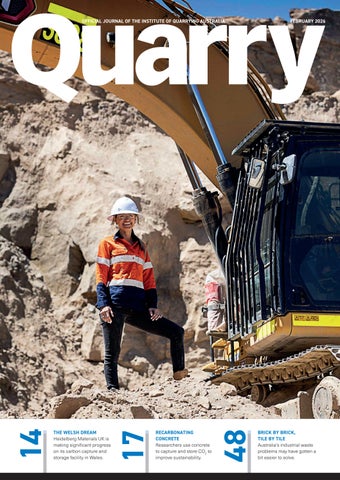
Heidelberg Materials UK is making significant progress on its carbon capture and storage facility in Wales.
RECARBONATING CONCRETE
Researchers use concrete to capture and store CO2 to improve sustainability.
Australia’s industrial waste problems may have gotten a bit easier to solve.
WELSH DREAM
BRICK BY BRICK, TILE BY TILE
IN THIS ISSUE
FEBRUARY 2026
VOLUME 35, ISSUE 2
Heidelberg
24 A resourceful showcase
The PNG Expo is an invaluable opportunity for the resources sector to connect.
26 Show up in Mackay
Queensland’s largest regional mining event is coming back to Mackay.
28 Anaconda in Australia
Onetrak has begun importing a new cone crusher to support quarries.
30 Taking a national view
Industry stakeholders have welcomed the release of Infrastructure Australia’s latest report.
34 Standing the test of time
Komatsu Australia’s Smart Quarry Site is helping quarry operators make informed decisions.
Industry stakeholders have welcomed Australia’s adoption of
36 The all-rounder
The Volvo EC530EL from Volvo Construction Equipment ticks all the boxes.
38 Smarter surface solutions
Quarry learns about a new road repair solution that can benefit the wider quarrying industry.
40 Below the belt
Kinder Australia is helping quarries eliminate belt damage and spillage.
42 Working closer together
The Bulk Handling Technical Conference and Expo plans to engage the quarrying industry this year.
44 Updated and advanced
Caterpillar has announced a series of updates for its range of Cat hydraulic excavators.
46 A step toward better safety
Excitement is building as the Institute of Quarrying Australia prepares to launch its national awareness campaign, That’s Solid, in 2026 in a major milestone for the Australian quarrying sector Image: IQA
The appointment of a new mining and resources coroner in Queensland aims to support worker safety.
BRICK BY BRICK
STAY ALERT, STAY ALIVE
Working in a quarry is an intense yet rewarding job. Days can be long and sometimes stressful. It’s not uncommon for people to feel exhausted afterwards.
However, if you push your body beyond its mental and physical limits, day after day with no time to recover, it can lead to fatigue.
Fatigue is more than just a feeling of sleepiness or drowsiness. It’s a feeling of exhaustion that gets worse gradually. It can cause headaches and dizziness, reduce reaction times, lead irritability, poor shortterm memory and concentration. In extreme cases, it can lead to near misses or worse.
That’s something you never want to combine with heavy machinery.
Poor sleep is one of the highest factors behind fatigue. If you’ve had less than six hours of sleep in the past 24 hours, or less than 12 hours in the past 48 hours, you might be at higher risk.
Workers will often feel fatigue after 16 hours of being awake, especially if they have had to concentrate for a long period
of time, or have been exposed to extreme heat or cold. Stress, anxiety, depression and illnesses can also make matters worse.
Any business conducting 24hour operations, including shift work, on call-duty cycles, call outs and incident response has an obligation to manage fatigue.
Fatigue is a symptom, not a condition. For many people, it is caused by a combination of lifestyle, social, psychological, and mental wellbeing issues instead of an underlying medical condition.
To find out what is causing fatigue, your doctor can provide an examination which may involve blood tests or imaging tests. If you feel fatigued, avoid working alone and speak to your friends, neighbours, and co-workers about checking in regularly. A minimum 10 hour break between shifts is also best practice to mitigate the risks of fatigue. Driving to and from work can also be dangerous. It can be helpful to make other arrangements – it could save a life.
William Arnott Editor
POOR SLEEP IS ONE OF THE HIGHEST FACTORS BEHIND FATIGUE. IF YOU’VE HAD LESS THAN SIX HOURS OF SLEEP IN THE PAST 24 HOURS, OR LESS THAN 12 HOURS IN THE PAST 48 HOURS, YOU MIGHT BE AT HIGHER RISK.
BUILDING THE FUTURE TODAY
Major events and initiatives are taking shape this year as we focus on workforce attraction and sector connection.
Following the success of Adelaide 2024, where over 635 delegates gathered from across Australia, this year we head to the Gold Coast from 6 – 8 October.
The energy and connections from Adelaide set a new benchmark –let’s make 2026 even bigger.
Three days of expert insights, the latest technology showcases, networking opportunities, and sector exploration await.
We’re bringing together leaders and international experts, more than 100 exhibitors showcasing the latest innovations, the IQA National Awards celebrating excellence across our sector, site visits to Gold Coast operations, networking events in a stunning coastal setting, and our rocking futures career showcase for schools and students to discover quarrying careers.
The Gold Coast Convention and Exhibition Centre provides an excellent venue for the event, with the added benefit of the Gold Coast’s beaches, dining options, and accessibility for those traveling from across the country.
Early bird registration is now open. For conference registration, sponsorship
opportunities, and exhibitor prospectuses, visit quarry.com.au.
WATCH THIS SPACE
Two major IQA initiatives are about to launch, working together to improve public understanding of quarrying careers and attract the next generation of talent.
That’s Solid: Our first national public awareness campaign features real stories from members across Australia, showcasing diverse quarrying career opportunities and the vital community role our sector plays. The campaign includes a dedicated career quiz, quarrying career stories and resources.
Following the campaign launch, we’ll introduce our School to Workforce Hub - an online resource hub connecting schools, students, parents, and career advisers with comprehensive quarrying career information, work experience toolkits, and pathway guidance.
These initiatives represent a major investment in positioning our sector for the future.
TWO MAJOR IQA INITIATIVES ARE ABOUT TO LAUNCH, WORKING TOGETHER TO IMPROVE PUBLIC UNDERSTANDING OF QUARRYING CAREERS AND ATTRACT THE NEXT GENERATION OF TALENT.
and connecting
Keep an eye out for more details coming very soon.
I look forward to working alongside many of you throughout the year as we continue building a strong future for our sector.
Jane Schmitt Chief Executive Officer Institute of Quarrying Australia
www.quarry.com.au
The IQA’s Strategic Plan 2023 to 2026 embodies the following vision, values and strategic priorities:
Thriving communities supported by a sustainable industry
Operational Priorities:
• Deepen industry participation
• Sustainable revenue streams
• Highly capable team
• Technological innovation
• Effective engagement
• Great governance
Strategic Priorities:
• Support industry participants with compliance and regulation
• Build a diverse and skilled industry
• Foster strong industry connectivity
IQA Contacts:
For all education, member and branch enquiries: Phone: 02 9484 0577
Email: iqa@quarry.com.au
Chief Executive Officer
Jane Schmitt
President
Michael Close
Company Secretary
David Cowie
Follow the IQA on our social media pages:
IQAustralia
the-australian-institute-ofquarrying/ iqaus
CONVERSATIONS WITH MICHAEL CLOSE, PRESIDENT
Michael Close interviews
Matec
Pacific managing
director and co-founder Edoardo Sommacal.
Michael Close: What made you decide to come on board as a national partner with the IQA?
Edoardo Sommacal: For us, it made sense to formalise what we’ve been doing informally for years –staying close to what’s happening in Australian quarrying. The sector here has distinctive challenges, particularly around water scarcity and environmental standards, and we learn a great deal from seeing how different operations tackle those issues.
The IQA brings together people who are actually running sites, dealing with regulations, solving practical problems. That’s valuable insight that helps us stay relevant and responsive to what operators genuinely need, rather than what we think they might need.
MC: Water has become a much more prominent conversation recently. What’s changed?
ES: Several things at once. Climate patterns are shifting – some regions have too much water creating handling problems, others face severe restrictions. Regulators are paying closer attention to discharge quality and environmental impact. Local communities are more engaged with how operations manage resources on their doorstep. What’s interesting is how these pressures are changing operational thinking. Ten years ago, water management was often an afterthought.
Now we’re seeing operations design it in from the start, looking at closed-loop systems, treatment capacity, how to handle seasonal variations. It’s become part of the core planning conversation rather than a compliance checkbox.
MC: How are Australian sites approaching these challenges?
ES: Australian operators tend to be quite pragmatic. They want to see test results on their actual materials, understand the engineering properly, know what’s realistic versus theoretical. There’s healthy scepticism about claims that sound too good.
We’ve noticed operations are often willing to invest in robust solutions if the long-term case stacks up, even when the upfront cost is higher.
That’s not universal everywhere.
The focus tends to be on total cost of ownership rather than just purchase price, which leads to different conversations about equipment life, maintenance access, spare parts availability.
THE INSTITUTE BRINGS TOGETHER PEOPLE WHO ARE ACTUALLY RUNNING SITES, DEALING WITH REGULATIONS, SOLVING PRACTICAL PROBLEMS.
and connecting
www.quarry.com.au
The IQA’s Strategic Plan 2023 to 2026 embodies the following vision, values and strategic priorities:
Vision:
Thriving communities supported by a sustainable industry
Operational Priorities:
• Deepen industry participation
• Sustainable revenue streams
• Highly capable team
• Technological innovation
• Effective engagement
• Great governance
Strategic Priorities:
• Support industry participants with compliance and regulation
• Build a diverse and skilled industry workforce
• Foster strong industry connectivity
IQA Contacts:
For all education, member and branch enquiries: Phone: 02 9484 0577
Email: iqa@quarry.com.au
Chief Executive Officer
Jane Schmitt
President Michael Close
Company Secretary
MC: What do you think matters most for operations trying to stay ahead?
ES: People who can think across disciplines. Someone who understands both the process engineering and the commercial pressures. Technical staff who can communicate with regulators and community groups. Operators who spot efficiency opportunities that might come from changing how three different things interact. That cross-functional thinking is increasingly important.
Michael Close, FIQ President Institute of Quarrying Australia
David Cowie
Follow the IQA on our social media pages:
IQAustralia
the-australian-institute-ofquarrying/ iqaus
OUT AND ABOUT WITH THE IQA
Victorian sub-branch smashes attendance records at Bendigo dinner
The Victorian sub-branch has set a new benchmark for member engagement, with 110 attendees gathering at the All Seasons Resort in Bendigo on 27 November – the largest turnout in the branch’s history.
The record-breaking event signals a significant surge in Victorian quarrying sector participation, reflecting growing demand for professional networking opportunities across the state.
Agile Screening executive director Ed Sill donated premium prizes, including a signed Hawthorn Football Club guernsey and wine bottles autographed by AFL coach Sam Mitchell. Tricon Equipment’s Cailean Woods also addressed the milestone crowd.
Comedian Anthony “Lehmo” Lehmann brought his trademark humour to the evening’s entertainment program.
The Victorian sub-branch continues the momentum with its next networking dinner in Geelong on 19 February 2026, with registrations already open.
Silica management and tech innovation take centre stage at SA seminar
Critical updates on silica risk management and the latest on geotechnical monitoring
technology headlined the South Australian Branch’s WHS Breakfast Seminar at the Adelaide Pavilion.
SafeWork SA’s Michael Paterson delivered timely guidance on silica risk management compliance, addressing regulatory requirements that continue to reshape operational practices across the sector.
In a significant development for the sector, Beiha Yanez from the Department for Energy and Mining unveiled a new quarry closure framework currently in development.
The comprehensive framework, complete with practical guidelines and tools, aims to
The Victorian sub-branch saw the largest turnout at the All Seasons Resort in Bendigo.
Images: IQA
Left to right: Tristan Throup, Beiha Yanez, Michael Paterson, Shelley Rowett and Michael Close.
IQA members explored the historic XXXX brewery facility.
SLR Consulting’s Tristan Throup demonstrated how unmanned aerial vehicle and terrestrial scanner technology is revolutionising geotechnical monitoring, offering operators enhanced site safety capabilities and real-time operational intelligence previously unavailable through traditional methods.
Mining and Quarrying Occupational Health and Safety Committee executive officer Shelley Rowett outlined the committee’s 2025/26 program, detailing initiatives designed to advance safety
standards across mining and quarrying operations statewide.
IQA president Michael Close, who hosted the seminar, also presented a technical member (TMIQ) certificate to Nicholas Falland from Barossa Quarries, marking another professional joining the Institute’s technical membership pathway.
The breakfast seminar drew strong attendance from SA quarrying professionals, reflecting growing sector engagement with emerging regulatory requirements and technological advances.
UPCOMING COURSES AND EVENTS
Queensland branch members connect at historic production facility
The IQA Queensland Branch brought members together for a unique networking experience, with a behind-the-scenes tour of the iconic XXXX Brewery at Milton.
Guests divided into tour groups to explore the historic brewery facility, gaining exclusive insights into the brewing process and production operations before enjoying a tasting session that showcased the end product.
The tour was followed by networking at the XXXX Alehouse, where members connected with sector peers over food and refreshments.
The relaxed atmosphere was enhanced by a best dressed Christmas shirt competition, with Alec Harries taking home the top prize.
Queensland branch deputy chairperson Jason Egan hosted the event, bringing together members for what has become a highlight on the Queensland quarrying calendar.
“This was a fantastic way to bring our members together in a unique setting while learning about another production sector,” he said.
The event was proudly supported by QuarryLink, with managing director Greg Lowe joining members at the function.
Queensland branch chairperson Blake Ardrey extended his gratitude to the committee members.
“Our committee’s dedication enables us to deliver exceptional events and networking opportunities for the Queensland quarrying sector,” he said.
The Queensland branch continues its strong events program with a RUD Factory Tour, Young Members Network and Women In Quarrying connect mastermind session on 5 February 2026, followed by a Wagners Pinkenba site tour and dinner meeting on 26 February 2026.
ROCK SOLID CAMPAIGN
Excitement is building as the Institute of Quarrying Australia prepares for the imminent launch of its national awareness campaign, highlighting opportunities in the sector.
Quarries support local communities, hire locals and provide materials that local projects rely upon, but often go overlooked.
Now, the Institute of Quarrying Australia (IQA) is preparing a national campaign that aims to elevate and showcase the sector and how it invests in local communities and people.
“The IQA is shining a light on the breadth of career opportunities available across the quarrying sector.
From technical and environmental roles to leadership and innovation, quarrying offers long-term, rewarding careers that many
“There’s a perception that quarrying is a narrow or traditional sector, and that couldn’t be further from the truth. This campaign showcases a sector that is technologically advanced, safety-led and committed to building a diverse, future-ready workforce.
“We want students and job seekers to see quarrying as a sector where they can grow, learn and build a career with purpose. This campaign is about opening doors and inviting the next generation to be part of an essential and evolving sector.”
The multi-faceted campaign will demonstrate how the sector can provide solid entry-level careers with long-term opportunities, including leadership positions, for current job seekers and senior leadership.
It will provide resources for communities, schools, and parents to help them understand that meaningful career opportunities are available in the sector.
“We’ve developed resources specifically for parents, educators and job seekers, so they have clear, accurate information about the opportunities available in the quarrying
“These resources are designed to support informed conversations. By targeting parents, educators and job seekers, we’re creating a shared understanding of how quarrying careers align with skills, interests and longterm employment outcomes.
“Through this, our aim is to remove barriers and open pathways into a sector that needs a diverse, skilled workforce.”
In preparation for the national campaign, the IQA has spent significant time engaging with its membership base and the sector to understand the sector’s needs, workforce requirements and outreach opportunities.
IQA members will be featured as part of the national campaign, sharing their own journeys and careers in the sector and why they chose to work in this important sector. These authentic videos will underscore how the quarrying sector supports Australian communities at the local level and why it can be a rewarding career path.
Schmitt said the membership and sector feedback had been integral to creating an impactful campaign that will raise public awareness of the sector and what it contributes to Australia.
“This national campaign has been shaped by direct feedback from IQA’s members and the quarrying sector. Employers have been clear about the workforce challenges they face, and this initiative reflects the skills, pathways and messaging the sector needs to attract its future workforce,” she said.
“We worked closely with members to ensure the campaign is practical and aligned with the realities of modern quarrying operations.
“By promoting quarrying as a viable career pathway, we’re strengthening the workforce pipeline for our members and the wider quarrying sector.” •
For more information, visit quarry.com.au
The IQA is preparing to launch a national awareness campaign.
The campaign is set to feature real-life workers from the quarrying sector.
Images: IQA
Bringing you our world of expertise
We are now better equipped than ever to help you to optimise your comminution and material handling operations for maximum performance, safety and efficiency.
Our industry leading expertise in crushing, screening, feeding, loading and wear protection allows us to bring you an unrivalled equipment line-up. We underpin this unique offering with our expert process knowledge, full range of digital tools, high quality OEM spare parts, consumables and life-cycle services.
Scan the QR code to discover why we are the industry’s partner in eco-efficient mineral processing.
THE WELSH DREAM
Heidelberg Materials UK has advanced its plans to deliver the region’s first carbon capture facility, securing strategic partners to support the project’s engineering, procurement and construction management (EPCM) requirements.
It marks a significant step in what is traditionally an emissions-intensive industry. Many countries consider the cement sector to be “hard to abate”, since carbon emissions are considerable throughout the production process of cement.
Given this reality, the major construction materials companies have begun investing in carbon-capture technology at various stages to reduce the sector’s overall carbon footprint, especially as entire countries look towards a net-zero emissions target.
While it comes at no small cost to invest in these solutions, it does enable the quarrying sector to move towards cleaner manufacturing and deliver more sustainable construction materials.
Heidelberg Materials UK’s decision to build a carbon capture and storage (CCS) facility at Padeswood in North Wales is one of the most ambitious and extensive efforts to reduce emissions in the industry to date.
“The new facility will capture around 800,000 tonnes of CO₂ a year from our existing works and enable the production of evoZero, the world’s first carbon-captured near-zero cement, on an industrial scale to help decarbonise the construction industry,” Heidelberg Materials UK chief executive officer Simon Willis said.
The UK-based producer recently moved one step closer to making that dream a reality by signing Mitsubishi Heavy Industries (MHI) and Worley to an EPCM contract. It builds on the existing relationships between the companies after MHI and Worley completed the front-end engineering design for the North Wales project. Under the terms of the agreement, MHI will be responsible for delivering the carbon-capture technology at Padeswood while Worley will lead the EPCM delivery. The Australian-based firm will also provide support across the project’s infrastructure development, technology integration, and commissioning.
“This project is a landmark for industrial decarbonisation in the UK and Europe and part of the HyNet carbon capture cluster.
We’re proud to be working alongside Heidelberg Materials and MHI to deliver a facility that will help transform cement production and support the UK’s net zero ambitions,” Worley chief executive officer Chris Aston said.
“Our role in this project reflects our ability to enable sustainable industrial solutions and leverage our global expertise in delivery for complex energy and infrastructure projects.”
Willis said that partnering with Worley and MHI was an easy decision.
“We have established an excellent working relationship with Worley and MHI during the completion of the front-end engineering design for our Padeswood project,” he said.
“This, along with their proven track record in delivering this type of complex facility, makes them the perfect partner to take our groundbreaking project to the next stage.
“This is the next major milestone in our plans to build the
Heidelberg Materials UK is making significant progress on its carbon capture and storage facility in Padeswood, Wales.
Construction is set to begin on Heidelberg Materials’ carbon capture and storage facility in Padeswood.
The storage process will take advantage of the HyNet infrastructure.
Images: Heidelberg Materials UK
UK’s first carbon capture facility at a cement works.”
The Padeswood project, which is considered part of the wider HyNet North West initiative, is expected to be operational by 2029 with around 50 new roles created at the Padeswood facility and up to 500 jobs supported during the construction phase. The facility will be capable of compressing captured CO2, which will then be transported via an underground pipeline and stored beneath the seabed of Liverpool Bay.
“It is fantastic to see North Wales at the forefront of carbon capture and the hundreds of new jobs being created by these projects will help drive regional growth as well as accelerating our drive towards lower bills and energy security,” Wales secretary of state Jo Stevens said.
INVESTOR CONFIDENCE
The Padeswood project progressed rapidly throughout 2025, with major achievements including planning approval, secured investment, and construction beginning before the end of the year.
The UK Government reached a final investment decision with Heidelberg Materials UK in September 2025, which paved the way for construction to begin on the project. UK energy minister Michael Shanks confirmed the funding for the project, describing them as “trailblazing” in their respective sectors.
“Our clean energy mission means good jobs, regional growth, and investment for local communities,” he said.
“These trailblazing projects showcase North Wales and the North West’s workforce
on the global stage – leading the charge in the clean industries of the future and powering Britain’s reindustrialisation.”
The Padeswood decision was announced alongside the UK government’s agreement with Encyclis’ Protos project at Ellesmere Port.
The latter will be a waste-to-energy facility and, alongside the Padeswood project, will be part of Eni’s Liverpool Bay transportation and storage network and the HyNet carbon capture cluster, which the UK Government approved in April 2025.
The HyNet cluster is effectively a mixture of new and repurposed infrastructure across the northwest of England and North Wales, with the capacity to capture and store carbon emissions in Eni’s permanent storage in Liverpool Bay.
Carbon Capture and Storage Association chief executive officer Olivia Powis said the support for CCS projects needed to continue if governments were serious about decarbonising ‘hard to abate’ sectors.
“Cement and energy from waste are two of the most difficult sectors to decarbonise, yet they are fundamental to our economy and way of life – from building new homes and vital infrastructure to managing society’s unrecyclable waste and providing reliable low-carbon power,” she said.
“These world-leading projects show how carbon capture can provide credible, scalable pathways to net zero, securing the future of essential UK industries and keeping businesses competitive in global markets.
“[It will] kickstart the UK’s new low-carbon cement market, driving economic growth in local communities.” •
DRUM CUTTERS
SMOOTH
OPERATOR
Simex TF Drum Cutters combine low vibration with consistent cutting performance, making them ideal for controlled excavation in quarries when conventional excavation or percussive systems have little e ect. The dual-drum design enables precise, selective removal of the rock mass while maintaining wall integrity. The resulting fragmented material typically achieves a grading that eliminates the need for further volume reduction.
Key Bene ts:
•Precise cutting
•Low noise and vibration
•Maintenance-free operation
Compatible with excavators from 2.5 to 70t, TF Drum Cutters deliver reliable productivity across a broad range of applications.
Calculate Your Production
Use Simex online tool to estimate hourly production and identify the most suitable TF model for your excavator and material type.
The carbon capture and storage process involves several stakeholders.
RECARBONATING CONCRETE
Cement is a major source of emissions – but what if concrete could be used to capture and store CO2?
The push to decarbonise Australia’s construction and infrastructure sectors is accelerating, but one material sits at the centre of the challenge: concrete.
Concrete is one of the most widely used construction materials in the world, but it comes with a major carbon footprint, one that is increasingly difficult to abate.
Boral head of sustainability and innovation, Dr Ali Nezhad, said this is exactly why the company is investing so heavily in lowercarbon materials and new technologies that change how concrete is made, used, and recycled.
“Concrete emissions come mostly from cement, which is the main binder,” he said.
“Almost 65 per cent of those emissions are hard-to-abate emissions incurred during cement manufacturing. So, carbon capture becomes an important decarbonisation lever to address that.”
“One challenge is the utilisation or the storage of that carbon,” Nezhad said.
“You’re looking for storage in places or in materials that you can reutilise somewhere. That’s more important from the environmental point of view and the financial point of view.”
Nezhad said that the team at Boral began searching for a material which can absorb CO2 and hold it permanently.
The answer lay in concrete itself.
The process of re-carbonation, according to Boral, is where carbon dioxide is absorbed by the concrete used in buildings and infrastructure through their service life and end of life phases.
“Concrete loves to absorb carbon dioxide,” Nezhad said.
“Studies have shown that concrete could absorb anywhere between 20 and 55 per cent of the process emissions from cement
manufacturing during the life of the building or infrastructure.”
For Nezhad and the team, that question became: what if this process could be engineered and accelerated?
“With that concept, we knew that concrete is good at absorbing carbon, and we knew we needed to store carbon in a material,” he said.
“Then the idea was, can we just use concrete to store the carbon emissions from our cement manufacturing?”
The breakthrough came through Boral’s recycling operations.
Construction and demolition waste already provides the company with significant volumes of crushed concrete, and crushing increases surface area, which in turn boosts CO2 absorption.
“If the concrete is crushed into a smaller body, that gives it a larger surface area and better absorption,” Nezhad said.
“Luckily, the crushed concrete we are looking for is the product of our recycling business.”
Boral demonstrated the system at larger scale, proving that crushed recycled concrete can effectively absorb captured CO2. But absorption was only half the battle; the material also needed to be useful.
The team then developed concrete mixes where natural aggregates were replaced with these re-carbonated aggregates.
“We had to demonstrate that it can be reused and utilised,” Nezhad said.
“You get two advantages. One is a reduction in the embodied carbon of concrete because of the carbon that’s going into those aggregates, and the other is the environmental benefit of reusing natural aggregates through recycling.”
According to Nezhad, concrete and asphalt together account for anywhere between 20 and 70 per cent of the embodied carbon of buildings and infrastructure.
“Our buildings and infrastructure can’t be decarbonised unless these materials are decarbonised,” he said.
Boral’s plan does not limit itself to carbonabsorbing aggregates.
Nezhad said that more than 90 per cent of concrete’s embodied carbon comes from cement, which typically makes up less than 15 per cent of the mix by weight. So decarbonising cement itself remains the biggest and most impactful lever.
“The first option you have is decarbonising cement manufacturing,” he said.
“If you have less emissions from cement, you can go a long way.”
Nezhad said that over the past five-six years, Boral has “accelerated its alternative fuel program,” shifting away from coal toward waste-derived options.
“We are now using 114 kilo tonnes of waste material instead of coal,” he said.
“That’s a massive source of reduction.”
Boral is also investing in alternative raw materials.
“We’re replacing limestone with precarbonated materials. Where it doesn’t need to be decomposed into carbon dioxide,” Nezhad said.
While full decarbonisation of cement manufacturing remains Boral’s goal, Nezhad
said that the company is also pursuing a second strategy: use less cement in concrete.
“A lot of our research and development goes into finding new ways to use less cement,” Nezhad said.
Nezhad said that supplementary cementitious materials (SCMs) such as fly ash and slag have long played that role, but supply constraints and performance limitations mean the industry needs to be innovative.
“One of Boral’s key focus areas is achieving high cement-replacement levels without compromising the properties of concrete,’ he said.
Nezhad said that the company is now working to push replacement rates to 70 per cent or higher, while also identifying new SCMs.
“One of the challenges we face is having access to enough materials to replace cement,” he said.
“We’ve made progress recently with calcined clay, but when cement manufacturing decarbonises fully, you’ll achieve your objective.” •
Boral has undertaken trials to prove crushed recycled concrete can effectively absorb captured CO2
ADOPTED IN AUSTRALIA
Industry stakeholders have welcomed Australia’s adoption of the low-carbon cement ratings from the Global Cement and Concrete Association.
Australia’s adoption of lowcarbon cement ratings from the Global Cement and Concrete Association (GCCA) has been praised by key stakeholders.
In December, Cement Concrete & Aggregates Australia (CCAA) hosted the launch for the “landmark” adoption of the low-carbon and near-zero carbon concrete, which brought the GCCA’s framework into an Australian context.
“Until now, different organisations have approached low-carbon concrete in different ways. This adoption creates a common reference point that the entire supply chain
can use,” CCAA chief executive officer Michael Kilgariff said.
“It provides clarity about how concrete is performing from a carbon perspective and supports more consistent decision-making on projects.
“We’ve taken a strong global framework and made sure it works for Australia. The extended strength range, alignment with local data and straightforward table format mean the ratings can be used immediately by both government and industry.
“This guide is another practical tool that supports those goals and helps project teams make clearer, more consistent
decisions about the carbon performance of concrete.”
The Australian framework provides a new guide for industry professionals who want to assess the carbon performance of concrete by using an AA-G ratings system. The system goes beyond the GCCA’s initial ratings by considering a broader range of strengths across the Australian infrastructure and construction sectors.
The GCCA launched its ratings system for low-carbon concrete and cement in April 2025 to standardise and increase transparency for stakeholders seeking to procure sustainable cement and concrete.
Under the GCCA’s framework, purchasers, including builders, architects, governments, planners, and consumers, can identify concrete and cement products based on their carbon footprint rating.
“Cement and concrete are the foundations of modern life – from the buildings we live and work in, to the roads we travel, and the infrastructure that supports clean water and green energy. As global demand for sustainable construction grows, the need for greater transparency around the carbon footprint of construction materials is more critical than ever,” GCCA chief executive Thomas Guillot said at the time.
“Our low carbon ratings system supports more sustainable procurement practices and will empower the entire value chain to accelerate decarbonisation.
“With this rating system in place, governments, policymakers and the private sector can now prioritise lower carbon
cement and concrete in the procurement process which will in turn further stimulate the industry’s focus on decarbonising these essential building materials.”
Both the GCCA’s concrete ratings, and the Australian adoption, classify the material based on global warming potential (GWP) and the specified concrete strength. Regarding these two metrics, the GWP is measured in kilograms of CO2e per cubic metre, while the strength rating assumes that higher concrete strength implies more cement used and higher emissions as a result.
The AA rating under the framework indicates near-zero emissions, in line with a 2050 net-zero target, with A to F ratings divided into intervals based on GWP and specified concrete cylinder strength (MPa).
The GCCA’s framework ranged from 20 to 50MPa, with the Australian adaptation covering 5 to 100MPa. This ensures the Australian framework is aligned with local
The global quarrying sector is increasingly pursuing low-carbon cement,
Cement is critical for infrastructure projects.
Image:
GDMatthews/stock.adobe.com
grade strengths, such as 32MPa. It is designed for use with third-party-verified EPD data, covering the emissions scope from A1 to A3 and compliant with ECO platform verification guidelines.
To create the adaptation, the CCAA worked with the GCCA and the Materials and Embodied Carbon Leaders’ Alliance (MECLA), using local environmental product declaration (EPD) data as well.
Cement Australia national technical manager Matthew Kerley said a rigorous, data-driven approach supported the Australian framework.
“We overlayed all of the Australian EPD data, and when we looked at the median EPD values, we saw a very strong correlation with the GCCA’s 20 to 50MPa bands, which, for us, validated the GCCA model,” he said.
“Once we knew we had a good correlation between our EPD data and the GCCA’s, we decided to extend that out to 100MPa.
This involved a lot of collaboration; we got feedback from the GCCA, we looked at the UK models that are already out there and engaged with MECLA.
“While we wanted to use our local EPD data and have this framework built for Australia, we also wanted to ensure this was practical. It is important to ensure that it is a consistent ratings system that could be used in the future.
“This process meant [the final result] was a data-driven but practical approach.”
Kerley said he was excited to see the framework be used within the sector.
“The aim is that this framework will be the basis for things like reporting and procurement. Getting a consistent language around these ratings is a first step,” he said.
The expanded strength range is something the GCCA could consider adopting into its concrete framework in the future, according to GCCA concrete and sustainable construction director Andrew Minson.
“[Australia] has taken the lead on widening the strength range. The strength of [Australia’s] EPD data means we think we’ve got a good foundation to now pick up what’s been done in this framework and adopt it into our global framework,” he said at the launch of the ratings,” he said.
“We’re delighted to have the strength of data [Australia] has and the thoroughness that the [CCAA] has used to justify this range, and we’ll be having a conversation now about extending our global ranges.”
Kilgariff said the Australian framework was a milestone achievement for the sector.
“This is an important milestone for our sector, one that will help drive lower-carbon outcomes across Australia’s infrastructure pipeline by supporting the procurement pull-through needed to scale lower-carbon concrete solutions, and in turn help deliver a more sustainable built environment into the future,” he said. •
Some consider cement production as a ‘hard to abate’ sector.
GET TICKETS
Australia’s largest regional mining event
A RESOURCEFUL SHOWCASE
The PNG Expo returns in 2026, and anticipation is already ramping up.
PNG Industrial Mining Resources Exhibition and Conference (PNG Expo) is committed to growing PNG’s mining, resources, and supporting infrastructure through strategic connections.
Prime Creative Media show director of mining events Rebecca Todesco said that PNG Expo is an exciting and valuable opportunity for the greater resources industry to connect.
“This is your chance to get your business in front of the right people, in the right market, and at the right time,” she said.
“We’re not just hosting an event; we’re bringing the industry directly to you.”
PNG Expo aims to bring together all sectors of the industrial, mining, and resources sectors together into one vibrant location.
The two-day 2026 exhibition will feature an array of equipment displays and stands across an expanded floorplan, while the conference will showcase experts from across the mining and resources sector presenting on challenges and opportunities for the local industry.
Networking is at the heart of PNG Expo, and in 2026, the resources industry will have the opportunity for high-impact meet-ups alongside informal catch-ups by the pool.
It is an invaluable chance to spark conversation, build relationships, and create long-lasting connections. Curated in collaboration with the PNG Mining editorial team, a free-to-attend conference program will also take place. The conference will cover all the critical issues that are impacting the future of the mining and greater resources industry, and sessions will feature thought-provoking discussions expert analysis, and practical advice for professionals.
In response to exceptional demand and significant year-on-year growth, PNG Expo 2026 will feature an expanded floorplan compared to previous showcases.
This will elevate the exhibition experience and support its continued trajectory as the region’s premier industry showcase.
The entire event will be hosted at a worldclass and secure venue, which will eliminate
the need for travel between sites and ensures a seamless experience for all attendees.
“The redesigned floorplan, to stronger content streams and bigger networking opportunities, it all showcases that everything we’re doing is designed to add value for both exhibitors and attendees,” Todesco said.
All the extra preparation for the 2026 event comes after strong showpiece events in 2024 and 2025.
At PNG Expo 2025, 65 per cent of attendees indicated they’re directly involved in the decision making proves at their companies.
Attendance saw a 10 percent increase in 2025, with 62 per cent of the attendees local to PNG. Todesco said delegates and exhibitors should sign up early and secure their positions at the premier event.
“Don’t wait to get on board,” she said.
PNG Expo 2026 will be held at the Stanley Hotel & Suites in Port Moresby from July 1–2, 2026. •
Secure your spoy not at pngexpo.com/getinvolved
Images: Prime Creative Media
In 2026, the PNG Expo will be held at the Stanley Hotel & Suites, Port Moresby.
The PNG Expo is an invaluable opportunity
SHOW UP IN MACKAY
Queensland’s largest regional mining event is coming back to Mackay. Here’s how you can secure your ticket.
The countdown is on for the Queensland Mining & Engineering Exhibition (QME) returningto Mackay, which will bring together several key heavy industrial sectors.
QME is the premier event for the Queensland mining industry to connect, explore, and experience the newest equipment and innovations from July 21-23.
The 2026 event is expected to be one of the largest, featuring hundreds of exhibitors, live demonstrations, free seminars, and many networking opportunities.
QME 2026 will bring together hundreds of leading suppliers, with industry heavyweights such as REMA TIP TOP, Regal Rexnord, Fulton Hogan, Pirtec, Epiroc, Hastings Deerings, Brooks/XCMG, and Flexco Australia.
Around 85 per cent of exhibition space has already sold, with limited outdoor space remaining.
The strong interest in early bookings reflects the industry’s dedication to three days filled with live technology demos, thought leadership, and achievements.
The exhibition floor’s centrepiece is the much-anticipated QME Mining Pavilion, a lively area where leading mining firms and major contractors will display their newest projects, innovations, and initiatives. The Mining Pavilion provides attendees with a
unique chance to connect directly with the organisations shaping Queensland’s mining future, offering insights into procurement and partnership opportunities, and helping forge meaningful connections within the thriving mining community.
Over three action-packeddays, the QMEconference will explore topicsincluding thefuture of coal, metals, and minerals; the push toward more sustainable mining; and the latest thinking in safety, mental health, and workforce wellbeing.
Sustainability and environmental, social, and governance (ESG) remain key themes for the resources sector, which is why QME 2026 will once again host the decarbonisation showcase.
This initiative highlights the technologies, strategies, and services that help mining companies reduce emissions, enhance energy efficiency, and fulfil their ESG commitments.
Prime Creative Media show director of mining events, Rebecca Todesco, said theQME2026isa key opportunity for the mining industry.
“If you want to know where the industry’s heading, QME is the place to be;simple as that,” Todesco said.
“Three days, hundreds of exhibitors, new tech across the expansive expo: QME is a
powerhouse of innovation for Queensland’s mining industry.
“We’ll be working closely with our industry partners and tapping into the editorial strength of our leading publications to bring together an insightful, impactful conference.”
The event benefits from the support of two key sponsors: Pirtek and Hitachi
Construction Machinery. While Pirtek brings valuable backing to the event overall, Hitachi
Construction Machinery takes a leading role as sponsor of the QME leadership series, a critical platform for advancing thought leadership and fostering the strategic conversations that will shape the mining sector’s future.
The 2026 event also benefits from strong partnerships with the Queensland Resources Council (QRC) and the Bowen Basin Mining Club (BBMC). QRC, Queensland’s leading resources body, further boosts QME’s importance by emphasising the event’s role in showcasing innovation and its contribution to Mackay’s regional economy.
BBMC will be hosting the esteemed Queensland Mining Awards in Mackay alongside the exhibition, strengthening the celebration of excellence and innovation. BBMC’s presence promotes networking and partnership opportunities that highlight Queensland’s leadership
The QME 2026 event is shaping up to be one of the best yet.
in mining equipment, technology, and services innovation.
“We’re incredibly excited to bring the Queensland Mining & Engineering Exhibition back to Mackay in 2026,” Todesco said.
“This event is where innovation, collaboration, and opportunity come together
and we’re looking forward to welcoming everyone to three days packed with innovation, learning, and networking.
“There’s a certain energy when the industry gathers in one place for QME that comes from shared challenges, bold ideas and a collective drive to lead the way forward.”
GT165 MOBILE SCREEN PLANT
With exhibition space rapidly filling and the excitement building, QME 2026 stands as the must-attend event for anyone serious about mining in Queensland. It’s where the sector’s biggest deals and boldest ideas are realised – in the heart of Mackay, at the centre of
maximising everything people know and love
“Attendees and exhibitors of QME 2026 can expect the kind of networking people know, love and have come to rely on, and the energy that only happens when the right people are in the same place at the same time.
“The 2026 event will take that to the next level.” •
To secure your tickets, visit queenslandminingexpo.com.au
Meet the ASTEC GT165 Tracked Scalper Plant
Engineered for unmatched efficiency and mobility, the ASTEC GT165 Tracked Scalper Plant delivers powerhouse performance right where you need it.
With a massive 10.5 cubic yard hopper, dual-deck vibrating screen, and hydraulic fold-out conveyors, it’s built to handle serious volume with precision and speed.
Whether you’re processing rock, soil, or recycled materials, its robust Cat Tier III diesel engine and track-mounted design mean you get maximum output with minimal downtime, even in the toughest terrain. Get the job done faster, cleaner, and smarter with the GT165.
QME will be held in Mackay, Queensland.
ANACONDA IN AUSTRALIA
Onetrak has begun importing a new cone crusher to support quarries seeking improved aggregate production.
In 2024, Anaconda Equipment unveiled its C12 Recirc Cone Crusher at the international trade show Hillhead.
Designed for secondary and tertiary mobile crushing applications, the new unit was the ideal tool for producing aggregates with good shape while reducing bottlenecks in the screening process.
Onetrak business manager Paul Kerr said he was excited to announce the first of the machines would be arriving in Australia this year.
“We have the first one arriving in February,” he told Quarry
“We’re already organising demonstrations with clients. It’s going to be a competitive and productive unit.”
The C12R Cone Crusher features an FLSmidth Raptor 250 cone chamber within an Anaconda tracked solution. Its 89mm throw within the crushing chamber enables faster, more effective crushing.
A higher eccentric throw reduces crushing zones, leading to a quicker passage through the crusher. The faster the material passes through, the higher the crusher’s capacity.
To optimise this, the advanced control system offers users intuitive operation and precise adjustments, making it easy to optimise performance for different materials and output requirements. The feeder is fitted with an ultrasonic
level sensor, which dictates the speed of the feeder to continuously keep the chamber choke fed, achieving optimum crushing productivity.
Choke feeding ensures the crushing chamber is consistently full, leading to more efficient and effective crushing. This practice helps maintain a uniform particle-size distribution, which can improve the quality of the final product.
Additionally, choke feeding minimises wear on the crusher’s components by reducing the stress and strain they endure, ultimately extending the machine’s lifespan.
Properly managing the feed can also enhance the crusher’s throughput, ensuring that operations run smoothly and efficiently.
Kerr said the C12R’s unique dual 12x5 screen box makes it stand out.
“The screen box can often be the bottleneck in the cone crushing capabilities. The C12R’s dual-screen box essentially doubles its screening capabilities,” he said.
“The top deck can act as a relief deck, improving the screening of fines in the remaining material.
“This innovative design ensures a more efficient separation process, reducing the load on the primary screen and extending its lifespan. Additionally, it allows for a higher throughput, increasing overall productivity and minimising downtime.”
The Anaconda C12R Cone Crusher offers a wide selection of liner options, including short and standard head configurations, with a range of closed side settings (CSS) from 6mm to 45mm, catering to fine, medium and coarse feed sizes.
The standard head and short head configurations provide different crushing capabilities, with a minimum of six liner options available.
It also features a quick-release screen box, which can be removed in around 15 minutes.
Kerr said the CR12’s quick set-up time was impressive for a machine of its size, as it can quickly and easily transition from transport to operation.
“The mobility of the C12R allows for seamless transitions between job sites, significantly reducing downtime and increasing overall productivity,” he said.
“The C12R also incorporates dust suppression systems, ensuring that it not only performs exceptionally but also minimises its impact on employees and the surrounding environment.
“It offers unrivalled access from ground level for daily maintenance requirements, ensuring all necessary tasks can be performed quickly and efficiently.”
Easy access helps to minimise downtime, as maintenance teams can quickly address issues when they arise.
The C12 Recirc Cone Crusher is designed for secondary and tertiary mobile crushing applications.
Images: Onetrak
Onetrak can also support its customers from seven branches located across Australia. The company offers ongoing training from the original equipment manufacturer and can draw upon a team with more than 135 years of combined experience.
Kerr said the team’s expertise is vital for the quarry industry and has helped inform Anaconda’s design.
“The crusher was built for a worldwide market,” he said. “It has been tweaked by our team, who drew upon decades of experience to ensure its suitable for Australian conditions from day one.
“The C12R is built to handle dust, heat, and comply with local regulations. It’s a versatile cone crusher that sits in the midrange of the market.
“We’re excited to release the crusher for the Australian market.” •
For more information, visit onetrak.com.au
•It can suit almost any plant configuration
•Fitted with a Cat C9.3B Diesel Engine rated at 415 horsepower
•Unrivalled access from ground level for daily maintenance requirements
•6.3m3 feeder fitted with twin drive motors, hydraulic wing extensions, twin coil metal detector and feeder bridge, Hardox wear liners
•Ultrasonic level sensor with feeder start/stop
•Radio remote control for tracks and feeder operation
•FLSmidth Raptor 250 cone
•Large variety of liner options, including short and standard head configurations, with a range of CSS
•Available with or without dual 12x5 screen box
•Screen box allows for increased tonnages
•Three-way split with an optional mids conveyor
•Radial recirc conveyor for closed or open circuit operation
•Main conveyor discharge height 3.8m
•Work lights
•Dust suppression
The C12R features an FLSmidth Raptor 250 cone chamber.
TAKING A NATIONAL VIEW
Industry stakeholders have welcomed the release of Infrastructure Australia’s latest report, which reveals a growing demand for projects nationwide.
Australia’s infrastructure pipeline continues to be driven forward by investment in housing and energy projects; however, future investment could be scuppered by continual workforce shortages.
Infrastructure Australia has released its annual Infrastructure Market Capacity Report, which provides a detailed picture of the state of the country’s infrastructure sector.
The report was headlined by continued growth in the nation’s five-year major public infrastructure pipeline which has risen by $29 billion compared over the past year to land at $242 billion. The regulator described the lofty amount as the “highest” it had seen since the annual report was launched five years ago.
“The pipeline shows governments are doubling down on energy transmission
and housing projects in a bid to meet their targets, while continuing to deliver the major transport projects we need to enable Australia’s productivity and liveability for decades to come,” Infrastructure Australia chief executive officer Adam Copp said.
The pipeline itself is a melting pot of projects, primarily utilities, as well as social housing and transport projects. The biggest growth area, according to the report, is in energy transmission and renewable projects, including wind farms and solar power. In contrast, transport projects make up more than 50 per cent of the overall pipeline.
The national infrastructure advisor created the Major Public Infrastructure Pipeline as a baseline measure for yearly infrastructure activity in the nation. It combines publicly funded infrastructure projects in New South
Wales, Victoria, Queensland, and Western Australia, valued at more than $100 million, alongside projects exceeding $50 million in the Australian Capital Territory, Northern Territory, South Australia, and Tasmania.
“Our analysis shows public and private sector ambitions to deliver renewable energy projects – transmission lines, solar, wind, and pumped hydro projects – are estimated to total $163 billion over the next five years, a significant proportion of which would be driven into our regions,” Copp said.
“With community buy-in, this mammoth investment presents a once-in-a-generation opportunity for these regions–but to unlock it effectively and ensure we have the people power to do the job, we need to turn the page on three decades of stagnating productivity in construction. We need to do more with less.”
The construction sector is currently 141,000 workers short of the required number to deliver the major public infrastructure pipeline.
WORKER CONUNDRUM
One of the major underlying concerns from the report is the projection that the sector is currently 141,000 workers short of the required number to deliver the major public infrastructure pipeline. The report forecasts this could grow to a potential 300,000-worker shortage by 2027.
In regional areas which are projected to see a rise in public investment to deliver more infrastructure projects, this issue could be exacerbated with greater workforce shortages. The report highlighted south east Tasmania, parts of Queensland including the Sunshine Coast and Toowoomba as well as areas in New South Wales including New England as spots which could see this demand increase in the coming years.
Copp said the organisation recommended a re-set in how Australia approaches delivering an infrastructure project.
“One of our key recommendations is for governments to incentivise the market to trial productivity-enhancing innovations such as Modern Methods of Construction which can then be scaled – just like the UK, US, and Singapore have done,” he said.
“We’re also recommending the development of consistent nationwide training programs to upskill workers in these innovations.
“We need to start investing in innovation rather than fixating on delivering at the lowest possible cost.”
The worker shortage is not a new concern to those within Australia’s infrastructure sector and related industries. However, industry stakeholders have said there was a degree of nuance to the shortage in the short-term but expected the issue to “intensify” in the longer term.
Australian Constructors Association chief executive officer Jon Davies said significant capacity exists in many areas to
CRUSHE R & SCREEN SA L ES PTY LTD IMS DI ST RIBU TOR for Aust ralia, Papua N ew Guine a and South East Asia
IMS
undertake infrastructure projects right now across Australia.
“Many large construction businesses are currently reducing their workforce due to delays in bringing projects to market, particularly in the energy sector, so clients who act now can access experienced teams ready to deliver at a price that will not be achievable in just one- or two-years’ time,” he said.
Track Blenders in Stock for Sale and Hire
| www.ims-ltd.ie
IMS have added the new BP1200-48TB track electric twin power blender to its impressive collection of blenders and pugmills, the new BP1200-48TB has four separate fe 12m3 each. All feed hopper conveyors are fitted with belt scales recording system that can be operated from an iPad or phone from its own Wi-Fi system from a loader or site office. A Cat C7 Generator powers the Nord electric motors a speed to each feed hopper conveyor. The generator can be connected to mains power and could power an extra 24-meter radial stacker increasing the stockpile capacity.
BP1200-9TB twin feed hopper blender with mixer and water adding system
BP1200-48TB four hopper blender, diesel electric can connect to mains power
The worker shortage is not new to those Australia’s infrastructure sector and related industries.
Davies pointed to the need for AUKUS facilities and Olympic infrastructure as well as standard infrastructure updates as some of the drivers of longer-term pain when it comes to the worker shortage.
“The looming workforce crunch is a wakeup call. Improving productivity is the answer and it will require governments industry and unions to work differently,” he said.
“We have a once-in-a-generation opportunity to align governments, industry and unions to deliver a more productive, sustainable and inclusive construction sector.”
Master Builders Australia shared similar sentiments when responding the release of the 2025 Infrastructure Market Capacity report. The association, which the building and construction industry, said the “persistent” workforce shortages had the potential to derail the infrastructure pipeline.
“The gap between labour demand and supply in critical infrastructure trades, civil construction, concreting, formwork, plant operation, engineering and project management, is now one of the most severe in the economy,” Master Builders Australia
“The challenges are particularly acute in regional and remote areas, where infrastructure investment is essential to support population growth, connectivity, and improved community services.
“Industry is doing its part through investment in training, apprenticeships and upskilling, but the sheer scale of demand cannot be met without coordinated national action.”
The association called for action at federal and state government level to provide improved pathways into the construction workforce. The association has suggested faster skills recognition, streamlined migration pathways, and targeted incentives for apprentices and employers as potential options.
“If we want to deliver the homes, infrastructure and productivity gains Australians expect, we must ensure the civil construction workforce is equipped, expanded and properly supported,” Wawn said.
SUSTAINABLE CONSTRUCTION SUPPORT
The report made a specific effort to spotlight the state of play when it comes to lower
It comes on the heels of Infrastructure Australia’s Embodied Carbon Projections report which estimated that across 202223, the upfront embodied emissions of Australia’s buildings and infrastructure sector accounted for seven per cent of national emissions. This figure incorporates emissions from manufacturing building materials.
While the infrastructure sector is already investing in some lower emission materials, including lower carbon cement and lower carbon cementitious products, and recycled materials have shown some promise to lowering emissions, the report
Earlier this year, the Federal Government released its Transport and Infrastructure Net Zero Roadmap and Action Plan (Transport Sector plan) which highlighted the importance in shifting to lower emissions construction materials. It highlighted the potential benefits of using these materials as a means to strengthen local material supply, with procurement a key pathway to achieving this.
Several governments have introduced sustainable procurement policies including Victoria’s Recycled First Policy, Western Australia’s Transport Portfolio Sustainable
Infrastructure plays a key role in Australia’s wider society.
Infrastructure Policy and New South Wales’ Decarbonising Infrastructure Delivery Policy while the Federation Funding Agreement Schedule (FFAS) on Land Transport Infrastructure Projects also promotes reporting on the uptake of recycled content in infrastructure projects.
Cement Concrete and Aggregates Australia chief executive officer Michael Kilgariff said procurement would be a key method to decarbonising the infrastructure pipeline.
“To deliver this pipeline, governments need smarter procurement that values quality, resilience and lower embodied carbon, not just the cheapest upfront bid,” he said.
“Consistent market pull for modern construction materials is essential if we’re to meet both delivery and decarbonisation goals.
“Our members are already supplying low-carbon concretes using fly ash, slag, silica fume, calcined clays and recycled fines; what’s missing is a clear, consistent demand signal.
“This kind of market pull is one of the most practical steps we can take to support productivity, sustainability and delivery of the pipeline.
“If we align procurement, standards and project pipelines, we can maintain the flow of essential materials while accelerating uptake of lower-emissions products, turning today’s record pipeline into long-term economic, social and environmental value.” •
The construction sector is currently 141,000 workers short of the required number to deliver the major public infrastructure pipeline.
Industry leading solutions
Purpose built fleets tailored to quarry site requirements
OEM backed support, service and technicians
24/7 service Australia wide
Expert advice and analysis
Late model, low hour fleet
STANDING THE TEST OF TIME
Komatsu Australia’s Smart Quarry Site is helping quarry operators make informed decisions.
When it comes to fleet management solutions, Komatsu Australia’s Smart Quarry Site (SQS) has stood the test of time.
The SQS platform, developed in Australia, has been used worldwide across many quarrying applications. Instead of isolated systems and relying on “gut feel”, SQS provides a single source of truth, bringing together data, operator performance, site safety and maintenance into a single platform.
Komatsu Australia product management for Smart Quarry Site Shaun Kean said part of the reason was that SQS helped quarries deal with modern problems.
“Smart Quarry Site has been in the market for several years now, and the reason it’s still so relevant is that the challenges in quarries haven’t gone away; they’ve intensified,” he said.
“Most operations are under pressure to move more tonnes with fewer people, while managing fuel costs, safety obligations and emissions. SQS was built specifically for that world.
“Over time, we’ve evolved the SQS system –adding things like CO₂ and fuel burn insights, enhanced electronic pre-start checks, safety and machine health views, and more powerful utilisation and operator scorecards.”
“It gives site and project managers an ata-glance, near-real-time view of production, machine utilisation and material movement across the entire quarry – extraction, haulage, dumping and stockpiles – on one platform.”
SQS was developed by Komatsu Australia in partnership with its subsidiary iVolve, in direct consultation with operators in the quarrying sector. Their feedback, as Kean said, ensured that the metrics were important to the daily running of a quarry operation.
Because of this, SQS can integrate directly with a machine’s telematics and onboard sensors. As a brand-agnostic tool, SQS can work within a mixed fleet set-up as well as Komatsu equipment and provide actual machine-reported values. Compared with reverse-engineered or interpolated data, machine-reported data is often more accurate, allowing operators and managers to use it confidently when making decisions. By integrating into the machine’s telematics, SQS can provide real-time feedback to the operator as they perform daily tasks. Operators can receive realtime insights into payload accuracy, target destinations and operating behaviour. This feedback is delivered into the cabin and can help operators achieve consistent payloads, reduce idle time, and avoid overloading machines.
Kean said that through this function, SQS became a continuous-learning tool that could boost on-site productivity.
“Because we designed SQS with quarries and major civil jobs in mind, not generic transport or mining, the insights, feedback, dashboards, reports and terminology are very ‘quarry fluent’,” he said.
“This means that SQS differs from other options in a few key ways. One of them is that real-time feedback for operators can be displayed on the cabin screen. This feedback can help them self-correct and improve as they operate the machine.”
SQS goes beyond site productivity, in line with Komatsu’s aim to support the entire quarry ecosystem. Safety is fundamentally important to the quarrying sector, which is why it is a cornerstone of the SQS platform.
SQS includes electronic pre-starts and defect workflows to help operators identify and address safety issues. As all defects are digitised and time-stamped, maintenance teams can spot recurring issues that increase downtime and intervene with a proactive preventative maintenance strategy that enhances compliance and machine uptime. This also avoids the need to record pre-starts on paper and ensures a transparent approach to safety across the whole quarry operation.
The platform also provides animated visualisations of every production movement from loading to machine movement to the site circuit. This provides managers with a comprehensive, at-a-glance view of activity within the quarry to ensure oversight of safe operations and key performance indicators, including cycle time, fuel burn, and machine uptime.
“The benefits of SQS go beyond telematics. It is effectively a production and safety tool for quarries that happens to use telematics,” Kean said.
“We built the dashboards with input from industry experts and end users so that they show the information supervisors actually need, updated in five-minute increments and available in configurable reports.
“We have seen that customers who use SQS typically see improvements in productivity, fuel efficiency, idle time and
Smart Quarry Site can support the entire quarry operation.
safety within the first year. Many sites achieve a return on investment in less than 12 months.”
In one case, an Australian hard rock quarry used SQS to analyse truck cycle times and its loader utilisation rate. The SQS data showed that trucks were queuing at the crusher despite a second loading unit being underutilised.
With the help of SQS, the supervisors used the haul-circuit analysis to adjust the loader placement and rebalance its operational fleet.
This led to the quarry achieving reduced cycle times, increased tonnes-per-hour and lower idle time and fuel burn.
Another quarry used SQS’s in-cabin operator feedback, along with real-time alerts for exceeding speed limits and gear selection, to help operators self-correct when transporting material down a steep haul road.
The results showed a significant reduction in speeding incidents and reduced brake wear, which also helped with maintenance costs.
“When we talk about return on investment, we talk about the dollar value a lot, but there are so many other things that also go into it, which SQS can provide,” Kean said.
“There’s an enhanced safety aspect, improved operator performance from the continuous feedback, and these factors not only support the return on investment, but they also help the quarry’s bottom line.”
SQS can provide near-real-time insights to support informed decision-making.
Komatsu Australia’s team provides support to all of its SQS customers from conception to commissioning of the tool across its fleet. They can help operators, managers and supervisors learn how to interpret the data and get the most out of it for their operations. Kean said digital tools like SQS are going to play an increasingly important role in the quarrying sector.
“We know quarries will continue to evolve their fleets over time; SQS gives them a stable, OEM-agnostic digital platform to grow with,” he said. “At the moment, we’re seeing
quarries evolve rapidly, and digital tools like Smart Quarry Site will be central to how operations run over the next decade.
“SQS will enable quarries to shift from reactive to proactive decision making, which will improve productivity and safety. As quarries become integrated digital ecosystems, SQS can be that central platform that ties together production, machine health, safety insights and operator behaviour.” •
For more information, visit komatsu.com.au
LEADING PRODUCTION OPTIMISATION
THE ALLROUNDER
Volvo Construction Equipment has designed the Volvo EC530EL excavator to be a versatile option for quarry operators and a natural partner to the EC550EL.
The Volvo EC530EL has already proven itself to be a standout 50-tonne crawler excavator for Australian quarries and contractors, and it now sits alongside a powerful new sister model, the EC550F, offering customers even more choice in Tier 3 and Stage V configurations. Both machines deliver the kind of performance, comfort, and fuel efficiency more commonly associated
THE ALLROUNDER: EC530EL
The Volvo EC530EL has become a go-to excavator for CJD Equipment customers seeking a fast, quiet, and highly productive 50-ton machine that consistently outperforms its weight class. CJD Equipment regional sales manager Jack Trewin said the EC530EL is “a slept-on option” that matches the performance of many 60-tonne excavators,
Volvo designed the EC530EL for heavy-duty digging, mass excavation, and large site preparation, then focused on the small details that make a big difference to daily operations. Operators benefit from a next-generation electro-hydraulic system with independent metering valve technology, delivering up to a 25 per cent improvement in fuel efficiency over previous models by optimising engine and pump performance. Paired with the ME (Mass excavation) boom and arm configuration, along with a large bucket, is a match for the 30 to 40 tonne Volvo hauler. The EC530EL can reduce loading passes and cycle times, boosting productivity by up to 20 per cent in some applications.
COMFORT, CONTROL, AND UPTIME
In the cab, optional features such as Comfort Drive Control allow steering via advanced joystick rollers rather than pedals, reducing fatigue and making the machine easier to operate in repetitive applications. Boom and arm shock reduction technology helps smooth out the ride, creating a more comfortable environment that supports operator health, productivity, and retention over long shifts. Feedback from CJD customers consistently highlights that the EC530EL is quick, quiet, comfortable, and powerful, a combination that operators are proud to work with day after day. Maintenance is streamlined through easy access to key service points and three-point right-hand-side access to the upper structure, helping technicians work safely and efficiently. A super-rigid, reinforced undercarriage, combined with robust upper and lower frames, provides the strength expected from a much larger excavator. Extended service intervals further support uptime. Optional Volvo technologies, such as Volvo CO-Pilot and ActiveCare telematics, provide owners with greater visibility into performance, utilisation, and health, helping to keep machines running smoothly and costs under control.
“THE VOLVO DIFFERENCE” IN THE 50TONNE CLASS
Since its launch in 2021, the EC530EL and EC550EL have been recognised for delivering true 50-tonne versatility,
The Volvo EC530EL has been popular with CJD Equipment customers.
with digging forces and lifting capacity usually associated with 60-tonne machines. According to Volvo CE, the EC530EL offers the highest engine power in its class, high tractive force, and strong swing torque, enabling it to move more material faster in demanding quarry and civil environments.
As Trewin said, “Everyone makes a 50-tonne digger, but no one makes it quite like a Volvo”, from operator comfort and serviceability to outright speed and productivity.
That attention to detail is reflected in features that operators and owners notice every day: intuitive controls, excellent visibility, thoughtful access points, and the
kind of reliability that keeps fleets running rather than waiting for repairs.
For many CJD customers, that combination has created long-term loyalty, with some operators running nothing but Volvos for decades after experiencing the difference in real-world conditions.
ENTER THE EC550EL
Building on the success of the EC530EL, the Volvo EC550EL has been available in Australia as its natural sister model in the 50-tonne class, delivering even more heavyduty capability for high-production quarrying and large infrastructure projects.
Engineered
Like the EC530, the EC550 platform is engineered to offer 60-tonne performance, with a reinforced undercarriage and structures designed for sustained work with larger buckets and heavier loads.
The EC550EL is available to Australian customers in both Tier 3 and Stage V engine variants, giving fleets the flexibility to align with local emission requirements, site policies, and fuel strategies while retaining the same core Volvo performance DNA. Equipped with the same next-generation electro-hydraulic system, the EC550EL shares the fuel efficiency gains of its sibling.
TWO TRUE 50TONNE WORKHORSES, ONE NATIONAL PARTNER
The EC550EL provides Australian quarry, mining, and civil operators with a powerful one-two punch in the 50-tonne range, complementing the all-round versatility of the EC530EL. CJD Equipment supports customers before, during, and after the sale, with expert advice on specifying the right configuration, operator training options, and proactive support via Volvo’s digital tools.
For quarry, mining, and construction businesses seeking to advance into a new generation of 50-tonne performance, the EC530EL and its sister model, the EC550EL, set a new benchmark for what a Volvo excavator can achieve on Australian sites. •
For more information, visit cjd.com.au
The EC550EL from Volvo CE is a natural partner to the EC530EL model
SMARTER SURFACE SOLUTIONS
Quarry learns about a new road repair solution with an application that can benefit the wider quarrying industry.
SIMEX has introduced two major advances in surface-processing technology: the ART 1000 Gen II asphalt regeneration system and the latest evolution of its TF Drum Cutter range.
While these innovations benefit civil contractors and road authorities, they also offer significant advantages for quarry operators seeking efficient surface maintenance, selective extraction, and safer, more controlled rock processing.
REBUILDING QUARRY ROADS,
AND ANY
ROADS,
WITH WHAT’S ALREADY THERE Roads leading to quarries are among the most heavily trafficked surfaces in the construction materials sector. Continuous truck movements, turning zones, and stockpile areas can deteriorate quickly, demanding frequent patching or resurfacing. Traditionally, this means trucking in new asphalt or aggregate and removing failed material, an expensive and timeconsuming cycle.
The SIMEX ART 1000 Gen II presents a different approach. The system repairs damaged asphalt using 100 per cent of the existing road material. It mills the surface, refines it, injects a rejuvenator, and lays it back down in a single pass.
For quarry operators, this brings clear benefits, including reduced truck movements
on-site and around the quarry, lower material costs by eliminating the need for imported asphalt, and faster reopening of internal haul roads, improving productivity.
The dual-drum system handles milling, grain-size reduction, and final mixing, producing a recycled bituminous blend that can be compacted immediately. Even mixed surfaces containing traces of cement mortar, common in areas disturbed by service installations, can be restored cleanly.
A SMARTER, MORE OPERATORFRIENDLY GEN II
The upgraded ART 1000 Gen II includes a new onboard electronics package that delivers real-time performance data such as material throughput, rejuvenator dosage, and progress metrics. Precise dosing control allows adjustments down to 0.1L per minute, and automatic calibration ensures correct additive application at varying carrier speeds, especially useful for long or uneven quarry roads. LED indicators help operators maintain optimal working speed, improving mix consistency and reducing the risk of rework. For quarry managers looking to extend asset life, reduce maintenance costs, and keep haul routes operating smoothly, the ART 1000 Gen II sets a new benchmark in sustainable road rehabilitation.
PRECISION ROCK CUTTING FOR QUARRIES AND MINES
While the ART technology optimises road surfaces, SIMEX’s TF Drum Cutter range continues to shine in tough geological environments, from underground tunnels to open-cut quarries.
Simex has a trusted range of dealers in Australia who support its products. A render showing the capabilities of the ART 1000 Gen II.
Images : Simex
Quarrying increasingly demands tools that can manage harder, more abrasive deposits with precision and minimal disturbance. In many situations where traditional excavation or blasting is too disruptive, too costly, or restricted, mechanical drum cutters offer an effective alternative.
A recent underground gold mine project in Western Australia demonstrates the capability. Byrnecut Mining used a SIMEX TF850 Drum Cutter to shape soft limestone in a confined portal expansion.
Blasting was not viable due to fragmentation risks, and the narrow workings required a compact, controllable tool.
A modified Volvo ECR235E excavator with a 360° rotator and 140° actuator, engineered by Total Rockbreaking Solutions, allowed the TF850 to grind the face cleanly, keeping vibration and noise low while protecting wall stability. A dust suppression system further improved operator comfort and safety.
SELECTIVE EXTRACTION AND PROFILING: KEY ADVANTAGES FOR QUARRIES
A variety of tooth geometries further refines performance, allowing operators to switch between mixed materials, extremely hard substrates, or fine finishing work. In many cases, the material produced by the TF range is already crushed to a usable size, reducing the load on downstream crushers and improving overall plant efficiency.
II and TF Drum Cutter range speak directly to these needs.
NEW: THE MOBIREX MR 100 i NEO
Whether maintaining kilometres of internal haul roads, profiling benches, or selectively extracting rock, SIMEX’s latest technologies help quarries work cleaner, safer, and more productively, setting a new standard for modern surfaceprocessing equipment. •
For more information, visit totalrockbreaking.com.au
Efficient when & where you need it – the MOBIREX MR 100 NEO mobile impact crusher! With its compact dimensions and low transport weight, this machine is amazingly flexible, fast and versatile. The MR 100 NEO sets an all-new benchmark in the compact class – with highlight features such as automatic crusher gap adjustment or Lock & Turn Quick Access for tool-free, safe crusher opening in 30 seconds. Choose between two drive versions: the electric E-DRIVE or direct D-DRIVE. The MOBIREX MR 100i NEO: ready, set, crush!
www.wirtgen-group.com/mr-100i-neo-kleemann
K-Containment seal is a high-performance, low-friction engineered polyurethane system that offers exceptional wear resistance.
BELOW THE BELT
Kinder Australia is helping quarries eliminate belt damage and spillage with improved support systems.
Ohau Quarry, a New Zealand aggregate supplier, was facing issues with rock getting past the skirt, resulting in significant damage to the belt.
A large, sharp-faced rock would strike the belt, requiring a change-out every three months.
The friction between the rock on the belt, the belt surface, and the bottom of the skirt board when the belt sags was also leading to entrapment damage. Kinder engineering manager Bradley Owen said the conveyor belt is the most important and most expensive component in a conveyor system. While all belts will wear out over time, it’s important to avoid damage where possible.
“A major cause of damage to a belt is skirt induced grooving caused by the space between idlers being too large. It’s as simple as that,” he said.
“With traditional rollers, it’s impossible to eliminate belt sagging. It doesn’t take too much sag before the material can escape past the skirt.
“The more material that is allowed to escape, the bigger the risk that abrasive material can become trapped in the conveyor system and cause damage to the belt. As the skirts wear, you also get a bigger gap, allowing bigger material to escape –accelerating the wear.”
Kinder’s solution to this problem is simple–a belt support or impact cradle system that replaces rollers with slider rails.
The K-Sure belt support system is designed to provide consistent, stable support for the troughed conveyor belt profile by reducing the number of rotating conveyor components.
It uses the existing conveyor idler frames and centre conveyor roller.
The wing rollers are then replaced by the K-Sure belt support system’s universal adaptor brackets and low-friction polymer belt support rails. There are no pre-engineering, adjustments or special tools required.
Owen said the slider rails create a flat surface for the belt to run on, which, when combined with the right skirting system, can create the perfect seal to eliminate spillage and dust.
“If a quarry is having issues with belt damage or sag, we can review the design data and then harness our expertise to build the support required for their system,” he said.
“Once we know the belt speed, the material you are conveying, where the application is on site, and such, we can then find the best option for the client.
“We specifically customise our designs to suit the transfer point because there are so many different options and factors that need to be considered.”
In addition to the K-Sure belt support system, Ohau Quarry installed the K-Containment seal.
K-Containment seal is a highperformance, low-friction engineered polyurethane system that offers exceptional wear resistance. The slotted arrangement allows for installation adjustment, ensuring that material cannot be entrapped, leading to premature belt damage.
In many cases, the outer flexible seal is ineffective in controlling spillage, as an unsupported belt trying to contain the full weight of the material load would be inadequate.
Instead, to effectively contain bulk material, a K-Containment seal is installed inside the chute to handle high internal pressure, reducing the load on the skirting seal.
Owen said updating the belt support as well as the skirting system is vital to effectively eliminate belt damage.
“The first thing someone will think about when looking to seal their conveyor is skirting, but what gets overlooked is what is happening below the belt,” he said.
“If there’s not adequate support, then the material will just escape when the belt begins to sag.
“Sometimes it’s more cost-effective to improve the belt support than it is to reinvent the skirting system.”
Since installing the K-Sure belt support system and K-Containment seal, Ohau Quarry reported to Kinder that there have been no issues with belt sag or damage, and that the same belt has continued operating for up to two years.
Owen said innovation is at the heart of Kinder’s business, which is why the company has a full-time research and development team that focuses on developing new products to tackle common conveyor conundrums.
One of the new products the team has developed is the K-Superskirt Defender series. Skirt grooves are a common issue in conveyor systems, resulting from the accumulation of bulk materials and fines.
When fines leak under hard skirts, they form abrasive clumps that rub against the belt’s top cover, exacerbating groove formation over time and causing irreversible belt damage. These grooves pose significant risks to conveyor belts, leading to premature wear and unplanned downtime.
K-Superskirt engineered polyurethane defender features a thicker bottom base specifically engineered to prevent material build-up from settling and sticking, minimising the formation of skirt grooves.
The company also offers dedicated training days to help quarry maintenance teams spot potential issues, along with some of the common fixes.
“We have a lot of knowledge that we want to share with the industry,” Owen said.
“It’s also an opportunity for them to hear from other people within the sector and their own organisation.
“We also learn a lot about the problems quarries are facing, which can guide our own research and development.” •
The K-Superskirt engineered polyurethane defender prevents material build-up from settling and sticking.
WORKING CLOSER TOGETHER
The Bulk Handling Technical Conference and Expo plans to engage the quarrying industry this year.
The bulk handling sector will come together for the industry’s only dedicated exhibition and conference, the Bulk Handling Technical Conference and Expo (BULK2026), at the Melbourne Convention and Exhibition Centre from September 16–17.
Despite being a bulk handling event, other relevant industries like the quarrying sector are being advised to attend.
Prime Creative Media general manager of events Siobhan Rocks said that BULK2026 is an invaluable opportunity for those in the quarrying industry to network and to learn more about the latest and greatest innovations that are driving relevant sectors forward.
“Although it’s centred around bulk handling, BULK2026 is absolutely relevant to other associations such as grain and quarry, because we know that Victoria is a central location for grain experts and construction, quarry, and aggregates,” she said.
BULK2026 brings together Australia’s bulk handling and quarrying industries, offering a unique platform to connect with a wide audience, meet new clients, and explore the latest technologies in the sector. The event also highlights critical industry topics, including sustainability, workforce safety, and supply chain resilience.
Rocks said that after a successful event in 2024, the show will now feature a dedicated technical conference.
“When we ran BULK in 2024, it was mainly an exhibition, so we had a lot of great exhibitors demonstrating their products,” she said. “But in 2026, we are getting back to what we think is the most important thing for a bulk handling event, which is to focus on the technical conference. BULK2026 is really about the content first, supported by the exhibition.
“We are being guided by Australian Society of Bulk Solids Handling and TUNRA, who will curate the program.”
The exhibition still remains a core component of the event and several leading companies have been locked in as exhibitors,
BULK2026 will include a focus on technical information for the bulk handling sector.
including Hawk Measurement Systems (HAWK). The company’s product manager of fibre optics Mathew Cook said he is looking forward to building upon a strong outing at the previous expo.
“We were very successful at BULK2024, and we are looking forward to another positive exhibition,” he said.
“A couple of things went really well at BULK2024, and we want to expand upon these moments to deliver a great exhibition for customers and clients. I knew that I was in the right place when I saw a customer who bought HAWK’s first solution, without knowing that they would be attending.”
Established in 1988, HAWK has won several awards for their breakthrough technologies. Cook said the company has its own research and development team.
But what HAWK really wants to demonstrate at the show is its ability to make product for a market that is tried and tested.
“At BULK2026, we really want to push our conveyor health monitoring system, which is the fibre optics that we place on the conveyor belt,” he said.
“Our focus is going to be primarily on conveyor belts and end user experience.”
BULK2026 will be collocated with MEGATRANS, Australia’s largest integrated conference and exhibition dedicated to the logistics and supply chain industry.
“Despite being different events, we know that supply chain logistics and the bulk handling communities are really interconnected,” Rocks said.
“We are also excited to change what we’re doing from a networking perspective.
“For the first time ever, we are going to have a dedicated network evening.”
Experts and industry figures will have the opportunity to explore the latest in research, practical case studies, and innovations that are shaping the future of bulk materials handling.
Attendees will be provided with an invaluable technical conference, central to the event, and a chance to meet people to grow and expand operations.
“At BULK2026, exhibitors can expect real leads and projects, engaging directly with professionals who are actively seeking bulk handling solutions,” Rocks said.
“The event offers unmatched exposure, giving your brand the chance to shine in front of one the bulk sector.”
Get involved at bulkhandlingexpo.com.au •
BULK2026 will include several networking opportunities for attendees.
UPDATED AND ADVANCED
Caterpillar has announced a series of updates for its range of Cat hydraulic excavators.
As part of its 2025 annual product update, Caterpillar has revealed key product updates will be rolled out to its excavator line-up.
The wide-ranging updates are designed to help improve machine efficiency and performance in daily operations. Among the updates are enhancements to Cat Grade technologies, a new user interface, and an advanced payload option for Cat track excavator users. The updates will be applied to Cat small, medium, and large excavators, plus material handlers, wheeled excavators and Cat specialty machines. Caterpillar senior global product consultant for excavation Jason Ho said the updates will help operators do more work without delays.
One of the headline updates from the 2025 APU announcement confirmed that Cat Grade with Advanced 2D features and functions are now integrated into standard Cat Grade with 2D for 2025 model builds.
Cat 2D technology enables the operators to access real-time guidance for accurate vertical and horizontal control. Ho said this helps ensure cuts and fills are made to exact specifications, without undercutting or overcutting, and can eliminate the need for
ground stakes in most applications.
“Our 2D grading technology provides easy adjustments to target depth and slope using joystick commands, the touchscreen interface, or a jog dial. It displays target grade with visual guidance plus height and depth,” Ho said.
“To help ensure long life, the integrated components are protected from damage, and 2D works with multiple bucket types, including digging, cleaning, grading and tilting.”
“Our Cat Grade with 2D for excavators is an indicative system that helps operators reach grade faster when compared with traditional grading methods. Simply select your target depth and slope and watch the Grade with 2D system use on-board processors and sensors to provide real-time guidance on the distance to grade.”
The manufacturer has also made Grade with 3D technology available as a factoryinstalled option available with track and wheeled excavators. The new option means that all the hardware required for the 3D system will be installed and tested in the factory and means that customers who want to add Cat Grade with 3D after their purchase
can easily upgrade.
“Cat Grade with 3D for excavators helps operators grade more quickly, accurately and efficiently, improving productivity when compared to traditional grading methods.
“It incorporates GNSS technology and RTK positioning guidance to streamline the grading process for complex designs commonly encountered on large infrastructure and commercial projects.
“This system allows operators to work confidently, eliminating guesswork while cutting and filling to precise specifications.”
NEW USER INTERFACE UNVEILED
The new Caterpillar display’ user interface (UI) will enable operators to easily set-up machines and access important information. Caterpillar has reconfigured the UI so that accessing features like reordering work tool lists to creating new work tool combinations is easier. The ability for operators to input work tools, including couplers and attachments, reduces calibration time and means more time is spent on important tasks.
Cat Payload, when used with Cat excavators and material handlers, can provide operators with precise bucket load information with on-
the-go weighing.
This means the changes of overloading, underloading or misloading materials can be avoided.
Weigh mode and stockpile mode ensure operators can keep track of the amount of material moved between truck loading and moved around the site.
“One of the main things your operators are going to see is how quickly the monitor starts back up and the improved interface. The icons are now clearly laid out and they are easy to navigate,” Ho said.
“The latest operator-oriented UI has been redesigned to maximise uptime by allowing operators to easily reorder work tool lists and quickly create new work tool combinations. It also eliminates the need to measure up again when changing Cat work tool attachments and makes it more manageable for a single person to check and adjust for bucket wear.
“While Cat Payload helps operators to accurately hit load targets and avoid underloading, overloading or misloading materialscustomers with track excavators can upgrade the system to Advanced Payload for expanded capabilities such as custom tags, daily totals and electronic ticketing. When combined with VisionLink Advanced Payload enables customers to analyse job sites and individual assets for remote management of production targets and key metrics.”
Cat Advanced Payload helps customers to:
•Lower costs: by saving time, labor and fuel consumption.
•Improve accuracy: with precise payload targets that help eliminate over and underloading.
•Increase efficiency: helping new operators to get up to speed faster and experienced operators work more accurately.
•Monitor safety: by helping to prevent truck overloading, which results in heavier and more unstable loads.
“Cat Advanced Payload is basically a system upgrade that offers expanded features and capabilities, including custom tags, daily totals, and electronic ticketing. It’s a no brainer,” Ho said.
“When you combine Payload with VisionLink Productivity, you can analyse jobsites and individual assets for remote management of production targets and key metrics.”
Caterpillar has a several specialists as part of its equipment training solutions team who have developed resources to help train and
develop operators and jobsite supervisors on Cat machinery. The training programs span a variety of methods, including eLearning, instructor-led, simulators, and custom training programs, to ensure operators can work safely while maximising their
These programs are also designed to help operators effectively use Cat’s advanced features including Cat Grade 3D Ready, Cat Payload and Cat Advanced Payload.
Ho said the new updates will help operators become more efficient in their daily tasks and master operating Cat’s machinery.
“With advancements in machine setup simplification, the latest operator-oriented user interface, Cat Grade 3D Ready, Cat Payload, and Advanced Payload, these updates help you make the most of every second of your shift,” he said.
“For anyone who is curious about what these updates can do for your business, I encourage you to jump into one of our Cat hydraulic excavators to see these updates
*NOTE: Cat Payload for excavators is not legal for trade. VisionLink subscription required. Availability may vary by region, consult your Cat dealer for more details.
Images: Caterpillar
Caterpillar revealed several key updates for its range of hydraulic excavators.
The information is presented to the operator in the cabin so they can make real-time decisions.
A STEP TOWARDS BETTER WORKER SAFETY
The appointment of a new mining and resources coroner in Queensland aims to support worker safety in the industry.
The Queensland Government has revealed that the state’s mining and resources coroner has commenced their role.
Wayne Pennell, a veteran of more than 20 years with the Queensland Police Service, will be responsible for conducting mandatory coronial inquests at any Queensland quarry, mine, petroleum, or gas site, as well as providing timely updates and news to the families of any victims.
The new role replaces the former Mining Warden’s Court, which was abolished in the early 2000s.
Pennell was admitted to the Bar of the Supreme Court in 2003, following his stint in the police force. Since starting the role, he has already been investigating several mining-related deaths as part of his general coronial duties.
He will also be responsible for providing
coronial duties when not investigating mining-related matters, which the Queensland Government said will help ease pressure on the justice system.
Pennell said that he is proud to be appointed to the new position.
He has started the role while being based in Brisbane and is expected to relocate to Mackay in the next 12 months.
“Undoubtedly, it is with great pride and tremendous privilege that I sit here before all of you as Queensland’s first mining and resources coroner,” he said.
Queensland attorney-general Deb Frecklington said that Pennell will help bolster the state’s mining and resources sector.
“By having a coroner who specifically focuses on investigating mining-related matters, families or friends of anyone killed by a workplace accident on a site can rest assured that the incident will be thoroughly
deserve to know that an accident has been fully investigated.”
Frecklington said Pennell’s extensive experience ensured he had the skills to succeed in the new role.
“I am confident he will help provide those answers to loved ones sooner, because safety on our mining and resources sites is an absolute priority for this government,” she said.
“This will be an expansive role for Pennell, who is very well qualified to assume this important position.
“It is also another vital boost to our courts as we deliver on our promise of faster access to justice for victims.”
Queensland natural resources and mines minister Dale Last said the Queensland Government is restoring safety to the mining and resources sector.
“With the mining and resources coroner now
Wayne Pennell has been named as the mining and resources coroner in Queensland.
BRICK BY BRICK, TILE BY
TILE
Australia’s industrial waste problems may have gotten a bit easier to solve.
RMIT University, with funding from Sustainability Victoria and in collaboration with Bristile Roofing and Brickworks, has made a discover that it has said may significantly address the industrial waste management problem in Australia. By using recycled materials like coal ash and recycled glass, a team of researchers from RMIT developed sustainable roof tiles and bricks, resulting in a 13 per cent reduction in CO2 emissions compared to traditional tiles. The finished product has both sustainable and environmental benefits by replacing virgin materials that often have significant ecological impacts due to resource depletion and energyintensive extraction processes.
Approximately 12 million tonnes of coal ash are produced annually from electricity
generation, and over 1.3 million tonnes of glass waste are generated yearly, with a significant portion ending up in landfills, according to an RMIT report.
RMIT senior lecturer and project lead Dr Chamila Gunasekara said that using recycled materials like harvested pond ash and unwashed recycled glass sand can effectively replace environmentally harmful materials.
“By replacing ten per cent of cement with harvested pond ash and ten per cent of river sand with unwashed glass waste, which is a total of 20 per cent virgin material replacement, we not only reduce waste going to landfill but also produce an improved concrete product with enhanced fire resistance, a valuable feature for roofing in Australia’s climate,” he told Quarry
TILE BY TILE
Research began using a variety of materials, including coal ash, waste mining tailings, plastics, glass waste, paper, and even cardboard waste.
Gunasekara said the team identified materials that have the potential to be improved by value adding and do not need to remain sitting in landfills.
“As a team, we thought: why can’t we use this waste material as a value-added material? We can use recycled material as a means to replace the virgin material, which is all the raw resource extracted directly from nature that has not been previously processed or used,” he said.
“The material scarcity is very high in the construction industry for sand and
Images: RMIT
Study co-authors (l-r) Dr David Law, Dr Yulin Patrisia, Professor Sujeeva Setunge, Professor Kate Nguyen, and Dr Chamila Gunasekara.
aggregates. Recycling value-added material like coal ash and glass waste is a sustainable and environmentally friendly approach.”
RMIT principal research fellow Dr Yulin Patrisia said the tiles demonstrate the ability to integrate significant volumes of industrial waste without compromising quality and safety.
“While harvested waste pond ash is less reactive, primarily due to prolonged storage in settling ponds, it remains an attractive material due to its abundance and contribution to long-term engineering performance,” she said.
“Despite its lower early reactivity, it helps enhance concrete performance over time. Our tests showed better dimensional stability, reduced shrinkage cracking, and continued strength gain, making it ideal for durable, non-structural applications.”
The team has produced more than 300 “eco-friendly” roof tiles, with full-scale manufacturing trials taking place at Bristile Roofing’s Melbourne facility.
These tiles are lighter, more fire-resistant, and meet Australian Standards for strength
“Regarding specifications and standards, it’s very much a fireproofing material compared to conventional concrete tiles in the commercial market,” Gunasekara said.
“It is also a lighter material. When you have a lighter and durable material, it will give more relief to the roofing structure and timber structure.”
BRICK BY BRICK
The project’s implications extend beyond concrete roof tiles to other applications, including concrete bricks.
The team’s concrete brick prototypes use 15 per cent harvested pond ash and 20 per cent unwashed glass sand, totalling 35 per cent waste materials.
The prototype models comply with Australian standards for load-bearing structural concrete and fire performance of wall elements.
Gunasekara said the next steps will be to trial the concrete bricks. This will be carried out with the support of the Australian Research Council’s (ARC) foundational national network, Industrial Transformation
“The next steps for this project moving forward are to work with Bristile Roofing and Brickworks to trial the concrete bricks as well,” he said.
“Then we must move into a more commercial plan, which is to find the right business or businesses that will accommodate where we get the materials and identify the key material suppliers. And that’s more in the discussion stage currently.”
The good thing is that the team say that they have identified where they can get the material they need. Gunasekara said he hoped to see more support from people within the industry to help move the project along.
“We want partners and users who would like to join us in this consortium and take this product into the construction application,” he said.
“We have all the knowledge; we have set up prototypes. So now, the next thing is taking them on board and working with them to get this product into the market as soon as possible.
“This is more than just a lab success; we
Recycled pond ash and glass can replace virgin resources. The full-scale manufacturing trials at Bristile Roofing’s Melbourne facility produced hundreds of eco-friendly tiles.
GEOLOGY TALK
REBUILDING UKRAINE: A CONCRETE ROADMAP
aggregates together, and hydration causes the mixture to harden and gain strength over time.
Okanagan 4 Ukraine and UBCO engineers may have found a way to rebuild roads amid the Ukraine war, by making a concrete solution using recycled debris from fallen buildings.
UBCO Okanagan student Arman
Hajiabdolmajid, who finishes his studies this year, is among the six School of Engineering students who worked on the ‘Rebuilding Ukraine’ initiative. Alexa Hum, Alexander Marcuzzi, Hans Nicolajsen Suarez, Jacques Aritanto, Yugandher Ghugare, and Hajiabdolmajid, partnering with Okanagan 4 Ukraine founding members Dr Kate Woodman and Iryna Storozhuk and four Ukrainian engineers, has proven that rubble from destroyed buildings can be recycled to help the country reconstruct its roads.
Okanagan 4 Ukraine is a non-profit organisation in British Columbia that provides humanitarian and settlement support to Ukrainian refugees arriving in Canada and to those in Ukraine.
“As rebuilding begins, demands for materials will increase, potentially depleting local reserves,” Hajiabdolmajid said.
“The ongoing war in Ukraine has resulted in large amounts of waste material like rubble and debris. By recycling the concrete
rubble as a replacement for aggregate, a major component in concrete, we can put this rubble to good use rather than discarding it.
“This can lead to costly imports as substitutes. The country’s waste system is not designed to process the amount of waste material produced from this war.”
The group have found a potential solution. Using the ruins of buildings, Hajiabdolmajid said that the team designed a strong, reliable concrete mix that can be used as dependable road surface to rebuild Ukraine’s existing, but heavily damaged transportation infrastructure.
Recycling rubble can also reduce the need to extract the traditional fine and coarse aggregate from riverbeds and quarries, as recycled concrete is proving to be a more suitable substitution.
Typically, concrete will consist of cement, fine aggregate or sand, gravel or coarse aggregate, water, and additives that enhance the final product. Cement and water form a paste that binds the
To reuse rubble from Ukraine, the debris needs to be crushed into fine sand. The process involves gathering and transporting the damaged concrete to a processing site, where materials like metal, plastic, glass, and wood are removed and disposed of properly.
The team gathered concrete waste from old experiments to create a mixture that included the highest volume of recycled fine aggregate, while still meeting rigorous strength requirements. Using compression testing, they monitored the strength of the concrete after seven, 14, and 28 days.
Concrete roads uncommon in Ukraine. The team chose to use concrete instead of asphalt because of its longer lifespan and ruggedness. The students developed a sustainable, high-performance concrete using 30 per cent recycled aggregate. It passed lab testing at UBCO and exceeded benchmarks required for European road infrastructure. They also created a prototype sensor to detected internal concrete cracks or instability.
UBC applied science, electrical engineering professor Dr. Jonathan Holzman, said that the innovative approach helps solve resource scarcity and sustainability problems. •
Okanagan 4 Ukraine Foundation founding member Iryna Storozhuk, left, sits beside student Alexa Hum. In the back row, UBCO Professor Gord Lovegrove stands beside team members Hans Nicolajsen Suarez, Jacques Aritanto, Arman Hajiabdolmajid, Alexander Marcuzzi and Yugandher Ghugare.
Image:
UBC Okanagan
The Stanley Hotel and Suites Port Moresby, Papua New Guinea
1-2 July 2026
Secure your spot and showcase your business to the industry’s key players