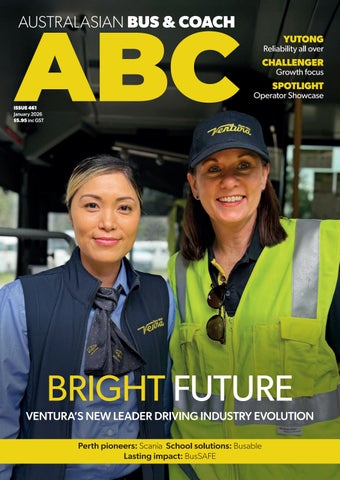
Australasian Bus & Coach Jan 2026

Page 1


DRIVING AUSTRALIAN COACH EXCELLENCE FOR 20 YEARS

AVAILABLE NOW FOR IMMEDIATE DELIVERY.

PRESIDENT 2

Luxurious, stylish, spacious & affordable.

Our flagship President 2 Coach, trusted by operators across Australia for its durability, comfort, and value.

■ Available in 53 & 57 seater variants

■ Designed & Engineered in Australia for Australian conditions

■ Ideal for touring, charter, school and regional operations

■ Backed by BLK’s national support network

BLK proudly celebrates 20 years in Australia - two decades of delivering premium coaches, trusted partnerships, and proven performance to operators nationwide.

AVAILABLE NOW FOR IMMEDIATE DELIVERY.

PRESIDENT 10

Sophisticated Modern Midi Coach

■ 41 seater

■ Premium interior and passenger comfort

■ Efficient driveline options

■ Built for operators who demand more

■ Ideal for touring, charter, school and regional operations

■ Leading 5 year Warranty

From family-owned operators to major fleets, BLK Bus & Coach Sales has built a reputation for delivering quality coaches, dependable aftersales support, and long-term value. When delivery timelines matter, experience counts.

New beginnings

From acquisitions

to appointments, introductions

to

invigorations,

the bus industry is already out of first gear to start an important year

There’s nothing quite like this time of year. The warmer air, the scorching sun. The rhythmic sounds of ocean waves touching down, of sand between the toes and of later nights spent catching up. By the time work rolls around, which, rest assured, it certainly has by now, there’s a more optimistic and restful look on the world.

The Australasian bus and coach industry is in this enjoyable lull, but that doesn’t mean nothing is happening. Instead, the opening weeks of 2026 show there’s plenty on the move to begin the year.

It started in December when a combination of new electric buses began touching down in South Australia at Torrens Transit. The first two of 60 new electric buses, coming courtesy of Scania and Volgren, arrived in Adelaide across Metro routes, with all 60 vehicles expected to be operating by the middle of this year.

at major businesses running services around Australasia from page 29, while also giving their thoughts on the state of the industry. This resulted in another telling survey analysis that starts on page 36 and breaks down operator opinions on what is best for the sector moving into another critical year.

Our cover is something a tad different to start the year, with Ventura’s new CEO in the spotlight. From page 20, I was lucky to meet Carol-Anne Nelson in person late last year in Melbourne’s CBD, and the resulting chat was all about optimism regarding the role that bus has to play in the future of Australian transport, with Ventura set to be at the forefront of this revolution.

The opening weeks of 2026 show there’s plenty on the move to begin this year

“This is an exciting milestone for our public transport network with the first two electric buses now handed over to the state government and ready to hit the road,” South Australian infrastructure and transport minister Emily Bourke said.

“This is a major step forward to achieve our target of net zero by 2050, positioning us as a leader in zero-emission public transport.”

Following this was the news in Queensland that family operator Burns Bus Service had sold its school bus business to the newly formed QBus, which comprises Gatton and Minden Bus Services courtesy of Tayla Hill. To cap it off, governments followed suit this month in the list of updates when the Queensland government revealed it would double its financial year spend on introducing driver safety screens to the state’s bus network. It’s all made for a whirlwind time and sets the scene for another productive Expo year.

The January edition of ABC reflects this, but it also signals the return of our annual Operator Showcase. Having grown each year, the latest instalment saw 102 operators provide their details for a comprehensive look

On the operator front, it was also a pleasure to sit down with the Pickering family and discuss the history of BusBiz, formerly Swan Hill Bus Lines, including decades of growth, acquisitions, changes and determination, as can be seen on page 25.

As usual, Australasia’s bus and coach suppliers were out in full force to start 2026, with the likes of Yutong, Challenger and Scania all detailing their latest developments and plans for the Expo year. Busable returned with an in-depth look into its school transport technology that perfectly suited the ‘Back to School’ theme alongside BusSAFE. At the very back of the mag, don’t miss our December deliveries data and 2025 wrap. We hope you enjoy this edition and we look forward to the busy year ahead!

in the know

04. editorial | ignition NEW BEGINNINGS

From acquisitions to appointments, introductions to invigorations, the bus industry is already out of first gear to start an important year

08. news | all aboard

Check out the latest news from around Australia and the world features

20. cover story | ventura TIME TO SHINE

ABC introduces the bus industry to Carol-Anne Nelson, the passionate new CEO of Ventura who is looking to push the status quo of change in the public transport sector

25. feature | busbiz SWAN HILL STRONG

In 2025, BusBiz, formerly known as Swan Hill Bus Lines, celebrated six decades of bus services. Now, with the third generation emerging, the family business is aiming for further growth

29. operator showcase WELCOME TO THE SHOWCASE

The 2026 edition of the ABC Operator Showcase saw more than 100 companies provide their details and thoughts on the bus and coach industry

38. feature | yutong RELIABLE REPUTATION

Two operators on opposite sides of Australia have enjoyed similar success and service since recently forming ongoing partnerships with Yutong and VDI

40. feature | challenger BUILDING FOUNDATIONS

After being left in the Victorian bus industry’s equivalent of limbo for much of 2025, Challenger’s new national sales manager is preparing for an exciting period of growth

42. feature | scania PERTH PIONEERS

Over the past five years, WA equipment rental agency Kuuwu Rentals has looked to introduce sustainable vehicles. Its first Scania-Irizar electrichybrid model is a major step in the right direction

44. feature | busable TOP OF CLASS

After working on regional school bus projects across New South Wales, Heroly Chour set out to solve one of transport’s most complex and safetycritical challenges

46. feature | bussafe SPRUIKING SAFETY

The BusSAFE program is making a major impact, teaching Australian students bus safety skills to last a lifetime

49. competition | best bus BLISSFUL BEAUTY

The first winner of Best Bus for 2026 takes us to a classic Denning Phoenix deep in the lush Aussie countryside

departments

52. factory facts | bus deliveries DECEMBER DELIVERIES

Check out the latest bus and coach supplier sales data collected and recorded for you to review and see how the market fared in December and in 2025

58. back seat | medi bus MEDICAL MARVEL

We all know that buses are more than just four wheels. Around NSW, many communities are realising this too courtesy of this repurposed IVECO Medibus

Fellner

EDITORIAL & DESIGN

Managing Editor: Geoff Crockett

e-mail: geoff.crockett@primecreative.com.au

Editor: Sean Mortell

e-mail: sean.mortell@primecreative.com.au ph: 0468 577 166

Art Director: Daz Woolley

Designer: Apostolos Topatsis & Jacqueline Buckmaster

PRINTING

Brougham Press

ADVERTISING

Sales Manager – South:

Courtney Burton ph: 0481 736 890 e -mail: courtney.walker@primecreative.com.au

Business Development Manager – Bus: Sylvie Hanlon ph: 0466 545 664

e-mail: sylvie.hanlon@primecreative.com.au

SUBSCRIPTIONS

www.busnews.com.au/subscribe ph: +61 (0)3 9690 8766

Mon-Fri 8am-4.30pm (EST) e -mail: subscriptions@primecreative.com.au mail: 379 Docklands Drive, Docklands VIC 3008 Australia

Annual subscription rates (12 issues): Australia: $99*

Overseas: $A170 (Australian air-mail only) *price includes GST

Cover image: Ventura

Image: Challenger

Queensland operator sells school business

The longstanding operator has officially wrapped up 56 years of service after selling the business to another well-known operator

Queensland family operator Burns Bus Service has officially sold its Queensland school bus business.

The longstanding family business, advised by McInnes Wilson, has sold the operations to QBus, led by Tayla Hill. QBus is a new combination of Gatton and Minden Bus Services and has started operations as of this year.

Since January 1969, the Burns family has safely carried multiple generations of students to and from school in the Lockyer Valley.

The family’s 56 years of service in the bus industry came to a close on Friday December 12, 2025, as the final runs were operated from Esk and Kentville schools.

Nestled in the heart of the Lockyer

The business only started by chance when the education department decided to close Atkinson’s Lagoon State School in the ‘60s, with a local reneging on providing the school transfer run from the area to Coominya State School at the last minute.

In stepped Les and Mavis Burns, buying a 22-seat Toyota Coaster before replacing it with a Superior bodied Austin 2.45F in February 1969 to accommodate extra students.

“Congratulations to the Burns family on their longevity in the bus industry and to Tayla Hill of QBus on the acquisition,” McInnes Wilson says.

Two Queensland operators in Gatton and Minden Bus Services have

is committed to delivering safe, reliable and community focused transport for the future,” Tayla Hill says.

On top of this, the rebranded operator has also joined the transportme (TME) platform.

The QBus team will implement transportme’s student management module while also planning ahead for future iterations of the brand’s shifts, rosters and charter module, as well as its vehicle maintenance module.

“Over time, QBus will plan on expanding the use of transportme across their fleet as their operations grow,” transportme says.

“We’re proud to partner with for-

PT fares slashed out west

The new bus and train fares make accessing WA’s transport system as cheap and easy as it was in the ‘80s

The Western Australian government has made public transport more affordable for patrons, slashing fares to make them as cheap as they were in the 1980s.

Since January 1, Transperth and Transregional fare zone structures have been overhauled with the introduction of the Go Anywhere fare, while Transwa fares have also been dropped.

Under the new structure, passengers can travel anywhere on the network for as little as $2.80 per trip when using a SmartRider with Autoload, or $3.50 if paying with a credit or debit card.

The last time fares to travel across the network were this cheap was in the mid-1980s.

Passengers who regularly commute to and from the CBD will save a further $625 per year on top of the

savings they receive from the WA government’s Two-Zone Fare Cap.

The government says the changes benefit tens of thousands of households across WA, with 70,000 to 80,000 people making journeys of two zones or more on a typical weekday.

DayRider and FamilyRider fares are also reduced to $7, making it easier and more affordable for families and visitors to commute, travel, and explore Perth.

From 1 January, Transwa fares have also been permanently reduced by 50 per cent, meaning public transport across regional WA is also cheaper.

The changes mean someone travelling between Kalgoorlie and Perth on the Prospector will save $100 on a return journey, while someone travelling between Esperance and Perth will save $107 on a return trip.

The changes make bus and train

travel more economical for regional trips, helping take cars off regional roads.

“Not since the 1980s has it been so cheap to travel across Perth’s public transport network. With the Go Anywhere Fare, passengers can travel anywhere on the Transperth network for as little as $2.80,” deputy premier and WA transport minister Rita Saffioti says.

“By halving Transwa fares, we’re delivering cheaper travel to more than 200 destinations across regional Western Australia, benefiting our regional communities, tourism and hospitality businesses.

“This is about giving Western Australians more choice, more convenience and incredible value, and represents real cost-of-living relief for tens of thousands of Western Australians.”

Above: Cheaper fares headline WA’s new year innovations for PT. Image: Transperth

Limited SkyBus Express launched in Launceston

The limited Launceston Express service is all about supporting travel to a sold-out concert in the region

Australasian bus operator Kinetic has announced a new temporary SkyBus Launceston Express service will have supported a special event in the city.

From January 22-26, the express service provided fast, frequent transfers to and from Launceston Airport and the CBD to support the thousands of fans who descended on the town for the Foo Fighters’ sold-out concert at UTAS Stadium on January 24.

City-bound services ran from January 22 to 24, with SkyBus meeting all arriving flights at Launceston Airport and transporting passengers direct to Launceston CBD via two stops – the Launceston General Hospital and the Launceston Regional Transit Centre.

Right: The service ran to and from a special concert. Image: Peter Mathew/ The Photo Pitch

Airport-bound services ran from January 25 to 26, departing from Launceston CBD to Launceston Airport.

Fares were $22 for a one-way trip, and $40 return.

Kinetic general manager (Tasmania) Andrew Grzinic says the SkyBus Launceston Express provided fans with a convenient, stress-free

transport option for the landmark event.

“This was the biggest concert Launceston has ever hosted, and we wanted to make sure fans had a reliable transport option to and from the airport,” he says.

“We’re proud to have supported this incredible event and helped people get there and back home safely.”

The Foo Fighters concert on January 24 marked the band’s first performance in Tasmania since 2015 and was their first ever show in Launceston.

The event sold out in record time, with fans travelling from across Australia for the one-night-only performance.

Unique 4x4 teased ahead of Expo

The manufacturer has partnered with a popular European bus brand ahead of the model’s release at this year’s Expo

This year is already starting with surprises and news, with a new brand set to unveil a unique bus model to the local industry in 2026.

Below: AutoBus is partnering with Scania. Image: AutoBus Australia

AutoBus Australia has revealed it will release the first purpose-built 4×4 integrated off-road 40 passenger vehicle at the Australasian Bus &

Coach Expo in Sydney this July.

TRUBUS will be built on a Scania chassis and has been designed from the ground up, suited to Australia’s tough terrains.

“I founded AutoBus Australia to make this happen. We’ve spent the past year locking in the right partnerships. A team that knows what industrial operators need,” AutoBus Australia CEO Boris Cherny says.

More details on the model are set to emerge in the current months, with the first bit of information based around AutoBus Australia’s partnership with Scania Australia for the model.

TRUBUS is built on a Scania P320 Euro 6 B4x4HZ chassis, featuring 320hp, a nine-litre engine, Scania Opticruise transmission and factoryintegrated safety systems.

BusVic officially rejoins BIC network

The milestone moment has seen BIC welcome the Victorian state association back into its partnership network

One of the industry’s worst kept secrets is now official, with the Bus Association of Victoria (BusVic) rejoining the Bus Industry Confederation’s (BIC) national association partner network.

Both BIC executive director Varenya Mohan-Ram and BusVic executive director Peter Kavanagh have confirmed the news in the wake of the announcement made at the BIC national conference in Perth last year.

“State associations are vital to the bus industry’s long-term viability, and it makes sense for us to speak with

one voice,” Mohan-Ram told ABC

“While we should have our robust conversations, we must articulate one narrative – this solidifies our message and reduces confusion. The inclusion of BusVic into the BIC strengthens the entire industry.

“Across our sector, there is a deep and growing conviction that unity is our greatest strength. When we come together with purpose, we create better outcomes for all our stakeholders, from operators and manufacturers/assemblers to suppliers and the communities we

are proud to serve. That’s why the BIC Council unanimously approved BusVic’s membership.

“Peter Kavanagh, the new executive director, is well-known to the industry, a steady hand and a knowledgeable leader for BusVic. His collaboration at the national level is invaluable.”

Kavanagh says BusVic is “just pleased to be in the BIC camp again”.

“We plan to participate fully to support the national bus industry in all of its endeavours,” he told ABC

“We look forward to a bright and collaborative future!”

Below: BIC has welcomed another state member back to the fold. Image: Prime Creative Media

Aussie tech company grows with NSW contracts

Contactless ticketing, courtesy of transportme, is seeing numerous bus and coach routes around regional NSW enjoy the tap-and-go payment technology

Australian-owned and operated technology company transportme is growing from within the local bus and coach industry courtesy of recent contract wins.

At the heart of the technology transformation within the Australasian bus industry is transportme, which is the product of lived experience built by people who know buses inside and out.

Founder and CEO Nigel Tooth began his career as a bus operator in regional New South Wales. His first-hand understanding of the challenges – managing compliance, balancing government reporting, or simply keeping services running – sparked the idea that technology could make life easier for operators, drivers and passengers alike.

From those beginnings, transportme has evolved into a next-generation transit management

Above: transportme is growing as more of NSW’s bus network goes ticketless. Image: puhimec/ stock.adobe.com

ecosystem after being created by industry experts and refined with operator feedback.

Over time, the platform has grown into a trusted system covering ticketing, passenger payments, operations, fleet management and compliance.

That vision has culminated in a landmark partnership with Transport for NSW. transportme’s technology, including the payment technology delivery partners, is being rolled out across more than 400 vehicles in rural and regional NSW as part of Transport for NSW’s new Contactless Ticketing Program.

This includes rolling out the transportme solution across regional NSW. So far, the technology has been installed on buses in Orange, Parkes, Forbes, Lithgow, Ballina, Byron Bay, Goulburn and Crookwell, Mittagong and Tweed Heads. Prior to this, 20

local buses in Wagga Wagga were fitted with the tap-and-go payment technology after successful trials were run in Bathurst and Dubbo.

“Contactless payment technology is becoming increasingly popular with the community for a range of transactions, but until now the option of tap-and-go payments on buses has mostly been confined to Greater Sydney,” NSW roads and regional transport minister Jenny Aitchison says.

“The Contactless Ticketing Program will make public transport in the regions more convenient and accessible, with the choice of a more seamless, secure and reliable payment experience, in addition to cash.”

For passengers, the benefits include payment flexibility, as they can pay with cash, contactless bank cards, smartphones or wearables, while many communities are enjoying modern payment options for the first time on bus services.

For operators, the system is guided by the Control Hub, which includes live vehicle tracking and ticketing through to compliance reporting, driver communications and fleet management.

By reducing administrative burdens, streamlining compliance and improving safety, operators can focus on delivering reliable services that meet community needs, while governments can access accurate reporting, transparent performance and data-backed investment decisions.

“Installing contactless payment technology on our buses means a smoother, faster boarding experience for our passengers. It’s a win for both customers and operators and is an exciting milestone for our city and for regional NSW,” Busabout Wagga director Joe Calabro says.

Victorian youths begin enjoying free PT

The cost of living public transport measure is now seeing more than one million young Victorians enjoy free bus services

The Victorian government has announced now one million young Victorians are now travelling for free as the public transport fare measure has come into effect across the state.

The Victorian Labor government has made public transport free every day for every child, with acting premier Ben Carroll and public transport minister Gabrielle Williams announcing that all passengers under 18 are now able to catch a bus for free via a youth myki card.

“This will put money back in the

pockets of parents right across Victoria and make life just that little bit easier,” Carroll says.

The cost of living measure will allow more than one million young Victorians access free public transport, with passengers aged five to 17 having to carry their youth myki as proof of their free travel entitlement.

Youth myki cards are available to purchase for $5, both online on the Transport Victoria website or in person at staffed stations.

“This is real, practical, cost of living relief for Victorian families. Whether it’s travelling to the city, to regional Victoria or just around the corner – it’s now free for every child,” Williams says.

rides are free for Victorians under 18. Image: Victoria’s Big Build

The state government is encouraging passengers to continue tapping on and off to ensure a smooth entry and exit. Below: Bus

“We’re adding more services across our public transport network, to provide Victorians with more options to get to appointments, work and social activities.”

SA labels PT hubs in new knife law reforms

The state’s new knife law reforms sees more than 30 bus and transport sites listed as designated hubs protected by the law

The South Australian government has declared public places like public transport stops as designated hubs as part of new knife law reforms.

From 2026 onwards, declared public places like transport hubs, vehicles operated by declared public transport services or shopping centres, will see police be able to conduct metal detector searches on any person or their property. They can also order a person or group posing a risk to public safety to leave the declared place for 24 hours as part of the laws.

More than 30 transport hubs have been declared, including Adelaide Central Bus Station, Flinders University Interchange, Glenelg Interchange, Golden Grove Park’n’Ride and any other interchange, station or park’n’ride in metropolitan Adelaide that is used by PT services under the name ‘Adelaide Metro’.

Below: Transport hubs are critical to the new laws. Image: myphotobank.com. au/stock.adobe.com

These declared hubs are in addition to the Adelaide Railway Station, the first Declared Public Transport Hub which was declared on December 19.

Gawler train service, Belair train service, Seaford train service, Flinders train service, Outer Harbour train service, Grange train service and Port Dock train service have also been declared as public transport services.

These declared public transport hubs and services also build on the 11 declared shopping centres brought in by SAPOL in September and October.

The declarations will remain in place until revoked by the Police Commissioner. Declarations are able to be made over certain areas or at public events where there is an increased risk to public safety and in making any declaration, the Commissioner of Police must be satisfied that search powers in that area are necessary or appropriate, and would likely be effective

in deterring or detecting the commission of a weapon-related offence.

“The safety of the South Australian community is paramount, that is why we introduced and passed laws for declared public places and transport services and the toughest knife laws of anywhere in the nation,” South Australian deputy premier Kyam Maher says.

“These measures were designed to better equip SA Police to protect the community and to identify dangerous weapons before an incident occurs. Under these search powers in declared shopping centres we have already seen a number of knives detected and removed from circulation.

“The SA government is committed to maintaining strong and effective laws across our state and these reforms demonstrate just that.”

London freezes bus fares

Bus and tram fares across London will remain frozen until mid-2026 under new proposals from the Mayor of London

Bus and tram fares in London will be frozen until July 2026 under a proposed cost-of-living measure announced by Mayor of London Sadiq Khan, while Tube and TfL rail fares are expected to rise from March next year.

The proposal follows a £2.2 billion multi-year funding agreement between the UK government and Transport for London (TfL), finalised in the 2025 Spending Review. Under the funding deal, TfL was expected to increase fares by inflation plus one per cent, but City Hall funding will instead be used to hold bus and tram fares at current levels.

If approved, the move would mark the seventh time bus and tram fares have been frozen under Khan’s mayoralty.

“When the government awarded TfL £2.2bn in vital investment, it made clear it expects fares to rise by inflation plus one per cent,” Khan says.

“However, I remain committed to doing everything in my power to keep TfL fares as affordable as possible because I know how the cost-of-living crisis is still hitting many Londoners whard.”

Under the plan, pay-as-you-go fares on the Tube and TfL rail services will increase from March, but individual fare rises will be capped at 20 pence, with many increases limited to 10 pence.

“That’s why I’m announcing plans for an emergency cost-of-living measure, funded by City Hall, to continue freezing bus and tram fares until July 2026,” Khan says.

“It will particularly benefit those on the lowest incomes in our city.”

Khan says TfL fares have remained below inflation for much of the past decade. City Hall estimates that, if the proposed changes are approved, Londoners will still be paying around 34 per cent less for bus and tram fares and 16 per cent less for Tube and rail fares than they would have if prices had risen in line with inflation since 2016.

MINIBUS CONVERSIONS

Remodelling conversion or retrofit transformation solutions

Wheelchair accessibility install Seating arrangement solutions

& audio visual upgrades

T (07) 3344 4544

E coachworks@royans.com.au www.royans.com.au

“The record number of fare freezes since 2016 means Londoners are still saving significantly compared to where fares could have been,” Khan says.

“I’ll continue to do all I can to support Londoners as we build a fairer, greener city.”

The fares package will require formal approval through a Mayoral Decision. If implemented, it would represent the first increase to Tube and rail fares in several years, while maintaining flat pricing for surface public transport as TfL balances affordability with ongoing network investment.

Above: Bus fares won’t rise in London. Image: Alexey Fedorenko/ stock.adobe.com

Historic NZ electric doubledecker bus unveiled

The historic vehicle creates a NZ first and comes courtesy of a partnership between Kinetic and a leading global automotive manufacturer

Kinetic New Zealand has announced the arrival of the country’s first lightweight electric double-decker bus.

Developed through a strategic partnership between global automotive brand Geely and Kinetic, the landmark vehicle represents another step forward in sustainable public transport.

The bus is now set to enter service with Environment Canterbury as part of a trial.

The electric double-decker model is the first of its kind in New Zealand that meets weight compliance without requiring a permit.

The new vehicle was built leveraging Volvo Car’s (a Geely owned company) research and development and safety standards to combine global electric vehicle engineering with local operational insight in a first for Aotearoa.

“This is a game-changer for zero-emission public transport in New Zealand,” Kinetic New Zealand managing director Calum Haslop says.

“By partnering with Geely, we’ve created a vehicle that doesn’t just meet New Zealand’s regulatory standards, it exceeds them. This is what happens

when global expertise meets local innovation. It’s lighter, safer, smarter to charge and designed for the unique challenges of our cities.”

Built using aerospace-grade aluminium technology, similar to that used in the Airbus A380, the bus delivers a stronger and lighter frame than traditional steel construction.

Kinetic says it reduces road wear, tyre and brake use, and energy consumption, improving operational efficiency.

Kayne Bass, the executive general manager of electrification ANZ at Kinetic, led the project team and says working alongside Geely has been a highlight of his career to date.

“The speed of innovation at Geely is astounding. As a partner they were incredibly responsive to feedback at every stage of the project,” Bass says.

“Each time we encountered an obstacle, or something didn’t quite work the way we expected, it became a learning and platform for high-velocity development. We had a shared goal of accelerating New Zealand’s low-emissions public transport future, and the result will be transformational for public transport across our urban centres.”

The milestone follows an intensive 18-month development and testing program, during which four prototypes were built to refine performance, safety and compliance for New Zealand conditions. Backed by $6M USD of R&D investment, the project has delivered a solution built on design and technological achievement.

Helena Lee, the general manager of JW Group (who is the local agent for Geely buses), says NZ has one of the most demanding markets for double-decker electric buses, with no existing double-decker EV platform in the world meeting the country’s vehicle dimensions and mass rule limits.

“We have over 30 core engineers from across the industry working on this project, including members of our aerospace engineering team. Everyone was fully dedicated, collaborating across time zones in real time to ensure optimal performance, long-term durability and application of special technology. The end result is down to a relentless development process lasting nearly two years,” Lee says.

“This is a machine, purpose-built for New Zealand, engineered for compliance, designed for longevity and shaped by collaboration between Geely, and Kinetic at the highest technical level ever committed by Geely to an overseas project. We couldn’t be prouder to see it arrive in Aotearoa.”

Canterbury Regional Council Chair Dr Deon Swiggs says he’s looking forward to seeing the benefits the new bus will bring to customers, local infrastructure and the region’s sustainability goals.

“It’s exciting that we’re the first region to host this next-generation electric double-decker,” he says.

“Customers can look forward to riding on the new bus on some of our key Metro routes from early this year.”

Above: Kinetic worked with a popular global automotive company for the unique bus. Image: Kinetic New Zealand

Time to shine

ABC introduces the bus industry to Carol-Anne Nelson, the passionate new CEO of Ventura who is looking to push the status quo of change in the public transport sector

We’re only a couple minutes into settling down and beginning our chat about the state of the local bus industry when Carol-Anne Nelson proclaims the future is bright for the sector. It serves as a statement of intent for the new CEO of Victorian operator Ventura Bus Lines and what she’s looking to achieve at the helm of the growing business.

“I think it’s time for bus to shine in Australia,” she told ABC

“It’s great time to be part of the bus industry – there’s lots of opportunity and plenty happening to improve and expand services while delivering real

innovation and excitement.”

In October last year, Carol-Anne was appointed as the new leader of Ventura, taking over from longstanding CEO Andrew Cornwall after serving as a non-executive director on the company’s board since 2024. Supporting her arrival at the major operator is a refreshed leadership team that sees the company reach gender parity at both the executive and board levels. With goals including sustainability, accessibility and innovation, it’s evident that Carol-Anne’s tenure at the operator will be all about modernising the brand.

“The world is our oyster – there are

so many things we can do, so part of my challenge will be staging this in a way that makes sense so that we can sustain it as a business,” she says.

“It’s been a fantastic change to go from being on the board to moving towards daily operations and working closely with staff, customers and stakeholders.

“Ventura’s commitment to safety, service and community engagement aligns strongly with my experience and values, and I look forward to continuing to grow the business for the benefit of Melbourne and Victoria.”

Carol-Anne brings a wealth of transport experience to the role,

Above: Carol-Anne Nelson is now at the helm of Ventura

having held various executive roles at a range of state government departments and companies. This includes serving as deputy secretary at Transport for NSW and chief operating officer and chief customer officer at V/Line between 2014 and 2018.

It means the sheer volume of Ventura’s standing in the industry doesn’t come as a surprise. The Victorian operator first founded by the Cornwall family has been moving Victorians for more than a century, and now carries 42 million passengers each year on 950 vehicles, equating to a 33 per cent market share of the state’s public bus services. This juggernaut is run by 1,800 local team members and a workforce that represents 59 countries.

Fortunately, Carol-Anne’s experience working with government and on both bus and rail has set her up for success at Ventura.

“I do always think of myself as being part of the public transport industry – while my responsibility is to be a leader at Ventura, there’s also a responsibility to be part of the industry,” she says.

“My experience working in public transport is long, having worked on rail, tram and bus across Queensland, NSW and Victoria. The nice part of being at a business like Ventura that’s so agile is that we can be a leader and pilot new ideas to make the industry better as a whole.

“We want to create good quality public transport that takes more cars off roads and provides access to more people who may not have been able to use our services. It couldn’t come at a more important time for Melbourne when the city is growing so fast.”

For Carol-Anne, nothing beats the rewarding feeling of a day’s work in the public transport sector. She refers to it as an industry where you can arrive home at the end of each day and realise the lives of many have been made better through this high-quality access.

Carol-Anne’s job is to combine this modern public transport passion with a century of operations and the ongoing history of Ventura. Over time, she says Ventura has always

invested in its people, innovation and technology to lead the way. She’s not planning on changing this model anytime soon.

In recent years, the company has taken on a new look, as Ventura was first acquired by Keppel Infrastructure Trust (KIT) in 2024 before it sold 25 per cent of its stake to Samsung Asset Management in June 2025. Using this

global expertise, Carol-Anne says Ventura has the opportunity to utilise international best practice for local solutions. A major part of this will be sustainability.

“Sustainability is integral to our strategy – every new bus, depot and technician plays a role in fostering cleaner, greener and more dependable journeys. We’re backed by Keppel, a global leader in sustainability and intelligent design, so together we can provide solutions that are world-class and show we care,” she says.

“The opportunity moving forward with a new ownership structure is that we can now take the experience of a global business backing us and apply it firstly to Melbourne’s south-east for the benefit of local people.

“We can then spread from there and benefit the entire Australian public transport sector. My job is to work with our staff, passengers and stakeholders to ensure this pace of change is sustainable, but the industry should still expect to see some innovations on the way from Ventura in the near future.

“People will see some new ideas coming from us in the next little period – our innovation is fully integrated, we invest in advanced technology, safety, sustainability and job creation to establish a transport network that is more accessible and

Below: Carol-Anne has experience across both bus and rail
Above: The appointment is part of a new look executive team at the Victorian operator

prepared for the future. We’re lucky to have a fantastic team around us that brings experience, knowledge and contacts.

“We want to create a sustainable public transport system that drives patronage, we want to be right out the front creating opportunities for all.”

A defining feature of Carol-Anne’s start to her tenure is her partnership with Andrew Cornwall. As a doyen of the Victorian bus industry through his three decades spent at the helm of Ventura, Cornwall has stayed on as a senior adviser.

Already, this has paid off for Carol-Anne and the new leadership team as he’s remained generous with growing Ventura.

“It’s fantastic how helpful he has been – he epitomises the industry we want to work in, which is one where people share insights and pull collectively to achieve great outcomes,” she says.

“It’s wonderful working with someone who has such rich experience and is passing his knowledge on. Luckily, he’s also very open to us doing it our own way – we’ve always tried to push the boundaries and he encourages that, as do all senior members at the business.”

Cornwall’s introductions across

that positive approach towards the industry that she first greeted me with. It could serve as the catalyst for rapid evolution in the Australian bus industry.

“We look at other jurisdictions for inspiration – look at the bus industry 10 years ago and how unrecognisable it is now. If we get that same level of change, it’s

Above and below:
The new Ventura leader has already gotten around to all depots
Images:

endeavourawards.com.au

“Australian Truck Radio is my trucking radio station. So many great trucking tunes with loads of industry news. I lock it on and leave it on all day long!”

ASH ANDERSON
INSTRUCTOR, DYNAMIC TRUCK SCHOOL

Swan Hill strong

In 2025, BusBiz, formerly known as Swan Hill Bus Lines, celebrated six decades of bus services. Now, with the third generation emerging, the family business is aiming for further growth, Sean Mortell reports

The year was 1990 and it was a defining time around the world. Globally, the Soviet Union had collapsed and Nelson Mandela had just walked out of prison to begin his path to the South African presidency. Locally, the Australian bus industry was in crisis mode, addressing the tragedies of the Grafton and Kempsey crashes in late 1989.

Down by the banks of the Murray River, a local, family-owned Swan Hill business was toiling away, passing over the baton to continue providing beloved bus services for the community.

“When you live in Swan Hill, there’s

not a lot of opportunity for growth in the passenger transport game,” Peter Pickering told ABC

“I did say to my father back in 1990 that I’d be happy with the 10 buses and that would do us, and he told me that we wouldn’t stop there.”

As the ‘90s progressed and the industry began to recover from the dual tragedies of ’89, Pickering’s perspective slowly evolved as his passion for growth took hold. At the helm of Swan Hill Bus Lines, now known as BusBiz, he would soon lead the operations out of the Swan Hill region, taking the first giant steps for the business out of the shadows of the north-west Victorian town.

Above:

The family business has come a long way from its Swan Hill origins

Nowadays, with a third generation in tow, BusBiz has just finished celebrating 60 years of service in 2025.

“It all started back in 1960 when my father and his brother, or my uncle, had a road freight transport business,” Peter says.

“Dad never really saw a future in the trucking industry, having to fight against road taxes, railways, train lines and the likes. He turned his focus to different options and diversifications, such as farming – he looked at farming as an option but never actually went into farming. However, when a school bus tender came along in Swan Hill, it changed everything.”

He put his hand up for the tender and managed to win it. By the year’s end another tender had been put to market and he was to win again, starting a legacy of the Pickering family running bus services in Swan Hill.

“When they won that second tender, my father told my uncle that at least both of them had a job moving forward driving school buses if road transport falls away,” Peter says.

“In the next five years they added another couple of contracts to the business, and that’s when they formed Swan Hill Bus Lines in 1965.”

This backstory means, unofficially, the Pickering family has been running services for 65 years. While this 60-year celebration is all about the bus operations, Peter says the road transport side has also prospered and continues to this day, despite his father and uncle having passed away.

“That business is kept going under the guidance of my two brothers and cousin,” he says.

Instead of following his family down the road transport route, Peter veered to handle the bus side when he was old enough. In 1988 he ascended to manage seven school bus contracts previously run by his father and uncle. It only grew from there.

“I started as an apprentice motor mechanic before I went into trucking driving and then management,” he says.

In just under 40 years since Peter took over the seven contracts, BusBiz has changed rapidly. It now includes around 280 buses and 390 staff operating across three states, while the name has been evolved from the familiar Swan Hill Bus Lines of the past.

“Once we expanded out of Swan Hill, we weren’t seen as locals in other areas like we were in Swan Hill,” he says.

“It was highlighted in Dubbo when we were fortunate to win Trainlink tenders there, and also when we purchased operator Townsends Travel in late 2017 along the South Australian Riverland region. We knew then we had to change our name, as it was too location-specific for what we had become.”

The change to BusBiz may have been a major step in the operator’s history, but it has only allowed the

Pickering family to continue growing its network of services. Now, the BusBiz badge can be seen on buses in Victoria, New South Wales and SA, especially in towns surrounding the Murray River.

The expansion of BusBiz hasn’t just been location and service based –Peter has also passed down the love of running bus operations to his kids Lachlan and Emma, who are now both heavily involved in the business as CEO and human resources manager respectively.

“I’ve always been around buses –it’s hard to pick the earliest memories I have of them, as they’ve just always been there in my life,” Lachlan told ABC

“I remember when we expanded to Dunkeld in 1999, which was our first move out of Swan Hill, to run two contracts that involved three buses. We spent a lot of time in the early years taking these new routes on, and I remember plenty of journeys from Swan Hill to Dunkeld.

“It included spending school holidays in the workshop with mechanics and other apprentices, running around with a grease gun, and then going around the depot and having fun with the buses.”

Lachlan’s early memories also involved the business’ acquisition of Kingston’s Coach Tours in Stawell, and then along came routes in Donald, Wycheproof and Warracknabeal before BusBiz then went into SA and NSW.

Below:

The brand’s growth over the years has come via acquisitions and tendering

For Emma, she similarly remembers buses being part of everyday life from a young age.

“My earliest memory was starting primary school and having to catch the bus, and I was so excited and proud that the bus we took was one that my dad ran,” she told ABC

“I remember travelling around with the family to spend time in Dunkeld and Stawell, exploring the town and being part of the business.”

It echoes Peter’s own upbringing, with the BusBiz managing director similarly recalling a childhood spent driving around buses and trucks, always around heavy equipment. Upon reflecting on more than 60 years of the business and the growth journey it has been on to become a force of Victoria’s north, Peter can’t pinpoint one exact moment where it all kicked off for BusBiz.

“Not all of our growth has been acquisitions, some of it has been natural through tendering,” he says.

“There have been highs and lows, but the highs include winning tenders you don’t expect to win. There’s been a lot of buying and acquisitions over the years, but the most exciting part hasn’t been buying companies, but instead being able to integrate them into our existing operations.

“It can be challenging, but it’s been a highlight – growing and being part of such a good industry that makes it so interesting and engaging to turn up to work each day.”

Despite being 60 years into the

venture, none of the Pickering family members are content with staying still. As we chat, Peter reveals BusBiz has just bought around 15 school contracts from October last year. However, it’s now not just coming from Peter’s aspirations ¬– he says Emma and Lachlan are the new driving force of BusBiz’s ongoing evolution.

“I’m backing out more and they’re stepping up, which is very heartening for me,” Peter says.

“They want to take on Echuca and came to me with the opportunity. They’re both very well respected in the industry and want to be in it, so with them the future looks very bright.”

From Lachlan’s perspective, he’s intent on ensuring him and Emma

don’t become another example of the third generation curse. But there’s no time for this negativity to linger – he says he feels “very lucky” to work with family every day and is eyeing more chances to grow in the local communities BusBiz now work with.

“It’s great to be able to carry on the legacy of Swan Hill Bus Lines and the Pickering name in the transport industry,” he says.

“The bus industry is fantastic and I love working with everyone in it. We’ve never really had a business plan of how we want to expand and grow, it’s more just a desire. We’re more focused on opportunities that arise rather than planning for it.”

Emma and Lachlan both reveal the secret sauce to BusBiz’s success

– remaining a tight family unit, with Peter’s wife Sue being another important part of this successful family. Now, the trio will look to continue building BusBiz further following six decades of hard work and growth.

“It’s very much about the contributions from our staff that help push us forward ¬– if we didn’t have this team behind us, we couldn’t do what we do every day,” Emma says.

“Both Lachlan and I get asked how we manage BusBiz from Swan Hill, especially when we have buses in NSW and SA too. The answer is always our staff – we trust them so much to get the job done and help us lead the business forward into a new era.”

Above: Growth is still the focus for BusBiz

OPERATOR SHOWCASE SURVEY

*

* * * Canada Bay Council, City of Parramatta, City of Ryde Council, City of Sydney Council, Hunters Hill Council, Lane Cove Council, North Sydney Council, Willoughby City Council, Inner West Council, Cumberland Council, Blacktown City Council, Penrith City Council, Hawkesbury City Council, Wollondilly Council, The Hills Shire Council, Newcastle City Council, Central Coast Council, Clarence Valley Council, Port Stephens Council, Kempsey Shire Council, Nambucca Shire Council, Port Macquarie Hastings Council, City of Coffs Harbour, Lake Macquarie City, Mid Coast Council, Bellingen Shire Council, Onkaparinga Council and Marion Council

OPERATOR SHOWCASE SURVEY

* * * Melbourne, Darebin, Yarra, Nillumbik, Banyule, Moonee Ponds, Hume, Wihttlesea, Edward River, Hay, Adelaide City Council, Alpine Shire Council, Australian Capital Territory, Banyule City Council, Bass Coast Shire Council, Bathurst Regional Council, Baw Baw Shire Council, Benalla Rural City Council, Berrigan Shire Council, Campaspe Shire Council, Cardinia Shire Council, Casey City Council, Central Goldfields Shire Council, Conargo Shire, Cootamundra Gundagai Regional Council, Darebin City Council, Dubbo Regional Council, East Gippsland Shire Council, Edward River Council, Eurobodalla Shire Council, Greater Bendigo City Council, Greater Shepparton City Council, Griffith City Council, Hay Shire Council, Hume City Council, Indigo Shire Council, Lachlan Shire Council, Latrobe City Council, Macedon Ranges Shire Council, Melbourne City Council, Merri-bek City Council, Mitchell Shire Council, Moira Shire Council, Moonee Valley City Council, Mount Alexander Shire Council, Nillumbik Shire Council, Parkes Shire Council, Snowy Valleys Council, South Gippsland Shire Council, Strathbogie Shire Council, Towong Shire Council, Wagga Wagga City Council, Wangaratta Rural City Council, Wellington Shire Council, Whittlesea City Council, Wodonga City Council, Yarra City Council, Yarriambiack Shire Council, Albury City

OPERATOR SHOWCASE SURVEY

* * Monash, Knox, Yarra Ranges, Maroondah, Whitehorse, Boroondara, Darebin, Stonnington, Glen Eira, Bayside, Kingston, Dandenong, Casey, Cardinia, Mornington Peninsula, Melbourne, Banyule, Bass Coast, South Gippsland

Times of unease

The 2026 ABC Operator Showcase survey saw 102 operators provide their thoughts on the current state of play in the local industry

There’s a range of factors, updates and roadblocks currently standing in front of Australasia’s bus and coach industry. Regulation, the ongoing transition to zero-emissions buses, recruiting and retaining staff, consolidation and contracting. It all culminates in a challenging era to run bus and coach services in the region.

However, it’s this very reason why the ABC Operator Showcase is such an important part of the industry’s plans. Each year, ABC surveys operators as part of our Showcase, with participants opting in to provide anonymous insights into the industry and what they are facing on a daily basis.

The 2026 edition of the Showcase survey saw 102 operators around Australasia provide their details and thoughts on the make-up of their fleet, their future plans and the major issues impacting them.

These participants ranged from inner-city and metro companies to the country and rural/regional operators that traverse Australia’s countrysides. While the survey results represent a snapshot of these participants’ views and don’t represent any attempt to speak to a general Australian industry view in any way, they provide an update on the industry from the lifeblood of the Australian bus and coach industry – the operators.

Slowly bucking the zero trend

It’s a case of another year and a consistent hesitancy from Australasia’s operators to embrace the zero-emissions bus transition. While there have been updates made by many operators in the past year to welcome the new vehicle power technology to their operations, a resounding 83 of the respondents, or 90 per cent, said that zero per cent of their fleet includes zero-emissions

buses or coaches. It may seem like a lot, but this is down on recent years and the 92 per cent who said zero last year, showing there is some positive movement towards the technology. Outside of this, five per cent of respondents said that zero-emissions buses make up 1-10 per cent of their fleet, while three per cent reported between 21 and 50 per cent of their fleets feature these buses. Finally, two per cent said that 91 to 100 per cent of their fleets are zero-emissions, up from one per cent last year. When it comes to intentions to transition to zero-emissions, scepticism still remains. Around 56 per cent of the 2026 participants of the Showcase reported they were still unsure if they would transition towards the technology, down from the 58 per cent of undecided respondents last year. Just under 20 per cent of participants said they had intentions to transition, mirroring last year, while 24 per cent made it clear they didn’t want to make the transition, slightly up from last year’s numbers.

When it comes to the preferred fuel source of Australian operators, there’s no surprises that diesel still sits comfortably atop the list, with 70 per cent saying they wanted to stick with diesel. This aligned with previous years, with 13 per cent having no preference at all while electric and hydrogen fuel cell could barely be split, accruing eight per cent and seven per cent apiece. Finally, two per cent still wanted to stick with alternative biofuel options, mirroring last year’s response.

The price isn’t right Once again, the rising costs of transition to zero-emissions operations remained the key reason why operators are reluctant or unsure about making the change. The 2026

survey saw 38 per cent of operators participating say that price is the key issue impacting the slow rate of transition, up from 36 per cent recorded in last year’s Showcase.

Out of the 102 operators, 23 per cent labelled range anxiety as an ongoing sticking point, while another 23 per cent cited other reasons such as vehicle and infrastructure availability, government and depot contracts and the ability of the electricity grid to cope as key reasons. Finally, 16 per cent said a lack of space for infrastructure was a defining problem with the transition, up from 14 per cent last year.

Of the participants, 92 per cent said they had no current zero-emissions training plans in place, while the other eight per cent had implemented plans already. This remains identical to previous years and shows there’s a long way to go in rolling out this technology across the entire Australasian bus industry.

New issues

For the first time, the 2026 Operator Showcase asked operators if they are struggling to recruit and retain skilled workers, such as drivers and workshop staff. The answer was a yes, with 71 per cent of respondents agreeing while the other 29 per cent said they were managing to cope fine.

The final part of the survey asked operators what they saw as the biggest issue facing the industry as we start 2026.

Common answers included the lack of drivers, both old and new, with the recruitment issues and driver shortages being a dominant response. Increasing prices was also a common theme, as well as government contracting and the prevalence of multi-national businesses being successful in tenders over smaller local operators.

Other lesser mentioned issues were accessing parts, upgrading buses on time, remaining compliant and uncertainty and unease about what the future holds in Australasia’s bus industry. This quote from one

operator sums up sentiments perfectly.

“There’s uncertainty about future contracts due to a lack of commitment from governments – everything is a race to the bottom line and the

A resounding 90 per cent said that zero per cent of their fleets include zero-emissions buses, with five per cent answering between one and 10 per cent. The next largest was the two per cent who said ZEBs make up 91 to 100 per cent of their fleets.

Just over half of participants are unsure about whether they’ll make the transition.

For 65 per cent, diesel is still the preference, with 12 per cent having no preference when it comes to fuel source.

multinationals are taking over on slim margins.”

All of this paints a picture of the key issues and feeling of doubt that’s creeping into the bus and coach operator scene locally.

A clear 71 per cent of participants have issues recruiting and retaining workers.

The biggest issue when it comes to transitioning remains the price of ZEB buses and coaches.

Reliable reputation

Two operators on opposite sides of Australia have enjoyed similar success and service since recently forming ongoing partnerships with Yutong and VDI

It’s a rising trend across all bus and coach operators around the country. Whether it’s a lone driver stuck in the brown sand of the outback or the honking horns of CBDs, a reliable bus and a capable support service are emerging as not just the operational details that they once used to be.

Nowadays, operators aren’t just looking at shiny chrome or the most powerful engines when they choose a new bus or coach to order. It’s fast become the intangibles – the quality built into the model and its reliability –that are all-important. Backing that up with a wide and fast-paced network of spare parts and aftersales support

creates a full package that extends well beyond the four wheels of the vehicle.

In recent years, Yutong Australia and its dealer partner VDI has innovated in these areas to create an overall bus and coach offer that is all about credibility and confidence across a variety of markets, applications and locations.

“We see our connection with Yutong and VDI as a partnership, not just as a transaction,” Stephen Grant, General Manager at Victorian school bus service operator Dhillon Bus Charter, told ABC

“We’ve got a strong working relationship with the Yutong and VDI

Above:

Out west, the reliability behind VDI and Yutong’s expanding fleet has been critical for operators

team across the whole supply chain and it’s keeping us at the front of the pack.”

Mandeep Dhillon founded Dhillon Charter, growing the business over two years from 11 buses to 25 buses in the fleet.

This successful scaling meant the pair soon looked towards the school and charter markets for further growth.

“Around a year ago we were invited to participate in our first school bus tender, and were able to do so successfully,” Grant says.

“We then went on a bout of buying buses, employing drivers and establishing a strong operational network and customer service team,

Images: Yutong/VDI Australia

all within three months. We soon found that Yutong would be pivotal to

It was in the latter months of 2023 that Dhillon Charter entered the market to buy vehicles. After scouring the Victorian sector, the emerging operator quickly landed on Yutong and VDI. Needing six buses in a very short timeframe, Grant says Yutong and VDI pulled every stop to help them gather the buses and specify them to what was needed for the school contract.

“From the start, the Yutong and VDI team were incredibly helpful with information and details that we could then relay to the school,” he says.

“We test drove the buses and we all loved the comfort, mobility, stability and safety of the C12 model. We then found Yutong and VDI to be very good when it came to not just the product, but the service and reliability side of the equation too.”

The six Yutong C12 models quickly entered into operations, offering 57-seat models with seatbelts. When Dhillon Bus Charter recently won another major tender for school bus services requiring 14 vehicles, the operator went straight back to the Yutong and VDI team.

“A major requirement of this tender was to prove the uptime and reliability of the vehicles – Yutong made this easy,” Grant says.

“We’ve also been able to introduce practical technology as a value-add for schools, including student Wi-Fi, courtesy of Yutong and VDI. It’s not something we’ve commonly seen in the Victorian school bus market.”

A recent trip to Yutong’s head factory in Zhengzhou, China capped off the recent evolving partnership with the brand and VDI. Grant says witnessing how the various Yutong models are manufactured with reliability and quality at the front of mind was a decisive factor, while the ongoing aftersales support has been a source of great comfort.

“Seeing the Yutong operations first hand and meeting the people behind the product gave us and our customer real confidence,” he says.

“Reliability is central to our service promise, and local parts and

technician support helps us deliver it.

“The aftersales support has been proactive, including regular check-ins, which helps when you’re scaling.”

On the other side of Australia, and in a much different market, Roberto Trifunovski, the owner of both Bus Charters Perth and Fleet Hire Perth, has also enjoyed the reliability and support of both Yutong and VDI. Its story started in 2008 when Trifunovski moved from Macedonia to Australia before starting the business with school bus services roughly 12 years ago.

After expanding into the high-end charter, mining and university transfer spaces, Bus Charters Perth & Fleet Hire Perth now has a total of 39 vehicles in its fleet and Trifunovski prides the company on maintaining a five star rating across 234 Google Reviews.

A large part of this success boils down to his decision to start buying Yutong buses in 2017.

“Since then I have never looked back – the first model I bought was a 54-seater Yutong D12 coach,” he told ABC

“By the time it came to buy a second bus, I didn’t even need to test drive it as the quality of the first Yutong bus was so good.

“Since I met Mike Kennedy from Yutong Bus Centre WA and his team, I’ve known I can trust them and I have kept adding more 44-seat and 28-seat Yutong buses since.”

Out of the 39 buses in Bus Charters Perth & Fleet Hire Perth’s fleet, eight

of them are currently sporting the Yutong badge. A major part of this swing towards Yutong and VDI is the support Trifunovski has received from the brand and its local dealer. He says he’s “never had support” like what he has received from Yutong and VDI over the years, with the reliability, strong warranty and ongoing support proving critical to Bus Charters Perth & Fleet Hire Perth’s ongoing expansion out west.

“I was losing my confidence in the industry, but after working with Yutong and VDI, my trust has returned and I’m much happier,” he says.

“I now know I can provide high quality and good value buses and coaches for customers and my vehicles can remain on the road for a long time.”

Moving forward, Trifunovski shares similar sentiments to Grant and the Dhillon Bus Charter team on the other side of the country. Despite working in different markets and in varying conditions, the key values of Yutong and VDI – reliability, support and quality – have shone through to offer an exciting future for both operators in Australia.

“The newer vehicles have lifted the comfort and passenger experience – people feel safer and the Yutong buses are great value for money,” he says.

“Responsive service is helping to keep the vehicles on the road. With Yutong and VDI, it’s not just about the badge, it’s about the people standing behind it too.”

Above:
The Dhillon Bus Charter team have revelled in Yutong and VDI’s technology and support

Building foundations

After being left in the Victorian bus industry’s equivalent of limbo for much of 2025, Challenger’s new national sales manager is preparing for an exciting period of growth

This time a year ago, Peter Simpson was in a completely different position. The experienced bus industry member had a new role lined up, ready to start afresh with the latest venture. It soon fell through, leaving him in limbo.

“It threw a spanner in the works, and led to me being unemployed for more than a year,” he told ABC

“I thought I was cooked, I was done, and I wouldn’t get a job in the industry again.”

The catalyst for this was the Victorian government’s announcement on Christmas Eve in 2024 that it would pause all current

bus orders and extend the lifespans of existing buses in service around the state. For many in the local industry, it meant an uncertain future as the order pipeline was blocked. For people like Simpson who were stuck between jobs at the wrong time, it meant his new role was put on the backburner as a mixture of manufacturers, suppliers and operators scrambled to adjust to the changing scenario.

A year later and it’s looking remarkably different for Simpson and the Victorian industry. On the final day of the financial year, the Victorian government confirmed a new funding package of up to $50 million, translating to around 96 additional

Above:

vehicles in bus orders. By this time, Simpson’s prospects were looking better after chatting to supplier Challenger Bus & Coach.

Following an interview, it proved to be a defining moment for both Simpson and Challenger, with the former now the recently appointed national sales manager for the emerging brand.

“It turned out I ticked more boxes for Challenger than either of us could’ve expected,” he says.

“In my first conversation with Greg (Challenger owner Greg Sloan), he told me they needed someone who is very active with their hands and can assist with maintenance and

The Challenger family has recently added new members

preparing a bus, which is very much me courtesy of my experience in

“Having experience in selling into every state in Australia for more than 25 years meant I soon felt like the

catches up with Simpson in late 2025, he’s been in the role for just over two weeks, learning the intricacies of the growing bus and coach supplier. In just under a decade, Challenger has evolved to become a popular bus and coach choice for operators around the country through a growing variety of models. It leaves the latest appointment excited to add to Challenger’s ongoing

“Even though I’m the national sales manager, I’m mainly onboard to assist and take the load off of the current sales staff,” he says.

“They are all wonderful people, and my role is to take the pressure off and lend my expertise to certain

“Everyone is really committed – the brand has plenty of room for growth and is willing to do so. Through the team, it’s been really exciting to see this in action and hopefully I can play my part to building the operations.”

Simpson’s arrival already caps off a year of evolution and momentum, adding to the structure of the supplier. In a year where Challenger has seen a 35 per cent increase in vehicle deliveries when compared to 2024, the past year saw Challenger add a general manager in Paul Fagg

to sit alongside state sales managers Dan Campbell and Simon Hendricks as well as state sales and national spare parts manager Mark Collins and Simpson in the newly made national sales manager role.

Having seamlessly fit into the structure, Simpson is quick to notice the positive energy surrounding the supplier as it prepares for another productive year of growth.

“The whole team is so focused – in my first couple of weeks I’ve noticed that everyone has input, which is something you don’t always see at larger companies,” he says.

“It’s refreshing to see all staff being allowed to use their knowledge and ability, receiving free range to suggest innovative ideas to make the business better.

“For me, this allows me to focus on helping the sales team to grow, and to help them in any way possible.

“So far my contacts have helped make the mundane day-to-day operations easier. It’s exciting to be involved in such an interesting business that has so much to offer.”

Moving forward, it may be too early for Simpson and the team to set goals for the immediate future, but that hasn’t stopped him from planning for success. While Challenger has started making smatterings of deliveries to various Australian jurisdictions, Simpson’s primary focus is to help the growing brand establish footholds in a variety of markets. He says it’ll serve as the key to unlocking plenty of doors and expanding the Challenger presence.

A year after his career first looked to be in limbo, the closing weeks of 2025 have given Simpson plenty of reasons to look forward to a better year ahead.

“We already have a good presence in Queensland and Victoria, while we have customers in South Australia, New South Wales and Western Australia, but my focus is to build substance,” he says.

“There’s no magic number we want to reach – we’ve only been around for just under a decade, so we want to keep growing and putting our name and product out there.

“I’m extremely happy to be onboard with Challenger and excited for what the future holds. We’re going to keep putting ourselves out there and doing the brand proud.”

Above: Peter Simpson is happy to be donning the Challenger badge

Perth pioneers

Over the past five years, WA equipment rental agency Kuuwu Rentals has looked to introduce sustainable vehicles. Its first Scania-Irizar electric-hybrid model is a major step in the right direction

For years, popular thought suggests the zero-emissions transition within Australasia’s bus and coach sector has centred on the major cities. The thriving metropolis adding dozens of electric urban low-floor models to suburban fleets, and swiftly installing charging facilities to match them.

However, not all early movers in the shift towards a more sustainable fleet are based in these city centres. In fact, when Western Australian equipment rental agency Kuuwu Rentals first began the search for lower emissions vehicles in 2021, it was doing so for mining equipment in the state’s remote regions.

“We started investigating electric vehicle options in 2021 as we saw the direction the world was going,” Kuuwu Rentals stakeholder portfolio executive Darren Hulme says.

“In 2022 we partnered with Worley and conducted an extensive research project, and a year later we had a comprehensive feasibility report that showed a clear pathway of solutions for the mining industry to transition into electrified fleets.

“As a first mover, armed with our feasibility report, and in conjunction with Worley, we have invested time and energy into ensuring we offer a full solution, fit for purpose to suit our clients’ harsh mining environments. We’re going beyond simply placing a battery electric vehicle on site –we will assist our clients to achieve their targets in an efficient and cost-effective manner with a holistic turn-key solution.”

The rental company was founded in 2019 with a fleet of light vehicles. It quickly expanded into buses and trucks, as well as plant equipment,

Above: Kuuwu Rentals is an early mover in electric-hybrid bus technology out west

with the business continuing to adapt to industry needs as it grows its reach across WA.

It’s also not like many other rental agencies around the nation – it’s majority owned by Buurabalayji Thalanyji Aboriginal Corporation (BTAC), the Aboriginal Traditional Owners of the Onslow region in the Pilbara. Its expertise is in offering a one-stop-shop for light vehicles, earthmoving and construction equipment solutions for all mining, civil, construction and agricultural projects Australia wide.

“We specialise in long-term rentals offering bespoke builds specific to each project,” Hulme says.

“We ensure quality and productivity as well as peak performance by using the newest and latest equipment available. We are passionate about giving back to the communities we

Images:

work in as we are dependent on their skills, services and infrastructure for the success of our business.

“We are driven by a mission to make lives and communities better, investing our profits in community projects, education, job creation and apprenticeships – particularly for Indigenous Australians in local communities and our young people.”

The fast pace of evolution has led to the company moving from prospective electric vehicle customer to a pioneer in the local transport space when it comes to sustainable solutions. This rapid rise culminated in the delivery of Scania’s first electric-hybrid powered coach chassis to a WA operator, with the maiden model coming fitted with the latest Irizar i6 body.

Initially this electric move has focused on deploying battery electric utes for mining customers as part of the Kuuwa Rentals’ ‘Charge Forward’ program, but now the two new Scania Irizar electric-hybrids join the fleet to broaden the path towards reduced carbon emissions.

like to be front runners and trial new equipment, so being one of the first movers on an asset like this is in line with our positioning,” he says.

“The Scania-Irizar electric-hybrid is a great addition to our ‘Charge Forward’ program, offering our clients lower emission fleet options,” Hulme says.

“With its incredible range, this coach is ideal for remote areas where BEV has challenges due to the current lack of infrastructure.

“Charging infrastructure is the main barrier, both in regional and remote areas and also on mine sites. The electric-hybrid option delivers the best of both worlds at this stage as the market decides which direction it will take.”

With customer service at the core of Kuuwu Rentals’ focus, Hulme works on the belief that it’s the business’ responsibility to have what the market needs at any given time. With some of the equipment purchased costing millions of dollars, the rental agency knows that customers may only need the asset for 12 to 24 months, offering these vehicles for cheaper and shorter terms.

“We look after everything from registrations to servicing meaning less onus on the customer to worry about these administrative issues. We also

“We chose Scania and Irizar as we only use brands we trust, and Scania is one of those brands that we put our trust in already through the purchase of trucks and buses. We have a reputation for supplying quality equipment, so it is imperative that we partner with brands we trust too.

“Our existing Scania vehicles have proved to be popular with clients as they are reliable and good quality. We mainly have Scania trucks on our fleet and several buses. We have been providing Scania products to our clients for nearly six years, and they are always popular, and we have a good relationship with Scania.

“We wanted to be first with this electric-hybrid coach. The specifications are great and in particular the range, and the vehicle fits our push towards reducing emissions across our customers’ operations. At present, full electric options aren’t viable for every client. Hybrids offer an excellent option for our clients who want to lower emissions without being dependant on infrastructure.”

Hulme says Kuuwu Rentals has

a clear metric of determining the success of the electric-hybrid Scania and Irizar bus – client feedback. If it’s popular and performing as expected onsite, he expects others to want to move towards a hybrid option too.

“Our previous Scania experience has shown us that Scania aftersales support is always fantastic across service bookings, parts supply and assistance in the field,” he says.

The two coaches come powered by a Scania 5-cylinder diesel engine delivering 360hp and a 12-speed Scania Opticruise automated transmission. An electric machine is integrated to provide zero tailpipe emission running over a short distance. The electric-hybrid powertrain provides a self-charging electric experience while also removing traditional range anxiety.

“The new Scania-Irizar electric-hybrid combination is the ideal solution for customers looking to reduce their carbon footprint but not have to cope with range anxiety,” Scania Bus & Coach national sales and contract manager for Victoria, South Australia and WA Jamie Atkinson says.

“With mining operations customers looking to do all they can to reduce their emissions, the electric-hybrid powertrain we offer delivers an instant saving of around 25 per cent in fuel burn and tailpipe emissions. That’s a worthwhile saving in anyone’s books, and it means the operators retain full utilisation flexibility in terms of range and refuelling.

“To further push the reduction in emissions towards parity with full battery electric vehicles, switching to run these electric hybrids on renewable diesel fuel, such as B100 biodiesel or HVO, would drive the CO2 savings towards 85 per cent, and for infrastructure such as mining operations, where fuel is stored in bulk on site, this could make the adoption of renewable fuels all the more practical.

“The Scania-Irizar partnership has been a successful one for our customers over many years, and we are very excited by the prospect of assisting more customers to reduce their emissions and fuel burn via our electric-hybrid solution.”

Above: Kuuwu Rentals’ Darren Hulme

Top of class

After working on regional school bus projects across New South Wales, Heroly Chour set out to solve one of transport’s most complex and safety-critical challenges

Heroly’s understanding of school transport was shaped on the road.

Through his work on regional bus projects for Transport for NSW, he spent months riding at the front of school buses, speaking with drivers and observing the daily realities of getting students to and from school safely.

From the early-morning chatter to the quiet responsibility carried by drivers, he saw firsthand how much trust families and communities place in these services, and how little room there is for error when routes, transfers or timings go wrong.

“We started Busable with school travel in mind. It came directly from my time working on regional bus contract projects at Transport for NSW,” he told ABC

“That experience really made a mark on me. It reinforced how critical safe, reliable school transport is, and how much depends on getting it right every day. It’s become a core focus for Busable.”

Those experiences have allowed Heroly to shape Busable’s focus on building a unified planning and operations platform for school transport – one designed to reflect the full complexity of the network and reduce reliance on manual processes. At its core, the goal is simple: ensure students get where they need to be safely and on time, while making the experience calm, predictable and reassuring for everyone involved.

“We’re focused on giving operators control, parents confidence and turning everyday school transport into a better experience for everyone,” Heroly says.

He says his time on school bus services influenced how he approaches building solutions at Busable. Working closely with drivers gave him a clear view of the

responsibility they carry each day, and the trust placed in them by families and communities.

“I had a front-row seat to the challenges of school travel,” he says, “from student behaviour through to the very different demands of metro and regional services.

“In regional areas, if a student is dropped at the wrong stop or misses the only service of the day, there’s often no backup. There’s no second bus. The consequences are real, and that’s why getting it right every time matters.

“Busable’s platform gives drivers clear visibility of which students are

expected on each service, where they should board and where they should disembark.”

Heroly says one of the most critical challenges in school transport is ensuring students can safely transfer between buses without being left behind.

“Coordinating transfers is often very manual, cumbersome and prone to error,” he says.

“I’ve heard stories where a driver leaves before the connecting service arrives, leaving a student stranded with no transport. In some cases, it falls to the school principal to leave campus and drive the student home.

Above: Heroly and Busable have used experience to shape their school bus module
Images:

“The critical problems we’re solving come down to giving drivers better support and operators a unified view of their services. By bringing student data, route information and service details together, drivers arrive at each stop knowing who should be boarding and disembarking, and whether connecting services are on their way.”

To support the entire school bus network, systems across depots, drivers and families need to work in sync. Busable provides a shared, real-time view of services, helping everyone involved understand how journeys are progressing.

“When students tap on and off the bus using their school-issued card, it gives parents, schools and operators real-time visibility of the journey, showing when students board and exit the bus, with second-by-second updates that provide a highly accurate picture as the trip unfolds,” Heroly says.

Beyond day-to-day operations, Busable is also used by large bus operators and government agencies for school bus route planning. Its planning platform can optimise routes based on student pick-up locations and school drop-off points, while accounting for bell times, maximum travel durations, vehicle capacity and specific fleet requirements.

This allows operators to design and adjust routes with greater precision

as enrolments, timetables and fleet availability change – reducing risk, improving reliability and ensuring services remain compliant.

For some operators, those planning capabilities are translating into new opportunities. The ability to optimise routes, model bell times and publish clear timetables has helped operators demonstrate reliability and preparedness when tendering for private school services.

The system is already in use across Australian school transport networks.

On the Gold Coast, Trinity Lutheran College has been using Busable’s technology for more than a year.

“They started using the platform and told us they were surprised by how much functionality it brought together in a short space of time,” Heroly says.

He says one of the key benefits for schools and operators is having changes flow through the system automatically.

“When school routes and timetables change, updates are automatically reflected on the school’s website so families are always looking at the current timetable,” he says.

“That consistency is critical in school transport.”

In many school bus operations, a single change still has to be manually updated in multiple places – the route plan, the driver’s run sheet, vehicle availability and workshop schedules.

If one update is missed, there’s often no automatic warning. People rely on conversations, memory or experience to catch issues before they reach road.

As operations grow, he says that reliance becomes risky, particularly in school transport, where the margin for error is small and the consequences of a missed connection or unavailable vehicle can directly affect student safety.

Busable also supports school bus operators by managing government-provided student travel data, including eligibility checks and data validation, in a secure and consistent way. This reduces administrative burden and helps ensure accurate, reliable information is available to schools, operators and parents.

“At the end of the school day, it’s about making sure school transport works the way families expect it to –safely, reliably and without surprises,” he says.

Left: Parents and schools can access up-todate timetables
Above: Parents can track their kids as they hop on and off the school bus

Spruiking safety

The BusSAFE program is making a major impact, teaching Australian students bus safety skills to last a lifetime

Although buses are one of the most widely used modes of student transport, bus safety messages are often overlooked in general road safety education.

Enter BusSAFE, an award-winning school incursion program dedicated to bus safety. The program was established following a tragic accident in South Australia, highlighting a need to educate young passengers about how to keep themselves safe on and around buses. Soon after, BusSAFE rolled out trials in Queensland and Tasmania, with support from the National Heavy Vehicle Regulator.

Members of BIC or state bus associations all over Australia can now access this award-winning safety program and join other operators across all states that have already adopted BusSAFE.

BusSAFE is led by the bus industry, for the bus industry. Each session is delivered in partnership with bus operators, who nominate staff to deliver this critical information to students at their contracted schools. Presenting the BusSAFE program is a great opportunity for drivers, trainers or other team members with a passion for community engagement.

BusSAFE presenters visit schools to

speak to students from years Prep to 9. Sessions are curriculum-aligned, interactive and fun. Students explore topics like seatbelt use, safe choices on and around buses, respectful behaviour toward drivers and other passengers, and understanding bus safety as a shared responsibility.

As the first nationally-coordinated program of its type in Australia, BusSAFE was named School Program of the Year at the 2025 Australian Road Safety Awards and has drawn overwhelmingly positive feedback from participating operators and schools.

BusSAFE says implementing student safety education into operations delivers a range of benefits, including the ability to demonstrate commitments to safety, improve safety outcomes for student passengers, reinforce bus safety as a shared responsibility and support drivers, schools and the community.

Manions’ Coaches in Beaconsfield, Tasmania has had two staff delivering the program since mid-2025.

“We are very keen to help cement lifelong safe behaviours for students travelling on and around buses,” operations manager Rachel Hodge says.

“This program is a beaming

Below: BusSAFE recently delivered sessions in Beaudesert. Image: BusSAFE

example of what can be accomplished at the grass roots level to protect our kids, our drivers and our businesses. We strongly encourage operators and schools to support this program.”

Since its introduction in South Australia, Queensland and Tasmania, BusSAFE has attracted strong interest from educators. During the 2025 school year alone, almost 12,000 students participated in the program across the three regions.

Preliminary independent analysis of the BusSAFE program by researchers at the University of Sydney revealed that more than 90 per cent of school representatives agreed that the program was worthwhile and 86 per cent favoured a return visit.

Logan Coaches/CavBus assistant general manager Trevor Howell says his drivers have noticed real change in student safety awareness following BusSAFE sessions in Beaudesert, Queensland.

“Students are picking each other up if they’re not wearing seatbelts and reminding each other about how to keep safe,” Howell says.

For more information, contact BusSAFE at 08 8269 1077, info@ bussafe.com.au or via www.bussafe.com.au

Endeavour Awards and Australian Manufacturing Week

exhibition highlights technologies including CNC machining, robotics, additive manufacturing, software and more. It is designed to connect professionals, promote innovation and support industry growth.

“This partnership with AMTIL and Australian Manufacturing Week is a natural fit. It allows us to expand our reach and further strengthen the manufacturing industry as the Endeavour Awards continue to

completed in one sitting; a partially completed form cannot be saved and reopened at a later date.

• All products and/or technologies must be manufactured and/or commercially available in Australia.

• Companies and sites nominated must operate within Australia.

• E xecutives nominated must reside and work in Australia.

• All nominations must be accompanied by a high-resolution

this award-winning safety program. We provide everything you need to deliver this critical information to students at your contracted schools.

Each BusSAFE session teaches students comprehensive bus safety principles, and will assist you to:

R Promote safe behaviour on and around buses.

R Demonstrate your commitment to safety.

R Reinforce bus safety as a shared responsibility.

R Support your drivers, school and community.

Phone: (08) 8269 1077 Web: bussafe.com.au

Send in your best bus or coach photos to feature in next month’s magazine.

IWINNER

Blissful beauty

The first winner of Best Bus for 2026 takes us to a classic Denning Phoenix deep in the lush Aussie countryside

t’s this time of year when the summer shots shine through in ABC ’s Best Bus. As we head into a third year of running Best Bus, the photos of sparkling buses and coaches in the hot Aussie sun seem to take on a particular golden hue. The first winner of Best Bus for 2026, courtesy of Matthew Healey, summarises this summer bliss to perfection.

The January winner of ABC Best Bus goes to Matthew for his wonderful capturing of his Red and White Coaches Australia Denning Phoenix

amid the rich green and sky blue of its surrounds.

Matthew took the photo out in Minden on a private property for a camp retreat.

The Denning Phoenix sparkles in the sun and is a worthy winner to kickstart another massive year for best Bus.

Alongside Matthew’s successful submission, he also sent through several other wonderful shots, including of the Red and White Coaches vehicle out the front of a hangar, the Queensland Museum and some colourful Aussie trees.

Geoff Mead is another worthy January finalist for his older style shot of his very own Denning.

As the winner of Best Bus

January, Matthew has received a free 12-month subscription to ABC magazine, while the winning photo is also being shown off as ABC ’s Facebook cover photo for the whole of the month.

Don’t forget to send through your Best Bus photos for February and throughout 2026 via email and keep an eye on our Facebook page for more details!

Above: The January winner. Image: Matthew Healey
Above: Geoff Mead’s old style Denning. Image: Geoff Mead
P50, Left, Above & Below: A collection of Matthew Healey’s finest work. Images: Matthew Healey

Massive finish caps off busy year of deliveries

The final bus and coach delivery data for 2025 has encapsulated another soaring year for the industry as the numbers finished strong

Last year was another mega one for the industry, with the final bus and coach delivery details for 2025 providing a strong finish.

There were 155 deliveries recorded in December, up slightly from the 151 recorded in December 2024.

A tighter battle finished off the year in the chassis sector, with two familiar European competitors pushing each other to the limit in December. Volvo proved to be victorious yet again with 48 deliveries, with Scania nearly snatching top spot with 44. Yutong’s mixture of 25 heavy bus deliveries and 11 light bus saw it claim a clear third ahead of Custom Denning (12).

Following this, MAN had the seven deliveries and BCI the four, with I-Bus (three) and BLK (one) wrapping up the market for 2025.

It felt fitting that the bodybuilder segment finished off with Volgren flexing its muscles at the top, the manufacturer recording a mammoth 73 deliveries in December. The next best was Yutong’s 36 deliveries (25 heavy bus, 11 light bus), with Custom

Denning (12) and Irizar (10) the only other brands to have double digit deliveries for the month. After Scania Higer’s six deliveries, the final 18 deliveries were split between six different brands.

In similar vein to Volgren, McConnell was a standout winner once again in the seating market, finishing off 2025 with 73 deliveries in December. Yutong finished in second with 31 units, while StyleRide upset Sege with 24 deliveries compared to the latter’s 22. Following the big four, APM had the three deliveries and both Fainsa and Marcopolo recorded solitary units.

The most unpredictable market within the bus and coach deliveries fold continued to surprise one last time in 2025, with Cling-Yutong claiming the month’s honours courtesy of 36 deliveries. Thermo King rose to second with 30 deliveries, while a three-way battle saw Coachair record 22 units, Hispacold the 20 and Denso 18. Following this tense standoff, Spheros had the 13 deliveries while the final 16 deliveries were split

Above: Scania’s maiden electric bus deliveries into South Australia allowed it to make a splash in the ZEB market. Image: South Australian Department of Infrastructure and Transport

between Konvekta (six), Valeo (six), I-Bus (three) and BCC (one).

For one last time in 2025, NSW looked set to claim top honours in the state-based battle. However, a massive wave of deliveries out west saw WA claim the top spot with 45 deliveries in December compared to NSW’s 40. Queensland nestled into third with 31 units, leaving Victoria in fourth with 25, while South Australia’s 10 deliveries and the ACT’s four wrapped up the market.

The zero-emissions and diesel comparison continued to swing more towards the former, with there being 53 zero-emissions deliveries out of the 155 total. In this growing market, Volvo’s 27 deliveries led the way ahead of Custom Denning (12), Scania (10) and Yutong (four). Out of the remaining 102 diesel deliveries, Scania (34) narrowly led the way ahead of Yutong (32) and Volvo (21).

Turn overleaf for comprehensive delivery information for December and for a wrap of all 2025 deliveries. Please note all data is as supplied from manufacturers, at their discretion.

It felt fitting that the bodybuilder segment finished off with Volgren flexing its muscles at the top, the manufacturer recording a mammoth 73 deliveries in December.

In a similar vein to Volgren, McConnell was a standout winner once again in the seating market, finishing off 2025 with 73 deliveries in December.

Out of the remaining 102 diesel deliveries, Scania (34) narrowly led the way ahead of Yutong (32) and Volvo (21).

A tighter battle finished off the year in the chassis

DELIVERIES DECEMBER

Building blocks

The bus and coach deliveries data for Australia is in for 2025, with the industry enjoying another bumper year

When the yearly deliveries data was determined this time last year, it was a case of a major spike in deliveries for the local bus and coach industry. Fast-forward 12 months and, while the 2025 numbers fell narrowly short of 2024’s historic heights, there’s still plenty to celebrate.

ABC has finalised the 2025 deliveries data, with 1,712 new bus and coach deliveries made in 2025. While it may be down from the 1,907 deliveries recorded in 2024, it’s still a massive improvement from the 1,387 vehicles recorded in 2023.

The chassis sector once again saw Volvo claim top honours, securing market leadership again with 628 deliveries in 2025. Second place went to Yutong, with its 333 deliveries broken down into 188 heavy bus deliveries and 145 light bus units. Scania found itself in third place again with 305 heavy bus deliveries for the year. Custom Denning shot up the rankings in 2025 to finish fourth with 118 deliveries, while King Long (76) narrowly finished ahead of I-Bus (74 – three heavy bus and 71 light bus). MAN (51) squeezed past the half-century mark for the year, with BCI (46) and BLK (33) just short of it in productive years.

It was a case of Volgren extending its dominance over the local bodybuilder market in 2025, recording 526 deliveries for the year in a powerful display. While both Irizar and Yutong were tied in the heavy bus segment with 187 deliveries apiece, the latter’s 145 light bus deliveries saw it claim second. Custom Denning followed the close pair with 140 deliveries, with BCI (124) the only other to surpass triple figures. Following this tight pack at the top, I-Bus recorded the 74 deliveries split between heavy and light bus, King

recorded 54 and BLK finished with 51. There were no surprises that McConnell more than doubled its next best competitor in the seating market during 2025, finishing with 729 deliveries for the year. The brand’s highlight was 80 deliveries in October, remaining remarkably consistent. Sege came in second with the 319 units, while Yutong (257) completed the leading trio. StyleRide sat comfortably in fourth with 214 deliveries, with APM (74) edging out King Long (62) for the final spot on the podium.

There was a change of the guard in the air-conditioning game, with Cling-Yutong delivering the most HVAC units in 2025 with 329 recorded. Coachair shot into second with 250 units delivered, finishing the sole unit ahead of Hispacold in a

tight finish. Thermo King (244) was very close behind but slid down to fourth, while Spheros (165) finished in fifth. Following this, all of Songz (95), Denso (92) and Valeo (82) came close to surpassing triple figures.

Another change was seen in the state battle, with Queensland claiming top honours in 2025 with 463 deliveries made. Bitter rival NSW came in second with 420 deliveries, while Victoria slipped from the top spot in 2024 to third last year with 325 units delivered. Western Australia rose in fourth spot with 308 deliveries, while South Australia (121) had a strong year ahead of the ACT (66), the NT (five) and Tasmania (four).

In the zero-emissions and diesel split, the former continued to rise, with 350 zero-emissions deliveries recorded in 2025. Last year, 347 of these were electric, with Custom Denning (114) and Volvo (108) leading the way, while Wrightbus (two) and ARCC (one) were responsible for the only hydrogen fuel-cell deliveries made. Out of the 1,317 diesel deliveries made, Volvo shone with 520 ahead of Yutong (262) and Scania (250), who also added on 45 diesel hybrid deliveries in another big year.

There were no surprises that McConnell more than doubled its next best competitor in the seating market during 2025, finishing with 729 deliveries for the year.

Volgren continued to dominate the bodybuilder market. Image: Volgren

It was a case of Volgren extending its dominance over the local bodybuilder market in 2025, recording 526 deliveries for the year in a powerful display.

Out of the 1,317 diesel deliveries made, Volvo shone with 520 ahead of Yutong (262) and Scania (250), who also added on 45 diesel hybrid deliveries in another big year.

The chassis sector once again saw Volvo claim top honours, securing market leadership with 628 deliveries in 2025. Second place went to Yutong, with its 333 deliveries broken down into 188 heavy bus deliveries and 145 light bus units.

Medical marvel

Ipassengers. They carry services, opportunities and, in some cases, solutions to problems created by distance. The Diabetes Alliance Program Plus (DAP+) Medibus is a modern expression of that tradition, using a purpose-modified IVECO bus to deliver specialist diabetes care directly into local communities, where access has long been a challenge for those living in rural and remote Hunter New England regions.

Developed and operated by the Diabetes Alliance Program Plus (DAP+), the Medibus was designed to overcome geographic barriers rather than work around them.

“The DAP+ MediBus is exactly the kind of healthcare innovation our regional communities need,” New South Wales health minister Ryan Park says.

He says a highlight of the Medibus is its ability to bring specialist diabetes care closer to home for people who might otherwise go without.

From an industry perspective,

Built on an IVECO platform by the Varley Group, the bus has been structurally transformed from a conventional passenger vehicle into a fully equipped mobile medical clinic.

Rows of seats have been replaced with a consultation room that enables clinical workspaces and storage areas designed to support medical equipment and multidisciplinary specialist and allied health teams.

The interior layout prioritises privacy, accessibility and workflow over capacity. Entry and internal circulation are configured to accommodate patients with mobility challenges, while the overall fit-out enables multiple clinicians to work onboard simultaneously. The result is a vehicle that functions as an extension of fixed healthcare infrastructure rather than a temporary or compromised alternative.

“The DAP+ Medibus is a gamechanger for our rural and regional communities. By bringing specialist diabetes care directly to

professionally regardless of location. knowledge sharing that extends beyond the bus’s visit.

NSW Hunter minister Yasmin Catley has emphasised the value of that mobility.

“Our goal is to make it easier for people to get the care they need without the stress or burden of travelling long distances, especially in regional and rural areas,” she says.

For communities spread across large catchments, the bus itself becomes the critical link. For the bus and coach industry, the Medibus is a reminder of the sector’s adaptability. It demonstrates how a robust commercial platform, paired with thoughtful modification and clear purpose, can deliver outcomes far removed from traditional route or charter services.

In this case, the bus is not just transporting people. It is delivering care, reducing barriers and quietly reinforcing the role of buses as some of the most flexible and valuable assets in regional Australia.

the Hunter New England regions. Image: DAP+

Turn static files into dynamic content formats.

Create a flipbook
Issuu converts static files into: digital portfolios, online yearbooks, online catalogs, digital photo albums and more. Sign up and create your flipbook.