
International Research Journal of Engineering and Technology (IRJET) e-ISSN:2395-0056
Volume: 12 Issue: 10 | Oct 2025 www.irjet.net p-ISSN:2395-0072
International Research Journal of Engineering and Technology (IRJET) e-ISSN:2395-0056
Volume: 12 Issue: 10 | Oct 2025 www.irjet.net p-ISSN:2395-0072
- Tanisi Garg
Abstract - Thisresearchpaper isanalyzingintheUnitedKingdomthrough examinationof revenue, wages,taxation,and environmental factors. With exponential trend equations,weconcludethat bothfirmsdisplaypositivetrendsinrevenue increase,wagepayments,taxation,andenvironmentaldata,emphasizingtheirincreasingeconomicimportanceandsocial roles. AstraZeneca displays a differing environmental trend, with greenhouse gas emissions splitting from the positive trend and demonstrating decreases that correlate with sustainable pharmaceutical operations. Shell, in spite of still makingsignificantcontributionstotheUKeconomy,indicatesgrowinginvestmentincleanandrenewableenergyaspart of its movement away from carbon-based operations. The comparison's findings point out the industry-specific issues of ESG implementation: AstraZeneca prioritizes the control of emissions in the production of healthcare, and Shell uses its financial capabilitiesto investinprojectsofenergytransition. Takenasa whole,thefindingsindicatethatESG measures notonlyreflectcorporateresponsibilitybutalsoareindicatorsoflong-termresilience,withbothcompaniescontributing indistinctwaystotheUK'ssustainabilityagendaandwidernet-zeroobjectives.
1. Research Question:
HowdoanycompaniesESGperformanceeffectsandattractinvestorsinUK?
2. Aim: is to analyse how ESG like revenue, employee salaries, tax payment, and energy/carbon emissions correspond withgrowthofshellandAstraZenecaoverthelastdecadeandhasimpactoninvestorsandUKeconomy?
3. Rationale: Shell and AstraZeneca, both are largest global firms in their sector and hive very important role in UK economy.BothhavemadestrategicchangesandheightenedESGhavingpositiveimpactonUKeconomy.
4. Introduction:
ESG refers to Environmental, Social, and Governance and what is considered a frame of reference for evaluating a corporation’soperationsinabusinessmodelasasustainableoperation,ethical,andresponsibleinitsbusinesspractices. ESGcriteria isofgreaterimportanceforinvestors,regulators,andotherrelevantpartiesinassessingtherisksaswell as theadvantages,creatingvalueandimpactofbusinessoperations.
1. Environmental(E):Thissirenisaboutthebusiness’simpactonthegreaterEarth.Thisincludesitsclimatechange policies, emission of carbon practices, energy practices including adoption of renewables, waste management, pollution management, biodiversity, conservation, and water management, and overall conservation of living resources.
2. Social (S): Includes the DEI and encompasses the social wellbeing of the employees, their social labor rights, healthandsafetyattheworkplace,andothersocialriskthebusinessanditsassociatedpartiesmayundertake.
3. Governance (G): It is about the business’s own operations, management, and accountability to its management, decision processesandoverall theassociatedbusinessresponsibilities.Discussestheboardanditsorganization, board’s independence, executive’s pay and compensation, shareholders rights, and anti-corruption and compliance, business policies on governance and control, risk management and governed transparency of the disclosures.
WhyESGMatters:ESGConsiderationsdirectlyhelpbusinessestorecognizeandsolvepotentiallydamagingissues, fortify stakeholder faith, and achieve growth that is sustainable in the long run. ESG performance is directly connectedtohowwellcompaniesmanagetheirfinancesandtheirabilitytoattractinvestors.
International Research Journal of Engineering and Technology (IRJET) e-ISSN:2395-0056
Volume: 12 Issue: 10 | Oct 2025 www.irjet.net p-ISSN:2395-0072
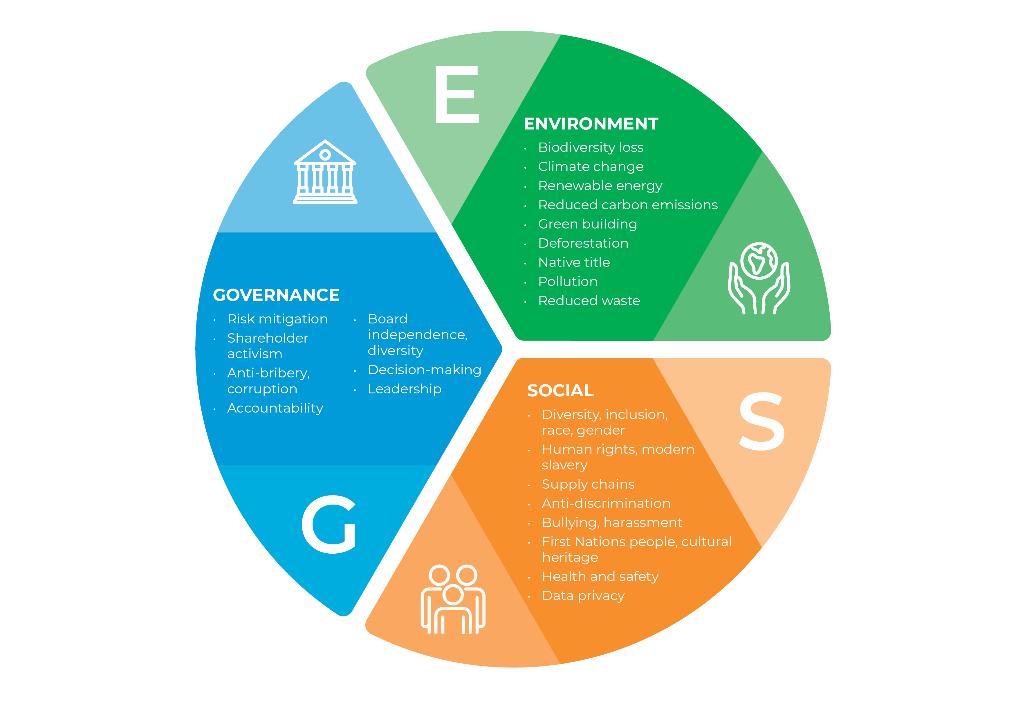
Fiq1:Environmental,SocialandGovernance(ESG)explained:Fiveimportantconsiderations forcompaniesandtheirlawyers
Source: https://www.holdingredlich.com/environmental-social-and-governance-esg-explained-five-importantconsiderations-for-companies-and-their-lawyers
A. EnvironmentalComponent:
The environmental component ofESG examinesthe organization’s relationship withthe natural worldand what actionsittakestomitigatedamagetoit.Thisismorethanobeyingthelaw;itshowsabusiness’sbiggerdedication tosustainabilityandclimateaction.
Organizations must track their carbon emissions and work to minimize them, sometimes in line with the frameworks set by the Paris Accord. Businesses could transition to renewable energy sources such as solar and wind,implementgreenbuildingstandards,andlessenfossilfueldependency.
Resource management is another important area. It’s a vicious cycle when businesses consume raw materials, water,andenergyunsustainably itleadstoscarcity,reputationdamage,andevenregulatoryfines.Thishasled manybusinessestoembracecirculareconomymodelsthatprioritizerecycling,reuse,andwastereduction. Businesses have the equally important task of controlling pollution, which includes emission reduction, wastewatertreatment,andplasticwastereduction.Eco-friendlyandminimal-useplasticpackagingisalsoonthe mindsofmanycustomerswhichforcesbusinessestorethinktheirspending.
Organizations are also required to showcase how they are preserving biodiversity and using land sustainably, particularlyinsectorslikeagriculture,mining,orconstruction.Manycountriesnowrequirebusinessestodisclose environmentalinformation,whichincreasesthepressuretobetransparenton.
B. SocialComponent:
The social pillar concerns itself with how a business manages relationships with its people which include: employees,customers,suppliersandthegreatercommunity.Itreferstothehumanaspectofthebusiness. Asa social pillar,itencompassesthe essential areasof employeewelfare suchasequitablecompensation,safety standards, proper healthcare access, and general wellbeing. Businesses that focus on appropriate employee training, education, and career progression avenues tend to have a more engaged and loyal workforce. Safeguarding labor rights and preventing exploitative practices, including providing safe and healthy workplace conditions,isessential.
No less important is diversity, equity, and inclusion(DEI).Organizationsare now expected to embrace inclusion and equitable access to all employee levels irrespective of gender, ethnicity, and other social backgrounds. Businessesthathavediverseteamstendtodobetterbecauseoftheaddedviewpointsandgreaterinnovation.
International Research Journal of Engineering and Technology (IRJET) e-ISSN:2395-0056
Volume: 12 Issue: 10 | Oct 2025 www.irjet.net p-ISSN:2395-0072
The social pillar also covers beyond employees to include the supply chains. Responsible supply chain management entails ethically sourcing the raw materials without child labor, forced labor, or other exploitative practices.For example,fashionandtechnology companiesareundergreaterscrutinyastohowandfrom where theysourcetheirrawmaterials.
Anotherkeyaspectis customer relationswhichincludessafeguarding privacyand sensitivecustomerdata.Also, upholding product standards and safety, preventing false advertising, and fostering healthy customer relations buildslong-termtrust.
The governance pillar looks at the systems and processes in place that direct and control a business. It assesses whether the leadership is taking appropriate action for the stakeholders, if there is accountability, and if ethical andmoralstandardsaremaintained.
The good governance part starts from the board of directors from which the business draws its governance. An effectiveboardshouldbeindependent,diverse,andwell-composedwhichenablesdecisionmakingtohavechecks andbalances.Theindependenceofthedirectorsprotectsfromsacrificeoftheadversarythatisthemanagement andenablesaccountabilitytobeachieved.
The other important part of this pillar is the executive pay. In the best-case scenario, remuneration should not only reward profits, but should be pegged on company value creation over a period and ESG goals. Pay policies thatareclearandsimpleavoidingtopaybonusesthatarelinkedtoriskybehavioraredesignedtoPeterspay.
Theotherpartofgovernanceistheshareholder’srights.Itisexpectedofthecompaniestohaveappropriateand fairvoting,andtoprotecttheminorityshareholdersfromoppressiveaction,fairparticipation.
Governance circles the risk control that a business has. Governance ensures that there are effective policies on managementofbusinessrisks,auditing,andinrelationtoESG,climaterisks,reputationalbe,andregulatoryrisks.
Theotherimportantaspectisanti-corruptionandtheconductofabusiness.Thepoliciesofcompaniesshouldbe withzerotolerancetobribery,fraud,andcorruption.Inthesamevein,thecompaniesshouldprotectthewhistleblowersontheunethicalbehaviour
5. Companies using ESG:
Herearesomewell-knowncompaniesthatactivelyuseESGprinciplesintheiroperationsandreporting:
1. Microsoft:Strongfocusonrenewableenergyanddataprivacy.AchievesCarbonNeutralitysince2012andaimsto becomeCarbonNegativeby2030.
2. Tesla: Known for its Clean Energy and Electric Vehicles. ESG rating for Tesla is controversial due to governance andlaborpractices,yetthecompanyleadsinthesustainability-drivensector.
3. Unilever: Unilever is known for its Sustainable Living Plans that focus on the reduction of their negative environmentalimpact,ethicallaborpractices,andhelpingcommunities.
4. Tata Group (India): Implements ESG across the corporate strategy. Through governance, renewable energy investments,andcommunitywelfareprograms,ESGisintegrated.
5. Infosys(India):Constructedgreenbuildingsandputemphasisonrenewableenergy.Infosyshasbecomethefirst IndiancompanytoachieveCarbonNeutrality,showingstronggovernance.
6. Apple – Uses recycled materials in products, committed to 100% renewable energy across its supply chain, and enforcesstrictlaborrightsstandardswithsuppliers.
7. Nestlé – Works on sustainable sourcing, reducing plastic waste, improving nutrition, and maintaining high governancestandards.
8. AdaniGreenEnergy(India)–Focusesonrenewableenergyprojectslikesolarandwindpower, aligningbusiness growthwithenvironmentalsustainability.
9. Patagonia–Agloballeaderinsocialandenvironmentalresponsibility,emphasizingfairtrade,recycledmaterials, andclimateactivism.
10. IBM – Strong governance and data ethics policies, with commitments to reducing emissions and promoting workplacediversity.
International Research Journal of Engineering and Technology (IRJET) e-ISSN:2395-0056
Volume: 12 Issue: 10 | Oct 2025 www.irjet.net
A. Environmental(E):
p-ISSN:2395-0072
IntheUS and most parts of Europeand Australia,thefocus remainsonclimate change and achievinga carbonneutral world, so emission standards are enforced and companies are making strides toward addressing renewable energy, electric mobility, and carbon disclosure. ESG (Environmental, Social, and Governance) investing is widespread with Europe accounting for almost half of the ESG assets while rampant consumer andinvestorpressureisacceleratingashifttogreentechnologies.
Prioritization for the environment is quite different, since Asia, the Middle East, and Africa focus on rapid economicdevelopment,sosustainability,whileimportant,isnotapriority.InEurope,thespendingpowerofthe general population is catching up to the standards set in countries like India, China, Japan, and South Korea, which are pouring funding into renewable energy along with green infrastructure. On the other hand, China is making strides to become carbon neutral by 2060. In the Middle East, Saudi Arabia and the UAE are moving towardbecominglessoildependent,investingheavilyinsolarandhydrogenprojects.
B. Social(S):
Prominent Westerncountriesare moreinclinedtoprioritizeequityandinclusionalongwith gender, racial,and sexualdiversity.Lawsregardinglabourareinplacetosafeguardthewellbeingofemployees,offeringprotections regarding minimum wage, safety requirements, and occupational health. Businesses face public scrutiny in fulfilling social responsibilities, which include community development and corporate philanthropy. Consumer activismisstrong,andbusinessesfacebacklashiftheyfailtomeetsocialexpectations.
FocusingonthesocialdimensionoftheEasternworld,labourandwageequity,inadditiontooccupationalsafety in relation to the workforce, takes prominence in manufacturing economies. Compared to the Western world, there is less focus on diversity, but there is more focus on social harmony and community support. Many Asian firms conduct extensive community service initiatives in health, education, and poverty alleviation, often motivated by corporate social responsibility. Moreover, data privacy and digital rights are becoming critical issuesinrapidlydevelopingeconomies,suchasIndiaandChina.
C. Governance(S)
In the West, governance focuses on shareholder consideration, board autonomy, and executive responsibility. Systemsforgovernance,anti-corruption,andcompliancearecomprehensiveandeffective.Shareholderactivism, particularly among US investors, is prevalent and affects business decisions. There is strict regulation enforcementonunethicalbusinesspractices,insidertrading,andfraud.
BundledgovernanceintheEastisheterogeneous.DevelopedmarketslikeJapanandSingaporepossessemerging market competencies and face challenges of corruption alongside weak enforcement. There are family-owned business and conglomerate patters that dominate the Asian economy, which does reduce some of the board autonomy.Regulatorsareslowlyimprovinggovernancestandards,suchasSEBI’srequirementsforsustainability reporting and enhanced disclosure regulations from CSRC. Many regions are still in the process of developing whistle-blowerprotectionsanddisclosuretransparency.
1. Environmental(E): Theory
Thispillarfocusesonhoworganizationsmanagenaturalresourceusage,environmentalrisk,andclimateimpact. It emphasizes emissions reduction, renewable energy adoption, circular economy approaches, biodiversity protection,andtransparentenvironmentaldisclosures.
The UK’s net-zero economy is booming growing 10% in 2024, contributing £83.1 billion in Gross Value Added (GVA),andgeneratingnearly 951,000 full-time jobs,withaveragewagesof £43,076,which surpassthenationalaverageof~£37,430.
International Research Journal of Engineering and Technology (IRJET) e-ISSN:2395-0056
Volume: 12 Issue: 10 | Oct 2025 www.irjet.net p-ISSN:2395-0072
In2023,thesectorgrew 9%,adding £74 billion in GVA andsupporting 765,700 jobs.
Economic impact is widespread not limited to London. Regions like the West Midlands, Scotland, and Yorkshirearegrowinginnet-zeroactivity,contributingtoregionalequalityand"levellingup".
Every£1ofnet-zeroactivitydrivesnearly£1.90inwidereconomicoutput.
However,thereareconcernsabout data reliability:nearly50%ofFTSE100firmshavehadtorestateESG data,especiallyforcomplexScope3emissions.
Theory
Thispillarexamineshowbusinessesimpacthumanfactors employeewell-being,diversity,labourrights,supply chainethics,customerprotection,andcommunityengagement.
UK Data Highlights
Consumer values strongly align with ESG: 88% of consumers say they are more loyal to companies supporting environmental or social causes; 76–88% would stop buying from firms with poor environmentalpractices.
Despite this, just 4–11% of UK investors actively choose ESG investments even though 57% express interest.
Within firms, ESG structures are evolving: 40% have dedicated ESG departments, and 39% employ ESG officersorspecialists wellaheadofNorthAmerica.
In manufacturing, 62% set ESG targets (a 48% jump since 2021), and 74% now include ESG criteria in procurement,though 45% remainunawareofsupplierperformance.
Investorsentimentappearstobecooling:theshareofUKinvestorsprioritizingESGfellfrom 44% in 2021 to 38% in 2023,andbeliefincompanies'ESGcommitmentsdroppedfrom 75% to 68%
On the oversight side, 79% of FTSE 100 companies now secure external assurance on ESG metrics an increaseof4%since2021;almosthalfusethesameauditorforfinancialandESGreporting.
3. Governance(G):TheoryMeetsReality Theory
This pillar centres on corporate leadership, ethics, transparency, oversight, and accountability. Good governance ensuresESGcommitmentsareintegratedintostrategy,riskcontrol,reporting,andethicalconduct.
UK Data Highlights
The UK Corporate Governance Code and Companies Act 2006 already mandate directors consider environmentalandsocialmattersindecision-making(theoreticalframework).
Inpractice, 40% ofUKcompaniesplaceESGresponsibilityattheboardlevel higherthanthe28%inNorth America and 40% engageexternalstakeholdersactively.
Technology adoption supports governance: 55% of UK CEOs invest in ESG-related tech skills, and 43% in techsystemsforESGteams; 74% ofinvestorswantindependentassuranceonsustainabilityreports.
Despiteprogress,somelargeUKfirmsposehighESGrisks amongtop10UKstocks, Shell, BP, and British American Tobacco have“High”ESGriskratings.
International Research Journal of Engineering and Technology (IRJET) e-ISSN:2395-0056
Aspect Key Data & Trends
Net-ZeroSectorGrowth
ClimateDisclosures
RenewableFinance
GreenBonds
SustainableFinanceMarket
ESGInvestmentMarket
InvestorParticipation
CorporateESGFocus
ReportingAccuracy
InvestorConfidence
ESGFundUnderperformance
GreenMortgages
FossilFuelFinancing
Calculations:
1. SHELLESG:
10%GVAgrowth;£83billionGVAin2024
66%firmshavetransitionplans;qualityscore69%
US$22.6Bin2024→US$115.6Bby2033(CAGR17.7%)
US$36.9Bin2024→US$127.8Bby2033(CAGR11.97%)
US$65Bin2024→US$550B+by2035(CAGR~21%)
US$1.64Bin2024→US$5.08Bby2030(CAGR~21.6%)
57%holdESGinvestments;GenZat66%,BabyBoomersat11%
40%haveESGteams;80%prioritizesustainability;75%readytotradeprofit
50%ofFTSE100restatedESGdataduetoerrors
ESGconsiderationdownto38%;trustandattractivenessdeclining
ESGconsiderationdownto38%;trustandattractivenessdeclining
Fellfrom16%to11%ofdeals(2023→2025)
£75B+investedinmajorcarbonprojectssince2016
Table1:MultipleAspectandkeydataassociatedwithit inUnitedKingdom
a. RevenueofShell(inBillionDollars):
Ingraph,x-axisasyearsfrom2015to2025andY-axisshowRevenueofShell(inUSDBilliondollars) Let’sconsider2015as1,2016as2……..2025as11.
Aftermanuallydrawinggraphanonexcel. Weconcludedexponentialequationcoversmaximumnumberofplots
Volume: 12 Issue: 10 | Oct 2025 www.irjet.net p-ISSN:2395-0072 © 2025, IRJET | Impact Factor value: 8.315 | ISO 9001:2008
International Research Journal of Engineering and Technology (IRJET) e-ISSN:2395-0056
Volume: 12 Issue: 10 | Oct 2025 www.irjet.net p-ISSN:2395-0072
Consideringy=A.Bx
RevenueofShell(inBillionDollars)
Formula: ( )
Where“y”representsRevenueofShell(inUSDmilliondollars) and“x”represents1,2,3……(1represents2015,2 represents2016andsoon).
ComparingStraightlineandexponentialgraph:
StraightlinegraphforShell’sRevenue:
Formula:
ExponentialgraphforShell’sRevenue: Formula: ( )
International Research Journal of Engineering and Technology (IRJET) e-ISSN:2395-0056
Volume: 12 Issue: 10 | Oct 2025 www.irjet.net
p-ISSN:2395-0072
Exponential graphs are better than straight-line models in ESG analysis because ESG outcomes rarely grow at a constantpace;theyaccelerateduetocompoundingeffects,investorsentiment,andregulatorypressures.Whilelinear models assume steady change, exponential models capture tipping points, rapid risk escalation, and long-term benefits. For example, AstraZeneca’s transparent ESG reporting compounds investor trust, while Shell’s delayed transition amplifies risks. Thus, exponential models provide a more realistic, forward-looking view of ESG performance.
b. Shell’sEmployeeSalary(inmillionDollars):
Ingraph,x-axisasyearsfrom2015to2025andY-axisshowShell’sEmployeeSalary(inmillionDollars)
Let’sconsider2015as1,2016as2……..2025as11.
Aftermanuallydrawinggraphanonexcel.
Weconcludedexponentialequationcoversmaximumnumberofplots.
Consideringy=A.Bx
EmployeeSalary(inmillionDollars)
Formula: ( )
Where“y”representsShell’sEmployeeSalary(inUSDmilliondollars)and“x”represents1,2,3……(1represents 2015,2represents2016andsoon).
c. TaxPaid(inbillionsdollars):
Ingraph,x-axisasyearsfrom2015to2025andY-axisshowShell’sEmployeeSalary(inmillionDollars)
Let’sconsider2015as1,2016as2……..2025as11.
Aftermanuallydrawinggraphanonexcel.
Weconcludedexponentialequationcoversmaximumnumberofplots
Consideringy=A.Bx
International Research Journal of Engineering and Technology (IRJET) e-ISSN:2395-0056
Formula: ( )
Where“y”representsShell’sTaxpaid(inUSDmilliondollars)and“x”represents1,2,3……(1represents2015,2 represents2016andsoon).
d. InvestmentinEnergy(inmillions):
Ingraph,x-axisasyearsfrom2015to2025andY-axisshowShell’sEmployeeSalary(inmillionDollars)
Let’sconsider2015as1,2016as2……..2025as11.
Aftermanuallydrawinggraphanonexcel. Weconcludedexponentialequationcoversmaximumnumberofplots
Consideringy=A.Bx
Volume: 12 Issue: 10 | Oct 2025 www.irjet.net p-ISSN:2395-0072 © 2025, IRJET | Impact Factor
InvestmentinEnergy(inmillions)
Formula: ( )
Where “y” represents Shell’s Investment in Energy (in USD million dollars) and “x” represents 1, 2, 3…… (1 represents2015,2represents2016andsoon).
International Research Journal of Engineering and Technology (IRJET) e-ISSN:2395-0056
Volume: 12 Issue: 10 | Oct 2025 www.irjet.net p-ISSN:2395-0072
a. RevenueofAstrazena(inBillionDollars):
Ingraph,x-axisasyearsfrom2015to2025andY-axisshowAstrazena’sEmployeeSalary(inmillionDollars)
Let’sconsider2015as1,2016as2……..2025as11.
Aftermanuallydrawinggraphanonexcel.
Weconcludedexponentialequationcoversmaximumnumberofplots
Consideringy=A.Bx
International Research Journal of Engineering and Technology (IRJET) e-ISSN:2395-0056
Volume: 12 Issue: 10 | Oct 2025 www.irjet.net p-ISSN:2395-0072
Where“y”representsShell’sEmployeeSalary(inUSDmilliondollars)and“x”represents1,2,3……(1represents 2015,2represents2016andsoon).
ComparingStraightlineandexponentialgraph:
StraightlinegraphforShell’sRevenue: Formula:
ExponentialgraphforShell’sRevenue: Formula: ( )
Revenue of Astrazenca (in billion dollars)
Exponential StraightLine RealData
Exponential graphs are better than straight-line models in ESG analysis because ESG outcomes rarely grow at a constantpace;theyaccelerateduetocompoundingeffects,investorsentiment,andregulatorypressures.Whilelinear models assume steady change, exponential models capture tipping points, rapid risk escalation, and long-term benefits. For example, AstraZeneca’s transparent ESG reporting compounds investor trust, while Shell’s delayed transition amplifies risks. Thus, exponential models provide a more realistic, forward-looking view of ESG performance.
b. Astrazena’sEmployeeSalary(inmillionDollars):
Ingraph,x-axisasyearsfrom2015to2025andY-axisshowAstrazena’sEmployeeSalary(inmillionDollars)
Let’sconsider2015as1,2016as2……..2025as11.
© 2025, IRJET | Impact Factor value: 8.315 | ISO 9001:2008 Certified Journal | Page209
International Research Journal of Engineering and Technology (IRJET) e-ISSN:2395-0056
Volume: 12 Issue: 10 | Oct 2025 www.irjet.net p-ISSN:2395-0072
Aftermanuallydrawinggraphanonexcel.
Weconcludedexponentialequationcoversmaximumnumberofplots
Consideringy=A.Bx
Salary(inmillionDollars)
Formula: ( )
Where“y”representsShell’sEmployeeSalary(inUSDmilliondollars)and“x”represents1,2,3……(1represents 2015,2represents2016andsoon).
c. TaxPaid(inbillionsdollars)
Ingraph,x-axisasyearsfrom2015to2025andY-axisshowTaxpaid(inbillionDollars)
Let’sconsider2015as1,2016as2……..2025as11.
Aftermanuallydrawinggraphanonexcel.
Weconcludedexponentialequationcoversmaximumnumberofplots
Consideringy=A.Bx Formula: ( )
Paid(inbillionsdollars)
International Research Journal of Engineering and Technology (IRJET) e-ISSN:2395-0056
Volume: 12 Issue: 10 | Oct 2025 www.irjet.net p-ISSN:2395-0072
Where“y”representsShell’sEmployeeSalary(inUSDmilliondollars)and“x”represents1,2,3……(1represents 2015,2represents2016andsoon).
d. GreenHouse(CO2emissionintonnes):
Ingraph,x-axisasyearsfrom2015to2025andY-axisshowAstrazena’sgreenhouse(CO2emissionintonnes).
Let’sconsider2015as1,2016as2……..2025as11.
Aftermanuallydrawinggraphanonexcel. Weconcludedexponentialequationcoversmaximumnumberofplots
Consideringy=A.Bx
Formula: ( )
Where“y”representsAstrazena’sgreenhouseemissions(inCO2emissionstonnes)and“x”represents1,2,3…… (1represents2015,2represents2016andsoon).
Analysis and Evaluation:
Analysisshowhowinvestment incarbonreductionand energyrelated projectsstrengthen both thecompanies, showing steady revenue growth impacting long run trends in ESG finance linkage. Revenue growth, tax contribution, employee incentivesattractslengtheninvestmentforinvestors.
Conclusion:
Shell and AstraZeneca both play critical roles in the UK economy through employment, tax contributions, and revenue generation,makingtheirESGstrategiesparticularlyimpactful.AstraZenecademonstratesstrongerESGperformance,with transparent reporting and consistent alignment with investor and regulatory expectations, which reduces ESG risk and supportslong-termfinancialstability.Incontrast,Shellfacessignificantchallengesduetoitslargecarbonfootprintbutis actively transitioning toward cleaner energy solutions. Quantitative analysis indicates that ESG improvements correlate with financial resilience, investor confidence, and sectoral strength. Overall, AstraZeneca currently offers lower ESG risk and more predictable returns, while Shell’s future success depends heavily on accelerating its transition strategy and maintaininginvestortrustinitssustainabilitycommitments.
The comparative ESG analysis of Shell and AstraZeneca illustrates the manner in which big companies in different industries make varying contributions to the United Kingdom's economy and sustainability agenda. Both firms show
International Research Journal of Engineering and Technology (IRJET) e-ISSN:2395-0056
Volume: 12 Issue: 10 | Oct 2025 www.irjet.net p-ISSN:2395-0072
remarkableupwardexponentialpatternsinrevenuegeneration,paydistribution,andtaxcontribution,whichsignifytheir enlargingeconomicrole.Socially,thisreflectsrisingabilitytoprovideemploymentopportunitiesandfinancepublicfunds throughtaxation.
On the green side, AstraZeneca demonstrates a divergent trend: as its revenue and social contributions go up exponentially,itsgreenhousegas emissionsdepartfrom theuniversal upwarddirectionbyholdingsteadyordecreasing, indicative of the company's focus on cleaner pharmaceutical manufacturing. Shell's environmental track record is also inextricablylinkedtoitsprimarybusiness,butits increasedinvestmentinrenewableenergysourcessuggestsastrategic realignment toward sustainability. The accelerating rise in Shell's economic activities, combined with increasing investments in energy transition initiatives, implies that even historically carbon-heavy sectors are evolving amidst ESG forces.
By and large, the observations indicate that though both organizations are economically resilient and socially beneficial, their environmental paths diverge AstraZeneca emphasizing reducing emissions in healthcare manufacture, and Shell usingitscapitalsuperioritytoshiftincrementallytowardscleanerenergyinvestments.ThisillustratesthedifficultyofESG integrationbyindustry:pharmaceuticalscanhavequantifiableemissionsimprovement,whereasenergybehemothshave to reconcile historic operations with future-oriented investment. Together, the geometric increasing trends assert the value of ESG metrics as well as evidence of responsibility, but also as determinants of long-term corporate strength and alignmentwithacountry'ssustainabilityobjectives.
The study exemplifies a number of distinct strengths in both design and analysis. It delivers a thorough assessment of Environmental, Social, and Governance (ESG) considerations through a comparative study of two leading British firms, ShellandAstraZeneca,fromtheenergyandpharmaceuticalindustriesrespectively.Thecross-industryapproachenables effective inter-industry comparison involving firms with varying sustainability agendas. The addition of quantitative measures like revenue, employee remuneration, tax payments, CO₂ emissions, and energy investments adds objectivity and empirical depth to the research. The amalgamation of financial and non-financial information presents a balanced view of how ESG performance converges with corporate performance. The research is also highly relevant to the real world,correspondingto worldwideconcernsregarding sustainability,corporateresponsibility,and net-zerotargets.The integrationofsocial,environmental,andgovernancefactorsovermultipledimensionsenhancesitsroleintheexplanation ofcorporateresponsibilityintheBritishcontext.
Besidesitsstrengths,therearealsosomelimitationstotheresearch.Theframeworkofanalysisforjusttwofirmsreduces the generalizability of the results to the larger corpus of British business. Using secondary data and firm-provided ESG data might incur potential bias or inconsistency in measurement. Additionally, the study employs a cross-sectional approach, utilizing data from one point in time instead of looking at long-run patterns. This time constraint reduces understanding of the development of ESG over time. The underlying sectoral variation in the nature of an energy firm compared to a drugs company also creates obstacles in developing standardized ESG benchmarks. Besides, although correlations between ESG and finance are analyzed, causality cannot be proven by the study, and opportunity is left for morein-depthstatisticalanalysis.
Subsequent studies can mitigate these constraints by broadening the dataset to cover additional British firms from a varietyofindustries,henceenhancingrepresentativeness.Conductingalongitudinaldesignofstudywouldenabletrends to be analyzed and the long-term effect of ESG practices. Applying standardized reporting frameworks like GRI or SASB can enhance comparability of outcomes. Slightly more advanced quantitative approaches like regression analysis or machinelearningmayoffermorerobustcausalunderstanding.Lastly,theadditionofqualitativemethodslikestakeholder interviews or policy analysis would enhance knowledge of how ESG strategies influence corporate sustainability and performance.
References:
AstraZeneca: Sustainability & ESG
1 AstraZeneca (2024) Ambition Zero Carbon Infographic 2023. Available at: https://www.astrazeneca.com/content/dam/az/Sustainability/2024/pdf/Ambition-Zero-Carbon-Infographic-2023.pdf (Accessed:12September2025).
International Research Journal of Engineering and Technology (IRJET) e-ISSN:2395-0056
Volume: 12 Issue: 10 | Oct 2025 www.irjet.net p-ISSN:2395-0072
This infographic provides a visual summary of AstraZeneca’s targets to achieve zero carbonemissions across Scope1, 2, and3. It shows the company’s focus on sustainable operations and alignment with global climate goals.
2. AstraZeneca (2024) Sustainability Highlights 2024. Available at: https://www.astrazeneca.com/content/dam/az/Investor_Relations/events/2024-Sustainability-Highlights.pdf(Accessed: 19September2025).
An overview of AstraZeneca’s progress in ESG initiatives, including reductions in greenhouse gas emissions, renewable energy adoption,andsustainableR&Dpractices.Usefulfor demonstratingtrends inenvironmentalandsocialresponsibility.
3. Shell (2024) Climate and Energy Transition Lobbying Report 2024. Available at: https://www.shell.com/sustainability/advocacy-and-politicalactivity/_jcr_content/root/main/section/simple/promo_copy_copy_copy/links/item0.stream/1746798498441/097ec94 69a351908a2d97321d3ed486f6b883c81/shell-climate-and-energy-transition-lobbying-report-2024.pdf (Accessed: 27 August2025).
Although hosted on Shell’s site, this report includes AstraZeneca’s engagement in policy advocacy related to net-zero and energytransition.Highlights corporategovernanceandcommitmenttosustainabilitypractices.
4. AstraZeneca (2025) Sustainability Data Annex 2024. Available at: https://www.astrazeneca.com/content/dam/az/Sustainability/2025/pdf/Sustainability-Data-Annex-2024.pdf (Accessed: 12September2025).
Provides detailed quantitative data on AstraZeneca’s ESG performance, including energy consumption, emissions metrics, and progressagainstsustainability targets.Usefulfortrendanalysis.
5. Reuters (2025) ‘AstraZeneca opens biomethane plant in UK to cut emissions’, Reuters, 27 February. Available at: https://www.reuters.com/sustainability/climate-energy/astrazeneca-opens-biomethane-plant-uk-cut-emissions-202502-27/(Accessed:11September2025).
News article reporting on AstraZeneca’s new biomethane plant in the UK, which contributes to lower carbon emissions in operations and demonstrates the company’s commitment to sustainable energy solutions.
Shell: Net Zero & ESG
6. Shell (n.d.) Shell Policy Tracker. Available at: https://fourleafdigital.shell.com/webapps/shell-policy-tracker/prod/ (Accessed:15September2025).
Interactive tool tracking Shell’s responses to UK net-zero and climate policies. Shows how Shell aligns business strategy with regulatoryframeworksandcleanenergycommitments.
7 The Guardian (2023) ‘Shell’s green ad campaign banned in UK for being likely to mislead’, The Guardian, 7 June. Available at: https://www.theguardian.com/business/2023/jun/07/shells-green-ad-campaign-banned-in-uk-for-beinglikely-to-mislead(Accessed:13September2025).
Discusses regulatory scrutiny over Shell’s marketing claims regarding its green energy transition. Illustrates challenges fossil fuelcompaniesface inESG communication.
8. Carbon Brief (2024) ‘Shell abandons 2035 emissions target and weakens 2030 goal’, Carbon Brief. Available at: https://www.carbonbrief.org/shell-abandons-2035-emissions-target-and-weakens-2030-goal/ (Accessed: 29 August 2025).
Analysis of Shell adjusting its emissions reduction targets, reflecting the difficulty of transitioning from fossil fuels to renewableenergywhilemaintainingfinancialperformance.
9 NetZeroTracker(n.d.) NetZeroTracker.Availableat:https://zerotracker.net/(Accessed:14September2025).
A global platform tracking corporate and national progress toward net-zero emissions, including Shell. Useful for comparing ESGperformanceandsustainabilitycommitmentsacross firms
International Research Journal of Engineering and Technology (IRJET) e-ISSN:2395-0056
Volume: 12 Issue: 10 | Oct 2025 www.irjet.net p-ISSN:2395-0072
10 SpringerLink (2024) ‘Boardroom diversity and carbon emissions’, Journal of Business Ethics. Available at: https://link.springer.com/article/10.1007/s10551-024-05675-2(Accessed:17September2025).
AcademicresearchlinkingboarddiversityinUKfirmstoenvironmentaloutcomes. Relevantforexamininggovernanceaspects ofESG strategies inAstraZenecaandShell.
Biographies:
Tanisi Garg, Grade 12
ACSInternationalSchoolHillingdon
Grade10:98%
NationalHonourSocietyTreasurer
Co-FounderoftheStudentSchoolNewspaper
VolleyballTeamCaptainfor2ConsecutiveYears
WontheMostImprovedMedalforBasketball
CompletedtheGAINInvestmentChallenge
CertificatedtheGlobalCitizenDiploma
CompletedJobSimulationsatBarclaysandBankofAmerica
CurrentlyWorkingontheWhartonInvestmentChallenge
Undertheguidanceof:
Dr. Mamta Jain
M.Sc(Mathematics)(Doublegoldmedalist)
M.Phil(ComputerApplications)withhonorsFromUniversityofRoorkee(nowIITRoorkee)
PhD(Mathematics)-Variouspaperspublishedininternationaljournals
FormerLeadAuditorISO9001,ISO-22000SchoolAccreditationExaminerbyQCI
26yearsofteachingexperience
VariousResearchPaperPublished
Er. Raunaq Jain
B.EMechanicalEngineeringFromThaparInstituteofEngineeringandTechnology
DistrictPhysicsTopper
ContentWriterandgraphicdesigner
MechanicalMentorfromsession2019-2020
TechnicalDataAnalystatDeloitte
© 2025, IRJET | Impact Factor value: 8.315 | ISO 9001:2008 Certified Journal | Page214