
International Research Journal of Engineering and Technology (IRJET) e-ISSN:2395-0056
Volume:12Issue:10|Oct2025 www.irjet.net p-ISSN:2395-0072
International Research Journal of Engineering and Technology (IRJET) e-ISSN:2395-0056
Volume:12Issue:10|Oct2025 www.irjet.net p-ISSN:2395-0072
Sneha Kumbhar1 , Atharva Khairnar2 , Swaraj Langhe 3 , Harshali Latake4, Aryan Kokate, Vivek Nagnath5
Students, Department of Information Technology, Vishwakarma Institute of Technology, Pune, Maharashtra, India ***
Abstract - In colleges and universities, students often struggle to keep track of the many events happening around them ranging from workshops and seminars to hackathons and sports activities. Information is usually scattered across different platforms, making it timeconsuming and difficult to stay updated. The challenge is even greater for visually impaired students, who face barriers in accessing event details through traditional communication methods. To overcome these gaps, we designed a Centralized Event Information Platform,a webbasedsolutionthatbringsalleventdetailstogetherinone place. The system not only allows students to browse, track,andregisterforeventsbutalsointegratesaText-toSpeech (TTS) feature to make the platform more accessible. Automated email updates further ensure that students receive timely reminders and confirmations. By reducing information gaps and promoting inclusivity, the platformencourageshigherparticipationandhelpscreate amoreengagingandsupportivecampusenvironment.
College clubs are host to a wide variety of events that not only add to academics but also are a source of extracurricular activities. Centralized Event Information Platform aims to create a user-friendly website that consolidates information about various club events like hackathons, seminars, sport events, workshops, cultural or technical activities and many such events which play a vital role in student development. However, the lack of a centralized information source creates challenges for students seeking relevant events. This platform addresses the challenge of finding and tracking events by providing a single source of information. Additionally, the platform includes an API to make event details accessible to visually impaired students through textto-speech speech functionality. This promotes inclusivity and encourages equal participation for all students. Overall, this platform simplifies event discovery, reduces time consumption and empowers students to engage in co-curricular and extracurricular activities. It creates a positive social impact by making events more accessible to visually impaired students, hence boosting their social moraleimpact by making events more accessible to visually impaired students, hence boosting their social morale
Thepaper “Best Practices in Web Design” by B. Smith and J. Doe helped shape the project’s accessibility features. It inspiredtheuseoftheWebSpeechAPIfortext-to-speech, ARIA tags for screen readers, and keyboard navigation to support visually impaired users. “Data-Driven Decision Making in Education” by W. Brown guided the platform’s useofdataanalyticstomanageevents,trackparticipation, and improve recommendations through user data and automated emails. The Google Developers module “Using Text-to-Speech for Accessibility” supported the integration of voice features to make the system more user-friendly forvisuallyimpairedusers. “Designing for Accessibility” by J. Green and P. Lee influenced the inclusion of keyboard navigation, ARIA attributes, and responsive design for betteraccessibilityonalldevices.The “Event Management System” by Vinay Mishra et al. helped in developing the “Book Events” feature, which handles scheduling, reminders, and event coordination efficiently. “A Web Accessing Tool for Blind and Visually Impaired People” by Fajar and Muliaa A. Ayu inspiredfeatureslikespeechinput and text-to-speech for easier access to event information. “Visually Impaired E-Commerce” by Mallika Chand et al. guided the use of voice commands, audio feedback, and recommendation systems for a better user experience. “PerSEEption” by De Jesus and Gapilitan influenced the platform’s design for accessibility, adding audio feedback and supportive learning tools. “Voice-Based Online Examination System” by Dharmasena and Jayakody inspired the use of speech technologies for smooth and secure interactions. Lastly, “Social Media Personal Event Notifier” by Pavithiran and Padmanabhan guidedtheuseof NLP and machine learning to collect and prioritize event dataeffectively.
1.2Methodology
A.SystemArchitecture
The system architecture ensures modularity, scalability,andaccessibilitythroughthreelayers[11]:
1. Front-end Layer: Built using HTML, CSS, and JavaScript toprovidea responsive UIandsmooth UX. It communicates with the back-end via HTTP requestsandAPIcalls.
2. Back-endLayer:DevelopedwithFlask(Python),it handles routing, user requests, data validation, andAPIinteractions.
International Research Journal of Engineering and Technology (IRJET) e-ISSN:2395-0056
Volume:12Issue:10|Oct2025 www.irjet.net
3. API Layer: Integrates two external APIs Web Speech API (converts text to speech for visually impairedusers)and AmazonSESAPI(automated eventconfirmationemails).
The client-server model allows independent development and maintenance of modules.
Figure 1: Methodology Flowchart (Google TTS for Web Speech API Framework)
B.Front-endDevelopment
Thefront-endwasdesignedusing:
HTML: Structured event details and registration forms using semantic tags for better accessibility andSEO.
CSS: Created a responsive layout using Flexbox andGrid.
JavaScript: Added interactivity and activated the WebSpeechAPI.
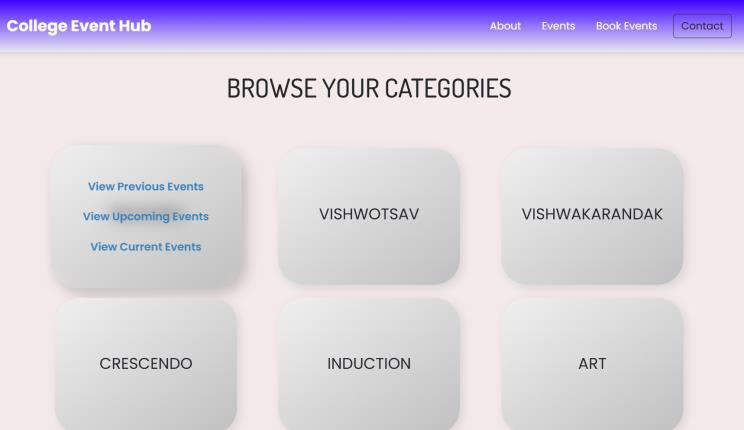
ABookEventpageallowsuserstoregisterforevents. Data is sent to the back-end via AJAX, ensuring smooth,reload-freecommunication.
C.Back-endDevelopment
BuiltusingFlask,theback-endmanages:
Routing: For homepage, event booking, and textto-speechendpoints.
Form Handling: Validates and processes user inputssecurely.
APIIntegration:Connectsto Web SpeechAPI and Amazon SES to provide audio output and automatedemails.
D.APIIntegration
1. Web Speech API:Converts text intoMP3 audio to assistvisuallyimpairedusers.
2. Amazon SES: Sends automated confirmation emails using Flask’s boto3 library with dynamic HTMLtemplates.
Both APIs were tested for accuracy and reliability.
Figure 2: Integration of Web Speech API
E.AccessibilityFeatures
Thewebsitepromotesinclusivitythrough:
Fullkeyboardnavigationandlogicaltaborder.
AudiofeedbackviaWebSpeechAPI.
Responsivedesignforalldevices.
ARIA attributes for enhanced screen reader compatibility.
The website was successfully built using HTML, CSS, and JavaScript for the frontend, along with Flask for the backend. The incorporation of two essential APIs Web Speech API and Amazon SES improved the website's functionality,makingitmoreaccessibleanduser-friendly, particularly for visually impaired users. The following results were noted during the development and testing phasesFront-endResponsiveness:Thewebsitewastested for responsiveness across various devices (desktops, tablets, and mobile phones) and screen resolutions. The
p-ISSN:2395-0072
use of modern CSS frameworks ensured a consistent and visuallyappealinglayout.
Flask provided a lightweight and efficient backend, capableofhandlingmultipleuserrequestssimultaneously. The average response time for dynamic content (e.g., eventregistration)wasunder1second.
Accessibility Compliance: The website was evaluated against the Web Content Accessibility Guidelines (WCAG 2.1), achieving Level AA compliance. This was primarily due to the Web Speech API integration and keyboardfriendly
Table-1: comparisontable
Study What They Tried Where It FellShort How Our Work FixesIt
Smithet al.[1]
Pulled realtime event data from different sources
Johnson etal.[2] Used social media for event sharing
Chen et al.[3] Added blockchain for event security
Patel et al.[4]
Personalized eventsusing AI
Couldn’t scale well as events grewbigger
Scattered info,no singlehub
Too costly and complex foreveryday use
Risked privacy issues and bias
Brown etal.[5]
Studied engagement on digital platforms
Couldn’t solve longterm retention
We built a system that scalessmoothly while giving instantupdates
We created a central space that unites social features with official eventdetails.
We provide secure, reliable access without the heavy blockchain overhead
We designed controlled personalization that respects privacy while stayinguseful
Our platform adds interactive and accessible tools to keep users engaged overtime.
The proposed College Event Information Platform presents a promising foundation for enhancing student engagement and inclusivity in academic and extracurricularactivities.However,theplatform'spotential for expansion and improvement extends well beyond its current capabilities. Several future enhancements can be integrated to improve functionality, accessibility, scalability,andoveralluserexperience
International Research Journal of Engineering and Technology (IRJET) e-ISSN:2395-0056
Volume:12Issue:10|Oct2025 www.irjet.net p-ISSN:2395-0072
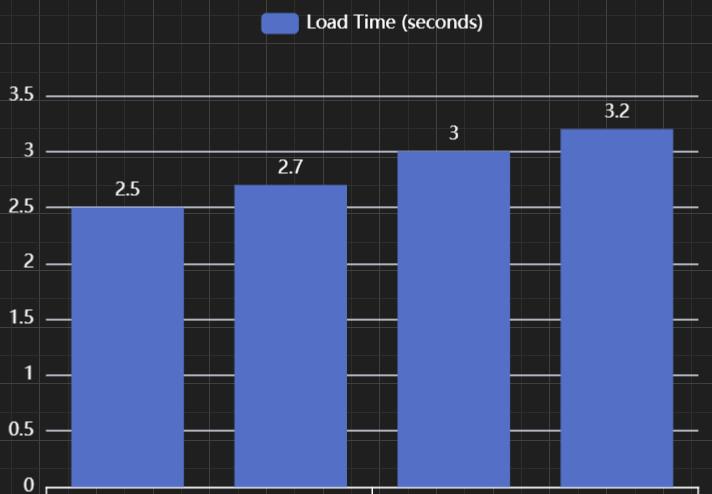
Chart -1: The bar graph shows the load time of the websiteacrossdifferentdevices.Thebarsrespectivelyare of Desktop/Chrome, Desktop/Firefox, Mobile/Chrome &Mobile/Safari
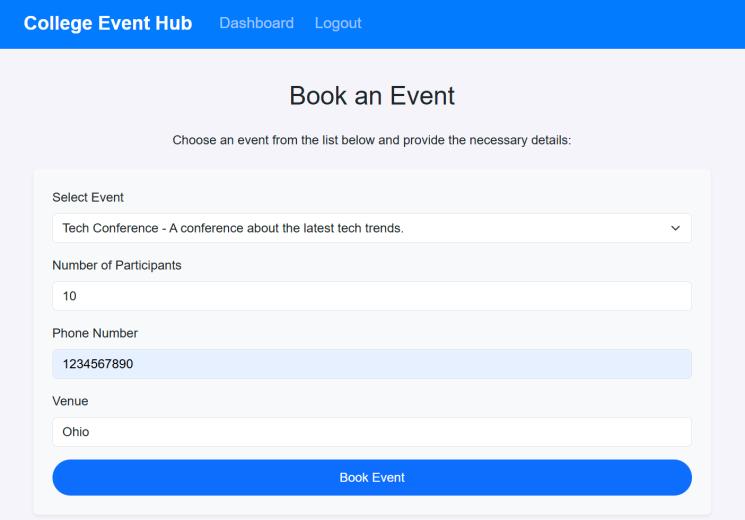
Book Event form powered by Flask (Note: The phone number and venue in this figure to be considered as test examples)
The creation of “Centralized College Event Hub with Support for Visually Impaired Students” marks an
important advancement in promoting inclusivity and accessibility within educational institutions. By incorporating features such as text to speech capabilities, compatibility with screen readers, and real time updates about events, this platform effectively addresses the difficulties visually impaired students encounter when tryingtoengagewithcampusactivities.
The initiative not only makes it easier for students to find and participate in co-curricular and extracurricular events but also encourages community involvement and equalopportunitiesfor everyone. Withcareful planning,a focus on user needs, and the application of strong developmenttools,thisprojectsetsascalableexamplefor building accessible digital platforms in academic environments.
We sincerely express our gratitude to Director of VIT, Pune Dr. Rajesh Jalnekar Sir for providing us with the opportunity and resources to work on this research. We are also deeply thankful to Prof. Chandrashekhar Mahajan Sir,HeadoftheDepartment,forhisvaluableguidanceand support throughout this project. Additionally, we extend our appreciation to S. S. Sawant Sir, our project coordinator, for his encouragement and assistance. Their support has been instrumental in the successful completionofthisproject.
WealsoacknowledgethedevelopersoftoolsandAPIslike Web Speech API and Amazon Simple Email Service (SES), whichenabledtheimplementationofaccessibilityfeatures.
Lastly gratitude goes to our peers and beta testers (especiallythevisuallyimpairedtesters)fortheirfeedback, helpinguscreateaninclusiveanduser-friendlyplatform.
[1] B. Smith and J. Doe, Accessibility for the Visually Impaired: Best Practices in Web Design. IEEE Transactions on Accessibility, vol. 56, no. 4, pp. 120130,Apr.2023.
[2] W.Brown,Data-DrivenDecisionMakinginEducation. Proc.IEEEInt.Conf.onDataScience,2023,pp.45-50.
[3] Google Developers, "Using Text-to-Speech for Accessibility," 2024. [Online]. Available: https:// developers.google.com
[4] J. Green and P. Lee, Designing for Accessibility: A ComprehensiveGuide.IEEEPress,2021
[5] Vinay Mishra, Madhu Dubey, Priya Bamajai- Event Management System,InternationalJournalofTrendin ResearchandDevelopment(IJTRD),2016
International Research Journal of Engineering and Technology (IRJET) e-ISSN:2395-0056
Volume:12Issue:10|Oct2025 www.irjet.net p-ISSN:2395-0072
[6] Fajar,MuliiaAnugerahAyu-AWebAccessingToolfor Blind and Visually Impaired People Using Bahasa Indonesia,IEEE,2017
[7] Mallika Chand, Shreya Mukherdhi, Sullah MirkarVisually Impaired Friendly E-commerce, (ICEECCOT), 2019
[8] Jan Adalbert P. De Jesus, Kyle Andrew V. GapilitanMobile and Web Application Framework for Visually Impaired Students, 1st International Conference in InformationandComputingResearch,2021
[9] J.H.H.N.Dharmasena,FacultyJ.A.D.C.A.JayakodyVoice-based Online Examination System for Visually Impaired, International Conference on Advanced ResearchComputing(ICARC),2022
[10] Pavithiran Gassinikumar, Shaam PadmanabhanSocial Media Personal Event Notifier Using NLP and Deep Learning, International Conference on Power, Energy,ControlandTransmissionSystems,2022