
International Research Journal of Engineering and Technology (IRJET) e-ISSN: 2395-0056
Volume: 12 Issue: 10 | Oct 2025 www.irjet.net p-ISSN: 2395-0072
International Research Journal of Engineering and Technology (IRJET) e-ISSN: 2395-0056
Volume: 12 Issue: 10 | Oct 2025 www.irjet.net p-ISSN: 2395-0072
Bindiya K1, Srinivasa V2 , Akshatha M3
1,2,3 Assistant Professor, Department of Civil Engineering, JNNCE, Shivamogga
Abstract - Conventional identification of soil involves the collection of soil samples and conduction of various tests. Collection of soil sample may be disturbed soil sample or undisturbed soil sample. The identification of soil includes various tests Conventional soil sampling process may be difficult during the difficult construction areas like steep and hilly terrain, coastal regions etc. Problems in the conventional method of soil identification and samplingcanbeovercomeby using geophysical methods. Geophysical method includes seismic refraction method, electrical resistivity method, ground-penetrating radar, magnetic, etc. Electricalresistivity method works on the principal of Ohms law. It measures the resistivity of soil. Geophysical method of soil exploration is a faster method. Requires less cost and cover larger areas. The study area was JNNCE Campus, Savalanga Road, Navule, Shivamogga, Karnataka. ElectricalResistivityofasoildepends on the soil type, water content, density of soil and the composition of the soil. Schlumberger Array arrangement is symmetric, collinearandusesfourelectrodes.Resultsindicates that Soil resistivity values increases with depth. At deeper depth higher resistivity value obtained indicates that the presence of parental soil deposit. Higher resistivity values at deeper depth also indicates decreasing moisture content and increasing density of soil. The results indicates that Electrical resistivity method is also one of the powerful tool for identification of soil.
Key Words: Electrical Resistivity1, Soil Resistivity2, Soil Classification3,SoilProfiling4,Subsurface5etc
1.INTRODUCTION
Conventional identification of soil involves the collection of soil samples and conduction of various tests. Collection of soil sample may be disturbed soil sample or undisturbedsoilsample.Theidentificationofsoilincludes various tests like Sieve analysis, Atterberg Limits, etc. Conventionalmethodsgiveveryaccurateresults,butthese aretimeconsuming.Conventionalsoilsamplingprocessmay bedifficultduringthedifficultconstructionareaslikesteep andhillyterrain,coastalregionsetc. Difficultconstruction areasrequireagreaternumberofsamplesandhighaccuracy of sampling. In these cases, soil identification processes were costly and time consuming. These problems in the conventionalmethodofsoilidentificationandsamplingcan be overcome by using geophysical methods. Geophysical method includes seismic refraction method, electrical resistivitymethod,ground-penetratingradar,magnetic,etc. Nowadaysgeophysicalmethodofsoilexplorationincreases becauseitgivestheresultsofsubsurfaceinvestigationover
large areas. Electrical resistivity method works on the principal of Ohms law. It measures the resistivity of soil. Geophysicalmethodofsoilexplorationisafastermethod. Requireslesscostandcoverlargerareas.
1. Mohd Hazreek Bin Zainal Abidin et. al., (2013) as conductedtestonTheInfluenceofSoilMoistureContentand Grain Size Characteristics on its field Electrical Resistivity. Thestudypresentsademonstrationoftheinfluenceofsoil moisture content and grain size characteristics to field resistivitydataasmuchdesiredforERMverification.2DERM was performed using a set of ABEM (SAS) 4000 based on pole-dipole array. Three soil samples from locations lying alongasurveylinewerecollectedimmediatelyformoisture content and particle size distribution test according to BS 1377(1990)Laboratorygeotechnicaltestsstronglyindicated that the electrical resistivity data can varied with the moisture content and grain size character. Soil electrical resistivityvaluesdecreasedwithincreasingmoisturecontent andfinescontent.Thecorrelationsestablishedbetweenthe above parameters in this study, help to strongly ratify the field ERM data and thus contribute to a meaningful ERM interpretation.(MohdHazreekBinZainalAbidin,2013)
2.ZAMHazreeket.al.,(2015)asconductedtestonsoil identificationusingFieldElectricalResistivityMethod.The studyperformedafieldelectricalresistivitymethod(ERM) using ABEM SAS (4000) at two different types of soils (GravellySANDandSiltySAND)todiscoverthebehaviorof electricalresistivityvalues(ERV)withtypeofsoilsstudied. Soil basic physical properties were determined through density (ρ), moisture content (w) and particle size distribution(d)toverifytheERVobtainedfromeachtypeof soilinvestigated.ItwasfoundthattheERVofGravellySAND (278Ωm&285Ωm)wasslightlyhigherthanSiltySAND(223 Ωm&199Ωm)duetotheuncertaintynatureofsoils.This findinghasshownthattheresultsobtainedfromERMneed tobeinterpretedbasedonstrongsupportedfindingssuchas usingdirecttestfromsoillaboratorydata.Furthermore,this studywasabletoprovethattheERMcanbeestablishedasan alternative tool in soil identification provided it was being verifiedthroughotherrelevanceinformationsuchasusing geotechnicalproperties.(Z.A.M.Hazreek,2015)
3.IbrahimAdewuyiandFalaePhilips(2018)asconducted testonIntegratedgeophysicalandGeotechnicalMethodsfor Pre-FoundationInvestigations.Anintegratedgeophysicaland geotechnicalinvestigationforaproposedbuildingfoundation
International Research Journal of Engineering and Technology (IRJET) e-ISSN: 2395-0056
Volume: 12 Issue: 10 | Oct 2025 www.irjet.net p-ISSN: 2395-0072
ofanindustrialplantlayoutwascarriedouttodeterminethe competencyofthesubsoilasfoundationmaterials.Electrical ResistivityImaging(ERI)andsoilanalysestechniqueswere adopted.TwotraversesoffourVerticalElectricalSounding (VES)pointswerecarriedoutand8BoreholesforStandard PenetrationTest(SPT)weredrilled.Inaddition,soilsamples were taken at 1.5 m and 10 m depths and subjected to various laboratoryanalyses.Threegeoelectriclayerswere delineatedfromVESincludingtopsoil,saturatedsandyclay soilandlimestone.TheSPTNvalueindicatesthattherelative densityofthesoilsismediumdensetoverydensewhilethe resultofthegeotechnicalanalysesshowsthatmaximumdry densityofthesoilsrangefrom1680-1900kg/m3and16001850 kg/m3 respectively at 1.5 m and 10 m while the optimummoisturecontentrangefrom14-19%and13-19% respectivelyat1.5mand10m.Thesoilsaresiltysandwith low plasticity deputing low to medium swelling potential. Conclusively,thesubsurfaceonwhichthefoundationofthe industrialstructureswillbelocatedwithinthestudyareais safeandfairlycompetentforanyengineeringwork.Owning to the water lodge nature of the area it is advice that the building should rest on pill between 5 m and 10 m depth. (Falae,2018)
3.1
The study area was JNNCE Campus, Savalanga Road, Navule, Shivamogga, Karnataka The study area is covered under longitude: E 75°34’42” -E 75°34’38”, latitude: N 13°58’6” - N 13°58’9” and elevation 610m from Mean Sea Level
Electrical Resistivity of a soil depends on the soil type, watercontent,densityofsoilandthecompositionofthesoil. Electricalresitivitymethodrequiresfourelectrodes.These electrodes are driven in the ground in a straight line. The spacing between the electrodes depends on the depth of investigation.Generallythefourelectrodesareplacedata equaldistanceapart. Acurrentispassedbetweenthetwo outerelectrodesandthepotentialdropbetweentheinner electrodesismeasuredbytheuseof apotentiometer.The testisdonebydrivingfourelectrodesintothegroundalong astraightlineatequaldistances.Thisisshowninthefigure 1
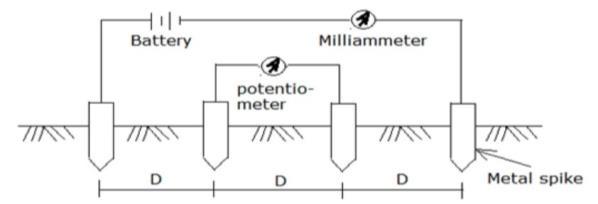
Fig.1: ElectricalResistivityMethod


Whereρ=MeanResistivity(ohm-cm)
D=distancebetweentheelectrodes(cm)
E=potentialdropbetweenouterelectrodes(volts)
I= current flowing between outer electrodes (amperes)
R=resistance(ohms)
Schlumberger Array arrangement is symmetric, collinear arrangement.Fourelectrodesareusedinthisarrangement. Current electrodes are denoted as A and B and potential electrodesaredenotedbyMandN.DistancebetweenMand N is denoted by ‘a’ and the distance between A and B is denoted by ‘2S’. The Schlemberger Array arrangement is showninfigure2. Thedistancebetweencurrentelectrodes shouldbegreaterthanfivetimesdistancebetweenpotential electrodes(AB>5MN).Theapparentresistivityisgivenby
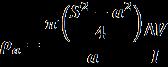

Fig.2: SchlumbergerArray
where,ΔVisthepotentialdropand Iistheappliedcurrent.
The soil resistivity data were interpreted by using quantitativemethodbasedoncurvematchingmethodand computerizedinterpretationmethods.Thesoilresistivityof allthefourlinesissummarizedintable1.
Fromthetable1,itcanbeinterpretedthatthesoillayers aremadeupofdifferenttypesofsoilrepresentedintheform ofresistivityvalues.Itcanbeobservedthattheresistivityin thetopsoillayerrangesbetween45.913Ωmto428.387Ωm between0.75mto1.5m.Thisindicatesthatupto1.5mmay befilledupsoil.
Volume: 12 Issue: 10 | Oct 2025 www.irjet.net
Table -1: SoilResistivityofI,II,IIIandIVLine
Table -2: SoilResistivityvaluesofdifferentsoilswith differentcolours(Hoekstra,2001)
changing ina very irregularpattern indicates the filled-up soil.Thenfrom4mdepthresistivityvaluesincreasinglinearly indicatesnaturalsoildeposit. Intermediatelayermoderate
Table -3: Resistivity of soil and soil classification ofI Line resistivityof120Ωmto240Ωmindicatesthemixerofsandy soil. Fordeeperdepthresistivityvaluesareincreasinguptoa 428.38Ωmatadepthof50m.Deeperdepthofsoilprofiling indicatestheSandysoilwithamixerofsilt
The table 2 represents the color code given for the differenttypesofsoil.
Table3indicatestheResistivityofsoilandsoilclassification ofILine. Table3indicatessoilresistivityrangesfrom113.91 Ωm to 428.387 Ωm. Up to 3m depth resistivity values are
Table -4: ResistivityofsoilandsoilclassificationofIILine
International Research Journal of Engineering and Technology (IRJET) e-ISSN: 2395-0056
Volume: 12 Issue: 10 | Oct 2025 www.irjet.net p-ISSN: 2395-0072
5
5
5 35
5
5
5
Table4indicatestheResistivityofsoilandsoilclassification of II Line. Table 4 indicates soil resistivity ranges from 54.895Ωm and 410.084 Ωm. soil resistivity of line II also shows up to 3m depth resistivity values are changing in a veryirregularpatternindicatesthefilled-upsoil.Thenfrom 4m depth resistivity values increasing linearly indicates naturalsoildeposit. From4mt25mindicatesaresistivity valueof54.895Ωmto239.833Ωmindicatessiltorsandysoil. From25mdepthresistivityvalueincreasesfrom239.833Ωm to409.558Ωmindicatessandysoilwithamixerofclayorsilt.
Table -5: ResistivityofsoilandsoilclassificationofIII Line
shows higher resistivity values in the top layer up to 2m. Indicatesfilled-upupsoilwithmixerofsiltandsandysoil. From 3m depth resistivity value increases with the depth. Thisindicatesthedepositionofnaturalsoilfrom3mdepth. Upto10mdepthresistivityvalueindicatesthesiltysandor sandyclay.From10mdepthresistivityvaluesincreasedand itindicatessandyclayorsandysilt.
Table -6: ResistivityofsoilandsoilclassificationofIV Line
Table 5 indicates the Resistivity of soil and soil classification of III Line. Table 5 indicates soil resistivity ranges44.806Ωmto523.796Ωm.soilresistivityoflineIII showshigherresistivityvaluesinthetoplayer.Indicatesthe filled-upsoilwithmixeroffineandcoarsesoil.Fromdeeper depth resistivity values increase in a linear pattern Resistivityvaluesofdeeperdepthindicatesandysoilwitha mixerofsilt.
Table 6 indicates the Resistivity of soil and soil classification of IV Line. Table 6 indicates soil resistivity ranges36.762Ωmto472.884Ωm. SoilresistivityoflineIV
Table7indicatesgeneralizedsoilprofilingforallthe4lines.
Table -7: SubsoilStratificationandZoneofsoil
Depth (m) Resistivity (Ωm)
Probable Soil classification Remarks
0-1.5 45-428 Sand/Gravel Filledupsoil
2-10 50-180 SiltySand/Clayey Silt Natural Weatheredsoil
10-20 150-240 SiltySand
20-50 240-472 GravellySand NaturalSoil
Thefollowingaretheconclusionsdrawnfromtheelectrical resistivitytest
• The top layers approximately up to 2m depth indicate resistivityvaluesarechanging veryabruptlyindicatesthe filledupsoil.
International Research Journal of Engineering and Technology (IRJET) e-ISSN: 2395-0056
Volume: 12 Issue: 10 | Oct 2025 www.irjet.net p-ISSN: 2395-0072
The middle layer approximately 2 to 10m depth indicates resistivity values increases with depth indicatesthenaturalsoildeposit.Basedonobtained resistivityvaluesitmaybeconcludedthatsiltyor claysoilwithamixerofsandysoil.
For deeper depth resistivity value increases with thedepthindicatessandysoilorgravellysoil.This indicates the natural parental soil deposit with higherresistivityvalues.
Higher resistivity values at deeper depth also indicatedecreasingmoisturecontentandincreasing densityofsoil.
TheresultsindicatethatElectricalresistivitymethodisalso oneofthepowerfultoolforidentificationofsoil.
[1] A. A. Kaufman and P. Hoekstra, Electromagnetic Soundings, Methods in Geochemistry and Geophysics, ElsevierPublishingCompany,pp.533–534,2001.
[2] Mohd Hazreek Bin Zainal Abidin, Devapriya Chitral Wijeyesekera, Rosli Saad, and Fauziah Ahmad, “The Influence of Soil Moisture Content and Grain Size Characteristics on its Field Electrical Resistivity,” Electronic Journal of Geotechnical Engineering (EJGE), Vol.18,Bund.D,2013.
[3] Z.A.M.Hazreek,S.Rosli,W.D.Chitral,A.Fauziah,A.T.S. Azhar, M. Aziman, and B. Ismail, “Soil Identification Using Field Electrical Resistivity Method,” Journal of Physics: Conference Series, Vol. 622, 012030, 2015. DOI:10.1088/1742-6596/622/1/012030
[4] I.A.OyediranandP.O.Falae,“IntegratedGeophysical and Geotechnical Methods for Pre-Foundation Investigations,” Journal of Geology & Geophysics,Vol.8, No. 1, 2018. DOI:10.4172/2381-8719.1000453
[5] IS 15736:2007 – Geological Exploration by Geophysical Method (Electrical Resistivity) – Code of Practice,Bureau ofIndianStandards,NewDelhi,India,2007.