
International Research Journal of Engineering and Technology (IRJET) e-ISSN: 2395-0056 p-ISSN:2395-0072

Volume:12Issue:10|Oct2025 www.irjet.net

International Research Journal of Engineering and Technology (IRJET) e-ISSN: 2395-0056 p-ISSN:2395-0072
Volume:12Issue:10|Oct2025 www.irjet.net
Tanmay Bhale1 , Prof. Pramila M Chawan2
1MTech Student, Dept. of Computer Engineering & IT, VJTI College, Mumbai, Maharashtra, India
2Associate Professor, Dept. of Computer Engineering & IT, VJTI College, Mumbai, Maharashtra, India
Abstract - Accurateandearlydiagnosisofthyroidnodulesis critical for effective management of thyroid diseases. Traditionaldiagnosisreliesheavilyonexpertinterpretationof ultrasound images, often resulting in subjectivity and variability. With advances in artificial intelligence, convolutional neural networks (CNNs) have emerged as powerful tools for automated image analysis and disease recognition. This paper surveys the recent developments in using CNNs for thyroid nodule detection, classification, and riskstratification,highlightingtheirperformancecomparedto traditionalmethodsandexpert radiologists. Wealsodiscuss challenges in model generalization, dataset diversity, and clinical adoption, concluding with perspectives on future research. Recent years have seen major strides in the automated analysis of thyroid nodules using Convolutional NeuralNetworks(CNNs)appliedtoultrasoundandcytological images.Whileearliercomputer-aidedsystemsreliedonhandcrafted features and were limited by operator variability, CNN-baseddeeplearningprovidesbothautonomousfeature extraction and improved diagnostic accuracy. This survey paper systematically reviews the evolution of automated thyroid nodule analysis, highlights the latest technological advancementsincludingmultimodalmodelsandexplainable AI and identifies key challenges and future directions for clinicaltranslation.
Key Words: Thyroid nodule, Deep learning, ConvolutionalNeuralNetworks, Ultrasound,ComputerAidedDiagnosis,ArtificialIntelligence,Cytology,MultiModalAI
1. INTRODUCTION
Thyroid nodules are extremely common, and accurate differential diagnosis is crucial to avoid unnecessary surgeries while promptly identifying malignancies. Traditionaldiagnosisreliesuponsubjectiveradiologicaland cytological assessments, contributing to inter-operator inconsistencyandover-diagnosis.
AI-drivencomputer-aideddiagnosis,particularlydeepCNNs, have emerged as robust solutions, outperforming or matching the accuracy of expert radiologists by automatically extracting discriminative features from medicalimages.
Recent advances in deep learning, particularly CNNs, have demonstratedhighaccuracyinextractingcomplexfeatures

frommedicalimages,enablingthemtoperformautomated diagnosisofthyroidnodules
CNNsareaclassofdeeplearningmodelsparticularlysuited for image-based tasks owing to their automatic feature extraction capabilities. Various studies have shown CNNbasedcomputer-aideddiagnosissystemscanmatchoreven surpassexpertradiologistsintheaccuracyofthyroidnodule classificationonultrasoundimages.
2.1
2.1.1
Initial research into AI-assisted thyroid diagnosis in the 1990sfocusedonmanuallyengineeredfeatures(e.g.,nodule borders,echogenicity)analysedbyshallowmachinelearning models such as support vector machines and early neural networks.Thesesystemsimproveddiagnosticconsistency butsufferedfromlimitedspecificity,operationalcomplexity, anddependenceonsubjectivefeatureextraction.
Deeplearning,particularlyConvolutionalNeuralNetworks, marked a paradigm shift: they automatically learn hierarchical features from raw image data, enabling more objective,accurate,andscalableanalysis.
CNN models like VGG-16, ResNet, and custom medical architectures have demonstrated high performance in thyroid nodule detection, classification, and risk stratificationonultrasoundandcytologicalimages.
2.2.1 Multimodal and Multitask CNNs
Integration of multimodal data-including genetic, clinical, and imaging information yields superior diagnostic performance and lays the foundationforprecisionmedicineinthyroidcare.
Multi-tasklearningframeworkscansimultaneously performdetection,classification,andevenmutation prediction,leveragingsharedrepresentations.

International Research Journal of Engineering and Technology (IRJET) e-ISSN: 2395-0056 p-ISSN:2395-0072
Volume:12Issue:10|Oct2025 www.irjet.net
Transfer learning with pre-trained networks on largedatasetsenableshighaccuracyevenindata–scarce in medical domains. Federated learning is poised to enables collaborative AI development acrosshospitalswhilemaintainingpatientprivacy.
Open–sourcedatasetsandreproducible benchmarksareessentialforrobustcross-site validation.
XAI tools are moving from research to clinical practice,withheatmapsandfeatureranking(eg: SHAPvalues)illuminatingmodeldecisions.
Betterinterpretabilitymayalsoaddressregulatory, ethical , and legal barriers , as clear explanations help trace responsibility for AI – driven medical decisions.
This, survey reviews five representative works on CNNbased automated diagnosis of thyroid nodules from ultrasoundimages.
Selected paperscover
1. large multicentre CNN CAD development and prospectivevalidation,
2. detection/localizationusingMaskR-CNNvariants,]
3. high-performance CNN classification with visual attention,
4. multi-scale densely connected CNN architectures, and
5. a high-quality dataset with histopathology labels thatenablesclinically-relevantmodeltraining.
I compare datasets, methods, explainability techniques, reportedperformance.
1. Park et al., Scientific Reports (2019)
- dCAD: Deep-learning US CAD system vs radiologists
Park et al. developed a deep-learning ultrasound CAD (dCAD)systemtrainedon4,919thyroidnodulesfromthree institutionsandprospectivelyvalidatediton286nodules. The study compared the CNN-based dCAD with an earlier SVMCADandwithradiologistsofvaryingexperience.dCAD achieveddiagnosticperformancecomparabletoradiologists (nosignificantdifferenceinsensitivity,specificity,PPV,NPV,
accuracy) and outperformed the SVM CAD, particularly improvingspecificityandPPV.Thestudyemphasizedclinical validationandmulti-centertrainingdatatoreduceoperator dependence
2. Abdolalietal., ComputersinBiologyandMedicine (2020)
- Mask R-CNN multi-task detectionframework.
Abdolali et al. focused on the detection/localization problem rather than only classification. Using a Mask RCNN–basedmulti-taskarchitecture,themodelwastrained on thousands of ultrasound frames (local training/validation: 2,461 / 820 frames) and validated on 821frames.Theydesignedacustomlossregularizationto prioritizedetectionqualityandshowedbetterresultsthan FasterR-CNNandconventionalMaskR-CNNvariants.This workhighlightstheimportanceofaccuratelocalizationfor downstream diagnosis and automated ROI extraction in ultrasoundvideo/framedata
3. Zhu et al., Quantitative Imaging in Medicine & Surgery (2021)
- BETNET: Brief Efficient Thyroid Network (localization + diagnosis)
Zhuetal.proposed BETNET,a VGG-19–basedmodel finetunedforsimultaneous localizationandclassification.The training set was large (16,401 images; external test sets included>1,000images)andresultswerestrong(validation AUCs~0.95–0.98,internaltestaccuracy~91%,externaltest AUC~0.97).BETNETalsoproducedattention/heatmapsto visualize regions used by the model (helpful for explainability).
ThepapercomparedBETNETwithseveralstate-of-the-art CNNs and some radiologists, showing competitive or superiorperformance.
4. Wang et al., Frontiers in Neuroscience (2022)
- n-ClsNet: Multi-scale densely connected CNN for classification.
Wangetal.proposed n-ClsNet,whichincorporatesamultiscale classification layer, skip blocks, and a Hybrid Atrous Convolution (HAC) block to preserve spatial details and learn multi-scale features. Evaluated on the TNUI-2021 dataset, n-ClsNet reported average accuracy ≈ 93.8%, outperformingseveralbaselinemethods. This line of work highlights architectural improvements (dense connections + atrous convolutions + multi-scale fusion)tailoredforultrasoundtextureandshapevariability.
International Research Journal of Engineering and Technology (IRJET) e-ISSN: 2395-0056 p-ISSN:2395-0072
Volume:12Issue:10|Oct2025 www.irjet.net
5. Hou et al., Scientific Data (2024) - An ultrasonography dataset with pathological diagnosis annotations (8508 images; 842 cases).
Houetal.createdalargepublicdataset(8,508imagesfrom 842cases)with histopathology-confirmed labels(benign vsmalignant)andassociatedmetadata.Theyvalidatedthe dataset by training example models (e.g., a dual-attention framework)andprovidedexternaltestsplits.Thisdataset addressesacriticalbottleneck:manypriorstudiesusedTIRADSorradiologyreportsasproxylabelsratherthangoldstandardpathology,limitingclinicalrelevance.
The dataset fosters robust model development and crossinstitutionalgeneralizationtesting.
Data scale & labels
Small → large: earlier studies often used hundreds–low thousands of images; more recent works use tens of thousandsorcurateddatasetswithpathologiclabels.Houet al. (2024) is notable for pathology-confirmed labels, improvingclinicalrelevance.
Tasks addressed
Detection/Localization: Abdolali (Mask R-CNN) & BETNET include localization to extract nodules from full images/videoframes.Localizationimprovesinterpretability andavoidsmanualROIcropping.
Classification (benign vs malignant):Park,BETNET,nClsNetfocusonclassificationperformance,oftencompared againstradiologists.
Transferlearning(VGG/ResNet)+fine-tuningwas common early; later work custom designs multiscale blocks, atrous convolutions, and dense connectionstobettercaptureultrasoundtextures andvaryingnodulesizes.
Several papers include visual attention/heatmaps orattentionmodules(BETNETreportedattention heatmaps; many recent works use Grad-CAM or attention scoring to highlight regions), increasing clinician trust. Explainability is used both as validation(modelfocusesonnoduleregions)andas apotentialreportingtool.
ReportedAUCsandaccuraciesarehigh(AUCsoften >0.90 in internal/external tests). Park et al. performed prospective clinical validation and directlycomparedCNNCADswithradiologists,an important step toward clinical translation. However, reported specificity and performance consistency across devices/populations vary by study.
A. Problem Statement
Thyroid disorders are among the most common endocrinediseasesworldwide,affectingmillionsof people annually. Early and accurate detection of thyroid abnormalities, such as benign and malignant nodules, is crucial for timely treatment and reducing health complications. However, traditional diagnostic methods including manual ultrasoundinterpretationandfineneedleaspiration cytology are often time-consuming, operatordependent,andpronetohumanerror.
There is a need for an automated, reliable, and efficient system that can accurately detect and classify thyroid nodules from medical images. The proposed project aims to develop an intelligent thyroid detection model using deep learning techniques to assist radiologists in identifying and classifying thyroid nodules. This approach seeks to improve diagnostic accuracy, reduce false positives and negatives, and provide a costeffective solution for early thyroid disease diagnosis.
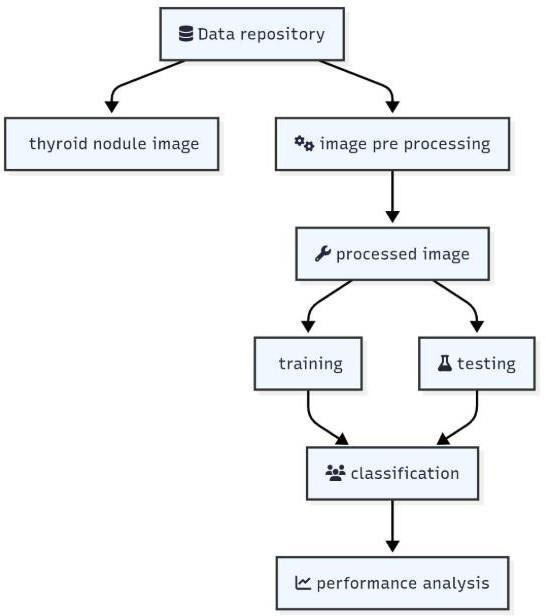
B. Architecture Overview (end-to-end pipeline)
Data acquisition - collect ultrasound images
(transverse & longitudinal) with labels (benign / malignant)confirmedpreferablybyhistopathology orFNA.Includemetadata(scanner,probe,patient age/sex,view).
Preprocessing & annotation - standardize image sizes, normalize intensities, annotate bounding boxes / masks for nodules (radiologistverified).
Modelling(multi-task) -asinglenetworkperforms:
(A)Noduledetection/localization, (B)Segmentation(optional), (C)Classification(benignvsmalignant), (D)Uncertaintyestimation.
International Research Journal of Engineering and Technology (IRJET) e-ISSN: 2395-0056 p-ISSN:2395-0072
Volume:12Issue:10|Oct2025 www.irjet.net
Evaluation&clinicalvalidation –cross-validation,externaltestset(s),readerstudy comparingtoradiologists,statisticaltesting.
Deployment - lightweightinferencemodel,UIfor clinicians showing image, predicted label, confidence, and explanation maps; logging for modelmonitoring.
5. CONCLUSIONS
This paper provide a detailed review of AI-driven, CNNbased analysis of thyroid nodules has matured from laboratorysettingstowardclinicalutility,offeringaccuracy levels comparable to expert physicians and reducing subjectivityinnoduleevaluation.
Ongoingadvancementsinmulti-modallearning,explainable AI, and federated data sharing are vital in overcoming current limitations. By focusing on generalizability, interpretability,andclinicalworkflowintegration,thenext wave of research promises a paradigm shift in thyroid nodule managementtoward moreobjective,personalized, andaccessiblecare.
1. Park VY et al. Diagnosis of Thyroid Nodules: Performance of a Deep Learning CNN Model vs. Radiologists. SciRep. 2019.
2. AbdolaliF etal. Automatedthyroidnoduledetection fromultrasoundimagingusingdeepconvolutional neuralnetworks. ComputBiolMed. 2020.
3. ZhuJ etal. AnefficientdeepCNNmodel(BETNET) forlocalizationandautomaticdiagnosisofthyroid nodules on ultrasound. Quant Imaging Med Surg. 2021.
4. WangL etal. AMulti-ScaleDenselyConnectedCNN for automated thyroid nodule classification (nClsNet). FrontiersinNeuroscience. 2022.
5. HouX etal. Anultrasonographyofthyroidnodules datasetwithpathologicaldiagnosisannotationfor deeplearning. ScientificData. 2024.


Tanmay Bhale , M. Tech Student, Dept. of Computer Engineering and IT, VJTI College, Mumbai, Maharashtra,India
Prof. Pramila M. Chawan, is workingasanAssociateProfessor in the Computer Engineering DepartmentofVJTI,Mumbai.She has done her B.E.(Computer Engineering) and M.E.(Computer Engineering)fromVJTICollegeof Engineering, Mumbai University. She has 30 years of teaching experienceandhasguided85+M. Tech. projects and 130+ B. Tech. projects. She has published 148 papers in the International Journals, 20 papers in the National/International Conferences/Symposiums.