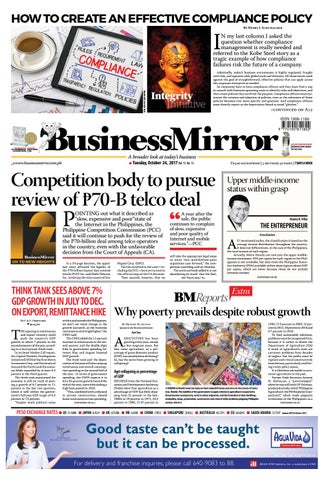
How to create an effective compliance policy By Henry J. Schumacher
I
n my last column I asked the question whether compliance management is really needed and referred to the Kobe Steel story as a tragic example of how compliance failures risk the future of a company.
Kirill Makarov | Dreamstime
Admittedly, today’s business environment is highly regulated, fraught with risk, and operates with global scale and diversity. All those forces work against the goal of straightforward, effective policies that can apply across the corporate enterprise as needed. So companies have to have compliance officers and they must find a way to consult with business operating units to identify risks and objectives, and then create policies that are fit for the purpose. Compliance officers must systemize the creation and adoption of policies, even as the substance of those policies becomes ever more specific and granular. And compliance officers must directly report to the Supervisory Board to avoid “glitches.”
media partner of the year
United nations
2015 environmental Media Award leadership award 2008
»continued on A12
BusinessMirror A broader look at today’s business
www.businessmirror.com.ph
n
Tuesday, October 24, 2017 Vol. 13 No. 13
Competition body to pursue review of ₧70-B telco deal
P
OINTING out what it described as “slow, expensive and poor”state of the Internet in the Philippines, the Philippine Competition Commission (PCC) said it will continue to push for the review of the P70-billion deal among telco operators in the country, even with the unfavorable decision from the Court of Appeals (CA).
In a 54-page decision, the appellate court affirmed the legality of the P70-billion buyout deal entered into by PLDT Inc. and Globe Telecom Inc. involving the telco assets of San
Miguel Corp. (SMC). Parties involved in the case—including the PCC—have yet to receive the official copy of the CA decision. “Rest assured, however, that we
A year after the sale, the public continues to complain of slow, expensive and poor quality of Internet and mobile services.”—PCC
will take the appropriate legal steps to move this multibillion-peso acquisition case forward,” the competition watchdog said on Monday. The antitrust body added it is not abandoning its stand that the deal, See “Telco deal,” A2
2016 ejap journalism awards
business news source of the year
P25.00 nationwide | 5 sections 32 pages | 7 days a week
Upper middle-income status within grasp Manny B. Villar
THE ENTREPRENEUR Conclusion
A
s I mentioned earlier, the classification is based on the average income distribution throughout the country. It does not differentiate, in the case of the Philippines, the total income of each region. Actually, Metro Manila can now join the upper middleincome economies. GNI per capita for each region in the Philippines is not available, but data from the Philippine Statistics Authority (PSA) available online show figures about GDP per capita, which are lower because these do not include overseas income. Continued on A8
THINK TANK SEES ABOVE 7% BMReports GDP GROWTH IN JULY TO DEC. ON EXPORT, REMITTANCE HIKE Why poverty prevails despite robust growth By Cai U. Ordinario
T
@cuo_bm
he upswing in remittances and export recovery could push the country’s GDP growth to above 7 percent in the second semester of the year, according to a local private think tank. In its latest Market Call report, the Capital Markets Development Initiative (CMDI) of the First Metro Investment Corp. and University of Asia and the Pacific said the economy likely expanded by at least 6.5 percent in the third quarter. The think tank maintained the economy is still on track of posting a growth of 6.7 percent to 7.1 percent in the last two quarters, which is well within the government’s full-year GDP target of 6.5 percent to 7.5 percent. “Despite much political noise
within and outside the Philippines, we don’t see much change in the growth narrative, as the economy continues to emit bright lights,” the CMDI said. The CMDI added the 12-percent increase in remittances in the second quarter and the double-digit hike in government spending between May and August boosted GDP growth. The think tank said the depreciation of the peso will also ramp up remittances and overall consumption spending in the second half of the year. In terms of government spending, the CMDI expects it to hit a 20-percent growth toward the end of the year, notwithstanding a high base posted in 2016. “This, combined with a rebound in private construction, should boost total construction spending, Continued on A12
PESO exchange rates n US 51.5080
By Michael M. Alunan
Special to the BusinessMirror
A
Part Two
GRICULTURE has been growing every year, except a few stagnant years. But how come agriculture, as a percentage of gross domestic product (GDP), has steadily been declining? So, has the sector been growing or collapsing?
Agri collapsing as percentage of GDP RECORDS from the National Economic and Development Authority (Neda) show that agriculture as a percentage of GDP has been dropping from 31 percent in the late1960s to 29 percent in 1971, 23.5 percent in 1980, 22.47 percent in
A vendor in Manila feeds her baby on their makeshift home and store on the streets of Santa Cruz, Manila. The inability of the government to apply reforms in agriculture is expected to breed massive rural poverty, rural-to-urban migration, and the formation of slum dwellings, criminality, drugs, prostitution, social unrest and a host of other problems plaguing Philippine society. NONIE REYES
1990, 17.5 percent in 2005, 15 percent in 2012, 10 percent in 2014 and 9.7 percent in 2016. To find sustainable solutions, problems must be recognized first, because it is unfair to blame the Department of Agriculture (DA) if much of agriculture’s woes are carryover problems from decades of neglect. But the public must be vigilant and critical constructively from hereon, particularly conflicting tricky policy issues. It is therefore advisable to scrutinize agriculture in the past. Former Neda Secretary Arsenio M. Balisacan, a “povertologist” when he was still with UP Diliman, produced a study, titled “Philippine Agriculture: Are We Ready for Competition?,” which made poignant revelations of the Philippines as a
n japan 0.4524 n UK 67.9288 n HK 6.6018 n CHINA 7.7813 n singapore 37.8262 n australia 40.2741 n EU 60.6043 n SAUDI arabia 13.7347
Continued on A2
Source: BSP (23 October 2017 )
BMReports BusinessMirror
A2 Tuesday, October 24, 2017
www.businessmirror.com.ph
Why poverty prevails despite robust growth Continued from A1
top laggard in farm yields that is blamed for widespread rural poverty. From 1980 to 2000, China’s total productivity alone grew by 4.7 percent a year, a whopping 4,600 percent higher than Philippine growth of 0.1 percent. Thailand grew by 1 percent a year, or 900 percent more; while Indonesia’s productivity grew by 1.6 percent, or 1,500 percent more than the Philippine average. Factor productivity measures efficiency, or yields per hectare. It gauges efficiency, unlike the misleading agricultural growth, bolstered by inflation and production due to bigger hectarage, not through yield improvements.
Grain of truth
OUR r ice y ield s were t he worst in Asia, which is ironic, having the International Rice Research Institute and the Philippine Rice Research Institute. Even private-sector initiatives like Henry Lim Bon Liong of SL-Agritech made technological breakthroughs. Balisacan’s study said local rice yields from 2000 to 2002 were the lowest at three metric tons (MT) per hectare, much lower than China’s 6 MT per hectare, Indonesia’s 4.1 MT per hectare, Vietnam’s 4.2 MT per
Telco deal. . . Continued from A1
which it earlier said could be in violation of the Philippine Competition Act (PCA), should be reviewed. “We are firm in our resolve to perform our mandate under the law. We note that, a year after the sale, the public continues to complain of slow, expensive and poor quality of Internet and mobile services,” it said. It did not cite any research or study to back its claim. But, according to the latest State of the Internet Report of Akamai Technologies, the Philippines continued to lag behind its peers in
hectare and even Myanmar’s 3.2 MT per hectare. Even East and Southeast Asia’s average yields were higher at 3.6 MT per hectare, while developing countries posted average yields of 3.8 MT per hectare, Balisacan’s study said. Local rice yields already improved to over 3.8 MT per hectare, but others have also increased since then. Average corn yields from 2000 to 2002 were also the lowest at 1.7 MT per hectare below China’s corn yields of 4.7 MT per hectare and Vietnam’s and Indonesia’s 2.8 MT per hectare. Even Myanmar posted a higher yield of 1.9 MT per hectare. East and Southeast Asia recorded average yields of 2.5 MT per hectare, while developing countries posted yields of 2.9 MT per hectare. Costs of corn are vital being the main ingredient in feeds for livestock and poultry. It is no wonder beef and chicken imports are cheaper. Our national average yields are low, as they are dragged down by low-yielding, nonirrigated rain-fed rice, partly due to poor investments in irrigation projects, which figuratively don’t hold water due to corruption. We can only surmise why more canals are rehabilitated yearly, than new ones built as if they get damaged every year. Thus, our low productivity plus the alleged temptations from rice imports have encouraged massive rice imports, which hit
terms of broadband connectivity. It continued to land on the lowest spot with an average speed of 4.5 Mbps in the fourth quarter last year, which is a 44-percent improvement from the same quarter the year prior. Likewise, the brief report on the state of the Internet in the Phi l ippines of L ondon-based crowdsourcing company Open Sig na l revea led t hat average speeds of 3G and 4G in the country “remained slow, well below” the global average speeds for the two mobile connections. Compared to the global average of 16.2 Mbps for 4G, Smart Communications Inc.’s LTE speed was at 10.6 Mbps, while that of Globe Tele-
2.3 million MT in 2007 making the Philippines the world’s biggest importer that year.
Small banks for farmers shutting down?
RAISING agriculture back on its feet is difficult if there are prevailing biases against agriculture and conflicting policies that’s likened to the left hand doing the opposite of the right hand. Perhaps, it’s neither wise to allow Adam Smith’s proverbial “Invisible Hand” the wanton freedom on the naïve belief that the free market will solve all problems. As the government pumps in more resources into agriculture, the Bangko Sentral ng Pilipinas (BSP) and Philippine Deposit Insurance Corp. may have liberally allowed the systematic yearly closure of 19 small banks from 2000 to June 2017, or about 310 small banks. In 2000 23 small banks were closed by the BSP; 2001, 19 rural banks, including four cooperative banks; 2002, 12 banks; 2003, nine rural banks, including two cooperative banks; 2004, two savings and two rural banks; 2005, eight rural banks and two savings banks; 2006, 10 rural banks and one development bank; 2007, 16 rural and one savings; 2008, 22 rural, one coop and one thrift; 2009, 27 rural, two savings and two cooperatives; 2010, 21 rural, one savings and three cooperatives;
com Inc.’s was at around 8 Mbps. On 3G, both ended the first half with roughly 2.5 Mbps in download speeds, a little less than half of the global 3G average of 4.4 Mbps. “If anything, this has further f ueled our deter minat ion to safeguard the market and promote the interests of consumers,” the PCC said. Representatives of the two telcos decided to keep mum on the appellate court’s decision, as they have yet to receive a copy of the CA ruling. According to the decision penned by Associate Justice Ramon Bato, the CA Former 12th Division held that the PCC gravely abused its discretion when it ordered a full review of the said acquisition de-
2011, 25 rural and four savings; 2012, 22 rural, one commercial and one cooperative; 2013, 18 rural and one big cooperative; 2014, 13 rural, one cooperative and one savings; 2015, 14 rural; 2016, 20 rural, three thrifts and savings. As of June five rural banks were closed. Will credit to farmers dry up? As rural banks shut down, farmer credit may dry up or tighten as commercial banks replacing them remain allergic to farmer lending. A commercial-bank manager in Ilocos revealed years back that only 2 percent of funds are retained to meet withdrawals and loans and remits 98 percent to Manila. Ilocos banks are exceptions as overseas Ilocanos continue remitting to their families, who remain fairly frugal as they spend less and invest less. It is ironic that while credit to agriculture is restricted, commercial banks are awash with funds. BSP records show 2015 domestic-savings rate was 30.3 percent of gross national income, but gross capital formation was only 19.8 percent. The difference indicates that so much in savings are held by banks unproductively.
Why not incentives to rural lending?
PERHAPS, these surplus savings can be bundled and redirected to fund rural investments, this time, matched with incentives
spite PLDT and Globe’s compliance to its Memorandum Circular (MC) 16-002. Thus, the appellate court issued a writ of mandamus compelling the PCC “to recognize the subject acquisition as deemed approved by operation of law.” MC 16-002 requires parties to a merger and acquisition to merely notify the PCC through a letter addressed to the commission containing certain information. The CA explained that following its examination of the notice submitted by the petitioners, it is convinced that the said notice sufficiently contains the “Key Terms of the Transaction” and substantially complied with the requirements of
and government guarantees. If the government can provide sovereign guarantees to foreign loans and investors, why not provide the same incentives to local banks funding rural projects, which have no foreign-exchange risks, no import content and have higher multiplier effects to the economy in terms of job generation, value-added earnings and resulting higher tax revenues for government, etc. After all, there is the Agri-Agra loan law, requiring banks to allocate 25 percent of their loan portfolio for agriculture, but the BSP allows them an escape clause by buying T-bills as a form of compliance. Banks obviously prefer safer paper investments in government securities over loans to agriculture, which is vulnerable to risks, including vagaries of nature. If reforms are not made that will redound to the poor farmers and fishermen, then the growth the Philippines keeps bragging about is just financial growth, while the real physical economy in agriculture may continue collapsing, thus breeding massive rural poverty, rural-tourban migration and all attendant social problems like slums, criminality, drugs, prostitution, insurgency, social unrest, the overseas Filipino worker phenomenon and a host of other problems plaguing society.
MC 16-002. “With the subject notice being compliant with the requirements of MC 16-02, and there being no false material statement therein, the subject acquisition is deemed approved by operation of law and may no longer be challenged under the PCA,” the appellate court said. “It follows that PCC is dutybound to recognize that status and give effect thereto. The petition for mandamus is therefore, meritorious,” it added. However, the CA pointed out that the approval of the deal does not remove the power of PCC to conduct a postacquisition review to ensure that PLDT and
To be concluded
Globe would not engage in any anticompetitive conduct. “If the parties misuse the subject acquisition to engage in anticompetitive behavior, then PCC may very well exercise its powers to prevent and punish anti-competitive behavior under RA 10067 (The Philippine Competition Act ),” the appellate court warned. It, will be recalled that PCC, in its letters dated June 7 and June 17, 2016, it ordered the preacquisition review and investigation of the acquisition made by PLDT and Globe of all the issuing and outstanding shares and assets of Vega Telecom Inc., a subsidiary of SMC, for allegedly being violative of the PCA on suspicion of conspiracy on its sale. Pursuant to the Sale and Purchase Agreement executed on May 30, 2016, for an agreed purchase price of P52,080,764,982 under a deferred payment scheme (the sum of P26,040,382,490 was paid upon the execution of the contract, P13,020,191,246 to be paid on December 1, 2016, and P13,020,191,246 to be paid on May 30, 2017). Both PLDT and Globe purchased on an equal sharing or 50-50 basis the entire issued and outstanding shares of stock of VTI. The PCC letters issued against both PLDT and Globe was hailed to the CA seeking to stop the former with its orders. In granting the petitions, the CA said the PCC violated the constitutional right of the petitions to equal protection of the laws when the it refused to accord the deemed approved status of the acquisition despite substantial compliance with MC 16-002. Furthermore, the CA noted that, while the PCC has original and primary jurisdiction in the enforcement and regulation of all competition-related issues, it nevertheless has no jurisdiction to conduct a full review of the subject acquisition. It noted that the National Telecommunications Commission (NTC) is the only government agency that has the authority to allocate, suballocate and grant permits for the use of radio frequencies under the Public Telecommunications Act. Thus, the CA held that in case of conflict between the decisions of the PCC and the NTC, both gover nment agenc ies shou ld consult each other “guided by overreaching goals of promoting market efficiency and protecting the consumers’ welfare.” Concurring with the ruling were Associate Justices Manuel Barrios, and Maria Eliza Sempio Diy. Lorenz S. Marasigan, Joel R. San Juan
The Nation BusinessMirror
www.businessmirror.com.ph
Poe sets pre-Christmas deadline to LTFRB on TNVS guidelines By Butch Fernandez @butchfBM
S
en. Grace Poe is eyeing a preChristmas deadline for the Land Transportation Franchising and Regulatory Board, as she prodded the regulator to fasttrack and release LTFRB guidelines covering Transportation Network Vehicle Services (TNVS) ahead of the fast-approaching year-end holidays. Poe, chairman of the Senate Committee on Public Services, on Monday pressed the LTFRB to complete the revised TNVS guidelines “at the soonest possible time,” after noting the board’s failure to meet a selfimposed deadline. “In the interest of public service, the LTFRB should release the guidelines before the end of the year, preferably before the holiday rush,” Poe said. The senator voiced concern that further delays in the release of those guidelines will “affect, not just the daily commute of those who rely on TNVS, but also those who rely on it for a living.” Recalling the LTFRB’s promise during the Senate hearing to finish its revised TNVS guidelines by September, Poe acknowledged receiving a letter from the LTFRB explaining their delay in releasing the revised TNVS guidelines. “I understand that given the numerous issues involved, which only came to light during the technical working group [TWG] discussions, it might be irresponsible on the part of the LTRFB to release new guidelines without taking into account the new issues that have surfaced,” Poe pointed out. She noted that even during the TWG hearing conducted by her committee, it appeared that “the problems were not limited to simply the number of vehicles on the road or that of surge pricing.” “Issues on f leet service, company markings on vehicles, and even insurance, among others, also need to be addressed,” Poe added.
Kintanar Jr. assumes position as Air Force commanding general
M
aj. Gen. Galileo Gerard R. Kintanar Jr. will assume as the new Air Force chief on Tuesday, succeeding Lt. Gen. Edgar Fallorina, who will bow out of the service just a week before he will reach the mandatory retirement age of 56. Kintanar will be installed as the 35th chief of the Air Force by President Duterte during the scheduled retirement and installation ceremonies. Kintanar, member of the Philippine Military Academy Class of 1985, will succeed Fallorina, a member of PMA Class of 1983, and whose mandatory retirement date is on November 1. The appointment of Kintanar as the new commanding general of the Air Force was confirmed on Monday by Armed Forces Chief of Staff Gen. Eduardo M. Año. “You can annouce it already, Galileo Gerald Kintanar Jr. is the next CG [commanding general], Philippline Air Force,” Año said, noting the new Air Force chief is both a “good commander and a silent worker.” “He’s a strategic thinker and a tested ace pilot,” he added on Kintanar. Kintanar will assume the chief post of the Air Force from being the commander of the Armed Forces Western Command, a position that he has held in August this year. Rene Acosta
Editor: Vittorio V. Vitug • Tuesday, October 24, 2017 A3
Marawi ‘liberation’ major blow to IS threat in Southeast Asia claimed more than 1,000 lives, of which most were terrorists. Among those killed were Hapilon, the selfstyled emir of the IS in Southeast Asia, and the Maute brothers, who was in charge of the Daesh-inspired Maute Group.
End of combat operations
One of the first battalions that have been deployed in war-ravaged Marawi City arrives to a hero’s welcome at the Villamor Air Base last Friday in Pasay City. Defense and military officials on Monday declared the end of fighting in the city following the defeat of Islamic State-inspired Maute Group. AP By Elijah Felice E. Rosales
M
@alyasjah and Rene Acosta
@reneacostaBM
alacañang on Monday said the end of fighting in Marawi City, Lanao del Sur, dealt a severe blow against the looming Islamic State (IS) threat in Southeast Asia. After Defense Secretary Delfin N. Lorenzana declared Marawi City clear of fighting, Presidential Spokesman Ernesto C. Abella said the government has ended the strongest extremist threat, by far, in Southeast Asia. “The fighting in Marawi has ended. Since the rebellion started 154 days ago, almost a thousand terrorists have been killed, including its leaders Isnilon Hapilon, Omar Maute and Mahmud Ahmad, among others,” Abella said.
“We have successfully concluded what has been, so far, the most serious threat of violent extremism and radicalism in the Philippines and in Southeast Asia. The defeat of the Daesh-inspired Maute Group, likewise, underscores our singleness of purpose in the global war against terrorism,” Abella added. The end of fighting in Marawi City came almost a week after President Duterte declared the besieged municipality liberated
from “terrorist influences.” The President instructed government officials to redirect all their efforts on the rehabilitation of Marawi City, which has suffered so much from five months of fighting between government troops and Maute Group terrorists. “With the liberation of Marawi, our focus now shifts to the enormous and challenging task of rebuilding, reconstruction and rehabilitation of the Islamic City. The damage to Marawi’s infrastructure and private properties, and the displacement of thousands of residents require the government’s unified and comprehensive effort; thus, we call on all our citizens to come together to move our country forward toward a peaceful, prosperous and secure future,” Abella said. “Finally, we commend government troops, including the fallen, for their courage, gallantry and sacrifice. A snappy salute to all of you,” the Palace official added. The conflict in Marawi City has
Defense and military officials declared on Monday the end of the combat operations against members of the IS-Maute Group in Marawi City after soldiers have retaken a mosque, wherein another key terrorist leader and two women were among those killed. Lorenzana announced the termination of the military operations against the terrorists during a press briefing at the sidelines of the Asean Defense Ministers’ Meeting (ADMM) in Clark. He was joined by Armed Forces Chief of Staff Gen. Eduardo M. Año. “We now announce the termination of all combat operations in Marawi…the Armed Forces and the police, headed by its government and the massive support of the Filipinos, have nipped the budding infrastructure and defeated terrorism in the Philippines,” Lorenzana said. “In crushing thus far the most serious attempt to export violent extremism and radicalism in the Philippines and in the region, we have contributed to preventing its spread in Asia and gave our share to maintaining global peace, stability and security,” he added. The completion of the operation, which came exactly five months after the IS-Maute Group took over the city on May 23, followed the recapture by soldiers of the last building held by the terrorists, wherein 42 people, including two women, were killed. “Forty-two cadavers were recovered…they were all fighting our troops so they were terrorists,” said Lorenzana, adding, “no more hostages have been left, as they have all been recovered a couple of days back.” According to Año, the last building that was cleared was a mosque, while the two women were reported to be wives of terrorists who decided to stay along
Alvarez says he has ‘no ax to grind’ against CJ Sereno By Jovee Marie N. dela Cruz @joveemarie
T
he camp of Chief Justice Maria Lourdes A. Sereno on Monday formally filed a motion asking the House Committee on Justice to allow her legal team to confront and cross-examine witnesses on the impeachment complaint against the Chief Magistrate. In a four-page motion, Sereno’s camp, led by Alex Poblador, asked to recognize the Chief Justice’s constitutionally guaranteed rights to be represented by a legal counsel and to confront the witnesses against her through lawyers representing her in the impeachment proceedings. Sereno also asked the panel to allow them to object to improper questions during direct examination and be furnished with all the documentary and testimonial evidence in support of the charges against the Chief Justice. “The confirmation was sought in light of public pronouncements by some members of this honorable committee, and in order to be clarified and assured that the procedure, which the committee would adopt during the hearings, would respect the basic rights of the Chief Justice as a respondent in an impeachment proceeding,” the motion stated. Earlier, Rep. Reynaldo V. Umali of the Second District of Oriental Min-
doro, the panel chairman, said House impeachment rules do not allow that the respondent will be represented by lawyers. “We are not depriving anyone of his or her right to confront witnesses. If she wants to confront witnesses, she can confront them personally, subject to the decision of the body politic,” Umali said. According to Umali, Sereno’s possible cross-examination of the witnesses are still subject to the approval of lawmakers. “Not all the congressmen are in favor of her impeachment. So they have to find an ally who will support her cause,” Umali added. The House Committee on Justice has found sufficient grounds in the impeachment complaint against Sereno. The panel would proceed to the next stage, which is the determination of probable cause, after the Congress Halloween break. The break will start this week on Thursday and will end on November 12. The complaint filed by lawyer Larry Gadon contains four grounds, including corruption, culpable violation of the Constitution, betrayal of public trust and other high crimes. The complaint also alleged 27 acts constituting the offenses charged against the Chief Justice. The committee will call on the complainant, and the respondent
to present their case before voting on the determination of probable cause. After the determination of probable cause, the articles of impeachment will be created and will be transmitted to the plenary for approval. The lower chamber needs 196 votes or two-thirds of all of its members before the articles be sent to the Senate that will act as an impeachment court.
‘Hatchet job’
Meanwhile, Speaker Pantaleon D. Alvarez on Monday dismissed the allegations hurled against him by the group Filipino Alliance for Transparency and Empowerment (FATE) as part of a “hatchet job” in a bid to divert public attention from the substance of the accusations raised against Sereno. In a news statement, Alvarez dismissed as baseless FATE’s allegations that the House hearings on Sereno’s impeachment could be railroaded. Such allegation, according to Alvarez, betrays the weakness of Sereno’s evidence in her defense. He added this was the same public-relations tactic employed against him and the House of Representatives when they investigated the P6.4-billion shabu-smuggling case involving former Customs officials. Alvarez also denied that the House is controlling the impeachment hearings because he has an ax to grind against Sereno for allegedly
We are not depriving anyone of his or her right to confront witnesses. If she wants to confront witnesses, she can confront them personally, subject to the decision of the body politic.” —Umali testifying against him in the Philippine International Air Terminals Co. Inc. (Piatco) case. He said all the cases against him related to the Piatco case were all dismissed and that Sereno did not testify against him as FATE alleged. Alvarez said that, aside from the allegations against Sereno’s income derived as member of the government’s counsel, the Piatco case has nothing to do with the impeachment case against her.
and fight with their husbands. Both Año and Lorenzana said that among those killed were Malaysian jihadist leader Amin Baco and about four or five other foreign terrorists. Authorities, however, have yet to officially confirm the exact number of killed foreign terrorists in the last battle. In Marawi City Col. Romeo S. Brawner Jr., commander of the Joint Task Force Ranao, said that two decomposing bodies of soldiers were also recovered from the last building cleared by troops. One of the body was severely burned or was intentionally burned, apparently by its captors, while the other body was decapitated, he said. Brawner added the five-month battle has resulted in the killing of 919 terrorists, the death of 165 policemen and soldiers, and the rescue of 1,780 civilians. The soldiers also recovered at least 864 high-powered firearms. While the government has won the war against the terrorists, Lorenzana, however, admitted it may not have defeated the ideology completely. “While we submit that these tactical and strategic gains will not annihilate the ideology completely, we declare that this achievement is clear manifestation of how our regional cooperation can lead to a decisive advance against the proliferation of terrorism in this part of the world,” he said. The defense chief also thanked the country’s allies, including China, the United States, Australia, Malaysia, Indonesia, Brunei Darussalam and Singapore for their help in crushing the terrorists’ siege in Marawi City. “Because China gave us firearms and ammunition, sniper rifles, while the United States provided intelligence, technical intelligence,” Lorenzana said. “We hope that this operational achievement in Marawi in the Philippines will be the catalyst that shall bring to the fore future cooperation and partnerships, not only against terrorism but also those that shall defeat other regional and global security threats,” he added.
Special nonworking days in Metro Manila, Bulacan, Pampanga from Nov. 13 to 15
M
alacañang has declared November 13 to November 15 as special nonworking days in Metro Manila for the 31st Asean Summit, which the Philippines is hosting. Under Proclamation 332, the President has opted to declare November 13 to November 15 as special nonworking days in the whole of the National Capital Region and in the provinces of Bulacan and Pampanga. The 31st Asean Summit and Related Summits will be held in the capital city and Clark, Pampanga. Citing “various activities directly connected with the 31st Asean Summit and Related Summits,” Duterte said the national organizing council has recommended the declaration of special nonworking days from November 13 to 15. Leaders of Southeast Asian countries and their dialogue partners, such as the United States and Japan, are expected to attend the region’s 31st convention. US President Donald J. Trump has confirmed his attendance in the summit. Elijah Felice E. Rosales
Economy
A4 Tuesday, October 24, 2017 • Editors: Vittorio V. Vitug and Max V. de Leon
BusinessMirror
TGRI slowed to 7.4 percent in April-to-June period–PSA
T
By Cai U. Ordinario
@cuo_bm
he robust performance of the real estate, finance, transportation and communication sectors boosted the country’s total gross revenue index (TGRI) in the second quarter, according to the Philippine Statistics Authority (PSA).
According to the latest Quarterly Economic Indices (QEI) report, the TGRI grew to 7.4 percent in the Aprilto-June period. This, however, was slower than the 8.4-percent growth posted in the same period in 2016. “Real estate posted the fastest growth across industries with 17.8 percent. This was followed by finance with 12.7 percent; and transportation and communication with 8.6 percent,” the PSA said. The PSA said the QEI is a compilation of quarterly indices on
production, gross revenue, employment, compensation, production per worker, compensation per employee and average earnings. Apart from gross revenues, PSA data showed the total employment index growing by 4.2 percent in the second quarter of the year. This was mainly due to transportation and communication with 5.7 percent, followed by manufacturing with 5.1 percent; finance with 3.2 percent; real estate with 2.1 percent; trade with 1.6 percent; private ser-
vices with 1.3 percent; and mining and quarrying with 1.2 percent. On the other hand, electricity and water contracted by 0.7 percent. Further, the total compensation index grew faster at 7.8 percent, on the back of higher compensation in manufacturing, which showed a 10.9-percent growth, as well as real estate with 9.3 percent. Other industries that contributed to the growth were transportation and communication with 9.1 percent; trade with 7.2 percent; mining and quarrying with 7.1 percent; electricity and water with 5.4 percent; private services with 4.2 percent; and finance with 1.1 percent. Meanwhile, the PSA said the total compensation per employee index grew by 3.5 percent in the April-toJune period. This growth was attributed to the uptrend of real estate with 7 percent, and electricity and water with 6.2 percent. However, finance contracted by 2 percent. The QEI is based on the results of the Quarterly Survey of Philippine Business and Industry (QSPBI),
Real estate posted the fastest growth across industries with 17.8 percent. This was followed by finance with 12.7 percent; and transportation and communication with 8.6 percent.” —PSA
which is conducted by the PSA. The data is supplemented by the results of the PSA’s monthly integrated survey of select industries or Missi, and production and prices for palay, corn and other crops (except coconut and sugarcane), livestock, poultry and fishery.
DOE now open to proposals for coal contracts By Lenie Lectura
@llectura
T
HE Department of Energy (DOE) is now accepting proposals for the exploration, development and production of the country’s indigenous coal resources through coal-operating contracts (COCs) with contractors. DOE Circular 2017-09-10 states that the DOE “desires to implement a simpler and faster public contracting program by nomination through publication to facilitate the acceptance of applications for COCs from interested applicants at any given time, which is deemed to be more responsive if the development of the country’s coal resources is to be intensified.” This took effect on October 22. “We can now accept application for coal-operating contracts through nomination by publication at any given time. The development of indigenous energy resources like coal will contribute to our ultimate goal of energy self-sufficiency,” DOE Head of Energy Resource Development Bureau Melita Obillo said. As such, the agency came out with a selection process in the awarding of COCs and the creation of a review and evaluation committee (REC). The circular states that applicants for COC will be the ones to formally nominate the area/s of their interest for the REC consideration. The DOE, through the REC, may publish identified coal area/s not covered by any application for nomination for the purpose of inviting interested applicants. In case there are two or more applicants over the same area, the highest-ranked applicant who meets the legal, technical and financial requirements shall be selected. The REC shall approve the nomination of areas of interest for publication. It will also review the legal, technical and financial capabilities of the applicants and their applications. It will also recommend the award and issuance of COC. The REC will be headed by Obillo, who will also be assisted by a technical working group. “The DOE intends to effectively administer, supervise and regulate the implementation of awarded COCs to ensure the sustainable development of the country’s coal resources,” it said.
www.businessmirror.com.ph
PHL agri trade in Q2 rose 2.6 percent to $4.011 billion By Jasper Emmanuel Y. Arcalas @jearcalas
T
he country’s external trade for agricultural commodities in the second quarter grew 2.6 percent to $4.011 billion, from $3.910 billion during the same period last year, according to the Philippine Statistics Authority (PSA). As a result, the country’s agricultural trade deficit in the April-toJune period shrank 23.76 percent to $1.335 billion, against the $1.751billion deficit recorded in the same period in 2016. The PSA attributed the improvement in our agricultural trade to higher agricultural commodities the Philippines exported and lower imports during the three-month period. “Agricultural export expanded by 23.9 percent to $1.338 billion in the second quarter of 2017, from $1.080 billion during the same period of 2016,” the PSA said. “Moreover, share of agricultural export to total export, likewise, went up by 8.5 percent, from 7.7 percent in the same period of 2016.” The PSA noted that, among the commodity groups, exports of animal or vegetable oils and their cleavage products posted the highest value, reaching $325.25 million during the reference period. The figure was 34.3 percent higher than the $242.14-million recorded earnings from the commodity group a year ago, the PSA said. “The bulk of export for this commodity went to the Netherlands, comprising 43.2 percent of the total agricultural exports,” it added. The commodity group also accounted for the lion’s share, or about 24.3 percent, of the total agricultural exports during the second quarter. Meanwhile, edible fruits and nuts and peel of citrus fruits or melons were the second-most bought commodity group from the Philippines during the second quarter, accounting for 22.4 percent of the total agricultural exports. “This commodity had a 22.4percent share, which increased by
18.7 percent to $299.16 million in the second quarter of 2017, from $252.01 million in the same period of 2016,” the PSA said. Meanwhile, the country’s agricultural import bill during the second quarter declined by 5.6 percent to $2.673 billion, from $2.831 billion recorded import value during the same quarter of 2016. “The share of agricultural imports to total imports was 11.3 percent in the second quarter of 2017, from 12.6 percent in the same quarter of 2016,” the PSA said. The PSA added cereals topped the country’s agricultural imports in the April-to-June period, reaching a value of $372.10 million. However, the figure was 12.7 percent lower than the $426.38 million worth of cereals the country purchased abroad during the second quarter of 2016. “Moreover, this commodity was imported mostly from Australia, valued at $157.43 million,” the PSA added. Miscellaneous edible preparation was the second-most imported commodity group by the Philippines in the second quarter, accounting for 13.1 percent of the total agricultural imports. “ This commodity posted an increment of 2.8 percent, valued at $350.98 million, during the second quarter of 2017, compared with $341.32 million in the same period of 2016,” the PSA said. “Indonesia was the top supplier, accounting for 30.3 percent of the total import of this agricultural commodity.” Among the country’s major trading partners, Japan posted a trade surplus of $153.52 million in the second quarter, 29.1 percent higher than the $118.90 million recorded during the same period of 2016, according to PSA. “Other major trading partners were Australia with $217.68-million trade deficit; the United States with $315.99 -million trade deficit; Asean with $700.45 million trade deficit and the European Union with $5.69million trade deficit,” it added.
Higher pump prices for fuel on Tuesday
O
Choose your pick A young couple browses over a whole shelf of imported baseball caps being sold at a bargain price of P50 apiece in Quiapo, Manila, over the weekend.
Nonie Reyes
il firms are expected to implement another round of price increase in petroleum products to reflect movements in the international oil market. On Monday PTT Philippines, Phoenix Petroleum and Eastern Petroleum said they will raise gasoline prices by P0.65 per liter and diesel by P.035 per liter. Seaoil will, likewise, implement the same price adjustment. It also said kerosene prices will increase by P0.55 per liter. The price adjustments will take
effect at 6 a.m. of Tuesday, October 24. Last week gasoline prices went up by P0.20 per liter, while kerosene prices were reduced by P0.15 per liter. There was no price adjustment for diesel on October 17. Local oil firms adjust their prices on a weekly basis to reflect prices of imported oil products that arrive in the country. It takes about a week for the oil companies to bring their products to the market from the time they import the products. Lenie Lectura
Group says rice ‘tariffication’ leads to ‘unli’ rice importation By Jonathan L. Mayuga @jonlmayuga
B
antay Bigas, an alliance for safe, sufficient and affordable rice, is opposing the Duterte administration’s plan for rice imports “tariffication,” saying such doesn’t provide enough protection to local rice farmers. “The proposed tariffication is very alarming, as it is leading to the full liberalization of the rice industry. The flooding of cheap imported rice will be catastrophic to the rice farmers, especially [so with] the government’s support to agriculture and farmers… limited by the agreement with WTO-AOA [World Trade Organization-Agreement on Agriculture], which pushes for total state non-intervention,” Zen Soriano, Bantay Bigas spokesman, said in a news statement.
The Philippines intends to impose a bound tariff rate of 35 percent for rice coming from the Asean countries without volume cap and a 40-percent bound tariff most favored nation (MFN) rate for inquota rice imports from countries outside of Asean, and a 400-percent MFN rate tariff outside of the minimum access volume (MAV) of 350, 000 metric tons (MT) from nonAsean member-countries. However, Soriano said, essentially, there will be an almost unlimited entry of imported rice in the country, which will hinder the development of the local rice industry and the people’s aspiration for safe, sufficient and affordable food. “Duterte’s economic managers and supporters of neoliberal policies argue that increasing the competition between traders will lower the rice prices. But this has not been the case since the country entered the
WTO,” Soriano added. He said retail rice prices have tripled since 1994, prior to the country’s WTO membership. The retail price of regular-milled rice has increased from P12.21 per kilo in 1994 to P38 per kilo this October, while the retail price of well-milled rice increased from P13.29 per kilo to P42.24 per kilo during the same time frame. “Instead of strengthening the local production and agricultural development, the government resorted to dependence on importation as a method to attain ‘food security,’” Soriano said. She explained that current palay production is only at the half of its potential since only 53 percent of irrigable lands have irrigation services, while some existing irrigation facilities are not well-maintained. If the sufficient irrigation service is provided to our rice lands along with the provision of other
support services, rice production will likely increase. “Genuine development of the domestic rice industry is necessary. To achieve this, the government must veer away from the liberalization of agriculture. We are supporting the enactment of the Rice Industry Development Act to be filed by Anakpawis Party-list in Congress,” Soriano said. Bantay Bigas conveners said the local rice industry and agriculture could be strengthened through the implementation of pro-people policies, provision of adequate support, production subsidies, seeds and organic fertilizers subsidies and free irrigation services for rice farmers. The full utilization of locally adapted rice varieties, protection of local varieties from appropriations, and recognition of farmers’ rights over seeds, including seed
Duterte’s economic managers and supporters of neoliberal policies argue that increasing the competition between traders will lower the rice prices. But this has not been the case since the country entered the WTO.”—Soriano
exchanging and saving, should also be fulfilled. The government must also stop land use and crop conversions in all agricultural lands, especially those planted with rice and corn, the group said.
www.businessmirror.com.ph
Banking&Finance BusinessMirror
Editor: Jun B. Vallecera • Tuesday, October 24, 2017
A5
Financial markets looking to how November 3 plays out
T
he Bureau of the Treasury (BTr) on Monday sold the entire batch of Treasury bills (T-bills) worth P15 billion, despite the rates remaining steady and no matter that market preference remain stuck with the short-dated tenors. National Treasurer Rosalia V. de Leon said the market is on edge, basically as to how the regulatory environment overseas will play out now that it remains uncertain whether there is continuity or a change of leadership at the United
States Federal Reserve (US Fed). The US Fed has authority over the world’s largest market and by this measure exerts an outsize influence on all other markets, including China’s. “But you see that there is very strong de-
mand even in the noncompetitive. I think again the preference for the short end of the curve and the liquidity is very much around,” de Leon told financial reporters. The 91-day tenor attracted P25.465 billion worth of offers that allowed the auction committee to award the full P6 billion and reject the excess P19.465 billion. This also allowed the three-month T-bill rate to average 1.957 percent, barely changed or only 0.1 basis points lower than the 1.958 percent set at the previous auction. De Leon said the market clearly took into consideration developments at the US Fed, and the issue of whether or not current chairman Janet Yellen will remain in place or somebody else will head the most influential central bank in the world.
NG spending slowed in September
T
he national government ran a P36.9billion deficit in September, 51 percent or P38.4 billion lower than the deficit registered last year. The third-quarter budget shortfall of P58.6 billion was also lower than the P93.4 billion recorded in the same quarter last year. However, the January-to-September deficit of P213.1 billion roughly equaled the outturn in 2016. Total revenues for the month amounted to P200.1 billion, registering year-on-year growth of 21 percent or P34.1 billion. Yearto-date, there was a 9 percent or P154.7-billion rise in collection over the same period last year to P1.801 trillion. The Bureau of Internal Revenue (BIR) collected P141.4 billion in September, an increase of 25 percent over the same month in 2016. In total, BIR collections grew by 11 percent year-on-year to P1.3 trillion in the first nine months of 2017. BIR revenue performance in September brought the total 2017 collection to within 1 percent behind the YTD program. The Bureau of Customs (BOC) managed a 21 percent year-on-year increase with actual collection of P40.3 billion in September.
The BOC collected P323.8 billion in the first three quarters, maintaining a 12-percent year-to-date improvement in performance. However, the BOC is still behind by 4 percent relative to its revenue program of P336.9 billion. The Bureau of the Treasury (BTr) generated P7.3 billion in September, down by 5 percent from last year’s P7.7 billion. For the period, lower income from Bond Sinking Fund/Securities Stabilization Fund offset higher dividend collection from Philippine Amusement and Gaming Corp. and National government shares of stocks. The bureau’s year-to-date total income of P74.7 billion was down by 13 percent, equivalent to P11.6 billion. Despite this, the bureau still exceeded its end-September program by 58 percent with income, specifically from Treasury operations already 98 percent of the full year target. Collections from other offices (nontax) for the month amounted to P9.4 billion, declining by 10 percent year-on-year. Nevertheless, the year-to-date total of P87.5 billion was 11 percent above program and closely maintained the same level over
the comparable period in 2016. National government disbursements amounted to P237.0 billion in September, declining by 2 percent or P4.3 billion in the same period last year. Total expenditure for the first nine months of the year reached P2,014 trillion, 8 percent or P154.1 billion higher, year-on-year, but still 6percent short of the P2,137.9-billion target. Interest payments (IP) for September decreased by 19 percent year-on-year to P26.4 billion. The resulting cumulative IP for 2017 of P250 billion is P806 million lower than the January to September 2016 amount. As a percentage of revenue and expenditures, the January-to-September interest payments accounted for 13.8 percent and 12.4 percent, respectively, improving from previous year levels of 15.2 percent and 13.4 percent. Netting out IP from expenditures, National government recorded a P10.5-billion primary deficit in September, significantly lower than the P42.7-billion primary deficit recorded in 2016. On the other hand, the cumulative primary surplus of P35.9 billion nearly equaled the level in 2016. With Rea Cu
M
Invest
Soon after building up your emergency fund, make sure to set aside a portion of your savings as investments. There are many investment programs available for Filipinos today; unit investment trust funds or UITFs, mutual funds, stocks, bonds, variable universal life or VUL insurance and exchange traded funds. These investment platforms allow your money to grow more than the inflation rate. In fact, these investment platforms earn from 5 percent to 10 percent on average per annum. Becoming a trader in the stock market is a different story. A trader may earn even more than 10 percent but one should train to participate in the stock market.
Make an average interest-return benchmark
Once you have made an investment, track its performance. Make sure you have at least an average interest-rate benchmark so as to surpass the inflation rate. Some whose risk profile is not on the high side may opt to invest in bonds or in a balanced fund with an average rate of return of 5 percent to 7 percent at least. If you invest on a regular basis and for the long haul, losing some during a recession should
Jendee Sapo
personal finance not affect you, since those are just paper losses, and your money will return as soon as the market corrects. Identify your timeline also on how long you will invest in a particular fund.
Match your investment with a particular goal
Every time you open an investment account, make sure to match it with a particular goal. It could be for retirement, the education of your children, a business fund or as funding for a future travel that will motivate you to keep on investing. Every goal has a timeline, and every goal has a price tag. Planning is crucial and, realizing that inflation will be present forever, you should factor in the effects of inflation in forecasting your goal. Plot how long you should be saving for that goal. An example is retirement, a rule of thumb is to save 20 years prior to your target retirement age. So investing for 20 years should help you beat inflation and achieve your retirement lifestyle. If you are now a parent, and you have a 1-yearold baby, that is 18 years of investing before your baby steps in to his first year in tertiary level. Factor in also how old you will be by the time your first born is in college. Inflation, if not considered in planning, can be deadly. This is also the reason why many retirees today are disappointed in their pension fund. These are the pensioners who were not taught on the effects of inflation, especially if you live too long and still spend on the basic things a retiree needs, such as food, medicines and many others concerning their daily living expenses. Inflation is a thief, but now that you know about this thief, do your future self a favor, beat inflation today. Jendee Sapo, RFP is a registered financial planner. To learn more about personal financial planning, attend the 66th RFP program this November 2017. To inquire, e-mail info@rfp.ph or text <name><e-mail> <RFP> at 0917-9689774.
T
he question of who’ll be the next leader of the People’s Bank of China (PBOC) has gained urgency after Governor Zhou Xiaochuan dropped heavy hints that he’s ready to head into retirement. Announcements about changes in the PBOC leadership could come at any time. With President Donald J. Trump mulling who will be the next chairman of the Federal Reserve and the Bank of Japan’s Haruhiko Kuroda’s term expiring in April, the world’s major monetary authorities could be in for an era of major change. Even though China’s central bank lacks the independence of its global peers, the government’s pick for the top job still matters, as Zhou’s influence over the nation’s financial opening-up during the past 15 years shows. His successor undoubtedly will have to craft policy mindful of the nation’s record debt load and an economy that’s on a long-term slowdown. Here are five potential contenders to
By Justice S J Ranada Jr.
HIERARCHY OF COURTS–direct resort to SC Trifling with the rule on hierarchy of courts is looked upon with disfavor by this Court. It will not entertain direct resort to it when relief can be obtained in the lower courts. The Court has repeatedly emphasized that the rule on hierarchy of courts is an important component of the orderly administration of justice and not imposed merely for whimsical and arbitrary reasons. De Lima v. Guerrero 10 Oct 2017
De Leon said headline inflation remains within the target rate of the Bangko Sentral ng Pilipinas (BSP) ranging from 2 percent to 4 percent. “I think the market is looking for fresh leads in terms of rates,” she said. The 364-day T-bills were similarly sold at the full P4 billion, with the auction committee rejecting P8.629 billion of total tenders amounting to P12.629 billion. The one-year T-bill rate now averages 2.853 percent, higher by 3.3 basis points from 2.820 percent at the previous auction. “Based on the survey, the rates would align five to 10 basis points. In the actual auction they stayed sideways, and that was expected given the chance of a rate hike in December,” she said. Rea Cu
PBOC retirement hint puts economists in play for governor job
Case clippings
Keep your money safe by beating inflation
illennials are born between the years 1983 and 2001 and are known to have a short attention span on a lot of things, including the desire to make an impact on society. They are the types of people who, at one point, will espouse a particular advocacy, but a different one tomorrow. But there are millennials who know what they want from life. These are the millennials who are specific in their goals, such as travel, carreer, life and, for some, investments. Regardless of the age group you belong, everybody now belongs to a society of millennials, where everything is fast-paced, from texting to shopping for something on the Internet. This fast-paced society could mislead you and, before you know it, you are already in your 60s and still find yourself procrastinating on things you have not started doing. There is so much to think about, but what really is everybody’s concern regardless of age? It is inflation. The inflation rate as of August 2017 is 3.1 percent. At this rate, the value of your savings in the bank would be cut in half by the time you retire at 60. So how does one build a portfolio knowing there is a thief called inflation that reduces the value of your money in half? Try investing to beat inflation.
“So everybody is on a wait-and-see attitude for now,” she said of events happening on November 3 when a US Fed chairman shall have been announced. The event is important if only for the fact that the US Fed chairman and his attitude to any interest rate adjustment has direct bearing, not only on continued US economic expansion, but the growth of emerging market economies and many others like it as well. The 182-day T-bills were sold in full as well or P5 billion, the tenor having received tenders aggregating P14.027 billion that forced the auction committee to reject P9.027 billion. The six-month rate now average 2.457 percent, unchanged from the previous auction.
GR 229781 Velasco, J
replace Zhou, 69, should he step down, listed in alphabetical order.
Guo Shuqing
The China Banking Regulatory Commission (CBRC) chairman combines political heft with top-level financial industry experience. His resume includes stints as governor of Shandong province, chairman of China Construction Bank Corp. and head of the nation’s securities regulator. He served at the central bank before, too, as deputy governor between 2001 and 2005, simultaneously running the State Administration of Foreign Exchange. Many consider Guo a reformer in Zhou’s mold. Still, under Guo, the CBRC advanced the broader crackdown on overseas investments by China’s top dealmakers in June, when it asked banks to detail loans to such companies as Anbang Insurance Group Co. and Fosun International Ltd.
Jiang Chaoliang
The party chief of Hubei province in central China and a former chairman of two state-owned banks, Jiang isn’t new to the PBOC. He led the Shenzhen and Guangzhou branches during the Asian financial crisis years, and he worked there during the collapse of Guangdong International Trust and Investment Corp., China’s biggest-ever corporate bankruptcy at the time. Jiang was promoted to assistant governor in 2000. He served as chairman of two state-owned lenders—Bank of Communications Co., where he led an initial public offering of Hong Konglisted shares and forged a partnership with HSBC Holdings Plc.; and Agricultural Bank of China Ltd., where he started his career.
Coinlancer launched $50-million ICO
C
oinlancer, a cryptocurrency expected to benefit freelancers, has launched a 300-million initial coin offering (ICO) seen to raise at least $50 million. The sale will end on November 14, 2017. According to Coinlancer advisor Sai Teja, freelancers will benefit from the new cryptocurrency given its low transaction rate—only at 3 percent—compared with the usual 10 percent to 20 percent service fee paid by freelancers to centralized hubs such as Upwork. The service fee is the fee deducted from the pay earned by the freelancer from the client once a project is completed. Coinlancer will operate on a blockchain technology that will allow direct transaction between the freelancer and the client, eliminating the need for a third party. It also means a secure and fast way of transacting. “We are not going to liquidate it to any bank. Our users will only be using cryptocurrencies,” Teja said during the launching in the Philippines. Coinlancer will also use escrow, where the client will deposit the fund and will be held until the freelancer has completed the project. The fund will then be disbursed to the freelancer’s digital wallet once the client has approved the finished work. According to Teja, Coinlancer will set up an office in the Philippines once it gets many Filipino users. “If we get many users in the Philippines,
Amarjit Singh (from left), advisor to Coinlancer; Shahin Pilli, CEO of World of Professionals Organization Ltd.; Sai Teja, Coinlancer advisor; and Rushabh Shah, CFO of Coinlancer, during the press launch. we will set up an office in Manila too,” according to Teja. Currently, Coinlancer is registered in the British Virgin Islands, and its head office is in Dubai. The Coinlancer platform will accept more than 20 types of cryptocurrencies, such as Bitcoin, Ethereum, Litecoin, etc. Coinlancer advisor Amarjit Singh emphasized that, unlike fiat currency, which can be regulated by the central bank of the country, a cryptocurrency is not, therefore, cannot be devalued. “[Fiat] currencies can be manipulated by the central bank. They can be
devalued. When it comes to cryptocurrency, you cannot do that,” Singh said. Prior to the Philippine launching, Coinlancer was welcomed in Malaysia. “The stand for Malaysia is they want to see what is the adoption rate, how many users like it,” Singh said. Singh added Coinlancer puts a 300-million cap for its ICO to put value in each token. “That is how you create value, when you have something in limitation... anything that is scarce creates good value in the long term,” Singh said.
A6
Tuesday, October 24, 2017 | www.businessmirror.com.ph
Enchanted K
A BusinessMirr
“FILIPINO SPIRIT FLY T
By Leony R. Garcia
WENTY two years after it opened to the public in October 1995, the magic lives on at Enchanted Kingdom (EK), the country’s first and premiere theme park located in Sta. Rosa, Laguna. Through the years, theme park owners and management team led by husband and wife Mario and Cynthia Mamon, EK successfully enchant the public with exciting new rides, magical experiences and souvenir items. Filipinos from all walks of life visit EK in droves, making this side of Laguna most visited and tourist-friendly. Many children – today’s millennials – have practically grown up and keep coming back reliving childhood memories and discovering new experiences with their friends and families in this happiest place in the Philippines. Thus, as it bids adieu to 21 glorious years and enters its 22nd year of park magic, the management team has set its sight on bigger achievements, better offerings and greater success in fulfilling its advocacies and God-centered vision. This year’s theme, “The Filipino Spirit Flying High,” Enchanted Kingdom aims to bring back national pride and to continue to be a beacon of hope for its loyal publicas as it continuously showcases the
goodness, if not the greatness in every Filipino through AGILA: The EKsperience. EK’s grandest and most ambitious attraction, AGILA: The EKsperience, was unveiled in December 2016 showcasing the Philippine eagle’s might and highlighting the beauty of the Philippine archipelago. The ride aboard the flying theater makes one travel and experience the beauty of our beloved country. “The pioneering motionsimulated flying theater currently finds no equal in size and magnitude. Its superlative features boast of the most modern breakthroughs in motion simulators and special effects, the most captivating aerial cinematography, world- direction, editing and musical score, and an iconic building to match its magnificence and grandeur,”
Kingdom@22
ror Special Feature
YING HIGH”
the Filipino people, Enchanted Kingdom will stay true to everything it holds dear, and that is, hope, inspiration and faith. This is the promise that everyone’s most loved theme park intends to keep, twenty two years and beyond,” she added.
The grand spectacle
PHOTOS BY ALYSSA SALEN
Mario Mamon said. It is no understatement that EK went to great lengths to produce an attraction as amazing and awe-inspiring as AGILA. Replicating an eagle’s movements as if gliding over its natural habitat is no easy feat, let alone simulating what it sees in the wild, in this case, the pristine, unspoiled beauty of the Philippine’s natural attractions among them Palawan’s Underground River, Bengue’t Rice Terraces, the Windmills of Ilocos, the sandunes of Laog, Batanes, and Boracay. Likewise, the sights and sounds are so astounding. Its creation will remain in Eldar’s books as one of the finest and proudest moments in EK history. In EK parlance, AGILA is definitely an EKsperience, one that epitomizes the Filipino Spirit Flying High. “The sky’s the limit for Enchanted Kingdom as it welcomes its 22nd year with this motto in mind. In this day and age, this is exactly what we need--a whole lot of hope, pride and spirit to get us through. Enchanted Kingdom has put itself to task by committing to inspire hope and build pride through its many endeavors. Through it all, EK educates as it entertains, delivers memorable moments as it thrills, values people as it reaps honors, supports causes at it moves to the future,” Cynthia Mamon said. “Like the indomitable Philippine Eagle and the unrelenting pride and spirit of
THE most loved theme park treated its loyal patrons with EK 22 ON 22 Concert, a spectacle of stars on October 22 starting 6:00pm at Agila Theater Grounds with a night of music and magic led by one of the Philippines’ hottest love teams today, Nadine Lustre and James Reid or JaDine among their followers. Hosted by Luis Manzano, adding magical and ‘kilig’ moments to park goers were EK's premier vocal groups Victoria's Way and Kingsmen , Arjo Atayde, Yassi Pressman and the boy band, The Juans. After serenading the crowd, Park guests walked over to the Spaceport at 8:30PM for the muchawaited Skywizardry Fireworks Competition that lit up the night sky. It was hosted by Angel Aquino and Yoni Mamon, while wholesome twosome Ella Cruz ,Julian Trono and EK Circle of Artists performed for the crowd. The distinguished panel of judges were composed of Chairman and CEO, GMA Network, Inc. Atty. Felipe Gozon, Model, Actor and Sta. Rosa Laguna's pride Alden Richards, 1st District, Province of Laguna Cong. Arlene Arcillas, GMA 7 Encantadia Director Mark Reyes, Musician, Composer and Conductor Maestro Ryan Cayabyab, Managing Director, Siam Park City, Bangkok, Thailand WUTHICHAI LUANGAMORNLERT, Founder & Managing Director, Only World Group, Kuala Lumpur, Malaysia, Ybhg TAN SRI RICHARD CK KOH, Chairman, P.T. Funworld, Jakarta, Indonesia MR..RACHMAT SUTIONO and Former PEZA Director General Atty. Lilia De Lima. As expected the night’s fanfare ended with a momentous high. There were 4 local contenders who battled in the pyromusical competition. Exhibitions of fireworks accompanied by one chosen song and the other was EK’s original song “Everyday, Everyday.” Sky Wizard no. 4 - Pyromount Fireworks emerged as the Grand Winner by unanimous decision.
What’s new inside the world-class theme park’s in-house museum?
TO celebrate another year of magical experiences EK’s place of curated memories of the park, Memorabilia, is updated with all-new installations. Together with the launch of the park’s 22nd anniversary, the memorabilia showcase the making of AGILA: The EKsperience as it highlights on the attraction’s journey throughout its first year of conception until implementation. The Memorabilia displays pictures from the groundbreaking ceremonies held on March 2014, the design of the building by Architect Kenneth Quintal, the theming by RTA and the musical scoring of Maestro Ryan Cayabyab and the ABS-CBN Philharmonic Orchestra. The Memorabilia describes how the AGILA film was produced with the help of Philippine Film Studios Inc as Executive Producer with post production by the Central Digital Labs with Sid Maderazo as Director. The ride was manufactured by Simex Iwerks, a Canadianbased company. AGILA: The EKsperience was recently nominated for the THEA awards for Product Excellence.
www.businessmirror.com.ph | Tuesday, October 24, 2017
A7
I was flying! By Vernon Velasco
W
HEN I was in fourth grade, my class took a field trip to the nearby Enchanted Kingdom (EK), which my teacher said would teach us a lesson about flying. I didn’t know about that; I used to think that the only things that could teach you how to fly are birds and airplanes. When I told my friends this, they wondered if I had ever been to a carnival, explaining that EK is a theme park, “a place where everything flies.” There, we witnessed how people squealed and cried as they were thrown up, up and away in the air, but still they were at it anyway. Practically every ride at the amusement park was a torture chamber, except that, apparently, it’s a kind of torture that people enjoy. I, on the other hand, found utter joy and peace in gently pedaling a swan-shaped vessel in the Swan Lake. When finally I was hit on, a classmate coaxed me to break my neck like a man and ride the Condor (now the EKstreme), a towering vertical metal bar with seats around it. The ride was simple: What goes up must come down. To wit, it’s like being on a crashing elevator. If you really come to think about it, it is not flying; it’s falling, but years of going to EK since then taught me how to be graceful in mid-air and do it in a spirit of life-enhancing joy, choosing to let go of the handle bars when what I was more inclined to do was hold on to it tighter, and pretending sometimes that when I fall, I fly. Recently, my girlfriend and I went to EK just a kiss shy before its celebra-
tion of its 22nd anniversary, when the air was tinged with festivity and was somehow conducive to falling in love. While it’s true that nothing beats an end-of-day carousel ride as fireworks illuminate an already starry sky, we were there to experience something equally majestic, which was EK’s newest (and, at that, largest) attraction, Agila: The EKsperience. The SimEx-Iwerks Entertainment-designed first and only flying theater in the Philippines is housed in a 10-storey-high circular building, which, from atop, resembles the sun in the Philippine flag. Utilizing a new patented system called SkyRide in its design, it synchronizes with a short film that features 20 beautiful locations in the Philippines in full 6K resolution, projected in what is thus far touted to be the largest screen in Southeast Asia. The aerial videography was a brainchild of an Emmy Award-winning cinematographer, whose portfolio includes that of the Survivor series and Titanic. The 4D motiontheater technology makes for a much immersive experience as it devises wind, water, mist and scent effects to stimulate the senses, not to mention a combination of overhead stereo speakers and seat bass shakers. As a prelude to our “flight”, we were met by the real Eldar, who materialized in style, a far cry from the ubiquitous walking mockup of the wizard we see at the park in any time of day. With a sleight of hand, he could teleport at the beck of his wand and even conjure the elements from his sleeves, transporting us through the vacuum of time and space so that the next thing we knew, we were actually
on the wings of the Philippine Eagle, and flying as if, like the dancer and the dance, were innately entwined. I think more than “edutainment,” which is what Agila is all about, what I learned in flight for the briefest of hours is the real meaning of freedom. It is like surrendering to the joy of jumping off a cliff, something incomparable to when you ride a chopper or an airplane, where everything is either reduced to a momentary standstill or spoilt by the cacophony of a hydraulic whirr. Because it takes having actual wings to witness something truly majestic, the true grandeur of freedom and beauty is meant to be savored only by those who fly. Whereas, we are forever locked up on our feet, or reveling with beauty of the stars when the lights are out, or buying a balloon, naming it, loving it and then letting go of it so that at least a part of us could ever fly. On the Agila, we hovered atop the hostile vicinity of the Mayon Volcano, cruised over the irate river of Cagayan, sailed above the sand dunes of Paoay—it’s a gust of snow—and, before I knew it, I was crying halfway through the course of the trip. I didn’t mean to steal anybody’s thunder, but you fly on the Agila, appreciate the beauty of all these wonderful places in a new way, and you’re overwhelmed by a feeling you miserably fail to put into words. Some say it is something akin to watching a place recede into the distance, while, for some, it’s like seeing the smile a loved one gives as she drives away. As for me, maybe that’s how it feels when you are able to see for the first time.
A8 Tuesday, October 24, 2017 • Editor: Angel R. Calso
Opinion BusinessMirror
www.businessmirror.com.ph
editorial
Stop polluting before cleaning
T
he estimated cost of cleaning the Pasig River is around P200 billion, and both the National Economic and Development Authority and the Asian Infrastructure Investment Bank (AIIB) have said this could still be a flagship project of the Duterte administration. AIIB’s Philippine representative Rolando Macasaet said in a forum during the Philippine Business Conference last week that the multilateral lender could finance the Pasig River rehabilitation if the government submits a proposal. Two-hundred billion pesos for a clean Pasig River is well worth the money but, first things first, let us kick out all of the Pasig River’s polluters. Finance Secretary Carlos G. Dominguez III said the same thing: Putting a stop to the pollution of the Pasig River should be a prerequisite before the government pushes through with its rehabilitation. Otherwise, it will just be a waste of money. He said stopping pollution does not require financing, only political will. We agree. There have been earnest efforts to clean up the Pasig River during previous administrations. For instance, in 2013, the Department of Environment and Natural Resources (DENR) and the Pasig River Rehabilitation Commission (PRRC), the agency mandated to preserve, rehabilitate and manage the river as per Executive Order 54, launched a P50-million mangrove-planting project along the banks of the river to improve its water quality. There were also the DENR’s “Adopt-an-Estero” project and the “Piso Para sa Pasig” campaign led by former First Lady Amelita Ramos. All these and other laudable projects contributed positively to the cleanup of the Pasig River. But any kind of rehabilitation would only be partially successful for as long as the government cannot relocate the factories and the squatters who keep dumping their wastes in the river. In general, the government’s enforcement of environmental standards against water pollution, specifically those caught dumping industrial effluents and wastes into our waters, has been relegated to the payment of modest fines, if at all. Take for instance the P150,000 fine recently imposed by the DENR against the Philippine Ecology System Corp., which was found polluting Manila Bay, a token penalty that was promptly settled by the polluter that was allowed to resume its operations. Or remember Glenn Defense, the United States Navy contractor who dumped toxic waste into Subic Bay in October 2013? After all the media brouhaha, did it undertake a cleanup and pay for damage caused by its operations? The government must stop water pollution at all costs. It must strictly implement water-quality regulations targeted at industries operating near the Pasig River, the Manila Bay, the Laguna de Bay and our other water bodies. It must have a better monitoring system to ensure compliance of water standards and other environmental laws. It is to their own benefit that businesses install and run proper wastewatertreatment facilities. If they can recycle and process their water cleanly, their water consumption would decrease, and they can reduce their bills. Better environmental practices would also give businesses a better public image, which can only boost their bottom line. A clean Pasig River would surely improve the quality of life in Metro Manila and raise the value of the properties along the riverbanks. A study commissioned by the PRRC in 2012 showed that total benefits of a clean Pasig River could reach up to P23.94 billion. Benefits to residents include total land value, which could reach P22.45 billion in 20 years; some P218.4 million in savings from temporary flooding relocation; P270.86 million in recreational value; and P998.27 million in health savings. The government could generate some P561.33 million in land taxes and around P801.9 million in real-property tax for buildings. Rather than being a national embarrassment, a clean Pasig River can be a rallying point for urban renewal and a shining example for other waterwayrestoration projects around the country. But, again, all rehabilitation efforts would come to naught if we cannot stop the polluters. Let’s stop dirtying the river before we start cleaning it.
Since 2005
BusinessMirror A broader look at today’s business ✝ Ambassador Antonio L. Cabangon Chua Founder Publisher
T. Anthony C. Cabangon
Editor in Chief
Jun B. Vallecera
Managing Editor Associate Editor City & Assignments Editor
Max V. de Leon Jennifer A. Ng Vittorio V. Vitug
Senior Editors
Ruben M. Cruz Jr. Angel R. Calso
Creative Director Chief Photographer
Eduardo A. Davad Nonilon G. Reyes Judge Pedro T. Santiago (Ret.) Benjamin V. Ramos Adebelo D. Gasmin Marvin Nisperos Estigoy Aldwin Maralit Tolosa Rolando M. Manangan
BusinessMirror is published daily by the Philippine Business Daily Mirror Publishing, Inc., with offices on the 3rd floor of Dominga Building III 2113 Chino Roces Avenue corner De La Rosa Street, Makati City, Philippines. Tel. Nos. (Editorial) 817-9467; 813-0725. Fax line: 813-7025. (Advertising Sales) 893-2019; 817-1351, 817-2807. (Circulation) 893-1662; 814-0134 to 36. E-mail: news@businessmirror.com.ph.
www.businessmirror.com.ph
Printed by brown madonna Press, Inc.–San Valley Drive KM-15, South Superhighway, Parañaque, Metro Manila MEMBER OF
Manny B. Villar
THE Entrepreneur Continued from A1
F
or the sake of discussion, we can use GDP per capita per region (GRDP), which is more conservative. Even then, Metro Manila or the National Capital Region (NCR), on its own, can join the league of upper middle-income economies. According to the PSA, the NCR posted the highest GRDP at P232,836 in 2016, nearly three times the national average of P78,712. Using an exchange rate of P50 to $1, that translates to $4,656, well within the $4,036-$12,475 range for upper middle-income economies. The figure would have been higher in terms of GNI per capita, which would include overseas income. The NCR continues to account for the largest share of the national economy at 36.6 percent of the country’s GDP. Cavite, Laguna, Batangas, Rizal and Quezon (Calabarzon) follows with a 16.8-percent
share and Central Luzon with a 9.5-percent share. Together, these three regions account for 62.9 percent of the country’s GDP in 2016. The good news is that economic growth is not limited to these three regions. According to the PSA, all seventeen regions posted positive economic growth from 2015 to 2016, with Eastern Visayas’s economy growing the fastest at 12.4 percent, nearly twice the NCR’s growth rate of 7.5 percent and more than twice faster than Calabarzon’s 4.8 percent. Other growth leaders were Central Luzon, which grew by 9.5
I look at the government’s massive infrastructure program as the lead effort in developing and channeling investments in the countryside. The big players in the private sector are also pursuing their own initiatives to develop new growth areas in many parts of the country, including Mindanao.
percent; Central Visayas, 8.8 percent; Ilocos Region, 8.4 percent; Northern Mindanao, 7.6 percent; Davao Region, 9.4 percent; and Western Visayas, 6.1 percent. This is why President Duterte’s policy of regional development could not have come at a more opportune time. Encouraging investments in the regions outside the NCR, Central Luzon and Calabarzon will help increase productivity and income in these areas, and move them closer to Metro Manila’s status. I look at the government’s massive infrastructure program as the lead effort in developing and channelling investments in the countryside. The big players in the private sector are also pursuing their own initiatives to develop new growth
Dealing with the loss of a loved one John Mangun
Lorenzo M. Lomibao Jr., Gerard S. Ramos Lyn B. Resurreccion, Efleda P. Campos Dennis D. Estopace
Online Editor Social Media Editor
Chairman of the Board & Ombudsman President VP-Finance VP Advertising Sales Advertising Sales Manager Group Circulation Manager
Upper middle-income status within grasp
OUTSIDE THE BOX
A
ll good things eventually come to an end. It is all a part of the cycles of life. Sometimes, it is like a thousand points of colored lights in the sky exploding from rockets that shoot quickly into the night and then are no more.
Other times, it is as a long process as a majestic tree growing from a single seed. But it cannot go on indefinitely. When the end is near, we may not even realize that it is coming. When the point of no return to the final termination strikes, we will probably miss it. But it will come. Sooner or later, we will realize that the world is changing. While there is nothing that we can do to stop this change, most of us—almost all of us —are unwilling or unable to face it head on. So we go through five stages to deal with the loss. We have been told that the first
stage is denial. While we can see that things are different than they were a day, a week, a month ago, we make excuses and deny what is unfolding before our eyes. Denial is a lie to ourselves, but it is also a defense mechanism. But this denial keeps us from taking any positive action. We sit and watch and wait, hoping that what we are seeing is not true. But it is true, and next we move into anger. “How could this be happening?” “It’s not fair!” we might think. “I deserve just as much, if not more than other people.” Anger, though, can lead to action. A person
There may not be any more shattering experience in life than seeing a stock that you own go from P8 to P15 to P7 or, another actual example, from P10 to P27 to P2. However, unlike in mortal life, stocks do not die suddenly or otherwise. The price just fades away before our eyes.
may think that by doing something, anything, the loss will simply go away. We know that will not happen, but we feel the need to channel our anger into action. When anger does not change anything, we begin bargaining. Our brains start working overtime. If I do this, then maybe I can offset that. We cry out to whatever makes sense to reverse the loss in our lives. “If this changes, I promise I will never do this again.” We might even realize that we are bargaining from a position of complete weakness, but that does not stop us. We then enter the most difficult emotional phase—depression. Being depressed is horrible. All of the ac-
areas in many parts of the country, including Mindanao. The income rankings were not established just to show which countries are rich and which are poor. According to the World Bank, a country’s GNI tends to be closely linked with other indicators that measure the social, economic and environmental well-being of a country and its people. In general, people in countries with high GNI per capita tend to have longer life expectancies, higher literacy rates, better access to essential services like safe water and lower infant-mortality rates. As we improve our income ranking, we should also start thinking as an upper middle-income country. Decision-makers and policy-makers must throw out nuisance or old style policies and replace them with policies that support a more sophisticated economy. This is because the journey of the Philippines does not end in achieving an upper middle-income status. Achieving that target means setting our sights on a new one—joining the club of 80 high-income countries. For comments, e-mail mbv.secretariat@gmail. com or visit www.mannyvillar.com.ph.
tions we have taken have failed. The situation is not better. We are helpless and hopeless, and there is no worse place to be. We are hurting, and the pain does not go away. From depression, there is no other path to take and no place to go other than acceptance of what has happened and where we are now. This is the point at which we accept our fate. There may not be any more shattering experience in life than seeing a stock that you own go from P8 to P15 to P7 or, another actual example, from P10 to P27 to P2. However, unlike in mortal life, stocks do not die suddenly or otherwise. The price just fades away before our eyes. But as the price is going down, we treat it as if it were a loved one who has passed on, going through the five stages of grief as we lose more and more money. You have heard the wisdom, “Don’t marry your stocks.” There is a reason for that.
E-mail me at mangun@gmail.com. Visit my web site at www.mangunonmarkets.com. Follow me on Twitter @mangunonmarkets. PSE stockmarket information and technical analysis tools provided by the COL Financial Group Inc.
Opinion BusinessMirror
www.businessmirror.com.ph
PIK founder, Stanford Warning to FDA chief professor won the coveted Blue Planet Prize Ernesto M. Hilario ABOUT TOWN
Cecilio T. Arillo
database
F
OUNDER and Director Hans Joachim Schellnhuber of the Potsdam Institute for Climate Impact Research (PIK), won last Thursday this year’s Blue Planet Prize (BPP), the world’s most prestigious award in environmental science in a ceremony at the United Nations University, Shibuya Ward, Tokyo.
Prof. Gretchen C. Daily, director of the Center for Conservation Biology, cofounder and Faculty Director of the Natural Capital Project and senior fellow at the Stanford Woods Institute, Stanford University, also won the coveted prize for her outstanding research and field work for many years in the effects of human activities on the biosphere. In addition to the coveted honor, the BPP carries a ¥50-million reward. The BPP recognizes outstanding efforts in scientific research or applications of science that contributed to solving global environmental problems. The Asahi Glass Foundation created the prize in 1992, the year of the Rio Earth Summit, and, since then, the foundation has awarded two winners every year. “Professor Schellnhuber pioneered a new field of climate science,” said Yoshihiro Hayashi, chairman of the Blue Planet Prize Selection Committee and director general of the National Museum of Nature and Science in Tokyo. “The director of PIK provided groundbreaking interdisciplinary science,” Hayashi said. “Furthermore, one of his greatest successes was communicating the magnitude of the challenge of climate stabilization to a broad public, as well as decision-makers,” he added, and called Schellnhuber “the father of the 2-degrees limit for global warming.” On the same note, the official declaration by the Blue Planet Prize organizers said: “His activities eventually created a torrent of measures against global warming worldwide, resulting in the 2-degree guardrail agreed upon by more than 190 countries at the UN climate summit COP21. Professor Schellnhuber and PIK have played a central role in this field for many years.” The award committee said: “Prof. Daily played a major role in the creation and development of a new interdisciplinary field of environmental science called ‘Countryside Biogeography.’ She made a significant contribution to the understanding of biodiversity by predicting various species’ likelihood of surviving human impacts and analyzing the future of ecosystems and the implications for human well-being, especially from the standpoint of agricultural land use. She has incorporated environmental issues into business practices and public policies worldwide.” “Around the world, we see awakening to human dependence on our blue planet’s nonhuman companions, from microbes and bees to giant sequoias and vast coral reefs. We see emergence of a common language and approach for integrating the values of nature into the design of cities, working landscapes and seascapes, and protected areas,” Daily said. “I believe that the two recipients are leading us to a new era of tackling environmental issues,” said Hiroyuki Yoshikawa of the Blue Planet Prize Committee and a special counselor to the President of the Japan Science and Technology Agency.
The committee includes internationally renowned scientists, such as Nobel Laureate Ryoji Noyori, who met Schellnhuber on the eve of the prize ceremony. “This prize is said to be the Nobel Prize for environmental research,” said Masaharu Nakagawa, Japan’s Minister of the Environment, in a personal meeting earlier with Schellnhuber, whom he thanked “for helping with the long-term strategy of our country.” “Stabilizing the climate is a global challenge that requires concerted action by all countries,” Japan Prime Minister Shinzo Abe said in a message congratulating the awardees. “My government remains committed to climate action.” Marking the outstanding significance of the event for Japan, His Imperial Highness Prince Akishino attended the ceremony. “In recent years, we humans have pursued the progress of science and technology—yet, precisely by this way of economic development, the ecosystems have been affected,” the Prince said. He specifically mentioned the increase of dangerous weather extremes. “We need a correct understanding of the human effect on the environment—as well as actions. It is hence satisfying that the laureates have developed the science as well as they have sounded the alarm,” the Prince added. In a congratulatory message, the Prince of Wales, Charles, emphasized that Schellnhuber’s work is important to persuade the world to counter climate change, and to save the planet for our children and grandchildren. Previous recipients of the prize include the godfather of climate modeling, Syukuro Manabe of the United States National Oceanic and Atmospheric Administration’s Geophysical Fluid Dynamics Laboratory, former Prime Minister Gro Harlem Brundtland of Norway and Charles Keeling of the University of San Diego, California, who gave his name to the famous Keeling curve of atmospheric CO2 concentration measurements. Today, scientists around the world, including those at the PIK that Schellnhuber founded in 1992 are successfully investigating the nonlinear dynamics of the complex climate system, and religious leaders like Pope Francis, whose green Encyclical Schellnhuber had the honor to present to the world in 2015, joined in the call for avoiding dangerous climate change. “Man-made climate change has roared on, since policy has largely failed us,” Schellnhuber said, adding that: “Now, on the basis of the Paris Agreement to limit temperature rise to well below 2° Celsius, a great transformation of the global economy is required.” He urged Japan and Germany to lead in the race against global disaster with sustainable innovations for the sake of the Blue Planet.
To reach the writer, e-mail cecilio.arillo@ gmail.com.
T
he new head of the Food and Drugs Administration (FDA) should be advised by the people around her to exercise greater prudence and caution. Otherwise, the number of her enemies may keep growing and take a toll on her and the FDA at some point in time. Nela Charade Puno is the current director general of this onceobscure agency. She was named to the post by President Duterte, and it appears she has managed to put the decrepit agency back in good, fighting form. Puno has been cracking down consistently and effectively on merchants and syndicates peddling fake or unregistered health, food and cosmetics products. Thanks to the help of Philippine National Police Chief Ronald M. de la Rosa and former Chief Superintendent Allen Bantolo, Puno’s campaign against these risky products has produced results and apparently gained the respect of the public. The problem is, Puno appears to also have the knack of making enemies. Last we heard from media reports, Puno’s Regulatory Enforcement Unit led by Bantolo raided a major food and goods outlet. The FDA was responding to complaints from buyers that the said outlet was allegedly selling bundled food items that are either expired or nearing expiration. The raid got both good mileage and reactions. It may have also displeased some very powerful interests that have direct access to political personalities in this country. Puno should be made aware of this. There are parties that would not take her law enforcement success sitting down. Latest we heard is that another “nemesis” is planning to get back at Puno. It appears this person lost a valuable post in government because
Duterte, out of the blue, just showed this person the exit door. The apparent reason given by the President was that this person had been involved in transactions that fail the tests of morality, legality and transparency. Well, somebody must have told the President about the alleged misdeeds. Now, the fired official is reportedly planning a massive black propaganda effort against the FDA and Puno herself. Why Puno appears to have been singled out by this person baffles many. Some say this is because Puno is said to have a direct access to the President and has Duterte’s ears. Puno has also been unrelenting in her bid to rid the FDA of mediocre and corrupt elements. The other possibility is that the person is aware that Puno’s agency itself may have been a “victim” of whatever this person has been accused of by the President. The person must have realized that Puno may be capable of getting back at those who disadvantage her agency. It may be true that, in this country today, the President’s trust and ears are important. Puno, however, must be extra careful. The forces she has been colliding with are also capable of getting back at her, and the President may not be there all the time to protect her. If it is true that this person fired by the President is planning a blackpropaganda operation against Puno, then he has read the situation well. This person must have seen that the list of interests offended by Puno
A
a platform for hate speech and incendiary rumors targeted at vulnerable minority groups. Elsewhere, shadowy political actors and authoritarian regimes have used the site to smear opponents and tighten their grip on power. In such countries, users are often new to the Web, and digital literacy is low. In many cases, people have been subjected for decades to laughably inaccurate state propaganda and lack independent media alternatives; what appears on Facebook is widely accepted as news. Where legitimate press outlets do exist, they rarely have the resources
seems to be growing. Already, Puno is under fire from so-called Pro-life groups. It will be recalled that the Supreme Court had issued an order stopping the implementation of the country’s reproductive health law. The lifting of the stop-order is contingent on something Puno must do: review and recertify that two controversial contraceptives being opposed by the Pro-life groups do not cause abortion. The person fired by the President and who is reportedly planning a massive attack on Puno and the FDA really has something to build and capitalize on. As the saying goes, in this country, “the enemy of my enemy is my friend.” The person fired by Duterte is said to have powerful connections. It is safe to presume this person will use those connections to get back at the party or parties who reported the corrupt practices to the President. We cannot fault this person for doing this. After all, the person did not get a chance to present a defense before the President. According to Duterte himself, the President was so angry with this person that he threatened to give this person a kick. This person may not be able to move on in life until revenge happens. Whether or not Puno believes in the speculations about a black prop against her in the offing, there is a need for precaution. Sure, the public is not asking her to stop her determined campaign against the peddlers of risky and unregistered products. However, she should make sure she knows whose toes she is stepping on.
Rotary to assist in rebuilding Marawi
The Rotary Club of Manila (RCM), the first to be established in the Philippines way back in 1919, will take an active role in rebuilding war-torn Marawi City as part of its centennial celebration in 20182019. RCM, with lawyer Jimmie Policarpio as its current president, will be helping in the humanitarian effort along with 10 other Rotary Clubs consisting of some 25,000 members, according to one of its
Trump’s boogeymen? Women! By Charles M. Blow New York Times News Service
D
onald J. Trump has a particular taste for the degradation of racial, ethnic and religious minorities and women—and God forbid those identities should overlap—as a way a playing out his personal sense of racial, sexist, and patriarchal entitlement. And as he degrades, he plays to those very same entitlements in the base that elected him. This has manifested itself most recently in a despicable episode in which Trump became embroiled in a controversy—mostly of his own making!— over an unacceptable call he made to a pregnant widow of one of four soldiers killed in a still-murky attack in Niger. Congresswoman Frederica Wilson, a black woman, knew the fallen soldier and his widow and was in the car when the president called to offer condolences. Wilson seems to have correctly reported what Trump said. This set Trump off, and he issued a stream of lies to defame Wilson. The White House even sent its chief of staff, Gen. John Kelly, out to defend the president. He, too, lied about Wilson. When asked about Kelly’s lies, Press Secretary Sarah Huckabee Sanders said
it was “highly inappropriate” to question a four-star general. Aside from this not being a Third World military junta where a person in a high-profile political job can’t be questioned, this illustrates how Trump’s fetish for military generals also acts as an expression of his racial exclusion and preference for patriarchy. Military generals are a fraternity comprised almost exclusively of white men, according to a government report from 2011. How dare their word be questioned? But there is no limit to the questioning of women in the Trump universe, no matter how high those women have risen, no matter the merits of their claims, particularly if the women are black or brown or if they have directly challenged Trump. As Michelle Lyn wrote for Vogue. com last week: “According to Trump’s sordid hesaid-she-said turn of events, however, Wilson isn’t an elected official supporting a constituent and friend, she’s a ‘wacky’ woman. Just like Clinton and San Juan Mayor Carmen Yulín Cruz were ‘nasty’; Mika Brzezinski had a ‘low IQ’; Megyn Kelly has ‘blood coming out of her wherever”; and Jessica Leeds, who accused Trump of assault, ‘would not be [his] first choice.’” She continued: “Women who hold truth to Trump’s
Think the US has a Facebook problem? Look to Asia
long with its Silicon Valley brethren, Facebook is scrambling to respond to pressure from Congress about the flood of fake news and bogus political ads on its site. The deluge is also doing great damage, it’s worth pointing out, far from Washington. Facebook’s fastest-growing markets are in the developing world, where the problem of fake news is even more devilishly complicated and dangerous, if that’s possible, than in the West. In rapidly changing countries, such as Myanmar, Facebook has become
Tuesday, October 24, 2017 A9
to fact-check and combat misinformation on their own. And, as serious as the undermining of elections and erosion of Western institutions is, the consequences of letting these lies circulate unchecked in the developing world may be even more frightening. In India, Facebook’s second-biggest market, fake stories spread on its WhatsApp messaging service have led to lynchings; in Myanmar, Facebook posts and fake images have contributed to the toxic hatred of Rohingya Muslims, more than 500,000 of whom have been driven from their
homes since late-August. Religious tensions in Indonesia are running higher than they have in years, in part due to a fake-news campaign cynically used to demonize and oust Jakarta’s Christian governor. Facebook may disavow direct responsibility for these trends, and it may even be correct. Yet, its platform exacerbates the potential for violence and social breakdown. This is not to say that Facebook has any obvious solutions. It doesn’t: Algorithms are a crude tool; scanning posts for offensive language risks censor-
officers, former Interior Secretary Rafael M. Alunan III. I had a brief chat with Sec. Alunan on the sidelines of the latest Saturday Forum@Annabel’s. He said their humanitarian assistance in Marawi will focus on filling in four gaps. One, they will assist soldiers and internally displaced people suffering from post-traumatic stress disorder (PTSD). They will tap psychologists and psychiatrists to give counsel to the soldiers who were in the frontlines of the fierce battles with the Islamic State of Iraq and Syria-linked Maute Group and have to deal with the psychological effects of war. Alunan said two prominent psychologists, Gregorio Diokno and Dulce Gust, have volunteered their services and will study the long-term effects of PTSD. Two, the Rotarians will provide prostheses to the troops who were wounded in battle and lost their limbs as a result. This would be coupled with morale-raising activities, such as visits by celebrities and beauty queens and entertainers to hospitals where the injured troops are recuperating. Third, they will conduct medical missions in different communities in Marawi from now until 2019. The Rotarians will request for the free services of volunteer doctors and other medical personnel and provide medicines to those who need it most. And fourth, the civic group will provide adequate water and sanitation services to communities to prevent the outbreak of dengue and malaria epidemics in vulnerable communities. As part of this endeavor, they will also conduct fumigation activities and information dissemination on how to prevent healthrelated concerns. These four activities under what they call the “One Rotary, One Philippines, One Marawi” program will be undertaken in close coordination with the Armed Forces of the Philippines, the Autonomous Region in Muslim Mindanao, national government agencies, local government units and other civil-society groups.
E-mail: ernhil@yahoo.com.
power are often met with petty insults and cyberbullying [Paging Melania!] —but most of all, Trump and company brand them liars or assail them as absurd.” One common thread is to reach beyond attacking these women on the merits of their claims to attacking the way they look. And this isn’t simply constrained to Trump himself; it is apparently in the bloodline. Donald Trump Jr. once referred to Congresswoman Maxine Waters as looking “like a stripper.” Another strategy of dismissal is to portray these women as mere ideological, party-serving puppets, rather than as fierce advocates with their own opinions and power. Trump tweeted, for example, that Cruz was “told by the Democrats that you must be nasty” to him. None of this is out of step with what his base wants. Trump is advancing an agenda of white male identity politics and for those in his camp and in his corner, this is the dawn of a blissful new day. Trump isn’t simply doing this on a personal level; he’s also doing it on the broader policy level. At the same time that he’s pushing massive tax cuts for the top 1 percent, he is also seriously considering welfare reform. You may not fully comprehend the racial dimensions of this, so allow me to elucidate.
According to a Tax Policy Center report issued late last month about the Republican tax plan, in 2018, “Taxpayers in the top 1 percent [incomes above $730,000], would receive about 50 percent of the total tax benefit,” and by 2027, “about 80 percent of the total benefit would accrue to taxpayers in the top 1 percent.” And who exactly are the top 1 percent, demographically? Well, a 2011 analysis by The Grio found that they are 96.2 percent white, and a 2012 study found that about eight in 10 were men. Contrast that with welfare, where the majority of recipients are women. Although many government assistance programs primarily benefit white people, many white people, and Republicans in particular, don’t realize this. A YouGov poll taken in January of 2016 found that a plurality of respondents and an even higher percentage of Republicans wrongly believe that black people are welfare’s largest recipients. Much of the money is directed at white people, but most of the stigma is directed at black and brown people, and Trump is, like a multitude of Republicans before him, exploiting the misperception. Trump’s boogeymen are very often boogeywomen, and they are particularly primed for attack if they are black or brown.
ing some fair speech, while hate-mongers will find ways around the filters. Greatly expanding personnel to monitor posts would be time-consuming and expensive. It’s not completely hopeless. Civil-society groups can help to build up digital literacy, inoculate readers against the most obvious hoaxes and challenge inflammatory appeals. Media organizations can pool resources to help factcheck and debunk hoaxes. Governments can draft clearer laws against hate speech and force Facebook and other social-media companies to abide
by them—though there is a danger that some will use Facebook’s struggles as a rationale for censorship. At the end of the day, however, Facebook can’t sidestep its own responsibility. Yes, algorithms will have to be tweaked constantly. At the same time, whatever the cost, the company will have to hire more human beings to monitor how its platforms are being used in these countries. Facebook cannot contribute to building a global community if it’s also giving its users the means to tear societies apart. Bloomberg View
Global Eye
A10 Tuesday, October 24, 2017 • Editor: Angel Calso
BusinessMirror
Rate-rigging case starts in next test for tarnished Aussie banks
F
By Emily Cadman | Bloomberg
suits could be “large and significant.”
‘Unconscionable conduct’
The regulator claims that in trades between 2010 and 2012, the banks abused their role as BBSW (bank bill swap) panel members and created an artificial market. It accuses the lenders of “unconscionable conduct,” taking advantage of counterparties and breaching their financial-service license duties. Lawyers for both sides are scheduled to meet in the Melbourne Federal Court at 10:15 a.m. for the first day of the hearings, which are slated to run until at least Christmas. Suits have been filed against each of the banks separately over different trading incidents, although the thrust of the claims is the same in each case. The banks deny the allegations. Underscoring the risk of claims abroad, last year United States investment funds FrontPoint Asian Event Driven Fund Ltd. and Sonterra Capital Master Fund Ltd. filed a raterigging suit in New York against 16 banks—including Westpac, National Australia Bank and ANZ—which drew heavily on material presented in legal filings by the Asic. The banks are defending the case.
E-mails, calls
ASIC’S case is built around instant messages, e-mails and telephone calls from the banks’ own communication systems as part of its investigation dating back to 2012. The process for setting BBSW rates has
The cases are coming to court. Bloomberg News
since been overhauled to rely on market data rather than submissions. Extracts of these often-profane conversations about rate-setting tactics were filed in court documents by the regulator as part of the claims process. “We are trying to push the rate set lower today…and then push it higher tomorrow,” Asic alleges one ANZ trader said, court filings show. In another it quotes a Westpac trader as saying their role is to “manage and monitor where BBSW gets set” and there may be cases where it’s “in the bank’s interest to try and decrease that rate or something.” The lenders argue that individual traders didn’t have the ability to move the benchmark, considering the large number of participants. They also suggest that some of their quoted conversations don’t reflect the full exchanges, and say the regulator presented an overly simplistic view of how
the rate was set. Capitalizing on popular resentment against the nation’s banks, Prime Minister Malcolm Turnbull’s government imposed an A$6.2billion annual levy on the sector in May. The opposition Labor Party, which has promised a wide-ranging inquiry into the sector, is riding high in the polls.
‘Snowball Building’
This latest court case “just adds to the pressure,’’ said Andrew Hughes, a lecturer in branding and marketing at Australian National University in Canberra. “You can see the snowball building.” It’s also a high-stakes case for the regulator. Asic has focused much of its enforcement budget on seeing these three case through to court, and a defeat would raise questions about its ability to take on future large prosecutions. Asic Chairman Greg Medcraft said last
year that the regulator has an A$80million “war chest” to use in any litigation. Proving the allegations won’t be straightforward, legal experts said, with the law around the two most serious allegations—of unconscionable conduct and market manipulation—rarely having been tested in court. The cases are a swansong for Medcraft, whose term ends on November 12. The former investment banker has repeatedly stressed the need to ensure a “credible outcome” in the case and has publicly complained about a perceived lack of cooperation from the banks. “This is a critically important case for the regulator,’’ said Michael Adams, dean of the School of Law at Western Sydney University. “The complexity of proving market manipulation and the quantity of evidence means it will be an uphill battle for Asic.”
Millions return to poverty in Brazil, eroding ‘boom’ decade By Peter Prengaman, Sarah Dilorenzo & Daniel Trielli The Associated Press
R
IO DE JANEIRO—When Leticia Miranda had a job selling newspapers on the streets, she earned about $160 a month, just enough to pay for a tiny apartment she shared with her 8-year-old son in a poor neighborhood of Rio de Janeiro. When she lost her job about six months ago amid Brazil’s worst economic crisis in decades, Miranda had no choice but to move to an abandoned building, where several hundred people were already living. All of her possessions—a bed, a fridge, a stove and some clothes— have been jammed into a small room that, like all the others in the building has windows with no glass. Residents bathe in large garbage cans filled with water and do their best to live with the stench of mountains of trash and rummaging pigs in the center of the building. “I want to leave here, but there is nowhere to go,” said Miranda, 28, dressed in a bikini top, shorts and sandals to deal with the heat. “I’m applying for jobs and did two interviews. So far, nothing.” Between 2004 and 2014, tens of millions of Brazilians emerged from poverty and the country was often cited as an example for the world. High prices for the country’s raw materials and newly developed oil resources helped finance social-welfare programs that put money into the pockets of the poorest. But that trend has been reversed over the last two years due to the deepest recession in Brazil’s history and cuts to the subsidy programs, raising the specter that this continent-sized nation has lost
its way in addressing wide inequalities that go back to colonial times. “Many people who had risen out of poverty, and even those who had risen into the middle class, have fallen back,” said Monica de Bolle, a senior fellow at the Washington-based Peterson Institute for International Economics. The World Bank estimates about 28.6 million Brazilians moved out of poverty between 2004 and 2014. But the bank estimates that from the start of 2016 to the end of this year, 2.5 million to 3.6 million will have fallen back below the poverty line of 140 Brazilian reais per month, about $44 at current exchange rates. Those figures are likely underestimates, de Bolle said, and they don’t capture the fact that many lower middle class Brazilians who gained ground during the boom years have since slid back closer to poverty. Economists say high unemployment and cuts to key social-welfare programs could exacerbate the problems. In July, the last month for which data is available, unemployment was close to 13 percent, a huge increase from 4 percent at the end of 2004. Lines of job seekers stretching several blocks have become commonplace whenever any business announces openings. When a university in Rio this month offered low-skilled jobs paying $400 a month, thousands showed up, including many who stood outside in the rain a day before the process began. Meanwhile, budgetary pressures and the conservative policies of President Michel Temer are translating into cuts in social services. Among those hit is the Bolsa Familia—Family Allowance— program that gives small subsidies each month to qualifying low-income people. It’s credited with much of the poverty
Asia’s oil hub going green with floating solar, storage systems By Dan Murtaugh Bloomberg
S
ive years after starting an interest rate-rigging probe, Australia’s financial regulator is poised for a court showdown with three of the nation’s biggest banks.
Barring any last-minute settlement, the Australian Securities & Investments Commission (Asic) will proceed with its cases against Australia and New Zealand Banking Group Ltd., Westpac Banking Corp. and National Australia Bank Ltd. on Monday morning. Asic alleges the banks’ traders sought to manipulate the benchmark bank bill swap rate—used to price more than A$10 trillion ($7.8 trillion) in derivatives —to benefit their institutions’ trading positions. The cases are coming to court after banks worldwide paid $9 billion in fines for rigging Libor, a practice that scarred the industry’s alreadytainted reputation in the wake of the global financial crisis. On top of the latest litigation, Australian banks are facing an image problem of their own after a series of scandals criticized by politicians and the public. Unlike the Libor and Euribor cases, the immediate financial hit to the Australian banks if they lose the civil case would be small: as much as A$231 million in fines compared to their combined annual profits of A$20 billion, according to calculations based on the regulator’s claim. The bigger concern, if they are found responsible, is harm to their reputations and the threat of follow-on litigation overseas. “The legal damages would likely be manageable,” said Frank Mirenzi, a banking analyst at Moody’s Investors Service. But the reputation damage and potential for class-action
www.businessmirror.com.ph
IN this October 20 photo, Simone Batista, holding her baby Arthur, looks into the camera as tears roll down her cheeks while she recounts being cut from the “Bolsa Familia” government subsidy program for low-income people, at her shack home in the Jardim Gramacho slum of Rio de Janeiro, Brazil. Batista wants to appeal the government cutting her from the program, but doesn’t have enough money to take buses to the administrative office downtown. AP reduction during Brazil’s boom decade. Nonlabor income, including social programs like Bolsa Familia, accounted for nearly 60 percent of the reduction in the number of people living in extreme poverty during the boom decade, said Emmanuel Skoufias, a World Bank economist and one of the authors of the report on Brazil’s “new poor.” Now, even as job losses have been pushing more people toward the program, fewer are being covered. “Every day is a struggle to survive,” 40-year-old Simone Batista said, tears streaming down her face as she recounted being cut from Bolsa Familia after her now 1-year-old was born. She wants to appeal, but doesn’t have enough money to take buses to the administrative office downtown. Batista lives in Jardim Gramacho, a slum in northern Rio where
she and hundreds of other destitute residents find food by rummaging through garbage illegally dumped in the area. An Associated Press review of Bolsa Familia data found coverage declined 4 percentage points between May 2016, when Temer became acting president, and May of this year. Part of that may be due to a crackdown on alleged fraud that started late last year. Temer’s administration announced it had found “irregularities” in the records of 1.1 million recipients—about 8 percent of the 14 million people who receive the benefit. The infractions ranged from fraud to families that were earning above $150 a month, the cutoff to receive the benefit. “The government shouldn’t lose focus on the priority” of keeping people out of poverty, said Skoufias, adding that Bolsa Familia represented only about 0.5
percent of Brazil’s GDP and the government should be looking to allocate more, not fewer, resources to it. Still, any discussion of increased spending is likely doomed in Congress, where a spending cap was passed earlier this year and Temer is pushing to make large cuts to the pension system. The fiscal situation is even worse for many states, including Rio. A year after hosting the 2016 Summer Olympics, Rio is so broke that thousands of public workers are not being paid, or are being paid late in installments. Many budget items, from garbage collection to a community-policing program, have been sharply reduced. For many who live in Rio’s hundreds of favelas, or slums, an already hardscrabble existence feels increasingly precarious. Maria de Pena Souza, 59, lives with her 24-year-old son in a small house with a zinc roof in the Lins favela in western Rio. They want to move because the home sits on a steep hill that is prone to deadly mudslides. But her son hasn’t been able to find work since finishing his military service a few years ago. “I would leave if there was a way, but there isn’t,” said de Pena Souza, who added: “When it rains, I can’t sleep.” The economic doldrums are clearly fueling the political comeback of former President Luiz Inacio Lula da Silva, who, from 2003 to 2010, presided over much of the boom. After leaving office with approval ratings over 80 percent, da Silva’s popularity plunged as he and his party were ensnared in corruption investigations. Da Silva is appealing a conviction and nearly 10-year sentence for corruption. But he still consistently leads preference polls for next year’s presidential election.
ingapore plans to develop solar power and energystorage technologies as the oil-trading hub of Asia pushes to generate more of its power from renewable sources. The city-state is testing floating power projects in its reservoirs, a technology that could help solar meet as much as a quarter of electricity demand by 2025, Deputy Prime Minister Teo Chee Hean said on Monday in a speech opening Singapore International Energy Week. The government also reached agreements for energy storage and micro-grid projects, Sim Ann, senior minister of state for trade and ministry, said at the event. To reduce its reliance on fossil fuels, Singapore is trying to overcome natural limitations on hydropower and wind and a lack of available land for solar panels. While the city-state is a small emitter of carbon, it will be one of the first to feel the effects of climate change, Teo warned. “We are one of the small island states, the average height above sea level is not a great deal,” Teo said. “If the sea levels rise, we have to take it very seriously, or all of us will have to take swimming very seriously.” Singapore, which has long been one of the world’s largest oil refining and trading hubs, has shifted its electricity mix over the past century from coal to oil to natural gas, which now generates about 95 percent of Singapore’s 8 gigawatts of power. Solar capacity has grown to a peak of 140 megawatts, from about 0.4 megawatt in 2008, Sim said.
Floating panels
The island nation can produce a peak of 2 gigawatts from solar by 2025, Teo said, citing a study by the Sustainable Energy Association of Singapore. Floating solar can help by creating extra surface space for photovoltaic panels, Teo added. Tests done at Tengeh Reservoir have shown floating panels to be more efficient than rooftop, he said, adding that the country will also explore vertical solar panels on the sides of skyscrapers. Singapore is pushing forward with plans to store intermittent solar energy, awarding deals to groups led by Red Dot Power and CW Group to install 4.4 megawatt-hours of storage solutions in two substation locations connected to the grid, Sim said. Singapore’s Energy Market Authority will also make it easier for consumers to generate solar power for themselves and to sell excess energy back to the grid, she added. Singapore’s SP Group signed a memorandum of understanding with the Singapore Institute of Technology to develop the country’s first urban micro grid at the institute’s future campus in Punggol.
AN employee inspects a solar panel for faults on the module production line at the REC Solar ASA manufacturing facility in Singapore. REC Solar has more than quadrupled to lead the 17-member Bloomberg Intelligence Global Large Solar Energy Index for the past year. Bloomberg
Global Eye BusinessMirror
www.businessmirror.com.ph
Tuesday, October 24, 2017 A11
Hopes and fears in Hong Kong, Taiwan By Arisa Lai, Yi-Ling Liu & Taijing Wu | The Associated Press
and sent back to the mainland via illegal means,” he said. “Hong Kong people face greater threats, in particular when it comes to their political rights.” His outlook is bleak. “Maybe one day, we will not be able to organize on the streets, express our viewpoints, publish books, criticize the government or express what we believe to be right and just,” Lee added. “The values that define Hong Kong will no longer exist.”
H
ONG KONG—It wasn’t just the dark-suited delegates in Beijing who were listening intently last week, as Chinese President Xi Jinping outlined his grand ambitions to launch a twice-a-decade Communist Party congress. On China’s peripheries, there was apprehension and optimism as Xi, China’s strongest leader in decades, reasserted his authority over semiautonomous Hong Kong and selfgoverning Taiwan. Xi declared that Hong Kong, where residents are increasingly divided over Beijing’s rule of the former British colony, and Taiwan, where voters elected an independenceleaning president last year amid rising alienation from the mainland, are part of a “great rejuvenation of the Chinese nation” led by the Communist Party. Here’s a look at what people on the two islands told The Associated Press about the party congress:
The anxious businessman
Businessman Ringo Lee believes Xi must talk with Taiwan’s President Tsai Ing-wen to encourage better ties across the Taiwan Strait. Companies like his travel agency depend on it. The company brings mainland Chinese tourists to Taiwan, and also sends Taiwanese tourists to the mainland. Travel and tourism-related companies need good “cross-strait”
relations, Lee said. But because of strained ties in recent years, “the number of Chinese tourists coming to Taiwan has dropped,” added Lee, 45. “Xi Jinping’s task in his second term is to make Taiwanese people feel that China is a friendly nation,” Lee said.
The activist
Christophe Chan feels Xi has done little over the past five years to improve relations with Taiwan, a democracy that Beijing views as a renegade province. Like many younger residents, he believes Beijing should give up on its claim that Taiwan is part of Chinese territory. “Taiwan and China are two different countries. This is a political fact that must not be neglected,” said Chan, a supporter of 2014’s studentled Sunflower Movement protests that opposed a trade agreement with Beijing and closer ties with the mainland. Only when China has “faced the truth about Taiwan, and recognizes it as a democratic and sovereign entity,” can “both countries engage in friendly dialogue and exchange,”
The optimist student
IN this combination of images made from October 13 to 16 video, Taiwan’s Christophe Chan (from left), Ringo Lee; and Hong Kong’s Fan Li, Lee Chan and Jackel Wan are interviewed by The Associated Press in Taipei City, Taiwan, and Hong Kong regarding the twice-a-decade Communist Party congress opened by China’s President Xi Jinping last week. AP
added Chan, 38. Chan disapproves of the Communist Party’s hard-line governance under Xi. “We are used to calling China a superpower, or even a great country,” but the party’s policies in recent years suggest otherwise, he said. “China is cracking down on human rights,” Chan added.
The pro-Beijing retiree
For retiree Fan Li, the most important thing is whether China’s leaders can improve the livelihoods of people in Hong Kong. “In the last 10 years, China’s leaders—Hu Jintao, Jiang Zemin and Xi Jinping—have all introduced different policies to support the development of Hong Kong,” said Li, 70. Li believes China’s leaders will successfully steer the city’s future economic development as they have done for the mainland.
He cited Beijing’s big projects like the “One Belt, One Road” infrastructure project, which aims to better connect China, Europe and Africa, and another aimed at helping Hong Kong’s integration with the wealthy, industrialized neighboring mainland province of Guangdong. He believes that Hong Kong’s prodemocracy lawmakers hindered the city’s economic development. “When some people constantly oppose policies for the sake of opposition, they delay progress,” he said. “Take Shenzhen,” Li added, referring the mainland boomtown next door to Hong Kong. “In the last 20 to 30 years, it has grown rapidly from a small village to the large, vibrant city that it is today.” Hong Kong’s development has stalled in comparison, he believes, because of “internal problems.”
The disillusioned student College student Lee Chan, 21, believes the party’s policies have done little to address problems faced by Hong Kong’s young. Disillusioned about their chances of social mobility and struggling to find affordable housing, many have given up on their dreams, he said. But an even greater worry is the Communist Party’s increasing encroachment on political liberties like freedom of speech. “Many people will complain about economic problems, such as high property prices, or the rising cost of chicken and vegetables,” he added, “but are unaware that our political freedoms are gradually eroding.” Hong Kong’s prosperity as an international finance hub is underpinned by these freedoms, which are now being compromised, he said. “Booksellers have been detained
Jackel Wan, 19, is optimistic about relations between Hong Kong and the mainland and thinks the good atmosphere will continue under Xi’s leadership. Beijing’s policies haven’t significantly touched Kui’s personal life and he believes the freedoms he enjoys remain intact. “I can still study freely. I still have freedom of speech. Hong Kong is still under the framework of ‘One Country, Two Systems,’ and still under the basic law,” he said, referring to a special formula and miniconstitution Beijing promised after the 1997 handover from Britain. They guarantee the city’s wide autonomy and civil liberties unseen on the mainland. Kui believes Beijing’s tough line on rising dissent in the city is appropriate, a stance at odds with many other young people, including those who helped spearhead huge 2014 pro-democracy protests. He said calls for Hong Kong independence by a small but vocal minority on college campuses and elsewhere are unrealistic. “They are doing the right thing to keep the situation under control,” Kui said of China.
Macron opponents paint him as ‘anti-Robin Hood’ in tax uproar Czechs add to EU’s headache by electing a euroskeptic By Mark Deen & Helene Fouquet Bloomberg
By Peter Laca & Ladka Bauerova
P
resident Emmanuel Macron’s effort to scrap France’s wealth tax is overshadowing other government policies as opponents portray him as an “anti-Robin Hood” who is taking from the poor to give to the rich. With his first budget now being scrutinized by lawmakers, Macron and his ministers are in the uncomfortable position of defending a cut in the tax on personal assets over €1.3 million ($1.5 million) while also having cut housing subsidies for the poor. Bruno Le Maire said last Wednesday that the top 1,000 payers of the wealth tax—known as the ISF—will collectively benefit to the tune of €400 million under the new budget. That amount is equivalent to savings from lower housing benefits, the opposition says. “There is a widening public debate about Macron being the president of the rich,” Adrien Quatennens, the 27-year-old lawmaker of the left-leaning France Unbowed, said on France 5 television on the first day of the budget debate. “We believe it’s not just that; we think he’s the anti-Robin Hood, who is transferring wealth from the poor to the rich.” The problem for Macron is that the charge is sapping his political capital at a time when his government is gearing up for its second-major economic reform—this time an overhaul of the nation’s system of unemployment benefits. Despite ministers’ attempts to explain the government’s reasons for the wealth-tax cut, Macron’s popularity is suffering. The president’s approval rating dropped 3 points to 42 percent, according to an Ifop poll published last Sunday. A separate Elabe poll shows that Quatennens’s argument has traction: 69 percent of the French believe Macron’s plan to trim the wealth tax will increase inequality, while only 31 percent agree with the government’s argument that it will foster investment.
‘Explosive’ situation
“The wealth tax is a symbol, a marker of the politics of the right,” Raymond Soubie, one of France’s most respected specialists on social relations, said in an interview “By cutting it, you win symbolically but you create a lot of headaches.” If it comes at the same time as other budget cuts, the situation could become “explosive,” he added. The danger for Macron is that roughly 40 percent of voters backed populist candidates in
Bloomberg
A
Emmanuel Macron, France’s president, waves to photographers outside the presidential palace in Athens, Greece, on September 7. Macron will outline some of his ideas on a state visit to Greece on Thursday in a speech on the Pnyx, a hill opposite the Acropolis that was the heart of ancient Athenian democracy. Bloomberg
the first round of this year’s presidential election and represent fertile ground for opponents, especially France Unbowed leader Jean-Luc Melenchon. For the first time since the election, lawmakers from Melenchon’s party were collaborating with more mainstream Socialists in parliament last week to try to block the changes to the wealth tax. While Macron was a minister in Francois Hollande’s Socialist government and left-leaning voters helped put him in office, his support is increasingly coming from the right of the political spectrum. Roughly half of people who identify themselves as on the right now back Macron, compared to just 4 in 10 self-identified Socialists, according to the Ifop poll.
Old instincts
Ifop pollster Jerome Fourquet says that Macron is making a double bet—that the economic uplift brought by the elimination of the wealth tax will boost his popularity when it matters several years from now and that he can change a deeply held French aversion to inequality and the rich. It’s far from sure that he will win on either front. “The old instincts of the French are still there; their views on money are very difficult to change and the risk is that Macron’s label as the president of the rich becomes a permanent one,” Fourquet said in an interview. “By cutting the housing subsidy at the same time as cutting the wealth tax, Macron makes himself Robin Hood for the rich. That’s handing a weapon to his opponents and it’s very destructive in terms
of public opinion.” The social wrath has been building for weeks and the debate on wealth distribution is competing in French media headlines with that on sexual harassment sparked by the Harvey Weinstein scandal. Conservative and pro-market newspaper L’Opinion’s called France “this strange country that hates its rich” in an editorial. Finance Minister Le Maire had to make a public statement to explain how much money the scrapping of the wealth tax would represent, after Liberation newspaper and 112 lawmakers called on him to justify the political choice.
‘Real transformation’
“WE can’t complain that our economy is dependent on foreign capital when we tax capital so much,” Le Maire said when asked about the issue on France 3 TV last Sunday. “The old economic world has failed. We’re defending a real transformation.” Le Monde has put reports about rising youth poverty, multiplying shanty towns and underfunded universities on its cover in recent days. The Communist-backed CGT union, which is getting more radical, is seeking to exploit those doubts. Its oil and refinery branch called for a strike on Tuesday. Soubie, who was advising President Nicolas Sarkozy when a million protesters took to the streets in 2010 against a plan to raise the retirement age and who was also involved in the three-week strike that paralyzed France in 1995, warned that such protests could flare up unexpectedly.
dominant victory by the euroskeptic ANO party in the Czech Republic’s parliamentary election has dealt another blow to forces pushing for deeper integration in the European Union (EU) and underscored the influence of antiestablishment parties in the bloc. The party run by billionaire Andrej Babis, who opposes euro membership and has blamed terrorist attacks on Germany’s immigration policy, won by a record margin and has started coalition talks. In a surprise, the Civic Democrats, who have pledged to abolish the Czechs’ obligation to join the euro, finished second. The anti-Muslim Freedom and Direct Democracy, a party known as SPD that’s called for the country to follow Britain out of the EU, finished fourth. All in all, parties opposed to deeper integration won more than half of the vote. ANO lacks the open hostility to the world’s largest trading bloc that’s exhibited by Austria’s nationalist Freedom Party and Germany’s AfD, which achieved strong showings in elections over the last month. But its criticism of interference from Brussels and the collapse of pro-EU parties means a Babis government will probably shift toward “more euroskeptic rhetoric” and complicate efforts by other leaders to boost cooperation, according to Vit Dostal, director of the internationalrelations think tank AMO in Prague. “This has become a general trend —we’ve seen it in the Dutch elections, in France, in Germany,” Dostal said by phone. “This phenomenon, the rise of antiestablishment parties, shows that there’s a widening gap between the winners and losers of globalization. And that, in turn, generates negative sentiment toward the EU, which is seen as the embodiment of globalization.” During the campaign, ANO criticized the EU for “meddling” and vowed to keep Muslim refugees out of what has been one of the countries least affected by Europe’s worst migration crisis since World
War II. After his victory, Babis called his party pro-European, but he stuck to his opposition to adopting the euro, a stance that resonated with voters in the bloc’s most euroskeptic member.
‘Two-speed Europe’
He opposes any movement toward a “twospeed Europe” in which some countries may be left behind by a core of euro-using nations that agrees on deeper economic and other cooperation. That may already be happening to countries whose governments say they’re pro-EU but don’t follow through with policies that demonstrate that, according to Judy Dempsey, a fellow at Carnegie Europe. “If you don’t join the eurozone, frankly you’ll become a second-tier country,” Dempsey said. “The two-speed Europe is definitely on the cards. But, in some ways, the Czech Republic is already there.” Having drawn comparisons to United States President Donald J. Trump, Babis’s opponents accuse him of conflicts of interest tied to his agriculture and media businesses and say that his pledge to run the government like a business smacks of authoritarianism. He was also charged by police in a criminal fraud case before the vote. The magnate, who is worth an estimated $4 billion, has repeatedly rejected the allegations, and the election has renewed his parliamentary protection against prosecution. ANO hit its first obstacle to forming a government after potential coalition partners declined to join the billionaire in a Cabinet as long as he’s facing criminal fraud charges. While the secondrichest Czech said he won’t team up with the Communists and the SPD, he hasn’t ruled out forming a one-party Cabinet and seeking an ad hoc support from lawmakers from fringe or extremist parties to push through measures in parliament. Still, he is a practical politician who pursues a “transactional” approach to politics rather than an ideology, according to Dostal at AMO. That differentiates him from Polish ruling party leader Jaroslaw Kaczynski and Hungarian Prime Minister Viktor Orban, who have clashed with Brussels over democratic standards.
2nd Front Page BusinessMirror
A12 Tuesday, October 24, 2017
www.businessmirror.com.ph
DOT launches ‘fun on the farms’ program By Ma. Stella F. Arnaldo
P
@akosistellaBM Special to the BusinessMirror
LANTING rice is never fun, the old Filipino ditty goes. But the Department of Tourism (DOT) seems bent on changing that view by finding ways to make it an enjoyable experience and encouraging tourists to visit farms. On Monday the DOT launched the “It’s More Fun on Philippine Farms” program, wherein a Farm Tourism Development Board is expected to formulate a national action plan to get more visitors to appreciate the colorful Philippine countryside, visit farms and enjoy the produce. In her speech, Tourism Secretary Wanda Corazon T. Teo said: “It’s about time that we took steps to put farm tourism at center stage, as the country teems with rich agricultural destinations nurtured by our hardworking farmers, who we now recognize as major stakeholders in an inclusive and sustainable tourism industry.” She added that a series of activities will be held throughout t he cou nt r y, i nc lud i n g
36 The current number of accredited agri-tourism sites in the country
consultative assemblies with farmtourism stakeholders, as well as exhibits on diverse farm-tourism destinations, farm produce and pasalubong specialty items. She noted that nearly 50 percent of the country’s total land area is
SEN. Cynthia A. Villar (right), author of the farm-tourism development law (Republic Act 10816), unveils the logo of the farm-tourism program and campaign of the Department of Tourism. Looking on is Tourism Secretary Wanda Corazon T. Teo. Photo courtesy OF D.O.T.
devoted to agriculture, a sector that employs over 17 million Filipinos. This accounts for about 25 percent of the country’s total work force. According to the DOT, there are about 36 farms accredited as agritourism farms or sites. Thirteen of these sites are in Region 4A, which is composed of the provinces of Cavite, Laguna, Batangas, Rizal and Quezon, and are easily accessible from Metro Manila.
Under the “fun on the farms” program, an interim Farm Tourism Development Board has been set up. It includes representatives from the DOT, the Department of Agriculture (DA), the Department of Trade and Industry and the private sector. Teo said the board will then draw up a National Farm Tourism Strategic Action Plan assisted by a technical working group
composed of representatives from the Agricultural Training Institute, a DA-attached agency; the Technical Education and Skills Development Authority; the Department of Science and Technology; and government financial institutions like Land Bank of the Philippines and the Development Bank of the Philippines. She added among the activities that will be undertaken is a
search for “Farm Tourism Ambassadors” among children and young adults and the “Sunshine Tourism Awards,” which will honor best practices in farm tourism. All these activities will culminate in a national event, “It’s More Fun on Philippine Farms Summit,” to be headed by the Fa r m Tou r i s m D e ve lo pme nt Board in September 2018. For his part, Undersecretary for Farm Tourism Silvino O. Tejada said farm tourism will prove to be a bright spot, as well as a viable foundation for the tourism industry. “Agriculture represents the Filipino resiliency and productivity, the same theme showcased in all our ethnic and cultural festivals or fiestas throughout the country. Farm tourism in the Philippines literally means celebration and fun.” At Monday’s event also were Sen. Cynthia A. Villar, primary author of the farm-tourism development law (Republic Act 10816), Party-list Rep. Sharon S. Garin of Aambis-OWA who sponsored the House bill that paved the way for the said law. DOT officials said both lawmakers have strongly advocated the development of farm tourism as a profitable business proposition to farmers and farm owners by converting their farms into tourist destinations, and to help train the youth in agriculture.
How to create an effective compliance policy Continued from a1
How to begin? The best approach for compliance officers is to understand the traits of an effective policy. And as new risks or regulatory requirement come along, they have to find their way in adjustments in the compliance management process, even if the substance of the policy might vary greatly from one risk to the next. A policy is not a procedure— The compliance community uses “policies and procedures” as shorthand so often that one might assume they are one thing, they are not. A policy states an objective the company wants to achieve, whether that objective is rooted in regulatory compliance (pay no bribes) or good business practice (always give the customer the benefit of the doubt). The important point is that a policy tells the employee what the goal is—not how to achieve the goal. The latter is a procedure, and procedures do have an important place in your compliance program. But policies are even more important, because they fix the employee’s attention on the desired result. Make it clear and simple— The wording of a policy should engage employees in ways they understand. The easy example of this point is to translate policies into local language (which is now a given for effective compliance programs), but it goes well beyond that. Good policies are clearly written and simply written. If a legal team is drafting your policy, they may appreciate
the objective to be achieved, but smother it in technicality. Specify what prompted it— One of the worst situations a compliance officer might confront are cynical employees, trudging through daily routines because “this is the way we’ve always done it. I don’t know why.” That attitude arises from policies that exist without any clear purpose. All policies should be tied to something: a regulatory requirement, a core value, a performance objective. Not all policies need to stem from regulatory requirements, although many do. But all policies must state why they exist (cite the relevant regulation, if one applies), and why the company wants employees to follow them. For example, an antidiscrimination policy might say: “The company’s policy is not to discriminate in hiring on the basis of race, ethnicity, gender or physical disability. Discrimination is against the law, and offends our core values as an organization that wants to hire the best people we can find.” Include examples—Thoughtful employees will always appreciate examples and context, so they can see a policy “in action.” An antibribery policy, for instance, should include examples of what is not allowed (making a donation to a charity run by a foreign government procurement officer) and what is allowed (paying a bribe to escape false imprisonment). The examples you include must be considered carefully. They should be
practical, “real” examples of what an employee might encounter— and they also must reflect the core values or risks driving the need for the policy in the first place. With modern technology, including examples is easy to do. Online, interactive policy manuals can include short videos rather than written material. Innovative companies can even construct an app with a “choose your own adventure” approach, leading employees to the correct policy depending on their specific questions. Include related materials— This is a corollary to our earlier point that a good policy specifies what prompted its creation. Again, thanks to modern technology, a policy can link back to underlying regulations, laws, a company’s own Code of Conduct, a risk the company has identified, or even performance goals—whatever circumstance prompted the policy to begin with. Include even examples for exemption requests—Every policy should explain how an employee can seek an exemption to it, or why exceptions are not allowed. A policy should never ignore exception requests entirely—for fear that employees will simply decide not to ask about an exception at all, and violate the policy without telling you. A procedure to ask for exceptions (even if the answer is no) tells employees that they can play a role in policy implementation; that policies are not diktats from high command, where questions are hidden rather than raised.
Be more encouraging than discouraging—Many policies are “Thou Shall Not” in nature: compendiums of antidiscrimination, anti-bribery, antitheft, antifraud, anticollusion, anti-disparagement. To a certain extent, that is unavoidable; many laws are themselves prohibitive, so policies created to comply with those laws veer toward prohibitive language themselves. Still, a policy’s ultimate aim is to win the enthusiasm and support of employees, more than their blind obedience. So in a policy’s language, its objective, its tone, its examples—how can the policy emphasize what employees should do, rather than what they should not? It’s an important question to ask, because it forces executives drafting the policy to ask: Why are we doing this? How does the policy help us? In an ideal world, this exercise will also lead executives to ask how the policy helps the company achieve its main priorities and uphold its core values. In conclusion, not surprisingly, some companies question whether or not they should invest in a full-fledged compliance program. However, while the return on investment is not always obvious, a strong program can help your company avoid fines and legal expenses. If you need support in creating effective compliance management tools, contact Schumacher@integrityinitiative.com—we can introduce experts, including GAN Integrity— www.ganintegrity.com
THINK TANK SEES ABOVE 7% GDP GROWTH IN JULY TO DEC. ON EXPORT, REMITTANCE HIKE Continued from A1
which should more than offset some weakness in durable equipment expenditures,” CMDI said. It also said the robust growth in exports, which posted a 10-percent increment in the third quarter, will continue until the end of the year on the back of strong global demand from the United States, European Union, China and India.
CMDI added that the 5.5-percent real depreciation of the peso of 5.5 will continue to fuel export growth. Overall, CMDI said exports, with its double-digit expansion, will provide the needed stimulus for the economy to post a full-year growth of 6.5 percent to 7 percent. “Exports will continue to accelerate as the economic expansion in the US, euro zone and China has gained traction and has exceeded
expectations so far,” CMDI said. The think tank also noted that the recent spike in US petroleum prices, which affected the country’s inflation rate, was mainly a negative impact of Typhoon Harvey and therefore temporary. With the recent increase in oil production from the Organization of the Petroleum Exporting Countries (Opec), supply and prices should remain stable.
The increase in Opec’s September production was mainly due to output hikes in Saudi Arabia, Libya and Nigeria. The production is enough to stem any shortfall in oil production in the US. “With this benign inflation outlook, we see the central bank maintaining the status quo with respect to its policy rate, the related interest rates and reserve requirements for the rest of the year,” CMDI said.
Lasallian Scholarum awards 2017 The BusinessMirror’s Stephanie Tumampos bags the Outstanding Published Feature Story on De La Salle University (DLSU) trophy for her article, “DLSU grad student developing iSteth, a smart lung sound alert system,” during the 2017 Lasallian Scholarum Awards. Photo shows Tumapos’s sister Nikki (center) receiving the award from Br. Raymundo Suplido, FSC, DLSU president. Joining them is the BusinessMirror feature writer Leonila Garcia, the 2016 Scholarum winner. NONOY LACZA
Senate minority to move for quick ratification of PHL-Efta free-trade pact By Butch Fernandez @butchfBM
S
enate Minority Leader Franklin M. Drilon is batting for early ratification of a freetrade agreement (FTA) between the Philippines and the European Free Trade Association (Efta) soon, as Congress reconvenes regular sessions on November 13. Drilon conveyed his commitment to push for speedy ratification of the trade pact during a recent meeting with Svein Roald Hansen, head of the Efta Parliamentary Committee, whom Drilon met in Oslo, Norway, after participating in the 137th InterParliamentary Union Assembly held in Saint Petersburg, Russia. The senator said he assured Hansen of his support once Malacañang sends the trade pact to the Senate for ratification. “As soon as the President ratifies the agreement and it is sent to the Senate for its concurrence, we, together with the minority bloc, will support it and we will ask the chamber to prioritize it,” Drilon said. The senator noted that ratification
of the FTA will bolster trade between the country and the Efta, a regional trade organization and free-trade area consisting of Norway, Iceland, Liechtenstein and Switzerland. According to Drilon, immediate implementation of the trade agreement “will not only help the economy and local exporters, it will strengthen its relationship with the Efta member-countries.” He said around 11,799 Filipinos in Norway alone are working in the health-care sector, engineering and service industry. “It is to the best interest of the Philippines that the relationship with Norway and Efta membercountries is maintained,” the senator said, adding that an estimated 25,000 Filipinos are working as seafarers onboard Norwegian-registered vessels. The FTA, signed in April 2016 in Bern, will cover, among others, trade in goods, rules of origin, customs cooperation, trade facilitation, sanitary and phytosanitary measures, technical barriers to trade, trade remedies, trade in services, investments, intellectual- property rights, competition, government procurement, and trade and sustainable development.