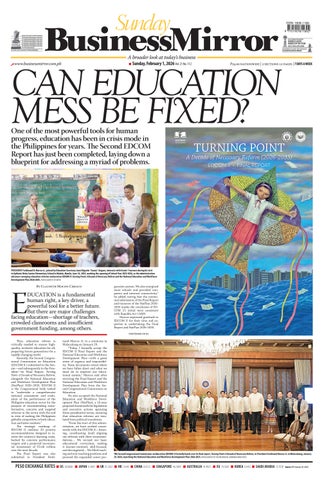

CAN EDUCATION MESS BE FIXED?
One of the most powerful tools for human progress, education has been in crisis mode in the Philippines for years. The Second EDCOM Report has just been completed, laying down a blueprint for addressing a myriad of problems.

By Claudeth Mocon-Ciriaco
EDUCATION is a fundamental human right, a key driver, a powerful tool for a better future. But there are major challenges facing education—shortage of teachers, crowded classrooms and insufficient government funding, among others.
Thus, education reform is critically needed to ensure highquality, inclusive education for all, preparing future generations for a rapidly changing world.
Recently, the Second Congressional Commission on Education (EDCOM II ) submitted to the Senate—and subsequently to the President—its Final Report, Turning Point: A Decade of Necessary Reform, alongside the National Education and Workforce Development Plan (NatPlan) 2026–2035. EDCOM II is the Congressional body tasked to “undertake a comprehensive national assessment and evaluation of the performance of the Philippine education sector for the purpose of recommending transformative, concrete and targeted reforms in the sector with the end in view of making the Philippines globally competitive in both education and labor markets.”
The strategic roadmap of EDCOM II outlines 20 priority recommendations designed to reverse the country’s learning crisis, backed by concrete performance targets and a projected incremental investment of P2.66 trillion over the next decade.
The Final Report was also submitted to President Ferdi-



nand Marcos Jr. in a ceremony in Malacañang on January 29.
“Today, I formally accept the EDCOM II Final Report and the National Education and Workforce Development Plan—with a great sense of urgency and responsibility. These documents reveal where we have fallen short and what we must do to improve our educational system,” Marcos said after receiving the Final Report and the National Education and Workforce Development Plan from the Second Congressional Commission on Education.
He also accepted the National Education and Workforce Development Plan (NatPlan), a 10-year proposed framework for legislation and executive actions spanning three presidential terms, ensuring that education reforms are insulated from political transitions.
“From the start of this administration, we have worked consistently with the EDCOM II—listening, coordinating [and] aligning our reforms with their recommendations.... We revised our basic educational curriculum, making it learner-centered, skill-focused, and decongested.... We filled teaching and non-teaching positions and pursued the expanded career pro
gression system. We also energized more schools and provided computers and internet connectivity,” he added, noting that the ceremonial submission of the Final Report and turnover of the NatPlan 20262035 marks the conclusion of EDCOM 2’s initial term consistent with Republic Act 11899. Marcos expressed gratitude to EDCOM II for their time and expertise in undertaking the Final Report and NatPlan 2026-2035.


-
THE Second Congressional Commission on Education (EDCOM 2) formally hands over its final report, Turning Point: A Decade of Necessary Reform, to President Ferdinand Marcos Jr. at Malacañang, January 29, 2026, launching the National Education and Workforce Development Plan 2026-2035. PHOTO COURTESY OF THE PRESIDENTIAL COMMUNICATIONS OFFICE
PRESIDENT Ferdinand R. Marcos Jr., joined by Education Secretary Juan Edgardo “Sonny” Angara, interacts with Grade 1 learners during his visit to Epifanio Delos Santos Elementary School in Malate, Manila, June 16, 2025, marking the opening of School Year 2025-2026, as the administration advances sweeping education reforms anchored on EDCOM II’s Turning Point: A Decade of Necessary Reform and the National Education and Workforce Development Plan 2026-2035. PHOTO COURTESY OF DEPED
CAN EDUCATION MESS BE FIXED?
Findings
THE Commission’s findings lay bare a stark reality facing the education sector with key highlights include:
• The “Proficiency Collapse” Diagnosis: Findings show that while 30.5 percent of students are proficient in Grade 3, this drops to a critical 0.40 percent by Grade 12, highlighting a massive failure in learning continuity.
• NatPlan 2026–2035: The Commission introduced this 10year plan to align the Department of Education (DeEd), Commission on Higher Education (CHED), and Technical Education and Skills Authority (Tesda) with 20 priority recommendations, including ending “mass promotion” to ensure actual learning mastery.
• Early Childhood Focus: To combat 23.6 percent stunting in children under five, the report urges increased nutrition investments and expanding 3-4 year old early education participation from 34 percent to 90 percent.
• Teacher and Systemic Support: With teachers averaging 52 hours of work weekly due to nonteaching tasks, the report advo -

cates for improved staffing and reduced administrative burdens.
• Resource Alignment: The plan is supported by a P1.37-trillion budget in 2026, meeting 4.4 percent of GDP, and aims for a total of P2.66 trillion in investments over the next decade.
Education, not corruption DURING EDCOM II’s submission of the report to the Senate, Sena-
tor Bam Aquino, chair of the Senate Committee on Basic Education and one of EDCOM II’s leaders, stated: “Alongside numerous colleagues, we have also filed Senate Concurrent Resolution No. 8, Adopting the National Education and Workforce Development Plan (2026–2035) and the Recommendations of the Second Congressional Commission on Education, as the Ten-Year Policy Framework of the National Government. At the right time, we hope that the members of the Chamber support this Concurrent Resolution.”
“Since our first term, we have given priority to advocating for education. And when we began our second term in July, we aligned the goals of our committee with addressing the crisis in education. This includes addressing nutrition, the shortage of classrooms, lack of textbooks and internet connectivity, support for teachers, problems with the learning gap and curriculum, and of course, employability. We have always believed that the first step to reform is to correctly address the problem; and because of the EDCOM report, we are able to do this,” Aquino said, stressing that what the country and the



Aquino thanked his CoChairpersons: Sen. Loren Legarda, Reps. Roman Romulo and Jude Acidre; as well as EDCOM II Commissioners—Senators Alan Peter Cayetano, Win Gatchalian, Joel Villanueva, and their congressional counterparts Reps. Steve Solon, Zia Adiong Alonte and Anna Victoria Veloso-Tuazon. He also thanked former commissioners: Senators Pia Cayetano, Chiz Escudero and former senator Koko Pimentel, Reps. Mark Go, Khalid Dimaporo and Pablo John Garcia. Urgent, sustained education reform FOR her part, Legarda called for urgent and sustained education reform.
Legarda, who co-chairs EDCOM II, emphasized the urgency for decisive action to confront the country’s education crisis.
“If we prioritize education, we lift the entire nation. We all know that our education sector continues to face serious challenges, from learning poverty and classroom backlogs to teacher shortages and weak links to the labor market. But it is precisely because of these difficulties that we must persist and press forward with reform, not retreat from it,” Legarda stressed.
Amid the challenges mentioned by the Commission’s final report, Legarda reiterated that transformative change requires both urgency and persistence. She pushed for the Commission’s extension to sustain focus and deliver deeper, long-term solutions for education.
“This extension is not merely procedural. It is a reaffirmation of our shared responsibility to place our learners, teachers, and parents at the center of reform, and to give ourselves the time and institutional stability needed to pursue solutions grounded in evidence and lived realities,” Legarda added.
Thinking beyond the present MEANWHILE , President Marcos emphasized that the government needs to think beyond the present, even beyond his administration and current local leadership
terms, to effectively address the learning crisis.
“It calls on government, educators, industries, and communities to improve our educational system into one that will prepare every Filipino to meet the challenges of our time,” the President said.
The Chief Executive highlighted the largest allocation to the education sector in this year’s General Appropriations Act, totaling P1.3 trillion, which accounts for 4.36 percent of the country’s gross GDP.
This marks the first time in Philippine history that the budget surpasses the global benchmark for education spending.
“Through this budget, we can hire more teachers to reduce their overall workload; implement learning recovery in reading, math and science; expand school-based feeding programs; and construct more classrooms, further improving our educational system.... Furthermore, we are allotting more than P182 million in the 2026 budget specifically for scholarships in master’s degrees for Guidance Counselling, Psychology, and other specializations. We likewise have expanded access to TechnicalVocational Education and Training through scholarships,” the President continued.
He assured his countrymen that the administration will continue to build on the progress made and further strengthen efforts to ensure all Filipino learners receive the quality education they deserve.
Initiatives reflect recommendations FOR his part, Education Secretary Juan Edgardo “Sonny” Angara pointed out that many of the EDCOM 2 recommendations are already reflected in ongoing initiatives of the Marcos administration, particularly those focused on learning recovery, strengthening foundational skills, and advancing system-wide governance reforms.
Angara also stressed his commitment to lead the next decade of education reform, vowing to move to translate long-standing recommendations into concrete, timebound actions for schools, teachers, and learners.
“Many of the recommendations reflect reforms that DepEd has already started implementing. What we are doing now is moving faster, scaling up, and tightening accountability,” Angara said.
He added that the EDCOM 2 Final Report should be treated as a shared national agenda that requires sustained cooperation across government and society.
“ Turning Point is ultimately a nation-building agenda, and its success will depend on collective action,” Angara said, calling on lawmakers, local governments, industry partners, parents, and civil society to sustain reforms beyond political cycles.
Reforms were being anchored earlier on a child’s learning journey through closer coordination among education, health, and nu-


₧1.3T
trition agencies, alongside stronger participation by local governments.
Curriculum harmonization, workforce training, and unified data systems are being rolled out to strengthen early learning delivery. It will be supported by expanded feeding and parent engagement programs beginning School Year 2026–2027, particularly in highneed communities.
At the classroom level, the revised K to 10 curriculum is being rolled out nationwide, supported by large-scale teacher training and earlier alignment of learning materials.
Learning recovery is being implemented at scale through diagnostic-driven interventions under the ARAL Program, while national and international assessment results are being opened to schools, local governments, and parents through Project BUKAS to support timely, school-level action.
By School Year 2026–2027, reforms in grading, assessment, and promotion are expected to reinforce mastery-based learning and ensure that learner progression reflects actual learning outcomes.
Teachers and school leaders remain central to the reform agenda. Administrative workload is being reduced through the deployment of non-teaching personnel and the digitization of school processes, while professional development and career progression systems are being aligned more closely with instructional competence.
Meanwhile, Senior High School programs are being strengthened through closer coordination with industry, the Technical Education and Skills Development Authority (Tesda) and the Commission on Higher Education (CHED), while reforms in the Alternative Learning System (ALS) are improving learner tracking, literacy outcomes, and completion rates.
To support these reforms, school infrastructure delivery is being accelerated.
Alongside collaborating with local government units, publicprivate partnerships were reactivated, enabling large-scale school infrastructure projects to move forward.
Biddings for PPP BIDDINGS are set to begin this year for Public-Private Partnership or PPP, with simultaneous construction expected by the first quarter of 2027, addressing the country’s 165,000-classroom shortage.
DepEd said it will continue working with Congress, local governments, and development partners to monitor progress under the National Education and Workforce Development Plan, emphasizing that the next decade of education reform will be judged by faster implementation and measurable improvements in learning outcomes.
young people need is education and not corruption.
Editor: Angel R. Calso

From janitor to front lines: Bangladeshis tricked into fighting for Russia in Ukraine
By Samya Kullab The Associated Press
LAKSHMIPUR, Bangladesh—A labor recruiter persuaded Maksudur Rahman to leave the tropical warmth of his hometown in Bangladesh and travel thousands of miles to frigid Russia for a job as a janitor.
Within weeks, he found himself on the front lines of Russia’s war in Ukraine.
An Associated Press investigation found that Bangladeshi workers were lured to Russia under the false promise of civilian work, only to be thrust into the chaos of combat in Ukraine. Many were threatened with violence, imprisonment or death.
AP spoke with three Bangladeshi men who escaped from the Russian military, including Rahman, who said that after arriving in Moscow, he and a group of fellow Bangladeshi workers were told to sign Russian documents that turned out to be military contracts. They were taken to an army camp for training in drone warfare techniques, medical evacuation procedures and basic combat skills using heavy weapons.
Rahman protested, complaining that this was not the work he agreed to do. A Russian commander offered a stark reply through a translation app: “Your agent sent you here. We bought you.”
The three Bangladeshi men shared harrowing accounts of being coerced into front-line tasks against their will, including advancing ahead of Russian forces, transporting supplies, evacuating wounded soldiers and recovering the dead. The families of three other Bangladeshi men who are missing said their loved ones shared similar accounts with relatives.
Neither the Russian Defense Ministry, the Russian Foreign Ministry nor the South Asian country’s government responded to a list of questions from AP. Rahman said the workers in his group were threatened with 10year jail terms and beaten.
“They’d say, ‘Why don’t you work? Why are you crying?’ and kick us,” said Rahman, who escaped and returned home after seven months.
The workers’ accounts were corroborated by documents, including travel papers, Russian military contracts, medical and police reports, and photos. The documents show the visas granted to Bangladeshi workers, their injuries sustained during battles and evidence of their participation in the war. How many Bangladeshis were deceived into fighting is unclear.
The Bangladeshi men told AP they saw hundreds of Bangladeshis alongside Russian forces in Ukraine.
Officials and activists say Russia has also targeted men from other African and South Asian countries, including India and Nepal.
Overseas work supports Bangladeshi families
IN the lush greenery of the Lakshmipur district in southeast Bangladesh, nearly every family has at least one member employed as a migrant worker overseas. Job scarcity and poverty have made
such work essential.
Fathers embark on yearslong journeys for migrant work, returning home only for fleeting visits, just long enough to conceive another child, whom they will likely not see again for years. Sons and daughters support entire families with income earned abroad.
In 2024, Rahman was back in Lakshmipur after completing a contract in Malaysia and seeking new work. A labor recruiter advertised an opportunity to work as a cleaner in a military camp in Russia. He promised $1,000 to $1,500 a month and the possibility of permanent residency. Rahman took out a loan to pay the fee of 1.2 million Bangladeshi taka, about $9,800, to the broker as a fee. He arrived in Moscow in December 2024.
Basic training, then the battlefield ONCE in Russia, Rahman and three other Bangladeshi workers were presented with a document in Russian. Believing it was a contract for cleaning services, Rahman signed.
Then they went to a military facility far from Moscow, where they were issued weapons and underwent three days of training, learning to fire, advance and administer first aid. The group went to a barrack near the Russia-Ukraine border and continued training.
Rahman and two others were then sent to front-line positions and ordered to dig pits inside a bunker.
“The Russians would take a group of say, five Bangladeshis. They would send us in front and stay at the back themselves,” he said.
The men stayed in a leaky bunker in the rain as bombs fell a few kilometers away. Missiles flew overhead.
One person was serving food. “The next moment, he was shot from a drone and fell to the ground right there. And then he was replaced,” Rahman said.
Promises of jobs far from the front SOME Bangladeshi workers were lured into the army with promises of positions far from the front line. Mohan Miajee enlisted in the Russian army after the job that initially brought him to Russia— serving as an electrician for a gasprocessing plant in the remote far east—was plagued by harsh working conditions and relentless cold.
While searching for employment online, Miajee was contacted by a Russian army recruiter. When he expressed his reluctance to kill, the recruiter said his skills as an electrician made him an ideal candidate for an electronic warfare or drone unit that would be nowhere near combat.
With his military papers in order, Miajee was taken in January 2025 to
a military camp in the captured city of Avdiivka. He showed the camp commander documents describing his experience and explained that his recruiter had instructed him to ask for “electrical work.”
“The commander told me, ‘You have been made to sign a contract to join the battalion. You cannot do any other work here. You have been deceived,’” he said after returning to his village of Munshiganj.
Miajee said he was beaten with shovels, handcuffed and tortured in a cramped basement cell, and held there every time he refused to carry out an order or made a small mistake.
Because of language barriers, for example, “if they told us to go to the right and we went to the left, they would beat us severely,” he said.
He was made to carry supplies to the front and collect dead bodies.
Meanwhile in Rahman’s unit, some weeks later, they were instructed to evacuate a Russian soldier with a wounded leg. The men carried him, but no sooner had they left the position than they saw a Ukrainian drone buzzing above. It fired at them. Then more drones came in a swarm.
Rahman could not advance or return to the bunker. A Russian soldier guiding them said land mines were everywhere.
He was stuck, and the Russian commander fled.
Rahman eventually suffered a leg wound that sent him to a hospital near Moscow. He escaped from the medical center and went directly to the Bangladeshi embassy in Moscow, which prepared a travel pass for him to leave the country.
Some months later, Rahman helped his brother-in-law Jehangir Alam, who also spoke with AP, run away using the same method—leaving the hospital after being wounded and appealing to the embassy.
Families long to learn about missing men FAMILIES in Lakshmipur hold tightly to the documents of their missing loved ones, believing that one day, when presented to the right person, the papers might unlock the path to their return.
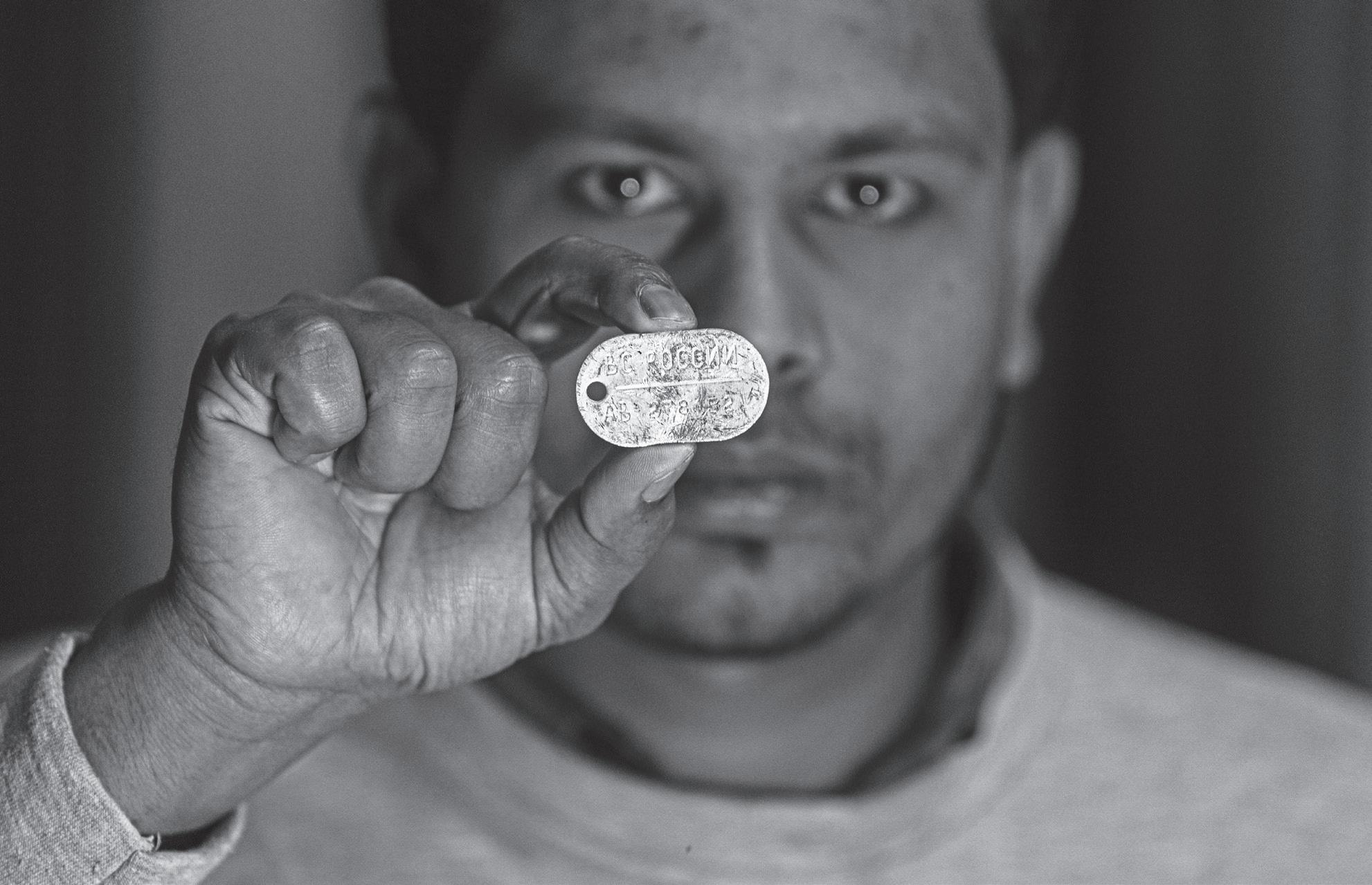
The documents included photos of Russian business visas, military contracts and army dog tags. The papers were sent by the missing men, who urged relatives to complain to recruiting agents.
The contracts were verified by two Russian groups helping men evade or get out of military ser -
vice. Maj. Vladimir Yaltsev, head of the Kostroma regional recruitment center for contract military service, is listed as signing the contracts on behalf of the Russian military.
In their final messages, these husbands, sons and fathers conveyed to relatives that they were being forcibly taken to the front lines in Ukraine. After that, all communication ceased.
The families filed a complaint with police in Dhaka and traveled on three occasions to the capital to pressure the government to investigate.
Salma Akdar has not heard from her husband since March 26. In their last conversation, Ajgar Hussein, 40, told her he had been sold to the Russian army. The couple has two sons, ages 7 and 11.
Hussein left in mid-December 2024, believing he was being offered a job as a laundry attendant in Russia, his wife said. He had recently returned from Saudi Arabia and planned to stop working overseas for a spell, she explained. But believing Russia offered opportunities to make money, he left again. He sold some of his land to pay the agent’s fees.
For two weeks, he was in regular touch. Then he told his wife he was being taken to an army camp where they were trained to use weapons and carry heavy loads up to 80 kilograms (176 pounds).
“Seeing all this, he cried a lot and told them, ‘We cannot do these things. We have never done this before,’” his wife said.
For two months after that, he was offline. He reappeared briefly to explain they were being forced to fight in the war.
Russian commanders “told him that if he did not go, they would detain him, shoot him, stop providing food,” she said.
Families in the village confronted the recruiting agent, demanding to know why their loved ones were being trained for war. The agent replied dismissively, saying that it was standard procedure in Russia, insisting that even launderers had to undergo similar training.
Hussein left a final audio note for this wife: “Please pray for me.”
Son expected to work as a chef
MOHAMMED SIRAJ’S 20-yearold son, Sajjad, departed believing he would be working as a chef in Russia. He needed to support his unemployed father and chronically ill mother.
Siraj wept as he described his
son begging him to ask the agent why he was being made to undergo military training. Sajjad fought with his Russian commanders, insisting he had come to be a chef, not to fight. They threatened him with jail if he did not comply. Then someone else threatened to shoot him, his father recalled.
Sajjad called the family and said he was being taken to battle.
“That is the last message from my son,” he said.
In February, Siraj learned through a Bangladeshi man serving with Sajjad that his son had been killed in a drone attack. Unable to bear telling his wife the truth, Siraj assured her that their son was doing well. But word spread through the village.
“You lied to me,” Siraj recalled her saying as she confronted him. Soon after, she died, calling out for her son in her final moments.
Investigation uncovers network of intermediaries IN late 2024, families approached BRAC, an organization that advocates for Bangladeshi workers, and said they could no longer reach their relatives in Russia. That prompted the organization
to investigate. It uncovered at least 10 Bangladeshi men who are still missing after they were lured to fight.
“There are two or three layers of people who are profiting,” said Shariful Islam, the head of BRAC’s migration program.
Bangladesh police investigators uncovered a trafficking ring in Russia after a Bangladeshi man returned in January 2025, alleging he had been deceived into fighting. The police believe that similar networks, operated by Bangladeshi intermediaries with connections to the Russian government, are responsible for facilitating the entry of Bangladeshis into Russia. Another nine people were discovered to have been lured into fighting based on that police investigation, according to investigator Mostafizur Rahman. The Associated Press reviewed the police report filed by one victim’s wife, who said he went to Russia expecting to work in a chocolate factory. A middleman, a Bangladeshi with Russian citizenship who was residing in Moscow, has been charged. It’s not clear how many Bangladeshis were lured to Russia. A Bangladeshi police investigator told AP that about 40 Bangladeshis may have lost their lives in the war. Some go willingly, knowing they will end up on the front lines because the money is too good, according to Rahman, the investigator.
In Lakshmipur, investigators learned that the local agent has been funneling recruits to a central agent associated with a company called SP Global. The company did not respond to AP’s calls and e-mails. Investigators found it ceased operations in 2025.
Families of the missing individuals said they have not received any money earned by their loved ones. Miajee too said he was never paid.
“I don’t want money or anything else,” Akdar said. “I just want my children’s father back.”

The Associated Press writer Julhas Alam in Dhaka, Bangladesh, contributed to this report.
MAKSUDUR RAHMAN, 31, who escaped after fighting for the Russian army, shows a Russian military dog tag during an interview with The Associated Press in Lakshmipur, Bangladesh, Dec. 10, 2025. AP/RAJIB DHAR
Trump’s immigration crackdown led to drop in US growth rate last year as population hit 342 million
By Mike Schneider The Associated Press
ORLANDO,
Fla.—President
Donald Trump’s crackdown on immigration contributed to a year-to-year drop in the nation’s growth rate as the US population reached nearly 342 million people in 2025, according to population estimates released Tuesday by the US Census Bureau.
The 0.5% growth rate for 2025 was a sharp drop from 2024’s almost 1% growth rate, which was the highest in two decades and was fueled by immigration. The 2024 estimates put the US population at 340 million people.
Immigration increased by almost 1.3 million people last year, compared with 2024’s increase of almost 2.8 million people. If trends continue, the annual gain from immigrants by mid-2026 will drop to only 321,000 people, according to the Census Bureau, whose estimates do not distinguish between legal and illegal immigration.
In the past 125 years, the lowest growth rate was in 2021, during the height of the coronavirus pandemic, when the US population grew by just 0.16%, or 522,000 people and immigration increased by just 376,000 people because of travel restrictions into the US. Before that, the lowest growth rate was just under 0.5% in 1919 at the height of the Spanish flu.
Births outnumbered deaths last year by 519,000 people. While higher than the pandemic-era low
at the beginning of the decade, the natural increase was dramatically smaller than in the 2000s, when it ranged between 1.6 million and 1.9 million people.
Lower immigration stunts growth in many states
THE drop in immigration dented growth in several states that traditionally have been immigrant magnets.
California had a net population loss of 9,500 people in 2025, a stark change from the previous year, when it gained 232,000 residents, even though roughly the same number of Californians already living in the state moved out in both years. The difference was immigration since the number of net immigrants who moved into the state dropped from 361,000 people in 2024 to 109,000 in 2025. Florida had year-to-year drops in both immigrants and people moving in from other states. The Sunshine State, which has become more expensive in recent years from surging property values and higher home insurance costs, had

only 22,000 domestic migrants in 2025, compared with 64,000 people in 2024, and the net number of immigrants dropped from more than 411,000 people to 178,000 people.
New York added only 1,008 people in 2025, mostly because the state’s net migration from immigrants dropped from 207,000 people to 95,600 people.
South Carolina, Idaho and North Carolina had the highest year-over-year growth rates, ranging from 1.3% to 1.5%. Texas, Florida and North Carolina added the most people in pure numbers. California, Hawaii, New Mexico, Vermont and West Virginia had population declines.
The South, which has been the powerhouse of growth in the
2020s, continued to add more people than any other region, but the numbers dropped from 1.7 million people in 2024 to 1.1 million in 2025.
“Many of these states are going to show even smaller growth when we get to next year,” Brookings demographer William Frey said Tuesday.
The effects of Trump’s immigration crackdown TUESDAY’S data release comes as researchers have been trying to determine the effects of the second Trump administration’s immigration crackdown after the Republican president returned to the White House in January 2025. Trump made a surge of migrants at the southern border a central
issue in his winning 2024 presidential campaign.
The numbers made public Tuesday reflect change from July 2024 to July 2025, covering the end of President Joe Biden’s Democratic administration and the first half of Trump’s first year back in office.
The figures capture a period that reflects the beginning of enforcement surges in Los Angeles and Portland, Oregon, but do not capture the impact on immigration after the Trump administration’s crackdowns began in Chicago; New Orleans; Memphis, Tennessee; and Minneapolis, Minnesota.
The 2025 numbers were a jarring divergence from 2024, when net international migration accounted for 84% of the nation’s 3.3 million-person increase from
the year before. The jump in immigration two years ago was partly because of a new method of counting that added people who were admitted for humanitarian reasons.
“They do reflect recent trends we have seen in out-migration, where the numbers of people coming in is down and the numbers going out is up,” Eric Jensen, a senior research scientist at the Census Bureau, said last week.
How the population estimates are calculated
UNLIKE the once-a-decade census, which determines how many congressional seats and Electoral College votes each state gets, as well as the distribution of $2.8 trillion in annual government funding, the population estimates are calculated from government records and internal Census Bureau data.
The release of the 2025 population estimates was delayed by the federal government shutdown last fall and comes at a challenging time for the Census Bureau and other US statistical agencies. The bureau, which is the largest statistical agency in the US, lost about 15% of its workforce last year due to buyouts and layoffs that were part of cost-cutting efforts by the White House and its Department of Government Efficiency.
Other recent actions by the Trump administration, such as the firing of Erika McEntarfer as Bureau of Labor Statistics commissioner, have raised concerns about political meddling at US statistical agencies. But Frey said the bureau’s staffers appear to have been “doing this work as usual without interference.”
“So, I have no reason to doubt the numbers that come out,” Frey said.
How Americans use AI at work, according to a new Gallup poll
By Matt O’brien & Linley Sanders
The Associated Press
AMERICAN workers adopted artificial intelligence into their work lives at a remarkable pace over the past few years, according to a new poll. Some 12% of employed adults say they use AI daily in their job, according to a Gallup Workforce survey conducted this fall of more than 22,000 US workers. The survey found roughly onequarter say they use AI at least frequently, which is defined as at least a few times a week, and nearly half say they use it at least a few times a year. That compares with 21% who were using AI at least occasionally in 2023, when Gallup began asking the question, and points to the impact of the widespread commercial boom that ChatGPT sparked for generative AI tools that can write emails and computer code, summarize long documents, create images or help answer questions.
Home Depot store associate Gene Walinski is one of the employees

embracing AI at work. The 70-yearold turns to an AI assistant on his personal phone roughly every hour on his shift so he can better answer questions about supplies that he is not “100% familiar with” at the store’s electrical department in New Smyrna Beach, Florida.
“I think my job would suffer if I couldn’t because there would be a lot of shrugged shoulders and ‘I don’t know’ and customers don’t want to hear that,” Walinski said.
AI at work for many in technology, finance and education
WHILE frequent AI use is on the rise with many employees, AI adoption remains higher among those working in technologyrelated fields.
About 6 in 10 technology workers say they use AI frequently, and about 3 in 10 do so daily.
The share of Americans working in the technology sector who say they use AI daily or regularly has grown significantly since 2023, but there are indications that AI adoption could be starting to plateau after an explosive


increase between 2024 and 2025.
In finance, another sector with high AI adoption, 28-year-old investment banker Andrea Tanzi said he uses AI tools every day to synthesize documents and data sets that would otherwise take him several hours to review.
Tanzi, who works for Bank of America in New York, said he also makes uses of the bank’s internal AI chatbot, Erica, to help with administrative tasks.
In addition, majorities of those working in professional services, at colleges or universities or in K-12 education, say they use AI at least a few times a year.
Joyce Hatzidakis, 60, a high school art teacher in Riverside, California, started experimenting with AI chatbots to help “clean up” her communications with parents.
“I can scribble out a note and not worry about what I say and then tell it what tone I want,” she said. “And then, when I reread it, if it’s not quite right, I can have it edited again. I’m definitely getting less parent complaints.”
Another Gallup Workforce survey from last year found that

about 6 in 10 employees using AI are relying on chatbots or virtual assistance when they turn to AI tools. About 4 in 10 AI users at work reported using AI to consolidate information or data, to generate ideas or to learn new things.
Hatzidakis started with ChatGPT and then switched to Google’s Gemini when the school district made that its official tool. She has even used it to help with recommendation letters because “there’s only so many ways to say a kid is really creative.”
The benefits and drawbacks of AI adoption
The AI industry and the US government are heavily promoting AI adoption in workplaces and schools. More people and organizations will need to buy these tools in order to justify the huge amounts of investment into building and running energy-hungry AI computing systems. But not all economists agree on how much they will boost productivity or affect employment prospects.
“Most of the workers that are most highly exposed to AI, who


are most likely to have it disrupt their workflows, for good or for bad, have these characteristics that make them pretty adaptable,”
said Sam Manning, a fellow at the Centre for the Governance of AI and co-author of new papers on AI job effects for the Brookings Institution and the National Bureau of Economic Research.
Workers in those mostly computer-based jobs that involve a lot of AI usage “usually have higher levels of education, wider range of skill sets that can be applied to different jobs, and they also have higher savings, which is helpful for weathering an income shock if you lose your job,” Manning said.
On the other hand, Manning’s research has identified some 6.1 million workers in the United States who are both heavily exposed to AI and less equipped to adapt. Many are in administrative and clerical work, about 86% are women and they are older and concentrated in smaller cities, such as university towns or state capitals, with fewer options to shift careers.
“If their skills are automated, they have less transferable skills to other jobs and they have a lower savings, if any savings,” Manning said. “An income shock could be much more harmful or difficult to manage.”
Few workers are concerned about AI replacing them
A SEPARATE Gallup Workforce survey from 2025 found that even as AI use is increasing, few employees said it was “very” or
“somewhat” likely that new technology, automation, robots or AI will eliminate their job within the next five years. Half said it was “not at all likely,” but that has decreased from about 6 in 10 in 2023. Not worried about losing his job is the Rev. Michael Bingham, pastor of the Faith Community Methodist Church in Jacksonville, Florida.
A chatbot fed him “gibberish” when he asked about the medieval theologian Anselm of Canterbury, and Bingham said he would never ask a “soulless” machine to help write his sermons, relying instead on “the power of God” to help guide him through ideas.
“You don’t want a machine, you want a human being, to hold your hand if you’re dying,” Bingham said. “And you want to know that your loved one was able to hold the hand of a loving human being who cared for them.”
Reported AI usage is less common in service-based sectors, such as retail, health care or manufacturing.
O’Brien reported from Providence, Rhode Island, and Sanders from Washington. Gallup’s quarterly workforce surveys were conducted with a random sample of adults age 18 and older who work full time and part time for organizations in the United States and are members of Gallup’s probabilitybased Gallup Panel. The most recent survey of 22,368 employed US adults was conducted from Oct. 30-Nov. 13, 2025. The margin of sampling error for all respondents is plus or minus 1 percentage point.
A MAN takes an image with his phone next to where the border wall separating Mexico and the United States reaches the Pacific Ocean, Jan. 28, 2025, in Tijuana, Mexico. AP/GREGORY BULL

Virology Institute to make PHL vaccine-independent
By John Eiron R. Francisco
SEEKING to build domestic vaccine manufacturing capacity, the Philippine government is moving to reduce reliance on imported vaccines after the Virology and Vaccine Institute of the Philippines (VIP) Act was signed into law last year.
During the fourth and final leg of the public consultation on the VIP’s implementing rules and regulations (IRR) held on January 27 in Parañaque City, Director Lita Suerte-Felipe of the Department of Science and Technology Department Legislative Liaison Office (DOST-DLLO) said the Institute was born out of the need to produce vaccines suited to the country’s specific health needs.
Suerte Felipe said the Covid-19 pandemic exposed the country’s heavy reliance on imported vaccines from developed nations, whose production priorities and standards may not always align with local conditions.
“During the height of the Covid-19 pandemic, we saw how crucial it was to strengthen our country’s capacity for biological research and vaccine development,” she said.
The Philippines began its Covid-19 vaccination rollout in March 2021, nearly a year after the United Kingdom became the first country to administer a fully tested Covid-19 vaccine to its citizens in December 2020. By the time vaccines arrived in the Philippines, the country had already recorded a surge in cases.
As of January 2022, the Philippines had logged around 2.8 million Covid-19 cases and 51,570 related deaths, or about 1.8 percent of total infections.
Vaccine supply during the rollout relied heavily on imports. As of June 27, 2022, around 93.7 mil -
lion doses of Pfizer vaccines had arrived in the country, followed by 56.11 million doses of Sinovac and 38.85 million doses of AstraZeneca.
These vaccines were sourced mainly from China, the United States, and several European countries, supplemented by donations coursed through the Covid-19 Vaccines Global Access facility.
These realizations, SuerteFelipe said, led to the creation of the VIP as a national institution that would anchor the country’s scientific preparedness against future outbreaks affecting humans, animals, and plants.
Marissa M. Alejandria, executive director of the University of the Philippines-National Institutes of Health (UP-NIH), emphasized that vaccines are among the most significant breakthroughs in the fight against infectious diseases, alongside antimicrobials, oral rehydration therapy, sanitation, and access to clean water.
“There was even a time when it was thought that infectious diseases could be eliminated because of these breakthroughs,” Alejandria said. “But with advances in technology and increasing global interconnectedness, infectious diseases have continued to emerge—as seen with new pathogens and, most recently, the pandemic.”
She stressed that history has consistently shown vaccination to be life-saving, including during the Covid-19 crisis.
However, she noted that significant gaps remain in the country’s health system, particularly in access, infrastructure, regulatory frameworks, policy support, funding, and human resource capacity.
“Hence, we applaud the vision of DOST in creating the Virology and Vaccine Institute of the Phil -

ippines and celebrate its passage into law,” Alejandria said.
The VIP was established under Republic Act 12290, which traces its roots to the 18th Congress, when the bill was first filed in March 2020 at the height of the pandemic. Drafted by the DOST in coordination with lawmakers, the measure sought to address emerging and future health threats.
Although the House of Representatives approved the bill on third reading, it remained pending in the Senate until the end of the 18th Congress. The proposal was later revised and refiled in the 19th Congress, eventually signed into law by President Ferdinand Marcos Jr. on September 12, 2025.
“This law represents more than just a legislative victory,” SuerteFelipe said. “It stands as a symbol of our nation’s commitment to self-reliance, innovation, and resilience in the face of future health challenges.”
Following the signing of the law, researchers and health experts began drafting the IRR to operationalize the institute, establish procedures, clarify legal provisions, and define the roles of implementing agencies.
The DOST-DLLO official said a series of consultations with government agencies, academic institutions, and research organizations are being conducted to further refine the IRR and ensure that it reflects the goals, mandates, and intent of the VIP law.
The public consultation process began in Luzon on November 13, 2025, and continued in the Visayas and Mindanao on January 12 and 20.
The National Capita Regionleg consultation was supported by key figures from both government and the private sector, including Health Secretary Teodoro J. Herbosa; DOST-NCR Regional Director Engr. Romelen Tresvalles; Alejandria; UP Manila Professor Emeritus Dr. Lulu Bravo; and St. Luke’s Medical Center Vice President for Research and Biotechnology Dr. Rodolfo S. Pagcatipunan.
Collaboration key to VIP’s success IN her remarks, Bravo emphasized that sustained collaboration must be at the core of VIP’s implementation, calling for long-term cooperation among government agencies, the private sector, international partners, and nongovernment organizations.
The key to unlocking the PHL’s robotics potential
By Bless Aubrey Ogerio
THE country’s push into robotics will only go as far as its ability to ground research in the realities of local industry, according to a Filipino scientist working on automation and manufacturing technologies.
Dr. Albert Causo, a Balik Scientist at the Metals Industry Research and Development Center (MIRDC), said robotics research and development in the country needs to be more closely aligned with on-theground business needs, particularly those of micro, small and medium enterprises (MSMEs), which make up the bulk of the domestic manufacturing base.
“Research efforts must be driven by actual business pain points, particularly those faced by MSMEs,” Causo said, noting that many technologies fail to gain traction because they do not directly address production constraints faced by firms.

Mechatronics, Robotics, and Industrial Automation Laboratory (Amerial), particularly in support of the Connected and Unified Autonomous Technologies with Automation and Robotics (Cuatro) Program. The program aims to develop automation solutions that can be adopted by local manufacturers.
She also pointed out the importance of public understanding of vaccinology, noting that vaccines are not merely a scientific concept but a shared responsibility involving families, communities, and society as a whole.
Bravo highlighted the need for vaccine accessibility, saying this requires a coordinated effort among the Department of Health, the Food and Drug Administration, and other institutions to ensure vaccines are available, affordable, and sustainable.
She warned that misinformation and disinformation remain major obstacles to vaccination efforts, citing how vaccine coverage in the Philippines once exceeded 100 percent in the early 1990s before declining due to shifting policies and public skepticism.
“This is why communication and advocacy are just as important as science,” Bravo said, explaining that restoring public trust is critical to strengthening the country’s immunization program.
Moreover, Herbosa said the VIP’s mandate aligns with the DOH’s eight-point action agenda for health, particularly under its pandemic preparedness strategies.
He added that the institute would support the country’s goal of achieving 95 percent fully immunized children, which remains one of the government’s priority health outcomes.
The VIP facility is under construction in New Clark City in Capas, Tarlac, on a five-hectare site. The complex will include an administration building, lecture hall, Good Manufacturing Practice facility, human and animal virology laboratories, a plant virology laboratory, animal isolation units, biosafety level 3 and 4 laboratories, plant cultivation areas, a dormitory, a power station, and a sewage treatment plant.
DR . Gay Jane P. Perez is the new Director General of the Philippine Space Agency, PhilSA announced in a news release.
President Ferdinand R. Marcos Jr. appointed Perez who succeeded Dr. Dr. Joel Joseph S. Marciano Jr., the founding Director General of PhilSA who served the agency since January 2020.
Perez previously served as Officer-inCharge of PhilSA beginning September 2025.
One health approach
MEANWHILE , Science Secretary Renato U. Solidum Jr. highlighted in his keynote speech the importance of the One Health approach, describing it as a foundation for resilience that goes beyond merely surviving, but enables communities to thrive.
“Protecting life goes beyond human health alone,” Solidum said, citing recent outbreaks of African swine fever, which caused thousands of hog raisers to lose income, disrupted food supply chains, and drove up market prices.
He pointed out that animal diseases are not only agricultural issues but also have wider economic and social impacts.
Solidum added that the VIP will play a key role in preventing animal viruses, developing vaccines, and supporting early detection through surveillance programs.
“Through these efforts, we aim to protect livestock, safeguard farmers’ incomes, and strengthen food security,” he said. He also emphasized the interconnection between plant health and human well-being.
“Our crops feed our people, support industries, and sustain the environment. Yet plant viruses and emerging agricultural diseases threaten productivity, biodiversity, and resilience to climate change,” Solidum said. He noted that the DOST is working to detect and manage plant pathogens that could affect key agricultural commodities.
“Ultimately, these efforts protect farmers’ livelihoods, secure food supply chains, and maintain ecological balance,” Solidum said, underscoring that the One Health approach integrates human, animal, and plant health to ensure that the wellbeing of each sector supports the others.

She earlier held the position of PhilSA’s Deputy Director General for Space Science and Technology from 2021, bringing with her extensive experience in space science, research and development, and institutional leadership.
He pointed to international examples, such as Singapore and Denmark, where strong coordination among government, research institutions and private industry has helped accelerate robotics research and commercialization.
Both countries are among those with the highest levels of industrial robot adoption, particularly in automotive manufacturing and in sectors such as metal and machinery, rubber and plastics, and food and beverage, according to data from the International Federation of Robotics. In these cases, Causo said,
Causo emphasized that translating research into usable technologies requires coordinated policy support, industry-led research priorities, and sustained capability building. Without these elements working together, he said, investments in robotics and automation risk falling short of their intended economic impact.
automation investments were closely tied to productivity gains rather than technology adoption for its own sake.
“Industry 4.0 investments only create value when they improve productivity—allowing firms to take on more orders reliably, expand operations, create jobs, and stimulate broader economic activity,” he said.
Causo made the remarks during his exit presentation marking the completion of his engagements under the Balik Scientist Program, where he outlined his work supporting robotics, automation and Industry 4.0 initiatives in the country.
Among his contributions was providing technical and strategic guidance to strengthen the Advanced
On the other hand, he also said he remains open to supporting curriculum development and further research and development efforts to help build local talent and strengthen long-term capabilities in robotics and automation.
Science Undersecretary Leah Buendia said Causo’s work reflects the intent of the Balik Scientist Program to bring overseas expertise back into the country to support national development goals.
Alongside the Balik Scientist Program, the Department of Science and Technology is implementing the Cuatro initiative, which seeks to enhance the competitiveness of local manufacturers through the establishment of a Smart Manufacturing Hub at MIRDC.
The hub is intended to support firms in testing and adopting automation technologies suited to Philippine manufacturing conditions.
DOST sets review classes ahead of scholarship exam
ary 4 with Creative Reasoning, Language, and Literature, scheduled from 6:30 p.m. to 9 p.m.
Sessions on
The
and February 19, both from 6:30
p.m. to 8 p.m.
Interested participants may register through the official DOST-NCR link. Meanwhile, DOST-SEI said test permits for qualified examinees are set to be released from February 1 to 9.
The SEI Undergraduate Scholarship Examination will be administered nationwide on February 21 and 22. The program supports students pursuing priority science and technology courses. Bless Aubrey Ogerio
Before joining PhilSA, Perez led the science team behind the development of the Philippines’ first microsatellites, Diwata-1 and Diwata-2. These landmark missions laid the groundwork for subsequent space technology initiatives, including the ongoing development of the Multispectral Unit for Land Assessment satellite.
A recipient of the 2021 National Academy of Science and Technology Outstanding Young Scientist and the 2019 The Outstanding Women in the Nation’s Service Award, Perez is the first Filipino awardee of the Asean-US Science Prize for Women.
She was recognized for her groundbreaking research using satellite data to forecast droughts and enhance agricultural productivity. Her contributions have been acknowledged by the the Philippine Senate through Resolution 923 (17th Congress), underscoring
the global excellence of Filipino scientists. Perez recently represented the Philippines in key international space initiatives, including collaborative agreement with the Indian Space Research Organization, the United Nations Space4Ocean initiative, and the Artemis Accords, which promote the safe, transparent, and sustainable civil exploration of the Moon, Mars, and other celestial bodies. Perez earned her doctorate in Physics from the University of the Philippines Diliman and completed her postdoctoral research at NASA’s Goddard Space Flight Center, where she specialized in remote sensing and satellite data applications.
As Director General, Perez will further advance the Philippines’ Yamang Kalawakan program by strengthening the national space ecosystem, advancing research and innovation, and the expanding partnerships in support of an inclusive and sustainable national space program.
The Director General of PhilSA holds the rank of a Cabinet Secretary and serves as the Presidential Adviser on Space Matters.

Dr. Gay Jane P. Perez is new PhilSA chief
DR . Gay Jane P. Perez PHILSA PHOTO
BALIK Scientist Dr. Albert Causo JORELLE BONIFACIO, DOST OUSECRD
THE Department of Science and Technology leads the public consultation on the implementing rules and regulations of the recently-signed Vaccine Institute of the Philippines Act, at a hotel in Parañaque on January 27. JOHN EIRON R. FRANCISCO
A6 Sunday, February 1, 2026

Editor: Lyn Resurreccion • www.businessmirror.com.ph
PHL’s Catholic Church leaders confront internal challenges, push collaboration
THE country’s Catholic bishops and religious leaders acknowledged deep internal challenges while calling for stronger unity to confront Church failures and national crises.
The unusually frank remarks were made during a joint gathering of bishops and major religious superiors at De La Salle University in Manila on January 23, aimed at fostering dialogue, discernment and cooperation.
The gathering marked the second meeting of its kind since the first was convened in 2018.
Archbishop Gilbert Garcera, president of the Catholic Bishops’ Conference of the Philippines, said the Church continues to struggle to live out its mission.
“The journey toward becoming a true Church of the poor remains wounded,” Garcera said, citing “fragmented communion” and
“socially indifferent ministry.”
He also pointed to “entrenched clericalism and patriarchy, weak accountability and evangelical witness” as problems undermining the Church’s credibility. Garcera explained that the meeting was not symbolic. “What we do today is not merely a meeting. It is an act of fidelity to the Church’s present journey,” he said.
He said the encounter responds directly to Pope Leo XIV’s call for synodality, or listening and deciding together as a Church.
Collaboration between bishops, religious BISHOP Elias Ayuban Jr. of Cubao,

chairman of the CBCP Episcopal Commission on Mutual Relations
Between Bishops and Religious, said participants openly acknowledged challenges in collaboration.
“Today, we acknowledge the challenges in the areas of mutual relations and collaborative ministry,” Ayuban said, referring to
bishops, clergy and consecrated persons.
He said tensions often receive more attention than cooperation.
“A tree that falls makes more noise than a forest that grows in harmony,” Ayuban said.
The bishop, a Claretian, said genuine collaboration requires
CBCP leader: Church open to dialogue with Marcos admin
THE leadership of the Catholic Church said this past week it is open to dialogue with the Marcos administration, but only if it serves the common good.
Archbishop Gilbert Garcera, who recently assumed office as president of the Catholic Bishops’ Conference of the Philippines (CBCP), said dialogue is an important part of the Church’s role.
“We will be open to a dialogue, not a monologue,” Garcera said at a news conference in Manila. “We are open because conversation is necessary. The key word is dialogue, in humility.”
“Communication and conversation are important because having no communication is very difficult,” he added.
When asked if there were specific issues the Church wants to discuss with the government, Garcera said the bishops are open to any topic.
“We are open to anything, especially if it will be for the good of the Filipino people,” he said.

It can be recalled that last year the Catholic Church in the country and other Christian denominations and religions have criticized large-scale corruption in flood-control projects, and have led nationwide protests against the scheme.
They also criticized the political dynasties that have been taking advantage of the system that
leads to corruption.
In his speech at the Edsa People Power Monument in Quezon City on November 30, 2025, Cardinal Pablo Virgilio David said the fight for transparency and accountability must continue across the nation.
The outgoing president of CBCP cited political dynasties as one of the “most malignant forms of cancer” in the country and urged
lawmakers to pass reforms to curb their influence.
“Democracy cannot function fully until these tumors, especially political dynasties, are removed. It will take a sort of chemotherapy to eliminate these cancer cells before they metastasize,” David said.
Garcera clarified during the news conference, however, that no meeting has been scheduled between the executive office and the CBCP since he assumed the presidency in December 2025.
“I haven’t spoken to any government official so far… but there are requests. However, because of the schedule, it’s difficult to set one,” he said.
The news conference was held at the end of the three-day CBCP plenary assembly at the Pope Pius XII Catholic Center on UN avenue, Manila.
The biannual assembly gathered more than 85 bishops from across the country and was presided over by Garcera for the first time as CBCP head. CBCP News with B usiness M irror
Sarah Mullally is Church of England’s first woman head
LONDON—Sarah Mullally walked into St. Paul’s Cathedral on Wednesday morning as the bishop of London. When she walked out in the afternoon as bells rang out, she was the spiritual leader of millions of Anglicans around the world.
Mullally, 63, became the archbishop of Canterbury, making her the first woman to lead the Church of England. The worldwide Anglican Communion, which includes the Episcopal Church in the US, has no formal head, but the archbishop traditionally has been seen as its spiritual leader.
As the choir sang an anthem by Edward Elgar, the cancer nurse turned cleric officially took up the responsibilities of her new job as bewigged judges presided over a legal ceremony confirming her appointment, which was announced almost four months ago.
As the lengthy process came to a close and her election was con -
firmed, Mullally stood and faced the congregation to loud applause.
“We welcome you,” the bishops surrounding her shouted in unison.
The so-called Confirmation of Election service marks a major milestone for the Church of England, which ordained its first female priests in 1994 and its first female bishop in 2015. The church traces its roots to the 16th century when the English church broke away from the Roman Catholic Church during the reign of King Henry VIII. George Gross, an expert on theology and the monarchy at King’s College London, highlighted the church’s continuing divergence from the Catholic Church, which forbids women from being ordained as priests, much less as serving as the religion’s global spiritual leader.
“It is a big contrast,” Gross said. “And in terms of the position of
women in society, this is a big statement.”
But Mullally’s appointment may deepen rifts within the Anglican Communion, whose 100 million members in 165 countries are deeply divided over issues such as the role of women and the treatment of LGBTQ people.
She will also have to confront concerns that the Church of England hasn’t done enough to stamp out the sexual abuse scandals that have dogged it for more than a decade.
Gafcon, a global organization of conservative Anglicans, says Mullally’s appointment is divisive because a majority of the Anglican Communion still believes only men should be bishops.
Rwandan Archbishop Laurent Mbanda, chairman of the Gafcon council of senior bishops, known as primates, also criticized Mullally’s support for the blessing of same-sex marriages.
“Since the newly appointed archbishop of Canterbury has failed to guard the faith and is complicit in introducing practices and beliefs that violate both the ‘plain and canonical sense’ of Scripture and `the Church’s historic and consensual’ interpretation of it, she cannot provide leadership to the Anglican Communion,” Mbanda said in October.
As part of the ceremony, a cleric announced that no one had raised legitimate opposition to Mullally’s confirmation. A heckler began shouting and was escorted from the cathedral.
The bishops declared that no objection had been made in a timely way and Mullally took her oath of allegiance to the British crown and the church.
Mullally replaces former Archbishop Justin Welby, who announced his resignation in November 2024, after he was criticized for failing to tell police about al -
humility, dialogue and listening, warning that “there can be no true collaboration where dialogue is absent.”
He added that mutual relations are a shared responsibility, calling on bishops to accompany consecrated persons with “benevolence, paternal care, and solicitous love.”
Garcera urged bishops to be more open to collaboration with religious congregations in dioceses and parishes nationwide.
“Let us welcome their charisms, their prophetic insights, and their dynamic pastoral energy,” he said, calling them gifts to local churches.
Unity urged amid national challenges
DOMINICAN Sr. Cecilia Espenilla, co-chairperson of the Conference of Major Superiors in the Philippines, said the gathering showed growing unity.
“This is a beautiful gathering that will strengthen the Catholic Church in the Philippines,” Espenilla said, pointing to communion and collaboration.
She acknowledged tensions but urged solutions, saying unity is urgently needed as the country faces corruption and other social problems.
“Our oneness is very much needed,” she said, citing national concerns including corruption.
Veteran Catholic media priest Fr. Isabelo San Luis dies at 81
FR . Isabelo “Bel” San Luis, a priest of the Society of the Divine Word (SVD) known for his work in Catholic media, died Wednesday, his congregation said. He was 81.
In a social media post, the SVD described San Luis as “a faithful servant of God and His people,” praising his lifelong dedication to ministry.
Fr. Elmar Castrodes Fiel, SVD, manager of Radio Veritas Asia, paid tribute to San Luis as his mentor in the media ministry.
“Your [Fr. Bel] wisdom, patience, and passion for evangelization through media shaped not only programs, but also the people behind the cameras,” Fiel said.
“You taught us that communication is a ministry, and that every broadcast can be a prayer.”
Born in Laoag City, San Luis was ordained a priest in 1971. He held leadership roles, including rector of the Divine Word Seminary in Urdaneta, Pangasinan, and president of Divine Word College of Laoag.
In 1987, he became editor of Divine Word Publications in Manila and later studied communications in London. From 1992 to 1999, he directed SVD publications, social

communications and media projects across the Philippines.
He then served six years as parish priest at the National Shrine of Saint Jude Thaddeus in Manila. Since 2005, San Luis has focused on media ministry. He was founder of the Mission Communication Foundation Inc., which helped promote the SVD’s missionary work, spiritual outreach and evangelization efforts. San Luis also wrote for major newspapers, established the Family Mass television apostolate and produced the “Seven Last Words” program. His TV show “Salitang Buhay” brought his preaching into many Filipino homes. CBCP News Fr. Isabelo “Bel” San Luis SCREENSHOT DIVINEWORDMEDIAPH

legations of physical and sexual abuse by a volunteer at a churchaffiliated summer camp. She was nominated by a 17-member commission composed of clerics and lay
pointment
Charles
and
confirmed
But there is still one more step in the long process of appointing the new archbishop. On March 25 at Canterbury Cathedral, Mullally will be formally installed as bishop of the diocese of Canterbury in a ceremony marking the beginning of her new role. After that, her public-facing ministry begins.
Press
CATHOLIC bishops and major superiors pose for a group photo after Mass at the chapel of De La Salle University in Manila on January 23. CBCP NEWS
ARCHBISHOP Gilbert Garcera (center), president of the Catholic Bishops’ Conference of the Philippines, answers questions from the media during a news conference in Manila on January 26. CBCP NEWS
people
her ap -
was
by King
III, who is the supreme governor of the church.
Danica Kirka/Associated
SARAH MULLALLY on the steps of St Paul’s Cathedral, London, following the Confirmation of Election ceremony confirming her as archbishop of Canterbury, becoming the first woman to lead the Church of England, on January 28. AP/ALBERTO PEZZALI

Editor: Lyn Resurreccion

From hotspots to hope in PHL biodiversity

By Jonathan L. Mayuga
WITH the launch of the 15-year Philippine Biodiversity Strategy and Action Plan in 2025, the country is no longer just identifying its “living treasures.” It is embedding their survival into the “national development roadmap.”
Notable among the gains in biodiversity protection and conservation was highlighted by Environment Secretary Raphael Lotilla in his 2025 year-end report, wherein he cited the country’s recognition by the United Nations Specialized Agency, the Food and Agriculture Organization, for an increase in the country’s forest cover.
Mega diversity, habitat loss
CONSIDERED as one of the 18 megabiodiverse countries in the world, hosting 70 percent to 80 percent of the world’s biodiversity despite its relatively small size, the Philippines is stepping up efforts to protect and conserve its natural treasures.
The country has 322 identified Key Biodiversity Areas (KBAs), a significant increase from the 228 sites recognized before a landmark update in August 2025. KBAs are sites that contribute significantly to the global persistence of biodiversity. They are considered the most significant places on the planet for nature, encompassing terrestrial, freshwater, and marine ecosystems ranging from vast deserts to the deep ocean.
However, the Philippines is also one of the most threatened, having lost at least 70 percent of its original natural habitat due to, among others, massive deforestation, land conversion, and rapid urbanization.
Watershed protection FROM 2022 to September 2025, the government planted 62 million seedlings across almost 99,000 hectares, prioritizing critical watersheds and water-stressed areas, while providing more than 760,000 jobs to local communities.
The National Mapping and Resource Information Authority’s 2025 data confirms a net forest gain of 53,952 hectares in Luzon, or 1.33 percent since 2020. Home to a diverse species of flora and fauna, the expansion of the country’s forests is a crucial strategy in protecting and conserving the country’s rich biodiversity.
Forest for Life
“TO institutionalize these gains, we launched the ‘Forests for Life: The 5 Million Trees by 2028’ campaign and implemented the Sustainable Forest Land Management Agreement to improve tenure governance,” Lotilla said.
While its initial target is five million trees, Forests for Life has already attracted many supporters from the private sector, which is now going to increase trees planted to 10 million, Lotilla added.
Forest protection
THE DENR has also strengthened enforcement by filling more than 2,000 forest ranger positions.
Lotilla admitted that the 2,000 rangers cannot protect every hectare of the country’s forests, saying the ideal ratio would be one forest ranger for every 1,000 hectares.
“But right now, this is closer, the ratio is closer to one ranger to 7,000 hectares,” he said.
Protected area expansion
AT the forefront of biodiversity protection and conservation efforts, the DENR’s Biodiversity Management Bureau (BMB) reported that the country’s protected area system had expanded in terms of global recognition in 2025.
The Philippines currently has 251 protected areas covering 7.87 million hectares, including 14 Asean Heritage Parks.
Last year, three new wetland ecosystems in the Philippines were designated as Flyway Network Sites under the East Asian–Australasian Flyway Partnership (EAAFP), bringing the country’s total to seven such sites.
They are Lake Mainit, Agusan Marsh Wildlife Sanctuary, and Sibugay Wetland Natural Reserve. The designation were announced on November 10, 2025, during the 12th EAAFP Meeting of Partners in Cebu City.
Meanwhile, in an earlier interview, Mariglo Laririt, assistant director of the DENR-BMB, said the Philippines has a long way to go to achieve the so-called 30x30 Target, a global, science-driven initiative adopted in 2022 under the KunmingMontreal Global Biodiversity Framework to conserve at least 30 percent of the world’s lands, inland waters, and oceans by 2030.
Strengthening enforcement
STEPPING up efforts to protect and conserve biodiversity, the DENR-BMB has refined and standardized enforcement procedures for various environment and biodiversity laws, such as the Wildlife Resources Conservation and Protection Act, Expanded National Integrated Protected Areas System Act (Republic Act 11038), and National Caves and Cave

Resources Management and Protection Act.
More importantly, to step up the protection of the country’s ocean and marine biodiversity, the country has ratified the Agreement on Marine Biological Diversity of Areas Beyond National Jurisdiction, a legally binding international instrument under the United Nations Convention on the Law of the Sea.
The treaty was adopted on June 19, 2023, to protect the high seas, covering two-thirds of the ocean. It entered into force on January 17, 2026.
The DENR-BMB also advanced the work on a National Ocean Environments Policy by convening the Ocean Environments Task Force, and moved forward with the setting up of a total of nine Marine Scientific Research Stations among the six marine biogeographic regions of the Philippines.
Asean conservation highlights NOT lagging behind are the gains in the protection and conservation of biodiversity in the Asean Region.
Asean Centre for Biodiversity (ACB) reported some conservation highlights last year.
They include ACB’s participation in the World Expo 2025 in Osaka, Japan
In coordination with the Asean Secretariat, the Metro Pacific Investments Corp., and other activity partners, ACB set up the Asean Forests Wall at the International Organizations Pavilion, highlighting the value of Asean forests and giving visitors a virtual experience of walking in an Asean Heritage Park.
Promoting sustainability
A C B also participated in several dialogues
and visionary exchanges on sustainable communities, biodiversity conservation, one health approaches, and on business and biodiversity.
The event allowed a strengthened partnership between the ACB and Asean.
ACB likewise held the eighth Asean Heritage Parks Conference in Quang Ninh, Vietnam, from December 1 to 6.
The conference’s plenary, parallel sessions and side events were designed to advance the conservation agenda and provide a platform for insightful dialogues, and for developing concrete actions and specific ways forward.
Key presentations have delved into the opportunities and challenges of the Kunming-Montreal Global Biodiversity Framework and the Asean Biodiversity Plan in the next five years, as well as the current status and trends in biodiversity.
The conference gathered over 300 protected area management experts, conservationists, policymakers, youth leaders, media practitioners, and key persons from local communities, the business sector, and non-governmental organizations.
EnCORE Wetlands Project
BOOSTING wetland conservation in the Asean, the ACB launched the Enhancing Conservation and Restoration of Wetlands and Peatlands in Asean as Effective Sinks and Reservoirs of Greenhouse Gases (EnCORE) Wetlands Project, its first regional project on wetlands alongside the 27th ACB Governing Board and the 36th Asean Senior Officials on Environment and Related Meetings on July 28, 2025.
The EnCORE Wetlands Project aims to create science-based and practical methods
to protect carbon-rich ecosystems, such as wetlands and peatlands, to protect biodiversity in the region.
Two pilot sites have been selected for the project—the Maludam National Park in Malaysia, and the Agusan Marsh Wildlife Sanctuary, an Asean Heritage Park in the Philippines.
The ACB has been promoting the conservation and sustainable management of wetlands and peatlands primarily through the Asean Heritage Parks Programme and the Asean Flyway Network. With the addition of the EnCORE Wetlands Project, the ACB enhances its portfolio of regional initiatives to accelerate actions to climate mitigation and ecosystem restoration.
Promoting urban biodiversity USING nature-based solutions, the ACB is likewise promoting urban biodiversity in Southeast Asia. It held the “Southeast Asia Conference on Urban Nature-Based Solutions: Unlocking Financing and Local Action for Climate-Ready and BiodiversityPositive Cities.”
Co-organized by the National Parks Board Singapore, the UN Environment Programme, the International Council for Local Environmental Initiatives Cities Biodiversity Center, and the ACB, the conference was held on August 19 and 20, 2025 in Singapore.
The discussions underscored that urban biodiversity is fundamental to climate resilience, One Health, and sustainable urban development, and that its conservation depends on locally tailored approaches that engage stakeholders and communities through urban nature-based solutions.
King Charles III believes ‘harmony’ can help save the planet
LONDON—Can it be that, like many baby boomers, King Charles III feels misunderstood?
That might sound like a strange question for a man with his own public relations team and easy access to any journalist in the realm.
But 16 years after he wrote a book explaining his vision for saving the planet, the king has teamed up with Amazon Prime to make a film spelling out that philosophy. The documentary delves into Charles’ concept of “harmony,” the idea that restoring the balance between the human and natural worlds is crucial to combatting global warming and many other major problems facing humanity.
Along the way, the king also confronts his critics, who have lampooned him as a dilettante flitting aimlessly from one cause to another with no rhyme or reason.
Charles believes that climate change, urban planning, sustainable agriculture, traditional crafts and fostering understanding between religions—causes to which he has devoted much of his adult life—are inter-related issues that must be dealt with to create more liveable communities.
“I think we need to follow harmony if we are going to ensure that this planet can support so many,’’ he said in a trailer for the film. “It’s unlikely there’s anywhere else.’’
‘Cycles and loops’ of nature
TO help explain these ideas, experts including Tony Juniper, the former head of Friends of the Earth in England, Wales and Northern Ireland, and Emily Shuckburgh, a University of Cambridge climate scientist, appear with Charles in “Finding Harmony: A King’s Vision,” available on Amazon from February 6. The narrator is Kate Winslet.
The king wants people to recognize that humans are as much a part of the natural world as the birds and the trees, something that can be obscured as we rush to work in air-conditioned offices, then drive to the supermarket to buy food wrapped in plastic, Juniper told The Associated Press.
The “cycles and loops” of nature are still what govern human society, Juniper said, and reconnecting with that is critical as we confront global warming, soil erosion, ocean plastics and the chemicals building up in our food chains.
“All of that is reversible, all of that fixable,” he said. “But it’s going to require more of us to understand that we are not outside nature, we are in it.”
Juniper believes Charles is uniquely qualified to deliver this message because he has been campaigning on these issues for decades and continues to do so even as other world leaders shun environmental protection.

“If there’s one person in the world who is literally a globally recognized figure, who has authenticity derived from an incredible track record on these subjects, it is King Charles III,” Juniper said.
Turning the page
CHARLES addressed the idea of restoring balance in the natural world in his 2010 book “Harmony: A New Way of Looking at Our World,” written with Juniper and Ian Skelly, a former BBC presenter.
So why return to the subject now?
Part of it may be the hope of reaching a new audience through a streaming service
with global reach.
Prince William, Charles’ heir, ventured into the same space last year when he revealed his plans for the monarchy on comedian Eugene Levy’s Apple TV show “The Reluctant Traveler.”
But the king also wants to shift the focus back to an issue he hopes will define his legacy after two years in which the media, and the public, were distracted by other matters, said Ed Owens, author of “After Elizabeth: Can the Monarchy Save Itself?”
First there was Charles’ cancer diagnosis, which forced him to step away from public
duties for several months in early 2024 and raised nagging questions about his health.
Then there were the continuing tensions with his younger son, Prince Harry, and the scandal surrounding his brother Andrew’s links to the convicted sex offender Jeffrey Epstein.
With Charles apparently past the worst of his cancer treatmen t, and Andrew stripped of his titles, now may be the time to turn the page.
“Let us not be in any in any doubt, that this is a very deliberate attempt to rebrand monarchy after a couple of very difficult years,” Owens said.
Even so, the king can’t be accused of only taking up these issues recently.
Charles gave his first speech on the environment in February 1970, when he was just 21 and still a student at Cambridge.
In 1990, he founded Dumfries House, the flagship project of the King’s Foundation, to promote sustainable agriculture, traditional arts and crafts, health and well-being.
The house and surrounding 2,000-acre estate in southwestern Scotland operate as a laboratory of sorts for the philosophy of harmony, offering courses that seek to teach the principles of nature while preparing students to work on farms, in hotels and restaurants—and on construction sites.
Carving a new future
AMONG those who is attending a course at Dumfries House is Jennie Regan, 45, who is training to be a stonemason after 15 years as a university administrator.
On a recent afternoon, Regan stood proudly behind a carving she created bearing the inscription “Have not guided you well?”—a nod to the story of the benevolent Scottish fairy Ghillie Dhu who led a lost child to safety. The carving, which will adorn the floor of a wildlife hide, a hidden woodland shelter for observing nature, is an example of what attracted her to stonemasonry—the ability to combine her love of nature with the goal of making something that will last for years.
“Things need to be sustainable, Regan said. “Building sites have so much waste.” Shuckburgh, who collaborated with the king on a children’s book about climate change, said the documentary offers a hopeful vision for addressing the challenges facing the world.
“It feels as though we’re living through difficult times,’’ said Shuckburgh, director of Cambridge Zero, the university’s effort to address the climate crisis. “Having something that provides that sense of hope and optimism is really, really important.” Danica Kirka/Associated Press
ONE of the country’s avian visitors spotted at the Olango Island Wildlife Sanctuary, the first Flyway Network Site in the Philippines. The Siberian Sand-Plover (Anarhynchus mongolus) is listed as an endangered migratory waterbird in the IUCN Red List. SCREENSHOT FROM DENR-BMB WEBSITE; PHOTO BY DENR CENTRAL VISAYAS
RENOWNED for it’s rich marine biodiversity, the Tubbataha Reefs Natural Park in Palawan, a Unesco World Heritage Site and Asean Heritage Park, is home to a variety of shark species. DANNY OCAMPO
BRITAIN’S King Charles III waves as he arrives for a visit to University College Hospital Macmillan Cancer Centre in London, on April 30, 2024. AP/KIN CHEUNG

Lesson learned from SEA Games as Mindoro returns to pro fights
By Josef Ramos
WELJON MINDORO learned lessons in amateur boxing the hard way in last December’s Southeast Asian Games in Bangkok and hopes to translate the experience to a positive result when he returns fighting as a pro later this month.
“It’s not an easy task at all,” Mindoro told the BusinessMirror before the weekend as he recalled his first stint as a national team boxer.”Fighting in the amateur has taught me about patience and quality.”
Mindoro lost to Vietnam’s Bui Phuoc Thung via unanimous decision in the men’s middleweight (75 kgs) semifinals in Thailand to settle for a bronze medal.
A professional with a record of 15 wins all by knockout with one draw, Mindoro heeded the call of duty for Thailand along with Tokyo
Olympics bronze medalist Eumir Felix Marcial—also unbeaten in seven fights as a pro—who came home with a light heavyweight gold medal from Thailand. Mindoro, 25, is back in training to prepare for a non-title tune-up fight against a still to be undetermined opponent on February 21 in a promotion organized by Marcial in his native Zamboanga City.
“I immediately went back training after the holidays. I really need to sharpen more my skills,” he said. “When you are fighting in the amateur, you need to start good and close out impressively.”
After his tuneup fight, Mindoro will fly to the US to resume training at Sean Gibbons’s Knuckleheads Gym in Las Vegas.
Mindoro said he remains available for national team duties, including the 20th Asian Games in Aichi Nagoya this September.
Red Panda immensely grateful, motivated with supportive fans
CORAL GABLES, Florida— Rong Niu’s pink sequined dress shimmered under the arena lights at a recent Miami men’s basketball game.
The popular halftime performer known as “Red Panda” finished her signature seven-minute set, looked up at a crowd of fans chanting her name and flashed a smile before dismounting.
Cameras rose instantly. A Hurricanes band member shouted “I love you, Red Panda!” A security guard shook his head in disbelief as a nearby fan asked aloud, “How does she do that?” Members of the Hurricanes’ dance team lined up for photos with her before she made her exit.
Niu has grown somewhat accustomed to the fanfare over decades performing at National Basketball Association (NBA), Women’s NBA and college basketball games—her first halftime show was a Los Angeles Clippers game in 1993.
Still, even after sports fans rallied around her following a frightening fall during a WNBA game last July, she can hardly put words to what the support means to her.
“I feel so much support,” Niu said after performing at Miami’s home game against Stanford last Wednesday. “It’s beyond support—I don’t know. I don’t have a better word to describe that feeling. That was beyond appreciation.”
Niu comes from a family of performing acrobats. She’s been doing
it since age 7, when her father first discovered her talent by helping her balance bowls and bricks on her head at their home in China’s Shanxi province. Her act is composed of her riding a custom-built unicycle, which stretches about eight feet above the court, and balancing custom-made bowls on her lower leg before flipping them atop her head.
During intermission of the WNBA Commissioner’s Cup final between the Indiana Fever and the Min nesota Lynx, Niu fell off her unicycle and crashed to the court a minute into her performance.
She remained down for several minutes, was eventually helped off by wheelchair and later diagnosed with a broken left wrist.
“I now realize I was disoriented. It was not just pain right here,” Niu said, pointing to her left wrist, which she recalled being swollen and in immense pain. “I wasn’t very clear because of the impact. They said, ‘Can you walk?’ I said, ‘Yes,’ and then I tried to stand up and walk. And then, I think I was passing out.” She spent 11 hours in a Minneapolis hospital, with a pair of Lynx staffers there with her the entire time.
As she lay in the hospital bed, she wondered what could have gone wrong during the act she’d performed so many times. AP


Blind to experience Super Bowl action
SOME blind and low-vision fans will have unprecedented access to the Super Bowl thanks to a tactile device that tracks the ball, vibrates on key plays and provides real-time audio.
The National Football League (NFL) teamed up with OneCourt and Ticketmaster to pilot the gameenhancing experience 15 times during the regular-season during games hosted by the Seattle Seahawks Jacksonville Jaguars, San Francisco 49ers

RONG NIU performs during halftime of the college basketball game between Miami and Stanford in Coral Gables, Florida, last week. AP




next question was where she was headed for college. Duke University won the Rianne “lottery” when Malixi officially enrolled in the fall of 2025. The Durham, North Carolina, university boasts seven NCAA women’s golf championships, with the most recent one in 2019.
Rianne’s first few starts for Duke were a little lukewarm, finishing no better than a T-17 at the Ruth’s Chris Tar Heel Invitational. That was in the fall of 2025, a year when injury limited Malixi. She even had to withdraw from the Augusta National Women’s Amateur due to lower back issues. As 2026 rolled in, it seems that Rianne is again firing on all cylinders, and is back in dominant form. Just a few days ago, Duke’s highly-touted freshman claimed the individual honors at the Sea Best Intercollegiate at Jacksonville, Florida’s San Jose Country Club. With rounds of 71-66-63, Rianne finished at -16 for the individual title. Her final round -9 (63) featured a scorching 29 on the back 9. That’s seven birdies in nine holes. Her emphatic win broke or tied a couple records at Duke’s women’s golf program, namely the lowest 54-hole score at 200, the lowest 18-hole score at 63. If that’s not a
Atlanta Falcons and Minnesota Vikings
About 10 blind and low-vision fans will have an opportunity to use the same technology at the Super Bowl in Santa Clara, California, where Seattle will play the New England Patriots on February 8. With hands on the device, they will feel the location of the ball and hear what’s happening throughout the game.
Fan can’t wait
SCOTT THORNHILL, the executive director of the American Council of the Blind, will be among the fans at Levi’s Stadium with a OneCourt tablet in their lap and Westwood One’s broadcast piped into headphones. He was diagnosed with retinitis pigmentosa when he was 8, and later lost his sight.
“It will allow me to engage and enjoy the game as close
“It’s
First-hand feel
“The
I was able to hear Seattle’s amazing announcer, Steve Raible. Real-time audio is the real beauty of the device because usually when I’m listening to a game, there can be a delay of up to a minute or more and that can be challenging to constantly ask family and friends what happened.
“Can you imagine how this can open up everything, not just football?”
OneCourt’s on it
IT has partnered with National Basketball Association and Major League Baseball teams to provide its devices at games and is in talks to make them available with the National Hockey League, along with other leagues and sports organizations all

statement, I don’t
OneCourt launched in 2023 after founder Jerred Mace saw a blind person attending a soccer match while he was a junior at the University of Washington.
The startup with headquarters in Seattle uses the NFL’s tracking data from Genius Sports and translates it
into feedback for the device to create unique vibrations for plays such as tackles and touchdowns.
The data is generated from cameras and chips embedded in balls, jerseys and elsewhere. The same technology is used by the NFL’s NextGen Stats for health and player safety, statistics and gambling.
“It’s a testament to the maturity of the product and our company that we have gone from delivering this to a handful of teams throughout the last year or two to having it at the largest event in American sports,” OneCourt co-founder Antyush Bollini said. “The Super Bowl is such an amazing event and now blind and low-vision fans can use our technology in a way they deserve.”
Ticketmaster’s funding for the NFL pilot went toward underwriting the device to make it available to fans for free, according to senior client development director Scott Aller.
“This is a very, very big social impact win,” Aller said. “We hope that we can make an investment like this in every single one of our markets.”
After some teams approached the league about improving access for all, the NFL has spent the past few months piloting the program and ultimately decided to have the device make its Super Bowl debut.
“It’s not lost on us that we have blind to low-vision fans and we want to do right by them,” said Belynda Gardner, senior director of diversity equity and inclusion for the NFL. Gardner said the league has been very encouraged by the pilot and potential of this technology.
“We’re reviewing what we learned and evaluating how it can be implemented going forward,” Gardner said. “There aren’t any definitive next steps and we will use the offseason to determine where this technology sits in the NFL’s suite of offerings.” AP
WELJON MINDORO (left) in action against Vietnam’s Bui Phuoc Thung in last December’s Southeast Asian Games in Bangkok. POC PHOTO
CLARK ROBERTS, a blind Seattle Seahawks fan, uses a OneCourt tablet, a tactile device that translates gameplay into trackable vibrations along with real-time audio, at the T-Mobile Innovation Hub in Bellevue, Washington. AP


‘HOLD
all, ‘Wonder Man’ teaches us how to breathe
FEBRUARY 1, 2026 | soundstrip.businessmirror@gmail.com
COLLECTIVE THERAPY
OPM artists sing stages of heartbreak at Broken Hearts Club Concert
Story and photos by Vincent Peter Rivera
As long as Filipinos are in love—or nursing the wounds of it—OPM will always have a seat at the table.
While the rest of the world was busy chasing “new beginnings” this January, a powerhouse lineup of OPM icons decided to look backward instead. Ebe Dancel, Kamikazee, This Band, Nina, and Rico Blanco went against the current, inviting a stadium full of fans to revisit the ghosts of their past at the bittersweet Broken Hearts Club Concert.
Though their genres span from soulful pop to gritty rock, these artists share something in common: they are the architects to some of the Filipino “hugot” anthems. They have penned the very songs that serve as companions for navigating the messy, beautiful, and often devastating field of romantic relationships.
The night wasn’t just a concert; it was a collective therapy session. Blending timeless hits with the candid, often hilariously blunt insights from the “Lecheng Pag-ibig ‘to” podcast with DJ

Publisher :
T. Anthony C. Cabangon
Lourdes M. Fernandez
Editor-In-Chief :
Concept :
Aldwin M. Tolosa
Y2Z Editor :
SoundStrip Editor : Group Creative Director : Graphic Designers :
Jt Nisay
Edwin P. Sallan
Eduardo A. Davad
Niggel Figueroa
Chow Jarlego
Contributing Writers :
Tony M. Maghirang
Rick Olivares
Jingo Zapata
Reine Juvierre S. Alberto
John Eiron R. Francisco
Patrick Villanueva
Ana Zoe V. Davad
Justine Xyrah Garcia
Ginger Franz S. Ocampo
Trixzy Leigh Bonotan
Bless Aubrey Ogerio
Photographers :
Bernard P. Testa
Nonie Reyes
Y2Z & SOUNDSTRIP are published and distributed free every Sunday by the Philippine Business Daily Mirror Publishing Inc. as a project of the
The Philippine Business Mirror Publishing, Inc., with offices on the 3rd Floor of Dominga Building III 2113 Chino Roces Avenue corner
Dela Rosa Street, Makati City, Philippines. Tel. Nos. (Editorial) 817-9467; 813-0725. Fax line: 813-7025
Advertising Sales: 893-2019; 817-1351,817-2807.
Circulation: 893-1662; 814-0134 to 36. www.businessmirror.com.ph
Chacha and Sam YG, the event took the audience on a raw journey.
Together, a crowd of “yearners,” the “broken,” and the “unhealed” traversed the five stages of heartbreak—all in a single night at the start of a brand-new year.
Stage 1: Denial
Heartbreak is often most painful when it is fresh. This is the stage of late-night silence, where the absence of a “goodnight” text feels like a physical weight. It is the season of selfreproach, where we feel foolish for refusing to believe the relationship is truly over.
To open this chapter, there was no better guide than Ebe Dancel. Taking the stage with an emotionally-stirring presence, Dancel leaned into his vulnerability. He shared with the crowd about how “age is hitting him now” per his doctor’s advice, but his voice remained as timeless as ever. His interactions were simple and somehow humorous, a gentle contrast to the weight of his setlist.
When he closed with the songs: Makitang Muli, Burnout, and Bawat Daan, the arena felt the collective ache of a crowd still trying to convince themselves that the person they lost might still walk through the door.
Stage 2: Anger
Once denial fades, remorse turns into something sharper. Anger is a valid, necessary part of the process—a raging fire that demands to be felt.
Kamikazee didn’t just perform; they erupted. Without any heads up, lead singer Jay Contreras charged in with Doo Bidoo, demanding immediate attention as he claimed the stage like his territory.
The energy was contagious, raw, and rugged. As Contreras roamed the MOA Arena, refusing to stay stationary, he mirrored the unsettling, dynamic nature of rage.
Between signature curses and high-octane antics, the band performed Halik, the ultimate anthem for this stage. Despite his outrageous energy—even kneeling to kiss the stage and performing shirtless—there was a deep undercurrent of love.
Celebrating their 25th year last 2025, Kamikazee reminded everyone that while anger is loud, it stems from a place of intense passion.
Stage 3: Bargaining
As the adrenaline of anger extinguishes, a heavy, gloomy ambiance creeps in. This is the stage of the “relapse,” where we find ourselves hungry for a second chance, echoing the desperation just like the iconic scene of characters Popoy and Basha in the movie, One More Chance.
This Band captured this vulnerability perfectly. In stark contrast to Kamikazee’s




animatic movement, the group stayed anchored in one spot—a poignant representation of being “stuck” in one’s realization that after all resentment, you’re still far from okay.
The vocalists’ voices were pleading, almost desperate, during hits like Hindi Na Nga and Nang Iwan. The crowd grew quiet, the air was filled with the “what-ifs” of thousands of people wondering if they could just go back to the way things were.
Stage 4: Depression
DJ Chacha and Sam YG noted that this is arguably the hardest stage. It is a battle between hurting and wanting to heal, a time when you might lose yourself in the process of just trying to cope.
Nina, the “Soul Siren,” brought a hauntingly accurate depiction of this confusion to the stage. While her banters were light and enthusiastic, her songs told otherwise.
She provoked the audience into reminiscing about their exes with instigating questions, playing the role of both entertainer and emotional catalyst. When she sang I Love You, Goodbye and Someday, it felt like a collective breaking point.
Nina proved she is the “emotion itself”—the kind of artist who can make you feel heartbroken even if you’re “single” to begin with.


Stage 5: Acceptance
Finally, the “better, not bitter” stage arrives. As DJ Chacha put it, this is when the name of an ex might ring a bell, but it no longer rings an alarm. Rico Blanco embodied this sense of being “better.” Even amidst technical difficulties with his in-ears, he remained calm and composed. His set, featuring Kisapmata, Antukin, and Umaaraw, Umuulan, felt freeing. Before fully embracing a new beginning. he revisited the past with 214, ensuring a holistic transition toward healing.
Blanco revealed that he once considered resting from the stage, but it was the fans who kept him going.
Therefore, he closed the night with You’ll Be Safe Here, turning the arena into a sanctuary. It was more than a finale; it was a sincere and gentle tap on the back, that once the lights go down and the five stages are complete, there is a haven waiting for them at their rightful time. While starting the year with a bittersweet concert might seem odd for some, but if you really think about it, there could have been no better time to witness the show than now. The Broken Hearts Club encourages us to confront the ghost of our past relationships, to feel every bit of it, and realize that there’s no other way but to move forward—so you could learn, eventually forgive, and let go at your own accord.
The Broken Hearts Club Concert Stage. Ebe Dancel.
Kamikazee.
This Band.
Nina.
Rico Blanco.
NOT JUST A SOLO DREAM
Jolianne wants more women on the music charts
Story by John Eiron R. Francisco
Most artists dream quietly of the charts, of hearing their names whispered on radio stations, of seeing their songs climb the ladder of popularity. But for 22-year-old R&B-pop singer-songwriter Jolianne, the dream goes beyond herself. She envisions not only her own voice rising, but also women’s voices filling the space beside hers.
“I see myself on the charts,” she told BusinessMirror’s SoundStrip softly, yet firmly. “But other than that, I also want to see more women on the charts. It’s definitely not a onewoman job. It’s a collective effort.”
The Philippine charts, she noted, are dominated by men.
“They’re incredible artists, don’t get me wrong. But we have so much talent from female artists, so many stories worth amplifying. I’d love to see more of that.”
Euphoric Connections
Jolianne, who hails from Cebu, first caught the public’s attention at just 11 years old as a contestant on The Voice Kids Philippines (Season 2). Since then, she has steadily built a name for herself, opening for international acts like Air Supply, Michael Learns to Rock, and Stephen Bishop.
By 2020, Jolianne had released four singles that together earned over 1.5 million streams and grew her Spotify monthly listeners to 100,000. That same year, Careless Records signed her at just 17.
Over time, she realized her voice is not just a tool but a reflection of her experiences, and a vessel for the stories she wants to tell.
“This time, it’s the other way around,” she explained. “I see myself as a songwriter first, as an artist first, and my singing is just an accessory to that. I feel like now I have a story to tell, one that’s truly my own, something I’ve lived through.”
Her latest single, ‘Palayo sa Mundo,’ a collaboration with Arthur Nery, recently entered Spotify’s top 10 charts and has already amassed over 13 million streams. Jolianne said this marks her first time appearing on the charts.
“It’s euphoric to know that people can connect to your song as much as you connect to it,” she said, adding that it is deeply fulfilling to see others resonate with her music.
The song itself centers on finding refuge and peace in love amid the chaos of the world. It expresses a longing to escape external pressures and distractions, and to be fully present with someone you care for.
The chorus, which Jolianne cites as her favorite part, reads:
Palapitsa‘yongyakap
Palayosamundo
Tumatahimikangisip
Tumatahansa’yo Atkung‘dipatama
Samatangtadhanaay


Panalanginangtangikongalay “I think I relate to it in the sense that sometimes love alone isn’t enough. Sometimes
mostly English, but this time, I’m taking on the challenge of writing in Tagalog.”
As for the stories she’s drawn to, she


Also with Arthur Nery
‘HOLD FOR FIVE… EXHALE SLOWLY FOR FIVE…’
Above all, ‘Wonder Man’ teaches us how to breathe
By Jt Nisay Y2Z Editor
AJOB lost, a girlfriend gone, a family disappointed, a secret coming to the fore. Then, amid the chaos, comes an opportunity of a lifetime.
The stakes are mounting for struggling actor Simon Williams in Marvel Television’s new series, Wonder Man, now streaming on Disney+. Played by Emmy Award winner Yahya Abdul-Mateen II, Simon has been trying to get a grip of emotions his entire life. Whenever it gets out of control, trembles, or even blasts, follow, because he is no ordinary human.
Trevor Slattery, played by Academy Award winner Ben Kingsley, knows this. A struggling actor as well, we first saw him in 2013’s Iron Man III, not as the villain, but the frontman/fall guy of the villain, The Mandarin, a global terrorist. After getting to prison here and befriending a faceless mystical creature there, the Marvel Cinematic Universe (MCU)’s most upward-failing character finds himself in Wonder Man, in a bar, comforting the restless Simon before all hell breaks loose.
“Have you tried boxed breathing?” Trevor asks. He then grabs a square coaster in front of him for a visual demonstration, starting the exercise with the queue, “Take a deep breath…”
Simon follows. He resets and watches Trevor’s finger slowly run along the four corners of the square, each with a different instruction.
“Hold for five…”
“Exhale slowly for five…”
We all needed that It should be understandable why MCU fans may not be familiar with the story and character of Wonder Man. He’s not exactly a Marvel A-lister like Spider-Man or the X-Men, simply because he wasn’t
The
hardworking


TMARVEL Television’s Wonder Man follows aspiring Hollywood actor Simon Williams (Emmy
winner Yahya Abdul-Mateen II), who wants to land the biggest role of his career, despite the industry banning the likes of him who are gifted with superpowers. He meets Trevor Slattery (Academy Award winner Ben Kingsley), whose biggest roles may be well behind him. All eight episodes of Wonder Man are now exclusively streaming on Disney+. COVER AND INSIDE PHOTOS FROM DISNEY+
positioned to become one. Wonder Man was supposed to be nothing more than a one-and-done.
In 1964’s The Avengers #9, Stan Lee, Don Heck, and Jack Kirby introduced the character as some sort of disposable figure, dying in his very first appearance. Simon wasn’t an actor, but a company heir like Tony Stark who couldn’t keep up with his success. He got furious, and the villain Baron Zemo capitalized on his envy by recruiting him and infusing his body with ionic energy. Simon was supposed to help Baron take down The Avengers, but had a last-minute change of heart and opted for a noble sacrifice. He died, and was kept dead for over a decade, partly because of a legal issue with DC Comics for obvious reasons. However, Wonder Man was resurrected a few times over since that it jokingly became his other superpower.
employee
HERE are nightmares, then there’s getting stranded on an island with your horrible boss, that a-hole straight from hell.
20 th Century Studios explores the spine-chilling, nerve-wracking scenario in the darkly comedic psychological thriller ‘Send Help,’ now showing in Philippine cinemas nationwide. Directed by genre-bending visionary Sam Raimi, the actionpacked film stars Oscar® nominee Rachel McAdams (‘Spotlight,’ ’Mean Girls’) as Linda Liddle, a mistreated office worker, alongside Dylan O’Brien (‘Twinless,’ ‘Saturday Night’) as her arrogant boss, Bradley Preston. The two survive a plane accident, wash ashore on a remote island, and navigate a dramatic power shift.
In the end, only one of them makes it out alive.
v.s.
None of that convoluted past carries over into the new Marvel Television series. It starts on a clean slate, with showrunners Destin Daniel Cretton (ShangChi and the Legend of the Ten Rings, SpiderMan: Brand New Day) and Andrew Guest (Community, Hawkeye) doubling down on the character’s relative anonymity to deliver a fresh story—a meta-commentary on Hollywood through the lens of a buddy comedy.
In the eight-episode series, there’s no second-guessing Simon’s true intentions, no power-giving blood infusions, not even a grand superhero battle. It’s a simple, grounded story about a driven, overthinking man, dealing with anxiety, out to make a name for himself.
In Wonder Man, a series about a movie, Yahya Abdul-Mateen II absolutely crushes the role of Simon. While he captures the
highs and lows of someone on an emotional rollercoaster throughout the show, AbdulMateen II does so in his own, measured range. Intense doesn’t necessarily equate to shouting at the top of his lungs or sobbing uncontrollably. The extremes are communicated in nuances: a clenched jaw, tensed shoulders, smiling eyes—even when everything around him begins to shake.
The perfect, eccentric Yang to AbdulMateen’s calibrated Yin is the inimitable Ben Kingsley. In Wonder Man, his portrayal of Trevor is as likeable as his Mandarin was detestable. It’s a drastic turnaround of the character that began in Shang-Chi , and is now completed here, becoming a bona fide crowd favorite. Kingsley brings his quirky Trevor to life in the way he speaks, thinks, and, yes, how he continues to fail upwards.
For the MCU, Wonder Man tries and becomes a lot of things. It really is nothing like we’ve seen before from a Marvel movie or series, so much so that one wouldn’t recognize it was part of the acclaimed franchise, save for a few passing mentions of Captain America and the Hulk. Given that it’s a satire about Hollywood as we know it, there are way more references to pop culture, with Christopher Nolan, Mario Lopez, Olaf, and even Netflix, now part of MCU canon.
Above all, Wonder Man feels like a welcome, deep breath. What officially began with that intense military convoy scene in 2008’s Iron Man has become an entire industry unto itself, filled with multis: a “multi-billion” film franchise, the most successful in history, expanding into the “multiverse” that is just about to get even bigger with Dr. Doom looming. It can be overwhelming, tiring, even, to see how far we have zoomed out over the years.
With Wonder Man, we are pulled from the multiverse and right back into the basics, right into one man, also living in California, figuring out who he really is. It’s a welcome change of pace, even if we basically just returned to where we started.
With so much happening and still more about to happen in this space, Wonder Man recenters us. It’s the MCU asking us to hold for five… exhale for five…
the horrible boss: Who survives in ‘Send Help’?
From strategy and planning
RACHEL MCADAMS turns in a stellar performance as Linda, a hardworking but downtrodden employee from the Strategy and Planning department, who was promised a promotion to Vice President by the company’s CEO. However, he suddenly died, and so did the plans for her. Taking the reins was Dylan O’Brien’s Bradley Preston, the big boss’ chauvinistic son—a living, breathing example of a self-absorbed nepo baby. He thumbs down Linda’s promotion, thinking she lacks “charm” for the role.
Linda confronts him, and Bradley gives her one last shot to prove her worth, inviting her to a business trip to Bangkok to oversee a company merger. Their flight is met by a storm, the plane’s engine gives out, and they crash into the ocean. Linda and Brad-
ley somehow survive and find themselves alone on a deserted island, introducing both a drastic change to their employee-boss dynamic and a massive tonal shift to the story.
Who dies and what happens next are impossible to tell
IN ‘Send Help,’ the laugh, shock, and scare are all over the place in the best way. At its core are layers of simple-enough premises: a classic Robinsonade, along with class struggle. However, the action-packed story takes tons of twists and turns that leave the audience clueless on where the story goes, but keeps them engaged and on the edge of their seats. It’s difficult, if not downright impossible, to predict how one would feel toward a scene, or a char-

acter, even. There’s just no telling what comes next.
‘Send Help’ is Sam Raimi at his finest, with all the right mix of emotions at just the right moments, more so when it’s least expected. Rachel McAdams and Dylan O’Brien own their characters as well, keeping true to their identities even when everything around them has changed. They make it impossible to root for one character throughout the movie, up until the end, when just one of them walks away from the island. ‘Send Help’ is produced by Raimi and Zainab Azizi, executive produced by JJ Hook and written by Damian Shannon & Mark Swift, with original music by Danny Elfman. Catch the all-original darkly comedic psychological thriller from 20th Century Studios now showing in cinemas nationwide. Book your tickets at https://www.disney.ph/movies/send-help
Award