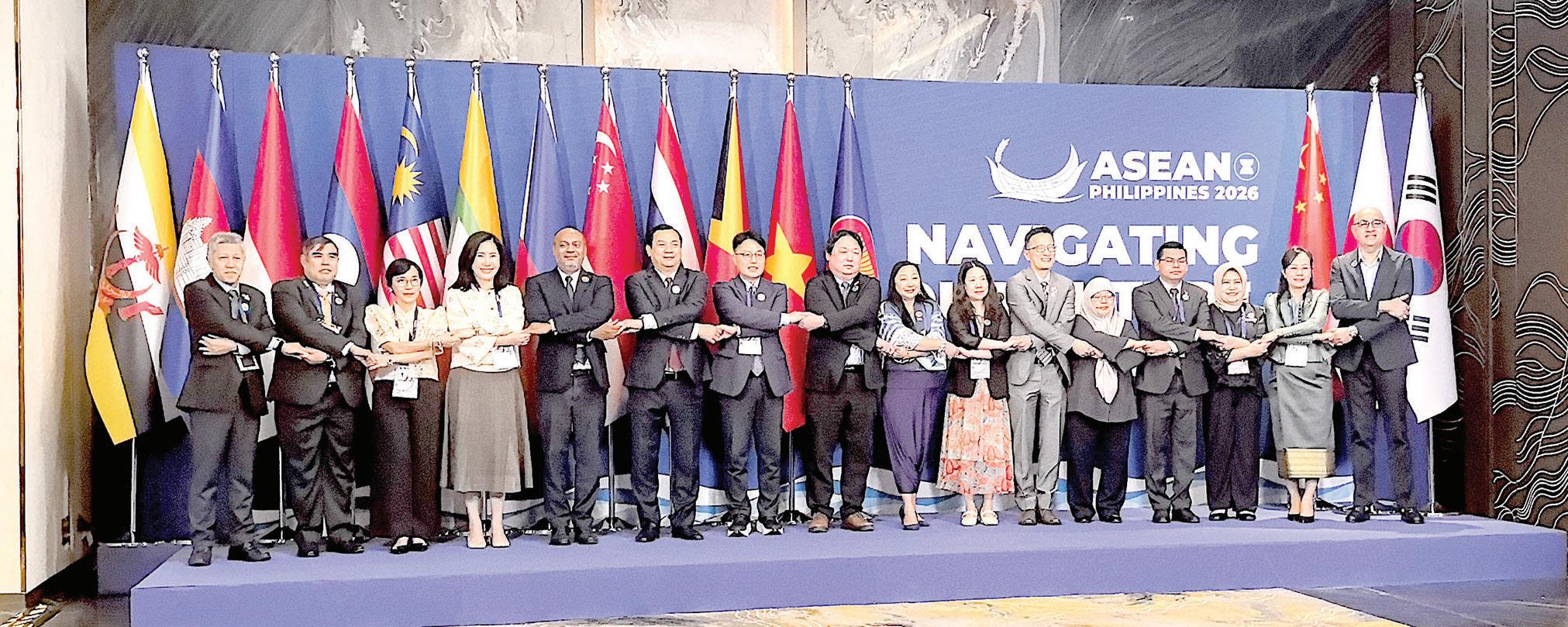
comes on the heels of strong post-pandemic rebounds, with both regions recording significant gains in tourist arrivals. The Philippines’s Tourism Undersecretary Verena Buensuceso, speaking at the 48th Meeting of the Asean Plus Three National Tourism Organizations (NTOs), credited the Asean Plus Three
(APT) framework—comprising Asean, China, Japan, and the Republic of Korea—for helping the industry weather recent challenges. She urged the bloc to remain “competitive, resilient, and inclusive” as it charts the future of regional tourism.
“Our partnership between and among Asean, China, Japan and the Republic of Korea is not just a collaboration, it is a vital alliance that highlights the profound role of tourism as a catalyst for unity and mutual prosperity,” Asean Plus Three NTOs cochair Buensuceso said. She noted that visitor arrivals from the Plus Three countries have
been a major driver of Asean’s recovery: more than 20 million arrivals from China, over 3 million from Japan, and 9 million from Korea in 2024. These numbers are expected to grow further in 2025, underscoring the dynamism of the sector.
What the NTOs do THE Asean Plus Three NTOs serve as the technical and operational arm of regional tourism cooperation. While the annual ministerial meetings set broad policy directions, the NTOs are tasked with implementing the Tourism Cooperation Work Plan,
By Andrea E. San Juan @andreasanjuan
THEBangko
Sentral ng Pilipinas (BSP) may deliver two more rate cuts this year before capping off the easing cycle as the economy may bear the brunt of imported inflation amid the weakening peso, according to economists.
“BSP still has some room to cut but it is now more limited and data dependent because the PHP weakness and potential imported inflation are key constraints,” Philippine Institute for Development Studies (PIDS) Senior Research Fellow John Paolo R. Rivera told the BusinessMirror in a Viber message on Tuesday. Rivera explained further that when the Philippine peso continues to weaken, because the country is an “importsensitive” economy, “We will pay higher prices because our currency is weaker.”
Rizal Commercial Banking Corp. chief economist Michael L. Ricafort told this newspaper that the BSP could possibly go beyond one more rate cut this year, but underscored that it would also be “limited.”
“Delicate balancing act to stabilize the
EBy Ada Pelonia @adapelonia
XPORT revenues from coconut-based products surged to over $3.5 billion in 2025, the highest level in nearly two decades, as supply constraints jacked up prices.
Preliminary figures from the Philippine Statistics Authority (PSA) showed the value of coconut-based exports last year jumped by over a third to $3.57 billion from $2.66 billion in 2024. Historical
indicated that the export earnings from coconut-based goods posted in 2025 was the all-time high since the time series started in 2006.
Shipments of coconut oil held the lion’s share of the product group last year, as it surged by 29.4 percent to $2.87 billion, a new record-high from the $2.22 billion recorded in the previous year. In 2025, the average price of coconut oil, the country’s leading farm export, skyrocketed by 63.27 percent to $2,480 per
By Justine Xyrah Garcia
DESPITE ending 2025 with record-high export earnings, the country’s import bill refused to take a back seat.
Preliminary data from the Philippine Statistics Authority (PSA) on Tuesday showed the total value of imported goods reached $133.57 billion in 2025, the second-highest level on record, next only to the $137.22 billion posted in 2022.
The rise in imports came even as the Philippines posted its highest export earnings on record, with total exports reaching $84.41 billion last year.
The country’s cumulative trade deficit, meanwhile, stood at
$49.17 billion in 2025, narrower than the $54.33 billion recorded in 2024. On a monthly basis, the trade gap in December narrowed by 15 percent year-on-year. Imports have remained persistently high in recent years, with annual import payments staying above the $100-billion mark since 202. Imports peaked at $137.22 billion in 2022, before easing to $126.21 billion in 2023 and rising again to $127.60 billion in 2024.
For Philippine Institute for Development Studies (PIDS) Senior Research Fellow John Paolo R. Rivera, the figures reflect the Philippines’ import-dependent growth model, where strong economic activity is closely linked to foreign purchases.
“It reflects the Philippines’ import-dependent growth model over the past five years—characterized by strong demand for fuel, food, capital goods, and intermediate inputs needed for manufacturing, infrastructure, and consumption, even as global commodity prices were elevated in parts of the period,” Rivera told the BusinessMirror Rivera added that while recordhigh exports are “encouraging,” much of the country’s export sector remains “highly import-intensive,” meaning, rising exports are often accompanied by higher import demand. PSA data for 2025 support this pattern. Imports were dominated
metric ton (MT) from $1,519 per MT a year ago, according to World Bank.
The country’s outbound shipments of desiccated coconut also skyrocketed by 76.1 percent to $521.26 million in 2025 from $295.94 million in the previous year, based on PSA data.
Revenues from other coconut products also grew by 55.6 percent to $125.06 million from $80.37 million.
Despite the recorded surge in most coconut-based goods, export earnings from copra meal or cake declined by 12.2 percent to $54.84 million from $62.45 million.
Earlier, the United Coconut Association of the Philippines (Ucap) said it expects coconut output to rebound in 2026, owing to the recovery of trees and absence of destructive typhoons last year.
Meanwhile, PSA data also showed that the country’s revenues from fruits and vegetables exports in 2025 jumped by nearly a quarter to $2.94 billion from $2.36 billion in 2024. Banana shipments led the category, as it surged by 36.1 percent to $1.68 billion from the previous year’s $1.23 billion, based on PSA data.
Of the pineapple-based products, only exports of pineapple juice recorded a year-on-year increase, up by 22.8 percent to $138.88 million from $113.06 million in 2024.
Shipments of canned pineapple dropped by 4 percent to $211.33 million from $220.2 million, while those of pineapple concentrates dropped by 22 percent to $19.4 million from $24.88 million.
DBM gives LGUs ₧1.19-T national tax allotment for ’26
By Reine Juvierre S. Alberto @reine_alberto
THE Department of Budget and Management (DBM) has approved and released the full P1.19-trillion national tax allotment (NTA) of local government units (LGUs) for this year.
Acting Budget Secretary Rolando U. Toledo approved the issuance of the special allotment order and the corresponding notices of cash allocation on January 26, covering the full-year NTA of LGUs across the country.
This year’s NTA is higher by 15.07 percent than the previous year’s P1.034 trillion allocation.
“The timely release of the FY 2026 National Tax Allotment ensures that local governments have the resources they need to deliver services without delay,” Toledo was quoted in a statement as saying. “This is how the 2026 budget works for the people—by making sure funds reach communities when they are needed most.”
The NTA will be divided among municipalities, which will receive the largest share at P404.486 billion, fol-
lowed by cities with P274.103 billion, provinces with P273.817 billion and barangays with P238.101 billion.
Broken down, the NTA will be distributed to 83 provinces, 149 cities, 1,491 municipalities and 41,913 barangays, in accordance with the formula prescribed under the Local Government Code of 1991.
Among the regions, Region IV-A or Calabarzon will receive the largest budget worth P142.277 billion, trailed by Region III or Central Luzon with P116.840 billion and the National Capital Region (P71.687 billion).
Meanwhile, the lowest allocations will go to the Cordillera Administrative Region with P35.373 billion, Region XII or Caraga with P45.961 billion and Region XII or Soccsksargen with P49.722 billion.
The NTA was directly credited to the authorized government servicing banks of LGUs, in accordance with existing budgeting, accounting and auditing rules, the DBM said.
Moreover, the full and upfront release of the NTA underscores the “people-centric character” of this year’s budget, which prioritizes uninterrupted basic services, stronger local governance, and faster delivery of programs that directly affect communities, the DBM added.
The DBM also reminded LGUs to utilize the NTA strictly for authorized purposes and to comply with reporting requirements, consistent with transparency and accountability standards.
“By releasing the NTA in full and on time, we are enabling
LGUs to act decisively, respond to local needs, and bring immediate benefits to their constituents,”
Toledo said.
Under the Constitution and the Local Government Code, the NTA represents the automatic and formula-based share of LGUs in national internal revenue, serving as a primary source of funding for local programs, projects, and services.
The NTA was computed based on the actual national tax collections from 2023, which reached P3.824 trillion. About P868.654 billion was sourced from the Bureau of Internal Revenue, while P321.788 billion and P66.208 million came from the Bureau of Customs and other agencies.
peso as well so any future cut be limited,” Ricafort told this paper. On Tuesday, data from the Bankers’ Association of the Philippines (BAP) showed the local currency closed at P59.085 per $1. The peso weakened by 11 centavos from its previous finish of P58.971 on Monday. Ricafort said this could be due to US President Donald Trump’s latest tariff pronouncement, threatening to raise US tariffs on South Korea imports to 25 percent from its initial 15 percent tariff.
‘Two more rate cuts’ MEANWHILE , Jonathan L. Ravelas, senior adviser at Reyes Tacandong & Co., told this newspaper: “Am looking at two [rate] cuts to 4 percent to support growth.”
But Ravelas noted: “This assumes fourth quarter of 2025 growth misses,” adding, the “manageable” inflation gives ample space for the central bank to deliver rate cuts. Ricafort said the possible 25-basis-point (bp) rate cut on the central bank’s rate-setting meeting on February 19, 2026 could help spur local economic growth as a “policy priority in terms of further monetary easing measures alongside expansionary fiscal spending through catch up government spending especially on infrastructure.”
February rate cut effect
wires, springs, and bearings— cannot compete,” Lee emphasized.
Other sectors, including food manufacturing, face competitive pressures from imports that require timely policy responses.
FPI stressed that trade remedies must act as rapid-response tools to prevent plant closures, layoffs, and investment delays.
“A fast, credible, and predictable Trade Remedy Action is needed, more than ever, to prevent plants from scaling down, workers being laid off, and investments being postponed or canceled due to se -
coordinating marketing campaigns, and facilitating capacity-building programs.
They provide continuity between high-level ministerial commitments and on-the-ground initiatives, ensuring that collaborative projects—such as joint promotions, training workshops, and cultural exchange programs—are carried forward.
Why they compete
ASEAN and Northeast Asia compete because they target the same lucrative source markets. Chinese outbound travelers remain the largest pool, while Japanese and Korean tourists are highspending and culturally inclined toward regional travel.
Long-haul visitors from Europe and North America also see Asia as a single destination, forcing countries to differentiate themselves. With beaches, cultural heritage, shopping, and gastronomy as common selling points, destinations often overlap in their appeal.
Complementary promotion DESPITE this rivalry, Asean Plus Three has tried to soften competition through joint branding and marketing. The Asean Plus Three Tourism Cooperation Work Plan
rious and sometimes irreversible damage,” Lee said. She added that industrial renewal under the Tatak Pinoy initiative depends on treating trade defense instruments as strategic economic infrastructure rather than temporary measures.
“We need to ensure that Philippine industry can compete on fair and sustainable terms, that trade remedy instruments are deployed judiciously and effectively—protecting domestic industry, promoting employment, and advancing inclusive economic growth,” Lee said.
(2021–2025) has been about 70 percent implemented, focusing on collaborative campaigns, sustainable tourism, and capacity building. The Asean-China Centre, Asean-Japan Centre, and AseanKorea Centre have organized fairs, seminars, and joint promotions to highlight complementary strengths.
China has supported Asean tourism through events like the China International Travel Mart and rural tourism seminars. Japan has emphasized resilience and sustainable practices, tying promotions to the last year’s Osaka Expo. Korea has contributed technical assistance and AI-driven tourism initiatives under the KOPIST Programme.
Challenges in joint marketing STILL , complementary promotion remains uneven. National branding campaigns such as “Amazing Thailand” or “Visit Japan” often overshadow regional efforts. The race for Chinese tourists in particular has led to overlapping promotions rather than coordinated strategies. Visa regimes and connectivity differences also limit seamless multi-country itineraries.
The Cebu gathering builds on momentum from the 24th Asean Plus Three Tourism Ministers’ Meeting held in Johor, Malaysia, in January 2025. That meeting reported over 190 million visitors across Asean Plus Three countries in 2024, with optimism for continued growth. Ministers agreed to align future strategies with the Asean Tourism Sectoral Plan 2026–2030, emphasizing collaborative marketing and sustainability.
RIVERA explained that if a rate cut pushes through in February, “it would help lower borrowing costs, support credit, housing, and business activity, with effects typically felt over 2-3 quarters rather than immediately.”
The PIDS senior research fellow also noted that borrowers, firms with expansion plans, micro, small and medium enterprises (MSMEs) and “interest-sensitive” sectors like construction and consumer durables would benefit from a rate cut.
On the flipside, Rivera said: “Losers could be savers facing lower deposit returns, banks if margins compress, and the PHP if rate differentials widen though the BSP will balance growth support against forex and inflation risks.”
In an earlier interview, BSP Governor Eli Remolona Jr. told reporters that a cut is still uncertain.
“Even that cut…that’s still a maybe,” Remolona told reporters on the sidelines of the recent Annual Reception for the Banking Community. Asked if a weaker-than-expected fourth-quarter economic performance would warrant a reduction in interest rates, Remolona said: “It would help us decide to cut.”
Remolona said, however, that the gross domestic product (GDP) data is not the only factor that would prompt another interest rate cut.
“Our mandate is inflation. Inflation is the number one factor,” the BSP governor said, adding that the monetary board considers the United States Federal Reserve’s decision as one data point among many. During its monetary policy meeting last December 11, 2025, the BSP’s Monetary Board decided to reduce the BSP’s Target Reverse Repurchase (RRP) Rate by 25 basis points to 4.50 percent. The BSP signaled in December that it may be approaching the end of its easing cycle, after delivering its 25-basis-point rate cut, the fifth reduction in 2025.
wanted to review the processes and see where the vulnerabilities are.”
The BIR has temporarily suspended all field audits and other related operations last November 24, 2025. There has been an alleged corruption in the bureau, particularly in the reported misuse of LOAs that has allegedly become a longrunning “money-making scheme” (See: https://businessmirror.com. ph/2025/11/21/erwin-tulfo-seeksprobe-of-misuse-of-loas-at-bir/). In 2024, the BIR issued 82,228 LOAs to taxpayers subjected to audit.
IPOPHL, DICT partner to strengthen digital innovation in AI, blockchain
By Bless Aubrey Ogerio
THE Intellectual Property Office
of the Philippines (IPOPHL) and the Department of Information and Communications Technology (DICT) signed an agreement on Monday to boost the country’s capacity to manage intellectual property in emerging digital technologies.
The agreement will focus on enhancing the technical skills of patent examiners and personnel in evaluating innovations in artificial intelligence (AI), blockchain, the Internet of Things, big data and other ICT fields.
“This is vital not only as a national office but also as an international Searching Authority and International Preliminary Examining Authority as we provide inventors early insight into how strong their invention is before they seek patent protection in multiple countries,” IPOPHL acting director general Nathaniel Arevalo said.
The collaboration supports IPOPHL’s AI strategy, which aligns with national digital roadmaps. In November 2025, the office released guidelines for AIrelated patent applications, outlining requirements for patentability, inventorship, disclosure and claim clarity.
For his part, ICT Secretary Henry Rhoel Aguda said the partnership aims to ensure that personnel remain up to date with
PhilRice warns farmers vs potential pest infestations
By Ada Pelonia @adapelonia
developments in ICT and are equipped with the skills needed to evaluate complex digital technologies.
In the 2025 Global Innovation Index, the Philippines ranked 50th out of 139 economies.
Last year, Science Secretary Renato Solidum Jr. noted that human resources, infrastructure, and equipment are key areas for improvement, with the country targeting 49th place by 2026 under the Philippine Development Plan.
Moreover, the collaboration with the DICT follows IPOPHL’s September 2024 facilitation of an e-commerce memorandum of understanding (MOU) between brand owners and online platforms.
The MOU, which includes 41 signatories from brand owners, industry groups and marketplaces, establishes a self-regulatory framework to address counterfeit products and fraudulent trade practices.
It allows parties to submit complaints directly to platforms regarding violations in both physical and digital markets.
According to the United Nations Development Program, Association of Southeast Asian Nations (Asean) economies could generate nearly $1 trillion in additional gross domestic product (GDP) over the next decade as AI and other digital technologies are adopted more broadly.
Bill grants security of tenure, higher pay, benefits to military, other NUP
By Jovee Marie N. dela Cruz @joveemarie
ALAWMAKER is pushing for the passage of a proposed measure that seeks to guarantee security of tenure and provide decent pay and benefits to non-uniformed personnel (NUP) in the country’s military and law enforcement agencies.
With the implementation this year of salary increases and higher subsistence allowances for military and uniformed personnel, Parañaque Rep. Brian Raymund Yamsuan said their civilian counterparts have been left behind, burdened by low pay, excessive workloads, and a lack of job security and benefits.
Yamsuan has filed House Bill 4796, or the proposed Magna Carta for Non-Uniformed Personnel, to ensure fair treatment of NUP and recognize their indispensable role in uniformed agencies.
“The recent salary hikes for uniformed personnel highlight the wide disparity in pay and benefits between them and their civilian counterparts,” Yamsuan said, calling on Congress to champion the welfare of NUP whose roles
are “just as important and indispensable.”
The proposed Magna Carta covers NUP in the National Police (PNP), Armed Forces (AFP), Bureau of Fire Protection (BFP), Bureau of Jail Management and Penology (BJMP), Bureau of Corrections (BuCor), Department of National Defense (DND), Philippine Coast Guard (PCG), and National Mapping and Resource Information Authority (Namria). Yamsuan said the bill seeks to align NUP salary scales with those of uniformed personnel, ensure a decent standard of living for the lowest-ranked workers, and provide benefits such as overtime pay, night differential, hazard pay, subsistence and clothing allowances, leave, early retirement, and scholarships for dependents.
The measure also guarantees security of tenure, due process in termination, reinstatement with back wages if unjustly dismissed, and freedom of association.
Once enacted, Yamsuan said the Magna Carta would help professionalize the public safety workforce, boost morale, and improve accountability and efficiency in uniformed agencies.
THE Philippine Rice Research Institute (PhilRice) on Tuesday urged farmers to take proactive measures against potential pest infestations in the first quarter, citing risks across the country’s leading riceproducing regions.
PhilRice noted that the Bureau of Plant Industry (BPI) identified brown planthoppers (BPH), rice stemborers, rodents, bacterial leaf blight (BLB), and leaffolders as the major threats to rice crops.
The agency expects Central Luzon to be the most vulnerable, with nearly all provinces forecast to face multiple pest pressures. The Bicol Region and Eastern Visayas are also at high risk, it added.
The PhilRice said BPH infestations, which cause hopperburn or brown patches on dried plants, are forecasted to hit Central Luzon, the Cordillera Administrative Region (CAR), and Eastern Visayas.
With this, the agency called on planters to practice synchronous planting, plant resistant varieties, avoid excessive nitrogen fertilizer, use alternate wetting and drying (AWD) technology, and avoid early insecticide spraying to boost the
population of biological control agents.
In addition, PhilRice expects rice stemborers to affect Bicol, Central Luzon, and Northern Mindanao. These pests reportedly cause deadheart and whiteheads.
As such, the agency urged farmers to be thorough in their land preparation, handpick egg masses, and release biological control agents.
PhilRice also noted that rodent infestations remain concerning for the sector, as these can consume up to 12 percent of their body weight daily and damage as many as 300 tillers per night.
Moreover, yield losses may range from 5 percent to 90 percent, with Eastern Visayas, Central Luzon, and Bicol expected to experience high infestations.
“We emphasize that farmers follow the right timing for rat hunting, which was during the start of the pest’s breeding season or one month after crop establishment, proper burrow management, and safe-bait
Zambales Ayta villages get bulk of ₧24-M Pinatubo tour income
BBy Henry Empeño
OTOLAN, Zambales— Mount Pinatubo, often described as the Philippines’ “Beautiful Disaster,” is now providing a hefty contribution for the development of Ayta communities here that were devastated when the volcano erupted in 1991.
Mayor Jun Omar Ebdane said close to 74 percent of what the local government of Botolan earned last year from trekking tours at Mt. Pinatubo were distributed among upland barangays near the popular tourist attraction.
“We collected more than P24 million from Pinatubo tours in 2025, and most of the proceeds went to the barangays in Baytan [east],” Ebdane said, referring to the villages of Villar, Burgos, Moraza, Belbel, and Poonbato which form part of the Ayta ancestral land.
“Of the total income from Pinatubo tours, P17.75 million went to [the upland barangays], while only
P6.25 million was retained by the local government of Botolan,” he pointed out.
The hefty allocation for Ayta villages, Ebdane said, is in recognition of the tribesmen’s contribution in protecting the Pinatubo landscape, as well as for their involvement in the town’s eco-tourism industry.
The mayor said residents of communities along the way of the Pinatubo tour also earn privately from food and souvenir items they sell to visitors.
Around 500 tourists each week take the package promoted by the Botolan local government, with tours running only during the dry-season months from January to May, said Gennessy Villar, head of the Botolan Tourism Office.
Some private tour companies have also latched onto the promotion and offered various packages, including overnight stay, that start at P2,350 up to P3,299 per person. These tours take off from
BuCor plans to go solar
Teither Botolan or Capas, Tarlac, with the latter offering a different route.
The fee covers payment for the mandatory tour guide, environmental fee, and the 4x4 vehicle transportation that takes visitors across the expansive lahar field and up to within three kilometers of the Pinatubo crater lake where the trek begins.
In Botolan, the package also includes access to creek swimming area, swimming pool, and shower room at Camp Kainomayan, the jump-off point.
Ebdane said that this year, he would propose for a comprehensive plan for the use of revenue from the local government’s tourism program in consultation with tribal leaders and barangay officials.
“This is to further promote inclusive growth in the upland villages near Mount Pinatubo, and to ensure that revenues are spent for projects that benefit the residents,” he added.
handling approach to reduce damage and yield loss,” PhilRice crop protection expert Leonardo Marquez said.
The PhilRice also expect BLB to spread in Central Luzon and Bicol. These tend to result in wilting, yellowing, and drying of leaves. To cushion its impact, the agency said farmers should use resistant varieties, minimize transplanting injuries, avoid excessive nitrogen use, and maintain field sanitation. It added that leaffolders, which fold rice leaves and feed inside, will likely affect Central Luzon, Cagayan Valley, and the Davao Region. PhilRice called on planters to remove grassy weeds, avoid shaded planting areas, use of biological control agents, and apply insecticides to prevent outbreaks.
“Farmers can prevent severe losses by adopting resistant varieties, practicing synchronous planting, applying balanced fertilization, protecting beneficial insects, keeping fields clean, and monitoring regularly for early signs of pest outbreaks,” Marquez said.
Poorly-maintained
bus terminals get goat of LTFRB chief
By Lorenz S. Marasigan @lorenzmarasigan
THE Land Transportation Franchising and Regulatory Board (LTFRB) said on Tuesday it has issued show cause orders against four bus companies following surprise inspections that revealed poorlymaintained passenger terminals in Quezon City.
LTFRB Chairman Vigor D. Mendoza II identified the bus companies as Belleza Transport Corp., Mega Bus Lines Corp.— both operating terminals in Cubao—Eaglestar Transit Corp., and Elavil Phils Tours Inc.
“This is proof that we are serious when we said that we will run after those that do not comply with the basic standard on what bus terminals and public transportations must be,” he said. Inspection reports showed each company committed at least 10 violations of regulations governing passenger terminal maintenance.
By Joel R. San Juan @jrsanjuan1573
HE Bureau of Corrections (BuCor) has partnered with an energy company to explore the possibility of converting its correctional facilities to solar power and other renewable energy applications.
The plan was formalized with the signing of a memorandum of understanding between Corrections Director General Gregorio Catapang and BDLS Core Energy and Construction Solutions, Inc. president Romel Paradero on Tuesday.
The MOU aims to establish a collaborative framework for the conduct of a thorough feasibility and viability study on transitioning BuCor’s correctional facilities to solar energy and other renewable sources.
Catapang said the partnership
signals a significant commitment towards not only reducing the agency’s carbon footprint but also optimizing financial resources allocated to electricity expenses.
“The objective of this MOU is to establish a cooperative framework between BDLS and the BuCor for the conduct of a feasibility and viability study on converting correctional facilities to solar energy and other renewable energy applications,” Catapang said.
Under the MOU, BDLS will conduct, at no cost to the government, a technical and financial feasibility study to assess the viability of converting correctional facilities to solar power or other renewable energy sources, prepare and submit a comprehensive report of its findings and recommendations to the BuCor and ensure that the study is conducted
in accordance with applicable laws, standards, and regulations.
Bucor, on the other hand, will grant BDLS access to relevant correctional facilities and premises necessary for conducting the study.
Catapang noted that the Bucor spends a staggering P162 million annually for its electricity bill nationwide with P102 million of this amount is attributed to the New Bilibid Prison, the National Headquarters in Muntinlupa City, and the Correctional Institution in Mandaluyong City.
Considering its huge electricity bill, Catapang stressed the necessity of innovating energy strategies to maximize available resources.
“We have to innovate and think of ways on how to maximize our resources and going solar is the way to go to save costs on electricity,” he said.
Common infractions included insufficient roofing to protect passengers from weather elements, absence of decent and separate comfort rooms for males, females and persons with disabilities, inadequate security measures including CCTV systems and baggage inspections, and lack of PWD ramps.
The four bus companies have been ordered to submit written explanations on why their Certificates of Public Convenience should not be revoked. A consolidated hearing is scheduled on February 11.
“The issuance of the SCO against four bus companies is just the beginning. Filipino commuters should expect daily monitoring and quick action from their LTFRB in the interest of their right for safe and comfortable travel experience,” Mendoza said.
Mendoza urged all bus companies, transport groups and cooperatives to ensure their passenger terminals comply with LTFRB rules.
A4
Wednesday, January 28, 2026 www.businessmirror.com.ph
Lacson steps down as Electoral Reform committee chairman
SENATE President Pro Tempore Panfilo
M. Lacson, one of the upper chamber’s busiest members, relinquished on Monday the chairmanship of the Senate Committee on Electoral Reforms and People’s Participation to Sen. Ana Theresia “Risa” Hontiveros.
Lacson cited his heavy workload for the decision.
Lacson said he discussed the matter during the majority bloc’s caucus at noon, and that Hontiveros was amenable to taking over as chairperson of the committee.
PunoakosaBlue-Ribbon and Accounts [committees], Senate President Pro Tempore pa ako. Amenable naman si Senator Hontiveros to chair [I have my hands full as chairman of the Blue-Ribbon and Accounts committees. I am also Senate President Pro Tempore. Senator Hontiveros is amenable to chair the committee],” he said.
Aside from serving as Senate President Pro Tempore, Lacson chairs the Senate BlueRibbon committee, which is looking into the
corruption behind anomalous flood control projects, among others; as well as the Committee on Accounts.
As Blue-Ribbon chief, he has called four hearings, and is expected to call one or two more in order to sew up loose ends in the inquiry into the corruption scandal, described as the biggest in recent history, and which has embroiled both officials of the Executive branch and of Congress.
At Monday’s Senate session, Senate Majority Leader Juan Miguel Zubiri formally informed the Senate that Lacson communicated his intention to relinquish chairmanship of the committee, and moved to elect Hontiveros as committee chairperson.
‘Unwilling’ contractors warned STILL related to the fallout from the floodcontrol projects mess, Lacson advised the Department of Public Works and Highways (DPWH) prepare to deal with contractors
See “Lacson,” A5
House tackles anti-dynasty bills
By Jovee Marie N. dela Cruz @joveemarie
CITING constitutional principles of equal access to public service, fair political competition, and accountability, the House of Representatives on Tuesday formally began deliberations on anti-political dynasty measures, assuring the public that the chamber is addressing the issue seriously and considering its full implications.
The deliberations opened with the first hearing of the House Committee on Suffrage and Electoral Reforms, attended by Speaker Faustino Dy III, author of one of 20 anti-political dynasty bills filed in the House.
Dy said the proposed Anti-Political Dynasty bill has long been awaited by the Filipino people and remains without an enabling law nearly four decades after the Constitution was ratified.
“The proposed Anti-Political Dynasty bill has long been awaited by the Filipino people. It has been nearly 40 years since our Constitution was ratified with a provision meant to ‘guarantee equal access to opportunities for public service and prohibit political dynasties.’ However, it lacks an enabling law—and this is what we aim to pass in the 20th Congress,” Dy said.
Dy emphasized that it is time for thorough discussions to pass a
proposal that will be acceptable to both the Filipino people and fellow public servants.
Dy said the measure forms part of broader democratic reforms aimed at strengthening institutions and widening access to public service.
“Let us remember: this is just the beginning of broader reforms aimed at strengthening our democracy, expanding equal opportunities for public service, and restoring the people’s trust in our institutions,” he said.
The House chief noted that the anti-political dynasty measure has been identified as a priority by President Marcos during the recent meeting of the LegislativeExecutive Development Advisory Council (Ledac).
Dy had filed House Bill 6771 with Majority Leader Ferdinand Alexander Marcos, one of the measures taken up during the hearing.
He said the hearings are meant to gather views and examine the implications of the proposed legislation.
The Speaker urged his fellow lawmakers to remain open-minded during the deliberations.
Lanao del Sur Rep. Zia Alonto Adiong, the chairman of the Committee on Suffrage and Electoral Reforms, emphasized that the deliberations are not intended to attack political clans or rewrite political history.
“This hearing is convened not to attack families, not to single out individuals, and not to rewrite political history,” he said.
The Commission on Elections (Comelec), meanwhile, warned that preparations for the 2028 elections could be delayed if the Anti-Political Dynasty bill were not passed soon, citing limited time for voter education and the poll body’s duty to accept certificates of candidacy under Section 77 of the Omnibus Election Code.
Inequality
PARTY-LIST Rep. Chel Diokno, the first nominee of Akbayan, meanwhile, urged Congress to finally pass a law prohibiting political dynasties, saying the continued dominance of political families undermines democracy and worsens inequality in the country.
Diokno issued the call as he sponsored House Bill 5905, or the Comprehensive Anti-Political Dynasty Law, stressing that Congress has failed to fulfill its clear and long-standing mandate under the 1987 Constitution to enact an anti-political dynasty law.
“The intent of the framers was crystal clear: Democracy must not be undermined by the concentration of power in a few families. Public office must remain a public trust—it is not something to be inherited,” Diokno said.
Diokno said the bill seeks to finally give teeth to that constitutional provision by providing a clear categorical definition of
political dynasties and delineating prohibited relationships and scenarios.
While there are some laws with anti-dynasty provisions, such as the Sangguniang Kabataan Reform Law (Republic Act 10742), the Bangsamoro Electoral Code (BEC), and the Bangsamoro Local Governance Code (BLGC), Diokno underscored the need to pass a law that applies to all levels of government.
According to a study by the Ateneo Policy Center published in the Journal of Government and Economics, the share of elected positions held by political dynasties has increased from 19 percent in 1988 to 29 percent in 2019.
“That means 1,548 political families held office, with 339 clans having at least three members in power in 2019,” he pointed out.
Citing the same study by the Ateneo Policy Center, Diokno said that political dynasties exacerbate poverty, particularly in resource-rich, non-Luzon provinces, where the concentration of both political and economic power results in extractive governance patterns.
Party-list Rep. Antonio L. Tinio, the nominee of ACT Teachers, warned that political power in the Philippines has become concentrated in elite clans that treat public office as private property, using it to expand their economic and land interests while the majority remain mired in poverty. He cited the May 2025 elections, which he said saw the rise of so-called “obese political dynasties,” or clans with five or more members simultaneously holding office.
He also linked dynastic rule to weak accountability, pointing to flood control scandals and disaster responses where billions of pesos were spent but communities remained submerged. In areas dominated by political families, he said, checks and balances collapse and public funds become sources of patronage and corruption.
House committee sets deliberations on impeach complaints vs Marcos
By Jovee Marie N. dela Cruz @joveemarie
THE House of Representatives Commit-
tee on Justice will start deliberations next week on the impeachment complaints against President Marcos.
Batangas Rep. Gerville Luistro, committee chairperson, said the first round of hearings will be devoted to determining whether the complaints are sufficient in form and substance.
The committee, Luistro also said, will consolidate the two impeachment complaints for joint review.
“We are considering the dates of February 2, 3, and 4 as our initial schedules. Definitely, these dates will be dedicated for the purpose of determining sufficiency in form and substance,” said Luistro in an interview. “If these hearing dates are not enough, we will schedule further dates in the succeeding weeks.”
She underscored that, under the Supreme Court’s ruling in Francisco v House of Representatives, the mere transmittal of an impeachment complaint to the Committee on Justice already completes the initiation process.
“As long as an impeachment complaint reaches the Justice committee following the Francisco ruling, it completes the initiation process, and therefore it bars all subsequent impeachment complaints against the same impeachable official,” Luistro said. “It likewise triggers the running of the one-year prohibition period.”
Luistro, meanwhile, said that the committee will proceed independently in evaluating the complaints, regardless of statements from House leaders.
“With all due respect to Speaker Bojie Dy, I am expecting the entire Justice committee to act with utmost independence and impartiality,” she said. “So, regardless of the pronouncement of the Speaker, the members of the House are expected to evaluate, assess, and hear the impeachment complaint with utmost independence and impartiality.”
Earlier, Dy dismissed the filing of the first impeachment complaint against the President, saying there is no factual or legal basis to justify the move.
Dy stressed that Marcos is clearly fulfilling the mandate entrusted to him by the Filipino people and is performing his duties in accordance with the law.
Invitation
LUISTRO also said the committee will extend an invitation to Marcos to participate in the hearings as part of due process but stressed that attendance is optional.
“It is up to President Marcos to participate in the upcoming hearings,” she said. “If he chooses not to participate, it would be deemed a waiver of his right to be present during hearings.”
The House of Representatives on Monday
formally referred two verified impeachment complaints against Marcos to the Committee on Justice after their inclusion in the plenary’s Additional Reference of Business.
The first complaint, filed on January 19, 2026, was lodged by lawyer Andre de Jesus and endorsed by House Deputy Minority Leader Jernie Jett V. Nisay, the nominee of the party-list group Pusong Pinoy.
The second complaint, filed on January 26, 2026, was submitted by a coalition of activists and private individuals led by Liza Largoza Maza, Teodoro A. Casiño, Renato Reyes Jr., and Neri Colmenares and labor leader Ronaldo Adonis. It was endorsed by Party-list Reps. Antonio L. Tinio of ACT Teachers, Sarah I. Elago of Gabriela Renee Louise M. Co of Kabataan.
Luistro explained the procedural timeline under House rules: Once the Office of the Secretary General receives an impeachment complaint, it must immediately transmit it to the Office of the Speaker, who then has 10 session days to include it in the Order of Business of the plenary. After its inclusion, the plenary has three session days to transmit the complaint to the Committee on Justice for formal review.
She added that whatever decision the committee reaches, it is required to submit a committee report to the plenary within 60 session days, noting that suspended sessions are not counted as separate session days.
The impeachment complaints cite several grounds, including culpable violation of the Constitution, graft and corruption, and betrayal of public trust.
Legal thresholds
LUISTRO outlined the legal thresholds and process for reviewing impeachment complaints, highlighting the difference between “sufficiency in form” and “sufficiency in substance.”
Sufficiency in form requires complaints to be signed, verified, and endorsed by at least one House member. Sufficiency in substance assesses whether the allegations substantiate the constitutional grounds for impeachment, including culpable violation of the Constitution, treason, bribery, betrayal of public trust, graft and corruption, and other high crimes.
The committee first checks formal and substantive sufficiency, reviews evidence to determine if there is a solid basis to proceed, holds hearings for all parties involved, and finally assesses probable cause. Attendance at hearings is optional; absence is taken as a waiver of the right to be present.
Luistro emphasized that allegations must be supported by personal knowledge or authentic records. Complaints failing the initial standards will still receive a formal report but will not move forward. The overall timeline depends on the submission of evidence and responses.
AFP validating report of Filipino ‘mercenary’ killed in Ukraine
THE Armed Forces is still verifying reports coming from Ukrainian defense sources claiming that a Filipino “mercenary,” fighting for the Russians, was killed during another round of fighting between Ukraine and Russia.
Col. Francel Margareth Padilla, AFP spokesperson, on Tuesday said the AFP is now coordinating with relevant government agencies and official counterparts to verify details of the mentioned individual.
“We have taken note of the report circulating from Ukrainian defense sources. At this point, the information is still being validated through proper channels,” Padilla said.
Also, Padilla said the AFP does not rely solely on third-party battlefield reports to confirm such claims.
“The AFP does not rely on third-party
battlefield reports alone to confirm the identity or nationality of individuals involved in foreign conflicts,” she said.
And until such verification is completed, Padilla added that it would be premature to either confirm or deny the report.
“As a matter of policy, we deal in confirmed facts—not unverified claims,” she added.
Ukraine’s military intelligence reported on Monday that a Filipino national, identified as “John Patrick,” was killed fighting with Russian forces in Kramatorsk District in the Donetsk region.
The agency, in a statement posted on Telegram, said the man had served in Russia’s 9th Battalion, 283rd Regiment, 144th Motorized Rifle Division in the 20th Combined Arms Army.
On its official Facebook page, the Main Intelligence Directorate of Ukraine’s Ministry of Defense (GUR) said that “John Patrick”was killed during a high-casualty “meat assault” near Novoselivka in the Kramatorsk district.
Three selfie photographs retrieved from Patrick’s mobile phone were posted by GUR, showing him in a hooded military jacket with a pixelated camouflage pattern of dark green, light green, and brown. Notably, the uniform bore no unit patches, name tapes, or rank insignia.
The Department of Foreign Affairs in Manila has yet to respond to requests to comment on this claim by Ukrainian military intelligence.
According to the Ukrainian intelligence agency, John Patrick reportedly underwent only one week of basic training before being sent to the front line. He was found carrying a weapon, ammunition, and a scrap of paper with his unit number and commander’s contact details. He did not speak Russian. “He was wounded and died slowly in a tree line; no evacuation measures were planned or attempted,” GUR added. The incident comes amid Moscow’s own accusations that foreign mercenaries are being recruited against Russia. Earlier, the Russian Foreign Ministry alleged that a US private company was actively recruiting Filipino nationals to fight on Ukraine’s side. The ministry claimed such efforts were part of Washington’s broader strategy to internationalize the conflict, though it provided no verifiable evidence. Malou Talosig-Bartolome and Rex Anthony Naval
Cebu City goes on waste reduction mode
Palace: Impeach raps against FMJr attack on country, economy Marcos obeys doctor’s order
MALACAÑANG said it considers the impeachment complaints against President Marcos as an “attack” not only on the Chief Executive, but also on the country and the economy.
However, it reiterated that the President will cooperate with Congress in the impeachment proceedings.
“Because, as we have said, any filing of an impeachment complaint will not only affect the President but also the country and the economy,” Palace Press Officer Claire Castro said in Filipino in a press briefing on Tuesday.
Castro made the statement after the House of Representative verified the two impeachment complaints against Marcos.
The first was filed by the lawyer Andre de Jesus and endorsed by Deputy Minority Leader Jernie Nisay, the nominee of the party-list group Pusong Pinoy.
It cited several grounds for removing Marcos from his post among these allowing the International Criminal Court to arrest former President Rodrigo Duterte, as well as his failure to veto the allegedly unconstitutional provisions of the General
Lacson. . .
Appropriations Act in 2023. The second complaint was filed by the Makabayan Coalition that accused Marcos of institutionalizing systemic corruption and patronage; abusing the unprogrammed appropriations; and alleged involvement in kickback schemes.
The impeachment complaints were referred to the House Committee on Justice last Monday.
Castro assured that the said impeachment complaints will not impede the President from doing his tasks.
“These impeachment complaints filed against the President will not stop him from continuing to work to improve the lives of every Filipino,” she said.
In a related development, Castro also lauded the decision of the president’s son, House Majority Leader Ferdinand Alexander Marcos to voluntarily recuse from the impeachment proceedings against his father. She called the decision a “hallmark of a statesman.”
“It shows his character; it shows his decency. And we believe that it is the right thing to do,” Castro said. Samuel P. Medenilla
CBy Carmel M. Pedroza
EBU CITY—The local government of Cebu City has intensified efforts to address the city’s garbage problem by starting with small but practical steps such as strict waste segregation and composting, particularly in upland barangays, Mayor Nestor Archival said.
In a news conference, Archival said reducing the volume of waste reaching disposal facilities is a critical part of the city’s strategy.
The city government, he said, is urging barangays—especially those in mountainous areas—to establish compost pits for biodegradable waste.
He noted that there are 33 upland barangays whose waste are still being transported to the landfill, a practice the city hopes to change.
“We need to start doing things right. If we can bring down the volume of waste going to the landfill... that will already be a big help,” Archival said, adding that City Hall would serve as a model for proper segregation.
Manage your waste
THE mayor said the city is also appealing to large waste generators such as malls and hotels to manage their own waste and help reduce the load brought to disposal facilities. He clarified that the move is not an order but a call for cooperation.
“This is not an order, but we need their help. If you have waste, let’s manage it together,” he said.
Archival acknowledged the continuing challenges surrounding the Inayawan
facility, clarifying that it will be utilized as a transfer station rather than a reopening of the landfill.
He added that the Department of Environment and Natural Resources (DENR) has been assisting the city in finding solutions, noting that the agency has not barred the city from pursuing interim measures.
“The landfill is already there. There must be reasons why it happened. This is the time for us to help each other,” Archival said, pointing out that he has been in office for only about 200 days.
Help from neighbors TO address the immediate waste disposal issue, the city has sought temporary arrangements with nearby localities.
Consolacion has extended limited assistance, while discussions are ongoing with other areas, including Aloguinsan, which has expressed readiness to accept Cebu City’s waste subject to terms and costs.
Archival, however, noted that hauling waste to distant locations would be costly, underscoring the need to significantly reduce the volume of garbage transported.
He said PrimeWaste Solutions, the city’s waste contractor, also has a responsibility to help identify suitable transfer stations.
No final decisions have been made following the meeting led by Environment Secretary Raphael Lotilla, Archival said.
He told reporters that he is writing a letter to the DENR to seek representation before the Supreme Court regarding the Inayawan landfill closure.
Shredding, composting
AMONG the city’s immediate measures is the
use of shredding and composting machines, including equipment offered by a Bacolodbased firm, Ramon Uy Enterprises.
The mayor cited the Carbon Public Market as a pilot area, where waste volume has reportedly been reduced from 16 sacks to three sacks after shredding.
“Carbon Market generates about 40 tons of waste daily. If we can shrink that volume, it will make a big difference,” he said.
The city plans to roll out barangaylevel models starting Tuesday, including in barangay Kamputhaw, which currently sends about two truckloads of garbage daily to the landfill. Shredders will be deployed to demonstrate how waste volume can be reduced and managed within communities.
Archival also reiterated support for longterm solutions such as waste-to-energy (WTE) projects, while noting that these would take at least five years to materialize. In the meantime, he said composting remains the most viable option.
“If there is a way...composting is the best way,” he said.
The mayor said a portion of the P8.5 million from the Local Development Fund has been allocated for environmental programs, while the national government has also provided a P50-million budget for a materials recovery facility (MRF), although the city is still searching for a suitable site.
Despite the challenges, Archival expressed optimism that cooperation among government agencies, barangays, businesses, and residents could prevent the waste issue from escalating into a crisis.
“This would be a crisis if we don’t help each other. But if we work together, then it will not be,” he said.
PRESIDENT Marcos has deferred attending events outside Malacañang after his physicians advised him to “take it slow”and avoid strenous activities.
Marcos, who is suffering from diverticulitis, however continues to hold private meetings at the Palace, Palace Press Officer Claire Castro said.
The Chief Executive, Castro said, presided over the Seventh Economy and Development Council Meeting on Monday so he can be updated on the developments in the Cabinet.
“This may be one of the ways [he is complying] with the orders of his doctor to take it easy,” Castro said in Filipino in a press briefing on Tuesday.
Diverticulitis is a medical condition where the pouches in the large intestine get inflamed, causing stomach pain.
Marcos underwent observation at the St. Luke’s Medical Center in Quezon City after he complained of abdominal pain on Wednesday and was diagnosed with diverticulitis.
He attributed the affliction to his hectic work schedule in previous months and as a part of the ageing process.
Following the said hospitalization, the President was unable to attend the 2025 Ten Outstanding Young Men (TOYM) in Malacañang and the launching of a new scholarship program in Ilocos Norte. Among the possible treatments for diverticulitis is the removal of the diseased section of the colon through surgery, but the condition is mostly managed by anti-biotics.
Castro said the President has no plan to go under the knife.
‘Take diplomatic action vs Chinese Embassy deputy spokesman’
MEMBERS of the House of Representatives on Tuesday filed a resolution urging the government to take stronger diplomatic action in response to public statements by the Chinese Embassy targeting Philippine officials.
Liberal Party and Akbayan lawmakers filed House Resolution 680 calling on the Executive branch, particularly the Department of Foreign Affairs (DFA), to adopt a bolder diplomatic stance and implement appropriate measures—including filing diplomatic protests, summoning the Chinese Ambassador, or declaring persona non grata any embassy spokesperson or diplomat engaged in improper conduct – to assert diplomatic norms, non-interference, Philippine sovereignty, and territorial integrity.
“The Chinese Embassy has repeatedly issued public statements and social media posts directed at Philippine officials that employ discourteous, disparaging, and inflammatory language, including personal attacks on the competence and integrity of Philippine public
“The
should anticipate
servants, insinuations that they are ‘embarrassing’ themselves, and threats couched as warnings to ‘stop or pay the price,’ which go beyond legitimate articulation of a foreign State’s position and constitute an unacceptable departure from the restraint, civility, and mutual respect expected of diplomatic missions,” the resolution read.
The lawmakers noted that instead of limiting its concerns to diplomatic channels, the Chinese Embassy has increasingly used public platforms to admonish and intimidate Philippine officials, delegitimize lawful transparency initiatives, and influence domestic discourse in ways that undermine Philippine sovereignty and institutional dignity.
Since December 2025, Deputy Spokesperson Guo Wei of the Chinese Embassy issued statements disputing Philippine positions on navigation rights, archipelagic sea lanes, EEZ entitlements, and the 2016 Arbitral Award.
In January, similar statements were directed at lawmakers speaking on maritime and regional security.
X account.
of the
The resolution said that this pattern of undiplomatic and threatening statements weakens trust in rules-based dispute settlement and signals a preference for coercion over dialogue. It calls on the DFA to take proactive diplomatic measures, both bilaterally and in international and regional fora, to uphold the Vienna Convention on Diplomatic Relations and protect the Philippines’ sovereign rights and national dignity.
HR 680 also urges the DFA to consistently prioritize established diplomatic channels and take steps, including summoning the Chinese Ambassador, to prevent the normalization of inappropriate statements by foreign diplomats.
Brazen, abrasive
THE Coast Guard (PCG) spokesman for the West Philippine Sea, Commo. Jay Tarriela, meanwhile, slammed the “brazen and abrasive” statements released by the Chinese Embassy in Manila against Philippine elected officials.
In a statement, Tarriela said the embassy’s statements were “blatant disrespect against Philippine elected officials in our own soil.”
“As Filipinos, we must recognize that this attack on our sitting Senators by foreign diplomats is not merely an assault on the Senate as a democratic institution, but a direct challenge to our sovereignty and to the Filipino people as a whole,” he said. The statement was in response to several social media posts and statements made by Chinese Embassy Deputy Spokesperson Guo Wei against him and several sitting elected officials, including Sens. Ana Theresia “Risa” Hontiveros, Erwin Tulfo and Francis Pangilinan, among others. Guo has since responded to Tarriela, questioning whether he was representing Filipinos and criticized other statements made by government officials in support of Tarriela as “helpers.”
See “WPS,” A10
January 28, 2026
‘Mother of all deals’: India and EU forge trade pact amid shared US tariff woes
By Rajesh Roy The Associated Press
NEW
DELHI—Prime Minister Narendra Modi said Tuesday that India and the European Union have reached a free trade agreement to deepen their economic and strategic ties.
The accord, which touches a whopping 2 billion people, was concluded after nearly two decades of negotiations. It was dubbed the “mother of all deals” by both sides.
It is one of the biggest bilateral engagements on commerce. The timing comes as Washington targets both India and the EU with steep import tariffs.
“This agreement will bring major opportunities for the people of India and Europe. It represents 25% of the global GDP and one-third of global trade,” Modi said while virtually addressing an energy conference.
The deal comes at a time when Washington is targeting both India and the EU with steep tariffs, disrupting established trade flows and pushing major economies to seek alternate partnerships.
Modi was scheduled to meet with European Commission President Ursula von der Leyen later Tuesday to jointly announce the agreement.
India has stepped up efforts to diversify its export destinations as part of a broader strategy to offset the impact of higher US tariffs.
The tariffs include an extra 25% levy on Indian goods for its unabated purchases of discounted Russian oil, bringing the combined tariffs imposed by the United States on its ally to 50%.
The deal gives the EU expanded access to one of the world’s fastest-growing major economies, helping European exporters and investors to reduce their reliance on more volatile markets.
Bilateral trade between India and EU stood at $136.5 billion in 2024-2025. The two sides hope to increase that to about $200 billion by 2030, India’s Trade Ministry officials said.
“Ultimately, the agreement is about creating a stable commercial corridor between two major markets at a time the global trading system is fragmenting,” said Indian trade analyst Ajay Srivastava.
The EU is still reeling from the aggressive approach of its once-stalwart ally across the Atlantic. There’s a widespread sense of betrayal across the 27-nation bloc from US President Donald Trump’s onslaught of higher tariffs, embrace of far-right parties, and belligerence over Greenland.
Brussels has accelerated its outreach to markets around the world: Over the past year, von der Leyen has signed deals with Japan, Indonesia, Mexico, and South America under the catchphrase “strategic autonomy,” which in practice is akin to decoupling from a US seen by most European leaders as erratic.
“We are showing a fractured world that another way is possible,” she posted on X after arriving in India on Sunday.
The Associated Press writer Sam McNeil contributed from Brussels.
Trump threatens to hike tariffs on South Korean goods over inaction on trade deal
By Josh Boak & Hyung-Jin Kim The Associated Press
WASHINGTON—President Donald Trump said Monday he is increasing tariffs on South Korean goods because the country’s legislature has yet to approve the trade framework announced last year.
Trump said on social media that import taxes would be raised on autos, lumber and pharmaceutical drugs from South Korea with the rate on other goods going from 15% to 25%. The US president previously imposed the tariffs by declaring an economic emergency and bypassing Congress, while South Korea needed legislative approval for the framework announced in July and affirmed during Trump’s October visit to the country.
“Our Trade Deals are very important to America. In each of these Deals, we have acted swiftly to reduce our TARIFFS in line with the Transaction agreed to,” Trump said. “We, of course, expect our Trading Partners to do the same.” The threat was a reminder that the tariff drama unleashed last year by Trump is likely to be repeated again and again this year. The global economy and US voters might find the world’s trade structure constantly being subject to disruption and new negotiations as Trump has already sought to levy tariffs in order to bend other nations to his will.
Trump has in the past tied his tariffs to commitments by South Korea to invest $350 billion in the US economy over several years, including efforts to revitalize American shipyards. But the Trump
“Trump,” A11
A8 Wednesday, January 28, 2026
The World
Editor: Angel R. Calso
Activists: Iran’s crackdown killed over 6,100; US carrier arrives amid threats
By Jon Gambrell The Associated Press
DUBAI, United Arab Emirates—Iran’s bloody crackdown on nationwide protests killed at least 6,126 people while many others still are feared dead, activists said Tuesday, as a US aircraft carrier group arrived in the Mideast to lead any American military response to the crisis.
The arrival of the USS Abraham Lincoln aircraft carrier and guided missile destroyers accompanying it provide the US the ability to strike Iran, particularly as Gulf Arab states have signaled they want to stay out of any attack despite hosting American military personnel.
Two Iranian-backed militias in the Mideast have signaled their willingness to launch new attacks, likely trying to back Iran after US President Donald Trump threatened military action over the killing of peaceful protesters or Tehran launching mass
executions in the wake of the demonstrations.
Iran has repeatedly threatened to drag the entire Mideast into a war, though its air defenses and military are still reeling after the June war launched by Israel against the country.
Both the Houthis and Kataib Hezbollah sat out from Israel’s 12-day war on Iran that saw the United States bomb Iranian nuclear sites. The hesitancy to get involved shows the disarray still affecting Iran’s selfdescribed “Axis of Resistance” after facing attacks from Israel during its war on Hamas in the Gaza Strip.
Activists offer new death toll
THE new figures Tuesday came from the US-based Human Rights Activists News Agency, which has been accurate in multiple rounds of unrest in Iran. The group verifies each death with a network of activists on the ground in Iran. It identified the dead
as including at least 5,777 protesters, 214 governmentaffiliated forces, 86 children and 49 civilians who weren’t demonstrating. The crackdown has seen over 41,800 arrests, it added.
The Associated Press has been unable to independently assess the death toll given authorities cutting off the Internet and disrupting calls into the Islamic Republic.
Iran’s government has put the death toll at a far lower 3,117, saying 2,427 were civilians and security forces, and labeled the rest “terrorists.” In the past, Iran’s theocracy has undercounted or not reported fatalities from unrest.
That death toll exceeds that of any other round of protest or unrest there in decades, and recalls the chaos surrounding Iran’s 1979 Islamic Revolution.
The protests in Iran began on Dec. 28, sparked by the fall of the Iranian currency, the rial, and quickly spread across
the country. They were met by a violent crackdown by Iran’s theocracy, the scale of which is only starting to become clear as the country has faced more than two weeks of internet blackout— the most comprehensive in its history.
Iran’s U.N. ambassador told a U.N. Security Council meeting late Monday that Trump’s repeated threats to use military force against the country “are neither ambiguous nor misinterpreted.” Amir Saeid Iravani also repeated allegations that the US leader incited violence by “armed terrorist groups” supported by the United States and Israel, but gave no evidence to support his claims.
Iranian state media has tried to accuse forces abroad for the protests as the theocracy remains broadly unable to address the country’s ailing economy, which is still squeezed by international sanctions, particularly over its nuclear program.
Some Iranian-backed militias suggest willingness to fight IRAN projected its power across the Mideast through the “Axis of Resistance,” a network of proxy militant groups in Gaza, Lebanon, Yemen, Syria and Iraq, and other places. It was also seen as a defensive buffer, intended to keep conflict away from Iranian borders. But it has collapsed after Israel targeted Hamas, Hezbollah in Lebanon and others during the Gaza war. Meanwhile, rebels in 2024 overthrew Syria’s Bashar Assad after a yearslong, bloody war in which Iran backed his rule.
Yemen’s Houthi rebels, backed by Iran, have repeatedly warned they could resume fire if needed on shipping in the Red Sea, releasing old footage of a previous attack Monday. Ahmad “Abu Hussein” al-Hamidawi, the leader of Iraq’s Kataib Hezbollah militia, warned “the enemies that the war on the (Islamic) Republic will not be a picnic; rather, you will taste the
bitterest forms of death, and nothing will remain of you in our region.”
The Lebanese militant group Hezbollah, one of Iran’s staunchest allies, refused to say how it planned to react in the case of a possible attack.
“During the past two months, several parties have asked me a clear and frank question: If Israel and America go to war against Iran, will Hezbollah intervene or not?” Hezbollah leader Sheikh Naim Kassem said in a video address.
He said the group is preparing for “possible aggression and is determined to defend” against it. But as to how it would act, he said, “these details will be determined by the battle and we will determine them according to the interests that are present.”
The Associated Press writers Edith Lederer at the United Nations and Abby Sewell in Beirut contributed to this report.
Meta, TikTok and YouTube face trial over youth addiction claims
By Barbara Ortutay AP Technology Writer
THREE of the world’s biggest tech companies face a landmark trial in Los Angeles starting this week over claims that their platforms— Meta’s Instagram, ByteDance’s TikTok and Google’s YouTube—deliberately addict and harm children.
Jury selection starts this week in the Los Angeles County Superior Court. It’s the first time the companies will argue their case before a jury, and the outcome could have profound effects on their businesses and how they will handle children using their platforms. The selection process is expected to take at least a few days, with 75 potential jurors questioned each day through at least Thursday. A fourth company named in the lawsuit, Snapchat parent company Snap Inc., settled the case last week for an undisclosed sum.
At the core of the case is a 19-year-old identified only by the initials “KGM,” whose case could determine how thousands of other, similar lawsuits against social media companies will play out. She and two other plaintiffs have been selected for bellwether trials—essentially test cases for both sides to see how their arguments play out before a jury and what damages, if any, may be awarded, said Clay Calvert, a nonresident senior fellow of technology policy studies at the American Enterprise Institute.
KGM claims that her use of social media from an early age addicted her to the technology and exacerbated depression and suicidal thoughts. Importantly,
the lawsuit claims that this was done through deliberate design choices made by companies that sought to make their platforms more addictive to children to boost profits. This argument, if successful, could sidestep the companies’ First Amendment shield and Section 230, which protects tech companies from liability for material posted on their platforms.
“Borrowing heavily from the behavioral and neurobiological techniques used by slot machines and exploited by the cigarette industry, Defendants deliberately embedded in their products an array of design features aimed at maximizing youth engagement to drive advertising revenue,” the lawsuit says.
Executives, including Meta CEO Mark Zuckerberg, are expected to testify at the trial, which will last six to eight weeks. Experts have drawn similarities to the Big Tobacco trials that led to a 1998 settlement requiring cigarette companies to pay billions in healthcare costs and restrict marketing targeting minors.
“Plaintiffs are not merely the collateral damage of Defendants’ products,” the lawsuit says. “They are the direct victims of the intentional product design choices made by each Defendant. They are the intended targets of the harmful features that pushed them into
self-destructive feedback loops.”
The tech companies dispute the claims that their products deliberately harm children, citing a bevy of safeguards they have added over the years and arguing that they are not liable for content posted on their sites by third parties.
“Recently, a number of lawsuits have attempted to place the blame for teen mental health struggles squarely on social media companies,” Meta said in a recent blog post. “But this oversimplifies a serious issue. Clinicians and researchers find that mental health is a deeply complex and multifaceted issue, and trends regarding teens’ well-being aren’t clear-cut or universal. Narrowing the challenges faced by teens to a single factor ignores the scientific research and the many stressors impacting young people today, like academic pressure, school safety, socio-economic challenges and substance abuse.”
Meta, YouTube and TikTok did not immediately respond to requests for comment Monday.
The case will be the first in a slew of cases beginning this year that seek to hold social media companies responsible for harming children’s mental wellbeing. A federal bellwether trial beginning in June in Oakland, California, will be the first to represent school districts that have sued social media platforms over harms to children.
In addition, more than 40 state attorneys general have filed lawsuits against Meta, claiming it is harming young people and contributing to the youth mental health crisis by deliberately designing features on Instagram and Facebook that addict children to its platforms. The majority of cases filed their lawsuits in federal court, but some sued in their respective states.
TikTok also faces similar lawsuits in more than a dozen states.
ney said Monday some of US President Donald Trump’s threats should be viewed as prepositioning ahead of negotiations to renew the free trade pact between the two large trading partners.
Carney noted they are entering a review of the United States–Mexico–Canada Agreement this year and said he expects a “robust review.”
“The president is a strong negotiator, and some of these comments and positioning should be viewed in the broader context of that,” Carney said.
Trump threatened this past
weekend to impose a 100% tariff on goods imported from Canada if America’s northern neighbor went ahead with a trade deal with Beijing, though Carney has said Canada has no interest in negotiating a comprehensive trade deal with Beijing.
US Treasury Secretary Scott Bessent said Carney spoke to Trump on Monday and Bessent told Fox News that Carney “was very aggressively walking back some of the unfortunate remarks he made at Davos.”
A spokesperson for Carney didn’t immediately respond when asked about the Carney-Trump call.
Dominic LeBlanc, Canada’s minister responsible for Canada-US trade, said he spoke with US Trade Representative Jamieson Greer on
Starmer heads to China seeking a thaw in relations but risking a rift with Trump
By Jill Lawless The Associated Press
Prime Minister Keir
ONDON—U.K.
LStarmer is heading to China, seeking a thaw in relations with Beijing at a time of strained ties with the United States.
He’s hoping for an economic boost to Britain, but risks the wrath of China hawks at home—and of US President Donald Trump, who’s already heaping tariffs and criticism on America’s closest allies.
Starmer is due to meet China’s President Xi Jinping during the visit that starts Wednesday, the first by a U.K. leader since 2018. He is expected to be accompanied by U.K. Business Secretary Peter Kyle and dozens of corporate chiefs as Britain seeks Chinese technology and investment, alongside greater access to the world’s second-largest economy for U.K. financial services, cars and Scotch whisky.
“China is no longer just the world’s factory; it is also becoming a global market,” said Zhao Minghao, a professor in the Institute of International Studies at Shanghai’s Fudan University.
From golden era to big chill KERRY BROWN , director of the Lau China Institute at King’s College London, said the trip comes as dramatic shifts in geopolitics create new opportunities for U.K.-Chinese relations.
But he said “Starmer is going to be talking to a very skeptical audience.”
“Britain has not been very consistent in its relations with China. We have been very hot and cold,” Brown said.
The relationship has soured since the short-lived “golden era” proclaimed in 2015 by Conservative Prime Minister David Cameron, who took Xi to a traditional English pub during a state visit. Beijing’s crackdown on civil liberties in Hong Kong, China’s support
for Russia in the Ukraine war and growing concern about espionage and economic interference have widened the gap between London and Beijing.
Cameron’s Conservative successors barred Chinese investment in sensitive telecoms infrastructure and squeezed China out of investment in new U.K. nuclear power plants.
Starmer’s center-left Labour Party government carried out a review of relations with Beijing after it was elected 18 months ago. It says its approach is one of hard-headed pragmatism—protecting national security from Chinese espionage and interference while keeping up diplomatic dialogue and economic cooperation with the Asian superpower.
Both Britain’s economy—the world’s sixth largest—and Starmer’s popularity could use a boost.
His government has struggled to deliver the economic growth it promised and ease a cost-of-living crisis for millions of households.
Labour lags behind hard-right Reform UK in opinion polls, and nervous Labour lawmakers openly mull whether it would be better to ditch Starmer for a more charismatic leader, such as Manchester Mayor Andy Burnham.
America’s allies look to China
STARMER’S visit to China comes as cracks are starting to appear in his attempt to strike up a warm relationship with Trump—efforts rewarded with a trade deal that reduced US tariffs on Britain’s key auto and aerospace industries.
For months Starmer refrained from public criticism as Trump attacked the mayor of London, slammed British immigration policy and sued the BBC for $10 billion.
But in recent days, Starmer has spoken out against Trump’s desire to take over Greenland—calling it “completely wrong”—
and condemned Trump’s disparaging comments about the role of U.K. and other NATO troops in Afghanistan, which Starmer called “insulting” and “appalling.”
Starmer travels to Beijing days after Canadian Prime Minister Mark Carney. Next month it’s the turn of German Chancellor Friedrich Merz, as some of America’s strongest allies hedge their bets against the unpredictable Trump.
Zhao said growing unease among US allies over Washington’s recent policy moves, including on tariffs, Greenland and the war in Ukraine, “have triggered a wave among allies to recalibrate their policies to ‘de-risk’ from the United States.”
But rapprochement with Beijing brings the risk of a rift with Washington. Trump has threatened to slap a 100% tariff on all Canadian goods after Carney struck a trade deal with China on his trip this month.
Espionage and human rights concerns STARMER’S critics say the government is being naive about China’s threat to Britain’s security in the face of pressure from Beijing. The trip follows U.K. approval of a 20,000 square-meter (around 215,000 square-foot) Chinese embassy near the Tower of London despite strong opposition from critics who say the “mega-embassy” will make it easier for China to conduct espionage and intimidate dissidents. Starmer also faces criticism over an agreement to hand over the Chagos Islands in the Indian Ocean to Mauritius. The government says the move will secure the future of a key U.K.-US military base against legal challenge, but critics argue it opens the door to Chinese influence. Last week Trump spoke out against the deal, reversing his previous support.
Sunday and made it clear that the Canadians are negotiating a “narrow trade arrangement” with China that mostly deals with just “a few sectors of our economy.”
He compared that to an agreement Trump made with Chinese leader Xi Jinping in South Korea last summer in which the US cut some tariffs on China while Beijing moved to allow rare earth exports and lift a pause on purchasing US soy.
LeBlanc also said upcoming talks were a review of the United States-Mexico-Canada Agreement and not a full-scale renegotiation of trade as happened during Trump’s first term.
“It’s not six years ago We talked about that. This is a review,” LeBlanc said. “It was built into the agreement. It’s not a renegotiation.”
LeBlanc said Canada is ready to move quickly.
In 2024, Canada mirrored the United States by putting a 100% tariff on electric vehicles from Beijing and a 25% tariff on steel and aluminum. China had responded by imposing 100% import taxes on Canadian canola oil and meal and 25% on pork and seafood.
Breaking with the United States this month during a visit to Beijing, Carney cut its 100% tariff on Chinese electric cars in return for lower tariffs on those Canadian products.
Wednesday, January 28, 2026
Auto workers warn job risks as car industry funds vetoed
By Bless Aubrey Ogerio
YOU cannot talk about industrialization, competitiveness, or job creation while dismantling the very programs that make them possible, the Automotive Industry Workers’ Alliance (AIWA) told the government.
In a statement on Tuesday, AIWA said the decision to veto funding for the Comprehensive
Clean up 2027 project list to root out corruption, Sen. Win tells DBM, DPWH
By Butch Fernandez @butchfBM
SENATOR Win Gatchalian on Tuesday urged the Department of Budget Management (DBM) and the Department of Public Works and Highways (DPWH) to carefully sift through infrastructure projects for 2027 to effectively root out corruption.
Paparatingnanamanang2027 budget, kaya dapat ngayon pa lang ay maayos na ang pagsusumite sa DBM para hindi na tayo uli magahol sa pag-aayos ng budget tulad ng nangyari sa 2026 budget. [The 2027 budget season is approaching, so this early, submissions to the DBM should be processed well so we don’t lack for time, as what happened with the 2026 budget],” said Gatchalian, chairperson of the Senate Finance Committee.
The DBM requires all new or expanded infrastructure projects to be shovel-orimplementation-ready. However, the same policy has been loosely implemented resulting in ghost and substandard projects.
Angnangyayari,gumagawangproyekto
kahit wala pang eksaktong coordinates, basta may mailagay lang sa NEP. Imbes na ang proyekto ang habulin ng pondo, ang hinahabol ay ang pondo bago pa man ang proyekto,” he said.
(What’s happening is that they push projects even when there are no exact coordinates, just so these can be included in the National Expenditures Program. Instead of the funds chasing after the project, what’s happening is we are chasing the funds even before the projects).
During the recent Senate hearing, DPWH officials disclosed that 291 of the 337 flood control projects verified so far lack accurate coordinates in the “Isumbong Mo sa Pangulo” portal.
In the wake of the massive uproar against multibillion-peso corruption in the floodcontrol projects that occupied the second half of 2025, flood control projects were largely omitted from the 2026 budget. However, they are expected to return next year due to the continued flood vulnerability of many areas, the senator said.
Automotive Resurgence Strategy (CARS) and the Revitalizing the Automotive Industry for Competitiveness Enhancement (RACE) programs weakens policy support for the industry at a time when countries are competing for manufacturing investments.
“Vetoing CARS and RACE funding is a direct attack on Filipino workers’ jobs and on the country’s own industrial strategy,” AIWA
president Charlie Subido said.
Under earlier budget proposals, the CARS program was slated to receive P4.32 billion in fiscal support arrearages, while the RACE program was allocated P250 million through unprogrammed appropriations in the proposed 2026 General Appropriations Act.
Mitsubishi Motors Philippines Corp. and Toyota Motor Philippines Corp. are beneficiaries of
both programs.
Recent figures from the Chamber of Automotive Manufacturers of the Philippines Inc. and the Truck Manufacturers Association showed total vehicle sales reached 491,395 units last year, up from 473,842 units in 2024.
In 2024, the automotive industry generated an estimated 138,000 direct and indirect jobs and contributed around 70 billion pesos in tax revenues.
Ched, PAG-IBIG Fund partner to provide affordable housing for students and faculty via ‘Project BALAY’
By Claudeth Mocon-Ciriaco @claudethmc3
STRESSING that housing security plays a critical role in the success of students, Commission on Higher Education (Ched) Chairperson Shirley C. Agrupis on Tuesday said that the agency and the Pag-IBIG Fund signed a memorandum of understanding (MOU) to institutionalize Project BALAY (Building Access to Learning for Students), a joint initiative aimed at expanding access to safe and affordable housing for students, faculty, and nonteaching personnel in higher education institutions.
The signing on January 23 took place during the Launching of PBBM-GABAY ng Bayan Programs with Ched, the Department of Education (DepEd), and the Technical Education and Skills Develop -
ment Authority (Tesda), highlighting the government’s commitment to addressing non-academic barriers that affect student retention, productivity, and degree completion.
“For many students, access to safe and stable housing can determine whether they can stay in school and complete their degree. Project BALAY allows us to address learning and living conditions at the same time,” Agrupis said.
Under the MOU, Ched and the Pag-IBIG Fund will collaborate on student-oriented housing solutions and related initiatives, including academic programs and research in housing and urban development, scholarships and training in housing-related fields, financial literacy activities, and information and advocacy campaigns.
Pag-IBIG Fund Chief Executive Officer Marilene C. Acosta said the partnership
aligns housing initiatives with national education priorities. The collaboration allows Pag-IBIG Fund to extend its housing mandate to the academic community, supporting students and education workers while contributing to long-term human capital development.
Ched and the Pag-IBIG Fund will convene presidents of State Universities and Colleges (SUCs) from Regions I, II, III, and the Cordillera Administrative Region for a business presentation on Project BALAY, outlining the program framework, potential institutional participation, and areas for future cooperation.
Anchored on Ched’s ACHIEVE Agenda, Project BALAY supports the government’s Bagong Pilipinas vision by integrating education, housing, and social development to improve student completion and overall outcomes in higher education.
PNAA demands independent probe after DHS agents kill critical care nurse in Minneapolis
THE Philippine Nurses Association of America (PNAA) echoed the call of their fellow associations in calling for a complete, transparent, and independent investigation, following the death of Alex Jeffrey Pretti, a critical care nurse , who was shot and killed during an encounter with agents from the Department of Homeland Security in Minneapolis, Minnesota.
PNAA’s call came after the circumstances surrounding the death of Pretti on January
24, 2026, although, the incident remain under investigation, significant questions continue to be raised about the sequence of events and the use of force. Pretti was working at the Minneapolis Veterans Affairs (VA) Health Care System.
PNAA stands in solidarity with the American Nurses Association (ANA), the American Association of Critical-Care Nurses (AACN), and nursing and healthcare organizations across the nation in expressing our deepest condolences to Alex’s family,
PHL and US forces conduct 11th bilateral MCA in WPS
By Rex Anthony Naval
SHOWING the strong military ties between the Philippines and the United States (US), naval and air force units from the two countries on Jan. 25 to 26 conducted the 11th bilateral maritime cooperative activity (MCA) off Bajo de Masinloc, West Philippine Sea (WPS).
The Armed Forces of the Philippines (AFP) on Tuesday said that this is the first bilateral MCA with its United States Command (USINDOPACOM) counterparts.
“This iteration highlighted the enduring AFP-US alliance and reaffirmed both forces’ shared commitment to strengthening maritime security, enhancing operational interoperability, and upholding a rulesbased international order in the Indo-Pacific Region,” it added.
For the 11th bilateral MCA, the AFP deployed the guided-missile frigate BRP
THE Department of Agrarian Reform (DAR) and the Cooperative Development Authority (CDA) have strengthened their partnership to provide greater access to cooperative services for agrarian reform beneficiaries (ARBs) in the Zamboanga Peninsula.
loved ones, colleagues, and all whose lives he touched.
“Alex devoted his life to caring for others— veterans, patients, and communities in need. His untimely death is a solemn occasion that deeply affects the nursing community, healthcare workers, and all who value public service and human dignity,” the PNAA statement read.
PNAA also urged that the findings be
See “PNAA,” A11
DOTr grounds Aleson Shipping passenger fleet after tragic Basilan
TAntonio Luna (FF-151), FA-50PH jet fighters, A-29 “Super Tucano” close air support aircraft and an AW-109 helicopter along with the Philippine Coast Guard’s BRP Gabriela Silang (OPV-8301). Meanwhile, USINDOPACOM fielded USS John Finn (DDG-113) and an MH-60R “Seahawk” helicopter.
“Participating units conducted a series of combined naval and air operations, including Replenishment at Sea [RAS] Stationing, Replenishment-at-Sea Approach [RASAP], Surface Warfare Exercise [SUWEX], Night Steaming in Company [NSIC], Photo Exercise [PHOTOEX], and Passing Exercise [PASSEX],” the AFP said. It also said that the successful conduct of these activities enhanced coordination, tactical proficiency, and mutual understanding between allied forces, further strengthening their readiness to address maritime challenges and contribute to peace and stability in the region.
sinking; cites 32 incidents since 2019 DAR, CDA expand tie
HE Department of Transportation (DOTr) has ordered the immediate grounding of the entire passenger fleet of Aleson Shipping Lines following the
sinking of MV Trisha Kerstin 3 that claimed at least 18 lives and left 10 others missing off the coast of Basilan.
Transportation Secretary Giovanni Lopez also cited a troubling safety record that shows the shipping company has been involved in 32 maritime incidents since 2019, including the latest tragedy.
“We are grounding the entire passenger fleet of Aleson Shipping Lines,” he said in a press briefing. “Maritime safety is not optional. It’s non-negotiable.” The grounding order applies only to the
passenger fleet. Aleson’s exclusive cargo vessels may continue operations as the DOTr addresses cargo transport separately.
Lawmakers on Monday called for urgent, independent, and comprehensive investigations into Aleson Shipping Lines following the capsizing of the M/V Trisha Kerstin 3, which left at least 18 dead, dozens missing, and hundreds traumatized in Basilan waters—the third major maritime accident involving the same company in the past decade.
See “DOTR,” A11
The DAR Region IX and CDA Region IX formalized their collaboration through a memorandum of agreement (MOA) to expand support for cooperative registration, training, and enterprise development, making it easier for farmers to organize, access services and grow their livelihoods.
DAR Region IX Regional Director Ramon E. Madroñal Jr. said the partnership reinforces the shared goal of uplifting ARBs and strengthening farmer-led organizations.
“DAR and CDA share the same mission of promoting social justice and economic development. Through this agreement, we can better support our ARBs and ensure that ARBOs receive timely and effective assistance,” Madroñal said.
He added that earlier coordination between the two agencies led to the successful
WPS. . .
Continued from A5
“Can’t win the argument, so you call in helpers? When that fails, you fan the flames?
Before posting, get one thing straight: every time you speak up, who’s attacking, and who’s defending? A factual response isn’t ‘disrespect’, let alone ‘assault’.’ If you invoke the freedom to attack, we have the right to defend,” Guo said.
In a separate statement, the Department of Foreign Affairs (DFA) has made “firm representations” to the Chinese ambassador, stating “serious concerns” with the escalation of public exchanges.
“We reiterate our previous statements affirming support for our officials to perform their lawful duties in defense of Philippine
registration of 22 ARBOs, showing the value of strong inter-agency cooperation. Under the agreement, DAR and CDA will jointly conduct capacity-building activities, enterprise development programs, and policy coordination. A key initiative is the rollout of one-stop-shop cooperative registration caravans to speed up registration and bring services closer to farmers in rural areas.
DAR will provide technical assistance, including help in preparing documents and meeting requirements, while CDA will lead pre-registration seminars, mandatory trainings, and cooperative registration, with support from DAR personnel. The partnership also covers joint inspections and complementary interventions to help ensure cooperative sustainability and accountability.
The initiative supports the directive of DAR Secretary Conrado M. Estrella III to improve farmer incomes, promote rural enterprises, and advance agrarian reform goals nationwide. Jonathan L. Mayuga
sovereignty, sovereign rights, and jurisdiction. Their views, as well as those of disagreeing voices, are an inescapable part of the robust plurality of ideas that animate our democratic society,” the DFA said. On the other hand, Assistant Director General Cornelio Valencia Jr., National Security Council spokesperson, said the “recent pattern of public statements” made by the Chinese embassy was “undiplomatic and uncalled for.” “The Philippines is a democracy governed by the rule of law. Public officials, spokespersons, and institutions are mandated to inform the Filipino people of developments affecting national security, including activities in the West Philippine Sea. This responsibility does not require approval from any foreign government,” Valencia said. Jovee Marie N. dela Cruz With PNA
PNAA. . .
Continued from A10
made available promptly and fully to the public and to Alex’s family.
The group lamented that the loss of a nurse in any context — particularly under circumstances involving violence — is distressing, unacceptable, and a reminder of the urgent need to protect the safety and well-being of nurses everywhere.
As an organization rooted in the values of compassion, service, leadership, and community, PNAA reaffirms its mission to:
n Advocate for the safety, dignity, and respect of nurses in all settings;
n Promote equitable health and social policies that support the well-being of patients, communities, and those who serve them;
n Uphold the highest standards of professional practice, integrity, and humanity;
n Stand in unity with nursing organizations nationwide to amplify a voice for meaningful change and safety.
“In this moment of collective grief, we also recognize the emotional toll events like this can take on nurses, healthcare professionals, and our communities. We encourage nurses and care teams to support one another, lean into their networks, and seek peer or professional support as needed. Our personal well-being is essential to our continued ability to serve and to care for others with excellence and heart,” PNAA stated.
Likewise, PNAA honors the life and service of Pretti.
“We recommit ourselves to advocating for a just and humane society in which safety, dignity, and well-being are the norm—not the exception.”
Claudeth Mocon-Ciriaco
Trump. . .
Continued from A7 administration’s relations with South Korea have at times been rocky with the raid last year by immigration officials at a Hyundai manufacturing site in Georgia in which 475 people were detained.
South Korea’s presidential office responded after a meeting of top South Korean officials that it will convey its commitment to implementing last year’s deal to the US.
The presidential office said that South Korea’s Industry Minister Kim Jung-Kwan will travel to the US for talks with Secretary of Commerce Howard Lutnick, while Trade Minister Yeo Han-koo will travel separately to meet with Trade Representative Jamieson Greer. Kim was on a visit to Canada.
South Korean lawmakers have submitted five bills on implementing South Korea’s proposed $350 billion investment package to the National Assembly. The bills are currently before the assembly’s finance committee.
Kim Hyun-jung, a spokesperson for South Korea’s governing Democratic Party, said his party will coordinate with the government to organize swift debate and action on the bills.
Assembly officials said the five bills will likely be incorporated into a single proposed law, which will need approval from the finance and judiciary committees before it can go to a floor vote.
Trump’s announcement of new tariffs fits a pattern in which Trump plans to continue to deploy tariffs, possibly to the detriment of relations with other countries.
Just last week, the president threatened tariffs on eight European nations unless the US gained control of Greenland, only to pull back on his ultimatum after meetings at the World Economic Forum in Davos, Switzerland. Trump on Saturday said he would put a 100% tax on goods from Canada if it followed through with plans to bolster trade with China.
Trump has bragged about his trade frameworks as drawing in new investment to the US, yet many of his heavily hyped deals have yet to be finalized. The European Parliament has yet to approve a trade deal pushed by Trump that would put a 15% tax on the majority of goods exported by the EU’s 27 member states.
The United States is poised this year to renegotiate its amended 2020 trade pact with Canada and Mexico. There are also ongoing Section 232 investigations under the 1962 Trade Expansion Act, as well as an upcoming Supreme Court decision on whether Trump exceeded his authority by declaring tariffs under the 1977 International Emergency Economic Powers Act.
Kim reported from Seoul, South Korea.
Marcos mandates use of transparency website to prevent misuse of 2027 government funds
By Samuel P. Medenilla @sam_medenilla
TO ensure transparency in the crafting of the 2027 budget, President
Ferdinand Marcos has ordered concerned government agencies to use the new transparency website of the Department of Budget and Management (DBM).
The Chief Executive issued the directive during 7th Economy and Development Council Meeting last Monday.
“As early as now, he wants to implement [the
DOTR. . .
Continued from A10
In a privilege speech, Basilan Rep. Yusop T. Alano described the tragedy as part of a disturbing pattern of maritime accidents involving the same shipping operator over the past decade.
Alano stressed that this was not an isolated incident. He recalled two previous tragedies involving Aleson Shipping Lines: the 2016 sinking of the M/V Danica Joy 2 in Zamboanga City, caused by improper ballasting during unloading, and the 2023 fire aboard the M/V Lady Mary Joy 3 off Baluk-Baluk Island, which killed at least 31 passengers.
“Three major incidents within a single decade cannot reasonably be attributed to misfortune alone. They point to systemic shortcomings that were allowed to persist, gradually normalized, and insufficiently addressed,”Alano said, urging Congress to ensure accountability for both operators and regulators.
Alano called for a full, transparent investigation into the Trisha Kerstin 3 disaster, a comprehensive safety audit of all Aleson Shipping vessels, and a congressional inquiry into the actions of the Philippine Coast Guard, Maritime Industry Authority, and other concerned agencies.
Based on its website, Aleson has 11 passenger vessels, including MV Trisha Kerstin 3, the vessel that sank on Monday.
The transport chief has ordered the Coast Guard and the Maritime Industry Authority (Marina) to conduct a comprehensive safety audit and risk inspection within 10 days.
The duration of the grounding order will depend on the results of this review, which will cover vessels, personnel, and crew.
Lopez questioned the regulatory oversight of Aleson Shipping Lines, asking Marina officials: “What did we do for the last how many years? Where are the reports? What were our shortcomings?”
Commodore Rejard Marfe, commander of the Coast Guard District of Southwestern Mindanao, noted that the agency is now focused on finding the 10 missing passengers listed on the vessel’s manifest.
However, families have reached out claiming missing relatives who were not listed on the manifest.
MV Trisha Kerstin 3 was carrying 317
BILL. . .
Continued from A1 by electronic products valued at $31.94 billion, followed by mineral fuels, lubricants and related materials at $16.69 billion, and transport equipment amounting to $12.55 billion. Within electronics imports, semiconductors accounted for the largest share at $22.92 billion, followed by electronic data processing worth $3.23 billion and communication or radar equipment valued at $1.78 billion. On the export side, electronic products also accounted for more than half of the country’s total exports in 2025, with shipments valued at $45.96 billion, of which $34.62 billion came from semiconductors alone.
This was followed by other manufactured goods worth $6.13 billion and machinery and transport equipment valued at $3.55 billion.
For former Tariff Commissioner George N. Manzano, the export composition underscores the import-intensive nature of the country’s manufacturing sector.
“I would conjecture that the levels of import payments are high even as exports are also high is due to the fact that our major exports [electronics, machinery, etc] have import content. At the same time, we import intermediate goods for our manufacturing sector,” he told B usiness M irror Manzano added that this reflects
new system]. First of all, we have transparency portals so that whatever activities happen in government agencies, people can see them, especially those related to procurement and bidding—that’s one,” Palace Press Officer Claire Castro said in Filipino in a press briefing last Tuesday.
She said the measure aims to prevent the misuse of government funds, which became apparent in the ongoing crackdown of the Marcos administration against flood control project anomalies.
“The President believes that there needs to
passengers and 27 crew members when it sank early Monday morning, approximately 2.75 nautical miles northeast of Baluk-Baluk Island in Basilan. The vessel departed Zamboanga City at around 9:20 p.m. on January 25, bound for Jolo, Sulu.
As of writing, 316 individuals have been rescued. The death toll stands at 18, including an infant. Among the missing are eight crew members, the ship captain, and a Coast Guard marshal.
Coast Guard Commandant Admiral Ronnie Gil Gavan said six technical with specialized equipment will begin underwater operations. The Coast Guard has deployed 16 technical wreck divers and a remotely operated vehicle (ROV) to assist in the search for the missing.
To minimize disruption to passengers, Lopez said Marina has been tasked with issuing special permits to other qualified and seaworthy shipping lines to service Aleson’s routes.
For routes where Aleson is the sole operator, the Coast Guard will provide free transportation to affected passengers.
According to its website, Aleson voyages out of Zamboanga to the following domestic destinations: Jolo, Isabela, Lamitan, Bongao, Dapitan, and Siquijor. It also operates passenger services from Zamboanga to Sandakan, Malaysia.
“If the investigation shows there were shortcomings on the part of the government—whether Coast Guard or Marina—we are going to exact higher accountability. We will file appropriate cases,” Lopez said.
The same standard will apply to the ship owner.
“If the investigation shows they were at fault, we will expect the full force of the law also,” Lopez added.
The transport chief emphasized that the permit of Aleson Shipping Lines could be suspended or revoked depending on the investigation’s findings.
“If based on the investigation, the grounds for their violation is for suspension or revocation, we will do it—because that’s what the law demands,” he said.
Lopez has also ordered Marina to submit a complete maritime safety audit of the entire domestic shipping fleet in the Philippines. Lorenz S. Marasigan and Jovee Marie N. Dela Cruz
overall growth in manufacturing activity, noting that higher exports—particularly in electronics—naturally lead to increased imports of components and inputs needed for production.
Ateneo de Manila University (ADMU) economist Leonardo A. Lanzona, meanwhile, said the trend also highlights the country’s continued concentration in lower-value segments of global production.
“While our exports have increased, and our participation in Global Value Chains [GVCs-] have deepened, the country continues to be reliant on imported inputs for its export production. As a result, the country remains positioned in relatively low values activities within global industries,” Lanzona told B usiness M irror
The People’s Republic of China remained the Philippines’ top source of imports at $38.22 billion, followed by the Republic of Korea at $10.58 billion and Indonesia at $10.16 billion, while the United States led export destinations at $13.44 billion, ahead of Hong Kong at $12.32 billion and Japan at $11.57 billion.
Import bills seen rising further ACCORDING to Lanzona, import payments could reach new record levels in the coming years, particularly if the country fails to move up the value chain.
Earlier, the Interagency Development Budget Coordination Committee (DBCC)
be reform in the use of public funds so that what happened in previous anomalous flood control projects will not be repeated,” Castro said. Last Monday, DBM officially issued its budget call to concerned government agencies for crafting the 2027 national budget.
Marcos earlier said he wants greater accountability in crafting the budget after he flagged unprogrammed appropriations (UA) in the national budget in 2025, which he said were not aligned to the priorities of his administration.
He has vowed to no longer allow the UA to be “misused or treated as a backdoor for
discretionary spending.”
Aside from the 2027 national budget, Marcos also discussed the slowdown in the country’s economic growth last year as well as the government’s ongoing climate change adaptation measures.
In a statement, Executive Secretary Ralph G. Recto, who was present in the meeting, said they discussed how to fast-track government aid for calamity-hit communities.
Recto emphasized the need to simplify “the current process for vetting local government units requests to remove bottlenecks and speed up the
release of support.”
Other
“This
DOJ issued subpoenas for plunder cases involving Jinggoy, Bonoan, Bong Revilla et al; indicts Discayas for tax evasion
TBy Joel R. San Juan @jrsanjuan1573
HE Department of Justice (DOJ) has issued subpoenas for the plunder cases filed against Senator Jinggoy Estrada, former Department of Public Works and Highways (DPWH) Secretary Manuel Bonoan, detained former senator Ramon “Bong” Revilla Jr and several others in connection with the flood control mess.
The subpoenas directed them to appear for the conduct of preliminary investigation into the plunder cases scheduled on February 2 and February 12.
Estrada and Bonoan are co-respondents in one of the three plunder cases pending before the DOJ in connection with the flood control scandal.
The other two plunder cases involve Revilla, et al and former Ako Bicol Partylist Rep. Elizaldy “Zaldy” Co et al.
The plunder case against Co had already undergone preliminary investigation and is expected to be resolved soon.
Also named as respondents in the plunder case involving Estrada and Bonoan are the late Maria Catalina “Cathy” Cabral, and
Carney. . .
Continued from A9
“Last week’s new strategic partnership with China will make available tens of thousands affordable electric vehicles in Canada,” Carney said Monday.
Carney has said there would be an initial annual cap of 49,000 vehicles on Chinese EV exports coming into Canada at a tariff rate of 6.1%, growing to about 70,000 over five years.
He also has said the initial cap on Chinese EV imports was about 3% of the 1.8 million vehicles sold in Canada annually and that, in exchange, China is expected to begin investing in the Canadian auto industry within
decided to raise its goods import growth assumption for 2026 to 2028 to 4 percent, up by 0.5 percentage point from its previous projection.
“Unless the country upgrades to highvalued tasks and participates in the higher tier of global production, we would expect import payments to increase and even exceed $140 billion,” Lanzona said.
Rivera agreed that imports are likely to remain strong, although global oil prices and exchange-rate movements could influence the pace of growth.
“If import payments continue to outpace export earnings, the peso becomes more vulnerable through a wider trade and current account gap, increasing the economy’s reliance on remittances and capital inflows to finance external needs,” Rivera added.
“This makes the peso more sensitive to shifts in investor sentiment, global rates, and risk appetite, underscoring the need to boost export diversification and attract stable long term [foreign direct investment].”
Lanzona added that strengthening the country’s skills base and productive capacity remains crucial, noting that these capabilities ultimately determine how the Philippines participates in GVCs.
“Unless we upgrade our skills and productive capacities, our peso currency will remain vulnerable to movements in the dollar,” he added.
former DPWH officials Roberto Bernardo, Gerard Opulencia and Henry Alcantara. Bernardo, Opulencia and Alcantara along with contractor Sally Santos have already been admitted under the DOJ-Witness Protection Program as state witnesses in the flood control scandal.
Aside from plunder, Estrada and Bonoan and their co-respondents were also charged before the DOJ with violation of Section 3 ( e ) of Republic Act 3019 or the Anti-Graft and Corrupt Practices Act, direct bribery and receiving gifts by public officers, and cirruption of public officers.
The case was filed by the National Bureau of Investigation-DOJ Public Works and Bid-Rigging Task Force.
On the other hand, the other respondents in the plunder case against Revilla are Bernardo, Opulencia and Alcantara.
Aside from plunder, Revilla and his corespondents were also charged with graft, direct bribery and receiving gifts by public officers and corruption of public officers.
DOJ indicts Discayas for tax evasion
MEANWHILE , the DOJ has resolved to file before the Court of Tax Appeals (CTA) two tax evasion charges against contractors Curlee and Sarah Discaya who have been implicated in the anomalous flood-control projects of the government. DOJ spokesman Polo Martinez said Curlee and Sarah are respondents, respectively, in each case for violations of Section s 254 (willful Attempt to Evade or Defeat Taxes) and 255 (Willful Failure to Supply Correct and Accurate Information) of the National Internal Revenue Code. Martinez said a total of five tax evasion complaints against the Discayas were resolved in the past weeks.
three years.
Trump’s tariff threat came amid an escalating war of words with Carney as the Republican president’s push to acquire Greenland strained the NATO alliance.
It may be recalled that last October 8, the Bureau of Internal Revenue (BIR) filed criminal charges before the DOJ against the Discayas and a corporate officer of construction firms St. Gerrard Construction Gen. Contractor & Development Corporation for tax evasion amounting to P7.18 billion. The BIR discovered that the DIscayas failed to pay billions in income taxes for taxable years 2018 to 201. Likewise, the BIR said the DIscayas failed to file and pay documentary stamp tax returns for the transfers and disposal of their shares of stocks involving their construction firms.
Carney has emerged as a spokesman for a movement for countries to find ways to link up and counter the US under Trump. Speaking in Davos before Trump, Carney said, “Middle powers must act together because if you are not at the table, you are on the menu.” The prime minister received widespread praise and attention for his remarks, upstaging Trump at the World Economic Forum.
Trump’s push to acquire Greenland has come after he has repeatedly needled Canada over its sovereignty and suggested it also be absorbed into the United States as a 51st state. He posted an altered image on social media last week showing a map of the United States that included Canada, Venezuela, Greenland and Cuba as part of its territory.
PHL invokes WTO safeguard measures to shield farmers
THE Philippines is one of the 39 members of the World Trade Organization that has reserved the right to use special safeguards on agricultural products. According to the WTO, the special safeguard (SSG) provisions allow the imposition of an additional tariff where certain criteria are met. The criteria involve either a specified surge in imports (volume trigger), or, on a shipment-by-shipment basis, a fall of the import price below a specified reference price (price trigger).
Documents from the WTO indicated that 13 percent of the Philippines’ tariff lines are covered by special safeguards. The percentages represent the number of agricultural tariff lines covered by the SSG as a proportion of the number of all agricultural tariff lines of the member concerned, the WTO said. The Philippines is allowed to apply special agricultural safeguard to 118 tariff items.
Recently, the Department of Agriculture (DA) has announced its intent to impose SSG duty on certain food items, including mechanically-deboned meat (MDM) of chicken. (See, “DA seeks safeguard duties on chicken MDM, 4 others,” in the BusinessMirror , January 2026). The agency wanted to slap SSG on out-quota shipments of frozen chicken MDM; other meat and edible meat offal, salted, in brine, dried or smoked except freeze-dried diced chicken and dried pork skin; onion, except bulbs for propagation. Also included are: other prepared and preserved meat, meat offal, blood of turkeys except those mechanically deboned or separated meat; and other prepared and preserved meat, meat offal, blood, except those of turkey and chicken.
The government wanted to impose the safeguard duties after prices fell below the so-called “trigger price.” Based on its monitoring, the DA noted that the actual cost, insurance, and freight (CIF) prices for the agricultural products that will have additional duties have breached their respective price thresholds. Because the food items are cheaper than domestically produced products, the imports could pull down local prices and result in losses for Filipino producers.
While chicken MDM has already been scrapped from the coverage of SSG duties, certain food items like imported offal and onions would likely enter the Philippines at a higher price because of the special safeguards. This was based on the recent pronouncement of the DA chief who announced that his agency will have to reissue a department order to reflect the removal of chicken MDM. (See, “Govt scraps chicken MDM from SSG duty coverage,” in the BusinessMirror , January 26, 2026). Imposing these safeguard duties is nothing new for the Philippines as the country has availed itself of this measure in the past for chicken and coffee.
The rationale behind the government’s decision to impose the SSG is clear, but this move could be used by some traders as reason for resorting to price gouging especially since higher duties are meant to deter the entry of more shipments. The government should see to it that mechanisms are in place to prevent certain quarters from unduly taking advantage of this development. Unscrupulous traders, smugglers and profiteers could defeat the purpose of tapping a mechanism that is meant to protect not only local farmers, but also consumers.
Energy infrastructure and tourism
TTHE BUILDER
HE travel sector will not prosper if our tourism destinations suffer from unreliable power supply.
Energy infrastructure is vital to the economy and the tourism business. Along with roads, airports and seaports, energy facilities provide comfort to the stay of both local and foreign tourists.
The hospitality business is about making travel memorable to tourists. The seamless travel and uninterrupted electricity and utility services are major conveniences that appeal to tourists.
Travelers will surely go back to their favorite tourist destination if they experience superb services from the hotel staff and find the infrastructure support adequate.
Famous tourist spots like Siargao Island deserve all the infrastructure backing from the government. Fortunately, the Energy Regulatory Commission (ERC) did not fail to respond to Siargao’s needs.
Antonio L. Cabangon Chua Founder
T. Anthony C. Cabangon
Lourdes M. Fernandez
Jennifer A. Ng Vittorio V. Vitug
Lorenzo M. Lomibao Jr., Gerard S. Ramos Lyn B. Resurreccion, Dennis D. Estopace Angel R. Calso, Dionisio L. Pelayo Ruben M. Cruz Jr.
Eduardo A. Davad Nonilon G. Reyes D. Edgard A. Cabangon
(Circulation) 893-1662; 814-0134 to 36. E-mail: news.businessmirror@gmail.com www.businessmirror.com.ph
The regulator last week approved the P11.856-billion Claver-Siargao interconnection project (CISP) of National Grid Corp. of the Philippines (NGCP) to expand grid reliability and support power delivery across Siargao Island.
Siargao is sometimes battered by strong typhoons because of its geographic location. Strong storms
can easily disrupt electricity supply in the island.
With CISP, Siargao residents and the thousands of foreign tourists who enjoy surfing the waves of the island are now assured of a more reliable electricity supply from Siargao Electric Cooperative (Siarelco).
The CISP includes a 42-kilometer submarine cable with a 58-megavoltampere capacity that will link two new switching stations in Claver, Surigao del Norte and Dapa, Siargao Island.
The island lacks local power generation and relies on a long interconnection route that has caused lowvoltage issues across the network.
Siargao’s electricity problems are not an isolated one. The Philippines has an expanding economy that requires increasing energy capacity.
That is why I am not surprised that the private sector is doing its share to boost the country’s power output.
San Miguel Global Power Hold-
By Michelle Ma & Mark Chediak
AFTER two decades of flat electric demand, artificial intelligence has emerged as the US power industry’s great hope. More recently, it’s become clear AI is also its biggest threat.
It’s no wonder, then, that AI, data centers and their impact on the utility bills of homes and businesses dominated conversation Monday at BloombergNEF’s annual summit in San Francisco. Already, the data center boom has shaped the US economy. In November, it swayed elections in New Jersey, Virginia and Georgia. It’s now poised to play a key role in the congressional midterms this fall. Here are five takeaways from the
Siargao’s electricity problems are not an isolated one. The Philippines has an expanding economy that requires increasing energy capacity. That is why I am not surprised that the private sector is doing its share to boost the country’s power output.
ings Corp. and its partners disclosed their plan to develop over 2,670 megawatts of solar power projects in Luzon and Mindanao for completion between 2026 and 2029.
The unit of conglomerate San Miguel Corp. chose the renewable option, which is timely in the face of climate change and its planned transition to cleaner energy sources.
Per newspaper reports, the first phase of the rollout includes an initial capacity of 2,670 megawatts in Bataan, Davao, Bulacan and Isabela provinces.
The tourism inductry and the whole economy will benefit from this power expansion. Added capacity to the energy grid will likewise support factory expansions that generate more job opportunities.
Airport support
THE expansion and modernization of airports are another factor that will support the tourism industry.
President Ferdinand Marcos, Jr. last week led the inauguration of the P1.576-billion Evelio B. Javier Antique Airport Development Project. The airport now has a new passenger terminal building and can accommo-
date four jet aircraft simultaneously. Its new Passenger Terminal Building has an expanded capacity of 360 passengers from the previous 64. The construction and development of modern airports cannot be understated. They boost tourism and Antique’s economy. For Antique, the expanded airport will lead to a vibrant local economy with guests spending money for food and accommodation in the province.
It unlocks the tourism potential and will pave the way for tourists to visit the province’s exotic beaches, such as the white sand Mararison Beach in Culasi, and other natural sites.
Infrastructure projects are key to economic development and progress. The government is on the right track in pursuing mega infrastructure projects, like the 147-kilometer North-South Commuter Railway, the Metro Manila Subway Project, MRT-7 and the rehabilitation of the MRT-3 railway. Other projects are the modernization of the EDSA Busway and fasttracking the Cebu Bus Rapid Transit and the Davao Public Transport Modernization Project. New road and railway projects also bring new opportunities to the tourism industry, which easily generates jobs and improves the rural income. They are the lifeblood of a modern economy.
For feedback e-mail to senatormarkvillar@ gmail.com or visit our web site: https://markvillar. com.ph
With concerns about energy affordability mounting, data centers are under increasing pressure to limit the burden on individuals. Otherwise, “consumers may end up holding the bag,” said RMI co-founder and chairman emeritus Amory Lovins. Data centers are the main driver of utility cost growth, so “they also need to be the ones to cover that,” said Ryan Wiser, senior scientist, Lawrence Berkeley National Laboratory.
first day of the BNEF summit. Affordability is an 800-pound gorilla WITH concerns about energy affordability mounting, data centers are under increasing pressure to limit the burden on individuals. Otherwise, “consumers may end up holding the bag,” said RMI co-founder and chairman emeritus Amory Lovins. Data centers are the main driver of utility cost growth, so “they also need to be the ones to cover that,” said Ryan Wiser, senior scientist,
Lawrence Berkeley National Laboratory.
Efforts are being made to address this. Just this month, President Donald Trump and a group of governors in the Northeast and Mid-Atlantic agreed to push for an emergency wholesale electricity auction that would effectively compel tech companies to fund new power plants. The plan is intended to address two challenges: getting data centers the power they need while attempting to tame utility bills. Nuclear may miss the initial AI moment TECH companies have been unequivocal: They want nuclear energy, See “AI,” A13
Mark Villar
Japan’s bond meltdown spurs speculation of GPIF portfolio shift
By John Cheng & Masaki Kondo
INVESTORS gaming out how Japan can calm its volatile bond market and prop up the yen see a possible answer in the $1.8 trillion Government Pension Investment Fund.
As one of the world’s largest pension funds—and a trend setter for other Japanese institutions—the GPIF could help arrest the spike in yields by increasing its asset allocation to the country’s government bonds, they say. The shift would be coupled with a reduced target for holdings of foreign bonds, notably US Treasuries, in the process easing selling pressure on the Japanese currency.
The fund, which takes a long-term perspective on its portfolio structure, declined to comment on the prospect of any change. While GPIF completed a five-yearly review of its portfolio in 2025, an early rethink is being raised by market participants after last week’s meltdown in Japanese government bonds and indications of potential government intervention to support the yen.
“The clear solution is for GPIF to sell foreign bonds and buy JGBs,” Brent Donnelly, the president of Spectra Markets and a former currency trader, said in a note. “GPIF currently holds around $400 billion of foreign bonds and a change in allocation there would send a strong signal for the start of a Japanese repatriation theme. This would be enormously bullish for JGBs and the yen at the same time.”
The talk of such a shift gained traction after last week’s bond rout propelled long-term yields to historical peaks and sent ripples across global markets.
The scale of the move has put officials on alert in Tokyo and Washington, with the yen rebounding sharply after sliding to an 18-month low as traders cited signs the US may join Japan to defend the beleaguered currency.
Japanese public pension funds have increasingly become the steady domestic buyer of government bonds as the Bank of Japan steps back. They have bought a net ¥28.2 trillion of sovereign debt since the fourth quarter of 2022, based on central bank data adjusted for redemptions. By contrast, the BOJ has fallen behind, with slowing purchases failing to offset bonds rolling off its balance sheet.
The GPIF reviews its model portfolio once every five years. At its latest review in 2025, effective from April 1, the fund said it would keep assets evenly split between stocks and bonds. Between those cycles, however, the fund may assess its strategic allocation and can make revisions when deemed necessary, GPIF says. In 2014, the GPIF unveiled a major portfolio shift outside its regular review timetable following the BOJ’s expansion of quantitative easing.
A GPIF spokesperson said investments are conducted in line with the basic portfolio from a long-term perspective.
Under pressure to improve longterm returns amid Japan’s aging population, the GPIF gradually raised its exposure to overseas assets over the past decade. The move, combined
which is clean and can provide roundthe-clock power. Meta Platforms Inc. struck major deals with startups and Microsoft Corp. has led the charge to restart a shuttered power plant, to name two recent moves to kickstart the nuclear industry. Yet not a single new small modular reactor, or SMR, has been built in the US, and only one design has been approved by the US Nuclear Regulatory Commission. And a traditional nuclear power plant takes about a decade to stand up, far longer than the timeframe required to meet bur-
Gaza war triggers unprecedented Israeli mental health crisis
AJapanese public pension funds have increasingly become the steady domestic buyer of government bonds as the Bank of Japan steps back. They have bought a net ¥28.2 trillion of sovereign debt since the fourth quarter of 2022, based on central bank data adjusted for redemptions. By contrast, the BOJ has fallen behind, with slowing purchases failing to offset bonds rolling off its balance sheet.
with the BOJ’s massive easing, added to downward pressure on the yen.
As per its current investment plan, the fund which is one of the world’s largest retirement pools, allocates assets evenly across Japanese and foreign stocks and bonds—25 percent each—and targets returns of 1.9 percentage points above nominal wage growth.
The potential diversion has significant implications for US Treasuries with GPIF among its biggest investors globally.
GPIF held 51.8 percent of its foreign bond holdings in Treasuries at the end of March 2025, the highest since data became available in 2015, according to data compiled by Bloomberg, as elevated global yields and a weak yen spurred outbound flows.
“It is not our base case, but we think it is a risk we should be considering into the end of March,” said Stephen Spratt, a rates strategist at Societe Generale SA. “From a political perspective, this would help solve two major issues for the administration. There would be less net buying of overseas assets from this community, removing some pressure on the yen. This would also support long-end JGBs.”
Still, market experts are reining in hopes of aggressive buying of JGBs, citing an agreement between the two nations which says “government investment vehicles such as pension funds continue to invest abroad for risk-adjusted return and diversification purposes, not targeting exchange rates for competitive purposes.”
Public pensions’ JGB holdings at ¥67.6 trillion remain far smaller than the BOJ’s ¥522.2 trillion as of the third quarter of 2025. But strategists say even a modest shift—or a clear signal—could help steady sentiment in a market where investors have been wary of the heightened volatility at the super-long end.
“An emphatic backstop in the JGB market means that those afraid of ‘catching falling knives’ could find the confidence to get back in,” said Vishnu Varathan, head of macro research, Asia ex-Japan at Mizuho Securities. “JGB yields are already turning increasingly attractive,” he said while the market moves were “daunting.” With assistance from Nao Sano/Bloomberg
geoning AI demand. The longstanding question for nuclear power is whether or not reactors can “be built on time, on budget and actually be competitive with natural gas,” said BNEF analyst Musfika Mishi. Today, nuclear energy in the US is three times more expensive than natural gas-fired power, Mishi said. While SMR companies have promised lower costs, she said, time will tell if they can succeed.
Is AI demand overhyped?
THERE’S an even more fundamental question than what energy technologies are best-positioned to meet demand: Just how much demand
By Alisa Odenheimer
MOTHER describes in a newspaper column how her son, a military reservist, has smashed all the mirrors in his house. On stage, a stand-up comedian talks about his struggle with post-traumatic stress disorder. And in Parliament, a teenager pleads for help in dealing with her father’s explosive behavior since returning from the Gaza war.
Gaza is in physical ruin and Palestinians, many living in makeshift shelters and unsanitary conditions, are struggling with trauma likely to leave a mark for generations.
In Israel, there are thousands suffering from PTSD following the Oct. 2023 Hamas attack and the subsequent two-year war, in what has become the country’s biggest-ever mental health crisis.
Analysts of Israeli society say the trauma has sidelined support for coexistence with the Palestinians and is making another hawkish government more likely in elections due this year.
“People are in survival mode,” Yafit Levin, a professor of psychology and social work at Ariel University said. “There’s a significant chance that a right-wing government will be elected again, because that’s what pushes the security button for Israelis.”
The crisis also has a steep economic price. According to a study by NATAL Israel Trauma & Resiliency Center, it is likely to cost the economy 500 billion shekels ($160 billion) over the next five years. This includes direct damage to employment and loss of productivity, as well as indirect costs such as increased traffic accidents, chronic disease, addictions and domestic violence.
At the same time, the scale of mental health casualties has led the defense-tech sector into the field of trauma. GrayMatters Health Ltd. uses an amygdala-based biomarker and computer simulation to help improve PTSD symptoms. MAPS Israel is a nonprofit that’s examining the
potential of group psychotherapy using psychedelics for PTSD.
And in Sderot, one of the communities that came under the Hamas attack, a technological incubator supports startups that develop technologies and services in the field of PTSD. One such company, Voxwell. ai, is using AI and vocal biomarkers to enable earlier screening for depression and anxiety risk.
Experts say that even if the current ceasefire holds, the numbers of those afflicted—survivors of the Hamas invasion, first responders who arrived at the carnage, and soldiers who fought in the war—will swell, leaving a lasting imprint on society for years to come.
“Based on our past experience, it’s going to take two or three decades to handle this,” says Yair BarHaim, head of Tel Aviv University’s National Center for Traumatic Stress and Resilience.
It will similarly take decades to deal with the destruction and trauma in Gaza, where more than 70,000 have been killed and nearly 2 million displaced. The health care system has been severely damaged and it too will take years to rebuild.
In Israel, along with PTSD, rates of depression and anxiety are at the highest level ever recorded, a coalition of mental health and welfare organizations says. They are urging Prime Minister Benjamin Netanyahu to allocate major resources for the “psychological rehabilitation and recovery of Israeli society as a whole.”
The Defense Ministry’s rehabilitation department is treating 32,000
In Israel, along with PTSD, rates of depression and anxiety are at the highest level ever recorded, a coalition of mental health and welfare organizations says. They are urging Prime Minister Benjamin Netanyahu to allocate major resources for the “psychological rehabilitation and recovery of Israeli society as a whole.”
soldiers with mental health issues and post trauma, including about 13,000 added in the past two years.
The total is expected to rise to 50,000 by 2028, the ministry says.
Natal cites a study saying that as many as 625,000 Israelis out of the 10-million strong population have experienced or will experience psychological effects, and 60,00080,000 will develop acute symptoms that will impair their ability to reintegrate into the workforce.
This all lands on a society that, despite its tensions, both external and internal, has long ranked among the happiest in the world. So far, that hasn’t changed. While a recent survey found that a third of the population feels the need for psychological help, it also found that two-thirds of the population is “highly optimistic.”
That optimism also exists, to an extent, in the mental health field.
Strong social cohesion and support are one of the best buffers against PTSD, says Jonathan Huppert, head of the Hebrew University of Jerusalem’s Center for Trauma Recovery. Israel embraces its veterans in a way that’s quite distinct from the rejection Vietnam vets in the US faced in the 1970s.
First-line treatments involve cognitive behavior therapies. In addition, a wide range of supplementary activities have been developed in Israel, as well as in India and Thailand, where young Israelis congregate following their army service.
Xi seeks ‘total control’ of military with purges, US envoy says
By Stephen Engle & Nectar Gan
THE top US diplomat in China said Chinese President Xi Jinping’s purge of his most senior general is driven by his effort to both secure “total control” of his military and root out corruption.
Ambassador David Perdue told Bloomberg Television the probe into Zhang Youxia announced over the weekend is a “major development,” citing the family connections the vice chair of China’s apex military commission has with Xi. Chinese authorities said Zhang was being investigated for suspected serious discipline and law violations, without disclosing further details.
“I take him at his word that there’s a corruption effort underway, that he’s trying to correct decades of corruption inside the military,” Perdue said on the sidelines of a Goldman Sachs conference in Hong Kong on Tuesday, referring to Xi.
will there be? PJM Interconnection, operator of the biggest US grid, recently dialed back its electricity use forecast for the summer of 2027 after taking a closer look at data center connection requests. But on the whole, US data center demand is set to grow. BNEF estimates it will hit around 400 terawatt-hours by 2030, en route to tripling over the next 10 years. Other forecasts project much more, with some ranging above 1,000 terawatt-hours of demand by the end of the decade.
Lovins said investors should consider a number of risks when deciding how much to bet on a rapid buildout of natural-gas power plants to meet
“I do believe President Xi is trying to do that. On the other hand, I think he’s making sure that he has total control of his military,” he said, adding that the US is tracking the ongoing moves closely.
Perdue didn’t directly answer a question about a Wall Street Journal report that Zhang allegedly leaked secrets about China’s nuclear-weapons program to the US. A Chinese Foreign Ministry spokesman said he wasn’t familiar with the matter when asked about the report at a regular press briefing on Monday.
Only two people remain on China’s seven-man Central Military Commission following the
projected AI demand. Those include the possibility that data centers become more efficient and flexible in their energy use or that the AI bubble pops.
“Demand uncertainty and financial risk rise deeply when artificial intelligence meets natural stupidity,” said Lovins.
United States of contradictions ON the one hand, Trump has made it harder to build wind power. On the other, he’s pushed for a data center boom that needs all the energy it can get.
That’s just one of the many contradictions at play in US energy policy under Trump. The country has also
Many of the programs are offered by nonprofit such as Etgarim, founded by disabled veterans and rehabilitation professionals, and involve sports and outdoor activities. Another group, Arim Roshi, supports women, who have distinct needs and symptoms from men.
Several of those living with PTSD spoke about their experiences on condition of using only their first names out of a desire for privacy.
Jamal, a Muslim Arab volunteer for Zaka, the nonprofit rescue and recovery service, says he’s been struggling after helping gather the remains of those murdered in their homes, cars, and outdoors. He can’t stand being in crowded places, is easily agitated, and sleeps badly, waking every couple hours from nightmares. He also isn’t comfortable being on his own, something that makes it difficult for him in his work as a truck driver.
Michael, a Jewish reservist who watched a bomb kill two of his comrades and suffers sleepless nights and flashbacks, forcing him to quit his job, says, “I had to put on a mask, pretend that everything was OK. I have less patience, and am more disconnected from those around me.”
The Defense Ministry is trying to boost awareness through advertising. One such ad depicts an exhausted young man dragging a stretcher with himself lying on it.
“You’ve come home. But you’re burdened with an injury, an injury that no one can see. You don’t have to carry it on your own,” the narrator says, as one after another, his family, friends and others join in to help him carry the stretcher.
Huppert, the psychologist, says trauma doesn’t have to be a life sentence.
“These reactions can be viewed in the same way that we think of infection,” he says. “With the proper treatment, you may still have a scar, but you can live your life fully.” Bloomberg
Despite the internal upheaval in Beijing, Perdue described the broader US-China relationship as “improving multi-dimensionally” since Xi’s meeting with US President Donald Trump in Busan, South Korea in October. He said negotiators are working toward a series of agreements before Trump’s April visit to China, citing a deal involving Boeing Co.
investigations that ensnared also Liu Zhenli, chief of the Joint Staff Department.
Despite the internal upheaval in Beijing, Perdue described the broader US-China relationship as “improving multi-dimensionally” since Xi’s meeting with US President Donald Trump in Busan, South Korea in October. He said negotiators are working toward a series of agreements before Trump’s April visit to China, citing a deal involving Boeing Co.
backed out of many climate pacts and groups, allowing China to build even further on its massive clean tech lead, creating what former Energy Secretary Jennifer Granholm said was a major problem.
“Our economic competitors like China are so happy that the US has pulled back,” she added.
Democrats should “break some eggs” GRANHOLM’S advice to the next Democrat to win the White House? “Don’t be afraid to break some eggs.”
Under President Joe Biden, Granholm oversaw an effort to allocate tens of billions of dollars in loans and
“What we’re really trying to do in this entire episode is to buy some time and space,” Perdue said, referring to the current truce. Trade negotiators including Treasury Secretary Scott Bessent and his Chinese counterpart He Lifeng “were making a lot of progress,” he said. The ambassador expressed encouragement regarding compliance with the current truce, specifically noting progress on fentanyl precursors and soybean purchases. Both sides have completed most of the agreements made in Busan, he said. Perdue also touched on the case of jailed former Hong Kong media mogul and democracy activist Jimmy Lai, confirming Trump has requested his release on humanitarian grounds. He characterized the matter as an “ongoing conversation” between the two heads of state, although he said he hasn’t seen any recent development about that. With assistance from Colum Murphy/Blooomberg
grants for clean technologies, such as hydrogen and carbon removal. Some of that funding has since been clawed back or wiped out by the Trump administration. Granholm said that his aggressive approach should inspire how Democrats tackle the clean energy buildout.
“The cancellation of all of these loans and grants was stunning to a lot of people who had worked on those because we thought we had commitments, we had obligations,” Granholm said. “Had we known that there would be such a slash-and-burn mentality about it, I think we would’ve done things differently.” Bloomberg
Wednesday, January 28, 2026
2nd Front
BusinessMirror
FPI: LOCAL INDUSTRIES NEED STRONG TRADE DEFENSE TOOLS
By Bless Aubrey Ogerio @blessogerio
TRADE safeguards must be implemented with speed, evidence and fairness as domestic manufacturers face mounting import pressures, the Federation of Philippine Industries (FPI) urged.
The call follows a Bureau of Import Services statement, projecting an increase in trade remedy cases this year, as local industries seek relief from sustained surges of imported goods.
“Safeguards are lifelines, not barriers. We welcome decisive action to protect Philippine industries and consumers,” FPI chairperson Elizabeth Lee said in a statement on Tuesday.
In July, FPI outlined six industry policy priorities and six trade and enforcement reforms, including measures to address import surges and what it calls “unfair” foreign competition.
While acknowledging the importance of international trade, the group stressed the need for trade remedies when imports are dumped, subsidized, or arrive in volumes that harm local producers.
For instance, the Department of Trade and Industry imposed a definitive safeguard duty of P14 per bag on cement imports from
January 19, 2026, to January 18, 2029, after the Tariff Commission confirmed that surging imports had caused serious injury to domestic manufacturers.
In an interview on January 19, the Cement Manufacturers Association of the Philippines (CeMAP) said the country’s cement industry is approaching 2026 cautiously after a 2 to 3 percent decline in demand in 2025.
Recent data from the Construction Materials Wholesale Price Index in Metro Manila showed cement prices fell 1.5 percent, slightly steeper than the prior month.
“This safeguard is a critical step to stabilize the market, protect local producers, and ensure Philippine cement is not displaced in government infrastructure projects,” Lee added.
FPI also highlighted similar pressures in the local steel industry, noting that cheap or substandard imports could crowd out domestic supply.
Metro Manila’s construction materials index also showed structural steel prices dropped 2 percent annually in 2025, reversing a 9 percent increase in 2024.
“Steel is a foundation industry. Without a viable domestic base, downstream manufacturing—from machinery parts to
BIR lifts suspension of tax audits, says reforms in place
By Reine Juvierre S. Alberto @reine_alberto
THEBureau of Internal Revenue (BIR) on Tuesday lifted the suspension on tax audits and field operations after rolling out a reformed audit program to make assessments fairer and more accountable.
In a press briefing, Finance Secretary Frederick D. Go and Internal Revenue Commissioner Charlito Martin R. Mendoza announced that the suspension on issuing letters of authority (LOA), mission orders and field audits is lifted.
Go said the pause enabled the BIR to review its audit framework comprehensively, consult stakeholders and engage with the private sector and design reforms.
“[The BIR] has designed concrete reforms to make audits fairer, more predictable and more accountable,” Go said. “As audits resume, we urge taxpayers and the public to actively participate in implementing these reforms.”
On the same day, Mendoza issued Revenue Memorandum Circular No. 008-2026, lifting the suspension immediately. Under the circular, the resumption will cover the issuance of electronic LOAs, Mission Orders and Tax Verification Notices, as well as the continuation and completion of audit cases that were suspended. It also includes enforcement, verification, assessment and collection activities that require audit or field work, and other audit or enforcement actions deemed necessary to protect government revenue or enforce tax compliance.
What it takes to meet PDP targets
By Justine Xyrah Garcia
WITH just over two years left before President Marcos ends his term, the government is “shifting decisively toward stronger execution, transparency, and accountability” as it seeks to deliver on commitments under the Philippine Development Plan (PDP) 2023–2028, the Department of Economy, Planning, and Development (DepDev) said Tuesday. DepDev Secretary and Economy and Development Council Vice Chair Arsenio M. Balisacan said 2026 has emerged as a “rally point” for accelerating reforms and translating plans into tangible gains for Filipinos.
“With less than three years left in the PDP’s implementation period, tighter prioritization and stronger coordination between planning and bud-
geting are essential so that the Filipino people feel the benefits of these transformative projects,” Balisacan said. In August last year, the government updated its PDP targets, including a downward adjustment to its economic growth assumptions. Under the updated plan, the government is now targeting economic growth of 5.5 to 6.5 percent in 2025, followed by annual growth of 6 to 7 percent from 2026 to 2028. This compares with the PDP’s original target of 6.5 to 8 percent GDP growth through 2028. Despite the recalibration, the DepDev earlier said the Philippines remains on track to attain upper middle-income country status in the near term.
To support this goal, the revised PDP sets a gross national income (GNI) per capita target of $5,124
to $5,210 in 2026. The government aims to further lift GNI per capita to $5,452 to $5,589 in 2027 and $5,882 to $6,081 by 2028.
Translating these targets into lived outcomes, however, will hinge on how government delivers.
Balisacan said improving public service delivery must go hand in hand with the modernization of governance systems, noting that institutional reforms are critical to sustaining development outcomes.
The socioeconomic chief said technology-enabled governance— spanning planning, budgeting, implementation, and monitoring and evaluation—will be central in the coming years to ensure projects stay on track and remain visible to the public.
“Transparency and accountability must be embedded in core government
processes. Technology can play a central role—through public dashboards that track the Philippine Development Plan and project performance, and through modernized monitoring and evaluation systems, particularly in infrastructure agencies,” he explained.
As part of this push, Balisacan said the agency’s Public Investment Program Online (PIPOL) System and the Department of Budget and Management’s Online Submission of Budget Proposals System (OSBPS) will be utilized in preparing the 2027 national budget.
“Integrating the PIPOL and OSBPS will reinforce the alignment of spending priorities and increase transparency in resource allocation—elements that are so critical to project and program responsiveness as well as completion and delivery,” Balisacan said.
“The suspension last November gave the Bureau time to review audit procedures, consult stakeholders, and implement reforms,” Mendoza said during the press briefing. “As audits resume, taxpayers will feel the difference immediately.”
Audit reforms
AMONG the reforms is the adoption of a “single-instance audit framework,” which limits the BIR to issue one LOA per taxpayer per taxable year, covering all applicable internal revenue taxes, including value-added tax.
Taxpayers with multiple previously issued eLAs may request that they be consolidated into a single LOA.
To ensure clear authority, the BIR shut down the VAT Audit Sections and Large Taxpayers VAT Audit Units, as audit authority will now be limited to the regional offices and the large taxpayers’ service. Moreover, revenue officers shall not issue unreasonable assessments. Audit notices shall only be based on issues that remain unresolved and shall clearly state the factual and legal bases, including the applicable law and jurisprudence.
During the conduct of audits and assessments, the mandatory use of standardized audit checklists and proper documentation of audit events and taxpayer interactions shall be required.
Minutes of any audit event must also be duly signed by the taxpayer and the revenue officer. Further, taxpayers will be given more flexibility during examinations, as the BIR will allow reasonable options on the manner and venue of record inspections when documents are voluminous or difficult to transport.
The new reforms also introduced risk-based, data-driven audit selection through a system-assisted process that generates an anonymized list of taxpayers based on predefined risk criteria.
“With audits resuming under these improved rules, we call on taxpayers and the public to actively work with the BIR, reach out for assistance when needed, and uphold the compliance so that together we can ensure fair and professional audits for all,” Mendoza said. Mendoza said that when the audits were suspended, the BIR wanted to review the protocols. “We
Lower exports reliance a short-run blessing, but a long-term curse
By Andrea E. San Juan @andreasanjuan
THE Philippine economy may have dodged traderelated risks in 2025 due to its relatively lower reliance on exports compared to neighbors, but this also signals that the country should aspire to get a larger share of the global exports pie to future-proof the local economy, according to the Asian Development Bank (ADB).
“You know, some of the traderelated risks have been less of an impact on the Philippines as compared to some other Asean neighbors. And the reason for that is, you know, 70 percent of the GDP, you know, is consumption here,”
ADB Country Director for Philippines Andrew Jeffries told reporters at the sidelines of the recent Annual Reception for the Banking Community in Manila.
“And there’s less reliance on exports here compared to some other Asean countries. So all the trade tension from earlier in 2025 really negatively affected some of the Philippines’s neighbors much more than the Philippines,” added Jeffries.
On the flip side, however, the ADB official underscored that for longer-term growth and resiliency of the economy, “The Philippines needs more of that share of exports.”
Jeffries underscored that it may have helped the Philippines in the short run that it was shielded from negative shocks.
“But the reason they were shielded is they don’t have a big piece of that pie. So I think it’s still very important that over time, that pie grows for the Philippines,” added the ADB official.
Jeffries pointed out that Philippine exports have room to grow but this depends on the government’s will and efforts to ease the logistical woes of local shippers as they trade goods.
The ADB official underscored the importance of growing the
country’s exports, especially in the context of the Philippines which he noted boasts of a young demographic.
“I think that’s something that would be good for the Philippines to grow. And there’s a lot of young people, so you need a lot of jobs. And so that FDI and growing that sector is a way to create more jobs,” added Jeffries.
Meanwhile, he described the challenges being faced by local exporters as “multifaceted,” adding, “I think that part of it is perhaps geographical…given the archipelagic issues.”
“The connectivity here is just automatically more expensive and more of a challenge than certain neighbors,” the ADB official pointed out. He also raised the issue of the Philippine economy being concentrated on retail and services and less focused on growing the Philippine exports.
“So, logistical challenges and the local business and industry were less focused on that in the past,” said Jeffries. The latest data from the Philippine Statistics Authority (PSA) showed the country’s merchandise exports grew to $84.41 billion in 2025, up 15.2 percent from the $73.27 billion in 2024.
While the country’s exports have been growing, two years’ worth of supply chain disruptions alongside the Washingtonimposed tariffs had prompted the Philippine government and trade and industry groups to trim the targets for export revenues from 2025 to 2028 to “more realistic” targets.
For 2025, the Philippines expects its outbound shipments to hit $110.8 billion to $113.4 billion. The revised targets noted that for 2026, the country may earn around $116.1 billion to $120.2 billion in exports revenues. (See: https://businessmirror.com. ph/2025/12/05/phl-trims-export-revenue-goals/)
DYNASTIES
Editor: Jennifer A. Ng
Meralco to recover cost via rate hikes starting March
By Lenie Lectura @llectura
THE Manila Electric Company (Meralco) will collect from its customers an additional P0.2816 per kilowatt hour (kWh) starting March until the full amount of P31.34 billion is collected.
The amount represents the recovery rate impact on Meralco’s generation charge after the Energy Regulatory Commission (ERC) allowed San Miguel Energy Corp. (SMEC), South Premier Energy Corp. (SPPC), Panay Energy Development Corp. (PEDC), and AC Energy Corp. (ACEN) to recover an aggregate amount of P31.34 billion from Meralco, citing “abrupt and extraordinary surge in fuel prices” that led to a “change in circumstance (CIC).” The power firms said this warrants a price adjustment under their power supply agreements (PSAs) with the utility firm.
“Despite the rate impact, which we achieved by stretching the recovery periods for all these adjustments, we are still anticipating that the overall net effect on Meralco’s rates of the CIC adjustments will be minimal or none at all.
Meralco has been implementing a CIC rate averaging around P0.28/kWh per month since September 2025 and this is to continue until February 2026. That is why we directed the implementation of the remaining CIC adjustments starting in March 2026 only so as to mitigate any impact on the overall rates of Meralco,”
ERC Chairperson Francis Saturnino Juan said.
In separate orders, the ERC allowed SMEC to recover from Meralco a total of P13,362,490,000. The estimated rate impact to Meralco’s generation charge amounts to an increase of around P0.1051 per kilowatt hour (kWh). The recovery period is 36 months.
The ERC earlier allowed SMEC to recover from Meralco P3.756 billion but SMEC asked to recover the remaining unclaimed amount of P13.362 billion for May 22, 2022 to July 23, 2023.
In another order, the motion for price adjustment filed by SPPC was granted. It was allowed to recover P15,850,120,000 and enabled Meralco to charge and collect from its customers an equivalent amount of P0.1246 per kWh starting the March customer billing period until the full payment of SPPC’s total recoverable amount.
SMEC and SPPC are subsidiaries of San Miguel Global Power Holdings Corp.
Similar to SMEC, SPPC was earlier permitted to recover P1.392
billion. It then filed a motion to recover P15.85 billion in remaining unclaimed amount for May 26, 2022 to December 6, 2022.
The ERC also authorized PEDC to recover P380,623,829.34 from Meralco. The amount translates to about P0.00093 per kWh increase.
ACEN has two PSAs with Meralco. In the first PSA, the ERC allowed the power generation arm of Ayala Corp. to recover P1,528,902,719.59. Accordingly, Meralco must collect this from its customers around P0.0373 per kWh.
The other PSA between ACEN and Meralco involves a recovery rate of P0.0054 per kWh representing the P220,088,843.25 amount that must be recovered.
The power generation firms argued that despite locking in certain amounts in the PSAs they signed with Meralco, fuel prices surged because of the coal export ban in Indonesia and the Russian invasion of Ukraine. These were the basis they cited for price adjustment which amounts to a CIC contemplated under their respective PSAs.
ACEN wants to start SRO in H2
ACEN Corp., the listed energy arm of the Ayala Group, is evaluating the possibility of launching its planned P30billion stock rights offering (SRO) in the second half of the year.
“Because of our pace of capital deployment, we are looking at second half later this year for the next capital raising. Basically, we put it on hold indefinitely and then we’ll revisit it middle of the year,” said ACEN President Eric Francia. The stock rights offer was initially set in September last year but ACEN decided to postpone it
FRANCE’S billionaire Pinault family agreed to sell its 29 percent stake in Puma SE to China’s Anta Sports Products Ltd., paring back its holdings beyond the luxury-goods industry as it focuses on a turnaround at the key Gucci brand.
Anta agreed to spend €1.5 billion ($1.8 billion) for a leading ownership position in the German sports company and expand its portfolio of Western athletic brands that already includes labels ranging from Salomon to Wilson.
Puma shares jumped as much as 21 percent in early Frankfurt trading, roughly halving the past year’s decline.
The agreement will see Anta acquire roughly 43 million Puma shares from Artémis, the Pinault holding company, for €35 each, Anta said in a filing to the Hong Kong stock exchange on Tuesday. That’s a 62-percent premium to Puma’s last close.
The deal will help the Pinault family reduce debt at Artémis as it prioritizes high-end fashion. Kering SA, the Pinaults’ luxurygoods group, is still struggling to turn around Gucci after demand waned in China. The company also owns brands including Yves Saint Laurent and Balenciaga.
due to the revised scheduling of the group’s capital expenditures (capex) in a number of its markets in Southeast Asia. Francia said even the amount has yet to be finalized. “We will… assess where we stand in terms of the pace of capex deployment. And then hopefully, we’ll be making a decision maybe in the second quarter on the latest plans for capital raising. But it’s on the table.” The stock rights offer is meant to finance ACEN’s renewables expansion programs. “It’s still for growth capital for sure. The mix
may change depending on the projects that we end up prioritizing for this year.”
Currently, ACEN has 2.4 gigawatts (GW) of capacity spanning operational, under-construction and committed projects in the Philippines, accounting for about 35 percent of its global portfolio. Including the Philippines, ACEN has around 7 GW of project portfolio, of which approximately 4.3 GW are already operational.
“We’ll be more than 5 GW operational by the end of this year, and we should be close to 7 GW opera -
tional by next year,” Francia said. The company has earmarked P80 billion in capex this year. Of which, around P60 billion will be allocated for renewable energy projects in the Philippines.
In January to September 2025, ACEN reported an attributable net income of P1.79 billion, down by 78 percent compared to P8.14 billion a year ago.
Revenues also contracted, ending 18 percent lower at P23 billion from P28 billion on softer electricity prices and reduced power generation output. Lenie Lectura
despite its strong track record in recent years.
Anta’s stake purchase could pave the way for a full takeover of Puma, though Anta said it currently doesn’t have such a plan. Bloomberg News reported in November that Anta was among the companies exploring a potential acquisition of the German sportswear maker, saying the firm had been working with an adviser to evaluate a bid.
The transaction is expected to close by the end of 2026 and Anta plans to gain representation on Puma’s supervisory board, the statement said.
By VG Cabuag @villygc
AVIDA Land Inc., the midsized brand of listed Ayala Land Inc., on Tuesday said it will spend some P3.1 billion to develop The Heights Katipunan in Quezon City.
The development will have 33 residential floors with 758 residential units on a 1,833-square-meter land area, facing schools, such as Miriam College and Ateneo de Manila University.
Aris Gonzales, Avida Land COO, said the development will have sales value of P6 billion. Reservation sales have already reached about P900 million, he said.
“It is a single tower development with 758 units designed really for students, families with kids studying in the most prestigious schools in Katipunan and investors looking for a steady recurring income,” Gonzales said.
“So, you’ll expect that this will be Avida’s next generation of residential towers and we’ll try to change the skyline of Katipunan, (with) The Heights. To achieve this vision, we engaged a team of foreign consultants. One of the first developments of Avida where we engaged a foreign consultant to help us build the dream of creating the next generation of our developments.”
THE online gaming platform of Bloomberry Resorts Corp. led by billionaire Enrique K. Razon Jr., has launched its own line of Filipino-themed digital arcade games designed to celebrate domestic creativity.
The development features a facade designed in collaboration with the Buchan Group Australia Pty. Ltd., serving as the project’s international facade consultant, in line with Avida Land’s focus on global design standards. To enhance resilience and sustainability, The Heights Katipunan incorporates innovations, including heat-reducing materials and rainwater harvesting systems, to address the challenges of a changing urban environment.
Unit types include studio, onebedroom, and two-bedroom layouts ranging from 21 to 68 square meters, catering to a range of lifestyle needs. Prices start at P6.7 million, with the project currently available for pre-selling as part of Avida Land’s residential portfolio. The Katipunan area has continued to attract steady residential interest due to its accessibility and its position as an established education hub.
In recent years, several developments in the corridor have recorded high take-up rates or reached soldout status, underscoring the area’s continued appeal to both end-users and investors.
With fewer ongoing launches, available units in Katipunan have tended to move quickly, keeping residential activity active, the company said.
ments, he said. Jeepney Go takes cues from the country’s most recognizable mode of transport, while Cash Cash Fiesta features festive colors and celebratory visuals inspired by local street fairs and gatherings.
Two more additional titles, Tuktuk Gold and Slice n Go, will be released soon and is expected to bring variety into the Gioco Arcade collection.
The Puma stake purchase could help Anta capitalize on the global growth in sports participation and demand for so-called athleisure products, including in China where it’s taken off since the Covid-19 pandemic. Anta’s stock rose as much as 3.4 percent on Tuesday, the most since November.
Anta is betting on Puma Chief Executive Officer Arthur Hoeld’s early turnaround plan, which calls for revamping marketing efforts in hopes of making the leaping-cat brand more desirable for consumers. The CEO pledged in October to return to growth by 2027 and reestablish Puma as a top-three sports brand globally after it’s faced collapsing demand for its sneakers and apparel products over the past year.
Anta is taking a gamble that Puma’s more than 75 years of heritage in sports matter at a time when the footwear world has seen an explosion of new brands stealing market share, from Switzerland’s On Holding AG to Hoka to Anta itself.
“Heritage does count for something after all,” said James Grzinic, a London-based analyst for Jefferies, in a note.
The fact that Anta already has such confidence in Puma’s earnings potential should be encouraging for peers, the analyst noted.
Cross-town rival Adidas AG has also struggled in recent months, with investors increasingly questioning its growth and earning potential
The Puma investment will accelerate Anta’s globalization “and help drive the next chapter of growth for the global sports markets including China,” Anta Chairman Ding Shizhong said in the statement. “We believe Puma’s share price over the past few months does not fully reflect the long-term potential of the brand,” he added.
China’s biggest athletic apparel maker has been on a global brandsshopping spree, and also owns sportswear labels including Descente and Jack Wolfskin. In 2019, an Anta-led consortium paid $5.2 billion for Amer Sports, owner of premium names such as Salomon and Arc’teryx. Anta remains the largest shareholder in Amer, which is now a publicly listed company in New York. Bloomberg News
Megafunalo has partnered with Gioco Arcade to develop the games. It launched two games on Monday and will try launch two more later this year.
The company said the launch of Gioco Arcade reflects a growing appetite for interactive gaming experiences that feel authentic, familiar, and culturally resonant, while continuing to meet international standards of quality and performance.
“Filipino creativity is vibrant, playful, and deeply rooted in everyday life,” Cyrus Sherafat, executive vice president and head of gaming at Megafunalo, said.
“With Gioco Arcade, we’re bringing that spirit into our games and offering players experiences that feel exciting and familiar, all within a licensed and trusted platform.”
The initial Gioco Arcade lineup draws inspiration from Filipino imagery and shared cultural mo -
The initiative positions local ideas for a global audience and reinforces the platform’s role in elevating homegrown creativity within a fully licensed and regulated framework. Sherafat said Megafunalo is “growing nicely”.
“We’ve been able to continuously increase our user base, so we’re very excited, and I definitely think the partnership with Gioco is going to help expand that as we’re going to get more of our content to being Filipino themed,” he said.
“I think Megafunalo positions itself for the Filipinos, our entertainment on the on the app is meant for local customers, local market. And I think Gioco’s game development is also very much targeted towards local themes and
PUMA flagship store at Puma SE HQ. BLOOMBERG
ARTIST'S perspective of The Heights Katipunan. PHOTO FROM WWW.AVIDALAND.COM
Entrepreneur
www.businessmirror.com.ph
Keeping top performers in your team
THE sales leadership rule of thumb is this—strengthen the area of your strength. This applies to skills, products, branding, strategies, tactics and most especially with people. You may have ten, twenty, or even a hundred or more people on your team, but no matter the number, what’s important is that as much as possible, you keep your key people performing at their highest level. But how do you do that? You may actually employ a variety of strategies, but here are my top three: depth of connection, empowered involvement, and compelling beliefs.
Depth of Connection
AS a sales leader, you need to establish certain levels of relationship with your team. Dr. Paul Hersey and Ken Blanchard in their trailblazing work on the management of organizational behavior suggested a situational leadership approach to dealing with different types of team members. This means that less experienced teammates must be led with a directing type of leadership while the most experienced and highly performing members are given free reign to explore the business with tasks being fully delegated. In a similar fashion, you must also adjust the way you relate with the team—more formal approach for new and less experienced members, to less formal and more open relationship with high performing teammates. That depth of relationship with your top performers will allow you to effectively connect with them, and vice-versa. Such connections are usually lasting and are powerful anchors for motivation and inspiration.
Empowered Involvement
THE Pareto Principle states that in general, your top twenty percent people are responsible for eighty percent of your production. This has been proven time and again, with only a few deviations here and there, yet the average is still within the 80–20 Rule. A key in making sure that top performers will keep on performing is to set them up for em -
TBy Bless Aubrey Ogerio
HE Center for International Trade Expositions and Missions (CITEM) significantly outperformed its export promotion targets in 2025, achieving 774 percent of its goal despite global market uncertainties and ongoing geopolitical tensions.
Preliminary data showed potential export sales of about $740.75 million, well above the original target of $95.75 million.
“We are proud of what the agency accomplished in the past year,” CITEM executive director Leah Ocampo said. “CITEM’s achievements are proof that regardless of the volatility of the global market, the appeal of and demand for Filipino creativity and craftsmanship remain strong.”
In enterprise support, CITEM assisted 1,384 local firms, surpass-
BusinessMirror
Export champions recognized at Gawad ng Hiraya’t Sikhay ’25
Opowered involvement—a type of team participation where key individuals are given freedom to plan, decide and pursue their goals within a specific set of resources and timeline. At the same time, since these are composed of top performers, a sales leadership function directed towards the lowest percentile group shall be delegated in order to further deepen top performers’ involvement in the business process. Likewise, allowing them to lead creates a certain degree of challenge that enhances leadership maturity and resilience.
Compelling Belief INTEGRAL to your relationshipbuilding with top performers is to ensure that individual goals and motivations are clearly defined from the get-go. According to Dee Hock, the founder and former CEO Emeritus of Visa, “Far better than a precise plan is a clear sense of direction and compelling beliefs.” Others may refer to this as the individual’s deepest why. But in reality, the why serves as the catalyst for a clear sense of direction. So if the why is clear enough, the way will be incontestably obvious. But success is not possible with vision alone. One needs a set of compelling beliefs that success is indeed possible. This is achieved through constant practice and experience, that always point towards a victory comprised of winning and learning. Going through this painstaking process will help the individual develop action-oriented growth mindset that generates continual pursuit for success, knowing full well that it is indeed possible and within reach.
Alexey Rola Cajilig is the Founder, President & CEO of ARCWAY Consultancy Inc. He is a Sales Leadership Coach, Strategic Sales Operations Consultant, Christian Motivational Speaker, Human Ecologist and Author of Life is a Classroom, The Effective Seller, Solving the Sales Puzzle and Practical Market Intelligence. Coach Lex is also the creator of ARCH Styles, a behavioral and personality assessment & discovery tool. If you have questions and suggestions, you may connect with him at https://www.facebook.com/coachlexey and at https://www.linkedin.com/in/alexeyrola-cajilig
ing the initial goal of 1,034. These included micro, small, and medium enterprises from various exportoriented industries. Support for the creative sector was also expanded through CITEM’s CREATEPhilippines program, which aided 571 Filipino creatives. This included individual practitioners, studios and collectives, through business-matching sessions and listings in the CREATEPhilippines Directory of Creatives.
The agency’s buyer outreach likewise surpassed expectations, attracting 7,191 trade buyers in 2025, nearly double the target of 3,865. It also generated 34,403 trade inquiries, more than four times the original projection of 8,195. On the other hand, CITEM reported progress on the Likhang Filipino Exhibition Halls at the International Trade Center Complex in Pasay City.
UTSTANDING exporters, enablers, and institutions were honored with the Gawad ng Hiraya’t Sikhay during the Exporters’ Night held on December 4, 2025 at the Edsa Shangri-La Manila. The award recognizes the excellence, innovation, and resilience of exporters and the organizations that help advance the Philippine export sector.
In the National Exporters Week (NEW) 2025’s Opening Ceremony, Secretary Cristina Roque highlighted the contribution of exporters to the economic development as exports have grown by 14.5 percent despite global headwinds from $67.6B in January to November 2024 to $77.4B in January to November 2025.
Gawad ng Hiraya’t Sikhay is a tribute to the spirit that drives the Philippine export community forward. Hiraya, the aspiration that fuels bold ideas and ambitious pursuits, and Sikhay, the tireless effort, perseverance, and commitment that transform vision into impact. The branding initiative seeks to establish a distinct and enduring identity for the award, enhancing its visibility and prestige especially in future editions of NEW.
The evening’s highest honors, the Export Performance Excellence Award, recognized companies that
demonstrated exceptional global competitiveness, sustained growth, and strong export performance in their respective sectors. The awardees were EHS Lens Philippines, Inc. for Consumer Goods, Cargill Oil Mills Philippines, Inc. for Food, Cebu Mitsumi, Inc. for Industrial Goods, and Infosys BPM Philippines for Services.
The Product and Services Diversification Awards were conferred on B/E Aerospace B.V. and ThinkBIT Solutions Phils., Inc., respectively, recognizing their ability to diversify export portfolio in response to evolving global business demands. The Market Diversification Award was presented to D&L Premium Foods Corp. for successfully penetrating new international markets and achieving consistent export growth across multiple destinations.
The Exporters’ Choice for Export Enabler Award was awarded to the Chamber of Cosmet -
ics Industry of the Philippines, Inc. (CCIP) for its significant contribution to improving the export environment through industry support, advocacy, and sustained service to exporters.
Special Citations were given to the International Trade Centre (ITC) for its continued support to Philippine exporters through the ARISE Plus Philippines Project, and to Korea Trade Network (KTNET) for its collaboration with the Philippines in advancing digital trade facilitation, particularly through the implementation of the FTA Origin Management System.
The awarding ceremony, which concluded the celebration and activities of National Exporters’ Week (NEW) 2025, was jointly led by DTI Undersecretary Ceferino S. Rodolfo and PHILEXPORT President Sergio Ortiz-Luis Jr. In his message, DTI Undersecretary Ceferino S. Rodolfo highlighted the significance of the evening’s recognition. “This year, the theme of the National Exporters’ Week is ‘Making Waves: Exporters Driving the Nation Forward.’ And indeed, our
awardees are making waves—turning challenges into opportunities, and ideas into global success,” he said. He added that each award reflects the hard work, resilience, and excellence that continue to strengthen the Philippines’s position in global trade.
“We extend our appreciation to our partners and stakeholders whose continued collaboration strengthens the Philippine export ecosystem. Your collective efforts reflect the excellence, innovation, and perseverance that make Philippine exports competitive on the global stage,” DTI-EMB Director Bianca Pear R. Sykimte said.
Director Sykimte also closed the ceremony by encouraging exporters and partners to continue working together, innovating, and pursuing new opportunities to expand the reach of Philippine products and services worldwide.
The National Exporters’ Week was held on 01-04 December 2025 and was organized by DTI-EMB, Export Development Council (EDC), and PHILEXPORT. The four-day event attracted almost 1,500 participants nationwide.
Marcos revives Likhang Filipino to boost livelihoods and national export pride
IN a significant move to promote Filipino products globally, President Ferdinand R. Marcos Jr. led the grand reopening of the Likhang Filipino Exhibition Halls on Thursday, January 15, 2026. Joined by First Lady Liza Araneta-Marcos, former First Lady Imelda Romualdez Marcos, Trade Secretary Cristina A. Roque, and Center for International Trade Expositions and Missions (CITEM) Executive Director Leah Pulido Ocampo, the President opened the newly renovated center at the ITC Complex (formerly PhilTrade) in Pasay City.
The project is part of the Marcos administration’s and the Department of Trade and Industry’s (DTI) shared agenda to empower micro, small, and medium enterprises (MSMEs). Managed by the CITEM, the hub serves as a permanent launchpad for small businesses to scale their reach. Trade Secretary Cristina A.
Opened on January 15 to coincide with the Philippines’ hosting of the ASEAN Summit, the facility is intended as a permanent venue for showcasing Filipino products and creative works to both local and international markets.
The agency is planning to build on its 2026 performance under the framework of Executive Order 75, which guides government strategy to strengthen the country’s export sector. As part of its market expansion efforts, Philippine food exporters joined CITEM in September for the Market Sensing Mission with Trade Participation in Private Label Middle East 2025 at the Dubai World Trade Centre.
The mission sought to enhance the competitiveness of Filipino private label products and strengthen trade connections in the Middle East.
Roque emphasized that for the longest time, Filipino artisans have looked for a permanent home to showcase their talent. “The Likhang Filipino Exhibition Halls is our definitive response,” Secretary Roque stated. “This center serves as a strategic bridge for our MSMEs, allowing them to transition from local success to international competitiveness.”
Likhang Filipino is an extension of the premier trade shows—Manila FAME and IFEX Philippines—organized by DTI-CITEM. By establishing this hub, the government allows Philippine exporting enterprises to have another platform to showcase their products all year round, rather than relying solely on seasonal events.
Beyond being a marketplace, the facility is a premier showcase for artisans to present their unique designs across various industries. Visitors can explore curated galleries featuring the best in
furniture, home accessories and lighting, fashion and textiles, gifts, food products, and other crafts. By providing these makers a year-round venue to display their work, the government aims to stimulate job creation and improve livelihoods for families across the country.
The reopening is strategically timed as the country prepares to host the ASEAN Summit. The halls will serve as a “front door” for foreign leaders and tourists to experience the pinnacle of Filipino ingenuity. Secretary Roque noted that by gathering the distinct artistry of all 18 regions under one roof, the government has created a premier destination where global delegates can experience the full spectrum of local talent.
“Our local products are ready for the world,” President Marcos stated during the event, noting that the superior quality of items made by Filipino hands
speaks for itself. This initiative seeks to establish “Likhang Filipino” as a globally recognized brand that serves as a point of national pride.
“There is nothing but immense pride that comes from recognizing our own, from seeing materials shaped by Filipino hands, ideas rooted in Filipino culture, and designs that feel both familiar and exceptional,” he added.
The Likhang Filipino Exhibition Halls will be free to the public starting January 20, 2026, with operating hours from 10:00 a.m. to 7:00 p.m., Tuesday through Sunday. By visiting the hub, Filipinos can directly support local entrepreneurs and witness the remarkable creativity emerging from different provinces. More than just a venue for commerce, the new center is a space where the dedication of Filipino artisans is celebrated and shared with the rest of the world.
TBy Jonathan L. Mayuga @jonlmayuga
HE Department of Agrarian Reform (DAR), in partnership with the Local Government Unit (LGU) of Pinili and the Buanga Agrarian Reform Cooperative (ARC), has turned over a P2-million processing center to a group of agrarian reform beneficiaries (ARBs) to boost peanut production in Pinili, Ilocos Norte. Funded under DAR’s Village-Level Farm-Focused Enterprise Development (VLFED) Program, the modern processing facility will benefit members of the Dalayap Agrarian Reform Community (ARC).
The processing center is considered a step toward higher incomes and sustainable livelihoods for the group’s members, as it strengthens the cooperative’s peanut-based food enterprise by enabling value-added production, improving
product quality, and expanding market opportunities.
The project was realized through a public-private partnership, with P1.5 million from the LGU of Pinili, P400,000 from DAR, and P100,000 from the Buanga ARC, demonstrating strong collaboration to uplift local farmers.
Designed as a centralized processing hub, the facility will benefit 142 men and women ARBs, allowing them to efficiently produce market-ready products such as peanut butter, adobo peanuts, and sugarcoated peanuts. By addressing long-standing gaps in post-harvest facilities and processing capacity, the center empowers the cooperative to reduce losses, increase productivity, and generate higher and more stable incomes.
“This processing center is more than infrastructure—it is a pathway to economic growth for our ARBs,” said Regional Direc-
tor Maria Ana Francisco. “With the right facilities in place, farmers can move beyond raw production, reach bigger markets, and secure better livelihoods for their families.” She added that the VLFED Processing Center reflects what communities can achieve through unity and shared commitment. “This is only the beginning. Greater opportunities await, and we believe the cooperative is ready to take them on. DAR remains committed to helping every ARB increase income and improve family well-being,” Francisco said.
Buanga Agrarian Reform Cooperative Chairperson Concepcion U. Felipe welcomed the project, calling it a longawaited breakthrough for members. “With this center, we can finally produce peanut butter and other products that consumers are looking for. This is truly a dream come true for our families,” she said.
Vittorio
BOC poised to exceed 2026 target amid forex rate swings
By Reine Juvierre Alberto @reine_alberto
THE Bureau of Customs (BOC) is confident of exceeding its P1-trillion revenue target this year, even as the peso rebounds after exchange-rate swings added billions of pesos to state coffers.
Customs Assistant Commissioner Vincent Philip C. Maronilla told reporters last Tuesday that the BOC is expecting a surplus of P3 billion to P4 billion in revenue collection for January, driven by higher volumes of shipments coming into ports.
“Based on our January figures, we’re still up. So if we continue this trend, we’re very much confident that we’re going to hit the revenue target for this year,” Maronilla said on the sidelines of the launch of the agency’s “Registered Business Enterprise Taxpayer Service.”
The Development Budget Coordination Committee (DBCC) has lowered the BOC’s target by 0.98 percent
THE Insurance Commission (IC) has formally closed the decade-long liquidation of Danvil Plans Inc. and allows the preneed company to restart operations under a new name and purpose.
to P1.003 trillion from the earlier goal of P1.013 trillion. The adjusted target is still 5.66 percent higher than last year’s P958.714 billion program.
The BOC also benefits from the peso’s recent depreciation, which sank to its lowest at P59.44 against the greenback.
“If the exchange rate is strong, at least in favor of the dollar and because our imports are dollar-driven, then of course that helps us,” Maronilla said.
As a rule of thumb, every depreciation of the perso in the foreign exchange rate adds P1 billion in the BOC’s revenue collection, Maronilla explained.
But with Ferdinand R. Marcos Jr. saying he does not want the exchange rate to reach P60 to the greenback, the BOC plans to offset the loss with non-traditional revenue sources, including frequent auctions of seized vehicles starting next month.
“Even if that’s going to be adverse to our collection, we’re not seeing any improvement or any strength in the dollar anymore,” Maronilla noted. “I think the Philippine peso will rebound, and we’re trying also to mitigate that particular effect on our collection. But overall, that’s good for the economy.”
To improve revenue collections, the BOC is also banking on higher import volumes and tighter enforcement against misinvoicing and customs fraud.
Maronilla said the BOC has raised its rate of assessment by about two to three percent after improving its reference value systems and strengthening checks on declared import values.
The bureau also imposed a stricter accreditation of importers, tighter conflict-of-interest rules and additional implementing guidelines expected to be issued in the coming days to weed out fly-by-night and
dummy importers.
Rice tariff
MEANWHILE, the BOC has authorized the importation of milled rice into the country’s ports after the ban was lifted.
Asked whether the BOC will request to restore the rice tariff rate to 30 percent from the adjusted 15 percent, Maronilla said the BOC will defer to the Department of Agriculture, even as a lower rate limit potential revenue collections for the agency.
“When we’re talking about revenue, of course, it’s beneficial for us to have a higher tariff rate,” Maronilla said. “The BOC does not want to pre-empt any decision, especially this particular commodity.”
The lowered rice tariff rate, topped with the rice importation ban that reduces the BOC’s tax take by about P3 billion a month, has dented the BOC’s revenue collection last year.
The bureau missed last year’s P958.713-billion revenue target by 2.6 percent, having collected P934.4 billion.
Still, this was up by 1.9 percent from the P916.674 billion raised in 2024.
Dream for Dear Philippines
“Tourism can be a powerful tool for development, but only if it’s done right.” —Taleb Rifai
former UNWTO Secretary General
THE world is mired with many problems and so is our country. In some moments of reflection, I thought of writing on a dream that may be doable for the only country we have.
The Philippines is endowed with many islands, wonderful sights, breathtaking beaches and vibrant culture. We even have different dialects and varying cuisines. Our people are generally hospitable, kind and welcoming. There are many established places to go to and more to explore. The interesting islands are good destinations for the travelers. For a jurisdiction with no manufacturing capability to match other countries, tourism is an untapped economic development contributor.
Consider some recent tourism numbers in the Asean region. Among top Asean destinations from January to August of 2025, the Philippines was lagging behind in arrivals with just 3.96 million as against Malaysia’s 28.24 million, Thailand’s 21.88 million, Vietnam’s 13.90 million, Singapore’s 11.60 million and Indonesia’s 10.04 million.
For 2026, the Asean region’s strategic outlook aims to shift its focus toward a different approach to “quality tourism,” and that would mean “sustainability tourism,” instead of just focusing on mere volume.
To realize a dream Philippine tourism, the following elements are needed:
1. Community-led tourism where the locals are primed on tourism initiatives, ensuring they reap the economic benefits;
2. Eco-friendly practices where sustainable practices are promoted like greening the community; and 3. Cultural preservation where local traditions, arts, and heritage sites are preserved and blended-in historical highlights.
Funding may be a concern. Note though that there are international funding agencies open to address this need. One is the EU-Philippines Green Economy Partnership that provides grants and initiatives. If both national and local governments will work together, sustainable tourism can be achieved and it can contribute to economic development.
Conchita L. Manabat is an incorporator & the President of the Development Center for Finance, an incorporator and Trustee of San Carlos School of Cebu, Inc., and a Trustee at the Coalition of Services for the Elderly. She is an incorporator of and Lifetime Fellow at Institute of
Pensive investors prompt mixed T-bond sale results IC formally closes Danvil’s 10-year liquidation case
In a directive issued by Insurance Commissioner Reynaldo A. Regalado, the liquidation proceedings for Danvil were declared formally closed after it was placed under liquidation in 2014.
According to IC, Danvil has distributed 68 percent of the benefit checks that the regulator ordered
HONG KONG SAR—The 19th Asian Financial Forum (AFF) opened Monday morning at the Hong Kong Convention and Exhibition Centre with more than 3,600 influential leaders from over 60 countries and regions joining the two-day summit, the region’s first major international financial event of this year. Co-organized by the Hong Kong Special Administrative Region (HKSAR) Government and the Hong Kong Trade Development Council (HKTDC), this year’s AFF, themed “Co-creating New Horizons Amid an Evolving Landscape,” takes on added significance being the first such event of China’s 15th Five-Year Plan period (2026-2030).
“Featuring more than 150 prominent speakers, from Hong Kong, throughout the Asian region and around the world, the Forum will inspire insight and innovation, create partnerships and explore fresh business opportunities,” John Lee, chief executive of the HKSAR, was quoted in a statement as having said in his opening remarks at the Forum. Lee also spoke of the boundless opportunities for Hong Kong under the unique principle of “one country, two systems,” that assures Hong Kong of the unwavering support of China, while continuing to expand its global markets and reach, read the statement.
“This unparalleled positioning solidifies our institutional strengths: the rule of law, a judiciary that exercises its power independently, an open and transparent market, the free flow of capital and a low and simple tax regime,” Lee said.
Lee later witnessed the signing of a co-operation agreement between the Financial Services and the Treasury Bureau and the Shanghai Gold Exchange,
immediately distributed. The IC said that distribution has been ongoing for almost a decade, and no new planholder incident emerged during the said period aside from the request of those with lapsed and pre-terminated plans.
Danvil has also set aside a contingent fund worth P100 million to cover any remaining or future liabilities, and there were no suspended, unreleased or abandoned benefits requiring a special distribution plan. The remaining funds for planholders were ordered by IC to be
marking a new milestone in deepening co-operation between the gold markets of Hong Kong and Shanghai.
The agreement was signed by the Secretary for Financial Services and the Treasury Christopher Hui, and Shanghai Gold Exchange Chairman Yu Wenjian.
“The agreement just now signed is far more than a formal document,” said Hui. “It represents a resolute commitment to advancing the synergistic development of Hong Kong and Shanghai as premier international financial and gold markets. It reflects our joint determination to deepen the integration and complementary strengths of Hong Kong and Shanghai, so that together we can expand our share and influence in the global gold market, and better support Renminbi internationalization.”
Hui outlined the strategic significance of the agreement and the overall development blueprint for Hong Kong’s gold market.
“In recent years, amid heightened geopolitical uncertainty, inflationary pressures, and ongoing restructuring of the international monetary system, the strategic importance of gold has become even more pronounced,” Hui said.
The agreement covers two major forward-looking areas of co-operation: establishing a high-level, collaborative governance structure for Hong Kong’s new gold central clearing system; and opening new avenues for physical infrastructure synergy and market interconnectivity.
The AFF serves as the opening event of the International Financial Week in Hong Kong, featuring over 10 partner activities covering a range of global financial and business topics, including Asean opportunities, asset and wealth management, and artificial intelligence.
placed in a separate trust account to ensure continued protection.
The IC will also continue to oversee the release of unclaimed benefits and will require further efforts to contact planholders who have not yet collected their checks.
“It has been shown that the conditions for final closure have been complied with,” the IC said.
Moreover, financial statements showed Danvil has a positive stockholders’ equity and no unresolved liabilities preventing closure.
These findings prompted the IC
to approve Danvil’s application to formally end its liquidation proceedings and to permit the company to cease operating as a pre-need firm.
As such, Danvil Plans is allowed to amend its corporate name and business purpose and continue operating as a non–pre-need, non-insurance company.
From then on, Danvil will be fully responsible for its corporate affairs, audits and liabilities, while the IC and the liquidator will no longer be liable for any corporate issues that may arise. Reine Juvierre S. Alberto
HE Mitsubishi UFJ Financial Group
TInc. is considering issuing a significant risk transfer that’s designed to appeal to insurance companies, according to people familiar with the matter.
Japan’s largest bank is speaking with investors about an SRT tied to around $2.5 billion of loans, according to the people, who asked not be identified because the matter is private. The transaction may be completed this quarter, they said.
Banks use SRTs to insure loans against default, typically obtaining protection for between 5 percent and 15 percent of the loan value. The instrument also allows lenders to boost their solvency ratios or free up capital.
SRTs often involve selling credit-linked notes to funds. Insurance companies also participate in the market, usually by issuing a guarantee known as an unfunded credit protection, which is what MUFG would use for its transaction, the people said.
Terms including the size and format of the deal may change following discus-
sions with potential investors, said the people. The portfolio in the MUFG deal would mostly consist of corporate loans, the people said.
A representative for the bank declined to comment.
MUFG is in the process of transforming its business model, which has long relied on the strength of its own balance sheet to extend corporate and project financing. The lender is trying to boost its return-onequity by shifting its focus to underwriting and selling debt to institutional investors instead of holding all loans on its books.
Austria’s Erste Group Bank AG recently issued an SRT tied to more than €10 billion ($11.9 billion) in one of the largest transactions exclusively targeting insurance firms.
Among Japanese banks, Sumitomo Mitsui Banking Corp.’s Asia Pacific arm in December sold an SRT tied to $3.2 billion of loans with Blackstone Inc., Stonepeak Partners and Clifford Capital. In July, SMBC marketed a SRT tied to a portfolio of loans to private market funds. Bloomberg
One can dream of a sustainable tourism for the country. This may be achieved when local communities are encouraged to manage and benefit from tourism while preserving the country’s natural and cultural heritage.
RESULTS were mixed in the Bureau of the Treasury’s (BTr) auction of long-dated debt papers as it fully awarded the 3-year tenor and partially awarded the 20-year Treasury bonds (Tbonds) last Tuesday.
Broken down, the auction committee raised P30 billion by awarding in full the re-issued 3-year tenor debt papers.
The average yield for the Tbonds fell to 5.324 percent, down by 14.3 basis points (bps) from the previous auction’s rate of 5.467 percent last January 6.
This was also 11.1-bps lower compared to the secondary benchmark rate of 5.435 percent for the same tenor as of January 27.
Investors’ asking yields for the 3-year government IOUs ranged from a low of 5.285 percent to a high of 5.335 percent.
Bids for the tenor reached P102.739 billion, which was 3.4 times oversubscribed the P30 billion offering.
Strong demand from investors allowed the Treasury to open its tap facility window and generate an additional P15 billion in proceeds.
The debt papers have a remaining term of two years and five months and will mature on August 18, 2028. The coupon rate was set at 3.750 percent.
According to Michael L. Ricafort, chief economist at Rizal Commercial Banking Corp., yields went down due to very strong demand from investors locking in yields and anticipating a cut in interest rates.
Ricafort said dovish signals on a possible 25-basis-point rate cut on the next rate-setting meeting of the Monetary Board of the the Bangko Sentral ng Pilipinas (BSP) amid low inflation and weak economic growth caused the yields to slide.
20-year tenor
MOREOVER, the Treasury’s auction committee partially awarded P11.6 billion out of the P20 billion
views and opinions expressed herein are those of the author and do not necessarily represent the BusinessMirror
offering of the re-issued 20-year T-bonds due to weak demand from investors.
Tenders for the debt papers amounted to P24.985 billion or 1.2 times the P20 billion the Treasury put up for sale.
Average investors’ asking yield for the government securities climbed to 6.572 percent, up by 33 bps from the 6.242 percent in the previous auction for the same tenor last November 18, 2026. The average rate was also higher by 8 bps than the 6.492 percent yield for the 20-year tenor in the secondary market. The yields of the T-bonds were between a low of 6.500 percent to a high of 6.600 percent. The coupon rate was set at 6.875 percent. The debt notes have a remaining life of 18 years and three months, set to mature on May 23, 2044.
Ricafort said investors are cautious in locking on longer-end tenors due to risks to manage, as the greenback-peso rates came from new record highs a week ago that could still lead to some pick up in importation costs and overall inflation.
“[This is] also amid relatively higher long-end bond yields in some developed countries worldwide in recent weeks/months amid concerns over long-term inflation if the Fed becomes more aggressive in cutting rates in the coming months,” Ricafort added.
This month, the Treasury was able to raise a total of P176.6 billion via the issuance of T-bonds. This met its target of borrowing up to P160 billion from the domestic debt market through long-dated securities. Next month, the Treasury plans to generate up to P200 billion from T-bonds and P108 billion from Treasury bills.
The government’s outstanding debt reached a new record high of P17.647 trillion as of end-Novem-
Conchita L. Manabat
Image
‘HEATED RIVALRY’:
How a queer hockey romance rose to mainstream success
By Pauline Joy M. Gutierrez
WHEN the Canadian series Heated Rivalry premiered at Montreal’s Image+Nation LGBTQ+ Film Festival in November 2025—followed quickly by its online debut on Crave and international streaming pickups on HBO Max, Neon, and Movistar Plus+—it landed with a level of enthusiasm that few domestic dramas achieve. Audience buzz spread with remarkable speed, circulating through global queer communities and beyond.
Based on the romance novel series by Rachel Reid, the show follows rival hockey stars: Shane Hollander (Hudson Williams), the cleancut “golden boy” of Montreal’s team, and Ilya Rozanov (Connor Storrie), a cocky Russian winger from Boston. The appeal is almost immediate. On the surface, it’s a brisk, characterdriven drama set against the hypermasculine spectacle of elite men’s sports. But its success comes from more than just the novelty of a queer hockey romance.
WHY WOMEN—AND
EVERYONE
ELSE—ARE WATCHING
ONE of the series’ biggest strengths is how widely it resonates. Queer audiences have praised its grounded portrayal of gay relationships, but it has also attracted a strong and vocal following among women, who were instrumental in turning the original novels into a wordofmouth success long before the adaptation arrived.
Rhadem Musawah, cofounder of Pride Philippines, explains why: “It’s the fantasy of seeing men explore their vulnerability without losing their masculinity. This isn’t the usual boys’ love story—it’s men, in men’s sports, in men’s spaces.”
Instead of leaning on clichés of soft or overly polished queer men, Heated Rivalry presents two fully grown adults confronting desire—an emotional terrain male leads in dramas rarely get to explore. Viewers see Shane and Ilya struggle with restraint and longing in a world that demands “macho” toughness at all times.
Although the pacing is unmistakably modern— storylines move quickly, and subplots don’t overstay—the show continually returns to pockets of quiet intimacy. The physicality of hockey becomes its own language, one only lovers would understand. Every shove, glance, and shoulder tap feels charged, allowing the characters to express what they can’t yet say aloud.
The romance taps into tropes that have long energized female fandoms: the enemiestolovers arc, the allure of forbidden love, and the delicious tension
of a secret relationship. Fans often cite the “push and pull” as the show’s hook—the playful sparring, the coded nicknames (“Jane” for Shane and “Lily” for Ilya), and the slow unspooling of tenderness beneath the rink’s bravado.
Heated Rivalry also understands the value of wellcrafted intimate scenes—not for shock or easy thrills, but as deliberate storytelling tools that reveal how the characters trust each other, grow with each other, and navigate the shifting boundaries of their bond. At a time when many productions rush past intimacy, the show uses it with intention, allowing these private exchanges to quietly advance Shane’s and Ilya’s relationship and offer viewers insight into how their connection evolves.
THE POLITICAL WINDS AROUND IT NOTABLY, the series is gaining traction at a moment when debates around gender and LGBTQ+ rights are intensifying worldwide. It is striking, then, to see a proudly Canadian production finding global resonance while navigating a political climate so heavily shaped by shifting US policy.
Since early 2025, the Trump administration has taken steps that significantly narrow federal recognition of gender and sharply reduce LGBTQ+ visibility in government materials. References to gender diversity have been removed from multiple federal websites, and foreign aid policies have been reshaped to exclude or penalize organizations that support diversity, equity, inclusion, or genderidentity programming.
The expanded Mexico City Policy—revamped in 2025 and broadened again in 2026—now reaches far beyond reproductive health. It restricts roughly $30 billion in foreign aid to any group the administration deems to be promoting “gender ideology,” effectively targeting LGBTQ+ support programs worldwide. USAID funding, historically a lifeline for queer and genderinclusive initiatives, has faced sweeping freezes and terminations, disrupting more than 80 percent of its former programming.
constraint has always been borderless.”
The administration’s withdrawal from dozens of UN bodies has further destabilized the global policy landscape around reproductive and gender rights.
Musawah is careful not to frame Heated Rivalry as a direct response to these shifts. “Before Trump and during Trump,” he notes, “we already have enough gay romance films, TV series, and stream shows.” The show does not position itself as a rebuttal to any of this. That, he suggests, is precisely the point. It simply tells a story.
But in moments of political contraction, stories take on new weight.
“One thing I truly love about the show,” Musawah
Declining without stressing
YOU have likely found yourself agreeing to something while a quiet voice inside you objects. You accept the invitation, the request, or the suggestion, even though you already feel tired or uneasy. You smile, nod, and move on, only to feel a wave of regret later. Learning how to politely but firmly say “That is not for me” is a life skill that protects your time, your energy, and your peace of mind.
Many people grow up believing that saying no is rude or unkind. You may have been taught that being agreeable keeps relationships smooth and avoids tension. In practice, the opposite often happens. When you say “yes” out of pressure rather than choice, resentment builds quietly. You may feel taken for granted or overlooked, even though you never voiced your true feelings. Over time, this habit can weaken your confidence and strain your relationships in subtle but lasting ways.
The foundation of a respectful “no” is selfawareness. You need to notice when something does not sit well with you. Your body often reacts before your mind does. You might feel your shoulders tense, your breathing shorten, or your enthusiasm fade. These signals matter because they are early warnings that you are stepping beyond your limits. When you learn to notice them, you give yourself permission to pause and respond with intention instead of habit. Clarity makes politeness easier. When you know your answer, your words do not need to be
says, “is how it unveils love in all its forms. Its virality matters—because virality means reach. It means the conversation can travel to every corner of the world.” Here, pop culture steps in where political discourse falls short. When government language around inclusion narrows, media helps expand it.
A show like Heated Rivalry cannot repair foreign aid disruptions or undo policy rollbacks, but it can shape the cultural climate in which those policies land. In that sense, the series becomes part of a global countercurrent.
A STORY WITHOUT BORDERS
MUSAWAH sees the global resonance of Heated Rivalry as proof that stories rooted in emotional truth transcend geography.
“It’s not just a ‘Canadian’ or even a ‘queer’ story,” he says. “It’s a deeply human one...love that survives
complicated. You do not owe anyone a detailed explanation or emotional justification. Simple language often sounds more confident and more respectful. You can say, “Thank you for asking, but that is not for me” or “I appreciate the offer, but I’ll pass”. You can even say, “I am not comfortable with that, but I wish you well”. Each response shows courtesy while keeping your boundary intact. Your tone matters as much as your wording. Speak slowly and evenly. Keep your voice calm and steady, and avoid nervous laughter or excessive apologies. Repeated apologies can weaken what you mean and suggest uncertainty. Adopt the mindset that you are not asking for permission, but sharing a decision. A calm and grounded delivery communicates self-
respect and encourages others to respond in kind.
Preparation can make difficult moments easier. Think about situations where you often agreed to do something even when you did not want to. This might involve extra work tasks, social plans, family expectations, or unsolicited advice. Choose one or two phrases that feel natural to you and practice saying them aloud. Practice may feel awkward at first, but it builds confidence. When the moment arrives, your words will feel familiar instead of rushed or defensive. Some people will push back when you set a boundary. They may insist, persuade, or joke in an attempt to change your mind. This reaction does not mean your response was wrong. You can calmly
The show’s international rollout—beginning at a local festival and expanding through regional streaming deals—highlights an emerging distribution model for storytelling: build community locally, scale globally.
Queer stories have long traveled this way, carried first by tightknit fan communities before breaking into mainstream awareness.
Heated Rivalry fits squarely within that tradition— and deepens it. It’s a story about two men skating in tight, highspeed circles around the truths they are learning to name. But off the ice, it has grown into something larger: a reminder that even in politically turbulent times, audiences everywhere continue to seek stories where love pushes back against fear—and where resistance becomes the language through which courage finds its voice.
repeat your answer without changing your tone or adding new reasons. You can say, “I understand, but my answer remains the same.” Repetition without irritation shows consistency and quiet strength.
Honesty does not require oversharing, and you are allowed to keep your reasons private. Saying “It does not work for me” is enough to communicate a clear decision. When you explain too much, you invite debate, pressure, or unwanted opinions.
Simple honesty keeps the focus on your choice rather than your justification and protects your emotional space while maintaining a calm and respectful conversation.
It also helps to remember that saying “no” does not close every door. You can decline one request while still leaving room for future connection and goodwill.
A “no” can apply to a moment rather than to a person or relationship. You can say, “This is not for me right now” or “I will sit this one out”, which signals honesty without finality. These responses communicate choice rather than rejection. They reassure others that your decision is about fit or timing, not a lack of respect or interest. These phrases also help reduce unnecessary tension in the conversation.
Saying “That is not for me” is not a rejection of the person. It is a statement about fit, timing, or preference. When you speak honestly, you give others accurate information. This clarity prevents misunderstandings and allows relationships to function with less friction and more trust.
Each polite and firm “no” teaches people how to treat you. More importantly, it teaches you how to treat yourself. With practice, you begin to trust your instincts and respect your limits. Over time, you will find that protecting your boundaries does not damage relationships, but often strengthens them. With
and practice, saying “That is not for
Cisco, Entropy lay foundation for PHL’s AI future with Next-Gen AI Infrastructure
Cisco, the worldwide leader in networking and security, announced a collaboration with Entropy, a Philippinebased digital solutions company, to drive AI innovation nationwide. Entropy will leverage Cisco Secure AI Factory with NVIDIA to develop and scale new AI solutions for telcos, ISPs, and enterprises. Part of Cisco’s Country Digital Acceleration Program, the collaboration will provide organizations with robust, secure, AI-ready infrastructure to turn ideas into scalable solutions and help the Philippines advance its national digital and AI ambitions.
As AI adoption accelerates in the Philippines, the need for secure, scalable, and high-performance AI infrastructure
has never been greater. Half of the Philippine organizations surveyed expect their AI workloads to increase by over 50 percent in the next three to five years, yet only half are building AI capacity with the necessary power infrastructure to support it, according to Cisco’s AI Readiness Index 2025.
“AI has the potential to transform the way Filipinos live and work, but it starts with the right foundation,” said Zaza Soriano-Nicart, Managing Director of Cisco Philippines. “By working together with Entropy, we are not just bringing worldclass AI infrastructure to the Philippines but also empowering local industries to harness emerging technologies securely, reliably, and at scale. This is a critical step forward in building an inclusive, AI-ready nation.”
For Entropy, a homegrown company specializing in data-driven solutions, the goal is to make AI practical and accessible for Filipinos in everyday life. “Our mission is to translate AI innovation into tangible benefits for Filipinos, whether it’s expanding connectivity in rural areas or ensuring reliable communication during emergencies and natural disasters,” said Sam Consorte, Managing Director of Entropy. “Partnering with Cisco gives us the world-class tools and secure platforms needed to deliver these solutions quickly and confidently, creating real impact in communities across the country.”
Cisco Secure AI Factory with NVIDIA delivers enterprise-grade security, seamless integration, and unified management, empowering telcos, ISPs, and enterprises to accelerate AI innovation while maintaining the highest standards of safety and security.
The Secure AI Factory is built with Cisco AI PODs at its foundation, which are modular, pre-validated, and cloud-agnostic full-stack infrastructure offerings. By removing the complexity of building out data center infrastructure, Cisco is enabling companies to quickly build and expand for their specific AI needs without sacrificing operational simplicity or security.
Previously, Entropy relied on analytics tools that were not built for the demands of live, mission-critical telecom operations. By working with Cisco, Entropy can now process large volumes of data securely and at scale, bringing automation and actionable insights directly into the heart of telecom networks. Both parties are looking to enable telecom applications like network automation, predictive maintenance, and broadband analytics, as well as potential use cases in smart traffic, public safety, and cybersecurity.
This collaboration also aligns with national goals for digital innovation and supports Cisco’s Country Digital Acceleration Program in the Philippines, also known as UGNAYAN 2030, which focuses on building digital resilience and accelerating innovation across key sectors.
Enjoy Mang Inasal Spicy Pork BBQ until April 30
MANG Inasal, the country’s Grill Expert, extends the availability of its Spicy Pork BBQ up to April 30, 2026 to allow more customers to try this limited time offer.
“We will continue serving the spicy Pork BBQ for another quarter. We initially announced a January 15 cut off but we want more people to check out what a number of Mang Inasal customers have been raving about since we introduced the product in Q4 2025,” said Mang Inasal president Mike V. Castro. “I encourage all to try Mang Inasal’s spicy Pork BBQ for that juicylambot sarap with a kick!
Mang Inasal has long acknowledged the preference of a segment of its customers that go for spicy food. A staple in its menu is Paborito Meal 1.5, the spicy version of the Mang Inasal bestselling Chicken Inasal Paa. Meanwhile, the condiments available at Mang Inasal stores include siling labuyo.
Want more Mang Inasal exclusives NOW? Visit www.manginasal.ph for the latest news, https://manginasaldelivery.com.ph for delivery deals, and follow Mang Inasal on social media for more Ihaw-Sarap and Unli-Saya updates!
MR.DIY kicks off 2026 with newest ‘Gusto Mong Buhay, i-MR.DIY’
LEADING home improvement retailer
MR.DIY Philippines officially launched its newest brand thematic campaign,
“Gusto Mong Buhay, i-MR.DIY!”
Centered on the core theme of home and life improvement and achieving one’s goals, the campaign juxtaposes the value-formoney, everyday convenience of MR.DIY with the everyday realities of Filipino households.
The campaign comes at a time where Filipino households continue to prioritize essential spending and careful budgeting, reinforcing how the home remains central to daily decisions and family life.
It is within this real, grounded insight that “Gusto Mong Buhay, i-MR.DIY” comes to life — not as a distant aspiration, but as a reflection of everyday reality.
“We see Filipinos choosing to fix instead of replace, organize instead of discard, and improve little by little,” said Coleen Ducusin, Chief Marketing Officer of MR.DIY Philippines.
“‘Gusto Mong Buhay, i-MR.DIY’ is about
campaign
empowering those everyday choices — making practical solutions, accessible, and easy for every Filipino household to live the life they want.”
With a continuously growing store network and over 18,000 products across household and kitchen essentials, hardware, electrical, school and office supplies, accessories, and many more — the campaign positions MR.DIY not just as a store, but as an everyday ally.
“At MR.DIY, we want to grow with our customers, and be the practical partner of Filipino families and a progressive brand that reflects the aspirations of modern consumers,” said Roselle Andaya, Chief Executive Officer of MR.DIY Philippines.
“From their everyday needs to long-term dreams, MR.DIY helps make the life they want within reach.”
To watch the Gusto Mong Buhay, i-MR. DIY! Official Video visit www.mrdiy.com/ph and follow MR.DIY Philippines on Facebook, Instagram, Youtube and TikTok.
SEATTLE’S Best Coffee kicks off the new year with a refreshing new way to stay energized, unveiling its new Cold Brew Collection: a lineup crafted to celebrate the cooler, bolder side of coffee. The brand invites coffee lovers to embrace a chill that’s smooth, bold in flavor, and irresistibly refreshing. Designed for anyone craving a cool refreshment, the new collection reinforces Seattle’s Best Coffee as the go-to destination for smooth and satisfying cold coffee experiences perfect for any moment. The Seattle’s Best Cold Brew Collection brings together three new variants,
a
encourages everyone to embrace
In the photo are, from left, the Entropy team with Kenneth David, Business Development Head; Michael Espino, CTO; Sam Consorte, CEO. Cisco Philippines is represented by Zaza Soriano-Nicart, Managing Director; Ericson Cachuela, Business Development Manager for the Cisco Country Digital Acceleration Program.
“Gusto Mong Buhay, i-MR.DIY” shows the everyday realities and aspirations of Filipino families to live the life they want.
Editor: Tet Andolong
BusinessMirror
RETAIL TITANS LAUNCH MULTI-BILLION OVERHAUL AS TBG CONTINUES EXPANSION
By Rizal Raoul S. Reyes @brownindio
THE country’s retail sector, led by the retail giants, is undergoing a multi-billion transformation and prioritizing experiential retail.
In a recent press briefing, CBRE Philippines head of transaction management and retail Maam Argos, says Ayala Land, Robinsons, and SM Prime Holdings are leading the transformation and are no longer focused on adding square footage. “The goal is to increase dwell time. By introducing premium dining, wellness centers, and luxury cinemas, developers aim to keep consumers in malls longer to drive higher spending,” Argos explains.
Further, Argos describes the Philippine dining landscape moving beyond simple “post-pandemic recovery” into a high-stakes era of intentionality and lifestyle integration. As major developers pivot toward retail-centric mixed-use spaces, dining has become the "anchor tenant" that replaces the traditional office-driven foot traffic.
According to CBRE data, food and Beverage (FnB) dominated new openings at 52 percent, followed by apparel at 26 percent. Notable new entrants include brands like the Australian brand Anko, Alo and Golden Goose. Developers are no longer just collecting rent; they are “skin in the game” partners. By taking equity
stakes in brands (like Ayala’s investment in Anko or curated F&B concepts), they control the quality and vibe of the development.
One of the growth drivers of the retail and dining experience are members of generation Z because they are spending a significant portion of their disposable income on lifestyle drinking a famous but controversial coffee brand.
Meanwhile, the real estate investment trusts (REITs) are being propped up by strong retail performance rather than office rentals.
“Developers are moving away from heavy office portfolios. In some new
developments, office space only accounts for 5 percent–10 percent, while the rest is dedicated to retail and lifestyle,” says Argos.
TBG on a roll
THE Bistro Group (TBG) has become one of the beneficiaries in the growth of the local dining landscape.
It recently opened its 39th branch at the ground floor at Ayala Malls Vermosa.
Italianni’s has grown from a single international franchise in the 1990s to one of the most recognizable casual dining brands in the Philippines. The growth of Italianni’s could be traced in how “American-Italian” hospitality can be successfully localized for the Filipino market.
Originally a concept developed in 1991 by Carlson Restaurants, the same parent company of TGI Fridays, Italianni’s entered the local dining scene in 1996. The first branch
Property valuation outlook: Navigating PHL market dynamics in 2026
Conclusion
THIS is the conclusion of Colliers Philippines’ property appraisal outlook for 2026. Overall, we remain optimistic especially with the entry of new players for hotel and industrial sectors. Colliers Philippines believes that 2026 will be crucial for the recovery and growth prospects of leisure and industrial segments. These are property sectors that play a pivotal role in helping the Philippine government achieve inclusive growth, hence, adequate and globally-recognized valuation practices are important in stoking interest from global players. While the industrial sector has recorded sustained growth the past couple of years, the delivery of new industrial parks and warehouses in Luzon is expected to put a downward pressure on industrial land and warehouse lease rates. The leisure sector, on the other hand, is still on its way to recovery. International arrivals remain dismal and big-ticket airport modernization and road projects have yet to be completed. Despite sluggish international arrivals, domestic travelers continue to fuel demand for hotels and conference halls. We’ve yet to see the much-needed dollars and euros injecting positive multiplier effects into our tourism segment.
Industrial: New and expanding locators’ raise PHL industrial sector’s profile
DEVELOPERS are building industrial parks, which are sometimes part of more expansive township developments, in Central Luzon. Infrastructure projects in key provinces like Bulacan and Pampanga are improving accessibility and unlocking long-term property value in these areas.
Data centers are a key growth segment, with more local and foreign operators setting up facilities in the country this year, according to the Department of Information and Communications Technology (DICT). Equinix, a global digital infrastructure company, completed its acquisition of three data centers located in Makati and Cavite in 2025.
Aside from improving infrastructure network, sustained economic expansion, and availability of highly-skilled workforce,
Colliers believes that fostering a more conducive business environment will likely play a crucial role in sustaining the inflow of foreign direct investments into the country’s major industrial corridors.
In our view, maximizing pro-investment measures is important in shielding the Philippine industrial sector from global geopolitical concerns which could raise cost of doing business and hike prices of input that Philippine-based exporters use for their goods.
Developers with industrial footprint should also thoroughly assess expansion plans. Instilling a more comprehensive supply chain as well as diversifying export markets are also pivotal in raising the Philippine industrial sector’s competitiveness.
Leisure: Domestic travelers fuel hotel occupancies THE Philippine travel and tourism sector continues to attract major hospitality brands. This is primarily due to the sector’s growth potential especially given the Marcos administration’s plans to rehabilitate and modernize airports across the country.
In 2026, Colliers expects the delivery of about 3,100 new hotel rooms in the capital region, the highest since 2018. The Bay Area and Makati CBD will account for more than two-thirds of the new supply. From 2026 to 2028, we expect the annual delivery of 1,900 hotel keys, lower compared to the 2,200 new rooms completed from 2017 to 2019.
Foreign hotel brands are relentlessly expanding in the Philippines, with upcoming hotels in Metro Manila including Ascott DD Meridian Park, Dusit Greenhills Manila, Mandarin Oriental, Canopy by Hilton, and Moxy Hotels Circuit. From 2026 to 2028, foreign brands will likely account for more than half of the new supply in the capital region.
Hotel developers are also keen to invest in the country’s key tourist areas to address unmet demand for luxury hospitality accommodation. Ascott Limited is building Balai Dajao under the Preference Hotel brand in Siargao, which is the first international resort on the island.
Colliers encourages developers to partner with foreign brands and look at building hotels in thriving tourist destinations across the country. Among the developers that have expressed interest to expand their hospitality footprint include Italpinas Development Corporation (IDC) which partnered with Dusit International in launching Dusit Princess Firenze Cagayan de Oro and Dusit Princess Bukidnon; Damosa Land and Wyndham Hotels & Resort’s TRYP by Wyndham Hotel Samal in Davao; Tytans Properties and Accor’s Pullman Mactan Cebu Hotel & Residences; AppleOne Properties and Marriott International’s JW Marriott Panglao in Bohol; and Cebu Landmasters Inc. and The Ascott Group’s Citadines Paragon Davao. Aside from the traditional hotspots, local developers and foreign brands should seriously consider building new facilities in emerging hubs with tremendous potential for growth.
opened in Makati City.
At the time, Italianni’s faced the challenges of the Filipinos’ fascination with sweet, “local-style” spaghetti. Nonetheless, Italianni’s remained unfazed and introduced a more authentic, upscale Italian-American experience that emphasized shared dining and large portions.
TBG weathered the 1997 Asian financial crisis by focusing on service quality and staff training.
Italianni’s beefed up its presence in major Ayala and SM malls, positioning itself as a "premium" but accessible choice for families and business lunches.
Furthermore, TBG branched out expanding to key regional hubs like Davao, Cebu, Bacolod, and Pampanga.
Building a local concept
TBG’S aggressive expansion serves as a case study for 2026. While they have historically relied on Western
franchises (TGI Fridays, Denny’s), they are now pivoting to homegrown “Plus” concepts. Guia Abuel, TBG Chief operating officer, tells reporters in a recent interview that the launch of Siklab+ (their Filipino food brand) shows that even major groups realize the market is moving toward elevated authenticity. By applying Western operational rigor to local flavors, they are capturing the “Balikbayan” and “Gen Z Heritage” markets.
While TBG’s portfolio boasts an impressive global spread—spanning American, Italian, and Japanese cuisines—a distinct local concept remains the “missing piece” of their culinary puzzle. Observing the success of competitors, it recognized a significant market opportunity that we were uniquely positioned to fill. By taking the foundation of the original Siklab and elevating it with refined flavors and modern service, TBG created a "plus" experience that
LEADING developer in the Visayas and Mindanao Cebu Landmasters Inc. (CLI), together with Xavier University (XU), is advancing Cagayan de Oro City’s urban connectivity through the Manresa Access Road, a P120 million strategic infrastructure project built on land jointly contributed by both partners and fully funded by CLI, highlighting their collaborative effort to create a sustainable and connected township.
The project, marked by a concrete pouring ceremony on January 23, will strengthen connectivity between Uptown and Downtown CDO, improve daily mobility for residents, students, workers, and businesses, and support CLI’s sustainable township development, and align with the city’s longterm growth needs.
Spanning 2 kilometers and 10 meters wide on land jointly owned by CLI and Xavier University, the Manresa Access Road expected to be completed in Q4 2027 will directly link Masterson Avenue to Balulang Road, improving downtown access via the Macasandig Bridge, easing congestion, and enhancing daily mobility across Cagayan de Oro. It will
also boost Uptown CDO connectivity, shorten travel times, expand route options, and provide safer, more predictable travel for commuters, while the improved linkage simultaneously supports economic activity across the city.
The road is complementary to Manresa Town, CLI’s 14.6-hectare integrated university township designed with student-friendly spaces and seamlessly connected to Xavier University Masterson Campus, dubbed the Campus of the Future, as well as to Uptown CDO. Sustainability and quality of life are at the core of both the campus and township designs, with generous open areas, green spaces, wide roads, and dedicated bike lanes that promote healthier and more environmentally responsible lifestyles.
The development also benefits from its proximity to 28 hectares of protected forest, ensuring that urban growth is balanced with environmental stewardship.
“Manresa Town is built to shape the future of Uptown CDO. By creating a sustainable, connected, and vibrant community for students, educators, and residents, it supports Cagayan de Oro City’s growth and enhances the quality of life for everyone who lives
finally brings an authentic Filipino heart to their diverse international lineup.
“In a short time, Siklab has resonated deeply with guests who are looking for bold yet familiar Filipino food. The brand has become a key driver of Bistro’s growth, reflecting both the strength of the concept and the growing appetite for proudly local flavors. With the consistent support from our guests, we are excited to build on Siklab’s momentum and make it more accessible,” says Abuel in a press interview during the opening of its latest branch at S’ Maison mall.
“Our biggest branch is more than just a restaurant. It is where Filipino food brings people together, sharing precious experiences, in a spacious and welcoming ambiance.”
Further, Siklab will also open branches in the first quarter of 2026 in Park Triangle in BGC, Vermosa in Cavite and at Evia Lifestyle Mall in Las Piñas.
and works here,” said CLI Chairman and Chief Executive Officer Jose Soberano III.
Manresa Town’s first residential project, One Manresa Place, launched last year, generated P4 billion in sales within its first two days and is now 99 percent sold, reflecting strong demand and confidence from students, teachers, and investors.
As the leading property developer in the South, Cebu Landmasters brings extensive experience in creating integrated communities that respond to local needs. Its collaboration with Xavier University, a cornerstone academic institution in Northern Mindanao, ensures that development aligns with educational, social, and civic priorities. Connectivity-driven and sustainable infrastructure is essential for the rapidly urbanizing city of Cagayan de Oro, and the Manresa Access Road exemplifies this approach, physically linking districts while strengthening collaborative infrastructure that benefits the wider community. Cebu Landmasters currently has more than 130 projects across 18 key cities in
MAAM ARGOS
SOFRONIO VASQUEZ—The Voice Grand Champion; Chef Josh Boutwood—The Bistro Group Corporate Chef; Perkin So—SAVP, Mall Operations; Guia Abuel Chief operating Officer, The Bistro Group; Debbie Chung Board of Director, Inoza Business Holdings Inc.; Jean Paul Manuud President, The Bistro Group; Patricia Lim Board of Director Inoza Business Holdings Inc.
ITALIANNI’S Vermosa branch
Guido up front, Clyde in pursuit
By Aldrin Quinto
VAN DER VALK
UIDO
Gcapped a day of sharp putting with a 35-foot birdie on No. 17, carding a 67 for a one-stroke lead over Clyde Mondilla in the first round of The Country Club (TCC) Invitational on Thursday in the City of Santa Rosa in Laguna.
The Philippines-based Dutchman launched his bid for a third TCC Invitational title under light rain and gentle winds with three straight birdies from No. 2 for the early lead in the flagship tournament of the Philippine Golf Tour (PGT) season.
Van der Valk’s lone slip came on the par-three No. 11—the only putt inside 10 feet that he missed—but recovered nicely with long conversions on the 14th and 17th holes.
“It’s just a difficult hole and you can make bogey on this course on any hole, it’s just the way it is so nothing, I just kept on going and kept trying to create birdie chances as much as I could,” Van der Valk said.
“I read the greens well today and struck ’em on the lines I wanted and the greens are just pure,” added the champion of the Don Pocholo Razon Memorial Cup in 2020 and 2023. Playing in the last group with three-time champion Angelo Que and rising star Fidel Concepcion, Mondilla stayed among the backmarkers early in the P6.5 million tournament offering P2.2 to the champion.
But the former Philippine Open champion and multiple PGT titlist
noted that the bogey on No. 3 shouldn’t rattle anyone’s mindset.
“One over, two over after six holes on this course is actually decent, it’s a very difficult stretch,” Mondilla said. “If you manage things well, you’ll get your chances to make birdie, get back to even or move under par.”
He did, reaching the turn at even par and hitting five birdies on the back nine including three straight from No. 13.
He slipped back to four-under with bogey on the finishing hole, but remained confident as he wound up within striking distance at 68.
“The idea is to limit the penalties early, you’ll get your chances,” Mondilla said. Asian Development Tour winner Carl Corpus also briefly held a share of the lead in the tournament held in honor of International Container Terminal Services Inc. founder Don Pocholo Razon, tapping in following a spectacular shot out of the bunker on No. 8. Corpus, who made three birdies in a four-hole stretch on the front nine, made bogey on No. 15 and hit birdie on the 17th for a 69 and solo third spot.
Korea’s Jung Jaehyun and former champion Micah Shin of the US fired 71s for a share of fourth spot. Miguel Tabuena, champion of the International Series Philippines at nearby Santa Elena last season, had a rather quiet round after topping the TCC Invitational Pro-Am just the day before along with amateur partner Donato Almeda.
The 31-yearold Tabuena, still breaking in his new Callaway driver, recovered from early bogeys to submit an even 72 for joint sixth spot.
“Those are really difficult holes,” Tabuena said of the bogeys on Nos. 1 and 4. “Still not as comfortable, but on the other holes the driver’s been working,” said Tabuena, who got back to even with birdies on Nos. 8 and 13. “It’s not really a course where there’s a lot of birdie chances. You just gotta hang in there so you get a chance on Friday.”
Sean Ramos also carded a 72, while Aidric Chan, Keanu Jahns and Que shared eighth spot at 73.
Reymon Jaraula, Ryan Monsalve, Nilo Salahog and Arnold Villacencio were tied for 11th at 75, while firing 76s were Jhonnel Ababa, Mike Bibat, Rupert Zaragosa and Collin Wheeler of the US.
Concepcion wound up carding a 77, sharing 19th spot with five-time PGT Order of Merit champion Tony Lascuña.
MELBOURNE, Australia—
Wearable fitness trackers will likely be OK for players to use in future editions of the Australian Open, where leading players Carlos Alcaraz, Jannik Sinner and Aryna Sabalenka have been asked to remove their devices in matches this year.
Sabalenka—who’s aiming for a third Australian title in four years— said after her 6-3, 6-0 win over 18-year-old Iva Jovic to reach the semifinals that the tournament and other three majors are out of step with the rest of tennis.
Alcaraz and Sinner , who have split the last eight major men’s singles titles between them, were approached by chair umpires during the fourth round on Sunday and
Monday to take off the straps they usually wear on their wrists.
Video of the interactions drew attention to a conflict between regular tourna
tries to beat the Australian head. AP
Alex
Open following her 6-1, 6-2 win over Russian Alina Chareva on Monday night. Eala takes on either Japan’s No. 204 Nao Hibino or No. 140 Himeno Sakatsume in the Round of 16 on Wednesday night. NONIE REYES
The devices are widely used in elite sports to collect physiological data that provides insights about health and performance in training, competition, recovery and sleep.
The technology is approved for use by the International Tennis Federation (ITF) and by the men’s and women’s tours.
So far, the approval hasn’t extended to the four Grand Slam tournaments which include the Australian, French and US Opens and Wimbledon.
So, that’s why the chair umpire approached top-ranked Alcaraz during his fourth-round match against Tommy Paul and asked him to take it off.
The 22-year-old Alcaraz immediately complied, taking off his sweatband and removing the strap. AP
THE US’s Cash Hoover, 16, flashed smarts seen mostly on veterans and Great Britain’s Ben Skinner hardly showed he was 41 and a father of four as they dominated the World Surf League (WSL) La Union International Pro World Longboard Tour Qualifier recently off Urbiztondo Beach in San Juan, La Union.
Local bets Rogelio Esquievel Jr. and Jomarie Ebueza didn’t disappoint and finished second and third, respectively, in the men’s competition the first-of-itskind event presented by the Philippines Sports Commission that granted 2026 Longboard Tour (LT) Wildcards to the winners and runners-up.
“I’m so incredibly happy, I don’t think I’ve been this happy in so long,” said Hoover, a standout throughout as she posted the equal highest women’s total in her very first heat with a smooth style and solid nose-riding and classic carves.
“I cried tears of joy coming out of the water. I’ve worked so hard for this, and this event has been so stressful,” she said after her remarkable performance at Monaliza Point. “And to be able to just feel that I’ve officially made my spot on tour for this year is the best feeling in the world.”
Japan’s Natsumi Taoka also qualified for the LT Wildcards for finishing second in the women’s competition that attracted 120 of the world’s best surfers and supported by the PSC chaired by Patrick Gregorio, the Philippine Amusement and Gaming Corp., Alima, LUSC, Kudo Surf , Province of La Union, Department of Tourism Region 1, Municipality of San Juan and San Miguel Corp.
advanced to the ongoing best-of-seven championship war against TNT for the PBA Philippine Cup. And then only last Sunday, Perez authored another unbelievable feat of hitting back-to-back shots from beyond the neighboring arcs to convert for SMB a lost cause into a won game.
With SMB seemingly doomed as it trailed TNT, 89-86, Perez came to the rescue with a stunning quadruple in front of the much taller Henry Galinato Jr.—a step-back four at that, mind you—to suddenly give the Beermen a 90-89 lead with 41.8 seconds left.
As if that was not enough, Perez struck another dagger after only several seconds later, burying a crippling triple against Calvin Oftana’s outstretched arms for SMB’s 93-89 advantage with mere 12.3 ticks remaining. Not even a timeout by TNT coach Chot Reyes could reverse the tide as G5 Jordan Heading’s heave from four-point country was way too short.
By Josef Ramos
31st league crown. Austria, a 10-time PBA champion, said they would push hard in Game 4 to get to a much better advantage.
“We must work hard because we know TNT will not allow itself to go down 1-3 in the series,” said Austria, who’s wards are after a 12th all-Filipino crown. “But on our end, we also want a good advantage in this series.” The Beermen relied on CJ Perez’s 17 of 20 points in the fourth quarter highlighted by a crucial four-point shot and three-pointer that led to their 95-89 win in Game 3, giving them a one game edge heading into 7:30 p.m. game.
TNT’s Rey Nambatac said the Game 3 loss hurt.
“On my part, Game 3 was a very painful loss, but we will use it as motivation especially,” said Nambatac, who carried TNT with seven of his 12 points in the last quarter. “We need to again adjust very well and check where we went wrong.” CJ Perez was the biggest pain for TNT in Game 3 with his four-pointer and triple in the final minute of play and is again expected to play “Predator” anew alongside June Mar Fajardo, who collared 27 rebounds with 16 points and Don Trollano who slashed his way to 19 points on Sunday night. Calvin Oftana had 25 points and Jordan Heading added 15 points and 11 assists in the loss.
ARYNA SABALENKA
CHRIS ROSS prefers to go relentless.
CASH HOOVER gets the champion’s ride while Ben Skinner proves age is only a number. WSL PHOTO