

and fish prices, increased domestic fuel costs and the weakening of the peso likely caused inflation to accelerate in January, according to the Bangko Sentral ng Pilipinas (BSP).
In its month-ahead inflation forecast, the BSP said inflation will likely settle within 1.4 percent to 2.2 percent in January 2026.
In December 2025, prices of commodities went up by an average of 1.8 percent.
“Upward price pressures may stem from higher prices of major food items such as rice and fish, increased domestic fuel costs, the annual adjustment in excise taxes for alcohol and tobacco, higher water and toll rates, as well as the peso depreciation,” BSP said in a statement over the weekend.
The central bank noted, howev-
er, that these pressures could be partly offset by lower electricity charges in Meralco-serviced areas and stabilizing vegetable prices. Nonetheless, the BSP said it will continue to monitor domestic and international developments affecting the outlook for inflation and growth in line with its “datadependent” approach monetary policy.
Recently, commercial bank economists laid out data points and possible factors that the BSP may take into account at its upcoming policy meeting on February 19.
By Reine Juvierre S. Alberto @reine_alberto

THE government’s infrastructure spending took a sharp downturn in November last year as the investigation into corruption allegations at the Department of Public Works and Highways (DPWH) stalled projects and delayed billings. According to the latest data from the Department of Budget and Management (DBM), infrastructure and other capital outlays fell by 45.2 percent to P48 billion in November 2025 from
P87.6 billion in November 2024.
“The spending performance of the DPWH continued to post negative growth amid the ongoing probe and crackdown on corruption issues,” the DBM said.
As a result, this slowed the implementation of DPWH’s infrastructure projects across the country, which affected contractors’ timely reporting of progress billings and the handling of payment claims.
The corruption probe also hampered year-to-date infrastructure spending, as this contracted by 16 percent to P991.1 billion from
January to November 2025 from P1.180 trillion in the same period a year ago.
‘Economic drag’ ACCORDING to John Paolo R. Rivera, senior research fellow at the state-run think tank Philippine Institute for Development Studies, the decline in infrastructure spending reflects how governance shocks can quickly translate into real economic drag.
“While tighter scrutiny of projects is necessary to restore integrity, the prolonged slowdown in disbursements also weakens
growth momentum by delaying multiplier-heavy spending on construction, jobs, and regional activity,” Rivera said.
“The key challenge now is to ensure that anti-corruption measures lead to faster, cleaner execution and not a paralysis in public investment so infrastructure can resume supporting recovery in 2026,” he added.
As these probes on questionable contracts take place, Rivera said government should continue funding and implementing projects that are already vetted such



By Bless Aubrey Ogerio
THE 57-percent year-on-year drop in investment approvals last month is due to seasonality and is not indicative of a weakening investor interest, the Philippine Economic Zone Authority (PEZA) said. Approved investments in economic zones reached P12.86 billion in January, down from P30.16 billion recorded in the same month last year, based on PEZA data.
“In our history, usually January is down because it’s during the fourth quarter that companies peak with their operations and exports,” PEZA Director General Tereso Panga told reporters on the sidelines of a British Chamber of Commerce Philippines event in Makati last Thursday.
“So, slowly they will be ramping up.
We’re hopeful that we can get more projects in the coming months,” he added.
Even with the dip, the agency maintained its target of generating P300 billion in investments and creating 100,000 jobs in 2026, noting that the goal remains conservative relative to historical growth trends.
“If you look at our average growth rate, it’s about 23 percent yearly. So that P300 billion is just 15 percent,” Panga said.
Earlier this week, PEZA described the slowdown as a “steady recalibration” rather than a downturn, saying it reflects how investors adjust timelines without abandoning long-term plans.
“Resilience is built not just in times of expansion, but in how economies navigate


By Malou Talosig-Bartolome
CEBU City—The Philippines is pushing for intensified maritime cooperation among Southeast Asian nations as Asean and China race to conclude the long-delayed Code of Conduct (COC) in the South China Sea within the year.
Foreign Affairs Secretary Ma. Theresa Lazaro said Asean foreign ministers “welcomed” Manila’s proposal for leaders to adopt an Asean Declaration on Maritime Cooperation at the May summit. The declaration, she noted, will identify specific initiatives to strengthen regional collaboration, though de
tails were not disclosed.
DFA Undersecretary Leo Herrera-Lim, chair of the Asean senior officials meeting, clarified that the proposed declaration is distinct from the COC negotiations with Beijing.
Strategic waters BEYOND the South China Sea, Asean’s maritime agenda covers vital arteries of global trade—the Malacca, Singapore, and Lombok straits—connecting the Pacific and Indian Oceans. These waterways underpin supply chains, energy security, and regional connectivity.
In 2023, Asean senior officials


transition,” Panga said in a statement.
In addition, he said PEZA is currently awaiting the registration of several large projects, including investments in electronics—some involving tier-1 suppliers to Nvidia, as well as pharmaceutical manufacturing, though details were not disclosed.
Law amendments
PEZA is also targeting the proclamation of 30 economic zones this year, with two already approved as of January and 15 still pending, Panga said. He expressed optimism that the approval process would move faster in the coming months, citing support from the Executive Office.
“I’m sure ES [Executive Secretary Ralph] Recto, being pro-ecozone development, will help us how we can speed up the process,” Panga said.
As of August last year, 34 new and expansion ecozones had been proclaimed under the Marcos administration, contributing P14.7 billion in capital investments.
PEZA is also pushing for amendments to its charter, including the restoration of certain regulatory powers previously exercised by the agency, particularly over fire permits and safety inspection certificates.
“It’s a 30-year-old law,” Panga said. “So, it’s high time that we revisit the provisions, align it with global standard and where we modernize the way we do business in the PEZA zone so that we can accelerate more, the entry of more investments into the Philippines.”
The proposed changes would mark only the second major amendment to the PEZA law, following earlier revisions that allowed the direct remittance of the two-percent share to local governments and exempted the agency from the Salary Standardization Law.
Panga said PEZA also wants to strengthen its corporate structure by adding one or two deputy director generals and expanding the definition of special economic zones to “reflect evolving investment models.”
By Jovee Marie N. Dela Cruz @joveemarie
RESIDENT Ferdinand R. Mar-
Pcos Jr. on Sunday called for the review and modernization of outdated government policies, stressing that systems should make life easier for Filipinos—not create inconvenience—while pushing for faster digitalization of public services.
“We need to make life easier for Filipinos. Systems should bring comfort to people, not give them headaches,” he said in his “BBM Vlog.”
Marcos encouraged citizens to actively share policy suggestions that could help address persistent problems in governance and service delivery.
“In our country, there are still many policies that need to be changed and revised. We see these in the news and hear them directly from our fellow Filipinos through their complaints,” he added.
The President noted that policies are effective only when they are clear, enforceable, and capable of simplifying daily life—whether in promoting discipline, safeguarding public health, improving service delivery, or enhancing the ease of doing business. Citing practices in other countries,
Marcos said discipline-focused policies help cultivate orderly and responsible societies. He also pointed to innovative labor and health policies abroad that improve productivity, reduce burnout, and strengthen public health.
“All of those are good—policies on road courtesy, we need those. Health policies as well—we need those too. But I believe we must focus on outdated policies that slow down and make government transactions difficult, particularly in terms of the ease of doing business.”
Among the outdated practices he cited were requirements, such as needing an ID to apply for another ID, repeatedly filling out multiple forms containing the same information, and requiring physical presence for transactions that can already be done digitally.
Marcos said solutions to longstanding inefficiencies are already available, including wider use of the eGovPH app and the continued digitalization of government systems.
He cited recent policy improvements, including the Land Transportation Office’s suspension of the physical confiscation of driver’s licenses and recognition of digital licenses; the use of Beep cards in LRT and

MRT systems granting 50-percent discounts to students, senior citizens, and persons with disabilities; Sunday family promos in LRT and MRT; the expansion of the zero-billing policy to cover the middle class; and free Wi-Fi in LRT and MRT stations.
The president also emphasized that the success of good policies depends on active public cooperation.
“Policies are culture written into law. Let us know in the comment section if you have policy suggestions that can help solve many of our problems. We look forward to your suggestions,” he added.
Meanwhile, Marcos, in the same vlog, said he is now recover-
Jun Neri, lead economist of the Bank of the Philippine Islands (BPI), said in a statement that against the backdrop of subdued inflation and weakening growth momentum, the case for a February rate cut by the BSP has strengthened.
Neri pointed out that even as the Federal Reserve is “widely expected” to stay on hold until Jerome Powell’s term ends in May, local growth considerations may prompt the BSP to move ahead of the Fed at the February 19 policy meeting.
For his part, Standard Chartered Bank economist and foreign exchange analyst Jonathan Koh said at a briefing on Friday that the BSP could deliver two more rate cuts this year after the pace of the Philippine economy’s growth in 2025 turned out to be weaker than expected.
“I’m looking for a 25-basis-point cut in February. And the risk to my call is actually one more rate cut to bring the policy rate to a terminal rate of 4 percent,” Koh said.
As to the timing of the second rate cut, he said the BSP could deliver another quarter-point cut at the next scheduled policy meeting of the Monetary Board (MB) after its February 19 meeting.
“The risk there is because I think the governor has alluded before that if GDP growth for this year falls below 5 percent, then there’s a risk that they could do more than what the market is pricing in,” added Koh.
The economists’ pronouncements on BSP’s rate cuts came after the Philippine Statistics Authority announced last week that the Philippine economy grew 3 percent in the last three months of 2025, bringing fullyear growth to 4.4 percent last year, well below the government’s target range of 5.5 to 6.5 percent.
According to Koh, investment is unlikely to contribute meaningfully to growth this year as weak sentiment and slower capital spending still weigh on the country’s expansion.
“I think the key thing is really there needs to be a turnaround in sentiment because if you look at the GDP numbers for second half of last year, it was really driven by public construction spending subtracting. Given what’s going on, higher scrutiny of public capex, the slowdown in disbursements has affected but also it has spilled over to the private sector,” he said.
Data from the PSA showed that gross capital formation, which is the investment component of the economy, further contracted to 10.9 percent in the fourth quarter of 2025, worsening from the 2.8 percent decline in the third quarter.
In terms of consumption,
ing and in good condition, assuring the public that doctors found nothing serious following their medical assessment.
“As for me, I’m already recovering. The doctors’ assessment is good—nothing serious. I just need to regain my strength,” said Marcos after being diagnosed with diverticulitis.
He also said he lost some weight after being placed on a liquid diet for several days, joking about the experience.
“I’ve even lost weight since I was only given broth for several days. That’s fine—it’s like I went on a diet,” he added.
The president said he is following doctors’ advice as he continues his recovery.
household consumption growth has steadily weakened in recent years, easing by an average of about 1.2 percentage points per period based on available data.
From a robust 8.3 percent expansion in 2022, spending growth slowed sharply to 5.5 percent, before decelerating further to 4.9 percent in 2024 and 4.6 percent in 2025.
Koh said improving labor market conditions is critical if consumption is to play a stronger role in supporting growth.
While overall employment levels have been relatively stable, the economist said job quality remains a concern as growth in salaried or paid positions—considered higher-quality jobs—has been weak.
He noted that when unpaid family workers are excluded, employment growth among salaried workers was “very slow,” limiting household spending power.
Despite the recent slowdown, Koh said a return to the country’s 6-percent growth potential remains possible, depending on how quickly investor and consumer confidence improves.
“I think there has been a lot of push for…accountability and transparency…I think once the confidence in that area recovers, there are actually support in place to help carve a path towards recovery,” he said.
Additional rate cuts IN a statement it issued over the weekend, Citi Research shared the same sentiment of other commercial bank economists that the sharp slowdown in economic growth in the last quarter of 2025 will boost the likelihood of a 25-basis-point cut in the February 19 meeting of the Monetary Board.
“A terminal rate of 4.25 percent in February remains our base case, bringing real policy rates slightly below 1.5 percent. With regard to the risk scenario, an additional cut in April cannot be ruled out, in our view, especially if GDP growth further decelerates in the first quarter [this year], contrary to our recovery forecast,” it said.
Citi said an additional cut in April cannot be ruled out, in its view, especially if GDP growth further decelerates in the first quarter, contrary to its forecast of a recovery.
“However, global oil price dynamics, in the midst of geopolitical tensions, will also need to be closely monitored. So far, domestic gasoline prices have risen this month but are still lower vs. a year ago. Any surge in global oil prices could raise BSP’s concern over imported inflation in the midst of an expected rebound in year-onyear inflation. This may adversely impact the possibility of any further cut in April,” it added.
as routine road maintenance, rehabilitation, and smaller LGU-level works.
At the same time, agencies should strengthen procurement safeguards, such as digital tracking, transparent bidding, independent audits, so spending can restart faster without sacrificing accountability, he added.
“The goal is to avoid a freeze in public investment. Investigate decisively, but keep legitimate infrastructure moving to protect jobs and growth,” he said.
NG disbursements
WITH the decline in infrastructure and capital outlays, overall government spending was dragged down in November.
Disbursements slumped by 9.6 percent year-on-year to P498.3 billion in November 2025 from P551.3 billion.
The drop was also caused by lower capital transfers to local government units, maintenance and other operating expenses (MOOE), tax expenditures and subsidies to government corporations.
Even with the decrease in November, cumulative government sending grew by 2.5 percent to P5.412 trillion as of end-November from P5.281 trillion in the same period a year prior.
Broken down, allotment to LGUs went up by 17.9 to P826.5 billion as of end-November 2025 from P700.9 billion, driven by higher national tax allotment.
Interest payments also rose by 13.5 percent to P800.5 billion from last year’s P705.3 billion, on the back of higher rates and volume, new government securities issuances and foreign exchange fluctuations and coupon payments for global bonds.
Personnel services expenditures increased by 7 percent to P1.423 trillion from P1.330 trillion in the previous year, due to the implementation of the second tranche of salary increases for civilian government employees. Likewise, MOOE reached P994.9 billion, up by 5.4 percent from P944.2 billion, largely due to the increase in the teaching allowance for public school teachers and payments for banner programs of the Department of Education.
This was also due to the implementation of the Universal Access to Quality Tertiary Education-Free Higher Education Program and Tertiary Education Subsidy of the Commission on Higher Education.
As of end-November 2025, some P140.4 billion in balances from the regular budget of departments, P42.6 billion in special purpose funds and P122.3 billion in automatic appropriations are still available for release.
The release is subject to the submission of special budget requests and corresponding documentary requirements by the concerned agencies for evaluation of the DBM.
were designated as the lead sectoral body for maritime cooperation, tasked with advancing sustainable fisheries, smart ports, roll-on/roll-off shipping, adherence to United Nations Convention on the Law of the Seas, and IndoPacific partnerships.
Lazaro said ministers also “reaffirmed” the importance of dialogue through the Asean Maritime Forum (AMF) and the Expanded Asean Maritime Forum (EAMF), which will publish the second edition of the Asean Maritime Outlook this year.
Outlook, pressures THE 2023 Asean Maritime Outlook flagged four trends reshaping the region’s agenda:
n Geopolitical tensions: South China Sea disputes, external power competition, and non-traditional threats like illegal, unreported, and unregulated fishing, and piracy.
n Environmental pressures: Climate change, marine pollution, biodiversity loss, and decarbonization See “Maritime,” A12
IBy Jovee Marie N. dela Cruz @joveemarie

MPEACHMENT complaints filed against President Marcos will ultimately be decided by the individual conscience of lawmakers but face a steep challenge as the House of Representatives formally begins its review this Monday, according to a leader of the chamber.
The House Committee on Public Accounts chairman, Rep. Terry L. Ridon of Bicol Saro party-list group, in a recent news forum, said the House Committee on Justice will open on Monday its proceedings to determine the sufficiency in form—and later, the sufficiency in substance—of the impeachment complaints filed against the President.
Ridon emphasized that impeachment proceedings are evidence-based and guided strictly by constitutional standards, stressing that the outcome will depend on the judgment of individual members of the House.
“Impeachment proceedings will always be based on facts; they will be based on evidence, and decisions relating to the impeachment will be based on the conscience of every House Member,” Ridon said.
He added that opinions or pressures from outside the legislature have no bearing on how lawmakers will decide the cases.
Ridon said the Constitution provides clear grounds for impeachment, which lawmakers must carefully examine as they assess the complaints.
“The fundamental question in any impeachment proceeding is whether the
AFTER the Department of Public Works and Highways (DPWH) relieved and suspended three personnel in the Second Engineering District in Pampanga for allegedly demanding kickbacks from contractors, an assistant minority leader on Sunday said this onestrike policy is a crucial step that must be applied consistently nationwide to restore public trust in government infrastructure projects.
Las Piñas Rep. Mark Anthony Santos lauded Public Works Secretary Vivencio Dizon for finally implementing the policy, which mandates the immediate relief of officials facing reports of irregularities, pending investigation.
“I commend Secretary Dizon for enforcing the one-strike policy. This sends a clear message that corruption—especially among district engineers—will not be tolerated, and that accountability in public works must come first,” Santos said.
The lawmaker’s statement followed Dizon’s decision to relieve and suspend three personnel from the DPWH Second Engineering District in Pampanga for allegedly demanding kickbacks from contractors. The officials were identified as chief of maintenance Ranilo Magtoto and construction section personnel Arnold Domingo and Jefferson Guinto.
Under the one-strike policy, Dizon said, any DPWH official reported to be involved in irregularities will be immediately removed from their post while a formal investigation is conducted.
Santos added that the policy addresses long-standing concerns raised by local governments and national agencies over alleged irregularities in flood control, road, and other infrastructure projects across the country.
“Public works projects are vital to national development. We cannot allow corrupt practices to compromise the quality, safety, and integrity of these initiatives,” Santos added.
He noted that he had earlier pushed for the adoption of a similar policy in August last year, following President Marcos’s “Mahiya naman kayo” State of the Nation Address, urging then-public works secretary Manuel Bonoan to adopt a one-strike rule similar to that of the National Police (PNP).
According to Santos, ensuring strict accountability within the DPWH is essential to guaranteeing that infrastructure projects are properly built and resilient, particularly as the country continues to invest heavily in flood control and disaster-mitigation projects. Santos said the enforcement of the onestrike policy should be consistently applied nationwide to ensure that all DPWH offices adhere to the same standards of integrity and accountability.
Last August 5, Santos asked the DPWH to replace the district engineer for Las Piñas and Muntinlupa amid alleged involvement in questionable transactions—including a supposed transfer of funds for flood control. Jovee Marie N. dela Cruz
By Ashley J. Manabat
CITY OF SAN FERNANDO—The Commission on Elections has ordered a manual recount of votes in the 2025 San Fernando mayoral race following an electoral protest filed less than two weeks after the elections. In a decision dated December 23, the Comelec First Division granted the protest filed by mayoralty candidate Mylyn Pineda Cayabyab against Mayor Vilma Caluag, citing sufficient grounds. The ruling authorizes the reopening of ballot boxes and sets the recount to begin February 2, 2026.
“The allegations in the protest are specific enough to warrant the recount proceedings relative to the instant case,” the order stated. “Contrary to the claim of the protestee, this Commission [First Division] finds the election protest sufficient in form and content. All other arguments in the Answer are bereft of merit.”
Cayabyab filed the protest at the Comelec main office in Manila on May 22, 2025, following the May 10 elections. She sought a manual recount in 239 precincts, where official results showed she received 49,061 votes compared with Caluag’s 127,124 votes.
As preparations for the recount move forward, a local teachers’ group has denied social media claims alleging that public school teachers in the city were paid to
acts complained of constitute a culpable violation of the Constitution or a betrayal of public trust,” he said.
Ridon said the Committee on Justice is prepared to hear the complainants once hearings begin, giving them the opportunity to present the bases of their accusations against Marcos.
“The hearings will start Monday morning, and we will listen to how the complainants intend to substantiate their allegations,” he said.
He added that impeachment is not dictated by political instructions or external influence, reiterating that it is the exclusive prerogative of Congress.
“Impeachment is a sole constitutional responsibility of the legislature,” Ridon said.
Fall short
RIDON also pointed out that several allegations raised in the complaints may fall short of the constitutional threshold required for impeachment.
He cited, for instance, claims related to the arrest of former President Rodrigo Duterte and his transfer to The Hague to face proceedings before the International Criminal Court, noting that the Executive merely implemented international obligations through coordination with Interpol.
“In my view, that does not constitute an impeachable offense,” Ridon said. “It does not amount to a culpable violation of the Constitution or a betrayal of public trust.”
Ridon also addressed allegations concerning unprogrammed appropriations,
noting that such provisions have existed in the national budget since 1989 and have not been declared unconstitutional by the Supreme Court.
“Unprogrammed appropriations had been in the budget since 1989,” Ridon said. “I don’t think the Supreme Court had ever stated that this is an unconstitutional provision in the national budget.”
“It does not rise to public trust or a culpable violation of the Constitution,” Ridon added, saying the burden remains on complainants to establish their case.
The House of Representatives formally referred two verified impeachment complaints against Marcos to the Committee on Justice last Monday night after their inclusion in the plenary’s Additional Reference of Business.
undergo “training” related to the recount. Assert San Fernando, the official union of teachers and school principals in Central Luzon, said the allegations were false and condemned what it described as an attempt to malign educators.
The claims originated from a post by a social media page “Laban San Fernando,” which alleged that teachers received payments tied to recount-related training. The post did not specify the teachers’ supposed role in the electoral protest or provide details on the nature or legality of the alleged activity.
The allegations were widely believed to refer to the protest filed by Cayabyab following the mayoral election.
“We strongly condemn the continued spread of false information and malicious accusations against the teachers of the City of San Fernando, Pampanga,” the group said. “Teachers are professionals who have long served with dignity, integrity, and dedication to the education of our youth.”
The group urged the public to be cautious of unverified online claims and warned against the use of social media to spread disinformation linked to local political disputes.
Cayabyab was the mayor of Lubao, Pampanga, from 2010 to 2019 and was a Provincial Board Member up to 2025.
She is the daughter of Rodolfo “Bong” Q. Pineda and Gov. Lilia Pineda of Pampanga.
as it evaluates whether the complaints meet the initial requirements under the Constitution.
ABy Butch Fernandez @butchfBM
MID rising global concern over the Nipah virus, Sen. Francis Escudero urged health and border authorities to maintain strict vigilance and ensure that preparedness systems remain fully operational.
Escudero said that although current health advisories place the Philippines at low risk, developments in neighboring countries underscore the need for sustained, proactive monitoring.
“Public safety depends not only on rapid response but on continuous readiness,” he said, noting that several Asian countries have already tightened airport health checks following recent Nipah-related developments abroad.
By Jonathan L. Mayuga @jonlmayuga
THE Philippine Institute of Volcanology and Seismology, on Sunday shared details on Mayon Volcano’s most violent eruption on February 1, 1814.
In a Facebook post, Phivolcs said that eruption, classified as “Plinian,” was an extremely powerful, explosive volcanic event that saw the volcano eject massive, sustained columns of gas and high into the stratosphere’
It called a “Plinian” eruption after Pliny the Younger, who wrote an account of the eruption of Mt.Vesuvius in 79 AD.
The 1814 Mayon eruption was characterized by violent and sustained ejection of volcanic tephra, mostly volcanic ash and lapilli.
Documented in several accounts written mostly by parish priests along with official letters of government officers, the eruption was the worst in Mayon’s history.
Phivolcs said that a series of earthquakes was felt starting January 31, 1814, with increasing occurrence leading up to the eruption.
“Ash and volcanic fragments were violently ejected into the air. As described in some accounts, it can be interpreted that pyroclastic flows swept down the southern slopes of the volcano. The climatic phase covered several towns of Albay province with ash,” it said.
Phivolcs also recalled that volcanic ash was described to reach up to 10-12 meters along the affected slopes.
Severely damaged during the 1814 eruption were the old towns of Cagsawa and Budioao, the town of Camalig, and parts of Legazpi City.
The damage was so severe that the old town capital was moved from Cagsawa to Daraga, which was then a small village.
Budiao and Cagsawa, including the barangay of Bubulusan, which are traversed by streams radiating from the volcano center, were also completely buried by lahar deposits.
Mayon is currently under Alert Level 3 status, or intensified unrest. It signifies
The Philippines must match this level of alertness to safeguard travelers and communities, he added.
Nipah virus, first detected in Malaysia in 1998, has resurfaced in India, where authorities are enforcing localized containment measures and expanded contact tracing. Outbreaks have also been recorded in Bangladesh, prompting heightened regional surveillance.
Escudero called on the Department of Health and the Bureau of Quarantine to keep border health protocols fully activated, from thermal scanning and symptom monitoring to clear guidance for arriving passengers. These measures, he said, are critical to preventing the entry and spread of highrisk pathogens.
He also underscored the need for strong inter-agency coordination among health,
transport, and local government units.
“Preparedness is never the work of a single office. It is a shared responsibility that requires synchronized systems, updated data, and timely communication,” he stressed.
He added that the government should have already internalized the lessons of past outbreaks.
“We should learn from the mistakes of the past, particularly during the Covid pandemic, and strive to do better. That means not repeating those missteps but instead collating and applying the best practices we developed and witnessed, especially from the healthcare professionals and local govenments that were on the frontlines during that time,” he said.
“As global health landscapes shift, the Philippines must stay one step ahead,” he concluded.
DOH increases efforts AMID the looming threat of Nipah virus, an
“Early detection and transparent reporting remain the strongest defenses against emerging health threats. call on our authorities to continue refining surveillance tools and ensuring that frontline personnel are equipped with updated protocols,” he added. Escudero, likewise, emphasized the importance of clear and consistent public advisories to curb misinformation and maintain public confidence. Calm, factual communication, he noted, helps citizens understand risks without panic and reinforces trust in institutions.

By Ma. Stella F. Arnaldo @akosistellaBM Special to the BusinessMirror
CEBU CITY—It may be hard to believe to many, but the Philippines has surpassed Thailand in terms of tourism’s contribution to the local economic output.
Citing figures from the World Travel and Tourism Council (WTTC) Economic Impact Reports (EIR) 2025 of members of the Association of Southeast Asian Nations (Asean), Asian Development Bank economist Sanchita Basu Das said the Philippines tourism sector contributed US$91.8 billion to the gross domestic product (GDP), with a share of 19.9 percent to total in 2024. It topped other Asean members in terms of the economic impact of the tourism sector.
In contrast, tourism in Thailand—the top destination of international travelers going to Southeast Asia at 35 million in 2024— contributed just US$67.3 billion, with a share of 12.8 percent to total GDP. Das made the presentation on January 29 during the 29th Meeting of Asean Tourism Ministers.
Former Socio-economic Planning Secretary Dante B. Canlas explained to the BusinessMirror : “The share of tourism to Philippines GDP is big-
ger than Thailand’s—that’s not puzzling because Thailand’s GDP is much bigger than that of the Philippines. Thus, the bigger the denominator, the smaller the share.”
He added, “Meanwhile, tourism revenue in the Philippines has been growing fast. In Thailand, it’s revenue from manufactured exports that’s growing fast and contributing more to its GDP.” In 2024, Thailand’s exports of goods were valued over $300 billion (current prices), with a 70 percent share to GDP, as per data compiled by the World Bank.
$103-B more in 2026 IN 2024, the Philippines local economic output was valued at $454.72 billion, with a GDP per capita at around $3,925, both at constant 2015 prices. Thailand’s GDP that year reached $471.18 billion, with a GDP per capita of $6,574.50, at constant prices.
As far as employment was concerned, the Philippines recorded 11.2 million tourism jobs, accounting for 23 percent to total employment in 2024. Indonesia topped the tourism employment picture in Asean, at almost 13 million, but delivered a 9-percent share to the country’s total recorded jobs.
Tourism Secretary Christina Garcia Frasco—under pressure from the public to deliver more foreign visitor arrivals—lost no time in crowing about the ADB report. “These figures clearly show that the Philippines ranks among Asean’s leading tourism economies. [The data show] tourism remains a powerful driver of inclusive growth, job creation, and economic resilience for our country,” she said in a news statement.
In its 2025 EIR for the Philippines, the WTTC projected tourism’s contribution to the Philippine economy at 21 percent, adding some US$102.6 billion (P5.6 trillion/US$1:P57.5) to the GDP this year. This represents an 11.8-percent change from the GDP contribution in 2024, although a slower growth from the 27.6-percent year-on-year change in 2024/2023. This year’s estimated tourism contribution is 13.5 percent higher than the prepandemic $90.4 billion recorded in 2019. (See, “Int’l tourism spending in PHL to breach pre-Covid levels,” in the BusinessMirror, June 16, 2025.)
45M tourism jobs in Asean ACCORDING to Das, tourism delivered some $374 billion to
Southeast Asia, accounting for a 9.4 percent share to the region’s GDP. Tourism jobs were recorded at close to 45 million, representing a 13.5 percent share of Southeast Asia’s total jobs.
“Tourism dependency varies across Asean with tourism accounting for over 45-60 percent of total services exports in highly reliant Southeast Asian economies—well above the global average of 25 percent,” she said.
She noted that, “Southeast Asia’s average receipts per arrival are rising—reaching $1,085 in 2024—but still trail North America [$2,165], Central America [$1,441], and Northern Europe [$1,510].”
Citing WTTC data, the Philippines recorded average tourist spend of $1,632, almost 38 percent higher than the per capita tourist spend in prepandemic 2019. The country exceeded Singapore, where average visitor spend was $1,443 per capita in 2024. In terms of total visitor receipts, however, Singapore’s dwarfed the Philippines’s $24 billion versus $9.7 billion, respectively.
In terms of visitor arrivals, the Philippines ranked third to the last in Southeast Asia at 5.4 million in 2024, with no data available for Cambodia.
By Jovee Marie N. dela Cruz @joveemarie
THE House of Representatives is moving to pass an amendatory measure institutionalizing the Pantawid Pamilyang Pilipino Program (4Ps) that would substantially increase monthly cash grants for education, health care, and nutrition.
House Majority Leader Ferdinand Alexander A. Marcos of Ilocos Norte said that the House Committee on Appropriations is working intensively to secure approval of the measure’s budgetary requirements. Marcos said the importance of passing a consolidated 4Ps bill to strengthen government support for education, health, and nutrition.
ANEW toxicological review
published by the US National Library of Medicine (NLM) raises concerns that current discussions on smokefree products (SFPs) are overlooking a pivotal public health issue.
NLM is the world’s largest biomedical library and a national resource for health professionals, scientists, and the public. The review, “The potential of smokefree products to reduce harm for smokers: What does the toxicological evidence say?”, stressed that overwhelming scientific data demonstrate e-cigarettes, heated tobacco products, and nicotine pouches pose far fewer risks than traditional smoking.
“It will help the government provide more sustained assistance to Filipino households,” Marcos said. “We want to strengthen social protection for the country’s low-income households.” The proposed amendments were earlier approved by the House Committee on Poverty Alleviation.
The measure introduces major upgrades to the country’s flagship anti-poverty program, including increased education subsidies, a near doubling of the health grant, and new cash assistance for food, nutrition, and children in their first 1,000 days of life—marking one of the most significant enhancements to the 4Ps since its enactment.
Under the committee-approved amendments, education cash grants for
children of 4Ps beneficiaries will increase across all levels. Monthly assistance will rise from P300 to P500 for day care and elementary pupils, from P500 to P700 for junior high school students, and from P700 to P900 for senior high school students, for up to ten months each year.
Health assistance will also see a substantial increase, with the monthly health grant raised from P750 to P1,800 for up to 12 months annually. Children with disabilities will receive an additional P400 per month to address higher medical and care needs.
To address malnutrition and stunting, the bill introduces a Food and Nutrition Cash Grant of P1,100 per month for up to 12 months each year. It also institutionalizes a First 1,000 Days (F1KD) cash grant of
P400 per month for children aged zero to 2, targeting the most critical stage of child development.
Lawmakers said these enhancements reinforce the 4Ps as both a povertyalleviation and human capital development program, ensuring that children from poor households are given a stronger start in life.
The measure also mandates more frequent reviews of cash grant levels and program outcomes, reducing the assessment cycle from every six years to every three years. Additional conditionalities will require beneficiary households to complete governmentaccredited livelihood and skills training programs, aimed at helping families transition from dependency to selfsufficiency.
PNP warns public on growing threat of cryptocurrency scams
By Rex Anthony Naval
WITH the growing threat of cryptocurrency and other online investment scams, the National Police (PNP) Chief, Gen. Jose Melencio Nartatez Jr., on Sunday called on the public to be more wary and vigilant against these crimes which continue to victimize many Filipinos of their hard-earned money.
Records of the PNP Anti-Cybercrime Group (ACG) indicate that a total of 311 investment scam cases were reported from January 1 to December 31, 2025, 12 of which involved cryptocurrency schemes.
These scams usually begin by offering “high returns” to lure victims into investing and even encouraging them to recruit others.
“At first, withdrawals may be allowed to gain trust, but eventually, access to earnings and accounts is suddenly blocked, causing
invested money to be lost permanently,” Nartatez said. He also urged the public to always verify the legitimacy of any online investment or cryptocurrency platform before committing funds.
Citizens should be cautious of promises of guaranteed high returns, avoid sharing personal banking or account information online, and report any suspicious activities immediately to the nearest police station or the PNP Anti-Cybercrime Group. Staying informed, asking questions, and educating family members about common online fraud schemes are also key steps in avoiding being victimized. Nartatez said the PNP Anti-Cybercrime Group continues to raise awareness and provide guidance to ensure that citizens can safely navigate online financial opportunities without falling prey to scams.
10 QC stores selling banned cosmetic products–group
By Jonathan L. Mayuga @jonlmayuga
AWASTE and pollution watchdog has identified 10 retail stores selling contaminated skin-lightening products in Quezon City, despite the local government’s (LGU) efforts to stop the unlawful trade.
EcoWaste Coalition said the group was able to purchase skin whitening products that contain mercury, a chemical not permitted in cosmetic product formulations, and banned by the Food and Drug Administration (FDA).
The group released its findings ahead of the first anniversary of Quezon City Executive Order 2025-2 signed by Mayor Maria Josefina Tanya Belmonte Alimurung on February 12 last year, creating a task force for the implementation of Quezon City Ordinance 2767, series of 2018.
EcoWaste conducted a rapid monitoring from January 23 to 26, 2026, to verify the current retail landscape as regards the illegal sale of FDA-flagged mercury-laden cosmetics.
“We carried out our latest investigation to support the nonstop efforts of the Quezon City Health Department [QCHD], particularly its Food-Drug Regulation Section, which is the lead unit in charge of enforcing the said ordinance and executive order,” said Aileen Lucero, National Coordinator, EcoWaste Coalition.
“Our monitoring shows that the problem persists despite the devoted work of the city’s Food-Drug Regulation Officers to seek business compliance with the ban on mercury-added cosmetics,” she said. “We urge the QCHD to go after the violators and to remain steadfast in upholding Ordinance 2767 for the health and safety of the people and the environment.”
checked, 45 were found not selling FDAflagged cosmetics at the time of monitoring, with most vendors saying “bawal na.”
However, 10 retail outlets located in barangays Bagbag, Commonwealth, Novaliches Proper, Payatas A, Socorro (Cubao), San Bartolome, and Talipapa were found selling one or more FDA-flagged cosmetics, particularly 88 Total White Underarm Cream, Goree Beauty Cream with Lycopene, and Goree Day & Night Beauty Cream.
Of the 10 non-compliant retailers, seven were discreetly selling the forbidden commodities. In contrast, three stores openly display the proscribed items and offer them as if they were legal to sell.
Sold for P250 to P300 each, mercurylaced Goree from Pakistan and 88 Total White from Thailand have been banned in the Philippines and several other countries. The Minamata Convention on Mercury explicitly banned mercury in cosmetics and established a 15 mg per kilogram (or 15 parts per million) threshold for total mercury in waste.
As per X-Ray Fluorescence (XRF) screening conducted by the EcoWaste Coalition for the FDA-flagged products bought during its latest monitoring in Quezon City, the analyzed products contain 1,840 ppm to 29,500 ppm of mercury.
Niessner said.
Niessner emphasized that across multiple countries, SFPs such as e-cigarettes, heated tobacco, and nicotine pouches are proving effective in supporting smokers to quit cigarettes.
He said SFPs generate only a fraction of the toxins produced by burning tobacco, offering smokers a practical route to transition to safer nicotine use.
Niessner highlighted that in the United Kingdom, promoting smoke-free products as safer alternatives helped cut adult smoking rates from 20.3 percent in 2010 to 11.9 percent in 2023. In Sweden, these products played a central role in driving smoking to historic lows. In the US, the
Authored by Reinhard Niessner of the Technical University of Munich and published in August 2025, the review coincides with shifting tobacco policies in Europe.

rise of e-cigarettes among adults has been a major factor in reducing smoking prevalence.
Drawing on his expertise as an aerosol chemist, Niessner emphasizes that nicotine is not the main culprit behind smokingrelated disease; it is the harmful cocktail of chemicals generated by burning tobacco.
“When tobacco is ignited, cigarettes emit approximately 6,500 components, of which about 100 are of major toxicological concern,” Niessner said.
Niessner stressed that smoke-free products avoid combustion, removing the most damaging chemical reactions. He emphasized that e-cigarettes, heated tobacco, and oral nicotine products are smoke-free, do not burn tobacco, and produce far lower levels of harmful and potentially harmful constituents (HPHCs) than cigarettes.
“It is the nature of science that the evidence will never be complete, but the totality of data should be considered when discussing the correct handling of SFPs. At present, these data suggest that SFPs can play a useful role in curbing the individual and societal risks associated with smoking,”
He noted that e-cigarettes deliver an 80 percent to 99.9 percent reduction in toxic compounds compared to smoking, while heated tobacco products slash emissions of dangerous carcinogens like tobacco-specific nitrosamines by more than 90 percent.
Meanwhile, analysis reveals that nicotine pouches carry toxicant levels similar to those found in nicotine patches and gum, underscoring their status as one of the safest nicotine products available.
Niessner stressed that failing to highlight the reduced harm of these products robs adult smokers of options that may save lives. “Raising concerns alone does not sufficiently inform the 20 million smokers about the comparative health risks,” he said.
Although smoke-free products are not without risk given nicotine’s addictive nature, the review stresses they play a “useful role in curbing individual and societal risks.
The review stresses that regulators must protect young people and nonsmokers, but also guarantee adult smokers the right to clear information and safer alternatives.
Of the 55 beauty product kiosks and stores
official of the Department of Health (DOH) on Sunday assured that the agency is already increasing its efforts to ensure that the virus did not enter the country.
Health Assistant Health Secretary Albert Domingo said that new arrivals are also required to fill up e-Travel documents within 72 hours to determine the countries they previously visited.
“For the record, wala tayong namomonitor or nakikita na may sintomas o history ng exposure. AngIndia angnagsabi naangkumpirmadolangnilaaydalawang kaso,” said Domingo in a radio interview.
Domingo stressed that safeguards are fully in place after the Bureau of Quarantine (BOQ) recommended increased awareness following the reports of Nipah outbreak in India.
BOQ is an agency under the DOH. BOQ, he said, has provided information
The three samples of 88 Total White Underarm Cream contain 1,840 ppm to 2,091 ppm of mercury as per XRF screening; the four samples of Goree Beauty Cream with Lycopene contain 27,130 ppm to 29,170 ppm of mercury; and the three samples of Goree Day & Night Beauty Cream contain 27,30 ppm to 29,500 ppm of mercury. Exposure to mercury in skin lightening products has been linked to skin rashes, uneven color and scarring, digestive, immune, nervous, and renal system damage, as well as anxiety and depression.
materials in all points of entry in the country and that nurses and other health personnel are deployed at the Ninoy Aquino International Airport.
To spot and observe arriving passengersfor signs and symptoms of the Nipah virus, thermal cameras have been installed to monitor the body temperature of arriving passengers.
“Iyongmgasintomasaypangkaraniwan. Puwede kang magkaroon ng lagnat, magkaroon ng pananakit ng katawan, sipon.Parasiyangmala-trangkasongsakit at its mild side,” he said. He appealed to those who might experience the symptoms not to panic.
“Kung kayo naman ay hindi bumibiyahe at wala naman kayong nakasalamuha na galing sa labas ng bansa, baka ibang sakit iyan.”
He noted that DOH hospitals and the Research Institute for Tropical Medicine (RITM) in Muntinlupa City have isolation rooms prepared for such cases. With Claudeth Mocon-Ciriaco
TBy Ada Pelonia @adapelonia
HE Philippines likely reclaimed its position as the world’s second-largest banana exporter in 2025, when it expanded banana output by double digits, an international report said.
The Food and Agriculture Organization of the United Nations (FAO) said the country’s banana shipments may have jumped by 26 percent to 2.9 million metric tons (MMT) last year, from 2.33 MMT recorded in 2024.
These figures would enable the Philippines to return to its previous export ranking which it held for six years until 2022, before it slipped to third place in the succeeding years after being dislodged by Guatemala.
According to FAO, the rebound in banana shipments from the Philippines buoyed exports from Asia which exported some 5.2 MMT last year.
“The main reason behind this is a surge in supplies from the Philippines, the key exporter in the region, which saw production recover from the damages experienced in recent years.”
It attributed the recovery of the domestic banana sector to “substantial” investments to boost the production in
Cagayan Valley. This includes the government provision of organic fertilizer and other inputs.
China and Japan remained as key destinations for Philippine bananas, accounting for around 80 percent of exports.
However, FAO also noted the 50-percent surge in shipments from Vietnam “an emerging exporter of bananas to Japan.”
Tariff reduction AGRICULTURE Secretary Francisco Tiu Laurel Jr. said he recently engaged with his Japanese counterpart and reiterated the call to slash the tariffs slapped on Philippine bananas.
The Philippines has already lost market share in key Asian markets, as it lagged behind nations that enjoy lower banana tariffs.
“We reiterated our request to reduce the tariff for Philippine bananas [because] other countries like Vietnam, Thailand, and Mexico are on their way to attain zero tariffs,”

he recently told reporters.
Currently, Philippine bananas in Japan are slapped with a tariff of 8 percent during summer and 18 percent during winter.
The DA chief said he is banking on the country’s potential participation in the Comprehensive and Progressive Agreement for Trans-Pacific Partnership (CPTPP) to secure zero-rated tariffs for the fruit.
He said Japan also supports the country’s accession to be part of the 12-member bloc.
He added that the agency is working on the accession to the International Union for the Protection of New Varieties of Plants (UPOV) Convention,
which is one of the requirements for CPTPP. The Philippines is one of the states that have initiated the procedure for acceding to the convention.
The DA chief said it would take around 3 to 5 years to become a member of the CPTPP.
The Philippines formally applied for membership in the bloc last August.
In the meantime, he said he sought the reduction of tariffs on Philippine bananas to Japan to around 5 to 8 percent to help the local banana sector.
“Their response was somewhat positive, and we will wait for their study on how (this can be achieved).”
THE Philippines is mulling over measures that could limit the importation and use of artificial sweeteners and other sweeteners which have dampened demand for locally produced cane sugar.
The Sugar Regulatory Administration (SRA) said it received a manifesto from the sugar industry which called on the government to regulate artificial sweeteners and impose tighter measures on other sugar substitutes.
The manifesto was signed by major sugar federations nationwide along with sugar millers, refiners, and allied industry groups, with the Department of Agriculture (DA) calling it “an unusually broad show of consensus in a sector often marked by competing interests.”
The DA said the issue on artificial sweeteners brought the sugar industry to unite.
“We have received today, through the SRA, a manifesto asking the government to regulate the importation and use of artificial sweeteners and other sugar substitutes,” it said.
“The DA and SRA will surely work on this, as this is an extraneous force affecting the demand for locally produced sugar.”
SRA Administrator Pablo Luis Azcona said the issue had been raised with local governments, including the provincial government of Negros Occidental, considered a key sugar-producing region.
“We have brought this issue to the attention of all the stakeholders involved, and after meetings with leaders, I am very happy that everyone has come together for this common cause,” he said.
“It is probably one of the few times the stakeholders have one common stand, and the SRA will
surely take action.”
The DA said the concern surrounding artificial sweeteners floated in 2024, when the agencies flagged the influx of sugar substitutes as a threat to domestic sugar demand.
Following this, the agency initiated a policy framework to closely monitor the actual importation of sugar substitutes.
For the agencies, the manifesto “signals mounting pressure to balance consumer trends, food manufacturing needs, and the sustainability of the domestic sugar industry— placing sugar substitutes squarely on the government’s agricultural policy agenda.”
Last year, the United States Department of Agriculture’s Foreign Agricultural Service in Manila (USDA-FAS Manila) said in a report that the country’s consumption of sugar
alternatives will jump by 47 percent, or half of the projected 2.2 million metric tons (MMT) raw sugar consumption.
The agency forecasts that consumption of alternative sweeteners converted into raw sugar equivalent will reach 1.14 MMT in MY 2025. (See: https://businessmirror.com. ph/2025/04/21/phls-use-ofsugar-substitutes-seen-torise-47-this-year-usda/).
This expected figure is higher than the 774,000 metric tons (MT) consumption recorded in 2024. Alternative sweeteners include aspartame, acesulfame, sucralose, saccharin, and stevia.
The USDA-FAS Manila said the consumption of sugar alternatives has been increasing over the past years, with the double-digit growth recorded in MY 2024 “causing an alarm among sugar producers.”
Ada Pelonia
THE US Southeast is making final preparations for a powerful Atlantic storm as yet another blast of Arctic air surges south, threatening to smash temperature records and putting Florida’s citrus belt at risk of a damaging freeze.
Central Florida’s orange-growing region could see single-digit wind chills beginning late Saturday, according to the National Weather Service. Orlando and Tampa will be on freeze alerts, a rarity for an area accustomed to mild winters.
Most of Polk County in Central Florida, the state’s biggest citrus producing county, is within the zone expected to face below-freezing temperatures. That county in the prior season produced nearly 30 percent of Florida’s total orange output in terms of boxes, according to the US Department of Agriculture. Further north, heavy snow is expected to arrive in the Carolinas by Saturday morning, with more than eight inches (20 centimeters) forecast in some places and the potential for prolonged blizzard conditions as winds gust in the hardest-hit areas.
Roughly 1,000 flights have been canceled within the US this weekend, according to FlightAware. Half of them are at Atlanta’s Hartsfield-Jackson International Airport, a major aviation hub that could see up to two inches of snow by Saturday night.
The storm will strike a region still digging out from last week’s sprawling storm, which coated much of the eastern and central US in snow and ice. In the Carolinas, state officials are preparing snowplows and urging drivers to stay off the roads, as temperatures drop low enough to turn melted slush back to ice. North Carolina Gov. Josh Stein warned the impending storm “could disrupt daily life for several days” as road conditions deteriorate once again.
“I’m grateful to the emergency and first responders who have been working their tails off to keep us safe through these back-to-back weather events,” Stein said in a statement Friday.
The heavy snow in the forecast is less likely to cause power outages than last weekend’s burst of freezing rain and ice. But more than 200,000 homes and businesses—mostly in Tennessee and Mississippi—were still without power as of 4:30 p.m. New York time Friday.
“Some of the worst stuff is coming up this weekend, for people in the South that don’t have electricity—and obviously with that, the ability for heat,” said Bob Oravec, a senior branch forecaster for the US Weather Prediction Center in Maryland.
Already-frigid temperatures in the eastern half of the country will continue to slide as more icy air barrels down from the pole. While major East Coast cities—including Washington, Boston and New York—may see little more than a dusting this weekend, gusting winds will drive wind chills well below 0F (-18C).
New York City has just wrapped one of its coldest weeks on record, according to the Weather Prediction Center. The Mid-Atlantic hasn’t seen such a deep, extended cold snap since 1989.
As the rapidly-strengthening storm churns back out to sea late in the weekend, it is also expected to bring strong winds and coastal flooding across the Eastern seaboard, potentially worsened by high tides from Sunday’s full moon.
Barring a major shift in the storm track, much of the Northeast is likely to avoid another dumping of snow. Boston may see a few inches at most, according to the National Weather Service, and a light dusting is possible in New York.
Demand for heating has soared, and power prices have at times spiked to unprecedented heights. In Virginia, Maryland and Washington DC, real-time prices topped $1,000 a megawatt-hour at 5:40 p.m. Friday, more than double the day-ahead prices in the same section of the grid. New York City wholesale power will peak at $313.71 a megawatt-hour early Saturday evening. That’s down 39 percent from Friday’s hourly high, but similar to levels seen last weekend, according to data from the state grid operator.
New York Independent System Operator Inc. is also offering to pay largescale customers enrolled in an incentive program to cut back their consumption Friday and Saturday, beginning in the late afternoon and extending until 10 p.m. local time both days.
The move is intended to shore up resources after sundown, as temperatures dip even lower and New Yorkers crank their heaters.
With temperatures expected to remain below normal into next week, the US Energy Department has extended emergency orders allowing the biggest US grid—PJM Interconnection LLC, which serves the Mid-Atlantic and New Jersey—to exceed emissions limits. One order would allow PJM to direct data centers to run backup generators, reducing stress on the grid. Bloomberg News
By Butch Fernandez @butchfBM
ENATOR Francis
SPangilinan has appealed to local government units (LGUs) to support and implement the Sagip Saka Act to give them urgently needed relief as they continue to grapple with many challenges.
Pangilinan made the appeal during a dialogue with 67 Mayors for Good Governance and the Department of Agriculture (DA).
The law, which he authored
and passed in 2019, allows the national government agencies and LGUs to directly purchase agricultural and fisheries products from farmers and fisherfolk without public bidding.
“Sana lahat ng LGU ay tumaya at tiyakin ang full implementation ng batas na ito kasama ang DA [I hope all LGUs make a stake on this and ensure the full implementation of this law].”
Pangilinan, who chairs the Senate Committee on Agriculture, Food, and Agrarian
Reform, noted the critical role of LGUs play in implementing policies, laws, and programs.
In particular, he called LGUs the “frontliners” of government programs, pointing out their proximity and immediate mandate to effectively and efficiently implement laws that will benefit Filipinos “at the grassroots level.”
“When LGUs are more active, the results of national government programs are more felt. That’s why, as far as I’m concerned, the cooperation between national and local
governments, especially in agriculture, is indispensable.”
He underscored the guidance of the LGUs: “These programs are made precisely for us to be able to purchase directly from our farmers and our fisherfolk. And with the help of LGUs, there is a big chance it can be implemented effectively, and the income of farmers would be substantive.”
Key interventions
The senator took a major role in pushing for the signing of Executive Order (EO) Nos.
100 and 101 by President Ferdinand “Bongbong” Marcos Jr. last year.
EO 100 mandates setting a floor price for palay to protect farmers from low farmgate prices, and EO 101 directs government agencies to fully implement the Sagip Saka Act. He said these twin EOs empower local and national governments to implement the Sagip Saka Act and ensure that farmers, fisherfolk, and consumers benefit from improved and sustainable local food production, strengthened
rural development, and accessible fresh and nutritious food products.
“Kaya napakahalaga dahil kapag bumili ang national at local governments sa ating mga magsasaka, babalik sa lokal na ekonomiya yung pera, lalago ang local economy, sariwa pa ang magiging mga produkto [That’s why it is so important that the national and local governments buy from our farmers, because the money goes back to the local economy, and people get to enjoy fresh produce].”
By Wafaa Shurafa, Samy Magdy And Sam Metz The Associated Press
DEIR AL-BALAH, Gaza Strip — Hospitals in Gaza said Israeli strikes killed at least 30 Palestinians including several children on Saturday, one of the highest tolls since the October ceasefire, a day after Israel accused Hamas of new truce violations.
The strikes hit locations throughout Gaza, including an apartment building in Gaza City and a tent camp in Khan Younis, said officials at hospitals that received the bodies. The casualties included two women and six children from two different families. Another airstrike hit a police station in Gaza City, killing at least 14 and wounding others, Shifa Hospital director Mohamed Abu Selmiya said. The strikes came a day before the Rafah crossing along the border with Egypt is set to open in Gaza’s southernmost city. All of the territory’s border crossings—the rest are with Israel—have been closed throughout almost the entire war. Palestinians see Rafah as a lifeline for tens of thousands needing treatment outside the territory, where the majority of medical infrastructure has been destroyed.
The crossing’s opening, limited at first, will occur as the US-brokered Israel-Hamas ceasefire plan moves into its second phase. Other challenging issues include demilitarizing the strip after nearly two decades of Hamas rule and installing a new government to oversee reconstruction. Egypt, one of the ceasefire mediators, in a statement condemned the Israeli strikes in the “strongest terms” and warned that they represent “a direct threat to the political course” of the truce. Qatar, another mediator, in a statement called Israel’s strikes a “dangerous escalation” and said continuing them poses a “direct threat” to the political process.
‘We don’t know if we’re at war or peace’ NASSER Hospital said the strike on the

tent camp in Khan Younis caused a fire, killing seven, including a father, his three children and three grandchildren.
Atallah Abu Hadaiyed said he had just finished praying when the explosion struck. “We came running and found my cousins lying here and there, with fire raging. We don’t know if we’re at war or at peace, or what. Where is the truce? Where is the ceasefire they talked about?” he said, as people inspected
ruins including a bloodied mattress. Shifa Hospital said the Gaza City apartment building strike killed three children, their aunt and grandmother.
“The three girls are gone, may God have mercy on them. They were asleep, we found them in the street,” said a relative, Samir Al-Atbash, adding that the family were civilians with no connection to Hamas. Names were written on body bags lined up at the
KBy Susie Blann
The Associated Press
YIV, Ukraine—Emergency power cuts swept across several Ukrainian cities as well as neighboring Moldova on Saturday, officials said, amid a commitment from the Kremlin to US President Donald Trump to pause strikes on Kyiv as Ukraine battles one of its bleakest winters in years.
Ukraine’s Energy Minister Denys Shmyhal said that the outages had been caused by a technical malfunction affecting power lines linking Ukraine and Moldova.
The failure “caused a cascading outage in Ukraine’s power grid,” triggering automatic protection systems, he said.
Blackouts were reported in Kyiv, as well as Zhytomyr and Kharkiv regions, in the center and northeast of the country respectively. The outage cut water supplies to the Ukrainian capital, officials said, while the city’s subway system was temporarily suspended because of low voltage on the network.
Moldova also experienced major power outages, including in the capital Chisinau, officials said.
“Due to the loss of power lines on the territory of Ukraine, the automatic protection system was triggered, which disconnected the electricity supply,” Moldova’s Energy Minister Dorin Junghietu said in a post on Facebook. “I encourage the population to stay calm until electricity is restored.”
Weaponizing winter
THE large-scale outage followed weeks of Russian strikes against Ukraine’s already struggling energy grid, which have triggered long stretches of severe power shortages.
Moscow has sought to deny Ukrainian civilians heat, light and running water over the course of the war, in a strategy that Ukrainian officials describe as “weaponizing winter.”
While Russia has used similar tactics throughout the course of its al-

most four-year invasion of Ukraine, temperatures throughout this winter have fallen further than usual, bringing widespread hardship to civilians.
Forecasters say Ukraine will experience a brutally cold period stretching into next week. Temperatures in some areas will drop to minus 30 degrees Celsius (minus 22 Fahrenheit), Ukraine’s State Emergency Service said.
Trump said late Thursday that President Vladimir Putin had agreed to a temporary pause in targeting Kyiv and other Ukrainian towns amid the extreme weather.
“I personally asked President Putin not to fire on Kyiv and the cities and towns for a week during this ... extraordinary cold,” Trump said during a Cabinet meeting at the White House. Putin has “agreed to that,” he said, without elaborating on when the request to the Russian leader was made.
The White House didn’t immediately respond to a query seeking clarity about the scope and timing of any limited pause. Kremlin spokesperson Dmitry Peskov confirmed Friday that Trump “made a personal request” to Putin to stop targeting Kyiv until Sunday “in order to create favorable conditions for negotiations.”
Talks are expected to take place between US, Russian and Ukrainian
officials on Feb. 1 in Abu Dhabi. The teams previously met in late January in the first known time that officials from the Trump administration simultaneously met with negotiators from both Ukraine and Russia. However, it’s unclear how many obstacles to peace remain. Disagreement over what happens to occupied Ukrainian territory, and Moscow’s demand for possession of territory it hasn’t captured, are a key issue holding up a peace deal, Zelenskyy said Thursday.
Russian presidential envoy Kirill Dmitriev said on social media Saturday that he was in Miami, where talks between Russian and US negotiators have previously taken place. Russian state news agencies later reported that he was meeting with an “American delegation” but did not provide further details.
A pause in strikes RUSSIA struck Ukrainian energy assets in several regions on Thursday but there were no strikes on those facilities overnight, Ukraine’s President Volodymyr Zelenskyy said Friday. In a post on social media, Zelenskyy also noted that Russia has turned its attention to targeting Ukrainian logistics networks, and that Russian drones and missiles hit residential areas of Ukraine overnight, as they have most nights
during the war.
Trump has framed Putin’s acceptance of the pause in strikes as a concession. But Zelenskyy was skeptical as Russia’s invasion approaches its fourth anniversary on Feb. 24 with no sign that Moscow is willing to reach a peace settlement despite a US-led push to end the fighting.
“I do not believe that Russia wants to end the war. There is a great deal of evidence to the contrary,” Zelenskyy said Thursday.
In the streets of Kyiv Saturday, many Ukrainians shared Zelenskyy’s skepticism.
On the banks of the Dnipro River in the northern part of the city, several hundred people gathered to unwind and enjoy a DJ set. The river is frozen solid enough for people to run, dance and ride sleds across its surface. Some have brought their dogs, while others have set up picnics and lit grills. At the same time, their homes remain cold, often without water or electricity.
Speaking with The Associated Press, Serhii Kupov, 57, said he did not believe peace could be achieved through negotiations as Russia was “putting forward unrealistic demands.” Gathered around a small camping table, Kupov and his friends raised glasses of alcohol and said they were ready to endure the temporary lack of heating in their homes.
Albina Sokur, 35, has also been without heating for nearly three weeks. She is the mother of six-year-old Tymur and is originally from Donetsk, a city Russia occupied in 2014 at the start of its military aggression against Ukraine. She says that despite the constant instability, she still tried to live life “to the fullest.”
Sokur said that she hoped peace could be achieved through negotiations, but said she did not believe that she would ever be able to return home.
Associated Press writers Kamila Hrabchuk in Kyiv, Ukraine, and Stephen McGrath in Leamington Spa, England, contributed.
foot of a wall. Shifa Hospital said the strike on the police station killed at least 14 including four policewomen, civilians and inmates. The hospital also said a man was killed in a strike on the eastern side of Jabaliya refugee camp.
Hamas called Saturday’s strikes “a renewed flagrant violation” and urged the United States and other mediating countries to push Israel to stop them.
“All available indicators suggest that we are dealing with a ‘Board of War,’ not a ‘Board of Peace,’” senior Hamas official Bassem Naim said on X, questioning the legitimacy of the Trump administration-proposed international body meant to govern Gaza.
Israel’s military, which has struck targets on both sides of the ceasefire’s dividing line, said its attacks since October have been responses to violations of the agreement. It said Saturday’s strikes followed what it described as two separate ceasefire violations a day earlier, in which Israeli forces killed three militants who emerged from a tunnel in an Israeli-controlled area of Rafah and four who approached troops near the dividing line.
The number reported killed Saturday was several times higher than the daily average since the ceasefire began. As of Friday, Gaza’s Health Ministry had recorded at least 520 Palestinians killed by Israeli fire since the start of the ceasefire. The ministry, part of the Hamas-led government, maintains detailed casualty records that are seen as generally reliable by U.N. agencies and independent experts. The war began with the Hamas-led attack on southern Israel that killed some 1,200 people, mostly civilians, and took 251 people hostage. The remains of the final hostage in Gaza were recovered early this week.
Magdy reported from Cairo and Metz from Jerusalem.
Iran says it now considers EU militaries to be terrorist groups
By Jon Gambrell The Associated Press
DUBAI, United Arab Emirates — The speaker of Iran’s parliament said Sunday that the Islamic Republic now considers all European Union militaries to be terrorist groups, lashing out after the bloc declared the country’s paramilitary Revolutionary Guard a terror group over its bloody crackdown on nationwide protests.
The announcement by Mohammad Bagher Qalibaf, a former Guard commander, of the terror designation will likely be mostly symbolic. Iran has used a 2019 law to reciprocally declare other nations’ militaries terror groups following the United States declaring the Guard a terror group that year.
However, it comes as tensions are high in the Mideast as US President Donald Trump weighs a possible military strike against Iran. The Islamic Republic also planned a live fire military drill for Sunday and Monday in the strategic Strait of Hormuz, the narrow mouth of the Persian Gulf through which a fifth of all oil traded passes.
Qalibaf made the announcement as he and others in parliament wore Guard uniforms in support of the force. The Guard, which also controls Iran’s ballistic missile arsenal and has vast economic interests in Iran, answers only to Iran’s 86-year-old Supreme Leader Ayatollah Ali Khamenei.
“By seeking to strike at the (Guard), which itself has been the greatest barrier to the spread of terrorism to Europe, Europeans have in fact shot themselves in the foot and, once again through blind obedience to the Americans, decided against the interests of their own people,” Qalibaf said.
Lawmakers at the session later chanted: “Death to America!” and “Death to Israel!” at the session.
Trump has laid out two red lines for military action: the killing of peaceful protesters or the possible mass execution of those detained in a major crackdown over the demonstrations. He’s increasingly begun discussing Iran’s nuclear program as well, which the US negotiated over with Tehran in multiple sessions before Israel launched a 12-day war with Iran back in June. The US bombed three Iranian nuclear sites during the war. Activity at two of the sites suggest Iran may be trying to obscure the view of satellites as it tries to salvage what remains there.
Trump on Saturday night declined to say whether he’d made a decision on what he wanted to do regarding Iran.
Speaking to reporters as he flew to Florida, Trump sidestepped a question about whether Tehran would be emboldened if the US backed away from launching strikes on Iran, saying, “Some people think that. Some people don’t.”
Trump said Iran should negotiate a “satisfactory” deal to prevent the Middle Eastern country from getting any nuclear weapons but said, “I don’t know that they will. But they are talking to us. Seriously talking to us.” Ali Larijani, a top security official in Iran, wrote on X late Saturday that “structural

By Jon Gambrell
The Associated Press
UBAI, United Arab Emir -
Dates—As tensions soar over Iran’s bloody crackdown on nationwide protests, satellite images show activity at two Iranian nuclear sites bombed last year by Israel and the United States that may be a sign of Tehran trying to obscure efforts to salvage any materials remaining there.
The images from Planet Labs PBC show roofs have been built over two damaged buildings at the Isfahan and Natanz facilities, the first major activity noticeable by satellite at any of the country’s stricken nuclear sites since Israel’s 12-day war with Iran in June.
Those coverings block satellites from seeing what’s happening on the ground—right now the only way for inspectors from the International Atomic Energy Agency to monitor the sites as Iran has prevented access.
Iran has not publicly discussed the activity at the two sites. The IAEA, a watchdog agency of the United Nations, did not respond to requests for comment.
US President Donald Trump repeatedly has demanded Iran negotiate a deal over its nuclear program to avert threatened American military strikes over the country’s crackdown on protesters. The US has moved the USS Abraham Lincoln and several guided-missile destroyers into the Middle East, but it remains unclear whether Trump
will decide to use force.
The new roofs do not appear to be a sign of reconstruction starting at the heavily damaged facilities, experts who examined the sites said. Instead, they are likely part of Iran’s efforts “to assess whether key assets — such as limited stocks of highly enriched uranium — survived the strikes,” said Andrea Stricker, who studies Iran for the Washington-based Foundation for Defense of Democracies, which has been sanctioned by Tehran.
“They want to be able to get at any recovered assets they can get to without Israel or the United States seeing what survived,” she said.
Isfahan and Natanz are 2 key Iran sites
PRIOR to Israel launching a 12-day war with Iran in June, the Islamic Republic had three major nuclear sites associated with its program. Iran long has insisted its nuclear program is peaceful. However, Iranian officials in recent years have increasingly threatened to pursue the bomb. The West and the IAEA say Iran had an organized nuclear weapons program up until 2003.
The Natanz site, some 220 kilometers (135 miles) south of the capital, is a mix of above- and below-ground laboratories that did the majority of Iran’s uranium enrichment. Before the war, the IAEA said Iran used advanced centrifuges there to enrich uranium up to 60%, a short, technical step from weapons-grade levels of 90%. Some of the material is presumed to have been onsite for

when the entire complex was attacked.
The facility outside the city of Isfahan was mainly known for producing the uranium gas that is fed into centrifuges to be spun and purified.
A third site, Fordo, some 95 kilometers (60 miles) southwest of the capital, housed a hardened enrichment site under a mountain.
During last year’s war, Israel targeted the sites first, followed by US strikes using bunker-busting bombs and Tomahawk cruise missiles. The US strikes “significantly degraded Iran’s nuclear program,” the White House’s National Security Strategy published in November said, though specifics on the damage have been hard to come by publicly.
Iran has not allowed IAEA inspectors to visit the sites since the attacks.
Roofs seen in Isfahan and Natanz
The main above-ground enrichment building at Natanz was known as the Pilot Fuel Enrichment Plant. Israel hit the building June 13, leaving it “functionally destroyed,” and “seriously damaging” underground halls holding cascades of centrifuges, the IAEA’s director-general, Rafael Mariano Grossi, said at the time.
A US follow-up attack on June 22 hit Natanz’s underground facilities with bunker-busting bombs, likely decimating what remained.
Planet Labs PBC images show Iran began in December to build a roof over the damaged plant. It completed work on
the roof by the end of the month. Iran has not provided any public acknowledgment of that work. Natanz’s electrical system appears to still be destroyed.
Iran also appears to be continuing digging work that it began in 2023 at Kūh-e Kolang Gaz Lā, or “Pickaxe Mountain,” a few hundred meters (yards) south of the Natanz complex’s perimeter fence. Satellite images show piles of dirt from the excavation growing in size. It is believed to be building a new underground nuclear facility there.
At Isfahan, Iran began building a similar roof over a structure near the facility’s northeast corner, finishing the work in early January. The exact function of that building isn’t publicly known, although the Israeli military at the time said its strikes at Isfahan targeted sites there associated with centrifuge manufacturing. The Israeli military did not respond to requests for comment over the construction.
Meanwhile, imagery shows that two tunnels into a mountain near the Isfahan facility have been packed with dirt, a measure against missile strikes that Iran also did just before the June war. A third tunnel appears to have been cleared of dirt, with a new set of walls built near the entrance as an apparent security measure.
Sarah Burkhard, a senior research associate for the Washington-based Institute for Science and International Security, which long has watched Iran’s nuclear sites, said the roofs appear to be
part of an operation to “recover any sort of remaining assets or rubble without letting us know what they are getting out of there.”
Sean O’Connor, an expert at the opensource intelligence firm Janes, concurred that the aim was likely “to obscure activity rather than to, say, repair or rebuild a structure for use.”
Other work continues in Iran SINCE the end of the war, Iran has worked to reconstitute its ballistic missile program, rebuilding sites associated with
By Matthew Lee, Farnoush
Amiri & Michelle L. Price
The Associated Press
WASHINGTON — US allies and partners in the Middle East again are urging restraint from both the United States and Iran as the Trump administration warns of a possible strike and builds up its military presence in the region, according to an Arab diplomat familiar with the matter.
Saudi Arabia, Turkey, Oman and Qatar have been in touch with leaders in Washington and Tehran to make the case that an escalation by either or both sides would cause massive destabilization throughout the region and affect energy markets, according to the official, who spoke on condition of anonymity to discuss private diplomatic discussions.
Arab and Muslim states in the region fear that any type of US attack on Iran would prompt a response from Tehran that would, in the immediate term, likely be directed at them or

American interests in their countries that could cause collateral damage, the official said.
Saudi Arabia’s defense minister, Khalid bin Salman, said on social media Friday that he discussed “efforts to advance regional and global peace and stability” in Washington
with Secretary of State Marco Rubio, Defense Secretary Pete Hegseth, President Donald Trump’s envoy to the region Steve Witkoff and Gen. Dan Caine, chairman of the Joint Chiefs of Staff.
See “Mideast,” A9
DBy Jon Gambrell The Associated Press
UBAI, United Arab Emir -
ates—An explosion tore through an apartment building Saturday in Iran’s port city of Bandar Abbas, killing a 4-year-old girl as local media footage purportedly showed a security force member being carried out by rescuers. The blast happened a day before a planned naval drill by Iran in the Strait of Hormuz, the narrow mouth of the Persian Gulf through which a fifth of all oil traded passes. The US military has warned Iran not to threaten its warships or commercial traffic in the strait, on which Bandar Abbas sits.
State television quoted a local fire official as blaming the blast on a gas leak. Media reported at least 14 others injured in the explosion. A local newspaper, Sobh-e Sahel, aired footage of a correspondent speaking in front of the
covering the branch insignia on his uniform.
The newspaper did not acknowledge the security force member being carried out elsewhere in its reporting. Iran’s paramilitary Revolutionary Guard did not discuss the blast,
other than to deny that a Guard navy commander had been hurt.
Another explosion blamed on a gas explosion Saturday in the southwestern city of Ahvaz killed five people, state media reported.
Iran remains tense over a threat by US President Donald Trump to potentially launch a military strike on the country over the killing of peaceful protesters or the possible mass execution of those detained in a major crackdown over the demonstrations.
Trump on Saturday night declined to say whether he’d made a decision on what he wanted to do regarding Iran.
See “Blast,” A9

Monday, February 2, 2026
By Eric Tucker, Michael R. Sisak & Alanna Durkin Richer
The Associated Press
NEW YORK—The Justice Department on Friday released many more records from its investigative files on Jeffrey Epstein, resuming disclosures under a law intended to reveal what the government knew about the millionaire financier’s sexual abuse of young girls and his interactions with rich and powerful people such as Donald Trump and Bill Clinton.
Deputy Attorney General Todd Blanche said the department would be releasing more than 3 million pages of documents along with more than 2,000 videos and 180,000 images. The files, posted to the department’s website, include some of the several million pages of records that officials said were withheld from an initial release in December.
Included were documents concerning some of Epstein’s famous associates, including Andrew Mountbatten-Windsor, formerly known as Britain’s Prince Andrew, and email correspondence between Epstein and Elon Musk and other prominent contacts from across the political spectrum.
The documents were disclosed under the Epstein Files Transparency Act, the law enacted after months of public and political pressure that requires the government to open its files on the late financier and his confidant and onetime girlfriend, Ghislaine Maxwell. Lawmakers complained when the Justice Department made only a limited release last month, but officials said more time was needed to review additional documents that were discovered and to ensure no sensitive information about victims was released.
Friday’s disclosure represents the largest document dump to date about a saga the Trump administration has struggled to shake because of the president’s previous association with Epstein. Criminal investigations into the financier have long animated online sleuths, conspiracy theorists and others who have suspected government cover-ups and clamored for a full accounting, demands that Blanche acknowledged might not be satisfied by the latest release.
“There’s a hunger, or a thirst, for information that I don’t think will be satisfied by the review of these documents,” he said.
After missing a Dec. 19 deadline set by Congress to release all the files, the Justice Department said it tasked hundreds of lawyers with reviewing the records to determine what needed to be redacted, or blacked out. It denied any effort to shield Trump, who says he cut ties with Epstein years ago after an earlier friendship, from potential embarrassment.
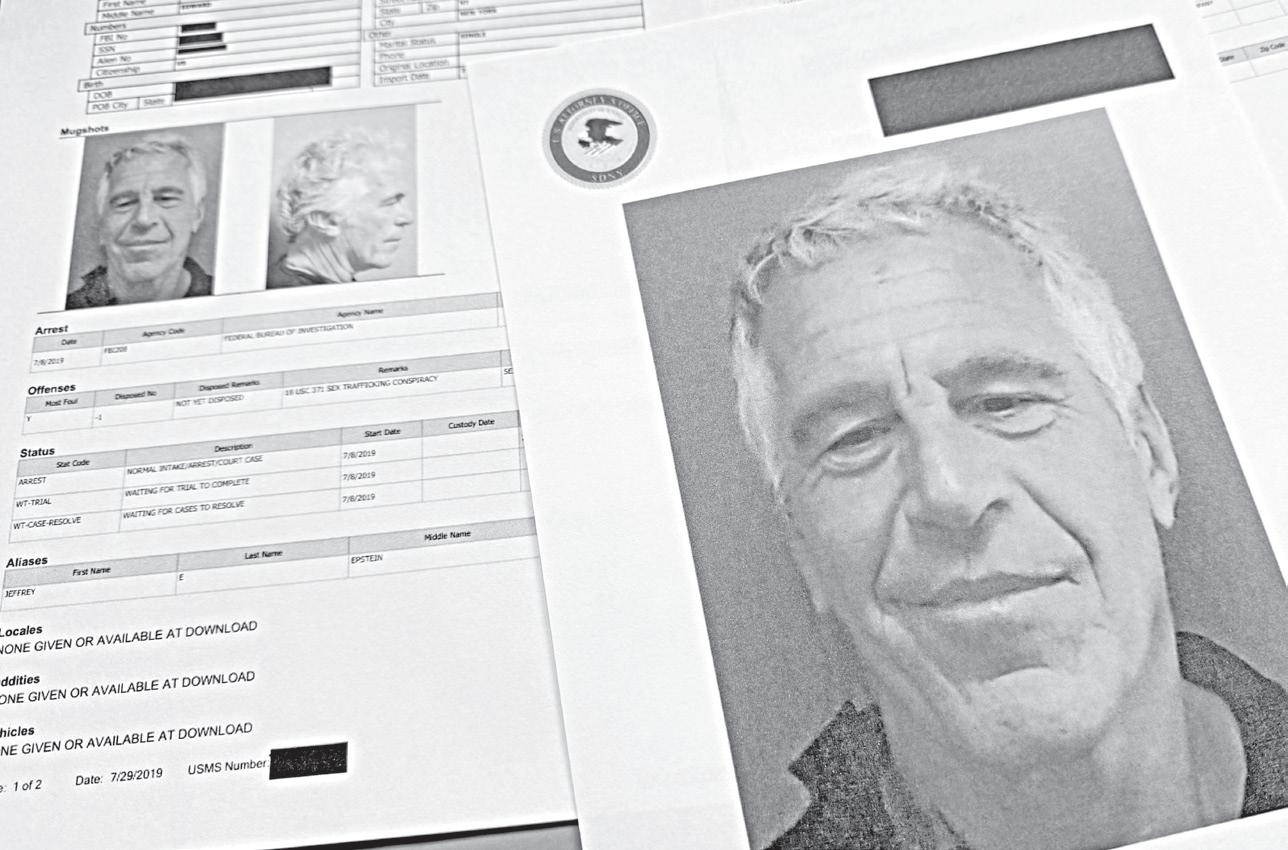
Epstein’s famous friends THE latest batch includes correspondence either with or about some of Epstein’s friends.
The records have thousands of references to Trump, including emails in which Epstein and others shared news articles about him, commented on his policies or politics, or gossiped about him and his family. Also included was a spreadsheet created last August summarizing calls to the FBI’s National Threat Operation Center or to a hotline established by prosecutors from people claiming without corroboration to have some knowledge of wrongdoing by Trump.
Mountbatten-Windsor’s name appears at least several hundred times in the documents, sometimes in news clippings, sometimes in Epstein’s private e-mail correspondence and in guest lists for dinners organized by Epstein. Some records document an attempt by prosecutors in New York to get the former prince to agree to be interviewed as part of their Epstein sex trafficking probe.
The records also show Musk, the billionaire Tesla founder, reached out to Epstein on at least two occasions to plan visits to the Caribbean island where many of the allegations of sexual abuse purportedly occurred.
In a 2012 exchange, Epstein asked how many people Musk would like flown by helicopter to the island he owned.
“Probably just Talulah and me,” Musk responded, referencing his thenpartner, actress Talulah Riley. “What day/night will be the wildest party on our island?”
Musk messaged Epstein again ahead of a planned Caribbean trip in 2013.
“Will be in the BVI/St Bart’s area over the holidays,” he wrote. “Is there a good time to visit?” Epstein extended an invite for after the New Year holiday.
It’s not immediately clear if the island visits took place. Spokespeople for Musk’s companies, Tesla and X, didn’t respond to e-mails seeking comment.
Musk has said he repeatedly rebuffed Epstein’s overtures.
“Epstein tried to get me to go to his
island and I REFUSED,” he posted on X in 2025 when House Democrats released an Epstein calendar with an entry mentioning a potential Musk visit.
Epstein also appears to have tried to connect New York Giants co-owner Steve Tisch with women, according to emails. In one exchange, Tisch told Epstein he had had lunch with one of Epstein’s assistant’s friends. He described her as a “very sweet girl,” and asked if Epstein knew anything about her.
“No, but I will ask,” said Epstein, before inquiring if Tisch had contacted another woman, crudely describing her physical features.
Tisch said in a statement that he had a “brief association” with Epstein where they emailed about adult women and other topics. He said he “never went to his island” and that he “deeply regrets” the association.
The documents show that Steve Bannon, a conservative activist who served as Trump’s White House strategist earlier in the president’s first term, bantered over politics with the financier, discussed get-togethers with him over breakfast, lunch or dinner and, on March 29, 2019, asked Epstein if he could supply his plane to pick him up in Rome.
Epstein told him his pilot and crew “are doing their best” to arrange that flight but if Bannon could find a charter flight instead, “I’m happy to pay.”
Apparently in France at the time, Epstein sent a text message saying: “My guys can pick you up. Come for dinner.”
The exchange did not show how that played out.
In December 2012, Epstein invited Howard Lutnick, now Trump’s commerce secretary, to his private island for lunch, the records show. Lutnick’s wife accepted the invitation and said they would arrive on a yacht with their children. On another occasion in 2011, the two men had drinks, according to a schedule shared with Epstein.
Lutnick has said he cut ties with Epstein long ago. A Commerce Department spokesman said Lutnick had “limited interactions with Mr. Epstein in the presence of his wife and has never been accused of wrongdoing.”
ABy Will Weissert The Associated Press
BOARD AIR FORCE ONE—President
Donald Trump said Saturday that he has instructed Homeland Security
Secretary Kristi Noem not to intervene in protests occurring in cities led by Democrats unless local authorities ask for federal help amid mounting criticism of his administration’s immigration crackdown.
On his social media site, Trump posted that “under no circumstances are we going to participate in various poorly run Democrat Cities with regard to their Protests and/or Riots unless, and until, they ask us for help.” He provided no further details on how his order would affect operations by US Immigration and Customs Enforcement and DHS personnel, or other federal agencies, but added: “We will, however, guard, and very powerfully so, any and all Federal Buildings that are being attacked by these highly paid Lunatics, Agitators, and Insurrectionists.” Trump said that in addition to his instruc-
tions to Noem he had directed “ICE and/ or Border Patrol to be very forceful in this protection of Federal Government Property.”
Later Saturday night, Trump said to reporters as he flew to Florida for the weekend that he felt Democratic cities are “always complaining.”
“If they want help, they have to ask for it. Because if we go in, all they do is complain,” Trump said.
He predicted that those cities would need help, but said if the leaders of those cities seek it from the federal government, “They have to say, ‘Please.’”
The Trump administration has already deployed the National Guard, or federal law enforcement officials, in a number of Democratic areas, including Washington, Los Angeles, Chicago and Portland, Oregon. But Saturday’s order comes as opposition to such tactics has grown, particularly in Minnesota’s Twin Cities region.
Trump said Saturday night that protesters who “do anything bad” to immigration officers and other federal law enforcement,
Another Epstein contact surfacing in the records is former Obama White House general counsel Kathy Ruemmler. In one of several exchanges, Epstein e-mailed Ruemmler to advise that Democrats should stop demonizing Trump as a Mafia-type figure even as he derided the president as a “maniac.”
A spokesperson for Goldman Sachs, where Ruemmler is general counsel and chief legal officer, said in a statement that Ruemmler “had a professional association with Jeffrey Epstein when she was a lawyer in private practice” and “regrets ever knowing him.”
Building on the earlier release
THE tens of thousands of pages released last month included previously released flight logs showing Trump flew on Epstein’s private jet in the 1990s, before their falling-out, and several photographs of Clinton. None of Epstein’s victims who have gone public with their stories have publicly accused Trump, a Republican, nor Clinton, a Democrat, of wrongdoing. Both have said they had no knowledge he was abusing underage girls.
Epstein killed himself in a New York jail cell in August 2019, a month after being indicted on federal sex trafficking charges.
In 2008 and 2009, Epstein served jail time in Florida after pleading guilty to soliciting prostitution from someone under the age of 18. At the time, investigators had gathered evidence that Epstein had sexually abused underage girls at his Palm Beach home. The US attorney’s office agreed not to prosecute him in exchange for his guilty plea to lesser state charges.
A draft indictment from that period released Friday shows prosecutors contemplated federal charges against not just Epstein but three others who were his personal assistants and were suspected of participating in a conspiracy to recruit underage girls to perform lewd acts with Epstein.
In 2021, a federal jury in New York convicted Maxwell, a British socialite, of sex trafficking for helping recruit some of his underage victims. She is serving a 20-year prison sentence.
US prosecutors never charged anyone else in connection with Epstein’s abuse of girls. One victim, Virginia Roberts Giuffre, accused him in lawsuits of having arranged for her to have sexual encounters at age 17 and 18 with numerous politicians, business titans, academics and others. They all denied her allegations.
Among those accused was Britain’s Prince Andrew, who was stripped of his royal titles amid the scandal. Andrew denied having sex with Giuffre but settled her lawsuit for an undisclosed sum.
Giuffre died by suicide last year at age 41.
Tucker and Richer reported from Washington. Associated Press journalists from around the country contributed to this report.
Trump moves fast to cut a funding deal, a striking change from last shutdown fight
By Joey Cappelletti & Stephen Groves The Associated Press
ASHINGTON—President
WDonald Trump moved quickly this week to negotiate with Democrats to try and avert a lengthy government shutdown over Department of Homeland Security funding, a sharp departure from last year’s record standoff, when he refused to budge for weeks.
Some Republicans are frustrated with the deal, raising the possible of a prolonged shutdown fight when the House returns Monday to vote on the funding package. But Trump’s sway over the GOP remains considerable, and he has made his position clear at a moment of mounting political strain.
“The only thing that can slow our country down is another long and damaging government shutdown,” Trump wrote on social media late Thursday.
The urgency marked a clear shift from Trump’s posture during the 43day shutdown late last year, when he publicly antagonized Democratic leaders and his team mocked them on social media. This time, with anger rising over shootings in Minneapolis and the GOP’s midterm messaging on tax cuts drowned out by controversy, Trump acted quickly to make a deal with Senate Democratic leader Chuck Schumer of New York.
“Trump and the Republicans know that this is an issue where they’re on the wrong side of the American people and it really matters,” Schumer told reporters Friday after Senate passage of the government funding deal.
The crisis caused by Minneapolis killings
SENATORS returned to work this week dealing with the fallout from the fatal shooting of ICU nurse Alex Pretti in Minneapolis by federal immigration officers, as well as the killing of Renee Good in the city weeks earlier.
Republicans were far from unified in their response. A few called for the firing of top administration officials such as Homeland Security Secretary Kristi Noem and Stephen Miller, the White House chief of staff for policy.
Most GOP senators tried to strike a balance, calling for a thorough investigation into Pretti’s killing while backing the hardline immigration approach that is central to Trump’s presidency.
But many agreed that the shootings threatened public support for Trump’s immigration agenda.
“I’ve never seen a political party take its best issue and turn it into its worst issue in the period of time that it has happened in the last few weeks,” said Sen. John Kennedy, R-La. “Some things have to change.” Democrats quickly coalesced around their key demands.
Sen. Chris Coons, D-Del., said there “was unanimity” around core principles of enforcing a code of conduct for immigration officers and agents, ending “roving patrols” for immigration enforcement actions and coordinating with local law enforcement on immigration arrests.

boost as voters begin to see larger tax refunds.
Republicans are also mindful of the political damage from last year’s shutdown, when they took a slightly larger portion of the blame from Americans than Democrats, according to polling from The Associated Press-NORC Center for Public Affairs Research.
“The shutdown was a big factor, negative for the Republicans,” Trump told Republican senators at the White House in November.
On a practical level, this funding standoff threatened to destroy months of bipartisan work, including long hours over the holiday break, to craft the 12 spending bills that fund the government and many priorities back home.
“We saw what happened in the last government shutdown in regards to how it hurt real, hardworking Americans,” said Sen. Katie Britt, R-Ala., a member of the Senate Appropriations Committee. “I don’t want that to happen again.”
A two-week funding battle begins THE agreement reached this week, if passed by the House, would avoid a prolonged shutdown and fund nearly every federal department through the end of the budget year in September. But it would not resolve one of the most difficult issues for Congress and the White House: DHS funding. Instead of a full-year deal, funding for the department was extended for just two weeks, giving lawmakers little time to bridge the deep divides over immigration enforcement.
Democrats are pressing for changes they say are necessary to prevent future abuses, including requiring immigration agents to wear body cameras, carry clear identification, end roving patrols in cities and coordinate more closely with local law enforcement when making arrests. Many Democrats also want tighter rules around warrants and accountability mechanisms for officers in the field.
Those demands have met stiff resistance from Republicans. Some are opposed to negotiating with Democrats at all.
“Republicans control the White House, Senate and House. Why are we giving an inch to Democrats?” Sen. Tommy Tuberville, R-Ala., wrote on social media.
“will have to suffer” and “will get taken care of in at least an equal way.”
“You see it, the way they treat our people. And said, you’re allowed, if somebody does that, you can do something back. You’re not going to stand there and take it if somebody spits in your face,” Trump said.
Minnesota Attorney General Keith Ellison and the mayors of Minneapolis and St. Paul have challenged a federal immigration enforcement surge in those cities, arguing that DHS is violating constitutional protections.
A federal judge says she won’t halt enforcement operations as the lawsuit proceeds. State and local officials had sought a quick order to halt the enforcement action or limit its scope. Justice Department lawyers have called the lawsuit “legally frivolous.”
The state, particularly Minneapolis, has been on edge after federal officers fatally shot two people in the city: Renee Good on Jan. 7 and Alex Pretti on Jan. 24. Thousands of people have taken to the streets to protest the federal action in Minnesota and across the country.
Trump’s border czar, Tom Homan, has suggested the administration could reduce the number of immigration enforcement officers in Minnesota—but only if state and local officials cooperate. Trump sent Homan to Minneapolis following the killings of Good and Pretti, seeming to signal a willingness to ease tensions in Minnesota.
The president on Saturday night said he intended to speak to Homan and Noem on Sunday and he seemed to endorse the idea of immigration agents wearing body cameras or having their interactions filmed.
Trump was asked by a reporter if he thought it was a good thing having lots of cameras capturing incidents with law enforcement.
“I think it would help law enforcement but I’d have to talk to them,” Trump said. He went on and added: “That works both ways. But overall, I think it’s 80% in favor of law enforcement.”
It helped that Trump himself was looking for ways to de-escalate in Minneapolis.
“The world has seen the videos of those horrible abuses by DHS and rogue operations catching up innocent people, and there’s a revulsion about it,” said Sen. Tim Kaine, D-Va.
“The White House is asking for a ladder off the ledge,” he added.
Avoiding the painful politics of a shutdown
REPUBLICANS are also trying to promote their accomplishments in office as they ready for the November elections and the difficult task of retaining control of both chambers of Congress.
But the prospect of a prolonged shutdown shifted attention away from their $4.5 trillion tax and spending cuts law, the centerpiece of their agenda. Republicans had hoped the beginning of this year’s tax season on Monday would provide a political
Republican senators said they would take the fight to Democrats by introducing their own bills, including restrictions on “sanctuary cities,” to show their support for Trump’s policies. That term is generally applied to state and local governments that limit cooperation with federal immigration authorities.
“We’ve let the issue get away. We’re not leading. We’re trying to avoid losing rather than winning,” said Sen. Lindsey Graham, R-S.C., who held up the spending bills until Senate Majority Leader John Thune, R-S.D., agreed to give him a vote on his sanctuary cities bill at a later date.
Thune acknowledged the difficulty of the next two weeks, saying there are “some pretty significant views and feelings.”
“We’ll stay hopeful,” Thune told reporters about the upcoming DHS fight. “But there are some pretty significant differences of opinion.”
and
this report.
By Lorne Cook The Associated Press
BRUSSELS—European allies and Canada are pouring billions of dollars into helping Ukraine, and they have pledged to massively boost their budgets to defend their territories.
But despite those efforts, NATO’s credibility as a unified force under US leadership has taken a huge hit over the past year as trust within the 32-nation military organization dissolved.
The rift has been most glaring over US President Donald Trump’s repeated threats to seize Greenland, a semiautonomous territory of NATO ally Denmark. More recently, Trump’s disparaging remarks about his NATO allies’ troops in Afghanistan drew another outcry. While the heat on Greenland has subsided for now, the infighting has seriously undercut the ability of the world’s biggest security alliance to deter adversaries, analysts say.
“The episode matters because it crossed a line that cannot be uncrossed,” Sophia Besch from the Carnegie Europe think tank said in a report on the Greenland crisis. “Even without force or sanctions, that breach weakens the alliance in a lasting way.”
The tensions haven’t gone unnoticed in Russia, NATO’s biggest threat.
Any deterrence of Russia relies on ensuring that President Vladimir Putin is convinced that NATO will retaliate should he expand his war beyond Ukraine. Right now, that does not seem to be the case.
“It’s a major upheaval for Europe, and we are watching it,” Russian Foreign Minister Sergey Lavrov noted last week.
Filling up the bucket CRITICIZED by US leaders for decades over low defense spending, and lashed relentlessly under Trump, European allies and Canada agreed in July to significantly up their game and start investing 5% of their gross domestic product on defense.
The pledge was aimed at taking the whip out of Trump’s hand. The allies would spend as much of their economic output on core defense as the United States — around 3.5% of GDP — by 2035, plus a further 1.5% on securityrelated projects like upgrading bridges, air and seaports.
NATO Secretary-General Mark
Rutte has hailed those pledges as a sign of NATO’s robust health and military might. He recently said that “fundamentally thanks to Donald J. Trump, NATO is stronger than it ever was.”
Though a big part of his job is to ensure that Trump does not pull the US out of NATO, as Trump has occasionally threatened, his flattery of the American leader has sometimes raised concern. Rutte has pointedly refused to speak about the rift over Greenland.
Article 5 at stake
THE North Atlantic Treaty Organization was formed in 1949 to counter the security threat posed by the Soviet Union during the Cold War, and its deterrence is underpinned by a strong American troop presence in Europe.
The alliance is built on the political pledge that an attack on one ally must be met with a response from them all—the collective security guarantee enshrined in Article 5 of its rule book.
It hinges on the belief that the territories of all 32 allies must remain inviolate. Trump’s designs on Greenland attack that very principle, even though Article 5 does not apply in internal disputes because it can only be triggered unanimously.
“Instead of strengthening our alliances, threats against Greenland and NATO are undermining America’s own interests,” two US senators, Democrat Jeanne Shaheen and Republican Lisa Murkowski, wrote in a New York Times op-ed.
By Regina Garcia Cano
The Associated Press
CARACAS, Venezuela—Ven -
ezuela’s acting President
Delcy Rodríguez on Friday announced an amnesty bill that could lead to the release of hundreds of prisoners, including opposition leaders, journalists and human rights activists detained for political reasons.
The measure had long been sought by the United States-backed opposition. It is the latest concession Rodríguez has made since taking the reins of the country on Jan. 3 after the brazen seizure of then-President Nicolás Maduro in a US military attack in Venezuela’s capital, Caracas. Rodríguez told a gathering of justices, magistrates, ministers, military brass and other government leaders that the ruling party-controlled National Assembly would take up the bill with urgency.
“May this law serve to heal the wounds left by the political confrontation fueled by violence and extremism,” she added in the pre-taped televised event. “May it serve to redirect justice in our country, and may it serve to redirect coexistence among Venezuelans.”
Rodríguez also announced the shutdown of Helicoide, a prison in Caracas where torture and other human rights abuses have been repeatedly documented by independent organizations. The facility, she said, will be transformed into a sports, social and cultural center for police and surrounding neighborhoods.
Rodríguez made her announcement before some of the officials that former prisoners and human rights watchdogs have accused of ordering the abuses committed at Helicoide and other detention facilities.
Relatives of some prisoners livestreamed Rodríguez’s speech on a phone as they gathered outside Helicoide. Some cried. Many chanted “Freedom! Freedom!”
“God is good. God heard us,” Johana Chirinos, a prisoner’s aunt, said as tears rolled down her face.

Opposition leader and Nobel Peace Prize laureate María Corina Machado in a statement said the announced actions were not taken “voluntarily, but rather in response to pressure from the US government.” She also noted that people have been detained for their political activities from anywhere between a month and 23 years.
“The regime’s repressive apparatus is brutal and has responded to the numerous criminal forces that answer to this regime, and it is all that remains,” Machado said. “When repression disappears and fear is lost, it will be the end of tyranny.” The Venezuelan-based prisoners’ rights group Foro Penal estimates that 711 people are in detention facilities across the South American country for their political activities. Of those, 183 have been sentenced. Among the prominent members of the political opposition who were detained after the 2024 presidential election and remain in prison are former lawmaker Freddy Superlano, Machado’s lawyer Perkins Rocha, as well as Juan Pablo Guanipa, a former governor and one of Machado’s closest allies.
The government did not release the text of the bill on Friday, leaving unclear the specific criteria that will be used to determine who qualifies for amnesty.
Rodríguez said the “general amnesty law” will cover the “entire period of political violence from 1999 to the pres -
“Suggestions that the United States would seize or coerce allies to sell territory do not project strength. They signal unpredictability, weaken deterrence and hand our adversaries exactly what they want: proof that democratic alliances are fragile and unreliable,” they said.
Even before Trump escalated his threats to seize control of Greenland, his European allies were never entirely convinced that he would defend them should they come under attack.
Trump has said that he doesn’t believe the allies would help him either, and he recently drew more anger when he questioned the role of European and Canadian troops who fought and died alongside Americans in Afghanistan. The president later partially reversed his remarks.
In testimony to the Senate Foreign Relations Committee, US Secretary of State Marco Rubio dismissed criticism that Trump has undermined the alliance.
“The stronger our partners are in NATO, the more flexibility the United States will have to secure our interests in different parts of the world,” he said.
“That’s not an abandonment of NATO. That is a reality of the 21st century and a world that’s changing now.”
A Russia not easily deterred
DESPITE NATO’s talk of increased spending, Moscow seems undeterred.
The EU’s foreign policy chief, Kaja Kallas, said this week that “it has become painfully clear that Russia will
Continued from A7
The words of caution come as Trump has shifted his rationale for possible US military action against Iran in recent days from a response to the deadly crackdown on nationwide protests to a deterrent of the country’s nuclear program. That is even as he insists Iranian nuclear sites were “obliterated” in US strikes in June.
Trump says he wants to make a deal TRUMP on Friday said he hoped to make a deal with Iran but told reporters: “If we don’t make a deal, we’ll see what happens.”
He was cryptic when asked if he had given Iran a deadline, saying, “Only they know for sure.” He affirmed that he had communicated his threats to the country’s officials directly but did not offer any details.

remain a major security threat for the long term.”
“We are fending off cyberattacks, sabotage against critical infrastructure, foreign interference and information manipulation, military intimidation, territorial threats and political meddling,” she said Wednesday.
Officials across Europe have reported acts of sabotage and mysterious drone flights over airports and military bases. Identifying the culprits is difficult, and Russia denies responsibility.
In a year-end address, Rutte warned that Europe is at imminent risk.
“Russia has brought war back to Europe, and we must be prepared for the scale of war our grandparents or great-grandparents endured,” he said.
Meanwhile in Russia, Lavrov said the dispute over Greenland heralded a “deep crisis” for NATO.
“It was hard to imagine before that such a thing could happen,” Lavrov told reporters, as he contemplated the possibility that “one NATO member is going to attack another NATO member.”
Russian state media mocked Europe’s “impotent rage” over Trump’s designs on Greenland, and Putin’s presidential envoy declared that “transAtlantic unity is over.”
At the same time, Iran’s nuclear threat has remained the larger concern for both the US and the region, particularly Israel. The official said it made sense to Trump to remind Iran’s leadership that the ultimate goal is to eliminate that threat.
“Hopefully Iran will quickly ‘Come to the Table’ and negotiate a fair and equitable deal — NO NUCLEAR WEAPONS — one that is good for all parties,” Trump wrote on his Truth Social platform this week. “Time is running out, it is truly of the essence!”
A senior administration official stressed that Trump “has all options at his disposal.” That official did not offer details about whether the White House had any indications that Iran was taking steps to rebuild its nuclear program.
Iran says it’s ready for talks but also ‘ready for war’
IRANIAN Foreign Minister Abbas
Doubt about US troops
US Defense Secretary Pete Hegseth is due to meet with his counterparts at NATO on Feb. 12. A year ago, he startled the allies by warning that America’s security priorities lie elsewhere and that Europe must look after itself now. Security in the Arctic region, where Greenland lies, will be high on the agenda. It’s unclear whether Hegseth will announce a new drawdown of US troops in Europe, who are central to NATO’s deterrence.
Lack of clarity about this has also fueled doubt about the US commitment to its allies. In October, NATO learned that up to 1,500 American troops would be withdrawn from an area bordering Ukraine, angering ally Romania. A report from the European Union Institute for Security Studies warned last week that although US troops are unlikely to vanish overnight, doubts about US commitment to European security means “the deterrence edifice becomes shakier.”
“Europe is being forced to confront a harsher reality,” wrote the authors, Veronica Anghel and Giuseppe Spatafora. “Adversaries start believing they can probe, sabotage and escalate without triggering a unified response.”
ent.” She also explained that people convicted of murder, drug trafficking, corruption or human rights violations will not qualify for relief.
Rodríguez’s government earlier this month announced plans to release a significant number of prisoners in a goodwill gesture, but relatives of those detained have condemned the slow pace of the releases.
“A general amnesty is welcome as long as its elements and conditions include all of civil society, without discrimination, that it does not become a cloak of impunity, and that it contributes to dismantling the repressive apparatus of political persecution,” Alfredo Romero, president of Foro Penal, said on social media.
The organization has tallied 302 releases since the Jan. 8 announcement.
The human rights group Provea in a statement called out the lack of transparency and “trickle” pace of prisoner releases. It also underscored that while the freeing of those still detained “is urgent, the announcement of an amnesty should not be conceived, under any circumstances, as a pardon or act of clemency on the part of the State.”
“We recall that these people were arbitrarily imprisoned for exercising rights protected by international human rights instruments, the National Constitution, and Venezuelan laws,” the organization said.
Trump’s return to the nuclear issue should not necessarily be considered a shift in tactics, but rather part of a broader approach toward dealing with Iran and the threat the US believes it poses to its people and the region, according to two administration officials who spoke on condition of anonymity to describe the president’s thinking.
One of the officials said Trump had initially focused on the protests inside Iran as a way of both encouraging demonstrators who might at some point force a change in Iranian policies and warning Tehran of consequences for mistreating them.
Trump said Friday that Iran heeded his earlier warnings about holding off from executing protesters, which he said he appreciated, but then acknowledged, “A lot of people are being killed.”
Araghchi said Friday while meeting Turkish officials in Istanbul that his country is ready for dialogue to resolve tensions but that there are no concrete plans for talks with his US counterparts.
“The Islamic Republic of Iran, just as it is ready for negotiations, it is also ready for war,” he added.
Ankara has been working to reduce the tensions, with Turkish President Recep Tayyip Erdogan offering during a telephone call with Iranian President Masoud Pezeshkian earlier Friday to act as a “facilitator” between Iran and the US, according to his office.
Trump backed down from ordering any strikes earlier this month after telling Iranians to keep protesting and that “help is on the way,” saying he had received assurances Iran would not execute some 800 protesters.
Speaking to reporters as he flew to Florida, Trump sidestepped a question about whether Tehran would be emboldened if the US backed away from launching any strikes on Iran, saying, “Some people think that. Some people don’t.”
Trump said Iran should negotiate a “satisfactory” deal to prevent the Middle Eastern country from getting any nuclear weapons
Trump, meanwhile, repeatedly has touted a “massive armada” of US warships in the region. The US military has bolstered its presence with the aircraft carrier USS Abraham Lincoln and three guided-missile destroyers, which brought thousands of additional service members to join other destroyers and ships in the Middle East. US Central Command urged Iran to avoid “unnecessary risk to freedom of navigation” during a planned live-fire exercise starting Sunday in the Strait of Hormuz, a waterway where 20% of the world’s oil passes. The command noted that it would not tolerate “unsafe” actions from Iran, including flying over US military ships engaged in flight operations, highspeed boat approaches or weapons pointed at American forces.
The Arab official said the region’s message to the US is that it should proceed with extreme caution, mindful of the havoc that could ensue. The message to Iran is that if the US does strike, it should carefully calibrate how it responds and not take action that would affect its neighbors, the official said. US assets in Qatar, for instance, were the target of Iranian retaliation after Trump’s airstrikes on Iranian nuclear facilities last year. The official added that ideally nothing would come to pass other than a period of extreme anxiety but said the situation was unpredictable and that no one other than Trump knows if an attack would be coming.
Amiri reported from New York. Associated Press writers Mehmet Guzel in Istanbul and Konstantin Toropin in Washington
Nationwide protests in Iran began in late December against economic woes but broadened into a challenge to the Islamic Republic’s theocracy. Activists say the government’s crackdown has killed at least 6,540 people.
but said, “I don’t know that they will. But they are talking to us. Seriously talking to us.” Ali Larijani, a top security official in Iran, wrote on X late Saturday that “structural arrangements for negotiations are progressing.” However, there is no public sign of any
THE Philippines wears a crown—but it is one of thorns. Cel ebrated as the world’s largest exporter of nurses, the country supplies skilled, compassionate, and English‑proficient profes sionals who sustain healthcare systems from New York to Riyadh, London to Ontario. Yet a recent World Bank report exposes a bru tal paradox: even as the Philippines provides nearly a quarter of the world’s overseas nurses, it ranks among the lowest in public primary healthcare (PHC) worker density in East Asia and the Pacific. This is not just ironic; it is a national health crisis demanding urgent, radi cal reform. (Read the BusinessMirror story: “WB flags PHL’s low density of primary healthcare staff,” January 23, 2026).
With a meager 6.4 public PHC workers per 10,000 citizens, the Philippines trails far behind neighbors like Vietnam (10.5), Malaysia (40), and Singapore (63.7). This severe shortage directly leads to diminished preventive care, limited access to community-based services, and an alarming rate of 24 preventable deaths for every 10,000 Filipinos. These deaths, linked to poor prevention and substandard care, are a tragic indictment of a system failing its most vulnerable, particularly outside major cities.
This workforce gap arrives at a perilous moment. The region, including the Philippines, faces a tsunami of non-communicable diseases (NCDs)—diabetes, hypertension, heart disease—fueled by aging populations and rapid urbanization. As World Bank Vice President for EA&P Carlos Felipe Jaramillo warned, this rise in chronic illness threatens to “erode hard-won economic gains.” People may live longer (life expectancy jumped from 68 to 77 years since 1990), but they spend an alarming extra 9.3 years in poor health. This burden falls heavily on individuals in their prime working years, straining families, overwhelming a threadbare health system, and sapping national productivity.
The solution, as the World Bank rightly emphasizes, lies in robust primary healthcare—prevention, early detection, and long-term management of chronic conditions. Yet, the very foundation needed to deliver this care is crumbling. The exodus of health professionals is a core driver of this crisis. While Filipino nurses are celebrated exports, their absence at home creates a vacuum that the nation cannot fill.
Additionally, the weight of healthcare costs is overwhelming. Out-of-pocket expenses present a significant obstacle, affecting nearly 17 percent of the region’s population who are vulnerable to catastrophic health spending.
The path forward requires decisive systemic change, emphasizing the importance of prevention and frontline empowerment. This involves shifting from a reactive “cure” model to proactive chronic disease management, utilizing “task-shifting” to train and empower healthcare workers like nurses, midwives, and community health professionals to provide essential primary health care services. Additionally, addressing the brain drain necessitates investments in competitive salaries, improved working conditions, robust career development, and incentives for serving in underserved areas, showing that the nation values its healthcare workers as much as the world does.
Acknowledging health investments as a driver of economic growth is essential, as every job created in the health sector contributes to the generation of more jobs, resulting in a healthier and more productive population.
We face a pivotal choice: we can continue to be the world’s supplier of nurses while our own citizens lack basic healthcare—threatening our nation’s economic future—or we can commit the same energy used to train healthcare workers for export to strengthening our domestic health system. Strengthening primary healthcare isn’t just a health imperative; it’s the foundation for sustainable national development and human dignity. The time for acknowledging this cruel irony is over. The need for swift, transformative action has never been more urgent, with the nation’s health and long-term economic future fundamentally at stake.


HEN the World Economic Forum asks, “How can we better invest in people?”, we should hear that as a very se rious question, not a distant Davos slogan. Around one in five jobs worldwide is expected to be disrupted by 2030, and nearly four in 10 core skills are projected to change or become obsolete as technology and the green transition reshape work; if we don’t act, the Philippines will again be left behind.
WE Forum says over half of workers will need reskilling or upskilling by 2030, and the most in-demand abilities will be analytical thinking, resilience, flexibility, and technological literacy, alongside AI and data skills. These aren’t abstract buzzwords when you look at our BPO agents handling AI tools, delivery riders navigating algorithmic platforms, or teachers suddenly
expected to teach coding without proper support.
At the same time, Philippine data show a deep skills mismatch: an analysis of TVET and labor force surveys found that while around 39 percent of employed Filipinos are overqualified for their jobs, about 29 percent lack the qualifications needed for the roles they already hold. We are wasting human potential by under
employing those with skills and leaving many workers struggling in positions they were never trained for.
The WE Forum campaign about “investing in people” covers three areas: reskilling and upskilling at scale, helping workers move from shrinking sectors to growing ones, and expanding health and inclusion so more people can actually participate in the economy. That speaks directly to our daily worries: unstable wages, migrating abroad, and scrambling for extra income through gigs and online side hustles.
TESDA itself has acknowledged that 2026 must be about higher-impact, future-ready skills training that truly opens pathways to employment, not just certificates. Yet TVET experts warn that our system is still not aligned enough with industry needs, with persistent gaps between what is taught and what workplaces actually demand. Meanwhile, millions of Filipinos are already “curriculum designers” of their own lives — piecing together YouTube tutorials, short courses, and trial-and- error
businesses on top of a main job.
For a country that exports nurses, seafarers, engineers, and creatives, the most patriotic thing we can do in this decade may simply be to take Filipino talent seriously. WE Forum argues that technological change and the green transition will drive massive job reconfiguration, but that public - private collaboration can build more resilient societies if we choose to prioritize people over short-term cost-cutting. In the Philippine context, that means moving beyond slogans about “digital transformation” and asking the harder questions: Are public schools teaching the analytical, digital, and interpersonal skills that will still matter in 2030? Are TESDA and LGUs mapping out which green and tech- enabled jobs are emerging locally, so their training actually leads somewhere? Are companies treating training as an expense to be minimized, or as the core investment that makes any AI adoption worthwhile?
To be continued
The ‘Little President’: Why stability matters most for Marcos now

N politics, change is often mistaken for action. When trust rat ings dip or the political weather turns rough, the reflex is to re shuffle—move people around and hope that momentum follows. But governance is not theater. At this point in the Marcos adminis tration, what the President needs most is not disruption, but stability in how the government works.
Nowhere is this more evident than in the position of Executive Secretary.
President Ferdinand Marcos Jr. has already appointed three Executive Secretaries in his first three years in office. That alone should give any leader pause. The Executive Secretary is not a ceremonial post—he is often referred to as the Little President, the nerve center of Malacañang where policy coordination meets bureaucratic execution. This is the person who tries to make sure presidential decisions are not merely announced but actually implemented smoothly across government.
Calls for a change at this crucial post are almost inevitable in politics. But the question we ought to ask is less about personalities and more about what kind of governance the administration needs at this moment.


That broader question matters even more when routine governance decisions are being recast as grounds
for impeachment—a leap that risks confusing policy disagreement with constitutional wrongdoing.
Impeachment is a constitutional remedy reserved for the gravest forms of misconduct: culpable violation of the Constitution, treason, bribery, graft and corruption, other high crimes, or betrayal of public trust. It is not designed to resolve technical disputes over budget mechanics—especially when those mechanics were explicitly authorized by Congress itself.
This is precisely where attempts to elevate the PhilHealth funds issue into an impeachment case against the President falter.
At its core, the controversy centers on a provision in the 2024 General Appropriations Act (GAA) that required the remittance of idle and excess funds from governmentowned and -controlled corporations, including PhilHealth, to the National Treasury. This was not an executive maneuver. It was a legislative act—
debated, passed by Congress, signed into law, and implemented by the executive branch pursuant to statutory mandate.
Impeachment requires executive wrongdoing. What critics point to instead is legislative authorization followed by executive compliance. That distinction is fatal to the argument.
The President did not unilaterally seize PhilHealth funds. The executive did not bypass Congress. There was no secret reallocation, no offbudget transaction, and no circumvention of the appropriations process. Funds were remitted as required by law and later spent only through appropriations enacted by Congress.
Even the Supreme Court’s subsequent ruling does not salvage the impeachment narrative. While the Court struck down the GAA provision on constitutional grounds and ordered the return of funds to PhilHealth via the 2026 budget, it did not declare the President guilty of abuse of power. Nor did it characterize the remittance as corruption, diversion, or betrayal of public trust.
These legal nuances matter. Governance requires accountability, yes—but it also requires fair adjudication of disagreements and respect for institutional processes.
Now back to the question of leadership at the Palace.
At a moment when economic pressures are mounting, geopolitical uncertainties persist, and public expectations run high, what the President needs at his flank is continuity, institutional memory, and coordination—not another learning curve
in the heart of his executive office. Ralph Recto brings something his immediate predecessors did not: deep political experience and institutional familiarity. A former congressman and senator, he understands how laws are made, how coalitions are built, and how institutions behave under stress. That perspective matters, especially for an administration still pursuing key reforms across government.
The Executive Secretary is not simply a technocrat managing administrative tasks. The job demands judgment—knowing when to push, when to pause, and how to align competing interests behind coherent executive action. That is where experience counts. Calls for change often rest on the assumption that replacing people automatically changes outcomes. History suggests otherwise. What truly alters outcomes is clarity of direction, discipline in execution, and trust within the President’s inner circle. Constant turnover erodes all three.
Retaining the Executive Secretary at this junction is not about resisting accountability. It is about recognizing that effective governance depends on continuity and competence operating together. The President does not need another adjustment period in Malacañang’s most critical office. He needs stability, institutional memory, and a seasoned operator who understands both policy and politics—and at this point, only someone with Recto’s blend of experience and institutional knowledge fits that bill.

PJoel L. Tan-Torres
Part three
ART of the confusion in the measurement of revenue bureaus’ performance is that “exceeding the target” is treated as a continuously moving situation, when, under Republic Act No. 9335 (Attrition Act of 2005 or Attrition Law), it is actually a legal and technical benchmark. The Attrition Law was designed to institutionalize accountability by linking revenue performance to incentives and penalties for officials of revenue-generating agencies, namely the Bureau of Internal Revenue (BIR) and the Bureau of Customs (BOC). In principle, it ensures that failure to meet targets has consequences, while strong performance is rewarded, based on targets set by the Development Budget Coordination Committee (DBCC).
The law sets a clear pattern for how much of the “excess” tax collections accrues to the Rewards and Incentives Fund (Fund): if the excess is 30 percent or less of the target, 15 percent of that excess goes to the Fund; if the excess is more than 30 percent, the Fund gets 15 percent of the first 30 percent plus 20 percent of the remaining excess. Importantly, the Fund is treated as automatically appropriated in the year immediately following the year the target is exceeded, and it is supposed to be released automatically within that same fiscal year.
On the other hand, the sanction for BIR and BOC officials who fail to meet their revenue targets is “attrition,” meaning they can be separated from the service, subject to the law’s rules and due process. This is triggered when collections fall below the assigned target by the benchmark threshold of 7.5 percent of the tax collection goal.
A Revenue Performance Evaluation Board (Board) has been created to administer the reward and penalty provisions of the Attrition Law. The Board is chaired by the Department of Finance Secretary, with the Department of Budget and Management Secretary and the National Economic and Development Authority (now the Department of Economy, Planning, and Development); the Commissioners of the BIR and BOC sit as non-voting members, alongside representatives from the officials and rank-and-file.
This structure is deliberate. It places the incentive and separation mechanism under a Board where fiscal managers sit at the table, and where the BIR or BOC Commissioner does not unilaterally decide who benefits or who is penalized.
The Board’s functions include prescribing rules for allocation and release of the Fund, setting and applying criteria for separation of employees whose performance falls short, establishing a performance evaluation system, and submitting an annual report to Congress.
Revenue Memorandum Circular (RMC) No. 60-2021, issued in May 2021, publishes the full text of the “Amended Rules and Regulations to Implement Republic Act No. 9335.” (https://bir-cdn.bir.gov. ph/local/pdf/RMC%20No.%20602021%20Annex.pdf).
The most consequential clause in the Attrition Law and Implementing Rules and Regulations (IRR) is the definition of “revenue targets.” The law states that revenue targets refer to the original estimated revenue collection expected of the BIR and the BOC for a given year, as stated in the Budget of Expenditures and Sources of Financing (BESF) submitted by the President to Congress. This provision is the guardrail that prevents the rewards and penalty system from being triggered by moving goalposts or by late-year “adjustments” that may

TThe sanction for BIR and BOC officials who fail to meet their revenue targets is “attrition,” meaning they can be separated from the service, subject to the law’s rules and due process. This is triggered when collections fall below the assigned target by the benchmark threshold of 7.5% of the tax collection goal.
have legitimate macro reasons— but cannot automatically convert an ordinary collection outcome into a legally compensable “excess” or “shortfall.” However, the IRR provided a provision for the Board to consider year round adjustments for tax collection targets after considering “the following, among others, as relevant factors affecting the level of collection: Provided, That these factors were not taken into account in setting BESF targets: Enactment of a law that repeals revenue measures, reduces tax and tariff rates, grants tax exemptions, or otherwise results in the diminution of the tax base or of taxable transactions and activities, including the entry into force of a treaty or an international agreement that the Philippines entered into resulting in preferential treatment for certain taxpayers or transactions.” Are these subsequent adjustments to the revenue agencies’ tax collection targets permissible under the law? I have my thoughts on this, which I can discuss in another article. The law also makes clear that the BIR and BOC are expected to submit to the Development Budget Coordination Committee the distribution of agency targets by revenue districts for the BIR and by collection districts for the BOC. And once incentives are triggered, they are not to be awarded as a blanket windfall: any incentive is to be apportioned among units, officials, and employees in proportion to their relative contribution to the aggregate excess. This will equivalently apply to shortfalls in collections by the two agencies. That proportionality rule matters because it underscores the law’s original intent: institutional performance must be traceable, measurable, and earned—not merely declared. This is the hallmark of an effective performance measurement system that complies with the intent of the Attrition Law.
To be continued
Joel L. Tan-Torres was a former Commissioner of the Bureau of Internal Revenue. He has also held various positions, including Dean of the University of the Philippines School of Business, Chairman of the Professional Regulatory Board of Accountancy, Tax partner of Reyes Tacandong & Co., and SyCipGorres and Velayo & Co., and director of various corporate boards. He is a Certified Public Accountant who ranked No. 1 in the
Siegfred Bueno Mison, Esq.
HE ongoing word war between public officials from the Philippines and China in the conflict in the West Philippine Sea (WPS) or South China Sea should remain a war of words instead of deeds. Of course, the continued incursions of Chinese ships in our exclusive economic zone have only exacerbated the growing tensions between the two countries.
Philippine Coast Guard (PCG)
Spokesperson Jay Tarriela has constantly defended the territorial integrity of the country in various public fora, including social media. Reacting to the relentless Facebook posts allegedly attacking and smearing China, Chinese embassy spokesperson Ji Linpeng claimed that Tarriela and “certain individuals and institutions in the Philippines” have been “relentlessly attacking and smearing China and spreading false narratives” over the past few days, coinciding with the recent designation of Ambassador Jing Quan last December 2025.
I suppose the individuals referred to by spokesperson Ji are Senators Risa Hontiveros and Erwin Tulfo, who recently publicly lambasted Chinese embassy officials in Manila. Senator Hontiveros recently said that China is acting like a “bad guest” in the Philippines. In a plenary session at the Senate a few days ago, she said, in Filipino, that “no foreigner has the right to silence Filipinos within the Philippines—especially an ambassador, from whom higher standards are expected.”
Senator Erwin Tulfo, in criticizing the Chinese embassy for lecturing Philippine officials on the limits of freedom of speech, said: “We are told that criticizing a foreign head of state is completely unacceptable. Let me say this then: If you do not like how democracy works in this country, then you are free to leave the Philippines. Get the fuck out!”
However, Senator Robin Padilla, in the same session, criticized the use of a caricature of Chinese President Xi Jinping by Tarriela. In Filipino, Senator Padilla urged Tarriela not to disrespect Chinese officials: “If you disrespect someone, you will be disrespected in return.”
On the part of the Chinese officials, spokesperson Ji threatened: “If people like Tarriela continue to spread disinformation and distorted narratives unchecked, even the strongest diplomatic efforts to stabilize bilateral relations will be
undermined, and even more development opportunities will be lost for the Philippines.”
In a statement, Ji said: “They are free to attack; we are just as free to respond. Freedom of speech works both ways… No need to get so worked up—pace yourselves. The road ahead is long, and there will be plenty of chances to talk.”
In contrast, Chinese Ambassador to the Philippines Jing Quan, who served as deputy chief of mission at the Chinese Embassy in Washington DC, before his assignment to the Philippines, was quite nonconfrontational. In one public event, Ambassador Jing said, “As ambassador, I will firmly safeguard national interests and dignity, while also playing a bridging role to stabilize rather than deteriorate China-Philippines relations, and to bring the people of both countries closer rather than drift apart.”
In related developments, Ambassador Jing met with Chief of the Philippine National Police PGEN Jose Melencio Nartatez Jr. and discussed law enforcement cooperation between China and the Philippines to further combat transnational crimes as well with Quezon City Mayor Joy Belmonte, who reportedly spoke highly of China’s technological advancements in fields such as waste-to-energy technology, new energy vehicles, and climate change response.
Some may immediately conclude that Tarriela, Hontiveros, and Tulfo are anti-China whereas Padilla and Belmonte are pro-China. Whatever they said, they were free to choose. One side can be considered as nationalists and patriots; the other can be seen as collaborators and branded as traitors.
What our current set of government leaders perhaps cannot comprehend is that the greater battle is within ourselves. The battle of Good vs. Evil is never won outside; it is won inside.
In the Philippines, there must be unity in ranks, particularly among
government officials, ideally. For consistency, there should be one clear policy spoken by one mouthpiece, ideally. There must be a common understanding of the issue, which finds no or little support from a cultural or even economic argument, ideally.
Bickering between officials in government and false narratives spread by and among Filipinos cause more conflict internally than externally. One thing is undisputed from my military mind though—China is the greater giant in this conflict.
Yet, the Battle Outside is not a clear cut case of David vs. Goliath since I seriously doubt that Goliath (China) will attack its “blood brother” David (Philippines). After all, a significant majority of the Filipinos have Chinese blood in their veins, myself included.
But the Battle Within (our government) is clear for me given the obvious closeness to the US during the Aquino administration (20102016) and the evident alliance with China during the Duterte years (2016-2022). I am not sure whether we, as a country and a people, can sustain the “friend to all, enemy to none” foreign policy under this current Marcos administration.
Our leaders must choose wisely instead of foolishly. In the spiritual realm, some individuals can easily conclude that the battle is between good and evil. One pastor who recently spoke before the Intentional Disciple Conference (IDC) said that most believers are in battle formation but only a handful are ready to wage war. Most believers understand that the devil is the enemy. But only a handful understand that mortal beings, being sinful in nature, their enemy lies within. Man is no match against his own inherent tendencies to succumb to the temptations of pride, envy, anger, lust, and many others. Yes, the temptations and sins of the flesh are far greater than what mortal beings can handle. Even the great King David himself who conquered and defeated a larger Goliath was no match against the temptation of the flesh.
The Bible told us that David sent for Bathsheba, took her, slept with her, and planned the death of her husband Uriah, abusing his power quite sinfully the rest of the way (2 Samuel 11:2-4, 14-16 ). Fortunately, David chose to confess, repent, and yield to the power of our Almighty God. He was humble enough to confess, after committing adultery with Bathsheba. David pleaded to the Lord—“For I know my transgressions, and my sin is always before me. Against you, you only, have I sinned and done what is evil in your sight; so you are right in your ver -
dict and justified when you judge.” (Psalms 51:3-4). He further asked for a pure heart as well as for a steadfast and willing spirit to sustain him against the daily attacks from within. (Psalms 51:10, 12) Obviously, the choice is ours. We can submit to sin and enjoy temporal pleasure or choose to submit to His will but reap eternal salvation. For believers, we understand that choosing His will results in suffering, many times. But, we believe that we are stronger to face these trials, tests, and tribulations with Him. In 2 Corinthians 12: 9-11, the Bible says, “My grace is sufficient for you, for my power is made perfect in weakness.” Therefore I will boast all the more gladly about my weaknesses, so that Christ’s power may rest on me. That is why, for Christ’s sake, I delight in weaknesses, in insults, in hardships, in persecutions, in difficulties. For when I am weak, then I am strong.”
Another pastor in that IDC boldly said that in surrender, we win. Once we intentionally surrender to His will, we are victorious against evil principalities. The battle between the flesh and the spirit can be lost or won daily. Our decision to choose foolishly (David’s adultery and murder) or wisely (David’s confession and request for a pure heart) are done daily. Such daily decisions leaning towards good instead of evil can be easily be made with a close and personal relationship with our Lord and Savior Jesus Christ. The more we feed ourselves with the Word of God by reading and studying the Bible, the Holy Spirit in us can help us to choose wisely rather than foolishly, daily. In the words of pastor John McArthur, “make sure Satan (the evil within us) has to climb over a lot of Scripture to get to you.”
Over time, we can be more firm in our daily choices and eventually live in victory within as a way of life. With God in us, the Battle Within is a mismatch, for there is no greater, bigger, and more powerful “giant” than He who, in all things, “works for the good of those who love him, who have been called according to his purpose.”
Siegfred has a diversified set of education and experiences which has made him a game changer and a servant leader in organizations. His professional degrees came from the United States Military Academy at West Point in New York, Ateneo Law School, and University of Southern California, Los Angeles, USA. His corporate experiences include stints as general counsel for the country’s flag carrier, a food exporter with manufacturing plants in Davao and in Laguna, and a sports distributor company. Siegfred is a former soldier and a lawyer by profession, a teacher and inspirational speaker by passion, and a book author and a writer with a mission.
By Patpicha Tanakasempipat
over a week before Thailand’s general election, Prime Minister Anutin Charnvirakul trekked to the Thai-Cambodian border and posed with frontline soldiers as the national flag fluttered in the breeze, protective gear layered over his government uniform.
That embrace of the military, and apparent backing of the country’s conservative establishment, has given Anutin’s Bhumjaithai Party an edge in the Feb. 8 vote. Once seen as a mid-sized broker skilled at trading seats for cabinet posts, the party has steadily expanded its footprint, leveraging its time in government and pragmatic deal-making to court voters beyond its traditional rural strongholds.
As nationalist sentiment surged following last year’s flare-up along the border, Anutin has tapped public concerns over security and national pride by promising stability and a firm defense of Thai sovereignty—a message that has resonated as tensions linger.
“I will keep the border crossings closed, I will protect your land, I will build a wall for you,” Anutin said at a rally last week in Ubon Ratchathani, one of seven provinces bordering Cambodia and which saw thousands forced to evacuate during the clashes. “If they fire artillery at Thailand, they don’t know what’s coming for them. They won’t dare. We’ve shown them. We’ve protected every square inch of our land.” Such close alignment with the mili-
tary sets Bhumjaithai—which means “proud to be Thai”—apart from the rest of the parties in an election likely to produce another fractured parliament. That’s reinforced Anutin’s image as the prime ministerial candidate that has the strongest backing of the establishment since the exit of Prayuth Chan-Ocha, a former general who ruled from 2014 to 2023 after leading a coup. It has also helped that Anutin rose to power last year after his predecessor from a rival party, Paetongtarn Shinawatra, was ousted over her handling of the border conflict.
The controversy created a rupture between then-ruling Pheu Thai party —controlled by the family of political heavyweight and establishment-irritant Thaksin Shinawatra—and the conservatives who had allowed him to return from 15 years of exile. Their alliance was grounded in blocking the rise of Move Forward, the former incarnation of the reformist People’s Party.
“Anutin has effectively positioned himself as the rightful conservative successor, one who can be relied upon to defend the royalist-military establishment against perceived encroachment from
both progressive forces and Shinawatraaligned parties,” said Napon Jatusripitak, director of the Center for Politics and Geopolitics at think tank Thailand Future.
The People’s Party, and the progressive movement behind it, have accused establishment elites of holding back Thailand’s economy by choosing status quo instead of disruptive reforms that are needed to modernize the country’s bureaucratic and industrial infrastructure. The pro-establishment conservatives, for their part, brand the reformists as threats to the social and political order.
Bhumjaithai is mounting a late push to close the gap with the People’s Party, even going so far as to cast the race as one that’s between “those who love the nation and those who don’t,” as Transport Minister Phipat Ratchakitprakarn put it. Because no party is projected to win a clear majority, a second-place finish could still offer a path to power, given the conservative establishment’s preference to keep progressives out of government.
In his first big rally in Bangkok on Friday, Anutin also vowed to protect the monarchy. A campaign to loosen the country’s lese majeste law, which punishes criticism of the monarchy with up to 15 years in jail, helped Move Forward to a surprise victory in 2023. It was also the reason it was disbanded by a court a year later.
Amending the law “will never happen and will never succeed because you have us,” Anutin told hundreds of supporters in Bangkok’s central Lumpini park.
Founded by political power-broker Newin Chidchob as a breakaway faction from a party backed by the Shinawatra family, Bhumjaithai’s support is rooted in provincial networks, particularly in the northeast. Since its 2008 start, Bhumjaithai has secured influence within successive coalition governments and survived multiple cycles of political upheaval in Thai politics. Until it pulled out of the Shinawatra-led administration last year, the party was part of every military-backed or civilian administration since 2019.
“Unlike Thaksin, Newin has stayed out of the picture to play a supporting role in order to make the party a core force and build confidence in Anutin,” said Olarn Thinbangtieo, deputy dean of Burapha University’s Faculty of Political Science and Law. Analysts say Bhumjaithai could win as many as 150 seats out of a possible 500 in this election, up from 71 when it placed third in 2023. The party’s extensive local networks—a decisive advantage in constituency races—could deliver stronger results than polls suggested, particularly in harder-to-survey areas.
According to data journalism outlet Rocket Media Lab, 86 of Thailand’s 215 local political dynasties are contesting the election under Bhumjaithai’s banner, compared with 48 the last time. The People’s Party has members from only 10 smaller families running for office.
Monday, February 2, 2026
By Bless Aubrey Ogerio @blessogerio
RETAIL prices in Metro Manila grew at a slower pace on an annual basis in 2025, as food price increases decelerated, government data showed.
The Philippine Statistics Authority (PSA) reported that the General Retail Price Index (GRPI) in the National Capital Region rose 1.2 percent last year, down from 1.8 percent in 2024.
The food index contributed to this trend, increasing 1.4 percent in 2025, compared with 2.4 percent a year earlier.
Beverages and tobacco grew 3 percent, down from 3.5 percent in 2024; chemicals, including animal and vegetable oils and fats, 2.1 percent from 2.4 percent; and manufactured goods classified chiefly by materials, 1.2 percent from 1.3 percent.
The increase in machinery and transport equipment slowed to 0.4 percent from 0.5 percent, while that of miscellaneous manufactured articles reached 0.8 percent, down from 1.4 percent the previous year.
Crude materials, inedible except fuels, posted a slightly faster annual increase of 1.1 percent in 2025 from 1 percent in 2024.
Mineral fuels, lubricants, and related materials, however, saw
an annual decline of 1.1 percent in 2025, reversing a 0.4 percent increase in 2024.
Meanwhile, data for December 2025 showed the GRPI in Metro Manila rising 1.5 percent year-on-year, up slightly from 1.4 percent in November.
Food prices were up 1.8 percent in December, compared with 1.5 percent the previous month.
Crude materials, inedible except fuels, also recorded a higher annual increase of 2 percent in December from 1.9 percent in November.
Slower growth was noted for beverages and tobacco (1.4 percent from 1.7 percent), mineral fuels and lubricants (0.8 percent from 2.8 percent), manufactured goods classified chiefly by materials (1.4 percent from 1.5 percent), and miscellaneous manufactured articles (0.8 percent from 0.9 percent).
The indices for chemicals, including animal and vegetable oils and fats, and machinery and transport equipment maintained their previous month’s annual rates of 2.2 percent and 0.7 percent, respectively.
The GRPI tracks the general level of prices at which retailers sell goods to consumers or end-users, making it a key gauge of consumer inflation trends in the region, according to the statistics agency.
By Ada Pelonia @adapelonia
in Luzon have exceeded 100 percent utilization rates, stoking concerns of a potential stockout of raw materials used by local meat processors.
Philippine Association of Meat Processors Inc. (Pampi) Director Jet Ambalada told the BusinessMirror that Luzon ports are experiencing congestion at a time when they should have been clearing yard space.
“In my almost 40 years of experience, I have never seen all ports in
Luzon reach over 100 percent utilization level. It’s end-January, so it’s supposed to be the lean season,” Ambalada told this newspaper.
He attributed the congestion to the year-on-year surge in the country’s inbound and outbound shipments of goods, citing steady
growth in demand.
Government data showed that the Philippines ended 2025 with record-high export earnings alongside the surge in import bill. (See: https://businessmirror.com. ph/2026/01/28/record-exportshigh-import-bill/).
In particular, total exports reached $84.41 billion last year, while the total value of imported goods reached $133.57 billion in the same period, the second-highest level on record, next only to the $137.22 billion posted in 2022.
Should the port congestion persist in the first quarter, however, Ambalada warned that this could trickle into their operations.
“It’s bad [if this extends within the first quarter] because we will run out of stock. But there won’t be price increases, since that’s not the
supply chain shifts.
n Technological shifts: Smart ports, AI-driven domain awareness, and innovations in maritime transport.
Tneeds in shipping. n Economic connectivity: Blue
economy growth, short-sea shipping, and port digitalization amid
The report urged Asean to strengthen domain awareness,
issue,” he said. “The prices of raw materials from source countries are currently low-priced. The problem is how we could get our hands on the supply to keep our factory running.”
With this, Ambalada urged the shipping lines to find alternative container yards and send super vessels to take out empty containers.
“The ports should accept empty containers so we can pull out the loaded ones, or find a space for our empty containers,” he said. “They can also send an additional vessel to pick up the empty containers [because] we can’t return them since there’s no truck. They’re full of empty containers.” The Association of International Shipping Lines (AISL) did not immediately respond to the BusinessMirror ’s request for comment.
align partner engagements under the Asean Outlook on the IndoPacific, build capacity on biodiversity and marine debris, advance the Single Shipping Market, and adopt smart port performance indicators.
By Francine Medina
ravel today has evolved beyond ticking destinations off a bucket list. More than itineraries and Instagram-worthy views, modern travel is now defined by intention—by the questions travelers ask before they go. How does this journey affect the environment? How does it support local communities? And how can each trip leave a positive footprint long after the bags are unpacked?
This shift toward more conscious travel is at the heart of Megaworld Hotels and Resorts’ (MHR) newest campaign, MEGreen Mindful Stays, an initiative that promotes sustainable tourism, mindful consumption, and deeper guest engagement across its properties in Boracay and Metro Manila.
As the country’s largest hotel property group, MHR is using its scale and influence to help redefine hospitality—one that balances comfort and convenience with responsibility and purpose.
Redefining the way we travel
THE launch of MEGreen Mindful Stays reflects a broader rethinking of what it means to travel today. Rather than focusing solely on luxury or leisure, the program encourages guests to be more intentional about their choices—from how they consume resources to how they interact with communities.
“This is really about traveling with awareness,” said Cleofe Albiso, Managing Director of Megaworld Hotels and Resorts, in an interview with “Freshly Brewed,” BusinessMirror’s weekly digital program

hosted by Trade and Industry reporter Bless Ogerio. “It’s about understanding that every decision we make as travelers has an impact—on people, on places, and on the planet.”
Through MEGreen Mindful Stays, MHR integrates sustainability into the guest experience by promoting eco-friendly practices, supporting local suppliers, offering wellness-driven activities, and encouraging responsible tourism behaviors.
Navigating challenges, finding opportunities
THE hospitality industry faced significant headwinds in 2025, driven by economic pressures, geopolitical tensions, and shifting travel behaviors. Despite these challenges, MHR managed to not only stay resilient but also achieve several major milestones.
“2025 was not an easy year for tourism,” Albiso acknowledged. “But we were fortunate to still record meaningful wins.”
One of the most significant was the company’s achievement of 100 percent Muslim-friendly accreditation across all 13 of its properties, making Megaworld the


first hotel chain in the Philippines to reach this milestone.
“This allows us to better serve our Muslim guests who are looking for accommodations that respect their beliefs and practices,” Albiso said. “It’s an important step in making hospitality more inclusive.”
MHR’s efforts were further recognized with the CrescentRating Halal-Friendly Hotel Chain of the Year award, as well as an Excellence Award from the Philippine Tourism Awards under the Department of Tourism.
“These recognitions affirm that our efforts matter,” Albiso added. “They inspire us to keep improving and to find ways to stand out not just through service, but through purpose.”
The Sampaguita story
CENTRAL to Megaworld Hotels and Resorts’ identity is the sampaguita, the national flower of the Philippines and a symbol of sincerity, warmth, and heartfelt service.
The flower is woven into the brand’s philosophy through its Five Senses program and its corporate social responsibility initiatives.
Last year, MHR launched Sampaguita Parks across several Megaworld estates, creating green spaces while supporting communitybased planting programs.
“For us, the sampaguita represents who we are as a Filipino brand,” Albiso explained. “It reflects humility, care, and the genuine warmth we want our guests to feel.”
Beyond symbolism, the initiative also supports livelihood programs and community partnerships, reinforcing MHR’s commitment to inclusive growth.
A new generation of travelers ACCORDING to Albiso, one of the biggest shifts in recent years has been the evolving mindset of travelers—particularly among younger generations.
“People are no longer just looking for popular destinations,” she said. “They’re seeking meaning. They want experiences that connect them to local culture, to nature, and to communities.”
Digital platforms play a major role in shaping these preferences. From TikTok to Instagram, travel decisions are increasingly influenced by online content, reviews, and storytelling.
“What people see online really matters,” Albiso noted. “The quality of content, how authentic it feels, and how it resonates emotionally all influence booking decisions.”
Despite the rise of digital platforms, she emphasized that traditional booking channels still have a place.
“Some guests still prefer personal interactions—calling directly, talking to a salesperson, or visiting an office. That human connection remains important, and we continue to invest in it alongside digital innovation.”
Making mindfulness practical WHILE the concept of mindful travel may sound abstract, MHR works to make it tangible through everyday practices.
“Mindfulness doesn’t have to be complicated,” Albiso said. “It can start with something as simple as being conscious of how you use your hotel room.” She shared that housekeeping teams often encounter excessive waste left behind by guests, even after short stays. “With mindful travel, we encourage guests to leave rooms in a decent condition, reuse towels when possible, and be considerate of the people who clean after them. These small actions have a big impact on water use, energy consumption, and labor.” Reducing food waste, minimizing single-
use plastics, and encouraging guests to bring reusable items are also part of the initiative.
“These are simple habits,” she said, “but collectively they help lower our carbon footprint.”
Building a culture of care BEYOND hotel operations, MEGreen Mindful Stays extends to community engagement. In Boracay, for instance, MHR partners with Ati communities, providing training and livelihood opportunities through the production of woven products made from nito.
“These communities existed long before tourism arrived,” Albiso said. “We see ourselves as guests in their home. It’s only right that we give back by creating opportunities that are sustainable and respectful.”
The products created by the communities are either purchased by the hotels or sold independently, allowing residents to earn income while preserving traditional crafts. A movement, not a campaign FOR Albiso, MEGreen Mindful Stays is not just a marketing initiative—it is a long-term advocacy.
“Sustainability has become a buzzword, but mindful travel goes deeper than that,” she explained. “It’s about being intentional in everything we do, from operations to guest experience.”
She hopes the campaign will inspire not just travelers, but also industry partners and other hospitality players to adopt similar practices.
“We’re not claiming ownership of the idea,” she said. “We want this to become a shared mindset across the industry.” As the campaign continues to gain traction, Albiso remains optimistic about its potential impact.
“Our hope is that people begin to see how even small actions—choosing responsibly, being respectful, being present—can create meaningful change,” she said. “If we all do our part, the collective impact can be powerful.” In the end, MEGreen Mindful Stays is about more than travel. It is about redefining what it means to explore the world—with intention, respect, and care.
•
Editor: Jennifer A. Ng
B1 Monday, February2, 2026
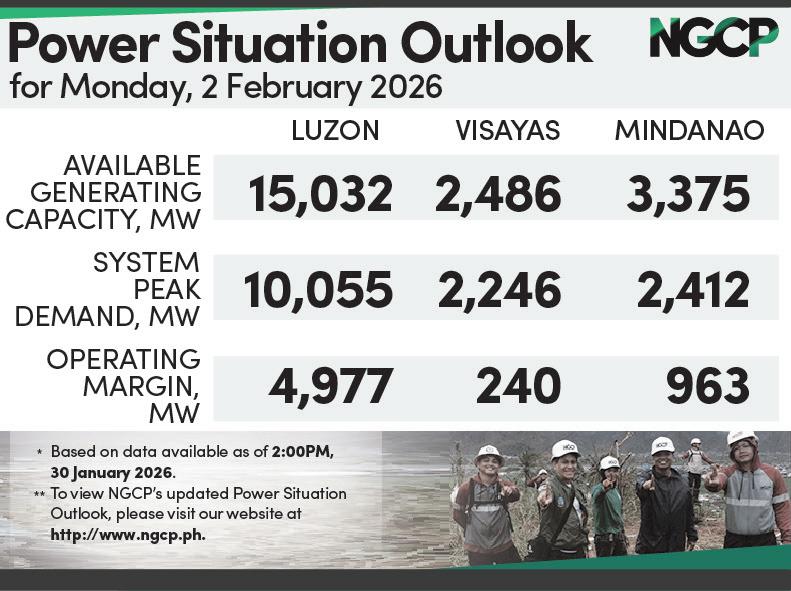

By VG Cabuag @villygc
THE Securities and Exchange Commission has filed a criminal complaint against Villar Land Holdings Corp., its related entities, and their respective officers for market manipulation, insider trading and misleading disclosures that distorted the company’s share prices and misled the investing public.
In a complaint filed last January 30, the SEC charged Villar Land, formerly Golden MV Holdings Inc., for violating the Securities Regulation Code in making false or misleading statements and engaging in acts that operated as fraud or deceit upon investors.
Named as respondents are Villar Land chairman and former senator Manuel B. Villar Jr.; former senator Cynthia A. Villar; directors Cynthia J. Javarez, Manuel Paolo A. Villar, Camille A. Villar, and Mark A. Villar; and independent directors Ana Marie V. Pagsibigan and Garth F. Castañeda.
The SEC also charged related entities Infra Holdings Corp. and MGS Construction, together with their
officers and authorized signatories Virgilio B. Villar, Josephine R. Bartolome, Jerry M. Navarrete and Joy J. Fernandez.
“Building investor confidence in the Philippines is crucial in driving the inclusive and sustainable growth of our capital market and business sector for national development,”
SEC chairman Francis E. Lim said.
“In this light, the SEC is firm in addressing fraudulent and manipulative acts that mislead the investing public and distort our capital markets. The commission likewise enjoins publicly listed companies to uphold the highest standards of good corporate governance to help strengthen and sustain investor con-
fidence badly needed by our capital markets,” he said.
“Villar Land and its directors will answer all the allegations leveled against them after formal receipt of the alleged complaint,” the company said in its reply.
The charges stemmed from the SEC’s investigation into Villar Land’s public disclosures and trading activities, which misled investors and distorted the market price of the company’s shares.
Villar Land’s public disclosure of its 2024 financial statements, which reported a substantial increase in total assets to P1.33 trillion and net income of P999.72 billion, from P1.46 billion in the previous year. The company attributed the increase to a revaluation of its real estate holdings.
The SEC alleged that these figures were disclosed to the investing public prior to the completion of the company’s external audit. The company’s independent auditor subsequently clarified that the financial statements had not yet been fully audited, particularly with respect to the valuation of major properties. When the audited financial statements were later submitted, Villar Land reported total assets of only P35.7 billion—significantly lower than the amounts earlier disclosed.
The complaint said that related entities, including Infra Holdings Corp.
and MGS Construction, engaged in trading activities that created artificial demand and supported the price of Villar Land shares. Infra Holdings Corp. is owned by Virgilio B. Villar, the brother of Manuel B. Villar, Jr.
The SEC said Camille A. Villar engaged in insider trading when she purchased 73,600 shares of the company in December 2017, shortly before the release of a corporate disclosure that resulted in an increase in the company’s share price.
The agency also cited regulatory findings involving Villar Land’s property appraiser. In November 2025, the SEC revoked the accreditation of E-Value Phils. Inc. and imposed a P1-million fine after determining that its valuation reports, which were used in support of Villar Land’s asset revaluation, were unreliable.
Villar Land earlier explained that, due to delays caused by various requests by its auditor, it had “reluctantly” proposed to the external auditors the use of cost basis in recording its said properties instead of using the market value which was much higher.
“We want to highlight that while the company firmly believes that it is the fair value of the Villar City properties that should be reflected in its financial statements” but had agreed to use the lower valuation “in the interest of securing the immediate release of the 2024 audited financial statements.”
TBy Lenie Lectura @llectura

HE Energy Regulatory Commission (ERC) has approved another extension of the power purchase agreement (PPA) between the Manila Electric Co. (Meralco) and the First Gas Power Corp. (FGPC) until June this year.
In its eight-page order, the commission authorized the parties to implement the second interim extension of their agreement until June 25, 2026, under the same terms approved last year. The approval of the PPA is necessary for the continued dispatch of the power from First Gen’s 1,000-megawatt (MW) Santa Rita gas-fired power plant to Meralco.
The PPA expired last Saturday.
First Gen owns and operates four gas-fired power plants with a combined capacity of 2,017 MW located in Batangas. FGPC, a subsidiary of First Gas Holdings Corp., supplies electricity from the Santa Rita plant to Meralco under a 25year PPA.
According to the ERC, the Santa Rita plant has contributed to energy security through the frequent operation of its available units at full capacity, providing the needed

increase in supply and stabilizing Wholesale Electricity Spot Market (WESM) prices.
The Commission is cognizant that the reliable and flexible capacity offered by the Santa Rita Plant is much needed during the summer months. It is thus imperative that the power grids maintain sufficient capacity available to avert yellow/red alerts, power interruptions, or worse, widespread outages, added the regulator. Further, the ERC cited energy secretary Sharon Garin’s pronouncement of the importance of significant natural gas discovery at Malampaya East1, saying it is a critical bridge in the country’s energy mix, supporting power reliability while the country scale renewables, energy storage and grid upgrades.
“This is consistent with the mandate of RA 12120 to promote the development of indigenous natural gas,” the ERC said.
By Anne Ruth Dela Cruz
OPTUM reinforced its leadership in the health information management (HIMS) and information technology–business process management (IT-BPM) sectors, taking a leading role this year at the International IT-BPM Summit (IIS), hosted by the IT and Business Process Association of the Philippines (IBPAP), and at the Healthcare Information Management Services Conference (HIMSCON), led by the Healthcare Information Management Association of the Philippines (HIMAP).
Both forums serve as critical platforms for collaboration. IIS brings together decision-makers, thought leaders and global stakeholders to discuss digital services, workforce competitiveness and emerging technologies. HIMSCON, meanwhile, remains the central gathering of the HIMS industry — a venue for examining challenges, recognizing milestones and setting the pace for innovation. The strong presence of Optum in both discussions underscores its steadfast focus on advancing the future of HIMS and IT- BPM in the Philippines.
At the International IT-BPM Summit, Optum led the discussion on the future of work and the talent transformation needed to thrive in a rapidly changing environment.
During a dynamic session, Rain Tan, vice president for People, and Atty. Darwin Mariano, vice president for External Affairs, led a workshop on creating inclusive, future-ready work environments. They emphasized that organizations across the IT-BPM sector must build agile, adaptable and empowered workforces as digital transformation reshapes roles, skill demands and employee expectations. They underscored a key point: talent development is never static. As industries evolve, strategies for developing people must evolve as well. Tan and Mariano highlighted the organization’s commitment to innovation, business acumen and developing teams that can operate seamlessly across digital and human-centered functions.
They also addressed the realities of working across diverse global markets, noting that although each


region presents different challenges, the path forward is the same: companies must push for the highest possible standard of quality, ensuring consistent excellence in every market.
The session further highlighted the growing importance of technology integration, innovation and workforce transformation in elevating customer service. Optum emphasized how the combination of digital tools and empowered talent is redefining what exceptional service looks like in fast-moving, high-precision industries.
Leading the Transformation Dialogue at HIMSCON AT HIMSCON, Optum leaders outlined a forward-looking vision for the HIMS industry. Raymond Ver Santos, senior director for Talent Acquisition, said the industry’s ability to “go further” depends on three key drivers: technology inte-
gration, deeper technical expertise, and purpose-driven talent. He emphasized the importance of developing professionals with strong analytical and clinical skills who also understand their role in improving health care outcomes worldwide. To build on this foundation, Optum emphasized the role of artificial intelligence, automation and advanced digital platforms in modernizing HIMS operations. These tools improve accuracy, streamline workflows, reduce turnaround time, and allow clinicians to focus on higherlevel decision-making, which ultimately improve both efficiency and patient outcomes. Mariano reinforced these themes while moderating a discussion among other HIMS leaders. They explored how organizations can turn operational pressures into catalysts for sustainable growth by investing in digital ma-
turity, strong people programs and employee engagement—principles that also support the long-term strategy at Optum.
A Commitment to Industry Leadership OPTUM leadership presence at both HIMSCON and IIS reflects its deep commitment to shaping the future of the industries it serves. By sharing expertise, presenting data-driven insights and encouraging forward-looking conversations, Optum is not just contributing to industry dialogues—it is leading them.
As Optum continues to grow, it remains dedicated to uplifting the HIMS and IT-BPM sectors, empowering Filipino talent and developing better solutions for patients, partners and communities worldwide. Through every forum, workshop and collaborative effort, Optum advances the industry further with purpose.
By Reine Juvierre Alberto @reine_alberto

THE increasing demand for financial security is being credited by the Insurance Commission (IC) for driving the life insurance industry’s net income growth last year.
Latest IC data showed that the net income of the life insurance industry rose by 15.11 percent to P46.32 billion in 2025 from P40.24 billion in 2024.
“It’s a sustained growth,” Insurance Commissioner Reynaldo A. Regalado told reporters last Friday. “It’s continuous in the sense of security that the insurance provides. When you look at spending, the propensity to spend is more on security than on retail.”
This is evident as insurance density, or the average spending of an individual on insurance, reached an all-time high of P4,384.56 in 2025, compared to P3,894.03 in the previous year.
Insurance penetration, or the share of the sector of the country’s gross domestic product, also improved slightly to 1.78 percent in
THE Philippine Chamber of Cooperatives (Coop Chamber) has called on regulators to allow micro-cooperatives to submit internally-certified financial statements instead of pressuring them to hire external auditors.
In a statement, Coop Chamber appealed to the Cooperative Development Authority (CDA) to exempt micro cooperatives from the mandatory submission of Audited Financial Statements (AFS) signed by external certified public accountants (CPAs).
The Coop Chamber said it proposed to CDA Chairman Alexander B. Raquepo that micro cooperatives be allowed to submit annual financial reports certified under oath by their own officers, specifically the cooperative’s Treasurer and Chairman. The organization stressed that the proposal is not a request to lower transparency standards, but supports a “tiered” approach to regulation that takes into account the limited resources of micro cooperatives.
“Micro cooperatives are often still struggling to establish their operations and secure their sustainability,” Coop Chamber Chairman Noel D. Raboy was quoted in a statement as saying.
“Requiring them to pay for accredited CPAs drains resources that should instead be used for business growth and member services,” Raboy added. “By simplifying compliance, we make their integration into the formal economy manageable rather than punitive.”
The Coop Chamber’s appeal
By Jovee Marie N. dela Cruz @joveemarie
CAMARINES Sur Rep. Miguel Luis
“Migz” R. Villafuerte is push -
ing for the swift approval by the House of Representatives of a Senatepassed measure that seeks to establish an official digital budget portal. Villafuerte was referring to the proposed “Citizen Access and Disclosure of Expenditures for National Accountability,” or “Cadena,” law that, he said, would create a centralized, tamper-resistant digital budget platform where all government budget transactions would be publicly accessible. The proposed digital budget platform will require all government agencies and government-owned or -controlled corporations (GOCCs) to upload detailed
2025 from 1.67 percent in 2024.
“We’ll continue the growth of the industry for life [insurance],” Regalado said. “What’s important is how we improve the coverage, since 80 percent is life [insurance].”
Total premiums of the life insurance industry increased to P403.21 billion in 2025, up by 14.54 percent from P352.02 billion a year ago, driven by sustained demand for insurance products.
The life insurance industry accounted for 80.77 percent of the P499.23 billion in total premiums paid to the entire insurance industry in 2025.
Meanwhile, life insurance companies paid out a total of P121.88 billion in benefits in 2025.
Total net worth of the insurance industry also rose by 10.58 percent to P310.72 billion in 2025 from P280.99 billion in 2024.
“The sustained increase in premiums and net worth highlights the industry’s positive momentum entering 2026,” Regalado said.
The life insurance sector’s total assets reached P2.09 trillion in 2025, an 8.54 percent jump from P1.93 trillion in the year prior.
DBy Andrea E. San Juan
NEGROS ORIENTAL—The
worse-thanexpected outcome of the Philippine economy in the fourth quarter (Q4) of 2025 has prompted the Monetary Board (MB) to revisit its framework, further scrutinizing the demand and supply side of the economy before deciding whether it would deliver another rate cut in its upcoming policy meeting.
In an interview with reporters last Sunday here, BSP Governor Eli M. Remolona Jr. signaled that the MB may have miscalculated its estimate on the gross domestic product (GDP) data in the fourth quarter of last year.
“The Q4, when we did our estimate, was worse than expected. This one is even worse than that. So medyo
comes after the Securities and Exchange Commission (SEC) recently exempted micro enterprises (corporations) from submitting audited financial statements to encourage growth of micro, small and medium enterprises.
The SEC is now only requiring micro cooperatives to submit financial statements accompanied by a “Statement of Management’s Responsibility” signed by the company’s chairperson and treasurer.
“If the corporate regulator can cut red tape to help micro enterprises survive, surely the cooperative sector, which directly serves the grassroots and marginalized, deserves the same support,” said Edwin A. Bustillos, secretary-general of the Coop Chamber. “This proposal is timely and necessary. It aligns the cooperative movement with the national government’s push for Ease of Doing Business.”
The Coop Chamber said that the CDA, the government agency dedicated to championing the growth of cooperatives, will recognize the value of creating a more supportive regulatory framework.
“We are asking the CDA to exercise its developmental mandate,” Bustillos said. “By removing this financial hurdle, we empower micro-cooperatives to focus on what matters most: improving the lives of their members.”
Coop Chamber is a national organization of cooperatives in the country, representing primary cooperatives and advocating for a policy environment that ensures sustainability and growth for the movement.
Reine Juvierre S. Alberto
budget-related documents, including contracts, project costs, bills of materials, and procurement records, into a secure public ledger. The lawmaker said the open-source platform would help curb corruption by ensuring that budget data across all government offices are publicly accessible, verifiable, traceable, and protected from tampering.
As chairman of the House Committee on Information and Communications Technology (ICT), Villafuerte expressed hope that the House would prioritize the Cadena bill now that Congress has resumed session following the yearend break, noting that the Senate already approved its version—Senate Bill 1506. The Senate measure was principally authored by Sen. Paolo Benigno “Bam” A. Aquino IV.
By Lorenz S. Marasigan @lorenzmarasigan
ADELIVERY riders’ union is demanding a full accounting of withholding tax deductions collected by Delivery Hero Philippines Inc. (DBA Foodpanda), raising questions about the transparency of tax remittances that could amount to hundreds of millions of pesos over the years.
The National Union of Food Delivery Riders (Riders-Sentro) claimed that Foodpanda riders have been subjected to monthly tax deductions averaging P300 per rider without ever signing tax-related documents
mayroon kaming mali; mayroon kaming hindi na-ano,” Remolona told reporters on the sidelines of an event for journalists conducted by the central bank every year.
Asked on how this development will affect the BSP’s stance on monetary easing and if this warrants another rate cut in February, Re -
required by the Bureau of Internal Revenue (BIR).
Using data from the Department of Labor and Employment (DOLE) of 44,000 Foodpanda delivery riders nationwide, the group estimates the company withholds at least P13.2 million monthly, or P158.4 million annually.
With Foodpanda operating in the Philippines since 2014, RidersSentro suggested the cumulative amount could be substantial.
“If these deductions are legitimate taxes, where are the BIR forms, receipts, and certificates? If they are not, why is Foodpanda collecting money under the guise of ‘withholding tax’?”
molona said: “We will look at the demand and supply side [first]. We don’t know yet.”
Remolona, who is also the chairman of the MB, was further quizzed if the recent GDP turnout could prompt the MB, the highest policy-making body of the central bank, to deliver two consecutive rate cuts in the upcoming policy meetings.
“We will look at the data. There may be a cut [in February] but we’ll see. But not two consecutive [cuts].
One meeting at a time,” he said.
Asked if there’s also a possibility for the central bank to keep its key interest rate unchanged, Remolona said: “Yes.”
However, he underscored that the BSP does not rely much on the Federal Reserve’s decisions on its key interest rate, given a different economic scenario in the United States.
According to a report by Reuters, the central bank of the United States held interest rates steady on Wednesday “amid what US central bank chief Jerome Powell described as a solid economy and diminished risks to both inflation and employment, an outlook that could signal a lengthy wait before any further reductions in borrowing costs.”
the group asked through a statement.
Riders-Sentro is demanding a full public accounting of all amounts deducted as withholding tax since foodpanda began operations, immediate disclosure of BIR compliance documents and remittance records, and an investigation by the BIR, DOLE, and other government agencies into possible violations. When sought for comment, Delivery Hero said that withholding taxes are fully remitted to the BIR in accordance with applicable tax regulations.
“The implementation and remittance of withholding tax are clearly outlined in the ‘freelance agreement’
Monetary authorities have cut rates eight times since August 2024, for a total 200 basis points, reducing the policy rate from 6.50 percent to 4.5 percent.
Aside from the GDP data, Remolona said the seven-man MB would also wait for the release of the January 2026 inflation data, as among the data points that the MB considers in rate-setting.
The BSP governor pointed out that the central bank was looking at a 3.8 percent growth in the fourth quarter.
“When the actual data came out, it was even worse. We thought nothing that we didn’t take account of. But it was because we didn’t really have the data on it…There are other things that we missed, to be honest and we have to look more carefully at these other things and use them in our models,” Remolona said. He said the BSP’s policy-making body is using a “big model with 70 equations.”
Upon running the model, Remolona said: “It gave us what we thought were very pessimistic answers. And it turns out they were not pessimistic enough. So we have more homework to do, including gathering more indicators.”
that our partner riders review and sign prior to onboarding,” the company said in an email. “Foodpanda acts solely as a withholding agent for tax purposes and does not retain these amounts.”
The company added that riders may request records of their withholding and remittance history, including their Certificate of Tax Withheld and other applicable BIR documentation through official support channels. According to Delivery Hero, it remains compliant with all tax and regulatory requirements and will cooperate with government agencies should clarification be required.
StanChart ‘more cautious’ on peso, cites risks to BPOs
EXECUTIVES of the Hongkongbased Standard Chartered Bank expressed being “more cautious” on the Philippine peso compared to other currencies in the Asean region as developments in artificial intelligence may pose risks to the dollar-earning Philippine business process outsourcing (BPO) industry.
“For the Philippines itself, in terms of the outlook on the peso, I would say within the Asean region, the peso is probably a currency that we are a bit more cautious on,” Standard Chartered Bank Economist and Foreign Exchange (FX) Analyst in Asia Jonathan Koh said in a news briefing last week.
The lawmaker said the measure deserves urgent House approval, as it is among the 48 priority bills identified by President Ferdinand R. Marcos Jr. and the Legislative-Executive Development Advisory Council (LEDAC) for action by the 20th Congress. Under the Cadena bill, criminal and administrative penalties will be imposed on government officials who fail or refuse to disclose required documents or who upload false or fraudulent information.
Villafuerte said the House version of the Cadena bill was substantially based on Aquino’s SB 1506. The lawker added that the measure would place budget records and other fiscal documents on blockchain or similar technologies to further enhance transparency in government budget processes.
“And I think the reasons for that is number one, the structural positive that have supported the peso face a bit of challenges in my view. And the two structural positive are number one, BPO exports. BPO exports have actually been coming off a little bit. The risk to that is actually AI and also potentially US policy,” Koh added citing the proposed “Halting the International Relocation of Employment,” or “Hire,” Act of 2025.
Koh said that while the Hire Act has not been implemented by the US, he warned that once enacted, this measure would slap a 25-percent tax on US businesses that outsource BPO services.
“So that tax clearly is not going to
The bill mandates the government to ensure data integrity—defined as the accuracy, consistency, and reliability of fiscal data throughout its lifecycle—and to establish a “data embassy,” or a secure data storage facility located outside the Philippines but under full Philippine ownership, jurisdiction, and control, to ensure backup and continuity of critical fiscal systems.
It also provides for real-time channels that will allow citizens and civil society organizations to report, track, and receive acknowledgment of verified discrepancies or irregularities in published budget data.
While the measure applies to all national government agencies, instrumentalities, and GOCCs, as well as publicly funded projects under public-private partnerships (PPPs) and foreign-assist-
be positive for economies whereby BPO is a huge portion, and here it’s about 8 percent of GDP [gross domestic product]. So that’s I think is the first reason,” he said.
Koh also cited the slow growth in cash remittances from Overseas Filipinos as one of the threats hounding the the local currency.
“On the remittances side of things, remittances has been growing stably, 3 percent year-on-year, but as a percentage of GDP, it’s not growing as fast as nominal GDP. So as a percentage of GDP, it has actually been falling. It used to be maybe about 10 percent, now it’s probably about 8.5 percent of GDP. So it’s not reall helping offset the merchandise
ed programs, local government units (LGUs) are not covered. However, LGUs are encouraged to adopt similar mechanisms to promote fiscal transparency and participatory governance at the local level.
trade deficit that the economy is running at the moment,” added Koh. At an earlier interview, IT and Business Process Association of the Philippines (IBPAP) President Jonathan “Jack” R. Madrid said the recent currency movement has an immediate impact on the export-oriented sector, which earns primarily in dollars while shouldering most of its expenses in pesos.
“It makes us a little bit more competitive,” Madrid said, referring to the peso’s movement against the dollar. (See: https://businessmirror.com.ph/2026/01/29/currency-swings-tilt-costs-in-favor-ofbpos-ibpap/) Andrea San Juan
The Cadena bill expects its platform will serve as the primary public access point for searching, downloading, and reviewing government budget data in open, interoperable, and structured digital formats, subject to tiered access controls to protect personal data and national security information. The system will be developed using distributed ledger technologies such as blockchain and will interface with existing government platforms. The latter includes the Integrated Financial Management Information System, the Budget and Treasury Management System and the Philippine Government Electronic Procurement System. The integration, according to the bill, would be accomplished through standardized application programming interfaces. The bill also creates a National Budget Transparency and Accountability Council to oversee the implementation, auditing, and continuous improvement of the Cadena system. The council will be co-chaired by the secretaries of the Department of Information and Communications Technology and Department of Budget and Management (DBM). The Council will have members from the Commission on Audit, the Department of Justice, the Department of Finance and four citizen representatives from civil society, the academe, media, and the business and technology sectors.
Monday, February 2, 2026
By Dee-Ann Durbin AP Business Writer
Americans are drinking more coffee than they have in decades. But fewer of them are getting it from Starbucks.
The company that revolutionized the United States’ coffee culture remains America’s biggest player, with nearly 17,000 U.S. stores and plans to open hundreds more. But it’s facing unprecedented competition, which will make it harder to win back the customers it already lost.
Starbucks’ share of spending at all U.S. coffee shops fell in 2024 and 2025; it now stands at 48 percent, down from 52 percent in 2023, according to Technomic, a food industry consulting firm. Dunkin ‘, a perennial rival that just opened its 10,000th U.S. store, gained market share in both of those years.
Starbucks has other challengers, like the fast-growing drive-thru chains 7 Brew, Scooter’s Coffee and Dutch Bros. Chinese chains like Luckin Coffee and Mixue are opening U.S. stores. High-end coffee shop Blue Bottle, which has 78 U.S. stores, has opened two more since the start of the year. Even McDonald’s and Taco Bell are bolstering their beverage offerings.
“People haven’t fallen out of love with Starbucks, but they’re now polyamorous in their coffee choices,” said Chris Kayes, chair of the management department in the George Washington University School of Business. “People are now experimenting with other coffees, and they’re seeing what’s out there.”
Caffeination nation
AMERICANS love coffee. In both 2024 and 2025, an estimated 66% of Americans reported drinking coffee every day, up 7 percent from 2020, according to the National Coffee Association, an industry trade group. Coffee chains are racing to cash in on that demand. The number of chain coffee stores in the U.S. jumped 19 percent to more than 34,500 over the last six years, according to Technomic, a consulting firm that researches the foodservice industry.
Seattle-based Starbucks was a small, regional chain when former CEO Howard Schultz acquired it in 1987. Now, other small chains are seeing explosive growth. Nebraska-based Scooter’s Coffee had 200 locations in 2019; it now has more than 850. Arkansas-based 7 Brew, which had 14 locations in 2019, now has more than 600.
“There’s too much supply relative to demand,” said Neil Saunders, a managing director and retail analyst at consulting firm GlobalData Retail Saunders said Starbucks’ size is somewhat of a disadvantage, since it has less ability to grow sales by opening new locations.
“Honestly, they’re pretty saturated,” Saunders said. “They’re a very mature business.” From grande to venti
STARBUCKS is undaunted. At a conference for investors on Thursday, the company said an ongoing effort to improve service while making stores warmer and more welcoming was boosting U.S. store traffic. It plans to add 25,000 seats to its U.S. cafes by this fall.
“Growth doesn’t require us to become something new. It requires us to be exceptionally good at what we already are,” Starbucks Chief Operating Officer Mike Grams said. Starbucks expects to open more than 575 new U.S. stores over the next three years. It developed a smaller-format




customers with discounts because competitors will always go lower.
“Keep your prices the same and try to justify them,” Felhandler said. He thinks Starbucks’ store redesigns and new menu items will bring back traffic.
from his home in Delaware, said he stopped by to try a Velvet Latte because Luckin had a $1.99 drink promotion. Xie said he normally brews his own espresso, but if Luckin opened a store that was on his way to work, he would go there.
As for Starbucks? “I think it’s overpriced,” Xie said.
Starbucks’ future IN 2024, the average customer spent $9.34 at Starbucks, compared to $8.44 at Dutch Bros and $4.68 at Dunkin’, according to an analysis by the investment research company Morningstar.
Starbucks didn’t raise prices in its 2025 fiscal year and has vowed to be judicious about future increases. But Ari Felhandler, an equity analyst with Morningstar, said it would be a mistake for Starbucks to try to win over
Grams, Starbucks’ chief operating officer, said the company firmly believes its best way forward is not drive-thru-only stores or mobile pickup kiosks. It’s building cafes with comfortable seating—the “soul of Starbucks,” as he put it—that also serve mobile, drive-thru and delivery customers. Customers sometimes want something convenient, and they sometimes want to dwell, he said.
“There’s always going to be competition. We’re aware of it, we keep an eye on it for sure, but we don’t try to be them,” Grams told The Associated Press. “We offer something that most people don’t, which is a legitimate space to sit down, enjoy and use it for a variety of different reasons.”
But Kayes, of George Washington University, wonders if that strategy will be enough to keep Starbucks on top, or if customers who want a cozy or premium experience have already moved on to independent coffee shops or upscale chains like Blue Bottle. “In some ways, I think they are a victim of their own success,” Kayes said. “I do think that the aura of Starbucks as being something special and unique and exciting isn’t there anymore.”

PARIS—Valentino Garavani’s death on January 19, 2026 cast a long shadow over the opening day of Paris Fashion Week menswear, with front-row guests and industry figures mourning the passing of one of the last towering names of 20th-century couture—an Italian designer whose working life was closely entwined with the Paris runways.
Valentino, 93, died at his Rome residence, the Valentino Garavani and Giancarlo Giammetti Foundation said in a statement announcing his death. While he built his house in Rome, he spent decades presenting collections in France. He “was one of the last big couturiers who really embodied what was fashion in the 20th century,” said Pierre Groppo, fashion editor in chief at Vanity Fair France.
On a day meant to sell the future, many guests said they were thinking about what fashion has lost: the couturier as a living institution.
Groppo pointed to the codes that made Valentino instantly legible—“the dots, the ruffles, the knots”—and to a generation of designers who, he said, “in a way, invented what is celebrity culture.”
Valentino’s vision was built on a simple idea: make women look luminous, then make the moment unforgettable.
He dressed Jacqueline Kennedy Onassis and Elizabeth Taylor, among others, fixed his signature “Valentino red” in the public imagination, and—through his decades-long partnership with Giancarlo Giammetti—helped turn the designer himself into part of the spectacle, as recognizable as the clients in his front row.
Prominent fashion writer Luke Leitch framed the loss in similarly outsized terms, calling Valentino “the last of the fashion ‘leviathans of that generation’,” and saying it was “absolutely” the end of a certain class of designer: figures whose names could carry a global house, and whose authority came not from viral speed but from permanence.
Trained in Paris before founding his maison in Rome, Valentino became a rare bridge figure: Italian by origin, but fluent in the rituals that made Paris couture an institution. His career moved between those two capitals of elegance, bringing Roman grandeur into a system that still treats fashion not only as commerce, but as ceremony. AP

WHILE some local celebrities have to share space in advertising campaigns or jostle for attention at fashion shows, Andrea Brillantes stands boldly alone as the brand ambassador for global fashion lifestyle brand Guess.
Late last year, the American label reopened its flagship store at SM Mall of Asia. The event was the unveiling of its latest store concept, a world-first for the brand, as well as the introduction of Andrea as its first local ambassador for Guess Philippines—two landmark milestones that signal the brand’s elevated vision for the market and its continued investment in the region.
“This store represents the future of Guess. Debuting our first global concept here in Manila shows our confidence in the Filipino market. We’re raising the bar for what customers can expect, from the in-store experience and design to our overall brand energy,” Maureen Stamati, executive director of Guess Philippines, said in a statement.
Guess as a clothing brand was founded in 1981 in the US by the brothers Georges, Maurice, Armand, and Paul Marciano. It became an international sensation after it released its glamorous and sensual black-and-white ad campaigns, launching the careers of soon-to-be supermodels and sex kittens.
In the 2023 book A Fourth Decade of Guess Images, Paul Marciano, co-founder, chief creative officer and the mind behind the brand’s advertising campaigns, said: “I was convinced that if there was not a strong image attached to the Guess brand, one day we could miss a season or a trend, and we might face a major challenge. I always thought a brand image, if done well, will survive the test of time and the test of fashion trends.”
The book’s cover features then-Guess Girl and former Guess Kids’ model, the Palestinian-American/ Dutch Gigi Hadid. The brand, though, was catapulted to global fame when it was fronted by German model Claudia Schiffer, photographed by Ellen von Unwerth and styled like the French sex siren Brigitte Bardot. Claudia was preceded by the Italian Carla Bruni. They were followed by the American Shana

Zadrick, Czech Eva Herzigova, the late American Marilyn Monroe/Jayne Mansfield lookalike Anna Nicole Smith, Drew Barrymore, British-Jamaican Naomi Campbell, Indian Miss World Priyanka Chopra, heiress Paris Hilton; the Americans Grace
FROM January 23 t0 26, London-based fashion brand COS opened an interactive popup celebrating the Spring Festival and the Year of the Horse (in 2026, it falls on February 17). Set within Tianhou Palace—a historic temple in downtown Shanghai—the space introduced COS’ limited-edition Spring Festival capsule, presented alongside the brand’s wider collection and a series of experiential moments rooted in tradition, performance and modern culture.
Framed by historic architecture, serene courtyards and layered cultural significance, the pop-up reimagined the ambience of a traditional Chinese teahouse through a contemporary lens. The result was a carefully curated environment that reflected COS’ design philosophy—considered, relevant and refined—where contemporary aesthetics harmonized with heritage influences. The space was open to the public, when visitors were invited to discover the COS capsule collection, attend tea workshops, and leave their hopes for the new year on an interactive wishing tree adorned with red cotton and silk leaves, which will be replanted after the event. The experience welcomed visitors to engage with rituals and the tranquility of the new year, embracing the beginning of a new chapter. PHOTOS FROM COS


what she thought was a gold bracelet. “Nakuha ko ito from a girl na galing nagtrabaho sa Japan. Nangailangan siya ng pera. Yun, kinuha ko; malay ko ba kung ano yung anklet Sabi ko bakit parang ang laking bracelet ([ girl who worked in Japan needed money and brought it to me. I thought it was a bracelet. I did not realize that it was an anklet. At that time, I did not even know what an anklet was],” said Deo. From that first piece, Deo went head on into business. She bought a computer and rented it out by the hour. She had a piggery. She also went into farming, money lending, trucking, beauty clinics, and travel and tours. But eventually, she went back to her first love. Deo’s live-selling sessions on Facebook are much-awaited by her clients, who she fondly calls mga madam.” She also has showrooms in Mindanao, Cavite and Manila for those who aren’t into buying from live selling. Deogold & Diamond also holds private sales.


Elizabeth, Hailey Bieber, Ireland Baldwin and Sydney Sweeney; and pop stars Camila Cabello and Jennifer Lopez. Our own Andrea, 22, joins this international roster of unforgettable Guess Girls. Last seen on the crime series FPJ’s Batang Quiapo with Coco Martin, Andrea was chosen for being “confident, contemporary, and culturally resonant,” and a reflection of the next-generation spirit of the brand. Lagi akong napapatingin sa store. As in, bata palang ako, lagi akong nagtatanong sa mama ko about the brand.
‘Di ko pa kasi s’ya afford before,” Andrea told the media during her launch. “’Di ko po talaga inaakala na magiging brand ambassador ako. I think I manifested it!” As seen on Guess stores across the country, Andrea is leading campaigns, headlining events, and playing a key role in connecting the brand with fashionforward Filipino consumers through fresh, youthdriven storytelling that she also shares to her 14.6 million followers on Instagram.
In a statement, the child star-turned-teen queenturned-actress said: “Guess has always inspired me to embrace my confidence and femininity. Being named their first local ambassador is an honor, and I’m excited to represent a brand that celebrates boldness and individuality.”
Yung iba, lumilipad pa from Cebu [Some clients fly in from Cebu],” said Deo. As a live seller, you would not think that Deo is selling diamonds worth hundreds of thousands and even millions. She makes it fun and entertaining. Aside from gold, Deogold & Diamonds specializes in diamonds, luxury jewelry pieces, and curated fine collections sourced from reputable international factories and partners. Each piece is carefully selected to meet the highest standards of brilliance, value, and timeless design. “Siguro you deliver talaga kung ano yung promise naman,” said Deo on the secret to the success of her 20-year-old business. Despite her success (she can make up to P13 million in one live-selling seesion), Deo considers herself to be a small jeweler and her company’s goal remains. It is to “offer exceptional diamonds and fine jewelry through transparent sourcing, personalized service, and immersive live selling experiences that redefine modern luxury.”
Anew benchmark in home and building retail began on January 16, 2026, as ACE Builders opened its largest store in Asia at SM City Baliwag. Covering over 6,000 square meters, this newest branch is the most expansive ACE store to date, offering a wide and complete range of construction supplies, home improvement products, and lifestyle essentials—all under one roof.
Designed for both homeowners and professionals, ACE Builders SM Baliwag combines scale, selection, and service to provide a shopping experience tailored to real, everyday needs.
ACE Builders Baliwag carries an extensive lineup of trusted and reliable products across major categories:
• Tiles and Flooring
• Wall Cladding
• Sanitary Wares and Plumbing
• Paint and Paint Accessories
• Electrical
• Lawn and Garden
• Home Hardware
• Small Appliances
• Hand and Power Tools

• Automotive Products • Chemicals and Cleaning Solutions • Pet Care Essentials • Home Basics and Storage
From major renovation projects to simple home upgrades, the store is designed to meet the demands of modern Filipino households, contractors, and construction professionals alike.
ACE Builders Baliwag joins other flagship stores in the ACE Builders network, including ACE Builders North EDSA, Fairview, and Pampanga. With the opening of its biggest location yet,
ACE continues to expand its reach and improve accessibility to highquality building materials and home solutions.
Since opening its first store in 1997 at SM Southmall, Las Piñas, ACE Hardware Philippines has grown into one of the country’s leading hardware chains, with 238 branches nationwide. The ACE Builders concept was introduced to provide a more comprehensive offering for customers needing larger-scale or more specialized products for construction and home projects.
“Sidlak” to beats and purpose with BingoPlus at the Sinulog Festival 2026

IN its third year, BingoPlus joined the celebration of the country’s biggest festival, the Sinulog Festival. The leading and comprehensive digital entertainment platform proudly stood as the festival’s co-presenter, bringing a fun-filled and truly entertaining Sinulog experience to everyone.
To celebrate the festivities, the DigiPlus flagship brand mounted “BingoPlus Musikalingawan sa Sinulog 2026,” a two-day show featuring worldclass performances, exciting games and prizes, and inspiring stories of hope and change.
The fun-filled show took place at Plaza Independencia, Cebu, on January 17 and 18. Headlining the day one performances were local artist Kurt Fick and the band Oh Caraga, R&B singer Justin Vasquez, and the indie rock and alternative poprock band Hey June.
Singer-songwriter and actor Patrick Quiroz and powerhouse belter diva Jona headlined the day two performances. Joining them were the queen of teleserye theme songs Sheryn Regis and “The Singer’s Singer” Jed Madela, who graced the BingoPlus stage with Filipino favorites and hit songs. Closing the celebration was Cebu pride and Tawag ng Tanghalan grand champion Kent Villarba, who delivered a groovy and entertaining performance.
The night was also graced by the appearance of BingoPlus GMA vertical drama artists Andrea Torres of “Babae sa Bintana”, Michael Sager of “A Masked Billionaire Stole My Heart”, and Harlene Budol of “Toyang to Forget”, who were warmly welcomed by festivalgoers. The artists invited Cebuanos to watch and support the drama series and delighted the crowd with a lively “budots” dance.
All these were enjoyed alongside raffle prizes, including BingoPlus premium merchandise, smart TVs, a gas stove, a laptop, and grand prize of a brand-new motorcycle.
What made the celebration even more special was its heartfelt purpose of bringing fun and hope to communities. The corporate social responsibility arm of DigiPlus Interactive Corp., DigiPlus Foundation (formerly BingoPlus Foundation), distributed P1.5 million worth of recovery assistance, supporting families and students affected by a series of disasters experienced by Cebu City throughout 2025.
Prior to the music and festivities, BingoPlus turned Cebu’s streets purple as it joined the Sinulog Grand Parade with its electropical-themed float. Smiling and waving at festivalgoers were delegates from the DigiPlus Foundation and partner influencers. Meanwhile, GMA’s first lady of primetime, Sanya Lopez, performed during the opening of the Sinulog 2026 Grand Finale, delivering her original hit song, “Hot Maria Clara,” at the Cebu City Sports Complex.
BingoPlus’ continued presence at the Sinulog Festival demonstrates its commitment to delivering quality and truly entertaining experiences at major celebrations across the country. The brand believes that bringing fun goes beyond entertainment, it also means helping communities smile and find hope. This vision aligns with this year’s BingoPlus theme, “Sidlak”, meaning light, which symbolizes the enduring strength of Cebuano communities and their ability to rise brighter after adversity.
Savoy Hotel Manila brings books, smiles, and sustainability to Project Pearls children
SAVOY Hotel Manila, a brand of Megaworld Hotels & Resorts, partnered with Books for a Cause to bring joy, learning, and inspiration to the children of Project Pearls Learning Center through its heartwarming Bookshelf Project. As part of the initiative, Savoy Hotel Manila’s Engineering Team handcrafted a custom four-tier wooden bookshelf, which was filled with children’s books donated by Books for a Cause. The program opened with a welcome message from General Manager Den Navarro.
“The Circle of Happiness culture of Savoy Hotel Manila and Megaworld Hotels & Resorts is rooted in our love for service and love for country. The Bookshelf Project reflects this belief—serving communities with sincerity while helping shape a better future for the next generation of Filipinos,” Navarro said. The day was filled with energy and excitement,
made possible by the overwhelming support of Project Pearls’ leaders, teachers, and volunteers, alongside the enthusiastic participation of its preschool learners. Greg De Garriz, Director of People Management and Development, led an engaging storytelling session, sharing inspiring Bible stories such as “Jonah” and “David and Goliath,” encouraging children to embrace courage, faith, and their own unique strengths. Following the storytelling, the children enjoyed a fun coloring activity with the assistance of Savoy Hotel Manila associates, before being treated to a nutritious lunch specially prepared by the hotel’s talented Culinary Team. Associates also showed their support for GROW (Giving Resources & Opportunities for Women), Project Pearls’ livelihood program, by purchasing handcrafted products, reinforcing the meaningful connection between

FILINVEST Land, one of the country’s leading property developers, proudly marked a milestone with the official blessing and unveiling of its resort-inspired amenities at Alta Spatial, located in Karuhatan Road, Barangay Karuhatan, Valenzuela City. The event signified the company’s commitment to providing accessible, thoughtfully designed, and community-oriented living spaces for today’s Filipino families. The intimate ceremony was attended by Filinvest Land executives, project partners, community leaders, and the first set of homeowners who eagerly witnessed the unveiling of Alta Spatial’s amenity core. These include a swimming pool, clubhouse, basketball court, and landscaped open spaces, carefully planned to elevate the everyday lifestyle of its residents.
“At Filinvest Land, we believe in building more than homes; we build communities that empower families to thrive,” said Maria Theresa L. Hular, Alta Spatial Project Director, Filinvest Land. “The unveiling of amenities at Alta Spatial is part of that promise. We’re excited to open these spaces for leisure, wellness, and connection among neighbors and families.”
Alta Spatial is part of Filinvest’s Smart Value Homes portfolio, offering affordable mid-rise condos with access
to generous open spaces and top-grade facilities. The project responds to the growing demand for suburban living with urban conveniences, made even more relevant in the post-pandemic landscape where health, wellness, and community are top priorities.
Residents of Alta Spatial can now conveniently integrate relaxation and recreation into their daily routines, with the pool area and landscaped gardens serving as the perfect escape from city stress. The development’s strategic location provides easy access to Metro Manila’s key business districts, transport hubs, and educational institutions. In line with Filinvest Land’s dedication to sustainable development, Alta Spatial features energy-efficient systems, green building practices, and eco-friendly landscapes, ensuring long-term value for its homeowners while contributing to a greener future. The blessing and amenity unveiling also serve as a prelude to the project’s continuing development and future phases, reinforcing Filinvest Land’s mission to make quality homes accessible to more Filipino families. For more information about Alta Spatial and other Filinvest projects, visit the official website or follow @ FilinvestLand on social media.
Derrick Rose’s journey of resilience lives on through his jersey retirement
THERE might be no greater story of a comeback than that of Derrick Rose.
Drafted No. 1 overall pick in 2008 by his hometown of Chicago, Rose was poised to be the face not only of the Bulls franchise, who was looking for the next hero after the legendary Michael Jordan, but of the entire NBA as well.
The budding superstar immediately blossomed in his decorated rookie season, guiding his squad to the first round of the playoffs of the same year before bowing to defending champion Boston Celtics in the quarterfinals and becoming the Rookie of the Year, only the third Bulls to do so.
Dubbed the Windy City Assassin because of his lethal buzzer-beaters, Rose was already averaging 25.0 points per game, 7.7 assists, and 4.1 rebounds, making him the youngest Most Valuable Player and by his third year, he became the third player to score 2,000+ points and 600+ assists in a single season.
But that potential was nipped early by the biggest setback of his career back in 2012 as the crafty guard drove into a hopstep in the paint, a move that changed his life forever as it resulted in a non-contact ACL tear on his left knee.
Thus, the dynamic guard out of Englewood, Chicago, became one of the biggest “what if” of the NBA. It was an uphill battle from then on for Rose as he struggled to regain his old form.
The then 30-year-old Rose marked a new chapter of his career after signing with Minnesota Timberwolves which was highlighted by a 128-125 rout of Utah Jazz. “We got a young group; my job is to help the guys out and lead by example,” an emotional Rose, who raised his fist to roaring chants of MVP after finishing with a career-high 50 points, said in a postgame interview

Last year, Rose joined hands with the Philippines’ biggest sportsbook, ArenaPlus, as their endorser–a perfect figure of resilience, an icon of greatness, and a reflection of inspiration for his Filipino fans as someone who didn’t let any setback hold him down.
Like Rose, Filipinos have been described as resilient as they smiled over hardships. Also like Rose, who despite his injury kept moving forward with the hope of finding his lost self in the process, Filipinos remain optimistic for a better tomorrow.
D.Rose, as he is often called, didn’t give up and kept doing everything he could to improve. In the process, he also inspired others including Filipino athletes. ArenaPlus admires his legacy as he rose above the odds.
Last January 24, 2026, Rose’s jersey finally went up to the rafters of the United Center Arena in Chicago, Illinois, USA. As a tribute to his greatness, ArenaPlus is giving away five signed DRose jerseys this week. Find out how to join in this article. Now, his hard work has paid off, as Rose saw his jersey number retired in the hometown he cherished. He will be forever recognized as the Most Valuable Player, on and off the court. Thank you, Derrick Rose! Isa kang tunay na astig!
community empowerment and sustainability. Reflecting Savoy Hotel Manila’s commitment to sustainable and community-centered initiatives under the MEGreen program, GM Den Navarro added: “Through MEGreen’s Community to Shape pillar, we are reminded that being responsible corporate citizens means investing in education, nurturing young minds, and supporting initiatives that create lasting social impact. By giving children access to books and a space to read, we help build confidence, curiosity, and hope, values that extend far beyond the classroom.” The Bookshelf Project stands as a testament to Savoy Hotel Manila’s Circle of Happiness culture, where heartfelt Filipino hospitality goes beyond the hotel walls, creating meaningful impact, strengthening communities, and contributing to a brighter and more sustainable future.


IN a previous column, we featured what can communicators look forward to in 2026, given the challenges and opportunities they face. Nicole Schuman Managing Editor of PRNEWS, compiled some predictions for the coming year that she received from friends in the communication industry and came up with a comprehensive (and exciting) forecast in Communicators Share Their 2026 PR Industry Predictions.
Then, we shared trends in Agencies/Business, Content, and Media Relations. This time, we share their thoughts on Crisis, Health, and Trust. While most of these come from the US, we have things in common, and there is much we can learn from these
Crisis CRISIS as the default state: Permacrisis forces comms to operate as an always-on strategic function in realtime decision making.”
Dara Busch, CEO HAVAS PR North America
“Deepfakes and bots will dominate crisis scenarios. Bad things happen to good businesses. That’s why planning ahead matters so much -especially now, when deepfakes and bots can spread something false about you faster than you can refresh your feed.
Any crisis will require a reactive strategy, but it’s critical to employ a proactive strategy that incorporates social media platforms of leadership members. Social media can be a force for good when leaders commit to showing up with clarity, consistency, and authenticity.”
Kristi Piehl, Founder and CEO, Media Minefield

n EY GDS PHILIPPINES
SECURES TOP 10 SPOT IN PROSPLE 2026 GRADUATE EMPLOYER RANKINGS
MANILA, PHILIPPINES—EY Global Delivery Services (GDS) Philippines has been ranked 6th best overall in the Prosple 2026 Top 100 Graduate Employers, reinforcing the organization’s position as one of the country’s most sought-after workplaces for fresh graduates.
Prosple’s rankings are based on what today’s graduates value most: work-life balance, competitive compensation, employer reputation and verified employee experiences, among others. After recently marking its 10-year milestone in the Philippines, this 2026 recognition highlights EY GDS’ sustained commitment to creating meaningful, future-ready careers through cross-cultural experiences, purpose-driven work, and strong learning and development programs.
Beyond its significant overall employer ranking, EY GDS Philippines achieved top ranks across key

Health
“IN 2026, health media will reclaim its edge as earned coverage becomes critical for visibility in LLM-powered search. Media will experiment with new hybrid formats to meet how audiences actually consume news what they expect in terms of clarity and trust. At the same time, platforms like Substack will continue to gain ground, forcing traditional outlets to move faster, get sharper, and lean harder into what they do best.”
Theresa Dodge, EVP & Chief Media Relations Officer, Inizio Evoke Comms
“More and more people are craving authentic connection. In healthcare, we can expect more non-CEO spokespeople—frontline nurses, pharmacists and community health workers—as default media voices on issues like access to care and burnout. Unpolished but honest is a style choice we can expect from brands, with more visible emotional and slight imperfections helping to built
career pathways, reflecting both the breadth and depth of opportunities it offers graduates: #2 in Cybersecurity and #3 in both Accounting & Advisory and in Information Technology.
Its strong showing in Cybersecurity, ranking #2, further underscores EY GDS Philippines’ evolution into a technology powerhouse and innovation hub for managing complex digital risks at scale. Graduates are immersed early in cyber threat management, identity and access management, security operations, and technology risk and compliance. These experiences are strengthened through Cybersecurity bootcamps and the EY GDS Academia program, which offer focused knowledge and hands-on learning in cybersecurity—helping graduates rapidly build highly-demand skills while contributing to global client engagements.
Recognition in Accounting & Advisory and Information Technology, where EY GDS Philippines is placed at #3 in both categories, highlights the organization’s role as a global delivery and innovation center for finance, risk and technology services. Career pathways span audit and assurance, tax, financial reporting, advisory, software development, data and
analytics, cloud engineering, automation, consulting and large-scale digital transformation initiatives.
Through EY GDS Academia partnerships, graduates can pursue focused learning tracks including ServiceNow and cybersecurity, reinforcing the organization’s commitment to continuous upskilling and to developing future-ready professionals who operate at the intersection of business, technology and innovation.
EY GDS Philippines likewise earned strong marks in areas that matter most to graduates. It secured the top position for worklife balance across multiple fields, including accounting, information technology, cybersecurity and business management, reinforcing its reputation as a workplace that supports sustainable early-career growth. The organization also ranked #2 overall for work hours, reflecting consistently positive employee feedback across verified Prosple graduate reviews and achieved an A+ rating in Information Technology, placed at #2 for salary competitiveness, alongside strong placements in other disciplines.
“Ranking in Prosple’s top 10 ranking overall and excelling across multiple technology and ad -
trust with target audiences.
Danielle Ruckert, Vice President and Healthcare Industry Expert, RH Strategic Communications
“Politics will continue to shape healthcare in 2026 as the rapid policy moves of 2025 across immunization standards, FDA pathway, and domestic manufacturing begin to converge and redefine the landscape in which companies must communicate scientific progress and public responsibility. As scientific information is increasingly filtered through political lenses, communicators will need new ways to sustain trust across diverse audiences.”
Kyra Faircloth, Senior Advisers, Public Affairs, Inizio Evoke Comms
Trust
NONPROFITS and philanthropies will become the most trusted voices in society. In a fast- changing policy and economic environment, they have become the public’s most trusted problem-solvers. In the year ahead, communi -
visory-driven career paths is a testament to how our commitment to learning and providing impactful global experiences is truly resonating with today’s professionals as they embark on their career journeys,” said Ajay Anand, EY GDS Global Vice Chair.
“This Prosple recognition reflects how EY GDS Philippines has continued to evolve over the years—as a place where technology, innovation and people development come together. It’s truly encouraging to see the organization acknowledged in this way, especially because the results speak for what graduates themselves value and look for in an employer,” Dench Decino, EY GDS Philippines Location Leader added.
According to Prosple, the 2026 methodology strengthened its reputation measure through direct feedback from more than 2,000 recent graduates, capturing which employers they recognize and aspire to work for and providing a clearer view of genuine brand appeal beyond application volume. Prosple’s rankings combine data-driven, objective measures with verified graduate reviews, highlighting strengths in training, career progression, organizational culture and workplace experience.
cators in the nonprofit and philanthropy sector will have a rare opportunity to turn heightened public trust into deeper understanding and engagement. This means telling straightforward, consistent stories that show the real impact of an organization’s work, giving donors and supporters clear reasons to get involved and creating content that reflects the urgency of issues communities are facing.”
Noah Keteyian, Executive Vice President, Corporate Reputation & Brand Purpose, We Communications
“Community-first climate comms will beat footprint talk in 2026. The organizations that will stand out will treat communities as co-strategists and co-storytellers. They will bring local and indigenous voices into product design, policy conversations and press opportunities, and they will be ready before key climate, heat or water moments hit with stories that show their solutions at work in real places. Audiences are out of
To learn more about how EY GDS Philippines can shape the future with confidence for fresh graduates, visit https://www. ey.com/en_ph/careers/global-delivery-services.
n HUXLY STRENGTHENS
GLOBAL PRESENCE WITH STRATEGIC APAC EXPANSION
SINGAPORE—Global innovation consultancy Huxly Global has expanded into Asia-Pacific with the launch of its APAC office in Singapore. This move comes as a response to the growing demand from brands that are now looking to build more culturally relevant innovation across the region. The launch, marked by an industry gathering at The Fullerton Hotel, where senior leaders from FMCG, beverage, and consumer brands came together to discuss how innovation needs to change in markets defined by cultural diversity, rapid change, and rising consumer expectations.
Claire McCormack, General Manager at Huxly, opened the event by outlining why APAC is such a critical focus for the business and for brands more broadly. “APAC is setting the pace for the rest of the world. It’s the region with the most cultural variation and the greatest
patience for promises. They want proof and they have to hear it from the people most affected.”
Britanny Jacobsen, Account Directory and Sustainability Expert, RH Strategic Communications
“Truth becomes the brand differentiator: Proof, evidence, and contest message volume as PR leaders shift from storytellers to trust to trust stewards.”
Dara Busch, CEO, HAVAS PR North America
PR Matters is a roundtable column by members of the local chapter of the United Kingdom-based International Public Relations Association (IPRA), the world’s premier association for senior professionals around the world. Millie Dizon, the Senior Vice President for Marketing and Communications of SM, is the former local chair.
We are devoting a special column each month to answer the reader’s questions about public relations. Please send your comments and questions to askipraphil@gmail.com.
intensity of innovation. Huxly has worked in APAC before, but for us to truly create meaningful product experiences here, we needed to be on the ground. We know our approach to intentional innovation can make a real difference here. Launching in APAC means that we can now work even more closer with clients to create products that truly make an impact and get people talking.” Huxly’s expansion into the region builds on its existing global footprint and the need for broader conversations around how brands should be approaching innovation for a new generation of consumers. As products become easier to replicate, and trends travelling faster than ever, cultural understanding has become a key differentiator for long-term success. A panel discussion featuring leaders from Coca-Cola, Diageo, Mondelez, and MMR brought this reality into sharp focus. Panelists shared how innovation decisions are increasingly shaped by local context, consumer emotion, and cultural fit, rather than product performance alone. The conversation reflected a shared understanding that brands in APAC must balance global consistency with local relevance, often across vastly different consumer mindsets and expectations.

By Josef Ramos
PHILIPPINE Olympic Committee (POC) president Abraham Tolentino encouraged national sports associations (NSAs) to host international competitions to help boost the government’s intensified sports tourism campaign.
Tolentino said the Women’s Tennis Association (WTA) 125 Philippine Women’s Open that ended Saturday was a classic example of the campaign initiated by the Philippine Sports Commission and the National Sports Tourism-Inter-Agency Task Force (NST-IATF) created by Malacañang.
“It’s incredibly beautiful to see sports events from abroad being hosted by our country,” Tolentino said. “These events benefit our tourism campaign and proves that we’re ready to host any world class sport.”
“If we host basketball and volleyball, so why not tennis?” added Tolentino, referring to the FIBA World Cup in 2023 and the FIVB Men’s World Championship last year.
Partick Gregorio, who chairs both the PSC and NST-IATF, has been relentless on the campaign close to being fearless in pushing NSAs to commit to the campaign.
The WTA125 which Colombian Camila Osorio won on Saturday and featured the country’s very own, Alex Eala,, according to Gregorio, was a P100 million event that included a major refurbishment of the Rizal Memorial Tennis Center to world-class and WTA standard.

“We spent only P100 million in this hosting [WTA125] and imagine how good the impact was,” Gregorio said. “The people came to watch tennis even after the exit of Alex [Eala].” Gregorio said after the WTA125, golf is next with the Philippine Golf Championship that starts this Thursday at the Wack Wack Golf and Country Club.
THE Ironman 70.3 Davao gets bigger, tougher and more compelling when it returns on March 22 in Davao City.
Marking its milestone fifth edition, the race signals Davao’s renewed prominence on the global triathlon map, highlighted by a redesigned bike course, the return of crowdfavorite team competitions, and strong backing from new and renewing partners.
Long regarded as the most competitive Ironman 70.3 in the Philippines, the Davao leg is once again expected to draw a stellar international and local field, with elite athletes and agegroup standouts battling for podium honors.
The race features the classic Ironman 70.3 distance—1.9kilometer swim, 90-kilometer bike and 21.1-kilometer run.
The revamped bike leg is expected to challenge pacing and technical execution, rewarding smart racing and disciplined power output, particularly under Davao’s demanding conditions.
Beyond the physical challenge, the race carries global significance, offering coveted qualifying slots to the Ironman 70.3 World Championship in Nice, France.
In partnership with the Davao City government, the organizing Sunrise Events Inc. and key stakeholders, the city ensures a safe, welcoming and globally competitive race environment for athletes and supporters from the Philippines and abroad.



TThese commitments were formalized during a contract signing and sponsors’ presentation confirming BYD as title sponsor and Aboitiz as presenting sponsor.
Also renewing support are FLIQ, Manila Bulletin, Amlan and ION, with RLC Residences once again sponsoring Ironkids Davao.
Adding to the festivities, 2GO will sponsor the Gwapa Dabawenya Run, with Sun Life as presenting partner and BLK as official sponsor, featuring inclusive 5km, 10km and 21km distances.
weaves



MORE than 130 players are seeing action in the Philippine Golf Championship presented by the Philippine Sports Commission (PSC)—kick of leg of the new Asian Tour season—on Thursday at the fabled East Course of the Wack Wack Golf and Country Club in Mandaluyong City. Former Order of Merit (OOM) winners in John Catlin and Sihwan Kim of the United States as well as Jazz Janewattananond of Thailand are seeing action in
and the
of the Philippines (NGAP). Backed by the PSC under chairman Patrick Gregorio, the tournament marks the second straight year that the country will host the season-opening event of the Asian Tour, which positions the country as a regional golfing powerhouse.
“Hosting the season opener of the Asian Tour for the second straight year reflects the confidence the international sporting community has in the Philippines,” Gregorio said.
“The Philippine Golf Championship aligns perfectly with our vision of using major events to
“The Filipino golfers can compete against the world’s best,” Gregorio said. “We have proven that time and again. The Philippines as a golf destination is also comparable with the world’s best.” The event will showcase the talent of Filipinos, including Aidric

www.businessmirror.com.ph

By Vincent Peter Rivera
DESPITE the changing times, the City of Biñan remains true to its roots. From its lifestyle to its infrastructure, the city’s rich traditions linger vividly within—a legacy kept alive through the annual “Araw ng Biñan.”
This year, the “City of Life” celebrates a significant threefold commemoration: its 16th Cityhood Anniversary, 81st Liberation Day, and 279th Founding Commemoration. Beyond the festivities, the three-day event is a dedicated time for reflection and remembrance.
Mayor Angelo “Gel” B. Alonte views the festival as a necessary “pause” in the rush of modern living—a moment to look back at the city’s evolution and the struggles that fueled its growth.
“Araw ng Biñan is really about remembering who we are … and I believe that sense of identity keeps us grounded as we move forward,” he said.
For Mayor Alonte, it is a time for every Biñanense to stand tall and honor their origins.
Echoing this sentiment, City Tourism and Cultural Affairs Officer Dr. Bryan Jayson “BJ” Borja noted that the event places heritage at center stage.
Araw ng Biñan is a histo-cultural festivity that celebrates the city’s historical milestones,” Dr. Borja stated. “Basically, it’s the triumphs of the city in terms of its history.”
While these modern accolades define the city today, they also serve as a vital link to a storied past—a trace back to the very foundations of how Biñan first began.
Biñan’s beginning, untold Long before it became the “Trading and Commerce Center of the South”, Biñan was a frontier discovered by Captain Juan de Salcedo in June 1571. Arriving just a month after the establishment of Manila, Salcedo’s exploration of Laguna de Bay—the Philippines’ largest freshwater lake—marked the beginning of Biñan’s recorded history.
More than two centuries passed, and Biñan's identity began to crystallize when it was officially established as a town in 1747. This stands as one of the earliest triumphs in local history—a legacy the city proudly honors today with its 279th Founding Anniversary.
Biñan earned perhaps its most cherished historical distinction through its deep connection to the national hero, Dr. Jose Rizal.
While born in nearby Calamba, Rizal began his formal intellectual journey in Biñan— the very town to which his family held deep ancestral ties.
Rizal’s parents, Francisco Mercado and Teodora Alonso, were natives of the town, and both his maternal and paternal lineages boast grandfathers and great-grandfathers who served as its mayors. In June 1871, the young Rizal, then, arrived in town accompanied by his brother, Paciano. Lodged at his Aunt Tomasa's house believed to be in Barangay San Vicente, the future hero was placed under the tutelage of Maestro Justiniano Aquino y Cruz.
Although his stay lasted only for six months, the city remains an integral part of the Rizal story. Today, Biñan holds a national historical marker to signify the school of his youth, while a monument stands proudly in the town plaza—a silent witness to Biñan’s vital role in the making of a hero.
The transition into the modern era brought the fulfillment of a longstanding dream. On February 2, 2010, the town’s vision of cityhood was realized through the ratification of Republic Act No. 9740. Thus, Biñan officially became the fourth city in the province of Laguna and the 139th in the Philippines.
The 16th Cityhood Anniversary: A collection of Biñan’s vision
The festivities officially ignite on February 2, a day Mayor Alonte has declared a school holiday to ensure the city’s youth are at the heart of the celebration.
With the theme, “Buhay ang Nakaraan, Sumasalubong sa Hinaharap” (Living the Past, Welcoming the Future), the day begins with a spiritual homecoming—a Thanksgiving Mass at the San Isidro Labrador Diocesan Shrine. This is followed by a vibrant display of local pride during the Grand People’s Parade at Plaza Rizal, where the streets come alive with the collective energy of the community. Beyond the spectacle, the anniversary serves as a strategic launchpad for progress, beginning with the JCI Biñan Photo Exhibit at the Alberto Mansion. Today, the itinerary



will be formally presented in a press conference led by the City Information Office (CIO), before the formal launch of the 2026 priority programs at the Sentrong Pangkultura ng Biñan.
In the afternoon, the air fills with the harmonies of the 9th Biñan National Choral Festival at La Consolacion College. Thirteen elite groups from across the country, spanning from the City of Manila to Batangas and Cavite, compete in a showcase of vocal excellence.
However, the true essence of the celebration is about championing its people—the Biñanenses. Therefore, this year marks the inauguration of the first-ever “GEL Awards: Gawad



sa mga Natatanging Galing at Epektibong Lingkod ng Biñan.” Held at Plaza Rizal, this award recognizes the unsung heroes of the city— the volunteers and grassroots workers who serve as the backbone of Biñan’s public service.
“Ito ay gawad para sa mga tao at samahan na kasa-kasama natin ng tahimik at gumagawa ng consistent volunteer works sa iba’t ibang larangan. [This award is a tribute to the individuals and organizations who quietly work alongside us, consistently dedicating themselves to volunteerism across various fields.],” said Mayor Alonte.
The 81st Liberation Day: Honoring Valor
On February 3, the city shifts its focus to a more sacred milestone: the 81st Liberation Day. Though it has been years since the passing of the city’s last surviving World War II veteran,
Sixto Almario, Biñan refuses to let the memory of its liberators fade.
This Special Non-Working Day is marked by a ceremonial march from Carmona to Biñan, culminating in a rhythmic display of discipline during the Marching Drill and Exhibition at the Heroes Memorial.
In a poignant gesture of gratitude, the city continues to honor the families of its veterans, providing them with a cash grant of P8,100.
As Dr. Borja noted, “This recognition ensures that the legacy of heroism continues to flow through the blood of the next generation.”
The second day also serves as a platform for the city to reinforce its social services and showcase arts, especially since February also celebrates the National Arts Month.
The Historic Alberto Mansion will host a prestigious exhibition featuring Filipino visual arts masters in collaboration with 928 Gallery. Meanwhile, a wall adjacent to the Biñan City Hall will be transformed by a city-wide mural competition titled, Ani ng Biñan, Katotohanan at Giting: Art in Public Spaces Wall Mural Competition.
A synergy of tradition and innovation will also take center
stage through a series of landmark inaugurations. The city will launch the GEL Young Leaders Academy and the Tatak GEL Learning Hub, alongside the groundbreaking of the new Biñan Veterinary Services Building. Furthermore, the local government will celebrate a major milestone in community welfare with a Key Handover to The Meadows (the city’s housing project) residents, officially welcoming Biñanenses to their new homes.
To culminate the day on a high note, the Liberation Day will conclude with a celebration of freedom at Plaza Rizal—featuring a star-studded free concert headlined by Rocksteddy, Juris, Paul Salas, Dionela, and comedian Petite— proving that the rhythm of Biñan remains as strong as its history.
The 279th Commemoration:Founding
A celebration of identity
The three-day celebration culminates with meaningful services on February 4, focusing on the very foundation of the community.
The day is marked by the launching of the Tatak GEL Public Service Caravan, in collaboration with Congressman Walfredo “Arman” R. Dimaguila Jr. and Vice Mayor Jonalina “Dada” R. Reyes, that will bring essential services such as facilitating PHLPost, NBI and PSA applications, medical and dental missions, mental health and wellness talks, legal services, and grants pay-outs among others directly to the barangays.
After that, the youth take the lead in the KGEL Community-wide Clean Up Drive, showcasing the bayanihan spirit in cleaning some of Biñan’s waterways like rivers and lakes.
An important moment of intergenerational storytelling is the “ Tanda at Tala: The Biñan Memory Project,” which conducts an oral history forum, allowing the elders of Biñan to share their lived experiences and preserve the town’s collective memory for the next generation.
To maximize the reach of this initiative, the forum is broadcast via Zoom, ensuring that these stories are accessible to every Biñanense, whether they are local or residing overseas.
The grand finale of the “Araw ng Biñan” is a spectacular return to the city’s cultural roots: the 8th Biñan Folk Dance Festival. This year, the spotlight shines brightly on the Maglalatik, a dance that was born and bred in the soil of Biñan.
Recognizing that the dance’s true form has become varied over the years, the city hosted the 1st Biñan Maglalatik Congress to standardize its movements based on historical literature. By achieving uniformity, dancers will evoke the passion of their ancestors, ensuring that the Maglalatik is not just a performance, but a living testament to Biñan’s rich heritage. These consistent efforts to elevate the city’s culture and governance have not gone unnoticed on the national stage. Araw ng Biñan was honored as 1st Runner-Up for Best Tourism Event (Historical Commemoration) at the 2022 ATOP National Tourism Pearl Awards. Building on this momentum, the city was named a National Finalist for Best Tourism Destination of the Year at the 2025 Philippine Tourism Awards and secured 1st RunnerUp in The Manila Times Philippine Model Cities 2025. As Araw ng Biñan blooms once again, it serves as an important homecoming for every Biñanense— an invitation to retrace their ancestral roots and reclaim a heritage that remains the very core of their identity.
Monday, February 2, 2026| www.businessmirror.com.ph
While the role of mayor is new, the terrain is familiar. Having served as the city’s vice mayor for nine years, he is now leveraging

By Vincent Peter Rivera
“Excited and proud.”
THESE were the words that immediately set the tone for Hon. Angelo “GEL” B. Alonte as he reflected on a significant milestone: leading his first-ever Araw ng Biñan as the city mayor.
“I take this very personally,” Mayor Alonte shared, underscoring a deep commitment to honoring Biñan’s storied past. For him, the city’s triad of celebration—commemorating its cityhood, liberation, and foundation—isn’t just a series of events; it’s a legacy that demands excellence.
In an exclusive sit-down with BusinessMirror, Mayor Alonte pulled back the curtain on his preparations. He isn’t simply overseeing the festivities; he is maneuvering them.
“Hands on ako from planning, coordination, hanggang execution,” he explained. “Gusto ko na maayos, malinaw at may direksyon ang bawat activity, hindi lang basta [magkaroon ng] program.”
[“I am hands-on from planning and coordination all the way to execution,” he explained. “I want every activity to be organized, clear, and focused on a specific direction, rather than just having a program for the sake of it.”]
While the role of Mayor is new, the terrain is familiar. Having served as the city’s Vice Mayor for nine consecutive years, Alonte was long known as part of Biñan’s administrative backbone.
Now, standing at the helm, he is leveraging that experience to launch a suite of projects aimed at steering the city towards a future-proof path.
Roadmap to inclusive, holistic, and future-ready Biñan When Mayor Alonte assumed leadership of Biñan, he didn’t just bring a platform; he brought a mantra called “#TatakGEL”, standing for Galing at Epektibong Lingkod (Excellent and Effective Service).”
This philosophy serves as the heartbeat of his 2026 priority programs.
During the interview, he proudly displayed his custom-made barong, adorned with symbolic embroideries that represent his roadmap for the city. For Mayor Alonte, these are not just projects; they are a testament to his leadership style.
As he puts it: “Actually, #TatakGEL is about service with heart and resolve. Hindi sapat ang magaling na papel, kailangan ramdam ng tao [A good plan on paper is not enough; the people need to really feel it].”
Thus, on the first day of Araw ng Biñan, Mayor Alonte officially launched various priority programs, beginning with the Growing Explorers Learning (GEL) Hub. This dedicated early learning and care facility is a direct response to the needs of city government employees with toddler-aged children.
By providing a safe, nurturing, and stimulating environment staffed by trained caregivers, the GEL Hub allows working parents to balance their public service responsibilities with peace of mind.
Located in proximity to the workplace, the hub promotes early socialization and holistic development for toddlers while simultaneously boosting the morale and productivity of the city’s workforce.
Parallel to this focus on early childhood is the PROJECT GEL–SWEEPERS (Strategies for Waste Elimination & Environmental Protection of the Ecosystem and Resources in Schools). This flagship environmental and livelihood initiative integrates sustainable waste management into the daily lives of students and the local business sector.
Anchored on the 3Rs (Reduce, Reuse, Recycle), the program establishes waste segregation points in schools and markets, training teachers and vendors to convert recyclable materials into functional office products through ecoworkshops.
By partnering with the Department of Education (DepEd), the Business Permit and Licensing Office (BPLO), the local business sector, and market vendors, the
program offers incentives and tax privileges to participants, proving that environmental protection and economic opportunity can move forward together.
Looking toward the future, the Biñan Smart City Master Plan 2026–2035 sets a long-term roadmap for inclusive and resilient

urban development. Guided by a 10-policy thrust, the plan focuses on everything, from safe barangays and compassionate healthcare to heritage preservation and transparent financing.
Mayor Alonte shared that digitalization was a long-held dream that he shares with fellow

leaders: “Isang pangarap namin, ni Congressman Arman kasama ang ating Vice Mayor Dada, talagang maging smart city na ang Biñan [“One of our dreams—mine, Congressman Arman’s, and our Vice Mayor Dada’s—is to truly become a smart city].” This vision has already moved
beyond the planning stage and into active research. To build a solid foundation for this digital shift, the city in collaboration with the UP National College of Public Administration and Governance (UP NCPAG)—conducted a benchmarking study in Kaohsiung, Taiwan. The mission focused specifically



leveraging that experience to launch projects geared towards a future-proof path.
on “smart governance,” allowing the leaders to observe first-hand how integrated technology can streamline public services and improve administrative efficiency back home in Biñan.
A major pillar of this inclusive vision is the Biñan Access Plus, a program Mayor Alonte has dubbed the “Pink Card.” While the city’s previous HAPI Card served a vital purpose, the Pink Card expands those benefits significantly to cover the entire family under a single access system.
Sa HAPI Card, usually hospitalization lang nabibigyan nito [With the HAPI Card, usually only hospitalization is covered by this],” Mayor Alonte shared, pointing out the difference between the two cards.
This card consolidates health assistance, such as free maintenance medicines and surgical referrals; education support, including Senior High School vouchers and Iskolar ng Biñan grants; and social services for seniors, solo parents, and PWDs, including free legal and notarial services.
Meanwhile, the Mayor’s passion for the youth is perhaps most visible in his commitment to the Biñan City College. Of all the symbols on his barong, this is the one he is most eager to bring to life.
Siya na lang ang hindi ko naaachieve rito. Pero pinapangako ko naman, sa tulong ng aking mga Department Heads, especially with the Education Department, before the end of my first term, maisasakatuparan na ito at matatayo ko ito at para sa ating mga kabataan dito sa ating Lungsod ng Biñan,” he shared.
[“This is the only thing I have yet to achieve among these. But I promise, with the help of my Department Heads, especially the Education Department, before the end of my first term, I will build this and make it a reality for our youth here in our City of Biñan,” he shared.]
In relation to education is the Purple Movement, a youth empowerment campaign focused on leadership, participation in governance, and mental health advocacy, including a proposed mental health chatline to ensure that “Every Youth Matters.”
On the other hand, the 2026 agenda also recognizes the back bone of its public health service: its health workers. Thus, Mayor Alonte has moved to regularize healthcare workers and create positions within Biñan City public hospitals.
“ Tinaasan natin ‘yung salary ng mga doctors [We increased the salary of the doctors],” he noted, emphasizing the need to reward loyal service.
He expressed pride in seeing former scholars return to serve their home city: “Natutuwa naman ako, ang daming scholars ng Biñan... mga nurses, MedTech (Medical Technologists), who were once JO pero ngayon … [regular] hired na.” [He expressed pride in seeing former scholars return to serve their home city: “I am truly happy because we have so many scholars in Biñan... nurses and Medical Technologists who were once Job Order workers, but now they are officially hired as regular employees.”]
Lastly, with the priority plan of building the Biñan Child Development Center for SPED students and the new Biñan City Veterinary Services Building, the #TatakGEL blueprint ensures that every facet of the community—from the youth and the environment to the very animals and workers that sustain the city—is
for.




traditional timers, these smart systems will analyze the actual volume of vehicles in real-time to adjust signal timings.
This advanced technology is slated for the city’s critical junction pathways: the stretch of Malvar Street heading toward Carmona, the intersection of Malvar toward Platero, and the Sta. Rosa Road, the Canlalay to San Francisco route, and the hightraffic corridor from Pavilion Mall leading to the City Hall Complex.
Safety and surveillance are also part of the city’s upgrade, which includes the additional installation of CCTVs across the city’s busiest arteries.
The expansion will cast a wider “Eagle Eye” over the National Highway in Canlalay, the San Vicente to Tubigan stretch of Malvar Street, and the Bonifacio Street in Poblacion.
Furthermore, heightened monitoring will be established at the Manabat Street and Evangelista Bridge crossing, as well as the bustling Market Area, ensuring that peace and order are maintained in the city’s densest commercial zones.
Meanwhile, Biñan plans to invest in another technological advancement at its Operational Optimization of the Command, Control, and Communication Center (C3) by making a holistic upgrade of the city’s emergency response capabilities.
The optimization includes a comprehensive system upgrade of the monitoring systems the procurement of additional state-of-the-art rescue vehicles, specialized equipment, and advanced radio communication gear.
To match the new tech, C3 personnel will undergo intensive training and seminars to sharpen their crisis management skills.
Finally, the city is laying the groundwork for long-term sustainability and disaster preparedness. To ensure the safety of every citizen during natural calamities, the administration is set to begin the Construction of Clustered Evacuation Centers, strategically located to serve all 24 barangays.
These facilities will provide a secure refuge for families in times of natural disasters and unforeseen incidents.
As Mayor Alonte unveiled these new and modern plans during the celebration of Araw ng Biñan, it’s a clear testament to past and future coexistence—cementing the idea that a city can give a nod to innovation while paying homage to its roots and heritage.
Biñanenses take center stage at inaugural GEL Awards
By Vincent Peter Rivera
WHILE the people have always been the heart of Araw ng Biñan, this year’s threeday celebration took that tribute a step further. The inaugural GEL Awards served as a new centerpiece of the festivities, honoring the Biñanenses who showcased nobility and diligence. For this year’s commemoration, Hon. Angelo “GEL” B. Alonte, together with the City of Biñan, introduced its first-ever GEL Awards, an accolade to recognize and honor volunteers (both individuals and groups) whose service demonstrates excellence, effectiveness, and shared responsibility in community development. Ang GEL Awards ay na-conceptualize para ma-recognize ‘yung mga volunteer partners ng LGU sa mga activities nito [The GEL Awards
Exemplary Individuals
Jermaine H. Matarlo. A native entrepreneur and member of Kalinga ng AnGEL, Inc., Matarlo has been a beacon of hope for cancer patients since 2020. He has raised funds for medical and educational assistance, personally attending to the needs of over 600 individuals living with cancer. His dedication has fostered a culture of compassion within the local business sector.
Kenneth L. Bien. A model of youth leadership, Bien founded the Association of Langkiwa Youth Volunteers (ALYV). Over seven years, he has utilized platforms like Radyo Biñan 87.9 FM to advocate for mental health and disaster preparedness. His selflessness was most evident during the pandemic, when he stayed away from home for months to ensure the consistent distribution of relief goods.
Ramon “Mang Kid” Manabat. With over 40 years of service at the Biñan Public Market, Mang Kid proved that service is measured by the heart. Beyond creating the famous “Biñan’s Best Longganisa,” he has consistently provided free meat to underprivileged families. His journey from humble beginnings to becoming a successful and charitable businessman serves as an inspiration to all local entrepreneurs.
Belinda “Ma’am Bel” Ignacio. As the GAD Focal Person at Jacobo Z. Gonzales Memorial National High School, Ma’am Bel has championed the rights of PWDs, senior citizens, and indigenous peoples. Despite her own hearing disability, her professional delivery of TESDA programs has opened doors for the city’s most underserved sectors, proving that limitations are no barrier to excellence.
Outstanding Organizations
Trimex Colleges—Student Affairs and Development Office (SADO) Serving as a vital bridge between students and the community, SADO has facilitated scholarships for over 1,800 students. Their “Biñan Bridge Initiative” extends beyond academics, providing vital health services, including HIV awareness and mental health support, in coordination with the local government.
The League of the Fraternal Order of Philippine Eagles, Inc. (STR XXXVIII) This civic organization is recognized for its rapid response in disaster relief and consistent medical missions. By uniting professionals from various backgrounds, the Eagles and Lady Eagles exemplify bayanihan, providing immediate relief and longterm support to families lacking basic services.
PUP Biñan – Central Student Council. The council redefined student governance through data-driven leadership. In just one year, they implemented 54 innovative programs benefiting nearly 20,000 individuals. Their systematic approach to social service and disaster response has made them a model for youth leadership across the province.
Lingkod at Pagmamahal (LingAP) of SMCL Foundation Inc. For seven years, LingAP has focused on community-based enterprise. Their most significant achievement is the transformation of Sitio Balimbing from a former dumpsite into a clean, organized community center. Through their Health Empowerment in Education, Advocacy, and Livelihood (H.E.A.L.) and Entrepreneurship to Advance and Improve Lives through Resource and Capability Building and Networking (E.A.R.N.) programs, they have empowered marginalized families to become self-sufficient.
De La Salle University – Laguna Campus A partner in progress for over two decades, DLSU Laguna has provided full scholarships to public school students through the LINGAP program since 2006. Their commitment to inclusive education has transformed the lives of countless scholars, shaping the next generation of Biñanense leaders.
Ilog Mariano Volunteer Group This group serves as the essential “human element” in the city’s flood mitigation efforts. By voluntarily monitoring the Ilog Mariano pumping stations daily, they have ensured the success of government projects, which led to the prevention of flooding in four major barangays.
Indeed, these newly named awardees are a testament that Biñanenses are not only the heart of the festivity but the core of the city. This spirit exemplifies excellence and altruism.
The awarding ceremony is on February 2 (Monday), 6 p.m. at Plaza Rizal. Male Ensemble Philippines is the guest performer.










Monday, February 2, 2026

The center plays a vital role in advancing BCHATO’s mission to promote research on Biñan’s local history and cultural heritage.
By Shiela G. Legaspi
THE Biñan City Studies Center
(BCSC), the city’s public library under the Biñan City Culture, History, Arts and Tourism Office (BCHATO), continues to strengthen its role in promoting literacy, local history, and cultural awareness as it marks its 10th year of service.
Established in 2016 and housed at the Sentrong Pangkultura ng Biñan, the BCSC, formerly known as the Biñan City Library, is a free and open learning space for residents and non-residents alike.
It offers books, audio-visual materials, computers, and research resources for users of all ages.
The center also plays a vital role in advancing BCHATO’s mission to promote research on Biñan’s local history and cultural heritage through its growing collection of rare Filipiniana and local history materials.
In May 2019, the BCSC was officially affiliated with the National Library of the Philippines (NLP) pursuant to Republic Act No. 7743, expanding its reach beyond traditional library services. Since then, it has extended its programs to various sectors of the community, including students, out-of-school youth, parents, and persons with disabilities, with the strong support of the local government unit and the NLP.
Among its notable initiatives is the establishment of the Maestro Justiniano Aquino y Cruz Children’s Library, a satellite library located at Bahay Pag-asa in Barangay San Antonio. Named after the first formal teacher of Dr. Jose Rizal in Biñan, the children’s library provides a dedicated reading space and regular storytelling activities for children in the shelter.
The BCSC also operates a mobile library that brings books and storytelling programs to all 24 barangays of the city. Using a rolling bookshelf transported via an e-tricycle, the mobile library conducts outreach activities in partnership


with the Sangguniang Kabataan ng Biñan, making library services more accessible to communities.
These reading initiatives are anchored on the advocacy #MayPagasaSaPagbasa, an idea initiated by Dr. BJ Borja and integrated across all public programs of BCHATO to ensure that literacy remains at
the heart of the city’s cultural and educational efforts. The campaign aims to rekindle children’s interest in books and reading while embedding reading activities in festivals, cultural events, workshops, and community outreach programs.
Dr. Borja emphasized the transformative power of reading,
the establishment of Barangay Reading Centers, strengthened partnerships with public and private schools, and continuous book donation drives throughout the city.
Every November, in celebration of Library and Information Services Month, the BCSC organizes activities such as Read and Treat, a storytelling event where children dress as their favorite book characters, and Thesis Night, a free research consultation for students.
Beyond providing technical research support, Thesis Night also advances one of BCSC’s key thrusts— coordinating with schools and academic institutions to encourage students to use Biñan as the locale of their studies and to develop research centered on the city’s history, culture, social development, and heritage.
Through this initiative, the center actively promotes Biñan Studies as a growing field of local scholarship. The success of these programs

noting that literacy is both a cultural and social investment. “If you read, there is hope. When you open the books of your past, your future becomes brighter. And if we can teach all children to open books, the hope for a better Philippines becomes possible,” Borja said.
The campaign has since led to
led to the formation of the Librarians Association of Biñan (LAB) in June 2022, further strengthening collaboration among librarians and library workers in the city.
One of the center’s flagship programs, KwenTuruan: Karunungan sa Silid-Aklatan, provides free school-break tutorials for children
What is taking shape in Biñan is not simply a collection of events, but a cultural territory being carefully built and governed.
By Raymond R. Vergara
EVERY February, the Philippines observes National Arts Month (NAM), as mandated by Presidential Proclamation No. 683 (1991), to honor Filipino artists and promote national culture.
Led by the National Commission for Culture and the Arts (NCCA), it calls on local governments to bring the arts from the center to the communities—to expand the cultural map of the Philippines.
In recent years, Biñan City has answered this call not merely as a participant, but as a formidable cultural frontier where artistic development is not limited within established metropolitan structures but is being actively nurtured in the life of its residents.
Known as the City of Life, Biñan has consistently transformed itself into a cultural outpost in Southern Luzon, where the arts are not seasonal ornaments but a permanent public service commitment.

In 2018, Biñan was designated as a Cultural Center of the Philippines (CCP) Regional Arts Center. The recognition signaled the city’s sustained investment in cultural work and growing role in the regional creative industries. Through the Biñan City Culture, History, Arts and Tourism Office (BCHATO), the city government has institutionalized a month-long celebration of artistic creation every February that coincides with Araw ng Biñan (February 2–4)—making the arts inseparable from the city’s civic life. These efforts are reinforced by the consistent support of the city’s leadership—Mayor Angelo Alonte, Vice Mayor Dada Reyes, and Congressman Atty. Arman
Dimaguila—whose collective commitment has enabled long-term programming, infrastructure development, and stable opportunities for artists and cultural workers. In Biñan, governance has become a partner of creativity, allowing culture to take root and expand creative initiatives.
National Arts Month
The city’s recent initiatives during National Arts Month prove how this frontier is being actively fashioned.
In 2025, the Sentrong Pangkultura ng Biñan–Biñan City Center for Performing Arts was inaugurated on February 2 in conjunction with the city’s 15th Cityhood Anniversary. National Artist for Music Ryan Cayabyab composed the center’s house chimes—original music that marks the opening of performances and symbolically announces the presence of theater in everyday urban life.
Visual and musical arts also continue to chart new territory. The Art in Public Spaces Wall Mural Competition, initiated in 2017, transforms ordinary walls into communal canvases.
The Biñan Drum and Bell Competition highlights the city’s growing musical ensembles, while the Biñan National Choral Festival positions Biñan within the national choral landscape. Through Sining Konsiyerto at Plaza Rizal, the Biñan City Centre for Performing Arts official groups further opened public space as a site of performance and cultural engagement.
The city’s declaration of Theater Arts Year (August 7, 2024–August 7, 2025) and the staging of Dulambayan: Biñan Theater Arts Festival reflect a strategic choice: theater is being cultivated not only as an art form, but as an essential activity for human development. Together, these endeavors function as cultural foundations—fixed points from

which artistic life can radiate outward into schools, neighborhoods, and public discourse.
The Triumph of Dulambayan: Biñan’s Banner NAM Program
At the heart of Biñan’s National Arts Month celebration stands Dulambayan: Dulaan ng Bayan, the city’s banner NAM program since 2018.
More than a festival, Dulambayan serves as a comprehensive platform for theater-making, theater engagement, and theater appreciation, bringing together all theater organizations in Biñan under one collective artistic vision.
Scheduled this year on February 13–15 and 20–22 at the Sentrong Pangkultura ng Biñan, Dulambayan is an avenue for local theater makers to interpret and reimagine canonical Filipino works for contemporary audiences. This creative process not only hones artistic excellence but also deepens cultural literacy among both artists and spectators. As Biñan’s flagship NAM program, Dulambayan plays a crucial role in translating the national celebration of the arts into a living, community-centered experience. It actively cultivates new productions, encourages collaboration among theater groups, and strengthens the local creative ecosystem.
through storytelling, art activities, and cultural tours. In October 2024, the program received First Place at the Exemplary Children’s Library Service Awards from the National Library of the Philippines, marking the City of Biñan’s first national recognition in public library services.
The local government also continues to recognize the vital role of libraries and library workers by honoring outstanding libraries and librarians during the annual celebration of Araw ng Biñan.
As part of its 10th year celebration, the BCSC unveiled its newly renovated facility - an adaptive reuse of the former municipal jail, now transformed into a modern and welcoming library space. This repurposing not only provided improved amenities such as a larger reading area, an expanded children’s section, upgraded computer facilities, and a multimedia room, but also reinforced the vision of the Sentrong Pangkultura ng Biñan Complex as a cultural hub where key institutions come together.
Along with the museum, theater, research hub, and now the library, the complex embodies the city’s commitment to nurturing arts, heritage, education, and cultural development.
Reflecting on the establishment and growth of the center, former Mayor and now Congressman Atty. Arman Dimaguila emphasized the enduring value of libraries in the digital age: “During my term as Mayor, I prioritized the library because I still believe in its power. Digital platforms are effective, but reading a physical book is a completely different experience. It opens up a new dimension for exploration and imagination.
“I am happy that Mayor Gel Alonte is continuing this, as Gel and I have worked together for a long time in our literacy advocacy.” Libraries, Borja notes, remain important today not only as repositories of knowledge but as spaces that foster curiosity, critical thinking, and creativity, experiences that digital tools cannot fully replicate.
Through its sustained programs, innovative services, and strong community partnerships, the Biñan City Studies Center remains steadfast in preserving Biñan’s rich heritage while promoting lifelong learning and literacy for all. The BCSC is open to everyone from Monday to Friday. For more information, visit binanstudiescenter.com.
bition Halls of the Center for International Trade Expositions and Missions (CITEM) in Pasay City, Art Fridates provides a national platform for Filipino cultures.
On February 20, Biñan will present heARTS: Sa Pintig ng Sining, a tribute to the arts and to the emotional bonds formed through creative expression. The program will feature the Biñan Metropolitan Chorus in a mini-concert of love anthems from the Philippines and ASEAN, celebrating musical heritage and regional unity. Joey Gianan Vargas conducts. It
Through workshops, performances, talkbacks, and shared artistic spaces, the festival nurtures a culture of participation, where audiences are not merely viewers but engaged partners in the theatrical experience.
Dulambayan also functions as a vital educational and cultural bridge. By making theater accessible to students, families, and the broader public, it fosters a deeper appreciation for dramatic arts as a tool for storytelling, moral reflection, historical awareness, and social discourse.
In doing so, it reinforces theater’s role as both an artistic discipline and a communal practice. The program’s excellence has gained national recognition. Dulambayan: Dulaan ng Bayan earned the Grand Winner award for Best Institutionalized Culture and Arts Program at the 2025 Association of Tourism Officers of the Philippines (ATOP) National Tourism Pearl Awards, an affirmation of its impact on cultural development and creative tourism.
Becoming a National Arts Frontier
This year, Biñan extends its borders beyond the regional through its participation in Art Fridates, an NCCA program under Ani ng Sining: The Philippine Arts Festival. Held every Friday of February at the reopened Likhang Filipino Exhi-
continues to cultivate a sustainable creative ecosystem. Its recognition as a CCP Regional Arts Center, its award-winning programs, and its expanding national presence trace a clear path forward—one in which the arts are no longer peripheral, but foundational to both local pride and national identity.
What is taking shape in Biñan is not simply a collection of events, but a cultural territory being carefully built and governed. As we celebrate National Arts Month this February, Biñan stands as proof that when local governments invest in artists and treat culture as a strategic resource, a region can be transformed into a frontier of possibility. On