economy if the trust and confidence of investors and consumers are not restored, according to an economist.
“Even if BSP cuts rates, it may not manifest in growth if trust and confidence are not restored,” Philippine Institute for Development Studies (PIDS) Senior Research Fellow John Paolo Rivera told the BusinessMirror in a Viber
message on Thursday. “It’s not about whether BSP will hold or cut rates. This is about whether investor confidence and trust as well as consumer confidence are restored,” Rivera added. He also told this newspaper: “By all means, BSP can cut rates, but it’s nothing if confidence is not present.”
Meanwhile, Luis F. Dumlao, Ateneo De Manila University (ADMU) economics professor, said the latest gross domestic product (GDP) data now eases the decision of the central bank to further reduce interest rates.
On Thursday, the economy un-
derperformed anew after posting 3-percent growth in the fourth quarter of 2025.
Data from the Philippine Statistics Authority (PSA) indicated this was slower than the third-quarter expansion and pulled full-year GDP growth down to 4.4 percent in 2025, the slowest pace of the economy since the pandemic. By comparison, the economy grew 5.2 percent in the fourth quarter of 2024, while full-year growth averaged 5.6 percent in 2024.
With this, Dumlao said: “Below the target inflation gives pressure for BSP to ease interest. Low GDP
growth eases it’s decision to ease interest.” Dumlao said. He also pointed out that with consumption and investment slowing and inflation still below target, the easing of interest “has not materialized to expectations.”
The country’s full-year head inflation in 2025 was at 1.7 percent, well below the government’s 2 to 4 percent target range for 2025.
Following the announcement of the economic performance of the Philippines in the fourth quarter of 2025, ANZ Research said the BSP is likely to lower the policy rate by 25 basis points (bps) at its
GROWTH
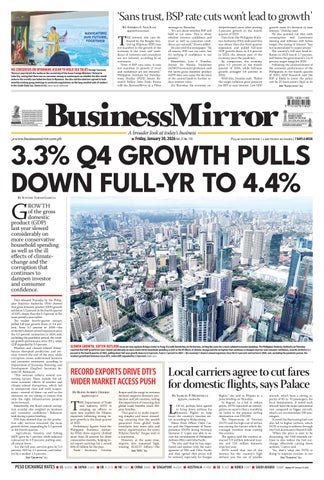
of the gross domestic product (GDP) last year slowed considerably on more conservative household spending as well as the ill effects of climatechange and the corruption that continues to dampen investor and consumer confidence.
Data released Thursday by the Philippine Statistics Authority (PSA) showed that gross domestic product (GDP) growth settled at 3.3 percent in the fourth quarter of 2025, slower than the 5.3 percent in the same period a year earlier.
The weaker fourth-quarter outturn pulled full-year growth down to 4.4 percent, from 5.7 percent in 2024—the economy’s slowest annual expansion since the 9.5-percent contraction in 2020, and, excluding the pandemic period, the weakest growth performance since 2011, when GDP expanded by 3.9 percent.
Weather and climate-related disturbances disrupted production and services toward the end of the year, while corruption issues undermined business and consumer sentiment, according to Department of Economy, Planning, and Development (DepDev) Secretary Arsenio M. Balisacan.
“This outcome reflects several converting factors. These include the adverse economic effects of weather and climate-related disruptions, which led to unexpected class and work suspensions—several of them—as well as the measures we are taking to ensure that only the right infrastructure projects move forward.
Admittedly, the flood control corruption scandal also weighed on business and consumer confidence,” Balisacan said during a press briefing.
PSA data showed that on the production side, services remained the main growth driver, expanding by 5.2 percent in the fourth quarter.
Agriculture, forestry, and fishing (AFF) grew by 1 percent, while industry contracted by 0.9 percent, pulling overall output lower.
For the full year, services grew by 5.9 percent, AFF by 3.1 percent, and industry by a modest 1.5 percent.
By Bless Aubrey Ogerio @blessogerio
THE Department of Trade and Industry (DTI) is ramping up efforts to open new markets for Filipino exporters following strong export growth in the final quarter of 2025.
Preliminary figures from the Philippine Statistics Authority (PSA) show exports climbed more than 20 percent for three consecutive months, helping total export earnings hit a record $84.41 billion for the year.
Trade Secretary Cristina
Roque said the surge in overseas demand supports domestic production and job creation, noting the importance of ensuring that global trade benefits reach Filipino families.
“Our goal is to make exporting simpler and more rewarding, ensuring that the wealth generated from global trade translates into more jobs and better opportunities for every Filipino family,” Roque said in a statement. However, at the same time, imports also remained high, totaling $133.57 billion—the
By Samuel P. Medenilla @sam_medenilla
LOCAL airlines have agreed to bring down airfares for domestic flights to help boost the country’s tourism sector, according to Malacañang.
Palace Press Officer Claire Cas-
tro said the Department of Transportation (DOTr) Acting Secretary Giovanni Z. Lopez was able to secure the commitment of Philippine Airlines (PAL) and Cebu Pacific.
“He also said that he has negotiated and spoken with the management of PAL and Cebu Pacific and they agreed that prices will be reduced, especially for Siargao
flights,” she said in Filipino in a press briefing on Thursday.
In August, in a bid to reduce prices, DOTr launched an investigation on reports that a roundtrip air ticket to the popular surfing destination cost P30,000.
The Department of Tourism (DOT) said the high cost of airfare was among the factors which discouraged travelers from visiting the country.
The agency said the country attracted 5.9 million inbound tourists and 134 million domestic trips last year.
DOTr noted that one of the reasons for the country’s high airfares was the use of smaller
aircraft, which have a sitting capacity of 60 to 70 passengers, for local destinations. It noted such aircraft have the same operational cost compared to bigger aircraft, which can accommodate 200 passengers. It noted the fluctuating fuel cost also led to higher airfares, which DOTr is trying to address through the Civil Aeronautics Board (CAB). “When the price is seen to be decreasing, the CAB reminds airlines to also reduce the fuel surcharge, effectively cutting down airfares,” Castro said. “So, that’s what the DOTr is doing to improve tourism in our
By Justine Xyrah Garcia
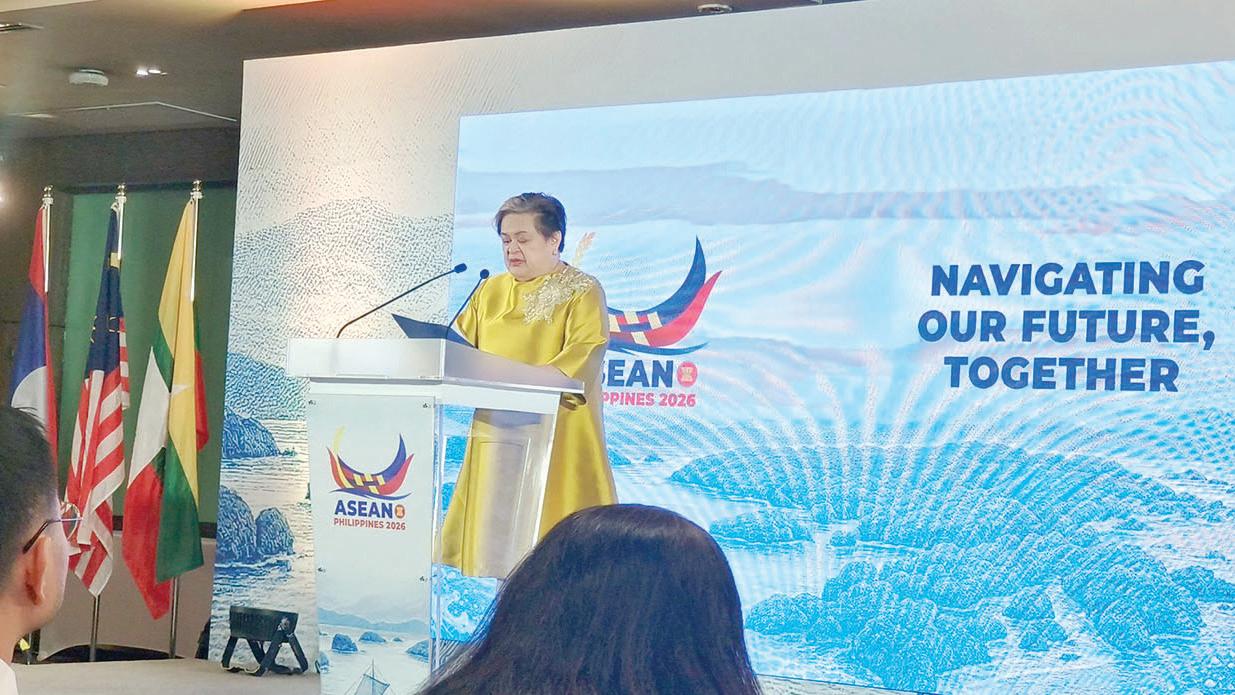
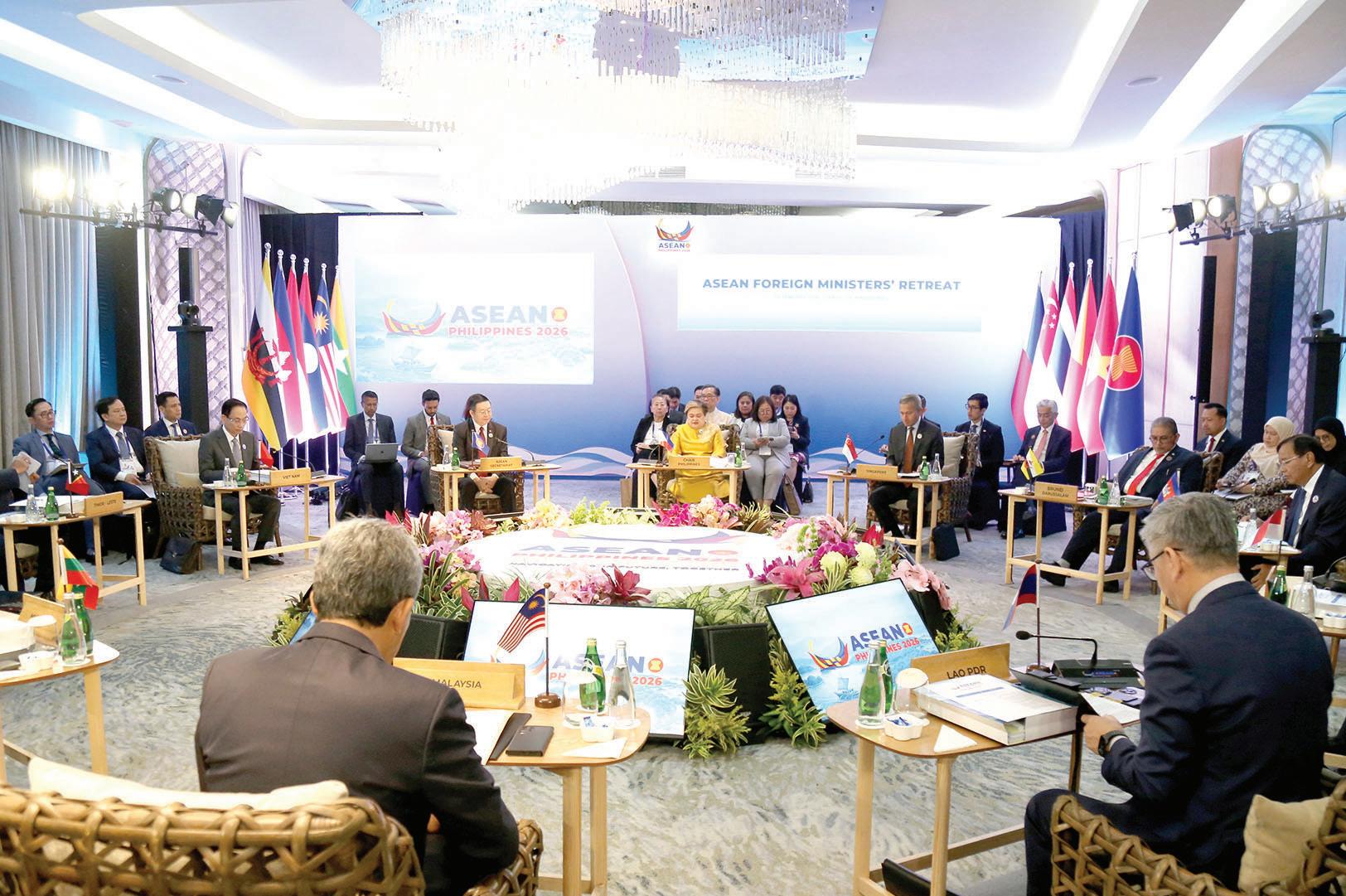
NO CONSENSUS ON MYANMAR, ASEAN TO HOLD SEA TALKS Foreign Secretary
Theresa Lazaro briefs the media on the second day of the Asean Foreign Ministers’ Retreat in Cebu City, noting that there was no
Rate
February meeting amid “slowing activity and muted inflation pressure.”
Economists told this newspaper earlier this week that the BSP could deliver two more rate cuts this year to support growth.
Rivera explained that if a rate cut pushes through in February, “it would help lower borrowing costs, support credit, housing, and business activity, with effects typically felt over 2-3 quarters rather than immediately.”
The PIDS senior research fellow also noted that borrowers, firms with expansion plans, micro, small and medium enterprises (MSMEs) and “interest-sensitive” sectors like construction and consumer durables would benefit from a rate cut.
On the flipside, Rivera said: “Losers could be savers facing lower deposit returns, banks if margins compress, and the PHP if rate differentials widen though the BSP will balance growth support against forex and inflation risks.”
In an interview last week with reporters, BSP Governor Eli M. Remolona Jr. said a cut is still uncertain.
“Even that cut…that’s still a maybe,” Remolona told reporters on the sidelines of the recent Annual Reception for the Banking Community.
Asked if a weaker-than-expected fourth-quarter economic performance would warrant a reduction in interest rates, Remolona said: “It would help us decide to cut.”
Remolona said, however, that the gross domestic product (GDP) data is not the only factor that would prompt another interest rate cut.
Meat imports surge to over 1.6 MMT, an all-time high
By Ada Pelonia @adapelonia
THEcountry’s meat imports surged to over 1.6 million metric tons (MMT) in 2025, a new all-time high, based on latest government data.
Data from the Bureau of Animal Industry (BAI) showed that the Philippines imported 1.64 MMT of meat shipments last year, up by some 13 percent from the 1.45 MMT in 2024.
Pork imports grew by 16 percent to 851,760 metric tons (MT) in 2025 from 733,729 MT in the previous year.
BAI data showed that a chunk of the imports were pork cuts and offals at 358,880 MT and 267,744 MT, respectively.
The country is still grappling with the persisting effects of African swine fever (ASF) on the domestic swine sector.
The deadly swine disease crimped local output since it was detected in 2019, tightening supply and jacking up retail pork prices to a high of P400 per kilo.
This development prompted the government to issue a raft of inter -
3.3% Q4 growth pulls down…
Continued from A1
Softer spending HOUSEHOLD final consumption
expenditure (HFCE)—long considered the main driver of domestic demand—grew by around 4.6 percent in
ventions last year, including the imposition of a maximum suggested retail price (MSRP).
BAI data also showed that chicken shipments rose by 14.47 percent to 540,522 MT last year from 472,211 MT in 2024.
Mechanically deboned meat (MDM) consisted of the bulk of shipments at 288,326 MT, with chicken leg quarter trailing behind at 143,923 MT.
Beef imports also recorded a year-on-year uptick by 1.74 percent to 207,436 MT from 203,898 MT, the bulk of which consisted of beef cuts at 133,716 MT.
Other meat shipments, such those from buffalo and lamb, also posted annual increases by some 12 percent to 42,503 MT and 734 MT, respectively.
BAI data also showed a notable
2025, continuing a deceleration from 4.9 percent in 2024, 5.5 percent in 2023, and 8.3 percent in 2022.
Other major expenditure items, meanwhile, posted gains, with the government final consumption expenditure expanding by 9.1 percent, and imports of services rising by 6.1 percent.
The government had earlier expected growth to pick up in the fourth quarter on the back of stronger holiday spending and improved sentiment, but that rebound failed to materialize.
Philippine Institute for Development Studies (PIDS) Senior Research Fellow John Paolo R. Rivera said weak consumer confidence remained a key constraint, as many households remained unsure about the stability of their jobs and incomes.
“Employment and income may not be stable so consumers are being very cautious. We have seen how erratic employment figures are recently,” Rivera told the BusinessMirror Rivera added that the slowdown cannot be fully explained by corruption and climate issues alone.
He said growth was also weighed down by delays and underspending in public programs, weaker construction and investment momentum, tight financial conditions, and softer external demand, which together reduced the economy’s usual buffers.
“The drag became larger because of policy implementation bottlenecks and an investment slowdown, not just weather and sentiment,” he added.
These pressures were evident in investment data. Gross capital formation plunged by 10.9 percent in the fourth quarter, resulting in a 2.1-percent contraction for the full year, making investment one of the biggest drags on growth.
For De La Salle University (DLSU) economist Ma. Ella Calaor-Oplas, beyond climate shocks and governance issues, long-standing structural barriers continue to discourage investment, including relatively high labor and wage costs compared with neighboring countries.
“Let us not forget that we have
surge in duck shipments, growing by threefold or 212 percent to 692 MT, from 221 MT in 2024.
Brazil remained the country’s top supplier of pork (338,878 MT), chicken (248,266 MT), and beef (92,050 MT) in 2025. The Brazilian Association of Animal Protein (ABPA) recently said that the Philippines was its leading export market for pork products last year.
“There has been a significant shift in the landscape of export destinations,” ABPA President Ricardo Santin was quoted in the statement as saying.
“The Philippines has consolidated its position as the largest importer of Brazilian pork, and other markets, such as Japan and Chile, have taken center stage among the top five importers,” he added.
structural barriers that discourage investments. Our salaries and wages are expensive relative to our neighboring countries,” Oplas told this newspaper.
Constraints FORMER Socioeconomic Planning Secretary Dante B. Canlas said corruption and climate change remain critical in hindering the economy’s “basic growth drivers, particularly investment, both domestic and foreign.”
He added that other major constraints include rising global trade barriers, as well as domestic policies governing key utilities such as electricity and water, which continue to weigh on competitiveness.
Canlas said the national government must pursue deficit reduction responsibly, while protecting budget allocations for basic needs.
“In addition, the national government must in the aggregate put in place a responsible deficit-reduction program. As the budget deficit is reduced, the government must protect budget allocations in education, health, and infrastructure, particularly in narrowing unmet needs in housing and shelter, and transport,” Canlas told the BusinessMirror Balisacan earlier said the slowdown in construction was “a very deliberate action,” stressing that the government opted to rein in spending rather than risk waste and misuse of public funds, with the goal of ensuring that public resources are directed toward projects that genuinely improve services and social protection.
Despite the weaker 2025 outturn, economic managers remain cautiously optimistic. Balisacan said the economy could return to a 5-percent growth pace, provided momentum improves by the second quarter.
Earlier, the Development Budget Coordination Committee (DBCC) lowered the country’s 2026 GDP growth target to 5 to 6 percent, from the earlier 6 to 7 percent. The panel now expects growth of 5.5 to 6.5 percent in 2027, while retaining its 6 to 7 percent forecast for 2028.
Ateneo de Manila University (ADMU) economist Ser Percival Peña-Reyes said hitting the 5-percent mark remains possible, but warned that governance reforms will be crucial.
“Someone should be locked up, a big fish or whoever is the mastermind behind all of this,” he told this newspaper.
Earlier this week, the DepDev said 2026 is a “rally point” for the government to meet its Philippine Development Plan (PDP) 2023–2028 targets.
n Security risks: Cross‑border crime, traffick ing, and instability threaten regional stability.
n Geopolitical competition: China’s deep engagement with Myanmar complicates Asean’s diplomacy, raising fears of external powers filling the vacuum.
n Unity vs. non‑interference: The crisis expos es Asean’s struggle to balance its founding prin ciple of non‑interference with mounting pressure to act decisively.
Visit to Naypyidaw LAZARO also addressed criticism of her recent visit to Naypyidaw early this month, which some feared conferred legitimacy on the junta. She countered that the trip was part of her mandate as Asean’s special envoy under the 5PC. “I do not know how to discuss this issue if I haven’t talked to the military junta,” she argued. To balance engagement, Lazaro highlighted the stakeholders’ meeting she had with groups opposing the regime in Tagaytay City. For now, Myanmar’s junta leaders and high level ministers remain barred from Asean sum mits and ministerial meetings—a decision only leaders can amend. Meanwhile, Asean has agreed to establish a long‑term special envoy position to ensure sus tained engagement with the crisis. Malou Talosig‑Bartolome
country when it comes to the issue of airfare,” she added.
Castro said Marcos is optimistic the country can raise domestic tourism through the ongoing Travel Exchange (TRAVEX) 2026 in Cebu.
The event features around 346 exhibitors from the Philippines and other Association of Southeast Asian Nations.
“Its goal is to connect Asean destinations and the global market,” Castro said.
“From January 28 to 30, tourism enterprises, tour operators, destination makers and buyers from Asean will come together to negotiate, build relationships and discuss the future of tourism in Asean,” she added. In a related development, Castro also maintained that the DOT Secretary Christina G. Frasco still enjoys the trust of the President.
The Palace issued the statement amid reports that Frasco was already on her way out of the Cabinet after her controversial magazine cover shoot.
The magazine, which prominently featured pictures of Frasco, was supposed to promote the country’s local tourist spots and the Philippine Pavilion at the Osaka Expo 2025. DOT drew flak for the incident.
“She still enjoys the trust of the President,” Castro said.
second-largest on record after 2022’s $137.22 billion. (See: https://businessmirror.com.ph/2026/01/28/ record-exports-high-import-bill/)
This resulted in a trade deficit of $49.17 billion, narrower than the $54.33 billion gap in 2024. China remained the top supplier at $38.22 billion, while the United States was the leading destination for the country’s exports at $13.44 billion.
Sustaining export momentum will require vigilance amid global trade uncertainties, including potential tariffs on specialty electronics and other key products, the DTI cautioned.
To bolster competitiveness, the department plans to expand market access initiatives, improve ease-ofdoing-business measures and provide exporters with targeted support to navigate shifting international trade conditions.
These efforts are aimed at maintaining the country’s export growth trajectory and setting the stage for a strong year in 2026.
Empowering Ombudsman among Blue Ribbon recommendations in flood-control probe report
PBy Butch Fernandez @butchfBM
ROPOSED legislation
to strengthen the fight against corruption by empowering the Office of the Ombudsman will be among the partial recommendations of the Senate Blue-Ribbon Committee following its findings on the flood-control project mess, Senate President Pro Tempore and Blue-Ribbon committee Chairman Panfilo M. Lacson said on Thursday.
search warrants and follow up the investigation of corruptionrelated cases.
Lacson said the recommendations include: Allowing the undermanned Office of the Ombudsman to deputize private lawyers as prosecutors, and giving it a law enforcement arm to apply for
“One recommendation is based on the suggestion of former Senate President Franklin Drilon to allow the Ombudsman to deputize private lawyers to help in prosecuting cases, because the Office of the Ombudsman is very undermanned. If
we allow it to deputize private lawyers to act as prosecutors by way of legislation, that would be a good measure,” he said in English and Filipino in a radio interview.
Lacson said a second recommendation involves a small dedicated law enforcement arm for the Ombudsman, which presently relies on help from other agencies
House leader defends handling of impeachment cases vs FMJr
ALEADER of the House of Representatives on Thursday dismissed claims that impeachment efforts against President Marcos are being blocked, saying the real issue is the failure of complainants to secure a House member to endorse their complaint.
Lanao del Sur Rep. Zia Alonto Adiong said allegations raised by lawyer Ferdinand Topacio and former defeated Quezon City mayoral bet Michael Defensor are misleading and unsupported by facts, stressing that the impeachment process is not being obstructed but simply not being complied with.
The two attempted to file a third impeachment complaint but were unsuccessful.
“The problem is straightforward: there is no House member endorser,” Adiong said. “Without an endorser, the complaint cannot move. That is what the rules clearly provide.”
He emphasized that no official is preventing the filing of an impeachment case, noting that complainants are free to proceed as long as they meet the basic constitutional and House requirements.
“This is not about being stopped or blocked,” Adiong said. “It’s about meeting a basic requirement. The absence of an endorser is the main issue.”
Adiong’s remarks echoed earlier statements by the House Committee on Justice chairperson, Batangas Rep. Gerville R. Luistro, who explained that impeachment complaints filed by private individuals will not be transmitted to the Office of the Speaker unless endorsed by a member of the House.
Luistro noted that impeachment complaints may be initiated either by a private individual endorsed by a House member or through the signature and verification of at least one-third of all House members. Complaints that fail to meet either requirement
do not enter the formal House process.
Adiong also said these rules have long been in place to ensure order and fairness in impeachment proceedings.
He added that once a complaint is properly endorsed and transmitted to the Speaker, the House follows a defined timetable, starting with referral to the Committee on Justice and a review of its sufficiency in form and substance.
“This is a constitutional process,” Adiong said. “If they are serious, they should follow the rules so the public is not misled.”
like the National Police (PNP) and National Bureau of Investigation (NBI).
Law enforcement arm
“THE Office of the Ombudsman should have its own law enforcement arm. Even if it is small, it should be dedicated, to allow it to apply for search warrants and conduct follow-up investigations of corruption-related cases,” he said. Lacson said the partial recommendations are in line with the Blue-Ribbon panel’s main task to conduct hearings in aid of legislation, adding many pieces of evidence stemming from its hearings were used by the Department of Justice, Office of the Ombudsman,
See “Blue Ribbon,” A4
Marcos appoints Perez to PhilSA
PRESIDENT Marcos has appointed Gay Jane P. Perez as the Director General of the Philippine Space Agency (PhilSA).
Perez previously served as the agency’s officer in charge beginning September 2025. Prior to this, she held the position of Deputy Director General for Space Science and Technology (DDGSST) from 2021, bringing with her extensive experience in space science, research and development, and institutional leadership.
Before joining PhilSA, Perez led the science team behind the development of the Philippines’ first microsatellites, Diwata-1 and Diwata-2.
These landmark missions laid the groundwork for subsequent space technology initiatives, including the ongoing development of the Multispectral Unit for Land Assessment (Mula) satellite. A recipient of the 2021 National Academy of Science and Technology (NAST) Outstanding Young Scientist award and the 2019 The Outstanding Women in the Nation’s Service (TOWNS) award, Perez is also the first Filipino awardee of the Association of Southeast Asian Nations (Asean)-US Science Prize for Women.
See “PhilSA,” A4
Jovee Marie N. dela Cruz
Hybrid work uptake underpins IWG’s 6 new PHL office sites
THE growing adoption of hybrid work arrangements among Philippine companies is reshaping demand for office space, with hybrid work solutions provider International Workplace Group (IWG) set to open six new flexible workspace locations across the country in the first quarter of 2026.
The new sites—spread across Quezon City, Makati, San Juan, Cebu City, and Lapu-Lapu City—form part of IWG’s plan to launch 29 centers nationwide this year.
If completed as scheduled, the expansion would bring the company’s Philippine network to 76 locations by the end of 2026. The facilities will operate under the Regus, Spaces, and HQ brands.
The expansion comes after property consultancy firm Colliers earlier found that 82 percent of organizations in the Philippines have adopted hybrid work models, while 32 percent are planning workplace upgrades next year. Colliers also projects that flexible workspaces could account for about 30 percent of global commercial real estate by 2030.
IWG said the upcoming locations are part of a broader shift toward decentralized office setups, with workspaces located closer to
residential areas rather than concentrated solely in central business districts.
In addition to the six centers scheduled to open next year, the company has signed more than 100 locations across the Philippines to date, including in Novaliches, Imus in Cavite, Marikina, Caloocan, and Panglao in Bohol.
“We are expanding our presence across the Philippines at a time when flexible working is becoming the default model for companies of all sizes,” said Marc Descrozaille, chief executive officer for the Middle East, Africa, and Asia Pacific at IWG.
“Our model not only supports better work-life balance and improves employee satisfaction, but also helps businesses boost productivity, scale efficiently, and manage costs, all while giving teams access to thousands of professional locations around the world,” he added.
Globally, IWG operates more than 5,000 locations in 121 countries. The company said it signed and opened more sites in the first half of 2025 than during its first decade of operations, as flexible office arrangements continue to gain traction among businesses adjusting to post-pandemic work patterns. Justine Xyrah Garcia
Ciac, BCDA show Clark investment opportunities to Japanese investors
EW CLARK CITY, Tarlac—
NThe Bases Conversion and Development Authority (BCDA) and its subsidiaries, including the Clark International Airport Corporation (Ciac), presented current and upcoming projects to Japanese companies during the BCDA-Japan Bank for International Cooperation (Jbic) Project Pitching event held at the Athletics Stadium here.
The project pitching event was also attended by representatives from the Clark Development Corporation (CDC), the John Hay Management Corporation (JHMC), and the Poro Point Management Corporation (PPMC).
“Ciac is in full support of the BCDA’s efforts to strengthen collaboration with Japanese companies, facilitate partnerships, and identify viable investment opportunities within the Clark Aviation Capital. Our goal is to create business opportunities that will generate jobs and improve the quality of life of Filipinos,” CIAC President and Chief Executive Officer Jojit Alcazar said.
The Japanese companies that attended the event specialize in various businesses such as water and wastewater treatment, infrastructure, industrial park development, information technology for public safety and
TRecto, Pangilinan align on measures to address sugar industry woes
By Butch Fernandez @butchfBM
URGENT challenges are confronting sugar farmers, mill workers, and consumers, prompting the Palace and the chief of the Senate’s agriculture panel to jointly outline key policy recommendations to stabilize the sector.
Meeting with Executive Secretary Ralph Recto on Wednesday, Sen. Francis Pangilinan presented a situationer on the country’s sugar industry to highlight the daunting challenges and issues.
Pangilinan, chairman of the Senate Committee on Agriculture, Food, and Agrarian Reform, raised problems of high production costs, declining farm incomes, supply volatility, and the long-term impact of importation policies on local producers.
smart transportation, energy and energy transition, agriculture, and Public-Private Partnerships (PPP).
The project pitching event follows the recently signed memorandum of understanding between BCDA and Jbic which aims to strengthen cooperation in promoting BCDA projects and programs, particularly those advancing energy transition, environmental and social sustainability, and quality infrastructure across sectors.
Jbic, a Japanese government financial institution, promotes Japan’s overseas strategic initiatives, focusing on green growth and addressing social challenges.
On behalf of Ciac, Chief Business Development Officer Melissa Feliciano presented the corporation’s flagship projects, highlighting investment-ready opportunities for the Clark National Food Hub, the Urban Renewal and Heritage Conservation Program, the Clark International Aviation Campus, and the Clark Pharmaceutical Hub.
Ciac is the BCDA’s premier aviation and land development arm committed to transforming the Clark Civil Aviation Complex into the Clark Aviation Capital, a vibrant business and logistics hub poised to become the country’s leading global aviation center.
learn to use TikTok
AYTAY, Rizal — More than 100 micro, small and medium enterprises from Rizal province participated in “Unlad Lokal: Start Your TikTok Shop Journey Today,” a free seminar held at the Rizal Provincial Civic Center, Taytay.
The activity was initiated by the local government of Taytay in partnership with the Department of Trade and Industry-Rizal, with TikTok Shop Philippines as the main resource speaker.
The seminar aimed to complement existing online selling platforms of MSMEs, highlighting its potential to increase revenue through effective social commerce strategies.
Participants took part in interactive sessions covering Introduction to TikTok Shop, Seller Center Navigation, TikTok Shop Affiliates, Livestreaming and Content Creation, and TikTok Ads, enabling them to strengthen digital presence, enhance customer engagement, and improve sales performance. To ensure a seamless and hands-on learning experience, internet connectivity was provided on-site to participants, powered by Converge for SMEs, allowing MSMEs to actively explore the Seller Center and digital tools discussed during the seminar.
“Our sugar industry must now have a transparent and balanced policy and strategy that seeks to protect not just the industry, but those who toil day to day and sacrifice to sustain the sector—our farmers,” he said.
“We must ensure that solutions are fair, evidence-based,
and responsive to the realities on the ground,” he added.
In the recently held public consultation with the House of Representatives and sugar planters in Talisay City, Negros Occidental, Pangilinan bid to identify the challenges that plague the multibillion-peso industry, pointed out the massive impact of the sugar industry on the country’s economy and the livelihood of farmers and other industry stakeholders.
“The sugar industry supports hundreds of thousands of Filipino families. Any policy decision must take into account its effect on farmers’ livelihoods, food security, and rural development,” he explained. “This situationer is meant to provide a clear picture of where the industry stands and what immediate and long-term
actions are needed.”
Recto assured the senator that the sugar industry is one of the priorities of President Marcos and that the concerns raised would be reviewed and elevated to the appropriate offices for policy consideration as part of the administration’s broader effort to craft responsive interventions for the sector.
Recto also stressed the importance of close coordination between the executive and legislative branches, as well as continuous dialogue with farmers, millers, and other stakeholders.
Pangilinan vowed to continue working with the executive branch, as well as across political party lines, to pursue reforms that will lead to a more resilient, competitive, and sustainable sugar industry.
Based on Sugar Regulatory Administration (SRA) Reports as of January 2026, the number of operating raw sugar mills declined from 28 in 2018 to 25 in 2025, with 13 mills located primarily on Negros Island. Sugar refineries also dropped from 13 to 10 over the same period, with only five refineries capable of producing premium-grade refined sugar.
The senator also lamented the decline in farmgate prices, with the per-bag of sugar dropping to P2,150 to P2,300 last year. The current production cost is P2,500 per 50-kilogram bag.
With Samuel P. Medenilla
Continued from A3
She was recognized for her groundbreaking research using satellite data to forecast droughts and enhance agricultural productivity. Her contributions have also been acknowledged by the Senate through Resolution 923 of the 17th Congress, underscoring the global excellence of Filipino scientists.
Most recently, Perez represented the Philippines in key international space initiatives, including collaborative agreement with the Indian Space Research Organization (Isro), the United Nations Space4Ocean initiative, and the Artemis Accords, which promote the safe, transparent, and sustainable civil exploration of the Moon, Mars, and other celestial bodies.
Perez earned her doctorate in Physics from the University of the Philippines Diliman and completed her postdoctoral research at the US National Aeronatical and Space Administration’s (Nasa) Goddard Space Flight Center, where she specialized in remote sensing and satellite data applications.
As Director General, Perez will further advance the Philippines’ Yamang Kalawakan by strengthening the national space ecosystem, advancing research and innovation, and the expanding partnerships in support of an inclusive and sustainable national space program.
The Director General of PhilSA holds the rank of a Cabinet Secretary and serves as the Presidential Adviser on Space Matters.
“Yamang Kalawakan” refers to the emergent Philippine space ecosystem and embodies the people, institutions, infrastructure, policies, and environment that enable the country to take advantage of the wealth of opportunities in the global space economy. It conveys the importance of outer space as a precious domain and seedbed of innovation that now increasingly contributes to the progress, security, and prosperity of nations.
PIDS: 3 in 10 families vulnerable to poverty
By Justine Xyrah Garcia
DESPITE declining official poverty figures, state think tank Philippine Institute for Development Studies (PIDS) on Wednesday found that about three in 10 households still faced a high risk of falling into poverty in 2023.
The new study showed that while household poverty incidence stood at 10.9 percent, the share of households classified as vulnerable to income poverty reached 30 percent, or about 2.75 times the number of poor households.
According to PIDS, vulnerability refers to the probability that a household will become incomepoor owing to income volatility or persistently low earnings, even if it is not currently poor.
“The vulnerability estimates support the often-stated claim that the poverty statistics underestimates the proportion of the population that is vulnerable to poverty. Indeed here we find that there are households whose probability of poverty may be high who are nevertheless observed to be non-poor,” it noted.
Continued from A3
and the Independent Commission for Infrastructure in filing information before the courts.
Also, he said the Blue-Ribbon committee is almost finished working on its partial committee report. After the partial committee report is presented to the Senate plenary, he said it may hold one to two more hearings to wrap up the investigation.
The state think tank said about 86 percent of vulnerable households were exposed mainly to income volatility, while 73 percent of highly vulnerable households suffered from persistently low incomes, placing them close to or below the poverty line even in the absence of major shocks.
Vulnerability remained markedly higher in rural areas, where incidence reached 43 percent, more than double the 20 percent recorded in urban areas.
Regional disparities were also pronounced, with vulnerability ranging from 9 percent in the National Capital Region (NCR) to as high as 76 percent in rural areas of the Bangsamoro Autonomous Region in Muslim Mindanao (BARMM).
Despite having the lowest poverty incidence, NCR stood out for a different reason.
PIDS found that Metro Manila recorded the highest vulnerability-to-poverty ratio at 7.9.
While poverty incidence in NCR was just 1.1 percent in 2023, the vulnerability rate stood at 9 percent.
PIDS said this contrast high -
Evidence based HE said that he is “very confident” that the Blue-Ribbon panel’s eventual committee report will be solid because it is “evidence-based.”
“The committee report’s contents are based on evidence,” he said.
Lacson also said the subpoenae issued by the DOJ against personalities, including former Public Works Secretary Manuel Bonoan and Sen. Jinggoy Estrada, will not affect the Blue Ribbon panel’s investigation.
lights the limits of using poverty rates as the sole indicator of welfare, particularly in urbanized regions where households may earn above the poverty line but remain highly exposed to labor market and economic shocks.
Social protection gaps
THE state think tank said these findings raise questions about the adequacy of existing social protection systems as the Philippines moves toward upper-middle-income country (Umic) status and its goal of becoming a predominantly middle-class society by 2040.
Based on international comparison, the country’s effective social protection coverage rate— measured as the share of the population receiving at least one social protection benefit excluding health—stood at 34.9 percent in 2022.
This was significantly lower than coverage levels in Thailand (70.1 percent), Indonesia (54.3 percent) and Singapore (100 percent), and well below the 71.2 percent average among Umics.
Labor-related protection remains particularly weak. Only 5.6
“What is more important to our committee report is the aspect of the probe in aid of legislation. The recommended pieces of legislation aim to correct our current system as part of our oversight mandate, to correct weaknesses in our current laws and strengthen our fight against corruption,” he said.
Co’s whereabouts
LACSON said it is up to the Executive department to follow up on information that former Partylist Rep. Elizaldy Co of Ako Bicol
percent of unemployed Filipinos were covered by social protection programs, compared with 62.8 percent in Thailand, 59.2 percent in Vietnam, and 10.4 percent in Malaysia.
Pension coverage was also limited, with just 33.4 percent of the labor force actively contributing to a pension scheme, leaving about two-thirds of workers without retirement security.
In terms of financing, the Philippine government spent 2.7 percent of gross domestic product (GDP) on social protection excluding health care in 2022, lower than Thailand’s 4.9 percent and Vietnam’s 5.1 percent, and far below the 8.5 percent average among Umics.
The Philippines’ health spending was also relatively low at 2.3 percent of GDP, compared with 3.6 percent in Thailand and 3.5 percent in Singapore.
“The vision of a predominantly middle-class Philippines by 2040 remains achievable but requires sustained commitment to policies that promote inclusive growth, reduce vulnerability and build resilience,” PIDS said.
“emerged” in Stockholm, Sweden, at least on January 15, based on a petition filed with the Supreme Court. But he said the document does not automatically mean Co is staying in Sweden, adding it might even be meant to throw off investigators and trackers.
“A document indicating he was in Sweden does not automatically mean he is staying there. He could be on the move. It could even be meant to confuse those following him,” he said.
Rizal MSMEs
No massive reshuffle in PNP–Nartatez
By Rex Anthony Naval
THE newly-promoted National Po -
lice (PNP) chief, Gen. Jose Melencio
Nartatez Jr., on Thursday said he will not institute an organization-wide reshuffle following his elevation as the service’s highest police officer on Wednesday.
Nartatez, who PNP’s 32nd chief, said stability will be maintained within the organization.
Customs
“There will be no abrupt or sweeping reshuffle. Any movement will be orderly, well-planned, and based on organizational needs,” he added.
Nartatez said existing anti-crime and community safety directives remain in place.
He also noted that continuity will be ensured in key operational units handling major crime, counterterrorism, and internal security.
“Leadership movement in the PNP is a normal process. Promotions, retirements, and operational requirements naturally result in adjustments. What’s important is that our work continues without disruption,” Nartatez stressed.
He also called on all senior officers and rank-and-file personnel to remain focused on their mandates, stressing that discipline, professionalism, and service to the people remain the core priorities of the PNP under
his leadership.
“Regardless of assignment, our duty to serve and protect remains the same. Performance, integrity, and the needs of the service will always be the basis. We are focused on ensuring the right people are in the right positions,” he said.
Nartatez took his oath before President Marcos Jr. in Malacañang on Wednesday.
Nartatez assumed command of the police forces in August last year following
seizes ₧43-M cocaine from arriving passenger at Naia
By Reine Juvierre S. Alberto @reine_alberto
HE Bureau of Customs (BOC) in -
Ttercepted more than P43 million worth of cocaine from an arriving passenger at the Ninoy Aquino International Airport (Naia) Terminal 3 and shut down an alleged illegal cigarette factory in Pampanga.
In a statement, the BOC said authorities seized 8.194 kilograms of cocaine, estimated at P43.43 million, hidden in a passenger’s checked-in baggage on January 22.
The luggage was immediately subjected to a 100-percent physical examination after suspicious images were detected during X-ray screening.
Field testing conducted in coordination with the Philippine Drug Enforcement Agency (Pdea) and the Naia Inter-Agency Drug Interdiction Task Group yielded positive results for cocaine.
The illegal drugs were turned over
to Pdea for confirmatory laboratory examination, proper disposition and further investigation.
The passenger faces charges for violations of Republic Act 9165, or the Comprehensive Dangerous Drugs Act of 2002, as amended, and Republic Act 10863, or the Customs Modernization and Tariff Act.
“This interception highlights the critical role of alert inspection and inter-agency coordination in preventing illegal drugs from entering the country,” Customs Commissioner Ariel F. Nepomuceno was quoted in the statement as saying.
“This operation reflects the dedication of our frontliners in conducting thorough examinations and ensuring that our airports are not exploited by drug traffickers,” BOC-Naia District Collector Yasmin O. Mapa added. Meanwhile, the BOC conducted a separate joint enforcement operation against an alleged illegal cigarette manufacturing facility in Mexico, Pampanga on January 28.
The operation targeted a warehouse in barangay Panipuan that authorities said was being used for unauthorized local production of cigarettes without valid permits.
Inventory and valuation of the seized cigarettes, raw materials, and equipment are ongoing to determine potential duties, taxes, penalties, and possible violations of customs, tax, immigration and other related laws.
Discovered at the site were allegedly locally manufactured cigarettes branded “Two Moon,” along with cigarette-making machines and manufacturing paraphernalia bearing the brands Mighty, H&P, Playboy and Carnival.
The BOC said that these brands are the same as those that have been seized in a recent operation in Batangas, which indicates a possible link in the distribution and supply chain of illicit cigarettes under investigation.
Authorities also found cigarette-making machines and raw materials suspected to
be smuggled, as these were not covered by import permits or proper customs documentation.
There were also tax stamps found within the compound, and now being verified by the Bureau of Internal Revenue to determine their authenticity and compliance with excise tax laws.
Individuals found inside the premises included six Chinese nationals, 52 Filipino men and 11 Filipino women.
The BOC said it is coordinating with the Bureau of Immigration to verify the legal status of the foreign nationals.
“Illicit cigarette manufacturing undermines legitimate businesses, deprives the government of much-needed revenues, and poses serious risks to public health. In line with the President’s directive, the Bureau of Customs will relentlessly pursue those involved in smuggling and illegal manufacturing through sustained enforcement and close coordination with our partner agencies,” Nepomuceno said.
the removal of Gen. Nicolas Torre, who attempted to reshuffle members of the PNP command group without clearance from the National Police Commission chaired by Interior Secretary Juan Victor Remulla. He could not immediately be promoted as Torre held the four star rank and was still considered still in the active service though on leave.
During the Estrada administration, Lt. Gen. Roberto Lastimoso, the first PNP chief
Sanitation inspectors to get fair shake in Lacson bill
THEY are not even considered frontliners, but they are the unsung “foot soldiers” of the Department of Health with an indispensable role: safeguard public health at the community level.
Overlooked for years, they may soon get long-overdue improvements in benefits and working conditions, if a bill filed by Senate President Pro Tempore Panfilo Lacson were to be passed.
Lacson’s Senate Bill 1725 seeks to positively augment and improve the compensation of sanitation inspectors by modifying their salary grade schedule.
“This bill aims to professionalize the health and sanitary-related services rendered by sanitation inspectors by requiring the registration and accreditation of the sanitation inspectors to ensure the healthcare and welfare of the community,” he said in his bill titled “An Act Modifying the Salary Grade Schedule and Enhancing the Benefits of Sanitation Inspectors,
Protecting their General Working Conditions, and Appropriating Funds Therefor.” The bill, Lacson added, “further intends to positively augment and improve the basic monetary compensation of sanitation inspectors by modifying the salary grade schedule for all registered sanitation inspectors nationwide and correlating the existing position titles of SIs to the next higher salary grade.” Sanitary inspectors have the duty to enter premises involved in the manufacture, preparation or packing of any food for sale, the senator noted.
And yet, a 2021 joint press statement of the Department of Health, World Health Organization and United Nations Children’s Fund showed that the 2,700 sanitation inspectors in the country were unevenly distributed, with 68 percent of cities in the country having fewer SIs than required. The
See “Lacson,” A9
Embodying the ‘Sidlak’ spirit | BingoPlus brings entertainment, prizes, and donations at Sinulog 2026
The country’s leading digital entertainment and gaming platform added more cheer to the Sinulog festivities through a mall show and two-day musical extravaganza.
By Vincent Peter Rivera
AS the Philippines rings in the new year, the nation gathers for one of its most storied traditions: the Sinulog Festival. Held every third Sunday of January, the 2026 festivities saw BingoPlus return to the “Queen City of the South” to take an active role in this long-held cultural milestone.
Marking its third year of participation, the country’s leading digital entertainment and gaming platform served as a co-presenter for the annual event, carrying the theme, “Sidlak” (light).
Sinulog is a profound tribute to the Sto. Niño (Child Jesus), the beloved patron of Cebu Province, serves as a cornerstone of Filipino faith.
Given the Philippines’ status as a predominantly Catholic nation, the festival has evolved into more than just a religious rite; it is a synergy of deep spiritual devotion and rich cultural heritage.
The heartbeat of the celebration remains the Sinulog Dance. Derived from the Cebuano word “sulog,” which means “like a water current,” the traditional dance captures the fluid and rhythmic flow of the water. This performance “symbolizes the transition of the Filipino people from their pagan roots to embracing Christianity,” according to sinulogfestival.com.
Driven by its mission to bring entertainment into the lives of Filipinos, BingoPlus elevated this year’s experience through a variety of interactive activities and prize giveaways, ensuring that the spirit of “fun” was felt by every devotee and traveler in attendance.
Sinulog Festival
2026 Mall Show
To build momentum for the main event, the digital entertainment
platform hosted the “BingoPlus Sidlak Sinulog: Sidlak sa Kalingawan Mall Show” at SM Seaside City Cebu from January 9 to 11.
The opening day kicked off with performances from influencers Althea Ablan and Choevy Walter alongside actor Tony Labrusca, who engaged the crowd with interactive games inspired by the BingoPlus GMA vertical series.
This innovative, short-form drama format features 40 bitesized episodes starring GMA Sparkle artists and is available for streaming exclusively on the BingoPlus app.
On the second day, the stage became even more star-studded with lead actresses—Andrea Torres, Roxie Smith, and Arra San Agustin—joining the stage while serenading performances from Patrick Quiroz and Seth Fedelin filled the rest of the day.
Musikalingawan sa Sinulog Kickoff
The main festivities reached a fever pitch on January 17 as BingoPlus launched the first day of “BingoPlus Musikalingawan sa Sinulog 2026” at Plaza Independencia, Cebu.
This two-day musical extravaganza showcased a blend of local pride and contemporary hits, headlining performances from local artist Kurt Fick, the band Oh Caraga, and the indie rock sounds of Hey June. R&B singer Justin Vasquez also brought soulful tracks on the first night of the concert.
Beyond the stage, festivalgoers, aged 21 and above, engaged with interactive booths at the venue, featuring games inspired by the BingoPlus GMA vertical series and the newest face of the brand’s sister platforms, Manny Pacquiao.
These activities, including Tropical Rush and Spin the Wheel, offered attendees the chance to win premium merchandise and essential home items like the 50inch Smart TV and a 4-burner gas range with oven, setting a high energy for the festival weekend.
BingoPlus at Sinulog Festival’s Pinnacle To begin the highlight day, the brand showcased its own vibrancy and identity during the Sinulog Grand Parade with its “electropical-themed” float. It was then followed by GMA’s Sanya Lopez, who delivered a performance of her song, “Hot Maria Clara,”
with Cebu’s own Kent Villarba delivering a groovy closing performance.
Another highlight of the night was the appearance of BingoPlus GMA vertical drama stars Andrea Torres, Michael Sager, and Harlene Budol, who delighted the audience with a lively “budots” dance. Amidst the music and the raffling of a brand-new motorcycle, the DigiPlus Foundation (formerly BingoPlus Foundation) distributed P1.5 million in recovery assistance to Cebuano families and students affected by the natural calamities last year.
For BingoPlus, its presence at the Sinulog Festival 2026 was not only about bringing fun and entertainment to every Cebuano and festivalgoers alike. By embodying its theme, “Sidlak,” the brand aims to be a ray of light that celebrates the enduring strength and heritage of the whole community.
Starmer and Xi call for deeper UK-China ties as Trump shakes up global relations
By Ken Moritsugu
The Associated Press
EIJING—The leaders of Brit -
Bain and China called Thursday for a “comprehensive strategic partnership” to deepen ties between their nations at a time of growing global uncertainty.
Neither publicly mentioned Donald Trump, but the American president’s challenges to the post-Cold War order was clearly on their minds.
“I think that working together on issues like climate change, global stability during challenging times for the world is precisely what we should be doing as we build this relationship in the way that I’ve described,” Starmer told Xi in his opening remarks.
The two met in the Great Hall of the People in central Beijing as their nations try to improve relations after several years of acrimony. Relations have deteriorated over allegations of Chinese spying in Great Britain, China’s support for Russia in the Ukraine war, and the crackdown on freedoms in Hong Kong, the former British colony that was returned to China in 1997. Starmer is the first British prime minister to visit in eight years.
“China-U.K. relations experienced setbacks in previous years, which was not in the interests of either country,” Xi said. “In the current complex and ever-changing international situation, ... China and the U.K. need to strengthen dialogue and cooperation to maintain world peace and stability.”
Xi also appeared to acknowledge the criticism that Starmer has faced for reaching out to China despite
national security and human rights concerns. The U.K. recently approved controversial plans for a huge Chinese Embassy in London, removing a sticking point in relations but also overriding fears that the “mega-embassy” would make it easier for China to conduct espionage and intimidate dissidents.
“Good things often come with difficulties,” Xi said. “As long as it is the right thing to do in accordance with the fundamental interests of the country and its people, leaders will not shy away from difficulties and will forge ahead bravely.”
Starmer, who became prime minister in July 2024, has said he would protect national security while keeping up diplomatic dialogue and economic cooperation with China. He told Xi that it has “been far too long” since a U.K. prime minister visited.
“I made a promise 18 months ago when we were elected into government, that I would make Britain face outward again,” the leader of the center-left Labour Party said. “Because as we all know, events abroad affect everything that happens back in our home countries, from prices on the supermarket shelves to how
secure we feel.”
His government has struggled to deliver the economic growth it promised and ease a cost-of-living crisis for millions of households.
More than 50 top business executives have joined him on the trip, along with the leaders of some cultural organizations, as he seeks to expand opportunities for British companies in China.
The disruption to global trade under Trump has made expanding trade and investment more imperative for many governments. Vietnam and the European Union upgraded ties to a comprehensive strategic partnership Thursday, two days after the EU and India announced a free trade accord.
“At a moment when the international rules-based order is under threat from multiple sides, we need to stand side by side as reliable and predictable partners,” European Council President Antonio Costa said in Hanoi, Vietnam.
Starmer is the fourth leader of a US ally to visit Beijing this month, following those of South Korea, Canada and Finland. The German chancellor is expected to visit next month.
China executes 11 from Myanmar syndicate over billion-dollar scam operations, murders
By Huizhong Wu The Associated Press
BANGKOK—China executed 11 members of a Myanmar-based family crime syndicate that killed 14 Chinese citizens and ran scam and gambling operations worth more than $1 billion, authorities said.
The Wenzhou city Intermediate People’s Court announced the execution in a statement Thursday morning. It sentenced the 11 people to death in September. They included Ming Guoping and Ming Zhenzhen, who the court found led the scam and gambling operations, as well as key group members Zhou Weichang, Wu Hongming and Luao Jianzhang. The group filed an appeal that was rejected by the court in November. The family members were detained in November 2023 when Chinese authorities exerted pressure on authorities in the border areas shared with Myanmar to crack down on scams. Scam parks have become an industrial scale business in Southeast Asia, especially Myanmar, Cambodia and Laos, where a mix of trafficked and willing labor have carried out digital scams on victims around the world. Authorities in the region face growing international pressure from China, the US and other nations to address the proliferation of criminal activity.
Editor: Angel R. Calso
IN this photo released by Xinhua News Agency, Myanmar police hand over five telecom and Internet fraud suspects to Chinese police at Yangon International Airport in Yangon, Myanmar, Aug. 26, 2023.
WASHINGTON—The Federal Reserve pushed the pause button on its interest rate cuts Wednesday, leaving its key rate unchanged at about 3.6% after lowering it three times last year.
Chair Jerome Powell said at a news conference after the central bank announced its decision that the economy’s outlook “has clearly improved since the last meeting” in December, a development that he noted should boost hiring over time. The Fed also said in a statement that there were signs the job market is stabilizing. With the economy growing at a healthy pace and the unemployment rate appearing to level off, Fed officials likely see little reason to rush any further rate cuts. While most policymakers do expect to reduce borrowing costs further this year, many want to see evidence that stubbornly-elevated inflation is moving closer to the central bank’s target of 2%. According to the Fed’s preferred measure, inflation was 2.8% in November, slightly higher than a year ago.
Michael Gapen, chief US economist at Morgan Stanley, said that Powell kept the door open for further rate cuts this year, “when they get enough evidence inflation is decelerating.” Pow -
ell suggested in his remarks that the impact of tariffs, which have pushed up the cost of many goods such as furniture, appliances and toys, will peak in the middle of this year and inflation will fall after that.
In a sign of the unprecedented situation in which the Fed finds itself in Trump’s second term, Powell was asked to address a number of issues not directly tied to monetary policy but that could very well decide how the Fed implements its policy going forward.
Two officials dissented from Wednesday’s decision, with Governors Stephen Miran and Christopher Waller preferring another quarterpoint reduction. President Donald Trump appointed Miran in September, and he had dissented at the three previous meetings in favor of a half-point cut. Waller is under consideration by the White House to replace Powell, whose term ends in May.
The Fed’s decision to stand pat will likely fuel further criticism from Trump, who has relentlessly assailed Powell for not sharply cutting short-term rates. A reduction in the Fed’s key rate tends to lower borrowing costs for things like mortgages, car loans, and business borrowing, though those rates are also influenced by market forces.
A key issue facing the Fed is how long it will remain on hold. The ratesetting committee has been split be -
tween those officials opposed to further cuts until inflation comes down, and those who want to lower rates to further support hiring.
Powell suggested that there may not be that many more rate cuts needed. The economy’s solid 4.4% annual growth rate in the July-September quarter, the most recent data available, is a sign that interest rates aren’t so high that they are noticeably slowing growth, he added.
In December, just 12 of the 19 participants in the committee’s meetings supported at least one more rate cut this year. Most economists forecast the Fed will cut twice this year, most likely at the June meeting or later.
One issue still overhanging the Fed’s decision-making is the administration’s trade policy and the tariffs it has imposed on many US trade partners. When asked if the impact of tariffs had already moved through inflation, Powell said “a lot of it has,” and added that the Fed generally sees the import taxes as a one-time price increase.
“The expectation is that we will see the effects of tariffs flowing through goods prices peaking and then starting to come down, assuming there are no new major tariff increases,” Powell said.
Fed officials met this week in the shadow of unprecedented pressure from the Trump White House. Powell said Jan. 11 that the Fed had received subpoenas from the Justice Department as part of a criminal investigation into his congressional testimony about a $2.5 billion building renovation. Powell in an unusually blunt video statement said the subpoenas were a pretext to punish the Fed for not cutting rates more quickly.
On Wednesday, Powell declined to add anything to that earlier statement.
And last week, the Supreme Court took up Trump’s attempt from last year to fire Fed governor Lisa Cook over allegations of mortgage fraud, which she denies. No president has fired a governor in the Fed’s 112-year
history. The justices at an oral argument appeared to be leaning toward allowing her to stay in her job until the case is resolved.
When asked why he decided to attend the Supreme Court hearing, Powell said, “I would say that this case is perhaps the most important legal case” in the Fed’s history. “And as I thought about it, I thought, it might be hard to explain why I didn’t attend.”
When asked by reporters if he was confident the Fed can retain its independence, Powell said, “Yes,” and added, “I’m strongly committed to that and so are my colleagues.”
Trump has suggested he is close to naming a new Fed Chair, to replace Powell once his term ends in May.
The announcement could come as soon as this week, though it has been delayed before.
The president’s efforts to pressure the Fed may have backfired, economists say, as Republicans in the Senate have voiced support for Powell and threatened to block Trump’s replacement chair.
Powell has the option of remaining as a Fed governor beyond May but told reporters he hadn’t made a decision about whether to stay or leave.
The chair was also asked if he had any advice for his successor. “Don’t get involved in elected politics,” he said. “Don’t do it.”
As for interest rates, Wall Street
expected the Fed to hold steady at least until June.
Twelve of the 19 members of the Fed’s rate-setting committee have a vote, including all seven members of the board of governors, the president of the New York Fed, and a rotating group of four presidents from the regional Fed banks. This year, Beth Hammack, president of the Cleveland Fed; Neel Kashkari, president of the Minneapolis Fed; Lorie Logan, president of the Dallas Fed; and Anna Paulson, president of the Philadelphia Fed, will vote on rate decisions. All have recently expressed some skepticism of the need for further cuts in the immediate future. With businesses barely adding jobs, consumers remain gloomy about the economy. The Conference Board’s measure of consumer confidence dropped to an 11-year low in January, the business research group said Tuesday. Powell noted that while consumers are pessimistic in surveys, they are still spending at a healthy pace, helping propel the economy.
“The economy has once again surprised us with its strength,” Powell said. “Consumer spending, although it’s uneven across income categories, (the) overall numbers are good.”
Associated Press Writers Josh Boak and Ken Sweet in New York contributed to this report.
Russia and Ukraine’s combined war casualties could reach 2 million soon, report estimates
KBy Kamila Hrabchuk
The Associated Press
YIV, Ukraine — The number of soldiers killed, injured or missing on both sides of Russia’s war on Ukraine could be 2 million by spring, with Russia sustaining the largest number of troop deaths for any major power in any conflict since World War II, a report warned Tuesday. The report from the Center for Strategic and International Studies came less than a month before the fourth anniversary of Moscow’s full-scale invasion of Ukraine on Feb. 24. As the war grinds through another bitterly cold winter, Russian strikes damaged an apartment block Wednesday on the outskirts of Kyiv, killing two people. Nine others were injured in attacks in the Ukrainian cities of Odesa and Kryvyi Rih and in the front-line Zaporizhzhia region.
The CSIS report said Russia suffered 1.2 million casualties, including up to 325,000 troop deaths, between February 2022 and December 2025.
“Despite claims of battlefield momentum in Ukraine, the data shows that Russia is paying an extraordinary price for minimal gains and is in decline as a major power,” the report said. “No major power has suffered anywhere near these numbers of casualties or fatalities in any war since World War II.” It estimated that Ukraine, with its
smaller army and population, had suffered between 500,000 to 600,000 military casualties, including up to 140,000 deaths.
Neither Moscow nor Kyiv gives timely data on military losses, and each side seeks to amplify the other side’s casualties. Commenting on the report, Kremlin spokesperson Dmitry Peskov said Wednesday that the research could not be considered “reliable information” and that only Russia’s Ministry of Defense was authorized to provide information on military losses.
The ministry has not released figures on battlefield deaths since a statement in September 2022 that said just under 6,000
Russian soldiers had been killed.
The Ukrainian government had no immediate comment on the report. In an interview with NBC in February 2025, Ukrainian President Volodymyr Zelenskyy said that more than 46,000 Ukrainian soldiers had been killed since the war began.
The CSIS report estimated that at current rates, combined Russian and Ukrainian casualties may be as high as 1.8 million and could reach 2 million by spring.
The figures from the CSIS were compiled using the Washington-based think tank’s own analysis, data published by independent Russian news site Mediazona with the BBC,
estimates by the British government and interviews with state officials.
A war of attrition
REPORTS about military losses have been repressed in Russian media, activists and independent journalists say.
Mediazona, together with the BBC and a team of volunteers, has so far collected the names of more than 160,000 troops killed by scouring news reports, social media and government websites.
The report also said Russian forces were advancing at a sluggish pace since they seized the initiative on the battlefield in 2024, despite their much larger size.
Russia’s advance in Ukraine has largely settled into a grinding war of attrition, and analysts say Russian President Vladimir Putin is in no rush to find a settlement, despite his army’s difficulties on the roughly 1,000-kilometer (600-mile) front line.
The report said Russian forces have advanced at an average rate of between 15 and 70 meters (49 to 230 feet) per day in their most prominent offensives. That is “slower than almost any major offensive campaign in any war in the last century,” the report said.
Putin told his annual news conference last month that 700,000 Russian troops are fighting in Ukraine. He gave the same number in 2024, and a slightly lower figure — 617,000 — in December 2023. It was not possible to verify those figures.
2 killed in attack in Kyiv region
OFFICIALS said Wednesday that two people were killed near the Ukrainian capital and at least nine others were injured in attacks across Ukraine.
A man and a woman died in an overnight attack in the Bilohorodka area on the outskirts
of Kyiv, according to Mykola Kalashnyk, head of the regional military administration. Officials in the Ukrainian cities of Odesa and Kryvyi Rih, as well as the Zaporizhzhia region, also reported Russian strikes overnight, wounding at least nine people and damaging infrastructure.
RESCUERS carry the coffin of their fellow Oleksandr Zibrov, 36, who was killed in a secondary Russian drone strike on a residential building, at a fire station in Kyiv, Ukraine, Wednesday, Jan. 28, 2026. AP PHOTO/EFREM LUKATSKY
Malacañang optimistic about repatriating fugitives this year, including Zaldy Co
By Samuel P. Medenilla @sam_medenilla
MALACAÑANG said it expects Filipino fugitives abroad, including excongressman Elizaldy “Zaldy” Co, will be repatriated this year to face justice from the ongoing efforts by authorities to bring them home.
“The President is confident in the work being done by our government agencies, especially in pursuing fugitives,” Palace Press Officer Claire Castro said in Filipino in a press briefing last Thursday. She made the remark after the Department of the Interior and Local Government (DILG) said Co was spotted in Sweden after the agency earlier said it suspects the
Marcos says he remains in control of govt amid health concerns and impeachment complaints
DESPITE his recent health problem and the impeachment complaints filed against him in Congress, President Ferdinand Marcos Jr. said he remains in control of the government.
The Chief Executive made the statement in a video message released by the Presidential Communications Office (PCO) last Wednesday evening amid growing public concerns on the chief executive’s health after he was hospitalized last week.
“I’m running the government. We’re doing everything that needs to be done. The government’s work is continuous,” Marcos said partly in Filipino. Marcos underwent medical observation at the St. Luke’s Medical Center in Quezon, where he was diagnosed with diverticulitis, a medical condition wherein the large intestine suffers from inflammation.
The medical condition, which caused stomach pain, prompted Marcos’ doctor to recommend that he take a week-long rest from his hectic work schedule.
This led to the President to miss several public events outside of the Palace, including the Philippine National Police Day (PNP) last Thursday.
In a press briefing, Palace Press Officer Claire Castro also assured that the President still continues to work within the Malacañang, while he is still “recovering” from his diverticulitis.
“You saw the President, even though the doctor said he needed to take it easy, the President continued to work.The President is not on vacation; even though he needs to rest, he is still there reading the briefers, the briefs that he needs to know so that he is updated,” she said.
In his video message for the PNP Day celebration, Marcos can be seen to have visibly lost weight.
The Chief Executive attributed the weight loss to his doctor’s advice for him to take a soft diet for three days to mitigate the symptoms of his diverticulitis. He was also given medicine and antibiotics.
“I was told not to eat solid food to relieve stress on my intestines. So, I only eat soup,” Marcos said.
As of Wednesday, he said he was already allowed by his physician to eat solid food.
Castro also said the two impeachment complaints filed by lawyer Andre De Jesus and the Makabayan Coalition does not hamper the President from performing his duties.
Among the grounds cited in the said impeachment complaints was the President allowing the International Criminal Court to arrest former President Rodrigo R. Duterte, as well as his failure to veto the unconstitutional provisions of the General Appropriations Act in 2023. She reiterated the President is still waiting for the results of the House Committee on Justice’s evaluation of the “form and substance” of the complaints before he looks into the matter.
The Presidential Communications Office (PCO) undersecretary also said the chief executive has yet to assemble the legal team, which will represent him in the impeachment proceedings.
“That [creation of the legal team] hasn’t been discussed yet,” Castro said. Samuel P. Medenilla
former lawmaker was in Portugal.
DILG Secretary Juanito Victor “Jonvic” C. Remulla explained intelligence operatives may have missed Co’s transfer to Sweden by travelling by land and taking advantage of the European Union’s “borderless travel.”
Despite the said lapse, Castro said the President is confident that law enforcers will be able to
bring home Co.
Co is currently facing charges for malversation of public funds and graft charges for his alleged involvement in the P289.5-million road dike project anomaly in Oriental Mindoro.
“It is probably just necessary [for them] to be more diligent in searching for people who are hiding from the law,” she said.
DepEd, industry leaders pivot tech-voc to dynamic, data-driven model at summit
By Claudeth Mocon-Ciriaco @claudethmc3
GOVERNMENT and private sector leaders convened on Wednesday for the National Tech-Voc Summit, aiming to bring a major pivot in Senior High School (SHS) technical-vocational program, shifting from a static curriculum to a dynamic, data-driven model aligned with real-time industry needs.
The Department of Education (DepEd) said that summit brought together education leaders, industry partners, and training institutions around five focus areas: scaling workforce development through the Enterprise-Based Education and Training (EBET) Law; aligning education with global labor trends and the future of work; using private sector data to guide curriculum and career readiness; strengthening Senior High School industry immersion; and benchmarking best practices across public and private technicalvocational institutions.
“Kung gusto nating may tunay na kinabukasan ang mga mag-aaral, kailangang nakabatay ang itinuturo natin sa aktuwal na pangangailangan ng industriya, ngayon at sa hinaharap,” said Assistant Secretary Janir
Datukan, who represented Education Secretary Juan Edgardo “Sonny Angara. “Hindi sapat na maytrabaholang—mahalagakungmaypagangat,maykasanayan,atmaydisentengkita.” Dakutan framed the gathering as a deliberate move away from static curriculum cycles toward a more responsive model that keeps pace with economic change.
A key moment of the summit was the plenary session on scaling national workforce development under the EBET Law, which underscored how enterprise participation can accelerate curriculum updates, improve training relevance, and expand quality work immersion opportunities. By embedding industry more deeply into training design and delivery, the EBET framework positions technical-vocational education as a direct pathway to productive employment rather than a fallback option.
This was reinforced by a plenary on datadriven workforce planning, where private sector leaders presented labor market signals that can trigger faster curriculum adjustments, particularly in sectors affected by automation, digitalization, and shifting global demand. The session highlighted how timely data can guide not only what skills are taught, but where training
investments should be concentrated.
DepEd Bureau of Curriculum Development (BCD) Director Peter Marc D. Magsalin highlighted the role of sustained industry engagement in strengthening the school-to-work transition.
“We must recognize that industry participation is the only way to strengthen the pipeline of school-to-work transition,” Magsalin said.
“By aligning our sectoral expertise with global labor trends, we ensure our curriculum remains responsive to the future of work.”
He also urged partners to move beyond formal commitments and speak candidly about constraints on implementation.
“More importantly, share your challenges.... It is in being honest about our bottlenecks that we find our most innovative solutions. Beyond the data and policies, it is the camaraderie and collaboration formed in this room that will matter most. We are not just colleagues, we are fellow champions and advocates of TVET,”Magsalin said.
DepEd said insights from the summit will feed into continuous curriculum updates, enhanced work immersion standards, and deeper collaboration with industry and training institutions as part of its broader push to align basic education with national workforce priorities.
SC junks House appeal, finalizes Duterte impeachment rejection
THE Supreme Court has unanimously affirmed with finality its decision which declared as unconstitutional the Articles of Impeachment filed by the House of Representatives before the Senate against Vice President Sara Duterte for violating of the one-year-bar rule under the Constitution and her right to due process.
At a press briefing, SC spokesman Camille Sue Mae Ting said the Court, during its regular en banc session on Wednesday, junked the motion for reconsideration filed by the House of Representatives seeking the reversal of the said decision issued last July 2025.
Duterte, in a statement, welcomed the Court’s decision junking the impeachment complaint against her and urged all parties to move forward and focus on other important issues confronting the country.
“We thank the Honorable Court for a ruling that now definitely lays down clear and authoritative guidance on the constitutional limits and proper treatment of impeachment proceedings,” Duterte said.
“With these issues settled by the Court, the matter is now closed. We should then move on to address the nation’s other pressing concerns,” Duterte said.
Ting said the Court upheld that the fourth impeachment complaint transmitted to the Senate on February 5, 2025 was already barred by Article XI, Section 3 ( 5 ) of the Constitution.
The said provision states: “No impeachment proceedings shall be initiated against the same official more than once within a period of one year…We also affirm that the House of Representatives has the sole prerogative to initiate impeachment complaints and to promulgate its rules of impeachment in accordance with the requirements of the Constitution.” Joel R. San Juan
Mayon Volcano effusive eruption enters 4th week
EFFUSIVE eruption at Mayon Volcano in Albay continues, and is now on its 22nd straight day.
In its summary of 24-hour observation at Mayon on Wednesday, the Philippine Institute of Volcanology and Seismology (Phivolcs) said volcanic activity at Mayon, one of the country’s most active volcanoes, is characterized by lava dome and lava flow effusion.
Mayon Volcano, a classic young stratovolcano, is currently under Alert Level 3 intensified unrest.
Effusive eruption is a type of volcanic activity where low-viscosity, runny magma rises to the surface and releases gas easily, resulting
in a steady, relatively gentle outpouring of lava rather than an explosion. These eruptions typically produce extensive lava flows and build shield volcanoes.
This is also the third day that episodic minor strombolian activity, which essentially means the volcano is spitting out lava intermittently, was observed at Mayon. These contribute to the crater glow at Mayon, which remains fairly visible to the naked eye.
Phivolcs also said seismic activities were observed at Mayon.
During the observation period ending at 12 a.m. Thursday, Phivolcs recorded a total of 119 volcanic earthquakes, 344 rockfall events, and
41 pyroclastic density currents (PDC). Meanwhile, Mayon continues to emit sulfur dioxide. On Wednesday, Sulfur Dioxide Flux reached 1,275 tons per day.
During the intense volcanic activity, Phivolcs reported that a volcanic plume reached 1,000 meters above the crater before drifting eastsoutheast and southeast.
Phivolcs said entry into a 6-kilometer radius Permanent Danger Zone (PDZ) and entry without vigilance into the Extended Danger Zone (EDZ) are prohibited.
Likewise, Phivolcs said flying any aircraft close to the volcano is strictly prohibited.
Jonathan L. Mayuga
“The President is optimistic that those in hiding will be caught and brought to justice here in the Philippines to be held accountable if they should be in hiding,” she said.
Aside from Co, other Filipino fugitives abroad are former presidential spokesperson Harry Roque and businessman Charlie “Atong” Ang.
Roque, who was last seen in Vienna, Austria, is currently facing charges related to alleged illegal Philippine Offshore Gaming Operators (POGO) activities in Pampanga.
As for Ang, who was said to be staying in Cambodia, was accused of kidnapping and being involved in the deaths of several sabungeros (cockfighting enthusiasts).
PNP chief Nartatez orders
probe on PBBM’s fake medical bulletins
PHILIPPINE National Police (PNP) chief Gen. Jose Melencio C. Nartatez Jr. on Thursday directed the service’s Anti-Cybercrime Group to conduct an investigation to identify the persons behind President Ferdinand R. Marcos Jr.’s fake medical bulletins which are being spread in various social media.
“I have already tasked the PNPACG to help in the conduct of an investigation aimed at identifying those responsible for this. This is really disrespectful, insensitive and [a] gross violation of the law,” he added.
And while the PNP understands the political situation and fully respects everyone’s freedom of expression, Nartatez said manufacture and circulation of fake documents targeting anybody is malicious and in violation of the law.
“This must be looked into because it is clearly aimed at misleading the public. While we in the PNP fully respect the freedom of expression of every Filipino and every netizen, we are certain that this kind of action is not part of that freedom,” he added.
The PNP chief also urged netizens to be responsible in the use of social media.
The Presidential Communications Office (PCO) earlier condemned the circulation of fabricated medical documents and warned the public about its real intent.
Marcos medical records, privacy law
ST. Luke’s Medical Center has denied the authenticity of medical test results circulating online and on social media that claim to pertain to President Marcos, stressing that the documents did not originate from the hospital and are fake.
In a statement, St. Luke’s said it was aware of falsified medical documents being shared online that allegedly reflect the President’s medical condition.
“These documents are fake and falsified,” the hospital said in the statement, reiterating that it strictly upholds patient confidentiality and data privacy. It also emphasized that medical results are released only to the patient concerned through authorized and official hospital channels.
The hospital further clarified
that any medical records “obtained, posted, or circulated outside these channels are considered unauthorized, fraudulent, or falsified.” It added that the sharing of a patient’s medical information by anyone other than the patient constitutes a breach of data privacy and a violation of hospital policy and applicable laws. Under the Data Privacy Act of 2012 (Republic Act 10173), medical information is classified as sensitive personal information, and its unauthorized disclosure, including the improper sharing of medical records, may give rise to civil, administrative, and criminal liabilities.
St. Luke’s also urged the public to “exercise caution and responsibility in sharing unverified and unofficial information, particularly alleged medical results,” warning that such actions may contribute to the spread of false information and subject individuals to possible legal consequences. The hospital’s statement comes amid online speculation about the President’s health, with unverified documents gaining traction across various social media platforms. Malacañang has likewise reiterated its warning against the spread of fake news.
Palace Press Officer Claire Castro urged the public to refrain from believing and sharing unverified and anonymously sourced reports circulating online regarding President Marcos Jr.’s health, describing such claims as misleading and unfounded.
Castro said that information on the President’s medical condition, when necessary, is released only through official government channels, and cautioned against the circulation of unverified medical claims.
She further warned that the dissemination of false or fabricated information may carry legal consequences, reiterating the Palace’s call for responsible and discerning information-sharing.
Both St. Luke’s and Malacañang urged the public to rely only on official statements and verified sources, underscoring the importance of responsible information-sharing and respect for data privacy in the digital space.
Rex Anthony Naval and Rory Visco
www.businessmirror.com.ph
Co asks SC to stop Ombudsman prosecution
FLacson, Marcoleta finally find something to work on together
support his quest for answers on this matter.
By Butch Fernandez @butchfBM
By Joel R. San Juan @jrsanjuan1573
UGITIVE former Party-list Rep. Elizady Co of Ako Bicol has asked the Supreme Court (SC) to stop the Office of the Ombudsman from prosecuting him for graft and malversation through falsification of public document in connection with the multi-billion anomalous flood-control projects of the government.
In a 57-page petition, Co also asked the Court to annul and reverse the resolution issued by Ombudsman Jesus Crispin Remulla on November 14, 2025 recommending his prosecution for the said criminal offenses.
Co, through his lawyer Ruy Alberto Rondain, claimed that the said resolution was issued with grave abuse of discretion amounting to lack or excess of jurisdiction.
He also argued that the Court’s recent ruling in Vallacar Transit v Yanson which adopted the “Fugitive Disentitlement Doctrine” does not bar him from filing his petition.
The doctrine provides that “a fugitive from justice may not seek relief and is ‘disentitled’ from the judicial system whose authority such fugitive evades.”
In adopting the doctrine, the SC took into consideration the current landscape in the Philippines where several personalities suspected of being engaged in illegal activities related to offshore gambling and human trafficking have fled the Philippines while investigations were being conducted against them.
In line with this, the Court has set the guidelines courts must apply before declaring individuals fugitives, thus, barred from seeking judicial reliefs.
The Court defines a fugitive from justice as someone who not only flees after conviction to avoid punishment, but one who also flees after being charged to avoid prosecution.
It may be recalled that the Sandiganbayan issued last November 21 an arrest warrant and hold departure order (HDO) against Co and his co-respondents in connection with the case.
Co left the country in July 2025 before the flood-control scandal broke out and has been in hiding since then.
Owing to his failure to submit himself to the court’s jurisdiction, , the Sandiganbayan has declared him as a “fugitive from justice.”
Co’s camp argued that despite the Court’s ruling in Yanson, the general rule in Miranda v Tuliao remains in effect.
The Miranda ruling held that in criminal cases, an accused waives objections to jurisdiction over his person when he files any pleading seeking affirmative relief, except when he challenges jurisdiction itself.
“Miranda v Tuliao remains the general rule: physical custody of the accused is generally not needed to seek affirmative relief,” the petition read.
Co added that the Yanson ruling only applies in criminal cases at the appeals stage.
The former legislator also pointed out that he left the country on official medical leave and not to flee from possible prosecution.
He added that his failure to return to the country was due to the public furor over the flood control scandal that gave rise to “very real and imminent threats to my life.”
Co executed an apostille in Stockholm, Sweden, which he attached on his petition to certify the petition and attachments were personally signed by him.
When asked if Co is barred from seeking judicial relief from the SC under “Fugitive Disentitlement Doctrine,” SC spokesman Camille Sue Mae Ting said: “We will have to wait and see what the Court or how the Court acts on this petition.”
Ting, however, said Co’s petition would be included on the Court’s agenda.
“Well, right now, it will be immediately included into the agenda, and we will get further updates as needed,”
Ting said.
The case stemmed from the P289.5 million anomalous flood control project in Naujan, Occcidental Mindoro, which was undertaken by Sunwest Construction and Development Corp.., a construction company being linked to the family of Co. Aside from Co, the Ombudsman also named 17 other individuals, including executives of Sunwest, as co-respondents in the case.
PHL maintains position as world’s second leading pineapple exporter
THE Philippines likely maintained its position as the world’s secondleading pineapple exporter in 2025 following a double-digit growth, propelled by bolstered demand from key Asian markets, an international report said.
The Food and Agriculture Organization of the United Nations said pineapple shipments from the Philippines may increase by 14 percent to around 780,000 metric tons (MT), from the 682,383 MT recorded in 2024. Government interventions, the FAO said, improved yields in key producing regions. The provision of fertilizers, packaging materials, and pest management training propelled the production, it added.
Higher domestic output buoyed the country’s shipments to Asian markets, especially due to weather-stricken production in China, the top recipient of Philippine pineapples.
The international agency said preliminary trade data until end-September last year showed a 19-percent increase in annual shipments to China.
“Growth in exports to China was boosted by a weather-related decline in Chinese domestic production, which resulted in lower yields and lower qualities,” the FAO said.
Furthermore, Japan and South Korea also remained as crucial markets for pineapples from the Philippines.
Through the third quarter last year, the FAO said these countries purchased around
36 percent and 13 percent of pineapple shipments, respectively.
The agency noted a similar increase in shipments of Philippine pineapples to Japan, which jumped by 27 percent yearon-year.
Moreover, the FAO stressed that the average export quotations for Philippine pineapples grew by 6 percent to $668 per MT through the third quarter last year.
Despite this, the agency projects global pineapple exports to slip by 5 percent to 3.4 million metric tons (MMT) in 2025, owing to tight supply in leading powerhouse Costa Rica, the world’s leading exporter with around 60 percent market share.
The FAO said weather-related shocks in leading production areas of Costa Rica delayed planting, stressed plants, and posted higher incidences of pest infestations.
With this, the agency expects pineapple shipments from Costa Rica to fall by 16 percent to around two MMT.
“In terms of leading destinations, pineapple shipments from Costa Rica continued to be almost exclusively destined to the United States of America and the European Union, where demand remained firm,” the FAO said.
The agency noted that the average price of pineapple shipments from Costa Rica inched up by 1 percent to $595 per MT through the third quarter of 2025. Ada Pelonia
THE present and previous chairmen of the Senate Blue-Ribbon committee, who have been engaged in intermittent word war the past few weeks, have found a common cause to work on: sort out the issues related to the growing number of key government agencies led by “acting” Cabinet secretaries and not duly confirmed ones.
Reacting to the referral to the BlueRibbon panel, which he heads, of Sen. Rodante Marcoleta’s privileged speech on at least seven “acting” top officials, Senate President Pro Tempore Panfilo Lacson, panel chairman, said he appreciated Marcoleta’s flagging such a crucial issue, and promised to
MSMEs. . .
Marcoleta urged colleagues to prod the Executive branch to clarify the situation, and explain why no ad interim appointments were being issued, warning that the situation could eventually lead to some “constitutional crisis.”
Among those Marcoleta listed as serving in acting capacity are: Executive Secretary Ralph Recto; and the Secretaries of Finance (Frederick Go), Public works and Highways (Vivencio Dizon); Justice (Fredderick Vida); Budget and Management (Rolando Toledo); Environment and Natural Resources (Raphael P.M. Lotilla), Transportation (Giovanni Lopez); and Presidential Communications Office (Dave Gomez).
The Senate leadership referred the speech of Marcoleta to the Blue-Ribbon
The activity was supported by the DTI ECommerce Bureau, through Trade-Industry Development Specialist Paulo Estrada, who underscored the importance of establishing and sustaining online selling platforms as a key driver of MSME growth in today’s digital economy.
Continued from A4 Lacson.
Continued from A5
standard ratio is one SI for every 20,000 population, he noted.
“Despite all the health hazards that a sanitary inspector encounters in the fulfillment of his or her duties, a Sanitary Inspector I only receives a monthly salary of P18,255.00,” he lamented.
Under Lacson’s bill, all SIs shall be registered with the local health boards of the provinces, cities or towns where they serve. The SI Registry shall be subject to approval by the city and town health boards. The provincial SI registry shall be publicized in the provincial, city and town bulletin boards, including barangay health centers.
Registered SIs must be duly accredited by the city or town health board. SIs must complete a regular training program on environmental health sanitation within five years from registration.
The bill also provides education and career enrichment for accredited and registered SIs.
During their incumbency, SIs shall be entitled to health benefits including free medical care including surgery, medicines, X-ray and laboratory fees; compulsory medical examination annually; emergency assistance of up to P10,000 chargeable against the funds of the concerned local government (LGU); and mandatory and immediate membership in the Philippine Health Insurance Corp. (PhilHealth).
Other benefits include insurance coverage from the Government Service Insurance System (GSIS) borne by their respective LGUs; sick and maternity leaves; disability benefit; housing; leave benefits; freedom from interference or coercion; a monthly longevity pay of 5 percent of the basic monthly pay for every five years of service; free legal services; and preferential access to loans.
SIs shall also avail of occupational safety and health (OSH) standards including the rights to job safety orientations, to be informed of possible work hazards and health risks, to trainings, to refuse unsafe work, to be issued with personal protective equipment, and to comply with OSH standards.
Provincial, city and town health offices and local health boards must adopt and implement measures to prevent or minimize or both sanitation-related work hazards and risks.
Also, SIs shall be protected against discrimination and removal without valid cause.
Local health boards shall establish grievance mechanisms to process SIs’ complaints against discrimination and unjust removal.
Meanwhile, the bill allows the organizing of accredited or registered or both SIs into groups and associations; as well as representation in local health boards, water councils, social development councils, and disaster risk reduction management councils.
SIs shall be prohibited from engaging in partisan political activity, while the Department of Health through its Center for Health
The seminar was graced by DTI Supply Chain and Logistics Undersecretary Mary Jean Pacheco, who inspired the participants by addressing logistical challenges faced by local business owners and commended the Unlad Lokal initiative as a timely response to these concerns. She further encouraged MSMEs to register under the Barangay Micro Business Enterprises (BMBE) program, high -
Development shall conduct continuous capacity-building for SIs. Violators of the measure face a penalty ranging from P50,000 to P500,000, or imprison-
panel, prompting “Senator Risa Hontiveros, my seatmate,” to remark “that this was a reconciliation by referral,” Lacson said.
On Thursday, Lacson emphasized the importance of keeping discussions with Senate colleagues focused on issues.
Lacson said he has no problem supporting fellow senators on certain matters and disagreeing on others, so long as they maintain mutual respect and keep the debates professional.
“We don’t have problems with each other because we are focused on issues, though it is sad when the exchanges become personal.
But that is how it is in the Senate—we may have clashing opinions at times, but it does not affect the way we tackle issues,” he said in English and Filipino in a radio interview.
“We should have no problem with this
lighting its benefits in supporting business sustainability and expansion.
approach, provided we make sure things don’t get foul or personal,” he added. He cited his exchange Wednesday with Marcoleta. He supported Marcoleta’s stand as he noted he had reminded Executive Secretary Ralph Recto to seek ad interim appointments for Cabinet members so the Commission on Appointments can act on them. Only last week, Lacson called out Marcoleta’s presentation to the media of a “minority report” on the flood-control scandal, before the Blue-Ribbon committee could come up with its partial committee report. Marcoleta’s privilege speech on acting Cabinet secretaries was referred to the Blue-Ribbon committee chaired by Lacson as the primary committee, and the Committee on Constitutional Amendments as the secondary committee.
Also present to show support for the initiative were key local government representatives, including Dustin Regalado, Local Economic Development and Investment Promotions Office Focal Person of Taytay; Councilor James Gatlabayan of Antipolo City; andAnthony Calderon, Ledipo Focal Person of the Rizal provincial government. Their presence reinforced strong inter-LGU collaboration in advancing digital transformation for MSMEs in the province.
ment of one to five years, or both. Funds for the implementation of the measure shall be charged to the National Tax Allotment of LGUs, other local funds, the special
“Unlad Lokal” reflects the collective commitment of LGU Taytay, DTI Rizal, TikTok Shop Philippines, Converge for SMEs, and partner local governments to empower MSMEs through digital enablement, improved connectivity, and strengthened market access—driving inclusive and sustainable local economic development.
The mighty sardine: A small fish with big solutions for health
THE recent declaration by the US-based Medical Wellness Association (MWA) of 2026 as the “Year of the Sardine” might, at first glance, seem like a curious or niche marketing ploy. However, a closer look reveals a profound and urgent public health message that deserves our full attention. This initiative shines a spotlight not just on a simple fish, but on a potential pathway to addressing a silent pandemic: the global crisis of metabolic disease. (Read the BusinessMirror story: “MWA declares 2026 Year of Sardine,” January 23, 2026).
The statistics presented by the MWA are staggering and should serve as a wake-up call. Metabolic dysfunction—encompassing insulin resistance, fatty liver disease, and type 2 diabetes—now shadows nearly half the world’s population. It is the fertile ground from which more severe chronic illnesses like heart disease, stroke, and certain cancers grow. To frame this alongside smoking as a top global health concern is not hyperbole; it is a necessary recognition of a dietary and lifestyle emergency.
In this context, the promotion of the sardine is remarkably astute. It moves beyond abstract nutritional advice to champion a specific, accessible, and powerful food. The MWA’s emphasis on sardines as “medicine” underscores a vital principle: our first and best defense against disease is often found on our plates, not solely in our pill bottles. The nutritional profile of sardines—rich in Omega-3s, vitamin D, calcium, and protein— makes them a formidable ally in combating inflammation and improving metabolic function.
The specific commendation of the local brand Mega Sardines adds a compelling layer to the story. It highlights that not all food sources are created equal. The details matter: sourcing from the clean waters off Mindanao, maintaining rigorous control from boat to can to ensure freshness, and preserving the integrity of whole-food nutrients are crucial differentiators. This stands in stark contrast to the concerning findings about pollutants in other seafood and heavy metals in processed supplements. The message is clear: real, clean, minimally processed food is the foundation of health.
Yet, this declaration also presents a challenge and an opportunity, particularly for the Philippines. While it is a point of national pride that a local brand has achieved global “superfood” certification (currently the only brand worldwide to receive this recognition in the seafood category), the real victory lies in domestic adoption. As Mega Prime’s Marvin Tiu Lim noted, the task is to shift local perceptions—to help Filipinos see sardines not just as a convenient or emergency meal, but as a daily health staple, a superior alternative to ultra-processed options.
Furthermore, we must guard against over-simplification. As Lim wisely clarified, sardines are a powerful component of a healthy diet, not a magic bullet that replaces all other nutritional needs. The goal is integration and education, promoting dietary diversity anchored in whole foods.
As Mega Sardines expands into global markets, tailoring its message from Azerbaijan to America, the core lesson is universal. The “Year of the Sardine” is ultimately a symbol. It represents a return to nutritional wisdom, a challenge to food industry norms, and a call to prioritize prevention. In a world burdened by complex diseases and costly healthcare, the mightiest solution may indeed come in a small, silvery package.
Let 2026 be the year we collectively rethink our plates. Embracing the humble sardine is a simple, profound step toward reversing the tide of metabolic disease—for the health of our nation, and the world.
BusinessMirror
Losses in ‘sin tax’ revenues due to tobacco smuggling
THE government loses between P90 billion and P100 billion annually in uncollected tax revenues due to the widespread proliferation of illicit cigarettes.
“Every illegal pack sold is a theft from the Filipino people,” declares Police Brigadier General Hansel Matamis Marantan, Director of the PNP Highway Patrol Group, on the underground trade of smuggled cigarette products during the recent Pandesal Forum of Kamuning Bakery Café.
Describing the illicit trade as “a sophisticated, multi-layered criminal enterprise,” Marantan said that their operations have uncovered local manufacturing sites or factories in the country—producing the illicit cigarettes, evading taxes and operating outside any regulatory oversight.
The Philippines’ Sin Tax Law (Republic Act 10351), enacted in 2012, imposes higher excise taxes on “sin” products—specifically tobacco and alcohol—with the dual goal of discouraging the consumption of harmful products (tobacco and alcohol) while generating sustainable, longterm revenue for government-mandated health programs specifically earmarked for the Department of Health (DOH) to support the Universal Health Care (UHC) program.
The different
Twww.businessmirror.com.ph
The law changed the tax structure drastically by simpler, more restrictive system that imposes higher taxes on tobacco and alcoholic beverages, leading to higher prices. The goal is to prevent smoking initiation and promote cessation.
The passage of RA 10351 caused a dramatic increase in excise tax revenue, jumping from P32.16 billion in 2012 to P70.4 billion in 2013, an increase of over 100% in just one year. The following years’ tax revenue are P143.5 billion in 2015, P269 billion in 2019, P176 billion in 2021. P160.3 billon in 2022, and P134 billion in 2024.
The recent drop is essentially attributed to the smuggling and sale of Illicit products that are cheaper due to the price difference between taxed and untaxed cigarettes, and in the case of counterfeit and unbranded products, the difference between genuine and illegally manufactured goods.
Smuggled and illegally manufactured cigarettes, sold at rock-bottom prices, are undercutting the demand
for legally produced, tax-paid brands.
Pinoy Aksyon for Governance and the Environment (Pinoy Aksyon) underscored that the billion-peso worth of illegal cigarettes represents massive lost excise tax revenues, funds that should have gone directly to Universal Health Care, hospitals, and essential social services.
Smuggled cigarettes bypass health regulations, carry no verified safety standards, and often contain unknown or more harmful additives, exposing Filipino consumers—especially the youth—to even greater health risks.
Illicit cigarettes endanger public health as tests have shown that counterfeit and unregulated products may contain lead, insect parts, rat droppings, and synthetic drugs.
“The damage is two-fold: our economy bleeds, and our people suffer,” Pinoy Aksyon’s Bencyrus Ellorin said.
“This is why enforcement must not stop at the checkpoints. Justice must reach the boardrooms and backrooms where these operations are planned.”
“For too long, cigarette smuggling has been treated as a cost of doing business by criminal syndicates,” Ellorin said. “When drivers or caretakers are arrested but financiers walk free, the message is clear: crime pays.”
The group is calling for swift prosecution and life imprisonment for the financiers, protectors, and enablers behind large-scale cigarette smuggling, invoking the country’s strengthened anti-economic sabotage framework.
“Smuggling at this scale is not a simple tax violation, it is economic
sabotage,” Ellorin said. “It robs the government of billions, undermines public health, and fuels corruption. Those at the top of these syndicates deserve nothing less than life behind bars.”
Every peso lost to smuggling is a peso stolen from PhilHealth. It means fewer reimbursements, narrower benefit packages, patients turned away. Sin tax funds pay for cancer therapy, dialysis, anti-TB drugs, maternal care, vaccines, community doctors in far provinces. Those doctors—many already groping for resources—are deserting to private hospitals or overseas.
The PNP declared an intensified nationwide crackdown on the illicit cigarette trade, emphasizing that large-scale smuggling is now a nonbailable offense punishable by life imprisonment.
Cigarette smuggling is a serious criminal offense, with penalties that range from heavy fines to long-term imprisonment under main key legal frameworks that include National Internal Revenue Code (NIRC), as amended that Penalizes possession of cigarettes without valid tax stamps; the Customs Modernization and Tariff Act (CMTA-RA 10863) that penalizes smuggling and unlawful removal of goods from customs custody; and Tobacco Regulation Act of 2003 (RA 9211) that contains provisions on selling illegal tobacco products.
Atty. Dennis R. Gorecho is a junior partner of the Sapalo Velez Bundang Bulilan law offices. For comments, e-mail info@sapalovelez.com, or call 09088665786.
types of unemployed in the Philippines
HERE were 2.25 unemployed Filipinos as of the last count of the Philippine Statistics Authority (PSA) in its Labor Force Survey (LFS) of November 2025. The corresponding unemployment rate for the month was at 4.4 percent.
In everyday use, an unemployed person is simply an adult who has no job or is not doing any work. In most textbooks, meanwhile, the unemployed person is somebody of “working age, without work, available for work, and currently seeking work.”
The PSA uses a broader definition, however, in computing unemployment in the Philippines. As stated in the technical notes to its LFS, the PSA counts among the unemployed not just the standard group of those (1) without work and currently available for work and seeking work but also
those (2) without work and currently available for work but not seeking work if the reason is deemed invalid. Working age Filipinos are categorized into three groups: the employed; the unemployed; and those not part of the labor force. The labor force is just the sum of the employed and unemployed. The sum of the labor and those not in the labor force is the working age population. Children below 15 and overseas Filipino workers are not counted among working age Filipinos.
The invalid reasons for not seeking work even if available for work,
which makes one unemployed rather than not part of the labor force, are: (1) bad weather, (2) temporary illness or disability, (3) waiting for rehire or job recall, (4) awaiting results of previous job application, and (5) being fatigued or believing no work is available. In textbooks, those that fall under (5) are called discouraged workers and are normally classified as not part of the labor force rather than the unemployed.
[The valid reasons for not looking for work even if available for work that makes one not part of the labor force are housekeeping, schooling, permanent disability, and old age. Housewives and househusbands will thus be classified as not part of the labor force, as well as students who are not working, and those who are older than 65 and retired.]
The unemployed can thus be divided into three subgroups, which we can call the textbook unemployed, discouraged workers, and the other unemployed.
The share in the total unemployed of discouraged workers and the other unemployed is not trivial. The infor-
mation is not part of the readily available statistics but can be calculated using the LFS microdata made available by the PSA in its website. For instance, in the October 2024 LFS, which is the most recent regionally-representative LFS microdata in the PSA website, 35 percent of the unemployed fall under the other unemployed category and 9 percent fall under the discouraged workers category. In total, that means 44 percent of the country’s unemployed fall outside the textbook unemployed group. There are interesting differences across the three groups of unemployed that merit further investigation. For instance, discouraged workers and the other unemployed are significantly more likely to be male than female. Only 56 percent of the textbook unemployed are males compared to 62 percent and 63 percent, respectively, for the other two groups.
Discouraged workers are much more likely to be those with less education compared to the textbook See “Eagle Watch,” A11
Cabangon
EAGLE WATCH
Dr. Geoffrey Ducanes
Amicus Curiae
Dennis Gorecho
Chinese Embassy rejects
‘persona non grata’
calls, says defending China’s dignity is a diplomat’s duty
Remarks of the Spokesperson of the Chinese Embassy in the Philippines Ji Lingpeng on some Philippine legislators calling for declaring particular Chinese diplomat persona non grata.
Q:RECENTLY, the Chinese Embassy in the Philippines made firm response to lies and smearing remarks about China and the Chinese leader by Jay Tarriela, the so-called PCG spokesperson for the “West Philippine Sea.” Following that, some Philippine legislators claimed that the Chinese Embassy “interfered in the Philippines’ internal affairs” and “showed disrespect.” Certain senators proposed a resolution expressing an anti-China position and even suggested that a diplomat of the Embassy be declared persona non grata. What is your comment?
A: I think there is no need to go through such trouble. They could simply declare Ambassador Jing Quan “persona non grata”—that would be the most straightforward approach. As Ambassador, he bears responsibility for all words and actions of the Chinese Embassy. Over his 29-year diplomatic career, Ambassador Jing had spent 23 years working on US affairs. He had experienced many extremely difficult moments in China-US relations, including closing consulates, expelling diplomats, sanctioning, trade wars, etc. In the US Congress hundreds of anti-China bills or resolutions were introduced a year. Throughout all of this, Ambassador Jing never blinked his eyes, steadfastly defending China’s interests and dignity because this is the duty and responsibility of a diplomat. Ambassador Jing is appointed by President Xi Jinping and accepted by President Ferdinand R. Marcos Jr. In the Philippines, there is but one person who has the authority to ask Ambassador Jing to leave,
and that is President Marcos. If he were to receive such notice from President Marcos, he would depart immediately. But he would do so with immense pride and honor, knowing that through his actions, he has fulfilled the firm commitment a Chinese diplomat makes to his country.
As I was on leave in China recently, I regret that I was unable to take part in the above-mentioned impressive public exchanges of views over the past few weeks. If anyone intends to declare any Chinese diplomat “persona non grata,” please do include myself and the entire 12-member media affairs and public diplomacy team. As a team, we stay or leave, together. That said, rest assured that even if the embassy were to be closed, we would continue, without hesitation, to push back slanders and smears against China through various channels. This is the most basic duty of Chinese diplomats. If a diplomat cannot even do that, then what is the point of having diplomats at all?
Vietnam, EU upgrade relations as Trump roils global trade
By Nguyen Dieu Tu Uyen & Nguyen Xuan Quynh
VIETNAM and the European Union have upgraded diplomatic relations to a comprehensive strategic partnership, paving the way for deeper trade ties as US President Donald Trump’s tariffs roil global trade and strain long-held alliances.
The agreement was made on Thursday during the visit of European Council President Antonio Costa to Hanoi, and aims to boost cooperation on trade and investment in semiconductors, critical raw materials and security.
“Cooperation will also be explored in areas such as energy security, including strengthened exchanges on mechanisms for crisis preparedness,” according to a statement released by the EU. “Both sides identify maritime safety and security, cybersecurity and crisis management as key areas for further cooperation, based on mutual respect for each side’s interests and priorities,” it said.
The EU and major exporters like Vietnam are seeking more cross-border agreements in the wake of Trump’s rollout of tariffs, to diversify their markets and sources of goods. Days ago, the EU agreed what European Commission President Ursula von der Leyen called the “mother of all deals” with India, while Vietnam now has 17 trade agreements as its global economic and security role grows.
The agreement is the first for the EU with a member of the Association of Southeast Asian Nations. Vietnam has been building global ties for years, and has comprehensive strategic partnerships, its highestlevel agreement, with the US, China, Russia, Japan, India, UK, France and Australia.
The Southeast Asian nation’s economy is export-driven, and the pacts are aimed at helping it achieve double-digit economic growth.
London developers are snapping up empty spaces above rooftops
LThe agreement was made on Thursday during the visit of European Council President Antonio Costa to Hanoi, and aims to boost cooperation on trade and investment in semiconductors, critical raw materials and security.
The upgrade in relations sends “a powerful signal in an unsettled world—that the EU and Vietnam are choosing long-term cooperation over short-term hedging,” Costa said in an editorial.
The push for upgraded relations “is a message to the world that we want to reinforce our partnerships with countries like India, like Vietnam,” Julien Guerrier, EU ambassador to Vietnam, told reporters in Hanoi Monday.
The EU is Vietnam’s fourth-largest trading partner, with two-way trade increasing 10 percent to 15 percent annually to about $73.8 billion in 2025, according to Vietnam government data. The EU is among Vietnam’s top 10 foreign investors, with total FDI reaching about $30 billion.
Economic ties between the two sides were boosted by the EU–Vietnam Free Trade Agreement, which took effect in 2020 and eliminated nearly 99 percent of tariffs, according to a post on Vietnam’s government website. The agreement increased bilateral trade by about 40 percent, Costa said.
Vietnam and the EU have also established a Defense and Security Dialogue mechanism. Bloomberg
By Sarah Rappaport
OOK up. Some of the most interesting new developments in London are being built in the airspace above existing structures.
There are listings now popping up across sites like Rightmove for £320,000 ($437,000) for empty airspace in the residential neighborhood of Muswell Hill, or £150,000 in Deptford. Airspace purchases in London largely involve buying the space above a property to create new residential units, like building penthouses above already existing blocks. Industry experts Apex Airspace estimate that this type of construction has the potential for 180,000 new homes in London, and comes at a time when homebuilding has been collapsing across the UK capital.
However, airspace projects can often run into local opposition during the process, with residents saying they cause disruption and complaints about how the extra floors atop buildings change the look and feel of a neighborhood.
In cities like New York, buying up airspace to increase a building’s square footage or to create new buildings entirely has been going on for a long time. Take 111 West 57th Street, completed in 2021. The supertall pencil tower rises 1,428 feet above a 16-story building from the 1920s. The new apartments are connected to the old building with the same lobby, though high floor apartments have their own elevator banks. A so-called “quadplex” penthouse in that building was put on the market for $110 million in 2025.
Buying up airspace hasn’t taken off in London for a multitude of reasons. Many old buildings cannot take the extra load from new floors, and it’s common for blocks to have multiple owners which makes agreement on new construction difficult. There are also complex
planning constraints to protect skyline views and so-called conservation areas that make development tricky. But things became easier during the last government, which caused a flurry of airspace rights to hit the market.
In 2020, then housing minister Robert Jenrick introduced reforms that relaxed rules to add airspace builds above existing buildings. Owners can now construct additional residential stories to either expand their own dwelling or to create new units altogether without going through full planning permissions, which are often a long and costly process. This was part of a broader set of reforms to boost housing supply, and the current Labour government has not shelved these changes.
The new rules make it easier for developers to create new apartments in desirable areas with less red tape. The airspace is now largely being sold or leased to outside owners—and in many cases the people who live below the new flats have little say in the process.
London has very old housing stock, the oldest in Europe, with around 60 percent being built before World War II, according to the Greater London Authority. Much of the housing stock is Victorian, Edwardian and even Georgian houses, which in many cases have been converted from homes into individual flats. There’s little appetite or indeed permission from local councils to tear down 200-year-old buildings to build brand new ones. So utilizing airspace can help find pockets to develop that don’t involve demolishing anything.
United Kingdom Sotheby’s In -
ternational Realty executive partner Becky Fatemi says what was once dismissed as inaccessible air is now being seen as one of London’s most valuable untapped resources. “As London continues to grow within its existing footprint, building in the air isn’t just an architectural trend, it’s becoming a vital part of how our city sustains its future,” says Fatemi.
Architects and developers who work on these projects tote the economic benefits, saying that crucially, building up is cheaper than digging down in London’s famously tricky clay terrain. “It’s about half as expensive to do as a basement,” says architect Robert Douge, director of boutique architecture firm Arya Douge, who has been advising on these type of airspace projects in prime central London. The economics also make sense, he says. “If it costs say, £800 a square foot to build these in central London, and you can sell it for over £1,000 a square foot, it’s just a no brainer to do.”
Douge says that the space on top of buildings is also much more attractive than dark basements.
The biggest challenge is local objections. “On the national level, the government’s been trying to make it easier to extend without planning permission,” says Douge. “At local levels, there’s always been some resistance to that.”
In Camden’s Primrose Hill neighborhood, there is a plan to construct eight new penthouse apartments above a 1970s housing block called Darwin Court. There were around 100 local objections, including one from Labour councilor Patricia Callaghan, who says her concerns were focused on the disruption that locals would experience during construction and the possibility that the new apartments would change the character of the neighborhood.
Local resident Ben Olins has been living in the building since 1999, and
says beyond the obvious disturbance aspect—no one enjoys their neighbors doing construction—he was worried about the uncertainty of the build. Like many residents who live in London apartments, he owns the leasehold, but not the freehold of the property outright.
“We as leaseholders have no control over this, no guarantee that the project would be done when the developers said, and no guarantee that it’d match the plans we were shown,” he says. He’s also concerned about service charges—annual charges paid to maintain the building—rising as a result of the new airspace builds. No committed decision has yet been made by Camden Council on the future of the airspace builds on Darwin Court, and as a result, construction has not yet begun. Representatives for the London borough have declined to comment.
Across town, in the upscale neighborhood of Chelsea, developer Echlin is now in the middle of creating four new luxury apartments atop a red brick apartment building on Sloane Court East. The apartments are connected, with elevators inside the lobby that will take residences up to the new penthouses.
“What we have here is a relatively low-build building and there’s a real opportunity to add new floors,” says Sam McNally, co-founder of Echlin. The building is particularly suitable for airspace development since it is a more modern structure with a flat roof instead of a classical period townhouse that tends to dominate prime central London areas.
Sloane Court East is Echlin’s second airspace project after adding eight new apartments atop a modernist 1980s block in the Camden neighborhood in 2024. Two-bed apartments sold for £1.2 million pounds according to the Land Registry, more than the average for the neighborhood and much higher than the older apartments below. Bloomberg
Kremlin’s war machine set to hit the brakes under tighter budget
RUSSIA’S defense industry is poised to slow sharply this year as the Kremlin opts to prioritize economic stability and balancing finances over further increases in spending on the war in Ukraine.
Sectors tied to state defense orders, including for military equipment and components, drones and ammunition, will see annual growth of just 4 percent to 5 percent this year compared to roughly 30 percent in recent years, the Economy Ministry’s three-year forecast shows.
The breakneck expansion in weapons output—fueled by massive state spending, round-the-clock factory shifts and labor siphoned from the civilian sector—is running out of steam as Russia’s invasion of Ukraine nears its fourth full year. The slowdown highlights the government’s response to widening strains on the Russian economy as President Vladimir Putin continues to make maximalist demands for territory in Ukraine at US-led negotiations aimed at ending the war.
Defense spending, still the largest category of disbursements, was the only major line item officials cut in the budget, while overall
Eagle Watch. . .
continued from A10
unemployed and even the other unemployed. More than 61% of discouraged workers only completed junior high school or less, compared to 37 percent for the textbook unemployed and 41 percent for the other unemployed. In contrast, 34 percent of the textbook unemployed and 36 percent of the other unemployed completed college compared to only 16 percent of discouraged workers.
And perhaps related to above, because younger cohorts of Filipinos tend to be better educated, on
expenditure is expected to rise in line with inflation. Overall, warrelated outlays are set to fall this year by almost 11 percent following a more than 30 percent annual increase last year.
Top officials have signaled shifting priorities. Finance Minister Anton Siluanov, who two years ago declared fiscal policy was in the service of financing victory, has since recast the government’s goals around a balanced budget resilient to lower oil prices and sanctions.
First Deputy Prime Minister Denis Manturov told Putin at a meeting in January that the share of civilian products in output at defenseindustry plants rose to more than 30 percent last year, adding that the government plans to expand the number of civilian projects carried out by military enterprises.
“There is a very simple explanation for the Economy Ministry’s forecast. In 2026, fiscal policy will
average, the textbook unemployed are younger compared to the other unemployed and discouraged workers, with the latter being the oldest. Almost 86 percent of the textbook unemployed are less than 40 years of age (with 46 percent below 25 years of age) compared to 76 percent of the other unemployed (32 percent below 25 years of age) and 66 percent of discouraged workers (40 percent below 25 years of age). Almost a third of discouraged workers are 40 years of age or older compared to only 14 percent for the textbook unemployed and 23 percent of the other unemployed.
The country’s main regional urban centers also contain most of the
become contractionary,” said Tatiana Orlova, lead economist at Oxford Economics.
Further increases in military spending at a time when revenue is depressed would require diverting funds from other priorities and a heavier debt burden. It would also contribute to inflationary pressure, possibly resulting in a longer period of high interest rates that would further strain civilian industries.
Fiscal targets are based on macroeconomic forecasts and can be revised over the course of the year. Still, they reflect policymakers’ current approach to the trade-off between economic stability and expanding combat capability.
“Throughout this year they will remain at a crossroads—between continuing to pour resources into the war or beginning to dial it back toward a semi-war footing,” said Alexander Gabuev, Berlin-based director of the Carnegie Russia Eurasia Center. He cited the outcome of negotiations and the situation on the battlefield as key variables.
Russia faces mounting revenue constraints due to lower oil prices, wider discounts on its crude and lo -
unemployed, regardless of group. Of the total discouraged workers in the country, 29 percent are in CALABARZON and 17 percent are in Metro Manila. Of the total textbook unemployed in the country, 21 percent are in CALABARZON and 19percent are in Metro Manila. The share of the two regions in the other unemployed are 21 percent and 15 percent, respectively. In contrast, among the total working age population, the shares of the two regions are only 15 percent and 13 percent, respectively.
The country has achieved extraordinary gains in reducing unemployment in the last two decades.
gistical bottlenecks intensified by tighter sanctions. A strong ruble is compounding the pressure. At the same time, the sovereign wealth fund’s liquid reserves now appear close to the minimum required to safeguard financial stability, pushing the government to finance the budget deficit solely through new borrowing.
“Government spending has reached levels that can be considered near the limit for the current state of the Russian economy,” according to Alexander Shirov, director of the Institute of Economic Forecasting at the Russian Academy of Sciences. The defense sector is already slowing, monthly data show. The Economy Ministry estimates indicate that production growth in the optics and electronics industry— which includes components for military equipment—eased to 11 percent in 2025 from 28 percent in 2024. Output of other transportation-related items, including tanks and other combat vehicles, slowed to 27 percent from 34 percent a year ago, while production of finished metal goods, including bombs and weapons, decelerated to 14 percent from 32 percent. Bloomberg
Twenty years ago, in the first quarter of 2006, the unemployment rate was at 8.1 percent. In the fourth quarter of 2025 (measured in October), the unemployment rate was at 5 percent. It fell to as low as 4 percent in the second quarter of 2024. It is important to continue this momentum of reducing unemployment, while at the same time looking more closely at those seemingly unable to benefit from the employment being created in the economy.
BusinessMirror
Asean greenlights monthly talks to fast-track SCS Code
By Malou Talosig-Bartolome
CITY—Foreign ministers of the Association of Southeast Asian Nations (Asean) have agreed to hold monthly senior officials’ meetings to accelerate negotiations on the long-delayed Code of Conduct (COC) in the South China Sea, in a bid to meet the 2026 deadline set by regional leaders.
Philippine Foreign Affairs Secretary Maria Theresa Lazaro confirmed the decision during the second day of Asean Ministerial Retreat at NuStar Hotel on Thursday. She said she would convey the proposal to China, inviting Beijing to match the bloc’s intensified pace. The COC is envisioned as a set of navigation rules for navies, coast guards, and air forces of claimant states to maintain peace and stability while sovereignty disputes remain unresolved.
A four-day Senior Officials’ Meeting on the Implementation of the Declaration on the Conduct of Parties in the South China Sea (SOMDOC) opens Friday in Cebu, marking the first of the monthly sessions. As
Asean chair for 2026, the Philippines is tasked with steering both the bloc and China toward finalizing the COC text before year-end.
“We’ve been talking about this for 17 years,” Lazaro said. “Asean and China have heavily invested in this document.”
Asked if she was confident the code would be signed this year, Lazaro replied: “I would love being an optimist. But being a pragmatist, I cannot really predict.”
Milestone issues remain DESPITE renewed urgency, several sticking points persist. Lazaro identified four “milestone issues”:
Sea it will apply
n Linkage between the 2002 Declaration on the Conduct of Parties (DOC) and the COC n Legal binding nature of the document—whether the COC will be enforceable
n Definition of key terms, including “self-restraint” “Self-restraint” has long been invoked by Asean leaders to urge claimant states to avoid maritime clashes and prevent disputes from escalating into conflict.
hard” to resolve differences over the definition of “self-restraint” and related terms of reference. Other member states have also begun submitting papers to address specific milestone issues.
FLOOD LOSSES IN SOUTHEAST ASIA SEEN TOPPING $10B IN ’25
By Justine Xyrah Garcia
FLOODING across Southeast Asia, including the Philippines, may have pushed economic losses above $10 billion in 2025, far exceeding the $1 billion to $2 billion typically recorded during major regional flood events over the past decade, according to a new report by Willis. In its Natural Catastrophe Review 2026, Willis said extreme rainfall in the second half of last year triggered severe flooding across the region, increasingly affecting areas outside traditional highrisk zones as climate-driven weather patterns become more volatile.
Dr. Christopher Au, head of the APAC Climate Risk Centre at Willis, said that the economic implications of these losses remain significant for businesses, governments and insurers.
counterfactuals is becoming more central to risk management strategies, to help understand possible impact from near misses and natural variability, and not just rely on past observations,” he said.
The Philippines was cited among the most exposed economies, with flooding compounding a series of disasters in the latter half of 2025.
The country was hit by Super Typhoon Ragasa, four major earthquakes and their aftershocks, followed by two additional landfalling typhoons, with successive events adding to damage and slowing recovery for businesses and local governments.
Willis said the Philippine experience reflects a broader regional shift toward more complex, overlapping hazards, where disasters strike in quick succession and magnify losses.
Lazaro said the Philippine delegation is working “doubly, even triply
Momentum amid caution DESPITE the slow pace, ministers welcomed “positive momentum” in the talks and reaffirmed their commitment to an “effective and substantive” COC aligned with international law, particularly the 1982 United Nations Convention on the Law of the Sea (Unclos).
By Bless Aubrey Ogerio @blessogerio
ASIA and the Pacific remained the most active region for agreements in 2025, accounting for nearly two-thirds of all preferential trade agreements in force worldwide, according to a report by the United Nations Economic and Social Commission for Asia and the Pacific (Escap).
The Asia-Pacific Trade and Investment Briefs 2025/26 showed that 258 preferential trade agreements were active across the region last year, with 12 new deals concluded.
Escap attributed this expansion to the continued evolution of large regional frameworks such as the Comprehensive and Progressive Agreement for Trans-Pacific Partnership (CPTPP), the Regional Comprehensive Economic Partnership (RCEP) and Asean-led arrangements, alongside deeper engagement with partners in Europe and the Gulf Cooperation Council.
Trade agreements in the region have also grown broader in scope. Escap noted that 158 agreements now include provisions on sustainability and supply chain resilience.
The region likewise continued to shape global digital trade rules, participating in 12 of the world’s 16 digital trade agreements.
At the same time, countries increasingly turned to smaller, issue-specific arrangements, or “mini-FTAs,” to pursue targeted cooperation and manage emerging risks.
Despite this active rulemaking, trade momentum showed signs of strain. Global merchandise export volumes expanded by 2.8 percent in 2025, supported partly by front-loaded shipments ahead of anticipated tariff increases.
Exports from Asia and the Pacific grew faster at 3.3 percent, but weaker prices and intensifying competition weighed on export revenues.
Performance diverged across subregions, with the electronics-driven growth remaining concentrated in East and Southeast Asia, while South and Southwest Asia recorded an export contraction of about 2 percent.
Escap said intra-regional trade continued to cushion shocks, even as firms increasingly favored risk diversification over cost efficiency.
This shift has accelerated reshoring and nearshoring toward the United States and the
“Early indication suggests that the flooding across the Southeast Asia region may result in economic losses well above $10 billion, compared with the $1 billion to $2 billion range typical of major regional flood events over the past decade,” Au said. He added that warmer oceans, shifting storm formation zones and greater track sensitivity are making past patterns less reliable guides to future risk.
“With this changing operating environment, the role of
“This is precisely why risk-layered disaster financing, combining public, private and parametric solutions is becoming essential to safeguarding long-term resilience. They can help reduce volatility, support faster recovery and strengthen financial stability across Southeast Asia’s most disaster- prone economies,” Au added.
Globally, insured losses from natural catastrophes again topped $100 billion in 2025, marking the sixth consecutive year above that level.
European Union, alongside efforts to spread production across multiple locations.
Looking ahead, regional trade growth is expected to slow sharply to around 0.6 percent in 2026, pressured by escalating geopolitical tensions and increasingly restrictive trade policies.
Services trade, however, continued to outperform goods trade across Asia and the Pacific in 2025, even as growth lagged the global recovery.
Meanwhile, services exports rose by 5.4 percent, with Escap citing subdued demand in major markets such as Japan and China.
To reduce exposure to supply chain risks, services firms are increasingly diversifying operations toward Southeast Asia and India.
All subregions posted gains in services exports. East and North-East Asia led with growth of about 7 percent, while the Pacific recorded a more modest expansion of roughly 1 percent.
Modern services accounted for much of the increase, particularly telecommunications, information, and computer services, which grew by 13 percent, and business and financial services, which rose by 11 percent.
Intra-regional services trade also strengthened, making up around 21 percent of total services exports, driven largely by Southeast Asian flows to East Asia.
On the investment front, greenfield foreign direct investment announcements in Asia and the Pacific fell by 21 percent to $253 billion in pledged capital.
Escap noted, however, that the number of announced projects remained near record levels, indicating sustained interest in crossborder operations despite smaller deal sizes. Southeast Asia remained the top destination, attracting $74.4 billion in greenfield investment commitments.
More than half of announced projects, 52 percent, were driven by proximity to markets, underscoring a broader shift away from lowcost efficiency toward innovation-led and market-oriented investment strategies.
For 2026, Escap projects services export growth to remain positive at 4.4 percent, supported by continued expansion in digital services.
does not recognize the Myanmar military junta as of now.” Despite the official line, Lazaro acknowledged internal complexities. While no consensus exists to endorse the elections, “a good number” of Asean states see the polls as potentially positive.
She
crisis. Adopted in April 2021, the 5PC calls for:
1. Immediate cessation of violence
2. Inclusive dialogue among all parties
3. Appointment of a special envoy
4. Humanitarian assistance through Asean mechanisms
5. Envoy access to meet all stakeholders Progress has been limited, but ministers stressed that meaningful change requires peace and dialogue—not unilateral moves.
At the Retreat, Myanmar was represented not by a foreign minister but by a permanent representative, who defended the elections as “peaceful” and claimed strong participation.
Why Myanmar matters to Asean MYANMAR’S turmoil is more than a domestic issue—it is a test of Asean’s credibility and cohesion.
n Credibility: Asean’s inability to enforce the 5PC undermines its claim to be the region’s central diplomatic actor.
n Humanitarian spillover: Millions displaced by conflict risk spilling into neighboring states, straining Thailand, Malaysia, and Indonesia.
DFA Secretary Maria Theresa Lazaro meets with her counterparts on the second day of the Asean Ministerial Retreat in Cebu. AP/JACQUELINE HERNANDEZ
Editor: Jennifer A. Ng
B1 Friday, January 30, 2026
CIC sells more aircon in Q4
CBy VG Cabuag @villygc
ONCEPCION Industrial Corp. (CIC), a manufacturer of airconditioning units and refrigerators, said its group sales during the fourth quarter last year rose 10 percent to P6.3 billion.
The said figure includes contributions from its associate Concepcion Midea Inc.
The company said its consolidated net sales for the period reached P4.6 billion, up 3 percent year-on-year, while consolidated earnings amounted to P196 million. The company did not provide comparative figures.
“Despite a dynamic operating environment, our teams continued to deliver dependable results through focused operational management” Rajan Komarasu, the company’s CFO, said. “Our performance in the fourth quarter reflects the resilience of our diversified portfolio and provides a solid foundation as we move into 2026,” he said.
Makati
hotel taps
By Lenie Lectura @llectura
VALERO Grand Suites by Swiss-Belhotel has tapped First Gen Corp. for the supply of renewable energy (RE) to the 271-room upscale hotel in Makati City.
For the full year, including contributions from Midea, total group net sales rose 10 percent to P25.9 billion.
The company said its consolidated net sales reached P18.5 billion, up 3 percent year-on-year, while consolidated earnings amounted to P1.1 billion, some 10 percent lower than the previous year’s P1.22 billion,
“While 2025 presented industrywide challenges, CIC demonstrated resilience through disciplined execution and a steadfast focus on our priorities. We are taking meaningful steps to position the company for future opportunities and long-term value creation. We extend our sincere appreciation to our shareholders and partners for their continued trust and support,” Ariel Fermin, the company’s CEO, said.
Last June, company chairman Raul Joseph A. Concepcion said the company would continue to invest in its plant in Laguna, as it tweaks its operations.
Concepcion said the company is increasing its focus on the businessto-business and non-refrigerant businesses. This, he said, allow the company to reduce dependence on the household aircon and refrigerators/freezers business which is cyclical and weather-dependent.
“We want to de-seasonalize the business because there’s a lot of dependency (on the weather) and it doesn’t have to be that way. So, what we have done is to rebuild the B2B part of the business.”
He also said the ongoing renovations of malls and stores which are now being ramped up by the property and business sectors after being held back during the pandemic.
clean energy from First Gen
First Gen will source the RE from geothermal plants run by its subsidiary Energy Development Corp.
According to First Gen, an agreement was signed late last year to formalize the arrangement. With the agreement, Valero Grand Suites has become one of the first hotels in the Makati central business dis-
trict to transition to RE under the government’s Green Energy Option Program (GEOP). It joins a growing community of hospitality and business establishments committed to advancing sustainable energy use across the Philippines.
Designed to promote wider RE use, GEOP enables power consum-
ers with an average peak demand of 100 kilowatts for the past 12 months to choose their own respective RE suppliers.
As part of its strategic direction under Swiss-Belhotel International, the Valero Grand Suites continues to pursue programs aligned with global sustainability standards.
Berthaphil to explore opportunities in economic zones
By Bless Aubrey Ogerio @blessogerio
HE Bases Conversion and De-
Tvelopment Authority (BCDA) has joined forces with industrial real estate developer Berthaphil Inc. to explore aviation-related business opportunities in Clark Aviation Capital in Pampanga and New Clark City in Tarlac.
Formalized during the World Economic Forum in Davos, Switzerland, the partnership will involve a joint study aimed at identifying potential investors, assessing infrastructure needs and mapping viable commercial opportunities across the two BCDA-managed economic zones.
“Berthaphil has long been a trusted partner of BCDA and a key contributor to the development of the Clark Freeport Zone,” BCDA President and CEO Joshua Bingcang said.
Founded in 1995, Berthaphil focuses on developing industrial parks tailored to export-oriented and technology-driven businesses.
The company is looking to expand aviation-linked ecosystems within the Clark Civil Aviation Complex and New Clark City.
The joint study will evaluate how available land aligns with Clark’s master plan, gauge investor inter-
est, determine infrastructure and support requirements, and explore potential collaboration models between BCDA and Berthaphil.
The initiative fits within the government’s broader objective of establishing Clark International Airport (CRK) as a leading aerospace and aviation center.
In 2024, Berthaphil highlighted this vision at the Singapore Air Show, emphasizing opportunities for maintenance, repair and overhaul (MRO) providers, aerospace manufacturers, fixed-base operators, cargo carriers, logistics firms, regional airlines and aviation training institutions.
Under the Philippine Development Plan 2023-2028, priorities include infrastructure modernization, industrial diversification, and regional development.
Clark Aviation Capital, covering 2,367 hectares, is envisioned as a premier gateway and logistics hub. BCDA, for its part, continues to develop the 9,450-hectare New Clark City into a “modern, sustainable, and globally competitive investment destination.”
Bethaphil is managing 11 Clark Freeport properties across 45 hectares. The company said it has constructed and leased over 250 buildings.
Balancing digital convenience with physical presence
By John Eiron Raymundo Francisco
ACROSS global financial markets, banks are navigating a shift shaped by two parallel realities. Digital tools—mobile apps, self-service kiosks, and cashless payments—are now essential to daily life. At the same time, physical branches continue to play a critical role, particularly for customers who value personal interaction and guidance.
In a digital economy, branches continue to serve as trusted spaces where customers receive guidance, handle transactions that need personal assistance, and build relationships— complementing the speed and convenience of digital channels. This balancing act has prompted many banks to reimagine how branches should serve customers. Rather than scaling back physical presence, institutions are redesigning branches to work
alongside digital channels, making transactions more efficient while preserving the reassurance of faceto-face support.
Sy-led BDO Unibank, in its mission to deliver personalized banking that is easy, simple, and secure, has integrated relevant digital capabilities into its expansive network, allowing personal branch service to be complemented by digital tools that give customers options best suited to their needs. Instead of positioning online and in-branch banking as separate experiences, BDO brings them together to improve accessibility, manage branch traffic more effectively, and support a wider range of customer requirements.
Redesigning the branch experience
At the branch level, digital selfservice machines now handle routine steps that previously relied on manual processes. These tools are designed to shorten queues and reduce paperwork,
while still allowing customers to seek assistance from branch staff when needed.
One such tool is the Service Assist Machine (SAM), which enables clients to encode transaction details digitally before approaching a teller. By reducing hand-written forms, the process becomes faster and more accurate. The system also supports queuing, priority lanes, and digital appointment checkin—helping branches manage foot traffic more efficiently, particularly during peak hours.
To further streamline inbranch visits, BDO also offers online branch booking that empowers clients to plan their transactions ahead of time.
Through the Bank’s website, clients can select the transaction they need, choose their preferred branch, and set a convenient schedule.
Upon confirmation, a QR code is generated, which clients can scan at the SAM upon arrival to receive their queue number—reducing waiting time while keeping branch
visits orderly and efficient.
For clients who want to explore online banking within the branch, Account Assist Machines provide guided access to services such as account opening, account management, and credit card bill payments. This setup is particularly helpful for those new to digital banking and who prefer learning in a secure, face-to-face environment.
Branches are also equipped with Universal Teller Machines (UTMs), which allow clients to deposit cash and checks, withdraw funds, and update passbooks in one visit. By handling common transactions efficiently, these machines free up branch staff to focus on customer concerns that require more attention or discussion.
Beyond the branch, the Bank continues to strengthen its digital platforms to support changing lifestyles. BDO Online allows clients to manage accounts, track spending, and conduct transactions remotely, while BDO Pay enables mobile payments
linked directly to a client’s account. Together, these platforms provide flexibility while maintaining the option for inbranch support when needed.
Human support remains central to this shift. Branch personnel and customer relationship officers are trained to assist clients in using self-service machines and digital applications. By guiding customers through these tools inside the branch, the bank helps build confidence in digital banking without forcing adoption.
Expanding access through personal and digital integration
This integration of personal and digital services also supports financial inclusion. By combining physical reach with digital access, the bank can serve customers across age groups, locations, and varying levels of digital familiarity. The goal
Currency
costs in favor of BPOs—IBPAP
By Bless Aubrey Ogerio
AFIRMER US dollar against the peso has given the Philippine information technology and business process management (IT-BPM) industry a slight edge on costs, according to the IT and Business Process Association of the Philippines (IBPAP).
IBPAP President Jonathan “Jack” R. Madrid said the recent currency movement has an immediate impact on the export-oriented sector, which earns primarily in dollars while shouldering most of its expenses in pesos.
“It makes us a little bit more competitive,” Madrid said, referring to the peso’s movement against the dollar.
When compared with regional peers, he noted that the peso has remained relatively stronger than the Indian rupee, a key benchmark for global outsourcing.
Any dollar appreciation, he explained, helps narrow cost gaps and supports the country’s position as a services hub.
“So any kind of appreciation of the US dollar helps on the cost competitiveness,” Madrid said during a news briefing last Wednesday.
Data from the Bankers’ Association of the Philippines showed the peso closed at P58.74 per dollar on Wednesday, 35 centavos stronger than Tuesday’s P59.085 finish.
Despite the currency tailwind,
YEARS ago, over coffee with a respected association colleague, I received a piece of advice that has stayed with me throughout my career. He said, almost casually but with conviction, “As an association executive, you must always strive to be on the guest or speaker list.”
At the time, I thought he was simply talking about networking. In hindsight, I realized he was pointing to something far more strategic: visibility as a responsibility, not vanity.
The phrase “be on the invite list” may sound informal, even social. Its roots are tied to gatherings where access mattered, i.e., who was invited, who was present, and who had a seat at the table. In today’s professional and association context, being on the invite list goes beyond social currency. It signifies relevance, credibility, and trust. You are invited because your voice matters, your perspective is valued, and your organization is seen as part of the solution.
For associations, this matters immensely. Invitations to meetings, conferences, forums, and industry events, whether as a guest, panelist, or keynote speaker, are gateways. They open doors to potential members who may not yet know what your association stands for. They create opportunities to engage sponsors looking for credible partners. They attract supporters and allies who share the same advocacy, mission, or cause. Being visible is not about selfpromotion; it is about representation. When an association leader is invited to speak or participate, they carry with them the collective voice of their members. They bring industry insights, professional standards, and sector-wide concerns into broader conversations. In doing so, associations fulfill one of their core roles: being the bridge between their members and the wider ecosystem, i.e., government, business, academe, and civil society.
However, being on the invite list does not happen by accident. It is the result of deliberate effort. Associations must consistently demonstrate thought leadership through mean-
Madrid said the industry remains cautious heading into 2026, pointing to persistent challenges in ease of doing business and talent development.
Still, he expressed confidence that the sector will continue to grow. “But even today we can say that we are fairly certain we will exhibit positive growth,” he said.
Final industry totals are still being consolidated, but the IT-BPM sector is estimated to have brought in over $40 billion in revenues in 2025.
The IBPAP projects revenues of roughly $42 billion and a workforce of about 1.97 million full-time employees by the end of the year.
On the other hand, Madrid also highlighted the expanding role of global capability centers (GCCs) as a driver of the industry’s next growth phase, noting that around 150 GCCs were operating in the Philippines last year.
He said that sustaining momentum will hinge on stronger skills development, wider access to training, and improved workforce readiness.
The group is pushing an end-toend talent strategy covering early education, near-hire preparation, upskilling, and long-term worker support to move the sector toward higher-value services.
The industry group said it is pushing an end-to-end talent strategy that spans early education, nearhire preparation, upskilling, and long-term worker support to support higher-value work in the years ahead.
ingful programs, credible research, relevant advocacy, and professional governance. Leaders and professional staff must invest time in building relationships, contributing to dialogues, and showing up, physically and intellectually, where conversations that matter are happening. This also requires a mindset shift. Some associations remain inward-looking, focusing almost exclusively on internal activities. While member service is paramount, associations that wish to grow and sustain themselves must also look outward. Visibility fuels viability. When you are seen, you are remembered. When you are heard, you are trusted. And when you are trusted, opportunities follow. For association leaders and executives, the challenge is to be intentional. Are we present in the right rooms? Are we participating in conversations that shape our sector’s future? Are we positioning our association as a valuable partner, not just an attendee?
My colleague’s advice rings truer than ever. Being on the invite list is not about personal prestige; it is about organizational purpose. It is about ensuring that your association’s mission has a platform and your members’ interests have a voice.
My call to action is simple: step forward. Build your association’s visibility with purpose. Seek invitations, not for recognition, but for representation. Because when associations are on the invite list, their members and the communities they serve, are better off for it.
Octavio Peralta is the founder and volunteer CEO of the Philippine Council of Associations and Association Executives, the “association of associations.” The views he expressed herein do not necessarily reflect those of the BusinessMirror . E-mail: bobby@pcaae.org.
Dividends remitted by GOCCs in ’25 post double-digit decline
By Reine Juvierre Alberto @reine_alberto
DIVIDENDS remitted by government-owned and controlled corporations (GOCCs) to state coffers declined year-on-year in 2025, according to the Department of Finance (DOF).
Data obtained by the BusinessMirror showed total dividends contributed by GOCCs to the national government totaled P114.65 billion as of end-December 2025.
The amount, however, is lower by 17.19 percent than the P138.46 billion in dividends that GOCCs remitted in 2024. The amount is also below the DOF’s expectations of collecting P157 billion by the end of the year.
According to Rizal Commercial Banking Corp. Chief Economist Michael L. Ricafort, the lower dividend remittances from GOCCs could be due to their financial performance, particularly their profitability and net income, which determine how much they must remit to the national government. Ricafort said it could also partly be explained by base effects, noting that
Solar power project bags loan from Security Bank
By Lenie Lectura @llectura
THE Security Bank Capital Investment Corp., together with its parent company Security Bank Corp., extended P2.015 billion to Solar Valley Energy Solutions, Inc. to finance the latter’s 65-megawatt peak (MWp) ground-mounted solar power project in San Pablo, Isabela.
Security Bank Capital acted as lead arranger and bookrunner, while Security Bank anchored the transaction as sole lender, providing the full senior term loan facility to fund the project’s construction and development.
“This transaction reflects our commitment to financing high-quality renewable energy projects that deliver long-term value,” Security Bank Capital President and CEO Virgilio O. Chua was quoted in a statement as saying. Chua believes with its loan to Alba Renewables, the lender is “helping accelerate the country’s clean energy transition while backing infrastructure that contributes to energy security, emissions reduction, and resilient growth.”
The solar project of Solar Valley Energy is a joint venture between Alba Renewables Philippines with
CRYPTO exchange Bybit plans to start offering banking services with the launch of accounts that will let customers hold balances in US dollars and other fiat currencies.
The Dubai-based firm will roll out the accounts with the help of partner banks, including Pave Bank, a startup lender licensed in Eastern European country Georgia, Bybit CEO Ben Zhou said in an interview. These “MyBank” accounts will carry an International Bank Account Number (IBAN), allowing customers to transfer 18 currencies in and out, Zhou said. They are expected to go live in February, pending regulatory approvals.
The result is that Bybit may start to look more like a so-called “neo-bank”—a platform offering a broad array of financial services. Revolut and Robinhood, two of the best-known outfits in the neo-bank bracket, branched out into crypto trading after luring millions of users with banking and trading services. Bybit’s plan is to do that in reverse.
“The moment that your pound or US dollar arrives, you can choose to transfer it to crypto,” Zhou said. “That’s a huge update.”
Bybit is one of the world’s largest crypto exchanges by trading volume, with more than 81 million customers globally, ac-
remittances could be higher in the previous years and make current collections appear lower in comparison.
The top GOCC contributor was the Land Bank of the Philippines, remitting P33.526 billion, followed by the Bangko Sentral ng Pilipinas with P18.912 billion and the Philippine Amusement and Gaming Corp. with P12.678 billion.
Other top contributors included the Philippine Deposit Insurance Corp. (P10.130 billion), Power Sector Assets and Liabilities Management Corp. (P8.958 billion), Philippine Ports Authority (P5.203 billion), Manila International Airport Authority (P3.320 billion), Clark Development Corp. (P2.488 billion), Philippine National Oil Co. (P2.426 billion), and the Bases Conversion and Development Authority (P2.2 billion).
Dividends are a major source of non-tax revenues for the government to finance its programs and projects without the need to impose new taxes
on the public. Last year, the government’s revenue target amounted to P4.520 trillion, of which P301.5 billion will be sourced via non-tax revenues. To boost its collection, the DOF, through former Finance Secretary Ralph G. Recto, has set a higher bar for dividend remittances, increasing their shared to 75 percent from 50 percent. Under Republic Act
Soleos Energy Partners Pte. Ltd. Alba Renewables, which focuses on the development of utility-scale solar, wind, and battery storage projects across Southeast Asia, is based in Singapore.
Solar Valley will supply renewable capacity to the Luzon grid under a fixed 20-year tariff awarded through the government’s Green Energy Auction Program (GEAP).
Construction is currently underway, supported by the development expertise of Alba Renewables and the global operating capabilities of New York-based Brookfield Asset Management.
Solar Valley said that with the backing of Brookfield’s long-term capital and global platform, the company is well-positioned to scale high-impact RE investments across the region.
“Renewable energy plays a critical role in supporting inclusive and sustainable economic growth,” said Yvonne Joanna P. Marcelo, Group Head of Security Bank’s Corporate Banking Group. “By financing projects like Solar Valley, we help strengthen the country’s energy mix while enabling reliable, costcompetitive power for communities and businesses.”
ING Groep NV reported quarterly profit that beat estimates and it also lifted the profitability guidance for 2027.
The Netherlands’ largest bank expects a return on tangible equity of more than 15 percent next year, it said in a statement on Thursday. It also said it it anticipates revenue to exceed €25 billion in the period, which will include more than €5 billion in fees.
ING shares rose as much as 1.5 percent in early Amsterdam trading and were up 0.7 percent at 9:20 a.m.
“Supported by strong commercial momentum and disciplined cost management, we present a strong outlook for 2026 and have upgraded our outlook” for next year, Chief Executive Officer Steven van Rijswijk said in the statement.
Net income was €1.41 billion in the three months through December from a year earlier, boosted by a 22 percent increase in fees, the Amsterdam-headquartered company. That compares with an estimate of €1.33 billion in a Bloomberg survey.
The “strong” results suggest that the “good momentum” will continue, RBC Capital analyst Anke Reingen said in a note to clients.
Like many of its counterparts, ING has been diversifying its income stream to reduce reliance on interest
rates. The Dutch lender has deepened a push into fees aided by customer growth and gains in its investment products business.
Looking at M&A DURING the final quarter of last year, ING agreed to acquire the remaining stake in Polish asset management company Goldman Sachs TFI that it didn’t already own. Van Rijswijk has previously said the bank was considering acquisitions as a tool for growth, if it would aid ING in scaling domestically or expanding its product capabilities.
“When major M&A happens, we are always looking, we’re always reviewing whether it’s appropriate for us,” Chief Financial Officer Tanate Phutrakul said in a Bloomberg TV interview. Still, the focus is on making sure that “we don’t stray from the capital discipline that we have,” he said. Phutrakul will be replaced as CFO in April by Ida Lerner, the former CFO of Norwegian lender DNB Bank ASA. ING switched its target profitability metric to return on tangible equity from return on equity. The bank previously said it was expecting ROE of 14 percent next year, and it changed that to 15 percent on Thursday. Expressed in ROTE, that would have been more than 14 percent for 2027 previously, and more than 15 percent now. Bloomberg
cording to its website. Zhou sees the crypto firm’s edge in its global distribution: it’s already active in over 200 jurisdictions and has partnered with close to 2,000 banks to support its operations, he said.
About a year ago, the exchange suffered a $1.5 billion hack attributed to North Korea, after which it was forced to borrow from other platforms and use its own treasury funds to replace the roughly 515,000 tokens—mostly Ether but also derivatives of the coin—that were stolen.
To qualify for the new IBAN accounts, users will need to pass “know your customer” checks run by both Bybit and its banking partners.
This isn’t the exchange’s first thrust beyond digital assets. It previously expanded into commodities and stocks trading by offering Contracts for Difference, a kind of derivative.
Custody product BYBIT also plans to launch a new custody product for institutional investors, Zhou said.
It will primarily support banks and other large investors involved in tokenizing real-world assets—creating digital representations of property or stocks, for example, and linking them to blockchains. Bloomberg
THE dollar weakened, halting Wednesday’s bounce, as the return of the so-called debasement trade outweighed Treasury Secretary Scott Bessent’s affirmation of the stronggreenback policy.
Bloomberg’s gauge of the US currency slipped 0.3 percent, while precious metals such as gold and silver extended their record-breaking rallies. The dollar hasn’t acted like a haven currency for a while as investors prefer tangible havens such as precious metals, DoubleLine Capital chief executive officer Jeffrey Gundlach said in an interview with CNBC.
Bessent had offered support for the sinking greenback Wednesday, saying “the US always has a strong dollar policy.” His comments came after President Donald Trump fueled a selloff in the currency the day before when he suggested he’s comfortable with the dollar’s decline as it was good for US businesses.
“Bessent is employing a bit of strategic ambiguity” in his dollar comments, said Damien Loh, chief investment officer at Ericsenz Capital. “A full-fledged weak dollar policy as espoused by Trump initially could take on a life of its own and get out of control, so he was looking to temper that, although I still think they want a gradual dollar weakening.”
The dollar’s drop over the past year has come to be known as the debasement trade,
Octavio Peralta
A ssociation World
BSP banking reception lights up revamped PICC
THE Courtyard of the newly renovated Philippine International Convention Center (PICC) sparkled and shone on January 23 for the Annual Reception of the Banking Community hosted by the Bangko Sentral ng Pilipinas (BSP).
Renovated last year, the PICC is now ready to host the forthcoming meetings and summit of the Association of Southeast Asian Nations (Asean), which the Philippines is chairing this year. (Yes, yes, all 3,068 droplights at the unique chandelier in the PICC’s main Delegation Lobby are now complete, giving the iconic event space—designed by National Artist Leandro V. Locsin—a luminous glow.)
The Courtyard is now like an open-air art gallery with 20 sculptures donated by members of the Asia-
Nestlé, Benilde strengthen ties to train culinary aspirants
NESTLÉ Philippines Inc., the world’s largest food and beverage company, partnered with the De La Salle-College of Saint Benilde (DLS-CSB) to strengthen impactful initiatives to equip up-and-coming chefs with essential skills for today’s dynamic culinary landscape. The alliance, which was formalized through a signing of a Memorandum of Agreement (MOA), expands opportunities for students through curriculum integration, knowledge exchanges, and immersion programs. “This collaboration spans the School of Hotel, Restaurant and Institution
Management, the School of Deaf Education and Applied Studies [SDEAS], and the School of Management and Information Technology, reinforcing our shared commitment to inclusive education and industry engagement,” Benilde Center for External Linkages Oscar Sherlo Reyes explained. “The renewed agreement includes opening Nestle’s doors to Deaf students from SDEAS through internship opportunities, as well as employment pathways for alumni,” he added.
Among the highlights is the enhancement of the Young Culinary Talents
Program (YOCUTA). It serves as a training ground for Benildean culinary aspirants to build a career in the food service industry, as well as be introduced to Nestle’s diverse range of products.
In addition to student-internships for undergraduate students, the cooperation likewise opens micro-credentialing of relevant courses, plus exposure trips and immersion for both faculty and associates.
“This collaboration brings Benilde to the forefront of progressive and industryresponsive education and affirms the college’s position as a leader in innovation
education by strengthening real-world, industry-integrated training,” Benilde Culinary Arts Management Program faculty member and mentor chef Leslie Bitoy noted. Bitoy likewise reiterated how practicum and immersion opportunities help enhance student outcomes. “Mentorship and industry-led speakership enriches classroom instruction,” she added.
“Collaborative workshops, seminars and real-world project development, on the other hand, allow students to apply their learning to actual food and beverage sector challenges.”
Show
MOMMY’S WORD
THE young actor recently joined a show. After his stint on the show, he was fetched by his mother and his girlfriend (separately). However, his mother instructed him not to talk to or go near his girlfriend and the young actor being an obedient son, he followed instructions. The girlfriend, who is also in show business, could only cry. At first, he would still look at her but later on, he could not even meet his girlfriend’s eye. The young actor’s family is rich and it is understandable that his mother wants a girlfriend for her son that would boost his career. Everyone knows that she wants one of the girls on the show he was in because she is rich and popular.
STAGE DAD
A YOUNG actor recently joined a very popular show and being a good-looking boy, it was natural that fans would ship him with his co-stars. He has since left the show but had a chance to return. However, the pushy dad of one of his male co-stars talked to him and asked that if ever the young actor got back on the show, he should stay away from a certain female co-star. The reason? The female co-star is being shipped with the stage father’s son by their home studio. So guess what? The young actor was unable to return to the show. Could unseen forces be at work here?
CAREER RESET
THE young actress has gone through a career reset after she realized that her former image was too sexy for her fans. As a result of that, her name has been linked to that of a rich man who’s old enough to be her grandfather. The truth is, the young actress is currently in a relationship—but not to the said rich man but to a young man in showbiz. The relationship is not serious but the young actress is enjoying dating and being with someone with whom she has a lot in common. She realizes that her old image may have given people the wrong impression.
ACTING UP?
THERE is more than meets the eye in the controversy that the actress was recently embroiled in. The actress has been having manic episodes, during which she exhibits traits of being paranoid. This was one of those times. According to rumors, one of her adopted children has been legally declared as adopted by an employee for some reason and this has always been a source of insecurity for the actress. This is also one of the reasons why she has been acting up lately. One other reason is the end of her relationship with a problematic man.
Bruce Springsteen sings out against Trump in ‘Streets of Minneapolis’
By MarkKennedy The Associated Press
BRUCE SPRINGSTEEN is dedicating his new song to the people of Minneapolis, criticizing US President Donald J. Trump’s ongoing immigration enforcement operations in the city.
The lyrics of “Streets of Minneapolis,” released on Wednesday, describe how “a city aflame fought fire and ice ’neath an occupier’s boots,” which Springsteen calls “King Trump’s private army.”
Springsteen in a statement said he wrote and recorded the song over the weekend and released it in response to a second deadly shooting by federal immigration agents in Minneapolis.
“It’s dedicated to the people of Minneapolis, our innocent immigrant neighbors and in memory of Alex Pretti and Renee Good,” he wrote, naming the two victims.
Abigail Jackson, a White House spokesman, responded: “The Trump Administration is focused on encouraging state and local Democrats to work with federal law enforcement officers on removing dangerous criminal illegal aliens from their communities—not random songs with irrelevant opinions and inaccurate information.”
Springsteen’s slow-burning song builds from just acoustic guitar and voice to a fuller band tune, including a harmonica solo, and ends with chants of “ICE Out!”
“Oh our Minneapolis, I hear your voice,” The Boss sings. “Singing through the bloody mist/We’ll take our stand for this land/And the stranger in our midst.”
The title echoes Springsteen’s “Streets of Philadelphia,” which served as a title song for the Tom Hanks-led 1993 film Philadelphia. His song comes on the heels of English singer-songwriter Billy Bragg’s own “City of Heroes,” which the protest singer wrote Sunday and released the next day. Bragg said in a statement that the song was inspired by Pretti’s killing and centers “the bravery of the people of Minneapolis.” Springsteen has long been critical of the president, who in turn has called the rock icon “overrated.” They last publicly clashed last year, when Springsteen on tour in England told his audience that America “is currently in the hands of a corrupt, incompetent and treasonous administration.” Trump responded by calling Springsteen a “dried out prune of a rocker.”
In related news, Minneapolis’ First Avenue venue will host on Friday the benefit A Concert of Solidarity & Resistance to Defend Minnesota, featuring Tom Morello, Rise Against, Al Di Meola and Ike Reilly. All proceeds will go to the families of Good and Pretti.
“We are coming to Minneapolis where the people have heroically stood up against ICE, stood up against Trump, stood up against this terrible rising tide of state terror,” Morello said in a statement.
Jillian Ward, David Licauco headline GMA action-packed primetime series
“THE way to right wrongs is to turn the light of truth upon them,” writes Ida B. Wells-Barnett in of an Anti-Lynching Crusader.
This February 2, GMA primetime proudly unveils the gritty actiondrama world where truth has two sides and justice often comes with high cost. The series is bannered by the firstever pairing Delgado and David Licauco Dizon.
Joey, the vengeful daughter of a cop, gets her life intertwined with the cynical investigative journalist Andrew, in the pursuit of exposing justice and truth that even exposes their families’ wrongdoings. In a world where corruption and drug involvement are rampant among trusted officials, these two will fight for what is right.
Monetary Board ladies such as Amina Rasul Bernardo, Myra Wassmer, Bing Querubin, and the wives of former BSP governors Elma Tetangco and Tess Espenilla. Madam Marie was just radiant as she buzzed about, speaking with those who came up to introduce themselves.
First-timer to the event was Finance Secretarydesignate Frederick “Deck” D. Go, who is the newest member of the policymaking Monetary Board. We managed to harass him on his department’s possible action on several revenue regulations that are bound to raise travel costs of foreign tourists, at a time when the Philippines is already considered an expensive destination. He told me that Tourism Secretary Christina Frasco, “forwarded a good argument on the matter, so I have instructed our team, our Revenue Operations Group, to discuss that with the Bureau of Internal Revenue.”So, abangan. By the way, I was quite curious what BDO chairman Teresita Sy Coson was discussing with Sec. Go; it seemed to be an earnest topic that had the lady banker looking quite serious.
to September 2025. Good thing he is ably helped by Ana Maria Aboitiz Delgado, one of the few women bank chiefs in the country, and recently listed among Fortune’s 2025 Most Powerful Women. After kidding around with the 501 Geng (us old folks who covered the BSP under various governors), JG Summit Holdings president and CEO Lance Y. Gokongwei and BPI president TG K. Limcaoco went off by their lonesome. We suppose it was a time for Limcaoco to update his bank’s investor on the current goings on at the institution. I managed to catch “Papa” Lance leaving the festivities to ask about the transfer of Cebu Pacific’s turboprop operations to Clark. The CEB chair basically cited it as a done deal...just following the Transportation department’s orders, ma’am! But again, this certainly will impact the country’s desirability to foreign visitors. (See “Tourism braces for
Joining the action-packed drama is an elite ensemble composed of Richard as Tomas Limjoco, a philanthropist secretly leading a powerful drug syndicate; South Korean actor Kim Ji as Jin-Ho Lee, a charming Interpol agent with a hidden agenda; Angelu de Leon as Clarissa Delgado, a mother torn between her family and the scandals destroying them; and Raymart as Major Miguel Delgado, a wellrespected police officer fighting to clear
The powerhouse cast also includes Sparkle stars Winwyn Marquez as Theresa Park, a high-ranking member of an international drug syndicate; Analyn as Golda Briones, the sexy and bold as Peter Santos, Joey’s techie and street-smart best friend; Wendell Ramos as Police Major Diego Aglipay, Miguel’s
We bumped into UP Professor Emeritus Dr. Florian Alburo, who promised us a new paper on sustainable have met for the first time premier lawyer Nilo T. Divina, who has handled high-profile clients like Kris Aquino. Yet, he too, has been dragged into a few controversial cases, which we will not name—google nyo nalang. Not just bankers attend the important annual reception, but representatives of several foreign governments, as well. With the departure of now former US Ambassador to the Philippines MaryKay L. Carlson, Malaysian Ambassador Dato’ Abdul Malik stood out as the premier representative of the Diplomatic Corps. We imagine he was encouraging his friends and new acquaintances that evening to check out what his country is offering this year, it being Visit Malaysia Year.
Gov. Eli’s spoke briefly at the beginning of the evening, underscoring a theme of “Innovation, Inclusion, and Integrity.” Much innovation is being made on areas like 24/7
confidant who seems to care a lot about his friend’s family; Ayen Munji-Laurel as Yvette Dizon-Limjoco, a socialite wife and advocate of the poor; and Gina Alajar as Rebecca Dizon, a veteran journalist who got killed in a coverage. Never Say Die is produced by the GMA Entertainment Group, headed by officer in charge and vice president for drama Cheryl Ching-Sy. The show’s creative team is headlines by the visionary duo of Dominic Zapata and Richard Arellano, also the directors of the show, with Denoy Punio and Loi Argel Nova as writers. The world premiere of Never Say Die is on February 2, 2026, 8:55 pm, after Encantadia Chronicles: Sang’gre on GMA’s primetime block, and on Kapuso Stream, with a delayed telecast on GTV. More information can be found at www. gmanetwork.com.
settlement and cross-border instant payments, he said. “But there are also unseen innovations, such as how we tweak and improve our economic models and sentiment-measuring tools to better analyze the highly uncertain times we are in.”
Inclusion is about driving efforts like retirement accounts. “We’re pushing the envelope with policies, such as those in the very recent Circular 1221, which gives communities hit by calamities breathing space with loan payments and with regulations for faster recovery and restructuring.”
He emphasized the need for integrity, especially in the country’s current socio-political climate.
“We at the BSP and you in the banking community will ensure that a lack of trust does not weaken the financial system, which is critical not just for economic growth but also for financial stability. The banks today are a bright spot in our economy,” said Gov. Eli.
That kind of promise definitely set the positive and pleasant tone for the entire evening. Cheers to a great night, good food, and excellent stories from all the guests.
DAVID LICAUCO and Jillian Ward headline Never Say Die, the new series from GMA
MGEN unit expands Handumanan reforestation efforts in Panay
Meralco PowerGen Corporation (MGEN), through its thermal subsidiary Panay Energy Development Corporation (PEDC), formalized its partnership for the Handumanan Reforestation and Carbon Sink Project Phase II, marking the continuation of its longrunning reforestation efforts in Lambunao, Iloilo.
Handumanan Phase II forms part of MGEN’s contribution to One Meralco’s One for Trees Program, advancing its goal of planting five million trees nationwide by 2030. Through this initiative, MGEN continues to align its environmental programs with broader efforts to restore ecosystems and build climate resilience.
Phase II builds on the results of the first phase of Handumanan which planted more than 522,000 trees across around 150 hectares in Lambunao. Under the new phase, the project will restore 80 additional hectares through the planting of 153,660 endemic, indigenous, and agroforestry trees over the next four years.
MGEN has committed P10 million to support the implementation and
In the photo are, from left, WVSU-CAF Campus Administrator Dr. Joel A. Araquil, Sr.; MGEN Thermal Chief Operating Officer Arnel L. Santos; MGEN Thermal Panay Site Head Antonio J. Cabalhug Jr.; WVSU Vice President for Administration and Finance Dr. Peter Ernie D. Paris; MGEN Thermal President and CEO Felino M. Bernardo; DENR Region VI Regional Executive Director For. Raul Lorilla; DENR-PENRO Iloilo PENR Officer For. Salvador C. Manglinong, Jr.; and DENR-EMB VI Regional Director Atty. Ramar Niel V. Pascua.
monitoring of the project. In addition to expanding forest cover, the initiative is expected to help address carbon emissions, revive biodiversity, and provide livelihood opportunities for nearby communities.
Since 2009, MGEN Thermal Panay has nurtured a thriving green footprint with 845,726 trees and mangroves planted across 256.62 hectares from various projects and initiatives.
At the Memorandum of Agreement signing, MGEN Thermal President and CEO
Felino M. Bernardo emphasized: “Every tree we plant is a promise, a promise of cleaner air, richer biodiversity, and a healthier planet. Together, we are not just building forests; we are building hope. Powering a better tomorrow starts here, and it starts with us.”
Handumanan Phase II embodies MGEN’s mission of Powering a Better Tomorrow, driving meaningful change for communities today and preserving nature for generations to come.
IXM, Heroixm take top awards at the PANATA
THIS year’s PANATA Awards had the theme “Vow to Wow” and the advertising agencies of the Philippines turned out some of their best work in years. The year 2025 marked a banner year for the country’s most prestigious awards for marketing effectiveness and IdeasXMachina Hakuhodo was proud to be counted as one of the country’s finest and most awarded agencies, recognized by the Philippine Association of National Advertisers (PANA).
This year, IdeasXMachina Hakuhodo was front and center. While IdeasXMachina won a gaggle of important hardware, it was the Grand PANATA for Crisis and Reputation Management that marked its biggest achievement of the year.
IXM worked closely with PANA, as their partner creative agency, to make the night memorable. Together, the 2025 Award’s Night was more than just an evening to remember, it was a culmination of all the good work that has been done this year–with over 220 entries vying for top spots. It is the highest number of entries the PANATA Awards has ever received.
IXM Hakuhodo is particularly proud to announce their success this year, given the larger than normal pool of hopefuls.
Showcase for Brand Turnaround and Revitalization: Honda Civic, “Drives Like A Dream” and Best Showcase for Creative Business Solution: Le Minerale, “Rethink How You Use Doctor KOLS”. The Tiktok Shop Trednahan won silver for Best Showcase for Data Driver Performance and Best Showcase for Use of Emerging Platform.
Other IXM Hakuhodo affiliates were also widely recognized. IXM Hakuhodo’s Final Art partner FART won Production Agency Partner of the Year. HEROIXM also won gold for Best Showcase for Branded App or Game Development for Tiny Tanims, a card game meant to encourage children to eat their vegetables.
The outlier of the evening was work IXM Hakuhodo did for Vitress. Not only did the Vitress reputation management campaign win gold, but it also won the Grand PANATA for Crisis and Reputation Management.
KICKING off 2026 with momentum and distinction, Kingsford Hotel Manila emerged as one of the standout properties at the Megaworld Hotels and Resorts’ Sales and Marketing Conference 2026 held on January 7 to 9, 2026, at Mactan Newtown in Cebu. The annual conference, which gathered sales and marketing leaders from Megaworld Hotels and Resorts’ 15 premier properties nationwide, culminated in a gala dinner recognizing excellence across sales, marketing, and leadership. Kingsford Hotel Manila proudly took home multiple awards, underscoring its outstanding performance within the group. Leading the roster of awardees was Angel Faith Fernando, who was named the First Sampaguita Binhi Awardee which is a newly established distinction celebrating emerging leaders who embody the Sampaguita brand of service while inspiring excellence within their teams.
Derived from the Filipino words “Sampaguita” symbolizing Megaworld Hotels and Resorts’ service philosophy and “binhi,” meaning seed, the Sampaguita Binhi Award honors associates who demonstrate growth, dedication, and leadership potential. Like the national flower it represents, the award recognizes individuals who flourish within the organization and inspire others to do the same.
Also recognized was Jerico Feliciano earning Top 1 Sales Performer of Kingsford Hotel Manila, and Lady Dianne Lagrisola securing Top 2 Sales Performer of Kingsford Hotel Manila, highlighting the hotel’s strong market performance and dynamic sales team. Building on this momentum, Feliciano also made history last year as Overall Sales Top Performer for Managed Hotels, a testament to the hotel’s consistent excellence, strong market performance, and dynamic sales team.
Further staging its reputation for innovation and creativity, Kingsford Hunters HallowPop was awarded 2025 Marketing Campaign of the Year. The campaign was praised for its bold creativity, strong collaboration, and impressive P12 million in revenue conversion, while building powerful brand momentum, proving how
KMC
imaginative storytelling can drive both engagement and results.
Jorold Montelibano, General Manager of Kingsford Hotel Manila, extended his heartfelt congratulations to the awardees, “I am incredibly proud of our associates who have been recognized with these awards. I have personally witnessed their character, consistency, and dedication. The qualities that truly set them apart as role models for their colleagues. They are a genuine inspiration to all Megaworld Hotels and Resorts associates, embodying the Sampaguita brand and its core values of service excellence, integrity, and care.”
More importantly, these achievements directly impact our guests. Behind every award is a commitment to delivering seamless stays, thoughtful service, and moments that make guests feel valued and at home. These recognitions affirm that when our people grow, our guest experience grows with them, strengthening trust, loyalty, and meaningful connections that go beyond every stay,” he said.
As Kingsford Hotel Manila celebrates its fifth year this 2026, these recognitions stand as a meaningful milestone. Affirming the hotel’s steady growth, unwavering commitment to excellence, and the strength of its people and culture, as it confidently charts its path toward an even more impactful future.
The Megaworld Hotels and Resorts Sales and Marketing Conference is an annual gathering that brings together leaders and key decision-makers from its 14 premier properties across the Philippines. This year, under the inspiring theme, “Lead Where You Stand: Passion, Purpose, Progress,” the conference emphasized the cultivation of future leaders in the hospitality industry. Through engaging workshops, interactive sessions, and collaborative discussions, participants were encouraged to harness their passion, define their purpose, and drive meaningful progress—both within their teams and across the wider Megaworld Hotels and Resorts network. For Kingsford Hotel Manila, the message was clear: 2026 begins not just with awards, but with renewed purpose and momentum.
marks first major expansion of 2026 with workspace launch in Bridgetowne
Luminaries from the team were also recognized by the Awards body, Tobias “Blade” Bernardo took home the Agency Account Professional of the Year, and Rey “Brain” Leuterio, the leader of Heroixm, was awarded Strategy Specialist of the Year, “Kuldisyon” for VK was also awarded silver for Best Showcase for Building New Markets. Other IXM Hakuhodo wins includeBronze for Best
In the Bronze Category, the agency took home seven awards including for Best Showcase for Rebranding Campaign (FNG Nomura) and Favorite Campaign of 2025 (VK Kuldisyon).
While there have been many achievements this year, and many deserving entries, IXM is humbled by the awards and is even more motivated to push for excellence in the hopes of matching this year’s accolades.
IXM would like to thank the partnerships that made this year so successful, and extend its congratulations to everyone involved. It was truly a sparkling night.
IdeasXMachina Hakuhodo extends its congratulations to all the other winners. The team is honored that their work is counted among the many excellent campaigns this year.
Mercure Mactan Cebu welcomes international delegates to ASEAN Tourism Forum 2026
STRATEGICALLY located directly across the Mactan Expo, the official venue of the ASEAN Tourism Forum 2026, Mercure Mactan Cebu welcomes international delegates with a stay that seamlessly connects global meetings, local culture, and island living. Set within the vibrant Mactan Newtown township, the hotel offers both proximity and perspective—placing guests at the center of the forum while immersing them in Cebu’s distinct sense of place.
As Cebu hosts regional and global tourism leaders from January 28 to 30, 2026, the hotel forms part of the destination-wide showcase mounted by The Mactan Newtown community, reinforcing Cebu’s growing role as a premier MICE and tourism destination in Southeast Asia.
From the moment guests arrive, warm Filipino hospitality defines the experience. Thoughtfully curated interiors draw inspiration from Mactan’s natural elements—waves, coral reefs, and coastal textures—anchored by a striking metal art installation honoring national hero Datu Lapu-Lapu, a symbol of courage, heritage, and local pride.
Guest rooms extend the storytelling through curated artworks and design details that reflect everyday Cebuano life. Subtle motifs inspired by puso (hanging rice) and beloved local delicacies such as otap, rosquillos, and dried mangoes add character and familiarity, balancing cultural depth with the comfort expected by international business and leisure travelers.
Dining at Pulô, the hotel’s all-day restaurant named after the Cebuano word for “island,” introduces guests to the destination through flavor. The menu highlights heirloom-inspired dishes such as SuTuKil, Balbacua, Sizzling Kansi, and Tinola sa Itom,
complemented by international selections, offering a culinary experience that reflects Cebu’s diversity and identity.
The hotel deepens its connection to the community through the Likha Corner, a curated space in the lobby that supports local entrepreneurs. Featuring homegrown coffee, sustainably sourced snacks, handcrafted fashion pieces, and artworks, the initiative allows guests to take home meaningful expressions of Cebu’s creative culture.
For rest and renewal, guests may retreat to the hotel’s spa on the 20th floor and enjoy traditional Hilot treatments. These time-honored Filipino wellness practices provide balance and calm, offering a restorative pause after full days of ASEAN Tourism Forum engagements.
Conveniently located just 15 minutes from Mactan-Cebu International Airport, the hotel is also close to cultural landmarks such as the Mactan Shrine, the historic site of the Battle of Mactan, while remaining embedded within a modern township of dining, retail, and lifestyle offerings.
Backed by Megaworld Hotels & Resorts, the Philippines’ largest hotel operator, and in partnership with Accor, Mercure Mactan Cebu delivers internationally trusted standards enriched by authentic local character, supported by the Accor Live Limitless.
As Cebu takes the regional spotlight for ASEAN Tourism Forum 2026, Mercure Mactan Cebu stands where global dialogue meets island culture— welcoming international delegates to experience the destination not just through meetings, but through its people, stories, and way of life.
KMC Solutions, one of the Philippines’ leading providers of flexible workspaces and offshore team solutions, officially marked the opening of its newest workspace at Exxa Tower in Bridgetowne with an exclusive launch night on January 22, 2026.
The event brought together company leadership, key stakeholders, and real estate partners underscoring KMC’s continued confidence in the QC-East corridor and the long-term growth potential of the Bridgetowne township.
Held on the 18th floor of Exxa Tower along C-5 Road, the opening forms part of KMC’s early-year expansion strategy and reinforces its position as one of the country’s largest flexible office providers.
The launch builds on the success of the nearby KMC Zeta Tower site and reflects the company’s broader approach of expanding in well-planned, growthoriented business districts across the Philippines. Prior to the official launch night, KMC also hosted an open house for clients, prospective occupiers, partners, and brokers, offering the market an early look at the newly opened space and signaling strong demand for premium flexible offices in Bridgetowne.
The evening commenced with a ribbon-cutting ceremony led by KMC leadership, including KC Gamboa, Vice President of Workspace Sales; Tracy Ignacio, Chief Operating Officer; Atty. Amanda Carpo, Co-founder and Chief Legal Counsel; and Michael McCullough, Co-founder and CEO of KMC Solutions. Representatives from Robinsons Land Corporation were also in attendance, alongside key stakeholders from iFive Global, IMS People Possible, R.G. Manabat & Co., media partners, and other valued KMC clients.
In his opening remarks, McCullough emphasized the company’s design philosophy and focus on experience. “The design says everything. We thought about wellness, quiet spaces, collaboration spaces— and all of those areas come together here at KMC Exxa Tower,” he said.
Guests were then invited on guided tours of the site, which spans over 2,400 square meters and accommodates over 485 private office seats alongside 24 coworking areas. Designed to support teams at various stages of growth, the space prioritizes employee experience through a wide range of amenities, including a gym, shower rooms, sleeping quarters, clinic, mom’s room, Zen area with massage
In the photo are, from left, Michael McCullough, Co-Founder and CEO Of Workspaces; Co-founder and Chief Legal Counsel, Atty. Amanda Carpo; Chief Operating Officer, Tracy Ignacio; and Vice President of Workspace Solutions. chairs, and a flexible mind-and-body
Henry Ford Awards Best Motoring Section
Editor: Tet Andolong • www.businessmirror.com.ph
Motoring BusinessMirror
GWM IN BAODING: THE HAVAL H9 SUPREME RIDE AND DRIVE EXPERIENCE
Story & photos by Randy S. Peregrino
REAT Wall Motors (GWM)
Gis entering the highlycontested mid-sized SUV segment in the Philippines, focusing on the turbodiesel 4x4 powertrain category. The Chinese automaker is set to bring in the adventure-ready Haval H9 seven-seater SUV. While local distributor Luxuriant Auto Group, Inc. (LAGI) slowly builds its model roster, it also expands its dealership network. Ahead of the upcoming model’s Philippine debut, LAGI flew us to Baoding, China, to see the vehicle up close. We tested it in technical setups inside the company’s proving ground and rode into the expansive, extreme offroading landscape.
Up close and in the metal NOW in its second generation, the Haval H9 features a boxy silhouette and an imposing front end. It is built on a rugged body-on-frame ladder chassis. The old-schoollooking round LED headlamps feature integrated DRLs. The sideopening tailgate complements the boxy styling. The SUV also has a sunroof and roof rails. GWM claims its commanding stance, protective body lines, and dynamic styling show strength and readiness for the outdoors. The SUV measures 4,950 mm long, 1,976 mm wide, and 1,930 mm tall. The wheelbase is 2,850 mm. It rolls on 18-inch alloy wheels wrapped in 265/60 R18 rubbers. Ground clearance is 224 mm. Wading depth reaches 800 mm, and it has aggressive approach and departure angles. Inside is a complete contrast. GWM chose a luxurious approach instead of the usual Spartan layout. Upholstery uses elegant black and walnut tones. Trims have aluminum and wood-inspired finishes. The dash features a 10.25-inch full LCD cluster and a vivid 14.6inch touchscreen infotainment hub. It comes with Wireless Apple CarPlay, Wireless Android Auto, Bluetooth, and a 540-degree Around View Camera system. Fast 50-watt wireless charging is available, with USB ports on the front (USB-A + USB-C) and the rear (2 x USB-A). The interior lighting is customizable. The front seat has electric four-way lumbar support. The steering wheel includes multifunction controls. Of course, there is a sunroof. Motivation comes from a 2.4-liter turbocharged diesel
engine generating 183 hp and 480 N-m of torque. Power goes to the wheels through a smooth ninespeed automatic transmission. This setup features BorgWarner’s Torque-On-Demand intelligent 4WD with differential locks. There are seven specialized driving modes: Standard, Economy, Sport, Snow, Mud, Sand, and 4L Mode. The total towing capacity is 3,050 kilograms.
Driver assistance features include Parking Rear Sensors, Hill Descent Control (HDC), and Hill Start Assist Control (HAC). An Electronic Parking Brake with Auto Hold and a Tire Pressure Monitoring System (TPMS) are provided. The list extends to Electronic Stability Control (ESC), Brake Assist System (BAS), and Adaptive Hydraulic Brake Assist. Other features are Traction Control System (TCS), Off-Road Expert Mode, and Cruise Control with Off-Road Cruise Control.
The SUV features a HighStrength Steel Frame Construction and six airbags (Front - two, Side - two, Side Curtain - two). It has Cruise Control with Off-Road Cruise Control, an Automatic Crash Unlock Function, and an Automatic Fuel Cut-Off Function. Brake Assist and Override System, AntiLock Braking System (ABS) with Electronic Brake-force Distribution
(EBD), and Traction Control System are also included.
Xushui Proving Ground
THE GWM Xushui Proving Ground in Baoding, Hebei, China, is an automotive testing complex spanning 1.14 million square meters. As part of GWM’s R&D, the facility features 21 specialized modules and over 100 test roads that simulate global
driving conditions. It features a 7.1-kilometer high-speed oval with a 58-degree incline for testing vehicles up to 240 km/h and up to 3.5 tons. Engineers validate GWM’s latest powertrain innovations here. The site also offers rigorous offroad durability testing, high-speed handling testing, and NVH testing. The initial courses used familiar coned paths and chicanes to demonstrate the vehicle’s
acceleration, braking, and steering response. The Haval H9’s powertrain produced substantial torque, enabling quick acceleration. Sudden, forceful braking and sharp evasive maneuvers showed the vehicle’s stability. The large frame avoided excessive roll when steered back onto course. On continuous speed bumps, the damping setup managed rebounds well and minimized in-cabin bouncing. In
the eight-figure portions and slalom course, the responsive steering made constant turns easier, showing good stability and control.
The next course is a long series of winding roads with varying ascents and descents. It mimics mountain climbs and demands good handling, braking, and engine response. In the course, we only had to focus on braking, turning, and accelerating. The vehicle’s ESC system handled the rest. Entering and exiting tight bends was easier without the vehicle throwing its weight around. Even during intentional late apexes and early accelerations, the vehicle handled well.
Yixian Off-road Base
JUST when we thought we had seen enough extreme off-roading, GWM proved us wrong. The Yixian Off-Road Base is their dedicated site for testing capabilities in the mountainous terrain of Yixian County, Baoding. This facility uses natural, rugged terrain and simulates extreme driving conditions in a real-world setting. It is a critical validation site for GWM’s off-road brands: the Tank, Haval, and Poer/Cannon series. For safety reasons and due to difficult terrain, GWM commissioned expert drivers to show us how it is done. The first phase had alternating slopes, stairs, and a 45-degree high ramp. These obstacles were easy for the vehicle, like a warm-up for the tougher paths. When the long, rough paths appeared, it was game on for the Haval H9. The site let us experience the Haval H9’s intelligent 4x4 systems and powertrain across demanding courses. We drove over steep climbs with tight bends, uneven rocky surfaces, shallow river banks, and sand paths. Watching the expert drivers tackle extreme terrain proved the Haval H9 handled them with ease.
One highlight of the vehicle is its 540-degree Around View Camera system. Drivers found it easier to enter tight curves at steep angles. Even on rocky, shallow riverbanks, this was an essential off-roading feature. There were bounces when we hit rough paths, but these remained subdued. GWM did a great job creating a vast and extreme proving ground to test the vehicle in real-world conditions. Now we know why GWM was confident in claiming the Haval H9 is built for adventure. That is an understatement.
Target missed but positive growth still; correct Volvo discounts
THE target sales of 500,000 units was unmet but still, the industry came out swinging. It sold 491,395 units in 2025, surpassing 2024’s 473,842 output for a 3.7-percent growth. Not bad as the autoworld grappled with forces beyond its control. Elvin Luciano, the senior vice president of Toyota Motor Philippines (TMP), said the Chamber of Automotive Manufacturers of the Philippines, Inc. (CAMPI), Truck Manufacturers Association (TMA), contributed 463,646 units sold in 2025.
Luciano’s full statement:
“The industry delivered a modest growth last year due to the overall unfavorable market environment during the second half caused mainly by the reimposition of excise tax on pick – up trucks and several natural calamities experienced across the country.
“December 2025 registered 47,371 units sold, making it the strongest monthly performance since 2017.
“‘We attribute last year’s achievement to the aggressive promotional campaigns and the new product introductions from the various car brands which expanded consumer options especially in electrified and commercial vehicle segments,’” said Jose Maria Atienza, president of CAMPI.
“Electrified vehicles (xEVs) made a significant impact with 58,905 units sold, accounting for 12 percent of the 2025 market from
only 5.5 percent the previous year.
Combined Battery Electric (BEV), Plug-In Hybrid (PHEV) and Hybrid Electric (HEV) vehicle sales grew 142.5 percent versus 2024. This, says Atienza, highlights the public’s growing acceptance and demand for electrified technologies.
“Other sub-segments such as 1Ton+ Multi-Purpose Vehicles, also contributed positively to the industry’s 2025 performance, with a 76.6 percent increase compared to 2024. Models in this category include Toyota Tamaraw, Mitsubishi L300 FB & Isuzu Travis, among others.
“In terms of market share, Toyota captured 46.7 percent, followed by Mitsubishi 18 percent, Suzuki 4.5 percent, Ford 4.4 percent and Nissan 4.2.”
Here’s to a revitalized industry in 2026.
Volvo 500-k discounts NOT one million pesos but 500,000.
That’s the correct discount for each unit of XC90 PHEV T8 and XC60 PHEV T8 bought.
Here’s the statement of Hariphil Asia Resources, Inc. (HARI), the official distributor of Volvo Cars Philippines, through the indefatigable Ciana May P. Calcena.
“The Volvo XC90 Plug-in Hybrid is the brand’s flagship SUV with its multiple IIHS Top Safety Pick ratings—reinforcing Volvo’s unwavering commitment to safety, while delivering refined comfort and timeless Scandinavian design for unmatched peace of mind.
“Complementing this is the XC60 Plug-in Hybrid, Volvo’s bestselling SUV of all time with over 2.7 million units sold worldwide, offering customers a compelling opportunity to own world-class electrified vehicles that combine performance, sophistication and exceptional value.
“The Volvo XC90 T8 Plug-
in Hybrid, Volvo’s flagship seven-seater SUV, is offered with a P500,000 discount off its P5,450,000 suggested retail price. Designed for families and long-distance journeys, the XC90 T8 delivers up to 77 kilometers of electric-only driving range, enabling emissions-free use before seamlessly transitioning to hybrid mode for extended trips, ensuring optimal fuel efficiency, performance, and refinement. Its combination of electric capability, strong power output, and Scandinavian elegance creates a truly versatile premium SUV.
“The Volvo XC60 T8 Plugin Hybrid, Volvo’s best-selling five-seater SUV, is offered with a P500,000 discount off its P4,550,000 suggested retail price.
“Customers are encouraged to visit our Volvo dealership to learn more about the promo, availability and terms and conditions. Visit Volvo Cars Makati, call +63 908 8914 286, or email inquiry@ volvocarsph.com to book a test drive today.”
PEE STOP Congratulations to Jing Atienza for assuming the CAMPI presidency, replacing Atty. Rommel Gutierrez,
Known for its sporty character and versatility, the XC60 T8 offers up to 80 kilometers of electric-only range, ideal for daily urban driving. When the battery charge is depleted, the vehicle intelligently switches back to hybrid operation to maximize fuel efficiency while maintaining responsive performance—making it well suited for both city use and extended road trips.
AT the Xushui Proving Ground
AT the Yixian Off-road Base
B8 Friday, January 30, 2026
Shin, Tabuena hold ground at TCC
‘Complete game’ gives TNT momentum in Finals series
TNT Tropang 5G made San Miguel Beer look exactly the opposite of its vaunted strength in Game 4 of the Philippine Cup, an annihilation head coach Chot Reyes credited to his team playing a “complete game.”
“We did it because of a complete game,” said Reyes of their 110-87 rout of the Beermen that recuded the series for the Philippine Basketball Association all-Filipino conference crown to a best-of-three affair.
“Anytime you come out with a victory like this, it’s always a combination of defense and offense,” Reyes said. “It’s very important for us to get our offense on track.”
It’s back to virtually zero for both sides who take the floor of the Ynares Sports Center in Antipolo City for Game 5 at 7:30 p.m. Friday.
“Beating a team like San Miguel Beer, you need to make sure you are scoring on them,” added Reyes, whose wards limited their opponents way below the 100-point plateau.
After finding themselves go
down 1-2 after a 110-87 Game 3 loss last Sunday, the Tropang 5G came prepared Sunday with Calvin Oftana going on a scoring spree for 29 points with six rebounds.
Combo guards Jordan Heading and Rey Nambatac had field day, too, with 17 points and 13 points, respectively, for TNT which gave San Miguel Beer’s tower of power June Mar Fajardo a difficult time in the shade.
After his heroic in Game 3, SCJ Perez didn’t get into the rhythm in Game 3 and was 4 of 15 from the field—1 of 5 on three-pointers—to finish with 11 points, below his 17-point output two nights ago when he nailed a four- and a three-pointer that bailed San Miguel out of trouble.
“We expected that and we couldn’t adjust,” Perez said. “TNT is a tough adversary in this series and it’s getting intense as the games go on.”
Fajardo, the league’s nine-time Most Valuable Player, finished with 18 points and 16 rebounds with Don Trollano contributing 13 points. Josef Ramos
Are tennis players being treated like zoo animals?–Iga Swiatek
MELBOURNE—Iga Swiatek picked up a privacy theme that Coco Gauff left the Australian Open with after the 21-yearold American’s racket-smashing, frustration-releasing moments away from the court went viral. Gauff said “maybe conversations can be had” about the seemingly limitless access-all-areas cameras that track players from the locker room to the court and just about everywhere in between.
After her 7-5, 6-1 quarterfinal loss to fifth-seeded Elena Rybakina on Wednesday, Swiatek was asked how she feels about the lack of off-camera areas for the players and what she thinks should be the balance between constant content and player privacy.
are we, like, animals in the zoo where they are observed even when they poop, you know?” she said, apologizing for the latter reference. “OK, that was exaggerating obviously, but it would be nice to have some privacy.” Swiatek and Gauff are two of the top three players in women’s tennis, so it stands to reason they’ll be more in focus.
The off-court camera surveillance occurs at other tournaments and isn’t confined to the Australian Open, where organizers have created a three-week festival around the season-opening major by incorporating all manner of fan engagement.
The vision from the nonpublic stadium areas isn’t always broadcast, but players don’t need reminding that some moments that get captured will turn up on the internet for being cute, informative or just outright dramatic.
“We’re tennis players. We’re meant to be watched on the court, you know, and in the press. That’s our job,” she said.
Visions of Swiatek being stopped by security after forgetting her credential became a meme during the tournament—he’s won four French Open titles as well as Wimbledon and the US Open.
By Aldrin Quinto
CITY of Santa Rosa, Laguna—Micah Shin and Miguel Tabuena held their ground on moving day, each mounting a back-nine surge on Thursday to stay 1-2 on the leaderboard after three rounds of The Country Club Invitational.
The 29-year-old Shin remained the only player under par through three rounds of the flagship event of the Philippine Golf Tour, overcoming another tough opening nine to submit a 72 to get to twounder 214 with one round to play in the P6.5 million tournament.
Miguel Tabuena also came up with a superb recovery from a rough start, nailing three birdies in a bogeyfree back nine for a 218 and solo second place, just four strokes off pace in the tournament offering P2.2 million to the champion. Champion of the International Series
Philippines at Santa Elena and eager to start his new season on a strong note, Tabuena made four birdies on the day, including Nos. 6, 10 and 18—among the toughest holes on the Tom Weiskopf-designed course.
“Playing this event, they always set it up to play very, very difficult, and to score just around level par is good already. The course is in great shape,” said Tabuena, who started cold with four straight bogeys in the International Container Terminal Services Inc.-backed tournament.
“My game is not quite there yet, but it’s enough to compete. I’m just really glad I have a chance coming into the last day,” the former Philippine Open and TCC Invitational champion added.
Although still breaking in his new Callaway driver, Tabuena noted it’s not the major concern with his game.
“I just have to clean it up probably around the green,” he said.
Clyde Mondilla was alone in third at 220 after battling to a 75 with three birdies and six bogeys.
After reaching the turn at threeover, Shin birdied the par-four 12th and the par-5 hole No. 14 for the third straight day as part of a four-birdie back nine.
The Korean-American, looking to make it two crowns at TCC after winning the Don Pocholo Razon Memorial Cup in 2018, admitted
feeling dissatisfied after failing to break par for the first time this week.
“I wasn’t hitting it as good as the first two rounds, but I tried not to lose shots and just maintain,” Shin said.
Carl Corpus battled through another rollercoaster round at as gusty winds swept the course, his 74 highlighted by eagle three on No. 10 and marred by double-bogeys on 13th and 18th.
Still, the 23-year-old Asian Tour player stayed within striking distance at five-over 221, sharing fourth spot with two-time champion Guido van der Valk of The Netherlands, who carded a 76.
Korea’s Jung Jaehyun, tied for second after two rounds, fired a 77 and slid to sixth at six over 222 in the PGT’s season opener, held in honor of International Container Terminal Services Inc. founder Don Pocholo Razon. Keanu Jahns, winner of three PGT legs last season, was the only other player to shoot even par, taking seventh spot at 223.
Three-time TCC champion Angelo Que had a 78 for eighth spot at 227 followed by Aidric Chan, who stood in ninth place at 229 following a tough 82. Sean Ramos carded an 81 for a 230 aggregate, sharing 10th spot with Nilo Salahog, who fired a 79.
Tatiana in semis of WTA125 Russia’s Tatiana Prozorova, competing under the banner of Individual Neutral Athlete, beats Sofia Costoulas, 4-6, 6-2, 6-4, of Belgium to advance to the semifinals of the Women’s Tennis Association 125 Philippine Women’s Open at the Rizal Memorial Tennis Center. She faces Donna Vekic, who beat China’s Zhu Lin 6-4, 6-3, in the other quarterfinals. NONIE REYES
MELBOURNE—The most successful player ever in men’s tennis felt disrespected, and had to pause before summarizing the offending question out loud just to process it again.
Novak Djokovic, winner of 24 Grand Slam singles titles, including 10 at the Australian Open, was fielding questions about his pending semifinal with defending champion Jannik Sinner when he returned serve on one that he didn’t like.
In a nutshell, he was asked to compare eras from when he broke onto the scene while Roger Federer and Rafael Nadal were at the top of tennis to now, when Sinner and Carlos Alcaraz have blocked him from winning a major for the last two seasons.
“I’m chasing Jannik and Carlos? he responded. “In which sense?” In terms of trying to break the
“Sincaraz” streak of eight titles.
“So I’m always the chaser, and I’m never being chased?” he asked. “I find it a little bit disrespectful that you kind of miss out on what happened in between where the times when I started chasing, as you say, Rafa and Roger, and now that I’m chasing Carlos and Jannik, and there’s probably about a 15-year period in between where I was dominating the Grand Slams.
“It’s important to put that in perspective. I don’t feel like I’m chasing, to be honest. I’m creating my own history.”
The top four seeds reached the final four in the Australian Open men’s draw, with No. 1 Carlos Alcaraz and No. 3 Alexander Zverev set to meet in Friday’s other semifinal. The winners will advance to the championship decider on Sunday. AP
San Miguel Corp.-Philippine Sportswriters Association Annual Awards Night on February 16 at the Diamond Hotel Manila. The 32-year-old Tabuena, Biado and fellow world champions Chezka Centeno, Melvin Jerusalem, Annie Ramirez and Pedro Taduran join seven others who will receive Major Awards during the gala night annually mounted by the country’s oldest media organization and co-presented by the Philippine Sports Commission and ArenaPlus. The other Major Awardees are the Philippine men’s curling team, pool player Jonas Magpantay, Olympian and world-ranked pole vaulter
IGA SWIATEK waves as she leaves the court following her quarterfinal loss to Elena Rybakina. AP
MICAH SHIN flashes consistency in Thursday’s third round as Miguel Tabuena lurks dangerously behind. ROY DOMINGO