Director For Philippines Andrew Jeffries said: “Hopefully by 2027.”
“But return to high investment, public and private, I think would be, to me, the key driver. Because the other things seem to be going pretty well,” the ADB official told
reporters on the sidelines of the
2026 Annual Reception for the Banking Community held in Manila on Friday.
For 2026, he said the Philippine economy will experience “a slower quarter one, and maybe a little better quarter two, and then maybe a little better quarter three and a good quarter four. So it’s recovering to a good, faster rate. But the fullyear figure would be a little lower. But then that would set up the stage for a really good 2027.”
Jeffries emphasized that “The infrastructure investment and some of the private sector investment that will be the driver of
whether it’s a mediocre growth or if it’s, you know, higher.”
He explained that when the multilateral lender revised the growth targets for the Philippines in December 2025, the main variable in setting the growth expectation for 2026 was “how fast is the public investment recovery.”
“And we were thinking maybe in two quarters, it’ll start reviving,” said Jeffries, adding, “I’ve seen it in the media and government announcements that they’re really trying to revive it quickly. So that would be a positive thing for the full year-on-year growth.”
In its Asian Development Out -
look report published in December 2025, the ADB slashed its growth projection for the Philippines to 5 percent for 2025 from its 5.6 percent forecast in September 2025.
For this year, ADB also revised downward its growth projection for the Philippines to 5.3 percent from its previous 5.7 percent forecast. The multilateral lender said its revision of its growth forecasts for the Philippines reflects “reduced public infrastructure spending.” “GDP growth slowed to 4 percent in the third quarter, averaging 5 percent for the year up to
By Andrea E. San Juan @andreasanjuan
CONCERNS
around governance issues linked to flood control projects may have dampened business confidence toward year-end, with the Philippine economy likely capping 2025 off with a 5.1-percent pace, still short of the government’s target band, according to Moody’s Analytics.
In its economic view for Asia Pacific, Moody’s Analytics said the Philippine economy likely expanded 5.3 percent in the fourth quarter of 2025, bringing the full-year growth rate to 5.1 percent. This is below the government’s 5.5 to 6.5 percent gross domestic product (GDP) growth target for 2025.
However, it is worth noting that the 5.3-percent growth projection of the think tank for the Philippines in the last three months of 2025 is slightly quicker than the 5.2-percent GDP growth in the same period in 2024.
Moody’s fourth-quarter GDP projection is also faster than the 4 percent GDP posted by the Philippine economy in the third quarter of 2025.
Moody’s Analytics economist Sarah Tan explained to the BusinessMirror that the growth rate of the Philippine economy in the last quarter of 2025 could be attributed to a combination of external and domestic demand factors.
“Stronger global demand for electronics likely provided a lift to exports late in the year, while softer inflation, a more accommodative monetary stance, and higher remittance inflows compared to last year helped improve credit conditions and underpin household spending,” Tan told the BusinessMirror in an e-mail.
That said, Tan noted that activity was partly offset by weather-related disruptions, which weighed on agriculture and infrastructure, and by softer investment sentiment.
“Concerns around governance issues linked to flood control projects may have dampened business confidence toward year-end,” she also told this newspaper.
TBy Ma. Stella F. Arnaldo Special to the BusinessMirror
WITH the global recognition the Philippines and its various destinations have been receiving, it only managed to attract 5.9 million in inbound tourists last year.
According to Associate Economist Zhao (Bella) Guo of ABNAMRO, “These accolades reaffirm the Philippines’s standing as one of Asia’s premier destinations. But beneath this string of successes lies a deeper question: How can the country convert global recognition of its natural
beauty into a powerful engine for sustainable and inclusive growth—one that benefits communities across the archipelago?”
She averred, in the ABN-AMRO’s December 18 blog that the primary way to kick the Philippines out of its tourism rut is to address “long-standing infrastructure gaps that limit accessibility, competitiveness, and visitor experience.”
Among the honors received by the Philippines was from the World Travel Awards as Asia’s Leading Beach Destination, Leading Dive Destination, and
HE easing up of external pressures alongside “more stable” local fundamentals allowed the Philippine peso to regain some ground as the local currency closed at P58.971 against the dollar on Monday, its best in more than three weeks.
Data from the Bankers’ Association of the Philippines (BAP) showed the local currency closed at P58.971 per $1.
The peso strengthened by 12 centavos from its previous finish of P59.09 on Friday.
However, John Paolo R. Rivera, Philippine Institute for Development Studies (PIDS) Senior Research Fellow, told the BusinessMirror that “the move looks more like a short correction rather than a full trend reversal, with the PHP still sensitive to global volatility
and local confidence conditions.”
Rivera said the strengthening of the local currency reflects a combination of “improved global USD sentiment and near-term domestic forex support.”
External side ON the external side, Rivera said markets have eased slightly on US rate expectations, adding that risk appetite has improved, softening the dollar.
For his part, Jonathan L. Ravelas, senior adviser at Reyes Tacandong & Co., told this newspaper that the peso’s recent strength “is really about timing and alignment.”
“The US dollar has softened as markets price in slower growth and earlier Fed cuts, while investor risk appetite toward Asia has
improved,” Ravelas noted.
Rizal Commercial Banking Corp. chief economist Michael L. Ricafort said the peso also appreciated recently against the US dollar after the US currency declined against major global currencies.
“The US dollar declined vs. the following major Asian/ASEAN currencies: Japanese yen to the lowest in more than 2.5 months amid market speculations about possible market intervention by the US and Japan, vs. the Malaysian ringgit in more than 7 years or since June 2018, and vs. the Singapore dollar in more than 11 years or since 2014,” said Ricafort. Local fundamentals DOMESTICALLY, Rivera said the Philippine peso likely benefited
See “Growth,” A2
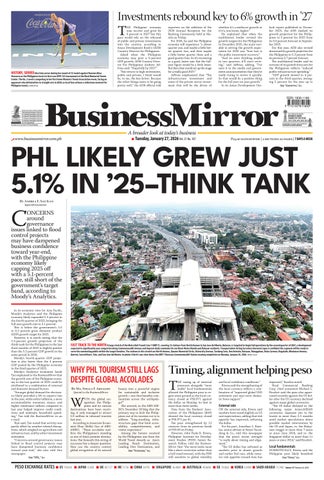
HISTORY, SERVED Alex Eala serves during her round-of-32
Charaeva as the
Thaison Builders and Data Land Inc.—are in the final stages of talks with DHSUD and the Home Development Mutual Fund (Pag-IBIG) for potential projects. Last month, Quadruple A contractor Megawide Construction Corp. also signed an investment and partnership agreement with Pag-IBIG Fund for 4PH projects.
The department previously reported that around 400,000 socialized housing units have been completed so far.
President Ferdinand R. Marcos Jr. had initially set a target of at least 6.5 million housing units by 2028, which was later revised to 3.2 million and subsequently adjusted to 1.1 million units.
Maharlika eyeing strategic agribusiness deals within H1
By Reine Juvierre S. Alberto
SOVEREIGN
wealth fund manager
Maharlika Investment Corporation (MIC) seeks to close strategic agribusiness deals within the first half of the year, backing firms ready to scale production and expand the country’s export capacity.
In a statement on Monday, MIC said it will focus on special situations and strategic mergers and acquisitions in the agricultural sector.
Looking ahead, Tan said the Philippine government should focus on improving governance and strengthening climate resilience.
“Enhancing transparency and accountability in public projects would help restore business confidence and support investment,” said Tan. At the same time, she said investing in climate-resilient infrastructure and disaster preparedness would reduce economic disruptions from extreme weather, supporting more stable growth.
The fund said it is looking into businesses with strong export potential and a significant labor component.
“Our goal is to back companies ready to scale—providing the resources to improve efficiency and increase export volume, which in turn secures and generates vital employment,” MIC President and Chief Executive Officer Rafael Jose D. Consing Jr. was quoted in a statement as saying on Monday.
Consing said MIC’s objective for this year is to invest in structural bottlenecks where measurable efficiency
can be generated.
MIC has entered into a partnership with Thailand’s Charoen Pokphand Group to establish a private equity fund to raise up to $1 billion in capital.
Aside from agriculture, MIC will also allocate capital across energy, logistics and mining.
“This ‘sectoral and tactical’ approach prioritizes assets that resolve structural chokepoints and unlock export capacity, ensuring the fund drives both financial returns and economic efficiency,” MIC said.
MIC also plans to invest in the upgrade and modernization of rural electricity infrastructure to stabilize power supply, energize “last mile”
communities and spur economic growth.
Moreover, MIC has identified mining as a structural approach to diversifying its portfolio, with a strategy focused on responsible extraction and domestic processing.
The sector not only contributes to national output and the government’s 5-percent GDP growth target but also serves as a strategic hedge against long-term currency volatility and global inflationary pressures.
“By marrying ‘intelligent capital’ with national imperatives, MIC will contribute to a more diversified and resilient Philippine economy,” Consing said.
On logistics, MIC said its stake in Asian Terminals Inc. (ATI) will ensure stable, long-term cash
flows while reinforcing key trade corridors needed for economic expansion.
MIC operates under Republic Act No. 11954, which established the Maharlika Investment Fund (MIF) and set the legal framework for its creation, capitalization, governance and operations. Its mandate is to manage the MIF to generate optimal financial returns and catalyze growth by investing in high-impact sectors critical to national progress.
MIC has a total initial capital of P75 billion, of which P50 billion and P25 billion came from the Land Bank of the Philippines and the Development Bank of the Philippines, respectively. The national government will provide the remaining P50 billion.
of the local currency.
from seasonal inflows such as remittances and corporate US Dollar conversions as well as some positioning ahead of key data and policy signals.
Ravelas said the Bangko Sentral ng Pilipinas’ (BSP) “credibility, steady interest-rate differentials, and seasonal dollar inflows like remittances” are supporting the local currency.
Ricafort noted that BSP Governor Eli Remolona Jr.’s signal that the US dollar/Philippine peso is unlikely to hit the P60-mark soon and the central bank’s recent intervention in the foreign exchange market could have also contributed to the strengthening
“Put simply, external pressures have eased just as local fundamentals look more stable—allowing the peso to regain some ground,” Ravelas told this newspaper.
BSP Governor’s signal IN an interview with reporters on the sidelines of the 2026 Annual Reception for the Banking Community on Friday, BSP Governor Eli Remolona Jr. signaled that the central bank would only defend the P60-to-a-dollar level if the local currency plunged sharply.
“It depends on how it gets there. Just because it’s 60 doesn’t mean we’re going to defend it,” he said, expressing confidence that the local currency won’t tumble to the P60-mark against the greenback anytime soon. Andrea E. San Juan
Leading Island Destination. The Department of Tourism (DOT) was also named Asia’s Leading Tourist Board, while Boracay Island was recognized as Asia’s Leading Luxury Island Destination and the Clark freeport was honored as Asia’s Leading Meetings and Conference Destination. Infrastructure gaps that the country has to address include bottlenecks in transport connectivity. “Investments in airports, seaports, and road networks are essential to improving access across islands, increasing visitor flows, and dispersing tourism benefits more evenly,” said Guo. A cornerstone of the economy SHE added that basic utilities and sustainable infrastructure must be developed. “Reliable utilities—water, sanitation, electricity, and waste management systems—are critical for sustaining service quality and strengthening visitor experience, especially for island and ecotourism destinations where carrying capacity is a concern.” And lastly, there must be supporting investments in digital systems and visitor facilities. “Complementary investments in broadband connectivity, digital booking and payment systems, and well-designed facilities such as visitor centers and convention halls can elevate comfort, safety, and service quality for visitors,” she said. Guo noted that tourism has played a large part in the growth of the Philippine economy. In 2024, the sector’s gross value added reached P3.5 trillion, 7 percent more than prepandemic levels—and accounted for 13.2 percent of the local economic output in terms of gross domestic product. Official data also showed the sector employed 4.9 million workers, accounting for 13.8 percent of the labor force. In ABN-AMRO’s analaysis, she said, “Tourism-related industries—such as hotels and restaurants—can generate higher domestic value-added per unit of production input than the average for all sectors, making the sector a key driver of the country’s post-pandemic recovery.”
Still, compared to other members of the Association of Southeast Asian Nations, the Philippines lagged behind in international arrivals, even prior to the pandemic, receiving 8.3 million. That same year, in 2019, Indonesia welcomed 16 million, Malaysia had 26 million, Thailand received 40 million, and Singapore had 15 million.
enforcement of safety regulations, especially in remote provinces.
In December 1987, the ferry Dona Paz sank after colliding with a fuel tanker in the central Philippines, killing more than 4,300 people in the world’s deadliest peacetime maritime disaster.
Marina probe
THE Maritime Industry Authority (Marina) is conducting an investigation to determine the probable cause of the ferry’s sinking.
“Marina has dispatched an investigation team to determine the probable cause or any factors that may have contributed to the incident. Appropriate actions will be taken based on the findings of the investigation,” the Marina said in a statement.
Marina added it is closely coordinating with the Coast Guard as search and rescue operations continue. The agency confirmed that the vessel was operating within its authorized maximum capacity of 352 passengers at the time of the incident.
“Marina Regional Office IX in Zamboanga City confirms that all statutory and safety documents are valid at the time of the incident,” the agency said.
The PCG reported that no oil spill has been observed at the site as of press time.
Marcos orders urgent aid PRESIDENT Ferdinand Marcos Jr. has ordered the distribution of as-
sistance for the passengers of the ferry, according to Malacañang.
“The President has already instructed the DSWD [Department of Social Welfare and Development] to provide appropriate assistance to our countrymen who were affected and victimized by the said incident,” Palace Press Officer Claire Castro said in a press briefing on Monday.
Castro said the Coast Guard currently conducting an investigation on the cause of the sinking.
Based on the ships manifest, M/V Trisha Kerstin has 332 passengers and 27 crew members.
In a related development, the Overseas Workers Welfare Administration (OWWA) also extended aid to the Filipino crew of the M/V Devon Bay.
The Singapore-flagged bulk carrier capsized in the West Philippine Sea near Pangasinan on January 23.
OWWA said two of the ship’s crew have died from the incident, while 15 other were rescued and brough to the South Harbor, Manila, Pier 13 last Monday. The search and rescue operations for the ship’s four other missing Filipino crew are still ongoing.
“Upon arrival at the port, the survivors immediately underwent an initial medical check-up before being taken to their temporary accommodation for further medical evaluation,” OWWA said in Filipino in a statement.
Jim Gomez, Associated Press, with reports from Samuel P. Medenilla, Lorenz Marasigan
government spending on flood
Thumbs up to DOT initiatives “MOREOVER, foreign tourists remain concentrated in a few destinations: the National Capital Region and Central Visayas [home to Cebu] account for over 60 percent of total foreign overnight stays. Many promising sites remain underdeveloped or difficult to reach.”
Guo, however, said initiatives of the Department of Tourism (DOT) like the Philippines Experience Program and the Filipino Brand for Service Excellence, which seek to upgrade service quality, rehabilitate various destinations, diversify product offerings, and emphasize Filipino hospitality. These support “soft infrastructure” such as human capital, service standards, and institutional capacity, “which remain equally vital.”
She expressed optimism that “the recent resumption of the e-Visa program for Chinese nationals is another important step in revitalizing inbound markets. Going forward, expanding training programs for hospitality workers and local enterprises, strengthening inter-agency coordination, and sustaining reforms in zoning, environmental management, and safety standards will be key. These efforts, anchored in the National Tourism Development Plan 2023–2028, can help forge a more harmonized and efficient tourism ecosystem.”
Manila recently announced visafree entry for Chinese tourists arriving at the Ninoy Aquino International Airport and Mactan Cebu International Airport, who are allowed to stay just 14 days. Tourists from India may also enter visa-free for 14 days, while those with valid and current visas from the United States, Canada, Japan, Australia, the Schengen region, Singapore, of the United Kingdom or residence permits may enter visa free for 30 days. The DOT targets the arrival of 6.7 million inbound tourists this year.
DPWH rushes investigation into collapse of flood-control dike portion in Arayat
By Lorenz S. Marasigan
T@lorenzmarasigan
HE Department of Pub -
lic Works and Highways (DPWH) has launched a technical assessment and investigation of the collapsed portion of a flood control dike in barangay Candating, Arayat, Pampanga, with findings set to be forwarded to the Office of the Ombudsman and Department of Justice (DOJ) for prosecution.
Public Works Secretary Vivencio Dizon said engineering teams have been deployed to the site to implement urgent protective measures for affected residents while overhauling the structure’s design to ensure a permanent solution.
“It seems to me that the design of the flood control in Candating, Arayat, is fundamentally flawed,” Dizon said in Filipino, noting that the contractor had failed to address foundation problems despite repeated directives.
The P91.63-million flood control structure, completed in July 2023 by Eddmari Construction & Trading, first collapsed in August 2024—just over a year after construction was finished.
Last year, when Dizon inspected the structure, he labeled it as “substandard.”
“If you recall, we forced the contractor to fix it because the
foundations were collapsing. But until now, they haven’t been able to fix it. So we need to make a decision here to really hold accountable those who should be held accountable,” Dizon said.
The investigation will identify all liable parties including the contractor, DPWH personnel, and other individuals involved.
Dizon disclosed that reports have surfaced linking congressmen to the project, adding that all allegations would be thoroughly investigated.
“Everyone needs to be investigated, and whatever our recommendation is, we will submit it to the Ombudsman and the DOJ,” he said.
Dizon noted that engineering teams are fast-tracking a permanent solution while protecting nearby houses and residents from further damage.
“Our countrymen there whose houses are affected are in a pitiful situation. So we cannot let this pass,” he said.
The 36-kilometer Dike that stretches from Apalit to Arayat was built in the 1940s and has been used as a detour road for several years now. Many parts of the dike has been degraded through time and by the trucks that regularly use it as a “shortcut” to the towns of San Luis, San Simon, Candaba and Arayat.
NDCM makes PHL internet accessibility competitive
By Samuel P. Medenilla @sam_medenilla
WITH the signing by President Ferdinand Marcos Jr. of the Nationwide Digital Connectivity Plan (NDCM), the country will soon be globally competitive in terms of internet accessibility, according to Malacañang.
The Department of Information and Communications Technology’s (DICT) on Monday announced the plan to accelerate the rollout of critical broadband infrastructure was finalized. Presidential Communications Office (PCO) Acting Dave M. Gomez said the NDCM enhance the country’s digital infrastructure so it will be on a par with that from other countries.
“The President noted that we are playing catch-up with our Asean (Association of Southeast Asian Nations) neighbors who have done this as early as 10 years ago,” he said.
“But with technology now more advanced and less cost[ly], he is confident we will soon be at par in terms of connectivity, speed and cost,” he added.
He said the plan was crafted using the “extensive and deliberate consultative process” with the
DFA urges restraint amid word war with Chinese Embassy
THE Department of Foreign Affairs (DFA) is trying to temper the heated public debate between the Chinese Embassy and Philippine legislators over the West Phippine Sea, even as Chinese and Association of Southeast Asian Nations (Asean) senior maritime and diplomatic officials gather this weekend to draft a long-awaited code of conduct in the disputed waters.
The DFA said it has made “firm representations” to Chinese Ambassador to Manila Jing Quan and the Embassy, conveying “serious concerns” over the escalation of public exchanges with Philippine lawmakers such as Sens. Anna Theresia “Risa” Hontiveros, Francis Pangilinan, Erwin Tulfo, and other officials.
“We reiterate our previous statements affirming support for our officials to perform their lawful duties in defense of Philippine sovereignty, sovereign rights, and jurisdiction. Their views, as well as those of disagreeing voices, are an inescapable part of the robust plurality of ideas that animate our democratic society,” the DFA said.
At the same time, the Department stressed the need for “sober, professional and respectful exchanges” in the public sphere, warning that intemperate language could derail diplomatic space needed to manage maritime tensions.
The controversy intensified last week when the Chinese Foreign Ministry summoned Philippine Ambassador Jaime FlorCruz to protest Coast Guard spokesman, Commo. Jay Tarriela’s use of AI-generated images portraying Chinese President Xi Jinping as a bully. Beijing said the images were disrespectful and unacceptable.
Since then, Philippine officials have rallied behind Tarriela:
Hontiveros branded the Chinese Embassy a “bad guest” in the Philippines.
stakeholders.
The plan focuses on four strategic pillars: strengthening governance and regulatory framework; universal access; infrastructure investment through public-private partnerships; and digital infrastructure which can withstand climate-related risks, disasters, and cybersecurity threats.
“The National Digital Connectivity Plan envisions a Digitally Connected Philippines - one where connectivity is meaningful, inclusive, and transformative, anchored on universal access, affordability, higher speeds, and secure digital services for all Filipinos,” Gomez said.
In 2024, DICT said the country is targeting to become one of the top three countries in Southeast Asia in terms of internet connectivity. It noted that that the country was sixth in the region in terms of internet penetration at that time.
Among the highlights of the NDCM is the National Fiber Backbone (NFB), which is expected to reach its Phase 2 and 3 this year.
The NDCP was discussed during the 7th Economy and Development Council Meeting, which was presided by Marcos, at the Presidential Security Command Compound in Otis, Manila on Monday.
Pangilinan called the Embassy’s posts “cowardly” and “duplicitous.”
Tulfo warned China had “no right to censure” Philippine leaders and should leave if it cannot
respect free speech.
Tarriela accused “Filipino trolls” of amplifying Chinese narratives online.
The Chinese Embassy’s deputy spokesperson Guo Wei countered that freedom of speech should not be used to “recklessly defame or attack others, let alone the head of state of another country.”
In Beijing, Foreign Ministry Spokesperson Guo Jiakun accused Tarriela of conducting a “smear campaign” and said China had lodged “solemn representations and strong protest” with the Philippine ambassador. Guo warned that Tarriela’s remarks had “crossed the line.”
The DFA emphasized that measured language is necessary to prevent public exchanges from derailing cooperation in non-sensitive areas, such as Coast Guard communication, scientific collaboration on ocean meteorology, trade and investment, agriculture, and people-to-people ties.
The Philippines is hosting the next round of Asean-China working group negotiations on the South China Sea code of conduct here this weekend. Regional leaders have set a 2026 deadline to finalize the text, underscoring the urgency of keeping diplomatic channels open despite the flare-up.
Meanwhile, the DFA has assured lawmakers critical of China’s recent strong remarks on the West Philippine Sea that the views articulated by the interagency National Maritime Council (NMC) are consistent with the Philippine government’s policy on its maritime issues with China.
However, Foreign Affairs
BuCor mulls regional prisons for heinous crimes convicts
THE Bureau of Corrections is eyeing to put up 13 more regional prison facilities and two more additional facilities for those convicted for heinous crimes.
Corrections Director General Gregorio Pio P. Catapang Jr. said the plan is aligned with Republic Act 10575 or the Bureau of Corrections Act of 2013 and Republic Act 11928 or the Separate Facility for Heinous Crimes Act.
The Bureau of Corrections Act of 2013 mandates the establishment of Regional Prison Facilities (RPFs) to reduce reliance on megaprisons and to bring correctional facilities closer to communities, while RA 11928 mandates the establishment of separate facilities for heinous crimes—one each for Luzon, the Visayas, and Mindanao.
The Bureau currently operates in only five out of the 18 regions
across the country including the National Capital Region, Mimaropa (Mindoro, Marinduque, Romblon and Palawan), Eastern Visayas, Zamboanga Peninsula and Davao Region.
Catapang said this shortfall highlights an urgent need to establish a presence in underserved areas such as the Cordillera Administrative Region, Ilocos Region, Cagayan Valley, Central Luzon, Calabarzon (Cavite, Laguna, Batangas, Rizal and Quezon), Bicol, Western Visayas, Central Visayas, Negros Island Region, Northern Mindanao, Soccsksargen (South Cotabato, Cotabato, Sultan Kudarat, Sarangani and General Santos), Caraga, and the Bangsamoro Autonomous Region in Muslim Mindanao (BARMM).
Secretary Maria Theresa Lazaro said in a letter to Hontiveros, that the department believes “Philippine government officials must also act professionally and in prudent fashion even in the face of opposing views,” an apparent reference to the ongoing word war between Beijing’s foreign ministry and Tarriela.
“In interacting with foreign governments, both language and action should be firm and assertive in conveying the national position, but also measured and composed in tone. Our statements should consistently position the Philippine government as taking the higher ground. Foreign heads of state and government, in particular, should be off-limits or at least treated with respect, regardless of our personal views.” It was an apparent reference to Tarriela’s use of caricatures in a recent presentation, where he ridiculed Xi. Lazaro assured Hontiveros –who has also been in the crosshairs of the Chinese government for her and her Akbayan party’s strong stance against Beijing’s “bullying” in the WPS – that the DFA will never back down from the official position asserting Manila’s rights in its maritime conflict with Beijing. “I assure you that the Department will remain true to its mandate, which is to maximize effective diplomacy and innovative approaches in order to produce meaningful outcomes in pursuit of the Philippine national interest, especially with regard to Philippines-China relations and the situation in the West Philippine Sea,” Lazaro told the senator
The Lazaro letter was revealed a day after the National Security Council (NSC) issued a statement calling out as “undiplomatic and uncalled for” the recent statements from China’s foreign ministry and embassy in Manila.
The statement by NSC’s spokesperson Assistant Director General Cornelio H. Valencia Jr. said the Council’s “concern extends beyond individual officials to the broader impact on Philippine institutions. The Philippines is a democracy governed by the rule of law. Public officials, spokespersons, and institutions are mandated to inform the Filipino people of developments affecting national security, including activities in the West Philippine Sea.”
This responsibility, the NSC added, “does not require approval
from any foreign government. We reiterate that disagreements between States must be addressed through established diplomatic channels, like the existing Bilateral Consultation Mechanism, consistent with international law and diplomatic norms. Public messaging that intimidates, threatens, or seeks to silence Philippine officials performing their lawful duties is inconsistent with the spirit and obligations of diplomatic engagement and clearly violates the Vienna Convention on Diplomatic Relations.”
This, as the Stratbase Institute on Monday categorically dismantled the Chinese Embassy’s attempt to gaslight the international community by portraying the Philippines as the “provoker” in the West Philippine Sea. The think tank also emphasized that the inversion of reality is flatly contradicted by a mountain of evidence. “The documented record is clear: China’s maritime forces are the sole aggressors, consistently employing state-sanctioned coercion through water cannon attacks, reckless maneuvers, and deliberate ramming. These are not mere ‘incidents’ but calculated acts of hostility that have damaged Philippine vessels and caused physical harm to Filipino personnel and civilians alike,” Stratbase explained. Stratbase said the core issue is not a “clash of perceptions,” but a defiance of international law. Under Unclos, the 2016 Arbitral Award is final, legally binding, and beyond appeal. It pointed out that the ruling explicitly extinguished China’s fabricated “historic rights” claims. It also stressed that stability in the region cannot be built on rhetorical gaslighting; it requires absolute adherence to the law.
Stratbase said calls for “restraint” are an insult to the victims of China’s repeated aggression. It pointed out that Beijing cannot preach peace while actively deploying force against Philippine vessels and destroying the livelihoods of Filipino fisherfolk. Stratbase urged China to adhere to the rules-based order as International law has already defined these waters; China’s presence is the provocation. “De-escalation is impossible without an end to Chinese hostility,” said Stratbase. Butch Fernandez, Malou Talosig-Bartolome, Rizal Raoul Reyes and Rex Anthony Naval
Mayon glow creates light show
By Jonathan L. Mayuga @jonlmayuga
MAYON Volcano in Albay glowed in the dark on Sunday as burning lava continued to flow from the crater down its near-perfect cone, cylindrical wall.
The crater glow at Mayon had remained visible to the naked eye for days, as the burning lava flows slowly, lighting the night and creating a spectacular show that wows tourists watching from a distance.
Volcanic activity at Mayon, which is currently under Alert Level 3 or intensified unrest, continues, characterized by lava dome and lava flow effusion with episodic minor strambolian activity, the Philippine Institute of Volcanology and Seismology reported in its summary of 24-hour observation on Sunday.
Mayon is now on its 20th day of gentle, effusive explosion, which means magma has low viscosity and gas can escape easily. The volcano edifice remains inflated, which means magmatic activity continues beneath.
During the observation period ending at 12 midnight on Sunday, Phivolcs said it recorded 13 volcanic earthquakes, one ongoing tremor, 229 rockfall events, and 45 pyroclastic density currents or uson.
See “Mayon,” A4 See “BuCor,” A5
MARKER Bulacan Gov. Daniel R. Fernando leads the unveiling of the historical marker of Kapitolyo ng Bulacan in front of the Provincial Capitol building in the City of Malolos on Friday, January 23, witnessed by (from left) Board Member Romina Fermin, Provincial Administrator Antonia V. Constantino, National Historical Commission (NHCP) Deputy Executive Director for Administration Rosario V. Sapitan, NHCP Executive Director Carminda R. Arevalo, Vice Gov. Alexis C. Castro, and Board Members Michael Aquino and Fortunato SJ. Angeles.
Groups file second impeachment case vs Marcos
By Jovee Marie N. dela Cruz @joveemarie
MILITANT groups led by Bagong Alyansang
Makabayan (Bayan) on Monday officially filed the second impeachment complaint against President Marcos, accusing him of “betrayal of public trust” over what they described as a massive and systematic corruption scheme in flood control projects from 2022 to 2025.
The impeachment complaint, endorsed by three Makabayan bloc lawmakers—Party-list Reps. Antonio Tinio of ACT Teachers, Renee Louise Co of Kabataan, and Sarah Jane Elago
of Gabriela—accused Marcos of betrayal of public trust in connection with alleged corruption in flood control projects from 2022 to 2025.
The complainants come from progressive groups representing workers, professionals, teachers, students, farmers, and urban poor communities.
The bloc said House Secretary General Cheloy Garafil gave no commitment on when she would transmit the second impeachment complaint to Speaker Faustino Dy III.
Later in the day, Tinio said Dy has formally received their impeachment complaint and has directed that it be included in the
The House of Representatives on Monday formally referred two verified impeachment complaints against the President to the Committee on Justice, following their inclusion in the plenary’s Additional Reference of Business. Deputy Speaker Yevgeny Vicente B. Emano of Misamis Oriental presided over the session when the referrals were made.
The first complaint, filed on January 19, 2026, was lodged by de Jesus and endorsed by Nisay.
The second complaint, filed on January 26, 2026, was submitted by a coalition of activists and
private individuals led by Liza Largoza Maza, Teodoro A. Casiño, Renato Reyes Jr., Neri Colmenares and labor leader Ronaldo Adonis. It was endorsed by Party-list Reps. Antonio L. Tinio of ACT Teachers, Sarah I. Elago of Gabriela and Renee Louise M. Co of Kabataan. Batangas Rep. Gerville Luistro, chairperson of the House Committee on Justice, explained that under the rules, once the Office of the Secretary General receives an impeachment complaint, it must immediately transmit it to the Office of the Speaker. The Speaker then has
Sandro recuses from dad’s impeachment case
HOUSE Majority Leader
Ferdinand Alexander
“Sandro” A. Marcos on Monday said he is recusing himself from all discussions and proceedings of the House Committee on Rules involving the impeachment complaints against President Marcos, citing the need to uphold institutional integrity over personal ties.
Currently, two impeachment complaints have been filed against Marcos.
Marcos explained that his decision was prompted by the fact that the impeachment complaints were filed against his father.
“Our democracy is strongest when institutions are bigger than personalities and when public servants choose principle over proximity,” Marcos, chairman of the House Committee on Rules, said.
“In view of the impeachment complaints filed against President Ferdinand R. Marcos Jr., who is my father, I have decided to formally recuse myself from all discussions, deliberations, and proceedings of the House Committee on Rules insofar as these complaints are concerned,” Marcos added.
Marcos stressed that stepping aside from the Rules committee
proceedings on the impeachment complaints does not diminish his broader responsibilities in the chamber.
He added that his inhibition was not required under House rules but was guided by a higher sense of responsibility to protect public trust and the credibility of the institution.
“I take this step not as a retreat from responsibility, but as an affirmation of it,” Marcos said. “Public office is a trust, and that trust is strengthened when those who hold power are willing to step aside to protect the institution they serve.”
Marcos said he remains fully committed to his duties as House majority leader in all other matters and expressed confidence in the House’s independence and sobriety in handling the issue.
“I remain committed to my duties as House Majority Leader in all other matters, and I express full confidence that the House will act with independence, sobriety, and fidelity to the Constitution in addressing this issue,” Marcos said.
He said his inhibition would allow the House to discharge its constitutional mandate without any perceived conflict of interest.
Jovee Marie N. dela Cruz
Lotilla sets multi-sectoral probe into Binaliw garbage slide
EBy Jonathan L. Mayuga @jonlmayuga
NVIRONMENT Secretary Raphael Lotilla on Monday launched an independent, multi-sectoral investigation into the garbage slide in Cebu City on January 8. Lotilla disclosed that a fivepronged strategy aims to establish accountability, determine the technical causes, and avoid a repeat of the incident that killed 35 people and injured 18 others. Lotilla wants a long-term and programmatic approach to addressing garbage challenges in the country.
“We are taking immediate and decisive action to ensure an impartial and scientific inquiry into the Binaliw incident,” Lotilla stated. “The public deserves transparency, and we are committed to deliver results that will ensure accountability and prevent future tragedies,” he added.
To ensure the investigation is objective and technically rigorous, Lotilla formed a special multistakeholder investigative team composed of the external solid waste management experts from nongovernment organizations (NGOs) and academe to comple -
ment the DENR Legal Affairs and Enforcement team of the agency’s central office.
“By involving experts from academia and civil society, we are ensuring that our findings are not only credible but also rooted in the best available science. We need to establish the accountabilities, and equally, if not more important, the lessons learned from this experience and how long-term measures should be framed to prevent a similar incident in the future,” he added.
Nationwide review RECOGNIZING that the Binaliw incident may indicate broader
BIR seizes smuggled cigarettes in Valenzuela
By Reine Juvierre S. Alberto @reine_alberto
SMUGGLED cigarettes with an estimated excise tax deficiency of more than P516 million were seized by the Bureau of Internal Revenue (BIR) and the Department of the Interior and Local Government (DILG) in Valenzuela City.
In a statement on Monday, the
Mayon. . .
Continued from A3
BIR said it intercepted the illicit cigarettes with an estimated excise tax deficiency of P516.795 million, inclusive of penalties and surcharges, in an operation last January 23. The DILG provided the BIR with verified information about the illegal trade and distribution of cigarettes in Valenzuela City, which prompted the enforcement action. After receiving the report, Internal Revenue Commissioner
Sulfur dioxide flux on Sunday reached 1,221 tons per day, while the plume emission from
Charlito Martin R. Mendoza ordered the issuance of mission orders for field verification and enforcement.
A total of 1,274 master cases of cigarettes were discovered and seized by operatives from BIR Revenue Region 5.
The BIR said the cigarettes were found to be non-compliant with the mandatory Internal Revenue Stamp requirement under the Tax
the crater created a wall 700 meters high.
Phivolcs said the moderate emission has an east-southeast, northeast, north-northeast, and north-northwest drift.
At Alert Level 3, entry into the six-kilometer permanent danger zone and flying of any aircraft near the volcano are prohibited owing to the hazards that may occur.
Increased seismicity at Taal DURING the observation period, Phivolcs reported increased seismicity at Taal Volcano in Batangas, with 23 volcanic tremors,
10 session days to include the complaint in the Order of Business of the House plenary.
After inclusion in the Order of Business, the plenary has three session days to transmit the complaint to the Committee on Justice, where a formal review will begin.
Luistro added that whatever decision the committee arrives at, it is required to submit a committee report to the plenary within 60 session days, stressing that suspended sessions are not counted as separate session days.
Order of Business of the House of Representatives.
The first impeachment complaint was filed by lawyer Andre de Jesus on January 19 and endorsed by House Deputy Minority Leader Jett Nisay, the nominee of the party-list group Pusong Pinoy. In their complaint, Bayan alleged that Marcos “did not merely preside over a corrupt government” but “actively engineered a hostile takeover of the state’s financial machinery” by manipulating the national budget to siphon more than P545.6 billion in flood control funds.
House panel sets probe of ‘sale’ of Leviste’s solar energy franchise
THE House Committee on Legislative Franchises is set to conduct a motu proprio inquiry, in aid of legislation, into issues surrounding the legislative franchise of Solar Para sa Bayan Corporation, following concerns over regulatory compliance and the protection of the consuming public.
systemic risks, Lotilla ordered immediate nationwide inspection of all operating sanitary landfills.
He directed all regional offices across the country to ensure strict compliance with environmental compliance certificates (ECCs) and safety protocols.
This directive aims to identify potential hazards early and enforce corrective measures before accidents occur.
“The safety of our communities is non-negotiable,” Lotilla added.
“We are now moving to ensure that facilities across the nation adhere to the highest standards of safety and environmental protection,” he said.
Code, which means excise taxes were not paid.
“This operation marks another major victory in the BIR’s ongoing fight against illicit cigarette trade and stands as the first joint enforcement action of the BIR for 2026,” the BIR said.
“It signals the BIR’s renewed and intensified commitment to combating tax evasion and illicit tobacco trade,” the bureau added.
including 1 ongoing since 9:22 a.m. on January 25.
Earlier Volcanic tremors on Sunday lasted two to three minutes.
Phivolcs also monitored shortterm swelling of the volcano’s edifice, which means that the ground surface on or around Taal Volcano island is experiencing a temporary and localized swelling or rising, caused by the movement of magma or volcanic gas beneath the surface, pushing the ground upward.
Currently under Alert Level 1 or low level of unrest, entry into the Volcano Island and flying of
During the committee proceedings on Monday, “Party-list Rep. Presley C. de Jesus of PhilRECA moved for the investigation, citing recent reports involving the franchise holder. These include the alleged sale or transfer of a controlling interest without prior congressional approval, questions on compliance with franchise conditions, and public disclosures that the company has supposedly been non-operational since 2022 due to regulatory delays.
“A legislative franchise is a privilege granted by the State. It is never a right. Congress has the obligation to continuously examine whether that privilege is being exercised in a manner consistent with law and with the welfare of the people,” de Jesus said.
He added that the inquiry would allow the committee to assess whether existing franchise provisions remain adequate and to identify possible policy reforms to ensure that franchise holders fulfill their obligations to consumers and the public.
De Jesus also moved for a referendum among committee members to secure the majority vote required to initiate the motu proprio inquiry, expressing confidence that the panel would act in line with its duty to uphold transparency and the primacy of public interest in the grant and regulation of legislative franchises.
Following approval of the motion, Party-list Rep. Sergio C. Dagooc of Apec formally requested the Energy Regulatory Commission (ERC) to look into previous issues involving Solar Para sa Bayan in areas where it reportedly operated.
“There are unresolved issues that raise fundamental questions on
aircraft near the volcano are prohibited.
Kanlaon, Bulusan CALMER Kanlaon Volcano on Negros island and Bulusan Volcano in Sorsogon were observed on Sunday. Phivolcs said three volcanic earthquakes were recorded at Kanlaon during the 24-hour observation on Sunday.
An old stratovolcano, Kanlaon, which straddles the provinces of Negros Oriental and Negros Occidental, is currently under Alert Level 2 or increased alert.
Sulfur dioxide flux at
Kanlaon
regulatory compliance, consumer protection, and respect for the franchise rights and property of electric cooperatives. These matters warrant closer scrutiny by both regulators and Congress,” Dagooc said. The lawmaker’s request sought regulatory clarification and enforcement on serious concerns raised by affected stakeholders, including the operation of renewable energy facilities without permits, the absence of an approved tariff from the ERC, the issuance of official receipts allegedly not registered with the Bureau of Internal Revenue (BIR), and the use of distribution assets owned by the Occidental Mindoro Electric Cooperative (Omeco) without permission, notification, or approval.
Since deliberations on the Solar Para sa Bayan franchise began in 2018, the “Power Bloc” of the House of Representatives has consistently raised legal, economic, and sectoral objections to granting broad nationwide authority to a single private entity, warning that such an approach poses serious risks to the structure and stability of the electric power industry.
The two representatives stressed that a nationwide franchise covering virtually the entire archipelago is overly broad, difficult to regulate, and fundamentally inconsistent with the localized nature of electric distribution.
They also clarified that the inquiry does not prejudge the outcome of the committee’s deliberations.
They reiterated that the award of legislative franchises must be based strictly on an applicant’s qualifications, compliance record, and proven capacity to serve the public—not on market influence or speculative promises.
The legislators maintained that genuine electrification and affordable power, particularly in rural and missionary areas, can only be achieved by strengthening electric cooperatives, enforcing fair competition, and maintaining robust regulatory oversight.
on Sunday was 988 tons per day. Meanwhile, Phivolcs said it observed a moderate emission of plume, which created a 150-metertall wall from the crater, drifting northwest and west side of the volcano.
Except for one volcanic earthquake and weak plume emission, Phivolcs recorded no significant other volcanic activity at Bulusan, which is currently under Alert Level 1 or a low level of unrest. Ground deformation, however, remains visible because of the inflated volcano edifice, which indicates magmatic activity happening beneath.
Impeachment. . .
Continued from A4
The complainants branded the alleged scheme as the “Flood Control Projects Corruption Scandal of 2022–2025,” claiming that public coffers were converted into a “private war chest” for the 2025 elections through budget insertions, kickbacks, and unprogrammed appropriations.
According to the complaint, the Marcos administration packed the national budget with pet projects and congressional insertions, moving regular budget items into unprogrammed appropriations (UA) to make fiscal space for favored projects. The UA allegedly ballooned to unprecedented levels—P807 billion in 2023 and P734 billion in 2024.
Bayan said the complaint was filed by citizens and taxpayers “outraged over the systematic corruption in government,” including workers, farmers, teachers, students, women leaders, environmental defenders, urban poor groups, and anticorruption advocates.
The groups stressed that the complaint was submitted before the one-year constitutional bar on impeachment proceedings took effect and called for its transmission to the Office of the Speaker and referral to the House Justice committee.
Continued from A3
Catapang noted that Bucor has started the establishment of a Super Maximum Facility (SMF) in Sablayan, Occidental Mindoro, for the Luzon area.
“No SMFs for heinous crimes have been established in the Visayas and Mindanao, requiring continued site identification and resource allocation,” he said.
Catapang earlier disclosed that a unified penology and correctional facility will be built in a 60-hectare lot in Nueva Ecija as a pilot area.
“The provincial jail will be transferred in the said area as we as the crowded BJMP [Bureau of Jail Management and Penology] jails from the municipalities,” Catapang explained.
“Then the BuCor will also put up a reception and diagnostic center. We will be in one compound,” he added.
The Bucor chief stated that this shift will not only alleviate current pressures but also align the nation’s practices with the best international standards, fostering a more humane approach to incarceration.
“The time to act is now; for a just and rehabilitative correctional system to thrive, proactive measures must be taken to bridge the existing gaps,” Catapang said. Joel R. San Juan
Continued from A4
Batangas Rep. Leandro Leviste, founder of the Solar para sa Bayan, welcomed a possible investigation into companies associated with him, saying he looks forward to the opportunity to address allegations and push for greater transparency in government.
“That’s good news. I look forward to take the opportunity to [1] correct the false information on social media about my business and [2] call for all members of Congress to disclose their assets and campaign donors, declared and undeclared, so we can comprehensively dissect any of their conflicts of interest related to DPWH or beyond, including any of their links to DPWH contractors and how they may be affected by my ongoing investigations into DPWH projects. I am 100% for transparency and accountability,” he said.
Leviste added that while he has not closely followed many of the media statements about his business, his lawyers are now reviewing statements by certain individuals in preparation for additional libel cases.
“I have not watched many of the media statements about my business, but my lawyers are now reviewing statements by certain individuals now [not to single anyone out] in preparation for additional libel cases that we will be filing,” he said.
“I welcome any inquiry on my businesses for the same reason am filing libel cases—I am thankful for the opportunity to correct the false information being spread and seek compensation for damages,” he added.
Jovee Marie N. dela Cruz
Traffic, infra, climate risks drive BGC master plan update
By Bless Aubrey Ogerio
THE Bonifacio Global City (BGC) will undergo a comprehensive redevelopment as the Bases Conversion and Development Authority (BCDA) begins updating the estate’s master plan, more than two decades after its original framework.
BCDA has partnered with SyCip Gorres Velayo & Co. (SGV & Co.) on the project, which started this month and is scheduled for completion by September.
The update aims to tackle key challenges in the central business district, including traffic congestion, aging infrastructure, climate risks, and the need for more inclusive and accessible mobility.
“We want to make sure that BGC continues to become more people-centric, with greater focus on open spaces, mobility, and transportation,” BCDA President
and Chief Executive Officer Joshua Bingcang said.
“Moving forward, we want BGC to be more open and accessible to all sectors of society.”
The nine-month process will include urban analysis, technical studies and stakeholder consultations to brainstorm development strategies.
Visioning workshops and engagement with residents, workers and businesses will also be conducted to guide their adjustments to land use, public space planning and mobility solutions.
The revised plan will emphasize transit-oriented development, streetscape improvements, active mobility and the strategic reallocation of BCDA’s gross floor area (GFA) entitlements.
According to BCDA, these measures will help match development intensity with infrastructure capacity, optimize land use and identify underutilized areas for potential development or disposition.
Once completed, the updated master plan is expected to support long-term investments, generate employment, and enhance accessibility for workers, residents, and visitors.
BGC continues to dominate office space demand in Metro Manila, data from Leechiu Property Consultants showed.
The business district accounted for 218,000 square meters, or 23 percent, of office demand in 2025, led by information technology and business process management companies.
Vacancy in BGC also remained the lowest in Metro Manila at 9 percent, equivalent to 191,000 square meters.
Cebu hosts Asean tourism leaders anew
CEBU CITY—Twenty-eight years after the landmark declaration on tourism cooperation was signed, officials from the Association of Southeast Asian Nations (Asean) National Tourism Organizations (NTOs) have once again convened in Cebu to strengthen regional collaboration and advance tourism initiatives, particularly with the inclusion of Timor-Leste as Asean’s 11th member.
Philippine Tourism Undersecretary Verna Esmeralda Buensuceso, in her opening remarks, expressed optimism about the outcomes of the meeting held on Sunday.
“As heads of national tourism organizations, we are in a critical and exciting position to transform vision into practice. What we de -
cide and coordinate in meetings like this translates into the visitor journey, the competitiveness of our destinations, the resilience of our enterprises, and the livelihoods of our communities,” Buensuceso said.
She added that holding the meeting in Cebu serves as a reminder to Asean tourism leaders of how collaboration can help achieve a more inclusive direction for Asean tourism.
Oliver Chong, assistant chief executive of the International Group (Designate) at the Singapore Tourism Board and Singapore’s representative to the NTO, described the gathering as a “pivotal moment” for regional tourism.
“We continue to strengthen our collaboration and advance
our shared vision of positioning Southeast Asia as an attractive single destination. The challenges and opportunities facing our tourism sector demand coordinated regional responses,” Chong said.
“Our collective strength lies in our diversity – 11 unique destinations, each offering distinct experiences and rich cultural heritage, yet united by shared values and common aspirations. As we gather today, we have a valuable opportunity to build upon past successes while exploring innovative pathways for sustainable tourism development,” he added.
The 63rd Asean National Tourism Organizations (NTO) Meeting was held in Cebu on Monday, with DOT Philippines serving as co-chair. Carmel M. Pedroza
‘BPO growth will drive flexible office demand’
THE expansion of the business process outsourcing (BPO) sector continues to drive demand for workspaces, flexible office solutions provider Axon Group said, while it also targets other corporate clients looking to consolidate or scale operations quickly.
Sherwin dela Cruz, Axon Group co-founder and chief executive officer, said the company’s model allows clients to occupy fully fitted offices within 75 to 90 days, avoiding delays typically associated with traditional office fit-outs.
“It absolutely is not our strategy. It is here to serve the needs of clients who need to move in ASAP [as soon as possible],” dela Cruz told reporters at the company’s office in Taguig City, noting that larger companies often return to their own office spaces once expansion is complete.
Axon currently operates two sites, including its flagship Quad facility in Bonifacio Global City (BGC) and a second location in Makati.
The Quad site, larger in total area but with lower ceiling heights
than the Makati office, functions as an operational workspace, hosting meetings, trainings, and collaborative work.
The company’s integrated model consolidates design, construction, technology and operational services under a single structure.
For dela Cruz, this approach reduces inefficiencies in procurement, construction and handovers, allowing clients to move in quickly and lowering overall execution risk.
Axon offers two main products. Axon Keys provides fully built offices for firms that prefer minimal upfront investment, while Axon D&B, the design-and-build arm, serves companies that can invest in custom fit-outs.
Dela Cruz said the BPO sector remains the primary driver of demand, particularly in Metro Manila and nearby economic hubs such as Clark, Tarlac, Pampanga, Alabang and Quezon City.
Moreover, the company sees potential for expansion into other corporate sectors as businesses consolidate operations or open new divisions.
He said the company has com -
Capitalism vs. Socialism
By Henry J. Schumacher
IREAD with great interest an article by Umair Haque about capitalism and socialism and would like to share part of his views with you, adjusted partly to my own thinking and its possible application in the Philippines when we talk about Inclusive Growth.
It all started the other day when I was talking to someone and in the middle of a perfectly civilized conversation about our impending doom he blurted out: “but you’re a socialist!”
Whoa. I’m not any of these things, capitalist, socialist, atheist, any-ist. My only role and goal when it comes to the world is to observe. And here’s what I see, here where I live and beyond:
The genuine opposite (or maybe endpoint, if you want to think dynamically, not statically) of both pure capitalism and socialism are kleptocracy, oligarchy, authoritarianism— what results when political economies are run by and for tiny elites. Why? Cutthroat competition in every aspect of life soon becomes abuse. Enforced cooperation soon becomes unendurable. So what now?
Capitalism and socialism should not be opposites. They should complement each other. The global economy must and hopefully will be built on new synthesis: Capitalism and socialism working together, each strengthening the others’ weakness, a kind of yin and yang of human organization. Some countries may have already found solutions. They seem to have found the basics of a genuinely good life. What are the basics?
Aristotle, Buddha, and Jesus all spelled it out millennia ago: food, shelter, income, safety, security, opportunity.
Today, we may have to update that list with things that didn’t exist in their time, but are clearly in the same spirit: transportation, healthcare, education, environment, free press, democracy, and a few more. If you think about it, no matter how much money you have, you can’t really buy such things unless a society has invested in them first.
These “things” are what I call “fundamental goods.” They
are what makes a life good at its root. Through them, everyone can be happy, and grow into their potential—without them, no one can be, no matter what your latest self-help bestseller says. Without a few meals a day, a little bit of money in the bank, and your health, no amount of positive thinking can get you to happiness—nor should it. Human beings are not all born to be monks—they are born to dare, risk, defy, rebel, imagine, create. And to do all that, they need the basics. Without the basics, democracy can’t survive, society can’t cohere, people can’t flourish, and lives can’t be fully lived. It’s a big world, and an endless future. But it’s also one with big problems. Demagoguery, extremism, inequality, instability, stagnation, mass extinction, climate change, the growing threat of war. Choose your apocalypse. These are the stakes of this troubled age. If humanity is to survive, it’s going to have to grow. Up. It is going to have to mature beyond the simple, crude polarity of yesterday, and learn to synthesize its great lesson. The new synthesis is social capitalism, or capital socialism. And that is what growth really is. It clearly leads us to get involved in ‘sustainable development’ and a focus on ‘inclusive growth.’ In other words, we cannot continue to hunt for maximum profits without ‘investing’ into the sufferings around us: extreme poverty, hunger, health and nutrition issues, inadequate education, etc. Let me conclude with my view that social conscience must seriously accept its responsibilities for providing employment, eliminating discrimination, avoiding pollution, and what ever may be the catchwords of the contemporary crop of reformers. I am expecting heavy “attacks”; you can email me at hjschumacher59@gmail.com.
widens coverage
mitted significant capital to its operations, though specific figures were not disclosed.
In addition, dela Cruz said highend corporate clients make up a substantial portion of its portfolio, where the complexity of office builds and the scale of investment limits the number of competitors in the market.
Axon also highlighted the role of fast, flexible spaces in responding to evolving workplace needs.
Data from Leechiu Property Consultants showed that Metro Manila remained the center of office demand, accounting for 948,000 sqm, or 78 percent of total take-up.
Within the region, BGC led with 218,000 square meters, or 23 percent of demand, largely driven by information technology–business process management (IT-BPM) companies.
“The more you outsource across multiple vendors, the higher the cost,” dela Cruz said. “That’s why we exist. We remove inefficiencies. We take it all in-house and then we get really competitive sa market.” Bless Aubrey Ogerio
TBy Ada Pelonia @adapelonia
HE Philippine Crop Insurance Corporation (PCIC) said its increased budget to P6.5 billion can insure nearly three million farmers and fishermen this year.
For 2026, the government appropriated P6.5 billion to the PCIC, a 45 percent increase from last year’s P4.5 billion and the highest allocation it ever received.
The state insurance agency noted that the expanded budget will translate into higher insurance cover for rice and corn and provide a wider reach for its free insurance program nationwide.
For one, the PCIC raised its insurance cover for rice and corn to P25,000 per hectare, from the previous P20,000.
The amount represents the maximum payout for total crop loss due to natural calamities, pests, and diseases under PCIC’s multi-peril insurance.
In addition, the higher budget allocation would also allow the state insurance agency to insure around 2.93 million farmers and fishermen in 2026, up by almost 25 percent from last year’s 2.35 million.
The PCIC explained that its free insurance program spans seven product lines, including rice, corn, high-value crops,
fisheries and aquaculture, livestock, and non-crop agricultural assets. Credit and life term insurance, however, remain excluded from the free coverage.
The
Editor: Angel R. Calso
Carney says Canada has no plans to pursue free trade deal with China as Trump threatens tariffs
By Rob Gillies The Associated Press
TORONTO—Canadian Prime Minister Mark Carney said Sunday his country has no intention of pursuing a free trade deal with China. He was responding to US President Donald Trump’s threat to impose a 100% tariff on goods imported from Canada if America’s northern neighbor went ahead with a trade deal with Beijing.
Carney said his recent agreement with China merely cuts tariffs on a few sectors that were recently hit with tariffs.
Trump claims otherwise, posting that “China is successfully and completely taking over the once Great Country of Canada. So sad to see it happen. I only hope they leave Ice Hockey alone!
President DJT”
The prime minister said under the free trade agreement with the
US and Mexico there are commitments not to pursue free trade agreements with nonmarket economies without prior notification. “We have no intention of doing that with China or any other nonmarket economy,” Carney said. “What we have done with China is to rectify some issues that developed in the last couple of years.” In 2024, Canada mirrored the United States by putting a 100% tariff on electric vehicles from Bei -
jing and a 25% tariff on steel and aluminum. China had responded by imposing 100% import taxes on Canadian canola oil and meal and 25% on pork and seafood.
Breaking with the United States this month during a visit to China, Carney cut its 100% tariff on Chinese electric cars in return for lower tariffs on those Canadian products.
Carney has said there would be an initial annual cap of 49,000 vehicles on Chinese EV exports coming into Canada at a tariff rate of 6.1%, growing to about 70,000 over five years. He noted there was no cap before 2024. He also has said the initial cap on Chinese EV imports was about 3% of the 1.8 million vehicles sold in Canada annually and that, in exchange, China is expected to begin investing in the Canadian auto industry within three years.
Trump posted a video Sunday in which the chief executive of the Canadian Vehicle Manufacturers’ Association warns there will be no Canadian auto industry without US access, while noting the Canadian market alone is too small to justify large scale manufacturing from China.
“A MUST WATCH. Canada is
systematically destroying itself. The China deal is a disaster for them. Will go down as one of the worst deals, of any kind, in history. All their businesses are moving to the USA. I want to see Canada SURVIVE AND THRIVE! President DJT,” Trump posted on social media.
Trump’s post on Saturday said that if Carney “thinks he is going to make Canada a ‘Drop Off Port’
for China to send goods and products into the United States, he is sorely mistaken.”
“We can’t let Canada become an opening that the Chinese pour their cheap goods into the US,” US Treasury Secretary Scott Bessent said on ABC’s “This Week.”
“We have a (United States–Mexico–Canada Agreement), but based off -- based on that, which is going to be renegotiated this summer,
and I’m not sure what Prime Minister Carney is doing here, other than trying to virtue-signal to his globalist friends at Davos.” Trump’s threat came amid an escalating war of words with Carney as the Republican president’s push to acquire Greenland strained the NATO alliance.
Carney has emerged as a leader of a movement for countries to find ways to link up and counter the US under Trump. Speaking in Davos before Trump, Carney said, “Middle powers must act together because if you are not at the table, you are on the menu” and he warned about coercion by great powers—without mentioning Trump’s name. The prime minister received widespread praise and attention for his remarks, upstaging Trump at the World Economic Forum.
Trump’s push to acquire Greenland has come after he has repeatedly needled Canada over its sovereignty and suggested it also be absorbed into the United States as a 51st state. He posted an altered image on social media this week showing a map of the United States that included Canada, Venezuela, Greenland and Cuba as part of its territory.
More than 11,400 flights canceled Sunday as massive winter storm sweeps across US
By Mae Anderson & Rio Yamat AP Business Writers
ASHVILLE, Tenn.—A
Nmassive winter storm made for a brutal travel day Sunday, with widespread cancellations and delays at some of the nation’s busiest airports.
Widespread snow, sleet and freezing rain threatened nearly 180 million people—more than half the US population—in a path stretching from the southern Rocky Mountains to New England, the National Weather Service said Saturday night. After sweeping through the South,
the storm moved into the Northeast Sunday, and was expected to dump about 1 to 2 feet (30 to 60 centimeters) of snow from Washington through New York and Boston.
More than 11,400 flights were canceled on Sunday, according to flight-tracking site FlightAware.
Aviation analytics firm Cirium said that as of Sunday morning, the storm is the highest experienced cancellation event since the pandemic.
By Sunday afternoon, the majority of flights were canceled at busy airports in the Northeast and elsewhere. LaGuardia
Airport in New York closed Sunday afternoon, according to the Federal Aviation Administration. The agency said on its website the busy Queens airport grounded flights until 8 p.m.
In Philadelphia, 94% of flights, 326 flights, were canceled. Ninety-one percent of flights, 436 flights, were canceled at LaGuardia Airport in New York. New York’s John F. Kennedy International Airport had 466 flights canceled, about
80% of flights, according to FlightAware.
Ronald Reagan Washington National Airport said on its website that all airlines had canceled departing flights for the day, about 421 flights.
Significant disruptions also hit major airport hubs in Dallas-Fort Worth, Charlotte, Philadelphia and Atlanta, home to the nation’s busiest airport.
Yemen rebels threaten Red Sea
attack as US aircraft carrier heads toward Iran
By Jon Gambrell The Associated Press
UBAI, United Arab Emir -
Dates—Yemen’s Iranianbacked Houthi rebels threatened new attacks on ships traveling through the Red Sea corridor, likely trying to back Iran as it worried Monday about an approaching US aircraft carrier after President Donald Trump threatened military action over its crackdown on nationwide protests.
A short video by the Houthis included previously published images of a ship on fire, with the caption: “Soon.” The rebels did not elaborate, but their campaign in the Red Sea saw over 100 ships attacked as part of a campaign the Houthis said pressured Israel over its war against Hamas in the Gaza Strip. The Houthis halted their fire after a ceasefire in the conflict, though they’ve repeatedly warned they could resume fire if needed.
The Houthi threat come as the aircraft carrier USS Abraham Lincoln and other guided missile destroyers with it move toward the region. Trump has said the ships are being moved “just in case” he decides to take action against Iran. Trump already has laid out two red lines for attack—the killing of peaceful protesters and Tehran conducting mass executions of those it has arrested in a massive crackdown over the demonstrations.
See “Yemen,” A11
Iran unveils bloody billboard: A visual threat to US as military tensions spike
By Elena Becatoros The Associated Press
DUBAI, United Arab Emirates— Iranian authorities unveiled a new mural on a giant billboard in a central Tehran square on Sunday with a direct warning to the United States to not attempt a military strike on the country, as US warships head to the region.
The image shows a bird’s-eye view of an aircraft carrier with damaged and exploding fighter planes on its flight deck. The deck is strewn with bodies and streaked with blood that trails into the water behind the ship to form a pattern reminiscent of the stripes of the American flag. A slogan is emblazoned across one corner: “If you sow the wind, you will reap the whirlwind.”
The unveiling of the mural in Enghelab Square comes as the USS Abraham Lincoln aircraft carrier and accompanying warships move toward the region. US President Donald Trump has said the ships
are being moved “just in case” he decides to take action.
“We have a massive fleet heading in that direction and maybe we won’t have to use it,” Trump said Thursday.
Enghelab Square is used for gatherings called by the state and authorities change its mural based on national occasions.
On Saturday, the commander of Iran’s paramilitary Revolutionary Guard warned that his force is “more ready than ever, finger on the trigger.”
Tension between the US and Iran has spiked in the wake of a brutal crackdown on nationwide
protests that saw thousands of people killed and tens of thousands arrested. Trump had threatened military action if Iran continued to kill peaceful protesters or carried out mass executions of those detained.
There have been no further protests for days and Trump claimed recently that Tehran had halted the planned execution of about 800 arrested protesters—a claim Iran’s top prosecutor called “completely false.”
But Trump has indicated he is keeping his options open, saying
on Thursday that any military action would make last June’s US strikes on Iranian nuclear sites “look like peanuts.”
US Central Command said on social media that its Air Force F15E Strike Eagle now has a presence in the Middle East, noting the fighter jet “enhances combat readiness and promotes regional security and stability.”
Similarly, the U.K. Ministry of Defense said Thursday that it deployed its Typhoon fighter jets to Qatar “in a defensive capacity.”
The protests in Iran began on Dec. 28, sparked by the fall of the Iranian currency, the rial, and quickly spread across the country. They were met by a violent crackdown by Iran’s theocracy, which does not tolerate dissent.
The death toll reported by activists has continued to rise since the end of the demonstrations, as information trickles out despite a more than two-week internet blackout—the most comprehensive in Iran’s history.
The US-based Human Rights Activists News Agency on Sunday put the death toll at 5,848, with the number expected to increase. It says more than 41,280 people have been arrested.
The group’s figures have been accurate in previous unrest and rely on a network of activists in Iran to verify deaths. That death toll exceeds that of any other round of protest or unrest there in decades, and recalls the chaos surrounding Iran’s 1979 Islamic Revolution. The Associated Press has not been able to independently verify the toll.
Iran’s government has put the death toll at a far lower 3,117, saying 2,427 were civilians and security forces, and labeled the rest “terrorists.” In the past, Iran’s theocracy has undercounted or not reported fatalities from unrest.
Zelenskyy says US security agreement for Ukraine ‘100% ready’ to be signed
By The Associated Press
PRESIDENT Volodymyr Zel -
enskyy said Sunday that a US security guarantees document for Ukraine is “100% ready” after two days of talks involving representatives from Ukraine, the US and Russia.
Speaking to journalists in Vilnius during a visit to Lithuania, Zelenskyy said Ukraine is waiting for
its partners to set a signing date, after which the document would go to the US Congress and Ukrainian parliament for ratification. Zelenskyy also emphasized Ukraine’s push for European Union membership by 2027, calling it an “economic security guarantee.”
The Ukrainian leader described the talks in Abu Dhabi, the capital of the United Arab Emirates,
as likely the first trilateral format in “quite a long while” that included not only diplomats but military representatives from all three sides. The talks, which
began on Friday and continued Saturday, were the latest aiming to end Russia’s nearly four-year full-scale invasion.
Zelenskyy acknowledged fun -
damental differences between Ukrainian and Russian positions, reaffirming territorial issues as a major sticking point.
“Our position regarding our
territory—Ukraine’s territorial integrity—must be respected,” he said.
See “Zelenskyy,” A11
UKRAINIAN President Volodymyr Zelenskyy speaks during a joint press conference with Lithuania’s President Gitanas Nauseda and Polish President Karol Nawrocki, at the Presidential palace in Vilnius, Lithuania, Sunday, Jan. 25, 2026. AP/MINDAUGAS KULBIS
ICC rules Duterte fit for pre-trial; confirmation of charges hearing set for February 23
By Malou Talosig-Bartolome
APRE-trial chamber of the International Criminal Court (ICC) on Monday announced that former Philippine President Rodrigo Roa Duterte has been declared fit to participate in pre-trial proceedings, paving the way for the opening of the confirmation of charges hearing on February 23, 2026.
Palace:
Marcos surgery rumors are ‘fake news’
By Samuel P. Medenilla @sam_medenilla
MALACAÑANG denied rumors that President Ferdinand Marcos will undergo an operation for his stomach pain last week, which resulted in him missing several events.
Palace Press Officer Claire Castro issued the clarification in a press briefing last Monday in response to the social media posts that the Chief Executive will undergo a medical procedure to address his diverticulitis.
Diverticulitis is a medical condition where the large intestine suffers from inflammation, causing stomach pain.
“There is no such news that we can give because right now, the President is in a meeting. So, that is fake news,” Castro said in Filipino.
Marcos was unable to attend the 2025 Ten Outstanding Young Men (TOYM) in Malacañang and the launching of a new scholarship program in Ilocos Norte after he was briefly hospitalized last week.
On Thursday, the chief executive released a video message, where he confirmed he was afflicted with diverticulitis, which he attributed to stress and his advanced age.
He also assured that the medical condition was not life threatening and that it will not prevent him from doing his duties.
The Presidential Communications Office said Marcos held a meeting with the Economy and Development Council Meeting at the Palace last Monday morning.
“Right now, we can say that our President is in good [health] condition because he is currently in a meeting,” Castro said. However, the chief executive has yet to attend a public event since before he was temporarily confined to a hospital on 22 January 2026.
The Chamber rejected the request of Duterte’s for an indefinite adjournment, arguing that Duterte was medically unfit to take part in the proceedings.
A panel of three independent medical experts examined Duterte and submitted their findings in December 2025.
After reviewing the reports and the parties’ observations, the Chamber concluded that Duterte can effectively exercise his procedural rights.
The Chamber stressed that measures recommended by the medical panel will be implemented to facilitate Duterte’s participation.
The confirmation hearing will determine whether sufficient evidence exists to establish substantial grounds to believe that Duterte committed crimes against humanity of murder and attempted murder in connection with the “war on drugs” campaign between 2011 and 2019.
Caroline Maurel, outreach officer at the ICC, told Filipino reporters that the Court has yet to decide whether Duterte would be required to be physically present during the pre-trial hearing.
“It is yet to be decided by the judges so we cannot speculate. The Chamber
Dy calls for anti-corruption drive, reforms to restore public trust as Congress reopens
AS the House of Representatives formally reopened session for the year on Monday, the Speaker urged lawmakers to confront past shortcomings, strengthen anti-corruption efforts, and push long-delayed political reforms to help restore public trust in government.
In his opening address, Speaker Faustino “Bojie” G. Dy III said the passage of the so-called “People’s Budget” in recent months marked only the beginning of Congress’ work to restore public trust and deliver meaningful results for Filipinos.
“The passing of the budget is only the start. The deeper question now is, how do we confront the lessons of the past, and how do we make sure that the mistakes
and failures of a few are never repeated?” Dy said.
To ensure proper implementation of the People’s Budget, Dy said the House would strengthen its oversight role through the Joint Congressional Oversight Committee on Public Expenditures. He added that performance audits and validations would be conducted not just on paper, but on the ground.
“We will make sure that every peso allocated for the people is used properly, sufficiently, and fairly,” he said.
He also said that accountability should not be viewed as retaliation but as a necessary step toward justice and institutional reform.
“Accountability is not an act of vengeance—it is an act of justice.
The country will not move forward by forgetting, but by fixing the systems that have long caused suffering to our people,” he added. Dy called for stronger measures against corruption and for clearer systems to track and safeguard public funds, saying these are essential to restoring the people’s confidence in government.
Despite political differences among lawmakers, the Speaker urged unity around what he called a “higher purpose” of honest and compassionate public service.
“Let us set aside divisive politics and embrace a politics that unites. Let us return to the true spirit of our oath—to be faithful servants of the people,” Dy said.
See “Speaker Dy,” A11
Comelec logs 1.46M voter registration applications, targets 2M by May 18
By Mary Jade Jadormio
HE Commission on Elections
T(Comelec) has processed 1,468,228 voter registration applications nationwide as of January 25, according to consolidated figures released for the 2026 Barangay and Sangguniang Kabataan Elections (BSKE).
The total applications consisted of 691,855 male registrants and 776,373 female registrants, indicating a higher participation rate among female applicants during
the ongoing registration period that began on October 20, 2025.
Meanwhile, according to Comelec Chairman George Erwin M. Garcia, the poll body is targeting a cumulative total of two million registrants by the close of the registration period on May 18, as applications continue to be accepted nationwide.
Regional data showed that Region IV-A (Calabarzon) recorded the highest number of processed applications at 284,933, accounting for nearly one-fifth of the national total.
The National Capital Region (NCR) followed with 166,457 applications, while Region III logged 174,791, underscoring sustained registration activity in densely populated and highly urbanized areas.
Other regions with notable registration figures included Region VII with 81,512 applications, Region XI with 74,400, and Region V with 71,340, reflecting broad participation across the Visayas and Mindanao.
Mid-range registration totals were reported in Region I with 65,311, Region II with 66,305, and Region XII with 58,187, based on the same consolidated data.
See “Comelec,” A11
will issue an order setting the schedule and directions for the hearing on the confirmation of charges in due course. Those directions will include instructions on the taking of measures that the medical reports have recommended to ensure that any medical condition that Mr. Duterte has can appropriately be addressed during the pre-trial proceedings,” Maurel said.
If one or more charges are confirmed, the case will be transferred to a Trial Chamber for the next phase of proceedings.
Duterte was surrendered to the ICC in March 2025 after Philippine
DepEd, Khan
authorities executed a warrant of arrest issued by the Court. His initial appearance before ICC judges took place on March 14, 2025. The confirmation hearing, originally scheduled for September 2025, was postponed pending the Defense’s adjournment request.
Pre-Trial Chamber I is composed of Presiding Judge Iulia Antoanella Motoc, Judge Reine Adélaïde Sophie Alapini-Gansou, and Judge María del Socorro Flores Liera. Practical information on attending or viewing the February 23 hearing will be released by the ICC closer to the date.
Academy expand free digital learning to 711,000 students nationwide
By Claudeth Mocon-Ciriaco @claudethmc3
THE Department of Education (DepEd) on Monday announced that its partnership with Khan Academy Philippines continues to expand nationwide, providing free software access and teacher training at no additional cost to government. The DepEd also underscored the measurable gains in learner performance and teacher support as the free digital learning platform continues to scale across public schools nationwide after reaching more than 711,000 learner-beneficiaries and 12,153 teachers across more than 2,700 public schools, growing from an initial pilot of around 30 schools when the partnership began.
“When we began working with Khan Academy Philippines, it was present in only a few dozen schools. Today, it supports thousands of schools nationwide, providing free tools and free training for teachers, without additional cost to government...This reduces the burden on schools and makes learning recovery easier to implement at scale,” Education Secretary Juan Edgardo “Sonny” Angara said.
Angara cited that the platform helps address a major pain point in classrooms by giving teachers realtime data on learner progress, allowing them to identify gaps quickly and adjust instruction without requiring additional administrative work or resources.
Tayo ‘yung unang recipient sa buong mundo. Libre nilang binigay sa ating mga guro. So I hope our teachers here, our principals here will have the same zeal, same excitement, the same determination to get these tools out to our learners in the field,” he added.
The Department noted that Khan Academy’s mastery-based learning system enables students to learn at their own pace, making it immediately easier for schools to conduct remediation, enrichment, and independent learning within regular class hours or after-school programs.
In recognition of this sustained contribution to learning recovery and classroom support, DepEd honored the leaders of Khan Academy Philippines, Geraldine Acuña-Sunshine (President and Chief Executive Officer); Myrish Cadapan-Antonio (Chief Operating Officer and Trustee); and De -
See “DepEd,” A11
Bangsamoro police ordered to identify and arrest mastermind behind ambush of Shariff Aguak mayor
ACTING Philippine National Police (PNP) chief Lt. Gen. Jose Melencio C. Nartatez Jr. on Monday ordered
all Bangsamoro police units to determine the identity and arrest immediately the mastermind behind the failed ambush against a town mayor in Maguindanao del Sur last Jan. 25.
In a media briefing, Nartatez said that a Special Investigation Task Group (SITG) will be created to collect forensic evidence from the suspects’ vehicle and firearms, and build a strong case against those responsible for the attack on Shariff Aguak Mayor Akmad Mitra Ampatuan in Barangay Poblacion on Sunday. “The Police Regional OfficeBangsamoro Autonomous Region [PRO-BAR] will pursue those responsible with full force. Those who believe they can hide behind hired gunmen are mistaken. The PNP will go after the masterminds and dismantle the entire network responsible for this attack,” he added.
President Ferdinand Marcos ordered law enforcers to ramp up security in the Bangsamoro Autono -
Smaller but steady registration numbers were recorded in CAR with 19,000, Region IV-B with 45,024, Caraga with 48,606, and the Negros Island Region with 80,382 applications processed.
Comelec data further indicated that voter registration activity was composed of new registrations, reactivation of inactive records, and transfer-related applications, including changes within the same city or municipality and transfers from other localities.
Apart from regional offices, the Comelec main office–Special Registration and Application Processing (SRAP) processed 2,336 applications during the same period, contributing to the national total.
Continued from A10
He emphasized that legislators would ultimately be judged not by their speeches, but by the laws they pass and the concrete results they deliver.
“I firmly believe that trust is not demanded—it is earned. And we must prove this every day through swift action, upright decisions, and programs with clear results,” he said.
Dy also announced that the House would begin deliberations on the proposed anti-political dynasty bill, which he acknowledged was a sensitive issue, even for his own family.
“If we are serious about reform and about giving everyone a fair chance, we must have the courage to talk about it—honestly, openly, and with sincerity,” he said.
The Speaker also unveiled plans to modernize the House through digital reforms, including the use of blockchain technology in partnership with the Department of Information and Communications Technology (DICT) to make legislative processes and documents more accessible to the public.
“This sends a clear message: we have nothing to hide and nothing to cover up. We are open to public scrutiny,” Dy said.
He disclosed that he recently met with DICT Secretary Henry Aguda to discuss the development of a mobile application called “House Book,” which will allow members and staff to monitor committee roll calls, track votes, and manage legislative documents.
“The goal is a fully digital and paperless Congress that is faster and more efficient,” he said.
Dy described these initiatives as only the first steps toward building a House that is “transparent, accountable, and worthy of the people’s trust.”
The Speaker said the 20th Congress must be remembered for courage, compassion, and responsibility in the face of corruption and public disillusionment.
“Someday, when our people look back at this period in history, may they say that in the midst of corruption and hopelessness, we did not retreat, we did not neglect our duty, and we worked hard not to fail the people’s expectations,” Dy said.
“This is the legacy we want to leave—a Congress that acted with courage, served with compassion, and led with accountability,” he added. Jovee Marie Dela Cruz
Lawmakers, industry leaders push for urgent reforms to resuscitate ‘critical’ sugar sector
By Jovee Marie N. Dela Cruz @joveemarie
WITH the country’s sugar industry now in a critical state and millgate prices plunging to levels that threaten farmers’ livelihoods, lawmakers and industry leaders rallied behind an urgent call for nationwide reforms to prevent a full-blown agricultural crisis.
Negros Occidental 3rd District
Rep. Javier Miguel Benitez recently led a joint public consultation in Talisay City, Negros Occidental, bringing together key figures from both the Senate and the House of Representatives to confront what he described as an “emergency” gripping the sugar sector.
The high-level inquiry was convened following Benitez’s filing of House Resolution No. 373, which
seeks a formal investigation into the drastic decline in millgate sugar prices and its far-reaching impact on farming communities across the country.
“The sugar industry across the country is once again in a critical state,” he said. “The alarm has been sounded many times. Experts have warned of collapse. Stakeholders have cried out for help. Time is no longer on our side. This is an emergency. The stage of symptoms has passed. What the industry needs now is resuscitation.”
He pointed to a compounding set of problems driving the downturn, including the alleged over-importation of refined sugar, the rapid growth of artificial sweeteners in the domestic market, and soaring fertilizer and fuel costs. He added that while the global sugar outlook remains promising, Filipino produc-
ers are being squeezed by El Niño, pest infestations, and volatile market conditions.
Although held in Negros Occidental, Benitez said the consultation was framed as a national reckoning for the sugar industry, which employs hundreds of thousands of workers and supports millions of Filipinos dependent on the sector for income and food supply stability.
The gathering drew a broad coalition of stakeholders from across the country, including the Confederation of Sugar Producers’ Associations (CONFED), United Sugar Producers Federation (UNIFED), National Federation of Sugarcane Planters (NFSP), Panay Federation of Sugarcane Farmers (PANAYFED), Sugar Master Plan Foundation, Inc. (SMPFI), Philippine Sugar Millers Association (PSMA), and the As -
DAR soon to turn over hauling truck, farm inputs for Dipolog City ARBs
By Jonathan L. Mayuga @jonlmayuga
THE Department of Agrarian Reform (DAR) in Zamboanga del Norte will soon turn over a hauling truck and organic plant supplement worth P1.87 million to the Dipolog–Polanco Irrigators Association Marketing Cooperative (DPIA–MARCO) to help Agrarian Reform Beneficiaries (ARBs) increase farm productivity and improve market access.
The assistance was discussed during a courtesy visit to Dipolog City Mayor Roberto Y. Uy by Provincial Agrarian Reform Program Officer Daisy Dell S. Digamon, together with DPIA–MARCO chairperson Myrna Cachin and DAR provincial officials.
DepEd.
Continued from A10
nise N. Fabella (Executive Director) as DepEd Heroes for leading the nationwide scale-up of free, high-quality digital learning tools for public schools.
DepEd said the partnership has also strengthened teacher capacity through nationwide onboarding and training, equipping educators
The support is part of DAR’s continuing programs under the leadership of Secretary Conrado M. Estrella III to strengthen farmers’ organizations, improve farm efficiency, and raise the incomes of ARBs.
“This assistance will help our ARBs reduce costs, improve post-harvest handling, and bring their farm products to the market more efficiently,” Digamon said. “By supporting cooperatives like DPIA–MARCO, we help farmers become more competitive, resilient, and sustainable.”
The hauling truck and farm inputs will be funded through the Agrarian Reform Beneficiaries Development Sustainability Program (ARBDSP), the Climate Resilient Farm Productivity Support Program (CRFPSP)
with classroom-ready digital tools aligned with the Department’s curriculum and learning priorities.
Atty. Acuña-Sunshine said the organization’s work is focused on removing barriers that prevent learners from accessing quality education.
“For our country to thrive, the best education must be democratized and must be made available for all. That’s why, we at Khan Academy Philippines are driven to provide a
through the Major Crop-Based Block Farm (MCBF) Productivity Project, and the Agrarian Reform Fund (ARF).
DAR Zamboanga del Norte officials believe the assistance will improve the cooperative’s postharvest handling and marketing operations, while the organic plant supplement will promote sustainable and climate-resilient farming practices among its members. These interventions aim to increase farm productivity, reduce operational costs, and improve the overall livelihood of ARBs.
DAR said the upcoming turnover highlights the strong partnership among the agency, the local government of Dipolog City, and farmers’ organizations in promoting sustainable agriculture and rural development
free, world-class education to everyone, everywhere, ensuring that every Filipino child has access to basic literacy and numeracy,” she said.
The impact of the partnership was underscored during the recognition ceremony, which was witnessed by school heads from the National Capital Region, who attested to improvements in learner engagement and classroom performance following the integration of Khan Academy resources in their schools.
sociation of Sugar Planters (ASP), along with cooperatives and agrarian reform beneficiary groups.
Also present were Senate Committee on Agriculture, Food, and Agrarian Reform Chair Sen. Kiko Pangilinan; House Committee on Agriculture and Food Chair Rep. Wilfrido Mark Enverga; Reps. Albee Benitez, Manuel Frederick Ko, Jeffrey Ferrer, Dino Yulo, and Mercedes Alvarez-Lansang; Negros Occidental Gov. Eugenio Jose Lacson; and Sugar Regulatory Administration (SRA) Administrator Pablo Luis Azcona.
Benitez said the inquiry’s primary objective is to revisit existing policies and strengthen the role of the SRA in balancing domestic production with imports to stabilize prices nationwide.
“Our shared purpose is to find sustainable solutions that will se -
Bangsamoro. . .
Continued from A10
mous Region (BARMM) in Muslim Mindanao (BARMM) as the region prepares for its expected first ever parliamentary polls this year.
Akmad’s two-vehicle convoy was attacked by suspects on board a white-minivan last Sunday. The local official was able to escape the incident uninjured, while three of his assailants were killed by the police.
Palace Press Officer Claire Castro instructed the Department of the Interior and Local Government (DILG) and the Philippine National Police (PNP) to help in securing BARMM.
“The President condemned that incident and because of his order and directive, the DILG and the PNP immediately took action [to address the situation in BARMM],” she said in Filipino in a press briefing last Monday.
“The DILG and this government will continue to maintain peace and order [in the region],” she added.
She urged the people in BARMM to report to authorities any suspicious activities in their area so they can be provided the needed protection against it.
Last September, the Commission on Elections (Comelec) tagged several areas in Lanao Del Sur, Maguindanao Del Sur, and Basilan in BARMM under serious threat due to the history of election-related violence in the said locations.
cure the lifeline of the sugar industry,” he said. “We till the same soil. We plant the same ‘patdan,’ We live from the same industry. And no matter how diverse our roles may be, the challenges we face affect us on every level.”
Benitez said the findings from the consultation will feed into urgent legislative proposals and administrative adjustments aimed at preventing further collapse of the sugar sector, protecting farmers’ incomes, and ensuring a stable supply of sugar for Filipino consumers.
Industry leaders said the price crash over the last quarter of 2025 translated into massive income losses, with the sugar industry missing out on about P5.3 billion in sugar sales and P1.73 billion in molasses—bringing total foregone earnings to roughly P7.28 billion.
The said BARMM parliamentary elections was originally scheduled to be held on May 2022, but it was deferred to May 2025 due to the pandemic.
It was rescheduled for the second time to 13 October 2025 after the Supreme Court ruled that Sulu was not part of BARMM. The High Court’s decision declaring the reallocation of the seats for Sulu as unconstitutional resulted to the third resetting of the conduct of the said polls to March this year. There is currently a bill at the House of Representatives delaying the said elections to September this year to give Comelec more time to prepare for holding the said polls.
As of press time, Castro said the Chief Executive has yet to issue his position on the proposed fourth postponement of the BARMM polls.
Nartatez directed the Bangsamoro police to intensify the campaign against loose firearms across the region to prevent similar attacks and ensure public safety.
This is to ensure that the province will not become the “Wild West” where illegal and high powered firearms are rife.
The PNP reiterated its firm stance against political violence as Nartatez warned individuals attempting to destabilize the region.
“The PNP will not tolerate attempts to intimidate or harm public officials, and we will ensure that justice is served,” Nartatez said. Rex Anthony Naval And Samuel P.
Continued from A9 Zelenskyy. . .
Continued from A9
Russian President Vladimir Putin discussed a Ukraine settlement with US President Donald Trump’s envoys Steve Witkoff and Jared Kushner during marathon talks late Thursday. The Kremlin insisted that to reach a peace deal, Kyiv must withdraw its troops from the areas in the east that Russia illegally annexed but has not fully captured.
Zelenskyy said the US is trying to find a compromise, but that “all sides must be ready for compromise.”
Negotiators will return to the UAE on Feb. 1 for the next round of talks, according to a US official. The recent talks covered a broad range of military and economic matters and included the possibility of a ceasefire before a deal, the official said. There was not yet an agreement on a final framework for oversight and operation of Ukraine’s Zaporizhzhia Nuclear Power Plant, which is occupied by Russia and is the largest in Europe.
Continued from A8 Yemen. . .
Iran renews threats and limits smaller flights
IRANIAN Defense Ministry spokesperson Gen. Reza Talaei-Nik renewed warnings Monday to both Israel and the US over any possible attack, saying it would “be met with a response that is more painful and more decisive than in the past.” Iranian state television quoted Talaei-Nik as adding that threats from the two countries required Iran “to maintain full and comprehensive preparedness.”
Iran over the weekend unveiled a new banner in Enghelab Square threatening the Lincoln, showing an aircraft carrier strewn with bodies and streaked with blood with the warning: “If you sow the wind, you will reap the whirlwind.” However, Iran is still reeling from a 12-day war launched by Israel in June that saw its air defense systems broadly destroyed and top military leaders killed, as well as its nuclear enrichment sites bombed by the US.
As a sign of concern over its airspace, Iran issued a notice to pilots Sunday that banned small private aircraft from flying in the country, with carveouts for the oil industry and emergency medical flights.
Many Western airlines have started to avoid Iranian airspace entirely due to the tensions, though Gulf Arab carriers flying to Moscow still rely on the route. Iranian air defense troops in 2020 shot down a Ukrainian commercial airliner, killing 176 people on board.
Death toll rises from protest crackdown
THE protests in Iran began on Dec. 28, sparked by the fall of the Iranian currency, the rial, and quickly spread across the country. They were met by a violent crackdown by Iran’s theocracy, the scale of which is only starting to become clear as the country has faced more than two-week internet blackout—the most comprehensive in the nation’s history.
The US-based Human Rights Activists News Agency on Sunday put the death toll at 5,848, with the number expected to increase. It says more than 41,280 people have been arrested.
The group’s figures have been accurate in previous unrest and rely on a network of activists in Iran to verify deaths. That death toll exceeds that of any other round of protest or unrest there in decades, and recalls the chaos surrounding Iran’s 1979 Islamic Revolution. The Associated Press has not been able to independently verify the toll.
Winter storm. . .
Allan Lengel of Detroit planned to return Monday from Fort Lauderdale, Florida, where the temperature has been in the 80s. But he’s staying until Wednesday after Delta suggested he change his reservation because of the weather impact on flights.
“Can’t say I’m disappointed. Frankly, I had been thinking of returning later because of frigid weather,” Lengel, 71, said, referring to conditions in Michigan.
American Airlines had canceled over 1,790 flights for Sunday, about 55% of its scheduled flights for Sunday, according to FlightAware. Delta Air Lines reported over 1,470 cancellations and Southwest Airlines reported over 1,340 cancellations for the day, while United Airlines had about 1,016. JetBlue had more than 590 canceled flights, accounting for roughly 72% of its schedule for the day. Vikrant Vaze, a Dartmouth pro -
fessor specializing in commercial aviation logistics, said recovery from the storm cancellations and delays will take days if not longer. And even for travelers who aren’t in areas that were directly affected by weather, cascading delays could still affect their travel plans.
“Because there are so many different airlines involved, I think it’s going to come down heavily to the individual airline’s network structure, the extent of hit that each of them has had, and just the intrinsic capacity of the airlines to handle these massive disruptions,” he said.
What you do if your flight is canceled
IF you’re already at the airport, get in line to speak to a customer service representative. If you’re still at home or at your hotel, call or go online to connect to your airline’s reservations staff. Either way, it helps to also research alternate flights while you wait to talk to an agent.
Most airlines will rebook you on a later flight for no additional charge,
but it depends on the availability of open seats.
Other carriers’ flights aren’t always an option YOU can, but airlines aren’t required to put you on another carrier’s flight. Some airlines, including most of the biggest carriers, say they can put you on a partner airline, but even then, it can be a hit or miss.
You are owed a refund for a cancellation
IF your flight was canceled and you no longer want to take the trip, or you’ve found another way to get to your destination, the airline is legally required to refund your money—even if you bought a nonrefundable ticket. It doesn’t matter why the flight was canceled. The airline might offer you a travel credit, but you are entitled to a full refund. You are also entitled to a refund of any bag fees, seat upgrades or other extras that you didn’t get to use. Yamat reported from Las Vegas.AP writer Ed White in Detroit contributed to this report.
Medenilla
A mirage of progress, a mountain of work
THE recent OCTA survey showing a dramatic plunge in self-rated poverty has understandably been met with cautious optimism. A 17-point drop in a single quarter, with millions of Filipinos feeling less poor and less food-insecure, is a headline any administration would welcome. It suggests that short-term palliatives—the ayuda and temporary employment programs—are reaching pockets of need and providing immediate, crucial relief. The Marcos administration is right to take note of this perceived boost in public well-being.
(Read the BusinessMirror story: Single-digit poverty goal faces tougher test despite Q4 drop, January 24, 2026).
However, taking this encouraging survey as proof of a decisive victory in the war on poverty would be a serious error. Economists from all ideologies echo this caution as a necessary reality check. The administration’s goal of reducing poverty to 9 percent by 2028 is at a critical point, marked by hope but overshadowed by persistent structural threats.
The economists’ warnings are compelling. Perception-based surveys are inherently volatile, capturing the mood of the moment rather than underlying stability. As DLSU’s Maria Ella Oplas notes, a sudden government cash infusion can quickly lift perceptions without creating lasting livelihoods. The simultaneous rise in self-rated hunger, affecting 4.2 million families, underscores how fragile many households remain. As ADMU’s Ser Peña-Reyes puts it, they are “economically precarious,” easily lifted by small gains and just as easily pushed back into hardship.
The unanimous downgrading of growth forecasts by the ADB, IMF, World Bank, and Amro is not a trivial adjustment. It is a red flag. Slower growth directly undermines the engine of lasting poverty reduction: the creation of stable, quality jobs and resilient income streams. Short-term aid cannot compensate for a medium-term investment slump. If capital is hesitant, job creation stagnates.
This brings us to the most pernicious barrier: the structural demons that have long haunted Philippine development. The economists, from former NEDA Secretary Dante Canlas to Oplas, point to the same twin cancers: corruption and weak investment confidence. They are inextricably linked. “Anomalous budget leakages” siphon resources meant for bridges, schools, and hospitals. A perceived culture of graft frightens away the very investments that create the factories, businesses, and industries that lift communities out of poverty for good. The administration can distribute all the ayuda in the treasury, but if it does not convincingly tackle these fundamental issues, the single-digit target will remain a mirage.
The official PSA poverty data—showing a steady but slow decline from 18.1 percent to 15.5 percent between 2021 and 2023—paints the more plausible picture: poverty reduction is a grueling, incremental marathon, not a sprint fueled by quarterly stimulus.
The OCTA survey is not a validation of strategy, but a test of resolve. It proves that targeted relief has a swift, positive impact, which is commendable. But it also exposes the profound vulnerability of our economic ecosystem.
For the 9 percent goal to shift from political slogan to attainable reality, the Marcos administration must use this moment of perceived goodwill to launch a far more aggressive offensive on the structural front. It must demonstrate an uncompromising war on corruption that reassures both citizens and investors. It must cultivate a policy environment that screams “open for serious, productive business,” not just consumption. It must ensure that growth, even if slower, is of a higher quality—more inclusive, job-intensive, and geographically dispersed.
The sharp drop in self-rated poverty is a welcome breath of air. But the mountain of long-term work remains. The administration should neither be discouraged by the economists’ cautions nor lulled into complacency by the survey’s result. The path to 2028 will be paved not by perceptions, but by hard, unglamorous, and transformative institutional reforms. Now is the time to double down on that harder path.
Opinion
SET acts, PSE talks
AAmbassador Antonio L. Cabangon Chua Founder
T. Anthony C. Cabangon
Lourdes M. Fernandez Jennifer A. Ng Vittorio V. Vitug Lorenzo M. Lomibao Jr., Gerard S. Ramos Lyn B. Resurreccion, Dennis D. Estopace Angel R. Calso, Dionisio L. Pelayo Ruben M. Cruz Jr.
Eduardo A. Davad Nonilon G. Reyes
D. Edgard A. Cabangon Benjamin V. Ramos Aldwin Maralit Tolosa Rolando M. Manangan
BusinessMirror is published daily by the Philippine Business Daily Mirror Publishing, Inc., with offices on the 3rd floor of Dominga Building III 2113 Chino Roces Avenue corner De La Rosa Street, Makati City, Philippines. Tel. Nos. (Editorial) 817-9467; 813-0725. Fax line: 813-7025. (Advertising Sales) 893-2019; 817-1351, 817-2807. (Circulation) 893-1662; 814-0134 to 36. E-mail: news.businessmirror@gmail.com www.businessmirror.com.ph
John Mangun
OUTSIDE THE BOX
FTER its main index fell 10 percent in 2025, the Stock Exchange of Thailand (SET) unveiled a new three-year strategic plan for 2026 to 2028 with the confident title, “The Trusted Gateway to Inclusive Opportunities.” Confidence, at least on paper, is not in short supply.
What is in short supply, as SET
President Asadej Kongsiri openly admits, is trading liquidity, investor trust, and a pipeline of new growth companies. Sounds familiar to a PSE investor.
He emphasized the urgent need for a transformation in the Thai capital market. He outlined multiple risks including political instability and global conflicts, which necessitate a strategic overhaul focusing on enhancing market attractiveness and boosting liquidity to foster stakeholder confidence and create new opportunities.
Sounds familiar to every PSE investor. The difference is that while the Philippine Stock Exchange (PSE) tends to discuss these issues, the SET is acting on it.
According to World Federation of Exchanges data, Thailand’s average daily trading value has trended downward since 2022, reflecting both domestic caution and global risk aversion. The country has also struggled to attract large technology or so-called “new S-curve” listings,
companies tied to emerging industries and new growth cycles. Against that backdrop, the Thai plan reads less like a vision statement and more like a recovery manual.
The first pillar, creating “exciting markets with confidence,” leans heavily on product expansion and investor access. Crypto exchangetraded funds, expanded depositary receipts, and leveraged ExchangeTraded Funds are all meant to pull capital back into the system. These are products the PSE has likely discussed, but has taken a more cautious approach to, reflecting regulatory hesitation and a still-small retail investor base.
Thailand’s willingness to move faster may improve liquidity. It also raises a familiar question for Filipino regulators: are these tools building long-term capital formation, or simply encouraging short-term trading activity? The same question applies to proposals in the Philippines to use state-run pension funds to revive stock investment loans, in my opinion, a very bad short-term idea.
SET’s push to streamline Initial Public Offering rules and accelerate listings echoes reforms already under way in the Philippines. The PSE has eased listing requirements for small and medium enterprises. Yet IPO volumes remain anorexic and post-listing performance dismal.
Thailand’s plan to partner with its Board of Investment to attract foreign firms is sensible, but regional competition is intense. Vietnam continues to capture a disproportionate share of high-value foreign direct investment.
Foreign investors already know the Philippine market. Without parallel reforms in taxation, corporate governance enforcement, and legal predictability, faster IPO processing alone will not move the needle. As is often the case, more frosting and less cake does not make a better dessert.
Another notable feature is the emphasis on derivatives through the Thailand Futures Exchange. Futures markets operate in more than 40 countries. Thailand’s push into short-dated products and cryptolinked derivatives is ambitious but achievable. In the Philippines, futures trading has been discussed for years, with nothing to show for it.
The least glamorous pillar may be the most important. Modernizing infrastructure and investing in people rarely make headlines, but they determine whether markets are trusted. New clearing systems and upgraded depository services sound technical, yet operational reliability is what separates credible exchanges from aspirational ones.
The Philippines learned this lesson painfully through past trading halts
and settlement issues. Investors rarely forgive system failures, no matter how elegant the strategy.
SET’s plan is serious, detailed, and largely realistic. It also reflects a broader Southeast Asian reality: capital markets no longer compete only within national borders. Filipino investors already buy Thai stocks through depositary receipts, just as Thai funds examine Philippine infrastructure and energy plays. In that environment, credibility, liquidity, and governance matter more than slogans.
“The Trusted Gateway to Inclusive Opportunities” is a bold promise. Thailand may yet deliver on it. But as the Philippines knows well, restoring market confidence is less about announcing transformation and more about proving, day after day, that the market works even when conditions do not.
The PSE’s own strategic plan for 2024 to 2026 highlights a major reform scheduled for 2026: the adoption of a “One Share = One Lot” rule, eliminating the current board lot system. Supposedly, this will boost retail investor participation. How that happens in practice has not been revealed. Most other PSE initiatives remain stuck in the language of “hopefully” and “working on it.” “A strong engine for a robust economy” may read well in a vision statement. In real markets, confidence is not discussed. It is earned.
E-mail me at mangun@gmail.com. Follow me on Twitter @mangunonmarkets. PSE stock-market information and technical analysis provided by AAA Southeast Equities Inc.
China national team’s $68 billion exit alters stock playbook
FOR years, investors in China’s stock market took comfort in an unseen backstop: the so-called national team, quietly deploying vast firepower to cushion selloffs and stabilize prices.
The script flipped last week.
Record outflows from exchangetraded funds held by Central Huijin Investment, a sovereign wealth fund, sent the clearest signal yet that Beijing is no longer simply propping up the market, but actively reining in the rally—a sharp break from past rescue playbooks.
While many investors see the selling as an effort to drain speculative excess from pockets of the technology sector rather than cool the broader market, the national team’s shift from one-way support to two-way trading is already changing behavior. Bloomberg Intelligence estimates Central Huijin sold $67.5 billion across 14 ETFs in just six sessions through Thursday.
“If enough people are watching what this player is doing, its actions could be enough to alter expecta-
tions,” said Chen Da, founder of Dante Research.
The ETF outflows have coincided with regulators’ efforts to tighten rules on margin financing, signaling unease over rapid gains in sectors such as rockets and AI applications, where profitability is unclear. The broader onshore benchmark CSI 300 has advanced 1.8 percent over the past month through Friday, while the chip-heavy Star 50 Index has jumped 16 percent.
On Friday, outflows in a basket of eight ETFs, owned by the national team and tracked by Bloomberg, reached another $9.7 billion.
“These days it’s probably smart to focus trading on the stocks that the team owns less of to avoid being in the line of fire,” said Wu Wei, a fund manager at Beijing Win Integrity Investment Management Co. “My trading has slowed a bit, because it’s not a
bullish signal at the end of the day.”
While the national team’s trading activity won’t be revealed until ETFs’ quarterly reports, investors and analysts are busy estimating just how much ammunition there’s left.
Central Huijin started aggressively investing in China’s ETFs in 2023, amassing $180 billion in such assets by the end of August 2025, according to Bloomberg Intelligence. The “scale of liquidation suggests a proactive effort to facilitate a price correction in overheated sectors,” wrote BI analysts including Rebecca Sin. After record outflows from a fund tracking the Star 50 Index, they estimate 5 percent of Central Huijin’s firepower is left for that product.
In recent sessions, intraday gains in certain gauges were quashed as turnover surged in ETFs that track the corresponding index—now widely seen as a sign that the national team is selling. On Wednesday, turnover for CSI 1000 ETFs started to climb as the underlying gauge rebounded nearly 2 percent
within an hour of trading, before slipping lower. Such patterns have repeated through the week, though strong risk appetite means the interventions have not always pushed indexes into the red. The E-fund ChiNext ETF saw sizable outflows on Thursday, but the gauge eventually recouped an intraday drop.
Though the selling surprised some investors, many view it as a step toward fostering a gradual bull market. Short-term volatility on the CSI 300 has fallen to the lowest since May. Trading activity onshore has eased from a frenzied pace of nearly 4 trillion yuan ($574 billion) earlier this month. Western Securities said reduced volatility created by the ETF selling may make equities more appealing to wealth management products and insurance funds.
“Instead of reading the state funds’ selling as a signal that the rally is over, we should consider this in the context of the structural, slow
Dollar pressure mounts as traders reopen debasement debate
By Ruth Carson
THE prospect of the US actually joining Japan in foreign-exchange intervention is just the latest in a series of blows to a currency that’s already under pressure on multiple fronts.
The dollar weakened against most major peers, the yen jumped and gold hit a record Monday as investors debated how any joint intervention to support Japan might further worsen sentiment toward the greenback. The US currency just experienced its worst week since May, after unpredictable Washington policymaking rattled financial markets.
For many dollar watchers, signs of US support to boost the yen reopens the argument about potential coordinated currency intervention to guide the greenback lower against key trading partners. The thinking goes that such a pact would help American exporters compete with rivals such as China and Japan, even if it raised questions about the value of the world’s reserve currency.
“If the New York Fed chooses to join in, then that would amplify the yen rally—and not just for symbolic reasons,” said Gareth Berry, strategist at Macquarie Group Ltd. “Japan has lots of dollars to sell, but the NY Fed has an infinite amount. It would also be interpreted as a sign that Trump wants a weaker dollar more generally.”
Bloomberg’s gauge of the greenback has fallen more than 9% since the beginning of last year. Risks around Federal Reserve independence and expectations that Chair Jerome Powell’s successor will be swayed by President Donald Trump to rapidly lower interest rates have also been weighing on the US currency.
The discussion on a potential currency pact reignited Friday when traders reported that the Federal Reserve Bank of New York had contacted financial institutions to ask about the yen’s exchange rate. Wall Street saw those inquiries as potentially laying the ground for Japan to intervene with help from the US. Co-ordinated intervention to prop up the yen is rare, with one occasion happening in 1998 and another being the Plaza Accord, a 1985 deal between the US, France, Japan, the UK and then West Germany to weaken the dollar.
Early last year, analysts debated the likelihood of a so-called Mar-aLago Accord, prompted by a research paper by Trump administration economist and now-Federal Reserve board member Stephen Miran on deliberately weakening the dollar.
“When the US Treasury starts making calls, it’s usually a sign this has moved past a normal FX story,” said Anthony Doyle, chief investment strategist at Pinnacle Investment Management. “The potential of coordinated action caps dollar-yen upside and makes the long dollar trade more fragile.”
bull,” said Yang Ruyi, a fund manager at Shanghai Prospect Investment Management Co., adding that it makes sense for Central Huijin to reposition into other thematic ETFs.
For consultancy Z-Ben Advisors Ltd., the absorption of massive selloffs without major volatility shows strong institutional demand for A-shares.
“Selling right now will free up positions so that they can provide a boost at a future time of risk,” said Zhu Zhenxin, head of Asymptote Investment Research in Beijing. “Such intervention will prevent a ‘mad bull’ like the one we saw in 2015.”
With national team flows under heavy scrutiny, investors may reignite the tech rally once they judge little remains to sell. Strong demand
Opinion
TAX LAW FOR BUSINESS
CUP vs TNMM: It’s not about which is better—it’s about which is defensible
By Joanne Padilla
TThe discussion on a potential currency pact reignited Friday when traders reported that the Federal Reserve Bank of New York had contacted financial institutions to ask about the yen’s exchange rate. Wall Street saw those inquiries as potentially laying the ground for Japan to intervene with help from the US.
The yen strengthened more than 1 percent in Asia trading Monday, while the Bloomberg Dollar Spot Index fell 0.4 percent, extending last week’s 1.6 percent decline. That came after Trump brandished tariffs on Europe over his bid for Greenland, then abruptly dropped them. On Saturday, he threatened 100 percent tariffs on Canada if it reached a trade deal with China.
“The US dollar’s selloff will accelerate as foreign investors increase their currency-hedging ratios and now that the yen depreciation trend has been stalled via action from officials,” said Mark Cudmore, Markets Live Executive Editor.
Elsewhere on Monday, gold rose beyond $5,000 an ounce for the first time. Precious metals are in the midst of a record rally as heightened geopolitical risks have added impetus to the so-called debasement trade, whereby investors retreat from fiat currencies.
In Asia, a number of currencies rose to notable levels with the Singapore dollar at its highest since 2014 and the Malaysian ringgit at its strongest since 2018 against the greenback. Korea’s won jumped more than 1 percent—earlier this month US Treasury Secretary Scott Bessent offered rare verbal support to the currency.
To be sure, there’s still debate about whether the Trump administration actually favors a weaker dollar. Bessent said last year that the US continues to have a “strong dollar” policy and dismissed concerns about the greenback’s status as the world’s key currency.
“The price of the dollar has nothing to do with a strong dollar policy,” Bessent told Bloomberg Television at the time.
For Daniel Baeza, senior vice president at Frontclear, any sign of coordinated action could hit sentiment toward the greenback.
“The bigger signal is policy coordination,” he said. “If markets interpret coordination as a willingness to tolerate easier global dollar conditions, especially alongside a dovish Fed reaction function, that could reinforce short-term dollar downside.” Bloomberg
for tech stocks makes the euphoria hard to quell. Despite obvious signs of intervention, the CSI 1000 Index —home to rocket stocks like Hunan Aerospace Huanyu Communication Technology Co. and those along the chip supply chain—is still at its highest since 2017. There’s also the lingering question of whether such heavy involvement in ETF trading is distorting market dynamics.
For now, Niu Chunbao, fund manager at Shanghai Wanji Asset Management Co., is looking at the blue chip stocks that have been swept up in the latest round of ETF selling. “I am pleased to see the team exit some of the ETFs as gains in some stocks were making the market restless and impulsive,” he said. “Dips caused by their selling may render some value stocks even more attractive to us.” With assistance from Jack Wang/Bloomberg
HE Comparable Uncontrolled Price (CUP) Method is generally considered the most preferred transfer pricing method —the so-called “gold standard”—across many jurisdictions. Under the OECD Transfer Pricing Guidelines for Multinational Enterprises and Tax Administrations, CUP is defined as a method that compares the price charged for property or services transferred in a controlled transaction with the price charged for property or services transferred in a comparable uncontrolled transaction under comparable circumstances. In simpler terms, it is an apple-to-apple comparison between controlled and uncontrolled transactions.
It is not surprising that CUP enjoys this status. It is the most direct and, in theory, the most reliable way to determine whether a controlled transaction is consistent with market outcomes. In fact, in jurisdictions such as Mexico and Israel, the CUP method is explicitly prescribed as the preferred method over other transfer pricing methods. CUP sits at the top of the hierarchy.
In a perfect world—where information is easily accessible and readily available—CUP would be an easy choice. However, in reality, transfer pricing is not an exact science, and securing direct comparables is often close to impossible. Transfer pricing analysis is only as good as the information it relies on. Recognizing these practical challenges in performing a CUP analysis, another method inevitably comes into view: the Transactional Net Margin Method (TNMM).
Unlike CUP, TNMM offers flexibility that CUP simply cannot. It is more tolerant of imperfect comparability, which is particularly useful in a world of data limitations. While CUP compares prices, TNMM focuses on net margins, taking into account the facts and circumstances surrounding the transaction. In other words, TNMM answers a broader question: does the overall result make commercial sense, given what the entity actually does and the risks it bears?
With this alternative method, however, a lingering question remains: if CUP is the gold standard, is TNMM really a defensible method?
In this article, we explore these two transfer pricing methods and examine the circumstances that warrant the use of one over the other.
CUP is King When it truly compares prices
CUP is conceptually the “strongest” method among all the transfer pricing methods because it directly measures what the arm’s length principle cares about: Price. It works best for transactions where reliable market benchmarks exist, such as:
n Commodities—commodity exchange markets.
n Intercompany loans—central bank rates, corporate bonds.
n Royalties—commercial royalty databases.
n Leases—property listings. Comparables may also be sourced internally (so-called internal CUPs), where a taxpayer transacts with both related and independent parties. When reliable data exists, CUP is hard to challenge. When it works, it works beautifully. However, here’s the catch—it only works if reliable comparable data exists. Reality is far from being sweet. CUP often struggles when market data is limited, adjustments become judgment-heavy, and even small differences materially affect price.
So how do we know whether comparables are truly reliable?
A local case that hits close to home is Cyanamid Philippines Inc. v. Commissioner of Internal Revenue, CTA. Case No. 4724, August 28, 1995. In this case, Cyanamid Philippines, Inc. was engaged in the marketing of various products in the areas of pharmaceutical, animal health and nutrition, and crop protection chemicals as well as medical devices. The tax authorities issued an assessment for deficiency income tax, arising from (a) overstatement of cost of goods due to transfer pricing of products, namely; aurofac and minocycline, which petitioner purchased from its parent company, American Cyanamid; and (b) unnecessary and unreasonable payment of royalties to the latter company for the supply of technical know-how. For this discussion, the focus is solely on the transfer pricing issue.
The Court ruled in favor of Cyanamid and cancelled the assessment. It found the BIR’s application of the CUP method arbitrary and unsupported. The BIR compared Cyanamid’s products (Aurofac and Minocycline) with Pfizer’s Vigofac and Doxycycline. However, the Court
agreed that these products were not sufficiently identical. Aurofac is an antibiotic, while Vigofac is a growth promotant. Minocycline and Doxycycline also differed in chemical structure, production process, and cost—differences that materially affect price.
What are the key takeaways?
Comparables cannot be chosen at will—by either taxpayers or tax authorities. 1. Operating in the same industry does not automatically make products comparable; 2. Differences in physical characteristics, production processes, and circumstances matter, and without reliable adjustments, CUP fails.
CUP may be the gold standard— but only when comparability is real, not assumed.
TNMM: A worthy opponent or so it seems
The Transactional Net Margin Method (TNMM) is often the default transfer pricing method when all else fails. In practice, it is frequently chosen for convenience rather than because it is the most appropriate method. Its popularity, however, is not surprising. TNMM offers several practical advantages that the CUP method often cannot, including the following:
1) It is more tolerant of imperfect comparability.
2) It works even when transaction-level pricing data is unavailable.
3) It is easier to apply where multiple transactions are bundled, services are integrated, and products are differentiated.
4) It is more forgiving of functional differences among comparables. Unlike CUP, TNMM is far more flexible when it comes to physical characteristics and the circumstances surrounding production. If CUP requires comparing apple prices with similar apple prices in a similar market, TNMM is built differently. Under TNMM, you can compare apples and oranges—so long as they belong to the same category. The key reason is simple: TNMM does not compare prices; it compares net margins. You cannot compare apples and oranges in terms of price, but you can compare their margins. If an apple seller earns an operating margin (EBIT/Operating Revenue) of 10 percent, and a neighboring orange seller also earns a 10 percent margin, one can reasonably conclude that both are operating in line with market outcomes.
The benefits are undeniable. TNMM is legitimate, widely accept-
ed, and explicitly recognized under the OECD Transfer Pricing Guidelines. But here is the uncomfortable question: what if the tax authority does not buy it? What if TNMM is applied out of habit rather than analysis?
What ultimately matters in a transfer pricing audit is not the method name—it is the story the method tells. A defensible TP position demonstrates that the selected method logically follows from the company’s actual functions, risks, and available data, rather than from a mechanical preference for a “higher” method. Regulators tend to focus less on whether CUP or TNMM was chosen in the abstract, and more on whether the taxpayer exercised sound judgment in matching the method to the commercial reality of the transaction. In the end, it is not whether one method is superior to the other, but rather whether the method is appropriate given the surrounding circumstances and conditions of the controlled transaction. In practice, a thoughtfully applied TNMM that is well-supported by facts, clearly explained, and economically consistent is often more defensible than a forced CUP analysis that appears theoretically superior but fails under detailed questioning. What we can glean from the above situations is that there is no better transfer pricing method—only the most appropriate one. Method selection should never be driven by hierarchy, convenience, or habit, but by a clear understanding of the facts, data constraints, and commercial realities of the transaction. At the end of the day, the best method is the one you can defend— calmly, consistently, and credibly— years later, in front of an auditor who has no context beyond what is written on the page. In transfer pricing, the method that wins is not the one ranked highest in theory, but the one that survives scrutiny in court.
The author is a center manager of Global Transfer Pricing Resource Center Manila, the transfer pricing arm of Du-Baladad and Associates (BDB Law) (www.bdblaw.com.ph).
The article is for general information only and is not intended, nor should be construed as a substitute for tax, legal, or financial advice on any specific matter. Applicability of this article to any actual or particular tax or legal issue should be supported, therefore, by a professional study or advice. If you have any comments or questions concerning the article, you may e-mail the author at joanne.padilla@ globaltpcenter-manila.com.ph or call 8403-2001 local 310.
Post-storm freeze to test US power grids as demand surges
By Lauren Rosenthal & Naureen S. Malik
US power grids are expected to grapple with unprecedented seasonal demand and the threat of blackouts after a damaging winter storm coated parts of the South and Mid-Atlantic in ice—leaving brutal cold in its wake.
New York may see a few more snowflakes on Monday as the biggest winter storm in years pushes out of the US. But frigid wind chills will likely persist all week, testing seasonal electricity-demand records from New England to Texas.
The PJM Interconnection grid that stretches from Chicago to Washington DC warned late Sunday it’s bracing for seven straight days of extreme demand, representing “a winter streak that PJM has never experienced.” The Electric Reliability Council of Texas, known as Ercot, is projecting record demand of 86 gigawatts on Monday, which would surpass the previous high set in August 2023.
The threat of a supply squeeze is dire enough that PJM is taking the unusual step of paying some major customers such as manufacturers to curb power use to help prevent
the need for rolling, residential blackouts. Ercot is taking similar measures.
Monday will be a day of tests of infrastructure and patience across most of the nation’s major population centers. Brutal cold, a heavy layer of snow and destructive ice accumulations will continue to snarl highway, rail and air travel, including public transit systems in New York, New Jersey and farther afield. Airlines will have a major task in unraveling the chaos from thousands of flight cancellations since the storm emerged late last week.
The US natural gas benchmark jumped as much as 19 percent to more than $6 per million British thermal units when trading opened late Sunday, a level not seen since 2022.
Dallas is under an extreme cold warning until Tuesday with wind chills expected to plunge as low as -10F (-23C). Overnight lows in Washington DC will struggle to reach 10F for most of the week. The upper Midwest, meanwhile, is shivering, with wind chills around -40F.
Electricity prices have soared and grid operators have been obtaining federal waivers from some pollution limits so they can employ dirtier power-plant fuels such as diesel and
coal. The US government also asked grid operators to make backup power available from facilities including data centers. Meanwhile, some utilities are scrambling to recover from widespread outages. Around 848,000 homes and businesses were without power as of 11:30 p.m. in New York.
The majority of those outages were in Tennessee, Mississippi and Louisiana, a region lashed by a heavy dousing of freezing rain. Some roads were left skating-rink slick by ice more than 0.75 inches (1.9 centimeters) thick that also encased tree branches and power lines.
The prolonged freeze in coming days will increase the risk of power outages as the weight of the ice snaps more limbs on lines.
By Sunday afternoon, more than 90 percent of customers were without power in the Tennessee county that includes Nashville. In Mississippi, ice-driven outages knocked some weather stations offline, said Rob Carolan of Hometown Forecast Services Inc., leaving government forecasters and first responders in the dark about conditions.
President Donald Trump approved emergency aid for a dozen states hit by the storm, freeing up
federal equipment and offering reimbursement for services such as sheltering and evacuations. The storm forced thousands of flight cancellations, on a scale not seen since the pandemic. More than 3,335 weekday flights across the US had already been called off as of late Sunday evening, according to statistics from FlightAware. New York City officials announced that approximately 500,000 publicschool students would have remote instruction on Monday. Day-ahead power prices for Monday in the PJM grid territory are the highest since a disastrous polar vortex in early 2014. In the grids covering New York City and parts of New England, on-peak average prices for Monday also touched all-time highs. PJM on-peak power for Monday rose to an average of $638.73 a megawatt-hour, according to grid data compiled by MCG Energy Solutions LLC. In Ercot’s North hub that includes Dallas, power for Monday’s peak-demand hours climbed 1,200 percent from the Sunday average to $516.25 a megawatt-hour, the most since August 2023. With assistance from Brian Eckhouse, Brian K. Sullivan, Mary Hui, Sri
and Rachel Lavin/Bloomberg
Tuesday, January 27, 2026
2nd Front Page
BusinessMirror
‘EXPRESS LANES’ FOR PROJECT PERMITS FOR 4PS EYED–DHSUD
By Justine Xyrah Garcia
THE Department of Hu-
man Settlements and Ur-
ban Development (DHSUD) said it is preparing to roll out “express lanes” for permits and licenses covering projects under the government’s Pambansang Pabahay para sa Pilipino (4PH) Program, in a bid to shorten approval timelines for socialized housing.
The planned express lanes are intended to streamline the processing of permits, certifications, and licenses for housing projects, following President Ferdinand R. Marcos Jr.’s directive for “efficient delivery of public service.”
Housing Secretary Jose Ramon P. Aliling said the initiative would require closer coordination among government agencies, with a focus on identifying procedures that could be prioritized for faster approval while remaining within existing laws and regulations.
“Each agency plays a major role here. The President’s directive is clear to simplify the process, because it is the public who will ultimately benefit, as this will help address the shortage in the supply of decent and affordable housing for Filipinos,” Aliling said in Filipino. He added that agencies were
being encouraged to first address policies that could immediately reduce delays in project approvals under the expanded 4PH Program, noting that simplifying processes would have a direct effect on housing delivery.
Aliling also underscored the need for greater interoperability among government systems through digitalization, citing the importance of real-time tracking and timely updates on the status of applications.
Earlier this month, DHSUD said it had begun coordinating with other agencies to simplify selected procedures related to socialized housing, including a review of tax-exemption applications and internal processing timelines for housing-related permits.
Aliling said the department has also reduced its internal processing time for the issuance of Licenses to Sell and expects other agencies to cooperate to sustain reforms in the housing sector through 2028.
The planned streamlining comes as DHSUD has reported additional large developers entering discussions for projects under the Expanded Pambansang Pabahay para sa Pilipino (4PH) Program.
The department earlier said two Quadruple A contractors—
ERC reviews forward, futures contracting for electricity
By Lenie Lectura @llectura
IS the country ready for energy hedging?
The Energy Regulatory Commission (ERC) said on Monday it is carefully assessing the impact of forward and futures contracting arrangements for electricity.
This concept involves allowing distribution utilities (DUs) to enter into contracts to secure a portion of their future power requirements at a predetermined price for the supply to their captive markets.
ERC chairperson Francis Saturnino Juan said there are several hedging tools meant to manage volatility and risks. “In futures contracting, they are usually traded through an exchange, which acts as the counterparty to the transactions and settles with the sellers. The contracts are standardized. The contracts are standardized.
In forward contracts, they are over-the-counter transactions between the buyer and seller. They’re the counter-party to each other and
there is no exchange handling the settlement for them,” said Juan.
These may not result in cheaper power rates. However, it will guarantee stable and predictable prices, the ERC chief explained.
“We cannot assume that there will be an outright reduction. What we can say is if these are the hedging instruments that are available to be able to manage the volatilities, they’ll be able to offer stable prices say over a one-year period or several years.
“We will take a look at forward contracting. If there is any value to allowing DUs to manage that volatility by entering into these forward contracts. Of course, we want to explore that. That’s why I mentioned in the keynote, we are keen on exploring every available mechanism that will ultimately be down to the benefit of the consumers,” said Juan during a forum convened by Power Philippines and Green Tiger Markets (GTM).
GTM is a Singapore-based derivatives marketplace that operates a digital trading platform primarily for Philippines’ power industry.
“We actually heard about this Green Tiger Market and their operations out of Singapore. And they are...able to facilitate the consump -
Ferry sinking: 316 saved, 15 dead
By Jim Gomez The Associated Press
MANILA , Philippines—A ferry with more than 350 people on board sank early Monday near an island in the southern Philippines. Rescuers have saved at least 316 passengers and retrieved 15 bodies, officials said.
The M/V Trisha Kerstin 3, an interisland cargo and passenger ferry, was sailing from the port city of Zamboanga to southern Jolo island in Sulu province with 332 passengers and 27 crew members when it apparently encountered technical problems and sank after midnight, coast guard officials said. The ferry sank in good weather
about a nautical mile (nearly 2 kilometers) from the island village of Baluk-baluk in Basilan province, said coast guard Commander Romel Dua.
“There was a coast guard safety officer on board and he was the first to call and alert us to deploy rescue vessels,” Dua said, adding that the safety officer survived. One of the rescued passengers, Mohamad Khan, said that the ferry abruptly tilted to one side and took on water, hurling people including him and his wife, who was holding their 6-month-old baby, into the sea in the darkness. He and his wife were rescued, but their baby drowned.
“My wife lost hold of our baby and all of us got separated at sea,” a dis-
traught Khan told a volunteer rescuer, Gamar Alih, who posted a video of Khan’s remarks on Facebook.
As Khan narrated their ordeal, his wife wept.
Alih, a village councilor from Zamboanga city, told The Associated Press that he volunteered to help in the search and rescue because some of his relatives were among the ferry passengers. They all survived.
Coast guard and navy ships, along with a surveillance plane, an air force Black Hawk helicopter and fleets of fishing boats were carrying out search and rescue operations off Basilan, Dua said.
Basilan Governor Mujiv Hataman said several passengers and two bodies were brought to Isabela,
the provincial capital, where he and ambulance vans waited.
“I’m receiving 37 people here in the pier. Unfortunately two are dead,” Hataman said, speaking by cellphone from the Isabela pier.
The coast guard said 316 passengers had been rescued and at least 15 bodies found.
The cause of the ferry sinking was not immediately clear and there will be an investigation, Dua said, adding that the coast guard cleared the ferry before it left the Zamboanga port and there was no sign of overloading.
Sea accidents are common in the Philippine archipelago because of frequent storms, badly maintained vessels, overcrowding and spotty
tion of various forwards contracts.
But these are contracts involving generators and RES [retail electricity suppliers]. So these are really unregulated. So there’s no issue in the regulation when it comes to current transactions between generators and RES,” he said.
However, forward contracting power deals involving DUs are relatively new in the Philippines. “We’ll have to look at the existing regulatory framework. If it’s going to be included, if it’s accommodated by our current laws.”
And then, he added, “if it’s included in the law, because it’s not considered a power supply agreement that would require ERC approval, how can we ensure that consumers are protected? And how can we ensure that utilities are incentivized too?”
The ERC’s commitment, he pointed out, is to initiate a comprehensive and transparent review of forward contracting arrangements.
“Our review will rigorously examine several critical questions, such as: What specific regulatory framework would be required? How would such a mechanism interact with and what framework would be required? How would such a mechanism interact with and Market?
Above all, how do we ensure any such system benefits first and foremost the consumers?”
Former Securities and Exchange Commission (SEC) Chairman Ephyro Luis Amatong said hedging in the context of electricity may sound new, but the same level of volatility is present with foreign exchange exposure.
“All of us are somehow exposed to foreign exchange either on a personal level or on the company level. And there are hedging tools that our banks provide,” he said at the forum. “We all know that electricity demand moves up and down during the day, and while you cover your baseload there’s always this portion that isn’t part of your longterm supply contract, and you go to the spot market to cover that.” The spot market, he noted, “is working well for, like, peaking or demand outside the power supply contract. But the volatility, depending on what the supplier demands in the spot market, that’s the thing at the moment that is unhedged. You can’t control the price. You don’t have certainty on the price when you’re forced to go to the spot market. But, I think, it was always the intention with Epira to have this financial hedge market,” he said.
Senate resolution hits back at China critics
By Butch Fernandez @butchfBM
THE Philippine Senate on Monday drew the line on the sand in the continuing word war between Philippine and Chinese officials on the latter’s “bullying” in the West Philippine Sea.
Fifteen senators crossed party lines to sign a resolution expressing the sense of the Senate condemning recent public statements made by the Embassy of the People’s Republic of China that criticized Philippine officials and institutions for positions taken in defense of national sovereignty and maritime rights.
The resolution, introduced by Senators Francis “Kiko” Pangilinan, Vicente “Tito” C. Sotto III, Panfilo “Ping” M. Lacson, Juan Miguel “Migz” F. Zubiri, Erwin T. Tulfo, Risa Hontiveros, Raffy T. Tulfo, Win Gatchalian, Loren Legarda, Joseph Victor “JV” Ejercito, Paolo Benigno “Bam” Aquino IV, Camille A. Villar, Mark A. Villar, Jose “Jinggoy” Estrada, and Manuel “Lito” Lapid affirms that Philippine officials have the sovereign right and duty to speak on matters of national interest in the performance of their official functions.
Hontiveros, meanwhile, also delivered a privilege speech pushing back against the pattern of attacks in media by China against Philippine officials, lawmakers and agencies.
She cited the attacks in social media against Philippine Coast Guard spokesman Commodore Jay Tarriela and against her and several lawmakers.
Taking the floor, Sen. Rodante Marcoleta told Hontiveros he had it on good authority, however, that Tarriela’s over-the-top attacks against Chinese officials, including President Xi Jinping, was not exactly welcomed by the Department of Foreign Affairs (DFA), because “it complicates their work” and escalates the tensions.
The Senate resolution stresses that the language used by a Chinese Embassy official, directed at incumbent members of Congress, departs from “the restraint, courtesy, and responsibility expected of diplomatic communications” and runs
counter to “the principles of mutual respect and non-interference” among states.
It recalls that the Department of National Defense and the Armed Forces of the Philippines have already denounced attempts by Chinese officials “to intimidate or malign Philippine defense institutions and personnel” and have vowed not to be “silenced by such actions.”
Citing the Charter of the United Nations and the Vienna Convention on Diplomatic Relations, the resolution notes that the Philippines, as a sovereign state, has the right to assert and defend its positions in accordance with international law and that “the peaceful assertion of sovereign rights...does not characterize aggression or provocation.” It calls on the DFA to take the necessary diplomatic measures to uphold the dignity of the Republic of the Philippines, ensure that relations with other states adhere to international law, and, if needed, “place [the country’s] objections on record and elevate the matter to relevant international fora.”
Risa, Erwin: This is the Philippines IN her speech, Hontiveros reminded everyone, “we are not in China. This is the Philippines. And we are in a democracy!”
At the same time, she said, “foreign missions are guests, not arbiters of our democracy.”
She recalled that “Even the Chinese Foreign Ministry Spokesperson Guo Jiakun threatened Philippine officials on our very own soil, warning that they will ‘pay a price’ for their words.”
In a separate privilege speech, Sen. Erwin Tulfo also took issue with recent statements by Chinese foreign ministry and embassy officials censuring Philippine officials and even saying at one point that, “they will pay a price” for their remarks.
Tulfo said the Philippine Constitution protects free speech, and punishes those who violate that freedom. In contrast, he said, critics of the Chinese government are persecuted. So, he added, if the Chinese officials here cannot accept this situation allowing free speech, ‘they can get the f—k out!”
THIS photo released by the Philippine Coast Guard shows its personnel tending to people who were aboard the M/V Trisha Kerstin 3 around the waters of Baluk-Baluk Island, Basilan, Philippines, on
Monday, Jan. 26, 2026. PHILIPPINE COAST GUARD VIA AP
Editor: Jennifer A. Ng
AC Logistics set to acquire stake in Glacier Megafridge
By VG Cabuag @villygc
AC Logistics Holdings Corp. on Monday said it signed an agreement to acquire up to an 84-percent stake in Glacier Megafridge Inc. (GMI), one of the leading players in the Philippine cold storage industry.
The subsidiary of conglomerate Ayala Corp. did not disclose the acquisition cost. The company said the agreement builds on the existing partnership between AC Logistics and Glacier through GMAC Logitech Refrigeration Corp., a joint venture that operates a cold storage facility in Cagayan de Oro and is currently expanding another facility in Davao.
“This agreement is a deliberate step in our transformation journey. GMI will complement and integrate into AC Logistics’ network of nodes, expanding our coverage to better serve our customers and strengthening our ability to deliver comprehensive logistics solutions to critical sectors. It’s about keeping our customers in mind and continually evolving to serve them better,” Erry Hardianto, president and CEO of AC Logistics, said.
‘Consolidation
By Justine Xyrah Garcia
DEMAND for office space in the Philippines is expected to climb until 2028 as companies consolidate operations into fewer, larger locations, reversing the fragmented office strategies adopted during the pandemic.
Sherwin dela Cruz, founder and CEO of workspace infrastructure company Axon Group, said firms that previously operated across multiple sites are now centralizing teams into single buildings---a shift that is supporting take-up even without aggressive corporate expansion.
This consolidation trend is expected to underpin demand in major business districts over the medium term.
“Before, there were develop -
The move to acquire Glacier is in line with AC Logistics strategy to transform itself into a comprehensive logistics solutions provider, with the cold chain logistics segment among its key verticals.
Once finalized, the agreement with Glacier will provide AC Logistics a strong platform to develop integrated cold chain services, addressing the significant supplydemand gap in the sector and contributing to efforts to reduce spoilage rates of agricultural products.
Studies estimate that the spoilage rate in the Philippines is at 40 percent to 50 percent.
Glacier is a major provider of integrated cold storage services in the Philippines, dedicated to overcoming logistical challenges and strengthening national food safety, security, and stability.
Since it was established in 2005, GMI has combined ad -
vanced Japanese refrigeration technology with Filipino expertise to ensure the efficient and reliable storage and distribution of perishable goods nationwide.
It operates 12 cold storage facilities across the Philippines with a total capacity of an estimated 75,000 pallet positions, delivering broad coverage and dependable service in key regions, helping sustain the country’s food supply chain and support economic growth.
“Partnering with AC Logistics opens new opportunities in GMI’s 20-year journey to scale and innovate. Together, we can address the growing demand for reliable cold chain solutions and help reduce inefficiencies in the supply chain.
This collaboration positions us to serve customers better and contribute to the country’s food security and economic growth,” Archie Yan, Glacier CEO, said.
to lift office demand’
ers building continuously because growth just kept going. But that stopped. Now, that pause is catching up with us…From now going there, it’s becoming a sellers’ market,” dela Cruz said, mostly in Filipino, during a chance interview.
He noted that companies are moving away from three or four separate offices in favor of unified locations that can house entire operations.
“What’s happening now is they’re moving and consolidating so everyone is in one whole building, instead of being spread across three or four sites. So the market is definitely growing nowadays.”
Leechiu Property Consultants (LPC) earlier reported that net office take-up rose 13 percent to 476,000 square meters (sq.m.) in 2025 from 422,000 sq.m. in 2024.
LPC also projected that around 2.3 million square meters of new office space will be added nationwide over the next five years, the bulk of which—about 1.9 million sq.m.—is expected to come online in Metro Manila starting in 2026.
The business process outsourcing (BPO) sector is expected to remain a steady source of demand through 2028, supported by continued expansion and geographic diversification.
“The workforce is growing, office spaces are increasing. They’re looking for talent everywhere…For BPOs specifically, there’s a lot going on there—that represents a lot of capital,” dela Cruz said, noting that BPO firms are increasingly looking to consolidate older offices—some built as early as 2017 or 2018—into newer, single-building locations that
can accommodate entire operations.
LPC said year-to-date office takeup rose 10 percent to 1.22 million square meters, with the IT-BPM sector accounting for 32 percent, or 549,000 sq.m., of the total.
The remaining 68 percent, or 671,000 sq.m., was absorbed by traditional corporates, government agencies, and Philippine inland gaming operators.
Outside Metro Manila, regional office markets are also expected to play a bigger role as firms decentralize operations. Dela Cruz pointed to “strong activity” in the Visayas.
“Cebu was very strong last year. I think around 80,000 square meters of office space were leased in Cebu in 2025. That’s very strong,” he said, adding that Iloilo is also nearing full occupancy.
AI job cuts are landing hardest in Britain, Morgan Stanley says
THE United Kingdom is losing more jobs than it’s creating because of artificial intelligence (AI)—and at a faster rate than its international peers. That’s according to research by Morgan Stanley that found the significant benefits to firms adopting the technology are coming at a particularly heavy cost to workers in Britain, weighing on an already cooling labor market.
British companies reported that AI led to 8 percent net job losses over the past 12 months, the study shared with Bloomberg shows. It was the highest level in a group that included German, American, Japanese and Australian firms, and twice the international average.
The report surveyed firms that have been using AI for at least a year, in five industries exposed to the technology—consumer staples and retail, real estate, transport, health-care equipment and automobiles. For many of them, tech investments are already paying off.
UK companies saw an average 11.5 percent productivity increase thanks to AI, with almost half reporting even greater boosts. But their US counterparts, which reported virtually the same productivity gains, created more jobs than they slashed due to AI.
In the UK, the AI revolution comes just as employers are struggling with payroll costs, slow growth and greater political in -
stability. Firms are cutting jobs at the fastest pace since 2020 and unemployment is at a near five-year high, according to the latest official statistics, as large minimum-wage rises and an increase in national insurance contributions continue to impact staffing plans.
While job postings are declining across the board, UK firms are scaling back occupations that are likely to be affected by AI, like software developers or consultants, at a faster pace, according to a Bloomberg analysis of online vacancies figures from the Office for National Statistics. Since 2022 when OpenAI’s ChatGPT was launched, vacancies for such jobs have dropped 37 percent, compared to a 26-percent decline elsewhere.
“The rising costs of employing staff is driving a growing number of smaller businesses to use
AI and outsourcing solutions to fulfill roles traditionally filled by local people who are now missing out on these opportunities,” said Justin Moy, managing director at EHF Mortgages in Chelmsford, northeast of London.
The Morgan Stanley report showed that AI led employers in the UK to cut or refrain from backfilling around a fourth of their roles, similar to peers in other countries. Yet UK firms were significantly less likely to step up hiring as a result of the technology.
AI has the potential to rescue Britain’s economy from its sluggish growth path. The possibilities have been highlighted by the Bank of England and the Office for Budget Responsibility, with the fiscal watchdog estimating the technology could lift productivity growth by as much as 0.8 percentage points
THE Securities and Exchange Commission (SEC) has issued amended guidelines governing registrars of qualified institutional and individual buyers, as it pushes to standardize and streamline procedures to enhance investor protection while ensuring regulatory compliance.
According to Memorandum Circular No. 5, Series of 2026, amendments to the rules include the requirements to initiate functions as registrar of qualified buyers (QBs), assignment of QB identification numbers and a provision on qualified buyer reliance to streamline registration process, among others. The amended rules also provided for the rollout of an Inter-Registrar Registry which will be accessible to all registrars.
“The amended guidelines ensure standardized and uniform implementation of the commission’s rules, making compliance more efficient and accessible for registrars and qualified buyers” SEC Chairman Francis E. Lim said.
“This is in line with our goal of promoting investor protection while still ensuring effective regulatory oversight.”
Under the rules, entities that hold an appropriate secondary license from the SEC may be authorized to act as registrar of QBs after applica-
tion with the SEC.
Authorized registrars may include banks, with respect to their registration as broker-dealer, government securities eligible dealer, government securities brokers and/ or underwriter of securities; brokers; dealers; and investment houses. Investment company advisers, issuer companies with respect to offerings of their own securities, and funding portals registered under the SEC crowdfunding rules may also be authorized as registrars.
To perform the function as registrar, an entity should submit electronically the required documents which include a letter informing its intention to act as registrar, SEC Form 39-Registrar, as well as a board resolution approving the intention, certified under oath by the corporate secretary, and attested to by the president or anyone performing a similar function, as well as its internal procedures, among others. It must also submit its internal procedures, subject to the approval of the SEC, which contain, among others, the organization chart, legal basis or criteria for evaluating QB applicants, control mechanisms to verify the continued compliance of the registered QBs, as well as the renewal process for QBs under their authority. VG Cabuag
within the next decade—a boost that would improve living standards and the public finances.
For now, however, the focus is on how AI is worsening the UK’s jobs crisis, particularly for young people and white-collar workers.
Official figures published last week showed vacancies across the economy have fallen by more than a third since 2022 — the equivalent of half a million roles. A fifth of that decline was driven by some of the sectors most likely to be impacted by AI, such as professional, scientific and technical activities, administrative services, and IT.
The UK’s youngest workers are being squeezed from both sides, as AI disrupts entry-level white-collar roles while Labour’s tax policies weigh on hiring in retail and hospitality. Youth unemployment has risen faster than the overall rate, reaching 13.7 percent in the three months through November, the highest since 2020.
BOE Governor Andrew Bailey says AI is emerging as the next “general purpose technology” akin to growth-driving waves of innovation in the past, such as computers and the internet. However, he warned last month that the UK needs to be ready for AIdriven job displacements. He also cautioned that the technology could impact the talent pipeline that helps workers move up into more senior roles. Bloomberg News
By Jonathan L. Mayuga @jonlmayuga
Maynilad Water Services, Inc. (Maynilad) said nonrevenue water (NRW) at its concession area is down to 30.7 percent at the end of 2025 from the 38.4 percent recorded in December 2024.
The private water concessionaire of the Metropolitan Waterworks and Sewerage System (MWSS) for the West Zone described the accomplishment as a “significant headway in reducing water losses.”
This 7.7 percentage-point reduction translates to 256 million liters per day (MLD) of recovered water— roughly equivalent to the output of a water treatment plant and enough to meet the daily needs of more than 1.6 million people.
On a full-year basis, Maynilad achieved a YTD average NRW of 34.9 percent, a 5 percentage-point improvement from 2024, signaling sustained momentum toward its long-term targets.
“This progress reflects the collective effort of our teams and the effectiveness of our multi-pronged approach to NRW reduction. Every liter of water recovered improves system efficiency by reducing the need to overproduce treated water, allowing us to optimize treatment, pumping, and distribution using existing
assets, while strengthening our ability to provide reliable service while stewarding resources responsibly,” Maynilad Chief Operating Officer Christopher J. Lichauco said. Throughout 2025, Maynilad scaled up operational interventions to accelerate leak detection, leak repair, meter replacement, and pipeline rehabilitation. The company repaired over 70,000 small leaks—a 22 percent increase from the previous year— alongside 206 large pipe leaks in primary distribution systems and 82 kilometers of old pipelines replaced in high-loss areas.
Maynilad also leveraged technology-enabled solutions to boost field productivity, including AI-assisted leak localization through tools like Infrawise and the pilot deployment of GAILL (Geo-AI Leak Locator).
“These innovations helped optimize our field activities and allowed us to detect and resolve leaks faster—especially in areas where traditional methods are less effective,” said Central NRW Head Engr. Ryan B. Jamora.
Maynilad’s NRW reduction program remains a cornerstone of its broader service reliability strategy, with ongoing efforts geared toward achieving its 2027 target of 25 percent NRW, as committed in its business plan for the 2023–2027 rate rebasing period.
PHOTO FROM THE FACEBOOK PAGE OF THE SECURITIES AND EXCHANGE COMMISSION
Banking&Finance
SSS to make microloan program available by March
By Reine Juvierre Alberto @reine_alberto
THE Social Security System (SSS) would make its microloan program operational by March, allowing members to borrow cash for short-term needs, the state-run pension fund manager’s top official revealed.
SSS President and CEO Robert Joseph Montes De Claro told BusinessMirror he “would have wanted it operational by January, but we’re finalizing the policy.” De Claro’s statement comes as
The Upgrade: Moving homes, moving up
SHELTER is one of our most basic needs. We all need a place not only to rest but also to make us feel at home. As our lives move forward, our idea of shelter or home changes, too. What worked when we were still young may no longer be the same when we get old and have a family of our own. Having a place to call home is, thus, a journey. It shows where we are in life, how much we earn, and how ready we are to take on responsibility. It also reflects our current lifestyles and lifegoals, and, in some cases, helps us build wealth.
As we grow, our shelter also changes. First, we live with our parents from childhood until college or when we are already working. Second, we rent a place, from when we are already working. Third, we buy condominium units when we start having our own families. For those with bigger families or can afford such, we might opt for a house and lot. Lastly, we may buy multiple condominium units or houses and lot for passive income.
Living with parents: The beginning MOST of us start our lives living with our parents. The advantage is little to no housing cost. There are no real property tax dues nor rental or association dues. Thus, we can focus on other expenses, such as tuition and other fees for students, or on saving up for young professionals. Of course, there are limits. We are subject to house rules and curfews. We also have to share living spaces with other. Nevertheless, this setup teaches us patience and reminds us that independence costs money.
Leasing: Paying for independence ONCE we start to work, we may choose to lease or rent. Leasing or renting gives us a sense of freedom, a sense of our own space and our own rules. It also offers us flexibility, especially among young professionals who may change jobs or locations. Still, renting comes with obligations. Monthly rents must be paid on time, every time. Most leases also require two months’ advance payment and one month deposit, which take a big bite out of our income and savings. Rented and leased places may also have rules and restriction on visitors and pets, and even on our habits (smoking comes on top of mind). Further, lessees must set aside money for utilities. And if the unit is fully furnished, the lessee is responsible for taking care of furniture and appliances which he or she does not own.
Renting teaches us discipline. It also highlights a hard truth, that we pay for things that we do not own.
Condominium: Your first real asset
BUYING a condominium is a first big upgrade, especially for many start-up families and young professionals.
This is where we can feel that housing is an investment. Thus, condominium owners have more freedom to
strong consumer spending, energy investments, and property demand drove last year’s loan growth, led by households, electricity and real estate.
According to De Claro, the Social Security Commission (SSC) will still need to approve next month the policy parameters for the microloan program.
He, however, expects the program would be available to SSS members by March.
Last December, the SSC approved the initial guidelines for the microloan facility and set its implementation for early 2026. Through the micro loan facility,
SSS members may borrow amounts ranging from P1,000 to P20,000, depending on their average monthly salary credit.
The loan may be paid within 15 to 90 days, with an interest rate of 8 percent per annum or 0.67 percent per month.
The facility will be open to eligible SSS members aged 18 to 65 years old, with at least 12 paid monthly contributions, and have no pending or settled retirement, total disability, or death benefit claims. Members with existing SSS loans may still qualify, subject to program limits.
SSS will partner with participat-
ing banks and financial institutions to deliver the program through their digital platforms. “This program will help steer members away from loan sharks and other high-cost, predatory lending schemes, while promoting responsible borrowing,” Finance Secretary and Social Security Commission Chair Frederick D. Go said in an earlier statement.
MySSS card
MEANWHILE, De Claro said SSS is also targeting to equip about two million members with a MySSS Card by the end of 2026.
“Ideally, each SSS member should
have the MySSS card,” he said.
The SSS has issued nearly 10,000 MySSS Cards to its members, while close to 100,000 disbursement accounts have been enrolled. The MySSS Card replaced the long-standing Unified Multi-Purpose Identification (UMID) card as an official ID, while also serving as a fully functional debit card linked to a savings account.
The card is issued through Rizal Commercial Banking Corp. and Union Bank of the Philippines. Other banks, including the Asia United Bank (AUB) and China Banking Corp., will follow.
BSP sifting through applications for digital bank license
By Andrea San Juan
THE Bangko Sentral ng Pilipinas (BSP) said it will ensure that only digital banks that possess “greater inclusiveness” would be granted licenses in the country.
personalize their space, such as being involved in sprucing the interiors, and deciding what to install in them. Condominiums also come in with professional management, providing for maintenance, housekeeping, and security. However, condominium ownership comes with a price. Owners must pay real property taxes and association dues. There are also rules to follow.
If the condominium unit was bought through bank financing, monthly amortization is a long-term commitment. Nevertheless, payments go toward something that we own. And over time, a condominium unit increases in resale value, and can even be rented or leased out for additional income.
House and lot: Space for growing families
AS our families grow, we dream of providing them a bigger space to live. Thus, some opt to purchase a house and lot. Compared to a condominium unit, houses and lots offer more space, especially for children, as well as privacy and flexibility. Nevertheless, the costs are higher. Homeowners have to shell out money for real property taxes, associations dues if their houses are in gated communities, utilities, and maintenance expenses. But owning land has a unique advantage. Land is limited. In good locations, houses increase exponentially in value over time. For many, this is an opportunity for investment and security.
Multiple properties: Turning homes into income
THIS is a step further. This is where we turn our ownership of multiple residential properties into additional or maybe main income. Thus, housing becomes part of our financial plan. Rental income can help cover maintenance expenses and even acquisition cost, and provide extra income to support future goals. Nevertheless, there is still a risk to vacancy. A property without tenant still has costs. Thus, research and planning are important: we have to take in consideration the location, the demand, and the prices. Property investment works best when we decide based on data and not on mere emotions and what is the current flavor.
Conclusion: Upgrade at your own pace
UPGRADING is not a race. Each stage has its own pros and cons. What matters is we choose wisely and understand our financial capability before moving up to the next stage. It is best that we approach this slowly but surely. With proper research and planning, shelter can be more than a place to live. It can be a foundation for long-term security and growth.
Marion Irvin Sales Evangelista is a registered financial planner of RFP Philippines.
and
“We’re still evaluating the applications. So, we just received the applications and doing documentary checks and evaluation of the business model that they’re proposing, also to meet the objectives of BSP—greater inclusiveness and they have the capacity to deliver,” BSP Deputy Governor Lyn I. Javier told reporters last Friday on the sidelines of the annual reception for the banking community the central bank hosted.
Javier, who heads the Financial
Supervision Sector of the BSP, said the central bank should have already selected the digital banks before the end of March.
“Maybe by the first quarter, we have already selected the likely candidates,” she said. “It still depends if there are other external factors; but that’s our internal target.”
The BSP deputy governor said the central bank would want to pick the digital bank with the “most promising business model that can actually provide value and greater services to the Philippines.”
The central bank stopped accepting new applications for digital bank licenses starting December 1 last year. The closure of the application window transpired after
Govt enjoys strong market demand for Treasury bills
THE national government is now on a four-week streak in upsizing the volume of Treasury bills (T-bills) it awarded, taking advantage of strong market demand and falling investors’ asking yields across the board.
During its last auction of T-bills for the month of January, the auction committee successfully generated a total of P37.8 billion, higher than its initial borrowing plan of P27 billion.
The Treasury fully awarded bids for T-bills and even increased the amount of volume it awarded to P12.6 billion for the 91-, 182- and 364-day debt papers.
Total bids across all three tenors reached P155.975 billion, about 5.7 times oversubscribed over the programmed P27 billion offering.
This prompted the auction committee to double the accepted noncompetitive bids across all tenors to P7.2 billion each.
Rizal Commercial Banking Corp. Chief Economist Michael L. Ricafort said the strong market appetite for short-term government securities indicates that investors are pricing in a 25-basis-point rate cut by the Monetary Board during its policy meeting next month. Ricafort said economic growth in the fourth quarter of 2025 and for the full year may come in softer, which could justify monetary easing to help support domestic growth.
T-bill rates THE average yields across all three tenors are lower than the previous auction rates.
Rates for the 91-day T-bills have averaged 4.666 percent, with yields ranging from a low of 4.640 percent to a high of 4.673 percent. The average rate is down by 5.7 basis points from the previous auction’s 4.723 percent.
The tenor attracted as much as P40.1 billion in bids, about 4.4 times the P9-billion initial offer.
Likewise, yields for the 182-day T-bills have also reached an average of 4.751 percent, as rates varied from 4.730 percent to 4.763 percent. The average yield is lower by
6.6 basis points compared to last week’s rate of 4.817 percent.
Tenders for the security reached P57.550 billion, 6.3 times the P9billion offer.
Meanwhile, the awarded 364-day T-bills capped at an average rate of 4.827 percent, posting a downtick of 6.1 basis points from the 4.888 percent yield recorded in the previous auction. Rates for this tenor peaked at 4.843 percent and were at their lowest at 4.810 percent.
The security attracted tenders equivalent to 6.4 times the P9-billion offer as demand for the debt papers reached P58.325 billion— the highest among all tenors.
The T-bills fetched lower average rates than the secondary market benchmark rates. The Philippine Bloomberg Valuation (PHP BVAL) rates are 4.766 percent for the threemonth, 4.836 percent for the sixmonth and 4.891 percent for the one-year tenors.
Ricafort said the T-bill yields moved in line with the comparable PHP BVAL yields, which were slightly lower by 0.03 to 0.05 weekon-week.
The easing in yields was also reinforced by the Philippines’ recent $2.75-billion global bond sale, Ricafort said, “reflecting continued international investor/credit confidence in the Philippine credit quality, thereby could help reduce the need for the national government to borrow domestically for now.”
A firmer peso, now at its strongest level in more than three weeks, also helped temper importation costs and overall inflation expectations and strengthened the case for monetary easing, Ricafort added.
This month, the Treasury raised a total of P147.6 billion, higher than the P108 billion it originally planned to borrow via T-bills.
Next month, the Treasury aims to generate P108 billion from its issuance of short-dated government IOUs. This is part of the government’s full-year borrowing plan worth P2.682 trillion.
The government’s outstanding debt stood at P17.562 trillion by the end of October 2025. Reine Juvierre S. Alberto
the Monetary Board’s approval of a moratorium on digital bank licensing last September. The BSP said the moratorium will remain in place until further notice.
A statement the central bank issued in September 2025 read that applications would “be evaluated on a first-come, first-served basis and must meet all documentation and licensing requirements of the BSP, both in terms of form and substance.”
By carefully screening applicants, the central bank said it aims to ensure that “only those with sound governance, robust risk management frameworks, and a compelling value proposition that meets the needs of Filipinos will be granted digital banking licenses.”
Currently, six licensed digital banks are operating in the country. In January last year, the BSP lifted an earlier moratorium and increased the cap on the number of digital banks to ten or an additional four new licenses. The central bank’s website lists the following licensed digital banks operating in the Philippines: GoTyme Bank Corp.; Maya Bank Inc.; Overseas Filipino Bank Inc. (a digital bank of the Land Bank of the Philippines); Tonik Digital Bank Inc.; and, Union Digital Bank Inc. Digital banks expanded total resources as of end-November last year, contributing P165.9 billion or 0.56 percent of the total. The assets held by digital banks swelled by 38.60 percent from P119.7 billion in 2024.
NHA: Settle amortization payments on time, online
By Justine Xyrah Garcia
THE National Housing Authority (NHA) has recently reminded housing beneficiaries to settle their monthly amortization on time, citing the availability of multiple payment channels.
According to the NHA, the addition of electronic payment platforms is part of the agency’s efforts to widen its collection channels.
NHA General Manager Joeben A. Tai said the agency is continuing to improve payment systems, particularly through digital options.
As we welcome the new year, the NHA continues its efforts to further strengthen payment methodologies, including reinforcing our digitalization initiatives to modernize and streamline our processes, particularly in the payment of monthly amortizations, which will greatly benefit the beneficiaries of our housing projects, Tai said, mostly in Filipino.
Aside from GCash and ECPay, the NHA has partnerships with other electronic payment service provid-
ers, including those operated by Maya Philippines Inc., Green Apple Technologies & Systems Inc. and Land Bank of the Philippines (Link. BizPortal). To note, the NHA cited as one of the providers the ESP Collection Agency, which doesn’t appear in the website of the Bangko Sentral ng Pilipinas and the Securities and Exchange Commission.
According to the NHA, its move to include electronic payments is in line with government’s “ease of doing business” approach, Republic Act (RA) 11032 (the Efficient Government Service Delivery law of 2018) and RA 8792 (the Electronic Commerce law). The NHA also reminded beneficiaries who availed of the Condonation 7 program, which ended in December last year, to continue paying their monthly amortization to avoid penalties and interest.
Payments may also be made directly at NHA offices nationwide. The agency said it continues to review additional payment channels to help beneficiaries avoid delinquency and to improve collection efficiency.
‘Review of budget must include GOCC subsidies’
By Butch Fernandez @butchfBM
THE congressional oversight review of the national budget should include subsidies given to government-owned and controlled corporations (GOCCs), Senator Sherwin T. Gatchalian said last Monday.
Gatchalian believes the review is timely as the Department of Budget and Management has launched a fiscal crackdown on GOCCs that continue to draw huge subsidies from the national government.
“I strongly support the DBM’s call for fiscal discipline. We need to make a proper assessment of GOCCs that remain on life support from the national government year after year,” according to the chairman of the Senate Committee on Finance. DBM Corporate Budget Memoran-
dum 48 trains its sights on GOCCs that have remained heavily dependent on budgetary support from the national government for the past 10 consecutive years. These shall be automatically flagged and may be subjected to mandatory institutional review, per the memorandum. Such a review refers to a structural assessment or study to determine whether the GOCC should continue operating as a corporation, be restructured, merged, rationalized, or converted into a national government agency based on its mandate, performance, and fiscal impact.
“The DBM and the Governance Commission for GOCCs (GCG) must prioritize weeding out non-performing GOCCs,” Gatchalian said. “For as long as these GOCCs are active, they can request subsidies, making a significant dent in the national budget.”
Art BusinessMirror
Uychaco’s horses prance in ‘Spectrum of Abundance’
GRAND Victory (left), Lizanne Uychaco, 20232026, mixed media on canvas, 160cmx100cm; Portents of Prosperity Lizanne Uychaco, 2023-2026, mixed media on canvas, 160cmx100cm
SOME are captured mid-stride, galloping with grace; others, stationary, head tilted and a hoof raised in elegant poses. Horses abound in the latest solo exhibition of feng shui artist Lizanne Uychaco, each symbolizing speed and success as vessels of prosperity.
The subjects represent the animal sign in the forthcoming Lunar New Year. Coming from the Year of the Wood Snake, 2026 is going to be the Year of the Fire Horse, characterized by passion and explosive energy. Uychaco’s 24 artworks bear the promise of good fortune all the same, as her new show, titled Spectrum of Abundance, is on view at Conrad Manila’s Gallery C.
“Through the year-opening showcase of our ‘Of Art and Wine’ series, we aim to share the promise of prosperity and positive energy that 2026 brings, as reflected in Ms. Uychaco’s exceptional artistry rooted in her Chinese-Filipino heritage,” said Conrad Manila hotel manager Akshat Sinha.
Uychaco leads a dynamic dual career. She’s a seasoned corporate executive serving as Executive Vice President of SM Investments Corp. and a soughtafter artist. She also serves as president of Sunshine Place, a center founded by Felicidad Sy, dedicated to the wellness and creative enrichment of seniors where painting and artistic expression play a central role. Uychacho holds multiple academic degrees: a Bachelor of Multimedia Arts from Asia Pacific College (APC), an AB in Literature from St. Scholastica’s College (SSC), a Master in Business Economics from the University of Asia and the Pacific (UA&P), and a
Master in Business Administration from the Ateneo Graduate School of Business. Meanwhile, as an equally successful creative, Uychaco is tagged as “the country’s first and only Feng Shui artist.” She was first introduced to the public art scene by the Ayala Museum in 1993, through its Discovery Series curated by the late Museum Director Sonia Ner. Her debut solo exhibition marked the beginning of a series of successful shows, primarily focused on her brand of feng shui art that’s an amalgamation of different artistic disciplines.
Uychacho’s lifelong exploration of expressing her creative freedom led to different artistic disciplines, from sculpture to silver craft, as well as Chinese painting and calligraphy, watercolor, oils, and acrylics. The best results and practices of each one manifest in her compelling mixed media creations, charged with heavy textures and auspicious symbols. Each Uychacho piece, including those featured in her ongoing show, presents a contemporary
CONTINUED ON B5
The talismanic arts of Marco Ruben T. Malto II
at the Boston Art Gallery in Cubao, Quezon City. Sensorium! Malto confronts us with all the available pharmacopeia if we are to discover healing. What antidotes are out there ready to be harvested as source of power?
The esoteric and the exotic blur their lines easily for how else can one explain the iconic figure of Elsa— Nora Aunor’s incandescent shadow—foregrounding the dolorous mood of a Condemnned Nazarene. The folk and the cinematic offering treacherous solutions to an otherwise mysterious affliction.
BY TITO GENOVA VALIENTE
“SOME say to break a spell is to end someone’s illusion. To fight fanaticism, perform cleansing and protection rituals. When all else has failed, confront and remove the source of the spell.” Thus, spoke Abigail Mercado, the curator of the art exhibit by artist and art academician Marco Ruben Malto II. But the healer, as well as, the witch might as well be talking, for she chants of a presentation which is called Lunas, the title of an exhibit in November 2025
Salvador Del Mundo—the iconography is familiar to a point. And yet something has been abstracted— the crown is missing on the head of this benign savior. What is left is a fuzzy crown of clouds from which fly multi-colored strips. Is this empty faith?
All around there are the unnameable tools— charms, amulets, mutya that are beyond reach, outside mortal touch, non-human and yet intriguingly not sacred.
There is the familiar old man, his head wrapped with a bandana, and before him arrayed the herbs and the thousand and one concoctions known to this ancient man alone. But wait, there’s a shrine to this our collective quest for healing. Behold the Altar of the Wrath of an Angel. With the fires of hell, he swings
a mighty bolo above four headless politicos (well, they look like some of those corrupt contractors who deserve to be decapitated).
Is that a Cabinet of Curiosities? There’s the familiar menacing eyes and on the other cupboards could be seen the graphics “nagbilin na ako.” Remember that day? This nation—our republic—has certainly suffered through the trauma of bad politics. We know the feeling of looking around and trying everything and anything to bring about a cure. Thus, the mask to prevent the Angel of Death upon us.
Marco Ruben T. Malto II is a graduate of University of the Philippines Diliman-College of Fine Arts (UPCFA) completing his Bachelor of Fine Arts Major in Painting degree in 1993, and his Master of Fine Arts degree in 2002. A former chairman of the Department of Studio Arts (DSA), Malto has been teaching at UPCFA since 2002, and is a consistent recipient of the UP University Artist Award and the UP Diliman Centennial Chair Award.
As an educator, Malto engages his viewers in important national discourses using his art to characterize and comment on socio-political conditions of today, while remembering history and drawing on cultural references that are distinctly Filipino, according to Mercado.
out some of your less meaningful pursuits to enable you to focus on what matters most. There is always a price to pay when you take on more than you can handle. ★★
LIBRA (Sept. 23-Oct. 22): Don’t make promises or exaggerate the possibilities. You may be excited about something or someone, but you’d best keep your plans and feelings to yourself. The element of surprise, coupled with intellectual charm, will capture attention. Trust your instincts, and something good will transpire. ★★★★★
SCORPIO (Oct. 23-Nov. 21): You have two choices: Run and hide, or embrace what comes your way. You are overdue for an overhaul, and by drawing on your experience and intuition, you can turn negatives in your life into positives. Go with the flow, do what benefits you and refuse to let what others do or say cost you or interfere with your plans. ★★★
SAGITTARIUS (Nov. 22-Dec. 21): Money management makes a difference. Review your subscriptions and cancel what you don’t need. Tidy up unfinished business and consider how to use the time and money you save. Buying freedom opens the door to opportunities that bring out the best in you. Communicate and put together a long-term plan that leads to a brighter future. ★★★
CAPRICORN (Dec. 22-Jan. 19): Take advantage of any opportunity to network or discuss changes you want to initiate. Being open with others will put your mind at ease. Expect complaints and interference from negative individuals, and address them before they escalate into something detrimental. Embrace what excites you and brings you joy. ★★★★★
AQUARIUS (Jan. 20-Feb. 18): Take pride in who you are and what you accomplish. Push for positive change, and set a good example for others. Use your extra cash to improve your lifestyle and invest in something that raises awareness and points you in a prospective direction. High-energy objectives will encourage others to pitch in and help. Set high standards. ★★
PISCES (Feb. 19-March 20): Exploit your skills, knowledge and awareness, and do your part to bring about positive change. Financial issues require a unique approach if you want to pay off debt or save for something that makes your life easier or more enjoyable. Put yourself first without guilt.
BIRTHDAY BABY:
GLAIZA DE CASTRO TO ATTEND 2026 INTERNATIONAL FILM FESTIVAL ROTTERDAM FOR GMA DOCUMENTARY FILM ‘58TH’
GMA actress Glaiza de Castro will attend the International Film Festival Rotterdam (IFFR) this January 2026 in the Netherlands for the world premiere of the GMA Public Affairs and GMA Pictures documentary film 58th, which revisits the Maguindanao Massacre through the story of Reynaldo “Bebot” Momay, recognized as its 58th victim. Directed by Carl Joseph Papa, 58th stars de Castro as Reynafe Castillo, Momay’s daughter whose story reflects the families’ enduring grief and pursuit of justice following the tragedy. “I am deeply honored and grateful to be part of 58th and to portray a role that gives voice to the victims’ families and keeps their call for justice alive,” De Castro said.
Blending animation with archival footage, 58th retells the tragedy for a new generation, ensuring the victims’ stories are not forgotten. The film is also the final project of the late Ricky Davao, who portrayed Reynaldo Momay. The supporting cast includes Mikoy Morales, Marco Masa, Zyren Dela Cruz, and Biboy Ramirez.
De Castro shared her excitement about the film’s inclusion in this year’s IFFR roster.
“When I heard about our film premiering at the International Film Festival Rotterdam, of course I was super excited because it’s GMA Pictures’ first feature to premiere outside the Philippines. And it’s also my first film festival. So it’s kind of become like a Christmas gift and a birthday gift for me,” she said.
“I am also looking forward to watching films from different parts of the world, along with the panel discussions, so I’m very excited to be in that same environment and with talented directors and actors who will also participate in the film festival,” she added. De Castro will be joined by GMA Public Affairs senior vice president and concurrent GMA Pictures executive vice president Nessa Valdellon, along with director Carl Joseph Papa.
The selection of 58th marks the first time a GMA Network film has been chosen for screening at IFFR, highlighting the growing global recognition of Filipino storytelling. Founded in 1972, IFFR is one of the leading international film festivals, deepening appreciation for film in all its forms. It also actively supports emerging and adventurous talent through initiatives such as CineMart, the Hubert Bals Fund, Rotterdam Lab and other professional programs. 58th screens as part of IFFR’s official selection, alongside a diverse lineup of socially relevant films in Rotterdam, The Netherlands.
The 2026 edition of IFFR will also feature other Filipino films, including Quezon, Moonglow, First Light, I Grew an Inch When My Father Died, Noodles, Our Love Was Instant and Forever, and Daughters of the Sea.
Uychaco’s horses prance in ‘Spectrum of Abundance’
Continued from B4
interpretation of ancient cultural symbols, beliefs, and energies associated with protection, good fortune, wealth, success and prosperity. A recurring motif in her work is the Chinese coin with a square hole. It’s a traditional charm symbolizing heaven (circle) and earth (square), in line with ancient Chinese cosmology. Historically used as currency from the Qin Dynasty (221 BCE) to the end of the Qing Dynasty, these coins embody both cultural heritage and metaphysical significance in her compositions. The coins figure prominently in Uychacho’s Spectrum of Abundance, along with other propitious elements and her horse subjects. In Bearer of Wealth, the horse bathes in colors and symbols of prosperity as it heads westward, seemingly guided by a Chinese coin in front of it. In Origins of Wealth, the two icons are fused together, with a horse imprinted on the coin, as seven others prance below, completing the classic motif of eight that represents the arrival of success, wealth and victory from all directions. Elsewhere, we find other variations of the coin, to go with depictions of dragons and koi fishes intended to attract good fortune, harmony and abundance.
Spectrum of Abundance runs at Conrad Manila’s Gallery C until March 21.
Show BusinessMirror
Alden Richards has found his purpose beyond fame
MORE often than not, top-tier celebrities often find themselves caught up in the hustle-and-bustle of their everyday life, and they get used to people running their life for them. They work very hard for their families, and fulfill every detail in the multi-million contracts they signed with their networks, brand partners and production houses. This makes it very easy for most of them to lose sight of what truly matters.
Multimedia artist Alden Richards has experienced more than what ordinary actors have gone through. His career continues to skyrocket as he takes on one project after another. People have ensconced him to the pedestal and he certainly knows the taste of real success. But not so long ago, he also has admitted to have hit rock bottom, feeling an indescribable sense of loneliness and being lost despite being on top. And during those times, Alden made glaring realizations about himself, about people, and about life that made him slowly bounce back to that place where he feels safest and most at peace.
“I have learned that it is important to be a man with purpose. When we have a clear sense of our life purpose, we are better able to focus our energies and efforts on things and people that truly matter. We are able to make more meaningful contributions to the world around us,” he told us when we spoke to him recently, a week after he celebrated his 34th birthday. He added, “When I realized how important it is to have a clear purpose of who you are and who you’d want to be, my life started to make sense. It was no longer what I could have but how I can make a difference in the life of others. One of the biggest benefits of having a clear purpose is that it helps us to set goals that are in alignment with our values and our priorities. Another benefit is that it helps us to find meaning, sense, direction and purpose in our work.”
The new year is off to a good start for Alden. He returns to anchor the second season of Stars on the Floor this February, GMA Network’s original dance contest that made waves last year on television. “You know when I started my career, I had to go through all kinds of training and workshops— singing, dancing, hosting, acting, everything. This show re-sparked my interest in the art of dancing, and seeing all the talented dancers during the first season, and how hard they train and how much discipline they have in order to perform, all that made me dig deeper into dance as an art form. Each dance has a narrative and tells a story, and each movement of a dancer opens up something that he’d like to share not only with his partner but also to everyone watching him perform. That’s the beauty, grace and complexity all combined when we watch a dance performance.”
Alden hinted that the new season will feature dance stars with P-pop celebrity leaders. “It will be something exciting to watch out for,” he said,
adding that Marian Rivera, dance coach Jay Joseph Roncesvalles and Rayver Cruz will take on the judging duties for the new season. He continues to be well-loved not because he is popular. When the studio lights are dimmed and you get the rare chance to sit beside Alden and exchange deep thoughts and no-holds barred stories about anything, just like I did a few times as his colorful career progresses, you realize that here is a good man who has found his purpose beyond fame, someone who has, in many instances, discovered and rediscovered who he is—his strengths, his yearnings, his frailties, someone who has cultivated a positive attitude in order to maintain control of his life, and in doing so effortlessly stands out in an industry filled with many shallow beings.
Alden Richards is a man with a deep sense of kindness and integrity, a man with a very clear purpose, and a man that is truly for others. Indeed, he is in a league of his own.
WRIVE takes first step with debut album ‘Unang Hakbang’
AFTER launching last year, Pinoy-pop boy group WRIVE finally announced their much anticipated album at SM North Edsa with the debut titled Unang Hakbang.
The group—composed of Asi, Drei, Ishiro, Matthew, and Russu—took their first big step in the industry, promising to deliver heartfelt music that has been ingrained to them since their training days.
Unang Hakbang is a 10-track album with the entries “Hollywood,” “Pangkalawakan,” “Panaginip na Lang,” “Pano Kung,” “Color Clash,” and “Don’t Make Me Hate You.” It also includes their hits “Señorita,” “Ooh La La” and “Hakbang.” Parts of the album were also composed by WRIVE members, most notably Ishiro and Russu. The group is also known to have been involved in a few songs outside of WRIVE, most notably BINI’s “Infinity” and “OA” by Klarisse de Guzman. they maintain that their dream remains the same: to achieve more in
. Because we started a dream, pero hindi kami nag-stick sa limit or to
a box,” Ishiro said during the press In their debut last year, they iterated how thankful they were in getting their second chances. After all, they came from the survival Dream Maker. As such, they still carry the same weight and responsibility of realizing their sakin na mabigyan Lalo na, nabigyan ako na hindi mag-isa. May mga pangarap kami dati na hindi namin nakuha...pero hindi ibig sabihin nun na hindi ” WRIVE’s Russu replied to the media. During the showcase, they also announced their official fandom name “Arrow” and handsign, which is akin to an arrow.
Unang Hakbang is now available for streaming on multiple platforms. The group is under ABSCBN’s Star Music and Polaris-Star Magic.
‘Sinners’ makes history, setting Oscars nomination record
RYAN COOGLER’S blues-steeped vampire epic Sinners led all films with 16 nominations to the 98th Academy Awards on Thursday, setting a record for the most in Oscar history. Academy of Motion Picture Arts and Sciences voters showered Sinners with more nominations than they had ever bestowed before, breaking the 14-nomination mark set by All About Eve, Titanic and La La Land. Along with best picture, Coogler was nominated for best director and best screenplay, and double-duty star Michael B. Jordan was rewarded with his first Oscar nomination, for best actor. Paul Thomas Anderson’s father-daughter revolutionary saga One Battle After Another the favorite coming into nominations, trailed in second with 13 of its own. Four of its actors—Leonardo DiCaprio, Teyana Taylor, Benicio del Toro and Sean Penn—were
nominated, though newcomer Chase Infiniti was left out in best actress. In those two top nominees, the film academy put its full force behind a pair of visceral and bracingly original American epics that each connected with a fraught national moment. Coogler’s Jim Crow-era film—the rare horror movie to win the academy’s favor—conjures a mythical allegory of Black life. In One Battle After Another, a dormant spirit of rebellion is revived in an out-of-control police state. Both are also Warner Bros. titles. In the midst of a contentious sale to Netflix, the 102-year-old studio had its best Oscar nominations mornings ever, with 33 total nods. For Coogler, the 39-year-old filmmaker of Fruitvale Station and Black Panther, it was a crowning moment. One of Hollywood’s most esteemed yet humble
filmmakers, Coogler has called Sinners—a film that he will own outright 25 years after its release—his most personal movie.
“I wrote this script for my uncle who passed away 11 years ago,” Coogler said in an interview on Thursday morning. “I got to imagine that he’s listening to some blues music right now to celebrate.”
Reached by phone an hour after the nominations were read, Coogler—speaking alongside his wife and producer Zinzi Coogler and producer Sev Ohanian— was still trying to process the movie’s recordbreaking haul.
The 98th Academy Awards will take place on March 15 at the Dolby Theatre in Los Angeles and will be televised live on ABC and Hulu. YouTube’s new deal to exclusively air won’t take effect until 2029. This year, Conan O’Brien will return as host. AP
ACTRESS Glaiza de Castro
THE P-pop boy group WRIVE
PhilHealth: 21 essential medicines under YAKAP remain available
The Philippine Health Insurance Corporation (PhilHealth) assures the public that the 21 essential medicines under the Yaman ng Kalusugan Program (YAKAP) continues to be available this year in YAKAP-accredited primary care facilities nationwide.
“All Filipinos are assured of continued access to these 21 medications at their chosen YAKAP Clinic, as we further improve the benefits of PhilHealth YAKAP and GAMOT,” stated Dr. Edwin M. Mercado, PhilHealth President and CEO.
The list includes Amoxicillin, Coamoxiclav, Cotrimoxazole, Nitrofurantoin, Ciprofloxacin, Clarithromycin, Oral Rehydration Salts (ORS), Prednisone, Salbutamol, Fluticasone + Salmeterol, Paracetamol, Gliclazide, Metformin, Simvastatin, Enalapril, Metoprolol, Amlodipine, Hydrochlorothiazide, Losartan, Aspirin, and Chlorphenamine.
Members can continue to access these medicines through the YAKAP-accredited clinics they are empaneled to, ensuring timely treatment and continuity of care.
PhilHealth also reminds partner YAKAP providers to keep sufficient stocks of the covered medicines and maintain service standards under the program.
“We will continue to strive to improve our service delivery through continued collaboration with YAKAP providers so
that all Filipinos who rely on PhilHealth can continue to have security,” Dr. Mercado added.
For further inquiries, members may contact their nearest PhilHealth Regional
Office or call the Corporate Action Center at (02) 866-225-88. Mobile hotlines are also available: 0998-8572957 / 0968-865-4670 (Smart) and 0917-127-5987 / 0917-1109812 (Globe).
Elevating Pet Grooming with Petsologist: Where Care Meets Expertise
PETSOLOGIST has become a trusted name in pet grooming, offering shampoos and conditioners that combine effective cleaning with specialized care for dogs and cats. Their products stand out for variety, functionality, and affordability, making them a go-to choice for pet owners in the Philippines.
Petsologist is a pet care brand known for its Pet Shampoo and Conditioner line, designed to meet the diverse needs of pets while ensuring safety and comfort. With options ranging from flea control to fur whitening, the brand emphasizes both hygiene and wellness.
Key Features of Petsologist Pet Shampoo and Conditioner line include: Anti Tick & Flea: Formulated to protect pets from parasites while keeping their coat fresh.
Antibacterial: Helps fight odorcausing bacteria, ideal for active pets.
Fur Whitening: Brightens white coats, restoring shine and vibrancy.
Variety of Scents: Options like Baby Fresh, Cucumelon, Fruitylicious, Lavender Fields, and Summer Blooms.
Sizes Available: 500 mL and 1000 mL bottles, offering flexibility for single or
multi-pet households.
Affordable Pricing: Ranges from P249 to P489, with promotions and bundle discounts.
Before buying these Petsologist products, here are things to consider:
Skin Sensitivity: Always test a small amount first, especially for pets with allergies.
Frequency of Use: Over-bathing can dry
La Camara Tees Off First-Ever Golf Cup for Business Leaders
LA Camara Manila, in collaboration with the PTC Group, is set to host its first-ever Golf Cup, a premier event bringing together business leaders and professionals for a day of golf, networking, and camaraderie. More than just a tournament, the inaugural edition also serves as a fundraising initiative, combining sport and social responsibility in a relaxed, elegant setting.
The event is scheduled for Monday, April 13, 2026, from 6:00 a.m. to 2:30 p.m. at the prestigious Villamor Golf Club in Pasay City. Participants, whether seasoned golfers or newcomers, can enjoy friendly competition while engaging with peers across industries.
This inaugural Golf Cup offers participants a unique opportunity to network, enjoy a day on the greens, and support a worthy cause. Whether you’re a seasoned golfer or new to the game, it’s an event you won’t want to miss.
For further details, you may reach out to the Spanish Chamber of Commerce in the Philippines via their email at membership@ lacamaramanila.com
out skin; balance grooming with natural oils.
Storage: Keep bottles sealed and stored in cool areas to maintain shelf life (up to 36 months).
Pet Type: Designed for both cats and dogs, but choose formulas carefully depending on coat type.
Petsologist balances functionality, fragrance, and affordability, making grooming less of a chore and more of a bonding experience. Their shampoos and conditioners not only clean but also protect, ensuring pets stay healthy, comfortable, and stylish.
Stay up-to-date on new products, promotions, and pet care tips by following Petsologist on social media: Facebook: https://www.facebook.com/ Petsologist Instagram: https://www.instagram.com/ petsologist
Filipino drivers. DEEPAL embodies all of that, and we are excited to introduce it to the market.”
Autohub Group said the addition of DEEPAL aligns with its strategy to introduce forward-looking automotive brands that respond to evolving consumer demand and increasing interest in sustainable transport options.
Deepal Philippines, under the Autohub Group, will introduce two key DEEPAL models for the Philippine market, led by the Deepal S05. The Deepal S05 will be available in two variants: the S05 REEV, which offers longer driving range and added flexibility for daily use, and the S05 BEV, a fully electric version designed for efficient city driving. Joining the lineup is the Deepal G318, a REEV and off-road-capable SUV built to handle both urban roads and more adventurous terrain. The Deepal S07, a midsize SUV, is expected to arrive in the Philippines in the succeeding quarters.
mobility solutions,” said Autohub Group President Willy Tee Ten. “We are focused on brands that combine innovation, sustainability, and relevance to the everyday lives of
DEEPAL is set to make its first major public appearance in the Philippines in April 2026, during the Manila International Auto Salon (MIAS), where further details on the brand’s local rollout and direction will be revealed. As competition intensifies in the electrified vehicle market, Autohub’s move positions the group to play a more prominent role in shaping the next phase of automotive mobility in the Philippines.
Foundever® earns multiple ACES Awards by putting people at the center of performance
FOUNDEVER® , the next-generation service leader reinventing customer experience (CX), marked a defining moment at the 2025 Asia Corporate Excellence & Sustainability (ACES) Awards, earning multiple honors that reflect a culture built on care, accountability, and sustained performance.
Foundever in the Philippines was named Top Workplace in Asia for the fifth consecutive year and Top CommunityCentric Company in Asia for the second year in a row. The organization also celebrated the recognition of Asia’s Most Inspiring Executives, awarded to Willy Lim, Vice President for Human Resources, Marketing & Communications, and Talent Acquisition for Foundever in the Philippines, China, and Malaysia.
Widely regarded as one of the region’s most selective platforms for leadership and sustainability, the ACES Awards recognize organizations that demonstrate excellence rooted in strong values, responsible leadership, and measurable impact.
While Foundever is recognized for operational excellence in CX, ACES evaluators noted that its true distinction lies in how it sustains high performance without losing sight of the people behind the results. In its official citation, ACES highlighted the company’s “practical blend of people-centric empathy and operational discipline.”
This balance defines the workplace culture of Foundever in the Philippines, one where structure and accountability coexist with respect, inclusion, and genuine care. It is a culture designed to be more than simply meeting business goals, but more on ensuring associates feel supported, heard, and valued at every stage of their journey.
Foundever in the Philippines strengthens its people-first culture through clear systems that guide performance and programs that prioritize holistic wellbeing. Central to this commitment is Thrive at Foundever which was launched in the Philippines in 2025. This holistic wellness program supports employee health across physical, mental, social, and financial aspects through a year-round calendar of activities: Physical wellness: Comprehensive
HMO coverage, medicine reimbursement programs and fitness and nutrition challenges through a dedicated wellness mobile app
Mental wellness: Confidential counseling through the Employee Assistance Program, mindfulness webinars, and access to teleconsultations Social wellness: Team volunteer events and peer recognition activities that build stronger relationships, foster inclusivity and celebrate diversity
Financial wellness: Salary advancement partnerships with trusted financial experts, plus financial literacy sessions that teach saving and investing basics
Together, these programs reinforce the belief that holistic employee wellbeing is not separate from performance, but a key driver of sustainable success. The recognition of Asia’s Most Inspiring Executive further underscored how leadership shapes the people-first culture at Foundever in the Philippines. For Lim, the award reflects a leadership philosophy grounded in balance—one that sees trust, empathy, and connection as essential to delivering strong business outcomes.
“Our responsibility as leaders is not only to meet goals,” Lim said, “but to ensure that every interaction with our associates builds trust, understanding, and a genuine sense of belonging.”
He added, “Winning Top Workplace in Asia for four straight years shows that this approach works—not as a one-time initiative, but as a culture that continues to grow stronger over time.” These values echo across Foundever in the Philippines, reinforcing why the organization continues to stand out among Asia’s leading workplaces—where people and performance move forward together.
These awards also add to Foundever in the Philippines’ roster of accolades such as being Great Place to Work® Certified™, listed as one of the Best Places to Work™ in the Philippines under the large category, and recognized as Circle of
Autohub goes deep blue with DEEPAL in 2026
In the photo are, from left, Mark Gabriel, General Manager, DEEPAL Philippines; Guan Xin, Vice President, Changan Auto Southeast Asia; Willy Tee Ten, President, Autohub Group; Leslie Wu, Vice Director, Changan Auto Southeast Asia; and Joel Villarin, Country Deputy Chief, Changan Auto Southeast Asia.
Fed, key allies poised to hold rates, defying Trump amid global tensions
By Craig Stirling & Vince Golle
THE Federal Reserve and three of the central banks that just backed its embattled chair are poised to keep interest rates unchanged at an edgy moment for global policymakers.
Officials in Washington are widely expected to defy US President Donald Trump’s calls for lower borrowing costs on Wednesday at the end of their two-day meeting. Peers in Brazil, Canada, and Sweden may also retain current settings.
Those latter three were among more than a dozen, including the Bank of England and European Central Bank, whose chiefs spoke out in “full solidarity” with Chair Jerome Powell, backing independence at a time when the administration in Washington is dialing up the pressure on him and his colleagues.
Aside from Trump’s frequent complaints at its unwillingness to slash interest rates, the Fed now faces grand jury subpoenas threatening criminal indictments, while the Supreme Court heard arguments on Wednesday on whether the president can fire Governor Lisa Cook.
Beyond that melodrama, every central bank is acting against a tense global backdrop, evidenced by the recent market rout in Japan, lingering investor concern over Trump’s designs on Greenland, and his incessant threats of further trade disruption.
“We are in a more shock-prone world,” Kristalina Georgieva, head of the International Monetary Fund, said Friday at the closing session of the World Economic Forum in Davos.
“We’re not in Kansas anymore.”
“We think most FOMC participants can cite data to support holding rates steady at the meeting. That degree of unity would be seen as a vote of support for Powell, who has come under fierce attack from the White House. The most interesting figures to watch are Governors Christopher
Waller and Michelle Bowman: If they vote with the majority to hold steady, they’ll be signaling to Trump that they side with Powell—including on Fed independence. We expect Waller to vote with the majority, but Bowman to dissent,” said Bloomberg economists Anna Wong, Stuart Paul, Eliza Winger, Chris G. Collins, Alex Tanzi and Troy Durie.
While policymakers are focused on the potential growth risks posed by tariffs, they’re also watchful for possible inflation pressures in the current environment.
As many as 18 central banks globally are on the calendar for decisions in the coming week. In contrast to the Fed, counterparts in Africa, confronting a different stage in the economic cycle, may unveil a wave of easing.
Elsewhere, inflation data from Australia to Brazil and Japan, Chinese industrial profits and gross domestic product in the euro region will be among the highlights.
US and Canada
FED officials are expected to hold rates steady after three straight cuts at the end of 2025. Powell is likely to telegraph his view that policy is wellpositioned for now, but hold off from signaling much about where rates are headed. That will buy officials time to see the impact of previous reductions.
Recent data showing that the US unemployment rate declined in December while inflation holds above the Fed’s target may work to placate hawks and doves alike, potentially garnering more support for a pause in the easing cycle.
Powell’s press conference will be the first since he disclosed Justice Department subpoenas affecting the Fed, and since a Supreme Court hearing regarding Cook’s battle to keep her job. Still, expectations are low that he’ll share much more on either of those fronts.
The week’s data calendar includes figures out Friday on the December producer price index. Economists
expect a modest acceleration in the gauge of wholesale costs from a month earlier.
Other upcoming reports include durable goods orders and the trade deficit for November, as well as January consumer confidence.
Bank of Canada policy to remain accommodative in 2026
TURNING north, the Bank of Canada is widely expected to hold its policy rate at 2.25% on Wednesday, with the monetary policy report set to emphasize slower growth and heightened uncertainty tied to this year’s review of the US-Mexico-Canada Agreement.
Traders in overnight swaps see the central bank staying on the sidelines for most of 2026, after policymakers said the current rate is at “about the right level” to support the economy without reigniting inflation.
Statistics Canada will release November GDP by industry along with a flash estimate for December, likely pointing to weak fourth - quarter output. November trade data may show a further drop in the share of exports to the US.
Asia
AUSTRALIA will be a focus when it releases a blast of inflation data ahead of the Reserve Bank’s Feb. 3 rate decision. The figures, due on Wednesday, are expected to show that consumer price gains accelerated to 3.6% year over year in the fourth quarter.
Coming on the heels of strong jobs data, the inflation report will likely underpin the RBA’s hawkish bias and spur speculation over a potential rate increase next month.
Japan also publishes inflation data. Friday’s report for Tokyo, a leading indicator for national trends, is forecast to show that the main gauge, excluding fresh food, slowed to 2.2%.
However, an index that removes distortions from energy subsidies is expected to hold steady at 2.6%, demonstrating that underlying price pressure remains robust and keeping
the Bank of Japan on track for more increases to borrowing costs.
Fourth-quarter GDP data is scheduled from the Philippines, Taiwan and Hong Kong. Growth is estimated to have sped up to 1.5% quarter-onquarter in the Philippines, while Taiwan’s year-on-year advance is seen accelerating to 8.75%.
China publishes industrial profits data on Tuesday that may offer fresh evidence of the pressures mounting for manufacturers as weak demand squeezes corporate margins for exporters and domestic-oriented industries alike.
December trade data is on tap from the Philippines, Hong Kong, Sri Lanka, New Zealand and Thailand, while Japan and New Zealand will release consumer confidence reports. New Zealand also release a gauge of business sentiment for January after the reading jumped in December to the highest in 30 years.
On the policy front, Pakistan’s central bank is expected to cut its SBP rate to 10% on Monday, while authorities in Sri Lanka are seen holding settings steady on Wednesday.
Europe,
Middle East, Africa
IN the euro area, reports will focus on momentum in the economy. Germany’s Ifo survey on Monday may be closely watched given that the sentiment index hasn’t really matched recent buoyancy in industrial data that may reflect the government’s defense and infrastructure stimulus.
The region’s first glimpse of GDP in the fourth quarter will arrive on Friday. All economists surveyed by Bloomberg predict some sort of expansion after Germany’s sketchy data already pointed to unexpectedly strong growth. France, Italy and Spain are all predicted to have shown increases in output.
Spain and Germany will also release price data on Friday in advance of wider regional numbers due the following week. Economists anticipate inflation slowed in January to
2.4% in Spain—the weakest level in seven months—while it likely held at 2% in Germany.
Few ECB officials are scheduled to speak, and on Thursday a blackout period starts before their first decision of the year, on Feb. 5. The BOE is also entering a quiet period in advance of its outcome the same day.
Policy
meetings in Europe
HUNGARY’S central bank will set rates on Tuesday, with no change forecast by economists but all eyes on potential signs of a cut.
The Ukrainian central bank’s decision is on Thursday, with the possibility of a large cut in borrowing costs foreseen by some observers.
Also on Thursday, the Riksbank is seen holding its key rate at 1.75%, with officials likely to reiterate their view of unchanged borrowing costs “for some time to come.” With inflation slowing, Swedish policymakers can wait for evidence that a recovery is building in the largest Nordic economy.
Africa will see decisions on borrowing costs
GHANA is poised to extend its easing cycle on Wednesday, with policymakers expected to cut their rate by 300 basis points to 15% as inflation continues to ease.
Mozambique is anticipated to lower borrowing costs to support the economy amid subdued price pressures.
South Africa may follow a day later with a 25-basis-point cut, to 6.5%, as the inflation outlook remains benign.
Malawi is likely to retain its key rate at 26% as inflation stays elevated.
On Friday, Eswatini and Lesotho— whose currencies are pegged to the rand—will possibly diverge. Eswatini is expected to trim borrowing costs by a quarter point, while Lesotho may stay on hold.
Latin America
BRAZIL serves up a mid-month consumer price report along with its first
monetary policy meeting of 2026.
Inflation may have ticked back up to breach the 4.5% top of policymakers’ tolerance range after slowing for three months to end 2025. The central bank’s 3% target is by most accounts out of reach for at least the current calendar year and next.
While a majority of Brazil-watchers expect to see a multi-year easing cycle begin to trim the key rate from the current 15% starting in the first quarter, few see that kicking off on Wednesday.
Chile’s central bankers can afford to stand pat after December’s quarter-point cut to 4.5%, likely 25 basis points above the consensus terminal rate.
Also on tap from the world’s largest copper producer and exporter is an end-of-month data dump: six separate reports, with monthly production data the highlight.
Brazil, Chile, Colombia and Mexico all post December unemployment reports. Among the region’s bigger economies, Peru, Brazil and Colombia currently enjoy record-low jobless rates.
In Mexico, fourth-quarter output data more likely than not will show LatAm’s No. 2 economy dodged a technical recession after posting twin negative prints for the three months through September.
External headwinds, especially the wild cards surrounding US trade policy and the review of the free trade accord with the US and Canada, weigh on the outlook for 2026.
Colombia’s central bank on Friday is all but certain to waste no time responding to a 23% hike to the minimum wage.
Analysts see a half-point rate increase to 9.75%, with 125bps to 150bps more tightening by year-end as 2026 inflation expectations have surged to 6.37% from 4.59% last month. With assistance from Monique Vanek, Jonnelle Marte, Robert Jameson, Brian Fowler, Laura Dhillon Kane, Simon Lee and Ott Ummelas / Bloomberg
Trump threatens 100% tariffs on Canada if it does China deal
By Kate Sullivan, Josh Wingrove & Laura Dhillon Kane
PRESIDENT Donald Trump threatened Canada with 100% tariffs against all its exports to the US if it makes a trade deal with China, escalating tensions between the US and its northern neighbor. Trump, referring to Prime Minister Mark Carney as “Governor Carney,” said the Canadian leader was “sorely mistaken” for opening up his country to more business from China, including a recent deal allowing an increase in Chinese electric vehicle exports. Trump has trolled Canada about his desire for it to become the 51st US state.
“China will eat Canada alive, completely devour it, including the destruction of their businesses, social fabric, and general way of life,” Trump said in a social media post. “If Canada makes a deal with China, it will immediately be hit with a 100% Tariff against all Canadian goods and products coming into the USA.”
While the emerging deal between Beijing and Ottawa is limited in scope, Trump warned in a subsequent post that “the last thing the World needs is to have China take over Canada. It’s NOT going to happen, or even come close to happening!”
Canada’s minister responsible for trade with the US, Dominic LeBlanc, said on social media that the country is not pursuing a free trade deal with China.
“What was achieved was resolution on several important tariff issues,” he said.
China and Canada reached an agreement last week to lower some trade barriers and rebuild ties, signaling a pivot in Canadian foreign policy and a break from alignment with Trump’s trade agenda. Carney said he expects China to cut tariffs on Canadian rapeseed, also known as canola, after meeting Chinese leader Xi Jinping on Jan. 16. It was the first visit by a Canadian leader to Beijing in eight years.
In return, Canada will allow 49,000 Chinese electric vehicles into its market at a tariff rate of about 6%, removing a 100% surtax. Canada had put the large tariff on Chinese EVs in 2024 to align with US policy. China will also offer visa-free travel to Canadians, Carney said.
Soon after the deal was signed, the Canadian leader delivered a withering speech at the World Economic Forum in Davos, Switzerland, in which he warned against coercion by great powers—an implicit denunciation of Trump’s approach to foreign affairs, though he did not mention Trump by name.
The US president responded by accusing Canada of ingratitude for American military protection and asserting that the country “lives because of the United States”—a claim Carney rejected. Trump also withdrew an invitation for Canada to join his so-called Board of Peace a week after Carney had
Trump’s move comes as he and Carney have launched a war of words over the US president’s actions to shake the world order, including his efforts to seize control of Greenland. Carney has said Greenland’s future should be decided only by the people of Denmark and Greenland, a Danish territory.
agreed in principle to be part of it.
Trump said Canada opposes his planned “Golden Dome” missile-defense project being built over Greenland, though it’s unclear if that is actually Ottawa’s position.
Treasury Secretary Scott Bessent said this week that Trump had asked Canada to take part in the project.
Carney has previously indicated a willingness for Canada to be involved in the Golden Dome. He’s also in the process of sharply raising Canada’s military and security spending—including the procurement of new fighter jets and submarines—partly because of Trump’s pressure on NATO allies to do so.
Carney made waves at the annual gathering of global financial elites in Davos, when he called on so-called middle powers to band together to
resist intimidation from great powers.
The prime minister attacked several of his policies by condemning using “tariffs as leverage, financial infrastructure as coercion, supply chains as vulnerabilities to be exploited.”
It is not immediately clear what would meet Trump’s threshold of a deal—Canada and China’s agreement earlier this month was essentially a limited trade pact, focused on agriculture and electric vehicles. The White House didn’t immediately respond to a request for comment. Also unclear was what any change would mean for how US tariffs apply to goods traded under the US-Mexico-Canada Agreement. Currently, goods under the deal are typically tariff-free, an exemption that means the vast majority of what the US buys from Canada faces no tariff.
The current import tax for non-excluded goods is 35%, with different rates for certain sectors, including steel, aluminum and automobiles.
Executives in the auto industry have warned the Trump administration that tariffs on auto parts—one of Canada’s major exports—would quickly disrupt manufacturing activity at American factories.
“The president seems to have flipflopped on his position once more and this reaction does not represent any level of rationality,” David Adams, president of Global Automakers of Canada, said in an e-mailed statement Saturday. His group represents a number of companies that assemble and sell vehicles in the US and Canada, such as Toyota Motor Corp. “We would hope that those around the president would have some appreciation of the damage executing on this statement would have for the American economy, American jobs and American consumers.”
Energy imports
THE US imports about 4 million barrels a day of oil from Canada, which is the major source of crude that serves refineries in the US Midwest. The US is also a major buyer of metals and fertilizer from its northern neighbor.
Trump has frequently threatened tariffs that don’t materialize.
One week ago, he threatened Europe with tariffs over Greenland that he has since shelved. And earlier this month he threatened secondary tariffs on any country trading with Iran, but has never elaborated and has yet to enact any. China is among
Iran’s major trading partners. The president also said in October he would place an additional 10% tariff on Canadian goods because he was upset about a television ad opposing the levies that was commissioned by the government of Ontario. But he never followed through on that.
“If there were 100% tariffs on Canada it would be a disaster. I guess my question would be, what’s the likelihood of that happening?” said Randall Bartlett, deputy chief economist with Canadian financial institution Desjardins Group. Trump has a habit of issuing warnings about huge tariffs then walking them back, “so the likelihood of that is very small.”
Relations between Washington and Ottawa have soured since Trump’s return to the White House. The president’s decision to raise tariffs on goods from Canada triggered widespread outrage, with many Canadians boycotting American products and skipping travel to the US Canada, which historically has routed much of its trade south to the US, has responded by aggressively looking to increase trade ties east to Europe and west to Asia—including sealing a trade deal with China and seeking new links with India, two countries that openly feuded with Carney’s predecessor, Justin Trudeau, in recent years. Trump, as part of his 51st state taunts, repeatedly referred to Trudeau as “Governor Trudeau.” But he had stopped doing so after Carney came into office. With assistance from Derek Decloet, Mathieu
MARK CARNEY and Donald Trump at the White House in October 2025. BLOOMBERG
By Josef Ramos
CJ PEREZ was a man on fire in the fourth quarter of Game 3 on Sunday night and burned down every hope TNT Tropang 5G gambled against defending champion San Miguel Beer to get that psychological edge in the Philippine Basketball Association Philippine Cup Finals.
He actually fumed midway in the match that he almost lost it against his own coach, Leo Austria.
But they’re all water under the bridge after the slasher from Pangasinan drilled a back-breaking four-pointer and a cold-blooded triple when they mattered most in the final minute of play, giving the Beermen a 95-89 victory and a 2-1 moraleboosting lead in the race-to-four series. After throwing bricks in the first three quarters where he scored only three points, Perez went berserk and single-handedly carried San Miguel Beer to the win. Call him hero but he surely doesn’t want to be in the same situation where they led by 17 points only to walk on ice until the final buzzer.
“I hope that kind of situation won’t happen again. We had a good lead and then gone,” the threetime scoring champion told the BusinessMirror on Monday.
The Beermen jumped to a 33-16 lead—a sign that they could dominate again as they did in Game 2, 111-92— but lost everything in the face of a major TNT assault on both ends.
“So we must prepare for their comeback, knowing coach Chot [Reyes] and their players, they will not allow
FIDE Master-elect Darry Custodio emerged with the most gold medals at six and Paralympian swimmer Angel Otom contributed five golds and one silver to the Philippines’s best campaign so far in the Asean Para Games that ended on Sunday in Thailand. With a total of 45 golds, 37 silvers and 52 bronzes, Filipino athletes who competed in the games’ 12th edition hosted for the second time by Nakhon Ratchasima surpassed the previous best 34-33-50 (gold-silver-bronze) tally in 2023 in Cambodia.
“I think the key was that both our athletes and coaches were able to really focus,” chef de mission Goody Custodio said. “At the same time, we were able to integrate young para-athletes into the team.”
Who you gon’ call? CJ Perez!
themselves to go down 1-3,” said Perez, who went on to score 17 points with six rebounds and two steals in Game 3.
“We expect the series, especially in Game 4, go even tighter…they will not give up that easily,” he added.
Just how hot Perez was showed off the court when he engaged Austria in a discussion during the half time break.
“He wanted to win and I believe him,” Austria said. “But as a coach, I’m aware of what’s happening in the game.”
Austria added: “Everything went well and he already apologized and we’re now preparing for Game 4 after getting a day’s rest [Monday].”
The former Lyceum of the Philippines University standout nailed the go-ahead four-point shot that gave the Beermen a 90-89 lead with 41 seconds left and he wasn’t done yet as buried a three-pointer in the final 12-second mark.
“I had no other choice but to make those crucial shots,” he said.
Don Trollano scattered 11 of his 19 points in the third quarter while June Mar Fajardo finished with 27 rebounds to go with 16 points and three blocks in Game 3.
Athletics was the biggest contributor with 16 gold medals, followed by swimming with 13 and chess with 12.
“Most of our medalists are actually young talents,” Custodio said. “Of course, our veterans are still there and they continue to deliver, but a big portion of our success came from new talents coming from different classes, especially among visually impaired athletes. That’s where many of our medalists came from.”
Thailand was relentless in retaining the overall crown in the games that started in 2001 in Malaysia with 135 golds, 144 silvers and 114 bronzes, way ahead of Indonesia with a 135-143-114 haul. Malaysia took third place with 64
learned for Abarquez
ELIZABETH “ELSIE” ABARQUEZ, unranked and a first-timer in a world-level competition, suffered a shutout loss to experienced Japanese Mai Hontama in the Women’s Tennis Association (WTA) 125 Philippine Open main draw on Monday at the new look Rizal Memorial Tennis Center. But Abarquez, playing out of National University, didn’t lose everything from the 0-6, 0-6 beating—she gained precious lessons in international play.
“I was so surprised, but I learned a lot from this experience, which is huge for my tennis career,” said the 24-yearold Education graduate. “I learned that I must improve my focus and mindset.”
The Philippine Sports Commission (PSC) set a goal of providing world-level competition for Filipino tennis players in bringing the WTA to home ground and Abarquez benefited from that purpose.
“This motivates me to continue my tennis career—more practice for me,” said Abarquez, who’s unranked against the world No. 105 Hontama, 26 and owner of four singles and five doubles International Tennis Federation titles.
“Her shots were so heavy to receive, but to undergo this is a blessing for me and to my career,” said Abarquez, a wildcard in the main draw, after the match that lasted an hour.
Abarquez returns to the court with Rovie Baulete in the doubles main draw on Tuesday.
Kay Emana played doubles with Hannah Maneja and yielded to Darja Semenistaja of Latvia and Nicole Fossa Huergo of Argentina, 6-2, 6-2, also on Monday, but gets another chance also as a wildcard in singles against Individual Neutral Athlete Tatiana Prozorova on Tuesday. Josef Ramos
Aaron Rodgers
AARON
Calvin Oftana had a game-high 25 points with five rebounds, Jordan Heading made 15 points and Rey Nambatac added 12 points for TNT.
Brandon Ganuelas-Rosser got into Fajardo’s head—a rarity from the nine-time Most Valuable Player— had 15 points, 13 rebounds and five assists for the Tropang 5G.
Game 4 is set at 7:30 p.m. again at the Mall of Asia Arena in Pasay City.
A FOUR-POINTER and a triple in the final minute from CJ Perez bail San Miguel Beer out and into a 2-1 series lead. PBA IMAGES
golds, 64 silvers and 73 bronze medals as it prepared to again host next year’s event in Kuala Lumpur. Custodio said the Philippines’ best medal haul was a collective effort from the Philippine Sports Commission (PSC) and Philippine Paralympic Committee as well as the private sector in making sure the athletes were wellequipped against the best in the region.
from every platform. On the money most of the time especially outside the numbers and on deep throws.
His release was lighting quick as he helped redefine modern QB mechanics—not a runner like Lamar Jackson of the Baltimore Ravens, but with excellent pocket movement and off-script creation. Historically one of the best touch down to interception ratios ever and for a long time, his statistical efficiency bordered on video-game levels. Almost unfair. The documentary wasn’t just about football, it’s about how a superstar tries to live with fame, expectations and contradiction.
It’s part self-examination, part legacy narrative and part attempt to frame Rodgers on his own terms.
Rodgers didn’t just play quarterback because he changed how it’s played. In terms of pure quarterbacking craft, he’s often compared to Peyton Manning with more arm talent.
Despite his talent and greatness, he only had one Super Bowl appearance with multiple National Football Conference Championship losses.
In some of those games, the offence stalled when it mattered most and maybe, some of the blame should go to
ABy Aldrin Quinto
STAR who made waves on the international stage and another who shone brightest on the domestic circuit head the elite field as professional Philippine golf fires off its new season with The Country Club (TCC) Invitational on Tuesday in Santa Rosa, Laguna. Miguel Tabuena, who highlighted his past season with an inspiring victory at home in the Santa Elena stop of the International Series and getting tantalizingly close to an outright spot in LIV
Philippines-based Dutchman Guido van der Valk is back after falling just short of his third TCC Invitational
Key elements in Fernandez trophy for Finals MVP
THE Ramon Fernandez Trophy that will be handed to the winner of the Philippine Basketball Association Press Corps (PBAPC) Finals Most Valuable Player will feature elements honoring the career of the great basketball icon.
The trophy’s design will bear Fernandez’s image and likeness while its dimensions were inspired by his records and accomplishments throughout his 20-year career in Asia’s first professional league.
The trophy is 19 inches tall with a four-inch base as a homage to his
TCC whenever his schedule allows. He skipped the tournament last year’s staging as he focused on the Philippine Open at Manila Southwoods where he placed fifth. Three-time Asian Tour winner Que topped the TCC three times in five years, and although it was in 2011 when he completed his triple, the stellar season he produced in 2025 puts him among the top favorites for the tournament held in honor of
19 PBA championships, the most by any player, and being the league’s first four-time MVP.
A figure of Fernandez stands at 15 inches in a tribute to when he won the 1989 Grand Slam with San Miguel Beer during his 15th season.
It also has a 19-inch circular base that refers to his jersey number during the last half of his career with Tanduay, Purefoods and San Miguel, and a 6.04-inch diameter to mark his height at 6-foot-4.
PBAPC officers conceptualized and finalized the trophy with PBA head of statistics Fidel Mangonon III
whoever was the offensive coordinator at the time.
He did have bad defenses in several playoff runs because special teams and coaching failures hurt him—all-time QBs usually force their way to more Super Bowls anyway.
Rodgers was often excellent but not always transcendent when his legacy was on the line.
Known to be intensely independent which sometimes strained relationships with coaches and teammates, he’s not a rah-rah leader like Tom Brady because he was very cerebral and sometimes detached.
He led more by example and brilliance than emotional buywhich works over a period of time he until it doesn’t.
In 2020–21, showed he could still be the best QB in football and the move to the Jets was about legacy redemption, but his Achilles injury immediately stalled that narrative.
At that point in his career, durability and system fit matter more than raw talent and had he come back strong, it would be one of the most impressive late-career rebounds ever.
The most naturally gifted quarterback of his era but unfortunately, not the most accomplished, Aaron Rodgers is one of the greatest throwers of the football ever.
He was quarterback who maximized efficiency like few others and a legend whose career feels just a little unfinished relative to his talent.
the season in good form, especially since the Philippine professional series, unlike other professional tours, begins with its richest tournament.
“Offseason is really not for relaxing because we need to start strong,” Villanueva said. “As a major limitedfield event, it will bring together the top players, all aiming to deliver their best.” Keanu Jahns, who won three titles in the PGT last season and wound up second on the Order of Merit, is among those looking to grab the spotlight.
Cousins Carl Corpus and Aidric Chan, set for the Asian Tour after making their mark with wins on the Asian Development Tour last year, will also look to earn a big start to the season. Corpus also won on the PGT last season. Others looking to steal the spotlight are Fidel Concepcion, Rupert Zaragosa, Reymon Jaraula, Russel Bautista, Jhonnel Ababa, and Clyde Mondilla. The field also features promising Korean players Jaehyun Jung, Tae Soo Kim, and Chonkoo Kang.
providing the design specifications and contextualization. Raymundo’s Awards, known for high-quality trophies and plaques, was commissioned by the scribes to create the trophy which will be given for the first time after the ongoing PBA Season 50 Philippine Cup Finals between San Miguel Beer and TNT. Fernandez gave his blessing to name the newly-introduced trophy in his honor as the PBAPC opted to add even more prestige to the award which was first introduced in the 1996 All-Filipino Cup Finals.
MIGUEL TABUENA and Angelo Que set out for a tough battle in Santa Rosa. PGT PHOTO