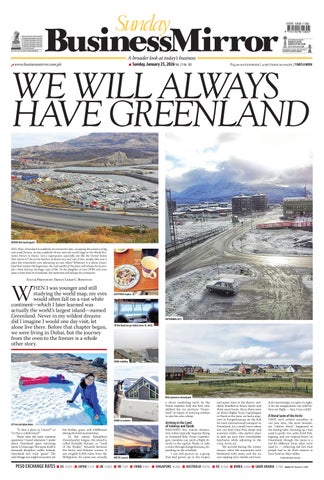
BusinessMirror January 25, 2026

Page 1


(Ed’s Note: Greenland is suddenly one everyone’s lips, occupying discussions in big and small forums, its fate suddenly thrust onto the world stage at the World Economic Forum in Davos. Can a superpower, especially one like the United States that claims it’s the prime bastion of democracy and rule of law, simply take over a place like Greenland, even alienating its own allies? Whatever it is about Greenland that tempts the hegemons, the real wealth of the place will always be its people—their history, heritage, way of life. To the daughter of two OFWs who once upon a time lived in Greenland, the memories will always be a treasure).

WHEN I was younger and still studying the world map, my eyes would often fall on a vast white continent—which I later learned was actually the world’s largest island—named Greenland. Never in my wildest dreams did I imagine I would one day visit, let alone live there. Before that chapter began, we were living in Dubai, but the journey from the oven to the freezer is a whole other story.

Nuuk, or take a route through Kangerlussuaq, depending on the schedule. I can still picture us: a group that had grown up in the tropics and spent time in the desert, suddenly bundled in heavy layers and thick snow boots. Since there were no direct flights from Copenhagen to Nuuk at the time, we had a stopover in Kangerlussuaq. As the hub for most international transport in Greenland, it’s a small town where you can find Duty-Free shops and souvenir stalls—the perfect place to pick up your first Greenlandic keychains while adjusting to the crisp, Arctic air. We arrived during the winter season, when the mountains were blanketed with snow, and the air was nipping your cheeks and nose.

And surprisingly, no igloo in sight. (I let my imagination run wild be -

Photos

Why icebreakers, not politics, decide access to Greenland

BRUSSELS—The cold, hard reality facing any US, NATO or European plans for Greenland is the ice. It chokes harbors, entombs minerals, and freezes shorelines into minefields of white and blue shards that threaten ships all year.

And the only way to break through all that is, well, with icebreakers: enormous ships with burly engines, reinforced hulls, and heavy bows that can crush and cleave ice.

But the United States has only three such vessels, one of which is so decrepit as to be barely usable. It has entered agreements to obtain 11 more, but can only source additional ships from adversaries—or allies it has recently rebuffed.

The key technology in the Arctic DESPITE toning down his rhetoric, US President Donald Trump seems set on the US owning Greenland for security and economic reasons: to keep what he calls “the big, beautiful piece of ice” out of the hands of Moscow and Beijing, to secure a strategic Arctic location for US assets, and to extract the island’s mineral wealth including rare earths. Without specifying any plan, he told world leaders gathered in Davos, Switzerland, on Wednesday that “to get to this rare earth you got to go through hundreds of feet of ice.”

Yet there is no meaningful way to do that—or anything else in the semiautonomous Danish territory—without icebreakers’ crucial ability to cut

trails through frozen seas. Even if they decided to surge US material into Greenland tomorrow, “they would have two or three years gap in which they’re not really able to access the island most of the time,” said Alberto Rizzi, a fellow at the European Council on Foreign Relations.

“On a map, Greenland looks surrounded by sea, but the reality is that the sea is full of ice,” he said. If the US wants more icebreakers, there are only four options: the shipyards of strategic adversaries China and Russia or longtime allies Canada and Finland, both of whom have recently weathered blistering criticism and threats of tariffs by Trump over Greenland.

Northern expertise in ice-capable ships ICEBREAKERS are expensive to design, build, operate and maintain and require a skilled workforce that can only be found in certain places like Finland, with expertise forged in the frigid Baltic Sea.

Finland has built roughly 60% of the world’s fleet of more than 240 icebreakers and designed half the remainder, Rizzi said.

“It’s very niche capabilities that they developed as a necessity first and then they have been able to turn it into geoeconomic leverage,” he said.

Russia has the world’s largest fleet with about 100 vessels, including colossal ships powered by nuclear reactors. Second comes Canada, which is set to double its fleet to around 50 icebreakers, according to a 2024 report by Aker Arctic, a Helsinki-based icebreaker design firm.

“Our design and engineering work order books are pretty full at the moment and the near future looks promising," said Jari Hurttia, business manager at Aker Arctic, as he describes rising interest in the firm's “unrivalled special competence which is not available anywhere else in the world.”

China currently has five compared to the US three, and is rapidly building more as they expand their ambitions in the Arctic, said Marc Lanteigne, a professor at the University of Tromsø in Norway who teaches often at the University of Greenland in Nuuk.

“China is now in a position to develop indigenous icebreakers, and so the US feels it must do the same,” he said.

Washington has to play catch up, and fast, said Sophie Arts, a fellow at the German Marshall Fund focused on Arctic security.

“President Trump has really bemoaned this lack of icebreakers, especially in comparison to Russia,” Arts said. The current US icebreaker fleet is “basically past their life cycle already.”

So he turned to the undeniable expertise of the European Union’s northernmost nation and the US’s neighbor to the north.

“Both Canada and Finland are really, really vital to this,” Arts said. “Cooperation is what makes this possible ... the US doesn’t really have a pathway

to do this on its own at this time.”

During his first administration, Trump prioritized the US military’s acquisition of ice-capable vessels, a strategy that the Biden administration followed up on by signing an agreement called the Ice PACT with Helsinki and Ottawa to deliver 11 icebreakers constructed by two corporate consortiums with Finnish designs.

Four would be built in Finland, while seven would be constructed in a Canadian-owned billion-dollar “American Icebreaker Factory” in Texas as well as a shipyard in Mississippi under joint US-Canadian ownership.

Any mining of critical minerals would face high costs in the harsh conditions at sea and on land in Greenland. Investments there would take

years if not decades to pay off, Lanteigne said.

Even with adequate icebreakers, the price to build and maintain mining or defensive facilities—like those envisioned in the yet-unfunded $175-billion Golden Dome missile defense network linking detectors and interceptors in space and on the ground — would be enormous. That means US allies in the Arctic might still welcome more investment by Washington in Greenland.

Danish Prime Minister Mette Frederiksen said in a statement that she would be open to strengthening Arctic security including the US Golden Dome program “provided that this is done with respect for our territorial integrity.”

Market dominance and strategic leverage

WHILE both the US and the 27-nation European Union including Denmark and Finland have pledged to vastly increase investment in Greenland, it is clear who currently has the hard-power capability to actually reach the vast frozen territory roughly three times the size of Texas.

“It’s kind of absurd because I don’t think Finland would scrap the deal with the US as a response to threatening to invade Greenland,” Rizzi said. “But if Europe wants to exercise significant leverage to the USA, they could say ‘We’re not going to give you any icebreakers and good luck reaching the Arctic, or projecting power there, with those two old ships that you have.’” European Commission President Ursula von der Leyen reminded world leaders Tuesday at Davos of the key EU-technology base for any Arctic endeavors.

“Finland—one of the newest NATO members—is selling its first icebreakers to the US,” von der Leyen said at the World Economic Forum.

“This shows that we have the capability right here, in the ice so to speak, that our northern NATO members have Arctic-ready forces right now, and above all, that Arctic security can only be achieved together.”

She announced after an emergency summit of the 27 EU leaders in Brussels on Thursday that the EU would surge defense spending in Greenland including an icebreaker.

We will always have Greenland

Continued from A1

What looked like beef wasn’t actually beef, it was either ummimak (musk ox) or tuttu (wild reindeer) — meats that were a wild Arctic twist on the usual pork and beef that I knew back home. If I were to describe their taste, it would be a much richer flavor than beef, more umami? (And really great when cooked as steak or roasted in the oven).

There was also mattak (whale skin and fat), a traditional Greenlandic delicacy, which had a unique crunch to it—best eaten when dipped in soy sauce and aromat. You’ll reel at the thought of eating it, but don’t knock it till you try it. It’s REALLY good.

Puisi (seal meat) is a good source of iron and a staple in the local diet during the winter, along with whale meat. (Imagine the density of beef, but make it briny).

However, there are moments of familiar comfort. The cold Greenlandic waters produce shrimp that are incredibly plump and sweet. We usually ate them peeled, mixed with mayonnaise, then piled on rye bread, garnished with sliced boiled eggs and a sprinkle (or a sprig) of dill.

And there’s also Suaasat, their national soup, which felt like an Arctic cousin to our nilaga and tinola. Traditionally made with seal or whale, but often cooked with reindeer or seabirds, it’s thickened with rice or barley—a very hearty bowl that felt like a warm hug in subzero conditions.

What time is it?

THE transition wasn’t just gastronomical; our internal clocks had to be reset. We Filipinos are used to the predictable 12-hour split of day and night, year-round. But Greenland threw that out the window.

During the summer, we experienced extended daylight. For a few months (late May to mid-July),

the sun never actually dips below the horizon. There were times that I’d wake up in a panic, seeing the room flooded with light and thought I slept heavily through my alarms—only to find out it was 2 a.m. It was a disorienting beauty that made the days feel infinite.

During winter is a different story, the sun sets earlier than we’re used to. It was dark and sometimes biting. But the sky during winter? A flood of colors would sweep through the skies during the coldest nights. I often find myself wishing that my phone camera back then had the same technology we have today. A simple lens couldn’t capture the way the vibrant colors didn’t just settle in the sky, but actually danced, shimmering with a life of their own.

Finding warmth in the cold

DESPITE being thousands of miles away from home, Greenlandic culture mirrored the warmth of Filipinos, revolving around family and hospitality. A proof of that is their traditional gathering called Kaffemik, where they meet at someone’s home to share stories over a cup of tea or coffee, and pastries.

When we arrived in Greenland, we didn’t know anyone other than our families and their families. But a week later? My introvert self is proud to say that I made friends that I’m still in touch with today (Hils alle sammen! Vi savner dig!)

Like any country hosting OFWs, Greenland gave to and gained warmth from the Filipino community. To say they were hardworking is an understatement. They were three-jobs-hardworking, but not in a bad way—these were jobs that they genuinely enjoyed. You have your usual hospitality jobs, healthcare jobs, and skilled jobs. And some of them even do side gigs (Whew! That’s a lot of jobs! But I used to wonder if the Arctic

cold kept them from feeling tired, or if the exhaustion only hit once they finally put their bags down at the end of a long, busy day.)

Greenland is also the place I learned how to knit, to crochet, to bake, and to be grateful of the nature God gave us and surrounded us with. Unlike the Philippines, Greenland has fresher air (not that much smoke since there aren’t many vehicles) and cleaner water (you can drink mineral water from the tap. Mineral.).

We also found ways to keep our spirits bright. One of the most unforgettable experiences I had didn’t involve expensive gear or professional training. It was simply the joy of being a kid in the snow. We headed to the nearest ski slope, but we didn’t have skis or snowboards. Instead, we embraced the Pinoys’ vaunted DIY spirit: we went sledding with nothing but cardboard boxes and heavy-duty trashbags. The sheer thrill of flying down the slope with nothing but a piece of plastic, the biting wind on our faces, and the sound of laughter echoing against the snow, remains one of my fondest memories. It proved that no matter where you are, or how deep the snow is, one can always find a way to make the world their playground.

Always a piece of Greenland with me IT has been more than a decade since I last set foot in the Arctic, but some things never changed. We still call our parents Anaana and Ataata or Mor and Far (Greenlandic and Danish for Mother and Father, respectively). I still use Danish and Greenlandic in my daily vernacular chat with my siblings—words like Nej (No), Aap (Yes), find their way when I talk to them. Day-to-day phrases, like Tak for mad (Danish; Thanks for the meal) are still used in our household. It’s bittersweet to remember my memories, I’m not going to lie about that. Because I find myself missing the wide-eyed kid who was suddenly in an entirely new world, experiencing things one can only see in documentaries. My heart aches and also swells with joy, seeing our friends who became family, how they’ve grown and started families of their own, or gone on adventures, half a world away. We may have left Kalallit Nunaat, but we didn’t leave it behind. We carry a piece of that ice and light with us, tucked away in our memories and our hearts, wherever our feet may take us next.

FINNISH icebreaker Polaris is moored in Helsinki, Finland, September 27, 2018. AP/DAVID KEYTON

Sunday, January 25, 2026

Russia watches US-European tensions over Greenland with glee, gloating and wariness

S tensions simmered be -

Atween the United States and Europe this week over President Donald Trump’s push to acquire Greenland, Russian officials, state-backed media and pro-Kremlin bloggers responded with a mixture of glee, gloating and wariness.

Some touted Trump’s move as historic. Others said it weakens the European Union and NATO— something that Moscow would seem to welcome—and that it takes some of the West’s attention away from Russia’s war in Ukraine.

Commentators also noted that the possible US acquisition of the self-governed, mineral-rich island from Denmark held security and economic concerns for Russia, which has sought to assert its influence over wide areas of the Arctic. Moscow has moved to boost its military presence in the region, home to its Northern Fleet and a site where the Soviet Union tested nuclear weapons.

In a speech at the World Economic Forum in Davos, Switzerland, on Wednesday, Trump insisted he wants to “get Greenland” but said he would not use force to do so, while deriding European allies and vowing that NATO should not try to block US expansionism.

Making ‘world history’

THE Kremlin has neither criticized nor supported Trump on the issue. Russian President Vladimir Putin said Wednesday that it “doesn’t concern us at all,” adding: “I think they’ll figure it out among themselves.”

His spokesman earlier this week pointed out the far-reaching impact if the US took Greenland from Denmark.

“Regardless of whether it’s good or bad and whether it complies with international law or not, there are international experts who believe that if Trump takes control of Greenland he will go down in history, and not only the US history but world history,” Kremlin spokesman Dmitry Peskov said Monday.

“Without discussing whether it’s good or bad, it’s hard not to

agree with these experts,” he added.

Such a cautious approach appears in line with Moscow’s public rhetoric toward the current US administration, as Russia tries to win concessions in the Trump-led effort to end its nearly four-year war in Ukraine and revive relations with Washington that had plunged to Cold War lows.

Putin said last year that Trump’s push for control over Greenland wasn’t surprising, given longtime US interest in the territory. Putin noted that the United States first considered plans to win control over Greenland in the 19th century, and then offered to buy it from Denmark after World War II.

“It’s obvious that the United States will continue to systematically advance its geostrategic, military-political and economic interests in the Arctic,” Putin said.

The government newspaper Rossiyskaya Gazeta on Sunday compared it to “such ‘planetary’ events as Abraham Lincoln’s abolition of slavery ... or the territorial conquests of the Napoleonic Wars.”

“If Trump secures the annexation of Greenland by July 4, 2026, when America celebrates the 250th anniversary of the Declaration of Independence, he will undoubtedly join the ranks of historical figures who affirmed the greatness of the United States,” the newspaper wrote.

A statement that appeared favorable to Trump came from Foreign Minister Sergey Lavrov, who told a news conference Tuesday that Denmark’s control over Greenland was a vestige of the colonial past.

“In principle, Greenland isn’t a natural part of Denmark,” he said.

Lavrov also drew parallels between Trump’s bid for Greenland and Putin’s annexation of Ukraine’s Crimean Peninsula. The 2014 illegal seizure of the peninsula is not recognized by most of the world.

“Crimea isn’t less important for the security of the Russian Federation than Greenland is for the United States,” he said.

A blow for longtime allies

OTHERS focused on the potential rift between the US and its European allies in NATO, a bloc that

has held firm since the dawn of the Cold War and that Russia has long viewed as an adversary.

“Transatlantic unity is over. Leftist, globalist EU/UK elites failed,” wrote Kirill Dmitriev, a presidential envoy involved in talks with the US on ending the war in Ukraine, in a post Saturday on X.

Lavrov echoed his sentiment, saying Trump’s bid for Greenland heralds a “deep crisis” for NATO and raises questions about the alliance’s preservation as a single military-political bloc.

In columns this week, Russian state news agency RIA Novosti touted Trump’s push for Greenland as “opening the door to world history before our very eyes” and mocked European countries for sending small military contingents to Greenland in a show of support for Denmark.

“Europeans can only watch this in impotent rage—they have neither economic nor military leverage against Washington,” one column said.

Another column said it was “amusing and didactical” that the World Economic Forum once “was at the pinnacle of power and might, a place everyone aspired to, and today they’re burying ‘Atlantic solidarity’ here.”

Pushing aside the war in Ukraine RUSSIAN state and pro-Kremlin media also argued Greenland

was diverting attention from Ukrainian President Volodymyr Zelenskyy’s effort to negotiate a favorable peace settlement to end Russia’s invasion of his country, painting it as a positive for Moscow.

“The world seemed to have forgotten about Ukraine and

Zelenskyy. And in this silence, US negotiators (Steve) Witkoff and (Jared) Kushner were preparing to travel to Moscow,” the pro-Kremlin tabloid Moskovsky Komsomolets said Sunday.

RIA Novosti echoed that Wednesday in a column titled “Greenland knocked out Zelenskyy,” saying “this uproar stirred up by Donald Trump has knocked Zelenskyy out cold,” and that “Ukraine’s importance will never return to its previous levels.”

But Trump said in Davos he would meet with Zelenskyy on Thursday. “I want to stop it,” Trump said of the fighting. “It’s a horrible war.”

Seeking Arctic supremacy

DMITRY MEDVEDEV, Russia’s former president who is deputy chairman of the Security Council, argued that Greenland “was never directly connected to the States,” and questioned what price Trump “is willing to pay to achieve this goal” and whether he is up to the task of “eliminating NATO.”

Popular pro-Kremlin military blogger and correspondent

Aleksander Kots said in a recent Telegram post that by taking Greenland, Trump “wants to seize the Russian Arctic” and get to the natural resources that Moscow covets there.

The Moskovsky Komsomolets tabloid on Sunday called Trump’s bid for Greenland a “turning point,” arguing that the Arctic “turns from a zone of cooperation into a zone of confrontation.”

“The Northern Fleet will be under threat. The economic projects will face hurdles. The nuclear deterrence will lose effectiveness. Russia will end up in strategic isolation,” its article said. “Greenland is not just Trump’s coveted 2 million square kilometer island. It is an icy noose around Russia’s throat. And Trump has already begun to tighten it.”

These concerns stand somewhat in contrast with the Kremlin publicly touting the prospects of cooperating with Washington in the Arctic. Putin has said, however, that Russia is worried about NATO’s activities in the polar region and will respond by strengthening its military capability there.

Sunday, January 25, 2026

Scientists warn human landscapes fuel unprecedented wildfire crisis in Chile

OGOTA, Colombia—Chile is reeling from one of its most serious wildfire emergencies in years.

Deadly flames sweeping across central and southern parts of the South American country have turned large swaths of forest and towns to ash, killed at least 20 people, forced tens of thousands from their homes and left families sifting through charred debris.

Fire scientists say the blazes are being driven not only by extreme heat, drought and wind, but also by how human-shaped landscapes interact with changing climates—a lethal mix that makes fires harder to control.

The fires began around mid-January in the Biobio and Nuble regions, roughly 500 kilometers (300 miles) south of the capital, Santiago. Within days, deaths were reported, more than 50,000 residents had evacuated and firefighters were battling more than a dozen active blazes.

The government declared a state of catastrophe—a rare emergency designation allowing for military coordination in firefighting efforts.

The fires have razed forests, farmland and hundreds of homes. In towns such as Penco and Lirquen, families confronted scenes of destruction— roofs collapsed, vehicles melted into twisted frames and community buildings reduced to rubble.

Scale and speed of fires

WHAT distinguishes Chile’s current fire season isn’t an unusual surge in the number of fires, but the amount of land they are burning.

“We are living a particularly criti -

cal situation that is very far from the usual averages that are normally seen in wildfire seasons,” said Miguel Castillo, director of the Forest Fire Engineering Laboratory at the University of Chile.

Castillo said Chile is “almost tripling the amount of affected area,” even though the number of fires so far is “within normal margins, even below average.” That means fewer ignitions are causing far greater damage—a pattern increasingly seen in extreme wildfire seasons around the world.

“This is a huge challenge for firefighters,” Virginia Iglesias, director of Earth Lab at the University of Colorado Boulder and a fire scientist and statistician, told The Associated Press.

Iglesias said that the emergency involves fires of different sizes, often advancing toward communities at once.

Heat, drought and wind CHILE is emerging from more than a decade of severe drought, leaving vegetation unusually dry. High summer temperatures and strong, shifting winds have further increased the risk.

“The hotter and drier things are the more of the fuel becomes available to burn,” said Mark Cochrane, a fire ecologist at the University of Maryland’s Center for Environmental Science, who studies wildfires globally. “Wind leans the flames over and transfers more heat in the direction of the wind. It also oxygenates the fire, so the fires combust more fuel more quickly raising the intensity.”

Iglesias described wildfire risk as a simple “recipe” with three ingredients: ignition, fuel and dry conditions. While fires have long been part of Chile’s ecosystems, she said, human activity has altered all three elements.

“Those winds are very erratic and very intense,” she said, adding that this affects not just how large fires become, but “how fast it’s going to move across the landscape.”

Alejandro Miranda, a researcher at Chile’s Center for Climate and Resilience Research, said wildfire behavior depends on several interacting factors: ignition, climate conditions, topography and the amount and continuity of burnable vegetation.

Chile’s prolonged drought—now more than a decade long—has dried forests and plantations alike, Miranda said, creating conditions that favor rapid fire spread. He said that recent extreme fire seasons, including those in 2017 and 2023, coincided with re -

cord high temperatures and rainfall deficits of more than 30% below historical averages.

“These conditions are the ones that are projected to become more intense in the future,” Miranda said. Why plantations burn differently LARGE areas of central and southern Chile are dominated by industrial pine and eucalyptus plantations, grown for timber and pulp. Fire experts say these landscapes play a major role in how fires behave once they start.

“Plantations facilitate the rapid spread of fire,” Castillo said.

Miranda said that plantations tend to have a high fuel load, large continuous areas of similar-aged trees

and abundant dead vegetation on the ground. When plantations aren’t actively managed, branches beneath the canopy can create a vertical “ladder,” allowing flames to climb into treetops and generate high-intensity crown fires.

Cochrane said that pine and eucalyptus “are very flammable and will build up more fuels over time,” and that these fires often send burning embers far ahead of the main blaze.

“It isn’t usually the direct fire that ignites homes,” Cochrane said. “It is embers landing everywhere.”

Castillo said those wind-blown embers can ignite new fires behind containment lines, making suppression extremely difficult, especially in

steep terrain and strong winds. Native forests, by contrast, tend to be more diverse and, in many areas, more humid, which can slow fire spread.

Causes and environmental impact

NEARLY all wildfires in Chile are caused by human activity, whether intentional or through negligence, experts said. Iglesias said that humans add ignitions through power lines, recreation and infrastructure, and that human-caused ignitions can extend the fire season, because they aren’t limited to lightning or storms.

The environmental impacts extend well beyond burned trees. Iglesias said smoke degrades air quality and poses serious health risks, especially for vulnerable populations, often far from the flames. After fires, soils can become water-repellent, increasing runoff, floods and landslides—what scientists call “cascading hazards.” Sediment can also contaminate rivers and raise the cost of treating drinking water. Miranda warned that fires can permanently alter ecosystems. After intense burns, invasive species such as pine can regenerate rapidly, replacing native forests and increasing future fire risk.

What comes next LOOKING ahead, Iglesias emphasized that while firefighting is essential, prevention matters more. She said that reducing ignitions, managing fuels, addressing climate change and redesigning communities—including defensible space around homes—are all critical steps. “These are very concrete actions that we can take to reduce the fire problem,” Iglesias said.

US at risk of losing measles-free designation as health officials confront enduring outbreak

IT’S been a year since a measles outbreak began in West Texas, and international health authorities say they plan to meet in April to determine if the US has lost its measlesfree designation. Experts fear the vaccine-preventable virus has regained a foothold and that the US may soon follow Canada in losing the achievement of having eliminated it.

The reevaluation is largely symbolic and hinges on whether a single measles chain has spread uninterrupted within the US for at least 12 months.

Public health scientists around the country are investigating whether the now-ended Texas outbreak is linked to active ones in Utah, Arizona and South Carolina. But doctors and scientists say the US—and North America overall—has a measles problem, regardless of the decision.

“It is really a question of semantics,” said Dr. Jonathan Temte, a Wisconsin family physician who helped certify the US was measles-free in 2000. “The bottom line is the conditions are sufficient to allow this many

cases to occur. And that gets back to de-emphasizing a safe and effective vaccine.”

Last year, the Centers for Disease Control and Prevention confirmed 2,242 measles cases across 44 states— the most since 1991—and nearly 50 separate outbreaks.

The problem has been years in the making, as fewer kids get routine vaccines due to parental waivers, health care access issues and rampant disinformation. More recently, Trump administration health officials including Health Secretary Robert F. Kennedy Jr. have questioned and sown doubt about the established safety of vaccines at an unprecedented level while also defunding local efforts to improve vaccination rates.

“The most important thing that we can do is to make sure the people who aren’t vaccinated get vaccinated,” said Jennifer Nuzzo, director of Brown University’s Pandemic Center. “We have not issued a clear enough message about that.”

A Department of Health and Human Services spokesperson said Thursday that Kennedy has emphasized vaccines as the best way to prevent measles, adding that the CDC is responding to outbreaks and working

to increase vaccination rates.

In a briefing Tuesday, department officials said they don’t yet have evidence that a single chain of measles has spread for a year.

But CDC’s principal deputy director said he would consider the loss of elimination status to be the “cost of doing business” globally.

“We have these communities that choose to be unvaccinated,” said Dr. Ralph Abraham. “That’s their personal freedom.”

Measles finds the unvaccinated THERE is little room for error in trying to stop measles. The virus is one of the most contagious, infecting 9 out of every 10 unvaccinated people exposed. Community-level protection takes a 95% vaccination rate. The current rate nationally is 92.5%, according to CDC data, but many communities fall far below that.

The patient in Texas’ first known case developed the telltale rash on Jan. 20, 2025, according to state health department data.

From there, the outbreak exploded. Officially, 762 people fell ill, most of them in rural Gaines County, and two children died. Many more

got sick and were never diagnosed: 182 potential measles cases among children in Gaines County went unconfirmed in March 2025 alone, state health officials said, a possible undercount of 44% in that county. Such data gaps are common, though, making it especially hard to track outbreaks. Many people living in communities where the virus is spreading face barriers, including

access to health care and distrust of the government.

Contact tracing so many cases is also expensive, said behavioral scientist Noel Brewer, who chairs the US committee that will finalize the data for international health officials. Research shows a single measles case can cost public health departments tens of thousands of dollars.

CDC data on measles is still among the best worldwide, Brewer said, but “the US has changed its investment in public health, so we’re less able to do the case tracking that we used to do.”

Genetic sequencing can fill some gaps.

Scientists have confirmed the same measles strain in Texas, New Mexico, Utah, Arizona, South Carolina, Canada, Mexico and several other North American countries, said Sebastian Oliel, a spokesperson for the Pan American Health Organization, which plans to make the final decision on

US measles elimination at an April 13 meeting.

But that’s not always enough to say the outbreaks are connected. Genetically, the measles virus doesn’t change as often as, say, flu.

“Within an outbreak, everybody is going to look the same,” said Justin Lessler, a University of North Carolina disease researcher.

The key question may then be how PAHO experts will navigate final data gaps, said Dr. Andrew Pavia, a Utah physician and longtime CDC consultant.

“My best guess is we will lose elimination status,” Pavia said. “The case for this not being continuous transmission is tenuous, and I think they are likely to err on the side of declaring it a loss of elimination status.” Oliel said when there is a case of unknown origin in a country with ongoing local spread, “the most conservative approach is to consider the case part of the existing national transmission.”

Mexico also up for review PAHO will review Mexico’s measles-free status alongside the US, Oliel said. The country’s largest outbreak has roots in Texas. It started when an 8-year-old boy from Chihuahua state got sick after visiting family in Seminole, Texas. Since last February, 6,000 people have gotten sick in Mexico, and 21 have died in Chihuahua state. But under PAHO’s definition of elimination, borders matter. If, for example, the chain of measles that started in the US spread to Mexico and then returned to the US anew, it would be considered a new chain, experts said. Still, many experts call that standard outdated.

HEALTH department staff members enter the Andrews County Health Department measles clinic carrying doses of the measles, mumps and rubella vaccine, Tuesday, April 8, 2025, in Andrews, Texas. AP/ANNIE RICE

Scientists urge stronger nuclear monitoring policy after detecting radioactive isotope in WPS

SCIENTISTS call for stronger policy and local testing capabilities after detecting higher concentrations of the nuclear substance iodine-129 in the West Philippines Sea (WPS).

“We currently have no regulatory body to monitor radioactivity in seawater. If the government decides to act, we need a routine sampling system,” Dr. Angel Bautista VII, scientist at the Department of Science and Technology’s Philippine Nuclear Research Institute (DOST-PNRI) told BusinessMirror , partly in Filipino, in an online interview.

Bautista emphasized the importance of developing domestic laboratory facilities and training personnel to measure radioactivity locally, eliminating the need to send samples abroad.

He noted that having this capability would improve the country’s preparedness for potential future incidents, and provide crucial baseline data ahead of possible nuclear energy developments.

“If we had our own instruments, it would be faster and we would be more prepared, especially with a nuclear power plant planned in the coming years,” Bautista explained. “This is important for nuclear power plants if we want to establish environmental baselines before construction.”

The analysis used Accelerator Mass Spectrometry (AMS), a technology commonly employed

in radiocarbon dating, such as determining the age of bones and archaeological materials.

Bautista, however, said that acquiring such equipment would cost an estimated P500 million.

“It’s not cheap, and the equipment is not available in the Philippines,” he said, adding that even within Asean, no country currently operates an AMS facility. The nearest laboratories are located in Taiwan and Japan.

Bautista noted that the analysis was made possible through international collaboration, particularly with Japan, where he completed his doctoral studies.

“I maintained close coordination with my PhD adviser and went back and forth to analyze the samples. That’s how this study was carried out,” he said.

WPS study

THE study in WPS, conducted by scientists from DOST-PNRI, the University of the Philippines Marine Science Institute (UP MSI), and the University of Tokyo, began around 2017.

Bautista said the research was designed to determine whether radioactive materials from the 2011 Fukushima nuclear accident

had reached Philippine waters. The accident occurred after a powerful earthquake and tsunami caused a power failure at the Fukushima Daiichi nuclear power plant in Japan, located near the Pacific coast.

To examine long-term radioactivity trends, the researchers analyzed massive coral formations, which serve as natural historical records of ocean conditions.

Coral cores were extracted vertically, with surface layers representing more recent years and deeper layers corresponding to earlier decades. About one meter of coral growth reflects roughly 100 years of environmental history, allowing scientists to track changes in seawater composition over time.

In collaboration with UP MSI, samples were taken from two locations: Baler on the Pacific side of

the Philippines, and Parola Island in the WPS.

The analysis confirmed that radioactive signatures linked to the Fukushima accident had reached Philippine waters, Bautista said.

However, when the two sites were compared, researchers observed an unexpected pattern. Beginning in the 1970s, iodine-129 concentrations were consistently higher in the WPS than on the Pacific side.

Bautista said the finding was puzzling, as most US nuclear weapons tests in the 1950s and 1960s were conducted in the Pacific Ocean, which should have resulted in higher iodine-129 levels along the country’s eastern seaboard.

“Instead, we observed a continuous increase in iodine-129 in the West Philippine Sea starting in the 1970s,” he said, adding that available data could not fully

‘From cradle to grave’: Chemistry’s role in global treaties

CHEMISTRY has long driven progress in fields ranging from agriculture and healthcare to energy and infrastructure. Its innovations fuel economic growth, improve quality of life, and help countries meet their fundamental societal needs.

Yet chemistry’s dual nature—capable of producing both beneficial and harmful substances—means it can be used for both good and nefarious purposes, according to a news release of University of the Philippines DilimanCollege of Science (UPD-CS). International agreements have been developed to regulate and control the harmful use of chemical, biological, radiological and nuclear (CBRN) materials.

Starting with the 1925 Geneva Protocol, the treaties aim to prevent the misuse of dangerous substances while allowing economic development.

This global effort advanced in the Philippines in April 2025, when President Ferdinand Marcos Jr. signed Republic Act 12174, or the Chemical Weapons Act of the Philippines.

During the fifth “Innovation Impact Stories” webinar of UPD-CS Innovation Program, Dr. Emily Castriciones from the UPD-CS Institute of Chemistry discussed chemistry’s role in implementing the Chemical Weapons Convention (CWC), which the Philippines had long ratified but could not fully enforce without a legal framework.

CHEMISTRY’S dual nature—capable of

“As chemists, what we really do—if we think about it—is to be with a chemical from cradle to grave. You do the synthesis, you do the testing, whether it’s a raw material or a finished product like a drug, even up to its proper disposal as chemical waste, you are still monitoring its presence in the waste streams and in the environment ” said Castriciones, who is also an Analytical Chemist Inspector for the Organisation for the Prohibition of Chemical Weapons.

“From the cradle to the grave of a chemical, there is always a chemist involved,” she added.

“Within the plant, there is a lot of work that we do as well. In government agencies, it’s mostly monitoring and regulatory, but let’s not

forget our law enforcement [agencies]—the Philippine Drug Enforcement Agency and PNP [Philippine National Police]. They have forensic labs, and through our project with DOST [Department of Science and Technology], we are collaborating with the PNP forensic lab and the Bureau of Fire Protection,” she explained.

“And of course, we can’t forget recordkeeping, documentation, and all the other essential work involved,” she added.

Castriciones became more closely acquainted with the convention through serving as the technical consultant for the CWC during the drafting of the Republic Act 12174 and by acting as a resource person in the technical working group meetings and stakeholder

consultations organized by the Senate Committee and the Anti-Terrorism Council, which functioned as Interim Philippine National Authority for the CWC.

“For the successful implementation of any national law, I think it is very important that stakeholders are involved, especially in the review and drafting of the implementing rules and regulations,” she pointed out.

“I’m pushing for a truly all-of-society engagement— from the government, the industry, the academe, and private testing laboratories and research institutions,” she said.

Castriones also shared that scientists can help strengthen the knowledge and technical capabilities of government agencies and conduct meaningful research on areas with immediate applications for national security through academic-government cooperative projects.

UPD-CS’ Innovation Impact Stories is a webinar series that explores how science, technology, and innovation drive real-world impact.

This initiative highlights the journeys, challenges, and successes behind researchdriven innovations that have made meaningful contributions across various fields.

It aims to inform and inspire students, researchers, and faculty to foster a culture of purposeful and collaborative innovation that bridges academic theory with practical application.

explain the trend.

The results prompted the research team to propose a followup study focused specifically on the WPS. Conducted from late 2022 to mid-2024, the project aimed to further investigate why iodine-129 levels were higher in the area, with policy-related aspects incorporated into the study’s scope following guidance from the DOST.

Second phase of research;

iodine-129 levels not harmful

IN the second phase of the research, the team analyzed around 120 seawater samples collected from various locations, including areas beyond the WPS and the Pacific Ocean, as well as Tubbataha Reef, the Sulu Sea, and other sites across the country.

“We confirmed that what we saw in the corals is still continuing,” Bautista said, noting that the latest data show elevated iodine-129 levels persisting to the present.

He added that findings from two research cruises conducted by the UP MSI in the West Philippine Sea in 2017 and 2021 indicate that concentrations of the nuclear substance “are still really high and still increasing.”

He also pointed to ocean circulation patterns as a possible factor, noting that technical analyses suggest the presence of a southward current originating from the Yellow Sea that could be transporting iodine-129 toward Philippine waters.

Bautista pointed out, however, that there is no cause for public concern at this stage, noting that the detected levels of iodine-129 remain far below thresholds considered harmful to humans, marine life, and the environment.

‘Invisible nuclear, visible oversight’ BAUTISTA said the team is still wrapping up the second phase of their research and considering a third phase that could include studying fish.

He explained that current findings do not indicate any immediate risk, and seafood remains safe to eat, but he said further study would be valuable.

The researchers are also advancing policy recommendations, which have already been submitted to relevant agencies, such as the Department of Environment and Natural Resources.

Bautista said the proposals include revising the Department Administrative Order (DAO) related to the Clean Water Act (Republic Act 9275) and the Toxic Substances and Hazardous and Nuclear Waste Act (RA 6969) to incorporate radioactive materials, which would allow for regular monitoring similar to other pollutants like heavy metals.

He noted that while it is unclear how quickly the DAO revisions could be implemented, recent legislation under the Philippine Atomic Energy Regulatory Act (PhilAtom) could provide a framework for oversight.  If the implementing rules and regulations of the law adopt the recommendations, Bautista said, PhilAtom could take responsibility for monitoring not only seawater but the broader environment.

“We’re hoping that will happen. Finally, I hope we can build our own instruments and equipment to strengthen our infrastructure,” he concluded.

3 authors win $10,000 prizes for blending science, literature

NEW YORK—Three authors who demonstrated how scientific research can be wedded to literary grace have been awarded $10,000 prizes.

The National Book Foundation and the Alfred P. Sloan Foundation on Wednesday announced the winners of the fifth annual Science + Literature awards.

The books include Kimberly Blaeser’s poetry collection, “Ancient Light,” inspired in part by the environmental destruction of Indigenous communities; the novel “Bog Queen” by Anna North, the story of a forensic anthropologist and a 2000-year-old Celtic druid; and a work of nonfiction, Patricia Ononiwu Kaishian’s “Forest Euphoria: The Abounding Queerness of Nature.”

“These gifted storytellers shine a scientific and poetic light on the beauties and terrors of nature and what they reveal to us about our deepest selves, our humanity, and our existence on this planet,” Doron Weber, vice president and program director at the Sloan Foundation, said in a statement.

Ruth Dickey, executive director of the National Book Foundation, said in a statement that the new winners continue the awards’ mission to highlight “diverse voices in science writing that…enlighten, challenge, and engage readers everywhere.”

The Book Foundation presents the National Book Awards, one of the literary world’s most prestigious events. The Sloan Foundation has a long history of supporting books that join science and the humanities, including Kai Bird’s and Martin J. Sherwin’s Pulitzer Prize-winning “American Prometheus,” which director Christopher Nolan adapted into the Oscar-winning “Oppenheimer.”

“At a time when science is under attack, it has become more urgent to elevate books that bring together the art of literature with the wonders of science,” Daisy Hernández, this year’s chair of the awards committee and a 2022 Science + Literature honoree, said in a statement. Hillel Italie/Associated Press

THIS combination of images (from left) shows cover art for “Ancient Light” by Kimberly Blaeser, “Bog Queen” by Anna North, center, and “Forest Euphoria: The Abounding Queerness of Nature” by Patricia Ononiwu Kaishian. UNIVERSITY OF ARIZONA PRESS/BLOOMSBURY

A6 Sunday, January 25, 2026

Faith Sunday

Editor: Lyn Resurreccion • www.businessmirror.com.ph

Bishop links social injustice to ‘withered hands’ of the corrupt

ACATHOLIC bishop on Wednesday delivered a sharp warning against corruption and social injustice, saying today’s “withered hands” belong to those who steal from the public.

Bishop Dave Dean Capucao of Infanta prelature said the Gospel story of Jesus healing a man’s withered hand challenges Church leaders to confront systemic wrongdoing rather than hide behind tradition or institutional comfort.

“Many hands are withered today because stealing [of public funds] has become systemic,” Capucao said during his homily during a Mass with fellow bishops at the Cubao Cathedral in Quezon

City on January 21. Referring directly to corruption, Capucao said stolen public funds leave deep moral and social wounds that demand repentance and healing, not silence or excuses from religious and civic leaders.

“I hope the hands of those who stole public money will wither,” he said, adding that corruption damages both society and the moral character of those involved. Capucao said healing, as shown

in the Gospel, must address not only physical suffering but also the deeper social and spiritual causes that keep people trapped in poverty and exclusion.

“Healing the hand also means healing the heart,” he said, stressing that injustice reflects a moral failure that requires conversion and concrete action.

The Mass concluded the second day of a three-day bishops’ seminar at the Pope Pius XII Catholic Center in Manila, ahead of the bishops’ 131st plenary assembly over the weekend.

The 59-year old prelate warned Church leaders against becoming detached administrators who focus on rules while ignoring suffering communities affected by hunger, inequality and abuse of power.

“Are we allowing fear of institutional norms to stifle the inherent call to radically love those

IN the humid, fast-paced environment of Metro Manila, where the skyline forms a jagged silhouette of steel and prayer, a quiet yet jubilant spiritual revolution is unfolding. It manifested across the vast and historic expanse of Luneta, as the Home Free Global Crusade (HFGC) 2026 transformed the Quirino Grandstand into a vibrant epicenter of spiritual gathering. Under the banner “Home Free: Saved. Healed. Delivered,” the city witnessed a multitude of people drawn not by spectacle, but by a deep longing for liberation that transcends the digital age.

Hosted by the Pentecostal Missionary Church of Christ (PMCC 4th Watch), the HFGC 2026 was not merely a religious event. It was a civic moment that assembled over 130,000 individuals from across the Philippine archipelago over two days (January 17 and 18), while reaching a global audience of more than 100,000 viewers through live broadcast.

At a time when institutions, political, economic, even morals are eroding under the weight of cynicism and fatigue, here was a mass gathering animated not by grievance or spectacle, but by PMCC (4th Watch’s) common conviction—lead people to the Almighty God. At the heart of the gathering stood global evangelist and PMCC (4th Watch) chief executive minister, Apostle Jonathan Ferriol, whose address cut through the abstractions often used to explain societal collapse.

“Chaos, corruption, and moral decay,” he pointed out, “cannot be ultimately thwarted by policy alone, nor by technological sophistication, nor even by reformist zeal. They are symptoms of a deeper dislocation, one that can only be confronted when the individual accepts Christ not as an idea or symbol, but as Lord and Savior.” Such language may be unfashionable in elite circles, where religion is often

tolerated when private or symbolic.

Yet, the HFGC did not seek permission from prevailing sensibilities. Its strength lays in its refusal to dilute meaning for acceptability. For those present— professionals, laborers, families, and the elderly—faith was not a lifestyle accessory; it was a profound reckoning. What made the event particularly arresting was its synthesis of scale and intimacy. This was faith at population level, yet deeply personal. A phenomenon that sociologists might describe as “phygital” (a blend of physical and digital) unfolded seamlessly: the physical gravity of thousands in prayer merging with highdefinition global transmission, collapsing distance without diminishing presence.

Manila became, briefly, a focal point of the sacred broadcast not as content, but as witness.

One of the event’s significant moments was during the baptism where thousands joined in, not as symbolism, but as covenant, meeting the modern cry for a life reclaimed and affirming faith not as nostalgia, but as a living, insistent force. Yet to describe what transpired merely in terms of attendance or numbers would be to misunderstand its gravity. What occurred in Manila was not ritual in the thin, performative sense of the word, but passage, an act of surrender and reorientation that, for its participants, marked the reclaiming of a life.

But of course, Yeng Constantino and Taya Smith’s performances were monumental and precented, leaving the crowd weeping for a revival.

Unveiled era of the apostolic authority

TO the uninitiated, the church has long been a fixture of the Philippine streetscape, a rhythmic, persistent presence of modesty and megaphones.

But as the church boldly heeded the call

in need?” Capucao asked, urging bishops to place compassion above rigid practice.

He also cautioned against relying on technology or systems to replace human responsibility, saying

true leadership requires personal encounter and moral courage.

“AI can stimulate conversation. AI can stimulate intimacy, vulnerability, and empathy in language, but AI cannot be a shepherd with a heart,” Capucao said, warning against leaders who act without genuine concern.

Capucao said the Church must actively confront injustice by standing with the marginalized, including Indigenous peoples, whom he described as powerful witnesses to shared responsibility and moral clarity.

“Resources are not a privilege, but rather they should be shared as blessings meant for the sustenance of all,” he said, calling on Church leaders to challenge corruption and inequality with decisive, compassionate action.

New

Loving-kindness meditation; how to practice it in the new year

APOPULAR New Year’s resolution is to take up meditation—specifically mindfulness meditation. This is a healthy choice.

Regular mindfulness practice has been linked to many positive health benefits, including reduced stress and anxiety, better sleep and quicker healing after injury and illness.

Mindfulness can help us to be present in a distracted world and to feel more at home in our bodies, and in our lives.

There are many different types of meditation. Some mindfulness practices ask meditators simply to sit with whatever thoughts, sensations or emotions arise without immediately reacting to them.

of the Gospel, a profound shift occurred that particularly started during the pandemic under the stewardship of Apostle Ferriol.

A shift in visibility and authority suddenly took place. From “hidden” to “sovereign” for decades, the PMCC (4th Watch) was a grassroots movement, powerful, but often operating in the peripheral “noise” of the city, including buses and markets.

The “new aesthetic” is the church stepping into the center stage (like Luneta) and claiming it with an imposing, organized, and sophisticated presence that can no longer be ignored by the elite or the global stage.

Apostle Ferriol said that since PMCC is committed to bringing the gospel everywhere, it needs to cope with the demands of time.

To understand the 4th Watch is to understand the poetry of time. The name itself is a masterpiece of eschatological suspense referring to the final watch of the night, the thin, blue hour before the dawn.

For the intellectual observer, there is a captivating tension, a community living with the urgency of the “end times” while simultaneously building an infrastructure designed to last for generations.

Fourth watchers have always been committed to great commission and to the kerygma that as Christians, one has to live in holiness because God is holy!

In an age that prides itself on progress, Luneta offered a reminder that renewal does not always come dressed as innovation. Sometimes, it arrives as return—quietly, decisively to first truths, to moral clarity, and to the enduring question of who, or what, ultimately governs the human heart that no algorithm can replicate.

And for Apostle Ferriol and the entire 4th Watchers globally, they are just starting; the harvest field is ready and the worker have a lot of work to do. Nazarene A. Leyco

Such meditations cultivate focus, while granting more freedom in how we respond to whatever events life throws at us.

Other meditations ask practitioners to deliberately focus on one emotion—for example, gratitude or love—to deepen the experience of that emotion. The purpose behind this type of meditation is to bring more gratitude, or more love, into one’s life.

The more people meditate on love, the easier it is to experience this emotion even when not meditating.

One such meditation is known as “metta,” or loving-kindness. As a scholar of communication and mindfulness, as well as a longtime meditation teacher, I have both studied and practiced metta.

Here is what loving-kindness means and how to try it out for yourself.

Unbounded, universal love

LOVING-KINDNESS , or metta, is the type of love which is practiced by Buddhists around the world. Like many forms of meditation today, there are both secular and religious forms of the practice.

One does not need to be a Buddhist to practice lovingkindness. It is for anyone and everyone who wants to live more lovingly.

Loving-kindness, the feeling cultivated in metta meditation, is very different from romantic love.

In the ancient Pali language, the word “metta” has two root meanings: The first is “gentle,” in the sense of a gentle spring rain

that falls on young plants, nourishing them without discrimination. The second is “friend.”

Metta is limitless and unbounded love; it is gentle presence and universal friendliness. Metta practice is meant to grow people’s ability to be present for themselves and others without fail.

Metta is not reciprocal or conditional. It does not discriminate between us and them, rich and poor, educated and uneducated, popular or unpopular, worthy and unworthy.

To practice metta is to give what I describe in my research as “the rarest and most precious gift”—a gift of love offered without any expectation of it being returned.

How to practice lovingkindness meditation

IN the fifth century, a Sri Lankan monk, Buddhaghosa, composed an influential meditation text called the “Visuddhimagga,” or “The Path of Purification.”

In this text, Buddhaghosa provides instructions for how to practice loving-kindness meditation. Contemporary teachers tend to adapt and modify his instructions.

The practice of loving-kindness often involves quietly reciting to oneself several traditional phrases designed to evoke metta, and visualizing the beings who will receive that loving-kindness.

Traditionally, the practice begins by sending loving kindness to ourselves. It is typical during this meditation to say:

“May I be filled by lovingkindness; may I be safe from inner and outer dangers; may I be well in body and mind; may I be at ease and happy.”

After speaking these phrases, and feeling the emotions they evoke, next it’s common to direct loving-kindness toward someone—or something—else: It can be a beloved person, a dear friend, a pet, an animal, a favorite tree. The phrases become:

“May you be filled by lovingkindness; may you be safe from inner and outer dangers; may you be well in body and mind; may you be at ease and happy.” Next, this loving-kindness is directed to a wider circle of friends and loved ones: “May they…”

The final step is to gradually expand the circle of well wishes: including the people in our community and town, people everywhere, animals and all living beings, and the whole Earth. This last round of recitation begins: “May we…”

In this way, loving-kindness meditation practice opens the heart further and further into life, beginning with the meditator themselves.

Loving-kindness and mindful democracy

CLINICAL research shows that loving-kindness meditation has a positive effect on mental health, including lessening anxiety and depression, increasing life satisfaction and improving self-acceptance while reducing self-criticism. There is also evidence that loving-kindness meditation increases a sense of connection with other people.

The benefits of loving-kindness meditation are not just for the individual. In my research, I show that there are also tremendous benefits for society as a whole.

Indeed, the practice of democracy requires us to work together with friends, strangers and even purported “opponents.” This is difficult to do if our hearts are full of hatred and resentment.

Each time meditators open their hearts in metta meditation, they prepare themselves to live more loving lives: for their own selves, and for all living beings. Jeremy

BISHOP Dave Dean Capucao of the Prelature of Infanta presides over Mass with fellow bishops at the Cubao Cathedral on January 21. CBCP NEWS
THE Buddha meditating in lotus position, in Bihar, India, probably Kurkihar, Pala dynasty, c. 1000 AD; black stone. This is a photo of an artwork at the Museum of
David Engels, Penn State/The Conversation (CC) via AP
THE Pentecostal Missionary Church of Christ 4th Watch hold the Home Free Global Crusade 2026 on January 17 and 18 at Quirino Grandstand in Manila. PMMC 4TH WATCH PHOTO

Asean Champions of Biodiversity Media Category 2014

Biodiversity Sunday

UN scientists: World in ‘era of water bankruptcy’

THE world is now using so much fresh water amid the consequences of climate change that it has entered an “era of water bankruptcy,” with many regions no longer able to bounce back from frequent water shortages.

About 4 billion people—nearly half the global population—live with severe water scarcity for at least one month a year, without access to sufficient water to meet all of their needs.

Many more people are seeing the consequences of water deficit: dry reservoirs, sinking cities, crop failures, water rationing and more frequent wildfires and dust storms in drying regions.

Water bankruptcy signs are everywhere—from Tehran, where droughts and unsustainable water use have depleted reservoirs the Iranian capital relies on, adding fuel to political tensions, to the US, where water demand has outstripped the supply in the Colorado River, a crucial source of drinking water and irrigation for seven states.

Water bankruptcy is not just a metaphor for water deficit. It is a chronic condition that develops when a place uses more water than nature can reliably replace, and when the damage to the natural assets that store and filter that water, such as aquifers and wetlands, becomes hard to reverse.

A new study this writer led with the United Nations University Institute for Water, Environment and Health concludes that the “world has now gone beyond temporary water crises.”

Many natural water systems are no longer able to return to their historical conditions. These systems are in a state of failure—water bankruptcy.

What water bankruptcy looks like in real life

IN financial bankruptcy, the first warning signs often feel manageable: late payments, borrowed money and

selling things you hoped to keep. Then the spiral tightens. Water bankruptcy has similar stages.

At first, we pull a little more groundwater during dry years. We use bigger pumps and deeper wells. We transfer water from one basin to another. We drain wetlands and straighten rivers to make space for farms and cities.

Then the hidden costs show up. Lakes shrink year after year. Wells need to go deeper. Rivers that once flowed year-round turn seasonal. Salty water creeps into aquifers near the coast. The ground itself starts to sink.

That last one, subsidence, often surprises people. It’s a signature of water bankruptcy. When groundwater is overpumped, the underground structure, which holds water almost like a sponge, can collapse. In Mexico City, land is sinking by about 10 inches (25 centimeters) per year. Once the pores become compacted, they can’t simply be refilled.

The “Global Water Bankruptcy” report, published on January 20 documents how widespread this is becoming.

Groundwater extraction has contributed to significant land subsidence over more than 2.3 million square miles (sqm) (6 million square kilometers [sq km]), including urban areas where close to 2 billion people live.

Jakarta, Bangkok and Ho Chi Minh City are among the well-known examples in Asia.

Agriculture biggest responsible for freshwater usage

AGRICULTURE is the world’s biggest water user, responsible for about 70 percent of the global freshwater withdrawals.

When a region goes water bankrupt, farming becomes more difficult and more expensive. Farmers lose jobs, tensions rise and national security can be threatened.

About 3 billion people and more than half of global food production are concentrated in areas where water storage is already declining or unstable.

More than 650,000 million sqm (1.7 million sq km) of irrigated cropland are under high or very high water stress. That threatens the stability of food supplies around the world.

water-loss management efforts, they also reinforce a culture of sustainability and accountability within the organization.

“‘Walk the Line’ encourages employees from all levels to see, firsthand, the challenges our technical teams face on the ground. It’s a chance to help detect leaks, inspect pipelines, and identify signs of water loss,” said Central NRW Head Engr. Ryan B. Jamora.

“Their observations and reports helped surface issues faster and contributed meaningfully to our field operations,” Jamora said.

The monthly field activities not only deepen internal appreciation for Maynilad’s

“The ‘Walk the Line’ initiative reflects Maynilad’s commitment to responsible water stewardship. It shows how every individual—regardless of role—can make a real contribution toward sustainable resource management,” said Chief Sustainability Officer Atty. Roel S. Espiritu.

The program complements the company’s comprehensive NRW reduction strategy, which includes active leak detection, pressure management, pipe rehabilitation, and community engagement. Employee involvement is key to strengthening these efforts and ensuring long-term water security.

Droughts are also increasing in duration, frequency and intensity as global temperatures rise. Over 1.8 billion people—nearly 1 in 4 humans—dealt with drought conditions at various times from 2022 to 2023.

These numbers translate into real problems: higher food prices, hydroelectricity shortages, health risks, unemployment, migration pressures, unrest and conflicts.

How did we get here?

EVERY year, nature gives each region a water income—depositing rain and snow. Think of this like a checking account. This is how much water we receive each year to spend and share with nature.

When demand rises, we might borrow from our savings account. We take out more groundwater than will be replaced. We steal the share of water needed by nature and drain wetlands in the process.

That can work for a while, just as debt can finance a wasteful lifestyle for a while.

Those long-term water sources are now disappearing. The world has lost

more than 1.5 million sqm (4.1 million sqkm) of natural wetlands over five decades. Wetlands don’t just hold water. They also clean it, buffer floods and support plants and wildlife.

Water quality is also declining.

Pollution, saltwater intrusion and soil salinization can result in water that is too dirty and too salty to use, contributing to water bankruptcy.

Climate change is exacerbating the situation by reducing precipitation in many areas of the world. Warming increases the water demand of crops and the need for electricity to pump more water. It also melts glaciers that store fresh water.

Despite these problems, nations continue to increase water withdrawals to support the expansion of cities, farmland, industries and now data centers.

Not all water basins and nations are water bankrupt, but basins are interconnected through trade, migration, climate and other key elements of nature.

Water bankruptcy in one area will put more pressure on others and can increase local and international tensions.

What can be done?

FINANCIAL bankruptcy ends by transforming spending. Water bankruptcy needs the same approach:

n Stop the bleeding: The first step is admitting the balance sheet is broken. That means setting water use limits that reflect how much water is actually available, rather than just drilling deeper and shifting the burden to the future.

n Protect natural capita—not just water: Protecting wetlands, restoring rivers, rebuilding soil health and managing groundwater recharge are not just nice-to-haves. They are essential to maintaining healthy water supplies, as is a stable climate.

n Use less, but do it fairly: Managing water demand has become unavoidable in many places, but water bankruptcy plans that cut supplies to the poor while protecting the powerful will fail.

Serious approaches include social protections, support for farmers to transition to less water-intensive crops and systems, and investment in water efficiency.

n Measure what matters: Many countries still manage water with partial information. Satellite remote sensing can monitor water supplies and trends, and provide early warnings about groundwater depletion, land subsidence, wetland loss, glacier retreat and water quality decline. n Plan for less water: The hardest part of bankruptcy is psychological. It forces us to let go of old baselines. Water bankruptcy requires redesigning cities, food systems and economies to live within new limits before those limits tighten further. With water, as with finance, bankruptcy can be a turning point. Humanity can keep spending as if nature offers unlimited credit, or it can learn to live within its hydrological means. Kaveh Madani, United Nations University/ The Conversation (CC) via AP

WEF26: Saudi Arabia leads global push to protect coral reefs, unlock AI potential

DAVOS, Switzerland—Her Royal Highness Ambassador Reema Bandar Al-Saud, Ambassador of the Kingdom of Saudi Arabia to the United States of America, announced at the World Economic Forum (WEF) Annual Meeting on January 21 that Saudi Arabia will host the first Global Coral Reef Summit 2026.

The summit will bring together global leaders, scientists, and investors to drive solutions for the protection and recovery of coral reef ecosystems.

It will address key challenges and policy and regulatory gaps, develop science-based solutions, and advance sustainable financing and investment mechanisms to scale coral reef protection and recovery.

Building on the call for constructive dialogue in an era of fragmentation, His Excellency Ahmed A. Alkhateeb, Minister of Tourism, said: “Tourism brings peace at a time when it’s needed—connecting people and encouraging dialogue. Tourism growth is good for peace, it’s good for people, good for youth, and good for women.”

On the Kingdom’s ambitions to become a global hub for artificial intelligence (AI), His Excellency Abdullah A. Alswaha, Minister of Communications and Information Technology, commented: “Saudi Vision 2030 was about economic diversification and empowering youth. Fast forward to today and we’ve achieved 56 percent non-oil contribution to GDP, and in terms of talent and youth, our tech force has increased dramatically.”

Earlier in the day, Humain and the National Infrastructure Fund (“Infra”) announced a Strategic Financing Framework Agreement of up to $1.2

billion to support the expansion of AI and digital infrastructure projects in the Kingdom.

The agreement outlines non-binding financing terms for Humain’s development of up to 250 MW of hyperscale AI data center capacity.

The United Nations Convention to Combat Desertification COP16 presidency also launched the Business4Land Champions’ Council.

This high-level coalition brings together CEOs, sustainability leaders, investors, and policymakers to accelerate land restoration, combat land degradation, and strengthen drought resilience.

The Ministry of Industry and Mineral Resources (MIM), in collaboration with WEF, announced the Lighthouse Operating System, a country-level framework designed to accelerate manufacturing transformation. Developed in partnership with WEF’s Advanced Manufacturing and

Production Centre, the initiative aims to diversify the kingdom’s economy, build robust non-oil industries, and position Saudi Arabia as a global hub for advanced manufacturing and logistics.

MIM and WEF announced a cooperation agreement on the sidelines of the Future Minerals Forum, which took place the week before the WEF Annual Meeting. The agreement runs until September 2027 and aims to unify efforts to strengthen partnerships around critical minerals required for energy and other technologies, contributing

MAYNILAD President and CEO Ramoncito S. Fernandez (second from right) and Central Non-Revenue Water (NRW) Head Engr. Ryan B. Jamora (third from right) observe a “Walk the Line” deployment in Manila, demonstrating top management’s active support for field-level operations and NRW reduction efforts. MAYNILAD PHOTO

Olympic flame reaches romantic city of Venice

VENICE, Italy—The Olympic flame on Thursday crossed through the romantic, lagoon city of Venice, where torchbearers glided on traditional Venetian boats down the Grand Canal and across St. Mark’s Basin facing the famed Doge’s Palace in one of its most scenic passages ahead of the Milan Cortina Winter Games.

The flame arrived near dusk in Venice’s Piazzale Roma, the main bus terminal for people arriving in the city. It crossed the Ponte delle Guglie in Cannaregio en route to the arched Rialto Bridge, where it was loaded onto a boat to traverse the Grand Canal toward the wooden Accademia Bridge.

Francesco Lamon, an Olympic gold medal-winning cyclist, was one of the torchbearers on Thursday.

“It’s an indescribable emotion,” he told The Associated Press.

People cheered from the side of the canal as the flame, held aloft by torchbearers, was conveyed on a long traditional Venetian boat that once carried Venice’s rulers. Called the Serenissima, it was flanked by smaller traditional boats as well as police on Jet Skis.

One small group of anti-war demonstrators called for Israel and the US to be excluded from the Games.

Venice historically has served as a crossroads between Eastern and Western civilizations, which is evident in its Byzantine architecture and history in the trade of spices, silks and art. In the modern era, it is the capital of the Veneto region, which includes host city Cortina nestled in the Dolomites to the north.

On a clear day, snow-capped mountains can be seen from Venice’s historic center.

From the Accademia Bridge, the flame was carried by foot to Punto della Salute, opposite St. Mark’s Square, four a brief tour of St. Mark’s Basin before being set down at the Doge’s Palace. Thousands of people gathered in St. Mark’s Square to cheer the flame as it passed St. Mark’s Basilica, where a small cauldron was lit.

Venice was the 46th stage of the 63-day torch relay covering 12,000 kilometers (nearly 7,500 miles) that started in Rome and will wind its way through all 110 Italian provinces before reaching Milan’s San Siro Stadium for the opening ceremony on February 6. Two official cauldrons will burn during the Games, one in Milan at Arco della Pace in Sempione Park, and one in Cortina, in the Dibona Square.

It’s the first time in nearly 20 years—since the 2006 Turin Games— that Italy has hosted the flame.

The Winter Games run through February 22, when the closing ceremony will take place in the Veneto city of Verona. AP

Too loud, or new to tennis? Alex Eala and Filipino fans BusinessMirror

Filipino fans supporting Alex Eala are not disruption—this is evolution happening in real time. After all, we’re not just watching the game; we’re helping it grow.

THERE’S a debate going on about whether Filipino tennis crowds are “too loud”—whether the support feels unruly, more like boxing or basketball than tennis.

I understand where that sentiment comes from. For many Filipinos, this world is still new. We’re learning the rhythms, the etiquette, the pauses. But what often gets missed— especially in online discussions—is this: we are learning, and we are listening.

I had the privilege of watching Alexandra Eala play at the ASB Classic this year. I’m a Filipino immigrant living in Auckland, and truth be told, I had never cared much for the tournament before.

ASB Classic is an annual January fixture in the city, but for someone like me—who grew up in the Philippines—sports meant basketball and volleyball. Like many Filipinos, I watched Manny Pacquiao’s fights religiously. As a reporter back home, I was often assigned to barangays where neighbours gathered around a single television to watch Pacquiao’s fights, sometimes pooling resources so everyone could watch together. Tennis, on the other hand, always felt distant. Not difficult to understand—anyone can follow the scoring—but culturally elite.

I knew the big names: Serena Williams, Maria Sharapova, Novak Djokovic. But I never followed their careers. Tennis wasn’t for people like me, or so I thought.

At work, I heard plenty about ASB Classic because of my Vietnamese colleague Linh, a keen club player who even volunteered at the tournament. Still, I remained indifferent. Until this year. This year, I was invested—because a Filipina was playing.

The young woman who had been making headlines in Guadalajara and Miami, who had represented the Philippines and won gold in

the Southeast Asian Games, who kept appearing on my social media feed—was stepping onto center court. Suddenly, tennis felt personal.

I found myself, alongside another Filipino colleague, scrambling to buy tickets for her first singles match against Croatia’s Paris Olympic silver medallist Donna Vekić. The price was eye-watering. I have never paid that much to watch a game. I wouldn’t even pay that much for a concert. But there I was, determined.

I was on the bus heading home when the ASB Classic released the schedule: Alex versus Donna, center

tennis match before. We said no. He paused, then smiled—half practical, half protective—and said there were rules we needed to know. Tennis, he explained, had a different etiquette. You don’t cheer during serves. You clap after points. You keep it measured. This wasn’t football. He was thinking of the 2023 FIFA Women’s World Cup, when Filipinos everywhere came out in full voice for the national team. We were there too—cheering with abandon, hearts on our sleeves. This would be different. And it was.

Throughout the match, the crowd— largely Filipino—followed the rules almost to the letter. No flags (ASB Classic security confiscates them). No chants mid-point. Just applause when points were won. As I shared photos and videos from the match on social media, my

about the new clubs coming out in 2026. While the big brands are slowly rolling out their offerings for the year, what created more buzz was Rory McIlroy’s shift from blades to cavity back irons. While it is not uncommon to see big names using cavity backs, players of Rory’s stature will naturally draw attention to any equipment change. He has been playing blades all his

former desk editor in the Philippines asked if they could repost them, which I agreed to. When they followed up asking if I could interview Alex’s fans in the stands or do an FB live, my response was: “I can’t po. Tahimik po kasi. Tuwing may points lang pumapalakpak .” The Filipino crowd only clapped when a point was won.

It wasn’t until Alex struck a stunning cross-court winner that spontaneous cheers broke out—and to my surprise, it was the New Zealanders around us, including my husband, who stood first. They clapped. They cheered.

As Alex mounted a comeback in the second set, and as the final set tightened, Filipino supporters began to cheer more openly. Not disruptively. Not disrespectfully.

Just encouragement. And something beautiful happened: the Kiwis around them joined in.

By the end of the match, the entire stadium was on its feet. Everyone cheering. Everyone invested.

That moment matters.

For me, watching that match wasn’t just about tennis. It was the first time I felt like my community didn’t need to whisper to belong.

For the longest time, Filipinos abroad have learned to adjust. To blend in. To be invisible in plain sight.

We are often described as the “ideal immigrants”: quiet, smiling, caring, hardworking, never demanding space. Governments welcome Filipinos because we don’t arrive to conquer—we arrive to contribute. That is the reality many of us grew up with.

So when someone like Alex steps onto a global court carrying the Philippine flag, something shifts.

Filipino communities take leave from work. They pay exorbitant ticket prices. They travel, queue, wait—just to show up for a young Filipina carving

Para hoops action The Philippines’ Rhebelyn Aniban goes for

golfing life, from his amateur days until last year.

Blades offer the most workability among all the iron head shapes. It also offers the best feel when struck perfectly. But Rory’s shift to more forgiving irons means that even at the highest level of golf, pros are still open to trying new things to gain that little bit of advantage.

Blades vs Cavity Backs

AS I mentioned above, bladed irons offer the most workability. This means the ability to shape shots left and right, high and low. What blades offer in workability, they lose to cavity backs in terms of forgiveness. On mishits, blades offer very low forgiveness, while cavity back irons offer some help due to weight redistribution. Perimeter weighting was the main objective of changing the shape of irons. Back in the day, everything was blade-shaped. Eventually manufacturers discovered that by moving weight from the center out to the perimeter, the size of the sweet spot increased. This meant slight mishits don’t get penalized as much. As years passed, improvements in forging, weight distribution, added weights like tungsten and better materials made cavity back irons more and more forgiving. Today’s most

space in an elite sport that never imagined her there. That isn’t noise. That’s presence. Alex herself understands this deeply. Speaking during the ASB Classic, she reflected that “home is a people, not the place.” In that moment, centre court in Auckland felt exactly that—home, not because of geography, but because of who showed up. Alex isn’t just a tennis player. She represents a cultural awakening. And for those who insist Filipinos should behave the way “proper” tennis crowds do, it’s worth naming the history plainly: tennis was codified in Europe, shaped in elite British and European social clubs, and exported to the rest of the world through colonial systems. The norms often defended as “tradition” were never culturally neutral to begin with. The sport is changing. Players from the Philippines, Thailand, Indonesia, Mexico and beyond are arriving. With them come new audiences, new energy, new futures—and new markets. The inaugural Philippines Women Open 2026 will make that shift visible. It will be a moment to see how tennis is shaped when Filipino fans engage with the sport on their own terms, in their own city. Expecting these communities to leave their identity at the gate just to be welcomed into the sport isn’t about respect; it’s about preserving an old order. The real question isn’t whether Filipinos are too loud—but whether tennis is ready to evolve. Even from a business perspective, the numbers point in the same direction. Tournaments like the ASB Classic and the Australian Open are seeing record-breaking attendance and sold-out courts. Engagement around Alex consistently trends. Her Australian Open pre-match press conference alone surpassed 180,000 views—and continues to climb. These new fans are engaged, loyal and willing to invest—emotionally and financially—in the sport. Filipinos have always bent themselves to fit the mould when living abroad. Maybe this time, it’s okay to meet us halfway.

forgiving irons fly longer and straighter, go higher and spin more (when needed) than ever before. There is now a category for “game improvement” irons where technology is maximized to build

TORCHBEARERS glide on traditional Venetian boats down the Grand Canal and across St. Mark’s Basin facing the famed Doge’s Palace ahead of the Milan Cortina Winter Games. AP
WHEN someone like Alex Eala steps onto a global court carrying the Philippine flag, something shifts. AP

IS LETTER WRITING BACK?

Digital natives embrace analog tools like letters and typewriters

JANUARY 25, 2026 | soundstrip.businessmirror@gmail.com

WHAT’S NEW IN 2025 BEATLES ANTHOLOGY

Or why the Fab Four stopped touring after coming to Manila

If the greatest story ever told was the Bible, then the greatest band of all time would have to be the Beatles.

Fans of the Rolling Stones and Led Zeppelin may say otherwise, but the Beatles’ music covered both rock and pop — meaning its fans were more diverse and wider.

In any case, interest in the Fab Four — in their story and legacy — is renewed by way of “The Beatles Anthology 2025,” a documentary series that has been restored and remastered and is currently streaming on Disney+.

The series’ original eight episodes, first broadcast in November 1995, with expanded versions released on VHS and LaserDisc in 1996, and on DVD in 2003, are here — plus a new ninth episode.

Long-time Beatles fans would be familiar with the content of the eight episodes, which trace the band’s roots at The Cavern in Liverpool, England, as well as a stint in Hamburg, Germany, before they conquered the world.

For those who have only the slightest idea what the Beatles did and their impact on 1960s counterculture, here’s what to expect:

Publisher :

T. Anthony C. Cabangon

Editor-In-Chief :

Lourdes M. Fernandez

Aldwin M. Tolosa

Concept :

Y2Z Editor :

SoundStrip Editor : Group Creative Director : Graphic Designers :

Jt Nisay

Edwin P. Sallan

Eduardo A. Davad

Niggel Figueroa

Chow Jarlego

Contributing Writers :

Tony M. Maghirang

Rick Olivares

Jingo Zapata

Reine Juvierre S. Alberto

John Eiron R. Francisco

Patrick Villanueva

Ana Zoe V. Davad

Justine Xyrah Garcia

Ginger Franz S. Ocampo

Trixzy Leigh Bonotan

Bless Aubrey Ogerio

Photographers :

Bernard P. Testa

Nonie Reyes

Y2Z & SOUNDSTRIP are published and distributed free every Sunday by the Philippine Business Daily Mirror Publishing Inc. as a project of the

The Philippine Business Mirror Publishing, Inc., with offices on the 3rd Floor of Dominga Building III 2113 Chino Roces Avenue corner

Dela Rosa Street, Makati City, Philippines. Tel. Nos. (Editorial) 817-9467; 813-0725. Fax line: 813-7025

Advertising Sales: 893-2019; 817-1351,817-2807.

Circulation: 893-1662; 814-0134 to 36. www.businessmirror.com.ph

Episode One traces the early years of the band’s members, John Lennon, Paul McCartney, George Harrison, and Ringo Starr, including their first drummer, Pete Bes,t and bassist Stu Sutcliffe, as well as their first hit record.

Episode Two shows the band’s rise on the music charts and the start of world domination.

In Episode Three, the band lands in America and breaks television viewership records with its appearance on “The Ed Sullivan Show.”

Episode Four shows how Beatlemania spread globally, as the band is caught in a daily schedule of media and fan frenzy.

Episode Five is about the record-breaking Shea Stadium show, Japan dates that courted controversy, and the disastrous Philippine concerts.

Rumors of a decline are deemed exaggerated, with the Beatles spending 1967 recording some of their biggest hits, which are documented on Episode Six.

Episode Seven is about the band’s leap into transcendental meditation, which leads to the creation of the “White Album.”

In Episode Eight, the Beatles prepare to record another album, which the band thinks would be its last.

In the new Episode Nine, McCartney, Harrison, and Starr regroup in the studio between ’94 and ’95, recreating a Lennon demo into a proper song and reflecting on their past.

The restoration was overseen by the Beatles' Apple Corps production team, working with Peter Jackson’s Wingnut Films & Park Road Post teams, along with Giles Martin, who has created new audio mixes for the majority of the featured music.

The new audio mixes are the 2025 Anthology’s biggest treat, the music jumping out, coming to life crystal clear.

But the episode about the Manila concert on July 4, 1966, sticks out like a sore thumb.

“The Philippines was almost like a mistake from the very beginning,” Beatles road manager Neil Aspinall recalls.

“I hated the Philippines,” Starr says.

“As soon as we got there, it was bad … bad news. It was a negative, negative vibe the moment we got off the plane,” Harrison points out.

Red flags

The first red flag appeared when the band was whisked off to an unknown destination without Aspinall, who got worried because they had weed in their luggage.

“God this is it, we’re gonna get busted,” Harrison says.

As it turned out, they were taken to a yacht anchored on Manila Bay. Brian Epstein was furious, yelling at what Harrison surmised was the concert promoter or agent.

The second red flag loomed when Harrison says they thought the venue would have a capacity of

“maybe 2 to 5,000, but when we got there, it was like the Monterey Pop Festival.”

A news account by Quijano de Manila (Nick Joaquin) in the Philippines Free Press explained: “Cavalcade [the company of concert promoter Ramon Ramos] originally intended to have the Beatles at the Araneta Coliseum, but the Aranetas very sensibly balked at Cavalcade’s plan to charge a top price of P50 for the show. At the ‘people’s coliseum,’ said the Aranetas, no seat was to cost more than P10. Cavalcade, fearing to lose money, wouldn’t bring down its alpine scale of prices and booked the Beatles into the Rizal Memorial Football Stadium. That was the big basic bubu. As one showman remarks, no show has ever succeeded at the football stadium because promoters don’t have control of the gates. Besides, a football stadium just is no place for a show.”

The third red flag occurred when Harrison and Starr say they saw on TV at their room at Manila Hotel a coverage of a reception in Malacañang, apparently for the band to meet then-President Ferdinand E. Marcos and First Lady Imelda Marcos with children (from 200 to 400 youngsters, mostly friends of Imee and Bongbong Marcos and children of high government officials, who had been waiting since mid-morning, Joaquin wrote).

The Beatles were a no-show, but Harrison swears they didn’t know about the reception.

“It was our day off, and we don’t get many days off,” says McCartney. The fourth red flag happened on the day of their departure.

Joaquin’s report said: “By the time they reached the customs zone the crowd had become a ferocious mob that couldn’t be kept out. The Beatles were rescued by MIA general manager Jurado, who had gone to

customs to expedite the Beatles’ departure himself. The Palace had sent Kokoy Romualdez to the airport with instructions to stop any violent demonstration and get the Beatles safely on board their plane.

“‘Beatles here!” cried Jurado and beckoned them into a corner. But the crowd surged all around as Jurado swiftly but grimly processed the Beatles’ papers: he was responsible for them [and] all he wanted was to get them off his hands as fast as possible. All the time, the crowd was whacking at the troupe and kicking them in the legs. When the papers were finished Jurado shouted: ‘Beatles out!’

“The crowd opened up, but the poor boys and their managers now had to run a gauntlet from customs to the waiting room. As they fled through the double line of jeerers, they were cuffed, buffeted, and kicked. They were all very pale. Ringo caught an uppercut on the chest; Epstein was knocked down to his knees; another manager dropped flat on the floor. The tearful girls at the scene were booed when they remonstrated and had to be escorted away by the police. American girls on the observation roof who cheered when the Beatles hove into view, running towards the plane, were likewise booed.”

In the Anthology, McCartney looks back at the incident: “But the nice thing about it was that in the end, when we found out that it was Marcos … what he’s been doing to his people, and that it was Imelda and what she’s been doing, and the ripoff, that the whole thing, apparently, allegedly, was, we were kind of glad to have done it. We must have been the only people who dared to snub Marcos.”

Says Beatles record producer George Martin: “When they got out of that country, I said, ‘never again, this is it.’ They said to Brian that they would not tour again.”

Photos: Screengrab from The Beatles Anthology

ALL THE GOOD THINGS

Jess & Pat’s celebrates 10th Anniversary with music & arts festival

Jess & Pat’s – that safe haven for indie music and arts that survived Covid when others did not – celebrated its 10th Anniversary last Sunday, January 18 at the National Science Complex Amphitheater at the University of the Philippines’ campus with several thousand friends and family in attendance.

If you are big on signs, then note that Jess & Pat’s All the Good things Music and Arts Festival got off the promising calendar year off to a good start with fan favorites and venue regulars the Ridleys, Kiyo, Lola Amour, Clara Benin, Over October, Sud, Toneejay, Sunkissed Lola, and Shirebound performing in front of several thousand ticket-paying customers.

And much like its small confines along #63 Maginhawa Street in Diliman, the organizers transplanted several things that the venue is known for.

Safe space. Intimate setting. Where even least known songs get sung back to you. And good comfort food.

Sud Ballecer, the guitarist and vocalist of the band that bears his name, likewise celebrated his 10th Anniversary with Jess & Pat’s.

“We’ve been with the venue since they were first located in Marikina and now in Maginhawa,” grinned Ballecer. “We’ve literally seen its growth as an indie music haven. We grew as they grew.”

“We can be ourselves here as a band. No pressure to perform the more known songs. We can sing the least known of our songs and yet the fans know the lyrics, and they sing along too. Mga true fans talaga.”

For good measure, Sud’s vocalist added, “At least no one can say na wala kaming problem with overcrowding here sa amphitheater.”

At the Maginhawa café, it can get crowded with fans literally an arm’s length away making

moving around rather difficult.

Nevertheless, Jess & Pat’s remains a popular hangout and performance venue for students, young adults, and today’s indie bands.

Chimed in Dan Ombao, the vocalist and guitarist of Sunkissed Lola, “It is amazing because the Jess & Pat’s vibe was transported here. You still have the good comfort food and family atmosphere in a no smoking and no alcohol zone.”

Ombao’s band kicked off the live performances and set the tone for the festival with the crowd engagement as the amphitheater turned into one massive karaoke session.

For Cherry who was in attendance with her friends Bea and Maria, even after graduation from college, she still goes to Jess & Pat’s.

“It is a community that understands me,” she professed. “When you go there to watch these bands, you bond over that because you like the same things. The 10th anniversary festival is like a party with all these people.”

Alexx Majam, who is one half of Jess & Pat’s along with her former schoolmate, thesis mate, partner, and now husband, Kloyd Majam, the success of their venture really tells their life story.

“It was just a thesis project,” chuckled Alexx while taking a short break during the festival to talk to the author who also served as her teacher and mentor during her college days. “But you know when you do something

from the heart and for the right reasons, all good things happen.”

Hence, the name of the festival.

“The festival is one-stop in this journey we’ve undertaken,” added Alexx. “But 10 years – wow!”

Speaking of journey, for Alexx, she thought her career would be in journalism as she was a budding sportswriter and staffer

with San Beda College’s The Bedan. She eventually contributed lifestyle articles in Business World before her love for the indie music scene along with Kloyd made them change gears.

With her face beaming with love and pride, Alexx surveyed the amphitheater with the crowds singing along to the artists, “This makes it all worth the sacrifices and challenges.”

Digital natives embrace analog tools like letters and typewriters

AT a time when productivity means optimizing every second and screens blur the line between work and home, some people are slowing down and disconnecting by looking to communication devices from the past.

Tactile activities ranging from writing letters and typewriter clubs to TikTok communities showcasing calligraphy skills and wax seals are giving retro writing instruments a resurgence. More than quaint throwbacks, the pursuits provide their enthusiasts with opportunities to reduce their technology use, be more intentional with time and build meaningful connections with others.

“I feel as though my pen pals are my friends. I don’t think of them much differently than if I were chatting with a friend on the phone, in a coffee shop or at another person’s house,” said Melissa Bobbitt, 42, a devoted letter-writer who corresponds with about a dozen people from her home in Claremont, California, and has had up to 40 pen pals at one time. “Focusing on one person and really reading what they are saying, and sharing what’s on your heart is almost like a therapy session.”

Ink, paper and other tools that once were the only way to send a message from afar are continuing to bring people together from around the world. Below, some of them explain the appeal of snail mail and give recommendations for getting started.

Writing can be an escape

IN a society shaped by constant availability, hands-on hobbies like writing letters and scrapbooking require focus and patience. The act of picking up a pen, sealing an envelope with wax and laying out pages may yield aesthetically pleasing results, but it also creates a space for reflection.

Stephania Kontopanos, a 21-year-old student in Chicago, said it can be hard to put her phone and computer away, especially when it seems all of her friends and peers are on social media and her classes and personal life revolve around being online.

“There are times when I’m with my friends and at dinner, I’ll realize we are all on our phones,” Kontopanos said, adding that she tries to put her phone down at those moments.

Kontopanos also unplugs consciously by sending postcards to her family and friends, scrapbooking, and junk journaling, which involves repurposing everyday materials like tickets and receipts to document memories or ideas. She says going to the post office has become an activity she does with her mother back home in Kansas and includes sharing stories with the postal workers, people she would not have routinely encountered.

Nostalgia can foster community

WRITING and sending letters is nostalgic for KiKi Klassen, who lives in Ontario, Canada. The 28-year-old says it helps her

feel more connected to her late mother, who was a member of the Canadian Union of Postal Workers, which represents mail carriers and other postal employees.

In October 2024, Klassen launched the Lucky Duck Mail Club, a subscriptionbased monthly mail service that sends participants a piece of her art, an inspiring quote and message. She says her membership includes more than 1,000 people across, at most, 36 countries.

“When I sit down, I’m forced to reflect and choose my words carefully,” Klassen said. “It also lends itself to vulnerability because it is easier to write down how you are feeling. I’ve had people write me back and I’ve cried hearing so many touching stories. I think for a lot of people paper creates a safe space. You write it down, send it off and don’t really think about it after.”

For Bobbitt, who has corresponded by mail for years, there is a “grand excitement” when she opens her mailbox and finds something that is not a bill or advertisement. “If we all filled each other’s mailboxes with letters, we would all be kinder and, at the very least, won’t dread checking our mailboxes,” she said.

Bobbitt says she first joined a pen pal club in second or third grade and later was connected to more writers through Postcrossing, an online project that partners people around the world to send and receive postcards. She says some of the postcards turned into letters as friendships grew between her and some other regular writers.

It’s a similar feeling of connection that inspired DJ Robert Owoyele, 34, to create CAYA, a monthly “analog gathering” in Dallas. Owoyele launched the event less than a year ago and has since organized evenings with letter writing, coloring, vinyl listening sessions and other activities.

“We live in a digital age that fosters a false sense of connection, but I think true connection happens in person,” he said. “When we are able to touch or see something, we are more connected to it naturally. These analog activities are a representation of that.”

How to get started

WHILE writing letters and engaging in other vintage pursuits might seem accessible, it is not always easy to get involved. For many people, carving out time to slow down can feel like another obligation in a schedule filled with to-dos.

Kontopanos says she decided it was important for her to reprioritize her time. “The older I get, the more I realize how much time had been wasted on my phone,” she said. Creating space to explore allowed her to discover the hobbies she loved doing enough to make them a priority, she said.

There are many hobbies to consider, some of which don’t require expensive tools or hours of free time. Frequenting spaces where communities centered around these hobbies gather can be a way to learn about the different activities. For example, participating in typewriter clubs such as Type Pals, attending events like the Los Angeles Printers Fair hosted by the International Printing Museum in California, and engaging with social media communities like the Wax Seal Guild on Instagram and The Calligraphy Hub on Facebook.

Klassen says that based on posts she’s seeing on her social media feeds, reviving vintage writing instruments and small tactile pleasures might be on the verge of becoming trendy.

“The girls are going analog in 2026,” she said.

How My Dream in a Shoebox helps children, one shoebox at a time

FOR children from marginalized sectors, school supplies seem like a luxury without adequate resources and support. Strategic marketing agency TeamAsia came up with an advocacy campaign called My Dream in a Shoebox (MDIAS), with the idea of collecting shoeboxes, called dream kits, that will hold together school supplies to help kids achieve their dreams through education.

For 17 years, MDIAS has worked to help change the trajectory for a number of hopeful young individuals, providing the foundational support that makes a difference in their lives.

“We believe that no child should ever have to choose between their education and financial

circumstances, so with MDIAS, we don’t only provide children with tools, we also fuel their dreams,” said Monette Iturralde-Hamlin, Founder and Chairperson of TeamAsia, and Co-Chief Dream Builder of MDIAS. “We empower them to dream big and write their own story without having to worry about the lack of resources.”

MDIAS has since expanded its efforts with financial assistance to scholars under its Dream Scholarship Assistance Program and donations to its beneficiary partners. It also partnered with the Yellow Boat of Hope (YBH), a non-profit organization that makes education more accessible to Filipino children in remote and poverty-stricken areas through various essential resource initia-

tives, one of which are e-hubs for blended learning and better access to connectivity and tech platforms.

“Collaborating with organizations that share our vision for education and empowerment allows us to create a more substantial and lasting impact. Together, we can provide the tools and opportunities that will transform lives and communities,” said Anton Lim, co-founder of YBH.

In 2024 alone, MDIAS was able to raise funds to provide the Yellow Boat of Hope (YBH) with an educational hub consisting of six computers, a year of internet service, a printer with materials, school supplies, hygiene essentials, and logistical

support. Last year, MDIAS also distributed over 5,000 dream kits, 300 of which were received by the beneficiaries of the Payatas Orione Foundation Inc. (PAOFI) at the Atis Covered Court, Area B., Brgy. Payatas in Quezon City. MDIAS urges everyone to be a part of a bigger movement for the future of children. You can join this campaign by becoming a partner, donor, or volunteer. For PHP350, you can sponsor a dream kit, and for PHP3,000, you can help provide a child’s educational needs and learning materials for one school year. MDIAS also welcomes monetary donations for dream kits, food, and logistical support. More information can be found on shoeboxcampaign.teamasia.com/donate/

n Cover photo by cottonbro studio on Pexels.com
PEN pal letters are displayed outside the Sullivan Country Health Care nursing home in Unity, New Hampshire. AP

Wine Dine&

From Manila to Niseko: A Pizza Pilgrimage at Baby Crosta

AFTER my first trip to Niseko in 2023, I was left wanting more, yearning to try to ski, discover more snow-filled adventures, and dive deeper into the local food scene. For most travelers, the powdery slopes of Niseko are a siren song for skiing and the crisp bite of Hokkaido air. But on my recent eight-day trip through Sapporo—including a four-day stint in the winter wonderland of Niseko— I was seeking for a different kind of “crust.” While I made it a point to learn how to ski on this trip, my true destination lay in the heart of Niseko Village: a chic, high-energy slice shop called Baby Crosta.

A Filipino Pride Success Story

IF you follow the global culinary map, the name “Crosta” carries serious weight. Its Manila-based flagship, Crosta Pizzeria, is a darling of the international circuit, recently clinching the 28th spot in the prestigious 50 Top Pizza in the World 2025 awards. Finding its younger, cooler sibling nestled among the snow-capped peaks of Japan is a testament to the global ambition of its Filipino founders, Ingga Cabangon Chua and Tommy Woudwyk. But the Filipino footprint in Niseko doesn’t stop at pizza. This winter destination is becoming a home away from home for Pinoy innovation. Just a short distance away, Hotel101-Niseko is currently rising. Scheduled to open in December 2026, this 482-room hotel, a project by DoubleDragon’s Injap Sia and Tony Tan Caktiong, is set to become the largest hotel in the Hirafu area. It’s yet another bold example of Filipino hospitality taking center stage on the global map. Dough, Fire, and Hokkaido Bounty STEPPING into Baby Crosta feels less like a traditional ski lodge and more like a high-octane celebration of dough and fire. Helmed by the award-winning Filipino-Japanese chef Yuichi Ito, voted Pizza Maker of the Year in 2024, the shop serves up contemporary Roman-style al taglio or by the slice, that bridges the gap between casual “après-ski” comfort and world-class artisanal craft. In a region where Japanese produce is king, Baby Crosta manages to marry Hokkaido’s bounty with a distinctly Filipino spirit of hospitality and innovation. While the slice shop downstairs hums with energy, the floor above houses Pizza Bianca. Here, Chef Yuichi provides an exclusive Pizza Omakase experience, blending exquisite local ingredients to elevate pizza into a fine art form within a setting of rustic elegance. The Niseko Exclusives

WHAT makes the Baby Crosta experience unique is its ability to showcase Hokkaido’s world-renowned produce through the lens of Romanstyle pizza. While the crust remains the signature scrocchiarella, light, airy, and ultra-crispy, two particular slices are exclusive to the Niseko slopes:

Maitake Pizza (1,800 yen) –Mushroom Sauce, Mozzarella, Garlic, Parmesan, Roasted Maitake, Parsley, Spring Onions. A masterclass in earthy minimalism. This whitebase slice celebrates the “Hen of the Woods” mushroom, known for its deep, woodsy aroma. The roasted Maitake is paired with a rich mushroom sauce and sharp garlic, brightened by a finish of spring onions and parsley. It is a warm, savory hug that instantly became a favorite.

Prince Salami (2,300 yen) –White Cheese Sauce, Mozzarella, Garlic,

Roasted Eggplant, Cherry Tomato, Salami Picante, Home-made Stracciatella , Parsley, Black Pepper. This was the standout for those who crave a bit of heat. It features a sophisticated white cheese base and roasted eggplant, which provides a silky texture that balances the kick of the Salami Picante. The crowning glory is the dollop of home-made Stracciatella, a creamy, luxurious cheese that melts into the spicy oil of the salami.

The Manila Mainstays FOR those of us who frequent Crosta in the Philippines, there is a

comforting familiarity in seeing two “Hall of Fame” pizza slices on the Japanese menu: Morty & Ella (3,000 yen) – White Cheese Sauce Base Mozzarella, Taleggio Mortadella, Pistachio Truffle Oil. Often cited as the slice that turned Manila onto pistachio-topped pizzas, this remains a decadent powerhouse and a personal favorite. The combination of silky Mortadella and creamy Taleggio is elevated by a drizzle of pistachio truffle oil. Tasting it in Niseko, right after a day on the slopes and

the hunger is real, only amplifies its richness.

Prosciutto Buffala (2,800 yen) – Tomato Sauce, Mozzarella, Prosciutto, Buffala Mozza, Basil. This is a quintessential classic. This redbase pizza relies on the quality of its components: the saltiness of the Prosciutto di Parma against the cool, fresh creaminess of the Buffalo Mozzarella. It is simple, elegant, and serves as the perfect benchmark for the award-winning dough that put Crosta on the world map.

A Vibrant Hub at Niseko-yo BABY Crosta is located in Nisekoyo, a vibrant hub within Niseko Village. It’s an all-season destination featuring Edo-period-inspired architecture and diverse culinary options, from steaming ramen to grilled meats. It provides a harmonious blend of traditional and modern experiences; all set against breathtaking landscapes. If you find yourself in Niseko, do yourself a favor: skip the standard lodge fare for one afternoon. Grab a slice of any of Baby Crosta’s pizzas, watch the snow fall through

the window, and toast to the fact that some of the world’s best pizza now speaks with a Filipino accent. But my pilgrimage isn’t over yet. With the upcoming opening of Hotel101-Niseko this December 2026, there are even more reasons to return. On my next trip, I’ve already set my sights on the full Pizza Bianca Omakase experience and a visit to Nani Kore Kani—another exciting restaurant concept by Ingga Chua Cabangon and Chef Yuichi. In Niseko, the snow may be cold, but the Filipino culinary fire is just heating up.

A Homecoming of Flavor: Chef Kevin Endaya Redefines Fine Dining at Lemuria

THERE’S something quietly poetic about coming home, especially when home is a place that once defined your craft. For Chef Kevin Endaya, returning to Lemuria Fine Dining after nearly a decade away wasn’t just a professional decision. It was a rediscovery of purpose, passion, and the kind of cooking that first made him fall in love with the culinary world.

“I realized I missed fine dining,” he says simply. After years of exploring casual dining, restaurant consulting, and running his own ventures, Endaya found himself drawn back to the elegance, discipline, and storytelling that only fine food could offer.

In August 2025, he officially returned to Lemuria, this time as both Executive Chef and General Manager, ready to reshape the restaurant with clarity, intention, and heart.

Back to the Basics, Forward with Purpose

LEMURIA, long known as one of the country’s pioneering fine dining institutions, is now undergoing a quiet but meaningful reinvention. For Endaya, this meant stripping away excess and refocusing on what truly matters.

“Food should be honest,” he explains.

“It doesn’t have to be complicated. What’s important is the flavor, the ingredients, and the respect you give to the process.”

The new Lemuria philosophy centers on classic European—particularly French—techniques, executed with precision and restraint. Sauces are prepared the old-fashioned way, stocks simmered patiently, bread and ice cream made in-house, and dishes built around balance rather than spectacle.

While visual appeal still matters, the spotlight has shifted back to taste. “Before, there was too much emphasis on aesthetics. Now, we let the ingredients speak,” Endaya says.

A Commitment to Quality— From Farm to Plate

ONE of the most defining aspects of Lemuria’s revival is its commitment to sourcing. During his time away, Endaya built strong relationships with local farmers and artisans, connections he now brings back to the restaurant.

Vegetables come from trusted local farms like Luntian in Quezon City, while premium pork is sourced from specialty farms in Batangas. Cheeses, including burrata and goat’s cheese, are locally made. Even the butter and sauces are handled with care and intention.

“Not everything has to be imported,” he says. “Local ingredients can be exceptional if you know where to look and how to treat them.”

This philosophy extends beyond food. Lemuria is also one of the few restaurants in the country that places serious thought into water selection. The restaurant carries Antipodes, a

premium New Zealand water chosen not for status, but for purity and wellness—an extension of the dining experience that reflects Endaya’s holistic approach to hospitality.

walk through the garden-lined entrance, the quiet elegance of the dining room, and the absence of distractions all serve one purpose: to let diners slow down and savor the moment.

“Dining here is meant to be an experience,” Endaya says. “From the moment you enter the gate, everything is intentional.”

That philosophy also extends to Lemuria’s intimate events space, designed to host elegant gatherings without the need for excessive styling. With European-inspired interiors and warm lighting, it’s a setting that feels both refined and personal—perfect for celebrations that call for subtle sophistication.

A Valentine’s Menu

Rooted in Romance and Memory

beetroot soup, escargot buttered in restraint. All this is an ode to enduring affection.

After the “Crimson Promise,” it is time for “Shared Silence” where guests will get to enjoy delicate crab, warm watermelon, intimacy without words, so to speak.

Before the main course, there is “The Pause Between Heartbeats,” a sharp, cleansing interlude brought by the acidity of a refreshing kamias sorbet. The main course is tagged “Vow Renewed,” CAB tenderloin and foie in quiet luxury bound by a deep bordelaise, a commitment refined time.

The “Ever After” or the dessert brings the evening to a comforting close—hazelnut in layered harmony paired with house-made ice cream, evoking warmth and familiarity.

“It’s like a story,” Endaya explains. “There’s an introduction, a pause, a climax, and a satisfying ending.”

A

Dining Experience, Not Just a Meal

UNLIKE most restaurants, Lemuria opens primarily for dinner, allowing guests to fully experience the ambiance as day turns to night. The

THIS year’s Valentine’s menu is especially meaningful for Endaya. It marks his first Valentine’s service at Lemuria since returning—a personal homecoming of sorts. It is also the first time that Lemuria will be opening for lunch. The four-course tasting menu is built around the idea of courtship and rediscovery, with each dish representing a stage in a love story.

The experience begins with “First Spark,” a delicate oyster tempura—light, crisp, and elegant. This will be followed by the “Crimson Promise” where guest will be served a silken

The menu, priced at P5,200++, reflects Lemuria’s philosophy of value over excess. “You get quality ingredients, thoughtful execution, and an experience you remember,” he says. “That’s more important than trends.”

Looking Ahead: 20 Years of Lemuria BEYOND Valentine’s

Editor: Anne Ruth Dela Cruz |
Niseko Village
From left, Maitake Pizza, Prosciutto Buffala, Prince Salami, Morty & Ella

January 25, 2026

WHEN MERIENDA STILL MATTERS AND DONE ‘BYTES’ STYLE

AS meals become increasingly rushed and mostly transactional, Bytes at Lanson Place Mall of Asia, Manila offers a thoughtful counterpoint. Built around the Filipino tradition of merienda, the restaurant reframes this snack as a moment of pause, where familiar comfort food is refined, conversations unfold slowly, and dining regains its sense of purpose.

Bytes, Lanson’s all-day dining destination on the ground floor of the Bay Wing, was conceived as a love letter to Filipino merienda: the in-between meal that is neither lunch nor dinner yet deeply ingrained in daily life. Familiar but reimagined, comforting yet considered, it invites guests to rediscover well-loved flavors without the weight of nostalgia or the pressure of trend-chasing.

“Bytes was envisioned as a love letter to the Filipino merienda, which is already familiar yet confidently reimagined,” according to Kristine Oro, Executive Chef at Lanson Place Mall of Asia, Manila, in an email interview with BusinessMirror

Familiar flavors, refined quietly THE philosophy behind Bytes began with restraint, where instead of reinventing Filipino food for novelty’s sake, the kitchen starts with ingredients that are instantly known with local diners like pandesal, tuyo, calamansi, adobo, ube, and then pares them back to their essence. Menu development focuses on clarity of flavor, where each element is allowed to speak without excess. Presentation follows the same thinking through clean, contemporary plating that feels modern without feeling foreign. The goal is not to surprise, but to reassure diners through comfort food that looks composed, thoughtful, and current. That approach runs through the refreshed menu. Champorado arrives with a signature chocolate bomb and tuyo, familiar yet polished. Palabok is layered with adobong pusit, tinapa, chicharon, shrimp, and annatto sauce, further deepening its savory profile. Even playful items like the Chicken Adobo Egg Drop Sandwich or the Chori Burger carry a sense of balance, to become indulgent but never careless. Other dishes

include the soothing Molo Soup (with shredded chicken, pork dumpling, spring onion, toasted garlic) and the refined yet still exoticlooking Dinuguan, a popular pork blood stew with lengua, crispy pork belly, and the accompanying rice puto.

“Comfort comes first. Refinement follows quietly,” Oro explains further.

Merienda as ritual, not just a meal

MORE than a menu category, merienda remains to be a social language in Filipino life. It is the shared snack between grandparents and grandchildren, the reason colleagues linger a little longer in the afternoon, the excuse to reconnect without ceremony.

Bytes is designed to reflect that emotional role. The space is relaxed and welcoming, where diners are encouraged to settle in rather than rush through. Whether it’s a solo afternoon bite or a casual gathering with friends, the experience is intentionally unhurried, which mirrors how merienda has always functioned: as a pause, a reset, a moment of connection.

Located within Lanson Place Mall of Asia, the restaurant benefits from a steady flow of

hotel guests, shoppers, and office workers. Yet it manages to feel insulated from the pace outside, offering a sense of calm that feels increasingly rare in a large retail complex.

Designed for all hours, not just mealtimes

BYTES’ strength lies in how its ambiance, service, and menu flow work together. The room

Enjoy elevated comfort while dining at Horizon Café of Hotel101 Fort

IN a city that moves fast and never seems to slow down, there’s something refreshing about a place that understands the value of comfort, consistency, and good food done right. At Hotel101 Fort, that philosophy comes to life at Horizon Café, the hotel’s all-day dining restaurant that blends accessibility with thoughtfully prepared meals—perfect for today’s urban traveler and casual diner alike.

Hotel101 is part of the DoubleDragon group’s growing chain of standardized hotels designed to deliver comfort, efficiency, and value without sacrificing quality. With branches across key locations in the Philippines and abroad, Hotel101 is built on a simple but smart concept: one room, one standard, worldwide.

The Fort property, strategically located near Bonifacio Global City, caters to business travelers, staycationers, and tourists looking for a reliable and hassle-free stay. Its clean lines, modern interiors, and

warm service reflect the brand’s goal of making travel easy, predictable, and pleasant—whether you’re staying for a night or a week. At the heart of this experience is Horizon Café, a space that mirrors the hotel’s philosophy of simplicity done well.

An All-Day Dining Destination

HORIZON Café serves as Hotel101 Fort’s main dining outlet, welcoming guests from breakfast through dinner. Designed with comfort in mind, the café features a relaxed atmosphere where guests can enjoy unpretentious meals without the formality of fine dining. The menu offers a well-curated mix of Filipino favorites and international comfort food—familiar dishes prepared with consistency and care. These dishes include Crispy Pata, Kansi, Pancit Canton, Topfu Sisig and Chop Suey

Whether it’s a hearty Filipino breakfast to start the day, a quick lunch between meetings, or a laidback dinner after exploring the city, Horizon Café delivers satis-

fying flavors that appeal to a wide range of diners. What makes the café stand out is its accessibility. The dishes are easy to enjoy, portions are generous, and the flavors are familiar yet thoughtfully executed—making it a favorite not only among hotel guests but also nearby office workers and residents looking for a dependable dining spot.

Comfort Food with a Hotel Touch

HORIZON Café’s menu leans toward well-loved classics, from local staples to international selections, offering something for every palate. Breakfast spreads are hearty and filling, while lunch and dinner options cater to both light eaters and those craving a more substantial meal.

It’s the kind of place where diners can enjoy comforting Filipino dishes one day and opt for Westerninspired plates the next—without the pressure of choosing something overly elaborate. The food is approachable, consistent, and satis-

feels approachable rather than formal, with service that is warm and intuitive instead of scripted. Guests can drop in for light bites in the afternoon, linger over more substantial fare, or ease into early evening with wine and small plates.

The menu transitions seamlessly from snacks to fuller dishes, reinforcing its all-day dining identity, a place where staying longer never feels awkward, and leaving quickly doesn’t feel rushed to establish that important balance for today’s flexible dining habits.

“An all-day table, where staying or leaving feels equally natural,” Oro emphasizes.

Standing out in a crowded dining scene

HOTEL dining, particularly in a competitive area like Mall of Asia, faces a more adventurous and value-conscious audience. Bytes answers that challenge not by chasing global trends, but by leaning into a strong sense of place.

Its differentiation lies in quality, consistency, and cultural grounding. Elevated hotel dining here doesn’t mean intimidating prices or precious plating. It means delivering honest value, food that feels thoughtfully made, famil-

fying, which is exactly what many diners look for in a hotel café. Service, too, plays a big role in the experience. True to Hotel101’s brand promise, the staff are warm, efficient, and attentive, ensuring that guests feel welcome whether they’re checking in for a stay or simply dropping by for a meal.

A Reliable Choice in the Heart of the City IN a dining scene often dominated by trends and concepts, Horizon Café stands out by staying true to what matters most: good food, good service, and a welcoming atmosphere. It reflects the very essence of Hotel101—modern, efficient, and thoughtfully designed for today’s lifestyle. Whether you’re staying at Hotel101 Fort or simply passing through the area, Horizon Café offers a dining experience that feels familiar yet polished, simple yet satisfying. It’s the kind of place you’ll want to come back to—not because it tries

iar yet special, and rooted in Filipino identity.

Looking ahead, Bytes also hopes to broaden the merienda narrative by honoring regional heritage, particularly Southern Mindanao delicacies. These dishes, with their distinctive techniques and deep cultural roots, are seen as a way to enrich the menu while staying true to its core philosophy: celebrating Filipino flavors with respect and restraint.

“We hope to broaden the merienda narrative by honoring regional heritage,” narrates Oro.

A pause worth taking IN the end, Bytes does not ask diners to rethink Filipino food. It simply invites them to experience it with a little more attention to be able to taste familiar flavors in a calmer setting, to linger over a snack that feels thoughtfully prepared, and to remember that sometimes, the most meaningful meals happen in between. In a city that rarely slows down, Bytes offers something quietly radical: the permission to pause. Bytes is located at the Ground Floor, Bay Wing of Lanson Place Mall of Asia, Manila, Mall of Asia Complex, Block 12 Palm Coast Avenue corner Seaside Blvd., Pasay City.

Molo Soup
Dinuguan
Dinuguan, Arroz Caldo, Chori Burger, Chicken Adobo Egg Drop, Palabok
By Anne Ruth Dela Cruz
Photos by Cedrick Rea
Kansi Salmon Florentine
Tofu Sisig Chop Suey

Wine Dine&

Cutt & Grill: Where Premium Steaks Meet Comfort, Craft, and Heart

FROM Jakarta to Manila, Cutt & Grill brings with it more than just premium cuts of meat; it carries a philosophy rooted in craftsmanship, hospitality, and the simple joy of sharing a good meal.

Founded in Indonesia, Cutt & Grill began as a passion project of a family deeply immersed in the food and hospitality industry. After successfully growing several concepts in Jakarta, including the well-loved Dillon Patisserie and Reload Gym, the founders envisioned a restaurant that would balance quality with comfort—one that offered premium steaks without the stiffness often associated with high-end steakhouses.

“We wanted something family-friendly,” shares Dylan Da Silva, owner of Cutt & Grill. “A place where you can enjoy really good food without feeling intimidated. Great steak, honest cooking, and an atmosphere where people can relax.”

From Jakarta to Manila

THE concept was born in Jakarta nearly seven years ago and quickly

gained a following for its accessible take on steakhouse dining. Today, Cutt & Grill operates several branches across Indonesia, and its expansion to the Philippines marks a major milestone for the brand.

“Filipinos love good food, especially meat,” Da Silva notes. “When we studied the market, we knew this was the right place to bring the concept. But we also knew we had to adapt, understand local tastes while staying true to our DNA.”

That balance is evident in the Philippine menu. While Cutt & Grill retains its signature steaks and house-made dishes, it also incorporates flavors and dishes that resonate with Filipino diners such as pork specialties, baby back ribs, and pasta dishes designed with a richer, more familiar profile.

A Steakhouse That Feels Like Home

UNLIKE traditional steakhouses that lean heavily into formality, Cutt & Grill positions itself as a premium yet approachable grill house.

“We don’t want guests to feel like they’re walking into a stiff, fine-dining restaurant,” Da Silva

explains. “It’s more of a comfortdriven experience. You come in, you eat well, you enjoy, and you stay longer than you planned.”

This philosophy extends to everything—from the warm interiors to the open, relaxed service style.

According to Country Head Joren John Estipona, hospitality is central to the brand’s identity.

“Our goal is for guests to feel at home the moment they walk in,” Estipona says. “From the way they’re greeted to how the food is served, everything is intentional. We want them to leave happy—full, satisfied, and excited to come back.”

Quality at the Core WHAT truly sets Cutt & Grill apart is its commitment to quality, especially when it comes to ingredients. The restaurant sources premium beef from Australia and Canada, including MB5-grade steaks and carefully aged cuts.

“We don’t compromise on quality,” Estipona shares. “Even our butter, salt, and seasonings are carefully selected. We age our steaks in-house, and that alone takes time and investment—but the result is worth it.”

Among the standout offerings is the Tomahawk steak, aged for up to 30 days to achieve tenderness and depth of flavor. The striploin— one of the restaurant’s bestsellers—is another favorite, offering rich marbling at a more accessible price point.

Yet Cutt & Grill isn’t just about steaks. The menu also highlights handmade pasta, crafted daily from scratch, as well as comfort-driven dishes such as bone marrow, duck, seafood, and slow-cooked meats. Even desserts are treated with care, with recipes developed in-house and inspired by the brand’s pastry roots.

Launch menu

CUTT & Grill’s grand launch menu was a sampler of what the latest steak house in town had to offer. First on the menu was the Summer Watermelon salad which was made up of watermelon, feta cheese, romaine, and honey lime dressing. This was a truly refreshing start to the meal and a dish that was part of the menu in Indonesia.

Next on the menu were two pasta dishes, one of which was Cam-

The quiet craft of Flour Pot

IN a dining landscape crowded with spectacle and sugar-laden excess, Flour Pot offers something refreshingly rare: restraint with soul. Tucked in Bonifacio Global City, the bakery and kitchen founded by chef Rhea SyCip is less about chasing trends and more about listening, to seasons, to farmers, to memory. It is a place where desserts speak softly yet linger long after the last bite.

A softer take on indulgence FLOUR Pot did not begin as a business plan. It began as a deeply personal craft, shaped by years in professional kitchens and sharpened by a chef’s instinct for balance. At the center of it all is SyCip’s belief that food should feel human before it feels impressive.

“Food should be intentional, heartfelt, and connected to the people and places that inspire it,” SyCip explained in an email interview with BusinessMirror.

The turning point came not in a boardroom, but in the highlands of Kibungan, Benguet. During farm rounds in 2023, SyCip met strawberry farmers whose livelihoods depended on small harvests and seasonal cycles. The realization was simple but profound: with scale and intention, her work could support

more than just diners. It could support producers.

That sense of responsibility now anchors Flour Pot’s identity. The brand is built around seasonal, artisanal, and locally sourced ingredients, many of which were procured directly, without the need for consolidators or shortcuts. SyCip forages with berry gatherers, visits farms with her team, and plans menus around what the land can offer, not the other way around.

“Our food tells the stories of the farmers who grow it,” she says.

“Supporting them by sourcing locally is one of the most meaningful parts of what we do at Flour Pot.”

Sustainability here is not treated as a buzzword, but as daily practice—small, consistent choices that prioritize care, fairness, and connection.

Baking with the seasons YEARS of training across disciplines have shaped SyCip’s culinary voice. Her desserts are composed with restraint, an approach that favors balance over bravado, familiarity over excess. Cakes and pastries are designed to comfort, with flavors that feel recognizable even when executed with refined technique.

Chef Rhea believes that “truly meaningful food is defined not by complexity, but by the meticulous care and intention invested in its creation.”

This philosophy is evident in

Flour Pot’s most talked-about offering, the Ubi Kinampay Cake. Made with Ubi Kinampay from Dauis, Panglao in Bohol—grown by a single family and harvested once a year—the cake respects the ingredient’s heritage. Cooked using traditional halaya methods and paired with carefully calibrated cake bases, it has become a seasonal bestseller not because it is flashy, but because it is faithful.

Signatures that tell a story

THIS respect for origin extends beyond desserts. Flour Pot’s specialty cakes and pastries are lovingly crafted to bring comfort in every bite, like the Carrot and Bourbon, a moist carrot and pili cake wrapped in burnt butter and bourbon-kissed cream cheese frosting; Chocolate Expressions, a decadent celebration of single-origin local cacao in layers of cake, meringue, mousse, ganache, and buttercream, and sweet offerings like the Strawberry Brioche Donuts that are soft, airy, and filled with a bright burst of strawberry goodness.

For savory dishes, Flour Pot also offers warm, hearty plates made to feel like home. Enjoy the Lambsagna, slow-roasted lamb shoulder nestled between creamy béchamel and lasagna.

Though best known for its cakes, Flour Pot’s savory dishes reveal another layer of SyCip’s story.

The Roast Chicken Curry nods to the years she and her husband spent living in Thailand, where curry was part of everyday life; the River Prawns and Ikura Pasta, a comforting bowl of miso-butter tossed prawns with edamame and ikura. Each dish reflects Flour Pot’s belief that flavors can feel familiar yet elevated, carrying both memory and movement. “Every pastry, bread, cake, and dish carries flavors that spark joy, textures that comfort, and stories that feel familiar,” SyCip narrates.

Purpose on the plate

IN an industry often pressured by speed and cost-cutting, SyCip remains firm about her non-negotiables. There are no shortcuts in sourcing, no compromises in preparation. Accessibility, for her, is not about lowering standards, but about offering honest food people can return to.

As Flour Pot opens its doors more fully to the public, SyCip’s role has evolved from chef-creator to culture-builder. She brings her team to farms, introduces them to producers, and reinforces a kitchen ethos rooted in respect. Through Flour Pot, she hopes to show that sustainability “isn’t about grand gestures, but small, consistent

panelle, Da Silva’s favorite dish. It is made of Fennel sausage, parmigiana Reggiano, garlic, onion and spicy pormodoro sauce. The second pasta dish was the Mafaldine made of Bolognese, parmigiano raggiano, basil and breadcrumbs.

The main event was the Black Angus Striploin which was a 180 day-grain fed Australian Black Angus served with pomme puree, grilled broccoli, red wine sauce and asparagus. It was juicy, full of flavor and cooked just right.

Even if guests were already full with the steak and pasta, there is always room for dessert. Dessert was Tiramisu, Mascarpone cream layered with coffee, Kahlua, and Amaretto soaked ladyfingers and dark chocolate, finished with cocoa.

Elevated, But Never Intimidating

WHILE the restaurant proudly serves premium fare, its philosophy remains grounded. Cutt & Grill aims to bridge the gap between luxury dining and everyday enjoyment.

“There are steakhouses that feel too formal or too expensive,” Da Silva explains. “We wanted to sit

in the middle—premium, yes, but still approachable. You can come here with your family, your friends, or for a casual celebration.” THIS balance is also reflected in the pricing. While offering topgrade meats, the restaurant maintains a range that allows diners to enjoy high-quality steaks without the exclusivity often associated with luxury dining.

A Growing Brand with a Clear Vision

THE Philippine launch marks only the beginning of Cutt & Grill’s expansion. With strong reception from diners, plans are already underway to open more branches in key locations such as Bonifacio Global City and other major hubs. Beyond restaurants, the brand is also expanding its lifestyle footprint, with plans to bring in Reload Gym—its premium fitness concept from Indonesia—further reinforcing its commitment to

A New Dining Destination AT its heart, Cutt & Grill is about connection—over food, over conversation, over moments shared at the table. It’s a place where premium doesn’t mean pretentious, and where craftsmanship meets comfort.

As the brand makes its mark in the Philippine dining scene, one thing is clear: Cutt & Grill isn’t just serving steaks—it’s serving an experience shaped by passion, precision, and a deep respect for good food done right.

Cutt & Grill is located at Ground Floor, Cogon Bldg, Unit 106, Parqal, Paranaque and is open from Sunday to Thursday, 11 am to 11 pm and Friday and Saturday, 11 am to 12 am.

Black Angus Striploin Mafaldine
Summer Watermelon
Cutt & Grill owner Dylan Da Silva
Cutt & Grill Country Head Joren John Estipona
Lambsagna
Strawberry Donuts
Chef Rhea and husband JJ SyCip
Prawn and Ikura Pasta
Roast Chicken Curry

Wine Dine&

Matsusaka Wagyu Now Available at 22 Prime, Discovery Suites Ortigas

THERE is a certain synergy that occurs when a group of friends, all forged in the fast-paced world of the hospitality industry and united by a love for globetrotting, reunites over a good meal. The conversation is sharper, the appreciation for service is deeper, and the expectations for the food are, understandably, very high. Not to mention, there’s always a healthy serving of “industry updates” and gossip going around the table to keep things lively.

Recently, our group was hosted by General Manager Carlo Cruz at 22 Prime, the multiawarded flagship restaurant of Discovery Suites Ortigas. We weren›t just there for the nostalgia of the Ortigas skyline; we were there to witness the arrival of a new star on their menu: the legendary Matsusaka Wagyu.

The ‘Queen of Beef’ Takes Center Stage WHILE many are familiar with Kobe or Ohmi, Matsusaka Wagyu is often whispered about by connoisseurs as the “Queen of Beef.” Sourced from the prestigious Ito Ranch, this beef is legendary for its intense marbling and a fat melting point so low it practically dissolves upon contact with the palate.

At 22 Prime, the Matsusaka Striploin is treated with the reverence it deserves. Priced at P40 per gram, it is an investment in flavor. The texture is buttery beyond description, offering a rich, umami-heavy profile that lingers long after the first bite. It is a “steak like no other,” staying true to the restaurant’s lofty promise.

A Symphony of Flavors WHILE the Wagyu was the undisputed star, the culinary

team at 22 Prime showcased their versatility through a well-curated supporting cast of dishes that we ordered:

Foie Gras Ferrero: A playful and decadent starter. The rich foie gras is disguised as a dark chocolate truffle, accented with gold leaf and served with a crisp toasted baguette. It’s a sophisticated balance of savory and sweet.

Mussels in Saffron Cream: These were a masterclass in aromatics. The saffron cream sauce was velvety, demanding to be soaked up by the accompanying toasted crostini.

The Signature USDA Steak Platter: For those who crave the classic American steakhouse experience, this platter remains a «mecca» for meat lovers.

Featuring USDA Angus Rib Eye, Wagyu Hanger, and Striploin, it

comes accompanied by crisp string onion rings, mushroom-laden sides, and a decadent Spinach Potato Gratin.

For those seeking a lighter turn, the Scallop and Clam Linguine offered a bright, herbaceous note with fresh basil and extra virgin olive oil, while the Grilled Mixed Seafood platter—prawns, salmon, mahi-mahi, and squid—proved that 22 Prime’s mastery extends well beyond the ranch.

Planning the Next Adventure AS we lingered over the last of the red wine and the view of the Ortigas skyline from the 22nd floor, our talk naturally turned from the meal to the road ahead.

For a group like ours, a meal this good usually serves as the “kickoff” meeting for our next journey.

Between bites of the feast in front of us, we began sketching out our next travel itinerary.

How Siklab+ ignites the passion for Filipino cuisine with a twist

standing, 220-seater restaurant.

The new S’ Maison branch, on the other hand, can accommodate up to 265 diners, features three function rooms designed to accommodate between 30 up to over 100 guests, hence the “+” extension.

From birthdays, reunions, and weddings to meetings and corporate events, everything guests need is thoughtfully in place for a seamless experience with access to accredited event suppliers, curated and customizable party food packages and onground logistical assistance.

The restaurant’s rustic local charm coupled with contemporary design that gives diners a taste of tradition in a vibrant, modern setting is a big part of its appeal.

perience is rarely complete without soup and one of the most ordered menu fare here is Bulalo Ala Eh!, a delicious concoction of beef shoulder, bone marrow, corn, baguio beans and pechay.

For those who prefer something more “maasim,” Siklab+ has three variants of the favorite tamarind-based Sinigang: Hipon sa Bayabas, Bangus sa Bayabas and my personal favorite, the Trio Sinigang na Baboy.

Given our shared background in hospitality and our passion for traveling, we are always searching for destinations that offer amazing sights, cultural depth, and, of course, world-class gastronomy.

Whether it’s a deep dive into the hidden culinary gems of the “50 Best Restaurants” and Michelin-starred destinations or a coastal European retreat, the planning is half the fun. There is something special about mapping out flights and hotels while being cared for by the exceptional staff at Discovery Suites—it reminds us why we fell in love with this industry in the first place. And speaking about love, the conversation eventually turned toward the “strategy of love.”

We debated the ideal traits of a partner, specifically the Filipino ideal of finding someone who is “mahal ka at madiskarte”— someone who loves you deeply and possesses that innate, street-smart resourcefulness.

However, one member of our group offered a refreshing, self-assured counter-perspective: he argued that being madiskarte shouldn’t be a prerequisite for a partner anymore. “If you already bring enough diskarte to the table yourself,” he noted, “then perhaps all you truly need is someone who simply, genuinely loves you.” The table erupted in laughter, but it was a poignant reminder: in both dining and life, sometimes the simplest, purest ingredients are the most fulfilling.

Visit 22 Prime WHETHER you are celebrating a milestone or looking for a worldclass steak experience, 22 Prime remains a cornerstone of the Ortigas dining scene. 22 Prime is located on the 22nd Floor, Discovery Suites, 25 ADB Avenue, Ortigas Center,

It’s open Mondays to Sundays, from 12:00 PM to 11:00 PM.

to open during the first quarter. Siklab+’s appeal extends to more than good food as its usually sprawling and spacious interiors also make it a destination for social and corporate events. The Kamagong branch is Siklab+’s first free-

Of course, the best reason to dine at Siklab+ or to book one of its function rooms for any event, is, the delicious food. From a personal standpoint, I do enjoy dining out at places that specializes in Japanese, Korean, Italian, Spanish, American and Mediterranean cuisine, among others. But at the end of the day, there’s still no place like home, especially when it comes to food.

And at Siklab+, good Filipino cuisine comes with their own unique twist starting from their witty names. The Pinoy dining ex-

Seafood enthusiasts will find a lot to like with either The Drunken Shrimp, grilled marinated-shrimp with cheese and garlic, or Garlicky Squid Adobo, Siniklabang Tuna Belly or even the Bangus ala Bawang, all guaranteed to enhance any palate.

Meat lovers will also have their fare of pork, beef and chicken selections ranging from Panalong Pork BBQ (panalo talaga!), Pinalutong na Tadyang (deep-fried marinated beef ribs) and Siniklabang Manok (Grilled boneless chicken leg quarter). For those who prefer veggies, there’s also Bet na Pinakbet (bet na bet!) and the wake-up call of Gising Gising Na!. Siklab+ also has its share of refreshing specialty drinks, my favorite of which is the must-try Siklab Gulaman, an unforgettable blend of tapioca and the resto’s own house gulaman. In explaining the demand for the rapid expansion and the clamor for more branches of Siklab+, Guia Abuel, Chief Operating Officer of The Bistro Group points to guests responding favorably to the restaurant’s “bold yet familiar” approach to Filipino food.

“In a short time, Siklab+ has resonated deeply with guests. The brand has become a key driver of the growth of The Bistro Group, reflecting both the strength of the concept and the growing appetite for proudly local flavors. With the consistent support from our guests, we are excited to build on Siklab’s momentum and make it more accessible,” Abuel further pointed out.

Pinatisang Fried Chicken
Klasikong Kare Kare

January 25, 2026

A major pivot for Philippine cinema

THE landscape of Philippine cinema is undergoing a considerable transformation, slowly transitioning from survival to strategic growth.

The goal for 2026 is clear: build an industry that serves as a mirror to the Filipino soul while standing tall in the global cinematic arena.

The Film Academy of the Philippines (FAP), Film Development Council of the Philippines (FDCP), and Cinemalaya, among other stakeholders, have recently aligned their efforts to professionalize the industry, secure international recognition, and safeguard the future of cinematic storytelling.

HISTORIC OSCAR PUSH

THE national government has committed substantial financial support to the Philippine Oscar campaign through the newly revitalized FAP.

Under the leadership of DirectorGeneral Paolo Villaluna, the FAP mounted a major promotion for “Magellan,” Lav Diaz’s internation-

ally acclaimed film starring Gael García Bernal.

While the country’s official submission for Best International Feature Film to the 2026 Academy Awards did not make it to the final shortlist, Villaluna noted that the campaign itself was a turning point for the country’s global presence. He emphasized that while local budgets still pale in comparison to the multimillion-dollar war chests of other international film productions, the significant increase in funding already marks a major milestone.

FAP has also supported other Filipino entries in major film circuits, such as Don Eblahan’s short film “Vox Humana” and Baby Ruth Villarama’s documentary “Food Delivery.”

Bolstered by Executive Order No. 70, s. 2024, the FAP has transitioned into a fully operational government

body under the administrative supervision of the Department of Trade and Industry.

NATIONAL DATABASE

ITS mission now rests on professionalization and training, recognition of excellence through the Luna Awards, and industry support and labor protection.

Moving forward, the FAP is focused on establishing a formal Board of Trustees.

By creating a national database of skilled workers, it strengthens its ties with the Academy of Motion Picture Arts and Sciences and international guilds. It will partner with different groups for training, as well as for masterclasses.

While Villaluna acknowledges that local moviegoing habits have not yet fully recovered from the pandemic, he remains confident in the industry’s health, stressing that the FAP’s new mandate is to ensure that the infrastructure is strong enough to bring our stories to the rest of the world.

TEN-YEAR ROADMAP

THE FDCP, led by Chairperson and CEO Jose Javier “Direk Joey” Reyes, is focusing on a data-driven future.

Last November, the FDCP unveiled a comprehensive long-term

plan entitled—“The big picture: roadmap for the future of the film industry of the Philippines.”

Developed with international consultancy group Olsberg SPI, the blueprint outlines a strategic vision for the next five to 10 years.

Key pillars of this roadmap include enhancing local talent through world-class training programs.

With a view of creating better industry standards, it pushes for stronger incentives to attract international productions and support local creators.

It aims to develop internationalstandard film studios by improving workforce capacity.

In the process, it encourages producers to move beyond the usual storylines, thereby embracing international co-productions and distribution.

ISAPELIKULA, JUANFLIX

IMPORTANT FDCP initiatives for 2026 include the ISAPELIKULA program.

This comprehensive film fund and development lab offers script development and producer-matching, a three-phase incubation, funding, and a distribution program to help filmmakers bring uniquely Filipino stories to the screen.

The FDCP has pledged to match private support for selected projects

with up to 10 million pesos to ensure they move into production.

A major highlight of the year is the relaunch of JuanFlix, the FDCP’s official streaming platform.

The service returns with a refreshed interface and an expanded library featuring restored classics, student films, and professional contemporary narratives.

REGIONAL HUBS

THE FDCP is also planning to develop new cinematheques in regional hubs to join existing centers in Bacolod, Iloilo, Davao, and Nabunturan—the provincial capital of Davao de Oro Carlo F. Ramirez, Creative and Production Officer of The Metropolitan Theater, announced that their office will continue their partnership with FDCP. Called “Mga Hiyas ng Sineng Filipino,” the partnership involves a monthly heritage screening and talkback series held at The MET.

They recently screened the late Mike De Leon’s satirical musical comedy Kakabakaba Ka Ba? and the documentary Del Mundo about Dr. Clodualdo “Doy” del Mundo, Jr. Director Milo Tolentino joined del Mundo for a talkback session moderated by University of the Philippines Film Institute associate professor Patrick Campos.

NATIONAL, INTERNATIONAL EVENTS

FROM January 28 to February 3, 2026, the FDCP will host World Cinema 2026, a curated nationwide theatrical event. The lineup features internationally acclaimed masterpieces such as Cannes Palme d’Or winner It Was Just An Accident (Iran), Sentimental Value (Norway), Resurrection (China), and Sound of Falling (Germany). The FDCP is also facilitating Filipino representation at prestigious global festivals and markets throughout the first quarter of 2026. FDCP will be at Sundance from January 22 to February 1 in support of the world premiere of Rafael Manuel’s Filipiñana in the World Cinema Dramatic Competition. From February 2 to 5, the FDCP will provide talent support and participation in the “Talents Connexion” program for short filmmakers at Clermont-Ferrand.

It will then partner with the Berlinale Co-Production Market to send three Filipino producers to Germany from Feb. 13 to 16. To end the first quarter, the council will lead the Philippine delegation and the Producers Connect Programme at the Hong Kong FILMART from March 17 to 20.

Continued on page 2

FDCP Chair and CEO Jose Javier Reyes at the Asia TV Forum and Market in Singapore

Sunday, January 25, 2026

2026: A promising year for Filipino films

Continued from page 1

KEY EDUCATION INITIATIVES

THE FDCP also aims to continue bridging the gap between education and industry through several key initiatives such as partnering with the Department of Education to develop film subjects for the Senior High School curriculum.

‘The Film Education Convention is also set to expand into a nationwide platform to train a globally competitive creative workforce.

Season 2 of Behind the Reel is also currently airing on YouTube. It focuses on roundtable discussions with industry veterans on career paths and the creative process.

Reyes has been vocal about the need for a mindset shift, stressing that producers must target both the Filipino diaspora and foreign audiences to ensure the industry’s survival in a post-pandemic world.

The FDCP will also continue to provide financial grants worth one million pesos each for each Cinemalaya 2026 entry and collaborate for the first time with the Puregold CinePanalo festival.

FEARLESS NARRATIVES, NEW VOICES

DESPITE recent budget challenges, the Cinemalaya Philippine Independent Film Festival remains the heartbeat of independent Philippine film.

Cinemalaya continues to push boundaries with its 2026 edition as it unveiled its 10 new full-length finalists, selected for their ability to boldly articulate and freely interpret the Filipino experience.

This year’s lineup features a diverse mix of Palanca-winning playwrights, past festival champions, and emerging cinematic voices.

Dustin Celestino is back for the third straight year with his a.ni. mal, produced by Janel Gutierrez Celestino under SINE METU Media Productions.

The film is set in a provincial town, with Lily, the mayor’s daughter, returning home with a compromising video of a powerful family friend, and the governor, abusing his dog.

Director Ma-an L. AsuncionDagñalan collaborates with writer Abet Pagdagdagan Raz in 2 Valid IDs

In the film, a poor farmer desperately needs to claim remittance money for the medical treatment of her husband, with severe COPD. However, she lacks the two valid IDs required to collect the funds.

Writer-director Paul Sta. Ana

will helm Dangeom, which is about a 22-year-old queer Korean-Filipino dancer who moves to South Korea to pursue K-pop dreams while caring for his grandfather.

JL Burgos will direct a full-length fiction film entitled Ganggang, which explores friendship and youth courage amid armed conflict.

After losing a fighting-spider match to the school bully, the two friends form an alliance with the son of a soldier. They venture into the wilderness to find a spider capable of defeating their rival, only to encounter the realities of military presence in their area.

In Kamay ni Bathala, Mark Duane Angos focuses on an idealistic young army lieutenant who is deployed to a conflict-torn village in Mindanao.

Instead of weapons, he brings a football to build trust with the community. He forms a fragile bond with a child who is supposed to be recruiting other children for a terror group.

Giancarlo Abrahan collaborates with writer Guelan Varela-Luarca to turn the latter’s play Corridors into the film The Mothering (Mag-iina).

After 21 years in New York, a woman returns to her decaying ancestral home to mourn her estranged father. She reunites with three generations of women: her mother, who uses “witching candles” to summon her husband’s spirit; her aunt, who harbors secret guilt; and her grandmother, a reclusive National Artist.

Alpha Habon’s May Buntot Ang Mga Yan is a coming-of-age tale between a boy from Manila and a Mangyan boy in Mindoro.

Vahn Leinard Pascual’s Status

Rejected tells the story of a grandmother’s unexpected online romance with an American.

David Corpuz’s Tayo Lang Ang Nakakaalam is a drama about a man struggling for visibility within his family.

In Tirik (To Set Upright), May-i Padilla focuses on a narrative that continues the festival’s tradition of exploring deep social and personal themes.

Set during the height of the drug war in Manila, the story, written by Charlson Ong, follows a weary priest and a taxi driver haunted by his past.

A PROMISING YEAR

THESE finalists are currently undergoing mentorship through the Cinemalaya Film Lab.

It is a three-month program designed to refine their skills in scriptwriting, directing, and cinematography.

Minda Casagan, Culture and Arts Officer from the Cultural Center of the Philippines Film, Broadcast and New Media Division, reiterated that this year’s Cinemalaya is scheduled from Aug. 6-18, moving back to its original schedule from October last year. Industry observers describe 2026 as a year of confidence rather than just trend-chasing.

Philippine cinema is no longer just seeking for global approval—it is asserting its identity.

With a renewed focus on worker welfare through the Eddie Garcia Law and a unified push toward international markets, 2026 stands to be a promising year for the Philippine film industry.

FAP Director-General Paolo Villalun
FAP Director-General Paolo Villaluna and staff visits Quezon City Mayor Joy Belmonte to talk about future collaborations
FDCP Chair and CEO Jose Javier Reyes leads Philippine Cinema Night at Singapore International Film Festival
FDCP Film Philippines Office in London
FAP Director-General Paolo Villaluna in a discussion on the Eddie Garcia Law with filmmakers Joanne Cesario and Maolen Fadul
CINEMALAYA grand prize winners
CINEMALAYA organizers and judges

Turn static files into dynamic content formats.

Create a flipbook
Issuu converts static files into: digital portfolios, online yearbooks, online catalogs, digital photo albums and more. Sign up and create your flipbook.