ROTARY CLUB OF MANILA JOURNALISM AWARDS
2006 National Newspaper of the Year 2011 National Newspaper of the Year 2013 Business Newspaper of the Year 2017 Business Newspaper of the Year 2019 Business Newspaper of the Year 2021 Pro Patria Award PHILIPPINE STATISTICS AUTHORITY 2018 Data Champion
BusinessMirror
www.businessmirror.com.ph
A broader look at today’s business n
Saturday, January 24, 2026 Vol. 21 No. 104
EJAP JOURNALISM AWARDS
BUSINESS NEWS SOURCE OF THE YEAR
(2017, 2018, 2019, 2020)
DEPARTMENT OF SCIENCE AND TECHNOLOGY
2018 BANTOG MEDIA AWARDS
P25.00 nationwide | 14 pages | 7 DAYS A WEEK
BSP: GEOPOLITICAL RISKS TO REQUIRE RCEP ACTION
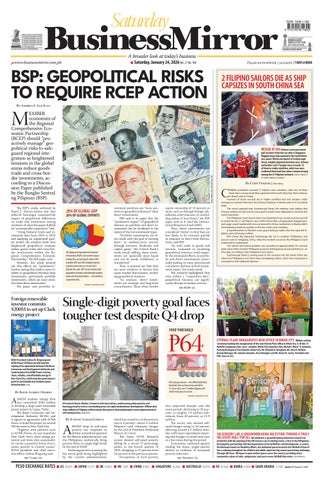
2 FILIPINO SAILORS DIE AS SHIP CAPSIZES IN SOUTH CHINA SEA
By Andrea E. San Juan
M
EMBER economies of the Regional Comprehensive Economic Partnership (RCEP) should “proactively manage” geopolitical risks to safeguard regional integration as heightened tensions in the global arena reduce goods trade and cross-border investments, according to a Discussion Paper published by the Bangko Sentral ng Pilipinas (BSP). The BSP’s study, authored by Hazel C. Parcon-Santos and Jose Adlai M. Tancangco, examined the impact of geopolitical differences on trade and investment among members of what the paper dubbed an “economically cooperative” bloc. “Using bilateral trade and investment data from 2010 to 2023 and applying an augmented gravity model, the analysis finds that heightened geopolitical tensions reduce goods trade and cross-border investments within the Regional Comprehensive Economic Partnership,” the BSP paper said. However, the study pointed out that effects are “asymmetric,” further noting that trade is more resilient to geopolitical frictions than investments, particularly portfolio investments, which are more sensitive than direct investments. The paper said portfolio in-
Foreign renewable investor commits $200M to set up Clark energy project
ARNEL MANALANG | DREAMSTIME.COM
RESCUE AT SEA Chinese rescue personnel
28% OF GLOBAL GDP
26% OF GLOBAL EXPORTS
The Regional Comprehensive Economic Partnership (RCEP) is the world’s largest trading bloc, accounting for about 28% of global GDP and 26% of global exports of goods and services as of end-2023. Despite this scale, BSP research shows that geopolitical tensions still materially weaken trade and investment flows—even within a cooperative bloc. BM Graphic: Ed Davad/Source: BSP
vestment positions are “more sensitive to geopolitical distance” than direct investments. BSP said in its paper that the “asymmetric impact” of geopolitical distance on portfolio and direct investments can be attributed to the nature of the two investment types. “Portfolio investments are often made with the goal of earning short- to medium-term returns through interests, dividends, and capital gains,” the Central Bank’s study noted, adding, these investments are “generally more liquid and can be easily withdrawn or transferred.” Thus, it pointed out that they are more sensitive to factors that cause market fluctuations, including geopolitical tensions. “In contrast, direct investments are strategic and long-term commitments. These often involve
equity ownership of 10 percent or more, such as through foreign subsidiaries, joint ventures, or controlling stakes in local firms,” the BSP paper said as it cited the International Monetary Fund (IMF). Thus, direct investments are considered “sticky” in that they are less likely to be reversed quickly in response to short-term fluctuations, said BSP. “As with trade in goods and services, sustained or escalating geopolitical tensions could magnify the estimated effects on portfolio and direct investments, potentially leading to more pronounced cumulative declines in both investment types,” the study noted. The research highlighted that even within a “cooperative bloc,” geopolitical tensions can significantly disrupt economic activity.
pull survivors from the sea after a Singaporeflagged cargo ship capsized in the South China Sea, about 100 km northwest of Scarborough Shoal, a highly disputed maritime area. Chinese authorities said 17 people were rescued, 14 of them in stable condition, while two were confirmed dead and four others remain missing among the 21 Filipinos on board. PHOTOS COURTESY OF CHINESE EMBASSY IN MANILA
By Cliff Venzon | Bloomberg
C
HINESE authorities rescued 17 Filipino crew members, with two of them dead, from a cargo vessel that capsized in the South China Sea, their embassy in Manila said on Friday. Fourteen of those rescued are in stable condition and one remains under emergency medical treatment, the Chinese Embassy in Manila said on its Facebook page. The vessel capsized near Scarborough Shoal, the embassy said, adding that Chinese military aircraft and its coast guard vessels were deployed to continue the search operation. The Philippine Coast Guard said it has dispatched two vessels and two aircraft to search for the 21 all-Filipino crew of M/V Devon Bay, a Singaporean-flagged general cargo vessel loaded with iron ore bound for China. Authorities in Manila didn’t immediately provide an update on the four other crew members. A representative for Manila’s coast guard told journalists that the reported fatalities were still being verified. M/V Devon Bay departed Zamboanga del Sur in southern Philippines and was en route to Yangjiang, China, when the incident occurred, the Philippine Coast Guard said in a statement. The vessel’s last known position was recorded at approximately 141 nautical miles west of the northern Philippine province of Pangasinan at around 8:30 p.m. on Thursday, according to the Philippine Coast Guard. Scarborough Shoal is among areas in the resource-rich the South China Sea where the Philippines and China have overlapping claims, which have long been a sore point in their bilateral relations.
See “RCEP,” A2
Single-digit poverty goal faces tougher test despite Q4 drop FOOD THRESHOLD
₧64
BCDA President Joshua M. Bingcang and ACWA Power CEO Marco Arcelli lead the signing of an agreement between the Bases Conversion and Development Authority and Saudi Arabian firm ACWA Power to bring clean, reliable, and affordable energy to New Clark City, reinforcing the government’s push for sustainable and resilient power infrastructure. BCDA
P64 a day per person—the official daily food threshold. Even as the poverty rate fell to 15.5% in 2023, over 17 million Filipinos still stretch every peso to survive.
By Bless Aubrey Ogerio
A
SAUDI Arabian energy firm has committed $200 million to develop a large-scale renewable power project in Capas, Tarlac. The Bases Conversion and Development Authority (BCDA) said it signed an agreement with ACWA Power to build the project on around 500 hectares in New Clark City. “Together with partners such as ACWA Power, we can maximize New Clark City’s clean energy potential and show that sustainability can be a powerful driver of economic growth in Central Luzon,” BCDA president and chief executive officer Joshua Bingcang said. See “Clark,” A2
ETERNAL PLANS INAUGURATES NEW OFFICE IN BIÑAN CITY Ribbon-cutting ceremony marking the inauguration of the new Eternal Plans office in Biñan City. (L-R) Rev. Fr. Rodolfo Carabuena; Hon. Liza L. Cardeño, Biñan City Councilor; Hon. Michael “Moro” R. Gonzales, Punong Barangay of San Antonio, Biñan City; Mr. Rolando B. Bongalon; Ms. Elisa V. Beltran, Branch Manager; Ms. Gemma Gonzales, Area Manager; and Mr. Elmer M. Lorica, President and COO. Story on A13.
BM Graphic: Ed Davad/Source: PSA
AN estero in Recto, Manila, is home to informal settlers, underscoring urban poverty and housing precarity even as surrounding areas see rapid condominium development. Official data show millions of Filipinos still live below the poverty threshold despite recent improvements in self-rated poverty. NONIE REYES
By Justine Xyrah Garcia
A
SHARP drop in self-rated poverty has reopened an old but unresolved question for the Marcos administration: can the Philippines realistically bring poverty down to single-digit levels by the end of 2028? Reducing poverty is among the key social goals being highlighted by the current administration,
which has vowed to cut the poverty rate to 9 percent—about 11 million Filipinos—and eliminate hunger by the end of President Ferdinand Marcos Jr.’s term. The latest OCTA Research survey showed self-rated poverty falling by a record 17 percentage points in the fourth quarter of 2025, dropping to 37 percent from 54 percent in the previous quarter. Perceptions of food poverty
also improved sharply over the same period, declining to 30 percent, or roughly 7.9 million individuals, from 49 percent, or 12.9 million. The survey also showed selfrated hunger rising to 16 percent, affecting around 4.2 million families, with most respondents reporting that hunger occurred only once or a few times during the period. Economists cautioned against reading the sharp, single-quarter decline as evidence of sustained poverty reduction. See “Poverty,” A2
SM SENSORY LAB: A GROUNDBREAKING MILESTONE TOWARD A TRULY INCLUSIVE MALL FOR ALL SM celebrates a groundbreaking milestone toward true
inclusivity with the opening of the SM Sensory Lab: A Calming Corner, a first in the Philippines. Developed in partnership with the Department of Social Welfare and Development, as well as the National Council on Disability Affairs, the dedicated space located in the SM Mall of Asia offers a calming atmosphere for children and adults experiencing sensory processing challenges. Through SM Cares, SM hopes to open similar spaces across the country, providing every community a place of calm, compassion, and care in every SM Mall they enter. SM SUPERMALLS
PESO EXCHANGE RATES n US 59.1670 n JAPAN 0.3735 n UK 79.8932 n HK 7.5891 n CHINA 8.4922 n SINGAPORE 46.2026 n AUSTRALIA 40.4702 n EU 69.5626 n KOREA 0.0404 n SAUDI ARABIA 15.7829 Source: BSP (January 23, 2026)