THE$5.7-billion deficit in the Philippines’s balance of payments (BOP) in 2025, a reversal of the $609-million surplus posted in 2024, can be attributed to importdriven demand, weaker exports and investment flows in recent months, according to analysts.
Latest data from the Bangko Sentral ng Pilipinas (BSP) showed that the country’s balance of payments (BOP), a measure of the country’s economic transactions with the rest of the world, registered an $827-million deficit in December 2025, bringing the full-year outcome to a deficit of $5.7 billion.
The $827 million deficit posted in December 2025 is the largest gap in the balance of payments in eight months or since April 2025. However, this is narrower than the $1.508 billion in December 2024 but wider than the $225 million deficit posted in November 2025. Given the latest data on the balance of payments, analysts now have their eyes on how fast the country’s outbound shipments and investments can pick up.
Rizal Commercial Banking Corp. (RCBC) chief economist Michael L. Ricafort pointed to the “continued trade deficit or net imports of the country recently,” adding, the gap may be “partly due to weather-related disruptions and some political noise since September 2025 that led to some local market volatility.” Jonathan Ravelas, senior adviser at Reyes Tacandong & Co. said in a Viber message that the wider BOP deficit “simply reflects strong domestic demand driving imports faster than exports and investment flows can catch up.”
Philippine Institute for Development Studies (PIDS) Senior Research Fellow John Paolo R. Rivera said the wider deficit in the balance of payments “reflects a mix of weaker capital inflows, softer FDI [foreign direct investments] and continued net outflows from portfolio investments, alongside a persistently wide trade deficit driven by imports.”
“BOP position will hinge on FDI recovery, export performance, remittance growth, and global financial conditions, particularly US interest rates,” Rivera said.
Echoing the sentiment of the local think tank’s senior research fellow, Ravelas said “They key watchpoint is how fast exports and FDI rebound, but overall external position remains resilient.”
By Reine Juvierre S. Alberto
HE Republic of the Philippines (ROP) returned to the international debt market for the first time this year on Tuesday, offering a benchmarksized, three-tenor US dollar-denominated global bond to lock in funding amid continued liquidity and demand for ROP securities.
National Treasurer Sharon P. Almanza said each tranche of the fixed-rate dollar bond will be issued at a benchmark size, with maturities of 5.5 years, 10 years and 25 years.
The initial price guidance for the 5.5-year tranche is around 70 basis points over Treasuries, while the 10-year bond is at 100 basis points over Treasuries and 5.900 percent for the 25-year tranche.
The offering is expected to open during Tuesday’s New York trading session, while the transaction will settle on January 27, 2026.
International credit watcher Moody’s Ratings has assigned “senior unsecured” ratings of Baa2 to the global bond offering to be issued under the government’s existing shelf program.
Moody’s said the dollar bonds will be ranked “pari passu” with
the country’s “current and future senior unsecured external debt obligations.”
The proceeds from the issuance will be used for general purposes, including budgetary support and the repayment of a portion of the government’s borrowings, according to Moody’s. S&P Global has also assigned its “BBB+” long-term foreign currency issue rating to the bonds that the Philippines will issue. The bonds represent “direct, general, unconditional, unsecured and unsubordinated obligations” of the Philippines, S&P Global said.
“They rank equally with the sovereign’s other unsecured and unsubordinated debt obligations,” it added. The joint bookrunners for the dollar bond offering are BofA Securities, Deutsche Bank, HSBC (B&D), J.P Morgan, Morgan Stanley, Standard Chartered and UBS1. The issuance comes against the backdrop of souring investor confidence caused by the flood control scandal that weighed on its economic growth.
“In spite of the recent government scandal, we didn’t see investors demanding a higher spread
Budget gaps seen persisting
THE national government is unlikely to record budget surpluses despite its stringent fiscal oversight, particularly on infrastructure spending, according to Maybank.
During the Philippine Macro and Market Outlook 2026, Maybank Securities Philippines Head of Equity Research Kervin Sisayan said the government will continue to run fiscal deficits even after cutting budgets for flood control and unappropriated programs.
“There is a shift from infrastructure spending to a bit more social services in terms of government spending,” Sisayan said. “So, not necessarily there will be less spending, but it’s just reallocated towards more support for the people.”
Sisayan said the fiscal deficit is expected to remain on a declining path, a development that could support one of the Marcos Jr. administration’s key targets of securing a credit rating upgrade.
A credit upgrade, he added, would also serve as a vote of confidence in the country’s improving fiscal health.
Maybank Investment Banking Group Economist Azril Rosli said the tighter scrutiny on government spending, notably on infrastructure, will result in improved governance rather than a pullback in fiscal policy. This could lead to more cautious disbursement and some delays in project rollout, which may temporarily slow spending growth in the near term, Rosli said.
By Bless Aubrey Ogerio @blessogerio
THE integration of around 40 government agencies into the National Single Window–Integrated Trade Facilitation Platform (NSW ITFP) is poised to cut delays and streamline trade in the country, the Federation of Philippine Industries (FPI) said.
The platform allows businesses to submit a single digital application for multiple permits and clearances, replacing the cumbersome system that once required traders to visit different offices for each approval, it said. “This is a herculean task, but
one that needs to have been started ‘yesterday,’ so our country can finally move forward and be at par, to a certain extent, with our Asean neighbors,” FPI said in a statement. Food importers, for instance, previously had to secure signoffs from the Food and Drug Administration, the Department of Agriculture and Customs.
Meanwhile, chemical traders navigated the Philippine National Police, the Department of Environment and Natural Resources and Customs. Electronics and car importers faced a similarly complex maze, compounded by local government permits.
According to the federation,
the agencies being integrated issue a range of import and export licenses, permits and clearances. By centralizing these processes, the NSW ITFP is expected to lower transaction costs, accelerate approvals and make supply chains more predictable.
Once fully operational, the platform will link to the Asean Single Window, positioning Philippine traders to compete more effectively with Singapore, Malaysia, Thailand and Vietnam— countries that have had national single windows in place since 2008-2016.
On the other hand, the FPI said that the NSW ITFP complements the Bureau of Internal
Revenue’s Digital Transformation (DX) Roadmap 2025-2028, which aims to modernize tax enforcement.
Under the roadmap, audits will be guided by data and risk analysis rather than discretion, artificial intelligence will flag potential compliance issues, ICT systems will be upgraded, and taxpayer portals will be modernized.
“By 2028, the BIR envisions a system where compliance is predictable, transparent, and far less prone to abuse,” it said. For FPI, the two roadmaps together aim to reduce bureaucratic obstacles, lower costs, and support business growth.
“As a result, the fiscal position could improve at the margin, but this should be seen as a function of timing and oversight rather than a shift toward austerity,” Rosli added.
Rosli said the Philippines continues to face significant structural spending needs, including infrastructure gaps, climate resilience, social protection and human capital investments.
“Any short-term improvement in the fiscal balance is more likely to be temporary, reflecting delayed expenditures rather than a sustained surplus position,” Rosli said. The government’s budget deficit widened to P1.26 trillion as of
San Juan @andreasanjuan
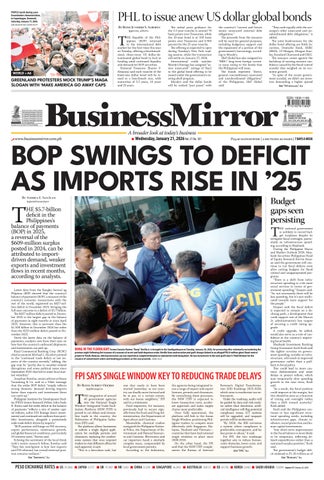
BONG IN THE FLOODLIGHT Former Senator Ramon “Bong” Revilla Jr. is brought to the Sandiganbayan on Tuesday, January 20,
“One focuses inward, making audits fairer and compliance smoother. The other looks outward, making trade faster and more competitive,” the FPI said. “Together, they aim to restore investor confidence by reducing unpredictability in both taxation and trade.”
The FPI cautioned, however, that the challenge lies in execution, saying that upgrading technology, training staff and breaking long-standing habits are all essential.
“But if these roadmaps are delivered faithfully, they could mark a turning point—where businesses no longer see government processes as obstacles, but as enablers of growth.”
DA seeks safeguard duties on chicken MDM, 4 others
By Ada Pelonia @adapelonia
THE Department of Agriculture (DA) has asked the Bureau of Customs (BOC) to impose special safeguard (SSG) duties on five agricultural products, including chicken mechanically deboned meat (MDM) and onions.
budgets, and project outcomes.
Empower citizens and civil society to scrutinize government decisions and enhances transparency throughout the project lifecycle,” it said.
Taken together, the study said these reforms are designed to alter the incentives facing public officials and contractors by raising the costs and risks associated with corruption.
“By realigning incentives, strengthening digital oversight, and empowering citizens, these reforms can make corruption increasingly irrational, costly, and unsustainable—laying the foundation for more resilient, equitable, and effective governance,” the report said.
Agriculture Secretary Francisco Tiu Laurel Jr. signed Department Order (DO) 5, which sought the imposition of SSG on out-quota of frozen chicken MDM; other meat and edible meat offal, salted, in brine, dried or smoked except freeze-dried diced chicken and dried pork skin; onion, except bulbs for propagation.
Also included are: other prepared and preserved meat, meat offal, blood of turkeys except those mechanically deboned or separated meat; and other prepared and preserved meat, meat offal, blood, except those of turkey and chicken.
Under the DO, the agency noted that its monitoring showed that the
actual cost, insurance, and freight (CIF) prices for these agricultural products have breached their respective price thresholds.
As such, this activates the legal authority to impose price-based SSG duties on these products.
The respective trigger prices for the mentioned commodities are as follows: frozen chicken MDM, P93.96 per kilo; edible meat offal, P70.5 per kilo; onions, P74.21 per kilo.
Furthermore, trigger prices for other prepared and preserved meat, meat offal, blood of turkeys, P259.22 per kilo; while other prepared and preserved meat, meat offal, blood except those of turkey and chicken, P298.55
per kilo.
“Price-based SSG measures to be imposed shall be on a shipment-by-shipment basis, depending on the difference between the actual CIF price at the time of lodgment of import documents and the corresponding trigger price,” the order read.
Under Republic Act (RA) 8800, 50 percent of revenues collected from fees, charges, and safeguard duties on imported goods will be earmarked for the Competitiveness Enhancement Measures Fund (CEMF) to boost domestic industries affected by increased imports.
Imports…
Ricafort, however, raised another scenario of the country’s BOP moving forward, saying the deficit could only be cushioned “if anti-corruption measures and other reform measures especially in further leveling up the country’s governance standards are taken seriously, as these help further improve international investor sentiment on the country.”
The good news, according to Ravelas, is that the Philippines has “very comfortable” reserves.
BSP data showed that the country’s gross international reserves (GIR) reached $110.8 billion as of end-December 2025.
“This level of reserves remains an adequate external liquidity buffer, equivalent to 7.4 months’ worth of imports of goods and payments of services and primary income,” BSP said in its statement late Monday.
The BSP said the latest GIR level
The special safeguard (SSG) duty is a trade mechanism that a country can impose on imported products that fall below a trigger price. Additional duties computed based on the difference between the value of the imported product and the trigger price are imposed on a commodity to protect domestic output against unfair competition. Government documents revealed that this year, the DA received a P25 million appropriation from the CEMF. The balance of the fund as of end-2024 stood at P5.16 billion.
ensures the availability of foreign exchange to meet balance of payments financing needs, such as for payment of imports and debt service, in extreme cases when there are no export earnings or foreign loans.
The central bank noted that this covers about 3.9 times the country’s short-term external debt based on residual maturity.
GIR is made up of foreign-denominated securities, foreign exchange, and other assets including gold.
“GIR helps ensure sufficient dollar liquidity to meet import needs and foreign debt obligations, address currency volatility, and provide a buffer against external economic shocks,” the BSP said.
Based on BSP’s earlier estimates, the country’s balance of payments is seen posting deficits of $6.2 billion in 2025 and $5.9 billion in 2026, in contrast to the $609-million surplus recorded in 2024.
while advancing the National Government’s development priorities. We value the continued confidence and support of our investors,” Almanza added.
for Philippine credit. This is a testament of continued confidence on the strength of the economy,” Sun Life Investment Management and Trust Corporation President Mike D. Enriquez told the BusinessMirror
The government is hounded by a massive corruption scandal centered on “ghost” and substandard flood projects from 2016 to 2025 valued at about P79 billion.
“This transaction underscores our steadfast dedication to sound fiscal policy and sustainable development,” Finance Secretary Frederick D. Go was quoted in a statement as saying. “We are confident that our policy direction and reform agenda will continue to resonate with the global investment community and support a successful outcome for this offering.”
Almanza said the government observed “favorable market conditions” for the Republic’s return to the international capital markets. “Anchored on stable fundamentals and our recent credit affirmation, this transaction reflects our proactive and strategic approach to secure cost-efficient funding
Moody’s said the Philippines’ fiscal consolidation “remains on track, though at a slower pace” to meet the government’s target of reducing the deficit to 4.3 percent of GDP by 2028, supported by the implementation of reforms to boost revenue collection and spending efficiency.
“Debt affordability, measured by the ratio of interest payments to revenue, is expected to weaken over the next two years before gradually normalizing as global refinancing rates decline and economic growth returns to its longterm trend,” Moody’s noted.
“We expect the Philippines to maintain resilient economic growth compared with regional and rating peers,” it added, underpinned by robust household consumption, steady remittance inflows from overseas workers, a recovery in public investment, and continued progress on structural reforms.
The Philippines’ last global bond issuance was a year ago, when it successfully priced its triple-tranche 10-year and 25-year US dollar bond and 7-year euro-denominated fixed-rate global bonds amounting to $2.25 billion and EUR 1 billion, respectively.
Christina Garcia Frasco has said may be attained with its P1 billion branding campaign funds allocated in this year’s General Appropriations Act. In a recent paper, Maybank Securities Inc. said, “Achieving the DOT’s 6.7-million arrivals target by 2026 depends on two key levers: pro-tourism policies [e-visas expansion, VAT refund]; and expanding airport capacity.” Maybank analyst Ronalyn Joyce Lalimo noted the rollout of the electronic visas late last year for India and mainland China, both significant sources of outbound tourists. “[This would have the impact of] back-loading gains into early 2026,” she said. The Department of Foreign Affairs (DFA) last week announced visa-free entry for mainland Chinese arriving via Manila or Cebu, and staying for just 14 days. As per DFA’s e-visa ph website, residents from 155 countries are allowed to enter the Philippines visafree for 30 days, while those from, Brazil and India are allowed to stay for 59 days. Among the 155 countries were members of the Association of Southeast Asian Nations; Australia, Palau, Japan, South Korea in Asia Pacific; European countries like France, Germany, Italy; and Gulf Cooperation Council members like the United Arab Emirates, Qatar, Saudi Arabia. (https://tinyurl. com/yr3v8v4m) Lalimo added that a value-addedtax (VAT) refund law for foreign tourists is projected to add an estimated P8.6 billion to P12.8 billion year in visitor receipts “and lift retail spending.” (See, “VAT refund for tourists does not cover online purchases,” in the BusinessMirror, March 28, 2025) She also noted ongoing improvements in local airports such as runway rehabilitations and passenger terminal expansions, which will ease capacity constraints this year. These upgrades “could raise airport capacity by 248 percent to 122 million passengers by 2027–2028, though full benefits will materialize post-2028,” she added. Koreans still top visitors “IN the near term, the staged rollout should enable incremental route and frequency additions, while longer inter-island stays support yield-led 2026 growth rather than volume expansion,” said Lalimo. Based on e-travel data and other BI data, the market breakdown per nationality showed, despite the 14-percent decrease in their visits last year, South Koreans remained the top nationality among foreign visitors at 1.35 million. But the lift in foreign arrivals were mainly due to the surge in North Americans, namely, Americans at 1.32 million (+31.4 percent) and Canadians 333,136 (+44 percent). A local tour operator explained, however, that many of these North Americans were likely Filipinos already holding passports of their host countries, or US and Canada citizens of Filipino descent. Double-digit increases were recorded for Japanese tourists at 469,521 (+22.4 percent); Australians 359,646 (+36.9 percent); British 228,425 (+30 percent); and Germans 108,569 (+29.24 percent). Only Chinese visitors recorded a 25.67 percent decrease to 237,101. Arrivals growth from Asia was tepid but topped by Taiwanese 213,928 (+5.24 percent); Singaporeans 115,341 (+7.3 percent); Indians 104,994 (+5.22 percent); and Malaysians 104,989 (+3.34 percent). Of the total inbound tourists last year, some 90.8 percent arrived by air at 5.89 percent, and less than one percent at 53,851 arrived by sea, or were cruise passengers.
The government plans to borrow a total of P2.682 trillion this year, of which P616.86 billion will be sourced externally.
This is to plug this year’s projected budget deficit of P1.646 trillion or 5.3 percent of GDP.
Villanueva, 33 co-accused fail to submit counter affidavits
SEN. Jose Villanueva has asked for more time to file his counter affidavit for one of three malversation cases filed against him before the Department of Justice (DOJ) in connection with the anomalous flood control projects undertaken by Topnotch Catalyst Builders Inc. in Bulacan.
At a press briefing, DOJ spokesman Polo Martinez said Villanueva did not appear during Tuesday’s preliminary investigation into the case but asked the handling prosecutor to give him until January 26, which was eventually granted.
Martinez added that none of Villanueva’s 33 co-respondents including former Department of Public Works and Highways engineers Henry Alcantara, Brice Hernandez, Jaypee Mendoza, Niño Lawrence, Morales, Ernesto Galang and several others includ -
ing Topnotch executives filed their counter-affidavits on the case.
He added that Villanueva is a respondent in three malversation cases before the DOJ which are either undergoing preliminary investigation or further investigation by the DOJ.
Villanueva has already filed a counter-affidavit in one of the three cases.
Meanwhile, Acting Justice Secretary Fredderick Vida said the Justice department is eying to get custody of Alcantara this week following the department’s decision to grant his application as “state witness” in the flood control scandal.
“The target is this week,” Vida told reporters while pointing out that procedures for his transfer would have to be made confidential due to security concerns.
See “Villanueva,” A8
House leaders: No special treatment for Marcos
By Jovee Marie N. dela Cruz @joveemarie
THE chairperson of the House of Representatives Committee on Justice on Tuesday vowed that the lower chamber will remain faithful to its constitutional duty in acting on the impeachment complaint filed against President Marcos.
Batangas Rep. Gerville Luistro, chairperson of the House Committee on Justice, said the initiation of impeachment complaints is an exclusive power of the House under the Constitution, and lawmakers are duty-bound to follow the process laid down in the Charter and in House rules.
“Let us be reminded that this is our constitutional duty. The House of Representatives has the exclusive power to initiate impeachment complaints,” Luistro said in a radio interview.
She explained that under existing rules, once the Office of the Secretary General receives an impeachment complaint, it must immediately transmit it to the Office of the Speaker. The Speaker then has 10 session days to include the complaint in the Order of Business of the House plenary.
With Congress set to resume session on January 26, Luistro said the 10-session-day period will begin from that date.
After inclusion in the Order of Business, the plenary has three session days to transmit the complaint to the Committee on Justice, where a formal review will begin.
“As chairperson of the Committee on Justice, the rule is clear. First, we have to determine sufficiency in form. Second, sufficiency in substance. Third, if sufficient in both, we will proceed to hearing. And fourth, we will resolve whether or not the impeachment complaint was able to establish sufficient probable cause,” she said.
Luistro added that whatever decision the committee arrives at, it is required to submit a committee report to the plenary within 60 session days, stressing that suspended sessions are not counted as separate session days.
She said lawmakers would exercise the same “rigor and candor” in handling the complaint against Marcos as they did in the impeachment case involving Vice President Sara Duterte.
“We can assure the public how we complied with our constitutional duty during the initiation of the impeachment complaint
Sandiganbayan orders Revilla’s detention at QC jail in Payatas
Tagainst the Vice President. We will be exercising the same rigor and candor in appreciating and investigating the allegations in the impeachment complaint against the President,” Luistro said.
Luistro reiterated that regardless of who the respondent is, the House must act in accordance with its sworn obligations.
“Whether it is against the President or against the Vice President, we will remain faithful to our sworn duty under the Constitution,” she said.
The impeachment complaint against Marcos was filed by private individual and lawyer Andre de Jesus and endorsed by Party-list Rep. Jett Nisay of Pusong Pinoy.
The impeachment complaint lists six grounds, including culpable violation of the Constitution, graft and corruption, and betrayal of public trust.
‘Unlikely to advance’
LANAO del Sur Rep. Zia Alonto Adiong said the impeachment complaint filed against Marcos is weak, unsupported by credible evidence, and unlikely to move forward in the House of Representatives.
Adiong said that impeachment is the most serious constitutional power lodged in Congress and should never be treated as a political weapon or publicity tool.
“Impeachment is the heaviest constitutional weapon available to Congress. It cannot—and must not—be wielded on the basis of recycled accusations, hearsay, or purely political grievances,” Adiong said.
“This particular complaint appears crafted more for media consumption than for serious constitutional scrutiny. The House will not treat impeachment as a mere press statement or partisan maneuver. We will demand substance, and in this instance, substance is conspicuously absent,” he added.
The lawmaker said the accusations against Marcos rely largely on long-standing claims repeatedly aired by critics but never supported by new or verifiable evidence.
“In stark contrast, the accusations directed at President Marcos rely almost entirely on long-standing claims from vocal critics—claims that have already been repeatedly aired in public without producing new, verifiable evidence capable of withstanding constitutional muster,” Adiong said.
See “Impeach,” A9
By Joel R. San Juan @jrsanjuan1573
that no special treatment would be accorded to the former senator.
HE Sandiganbayan has ordered former senator Ramon Revilla Jr. to be detained at the New Quezon City Jail in Payatas following his surrender on Monday to face the malversation of public funds through falsification of public documents filed against him in connection with the P92.8 million alleged ghost flood control project in Pandi, Bulacan.
The commitment order was issued following Revilla’s appearance before Sandiganbayan’s Special Third Division at around 10: 15 a.m for booking procedures.
Revilla voluntarily surrendered to the National Police (PNP) on Tuesday night after the antigraft court issued an arrest warrant against him and his co-accused including former Department of Public Works and Highways (DPWH) engineers Brice Hernandez, Jaypee Mendoza, Arjay Domasig, Emelita Juat and personnel Juanito Mendoza and Christina Pineda.
Hernandez and Mendoza were subsequently arrested by the members of the National Bureau of Investigation (NBI) at the Senate where they had been under custody for several months.
All of the accused had been arrested aside from Juat. In ordering Revilla’s transfer to the Quezon City jail, the Sandiganbayan took into consideration the letter of the National Police (PNP) acting Chief, Lt. Gen. Jose Melencio Nartatez Jr. warning it against committing persons deprived of liberty (PDLs) t o the PNP Custodial Center in Camp Crame.
Nartatez noted that the custo -
dial center is a facility where highprofile criminals such as suspected terrorists and those involved in heinous crimes are detained.
He added that it would be a burden on the part of the PNP in terms of financial and manpower resources if Revilla were to be placed under its jurisdiction.
“In the meantime, the accused, Ramon Revilla Jr., who is charged with malversation of public funds through falsification of public documents, shall be held at the Bureau of Jail Management and Penology–National Capital Region, Quezon City Jail, male dormitory, Payatas Road, barangay Bagong Silang, Quezon City,” the anti-graft court said.
Interior Secretary Jonvic Remulla, at a press briefing, said the PNP Custodial Center would no longer accept PDLs because it is up for demolition.
“It’s up for demolition anytime this month. We are currently securing the certificate from the DPWH declaring the building as already condemned. The building is very old, and the PNP has allotted a budget for the construction of a new headquarters, with this site proposed for the new building,” Remulla said while adding
Revilla safety assured REMULLA assured that jail authorities “will take all measures necessary to ensure his safety during the process of his trial.”
Following his arrest, Remulla said Revilla was also directed to surrender all his firearms. He said Revilla complied with the directive and surrendered a total of 20 short and long firearms.
It may be recalled that Revilla was also detained for four years for plunder and graft charges in connection with the anomalous disbursements of his Priority Development Assistance Funds (Pdaf) or pork barrel funds.
He was acquitted by the antigraft court in 2019 after the Sandiganbayan ruled that his signature was forged in documents related to projects under Pdaf.
Meanwhile, Remulla expressed optimism that the government would be able to bring home two executives of Sunwest Corporation who were earlier charged with malversation and graft and issued with arrest warrants in connection with theP289.5 million allegedly anomalous flood control project in Naujan, Mindoro.
Remulla said one of the executives had been located in the United States while the other is in New Zealand.
“Once their passports are cancelled, the homeland security will go after them,” he said.
Resigned Party-list Rep. Zaldy Co of Ako Bicol, who has left the country, is also one of the accused in the said cases.
Threat of violence
THE antigraft court will hear the motion of Revilla’s camp to be detained at the PNP Custodial Center during the arraignment and pretrial set on January 23.
Revilla cited possible threat to his life from co-detainees and gang-related violence, as well as,
Legislators: DOJ, Ombudsman should take lead in flood control investigation
HOUSE of Representatives leaders on Tuesday said the Ombudsman and the Department of Justice (DOJ) should now take the lead in ensuring accountability, following President Marcos’ statement that the work of the Independent Commission on Infrastructure (ICI) is “coming toward the end.”
Party-list Rep. Jude A. Acidre of Tingog said the proper course is to allow the Office of the Ombudsman and the Department of Justice to carry out their respective mandates.
“At this point, it is important to let the Office of the Ombudsman and the Department of Justice do their constitutional and legal duties,” he said, stressing that any further action should be based on evidence.
“All conclusions on the ICI were based on the work completed and the records already reviewed,” Acidre said. “The decision was grounded on findings, not percentages, and it does not preclude further action should new evidence surface.”
Acidre also rejected claims that the administration was avoiding the truth, saying accountability must remain evidence-based rather than influenced by speculation
or political pressure.
“Claims that the administration is avoiding the truth are unfounded,” Acidre said.
“The President has consistently maintained that accountability must be based on evidence, not speculation or political pressure.”
He also expressed confidence in Ombudsman Jesus Crispin Remulla, saying the official enjoys strong public support and has shown seriousness in pursuing corruption cases.
“Ombudsman Remulla enjoys high public support and has shown that he is firm and serious in the fight against corruption,” Acidre said. “If there is evidence, the proper institutions remain open to act.”
Meanwhile, Deputy Speaker Paolo Ortega V backed Marcos following Malacañang’s statement that the work of the ICI is nearing completion, calling for respect for established processes.
Ortega said the President’s statement was anchored on the ICI’s own assessment and the scope of work already accomplished, noting that completion is defined by findings and recommendations.
“The President’s statement reflects the assessment submitted by the ICI based on the work accom -
the insufficient number of Bureau of Jail Management and Penology (BJMP) personnel to ensure his safety.
The Sandiganbayan said it wants to hear the prosecution’s side on the motion of Revilla before issuing its decision on Friday.
The QC Jail Supt. Maria Lourdes Pacion, however, told the antigraft court that there has been no riot nor untoward incident in the jail and that they would designate at least 20 personnel to ensure Revilla’s security.
“Taking into consideration what the Jail Superintendent has said and being the person in charge of that facility and also taking into consideration the letter of Gen. Nartatez requesting the Sandiganbayan to refrain from sending detainees to any PNP custodial facility, the court hereby orders the detention of accused in the QC jail facility in the meantime,” Special Third Division chairperson Associate justice Karl Miranda said. Meanwhile, Revilla posted P90,000 bail for the graft case pending before the Sandiganbayan’s Fourth Division.
Follow Revilla’s example NARTATEZ on Tuesday called on all fugitives implicated in the flood control scam to follow the example of Revilla who voluntarily surrendered on Monday night following the issuance of the arrest warrant against him by the Sandiganbayan.
In a statement, Nartatez said declarations of innocence on allegations and charges should come with equal courage and dedication to face the accusers in court as a show of respect to the legal process.
“The PNP has been accommodating to all those who respect the rule of law and the legal process, but wil be tough against those
See “Revilla,” A9
Puno
plished,” Ortega said. “Completion is determined by findings and recommendations, not by arbitrary number-based benchmarks.”
He dismissed insinuations that the probe was ended to shield anyone, stressing that no individual is exempt from scrutiny if supported by evidence.
“Claims that anyone is being protected are baseless,” Ortega said. “No one—ally or otherwise— is beyond investigation if the evidence warrants it.”
The Deputy Speaker underscored that oversight mechanisms should not supplant the roles of agencies mandated by the Constitution to investigate and prosecute cases.
“The proper forum now is the Office of the Ombudsman and the Department of Justice,” Ortega said. “These are the institutions with the authority and mandate to act based on evidence.”
Ortega also voiced confidence in Remulla, citing public support for his leadership. “Ombudsman Remulla has broad public support and has demonstrated firm resolve in addressing corruption,” he said. “Where evidence exists, the proper institutions are ready to take action.”
Jovee Marie N. dela Cruz
DEPUTY Speaker Ronaldo V. Puno on Tuesday filed a criminal complaint for cyberlibel against Cavite Rep. Francisco A. Barzaga, even as the lawmaker vowed to personally apologize to business tycoon Enrique Razon Jr. for accusing him of bribery and admitted that his statements were driven by a personal grudge. Puno lodged the complaint before the Office of the City Prosecutor in Antipolo, citing Barzaga’s January 9, 2026, Facebook post alleging that “NUP [National Unity Party] Congressmen received bribes from Enrique Razon in various gatherings in Solaire prior to the 2025 elections in exchange for supporting Speaker Martin Romualdez.” Barzaga, for his part, said during the TNT Podcast of columnist Ramon Tulfo and lawyer Clint Aranas that aired Monday that he regretted his accusation against Razon and would apologize to him personally.
See “Barzaga,” A9
BFP orders fire inspectors to wear body cameras
By Jonathan L. Mayuga @jonlmayuga
THE Bureau of Fire Protection (BFP) has implemented the mandatory use of body cameras during fire safety inspections following the directive of Interior Secretary Juanito Victor Remulla.
To recall, Remulla has been very vocal about the alleged massive graft and corruption allegedly committed by BFP personnel.
Fire safety inspectors are often accused of extorting erring establishments “finding” violations of fire and building codes.
Fire safety inspections are done to identify and fix fire hazards, ensuring fire detection and suppression systems work, and verifying clear escape routes in compliance with the fire code to
protect lives, and property.
Fire inspection certificates are issued to establishments and are used to allow occupancy of homes, businesses establisments, and public buildings.
In a news release, the DILG said fire safety inspections are recorded from start to finish.
Recording begins upon issuance of the body-worn camera at the fire station and continues during travel, the actual inspection, discussion of findings, and until the camera is formally turned over
to the station custodian.
Upon arrival at an establishment, the Fire Safety Enforcer states on video their name and rank, location, date and time, nature of inspection, and the name of the establishment. The owner or representative is informed that the inspection is being recorded and may also take their own video.
Establishment owners may request, in writing, a copy of the inspection video within seven working days from the date of inspection through the City or Municipal Fire Marshal with jurisdiction over the inspected establishment.
The policy reiterates that Fire Safety Enforcers are strictly prohibited from recommending, selling, or endorsing any particular brand of fire safety equipment, in accordance with the Fire Code of the Philippines and the Ease of Doing Business Act.
During the inspection, the body-worn camera documents fire exits, fire safety equipment, and other required safety
measures, including the explanation of findings. For non-compliant establishments, inspectors are required to clearly explain deficiencies, required corrective actions, and possible penalties, all of which are recorded.
Fire Safety Enforcers are personally accountable for the proper use of body-worn cameras. Any unjustified failure to record, interruption of recording, or tampering with recorded footage constitutes misconduct.
After the inspection, recorded videos are turned over to the station custodian and uploaded to a secure system within 24 hours. Inspectors are prohibited from accessing, editing, deleting, or manipulating the recordings once turned over.
The DILG said the policy aims to ensure consistency, accountability, and proper documentation in the conduct of fire safety inspections. The BFP affirmed its full implementation of the directive in accordance with existing laws and regulations.
Firm warns vs AI-powered movie, event ticketing scams
By Lorenz S. Marasigan @lorenzmarasigan
GLOBAL cybersecurity com -
pany Kaspersky has issued a warning about sophisticated artificial intelligence (AI)driven scams targeting Filipino consumers as the country’s live entertainment industry continues to expand and more ticket purchases move online.
Sam Yan, head of Sales for Asia Emerging Countries at Kaspersky, said cybercriminals are using AI technology to create increasingly convincing fraudulent schemes that are becoming harder for consumers to detect.
He said bad actors are exploiting the urgency around high-demand events and time-sensitive purchases by creating fake ticketing websites, phishing links, and fraudulent resale offers that closely replicate legitimate platforms.
“As ticketing scams become more sophisticated, it’s increasingly important for consumers to stay informed and cautious online, while the private sector and regulators continue working together to protect digital transactions,” Yan said.
“With the Philippine entertainment industry continuing to grow, cybersecurity must keep pace to help preserve consumer trust and safe digital experiences.”
The threat is especially acute during peak periods such as holidays, major concerts, and sold-out shows, when buyers face pressure to act quickly and may be more likely to overlook warning signs.
Security researchers say this urgency creates conditions that favor scammers, who design their operations to exploit time-sensitive decisionmaking.
Kaspersky recommends that Philippine consumers purchase tickets only through official websites or authorized sellers and exercise caution with resale offers promoted through social media or messaging apps.
The firm advises against clicking on ticket links sent through unsolicited emails, texts, or private messages, even when they appear to come from known brands or events.
Consumers should also verify website URLs and check page details for spelling errors, unusual payment requests, or design inconsistencies before entering personal or payment information.
Using strong, unique passwords and enabling multi-factor authentication on ticketing, email, and digital payment accounts can provide additional protection. Installing reliable security solutions
that detect phishing websites and fraudulent pages in real time is also recommended.
For businesses operating in the entertainment and ticketing space, Kaspersky suggests monitoring platforms, websites, and social media channels for impersonation or fraudulent use of brand names and logos.
Companies should educate employees and partners on AI-driven phishing and social engineering tactics, particularly during peak events and holiday seasons.
The cybersecurity firm also recommends implementing advanced endpoint protection and threat detection solutions to identify and respond to suspicious activity across devices and workloads, along with strengthening incident detection and response capabilities through centralized monitoring to quickly contain potential threats.
Ebdane: Strong finances drive Zambales development
By Henry Empeño
IBA, Zambales—Sustained financial growth is powering the Zambales provincial government’s drive to empower communities, build more social infrastructures, and deliver progress in key sectors of public service, Gov. Hermogenes Ebdane Jr. said on Monday in his State of the Province Address (Sopa) here.
Ebdane, who addressed the Sangguniang Panlalawigan in its inaugural session this year, said Zambales has remained a firstclass province in 2025 owing to a growing income stream, mainly from dredging projects, as well as sound budget management.
“Today, Zambales stands
tall—economically, socially, and culturally. Our province has regained and sustained its firstclass province status, fueled by strengthened fiscal discipline and revitalized revenue generation,” he said.
Zambales was recognized by the Department of Finance last year as Top 8 among the 82 provinces in the country for a 32.50 percent ratio of locally-sourced revenue (LSR) to total current operating income (TCOI), a reprise of its achievement for fiscal year 2023 when its LSR to TCOI ratio was 32.74 percent.
Under Ebdane, the province also placed Top 2 in 2022 and Top 6 in 2023 for year-on-year LSR growth.
Ebdane said these record in -
come allowed the local government to enhance delivery of health and social services, infrastructure development, education and youth and sports development, livelihood opportunities, environmental stewardship, and peace and order in the last three years.
As of now, he said Zambales is laying the foundation for a stronger local economy by promoting tourism, encouraging local enterprise and investment, and empowering farmers and fishermen through capital and technical support.
With the establishment of the Zambales Mango Industry Council, Ebdane said a total of P5.3 million has been allocated as conditional assistance to revitalize 1,122 fruits-bearing mango trees in the towns of Palauig and Masinloc, as well as P1.6 million for technical training for mango growers in Castillejos, San Felipe, Botolan, and Iba.
Meanwhile, two 45-footer lightboats, the FB Zambales III and FB Zambales IV, will be given to local fishermen this month as initial inputs under a broader program that includes development of fish landing sites, technical training, and institutionalization of fishers’ groups into cooperatives.
Ebdane also cited the distribution of agricultural machinery to
Legislator proposes adoption of free online counselling app
By Jovee Marie N. dela Cruz @joveemarie
AS the country continues to grapple with a severe shortage of guidance counselors in public schools, a lawmaker is proposing the establishment of a free online-based counseling program to make antibullying and mental health support services more accessible to students.
Parañaque Rep. Brian Raymund Yamsuan said his proposed telecounseling program under House Bill 5240 seeks to expand the scope of the newly implemented school-based mental health support and child protection initiative of the Department of Education (DepEd).
Under the measure, a nationwide online support system will be created to tap the expertise of guidance counselors and licensed mental health professionals in offering secure teleconsultation services for students.
“Our proposed legislation aims to address the acute shortage of guidance counselors and mental health professionals that are supposed to be physically present in our schools. Providing online mental health support services will ease the access of students to counseling and other interventions necessary for their well-being,” Yamsuan said.
Education Secretary Juan Edgardo Angara earlier noted that the country continues to face a severe shortage of guidance counselors in schools, with only 4,069 licensed to do the job as of 2022. He added that over 4,000 counselor vacancies budgeted in 2024 are unlikely to be filled in the next five years, as universities are producing only a limited number of graduates.
Yamsuan said establishing an online-based mental health support system will also help improve the reporting and monitoring of cases involving bullying and other mental health challenges faced by students in public schools.
“Many students might find the act of physically speaking with a counselor awkward or difficult. By creating an online support program, students would be more comfortable in reporting cases of bullying or telling a guidance counselor about one’s mental health problems,” Yamsuan said.
The lawmaker also commended Angara for recently implementing the Kaagapay program, which aims to strengthen DepEd’s efforts in supporting students’ mental health and preventing bullying in public schools. The program taps parents, guardians, and caregivers as “co-educators” to reinforce “values formation, positive discipline, and well-being at home” among elementary and secondary learners.
Findings by the Second Congressional Commission on Education (Edcom 2) show that bullying cases in public schools have reached alarming levels. The Philippines recorded the highest percentage of bullying among participating countries and territories in the Program for International Student Assessment (Pisa), based on the 2019 and 2022 results.
According to Pisa 2019, 65 percent of Filipino students reported being victims of any type of bullying at least a few times a month, with 40 percent experiencing bullying frequently, or once a week or more. The Pisa 2022 results further revealed that one out of three Filipino students are being bullied in schools.
Under HB 5240, the telecounseling program will make use of a secure digital platform to deliver mental health services. These include, but are not limited to, individual teleconsultations, group counseling sessions, psychological first aid, and referrals to specialized mental health professionals, services, and facilities.
The program will also strictly adhere to the provisions of the Data Privacy Act and other relevant guidelines for mental health practice.
To encourage participation, mental health professionals involved in the program will be granted continuing professional development credits duly recognized by the relevant professional regulatory board and a monthly honorarium subject to the guidelines of the Department of Budget and Management (DBM) and the Civil Service Commission (CSC).
The Department of Health (DOH), in coordination with DepEd, the Commission on Higher Education (CHED), the Department of Information and Communications Technology (DICT), DBM, and relevant professional regulatory bodies, will serve as the lead implementing agencies under the proposed measure.
farmers, improvement of farmto-market roads, construction of two-storey Ebdane-type school buildings, and procurement of modern equipment like CT-scan, ultrasound and radiology machines for the four government hospitals in the province.
The Zambales provincial government is expected to complete the construction of major infrastructure projects within the next two years: the P499.6-million new Capitol building; P499-million sports complex track and stadium; P399.7-million provincial hospital annex; and the P213.2-milion Capitol multi-purpose building.
Ebdane said Zambales is bidding to host the 2027 Palarong Pambansa, with the sports complex stadium as the major venue for various sports competition.
In his Sopa, the governor also urged the provincial board to factor in social requirements in order to align legislation with defined government objectives, and noted that some outdated ordnances need review and amendment.
“What we know of today will continue to change. And what we achieved yesterday may no longer be applicable tomorrow,” Ebdane pointed out. “The responsibility of leadership is to keep moving forward—steadily, wisely, and with purpose,” he added.
Labor chief to regional offices: Ensure integrity of Dole programs
LABOR Secretary Bienvenido E. Laguesma has directed the Department of Labor and Employment (Dole) regional offices to strengthen oversight of labor programs following the approval of the agency’s P61.17-billion budget for 2026.
The instruction comes in the wake of President Marcos’ signing of the P6.793trillion national budget earlier this month, alongside his order to strictly enforce the ban on political involvement in the distribution of government assistance.
In a statement on Tuesday, Dole said Laguesma reminded regional directors to safeguard the integrity of the department’s programs and ensure they remain insulated from political interference, whether during election periods or outside of them.
The labor department’s 2026 allocation represents a 19.47-percent increase from the previous year, which Dole said would be used to expand employment facilitation and livelihood initiatives.
Labor Assistant Secretary Amuerfina Reyes earlier said more than P25 billion of the agency’s budget is earmarked for employment assistance programs.
Of this amount, P21.8 billion is allocated for the Tulong Panghanapbuhay para sa ating Disadvantaged-Displaced Workers (Tupad), P2.6 billion for the Dole Integrated Livelihood Program (DILP), P1.1 billion for the Government Internship Program (GIP), and P228 million for the Dole Adjustment
Measures Program (AMP). The Labor department said the expanded funding underscores the need for stricter governance safeguards, particularly as labor programs scale up in size and reach.
“The Department likewise reaffirmed its dedication to reinforcing public trust and upholding the highest standards of governance in the implementation of its programs and initiatives, ensuring the responsible and transparent use of public funds in strict accordance with existing laws, rules, and regulations,” it added. The reminder comes amid concerns raised by several economists, who earlier told this newspaper that Tupad’s doubled budget remains largely short-term in nature and vulnerable to abuse, with limited potential to move beneficiaries into stable employment.
(See: https://businessmirror.com. ph/2025/09/24/doubled-tupad-budgetrisks-waste-patronage-economists/) They also pointed to the lack of clear objectives for the emergency employment program, warning that this exposes it to inefficiency and corruption.
For its part, Dole said it will revisit its emergency employment guidelines to ensure the program cannot be used for patronage politics.
The department has also yet to release data on how many Tupad beneficiaries have transitioned into more permanent forms of employment. Justine Xyrah Garcia
4.5 million Filipino families exit self-rated poverty in record Q4 drop– OCTA survey
By Claudeth Mocon-Ciriaco @claudethmc3
AN estimated 4.5 million Filipino families no longer consider themselves poor as shown in the self-rated poverty, registering the largest single-quarter improvement ever observed, declining by 17 percentage points from 54 percent in September 2025 to 37 percent in December last year, according to the December 2025 survey conducted by the OCTA Tugon ng Masa (TNM) time series. The survey fieldwork conducted from December 03 to 11 on Poverty and Hunger, showed that the number of self-rated poverty has decreased to around 9.8 million families from approximately 14.3 million families. The 4.5 million Filipino families who no longer consider themselves poor within a single quarter, marks a clear break from all prior TNM trend movements, both in scale and speed.
At the regional level, self-rated poverty declined from the Third Quarter (Q3) 2025 to the Fourth Quarter (Q4) 2025 TNM Survey in most regions, reflecting the broad national improvement observed during this period.
Declines were observed across most major areas, with self-rated poverty decreasing by 7 percentage points in National Capital Region (NCR), 27 percentage points in Balance Luzon, and 28 percentage points in the Visayas. In contrast, Mindanao recorded a 4-percentage-point increase, highlighting an uneven distribution of gains.
Across major areas, Mindanao continued to post the highest level of self-rated poverty at 67
percent, followed by the Visayas at 40 percent.
Notable exceptions were Northern Mindanao, SOCCSKSARGEN, CARAGA, and BARMM, where self-rated poverty increased by 21, 2, 28, and 4 percentage points, respectively.
In contrast, the largest declines were recorded in MIMAROPA (72 percentage points), the Negros Island Region (45 percentage points), Cagayan Valley (42 percentage points), Central Visayas (40 percentage points), Bicol Region (28 percentage points), CALABARZON (26 percentage points), Western Visayas (25 percentage points), and the Cordillera Administrative Region (24 percentage points).
These patterns, the survey said, reinforce the observation that the record national decline in selfrated poverty masks substantial regional variation.
While many regions experienced historically large improvements between Q3 and Q4 2025, others—particularly in parts of Mindanao—did not share equally in these gains.
“This divergence highlights how national-level improvements may coexist with localized setbacks, especially in historically disadvantaged areas. Taken together, these trends suggest that while a large share of households may have recently crossed out of self-rated poverty between Q3 and Q4 2025—possibly reflecting improved incomes, employment conditions, or easing cost pressures—many may remain close to the poverty threshold. Sustaining these gains may therefore depend on policies that reinforce income
Drilon seeks heavier penalties for lawmakers involved in corruption
By Butch Fernandez @butchfBM
ORMER Senate President Franklin M.
FDrilon on Tuesday called for stiffer penalties and sweeping reforms to address the systemic abuse in the use of national budget, saying lawmakers who abuse public funds should be punished more severely than ordinary bureaucrats.
Speaking on ANC’s Headstart, Drilon said the Senate Blue Ribbon Committee should translate its investigation into concrete policy and legislative recommendations, particularly in response to alleged irregularities involving unprogrammed appropriations and flood control projects.
Drilon said one key reform would be to include harsher punishment for elected officials found guilty of corruption. “I would strongly suggest that the maximum penalty should be imposed on any legislator who is found to have committed such anomalies,” he said.
“In other words, you impose the maximum penalty so that it is a policy pronouncement that indeed, those who violated public trust and their mandate should be more liable or should be punished more than the ordinary bureaucrat,” Drilon stressed.
Moreover, Drilon also proposed to prohibit the inclusion of unprogrammed appropriations in the national budget, which is the source of much of the abuses. “I would propose that Blue Ribbon recommend legislation which would prohibit the inclusion of unprogrammed
allocation in the budget, because this is the subject of the abuse,” he said.
“All of these things that we see today is because the congressmen and the senators included the provision on program appropriation, and what had happened was that this was taken advantage of to fund the mess in the flood control,” Drilon stressed.
Even without new legislation, Drilon said the President could act immediately by withholding the release of unprogrammed funds until there is an actual surplus in the overall national budget.
“That he can announce as a matter of policy, because in the 2026 General Appropriations Act, there are still unprogrammed appropriations,” said Drilon.
He also pointed to the scale of ongoing investigations, noting reports that the Department of Justice is probing 421 flood control projects. Drilon described the task as “gargantuan.”To address this, he said the Office of the Ombudsman should be allowed to enlist additional legal support.
“I would strongly suggest that the Blue Ribbon Report include a recommendation that the Ombudsman be authorized to hire private lawyers for this particular, for such cases, as may be appropriate,” the former justice secretary said.
Drilon also called for clarifying the Ombudsman’s authority over legislators and the passage of an anti-political dynasty law.
See “Drilon,” A8
stability, manage price volatility, and protect households against short-term economic shocks, alongside targeted, region-specific interventions,” the survey explained.
By socioeconomic class, 61 percent of Class E households identified as poor, compared to 37 percent in Class D and 10 percent in Class ABC, underscoring the continued concentration of poverty among lower-income groups despite the record national improvement.
Self-rated food poverty
THE 1,200 male and female probability respondents aged 18 and above who were interviewed for the study, also said that selfrated food poverty perceptions recorded an even larger single quarter improvement, falling by 19 percentage points—from 49 percent or approximately 12.9 million families in September 2025 to 30 percent around 7.9 million families in December last year.
Food poverty refers to situations in which individuals and households struggle to obtain a sufficient and healthful diet.
“This change translates to roughly 5 million families who perceived themselves as better able to meet their food needs within one quarter and represents one of the fastest shifts in food poverty perceptions in the TNM series,” the survey stated Across major areas, Mindanao posted the highest proportion of adult Filipinos who consider theirfamilies food-poor at 64 percent, while Balance Luzon recorded the lowest at 15 percent. By socioeconomic class, 45 percent of families in Class E considered themselves
After
food-poor, compared to 31 percent in Class D and only 8 percent in Class ABC.
Compared with the Q3 2025 TNM Survey conducted in September 2025, self-rated food poverty declined by 10 percentage points in NCR, 27 percentage points in Balance Luzon, and 31 percentage points in the Visayas, while Mindanao recorded an increase of 3 percentage points.
The survey stated that the faster and larger improvement in food poverty relative to overall poverty suggests that households may have experienced immediate gains in food access or affordability.
However, the persistence of high food poverty in Mindanao and among lower-income households indicates that structural vulnerabilities in food access remain and continue to warrant policy attention.
Among families who considered themselves food-poor, the median monthly household expense required to exit food poverty was P10,000, while the median additional amount needed was P5,000 per month, indicating that relatively modest changes in income or prices can significantly influence food poverty perceptions.
Comparing Q3 and Q4 2025 TNM Survey, the median food poverty threshold declined from P15,000 to P10,000, while the median additional amount needed remained at P5,000 per month.
These patterns indicate that food poverty perceptions are particularly sensitive to shortterm economic conditions. While national improvements were historically large, localized increases highlight the importance of stabilizing food prices and ensuring
consistent access, especially for vulnerable populations.
Self-Rated Hunger
MEANWHILE , self-rated hunger increased by 5 percentage points in the December 2025 TNM Survey, rising from 11 percent, approximately 2.9 million families, in September 2025 to 16 percent or around 4.2 million families.
Nearly 80 percent of affected families reported that hunger occurred only once or a few times, rather than frequently or continuously.
The survey also indicated that Mindanao continues to post the highest poverty and hunger rates, and in several indicators recorded further increases, underscoring the persistence of regional disparitiesand the need for regionspecific policy responses.
“Taken together, the scale of the Q4 decline suggests a broad reassessment of household economic standing that may reflect improved income conditions, employment stability, or easing cost pressures during the period.
At the same time, the persistence of high poverty rates in specific regions and socioeconomic groups indicates that many households may have crossed the poverty threshold only marginally,” the survey read.
Sustaining these gains, the survey added, may therefore depend on policies that reinforce income stability and protect households from short-term economic shocks, particularly in structurally disadvantaged areas.
Among families that experienced hunger, 78 percent reported that it occurred only once or a few
16 years, DepEd enacts mandatory 20% bamboo furniture rule in schools
EDUCATION Secretary Juan Edgardo
“Sonny” Angara on Monday announced that the Department of Education (DepEd) will begin rolling out bamboo-made school furniture to public school learners and teachers in selected schools starting February, putting into practice Executive Order (EO) No. 879, s. 2010, which mandates a 20 percent bamboo allocation for school furniture.
From February to March 2026, DepEd will distribute 144,081 sets of learners’ tables and chairs and 3,235 sets for teachers.
In carrying out this distribution, DepEd is also applying a long-standing government requirement that at least 20 percent of school furniture be made from bamboo, a policy issued in 2010 and now reflected in actual procurement and delivery through climateresilient, engineered bamboo, consistent with President Ferdinand Marcos Jr.’s agenda on sustainability and local industries.
“Matagal na ang itong polisiya. Pero, ngayon ay binibigyang-buhay natin ito. Forthefirst-timeinhistory,maipapatupad
natin itong mandatory 20% bamboo allocation sa school furniture. Sa DepEd, gusto nating ipakita na puwedeng maging matibay, sustainable, atkalidadang school furniture para sa kapakanan ng ating mga learners at teachers. Magandangparaandin itoparama-promotenatinangTatakPinoy na isinulong natin sa Senado noon para kilalanin ang creativity ng kapwa natin Pilipino,” Angara said.
Apart from that, the DepEd also noted that the construction of around 5,766 classrooms is currently underway, amounting to P 16.19 billion, under the For Issuance of Special Allotment Release Order (FISARO) Batch 1.
Out of the said funding, DepEd underscored that the agency targets the construction of 2,333 Learning Continuity Spaces (LCS) worth Php 3.5 billion under the new construction funding, along with another 1,333 LCS amounting to P 2 billion under the Disaster Preparedness and Response Program (DPRP). Angara also said that the agency is aiming
to construct 800 Last Mile Schools classrooms, amounting to P 3 billion, as well as another 1,300 classrooms with approved Program of Works amounting to P 3 billion.
Under FISARO Batch 1, the agency also allotted Php 3.69 billion for 24,424 teachers’ tables and chairs and 1,099,111 learners’ tables and chairs, ensuring better learning environments nationwide.
Meanwhile, under FISARO Batch 2, DepEd has allotted P 11.35 billion for the completion of 2,067 classrooms, the repair of 11,886 classrooms, and the restoration of 258 Gabaldon facilities.
The Department has also funded the construction and improvement of School Health Facilities, amounting to P500 million.
“Muli,malinawangatingvisionngayong taon. Patuloy nating sosolusyonan ang kakulangan sa pasilidad natin sa buong bansa. We will continue to provide efficient and faster solutions by maximizing the funding that we got this year—for the sake of our teachers and learners,” Angara said.
times, rather than frequently or continuously, indicating that most experiences were episodic rather thanpersistent.
Across major areas, the incidence of involuntary hunger was highest in NCR and the Visayas (both 22 percent), followed by Mindanao (19 percent). By socioeconomic class, 33 percent of Class E and 16 percent of Class D households reported experiencing involuntary hunger.
“The increase in hunger alongside record declines in self-rated poverty and food poverty reflects differences in the nature and timing of these indicators. While poverty and food poverty capturebroader and relatively stable assessments of household economic standing and food capacity, hunger reflects recent and concrete experiences of food insufficiency. As a result, short-term disruptions—such as income timing gaps, price movements, weatherrelated disturbances, or localized access constraints—may have contributed to temporary hunger episodes, even as households reported historically large improvements in overall poverty status and food security,” the survey added.
The divergence between record improvements in poverty indicators and the rise in episodic hunger suggests that continued gains may depend not only on aggregate poverty reduction, but also on the capacity of households and systems to absorb short-term shocks. Ensuring that temporary food stress does not undermine broader progress may require measures that smooth income flows, stabilize prices, and provide timely, localized support during periods of disruption.
TBy Lorenz S. Marasigan @lorenzmarasigan
HE Department of Transportation (DOTr) said on Tuesday it expects the Davao International Airport expansion project to be completed by the second quarter of 2027.
Transportation Secretary Giovanni Lopez said he personally checked the progress of the ongoing P650-million development project, which will expand the passenger terminal building’s (PTB) floor area from 17,500 square meters to 25,910 square meters—a 48-percent increase. Currently, construction progress is now at 30 percent.
The project was awarded to AIMM Builder and Construction Supply, a oneperson corporation owned by sole proprietor James Liong, in mid 2024. Government documents showed that Liong has had construction contracts with the Department of Public Works and Highways (DPWH) and the Davao City Water District. The expansion will increase the terminal’s
A6 Wednesday, January 21, 2026
Editor: Angel R. Calso
Greenland protesters mock Trump’s MAGA slogan with ‘Make America Go Away’ caps
By James Brooks The Associated Press
COPENHAGEN, Denmark—Red baseball caps spoofing Donald Trump’s iconic MAGA hats have become a symbol of Danish and Greenlandic defiance against the US president’s threat to seize the frozen territory.
The caps reading “Make America Go Away”—parodying Trump’s “Make America Great Again” slogan—have gained popularity along with several variants on social media and at public protests, including a weekend demonstra -
tion held in freezing weather in the Danish capital.
European governments are rallying behind Denmark, citing the need to defend Arctic regions and warning that threats against Greenland undermine Western security.
Protesters, however, are less diplomatic.
“I want to show my support to Greenland and also show that I don’t like the president of the United States,” said 76-year-old Copenhagen resident Lars Hermansen, who wore one of the red caps at a protest Saturday.
The mock hats were created by Copenhagen vintage clothing store owner Jesper Rabe Tonnesen. Early batches flopped last year— until the Trump administration recently escalated its rhetoric over Greenland. Now they are popping up everywhere.
“When a delegation from America went up to Greenland, we started to realize this probably wasn’t a joke—it’s not reality TV, it’s actually reality,” said Tonnesen, 58. “So I said, OK, what can I do?” Can I communicate in
a funny way with a good message and unite the Danes to show that Danish people support the people of Greenland?”
Demand suddenly surged from a trickle to selling out in the space of one weekend. Tonnesen said he has now ordered “several thousand.”
The original version designed by Tonnesen featured a play on words: “Nu det NUUK!”—a twist on the Danish phrase “Nu det nok,” meaning “Now it’s enough,” substituting Nuuk, Greenland’s tiny capital.
Protesters at Saturday’s rally waved red-and-white Danish and Greenlandic flags and carried handmade signs mocking US claims over the territory, which is slightly larger than Saudi Arabia.
See “MAGA,” A7
UK defends Chagos sovereignty transfer to Mauritius after Trump’s ‘stupidity’ attack
By Jill Lawless The Associated Press
LONDON—The British government on Tuesday defended its decision to hand sovereignty of the Chagos Islands to Mauritius after US President Donald Trump attacked the plan, which his administration had previously supported.
Trump said that relinquishing the remote Indian Ocean archipelago, home to a strategically important American naval and bomber base, was an act of stupidity that shows why he needs to take over Greenland.
“Shockingly, our ‘brilliant’ NATO Ally, the United Kingdom, is currently planning to give away the Island of Diego Garcia, the site of a vital US Military Base, to Mauritius, and to do so FOR NO REASON WHATSOEVER,” he said in a post on his social media platform Truth Social. “There is no doubt that China and Russia have noticed this act of total weakness.”
“The UK giving away extremely important land is an act of GREAT STUPIDITY, and is another in a very long line of National Security reasons why
See “Chagos,” A7
US futures sink after Trump warns of higher tariffs for 8 countries over Greenland issue
By Elaine Kurtenbach AP Business Writer
BANGKOK—European shares mostly fell and US stock futures skidded Monday after US President Donald Trump threatened to slap a 10% extra tariff on imports from eight European countries because they oppose having America take control of Greenland.
Germany’s DAX lost 1.3% to close at 24,960.33 and the CAC 40 in Paris fell 1.9% to 8,101.96. Britain’s FTSE 100 declined 0.4% to 10,190.26.
The European countries targeted by Trump blasted his threat to raise tariffs, saying they “undermine transatlantic relations and risk a dangerous downward spiral.” The unusually strong joint statement was the most forceful rebuke from the European allies since Trump returned to the White House almost a year ago.
Trump’s moves are testing the strategic alignment and institutional trust underlying support from Europe, the largest trading partner and provider of financing to the United States, Stephen Innes of SPI Asset Management said in a commentary.
2025, though it slowed in the last quarter. Strong exports, despite Trump’s higher tariffs on imports from China, helped to offset relatively weak domestic demand.
Hong Kong’s Hang Seng index lost 1.1% to 26,563.90. The Shanghai Composite index gained 0.3% to 4,114.00.
In Tokyo, the Nikkei 225 declined 0.7% to 53,583.57. Japanese Prime Minister Sanae Takaichi was due to hold a news conference later Monday as she prepares to dissolve the parliament for a snap election next month.
Nasdaq composite shed 0.1%. They all notched weekly losses, while smaller company stocks fared better. The Russell 2000 eked out a 0.1% gain.
Technology stocks were the strongest forces behind the market’s moves throughout most of the day. Several big technology stocks made strong gains and helped offset losses elsewhere.
week with the government’s release of the personal consumption expenditures price index, or PCE. It is the Federal Reserve’s preferred measure for inflation.
Among US stock futures, the S&P 500 was down 1% as of 11:48 a.m. Eastern Time, while the Dow Jones Industrial Average was down 0.8% and the Nasdaq composite was down 1.2%. US stock markets are closed Monday in observance of Martin Luther King Jr. Day.
Trump said Saturday that he would charge a 10% import tax starting in February on goods from Denmark, Norway, Sweden, France, Germany, the United Kingdom, the Netherlands and Finland because of their opposition to American control of Greenland.
“In a world where geopolitical cohesion within the Western alliance is no longer taken for granted, the willingness to recycle capital indefinitely into US assets becomes less automatic. This is not a short-term liquidation story. It is a slow rebalancing story, and those are far more consequential,” Innes said.
In Asia, shares were mixed after China reported that its economy expanded at a 5% annual pace in
Elsewhere in Asia, South Korea’s Kospi jumped 1.3% to 4,904.66, pushing further into record territory on strong gains for techrelated companies. Computer chip maker SK Hynix climbed 1.1%.
Taiwan’s Taiex added 0.7%, while the Sensex in India fell 0.6%.
On Friday, stocks edged lower on Wall Street as the first week of corporate earnings season ended with markets trading near record levels.
The S&P 500 fell 0.1% and the Dow industrials lost 0.2%. The
Trump ties stance on Greenland to not getting Nobel Peace Prize
By Aamer Madhani, Geir Moulson & Emma Burrows
The Associated Press
NUUK, Greenland—US President Donald Trump linked his aggressive stance on Greenland to last year’s decision not to award him the Nobel Peace Prize, telling Norway’s prime minister that he no longer felt “an obligation to think purely of Peace,” in a text message released Monday.
Trump’s message to Jonas Gahr Støre appears to ratchet up a standoff between Washington and its closest allies over his threats to take over Greenland, a self-governing territory of NATO member Denmark. On Saturday, Trump announced a 10% import tax starting in February on goods from eight nations that have rallied around Denmark and Greenland, including Norway.
Those countries issued a forceful rebuke.
Many longtime allies of the US remained resolute that Greenland was not for sale but encouraged Washington to discuss solutions. In a statement on social media, the European Union’s foreign policy chief Kaja Kallas said the bloc had “no interest to pick a fight” but would “hold our ground.”
The White House has not ruled taking control of the strategic Arctic island by force. Asked whether Trump could invade Greenland, Danish Foreign Minister Lars Løkke Rasmussen said Monday that “you can’t leave anything out until the president himself has decided to leave anything out.”
British Prime Minister Keir Starmer also sought to de-escalate tensions Monday. “I think this can be resolved and should be resolved through calm discussion,” he said, adding that he did not believe military action would occur.
Early Tuesday, Trump posted on social media that he had spoken with NATO Secretary General Mark Rutte and “I agreed to a meeting of the various parties in Davos, Switzerland,” where they will be attending the World Economic Forum’s annual meeting this week.
Trump also posted a text message from Emmanuel Macron in which the French president suggested a meeting of members of the Group of Seven industrialized democracies in Paris after the Davos gathering.
Later, however, Trump posted some provocatively doctored images. One showed him planting the US flag next to a sign reading “Greenland, US Territory, Est. 2026.” The other showed Trump in the
Oval Office next to a map that showed Greenland and Canada covered with the US Stars and Stripes.
Strong opposition in Greenland to US threats
In a sign of how tensions have increased in recent days, thousands of Greenlanders marched over the weekend in protest of any effort to take over their island. Greenland Prime Minister Jens-Frederik Nielsen said in a Facebook post Monday that the tariff threats would not change their stance.
“We will not be pressured,” he wrote.
Meanwhile, Naaja Nathanielsen, Greenland’s minister for business, minerals, energy, justice and equality, told The Associated Press that she was moved by the quick response of allies to the tariff threat and said it showed that countries realize “this is about more than Greenland.”
“I think a lot of countries are afraid that if they let Greenland go, what would be next?”
Trump cites Nobel as escalation in text to Norwegian leader
Trump’s Sunday message to Gahr Støre, released by the Norwegian government, read in part, “Considering your Country decided not to give me the Nobel Peace Prize for having stopped 8 Wars PLUS, I no longer feel an obligation to think purely of Peace.”
It concluded, “The World is not secure unless we have Complete and Total Control of Greenland.”
The White House confirmed the authenticity of the message, with White House deputy press secretary Anna Kelly saying that Trump “is confident Greenlanders would be better served if protected by the United States from modern threats in the Arctic region.”
The Norwegian leader said Trump’s message was a reply to an earlier missive sent on behalf of himself and Finnish President Alexander Stubb, in which they conveyed their opposition to the tariff announcement, pointed to a need to de-escalate, and proposed a telephone conversation among the three leaders.
“Norway’s position on Greenland is clear. Greenland is a part of the Kingdom of Denmark, and Norway fully supports the Kingdom of Denmark on this matter,” the Norwegian leader said in a statement. “As regards the Nobel Peace Prize, I have clearly explained, including to President Trump what is well known, the prize is awarded by an independent Nobel Committee and not the Norwegian Government.”
The Norwegian Nobel Committee is an independent body whose five members are appointed by the Norwegian Parliament.
Trump has openly coveted the peace
prize, which the committee awarded to Venezuelan opposition leader María Corina Machado last year. Last week, Machado presented her Nobel medal to Trump, who said he planned to keep it, though the committee said the prize can’t be revoked, transferred or shared with others.
Speaking Monday night to reporters before boarding Air Force One on his way back from Florida to Washington, Trump said he didn’t “care about the Nobel prize.”
“A very fine woman felt that deserved it and really wanted me to have the Nobel prize. And I appreciate that. If anybody thinks that Norway doesn’t control the Nobel prize, they’re just kidding. ... And I don’t care what Norway says. But I really don’t care about that. What I care about is saving lives,” he said.
Trump says he will use tariffs as a bargaining chip
In his latest threat of tariffs, Trump indicated the import taxes would be retaliation for last week’s deployment of symbolic numbers of troops from the European countries to Greenland—though he also suggested that he was using the tariffs as leverage to negotiate with Denmark.
European governments said that the troops traveled to the island to assess Arctic security, part of a response to Trump’s own concerns about interference from Russia and China.
The move by some European countries to deploy troops may have given the impression that an armada of ships was
sailing to Greenland, when the reality was that European nations said they would send not more than a few dozen troops collectively, a senior European military official told The Associated Press speaking on condition of anonymity in order to talk publicly.
Trump threatened eight European countries with tariffs Sunday after they announced small numbers of troop deployments to the Arctic island – including Denmark, which Greenland is part of.
The European move was aimed at taking action on Trump’s concerns, the senior official told the AP.
In a statement on social media, NATO Secretary General Mark Rutte said he had discussed how important the region was for the “collective security” of the security alliance in a Monday meeting with the foreign ministers of Denmark and Greenland.
Six of the eight countries targeted are part of the 27-member European Union, which operates as a single economic zone in terms of trade. European Council President António Costa said Sunday that the bloc’s leaders expressed “readiness to defend ourselves against any form of coercion.” He announced a summit for Thursday evening.
The Associated Press writers Josh Boak in West Palm Beach, Florida; Jill Lawless in London; Molly Quell in The Hague; Lorne Cook in Brussels and Bill Barrow in Atlanta contributed to this report.
Earnings updates might give investors a better sense of how consumers are spending their money and how businesses are faring with persisting inflation and higher tariffs. Results from the technology sector are being scrutinized by investors trying to figure out whether the high stock prices fueled by the craze around artificial intelligence are justified.
This week will bring a broader mix of earnings from airlines, industrial companies, and technology companies. United Airlines, 3M, and Intel are all scheduled to release their quarterly earnings results.
The US central bank will get another update on inflation this
MAGA. . .
Continued from A6
“No Means No,” read one sign. Another declared, “Make America Smart Again.”
Wearing one of the spoof hats, protester Kristian Boye, 49, said the gathering in
Chagos. . .
Continued from A6
Greenland has to be acquired,” Trump said.
The United Kingdom and Mauritius signed a deal in May to give Mauritius sovereignty over the islands, though the U.K. will lease back Diego Garcia where the US base is located, for at least 99 years.
The US government welcomed the agreement at the time, saying it “secures the long-term, stable, and effective operation of the joint US-U.K. military facility at Diego Garcia.”
U.K. Cabinet Minister Darren Jones said Tuesday that the agreement would “secure that military base for the next 100 years.”
But it has met strong opposition from British opposition parties, who that giving up the islands, which have been British territory for two centuries, puts them at risk of interference by China and Russia.
Islanders who were displaced from the islands to make way for the US base say they weren’t consulted and worry the deal will make it harder for them to go home.
Legislation to approve the agreement has been passed by the House of Commons, but faced strong opposition in Parliament’s upper chamber, the House of Lords, which
The Fed’s next policy meeting is in two weeks, when it is expected to keep its current benchmark interest rate as it strives to balance a slowing jobs market with stubbornly high inflation, which remains above the Fed’s 2% goal. In other dealings Monday, US benchmark crude oil rose 12 cents to $59.58 per barrel. Price moves have settled down after a spate of volatility during widespread protests in Iran against that country’s leadership. Brent crude, the international standard, added 5 cents to $64.17 a barrel.
The price of gold resumed its upward climb, gaining 1.8%, while the price of silver jumped 6.2%.
The US dollar rose to 158.10 Japanese yen from 157.93 yen. The euro rose to $1.1643 from $1.1581.
AP Business Writer Alex Veiga contributed to this report.
front of Copenhagen City Hall struck a lighthearted tone while delivering a serious message.
“I’m here to support the Greenlanders, who are going through a very hard time right now,” he said. “They are being threatened with having their country invaded. I think it’s totally unacceptable.”
approved it, while also passing a “motion of regret” lamenting the legislation. It’s due back in the Commons on Tuesday for further debate.
Conservative Party leader Kemi Badenoch criticized U.K. Prime Minister Keir Starmer’s Labour Party government over the agreement. Badenoch said in an X post that Trump is right and that Starmer’s “plan to give away the Chagos Islands is a terrible policy that weakens UK security and hands away our sovereign territory. And to top it off, makes us and our NATO allies weaker in the face of our enemies.”
Reform UK leader Nigel Farage, an ally of the president said: “Thank goodness Trump has vetoed the surrender of the Chagos islands.”
The US has described the Diego Garcia base, which is home to about 2,500 mostly American personnel, as “an all but indispensable platform” for security operations in the Middle East, South Asia and East Africa. The Chagos Islands have been under British control since 1814, when they were ceded by France. Britain split the islands away from Mauritius, a former British colony, in 1965, and evicted as many as 2,000 people from the islands so the US military could build the Diego Garcia base.
Location discrepancies stall cases against officials, contractors in ghost flood control projects–Palace
By Samuel P. Medenilla
@sam_medenilla
DISCREPANCIES on the location of some anomalous flood control projects has caused delays in the filing of cases against erring officials and contractors who were involved in the said public works, according to Malacañang.
Palace Press Office Claire Castro said the Department of Public Works and Highways (DPWH) reviews the coordinates of the said problematic flood control projects if faced with said inconsistencies.
“If there is an error [in the location of flood control projects], they don’t file it immediately and the ones that they file, as was in the case yesterday, are the ones
with the correct data and facts,” she said in a press briefing last Tuesday. Senate President Pro Tempore Panfilo “Ping” M. Lacson claimed that former DPWH Secretary Manuel M. Bonoan deliberately gave the Palace wrong details on the location of 421 ghost or non-existent flood control projects.
Of the said ghost projects, 14 have been verified by the Department of Justice (DOJ). Castro said DPWH Secretary Vivencio “Vince” B. Dizon was tasked to verify and correct, if necessary, the locations of said public works.
“So, it’s up to Sec. Vince to make amendments, to correct everything so that the real culprits will be held liable,” she said.
Dizon will submit a report of the updated
list of the location of the ghost flood control projects to the President.
Castro said Marcos is also currently waiting for a report from the Independent Commission for Infrastructure (ICI) before he decides if he will appoint new members for the fact-finding panel.
Currently, only former Supreme Court (SC) Justice Andres B. Reyes Jr. remains as member of the three-man ICI after the resignation of SGV & Co. country managing partner Rossana A. Fajardo and former Department of Public Works and Highways (DPWH) Secretary Rogelio “Babes” L. Singson.
Pending report
LAST week, the chief executive said the ICI is already wrapping with its tasks
Discayas told to submit promised records
on flood control projects from 2016-2022
SBy Butch Fernandez @butchfBM
ENATOR Risa Hontiveros has challenged the controversial contractor couple Curlee and Sarah Discaya to prove their willingness to cooperate with authorities by complying with the Senate’s order to submit their flood control project records from 2016 to 2022.
“Kunggustongipakitangmag-asawang Discaya na nais nilang makipagtulungan sa pamahalaan at ilahad ang kanilang nalalaman, dapat na silang sumunod sa halos 4 na buwan nang utos ng Senado na ibigay ang records ng projects nila mula 2016 hanggang 2022,” Hontiveros said. During the latest Senate Blue Ribbon Committee hearing on the flood control scam, Curlee Discaya complained of
“modern-day robbery” after allegedly being asked to return ill-gotten money as part of their failed application into the Witness Protection Program.
However, Hontiveros said that the couple should not play “victim” and pointed out that the Discayas have been ignoring even orders by the Senate itself, since they have not yet submitted their records, including financial ledgers, on flood control projects from 2016-2022.
“September 25, 2025 pa yung order ng Senate Blue Ribbon Committee na iturn over ang kanilang records, at sabi ni Curlee Discaya noon, under oath, na susunod sila. Ngayon 2026 na, at kahit pa nag follow up na ang komite, wala pa ring isinusumiteangmgaDiscaya.Angbilisnila umoo noon, ngayon ang daming palusot,” Hontiveros said.
Hontiveros explained that the 2016 to 2022 records are being sought by the committee after Sarah Discaya admitted under oath that the couple started securing contracts for flood control projects in 2016.
Ayon nga sa datos ng komite, halos P207 billion in government contracts ang nakuha ng Discaya companies mula 2016 hanggang2025,kayamahalaganamasilip lahat iyan,” she added.
While Senator Ping Lacson, chair of the Senate Blue Ribbon Committee, had committed “to solve the problem” involving the Discayas’ records, Hontiveros reminded the couple that they cannot continue to ignore the Senate’s lawful order.
Ewankobakungbakitbinabatopang mga Discaya sa iba ang responsibilidad na sumunod sa utos ng Senate Blue Ribbon Committee,” Hontiveros concluded.
MMDA, Manila LGU break ground for new senior citizens’ and pet park in Pandacan
SOON the community, especially the senior citizens, and even pets will enjoy a space in the city of Manila where they can stay active and healthy .
The Metropolitan Manila Development Authority (MMDA), together with the Department of Budget and Management (DBM) and the local government of Manila, led the groundbreaking ceremony for the Senior Citizens’ Park and Pet Park, a Plaza Azul Redevelopment Project in Pandacan.
MMDA Chairman Romando Artes said that the project, that will be completed in five months, promotes the concept of nature-based solutions, such as using natural methods to grow trees and plants through the collection and use of rainwater.
“By applying these approaches, the project seeks to reduce maintenance costs while supporting environmental sustainability,” said Artes during the groundbreaking ceremony today.
to investigate anomalous flood control projects.
This, despite the ICI saying it is still waiting for additional commissioners before it can achieve quorum and resume its functions of endorsing cases to the Ombudsman and the Department of Justice.
“We will first see what the ICI report will be, and then we will see what the next step [of the President],” Castro said. Some lawmakers criticized the remark of Marcos on the ICI since they claim the fact-finding panel has barely scratched the surface of the country’s flood control projects in the last decade and that it was created allegedly to shield allies of the Marcos administration from being probed.
Under Executive Order No. 94, which
created the ICI, the fact-finding panel is tasked to investigate flood control and other infrastructure projects within the last 10 years.
In response to the said criticisms, Castro reiterated that Marcos will push through with its probe on flood control projects even beyond his administration with the passage of a bill creating the Independent People’s Commission.
She also assured that the ICI is not involved in any cover-up on its probe on public works irregularities.
“Because the President, as he has said many times before, I will repeat, no one is sacred [when it comes to government probe]: allies, relatives, friends, if it is necessary to investigate [them]—that is the President’s order,” Castro said.
Marikina implements 100% tax relief for sari-sari stores and carinderias to support local businesses
MARIKINA City has announced a 100 percent tax relief for sari-sari stores and carinderias for tax year 2026. This initiative aims to alleviate the financial burdens on residents and businesses, according to Marikina City Mayor Maan Teodoro, who made the announcement on Tuesday.
On Monday, Teodoro signed and approved the measures as part of a package of ordinances aimed at supporting micro, small, and medium enterprises (MSMEs) and household livelihoods, alongside a full amnesty on interests and surcharges for delinquent real property taxpayers.
Bilangtugonatbilangsuportasaating mga kababayan at negosyante, nagbigay tayo ng direksyon sa ating City Council na ipasa ang mahahalagang ordinansa. Una, ang amnesty sa interests at surcharges para sa mga hindi pa nakababayad ng amilyar, na tatagal hanggang Hulyo 2026, para mabigyansilangpagkakataongmabayaran ang kanilang mga amilyar,” she said.
household needs.
“At ikatlo, muli nating ibinalik ang tax exemption o libreng buwis para sa ating mgasari-saristoreatcarinderianawalang panindang alak at sigarilyo, maliliit na negosyong malaki ang ambag sa pangaraw-arawnakabuhayanngmgapamilya,” the mayor said.
All qualified sari-sari stores and carinderias will be issued certificates of exemption by the Business Permits and Licensing Office (BPLO). Establishments selling cigarettes and/or liquor remain ineligible for the tax relief.
Apart from the informal sector, the Marikina LGU also approved a 100 percent amnesty on interests and surcharges for delinquent real property taxpayers, which will run until July 2026. Taxpayers may settle their obligations either in full or on a staggered basis during the amnesty period.
Teodoro also announced the extension of the business permit renewal deadline from Jan. 20 to Feb. 28, 2026.
Boost PHL tourism while waiting for visas, Palace tells local travelers
FILIPINO travelers, who were affected by delays in visa issuance from Japan, can consider traveling in local tourist sights to help boost the economy, according to Malacañang.
“ While they are waiting [for their visa], it would be better for our countrymen to explore the Philippines,” Palace Press Officer Claire Castro said in a press briefing last Tuesday.
She said the affec ted travelers will not only be able to familiarize themselves with the country’s tourist hotspots, but also help raise government revenues.
“L et’s also boost Philippine tourism and help raise travel tax and the [income from] tourism agencies,” Castro said.
T he Department of Tourism reported that revenue from 134,136,651 domestic trips in 2024 generated US$63.4 billion. It made the Philippines among the countries with the biggest domestic tourism spending in Southeast Asia. C astro issued the statement amid reports that some tourism stakeholders and agency owners are having a hard time securing slots for visa applications for Japan.
T he Presidential Communications Office undersecretary said the Department of Foreign Affairs (DFA) is already looking into the matter. Samuel P. Medenilla
Malaysian. . .
Continued from A5
Malaysia and the MCCI, we are able to extend timely, life-saving assistance to more communities in need.” said PRC Chairman and CEO Richard J. Gordon. The Embassy of Malaysia and the MCCI has long been a reliable humanitarian partner of the Philippine Red Cross, extending support during major emergencies, including previous in-kind donations for families affected by typhoons and floods.
This social development project is aligned with President Ferdinand R. Marcos Jr.’s governance agenda and with wider efforts to sustainably improve public open space quality, community wellness, and green infrastructure in Metro Manila.
Manila City Mayor Isko Moreno expressed gratitude to the MMDA and DBM for the project, emphasizing how this initiative will help enhance the overall quality of life in Manila City.
“It will surely benefits the community and residents of Manila, especially senior citizens, by providing a safe and accessible space for socializing, relaxation, light exercise, and cultural activities, while also enhancing local businesses, community
The Plaza Azul Project in Pandacan, Manila, is a flagship initiative under Metro Manila’s Green Green Green (G3) Project, which aims to transform an underutilized urban space into a sustainable and inclusive public park by creating green open areas, recreational and wellness facilities, and community spaces that enhance environmental quality, promote healthy lifestyles, and strengthen social interaction among residents and vibrant space designed for pets to play, socialize, and enjoy the outdoors safely.
pride, and overall well-being and help pets stay active, reduce stress, and develop social skills in a secure, fun environment,” Moreno said.
Meanwhile, Department of Budget and Management (DBM) Undersecretary Goddess Hope Libiran said the project complements the Plaza Azul initiative, fostering sustainable development and eco-friendly practices in the community.
The DBM will continue to fully support all programs and projects under the Metro Manila Green, Green, Green initiative. We are committed to funding efforts that make our cities greener, cleaner, and more sustainable,” Libiran said.
The project is designed to be a vibrant community hub which include open spaces and grassy activity lawns where visitors can relax, socialize, or enjoy informal gatherings and recreational activities.
It will fea ture common amenities such as open spaces and activity lawns for relaxation, a park pavilion, a children’s playground, outdoor fitness equipment, a jogging path, a senior citizen pavilion, a basketball court, a multi-purpose court for sports, a kiosk area, and community events.
Claudeth Mocon-Ciriaco
Continued from A5
“The exemption from prosecution should be limited only to speeches delivered in the chambers, not to other matters,” he said, warning that a broader interpretation could create the perception that legislators are above the law.
“The Ombudsman should have jurisdiction over legislators, because the exemption from prosecution should be limited only to speeches delivered in the chambers, not to other matters. Otherwise, it can be interpreted that the legislators are above the law. So I would suggest that legislation be passed among those lines,” Drilon said.
Under the ordinance, sari-sari store and carinderia owners are exempted from paying business taxes, business permit fees, and other local regulatory fees and charges from Jan. 1 to Dec. 31, 2026.
Teodoro said the city has reinstated the tax exemption for sari-sari stores and carinderias that do not sell alcohol or cigarettes, underscoring the role of these small businesses in sustaining daily
No surcharges or penalties will be imposed on renewals made within the extended period and that the measures are intended to strengthen MSMEs and protect the welfare of Marikina families.
“Marikina is a business-friendly city. We will ensure our policies uplift local industries, foster economic resilience, and protect the welfare of our citizens,” the mayor added. Claudeth Mocon-Ciriaco
DAR eyeing to revive scholarship program for Agrarian Reform Beneficiaries’ children
AGRARIAN Reform Secretary Conrado M. Estrella III is eyeing to revive the Department of Agrarian Reform (D AR) scholarship program for the children of Agrarian Reform Beneficiaries (ARBs).
Estrella said the DAR is currently exploring ways to generate and mobilize funds to provide free education for deserving ARBs’ children, noting that education is a powerful catalyst for empowering the youth to pursue their aspirations and contribute meaningfully to countryside development.
“Sooner or later, the farm lots awarded to their parents will be passed on to them. We must prepare them through quality education and exposure to modern farming technologies,” Estrella said.
The DAR chief emphasized that as a precondition under the program, regardless of the career paths ARBs’ children may choose in the future, they should remain committed to nurturing and maximizing the productivity of the lands awarded to their families under the Comprehensive Agrarian
Villanueva. . .
“There
Continued from A3
Reform Program (CARP). You may become doctors, nurses, engineers, accountants, or professionals in other fields, but always take time to care for the farm lots awarded to your parents. Develop them, make them productive, and never consider selling them,” Estrella stressed.
The DAR scholarship program was previously one of the agency’s flagship initiatives, although it limited beneficiaries to four-year agriculturerelated courses to encourage youth participation in farming.
Studies have shown that the aging population of Filipino farmers poses a serious challenge to the future of Philippine agriculture. With the average age of farmers now at 57 years old, the country faces a critical shortage of farmers in the next decade, threatening its long-term food security.
Reviving the scholarship program, Estrella said, is a strategic step toward attracting a new generation of agrileaders and ensuring sustainable rural development. Jonathan L. Mayuga
The PRC said that the provision of solar lights reflects a shared focus on practical and sustainable solutions that help improve safety and living conditions, especially during power outages and disaster response operations.
“This generous support from the Malaysian Embassy and the MCCI means we can be there for more families when disaster strikes. Every donation helps us reach people in their most urgent moments and show them they’re not alone,” said PRC Secretary General Dr. Gwen Pang.
For his part, Malaysian Ambassador to the Philippines H.E. Dato’ Abdul Malik Melvin Castelino Anthony said that they appreciate the work of the PRC, especially in Cebu.
“When we went on the ground, we saw firsthand how often disasters strike here and we clearly saw the PRC actively responding and present on the ground,” the Malaysian official said.
While the financial aid assists with immediate needs, MCCI President How Han Hui shared that the solar lights represent our commitment to disaster response and preparedness.
“In the wake of disasters, light becomes more than just a utility—it also becomes safety, security, and hope. Through this, the Malaysian community stands in solidarity with the Philippines, especially the communities affected by the earthquake and typhoons in Cebu,” he said. The Malaysia Chamber of Commerce and Industries Philippines is the first ASEAN member country to establish a business chamber in the Philippines. It has continuously engaged the Malaysian private sector in supporting humanitarian and development initiatives, demonstrating the important role of businesses in humanitarian action Claudeth Mocon-Ciriaco
Earthquakes rock communities near restive volcanoes
By Jonathan L. Mayuga @jonlmayuga
VOLCANIC earthquakes continue to rock communities surrounding three restive volcanoes, the Philippine Institute of Volcanology and Seismology reported.
On Sunday, Phivolcs recorded a total of 19 volcanic earthquakes at Mayon.
In its summary of 24-hour observation for Mayon ending midnight on Monday, Phivolcs said volcanic activities at Mayon, one of the country’s most active volcanoes and renowned for its nearperfect cone, are characterized by lava dome and lava flow effusion.
“Enrique Razon, my apologies,” Barzaga said. “From a moral standpoint, if that is going to be my punishment for making a statement based on what I assumed, then yes—it is only right that I be charged for that.”
Razon earlier sued Barzaga for civil cyberlibel, seeking P110 million in moral and exemplary damages for causing harm to his reputation and emotional distress.
“If it so happens that I am fined or imprisoned as a penalty, I will accept it. That is fair. People—everyone—must be held accountable for their crimes or their immorality. And if I were to lose the case, I will willingly accept it,” he added.
Barzaga admitted that his accusation was fueled by a “personal” regret, saying he developed a grudge against Razon for not attending the wake of his father, former Cavite Rep. Elpidio Barzaga Jr., despite their supposed closeness.
Moreover, Puno said Barzaga’s post falsely imputes the commis -
who defy and disrespect them,” he added.
Revilla went to Camp Crame in Quezon City to surrender on Monday night. He was accompanied by his family and legal counsel.
Nartatez said he immediately ordered the Criminal Investigation and Detection Group (CIDG) to serve the arrest warrant issued by the Sandiganbayan for graft
He noted that no parallel House investigation has been conducted, no documents have been subpoenaed, and no proof has been presented to support the allegations.
“Any impeachment article must allege and substantiate at least one of the specific impeachable offenses enumerated in the 1987 Constitution: culpable violation of the Constitution, treason, bribery, graft and corruption, other high crimes, or betrayal of public trust,” he said.
“Vague assertions and political dissatisfaction do not meet that standard. The House leadership and the majority recognize this reality. This effort is unlikely to even reach the plenary for a vote on endorsement,” Adiong added.
those living within permanent danger zones (PDZs).
At Mayon, because of the possible hazards that can occur, entry into the 6-kilometer permanent danger zone and flying of aircraft near the volcano are prohibited.
Permanent relocation for Mayon
Crater glows because the flowing lava from the crater remains fairly visible to the naked eye. Meanwhile, Phivolcs said the volcano continues to emit sulfur dioxide. On Monday, it emitted an average of 3,061 tons per day.
Communities around active volcanoes are threatened by hazards associated with volcanic activities, prompting authorities to evacuate
sion of a serious crime and was made publicly through Barzaga’s verified Facebook page, “Congressman Kiko Barzaga,” which has approximately 1.9 million followers. He added that the post was subsequently amplified through online news sites and social media pages, widening its reach and impact.
Puno has categorically denied having received any bribe from Razon or any other person and said he is seeking redress for the damage caused by what he described as a false and malicious public accusation.
“Other NUP members who were similarly maligned are already in the process of filing their own complaints,” Puno said. “This is not about rhetoric. As we’ve said before, this is about protecting our reputations and enforcing accountability when outright falsehoods are thrown at us.”
The complaint traces the dispute to a prior ethics case before the House Committee on Ethics and Privileges. On September 17, 2025, Puno and 28 other House members filed a verified ethics complaint against Barzaga for alleged violations of the House Rules
and malversation charges as part of the legal process.
“The warrant was duly implemented, and the former senator was formally informed of the nature of his arrest and his constitutional rights,” he said.
Revilla later underwent the standard booking and documentation procedures that include medical examination and other proof of identity that will be presented to the court which issued the warrant.
Nartatez said the CIDG will present Revilla to the Sandigan -
Effect on economy
THE impeachment complaint filed against the President may have a negative impact on the economy since investors may consider it as a sign of his poor leadership, according to Malacañang.
The Palace, however, assured the Chief Executive is ready to face the attempt in Congress to oust him from power head on and will not seek any special treatment from his son, House Majority Leader Ferdinand Alexander Marcos III to evade it.
In a press briefing on Tuesday, Palace Press Office Claire Castro admitted that they consider the impeachment complaint detrimental to the administration when it comes to its economic targets.
“This is also not good from the perspective of economists and for our economy because it shows there are people who are
THE Department of the Interior and Local Government (DILG) underscored a shift toward longterm safety measures for communities affected by the activity of Mayon Volcano, with emphasis on permanent relocation rather than repeated emergency evacuations.
Local Government Secretary Juan Victor Remulla said Mayon is currently relatively calm, allowing the government to focus on planning.
Remulla is scheduled to visit Albay within the week to inspect proposed relocation sites.
and Republic Act 6713 in relation to social media posts “containing scurrilous attacks against government institutions and officials constituting conduct unbecoming of a Member of Congress.”
On December 1, 2025, the Committee on Ethics and Privileges issued Committee Report 28, finding Barzaga guilty of disorderly behavior and conduct unbecoming of a member of the House, recommending a 60-day suspension without salaries and allowances, issuing a stern warning that repetition would result in more severe disciplinary action, and directing the removal of the posts subject of the case within 24 hours from adoption in plenary.
Puno said that despite the House’s disciplinary action, Barzaga published the January 9 post while still under suspension. The complaint describes the post as retaliation against Puno and the other NUP members who previously initiated the ethics proceedings.
“Actions have consequences, especially when they are malicious and clearly intended to destroy reputations without any basis,” Puno said. “You cannot casually
bayan, which will in turn, decide on where he would be detained.
Nartatez also ordered the CIDG and other police units to start the operation to serve the arrest warrant against all the co-accused of Revilla in the case, particularly those who are yet to be accounted for.
“We encourage the other co-accused and all the fugitives to surrender and face the charges against them. Surrender is always a good choice but in case they choose to hide, then we will find them,” he added. With Rex Anthony Naval
allegedly not satisfied or negative about the President’s work,” she said in Filipino.
“So, this is not an advantage, no matter who filed it [impeachment complaint]. It is not good for the President to receive an impeachment complaint,” she added.
Do your job
CASTRO said she also has no information if Marcos has discussed the impeachment complaint with this son.
However, she said the President always tells Congressman Marcos not to allow personal attachments to hamper his duty as a lawmaker.
“The President always tells his son, just do his job even if it will involve [his] relatives and allies,” she said in Filipino.
“He should not be biased, even if his father is faced with an impeachment complaint,” she added. With Samuel Medenilla
He said around 1,000 families living within the danger zone will need to be permanently relocated.
A wider danger radius, Remulla said, would significantly affect much of Albay.
While some evacuees may soon be allowed to return as conditions stabilize, Remulla stressed that permanent relocation remains the priority to prevent repeated displacement.
The DILG continues to coordinate with local government units to ensure preparedness and community safety as long-term solutions are put in place.
Quakes, sulfur emission at Kanlaon
MOUNT Kanlaon on Negros Island remains under Alert Level 2 or state of intense unrest. On Monday, Phivolcs said it recorded a total of five volcanic earthquakes.
accuse someone of a crime, broadcast it to millions, and expect to hide behind social media antics. We will pursue full accountability under the law.”
In his complaint-affidavit, Puno argues that Barzaga’s post satisfies the elements of cyber libel under Section 4(c)(4) of Republic Act No. 10175, in relation to Articles 353 and 355 of the Revised Penal Code, as amended by Republic Act No. 10951, citing the imputation of bribery as a crimi -
Sulfur dioxide flux reached an average of 904 tons per day. A weak plume emission drifting east and north-east of the volcano was observed.
A stratovolcano, Kanlaon, which straddles the provinces of Negros Oriental and Negros Occidental, is highly unpredictable because of the lack of historical data about its eruptions.
At Alert Level 2, entry into the four-kilometer radius permanent danger zone and flying of aircraft near the volcano are prohibited.
Based on data from the Mt. Kanlaon Natural Park (MKNP) Protected Area Management Board (PAMB) and the Office of Civil Defense (OCD) in 2024, approximately 60 to 80 households are located within the four-kilometer radius PDZ.
Taal also restive TAAl Volcano in Batangas, currently
nal offense and asserting that the statement was made publicly, maliciously, and through a computer system.
The complaint also argues that Barzaga’s post is not protected by parliamentary immunity, emphasizing that cyber-libel carries a penalty exceeding six years and that the speech or debate clause does not extend to statements made outside Congress and unrelated to legislative action.
If the case were elevated by the
under Alert Level 1 or state of lowlevel unrest, meanwhile, continues to remain active but relatively calm. Phivolcs said based on its 24-hour monitoring at Taal, a total of eight volcanic earthquakes and three tremors lasting for two minutes were recorded on Monday.
Sulfur dioxide flux at Taal reached 180 tons per day, while a weak plume emission reached 600 tall from the crater.
Under Alert Level 1, entry into the Taal Volcano Island and flying of any aircraft near the volcano are prohibited.
Following the 2020 eruption at Taal, the Taal Volcano Island has been declared a “no man’s land”. Historically, however, around 2,000 to 5,000 families have established a settlement at the Taal Volcano Island, but were all relocated to safer grounds after the 2020 eruption.
Antipolo City prosecutor to the the Regional Trial Court, Barzaga will have to post a bail ofP30,000 for his temporary liberty and will have to seek permission from the court if he goes abroad. In addition, while the case is pending, Barzaga’s license to possess and own fireams (LTOPF) will be considered revoked and he has to surrender his registered firearms to the police for safekeeping during the pendency of the case.
Jovee Marie N. dela Cruz
Barzaga.
Breaking the cycle: Why record palay harvests haven’t ended PHL’s import dependence
AFTER the country achieved a historic output of over 20 million metric tons of palay in 2023, the government sought to sustain or surpass this production level. It’s not just because good palay harvest would boost overall agricultural production, considering that the rice subsector accounts for 15 percent of total farm output. More local palay also means fewer rice imports and fewer dollars exiting the country’s foreign exchange reserves.
Despite a record harvest, however, rice imports in 2023 reached 3.6 MMT, according to figures from the Bureau of Plant Industry. Purchases of imported rice have been consistently above 3.5 MMT in the recent years, with arrivals even hitting a record-high of 4.8 MMT in 2024, an El Niño year. Thanks also to the Rice Tariffication Law, it is easier now to bring in imports, an exercise that used to be regulated by the government prior to 2019.
That is why the latest data from the Philippine Statistics Authority (PSA), which indicated that rice output was again below the 20-MMT mark, was a disappointment. In recent months, when it was evident that the production goal for 2025 would be missed, the government pointed to storms and erratic weather patterns as culprits behind the decline. In a report last October, the government said the Philippines lost 480,000 metric tons of palay due to the southwest monsoon and the typhoons. (See, “Rice production goal still within reach—DA,” in the BusinessMirror, October 22, 2025).
By now, however, the impact of such occurrences should have already been minimized, if not prevented altogether, given the interventions that were funded by tariffs collected from imports, which formed the Rice Competitiveness Enhancement Fund. Initially, RCEF was allotted P10 billion yearly, an amount that was used for various programs and initiatives aimed at improving the productivity of local rice plantations. Recently, the allotment for it was raised to P30 billion a year under the amended Rice Tariffication Law.
More than six years after the law was put in place and implemented, the rice subsector continues to struggle to significantly increase output per hectare. Last year, official government data indicated that yield per hectare averaged 4.14 MT, slightly higher than the 4.04 MT recorded in 2019. And data would show that the country is still harvesting rice from rainfed areas or farms that rely on precipitation for irrigation.
The Department of Agriculture said it is fixing the “broken economics” of the local farm sector in its bid to prop up agricultural productivity. (See “DA: Reforms to improve execution of farm programs,” in the BusinessMirror , January 19, 2026). The government should kick off this exercise by making an earnest review of the initiatives that it has implemented in the past to achieve its food security goals. Judging from the latest data on rice production, it will be difficult for the Philippines to wean itself from staples produced by its neighbors in Southeast Asia like Vietnam.
Infra backs education
WMark Villar
THE BUILDER
HILE curriculum is the heart of learning, the physical environment also has a role in student development. A student cannot focus on learning in a sweltering, overcrowded room, nor can a teacher impart lessons without the basic functional facilities.
As we look toward the 2026 national budget, it is becoming clear the government is recognizing that the road to cognitive development involves infrastructure.
Infrastructure such as classrooms and facilities shape the learning environment. Classrooms do not only provide protection from the elements, but also encourage students to develop their cognitive abilities.
Proper ventilation, lighting and noise isolation are essential factors when building classrooms to facilitate group learning.
Other facilities—including libraries, canteens, toilets, auditoriums, laboratories and sports facilities—must also be well-designed to provide comfort and encourage physical activity.
Students, too, need safe roads to navigate the journey between school and home.
In other words, infrastructure plays a vital role in education. Without a conducive learning environment, Filipino students cannot perform to the best of their abilities. This
T. Anthony C. Cabangon
Lourdes M. Fernandez
Jennifer A. Ng Vittorio V. Vitug
Lorenzo M. Lomibao Jr., Gerard S. Ramos Lyn B. Resurreccion, Dennis D. Estopace Angel R. Calso, Dionisio L. Pelayo
Ruben M. Cruz Jr.
Eduardo A. Davad Nonilon G. Reyes
D. Edgard A. Cabangon
is why I support the government’s investment in both infrastructure and education.
In the 2026 budget, the government prioritized human capital development by allocating P1.224 trillion to education. This represents 4 percent of the gross domestic product (GDP) and the largest single portion of the total P6.793-trillion national budget.
A focus of this investment is the recognition that physical infrastructure—classrooms, libraries and toilets—is a critical variable in student achievement. Part of this allocation will fund school construction and facility improvements, reinforcing the idea that infrastructure is an essential platform that makes learning possible, safe and effective.
Facilities are more than just four walls. Proper lighting (especially natural light), ventilation and temperature control are vital, as extreme heat causes discomfort and affects student performance.
Noise reduction is also crucial, with classrooms located near roads
often facing learning disruptions. Access to clean water, sanitation and hygiene (WASH) is a major factor in student retention. Beyond the basics, science labs and art studios allow for hands-on learning, moving theory into practical application.
To support these needs, the Economy and Development Council (ED Council), chaired by President Ferdinand Marcos Jr., recently approved the P105.7-billion Public-Private Partnership for School Infrastructure Project Phase III (PSIP III).
The initiative intends to close classroom gaps and create better learning environments, alongside other high-impact projects. The decision was made during the council’s meeting on January 8, 2026, per the Department of Economy, Planning, and Development (DEPDev).
These initiatives highlight the administration’s commitment to promoting inclusive growth under the Philippine Development Plan (PDP) 2023-2028. Supervised by the Department of Education (DepEd), PSIP III is a flagship initiative designed to address long-standing shortages.
The lack of infrastructure has forced schools into multiple-shift schedules and overcrowded classrooms—averaging 50 students per class—which undermine effective learning.
Phase III of the PSIP aims to leverage private sector efficiency through a Build-Lease-and-Transfer arrangement, overcoming delays often associated with conventional procurement. It complements DepEd’s construction of nearly 25,000 classrooms as allocated in the 2026 General Appropriations Act.
With an estimated cost of P105.69 billion, PSIP III will deliver 16,459 new classrooms across 1,095 schools in Luzon between March 2027 and March 2028, benefiting at least 800,000 learners annually. Beyond construction, the project aims to lower the average class size from 50 to 39 students and eliminate multiple-shift schedules, transitioning schools to single-shift operations to increase student contact time and reduce teacher workload. As DEPDev Secretary Arsenio Balisacan noted, addressing critical infrastructure gaps is central to sustaining growth. By combining the 2026 General Appropriations Act with the PSIP III partnership, the government is laying the foundation for stronger human capital. I believe that we should continue to invest in both infrastructure and education to lay the foundation for future growth. Investments in these areas should be a part of sustainable, long-term strategy for national development.
By addressing the physical constraints that have long hampered our public schools, student performance will improve, as they will no longer be distracted by extreme heat or lack of basic sanitation.
Investing P1.224 trillion in education is a strong statement of priority. By building classrooms that foster safety and comfort for students, we are also building the foundation of a stronger and more resilient Philippines.
For feedback e-mail to senatormarkvillar@ gmail.com or visit our web site: https://markvillar. com.ph
Navigating tensions: The Philippine-China maritime dispute and
ALITO GAGNI
SERIES of maritime incidents in the waters off Luzon and the West Philippine Sea has evolved into an unusually public and sustained exchange between Philippine and Chinese officials, reflecting deeper disagreements over maritime rights, legal interpretations, and the management of disputes at sea.
The exchange began in late December after Philippine Coast Guard spokesperson Jay Tarriela acknowledged a reported humanitarian act by a Chinese naval vessel that assisted a Filipino fisherman near Zambales. While welcoming the humanitarian gesture, Tarriela questioned the presence of a Chinese warship within what the Philippines considers its exclusive economic zone (EEZ), citing the United Nations Convention on the Law
of the Sea (UNCLOS) and the 2016 arbitral ruling in favor of the Philippines. Chinese Embassy officials, led by Deputy Spokesperson Guo Wei, disputed this characterization, asserting that the vessel was exercising lawful navigation rights and that communication with Philippine authorities had taken place. The embassy released videos and audio recordings to support its account, framing the incident as a straightforward
humanitarian rescue that had been politicized.
Over the succeeding weeks, the exchange broadened beyond the initial rescue. Statements addressed Chinese research vessels transiting near northern Luzon, ongoing search and rescue missions involving Filipino fishermen, and wider assertions regarding overlapping EEZ claims, freedom of navigation, and environmental protection.
Chinese officials consistently rejected the binding force of the 2016 arbitral award, arguing that it was initiated without China’s consent and fell outside UNCLOS dispute settlement mechanisms. Philippine statements, in turn, emphasized the award’s finality under international law and framed transparency as a means of preventing the normalization of disputed activities at sea.
Despite the increasingly pointed rhetoric, both sides continued to publicly affirm commitments to humanitarian assistance and the avoidance of armed conflict. Notably, the Philippine Coast Guard conducted a medical evacuation for a Chinese crew member in early January, an act for which Beijing expressed formal appreciation.
Analysts note that while the exchange is notable for its unusually direct tone, it reflects longstanding structural disagreements rather than a sudden breakdown in relations. Trade, investment, and people-to-people exchanges between the two countries remain substantial, even as maritime tensions persist. As of mid-January, both governments maintain that dialogue remains possible—though the pathway toward reducing friction in the West Philippine Sea appears as contested as the waters themselves.
The dispute eventually drew in other Philippine institutions, including the National Maritime Council and senior defense and armed forces spokespersons, prompting China to issue formal, multipage responses accusing the Philippines of provocation and information manipulation, while reiterating calls for bilateral dialogue and consultation.
Revisiting the Ease of Paying Taxes Act
AAtty. Mabel L. Buted
LMOST two years have passed since the Ease of Paying Taxes (EOPT) Act became effective in January 2024. The primary objective of the law is to simplify the compliance of taxpayers in filing and paying their taxes and in fulfilling their other tax obligations. To this end, the law presented some reforms and new taxpayer classifications. Let us revisit the changes introduced by EOPT.
One of the significant changes relates to the timing of reporting and remittance of output taxes. Under the law, all taxpayers, whether engaged in the sale of goods or services or both, are mandated to adopt the accrual method of reporting and subjecting their revenues to VAT. Regardless of collection, all sales are now subject to VAT. This rule requires all taxpayers to issue invoices on their sale or transfer of goods and services. Taxpayers can recover the output taxes paid on uncollected receivables on sales by deducting the VAT previously paid from the output tax in the next quarter after the lapse of the payment period.
Under the EOPT Act, taxpayers are entitled to file and pay their taxes anywhere, through any BIR office, authorized agent banks (AABs) or authorized tax software provider, regardless of the place of the taxpayer’s registration. Under the revenue regulations, filing must be done electronically (eFPS/eBIRForms) and payment may be manual or online.
The BIR had released bank bulletins directing all AABs to accept tax payments, notwithstanding the RDO’s jurisdiction over the banks. This file-and-pay anywhere rule does not, however, relieve taxpayers mandated to enroll in the eFPS platform to register and comply. There were also reforms instituted in the processing of tax refunds. The EOPT introduced the risk-based approach in verifying VAT refund claims. The extent of the BIR’s tax audit will depend on the taxpayer’s risk classification (low, medium or high). Invoicing requirements were made simpler, as the taxpayer’s business style is not required anymore to be indicated in the invoices to substantiate purchases and input taxes.
rule on the timing of withholding of taxes on income payments. The obligation to deduct and withhold the tax arises at the time the income has become payable. The implementing rules provides that an income becomes payable when the obligation becomes due, demandable or legally enforceable, requiring the payor to withhold “at the time an income payment is accrued or recorded as an expense or asset, whichever is applicable, in the payor’s books, or upon the issuance by the seller of the sales invoice or other adequate document to support such payable, whichever comes first.”
Prior withholding of taxes on expenses is no longer a condition in the deductibility of the expense.
Payment of the annual registration fee of P500 for every head office or branch was discontinued. Cancellation and transfer of registration may now be effected by mere filing of an application for registration information update.
The POGO tax trap: How inflated zonal values are punishing Filipino property owners
TDr. Jesus Lim Arranza MAKE SENSE
HE rise and fall of the Philippine Offshore Gaming Operator (POGO) industry is more than just a story of shifting economic tides; it is a cautionary tale of government-induced market distortion. Today, as the dust settles following the total ban on POGOs, thousands of Filipino property owners find themselves “holding the bag”—saddled with properties that have lost their primary tenant base but are still being taxed at the “artificial” peak prices of 2019.
As Chairman Emeritus of the Federation of Philippine Industries (FPI), I am calling on the government to recognize its role in this crisis. It is time for an immediate, transparent review and recalibration of property zonal values to reflect the post-POGO reality.
The artificial boom AT its peak in 2019, the POGO industry was huge, employing anywhere from 300,000 to 470,000 workers. This influx was not an accident of the free market; it was a result of a deliberate government policy that actively encouraged POGOs to set up shop in the Philippines.
landlord with a vacant building that once housed a POGO, these taxes are no longer a contribution to nationbuilding—they are a financial death sentence.
A responsibility to rectify
THE government cannot have it both ways. It cannot declare an industry harmful and shut it down— thereby tanking the market value of the surrounding real estate—while simultaneously insisting on collecting taxes as if that industry were still thriving.
mediate and transparent review of zonal valuations, specifically in areas heavily affected by the POGO exit, such as the Bay Area and various residential hubs in Metro Manila.
‘Weaponizing’ $10 trillion of US assets is tough ask for Europe TAX LAW FOR BUSINESS
The law further classified taxpayers into micro, small, medium and large taxpayers, depending upon their gross sales for the taxable year, and granted special considerations to micro and small taxpayers such as reduced rates of compromise and civil penalties (6 percent interest and 10 percent surcharge). Micro and small taxpayers now also have simpler, only two-page, Annual Income Tax Return (BIR Form No. 1701-MS).
The impact on real estate was seismic. Developers and landlords, seeing the insatiable demand for office and residential spaces, naturally adjusted. We saw rental rates skyrocket and property values double in a matter of years. Take, for instance, BF Homes: a square meter that once sold for P20,000 saw its price nearly double during the boom.
This growth was not organic. It
AThe law had also finally provided a definite period within which the BIR would act on claims for refunds of excess and unutilized creditable withholding taxes (CWTs). The claim must be decided by the BIR within 180 days from the date of submission of complete documents in support of the application filed. It is only after the expiration of this period can the taxpayer appeal to the CTA. The taxpayer can appeal either the BIR’s decision rendered within the 180-day period or the BIR’s inaction within the same period. The BIR had also prescribed the mandatory requirements in CWT refund claims. The law expressly included the
These are the changes under the EOPT Act. A re all these changes being implemented in actual practice or not? Did these also make tax compliance easier or simpler? Are there changes that still need further clarifications? It is important to ask these questions, verify the changes that are being put into practice and evaluate those that practically worked in terms of meeting the objectives of the law. By doing so, we can initiate further discussions, provide additional clarifications, and present further reforms.
The author is a partner of Du-Baladad and Associates Law Offices (BDB Law) (www.bdblaw. com.ph).
The article is for general information only and is not intended, nor should be construed as a substitute for tax, legal, or financial advice on any specific matter. Applicability of this article to any actual or particular tax or legal issue should be supported, therefore, by a professional study or advice. If you have any comments or questions concerning the article, you may e-mail the author at mabel.buted@ bdblaw.com.ph or call 8403-2001 local 160.
was a bubble fueled by a specific government policy. When the current administration correctly identified POGOs as “harmful” and banned their operations, the bubble burst. But while the tenants have left, the tax obligations based on those inflated values have remained.
The tax trap
THE Bureau of Internal Revenue (BIR) sets zonal values to determine the basis for various national and local taxes. When these values are artificially high, the tax burden becomes predatory. Property owners are currently being squeezed from two sides. On the national level, they face disproportionately high Capital Gains Tax, Documentary Stamp Tax, Value-Added Tax, and Donor’s Tax. Even in times of grief, families are being hit with excessive Estate Taxes based on valuations that no longer exist in the actual market.
On the local level, the burden continues with Real Property Taxes, Special Education Fund taxes, and ad valorem taxes on idle lands. For a
By Greg Ritchie
S Europe considers how best to respond to US President Donald Trump’s latest threats over Greenland’s sovereignty, there’s one extreme potential counter measure that’s fueling debate among investors.
European countries hold trillions of dollars of US bonds and stocks, some of which sit with public sector funds. That’s spurring speculation they could sell such assets in response to Trump’s renewed tariff war, potentially driving borrowing costs up and equities down given US reliance on foreign capital.
But that’s easier said than done. The bulk of these assets are held by private funds outside the control of governments, and in any case such a move would likely hurt European investors too. Most strategists therefore believe there’s a low chance policymakers would ultimately go so far, given their broad reluctance to stand up to Trump since his return to power a year ago.
The mere fact that Deutsche Bank AG’s chief global currency strategist is nevertheless openly talking about the “weaponization of capital”
shows such retribution is becoming a tail risk for markets, as Trump’s expansionist policies redraw the geopolitical landscape. US assets held within the European Union amount to over $10 trillion, according to US Treasury data, with more in the UK and Norway.
“The US net international investment deficit is huge, and a potential threat to the dollar, but only if foreign holders of US assets are willing to suffer financially,” said Kit Juckes, chief currency strategist at Societe Generale SA.
“It may be that European public sector investors in US assets either stop accumulating or start selling, but the situation probably needs to escalate a fair bit further before they damage their investment performance for political purposes,” he said on Monday.
The escalation in tensions is hurt-
The FPI’s position is clear: the government has a moral and administrative responsibility to correct the consequences of its earlier policy decisions. Adjusting zonal values is not about asking for a “favor” or a “handout” for property owners and developers. It is about fairness, accuracy, and protecting the average citizen from being penalized for a market shift they did not cause.
The risk of inaction
IF the economic managers and tax authorities fail to act, the consequences will be far-reaching. Excessive tax obligations that do not correspond to actual property values will:
Discourage legitimate investment: Investors will shy away from a real estate market where the tax basis is untethered from reality.
Weaken the real estate sector: This sector is a pillar of our GDP; leaving it to languish under the weight of artificial valuations risks a broader economic slowdown.
Strain households: Ordinary Filipinos, already grappling with the rising cost of living, should not be forced to pay “premium” taxes on properties that have depreciated.
We urge the BIR and the Department of Finance to conduct an im-
ing US equity futures, European stocks and the dollar on Monday— with gold, the haven Swiss franc and euro among the main beneficiaries. That’s a milder version of how investors reacted after Trump’s tariffs last April—showing the “Sell America” trade may be back.
The most tangible reaction from the EU so far has been a proposal to halt approval of its July trade deal with the US. Leaders are also in talks to potentially impose tariffs on €93 billion ($108 billion) of US goods, with Germany’s finance chief urging Europe to prepare its strongest trade countermeasure in response.
Any weaponization of European holdings of US assets would represent a severe escalation. In effect, it would expand a simmering trade war —which investors largely shrugged off last year—with a financial conflict that directly impacts capital markets.
“For all its military and economic strength, the US has one key weakness: it relies on others to pay its bills via large external deficits,” said George Saravelos, Deutsche Bank’s global head of currency research. “In an environment where the geoeco -
Japan’s Takaichi calls February 8 election, vows to cut sales tax
By Sakura Murakami & Yoshiaki Nohara
JAPANESE Prime Minister Sanae Takaichi officially called an early election next month and promised a temporary sales tax cut on food if she wins a fresh mandate for her new coalition. The premier, who took power in October, is betting that her ruling Liberal Democratic Party can strengthen its slim majority in parliament in a February 8 election. She confirmed the date, which had earlier been reported in the local press, during a briefing on Monday.
“I will put my job as prime minister on the line with these election results,” Takaichi said, adding that a failure to secure a majority would
likely result in a different premier taking power. Japan’s government bond yields jumped earlier in the day as reports of tax cut proposal renewed concerns about Takaichi’s stance on fiscal policy. The yield on 30-year debt climbed 10 basis points to 3.61 percent, its highest level since its debut, while rates on 10- and 20-year notes rose to their highest levels since 1999.
Some food-related stocks in Tokyo jumped on Monday on bets that lower levies would spur demand. Yamazaki Baking Co. shares rose 4.8 percent, the most since August 2025, while 7-Eleven operator Seven & i Holdings Co. shares gained 5 percent. With the snap election, Takaichi appears to be banking on her high
personal approval ratings to give her a national mandate to pursue expansionary fiscal policies.
A poll by the Asahi newspaper conducted over the weekend showed that support for Takaichi remained high at 67 percent, with 52 percent saying that the ruling bloc should win a majority. Still, half of respondents disagreed with plans for a snap election, with 36 percent supporting the timing of the election and 50 percent disagreeing.
“I signed an agreement last October to not apply the sales tax on food for a limited period of two years,”
Takaichi said. “There was some debate within the LDP, but we have decided to include this in the LDP’s campaign pledges, too.”
The prime minister also said the
vote would provide a mandate for fundamental changes to strengthen both economic and defense policy, adding that no one will help a country that can’t help itself. On recently frosty relations with China, she said the door was open to communication.
By advocating a cut in the sales tax on food items, Takaichi is looking to deprive the opposition of a policy initiative that has resonated with the public. Voter frustration over costs of living was a major factor leading to setbacks for the LDP in the last two national elections.
But it’s a pledge that economists say will cost around ¥5 trillion ($31.6 billion) per year. Takaichi said she was still considering how to fund the move.
“The Takaichi administration is taking risks regarding fiscal discipline,” said Hideo Kumano, economist at Dai-Ichi Life Research Institute. “While they claim the 0 percent consumption tax on food is only for two years, I believe it will be nearly impossible to revert to the original rate once implemented.”
When asked if she was putting an election before policy to tackle inflation, Takaichi said she was calling the vote precisely so she could accelerate the execution of her policy platform.
Soaring food costs are a key component driving broader inflation higher, with data Friday expected to show consumer price growth has stayed above the central bank’s 2% target for four straight calen-
The landscape has changed. The POGOs are gone. It is only equitable that the government’s valuation of the land they left behind changes with it. We must ensure that our tax system is aligned with present-day market conditions, protecting the Filipino property owner from the unintended consequences of the past. The government made the decision to end the POGO era. Now, it must have the courage to fix the financial mess left in its wake. I have explained that the government’s decision to expel POGOs, which previously drove property values to unprecedented heights, has had detrimental effects on property owners. While it’s true that the increased zonal values can benefit those looking to sell their properties, they impose a heavy tax burden on families inheriting properties from their loved ones. For children mourning the loss of their parents who have bequeathed them a property, the financial strain from high estate taxes can be overwhelming. In fact, these families often wish to retain these properties for future generations, yet they find themselves facing significant obstacles. It is essential for the government to recalibrate zonal valuations and, more critically, to lower estate taxes to alleviate this burden on grieving families.
Dr. Jesus Lim Arranza is the Chairman Emeritus of the Federation of Philippine Industries and Fight Illicit Trade; a broad-based, multisectoral movement intended to protect consumers, safeguard government revenues and shield legitimate industries from the ill effects of smuggling.
nomic stability of the western alliance is being disrupted existentially, it is not clear why Europeans would be as willing to play this part.”
While a chunk of US assets is held by public-sector actors—the largest of which being Norway’s $2.1 trillion sovereign wealth fund—the bulk is held by a myriad of private investors. A decent amount of the US securities domiciled in Europe will ultimately be owned by investors from outside the region, too.
What’s more, those investors concerned by overexposure to US assets because of Trump’s policies may have already trimmed their holdings, after his “Liberation Day” tariffs last year fueled the “Sell America” trade. While the greenback is still suffering from that, US Treasuries ended up having their best year since 2020 and US stocks keep breaking fresh records.
“While the rest of the world still holds a huge amount of US stock and bonds, it is fair to assume that there has been a rebalancing of US dollar positions which will protect it from another bout of market jitters,” said Jane Foley, head of currency strategy at Rabobank. With assistance from Tom Fevrier/Bloomberg
dar years. The proportion of food spending within overall household consumption came to 28.9 percent in November, the highest for that month since comparable data became available in 2000. Japan currently applies an 8 percent tax on most purchases of food and non-alcoholic beverages, compared with a standard consumption tax rate of 10 percent. The earlier reports of Takaichi’s plan to cut the sales tax on food emerged after the Constitutional Democratic Party and Komeito last week formed a larger opposition
called the Centrist
2nd Front Page
BusinessMirror
‘Incentive reform, digital oversight key vs corruption’
By Justine Xyrah Garcia
CORRUPTION
in the Philippines persists because weak incentives, limited oversight, and narrow accountability keep it low-risk and highreward, according to a new policy brief by the De La Salle University (DLSU) Angelo King Institute for Economic and Business Studies (AKI).
Rather than focusing on spending levels, the study—authored by Marites M. Tiongco, Caesar B. Cororaton, and Francine Ysabel D. Gangan—said the more binding constraint lies in governance.
“Fiscal capacity without institutional discipline magnifies rent extraction. The binding constraint is governance, not spending volume,” the report said.
The authors said public funds continue to underdeliver because corruption distorts how projects are selected, implemented, and
monitored. Over time, this weakens the economic impact of government programs, lowers returns on public investment, and erodes public trust. To address these structural weaknesses, they said reforms must focus on how public spending incentives are designed. At the core of the study’s recommendations is incentive realignment. As explained by DLSU-AKI, existing budgeting and procurement systems tend to reward spending volume and speed rather than verified outcomes, encouraging rapid disbursement
Ecozone blueprint key investor draw—Peza
THE decades-old ecozone framework and recent regulatory reforms are the key factors supporting investor confidence for the country, the Philippine Economic Zone Authority (Peza) said.
According to Peza Director General Tereso Panga, the Philippines’s longstanding ecozone blueprint provides a “structured and predictable” system for investors amid competing incentives in other Asean countries.
“We’ve long been into these ecozones, actually not just with Peza, 30 years in history, but predating us is the EPZA [Export Processing Zone Authority], way back in 1969. So, we have the blueprint,” Panga said in a televised interview on Tuesday.
“We have what it takes to protect and grow their investments into the country. And so that is our value proposition for our investors,” he added. “In Peza, there is only one government in the economic zones, and so it helps a lot in facilitating their investments.” Peza estimated that investments facilitated by its framework could generate as many as 100,000 new jobs this year, primarily in the Information Technology and Business Process Management sectors, on top of roughly 1.8 million existing indirect jobs.
“These investments that we attract, once these are realized, this will then translate into generation of the much-needed jobs, especially not just in terms of numbers but quality jobs,” Panga said.
Recent Philippine Statistics Authority (PSA) data showed that in November 2025, the Services sector accounted for the largest share of employment at 62.1 percent, followed by Agriculture at 20 percent and Industry at 17.9 percent.
The employment rate in November 2025 was estimated at 95.6 percent, down from 96.8 percent in November 2024 but above October 2025’s 95 percent.
This corresponded to 49.26 million employed persons, compared with 49.54 million a year earlier and 48.62 million in the previous month.
When asked about factors hold-
ing back investment, Panga cited the need for government accountability and “better governance.”
“Well, we can see from the pronouncements of the president, from the cabinet, that they’re well-meaning with their resolve to finally put an issue closer to this,” he said.
Yet, despite political uncertainties and scandals affecting the government, Panga said locators continue to inquire about Peza’s capacity to safeguard and improve their investments.
“Usually they ask us about our ability, our capacity to support and grow their investments, particularly how we can protect their investments,” he said.
The Peza chief said locators, both existing and prospective, are particularly focused on infrastructure and governance improvements.
“They’re more particular about the flood control projects. But anything that has to do with improving ease of doing business, anything that has to do with better governance, I think can be a more effective tool in attracting investments, more than the fiscal incentives,” he added.
In a statement last December, Peza said it approved 281 projects worth P207.58 billion from January to November 2025, nearly 3 percent higher than the P201.55 billion recorded in the same period a year earlier. Speaking at Peza’s 30th Anniversary and Investors Recognition Night, Panga said economic zone investment approvals are expected to rebound this year. Bless Aubrey Ogerio
even when project quality suffers.
The think tank also recommended performance-based budgeting and contract designs that tie fund releases to independently verified milestones, post-construction inspections, and serviceability outcomes.
“Standard procurement rewards spending volume rather than verified outcomes, violating incentive compatibility. Principal–agent theory and empirical studies show that payments ‘ed to measurable outputs drastically reduce leakage,” it noted.
Flood control spending was cited as a case illustrating how weak incentives translate into large economic losses. Between 2022 and 2025, the government funded 9,855 flood control projects worth more than P545 billion.
Audit findings cited in the report also showed that 15 contractors cornered about 20 percent of total allocations, or roughly P100 billion, while losses from non-existent, duplicated, and substandard flood control projects were estimated at P42.3 billion to P118.5 billion.
The study said these inefficiencies may have reduced annual gross domestic product (GDP) growth by up to 0.5 percentage points and re -
sulted in as many as 266,000 foregone jobs.
Beyond incentives, the report highlighted digital governance as essential to reducing information gaps between implementers, oversight bodies, and the public.
The authors said that weak monitoring systems, delayed audits, and fragmented data allow misconduct to go undetected, lowering the risks associated with corruption.
To address this, they recommended real-time, publicly accessible project dashboards, geotagged progress reporting, and digital audit trails.
“Transparency is efficiency-enhancing: when information is observable and verifiable, rents shrink and accountability becomes enforceable,” the report noted.
Citizen participation was also identified as a critical complement to formal oversight.
DLSU-AKI cited citizen audits, open data platforms, whistleblower protections, and safeguards for investigative journalism as tools that strengthen accountability across government.
“Mandate proactive public disclosure of procurement contracts,
U.S. BUYERS, MANUFACTURERS AT PEZA NOW LINKED DIGITALLY
By Bless Aubrey Ogerio @blessogerio
THE Philippines is introducing a digital platform to connect buyers from the United States with verified Philippine manufacturers to boost the global visibility of local enterprises and strengthen the country’s position in international supply chains. The initiative was discussed during the visit of Philippine Economic Zone Authority (PEZA) Director General Tereso Panga to the US.
“This initiative aims to increase the global visibility of PEZA-registered enterprises and facilitate supply chain diversification,” the Philippine Trade and Investment Center (PTIC) said in a statement on Tuesday.
Panga met with Pinoy Global Supply (PGS) to review the platform, which is intended to streamline market access, support higher-value manufacturing and highlight the country as a competitive sourcing partner. According to PTIC, the platform will leverage technology to simplify access for Southeast Asian sourcing and encourage local manufacturers to move toward higher-value production.
The US visit also focused on
broader efforts to promote the Philippines as an attractive destination for investment and sourcing.
PTIC said they discussed strategies to market Philippine economic zones and priority industries to American investors to highlight the government’s ‘proactive approach’ amid shifting global supply chains.
“As US companies increasingly seek alternative manufacturing hubs, these collaborative efforts position the Philippines as a competitive, digitally-ready partner in the global market,” the statement added.
Last week, the authority announced that it had secured roughly $215 million in investment commitments from American firms engaged in medical exam nitrile glove production and aviation operations. (See: https://businessmirror.com.ph/2026/01/14/ us-based-companies-eye215-million-investments-inecozones/)
By November 2025, PEZA reported that over 250 companies with US ownership were registered in its economic zones, contributing more than P410 billion in cumulative investments and providing direct employment to over 380,000 Filipinos.
Tourist
By Ma. Stella F. Arnaldo Special to the BusinessMirror
THE Philippines received 5.87 million inbound tourists last year, boosted by the arrivals of overseas Filipinos and North Americans.
Data from the Department of Tourism (DOT) showed last year’s arrivals were 1.34 percent less than the 5.95 million who arrived in 2024, and just 71 percent of the 8.3 million historic high recorded in 2019, prior to the pandemic. Of the total inbound tourists, 543,085 were overseas Filipinos, up 6.41 percent, year-onyear. Overseas Filipinos are defined as Philippine passport holders permanently residing abroad. These data are based on e-travel data, managed by the Bureau of Immigration.
In a news statement, the DOT also released a figure of 6.48 million in total inbound tourists, using Bureau of Immigration (BI) data which reflected “cruise passengers and visitor categories not consistently or not fully captured [in the] e-travel [platform].” Of this total, foreign nationals were recorded at 5.94 million, then combined with the OF arrivals based on e-travel. The DOT also said it estimated international tourists spent P694 billion last year. There are no official data yet for inbound visitor receipts for 2024, although the agency has estimated it at P760 billion.
PEZA Director General Tereso Panga
DIZON TESTIFIES IN ORIENTAL MINDORO FLOOD CASE DPWH Secretary Vince Dizon talks to reporters before attending proceedings at the Sandiganbayan on Tuesday, January 20, 2026, to testify in the trial over an alleged P289‑million ghost flood control project in Oriental Mindoro that implicates former congressman Zaldy Co. Prosecutors allege the project was substandard and non compliant with design specifications, and that public funds were misused through falsified documents. NONOY LACZA
Editor: Jennifer A. Ng
Retailers urged to go public to hasten economic growth
By Bless Aubrey Ogerio @blessogerio
MEDIUM and large Philippine retail brands should consider listing on the Philippine Stock Exchange (PSE) to hasten the country’s economic expansion, the Department of Trade and Industry (DTI) said.
DTI said this was discussed during its meeting with the Philippine Retailers Association (PRA), where Trade Secretary Cristina Roque indicated that the agency is coordinating with the PSE to guide retailers that are keen on going public.
“Some are prepared for that also, and some have expressed interest,” Roque told reporters partly in Filipino on the sidelines of the Management Association of the Philippines’ inaugural meeting in Makati City on Monday.
In addition, she noted that some
companies are already prepared to do a maiden offering, while others have expressed interest in exploring it.
Beyond capital markets access, Roque said the DTI is looking to formalize cooperation with retailers through a memorandum of agreement that would cover various forms of assistance, including access to incentives and support for expansion. The trade department likewise presented government programs that retailers may already qualify for but have yet to fully tap.
Roque said many local firms re-
main unaware that incentives under the Corporate Recovery and Tax Incentives for Enterprise to Maximize Opportunities for Reinvigorating the Economy Act (CREATE MORE) are available not only to foreign investors but also to domestic companies.
“Many local retailers think CREATE MORE is only for foreign investors, but it is also available to local companies,” she said, adding that several large retailers also operate manufacturing facilities.
For retailers looking beyond the domestic market, the DTI presented support mechanisms for overseas expansion, including assistance from the Foreign Trade Service Corps and Philippine trade attachés.
The DTI chief said several local brands have already expressed interest in entering markets such as the United States, Singapore and the Middle East.
She added that automation and access to financing remain key priorities for companies seeking to scale up production and grow exports.
January 21, 2026
B1
PSEi seen reaching 7,000 points in ‘26
By VG Cabuag @villygc
“We really wanted to strengthen our ties and to also get closer to the retailers because they contribute significantly to income and job generation.”
Roque said the DTI is exploring additional measures to further support industry expansion, including possible policy proposals to reduce value-added taxes for exporters, although these remain under study.
A study by the Philippine Institute for Development Studies (PIDS) found that wholesale and retail trade generated about P378,000 per worker in 2024, while data from JobStreet showed retail and consumer products roles accounted for 2.7 percent of total job advertisements
Separately, an Asian Development Bank (ADB) report released in December noted that October’s purchasing managers’ index showed growth in retail and wholesale trade at 51.3.
DoubleDragon to build hotel in Australia
HOTEL101 Global Holdings Corp., a unit of DoubleDragon Corp., will build a 766-room Hotel101 in the heart of Melbourne central business district in Australia.
The hotel will be located in the heart of Melbourne’s CBD along Flinders Lane, a prime area renowned for its laneways, street art, boutique shopping, dining and proximity to major attractions. This strategic site positions the property as an ideal hub for leisure and business travelers seeking seamless access to Melbourne’s cultural, commercial and sporting hubs and will complement the existing premium hotel offerings in the CBD, the company said. Hotel101-Melbourne is expect -
ed to generate some AU$323.6 million, or about P12.6 billion in sales revenue forming part of Hotel101’s global expansion strategy.
The facility is expected to offer 4-star amenities at affordable prices, including ample meeting spaces and a conference center tailored for business events.
Consistent with Hotel101’s offerings across its locations globally, guests are expected to be able to enjoy modern rooms, 24/7 reception, all day dining, swimming pool, full-size gym, business center, children’s pool, rooftop bar, ample parking, luggage storage and other amenities.
The development is subject to customary national, regional and municipal regulatory approvals.
Hotel101-Melbourne is expected to be completed in 2029.
The company said it will capitalize on the its proximity to major attractions and events, including the Australian Open tennis tournament, the Formula 1 Australian Grand Prix, the Melbourne International Comedy Festival and the Melbourne Cup Carnival.
Hotel101 aims to disrupt the global hotel and hospitality sector through its unique tech-enabled business model that positions it to generate revenues twice: first from the advance sale of individual hotel units during the construction phase; and second, from long-term recurring revenue derived from day-to-day hotel operations. VG Cabuag
US air filter maker opens Cavite factory
UNITED States-based Nano Forge Solutions Inc. has opened a new air filter manufacturing facility in Cavite as part of its push to expand export-oriented production in Asia and strengthen its global supply chain.
The company invested about P70 million in the facility, located at the Golden Mile Business Park in Carmona, Cavite.
Spanning around 2,600 square meters, the plant will manufacture high-efficiency air filtration products, including HEPA-grade filters, primarily for overseas markets.
Nano Forge said the Philippine facility is intended to serve rising global demand for advanced air filtration products while allowing the company to scale production closer to key export routes in the region.
At the plant’s opening last week, Philippine Economic Zone Authority (Peza) Deputy Director General for Operations Vivian Santos said the agency would support the company’s operations as it expands its presence in the country.
“I want to assure you of Peza’s full support because when our locators grow, the Filipino economy grows with them--and we are committed to helping Nano Forge
succeed every step of the way.” Santos added that foreign investors choosing to locate in the Philippines are also banking on the local workforce. According to her, investors are choosing “Filipino skill, Filipino reliability, and Filipino competitiveness” when they set up operations in economic zones.
Beyond the capital investment and new infrastructure, Nano Forge said the Cavite facility is expected to contribute to local employment and help build technical capabilities in high-efficiency filtration manufacturing.
Company co-founder Aliwalas said the plant is designed to deliver “world-class clean-air products” while supporting workforce development in the host community.
The opening of the plant comes as government data points to improvements in air quality, particularly in urban areas.
In August last year, the Department of Environment and Natural Resources (DENR) reported a general improvement in air quality nationwide, citing emissions monitoring data from the Environmental Management Bureau
Based on EMB monitoring for 2024, air quality in Metro Manila improved in terms of particulate matter concentration. Levels of particulate matter measuring 10 micrometers or less (PM10) declined by 17.4 percent compared with earlier years.
Following the implementation of Euro 4 fuel and emission standards in 2016, the average PM10 concentration in Metro Manila fell from 46 micrograms per normal cubic meter (µg/ncm) in 2016 to 38 µg/ncm in 2024, according to DENR data.
Finer particulate matter, or PM2.5, also showed significant improvement. Average PM2.5 levels dropped by 37.6 percent, from 27 µg/ncm in 2016 to 16.86 µg/ncm in 2024.
For its part, environmental group EcoWaste Coalition said the gains highlight the importance of sustained policy enforcement and called on Congress to strengthen oversight of existing environmental regulations.
The group urged lawmakers to support measures aimed at improving the implementation of Republic Act 8749, or the Clean Air Act. Bless Aubrey Ogerio
THE benchmark Philippine Stock Exchange index (PSEi) could return to the 7,000-point level, which an analyst considered as “a catch-up phase” compared with regional peers.
Investment and Capital Corporation of the Philippines (ICCP) President and CEO Manny Ocampo said for the average Filipino, lower interest rates should be positive for consumption and spending, which in turn supports overall market sentiment.
“We are cautiously optimistic for the market, maybe looking at the PSEi hitting 7,000 for 2026, bearing no big negative surprises,” he said.
Ocampo cautioned, however, that volatility may emerge once companies begin releasing fullyear 2025 results.
He said results might be on the downside since starting the third quarter last year, business activity slowed down amid news regarding corruption and other disruptions.
This could prompt periods of profit-taking even as the broader outlook improves, he said.
From a macroeconomic perspective, ICCP expects 2026 to be characterized by consolidation
rather than sharp swings. Inflation is seen remaining manageable, while energy costs may ease as more renewable energy projects come online.
“Starting this year, we will see a lot of the renewable energy projects coming online,” Ocampo said.
“That should have a positive impact on energy costs overall.” He added that the shift toward non-fossil fuel-based energy is a positive development that supports both business and consumer activity.
On Tuesday, the PSEi shed 84.92 points to close at 6,352.86 points.
Total value of trade reached P7.11 billion, with decliners outnumbered gainers 133 to 68 and 66 shares were unchanged.
International Container Terminal Services Inc. was the top traded for the second straight day, gaining P10 to close at P630 per share. BDO Unibank Inc. lost P3.30 to P138, Ayala Land Inc. was down P1.10 to P22.40, Bank of the Philippine Islands fell P3.70 to P118.60, Bloomberry Resorts Corp. declined 15 centavos to P2.60 and Jollibee Foods Corp. shed P3.40 to P209.40.
“Expectations on maxing out value are being tempered already by bankers and advisors. That leaves a lot on the plate for people to enjoy an upside,” Ocampo said.
THE Department of Budget and Management has directed all government-owned and controlled corporations (GOCCs) and government financial institutions (GFIs) to prepare their budget proposals for next year.
Acting Budget Secretary Rolando U. Toledo issued the corporate budget call for fiscal year 2027 through Corporate Budget Memorandum No. 48, which outlines the guidelines and priorities for preparing the budget proposals of GOCCs and GFIs.
“The FY 2027 budget aims to intensify optimization of the budgetary support to GOCCs in response to the call to reform the public corporate sector in light of the tight fiscal resources of the government,” the memorandum read.
As such, GOCC budgets should be aligned with hard budget constraints, the Marcos Jr. administration’s priorities, Build Better More infrastructure without cutting social spending and digitalization and ICT projects endorsed by the Department of Information, Communication and Technology.
GOCCs must also avoid duplicating services, ensure public funds support only inherently public or developmental activities and not give unfair advantages to private firms.
“Given the limited available fiscal space, GOCC/GFIs budget proposals will be carefully evaluated in terms of value for money, performance metrics and alignment with the government’s fiscal consolidation strategy,” the DBM stressed.
The agency’s performance, specifically the progress of implementation of funded programs and projects and their corresponding budget utilization, will likewise be a key review factor.
Only proposals demonstrating clear evidence of implementationreadiness and strong absorptive capacity will be included in the FY 2027 Proposed National Budget.
The DBM will review the use of the previous year’s budget, physical progress of these projects, multiyear plans and concrete details on the budget’s use.
GOCCs and GFIs are expected to spend only on priority ongoing projects, revenue-generating projects and cost recovery for services.
Moreover, the DBM is urging state-run firms to improve revenue generation and efficiency; consider streamlining privatization and asset sales and leases; and maximize external financing before asking for subsidies.
Subsidy allocation will prioritize GOCCs with regulatory, developmental, or social functions, while highly commercial GOCCs that earn well and remit dividends will be the lowest priority.
The DBM warned that if a GOCC’s income has increased over five years, subsidies should be reduced, while firms relying heavily on subsidies for 10 consecutive years will be automatically flagged for mandatory institutional review.
Reine Juvierre S. Alberto
TBanking&Finance
BTr bucks demand for high bond yields
By Reine Juvierre Alberto @reine_alberto
THE Bureau of the Treasury
(BTr) fully awarded P30-billion worth of reissued Treasury bonds (T-bonds) last Tuesday, despite investors’ demand for higher yields, with some hesitancy over longer-dated bonds.
The auction saw the average yield fetching at 5.934 percent, 19.4 basis points (bps) higher than the 5.740 percent recorded in the previous auc-
tion on November 18, 2025.
Tuesday’s yields also inched up by 2.6 bps than the secondary market rate of 5.908 percent for the 7-year
tenor as of January 18, 2026.
According to Michael L. Ricafort, chief economist at the Rizal Commercial Banking Corp., there is some market hesitancy to lock in longerend tenors due to market risks to manage.
The Philippine peso weakened against the US dollar and reached record lows recently, which could increase import costs and drive overall inflation, Ricafort said.
Yields on long-term bonds in developed markets are also higher amid inflation concerns if the US Federal Reserve becomes more aggressive in cutting rates in the coming months.
The Fed is signaling a more cautious stance, but Fed Fund futures
fully priced in two 25-basis point rate cuts in 2026, which could be matched by the BSP to better manage interest rate differentials, Ricafort noted.
Moreover, geopolitical uncertainties in Greenland, Iran and Venezuela, could widen US deficits and add pressure on Treasury yields, with the 7-year US Treasury yield recently correcting at 4.05 percent, Ricafort added.
During the auction, the auction committee allowed the awarded yields to range from a low of 5.880 percent to a high of 5.980 percent. The coupon rate of the government security was at 3.625 percent. Tenders for the T-bonds reached P41.506 billion, or 1.3 times oversubscribed.
BSP warns public anew vs scam using its name
THE Bangko Sentral ng Pilipinas (BSP) has warned the public anew against financial transactions using its name, pointing out that its offices and personnel do not assist the general public in personal financial transactions.
A statement iasued by the central bank last Monday urges the public to ignore individuals and entities claiming to be BSP employees or representatives of BSP Offices that typically deal with complaints about products or services of banks, e-money issuers, and other financial institutions.
“The BSP, its offices, and employees do not engage or assist the general public in deposits, withdrawals or transfer of money from or to personal accounts,” the central bank.emphasized.
The central bank reminded the public to be cautious toward fraudsters that
WITHOUT realizing it you probably have been using biometrics in you daily life for a while now. If you have a smart phone or laptop, a camera is used for facial recognition to open the device. Other options include using your fingerprint or your iris. In the office, door access by a fingerprint pad not only provides security but also records other details such as time of entry for use in attendance records and also maps out the different areas you have been to in the facility. Banks also use biometrics for online accounts and other banking transactions. Oh, but there are a myriad of possibilities!
If you have applied for a Schengen, UK or US visa, you had to undergo biometrics where your fingerprints and face with different angles including that from a typical CCTV camera collects all that data, tied into your machine readable passport. Even airlines keep details of your passport, your flight bookings, frequent flyer miles, who you travel with, when you travel and your preferences.
Your social media accounts like Facebook, Instagram and TikTok know the topics that interest you the most, your most active times, your friends, who you follow, who your family and friends are, enabling them to feed you the right ads and contents at the most appropriate time! The different types of apps you use are also able to keep track of what you are doing, what you are taking photos and videos of, what you are buying, the payments you make, where you are going, and who you are talking to.
will show falsified documents bearing the BSP’s name and logo.
“They will also misrepresent the BSP through emails, text messages or phone calls,” the central bank also noted.
The BSP said fraudsters may also claim to create personal financial accounts for their potential victims.
For instance, the BSP noted: “They often attempt to obtain their victim’s personal information—such as bank account details, passwords, and other confidential data.”
The central bank also cautioned that these scammers often ask for advance payments or fees, with an “unusual sense of urgency.”
“The BSP will never ask the public to transfer funds from their accounts or make payments purportedly for antimoney laundering clearance, taxes, in-
I recently travelled to the UK, and had never been there before so I was quite anxious as to how the immigration and customs procedures would be. Of course, I had to get a visa and undergo biometrics by filling up an exhaustive application form, submit a number of requirements and pay various fees. I finally got my passport back with the UK visa so I booked my ticket online with Cathay Pacific and ready to go!
This is where I saw what biometrics can do. When I arrived at the Cathay Pacific counter to check in, they did not ask for my electronic ticket or my booking, they only asked for my passport! I was informed I had to pay for my travel tax, which had a longer line of people than the airline counter. Why can’t that be included when you pay for the ticket? Oh, well, that is a column for another day.
Going back to the airline counter after paying for the travel tax, I was given my physical boarding passes for the flight to Hong Kong and from Hong Kong to London with my luggage checked in through to London. I went through the whole Terminal 3 without a single person asking me for my UK visa.
zation’s
“At a time when medical inflation continues to put pressure on families and employers, we remain focused on delivering thoughtfully designed and cost-efficient healthcare solutions that make quality care accessible and sustainable,” iCare HMO President
surance, and other fabricated charges,” the central bank underscored.
As such, the central bank advised the public to not share personal or financial information and ignore clickable links, noting that under the BSP regulations, banks are prohibited from sending clickable links via SMS, email, or messaging apps.
“If there is a link, it may be a phishing attempt designed to steal your money,” the central bank warned.
Further, the public should report the incident immediately to the BSP via email address at bspmail@bsp.gov.ph or by calling 8811-1277 or 8811-1BSP.
“If your financial account has been compromised, immediately contact your bank or e-money issuer through its official channels,” the BSP also noted. Reine Juvierre S. Alberto
Upon arrival in Hong Kong for transit passengers, the only thing I needed was my boarding pass and go through a security check, with unmanned counters that had a scanner for the boarding pass bar code and a camera where you had to look and center your face.
It was only at London Heathrow Airport that an Immigration Officer asked for my passport and put an arrival stamp on my UK visa. Leaving the UK on my flight home was even quicker! After getting my boarding passes in the airline counter, we only had to go through a security check and unmanned counters scanning the bar code in our boarding pass and looking at the camera! The only time my passport was stamped was upon arrival at immigration in Terminal 3. It looks like your biometrics, passport, plane tickets, visa and other documents are now all tied in and secured, allowing for more mobility and ease of travel. Hopefully, this will deter the movement of criminals, terrorists and illegal aliens!
The views and comments of Dr. George S. Chua are his own and not of the newspaper or the Financial Executives Institute of the Philippines (Finex). The author was 2016 Finex President and a life member, 2010 to 2020 Federation of Philippine Industries Presi-dent, an active entrepreneur in fintech, broadcast, media, telecommunications, and properties. Dr. Chua is a Fellow at the Institute of Corporate Directors, a Professorial Lecturer 2 at the University of the Philippines Diliman and BGC Campus and Vice Chairman of the Market Governance Board of the Philippine Dealing and Exchange Corp. Comments may be sent to georgechuaph@yahoo.com or gschua@up.edu.ph.
The Philippine government aims to raise as much as P268 billion from auctioning off debt notes this month. The amount covers P108 billion worth of Treasury bills and up to P160 billion worth of Treasury bonds. This is part of the government’s P2.682-trillion borrowing program this year, of which P2.054 trillion will come from domestic lenders, while P627.104 billion will be sourced externally. This is to plug the projected budget deficit of P1.646 trillion or 5.3 percent of GDP. The national government’s outstanding debt climbed to a record high of P17.647 trillion as of endNovember 2025, according to the Treasury.
CCAP taps SG fintech firm for credit literacy
By Andrea San Juan
ASINGAPOREAN firm vows to put in all its resources as it entered into an agreement with the Credit Card Association of the Philippines to address what the CCAP sees as low credit literacy in the country.
“Our investment commitment means we will put all our people, spend time running campaigns, resources. We have a lot of resources and materials outside of the Philippines. We should bring [these] to the Philippines. As we go along, we will think through what else can we do,” MoneyHero Ltd. Chief Commercial Officer Shravan Thakur said last Tuesday. Thakur flew into Manila to sign an agreement with CCAP officials and formally launch the campaign borne out of that deal: “The Confidence Movement: Credit Literacy for Every Juan,” a nationwide initiative the entities expect would bridge financial literacy gap in the country.
CCAP Executive Director Alex Ilagan underscored the importance of rolling out this initiative amid a low credit literacy in the country, especially in the provincial areas which are deemed a hotbed for unregistered lenders.
“I think the impact [of low credit literacy] is [that] a lot of Filipinos, especially in the provinces, …borrow money from unregistered lenders,” Ilagan told reporters. “So, aside from very high interest, that’s very limited. Then you have to pay daily. Unlike if you borrow from a registered lender, bank, microfinance, [where] you also establish your credit history.”
He said relying on unregistered lenders and an unregulated market is “very detrimental” to the Philippines.
According to Thakur, MoneyHero will bring in its “international experience” in the Philippines to help improve the financial education among Filipino consumers. He said the large part of this campaign will be implemented through the firm’s digital platform “Moneymax.”
“Consumers, younger people, prefer digital but we also, you also explore webinars, join sessions, and all of that,” he added.
When asked on what is the top issue in the Philippines in terms of financial education, Thakur said: “I think the biggest issue is the lack of awareness.”
“A lot of young consumers... I don’t think there’s enough understanding of what they’re supposed to do and how it matters,” he added.
Misconceptions MEANWHILE, Ilagan said one of the major misconceptions that the CCAP has been trying
to address is the Filipino consumers’ view that they have to pay high interest when using a credit card.
“It’s not true that you have to pay high interest if you use your credit card, it’s a way to purchase goods and services on credit and you don’t have to pay interest as long as you pay in full and on time. That’s one of the misconceptions that we’ve been trying to connect,” the CCAP official noted.
Ilagan and Thakur said the entities will promote “responsible participation” in the formal credit system by encouraging the use of regulated financial products and consistent repayment practices.
“By strengthening credit histories and borrowing behavior, the campaign aims to support long-term financial milestones such as home ownership, entrepreneurship, and higher education, positioning credit as a tool for economic mobility rather than financial stress,” both parties underscored.
Ilagan noted that borrowing from a registered lender, bank or microfinance institution will eventually allow a borrower to establish credit history.
“So eventually, it will allow you to access bigger loans if you want to buy a house or buy a car. It’s one way of building your credit history,” added Ilagan.
Citing a study by TransUnion, MoneyHero Group noted that over 95 percent of Filipinos are “credit invisible” despite massive adoption of digital wallets. This means majority of Filipinos still lack the formal credit ratings needed to access traditional bank loans and essential financial tools.
“In the absence of a formal credit profile, many consumers turn to high-interest payday loans via fintech apps for quick liquidity,” read a statement Thakur shared with reporters last Tuesday.
“The Confidence Movement” aims to “rewrite this narrative” by showing Filipinos that these initial digital steps are a gateway to greater financial freedom, the statement read. “By moving from short-term cash needs to mastering responsible credit habits, consumers can graduate to formal banking products that offer lower interest rates and sustainable growth.”
The statement read further that Moneymax and CCAP aim to shift the narrative around credit “from fear and confusion to a tool for empowerment.”
The program will cover endto-end education on credit basics, healthy credit habits, and practical guidance to help Filipinos improve their credit profiles over time.
FINEX FREE ENTERPRISE
George S. Chua
The slow lane is still open
WE live in a time when answers arrive before questions fully form. Food appears after a few taps, messages travel across continents in seconds, and progress is measured by how fast something loads. In this environment, patience can feel outdated or even unnecessary. Yet you notice the quiet cost. You feel restless in lines, frustrated during learning, and uneasy when results take time. Relearning patience is not about rejecting modern convenience. It is about restoring balance so that speed does not control your expectations or your sense of worth.
You learn impatience early and often. You refresh pages waiting for replies. You compare your progress to highlight reels that appear effortless. When results do not arrive quickly, you may assume something is wrong with you or the process. This belief creates unnecessary pressure. Consider the example of learning a new skill. A language app promises fluency quickly, but real understanding develops through repetition, mistakes, and time. When progress feels slow, you may quit just before improvement becomes visible. Patience reframes the experience by reminding you that growth rarely announces itself loudly.
Impatience often disguises itself as efficiency. You tell yourself that you are saving time, but you may actually be losing depth. You skim instead of read. You respond instead of reflect. You move on instead of staying present. Over time, this habit can leave you feeling busy yet unsatisfied. Patience invites you to slow your internal pace even when the world moves fast. It allows you to engage fully rather than simply getting through the day.
Patience begins with noticing how urgency shows up in daily life. You feel it when traffic slows, when a meeting runs long, or when a child asks the same question again. Instead of judging yourself, you pause and name the feeling. You say silently that this
BY ATHENA TRIFONIA RUEDATIGLAO,
RND, MAED
ARE you eager to be back in shape for 2026? Do you want to look good? Here are some of my favorite topics for diet counseling after the festive holidays. New goals every year are
requires time rather than reheating something quick. These choices train your nervous system to tolerate delay. They also remind you that waiting does not equal wasted time. Waiting can hold reflection, anticipation and calm.
New Year dilemma: Are diet trends effective?
common for many. The gyms are now full of health enthusiasts. However, the fitness journey is often marred with fad and detoxification diets. We’ll explore the pros and cons of these trendy approaches to assist beneficial choices on your quest for a healthier lifestyle.
Fad diets such as keto, paleo and intermittent, while possessing a structured approach, promote quick weight loss.
However, these methods may be unsustainable and could cause nutrient imbalances which may adversely affect health. One may even experience the yo-yo effect, where one gains back all lost weight—and may even double it—once they go back to regular eating habits.
The detox diet claims to flush out toxins while requiring higher water intake. However, there is a
showing up rather than by visible change. If you write,
seeing immediate results. The harvest arrives because
Patience also improves how you relate to other people. Conversations deepen when you listen without rushing to reply. Conflicts soften when you
CONTINUED ON B5
lack of scientific evidence to back up its claims. It may likewise cause micronutrient deficiencies, low energy levels, muscle loss, and mild starvation.
Embarking on a healthier lifestyle is a great goal. While fad and detox diets may offer short-term benefits, the long-term benefits can be detrimental to your overall health and fitness goals.
Instead of opting for extreme measures like crash diets, skipping meals, and nutrient deprivation, consider making sustainable lifestyle changes, such as incorporating balanced nutrition, regular exercise, and adequate sleep.
Say no to meal replacements like diet bars, pills, or drinks, which may result in erratic eating patterns. It gives false promises as well. Go for natural.
Always consult a healthcare
professional or registered nutritionistdietitian before you engage in any drastic dietary changes to ensure that your approach to getting back in shape is effective.
■ Athena Trifonia Rueda-Tiglao is a registered nutritionist-dietitian and a nutrition and wellness consultant. She is a culinary nutritionist and associate professor in the School of Hotel, Restaurant, and Institution Management (SHRIM) of the De La Salle- College of Saint Benilde Manila (DLS-CSB) and is currently the secretary of the Benilde Faculty Association. She was awarded by the Benilde Center for Social Action as The Most Engaged Associate Volunteer as a Community Service Program Adviser. She likewise serves as a guest lecturer on Behavior Modification for private companies and government offices, and has served as a board member of the Philippine Society of Nutritionists-Dietitians.
By Eugenia Last
you pursue will pave the way to emotional and intellectual satisfaction. Express your thoughts and pursue your goals. ★★★★★
LEO (July 23-Aug. 22): Initiate change. An open mind and the time you dedicate to finishing what you start will determine what you get in return. Partnerships can be a game changer when you are trying to address concerns and make a difference in your community. Keep a level head and your eye on your target, and something good will transpire. ★★★
VIRGO (Aug. 23-Sept. 22): Keep moving. What you achieve will depend on how much time, money and effort you are willing to put into your pursuit. Reach out and join forces with other hardworking individuals. An emotional connection will develop with someone who shares your concerns and is striving to make the same lifestyle changes as you. ★★★
LIBRA (Sept. 23-Oct. 22): Use your charm to get others to pitch in and help. Reconfiguring a space in your abode will encourage you to finish abandoned projects. A lifestyle change that soothes the soul will get you back on track and ready to take a new direction. Personal growth will broaden your awareness and influence your journey. ★★★
SCORPIO (Oct. 23-Nov. 21): Wait and watch. Time is on your side, and avoiding premature changes will position you for success. Attend events that spark your imagination and present you with someone or something that can help you further your interests. Start conversations, listen intensely and observe what others do to ensure you don’t make the same mistakes. ★★★★★
SAGITTARIUS (Nov. 22-Dec. 21): Get the ball rolling, ask questions, promote and market your skills, and focus on what’s possible instead of wasting time on those trying to manipulate you to do things their way. You owe it to yourself to follow your heart and to pursue your dreams. Avoid paying for someone else. ★★
CAPRICORN (Dec. 22-Jan. 19): Tone down emotional rhetoric. If you act on gut feelings, you’ll end up backtracking. Refuse to participate in emotional mayhem; project a positive attitude. Love and hands-on help will achieve better results. Domestic issues will arise if you try to bring about changes that conflict with family, neighbors or bylaws. Say less and do more. ★★★★
AQUARIUS (Jan. 20-Feb. 18): Do your homework, follow the proper protocols and minimize your plans to stay within budget. Do what you can yourself, but when an expert is essential, don’t scrimp. Use intelligence and consider every angle, and you’ll save time, money and your reputation. ★★★
PISCES (Feb. 19-March 20): When in doubt, say no. Pursue facts, get the lowdown, enforce rules and regulations, and refuse to spend a penny on anything that doesn’t comply with your findings. Your opportunities will come from patience and paying
MOMMY DEAREST
EVERYBODY is talking about the beautiful young actress and her relationship with her mother. Old videos of the actress and her mother have surfaced and these put the mother in a bad light. According to sources, the mother is very controlling even with the actress’ money. In fact, they have said that it would not be surprising if the actress discovered that her mother did not take care of her money since she started in showbusiness when she was a child. The mother is also not affectionate with the actress, who finds love with other people. The mother, said the sources, is to be blamed for her daughter not being the superstar she deserves to be. Back when the daughter was a minor, the mother made really bad choices such as antagonizing those who managed the actress’ career. Thus, it’s not suprising that the careers of other young actresses were pushed instead of her daughter’s. Now that the young actress can make her own decisions, she can hopefully make good ones.
LOVE SCAMMER
THE gay actor had a boyfriend who scammed him for millions. He trusted the guy so much that he put up a business for him. They had been together for a good number of years at that point and the actor thought everything was okay. Within months of the opening of the business, the guy kept pushing the actor to expand and he agreed. What he did not know was that suppliers were not being paid and even the salaries of employees were being withheld. Still, the actor did not notice anything was amiss until he started being pursued by his creditors. Suddenly, the boyfriend was nowhere to be found. Later on, the actor discovered that his boyfriend was a serial love scammer who victmized gay men. According to rumors, some of the love scammers’ victims are getting together to finally expose him.
NEW COUPLE
HOW true is the rumor that a newly-single politician is wooing an actress, who is also single? The politician was in a long- term relationship with a celebrity who alllegedly cheated on him. Meanwhile, the actress was married but she and her husband separated eventually. The politician has long been rumored to be gay but he always hooks up with female celebrities. Meanwhile, the actress, who is no longer young, has had a number of relationships with politicians. This was when she was younger. Eventually, she settled down with a non-showbiz guy.
UNHAPPY CAMPERS
A CELEBRITY and her boyfriend are not happy with their management because they feel they’re being neglected. They even asked to change road managers. The truth is things change so fast in showbusiness. Stars fade. Who is hot right now may no longer be hot next month. The celebrity is not a has-been but she is no longer an A-lister. At this point, she is an expensive influencer. Sure, she gets brand deals but not ambassadorships or endorsements. Her boyfriend, on the other hand, has never been a A-lister. This is the reality that they have to live with now.
THE SLOW LANE IS STILL OPEN
Continued from B4
allow emotions to settle before responding. Trust grows when you give others time to explain themselves. In families and workplaces alike, patience creates room for understanding. You stop treating people as obstacles and start seeing them as complex individuals at their own pace.
You also benefit from setting realistic timelines. Many frustrations come from believing that everything should move at the speed of technology. Relationships do not deepen instantly. Confidence builds through repeated action. Healing follows an uneven path. When you accept these truths, you stop fighting reality. You meet yourself and others where they are rather than where you wish they would be. This acceptance reduces disappointment and strengthens resilience.
Patience can also be anchored in the body. When impatience rises, your breath often shortens and your muscles tense. You slow your breathing intentionally and lengthen each exhale. You relax your shoulders and unclench your jaw. These physical adjustments send a signal of safety. The mind often follows the body. With practice, you learn to calm yourself without reaching for constant distraction. Relearning patience does not mean lowering ambition. It means choosing endurance over urgency. You still set goals, but you respect the time required to reach them. You trust that steady effort builds quietly. In a world that celebrates instant results, patience becomes a quiet advantage. You listen better, decide more wisely, and persist longer. The slow lane remains open, and it leads to somewhere meaningful.
Show BusinessMirror
‘28 Years Later: The Bone Temple’ opens behind ‘Avatar: Fire and Ash’
By Lindsey Bahr The Associated Press
DESPITE strong critical reception, Later: The Bone Temple may have scored well with critics, but slightly more moviegoing audiences chose to spend the holiday weekend catching up with Avatar: Fire and Ash.
Cameron’s epic topped the North American box office charts for the fifth straight weekend with $13.3 million in ticket sales, according to studio estimates on Sunday. The Walt Disney Co. also celebrated another win as its Thanksgiving release 2 became the highest-grossing animated Motion Picture Association release of all time.
Meanwhile The Bone Temple, directed by Nia DaCosta, landed in second place with $13 million through Sunday. By the end of Monday’s Martin Luther King Jr. Day holiday, it’s expected to be at $15 million, still trailing Avatar’s projected $17.2 million.
The film, released by Sony Pictures and starring Ralph Fiennes and Jack O’Connell, opened wide this weekend in 3,506 theaters on a wave of hype and strong reviews. It currently has a 93 percent on Rotten Tomatoes, and 72 percent of audiences said in a PostTrak poll that they would “definitely recommend” the movie. Considering it’s also solidly in the horror genre and arriving in January, often a dumping ground for lesser movies, The Bone Temple should have done better. Internationally, it made $16.2 million from 61 markets.
But perhaps in a case of too much too soon, the sequel also comes less than a year after the previous installment, 28 Years Later which opened to $30 million in June. Going into the weekend, The Bone Temple was expected to make at least $20 million through Monday. With a reported $63 million production budget, not including marketing and promotion, it also has a long journey to break even.
“It’s one of those head-scratchers,” said Paul Dergarabedian, the head of marketplace trends for Comscore. “There may be a little bit of confusion from audiences. But word-of-mouth might sustain it in this marketplace, like we saw with The Housemaid and Zootopia 2.”
Danny Boyle and Alex Garland, the team who started it all with 28 Days Later, which came out in 2002, are also working on a third installment. Third place went to Zootopia 2, with $8.8 million in its eighth weekend. With global grosses currently at $1.7 billion, it surpassed Inside Out 2 as the highest grossing MPA animated release of all time. The MPA distinction means that the Chinese blockbuster Ne Zha 2, which has made over $2.2 billion, is not included in the rankings. Zootopia 2 is also now the ninth biggest global release of all time The Housemaid, one of the other major blockbusters of late, landed in fourth place with $8.5 million. Made
for only $35 million, the Lionsgate release has grossed nearly $250 million worldwide.
Rounding out the top five was Marty Supreme, which became A24’s highest grossing North American release with a running gross of $79.7 million, unseating Everything Everywhere All at Once Josh Safdie’s mid-century adrenaline rush may get another boost after Oscar nominations are announced on Thursday.
Lord of the Rings: The Fellowship of the Ring and The Two Towers were also back in theaters this weekend and both in the top 10, grossing $3.6 million and $2.4 million, respectively.
Outside of the top 10, Focus Features’ Hamnet which won best drama and best female actor for Jessie Buckley at the Golden Globes last weekend and is considered another top Oscar contender, expanded to 718 locations this weekend where it made $1.3 million through Sunday.
TANGHAL TERTULIA OF THE UNIVERSITY OF THE PHILIPPINES WINS BEST SPECIAL EVENTS PRODUCTION AT 38TH ALIW AWARDS
THE University of the Philippines’ (UP) flagship cultural program Tanghal Tertulia emerged as one of three winners in the much-coveted Best Special Events Production category at the 38th Aliw Awards, held at the Fiesta Pavilion of The Manila Hotel on December 15, 2025. Tanghal Tertulia distinguished itself as the only special event mounted by an educational institution of higher learning to be shortlisted and ultimately recognized in this highly competitive category— underscoring UP’s leadership in advancing arts and culture on the national stage. Launched in 2024, Tanghal Tertulia traces its origin to an inspired evening at the UP Executive House Amphitheater, when UP president Atty. Angelo Jimenez delivered an impromptu poetry performance, moved by the swaying bamboo trees and the twinkling stars under a clear night sky. That moment sparked a vision for a regular artistic gathering honoring UP’s National Artists. Jimenez then tasked Atty. Fina dela Cuesta-Tantuico to convene an ad hoc committee to conceptualize a program that would celebrate UP’s creative legacy and inspire new generations of Iskolars ng Bayan. The name “Tanghal Tertulia,” coined by professor emeritus Jose “Butch” Dalisay, draws from the Spanish tradition of the tertulia —a gathering for literary and artistic exchange.
“When we set up Tanghal Tertulia, we did not set out to win any awards. In fact, our motivations were far more modest,” said Jimenez. “Sitting as we do on a powder keg of creative talent, it was impossible not to ignore the fact that 44 of the country’s 81 National Artists came from UP. Tanghal Tertulia was our way of putting a spotlight on that legacy, and of sharing it generously
Hotel Fiesta
with the public. We accept this award on behalf of mga Artista ng Bayan at mga Iskolar ng Bayan.” Tanghal Tertulia is made possible through the collaborative leadership of Atty. Fina dela Cuesta-Tantuico (VP for public relations, UP Philippine Association of University Women), Dr. Patricia Brillantes Silvestre (dean, UP College of Music), Toym Imao (dean, UP College of Fine Arts and Chair, UP president’s committee on culture and the arts), Dr. Grace Javier Alfonso (executive director, TVUP), and Atty. Edlyn Frances V. Verzola (president, UP-PAUW), whose collective vision and stewardship have transformed the program into a nationally lauded cultural institution.
Joining Tanghal Tertulia in the winners’
circle for Best Special Events Production are “That’s Amore-RMA” and “JL 75th–The Beatles Concert”—both ticketed, commercial productions. In contrast, Tanghal Tertulia stands apart as a free cultural offering that is open to the public, reaffirming UP’s mission to democratize access to the arts and bring artistic excellence to the widest possible audience. Building on this milestone, preparations are now underway for the next edition of Tanghal Tertulia on February 21, 2026, which will honor three more living National Artists from the University of the Philippines, continuing UP’s enduring commitment to celebrating artistic excellence and inspiring future generations through the transformative power of the arts.
Harry Styles announces first album in 4 years, ‘Kiss All the Time. Disco, Occasionally’
NEW YORK—In this world, it’s just him: Harry Styles has announced that his long-awaited, fourth studio album will arrive this spring.
Titled Kiss All the Time. Disco, Occasionally and out March 6, the album is Styles’ first full-length project in four years. It follows the 2022, critically acclaimed synth pop record Harry’s House, which earned the former One Direction star the top prize of album of the year at the 2023 Grammy Awards. In a review, The Associated Press celebrated Harry’s House for showcasing “a breadth of style that matches the album’s emotional range.”
On Instagram, Styles’ shared the cover artwork for Kiss All the Time. Disco, Occasionally, which features the 31-year-old artist in a T-shirt and jeans at night, standing underneath a shimmering disco ball hung outside.
According to a press release, Kiss All the Time. Disco, Occasionally will contain 12 tracks and is executive produced by Kid Harpoon. The British songwriter and producer has been a close collaborator of Styles’ since the beginning of his solo career, working on all of his albums since the singer’s 2017 self-titled debut. Kiss All the Time. Disco, Occasionally is now available for preorder. It is also Styles’ first project since his former One Direction bandmate Liam Payne died in 2024 after falling from a hotel balcony in Argentina. AP
RALPH FIENNES
Pavilion. Also in photo are, from left, Jingjing Romero (UP Stratcom and UP-PAUW PR committee), Atty. Cynthia Nuval (COO, UP-PAUW), Atty. Edlyn Verzola (president, UP-PAUW), Jimenez, Atty.
Fina dela Cuesta-Tantuico (VP for public affairs, UP-PAUW), Dr. Patricia Brillantes Silvestre (dean, UP College of Music), Atty. Gaby Concepcion, (immediate past president, UP-PAUW), and Prof. Rica D. Abad (UP Stratcom and VP for communication, UP-PAUW). PHOTO BY FERNANDO G. SEPE JR., UP-MCO
Maya Backs CICC’s Scam Safe Initiative, Reinforces Commitment to Cybersecurity
Maya reaffirmed its support for the Department of Information and Communications Technology’s (DICT) Cybercrime Investigation and Coordinating Center (CICC) through the agency’s Scam Safe initiative, supporting efforts to strengthen public awareness and understanding of online scams and cyber fraud.
This commitment of support aligns with Maya’s broader approach to cybersecurity, treating protection as a core priority across both platform safeguards and consumer education. The company invests in resilient infrastructure, real-time monitoring and advanced risk controls, while embedding security-by-design into its products and app experience, and reinforcing safe digital behavior across payments, savings and credit.
“We’re pleased to support initiatives like Scam Safe, which underscore the importance of partnerships in addressing cybersecurity challenges,”
said Toff Rada, Head of Corporate Affairs at Maya. “Partnerships across government, finance, telcos and technology are critical to educating the public, sharing best practices and responding more effectively to evolving scam threats.”
Complementing its platform safeguards, Maya has prioritized consumer education as a critical layer of defense. Through ScamPatrol, its anti-scam awareness campaign, Maya delivers timely, practical
guidance to help users recognize common fraud tactics and adopt safer digital habits, reinforcing vigilance against scams across everyday digital transactions.
By supporting Scam Safe, Maya underscores its belief that cybersecurity is a shared responsibility—one that requires sustained collaboration, the sharing of best practices and public awareness to build a safer and more trusted digital financial ecosystem for Filipinos.
Make 2026 Yours: Claim the Year of New Possibilities with Galaxy AI
weather and health, and the innovative Now Bar, which keeps you informed about the apps and tools you use most. Together, they let you take on every challenge with confidence, style, and flexibility.
and confidence. With Galaxy AI at its core, every fold and flip helps you start to live your most empowered year yet. The Galaxy Z Fold7, Samsung’s lightest and thinnest Galaxy Fold yet, features a large main display that makes multitasking effortless, letting you run apps side by side like a portable workstation. The Galaxy Z Flip7, with its long-lasting 4,300mAh battery, keeps you moving all day, thoughtfully supported by personalized information from the Now Brief app, which shares essential updates such as
Powered by Galaxy AI, both devices feature multimodal AI that understands what you see, say, and do. Seamlessly type or speak contextual questions to get instant answers, or use screen or camera sharing on Gemini Live to show what is in front of you and get insights in real time—a faster, smarter way to learn, create, and explore more opportunities this year. Compact yet powerful, the Galaxy Z Flip7 FE features a 6.7-inch immersive display for streaming, creating, and connecting. With Galaxy AI guiding every interaction, it helps you flip into your most productive, creative, and confident self in 2026, turning every moment into a chance to grow, achieve, and shine. Turn every moment into an opportunity to create, connect, and shine. With Galaxy AI at its core, the Galaxy S Series elevates how you create, communicate, and get
things done, helping you start the year smarter, faster, and more inspired in your “New Year, New Me” journey.
Make every bit of 2026 glow with the Galaxy S25 Ultra. Featuring a 200 MP camera powered by Galaxy AI’s ProVisual Engine, it captures every detail, vibrant color, and rich texture, giving you a sharp and vivid glimpse of the new you. Along the way, discover more with Circle to Search with Google: just draw a circle around any object or text and get instant results in a floating view.
More than just a powerful processor and optimized battery, the Galaxy S25 and S25 Plus help you capture vibrant photos and videos with enhanced Nightography, leveraging an advanced Spatio-Temporal Filter that analyzes pixel data across multiple frames. It separates the subject from the background, perfect for your new adventures and experiences.
There is no obstacle to improving your creativity with the Galaxy S25 FE. Featuring a refined Galaxy AI model and advanced prompt processing like Generative Edit, it allows you to remove unwanted objects and related elements, adjust angles, and naturally fill in backgrounds, resulting in polished, professional-quality photos. Just like you, it is ready to explore, conquer, and grow this year, turning every memory into a standout.
2026 is your year to claim, create, and elevate. With Samsung Galaxy AI powering the Z and S Series, every device is your partner in making smarter choices because with Galaxy, the new you begins now.
Celebrate the new year with up to P10,000 in savings with the Galaxy Z Fold7 and Galaxy Flip7, and P4,000 off the Galaxy Flip7 FE until February 28, 2026. Be in style and power with the Galaxy S25 series and enjoy up to P3,000 off until February 28, 2026 and with flexible payment options for up to 36 months, starting at P866/month for Galaxy S25 FE. You can also get up to 30% off Galaxy Watch and Buds worth up to P12,000, perfect for staying connected, active, and fully immersed in your Galaxy-powered year and have additional discounts with trade-in until January 31, 2026.
DTI Permit Nos. FTEB -245565, 245575, 245573, and 243999
Women, migrants in Philippine art exhibit
ANOTHER major art exhibition is set to open at the UP Visayas Museum of Art and Cultural Heritage (UPV MACH) at the Pagwa Performing Arts Hall.
Titled “Sown by the Traveler: Women and Migrants in Philippine Art – Ginsabog sang Pangayaw: Kababayenhan kag mga Migrante sa Pilipinhon nga Taliambong,” the exhibition features 16 paintings from the Lopez Museum and Library Collection by artists who emerged as forerunners of modernism in the Philippines.
Curated by Dr. Patrick Flores, the exhibition opens on January 23, 2025 at 5 pm and presents works by Anita Magsaysay-Ho, Nena Saguil, Alfonso Ossorio, Juvenal Sanso, Macario Vitalis, and Fernando Zóbel—artists whose lives and practices were shaped by migration and transnational experience. The exhibition marks the second cycle of the collaborative project between the UP Visayas Museum of Art and Cultural Heritage and the Lopez Museum and Library. It follows the highly successful first exhibition, The Patrimony of All – Ang Panublion sang Tanan, which featured works by Juan Luna, Félix Resurrección Hidalgo, Fernando Amorsolo, and Juan Arellano. The two-cycle exhibition project is the brainchild of former Senator Franklin Drilon, with Senator Loren Legarda ensuring government funding. The Iloilo City Government and the Eugenio Lopez Foundation, Inc. are also partners in the project that is milestone for art and culture at UP Visayas and in the region.
The UPV MACH will be open during the Dinagyang Festival weekend on January 24 to 25. Regular museum hours thereafter will be Monday through Saturday, 8:30 am to 4:30 pm, continuing until the first week of June 2026. Two Women by Doris Magsaysay-Ho
DICT’s Cybercrime Agency and Action Center Moves to Filinvest Land’s Studio 7 Office Tower
THE Cybercrime Investigation and Coordinating Center (CICC), an attached agency of the Department of Information and Communications Technology (DICT), has formally entered into a lease agreement with Filinvest Land, Inc. (FLI) for over 4,000 square meters of office space and a dedicated 100-square-meter retail area at Studio 7, marking a significant step in strengthening the country’s cybercrime prevention and public service infrastructure.
This latest lease builds on Filinvest Land’s successful engagement with DICT last year, following the agency’s selection of Studio 7 for its headquarters. DICT began operations in the building in the fourth quarter of 2025, setting the stage for the continued expansion of government tenants within the development.
CICC’s relocation to Studio 7 places the agency in a more modern, centralized, and future-ready environment, purpose-built to house state-of-the-art cybercrime detection, investigation, and prevention capabilities. The new headquarters is designed to enhance interagency coordination, operational efficiency, and secure workflows as CICC carries out its national mandate to protect Filipinos against cyber threats.
“Filinvest Land is proud to support CICC in establishing a workspace that enables them to serve the public efficiently while building Filipino dreams by creating modern, accessible, and functional spaces that empower government agencies and the communities they serve,” said Tristan Las Marias, President and CEO of Filinvest Land, Inc. Located at 807 EDSA, Diliman, Quezon City, Studio 7 is a LEED Silver-certified, mixed-use development designed to support modern, high-performance organizations through efficient floor plates, integrated building systems, and seamless connectivity. Its strategic location along EDSA and proximity to the MRT-3 GMA–Kamuning Station make it one of the most accessible business addresses in Quezon City, enabling ease of movement for employees, partners, and the general public. The development also features on-site retail and lifestyle components that support day-to-day operations and workforce well-being.
Undersecretary Renato “Aboy” Paraiso, Acting Executive Director of the Cybercrime Investigation and
Coordinating Center, said, “We are truly honored to be able to partner with Filinvest Land Inc. (FLI) who supports us in our mission to safeguard our citizens and our continuous objective to expand our services and make it more accessible to the public.”
The CICC Action Center at Studio 7 is envisioned as a centralized hub for public reporting, case coordination, and citizen assistance, enabling faster response to cybercrime incidents while strengthening collaboration with law enforcement and partner agencies. Complementing the office space is an allotted retail area that will support CICC’s operations by serving as a public complaints and action center, providing a more visible, publicly accessible, and responsive touchpoint for citizens seeking assistance on cybercrime-related concerns. Together, these spaces are designed to improve accessibility and public awareness, reinforce government-led cybercrime response, and advance CICC’s mandate to enhance cyber resilience, promote digital safety, and build public trust. Paraiso added, “The Action Center is a critical component of our mandate to make government services more accessible and responsive, providing the public with a clear point of contact for reporting cybercrime concerns while enabling our teams to coordinate more effectively with partner agencies.”
DICT Secretary Henry Rhoel Aguda said, “Consolidating DICT offices and attached agencies within a single, secure, and accessible location supports stronger coordination, enhances operational security, and improves the overall delivery of digital government services, ensuring greater convenience and protection for both the public and our personnel.”
The CICC lease agreement further echoes FLI’s commitment to nation-building through the expansion of its government portfolio, including key agencies like the Department of Trade and Industry (DTI), the National Bureau of Investigation (NBI), and the Department of Information and Communications Technology (DICT), reinforcing its role as a reliable real estate partner that delivers accessible, functional, and future-ready workspaces for public service. For leasing inquiries, email: info@officesbyfilinvest.com.
DIGIPLUS Interactive Corp. (DigiPlus), the pioneer and leading digital entertainment provider behind BingoPlus, ArenaPlus, and GameZone, has partnered with top esports and gaming entertainment company Tier One Entertainment to launch “Level Up IRL,” a new podcast series that explores gaming culture, lifestyle, mental health, and the evolving creator economy. Episode 1 of the podcast, “Pro Poker Champion on Life, Loss, and Learning to Win Responsibly” is now streaming on DigiPlus’ YouTube and Spotify channels, with next episodes to drop every Wednesday.
“Level Up IRL (In Real Life)” unpacks gaming and creator culture through real stories—spotlighting the human struggles and wins behind the screen. With the tagline “Usapang laro, usapang totoo,” the creatorled series is designed to spark authentic conversations around the gaming experience, digital responsibility, and what it takes to grow in today’s fast-moving creator and entertainment space.
Spanning 12 episodes, the series brings together artists, creators, gamers, and industry voices to share real experiences and insights from the digital world, covering personal growth, responsible play, and navigating life online. Hosted by film and advertising director, writer, and producer Cia Hermosa Jorge, “Level Up IRL” features guests such as actress and host Tuesday Vargas, poker champion Flo Campomanes, stand-up comedian and TV/film writer GB Labrador, dancer and social media influencer Joshua Decena, and actress and theatre director Missy Maramara, among others.
“As a leader in digital entertainment, we have a
responsibility to create relevant content that promotes digital well-being and mindful engagement,” said Celeste Jovenir, Vice President of Investor Relations, Corporate Communications, and Sustainability at DigiPlus. “Through this initiative, DigiPlus seeks to establish a platform for constructive lifestyle and digital culture conversations that resonate with broader audiences, fully aligned with our vision to transform entertainment for good.”
Tier One Entertainment emphasized
Maya head of corporate communications and PR Nick Wilwayco and Maya head of corporate affairs Toff Rada.
In the photo are, from left, Ana Venus Mejia, FLI COO and CFO; Tristan Las Marias, FLI President and CEO; Undersecretary Renato “Aboy” Paraiso, CICC Acting Executive Director and Patricia May Abejo, Administrative and Finance Office Director.
Editor: Tet Andolong
BusinessMirror
‘Tourism is more than just airports and beaches’
By Rizal Raoul S. Reyes @brownindio
AWHOLE-OF-NATION approach is needed by the country to make its tourism industry more competitive with its neighbors in Southeast Asia. Moreover, the government needs to ensure aviation investments are strategically aligned with expressways, rail links, hotel development, and global service standards, according to the top executive of a property management consulting firm.
“Tourism is more than just airports and beaches. It is an experience powered by a complex ecosystem. Our position emphasizes that infrastructure, workforce development, utilities, and destination management must move in sync,” says Michael McCullough, founder of KMC Solutions and chairperson at Savills Philippines. Without proper coordination, McCullough says the country will be risking a shift in congestion from airports to roads or hotels instead of solving it. A solution is not yet in sight as the NAIA Expressway is just now fixing the connection to Terminal 3. He adds the Cebu airport experience into Cebu City is a challenge at best. Even the expressways into Clark International Airport need improvement. “We are years away from having express trains like Malaysia or Hong Kong connecting our cities to airports,” he says. In terms of the hard infrastructure, the government must prioritize multiairport systems like the Sangley International Airport which are more ready, while modernizing the Ninoy Aquino International Airport (NAIA) to ensure redundancy and resilience. In the future,
The 20th PropertyGuru Asia
McCullough recommends pairing it with expressways and rail links so travelers can easily hop from gateways to destinations. “On the digital side, seamless connectivity is now a baseline expectation—fast, free, and reliable internet at airports, hotels, and tourist spots is non-negotiable. Digital platforms for near instant visa processing and the E-Travel application should be frictionless,” he explains.
McCullough points out that the role of the local government units (LGUs) should be in planning and protectors of the tourism experience. He says sustainable city planning is critical because unchecked development can ruin the very destinations the LGU is trying to showcase. “Take Baguio as a
Property Awards
Grand Final recognizes Singapore’s finest real estate
BANGKOK: The 20th edition of the PropertyGuru Asia Property Awards series has culminated in spectacular style at its Grand Final, with recognitions for real estate achievements by Singapore developers.
After a landmark journey through 13 property markets, the 2025 PropertyGuru Asia Property Awards Grand Final set apart Asia’s outstanding developers, developments, and designs in ceremonies today at The Athenee Hotel, a Luxury Collection Hotel, Bangkok.
Commemorating 20 years of recognising achievements in real estate, the PropertyGuru Asia Property Awards Grand Final featured over 90 categories celebrating the “Best in Asia,” in line with PropertyGuru’s vision of powering communities to live, work, and thrive in tomorrow’s cities. Finalists were chosen from the PropertyGuru Asia Property Awards’ series of galas and events across the region.
Singapore developers received 11 wins at the Grand Final, including Best Residential Developer (Asia) for UOL Group Limited.
Parktown Residence, a venture of CapitaLand Development, UOL Group Limited, and Singapore Land Group Limited, was awarded Best Condo Development (Asia), Best Condo Architectural Design (Asia), and Best Condo Landscape Design (Asia). Upperhouse at Orchard Boulevard gained the Best Luxury Condo Development (Asia) and Best Luxury Condo Interior Design (Asia) awards for UOL Group Limited and Singapore Land Group Limited.
IOI Properties Singapore was awarded for the projects IOI Central Boulevard Towers, winning Best Office Development (Asia) and Best Office Architectural Design (Asia), and W Residences Marina View—Singapore, winning Best Lifestyle Condo Development (Asia). Promenade Peak by Allgreen Properties Limited won Best Luxury Condo Architectural Design (Asia) while Serene Living, managed by The Assembly Place, was named Best Co Living Space (Asia).
Henderson Land Development Company Limited from Hong Kong brought home the prestigious golden statuette of Best Developer (Asia). The Legacy - 8 Castle Road, Mid Levels, Henderson Land Development Company Limited’s ultra-luxurious joint venture with leading developer New World Development Company Limited, achieved a double victory in the development and design categories.
One Central Macau Revamp by Properties Sub F, Limited, a joint venture of Hongkong Land Group and Shun Tak Development Limited, also won and represented the Chinese special administrative regions. Design innovation from Mainland China was prominently recognised this year, with wins
for top design practices Benoy, CAN Design, J&A Design, and Lead8. With a total of 17 Best in Asia titles, Malaysia was the top-performing country at the 2025 PropertyGuru Asia Property Awards Grand Final. JLand Group emerged victorious as Best Industrial Developer (Asia), winning for its township development Bandar Dato’ Onn. MTD Properties and Faire Development were named Best Affordable Residential Developer (Asia) and Best Breakthrough Developer (Asia), respectively. Malaysia’s honours were spread across diverse developments emphasising connectivity, sustainability, multi-generational flexibility, and premium living experiences.
Other winning companies included Armani Group; Astaka Kimlun Sdn Bhd; City Motors Group; Exal (Malaysia) Sdn Bhd; Gunung Impian Development Sdn Bhd; IIB Land Sdn. Bhd.; Malton Berhad; Perbadanan Kemajuan Negeri Selangor (PKNS); Platinum Victory; R&F Development Sdn Bhd; Sime Darby Property; and TRX City Sdn Bhd. Indonesia followed closely with 15 wins for developers across the archipelago. Winners demonstrated their prowess in building live-work-play communities, with Paramount Land named Best Township Developer (Asia) and Sinar Mas Land winning for the townships BSD City and Grand Wisata. Sinar Mas Land also scored a joint win with Hongkong Land for Botanic Villa at NavaPark. PT. Putragaya Wahana, hailed Best Commercial Developer (Asia), earned multiple wins for the superblock Thamrin Nine, home to Indonesia’s tallest buildings. Winning projects by Mandiri Land, Masgroup, Summarecon Group, and Triniti Land set high benchmarks for affordable, mid-end, high-end, and eco-conscious living, as well as hospitality.
With 14 wins, developers from Vietnam rose as another formidable force at the Grand Final, led by CapitaLand Development (Vietnam), winner of Best Sustainable Developer (Asia) and multiple honours for the projects Orchard Grand, Orchard Mansion, The Fullton, and The Orchard. Gamuda Land Vietnam won Best Community Developer (Asia), reinforced by projects such as Central Park and Springville. Nomura Real Estate Vietnam, awarded Best International Partner Developer (Asia), was additionally recognised for The Komorebi. Projects from Ecopark Founder and KD Investment Joint Stock Company rounded out the elite winners from Vietnam.
Developers across the Philippines won 10 Best in Asia titles. Robinsons Land received four titles, including the Best Luxury Developer (Asia) award and wins for The Mall | NUSTAR; The Victor at Bridgetowne; and work. able GBF Center 1. Robinsons Hotels and Resorts was named Best Hospitality Developer (Asia) while RLC Residences, a Robinsons
Land subsidiary, won for Sync and The Residences at The Westin Manila. Winning developments from Aboitiz Economic Estates, Aboitiz Land, Inc., and FIESTA Communities Incorporated showcased the Philippines’ impressive progress in industrial development and housing connectivity.
Thailand developers earned seven Best in Asia wins, led by Reignwood Group, winner of Best Luxury Mega Township Development (Asia) for Reignwood Park. Thailand’s wins underlined development innovations and architectural excellence throughout the kingdom, exemplified by luxurious homes and coastal residences by AP (Thailand) Public Company Limited, Pruksa Real Estate Public Company Limited, Triya, and Tropical Life Real Estate Co., Ltd. Solidifying Thailand's stature as a premier retail destination, Lead8 was honoured for its design on Parade at One Bangkok.
Supaluck Umpujh, chairwoman of The Mall Group, received the PropertyGuru Icon Award from the editorial team of Property Report by PropertyGuru. The 2017 Thailand Real Estate Personality of the Year returned to the PropertyGuru Asia Property Awards in recognition of her recent iconic achievements in mixed-use and retail development, including the awardwinning EM District in Bangkok.
Eterno Property Group represented Australia’s enduring cross-border appeal to property seekers with wins for its projects Munro House and The Newlands. Eve Residences by Homecorp was recognised for its impressive views along the Australian coast.
From Japan, JY Suites Tsutenkaku by Jean Yip Developments won the Best Affordable Condo Development (Asia) award while Four Seasons Hotel Osaka by Curiosity won Best Hospitality Interior Design (Asia).
Representing Sri Lanka, Home Lands Group of Companies was named Best Lifestyle Developer (Asia) while Pentara Model Apartment by Urbanspace Interiors Pvt Ltd. won Best Condo Interior Design (Asia).
From the Middle East, The Chedi Private Residences, Sheikh Zayed Road, Dubai, United Arab Emirates by Chedi Hospitality won Best Branded Residential Development (Asia).
Jules Kay, general manager of PropertyGuru Asia Property Awards and Events, said: “We conclude the landmark 20th edition of the PropertyGuru Asia Property Awards series on a highly positive note, echoing industry resilience in over 600 awards across 13 distinct real estate markets that continue to overcome headwinds and capitalise on strategic opportunities in the current cycle. This year’s Best in Asia winners showcase recordsetting skyscrapers, large-scale townships, transit-oriented developments, premium and affordable homes, flexible spaces, and urban landmarks, designed with ambition for long-
cautionary example: its charm is undeniable, but decades of overdevelopment without adequate road expansion have led to gridlock that frustrates visitors and residents alike,” he says. Since tourism thrives on accessibility, the LGUs should integrate tourism plans with urban planning: roads, utilities, and green spaces must scale with visitor demand. To prevent overbuilding, it must enforce zoning and density and controls. Further, LGUs must also Invest in traffic management and public transport to keep destinations navigable.
“When local governments think long term and plan for livability, they turn destinations into worthy experiences worth revisiting,” McCullough points out. To address the pain points on af -
term value and guided by environmental and social considerations. We look forward to the new standards of sustainable development that developers in Asia will deliver over the next 20 years.”
Thien Duong, chairperson of the Grand Final jury and general director, GroupGSA (Vietnam), said: “The distinguished winners of the 20th PropertyGuru Asia Property Awards Grand Final have expertly answered the regional demand for experiential living, wellness integration, and future-proofed design. From integrated live-work-play communities to ultra-luxurious addresses and immersive sales galleries, the collective momentum is toward more sustainable, people-centric, and technologically adaptive projects. Our awardees demonstrate that exceptional master-planning, architecture, interior design, and landscaping can be achieved at any scale, ultimately driving tenant retention, buyer attraction, and the creation of civic assets that enrich the urban fabric. Congratulations to the Best in Asia.” The winners were selected by a jury comprising the head judges of participating markets in the Awards: Thien Duong; Ajai A Kapoor, CEO, 360 degrees—Real Estate Services (India); Cyndy Tan Jarabata, president of TAJARA Leisure & Hospitality Group Inc. (Philippines); Doddy A. Tjahjadi, managing director, PTI Architects (Indonesia); Eddie Guillemette, CEO, Midori no Ki (Japan); Datuk Ar. Ezumi Harzani Ismail, president, Malaysian Institute of Architects: 2020-2022 (Malaysia); Ivan Lam​, executive director, international business, Charter Keck Cramer (Australia); Ken Ip, chairman, Asia MarTech Society (Mainland China); Dr. Nirmal De Silva, director and CEO, Paramount Realty (Sri Lanka); Paul Tse, president, Macao Association of Building Contractors and Developers (Hong Kong and Macau); Roy Ling, CEO, board director, and adjunct professor, FollowTrade (Singapore); and Suphin Mechuchep, strategic real estate advisor (Thailand). HLB, the global network of independent professional accounting firms and business advisers, upheld the integrity of the awards. Paul Ashburn of HLB International Real Estate Group and Sakanphon Fueangwong of HLB Thailand oversaw the selection process. The PropertyGuru Asia Property Awards Grand Final is supported by platinum sponsor Sub-Zero & Wolf SEA; official portal partner PropertyGuru; official magazine Property Report by PropertyGuru; media partners Bridges, BusinessWorld, d+a Magazine, Detik.com, Hot Magazine, Inquirer Property, Kompas. com, Kopi and Property, Luxury Society of Asia, Manila Bulletin, Niaga Times, Penang Property Talk, Prop2morrow, REm Thailand, SquareRooms, Tatler Asia Homes, TerraBKK, The Grid, The Malaysia Voice, The Philippine Star, and Top10 of Asia; official courier EZY Express; and official supervisor HLB. For more information, email awards@ propertyguru.com or visit the official website: AsiaPropertyAwards.com.
fordability, McCullough says direct routes must be expanded to reduce airfare because limited direct routes and congestion in Manila drive up ticket prices.
McCullough says the government must find solutions to address the high cost of power and water, and transfers make destinations less competitive. He points out that mid-market travelers are often priced out by hotels in prime areas. He adds that BGC needs to develop more hotels for the midmarket segment.
Bold visa policy reform
MEANWHILE , the Federation of Filipino Chinese Chambers of Commerce and Industry Inc. (FFCCCII), recently commended the Philippine government’s decision to implement a 14-day visa-free entry policy for Chinese nationals.
“This decisive and progressive reform strategically positions the Philippines alongside our major ASEAN neighbors in the vital competition for the world's largest and most dynamic tourist market,” says FFCCCII president Victor Lim in a press statement.
Lim adds the country’s new
visa-free access is a critical step to ensure that the counry becomes the chosen destination for Chinese tourists.
Chinese outbound travel is on track to surpass the pre-pandemic peak of 155 million journeys and is projected to exceed 200 million by 2028. This represents a colossal wave of potential affluent visitors—the world’s biggest tourist source market—whose consumption patterns are actively reshaping global tourism.
The FFCCCII says the Philippines will benefit a lot in the visa policy as the new Chinese traveler is increasingly affluent, tech-savvy and seeks meaningful experiences. Further, it says the Chinese are among the world’s highest-spending tourists.
“We at FFCCCII believe that tourism is the quintessential lowhanging fruit of the Philippine economy. We are blessed not with potential, but with proven, worldclass assets: the legendary Filipino hospitality and the breathtaking, natural beauty of our tropical archipelago. This policy directs a powerful economic engine toward the heart of our nation,” it says.
More than infrastructure: Greenfield launches phase1 of its next chapter
GREENFIELD Development Corporation (GDC) marks the next phase of development with the groundbreaking of its new parking building with integrated retail spaces, designed to complement the current retail activity in the area, while setting the stage for future projects within the Greenfield District.
More than a parking facility, the project reflects Greenfield’s long-term vision of building spaces that prioritize community, connection, accessibility, convenience, and everyday wellness.
Designed and built by Ilo Corporation, the groundbreaking ceremony was led by GDC President Atty. Duane A.X. Santosand other executives in attendance.
Designing urban spaces around wellness
AT the heart of the project is a simple but powerful idea: the park is the development, and everything else—retail, offices, parking— serves as the amenity.
The steel parking structure will feature five floors of parking, with retail and commercial establishments at ground level, seamlessly integrated into a walkable, green environment. It forms part of Phase 1 of GDC’s next major development, set to commence in the first quarter of 2026 and projected for completion by the end of the year.
Phase 1 covers a 33,478-squaremeter block and features a 295-meter linear walkway, four meters wide, designed to promote movement, interaction, and everyday community life.
Building more than infrastructure FOR Greenfield, this groundbreak-
ing represents something far deeper than a construction milestone.
Over the years, Greenfield District has steadily cultivated spaces that support both personal and social wellness, from wide pavements for running, parks for yoga; basketball, volleyball, and padel courts, to open spaces that organically bring people together.
“We built the community; we built the health and sports facilities together with the parks and green open spaces as a venue to develop meaningful relationships, a sense of belonging and community engagement—the key attributes of social wellness,” Atty. Santos explained. “This steel parking area, together with this linear park, marks the first phase of our development. The park will be the spine of the whole District connecting health facilities and social spaces into one continuous story of wellness,” shared Santos.
A foundation for what comes next THIS project responds to how people actually live in Greenfield today,” Santos said. “It supports daily movement and activity while creating a stronger base for future developments across the district.”
As Phase 1 takes shape, the steel parking development stands as both a functional necessity and a symbolic foundation that supports growth while reinforcing GDC’s commitment to people-centric urban living. Because in Greenfield, development goes beyond buildings and structures. It’s measured by communities growing stronger, healthier, and more connected now and in the years ahead.
Wellness isn’t
MICHAEL MCCULLOUGH
VICTOR LIM PHOTO BY MARK NILO ODIAMAN
EXECUTIVES from Greenfield Development Corporation and Ilo Corporation lead the groundbreaking ceremony for the Greenfield District steel parking building.
Sports
first US vs. World showcase takes shape
TAllStar selections will now be decided by coaches, or perhaps even Commissioner Adam Silver.
M ilwaukee’s Giannis
Antetokounmpo, Oklahoma City’s Shai Gilgeous-Alexander, Denver’s Nikola Jokic, the Los Angeles Lakers’ Luka Doncic and San Antonio’s Victor Wembanyama were among those announced Monday as starters—an inexact term this year—for next month’s All-Star Game at the Los Angeles Clippers’ home arena in Inglewood, California. They’re likely heading to the World team, which will take on two teams of US players as part of yet another new format for the midseason showcase.
The NBA announced 10 starters, five from each conference. Golden State’s Stephen Curry, New York’s Jalen Brunson, Detroit’s Cade Cunningham, Philadelphia’s Tyrese Maxey and Boston’s Jaylen Brown all are presumably headed to the US squads that will play in the three-team, round-robin tournament on February 15—all 12-minute mini-games, with the top two teams advancing to a 12-minute championship game. It’s still as special as the first one was, honestly,” Gilgeous-Alexander said of the All-Star nod. “I grew up watching All-Star games as a kid, dreaming about playing in them. To be able to play in them will always have that same feeling. All the players that I looked up to, that I imitated my game after, played in those games, played on that stage. And for me to be able do so, it’s a blessing and an honor.” Starters were selected through
a weighted formula, with fan voting counting for 50percent of a player’s ranking, the votes of a 100-member panel of broadcasters and reporters counting for 25percent and voting by NBA players themselves counting for the remaining 25percent.
D oncic got the most fan votes with about 3.4 million, with Antetokounmpo next at around 3.2 million. Wembanyama and Minnesota’s Anthony Edwards tied for the fifth Western Conference starter spot; the nod went to Wembanyama because he had the edge over Edwards in fan voting.
T he US vs. the World concept was talked about for years before finally becoming a reality this season.
PHL team all set as Asean Para Games officially get underway
IT’S all systems go for the Philippines as the 13th Asean Para Games starts on Wednesday in Nakhon Ratchasima, Thailand.
Paralympic swimmers Ernie Gawilan and Gary Bejino will be the first in line for the Filipino delegation as the para swimming events start at 9:30 a.m. (Manila time) at the 80th Birthday Sports Complex.
A lso set to get a shot at gold are the men’s and women’s 3x3 wheelchair basketball squads at Hall 1 of Terminal 21 Korat as they both face hosts Thailand starting at 11 a.m. The Pilipinas Warriors defeated Malaysia, 13-11, in the semifinal while the Lady Warriors snuck past Laos, 8-4 in the final elimination match to earn a shot at the gold medal.
R epresentatives in para powerlifting, tenpin bowling, chess, para road cycling, para fencing, wheelchair tennis, sitting volleyball, para table tennis, shooting para sport, boccia, and para badminton are also set to see action on Wednesday.
Philippine Paralympic Committee president Michael Barredo is optimistic that the 216-strong national team will be able to surpass the haul of 33 gold, 33 silver and 50 bronze medals in the 2023 Cambodia Games.
Philippine Sports Commission
(PSC) chairman Patrick “Pato” Gregorio announced an additional P6,000 allowance to the para athletes and
The NBA and the National Basketball Players Association unveiled the long-awaited plan earlier this season, after trying yet again to figure out the latest way to spark renewed interest in the game.
It seemed like the right time to try a game with national pride at stake, given that it’ll happen this year around the midway point of the Milan Cortina Winter Olympics. The NBA’s AllStar events, like the Olympics in the US, will all be broadcast on NBC’s family of networks.
What is the format?
THERE will be three teams of at least eight players. Games will be one standard NBA quarter, or 12 minutes long. Team A will play Team B in Game 1. The winner of that game will play Team C in Game 2. The loser of Game 1 will play Team C in Game 3. The teams with the best two records will play in the championship game. If all three teams are 1-1, point differential would be the tiebreaker.
Where things stand THE league typically has 10 starters
private sector. To me, it is important that additional incentives are provided by the PSC through chairman Patrick Gregorio,” Barredo said.
All stats are set aside
THE first attempt is sometimes the hardest to hurdle, with challenges oftentimes too daunting to overcome. T hat’s the scenario confronting both San Miguel Beer and TNT when they begin today, Wednesday, their bestof-seven championship series for the Philippine Basketball Association (PBA) Philippine Cup.
Game time is at 7:30 p.m. at the Ynares Sports Center in mountaintop Antipolo.
O n paper, San Miguel Beer (SMB) is the favorite simply because the Beermen are not only the defending champions but also the more complete team than the TNT Tropang G5, personnel-wise.
W hile it’s true that June Mar Fajardo, SMB’s incontestable cornerstone, suffers from shoulder issues, the five-day break could have helped heal the injury. The 6-foot-10 Fajardo had struggled with his shooting, scoring
less than 10 points thrice, in the Beermen’s 4-2 series win over TNT. G ood thing his rebounding didn’t desert him, consistently grabbing double-digit boards. A nd then his teammates had repeatedly stepped up, notably JC Perez, Chris Ross, Mo Tautuaa, Marcio Lassiter, Jericho Cruz and, yes, the off-the-bench wonder, Don Trollano. In the Game 6 closer alone, Perez outdid himself, firing 30 firstquarter points in a career-high 41-point production in leading SMB to a 101-88 victory over Barangay Ginebra for the Beermen’s seriesclinching 4-2 triumph on Jan. 16 at the Smart Araneta Coliseum. Perez also broke the most consecutive baskets made— recorded by Cyrus Baguio, who went 9-for-9 for Alaska in the first quarter against Coca-Cola in the 2010 Fiesta Conference. Perez became only the third player to score 30 points or more on a perfect 12-of-12 field-goal shooting, tying the feat achieved by Allan Caidic and Bong Alvarez decades earlier.
Caidic did it in 1991, unloading 37 points in the third quarter en route to his 79-point effort for Tivoli against Ginebra.
A lvarez set
It’s just different. I n a standard All-Star Game—two teams, 12 players per side—the old voting formula works out perfectly. But this is three teams, with eight players per side. That means at least 15 players will “start” a game in the All-Star tournament. Therefore, it’s guaranteed that some players who weren’t announced as starters Monday will be starting on February 15. And it is possible that some rosters may have more than eight players, if the NBA needs to keep adding in order to get to 16 on the US side r eight on the World side.
Keys
By Josef T. Ramos
LeBron’s status LEBRON JAMES, for the first time in 22 years, wasn’t among the group selected as a starter. His record run of 20 consecutive AllStar Game appearances—not selections, that streak continued—ended last season when he bowed out of another mini-tournament format citing foot and ankle injuries. He could still make it as a reserve, with those 14 spots to be decided by a polling of NBA head coaches.
survives brief scare in opener; Sinner begins with anti-climactic win
MELBOURNE, Australia— Defending champion Madison Keys struggled early but held on to defeat Oleksandra Oliynykova and her offbeat style of game, 7-6 (6), 6-1, in a first-round match Tuesday at the Australian Open.
Ninth-seeded Keys, playing in her 50th Grand Slam tournament, dug herself into a deep hole at Rod Laver Arena. She trailed 4-0 in the first set and rallied to force a tiebreaker against the Ukrainian. Oliynkyoka, playing in her first Grand Slam main draw, also raced to a 4-0 lead in the tiebreaker but failed to cash in on two set-point opportunities.
Obviously I was very nervous at the start,” Keys said. “As nervous as I was...I’m really glad to be back, and that I got through that match.”
K eys praised Oliynykova, who signed autographs, accepted loud applause, and waved a Ukrainian flag on-court after the match.
Oliynykova kept Keys off-stride, particularly in the first set, with random shots which included high lobs—moon shots—that forced Keys deep behind the baseline. The Ukrainian’s strong defense and unorthodox play also kept her in the match early.
A little bit more of like an unconventional style,” Keys said. “I feel like that made things a little extra tricky at the start. I felt like at the end of the tiebreaker I really kind of found my game and then was able
to carry that into the second set.”
Quick win for Sinner
JANNIK SINNER dropped just three games and spent little over an hour on Rod Laver Arena to get his bid for an Australian Open three-peat started.
The No. 2-ranked Sinner was leading 6-2, 6-1 when Hugo Gaston suddenly retired from their match Tuesday night with an undisclosed injury.
I saw that he was not serving with a very high pace in the second set,” Sinner said, but “it’s not the way you want to win the match.”
It was an anti-climatic way to finish his first competitive match on the center court at Melbourne Park since his victory 12 months ago over Alexander Zverev to clinch back-toback Australian titles.
He’s aiming to become the fourth player to win three consecutive men’s titles at the Australian Open.
A mong other early matches Tuesday, two seeded women’s players were beaten. Indonesian Janice Tjen beat 22nd-seeded Leylah Fernandez of Canada 6-2, 7-6 (1) and Tereza Valentova of Czech Republic defeated Australia’s top-ranked women’s player, 30th-seeded Maya Joint, 6-4, 6-4. Former US Open champion Sloane Stephens was beaten in the first round by Karolina Pliskova 7-6 (7), 6-2. Stephens, who had to qualify this year, won the US Open in 2017. AP