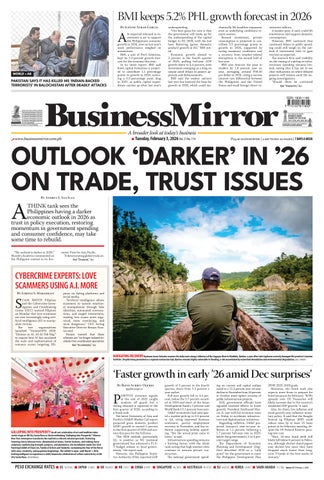
tank sees the Philippines having a darker economic outlook in 2026 as trust in policy execution, restoring momentum in government spending and consumer confidence, may take some time to rebuild.
By Lorenz S. Marasigan
SCAM WATCH Pilipinas and the Cybercrime Investigation and Coordinating Center (CICC) warned Filipinos on Monday that love scammers are now increasingly using artificial intelligence (AI) to manipulate victims.
The two organizations launched “UnmatchPH 2026: ‘Umiwas sa AI, AI-AI Feb-Ibig’” to expose how AI has escalated the scale and sophistication of romance scams targeting Fili-
pinos on dating platforms and social media.
“Artificial intelligence allows scammers to sustain emotional manipulation through fake identities, automated conversations, and staged interactions, making love scams more organized, more convincing, and more dangerous,” CICC Acting Executive Director Renato Paraiso said.
Paraiso warned that these schemes are “no longer isolated incidents but coordinated operations
By Justine Xyrah Garcia
AN expected rebound in investment is set to support the Philippines’s economic growth in 2026, even as last year’s weak performance weighed on momentum.
BMI, a unit of Fitch Solutions, kept its 5.2-percent growth forecast for the economy this year.
In its latest report, BMI said fixed capital formation is projected to contribute 1.1 percentage points to growth in 2026, reversing a 0.5-percentage point drag in 2025, as public capital expenditure catches up after last year’s
underspending.
“Our best guess for now is that the government will make up for the underspending of the capital budget in H2 2026, with the low base flattering [gross domestic product] growth in H2,” BMI noted.
Economic growth slowed to 3 percent in the fourth quarter of 2025, pulling full-year GDP growth down to 4.4 percent, with investment emerging as a drag on output amid delays in project approvals and disbursements.
BMI said the weaker outturn last year has lowered the base for growth in 2026, which could me -
chanically lift headline expansion even as underlying conditions remain uneven.
Beyond investment, private consumption is projected to contribute 3.5 percentage points to growth in 2026, supported by easing monetary conditions and a recovery from weather-related disruptions in the second half of last year.
BMI also forecast the peso to weaken by 1.8 percent year on year, averaging around P58.50 per dollar in 2026, citing a narrow interest rate differential between the Philippines and the United States and weak foreign direct in-
vestment inflows.
A weaker peso, it said, could lift remittances and support domestic consumption.
However, BMI cautioned that continued delays in public spending could still weigh on the outlook if investment fails to gain traction as expected.
The research firm said visibility on the timing of a pickup in infrastructure spending remains limited, noting that it has yet to see clear indications on when delayed projects will resume amid the ongoing investigations.
“Should there be continued
By Bless Aubrey Ogerio @blessogerio
POSITIVE economic signals at the end of 2025 caught analysts off guard, but a strong rebound is expected in the first quarter of 2026, according to a think tank.
The latest University of Asia and Pacific’s (UA&P) Market Call report projected gross domestic product (GDP) growth to exceed 5 percent in the first quarter of 2026 and sustain this pace for the full year.
“The 2026 outlook, particularly Q1, is positive as NG [national government] has advanced a P1.6T budget release to local governments,” the report said.
However, the Philippine Statistics Authority (PSA) reported GDP
growth of 3 percent in the fourth quarter, down from 5.3 percent a year earlier.
Full-year growth fell to 4.4 percent, below the 5.7 percent recorded in 2024 and short of the Asian Development Bank’s 5 percent and World Bank’s 5.1-percent forecasts.
UA&P economists had anticipated a modest pick-up to 4.6 percent in Q4, citing improved business sentiment, partial employment recovery in November, and low inflation supporting holiday spending. “But the actual print came in lower,” it said.
Infrastructure spending remains a limiting factor, with the think tank noting that high interest rates continue to restrain private construction.
The national government spend-
ing on current and capital outlays eased to a 12.2-percent year-on-year decline in November from 16 percent in October amid tighter scrutiny of public infrastructure projects.
Still, government officials have signaled renewed efforts to boost growth. President Ferdinand Marcos Jr. met with his economic team on Friday to accelerate infrastructure and digitalization initiatives.
Regarding inflation, UA&P projected January’s year-on-year inflation at 1.2 percent, following a 1.7 percent full-year rate in 2025, below the government’s 2 to 4 percent target range.
The Department of Economic Planning and Development (DepDev) described 2026 as a “rally point” for the government to meet the Philippine Development Plan
(PDP) 2023–2028 goals. Moreover, the think tank also expects more firms to prepare for bond issuances by February. “ROPs spreads over US Treasuries will likely increase due to the country’s weakened GDP growth,” it said. Also, for them, low inflation and weak growth may influence monetary policy. It said that the Bangko Sentral ng Pilipinas (BSP) could reduce rates by at least 25 basis points in its February meeting, despite the US Federal Reserve pausing rate cuts.
“Thus, 10-year bond yield will likely fall below 6 percent in February, although shorter-dated papers may decline less since they have dropped much faster than longterm T-bonds in the first weeks of January.”
“The outlook is darker in 2026,” Moody’s Analytics commented on the Philippine context in its Economic View for Asia Pacific. “A deteriorating global trade en-
NAVIGATING RECOVERY Boatman Jason Salvador resumes his daily route along a tributary of the Cagayan River in Maddela, Quirino, a year after twin typhoons severely damaged the province’s tourism facilities. Despite being promoted as
Quirino
C.PAREDES
delays to infrastructure spending, household spending and exports will not be enough to offset weaker public spending, posing downside risks to our forecast, it added.
BMI also flagged a less supportive external environment in 2026. Net exports are projected to subtract 0.7 percentage point from growth, reversing a 0.3-percentage point contribution in 2025, as global demand cools.
In addition, the research firm warned that inflation risks—particularly from higher global oil prices—could limit the scope for further monetary easing, potentially weighing on the pace of recovery in investment and consumption.
Inclusive growth, BARMM focus of PHL’s Asean hosting
By Samuel P. Medenilla @sam_medenilla
WITHPhilippine fisheries calls for the restoration of vessel monitoring capacity, harmonization of registration systems, complete delineation of municipal water, and strengthened enforcement in hotspot areas.
Hernandez said they would send the report and recommendations to the Department of Agriculture (DA) and BFAR, expressing hope that the agencies would take notice and respond with urgency.
“We call on President Marcos Jr. to reverse this alarming trend by investigating and holding to account the government officials and vested interests responsible for this gross neglect,” he said.
a focus on inclusive economic growth and assisting Bangsamoro Autonomous Region in Muslim Mindanao (BARMM), President Ferdinand Marcos Jr. has laid out the priorities of his administration in hosting the Association of Southeast Asian Nations (Asean) Leaders’ Summit and Related Summits this year.
The chief executive met with his Cabinet on Monday to finalize preparations for the said event.
Among those at the meeting were Foreign Affairs Secretary Maria Theresa P. Lazaro, Trade Secretary Cristina Aldeguer-Roque, Information and Communications and Technology Secretary Henry R. Aguda, Social Welfare Secretary Rexlon T. Gatchalian at Science and Technology Secretary Renato U. Solidum Jr. Also in the meeting were Acting Executive Secretary Ralph G. Recto, Presidential Management Staff Sec-
retary Elaine T. Masukat, Mindanao Development Authority Secretary Leo A. Magno, Senior Deputy Executive Secretary Maria C, Tiuseco, Office of the Executive Secretary Undersecretary Leonardo A. Cervantes, Palace Press Officer Claire A. Castro, and Asean-National Organizing Committee Director General Ma. Hellen B. De La Vega.
“The meeting discussed measures that will strengthen the call to deliver direct economic benefits to the subregion,” Palace Press Officer Castro said in Filipino in a press briefing.
“The President also wanted to focus on assisting the Bangsamoro Autonomous Region in Muslim Mindanao for the upcoming BIMP-EAGA Asean [Brunei-Darussalam-Indonesia-MalaysiaPhilippines East Asia Growth Area] Summit and other important topics,” she added.
The Presidential Communications Office undersecretary said coordination between various Philippine agencies is in full swing for the upcoming Asean Summit.
The Philippines will host the 48th Asean Leaders’ Summit and Related Summits in Cebu on May 8 and 9. It will also hold the 49th Asean Leaders’ Summit at Philippine International Convention Center in Pasay City on November 10 to 12.
Aside from preparations for
Asean, Marcos also attended another meeting on Monday to discuss the new Rizal Exhibition Hall, which will be constructed at the center of the National Museum of the Philippines (NMP) Complex in Manila.
He met with NMP Chairperson Adoni Aboitiz to discuss the details of the new facility, which aims to highlight Rizal’s interest in fine arts, anthropology, and natural sciences through exhibitions, educational activities and public programs.
The Presidential Communications Office said the three-phased projects will start next year and are expected to be completed in 2029 and cost P2.7 billion.
It will feature a 6,500 square meters of minimum exhibition area with at least 2,000 square meters tall space.
weak governance and execution are deterring capital formation,” it pointed out.
vironment is likely to sap export momentum, causing the economy’s lone bright spot to flicker and fade,” the think tank said.
Meanwhile, Moody’s Analytics sees consumer confidence in the Philippines weakening, pointing out that rebuilding trust in policy execution and restoring momentum in government spending will take time.
Moody’s Analytics also pointed out that while Philippine exports were the only “bright spot,” outbound shipments proved “insufficient” to offset the drag from weak domestic demand.
The think tank said this as the Philippine economy closed 2025 with what it described as a “disappointing” performance.
“GDP grew just 3 percent year on year in the final quarter, while growth in the September stanza was downwardly revised to 3.9 percent,” Moody’s Analytics noted.
This meant that for the full year, economic growth slowed to 4.4 percent from 5.6 percent in 2024—well short of the government’s 5.5 percent to 6.5 percent target and below or forecast of 5 percent.
“It also marked the softest pace of growth since the emergence from the pandemic trough in 2020,” the think tank also noted.
In the last three months of 2025, private consumption slowed despite low inflation and easing monetary policy, suggesting that rate cuts alone failed to revive household confidence.
Further, Moody’s Analytics pointed out that government spending “lost momentum” amid findings of corruption in flood control projects, including the misuse of funds.
“A loss of faith likely contributed to a decline in private investment, reinforcing concerns that
Last week, economists told this newspaper that interest rate cuts delivered by the Bangko Sentral ng Pilipinas (BSP) may not manifest in the growth of the economy if the trust and confidence of investors and consumers are not restored.
“Even if BSP cuts rates, it may not manifest in growth if trust and confidence are not restored,” Philippine Institute for Development Studies (PIDS) Senior Research Fellow John Paolo R. Rivera told the BusinessMirror in a Viber message on Thursday.
In a separate story published by this newspaper, Rivera said the slowdown in the Philippine economy cannot be fully explained by corruption and climate issues alone.
He said growth was also weighed down by delays and underspending in public programs, weaker construction and investment momentum, tight financial conditions, and softer external demand, which together reduced the economy’s usual buffers.
“The drag became larger because of policy implementation bottlenecks and an investment slowdown, not just weather and sentiment,” he added.
These pressures were evident in investment data. Gross capital formation plunged by 10.9 percent in the fourth quarter, resulting in a 2.1-percent contraction for the full year, making investment one of the biggest drags on growth. (See:https://businessmirror.com.ph/2026/01/30/3q4-growth-pulls-down-fullyear-to-4-4/)
An earlier story by the BusinessMirror also pointed to flawed fiscal policy behind the missed growth targets of the government for three straight years.
designed to emotionally groom victims before exploiting them financially.”
Scam Watch Pilipinas cofounder Jocel de Guzman said scammers are targeting specific profiles rather than randomly approaching potential victims.
“These scams focus on specific profiles: adults seeking foreign partners, financially stable professionals, women pressured to marry, men struggling with rejection, and solo parents looking for companionship, showing that scammers are exploiting vulnerability, not ignorance,” de Guzman said. The campaign identified six common love scammer profiles operating in the Philippines.
“Sad Boi, Sad Gurl” shares tragic personal stories to gain sympathy before gradually asking for money.
“The Seducer” uses attractive profile photos, quickly steers conversations toward sexual topics, and may solicit nude photos for potential blackmail.
“The Investor” poses as an appealing foreigner with a glamorous lifestyle and eventually draws victims into fake forex or cryptocurrency schemes.
“The Serviceman” claims to be a middle-aged foreign military officer stationed in Asia or the Middle East, typically targeting older women before requesting financial assistance.
“The Escort” presents as highly attractive and sexually open, sending explicit photos and asking for money before any in-person meeting. “The Slow Burn” builds trust gradually through seemingly harmless conversations, avoids face-to-face meetings, and later manipulates victims into sending money.
Paraiso and De Guzman said scammers now use AI-generated photos and fabricated identities to create realistic online personas, while scripted and automated conversations allow them to communicate with multiple victims simultaneously in a consistent, emotionally calculated manner.
“These schemes are no longer isolated incidents but coordinated operations designed to emotionally groom victims before exploiting them financially,” Paraiso said. Some operations employ AI-assisted or staged video calls to simulate real interaction and deepen trust, even if the person on screen is not who they claim to be.
Behind the scenes, organized scam hubs rotate faces and identities among operators, ensuring the scam continues even if one persona is exposed.
Those most vulnerable include “AFAM Forever”—adults aged 31 and above who use dating apps to seek long-term relationships with foreign partners—and “Azukal de Tito,” men aged 35 and above with stable careers and aspirational online lifestyles who are discreetly drawn into paid encounters that escalate into financial manipulation.
Also at risk are “D2M (Date-to-Marry),” single women in their mid-30s to early 40s who openly indicate marriage intent on their profiles, often under family or social pressure, and “WAFU,” men aged 31 and above who have experienced repeated rejection and struggle with self-confidence. Solo parents—widowed or separated individuals in their mid-40s and above whose children are already independent and who are open to finding companionship—are also targeted.
De Guzman noted that love scams rarely end with emotional manipulation alone. They often serve as entry points to cryptocurrency scams, fake gold and forex investments, and other high-yield, time-sensitive schemes.
an end, but a shared responsibility to carry forward the direction shaped through dialogue and cooperation over the past days.
She highlighted the forum’s key events such as the Travel Exchange (Travex), which brought together the region’s destinations, buyers, and partners through direct engagement.
The Asean Tourism Conference enabled careful discussions that moved beyond the region’s postpandemic recovery to focus on measurable sustainability, inclu-
sivity, and, and resilience.
The Philippine Regional Showcase showed off the various products of many local destinations, and which are rooted in the stakeholders’ culture and creativity.
The Asean tourism ministers also had separate discussions with their counterparts in China, Japan, and South Korea (Asean + 3), India, and Russia frameworks, to align priorities, strengthen cooperation, and advance connectivity guided by readiness and responsibility.
“Once emotional trust is established, victims are more likely to ignore red flags and comply with financial requests,” he said.
Scam Watch Pilipinas and CICC urged the public to report cybercrime-related incidents through the National Anti-Scam Hotline 1326, emphasizing that reports contribute to actionable intelligence for investigation and enforcement.
The launch was held together with partner organizations including the Philippine National Police AntiCybercrime Group, Gogolook (developer of anti-scam app Whoscall), GCash, Meta, and Truth360.
PPSC ’26 reforms focus on cyber, chemical security
Fil-Am convict in $34-M bingo scam flees to PHL
By Malou Talosig-Bartolome
TBy Jonathan L. Mayuga @jonlmayuga
HE Philippine Public Safety College (PPSC) of the Department of the Interior and Local Government (DILG) is rolling out key reforms in 2026, with particular focus on learnercentered education, expanded cyber and chemical security training, and upgraded training facilities to strengthen public safety education nationwide.
The PPSC vice president for academics, retired police Brig. Gen Vert T. Chavez announced this during the DILG Kapihan on Sunday. He said the College will transition to ISO 21001, an education management system emphasizing ethical, legally compliant, and student-centered instruction, aimed at improving curriculum, teaching, assessment, and research.
Training programs have also expanded to meet emerging security challenges. The National Virtual Training Center (NVTC) now offers basic and advanced Chemical Security Officers Courses, while
the National Cyber Training Institute (NCTI) has produced over 300 graduates from its Cyber Orientation, Cyber Intermediate, and Cyber Leadership Executive courses for division-level leaders and above.
To support these programs, PPSC will build a four-story academic building, a six-story cyber training facility, and complete two additional buildings at the Canlubang campus.
Aligned with the national focus on ethics and discipline, PPSC continues to implement its Character and Competency Framework, integrating leadership development across all training levels.
As the premier training institution for the National Police (PNP), Bureau of Fire Protection, and Bureau of Jail Management and Penology, PPSC has produced 487,216 graduates since 1993. It graduated over 11,200 students in 2025 and expects more than 11,300 this year, reinforcing its role in producing capable, ethical, and responsive public safety officers.
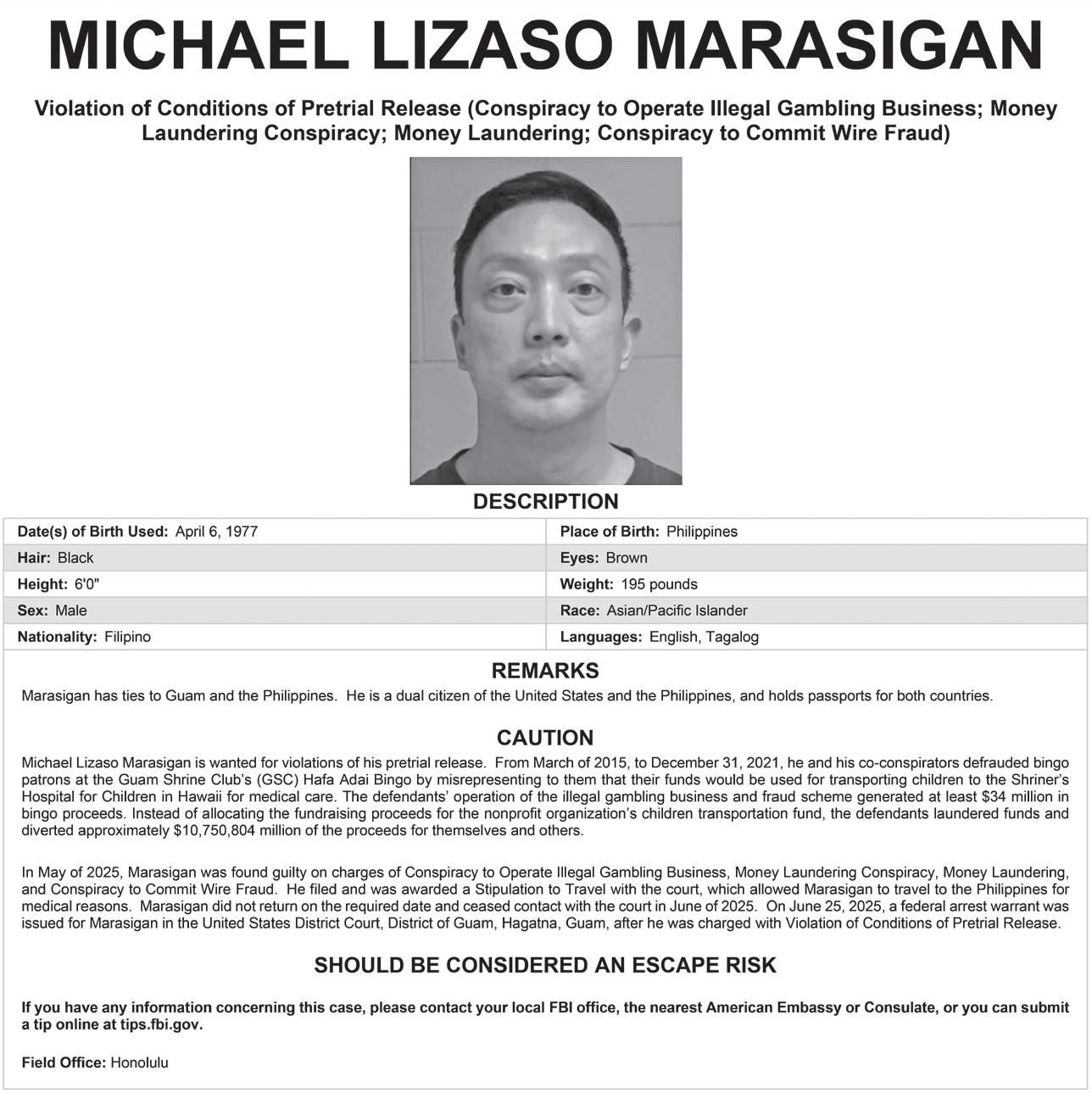
AFILIPINO-AMERICAN fugitive convicted in a massive charity bingo fraud has been placed on the US Federal Bureau of Investigation’s Wanted List.
The FBI on January 27, 2026 released a wanted poster for Michael Lizaso Marasigan, 48, eight months after a Guam jury found him guilty of conspiracy to operate an illegal gambling business, wire fraud, and multiple counts of money laundering.
Marasigan is belived to be in hiding in the Philippines Court records indicate that from 2015 to 2021, Marasigan and his accomplices ran Hafa Adai Bingo in Guam, claiming that proceeds would fund children’s medical trips to Hawaii’s Shriners Hospitals.
Instead, investigators said, the group laundered millions and diverted $10.7 million for
personal gain. The scheme generated more than $34 million in bingo proceeds before collapsing under federal scrutiny.
In May 2025, Marasigan was convicted in Case 23-00014 at the US District Court of Guam. Sentencing was pending when he petitioned for medical travel to the Philippines.
He failed to return in June 2025, violating pretrial release conditions. A federal arrest warrant was issued on June 25, 2025. By January 2026, his name was added to the FBI’s Most Wanted list.
The FBI said Marasigan holds both US and Philippine passports.
Groups file 2 impeachment cases vs Sara
By Jovee Marie N. dela Cruz @joveemarie
VICE President Sara Duterte was slapped with two impeachment complaints on Monday, with critics citing sworn allegations by her former aide, Ramil Madriaga, involving the alleged misuse of confidential funds and other serious offenses.
The complaints were filed days after the Supreme Court ruled that the House of Representatives’ 2025 Articles of Impeachment against her were barred by the one-year rule.
Batangas Rep. Gerville Luistro, House Committee on Justice chairperson. said that under the Supreme Court’s original decision, the one-year ban on initiating impeachment proceedings against Vice President Sara Duterte was set to lapse on February 6, 2026. However, based on the Court’s recent resolution, the prohibition is now considered to have expired on January 15, 2026.
The complaints invoked Madriaga’s claims that he transported large sums of money to various individuals upon Duterte’s instruction and that her 2022 election campaign was allegedly financed by drug money
and funds linked to Philippine Offshore Gaming Operators (Pogos). These allegations were raised as part of the grounds questioning Duterte’s handling of confidential funds.
The first verified impeachment complaint was filed by members of the Makabayan Coalition and endorsed by Party-list Reps. Antonio Tinio of ACT Teachers) Sarah Jane Elago of Gabriela Women’s Party, and Renee Louise Co of Kabataan before House Secretary General Cheloy Garafil.
The Makabayan bloc cited betrayal of public trust on three grounds: Duterte’s alleged unchecked discretion in handling P612.5 million in confidential funds from late 2022 to the third quarter of 2023; her alleged gross disregard for transparency and accountability by supposedly ordering subordinates to prepare
Palace confident on junking of impeachment complaints
By Samuel P. Medenilla
D@sam_medenilla
ESPITE the two impeachment complaints against the President Marcos being deemed sufficient in form by the House of Representatives, Malacañang is still confident the cases will be junked by lawmakers.
On Monday, the House of Committee of Justice declared the complaints filed by lawyer Andre de Jesus and the Makabayan Coalition, were sufficient in form.
Palace Press Officer Claire Castro, a lawyer, reiterated that Marcos did not commit any impeachable offense.
“Even before, the President said that he knows that he did nothing wrong, that he did not violate the law, and that he did not commit any impeachable offense, so he is confident in himself,” Castro said in Filipino in a press briefing on Monday.
She, however, noted that the President is concerned about the possible impact of the impeachment complaint to the economy.
Next week, the same committee of the House of Representatives will determine if the complaints are “sufficient in substance.”
Only after panel has determined that the complaints are sufficient in form and substance will it look if there are sufficient bases for impeachment.
When asked about the impeachment complaints against Vice President Sara Duterte, which was filed by the Makabayan Coalition, Castro said the Palace has no involvement in the said petitions.
In their complaint, the Makabayan Coalition said the Vice President allegedly committed betrayal of public trusts for misusing confidential funds, making a mockery of the audit process, and dereliction of official duty.
“We do not have any hand, we are not responsible for the filing of those complaints or impeachment complaints. So it’s up to the Congress to evaluate and decide with regard to the subject matter,” she said.
implausible accomplishment reports supported by fabricated liquidation reports and falsified documents, which were then submitted to the Commission on Audit (CoA) to justify the questioned use of confidential funds in violation of law; and her alleged dereliction of official duty for willfully refusing to recognize Congress’ oversight role during budget deliberations and its authority to conduct inquiries in aid of legislation.
The Makabayan bloc cited a sworn affidavit executed by Madriaga on November 29, 2025, which they said provides fresh details to House proceedings on the use of confidential funds under the Office of the Vice President (OVP) and the Department of Education (DepEd) from 2022 to 2023.
In his affidavit, Madriaga claimed he was directly involved in Duterte’s security arrangements following her election and later handled tasks involving sensitive information and money.
“Our work involved tactical transport services, securing VP Sara and other VIPs, conveying highly confidential information, and transporting large amounts of money to several persons as instructed by VP Sara,” Madriaga said.
He added that after Duterte’s victory, he was tasked to form the Vice President Security and Protection Group (VPSPG), which provided security and intelligence services to the Vice President. He
also said he recommended Col. Dennis Nolasco, a former subordinate in the Presidential Security Group, who later helped staff the unit and tapped Col. Raymund Dante Lachica to head the VPSPG. Madriaga said he worked closely with the two officers from July 2022 to April 2023 and claimed to have personal knowledge of activities related to the handling of confidential funds during the early months of Duterte’s term.
Second complaint
A SECOND impeachment complaint was filed by progressive groups and civil society leaders and was endorsed by Party-list Reps. Leila de Lima of Mamamayang Liberal and Perci Cendaña of Akbayan.
The complaint lists five articles of impeachment, including allegations that Duterte committed betrayal of public trust, culpable violation of the Constitution, graft and corruption, bribery, and other high crimes.
Among the grounds cited were Duterte’s alleged public admission of contracting an assassin and plotting to kill the incumbent President, First Lady, and a former House Speaker; alleged misuse and malversation of confidential funds while serving as vice president and Education secretary; alleged distribution of monetary gifts to DepEd officials involved in procurement; alleged unexplained wealth and
failure to fully disclose assets in her Statement of Assets, Liabilities, and Net Worth (SALN); and alleged involvement in other high crimes, including murder and conspiracy to commit murder.
The petitioners are led by Tindig Pilipinas co-convenor Francis Joseph Aquino Dee, former peace secretary Teresita Deles, and 2025 Ramon Magsaysay Awardee Fr. Flaviano Villanueva, and various youth and sectoral leaders.
“The Supreme Court itself stated that its ruling does not absolve Vice President Sara Duterte of the charges. By filing this complaint, we hope to finally get a verdict on these accusations,” Dee said.
Villanueva stressed the need for moral and legal accountability, saying the case is not only about Duterte but about upholding the principles of truth and justice and ensuring that no public official is above the law.
The second complaint, likewise, cited Madriaga’s sworn statement, including his claim that Duterte instructed him to deliver large sums of confidential funds to her security aide and that her 2022 campaign was allegedly funded by drug money and Pogo-linked sources.
“Madriaga’s testimony warrants a full investigation. His statements corroborate our worst fears about the vice president’s spending of public funds for personal use,” Dee added.
Cendaña said the latest impeachment complaints were
filed after the Supreme Court ruled that the House’s 2025 Articles of Impeachment against Duterte were barred by the oneyear rule, stressing that the decision did not clear her of the allegations. He added that the evidence could point to a broader conspiracy of abuse and corruption, warning that technicalities would not erase the charges against the vice president.
The Makabayan bloc asked the House of Representatives to take cognizance of the impeachment complaint and refer it to the House Committee on Justice in accordance with Article XI of the 1987 Constitution and House impeachment rules. They urged the committee to find sufficient substance in the complaint and recommend the approval of the Articles of Impeachment, leading to a plenary vote in the House and, if approved, a Senate trial.
Should the case reach the Senate, the complainants seek Duterte’s conviction, removal from office, and perpetual disqualification from holding any public office, as provided under the Constitution. The complainants stressed that they are seeking accountability strictly within the constitutional process, from committee proceedings to a possible full trial before the Senate sitting as an impeachment court.
Legislator to govt officials under probe: Step down
ELECTED and appointed government officials who are under investigation and facing criminal charges should consider stepping down from their posts as a matter of delicadeza and public accountability, a House of Representatives assistant majority leader said on Monday.
Las Piñas Rep. Mark Anthony Santos issued the statement following the filing of a criminal complaint by the Securities and Exchange Commission (SEC) involving Villar Land Holdings Corp. and several individuals accused of market manipulation, insider trading, and misleading public disclosures.
Santos said the case filed before the Department of Justice
underscores the importance of ethical leadership, particularly when public officials are named in criminal complaints.
“As a matter of delicadeza and in the interest of preserving public trust, elected and appointed government officials who are under investigation and facing criminal charges should consider stepping down from their posts,” Santos said.
He added that public officials included on the charge sheet –especially those holding elective positions – should consider resigning or taking a leave of absence to prevent further damage to the credibility of the institutions they serve and to help restore public confidence.
The SEC said Sen. Camille A.
Villar engaged in insider trading when she purchased 73,600 shares of the company in December 2017, shortly before the release of a corporate disclosure that resulted in an increase in the company’s share price.
Under the Securities Regulation Code, individuals found guilty of insider trading and related violations may face administrative sanctions and civil liabilities of up to three times the value of the transaction, in addition to actual and exemplary damages and attorney’s fees.
Separately, allegations of irregularities involving infrastructure projects have also surfaced during a Senate Blue-Ribbon committee hearing, where former Public Works secretary Mark
Raps vs Marcos ‘sufficient in form’
THE House Committee on Justice on Monday ruled that the two impeachment complaints filed against President Marcos are sufficient in form, paving the way for the panel to determine whether the charges are sufficient in substance.
The decision allows the committee, chaired by Batangas Rep. Gerville Luistro, to proceed with what she described as the first impeachment proceeding of the 20th Congress.
“What we completed today is what we call sufficiency in form,” Luistro said. “This means the impeachment complaint must be signed by the complainant, verified, based on personal knowledge and authentic records, and properly endorsed by a member of the House with a corresponding resolution.”
“Based on these considerations, the members of the justice committee voted to declare both the de Jesus complaint and the Maza et al. complaint sufficient in form,” she added.
The two cases are commonly referred to as the “De Jesus complaint” and the “Maza et al. complaint.”
The first complaint, filed on January 19,
2026, was initiated by lawyer Andre de Jesus and endorsed by House Deputy Minority Leader Jernie Jett Nisay, the nominee of the party-list group Pusong Pinoy.
The second complaint, filed on January 26, 2026, was submitted by a group of activists and private individuals led by Liza Maza, Teodoro Casiño, Renato Reyes Jr., Neri Colmenares, and labor leader Ronaldo Adonis, among others. It was endorsed by Party-list Reps. Antonio Tinio of ACT Teachers, Sarah Elago of Gabriela, and Renee Louise Co of Kabataan.
After hearing the endorsers, the committee first tackled the de Jesus complaint. Laguna Rep. Loreto Amante moved to declare it sufficient in form.
The motion was seconded but opposed by Manila Rep. Bienvenido Abante Jr., prompting Luistro to call for a division of the House.
“With 46 votes in favor, one vote against, and one abstention, the chair declares the de Jesus complaint sufficient in form,” Luistro declared.
The panel initially deferred action on the Maza et al. complaint after Cagayan de Oro Rep. Rufus Rodriguez questioned its verification, citing the lack of notarization and proper identification.
“If you look at the verification itself, there’s no notarization. How can it be a valid verification?” Rodriguez said.
Following a brief discussion, the committee proceeded after it was noted that both complaints followed the same format.
Caloocan City Rep. Edgar Erice moved to declare the Maza et al. complaint sufficient in form. Abante again objected, echoing concerns raised by Manila Rep. Joel Chua on whether the complainants satisfied the constitutional requirement of being taxpayers.
The committee eventually voted to declare the Maza et al. complaint sufficient in form, with 35 members voting in favor, nine against, and one abstention.
Explaining his “no” vote, Abante said the complaint plainly failed to meet formal requirements.
Luistro said the committee will next take up the question of whether the allegations meet the constitutional grounds for impeachment.
“[On Tuesday], we will discuss sufficiency in substance,” she said. “When we talk about
See “Marcos,” A5
Villar described what he claimed were long-standing internal arrangements related to project approvals, allocations, and budget insertions. In November last year, Ombudsman Jesus Crispin Remulla disclosed that investigators had conducted extensive inspections in parts of Metro Manila and Cavite as part of a broader probe into alleged irregularities. Initial findings, he said, pointed to what investigators described as extensive corruption, with possible cases including conflict of interest and civil forfeiture. Santos stressed that under the 1987 Constitution, members of Congress are not immune from criminal proceedings. Jovee Marie N. dela Cruz
January 2026 crime rates down by 24.32 %–PNP
By Rex Anthony Naval
HE National Police (PNP) Chief, Gen. Jose Melencio Nartatez Jr., on Monday said crime rates for this January have declined by 24.32 percent. This reduction showcases stronger police presence and more focused operations on the ground, the police chief added.
Nartatez said the PNP recorded 2,449 crime incidents for January 2026. This is 787 incidents less, or 24.32 percent lower, compared to 3,236 recorded for the same period last year.
Nartatez attributed the improvement to the “enhanced managing police operations” under the PNP Focused Agenda, which focuses on better supervision, clearer direction for field units, and faster police response.
See “PNP,” A5
www.businessmirror.com.ph
‘Govt response to disaster needs improvement’
By Justine Xyrah Garcia
FOLLOWING the slump in the country’s fourth-quarter and fullyear economic growth in 2025, the Department of Economy, Planning and Development (DepDev) said both national and local governments need to improve their responses to better manage weather-related disruptions.
Socioeconomic Development
work so often,” Balisacan told the BusinessMirror
He pointed out that in the last two quarters of 2025, Metro Manila and neighboring regions—which account for about “two-thirds of the economy”—announced repeated suspensions of classes and work, amplifying the economic impact.
“I think we need to improve the protocols for holding suspension, we need to improve weather forecasting, source of data. That’s what we’re working on now so it would not be too costly to the economy again,” Balisacan added.
since 2020, when the economy contracted by 9.5 percent due to the Covid pandemic. Outside that period, the last time the economy grew below the 5-percent mark was in 2011, when full-year growth stood at 3.9 percent.
In an earlier briefing, Balisacan said class and work suspensions in the fourth quarter alone shaved about 0.13 percentage point off economic growth.
The new tribe:
‘Knowledge Workers’
By Henry J. Schumacher
ATo strengthen disaster preparedness, he said the government has restored funding for the Project Nationwide Operational Assessment of Hazards (Noah) to improve early warning systems.
“Actually, it’s not so much the weather disturbances… Of course those created destructions, but the response of local governments and even the national government when we suspended classes and
Secretary Arsenio M. Balisacan said that while typhoons and other natural calamities battered the economy in recent months, their impact could have been less severe had government response been handled more effectively.
On Thursday, the Philippine Statistics Authority (PSA) announced that the country’s gross domestic product slowed to 3 percent in the fourth quarter of 2025, pulling the full-year growth down to 4.4 percent.
The 2025 growth outturn marked the weakest performance
Balisacan also said DepDev is working with the Department of the Interior and Local Government (DILG) and the Department of Science and Technology (DOST) to develop a more science-based approach to disaster response.
Clark airport reports 14% passenger growth in 2025
By Ashley J. Manabat
CLARK FIELD, Pampan -
ga—Clark International Airport (CRK) posted a 14 percent increase in passenger traffic in 2025, driven by higher domestic and international travel, the airport’s data indicate.
CRK handled 2,753,101 passengers last year, up from 2,404,888 in 2024. Domestic traffic rose 23 percent to 1,042,589, while international passengers increased 10 percent to 1,710,512.
LL countries and peoples are changing rapidly—as the market economy, democratic politics, and the international millennial’s culture spread all over the world, in the process called “globalization.” American management thinker Peter Drucker described this emerging social organization as the “Knowledge Society.” By this Drucker meant that—in our world today— knowledge has become the basic human resource.
economy’s central resource, we must keep in mind continuous learning has become essential. So swift is the generation and transmission of knowledge that learning has become a life-long process for every one of us. To maximize upskilling, we must also have critical thinking skills. It is not enough that AI tells us what to do, it is necessary that we understand what it says and adjust accordingly. Only then can we become true knowledge-workers of today and the future. We have to make learning part of our culture.
CRK is operated by Luzon International Premiere Airport Development (Lipad) Corporation which oversees management and development of the facility.
“2025 was a year of steady growth for Clark International Airport,” said Noel Manankil, Lipad president and chief executive
Airline capacity at the airport also grew. Total available seats climbed 12 percent to 3,767,345, reflecting a 21 percent increase in domestic capacity and an 8 percent hike in international capacity, supported by additional flight frequencies. Air traffic movements increased as well. Domestic flights rose 34 percent to 12,117, while international movements grew 5 percent to 10,628. Overall, total system-wide flight operations reached 22,745, up 18 percent from 19,222 in 2024.
officer. “The increase in passenger traffic and improved load factors were supported by stronger airline partnerships and Clark’s role as a reliable alternative gateway outside Metro Manila.”
Looking ahead, Manankil said they expect continued growth in 2026.
PAL, CEB
FLAG carrier Philippine Airlines (PAL) on Monday announced it will reroute its turboprop operations from Manila to Clark.
In an advisory, PAL said flights to and from Busanga, Siargao, Antique, and Catarman will be rerouted to Clark starting March 29, in line with the timeline set
by the Manila Slot Coordination Committee (MSCC).
Passengers booked on affected flights will receive updated itineraries, with options for rebooking, rerouting, or refund as needed.
“With the mandated transition of turboprop services out of Naia [Ninoy Aquino International Airport], PAL will introduce domestic jet frequencies beginning March 2026, expanding capacity on highdemand routes and providing passengers with more travel options,” the advisory added.
In another advisory, Cebu Pacific also announced the transfer of all turboprop operations to Clark by March.
PHL creative trade program showcases MSMEs in Bangkok
THE Philippine Trade and Investment Center (PTIC) brought the country’s Malikhaing Pinoy program to Bangkok on Friday, aligning with the country’s assumption of the Association of Southeast Asian Nations (Asean) Chairmanship for this year.
The event, held in partnership with Thailand’s Creative Economy Agency (CEA), showcased the Philippine Creative Industries Development Plan (PCIDP), aimed at scaling Filipino artisans and micro, small, and medium enterprises (MSMEs) into international markets.
“At the heart of any great nation lies its culture and heritage,” Trade Secretary Cristina Roque said. “Our Chair[man]ship provides a platform for our creative sector and talents
to take centerstage ensuring that the Philippine creative sector drives trade and tourism.”
Preliminary data from the Philippine Statistics Authority (PSA) showed that the creative sector contributed P1.94 trillion to the country’s gross domestic product (GDP) in 2024.
The showcase will continue as a week-long exhibition during Bangkok Design Week 2026 from January 31 to February 5.
Thai investors eye growth
DURING the visit, the Department of Trade and Industry (DTI) met with Thai companies looking to expand operations in the Philippines.
Charoen Pokphand Foods Public Co. Limited (CPF), a fully integrated
agro-industrial conglomerate, outlined plans to grow its business in the country.
CPF Philippines chairman Sakol Cheewakoset said the company has recorded an average 35-percent annual growth since entering the market 10 years ago.
“We want the Philippines to overtake Vietnam in a few years,” Cheewakoset said, highlighting the need for government support to realize expansion plans.
CPF currently operates facilities across Luzon, the Visayas, and Mindanao and expects to hire more Filipinos as new sites come online.
For her part, Roque said the agency would assist CPF in identifying pro-business, industrializing locations, noting the importance of the food sector for the country’s
growing population.
On the other hand, fiber cement manufacturer Shera Public Company Limited also sought support to accelerate its investments in the Philippines.
Shera’s reported that it produces 120,000 metric tons of fiber cement products annually and plans a second phase of investment to expand nationwide, supplying both public and private infrastructure projects, including schools and housing.
“We are building many houses for Filipinos,” Roque said, adding that there is room for expansion in the mass housing sector.
Further data from Shera showed that it generated P2.7 billion in revenue last year and employs 150 workers in the Philippines.
Bless Aubrey Ogerio
Lacson sets Blue-Ribbon panel hearing on BIR’s LOA resumption
TBy Butch Fernandez @butchfBM
HE Senate Blue-Ribbon committee will hold a hearing this week on the Bureau of Internal Revenue’s resumption of the issuance of letters of authority (LOA) and mission orders (MOs), Senate President Pro Tempore and Blue-Ribbon panel chairman Panfilo M. Lacson said
on Monday. Lacson said the Blue-Ribbon committee needs to be formally informed of the reforms the BIR has instituted in relation to issuance of LOAs, including safeguards it put in place.
“The Senate Blue Ribbon committee needs to be formally informed of the new reforms instituted by the BIR in relation to the issuance of LOAs and if
safeguards are already in place to prevent or at least minimize abuse committed against our taxpayers, then we may have to conclude the committee hearings on the matter,” he said.
“We will schedule a hearing this week in this regard to hear what the BIR has to say,” he added.
Last week, the BIR said it would resume audit operations, including the issuance of LOAs
injury cases dropped from 409 to 283. rape cases saw a sharp decline, falling from 848 to 331. theft slightly decreased from 1,020 to 981. For carnapping, motor vehicles [theft] dropped from 25 to 17, and motorcycles from 189 to 144,” Nartatez said. This, the PNP chief said, indicates that our communities are
and MOs, which were suspended in November following allegations of an extortion scheme involving their use.
BIR Commissioner Charlito Mendoza was quoted in reports as saying reforms will be implemented, including the limiting of LOA issuances to one letter per taxpayer per taxable year. Taxpayers can also verify LOAs through the BIR’s chatbot.
becoming safer. He also assured the public that police units nationwide will continue to intensify patrols, strengthen community coordination, and strictly monitor police performance to sustain the downward trend.
Nowadays, value is created not so much by capitalists, workers, and natural resources, as by productivity and innovation—both of which are the application of knowledge to work. Today, value is created primarily by intelligence—creativity—and inventiveness. The new tribe are “knowledge workers”—individuals who know how to allocate knowledge to productive use. And, for both individuals and nations, education—the systematic acquisition of knowledge—has become the ultimate ladder to opportunity!
Globalization should speed up the flow of technical and scientific knowledge from the developed to the less-developed countries. Education must work to close the gap in learning between those two types of countries. In other words, globalization will intensify and broaden every country’s need to educate ALL its people. No longer will it suffice to educate a tiny elite that will then manage and direct the politics, the economy, and the culture of the many. Development will require not only a corps of highly skilled individuals capable of absorbing advance technology; it will also require a minimum of scientific literacy and technological skill; it will also need the setting of professional standards, the delineation of fields of expertise, and the organization of communities of knowledge. Education can no longer afford to leave anybody behind. All young people—whether they go to college or not—will need a similar set of core competencies if they are to succeed in today’s labor markets.
The Philippines has to be part of the ever-changing, fast moving, technology-driven world taking shape before our eyes: the country has to position itself strategically in this new economy. The end-effort must be to secure the Philippines’s place on the right side of the digital divide, the revolutions in communications, information, and computer technologies are creating. This requires a work-class workforce, something that the ICT and creative industries need. And because knowledge has become the modern
Continued from A4
substance, the issue is whether the alleged acts constitute impeachable offenses.”
She emphasized that at this stage, the panel is not yet allowed to weigh evidence or determine the truth of the accusations.
“These are still preliminary matters in the impeachment process,” Luistro said.
“We are confined to what is written in the complaint. We are not allowed to go beyond that or receive evidence to prove the allegations.”
Luistro outlined the five-step impeachment process, noting that the determination of sufficiency in form was completed on Monday, to be followed by the review of sufficiency in substance.
Let me focus on an exciting development called Predictive Analytics which is a consequence of data management which we and our companies have no choice but to do.
Predictive Analytics is the use of data and other tech tools like artificial intelligence (AI) and machine learning (ML) to predict future outcomes. Predictive analytics uses historical data to discover patterns and trends that predict future occurrences. Currently, many industries are actively using predictive analytics, including manufacturing, healthcare, finance, education, retail, cybersecurity, and agriculture. For example, predictive analytics can be used for everything from predicting business revenue to machine downtime.
As data science evolves, new methods of using data are taking hold. Now, organizations can use data proactively with predictive analytics. How Does Predictive Analytics Help Business?
Predictive analytics takes data analysis a step further. While basic data analysis can show us what happened and what to do about it, predictive analytics shows us what could happen and how we can intervene.
Predictive analytics offers a wide range of benefits across industries, from manufacturing to cybersecurity. In conclusion, as mentioned above, in our world today—knowledge has become the basic human resource. Let’s all become devoted members of the knowledge society. Training our people has to become part of our culture! hope you enjoyed this article; I am certainly interested in your views concerning the knowledge workertribe, contact me at hjschumacher59@ gmail.com.
Luistro said the final step is the determination of probable cause, after which the committee’s findings will be contained in a formal report to be submitted to the House plenary. Approval by at least one-third of all House members would result in the transmittal of the impeachment case to the Senate for trial.
No bearing THE recent SC ruling on the impeachment case against Vice President Sara Duterte has no bearing on the impeachment proceedings involving Marcos, officials of the House Committee on Justice said Monday.
If the complaints are found sufficient in substance, she said, the committee will issue a notice to the respondent to file an answer and require the submission of pleadings, affidavits, and counter-affidavits under oath. The panel will then determine whether there is sufficient basis to support the complaints. If so, the process will proceed to hearings, where the complainants, their witnesses, and the respondent may be invited to appear.
See “Marcos,” A9
Pakistan says it has killed 145 ‘Indian-backed terrorists’ in Balochistan after deadly attacks
By Abdul Sattar & Munir Ahmed
The Associated Press
QUETTA, Pakistan—Pakistani police and military forces killed over a 100 “Indian-backed terrorists “ in counterterrorism operations across the restive southwestern province of Balochistan over the past 40 hours, government officials said on Sunday, a day after coordinated suicide and gun attacks killed 33 people, mostly civilians.
The raids began early Saturday at multiple locations across Balochistan, and left 18 civilians, including five women and three
children, and 15 security personnel dead, authorities said.
Sarfraz Bugti, the provincial chief minister, told reporters in
Quetta that troops and police officers responded swiftly, killing 145 members of “ Fitna al-Hindustan,” a phrase the government uses for the allegedly Indian-backed outlawed Baloch Liberation Army, or BLA. The number of militants killed over the past two days was the highest in decades, he said.
“The bodies of these 145 killed terrorists are in our custody, and some of them are Afghan nationals,” he said. Bugti claimed that the “Indian-backed terrorists” wanted to take hostages but failed to make it to the city center.
He spoke alongside senior government official Hamza Shafqat, who often oversees such operations against insurgents in the province, and praised the military, police and paramilitary forces for repelling the assaults.
Militant attacks erupted on Saturday in a resource-rich region where Pakistan is seeking to at -
tract foreign investment in mining and minerals. In September 2025, a US metals company signed a $500 million investment agreement with Pakistan, a month after the US State Department designated BLA and its armed wing as a foreign terrorist organization.
Residents described scenes of panic after a suicide bombing killed several police officers on Saturday.
“(It) was a very scary day in the history of Quetta,” said Khan Muhammad, a local resident. “Armed men were roaming openly on the roads before security forces arrived.”
Bugti repeatedly accused India and Afghanistan of backing the assailants and said senior leaders of the BLA, which claimed responsibility for the latest attacks in Balochistan, were operating from Afghan territory. Both Kabul and New Delhi deny the allegations.
He said on Sunday Afghanistan’s Taliban had pledged under the 2020 Doha agreement not to allow Afghan soil to be used as a base for attacking other countries, but “unfortunately, the Afghan soil was still being used against Pakistan.”
Tensions between Pakistan and Afghanistan have persisted since early October when Pakistan carried out airstrikes on what it described as Pakistani Taliban hideouts inside Afghanistan, killing dozens of alleged insurgents.
Bugti said militants stormed the home of a Baloch laborer in Gwadar and killed five women and three children. He condemned the killings. He said the attackers had planned to seize hostages after storming government offices in Quetta’s high-security zone but were thwarted. “We were aware of their plans, and our forces were prepared,” he said.
The BLA is banned in Pakistan and has carried out numerous attacks in recent years, often targeting security forces, Chinese interests and infrastructure projects.
Authorities say the group has operated with support from the Pakistani Taliban, known as Tehrik-e-Taliban Pakistan, or TTP. The TTP, a separate group, is allied with Afghanistan’s Taliban, who returned to power in August 2021. Balochistan has long faced a separatist insurgency by ethnic Baloch groups seeking greater autonomy or independence from Pakistan’s central government. The BLA regularly targets Pakistani security forces and has also attacked civilians, including Chinese nationals among the thousands working on various projects in the province.
Ahmed reported from Islamabad.
Nepal authorities arrest travel executives in $20 million fake mountain rescue scam
By Binaj Gurubacharya The Associated Press
KATHMANDU, Nepal—Authorities in Nepal have arrested six travel and mountain rescue executives accused of conducting fake rescues on the Himalayan nation’s high mountains to scam millions of dollars from international insurance companies, officials said Monday.
Nepal’s Central Investigation Bureau arrested six people from three different travel and mountain rescue operators last week, accusing them of submitting fake claims for close to $20 million between 2022 and 2025 and receiving the money in their accounts. All six are Nepali nationals.
Bureau spokesperson Shiva Kumar Shrestha said Monday that authorities are still investigating.
Fake documents including passenger and cargo manifests for helicopter rescue flights, medical invoices and hospital reports were sent to insurance companies, the bureau said. The agency said that one of the companies that 171 of the 1,248 rescues claimed by one company were fake, leading to unjustified payouts of more than $10 million. Another is accused of fabricating 75 of 471 claimed rescues and fraudulently claiming $8 million, while the last one is accused of making 71 fake claims with payouts totaling over $1 million.
See “Nepal,” A9
Editor: Angel R. Calso
www.businessmirror.com.ph
Hope and fear settle over Venezuela after US-imposed government change
By Regina Garcia Cano The Associated Press
CARACAS, Venezuela—Time in Venezuela feels like it’s moving both too fast and too slow. The pillars of the country’s self-proclaimed socialist government are falling at a dizzying pace or not quickly enough. Economic relief is finally on the horizon or already too late.
Thirty days after the US raid and capture of then-President Nicolás Maduro upended Venezuela, adults and children alike are still unsure of what exactly is happening around them. And as the initial shock gives way to a mix of uncertainty, hope and disappointment, a pervasive fear of another attack or more government repression continues to hang over them.
In the capital, Caracas, where government-sponsored billboards and graffiti demand that the US free Maduro, many residents wonder whether his successor, acting President Delcy Rodríguez has any autonomy or is capitulating to White House demands; whether she is Maduro by another name, and—crucial to their immediate needs—whether to believe, as indicated by her, that a long-sought wage increase is on the horizon. Meanwhile, long-silent opposition leaders have finally emerged to speak publicly.
“It’s an important change, certainly, but everything is the same, everything,” retiree Julio Castillo, 74, said of the removal of Maduro from office. “I feel as if nothing much has happened.”
‘We are acting under coercion’ VENEZUELA’S government and its supporters consider the capture of Maduro and first lady Cilia Flores a kidnapping. Rodríguez and senior officials have pledged to fight for the couple’s freedom since US President Donald Trump first announced their seizure in the early hours of Jan. 3. The ruling party has organized demonstrations to show their loyalty to Maduro, whom the fiery Hugo Chávez anointed as his self-proclaimed socialist revolution’s torchbearer before dying in 2013. It has also adjusted its messaging from threatening a Vietnam-like war with the US to admitting being militarily outmatched and needing to transform the relationship with Goliath.
Supporters—a minority compared to the crowds during Chávez’s presidency— see Rodríguez as lacking free will but trust that she can carry Chavismo, their political movement, through the next diplomatic battle.
“The Venezuelan state, and Venezuelans, are accepting this new situation in which we
are acting under coercion,” José Vivens, a Maduro loyalist, said of Rodríguez’s decision to allow the Trump administration to control Venezuela’s oil money, the country’s engine. “They kidnapped our commander. And we have to give in because we have to live for another battle.”
Vivens, a justice of the peace, was in his apartment’s parking lot in Caracas when he heard a loud whistle, then a deafening explosion the night of the attack. He ducked behind his car, and when he looked up, helicopters were flying unnervingly close to his building.
“They’ve invaded us,” was Vivens’ immediate thought. Not exactly, but he would learn a few hours later that the US military’s elite had captured Maduro at a nearby compound and loaded him onto a helicopter.
Abandoning a pillar of Chavismo
RODRÍGUEZ has used public events and gatherings with Venezuela’s private sector to assure anyone listening that she, not the Trump administration, is governing the South American country, even if she later acknowledges having a mutual agenda with the US, which was unthinkable weeks earlier.
“The people of Venezuela do not accept orders from any external factor,” she said during a meeting with oil executives to discuss an overhaul of the country’s energy law. “The people of Venezuela have a government, and this government obeys the people.”
Her proposed overhaul, which lawmakers swiftly approved and she signed into law Thursday, opens the nation’s oil sector to privatization, abandoning a pillar of Chavismo.
She introduced it following Trump’s assertion that his administration would take control of Venezuela’s oil exports and revitalize the ailing industry by luring foreign investment.
Testing the waters
MANY within the opposition had long expected that Maduro’s ouster, especially if led by Trump, would immediately result in one of their own taking the reins of the country. Trump’s decision to work with Rodríguez, instead of opposition leader and Nobel Peace Prize laureate María Corina Machado, continues to leave them baffled.
But as Machado’s supporters keep looking for signs that the White House will incorporate her meaningfully into its plans for their country, Venezuelans have begun testing Rodríguez’s commitment to what she has called “a new political moment” for Venezuela.
Iran summons EU ambassadors in retaliation for terror listing
By Jon Gambrell The Associated Press
DUBAI, United Arab Emirates—Iran said Monday it had summoned all of the European Union ambassadors in the Islamic Republic to protest the bloc’s listing of the paramilitary Revolutionary Guard as a terror group.
The move comes as Iran faces the threat of US military action in response to the killing of peaceful demonstrators and over possible mass executions. The American military has moved the USS Abraham Lincoln and several guidedmissile destroyers into the Mideast. It remains unclear whether President Donald Trump will decide to use force, though regional countries have engaged in diplomacy in an effort to halt a new Mideast war breaking out.
“Trump is trying to calibrate a response to Iran’s mass killing of protesters that punishes Iranian leaders without also embroiling the United States in a new, openended conflict in the region,” the New York-based Soufan Center think tank said Monday.
“Some Trump aides seek to
exploit Tehran’s weakness to secure major concessions from the regime, but Trump has set conditions for a diplomatic resolution that Tehran cannot accept.”
EU sanctions draw Iran’s anger
THE EU agreed to list the Guard as a terror group last week over its part in the bloody crackdown on nationwide protests in January that killed thousands and saw tens of thousands detained.
Other countries, including the US and Canada, have previously designated the Guard as a terrorist organization. While the move is largely symbolic, it does add to the economic pressure squeezing Iran, particularly has the Guard has a major influence on the country’s economy.
Iranian Foreign Ministry spokesman Esmail Baghaei told journalists that the ambassadors had begun to be summoned on Sunday and that process went into Monday as well.
“A series of actions were reviewed, various options are being prepared and were sent to the related decision-making bodies,” Baghaei said. “We think that in coming days, a decision will be
made about a reciprocal action by the Islamic Republic of Iran toward the illegal, unreasonable and very wrong move by the EU.”
Also Sunday, Iran’s parliament speaker said that the Islamic Republic now considers all European Union militaries to be terrorist groups, citing a 2019 law.
The Guard emerged from Iran’s 1979 Islamic Revolution as a force meant to protect the Shiite clericoverseen government and was later enshrined in its constitution. Operating in parallel with the country’s regular armed forces, it grew in prominence and power during a long and ruinous war with Iraq in the 1980s. Though it faced possible disbandment after the war, Supreme Leader Ayatollah Ali Khamenei granted it powers to expand into private enterprise, allowing it to thrive.
The Guard’s Basij force likely was key in putting down the demonstrations, starting in earnest from Jan. 8, when authorities cut off the internet and international telephone calls for the nation of 85 million people. Videos that have come out of Iran via Starlink satellite dishes and other means show men likely belonging to its forces shooting and beating protesters.
Guard drill in Strait of Hormuz ‘ongoing’ MEANWHILE , Baghaei also said a drill by the Guard in the Strait of Hormuz, the narrow mouth of the Persian Gulf through which a fifth of all oil traded passes, was “ongoing based on its timetable.” Iran warned ships last week that a drill would be carried out on Sunday and Monday, but prior to Baghaei’s comments had not acknowledged it taking place. The US military’s Central Command issued a strong warning to Iran not to harass its warships and aircraft, or impede commercial vessels moving through the strait. Satellite photos taken Sunday by Planet Labs PBC and analyzed by The Associated Press showed small vessels moving at speed in the strait between Iran’s Qeshm and Hengam islands, some distance away from the corridor commercial vessels take. The Guard relies on a fleet of small, fast-attack ships in the strait. Asked about whether Iran could face a war, Baghaei told the public, “don’t worry at all.” He declined, however, to discuss whether Trump set a deadline for Iran to respond to America’s demands.
Rafah crossing reopens, offering hope to Gaza’s sick and wounded
By Samy Magdy & Josef Federman The Associated Press
AIRO—Gaza’s Rafah bor -
Cder crossing with Egypt reopened on Monday for limited traffic, a key step as the Israeli-Hamas ceasefire moves ahead, according to Egyptian and Israeli security officials.
dren and adults needing medical care hope to leave devastated Gaza via the crossing, according to Gaza health officials. Thousands of other Palestinians outside the territory hope to enter and return home.
An Egyptian official said 50 Palestinians would cross in each direction in the first day of the crossing’s operation. The official, involved in talks related the implementation of ceasefire deal, spoke to the Associated Press on condition of anonymity to discuss the issue.
Israeli troops seized the Rafah crossing in May 2024, calling it part of efforts to combat Hamas arms-smuggling. The crossing was briefly opened for the evacuation of medical patients during a ceasefire in early 2025. Israel had resisted reopening the Rafah crossing, but the recovery of the remains of the last hostage in Gaza last week cleared the way to move forward.
Thousands of climbers come to Nepal every year to scale the highest Himalayan mountains, while tens of thousands more also come to hike the mountain trails leading up to the base camps of these high peaks. Every year several climbers die and hundreds are rescued suffering from extreme exhaustion, altitude sickness or other medical issues.
Continued from A5
San Juan Rep. Ysabel Maria J. Zamora, a vice chairperson of the panel, explained that the High Court decision pertain specifically to the impeachment complaint filed last year against the Vice President by more than one-third of the members of the House of Representatives.
“The impeachment complaint then was under the second mode, or the mode that requires a one-third vote of all members of the House of Representatives,” Zamora told her colleagues.
“In this case, the two complaints [against President Marcos Jr.] were filed by ordinary citizens and endorsed by members of Congress and then referred within the proper period to the House Committee on Justice,” Zamora said.
“So, Madam Chair, there is no effect on the proceedings before this committee,” Zamora stressed.
She noted that the SC ruling focused on the interpretation of the term “session days,” particularly in relation to the period within which the impeachment complaint against the Vice President was included in the House Order of Business and subsequently referred to the justice committee.
There are few roads and limited medical facilities in the mountains, so rescuers are often forced to charter expensive helicopter flights to transport patients to hospitals in Nepal’s capital Kathmandu. High altitude climbers are required to show proof of insurance covering helicopter rescue before they are issued climbing permits.
Based on the court’s definition of “session days,” Zamora said, the Tribunal ruled that the impeachment complaint against the vice president was already time-barred.
Committee chair Luistro and vice chair Bukidnon Rep. Keith Flores agreed with Zamora’s assessment.
“I agree, it has no effect because the pending impeachment complaints were filed under the first mode by private citizens and endorsed by House members,” Luistro said.
Ako Bicol Party-list Rep. Alfredo Garbin, another committee vice chairman, said the SC actually defined “session days” as “calendar days.”
He asked that, based on the definition, and counting from last Thursday, when the two complaints against the President were sent to the Committee on Justice, the panel does not have until May 26 to submit a report.
Luistro cautioned his colleagues against interpreting the SC decision, particularly the impeachment timetable, saying they should leave the matter to the leadership and “proper committees” of the House.
Independence FOR his part, Senior Majority Leader Lorenz Defensor on Monday said that
State-run Egyptian media and an Israeli official also confirmed the reopening, which for now at least, is largely symbolic. Few people will be allowed to travel in either direction, and no goods will be allowed to enter.
About 20,000 Palestinian chil -
the House of Representatives does not need to assert its independence from the judiciary, saying such independence is already clearly provided for under the Constitution and existing laws.
“We don’t have to assert our independence. Our independence is laid down by the law,” Defensor said, emphasizing the doctrine of separation of powers among the three branches of government.
Defensor, who represents Iloilo, said each branch must remain within its constitutional bounds, noting that the Legislative Department should not encroach on the Judicial Department—and vice versa—as well as on the Executive.
“I see no clear sign of grave abuse of discretion on the part of the House rules,” he said, adding that current procedures follow the intent of the Constitution, particularly on the initiation of impeachment complaints.
He maintained that when at least onethird of all members of the House endorse an impeachment complaint, the Constitution is clear that the case should be transmitted directly to the Senate for trial.
“The wording of the Constitution is very clear. If at least one-third of all members of the House of Representatives endorse an impeachment complaint, it should go directly
Israeli Prime Minister Benjamin Netanyahu has also said that Israel will allow 50 patients a day to leave. An official involved in the discussions, speaking on condition of anonymity to discuss the diplomatic talks, said each patient would be allowed to travel with two relatives, while some 50 people who left Gaza during the war would be allowed to return each day.
Israel has said it and Egypt will vet people for exit and entry through the crossing, which will be supervised by European Union border patrol agents and a small Palestinian presence. The numbers of travelers are expected to increase over time if the system is successful.
to the Senate forthwith,” Defensor said.
While expressing respect for the SC, Defensor said the High Court should not dictate how the House processes impeachment complaints, calling impeachment a political question vested in Congress.
“We respect the Supreme Court, but how you define a session day should not be defined by the Judicial Department. It should be the Legislative Department,” he said, noting that House sessions— especially during budget season—often extend beyond midnight.
Defensor, who chairs the committee tasked with revising House rules, said the chamber will comply with the SC ruling that, for purposes of impeachment, one session day is equivalent to one calendar day. However, he stressed that any revised rules must primarily be aligned with the Constitution and the intent of its framers.
At the same time, Defensor said the House retains the right to disagree with the Court’s decision, noting that even Supreme Court justices themselves issue dissenting opinions.
Citing the League of Cities vs. Commission on Elections case, Defensor recalled how the Supreme Court reversed itself multiple times, a process Congress respected in the spirit of the rule of law.
The reopening is a key step as last year’s US-brokered ceasefire agreement that took effect on Oct. 10 moves into its second phase. Before the war, Rafah was the main crossing for people moving in and out of Gaza. The territory’s handful of other crossings are all shared with Israel. Under the ceasefire terms, Israel’s military controls the area between the Rafah crossing and the zone where most Palestinians live.
Fearing that Israel could use the
crossing to push Palestinians out of the enclave, Egypt has repeatedly said it must be open for them to enter and exit Gaza. Historically, Israel and Egypt have vetted Palestinians applying to cross. The current ceasefire halted more than two years of war between Israel and Hamas that began with the Hamas-led attack on southern Israel on Oct. 7, 2023. The truce’s first phase called for the exchange of all hostages held in Gaza for hundreds of Palestinians held by Israel, an increase in badly needed humanitarian aid and a partial pullback of Israeli troops. The second phase is more complicated. It calls for installing the new Palestinian committee to govern Gaza, deploying an international security force, disarming Hamas and taking steps to begin rebuilding.
Federman reported from Jerusalem.
PSA: Over one-third of Pinoys died unattended in 2024
By Justine Xyrah Garcia
MORE than one-third of Filipinos who died in 2024 took their final breath without a doctor’s care, according to the Philippine Statistics Authority (PSA).
Latest data from the PSA showed that 296,551 of the 701,884 deaths recorded that year were unattended, meaning the individuals were not under the care of a private physician, public health officer, hospital authority, or any other allied health care provider at the time of death. By region, the Negros Island
PLDT told to bargain ‘in earnest’ with supervisory staff
THE Center for Trade Union and Human Rights (CTUHR) on Monday urged telco giant PLDT Inc. to negotiate “in earnest” with its supervisory employees, citing the lack of substantial progress in collective bargaining agreement (CBA) talks despite months of discussions.
CTUHR said negotiations for a new CBA covering 2026 to 2028 began in November last year, but no major agreement has been reached after 15 rounds of talks between management and the workers’ union, Gabay ng Unyon sa Telekomunikasyon ng mga Superbisor sa PLDT (GUTS-PLDT).
The proposed agreement will cover about 4,000 supervisory employees nationwide.
The labor group said the delay in reaching an agreement comes even as PLDT continues to post strong financial results.
CTUHR cited company disclosures showing that PLDT reported a net income of P32.31 billion in 2024, up 21 percent from P26.61 billion in 2023, and recorded P25.1 billion in earnings in the first quarter of 2025.
“CBA negotiations are about improving the state of workers’ labor rights. PLDT and other companies that are perfectly capable of enhancing their workers’ rights should offer improvements in wages and benefits, job security and union rights,” CTUHR said.
“As a major company in the country, PLDT is an instructive case of how employers are responding to workers’ demands.”
The group also noted that PLDT workers across the country have been expressing solidarity through social media, which it said reflects growing frustration over the pace of negotiations and the need for management to respond to workers’ concerns. Justine Xyrah Garcia
Region recorded more unattended deaths than attended ones, with 18,805 unattended cases compared with 16,439 attended.
The same pattern was observed in Eastern Visayas, which logged 16,610 unattended deaths versus 12,986 attended, and in Soccsksargen with 13,546 unattended deaths against 12,580 attended.
As for causes of death, the PSA said the leading causes in 2024 remained unchanged from previous years. Ischaemic heart diseases continued to top the list, accounting for 134,074 deaths, or 19.1 percent of total registered deaths.
This was followed by neoplasms or cancers with 77,504
deaths (11 percent), cerebrovascular diseases, including stroke, with 68,729 deaths (9.8 percent), and pneumonia with 47,260 deaths (6.7 percent).
The PSA also noted that the 701,884 deaths recorded in 2024 were 1 percent higher than the 694,821 deaths registered in 2023.
On average, 1,918 deaths were recorded per day in 2024, equivalent to about 80 deaths per hour or at least one death per minute.
The high share of unattended deaths in the country is reflected alongside data from the PSA showing that Filipinos’ out-ofpocket (OOP) payments to finance their health needs amounted to
DepEd, Open Ownership partner to combat corruption in massive education procurement
By Claudeth Mocon-Ciriaco @claudethmc3
NOTING that government spending is largest and most geographically dispersed in education sector, the Department of Education (DepEd) has formalized a partnership with Open Ownership to strengthen transparency, integrity, and risk detection in public procurement. With a record budget this 2026, DepEd is the country’s largest procuring entity, with procurement activities that directly affect classrooms, textbooks, school buildings, and learner support nationwide. The agency sees stronger transparency and risk management as key to ensuring that education funds are delivered more quickly and effectively to schools.
Open Ownership, an international organization that supports governments in implementing beneficial ownership transparency, will provide technical assistance, capacity-building, and analytical tools to DepEd procurement officials. This includes hands-on workshops and the codevelopment of an impact measurement framework to assess how beneficial ownership data improves procurement outcomes.
Gusto naming malaman kung sino talaga ang nasa likod ng mga
kumpanyang ka-transaksiyon ng gobyerno. Kapag malinaw iyon, mas madaling maiwasan ang problema at mas mabilis na maihatid ang silidaralan, libro, at tulong na kailangan ng mga bata. Mas siguradong sa paaralan napupunta ang pera, hindi sa bulsa ng iilan ,” said Education Secretary Sonny Angara as the partnership was sealed through a memorandum of agreement (MOA) signed on Monday, positioning DepEd to pilot the use of beneficial ownership data in procurement.
Beneficial ownership refers to identifying the natural persons who ultimately own, control, or benefit from companies participating in government contracts, beyond the names of incorporators or signatories on paper.
Under the agreement, DepEd and Open Ownership will conduct a retrospective analysis of selected procurement contracts to examine how beneficial ownership information can help flag potential conflicts of interest, undisclosed related parties, bid rotation, and market concentration. The pilot will also test which data points are most useful, at what stages of procurement they matter most, and how their impact can be measured.
Angara said the initiative supports ongoing reforms to improve budget execution and
reduce procurement risks, ensuring that public investments translate into timely delivery of classrooms, learning materials, and services for learners.
The initiative aligns with the New Government Procurement Act, which institutionalized beneficial ownership transparency as a safeguard against corruption and collusion in public contracting. The law requires suppliers to disclose information on who ultimately controls or benefits from their companies, shifting procurement oversight from a purely compliance-based approach to a more risk-based and evidencedriven system.
DepEd emphasized that the pilot is a learning and systemstrengthening exercise, not an investigation or a finding of wrongdoing. Results are expected to inform future policy refinements, internal controls, and procurement processes across the department.
The agency is one of the first government agencies in the Philippines to pilot the systematic use of beneficial ownership data in public procurement, marking a significant step in operationalizing procurement reforms and advancing data-informed governance, as education continues to receive one of the largest allocations in the national budget.
Senate inquiry sought on impact of potential full-blown Iran conflict on global oil prices, PHL energy security
By Butch Fernandez @butchfBM
IF a full-blown conflict erupts in Iran, what would be its impact on global supply and oil prices, and how would this in turn affect oil-importing Philippines?
Senator Win Gatchalian raised this question on Monday as he filed a resolution seeking a Senate inquiry to assess the potential impact of escalating political unrest in Iran on global oil prices and supply, with a view to safeguarding the Philippines’ energy security.
Gatchalian’s proposed Senate Resolution 278 noted that although the Philippines does not import Iranian crude due to sanctions, instability in Iran
can still drive up global oil prices because the petroleum market operates as an interconnected global system where disruptions in one major producer elevate benchmark prices worldwide.
Increases in domestic prices over the past few weeks have been caused partly by geopolitical tensions in Iran, the senator said. Another round of oil price hikes is expected on Tuesday.
Sustained increases in oil prices significantly raise the cost of electricity generation, particularly in off-grid and missionary areas
P615.16 billion in 2024, a growth of 11.8 percent from the P550.08 billion recorded in 2023 (See: https://businessmirror.com. ph/2025/07/25/pinoys-out-ofpocket-spend-for-health-up-by11-8-psa/).
The World Health Organization (WHO) defined OOP as “formal and informal payments made at the time of using any health care good or service provided by any type of provider.”
These include user charges or co-payments for covered services, as well as direct payments for services not covered by insurance or public health programs.
Just last month, the World
PNP chief Nartatez calls for more efforts against loose firearms
By Rex Anthony Naval
PHILIPPINE National Police (PNP) chief Gen. Jose Melencio Nartatez
Jr. on Monday directed all police units to intensify their campaign against loose firearms.
At the same time, he tasked national support units like the Criminal Investigation and Detection Group and the Special Action Force to hit hard on all gunrunning groups operating across the country.
“This is part of our anti-crime measures since firearms, particularly the unlicensed ones, are the main instruments in committing criminal activities. Denying criminal elements the opportunity to own loose firearms will cripple their capability to operate,” the PNP chief said.
This is part of the government’s move to maximize all efforts to ensure public safety.
While the PNP seized a lot of loose firearms last year, Nartatez emphasized the need to step up the conduct of operations and implementation of the strategies to account for more loose guns and prevent their proliferation. He said intelligence-gathering is now being intensified to run after existing gun-running groups and identify any new players in the proliferation of loose firearms, including high-powered ones. Nartatez also tasked the Civil Security Group to implement measures to compel delinquent gun owners to renew the licenses of their firearms.
“While we will hit hard on loose firearms, we also have to make sure that all firearms with expired permits must be renewed on time,” he said.
“Gun ownership comes with an obligation that includes renewing their licenses on time,” Nartatez stressed.
LGUs told to remove officials’ identifying marks from govt projects
By Jonathan L. Mayuga @jonlmayuga
THE Department of the Interior and Local Government has ordered nationwide enforcement of the administration’s “Anti-Epal” policy with the removal of names, images, and likenesses of public officials from all government-funded projects, programs, activities, and properties.
The DILG handed down Memorandum Circular No. 2026-006 directing all provincial, city, municipal, and barangay officials, including DILG central, regional, and field offices and attached agencies to ensure that no public official’s name, photo, logo, initials, color motif, slogan, or any identifying symbol appears on project signages, markers, tarpaulins, and similar materials funded by public money.
DILG Secretary Jonvic Remulla stressed that government projects are paid for by the people and must never be used for personal promotion. Government programs are not personal billboards. These are funded by taxpayers and must
Ureflect public service, not political credit-grabbing.
The Circular cites the 1987 Constitution’s principle that public office is a public trust, the Code of Conduct and Ethical Standards for Public Officials and Employees, and the Commission on Audit rules that classify such personalized displays as unnecessary expenses. It is further reinforced by the 2026 General Appropriations Act, which explicitly prohibits attaching officials’ names and images to government-funded projects. All concerned officials and employees are directed to cause the immediate removal and correction of non-compliant materials. Heads of offices are accountable for full and prompt compliance, as well as, for cascading the directive to all units under their supervision.
The DILG also reiterated the call of President Ferdinand Marcos Jr. to keep government projects free from political self-promotion and personality branding, and encouraged citizens to report violations of the Anti-Epal policy.
“Public funds are for public service, not for personal publicity.”
Bank reported that the Philippines has only about 6.4 public primary health care workers per 10,000 population, placing it among the countries with the lowest density of public primary health care workers in East Asia and the Pacific—limiting access to frontline and preventive health services (See: https://businessmirror.com.ph/2026/01/23/ wb-flags-phls-low-density-ofprimary-healthcare-staff/). This level remains well below that of neighboring countries such as Viet Nam, which has 10.5 workers per 10,000 population, Malaysia with 40, and Singapore with 63.7. See “Oil Prices,” A11
Gordon leads Red Cross’ first simultaneous relief distribution via video conference;
₧14.8M
NDER the leadership of Philippine Red Cross (PRC) Chairman and CEO Richard J. Gordon, the PRC conducted its first simultaneous relief distribution via video conference, providing P14.8 million in aid to 4,078 families across 15
in assistance reaches 4,078 families in 15 provinces
provinces. Today’s distribution targeted 15 affected provinces including Cagayan, Aurora, Isabela, Nueva Vizcaya, Quirino, Quezon–Lucena, Palawan, Catanduanes, Camarines Norte, Camarines Sur, Negros Occidental, Negros Oriental, Surigao del Norte, Davao Oriental, and Cebu—communities impacted by recent earthquakes and typhoons.
During his keynote address, Chairman Gordon noted that the Philippines remains one of the most disaster-prone countries in the world, facing volcanic eruptions, earthquakes, typhoons, and even systemic challenges that demand preparedness and collective responsibility.
“The Red Cross is here to help,
Milk production hits record 43.3M liters in ‘25 as dairy output rises 12%
TBy Ada Pelonia @adapelonia
HE country’s milk produc -
tion surged to 43.3 million liters in 2025, the highest recorded level, according to the Philippine Statistics Authority (PSA).
Data from the PSA showed that national milk output increased by 12.17 percent last year, from 38.6 million liters recorded in 2024. The value of dairy production also rose to P1.67 billion in 2025.
The latest production figures were the highest recorded level since the time series started, based on historical government data.
National Dairy Authority (NDA) Administrator Marcus Antonius Anday attributed the growth in milk output to government interventions.
“The substantial growth in milk production reflects the effectiveness of our dairy development programs, particularly in animal nutrition, herd expansion, and farm management,”
Andaya said.
“These gains were achieved without dairy animal importation for the past 3 years, highlighting improvements in productivity and herd performance at the farm level,” he added.
The agency noted that milk output from carabao jumped by 24 percent, citing continued contributions of the Philippine Carabao Center (PCC), including private carabao farms and noncooperative member farmers.
Furthermore, milk production from cattle and goats grew
FL’s friendly encounter with Chinese ambassador highlights diplomatic harmony
By Samuel P. Medenilla @sam_medenilla
THE friendly meeting be -
tweenFirst Lady Marie Louise “Liza” Araneta Marcos and meeting with Chinese Ambassador to the Philippines Jing Quan in a concert was proof there is no need to escalate “word-war” between Manila and Beijing, according to Malacañang
The First Lady and the Chinese diplomat attended the concert of renowned Chinese pianist Lang Lang in Makati during the weekend.
In her social media account, Marcos posted a picture of her and Jing smiling during the sidelines of the event, which she described
amid tensions
as “a beautiful evening of music, mastery, and shared moments.”
Palace Press Officer Claire Castro stressed that no diplomatic matters were discussed during the meeting between the First Lady and Chinese diplomat.
“It does not reflect policy direction [of the Marcos administration] and it is not linked to any diplomatic matters,” she said while describing the nature of the said meeting in a press briefing last Monday.
However, she said the meeting showed that both Manila and Beijing can peacefully settle their differences.
“China knows that our President and this administration only want diplomacy to resolve
any, issue.
So, China probably felt that, so there is no need for there to be any heat or tension between the two countries,” she said.
The Palace made the statement as lawmakers continue to call for Chinese embassy officials to be declared as persona non grata over their heated exchanges with local officials.
It earlier said that President Ferdinand Marcos will not make such a declaration, which can only worsen the tension between Philippines and China.
Instead, the President said he will let the Department of Foreign Affairs (DFA) address the matter through its direct communications with its Chinese counterparts.
DOJ starts PI to plunder cases vs Estrada, Bonoan, Revilla et al
Tby 4 percent and 27 percent, respectively.
Overall dairy animal inventory expanded by 5 percent to 161,868 heads from 154,252 heads, which the NDA said further reinforced production gains.
“The increase in milk production translated into higher milk sufficiency at 2.22 percent, bringing the country nearly halfway toward the government’s target of 5 percent milk sufficiency by 2028,” Andaya added.
The NDA said the passage of Republic Act (RA) 12308 or the
Animal Industry Development and Competitiveness Act further supports the dairy sector’s performance.
RA 12308, which earmarks P20 billion annually to the Animal Competitiveness Enhancement Fund (AnCEF), aims to strengthen livestock and dairy development by promoting competitiveness and streamlining animal health and breeding programs.
For 2026, the NDA expressed optimism about a further hike in milk production, with four stock
farms set to be operational this year. These will be established in Ubay, Bohol; Malaybalay, Bukidnon; Carmen, Cotabato; and Prosperidad, Agusan del Sur.
The agency inaugurated and made operational the first stock farm in General Tinio, Nueva Ecija last year.
“With the operation of our stock farms and the planned importation of 870 dairy cattle this year, we are confident that these initiatives will further contribute to increased milk production,” Andaya said.
Conflicting SC dates on Duterte impeachment ban spark House justice committee concerns
By Jovee Marie N. Dela Cruz @joveemarie
THE leaders of the House Committee on Justice expressed concerns on Monday regarding conflicting Supreme Court rulings about the one-year ban on impeaching Vice President Sara Duterte. They highlighted the differing reckoning dates in the Court’s decision from July 2025 and its resolution issued on January 29, 2026.
Committee vice chair Ysabel Maria J. Zamora of San Juan said the July decision set February 5 as the start of the one-year prohibition, but the later resolution changed the definition of a “session
day” from one that may span several calendar days to one equivalent to a single calendar day, effectively adjusting the timeline.
Zamora noted that this shift created confusion, as the resolution appears to treat the first impeachment complaint filed on December 2, 2024 as having been initiated on January 14, 2025, after the lapse of 10 session days, making January 15, 2026 the end of the one-year bar—earlier than February 6, 2026 under the original ruling.
Justice Committee chair Gerville Luistro of Batangas echoed the concern, saying the House is now uncertain which reckoning period governs—the February 5
date cited in the decision or the December 2 filing referenced in the resolution. She urged the Supreme Court to clarify the issue.
Vice chair Jonathan Keith T. Flores of Bukidnon added that the resolution failed to provide a clear computation, further fueling uncertainty and possibly prompting new petitions before the High Court. Meanwhile, Bicol Saro Rep. Terry L. Ridon said the timing of the referral of any impeachment complaint to the House Committee on Justice would be crucial, stressing that referral marks the initiation of impeachment proceedings for purposes of the one-year prohibition.
By Joel R. San Juan @jrsanjuan1573
HE Department of Justice (DOJ) Monday conducted its first preliminary investigation (PE) on the plunder charges filed against Senator Jinggoy Estrada, former Department of Public Works and Highways (DPWH) Secretary Manuel Bonoan, detained former senator Ramon “Bong” Revilla Jr and several others in connection with the flood control mess.
Bonoan, who personally appeared before the panel of prosecutors, expressed his readiness to answer the charges but noted that he has yet to see and review the complaint.
“I have not yet looked into the details of the complaint… We’ll try to look into all these allegations being thrown at us, certainly, I’m sure, we will be able to answer it,” Bonoan said, while maintaining his innocence.
The former DPWH secretary also indicated his desire to visit his wife in the United States who is still undergoing medication. He said his wife is scheduled to undergo a medical procedure by the middle of this month.
“I’m just waiting for the schedule of the operation,” he said. Bonoan is a co-respondent of
but you should not be overly dependent on having other people save you. While dependency has become the new normal, dapat tandaan natin na masarap tulungan ang mga tumutulong sa sarili ,” said Chairman Gordon.
Estrada, the late Maria Catalina “Cathy” Cabral, and former DPWH officials Roberto Bernardo, Gerard Opulencia and Henry Alcantara in the plunder case.
Bernardo, Opulencia and Alcantara, along with contractor Sally Santos, have already been admitted under the DOJ-Witness Protection Program as state witnesses in the flood control scandal. Currently, there are three plunder cases pending before the DOJ in connection with the flood control scandal.
The other two plunder cases involve Revilla, et al and former Ako Bicol Partylist Rep. Elizaldy “Zaldy” Co et al.
DOJ spokesman, lawyer Polo Martinez said the state witnesses who are respondents in the plunder cases are not excused from filing their counter-affidavits to the charges.
The plunder case against Revilla also underwent its first preliminary investigation Monday.
The former senator is currently detained for malversation charges in connection with the P92.8 million alleged ghost flood control project in Pandi, Bulacan.
Martinez said Estrada and Revilla did not appear before their respective panel of prosecutors since yesterday’s proceedings were merely for the receipt of the
“The Philippine Red Cross receives no government funding and relies primarily on donations and volunteer support to carry out its humanitarian mission. Despite this, we have grown and provided assistance, not only to local communities in need but also to disaster-affected communities abroad,” he added. Today’s distribution is part and parcel of PRC’s ongoing P301.8 million assistance for response and recovery for disasters such as the Cebu Earthquake, Davao Oriental Earthquake, Typhoon Tino (Kalmaegi), and Super Typhoon Uwan (Fung-Wong), targeting 23,242 disaster-affected families across 17 provinces. This operation is in partnership with the International Federation of Red Cross and Red Crescent Societies (IFRC), the Australian Department of Foreign Affairs and Trade, and PRC’s local partners.
complaints and the documents filed by the complainant National Bureau of Investigation (NBI).
“Sotinanggaplangponilayung complaint and yungmga additional documents by the NBI and it was done through their counsels. So, they did not have to appear. They are scheduled to appear at the next scheduled hearing for the submission of their counter-affidavits,” Martinez said.
Martinez noted that the NBI requested for more days to submit additional documents in support of their complaint which the panel granted.
The NBI was directed to submit the additional documents during the second preliminary investigation scheduled on February 12.
“The NBI was given until February 12 to submit those additional documents,” Martinez said.
The DOJ spokesman said Bonoan was present during the preliminary investigation to receive the complaint.
Meanwhile, the plunder case involving Co has yet to be concluded by the panel of prosecutors due to “pending incidents.”
Co, who left the country last year, has failed to submit his counter-affidavit during the preliminary investigation conducted on January 5 and January 15.
dependent on diesel-fed power plants deployed by the National Power Corporation-Small Power Utilities Group (NPC-SPUG), potentially resulting in higher generation costs and pressure for subsidies.
Gatchalian pointed out that the Philippines remains a net importer of petroleum and is highly exposed to fluctuations in global crude oil prices, particularly those originating in the Middle East, which supplies 96.8 percent of the country’s crude oil imports as of 2024, according to data from the Department of Energy.
The turning point: From ambition to action in education
THE alarming figures reported by the Second Congressional Commission on Education (Edcom II) serve as a powerful condemnation of a system in deep crisis. That only 48 percent of our youngest learners can read at their grade level is a national emergency. That a mere 0.4 percent of Grade 12 students are proficient, as measured by national tests, is a catastrophic failure with generational consequences. Against this bleak backdrop, the submission of the National Education and Workforce Development Plan (NatPlan) 2026–2035 (and the Edcom II report, Turning Point: A Decade of Necessary Reform), is the most critical and ambitious policy blueprint for the nation’s future in decades. (Read the BusinessMirror story: “Edcom II formally submits National Education Plan to Senate,” January 27, 2026).
The ambition is breathtaking, and rightly so. Targets like soaring from 48 percent to 95 percent reading proficiency, or from 0.4 percent to 90 percent senior high school competency, are not incremental; they are revolutionary. They acknowledge the depth of the hole we must climb out of. The plan’s holistic approach—tying early childhood nutrition to classroom performance, professionalizing teachers, ending “mass promotion,” and aligning senior high school with real-world jobs—shows a hard-won understanding that the crisis is systemic. It cannot be fixed with piecemeal solutions or political slogans.
Senators Bam Aquino and Loren Legarda are correct: this is a “roadmap” and a “covenant.” But history is littered with excellent commission reports that gathered dust on shelves. The haunting question now is whether this will be a true turning point or another tragic footnote. The plan’s success hinges on three pillars beyond the paper it is printed on: unwavering political will, sustained and intelligent financing, and relentless public accountability.
First, political will must transcend electoral cycles. The 10-year timeline demands commitment from administrations yet to be elected. The recommended governance reforms—rationalizing overlapping agencies, updating charters, depoliticizing the appointment of school leaders—will face entrenched bureaucratic resistance. Ending the culture of mass promotion will be unpopular. Prioritizing foundational literacy and numeracy over vanity infrastructure projects requires discipline. The Senate’s vow is a start, but the entire machinery of government, led by the Executive, must be harnessed.
Second, the P2.66 trillion incremental investment is not a suggestion; it is a prerequisite. The plan to raise the education budget to 5.5 percent of GDP is a recognition that world-class outcomes require world-class investment. These funds must be protected from corruption and inefficiency, directed precisely where the plan dictates: to classrooms, textbooks, teacher training, and child nutrition. The largest budget ever must be the smartest budget ever, with procurement reformed and every peso accounted for.
Finally, the covenant is not just with the government, but with the people. Citizens, parents, teachers, and the private sector must become active stewards of this plan. We must demand transparency on annual progress toward those quantified targets. We must support the teachers who will bear the burden of implementation. The media and civil society must track the promises, celebrating gains and exposing shortcomings with equal vigor.
Edcom II has done its job magnificently, providing a diagnosis and a detailed prescription. The monumental task now begins. The plan’s audacious goals remind us of the promise every Filipino child is entitled to. They chart a path from a system that stifles potential to one that unleashes it. This is the decade of necessary reform. We must now summon the necessary courage, resources, and collective will to walk the road. The future of millions of learners, and the nation itself, depends on it.
Opinion
‘IOUTSIDE THE BOX
T is the economy, stupid” was never meant as an insult to voters. James Carville coined the line in 1992 as a reminder to political professionals that people vote with their wallets long before they vote with ideology. Strip away the slogans, the culture wars, and the endless debates on personality, and what remains is painfully simple.
Che Guevara said: “The revolution is not an apple that falls when it is ripe. You have to make it fall.” But what makes the apple fall?
The joke is that an economic recession is when your neighbor loses his job. A depression is when you go unemployed. But even if you have a job, are rich or poor, the one universal wealth and economy killer is inflation. That is because extremely bad economic management always, universally shows in the inflation numbers.
History provides the clues that most experts choose to ignore. Look at the data leading up to February 1986 in the Philippines. In 1983, the inflation rate was 10 percent. By 1984, it had skyrocketed to 50 percent. In 1985, it was still a punishing 23 percent. By the time 1986 rolled around, the social contract was shredded.
The First Quarter Storm, the Martial Law declaration, and the Aquino assassination all may have led to Edsa. But the ostensibly anti-nuclear “Welga ng Bayan” strike in June 1985 seemed to be a dress rehearsal for the ultimate People Power eight months later.
When you wipe out the purchasing power of the middle class and the poor you are not just badly managing an economy. You are building your personal guillotine.
This pattern repeats across borders and decades. Iran today offers a textbook example of how inflation can radicalize even societies accustomed to a generation of repression. While analysts argue over geopolitics and foreign interference, the more immediate trigger has been monetary ruin. Annual inflation has not been below 10 percent since 2018.
Over roughly a decade, the Iranian rial suffered massive depreciation losing 95 percent of its crosscurrency value. More recently, the 2025 collapse of Ayandeh Bank, burdened by nearly $5 billion in bad loans tied to regime cronies, forced the government to print money to conceal losses. The October 49 percent inflation detonated public trust. Even merchants, traditionally cautious and politically conservative, have poured into the streets because commerce becomes impossible when currency values swing wildly and credit systems rot
When you wipe out the purchasing power of the middle class and the poor you are not just badly managing an economy. You are building your personal guillotine. This pattern repeats across borders and decades. Iran today offers a textbook example of how inflation can radicalize even societies accustomed to a generation of repression.
from within.
History shows that brutal force rarely restores order when money no longer works.
Europe learned the lesson repeatedly and expensively. Inflation fueled discontent before the French Revolution, as for ordinary citizens the trigger was high inflation that made it impossible to afford bread. Many factors appeared but high prices were the key to the destabilization that led to “La Révolution Française” with the murder of the king and the overthrow of the monarchy.
Consider the Russian Revolution of 1917. The monarchy used the inflationary printing press to pay for a foreign war. The result was a wicked combination of inflation and conscription that led the population to embrace the Bolsheviks. They did not suddenly fall in love with Karl Marx. They just hated the system that was pillaging their livelihoods. Inflation is so powerful it drives people into their own political hell.
The ideals of liberty can easily drown in blood and economic instability. In Germany, the Weimar hyperinflation of 1921 to 1923 obliterated savings and social trust,
Korea’s world-beating stock rally stumbles as risk-off wave hits
By Sangmi Cha
FOR much of the past year, South Korean stocks stood out as an anomaly, continuing to rise even on days when the global AI boom took a break in other markets. Monday’s rout is now testing investor confidence.
What started as a modest downturn quickly morphed into a sharp selloff, with the nation’s equities swept up in the unwinding of crowded trades along with gold and silver. Uncertainty over interest-rate policy and doubts about the durability of AI-driven spending weighed heavily on technology shares. The Kospi tumbled as much as 5.6 percent, the most since November, and a slide in futures triggered a halt in program trading on the benchmark index. Samsung Elec-
What started as a modest downturn quickly morphed into a sharp selloff, with the nation’s equities swept up in the unwinding of crowded trades along with gold and silver. Uncertainty over interest-rate policy and doubts about the durability of AI-driven spending weighed heavily on technology shares.
tronics Co. and SK Hynix Inc., the chip heavyweights that engineered the country’s world-beating gains since the start of last year, fell more than 6 percent each at the day’s lows. The won also weakened. Unease over Kevin Warsh’s nomination as the next Federal Reserve chair was compounded by Nvidia Corp. Chief Executive Officer Jensen Huang’s comments that the proposed $100 billion investment in OpenAI was “never a commitment.” The question is whether the downturn marks a temporary blip in Kospi’s upward trajectory, or the start of a deeper correction. “Just last month the market was wrapped in optimism and hope, but its abrupt plunge seems to have sparked a wave of panic selling,” Han Jiyoung, an analyst at Kiwoom Securities Co., wrote in a note. “Yet
clearing a path for extremist politics and totalitarian rule. When money collapses, moderation rarely survives.
The quiet truth beneath revolutions is not romance or rhetoric but arithmetic. Stable money supports social order. Sound banking channels savings into productive use instead of elite enrichment. When leaders forget this, they gamble with more than approval ratings. They gamble with the survival of their regimes.
Carville’s blunt reminder still holds, from Washington to Manila to Tehran. Ignore inflation, and eventually the crowd will remind you why that phrase endures. The ideology is irrelevant. When people cannot afford food, they will tear down any system. When savings disappear, loyalty disappears. When money fails, governments fall. Inflation is the revolution that nobody sees coming until it arrives. Then it is too late.
Any leadership presiding over inflation plays with fire. The underlying economic dynamic explains everything. Sound money matters. Zero inflation matters. A dependable currency matters. A banking system that serves the public instead of industrial elites matters. These are the keys to maintaining rule of law and regime stability. As American revolutionary Thomas Paine observed, every major failure of paper finance has eventually produced political upheaval, partial or total. History keeps the receipts.
E-mail me at mangun@gmail.com. Follow me on Twitter @mangunonmarkets. PSE stock-market information and technical analysis provided by AAA Southeast Equities Inc.
the key engines of Korea’s bull market—strong earnings momentum and minimal valuation pressure— remain firmly intact.” Seoul has been one of the world’s hottest stock markets since last year thanks to voracious demand for memory chips to work alongside AI processors such as those made by Nvidia. The Korean market has climbed to a valuation of over $3.3 trillion, overtaking Germany last week to rank
John Mangun
The new tax audit process: A welcome reset
TAtty. Irwin C. Nidea Jr.
TAX LAW FOR BUSINESS
HE Bureau of Internal Revenue (BIR) issued new rules on the resumption of tax audits. It represents a meaningful recalibration of how tax assessments are administered in the Philippines. After decades of taxpayer complaints over overlapping audits, administrative costs and even inefficient enforcement practices, the new framework signals an intentional effort to restore order, trust and fairness in the audit process.
Initial reception from taxpayers has been generally positive. Many view the new tax audit process as long overdue. At the same time, there is a shared and understandable doubt: whether the rules reflected on paper will translate into consistent practice on the ground.
At the outset, the rules clearly define the scope of audit and field operations that may now resume. These include the issuance of Electronic Letters of Authority (eLAs), Mission Orders (MOs), and Tax Verification Notices (TVNs), as well as the continuation of previously suspended audit cases. More importantly, the regulations expressly differentiate these instruments by function and authority, a distinction that had often been blurred in the past. Each audit or verification instrument now carries a mandatory label that describes its precise scope. An eLA authorizes a full examination of books and accounting records. In contrast, MOs and TVNs are expressly limited to verification, surveillance, or the examination of specific transactions. Language implying full audit authority is no longer permitted in limited-scope instruments.
This seemingly technical reform addresses a fundamental concern of taxpayers: the expansion of audit authority beyond what was formally granted. By forcing clarity at the outset, the new rules reduce uncertainty and curtail the discretionary creep that has historically characterized some audit engagements.
Central to the reform is the adoption of the Single-Instance Audit Framework. As a general rule, a taxpayer may now be subjected to only one eLA per taxable year, covering all applicable internal revenue tax types, including value-added tax. The issuance of multiple or overlapping letters of authority for the same year is expressly prohibited, save for clearly defined fraud exceptions.
This represents a decisive break from prior practice. Under the old regime, it was not uncommon for taxpayers—particularly large and medium-sized enterprises—to face several audit teams in a single year, each focusing on a different tax type. The cumulative effect was significant. Companies incurred increased administrative costs, diverted management time, and repeatedly reproduced the same records for different examiners. Beyond inefficiency, the proliferation of audit authorities heightened corruption risks. Multiple points of contact, extended audit timelines, and fragmented accountability created conditions where discretion could be misused. By consolidating audit authority into a single, comprehensive examination, the new framework reduces both cost and risk while preserving the government’s ability to protect revenue.
The automatic consolidation of pending eLAs further reinforces this policy direction. Beginning March 4, 2026, all ongoing audits covering the same taxpayer and taxable year will be consolidated into a single eLA, without requiring any action from the taxpayer. This administrative reset is expected to immediately ease compliance burdens while allowing the BIR to focus resources more efficiently. It is also important to note that taxpayers must signify their intention not to consolidate not later than February 16, 2026. Taxpayers must study the advantages and disadvantages of consolidation—the different stages of examination and opportunity of closing an assessment
Opinion
Closely monitoring Sta. Maria, Bulacan’s ban on induction furnaces
WThis reform is critical. A transparent, system-driven selection process enhances objectivity and shields both taxpayers and revenue officers from allegations of bias, retaliation, or selective enforcement. It also aligns Philippine practice with international standards on risk-based auditing.
much earlier, compared to others. Equally significant is the shift to system-assisted audit selection. Under the new rules, taxpayers proposed for audit are identified through BIR information systems based on approved criteria, subject to centralized approval by the Commissioner of Internal Revenue. Revenue officers no longer have unilateral discretion in selecting audit targets. This reform is critical. A transparent, system-driven selection process enhances objectivity and shields both taxpayers and revenue officers from allegations of bias, retaliation, or selective enforcement. It also aligns Philippine practice with international standards on riskbased auditing.
From the taxpayer’s perspective, one of the most welcome reforms concerns the manner and venue of audit examinations. While the BIR retains authority to examine books and records, taxpayers are now given reasonable options when records are voluminous or difficult to transport. Audits may be conducted at the taxpayer’s office, place of business, or at the BIR, taking into account practicality and operational disruption.
This marks a substantial improvement over prior practice, where taxpayers were often compelled to deliver truckloads of documents to BIR offices. Non-compliance could lead to the issuance of a subpoena duces tecum, regardless of the burden imposed. The new rule reflects a more balanced approach—one that recognizes legitimate enforcement needs while respecting business realities. Despite these advances, cautious optimism prevails. Taxpayers remain attentive to how revenue officers will apply consolidation rules, respect the limited scope of verification instruments, and honor agreed audit arrangements. The inclusion of administrative, civil, and criminal sanctions for non-compliant BIR personnel is a strong signal of institutional intent, but effective enforcement will ultimately determine credibility.
The new audit framework provides a solid foundation for restoring trust between the tax authority and the taxpayers. Its success will depend not on the breadth of its promises, but on disciplined, consistent, and good-faith implementation. If carried through as designed, it may well mark a turning point in Philippine tax administration—one where enforcement and fairness are no longer seen as competing objectives, but as complementary pillars of a credible revenue system.
The author is a senior partner of Du-Baladad and Associates Law Offices (BDB Law) (www. bdblaw.com.ph).
The article is for general information only and is not intended, nor should be construed as a substitute for tax, legal, or financial advice on any specific matter. Applicability of this article to any actual or particular tax or legal issue should be supported, therefore, by a professional study or advice. If you have any comments or questions concerning the article, you may e-mail the author at irwin.c.nideajr@ bdblaw.com.ph or call 8403-2001 local 330.
Dr. Jesus Lim Arranza
MAKE SENSE
HEN the Municipality of Sta. Maria, Bulacan enacted Ordinance No. 704 and its Implementing Rules and Regulations banning the use of induction furnaces in steelmaking, it sent a clear and commendable signal: environmental protection and consumer safety will no longer be subordinated to shortterm industrial convenience.
This decisive action deserves recognition, which is why I recently wrote a letter to Mayor Omeng Ramos expressing our appreciation for his political will.
Induction furnaces, as currently used by certain operators, have long been associated with serious environmental harm—airborne emissions, dust, slag overflow, and water contamination. Worse, they enable the production of substandard steel products that threaten public safety and undermine legitimate manufacturers who comply with the law and invest in proper technology.
But passing an ordinance is only half the job. The real test of leadership lies in its immediate and strict implementation.
The urgency cannot be overstated. Sta. Maria’s residents—ordinary citizens and taxpayers—have borne the brunt of pollution and environmental degradation for far too long. Protection of the environment and the welfare of the public cannot wait for another study, another extension,
or another compliance roadmap that stretches years into the future.
In fact, even the Supreme Court recognizes the urgency to implement environmental protection laws. The SC’s Rules of Civil Procedure explicitly prohibit trial courts and even the Court of Appeals from issuing injunctions that would stop the implementation of environmental laws and issuances. This is no accident. It reflects a national policy that environmental safeguards must be enforced without delay, precisely because environmental damage is often irreversible.
From the standpoint of industry, the Federation of Philippine Industries has been closely monitoring developments in Sta. Maria—particularly the enforcement actions against Hightension Industrial Corporation. We have learned that the company submitted a so-called Compliance Action Plan proposing a 24- to 36-month period to upgrade its facilities.
This proposal is plainly inconsistent with Ordinance No. 704 and its
The urgency cannot be overstated. Sta. Maria’s residents—ordinary citizens and taxpayers— have borne the brunt of pollution and environmental degradation for far too long. Protection of the environment and the welfare of the public cannot wait for another study, another extension, or another compliance roadmap that stretches years into the future.
IRR. The law is clear: the use of induction furnaces is strictly prohibited, modernization must occur within six months from the IRR’s effectivity, and failure to modernize within that period requires the dismantling or removal of the furnace from the factory. That six-month window already lapsed in December 2025.
At this point, the issue is no longer modernization—it is compliance with the law. Any further delay, whether dressed up as partial compliance or phased transition, should not be tolerated. Even the company’s own submissions acknowledge the environmental risks inherent in its operations, which only strengthens the case for immediately stopping the use of the induction furnace, without prejudice to any future modernization plans.
The more troubling reality is that more than a year has passed since the ordinance and its IRR took effect, yet no genuine modernization has been undertaken. This suggests not just delay, but a disturbing disregard for the law and for the authority of the
local government to regulate business operations in the interest of public welfare.
Let us be clear about the consequences. Ordinance No. 704 provides for the cancellation of a mayor’s permit without judicial hearing for violations, as well as fines and possible imprisonment. Equally important, failure to implement the ordinance exposes local officials themselves to potential administrative and graft liabilities. Environmental laws are not optional, and enforcement is not discretionary.
The Federation of Philippine Industries stands firmly behind the Sta. Maria municipal government in this effort and is prepared, if necessary, to pursue appropriate legal action to ensure the faithful and immediate implementation of the ordinance. We would much rather stand side by side with local authorities in defense of the environment and consumers than meet each other across a courtroom. Sta. Maria has the opportunity to set a powerful example—that local governments can regulate industry responsibly, protect their constituents, and uphold the rule of law without fear or favor. Environmental protection, consumer safety, and respect for lawful governance must prevail. We vow to expose any person who will act as a padrino and use his influence to seek a “special request or favor” to stop its implementation. We will remain vigilant.
Dr. Jesus Lim Arranza is the Chairman Emeritus of the Federation of Philippine Industries and concurrent Chairman of the Anti-Smuggling and AntiIllicit Trade Committee.
Modi aims at Trump’s threats with budget to shield India
By Dan Strumpf, Sudhi Ranjan Sen & Shruti Srivastava
PRIME Minister Narendra Modi’s plan to protect India’s economy from Donald Trump’s tariffs is coming into sharper focus.
The latest outlines of India’s plan to live in the new world order dominated by the US president came on Sunday in an annual budget announcement that was packed with support for exporters battered by US tariffs, as well as fresh backing for strategic sectors like rare earths, semiconductors and critical minerals.
Modi’s spending plan promised new outlays on infrastructure and an 18 percent hike in defense expenditure—a bulwark against the challenge posed by dual rivals China and Pakistan.
Despite those proposals, Modi’s government largely stuck to its debt targets and kept overall outlays in check. The budget avoided the broad-based tax cuts that characterized last year’s plan, while also steering clear of any new big-ticket splurges in a year when Modi’s party will face some tough election battles in key states.
“This is a holding operation this year for the Indian economy,” said Ashok Malik, New Delhi-based partner at The Asia Group, a business consulting firm. “It’s aimed at insulating India while being watchful for global headwinds.”
Shares slumped in a special Sunday session following the budget announcement—a pullback that investors blamed on a tax hike on equity-market transactions to curb speculation, rather than overall dissatisfaction with the new spending plan. The government also plans to borrow more in the coming fiscal
Continued from A12
for the day back below 4 percent. Sentiment was weak across the Asian region, with the MSCI Asia Pacific Index down around 2 percent, with tech the biggest drag.
“Jensen’s comments likely had a near-term sentiment impact, particularly on AI- exposed names that have rallied strongly year to date,” said Gary Tan, a portfolio manager at Allspring Global Investments.
year than the market had expected, a move that’s likely to pressure the bond market.
Indian bonds slid on Monday, with the 10-year yield rising as much as 8 basis points to 6.78 percent, the highest in more than a year. Key stock gauges wobbled between gains and losses.
Setting the tone for her 90-minute budget speech to the parliament on Sunday, Finance Minister Nirmala Sitharaman declared that India faced “an external environment in which trade and multilateralism are imperiled and access to resources and supply chains are disrupted.”
In the face of those threats, she called for India to “remain deeply integrated with global markets, exporting more and attracting stable long-term investment.”
Though not mentioned by name, the budget was clearly geared toward addressing new challenges posed by the Trump administration. Chief among them is the 50 percent tariff in place since August, aimed in part at punishing India for its purchases of Russian oil. The duties, coming from India’s largest trading partner, have battered labor-intensive industries,
“The remarks primarily served as a profit-taking catalyst, as we see some unwinding of crowded trades across the market.”
The Korean won fell as much as 1.3 percent to 1,459.20 against the dollar, marking the biggest daily decline since October. The Korean currency underperformed Asian peers broadly, compounded by foreign selling.
Even with Monday’s pullback, the Kospi remains up 19 percent for the year, among the world’s bestperforming major indexes. Some
Modi’s response to the fallout has been to crisis-proof the economy by making it more self-reliant. He cut consumption taxes last year to lift domestic spending, overhauled labor rules to make it easier for businesses to hire and fire, and opened up the nuclear and financial sectors to investors.
like textiles and furniture. Modi’s response to the fallout has been to crisis-proof the economy by making it more self-reliant. He cut consumption taxes last year to lift domestic spending, overhauled labor rules to make it easier for businesses to hire and fire, and opened up the nuclear and financial sectors to investors.
“The policy focus continues to be on improving productivity of factors of production, deregulations, sectoral ease of doing business,” said Madhavi Arora, an economist with Emkay Global Financial Services Ltd.
“The reformist agenda continues.”
Modi’s secondary strategy has been to strengthen trading relationships to offset the US threat. Last week, after almost two decades of negotiations, India and the European Union announced the completion of a free-trade agreement, giving exporters on both sides some reprieve from Trump’s tariffs. India also sealed trade pacts with the UK and New Zealand last year.
Self-reliance SUNDAY’S budget also brought new
investors see it as a healthy pullback necessary to power the market’s next leg up, noting how the selloff was driven by sentiment rather than any material changes to the investment thesis.
efforts to boost self-reliance in strategic sectors, with new outlays to boost manufacturing of semiconductors and pharmaceuticals, as well as an initiative aimed at helping mineral-rich eastern and southern states build mining, processing and manufacturing of rare earth minerals.
The initiatives, said Anish Shah, chief executive of Mahindra Group, “are forward-looking and essential for a resilient industrial ecosystem that can thrive amid global uncertainties.”
It’s unclear whether the government’s cautious budget will be enough to shore up growth and create the millions of jobs the economy needs every year for its young population. While the government is projecting growth for the coming fiscal year at 6.8 percent to 7.2 percent, the market consensus is more pessimistic at 6.6 percent. Opposition leaders were quick to point out that the government’s spending plan was lackluster and ignored the real economic threats of youth unemployment and low household savings.
For Modi’s government, the focus for now is on steering the economy through uncertain times, with little space to veer from fiscal targets.
“This budget was critical,” said Angshuman Bhattacharya, a partner at management consultancy EY-Parthenon, since “geopolitical events and their predictability have led to risks to an otherwise straightline India growth story.” With assistance from Anup Roy, Swati Gupta and Subhadip Sircar/Bloomberg
“Today’s selloff in AI names on the Kospi is exactly the kind of move I want to buy into,” said Jung In Yun, chief executive officer at Fibonacci Asset Management Global. “Nothing meaningful has changed in the real world. Orders have not been cut, capex has not disappeared, and the structural AI demand story is fully intact.” Korea’s two largest stocks—Samsung and SK Hynix—had both been setting fresh records regularly, with their latest earnings showing strong profit gains.
“There could be technical selling pressure as traders book some profits on the very strong positive share price movements of memory companies and South Korean equities year to date,” said Cameron Chui, an equity strategist at JPMorgan Private Bank. With assistance from Susie Kang/Bloomberg
Tuesday, February 3, 2026
2nd Front
BusinessMirror
FISHERIES OUTPUT SLIDES TO LOWEST LEVEL IN 2 DECADES
By Ada Pelonia
THE country’s fisheries output slid by 2.51 percent to 3.96 million metric tons (MMT) in 2025, the lowest level in over two decades, according to the Philippine Statistics Authority (PSA).
Environment group Oceana flagged the steady decline in fisheries production to an average annual loss of 45,000 metric tons (MT) since 2010, citing enforcement gaps in the Fisheries Code and “lack of leadership” from regulatory agencies.
For one, the organization’s audit report titled, “Net Loss: How Governance Gaps are Sinking Philippine Fisheries,” stressed that data from the mandated vessel monitoring measures (VMM) implemented by the Bureau of Fisheries and Aquatic Resources (BFAR) has yet to be publicly available despite over 90 percent of commercial vessels already installed with VMM devices.
The absence of vessel monitoring impedes accurate verification of catch documentation, which could have detected fisheries deterioration and prompted earlier intervention when “recovery prospects were more favorable,” according to Oceana.
“This is a national food security emergency,” Oceana Vice President
Von Hernandez said. “Our fisheries are being emptied, and with them, the livelihoods and food sources of millions of Filipinos.”
Figures from the PSA showed that the total volume of fisheries production last year fell from the 4.06 MMT in 2024.
Historical data indicated that the latest figure was the lowest level of fisheries output since the 3.93 MMT recorded in 2004.
Three out of the four subsectors posted contractions, with the inland municipal fisheries being the only subsector that rose on an annual basis, based on PSA data.
The aquaculture subsector, which accounts for more than half of the total fisheries output, slipped by 1.9 percent to 2.18 MMT in 2025, from 2.22 MMT in the previous year.
For the marine municipal fisheries, PSA said production shrank by 6.6 percent to 749,366 MT last year, from 802,860 MT in 2024.
Commercial fisheries registered 849,498 MT of production in the reference period, down by 2.17 from 868,324 MT in the previous year.
Only inland municipal fisheries expanded by 7.71 percent to 178,976 MT last year from 166,170 MT in the previous year, based on PSA data.
For Oceana, the downtrend in
S&P: Factories pick up, but confidence at near-record low
By Bless Aubrey Ogerio @blessogerio
THElocal manufacturing sector showed clearer signs of recovery in January, with output and new orders picking up. However, business confidence about the year ahead slid to its second-lowest level on record, according to Standard & Poor’s (S&P) Global Market Intelligence.
Data released by S&P showed the country’s Purchasing Managers’ Index (PMI) rose to a nine-month high of 52.9 in January, up from 50.2 in December. A reading above 50 indicates expansion.
“After a prolonged period of subdued growth in the second half of 2025, the first PMI data release for 2026 points to a marked shift in momentum,” S&P Global Market Intelligence economist Maryam Baluch said.
The latest survey showed a stronger flow of new orders, with the pace of increase accelerating from the previ-
ous month. This supported a return to growth in production, which rose for the first time in five months. The pace of output growth broadly matched the rise in new factory orders.
Firms responded by increasing purchases of inputs and adding workers, S&P said, noting that price pressures remained muted.
“The price picture was also subdued, thereby offering continued relief to manufacturers,” she said.
Yet, despite the improvement in current conditions, S&P showed that business confidence fell to its second-
Inclusive growth, BARMM focus of PHL’s Asean hosting
By Samuel P. Medenilla
@sam_medenilla
HE Office of the Ombuds-
Tman on Tuesday said that it would protest the requirement to obtain the House plenary approval in order to secure copies of the statements of assets, liabilities, and net worth (SALNs) of lawmakers who are under investigation for their alleged involvement in the flood control scandal.
At Monday’s Foreign Correspondents Association of the Philippines (Focap) Prospects Forum, Ombudsman Jesus Crispin Remulla said he was told that the condi-
tion is being imposed by the Office of the Secretary General of the House of Representatives.
“Lately, our teams have been having a hard time getting the SALNs of congressmen we are investigating. Because the Secretary General’s office is saying...I’ve been told that it has to pass through Plenary for them to be released,” he said.
“I don’t buy that excuse,” Remulla said.
Remulla said he would write a letter addressed to House Speaker Faustino “Bojie” Dy III to protest “the manner by which the secretary general’s office is conducting
its affairs.”
“It’s something that is just clerical and administrative to give us the SALNs because people are being investigated. There, we’re having a problem there,” he said.
Remulla also raised the suspicion that the secretary general might be protecting some people whom she used to work with.
“I don’t understand why they have to stonewall or give us a hard time…,” Remulla said.
“Probably there is a conflict of interest, the secretary general now used to work with some of the people we are investigating. That is why we are just harboring the sus-
picion that they may be protecting people and I don’t want to believe it…Hopefully, they stop doing that because this is a very urgent matter for the country,” he added.
Likewise, Remulla also complained about the lack of urgency on the part of the Anti-Money Laundering Council to move for the freezing of public funds being linked in the flood control mess.
“The earlier we freeze these funds the better. But it seems that they are not in a hurry at all, they like to take their sweet time and the AMLC doesn’t seem to have that attitude of urgency for the country,” Remulla said.
lowest reading since January 2016, surpassed only by March 2020 at the onset of the Covid-19 pandemic.
“This hesitancy reflects lingering concerns regarding export demand and the sustainability of the latest improvement,” Baluch noted.
The downbeat outlook comes even as export performance has improved. Data from the Philippine Statistics Authority (PSA) showed exports rose by more than 20 percent for three straight months, pushing total export earnings to a record $84.41 billion for the year.
Imports, however, reached $133.57 billion, the second-highest on record after 2022.
S&P noted that overall new orders were supported by a renewed rise in export demand. While the increase was modest, it marked the first expansion in new export orders since September.
Higher production needs also led to an increase in employment.
Manufacturing firms recorded job creation in January after two straight months of slight declines, with the pace of hiring the fastest since June, though still modest.
The increase in staffing allowed manufacturers to reduce backlogs of work. The contraction in outstanding
business was marginal, but marked the first decline in three months.
Purchasing activity also strengthened, with firms reporting a solid rise in input buying, the fastest in 12 months. At the same time, supply chain pressures persisted. Manufacturers reported longer delivery times for inputs in January, with delays more pronounced than in December. Official labor and production data point to lingering weaknesses in the sector. The PSA earlier reported that manufacturing posted one of its steepest year-on-year job losses in November 2025, shedding about 150,000 positions. In the same month, the Volume of Production Index for manufacturing declined by 1.5 percent year on year, reversing a 1.0-percent increase in October. In November 2024, the index had fallen by 4.5 percent. On the other hand, trade and business groups have warned that weak investor confidence and unresolved governance concerns continue to weigh on growth prospects, even as short-term indicators show signs of improvement. (See: https://businessmirror.com.ph/2026/01/31/ biz-groups-cite-trust-reform-issues-in-missed-growth-target/).
PHL bags 22 Asean tourism awards
By Ma. Stella F. Arnaldo Special to the BusinessMirror
CEBU CITY—Twenty-two tourism establishments and tours in Metro Manila and provincial destinations were recognized in special awards at the close of the Asean Tourism Forum on January 30.
The Asean Tourism Standards Awards, which are handed out at the end of the annual ATF, recognize excellence in sustainability, urban management, and events infrastructure. The Association of Southeast Asian Nations (Asean) held simultaneous but separate meetings for member-nations’ tourism and foreign affairs ministers in this city.
Private tourism stakeholders received awards in six categories, while local government units were also recognized in their own category.
In brief remarks before the announcement of the awards, which also recognized the tourism stakeholders in other Asean member states, Tourism Secretary Christina Garcia Frasco said: “Each recognition reflects commitment sustained over time, standards honored consistently, decisions guided responsibly, and service delivered with consistent excellence. Through your work, confidence in Asan tourism grows stronger, and the reputation of our region continues to rise,” she said.
Frasco is chair of this year’s ATF, which was held from January 28 to 30 at the Nustar Convention Center and Mactan Expo Center.
Recipients of the 10th Asean Green Hotel Award for their sustainable tourism practices were: Discovery Coron in Palawan, Le Monet Hotel in Baguio, Fairways and Bluewater Resort in Boracay, Seda Nuvali in Laguna, and City of Dreams Manila.
MICE honorees
AWARDED for their meeting rooms in the Asean Meetings, Incentives, Conventions, and Exhibitions (MICE) Venues were: the Marriott Grand Ballroom in Clark, Grand Ballroom of Hil -
ton Clark Sun Valley Resort, the Hari and Reyna Hall of Princesa Garden Island Resort and Spa in Puerto Princesa, Mactan Ballrom of Shangri-la Mactan, and the Lapu-Lapu Grand Ballroom of Bai Hotel Cebu.
Asean MICE awardees in the exhibition venues category were: the Cordillera Convention Hall in Baguio, the SMX Convention Center Clark, the Iloilo Convention Center, the SMX Convention Center Manila, and the World Trade Center Metro Manila. For their respective event venues, Asean MICE awardees were: the Palacio del Sur of Marcian Garden Hotel in Zamboanga City, the Sala Garden and Sooloo Rooftio Ballroom of Princesa Garden Island Resort and Spa, the Infinity Garden of Baguio Country Club, and the Beach Front of The Bellevue Resort in Bohol. The Asean Sustainable Tourism Awards went to the Palina River Cruise in Roxas City, Capiz for the urban category, as well as the Ganduyan Eco Trail in Sagada for the rural category. Also recognized were five LGUs among the Asean Clean Tourist Cities. These include: San Carlos City in Negros Occidental, Sipalay City in Negros Occidental, Ilagan City in Isabela, Iloilo City, and Tabuk City in Kalinga.
‘A shared responsibility’ THE Philippines closed out the three-day ATF with an evening of cultural performances, culminating with the formal turnover of next year’s ATF hosting to Singapore. The regional meeting of tourism ministers finalized the Asean Tourism Sectoral Plan (ATSP) for 20262030, which aims to strengthen the branding of Asean as a unified tourism destination by undertaking significant marketing efforts and promoting itself to high-value tourists. (See, “Asean eyes high-value tourists under its unified tourism plan,” in the BusinessMirror, Jan. 30, 2026.)
her
Editor: Jennifer A. Ng
‘Japan’s Mitsubishi commits to hike investments in PHL’
By Samuel P. Medenilla @sam_medenilla
PRESIDENT
Ferdinand Marcos
said Japan’s Mitsubishi Corp. has committed to expand its investments in the country, particularly in public transportation and renewable energy.
The chief executive met with Mitsubishi officials in Malacañang last Monday to discuss new investments aside from car production.
“I met with Mr. Katsuya Nakanishi, president and CEO of Mitsubishi, to advance investments that will create more jobs, help complete faster and more reliable subway and railway systems, and expand clean wind energy in the provinces,” Marcos
said in a statement.
“These efforts will also strengthen digital services that make everyday transactions easier for Filipinos as we continue building a Bagong Pilipinas.”
For its part, Mitsubishi said it opted to increase its investments as it is confident in the country’s economic prospects.
“Mitsubishi reiterated its confidence in the country’s vibrant
economy and continued investment in the country, especially in the energy, infrastructure, manufacturing, and financial technology industries,” Palace Press Officer Claire Castro said in Filipino during a press briefing last Monday.
During the meeting, she said Marcos also assured Mitsubishi officials that the company’s tax incentives under the Comprehensive Automotive Resurgence Strategy (CARS) program will be paid by the government.
“The president stressed the importance of the CARS program and that there is enough funds for the program.”
The chief executive made the assurance after he vetoed the unprogrammed appropriations (UA) for CARS and its updated version, the Revitalizing the Automotive Industry for Competitiveness Enhancement (RACE) Program, under the 2026 national budget.
MMC together with Toyota Motor Philippines were the two the beneficiaries of the CARS Program, which provide tax incentives to promote local car assemblers.
To qualify for the tax incentive under CARS, automakers must reach the minimum volume target sales of 200,000 domestically produced models of automobiles, which were enrolled in the program, in six years.
Last year, Mitsubishi Motors Corp.’s (MMC) announced it will invest P7 billion for its five-year expansion plan.
The expansion plan includes adding a new production model at its Mitsubishi Motors Philippines Corp. facility in Laguna.
As of last year, MMC’s manufacturing plant in Santa Rosa, Laguna has an annual production capacity of 50,000 units, but it has the potential to produce up to 100,000 units per year.
Mabini solar plant starts construction
By Bless Aubrey Ogerio @blessogerio
THE 49.9-megawatt Mabini
Solar Power Project in Barangay San Pedro, Mabini, Pangasinan has officially broken ground, the Board of Investments (BOI) said.
The project, developed by Spotlight Power Inc., covers 41.25 hectares and was granted green lane certification in 2024 before being registered with the BOI in 2025. According to BOI data, the project reached the groundbreaking stage within 11 months from pre-
PAL to halt turboprop operations at Naia
LEGACY carrier Philippine Airlines (PAL) will discontinue all turboprop operations at Ninoy Aquino International Airport (Naia) effective March 29, in compliance with a resolution issued by the Manila Slot Coordination Committee.
The flag carrier announced on Monday it will relocate turboprop services to its alternative hubs in Clark, Cebu, and Iloilo to free up slots in Manila.
Affected routes include ManilaBusuanga (Coron), Manila-Siargao, Manila-Antique, and Manila-Catarman flights, which will be rerouted through the carrier’s provincial hubs.
Passengers booked on the Manila-Busuanga and Manila-Siargao routes will be transferred to flights operating from Clark International Airport, while those traveling to Antique will connect through Iloilo. Catarman-bound passengers will be rerouted via Cebu.
Affected passengers will be notified with updated itineraries and given several options: rebooking on flights with available space in the same cabin class within 60 days of their original travel date; converting their tickets to travel credits valid for two years with a 5 percent bonus value; or requesting a refund for unused tickets minus the ticketing service charge. Lorenz S. Marasigan
development, compared with an average two-year timeline for similar projects.
Engineering, procurement, and construction will be handled by China CAMC Engineering Co., Ltd. (CAMCE). The project is part of Zenith Renewables Inc.’s portfolio of renewable energy developments.
The BOI said the project is among the initiatives being facilitated under the Green Lane program, which aims to streamline permitting for certain registered investments.
The Department of Energy (DOE) is implementing a 10-year
Green Energy Auction (GEA) program to increase the country’s renewable energy (RE) capacity. It aims for renewable sources to account for 35 percent of the national power mix by 2030 and 50 percent by 2040.
Two green energy auctions, which secured over 17,000 megawatts (MW) of RE capacity, were held last year. Of which, pump-storage hydropower (PSH) took center stage and attracted significantly oversubscribed bids.
Under GEA-3, the DOE locked in 6,680 MW of 12 committed power projects, with the delivery periods
scheduled between 2025 and 2035. These include 6,350 MW of PSH, 300 MW of impounding hydro, and 30.887 MW of geothermal.
The DOE said this auction was part of a broader strategy to encourage market-driven investments and efforts to diversify the country’s energy mix to achieve the target of 35 percent RE share in the power generation mix by 2030.
PSH is a large-scale energy storage system that acts like a giant battery, using excess electricity to pump water uphill to a reservoir, then releasing it through turbines to generate power when demand is high.
DMCI to bid for BSP complex in Tarlac
D.M. Consunji Inc. (DMCI), the construction arm of engineering conglomerate DMCI Holdings Inc., said the company would bid for the Bangko Sentral ng Pilipinas (BSP) complex in New Clark City, some of the components of which are limited to domestic companies.
Jorge A. Consunji, DMCI president and CEO, said the bid for the BSP complex is the “most exciting” project this year as the complex could cost about P40 billion.
“We will have unrestricted, which is the administration building, the museum. Then, the restricted, where the printing of the money is,” Consunji said. “We’re just going to have a consortium.”
“The good thing here is, because of national security, only the locals can bid. I think it’s one of the few projects that will be restricted. Only for locals. So, the Chinese and the foreigners cannot bid because of national security.”
He said the bidding was delayed, but the bid documents could be re-
leased during the first quarter.
The new BSP complex will rise in a 31.3-hectare campus in the New Clark City’s National Government Administrative Center in Capas, Tarlac.
It would include the transfer of printing and minting facilities in Quezon City, which the agency has been using for the last 43 years.
The complex will be home to world-class facilities with security for currency production, cybersecurity for its data center and IT systems, a research academy, a site for the preservation and promotion of culture and heritage and facilities for sports and employee wellness.
“The new BSP complex will be built at an opportune time—a time of transition to a new, vibrant economy. In its new home, the BSP will continue to lead the country’s transformation from a cash-heavy to cash-lite society through its policies in digitalization and cybersecurity,” the central bank said.
On other order book, Consunji said only talks are ongoing between
his company and some of the government agencies, which include the departments of Public Works and Highways (DPWH), of Transportation, the Metropolitan Manila Development Authority and other housing agencies.
“(DPWH) Secretary Vince Dizon, in principle, wants to decongest traffic,” Consunji said.
He said they were also have been called by Department of Human Settlements and Urban Development to review the housing cost because they’re too low for any contractor to bid.
“So, they’re talking again to be more realistic. To me, it’s a good sign because they saw it’s not viable. So, it’s on the table.”
For the DOTR, meanwhile, Consunji said the agency is asking if the North-South Commuter Railway Project can be partially operated— from Valenzuela to Malolos in Bulacan—before 2028. The NSCR will cut the travel time from Tutuban, Manila to Malolos, Bulacan down to 35 minutes. VG Cabuag
By VG Cabuag @villygc
TANDUAY Distillers Inc., the liquor unit of LT Group Inc., said it will continue to expand its flagship rum brand overseas this year.
Roy Kristoffer Sumang, Tanduay’s international business development manager, said the company’s main target are the locals and not the Filipinos overseas.
“We were saying the Filipinos are our brand ambassadors. They may not drink it (Tanduay rum), because they are already second generation, but they know Tanduay because of the story,” Sumang said.
“When we started (international expansion) in 2014, that was our mindset—to go to Filipino-dense countries. But we learned you will not grow that way.” Sumang said the goal is to be known internationally, “and you have to target international people.”
He sad Tanduay’s international expansion is a “long-play strategy” for the company, and the company has just started.
In terms of sales, Sumang said it is targeting to hit the 100,000-case milestone for its international operations, which is “miniscule” compared with the 23 million cases sold in the Philippines annually. At the moment, the company is still at the
halfway mark of its goal. He said, however, the company is selling the premium products, which allows the company to post higher profit margins.
“And our shareholders’ confidence is boosted because Tanduay is now known internationally. So, apart from that, we always carry the Philippine legacy, history and culture.” Tanduay has recently brought to the Philippines a brandy line of Spanish spirit maker Torres. In its Philippine market debut, it introduced Torres 5 Light and other higher-end products, which will be sold in wine shops and membership shopping stores, such as S&R.
“The arrival of Torres in the Philippines marks the coming of two great houses that are united by a shared commitment to excellence and growth. This partnership reflects our vision to offer Filipino consumers world-class spirits,” Lucio Tan III, president and CEO of Tanduay, said.
Tanduay is famous for being the world’s largest rum brand. Its expansion to other sectors such as gin and whiskey has seen limited result in the Philippines as it had to compete head-on with gin maker Ginebra San Miguel Inc and also Emperador Inc. Sumang said, however, that sales of imported liquor are growing and are even outstripping that of domestic spirits.
THE Department of Justice
(DOJ) said on Monday the complaint filed by the Securities and Exchange Commission (SEC) against Villar Land Holdings Corp. is now undergoing evaluation to determine if there is basis to proceed with the conduct of a preliminary investigation (PI).
Prosecutor General Richard Anthony Fadullon said pending the result of the evaluation, the DOJ would not consider the SEC complaint as already filed before the agency.
“We cannot make any disclosures as of this time. Remember that when cases are filed here, it’s not immediately for preliminary investigation, it has to go through evaluation and if it goes through evaluation, it’s as if no case has yet been filed technically because it still have to go through study and scrutiny by the panel to determine whether it is appropriate for PI,” Fadullon said.
“As far as the department’s concerned, no pronouncements can be made just yet because we don’t want to preempt the results of the evaluation.”
DOJ Spokesman Polo Martinez also clarified that the SEC complaint cannot be considered
as “deemed filed” until it is determined that it is sufficient for the conduct of PI.
He said that until the complaint has been issued a docket number, and consequently scheduled for preliminary investigation, the complaint is still subject to evaluation.
“If it is found not sufficient for PI, the SEC may be instructed to file additional evidence/documents to satisfy sufficiency,” Martinez said.
“If after submission of additional evidence, it is still not sufficient, it will then be denied.”
The SEC submitted its complaint before the DOJ last January 30 accusing Villar Land, formerly Golden MV Holdings Inc., of violating the Securities Regulation Code for alleged market manipulation, insider trading and misleading disclosures to manipulate investors and the stock market.
Named as respondents are Villar Land chairman and former senator Manuel B. Villar Jr.; former senator Cynthia A. Villar; directors Cynthia J. Javarez, Manuel Paolo A. Villar, Camille A. Villar, and Mark A. Villar; and independent directors Ana Marie V. Pagsibigan and Garth F. Castañeda. Joel R. San Juan
BUSINESSMIRROR FILE PHOTO
BUSINESSMIRROR FILE PHOTO
Banking&Finance
BSP eyes repo, bond markets for financial devt
By Andrea San Juan
THE Bangko Sentral ng Pilipinas (BSP) sees the interbank repo (repurchasing agreement) overtaking foreign exchange (FX) swaps in the Philippine money market this year.
The sentiment was expressed by BSP Governor Eli M. Remolona Jr. who said he sees “very encouraging signs of the development of two of the markets.”
“I would say the money market in the form of the repo contract is
developing very fast: [from[ almost nothing a year and a half ago is now P100 billion in transactions,” Remolona said at a media information session the BSP organized in Dumaguete City, Negros Oriental. According to the Central Bank
Multi asset investing explained: Why one asset class is never enough
MANY investors start their journey by choosing what feels familiar. For Filipino investors, this often means sticking to local stocks, keeping money in fixed income or focusing on a single successful market.
While this approach seems safe and straightforward, history suggests otherwise. Over time, relying on just one asset class exposes investors to unnecessary risk and missed chances. This is where multi asset investing becomes not just useful but essential.
1. History shows that no single market leads forever.
Long-term market data reminds us that leadership changes frequently. The S&P 500, representing large US companies, has averaged annual returns of about 9 to 10 percent over many years, making it one of the top-performing equity markets worldwide.
The MSCI All Country World Index captures both developed and emerging markets, reflecting the global economy’s growth across regions and cycles. Meanwhile, the Philippine Stock Exchange Index has seen periods of strong performance but also long times of stagnation and volatility. The lesson is clear. Markets take turns performing well. An investor who restricts exposure to just one country or region is essentially betting that this market will always lead. History shows that this rarely happens.
2. Diversification is not just about returns, but also about risk.
Many investors link diversification to better returns, but its real value lies in managing risk. Different asset classes respond differently to economic conditions. When stocks are volatile or declining, bonds often provide stability. When local markets struggle, global equities can still thrive due to stronger growth elsewhere or changes in currency.
Multi asset investing allows portfolios to handle shocks more effectively. It lessens the impact of downturns from any single market and helps investors stay invested during challenging times. In practice, this can lead to better long-term results, not because returns are always higher, but because investors are less likely to panic and make poor choices.
3. Filipino investors face unique concentration risks.
For Filipino investors, concentrating investments in the local market brings added risks. The Philippine market is relatively small and focused on a limited number of sectors driving index performance. It is also sensitive to foreign capital flows, interest rate changes, and currency shifts. Additionally, many financial goals like education, travel, retirement, and healthcare are increasingly tied to global costs. Exposure to global assets helps protect against peso depreciation and allows investors to tap into growth areas that might not be well represented locally. A multi asset
Governor, the repo contract is the number two market, second only to the FX swap market.
However, Remolona said he believes “it won’t be long before it surpasses the FX swap market and make the FX swap market redundant; no longer necessary.”
Data presented by the BSP chief showed that FX swaps amounted to P146.65 billion as of October 2025 while the interbank repo market reached P111.25 billion.
Remolona said the interbank repo market is what the BSP is trying to develop, adding that “eventually, we need to replace the FX swap market.”
He added that while the FX swap market is currently “more efficient, less complicated and easier to deal
PERSONAL FINANCE
approach acknowledges that while local investments are important, they should not be the only focus.
4. Multi asset investing better meets real life goals. Investing is ultimately about achieving real life goals, not just beating an index. Retirement needs stability and income. Planning for education requires growth within specific time frames. Wealth transfer and legacy planning need both capital preservation and appreciation.
By combining global equities, local equities, fixed income, and other assets, investors can create portfolios that align with their goals, risk tolerance, and time frames. Younger investors might lean towards growth assets, while those nearing retirement can gradually increase their exposure to income-generating and defensive assets. Multi asset investing offers flexibility and structure instead of a one-size-fits-all approach.
5. Staying invested matters more than perfect timing.
One of the biggest challenges for investors is staying invested during market ups and downs. Portfolios focused on a single asset class often see sharper changes, making it tough emotionally to hold through downturns. This usually leads to poor timing decisions, like selling low and buying back late.
A diversified, multi asset portfolio tends to experience more stable returns over time. While it doesn’t eliminate losses, it can lessen their severity. This helps investors stay disciplined and keep their investments working for them. In the long run, being consistent and managing behavior matters much more than pinpointing the best-performing asset in any given year.
The principle behind multi asset investing is balance, not complexity. Just as businesses diversify revenue streams to cope with economic cycles, investors should spread their assets to build resilience. History has shown that no single asset class consistently outperforms all the time. A well-built multi asset portfolio allows investors to engage in growth, manage risk, and stay in tune with their long-term financial goals.
For those looking to build wealth steadily in an increasingly uncertain global environment, it’s clear that one asset class is rarely enough.
Karlo Biglang-awa is a Registered Financial Planner of RFP Philippines. The views and opinions he expressed herein are those of the author and do not necessarily represent the BusinessMirror. To learn more about
with, … banks need to get familiar with the repo.”
Remolona said the latter is needed as “the repo is the standard shortterm contract in most of the world.”
According to the central bank governor, the interbank repo market— where the borrowing and lending of securities for short-term funds occur—is one of the BSP’s initiatives to transmit monetary policy.
He added that the interbank repo market also helps the central bank achieve its mandate of price stability.
Meanwhile, Remolona also pointed out the need for the Philippines to have a corporate bond market “that can serve as a spare tire in case the banking system fails.”
As he underscored the importance
of having a financial spare tire, in this case a diversified corporate bond market, he recalled the 1997 Asian financial crisis and Alan Greenspan who, at that time, chaired the US Federal Reserve.
According to Remolona, Greenspan recognized that the Asian financial crisis “devastated” the region’s banks.
So the banks had a hard time lending, he quoted Greenspan as saying.
But if banks had trouble lending, we could have turned to the corporate bond market, Remolona recalled Greenspan as saying adding that the then US Fed chairman called that market the spare tire of the financial system.
He noted that as of October 20,
2025, Philippine corporate bonds amounted to $23.2 billion or 4.8 percent of the country’s gross domestic product (GDP). This is dismal when compared to Thailand, whose corporate bonds amounted to $135.5 billion or 23.5 percent of GDP.
“So our corporate bond market is basically 97 percent triple-A [while] Thailand, our neighbor, developed their corporate bond market. Their corporate bond market, in terms of GDP, is six times the size of our bond market. While they have triple-A issues, they also have double-A: it’s a nice diversified corporate bond market where a range of issuers, different risks, can issue corporate bonds,” Remolona said. “That’s the market that Greenspan had in mind.”
IC to narrow insurance gap via new regulations
By Reine Juvierre Alberto @reine_alberto
TO narrow the country’s longstanding insurance gap, the Insurance Commission (IC) is moving to expand the compulsory motor vehicle coverage, strengthen micro insurance programs, and has approved new Takaful products to bring more Filipinos into the formal insurance system.
On the sidelines of the Philippine Life Insurance Association’s induction event last Friday, Insurance Commissioner Reynaldo A. Regalado told reporters that the IC will issue regulations on compulsory motor vehicle liability insurance (CMVLI) this year.
The IC has issued a draft circular last June 2025 to increase the CMVLI coverage for death benefits and limit of liability to P400,000 from the cur-
rent P200,000 each for all types of motor vehicles.
Regalado said the proposal will cover no-fault indemnity, which will be doubled to P60,000 from the existing P30,000. Medical benefits will also be increased to P1,600 a day from the current P400 a day.
Despite the increase, Regalado said it will only require minimal adjustments in premiums, as rates were last revised nearly two decades ago.
Regalado added that IC is currently consulting with consumer groups, transport operators and government agencies, including the Land Transportation Office, ahead of the rollout of the revised coverage.
Moreover, the regulator is awaiting action from the Land Transportation Franchising and Regulatory Board on the operationalization of passenger accident insurance for motorcycle taxis, following its review
PCSO achieves accreditation for responsible gaming tack
THE Philippine Charity Sweepstakes Office (PCSO) announced it achieved the prestigious “Level 3 Accreditation” for the “Responsible Gaming Framework” by the World Lottery Association (WLA), a first in the Philippine gaming industry.
The certification, awarded in January 2026, marks a historic leap for the agency, read a statement issued by the PCSO last Monday. Moving from Level 2 to Level 3 signifies that PCSO has transitioned from mere goals and visions, to actual planning and implementation of global best practices, it added.
“This ensures that every PCSO game is backed by a dedicated budget and concrete resources aimed at integrity, player protection, and ethical operations. All PCSO lottery draws are likewise ISO-certified, further reinforcing the agency’s commitment to transparency, accuracy, and internationally recognized quality standards.”
According to the PCSO, the WLA is the exclusive global authority on lottery governance, representing over 150 stateauthorized lotteries from more than 80 countries. To receive a Level 3 accreditation, an agency must pass a rigorous audit by an Independent Assessment Panel of international experts.
“By achieving this milestone, PCSO now aligns itself with the world’s leading lottery operators in countries such as the United States, Italy, Bulgaria, France, Turkey, Brazil, Argentina, among others,” read the PCSO statement.
This accreditation proves that the Philippines is no longer just a participant in the global gaming industry, but a leader that adheres to the same stringent safety and transparency standards as the most advanced nations.
This international recognition comes on the heels of another milestone achievement for the agency.
In December 2025, the Governance Commission for GOCCs (GCG) officially adjudged PCSO as the top governmentowned and controlled corporation (GOCC) in the Philippines.
With a record-breaking performance rating of 100.63 percent, the PCSO bested all other GOCCs. The GCG’s top ranking
and setting of initial rates.
“These are low-hanging fruits. As much as possible, we’re very consultative with this,” Regalado said.
The IC is also continuing its review of insurance rates for electric and hybrid vehicles, citing uncertainties over battery costs and coverage risks.
For now, EVs remain covered under existing rules, with final rates expected to be released within the year, Regalado said.
Micro insurance
TO further increase insurance penetration in the country, Regalado said the IC has approved six Takaful insurance products last year. These came from Etiqa Life and General Assurance Philippines Inc., Pru Life lnsurance Corporation of UK, CARD Mutual Benefit Association Inc. and Stronghold Insurance Co. Inc.
The regulator recently held a mi-
cro insurance forum to discuss ways to expand coverage, and encouraged life insurance associations to have institutional programs and corporate social responsibility initiatives.
“If you look at it per capita, the coverage of micro insurance is big. That’s why it should be our priority to cover financial inclusion because they’re the most effective,” Regalado said. Despite these efforts, Regalado acknowledged that the country continues to lag behind its long-standing target of achieving a 2 percent insurance penetration rate.
“It’s really not that easy—how we’re supposed to be doing the coverage. There’s still a big gap that we should be addressing,” Regalado said. Insurance penetration, or the share of the sector of the country’s gross domestic product, improved slightly to 1.78 percent in 2025 from 1.67 percent in 2024.
Treasury takes advantage of robust investor demand
TAKING advantage of easing yields and robust investor demand, the Bureau of the Treasury (BTr) increased its borrowing from the domestic debt market on Monday through shortterm securities.
During Monday’s auction, the auction committee saw total tenders for the 91-, 182- and 364-day Treasury bills (T-bills) reach P176.819 billion.
The auction was 6.5 times oversubscribed, as the Treasury’s initial offering was worth P27 billion, as investors locked in yields before rates possibly fall.
Strong demand for the debt papers prodded the auction committee to double the accepted non-competitive bids across three tenors to P7.2 billion each.
As a result, the Treasury raised P12.6 billion per tenor, above the programmed P9 billion.
was based on the PCSO’s exceptional transparency, revenue growth, and its massive social impact through its various social welfare projects such as the successful distribution of Patient Transport Vehicles to all cities and municipalities in the country, medical assistance program, disaster and emergency relief operations, medical equipment donation program, and the institutional partnership with non-government organizations.
This is in addition to the recognition bestowed on PCSO General Manager Melquiades A. Robles as one of three leadership award finalists by the GCG during the said annual awards.
“This international certification is more than just a plaque on the wall. It is a testament of solid commitment to the Filipino people,” Robles said.
“Being named the top GOCC in the country and now gaining Level 3 WLA accreditation shows that we are dead serious in combining heart-led public service with world-class professional standards,” he added.
“With its dual status as the country’s top GOCC and a world-certified top lotto operator, the PCSO continues to redefine the lottery experience as a secure, transparent, and world-class engine for nation-building,” the statement read.
Average rates for all tenors were lower than the previous auction rates and prevailing secondary market rates.
Rizal Commercial Banking Corp. Chief Economist Michael L. Ricafort said T-bill yields declined as markets anticipate lower borrowing costs by the government, triggered by the “weaker” economic growth in 2025.
Ricafort said the gross domestic product (GDP) growth data somewhat increased the odds of a 25-basis point rate cut by the Bangko Sentral ng Pilipinas (BSP) in the rate-setting meeting of its Monetary Board on February 19. Benign inflation and a relatively stable peso exchange rate could also justify a possible rate cut, Ricafort added.
After the Philippine economy grew worse-than-expected at 4.4 percent in 2025, BSP Governor Eli M. Remolona Jr. recently said that the MB will revisit its framework before deciding whether it will deliver another rate cut in its upcoming policy meeting. ( https:// businessmirror.com.ph/2026/02/02/ bsp-has-more-homework-after-disappointing-q4-gdp/)
“We will look at the data. There may be a cut [in February], but we’ll see. But not two consecutive [cuts]. One meeting at a time,” he said, adding that there’s also a possibility that the BSP will keep the policy rate unchanged.
T-bill yields
THE average rate for the 91-day T-bills dropped by 8.7 basis points to 4.579 percent from 4.666 percent in the previous auction. Awarded rates were as low as 4.548 percent to as high as 4.593 percent. Bids for the tenor reached P62.111 billion, almost seven times the P9billion offer. Meanwhile, the 182-day debt papers fetched an average rate of 4.672 percent, down by 7.9 basis points from last week’s 4.751 percent. Tenders for the security amounted to P59.818 billion, 6.6 times the initial P9-billion offer.
The 364-day T-bills posted an average rate of 4.689 percent, a 13.8 basis points reduction from 4.827 percent previously. Compared to secondary benchmark rates, the average T-bill yields were all lower. The Philippine Bloomberg Valuation (PHP BVAL) rates are 4.586 percent for the three-month, 4.682 percent for the six-month and 4.772 percent for the one-year tenors. According to Ricafort, PHP BVAL yields declined in recent months amid the gains in the local T-bill and Treasury bond (T-bond) market due to relatively higher demand and expectations of a potential inclusion of Philippine sovereign bonds in the JP Morgan Emerging Market Bond Index.
About P232.8 billion in 7-year Tbonds and P282.2 billion 5-year T-bonds are set to mature on February 14 and April 8, respectively. Ricafort said these maturities could add to peso liquidity in the market and also for possible reinvestment in government securities.
The Treasury plans to raise P108 billion from its issuance of T-bills this February, as part of the P2.682-trillion programmed borrowing for the year. This year’s borrowing program will follow a 77:23 mix in favor of domestic sources. Up to P200 billion is also being eyed to borrow through T-bonds this month. The
S. Alberto
Karlo Biglang-Awa
Art
Art Walk 2026: ‘Broader, more intentional’
ONE of National Arts Month’s marquee events every February along with Art Fair Philippines, Art Walk by Ayala Land returns for its third year with its biggest presentation to date.
Art Walk traces its roots to 10 Days of Art, a metro-wide initiative launched in 2017, featuring a dynamic lineup of art events that lead up to Art Fair Philippines. It follows the fair’s idea of bringing art outside of gallery walls and into public spaces, making it more accessible to everyone.
“Art Walk complements Art Fair Philippines and extends its presence into the city. This year, it becomes broader and more intentional,” said Paloma Urquijo-Zobel de Ayala, creative director of Ayala Land Hospitality, during Friday’s press conference at the Ayala Museum, officially kicking off this year’s edition that runs from January 30 to February 8. Art Walk 2026 goes beyond visual arts and expands into presentations of performing arts and creative activations across Makati City, envisioned as a broader cultural experience.
Among the events and performance arts this year is Night at the Theater, positioned as the “closest thing the country is having to a free West End LIVE or Broadway Con.” Happening on February 6 at the Samsung Performing Arts Theater in Circuit Makati, the event gathers 12 of the country’s leading theater companies for one night to preview their productions happening from January to June, all on one stage. Another presentation is the return of Shakespeare in the Park from February 7 to 8 with a special staging of William Shakespeare’s Twelfth Night. Presented by Ayala Land and Make It Makati in partnership with
CAST PH, the event will be held at Circuit Park and will be free and open to the public.
“Art is not only something you look at, but something you experience in time and space,” said Christopher Monani, director of the Samsung Performing Arts Theater. “Performing arts introduce movement, sound, storytelling, live human presence into the experience, adding another layer of diversity and emotional connection to Art Walk. Together with visual art, they create a richer, more immersive cultural landscape.”
Outside of Circuit Makati, which is being shaped as the city’s cultural district, more events and performances took over Ayala Triangle and Ayala Center. Still lined up on February 7 are Artist Talk and Screenings with Moi Tran and Jane Jin Kaisen at the Ayala Museum, and Lilibeth Cuenca Rasmussen’s The Mitochondrial Eve at the Ayala Museum and Greenbelt Zen Garden. In the latter, the audience encounters the intimate, powerful and sometimes challenging presence of motherhood through an hour-long
performance by the Filipino-Danish artist. On visual art, Art Walk 2026 packs quite the punch. Art Philippines co-founder Trickie Lopa said she’s been proposing Ronald Ventura’s Carousel “for so long,” and it is now on view at Circuit Makati.
The piece features a revolving carousel sculpture of fantastical creatures with metal parts, motor, fiberglass figures, and sound speakers. It was first shown in 2011 at Ventura’s retrospective at the Metropolitan Museum of Manila. There’s also a Leeroy New installation at Riverfront Drive at Circuit Makati, to go with Isaiah Cacnio’s LED works across Circuit, Glorietta, and Greenbelt, titled Between Thoughts. More information about the exhibits and presentations is available at www.10daysofart.com.
According to Urquijo-Zobel de Ayala, she spends much of her time in her role at Ayala Land thinking about how spaces are experienced, how communities
CCP Pasinaya 2026 shapes the future of artmaking across new venues
FOR the first time, the CCP Pasinaya Open House Festival, the country’s largest multi-arts festival organized by the Cultural Center of the Philippines (CCP), brings its vibrant celebration to the province of Capiz, joining Tagum City and Iloilo City as its regional partner venues. The National Parks Development Committee also joins CCP Pasinaya with performances and a Pamilihan at the Rizal Park Luneta. For its NCR leg, CCP Pasinaya happens simultaneously at the Circuit Performing Arts Theater (CPAT) in Makati City and the Metropolitan Theater in Manila City.
Festival-goers may watch performances of various groups in Rizal Park Luneta, among whom are the Philippine High School for the Arts’ Dulaang Sipat Lawin, Ang mga Manunubli ng Sinala, Samahang Nazareno Inc., Lahing Balangeña Performing Arts, and the University of Perpetual Help System’s DALTA Molino Performing Arts Group. Besides a marathon of world-class performances, attendees may support
local vendors and entrepreneurs in Rizal Park Luneta, courtesy of CCP Pasinaya’s Pamilihan component.
At the CPAT Activity Center, the Muntinlupa Dance Company, Centro Escolar University’s Folk Dance Troupe, and University of the East’s Silanganan Dance Troupe present some of the nation’s folk dances. Comedic duo Wanlu and Nicolo wows with puppetry.
Batangas State University’s Diwayanis Dance Theater dazzles along with the students of Temple Hill International School, The Saint Benilde Romançon Dance Company, Lipa Actors Company, and Kids Acts at the Met Theater on February 8. Globally acclaimed choirs Philippine Madrigal Singers and Imusicapella also captivate hearts with melodies. Still at the Met, CCP Pasinaya’s Pamilihan component takes the spotlight on February 7. The Philippine Philharmonic Orchestra facilitates an interactive instrument experience. SPIT Manila also
shares wit and wisdom in a one-hour introduction to improvisation comedy.
Unmasking the magic of puppetry is the International Ventriloquist Society of the Philippines, and tracing the myth of movement is the Alice Reyes Dance Philippines. Repertory Philippines will treat festival-goers to a lecture on Shakespeare’s life and works at the NCCA Met Theater.
Carrying the theme Paglikha sa Kinabukasan, CCP Pasinaya provokes a deeper appreciation for Philippine arts and culture in the younger generation as it travels to Tagum City, Iloilo City, and, for the first time, to Roxas City, Capiz.
Now in its 3rd year as CCP Pasinaya’s regional partner, the Iloilo Museum of Contemporary Art hosts artistic performances, workshops, and exhibitions on February 7. PCD School of Performing Arts, Bereber Sayaw Parkinson’s Disease, and SF School of Dance beautifully convey emotions through movement. Attendees may also bask in music’s
power with Kalinaw Mindanao, Kuntaw Mindanao, Drum Up, and Tagum City Symphonic Orchestra. Pasalidahay sa Tagum caps off the festivities on February 7. On February 8 in Robinsons Tagum, En Avant Dance Centre and Katribu Mindanao spearhead CCP Pasinaya.
Utilizing a “pay-what-you-can, workshop-all-you-can, and watch-allyou-can” scheme, CCP Pasinaya entices audiences to participate and reawaken their creativity and art appreciation. Pre-registration for Manila venues is now available on the CCP’s official social media accounts. For regional attendees, you may check the respective venues’ online pages. Participants across all locations are invited to join Paligsahan, the newest component of CCP Pasinaya. Follow the CCP on Facebook, Instagram, and TikTok for more updates on which segments apply to which location. More information on CCP’s productions, workshops, and events can be found at www.culturalcenter.gov.ph.
LEO (July 23-Aug. 22): A force play requires attention. Refuse to let anyone put demands on you. Question, communicate and change what isn’t working for you. Be your own advocate, and make your thoughts and feelings clear. Partnerships can be advantageous, but only if you maintain equality. Do your best, and expect the same in return. Personal growth is favored. ★★★
VIRGO (Aug. 23-Sept. 22): Keep your emotions in check and your eye on what you want to achieve. Be the go-getter, the one asking questions and putting everything in its place. You have plenty to gain by being direct and honest about what you want and expect from others. The bolder you are, the more respect and help you will receive. ★★★
LIBRA (Sept. 23-Oct. 22): You can participate and achieve something, or you can let temptation set in and lose your thunder. Refuse to let excessive behavior and procrastination win when you have so much to gain by pitching in and making a difference. Socializing and networking can lead to promising opportunities to become the best version of yourself. ★★
SCORPIO (Oct. 23-Nov. 21): Learn through observation, and don’t be afraid to ask questions or walk away. A change of heart will encourage you to find a path that better suits your preferences and your budget. It’s up to you to look out for your interests and to protect your possessions, reputation and heart from anyone who doesn’t treat you properly.
SAGITTARIUS (Nov. 22-Dec. 21): Put your energy into moneymaking opportunities and investing in yourself and your future. Mix and mingle with people just as vibrant and eager as you. Love and romance are on the rise, and mixing business with pleasure will help you make strategic moves that can improve your lifestyle. ★★
CAPRICORN (Dec. 22-Jan. 19): Sort through investments, financial and legal documents, and any medical issues that need attention. A couple of healthy lifestyle changes can make a difference to your mobility, clarity or longevity. Activities that motivate you to test your strength and build your endurance will have a positive impact on how you look and feel. ★★★★★
AQUARIUS (Jan. 20-Feb. 18): Be a leader, not a follower. Gravitate toward security and maintaining what you already have. Put your energy into detail, precision and perfection as you move forward. Communication will be unclear, and what you miss may cost you if you don’t question what others want or plan to do. ★★★
PISCES (Feb. 19-March 20): ESit tight and let whatever is happening around you unfold naturally. If you force issues, you will hit
BIRTHDAY BABY:
takes aim at Nicki Minaj, goes easy on Kendrick Lamar at Grammys
By Andrew Dalton The Associated Press
LOS ANGELES—Trevor Noah once again roamed through the audience during his monologue to open the Grammy Awards, taking pokes at the stars while standing right next to them, but he saved his most pointed joke for someone who was absent.
“Nicki Minaj is not here,” Noah said, to big cheers from the audience at Crypto.com Arena. “She is still at the White House with Donald Trump discussing very important issues.”
Minaj this week visited and praised the president, the culmination of a move toward MAGA that she’s made in recent months.
Noah broke into a Trump impression. “Actually Nicki, I have the biggest ass, everybody’s saying it Nicki.”
In his sixth time hosting the show—and what he says will be his last—Noah mostly played it safe, not delving into much politics or controversy. There was no mention of US Immigration and Customs Enforcement (on a night when many attendees were wearing “ICE OUT” buttons), or Greenland, or the Epstein files, at least not directly.
He packed much of the politics into one joke, when he said Lauryn Hill was performing on the show for the first time since 1999.
“Do you understand how long ago that is?” he said. “Back in 1999, the president had had a sex scandal, people thought computers were about to destroy the world, and Diddy was arrested.” Standing next to Olivia Dean, he praised her for fighting Ticketmaster. She won partial refunds for her fans last year after criticizing the ticket resale business for being exploitative.
“Because if the fans can’t afford tickets, we can’t have live music,” Noah said, “and without concerts, how would we find out which CEOs are having affairs on the Jumbotron?”
Later in the show, Noah cozied up to the night’s biggest nominee, Kendrick Lamar, and only congratulated him.
Later, he sat with Bad Bunny, and asked if he could come live with him in his native Puerto Rico if things got too bad in the US.
“Trevor I have some news for you,” Bad Bunny said. “Puerto Rico is part of America.”
The uncompromising brilliance of Beauty Gonzalez
THE performances that most often thrill me are those where instinct and technique are both in perfect balance, and sometimes in opposition, too; those that transform feelings into thoughts, nuances, movement and words.
Beauty Gonzalez is very much aware that in order for her to transform into the characters that she gives life to onscreen, she needs to be truthfully and emotionally connected to these characters.
“I find it quite difficult to fake an emotion. I admit that there are always scenes that are difficult to execute, and I can also be my staunchest critic. I guess it’s also my personality, you know—what you see is what you get, what I say is how I feel. That is perhaps why I believe that the best actors are the ones whose foundation is always the truth,” she explained.
I recently found out that it has been almost 20 years since Beauty first broke into the consciousness of the masses when she joined Pinoy Big Brother. Since then, I have quietly followed Beauty’s career, especially in recent years when she has indeed blossomed into a very credible actor.
In 2024, Beauty surprised us with her restrained but powerful performance as a young wife and mother who desperately tries to protect her family during a zombie outbreak in Carlo Ledesma’s Outside Hard-nosed critics were impressed with how she effortlessly breathed life to her role and matched Sid Lucero’s indefatigable intensity in the many difficult scenes where they acted together.
A few months ago, I was one of many who applauded Beauty’s impressive take on her role as an audience surrogate nurse in Adolfo Alix’s The Time That Remains.
Beauty not only illuminated this Netflix-exclusive movie with her quiet presence but also reminded us that she is one brilliant actor. I won’t be surprised if she gets a best supporting actress nod for her performance in this film when the awards season sets in.
“When I get an offer, I make time to study my role and the narrative very well. I don’t want to just accept any project and later on regret having done so. When it started to dawn on me that acting gives me joy and it’s something that I want to do and something that I can be good at, I make sure that I have to always convince myself before I take on any project.”
She added, “I am very happy that GMA Network continues to give me projects that I will find difficult to say no to, and roles that I think I can be proud of when I look back after many years. I am also glad that from time to time, my husband also gives me his full support when I accept films offers, which I also love doing.”
In House of Lies, GMA Entertainment Group’s latest drama offering, Beauty is the soul of the series. Like many soap opera projects we see on TV, the new series is about the heated rivalry of two women whose lives complicate the lives of those around them. But we learned from Beauty that the production team behind the show is taking the narrative into another level.
Direk Jerry Sineneng is the captain of the series and if I’m not mistaken, this is my fourth time under his care, guidance and mentorship. I guess we have so much in common and we are so interestingly different in some aspects also that we jell and work well together. He has seen all the facets of me both as an actor and as a person; maybe that is why the trust and respect we have for each other have been solidified by time and experience. Plus, he has a very hardworking pool of creatives that come up with very interesting and logical plots and subplots. That is why I eagerly
wait for the weekly scripts that they send.”
I guess the secret to Beauty’s continuous rise to the top is that she knows how to balance her many roles as wife, mother, and actor. When she is fired up at work, she shines. When her stress level is high, she releases any unnecessary energy by doing what she loves—bonding with her husband and daughter, doing yoga, traveling, discovering new places to visit, eating with her family or small circle of real friends, and quieting her mind when there is so much traffic in her thoughts. Added to that is the confidence she has as a woman which she has slowly built through the years.
As a person and as an actor, Beauty Gonzalez remains unhinged, uninhibited, uncompromising in her truth and always completely straightforward. I am so sure that she will continue to surprise us with her artistic brilliance in many years to come.
are formed, and how culture can live meaningfully within the environment.
“I’ve always believed that art plays a fundamental role in this,” she said, “not as decoration, but as something more essential: a catalyst for thought, pause and conversation. Art has the power to slow us down, to invite curiosity, and transform everyday environments into something more human and alive.”
This is also the reason why initiatives like Art Fair Philippines and Art Walk matter, Urquijo-Zobel de Ayala said. They create platforms where creativity is not confined to galleries alone, but becomes part of a public life, accessible, visible, and woven into the fabric of the city. She said the hope is that these initiatives, these events, grow into a wide cultural movement.
“Everybody looks forward to it every year as a time when we can all go out and enjoy art. Beyond the art fair, the museums, the galleries, the city really comes alive with art.”
its categories, winning Most Outstanding Morning
Show and Most Outstanding Morning Show Hosts. At the same time, Born To Be Wild and Drew won Most Outstanding Educational Show and Most Outstanding Educational Show Host, respectively. Moreover, I-Witness received the distinction of Most Outstanding Documentary Show, I Juander secured Most Outstanding Magazine Kara David was awarded as Most Outstanding Current Affairs Show Host for the podcast “i-Listen”. GMA further dominated multiple categories for entertainment, as Fast Talk With Boy Abunda took Most Outstanding Entertainment Talk Show award. Its host, Boy Abunda, was named Most Outstanding Entertainment Talk Show Host. On the cinematic front, GMA Pictures and GMA Entertainment Group’s 2024 Cinemalaya Balota was named Most Outstanding Film, with the network’s top talent Marian Rivera receiving the distinction of Most Outstanding Film Actress. Meanwhile, Barbie Forteza received the award for Most Outstanding Actress in a Digital Film for her remarkable turn in Kontrabida Academy. Presented by the De La Salle Araneta University (DLSAU), Gawad Lasallianeta honors individuals and programs that champion responsible, educational, and impactful media. The awardees were chosen through a voting process participated in by the DLSAU community from a pool of nominees across various categories.
The Rotary Club of New Manila East achieves triple historic milestone with Anvil Award triumph
The Rotary Club of New Manila East (RCNME) made history at the 61st Anvil Awards Recognition Night held at Solaire North Grand Ballroom, becoming the first Rotary club in the Philippines to win an Anvil Award for a coffee table book and only the second Rotary club to receive this distinction in the Anvil Awards’ 61-year history. This achievement marks the club’s 40th award during its momentous 40th anniversary year, a symmetry so perfect it caps a recordbreaking Ruby Year.
The Silver Anvil honored “40 Years: The Rotary Club of New Manila East 1984–2024,” an ISBNregistered chronicle that transforms institutional memory into measurable impact. Four decades of service across health, education, livelihood, youth development, environmental stewardship, and peacebuilding now exist as a permanent record.
Established in 1965 by the Public Relations Society of the Philippines, the Anvil Awards represent the country’s highest recognition in public relations and communications. Senior industry practitioners judge entries on research, strategic planning, execution, and results. The standards are exacting. The
recognition is rare. Immediate Past President Karlo
Benjamin Nisce, who led the club during its Ruby Year and spearheaded the publication, reflected on the achievement’s deeper meaning. “We set out to honor our past and inspire our future,” he said.
“This book proves that when you tell the truth about your work with clarity and conviction, the story becomes more than history. It becomes a call to action for every generation that follows.”
Ruby Year Public Image Chairman Jullian Anisco emphasized the authenticity behind the effort. “This was not a campaign created for awards consideration. It was a deliberate effort to document our legacy for future generations. The recognition reflects the discipline behind the work and the strength of the story.”
The Anvil achievement crowns an extraordinary Ruby Year of cascading triumphs. The club completed 80 projects and activities that generated waves of recognition: 34 Rotary International
District 3780 Excellence Awards, including Outstanding Club and President with High Platinum Distinction. The accolades reached beyond district borders, 2 Rotary Zone 10A Public Image Awards placed RCNME above 900+ clubs across the Philippines, earning a rare regional distinction. A Rotary International Club Excellence Award confirmed alignment with the movement’s highest global objectives.
Even the government honored the impact: DepEd and the Department of Health-QMMC honored RCNME as Partner in Service, validating the influence that extends far beyond Rotary walls. The Anvil Award, the 40th award crowning 40 years of service, cements RCNME’s legacy as the national standard for professional Rotary excellence.
The Ruby Year transforms from milestone into mandate: to continue serving with distinction, to document impact with excellence, and to inspire generations of Rotarians who will carry this blazing torch forward.
ACMobility powers into 2026 with smarter, more accessible EV network and services
ACMOBILITY, Ayala’s mobility arm and the leading provider of electric vehicle (EV) charging solutions and infrastructure in the Philippines, concludes another year with continued momentum. Anchored on its refreshed Charge Anywhere, Drive Anywhere core mission, ACMobility’s progress over the past year reflects a deliberate focus on real-world EV use for Filipinos: developing mobility solutions that respond to everyday driving needs and improving access to charging where it matters most.
Looking ahead, ACMobility aims to further build on this foundation and fortify the country’s most comprehensive EV charging ecosystem. Whether you’re charging at home, on the road, or when you need it most, ACMobility makes EV charging more seamless. Charge at Home with safe installations by Greenstrum, Charge on the Go at ACMobility EV Charging Hubs nationwide, Charge on Demand with Power-on-Wheels (POW), and Charge Smart with Evro, ACMobility’s reliable e-mobility service partner.
One of ACMobility’s key milestones in 2025 was the expansion of Power-on-Wheels (POW), its mobile EV charging station that powers users who lack fixed home chargers or EV charging stations near their area to charge on demand. Initially launched in early 2025 across select areas in Makati, Mandaluyong, and Taguig, POW now operates across the entire National Capital Region, covering all 16 cities, including the Municipality of Pateros.
The expansion included the deployment of additional POW units to service more areas in the region. These units are equipped with 120kW DC
Fast Charger with CCS2 as well as GB/T plugs, catering to both full Battery Electric Vehicles (BEVs) and select plug-in hybrids. The DC Fast Charger allows for quicker and more efficient charging, delivering up to 30 percent increase in as fast as 10 minutes.
Additionally, POW also introduced the Emergency Charging Assistance as part of its service offering, providing on-site support for EVs with five percent state of charge or less. Drivers may receive an emergency top-up of up to 20 percent, as well as 12volt battery boosting when required.
Emergency services can be requested by calling or texting +63 917 143 0856, with trained Power Tech technicians deployed across Metro Manila. For further information and assistance, customers may also call the ACMobility Helpline at (02) 7777-ACMo (2266).
Calling is toll-free for users with plans that include all-network coverage; standard carrier rates apply otherwise.
Last year was also a milestone year for Evro, ACMobility’s partner app. They recorded exceptional growth on app usage, with 33,000 new registrations and over 18,000 monthly active users—reflecting increased EV adoption alongside improved user experience and station visibility across the network.
In addition to that, the app also also rolled out new features for users to have better charging experiences: the Station Finder, a nationwide map of over 340+ DOE-registered charging station locations which helps users and EV owners plan and navigate their journey easily; and MyCharge Planner, an estimator that tells users how much they need to charge depending on their vehicles and target State of Charge (SoC). They also now offer GCash Link & Pay as a quicker way to pay, as well as in-app Charge Vouchers, giving users more reliable ways to pay for their charging experiences.
This year, ACMobility, alongside Evro, will continue to strengthen the charging experience by enhancing platform reliability, improving station visibility, and supporting a more seamless end-to-end charging journey as the network grows.
Beyond Metro Manila, ACMobility continues to spearhead the development of the Philippine EV Spine, extending EV charging infrastructure across Luzon, Visayas, and Mindanao to support both everyday urban driving and longer-distance travel. Through this strategic expansion along major routes and strategic partnerships with gasoline stations, destinations, and public transportation, ACMobility is helping make EV ownership more practical, accessible, and reliable for drivers nationwide.
“For electric mobility to work at scale, charging has to be reliable wherever drivers go. From emergency support in cities to charging access along long-distance routes, the network we’ve put in place reflects how Filipinos actually travel. As we move into 2026, that same focus guides our efforts to further strengthen reliability and make everyday EV use more practical across the country,” said Carla Buencamino, Head of Mobility Infrastructure at ACMobility.
Clark coffee scene to expand
CLARK Freeport Zone is set to welcome more coffee lovers at Andante Café Lounge, Clark’s newest café.
Ar-Sys Commercial Corporation, the company behind Andante, signed a lease agreement with Clark Development Corporation (CDC) to set up an 856-square meter parking lot for the café’s patrons. The agreement was formalized by CDC President and CEO Atty. Agnes VST Devanadera and Vallery Lopez, president of Ar-sys Commercial Corporation. Andante’s arrival comes as the Freeport celebrates global recognition as Asia’s Leading Meetings and Conference Destination. The three-storey café, located along E. Quirino, can seat more than 600 people, marking a significant turn in Clark’s food and beverage scene and supporting Clark’s Meetings, Incentives, Conferences, and Exhibitions (MICE) sector. Devanadera celebrated the café’s
growing market, highlighting the need to provide ample space to accommodate vehicles.
“We are very happy for Andante. If you have something extraordinary, people will really come to see you,” Devanadera said.
Other officials present during the signing include CDC Vice President for Business Development and Business Enhancement Group Atty. Noelle Mina Meneses; Vice President for Security Services Group PMGen. Lina Sarmiento (Ret.); Vice President for Administration and Finance Jose Miguel de la Rosa; Vice President for Legal Affairs Group Atty. Gloria Victoria Yap-Taruc; Special Assistant to the President and CEO Ma. Zoraida Camello, Tourism Promotions Manager Elenita Lorenzo, and Ar-sys Commercial Corporation Corporate Secretary Rona Mae Villanueva.
SM Hotels’ SMX Convention Center Aura redefines venue spaces
SMX Convention Center Aura plays a vital role in enabling Alice Saves Wonderland’s immersive magic experience to come alive in Manila. International creative technology leaders SparksLab Technology and FrameMotion Studio bring Alice Saves Wonderland to the Philippines, unveiling a spellbinding interaction that transforms storytelling into something audiences don’t just watch—but fully enter.
Through its adaptable spaces, robust technical infrastructure, and experienced on-ground team, SMX Convention Center Aura enables the seamless integration of advanced technologies, including projection mapping, motion sensors, spatial audio, artificial intelligence, and interactive 3D environments.
More than a venue, SMX becomes the canvas, shifting, responding, and transforming to support storytelling at scale. The collaboration illustrates how immersive creators and purpose-built event spaces can work together to redefine what exhibitions and live experiences can be.
“This partnership reflects where the future of events is headed,” shared Walid Wafik, SM Hotels & Conventions Corporation’s (SMHCC) Senior Vice President for Operations. “When content, technology, and venue design align, experiences move beyond being hosted— they are truly lived.”
Fresh from acclaimed international runs in Malaysia and Taiwan, Alice Saves Wonderland arrives in Manila as its third global stop, chosen for the city’s vibrant creative energy and growing reputation as a destination for next-generation experiences in Asia.
For this milestone staging, SparksLab and FrameMotion selected SMX Convention Center Aura as their preferred venue and events partner, transforming the space into an interactive Wonderland built for discovery, wonder, and meaning.
Holiday Inn and Suites Makati relaunch illuminates future of sustainable hospitality
HOLIDAY Inn and Suites Makati proudly announced its grand relaunch, unveiling a newly renovated hotel designed to offer a more modern, engaging, and sustainable guest experience. Guided by the theme “Refreshed. Redefined. Reimagined.”, the transformation reflects the brand’s commitment to innovation, connection, and responsible hospitality. Over the past months, the hotel has thoughtfully reimagined, redefined, and refreshed its spaces to reflect a more modern, welcoming, and connected Holiday Inn experience. At the heart of this transformation is the open lobby concept, designed to create seamless interaction, flexibility, and comfort. It is a space where guests can work, relax, meet, dine, or simply connect, all within one vibrant and open environment.
The hotel is proud to introduce enhanced features that give it a fresh and contemporary feel. These include e-working spaces and a media lounge, designed for today’s modern traveler, as well as a day-to-night bar that encourages effortless transitions from productivity to relaxation. These open and fluid spaces are thoughtfully designed to foster genuine connections and meaningful experiences.
Beyond the lobby, new spaces further enrich the overall guest experience. Families can now enjoy the Kids’ Play Area, while guests looking to unwind can relax at the Oz Pool Bar, offering a refreshing and laid-back atmosphere. For dining, Flavors Restaurant’s Al Fresco area provides an enhanced and relaxed experience, allowing guests to enjoy modern comfort cuisine in an open and
inviting setting. In the coming months, the hotel is also set to introduce pet-friendly rooms, extending its hospitality to guests who travel with their furry companions.
Sustainability remains a key pillar of the hotel’s transformation. Holiday Inn & Suites Makati is proud to share that it has received both the EDGE Advanced Certification and the prestigious EDGE Zero Carbon Certification, the highest level of green building recognition under the EDGE program. Behind the refreshed design and modern comfort is a deeper commitment—one that goes beyond aesthetics.
At Holiday Inn & Suites Makati, the transformation was guided not only by style and functionality, but by purpose. Through IHG’s Journey to Tomorrow, the hotel has implemented LED lighting, renewable
energy solutions, solar panels, and efficient water systems, among other initiatives. These efforts significantly reduce energy use, conserve water, and lower carbon footprint because caring for guests also means caring for the environment and the community.
“More than just a renovation, this relaunch is a reflection of who we are and what we believe in,” said Andy Belmonte, General Manager of Holiday Inn and Suites Makati. “We wanted to create a space that feels welcoming, inspiring, and responsible— where guests can feel good about their stay, not just because of the comfort, but because they know they are part of something that cares for people and the planet. This is our way of delivering True Hospitality for Good.” With its revitalized spaces, enhanced amenities, and strong sustainability
Present at the opening ceremony of Alice Saves Wonderland last January 14, 2026, were, from left, Jamilah Delgado Owner, SparksLab Information Technology Solutions Philippines; Catherine Agustin Regional Director, Department of Tourism-National Capital Region; Janytte Siega Director of Banquets and Event Services, SMX; Mohamed Thameem
“Each global stop adds a new layer to the story,” shared the SparksLab team. “For Manila, we wanted a venue that could support the technical depth of the experience while allowing audiences to feel fully immersed from the moment they step inside. SMX Convention Center Aura gave us the freedom and flexibility to bring Wonderland to life.”
As SMX Convention Center continues its nationwide expansion—with upcoming venues in Cebu, Cabanatuan, Sta. Rosa (Laguna), Sto. Tomas (Batangas), and Pasay—the collaboration reinforces its role in supporting the next evolution of exhibitions, brand activations, and experiential events across the country. Alice Saves Wonderland runs from January 15, 2026 to March 20, 2026 at SMX Convention Center Aura, Meeting Rooms 2–8, located on the 3rd and 4th Levels of SM Aura Premier, Taguig City.
commitment, Holiday Inn & Suites Makati enters a new year and a new chapter with a fresh and modern perspective—ready to create memorable experiences, meaningful connections, and moments that truly make guests smile.
From Magic to Magis: The Rotary Club of New Manila East accepts the Silver Anvil award for their 40th Ruby Year Coffee Table Book, marking their 40th award in their 40th anniversary year. In the photo are, from left, Ian Mondragon, Dir. Julian Anisco, President Majumi Borlaza, IPP Karlo Benjamin Nisce (holding trophy). Dr. Diana Nisce, Secretary Jan Cabugawan, Director Dave Buenviaje with PRSP officers.
Owner, SparksLab Technology Dubai; and Andy Teo Business Development, FrameMotion Malaysia.
Apartment prices have risen every single week for a year in Seoul as loan rules lock out buyers
By Heesu Lee
BOHYUN LEE followed South Korea’s prescribed route to success. She entered the country’s top university to study economics, moved to Seoul in 2010 and built an adult life there—working, forging relationships and treating the capital as home.
The one thing she doesn’t have is an actual home of her own. Over the past 16 years Lee has packed her belongings and moved seven times, cycling through a dormitory and rental homes as two-year leases expired. The hope of owning an apartment in Seoul, once a realistic goal, has steadily slipped out of reach.
“I’ve learned how to live without owning a home, but the dream hasn’t disappeared,” said Lee, 33, who works in the financial services industry.
“Moving so many times wears you down, and it feels unfair.”
Homes she once considered buying in the mid-2010s that were priced around 400 million won ($280,960) now trade at roughly three times that value, far exceeding what even a wellpaid professional can accumulate through wages alone. For Lee, the market’s relentless rise isn’t an abstract chart but a lived reality in which she’s seeing the bottom rung of the property ladder float out of reach with every extension of the rally.
The persistent increase in Seoul’s property prices threatens to undermine support for President Lee Jae Myung as the young adults flocking to the capital for jobs decry their inability to put down real-estate roots. It also limits the central bank’s scope to stimulate the economy at a time when persistent trade tensions threaten growth, as a rate cut might stoke excessive borrowing.
Apartment prices in Seoul have now risen for 52 consecutive weeks, according to Korea Real Estate Board. The rally has defied repeated attempts by successive governments to cool the market with steps including tighter lending rules, extending pressure on would-be buyers. Tougher mortgage limits have transformed South Korea’s capital into one of the most restrictive home-loan markets in the world, effectively locking out many potential buyers as prices advance further out of reach.
Under the latest framework, buyers can borrow a maximum of 600 million won for homes valued up to 1.5 billion won. For properties priced between 1.5 billion won and 2.5 billion won, the cap drops to 400 million won, while homes above that range qualify for loans of just 200 million won.
The government lowered loan-to-value ratios to 40% in October in designated regulated districts that now cover all of Seoul, while maintaining a higher 70% cap for first-time buyers and those refinancing existing mortgages. The special restriction applying
to properties in the nation’s capital comes as apartment prices in Seoul rose almost 9% in 2025. Gains across the rest of the country were around 1%, underscoring the extent to which demand is concentrated in the capital.
In global terms, South Korea is not alone in tightening access to home loans. Other markets, including New Zealand, Australia, Canada and Singapore, have imposed strict loan-to-value ratios, debtservicing limits or stress tests to cool overheated housing markets, while cities such as Hong Kong have paired lending curbs with hefty stamp duties, according to Pamela Ambler, head of investor intelligence and strategy Asia Pacific at Jones Lang LaSalle Inc.
Still, what sets South Korea apart is the breadth and speed of the measures applied at once, Ambler said.
“What makes Korea’s measures notable is the combination of measures targeting the same market simultaneously, plus the speed of implementation,” she said. “LTV restrictions in speculative zones, DSR caps, stress testing at higher interest rates and caps on mortgage growth or bank lending quotas create multiple overlapping constraints that can compound borrowing difficulties.”
Gareth Leather, a senior economist at Capital Economics, said South Korea stands out for how strictly and systematically it applies debt-service rules, but is not uniquely restrictive overall when compared with other highly interventionist housing-finance regimes in parts of Asia.
Lee said she could pay mortgage interest, but the strict loan caps make an actual purchase nearly impossible, underscoring the way in which the government’s repeated interventions have left Seoul’s mortgage market looking draconian.
Seoul’s population of 9.3 million exceeds the number of people living in New York City in a space that’s about 75% the size of the American city.
For many in their 30s, the pressure is colliding with major life decisions, feeding into the nation’s broader demographic strains by compounding alreadylow marriage and birth rates as young adults delay or abandon major milestones.
Jun Lee, a 31-year-old finance worker considering marriage next year, said housing has effectively become a prerequisite before setting a wedding date.
“Housing is the biggest problem—the more I look, the more discouraged I feel,” he said.
“Given how fast prices are rising, I thought I needed to buy first if I can, and then plan everything else around it.”
While he could manage mortgage interest payments, tight loan limits make buying difficult. Selling is also constrained, leaving the market clogged on both sides. Lee added government pledges to boost housing supply have offered little relief, noting that much of the planned stock consists of long-term rentals rather than owner-occupied homes.
“South Korea leans heavily on household lending curbs to rein in home prices—far more than most advanced economies, which deploy lending rules mainly to contain financial system risk,” said Bloomberg Economist Hyosung Kwon. “But with supply shortages still looming, tighter credit alone won’t break expectations of rising prices. Without credible measures to expand housing supply in line with demand, prices will keep pressing higher.” While some buyers are speculators, others are investors who simply sought a conservative alternative to stocks. Olive Lee, 57, said that after years of steady work, she chose property over stocks or other assets she considered too risky. She now owns four apartments in the Seoul metropolitan area with her husband, and higher taxes and tighter regulations have effectively locked them into ownership, constraining even routine decisions rather than enabling profit-seeking behavior. “The growing perception of multi-homeowners as speculators, sometimes even casting them as a social ill, feels extremely unfair,” Lee said. “I simply worked hard and accumulated the properties over time, without expecting the market to heat up this much.”
Rising home values in
Seoul have complicated the central bank’s policy calculus for much of the past year. The central bank effectively ended its monetary easing cycle in January, as authorities eye the risk of investors borrowing beyond their means. Household debt, of which mortgage loans account for more than 60%, is nearing 90% of gross domestic product, heightening concerns over financial stability.
The Bank of Korea has repeatedly warned that excessive concentration of jobs, education and housing in the capital is feeding into South Korea’s demographic crisis, discouraging marriage and childbearing by raising competition and living costs.
Governor Rhee Chang Yong also said in March last year that the problems of ultra-low birth rates, overcrowding in the Seoul metropolitan area and intense educational competition may appear separate, but are in fact “deeply interconnected.”
According to a recent study by state think-tank Korea Development Institute, since 2019 more than half of South Korea’s population has lived in the greater Seoul metropolitan area, which includes Incheon and surrounding parts of Gyeonggi province.
While concentration in large cities is a global trend, South Korea stands out: Despite three decades of balanceddevelopment policies, including building entirely new cities, the flow toward the capital has intensified without a single reversal since the 1970s, KDI said in January.
The government has repeatedly tried to counter that pull, but the forces drawing people into the Seoul area have consistently outweighed policy efforts to disperse growth.
South Korea began relocating government ministries,
Apartment prices in Seoul have now risen for 52 consecutive weeks, according to Korea Real Estate Board. The rally has defied repeated attempts by successive governments to cool the market with steps including tighter lending rules, extending pressure on would-be buyers. Tougher mortgage limits have transformed South Korea’s capital into one of the most restrictive home-loan markets in the world, effectively locking out many potential buyers as prices advance further out of reach.
agencies and state companies out of the capital in the mid2000s, accelerating the push in the early 2010s with the creation of Sejong City as a new administrative hub. The moves were aimed at easing congestion in Seoul and slowing the concentration of people and jobs in the capital region.
Those efforts haven’t changed the dynamics, and the political stakes are rising. After housing costs surged under the Moon Jae-in administration, real estate has remained one of South Korea’s most sensitive economic flashpoints. After taking office last June, President Lee described the housing market as a “ticking bomb” and pledged to rein in prices.
Yet apartment values have continued to climb, fueling growing frustration among voters. Recent surveys show public approval of the government’s housing policies has deteriorated sharply, particularly in Seoul—a trend that risks weighing on Lee’s broader support ahead of nationwide local elections in June.
In response, Lee has rolled out a series of new measures meant to cool the price rally.
In practice, however, the steps have tightened conditions on both sides of the market: Stricter lending rules make it harder for buyers to finance purchases, while heavier tax and regulatory burdens discourage homeowners from selling, effectively freezing supply.
The result is a system that leaves households with little room for error. If most people can realistically afford only one home, it makes sense to buy where demand is deepest and resale prospects are strongest, a dynamic that continues to channel buyers toward Seoul.
In a social media post on Jan. 25, Lee ruled out another extension of the temporary tax break for multiple homeowners, saying the grace period for punitive capital gains taxes had already been set to expire and that distortions created by abnormal policies must be corrected, even at the cost of short-term pain.
He followed up with a series of posts warning that authorities would not allow “waiting it out” to become a profitable strategy, adding that holding on to homes should not be cheaper than selling them. His remarks came amid reports of homeowners opting to hold on to properties rather than sell and pay higher taxes.
Following Lee’s comments, presidential Policy Chief Kim Yong-beom told reporters on Jan. 28 that the government is reviewing broader changes to property taxation, including holding taxes, but cautioned that such reforms could have significant market implications and therefore aren’t something that can be announced within the next month or two. Tougher policies are reinforcing a preference for what many describe as a “one-shot housing bet.” With high-paying jobs and daily life increasingly concentrated in the capital, housing decisions are blending the need for shelter with investment logic—intensifying the pull toward Seoul rather than diverting it.
South Korea said it will accelerate housing supply in the Greater Seoul area as part of a broader plan to break ground on more than 1.35 million homes nationwide over five years through 2030. The government will fast-track construction of about 60,000 homes as early as 2027, focusing on projects targeting younger households and newlyweds, including public-led redevelopment and rental housing on underused urban land.
Seoul’s dense transit network, elite universities and density of high-paying jobs continue to draw people from across the country. As careers, social networks and opportunities cluster in the capital, many see little realistic alternative to staying and buying in Seoul.
“If my job weren’t in Seoul, I might have chosen a different path,” said Jun Lee, who was born and raised in the city and has lived there his entire life.
“But everything—work, life, relationships—is here.” With assistance from Cat Barton, Jaehyun Eom, Yian Lee and Youkyung Lee/Bloomberg
RESIDENTIAL buildings by the Han River in Seoul. TINA HSU/BLOOMBERG
Rosario, Ardina head charge at Summit Point
AULINE DEL ROSARIO and Dottie Ardina lead a
Pdetermined Philippine charge as the International Container Terminal Services Inc. (ICTSI) Philippine Ladies Masters unwraps Wednesday at the Summit Point Golf and Country Club in Lipa City.
Both del Rosario and Ardina are fresh off intensive offseason work and have sharpened their skills entering the $200,000 tournament.
Del Rosario, the first Filipina to win on the Taiwan Ladies Professional Golf Association (TLPGA) Tour in 2017, is out to complete an unfinished business in the event after she emerged as the top local finisher last year, tying for fourth at The Country Club.
Ardina, on the other hand, brings both pedigree and urgency as a former dominant force on the Ladies Philippine Golf Tour (LPGT) before launching a successful overseas campaign—she captured her maiden Epson Tour title in 2022 and represented the country in the Paris 2024 Olympics.
Ardina is eager to end a long title drought and reassert herself as one of the region’s premier competitors in the kickoff leg of the Taiwan LPGA Tour that also marks the start of the new LPGT season.
The duo, however, will not be flying the flag alone as they face a formidable international cast from Taiwan, Thailand, Korea, Japan, Malaysia, Indonesia and Singapore.
Bolstering the local charge are Florence Bisera, Chanelle Avaricio, Daniella Uy and Mafy Singson, all riding high after earning cards in the China LPGA Tour Qualifying School. Leading the foreign contingent are Taiwan’s top guns, including TLPGA’s No. 2 Min Lee, a two-time Olympian and LPGA campaigner, alongside Chin-Min Chen and Ching Huang. Thailand counters with a deep and dangerous roster led by Nook Sukapan, last year’s runner-up, and supported by Chonlada Chayanun, Cholcheva Wongras, Kultida Pramphun, Ornnicha Konsunthea, Wannasiri Sirisampant, Supamas Sangchan and Pakin Kawinpakorn.
Also reinforcing the Philippine title bid are Epson Tour regulars Sam Bruce and Tomi Arejola, with Bruce seeking to replicate her strong 2025 start when she stunned the field to win the LPGT kickoff leg at Pradera Verde.
Former Asia-Pacific Cup champion Princess Superal, reigning LPGT Order of Merit winner Sarah Ababa, and multi-titled tour veteran Harmie Constantino likewise loom as serious threats, alongside Tiffany Lee, Martina Miñoza and Marvi Monsalve. Organized by Pilipinas Golf Tournaments Inc., and sanctioned by the LPGT, TLPGA and the Asia Golf Leaders Forum, the event features a stellar 126-player field. As the opening leg of the Taiwan LPGA Tour for the second straight year, the tournament further underscores the Philippines’ growing stature as a premier destination for elite women’s golf in Asia.
N
San Miguel Beermen PBA@50 champions!
By Josef Ramos
AN MIGUEL Beer brought TNT Tropang 5G to its knees to craft a masterful 92-77 Game 6 victory and win on Sunday night the most prestigious Philippine Cup trophy of the Philippine Basketball Association (PBA) on its 50th year anniversary.
The basketball gods must have sent all their blessings to the only remaining founding member of the league that turned half a century old this season that whatever shot the Beermen made in the fourth quarter found its mark and whatever defense they poured on to the Tropang 5G looked impenetrable.
Robert Non, the team’s representative to the PBA Board of Governors, had the conquest al summed up in a single sentence.
“It’s a milestone win in a milestone season in the PBA,” said Non during the celebratory interviews at the SM Mall of Asia Arena.
June Mar Fajardo was a giant of a Beerman for the umpteenth time as the nine-time season Most Valuable Player Fajardo was dominant with 29 points and 23 rebounds, numbers that were more than enough for the Cebuano to be named Finals MVP.
And what a way for Fajardo to celebrate not only the championship but also the individual award but to lift the Ramon Fernandez Finals MVP presented to him by no less than the league legend from whose name the all-Filipino
Chameleons test new look in PVL
XLED fans expect nothing less than an explosive start as the team battles Farm Fresh at the resumption of the Premier Volleyball League All-Filipino Conference on Tuesday at the FilOil Playtime Centre in San Juan.
Game time is at 4 p.m. with ZUS Coffee and Capital1 clashing in the other marquee matchup at 6:30 p.m.
Nxled underwent a major overhaul with the core of a four-time champion squad now leading a campaign for a franchise whose entry into the league in late 2023 was built largely on promise Farm Fresh, on the other hand, gets to test the Chameleons’ true mettle on Day 2 of the season-ending conference
organized by Sports Vision. Chemistry figures to be the least of Nxled coach Ettore Guidetti’s concerns—Brooke Van Sickle, Myla Pablo and MJ Phillips already share a championship-tested bond at Petro Gazz and their familiarity with each other extends to former teammates Djanel Cheng, Jonah Sabete, Bang Pineda, Jellie Tempiatuira, Nicole Tiamzon and Ranya Musa. Add seasoned veterans Aby Maraño and Aduke Ogunsanya and Guidetti finds himself with an enviable collection of aces.
For holdovers Lyann de Guzman, Chiara Permentilla, Krich Macaslang, Mayang Nuique, Lucille
its business model.
Almonte, EJ Laure and Jovelyn Fernandez, the challenge will be raising their level to crack a rotation loaded with proven winners.
“It’s obviously a challenge and it’s something that I accept, embrace and I am blessed to be the coach [of this team],” Guidetti said. “Yes, it will be difficult. Yes, it will be hard. But honestly, I’m not scared. I’m excited.”
Under new head coach Koji Tsuzurabara, Farm Fresh brings its own compelling storyline. The Japanese could prove to be a crucial equalizer, having previously handled several of Nxled’s new stalwarts during her stint with the Angels—a run that culminated in an AllFilipino championship in 2025.
The Expos became MLB’s best talent factory with players like Gary Carter, Andre Dawson, Tim Raines, Pedro Martínez, Larry Walker and Vladimir Guerrero.
Unfortunately, they couldn’t afford to keep stars and fans learned that success meant inevitable sell-offs.
Winning never felt sustainable due to numerous factors.
In 1994, the Expos were baseball’s best team at 74–40 and a real World Series contender, arguably the best chance Canada ever had to win it all.
The MLB strike cancelled the postseason which destroyed momentum.
The baseball lockout damaged fan trust in Montreal and attendance collapsed afterward and never recovered.
The whole thing wasn’t just a lost season, it broke the relationship among ownership, the players and especially the fans.
Ownership groups lacked capital and the resources which resulted in constant cost-cutting following the strike.
Stars were traded almost annually and fans saw it as a lack of long-term vision and no marketing stability.
The franchise became a feeder system for richer teams due to star players being nitpicked and by the late 1990s, MLB teams without modern stadiums were dying.
conference hardware is named after.
The ever humble Fajardo deflected praised once again.
“Coach Leo [Austria] is absolutely a great coach, he’s not seeking attention but he’s responsible for all these title conquests,” said Fajardo, who averaged 19.6 points and 18.3 rebounds in the best-of-seven series.
Austria was as humble in victory—him having won his 11th PBA title and steering the Beermen to a record 31st league crowns.
“We would like to congratulate TNT for bringing out the best in us,” said Austria after the team won the all-Filipino title in consecutive seasons. “Both of us are deserving to win a championship, but we got lucky.
He added: “It’s the experience of the players, that’s the reason why we’re winning the Philippine Cup...it has a lot of prestige.”
From the Beermen camp rose several heroes—CJ Perez who slashed and burned their foes’ defense time and again, Chris Ross whose stifling defense made TNT gunner Calvin Oftana uncomfortable all night and Rodney Brondial who was the sixth man no less in the series, not to mention they played the six games hurting.
Perez had 19 points and Brondial 15 points and 13 rebounds, numbers complimented bu the 13 points Marcio Lassiter delivered whether it was near or far from the basket.
The PBA resumes in six weeks with the import-laced Commissioner’s Cup on March 11.
calendar Grand Slam.
That’s all four major titles in one season, something no man has achieved since Rod Laver in 1969.
“Those are big words, to be honest,” said Alcaraz, the twotime defending champion at Roland Garros. “You know,
PAULINE DEL ROSARIO is out to complete some unfinished business. LPGT PHOTO
THE Beermen capture the San Miguel Corp. franchise’s 31st league title— and 12th all-Filipino conference trophy—as June Mar Fajardo lifts the Ramon Fernandez MVP Finals trophy with the legend himself, Fernandez. PBA IMAGES