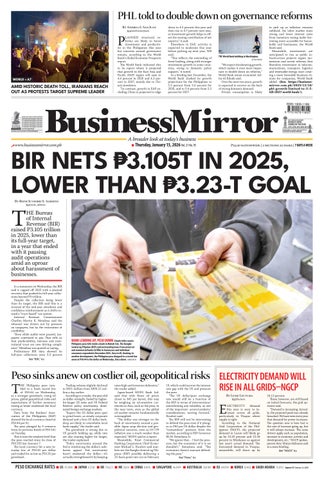
PHL told to double down on governance reforms By Andrea E. San Juan
P
WORLD » A7
AMID HISTORIC DEATH TOLL, IRANIANS REACH OUT AS PROTESTS TARGET SUPREME LEADER
ROTARY CLUB OF MANILA JOURNALISM AWARDS
2006 National Newspaper of the Year 2011 National Newspaper of the Year 2013 Business Newspaper of the Year 2017 Business Newspaper of the Year 2019 Business Newspaper of the Year 2021 Pro Patria Award PHILIPPINE STATISTICS AUTHORITY 2018 Data Champion
@andreasanjuan
LANNED structural reforms are likely to boost investment and productivity in the Philippines this year but concerns around governance remain, according to the World Bank’s Global Economic Prospects report. The World Bank indicated this in its report where it projected that growth in the East Asia and Pacific (EAP) region will ease to 4.4 percent in 2026 and 4.3 percent in 2027, mainly due to China’s slowdown. “In contrast, growth in EAP excluding China is projected to edge
down to 4.5 percent this year and then rise to 4.7 percent next year, as investment growth helps to offset the waning contribution of net exports,” it said. Elsewhere in EAP, activity is expected to moderate this year before picking up next year, WB said. “This reflects the unwinding of front-loading, along with stronger investment growth in some countries, owing to domestic policy support,” it noted. In a briefing last December, the World Bank slashed its growth projections for the Philippines to 5.3 percent from 5.4 percent for 2026, and to 5.4 percent from 5.5 percent for 2027.
THE World Bank building in Washington. AP FILE PHOTO
“We expect decelerating growth, which makes it even more important to double down on reforms,” World Bank senior economist Jaffar Al-Rikabi said. Over the next two years, growth is expected to recover on the back of strong domestic demand. Private consumption is likely
to pick up as inflation remains subdued, the labor market stays strong and lower interest rates from monetary easing make borrowing more accessible for households and businesses, the World Bank said. Meanwhile, investments are anticipated to rise as public infrastructure projects regain momentum and recent reforms that liberalize investment in telecommunications, transport, logistics and renewable energy start creating a more favorable business climate for companies, World Bank added. (See: https://businessmirror.com.ph/2025/12/10/ phl-growth-limited-to-5-5till-2027-world-bank/).
BusinessMirror A broader look at today’s business
EJAP JOURNALISM AWARDS
BUSINESS NEWS SOURCE OF THE YEAR
(2017, 2018, 2019, 2020, 2021) DEPARTMENT OF SCIENCE AND TECHNOLOGY
2018 BANTOG MEDIA AWARDS
BIR NETS ₱3.105T IN 2025, LOWER THAN ₱3.23-T GOAL www.businessmirror.com.ph
n
Thursday, January 15, 2026 Vol. 21 No. 95
P25.00 nationwide | 2 sections 22 pages | 7 DAYS A WEEK
By Reine Juvierre S. Alberto
T
@reine_alberto
HE Bureau of Internal Revenue (BIR) raised P3.105 trillion in 2025, lower than its full-year target, in a year that ended with it pausing audit operations amid an uproar about harassment of businesses. In a statement on Wednesday, the BIR said it capped off 2025 with a yearend recovery that pushed its full-year collections beyond P3 trillion. Despite the collection being lower than its target, the BIR said this is a reversal of the mid-year slowdown and confidence reinforcement as it shifts toward a “trust-based” tax system. Internal Revenue Commissioner Charlito Martin R. Mendoza said the rebound was driven not by pressure on taxpayers, but by the restoration of credibility. “Even while audits were paused, taxpayers continued to pay. That tells us that predictability, fairness and institutional trust are now driving compliance,” Mendoza was quoted as saying. Preliminary BIR data showed its full-year collections were 3.9 percent See “BIR,” A2
BANK LENDING UP, PESO DOWN A bank teller counts Philippine peso bills inside a bank in Makati City. The Bangko Sentral ng Pilipinas (BSP) said outstanding loans from universal and commercial banks (U/KBs) to businesses and individual consumers expanded in November 2025. Story in B3, Banking. In another development, the Philippine peso dropped to a record low anew at P59.44 to the dollar on Wednesday. Story above. NONIE REYES
Peso sinks anew on costlier oil, geopolitical risks ELECTRICITY DEMAND WILL
T
HE Philippine peso tumbled to a fresh record low of P59.44 on Wednesday, as a stronger greenback, rising oil prices, global geopolitical risks and expectations of further monetary easing at home weakened the local currency. Data from the Bankers’ Association of the Philippines (BAP) showed the local currency closed at P59.44 per $1. The peso plunged by 9 centavos from its previous finish of P59.341 on Tuesday. This is now the weakest level that the peso reached since its close of P59.355 last January 7. The local currency hit a new intraday low of P59.45 per dollar and traded for as low as P59.35 per greenback.
Trading volume slightly declined to $951 million from $999.22 million a day earlier. According to a trader, the peso slid as dollar strength, fueled by higherfor-longer US rates and US Federal Reserve policy uncertainty, dominated foreign exchange markets. “Expect the US dollar-peso spot to grind lower, as steady corporate demand and a firm US dollar backdrop are likely to overwhelm local bank supply,” the trader said. The greenback is strong due to US growth holding up, while rate are also staying higher for longer, the trader explained. “Policy uncertainty around the Fed is reinforcing the dollar’s safehaven appeal. Fed uncertainty hasn’t weakened the dollar—it’s actually strengthened it by keeping
rates high and investors defensive,” the trader added. Japan-based MUFG Bank Ltd. said that with Brent oil prices closer to $65 per barrel, this may be weighing on oil-sensitive currencies in Asia, such as the peso, in the near term, even as the global oil market remains fundamentally oversupplied. “The dollar was stronger on the back of uncertainty around a possible Japan snap election and geopolitical concerns, even as US CPI inflation was a touch weaker than expected,” MUFG said in a report. Meanwhile, Rizal Commercial Banking Corporation Chief Economist Michael L. Ricafort said markets see the Bangko Sentral ng Pilipinas (BSP) possibly delivering a 25-basis point rate cut on February
19, which could narrow the interest rate gap with the US and pressure the peso. “The US dollar/peso exchange rate would still be a function of the BSP in terms of interventions/ smoothening any volatility, as one of the important actors/catalysts/ considerations, moving forward,” Ricafort said. The BSP will not be intervening to defend the peso even if it plunges to P60 per US dollar despite the “tremendous” pressure from the market, according to BSP Governor Eli M. Remolona Jr. “We ignore that… I feel the pressure, but the economics of it is we shouldn’t,” Remolona said. “The economics doesn’t warrant defending the peso.”
RISE IN ALL GRIDS–NGCP By Lenie Lectura
E
@llectura
LECTRICITY demand this year is seen to increase across all grids, particularly in Visayas where supply is tight. According to the National Grid Corporation of the Philippines (NGCP), the projected demand in Luzon will likely go up by 13.32 percent and 12.34 percent in Mindanao as against last year’s actual demand. The forecasted demand in Visayas, meanwhile, will shoot up by
24.12 percent. These, however, are still based on initial forecasts, the grid operator said. “Demand is increasing. Actually, the projected peak was already breached. We have seen every year that demand for power increases. The question now is how fast is the rate of increase going up, but it will always increase. The same drivers apply such as population, increase in economic activity and development, etc.,” NGCP spokesperson Atty. Mutya Alabanza said at a news briefing. See “NGCP,” A2
See “Peso,” A2
PESO EXCHANGE RATES n US 59.3090 n JAPAN 0.3728 n UK 79.6223 n HK 7.6034 n CHINA 8.4976 n SINGAPORE 46.0474 n AUSTRALIA 39.6184 n EU 69.0594 n KOREA 0.0402 n SAUDI ARABIA 15.8153 Source: BSP (January 14, 2026)
News
BusinessMirror
A2 Thursday, January 15, 2026
NYT…
Continued from A14
Project. According to the province’s website, the project involves the improvement of the destination’s water and power supply, waste management system, docking area, and guest amenities. The project also intends to implement sustainability measures such as limiting divers, collection of an environmental fee from tourists to fund conservation efforts, and and online ticketing system. At the opening of the year, Palawan was named among the go-to destinations this year by foreign business publications and international travel guides. (See, “Palawan emerges as PHL’s big tourism draw for 2026,” in the BusinessMirror, January 5, 2026.)
Govt sets aside ₧6.3B for MUP pension hike in ’26
D
By Samuel P. Medenilla @sam_medenilla
ILO…
ESPITE the government’s tight fiscal space in 2026, the government will allocate an additional P6.3 billion this year to fund the pension increase of Miliary and Uniformed Personnel (MUP) after President Ferdinand Marcos approved their base pay hike last year, according to the Department of Budget and Management (DBM).
employment and higher-productivity activities. ILO Director-General Gilbert F. Houngbo said that economic growth alone will not reverse these trends, saying that “relying on economic growth alone is insufficient to deliver meaningful progress in decent work.” “Governments, employers and workers must act together to develop and promote strategies that reduce decent work deficits and promote social justice,” he added.
With the said increase, government economic managers are once again considering implementing the proposed legislated MUP Pension reform, which was shelved by the Marcos administration last year. In a press briefing in Malacañang on Wednesday, DBM Acting Secretary Rolando U. Toledo announced the increase was included in the 2026 General Appropriations Act (GAA) after Marcos issued Executive Order (EO) No. 107 last month. EO 107 authorized an annual in-
Continued from A14
www.businessmirror.com.ph
crease in the base pay and subsistence allowance of MUPs starting this year and last until 2028. Under the new base pay schedules for MUPs, the lowest monthly pay rate for MUPs was at P19,516 (candidate soldier), while the highest rate is P157,274 (general). It also raised their subsistence allowance to P350 per day. For this year, Toledo said P21.7 billion was allocated for the implementation of EO 107. Of which, P15.4 billion will be allocated for MUPs in active duty, while P6.3 billion will be for pensioners.
He said they are still determining how to mitigate the impact of the increases on the government’s finances. “It has big implications if ever in terms of the fiscal [space] and at the same time, EO 1[0]7 states that the TWG to look into the pension requirements of our MUP,” Toledo said. EO 107 created the TWG, which includes DBM, 180 days from the time of its implementation last month to conduct the review and recommend or draft the needed legislation to address its gaps if necessary. In 2023, former Finance Secretary Benjamin E. Diokno said the legislative measure is necessary to prevent a “fiscal collapse” for the government since the current MUP pension is not sustainable. Currently, the pensions of MUPs are completely funded by the government unlike those from other sectors. Last year, the Department of Fi-
nance (DOF) announced that the proposed bill was shelved since the Marcos administration currently has no fiscal space for it. Toledo said there is a need to review the policy proposal after the implementation of EO 107 last month. To minimize the possible disruption caused by the proposed reforms on the pension scheme of MUP, the Armed Forces of the Philippine (AFP) is pushing to limit its coverage to new retirees once the said changes are implemented. “I just want to emphasize that the direction [for the reform] was that any changes to the current MUP pension, it would be applied to new entrants,” AFP Deputy chief of staff Rommel P. Roldan said in Filipino. “Those who are currently receiving pensions, those who are retiring and will soon receive pensions, they would not be affected by any reforms that our pension reform law would apply,” he added.
‘CEPA with UAE opens more export pathways for MSMEs’ By Andrea E. San Juan
P
HILIPPINE trade is now better positioned for long-term growth after the signing of the trade deal with the United Arab Emirates (UAE) as the Middle Eastern country will open up “new channels” to broader markets, according to Philippine businesses and exporters. “The UAE serves not only as a major destination for Philippine exports but also as a global gateway linking Asia, the Middle East, Africa, and Europe,” Philippine Chamber of Commerce and Industry (PCCI) President Ferdinand Ferrer said in a statement. “By opening new channels through the UAE’s logistics and re-export networks, CEPA [Comprehensive Economic Partnership Agreement] makes Philippine trade more resilient and better positioned for long-term growth,” added Ferrer. Philippine Exporters Confederation Inc. (Philexport) President Sergio R. Ortiz-Luis Jr. shared the same sentiment with the business group as he stressed that the UAE is not only one of the country’s important export destinations but also a “strategic hub” for global trade. “This agreement will help Philippine exporters expand their presence in the Middle East and beyond, while creating new opportunities for investment, jobs, and inclusive growth at home,” Ortiz-Luis said in a statement. PCCI said this will help diversify the Philippines’s trade partnerships, reducing dependence on a limited number of “traditional” export markets.
BIR…
Continued from A1
lower than the P3.232-trillion revenue target. However, it was an 8.9-percent increase from the previous year’s collection of P2.851 trillion. “The performance was widely seen as a strong outcome given the Bureau’s deliberate suspension of audit operations during a major institutional reform phase,” the BIR said in the statement. The BIR said 2025 opened with double-digit growth, but momentum weakened “sharply” in the second half of the year. Revenue expansion also slowed beginning in July and dropped to nearly 1 percent in October. Still, revenue growth rebounded to 2.7 percent in November and accelerated further to 8.62 percent in December, which the BIR attributed to “rapid restoration of taxpayer confidence.”
The business group also acknowledged UAE as one of the Middle East’s “most important” commercial hubs, giving Filipino exporters, investors, and small enterprises greater access to a “high-income [and] highly connected market.” Meanwhile, Ortiz-Luis said the benefits of this trade deal will not only be confined to established exporters. The Philexport chief said this trade deal will also “create pathways” for micro, small, and medium enterprises (MSMEs), particularly to scale up, compete internationally, and contribute to inclusive growth across Filipino communities. He said this deal is expected to deepen market access, reduce barriers, and enhance competitiveness for Filipino exporters especially in key sectors and hubs such as electronics, food and agribusiness, machinery, and tropical fruits like bananas and pineapples, alongside their value chains. “This CEPA aligns with our national export growth strategies by providing clearer rules, lower tariffs, and greater predictability for exports,” he said. The Philexport chief said the signing of the CEPA with the UAE is a “major boost” for Philippine exporters and for the country as a whole. PCCI urged strong implementation of the agreement through clear rules, trade facilitation and “active” business engagement. “The Chamber reaffirmed its commitment to work with government partners in promoting CEPA and helping Filipino firms translate this milestone into concrete export growth, investment flows, and job creation,” it said.
In December, BIR collections reached P199.55 billion, one of the strongest monthly performances of the year, lifting fourth-quarter revenues to P782.68 billion. From applying enforcementheavy methods, Mendoza said the BIR is transitioning to a credibility-based administration, which is now delivering measurable results. The BIR said the improved trajectory provides a “firm base” for the Bureau’s 2026 reform rollout, which includes audit restructuring, legal safeguards and expanded digital systems under the BIR DARES framework. This year, the BIR seeks to raise P3.579 trillion in revenues. To attain this, the BIR must modernize its audits with artificial intelligence, align with international standards and ease the tax burden on ordinary Filipinos and small businesses. (See: https://businessmirror.com. ph/2026/01/13/%e2%82%b1358-t-bir-goal-what-it-willtake/).
Electricity demand will rise in all grids–NGCP Continued from A1
In 2025, the Luzon grid recorded a peak demand of 13,839MW in April. For Visayas and Mindanao peak demands, the numbers reached 2,691MW in June and 2,682MW in July, respectively. Alabanza also said that this year’s Grid Operating and Maintenance Program (GOMP) of the NGCP has been approved by the Department of Energy (DOE). The GOMP is the three-year forward-looking plan detailing maintenance schedules for power plants and transmission facilities. “But in the last two years, they have changed the projection from the straightforward forecast of supply versus demand, they’re doing loss of load expectation. So I’m still trying to figure out how to explain that. It’s a little bit more complicated and looks completely different from what we’re used to,” said Alabanza. The DOE, for its part, said there is adequate power supply in Luzon in the summer months when demand is at its peak. “For Luzon, there should be enough power supply. It’s more in the Visayas area. Visayas, because of the problem in Visayas, then Mindanao will be affected because they export power to Visayas. But we do have programs in place also to make sure that there won’t be any blackouts in Visayas,” DOE Secretary Sharon Garin said the other day. These measures include energy conservation, interruptible load program (ILP), power reserves from solar rooftop and diesel bunker. “The whole DOE is working on it. We’re actually assessing the schedules of the planned outages so there will be no problem in Visayas. We’re actually overhauling our energy outlook putting in more assumptions and recalculating everything,” Garin said. The Visayas grid imports most of its power requirements from Luzon and Mindanao via the VisayasMindanao interconnection project. Therefore, any power supply issues in Luzon or Mindanao may immediately impact Visayas supply. Earlier, the Independent Electricity Market Operator of the Philippines (IEMOP), operator of the Wholesale Electricity Spot Market (WESM), said the country’s overall power supply outlook for this year remains steady, except for the Visayas grid. IEMOP vice president for trading operations Isidro Cacho had said Visayas remains vulnerable due to its growing dependence from Luzon and Mindanao grids. “When it comes to the Visayas, we’re seeing an issue because it has become primarily dependent on Luzon and Mindanao,” Cacho said earlier. On the bright side, the DOE said it expects 200 new power plants to come online by end of the Marcos administration. As of November 2025, over 900 megawatts of new capacities were added to the grids.
Peso sinks anew on costlier oil, geopolitical… Continued from A1
The peso is expected to remain largely rangebound this year and will reach 59.2 at the end of 2026, according to HSBC Private Bank and Premier Wealth. “We hold a neutral view on the peso over the next six months,” Cheuk Wan Fan, Chief Investment Officer, Asia at HSBC Private Bank and Premier Wealth, said. Reine Juvierre S. Alberto
www.businessmirror.com.ph
Thursday, January 15, 2026
Lacson on Imee’s ‘sabunutan’ remark: Nothing in my face is ‘fake’ By Butch Fernandez @butchfBM
R
EMINDING her that “noise does not convict ...only evidence does,” Senate President Pro Tempore Panfilo Lacson on Wednesday hit back at Sen. Imelda Josefa Remedios Marcos for making “insulting” comments about the work of the Blue-Ribbon committee. Lacson reminded Marcos that she is a member of that panel and should thus more meaningfully participate in its investigation into the flood-control projects scandal, instead of making baseless innuendoes. Guesting at the Kapihan sa Senado, Lacson, the chairman of the Blue-Ribbon panel, hit back at Imee’s snide remarks at the weekend where she feigned worry that Lacson might drag her into a “sabunutan” or hair pulling, and snidely said she would likely lose that battle, insinuating the veteran lawmaker is gay. “Siguro akala niya naka peluka ako; second, she insinuated na bakla ako. Wala pong peke sa aking mukha,” Lacson said. He added, “ at kung iniisip ni Senator Imee na bakla ako, wala na po siya makikitang [mas] macho sa mundong ito.” At the start of the Kapihan hosted by dwIZ’s Cely Ortega Bueno, Lacson also returned the “favor” to Senator Marcos, saying he neither wears a wig nor is a homosexual,” but quickly clarified he is
not homophobic. He added that “nothing about my face is fake,” an apparent dig at the senator, widely reputed to have undergone cosmetic surgery in the past. He stressed that Marcos’s “noisy” commenting serves no purpose but derails the inquiry into the infrastructure scandal that had engulfed both the Executive and Congress. “So if she can add some evidence... she should join the hearing—no one will stop her nor muzzle her,” he said, speaking mostly in Filipino. He said Imee’s remarks are “nakakagulo, hindi nakakatulong [confuse people, and don’t help the inquiry],” adding, it is “talagang masyadong insulto sa integridad ng Senate Blue Ribbon Committee, sa aming lahat, for that matter. On Monday, if she possesses any evidence or lead, she should attend the January 19 hearing, and “I will give her an hour” to present what she knows. He said the BRC is insulted by Imee’s claim that the probe panel is deliberately shielding former Speaker Martin Romualdez, her first cousin with whom she had a bitter falling out in recent years as she took the side of Vice President Sara Duterte, seen to be a potential rival of Romauldez in the 2028 elections. Lacson said he does not know Imee’s intention, “hindi ko alam bakit ginugulo niya,” and hopes she will finally act as a responsible panel member.
Explosive eruption looms at Kanlaon By Jonathan L. Mayuga
T
HE Philippine Institute of Volcanology and Seismology (Phivolcs) said Kanlaon Volcano on Negros Island recorded a total of 45 volcanic-tectonic (VT) earthquakes early morning on Wednesday. The increased seismic activity was in contrast to the observed “calmer” activity of Kanlaon over the past two days. Kanlaon, a stratovolcano, straddles the provinces of Negros Oriental and Negros Occidental and is the highest peak on Negros island. The United States Geological Survey defines a stratovolcano, or composite volcano, as a tall, steep-sided, coneshaped volcano built from alternating layers (strata) of hardened lava, volcanic ash, cinders, and tephra from successive eruptions, creating a symmetrical structure like Mount Fuji or Mount St. Helens. Strato volcanoes are known for explosive eruptions because their viscous, silica-rich magma traps gas, and they often form above subduction zones, like the Pacific Ring of Fire, it added.
VT earthquakes
THE VT earthquake events at Kanlaon ra n g e d i n s t re n g t h b e t we e n ( l o c a l magnitude) ML 0.6 and ML 3.9 and were generated at 0 to 13 kilometers depths beneath the northwestern flanks of the volcanic edifice. The strongest of these events was reportedly felt at Intensities I to IV in La Carlota City and Bacolod City in Negros Occidental; and Canlaon City in Negros Oriental. Phivolcs said VT ear thquakes are generated by rock fracturing processes, and the increase in VT activity strongly indicates progressive rock-fracturing beneath the volcano. This happens as magma or magmatic gas drives a path towards the surface. Volcanic sulfur dioxide (SO₂) gas emissions from the summit crater of Kanlaon, based on campaign mDOAS measurements on Tuesday, averaged 1,248 tons per day, which is near the medium-term average of 1,767 tons per day since January 1, 2026. However, earlier, on January 9, the emissions rose to 4,126 tons a day. The overall parameters indicate that renewed magma intrusion is taking place beneath the edifice, which could potentially lead to a moderately explosive eruption. While Kanlaon remains under Alert Level 2 or increased unrest, Phivolcs said the increase in VT events could lead to increased chances of steam-driven or phreatic eruptions or short-lived weak to moderately strong explosive eruptions occurring at the summit that could generate
life-threatening volcanic hazards such as pyroclastic density currents or PDCs, ballistic projectiles, ashfall, rockfall, and others. “It is strongly recommended that communities within the four-kilometer Permanent Danger Zone or PDZ strictly remain evacuated and those within the 6-km radius from the summit crater be vigilant and ready in case unrest worsens,” Phivolcs warned. In addition, increased vigilance against potential syn-eruption lahars and sediment-laden streamflows in channels draining the edifice is strongly advised should heavy rains occur during eruptive unrest. Meanwhile, civil aviation authorities must also advise pilots to avoid flying close to the volcano’s summit as ash from any sudden eruption can be hazardous to aircraft, Phivolcs said.
Mayon still restive
ALERT Level 3 or intensified unrest prevails over Mayon Volcano in Albay. The summary of 24-hour observation at Mayon Volcano ending 12 nonn on Wednesday characterized activities as lava dome and lava effusion. Phivolcs said it has recorded 2 volcanic earthquakes, 209 rockfall events, plus pyroclastic density currents. Glowing molten lava continues to flow from the crater and remains visible to the naked eye. On Tuesday, Phivolcs said Mayon emitted sulfur dioxide at an average of 1,387 tons per day. Phivolcs said obscured plumes were observed on Tuesday at the crater of the volcano. Mayon’s volcano edifice remains inflated. Under Alert Level 3, entry into the 6-kilometer radius Permanent Danger Zone and entry without vigilance into the Extended Danger Zone (EDZ) is prohibited. In addition, Mayon continues to emit deadly sulfur dioxide (SO₂) and plumes, which sometimes rise to 1,000 meters from the crater. Other potential hazards on the ground are rockfalls or landslides, avalanches, lava flows, lava fountaining, pyroclastic density currents, and lahars during heavy and prolonged rainfall. Aside from Mayon and Kanlaon, two other volcanoes are showing signs of restiveness and are currently being monitored by Phivolcs: Taal in Batangas and Bulusan in Sorsogon, which are both under Alert Level 1 or low-level unrest. Under such Alert Level, entry into the four-kilometer radius PDZ is prohibited. For Taal, entry into the Taal Island is strictly prohibited. The Philippines has 24 active volcanoes.
A3
Court issues warrant of arrest against Atong Ang, 17 others By Joel R. San Juan
Sandoval said. Aside from Ang, the other individuals covered by the arrest warrants were police officers identified as Ryan Jay Eliab Orapa, Aaron Ezrah Lagahit Cabillan, Mark Anthony Aguilo Manrique, Anderson Abary, Michael Claveria, Edmon Muñoz, Farvy Dela Cruz, Renan Fulgencio, Alfredo Andes, Joey Encarnacion. The warrant also covers private individuals namely Rogelio Borican Jr., Jezrel Mahilum, Mark Carlo Zabala, Rodelo Anig-IG, Emman Falle, Julios Gumolon and Ronquillo Anding. The charges stemmed from the sworn statements executed by whistleblower Julie Aguilar Patidongan and his brother, Ellakim, accusing Ang of masterminding the disappearance of the cockfighting enthusiasts. “The record shows that all orders to apprehend ‘cheating’ sabungeros emanated from Ang,” the DOJ said. Ang was indicted for kidnapping with homicide in connection with the January 6, 2022 and January 13, 2022 incidents involving victims identified as Nomer de Pano, Jeffrey de Pano, Jonalyn Lubugin, Ricardo Sacdalan Jr., Edgar Tamanu Malaca, and Alexander Gatchalian Quijano; and the group of Melbert John Alcantara Santos, Mark Paul Fernandine, Ferdinand Dizon and Manny Magbanua, respectively. On the other hand, Ang was indicted for kidnapping with serious illegal detention in connection with incidents on December 29, 2021 and April 28, 2021 at AA Cobra Cockpit Arena in Sta. Cruz, Laguna; and August 30, 2021 in San Pablo City, Laguna. Involved in these incidents were 16 missing sabungeros. The cases have been filed in courts in Lipa City, Sta.Cruz and San Pablo where the commission of the crime allegedly took place. Based on the affidavit executed by Julie, he worked for Ang in 1999 as one of the feeders of fighting cocks until he resigned in 2003. Ten years later, Patidongan said he returned to work for Ang as close-in security guard for jueteng
and was later appointed as farm manager of AA Cobra Gamefarm in barangay Tangob, Lipa City, Batangas. Part of his duty, according to Patidongan, was to manage the farm, the breeding of fighting cocks, and followed Ang’s instructions for farm and online sabong operations. Patidongan claimed that there were repeated incidents of cheating inside fighting arenas in Manila Arena in Manila City; Sta. Cruz, Laguna; Lipa, City, Batangas; Lipa City, Batangas; and San Pablo City, Laguna. These cheating activities were reported to Ang, also known as “Boss AA,” who operates Pitmaster’s online sabong operations. Patindongan said upon learning of the sabungeros cheating activities, ordered their kidnapping and summary execution. Ellakim, on the other hand, claimed that he personally witnessed the kidnapping, transport and killing of missing sabungeros, attended meetings with police officers involved in the crime at the AA Cobra Farm, and was instructed to withdraw money from one of the victim’s ATM account at BDO Lipa City on January 14, 2022. “The fact that no human remains were recovered and presented in evidence, is of no moment. Concededly, the culprits were crafty and cunning to keep their crime with impunity and not to leave any traces of their evil acts that could give them away,” the DOJ said. It may be recalled that last June 2025, the government launched a search and retrieval operations at the Taal Lake where the remains of the missing sabungeros were dumped as claimed by Patidongan. Divers from the Coast Guard (PCG) have recovered hundreds of human bones from the site which are still undergoing DNA analysis. Following the issuance of the arrest warrant, the National Police (PNP) said it is now on track in arresting businessman Ang and the other accused. In a press briefing in Malacañang,
the acting PNP Chief, Deputy Director General Jose Melencio C. Nartatez Jr., assured that the force will serve the warrant. “The arrest warrants has specified the locations of Charlie ‘Atong’ Ang and it will be delivered to those locations,” he said.
Wind Signal 1 up in several Visayas, Mindanao provinces
Nartatez orders review of restrictive custody handling
@jrsanjuan1573
T
HE Regional Trial Court in Sta. Cruz, Laguna has ordered law enforcement agencies to arrest businessman Charlie “Atong” Ang and 17 others in connection with the disappearance of more than 30 cockfighting enthusiasts or “sabungeros” four years ago. The order was issued by Presiding Judge Mary Jean Tibo CajandabOng of the RTC in Sta. Cruz, more than two weeks after Ang and his coaccused were indicted by the Department of Justice (DOJ) for kidnapping with homicide and kidnapping with serious illegal detention cases before three different courts—the RTCs in Lipa City; Sta Cruz, Laguna; and San Pablo City, Laguna. The arrest warrants issued by the Sta. Cruz court covers four counts of homicide and 15 counts of serious illegal detention charges filed by the DOJ. No bail was recommended for both charges. Ang has already filed a motion for reconsideration before the DOJ seeking the reversal of the resolution issued by the panel of prosecutors recommending his indictment. The DOJ has 30 days to resolve the appeal under Department Circular 015, s. 2024. DOJ spokesman Polo Martinez said an Immigration Lookout Bulletin Order (Ilbo) was previously issued to notify authorities of any attempt by the accused to exit the country. Following the issuance of the arrest warrant, Martinez said prosecutors will seek the court’s issuance of a hold departure order against Ang and his co-accused. “The prosecution shall forthwith move for the issuance of a Hold Departure Order with the court and ensure that all the accused stand trial,” he said. Bureau of Immigration (BI) spokesman Dana Sandoval also said that its records also indicated that Ang has not left the country. “Upon verification of our records he has no recent travel,”
W
IND Signal 1 was hoisted over several provinces in the Visayas and Mindanao as the low-pressure area east of Mindanao developed into a tropical depression, the state weather bureau reported. The Philippine Atmospheric, Geophysical and Astronomical Services Administration (Pagasa) hoisted Typhoon Signal 1 over Northern Samar, Samar, and Eastern Samar in the Visayas as well as Dinagat Islands, Surigao del Norte, and Surigao del Sur in Mindanao. TD Ada is the first severe weather disturbance to affect the country’s weather system this year. Ada is expected to induce moderate to heavy rainfall over the affected areas on
Thursday and Friday, which could trigger flooding events in highly urbanized areas, near rivers or low-lying areas, Pagasa said in its Weather Bulletin issued at 11 a.m. on Wednesday. Meanwhile, the public is warned of the general wind threat over the affected areas under Signal 1. The weather bureau noted that local winds may be slightly stronger in coastal and upland or mountainous areas exposed to the wind. Pagasa said the highest wind signal that may be hoisted throughout the passage of Ada is Signal 2. However, weather forecasters said the Northeast Monsoon and the periphery of TD Ada will also bring strong to gale-force
gusts over Batanes, Babuyan Islands, Ilocos Norte, Abra, northern and eastern mainland Cagayan, eastern Isabela, eastern Bulacan, Aurora, most of Quezon, Camarines Norte, Camarines Sur, Catanduanes, and Sorsogon from today, Wednesday, until Friday. As of 10 a.m., the center of TD Ada was spotted 635 kilometers east of Hinatuan, Surigao del Sur. It is moving northeastward at 35 kmh and is packing maximum sustained winds of 45 kmh near the center, and gustiness up to 55 kmh. It is forecast to move to Surigao; east of Guian, northeast of Borongan City, east northeast of Catarman, Northern Samar; Virac, Catanduanes, and east of Echague in Isabela from January 14 to 19. Jonathan L. Mayuga
@jonlmayuga
T
HE death toll in the trash slide in Cebu City continued to increase as rescue and retrieval operations are still in full swing. The Cebu Disaster Risk Reduction and Management Council said that as of 6:30 p.m on Wednesday, reported at least 20 people were confirmed dead, with 16 others missing. A total of 18 of those who have been
recovered were injured and taken to different hospitals. Rescuers from the Bureau of Fire Protection (BFP), Armed Forces (AFP), National Police (PNP) and local disaster mitigation units are continuing retrieval efforts despite unstable conditions and methane gas risks in the area. The Cebu City Council has declared Friday, January 16 as a day of mourning to honor the victims. The city is currently under a state of calamity to facilitate emergency response and garbage disposal alternatives
LAWYER Gabriel Villareal, Ang’s counsel, assailed the court’s issuance of an arrest against his client, calling it a “premature” decision. Villareal also branded the order for Ang’s arrest as “legally questionable,” insisting that it failed to meet the constitutional standards that should have been observed under the circumstances. “Clearly, the court merely acted on the incomplete and one-sided information provided by the Department of Justice (DOJ) in its determination of probable cause, without having even seen the counter affidavits and exculpatory evidence of the respondents, including that of Mr. Ang,” Villareal said. He said the action violates Ang’s rights and is “constitutionally infirm.” Villareal said they will exhaust all available legal remedies to give Ang the opportunity to challenge the arrest order. “We have and will continue to render due respect to the government, the authorities and our courts. We trust that they will similarly give due respect to Mr. Ang and his co-accused,” Villareal said. “Even as we regret that the court has apparently chosen to disregard our plea for fairness and observance of the tenets of due process, we will continue to avail of the remedies available to us and accordingly deal with the processes of the court,” he added. Villareal added that no physical evidence has been presented by the DOJ to link Ang to the case and that only Patidongan’s narrative was used in pinning culpability. “This case was built on haste and from the beginning and the intent to use our client as a diversion has now become apparent.” With Samuel Medenilla
T
following the facility’s closure. Victims of the trash slide are primarily sanitation workers and employees of Prime Waste, the operator of the Binaliw Sanitary Landfill, while the rest are reportedly contracted workers. The victims were trapped when the garbage mound, some 20 stories high, collapsed on the staff housing area and the administration office. Meanwhile, Prime Waste Cebu issued a
HE Acting National Police (PNP) Chief, Lt. Gen. Jose Melencio Nartatez Jr., on Wednesday ordered a review of the existing protocol in handling policemen under restrictive custody following the stabbing incident involving two personnel assigned to the Criminal Investigation and Detection Group (CIDG). The CIDG is already investigating the incident that happened on Tuesday morning but Nartatez wants to expand the investigation to include possible adjustments on the rules governing PNP personnel under restrictive custody. “I have already directed all units and offices to conduct a review of the existing protocol to prevent the repeat of this unfortunate incident. Let this case serve as an urgent call to adjust and improve some policies that are sometimes overlooked,” Nartatez said. “Just because something is working does not mean that everything will always be alright. There is always room for improvement,” he added. Initial investigation if the incident indicate the stabbing that happened inside the CIDG office at Camp Rafael T. Crame in
See “Binaliw,” A4
See “Nartatez,” A10
Binaliw trash slide fatalities now 20, 16 still missing By Jonathan L. Mayuga
Premature
A4
Thursday, January 15, 2026
www.businessmirror.com.ph
US-based companies eye $215 million investments in ecozones By Andrea San Juan
P
@andreasanjuan
HILIPPINE economic zones have attracted around $215 million in investment pledges from American companies which are into medical exam nitrile gloves manufacturing and aircraft operations.
The Philippine Economic Zone Authority (Peza) said in a statement on Wednesday after some Philippine industry leaders flew to the United States for a five-day investment promotion mission. Peza noted that a huge chunk of the capital bagged from America will be poured into a plant that will churn out medical exam nitrile gloves. “W hile in Las Vegas, the Peza delegation met with a leading vertical manufacturer of high
qu a l it y indust r i a l a nd med ica l ex am nitrile gloves and glove making machines. This is to finalize the company’s plan to establish this year a nitrile glove manufacturing operation in the Philippines to serve Western and Asean [Association of Southeast Asian Nations] markets,” Peza said. The project, Peza said, is expected to generate approximately $200 million in investments and create more than 2,000 jobs for
Filipinos across two sites in South Luzon and Cebu. Meanwhile, in Buffalo, New York, Peza said it met with a global aerospace company planning a major expansion of its Philippine operations. Peza described the company as a “world leader” in flight control systems and critical control products which has operated in Baguio City since 1984. “The company is considering New Clark City as the site of its next expansion phase, which is projected to bring in over $15 million in new investments and generate 1,000 additional jobs, adding to its current workforce of more than 2,000 employees,” Peza said.
Investment prospects
AT the Consumer Electronics Show in Las Vegas, Peza was introduced to an American company which is considering investing into manufacturing of “cuttingedge” portable brain imaging systems in the Philippines. “ T he ph a r m a c e ut ic a l a nd
medical device sector is one of the promising new sources of ecozone FDI following the PEZA’s launching last year of the country’s first Pharma Park and the guidelines for registration of pharma-related projects,” Peza said. T he investment promotion agency tasked to establish and promote economic zones also revealed that one of the United States’ leading mental health services providers is exploring the establishment of a global center of excellence in the Philippines. “The company currently operates in the US and India and is considering launching IT-BPM operations locally, with the potential to employ more than 1,500 Filipinos within its first year of operations,” said Peza. As of November 2025, more than 250 companies with American equity are registered with Peza, injecting above P410 billion in cumulative investments and directly employing over 380,000 Filipinos, the investment promotion agency said.
Meralco, PNP bust illegal meter-selling operations By Lenie Lectura @llectura
T
HE Manila Electric Company (Meralco), with the assistance of the National Police (PNP), dismantled illegal meter selling operations in Sta. Cruz, Manila, on Tuesday. The joint operation led to the recovery of 12 units of allegedly refurbished stolen meters that belong to Meralco, which vowed to press charges against the establishment involved in the unlawful trade of stolen electric meters. The modus operandi involved stealing electric meters, refurbishing, and reselling them online, according to the PNP Criminal Investigation and Detection Group (CIDG). The joint operation was the result of a series of surveillance activities conducted with Meralco’s support. “We commend the swift action of the PNP in addressing this illegal activity. We assure our customers that Meralco remains committed to working closely with authorities to pro-
tect the integrity of electricity service and ensure public safety,” Meralco Vice President and Head of Corporate Communications Joe R. Zaldarriaga said. Meralco reiterated that stealing and reselling electric meters and other power distribution materials are illegal activities that violate Republic Act 7832, or the Anti-Electricity Pilferage Act, and are punishable with imprisonment or a fine ranging from P50,000 to P100,000 or both. Buyers or users of stolen meters and other electricity distribution materials meanwhile are also subject to legal penalties under Presidential Decree 1612 or the Anti-Fencing Law of 1972. “We urge the public to immediately report to Meralco or authorities any suspicious activity related to Meralco facilities, such as electric meters and power cables. Rest assured that we will continue to work closely with the PNP to combat theft of electric distribution facilities and other unlaw ful practices that threaten public safety and the integrity of our electricity ser vice,” Zaldarriaga added.
January electricity Energy-hosting communities get more financial benefits bill to reflect lower A transmission rate
T
HE overall transmission rate for the December 2025 supply period went down by 0.68 percent to P1.3455 per kilowatt hour (kWh) from P1.3547per kWh in November last year, the National Grid Corporation of the Philippines (NGCP) said on Wednesday. The transmission rate, which will be reflected in the January power bills, is composed of ancillary service (AS) and transmission wheeling rates. Transmission wheeling rates refer to what the NGCP charges for its core service of delivering electricity, while AS rates cover the pass-through costs of services sourced from the Reserve Market (RM) and from providers with bilateral contracts with NGCP to stabilize the grid during power supply-demand imbalances. AS rate stood at P0.5971 per kWh from a month ago’s P0.62 per kWh. Transmission wheeling rate reached P0.6058 per kWh. “For the January 2026 electric bill of end consumers, NGCP charges only 60 centavos per kWh for the delivery of its ser-
Binaliw. . . Continued from A3
vices,” NGCP said, adding that its revenues are revenue-capped and regulated by the Energy Regulatory Commission (ERC). NGCP emphasized that it does not earn from AS and does not benefit from any change in AS prices, as these are remitted directly to generation companies with bilateral contracts with NGCP, and to the Independent Electricity Market Operator of the Philippines (IEMOP) for AS sourced from the RM. The grid operator also reiterated its call for the unbundling of transmission charges to help consumers better understand the different components reflected in their electricity bills. NGCP emphasized that a significant portion of transmission charges in recent years has been driven by AS costs, which do not accrue to the company. These are fully collected and remitted to AS providers, in line with regulatory requirements. The transmission rate for the December billing period is billed to end-users through d i s t r i but ion ut i l it ie s a nd electric cooperatives. Lenie Lectura
statement sharing its grief with the families and loved ones affected by the incident at the Binaliw facility. “The incident has had a profound impact on the community, and our thoughts remain with all those affected,” the PWS
N improved policy that extends higher financial benefits to energy-hosting communities is already in effect, according to the Department of Energy (DOE). The total financial benefit increased to P0.03 per kilowatthour (kWh) of electricity generated and sold, from the previous P0.01 per kWh. Of this total, P0.025 per kWh (2.5 centavos) is allocated for communit y-dr iven prog rams, such as livelihood development, environmental protection, healthcare, education and an additional option to reduce electricity prices, representing a five-fold increase from the previous P0.005 per kWh allocation. The remaining P0.005
per kWh (0.5 centavo) allocated for electrification initiatives will continue to support efforts to connect households without electricity, and where applicable, help reduce electricity rates once full electrification is achieved. “This marks a major turning point for our energy-hosting communities,” said Energy Secretary Sharon S. Garin. “We are ensuring that the benefits of energy development translate into visible improvements in services and opportunities where these facilities operate.” These benefits are spelled out in the Energy Regulation Program 1-94 (ER 1-94), following the rollout of Department Circular (DC) No. DC2025-10-0023. The strengthened framework
promotes com mu n it y- d r iven planning by empowering host local government units (LGUs) and indigenous cultural communities/ indigenous peoples (ICCs/IPs) to identify priority programs and approve them through local council resolutions. Communities can now also opt to use their share to reduce local electricity rates through a resolution by the LGU; where funds remain unused for two consecutive years, the policy provides for an automatic electricity-rate reduction mechanism to ensure timely and meaningful utilization of benefits. To promote transparency and proper fund management, ER 1-94 financial benefits are administered through dedicated trust ac-
counts for the Development and Livelihood Fund (DLF), the Reforestation, Watershed Management, Health or Environment Enhancement Fund (RWMHEEF) or both, and the Electrification Fund (EF). The DOE also underscored the scale of the enhanced benefits for host communities. For instance, a 100-megawatt (MW) conventional power plant could generate around P21 million in annual ER 1-94 benefits, while a 100-MW solar facility could generate approximately P5.5 million per year, based on indicative capacity-factor assumptions. As of December 2024, the ER 1-94 Program supported 683 local governments, including 321 barangay, 286 towns and cities, and 76 provinces. Lenie Lectura
Comelec seeks ₧98.7-M budget for Antipolo special elections
T
HE Commission on Elections (Comelec) has formally sought an additional P98.7 million from the Office of the President to finance a special manual election in Antipolo City’s Second Congressional District. The request follows the vacancy of the district’s lone seat after the death of Rep. Romeo M. Acop in December. Under Republic Act 7166, a special election must be held within 60 to 90 days to fill vacated seats in the House of Representatives.
Comelec Chairman George Erwin M. Garcia told reporters on Wednesday that the agency had only been allotted P11 million for special elections in 2026, a figure that he said is insufficient for Antipolo given its electorate size. “That is how much the Comelec needs for the polls because Antipolo’s Second District has the most voters among all districts nationw ide—around 300,000 voters—so we need a larger budget,” Garcia said, speaking mostly in Filipino. Garcia also clarified that running a manual election remains the
statement said. According to the PWS Cebu, the company’s Emergency Response Team (ERT), activated immediately following the incident, together with other responders, continues to carry out intensive retrieval operations, ensuring the protection of all responders while working to recover those affected.
Seismic events, frequent rains
more cost-efficient option. He said the commission does not have available funds to secure a contract for automated machines if it were to opt for a fully automated special poll. In a January 13 letter to House Speaker Faustino G. Dy II, the poll body outlined that the P98.7 million would cover the conduct of the elections, honoraria of electoral board members and support personnel, and allowances for members of the district board of canvassers. The figure also includes the cost of pr inting off icia l ba llots, election forms, and other
THE company, citing the initial assessment of city officials and experts, said the incident was likely triggered by a combination of the recent earthquakes that hit Cebu, including the magnitude 6.9 earthquake on September 30, 2025 and subsequent aftershocks, followed by extreme
accountable forms, as well as, training sessions and logistical deployment. Comelec data show that Antipolo’s Second District has 713 precincts. Garcia said the number may still increase once the Election Registration Board (ERB) completes its assessment of voter registrations filed since October last year. He added that the calendar of activities—including the election period, campaign period, gun ban, and filing of certificates of candidacy—will be released once finalized. Justine Xyrah Garcia
rainfall from Typhoon Tino in early November. The company said it conducts regular inspections of its landfill cells, and before the Thursday incident, the affected cell did not bear any visual signs of weakening, such as cracks and irregular leachate outflows. “We are actively working with experts and authorities for a comprehensive investigation.” The operations at the Binaliw facility remain suspended as retrieval efforts continue. The Department of Environment and Natural Resouces Region 7 Office has issued a cease-and-desist order and notice of violation to the operator of the sanitary facility, even as the DENR Central Office issued a directive calling for a rapid assessment and action on the incident. Environment Secretary Raphael P.M. Lotilla had also issued an order to the DENR Region 7, Environment Management Bureau 7 and other concerned DENR satellite units to find an alternative waste disposal system so as not to affect the services in Cebu City and nearby cities served by the facility. Meanwhile, PWS Cebu said the incident is fully contained within the footprint of the Binaliw facility and does not involve surrounding communities. See “Binaliw,” A10
Thursday, January 15, 2026
A5
Palace: Marcos to personally address ICI concerns over vacancy of commissioners By Samuel P. Medenilla @sam_medenilla
P
RESIDENT Ferdinand Marcos will personally address the concerns raised by the Independent Commission of Infrastructure (ICI), including its request for the appointment of new commissioners, according to Malacañang. Palace Press Officer Claire Castro made the
statement after ICI special adviser Rodolfo Azurin Jr. said that their lack of commissioners is hampering their capability to refer flood control projects cases to the Ombudsman. The retired Philippine National Police Chief said they will be writing a letter to the Office of the President to get a clarification on the fate of the ICI. “If General Azurin wants to write so they can ask questions, it would be better if they
From 4Ps beneficiaries to attorneys-at-law: DSWD hails stories of triumph over poverty By Jovee Marie N. Dela Cruz @joveemarie
T
HE Department of Social Welfare and Development (DSWD) announced that two former beneficiaries of the Pantawid Pamilyang Pilipino Program (4Ps) are now lawyers, underscoring how sustained government support and personal perseverance can break the cycle of poverty. The DSWD, in a statement, said Golda Meir Piñon, a former 4Ps monitored child, and Lea Leonen Rivera, who grew up in a 4Ps beneficiary household, are set to take their oath as new lawyers, turning the government assistance they once received into remarkable professional success. For Piñon and Rivera, the road to becoming lawyers was marked by years of sacrifice, financial hardship, sleepless nights, and moments of doubt. Yet both held firmly to the belief that education could change the course of their lives. “I feel incredibly blessed to have passed the bar examinations. All the hardships and sacrifices in my studies truly paid off, along with the unwavering support of my parents and relatives who stood by me. I know this is only the beginning of even greater challenges ahead, but I thank God for allowing me to move forward,” said Piñon in a DSWD statement. She described the 4Ps as a lifeline that allowed her to stay focused on her studies despite financial difficulties. According to her, the program’s assistance helped cover basic household needs such as food and electricity, easing the burden on her family. “4Ps has been a huge help to us. Aside from my mom’s small business, the government’s
support helped cover our family’s needs. It even allowed me to reach college and become part of the ESGP-PA [Expanded Students Grants-in-Aid Program for Poverty Alleviation] program of the DSWD [and other government agencies]. The financial support they provided me was truly a big help,” Piñon said. Rivera’s journey was equally demanding. As the family breadwinner and eldest of three siblings, she worked while studying law to support her household and her 64-year-old mother, a solo parent. “Since I didn’t come from a well-off family, I worked hard to study law while teaching at a public secondary school. I am also the breadwinner, being the eldest of three siblings. My mother is already 64 years old and has been a solo parent ever since I was four years old,” said Rivera. She later worked as a call center agent throughout law school, juggling graveyard shifts with weekend classes. Rivera described passing the bar as a moment of overwhelming joy, recalling the years of exhaustion and sacrifice that led to that achievement. She credited the 4Ps and related government support for helping make her legal education possible and encouraged young people—especially those from poor families—to take full advantage of government programs. The 4Ps is the Philippine government’s flagship poverty reduction and human capital investment program, with the DSWD as the lead implementing agency. Qualified household beneficiaries receive conditional cash grants to support health, nutrition, and education, aimed at breaking the intergenerational cycle of poverty.
Comelec hopes to hold BARMM polls in ‘26 despite legal hurdles and uncertain timeline By Mary Jade Jadormio
T
HE Commission on Elections (Comelec) is hopeful that it can still conduct the Bangsamoro Autonomous Region in Muslim Mindanao (BARMM) parliamentary elections within the year, despite mounting legal and operational challenges. Although the commission holds no power to dictate the date of the polls, Comelec Chairman George Erwin M. Garcia still hopes to execute it within the year to avoid overlapping with preparations for the national and local elections. Under Supreme Court rulings, changes to electoral districts are prohibited within 120 days before an election, a window that has already lapsed in relation to the March 30, 2026 target date earlier set by the poll body. The commission stressed that while it had prepared for a March election in good faith, it cannot proceed without ensuring compliance with election laws and constitutional safeguards. Meanwhile, Garcia clarified that they have not yet formally declared the postponement of the initial schedule. “We still do not have an official and formal declaration that it will not push through on March 30. We are not yet at that point,” he said. Instead, the issue is currently being reviewed by Comelec’s Bangsamoro Study
Group, together with senior officials, whose recommendations will be elevated to the en banc for final action. “What we are trying to say is we only have very limited time,” Garcia added. Comelec also emphasized that only Congress has the authority to fix the date of the elections, including the BARMM parliamentary elections. Should the initial schedule be postponed to a later date, the commission said it would await legislative action to determine a new election date. Possible alternative timeframes being considered include late May or between the last week of September and the first week of October. The Comelec chairman said these options take into account practical concerns such as Ramadan, which will start in the second week of February, and Holy Week. “So, our moves will be limited. How could we conduct voter education? It is the most important component of an election, most especially, it changes every time. Voters should know who they are voting for,” Garcia said. Despite uncertainties, the commission emphasized its commitment to holding the BARMM elections as soon as possible, both legally and practically.
had a meeting with the President,” Castro said in Filipino in a press briefing in Malacañang last Wednesday. “So let’s just wait for the President to arrive regarding that and if they do have a letter, it would be better if they could deliver it immediately,” she added, Last Wednesday, Marcos returned from his two-day working visit from the United Arab Emirates.
Since the ICI was created last September through Executive Order No. 94, two of its three commissioners—SGV & Co. country managing partner Rossana A. Fajardo and former Department of Public Works and Highways (DPWH) Secretary Rogelio “Babes” L. Singson —resigned. Fajardo and Singson left the ICI saying that their role in the fact-finding panel is no longer necessary after it recommended the filing of
the first batch of charges against officials and contractors involved in flood control project irregularities. Currently, only former Supreme Court (SC) Justice Andres B. Reyes Jr. remains as chair of ICI. Despite the lack of quorum in the ICI, Castro said the fact-finding panel, which is tasked to investigate anomalies on flood control projects and other public works, can still refer cases to the Ombudsman.
“In my understanding, there is no need for a quorum [to make referrals] because they were formed to complete the investigation, just like Secretary Babe Singson and Commissioner Fajardo,” she said. “So, based on their mandate, if they already completed [their investigation] on a case is recommended and its [supporting] evidence is complete, they can recommend [the filing of charges in the Ombudsman],” she added.
Angara leads DepEd procurement overhaul, slashing textbook delivery times by nearly half By Claudeth Mocon-Ciriaco @claudethmc3
T
H E Depar tment of Education (DepEd) on Wednesday reported that it has recorded “major” procurement gains in 2025, as it undertook reform initiatives to modernize procurement, shorten delivery cycles, and ensure that every peso spent on education produces timely and tangible benefits for learners, teachers, and schools. For 2025 implementation, DepEd awarded 99.3 percent of its planned procurement chargeable against 2024 funds. The near-total awarding ensured that appropriations were translated into actual programs, goods, and services that directly support classroom learning, rather than remaining unused. “ Nung pumasok kami sa DepEd, ang marching order mula sa Pangulo ay bawat pisong inaprubahan para sa edukasyon ay dapat maramdaman sa silid-aralan. Hindi puwedeng manatili lang sa papel ang budget, kailangan itong maging aklat, kagamitan, at suporta na aktuwal na napapakinabangan ng mga mag-aaral at guro ,” Education Secretary Juan Edgardo “Sonny” Angara said, adding that it is in line with President Ferdinand R. Marcos Jr.’s push to make government spending faster, more transparent, and more responsive to public needs. Angara, who served as the principal
author of the New Government Procurement Act during his time in the Senate, framed the milestone as a matter of public accountability. DepEd also accelerated implementation through the strategic use of Early Procurement Activities (EPA). The Department awarded 91 contracts for 2025 as early as January, with all EPA contracts awarded by March. This allowed deliveries to schools between March and August of the same year, significantly improving access to learning resources earlier in the school cycle. Among the major procurement outputs for 2025 were digital and classroom support items under the DepEd Computerization Program, including 33,540 laptops for teaching personnel, 5,302 laptops for non-teaching staff, and 30,440 smart televisions distributed nationwide. The agency also awarded 1,374,231 Science and Mathematics Equipment (SME) packages for public schools. By end of 2025, DepEd directly entered into contracts for 47 classrooms under the Last Mile Schools (LMS) program, shifting from conventional construction to a designand-build approach to address recurring abandonment issues caused by site-specific conditions in remote areas.
Shortened procurement
ANGARA also led a major shift in textbook procurement, moving DepEd away from
developing manuscripts toward the procurement of available titles in the market. The change significantly shortened the procurement timeline up to delivery, from 245 to 451 days to as short as 180 days. The streamlined process resulted in time savings of up to 246 days, equivalent to a 26 to 45 percent efficiency gain. More importantly, the reform enabled DepEd to complete the procurement of all planned textbook requirements for 2024 and 2025, ensuring the timely availability of learning materials in schools.
Teacher development
DEPED also awarded several projects aimed at strengthening teacher development and inclusion. These include projects on upskilling and reskilling of 1,000 professional teachers and graduating pre-service teachers for career progression, and the policy mapping and strengthened referral mechanisms for learners with disabilities enrolled in the Alternative Learning System (ALS). DepEd, likewise, advanced the Teacher Effectiveness and Competencies Enhancement Project (TEACEP), a five-year, World Bank-funded initiative aimed at improving education quality and access for Kindergarten to Grade 6 learners in Regions IX, XII, and the Bangsamoro Autonomous Region in Muslim Mindanao (BARMM). As part of the project, 16,600 tablets were awarded to support teaching,
learning, and instructional leadership in priority areas.
Uninterrupted learning
TO support uninterrupted learning during disasters and emergencies, the department also rolled out the prototype units of the Disaster Response System for the Learning Continuity Package and upgraded Learning Continuity Spaces (LCS). This includes the deployment of 141 LCS, composed of two prototype units, six units already constructed in Masbate, and 133 units for nationwide deployment. For early childhood education, the department awarded 228,740 sets of kindergarten educational toys and 2,216,383 million kinder activity sheets, strengthening play-based learning and school readiness for young learners. With DepEd also receiving its largest budget in history at P1.015 trillion for 2026, the department said it is moving to further strengthen procurement reforms to make systems more agile and responsive. These include expanded early procurement, tighter alignment between planning and actual school needs, and faster delivery timelines to ensure that increased funding results in visible improvements on the ground. “ Kapag maayos at maagap ang procurement, mas maaga ring nakakarating sa mga paaralan ang mga kailangang resources. Doon nasusukat kung epektibo ang serbisyo ng gobyerno at kung may tunay na balik ang pondo ng bayan ,” Angara said.
Plastic ‘banderitas’ during fiestas pose a dual threat to human health, environment–group
W
HILE they may be pleasing to the eye and give an impression of joy and jubilation, plastic fiesta “banderitas” pose a dual threat: the massive quantity used for a non-essential purpose that aggravates the perennial garbage problem, and their inherent toxicity that poses a serious health risk to the general public. The EcoWaste Coalition, a waste and pollution watchdog, made this observation after finding colorful plastics used in the banderitas for the popular feast of the Santo Niño tainted with cadmium, a cancer-causing substance classified by the World Health Organization (WHO) as one of the 10 chemicals or groups of chemicals of major public health concern. Cadmium is a cumulative toxin linked to central nervous system and cardiovascular disorders, respiratory issues, cognitive and behavioral problems, bone weakening, kidney damage, and increased risk of cancers, such as kidney, lung, pancreatic, and prostate cancers. The EcoWaste Coalition, which advocates for a zero-waste and toxics-free society, revealed its findings following a chemical screening it conducted on new plastic sheets for making banderitas. Sold for P38 per meter in Binondo, Manila, these plastics are widely used to decorate many communities celebrating the festive feast in honor of the Child Jesus.
The group said it observed the early installation of plastic banderitas in areas such as Tondo and Pandacan, two districts closely associated with Santo Niño devotions. The group noted that the decorations, often made from newly cut plastic sheets, plastic scraps, or disposable “labo,” are being strung across streets and alleys days ahead of Sunday’s feast. “Banderitas made of disposable plastics have begun to sprout like mushrooms in the streets and alleys of Tondo and Pandacan as if communities are having a ‘pahabaan, padamihan, pabonggahan’ contest,” EcoWaste campaigner Ochie Tolentino said. Tondo is home to the centuries-old Santo Niño de Tondo, while Pandacan hosts its own Santo Niño shrine. The group described fiesta banderitas as “litter in the sky,” noting that such materials are rarely reused and typically end up mixed with other post-event trash. With the aid of a handheld Olympus X-R ay Fluorescence (XRF) analyzer, the group detected cadmium at levels exceeding 100 parts per million (ppm), the maximum limit for this chemical under the European Union’s Restriction of Hazardous Substances (ROHS). The regional bloc banned cadmium in plastics as early as 2011 to protect public health and reduce pollution. Of the nine colors bought and analyzed, all were found to
contain cadmium, ranging from 224 to 336 ppm, way above the 100 ppm limit. The green, orange, and violet colors contained 336 ppm, 320 ppm, and 315 ppm of cadmium. The blue, yellow, white, brown, red, and pink colors had 299 ppm, 298 ppm, 286 ppm, 269 ppm, 244 ppm, and 224 ppm, respectively. The detection of cadmium in the banderitas may be attributed to its use as a stabilizer in plastic manufacturing, particularly in the production of polyvinyl chloride (PVC) plastic, which uses many toxic additives, such as plasticizers like phthalates to make it flexible and soft, and heavy metal stabilizers like cadmium and lead to prevent the plastic from degrading during processing and use. Aside from the cadmium exposure effects on humans, particularly among workers in factories and waste facilities, and to consumers, the EcoWaste Coalition is concerned about the release of cadmium in the environment through the disposal of materials containing cadmium, such as plastic fiesta banderitas, which often end up being dumped or landfilled. According to the United Nations Environment Programme’s Final Review of Scientific Information on Cadmium, “products containing cadmium are not typically collected separately from the general waste stream in developing countries. Therefore, cadmium discards will
end up in municipal waste and disposed of in landfills, incineration, open burning, or indiscriminate dumping.” The plastic fiesta banderitas will turn into microplastics and nanoplastics as they break down in dumpsites, releasing the harmful chemicals into the environment. If incinerated, the banderitas will cause the formation and discharge of dioxins, the toxic byproducts of burning chlorinated materials such as PVC plastic. This is not the first time the EcoWaste Coalition detected cadmium in PVC plastic materials as part of its advocacy. Laboratory tests previously commissioned by the group confirmed the cadmium content of the analyzed PVC plastic school bags, PVC plastic raincoats, and PVC plastic tarpaulins, such as those used in the last mid-term elections. In 2024, the Catholic Bishops’ Conference of the Philippines (CBCP) adopted the non-use of single-use plastic fiesta banderitas as part of six ecological actions aimed at reducing plastic pollution. Earlier, in 2019, the CBCP issued a pastoral letter on ecology titled “An Urgent Call for Ecological Conversion, Hope in the Face of Climate Emergency,” which affirmed the Church’s commitment to the principles of Laudato Si, the late Pope Francis’ encyclical on caring for the environment and vulnerable communities. Jonathan L. Mayuga and Bless Aubrey Ogerio
Lawmaker seeks to align fire safety code with Ease of Doing Business Act
A
LAWMAKER is pushing for the passage of a bill amending the Fire Code of the Philippines (RA 9514) to harmonize fire safety enforcement with the Ease of Doing Business Act (RA 11032) and clarify the process between securing a Fire Safety Inspection Certificate (FSIC) and obtaining a mayor’s permit. In filing House Bill 7021, Quezon City 4th District Rep. Bong Suntay said reports from the business sector and local government units (LGUs) highlighted confusion and alleged irregularities in some fire safety inspections
and permit processing. Suntay said Republic Act 9514 empowers the Bureau of Fire Protection (BFP) to inspect establishments, enforce compliance, and issue FSICs. Meanwhile, Republic Act 11032 requires government regulations to be transparent, predictable, and proportionate, with streamlined procedures and clear timelines. “Experience in implementing both laws has revealed overlaps and procedural uncertainties, particularly when the absence of an FSIC is treated as an automatic reason to deny or delay a mayor’s permit. A mayor’s
permit, issued under the local government’s police power, is distinct from BFP’s fire safety mandate,” he added. Under HB 7021, the mandates of LGUs and the BFP are recognized as separate yet complementary. LGUs retain their police power and responsibility over business permitting, while the BFP maintains distinct duties over inspection and enforcement of fire safety standards. The proposal aims to prevent overlap and confusion that can delay permit processing and create opportunities for discretionary practices.
“LGU autonomy should not be undermined by procedural ambiguity,” said Suntay. “When the boundaries of each agency’s authority are clear, services are faster, public safety is stronger, and opportunities for abuse are reduced.” According to Suntay, the goal of HB 7021 is straightforward: strengthen fire safety while eliminating gray areas that can lead to corruption and abuse. “Public safety should never be compromised,”he emphasized. “But enforcement must be clear, fair, and consistent with due process.
When rules and timelines are clear, the chances for abuse are minimized.” HB 7021 upholds the independence of LGUs in granting and renewing Mayor’s Permits, consistent with their police powers, and specifies that the absence of an FSIC alone cannot automatically block or delay a Mayor’s Permit, except when the BFP issues a written finding of imminent risk to life or property. The bill also aligns procedures with the Ease of Doing Business Act, ensuring clear notices, defined timelines, and proper due process, while preserving and reinforcing the BFP’s
authority to conduct inspections, enforce compliance, and close establishments that pose genuine hazards. “This is not a reduction of power,” added Suntay. “It’s about system improvement—so everyone’s mandate is clear, and the government can function as a cohesive unit.” Overall, he said HB 7021 aims to establish a clearer, fairer, and more accountable regulatory framework—where public safety is protected, LGU independence is respected, and conditions that foster corruption are minimized. Jovee Marie N. Dela Cruz
A6
Thursday, January 15, 2026
BusinessMirror
www.businessmirror.com.ph
Thursday, January 15, 2026
A7
Amid historic death toll, Iranians reach out as protests target supreme leader By Jon Gambrell
The Associated Press
D
UBAI, United Arab Emirates—The death toll from nationwide protests in Iran has surpassed 2,500, activists said, as Iranians made phone calls abroad for the first time in days Tuesday after authorities severed communications during a crackdown on demonstrators. The number of dead climbed to at least 2,571 early Wednesday, as reported by the US-based Human Rights Activists News Agency. That figure dwarfs the death toll from any other round of protest or unrest in Iran in decades and recalls the chaos surrounding the country’s 1979 Islamic Revolution. Iranian state television offered the first official acknowledgment of the deaths, quoting an official saying the country had “a lot of martyrs.” The demonstrations began in late December in anger over Iran’s ailing economy and soon targeted the theocracy, particularly 86-year-old Supreme Leader Ayatollah Ali Khamenei. Images obtained Tuesday by The Associated Press from demonstrations in Tehran showed graffiti and chants calling for Khamenei’s death— something that could carry a death sentence. As the reported toll grew Tuesday, US President Donald Trump wrote on his Truth Social platform: “Iranian Patriots, KEEP PROTESTING—TAKE OVER YOUR INSTITUTIONS!!!” He added: “I have canceled all meetings with Iranian Officials until the senseless killing of protesters STOPS. HELP IS ON ITS WAY.” However, hours later, Trump told reporters that his administration was awaiting an accurate report on the number of protesters that had been killed before acting “accordingly.” Trump said about the Iranian security forces: “It would seem to me that they have been badly misbehaving, but that is not confirmed.” Iranian officials once again warned Trump against taking action, with Ali Larijani, secretary of Iran’s Supreme National Security Council, responding to US posturing by writing: “We declare the names of the main killers of the people of Iran: 1- Trump 2-” Israeli Prime Minister Benjamin Netanyahu.
Death toll spikes
THE activist group said 2,403 of the dead were protesters and 147 were government-affiliated. Twelve children were killed, along with nine civilians it said were not taking part in protests. More than 18,100 people have been detained, the group said. Gauging the demonstrations from abroad has grown more difficult, and the AP has been unable to independently assess the toll. Skylar Thompson with the Human Rights Activists News Agency told AP the new toll was shocking, particularly since it reached four times the death toll of the monthslong 2022 Mahsa Amini protests in just two weeks. She warned that the toll would still rise: “We’re horrified, but we still think the number is conservative.” Speaking by phone for the first time since their calls were cut off from the outside world, Iranian witnesses described a heavy security presence in central Tehran, burned-out government buildings, smashed ATMs and few passersby. Meanwhile, people were concerned about what comes next, including the possibility of a US attack. “My customers talk about Trump’s reaction while wondering if he plans a military strike against the Islamic Republic,” said shopkeeper Mahmoud, who gave only his first name out of concern for his safety. “I don’t expect Trump or any other foreign country cares about the interests of Iranians.” Reza, a taxi driver who also gave just his first name, said protests are on many people’s minds. “People— particularly young ones—are hopeless, but they talk about continuing the protests,” he said.
Iranians reach out, but world can’t reach in
SEVERAL people in Tehran were able to call the AP on Tuesday and speak to a journalist. The AP bureau in Dubai, United Arab Emirates, was unable to call those numbers back. Witnesses said text messaging was still down, and internet users in Iran could connect to government-approved websites locally but nothing abroad. The witnesses, who spoke on condition of anonymity for fear of reprisal, said police stood at major intersections and security officials in plainclothes were visible in public spaces. Anti-riot police officers wore helmets and body armor while carrying batons, shields, shotguns and tear gas launchers, they said. Several banks and government offices were burned during the unrest, the witnesses said. Shops were open Tuesday, though there was little foot traffic in the capital. See “Iranians,” A8
A8
Thursday, January 15, 2026
TheWorld
China’s 2025 trade surplus hits record $1.2 trillion, even with Trump’s tariffs By Chan Ho-Him AP Business Writer
H
ONG KONG — China’s trade surplus surged to a record of almost $1.2 trillion in 2025, the government said Wednesday, as exports to other countries made up for slowing shipments to the US under President Donald Trump’s onslaught of higher tariffs. China’s exports rose 5.5% for the whole of last year to $3.77 trillion, customs data showed, as Chinese automakers and other manufacturers expanded into markets across the globe. Imports flatlined at $2.58 trillion. The 2024 trade surplus was over $992 billion. In December, China’s exports climbed 6.6% from the year before in dollar terms, better than economists’ estimates and higher than
November’s 5.9% year-on-year increase. Imports in December were up 5.7% year-on-year, compared to November’s 1.9%. China’s trade surplus surpassed the $1 trillion mark for the first time in November, when the trade surplus reached $1.08 trillion in the first 11 months of last year. Economists expect exports will continue to support China’s economy this year, despite trade friction and geopolitical tensions. “We continue to expect exports to act as a big growth driver in 2026,” said Jacqueline Rong, chief China economist at BNP Paribas. While China’s exports to the US have fallen sharply for most of last year since Trump returned to office and escalated his trade war with the world ’s second-
largest economy, that decline has been largely offset by shipments to other markets in South America, Southeast Asia, Africa and Europe. For the whole of 2025, China’s exports to the US fell 20%. In contrast, exports to Africa surged 26%. Those to Southeast Asian countries jumped 13%; to the European Union 8%, and to Latin America, 7%. Strong global demand for computer chips and other devices and the materials needed to make them were among categories that supported China’s exports, analysts said. Car exports also grew last year. China’s strong exports have helped keep its economy growing at an annual rate close to its official target of about 5%. But that has triggered alarm in countries that
fear a flood of cheap imports are damaging local industries. China faces a “severe and complex” external trade environment in 2026, Wang Jun, vice minister of China’s customs administration, told reporters in Beijing. But he said China’s “foreign trade fundamentals remain solid.” The head of the International Monetary Fund last month called for China to fix its economic imbalances and speed up its shift from reliance on exports by boosting domestic demand and investment. A prolonged property downturn in China after the authorities cracked down on excessive borrowing, triggering defaults by many developers, is still weighing on consumer confidence and domestic demand. China’s leaders have made increasing spending by consumers
and businesses a focus of economic policy, but actions taken so far have had a limited impact. That included government tradein subsidies over the past months that encouraged consumers to buy newer, more energy efficient items, such as home appliances and vehicles, and replace older models. “We expect domestic demand growth to stay tepid,” said Rong of BNP Paribas. “In fact, the policy boost to domestic demand looks weaker than last year -- in particular the fiscal subsidy program for consumer goods.” Gary Ng, a senior economist at French investment bank Natixis, forecasts that China’s exports will grow about 3% in 2026, less than the 5.5% growth in 2025. With slow import growth, he expects China’s trade surplus to remain above $1 trillion this year.
Editor: Angel R. Calso
Iranians. . . Continued from A7
On the streets, people also could be seen challenging plainclothes security officials, who were stopping passersby at random. State television also read a statement about mortuary and morgue services being free—a signal that some likely charged high fees for the release of bodies during the crackdown. Security ser vice personnel also apparently were searching for Starlink satellite Internet terminals, as people in northern Tehran reported authorities raiding apartment buildings with satellite dishes. While satellite television dishes are illegal, many in the capital have them in homes, and officials broadly had given up on enforcing the law in recent years. Activists said Wednesday that Starlink was offering free service in Iran. “ We c a n co n f i r m t h at t h e f re e subscription for Starlink terminals is fully functional,” Mehdi Yahyanejad, a Los Angeles-based activist who has helped get the units into Iran, told The Associated Press in a statement. “We tested it using a newly activated Starlink terminal inside Iran.” Starlink itself did not immediately acknowledge the decision.
TheWorld
www.businessmirror.com.ph
Thursday, January 15, 2026
A9
Russia launches massive drone and missile assault on Ukraine power grid amid freezing temperatures By Illia Novikov
The Associated Press
K
YIV, Ukraine—Russia launched a second major drone and missile bombardment of Ukraine in four days, officials said Tuesday, aiming again at the power grid amid freezing temperatures in an apparent snub to US-led peace efforts as Moscow’s invasion of its neighbor approaches the four-year mark. Russia fired almost 300 drones, 18 ballistic missiles and seven cruise missiles at eight regions overnight, Ukrainian President Volodymyr Zelenskyy said on social media. One strike in the northeastern Kharkiv region killed four people at a mail depot, and several hundred thousand households were without power in the Kyiv region, Zelenskyy said. The daytime temperature in Kyiv, which has endured freezing temperatures for more than two weeks, was minus 12 degrees C (about 10 degrees F), with streets covered in ice and the rumble of generators heard
throughout the capital. Kyiv has grappled with severe power shortages for days, although Mayor Vitali Klitschko said Monday night’s strikes caused the biggest electrical outage the city has faced so far.
Kyiv residents huddle for warmth
MORE than 500 residential buildings remained without central heating Tuesday. Throughout the city, bare trees were weighed down with icicles and snow was piled up next to sidewalks. Olena Davydova, 30, charged her phone at what is called a “Point of Invincibility” shelter in Kyiv’s Dniprovskyi district. The governmentbuilt temporary installations, often large tents on the sidewalk, provide food, drinks, warmth and electricity. Davydova said she had been without power for nearly 50 hours. That forced her to adopt some new routines: sleeping in one bed with her child and two cats, storing fresh food on the balcony, and using candles after dark. She says she is taking the changes in
stride. “I still have enough patience. I’m not reacting to this in a very emotional way,” she told The Associated Press. Elsewhere, friends and relatives gathered in apartments still with power or hot water, at least temporarily, to charge their phones, take showers, or share a warm drink. Klitschko ordered the city to provide one hot meal per day to needy residents. He also announced that workers in the city’s water, heating and road maintenance services would receive bonuses for working “day and night” to restore critical infrastructure.
US calls out ‘inexplicable’ Russian escalation
FOUR days earlier, Russia also sent hundreds of drones and dozens of missiles in a large-scale overnight attack and, for only the second time in the war, it used a powerful new hypersonic missile that struck western Ukraine in what appeared to be a clear warning to Kyiv’s NATO allies that it won’t back down. On Monday, the US accused Russia of a “dangerous and inexplicable escalation”
of the fighting at a time when the Trump administration is trying to advance peace negotiations. Tammy Bruce, the US deputy ambassador to the United Nations, told an emergency meeting of the U.N. Security Council that Washington deplores “the staggering number of casualties” in the conflict and condemns Russia’s intensifying attacks on energy and other infrastructure. Russia has sought to deny Ukrainian civilians heat and running water over the course of the war, hoping to wear down public resistance to Moscow’s full-scale invasion, which began on Feb. 24, 2022. Ukrainian officials describe the strategy as “weaponizing winter.” The attack in Ukraine’s Kharkiv region also wounded 10 people, local authorities said. In the southern city of Odesa, six people were wounded in the attack, said Oleh Kiper, the head of the regional military administration. The strikes damaged energy infrastructure, a hospital, a kindergarten,
an educational facility and a number of residential buildings, he said.
2025 was the deadliest year for Ukrainian civilians
LAST year was the deadliest for civilians in Ukraine since 2022 as Russia intensified its aerial barrages behind the front line, according to the U.N. Human Rights Monitoring Mission in the country. The war killed 2,514 civilians and injured 12,142 in Ukraine—31% higher than in 2024, it said. “The sharp increase in long-range attacks and the targeting of Ukraine’s national energy infrastructure mean that the consequences of the war are now felt by civilians far beyond the front line,” Danielle Bell, the agency’s head, said in a statement Monday. Zelenskyy said Ukraine is counting on quicker deliveries of agreed upon air defense systems from the US and Europe, as well as new pledges of aid to counter Russia’s latest onslaught.
Meanwhile, Russian air defenses shot down 11 Ukrainian drones overnight, Russia’s Defense Ministry said Tuesday. Seven were reportedly destroyed over Russia’s Rostov region, where Gov. Yuri Slyusar confirmed an attack on the coastal city of Taganrog, about 40 kilometers (about 24 miles) east of the Ukrainian border, in Kyiv’s latest long-range attack on Russian war-related facilities. Ukraine’s militar y said its drones hit a drone manufacturing facility in Taganrog. The Atlant Aero plant designs, manufactures and tests Molniya drones and components for Orion unmanned aerial vehicles, according to the General Staff of the Armed Forces of Ukraine. Explosions and a fire were reported at the site, with damage to production buildings confirmed, the General Staff said. It wasn’t possible to independently verify the reports. Katie Marie Davies in Manchester, England, and Volodymyr Yurchuk in Kyiv contributed.
Trump weighs ‘strong options’ against Iran as he warns of action over deadly crackdown By Aamer Madhani The Associated Press
W
ASHINGTON—President Donald Trump was consulting with his national security team Tuesday about next steps with Iran as he looked to get a better understanding of the number of Iranian citizens who have been killed and arrested in more than two weeks of unrest throughout the country. Trump said he believes that the killing is “significant” and that his administration would “act accordingly.” He added that he believed the Iranian government was “badly misbehaving.” But the president said he has yet to receive a confirmed number of Iranians killed in the protests that began late last month, saying he has heard “five different sets of numbers” about the death toll. Since the protests began Dec. 28, 16,700 people have been arrested and more than 2,500 have been killed, the vast majority protesters, according to the Human Rights Activists News Agency. The organization relies on a network of activists inside Iran that confirms all reported fatalities. “The message is they’ve got to show humanity,” Trump said of the Iranian government. “They’ve got a big problem. And I hope they’re not going to be killing people.” The comments came after Trump earlier in the day announced he was cutting off the prospect of talks with Iranian officials amid a protest crackdown, telling Iranian citizens “help is on its way.”
Trump did not offer any details about what the help would entail, but his remarks come just two days after the Republican president said Iran wants to negotiate with Washington after his threat to strike the Islamic Republic. But Trump appeared to make an abrupt shift about his willingness to engage with the Iranian government. “Iranian Patriots, keep protesting and take over your institutions if you can,” Trump said in speech Tuesday at an auto factory in Michigan. “Save the names of the killers and abusers that are abusing you. You are being very badly abused.”
Iranian ambassador responds to Trump
IRAN’S chief envoy to the United Nations, Ambassador Amir Saeid Iravani, denounced Trump’s latest comments in a letter to U.N. officials as “interventionist rhetoric.” “This reckless statement explicitly encourages political destabilization, incites and invites violence and threatens the sovereignty, territorial integrity and national security of the Islamic Republic of Iran,” Iravani wrote. Iranian state media has aired at least 97 confessions from protesters, many expressing remorse for their actions, since the protests began, according to a rights group that is tracking the videos. Iran alleges these confessions, which often include references to Israel or America, are proof of foreign plots behind Iran’s nationwide protests. Activists say they are coerced confessions, long a staple of Iran’s hardline state television, the only
broadcaster in the country. And these videos are coming at an unprecedented clip. Trump, in an exchange with reporters during the factory visit, demurred when asked what kind of help he would provide. “You’re going to have to figure that one out,” he said. The US president has repeatedly threatened Tehran with military action if his administration found the Islamic Republic was using deadly force against antigovernment protesters. Trump on Sunday told reporters he believed Iran is “starting to cross” that line and has
left him and his national security team weighing “very strong options” even as he said the Iranians had made outreach efforts to the US. Trump announced Monday he would slap 25% tariffs on countries doing business with Tehran “effective immediately,” but the White House has not provided details on that move. China, the United Arab Emirates, Turkey, Brazil and Russia are among economies that do business with Tehran. The Associated Press reporter Michelle L. Price contributed to this report.
A10 Thursday, January 15, 2026
www.businessmirror.com.ph
‘Bonoan fed Palace wrong info on flood-control project sites’
F
By Butch Fernandez
@butchfBM
ORMER Public Works secretary Manuel Bonoan deliberately fed false data to Malacañang regarding ghost flood control projects, possibly to throw off the investigation into the matter, Senate President Pro Tempore Panfilo M. Lacson bared on Wednesday.
Addressing the Kapihan sa Senado forum, Lacson said “very reliable information” reaching him showing the data led to incorrect grid coordinates of thousands of flood control projects nationwide. “I received reliable information that former Public Works secretary Manuel Bonoan deliberately submitted to Malacañang incorrect grid coordinates of thousands of
flood control projects all over the country, which formed part of the Sumbong sa Pangulo website. This resulted in grossly inaccurate data involving some 421 ghost projects on previously inspected flood control projects earlier reported to the public by the said department and which they are now trying to rectify by comparing the records in their multi-year planning and schedul-
ing or MYPS, Project and Contract Management Application or PCMA, and other related documents that remain intact and in the possession of the Department,” he said. “Even if he insists he is not a principal player, we can very clearly see his complicity in covering up the crime,” he added, in a mix of English and Filipino. Lacson said he is not discounting the possibility that Bonoan may have done this to weaken or discredit the government’s efforts to get to the bottom of the corruption behind anomalous flood control projects. Former Public Works Undersecretary Roberto Bernardo had testified during hearings of the Lacson-led Blue-Ribbon committee that Bonoan had received billions of pesos in kickbacks related to infrastructure projects.
Discredit probe
“HE is misleading the Palace to weaken or discredit the investigation into ghost flood control projects. If several projects in the
Sumbong Sa Pangulo website turn out to be false, people will think it is not reliable,” he said. He added this could be why Bonoan at first contested the data on at least one ghost flood control project in Mindoro in his first privilege speech on the subject last year. “That could be why he claimed the grid coordinates in the projects we cited were wrong—because he knew he gave the wrong data. But little did he know that we used different sources in locating and identifying ghost flood control projects in my two privilege speeches,” he said. He said the Senate Blue-Ribbon committee, which he chairs, intends to get to the bottom of this in its next hearing on Monday, January 19, by issuing subpoena duces tecum for DPWH documents, including those left by the late Undersecretary Catalina Cabral before she died. Public Works Secretary Vivencio Dizon has said he will send two
Pinoys warned to be vigilant vs China’s ‘intimidation disguised as diplomacy’
A
HOUSE of Representatives deputy minority leader has cautioned Filipinos to remain vigilant against what she described as China’s use of intimidation disguised as diplomacy. House Deputy Minority Leader Leila M. De Lima made a statement following the recent statement of the Deputy Spokesperson of the Chinese Embassy in the Philippines attacking Manila’s position on the West Philippine Sea (WPS). Reacting to Beijing’s criticism of the Philippine National Maritime Council and its accusations that the Philippines is “provoking tensions,” de Lima said the statement was meant not to clarify issues but to pressure the country into silence and submission. S h e s t re s s e d t h at C h i n a’s c o re accusation—that the Philippines is blurring the distinction between a territorial sea and an exclusive economic zone (EEZ)—is
misleading and legally unsound. “First of all, the Philippines has no overlapping EEZ with China. China is around 900 kilometers away from the Philippines at their nearest points between Hainan and Palawan. Calculating a 300-kilometer EEZ for both countries from their respective baselines, that still leaves a healthy 300-kilometer buffer zone between them,” de Lima said. She said China’s attempt to cast itself as a reasonable neighbor ignores the root of the dispute—that country’s nine-dash line claim over almost the entire South China Sea. “The real problem from the very start is China’s nine-dash line,” de Lima said. “Nothing blurs the distinction between territorial seas and EEZs more than China’s absurd claim that treats nearly the whole South China Sea as its own territorial waters, despite its lack of basis in international law.” De Lima also criticized China for
omitting its own actions in the region while accusing the Philippines of provocation. “China conveniently skips its history of aggression in the Spratly Islands and Scarborough Shoal,” she said, citing Beijing’s massive island-building activities and the establishment of seven military outposts— the largest among claimant states. She added that China also failed to mention repeated incidents involving harassment of Filipino fishermen and Philippine Coast Guard personnel. “It is not the Philippines’ fault if Chinese vessels end up ramming their own ships while aggressively pursuing PCG vessels in waters well within our EEZ,” she said. De Lima further warned that the Chinese Embassy’s statement should be viewed in a broader geopolitical context, amid rising global tensions and power plays among major states. “When China says that defending what
is rightfully ours under international law deprives us of its ‘friendship,’ what it is really demanding is capitulation,” she said. “That is not friendship. That is vassalage.” She added that if the Chinese Embassy continues to spread what she described as false narratives about China’s actions in the WPS and attacks Philippine officials for speaking out, it undermines its role as a diplomatic mission. “At that point,” De Lima said, “it stops being diplomacy and starts looking like just another troll operation meant to intimidate and silence.” The Chinese Embassy in the Philippines on Tuesday defended the actions of the China Coast Guard (CCG) during an encounter with a Philippine fishing boat near Scarborough Shoal, rejecting accusations that China harassed Filipino fishermen or endangered peace in the South China Sea. Jovee Marie N. dela Cruz
undersecretaries to testify on the matter, and to bring the related documents, he added. Lacson said Bonoan will be one of the personalities that the BlueRibbon committee will subpoena in its Jan. 19 hearing. If he still fails to show up, he will be cited in contempt of the committee, and a legislative arrest warrant may be issued against him. If this happens, he said the committee will make arrangements with Philippine ambassador to the US Jose Romualdez to coordinate with US authorities to deport Bonoan to the country. “Bonoan’s stay in the US will expire, he cannot stay there forever. The longest stay in the US is six months. Beyond that, his stay will become unauthorized and he may be arrested and brought back, either through extradition or deportation,” he said.
Alleged Torre custody bid
LACSON said the Blue-Ribbon committee also intends to clarify
with former Bernardo the circumstances behind a failed attempt by former National Police chief and now Metro Manila Development Authority General Manager Nicolas Torre III to take Bernardo inTorre’s custody. Lacson said the panel wants to “find out for what purpose” this attempt was made. He said this happened before Ber nardo’s third appearance, where Bernardo learned Torre was to give him sanctuary, but he did not want to be in his custody. At the time, Torre was not yet MMDA General Manager. “It is still a big wonder sa akin bakit napasok sa scene si General Torre [It is still a big wonder to me why Torre entered the scene],” Lacson said. Also, Lacson said the Blue Ribbon Committee will also seek further clarification from the “BGC Boys” over reports that they have recanted or are planning to recant their testimonies before the committee or any other investigating body.
PNP ready to help in forensic audit of Cabral files
T
HE National Police (PNP) on Wednesday announced that it is ready to provide in the possible forensic audit of the Cabral files, a set of documents and records by the late Public Work Undersecretary Maria Catalina Cabral which have become central issue to the ongoing investigation into flood control anomalies. In a statement, the acting PNP chief, Lt. Gen. Jose Melencio Nartatez Jr., expressed the force’s readiness to help and added that he has placed the PNP Anti-Cybercrime Group (ACG) on standby to ensure readiness for any formal request for technical assistance or forensic audit. “The PNP is always ready to provide assistance on this matter as part of our commitment for truth, transparency and accountability. We have been assisting in the verification and investigation processes on questionable infrastructure projects, we are ready to do more for public interest,” he added. Public Works Secretary Vivencio
Binaliw. . . Continued from A4
It said financial assistance and psychosocial services are being provided to the families of affected employees, covered medical expenses for the injured, and shouldered funeral and burial costs for the fatalities. “PWS Cebu is committed to implementing critical site measures, including clearing the Materials Recovery Facility building to allow the safe removal of debris, rehabilitating the affected landfill cell to restore stability, and capping and closing the impacted area. The company is fully complying with the ceaseand-desist order issued by the DENR.” S i n ce a cq u i r i n g t h e p re v i o u s l y underdeveloped waste facility in 2023, PWS
Nartatez. . . Continued from A3
Quezon City involved two police officers under restrictive custody over the alleged theft of cash evidence seized in the raid of a Philippine Offshore Gaming Operation (Pogo) hub in Bataan in 2024. The two, along with other personnel, were preparing for the scheduled preliminary investigation at the Department of Justice when the stabbing occurred. Par t of the matters that should be reviewed is how custodians would respond to obser vations of change of behavior of any personnel under restrictive custody after the suspect policeman was reported to have been
Dizon earlier said that he supports the release of the list of infrastructure projects reportedly inserted or endorsed by politicians in previous budgets, which are said to have been compiled by Cabral. Dizon stressed, however, that these documents, including Cabral’s computer, need to undergo a forensic audit first. Nartatez said that a forensic audit, if warranted, can help establish authenticity and integrity of the documents. He said the police organization would wait for a formal request from any authorized body for a forensic audit. Once secured, he said the PNP, through the ACG, will fully cooperate while strictly following standard operating procedures and existing laws. Nartatez said the PNP is committed in supporting such initiatives while upholding the highest standards of law enforcement. He also reiterated the PNP’s commitment to assist in processes that aim to establish the authenticity and integrity of critical documents. Rex Anthony Naval
Cebu said it immediately began efforts to transform it into an advanced materials recovery facility. These efforts introduced improved systems for waste sorting and recycling, as well as strengthened leachate and effluent management. “Employee safety has always been a priority in PWS operations, with health and safety measures in place that meet and, in many cases, exceed local industry standards,” PWS Cebu said. “PWS’s long-term goal is to help address the growing demand for waste management by maximizing resource recovery and professionalizing industry practices. The unfortunate incident on January 8 does not diminish this commitment, even as the company remains focused on recovery efforts and supporting the affected families and community.” exhibiting a change of behavior prior to the incident. Nartatez said personnel facing serious offenses experience intense pressure and this is something that should also be looked into when placing PNP personnel under restrictive custody for a long time. The wounded policeman is under observation at the PNP General Hospital while the suspect is expected to be subjected to necessary assessments. Nartatez said he expects all unit commanders and heads of police offices to do the same review. Earlier, Nar tatez ordered all PNP commanders to properly supervise their men to monitor and respond to their concerns and quickly act even on minor cases of misconduct. Rex Anthony Naval
Thursday, January 15, 2026 A11
Group: Sugar glut due to govt import scheme By Ada Pelonia @adapelonia
A
GROUP of sugar millers bucked any import-linked export program, saying overimportation led to the current supply glut of the sweetener, which depressed millgate prices. The Philippine Sugar Millers Association (PSMA) reiterated its opposition to any proposed Sugar Order that would link the purchase of locally-produced sugar or exports to an import replenishment mechanism for the current crop year. This includes the shipments to the United States. “Linking exports to a guaranteed import replenishment that compensates exporters can have serious long-term negative impact on the viability of the sugar industry,” PSMA said in a statement. “ This mechanism has been identified as the primary cause of the current problem in supply glut that consequently led to the weak millgate prices. It is urgent
that any importation volume must only be for an actual shortfall. Doing otherwise puts the viability of this industry in jeopardy.” The PSMA noted that the country currently has “unprecedented sugar inventory levels brought about by overimportation of sugar over the past three years.” “It is imperative that current inventory levels be brought back to a healthy stock to use ratio which is equivalent to 2 months national consumption requirements.” Data from the Sugar Regulatory Administration (SRA) showed that millsite prices fell to around P2,100 per 50-kilo bag in December, from P2,500 in the previous year.
RAW sugar in a warehouse in Malaysia. ORE HUIYING/BLOOMBERG
While the PSMA maintained that the SRA has the authority to carry out its mandate to manage and balance the country’s sugar inventory, it urged the agency to exhaust its regulatory powers over the use of imports. “The association recommends that the SRA declare ‘A’ Quedans
‘Coffee project of tribes serves as Mt. Apo’s biofence’ By Manuel T. Cayon @awimailbox
D
AVAO City A tribal coffee project in the eastern foothills of Mt. Apo is also becoming a “biofence,” or protection hedge foliage in this country’s highest mountain, a corporate sponsor of the project has said. The coffee seedlings have been planted in several occasions during the last two years along Mount Apo’s Sibulan Trail, to create what the company said a “natural biofence” and help safeguard the strict protection zones while also generate potential income for the tribe. The most recent tree planting activity was conducted last year by the Tribal Councils of Sibulan Clusters 1 and 2, the Barangay Council of Sibulan, and the Apo Sandawa Porters’ Association (ASPA). Aboitiz Renewables Inc., the renewable energy arm of Aboitiz Power Corp., said it tapped the
Bagobo Tagabawa tribal group inhabiting the eastern side of the mountain to plant 1,000 arabica coffee seedlings to help the tribe with another source of livelihood while at the same time, add to the forest cover at the foothills. The Aboitiz project with the tribal community was called “Kahoy Mo, Kinabuhi Ko” (Your wood, My life), which the company said was a communityled reforestation effort designed to prevent encroachment into environmentally sensitive areas of the country’s highest peak. It said the coffee biofence protects biodiversity-rich zones from unauthorized entry while offering Indigenous communities a sustainable livelihood through future coffee harvests, it said. Christe Torres, Aboitiz Renewables External Relations Supervisor for Southern Mindanao, said the company has already consulted with the Davao regional office of the National Commission on Indigenous Peoples.
“After consulting with NCIP 11, the council began planting coffee in designated areas. We chose coffee as a living boundary for the strict protection zone, protecting Mount Apo forest while providing a crop the indigenous people’s community can harvest and sell.” Datu Jun Tolentino, tribal chieftain of Cluster 1, said that the coffee biofence “supports Mount Apo’s ecosystem while creating livelihood options for upland families.” Noreen Vicencio, first vice president and general manager for Hydro Operations at Aboitiz Renewables, said the project “shows that conservation is strongest when communities lead it”. “By supporting a coffee biofence along Mount Apo, we are helping protect a critical ecosystem while enabling Indigenous families to build a sustainable source of income. This is how we translate renewable energy into shared value, where environmental.”
for US export requirements without creating expectations of future imports to address the burgeoning sugar inventory.” The Department of Agriculture (DA) and the SRA recently extended the ban on sugar imports until December 2026.
US quota
MEANWHILE, the DA announced that the Philippines is set to export 100,000 metric tons (MT) of raw sugar to the US to reduce domestic stockpile and raise farmgate prices. (See: https://businessmirror. com.ph/2026/01/13/phl-to-sendto-us-100k-mt-of-raw-sugar/)
The DA has approved the SRA’s plan to export 100,000 MT of the sweetener to the US, following the previous crop year’s 130,000-MT increase in local output. Agriculture Secretary Francisco Tiu Laurel Jr. said allocating part of the record harvest for export under the US tariff-rate quota (TRQ) would help “soak up” excess raw sugar and ease downward price pressure that has plagued producers despite previous policy actions. “We will export raw sugar under the US quota system as soon as possible to provide the industry immediate relief.” In August 2025, the Philippines again secured a raw sugar quota of 145,235 metric tons raw value (MTRV) for fiscal year 2026 from Washington. The DA, however, said this season’s available allocation was gradually reduced by the US refiners to 100,000 MT due to “delays in the country’s decision to participate.” Under the TRQ, countries are allowed to export specified quantities of a product to the US at a relatively low tariff. This will mark the third year that the Philippines will ship the sweetener and fill its US sugar quota allocation.
DA to unveil Camarines Sur cold storage facility in Q1
T
HE Depar tment of Agriculture (DA) is set to l au nc h a P50 0 -m i l l ion cold storage facility in Pili, Camarines Sur, aimed at raising farmers’ incomes and stabilizing food supply. Agriculture Secretary Francisco Tiu Laurel Jr. and Camarines Sur Governor Luis Raymund Villafuerte Jr. inspected the facility ahead of its targeted inauguration by late February or early March. Its unveiling has been delayed by ty phoons and weather-related shocks in the latter part of 2025. “We are here to drive this g a me - c h a n g i n g p ro j e c t for ward,” the DA chief said. “This investment strengthens food security, creates jobs, attracts ag r i-investments, and—most importantly—raises incomes of farmers, fishers, and everyone in the agriculture value chain across Bicol and neighboring regions.” The facility will feature six refrigerated warehouses with a
combined 2,688 pallet positions, the DA said. At full capacity, it can store about 4,600 metric tons (MT) of boxed meat or 3,000 MT of vegetables. It is also equipped with a blast freezer, processing and packing areas, and a solar power system to cut electricity costs and improve operating efficiency. For his part, Villafuerte said the project was poised to be the “largest and most modern” cold storage facility in the region, which could create new entrepreneurial opportunities among Bicolano farmers and fisherfolk. “This won’t just serve Camarines Sur. It will support the entire Bicol region, the Visayas, and even Mindanao.” He said much of the farm produce from the Visayas and Mindanao already passes through the province en route to Metro Manila and other major Luzon markets, which makes Camarines Sur a natural logistics node. “We’re working double time to finish this as soon as possible.”
By reducing post-harvest losses and smoothing supply f lows, the DA noted that the cold storage facility could stabilize food prices while shielding farmers and fisherfolk from sharp market swings. Despite this, the agency stressed that the project’s long-term impact would depend on efficient management, affordable user fees, and strong linkages with traders and institutional buyers to ensure high utilization. The DA chief said the agency has earmarked another P500 million for a complementary food hub, with development expected to start in June and run for about 12 months. The hub will provide trading and distribution facilities to complete the province’s emerging food system. “With a complete food system in place, our farmers and fisherfolk can access higher-value markets and even export. That means more income, more jobs, and greater food security.” Ada Pelonia
Blistering metals rally sends gold, silver and copper to records
M
ETALS extended their dramatic start to the year with gold, silver, copper and tin all hitting record highs as investors bet on a boost from more US rate cuts and a revival in sentiment across Chinese financial markets. Commodities have posted eyewatering gains since late 2025 as traders position themselves for a year in which the Federal Reserve is expected to cut borrowing costs further to bolster US growth. That’s aided the case for base metals, while precious metals are also benefiting from renewed attacks on the Fed by the Trump administration and an increasingly tense geopolitical backdrop. Silver jumped as much as 5.3 percent to top $90 an ounce for the first time on Wednesday, while gold notched another all-time peak. Tin was the standout among base metals, and was up as much as 6 percent at one point, while copper also resumed its rally. Many metals are benefiting from prospects for better manufacturing demand,
including in growth sectors like artificial intelligence. T he so-ca l led ‘ debasement trade’ in which investors avoid government bonds and currencies due to worries over ballooning debt levels has underpinned the rally, especially in precious metals. A relatively weak greenback makes dollar-denominated commodities cheaper for many buyers. Gold rose 65% last year, while silver jumped almost 150 percent. Both posted their best annual performance since 1979. “When gold moves first, it usually signals declining trust in fiat currencies,” said Hao Hong, chief investment officer at Lotus Asset Management Ltd. and an influential Chinese market commentator who has backed metals. “Everything is measured against gold, then most assets look cheap right now, which is a strong tailwind for commodities, especially metals.” A more optimistic mood in Chinese financial markets has also helped, with investors piling into metals futures as well as equities in
recent weeks. The latest trade data for Asia’s biggest economy showed exports booming, adding to other signs of resilience including busier factory activity.
Trade turmoil
BASE metals have broadly benefited from expectations of tighter supply this year as global mines and smelters struggle to keep up
SILVER bars
with demand. The copper market saw multiple major disruptions last year, while aluminum faced constraints in top producer China, and tin exports were crimped from second-biggest supplier Indonesia. “A broader base of investors is starting to recognize the more structural trend of some metals as well as the problem on the supply side,” Alexandre Carrier, portfolio
manager at DNCA Invest Strategic Resource Funds, said. And some of the commodities notably silver and copper have been aided by the prospect of US import levies. Copper’s gains have been partially driven by a looming White House decision on import taxes later this year, prompting trader to rush metal to US ports. The market is also waiting for the outcome of a US Section 232 investigation, which could lead to tariffs on silver. “Fear about tariffs being added to silver has led to a large amount of silver getting stuck in the US, limiting flows into the global market,” said Liu Shiyao, an analyst at Zijin Tianfeng Futures Co. Ltd. The latest gains metals underline how strong investment flows have been, with speculative interest surging from Shanghai to New York. Trading volumes on the Comex and the Shanghai Futures Exchange have been elevated since late December, and total open interest across SHFE’s six base metals hit a record on Wednesday.
Still, there have been voices of caution especially for industrial metals. Citigroup Inc. and Goldman Sachs Group Inc., for example, both see copper prices retreating later this year. Chinese physical demand has been lackluster since late 2025. Haven demand has also been aided by US President Donald Trump’s capture of Venezuela’s leader, his renewed threats to take Greenland, and violent protests in Iran that could lead to a toppling of the Islamic regime there. Citigroup Inc. upgraded its three-month forecasts for gold and silver to $5,000 per ounce and $100 an ounce, respectively. Demand for gold and silver as a “hedge against inflation or financial instabilities” should continue this year, although gains are unlikely to be as strong as in 2025, said David Chao, a global market strategist at Invesco Asset Management, which manages assets of more than $2 trillion. “Gold is likely to outperform silver this year, due to recent geopolitical uncertainties.” Bloomberg News
A12 Thursday, January 15, 2026 • Editor: Angel R. Calso
Opinion BusinessMirror
www.businessmirror.com.ph
editorial The tourism emergency: A call for decisive reform
T
HE numbers are in, and they tell a story of alarming decline. As highlighted by the Filipino Chinese Chambers of Commerce and Industry Inc., international arrivals to the Philippines have not only dipped from last year but remain a staggering 37 percent below pre-pandemic levels. This is not a mere statistical blip; it is, as FFCCCII President Victor Lim rightly calls it, a “direct blow” to our national economic well-being. (Read the BusinessMirror story: “Tourism revival key to revving up GDP,” January 12, 2026).
Tourism is indeed our economy’s “low-hanging fruit.” It is a powerhouse of grassroots, inclusive growth, directly fueling jobs and sustaining millions of MSMEs across our archipelago—from the resort worker in Palawan to the souvenir vendor in Boracay and the tour guide in Intramuros. Every missed visitor represents a chain of lost income and opportunity for Filipino families. The diagnosis from the business community is painfully precise and must be heeded. Our challenges are no longer secrets: congested and inefficient gateways that frustrate rather than welcome; cumbersome visa processes that place us at a severe disadvantage compared to Asean neighbors who roll out the red carpet; and a failure to move beyond selling just postcard-perfect beaches to crafting deep, compelling narratives around our rich culture, history, and world-class cuisine. We have been content to rest on the laurels of our natural beauty for too long, while the competition has aggressively modernized, streamlined, and marketed itself. The result is that the mainstream traveler, who seeks both wonder and convenience, is choosing “effortless” destinations over ours. The FFCCCII’s proposal is not just another business recommendation; it is a blueprint for urgent national action. Their call for a “focused national agenda of comprehensive reforms” must be the starting point. First, an “Asean-competitive” visa regime is non-negotiable. If Vietnam, Thailand, and Malaysia can implement simple, accessible entry policies, so must we. This is a matter of political will and administrative efficiency. Second, a “gateways and connectivity revolution” must be treated with wartime urgency. Our primary airports are the nation’s business cards. The experience of entry and inter-island travel must be transformed from an ordeal into a promise of the ease and hospitality to come. Public-private partnerships should be aggressively pursued to fast-track this modernization. Third, our global promotion must evolve. It is time to train our entire industry—from guides to hospitality workers—to become storytellers. We are not merely selling a bed by a beach; we are offering a journey through a vibrant living heritage, a culinary adventure, and the genuine warmth of our people. The government cannot afford to treat this as just another sectoral concern. Tourism is a cross-cutting imperative that involves transportation, infrastructure, foreign affairs, and cultural agencies. It demands a whole-of-government response, led from the very top. The decline is our alarm bell. The business sector has charted the path forward; now we must summon the collective will for decisive action. The FFCCCII has extended its hand in partnership. The government must now grasp it with urgency and resolve. The potential of Philippine tourism is, as the chamber said, boundless. But potential unharvested is opportunity lost. Let this alarming data be the catalyst we need to finally enact the comprehensive reforms that will allow our tourism sector—and the millions who depend on it—to not just recover, but truly soar. Since 2005
BusinessMirror A broader look at today’s business ✝ Ambassador Antonio L. Cabangon Chua Founder Publisher Editor in Chief Associate Editor News Editor Senior Editors
T. Anthony C. Cabangon Lourdes M. Fernandez Jennifer A. Ng Vittorio V. Vitug Lorenzo M. Lomibao Jr., Gerard S. Ramos Lyn B. Resurreccion, Dennis D. Estopace Angel R. Calso, Dionisio L. Pelayo
Online Editor
Ruben M. Cruz Jr.
Creative Director Chief Photographer
Eduardo A. Davad Nonilon G. Reyes
Chairman of the Board President Advertising Sales Manager Group Circulation Manager
D. Edgard A. Cabangon Benjamin V. Ramos Aldwin Maralit Tolosa Rolando M. Manangan
BusinessMirror is published daily by the Philippine Business Daily Mirror Publishing, Inc., with offices on the 3rd floor of Dominga Building III 2113 Chino Roces Avenue corner De La Rosa Street, Makati City, Philippines. Tel. Nos. (Editorial) 817-9467; 813-0725. Fax line: 813-7025. (Advertising Sales) 893-2019; 817-1351, 817-2807. (Circulation) 893-1662; 814-0134 to 36. E-mail: news.businessmirror@gmail.com
www.businessmirror.com.ph
Printed by BROWN MADONNA Press, Inc.–Sun Valley Drive KM-15, South Superhighway, Parañaque, Metro Manila MEMBER OF
Publishers Association of the Philippines Inc.
THE Rice Terraces in the Cordillera mountains are a UNESCO World Heritage Site known for their spectacular landscape and sophisticated irrigation systems built by the indigenous Ifugao people over 2,000 years ago. PHOTO COURTESY OF THE DEPARTMENT OF TOURISM
Tourism is not a Beauty Contest John Mangun
OUTSIDE THE BOX
T
HE Philippines keeps asking why it lags behind Thailand and Vietnam in tourism numbers, yet the answer sits in plain sight, often somewhere between the arrival hall at Ninoy Aquino International Airport (NAIA) and the next delayed domestic flight. Tourism is not only about beaches and sunsets. It is a business of friction, cost, reliability, and confidence.
On those measures, the Philippines asks visitors to work harder than they have to do in neighboring countries and then charges them more for the effort. Start with the concept of “travel friction.” Granted that Thailand and Vietnam benefit from a geography that allows tourists to move overland with ease. Their dense networks of trains, buses, and lowcost flights allow visitors to improvise without anxiety. In Bangkok, a missed flight can be replaced by a train ticket and a bowl of noodles. In Hanoi, a tourist can board an overnight train and wake up in a different province for a fraction of the cost of a flight. In the Philippines, geography turns travel into a high-stakes logistical exercise. Island hopping sounds romantic in a brochure until weather cancels ferries and domestic airfares spike without warning. The Asian Development Bank has repeatedly noted that transport fragmentation remains a structural constraint for Philippine tourism. Moving from a gateway to a destination is not a
seamless transition; it is a series of expensive hurdles. The gateway experience itself does not help. Manila’s main airport regularly ranks among the most congested in Asia. Delays, terminal transfers, and limited runway capacity form a memorable introduction, though rarely a positive one. While Thailand invested early in multiple international gateways and Vietnam rapidly expanded airports in Da Nang, Cam Ranh, and Phu Quoc to bypass their capitals, the Philippines is still playing catch-up with projects that have yet to deliver relief at mass market scale. Cost is the second problem, and it cuts deeper because it contradicts traveler expectations. Many visitors arrive assuming the Philippines will be cheaper than its neighbors, only to be hit by a “price paradox.” Mid-range hotels in the Philippines routinely cost between US$45 and US$80 per night—and significantly more on remote islands. In contrast, Vietnam offers high-quality boutique options for $25 to $50, while Thailand delivers a level of luxury
The beaches will remain stunning, the diving sites world-class, and the people hospitable. But tourists will keep choosing Thailand, Vietnam, and Indonesia, not because those countries are more beautiful, but because they are easier, cheaper, and more predictable. In mass tourism, ease beats beauty every time.
for US$60 that would cost double in Cebu or Palawan. This disparity is not necessarily born of corporate greed; it is a byproduct of systemic inefficiency. Electricity prices in the Philippines are among the highest in Southeast Asia, nearly double Thailand’s rate. Hotels must pass these costs along to the consumer. Furthermore, the supply chain on remote islands is heavily dependent on imported fuel and food. When a tourist pays a premium for a meal on a remote beach, they are not paying for luxury; they are paying for the nightmare of getting that entrée or bottle of wine to a small port on an irregular shipping schedule. Street food offers another revealing contrast in value. Thailand’s food culture is globally famous and economically efficient. The World Bank has highlighted how their informal food economies support tourism while keeping traveler costs low. Vietnam does the same with highquality, affordable meals. In the Philippines, street food is less integrated into the tourism experience, often replaced by mall-based dining that carries higher overhead and prices. The result is fewer low-cost options and a diminished sense of value per
US dollar spent. Even our greatest asset—English proficiency— is being neutralized by “last-mile” infrastructure failures. While Western travelers find it easier to communicate here, that advantage evaporates when they encounter sluggish Internet and thin medical facilities outside major cities. In the Philippines, infrastructure tends to follow tourism demand as a frantic reaction rather than leading it as a strategic investment. Finally, governance and branding remain fragmented. Thailand sells its cuisine; Vietnam sells its heritage and rapid modernization. The Philippines changes slogans with the regularity of cabinet reshuffles, focusing on isolated spots like Boracay or Palawan rather than a coherent national experience. Tourism success is a systems test. Until the country addresses the structural deficits—modernizing inter-island transport, bringing down electricity costs, establishing clear and consistent regulations for tourism businesses, and committing to sustained rather than episodic marketing—arrival numbers will continue lagging the potential. The beaches will remain stunning, the diving sites world-class, and the people hospitable. But tourists will keep choosing Thailand, Vietnam, and Indonesia, not because those countries are more beautiful, but because they are easier, cheaper, and more predictable. In mass tourism, ease beats beauty every time. E-mail me at mangun@gmail.com. Follow me on Twitter @mangunonmarkets. PSE stock-market information and technical analysis provided by AAA Southeast Equities Inc.
Beirut’s Commodore Hotel, a haven for journalists during Lebanon’s civil war, shuts down By Bassem Mroue | The Associated Press
B
EIRUT—During Lebanon’s civil war, the Commodore Hotel in western Beirut’s Hamra district became iconic among the foreign press corps.
For many, it served as an unofficial newsroom where they could file dispatches even when communications systems were down elsewhere. Armed guards at the door provided some sense of protection as sniper fights and shelling were turning the cosmopolitan city to rubble. The hotel even had its own muchloved mascot: a cheeky parrot at the bar. The Commodore endured for decades after the 15-year civil war ended in 1990—until this week, when it closed for good. The main gate of the nine-story
hotel with more than 200 rooms was shuttered Monday. Officials at the Commodore refused to speak to the media about the decision to close. Although the country’s economy is beginning to recover from a protracted financial crisis that began in 2019, tensions in the region and the aftermath of the Israel-Hezbollah war that was halted by a tenuous ceasefire in November 2024 are keeping many tourists away. Lengthy daily electricity cuts force businesses to rely on expensive private generators. The Commodore is not the first of the crisis-battered country’s once-
bustling hotels to shut down in recent years. But for journalists who lived, worked and filed their dispatches there, its demise hits particularly hard. “The Commodore was a hub of information—various guerrilla leaders, diplomats, spies and of course scores of journalists circled the bars, cafes and lounges,” said Tim Llewellyn, a former BBC Middle East correspondent who covered the civil war. “On one occasion [late Palestinian leader] Yasser Arafat himself dropped in to sip coffee with” with the hotel manager’s father, he recalled.
A line to the outside world
AT the height of the civil war, when telecommunications were dysfunctional and much of Beirut was cut
off from the outside world, it was at the Commodore where journalists found land lines and Telex machines that always worked to send reports to their media organizations around the globe. Across the front office desk in the wide lobby of the Commodore, there were two teleprinters that carried reports of The Associated Press and Reuters news agencies. “The Commodore had a certain seedy charm. The rooms were basic, the mattresses lumpy and the meal fare wasn’t spectacular,” said Robert H. Reid, the AP’s former Middle East regional editor, who was among the AP journalists who covered the war. The hotel was across the street from the international agency’s Middle East head office at the time. “The friendly staff and the camaSee “Beirut,” A13
www.news.businessmirror@gmail.com
Opinion BusinessMirror
Thursday, January 15, 2026 A13
Sweden’s once-pioneering Red lines, increasing self-censorship reshape green ambitions are unravelling Hong Kong’s once freewheeling press scene By Kanis Leung | The Associated Press
By Charlie Duxbury & Lars Paulsson
S
IX years ago, the cobbled square outside Sweden’s parliament buzzed with energy as Greta Thunberg and her “Fridays for Future” demonstrators urged passing lawmakers to act on climate change through loudhailers and whistles.
On a recent Friday, it was far different. Two protesters, a small cardboard sign and a quiet vigil. The energy that’s drained out of the campaign mirrors a broader deflation of green ambitions in Sweden and across the continent. Populist groups are pushing back against environmental initiatives, spurred on in part by Donald Trump’s antigreen agenda, and there’s been a weakening of near-term emissionreduction measures, especially where climate and cost-of-living policies have clashed. The shift is widespread, but it marks a particularly sharp turn for Sweden, long a European leader on climate defense, driving aggressive emissions cuts through fossil fuel taxes and support for cleaner industries. Now, skepticism has taken hold in parliament, the environmental drive gone into reverse, and investors in giant clean industrial projects are getting cold feet. Among those at risk is the world’s biggest new green steel plant, strapped for cash before it’s even started production. Sweden’s backslide is even more striking given its energy backdrop. The country not only has access to copious amounts of emissionsfree electricity from hydro power, nuclear plants and wind farms; More importantly, it’s among the cheapest in the world. If a rich trailblazer, where consumers have felt the financial benefits of green energy directly in their pockets, can’t stay the course, who can? “We were one of the first economies in the world that really showed that we could decouple economic development from emissions,” said Johan Rockstrom, a Swedish scientist and director of The Potsdam Institute for Climate Impact Research. “Now we’re losing that reputation of being a country that others respect.” The most high-profile commercial failure has been Northvolt AB. Once Europe’s best hope for local battery production for car makers and others, cost overruns and production delays pushed it into bankruptcy. After it ran into trouble, the government refused to bail it out. Stegra AB—the start-up behind the green steel facility—has also received a cold shoulder from fiscal policymakers in Stockholm as it tries to raise capital to avert a funding crisis. With the next general election just eight months away, battle lines have already emerged around climate issues, and whoever wins will be hugely important to companies with ambitious projects. Opposition parties—including the Social Democrats and Greens—say they will renew the green push through an extension of credit guarantees and grants for emission-lowering industries, as well as a new state green investment bank. Recent polling suggests the opposition bloc have around a sevenpoint lead.
Green revolution
BOTH Stegra and Northvolt are part of what Sweden’s previous government intended to be a green industrial revolution. The plans are backed by a system of credit guarantees of up to $8.5 billion over the four years to 2025. The tone changed in 2022, when Prime Minister Ulf Kristersson’s coalition came to power. It’s supported by the right-wing Sweden Democrats, which believes the climate crisis has been exaggerated. Kristersson made a series of moves that eroded the country’s green credentials, including scrapping the environment ministry, reducing subsidies for electric vehicles, and cutting taxes on diesel
to appeal to rural voters unhappy with rising costs. The result? Sweden’s emissions rose 7 percent in 2024, which the Environmental Protection Agency blamed on higher diesel consumption. The administration also froze the credit guarantee program and late last year started an inquiry into its effectiveness. It also became more restrictive about grants available under some other programs. Stegra, for example, recently got 390 million kronor ($43 million) in public money, about a quarter of what it requested. The company is continuing to try to raise funding for its plant. “At the end of the day, companies have to stand on their own two feet,” Finance Minister Elisabeth Svantesson said in an interview. “The state shouldn’t always decide which companies should be supported.” Meanwhile, other parts of the green revolution have stumbled. A giant fertilizer plant was scrapped because it couldn’t get a power connection, while Danish utility Orsted A/S ended a Swedish green methanol project, saying there wasn’t yet a market. “For key green transition projects to move forward, you need a positive and long-term vision from the state,” said Daniel Hellden, co-leader of the Green Party. Some executives, who despite the challenges invest many billions of kronor in Sweden, concur. They want to see political backing. “The government should take a stronger stand,” said Tobias Hansson, head of the Swedish unit of Hitachi Energy, an electrical infrastructure specialist. “The global management asks why we should invest in Sweden when we can get state aid in Germany, in France, in Canada, in many other countries in the world. This is a dead end from a Swedish perspective.” Sweden’s hands-off industrial policy and reluctance to put money into individual companies is complicated by the scars of previous decisions, particularly ill-fated efforts to prop up ship building and steel making in the 1970s. But the current government’s stance is primed to become part of the election campaign. Voters named the environment as one of their top five issues in a recent poll published by newspaper Dagens Nyheter. The green investments are also intended to benefit some of Sweden’s economically-deprived regions, with large sums targeting the north of the country. Now, as the plans falter, there’s a clear impact in towns that were supposed to be the heart of a new green economy. In Skelleftea, the site of the bankrupt Northvolt battery plant, blocks of apartments built for workers now stand empty while businesses in the town have been forced to cut staff. US battery maker Lyten Inc. bought the site, but is yet to restart operations. Green infrastructure is capital-intensive and has “strong competition from places like China,” said Keith Norman, chief marketing officer at Lyten. “Consistent government support to get these industries off the ground remains critical.” In Boden, the site of Stegra’s planned steel mill, the local municipality is up to its neck in debt after building infrastructure and expanding services to be able to accommodate thousands of workers and their families. Stegra’s schedule is now for a 2027 start, several years later than planned. The town of just 28,000 people has 1.56 billion kronor of debt, up from less than 100 million kronor in 2017, and the figure is expected to soar even higher. Bloomberg
H
ONG KONG—From 18th place to 140th. That’s how much Hong Kong’s ranking plunged in a global press freedom index over some 20 years.
Behind the decline are the shutdown of pro-democracy newspaper Apple Daily, more red lines for journalists and increasing self-censorship across the territory. The erosion of press freedom parallels a broader curtailment of the city’s Westernstyle civil liberties since 2020, when Beijing imposed a national security law to eradicate challenges to its rule. Apple Daily founder Jimmy Lai was convicted in December under the security law, facing up to life in prison. Hearings began Monday for Lai and other defendants in the case to argue for a shorter sentence. His trial has been watched closely by foreign governments and political observers as a barometer of media freedom in the former British colony, which returned to Chinese rule in 1997. The government insists that his case has nothing to do with press freedom.
Arrests, shutdowns and convictions
HONG Kong’s media environment was once freewheeling. Journalists often asked the government aggressive questions even as the owners of their outlets were pro-Beijing. News outlets regularly broke stories critical of politicians and officials. But the space for reporters has drastically narrowed after China imposed the security law, which it deemed necessary for stability after huge anti-government protests in 2019. In 2020, Lai became one of the first prominent figures charged under the law. Within a year, authorities used the same law to arrest senior executives of Apple Daily. They raided its office and froze $2.3 million of its assets, effectively forcing the newspaper to shut down in June 2021. Online news site Stand News met a similar fate in December of that year, with arrests, police raids and asset freezes forcing its shutdown. By 2022, Hong Kong had plunged 68
places to 148th in the press-freedom index compiled by media freedom organization Reporters Without Borders. In 2024, two Stand News editors became the first journalists since 1997 to be convicted of conspiracy to publish seditious articles under a separate, colonial-era law. In December, Lai was found guilty of conspiring with others to collude with foreign forces and conspiracy to publish seditious articles. Six Apple Daily executives charged in the same case had entered guilty pleas, admitting they conspired with Lai to request sanctions, blockades or engage in other hostile activities against Hong Kong or China.
Red lines and censorship
FRANCIS LEE, a journalism and communication professor at the Chinese University of Hong Kong, said the Apple Daily and Stand News cases indicate that some common news practices of the past are no longer permitted. The Stand News case showed that some strongly critical commentaries with relatively intense expression might be considered seditious, he said. Lai’s case involved allegations of calling for foreign sanctions. “Maybe some advocacy journalism was at least permitted within the legal framework back then,” he said, referring to before the security law was introduced. “Today, it’s no longer allowed.” Self-censorship has become more prominent, but not only because of politics. Lee said mainstream news outlets face greater pressure not to upset their vital revenue streams, including advertisers and big companies, amid a difficult business environment. Many large companies in the city value the vast mainland Chinese market and ties with the government. Finding interviewees is not easy, either. “In Hong Kong nowadays,
when some topics and perspectives cannot be reported, it’s not just because of media outlets practicing self-censorship,” Lee said. “No one is willing to speak. Self-censorship is a broad social phenomenon.” Many opposition politicians and leading activists were jailed under the security law. Dozens of civil society groups closed down. Facing potential risks, some residents also became more reluctant to talk to reporters. Hong Kong Journalists Association chairperson Selina Cheng said many stories perceived to be politically sensitive or potentially questioning the authorities are not always easily published. There is an outsized concern over including responses from the government and pro-China groups to create balance, she said. “To do journalism in Hong Kong means that people always have to worry at the back of their heads: What are the risks that they may get involved in?” said Cheng.
Aftermath of deadly fire tells the changes
A MASSIVE fire that killed at least 161 people in an apartment complex in late November revealed some of these shifts. After the fire broke out on Nov. 26, reporters, including those from newer online outlets, went out in force to cover Hong Kong’s deadliest blaze in decades. They interviewed affected residents, investigated scaffolding nettings that authorities said had contributed to the blaze’s rapid spread, and reported on concerns over the government’s oversight. Cheng was encouraged by the coverage of the aftermath. But warnings and arrests followed. Beijing’s national security arm in Hong Kong summoned representatives of several foreign news outlets, including The Associated Press, on December 6. The Office for Safeguarding National Security said some foreign media had spread false information and smeared the government’s relief efforts after the fire and attacked the legislative election. After arrests of non-journalists who posted allegedly seditious content online or organized a petition,
public voices grew quieter, leaving reporters with fewer interviewees, Lee said. A planned news conference related to the fire, organized by people including former pro-democracy district councilors, was canceled. Bruce Liu, an organizer, was summoned by police for a meeting the same day. An investigative report on the maintenance project by a pro-Beijing newspaper is no longer viewable on its website. Ellie Yuen, who wrote a social media post questioning regulators’ oversight that went viral, said she stopped posting about the fire for “obvious reasons” without elaborating. Cheng raised concerns over what she called the “more covert muscling of people speaking out.” “If this keeps happening, then it’s much harder for the public to know what they’re missing out on,” she said. In an e-mailed reply to the AP’s questions, the government strongly condemned attempts to use the fire as an excuse to smear the administration with baseless accusations. “Human rights and freedoms of Hong Kong residents have all along been firmly protected by the constitution and the Basic Law,” it said.
Challenges exist beyond reporting
BEYOND reporting restrictions, Cheng’s trade union previously raised concerns about some journalists facing unwarranted tax audits and harassment through anonymous messages. The Inland Revenue Department has maintained that the background of a taxpayer has no bearing on its reviews. Cheng has launched a lawsuit against her former employer, The Wall Street Journal, for allegedly firing her over her union role. Both Cheng and Lee said journalists are still learning to survive in the narrowing space. In October, Cheng’s association showed journalists’ ratings of the city’s press-freedom index rebounded slightly. “Today’s situation is far from the previous state of freedom,” Lee said. “Self-censorship throughout society is severe. Yet some media outlets are still finding ways.”
UAE says Trump’s Iran tariff ‘is going to have an impact for sure’ By Omar Tamo & Dana Khraiche
HE United Arab Emirates said the US imposing a 25 percent tariff on countries doing business with Iran will impact its commodity supplies, including food, yet details remain unclear on how Washington would apply the fee. Minister of Foreign Trade Thani Al Zeyoudi said the UAE is Iran’s second-largest trading partner and that authorities are still evaluating the consequences of such a decision, if applied.
“They’re one of the main providers and suppliers of many of our commodities, especially when it comes to food products,” Al Zeyoudi said at a conference in Abu Dhabi in some of the first comments from a country that trades with Iran. “We’re still doing the analysis and the decision has not been taken but this is going to have an impact for sure.” The UAE imports nearly all of its food products from various nations, and Iranian produce is cheaper than those from Europe and the US. Stop-
ping trade would also weigh heavily on Iran’s economy that’s already facing high inflation and a currency crisis. Earlier this week and in response to a deadly government crackdown against protesters in Iran, President Donald Trump announced that the US would impose an additional 25 percent tariff on any country that does business with the Islamic republic. Iran has experienced weeks of mass unrest. While initially touched off by worsening economic conditions, the protests have increasingly
taken aim at the country’s ruling regime. Trump has also warned that the US could take military action against the Iranian regime for killing protesters. The US-based Human Rights Activists News Agency reported that at least 2,000 people have died in the Iranian upheaval, making it the deadliest wave of protests in decades. The UAE and the US are already in talks about a trade deal that would ease a 50 percent tariff on the Middle East nation’s supplies of aluminum.
Beirut. . .
troops, journalists used the roof of the hotel to film fighter jets striking the city.
raderie among the journalist-guests made the Commodore seem more like a social club where you could unwind after a day in one of the world’s most dangerous cities,” Reid said. Llewellyn remembers that the hotel manager at the time, Yusuf Nazzal, told him in the late 1970s “that it was I who had given him the idea” to open such a hotel in a war zone. Llewellyn said that during a long chat with Nazzal on a near-empty Middle East Airlines Jumbo flight from London to Beirut in the fall of 1975, he told him that there should be a hotel that would make sure journalists had good communications, “a street-wise and well-connected staff running the desks, the phones, the teletypes.” During Israel’s 1982 invasion of Lebanon and a nearly three-month siege of West Beirut by Israeli
The parrot at the bar
of Beirut, and after that the hotel lost its status as a safe haven for foreign journalists. Ahmad Shbaro, who worked at different departments of the hotel until 1988, said the main reason behind the Commodore’s success was the presence of armed guards that made journalists feel secure in the middle of Beirut’s chaos as well as functioning telecommunications. He added that the hotel also offered financial facilities for journalists who ran out of money. They would borrow money from Nazzal and their companies could pay him back by depositing money in his bank account in London. Shbaro remembers a terrifying day in the late 1970s when the area of the hotel was heavily shelled and two rooms at the Commodore were hit. “The hotel was full and all of us, staffers and journalists, spent the night at Le Casbah,” a famous nightclub in the basement of the building, he said.
In quieter times, journalists used to spend the night partying by the pool. “It was a lifeline for the international media in West Beirut, where journalists filed, ate, drank, slept, and hid from air raids, shelling, and other violence,” said former AP correspondent Scheherezade Faramarzi. “It gained both fame and notoriety,” she said, speaking from the Mediterranean island of Cyprus. The hotel was built in 1943 and kept functioning until 1987 when it was heavily damaged in fighting between Shiite and Druze militiamen at the time. The old Commodore building was later demolished and a new structure was built with an annex and officially opened again for the public in 1996. But Coco the parrot was no longer at the bar. The bird went missing during the 1987 fighting. Shbaro said it is believed he was taken by one of the gunmen who stormed the hotel.
T
continued from A12
ONE of the best-known characters at the Commodore was Coco the parrot, who was always in a cage near the bar. Patrons were often startled by what they thought was the whiz of an incoming shell, only to discover that it was Coco who made the sound. AP’s chief Middle East correspondent Terry Anderson was a regular at the hotel before he was kidnapped in Beirut in 1985 and held for seven years, becoming one of the longestheld American hostages in history. Videos of Anderson released by his kidnappers later showed him wearing a white T-shirt with the words “Hotel Commodore Lebanon.” With the kidnapping of Anderson and other Western journalists, many foreign media workers left the predominantly-Muslim western part
Bloomberg
2nd Front Page BusinessMirror
A14 Thursday, January 15, 2026
www.businessmirror.com.ph
SEIZED P61-B ILLICIT Rice tariff hike may impact CUSTOMS ITEMS DURING ’25 OPERATIONS retail prices–think tank
F
By Ada Pelonia @adapelonia
ILIPINO consumers may feel the pinch of increased retail rice prices with the government’s plan to raise the tariffs levied on the staple grain to 20 percent, according to economists. With the uptick in international rice quotations and the depreciation of the peso, Roehlano Briones, a senior research fellow at the Philippine Institute for Development Studies (PIDS), raised a caveat that the increase in rice duties could trickle into retail prices. “Any artificial increase in rice price is cause for concern,” Briones told the BusinessMirror. “Rather than pay the going price in the world market, we apply an extra tax.” Executive Director Marie Annette Galvez-Dacul of the University of Asia and the Pacific Center for Food and Agribusiness (UA&P-CFA), however, does not
see a “major price spike” in retail rice quotations due to government interventions. “Rice prices may go up slightly, due to higher global prices, a weaker peso, and higher tariffs,” Dacul told this newspaper. “It’s a concern, especially for low-income families, but a major price spike is unlikely because local supply is currently adequate and government measures can help control prices,” she added.
DA assurance
MEANWHILE, Agriculture Assistant Secretary Arnel de Mesa assured the public of the country’s ample domestic rice output and
buffer stocks. “The tariff increase reflects several realities—the recent depreciation of the peso and the global prices. We are closely monitoring the upward pressure on retail prices,” De Mesa told this newspaper. “We wish to assure the Filipino consumers that our local harvests and managed buffer stocks remain sufficient to stabilize the national supply,” he added. Furthermore, De Mesa noted that the Department of Agriculture (DA), in coordination with the Department of Trade and Industry (DTI), is intensifying market monitoring to prevent any unreasonable price hikes or hoarding. “We remain committed to balancing the welfare of our consumers with the long-term sustainability of our local rice industry,” he said. The government is set to implement the increase in rice duties to 20 percent from the current 15 percent on January 16, according to the DA. However, this comes at a time when the Philippine peso re-
cently plunged to another record low of P59.355 on bets of local monetary policy easing and a stronger greenback. (See: htt ps:// businessmirror.com. ph/2026/01/08/peso-hits-newlow-of-%e2%82%b159-355-onstrong-us-dollar/) The United States Department of Agriculture (USDA) also noted that global export prices of the staple grain posted increments in December. In its latest report, the USDA said Thai quotes grew by $15 to $396 per metric ton (MT) amid stronger market demand, while Pakistani quotes jumped $21 to $370 per MT, owing to strong interest from core markets. Indian quotes also inched up by $8 to $351 per MT, and Uruguayan prices rose $4 to $466 per MT following continued sales to Latin America. The USDA noted that Vietnamese prices dropped by $2 to $360 per MT, as it reflected below-average sales to the Philippines, its largest market. Furthermore, US quotes dropped $1 to $552 per MT on weaker sales to Latin America.
By Reine Juvierre S. Alberto
T
@reine_alberto
HE Bureau of Customs (BOC) has seized various illicit items, amounting to more than P61 billion, during its enforcement operations in 2025. In a statement on Wednesday, the BOC reported that it carried out 1,024 successful enforcement operations last year, which resulted in the confiscation of P61.707 billion worth of smuggled goods. Based on preliminary figures, the highest-valued seized commodity was general goods valued at P28.474 billion. This was followed by counterfeit goods amounting to P17.72 billion and P5.63 billion in illegal drugs. The BOC also seized P4.80 billion in wildlife and natural resources and P1.86 billion in tobacco products. In addition, the BOC conducted 85 seizure operations involving agricultural products, resulting in the confiscation of
over P622 million worth of smuggled agricultural goods. “These enforcement actions helped protect public health, maintain fair market conditions, and safeguard government revenue,” the BOC said. The BOC also filed 64 criminal cases with the Department of Justice (DOJ), including 31 cases involving agricultural smuggling, in its bid for a zero-tolerance policy against illicit trade and customs violations. Of these agricultural cases, 10 were involved in violations of the Anti-Agricultural Smuggling Act, while 21 violated the Customs Modernization and Tariff Act. Moreover, the BOC revoked or suspended the accreditations of 40 importers and 12 customs brokers found to have violated customs laws and regulations, to strengthen compliance in the trade sector. “Our gains in 2025 demonstrate what decisive leadership and collective accountability can achieve,” Customs Commissioner Ariel F. Nepomuceno was quoted as saying.
ILO: Green jobs demand swamps PHL talent supply By Justine Xyrah Garcia
T
HE demand for green skills in Asia and the Pacific is rising faster than the available workforce, posing challenges for countries pursuing low-carbon growth like the Philippines, according to the International Labour Organization (ILO). In its Employment and Social Trends 2026 released Wednesday, the ILO said the region faces a “dual challenge of climate risk and the need to diversify away from fossilfuel reliance,” noting that Asia and the Pacific accounted for an estimated 60 percent of global greenhouse gas emissions in 2023. These pressures stem from “a reliance on fossil-fuelled industrialization,” it added. Despite the growing push for decarbonization, the ILO pointed to a widening skills mismatch. Citing LinkedIn hiring data, it reported that “the demand for green talent is far outstripping the supply” in economies with available information, including Australia, India, Malaysia, the Philippines, Singapore, Thailand and Viet Nam. Earlier analysis found that hiring for green jobs in the region grew by 30 percent between 2016 and 2021. This aligns with an earlier report in this newspaper which found that the expansion of clean energy, sustainable agriculture and climateresilient infrastructure continues to outpace the country’s capacity to supply a workforce prepared for transition. (See: https://businessmirror.com.ph/2025/07/28/ green-jobs-seen-to-fuel-phl-labor-force-if-education-trainingkeep-up/). In the renewable energy sector alone, the Philippines has around 120,000 green jobs—a figure the ILO estimates must rise to 350,000 by the end of the decade to meet projected needs. The data is consistent with findings from the Technical Education and Skills Development Authority (TESDA), which show that only 14 percent of employers consider their workforce “fully prepared” to shift to green jobs as of 2025. Recurrent flooding, sea-level rise and agricultural disruptions could
further worsen the green jobs gap, according to ILO. “These developments have significant implications for labour markets, contributing to job displacement and migration within and across boarders,” it added.
Global picture
MEANWHILE, the ILO said that the global job quality is also expected to worsen, with 2.1 billion workers worldwide projected to be in informal employment this year, accounting for 57.7 percent of total global employment. The organization said the global informality rate rose by 0.3 percentage points between 2015 and 2025, reversing declines seen in previous decades. The ILO noted that own-account work, which often corresponds to low pay in low- and middle-income economies, also increased during the period. “Informality is typically associated with lower job quality due to limited access to social protection, rights at work, workplace safety and job security,” the report said. Alongside the slow pace of reducing informal work, the quality of global employment also weakened. The share of workers in extreme working poverty—defined as below US$3 a day—declined by only 3.1 percentage points between 2015 and 2025, compared to a 15-point drop in the preceding decade, leaving an estimated 284 million workers in extreme poverty. The ILO said “progress in employment quality has stalled,” noting that both extreme and moderate working poverty rates increased in low-income countries during the period. The slowdown occurred despite stable global unemployment, with jobless individuals projected to reach 186 million in 2026 and the unemployment rate expected to remain at 4.9 percent through 2027. The organization attributed the trend partly to weaker structural transformation, stating that the movement of workers across sectors “has halved globally over the last two decades,” delaying transitions into wage See “ILO,” A2
GREENPEACE CALLS FOR URGENT ACTION Garbage trucks unload trash at the sanitary landfill in Rodriguez, Rizal, on Wednesday, January 14, 2026. Environmental group Greenpeace calls
on the Philippine government to act with urgency and demonstrate strong political will in addressing plastic pollution. The group stresses the need for the strict enforcement of the Ecological Solid Waste Management Act of 2000 (Republic Act No. 9003), a law enacted in the aftermath of the Payatas tragedy that aims to prevent waste through source reduction and proper segregation, including the regulation of single-use plastics and the promotion of reuse systems. The group’s call came after a landfill landslide in Cebu City that trapped several individuals and claimed multiple lives. NONOY LACZA
Camiguin gains global focus with NYT list By Ma. Stella F. Arnaldo Special to the BusinessMirror
E
L Nido, Boracay Island, Siargao—these are among the usual island destinations that have received the nod oflocal and foreign tourists. Now Camiguin Island, just off the coast of Misamis Oriental, has finally been thrust into the limelight with its recent feature on the New York Times’s “52 places to go in 2026.” Wrote Patrick Scott of the volcanic island, ranked at no. 37: “without a single traffic light but with plenty of lush mountain peaks black-sand beaches and towering coconut palms, [it] has been rolling out improvements to entice more visitors.” He noted the near-completion of
the widening project of the some 65-kilometer road that runs around the island, and its first boardwalk on the beach in Mambajao, the island’s capital, is scheduled to open this year. The island has also made its play as a sports tourism destination with the addition of the Ironman 5150 triathlon in May. “The island is rich in local cuisine and in cultural heritage, including a sunken cemetery, an eco farm tour and an island-wide fall festival celebrating the sweet lanzones fruit. But Camiguin is foremost a destination for those who love the water, with treasure-chest-size neon clams, an abundance of sea turtles around white-sandbar islets. hot and cold springs, and waterfalls for bathing,” Scott added. The NYT recognition is timely as
the provincial government, long led by the Romualdo political family, launched in October its “Isle visit Camiguin 2026” tourism campaign, a play on the phrase “I’ll be there.”
Arrivals up 18%
DATA from the Department of Tourism (DOT) showed an 18.3-percent rise in overnight visitors to 306,465 in 2024. Of the total, close to 13,000 were foreign nationals (up 1 percent, year on year) and 293,516 were domestic travelers (+19.2 percent). According to the Camiguin government, Ironman 5150 will headline its tourism calendar this year, and is projected to attract thousands of triathletes and sports enthusiasts from across the globe.
Participants will swim the Sunken Cemetery, then hop on their bikes to run two laps on the island’s circumferential road, and run the island’s scenic routes to finish at the Camiguin Sports Complex., Other iconic tourist destinations on Camiguin include the still active Mount Hibok-Hibok, White Island sandbar, the Mantigue Island Nature Park, the Bura Soda Pool, Ardent Hot Springs, and Sto. Niño Cold Springs. The DOT in September recognized Mantigue Island as the Best Eco-Tourism Destination in its inaugural Philippine Tourism Awards. The local government admitted, however, that it was currently behind in the completion of the Mantigue Island Development See “NYT,” A2
Companies BusinessMirror
Editor: Jennifer A. Ng
Thursday, January 15, 2026
B1
‘Foreign operations spin-off Razon files cyber libel case against to bolster JFC performance’ Cavite lawmaker By VG Cabuag
J
@villygc
OLLIBEE Foods Corp. (JFC), which will spin off its international operations, on Wednesday said its main focus is still on the business performance of its domestic and foreign stores. Richard Chong Woo Shin, the company’s CFO, also said the spinoff is a major project, which will conclude during the US listing of its international unit by late next year. “The purpose of the plan is to position each business with the structure focus and investor alignment most appropriate for its strategy. The structure is very important, how we can get to market quickly, how we can govern, how we can make sure that end to end, from supply chain all the way to the restaurants and cafes are serviced. So, all this becomes a lot sharper
and more focused with this separation,” Shin told reporters in an online briefing. “The separation is intended to improve structural clarity and transparency, allowing the market to assess each business independently over time.” Shin said the plan is to have two separate Jollibee entities which will operate on its own. “They’re not subsidiaries anymore. Each entity will have its own board management team and operating model with clear accountability and decision-making authority
alignment on shared brand principles will be maintained at the governance level through common controlling shareholders, rather than through shared operations,” he said. “Because they’re separate entities, we got to make sure that it’s (at) arm’s length, meaning that the services will continue to be used and can be used, but it’s got to be at arm’s length.” Shin said key preparation areas include regulatory processes, audit and reporting, readiness, governance, establishment, finance. “The timeline allows for orderly execution and risk management across all work streams. This is very important. We do not want to rush.” Jollibee had announced that it will create a standalone international business unit with the intention to list on the United States stock exchange by late next year. The Philippine business will remain listed on the Philippine Stock Exchange (PSE), and existing shareholders will own both the Philippine and international companies, giving them the oppor-
tunity to participate in the growth of two strong and complementary enterprises, the company said. Jollibee, the local listed company, will include all Philippine operations and businesses, and will represent a focused domestic consumer platform. It offers stable earnings and continued opportunity for domestic expansion, and will remain listed on the PSE. Meanwhile, it will create Jollibee Foods Corp. International that will include all operations and businesses outside the Philippines. It will represent a global growth company with a portfolio of fastgrowing international concepts across multiple categories and geographies. Once implemented, the transaction is expected to result in Jollibee shareholders receiving shares in Jollibee International in line with their existing ownership in the company, subject to taxes and regulatory approvals. Shareholders may then decide whether to hold or sell their shares in each company separately.
SMC unit gets nod for debt issuance By Lenie Lectura @llectura
S
AN Miguel Global Power Holdings Corp. has secured board approval to issue $300 million in senior perpetual capital securities. In a filing, the power arm of conglomerate San Miguel Corp. (SMC) said the issuance will be listed on the Singapore Exchange Securities
Trading Ltd. It has tapped Standard Chartetred Bank as sole lead manager for the transaction. “The Corporation intends to apply the net proceeds from the Securities to purchase, repurchase and/ or redemption of all outstanding senior perpetual capital securities issued on January 21, 2020, with an initial distribution rate of 5.7 percent and the costs and expens-
es related to the Securities.” The power firm also intends to utilize remaining proceeds, if any, to fund the pre-development costs of solar energy projects and battery energy storage projects. The power firm said it will not use the proceeds to fund existing and planned coal power projects and liquefied natural gas assets. San Miguel Global Power secured
board approval on January 12. The company announced last February 2025 that it will embark on an expansion binge and that it has set aside at least P87 billion for thermal and gas projects. As part of its transition to cleaner energy sources, SMC Global Light and Power Corp. is developing a portfolio of solar power projects together with potential partners.
Luxury retailer Saks files bankruptcy after turnaround fails
S
AKS Global Enterprises filed for bankruptcy to address mounting losses and a substantial debt load that has weighed down the iconic luxury retailer. The company, which operates its Saks Fifth Avenue stores along with Bergdorf Goodman and Neiman Marcus, entered Chapter 11 bankruptcy in Texas, it said in a statement. Saks appointed former Neiman Marcus Group Chief Executive Officer Geoffroy van Raemdonck as its new CEO and said it is evaluating its “operational footprint” to invest where there is the greatest long-term potential. The move comes just over a year after debt investors handed Saks billions of dollars of new debt to help fund its acquisition of Neiman Marcus. But within months of doing so, the debt tumbled to deeply distressed levels, and by the end of 2025, Saks skipped an interest payment to bondholders totaling more than $100 million. “This is a defining moment for Saks Global, and the path ahead presents a meaningful opportunity to strengthen the foundation of our business and position it for the future,” van Raemdonck said in the statement. Van Raemdonck replaced Richard Baker who stepped down Tuesday. Saks has secured approximately $1.75 billion in financing, including $1.5 billion from an ad hoc group of the company’s senior secured bondholders, according to Wednesday’s statement. Stores under the brands Saks Fifth Avenue, Neiman Marcus, Bergdorf Goodman, and Saks OFF 5TH, will remain open, it added. The retailer expects to honor all
B
USINESSMAN Enrique K. Razon Jr. on Wednesday filed a cyber libel complaint against Cavite congressman Francisco Barzaga for posting false and damaging allegations on Facebook that linked Razon to corruption in Congress and bribery ahead of the 2025 elections. In a complaint-affidavit submitted to the Makati City Prosecutor’s Office on January 14, Razon said Barzaga’s posts accused him of being “the mastermind behind the corruption in Congress” and of bribing members of the National Unity Party during gatherings at Solaire Resort to secure support for former Speaker Martin Romualdez. Razon has since denied the claims, saying they were knowingly false or made with reckless disregard for the truth. Barzaga posted the allegations last January 9 on his public Facebook page. The posts were later deleted but had already been widely shared and republished by local media outlets, according to the complaint. Razon said the posts reached thousands of users within minutes and were seen by colleagues and staff. The case adds to Barzaga’s recent controversies. On December 1, the House of Representatives suspended him for 60 days without pay after an ethics inquiry found that he used his social media accounts to post lewd and degrading material and content deemed damaging to the image of Congress. Razon’s filing argues that Barzaga’s January 9 accusations crossed the line from political speech into criminal defamation. Under Philippine law, libel is defined as the public and malicious imputation of a crime or act that tends to discredit or dishonor a person. When committed using a computer system, including social media, it is punished as cyber libel under the Cybercrime Prevention Act. Razon said all elements of cyber libel are present: the statements
ICTSI Chairman and President Enrique K. Razon Jr.
accused him of crimes such as corruption and bribery, they were published publicly through Facebook and amplified by news sites, they were maliciously made, and he was specifically named. He also cited Barzaga’s use of the hashtag “#IkulongSiRazon,” meaning “Jail Razon,” as underscoring the criminal nature of the accusations. The businessman rejected the claims as implausible, noting that Romualdez ran unopposed and won a majority of votes to be reelected speaker in 2025, making any alleged bribery unnecessary. Razon said he has no role in congressional leadership contests and no ability to influence lawmakers’ votes. The complaint also disputes any claim of parliamentary immunity by Barzaga. The Philippine Constitution protects legislators from being sued over speeches made in Congress or its committees, but Razon said Barzaga’s remarks were posted on a personal Facebook page and were not part of any legislative proceeding. Razon is seeking two counts of cyber libel against Barzaga and civil damages of at least P100 million for moral damages and P10 million in exemplary damages, citing harm to his reputation and emotional distress. Prosecutors in Makati will determine whether to proceed with criminal charges. Under Philippine law, venue for libel cases involving private individuals lies in the city where the complainant resides, which in Razon’s case is Makati. VG Cabuag
Bill aims to increase protection for small shareholders in PHL
A
SIGNAGE at the Saks Fifth Avenue flagship store in New York, US, on Monday, January 5, 2026. PHOTOGRAPHER: BING GUAN/BLOOMBERG
customer programs, make go-forward payments to vendors, and continue employee payroll and benefits during the Chapter 11 process, it said. Upon court approval, the $1 billion of debtor-in-possession financing from the ad hoc group will provide liquidity to fund Saks’ operations and turnaround initiatives, the company said in the statement. A further $500 million of financing will be available to the company upon emergence from bankruptcy, expected later this year, it added.
Watershed moment
THE bankruptcy is a watershed moment for Saks, which traces its roots back more than 150 years. Its flagship
location on New York’s Fifth Avenue opened in 1924, when the stretch of now-prime real estate was largely residential. The business expanded from coast to coast in the ensuing decades, becoming an entry point to high fashion for many Americans, and went public for the first time in the mid-1990s. But the company has struggled to adapt to shifts in the industry as the luxury brands it offers in its department stores also market directly to consumers. The retailer had been negotiating a restructuring with creditors and weighing other ways to shore up liquidity, including raising emergency financing or selling assets, yet ultimately landed on a Chapter 11.
The road to bankruptcy has been rocky at times over the past weeks as lenders grew frustrated with the company’s situation and its management team. It was only in June that creditors tacked on hundreds of millions of dollars of additional debt to Saks in an effort to boost its finances, part of a deal that reorganized which lenders get paid out first. The deal created multiple tiers of bondholders, each with different claims on the company’s assets. Saks’ asset-backed lending facility was also amended to require the company maintain a minimum amount of excess liquidity, but the company has underperformed since then. Bloomberg News
VICE chairman of the House Committee on Banks and Financial Intermediaries has filed the proposed Shareholder Bill of Rights Act, aimed at strengthening protections for minority shareholders in both listed and non-listed corporations. House Banks and Financial Intermediaries Committee Vice Chairman Raymond Adrian Salceda of Albay filed House Bill 7120 after his appeal to SEC Chairman Francis E. Lim, where he raised concerns about Philippine residents being blocked from accessing Interactive Brokers. Salceda warned that limiting access to global investment platforms could reduce participation in equity markets and undermine perceptions of the Philippines as an open and investable market. “Small investors are always at a disadvantage. That’s why a robust retail market doesn’t exist,” Salceda said. “Whether it’s access to global markets or protection within domestic corporations, the problem is the same—ordinary investors are either locked out or taken advantage of,” he added.
HB 7120 introduces mechanisms proven effective in Singapore, the European Union, and the United States, including tag-along rights allowing minority shareholders to exit on the same terms when controlling shareholders sell, enhanced appraisal rights for dissenting shareholders in fundamental corporate changes, and majority-of-minority approval requirements for material related party transactions. The bill also mandates say-onpay provisions requiring shareholder votes on executive compensation, streamlined derivative action procedures enabling shareholders to pursue corporate claims, and quarterly financial disclosures for close corporations. For listed corporations and corporations vested with public interest, material related party transactions will require board approval with conflicted directors abstaining, independent fairness opinions for transactions exceeding 10 percent of total assets, and majority-ofminority shareholder approval for transactions exceeding 25 percent of total assets or resulting in a change of control. Jovee Marie N. Dela Cruz
B2
Companies BusinessMirror
Thursday, January 15, 2026
PSE STOCK QUOTATIONS
January 14, 2026
Net Foreign Bid Ask Open High Low Close Volume Value Trade (Peso) Stocks Buy (Sell) FINANCIALS
ASIA UNITED BDO UNIBANK BANK COMMERCE BANK PH ISLANDS CHINABANK CITYSTATE BANK EAST WEST BANK METROBANK PB BANK PHIL NATL BANK PSBANK RCBC SECURITY BANK UNION BANK BRIGHT KINDLE COL FINANCIAL DOMINION HLDG FIRST ABACUS FERRONOUX HLDG MANULIFE NTL REINSURANCE PHIL STOCK EXCH SUN LIFE VANTAGE
42.5 138.5 9.04 124 60.8 14.96 12.32 70.7 7.53 61.7 55.8 26 68.1 26.85 0.68 1.38 1.4 0.63 4.71 2,060 0.77 203 3,500 1
43.1 139.5 9.1 124.1 62 15.98 12.42 71 7.78 61.9 56 26.2 68.75 27 0.72 1.41 1.45 0.67 4.98 2,070 0.8 204 3,600 1.03
43.3 140 9.2 123.9 63.15 15.98 12.34 71.9 7.79 62 57 25.9 68.85 27 0.67 1.38 1.45 0.63 5 2,060 0.79 203 3,550 1
43.3 141.2 9.2 125 63.15 15.98 12.44 71.95 8.2 62.8 57 26 68.85 27 0.72 1.41 1.45 0.63 5.38 2,060 0.8 204 3,550 1.03
42 138.5 9.1 123.2 60.8 14.94 12.32 70.6 7.53 61.6 56 25.9 67.9 26.75 0.67 1.38 1.4 0.63 5 2,060 0.77 203 3,500 1
42 138.5 9.1 124 60.8 14.94 12.42 70.7 7.53 61.9 56 26 68.1 26.85 0.72 1.41 1.4 0.63 5 2,060 0.79 204 3,500 1.03
13,300 2,984,520 116,800 2,622,100 556,240 4,600 102,000 3,327,190 133,500 121,200 4,420 1,700 575,660 20,500 114,000 25,000 13,000 1,000 4,000 120 400,000 3,890 245 76,000
572,220 416,478,493 1,071,642 325,312,562 34,656,578 68,932 1,261,902 236,058,049.50 1,043,122 7,491,909 249,938 44,190 39,223,538.50 552,260 78,490 35,220 18,530 630 20,380 247,200 314,710 790,600 861,750 76,280
-85,820 -179,589,631 105,151,815 -5,440,223 8,964 1,240 -79,223,635 392,670 -177,938.50 -59,096 -18,190 12,583,863.50 -364,065 -33,840 236,900 -762,100 861,750 -1,000
INDUSTRIAL ACEN CORP 3.04 3.05 3.06 3.07 3.02 3.04 9,722,000 29,577,190 -2,018,660 0.51 0.53 0.53 0.54 0.52 0.53 278,000 147,570 ALSONS CONS 0.84 0.85 0.84 0.86 0.83 0.84 2,732,000 2,321,650 -89,430 ALTERNERGY HLDG 44.05 44.2 44.2 44.5 44.1 44.2 257,300 11,411,845 2,240,725 ABOITIZ POWER 0.84 0.85 0.86 0.84 0.85 26,000 22,210 RASLAG 0.88 BASIC ENERGY 0.124 0.124 0.121 0.124 0.122 0.124 310,000 38,060 4.45 4.57 4.59 4.68 4.42 4.57 1,778,000 7,891,370 -825,090 CITICORE RE FIRST GEN 19 19.04 19 19.1 18.98 19 522,000 9,923,904 245,958 FIRST PHIL HLDG 78.1 78.2 78.05 78.2 78.05 78.05 2,940 229,608.50 -6,244 MERALCO 590 590 579 577 576 590 343,450 199,835,315 42,582,030 41.1 41.35 41.1 41.5 41.05 41.35 679,900 28,089,420 1,848,255 MANILA WATER 17.4 17.52 17.76 17.36 17.4 3,825,100 67,144,016 -5,037,696 MAYNILAD 17.42 2.86 2.87 2.89 2.94 2.85 2.87 3,154,000 9,125,550 -51,810 PETRON 3.49 3.63 3.83 3.4 3.67 104,000 363,910 -1,310 PETROENERGY 3.85 PRYCE CORP 14.16 14.42 14.88 14.88 14.12 14.42 27,900 400,124 -20,504 REPOWER ENERGY 6.5 6.55 6.55 6.55 6.5 6.55 4,100 26,705 30.2 30.4 30.5 30.6 30.1 30.2 1,460,600 44,249,110 -17,890,810 SEMIRARA MINING SYNERGY GRID 17.62 17.64 17.92 18 17.62 17.62 1,783,600 31,609,416 -452,212 SHELL PILIPINAS 10 10.08 9.37 10.3 9.29 10.08 3,899,900 39,054,205 -113,024.00 10.6 10.68 10.5 10.6 97,800 1,037,632 158,188 SPC POWER 10.7 10.7 1.11 1.12 1.09 1.12 1.06 1.11 60,990,000 66,268,000 -3,153,710 SP NEW ENERGY 1.72 1.73 1.74 1.74 1.71 1.73 1,038,000 1,787,360 -38,060 TOP LINE 21.95 22 23 21.95 22 37,500 859,725 -23,000 VIVANT 21.95 AGRINURTURE 0.53 0.53 0.52 0.53 0.52 0.53 241,000 126,370 2.25 2.25 2.29 2.25 2.25 2.25 12,000 27,000 AXELUM 10.2 10.2 10 10.2 10.2 10.2 8,000 81,600 CNTRL AZUCARERA 40.25 40.3 40.85 40.95 40.1 40.3 776,100 31,427,060 1,001,815 CENTURY FOOD DEL MONTE 4.55 4.55 4.53 4.55 4.55 4.55 2,000 9,100 4.31 4.13 4.12 4.35 7,904,000 33,358,440 7,894,980 4.35 4.35 DNL INDUS 16 16.02 15.82 16 2,508,200 40,018,312 -14,961,828 EMPERADOR 16.02 16.02 55.95 55.95 55.3 56 251,590 14,085,917.50 -5,100,841.50 SMC FOODANDBEV 56 56 0.59 0.6 0.59 0.6 2,154,000 1,291,500 -388,800 FIGARO GROUP 0.6 0.6 FRUITAS HLDG 0.64 0.65 0.66 0.66 0.64 0.64 370,000 237,030 294.6 295 295 298.8 294.6 295 60,090 17,770,170 -15,190,034 GINEBRA JOLLIBEE 275,649,440 208.4 209 206.8 211.2 206.4 208.4 1,317,260 29,514,508 KEEPERS HLDG 2.4 2.42 2.4 2.43 2.4 2.4 1,214,000 2,925,240 -1,684,680 LIBERTY FLOUR 34 34.5 35.3 35.3 34.2 34.5 6,800 236,205 -45,890.00 5.82 6.58 6 6 6 6 6,500 39,000 MACAY HLDG 2.44 2.45 2.43 2.48 2.43 2.45 49,000 120,450 -7,340 MAXS GROUP 0.062 0.064 0.063 0.063 0.062 0.062 180,000 11,170 9,920 MG HLDG 5.95 6 6 6.04 5.95 5.95 2,795,200 16,679,738 -7,709,575 MONDE NISSIN SHAKEYS PIZZA 7.1 7.1 6.98 7.1 6.97 7.1 4,300 30,240 -15,510 ROXAS AND CO 2.57 2.65 2.5 2.65 2.5 2.65 284,000 725,270 138,830.00 RFM CORP 4.88 4.88 4.86 4.88 4.85 4.87 1,000,000 4,867,460 -1,683,830 SWIFT FOODS 0.05 0.054 0.054 0.055 0.05 0.05 660,000 34,250 -15,580 UNIV ROBINA 73.45 73.75 73.4 73.05 73 73.4 1,230,690 90,335,159.50 40,999,491 0.54 0.55 0.54 0.54 423,000 229,040 VITARICH 0.56 0.56 2.15 2.2 2.14 2.14 2.15 376,000 807,900 807,900 VICTORIAS 2.15 0.495 0.59 0.495 0.495 0.495 0.495 40,000 19,800 ATN HLDG B 40.05 53.5 50 50 50 50 50 2,500 CONCRETE A CONCRETE B 52.9 54 53 53 53 53 100 5,300 1.15 1.15 1.14 1.15 1.13 1.15 608,000 694,550 CONCREAT HLDG 2.69 2.69 2.66 2.69 2.69 2.69 10,000 26,900 EEI CORP 3.24 3.12 3.19 3.24 3.12 3.19 229,000 721,900 -31,800 MEGAWIDE PHINMA 16.4 15.4 15.6 15.6 15.6 15.6 111,000 1,731,600 17.02 18.5 20 16 19.5 5,400 94,782 19.5 SUPERCITY 0.335 0.35 0.35 0.35 10,000 3,500 TKC METALS 0.35 0.35 1.68 1.71 1.71 1.72 1.67 1.68 616,000 1,053,630 CROWN ASIA 0.97 0.98 0.98 0.98 66,000 64,680 980 EUROMED 0.98 0.98 MABUHAY VINYL 4.9 5.08 5 5.07 5 5.07 2,000 10,070 13.92 14.04 14.08 14.08 13.94 14.06 20,600 288,878 CONCEPCION 0.183 0.18 0.182 0.183 0.175 0.182 1,420,000 251,980 9,150 GREENERGY INTEGRATED MICR 4 4.01 4.05 4.16 4 4.01 482,000 1,944,940 -265,990 IONICS 1.13 1.11 1.12 1.11 1.11 1.11 577,000 642,480 74,370 11.3 11.4 11.1 11.1 11.4 60,500 686,710 PANASONIC 11.5 0.75 0.76 0.74 0.75 0.73 0.75 1,286,000 953,920 730 CIRTEK HLDG 2.02 2.11 2.03 2.05 2.03 2.05 40,000 81,220 26,390.00 STENIEL
HOLDING & FRIMS
ABACORE CAPITAL 0.32 0.325 0.31 0.325 0.305 0.325 6,620,000 2,125,750 23,200 15.12 15.4 16.36 16.38 15.08 15.4 9,000 141,004 ASIABEST GROUP 520 521 505 525 504.5 520 606,940 314,346,795 75,433,775 AYALA CORP 30.4 30.95 30.55 31 30.3 30.4 533,200 16,294,165 -351,030 ABOITIZ EQUITY 7.77 7.95 8.06 8.07 7.77 7.77 3,000,500 23,711,257 -6,529,097 ALLIANCE GLOBAL ANSCOR 14.66 14.68 14.2 14.64 14.18 14.2 15,300 223,978 0.83 0.87 0.81 0.86 0.81 0.86 1,260,000 1,062,670 ANGLO PHIL HLDG 7.42 7.43 7.37 7.46 7.37 7.42 112,800 835,652 -326,231 COSCO CAPITAL DMCI HLDG 10.56 10.68 10.72 10.8 10.56 10.56 3,093,400 33,005,472 11,226,456 FILINVEST DEV 4.6 4.7 4.58 4.69 4.58 4.69 52,000 239,360 46,000 614 614.5 609 614 606 614 174,400 106,673,055 84,888,490 GT CAPITAL 26.15 26.2 25 26.5 25 26.2 7,625,600 199,064,115 22,838,545 JG SUMMIT 0.345 0.35 0.335 0.335 270,000 90,600 LODESTAR 0.35 0.35 3.81 3.82 3.85 3.85 3.61 3.81 2,382,000 9,041,010 -4,280,720 LOPEZ HLDG LT GROUP 15.32 15.4 15.16 15.48 15.16 15.32 1,675,100 25,651,404 10,171,960 PRIME MEDIA 1.21 1.25 1.17 1.21 1.17 1.21 23,000 27,230 1.35 1.35 1.32 1.35 1.32 1.35 8,000 10,770 SOLID GROUP 738 740 734 745 725 740 285,360 210,661,035 45,078,615 SM INVESTMENTS SAN MIGUEL CORP 83.95 85 84.95 85 83.9 85 236,640 20,041,219.50 -2,564,983 66.9 67 67 67.4 67 67 23,210 1,555,900 -136,924 TOP FRONTIER 0.068 0.076 0.068 0.068 0.067 0.067 30,000 2,020 ZEUS HLDG PROPERTY ARTHALAND CORP 0.415 0.42 0.415 0.415 0.415 0.415 670,000 278,050 3.91 4.47 4.47 4.47 2,000 8,940 ANCHOR LAND 4.47 4.47 23.2 23.25 23 23.65 22.85 23.2 16,502,900 385,402,980 69,605,955 AYALA LAND 1.54 1.56 1.5 1.56 1.5 1.56 2,111,000 3,250,230 898,700 AYALA LAND LOG 8.4 8.5 8.4 8.4 8.4 8.4 4,900 41,160 ALTUS PROP ARANETA PROP 0.395 0.41 0.415 0.42 0.4 0.4 1,930,000 773,750 43 43.05 43.2 43.8 43 43.05 1,448,700 62,530,700 3,306,735 AREIT RT A BROWN 1.02 1.03 1.04 1.04 1.03 1.03 753,000 778,090 0.59 0.59 0.58 0.59 0.58 0.58 79,000 45,870 CITYLAND DEVT 0.074 0.074 0.072 0.073 0.072 0.074 1,670,000 120,480 CROWN EQUITIES 2.48 2.5 2.49 2.51 2.48 2.49 156,000 388,790 12,580 CEB LANDMASTERS 0.72 0.71 0.71 0.73 3,520,000 2,529,570 244,800 CENTURY PROP 0.73 0.73 3.55 3.56 3.55 3.54 3.56 1,594,000 5,669,930 -526,140 CITICORE RT 3.58 9.32 9.41 9.49 9.32 9.38 72,100 675,374 -119,261 DOUBLEDRAGON 9.38 DDMP RT 1.1 1.1 1.09 1.08 1.07 1.09 8,695,000 9,452,260 630,020 DM WENCESLAO 5.04 5.05 4.85 5.04 4.85 5.04 7,300 35,986 -19,605.00 EMPIRE EAST 0.115 0.116 0.115 0.115 0.112 0.115 720,000 82,180 3.05 3.06 3.06 3.07 3.05 3.05 689,000 2,104,190 -812,350 FILINVEST RT FILINVEST LAND 0.84 0.84 0.83 0.83 0.82 0.84 2,157,000 1,791,760 1,088,230 0.76 0.77 0.76 0.76 0.76 0.76 527,000 400,520 -19,000 GLOBAL ESTATE 951 999 1,000 1,000 951 999 250 247,855 GOLDEN MV 0.345 0.35 0.35 0.37 130,000 46,800 PHIL INFRADEV 0.37 0.37 1.81 2.03 2.03 2.04 2.03 2.04 16,000 32,610 JACKSTONES CITY AND LAND 0.51 0.52 0.52 0.52 0.51 0.52 328,000 170,450 1,560 MEGAWORLD 2.21 2.22 2.21 2.22 2.2 2.21 8,865,000 19,594,460 6,240,120 MRC ALLIED 0.84 0.85 0.85 0.86 0.83 0.85 12,079,000 10,152,980 -597,470 MREIT RT 13.9 13.92 13.96 13.96 13.9 13.9 1,752,700 24,397,838 -934,676 OMICO CORP 0.103 0.109 0.113 0.113 0.111 0.111 50,000 5,570 0.218 0.219 0.22 0.22 0.218 0.218 590,000 129,160 -2,200 PRMIERE HORIZON 5.81 7.19 5.83 5.83 5.83 5.83 100 583 PHIL RACING 1.15 1.16 1.12 1.15 1.12 1.15 912,000 1,042,270 677,430 PREMIERE RT 1.23 1.25 1.23 1.23 1.23 1.23 3,000 3,690 PRIMEX CORP RL COMM RT 8 8.04 8.04 8.09 7.99 8 17,747,700 142,359,657 86,961,059 ROBINSONS LAND 18.32 18.38 17.2 18.46 17.2 18.38 8,470,000 151,948,954 103,071,210 PHIL REALTY 0.103 0.12 0.123 0.124 0.103 0.103 260,000 31,240 1.88 1.87 1.89 1.92 1.86 1.88 551,000 1,037,450 18,800 ROCKWELL SHANG PROP 3.64 3.65 3.68 3.7 3.64 3.65 74,000 272,230 18,450 2.31 2.53 2.54 2.54 2.54 2.54 1,000 2,540 STA LUCIA LAND 23.35 23.5 23.65 24.05 23.35 23.35 13,677,500 325,235,195 -88,404,700 SM PRIME HLDG 1.18 1.23 1.65 1.05 1.44 72,000 88,450 -2,340 VISTAMALLS 1.44 0.71 0.73 0.74 0.75 0.7 0.71 404,000 283,990 SUNTRUST RESORT UNIHOLDINGS 142 120 141 113 113 135 270 34,909 1.38 1.39 1.34 1.42 1.31 1.38 8,131,000 11,140,710 1,115,880 VISTA LAND 1.49 1.49 VISTAREIT RT 1.47 1.49 1.47 1.47 1,398,000 2,070,910 -11,740 SERVICES ABS CBN 3.87 3.94 4.01 4.09 3.87 3.87 748,000 2,962,700 5.9 5.91 5.86 5.92 5.8 5.9 731,000 4,278,370 GMA NETWORK 0.173 0.184 0.172 0.185 0.172 0.185 20,000 3,570 MANILA BULLETIN 6 6.75 7 7 6 6 5,500 37,250 MLA BRDCASTING 0.73 0.74 0.74 0.76 0.73 0.74 10,332,000 7,706,200 922,850 DITO CME HLDG GLOBE TELECOM 1,660 1,667 1,640 1,681 1,634 1,660 119,900 199,819,215 -61,280,570 PLDT 1,360 1,360 1,350 1,320 1,316 1,360 160,110 215,067,740 49,397,280 APOLLO GLOBAL 0.0058 0.0059 0.0059 0.006 0.0058 0.0059 157,000,000 920,700 -17,400 CONVERGE 16.02 16 16.02 16.24 15.66 16 5,535,300 88,326,310 -11,019,836 DFNN INC 0.75 0.77 0.78 0.78 0.75 0.75 46,000 34,880 2.91 3.3 3.29 3.29 3.29 1,000 3,290 3,290 3.29 EASYCALL 0.123 0.125 0.125 0.127 0.123 0.126 1,660,000 207,170 ISLAND INFO 0.67 0.68 0.69 0.69 0.67 0.67 405,000 272,170 NOW CORP 0.137 0.14 0.138 0.14 740,000 102,280 TRANSPACIFIC BR 0.14 0.14 ASIAN TERMINALS 34.8 34.8 34.75 34.65 34.6 34.75 55,700 1,931,720 253,940 CHELSEA 0.93 0.97 0.96 0.97 0.93 0.97 252,000 239,910 33.4 33.45 33.3 33.5 33.2 33.4 113,900 3,792,910 2,484,185.00 CEBU AIR INTL CONTAINER 608.5 609 620.5 629.5 608.5 608.5 1,690,680 1,038,311,875 -215,719,745 LBC EXPRESS 8.4 8.4 8.13 8.4 8.39 8.4 2,000 16,799 4.6 4.62 4.67 4.56 4.65 198,000 916,520 396,990.00 4.65 MACROASIA 3.82 3.85 3.84 3.85 121,000 465,570 -308,000 PAL HLDG 3.85 3.85 0.6 0.62 0.57 0.67 0.57 0.62 558,000 339,070 HARBOR STAR 0.038 0.039 0.038 0.04 0.038 0.04 7,300,000 280,200 BOULEVARD HLDG DISCOVERY WORLD 1.03 1.03 1 1.03 1.03 1.03 16,000 16,480 -10,300 PH RESORTS GRP 0.137 0.138 0.14 0.146 0.138 0.138 450,000 62,550 0.425 0.41 0.42 0.425 0.405 0.405 560,000 230,700 WATERFRONT 16.3 16.3 16.06 16.3 16.3 16.3 6,500 105,950 CENTRO ESCOLAR 6.51 6.5 6.5 6.5 6.5 6.5 500 3,250 0 IPEOPLE 1.35 1.37 1.36 1.38 1.35 1.35 2,643,000 3,599,210 -1,141,890 STI HLDG 1.35 1.38 1.38 1.38 1.34 1.37 13,000 17,640 -9,560 BELLE CORP 2.62 2.63 2.67 2.62 2.63 17,865,000 47,190,350 10,058,060 BLOOMBERRY 2.63 1.77 1.8 1.79 1.85 25,000 45,140 PACIFIC ONLINE 1.85 1.85 DIGIPLUS 15.78 15.68 15.58 15.8 15.28 15.68 3,288,400 51,335,672 -3,505,510 PHILWEB 6.58 6.58 6.5 6.33 6.25 6.5 1,594,600 10,188,737 3,365,503 ALLDAY 0.049 0.048 0.034 0.05 0.034 0.049 389,500,000 17,147,600 -126,500 ALLHOME 0.385 0.385 0.365 0.27 0.27 0.365 26,900,000 9,223,250 1,861,900.00 METRO RETAIL 1.17 1.2 1.23 1.23 1.15 1.2 82,000 96,630 2,400 39.9 40 39.5 39.2 40 2,296,900 91,639,270 16,545,545 PUREGOLD 40.05 35.5 35.55 35.5 35.55 35.2 35.5 269,100 9,543,220 -2,779,280 ROBINSONS RTL 36.7 36.95 36.95 37 36.8 36.95 9,200 339,725 -169,975 PHIL SEVEN CORP 2.65 2.71 2.76 2.76 2.6 2.6 511,000 1,356,180 79,500 SSI GROUP UPSON INTL CORP 0.69 0.7 0.71 0.71 0.69 0.7 216,000 151,600 7.19 7.2 7.21 7.3 7.14 7.2 10,599,500 76,139,300 52,679,122 WILCON DEPOT IPM HLDG 2.1 2.4 2 2.1 2 2.1 3,000 6,200 2.7 2.7 2.41 2.46 2.46 2.7 34,000 86,340 -5,050 PAXYS MINING & OIL ATOK 2.15 2.4 2.25 2.4 2.1 2.4 595,000 1,275,550 -2,400 14.24 14.3 13.96 14.36 13.96 14.3 11,765,900 167,492,140 66,832,716 APEX MINING 7.59 7.65 7.44 7.79 7.44 7.65 1,606,100 12,212,006 1,410,182 ATLAS MINING 5.26 5.3 5.37 5.37 5.26 5.3 25,500 135,341 BENGUET A BENGUET B 5.4 5.4 5.12 5.4 5.4 5.4 100 540 5.2 5.2 5.1 5.2 5.1 5.2 20,600 106,040 DIZON MINES 0.305 0.305 0.3 0.305 0.305 0.305 50,000 15,250 EC VULCAN 1.85 1.82 1.94 1.94 1.82 1.82 1,598,000 2,946,590 -1,876,930 FERRONICKEL GEOGRACE 0.125 0.115 0.125 0.13 0.115 0.125 14,440,000 1,853,490 0.215 0.216 0.213 0.217 0.211 0.215 40,870,000 8,730,070 LEPANTO A 0.008 0.0081 0.0082 0.0083 0.008 0.0081 129,000,000 1,049,300 MANILA MINING A 0.008 0.0082 0.008 0.0084 0.008 0.0081 568,000,000 4,600,000 MANILA MINING B 0.81 0.82 0.83 0.8 0.82 1,048,000 843,220 MARCVENTURES 0.83 NICKEL ASIA 4.47 4.48 4.49 4.52 4.44 4.48 6,695,000 30,020,330 8,543,600 OCEANAGOLD 87,722,205 38.5 39 37.5 39.5 37.5 39 2,259,400 7,032,765 ORNTL PENINSULA 0.45 0.45 0.435 0.435 0.435 0.45 30,000 13,350 -4,350 PX MINING 11.7 11.72 11.7 11.92 11.68 11.72 9,777,800 114,857,066 42,305,666 UNITED PARAGON 0.005 0.0051 0.0052 0.0052 0.005 0.005 103,000,000 517,000 3.3 3.41 3.44 3.44 3.26 3.26 29,000 95,330 6,570 ENEX ENERGY 0.011 0.012 0.011 0.012 0.011 0.011 18,500,000 211,600 ORNTL PETROL A 0.011 0.012 0.012 0.012 0.012 0.012 400,000 4,800 ORNTL PETROL B 0.0088 0.0088 0.0088 0.009 14,000,000 124,600 -8,800 PHILODRILL 0.009 0.009 PXP ENERGY 2.52 2.53 2.49 2.47 2.42 2.52 2,068,000 5,092,510 89,930 PREFFERED ACEN PREF B 1,080 1,089 1,080 1,080 1,080 1,080 50 54,000 2,500 2,520 2,504 2,504 2,504 2,504 1,030 2,579,120 () AC PREF AR 1,988 1,998 1,995 1,995 1,990 1,990 1,170 2,333,875 () AC PREF B3R 2,002 2,020 2,002 2,020 2,002 2,020 50 100,370 -30,300 AC PREF B4R 490 494 490 490 490 490 200 98,000 ALCO PREF D BRN PREF A 98.05 99.25 99 99 99 99 3,000 297,000 101.9 102 102 102 102 102 2,900 295,800 -207,060 BRN PREF B BRN PREF C 106.5 107.5 106.5 107.3 106 106 7,040 750,213 34.9 36 35.4 35.4 34.85 35.4 1,600 56,475 CEB PREF 1,007 1,029 1,029 1,029 1,029 1,029 5 5,145 CLI PREF A1 1,030 1,062 1,066 1,066 1,066 1,066 50 53,300 CLI PREF A2 101 102 102 102 102 102 10 1,020 -1,020 CPG PREF B 96.05 96.4 96 96.5 15,610 1,501,887 DD PREF 96.5 96.5 97.1 98.7 98.5 98.5 98.1 98.1 150 14,743 EEI PREF B FDC PREF B 1,004 1,020 1,020 1,020 1,020 1,020 5 5,100 980 990 990 990 990 990 360 356,400 JFC PREF B 100.1 102.7 102.7 102.7 100 100 240 24,398 MWIDE PREF 5 1,002 1,019 1,008 1,008 1,000 1,002 850 852,190 PCOR PREF 4C 74.6 75.75 75 75 74.5 74.6 6,030 449,298 7,500 SMC PREF 2I 79 79.1 77.75 79 77.75 79 25,000 1,963,238 SMC PREF 2L 80.1 80.4 80 80.4 79.05 80.4 21,000 1,668,593 SMC PREF 2N 81.2 81.3 81.2 81.3 81.2 81.3 7,700 625,810 SMC PREF 2O 76.05 77.5 76.1 76.1 76 76 5,840 444,050 SMC PREF 2R SMC PREF 2U 77.5 78.95 78 79 78 78.95 3,210 252,960 -158,000 TECH PREF B2C 12.9 12.96 12.76 12.9 12.24 12.9 3,200 39,470 8.28 8.46 8.29 8.3 8.29 8.3 1,900 15,755 TECH PREF B2D 90 92.25 92.25 92.25 90 92.25 1,280 115,295 VLL PREF 2A 90.1 93.05 93.1 93.1 90.1 90.1 3,510 320,781 VLL PREF 2B
PHIL. DEPOSITARY RECEIPTS
ABS HLDG PDR GMA HLDG PDR
WARRANTS
AGI WARRANT
3.65 4.46 5.5 5.57 5.41 5.59 5.41 5.5 18,000 99,909 1.06
SMALL, MEDIUM & EMERGING
BALAI FRUITAS HAUS TALK ITALPINAS KEPWEALTH LFM PROP MERRYMART XURPAS NEXGEN ENERGY
0.34 1.01 0.88 1.16 0.04 0.43 0.245 3.05
1.07
1.07
1.07
1.06
1.06
125,000
132,650
5,300
0.345 1.03 0.91 1.29 0.041 0.445 0.25 3.08
0.34 1.02 0.91 1.04 0.041 0.435 0.25 3.05
0.345 1.03 0.91 1.04 0.043 0.44 0.25 3.07
0.34 1.02 0.88 1.04 0.041 0.43 0.25 3.05
0.345 1.03 0.88 1.04 0.041 0.44 0.25 3.07
240,000 156,000 61,000 2,000 500,000 250,000 200,000 9,000
81,800 159,410 54,790 2,080 20,800 107,800 50,000 27,490
1,020 1,820 2,080 12,900 -
EXHANGE TRADE FUNDS FIRST METRO ETF
105.5
-
106
105 106 104.5 106 19,610 2,062,238 -435,576
www.businessmirror.com.ph
Megaworld aims to expand office portfolio via new unit
M
By VG Cabuag
@villygc
EGAWORLD Corp. on Wednesday said it created a new office leasing group, meant to achieve its target of hitting 2 million square meters of leasable office space in its portfolio. The new group, which will be called Megaworld Global Offices, will collaborate with the company’s existing office leasing group, Megaworld Premier Offices, to accelerate the growth of the company’s office portfolio. It will focus on key growth areas across the country like the Ilocos Region, Pampanga, Cavite, Bacolod and Cagayan de Oro.
The company is also looking at attracting more multinational companies, including startup companies, to be part of its growing portfolio that now reached almost 200 companies. These companies are mostly located in key townships that turned into some of the country’s biggest cyberparks such as Eastwood City, Uptown Bonifacio, McKinley Hill, McKinley West, and Iloilo Business Park.
“We continue to see strong demand for office spaces in the country, even with the rapid emergence of artificial intelligence and other new technologies. These digital advancements continue to fuel substantial growth among many industries and create significant opportunities for finance, IT and healthcare professionals,” Lourdes T. Gutierrez-Alfonso, the company’s president and CEO, said. Megaworld Global Offices will be led by Francisco Roxas, an industry veteran whose career spans over 30 years of experience in real estate development and property management, about half of it in executive leadership roles. An alumnus of the Asian Institute of Management (AIM) with a master’s degree in Business Administration, Roxas combines academic excellence with a wealth of hands-on executive experience.
Megaworld today boasts over 1.6 million square meters across almost 90 towers nationwide, the biggest footprint in the market. T hese office developments serve as thriving hubs for more than 200,000 employees, primarily from the BPO and corporate sectors. The company cemented its industry leadership when it made history with the country’s largest single office lease transaction, after it bagged the Philippine global service center of JPMorgan Chase and Co. in Uptown Bonifacio. JPMorgan Chase currently operates out of two LEED-certified office towers built by Megaworld, spanning a combined 150,000 square meters. These landmark developments form part of Megaworld’s growing portfolio of over 32 green, LEED-certified and registered office buildings nationwide.
BARMM, Tokushukai Medical Group seal deal By Andrea E. San Juan @andreasanjuan
T
HE Bangsamoro Autonomous Region in Muslim Mindanao’s (BARMM) Ministry of Health has forged a deal with Japan-based Tokushukai Medical Group to jumpstart cooperation on uplifting healthcare in the region. In an interview on the sidelines of the signing of the Memorandum of Understanding (MOU) between BARMM’s Ministry of Health and Tokushukai Medical Group, Abdulhalik M. Kasim, director general of the BARMM Ministry of Health, said the agreement is the region’s initial engagement with the Japan-based medical group. “This will be in terms of exchanges of knowledge, exchange of medical expertise, referral, specialization and collaboration,” Kasim told the BusinessMirror, adding that while this is only an MOU, this deal will be a “window of opportunity” for different types of health assistance coming from Japan. Kasim said the region has inadequate health manpower. “If you will look into our health manpower, we really lack doctors. So, that’s why we are also looking forward to telemedicine and internet. Because our referral is based on cities like Davao, Zamboanga, which are beyond our reach sometimes.” Kasim said BARMM can benefit
from the specialized services offered by the Japan-based medical group particularly on cancer, stroke, cardiovascular and kidney diseases. “I think we can really have those services because we have a lot of doctors who are not yet specialized in terms of that and I think it will really open different opportunities.” He added that Tokushukai Medical Group also has initial plans to establish a hospital in BARMM. “It has not yet materialized but this (MOU) is just the opening. But they have plans because even in Indonesia, their approach is the same. Now they have started building a cardiovascular specialized center there.” Kasim unveiled some of the goals of the region—to establish smart health facility; institutionalize electronic medical record (EMR); expand access to healthcare services in remote and underserved areas; improve waste management practices for sustainability and health safety; and ensure efficient and sustainable water use, food sources, and nutrition program in healthcare and community settings. The region also hopes to strengthen its hospital infrastructure and utilities, standardize service delivery protocols in all health facilities, among others. BARMM’s provinces include Maguindanao, Lanao Del Sur, Sulu, Tawi-Tawi and Basilan and the Special Geographic Area.
Smart tests Lynk satellite service
S
MART Communications Inc. (Smart) and Lynk Global have successfully tested Direct-toDevice (D2D) satellite service in Catanduanes, boosting mobile services in areas where cell services are unavailable. The tests involved the successful transmission via Lynk satellite of text messages between a phone in Catanduanes and a phone in Metro Manila, as well as between two phones located within Catanduanes province. Both parties were also able to access Smart’s website, demonstrating Lynk satellite’s light data capabilities, which will continue to evolve toward full data service. “Our investments in technologies that strengthen and expand our network all reflect our core mission to connect last-mile communities, empower them to participate in the
digital economy and ensure that no Filipino is left behind,” said PLDT Chief Operating Officer Menardo G. Jimenez. “With 97 percent of the population already covered by our cellular network, it is important that we evaluate our satellite partners on the basis of not just their technology but also cost effectiveness. Our partnership with Lynk Global delivers both.” This milestone follows the successful signing of a Master Services Agreement between Smart and Lynk last October, which formalized the partnership between the two companies. “Smart and Lynk will continue to conduct these tests as Lynk’s technology matures, more Lynk satellites are deployed, and service availability significantly improves,” said Radames Zalameda, Head of the Network Strategy and Transformation Office at Smart. Lenie Lectura
MUTUAL FUNDS
January 14, 2026
NAV ONE YEARTHREE YEAR FIVE YEAR Y-T-D PER SHARE RETURN* RETURN STOCK FUNDS PRIMARILY INVESTED IN PESO SECURITIES (SHARES) ALFM GROWTH FUND, INC. -A225.82 5.25% 1.65% -0.37% -0.3% 5.15% ATRAM ALPHA OPPORTUNITY FUND, INC. -A 2.2768 22.36% 17.37% 11.36% 8.05% 5.73% ATRAM PHILIPPINE EQUITY OPPORTUNITY FUND, INC. -A 3.0025 2.82% -0.04% -1.11% -1.23%4.95% CLIMBS SHARE CAPITAL EQUITY INVESTMENT FUND CORP. -A 0.7821 7.79% 3.71% -0.7% N.A 3.8% FIRST METRO CONSUMER FUND, INC. -A 0.581 -6.41% -5.69% -4.95% N.A 4.76% FIRST METRO SAVE AND LEARN EQUITY FUND, INC. -A 4.5876 0.74% -1.69% -1.77% -0.65% 4.67% FIRST METRO SAVE AND LEARN PHILIPPINE INDEX FUND, INC. -A 0.6784 0.71% -2.36% -2.4% N.A 5.46% MBG EQUITY INVESTMENT FUND, INC. -A 91.34 27.45% 5.77% -2.34% N.A 3.05% PAMI EQUITY INDEX FUND, INC. -A 43.8088 3.23% -0.86% -1.6% -0.01% 5.68% PHILAM STRATEGIC GROWTH FUND, INC. -A 474.2 4.92% 1.22% -0.85% -0.09% 5.12% PHILEQUITY DIVIDEND YIELD FUND, INC. -A 1.6082 13.49% 9.89% 6.28% 3.82% 3.49% PHILEQUITY FUND, INC. -A36.4075 6.06% 1.87% 0.65% 1.4% 5.45% N.A PHILEQUITY MSCI PHILIPPINE INDEX FUND, INC. -A 0.9453 8.97% 2.22% 0.43% 5.73% PHILEQUITY PSE INDEX FUND, INC. -A 4.7265 5.02% 0.36% -0.55% 0.91% 5.5% PHILIPPINE STOCK INDEX FUND CORP. -A 777.77 3.97% -0.06% -0.88% 0.72% 5.6% SOLDIVO STRATEGIC GROWTH FUND, INC. -A 0.7465 6.49% 2.27% 0.46% -0.79% 5.93% SUN LIFE PROSPERITY PHILIPPINE EQUITY FUND, INC. -A 3.3721 -1.12% -1.28% -1.7% -0.55% 4.81% SUN LIFE PROSPERITY PHILIPPINE STOCK INDEX FUND, INC. -A 0.8722 2.96% -0.53% -1.29% 0.42%5.62% UNITED FUND, INC. -A3.48213.21% 2.77% 0.73% 1.77% 6.97% PRIMARILY INVESTED IN PESO SECURITIES (UNITS) COL EQUITY INDEX UNITIZED MUTUAL FUND, INC. -A 1.0932 3.97% -0.15% N.A N.A 5.59% COL STRATEGIC GROWTH EQUITY UNITIZED MUTUAL FUND, INC. -A 1.0889 4.22% N.A N.A N.A 4.19% PHILEQUITY ALPHA ONE FUND, INC. -A 0.9926 -1.92% -3.23% -2.21% N.A 4.68% PHILIPPINE STOCK INDEX FUND CORP. -A 938.01 3.23% -0.29% N.A N.A 5.59% EXCHANGE TRADED FUND (SHARES) FIRST METRO PHIL. EQUITY EXCHANGE TRADED FUND, INC. -A,C 105.8972 3.57% 0.21% -0.59% 1.24%5.66% PRIMARILY INVESTED IN FOREIGN CURRENCY SECURITIES (SHARES) ATRAM ASIAPLUS EQUITY FUND, INC. -B $1.0833 34.12% 5.88% -3.49% 2.98% 7.07% SUN LIFE PROSPERITY WORLD VOYAGER FUND, INC. -A $2.2593 18.72% 15.45% 5.8% N.A 1.85% BALANCED FUNDS PRIMARILY INVESTED IN PESO SECURITIES (SHARES) 4.76% ATRAM PHILIPPINE BALANCED FUND, INC. -A 2.2184 1.23% -0.8% 0.82% 3.39% ATRAM UNICAPITAL DIVERSIFIED GROWTH FUND, INC. -A 1.6821 8.58% 4.05% -0.07% 0.11%2.55% FIRST METRO SAVE AND LEARN BALANCED FUND, INC. -A 2.5403 2.11% -0.41% -0.85% 0.04%3.12% FIRST METRO SAVE AND LEARN F.O.C.C.U.S. DYNAMIC FUND, INC. -A 0.2374 9.15% 6.16% 3.46% N.A 2.99% NCM MUTUAL FUND OF THE PHILS., INC. -A,1 2.0613 5.12% 1.23% 0.79% 1.74% 2.91% PAMI HORIZON FUND, INC. -A3.8981 7.13% 3.46% 0.44% 1.23% 2.72% PHILAM FUND, INC. -A16.46233.5% 2.1% -0.71% 0.62% 2.69% SOLIDARITAS FUND, INC. -A2.1631 4.15% 2.13% 0.47% 1.09% 2.71% SUN LIFE OF CANADA PROSPERITY BALANCED FUND, INC. -A 3.5217 2.09% 1.05% -0.46% 0.18%2.34% SUN LIFE PROSPERITY DYNAMIC FUND, INC. -A 0.9317 2% 1.05% 0.73% 0.46% 2.12% PRIMARILY INVESTED IN PESO SECURITIES (UNITS) SUN LIFE PROSPERITY ACHIEVER FUND 2028, INC. -A 0.9896 3.23% 2.18% -0.77% N.A 1.08% SUN LIFE PROSPERITY ACHIEVER FUND 2038, INC. -A 0.8761 3.9% 0.47% -1.79% N.A 3.9% SUN LIFE PROSPERITY ACHIEVER FUND 2048, INC. -A 0.8494 3.23% -0.07% -2.08% N.A 4.58% PRIMARILY INVESTED IN FOREIGN CURRENCY SECURITIES (SHARES) COCOLIFE DOLLAR FUND BUILDER, INC. -A $0.03442 8.41% 2.1% -2.37% -0.28% 0.32% PAMI ASIA BALANCED FUND, INC. -B $1.2425 9.5% 0.75% 4.09% 3.23% 29.6% SUN LIFE PROSPERITY DOLLAR ADVANTAGE FUND, INC. -A $5.3932 15% 10.93% 3.35% 6.07% 1.27% SUN LIFE PROSPERITY DOLLAR WELLSPRING FUND, INC. -A $1.1886 10.55% 6.04% 0.32% N.A 0.58% BOND FUNDS PRIMARILY INVESTED IN PESO SECURITIES (SHARES) ALFM PESO BOND FUND, INC. -A420.57 4.27% 3.59% 2.53% 2.69% 0.21% ATRAM CORPORATE BOND FUND, INC. -A 1.9605 2.74% 1.36% 0.61% 0.36% 0.13% COCOLIFE FIXED INCOME FUND, INC. -A 3.5879 3.49% 3.52% 2.21% 3.5% 0.19% EKKLESIA MUTUAL FUND, INC. -A 2.4605 4.06% 3.96% 1.41% 1.9% 0.27% FIRST METRO SAVE AND LEARN FIXED INCOME FUND, INC. -A 2.5738 3.4% 2.33% 0.99% 1.57% 0.16% PHILAM BOND FUND, INC. -A4.6267 4.4% 3.39% 0% 1.51% 0.42% PHILAM MANAGED INCOME FUND, INC. -A 1.5248 4.91% 4.81% 2.92% 2.81% 0.24% PHILEQUITY PESO BOND FUND, INC. -A 4.3245 3.84% 3.65% 1.65% 2.31% 0.2% SOLDIVO BOND FUND, INC. -A1.124 4.29% 3.24% 1.58% 2.07% 0.29% SUN LIFE OF CANADA PROSPERITY BOND FUND, INC. -A 3.5654 4.22% 4.09% 2.2% 2.85% 0.39% SUN LIFE PROSPERITY GS FUND, INC. -A 1.893 4.11% 3.61% 1.61% 2.26% 0.42% PRIMARILY INVESTED IN FOREIGN CURRENCY SECURITIES (SHARES) ALFM DOLLAR BOND FUND, INC. -A 3.74% 3.24% 1.84% 2.35% 0.12% $529.41 ALFM EURO BOND FUND, INC. -AЄ223.75 2.43% 2.14% 0.4% 0.82% 0.03% ATRAM TOTAL RETURN DOLLAR BOND FUND, INC. -B $1.075 4.06% 1.87% -3.09% -0.19% -0.01% FIRST METRO SAVE AND LEARN DOLLAR BOND FUND, INC. -A $0.0264 6.88% 3.52% 0.08% 0.83% -0.38% PAMI GLOBAL BOND FUND, INC. -B $1.0575 22.65% 6.99% -0.51% 0.03% -0.17% PHILAM DOLLAR BOND FUND, INC. -A $2.4748 8.01% 4.32% -0.31% 1.54% -0.16% PHILEQUITY DOLLAR INCOME FUND, INC. -A $0.0643794 3.71% 2.37% 0.69% 1.49% -0.05% SUN LIFE PROSPERITY DOLLAR ABUNDANCE FUND, INC. -A $2.9153 7.99% 2.12% -1.78% 0.21%-0.47% MONEY MARKET FUNDS PRIMARILY INVESTED IN PESO SECURITIES (SHARES) AIB MONEY MARKET MUTUAL FUND, INC. -A 1.1675 3.04% N.A N.A N.A 0.14% ALFM MONEY MARKET FUND, INC. -A 149.09 4.46% 3.8% 2.8% 2.69% 0.26% FIRST METRO SAVE AND LEARN MONEY MARKET FUND, INC. -A 1.1994 3.88% 3.73% 2.73% N.A 0.19% SUN LIFE PROSPERITY PESO STARTER FUND, INC. -A 1.4836 3.92% 3.46% 2.72% 2.66% 0.18% PRIMARILY INVESTED IN PESO SECURITIES (UNITS) ALFM MONEY MARKET FUND, INC. -A 114.12 4.32% 4.3% N.A N.A 0.23% PRIMARILY INVESTED IN FOREIGN CURRENCY SECURITIES (SHARES) SUN LIFE PROSPERITY DOLLAR STARTER FUND, INC. -A $1.1776 3.04% 3.22% 2.27% N.A 0.13% FEEDER FUNDS PRIMARILY INVESTED IN PESO SECURITIES (UNITS) ALFM GLOBAL MULTI-ASSET INCOME FUND, INC. -A 46.8606 5.2% 2.2% N.A N.A 1.64% SUN LIFE PROSPERITY WORLD EQUITY INDEX FEEDER FUND, INC. -A 2.2256 26.25% 20.68% 14.01% N.A2.82% SUN LIFE PROSPERITY WORLD INCOME FUND, INC. -A 1.1328 6.79% N.A N.A N.A 2.14% PRIMARILY INVESTED IN FOREIGN CURRENCY SECURITIES (UNITS) ALFM GLOBAL MULTI-ASSET INCOME FUND, INC. -A $0.8205 4.43% 0.11% -3.69% N.A 0.58% A - NAVPS AS OF THE PREVIOUS BANKING DAY. B - NAVPS AS OF TWO BANKING DAYS AGO. C - LISTED IN THE PSE. 1 - EFFECTIVE OCTOBER 1, 2025, ITS FUND MANAGEMENT IS WITH BPI WEALTH. * THE FIRST TRANCHE (CORPORATE DEBT FUND 1) OF THE ATRAM UNITIZED CORPORATE DEBT VEHICLE, INC. MATURED ON MAY 25, 2025.
“While we endeavor to keep the information accurate, the Philippine Investment Funds Association (PIFA) and its members make no warranties as to the correctness of the newspaper’s publication and assume no liability or responsibility for any error or omissions. You may visit http://www.pifa.com.ph to see the latest NAVPS/NAVPU.”
www.businessmirror.com.ph
Banking&Finance
Nov bank lending steady as lesser money spread
D
ESPITE domestic liquidity growing at a slower pace in November last year, bank lending to businesses and consumers remained resilient, according to the Bangko Sentral ng Pilipinas (BSP). Preliminary BSP data showed that outstanding loans from universal and commercial banks (UKBs) to businesses and individual consumers reached P13.987 trillion as of November 2025. Loan growth remained steady at 10.3 percent year-on-year in November, unchanged from the pace recorded in the previous month. Month-on-month, outstanding UKB loans increased by 0.9 percent after adjusting for seasonal fluctuations. Broken down, outstanding loans to residents grew at a slower rate of 10.7 percent in November from 10.9 percent in October. Meanwhile, outstanding loans to non-residents dropped by 4.5 percent after contracting by 11.1 percent in the previous month. Loans supporting business activities also rose by 9 percent in November, driven by increased lending in real estate activities (9.0 percent); electricity, gas, steam, and airconditioning supply (26.6 percent); wholesale and retail trade, repair of motor vehicles and motorcycles (11.6 percent); financial and insurance activities (3.5 percent); information and communication (7.0 percent), and transportation and storage (12.7 percent). Moreover, consumer loans to residents—which include credit card, motor vehicle, and general-purpose salary loans—grew by 22.9 percent from 23.1 percent. “Looking ahead, the BSP will ensure that domestic liquidity and bank lending conditions remain aligned with its price and financial stability objectives,” the BSP said, as bank loans are the key transmission channel of monetary policy.
Domestic liquidity
PRELIMINARY BSP data also showed
that the amount of money circulating in the economy rose by 7.6 percent year-on-year to P19.439 trillion in November 2025. Growth of domestic liquidity, also known as M3, was slower in November than the 8.3-percent increase posted in October 2025. After adjusting for seasonal fluctuations, M3 increased by 1.2 percent month-on-month in November. On one hand, claims on the domestic sector, which includes private and government entities in the country, grew by 10.6 percent year-onyear in November from 10.5 percent in the previous month. Claims on a sector represent that sector’s liabilities to depository corporations (e.g., banks and the central bank). On the other hand, claims on the private sector alone grew by 11.1 percent in November from 11.0 percent in the previous month, on the back of continued expansion in bank lending to non-financial private corporations and households. Further, net claims on the central government recorded an 11-percent increase in November from the previous month’s 10 percent, driven mainly by its higher borrowings. Net foreign assets (NFAs) in peso terms also rose by 4.4 percent yearon-year in November from 2.1 percent in October. NFAs represent the difference between claims on nonresidents and liabilities to nonresidents of depository corporations. The BSP’s NFAs saw a 1.9 percent growth, while NFAs of banks similarly grew primarily on account of lower foreign currency-denominated bills payable. “The BSP will continue to ensure that domestic liquidity conditions remain consistent with its price and financial stability objectives,” the central bank said in a statement. M3 is a broad measure of money supply that includes currency in circulation, bank deposits and other financial assets that are easily convertible to cash. Reine Juvierre S. Alberto
DTI vows flexible financing for local garments industry By Andrea San Juan
T
HE Department of Trade and Industry (DTI) promised to work with government financial institutions to provide “flexible financing” for automation, machin6ery, and production equipment of Philippine garment makers to help local manufacturers become more competitive in the global market. Trade and Industry Secretary Cristina A. Roque said she received direct feedback from buyers abroad “that automation is no longer optional; it has become a baseline requirement in the global market.” “They expressed a clear preference for exporters with modern, automated production equipment, as short lead time is now the deciding factor, especially for fast-fashion brands,” Roque added. For this reason, she said the DTI will work with institutions like the Land Bank of the Philippines and the Development Bank of the Philippines to provide flexible financing. Roque added that incentives under the DTI’s Board of Investments (BOI) will support mechanized and digital garment production, while the Philippine Economic Zone Authority’s (PEZA) incentives will provide a “comprehensive package” of fiscal and non-fiscal support for export-oriented garment enterprises located within proclaimed PEZA Special Economic Zones. The Trade chief also underscored the need to support the local garments industry as she stressed the importance of adapting to shifting buyer requirements particularly in terms of production speed and technology adoption. Further, the country’s Trade de-
partment it will be studying proposals by the local garments industry aimed at enhancing overall cost competitiveness, including potential reductions in value-added tax (VAT) rates to levels “comparable” to those of other Asean economies, as well as expanded fiscal support for existing firms and subsidiaries. Meanwhile, DTI divulged that the local garments industry is set to gain “critical cost relief” under the Create More law with incentives that reduce power and labor expenses to protect jobs and restore competitiveness amid rising costs and tighter global competition. “Under the policy, new projects or registered subsidiaries of existing garment firms may avail of a 100 percent additional deduction on power-related expenses and a 50 percent additional deduction on direct labor costs, helping lower operating expenses and support job retention,” DTI said. Moreover, DTI noted that exportoriented firms may also qualify for VAT zero-rating or VAT exemption if at least 70 percent of their sales are exported. The Trade department said workforce capability within the local garments industry is also being addressed, with training programs to be expanded in partnership with the Technical Education and Skills Development Authority (Tesda) to increase the supply of skilled sewers and machine technicians needed for automated production. These were all discussed during a recent dialogue of DTI with garments manufacturers. Moving forward, Roque said the administration will push to “quickly stabilize” the garment industry as a “major source of employment.”
BusinessMirror
Editor: Dennis D. Estopace • Thursday, January 15, 2026
B3
Weak peso to temporarily boost BOC’s ’25 collection
A
By Reine Juvierre Alberto
@reine_alberto
WEAKER Philippine peso could temporarily boost the government’s collection from its fuel marking program, which yielded P247.12 billion in revenues last year. The Bureau of Customs (BOC) reported that it marked 21.102 billion liters of fuel last year, and collected a total of P247.12 billion in import duties and other taxes under the fuel marking program. Revenues from last year’s marked fuel are higher by 1.9 percent from the P242.36 billion yield in 2024. The BOC also marked more fuel last year, up by 5.7 percent from the
21.102 liters of fuel assessed a year earlier. “The program remains a key measure in detecting fuel smuggling, ensuring transparency in fuel distribution, and promoting fair competition in the oil industry,” the BOC said. As the peso reached record low levels recently, touching the P59 levels, it could have mixed effects on the government’s fuel marking program.
John Paolo R. Rivera, senior research fellow at the state-run think tank Philippine Institute for Development Studies, told BusinessMirror that a weaker peso raises the peso cost of imported fuel, which can inflate the tax base and support nominal collections. While the government can bank on the weaker peso to keep collections coming, Rivera said this is not a “reliable” strategy. “If depreciation reduces import volumes or shifts demand to smuggling/undervaluation, revenues can soften,” he added. “Enforcement remains the key driver of collections, while foreign exchange rate effects are secondary and cyclical.” “The BOC remains firmly committed to transparent enforcement that protects government revenue, legitimate trade, and the welfare of the Filipino people,”
Customs Commissioner Ariel F. Nepomuceno was quoted in a statement as saying. The fuel marking program began on September 4, 2019, as part of the Tax Reform for Acceleration and Inclusion (Train) law, to ensure that oil products in the market are compliant with tax regulations. According to the law, petroleum products that are refined, manufactured or imported to the Philippines, such as unleaded premium gasoline, kerosene and diesel, must be marked by an official marking agent after taxes and duties have been paid. The BOC uses a unique chemical marker in marking fuel that can be embedded at a molecular level in petroleum products—gasoline, diesel and kerosene—enabling authorities to test, identify and distinguish petroleum products with paid ex-
Payment processors eye Sovereign wealth fund SEA mechants’ intl reach to go into power, agri By Rizal Raoul S. Reyes @brownindio
F
INANCIAL technology (fintech) firms Primer API Ltd. and HitPay Payment Solutions Pte. Ltd. announced consolidating operations to ride on the incursion of Southeast Asian merchants into the global market. “Our merchants have evolved from serving primarily local customers to selling globally: from Southeast Asian exporters to the US, to travel and hospitality businesses attracting European customers,” HitPay CEO Aditya Haripurka said. “Accelerated access to new markets and local-level payment performance will be transformative for our fastgrowing merchants.” Last Tuesday, Primer and Hitpay inked an agreement to integrate operations targeting Southeast Asian merchants moving to access global markets. “The integration was fast, with minimal engineering, but the impact has been immediate, especially in fast-growing segments like travel,” Haripurka said. Primer CEO Gabriel Le Roux said: “Enabling merchants to scale internationally is still one of the hardest problems in payments. By partnering with HitPay, we’re opening new markets for their merchants and laying the foundation for long-term global expansion. This partnership shows how open, unified payments infrastructure can drive real growth for fintechs and the millions of businesses they power.” The companies said the collaboration extends in both directions, with HitPay integrating into Primer as part of the new “Primer for Partners” program.
Launched last month, Primer for Partners allows PSPs, alternative payment method providers and fraud detectors “to build and manage their own integration onto the Primer platform, making their products available to any Primer merchant while benchmarking and monitoring their performance.” The companies believe that the region’s rapidly growing cross-border e-commerce market would hit more than $76 billion by 2030 with merchants increasingly selling to customers worldwide. “But meeting international demand means navigating complex licensing requirements and managing multiple payment services provider connections,” read a statement issued by Hitpay. These factors, it added, undermines payment performance and slowing time-to-market. According to Haripurka, the Philippines is at a tipping point. “While market and payment complexities have traditionally made internationalization a lower priority, 32 percent of micro, small and medium enterprises (MSMEs) expressed interest to enhance their international presence this year.” In Southeast Asia, the push for international expansion has become a strategic necessity, according to Le Roux. He noted that the Singaporean government encourages local businesses to be ‘born global’ to secure high-value partnerships with MNCs, utilising government grants to scale beyond their home borders. Malaysia intensified national efforts last year to raise MSME export contributions to 15 percent, he added sans citing sources.
T
HE Maharlika Investment Corp. (MIC) will sustain its investments in the national power grid, rural electrification facilities and agricultural development projects as part of its medium-term strategy. A statement the sovereign wealth fund manager issued last Wednesday read that the MIC will continue pouring capital into the country’s electricity transmission system and rural power distribution to support inclusive growth. The MIC will be pushing infrastructure and logistics initiatives that will strengthen connectivity among Luzon, Visayas, and Mindanao and link Philippine businesses more closely with global markets to enable local entrepreneurs to become more competitive. The MIC added that it will keep funding agricultural ventures aimed at turning Philippine farming into a high-productivity driver of food security. “The eyes of the nation are on us, looking for execution. We have the capital, the mandate, and the talent. Now let us deliver results worthy of their trust,” MIC President and CEO Rafael D. Consing Jr. said during the corporation’s flag-raising ceremony, where he presented MIC’s priorities for 2026. Consing said MIC intends to act not merely as a “passive investor” but as a growth catalyst by backing projects that deliver high socio-economic returns for Filipinos.
“Operational mastery means our systems must be as transparent as the Santiago Principles we uphold, yet as agile as the global markets we compete in. We will manage this fund with the precision of world-class asset managers and the heart of public servants,” he added. In January last year, the MIC acquired a 20-percent stake in the National Grid Corp. of the Philippines, marking its first major investment since the corporation was established in July 2023. Moreover, the MIC has completed several landmark transactions last year, including definitive agreements and memoranda of understanding with Synergy Grid and Development Philippines, Palawan Electric Cooperative, Asian Terminals Inc. and CP Group, which it said laid the foundation for future investments and partnerships. The MIC is also in the process of acquiring an 11.2-percent stake in Asian Terminals Inc., giving it a minority share in one of the country’s major port operators. The fund manager noted that preparatory work is now underway to advance these engagements as part of its sovereign wealth mandate. The MIC said it remains the sole entity mandated to mobilize and deploy the Maharlika Investment Fund for transactions designed to generate optimal investment returns. Reine Juvierre S. Alberto
JuanHand operator inks deal with authorities vs scams
O
NLINE lender Wefund Lending Corp., the operator of app JuanHand, announced it has signed an agreement with the Philippine National Police Anti-Cybercrime Group (PNP-ACG) last Wednesday to safeguard Filipinos from scammers by providing knowledge and tools to identify and report suspicious activities. The partnership seeks to protect Filipinos through public awareness on responsible and safe borrowing, as well as to educate them on how to avoid traps set up by predatory lenders.
Particularly, initiatives such as information sharing, training programs, and public workshops on the evolving nature of cyber threats are part of the agreement. “Our partnership with PNP-ACG reinforces JuanHand’s commitment to protect Filipinos in the digital lending space,” Francisco Roberto D.C Mauricio, the President and CEO of JuanHand, said. PNP-ACG is a specialized unit within the Philippine National Police responsible for tackling cyber-related crimes.
“Through education and collaboration, we aim to help consumers avoid scams and borrow safely from legitimate platforms. Responsible borrowing is a force for good that ultimately leads to financial empowerment. JuanHand and PNP-ACG will work closely together to provide Pinoys a safe and secure lending environment that positively impacts their lives,” Mauricio said. Police Brigadier General Wilson C. Asueta, acting director of the Anti-Cybercrime Group, said the PNP-ACG will provide investigative and operational
support to assure the public that there are safeguards against cyber criminals. “We are also very thankful to our partners that will provide us support in terms of capacity building, in terms of providing technical support, and information sharing in terms of the needs of providing assistance so that we can provide a fair investigation,” Asueta said. “We are open to all financial institutions to provide a partnership with us so that we can address the problem of cyber crimes and to ensure cyber security,” he added. Reine Juvierre S. Alberto
NEA released ₧2.8B worth of loans to cooperatives By Lenie Lectura
T
@llectura
HE National Electrification Administration (NEA) released P2.8-billion worth of loans to 45 electric cooperatives (ECs) last year. Of the total amount, P1.7-billion were availed by 34 ECs--15 in Luzon, 8 in Visayas, and 11 in Mindanao--to
bankroll their capital expenditure (capex) projects. Moreover, NEA released P956 million to 11 ECs to help finance their working capital and cover their short-term expenses. The amount was distributed to the 11 ECs serving electricity consumers in Albay, Cagayan de Sulu, Camarines Sur, Cotabato, Negros Oriental, North-
ern Negros, Pampanga, Pangasinan, Sultan Kudarat and Tarlac. The NEA also disbursed P142.4 million worth of calamity loans. These funds were allocated to rehabilitate vital energy infrastructure damaged by Super Typhoon Odette in 2021, specifically for the Janopol mini-hydro power plant in Bohol under the service area of the Boheco 1
(Bohol Electric Cooperative), and the restoration of the Surneco (Surigao del Norte Electric Cooperative) distribution lines in Surigao del Norte. The NEA, which oversees 121 ECs in the country, provides financial assistance to ECs through its enhanced lending program to ensure their operations will continue for the benefit of their member-consumer-owners.
Health&Fitness BusinessMirror
Thursday, January 15, 2026
B4
Editor: Anne Ruth Dela Cruz
DOH to launch measles vaccination drive on January 19 By Claudeth Mocon-Ciriaco
W
HY is the measles, mumps, and rubella (MMR) vaccine important?
The Department of Health (DOH) said that getting the MMR vaccine is the best way to protect yourself, your family, and others in the community Measles is a highly contagious disease caused by the measles virus. Symptoms include high fever, cough, watery eyes, and full body rash. On January 19, 2026, the DOH will kick
off its Measles-Rubella Supplemental Immunization Activity (MR SIA) or Ligtas-Tigdas Vaccination. For the Phase 1, the vaccination drive will be conducted in Mindanao and in the Bangsamoro Autonomous Region in Muslim Mindanao or BARMM for approximately 2.8 million children from January 19 to February 13, 2026 while Phase 2 will done in
Luzon for 5.6 million children and in the Visayas for 1.9 million children in June 2026.
Measles-rubella cases The DOH said that as of December 27, 2025, the agency recorded a total of 5,123 cases of measlesrubella in the country. Of the cases, 3,511 or 73 percent were unvaccinated. The most number of cases, the DOH said, were
recorded in Zamboanga Peninsula, Northern Mindanao, SOCCSKSARGEN, and BARMM. The number of recorded cases is higher compared to the 3,880 cases in 2024. The DOH said that 2,567 of the cases were children aged six months and five years. “We invited all parents to visit the nearest health center for the vaccines their children require,” the DOH reminded.
Behind MakatiMed’s red light: A daily Vaccination is the missing link in fight vs dengue—study fight to keep blood supplies ready By Anne Ruth Dela Cruz
cells have a shelf life of 35 days, while platelets last only five days. Each unit requires specialized testing, sterile processing, temperature-controlled storage, and constant monitoring using advanced equipment. These factors help explain why patients are charged for transfusion services even though the blood itself is freely donated. One of the most common questions raised by the public is why donors are not paid, especially when hospitals charge for bloodrelated services. Dr. Relos explained that paying donors significantly increases risk. “When money is involved, people may lie about their health history,” he said. “They may donate too frequently or hide infections. That puts everyone in danger.”
O
N January 3, 2026, Makati Medical Center switched on the red lights atop its building—an unmistakable signal that the hospital’s blood supply had reached a critical level and that donors were urgently needed to help fill the gap. Dr. Jesus A. Relos, Chief of MakatiMed’s Section of Hematology, explained that this situation commonly occurs during the holiday season, when many people are out of town and others choose to postpone medical procedures until after the holiday break. “If you are going to review our numbers, we receive around 20 to 25 requests for blood every day for this 600-bed capacity hospital. We also have varying numbers of patients in the emergency room. We may be able to save or store enough for scheduled cases, but most of the time, we are surprised by ER cases,” Dr. Relos said.
Voluntary donors ACCORDING to Life An L. Arit, Unit Manager of the Blood Bank and Transfusion Services, the hospital should ideally maintain a minimum of 10 units of each blood type in stock. However, Arit shared that her team receives only zero to a maximum of five voluntary walk-in donors per day. To cover the deficit, MakatiMed can tap the Red Cross and its network of neighboring hospitals. The goal, however, is for the hospital to be self-sustaining “and not rely on the supply of the Philippine National Blood Center and the Red Cross, which also serve the rest of the population.” For patients who require blood for their procedures, MakatiMed does not require them to bring their own donors. While relatives and friends may volunteer, the hospital avoids “directed donation” as much as possible. The primary reason for this is safety. Blood donation involves strict screening
THE red lights are on at Makati Medical Center PHOTO FROM THE FB PAGE OF MAKATI MEDICAL CENTER
and answering deeply personal health questions about illnesses, medications, sexual history, tattoos, and other risk factors. In their eagerness to donate, potential donors may sometimes hide information out of fear or pressure, unintentionally putting both recipients and themselves at risk. “We want donors to be as safe as our patients,” Arit said.
Three lives saved ONE donor can help save up to three lives because a single donation of 450 milliliters of whole blood can be separated into three life-saving components: red blood cells, platelets, and plasma. These components are used by different patients with varying needs—trauma victims, cancer patients undergoing chemotherapy, those with blood disorders, and individuals suffering from sudden or uncontrolled internal bleeding. Blood, however, is perishable. Red blood
The process DONATING blood takes about one hour from registration to recovery, with the actual extraction lasting only 15 to 20 minutes. After processing and thorough testing, the blood can already be used by patients as early as the following day. Beyond helping others, donors also benefit from basic health screening, including blood pressure checks, hemoglobin testing, and screening for infectious diseases such as HIV, Hepatitis B and C, syphilis, and malaria. “But the greatest benefit,” Arit said, “is knowing that you helped someone live.” The other day, MakatiMed posted an update on its blood supply on its Facebook page. As of January 13, 2026, the hospital reported that its blood bank had returned to a stable level, thanks to the generosity of more than 500 donors. However, the need for blood does not disappear when the red lights are turned off. “People only realize the importance of blood when they need it themselves,” Dr. Relos said. “But one day, it could be you—or someone you love.”
Clinic exclusively for men now open to deal with their health issues By Rory Visco Contributor
F
OR many Filipino men, the topic of health is best avoided, much more ignored, especially when symptoms interfere with work, relationships, or daily function. Preventive care, particularly when it comes to sexual health and hormonal balance, remains clouded by stigma, discomfort, or the belief that decline is simply part of aging. Yet medical experts increasingly argue that men’s sexual health is not an isolated concern, but a critical marker of overall longevity and quality of life. Globally, research over the past decade has strengthened the link between sexual health and long-term outcomes. Erectile dysfunction, low testosterone, chronic fatigue, and reduced libido are now widely recognized as potential early indicators of cardiovascular disease, metabolic disorders, and hormonal imbalance. It’s as if saying that how a man performs and feels today can offer important clues about how long—and how well—the man is likely to live. In the Philippines, these issues are becoming harder to ignore. Longer life expectancy, increasingly sedentary lifestyles, high stress levels, and rising rates of diabetes and heart disease have placed men’s health squarely in the spotlight. Yet access to specialized, preventive-focused care remains limited, particularly for concerns that most men won’t or are reluctant to discuss openly. It is within this evolving landscape that Brovage, the country’s first luxury clinic dedicated exclusively to men’s sexual health, aesthetic urology, and advanced wellness, formally opened in Bonifacio Global City in last year. The clinic’s positioning is premium, but its underlying premise reflects a growing shift in medicine: that longevity begins with early intervention, personalization, and a more holistic
understanding of male health.
Longevity indicator
MEDICAL specialists now emphasize that sexual health concerns often surface years before more serious conditions are diagnosed. Declining testosterone levels, for example, have been associated with increased risks of cardiovascular disease, loss of muscle mass, depression, and cognitive decline. Similarly, persistent erectile dysfunction has been linked to vascular problems that may later manifest as heart disease or stroke. Despite these, many men may look at such symptoms only as private inconveniences and not warning signs. But clinicians believe any delay can cost valuable time, time when lifestyle modification, hormone optimization, or targeted therapies could significantly improve long-term outcomes. Brovage’s approach reflects this shift toward early detection and prevention. Rather than focusing solely on symptom relief, the clinic integrates advanced diagnostics, hormonal and genetic profiling, and lifestyle assessment to identify underlying issues that affect vitality and aging. This model mirrors global trends in men’s health, where longevity medicine increasingly intersects with sexual wellness.
Preventive men’s health
INTERNATIONALLY, men’s health clinics have expanded beyond traditional urology or aesthetics to include nutrition, mental well-being, fitness optimization, and stress management. This integrated approach is an acknowledgment that longevity is shaped by interconnected systems, not single interventions. At Brovage, programs are designed to be doctorled and tailored, combining medical treatment with guidance on nutrition, fitness, sleep, and psychological resilience.
While such models have been established in cities like Singapore and London, their arrival in the Philippine setting reflects a changing attitude among Filipino men, particularly professionals and executives, toward proactive health management. Dr. Frederick Mendiola, Brovage’s chief executive officer and a specialist in sexual medicine, has emphasized that men often seek help only after confidence and quality of life have already declined. The clinic’s goal, he said, is to create a space where men can address these concerns earlier, discreetly, and with medical rigor.
Health, confidence, quality of life
EXPERTS note that longevity is not merely about extending life but preserving function and independence. Sexual health plays a significant role in mental well-being, relationships, and self-esteem, all important factors that influence overall health outcomes as men’s age advances. In this context, the emergence of specialized clinics like Brovage points to a broader recalibration of how men view wellness. Health is increasingly seen not as crisis response, but as an ongoing investment, something that encompasses physical performance, hormonal balance, emotional health, and personal confidence. As Filipino men live longer and face more complex health challenges, the need for targeted, preventive, and stigma-free care becomes more pressing. While luxury clinics may not be accessible to all, their presence signals a wider shift in medical thinking, where sexual health is recognized as a vital entry point into conversations about longevity. The challenge moving forward lies in translating this awareness into broader public understanding. Because when men begin to take their sexual health seriously not as vanity, but as medicine, they may also be taking the first, and most crucial, step toward living longer, healthier lives.
By Rory Visco Contributor
E
VERY rainy season, Filipinos return to the same defenses against dengue, such as scrubbed backyards, cleared gutters, and citronella in the air, all anchored on the long-running “5S” strategy of the Department of Health (DOH). But as infections continue to surge and deaths rise during peak months, health experts are confronting a harder truth: sanitation alone is no longer enough. Strengthening the country’s dengue response now means looking beyond mosquito control and toward vaccination as the missing layer of protection. As the World Health Organization (WHO) pushes for a global goal of zero dengue deaths by 2030, the conversation in the Philippines is shifting toward a more permanent, science-led solution: the integration of second-generation vaccines into the national health strategy.
The Seven-Year verdict
THE push for immunization isn’t just based on public health hope but backed by robust, long-term data. Recently, the Asia Dengue Policy Working Group highlighted results from the Phase 3 Tetravalent Immunization against Dengue Efficacy Study (TIDES). The study tracked the performance of TAK-003, a vaccine developed by Takeda, over a seven-year period, a timeline that offers a rare and clear view of longterm safety and efficacy. The findings are particularly significant for a country like the Philippines, where all four strains (serotypes) of dengue circulate simultaneously. The trial showed that the vaccine provides sustained protection against virologically confirmed dengue over the long term. Unlike earlier medical interventions that faced hurdles regarding the “serostatus” of the patient like whether they had been previously infected, this second-generation approach offers a more simplified path for healthcare providers and patients alike. For Dr. Lulu Bravo, Executive Director of the Philippine Foundation for Vaccination (PFV), and who had long advocated for an “integrated” approach, the vaccine isn’t a replacement for cleaning surroundings or wearing long sleeves but a “missing piece” of the puzzle. It is the safeguard that ensures that even when a mosquito does manage to breed in the neighborhood and bites a child, the result won’t be a life-threatening medical emergency.
The ‘Singapore Paradox’ and the limits of cleaning
WHY isn’t cleaning up enough? Public health experts often point to what is known as the “Singapore Paradox.” Singapore maintains some of the most rigorous and successful mosquito control programs in the world, yet they
still experience massive, explosive outbreaks. The reason is a quirk of immunology: because the population isn’t exposed to mosquitoes often, they never develop natural immunity. When a single infected mosquito slips through the cracks, it enters a population that is essentially a “dry forest” waiting for a spark. This is where vaccination changes the game. By proactively building a baseline of immunity through a controlled two-dose regimen, the “peaks” of dengue season can be flattened. It transforms a potential national crisis into a manageable health event. For a developing economy, this also carries significant weight. Every dengue hospitalization represents a massive financial hit to a Filipino family, often involving lost wages for parents and high out-of-pocket costs that can push vulnerable households back into poverty. In the Philippines, the term “dengue vaccine” still carries heavy historical and emotional baggage. However, the tide of public opinion appears to be turning as more transparent, global data becomes available. Dr. Bravo noted that according to recent data from the Vaccine Confidence Project, Filipino trust in vaccines is rebounding significantly. “The Philippines was topping vaccine confidence—85 percent for dengue vaccine and 88 percent for vaccination in general,” Bravo noted. This level of trust is essential if the country is to move from reactive “fogging” to proactive, long-term prevention. Experts believe that by fighting disinformation with accurate scientific results, the fear mongering of the past can be replaced by informed health choices.
A tool, not a silver bullet
IT is important to note that TAK-003 is currently under review by the Food and Drug Administration (FDA) in the Philippines and is not yet available for local use, though it is already being administered in parts of Europe, Indonesia, and Thailand. Millions of doses have already been distributed globally, providing a wealth of “real-world” data that complements the clinical trials. The goal of highlighting such medical advancements is not to endorse a single brand, but to recognize that the technology behind vaccines has evolved. Second-generation vaccines are designed to be safer and easier to administer and to be a “universal” vaccination model that does not require the complex and expensive pre-testing that hindered earlier efforts. As the 2030 deadline for zero deaths approaches, the Philippines finds itself at a crossroads. The country can continue the annual cycle of cleaning and hoping or embrace a multi-layered strategy that includes immunization. If the data from the last seven years is any indication, vaccination may be the most powerful tool to use to finally turn dengue from a national seasonal fear into a preventable footnote in the country’s medical history.
Ateneo scientists work toward a vaccine to prevent stomach ulcers By Rizal Raoul S. Reyes Contributor
F
OR centuries, the medical community attributed gastric ulcers to lifestyle factors, particularly the consumption of irritants such as spicy food and the physiological effects of chronic stress. This long-held belief shifted dramatically with the discovery of Helicobacter pylori (H. pylori). This spiral-shaped bacterium colonizes the mucosal lining of the stomach and is present in approximately 60 percent of the global population. Far from being a byproduct of diet, H. pylori is now recognized as the primary cause of most peptic ulcers and a major risk factor in the development of gastric cancer. On a promising note, scientists from Ateneo de Manila University School of Science and Engineering, through its Department of Biology, have announced significant progress toward developing a vaccine against H. pylori, a breakthrough that could help prevent stomach ulcers and potentially lower the risk of gastric cancer.
Computer software
ACCORDING to a press statement, the Ateneo research team employed computer software and advanced computational techniques to study how the human immune system responds to various proteins produced by H. pylori. This approach, known as immunoinformatics, allows scientists to analyze immune responses using digital models
rather than relying solely on laboratory experiments. Using this cutting-edge method, Ateneo biologists Demy Valerie Chacon, Kiana Alika Co, Daphne Noreen Enriquez, Aubrey Love Labarda, Reanne Eden Manongsong, and Edward Kevin Bragais scanned the genetic makeup of the bacterium to predict which protein components are most likely to trigger a strong immune response. By running thousands of gene sequences through computational tools, researchers can identify promising vaccine targets more quickly and cost-effectively than through traditional trial-and-error laboratory work. Immunoinformatics combines computer science and immunology to pinpoint pathogen components that can safely activate protective immune cells. In their study, the researchers identified key H. pylori proteins that enable the bacterium to survive stomach acid, adhere to the stomach lining, and evade the body’s natural defenses. They also pinpointed protein regions that are likely to be safe, nonallergenic, and effective in stimulating immunity.
Early stages
WHILE the findings are still in the early stages and based primarily on computer simulations, the next step involves laboratory testing to validate these predictions. To date, there are still no approved vaccines against H. pylori, despite ongoing research efforts worldwide. If successful, the Ateneo team’s work could pave the way for the world’s first H. pylori vaccine—offering new hope in the prevention of stomach ulcers and gastric cancer.
Envoys&Expats BusinessMirror
envoys.expats.bm@gmail.com
Thursday, January 15, 2026
B5
THANKS FOR THE MUSIC
PARTNERSHIP TIGHTENED
World Bank representatives met with Secretary of Labor and Employment Bienvenido E. Laguesma (fourth from right) at the Occupational Safety and Health Center in Quezon City. The meeting strengthened ongoing collaboration on digital workforce development, labor market reforms, and social protection initiatives. The discussion focused on the implementation of the Philippine Digital Workforce Competitiveness Act, the review of the Philippine Qualifications Framework, and the rollout of the Global Accelerator Initiative to boost decent job creation and social protection in priority sectors. ALI CREO/DOLE-IPS
Ambassador Patrick A. Chuasoto (left) met with Conductor Maria Goundorina and Allmänna Sången (Uppsala Choir) Project Manager Vendela Damberg (on the right) on January 7 at the Embassy of the Philippines in Sweden, where the envoy conveyed his appreciation for the choir’s acknowledgement of the Philippines and the musical excellence of Songweavers Philippines during the Allmänna Sången’s performance at the Christmas concert held at Uppsala Castle on November 29, 2025. Both sides also expressed interest in exploring future collaborations between Philippine choirs and the Allmäanna Sången. The Songweavers were featured in the embassy’s “A Night of Music” held on November 4, 2025 at Konserthuset in Stockholm, where the choir sang the Swedish folk song “Och jungfrun hon går i ringen,” as well as the Swedish version of “Go the Distance” by Michael Bolton.
SFA Lazaro visits Myanmar, holds talks with State Security & Peace Commission officials S
ECRETARY of Foreign Affairs (SFA) Ma. Theresa P. Lazaro visited Myanmar to meet with senior leadership of the State Security and Peace Commission in Nay Pyi Taw. Lazaro was appointed by President Ferdinand R. Marcos Jr. as Special Envoy of the Asean Chair on Myanmar. In these introductory meetings with Acting President Senior General Min Aung Hlaing, Prime Minister U Nyo Saw, and Union Minister for Foreign Affairs U Than Swe of the State Security and Peace Commission, Lazaro had warm and constructive exchange of views on geopolitical developments, the political situation in Myanmar particularly the ongoing elections, and the priorities of the Philippines’ Asean chairship, as well as the implementation of the Five-Point Consensus. The officials recognized the role of the Philippines as the bloc’s chair, and expressed support for its chairship under the theme “Navigating our Future, Together.”
THE secretary with Prime Minister U Nyo Saw
“As chair of Asean, the Philippines will continue to build on the
efforts of previous Special Envoys of the Asean Chair on Myanmar in
advancing the implementation of the Five-Point Consensus,” Special Envoy Lazaro emphasized. On a bilateral level, the secretary thanked Myanmar for the prompt assistance in facilitating the repatriation of more than 600 Filipinos who fell victims to human trafficking. On the other hand, the Myanmar officials expressed appreciation for the deployment of an 89-member Filipino military-humanitarian contingent, as well as the financial assistance in response to the earthquake that devastated parts of the country in March last year. On the occasion of the secretary’s visit, Acting President Min Aung Hlaing granted amnesty to a Filipino national convicted of a crime involving moral turpitude. Both sides further welcomed that this year marks the 70th anniversary of the establishment of Philippines-Myanmar relations, and agreed to the convening of political and economic consultations to further strengthen and expand their bilateral cooperation.
British Embassy & DOE advance offshore wind, microgrid readiness under UK-PACT
T
HE Department of Energy (DOE) and the government of the United Kingdom of Great Britain and Northern Ireland, represented by the British Embassy in Manila, have signed a letter of intent (LOI) that formalizes their collaboration under the “UK Partnering for Accelerated Climate Transitions [UK-PACT]” Philippines Country Fund. The collaboration supports the Philippines’ transition to a lowcarbon economy by strengthening technical assistance and institutional capacity in offshore wind and microgrid development. Secretary of Energy Sharon S. Garin for the DOE and Economic and Climate Counsellor for the British Embassy in Manila Lloyd Cameron signed the LOI on December 16, 2025. The agreement underscores the growing climate partnership between the two countries, as set out in the 2025 UK-Philippines Joint Framework for the Enhanced Partnership. “This LOI reinforces our shared commitment to practical, outcomes-driven climate cooperation where technical rigor, transparent processes, and stronger institutional capacity translate into deliverable projects on the ground,” Garin said. “By strengthening the frameworks that make offshore wind and microgrid development more feasible, credible, and well-governed, we can accelerate the shift to cleaner and
more reliable energy while safeguarding public interest and longterm energy security.”
Cooperation framework
UNDER the energy sector priorities of the UK-PACT Philippines Country Fund, the LOI establishes a framework for cooperation to deliver three technical assistance projects covering offshore wind (OSW) and microgrid planning. These interventions are designed to reinforce implementation readiness, improve evidence-based decision-making, and enhance the quality and transparency of governance tools. The first technical assistance project will support the DOE in developing a robust evaluation framework for infrastructure plans submitted by developers under the Green Energy Auction or GEA-5 for OSW. This work will help assess feasibility, sequencing, and key milestones, while outlining documentation standards and evaluation criteria that reinforce transparent, credible, and bankable auction processes. By strengthening infrastructure plans’ reviews, particularly on timing, deliverability, and verifiable milestones, the DOE aims to ensure that auction outcomes translate into projects that can be executed responsibly and on schedule. The second technical assis-
tance project will develop a comprehensive data collection framework for DOE priority microgrid sites to strengthen institutional capacity for microgrid planning and evidence-based decisions. This intervention supports the department’s Competitive Selection Process for Microgrid System Providers (MSP) and aligns longterm rural electrification goals by improving the quality, completeness, and usability of site-level planning data.
Conditions verified
THE DOE emphasized that stronger site data enables more disciplined procurement, clearer performance expectations, and more sustainable microgrid solutions, particularly for geographically isolated and underserved areas, by ensuring that technical and commercial requirements are grounded in verified conditions. Lastly, the third technical assistance project will support the technical validation and peer review of the first-iteration results of the marine spatial planning process and its associated tool for the offshore wind use case. This includes ensuring methodological soundness, incorporating multistakeholder perspectives, and building the capacities of government agencies, particularly the Department of Environment and Natural Resources and the DOE to
apply an enhanced and validated MSP process effectively. The DOE noted that strengthening MSP tools and methods can help improve the transparency and quality of siting and planning decisions, support coordinated governance across agencies, and reinforce confidence in OSW development pathways. For Undersecretary Rowena Cristina L. Guevara, the cooperation is designed to translate policy direction into executable projects: “These workstreams will help the DOE sharpen implementation discipline from clearer documentation standards and review criteria for OSW auction to better site data that supports transparent, competitive microgrid procurement. Guevara furthered that “the objective is straightforward: improve readiness and confidence so that commitments convert into timely, reliable projects on the ground.” The UK PACT Philippines Country Fund support will run until March 2027, with the DOE and the British Embassy in Manila also organizing capacity-building activities, including workshops and training sessions for relevant government counterparts and stakeholders to strengthen technical capability, improve planning discipline, then promote consistent application of the developed tools and frameworks. Philippine Information Agency
29TH YEAR
The DFA Ladies Foundation Inc. held its annual General Assembly and celebrated its 29th foundation anniversary on December 16, 2025 at the Department of Foreign Affairs Headquarters at Double Dragon Tower, Pasay City. The event was participated in by the 2025 DFALF Board of Trustees, Incoming Trustees, and DFALF members at the Home Office and via online from the Consular Offices, and Foreign Services Posts. DFALF President Fidelis Herrera-Lim (fourth from right) delivered the President’s Report. DFA-OPD CLARK JOSEPH GALANG
Ambassador offers insights at fourth India-Japan Forum
AMBASSADOR Jocel F. Ignacio drives a point home at the prestigious India-Japan Forum. NEW DELHI PE
N
EW DELHI—Ambassador to India Josel F. Ignacio shared insightful perspectives on the broader promise and positive impact of Japan-India collaboration with third countries during his participation in the fourth India-Japan Forum last December. The Filipino diplomat was one of six distinguished panelists that delved into the potential of the IndiaJapan partnership to impact beyond the confines of their ties, under the theme “Third Horizon: Expanding Bilateral Cooperation Across Borders”—one of 10 panel discussions in the forum held at the Imperial Hotel on December 7 and 8, 2025. With him on the panel were Japanese Economy, Trade and Industry Ministry Regional Representative Nagamune Toyokazu; former Indian ambassador to Japan Deepa Wadhwa; Pathfinder Foundation founder Milinda Moragoda; Japan Transport and Tourism Research Institute chair Shukuri Masafumi; and former Indian External Affairs Secretary (East) and former ambassador to the Philippines Jaideep Mazumdar. Moderating the exchange was CEO Bharat Joshi of J-Curve Ventures. Earlier in the day, the forum’s inaugural session was keynoted by
India’s External Affairs Minister Dr. S. Jaishankar and Japan’s Foreign Minister Motegi Toshimitsu. The forum’s other panel discussions tackled topics of crucial relevance to Japan-India ties and their cooperation with partners, such as Resilient Futures: The Economic Security Agenda; Circuits of Trust: Powering Tomorrow’s Semiconductor Story; Supply Chains: The Intelligence of Connected Trade; Nuclear Power: Atoms, Alliances, and the Art of Restraint; Future of Digital Order: Cyber Sake and Chai; Lithium, Logic and Leverage: The New Energy Game; Defense Innovation and Partnership: A Strategic Leap; Passports of Potential: India-Japan’s Human Capital Future; and Capital Currents: Shaping the Trade and Investment Tide. First held in 2022, the India-Japan Forum bolsters cooperation, leverages on opportunities, exchanges ideas, builds mutual trust and develops a joint agenda for their future cooperation. Discussions are governed by Chatham House rules. Jointly organized by the Indian Ministry of External Affairs and thinktank Ananta Centre, the annual event gathers eminent representatives from governments, legislatures, industry, think tanks and academia.
Japan minister attends handover for vehicles, seed grants & advocacy materials in BARMM
T
HE Embassy of Japan’s Minister for Economic Affairs Naobumi Yokota graced the handover ceremony for “The Project for Promoting Digital Birth Registration of Populations at Risk of Statelessness in the Bangsamoro Autonomous Region in Muslim Mindanao [BARMM]” early last December at the MSSD Grounds in Cotabato City. Yokota was joined by Ministry for Social Services and Development (MSSD) Minister Raissa Jajurie, Department of Justice State Counsel IV Atty. Melvin Suarez, Philippine Statistics Authority-BARMM Director Engr. Akan Tula, United Nations High Commissioner for Refugees or UNHCR Philippines Head of National Office Maria Ermina ValdeavillaGallardo, and United Nations Children’s Fund or UNICEF-Philippines Mindanao Field Office Chief Andreas Wuestenberg. The government of Japan provided a ¥858-million (approximately $5.5-million) grant to enhance the facilitation of birth registration of the Sama Bajaus or the unregistered children in the context of forced dis-
placement due to armed conflict, and former combatants and their families in BARMM. The project is being implemented by the UNHCR for a duration of 30 months. It also aims to benefit 130,000 unregistered individuals, with 800,000 more indirectly benefiting in the next 10 years. During the ceremony, seven mobile birth registration caravan vehicles were handed over to the MSSD. Advocacy kits were also handed over to youth advocates from Lanao del Sur who will be rolling out the birth registration advocacy in the province. As 2026 marks the 70th anniversary of friendship between Japan and the Philippines, Yokota expressed his hopes that the project will further contribute to the warm relationship between the two countries, especially in BARMM. He also expressed that, “As we move forward, let us continue to work hand in hand to ensure that no Bangsamoro man, woman, nor child is left behind on the journey toward peace and progress.”
B6 Thursday, January 15, 2026
GCash launches in-app beginner’s guide to introduce crypto to everyday Filipinos
I
nterest in cryptocurrency continues to grow among Filipinos, with 96 percent showing awareness and over half expressing intent to invest within the year, according to a 2025 Consensys survey. Despite this high curiosity, many remain cautious and unsure where to begin. To help everyday Filipinos take their first confident step into the world of crypto, finance super app GCash launches “A Beginner’s Guide to Cryptocurrency,” a free and exclusive in-app introduction to cryptocurrency, written and illustrated by Luis Buenaventura, Head of GCrypto. Buenaventura, a Filipino crypto author, artist, and entrepreneur, is widely recognized as a pioneer in the local and global crypto scene. The Filipino-focused, narrative-style guide breaks down complex concepts like Bitcoin, wallets, and volatility through familiar and practical examples like inflation and daily budgeting, making the topic more approachable for crypto newbies. “Storytelling makes learning personal and relatable. By grounding financial concepts into everyday examples, we aim to make complex topics like crypto approachable for anyone,” said Buenaventura. Divided into eight chapters, the guide takes users through the fundamentals of crypto in a practical, easy-to-follow format that reflects the real financial experiences of Filipinos. It starts with why cryptocurrency was developed–tracing its roots to real-world economic challenges, particularly inflation and its impact on
people’s savings and purchasing power. From there, it walks readers through Bitcoin’s rise and volatility. “Understanding why crypto matters is the first step to learning how to use it wisely,” Buenaventura noted. “By helping them understand the balance of ‘high risk, high reward,’ we aim to set realistic expectations before they dive into actual investing.” Once readers have a grasp of cryptocurrency, the book guides them towards taking their first careful step into investing. It emphasizes the importance of building traditional savings, maintaining diversified investments, and treating crypto as a complement—not a replacement—to other financial foundations. The succeeding chapters explore the tools and mindsets needed to invest responsibly. It explains wallet apps, satoshis, and trading basics, and introduces other cryptocurrencies beyond Bitcoin, such as Ethereum, Solana, stablecoins, and high-volatility memecoins. It also dives into the mindset behind investing, tackling topics like moments of doubt, the importance of discipline, and the value of long-term thinking. Ultimately, it brings the conversation back to purpose, that crypto should serve real-life goals,
helping Filipinos fund dreams, support their families, and celebrate financial progress responsibly. “Our goal is to educate Filipinos on the responsible use of cryptocurrency, enabling them to take confident, informed steps into the future of finance,” Buenaventura added. Accessible with just a few taps, “A Beginner’s Guide to Cryptocurrency” is now available through GCrypto, a secure marketplace within the GCash app where users can buy, sell, and learn about crypto safely. “By publishing the book directly on the GCrypto platform, users can learn and explore at their own pace within a secure environment. This helps Filipinos build confidence and make informed decisions as they navigate the world of crypto,” said Buenaventura. With streamlined registration, low minimum investment options, and a curated selection of reputable coins reviewed by security experts, GCrypto aims to make cryptocurrency more accessible and less intimidating for Filipino users. Users can register and begin trading with just their fully verified GCash account, with no separate onboarding required. With investment entry points starting at just P200, GCrypto lowers the barrier for participation in the digital economy. The platform also offers a carefully curated portfolio of trusted cryptocurrencies, helping users make informed choices among reputable coins vetted for security and reliability. It also supports seamless conversion between pesos and crypto, as well as blockchain transactions for sending and receiving funds, all within the GCash app. Users can access the book by opening the GCash app, tapping “Grow,” and selecting GCrypto. Ready to take your first step into crypto? Download the GCash App on the Apple App Store, Google Play Store, or Huawei App Gallery. Kaya mo, i-GCash mo!
PhilHealth implements one-time interest waiver to help employers, members settle contributions
P
HILHEALTH welcomes the directive of President Ferdinand R. Marcos Jr. to implement a one-time waiver program for incurred interests from missed premium payments. This is a concrete measure to help employers, self-employed individuals, and other covered members settle longstanding contribution obligations and restore good standing with the National Health Insurance Program. The waiver policy underscores the administration’s commitment to fairness, economic recovery, and sustained access to healthcare by addressing the accumulated burden of interest arising from missed premium payments. To provide clarity, the one-time waiver applies strictly to interest charges and does not cover unpaid premium contributions. The policy is designed to assist employers and self-employed individuals whose arrears have ballooned primarily because of compounded interest, while ensuring continuous delivery of benefits of employees and members of PhilHealth. To further ease the financial burden on covered entities, PhilHealth is providing a one-year settlement window from the effectivity of the Circular, during which outstanding premium contributions may be paid. Employers who settle earlier within the prescribed period may qualify for greater reductions in interest, including partial or full waiver, depending on the length of the payment term. For the employed sector, the guidelines for availing waiver will be published soon. Meanwhile, the detailed implementing mechanics for the self-employed sector are being finalized and will be issued separately to ensure proper guidance and
orderly implementation. As part of the program safeguards, employers availing of the one-time waiver are required to register their employees under the Yaman ng Kalusugan Program (YAKAP) and ensure completion of the First Patient Encounter (FPE), in line with PhilHealth policy. This requirement reinforces the intent of the waiver, not only to recover missed contributions, but also to connect workers and their families to accessible primary care services. PhilHealth encourages all eligible employers and members to take advantage of this limited, one-time opportunity, and advises the public to await official announcements for further details on implementation timelines and payment arrangement options, particularly for the self-employed sector. For more information, employers may contact PhilHealth’s 24/7 hotline at (02) 866-225-88 or at mobile numbers (Smart) 0998-857-2957, 0968-865-4670, (Globe) 0917-1275987 or 0917-1109812.
Sheraton Manila Bay welcomes 2026 with spectacular New Year’s Eve Countdown Party
S
HERATON Manila Bay rang in the New Year with style, rhythm, and unforgettable energy at its New Year’s Eve Countdown Party, “Move to the Beat of 2026!” held at the 7th floor Grand Ballroom on December 31, 2025. The event brought together hotel guests, partners, and Manila’s social set for a night of music, movement, and celebration in the heart of the city. True to the spirit of connection that defines Sheraton as The World’s Gathering
Place, the evening featured an electrifying live performance by Crossroad Band, elevated by a dynamic saxophonist from Apple Tree Productions, who filled the ballroom with vibrant sounds that kept guests dancing well into the night. From classic favorites to modern beats, the music set the tone for a high-energy countdown that perfectly captured the theme of movement and new beginnings. Guiding guests through the night was Ramcy Tirona, returning as host after his
memorable role in Sheraton Manila Bay’s Art in Gathering event. With his signature charm and warmth, Ramcy seamlessly brought together the evening’s highlights—from live entertainment and the festive program to the much-anticipated countdown to 2026 at the hotel’s rooftop. Guests indulged in a lavish New Year’s Eve dining experience curated by Sheraton Manila Bay’s culinary team led by Executive Chef Gilbert Musngi, featuring an abundant international buffet and celebratory beverages designed to complement the night’s energetic atmosphere. As the clock struck midnight, associates from the hotel ushered all the guests to the hotel rooftop and were handed party favors and sparkling wine. Cheers filled the rooftop as they welcomed 2026 with renewed hope, dancing, and shared joy, an embodiment of the hotel’s commitment to creating moments that bring people together. We are grateful to our performers, partners, and guests who helped make the night truly unforgettable. We look forward to creating even more meaningful gatherings in the year ahead. For more updates on upcoming events and experiences at Sheraton Manila Bay, visit the hotel’s website or follow its official social media pages. Social media: @SheratonManilaBay | Contact number: +63 5318 0788 Together, let’s continue to move forward—one gathering at a time.
Hotel Sogo Employee Selflessly Returns Lost Cash Worth More Than P400,000
A
Hotel Sogo Santolan employee, Raymond Tobasco, discovered a substantial sum of lost cash amounting to more than P400,000 inside a guest room on December 5, 2025, and promptly returned it to its rightful owner. At approximately 8:40 AM, Tobasco, a room guide, found a grey body bag containing the cash inside a cabinet in Room 273. Following company policy, he immediately reported the discovery to his supervisors. The cash was promptly secured, and a meticulous, video-documented counting process was conducted by Hotel Supervisor Paulo and Leadman Jeric, confirming the exact amount. It was then turned over to the Cash and Property Management Supervisor
for safekeeping until officially claimed. Guided by the company’s core values of courtesy and discipline, Tobasco acted with both respect and responsibility when he found the lost cash. His careful and prompt return of the money not only protected the property of the guest of Hotel Sogo but also demonstrated how these principles are actively upheld by employees in their daily work. “The uprightness shown by our employee is truly impressive,” said Melchor A. Borata, Hotel Sogo Santolan Manager. “We are proud of what he did because you can see his discipline—not just our core values, but what our employees in every branch really do.”
Green energy campaign drives PHL merger and acquisition deals in 2025
I
NVESTORS continue to align with the government push for renewable energy, driving merger and acquisition (M&A) deals in the Philippines in 2025. Isla Lipana & Co./PwC Philippines’ YearEnd M&A Report 2025 showed that 74 M&A deals were announced in the country as of December 4, 2025, with a total deal value of US$4.6 billion. Strategic selection anchored investor interest, driving targeted activity toward stronger opportunities. The energy and natural resources sector accounted for 29.7 percent of the total deal volume, followed by consumer and retail at 14.9 percent, and industrials at 12.2 percent. “Philippine M&A trends last year indicated our resilience points and opportunity strongholds. While there was a lower deal volume, we are seeing that more deals are just taking longer to close. We expect a good number of these transactions to be completed early this year,” PwC Philippines M&A and Corporate Finance Partner Trissy Rogacion said. The energy and natural resources sector had a total deal value of US$1.9 billion from 22 deals. Among the largest transactions were Prime Infrastructure Capital’s US$897.5million acquisition of First Gen assets. Meralco also invested US$127.6 million in SP New Energy Corporation, showing demand for flexible, renewable-linked projects. Another notable deal was SembCorp’s US$77.4-million purchase of the Puente Al Sol solar farm in Negros Occidental. Policy support is poised to sustain investor interest, with the Philippine Energy Plan revising the government’s target for renewable share of power
generation to 35% by 2030, as well as duty-free importation of renewable energy equipment. Real estate and infrastructure had a total deal value of US$1.2 billion, with asset quality, location, and tenant mix driving M&A transactions. Legislative reforms such as the Real Property Valuation and Assessment Reform Act and the Accelerated and Reformed Right-of-Way (ARROW) Act also shaped the investment climate in infrastructure deals. Meanwhile, the industrial sector had nine announced deals with a total deal value of US$180 million. Deal activity centered on commercial and institutional construction, as well as metal smelting and refining. The energy sector is expected to drive more M&A activity in the Philippines in 2026. Both foreign and domestic strategic and financial investors are looking to increase their investments in renewable energy. The healthcare sector is also expected to have continued deal flow this year, as existing players focus on increasing their hospital presence across the nation. The push for better healthcare is also supported by investors. “Even as investors have been strategically selective in 2025, we anticipate sustained interest in various sectors,” PwC Philippines Chairman and Senior Partner Roderick Danao said. “For energy, deals on renewables drove the sector last year. Clearly, investors are aligning with the government’s long-range campaign for clean energy. With this, we can hope to see a new wave of M&A activity this year, especially in the energy sector.”
www.businessmirror.com.ph • businessmirror.lifestyle@gmail.com
Parentlife BusinessMirror
Editor: Gerard S. Ramos • Thursday, January 15, 2026
B7
CLOCKWISE: Meagan’s “golden mean” in learning: Meagan as Marie Curie in Career Day; Meagan at the Mind Museum; Meagan preparing for her first interschool Spelling Bee; Meagan on a site visit during the renovation of the Metropolitan Theater
CHEF RV Manabat with his sweet treats for furry friends.
A CAKE FOR OUR PET DOGS? CHEF RV SHARES NEW RECIPE
WHILE the bustle of the holiday season is in full swing or not, we tend to focus on our family and friends the most. After all, it’s always a good time to meet up, reconnect, and spend time together. However, let’s not forget our loyal companions—our furry pets, who have been with us through the years. Thus, Chef RV Manabat, known for his active social media presence and the eponymous Chef RV Café in Biñan, Laguna, has developed a carrot cake recipe for both pet owners and their furbabies to enjoy. Best of all, he assures this is dog-friendly. Chef RV, a De La Salle-College of Saint Benilde graduate and a master’s degree holder from the Boston University in the USA, creates recipes with easy-to-source Filipino ingredients and shares them online on his Facebook and YouTube channels. This is so his subscribers may try out the same in their own kitchens. “We always spend the festivities with our two dogs, our Golden Retriever Bambi and Siberian Husky Kiara. So they may also enjoy a festive treat, I developed this Dog-Friendly Carrot Cake recipe. It uses yogurt and honey, which are good for dogs,” he declared. “We serve it two ways. The whole cake, garnished with almonds on the side, is for humans. The mini cakes, nut-free, are for the likes of Bambi and Kiara to enjoy,” the chef continued.
DOG-FRIENDLY CARROT CAKE Ingredients: 2 cups all-purpose flour 1 1/2 teaspoons baking powder 1 1/2 teaspoons baking soda pinch of Salt 1 cup vegetable oil 1 cup muscovado sugar 3 whole eggs 2 cups grated carrots 1/2 cup crushed pineapples 1/2 cup plain yogurt Preheat the oven to 350F. In a bowl, stir together all the ingredients for the dog-friendly carrot cake until very smooth. Transfer onto preferred baking pans. Bake until the top exterior of the cake is almost dry to the touch.
CREAM CHEESE FROSTING Ingredients: 1 cup cream cheese 1/4 cup butter 1/4 cup honey Blend together until smooth. Add food coloring if desired. Spread on top of the cake.
Finding your parenting flow: Redefining our ‘golden mean’ L
AST week, I wrote about the joy and adventures of parenthood—the kind that does not always come with maps, but continuously fuels us with courage, curiosity, and the willingness to move even when we’re unsure of the terrain. As I reflected on that piece, I realized that adventure in parenting is not about going faster or doing more. It is about finding our flow—that sweet spot where love, discipline, play and meaning converge. It brought me back to my most favorite subject in college—Philosophy. Perhaps this is what Aristotle meant by the “golden mean”: virtue as the balance between excess and deficiency. Aristotle taught that a good life is lived not at the extremes, but in the thoughtful middle—where intention guides action. This idea has influenced my life view and decisions, because I become less afraid to make mistakes. I am aware that I am in a journey to find my “mean”, and finding it means experiencing or being aware of the two extremes. I later on paired it with another framework that has shaped how I parent and work: The One Thing by Gary Keller and Jay Papasan. The book reminds us that success comes from identifying the one thing that makes everything
else easier or even unnecessary. In parenting, I have discovered a lot of “one solutions” that combines answering a need, as well as fostering emotional positivity. Today’s parenting landscape often swings between extremes. On one end, we see hyper-involved parenting—over-scheduled children, constant monitoring, and academic pressure driven by fear of falling behind. On the other end is disengagement: where independence is mistaken for absence and screens replace connection. Research from childdevelopment experts continues to warn us that both extremes can affect children’s mental health, resilience and self-regulation. Somewhere between over-control and neglect lies the golden mean. And like the 80/20 rule in The One Thing, I have learned that 80 percent of positive outcomes often come from just 20 percent of intentional efforts. For me, that one thing is resilience, not rigid order. Applying the golden mean in motherhood has been a constant practice. I grew up in a home that valued academics deeply. I put immense pressure on myself as early as my preschool years. It burnt me out in my early high school years. I was lucky to have experienced 10th grade in a great school in New York, and later on went to a semi-progressive Spanish high school in Manila. I was able to appreciate the how and why of learning, because I understood the context of the subject matter and learning outputs were not just written tests. So when it came to my children’s learning, I exposed them a lot to the importance of learning deep and not just studying for the grade. I never pushed them to be honor students when they were pre-K to early grade school. I wanted them to develop this intrinsically. I would read and expose them to scientists, presidents and real-life experiences.
I would tutor them myself to understand what interested them and how they learned. When quarter grades come out, we would discuss their grades per subject and discuss if they are happy with their effort or if they would like to do better? Every year, I would see both my children wanting to aim higher, not to make me happy but because they were forming dreams for themselves. When Meagan was Grade 6, she came up to me and said she wanted to be a Fields Medalist, which at that time I did not even know what it was. Apparently, it was the highest honor in Mathematics. She chose to be Marie Curie in her career day. This was so different from her K2 year, when she dreaded Math. For busy parents, discovering The One Thing can feel daunting, but it starts with a simple question: What’s the one thing I can do such that by doing it, everything else becomes easier or unnecessary? Sometimes it’s one daily ritual—no phones during dinner. Sometimes it’s focusing on one key skill per child instead of trying to develop everything all at once. For us, it was learning to time-block family moments like our Saturday Game Nights amid work and school. In learning to pause, each of us, both parents and children, discovered that balance is not something we arrive at once and keep forever. It is something we choose again and again, in ordinary days and quiet moments. Parenting, like life, is not lived in straight lines but in rhythms—and when we listen closely, we find our flow. Finding my golden mean freed me from living inside a box of expectations. The One Thing sharpened my focus. Together, they remind me that meaningful parenting is not about doing everything—it is about choosing the right things with family love at the heart of our intentions.
Balancing technology and nutrition: The modern parent’s guide to raising healthy kids AS children grow up in a world shaped by technology, screens have become powerful tools for learning, creativity and connection. Yet while digital access opens doors to new discoveries, it also presents challenges for parents striving to nurture healthy routines and holistic development. In a fast-paced environment filled with online classes, mobile games and endless entertainment, today’s families need to find the right balance between technology use, physical activity, and proper nutrition. Parents now play an even more critical role in guiding their children so that digital tools support—not replace—the fundamentals of healthy growth. Below are practical ways modern parents can help children stay healthy, energized, and well-nourished in the digital age: n Encourage time away from screens. Technology can easily become addictive. Too much screen time can cause children to shift to unhealthy eating habits. These are amplified by other unhealthy effects like the lack of physical activity and social interaction. Limiting screen time is not about restriction—it’s about creating space for a wellbalanced life. Reminding them to put down their gadgets and explore doing other healthy activities will give them the benefit that activities outside the online world can bring For instance, snack bonding moments over nutritious food such as apple slices, bananas, or rice cakes, smoothies, or buko juice, can help foster real-world interaction while reinforcing good eating
habits. n Guide children by being mindful of what they see and hear. Children absorb what they watch and listen to, often unconsciously imitating behaviors they see online. There is a lot of information that can be consumed in the media, which can put it at a disadvantage. If they frequently watch content that shows unhealthy eating or skipping meals, these habits might quietly take root. As parents, we can guide our children by monitoring what they consume—both digitally and
nutritionally—and help them discern facts from fiction. Explaining why balanced meals and rest matter encourages mindfulness and critical thinking even at a young age. n Engage kids in meal preparation. Getting children involved in preparing meals can spark curiosity and excitement about healthy food. Assigning simple tasks—washing vegetables, mixing ingredients, or plating dishes—helps them build a sense of ownership over what they eat. This hands-on approach not only reduces gadget
time but also strengthens family bonds and fosters a deeper appreciation for nutritious meals. n Balanced nutrition in a digital world. While technology can enrich a child’s learning, it may also disrupt routines that support healthy eating. Between busy schedules, distractions, and selective eating habits, some children may still fall short of meeting their daily nutrient requirements. Pediatricians note that appropriate vitamin supplementation can help bridge these nutritional gaps. Products like Propan TLC are designed to complement a child’s diet by providing nutrients that support appetite, energy, and growth. Propan TLC contains Lysine and B-Vitamins to help maintain a healthy appetite, Vitamin C and B-Complex for immunity and energy support, and Chlorella Growth Factor with Vitamin D to aid overall growth and development. Ensuring proper nutrition through wholesome food choices—and, when needed, supplementation— helps children stay focused, energized, and ready to learn in an increasingly digital environment. n Helping children thrive in today’s world. As families navigate the realities of modern technology, finding balance remains key. Encouraging outdoor play, nurturing healthy mealtime habits, and supporting children with proper nutrition all contribute to their holistic development. With consistent routines, intentional choices, and a nurturing home environment, parents can help their children grow strong in body and mind while still making the most of what the digital age has to offer.
B8
Sports BusinessMirror
Thursday, January 15, 2026
mirror_sports@yahoo.com.ph | Editor: Jun Lomibao
Eala prevails vs Vekic in Kooyong Classic A
LEXANDRA EALA got her Australian Open preparations back on track with a repeat win over Donna Vekic, beating the Paris Olympics silver medalist, 6-3, 6-4, on Wednesday in the Kooyong Classic in Melbourne. The world No. 49 overcame a slow start, rising from 1-2 down to claim the opening set, while the world No. 70 Vekic again started hot in the second but Eala managed to regain control and finish the job in straight sets at the Kooyong Lawn Tennis Club. The 20-year-old Eala had beaten the 29-year-old from Croatia in three sets in the round of 32 of the Auckland Open in New Zealand earlier this month—Eala bowed out of the semifinal stage with a three-set loss to China’s Wang Xinyu. Vekic opened the Kooyong exhibition event with a 6-7(4), 6-4, 10-4 victory over Priscilla Hon of Australia on Tuesday. Daniela Hantuchova, returning to action after nearly nine seasons, plays Hon on Thursday. In men’s play, the US’s Learner Tien beat Marin Cilic of Croatia, 7-5, 4-6, 10-7, and Jordan Thompson defeated Denis Shapovalov of Canada, 6-7(1), 6-3, 10-8. Australia’s Nick Kyrgios earlier beat Zhizhen Zhang of China, 6-3, 4-6, 11-9, while Russia’s Karen Khachanov downed Frances Tiafoe of the US, 6-4, 6-4.
Eala is in the main draw of the Australian Open and eyeing her best finish in a Grand Slam—she reached the second round of the US Open in 2025.
Alcaraz, Sabalenka top seeds
CARLOS ALCARAZ and Aryna Sabalenka were officially made the top-seeded players for the Australian Open which begins Sunday at Melbourne Park. The announcement on Wednesday comes a day ahead of the tournament draw. Two-time defending champion Jannik Sinner was seeded second, with Alexander Zverev third and 10-time champion Novak Djokovic fourth. Sabalenka, Iga Świątek and Coco Gauff are the top three seeds in the women’s draw for the second consecutive year. Madison Keys returns as the defending champion and the ninthseeded player, one of four American women among the top 10 seeds.
Shelton knocks off the rust
EIGHTH-RANKED Ben Shelton “knocked off the rust” in his first match of 2026 on Wednesday with a 7-5, 6-4 win over Francisco Comesana in the Association of Tennis Professionals (ATP) Tour event in Auckland, New Zealand. As the top-seeded player, the American had a bye through the first round of ATP 250 tournament which he has chosen to start his season in each of his last four years. With his coach and father Brian Shelton and his partner, US women’s soccer team star Trinity Rodman courtside, Shelton saved a set point in the first set to beat 68th-ranked Argentina player in one hour and 42 minutes. Shelton had 12 aces and won 78 percent of first-serve points but his game showed signs of recent inactivity. “I feel great, knocked off a little bit of rust but just feel great to be back playing, back competing,” Shelton said. “I think it’s great when you get to play a competitive match, feel the tension at certain points of the match and then obviously get a win and give yourself the opportunity to play again.” The ATP Auckland stop is a tuneup event for the Australian Open. Second-seeded Casper Ruud bowed ALEXANDRA EALA gets back at her tormentor at the recent Auckland Open in New Zealand. RAFAELNADALACADEMY PHOTO
out in the second round to unseeded Hungarian Fabian Marozsan 6-4, 6-4. Marozsan ousted defending champion Gael Monfils in the first round. The 68-ranked Marozsan broke Ruud’s serve in the opening game and offered only one break point chance before taking out the first set in 40 minutes. Ruud lifted his serving game in the second set but Marazsan broke again in the ninth game and held serve to take the match. “I had a great serve today and I tried to push my game, tried to be aggressive, tried to believe in myself and everything just happened today,” Marozsan said. “It was a good day for me and hopefully I can keep going.” Fifth-seeded Briton Cameron Norrie also fell in the second round, beaten 4-6, 6-3, 7-6 (4) by Frenchman Giovanni Mpetshi Perricard. Alejandro Tabilo, the 2024 Auckland champion, beat fourthseeded Luciano Darderi, 1-6, 7-5, 6-3. With AP
PHL Ladies Masters kicks off TLPGA Tour
T
HE second edition of the International Container Terminal Services Inc. (ICTSI) Philippine Ladies Masters set next month will be the official kickoff leg of the 2026 Taiwan Ladies Professional Golf Association (TLPGA) Tour. Slated February 4 to 6 at the Summit Point Golf and Country Club in Lipa City, the $200,000, 54-hole championship will open a TLPGA season featuring at least 17 tournaments, thus placing the Philippines at the forefront of Asia’s competitive women’s golf landscape.
The event is expected to showcase the country’s finest professionals, who will be tested early by a formidable international field equally eager to gain momentum in the new season. Regular TLPGA campaigners will be joined by top players and rising stars from South Korea, Japan, Thailand, Malaysia, Singapore and Indonesia. Beyond the depth of talent, Summit Point offers a distinct and compelling challenge as the par-72 course, designed by Robert Trent Jones Jr., is renowned for its ambitious concept—replicas of 18 iconic holes from the world’s most famous
KOREAN Kim Kayoung is expected to return but faces a deeper and tougher field this time around. LPGT PHOTO
layouts, including St. Andrews, Augusta National, Pebble Beach and Spyglass Hill. The championship also carries the weight of a dramatic recent history with Korean Kim Kayoung producing a career-defining performance in last year’s staging, closing with a steady 68 at The Country Club to edge Thailand’s Nook Sukapan by a single stroke in a riveting final-round duel marked by multiple lead changes.
Veteran Pineda, four others join Chameleons
N
XLED added four more players on Wednesday to build momentum behind a revamped squad ahead of the 2026 Premier Volleyball League All-Filipino Conference. The Chameleons bolstered their roster with liberos Bang Pineda and Jellie Tempiatura, opposite hitter AA Adolfo, outside hitter Nicole Tiamzon and setter Joyme Cagande, bringing their total haul to nine as they continue reshaping the team less
than three weeks before the all-Filipino tournament. The group joins the first wave of signings—playmaker Djanel Cheng, winger Jonah Sabete and middle blockers Ranya Musa, Aduke Ogunsanya and Aby Maraño—to form a core of experienced veterans expected to stabilize the lineup and set the tone for the new season. Left without a team following Petro Gazz’s decision to take a leave of
absence, Pineda, Tempiatura, Adolfo and Tiamzon will reunite with fellow former Angels Musa, Sabete and Cheng, bringing championship pedigree and established chemistry to Nxled’s fold. At 34, Pineda played a pivotal role in Petro Gazz’s recent Reinforced Conference title run, steering the team out of a slow start en route to the championship, while Tempiatura, Tiamzon and Adolfo provided key contributions off the bench.
My horse heroes HORSE racing is a sport that has been around since ancient civilizations. Think chariot racing in Greece and Rome. I am not exactly a horse racing enthusiast, but I sure do love horses and have a soul connection to their beautiful character and spirit. Since it’s Horse Year, I thought I might share my horse list with you and show you why horses can be so inspiring, lovable, and even—ha ha—good role models. Let’s start with Secretariat. I was just starting my sportswriting career back in 1973 when Secretariat, an American thoroughbred racehorse, came on the scene. Local sports pages went crazy about him as he was then only the ninth winner of the American Triple Crown and the first to win it after 25 years. He still holds the fastest time record in all three of the Crown’s component races—Kentucky Derby, Preakness Stakes and Belmont Stakes—today. He broke records at Belmont, winning by 31 lengths that’s said to be the greatest race by a thoroughbred race horse. Also known as Big Red, he won 16 of 21 races, was Horse of the Year twice and would you believe runs the the next quarter-mile faster than the one before, accelerating all the way to the finish line. You can watch Secretariat at Belmont at https://www.youtube.com/watch?v=vfCMtaNiMDM. My next fave is Barbaro, another American thoroughbred
born in 2003. He had a brilliant, no-loss performance leading up to the Kentucky Derby and had been described as a “legend in the making.” He won all of his career starts before Preakness, then won the Kentucky Derby by 6 and a half lengths, the largest margin of victory since 1946. His jockey, Edgar Prado, said Barbaro pulled away in the Derby without him needing to use the whip—proof of his “natural, superior speed and power.” But Barbaro did not win at Belmont, because alas, he shattered his leg at Preakness and went through a grueling eight-month battle for survival. He received thousands of cards, flowers and prayers while he was being treated but alas, he had to be euthanized. Barbaro’s greatness lay not so much in what he achieved but in the bravery he showed while trying to recover.
LIBERO Bang Pineda finds a new home with the Chameleons. PVL IMAGES
LEBRON JAMES—shown here in action against Atlanta’s Asa Newell—misses a triple-double record, but this performance demonstrates he can still reach extraordinary heights even at 41 years old. AP
LBJ needs every minute of rest far more than he needs records
L
OS ANGELES—LeBron James needed only one more rebound late in the Los Angeles Lakers’ win over Atlanta to become the oldest National Basketball Association (NBA) player to record a triple-double. But when the Lakers finally pushed their lead into insurmountable territory, the 41-year-old James gladly stopped just short of history. After playing in back-to-back games for the first time in his unprecedented 23rd season, James needs every possible minute of rest far more than he needs another career superlative. He committed a take foul with 3:43 left and headed straight to the bench, replaced by his 21-year-old son, Bronny. James finished with 31 points, 10 assists and nine rebounds in the Lakers’ 141-116 win over the Atlanta Hawks on Tuesday night. He didn’t quite snare his 123rd triple-double, but this vintage performance demonstrated yet again that James can still reach extraordinary heights, even at this late stage in the longest career in league history. And even if he pays for that exertion with uncountable hours of daily recovery off the court. “Oh, I feel it,” James said with a smirk in the Lakers’ locker room. “I feel it right now. I’m ready to get home, get
His statue stands at Churchill Downs as an “eternal reminder of his triumph and his will to fight. He inspired many including you if you watch his heroic story at https://www. youtube.com/watch?v=8JtDsvUzJ0g. After Barbaro, I let Smarty Jones cheer me up. Like Barbaro, Smarty didn’t win the Triple Crown. He won the 2004 Kentucky Derby and Preakness, but only came in second at Belmont. He wowed many though by winning his first eight consecutive races—rare for a Triple Crown Contender. And his 11 ½-length victory at Preakness is still the largest margin in that race’s history. He was the top-rated three-year old worldwide in 2004 (winning the Eclipse Award as Horse of the Year) and was inducted into the National Museum of Racing and Hall of Fame in 2025. Like Barbaro, Smarty Jones inspires but in a different way. He fractured his skull in a starting gate accident when he was two years old. But he survived and was still able to race at a high level. He was a Pennsylvania horse in a world dominated by Kentucky horses and has a charisma that draws people in. Now in his 20s, he is still described as youthful, with a great personality, and is “really, really neat”. Known as “the people’s horse”, you can watch Smarty Jones’ Preakness race at https:// www.youtube.com/watch?v=W82T63ZnPBo. I have a couple more horse heroes. One is American Pharoah a thoroughbred racehorse foaled in 2012 who is the 12th Triple Crown Winner in history who ended a 37-year
me something to eat and call it quits. I’m feeling it right now, for sure.” James surprised coach JJ Redick by deciding to play against the Hawks. The Lakers took their third straight loss at Sacramento on Monday night, and James hadn›t played back-to-back games since his return from the sciatica that delayed his season debut until mid-November. “His competitive stamina is off the charts,” Redick said. “We didn’t expect him to be able to play. That’s just the nature of a 41-year-old body who plays heavy minutes. He just said, ‘I’m going to try. I’m going to try to do everything I can, do my normal routine, and then if I’m able to go...’” James’s game-day routine is incredibly extensive, as he detailed after beating the Hawks. He wakes up at home and goes straight into a cold tub, followed by a hyperbaric chamber. After a nap, James puts his legs in air compression sleeves designed for recovery while he plays the EA Sports PGA Tour video game. He heads to the Lakers’ downtown arena, where more work begins: muscle activation, treatments, stretching, weightlifting and a pregame meal while watching Tiger Woods’ simulated indoor golf league. Although he wasn’t expected to play against Atlanta, James decided to treat Tuesday as a game day to see how his body would react. AP
drought of Triple Crown winners. He won a fourth crown—Breeder’s Cup Classic—in 2015 and became the first horse to win the modern Grand Slam of Thoroughbred Racing. He was known for his “long, smooth, almost floating stride that allowed him to cover ground with incredible ease” and he excelled on both dry and sloppy tracks. He won the Preakness during a heavy downpour. Despite his achievements, American Pharoah (his name was left intentionally misspelled) is known for his “calm, kind and affectionate nature”—which makes him well-loved. He is now a stud and has many winning offspring that continue his legacy around the world. Catch American Pharoah at Belmont at https://www.youtube.com/watch?v=WyDcXtVb8_U. Another all-time favorite is Mine That Bird, who won the 2009 Kentucky Derby, came in second at Preakness and third at Belmont in 2009. He was inducted into the Canadian Horse Racing Hall of Fame in 2015. He’s not as titled as the other racehorses in my story, but just watch his 50-1 odds win at the Kentucky Derby and you’ll be inspired to go for anything even if you’re dead last. Watch that incredible win at https://www.youtube.com/ watch?v=MOU1_dYNLeA. Lastly, my all-time favorite is Seabiscuit. But we’ve run out of space. Just the same, you can enjoy the classic 1938 race between underdog Seabiscuit and the sleek, handsome War Admiral at https://www.youtube.com/watch?v=WVT2MPNCqgM. If you love underdogs, Seabiscuit is your guy.