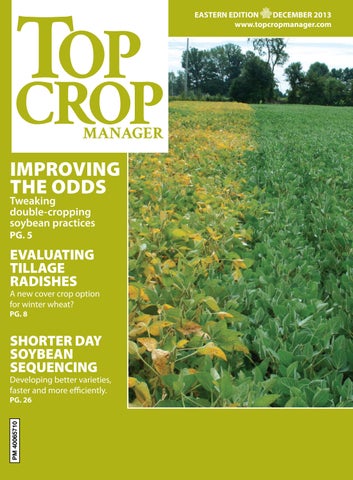
Developing better varieties, faster and more efficiently.
PG. 26
TOP CROP
12 | Green fuel advancements generating unique markets for crops and their residuals. By
Amy Petherick
| Sequencing for shorter-day soybeans geneticists are working to develop better varieties, faster and more efficiently. By
Amy Petherick
Carolyn King
Photo
Photo courtesy of Joce
Photo by Janet Kanters.
Stefanie Croley | aSSoCiate eDitor
FighTiNg
FoR ThE gRAiN
Ontario wheat protein levels may have increased in 2013, but the media (and consumer) war against wheat is still going strong.
Shortly after I read a report from the grain Farmers of ontario that said the ontario Wheat Quality Scoop program results indicated wheat protein levels were up despite fusarium challenges across the province, I found an interesting podcast on the CBC’s website.
“If you trust the bestsellers list, the vast grain fields that have been the pride of Canadian agriculture are actually a vast network of saboteurs working to wreck our health.”
This statement by anna Maria Tremonti, which opened a recent interview with neurologist Dr. David perlmutter on CBC’s The Current, prompted me to let out an exasperated sigh.
as a member of the ag media, and having previously served as the assistant editor of Bakers Journal magazine (a trade publication serving Canada’s retail baking industry), I cannot help but acknowledge the poor reputation that wheat has developed over the past few years among consumers. With the rise of atkins and other carb-free diets, and books like Wheat Belly blaming wheat and wheat products for numerous health problems, including high blood sugar, weight gain, arthritis and acid reflux, whole grains have earned a bad name, especially in mass media.
now, the war is back on: Grain Brain, a book written by perlmutter, claims wheat, carbs and sugar are the brain’s “silent killers,” contributing to alzheimer’s, parkinson’s and other diseases. Here we go again.
The effects of both books have rippled through the retail baking industry already, and there has been some reaction from the agriculture industry. The Healthy grains Institute launched in november 2012, with a mandate to inform Canadians about the benefits of whole grains. and, in response to claims made in Wheat Belly and other negative press, grain Farmers of ontario released a fact sheet advising Canadians to take a broader view of health in order to put the information being discussed into context.
But now that perlmutter and Grain Brain have reignited the fire in the media, I can’t help but fear the domino effect. There’s no denying that consumers are heavily influenced by mass media and celebrity trends. and, even though ontario farmers this year were successful in producing high-quality wheat by selecting wheat varieties and managing crops, so many people are still fighting against the grain. If consumers continue to refrain from purchasing wheat and whole grain products, bad news may eventually be in store for Canada’s grain farmers.
Interestingly enough, cardiologist Dr. William Davis, the author of Wheat Belly, told CBC news in an interview in october 2012 that he doesn’t plan on making the war against wheat a political cause. “These people have incredible power, clout and finances. It’s probably a pointless battle to even try to fight,” he said in the interview, adding, “It’s all about education, not trying to legislate this.”
now there’s a statement: It’s all about education. Call it irony, but among several stories from major media outlets about ditching wheat to better your health, I found nothing that noted ontario wheat protein levels increased in 2013. Isn’t it time for the producer to chime in on the discussion and spread the good word about what he or she so proudly grows?
Fredericks mfredericks@annexweb.com
MAIL AGREEMENT #40065710
CANADIAN ADDRESSES TO CIRCULATION DEPT. P.O. Box 530, Simcoe, ON N3Y 4N5 e-mail: subscribe@topcropmanager.com Printed in Canada ISSN 1717-452X CIRCULATION e-mail:subscribe@topcropmanager.com Tel.: 866.790.6070 ext. 202 Fax: 877.624.1940 Mail: P.O. Box 530, Simcoe, ON N3Y 4N5
SUBSCRIPTION RATES
Top Crop Manager West - 8 issuesFebruary, March, Mid-March, April, June, October, November and December - 1 Year - $45.00 CDN plus tax
Top Crop Manager East - 7 issuesFebruary, March, April, August, October, November and December - 1 Year - $45.00 CDN plus tax
Specialty Edition - Potatoes in Canada - February1 Year - $16 CDN plus tax
All of the above - $80 CDN plus
iM pRovi Ng
T h E oDDS
While early planting is key, growers are tweaking management practices to improve yield from double-cropping soybeans.
by Blair andrews
An empty field after the winter cereal harvest can be a terrible thing to waste.
With earlier harvests taking place in ontario in recent years, some farmers have been putting those fields to good use by planting a double crop of soybeans in early July.
“our growers are always looking at ways that they can generate extra revenue,” says eric richter, an agronomic sales rep at Syngenta, and a longtime proponent of double crop soybeans.
“To see a field harvested in early July and lay idle for the rest of the season just baffles me. There is an opportunity to plant a crop and generate some additional income.”
given that planting in July is a risky proposition, research into management practices for double cropping soybeans has been limited. That scenario is starting to change as richter and the ontario Ministry of agriculture and Food (oMaF), as well as the University of guelph, work on separate projects.
While it is still early, particularly for the oMaF and guelph trials that started in 2012, the research suggests that higher seed populations and the use of short-season varieties are key factors in helping the late-planted beans reach maturity.
However, much still depends on the time of planting and the weather conditions.
“When you’re seeding, it is often quite dry, so establishment
Photo
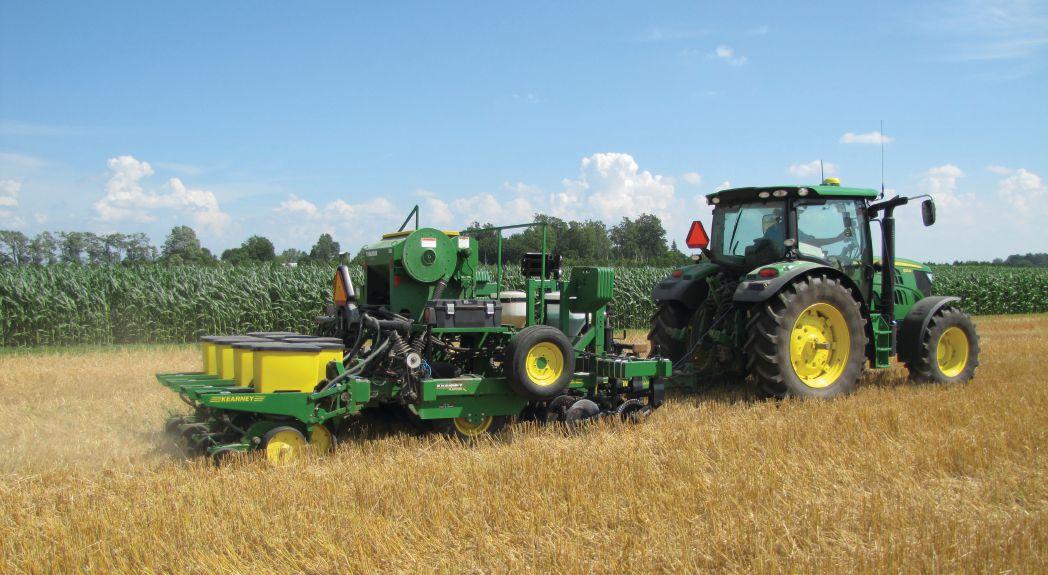
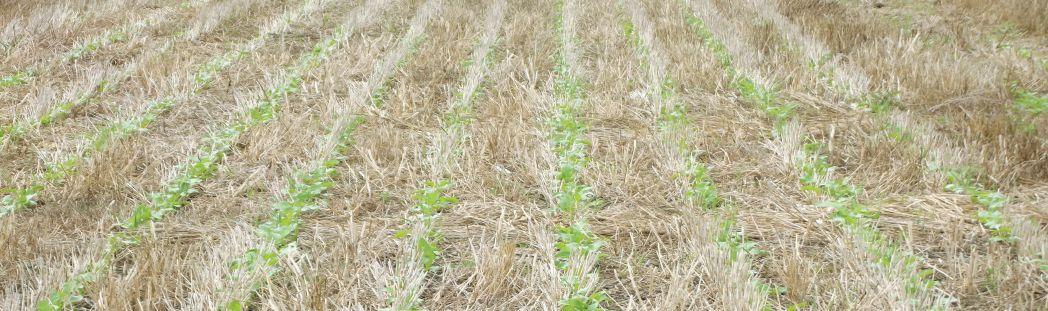
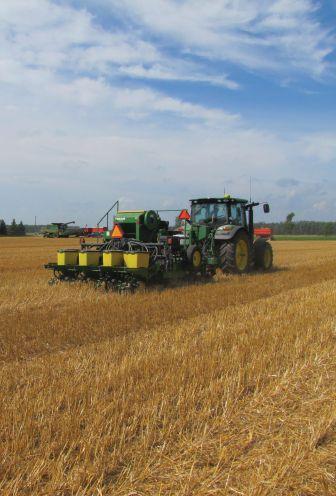
TOP: Soybeans are planted into wheat stubble immediately after harvest on July 18, 2012, at the Perth Soil and Crop Demo farm.
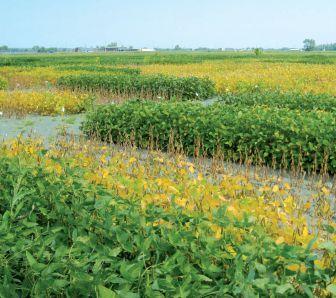
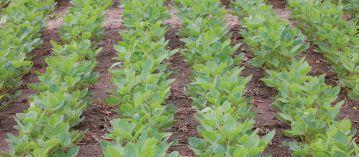
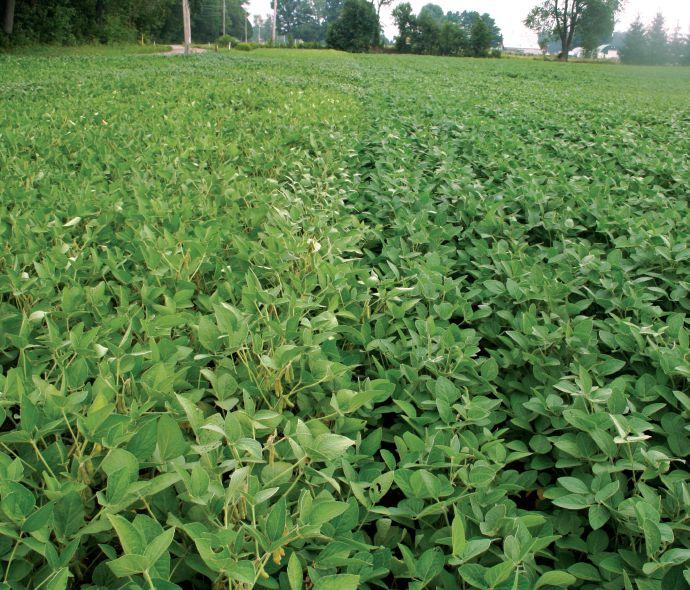
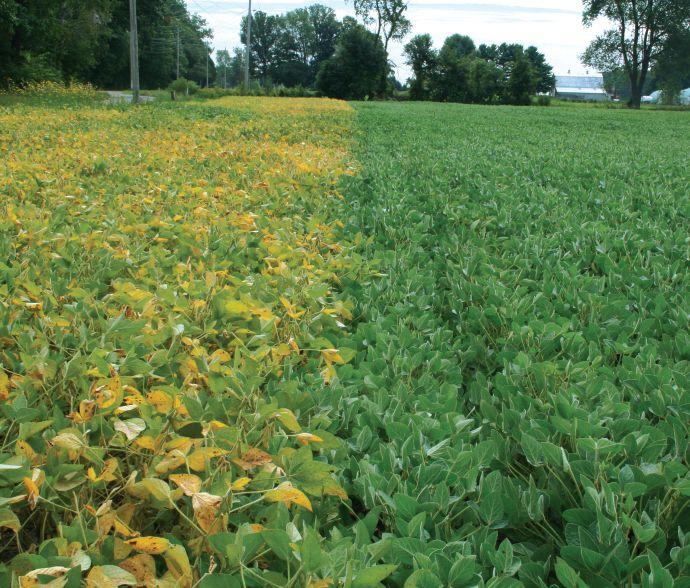
ABOVE: Double-crop soybeans, planted in Mount Brydges on July 5, 2013, are advancing well in maturity in September.
is the first problem,” says Horst Bohner, oMaF soybean specialist.
“The second problem is fall frost. Can you get them finished before it freezes? It’s a high-risk scenario and that’s why you can’t get crop insurance for it. It’s also why we don’t, as a general recommendation, just say, ‘go out and do it.’ ”
With the ability to plant in a more timely fashion in recent years, growers of double-crop soybeans have been tweaking their management practices. o M a F tested these ideas in its research to determine optimum seeding rates (100,000, 200,000 and 300,000 seeds per acre) and to test the appropriate maturity (variety) to seed. In 2012, trials were planted at three locations: two in perth County, ont., near Mitchell, and one in Middlesex County, ont., near Lucan. one site in perth, near Bornholm, was planted after winter barley on July 11. The other two sites were planted on July 23 and 24 after winter wheat. There was a slight delay at the two later planted sites because of the need to remove straw. as a result, only the early-planted Bornholm site made it to yield and was harvested november 23. The other two sites did not yield enough to warrant combining due to an early october frost.
The U of guelph also established one trial at the ridgetown research Station, which yielded about 35 bu/ac.
a yield increase of 2.6 bu/ac was realized when the seeding rate was increased to 200,000 seeds per acre from 100,000 (20.6 bu/ac versus 18 bu/ac). at 300,000 seeds per acre, the yield was 23.4 bu/ ac, a 5.4-bu/ac increase over the rate of 100,000 seeds per acre.
at the perth site that was harvested, two varieties were planted. one had a CHU rating of 2,650, which was about 100 CHU shorter than an adapted variety for the planting area.
There was little yield difference between the two varieties. “What we’re seeing so far from our research is that increasing the seeding rate helps a number of things including the most important, which is yield,” says Bohner. He suggests seeding 250,000 in narrow rows but he cautions that it could get costly given a mediocre chance at success.
“Location is another key factor in trying to make it work,” adds Bohner.
richter says the 250,000 to 300,000 seeding rate is important for getting as
much canopy closure as quickly as possible.
“That canopy closure is very critical because we really only have 90 days to a maximum 100-day growing season in ontario,” says richter, noting that 50 per
cent of the heat units and 45 per cent of the sunlight, on average, is available between July 15 and the first “true” killing frost.
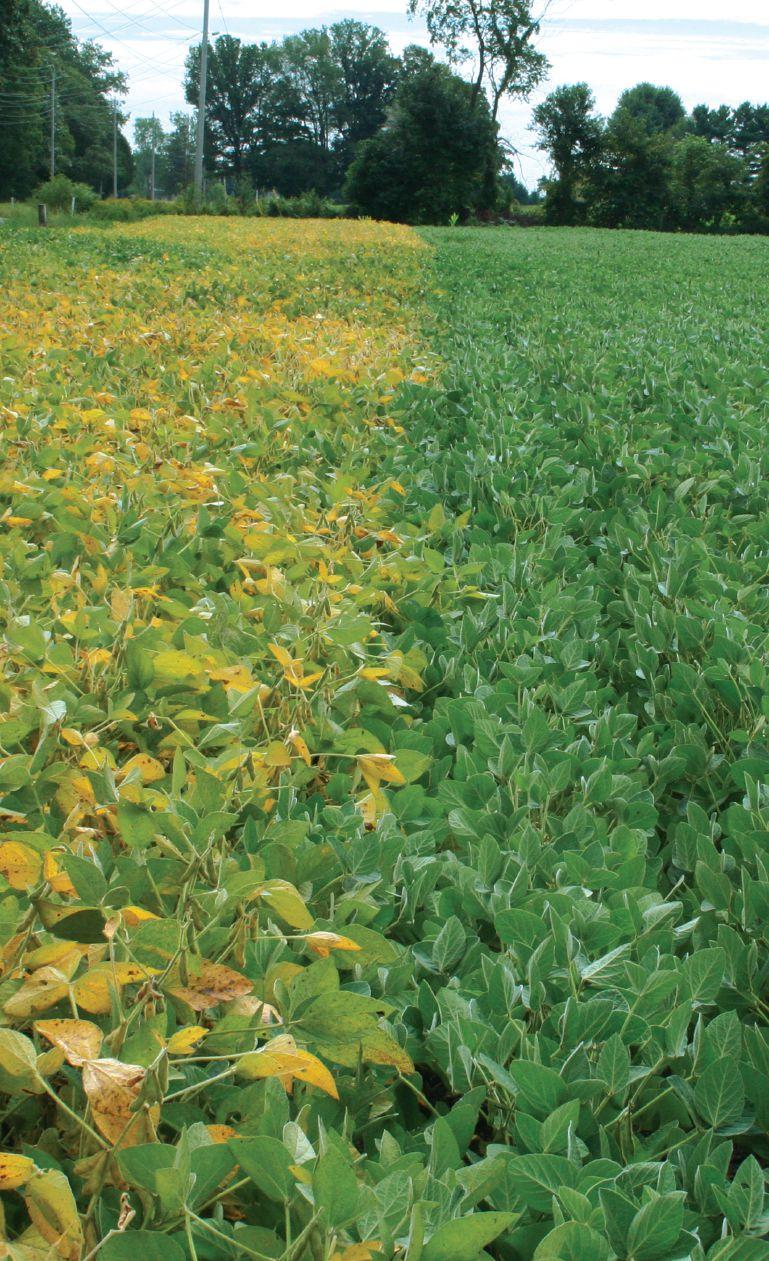
A comparison of double-crop soybeans, planted July 5, 2013, in Mount Brydges to soybeans planted on May 15. The double crop soybeans are on the right side. The picture was taken in August.
A comparison of double-crop soybeans, planted July 5, 2013, in Mount Brydges to soybeans planted on May 15. The double-crop soybeans are on the right side. The picture was taken in September.
Thanks to your input, Case IH Axial-Flow® 30 series combines are better than ever. Now the AFS Pro 700 control center has an adjustable slide rail that puts it right where you need it. The slim MultiFunction Propulsion Handle has all your controls in one convenient location. An industry-exclusive pivoting spout provides increased control during unloading. There’s even a portable cooler for your lunch. The combine that defined the industry has redefined operator comfort, convenience, and productivity. To learn more, see your Case IH dealer or visit us at www.caseih.com/combinetcme1213
EvA luAT i Ng Till Ag E
RADi Sh ES
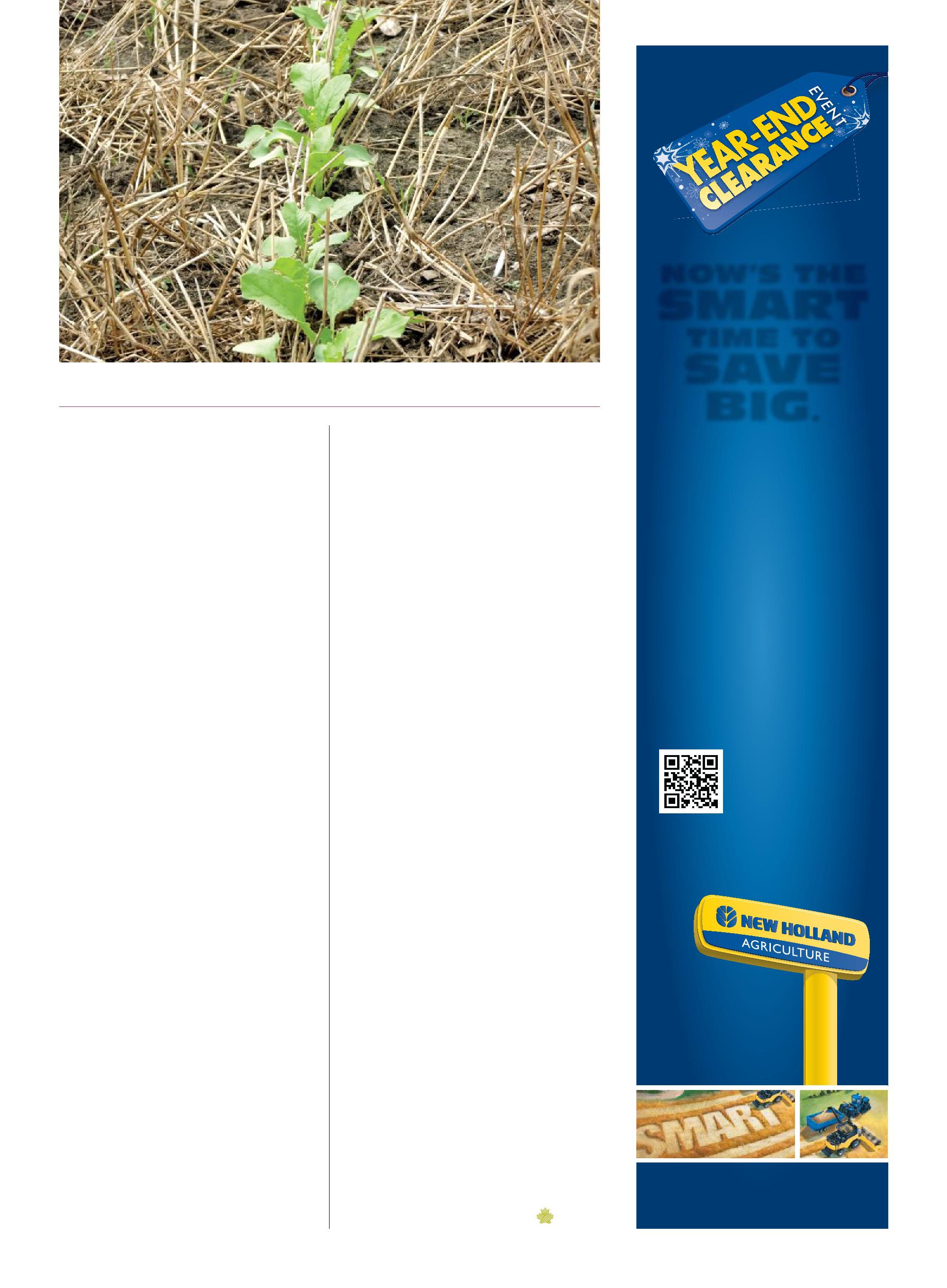
Farmers are realizing the benefits of tillage radishes as a winter wheat cover crop.
by Treena Hein
Anew option for a winter wheat cover crop is winning over farmers in ontario.
“I’ve seen many immediate benefits, but I know I have yet to realize all the long-term benefits,” Dan Breen says of tillage radishes. “While they’re only one piece of the bigger puzzle of our overall crop production system and our soil management strategy, they are an integral part.”
Breen and his wife Kathy have a dairy operation in putnam near London, ont., and grow the usual field crop rotation of corn, beans and wheat, with occasional winter barley and alfalfa as well. The soil type of the farm is variable, with sandy soil in the fields along the Thames river, some clay loam and about 200 acres of heavy clay.
The Breens are coming up on 25 years of continuous no-till, and Dan says he has been experimenting with various cover crops for nine years, with tillage radishes for four of those. “The more I use cover crops, the more it makes sense,” he says. “The benefits of keeping the ground covered and actively growing are many, including nutrient retention, better soil health, weed suppression –the list goes on. The soil organisms need a green crop to work with, rather than just stover.”
Some of the benefits of tillage radishes are shared with many other cover crops, but some are distinctly their own. They control winter annual weeds and capture nitrogen in the fall to release it in the spring. When they decompose quickly after the winter, the radishes release a great number of nutrients (especially nitrogen) into the upper portion of the soil, which is then available to young winter wheat plants. Many studies have shown that they also increase corn and soybean yields afterwards.
“Because I’m no-till, I have to pay attention to things like water filtration and soil aeration,” Breen explains. “The tillage radishes, which I have seen grow to a depth of three feet, including the tap and hair roots and easily five inches across at the top, provide this.
Some farmers use a deep tillage implement and I tell them with the radishes, I am doing that biologically.” above ground, the radishes on Breen’s farm grow knee-high or more before the snow comes and will keep growing until it’s -10 C for three or four days in a row –sometimes that’s into January. “They’re photosynthesizing, capturing carbon and benefiting the soil,” Breen says. “In the spring, they hold the snow so it’s a more gradual melt.”
no-till farmers who want to reduce compaction and farmers who want to scavenge nitrogen are the two main groups interested in tillage radishes, says Dr. rob Myers, regional co-ordinator and director of professional development (extension) programs at the University of Missouri. He notes that there is great interest in the U.S. in using radishes as a cover crop and that radish use (in field crops) has exploded over the last few years in many states, including Kentucky, ohio, Idaho, Maryland, Minnesota and Missouri. They are also used in horticulture. “Farmers like them as they are relatively easy to seed,” Myers notes. “It’s a small, round seed that’s easy to broadcast.”
Breen uses the brand “Tillage radish,” marketed by pennsylvania-based Cover Crop Solutions and sold by Speare Seeds in Harriston, ont., because it’s a well-established seed brand. To be effective cover crops, tillage radishes need time to grow before they’re killed by cold weather, so they don’t work well in a crop rotation after corn or soybeans. Breen says his radish planting date depends on the timing of wheat harvest and getting manure spread, and that could be anytime in august. “It depends on whether you spread straw and on the weather and so on, but if you can let volunteer wheat and some weeds come up and then do a roundup burn-down and plant a bit later, you’ll get a better result,” he says. “It’s not necessarily a cheap crop – it’s an investment, and
ABOVE: Dan Breen has planted tillage radishes in August as a cover crop for winter wheat over the last few years on his farm in Putnam, Ont., and sees many benefits in their use.
Photo courtesy of Dan b reen.
These images were taken on Aug. 30, 2013. Tillage radishes will grow until mid-winter in Ontario, reaching over three feet deep, 1.5 feet high and five inches across.
you want it to do well.” For planting in the first two years, Breen used a grain drill at seven pounds per acre. Last year as well as this year, in the hopes of more even emergence, he used a sugar beet disc in a unit planter at five pounds (125,000 seeds) per acre, and it worked well.
peter Johnson, provincial cereal specialist at the o ntario Ministry of a griculture and Food, notes that radishes may plug drainage tile. Myers has not heard any reports of this, but admits the possibility. Jill Sackett, extension educator with University of Minnesota e xtension, does not see this as a possible detracting factor. “Corn roots also can go down three to four feet [the depth at which tile lines are commonly placed], and the radishes decompose well in any case,” she notes. “When they do decompose quickly in the spring, it could be a problem in ground prone to erosion, so I recommend what I recommend with all cover crops – plant a mixture. Cover crops should not be a monoculture if you want to see multiple benefits.” Sackett adds that volunteer wheat can be suitable in functioning as the other cover crop in the mix but encourages mixtures of three or more species.
Myers adds that there can sometimes be an odour for a few days when the radishes decompose quickly in the spring, so you may want to plant them a little away from neighbours or chat with them about it.
Yield improvements?
While a recent U.S. Department of agriculture funded survey showed corn and soybean yield improvements from cover crops as a whole, there’s less information
specifically on radish impact on yield. “The decomposed radishes increase soil organic matter and eventually leave holes in the soil that allow water and air to enter and release nitrogen,” Myers says. “You would expect a yield benefit over the short term because of that, and over the long term after a few years, you would have a buildup of organic matter, which can support the achievement of higher yields as well.”
Breen has never done side-by-side corn, soybean or wheat comparisons, but in the corn he typically grows after radishes, he says he’s got more consistent emergence and more tilth to the soil with more consistent stands. “It’s due to the radishes rotting and providing better oxygenation and water filtration,” he says. “and I don’t think it’s useful to focus so much on immediate yield. We’re often short-sighted as farmers, and it’s not just about yield this year, but about improving soil quality and achieving excellent yield results over the long term. There is no doubt in my mind that radishes provide that.” Using the radishes also allows Breen to cut back on fertilizer. “I don’t want to quantify the amount because it’s going to be different for everyone, but it’s less, yes,” he says.
although he hasn’t seen the longterm results and there is a lot left to explore with tillage radishes and other cover crops, Breen sees huge potential for all kinds of applications of radishes. “We did a three-acre test patch where we took off corn silage, planted radishes between the corn stalk rows of 15 inches, then in october, we planted wheat in between the radish rows,” he says. “The wheat looked fantastic early but struggled as the spring weather conditions progressed.”
We’re making room for the new 2014 models, so now’s the time to save big on select New Holland tractors, combines and crop production equipment. But, hurry! When the year ends, so do the savings.
www.newholland.com/na
Photo courtesy of Dan b reen.
gREEN F u E l ADvANCEMENTS
Generating unique markets for crops and their residuals.
by amy petherick
If green chemistry sounds more like an oxymoron than an opportunity, be prepared for some big surprises in the notso-distant future.
Innovators within the manufacturing industry are getting back to nature and the door is open for farmers to take part. While the production of biofuels remains a popular example of green chemistry, ethanol is only the tip of the iceberg when it comes to industrial products that are being designed to include more renewable resources. as governments start to wean ethanol companies off of subsidies, Murray McLaughlin, the executive director of the Bioindustrial Innovation Centre in Sarnia, ont., says farmers can expect to see some positive changes.
“Biofuels are important, but the challenge with biofuels is slim margins,” explains McLaughlin. “on the chemical side of things, as long as oil stays above $80 per barrel, we can be competitive with any of the companies in that space and don’t need subsidies.”
In the petroleum industry, it’s not uncommon for companies to direct 75 per cent of raw materials into fuel production, but these often account for only 25 per cent of annual revenue.
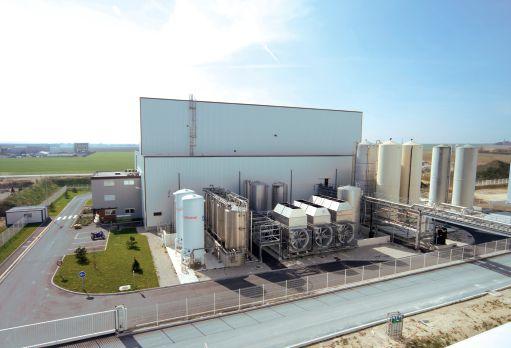
ABOVE: BioAmber has produced bio-based succinic acid
Photo courtesy of b io a mber.
Photo by Janet Kanters.
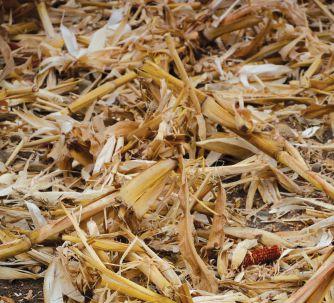
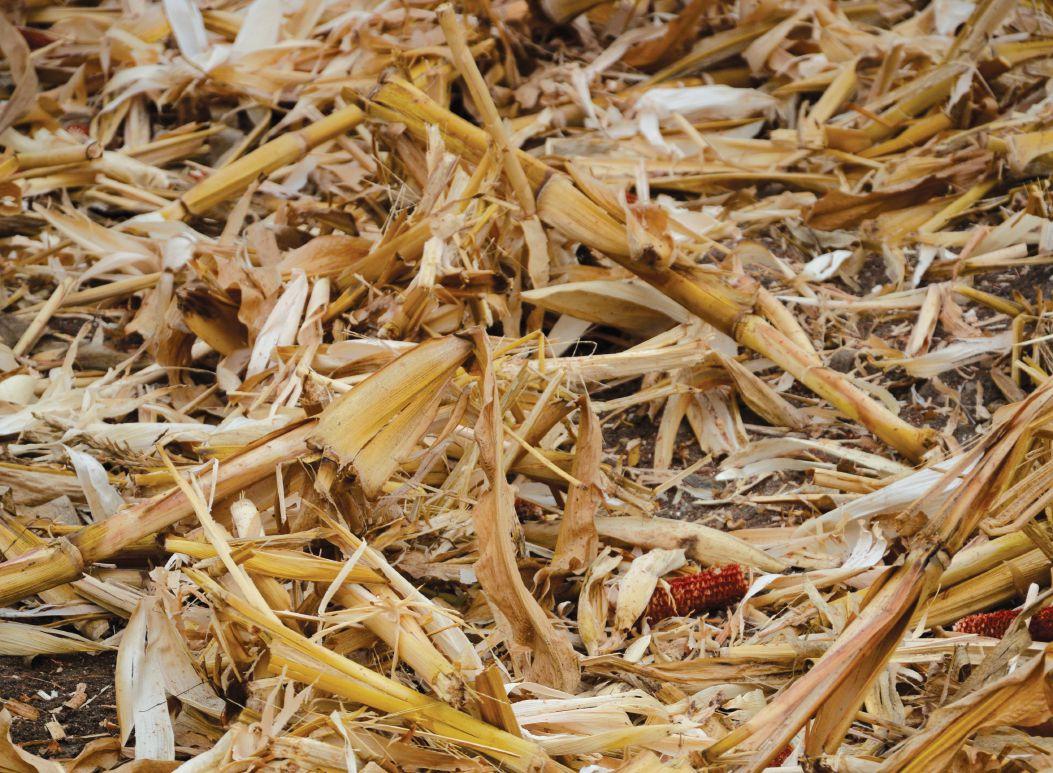
TOP: Randy Duffy, research associate, University of Guelph’s Ridgetown Campus, sees potential for corn stover beyond bedding and feed.
in January 2010.
With locally bred, high-yielding, glyphosate-tolerant and IP varieties from NK ® . Our Canadian breeders access the best soybean genetics in the world, rigorously
and technologies, including Genuity ® Roundup Ready 2 Yield ®, to develop varieties
to your farm. So the moment your Syngenta soybean seed enters the soil, you’ve set yourself up for success.
The rest of their income is generated by higher-end products, such as succinic acid, and it has made these products major targets for green chemists. Succinic acid is a specialty chemical used to make automotive parts, coffee cup lids, disposable cutlery, construction materials, spandex, shoe soles and cosmetics. It is usually made with petroleum, but Bioamber, a company that hopes to finish building north america’s largest bio-based chemical plant in Sarnia next year, has found a way to make succinic acid using agricultural feedstocks.
By using agricultural feedstocks instead of petroleum in its process, Bioamber produces a product that is not only more environmentally friendly but also, critically, costs less than petroleum-based succinic acid. In some applications, it performs even better than its petroleum-based competitors. Babette pettersen, Bioamber’s chief commercial officer, explains how the new technology is outperforming its traditional competitors.
“Succinic acid offers the highest yield on sugar among all the bio-based chemicals being developed because 25 per cent of the carbon is coming from Co2, which is much cheaper than sugar,” says pettersen. assuming $80 per barrel of oil and $6 per bushel of corn, Bioamber’s product pencils out at more than 40 per cent cheaper than succinic acid made from petroleum. “our process can com-
pete with oil as low as $35 per barrel,” pettersen adds.
The increased efficiency of the company’s process reduces the need for raw product, for example, from two kilograms of sugar to make one kilogram of ethanol to less than one kilogram of sugar to produce one kilogram of succinic acid.
The new plant is projected to purchase an annual quantity of liquid dextrose from local wet mills, which is equivalent to approximately three million bushels of corn. Bioamber’s yeast, the organism that produces bio-based succinic acid, can utilize sugar from a variety of agricultural feedstocks (including cellulosic sugars that may be produced from agricultural residuals such as corn stover when this alternative becomes commercially available).
randy Duffy, research associate at the University of guelph’s ridgetown Campus, co-authored a recent study on the potential for a commercial scale biorefinery in Sarnia, ont. The idea of producing sugars from agricultural residuals is attractive to companies like Bioamber, which faces public pressure against converting a potential food source into an industrial product, but also to farmers looking to convert excess field trash into cash.
“We’re at the point where some fields probably have too much corn stover and this is an opportunity for farmers if they want to get rid of their stover,” says Duffy.
“Some farmers are using it for bedding and feed, but there’s a lot of potential corn stover out there not being used or demanded right now.”
In fact, the report estimated that more than 500,000 dry tonnes of corn stover are available in the four-county region of Lambton, Huron, Middlesex and Chatham-Kent, and the refinery could convert half of it into cellulosic sugar annually, at a relative base price for corn stover paid to the producer of $37 to $184 per dry tonne, depending on sugar prices and sugar yields. McLaughlin says that with more and more companies look into building facilities like biorefineries, the potential benefits for farmers multiply exponentially. at the Bioindustrial Innovation Centre alone, McLaughlin says, there are three green chemistry companies already working in pilot demonstration scale operations to produce ethanol from wood waste, butanol from fermented wheat straw or corn stover, and plastic pellets with hemp, flax, wheat straw or wood fibres in them. on a fullscale basis, any one of these has significant potential to help farmers penetrate entirely new markets.
although these green products are exciting, McLaughlin strongly believes green chemistry is not going to completely replace oil and he tries to impress this on others. “There are such large volumes of
An artistic rendition of the BioAmber plant in Sarnia, Ont., expected to be completed next year. The plant will make succinic acid using agricultural feedstocks rather than petroleum.
Photo courtesy of b io a mber.
these chemicals produced from oil, I don’t think we ever will get to the point where we can displace these chemicals,” he says, “but we can complement them.” He says Woodbridge’s BioFoam, a soy-based foam used in automobile interiors as seat cushions, head rests and sunshades, is an excellent example of a hybrid product that uses green technology and petroleum technology. In order for the green chemistry industry in ontario to realize its maximum potential, he believes everyone involved needs to consider the oil industry as a potential ally rather than the enemy. “The petroleum industry already knows the chemical markets and they’ve got the distribution,” he says, “so, who better to partner with?”
The “Development of a Business Case for a Cornstalks to Bioprocessing Venture” report co-authored by Randy Duffy shows the various steps involved in the corn stalks to bioprocessing process and the potential involvement for various
chain stakeholders (green=farmers, blue=equity partners, which could include farmers).
Green chemistry is a relatively new concept, but rather than simply claim to be more environmentally friendly, the philosophy is defined by structured principles. Put simply, these technologies, processes, and services are required to prove safer, more energy efficient and environmentally sustainable. In 1998, Anastas and Warner defined the 12 principles of green chemistry.
Prevention – Avoid creating waste rather than treating or cleaning it up after the fact.
Atom economy – Synthetic methods must maximize the incorporation of all materials.
Less hazardous chemical syntheses – Design synthetic methods that are least toxic to human health and the environment.
Designing safer chemicals – Chemical products should be designed to be effective but with minimal toxicity.
Safer solvents and auxiliaries – Avoid the unnecessary use of auxiliary substances and render harmless when used.
Design for energy efficiency – Energy requirements of processes should be minimized for their environmental and economical impact.
Use of renewable feedstocks – Raw materials should be renewable whenever technically and economically practical.
Reduce derivatives – Use of blocking groups, protection/ deprotection, temporary modification of physical/chemical processes, etc., requiring additional reagents should be minimized or avoided if possible.
Catalysis – Catalytic reagents are superior to stoichiometric reagents.
Design for degradation – Environmental persistence of chemical products should be minimal.
Real-time analysis for pollution prevention – Real-time monitoring and control of hazardous substances must be developed.
Inherently safer chemistry for accident prevention –Substances used in a chemical process should be chosen to minimize the potential for accidents.
For more on sustainability, visit www.topcropmanager.com
Continued from page 6
Creating competition is another key factor of increasing the seeding rates.
It’s one of the reasons Ian Matheson, who farms near Woodstock, ont., plants 300,000 seeds per acre.
Matheson is one of several growers who have worked with richter on his project.
“From what we have learned, that is definitely necessary to get the height and get the competition in there to make
those beans elongate up,” says Matheson, who plants soybeans after winter barley. as for finding the appropriate maturity for double-crop beans, it was thought that full-season varieties were required to provide the additional height at harvest.
Brent pilkington, who plants doublecrop soybeans after the pea harvest on his farm near Mount Brydges, ont., says the longer-season theory seemed to have merit.
SPRAY IT LIKE YOU MEAN IT
“The longer-season will get more growth on them but you usually end up with junk beans if they don’t make the frost date,” says pilkington. “With the earlier ones, if you bump up the population, you still get some height and the plant just physically matures.”
While cautioning that he has only one year of data, richter says “downshifting” maturity is critical to improving the overall double-crop soybean system.
He suggests moving down by about 200-300 heat units from what would be considered a full season bean.
“The double-crop system really only works in the areas that have about 2,900 to 3,000-heat unit seasonal rating and more,” says richter.
“The longer-season variety is not actually helping the growers who are doing double crop; it puts them at higher risk of the system not working.”
richter adds that even with abundant heat in 2012, the longer-season varieties did not yield any higher than the shorterseason varieties.
Matheson, who opts for a more conservative approach of dialling back by 50 to 100 units, agrees that last year was tough on the longer-season varieties.
“on some of the longest day beans, it was an ugly sample of beans: a lot of black beans and rotten beans because they got frosted and they were nowhere near ripe,” recalls Matheson.
We aren’t surprised to hear words like impressive and dependable when people talk about Hybrid Mode™ .
Hybrid Mode™ reduces the need for the operator to take manual control of the boom while spraying lodged, thin or uneven crops.
What you may be surprised to hear is that our Hybrid Mode™ advanced crop spraying feature is exclusive to NORAC Spray Height Control Systems. Precision sPray HeigHt control www.norac.ca
While determining the best seeding rates and varieties is helping to improve the double-crop system, the most critical factor continues to be timing.
It’s imperative to plant the crop as quickly as possible after the cereal harvest.
“Literally the minute that the combine is through, and if you’re baling straw, get it baled and plant the beans or chop the straw, spread it wide and get the beans planted right away,” says richter.
He has always believed that double cropping is a real “crap shoot” after July 15, noting the odds against it working increase significantly each day after that date.
By the 20th, richter says, it likely won’t work.
“We run out of physical days, heat units and sunshine. But between July 1 and 15 in most years in those 3,000-heat unit areas, we have half a season left and
there is an opportunity for double crops to work really well,” he adds.
Whereas Bohner remains cautious over the high-risk prospect of double-crop soybeans, he says it can be worth a try in the right year.
“There have been guys who have yielded over 40 bushels and it’s hard to argue with that,” says Bohner. “plant as early as you can and choose the best variety possible that’s shorter than your adapted variety, and keep your fingers crossed.”
In Ian Matheson’s case, his advice for those considering the idea is to keep the expectations low.
“Don’t count on harvesting them; hope to harvest them,” notes Matheson. “Look at the money people are spending on cover crops. Beans are a little bit more expensive to plant but you have a chance to harvest a fairly valuable crop.”
Soybeans are planted into wheat stubble immediately after harvest on July 18, 2012, at the Perth Soil and Crop Demo farm.
Photo courtesy of h orst b ohner, omaf
pRESERvi Ng T h E
EFFECT iv ENESS oF Bt TRA i TS
A new option to slow the development of corn rootworm resistance.
by Carolyn King
Corn rootworm is a serious pest in corn-on-corn fields. at present, corn hybrids with Bt corn rootworm traits offer effective control in o ntario conditions. But this insect is notorious for its ability to develop resistance to control measures. So seed corn companies, researchers, extension agents and grower associations are working to maintain the effectiveness of these Bt traits for as long as possible.
The latest advance in these efforts is Syngenta’s new a grisure Duracade trait, which will be available for the 2014 growing season.
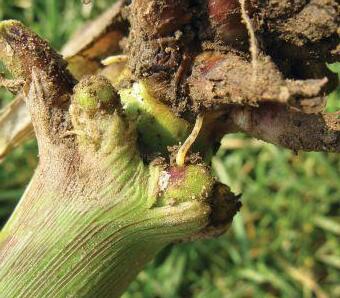
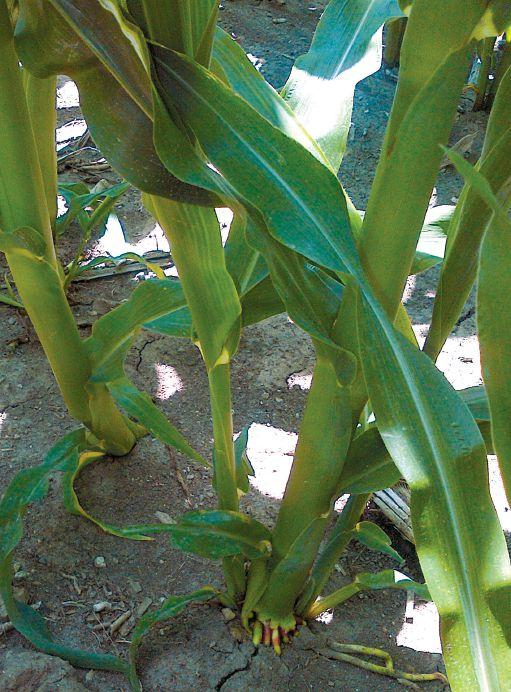
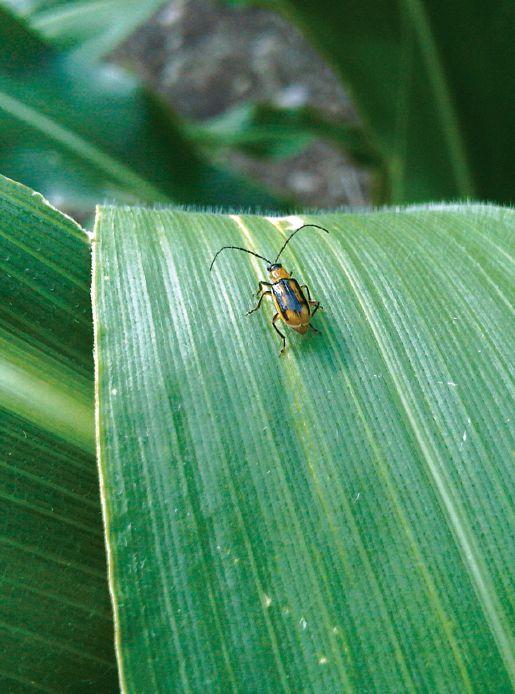
Corn rootworms impact corn yields in both their larval and adult stages. Starting in about mid-June, the larvae feed on corn roots for several weeks. This root damage stunts plant growth, reduces water and nutrient uptake, and causes lodging and goosenecking (bent stalks). The larvae transform into adult beetles towards the end of July. The adults feed on corn leaves and on the silks and pollen, reducing pollination. They lay their eggs in cornfields. The eggs overwinter and begin hatching in about early June.
Two corn rootworm species occur in o ntario: western corn rootworm (Diabrotica virgifera) and northern corn rootworm (Diabrotica barberi) . Bt rootworm traits work on both species.
On the lookout for resistance
So far, there haven’t been any confirmed cases of Bt-resistant corn rootworms in o ntario, but the risk is real. “In the U.S. since 2009, there have been increasing numbers of field cases where Bt rootworm traits are not performing as they should be and the beetle populations are overwhelming the technology,” explains Jocelyn Smith, program lead for insect resistance management at the University of g uelph’s ridgetown Campus.
She says the rootworm populations in o ntario are genetically the same as those in the U.S. so the genes for resistance to Bt traits are already present in our populations.
“You can speculate that our risk of developing resistance may be somewhat lower in o ntario and other areas away from the central Corn Belt in the U.S., where corn production is more intensive, with larger fields, large corn rootworm populations and more corn-on-corn [which are all factors that increase
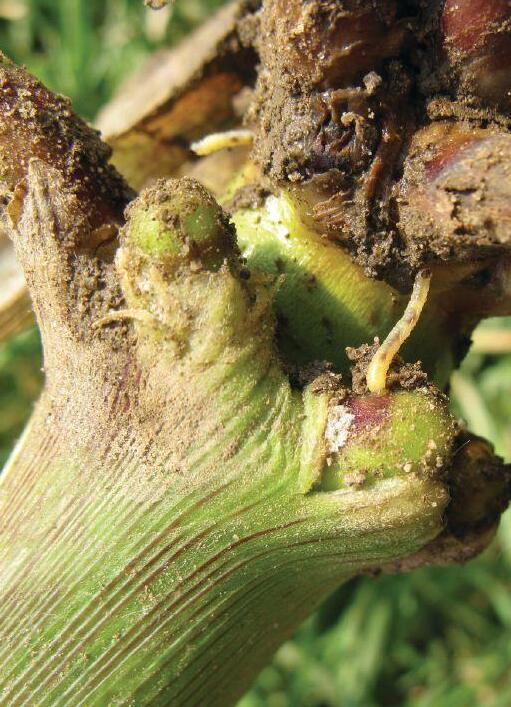
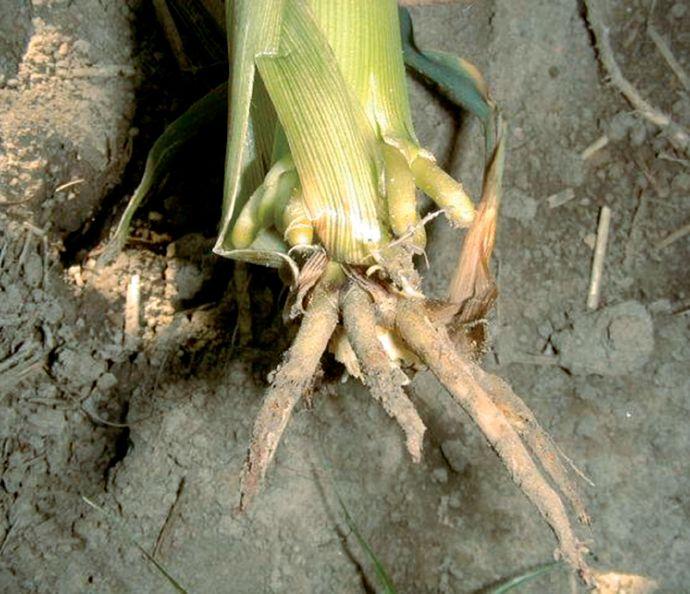
Corn rootworm larvae damage corn roots, resulting in stunted plant growth, reduced water and nutrient uptake, lodging and goose-necking.
selection pressure for Bt resistance]. o utside of the Corn Belt, we may have less selection pressure in that we typically have more crop rotation, smaller fields and typically not as heavy corn rootworm populations,” says Smith.
“We hope those practices will help prevent resistance from taking hold here. But the risk definitely still exists because it comes down to genetics and selection pressure.”
a s part of the strategy to preserve the effectiveness of Bt
Photo courtesy of Joce L yn s mith.
THEY HAVE ARRIVED
Introducing the all-new and innovative Pioneer side-by-side lineup from Honda. The Pioneer 700 carries two people, and the Pioneer 700-4 features the Industry’s first convertible seating designed for two, three or four. Learn more about Pioneer and the full lineup of accessories at honda.ca
*Pioneer 700-4 shown with accessories.
corn rootworm traits in Canada, researchers at the University of g uelph, ridgetown Campus, including Smith, Dr. art Schaafsma and graduate student andrea Hitchon, along with Tracey Baute from the o ntario Ministry of a griculture and Food, work collaboratively with seed corn industry partners to monitor for resistance as a mandate of the Canadian Corn pest Coalition.
Input from o ntario corn growers is crucial for early discovery of Bt resistance. So Smith, Hitchon and Baute are asking growers to contact them about situations where Bt rootworm products don’t seem to be performing as well as expected. The team will follow up on any reports and determine if resistance exists. If they find any patches of resistance, they will work with growers to eliminate those patches before the problem expands.
Smith notes, “So far in 2013, we have responded to a few field instances with unexpected rootworm injury, but none have raised concerns about resistance development.”
To look for signs of resistance, Smith encourages growers to start scouting in July by digging up corn roots and rating them for injury. Through the rest of the growing season, growers can watch for goose-necking, lodging and high numbers of adult beetles. Scouting in July is important because, if lodging isn’t noticed until harvest, it can be difficult at that stage to figure out if corn rootworm was the culprit.
o f course, growers also need to take steps to prevent Bt resistance when controlling corn rootworm. “The number 1 strategy is crop rotation because if you don’t plant corn after corn then the rootworm larvae will have nothing to feed on and will die. rotation is still the best way to control rootworm even in areas
with resistance,” says Smith. “The number 2 strategy would be to use a Bt trait to control corn rootworms in second-year corn.”
If using a Bt hybrid, growers must comply with the mandatory Bt refuge requirements regulated by the Canadian Food Inspection a gency. a refuge is a portion of a Bt field that is planted to a similar hybrid without the Bt trait. refuges slow the evolution of Bt resistance because some of the target insect’s population is not exposed to the Bt toxin.
To slow the development of Bt resistance, rotation among rootworm control strategies is recommended. Scouting for beetles in July and august is also recommended to determine the expected population level in the following year. If one or more beetles per plant are present, then control strategies are recommended for second-year corn.
To rotate control measures, a grower could use a Bt hybrid with multiple traits for rootworm control in one year and then a regular hybrid plus an insecticide in another year. Smith says soil insecticides are more effective than seed treatments for corn rootworm control. She does not recommend using both a Bt trait and an insecticide in the same year.
“a recently published study from Iowa State University has shown that there are no yield benefits to adding soil insecticides to Bt corn. It could also mask a developing resistance problem,” she says.
“Canadian corn producers can be really proud of the fact that they recognize the value of crop rotation in sustainable and competitive corn production. But they really need to remain diligent to such practices as crop and trait rotation and
Goose-necking is one of the symptoms of feeding by corn rootworm larvae.
Western corn rootworm is one of two species of corn rootworms found in Ontario.
Photo courtesy of Joce L yn s mith.
Photo courtesy of s yngenta.
NITROGEN LOSS STINKS
With untreated UAN, you can lose valuable nitrogen as ammonia gas. That’s why you need AGROTAIN® PLUS EZ FLO nitrogen stabilizer. It’s scientifically proven to protect ureabased nitrogen above and below ground from the risks of volatilization, denitrification and leaching.
planting the proper refuge,” notes Jennifer Hubert, one of Syngenta’s regulatory affairs team members.
A new Bt trait
Syngenta’s new a grisure Duracade trait will help corn growers fight Bt resistance in several ways. o ne key factor is that the new trait will be pyramided with a grisure rW, another Bt rootworm trait.
Bt traits come from Bacillus thuringiensis , a bacterium found in soil. The bacterium forms crystals of insecticidal proteins called Cry proteins. Seed corn companies alter corn plants to express Cry proteins as a way to manage insect pests. e xamples of Cry proteins used for corn rootworm control include Cry3Bb1, Cry34/35 and mCry3 a , which is the trait in a grisure rW. Syngenta’s new Duracade trait is eCry3.1 ab.
“There is a misconception that all Cry proteins on the market are the same – that if you get resistance to one, you’ll get resistance to the others,” says Hope Hart, technical leader, product safety, who works for Syngenta in north Carolina. “So I like to explain that, although they are similar in the way they work, there is a very specific and unique difference that gives them different modes of action.”
She outlines how Cry proteins work: “an insect takes a bite of the plant and ingests the Cry protein. That protein gets clipped by an enzyme and activated in the insect gut. o nce it is activated, it binds a protein receptor on the insect’s gut membrane. o nce it is on that membrane, it then pokes holes in the gut. That is similar for all Cry proteins. But what gives each of
Trait Stewardship Responsibilities Notice to Farmers
Monsanto Company is a member of Excellence Through Stewardship® (ETS). Monsanto products are commercialized in accordance with ETS Product Launch Stewardship Guidance, and in compliance with Monsanto’s Policy for Commercialization of Biotechnology-Derived Plant Products in Commodity Crops. This product has been approved for import into key export markets with functioning regulatory systems. Any crop or material produced from this product can only be exported to, or used, processed or sold in countries where all necessary regulatory approvals have been granted. It is a violation of national and international law to move material containing biotech traits across boundaries into nations where import is not permitted. Growers should talk to their grain handler or product purchaser to confirm their buying position for this product. Excellence Through Stewardship® is a registered trademark of Excellence Through Stewardship.
ALWAYS READ AND FOLLOW PESTICIDE LABEL DIRECTIONS.
these proteins a unique mode of action is that they each bind different protein receptors on the insect’s gut membrane.”
Cry proteins are fairly specific in their activity: they affect certain insect species but not others. That specificity is what led Hart to develop eCry3.1 ab back in 1999-2000. “I was actually trying to put together parts of our mCry3 a , which is active against rootworm, with parts of Cry1 ab, which is active against e uropean corn borer, to develop a protein that is active against both rootworm and e CB. That did not work,” explains Hart.
There is a misconception that all Cry proteins on the market are the same – that if you get resistance to one, you’ll get resistance to the others.
“However this hybrid protein that I had developed was still controlling rootworm. and, in rootworm research, the first rule is to never discount anything with rootworm activity because it is not easy to get. So we started looking into other uses for the protein. and when we started looking into the modes of action, we found that the Duracade protein binds a different receptor than mCry3 a does.”
So Syngenta went to work to develop corn hybrids pyramided with both the Duracade and rW proteins. “Duracade is not going to be a product by itself. It will only be sold with our agrisure rW because that will give you the two modes of action against rootworm,” Hart says.
although Smith hasn’t seen the new Duracade products yet, she notes, “ p yramided Bt events are a better option than just a single trait because the chance of resistance developing against two different traits at the same time is much less than it would be to develop against a single trait. It’s good that we’re getting another option in the marketplace to use against corn rootworm.”
Duracade advances
“For the 2014 growing season, we’re going to have five different corn hybrids available with agrisure Duracade through our nK Brand. Those products will range in maturity from 2,650 to 3,250 heat units. So we’ve got a range of maturities that growers are looking for within ontario and Quebec,” says Shawn Brenneman, agronomic sales manager with Syngenta in ontario. “We expect Duracade to be even more a part of our portfolio as we go forward.”
not only are all five hybrids pyramided with both the Duracade and the rW traits, but also all five will be available in e -Z refuge, with five per cent refuge blended in the bag, so it’s easy to comply with refuge requirements.
“Duracade is a next-generation rootworm event and growers will see the difference in the field,” Brenneman says. “The first generation of rootworm traits have done a pretty effective job of helping control corn rootworm beetle, but we still get calls about feeding by corn rootworm under high pressures. That is because all of the traits in the marketplace currently are a moderate dose of corn rootworm beetle control. But with agrisure Duracade, we’re seeing over 99 per cent control of corn rootworm beetle emergence within the trials, even under high pressures.”
2013-07-31 2:14 PM
That high level of control was found in a study led by Dr. Bruce Hibbard of the United States Department of agriculture. The researchers evaluated various Cry proteins for rootworm control at five Missouri sites in 2007, 2008 and 2009. Based on the number of larvae that survived to become adult beetles, corn hybrids pyramided with both the Duracade and rW traits caused 99.91 per cent mortality in western corn rootworm larvae.
In comparison, if a moderate-dose Bt toxin kills 97 per cent of the corn rootworm beetle population in a field, the remaining three per cent can actually
be quite a large number of beetles and some of those beetles could be carrying genes for resistance.
Smith says higher-dose Bt rootworm events would be an important advance in the battle against resistance. “From the beginning we knew that the risk of developing resistance was greater with the [first-generation] Bt events because none of them behave as a high-dose trait against corn rootworm. So they allow more than enough survival for rootworm populations to possibly become resistant.”
Brenneman says Duracade will be a good option for corn-on-corn fields with
The University of Guelph’s Ridgetown Campus has a corn rootworm resistance monitoring program through which the researchers collect beetle populations every year and test them using a bioassay technique for Bt resistance. So if Ontario corn growers report any instances of possible resistance in their fields, Smith and Hitchon can follow up by collecting beetles from those fields and testing them.
However, it’s not as easy as you might think to determine if a corn rootworm is actually resistant to a Bt trait.
First of all, corn rootworms don’t thrive under lab conditions. In addition, because the Bt traits work on the larvae, the researchers have to go through the time-consuming process of hatching larvae for testing. Smith explains, “You’re not able to collect beetles until late summer. Then we bring them into
corn rootworm problems. “I see a grisure Duracade being a great tool for a lot of the livestock growers – typically a majority of corn-on-corn acres are dairy, hog and beef farmers.”
He adds, “In the last couple of years, where we really see the issues with corn rootworm beetle are high-pressure cornon-corn situations and then you add a stress such as drought stress . . . agrisure Duracade will help maximize yields by mitigating the effects these additional stresses have in those areas where corn rootworm beetle has been an economic concern.”
Brenneman notes that corn rootworm control offers added benefits. “The first generation of Bt rootworm traits have the additional benefit of keeping the roots healthy and intact. Duracade will bring similar added benefits – keeping the roots actively growing and healthy so the plant is able to move the water and nutrients it needs to have the best yield and the best quality.”
o verall, it looks like a grisure Duracade will be a further step forward in preserving the effectiveness of Bt rootworm traits. It will offer another option for Bt trait rotations, it will be pyramided with another Bt rootworm trait, it will be packaged in a refuge-in-a-bag format, and research data indicate that it will provide a higher-dose Bt event.
For more on pests and diseases, visit the agronomy section of www.topcropmanager.com
the lab where we collect their eggs. The eggs then require a five-month diapause period under cold temperatures [before hatching into larvae], so we have to put the eggs in the refrigerator until about February. Only then can we hatch them out and start to do testing. So it takes about a year to get any data.”
As well, Smith says the jury is still out on the best way to test for Bt resistance in corn rootworms.
“There is a diet-based bioassay that has been the industry standard, but it isn’t a perfect system because the rootworms don’t do very well on some of the diets. So other researchers have developed plant-based bioassay techniques which in some ways work better. There are pros and cons to both methods.” Hitchon will be evaluating different bioassay techniques as part of her master’s research.
An example of root pruning caused by corn rootworm.
Photo courtesy of s yngenta.
SE qu ENC i Ng F oR ShoRTER- DAy S oy BEANS
Geneticists
help develop better varieties, faster and more efficiently.
by amy petherick
The ability to sequence genomes has been revolutionizing plant-breeding techniques worldwide for more than a decade, but here in eastern Canada, technology is notably impacting short-season soybean breeding.
genotyping by sequencing (gBS) was initially developed at Cornell University and adapted by Dr. Francois Belzile, a molecular biologist and geneticist at Laval University, specifically for Quebec and ontario’s public-sector soybean breeders. Using Dna extracted from a small segment of leaf material, the method yields a unique genetic fingerprint for each soybean line that is composed of thousands of Dna markers. The technique, already available to corn and rice breeders, has been applied to a representative collection of 300 soybean varieties chosen by a team of collaborating breeders, and has produced a vast database that is giving them new knowledge of parent materials and the lines used in their own trials.
“It’s like shining a flashlight on a very small portion of chromosomes and having a glimpse of different tidbits where, at each spot, we’re finding differences,” says Belzile. “By having a more intimate knowledge of what we have inside that plant, we’re able to better
compare the performance of different mutations.”
one of the collaborative breeders who became involved is Dr. Louise o’Donoughue of le Centre de recherche sur le grains inc. (CÉroM), in Quebec. o’Donoughue’s work focuses on the development of improved short-season varieties. She is using the marker technology to characterize all eight known genetic regions that affect maturity in potential parental material and the eastern Canadian germplasm. Before having access to the gBS database, o’Donoughue would have needed a full year to analyze one of these regions, but in the first year of access alone, she says, her team was able to study three regions and additionally identify two new early maturity mutations in one region.
“We have used the gBS approach to characterize both a collection that I put together of exotic lines from Japan, China, and
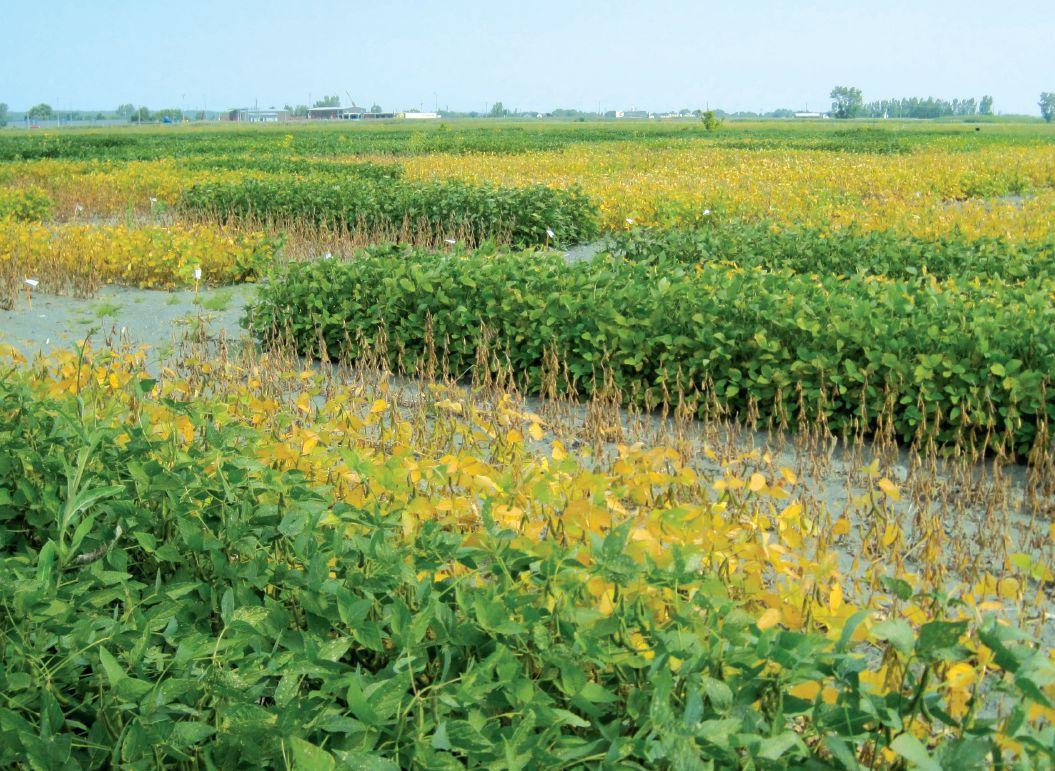
ABOVE: On Aug. 20, this maturity progeny trial conducted at CÉROM in Saint-Mathieu de Beloeil, Que., demonstrated more than 50 varieties were capable of maturing seven to 10 days earlier than the region’s short-season standard.
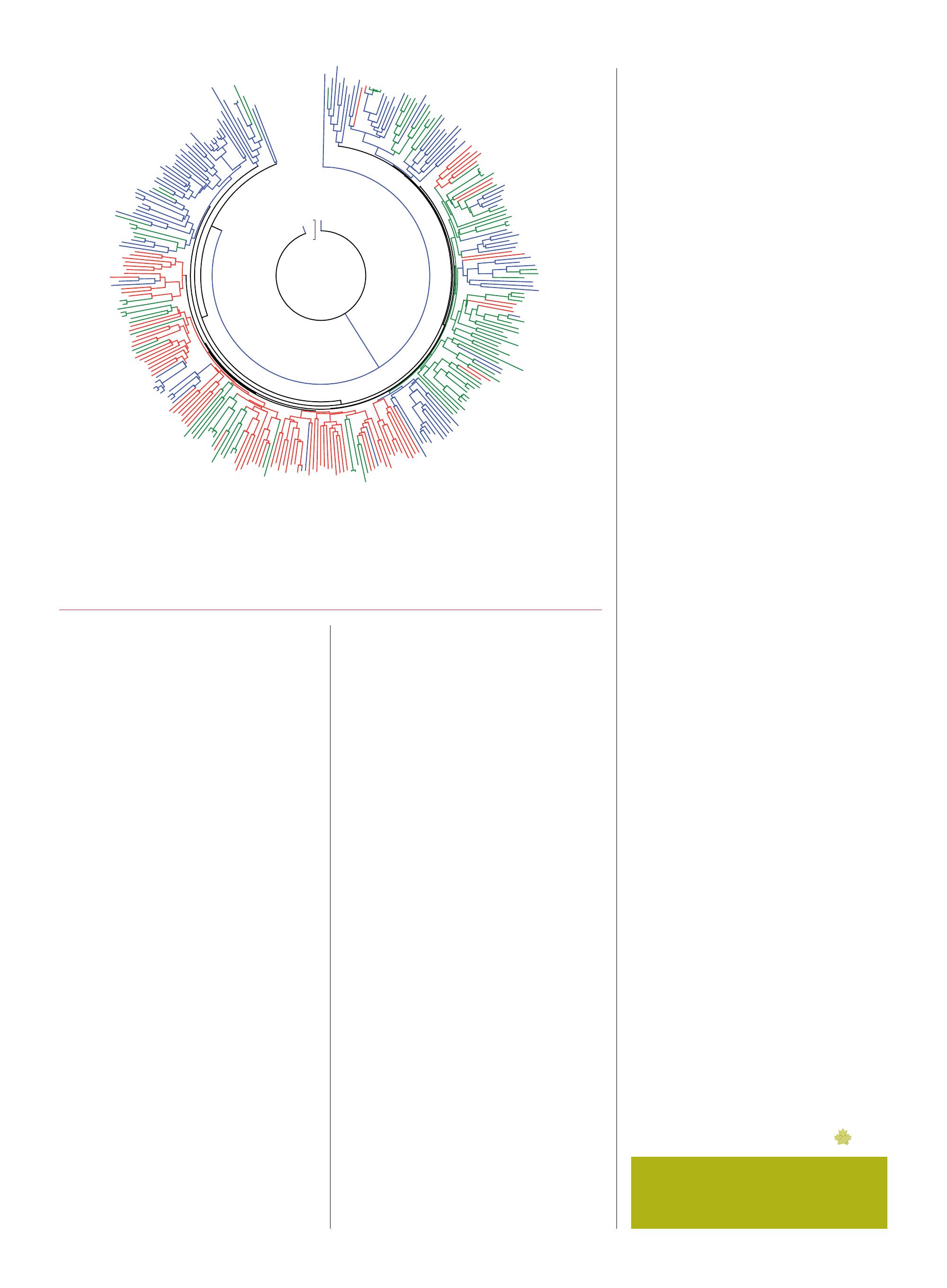
AC Proteus MapleAquilonArrow AC ProteinaACHarmony Fiston MapleAlbinosAltesse 5008KlaxonDonovan 17G 400328B OSG003AC2001 OSG045ACBravorSECAN8-1CSECAN7-38OSG030OSG021DaresOSG012OSG009OSG018 OSG029 4036P13j4035P18jOACNayaOSG026OSG001OxfordMapleOSG042 Isle OSG002 X5106-86BX5106-5BX5105-88BX5105-21BX5105-62BOT11-03X5106-30BX5106-80BOACCapital OACSECAN8-10OAC8-22CAtwood Erin OAC Clinton OAC OACConcordeOSG016Auburn SECAN7 1C OAC7-4CPerthOACGintyOAC4043P2j4043P8j4049P8jOSG033OSG032OAC7-23CSECAN9-13Jari14OAC4OAC7-3C OAC OSG015OAC7-26CChampion
GBS technology adopted by Francois Belzile
eastern europe that are potential parents for early maturity and the collection of lines that represent the eastern Canadian germplasm,” says o’Donoughue. “For the first maturity region analyzed, we found that in the eastern Canadian germplasm, around 40 per cent have the allele that does not confer photoperiod insensitivity or early maturity, but now that we know what allele is present in each of the lines, we can plan crosses to introduce the desired early maturity allele.”
as far as o’Donoughue is concerned, access to such detailed information will accelerate the breeding program and allow more efficient and economical selection of early maturity.
“If I have the markers for the maturity genes I want, I don’t even have to grow all the lines from a given cross, I can just test seedlings and keep only the ones that will be early,” she says.
This year, o’Donoughue says, she’ll even be able to report field results of some crosses made several years ago. It’s too early to report their yield potential, but o’Donoughue says she has at least 50 lines in her trials that have matured seven to 10 days earlier than Tundra, the Quebec standard for early maturity beans. With the genotyping data, she can now understand
why these lines are early. “By understanding better what’s in a particular plant, I can plan my crosses and look at the effects of different combinations of genes to see which ones are the best both in terms of maturity and yield,” she explains.
of course, all breeders know that without adequate yield performances farmers will not be pleased with short-season soybeans. Dr. Steve Molnar is a research scientist at agriculture and agri-food Canada (aaFC) who is also working on short-day breeding, though specifically on the genetic end of the aaFC program. He believes that in order to fully appreciate breeders’ recent accomplishments in improving short-day breeding stock, people need to remember that these scientists don’t have the luxury of being able to focus on just those eight regions of early maturity alone.
“Short season alone is not enough,” he says. “even if you achieve short season, you still need to have lines that perform well for a lot of other characteristics such as protein, oil or sugar content.”
For example, Molnar’s recent work includes a study of early-season breeding stock for improved cold tolerance characteristics. Unfortunately, the gBS method was not available to be used in this eight-year study, but the team was able to
identify varieties that expressed a greater tolerance for low temperatures during flowering, and, when crossed with similar parents, the progeny yield eight per cent more than the progeny of cold-sensitive parents. The challenge for researchers such as o’Donoughue is to match behaviour in the field to what Molnar analyzes in the genetic coding of a plant.
“You can make progress sometimes without knowing why you’re making progress and that’s good, because you can’t argue with success,” says Molnar, “but you may be limited in how far you can go if you don’t really understand why the progress is happening.”
as it turns out, this is exactly the problem Dr. Istvan rajcan, a soybean breeder at the University of guelph and part of the third collaborative team, is facing. after 20 years of success with oaC Bayfield, his team hasn’t ever known exactly how this variety and its progeny, such as oaC Wallace, became the high yielding varieties they are. While the researchers haven’t argued with the results, they also weren’t clear on how to repeat or improve on that performance. rajcan is now on the hunt to see if there are variations within the chromosomes of this line that could be combined with variations in other parents to produce even higher-yielding offspring, and after addressing yield, he says it seems the sky is the limit.
“It’s become fairly important for soybeans that we export to Japan to have a higher sugar content,” rajcan says, “so we can select for sucrose, or isoflavones, or vitamin e, and any number of compounds that are present in the seed could be either reduced or increased based on what we need while maintaining or even increasing seed yield.”
rajcan says the work never goes as fast as anyone would like but the great thing about the emerging culture in this short day breeding world is greater emphasis on collaboration, regardless of geographic and political boundaries. By bringing some of the region’s top public breeders together and pooling their collective data, significant advancements of the short-season bean are nearly inevitable and the effects are bound to filter into private breeding programs faster than ever before.
was used by researchers at AAFC (blue), the University of Guelph (red) and CÉROM (green) to map how closely related Eastern Canadian soybean varieties are. The tool will help breeders to avoid selecting parents from within the same genetic families for future crosses.
There’s a lot of potential in these seeds.
Help realize it with the number one inoculant.
There’s a reason HiStick® N/T is the best-selling soybean inoculant in Canada. It’s the only one that’s BioStacked®. Unlike ordinary offerings, a BioStacked inoculant delivers multiple bene cial biologicals to enhance the performance of soybeans. These help increase root biomass, create more nodules and improve nitrogen xation. Of course at the end of the day, all you have to know is what it does for your bottom line. HiStick N/T out-yields non-BioStacked inoculants by 4-6%. So why settle for ordinary? Visit agsolutions.ca or contact
AgSolutions® Customer Care at 1-877-371-BASF (2273) for more information.
Always read and follow label directions. AgSolutions is a registered trade-mark of
R EDu CED - RATE
A ppliCAT ioNS
Is this spraying practice contributing to herbicide resistance?
by Melanie epp
While research on the implications of using reduced-rate herbicide applications is lacking in ontario, research conducted and reviewed elsewhere can help shed some light on the issue. according to Jason K. norsworthy, associate professor at the Dale Bumpers College of agricultural Food and Life Sciences, University of arkansas, recurrent exposure to low-level herbicide doses that allow any part of the weed population to survive could have unintended consequences. norsworthy makes the case in his paper, Reducing the Risks of Herbicide Resistance: Best Management Practices and Recommendations, published in a 2012 special issue of Weed Science. repeated low doses risk the accumulation of minor genes, which, on their own, may give the weed only a slight edge when it comes to survivability, but if combined with other genes, could actually lead to significant levels of herbicide resistance. Scientists refer to this as “creeping resistance.”
To better understand how herbicide resistance can occur, it’s
especially important to know the reproductive mode of weeds, says Dr. François Tardif, research scientist at the University of guelph. Most weeds are self-pollinating, meaning the plant is fertilized by its own pollen. But some reproduce through crosspollination, transferring pollen from one plant to another. While herbicide resistance is possible in each type, plants with crosspollination can transfer resistance genes more easily. research shows that risk of resistance is much higher when it comes to cross-pollinating species, but not if full-rate herbicide applications are used. In ontario, cross-pollinating weed species include both common and giant ragweed.
So, why use reduced-rate applications in the first place? For some producers, it’s a matter of economics, especially where
ABOVE: OMAF’s Mike Cowbrough says most cases of resistance occur on the outside edges of the field, where spray drift leads to unintended (and often repeated) low-level herbicide applications.
Photos
herbicides are costly.
“although there is a perception that reduced rates provide short-term economic benefits to the growers, especially on lands that are leased, the costs of evolving herbicide resistance exceed monetary savings achieved through reduced herbicide doses,” states the norsworthy paper. Tardif adds that while farmers might be willing to reduce herbicide rates to cut costs, they won’t do so if weed control is compromised.
according to Mike Cowbrough, ontario Ministry of agriculture and Food (oMaF) weed specialist, since herbicide costs aren’t particularly high, the savings from using reduced-rate applications are minimal.
“If anything, the inexpensiveness of glyphosate has probably erred people on being more generous than being more frugal or cutting rates,” he says. “Cutting rates usually comes about when something is expensive, so when something’s cheap you tend to not worry as much.”
More often than not, reduced-rate applications are completely unintentional. Since producers try to get as close to 100 per cent control as possible, most cases of resistance do not occur in the middle of fields. They do, however,
occur on the field’s peripheries, where spray drift leads to unintended, and often repeated, low-level herbicide applications. Unintended low-rate applications can occur in a number of situations, such as where soil-applied, slow-degrading herbicides deliver sublethal levels to later-emerging weeds, especially in fields that see the same herbicides used over multiple growing seasons. Low-rate applications also occur when plants that are larger than recommended receive inadequate coverage. Inadequate coverage can also be the result of plant density and crop cover.
Understandably, it’s not always easy to get weeds at the right size. Challenges arise particularly in large operations where spraying in one day is next to impossible. others are challenged by labour shortages, and unfavourable weather conditions can make it tough to get into fields.
“Some of the smaller farms may not have their own sprayer, so they will hire a custom applicator who will do spraying for them,” says Tardif. Those companies will have a work list to go by and will sometimes work in less than perfect conditions, he adds.
Weed identification itself can be a challenge for some producers, Cow-
brough says. He’s been posting weed identification quizzes on www.fieldcropnews. com since april 2013, and while misidentification could be a result of the quiz itself – identifying weeds through web images is certainly much more challenging than doing it on the ground – Cowbrough says results have been somewhat poor.
“at a very broad genus level, I think producers and agronomists are pretty good,” says Cowbrough. “They can get it down to a family. They can get it down to a genus. It’s a bit tougher to get it down to a species, and that sometimes shines a light on why a herbicide is starting to fail or there’s a shift in populations.”
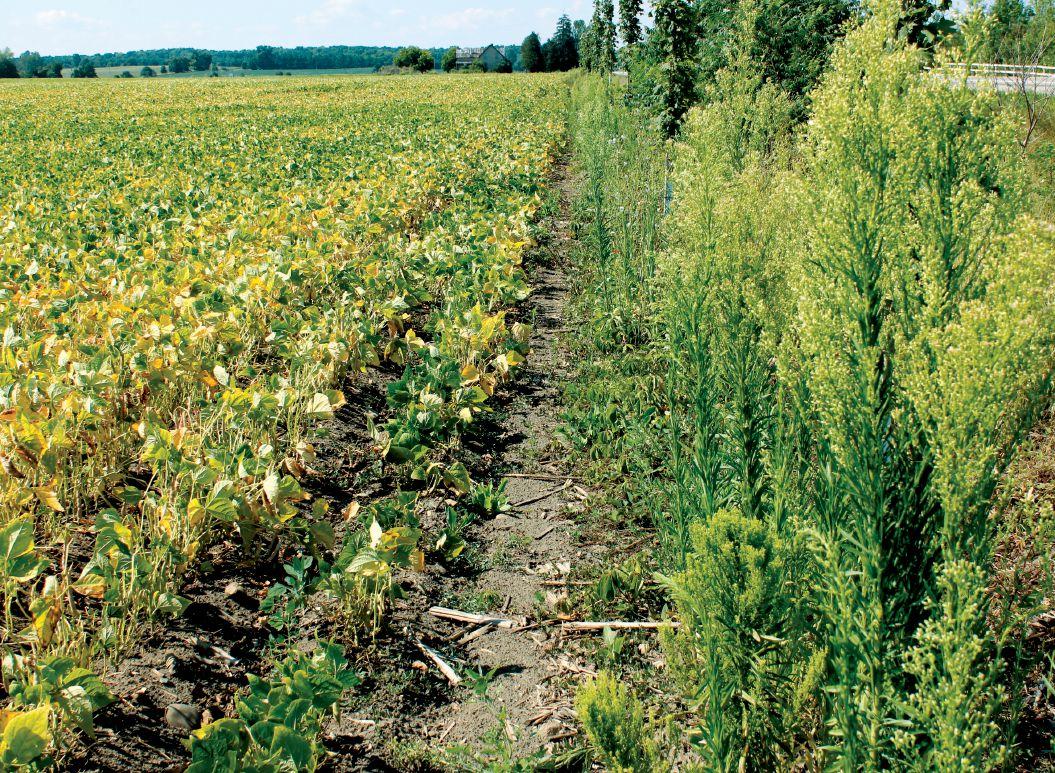
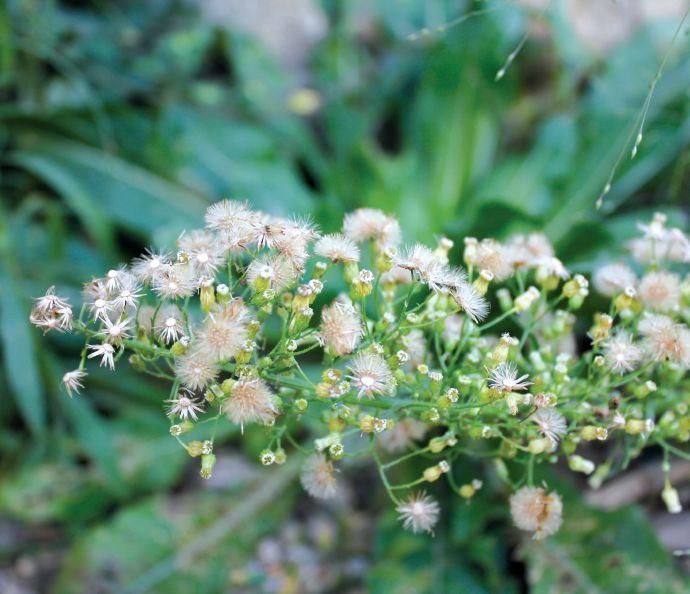
Misidentification is understandable, says Cowbrough, because it’s a very small portion of a farmer’s day-to-day activities. There are a lot of species – and a lot of look-alike species. of all the weed species in ontario, Cowbrough says, Canada fleabane is most often misidentified. He is currently working on a weed identification guide, which should help producers to better identify individual weeds.
While some of the challenges producers face are certainly beyond their control, others are not. precise sprayer calibration, for instance, is well within the producer’s control, as is correct mixing. When it comes to correct mixing, though, Tardif says there’s usually a little wiggle room.
“even if environmental conditions are not favourable, there’s usually enough active ingredient present to still get good control,” he says. “Some farmers may go with a three-quarter- or half-rate and find it works fine one year. What may happen the next year, though, is that that reduced rate may not be as effective.”
So, while reduced-rate herbicide applications are known in some cases to contribute to herbicide resistance, it’s not as bad as one may think. Follow the label and be sure to apply at the right plant size (keeping in mind that there is some wiggle room). pay attention to rotations, and don’t overuse the same modes of action. Most importantly, know your weeds. If it’s a problem weed, herbicides should be applied at the full, recommended rate.
Weed identification often can be a challenge when it comes to reduced-rate applications, according to OMAF’s Mike Cowbrough, who notes Canada fleabane is often misidentified.
Edmonton EXPO CENTRE at Northlands
FarmTech™ 2014 Speakers
Chris Hadfield
Astronaut, Former Commander of the International Space Station FarmTech™ 2014 Banquet
Michael Clemons
CFL Legend, Toronto Argonauts Vice-Chairman
Dr. Lutz Goedde McKinsey & Company
R.L. (Dick) Wittman Wittman Farms Consulting
Leona Dargis
Canadian Nuffield Scholar
Canada’s premier crop production and farm management conference.
FarmTech™ 2014 features an outstanding line-up of speakers delivering more than 65 concurrent sessions covering the latest in technology, environment, agronomy and farm business management.
The Agricultural Showcase is home to the most innovative companies displaying their products and services along with special events and networking opportunities.
Senior exeCutive finanCial ConSultant inveStorS Group finanCial ServiCeS inC. | paul r vaillanCourt, Cfp, Clu, CHS and CpCa
A DDRESSi Ng pERS oNA l ASSETS
as a farm owner, you spend considerable time focused on your production and business operations. You’re always thinking about how to improve results, adopt new ways of farming, and meet your customers’ needs. What about your personal assets and their yields? When was the last time that you thought about your savings or how much money you need to fulfil your dreams and eventually retire? are you getting the returns that you should? are you paying the least amount of taxes possible? perhaps it is time to look at the things that you should take care of now before the year is up.
Maximize children and grandchildren’s Registered Education Savings Plans (RESP)
You want to do all you can to provide your child or grandchild with opportunities to succeed – to afford the college or university of their choice, follow their dream career, and attain the earning power they desire. a post-secondary education will undeniably help them get there. a contribution of $5,000 to an reSp before Dec. 31 may generate up to $1,000 in basic Canada education Savings grant from the government – a 20 per cent return.
Top up your Tax-Free Savings Account
a Tax-Free Savings account can benefit any Canadian (18 years of age or older) to save for a short- or long-term goal. You can contribute up to $5,500 per year and watch your savings grow without being subject to tax throughout your lifetime. Your unused contribution room accumulates year after year.
If you haven’t opened an account yet, you can contribute up to $25,500 in 2013 and reduce taxes on your non-registered investments. If you have contributed regularly, set aside money now and make your full contribution come Jan. 1.
Contribute to your RRSP
one of the main advantages of contributing to a rrSp is the deferral of tax on investment income and capital gains. In order to take maximum advantage of this benefit, contribute to an rrSp as early as possible. remember, while most Canadians have until March 1, 2014, to make rrSp contributions that can be deducted on this year’s tax return, those turning 71 this year must make their rrSp contribution by Dec. 31, 2013.
Convert your RRSP to an RRiF
If you are turning 71 years old this year, your rrSp has to be collapsed by Dec. 31 by converting it to a registered retirement Income Fund (rrIF). an rrIF funds your retirement by providing payouts. payouts are fully taxable as income to you, but the remainder of the rrIF assets continues to grow and accrue income on a tax-deferred basis. The rrIF payment should be based on the age
of the younger spouse, thereby reducing the amount of the payout and the taxes payable. You should consider an annual payout and make the withdrawal on Dec. 31 of each year to maximize the taxdeferred growth.
Trigger capital gains or capital losses
If you anticipate capital gains from your non-registered investments, consider triggering losses by selling your funds that are at a loss. The “sale” must be settled by Dec. 31 in order to be applied against this year’s capital gains.
Make charitable donations
If you want your donations to be eligible for a tax credit this year, you need to contribute by Dec. 31. a charitable donation reduces provincial tax and federal tax. For example, if you’re an ontario resident and you donate $1,000, your total federal and provincial tax credits would be $361.38, or 36.38 per cent in tax savings. However, in addition, ontario applies a surtax. For 2013, an ontario resident who had taxable income of at least $104,000 (and thus would be subject to the surtax) would receive tax savings on a charitable donation of 46.41 per cent. Combine your donations with your spouse to maximize the credit.
Pay certain expenses
Some expenses are eligible for credits or deductions provided that they are paid before Dec. 31. These expenses include moving expenses, child-care payments, spousal support, tuition fees, union or professional dues, interest on student loans, medical expenses, investment counsel fees, and safety deposit box fees. Make sure to pay these before year-end.
Give non-cash gifts to employees
as a business owner, you can give an employee up to two “noncash” gifts per year, and up to two “non-cash” awards per year, as long as the total cost (including tax) does not exceed $500. The gifts are not a taxable benefit to the employee. The cost of the gifts is a tax-deductible expense for the employer.
Taxes are a fact of life – but keeping more of what you earn by paying less in taxes should be an important component of your overall financial plan. Your financial planner can help you identify and implement the most effective tax-smart strategies for your situation.
This is a general source of information only. It is not intended to provide personalized tax, legal or investment advice, and is not intended as a solicitation to purchase securities. Paul Vaillancourt is solely responsible for its content. For more information on this topic or any other financial matter, please contact an Investors Group Consultant.