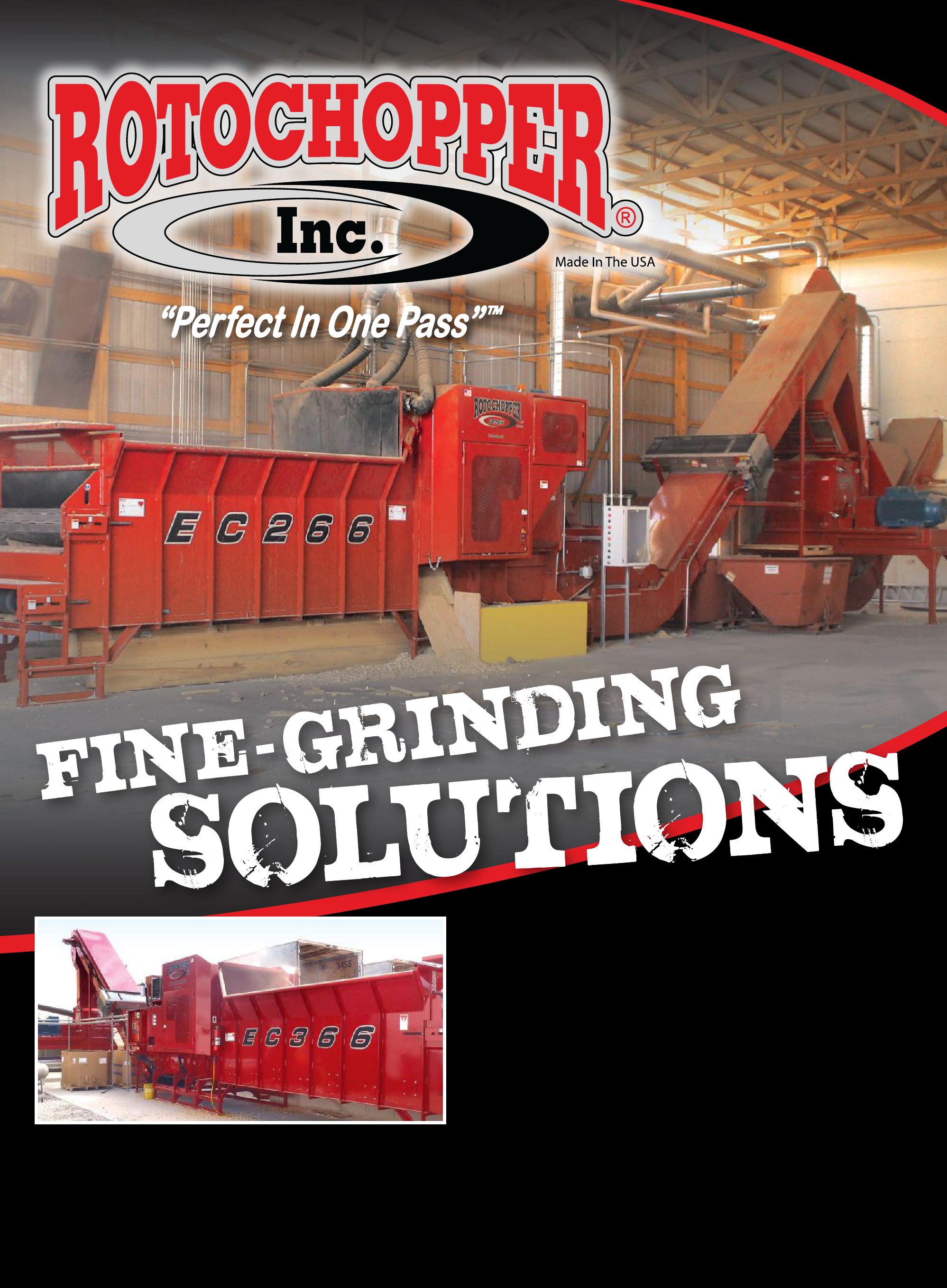
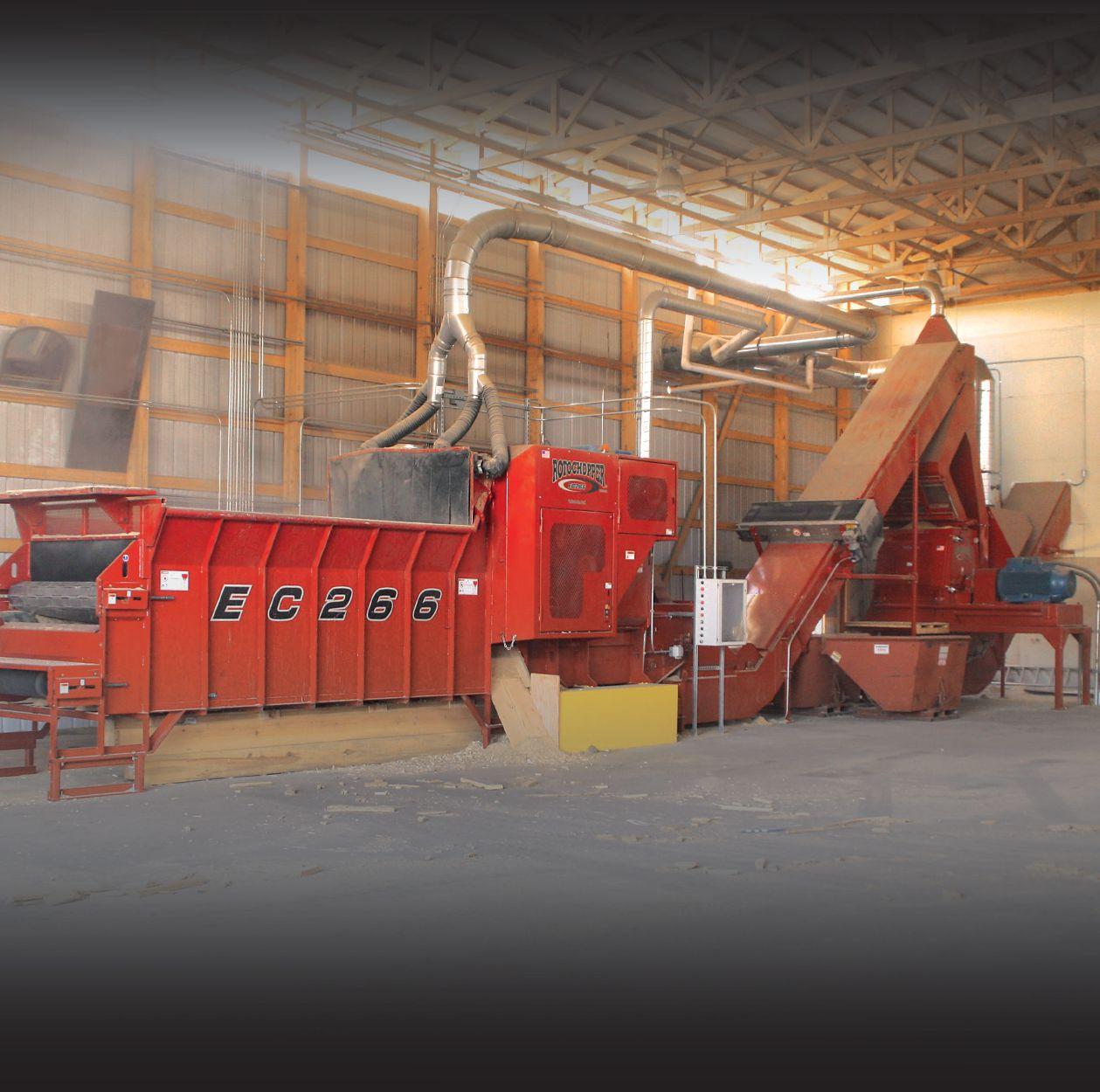
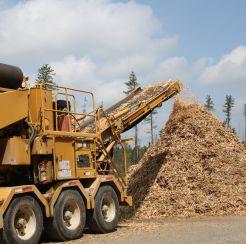
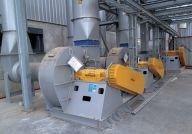
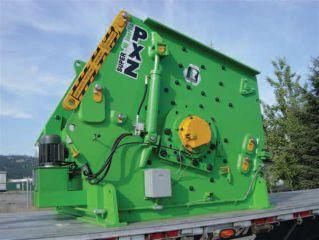
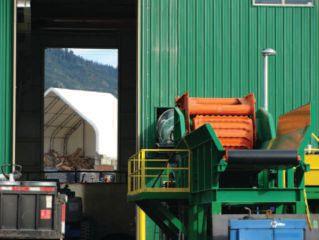
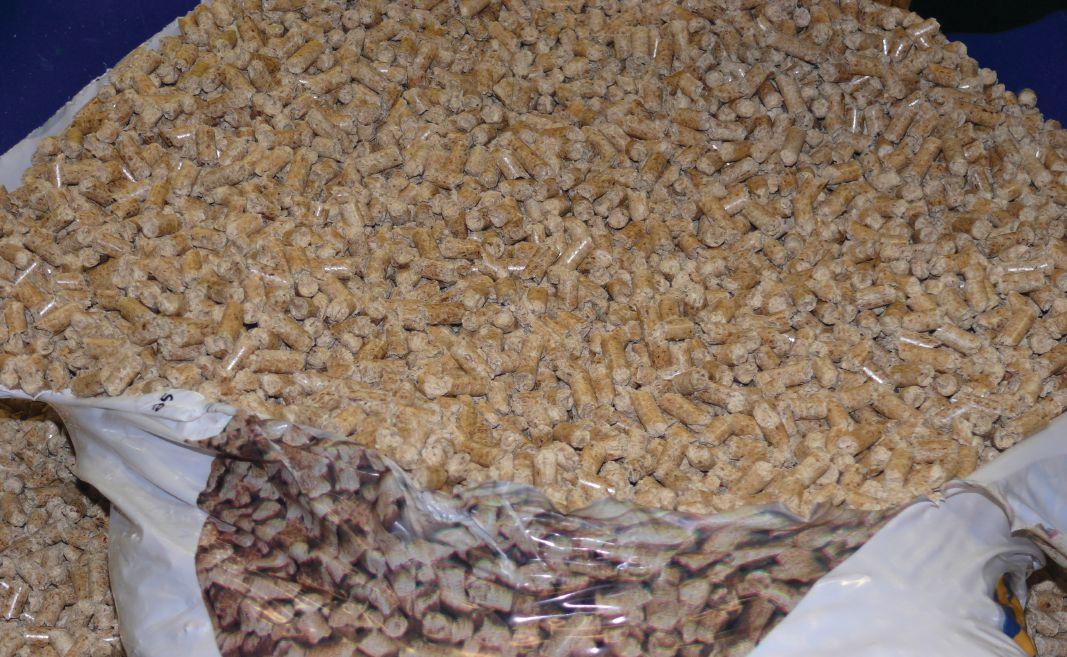
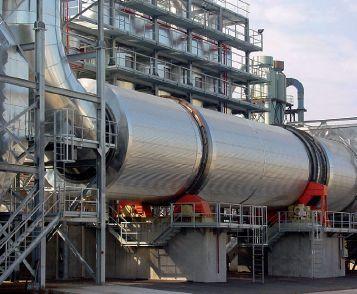
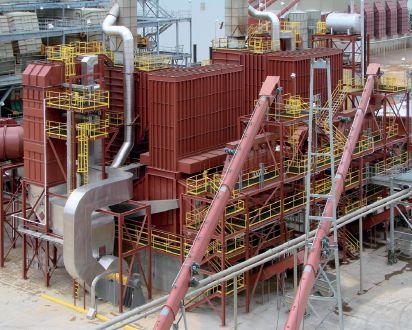
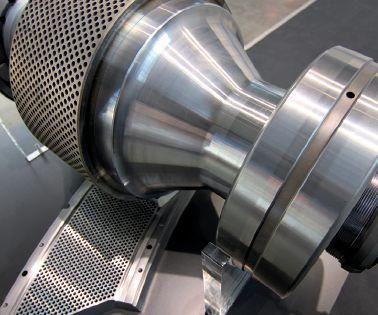
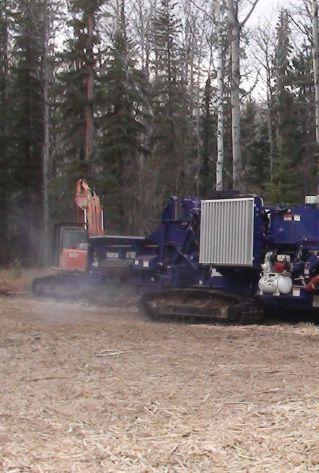
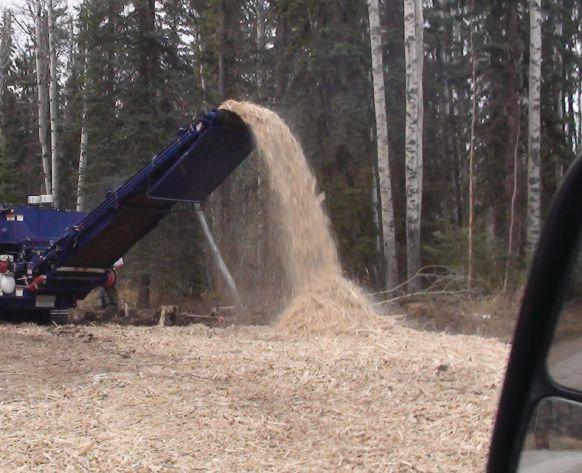
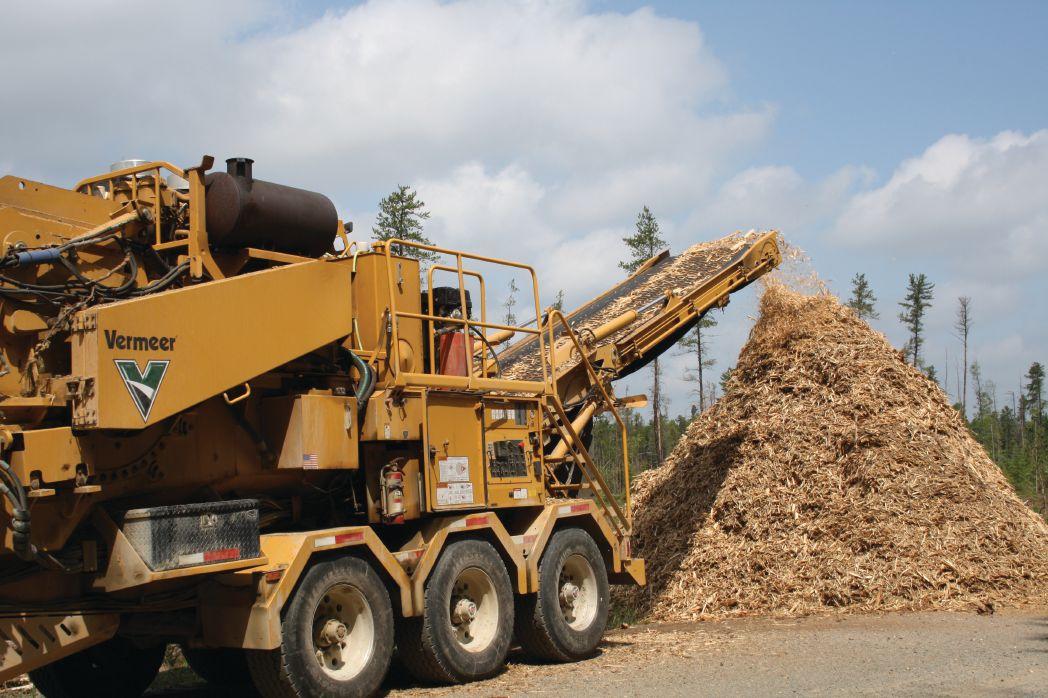
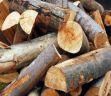
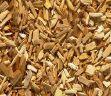
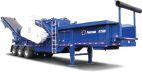
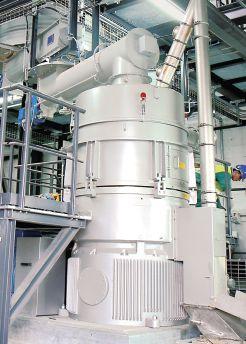
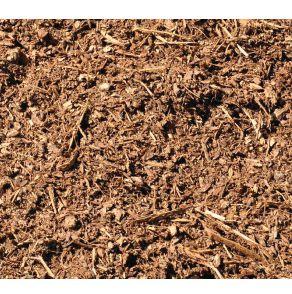
Rotochopper multi-stage grinding systems offer singlepass simplicity for producing animal bedding and short fiber fuels. Wood waste goes into the primary grinder and comes out of the in-line hammermill at finished specifications—no additional handling or hassle.
• Most uptime
• Cleanest operation
• Easily integrated into picking lines
• Unmatched particle size control
• Lowest cost per cubic ton
In-Line Hammermill
CANADIAN BIOMASS
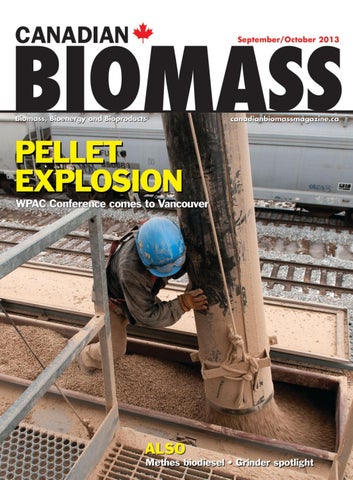
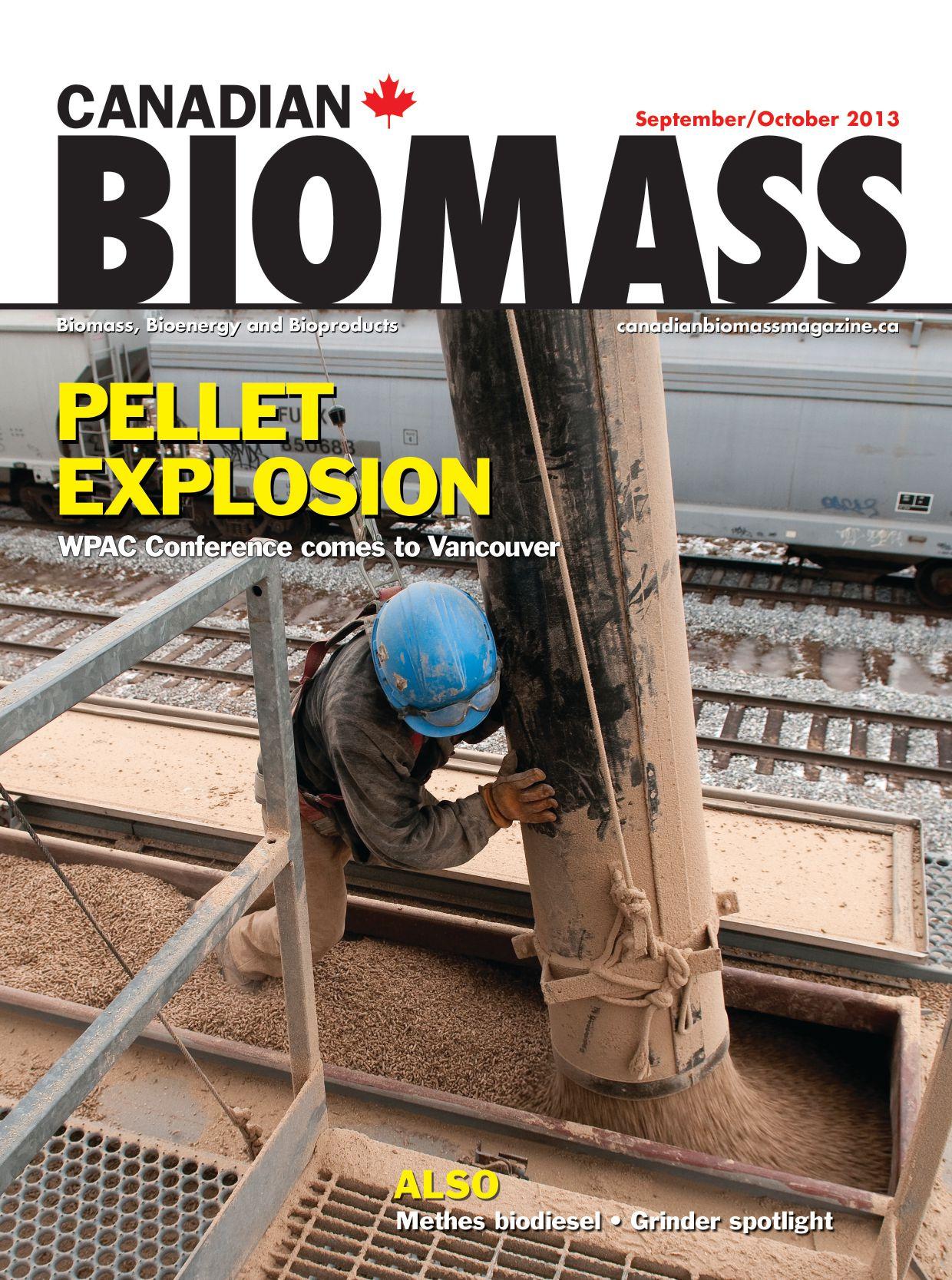
15 Bringing the Heat
A U.S. company is working to convince midsized businesses of the benefits of using pellet heat versus heating oil.
19 WPAC Show Guide
Canadian Biomass has your exclusive guide to the 2013 Wood Pellet Association of Canada AGM and Conference.
24 Grinding in Canada
Biomass contractors across Canada talk about the equipment they use to make their cut.
30 AgBiomass Conference Report
Our exclusive look back at the 2013 AgBiomass Conference in Ottawa.
OA national partnership
Government, associations need to follow the U.S. lead
n Sept. 12, the Pellet Fuels Institute announced it had joined the U.S. Department of Agriculture and three other biomass groups in signing a memorandum of understanding that says they will work together “to jointly grow and promote the wood to energy sector.”
This news is a positive development for the biomass market in the United States as both association and government interests come to the table to work together on industry initiatives and strengthen co-ordination within the industry.
It is news that should create a call to action for the biomass industry in Canada.
important steps need to take place.
First, the industry needs to come together for the greater good. Business and political interests must be left at the door. No secondary agendas can undermine such an endeavour. It needs to be a concerted effort throughout industry associations across the country. The bottom line is that all sectors would benefit from a more unified approach.
Such a partnership would not only strengthen co-ordination but also serve as a catalyst for stronger negotiations between the biomass industry and provincial governments on access to fibre. Currently, organizations such as WPAC are having little success getting the government to seriously consider the needs of the wood-to-energy market. An agreement similar to the one reached south of the border could change all of that and finally put the needs of biomass producers at the forefront of the discussion.
It’s also important to consider what such an alliance could contribute to the development of a stronger domestic bioenergy market. Yes, there are opportunities for expanded use of bioenergy coming from coal conversion projects in some provinces, as well as some small-scale institutional and commercial programs. But many other opportunities exist, such as providing pellet power for remote communities, that could be influenced by a stronger working relationship with the right government agencies.
But before all of this can happen, two
Second, the government needs to be engaged in an educated and thoughtful manner. Egos and prior agendas must be set aside to realize the overall potential of what the PFI/USDA model could provide. The environmental impact, cost savings, job creation and sustainable wood supply that would come from the expansion of the bioenergy market all would have to be clearly outlined with accurate figures that show the overwhelming benefit of such an expansion. These figures would demonstrate how vital the role of the federal government is in spearheading the initiative.
Most importantly, there is now a road map to follow to create an important partnership between the industry and the government departments that have influence over it. Our colleagues to the south have created the necessary tools we need to make this a reality. It’s time to talk with them to find out how they all came together to help move the industry forward.
Their agreement couldn’t have come at a better time, or a more important time, in the development of the bioenergy sector in Canada. •
Andrew Macklin, associate editor amacklin@annexweb.com
Copy - $9.00 (Canadian prices do not include applicable taxes) USA – 1 Yr $60 US; Foreign – 1 Yr $77 US
Occasionally, Canadian Biomass magazine will mail information on behalf of industry-related groups whose products and services we believe may be of interest to you. If you prefer not to receive this information, please contact our circulation department in any of the four ways listed above.
Don’t lose the megawatts trapped in your waste wood. Install our Organic Rankine Cycle (ORC) biomass system to convert logging and mill residues or insect-affected wood – virtually any highorganic-content waste – into clean, renewable electricity. ORC units generating 1 to 10MW can be easily integrated into your process. Find out how to turn biomass into megawatts, reduce your carbon footprint and bring savings to your bottom line. Visit www.pwps.com or call 1-866-PowerALL (1-866-769-3725) to learn more.
INDustrYnews
bIoAmber gets feD help to buIlD bIo-Chem plANt
BioAmber Sarnia’s new bio-based succinic acid plant, the first commercial scale production plant of its kind, will receive a $12-million investment from the federal government to support its construction in Sarnia.
The plant is expected to create 150 construction jobs and 60 permanent jobs once the plant is operational at the end of 2014. BioAmber Sarnia is a joint venture between BioAmber Inc. (70 per cent), and Mitsui & Co. (30 per cent), one of Japan’s largest trading houses. BioAmber has partnerships with several market leaders, including Cargill, DuPont Applied Biosciences, Mitsui & Co. and Mitsubishi Chemical.
Succinic acid is a chemical used in the manufacturing process of many everyday products, such as plastics, cosmetics, automotive parts and construction materials. BioAmber has developed a proprietary process to produce bio-succinic acid sustainably from renewable feedstocks instead of petroleum.
“We are grateful for the support given by FedDev Ontario to BioAmber Sarnia to build a commercial scale bio-based succinic acid plant and in helping develop a new bio-based chemical cluster in Sarnia,” said Jean-François Huc, president and CEO, BioAmber. “This initial 30,000-tonne capacity plant is an important step in changing the way the world makes products that historically have only been made through the traditional petrochemical route.”
tembeC seCures fuNDINg for CogeN proJeCt
Tembec has secured an additional $27.8-million loan to fund a portion of the Temiscaming, Que., specialty cellulose cogen project.
Tembec has entered into an additional loan in the amount of $17.8 million with Investissement Québec and has entered into an amended and restated credit agreement with Integrated Private Debt Fund III LP, as Agent for the project’s senior lenders, increasing its credit facility by $10 million. This additional $27.8 million in loans increases the total project financing to $132.8 million, with IQ now committed to $92.8 million of the financing and IPD committed to $40 million.
The completion of the boiler portion of the project is scheduled for April 2014 and the startup of the turbine should occur in September 2014.
BIOMASS SOLUTIONS TO POWER TOMORROW
ProcessBarron has 30 years of experience designing and fabricating biomass fuel, air & ash handling systems. ProcessBarron has the know-how to get the most out of your biomass systems.
pfI reAChes mou wIth usDA, INDustrY groups
The Pellet Fuels Institute (PFI) recently joined the U.S. Department of Agriculture (USDA) and three additional biomass groups in signing a memorandum of understanding (MOU) signifying a commitment by the federal government and industry to jointly grow and promote the wood-to-energy sector.
The MOU recognizes the shared goals and interests amongst the signers in expanding the use of wood to energy: creating local jobs, increasing affordable heating and electricity options for rural Americans, improving forest health, reducing wildfire risks, and promoting efficient biomass technologies across residential, commercial and industrial segments of the wood energy arena.
The Biomass Thermal Energy Council, the Biomass Power Association and the Alliance for Green Heat are also involved in the new agreement.
eN erkem, g ree NfI el D to bu I l D
Enerkem and GreenField together will build and operate a cellulosic ethanol facility integrated with GreenField’s existing ethanol plant in Varennes, Que.
The VANERCO project will receive financial support from the Canadian government through the Sustainable Development Technology Canada NextGen Biofuels Fund. Through the fund, $734,500 will support the initial development of the facility as a repayable contribution, an amount that could go up to $39.8 million.
The non-recyclable waste to be used at the VANERCO facility will come from institutional, commercial and industrial sectors, and from construction and demolition debris. Construction of the facility, which will use Enerkem’s proprietary waste-tobiofuels technology, is planned to begin in 2014. The plant is expected to produce 38 million litres of cellulosic ethanol annually at full production.
Conifex Timber Inc. recently announced it has received $100 million in project financing that will allow the company to restart its planned 36-megawatt bioenergy power project in Mackenzie, B.C. Conifex expects to receive formal commitment for the project financing shortly.
Conifex estimates that the bioenergy project, using a 36-megawatt steam turbine, will be able to produce 230 gigawatt hours of energy each year and generate annual revenues of approximately $25 million annually.
Processing Systems for Bioenergy
Liberating
Untapped Energy
A worldwide leader in size reduction technology for bioenergy, Vecoplan works with individual customers to design, engineer, manufacture and implement technologically advanced, material specific, and application specific shredding, ferrous and non-ferrous removal, size and density separation, screening and classification technologies and extremely efficient conveyor and bulk material handling, metering, storage and unloading technologies.
Contact Vecoplan today to learn more about our existing systems or to arrange a visit to one, or several, of our installations.
Phone: (336) 252-4774
Co NI fex restA rts b I oe N erg Y pro J e C t
A little perspective
Improving fibre security and affordability for B.C.’s wood pellet industry should be a government priority.
By Gordon Murray
Water, water everywhere … nor any drop to drink”
The Rime of the Ancient Mariner relates the experiences of a sailor who has returned from a long sea voyage. The mariner’s tale begins with his ship departing on its journey. Despite initial good fortune, the ship is driven south by a storm. The wind dies and the ship is stranded in a vast ocean. One by one, the crew dies of thirst despite being surrounded by water, leaving the mariner as the only survivor. Finally – near death – he is rescued.
This story brings to mind the current plight of the British Columbia wood pellet industry. As I pointed out in my July-August column, the problem is that despite giving us repeated assurances since 2008, the B.C. government, in its role as landlord over the province’s public forests, has still not delivered any meaningful way for pellet producers to obtain fibre supply security.
One easy way for the B.C. government to increase fibre supply for the wood pellet sector would be to ban slash burning across the province, similar to the way in which it banned the use of sawmill waste-wood beehive burners beginning in 1995. Presently, B.C.’s Forest Act does not provide mandatory utilization standards for primary forest tenure holders. The government allows the province’s lumber industry to harvest public forests, remove only the best timber and burn the rest – some 9.3 million dry tonnes annually (Table 1) – charging lumber producers nominal or zero stumpage for whatever timber they choose to waste. The amount of wood fibre being burned and wasted by B.C.’s lumber industry is six times greater than the total annual production of B.C.’s wood pellet industry. It is a common experience for pellet producers to reach out to B.C.’s lumber producers in an attempt to obtain access to leftover low-grade logs, branches and tops, only to find that those lumber producers prefer to burn this material rather than allow the pellet industry to have access to it. This is an egregious waste of a precious public resource that the B.C. Government should be preventing.
Particulate emissions from open burning are a serious health hazard, especially for B.C.’s children. According to Dr. Michael Brauer, a professor in the Faculty of Medicine at the University of British Columbia, particulate emissions from wood smoke cause a 32 per cent increase in middle ear infections and is the top reason for children under the age of two years to see a physician and be prescribed antibiotics. And wood smoke particulates cause an eight per cent increase in bronchitis in children and is the number 1 reason for children under the age of one year to be hospitalized. Even the B.C. government, in its 2008 Air Action Plan, acknowledges the dangers of particulate emissions by stating, “PM [particulate matter] is a serious health
For sustained growth, B.C. pellet mills need access to underutilized fibre like harvest slash.
COMPREHENSIVE PRODUCT & SERVICE PROGRAM FOR THE WOOD PELLET INDUSTRY
With 50 years of experience in the wood processing industry we offer a complete air filtration program for all production areas of wood pellet mills. Our product line includes customized systems for air extraction, dust collection, pneumatic conveying, air filtration and dryer exhaust gas cleaning.
Dry
Scheuch Inc. 2351 Huron Street, Unit 1, London, Ontario, N5V 0A8, Canada
Phone: +1 (519) 951-7700 I Fax: -7711 office@scheuch.ca www.scheuch.ca
concern, as it can cause diseases such as emphysema, chronic bronchitis, asthma and lung cancer. Because PM is composed of tiny particles invisible to the human eye, it can be inhaled deeply into our lungs.”
According to the Air Action Plan, slash burning is the number one source of B.C. particulate emissions, accounting for 32 per cent of all particulates in the province. This means that by banning slash burning in the province the B.C. government could not only provide a reliable source of fibre for B.C.’s pellet industry, but also dramatically reduce B.C.’s air pollution and in so doing, protect our childrens’ health.
Like the ancient mariner staring at a sea of undrinkable water, the pellet industry watches the BC lumber industry burn our forests. The government could easily stop this waste of our forests by banning slash burning and compelling tenure holders to utilize wood waste – either internally or by selling it to those who could use it. •
Gordon Murray is executive director of the Wood Pellet Association of Canada. He encourages all those who want to support and benefit from the growth of the Canadian wood pellet industry to join. Gordon welcomes all comments and can be contacted by telephone at 250-837-8821 or by e-mail at gord@pellet.org.
log harvest – bdt (@ 2.45 bdt/m3) (bdt)
Data sources: B.C. Ministry of Forests, Lands, and Natural Resource Operations, B.C. Forest Practices Board, and WPAC calculations
Wet and
Electrostatic Precipitators | Cyclones | Bag Filters | Pneumatic Conveying Systems | Fans | Rotary Valves
Taking the next step
Methes Energies uses demonstration plant model for full-scale success.
By Andrew Macklin
WHen
Nicolas Ng and John Loewen started Methes Energies almost a decade ago, they had little knowledge about making biodiesel and even less working capital. After years of research, studying the market and analyzing the technology, Methes Energies is almost ready to open its first full-size biodiesel production facility, which uses its own patented technology.
In 2004, there wasn’t a ton of activity in the biodiesel market in Canada. There was no government mandate for the use of biodiesel, nor was there any established quality standard. The United States was a different story, and that was where Ng and his partner saw an opportunity. They began doing research online to understand the process and how difficult biodiesel would be to make. From their research, it looked as if it were fairly easy to make, so they went and bought a few reactors to begin the process.
“We tried to make biodiesel ourselves to get to know the process,” explains Ng. “We quickly found out that it was actually very difficult to make biodiesel, especially on the commercial level. We found out it was even more difficult to meet the ASTM (American Society for Testing and Materials) specifications.”
The complexity of the process caused Ng and Loewen to spend the first 18-24 months as a company learning the process of making biodiesel fuel that would meet ASTM requirements and be a marketable product in North America. During that time, they realized that because competing with major manufacturers across Canada and the U.S. would not be realistic at this stage in the life of their company they would have to find a niche for themselves within the biodiesel marketplace.
“We figured out that, if there is a way we could develop a product to help an entrepreneur get into the biodiesel industry, there are places in North America and Europe where a small-scale production facility could make sense economically,” says Ng.
As a result, Methes Energies then went on a different path: one that would provide a framework for entry into the biodiesel market. After months of research and development, the company created a system that would fit the market by producing five million litres of biodiesel per year: the Denami 600 biodiesel processor.
Once the system was developed, the team at Methes tested a
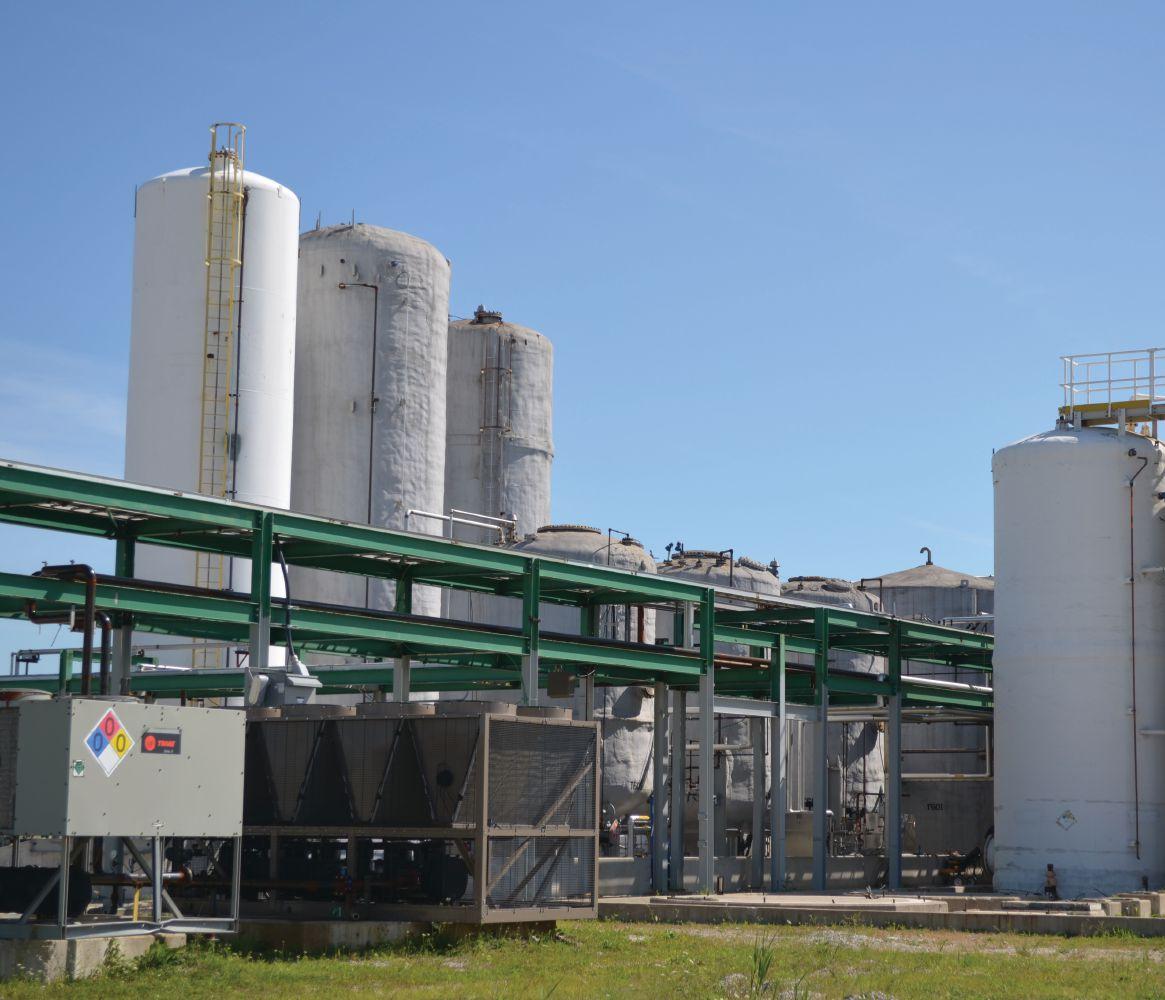
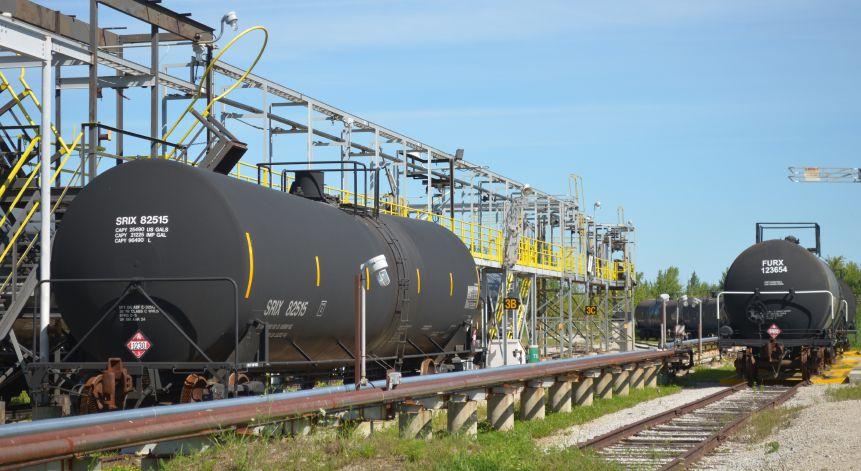
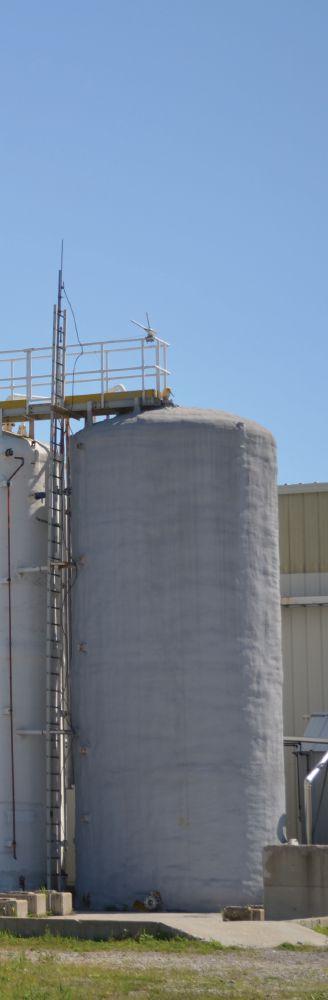
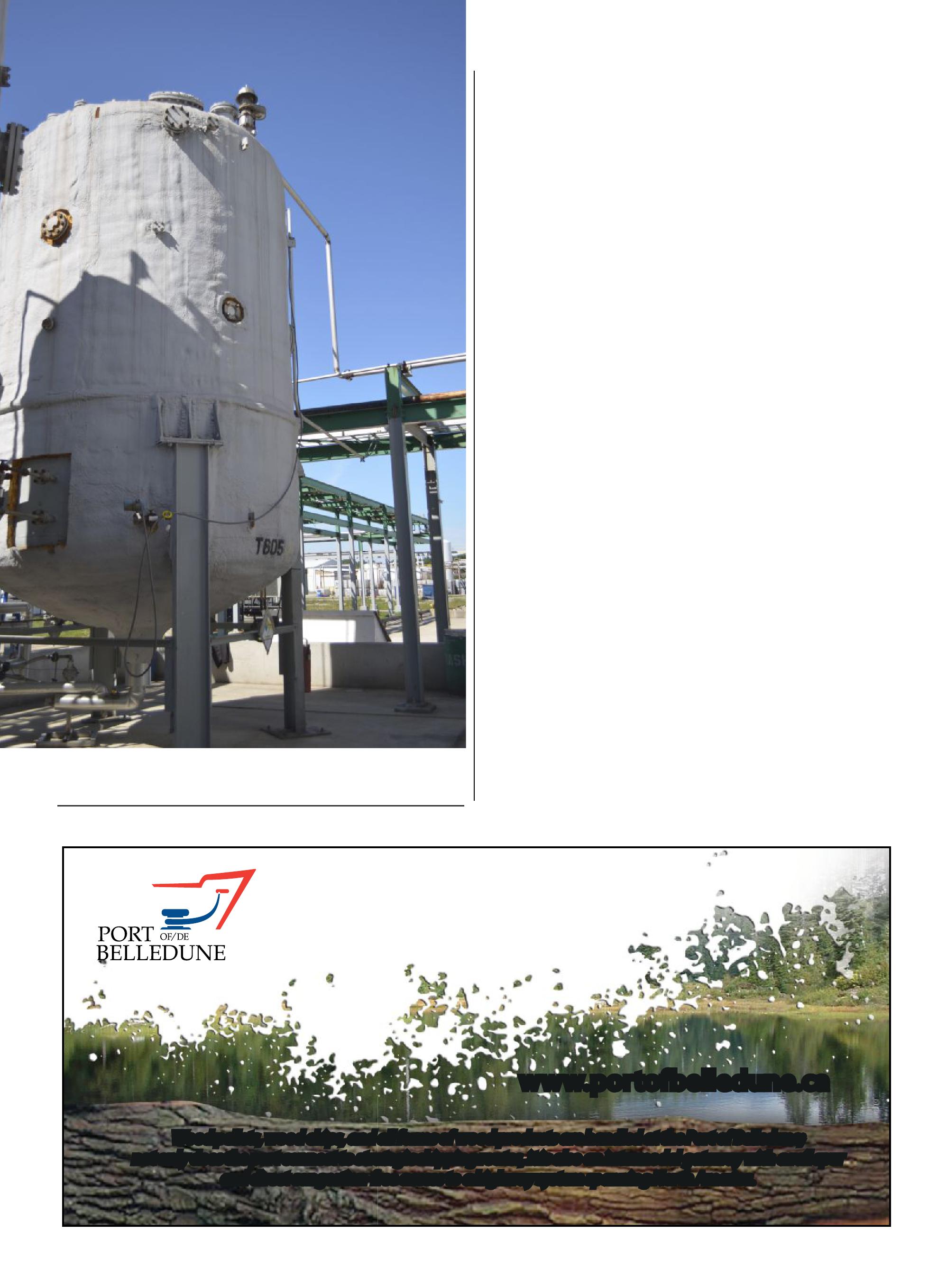
LEFT MAIN: Methes Energies’ new biodiesel plant is located on the former Chinook Chemical site in Sombra, Ont.
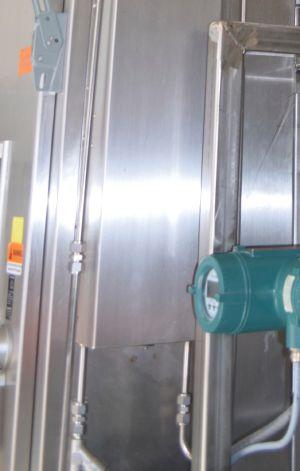
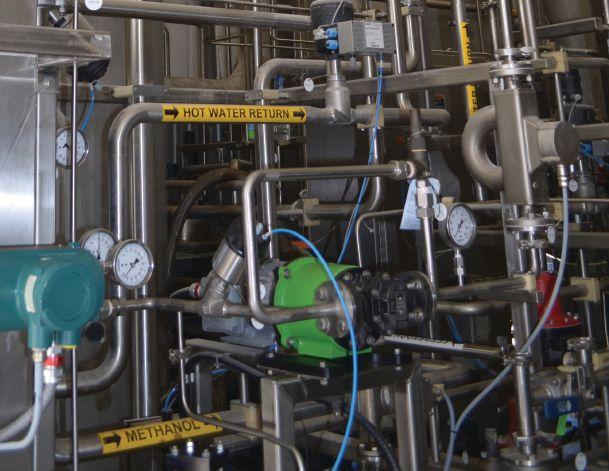
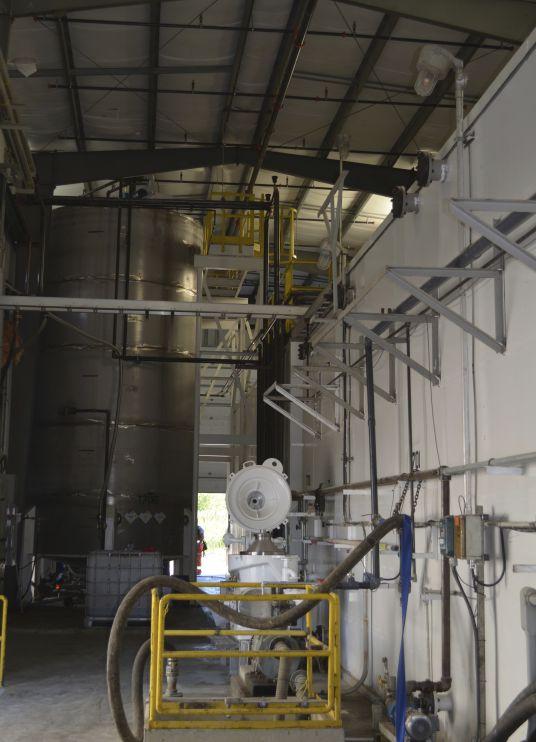
LEFT TO RIGHT: The existing rail infrastructure at the former Chinook Chemical site was one of the most appealing features that led to Methes Energies’ purchase of the property. This filtering system removes trace amounts of methanol and glycerin, an important step in meeting ASTM requirements.
variety of high-grade and low-grade feedstocks in order to ensure that the Denami could process all of them into ASTM-grade biodiesel. The demonstration plant was constructed at their current location in Mississauga, where the company was able to test virgin cooking oil, high-grade used cooking oil, refined oils, pork fat, lard and food-grade beef tallow. By early 2008, the Denami 600 was performing up to or above company expectations with all of the feedstocks, and Methes began selling ASTM-grade biodiesel to the commercial market.
AN opportuNItY to expAND
In 2009, with Methes having ramped up production of biodiesel at its demonstration plant in Mississauga, the company decided to look into the possibility of developing a commercial-scale plant. It wasn’t known if the expansion would take place in Canada or the United States, but it was preferred that the site be as close to the Mississauga operation as possible.
By complete fluke, Methes had an almost perfect location fall in its lap. Nicolas was discussing the expansion plan with colleagues when a person at another table overheard the conversation and approached Nicolas. The gentleman at the other table was part of a team that was in the process of decommissioning the Chinook Chemicals site in Sombra, Ont., located south of Sarnia along the St. Clair River.
Within 15 days, Ng and his team had toured the site and purchased the facility, which appealed for three reasons: First, already on site were a number of components such as tanks and piping, many of which could be used for biodiesel production once they were cleaned. Second, the location boasted solid rail infrastructure. Finally, the proximity to the U.S. border made it easier to transport feedstocks to the site and biodiesel from the site.
In order to afford an investment in commercial production in Sombra, Methes Energies took advantage of an opportunity to get federal funding through the government’s ecoENERGY for biofuels program. The program, which committed over $1 billion to biofuel grants over a nine-year period, provided the financial investment needed to push the project forward. In September 2009, the Ministry of Natural Resources announced that Methes would receive up to $5.4 million for the project.
a
Wood pellets, wood chips, and all forms of wood products are handled at the Por t of Belledune; not only does the por t connect to strategic shipping routes, it is also an intermodal gateway with a rail spur and direct congestion-free access to a highway system spanning Nor th America. w
The brownfield site appealed to Methes for several reasons, including the existing infrastructure and a rail link.
gettINg stArteD IN sombrA
The company began work in Sombra, making minor improvements to the site such as getting electricity running, and fixing and replacing some of the piping. Once the ecoENERGY grant money was actually received, Methes ramped up its conversion efforts.
The main project that took place during the ramping-up phase was the installation of the Denami 3000. The 3000 was built to be a larger version of the 600, increasing the flow, production and footprint of the 600 without changing the core technology. Continuous flow was increased from 158 GPH to 790 GPH, for an increase from 1.3 MM to 6.5 MM gallons per year of production.
With the installation of the Denami 3000, as well as upgrades to the piping and tank infrastructure, it took Methes eight to 12 months to retrofit the site so that it was suitable for biodiesel production.
There was also work to be done in training the staff at the Sombra site. Many had worked in biodiesel production or in similar industries, but they weren’t familiar with how the new Denami 3000 would perform as part of the system. With a limited supply of feedstocks, some unfamiliar equipment and the challenge of getting the crew settled, Methes took advantage of the opportunity to begin production at a lower capacity.
“We’ve been training our crew and fixing all of the different bugs in the system that we find along the way during our smallscale production at Sombra,” says Ng.
As of September, Methes was running the Sombra facility at 25-30 per cent of maximum production. By the end of October, production was expected to hit 50 per cent, with maximum levels to be reached in the second quarter of 2014. Full capacity is expected to be 50 million litres per year.
At least, that will be the case if Methes can find the right feedstock mix to use with the Denami 3000 based on what is available.
“One of the challenges is finding suitable feedstocks (for the Sombra site),” says Ng. “We looked at a number of different feedstocks: some worked well, some didn’t quite work well enough. Finding the right price point also made it difficult.”
Finding a consistent and cost-effective supply of high-grade feedstock has been a constant issue for Methes as the company continues to increase production. Even in the early stages, using the demonstration plant in Mississauga, finding good feed-
stocks has been an issue, especially from Canadian sources. The result has been a continued battle to find suitable feedstocks, in large quantities, from American suppliers.
“We prefer to use used cooking oil, and this comes from bigger cities like New York and Chicago, where we’ll often have to buy it from brokers,” explains Ng. “The oils are being collected by the different independents and are put together at a processing facility. There we either buy it direct from the production facility or from brokers.”
While cooking oils are the preferred feedstock, there is another option available in large quantities from some Canadian suppliers: corn oil. The ethanol production byproduct is being used by some other biodiesel producers in Canada and remains a secondary option for Methes Energies’ Sombra facility.
“We have also been using corn oil from ethanol plants,” says Ng. “There are some Canadian plants that we do business with, and we have also bought corn oil from different plants in the U.S. Midwest.”
the CurreNt mArket
Canada still has a relatively young market for biodiesel, but the introduction of a federal
mandate for its use has helped the industry get started.
There is a two per cent requirement for overall usage of biodiesel in Canada. However, the overall percentage means that the fuel use does not have to be nationwide. As a result, most of the demand remains in Western Canada, where local biodiesel producers compete on price with manufacturers in the western U.S.
The logistics of exporting biodiesel to Western Canada mean that Methes does not play in that market but instead has moved most of its product across the U.S.
The cost of biodiesel from other North American markets isn’t the only factor in looking for customers. There is also an emerging renewable diesel market that is competing for the same business opportunities.
“Other than the biodiesel that is being made in the U.S., we are also competing with renewable diesel that is being produced in Finland and Singapore,” says Ng. “A good part of our Canadian mandate for diesel is not only being met by purchasing and blending biodiesel but also by purchasing and blending renewable diesel.”
That isn’t likely to change unless the
federal mandate increases in Canada, which isn’t likely at this point. The issue isn’t just a push for change at the government level, but also the cost involved in the production of biodiesel. It is currently substantially higher than the cost of regular diesel.
lookINg AheAD
For now, Methes Energies is completely focused on getting the Sombra site up to 100 per cent capacity, regardless of what the future market looks like for biodiesel. With the second quarter of 2014 just six months away, there is still work to be done in order to get the facility ready for maximum production.
Once that is complete, Ng says that Methes will return to focusing on its original strategy: to provide systems for small-scale entrepreneurs looking to enter the biodiesel industry. Now that the company has field tested both the Denami 600 and the Denami 3000, those involved have a better understanding of what can go wrong with the implementation of the system – something that they think will be of value for potential customers looking at purchasing their technology.
At the same time, Ng realizes that they need to push forward with production and make sure that there is support for the industry in Canada: “The biodiesel industry in Canada is still very young, volumes are still very small and the industry is very fragile.” •
Bringing the Heat
A company providing wood-pellet heating that uses existing systems gains support as it manages risks.
By Tux Turkel
Astartup company in Orono, Maine, is trying to convince midsize businesses and institutions in New England that they can save money by converting from heating oil to wood pellets without buying any fuel or equipment. The concept is intriguing, but some observers in the pellet-fuel industry say Pelletco LLC faces challenges to perform on a large scale over time.
High and volatile oil prices have commercial users looking for alternatives. The next year or so will help show whether selling just heat, rather than fuel and equipment, is a viable option in Maine.
Pelletco brings a wood-pellet boiler and a storage building, called a HeatPod, to a client’s business, sets it up outdoors and connects it to the heating system. Pelletco operates and maintains the unit.
The client pays only for heat, buying BTUs at a price that’s nearly 20 per cent below the cost of oil. Pelletco says it has 11 HeatPods installed.
The three-year-old company has an ambitious growth plan. Financial material obtained by the Portland Press Herald shows that Pelletco, which expects to lose $366,125 this year, is seeking investors to transform it into a break-even energy-services provider with $3.5 million in earnings. That would require hooking up about 80 new customers by 2016, the company acknowledges.
The company has the support of a key lender for renewable energy that sees enough potential in the plan to provide seed capital. But its business plan has drawn a cautious re-
sponse from more established members of the state’s pellet-fuels industry.
They remember when a California company, International Wood Fuels, opened an office in Portland in 2009, selling the same kind of pellet-heat service to schools and large workspaces in New England.
Financial troubles forced the company to close in Maine two years later.
International Wood Fuels left behind disappointed customers and a broken promise to build a $20-million pellet mill in Burnham. The episode gave pellet heat a black eye, say industry veterans, at a time when it was struggling to gain acceptance as a viable alternative to oil.
No one is suggesting that Pelletco is destined to be another International Wood Fuels. But William Strauss, an economist and president of the FutureMetrics biomass consulting firm in Bethel, said both business models assume oil prices will stay high and wood prices will remain stable.
“There is a good target market for Pelletco to go after,” Strauss said. “Maybe they can pull it off. But banking on the spread between what you’re paying for energy and charging for heat has inherent risks.”
Strauss is a partner in Maine Energy Systems, which sells a European-designed pellet boiler and distributes pellets.
Pelletco faces other challenges, Strauss said, including the rapid penetration of natural gas lines in Maine and the logistics of operating and maintaining HeatPods on a large scale.
eAsY to swItCh bACk to oIl
James Knight, Pelletco’s chief executive officer, said these risks are being well managed. The trend for oil prices is clearly up, he said, and in his view, the notion that natural gas will reach many Maine businesses anytime soon is overly optimistic.
Knight also dismisses comparisons to International Wood Fuels. He notes that the HeatPods are hooked up beside oil systems, which remain intact.
“Should we go out of business, the customer is no worse off than they were before they met us,” he said. “They would just switch back to using oil.”
Pelletco got a big vote of confidence earlier this year from Coastal Enterprises Inc. The non-profit financial organization based in Wiscasset invested $500,000, as part of its focus on sustainable and renewable energy ventures in Maine.
“We feel it’s important for groups like ours to be playing a role in making these projects happen,” said Michael Finnegan, Coastal Enterprises’ senior vice president for lending.
The company also has attracted the interest of Eliot Cutler, an independent candidate for governor. Cutler said he has made “a substantial investment” in Pelletco. He said he appreciates the environmental attributes and Maine-based technology.
“Is it risky?” Cutler said. “Of course it is. Most investments are, to one degree or another. But I thought the heat spread and efficiency spread here was, and remains, a bet worth making.”
roots IN umAINe proJeCt
Pelletco spun off from an effort at the University of Maine to create a high-energy fuel pellet for industrial use by mixing plastic with wood. It won a $25,000 grant from the Maine Technology Institute last year to test the pellets for commercial production.
Knight said the test was successful in making high-heat pellets that could cut air emissions at industrial plants, but the market didn’t embrace them. Pelletco is no longer pursuing the project, he said.
Pelletco maintains an “alliance” with UMaine and its forest products research ca-
pabilities. That includes appointing Michael Bilodeau, director of the university’s Process Development Center, as Pelletco’s chief technology officer. Bilodeau serves as an unpaid officer for the company, Knight said.
Through that alliance, Knight got interested in a business model to lower the cost of biomass systems in schools and large workspaces. The HeatPod is the product.
Installation sites include two units at the Big Squaw Mountain ski area outside Greenville; the former Loring Air Force Base in Limestone; the China Lake Conference Center; the Mildred Fox Elementary School in South Paris; and the Center for Aquaculture Research in Franklin.
Nick Brown, the aquaculture centre’s director, said the HeatPod performed well last winter. Pelletco estimated that the centre would save $15,000 compared with oil heat. Brown said he hasn’t done the calculations yet but that may be on target.
Pelletco has had at least one startup problem, at the Mildred Fox School. The details are unclear. Knight said the problem involved balancing the temperature in the school’s steam heating unit.
George Soffron, the president of Corinth
Using our expertise in supervision & inspection, logistics, weight determination, sampling and laboratory services to support our clients in their contractual obligations.
Single Source Solution
Maine Energy Systems, an established pellet heat supplier, follows a different model, where clients own the appliances and buy pellets at market price.
Wood Pellets, said he learned that the pellets – fuel made by Corinth –were stored improperly, got wet and caused problems with the boiler. Soffron, a former president of the Maine Pellet Fuels Association, said he followed the situation closely because substandard installations reflect poorly on the industry and his company’s product.
Soffron said he’s “not a fan” of the oil-pellet price spread formula on which Pelletco’s business model is based. It makes the price of pellets much higher than the market price, he noted. “It is enticing,” Soffron said, “but it has the potential to rip off the consumer.”
AssumINg oIl stAYs hIgh
According to Knight and company financial documents, here’s how Pelletco is set up:
The company signs contracts ranging from five to 10 years. That gives Pelletco time to depreciate equipment costs and receive credits for tax purposes. According to documents, Pelletco projects a net loss this year of $366,125. The cost of pellets makes up roughly a third of expenses. Net revenue, from heat sales, is projected at $254,701. To begin to make a profit, Pelletco projects increasing heat sales revenue to $3.5 million by 2016. A key assumption is the price of oil. Pelletco says it can produce heat for nearly 20 per cent less than the cost of oil, at an equivalent of $2.99 a gallon. At current oil prices, making the same amount of heat from a ton of pellets – minus 20 per cent – costs around $350. Pellets can be bought in bulk for about $180 a ton. So there’s a “spread” of $170 a ton between wood and oil – Pelletco’s opportunity to pay its expenses and make a profit. The spread narrows if oil prices fall. In the oil market, commodity traders buy insurance against price swings, a so-called hedge. But hedging isn’t available for
biomass, exposing Pelletco to more risk.
Established 1973
Knight said he is confident in projections showing oil prices rising, adding they would have to drop very far to compete with wood.
The industry standard for Sawmills, Pulp/Paper Mills, Panelboard Plants and Wood Biomass Refineries
Strauss, the pellet-fuels economist, said it’s a reasonable bet – as long as oil stays high and pellet prices remain stable, as long as potential customers don’t hook up to natural gas and as long as Pelletco’s equipment and delivery systems work right.
• 560 TV Lines
• 2 9, 4 3, 6, 8, 12, 16 mm lenses
Against this backdrop, Pelletco is looking for money to grow. Knight said he and Bilodeau provided the seed capital, then raised $300,000 from outside sources. Pelletco since has raised equity “in the low millions,” Knight said. It now is seeking a minimum of $25,000 each from private investors.
• All Weather, Extreme Environment
• Heavy Gauge Di-Cast Metal Alloy & Titanium Components
The coming winter could be pivotal for Pelletco. It must keep raising capital while winning acceptance in the market and the pellet industry to expand its HeatPod network to a critical mass. Knight characterized the company’s growth plan as systematic, limited to 20 or so HeatPods this year.
• Tri-Axial Mounting System
• –60°C to +60°C
• –76°F to +140°F
• Waterproof, IP68 Rating
“I’m a big believer in crawl, walk, run as a business strategy,” he said. “We’re not trying to grow like crazy.” •
• Vibration Resistant
Available from leading electrical wholesalers throughout North America
This article originally appeared in the Portland Press Herald on Aug. 22, 2013, and has been edited for use in Canadian Biomass magazine by Andrew Macklin.
TECHNOLOGIES Inc.
Canada – Ph. 604-569-3240 • US – Ph. 269-966-2900 www opticomtech com 1-888-410-2447
Established 1973
Industrial CCTV Camera
The industry standard for Sawmills, Pulp/Paper Mills, Panelboard Plants and Wood Biomass Refineries
• 560 TV Lines
• 2 9, 4 3, 6, 8, 12, 16 mm lenses
• All Weather, Extreme Environment
• Heavy Gauge Di-Cast Metal Alloy & Titanium Components
• Tri-Axial Mounting System
• Waterproof, IP68 Rating
• Vibration Resistant
• –60°C to +60°C [–76°F to +140°F]
Available from leading electrical wholesalers throughout North America
TECHNOLOGIES Inc.
Canada – Ph. 604-569-3240 US – Ph 269-966-2900 www opticomtech com 1-888-410-2447
WELCOME
Welcome to Vancouver
On behalf of the Wood Pellet Association of Canada and its members, please allow me this opportunity to welcome you to the beautiful city of Vancouver and WPAC’s 2013 conference and annual general meeting.
Although our association and industry are relatively young, sustainable harvesting of timber and conversion to its various commodities has been going on in this area and across Canada for more than 150 years. In 1865, this beautiful seascape was simply known as the village of Gastown and its main employer was Hastings Sawmills.
Though sawmills have dotted this region for over a century, it took the pioneering vision and determination of one family (John, Rob and Jim Swaan) to turn the mills’ residual waste into a viable commodity. Since the first shipment of bulk wood pellets to Sweden 15 years ago, British Columbia’s wood pellet industry has grown and evolved to become a truly national industry that is globally recognized and respected.
We owe much of this success to the guidance and leadership of Gordon Murray, executive director of WPAC, and to the tireless efforts of many other association members. Under WPAC’s mandate and unbiased approach, I’m proud to highlight some of the association’s successes:
• Growth from nine member companies in 2009 to 73 companies in 2013 and the establishment of WPAC as a truly national trade association;
• Four-fold growth in export shipments from the East and West coasts since 2009;
• Global recognition of Canadian wood pellet producers with respect to quality, reliability and sustainability;
• Strong relationships with federal and provincial governments in Canada;
• Co-operation with European power utilities and other international pellet associations in standardizing pellet quality standards, spot contracts and sustainability criteria;
• Lobbying in the United Kingdom and the European Union regarding Canadian wood pellet sustainability;
• Ongoing work to improve access to fibre for producers in Western Canada;
• Co-operation amongst members to improve the shipping logistics from Eastern Canada to Europe;
• Developments on the regulatory front in Canada that should open the door to wood pellet co-firing in Canadian coal power plants;
• Both a co-firing study and a wood pellet emissions study in Canada for the purpose of policy direction regarding co-firing;
• Proof of the phytosanitary nature of wood pellets for export;
• Initial work to grow our domestic heat market;
• Establishment of ENplus and CANplus quality certification in Canada.
We hope that you enjoy your time here in Vancouver. Please remember that we all have a valuable stake in our association, so please get involved and stay involved.
Very best regards,
Robert Tarčon, Chairman, President Wood Pellet Association of Canada
EXHIBITORS*
Altentech Power
The Altentech Biovertidryer offers a new solution to remove moisture from biomass. It has been engineered to address the serious drying challenges facing the pellet industry, including operating costs, emissions and safety.
Andritz
Andritz offers a range of technologies for pelleting solid biofuels. Depending upon the characteristics of the biomass and the type of combustion system to be used, the processing line can include equipment for pretreatment, storage, contaminant removal, moisture removal, pelleting and transport.
Beijing Panda Pellet Machinery Co. Ltd.
Based on more than 30 years of panel board and wood industry machinery manufacturing experience, Beijing Panda Pellet Machinery provides solutions by highly developed key machines for raw material preparation and pelletizing.
Port of Belledune
Port of Belledune is a modern year-round marine transport facility and deep-water point of access that is innovative in developing its services and facilities to the fullest. The Port has proven itself capable of handling any and all goods, offering flexible services, creative solutions and excellent rates. Additionally, the Port specializes in the handling of bulk and break-bulk cargoes and is the only existing point of export for wood pellets on the east coast of Canada.
Bruks Rockwood
BRUKS Rockwood, Inc. engages in manufacturing and marketing machines and systems for the wood-processing, pulp and paper, energy, minerals, and terminals industries. Its services include project engineering, technical support, installation, start-up, training, and remote-monitoring/ servicing of machine functions. The company was founded in 1998 and is based in Alpharetta, Georgia.
California Pellet Mill
CPM is the go-to equipment provider for biomass pelleting. With over 80 years of pelleting experience, CPM has the expertise and equipment to partner in productive pellet processing from start to finish.
Canfornav
Canfornav is an international shipping company, domiciled in Montreal, that owns and operates 40 ocean-going bulk carriers suitable for shipping on the Great Lakes. Modern, efficient and fully equipped vessels are available to carry wood pellets and other bulk cargoes from Canada to the world.
Control Union/Timber Products Inspection
Control Union services the biomass industry using their expertise in supervision and inspections, logistics, weight determination and sampling. They also offer laboratory testing thru Biomass Energy Lab (BEL). BEL is an ISO 17025 Accredited laboratory which provides analytical certifications for pellet/biomass export shipments, as well as ENPlus auditing and consulting.
CPM Wolverine Proctor
CPM Wolverine Proctor has over 100 years of experience in conveyor drying: offering customized solutions in a modern and efficient facility devoted exclusively to the manufacturing of thermal processing equipment.
Dieffenbacher USA, Inc.
Dieffenbacher is a 130-year-old group of companies that manufactures pellet presses, chippers, hammermills, biomass burners, dryers and complete production systems for the wood panel and pellet industry. Everything is supplied from a single source and all electrical process controls are developed within our group of companies.
Fike
Fike has over 65 years of field experience and a team of engineers, application specialists and combustion researchers delivering a complete line of products and innovative technologies to the explosion protection market.
Foreman Equipment
Foreman Equipment offers a wide range of equipment to help tackle the most difficult of screening, grinding and log yard cleanup jobs and has been supporting the wood fibre business in B.C. and Yukon since 1984.
Jiangsu Yongli Machinery
Jiangsu Yongli Machinery is a biomass pellet mill manufacturer based in Liyang, China. Yongli produces pellet mills, hammermills, mixers, drum dryers and wood chippers with flexible operation, stable performance and low operational cost.
M&G Duravent
By constantly focusing on the innovation of professional quality products, M&G DuraVent has become a recognized technological leader in solutions for biofuel venting.
SARJ Equipment Corp.
SARJ Equipment plans, designs and builds full turnkey production plants for the pelleting industry. SARJ incorporates the Amandus Kahl flat die pellet machine into all of pelleting facilities to pellet all species of wood, achieving the highest throughput capacities while maintaining the lowest operating costs.
Scheuch
With over 50 years of experience in the wood processing industry
Scheuch offers a comprehensive air filtration program for wood pellet mills. Systems include customized solutions for air extraction, dust collection, pneumatic conveying, air filtration and exhaust gas cleaning. Scheuch designs and manufactures electrostatic precipitators, cyclones, bag filters and associated air handling components.
Seeger Green Energy
Seeger Green Energy provides large biomass heating and power plants; small decentralized biomass heating plants; and pellet and briquette production plants, which offer such critical services as project development, planning, financing and project supervision after plant commissioning.
Viridis Energy
Viridis Energy is a publicly traded manufacturer and distributor of biomass fuel that operates two wood pellet manufacturing facilities: Okanagan Pellet Company in B.C. and Scotia Atlantic Biomass in Nova Scotia, with total production of approximately 200,000 tons. It is the only pellet company in North America on both coasts.
*As of October 4th
AGENDA
November 18, 2013
8 a.m. to 6 p.m.
• University of British Columbia Pellet Workshop – Marriott Pinnacle 8:30 to 11 a.m.
• Visit to Fibreco Export wood pellet terminal – depart from Marriott Pinnacle 12 noon to 1 p.m.
• Buffet lunch – Marriott Pinnacle (workshop participants and board members only) 1 to 5 p.m.
• WPAC board meeting / annual general meeting – Marriott Pinnacle (board members and invited guests only) 6 to 8:30 p.m.
• Cocktail reception – Marriott Pinnacle
November 19, 2013: Conference Day 1
Session 1: 8 to 10 a.m.
Canadian Wood Pellet Industry from Coast to Coast
Chair: Robert Tarčon, General Manager, Premium Pellet, and President, Wood Pellet Association of Canada
• WPAC – year in review – Gordon Murray, Wood Pellet Association of Canada
• Integrating pellets with forestry, lumber, and energy – Robert Tarčon, Premium Pellet
• Experiences of a Quebec pellet operator - André Bédard, Granules LG Wood Products
• The resurrection of Scotia Atlantic Biomass – Michele Rebiere, Viridis Energy
• What is necessary for a successful industrial wood pellet export project– William Strauss, Future Metrics
10 to 10:30 a.m.
• Coffee break
Session 2: 10:30 a.m. to 12 noon
Sustainability in a Canadian Context
Chair: Scott Jamieson, Editorial Director/Group Publisher, Annex Business Media (Canadian Biomass Magazine)
• European biomass sustainability and advocacy issues – Seth Ginther, United States Industrial Pellet Association
• Carbon accounting for wood pellets – Gordon Murray, Wood Pellet Association of Canada
• The importance of sustainability to a U.K. generator - Richard Peberdy, Drax Power
• Perspectives on the new European solid biomass sustainability requirements – Dave Patterson, Forestry Innovation Investment / Canadian Council of Forest Ministers
• B.C. government perspectives on fibre sourcing for B.C. pellet operators
– Dave Peterson, Deputy Minister, BC Ministry of Forest, Lands, and Resource Operations
• Canadian wood pellet fibre sourcing – a regional review of volumes, methods, and costs – Dominik Roser, FP Innovations
• Progress report on Canada’s first coal to wood pellets power plant conversion
2:30 to 3 p.m.
• Coffee break
Session 4: 3 to 5 p.m.
Transportation and Logistics
Chair: Michele Rebiere, CFO - Viridis Energy
• Review of the Eastern Canadian Logistics Study
• A railway perspective on improving Canadian wood pellet export - Uri Szyk, CN
• Exporting from Northern B.C. – Pinnacle and the new Westview Wood Pellet Terminal –Vaughan Bassett, Pinnacle Renewable Energy
• Ocean shipping challenges and opportunities – Ben Vandenberghe, CTL Westrans Ship brokers
• Progress report on resolving IMO (International Marine Organization) shipping challenges –Fahimeh Yazdanpanah, University of British Columbia, Biomass and Bioenergy Research Group
5 to 6:30 p.m.
• Cocktail reception
November 20, 2013: Conference Day 2
Session 5: 8 to 10 a.m.
Markets – Part 1
Chair: Jenna MacDonald, Director of Marketing, Belledune Port Authority
• Global situation report – Ruth Sharpe, Argus Biomass Markets
• European utility perspective – Jorrit Hachmer, RWE Supply and Trading
• Rotterdam: a European biomass hub – Nicole Van Klaveren, Port of Rotterdam
• A trader’s perspective on the pellet trade in Russia, Asia and Europe – Arnold Dale, Ekman
• Review of the Canadian biomass cofiring study – David Butler, Canadian Clean Power Coalition
10 to 10:30 a.m.
• Coffee break
Session 6: 10:30 a.m. to 12 noon
Markets – Part 2
Chair: Pierre-Olivier Morency, Wood Pellet Association of Canada / Quebec Wood Export Bureau
• Growing North American pellet heating markets – Dutch Dresser, Maine Energy Systems
• European pellet heat markets, Christian Rakos, European Pellet Council
• Successful domestic commercial and institutional pellet projects – Michael Albright, University of New Brunswick, Canadian Bioenergy Centre
• Implementing ENplus / CANplus pellet quality certification in Canada
– Tamaki Kano, Control Union Canada
End of Conference
1 to 3 p.m.
• Tour of UBC Biomass and Bioenergy Research Group laboratory – depart from Marriott Pinnacle by taxi
Wood meets metal
Grinding contractors across Canada talk about the work they do and the equipment they use.
By Treena Hein
iT’
S an exciting time to be in biomass grinding. As Leonard Legault, president and CEO at All-Wood Fibre Ltd. in Prince George, B.C., says, “The grinding industry is still new, but there is tremendous potential yet to be realized, and we are confident that the opportunities for using wood in this way will just keep getting better over time.”
Biomass grindings are being used in a wide variety of ways in many sectors, more than ever before in Canadian history. From pulp and paper and pellet manufacture to power generation and specific local applications, ground material is in strong demand. Expansion is on the horizon in many areas of the country and optimism is in the air.
Canadian Biomass checked in with five companies across the nation using some of the leading grinder brands to find out when and why they got into grinding biomass, what their end products are used for, why they bought a particular grinder make and model, and much more. Read on to find out how things are going right now – and about plans for the future as well.
A ll - woo D IN pr INC e george
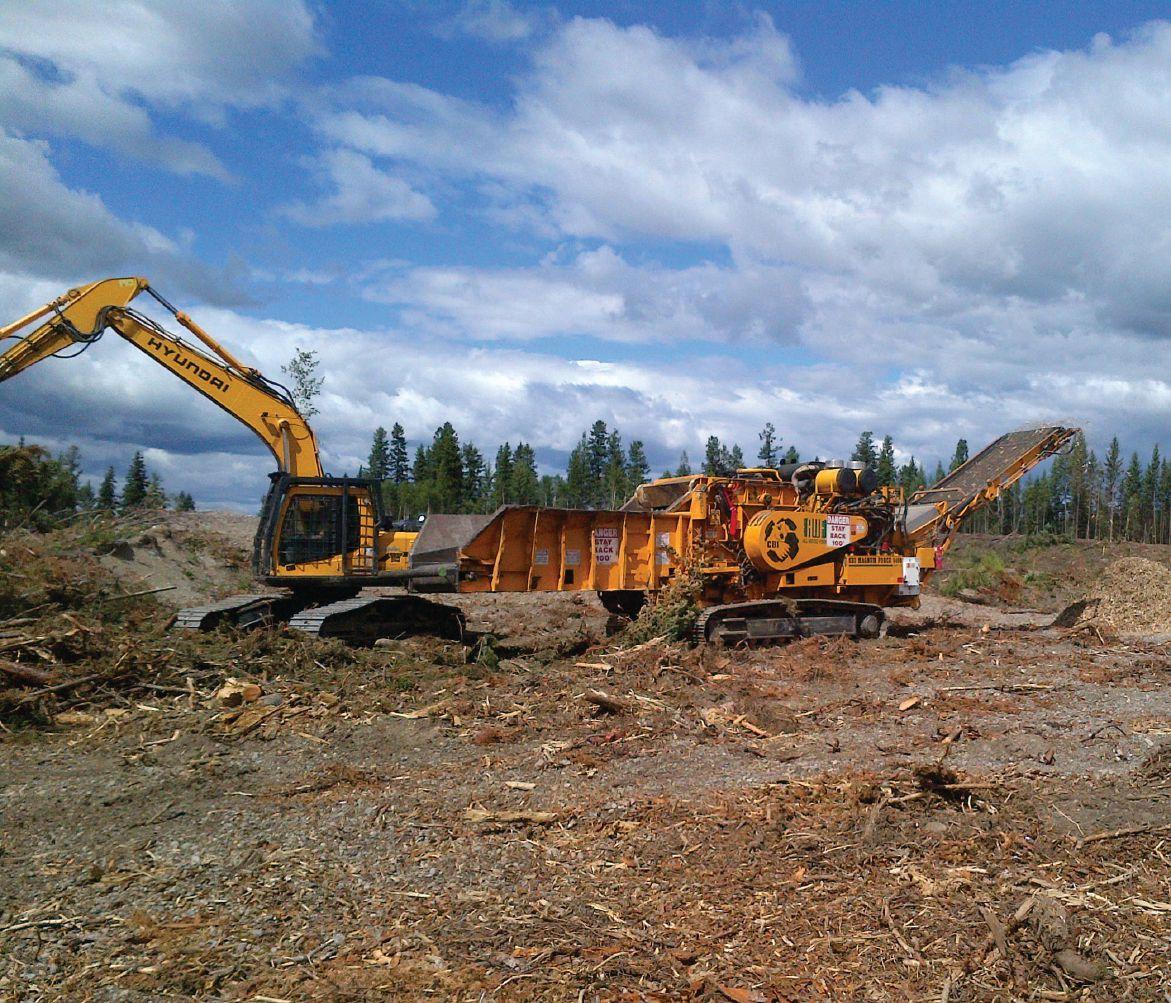
According to Legault, productivity is the name of the game in grinding. At All-Wood Fibre Ltd. in Prince George, they currently run two CBI 6400T grinders, each utilizing 1,050 hp. “What I like best and why we chose them is because CBI machines are productive and very tough,” Legault says. “They do not fall apart. We primarily grind for wood pellet companies that require a high quality product and CBI delivers.”
All-Wood Fibre also produces hog fuel for pulp industry boilers in the area, and also provides site cleanup for log yards. “We purchase our wood fibre from several forest companies that operate in the area and from private individuals as well,” Legault explains. “The fibre is generated from logging slash left at roadsides, and if not utilized, it will be burnt for no value whatsoever.”
All-Wood Fibre has been in the wood fibre business since 1994, when they started with whole log chipping for the pulp and paper industry across Western Canada. “We knew that one day the residual
LEFT MAIN: One of two CBI 6400T grinders used by the team at All-Wood Fibre in Prince George, B.C.
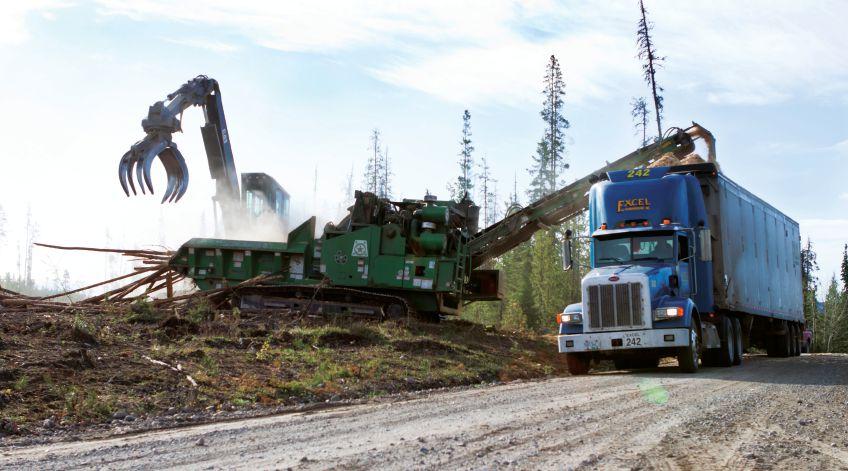
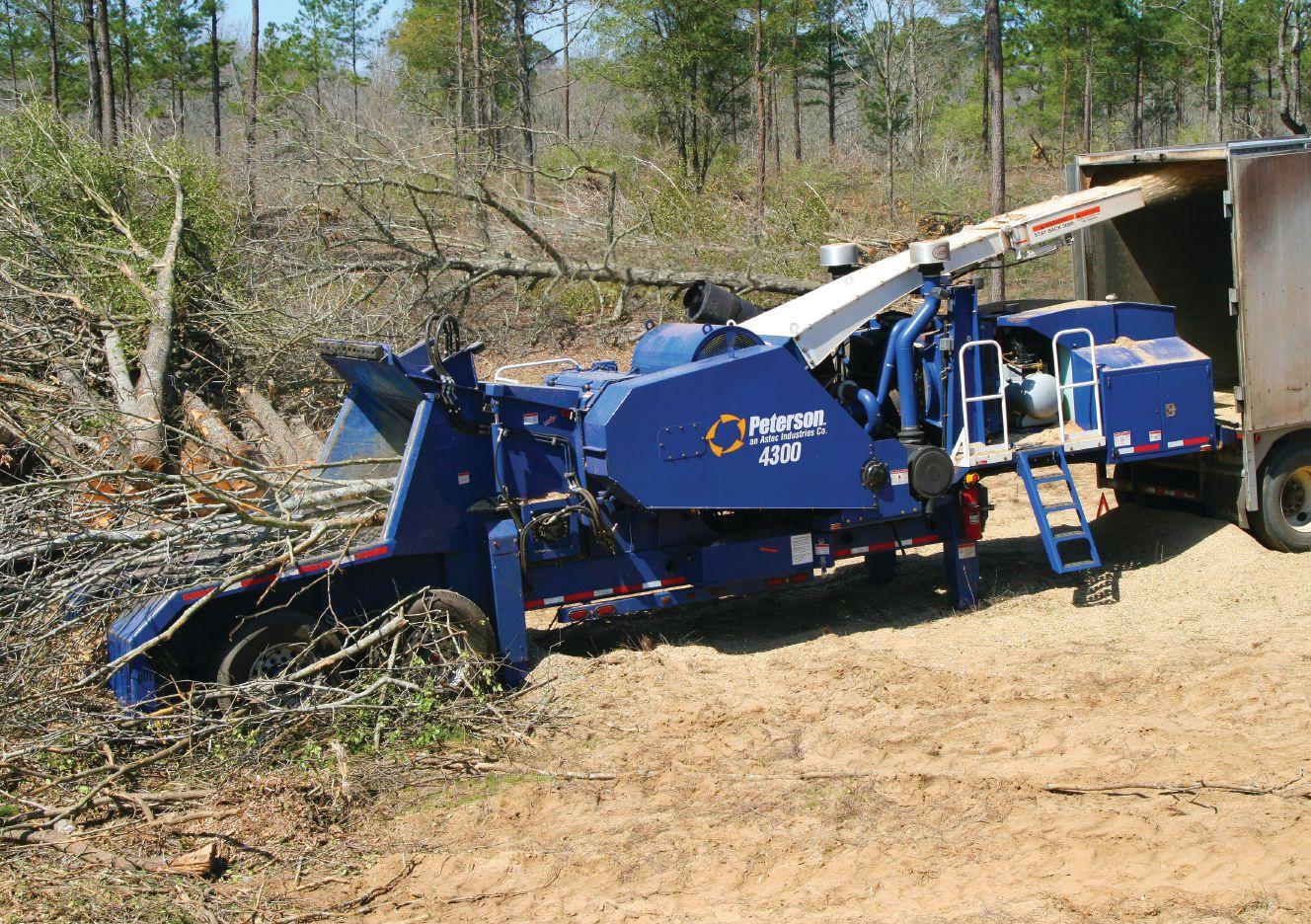
LEFT TO RIGHT: The Bandit 3680 (700 hp) hard at work at Excel Transportation Inc. in Prince George, B.C. Image courtesy of yellowribbonphotography.ca. Triple G Construction Inc. in Grande Prairie, Alta., uses two Peterson grinders (model 4710 B 760 hp) to process biomass from a variety of sources for a variety of end-uses, including as material to power cogen plants and “contaminate mix” for drilling rigs.
Temiskaming Wood Products in Kirkland Lake, Ont., uses a
for
fibre left behind and wasted would be needed, and that grinding would start to become important,” Legault notes. “With proper support, newer technologies will provide more opportunities for everyone in the future.”
t em I sk A m IN g IN kI rkl AND lA ke
At Temiskaming Wood Products in Kirkland Lake, Ont., they have always chosen to purchase Vermeer grinders. Owner Rick Nychuk says over the last seven years, he’s always found them to work well. He also likes them because his operators and mechanics are already familiar with them and Vermeer provides “good product support.”
About a year ago, Nychuk purchased a Vermeer HG6000, and says its double bolt system has turned out to be a great feature.
“Compared to a single bolt system, we haven’t had a bolt break since we got it,” he says, “which means we haven’t lost any teeth.”
The grindings (from timber tops) become hog fuel for Northland Power’s 25-year-old co-generation plant, which also uses natural gas to create power. Temiskaming Wood Products was approached to provide grindings for Northland’s Kirkland Lake-area plant around 2007. Nychuk explains, “They were running low on wood supply and asked us to get involved.” He adds, “I also harvest and run a sawmill, so the bark and sawdust from that goes for hog fuel as well.”
t r I ple g IN g r AND e p r AI r I e
Hard at work over at Triple G Construction Inc. in Grande Prairie, Alta., are two Peterson grinders, both model 4710 B, with 760 hp each. Grinding operations supervisor Mel Toerper says Peterson
Vermeer HG6000
all of its chipping operations.
machines were chosen for a few important reasons, one of them being their flexibility to make distinctive products.
“This is because of the unique rotor direction of the machine,” he says. “The products we make vary from large two-foot wood strand to sawdust. We also like Peterson’s reliability and high production level.”
Triple G supplies grindings to co-gen plants in the area, and they also can be used for “contaminate mix” on drilling rigs. Larger-sized ground material can be used for road and pad stability, and for frost retention on roads and leases. Its raw wood comes from old wood pallets and matting, mill byproduct and top piles. Toerper says his company did not get into grinding strictly to make a profit out of processing biomass.
“We also wanted to prove that natural wood can be 100 per cent usable,” he says. “As public demand for utilization grows, the biomass industry is going to expand and improve to further protect our environment. The future looks promising for the industry as a whole.”
e x C el IN b .C.’s N orth
At Excel Transportation Inc. in Prince George, B.C., future expansion and diversification of operations is in the works. In June, Excel purchased Pine Star Logging, a biomass grinding operation and former logging company for which Excel provided hauling services. Excel’s grinding operations supervisor (former manager at Pine Star Logging) is Keith Brandner. “Around 2008, Pacific Bioenergy called for more material,” he says, “and Pine Star put in a proposal and switched from logging to grinding pellet feedstock for them.” Brandner brings the technical expertise required to generate a high-quality fibre, which Pine Star was commended for.
Brandner and his team operate a Bandit 3680 (700 hp), purchased in 2008. “We actually changed the teeth number to 30 instead of 60 and modified the machine so that we can turn the teeth,” Brandner explains. “Bandit came to see our changes and now offers them as factory options.” He says the modifications don’t work in every application, but they are very good for the production of pellet material. Brandner bought a Bandit because of the strength of the local dealership, and has found the machine to work well. The company’s feedstock is logging debris from a 100-kilometre radius. “About 90 per cent of it is mountain pine beetle-killed wood, so it’s very dry and excellent for pellets,” Brandner says.
“Excel sees the bio-energy industry as an opportunity to provide value-added services to our customers,” says Annie Horning, Excel’s CEO. “We are always looking for opportunities to create synergies within our current operations and have invested in this strategy with a focus on the future. Pine Star’s high product standards were a good fit with our vision of securing valued partnerships with our employees, customers, suppliers, community, and the environment. We look forward to future growth and diversification in this industry.”
A x C or IN New b ru N sw IC k Demand is strong for grinding in the St. Anthony area of New Brunswick, and at a company called AXCOR, owner Denis Cormier
has chosen a Morbark to do the grinding work. Cormier went with a new Morbark in early spring 2013 because of his previous experience with Morbark. He says he was familiar with the brand and had good reliable service with a nearby dealer, which also happened to have a Morbark in stock at a competitive price. Cormier chose the model 4600XL on tracks with a 1050 hp engine.
“The majority of our work is for co-gen power plants, paper mill boilers, mulch and compost in New Brunswick, Nova Scotia and Maine,” Cormier says. “We grind mostly logging debris (treetops and branches) and residues from lumber mills and manufacturers.” Cormier has been grinding biomass since 2005, when he decided that it would be the best way to get a return for the byproducts from the family sawmill.
At that point in time, the company had only one market for grindings, a paper mill that has since closed. “This forced us to find other markets and customers in a different part of the province,” Cormier says. “We did find other markets, which eventually led us to buy the Morbark 4600XL. It’s the ideal size of machine for the kind of work we do.”
In terms of what lies ahead, Cormier observes, “By the look of it at this stage, co-gen seems to be getting more popular, which is a good thing for us. It provides a steady flow of work and hopefully we can expand in the near future.”
It’s clear that in some areas of Canada, biomass grindings are in high demand, especially in regions with pulp mill and co-gen plants. But grindings are being used for other applications as well, and it’s this diversity of end products that will continue to provide current stability – as well as a foundation for future growth. For their part, grinder manufacturers are taking notice, providing more flexibility in their designs, as well as better durability and higher production levels than ever before. •
November 18 – 20, 2013
Vancouver Marriott Pinnacle Hotel
Vancouver, BC
North American wood pellet exports to Europe are up over 70% in the third quarter of 2012 and continued projected growth in this industry is forecasted from coast to coast.
The WPAC AGM & Conference gives you the insight and the connections for growth in the Canadian and export markets.
The key Canadian Biomass Event of the year! Expert, comprehensive insight on the following topics;
• The Canadian Pellet Industry from Coast to Coast
• Sustainability in a Canadian Context
• Fibre Sourcing
• Transportation and Logistics
• Power Markets
• Heat Markets
• Wood Pellet Workshop and much more
Sponsored By
Media Sponsor
inaugural AgBiomass conference 2013
Seeking a unified voice to move industry forward.
By Amie Silverwood
MeMBeRS
of Canada’s agricultural biomass industry gathered in Ottawa for two days at the end of August to discuss the state of the industry.
Agricultural biomass from crop residues and purpose-grown crops is a renewable source of material that can be transformed into energy, biogas, biochemicals and bioproducts.
The purpose of the AgBiomass Canada Conference was to unite industry experts in an effort to move forward.
Speakers looked at some of the challenges and opportunities within the industry. Biomass has the potential to reduce the carbon intensity of our energy, chemicals and consumer products but an effort must be made to reduce the energy used in the production of biomass, given that more than 80 per cent of emissions occur in the final stages of production, according to Dr. Susan Wood-Bohm, executive director of the Biological GHG Management Program at Alberta Innovates Bio Solutions. Shipping the materials necessary from farm to factory for processing can require a lot of fuel use.
The carbon that comes from fossil fuels is millennia old, whereas the carbon that comes from biomass fuel has been recently sequestered and will be resequestered relatively quickly, argued Wood-Bohm. She recommended locating biomass facilities close to material sources in order to reduce the use of fossil fuels in the transportation of agricultural materials to the boiler, thus reducing the wasted fuel in the production of biomass.
Another challenge agricultural biomass faces is that the equipment required to process the material is expensive and varied – adding to the challenge of making a business case. Other complexities include timing issues, weather, transportation and storage issues. Residue management is a term that will keep cropping up as the industry struggles to get off the ground.
sImplIfYINg the messAge
Over the two-day conference, we listened to case studies about companies that have made successful business ventures around biomass. We heard from farms that sell their residuals and producers who buy them. We heard from companies that make biochemicals that are comparable to petrochemicals and can be used to manufacture plastics, personal care products and a full range of products. We heard from petrochemical representatives who are very interested in biochemicals and moving closer to the farm as oil gets more and more expensive.
Attendees were interested in creating a viable business case
for bioprocessors and a value-chain consortium discussed the findings of its recent study at the conference. The study looked specifically at developing a commercially viable cellulosic sugar plant in Southwestern Ontario to support the future production of green chemicals.
The consortium studied the costs associated with the harvest, aggregation and delivery of corn stalks to a commercial plant and sought to determine the most viable business model to enable producers to gain a fair profit while providing facilities with the feedstock they require to make a biochemical.
The researchers found they needed an option for farmers to retain more of the value chain. This was achieved through a cooperative business model with partners sharing the risks and the rewards.
There was a range of voices and a wide variety of backgrounds at the conference but everyone had high hopes for the future of biomass in Canada. Attendees agreed that their voices needed to find a rallying cry with which to clarify their potential and their needs when speaking with the public and with politicians.
The conference offered three key take-home messages: First, we need to celebrate our favourable outcomes, given that success breeds success. Second, moving forward, the industry professionals in attendance plan to focus on a single ask that can be accomplished in two or three years. Third, innovators must ensure that the products made have a way to monetize the carbon benefit from farm to fuel pumps.
Conference panellists from across the country agreed that we have the resources in Canada and the world-leading companies necessary to succeed: we just need a bit of co-ordination. The industry needs to create a market in Canada instead of being a biomass exporter only. The niches in Canada are unique so Canadians need to develop the technology necessary to fill the gaps and develop niches locally.
Though there are challenges for the industry to face, conference attendees were optimistic that there is an opportunity for biomass in Canada that needs to be seized.
Despite these concerns, forestry and agricultural residuals are the energy source of the future, insisted conference chair Don McCabe.
H AMMERMILL HAS TWO - IN - ONE CAPA b ILIT y
Williams Patent Crusher & Pulverizer Company Inc. has introduced what it calls the first hybrid hammermill combining the high capacities and heavy-duty features of a primary hog-type hammermill crusher with the fine-grinding capabilities of a secondary hammermill.
The new Chip Hog was initially designed for applications such as conditioning green wood chips with 40-50 per cent moisture to a uniform quarter-inch product size for drying or further processing. It does the fine-grinding work of a secondary hammermill using impact and simultaneous grinding while also incorporating higher product output and mill stability found on traditional large hammermills.
Features include a large feed opening, heavy-duty tool steel hammers for extended wear life, high hammer tip velocity to shred wet fibrous materials, and heavy-duty reinforced screen sections. The Chip Hog also has oversized eight-inch bearings and an available hydraulic cover opening system.
VAZ 1800 ROTARy WASTE SHREDDER FROM V ECOPLAN
Vecoplan’s VAZ 1800 industrial shredder was designed to process a wide range of wastes for recycling and RDF applications. These include MSW, plastics, wood and more. The VAZ 1800 features a large rotor diameter and taller feed ram that dramatically improves the throughput and overall processing efficiency of bulky scrap materials, and other large-dimension waste products.
The VAZ 1800 features dump-and-run operation, so entire containers of waste
can be fed into its hopper. The hopper, on a VAZ 1800, has a volume capacity of 10.25 cubic yards and a 70- by 82-inch in-feed opening. Its 25-inch-diameter rotor has 84 to 126 cutting inserts, is powered by a 150- to 200-horsepower motor, turns at 125 r.p.m., and is fed by a 10-horsepower, two-speed hydraulic feed ram.
N EW FEAT u RES ON T ERE x A R b ORIST C HIPPER
The TAC Woodsman 790 is the largest of the Arborist chipper products. It has a 36inch diameter by 37-inch-wide chipping drum, which has the ability to chip larger material. Main features include a programmable reverse auto feed governor, hydraulic lift and crush on feed wheel, telescoping tongue and a 360-degree hand-crank swivel discharge. The chipper weighs approximately 10,000 pounds and comes with a drop-leg jack.
The conveyor allows the TAC Woodsman 790 to process tangled and broken large material as well as large amounts of brush and longer stem material easily. The conveyor has a 36-inch-diameter by 37-inch-wide drum, which allows for chipping larger material.
The hydraulic loader draws material into the cutting system with limited trimming and is an efficient way of processing treetops and longer material.
EVENTS BOARD
November 18-20, 2013 • WPAC AGM and Conference Vancouver B.C. www.pellet.org/wpac-agm-2013
December 2-4, 2013 • CRFA Summit Montreal, Que. www.greenfuels.org
February19-20,2014• Canadian Wood Pellet Heating Conference Montreal, Que. www.quebecwoodexport.com/en/index.php?option=com_content&view=article&id=266:canadian-wood-pellet-heating-conference
March 18-19, 2014 • Bioenergy Conference & Expo Atlanta, GA www.bioenergyshow.com
April9-10,2014• Argus European Biomass Trading Conference London, England www.argusmedia.com/events/argus-events/europe/argus-euro-biomass
June 3-5, 2014 • WPAC AGM and Conference Vancouver, B.C. www.pellet.org
June 3-5, 2014 • World Bioenergy 2014 Jönköping, Sweden www.elmia.se/en/worldbioenergy
June 11-13, 2014 • International Bioenergy Conference & Expo 2014 Prince George, B.C. www.bioenergyconference.org
AD INDEX
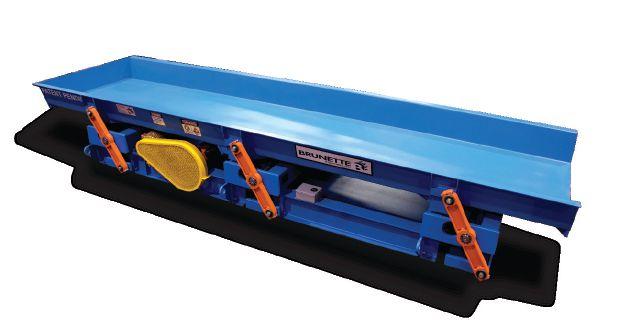
Customizable widths, lengths, screening options and metal detection to suit your
Biochar: ‘chicken soup for the soil’
AUnderstanding the potential value of biochar.
By Don Harfield
t a time of increasing global concern about greenhouse gases approaching the “tipping point” in the atmosphere and how to feed the increasing world population, biochar is emerging as a practical solution to both these issues.
By co-operating rather than fighting with nature, biochar sequesters the carbon as a soil amendment to increase soil productivity as an extension of the natural photosynthesis cycle. After maximizing the initial value for such things as fibre from the forest and food from agriculture, the remaining cellulosic material can be converted to biochar.
when blended with compost or manure and added to potting mixtures for potting plants, flowers and gardens. Regular biochar can be blended with compost and/ or manure for field application or land reclamation. Specialty higher-value uses for premium biochar include filtration removal of toxic compounds from air or industrial waters, and removal of phosphate from ponds and lakes negatively affected by algae bloom. After the biochar is treated, it can be reused in soil applications. Once in the soil, it is considered fully sequestered carbon.
In combination with good soils practices, biochar can be used to reclaim or improve poor soils, and good soils can be made better...
Around the globe, soils have generally declined in their carbon content over time, and oncefertile breadbasket and forested areas have become infertile or marginal lands. In combination with good soils practices, biochar can be used to reclaim or
has the expertise to ensure the biochar quality meets consumer and marketplace requirements, and the design experience to develop a system specific to a business application. Lakeland College has a Centre for Sustainable Innovation, which includes hands-on training for college students to equip them for a career in sustainable agriculture, livestock and alternative energy.
Given the increasing interest in maximizing economic opportunities from the forest and agriculture through biorefineries and nanotechnology to produce a higher-value product, producing biochar from residual biomass is a great way for companies to grow their financial bottom lines. Biochar is a quadruple win – it reduces carbon dioxide emissions to improve the environment, it improves soil productivity to increase food and forestry production, it reduces waste, and it adds economic value to the community.
Biochar is carbon produced through a simple process called pyrolysis, which is basically heating up biomass (such as wood or straw) in a no- or low-oxygen environment while producing excess heat. It’s sort of like combustion without air.
Biochar has many high-value applications and may be classified in three major quality grades, for simplicity: premium grade, mid-grade and regular grade. These are similar to what we are already accustomed to when we fill up our family vehicle with gasoline. Premium grade is useful as a substrate medium for growing tomatoes, cucumbers and bell peppers in greenhouses. Mid-grade is great
improve poor soils, and good soils can be made better to increase food production and make this a better world to live in for future generations. Biochar, therefore, can be considered “chicken soup for the soil.”
Alberta Innovates – Technology Futures (AITF), in collaboration with Lakeland College and industry partners, has established the Alberta Biochar Initiative to help bring biochar products to the marketplace. With financial assistance from Western Economic Development Canada, industry partners have access to two portable demonstration units, each designed to produce one tonne of quality biochar in a 24-hour day. AITF
Contact the Alberta Biochar Initiative to learn how biochar can be a part of your business success story. Go to http:// albertabiochar.ca/ or contact Don Harfield, AITF, at 780-632-8271. •
Don Harfield is team leader for research and biochar product development at Alberta Innovates – Technology Futures in Vegreville, Alta., and the technical leader for the Alberta Biochar Initiative.
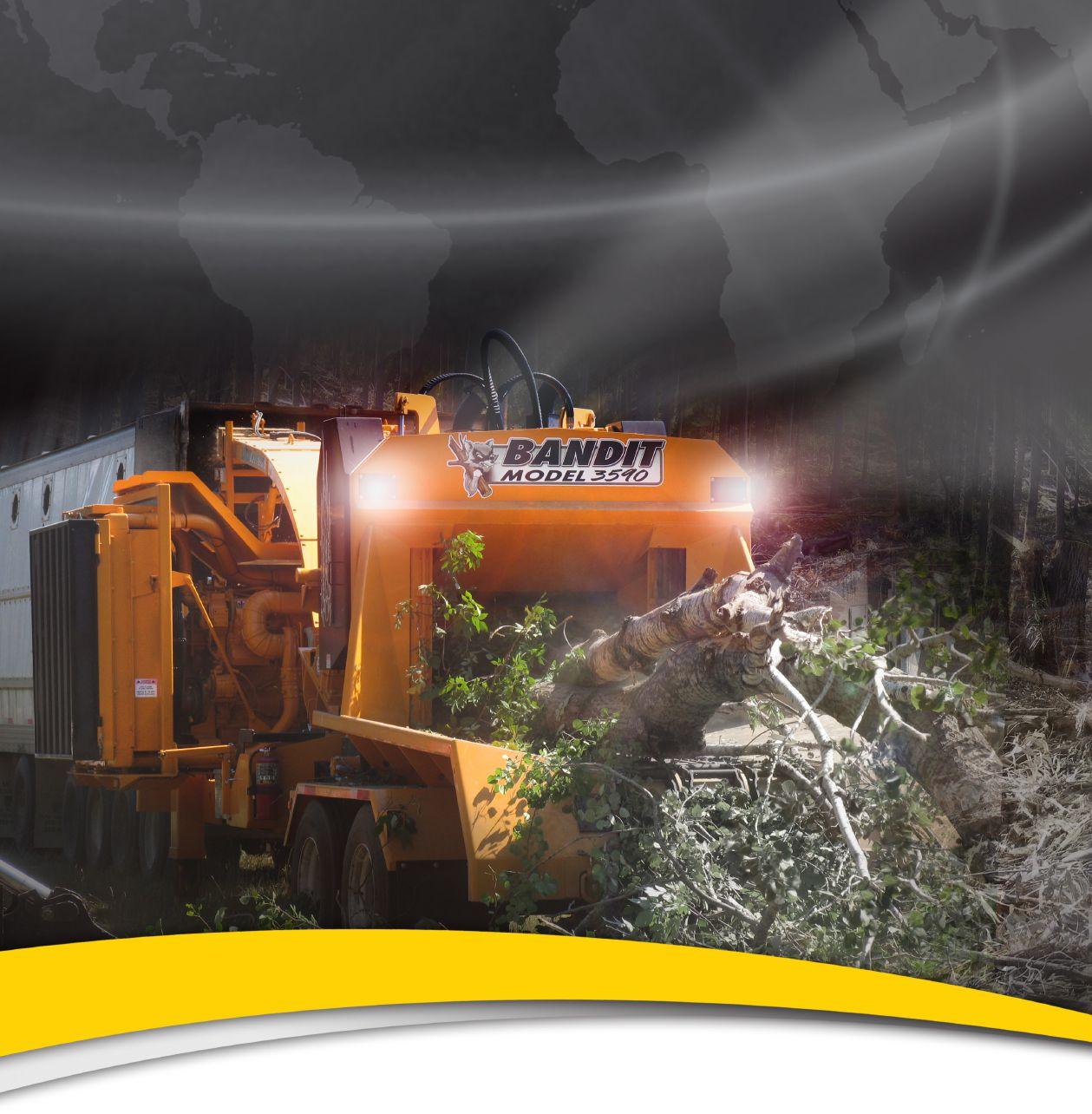
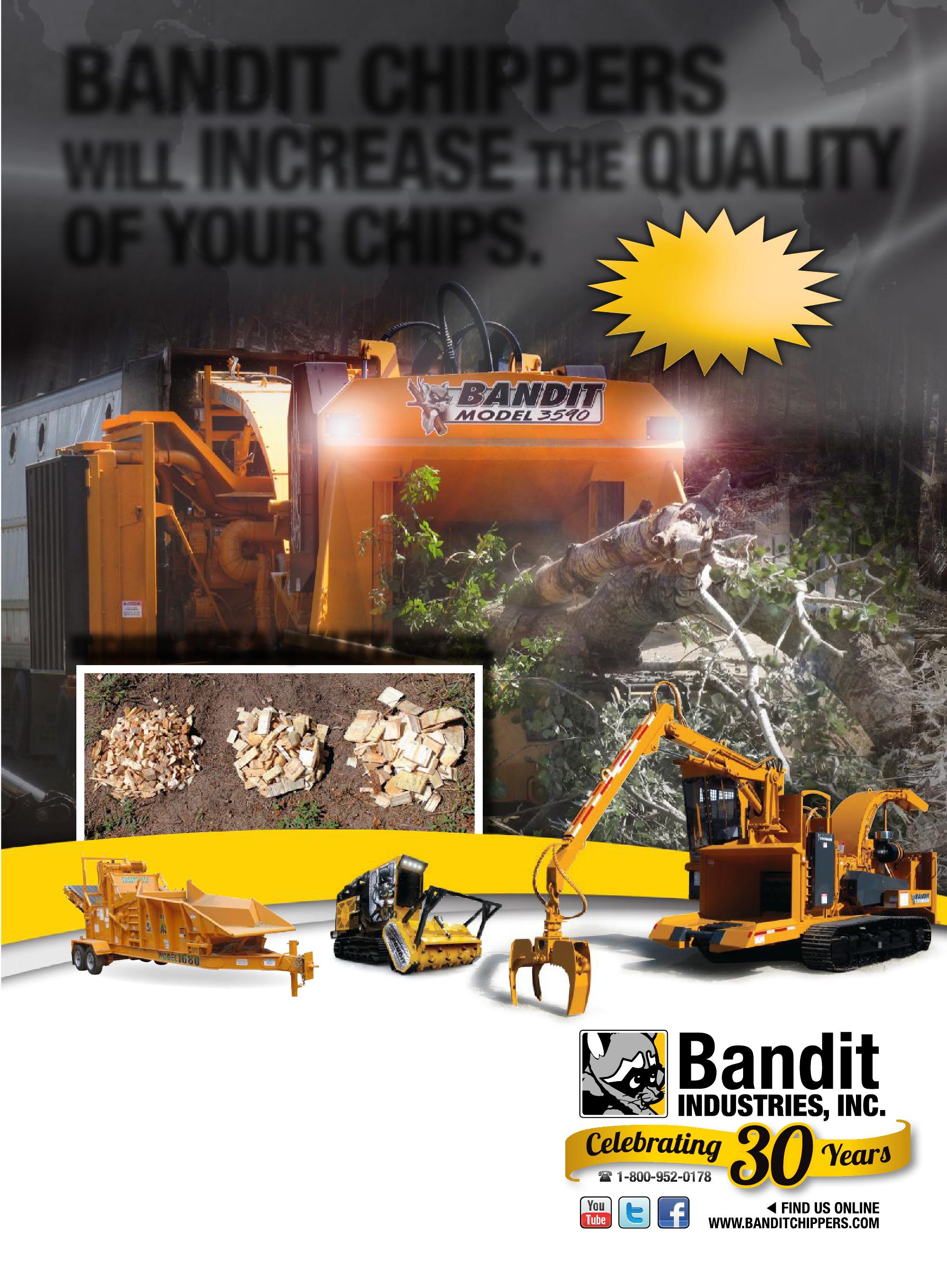
BANDIT CHIPPERS WILL INCREASE THE QUALITY OF YOUR CHIPS.
AVAILABLE WITH NEW SCREENING SYSTEM!
BECAUSE SIZE & QUALITY MATTER.
Available with new screening system and microchip drum!
The demand for biomass energy is growing. Size and quality are important to the power plants
Bandit whole tree chippers are known for producing high quality chips. Bandit chippers can produce a microchip 1/4”, 3/4” standard or 1-1/2” maxichip. Our unique card breakers remove oversized pieces, providing you with the exact chip you need, every time. Combined with Bandit’s legendary ruggedness and unstoppable production, it’s no surprise these machiens are #1 in the woods.
So let Bandit take you to the top of the biomass market: call your local Bandit representative to schedule a demonstration today!
Beast® Horizontal Grinders Track Carriers
Whole Tree Chippers
Global transportation at its best
Fast, efficient quality services, focused on offering the highest level of customer service!
Containerized, bulk, ISO tanks, flexi tanks, roll-on/Roll-off, breakbulk both Import and export. We can provide door to door solutions at very competitive rates! Extremely reliable agents worldwide helping us co-ordinate shipping requirements within the renewable industry. We specialize in moving wood pellets, Solar power, Biodiesel fuel, Recovered vegetable oil, Glycerine, Ethanol, Plastic scrap, metal scrap, crushed glass and wastepaper. For more information and quotes, please contact us!