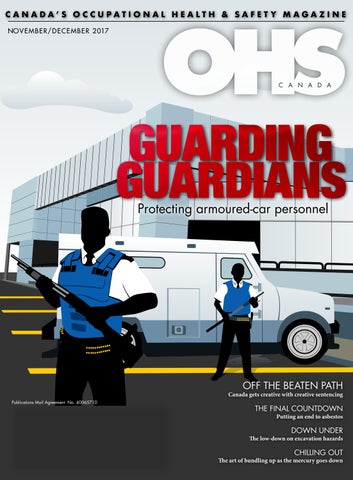
OHS - November - December 2017

Page 1


The controversial two-person crew has raised questions of how armoured-car personnel can transport valuables without compromising their own safety. BY

Creative sentences that are meaningful and enforceable can effect behavioural change and provide an alternative to conventional punitive approaches.

As the mercury drops and daylight gets shorter, outdoor workers need to bundle up without letting the layers get in the way of work.

Cave-ins are a real hazard in excavation

Proper trenching operations can protect workers from the risk of being buried alive.

Worker intervention to address hazards and the creation of policies on prescription opioid use were discussed at the National Safety Council Congress & Expo.

How far will the ban protect workers

ewan

The New Paradigm

Ontario Labour Minister Kevin Flynn addressed the importance of mental well-being at his second summit on post-traumatic stress disorder on October 18. More than 100 first responders attended the event.

While people from certain occupations might be more predisposed to developing mental-health issues, the digital revolution has effected deep transitions in workplaces at large and created a new paradigm that brings with it a new set of mental-health challenges that are more subtle but no less pervasive than those confronting first responders.

Constant connectivity and the ubiquitous use of digital devices have not only blurred the boundaries between the home and office. It has also hastened the pace of work by raising expectations with regards to the speed at which we respond to work emails. The increasing difficulty to switch off from work has led to a rise in burnout and stress. According to Statistics Canada, stress-related physical and mental-health issues cost employers billions in claims and lost productivity.

Familiarity and predictability are comfortable, which the digital economy is anything but. As employers stay lean and nimble by scaling back staff strength and leveraging on technology to automate certain operational functions, employees today are increasingly doing more with less. Add to that a general climate of uncertainty as seen in the rise of precarious employment, corporate cutbacks and the shrinking pool of full-time jobs, and you have a recipe for stress and anxiety.

We cannot turn the tide of the new economy, so what can we do to manage these mental challenges? Recognizing the presence of stress is the first step. With that acknowledgement comes devising ways to cope with stress, one of which is establishing an exercise regimen. Apart from reaping health benefits, such as promoting better sleep and releasing tension, physical activity also produces endorphins, or feel-good neurotransmitters that make one happy and upbeat.

Mental hygiene is also important. As our daily lives are largely characterized by the fragmentation of attention, meditation allows the mind to take a “time out” from constant cognitive distraction and free itself from cluttered thoughts and anxiety. Meditation does not necessarily mean closing your eyes and sitting with your legs folded; any hobby that requires concentration on the task at hand, like painting, gardening or fixing gadgets, will yield similar benefits.

Employers have a role to play too. While the pressure to stay lean and competitive can be intense, it is to a company’s advantage to strike a balance between keeping a healthy bottom line and safeguarding the mental well-being of their greatest assets: their people. A race to the bottom or the more-with-less approach may make the balance sheets look good in the short term, but the law of diminishing returns always apply, and the costs would likely become apparent in the long run.

A 2015 report on workplace mental health priorities by Morneau Sheppell may provide some guidance: employers who were scored favourably on psychological health and safety also rated better on several measures of workplace effectiveness that include lower absence rates, less presenteeism, higher employee engagement and lower personal stress among workers.

It is high time that occupational health and safety goes beyond the brick-andmortar approach and embrace the last frontier: the human mind.

Vol. 33, No. 6 NOVEMBER/DECEMBER 2017

EDITOR JEAN LIAN 416-510-5115 jlian@ohscanada.com

EDITORIAL ASSISTANT JEFF COTTRILL 416-510-6897 jcottrill@ohscanada.com

ART DIRECTOR GRAHAM JEFFREY

PRODUCTION MANAGER CHERYL FISHER 416-510-5194 achen@annexweb.com

CIRCULATION MANAGER ANITA MADDEN 416-442-5600 EXT 3596 amadden@annexbizmedia.com

PUBLISHER PETER BOXER 416-510-5102 pboxer@ohscanada.com

GROUP PUBLISHER PAUL GROSSINGER pgrossinger@annexweb.com

COO TED MARKLE tmarkle@annexweb.com

PRESIDENT & CEO MIKE FREDERICKS

EDITORIAL ADVISORY BOARD MEMBERS

DAVID IRETON, Safety Professional, Brampton, Ont.

AL JOHNSON, Vice President, Prevention Services WorkSafeBC, Richmond, B.C.

JANE LEMKE, Program Manager, OHN Certification Program, Mohawk College, Hamilton, Ont.

DON MITCHELL, Safety Consultant, Mississauga, Ont.

MICHELE PARENT, National Manager, Risk Management and Health and Wellness, Standard Life, Montreal, Que.

TERRY RYAN, Workers’ Compensation and Safety Consultant, TRC Group Inc., Mississauga, Ont.

DON SAYERS, Principal Consultant, Don Sayers & Associates, Hanwell, N.B.

DAVID SHANE, National Director, Health and Safety, Canada Post Corporation, Ottawa, Ont.

HENRY SKJERVEN, President, The Skjerven Cattle Company Ltd., Wynyard, Sask.

PETER STRAHLENDORF, Assistant Professor, School of Environmental Health,Ryerson Polytechnic University, Toronto, Ont.

JONATHAN TYSON, Association of Canadian Ergonomists/Association canadienne d’ergonomie, North Bay, Ont.

Printed in Canada

ISSN 0827-4576 (Print)

ISSN 1923-4279 (Digital)

PUBLICATION MAIL AGREEMENT #40065710

CIRCULATION

email: asingh@annexbizmedia.com

Tel: 416-510-5189

Fax: 416-510-5170

Mail: 80 Valleybrook Drive, Toronto, ON M3B 2S9

SUBSCRIPTION RATES

Published six times per year – Jan/Feb, Mar/Apr, May/Jun, Jul/Aug, Sep/Oct, Nov/Dec

Canada $110.50/yr plus tax

USA $132.50/yr

Foreign $137.50

Occasionally, OHS Canada will mail information on behalf of industry related groups whose products and services we believe may be of interest to you. If you prefer not to receive this information, please contact our circulation department in any of the four ways listed above.

Annex Privacy Office

privacy@annexbizmedia.com

Tel: 800-668-2374

No part of the editorial content of this publication may be reprinted without the publisher’s written permission © 2017 Annex Publishing & Printing Inc. All rights reserved. Opinions expressed in this magazine are not necessarily those of the editor or the publisher. No liability is assumed for errors or omissions.

All advertising is subject to the publisher’s approval. Such approval does not imply any endorsement of the products or services advertised. Publisher reserves the right to refuse advertising that does not meet the standards of the publication.

We acknowledge the financial support of the Government of Canada through the Canada Periodical Fund of the Department of Canadian Heritage.

WORK TILL IT HERTZ

Dickies® FR combines Workrite Uniform Company’s flame-resistant (FR) clothing expertise with the stylish look and fit of Dickies workwear.

$50,000

The sum of a grant to create the Equity-Focused Leadership program that seeks to establish more diverse and gender-equal workplaces in Alberta.

Source: Government of Alberta

16,000

1. Caution Around Trucks: British Columbia launched a province-wide campaign in October, urging drivers to take extra precautions around large trucks to reduce crashes that result in a significant number of fatalities each year. Be Truck Aware, which ran from October 17 to 31, is led by an alliance of British Columbia’s road-safety stakeholders.

Source: WorkSafeBC

2. Farm Safety Rules: The Alberta government is seeking the public’s input on recommendations made by the working groups that reviewed how workplace-safety rules can apply to farms and ranches in the province. Albertans can provide their feedback, which have been posted online, by January 15, 2018.

Source: Government of Alberta

3. Toxic Toll: A report published in September identified solar radiation, asbestos, diesel-engine exhaust and crystalline silica as the four major causes of work-related cancer in Ontario. The report made recommendations on how to reduce the number of occupational cancer cases in the province.

Source: Occupational Cancer Research Centre

Number of time-loss claims between 2012 and 2016 from British Columbia’s healthcare assistants, who experience the highest number of accepted time-loss claims of any occupation in the province.

Source: WorkSafeBC

28%

Percentage of Canadian workers who said their commute to work is too long. Workers spend an average of 53 minutes commuting each day.

Source: October 23 Robert Half Survey

Source: Ministry of Post-Secondary Education, Training and Labour

4. A System Review: The New Brunswick government held public meetings in five cities in November following the release of a discussion paper from an independent task force that examined the province’s workers’ compensation system.

5. Due Recognition: WorkplaceNL received the Outstanding Community Partner Award from the Canadian National Institute for the Blind (CNIB) on October 19 for its efforts to reduce workplace-related eye injuries. WorkplaceNL partnered with the CNIB on the Eye Safety Program, which brings experts into classrooms and workplaces to share practical ways to avoid eye injuries.

FIRE TRIGGERS EVACUATION

Source: WorkplaceNL

Two workers were injured when a fire broke out on an oil-production platform in the Gulf of Mexico on November 8. The incident led to the evacuation of 46 workers from Shell International Ltd.’s Enchilada platform. The two injured workers were flown by helicopter to a hospital, and the platform was shut down safely.

Source: The Associated Press

8 hours

The average amount of time per week that Canadian professionals reported feeling bored at work.

Source: October 19 OfficeTeam survey

A PPE MARKET LEADER

NOW OPEN IN

CANADA

In 20 years, Radians has become a major leader in the safety industry by manufacturing high performance Personal Protective Equipment (PPE) for the industrial, construction, and safety markets. Fostering a culture of innovation, flexibility, and excellence, we create products, services and experiences that are leading the way to a safer tomorrow.

We manufacture premium product lines, such as DEWALT ® and Crossfire ®, and performance value brands. Our comprehensive line of safety equipment provides a variety of PPE solutions to satisfy style demands, comfort requirements, compliance concerns, and price considerations of end users.

Radians has opened a new distribution center and offices at 1487 Lindsey Place, Delta, B.C., V3M 6V1, doing business as Radians Canada Distribution, Inc. The new facility is automated and offers same day shipping to all major cities in Canada of in-stock safety products that meet Canadian standards.

Radians offers a variety of Personal Protective Equipment in multiple important categories

OH&S UPDATE

COMPANY PLEADS GUILTY

FEDERAL — Irving Oil Commercial GP was fined $4 million on October 26 after it pled guilty to 34 counts for offences under the Transportation of Dangerous Goods Act

The fine comprises a penalty of $400,320 and $3.6 million for the implementation of research programs to improve the safety of the transportation of dangerous goods in Canada. In addition, Irving Oil was ordered to submit a corrective measures plan and follow up with Transport Canada (TC), according to the Public Prosecution Service of Canada.

Following the train derailment in Lac Mégantic, Quebec on July 6, 2013, a joint investigation by TC and the RCMP found that Irving Oil did not comply with all applicable safety requirements by failing to determine the classification of dangerous goods for the crude oil it transported by train. The shipping documents on board the trains were erroneous, and the company also failed to train its employees in the transportation of dangerous goods adequately.

These offenses occurred over an eightmonth period from November 2012 to July 2013, during which approximately 14,000 cars transported crude oil for Irving Oil.

LACK OF FALL ARREST SPURS FINE

YELLOWKNIFE — A Northwest Territories man was fined $1,000 on October 11 after being convicted for allowing himself, his wife and a friend to work on a roof without fallprotection equipment last year.

According to a statement from the Workers’ Safety and Compensation Commission, Paul Curren and the other two individuals were working on the roof of a home that he was building for his family on July 16, 2016. Based on the definition under the N.W.T. Safety Act , Curren was acting as an employer and was therefore required to comply with oh&s law.

Curren pled guilty to failing to ensure that employees were using a fall-protection system where they could fall at least three metres. Other charges were dropped.

BOARD RECOMMENDS DRUG TESTING

FEDERAL — The Transportation Safety Board of Canada (TSB) recommends that Transport Canada work with the aviation industry and employee representatives to develop and implement requirements for a comprehensive substance-abuse program to reduce impairment risk while engaged in safety-sensitive functions. The call follows the release of an investigation report into the fatal 2015 inflight breakup of a cargo aircraft operated by Carson Air Ltd.

On 13 April 2015, the Carson Air Swearingen SA-226TC Metro II was carrying freight from Vancouver International Airport to Prince George Airport, British Columbia, with two pilots on board. About six minutes after departure, the aircraft disappeared from radar. Ground searchers later found aircraft wreckage on mountainous terrain.

The investigation determined that the aircraft entered a steep dive before accelerating to a high speed which exceeded the aircraft’s structural limits, resulting in an inflight breakup that killed both the captain and first officer. Subsequent toxicology testing indicated that the captain had

DRONE COLLIDES WITH PLANE

FEDERAL — The Transportation Safety Board of Canada (TSB) has launched an investigation following a mid-air collision between an unmanned aerial vehicle and a passenger plane — the first such incident recorded in Canada — near Quebec City’s Jean Lesage International Airport on October 12.

The aircraft was arriving at the airport from Rouyn-Noranda, Quebec that day while carrying two crew members and six passengers, according to the TSB website. After the plane passed the final approach fix, the crew noticed the drone hovering near the left wing. The drone hit the plane at about 450 metres above the ground, and the crew declared an emergency. No one was injured, and the aircraft landed safely.

Federal Transport Minister Marc Garneau expressed relief that the collision had resulted in only minor damage to the plane. According to Garneau, Transport Canada received 1,596 reports of drone incidents to date in 2017, 131 of which had been “of aviation safety concern.”

consumed a significant amount of alcohol on the day of the occurrence.

“In Canada, regulations and company rules prohibit flying while impaired, but they rely heavily on self-policing,” Kathy Fox, Chair of the TSB, says in a statement dated November 2. “What is needed is a comprehensive substanceabuse program that would include mandatory testing as well as complementary initiatives such as education, employee assistance, rehabilitation and peer support.”

Pilot incapacitation was one of three possible scenarios that the TSB deemed could have explained the events that led to the incident. It is also possible that the heaters of the pitot system, which provides airspeed information, were off or malfunctioned. The third scenario involves a number of flight-specific factors that are consistent with an intentional act. But without objective data from a cockpit voice recorder or flight data recorder, it is impossible to determine with certainty which scenario played out during the flight.

— By Jeff Cottrill

FIRM FLOUTS WORKER PRIVACY

VICTORIA — The Office of the Information and Privacy Commissioner for British Columbia has ruled that a chicken-catching organization was not authorized by the Personal Information Protection Act (PIPA) to collect personal information of employees, farmers and contractors via video and audio surveillance.

Acting Information and Privacy Commissioner Drew McArthur initiated the investigation in response to a media report revealing that the company implemented surveillance after a covert video documented the mistreatment of chickens. “Video surveillance is too often seen as the solution to business problems. But it is rarely effective in solving those problems, and worse, it is often unlawful,” Commissioner McArthur says in the report, released on November 8.

The report found that the company collected personal information without the consent of the recorded individuals. It also failed to conduct a privacy-impact assessment prior to implementing the surveillance and did not have the appropriate policies and procedures in place.

According to the statement, the best way for an organization to demonstrate compliance with PIPA is to have an appropriate privacy-management

program. “Had this been in place, the surveillance likely would not have been implemented,” MacArthur notes.

TWO EMPLOYEES HOSPITALIZED

RED DEER

— Carbon-monoxide (CO) exposure at a Red Deer beer store sent two construction workers to a local hospital for examination on October 4.

According to the Alberta RCMP, a group of construction workers became ill from CO exposure while on the job at the Co-op Liquor Store. Emergency responders were called to the building at about 8:45 a.m. Personnel with the RCMP’s Red Deer detachment and the Hazardous Materials Response Unit also attended the scene.

First responders treated several workers before two of them were sent to hospital. The oh&s division of Alberta Labour is investigating the incident.

HEALTH AUTHORITY PENALIZED

YORKTON — The Sunrise Regional Health Authority in Saskatchewan pleaded guilty to four oh&s violations for exposing workers to spilled formalin, a formaldehyde-based disinfectant, in three separate incidents.

An October 30 statement from Labour Relations and Workplace Safety says the violations took place on March 20, April 8 and September 16, 2015 at the Yorkton Regional Health Centre. The Health Authority pled guilty to failing to ensure that competent persons, equipment, supplies and personal protective equipment are available for the prompt, safe and effective containment, neutralizing and decontamination of any accumulation, spill or leak where the possibility of such an event that may be hazardous to a worker’s health or safety could occur.

The Authority also contravened clause 318(3)(a) of the regulations, which requires an employer to ensure that a worker who works with, or is in proximity to, a controlled product is trained in the content required on the supplier label and workplace label for the controlled product, as well as the purpose and significance of the information contained on those labels. Yorkton Provincial Court issued a $5,357 fine and a $2,142.86 surcharge on each count. Four other charges related to this incident were stayed.

In a second incident, an employee at the Centre suffered serious crushing injuries after her limb was entangled in a laundry conveyer on May 21, 2015. The Health Authority pleaded guilty to

BILL REQUIRING GAS PREPAYMENT PROPOSED

EDMONTON — A bill that would enhance protection for fuel and convenience-store employees is one step closer to reality, as Alberta mulls proposed legislation requiring violence-prevention plans and pre-payment for fuel at gas stations across the province.

According to an October 30 statement from the Alberta goverment, the province’s Minister of Labour Christina Gray met Lawrence Richler, vice-president of Canadian Products Marketing with Husky Energy Inc., at the Brookview Husky in Edmonton to discuss measures to improve worker safety at fueling stations. “Pre-payment eliminates the risks associated with fuel payments, and we applaud the government for taking this important step to protect attendants and the public,” Richler says.

The proposed legislation, An Act to Protect Gas and Convenience Store Workers, would amend the Occupational Health and Safety Code to include mandatory prepayment for fuel and violence-prevention plans at retail fuel and convenience stores. If passed, the new measures are

expected to take effect on June 1, 2018.

Over the past three years, “gas-and-dash” incidents in the province have resulted in five worker deaths and serious injuries to three other workers. The rates of fuel theft incidents reported to police rose between 2011 and 2015.

The Alberta Association of Chiefs of Police estimates that there were more than 4,000 incidents across the province in 2015, averaging 12 fuel thefts per day.

Doug Rosencrans, vice-president and general manager of 7-Eleven Canada, says he believes that pre-payment of fuel purchases will improve employee and public safety. “For many years, 7-Eleven Canada has run an employeesafety program similar to the safety plan announced today.”

Alberta’s oh&s legislation requires employers to take all reasonable steps to protect worker health and safety. Proposed violence-prevention plans, which would help reduce the potential for violence through physical and procedural control measures, include safe cash-handling procedures.

— By Jean

failing to provide an effective safeguard where a worker may contact a dangerous moving part and was fined $35,714. An additional charge was stayed.

The third incident occurred on July 12, 2015 when a worker’s hand became pinned between the handle of a motorized cart and a door jamb, resulting in a fractured wrist. The Health Authority pleaded guilty to failing to ensure that only trained operators are required or permitted to operate powered mobile equipment, resulting in a serious worker injury and was fined $21,430. Three additional charges were stayed.

COMPANY PLEADS GUILTY TO CONTRAVENTIONS

REGINA — A woodworks company based in Regina was fined $2,800 after pleading guilty to two workplace-safety violations on October 4.

According to a statement from the Saskatchewan Ministry of Labour Relations and Workplace Safety, an occupational health officer from the Ministry inspected a worksite near Regina on June 2, 2016 and observed employees of NLF Woodworks Inc. working without the required fall-protection equipment or protective headwear.

No one was injured, but the employer was charged with contravening sections 91 and 116(2) of the province’s occupational health and safety regulations.

MAN ARRESTED FOR ASSAULT

WINNIPEG — The Winnipeg Police Service (WPS) arrested a 24-year-old man who is accused of assaulting a Winnipeg Transit employee on October 18.

According to a WPS statement, a man entered a bus by the back door without paying a fare and verbally abused the driver when the latter confronted him. Shortly afterwards, a transit inspector tried to speak with the passenger, who threatened and assaulted the inspector.

Police were contacted, and both workers restrained the suspect until WPS General Patrol officers arrived. Winnipeg resident Daniel Caneda was charged with assault, uttering threats and mischief under $5,000.

POLL HIGHLIGHTS VIOLENCE RISK

TORONTO — Hospital direct care providers are at great risk of physical violence in the workplace, according to a poll of Ontario hospital staff released on November 6.

A whopping 68 per cent of registered practical nurses and personal support workers said they have experienced at least one incident of physical violence in the hospital, which include punching, hitting or having things thrown at them in the last year. Nearly 20 per cent said they have been physically assaulted nine times or more in the last year.

The Canadian Union of Public Employees (CUPE), through its hospital division, the Ontario Council of Hospital Unions (OCHU), polled 1,976 members working in hospitals in seven Ontario communities earlier this fall. The poll findings for Ontario were released at Queen’s Park by OCHU president Michael Hurley and Scott Sharp, a personal support worker who was thrown through a wall by a disturbed patient at a hospital in Guelph, Ontario.

“The level of physical violence that I experienced and that so many other hospital staff experience every day, scars the body and it scars the soul. Not enough is being done by the hospitals to create a culture where violent behaviour is simply not tolerated. Instead, the victims of violence are, to a large extent, simply swept under the carpet,” Sharp says.

Among the findings is that 42 per cent of nurses and personal support workers report have experienced at least one incident of sexual harassment or assault in the past year. The unions are calling on the federal and provincial governments for legislative and legal changes to protect healthcare staff.

MCINTYRE POWDER RECEIVES FUNDING

TORONTO — Nearly 40 years after the Ontario mining sector ceased the practice of making workers inhale McIntyre Powder, the provincial government is funding a review of the powder’s long-term effects on miners’ health.

According to a news bulletin from the Ontario Ministry of Labour issued on October 11, the province will provide a $1

million grant to the Occupational Health Clinics for Ontario Workers (OHCOW) to assemble a team of health professionals to research whether past exposure to McIntyre Powder is connected to health issues. A proven connection will allow ill ex-miners to claim compensation from the Workplace Safety and Insurance Board.

A finely ground dust of aluminum oxide and aluminum, McIntyre Powder was once believed to prevent silicosis. From 1943 to around 1980, 45 Ontario mining companies exposed about 10,000 employees to the substance in a province-wide prevention program, according to information from the Ministry. Today, OHCOW has 325 case files from current and former miners who were exposed to the powder, while another 195 have reported health effects to a voluntary registry run by the McIntyre Powder Project.

“In addition to this funding initiative, we have conducted a comprehensive mining safety review,” Ontario Labour Minister Kevin Flynn says in the statement. “Implementation of its recommendations is well underway to further the health and safety of mine workers.”

Marcelle Crouse, the province’s Acting Chief Prevention Officer, says the grant would help to expand OHCOW’s capacity to address miners’ occupational illnesses. “It is essential mine practices be safe and that controls are put in place to prevent dangerous exposure,” Crouse says.

TAXI-FIRM OWNER GETS JAIL SENTENCE

SAULT STE MARIE — Hugger Inc., a taxi company known as Checker Cab, and Hugh Irwin, director of the company in Sault Ste. Marie, Ontario, were sentenced on October 24 for failing to pay wages totalling nearly $75,000 owed to more than 30 claimants.

According to the Ontario Ministry of Labour, the case dates back to April 2014, when the Ministry responded to employee complaints about the failure to pay wages at Checker Cab. The Ministry’s employment-standards officer issued the company and its director 63 orders to pay, but the orders were not complied with, and an application to review the orders was not filed.

The director pled guilty and was given a 15-day jail sentence for 32 of the count. He was also ordered not to be involved in any capacity, other than being an employee, in the business for one year. The company received a $1,000 fine for each of 31 counts. The company has since filed for bankruptcy, the bulletin states.

EMPLOYER FINED FOR FATALITY

NEWMARKET — An employer in Newmarket was fined $135,000 on October 13 for a fatal workplace incident involving a temporary worker two years ago.

The incident occurred on October 22, 2015, when the temporary worker was working as a beltline operator’s assistant for Bodycote Thermal Processing Canada Inc., according

to the Ontario Ministry of Labour. The worker was entering a pathway between conveyor beltlines and was hit by a forklift that the beltline operator was driving, causing fatal injuries.

The Ministry investigation determined that stacks of empty bins had blocked the workers’ views and that the workplace had nothing to separate forklift and pedestrian traffic or designated safe crossing points. Bodycote pleaded guilty to the following failures: to ensure that workers were not endangered by forklifts; that stored items did not limit sightlines of forklift drivers or pedestrians; and that forklift and pedestrian traffic was sufficiently separated.

ELECTRICAL SHOCK PROMPTS PENALTY

NAPANEE – Lafarge Canada Inc., a supplier of construction materials based in Mississauga, Ontario, was fined $115,000 on October 12 over a contract worker’s shock injury last year.

The Ontario Ministry of Labour states that a worker was cleaning electrostatic precipitators at the corporation’s plant in Bath on March 2, 2016, but the power supply for one of the precipitators had not been de-energized or locked out. The worker opened an access panel and received an electrical shock of about 47,500 volts.

Lafarge pled guilty to failing to ensure that the power sup-

ply to an electrical installation, equipment or conductor is disconnected, locked out of service and tagged before any work is done on or near live exposed parts.

EMPLOYEE KILLED IN WORKCAR

TORONTO — A 50-year-old subway-track maintenance worker with the Toronto Transit Commission (TTC) has died after a workplace incident left him severely injured.

The incident occurred October 1 when Tom Dedes and other TTC employees were moving equipment from a pickup truck onto a workcar at McCowan Yard, located east of Toronto. After the workers had finished loading the workcar, a locomotive pulled the vehicle and swung the tail end of it towards Dedes, who was standing between the workcar and the truck, pinning him against the truck. He was rushed to the hospital, but Dedes succumbed to his injuries.

The TTC says it notified the Ministry immediately after the incident. An internal TTC probe is ongoing.

ROOFING FIRM CONVICTED

WINDSOR — A roofing firm in Windsor, Ontario, was fined $90,000 for its involvement in the falling death of a young

MANAGE YOUR fleet WORRY-FREE WITH AMA.

From renewing your company vehicle registrations, to giving your employees the driver education they need to enhance their skills, we can help you keep your fleet safe on the road.

worker two years ago.

According to a court bulletin from the Ontario Ministry of Labour dated October 6, a group of Dayus Roofing Inc. employees were replacing shingles on a local house roof on December 11, 2015. One of the workers, who was tasked with dumping older shingles into a dumpster on the ground, was wearing fall-protection equipment, but detached the lanyard from the safety line while crossing the roof to dispose of shingles. The worker lost footing and fell to the ground, sustaining serious injuries and died in a hospital after six months.

Dayus Roofing pled guilty to failing to use a guardrail system, or a more effective fall-arrest system like a travel-restraint system, to protect its employees.

CRANE COMPANY FINED FOR FATALITY

BARRIE — A Toronto-based crane company was fined $95,000 following a worker fatality at a worksite in Innisfil, Ontario last year.

An employee of Toronto Crane Service Inc. was cutting up a tower crane on June 22, 2016 when the jib section tipped over and fell onto the worker, resulting in fatal injuries, according to an October 6 court bulletin from the Ontario Ministry of Labour. The Ministry investigation determined that the employer violated section 25(1)(c) of the Ontario Occupational Health and Safety Act by failing to ensure that any machinery or equipment that could fall and endanger a worker had been secured.

WORKERS’ COMPENSATION UNDERFUNDED

FREDERICTON — Members of the Canadian Union of Public Employees New Brunswick (CUPE NB) held a protest for the rights of injured workers on October 24 to denounce recent cuts to the workers’ compensation fund.

Earlier this year, WorkSafe NB announced its intention to increase the rates collected from employers to ensure sustainability of the workers’ compensation fund, but business interests lobbied against the measure, and WorkSafe NB’s board of directors buckled. On October 2, 2017, the board announced a meagre 22 cents hike per $100 of payroll. New Brunswick’s rate of $1.70 per $100 is amongst the lowest provincial rates in Canada.

“WorkSafe NB was created for people, not profits,” Daniel Légère, president of CUPE NB, charges in a statement issued on October 25.

Légère adds that the province has yet to come back from the cuts made back in 1992. As long-term sustainability of the fund is in question, CUPE NB is worried that attrition, cuts and even privatization, might be on the horizon.

According to the statement, CUPE and the Federation of Labour have communicated with the Labour Minister, recommending that funds to the workers’ compensation be restored to pre-1992 levels. This would enable the system to eliminate the three-day wait period for injured workers, increase benefits for injured and deceased workers and expedite the claims

process by hiring more front-line staff at WorkSafe NB.

PROVINCE ADDRESSES VIOLENCE

MONCTON — The government of New Brunswick aims to have new regulations on workplace violence in place before the next National Day of Mourning on April 28, 2018.

According to an October 18 statement from the province’s Department of Post-Secondary Education, Training and Labour, the Department has put together a steering committee of stakeholders, including government and labour representatives, to tackle the issues of violence, harassment, sexual harassment, bullying and other worker priorities.

“Your government is committed to ensuring that all New Brunswickers can work in healthy, respectful and inclusive workplaces,” Gilles LePage, the province’s Labour, Employment and Population Growth Minister, says in a statement. “Education and awareness are crucial, and we will continue to educate the public, workers and employers on the importance of creating safe and healthy workplaces.”

New Brunswick Nurses’ Union president Paula Doucet says she is “pleased” with the Department’s commitment to the violence problem. The regulations will apply all industries in the province.

BETTER ACCESS TO TREATMENT

DARTMOUTH — A former Nova Scotia MP is calling for better accessibility to treatment of post-traumatic stress disorder (PTSD) for police officers, paramedics, correctional officers and other first responders in the eastern provinces, following recent reports that the Halifax Regional Police (HRP) could not cover treatment for at least two officers.

Peter Stoffer, a part-time advocate with Trauma Healing Centers in Dartmouth, Nova Scotia and the NDP MP for the Sackville area from 1997 to 2015, referred to “a bit of a bureaucratic malaise” that had prevented one of the officers from getting treatment in Ontario on the HRP’s dime.

“There are always exceptions to

collective agreements,” Stoffer says. “There are ways the union and management could sit down together to see what can be done in order to ensure that this woman gets the best help that they can possibly give her.”

He adds that a treatment facility for the Atlantic provinces, specifically designed for all first responders and the military, “would go a long way” to providing access to professional-quality care that people are looking for, without having to move away from the region.

An online CBC News report from October 4 sparked brief controversy when it quoted HRP Chief Jean-Michel Blais on the issue. The story seemed to imply that Chief Blais, a champion of mental-health awareness who has talked openly about his personal experiences with PTSD, wanted the onus to be on the officers themselves to seek treatment and that PTSD was overshadowing other mental-health illnesses in the department.

While Stoffer says he is “disappointed” by Chief Blais’ comments in the story, he believes that Blais had probably been misunderstood. “The chief had responded in kind to what was happening, and unfortunately, I think the message was lost in translation.”

Chief Blais says the mental and physical health of employees is a top priority for the force. “We have done extensive work over the past few years in this area,” he notes. HRP is also going through independent processes that may help determine the future direction of the level of supports available.

FALL RESULTS IN CHARGES

ST. JOHN’S — A worker’s falling injuries at a St. John’s community centre two years ago have led to occupational health and safety charges against Flynn Canada Limited, a nationwide trade contractor specializing in roofing.

According to a statement issued by Service N.L. on October 12, the incident occurred in September 2015 during the construction of the Paul Reynolds Community Centre. A Flynn employee fell through the opening on the roof of the unfinished building and sustained injuries.

Following an investigation conducted by Service N.L.’s occupational health and safety division, Flynn Canada was charged with failing to do the following: provide a safe workplace; install temporary flooring in the roof’s work area; and familiarize employees with hazards.

The employer made its first court appearance on the charges on October 10 at the St. John’s Provincial Court. The next appearance is scheduled for November 22.

Follow us on Twitter @OHSCanada

Many of the preceding items are based on stories from our sister publication, canadian occupational health & safety news, a weekly e-newsletter that provides detailed coverage of Canadian oh&s and workers’ compensation issues. For more information, please call (416) 442-2122 or toll-free (800) 668-2374.

So, what’s on your mind?

Ever wonder what other oh&s types are thinking about? Find out by making our website poll at www.ohscanada.com a regular stop.

Would harmonizing Canada’s workplace-safety law boost safety or overlook provincial differences?

DISPATCHES

Firefighters battle not just flames, but carcinogens too

Searing flames are not the only hazards that intrepid firefighters battle. A study, published in the journal Environmental Science & Technology on October 18, sheds new light on another more insidious threat that may be putting firefighters at risk — toxic chemicals in smoke.

Researchers at the University of Ottawa, working with Health Canada, the University of Toronto and the Institut national de santé publique du Québec, examined chemical exposure experienced by Ottawa Fire Service firefighters during on-shift, emergency fire operations between January 2015 and April 2016. The team collected urine and skin wipe samples from firefighters at the start of their shift and after responding to a fire to measure if they had been exposed to polycyclic aromatic hydrocarbons (PAHs), which can cause DNA mutations and cancer. The samples also tested other harmful chemicals often found in smoke.

“Firefighters had from three to more than five times the amount of metabolites, or by-products of PAHs, in their urine after a fire compared to before the fire,” says Jennifer Keir, researcher at the University of Ottawa and senior author of the study. “Mutagenic potency of the urine, which reveals the potential for genetic mutations, also increased on average more than four times after a fire.”

have witnessed many of my peers and friends battle job related illnesses,” Matschke says. “To have definitive proof of the chemicals that we are exposed to and the routes of our exposures will improve our procedures and our equipment, meaning reduced incidence of job-related disease and longer, healthier lives.”

Jean Lian is editor of ohs canada

Prevention key to tackling PTSD: Minister

Prevention must remain everyone’s focus when it comes to post-traumatic stress disorder (PTSD). That was the message delivered by Ontario Labour Minister Kevin Flynn as he welcomed more than 100 first responders, employers and mental-health advocates to his second annual PTSD Summit in Toronto on October 18.

“An environment of positive mental-health practices is essential to a healthy province,” Flynn said. “As we work to create fairer workplaces, we can’t forget that this can only be done by also maintaining safer workplaces.” The conference is part of the provincial government’s broader commitment to the mental health of first responders included as part of Bill 163, the Supporting Ontario’s First Responders Act, which was passed in the spring of 2016.

Previous studies have shown that firefighters have increased risk of cancers and other serious illnesses compared to the general population, due in part to their exposure to hazardous chemicals found in smoke. This is the first study to examine chemical exposure occurring during emergency, on-shift fire suppression.

An unexpected finding relates to the route by which the monitored chemicals enter a firefighter’s body. The team found a significant link between PAH metabolites found in urine and levels of PAHs on skin, suggesting that firefighters are exposed to these harmful chemicals primarily through skin contact, rather than by inhalation.

“Our study shows that the best way to reduce a firefighter’s exposure to harmful combustion products is to reduce chemical exposure to the skin,” says Jules Blais, professor of environmental toxicology at the University of Ottawa and research team leader.

Captain David Matschke, a veteran firefighter for 32 years, is well aware of the dangers that his job entails. “I

Dr. Nick Carleton, a psychologist from the University of Regina who recently published results of a pan-Canadian survey of public safety personnel, told participants in his keynote address that PTSD and other mental-health concerns among first responders is an international problem.

“We are asking more and more of our public safety personnel,” Dr. Carleton said, noting that almost a quarter of first responders surveyed by his team screened positive for PTSD. “We don’t just want you to fight fires or transport people to hospitals. We want you to be community builders, we want you to save lives, we want you to make sure we are taking care of our own mental health, as well.”

The importance of mental health is gaining prominence in other sectors as well. The release of an online resource on mental-health issues for schoolteachers across Canada by Toronto-based insurance provider Teachers Life, a federally regulated company that serves the education sector, is an example. “We have seen an increase in stress-related claims in recent years,” Teachers Life president and chief executive officer Mark Cummings says.

Launched on October 5, Ready for Life was developed in partnership with Canadian Mental Health Association Ontario. The website includes advice, articles and input from mental-health experts aimed at education professionals, as well as features expert content on students’ mental health.

Correctional facility installs body scanner

Canada’s largest correctional facility has installed a body scanner to prevent visitors from smuggling weapons, drugs and other contraband onsite.

The Alberta government is testing the pilot project over the next year, and the Edmonton Remand Centre is training its employees to use the scanner, which is expected to be fully operational by December. The scanner is designed to detect items hidden on one’s body, as well as foreign objects in body cavities. It will complement current security measures at the facility, including search dogs, intelligence gathering and routine checks.

Provincial Justice Minister and Solicitor General Kathleen Ganley announced the project at a news conference in Edmonton on October 18. “The safety and security of staff, inmates and visitors at the Edmonton Remand Centre is paramount,” Ganley said at the conference. “Over the next year, we will evaluate how effective this technology is in preventing illicit drugs, dangerous substances and weapons from entering and jeopardizing the health and safety of those who enter this facility.”

Ken Johnston, the institution’s director of security, says the scanner technology is a part of a toolbox of security measures that will improve the Centre’s ability to maintain the safety of all those who work and live there. “We are looking forward to making this a part of our daily operations.”

The Alberta Union of Provincial Employees (AUPE) has been lobbying for correctional facilities in the province to install body scanners for years, according to union president Guy Smith. “There have been issues of contraband getting onto the site. So our members there, obviously, who have health and safety as their number-one issue for themselves and other inmates, wanted to see if there were measures that could be put in place.”

Smith adds that body scanners have seen success in Ontario institutions, which have been “fairly aggressive” in rolling out these measures. “Once inmates know that this measure is in place, they know they are probably going to get caught because of the body scanner, and the amount of weapons and contraband coming onto the facilities has decreased significantly.”

The scanner and its maintenance contract will cost the

government around $580,000, Smith says. He hopes that the pilot project will be successful enough to spur the installation of body scanners in other Alberta institutions. “This is certainly a very significant step forward.”

Tribunal rules in favour of injured

migrant worker

Ontario’s workers’ compensation board violated the rights of a Jamaican migrant worker by slashing his benefits following a back injury, according to a recent ruling from the Workplace Safety and Insurance Appeals Tribunal.

In what the Industrial Accident Victims’ Group of Ontario (IAVGO) Community Legal Clinic in Toronto called a “historic decision” in an October 5 statement, the Tribunal ordered the Workplace Safety and Insurance Board (WSIB) to pay Michael Campbell compensation based on work available to him in both Jamaica and Ontario. The WSIB’s practice of reducing workers’ compensation for temporary foreign employees is unfair and contrary to the province’s Occupational Health and Safety Act

“This decision supports protecting the rights of injured migrant workers, and the Tribunal should be commended,” says Airissa Gemma, a community legal worker with IAVGO who represented Campbell. “The WSIB needs to take immediate steps to change this cruel and unlawful policy.”

According to IAVGO, Campbell worked on a peach farm in Ontario for nearly a decade, trying to better the lives of his four children. He did not have permanent immigration status in Canada, which tied him to one employer and left him with no labour mobility.

After he injured his back in a workplace accident in 2008, the WSIB cut Campbell’s benefits under the assumption that he could still live and work at a minimum-wage job in Ontario. As a result, he lost his livelihood and his ability to work in Ontario and had to return to Jamaica, where his family slipped into poverty.

“What the WSIB does is unfair,” Campbell says. “WSIB needs to change its policy now, so no one else has to go through what I went through.”

The Tribunal decision was the result of a nine-year effort to get justice in his case. One organization that supported Campbell’s case was Justicia for Migrant Workers (J4MW), a Toronto-based grassroots entity that promotes the rights of temporary foreign workers in Canada. “Countless injured migrant farm workers and their families have become impoverished and destitute from this WSIB policy,” J4MW organizer Chris Ramsaroop says.

Jeff Cottrill is editor of

PRECIOUS CARGO

Transporting valuables is a dangerous business. The mounting pressure to stay profitable and competitive aside, the armoured-truck industry’s move towards the controversial “alloff model” has not only raised eyebrows, but also revived the debate of how to keep both the cargo and its guardians safe.

In 2012, three security guards were killed and a fourth was critically wounded in Edmonton when $1.9 million was stolen from an armoured truck during a routine stop at a local mall. Two years later, an armoured-truck employee fatally shot a 32-year-old man who was attempting to rob the guards as they emptied an automated teller machine.

That same year, an armoured-truck guard was shot multiple times after being ambushed outside a Toronto bank.

Threats of violence define the work that guards and drivers in the armoured-car industry face daily — and that threat is escalating, says Paul Carson, vice president of Paragon Security in Toronto. “The industry is a royal commission waiting to happen.”

Safety concerns in the armoured-car industry include understaffing and controversy surrounding the “all-off” model, which requires both staff in a vehicle carrying a twoperson crew to exit the car during stops — an approach that is widely considered dangerous, but continues to be used by major security companies.

According to Unifor, Canada’s largest private-sector union, there have been more than 85 armoured-car robberies in Canada since 2000, resulting in five deaths and countless physical and mental injuries. The numbers are likely higher since many attempts go unreported, says Mike Armstrong, Unifor’s national staff representative and the

union’s lead on armoured-car-industry matters in Ottawa. Then there are the near misses. “Crews are followed every night. This is organized crime.”

THE PROBLEM WITH “ALL-OFF”

The risks of the secure-logistics industry can be attributed to numerous factors. Foremost among them is the move throughout North America to shrink the crew operating an armoured vehicle from three to two members. Traditionally, an armoured-vehicle crew comprises three people: a driver, who operates the vehicle, maintains delivery logs and assists with loading and unloading the vehicle; a messenger, who collects and delivers goods while maintaining constant communication with the driver; and a guard, who protects the messenger and the goods.

With the elimination of the guard, the driver must now double up as a guard and exit the truck to pick up or deliver money, hence giving rise to the term “all-off model”, since both personnel have to leave the vehicle. “When they come

out, there is no one in the truck to give them a heads up. That is when they are vulnerable,” Armstrong says.

That vulnerability has been quantified. Since 2013, each reported armoured-car robbery has involved a two-person crew, with many occurring in public spaces or near residential areas. The two-person model requires the messenger, especially those servicing automated teller machines, to focus intensely on servicing and balancing the machine — a task that leaves them with little attention span to observe their surroundings, explains Jim McGuffey, owner of A.C.E. Security Consultants in Bluffton, South Carolina and chapter chair with ASIS International, an Alexandria, Virginia-based global organization for security professionals.

“The best practice is to have a three-person crew, which allows the driver to remain inside the vehicle to focus on the surrounding area” while the messenger and guard are inside a customer location, McGuffey says.

That best practice was recently enshrined — and overruled, at least for now — in the findings of a 2016 decision by Occupational Health and Safety Tribunal Canada, which is part of Employment and Social Development Canada (ESDC). The decision granted a stay of the direction issued by an official delegated by the federal Minister of Labour regarding the work refusal of Robert Dendura, an Edmontonbased armoured-car guard of Brink’s Canada Limited. Dendura refused to work on July 17, 2016, citing safety concerns associated with the all-off model.

The investigator concluded that the model does not sufficiently mitigate the danger of assaults against employees during a robbery attempt, nor does it provide employees with any information of suspicious persons or activities occurring outside while they are inside the customer’s location. As a result, the employees have a diminished ability to avoid potential ambush upon returning to the armoured vehicle.

The ruling ordered Brink’s to change from a two- to three-person crew immediately, so that the driver could remain in the vehicle to keep watch over his colleagues. This finding also backed an earlier Ministry of Labour investigation ruling. The ministerial delegate concluded that the implementation of the “all-off” model constituted a danger and issued a direction to the employer under the Canada Labour Code, Part II to alter the activity that constitutes the danger immediately.

“The directives in the original order recognized that the use of two-person, all-off crews elevates the danger of armoured-car personnel being attacked in public, which also increases the risk to innocent bystanders,” Armstrong notes. In its appeal of both orders, Brink’s was granted a temporary stay, which was extended this spring and will remain in effect until the appeal has concluded.

In his book Introduction to Private Security, Jack Dempsey notes that armoured-car personnel face a higher level of danger than that in other robberies. “The risk of violence associated with an armoured-car robbery is about 54 per cent, as opposed to just five per cent for a bank rob-

bery,” he notes.

The increased violence is likely linked to the sheer value of the loot, which can run in the millions, resulting in a more concerted effort on the part of the perpetrators to succeed. “Those who would attack an armoured car typically lie in wait. They will do almost anything to make sure their plan comes to fruition,” Carson suggests.

Two interconnected factors drive employers’ desire to reduce crew size. First is commoditization, which Carson says is a significant issue in the industry. “The buying of pencils can be commoditized, but armoured cars cannot be. This is a safety issue.”

Increased demand for armoured-car services turns up the pressure to reduce costs. “The industry is changing rapidly,” Armstrong observes. “Automated teller machines used to have five- to six-day service. Now, there are five to six changes a week.”

McGuffey believes that many companies are placing money before people. Over the past three decades, larger customers, such as banks and commercial accounts, began to merge and increase their footprints, giving them better leverage to negotiate more favourable carrier pricing by offering large pieces of work at substantially lower rates.

counterbalance to the demands for greater profit and reduced costs in a sector that has relatively few safety requirements, none of which directly addresses minimum-crew requirements. “There is no real regulation in the armouredcar industry,” Armstrong says. “School-bus drivers have a thousand more regulations.”

The Canada Occupational Health and Safety Regulations (COHSR) apply to employers in the armoured-car industry that fall under federal jurisdiction, according to Christopher Simard, an ESDC spokesperson based in Gatineau, Quebec. The COHSR are hazards-based, meaning that employers must comply with regulations that are applicable to their work and workplaces, although few apply specifically to the armouredcar industry.

“Crews are followed every night. This is organized crime.”

The federal regulations also require companies that cross provincial lines to establish health and safety committees or appoint oh&s representatives to help the employer identify the necessary measures to protect employees against workplace injury and illness. If a health and safety officer discovers a situation or activity that presents a danger in the workplace, they may issue a Danger Direction.

“It is not the customer’s fault for wanting to maximize their profits,” McGuffey notes, “but they must realize that the cash-in-transit industry is a low-margin industry compared to the risk it carries, and it will ultimately create problems for all concerned.”

A 2016 report from Unifor, Armed and Safe, notes that the most recent annual financial reports for Brink’s revealed global operating profits of US$56 million on revenues of $3.1 billion, yielding a modest operating margin of nearly two per cent. The recent international growth of GardaWorld Corporation boosted revenues to more than $2 billion in 2016, but the company’s expansion also weighed heavily on the security transport company’s bottom line, which posted a net loss of $140 million.

There is no significant

“This directs an employer and/or employee to correct the violation, terminate the activity or stop using the equipment, which poses an imminent danger to employees’ health or safety,” Simard says. This was the option that Dendura exercised when he refused to work on the grounds that the two-person crew structure implemented by his employer exposed him to danger.

While the legislation has teeth, its bite is not as sharp or deep as it once was. Currently, a danger is defined as “any hazard, condition or activity that could reasonably be expected to be an imminent or serious threat to the life or health of a person exposed to it before the hazard or condition can be corrected or the activity altered.”

According to Armstrong, an omnibus bill that was passed under the leadership of Prime Minister Stephen Harper contained working changes that significantly realigned the health and safety landscape in Canada by replacing the word “perceived” with “imminent”.

“That was the Conservative government’s contribution to the labour movement,” Armstrong says.

UNDER THE SPOTLIGHT

The dispute between Brink’s and the work refusal by its guard drew national headlines and put safety concerns in the armoured-car industry under the spotlight.

Peter Julian, the NDP’s Member of Parliament for New Westminster in Burna-

by, is also creating awareness of the issues with a private member’s bill tabled in the summer of 2016. Bill C-285, National Standards for the Armoured Transport of Currency and Valuables Act, calls for the federal government to consult with the provinces, territories and industry stakeholders to develop national standards regarding employee training, vehicle specifications, crew complements and safety-equipment requirements.

Unifor, which applauds the proposed bill, would like to see a harmonized federal regulatory framework in place. In addition, the union is urging the government to create comprehensive federal safety standards and regulations for the armoured-car sector, establish standardized firearms, use-of-force and heavy-vehicle training requirements, develop mandatory crew complements based on the level of risk, regulate vehicle specifications and institute compulsory use of bulletproof vests.

crews to fire through the gun portal, then training to do this must occur, as normal range instruction does not teach this specialized sort of shooting.” He also recommends daily inspection of equipment.

“Those who would attack an armoured car typically lie in wait. They will do almost anything to make sure their plan comes to fruition.”

Most of these issues are already covered in Bill C-285, but most private members’ bills never see the legislative light of day. Armstrong is cautiously optimistic that Julian’s bill might be endorsed. “At least this government is listening,” he notes.

In the absence of legislation or specific regulations for the armoured-truck industry, McGuffey points out that there are steps that employers can take to beef up safety. “The industry is in desperate need of leaders that will take a stance with pricing and doing what is right for their stockholders, their customers and their team members,” says McGuffey, adding that he would like employers to start making highlevel changes by rethinking their existing reward structure.

“Carriers must offer less incentives to middle and especially senior managers and more to those frontline people who risk their lives each day for their company. Due to large bonuses for increased profits, senior managers have focused more on reducing costs than on balancing risk with profit.”

Wage increases need to occur annually, McGuffey adds, as wages in this sector are generally low, considering the high risks involved. According to Pay Scale Human Capital, a Seattle-based company that has compiled the world’s largest database of individual salary profiles, an armoured-car guard and driver in Canada earn an average wage of $20.34 an hour, with an hourly range of $14.74 to $28.80.

Regarding mitigating risks on the ground, McGuffey suggests that sites be inspected for safety, security and time required to service before an actual run. He cites some carriers in Canada that perform a site inspection at each customer location prior to service. “This is a great practice, provided managers heed the findings of site assessments.”

Crew size must be predicated on risks, such as the amount of currency on board the truck and going into and out of each stop, as well as the existing security and safety measures at each customer location. Training also needs to be customized. “Training must be pertinent to duties and ongoing,” McGuffey advises. “If carriers are instructing

But Armstrong suggests that in spite of daily inspections, guards and drivers may still find themselves left to their own devices. “These crews are out in the middle of the night in the middle of winter. Often, they don’t have cell service and even the satellite radios don’t work inside the mall.”

ON THE ROAD

Among other significant threats that armoured-car personnel face, vehicle accidents top the list. Armoured trucks are difficult to bring to a stop, tough to maneuver and can easily blow a tire when overloaded.

In 2013, an armoured-car guard was one of two people killed in a highway accident in northern Alberta when the armoured car collided head-on with a pickup truck on icy road conditions. A year earlier, two armoured-truck crew members were seriously injured in a road accident near Kirkland Lake, Ontario — an incident that spilled millions of dollars in loonies and toonies across the highway. These coins pose a serious threat to armoured-car employees, especially those sitting in the back of the vehicle.

“If there is an accident, these [coins] would certainly become projectiles. The guard and the messenger would be in jeopardy,” Carson says.

Experts agree that there is room for safety improvements in the sector, but the industry seems to be inching towards greater rather than reduced risk. There are signs that armoured vehicles in Canada and the United States are moving towards one-person crews. According to Armstrong, two of the largest companies in the United States — GardaWorld and Brink’s — are both using one-person crews. “Brink’s is moving 900 two-person crews to one-person crews by 2019,” Armstrong says. “That is purely for profit.”

McGuffey confirms that the practice, which is already occurring in some cities in North America. He points to the lack of leadership within the industry, which continues to place profit ahead of safety. Stockholders have become used to substantially increased profits each year, pressuring carriers to accomplish more with less. Many carriers are reducing crew size — in some cases, using one-person crews for routes that are considered to be of lower risk.

“Carriers must do a better job at balancing risk against profit,” McGuffey says. Managers should address four questions prior to signing a contract: is the quoted rate good for the stockholders; is it good for the company; is it good for the customer; and is it good for those frontline team members who make it happen every day by risking their lives? “The answer to all four questions must be yes.”

donalee

Moulton is a writer in Halifax.

B X OUT OF THE

Fines

and prison terms are part of the arsenal when it comes to punishing offenders who break occupational health and safety laws. But a new sentencing model, which provides an alternative to the conventional punitive approach, is gaining traction in Canada: creative sentencing.

In January 2014, a 40-year-old Suncor worker drowned after falling into an icy tailings pond at an oilsands site near Fort McMurray, where a leaking tailings pipe had softened the ground. In addition to slapping Suncor with a $300,000 fine, the judge invoked creative-sentencing provisions under Alberta’s Occupational Health and Safety Act (OHSA) by ordering that 95 per cent of the fine be used to fund a University of Alberta engineering study into tailingspond safety and storage to enhance risk-management tools and guard against ground hazards that personnel face on worksites across the province.

“We will develop a methodology to enhance oh&s hazard-management tools at the field level that address the potential for ground hazards,” Renato Macciotta Pulisci, a research associate with the Department of Civil and En-

vironmental Engineering and one of the research team’s members, says of the two-year study in a June 26 statement.

While conventional penalties remain the norm, creative sentencing is gaining traction in courts for workplacesafety offences. “It is a powerful tool in the court system in aiding prevention,” Susan McRory, a lawyer with McRory Law Office in Edmonton, says of creative sentencing, which is used increasingly not only for environmental violations, but also to right wrongs in the occupational-safety arena, as the Suncor case illustrates.

Creative sentencing refers to the passing of an unorthodox sentence that links punitive measures to improved health and safety outcomes as an alternative to financial penalties or imprisonment. It is a sentence that a court can order to secure an offender’s good conduct by using a variety of options relating to penalties covered in a section of the workplace-safety legislation.

Creative sentencing has been used for environmental offences in Alberta since the mid-1990s, following the proclamation of the Environmental Protection and Enhancement Act in 1993. Creative sentencing for workplace-safety offences in Alberta can be pursued through section 41.1 Order of the Alberta OHSA or via corporate probation administered through Section 732.1(3.1) of the Criminal Code.

Under section 41.1 Order of Alberta’s OHSA, the court may require the offending party to establish or revise a policy

related to worker safety, training or education to improve health and safety at the jobsite. The provision under the Criminal Code require an offender to make a public acknowledgement, conduct additional training, policy or procedure development, give presentations or audits and participate in case studies, community service and reports to the courts.

Section 75 (1) of Nova Scotia’s OHSA stipulates that in addition to a fine or other punishment that a court may impose on an individual or company convicted of an oh&s offence, the court may order the offender to publish facts relating to the contravention, pay an amount to fund workplace-safety initiatives including, but not limited to, public education and perform community service. The addition of a special prosecutor has also increased the number of creative-sentencing court orders in the province, according to David Welsh, education and outreach officer with the Nova Scotia Department of Labour & Advanced Education in Halifax.

In Ontario, creative sentencing has some catching up to do. Jeremy Warning, a partner at Mathews, Dinsdale & Clark LLP, describes the sentencing approach in Ontario as “decidedly uncreative.” That said, Warning points out that the trend towards sentences other than fines is likely to continue and expand. As well, there is a growing recognition that public interest can be better served with creative sentences.

involved. A 2012 report entitled Creative Sentencing in Alberta indicates that the dollar value of creative sentencing in individual cases ranged anywhere from 25 per cent to 82 per cent of the total penalty amount between 1996 and 2012. The same percentage of creative sentences for the said period is 57 per cent for the entire province. Creative-sentencing cases can also take months — if not years — to proceed from the investigation stage to the sentencing stage.

“Creative sentencing is a huge amount of work” and “a risky enterprising,” McRory says. “This is a new approach, and when you do a new approach, bad things can happen.”

“Creative sentencing is a huge amount of work” and “a risky enterprising.”

THE GENESIS

Creative sentencing in Canada traces its roots to a 1980 decision by a judge in Yukon. In the case Regina v. United Keno Hill Mines Limited, Yukon Chief Judge Barry Stuart realized that it was not enough to use substantial fines as the principal means of punishing large corporations. He pointed to the need for a greater spectrum of sentencing options and compiled a list of what he described as “additional measures.” Judge Stuart’s concluding sentence, in which he expressed his hope that “other judges may explore more creatively and courageously than I have,” led to the coining of the term “creative sentencing.”

A number of companies in Alberta have been placed on probation in the last couple of years, Warning adds. One example is Needoba Construction Ltd., which became the first employer in the province to receive a creative sentence of 200 hours of community service, 18 months of corporate probation and a fine of $10,000 in 2016. The sentence stems from an incident in 2012, when a worker became paralyzed after falling 6.6 metres through a floor opening at a worksite in Calgary. Needoba pleaded guilty to failing to ensure the health and safety of a worker. As part of the sentence, a company representative is required to perform community service with Hearts and Hammers, a nonprofit organization that provides home renovations to accommodate people with mobility challenges.

Although creative sentencing is innovative and guided by the laudable intention to effect restitution and behavioural change on the part of the offending individual or corporation, there are concerns surrounding its implementation and enforcement. “There has been some controversy as to whether it is germane,” McRory says.

One key requirement of creative sentencing is to establish a nexus between the project and the offence committed, as well as link funds to the geographic region where the offence occurred. Establishing that connection can be tricky and unpredictable, due to the sheer variety and uniqueness of each case.

According to information from Alberta Environment and Parks, the amount of money dispersed each year through creative sentencing varies widely, depending on the severity of the offences and the size of the companies

Traditional sentences typically involve financial penalties or imprisonment if criminal negligence is found to be a factor. A prime example of an oh&s prison sentence is the Metron Construction case, in which four workers plunged to their deaths when the overloaded swing stage on which they were working collapsed from the 14th floor of an apartment building in Toronto on Christmas Eve of 2009.

The project manager was sentenced to 3.5 years in prison after he was found guilty of four counts of criminal negligence causing death and one count of criminal negligence causing bodily harm. Metron and their respective corporate directors were each subject to various convictions and fines under the Criminal Code and the Ontario OHSA.

Creative sentencing, on the other hand, focuses on restitution and rehabilitation. “Part of the reason why creative sentencing works is because it is this public announcement or acknowledgement of wrongdoing,” says Lianne Lefsrud, assistant professor with the University of Alberta in Edmonton. “Shame is very powerful.”

Lefsrud also emphasizes the importance of redemption. “It is super-important, when it comes to creative sentencing, that it has to have the ability to have a redemption story, the ability to learn.”

According to Ontario Ministry of Labour’s website, conditions for creative sentencing could include the following: restitution for loss or damage resulting from an offence; establishing policies, standards and procedures to reduce the likelihood of committing a similar offence in the future; communicating and reporting the implementation of, and accountability for, such policies, standards and procedures; and publicizing any measures the organization is taking to

prevent the offender from committing another offence or to remedy the harm committed. Only judges presiding over cases can approve a creative sentence and decide whether the creative-sentencing recommendations brought forward by the Crown prosecutor and defence counsel are suitable, subject to the unique circumstances of each case.

CREATING MEANINGFUL SENTENCES

Creative sentencing follows the three principles of denunciation, deterrence and rehabilitation. “Denunciation is one of the principles in sentencing in criminal law. That is sending a clear message to the general public that the offence is serious and the punishment is just,” explains Adele Tait, an investigation specialist with Alberta Government’s occupational health and safety investigation unit in Grande Prairie, Alberta. The purpose of punishment is to deter people from offending, while rehabilitation is meant to restore the reputation and character of the offending party and reinstate a positive condition.

Meaningful creative sentences should make victims feel acknowledged and instil a sense of confidence that similar accidents will be prevented in future. Tait says she could be working with a family for years while waiting for cases to go through court processes.

reer paths entirely or move to different industries.

“Working now with these corporate representatives, I have a lot more compassion for the good people behind corporations,” says Tait, noting that the causes and circumstances leading to incidents could sometimes stem from an industry-wide problem.

A well-designed creative sentence could improve the safety-management system and culture within the offending organization and help an industry learn from the offence through new research, information or shared training materials that have been developed as a result. In some cases, it could even benefit society at large.

Tait cites a 15-year-old worker who was killed after contacting a moving lower tail pulley conveyor belt while working in close proximity to an operational gravel-crushing conveyor system.

There is a growing recognition that public interest can be better served by using creative

sentences.

“At the end of the day, they don’t want to see anyone else go through this,” she notes. “We can’t bring back a life; we can’t bring back an arm. So what can we do? What would make them feel like something good can come out of a horrible situation?”

For some employers, creative sentencing is a way to make amends. “They didn’t intend for their worker to die in their workplace that day,” says Tait, adding that some employers are so traumatized by incidents that they do not want to be employers anymore; some even change their ca-

Arjon Construction Ltd., which pled guilty to failing to provide safeguards that would have prevented workers from coming into contact with moving parts of machinery, was fined $50,000 and placed on two years of corporate probation. The company was also ordered to pay $200,000 to the Alberta Construction Safety Association, which, in collaboration with the convicted company and several other industry associations, created best practices, a youth campaign and a course for the sand and gravel industry.

To avoid the perception of creative sentences as an outof-court settlement or a lenient punishment, they have to go above and beyond the legislation. “We are not going to put someone on a corporate probation and have conditions which they are supposed to follow anyway. It is the law, so we have to go over and above that,” Tait stresses.

That would involve looking at the offending company’s non-compliance history before and after the contravention. Are they repeat offenders? Do they have stop-work orders?

MARIJUANA IN THE WORKPLACE

Who Should Attend:

• Chief executive officers

• Senior safety-management executives

• Professionals in managerial/safety supervisory roles

• Human-resource planners

• Joint health and safety committee leaders

• Professionals in safety-sensitive industries, including construction, transportation services, logistics, manufacturing, resource extraction and healthcare.

What You Will Learn:

• Understand fitness for duty issues, recognize signs of impairment and know when to intervene;

• Balance compliance and enforcement with employee-privacy issues;

• Design and implement an effective drug-testing policy and procedures;

• Demonstrate due diligence and compliance with other legal considerations;

• Learn about best practices and recommendations toward preemployment screening and drug-testing;

• Managing employee expectations; and

• Appreciate the importance of education and training for employees and supervisors

Have they demonstrated that they have learned from the incident? The effectiveness of a creative sentence is also determined by how well defined and enforceable it is.

“If the sentence order is not detailed enough, many times, I go back and forth with the company,” Welsh says.

A LEG UP

While creative sentencing provides a constructive alternative to traditional punitive sentences, critics have questioned the effectiveness of “innovative” punishments and whether they provide an easy way for offenders. Delivering meaningful creative sentences is a labour-intensive undertaking that necessitates a great amount of research.

The challenge is compounded by the fact that there is no one-size-fits-all approach, as each case is surrounded by unique causes and circumstances that vary from industry to industry. There is also the challenge of managing the perception of victims’ families, who may disagree with the creative sentence or even perceive the projects, corporate probation and community service ordered by a creative sentence as “stunt” sentences.

McRory says prudence and vigilance are key when it comes to choosing the types of projects or recipient organizations that will benefit from creative sentences. “You have to make the investment in the hard work and in properly choosing projects,” says McRory, who points out that some companies may suggest projects that provide a hint of benefit to them or use it for their own pet projects.

Ensuring the proper diversion of funds extends not only to the offending party, but also to the recipient organization. Tait cites a possible scenario in which a convicted party pays a $300,000 creative-sentencing order to an organization that fails to deliver the projects for which the funds are meant. “The courts only have jurisdiction on the accused, not the

recipient,” Tait explains. “We have to have milestones and mechanisms, and we have to do our proper due diligence in selecting a recipient. Are they able to execute something like this? Because if they aren’t, we can run into problems.”

To ensure that a creative sentence is meaningful, just and generates worker-safety benefits that resonate across an industry, Tait stresses the importance of doing pre-sentencing research to review the circumstances leading to the incident and identify the nexus to determine a befitting punishment for the safety violation involved. Such a review should also take a macro view to identify systemic hazards that exist in the sector, assess what safety tools and resources are available to the industry as a whole, find out if there is a knowledge gap that needs to be filled and, if so, what can be done to address that gap.

“It really helps the court understand that we have done our homework,” says Tait, whose role as an investigation specialist is to take all these factors into consideration and prepare a pre-sentencing report that recommends a potential creative sentence for submission to the crown and defence counsel.

“You can’t always get what you want,” says Welsh, citing the possibility that the defence counsel or judge might be reluctant to take the advice or recommendations made in the pre-sentencing report.

Notwithstanding that possibility, Tait believes that a pre-sentencing report maximizes the chances of delivering a meaningful creative sentence. “If we put the work upfront before sentencing and conviction, we can actually design something meaningful,” she says. “But if you go up there and leave it to the judge, you can end up with something pretty wild.”

Jean Lian is editor of ohs canada

A BALANCING ACT

The decision of whether to adopt a creative approach towards sentencing workplace-safety violators requires not only a careful consideration of the facts of the case, but also balancing the needs to deter, punish and restore. In R. v. Katsheshuk Fisheries Limited, provincial court judge David Orr noted the limitations of imposing fines alone. The 2014 decision relates to a worker fatality aboard a shrimp trawler in the waters of Newfoundland in February 2012. A 25-year-old worker was crawling through the square opening of a shrimp-holding tank after completing an inspection when the shutter door closed on his neck, killing him instantly. Katsheshuk Fisheries, which was charged with failing to provide information, training, supervision and to ensure that all power equipment had controls shielded to prevent accidental activation, received a $90,000 fine from a court in St. John’s.

In the decision, provincial court judge David Orr wrote that “fines have limitations as a sentencing tool, as the effect of a fine on a large corporation may be negligible or may even, in some instances, be passed on to customers. Similarly, with respect to smaller corporations, large fines simply remain unpaid as the corporation that is unable to meet the obligation becomes bankrupt.” He also points out that victims often do not feel that a fine in and of itself sufficiently addresses their sense of loss.

Another decision that uses Katsheshuk Fisheries Limited as a precedent by accepting the rationale for creative sentencing, as set out in the joint submission, is the 2016 conviction of Kavanaugh Investments Ltd. in connection with a worker injury in Lloydminster on August 18, 2013. A worker was inflating a new 16-inch tire on a 16.5-inch rim when the tire exploded, striking the worker in the head and resulting in serious injury. The company was fined $5,000 and ordered to pay $97,750 to the Alberta Motor Transport Association to develop an entry-level course focusing on shop safety.

Cold Comfort

When autumn winds down and temperatures fall, outdoor workers need extra protection from the cold weather, on top of whatever personal protective equipment (PPE) they are already wearing. Manufacturers are aware of this, and they know that clothing designed to warm up these workers should not prevent them from moving easily or interfere with other required PPE.

And winter protection does not simply mean keeping a worker warm; other hazards come into play when the air gets colder, including the possibility of slipping on ice and sun exposure. There are many ways to prepare for the chilliest time of year.

PEELING THE LAYERS

One company that offers a full range of winter garments for outdoor workers is Mark’s Commercial, based in Calgary. Gerard Fernandes, a workwear buyer with Mark’s, says the garments are typically insulated to provide warmth, but they also provide the option to layer up or down. One example is the “7-in-1” winter coat, a high-visibility garment that can be worn in seven different ways just by changing the configuration of the shell, liner and detachable peaked hood.

in the oil and gas and utility sectors insulated FR parkas, jackets, coveralls, hoods and bibs that protect from both fire and chill. “They are outside all day long,” says Mark Saner, the company’s FR technical manager. “So they need to have that protection, from the FR as well as the insulation from the weather.”

Saner adds that some workers make the mistake of putting on a regular parka or jacket over standard FR gear and believing that they are fully protected. “That is not a good practice,” he warns. “If the outer layer catches on fire, you are still going to get that heat transfer through your FR materials if your jacket is burning. So it is important to make sure that that outer layer is always FR, that insulated layer, regardless of what you are wearing underneath.”

Cold air and slippery surfaces are not the only dangers of working outdoors in winter.

“For Canadians, work is always about layering,” Fernandes says. “If they are working, they build up their heat inside their body, and they just need to cool down, but then there are other times when they are in very, very cold or windy conditions or wet conditions.”

The best insulation for workers is air, so Mark’s takes that into consideration when designing their garments. “Whether we do that through fabrics, or whether we do that through the actual system of putting the clothes together, or the liners together, we want to trap that air inside.”

The company also makes sure that their workwear is compatible with whatever PPE that a worker may require. Another common feature of Mark’s coats and jackets is what Fernandes refers to as a “storm channel”, which is a front pocket or flap of fabric that creates a wind barrier to keep out cool air. It also provides extra protection during precipitation. “If they get wet, the storm channel will then take the water down the front of that zipper to the bottom, as opposed to penetrating through,” he says.

Workrite Uniform Co., which manufactures flame-resistant (FR) clothing in Oxnard, California, offers workers

Most of Workrite’s cold-weather products are designed for the southern United States, where outdoor temperatures rarely reach the frigid lows of the great white north. But the company has one product that has caught on well in Canada: an orange, high-visibility, insulated coverall with reflective tape that is very suitable for outdoor work at night.

Mark’s also specializes in offering winter workwear with hi-viz capability. Winter is the season when dusk sets in earlier and the sun rises later, so visibility is a safety feature that is certainly in demand. But Fernandes cautions employers that workers do not necessarily need the bright orange colours common in hi-viz apparel. “Lime may be a better way for that person to be in daylight conditions,” he notes.

Fernandes says that many Mark’s winter items, especially those made of cotton, can be cleaned in a regular washing machine, particularly after use by workers in oil and gas or other sectors where clothes often get dirty. But it is important to note any instructions or tags to be aware of any special requirements.

“For waterproof garments, as well as waterproof breathable garments, we ask that they wash them with a damp cloth on there, and they should never be put within a dryer,” he advises. Clothing should be hang-dried and avoid getting anything with chlorine on it, as it damages the coating.

With insulated FR clothes, Saner recommends spot cleaning with regular detergents, rather than using a washing machine on a regular basis. He adds that cleaning should not affect the FR abilities, which are guaranteed for Workrite garments’ entire life — “meaning that they are go-

ing to wear out before the FR’s going to lose its properties.”

It is also a good idea to inspect gar ments regularly for rips, holes and loose seams, although liners and insulation under the outer surface should prevent these defects from letting the chills inside if they are working properly.

SLIPPING AND SLIDING

Winter affects not only the air, but also the ground. Some outdoor workers face a significant risk of slips, trips and falls on icy ground. So manufacturers like Yaktrax in Vancouver and ICEtrekkers in Durham, North Carolina provide traction aids that one can attach to boots.

ployers may not realize that sun exposure is just as hazardous in the winter months as in the summer — arguably more so, because people often do not think to protect themselves from the sun in winter.

“As a skier, I have gotten bad burns on the face on cold days, but very, very sunny days,” says Claudio Dente, president of Dentec Safety Specialists in Newmarket, Ontario. “You should continue to wear and use sunscreens on the parts of the body that are going to be exposed, traditionally the face.”

Among the cold-weather gear available are Mark’s Commercial’s 7-in-1 winter coat (top), ICEtrekkers’ “diamond grip” traction device (middle) and Workrite’s fire-resistant parka (left).

ICEtrekkers has recently cre ated “diamond grips”, which have proved very popular with outdoor industrial workers. These traction devices fit over boots and have aircraft-grade steel cables with tiny steel islets covered by a zinc coating, according to Cate Rodrigue, marketing manager with Interex Industries, a Vancouver company that distributes Yaktrax and ICEtrekkers products.

“They have all got little pointy bits on them, and they all rotate. So that is what gives you more of a lateral stability,” explains Rodrigue about the diamond grips, which can also be used on loose gravel or bare concrete, mud and snow. “They are great for people who are on a worksite where probably some snow has been cleared from some areas. Perhaps it is wetter and icier in others, it is not a consistent base, and these are going to work really well.”

Another new traction product that Interex is distributing is the Summit from Yaktrax, which uses a crampon technology similar to the one that has been used on bike shoes, ski boots and snowboard boots. This is suitable for employees who go out into the field rather than stay on a specific worksite, Rodrigue explains. “It allows a much snugger fit over a boot, so it is less likely to come off it at any point.”

To keep boots, gloves and helmets dry between uses in the cold season, Rodrigue recommends Dry Guy, a brand of forced-air dryer that pushes warm air onto the garments, drying them more quickly than a standard convection dryer would. “If you are not drying them out properly, they can get mould growing inside them, which obviously creates an unhealthy environment for your skin,” she explains. In addition, dry garments are 25 times warmer than moist ones — a definite plus in winter — according to the Dry Guy website.

HERE COMES THE SUN

Cold air and slippery surfaces are not the only dangers of working outdoors in the winter. Many workers and em-

Dente notes that bright, sunny days in areas with a lot of snow can compound the sun’s effect. In addition to the dangers of ultraviolet rays, bright snow can reflect the sun in a way that makes it difficult to see. As such, it is not only wise to include sunscreen with PPE, but workers should also have sunglasses of some kind.

Another undervalued concern is dehydration. “People neglect to understand that dehydration is as concerning in cold weather as it is in hot,” Dente says. “Folks should be using rehydration products as well.”

Dentec offers a mineral-nutrient product called Sqwincher to restore important mineral salts and fluids that dehydration can tap out, especially when combined with heat stress and physical exertion. “You should drink it in combination with water,” advises Dente, “to help keep the body warm in cold weather.”

Every employer needs to assess all relevant risks associated with winter before deciding on what kind of clothing and accessories to purchase for employees. “It really depends on the conditions that the product will be used in,” Rodrigue says. “If they are transitioning from different surfaces, if they are on bare concrete and then they might be walking over to mud, or they might be walking over to an ice-covered area, then that would be a specific need,” she notes, adding that ICEtrekkers’ diamond grips would be ideal for that situation. But for postal workers and others who often traverse over icy sidewalks, the Summit from Yaktrax might be more suitable, “because that is designed for those very packed snow and icy conditions.”

For conditions with electric hazards, Saner advises employers to be sure of the specific risks before settling on FR winter wear. “Is it a flammable gas, flash-type fire application, or is it an electric-arc flash?” he asks. “Identify what the thermal-energy potential is, and then get the jacket or parka or whatever it is that is rated to that level.”

So while everybody knows that Canadians have to bundle up when the winter sets in, it is up to employers and their workers to ensure that people bundle up wisely — with all risks taken into account.

Jeff Cottrill is editor of canadian occupational health & safety news

In the Trenches

DIGGING IN THE DIRT: Construction and mining often involve excavating into the ground so that workers can lay the foundations of a structure, assemble underground piping or extract materials. Working inside a trench — defined as a hole that is deeper and much longer than its width — involves the risk of cave-ins, or the sides collapsing.

A worker who is buried in soil can die from suffocation or crushing injuries. According to the Canadian Centre for Occupational Health and Safety (CCOHS) in Hamilton, Ontario, 30 cubic centimetres of soil can weigh more than 45 kilograms, and workers have died in cave-ins that buried them up to the waist because they could not withstand the pressure of the soil.

TAKING A TOLL: Cave-in incidents continue to be a frequent hazard in Canada. In August, Sudbury construction firm R.M. Belanger Limited was fined $125,000 for a 2016 incident in which a trench collapse injured an employee’s leg, according to the Ontario Ministry of Labour in Toronto. Similarly, Alberta employer Vincent Bishop was ordered to pay $30,000 in January after a cave-in permanently injured a worker installing a water pipeline in 2014.

Hard numbers on Canadian cave-ins are difficult to come by, but the United States Bureau of Labor Statistics in Washington, D.C. says there were 350 American fatalities in trenching and excavation cave-ins from 2000 to 2009. Trench-collapse deaths have been increasing in the United States in recent years, from eight in 2012 to well over 20 in 2016, according to the Occupational Safety and Health Administration (OSHA) in Washington.

STABILITY NOW: In order to prevent cave-ins, it is vital to ensure that a trench remains stable at all times. The Infrastructure Health & Safety Association (IHSA) in Mississauga, Ontario notes the following factors that may affect trench stability: the type of soil and how moist it is; the weather; vibration; trench depth; nearby structures and any other extreme weight near the trench; improper installation of a support system, such as a trench box; existing foundations on the site; how long workers leave the trench open; and any previous excavations on the site.

The IHSA adds that cave-ins usually occur during service connections, excavations for drains or wells and other small construction projects that take little time. This is because some workers become complacent when tasks are relatively small or quick, so they do not implement sufficient measures to protect themselves.

THINK INSIDE THE

BOX: According to the CCOHS, precautionary measures that workers can take before or during the excavation of a trench to prevent a cave-in include the following: sloping the banks of the trench on an angle; sculpting steps into the trench sides; supporting the sides with plywood, timber or other materials in a process known as shoring; using rock bolts or wire mesh to support unstable trench walls made of rock; or installing a trench box.

A trench box is a temporary protective structure, usually made of steel or aluminum, designed to block soil from caving in. The box works properly only when the areas between the box sides and the trench walls are backfilled with soil. The CCOHS warns that a trench box that is not stabilized properly with backfilled soil may tilt or tip over if a collapse occurs, and workers should not be inside the box when it is being moved.

BY THE RULES: Section 3.12 of the federal Occupational Health and Safety Regulations deals with excavation risks. The regulations call for the installation of shoring and bracing during construction of any trench more than 1.4 metres deep and with sides sloped at 45 degrees or more to the horizontal, to support the trench walls. A qualified worker must supervise and/or perform this installation. The only exception is when the employer can provide a shoring system made of steel plates that support the entire height of the walls and that workers can move along the trench.

In Ontario, Section 25(2)(h) of the Occupational Health and Safety Act requires employers to take precautions, such as determining in advance how workers will enter and exit the trench, planning for the possibility of rain, taking note of vehicles or equipment near the trench that may cause soil vibration and training workers adequately.

FIXING A HOLE: An authorized, competent person must inspect the trench every day before any workers enter it to check for any cave-in hazards, OSHA recommends. It is also prudent to inspect the trench after a rainstorm or any other form of extreme weather that may have altered the condition of the soil or the hole, as water content may loosen the soil in the trench walls. Soil that workers have recently excavated may also cave in. Trench boxes should be inspected for cracks, holes or other defects.

Workers should never enter a trench that is not protected by sloping, shoring or a trench box, and one should never enter a trench alone — even if it is protected. A crew should ensure that a trench has an easy means of egress, such as ladders, steps or ramps, to allow workers to escape quickly and safely before disaster strikes, OSHA advises.

THE HOLE THING: Cave-ins are not the only hazard of working in trenches. Equipment or excavated soil stored too close to the hole could injure workers severely if it falls in, according to CCOHS. Workers could also face dangerous gases or dust in a trench, or suffocate from lack of oxygen or a flood of water. Other potential hazards include contact with electrical lines — both underground and overhead — as well as slips, trips and falls.

Workers should keep all heavy equipment away from trench edges and store surcharge loads no less than 60 centimetres from the sides, OSHA advises. Crews should know in advance where any underground power lines, gas lines or water pipes are located, so they can avoid them, and always test the air inside for hazardous gases or low oxygen.

STORMY WEATHER: The IHSA’s Construction Health and Safety Manual states that the amount of moisture in the soil around a trench can make a huge difference in terms of soil strength. When workers dig up the ground, they expose the soil to air, which changes its content immediately, and a trench left open for a long period of time has a greater chance of caving in due to increasing moisture. Moisture content can also vary by the depth of the soil and different sections of a long trench.

Weather can also have a significant effect on soil. Rain and melting snow increase moisture content; they can also cause overflow in nearby streams and sewers, which adds even more moisture, the IHSA warns. Some construction workers mistakenly believe that frozen soil will strengthen trench walls, but frost reaches only a limited depth, and it can melt when the weather warms up.

Follow us on Twitter @OHSCanada

Humans in the Machine

Workplace injuries and fatalities — even when they are caused by human error or negligence — are part of a larger systems failure, and employees can serve as an immune system that prevents emergent hazards from causing incidents. That is a key message from Phillip Ragain, the director of training and performance improvement with The RAD Group in Houston. Ragain spoke about how employees can enhance safety as operations become more complex during a session at the National Safety Council (NSC) Congress and Expo in Indianapolis on September 26.

There are two frameworks through which to view occupational incidents. The linear view was best summed up by William Heinrich, an American industrial-safety pioneer from the 1930s, who said that 88 per cent of all accidents, injuries and illnesses result from human failure.

In any workplace, there is a system of operations in place that typically comprise equipment, technology and procedures. “If people use that system correctly, then it will function safely and reliably,” Ragain explains. But if their conduct or behaviour is misaligned with the prevailing system, incidents can occur. In other words, it is “the individual who did something that made our system that was otherwise safe become something that was leading to incidents and injuries.”

than concluding that an incident is the outcome of an individual’s bad decision, the systems view seeks to understand why a worker made that decision within that context. “Human behaviour — this is the systems view — is not the cause of incidents. Human behaviour is part of a larger systems failure. That decision being made is affected by the context in which it is made,” Ragain says.

While each complex system is likely to have mechanical and administrative procedures in place to standardize processes, enhance safety and mitigate complexity, mechanical and administrative barriers are often limited in scope and slow to change. In fact, the more mechanical and administrative barriers there are and the more rules, policies and procedures become developed, the more complex and difficult it is to manage the system.

“Human behaviour is part of a larger systems failure. That decision being made is affected by the context in which it is made.”

But there is another framework called the systems view that sees workplace accidents as the result of a complex and interactive process involving multiple contextual factors that influence human cognition and behaviour. Unlike the school of thought propounded by Heinrich, which regards humans as forces that destabilize systems that are designed to be safe, a systems view perceives humans as capable of stabilizing complex systems. The latter adopts a macro perspective by looking at how people interact with the elements in their environment that ultimately influences their cognition and behaviour.

“We no longer think of the person as something that adversely affects our otherwise really well-engineered system. We think of the person as part of that system itself,” Ragain says of the systems view.

The two schools of thought yield a substantially different approach to examining the root causes of incidents. Rather

As such, what is needed is something that is dynamic, creative and ubiquitous that can respond quickly to emergent hazards. “What might that be? Well, humans,” Ragain says.

But certain contextual factors can prevent this immune system from functioning properly. While most people take the responsibility of speaking up against unsafe acts or conditions seriously, Ragain’s studies reveal that people intervene only 39 per cent of the time. The contextual factors that can inhibit intervention include the following:

• The Bystander Effect: The more people there are, the less likely we are to speak up.

• Production Pressure: Working under pressure and deadlines can change the way in which we see the world.

• The Unit Bias: The inclination to complete a unit or task without interruption.

• Deference to Authority: The presence of an authority figure inhibits intervention and could result in deferring safety responsibility to that person.

• Social Incongruence: This refers to the stress we feel when we are in tension with others. The avoidance of this social tension or fear of reprisal can result in people looking the other way.

• Confirmation Bias: The tendency to focus on information that confirms what we want to believe.

“We need people to speak up and intervene, so we can increase intervention rates,” says Ragain. “Encourage people to speak up even if they are wrong; thank them for having the courage to speak up.”

Managing Pain Meds

Workplace injuries are among the main contributors to opioid addiction, and employers need clear policies to address the issue.

“As employers, we are a major contributor to the opioid epidemic today,” says Christine Clearwater, the president of risk-management and loss-control consulting firm DrugFree Solutions Group LLC in Delray Beach, Florida.

Clearwater, who spoke about pain medications and workplace safety at NSC2017, says a good portion of opioid addicts today come from the employment and sports arenas. Eight to 10 per cent of the United States’ workforce have opioid-abuse disorders, and this group accounts for 40 per cent of company healthcare costs.

As painkillers are cheaper than alternative rehabilitative treatments like physiotherapy, these highly addictive opioids have become a popular, short-term solution to managing pain. The Centers for Disease Control and Prevention in Washington, D.C. states that opioids are not first-line or routine therapy for chronic pain Clinicians should prescribe the lowest effective dose of immediate-release opioids for three to seven days, after which alternative treatments that are not addictive can be used. “Doctors have been prescribing [opioids] commonly for 30 days,” Clearwater says. “If someone has a prescription and they do begin to abuse it, it doesn’t take long before addiction takes place. It is very quick.”

DIFFERENT, BUT SAME

“As employers, we are a major contributor to the opioid epidemic today.”

To ensure fitness for duty without infringing on privacy rights, employers need to address prescription drugs by developing a policy that establishes the premises on which drug testing would be conducted, as well as the decision process and referral procedures following testing. The policy should outline the company’s right to discipline and terminate an employee who may have caused or contributed to a workplace accident resulting in a fatality, bodily injury requiring immediate medical treatment away from the accident scene or damage to a motor vehicle and non-vehicular property above a specified dollar amount. To find out if an incident is linked to an employee’s fitness for duty, testing should be conducted within eight hours from the time of the incident’s occurrence for alcohol and within 32 hours for drugs.

While the policy should not discriminate against an employee solely for his or her status as a registered patient who is on prescribed opioids, it should set out clear guidelines regarding the use of prescription drugs and who is required to report the use of opioids. For this purpose, having a list of employees holding safety-sensitive positions becomes necessary, considering that prescription drugs could compromise their ability to do their jobs.

Opioids present safety challenges, but so does marijuana Part of the controversy surrounding marijuana stems from the nature of this drug and its detection.

Unlike alcohol, which contains ethanol, a cannabis plant has 483 chemicals. Ethanol is absorbed in the blood and broken down by the liver within hours, but weed’s mindaltering chemical, tetrahydrocannabinol, is stored in the body’s fat cells for weeks. While the alcohol content of wine, beer and liquor is quantifiable when sold, the same cannot be said for marijuana, which does not have a uniform, measurable unit. In fact, weed has become three times stronger in the past 10 years and has three times more carcinogens than cigarettes.

But there are also similarities between alcohol and weed: both cause impairment, damage the immune system and are addictive, with a high potential for abuse. “It definitely impairs someone’s ability to function; it affects their judgement and coordination,” Clearwater notes.

Training requirements for those in supervisory positions to identify potential substance-use issues and reasonable accommodation or return-to-work options should also be addressed in the policy. “Employees who are educated are three times less likely to produce positive test results because they understand the consequences and rules,” Clearwater says. “Managers who are trained are four times more likely to identify potential problems, use post-accident testing and reasonable-suspicion testing properly.”

Clearwater also highlights the importance of providing employees with access to support resources like employee assistance programs and insurance plans. She advises employers to talk to insurance companies and look at what is covered, the alternative support for pain management for injured workers and outpatient and inpatient services available to those who struggle with substance abuse.

“Keep in mind that these are just people and those people want to work, but they get caught up in this,” Clearwater says. “It is your bottom line, but it is also your employees, which are a company’s greatest asset.”

Jean Lian is editor of ohs canada

A Deadly Legacy

The federal government is moving towards a full ban on asbestos and asbestos-containing products by the end of 2017. The ban would align Canada with more than 50 other countries.

According to OCRC director Paul Demers, corporate subsidies kept the asbestos industry alive in Canada well into the 21st century. “Around six, seven years ago is really where we started to see some changes,” Demers says, noting that a mix of public opinion and the support of national organizations eventually moved Canada towards a full ban.

“Our love affair with asbestos really goes back thousands of years,” says Meghan Kelly, a training specialist with Pinchin Ltd. in Mississauga. Asbestos was used throughout most of the 20th century in many products, including roofing, insulation, flooring, plastics, textiles and cement pipes. Manufacturers appreciated the material for its resistance to heat, tensile strength, insulation and friction qualities. Even well after the 1970s, when the hazards became better known, Canada continued mining it in Quebec.

their responsibilities regarding potential asbestos exposure. “The message is really twofold for them,” Johnson says. The first message is to stop exposing construction workers to asbestos, and the second message is to protect the reputation of one’s contracting business.

Johnson says WorkSafeBC has a dedicated inspection team that looks at contractors doing this type of work and issues stop-work orders and penalties when non-compliance occurs. Fallout from non-compliance could include lost work hours, missed deadlines, cancelled projects and even rejection by potential clients due to a poor safety record.

“The realistic list of types of asbestos within materials that can be present in buildings is shockingly long.”

“The realistic list of types of asbestos within materials that can be present in buildings is shockingly long,” Kelly says, noting a “pretty reasonable” level of awareness amongst building owners, property managers and employers. But small-scale commercial enterprises tend to be less compliant with asbestos regulation, in Pinchin’s experience.

The biggest gap in asbestos awareness, she says, is in residential construction. Homeowners and contractors often display a considerable lack of knowledge and compliance, allowing workers to remove asbestos-containing materials from houses without sufficient training, especially when they want jobs done quickly. Even straightening a popcorn ceiling can be risky. “The texture finish of that popcorn ceiling could contain asbestos,” Kelly cautions.

A HOUSE CONTAMINATED

Asbestos-related disease remains the top cause of occupational fatalities in British Columbia, with 584 workers in the province having lost their lives to asbestos-related illness from 2006 to 2015, according to WorkSafeBC, which launched an asbestos awareness campaign last fall.

Al Johnson, the organization’s vice president of prevention services, says the goal is to keep more than 15,000 asbestos, demolition and general contractors in the province aware of

As for managing asbestos risk prior to starting work, the first step is to have a qualified person enter the structure and identify any materials that may contain asbestos. An asbestosabatement contractor must remove these materials and dispose of them safely by following proper procedures. But many contractors do not want to foot the extra costs of identifying and removing asbestos prior to demolition.

“Some contractors are cutting corners,” Johnson says. In the first half of 2017 alone, WorkSafeBC issued about 450 orders, including around 60 stop-work orders to contractors who were not dealing with asbestos the right way, resulting in more than 30 penalties.

Ontario’s Ministry of Labour requires a construction employer to notify workers if they will be working in proximity to asbestos-containing materials, even if there is no intention to disturb or remove them, says Marc Cousineau, an industrial hygienist with the Ministry in Toronto. “They have got to know the location of it, whether it is friable or not friable, if it is sprayed on.” The province’s regulations define asbestoscontaining materials as any material of which at least 0.5 per cent is asbestos by dry weight. Asbestos fibres must be no bigger than five microns long and three microns wide to be considered dangerous.

One issue that will remain after the ban kicks in is how much asbestos is still out there in buildings. While asbestoscontaining materials in a building can be harmless when encased or managed properly, Kelly notes that accidental disturbances and improper work continue to occur. “Everybody’s part towards health and safety is to communicate, raise awareness, help enforce a lot of regulations and raise questions,” she says.

Jeff Cottrill is editor of canadian occupational health & safety news

Alberta Motor Association

www.ama.ab.ca

For ad, see page 12

Dentec

www.dentecsafety.com

For ad, see page 35

Internet Based Learning

www.whmis.net

For ad, see page 11

Radians

www.radians.com

For ad, see page 7

Uline

www.uline.ca

For ad, see page 10

www.workritefr.com

For ad, see page 5 3M

www.3Mcanada.ca

For ads, see pages 2 and 36

TIME OUT

BARE NAKED DRIVERS:

Mounties in Leduc, Alberta, were searching for the naked truth after they responded to a collision on a rural road in which five people in one of the vehicles wore no clothes. According to CBC News, two cars collided in an industrial park near Edmonton on November 6. It was -8 degrees Celsius at the time of the incident. Police, who believed that drugs and alcohol were contributing factors, took the “high” five into custody, though four had to be sent to hospital. This incident might go down in history as Alberta’s homegrown cautionary tale of not mixing drugs and drinks with driving.

TRICK OR

TREAT: A Toronto man not only kickstarted trick-or-treating days earlier, but he also took his prank out of the residential neighbourhoood and into the heart of the downtown core. Police received a call about an armed hostage-taking that led to the shutdown of a section of Toronto’s financial district for about three hours on October 26. The Star reported that emergency task force officers surrounded the building only to find it empty. Police released security camera images of the suspect who made the prank call from a payphone, and the man was eventually arrested. It may be a good idea that candies be placed in the lobbies of office buildings the next Halloween.

CURE FOR PEDICURE: Thinking of getting your nails done? Think again if you live in Manitoba. Improper sterilization of tools and the reuse of disposable items were cited as common problems in the province’s latest public-health inspection reports. According to a CBC News report dated November 6, more than half of the 11 inspection reports received in 2016 dealt with issues around tool sterilization or reuse of single-use items. Manitoba does not conduct regular inspections of salons, as the province does not have a specific regulation concerning nail salons, aestheticians or the personal-service industry. Self-service might be a good idea when it comes to doing the nails.

NOT

THINKING STRAIGHT: For two women in Thunder Bay, Ontario, stealing beer alone was not thrilling enough; they raised the stakes by driving under intoxication that culminated in the finale of colliding with a pickup truck. The women were seen driving erratically out of the parking lot before it was involved in a hit-and-run collision just before 11 p.m., The Canadian Press reported on November 6. An 18-year-old woman is charged with theft under $5,000, dangerous driving, failure to stop at the scene of an accident and impaired driving, while her 22-year-old passenger was charged with theft under $5,000.

SEWER RACCOON: Obesity is a malaise that plagues not only human beings in affluent countries, but animals too. Police in Illinois responded to a call at a roadside sewer grate where an overweight raccoon was trapped while trying

to get out, United Press International reported on November 6. A police officer and an animal-control officer were unable to free the critter, so they enlisted the help of the city’s Public Works Department to free the raccoon, which wobbled its way out of the grate and continued its search of food.

HORSING AROUND: We all know that drunk driving is bad, but drunk riding? A 53-year-old woman in Florida was arrested for doing just that after police pulled her and her horse over along a busy road. The woman had nearly twice the legal limit of blood alcohol content while riding a horse, according to a report published in Metro. co.uk on November 4. It appears that this was not her first rodeo, as the sheriff’s office revealed she has five previous charges against her.

NEW BALL GAME: For a pharmacy in England, raising awareness of testicular cancer necessitates a new “ball” game. In support of the annual Movember to publicize men’s health issues, the pharmacy’s manager decided that the best way to do it is through a spectacular display of a pair of lifelike testicles in its window showcase. According to a news article published on November 6 in Metro.co.uk, the balls, which were nestled on a pillow like a piece of jewellery, were accompanied by a tag, “How well are you looking after your Crown Jewels?” The manager, who lost her mother to lung cancer, was upset when she learned that the display yielded a complaint. She and her team plans to keep the campaign running until the end of November. That’s ballsy.

NO FEAR:

Nothing ventured, nothing gained. A group of thieves in Sweden took that adage to a new level when it attempted a risky high-speed heist by jumping onto the back of a postal truck from the hood of a car following closely behind the truck. The daring feat was captured by security cameras placed in the backs of postal trucks after numerous thefts baffled officials and authorities, the United Press International reported on November 2. As officials of the Swedish Postal Service were able to watch the incident in real time, they contacted police, who arrested the criminal gang. The intrepid robbers could consider taking up a second career as stuntmen in Hollywood following their release.

BEER BLAST:

Pepper spray is more than just a self-defence tool for women. For a 29-year-old man at a movie theater near Berlin, it can also double up as a beer opener. But the German man soon learned that life is not all beer and skittles, when his attempt to open his beer with a can of pepper spray went awry, United Press International reported on November 3. The bottle cap tore a hole in the can of pepper spray, expelling its contents into the theater and resulted in an evacuation. The fire department said no serious injuries were reported from the incident.

Follow us on Twitter @OHSCanada

DENTEC

Turn static files into dynamic content formats.

Create a flipbook
Issuu converts static files into: digital portfolios, online yearbooks, online catalogs, digital photo albums and more. Sign up and create your flipbook.