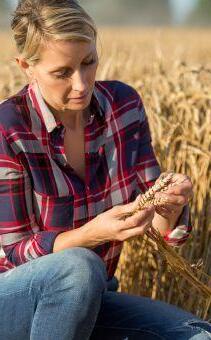
U of A’s new beef cattle research chair shares her POV. | 8
Moving manure
How complex is nutrient importing? | 10
Poultry litter: How old is too old? Digging into disease resistance. | 16
September/October 2021
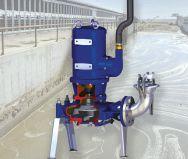
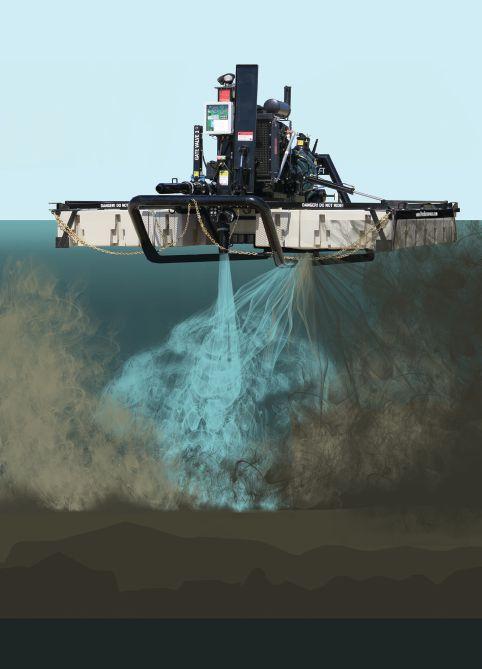
TURNING MANURE INTO HIGH QUALITY
WASTE WATER TREATMENT
WASTE WATER TREATMENT
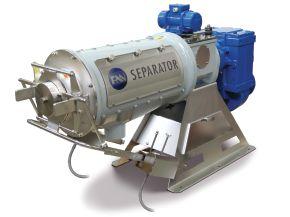
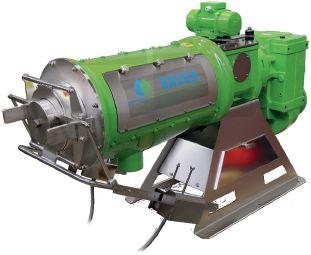
TURNING
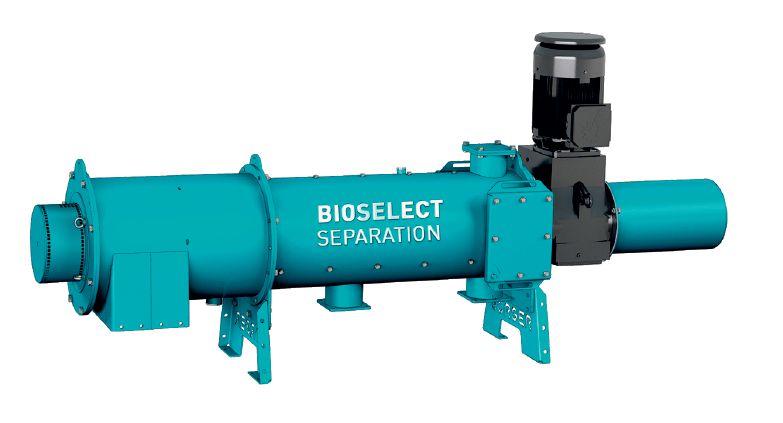
FAN PRESS SCREW
SEPARATOR
•
•
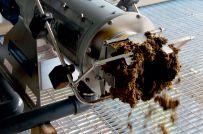
Fan produces bedding material with a dry matter content of up to 38% in solids.
All about transportation and safety
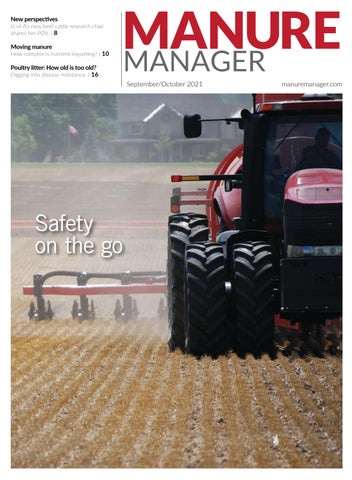
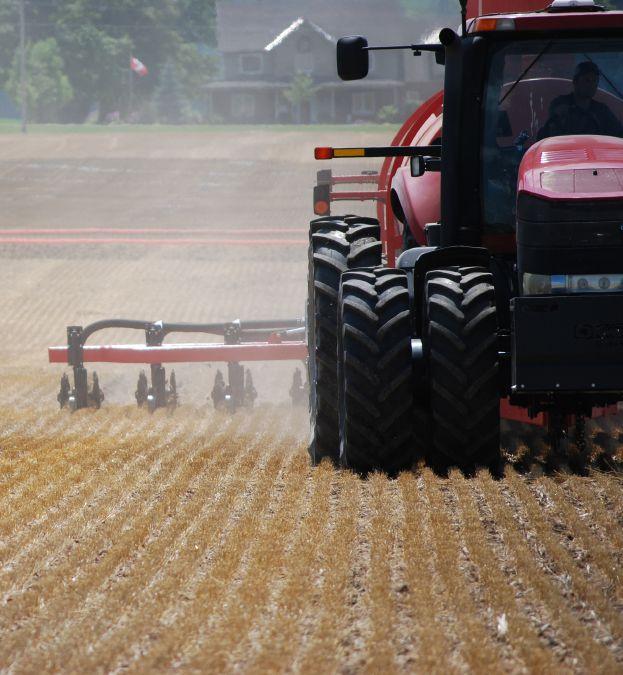
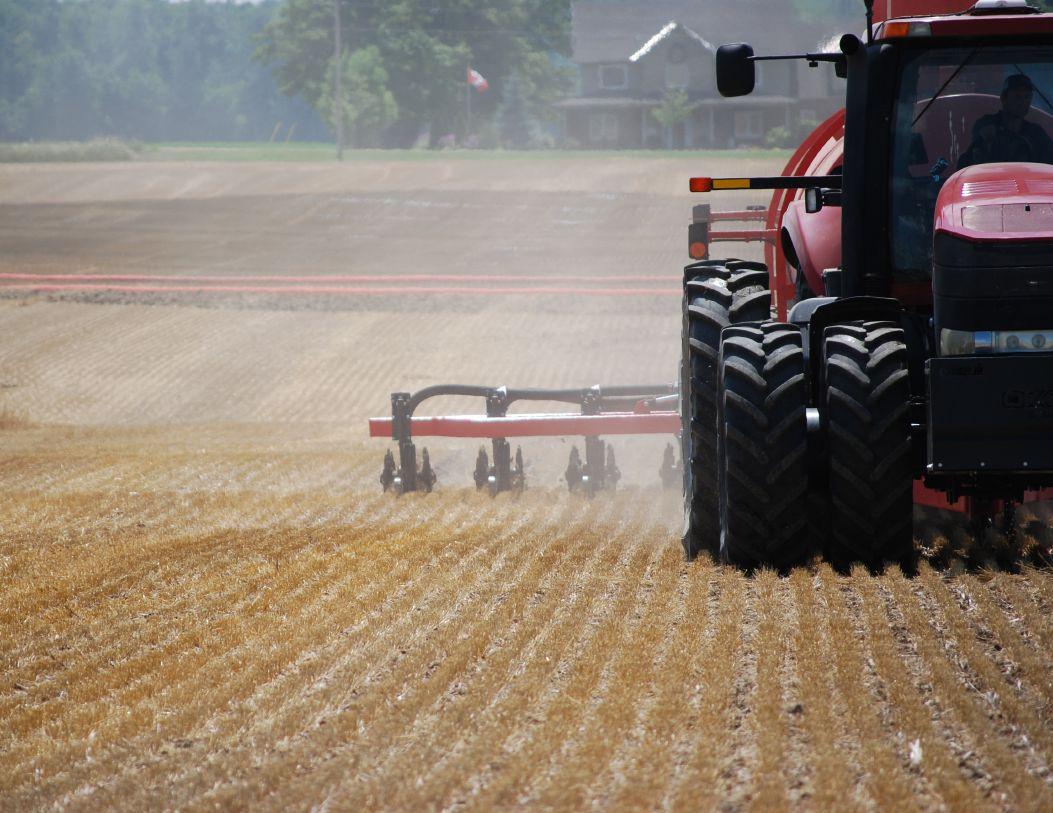
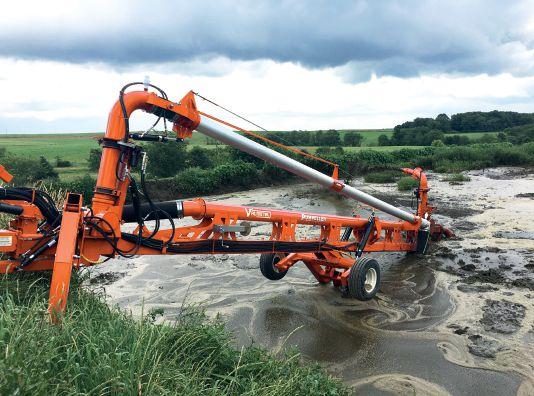
From moving manure to staying safe while operating tractors and trucks, this issue is all about manure in motion.
Safety in motion matters. See page 20. Photo by Manure Manager
New perspectives
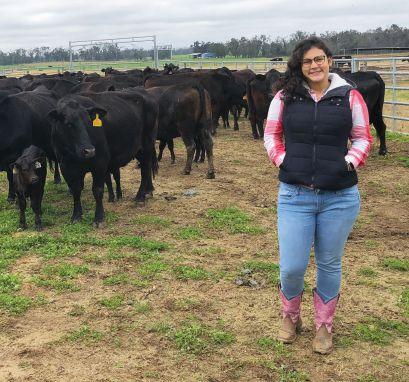
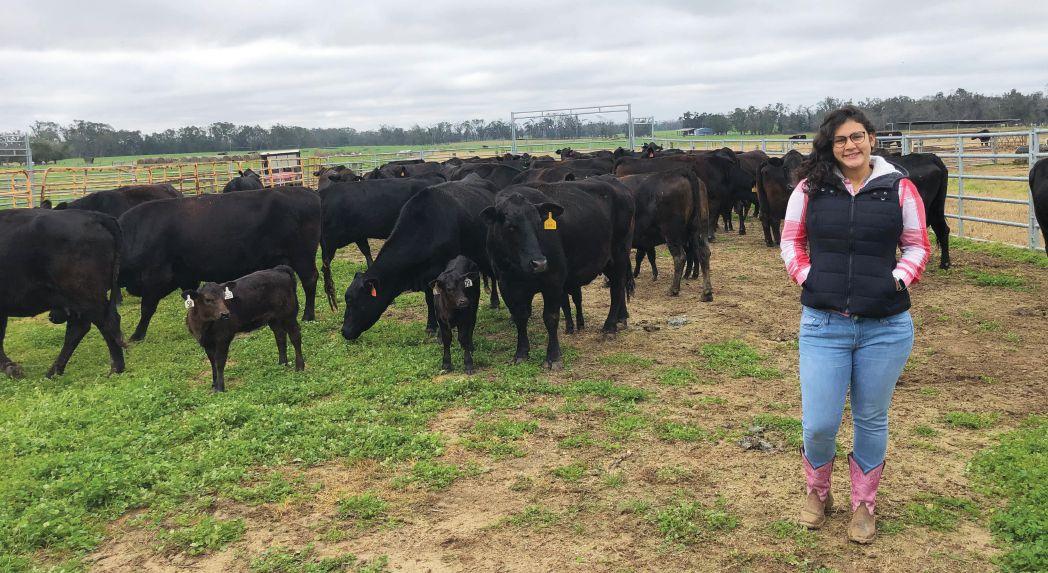
A Q&A with University of Alberta’s new Beef Cattle Research Council chair, Gleise M. Silva
BY JIM TIMLICK
Moving manure
New manureshed research shows how to use integrated planning for optimal manure dispersement
BY RONDA PAYNE
How old is too old? What does the age of poultry litter have to do with its resistance to E. coli and Salmonella?
BY JULIENNE ISAACS
The rules are there to keep you safe
I’ve never driven a tractor, a tanker or any type of equipment used for hauling manure. In fact, I’ve never even driven a pickup truck – I’m a small car driver. But I did grow up in snowy Northeastern Ontario. A couple years ago, on a wintry trip home, I remembered the advice I was given as a young driver: there are two stops there. The first is at the stop sign. Then, you pull forward and stop a second time so you can actually see around the snowbank.
Recently on a mid-winter trip home, I remembered why I’d been taught that routine: after I stopped and began to pull forward, around the snowbank I immediately saw not one but several sets of headlights zooming in my direction. Fortunately, it didn’t take long for me to find the muscle memory of the second stop, and to harness the patience that comes with driving in a more rural area – it’s a world away from city driving.
Besides the written rules, there’s always a whole series of unwritten rules we must follow to stay safe.
Safety is non-negotiable. And when safety measures are in place on the job, it becomes even more
that burnout and stress. However, not all industries involve work with large, heavy and potentially dangerous equipment.
Our agricultural workers are as valuable as what they produce – not just because they are workers, but because they are people – colleagues, friends, sons and daughters, parents, siblings and partners. Every time you get out to take a walk around your vehicle and get some fresh air, take your vehicle in for maintenance or complete a list of safety checks, you are investing in your own future.
And, for people like me who aren’t hauling manure, livestock and equipment on a daily basis, we need to remember that we share the road. Passing an oversized load to get to our destination a few minutes quicker –versus waiting until an appropriate and safe place to pass – often is not worth it.
While this issue is about safety, in many ways it is also about journeys. Yes, there’s road safety, but there’s also the topic of manure sheds and the complexity of moving manure (page 10). There’s also the journeys upon which we embark as people – like
“People of all industries experience burnout, stress and risk.”
imperative that we adhere to those measures. Routine, experience and a need to get the job done as efficiently as possible might drive us to skip the occasional step or to convince ourselves of things that are not true. “I’m not that tired.” “I can just check my maps app.”
To put it frankly, the job does not get done if you are no longer around to do it.
People in all industries experience burnout, stress and risk related to
the journey Gleise M. Silva took to Alberta to share her expertise in beef cattle health with the local industry (page 8).
Remember, whether we’re adjusting to new settings or perfecting our day-to-day routine, it never hurts to check in and ensure that you’re doing everything in the safest way possible, ensuring longevity for your equipment, your product and – your most valuable asset – yourself. The industry is better with you in it •
Find a new revenue stream in the last place most people want to look.
Turning agricultural waste into renewable natural gas (RNG) is a win-win for farms: it generates an additional source of income and also mitigates the methane emissions from livestock manure. Clean Energy is a one-stop shop for the development, operation, financing, marketing, and distribution of RNG. With 550+ fueling stations nationwide, including 127 in California, we provide the shortest path from farm to fleet.
New Holland’s latest tractor gets connected
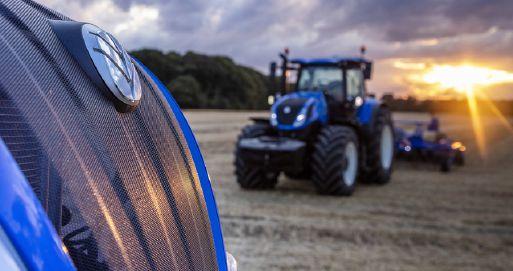
New Holland North America has added a new tractor to its lineup. The T7 Heavy Duty Tractor uses the brand’s PLM Intelligence technology to create a more connected experience. Precision and interconnected farming capabilities will help operators maximize yield, access key data and more.
The tractor contains a range of customization features to enable operators to suit their tractor to their individual preferences. According to the company, only two percent of parts are carry-overs from the
brand’s previous model. It’s also an extremely quiet piece of equipment, operating at 66 dBA.
“The T7 Heavy Duty with PLM Intelligence
Largest anaerobic digester in Northeast officially begins operation
As anaerobic digesters increase in popularity throughout North America, another major project has pressed the “start” button.
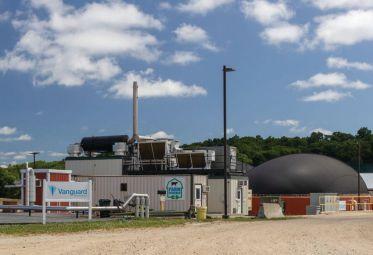
Representatives from Middlebury College, Goodrich Farm, Vanguard Renewables, VGS and the state of Vermont officially marked the startup of the largest anaerobic digester in the Northeast this past summer. The primary consumer of the energy generated by the digester will be Middlebury College, with raw material produced by Goodrich Farm in Salisbury.
The digester, which is built, owned and operated by Vanguard Renewables, has a daily capacity of 180 tons of food and beverage waste as well as 100 tons of dairy manure.
“The Goodrich Farm digester is the first star in a constellation of projects that will provide homegrown energy to Vermonters,” said Neale Lunderville, president and CEO of VGS, in a statement. “This farm, which began in 1956 with 10 cows, not only turns food scraps and manure from its now 900-head herd into renewable energy; it removes harmful methane from the atmosphere and phosphorus from the digestate that might otherwise drain into our watersheds and impact Lake Champlain. This is a great model, and we’re excited to continue working with our local farms to help Vermont meet its energy goals.”
series was developed with customer needs at the forefront,” said Ken Paul, High Horsepower Marketing Manager for New Holland
Agriculture North America, in a statement. “Integrating the new generation of PLM Intelligence to the T7 HD only elevates the tractor. Farmers can now easily do more in their operation and be remotely connected to dealers and support services increasing overall efficiency and profitability.”
Customers can register their machine through the MyNewHolland app and access the MyPLMConnect portal, where they can manage their fleet and farming data.
BRIGHTMARK, CHEVRON EXPAND PARTNERSHIP TO MORE RNG PROJECTS
Brightmark and Chevron will once again expand their previously announced joint venture, Brightmark RNG Holdings, to more projects across the U.S. to produce and market biomethane from dairy cows.
Currently, the joint venture includes projects in New York, Michigan, Florida, South Dakota and Arizona. Additional funding will be committed to 10 biomethane projects, including new sites in Iowa and Wisconsin, as well as more sites in Michigan and South Dakota. Chevron will be responsible for the producing and marketing of the RNG produced from these ventures.
“This latest expansion with Brightmark advances our strategy of higher returns and lower carbon,” said Andy Walz, president of Chevron’s Americas Fuels &
Lubricants in the statement. “Opportunities like these... reaffirm our commitment to investing in ways that are good for the environment, our consumers and our stockholders.”
“Brightmark’s expanded partnership with Chevron is another positive step forward in the decarbonization of the farming industry,” added Bob Powell, founder and chief executive officer of Brightmark.
“Our carbon-negative projects are successfully reimagining waste and delivering significant environmental benefits while improving economics for our dairy farm partners. We look forward to executing on these new RNG projects with Chevron and partnering with dairy farmers to expand our RNG footprint across the country.”
Growing the beef industry together
Incoming BCRC chair eager to work and learn with producers.
BY JIM TIMLICK
Gleise M. Silva grew up in Recife, a picturesque city in northern Brazil that is home to lush rainforests, historic architecture and some of the most prized beaches in the world. While she savored the splendors of her birthplace, her real interest was animals: specifically, beef cattle. That interest led her to study animal sciences in her native country before travelling to the U.S. for an undergraduate internship at the University of Florida. She subsequently completed her PhD at the school’s North Florida Research and Education Centre where she specialized in beef cattle nutrition.
Earlier this year she was hired by the University of Alberta as its first Beef Cattle Research Council (BCRC)-Hays chair in beef production systems. In her role, Silva will conduct research into cow-calf production with her U of A colleagues and turn their findings into practical advice for beef producers. Here, Silva shares what she hopes to achieve.
Interview has been edited for clarity and length.
Manure Manager: Tell me about the work and research you did prior to accepting your position with the University of Alberta.
Gleise M. Silva: After [my undergraduate] I went to the United States for my graduate studies. I did my beef cattle research there during my masters and
PhD programs. At the University of Florida, I did applied research in which we answered questions beef producers had about their operations. I worked mostly with grazing cow-calf systems, and we evaluated different nutritional approaches and management approaches to improve health, and performance of the cattle.
MM: Part of your role with the BCRC is to help beef producers save money. Can you explain how your work will help with that?
Silva: That can be achieved many different ways. For example, it can be by increasing the efficiency of cattle by having animals consume less. It can be by making sure the beef cow is calving every year which saves farmers in terms of labour and fuel on their field. There are a couple of ways to achieve this goal and to improve the economics of this sector. We want to find better ways or more efficient ways to produce cattle that will translate into more profit for the beef producers.
MM: You’ve only been here a short time, but have you noticed anything unique about Alberta or Canadian cattle or cattle operations compared to the ones you studied in Brazil and the U.S.?
Silva: I think the biggest difference that I have noticed
BCRC chair Gleise M. Silva is looking forward to working side by side with Canadian cattle producers.
PHOTO COURTESY OF GLEISE M. SILVA.
so far is the Canadian winter. It is maybe the biggest challenge here and it is unique compared to other parts of the world. The forage growth season is usually shorter than any other places in the world. We need to guarantee good forage production during the growing season and then store those forages for the months to come.
MM: When it comes to cattle production here in Canada a case is often made that you can be economically profitable or sustainable, but not both. How can cattle producers here maintain profitability while also being sustainable?
Silva: When we think of sustainability we have to remember exactly what it involves. Sustainability involves the environment, the social well-being of the farm family and the economics of the activity.
When we preserve natural resources, the grasslands, we are talking about sustainability. When we reduce calving intervals, when we reduce the stress on the land, when we reduce disease incidence we can improve profitability and the quality of life for the beef producer. It’s all aligned. One of the examples I like to use is when we have a cow that is giving a calf every 18 months instead of 12-month intervals we have to feed this new cow for longer without her being productive. That means we are losing feed, labor, space [and] general resources. But when we find the right management for our operation and can increase production we minimize waste, and we improve in gains.
When we select animals that are more efficient, and we give them adequate management, we reduce emissions and improve the performance of the farm. So that is all linked to sustainability and that is something we really have to think about. When we improve efficiency on our farm we are also more sustainable because we are reducing what we use, and we are reducing the waste we produce.
MM: You talked earlier about the importance of protecting grasslands. Can you discuss what role manure management can play in the protection of those grasslands?
Silva: Manure management can play a big role in the health of those grasslands. That’s really important because we know that manure can be a source of nutrients to the soil. When we have animals grazing we have what we call nutrient cycling. Nutrients are excreted through feces and
urine and will be deposited in the soil. This is contributing to the soil’s organic matter and consequently to soil fertility, plant nutrition and forage production. When we have cattle grazing on grasslands we have nutrients being returned to the system which contributes to maintaining soil health. And it’s important to make sure when we have cattle grazing grasslands that we have this manure being distributed throughout the entire pasture and not just a concentrated area.
MM: How important will it be to the work you are doing on behalf of the BCRB to work directly with Canadian cattle farmers?
Silva: My goal is to be really involved with the industry. I want to get to know the producers and work together with them as a team. I have a lot to learn, and I hope they can learn with me as well. I hope we can exchange knowledge and learn with each other with the common goal of growing the beef industry. •
When
Digester
• Barn Flush Pit
Separator Feed
Lagoons
Integrated planning for optimal manure disbursement
Manureshed research can help with placement of future livestock operations.
BY RONDA PAYNE
North Americans might be eating more plantbased foods, but meat products will continue to be a staple of everyday diets. The required growth in livestock production to meet this future demand for domestic and export meat products brings with it a corresponding growth in manure produced.
Statistics help tell the story. The per capita American meat consumption in 2020 was 225 pounds according to Statista. UN World Population Prospects indicates the North American population is expected to grow by approximately 14.5 percent from 2020 to 2050. Even if plant-based diets continue to increase in acceptance, there will still be an increased demand for livestock operations and thus the need for necessary improvements for optimal manure use and environmental health.
Dealing with manure is a farm operator’s issue. However, it is also a regional, national, international and global issue. Robb Meinen, senior extension associate with Penn State’s
ABOVE
department of animal science has been part of a team of experts exploring how better management of manuresheds can improve the distribution of nutrients naturally occurring in livestock production.
“A simple definition of a manureshed starts with any location where manure nutrients are generated,” he explains. “In much of our work we have utilized country-level analysis to consider trends in manuresheds, which is because much of the data used to assess manuresheds are available on a country basis.”
Despite this country-level data, manuresheds themselves are made up of regions known as source areas where the manure nutrients are produced and sink areas are those where manure nutrients can benefit crops. Meinen says this can be applied at a range of scales from farm-level to regional and beyond. So, at its simplest, a laying hen operation would be seen as a source area while a sweet corn and pumpkin farm could be a
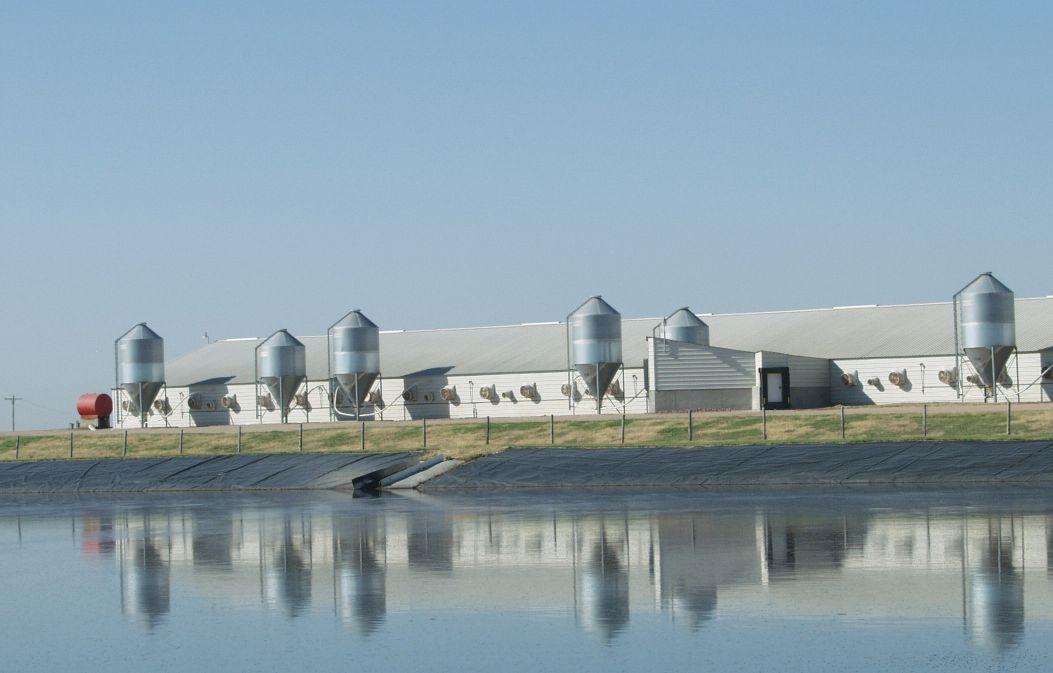
Application of swine manure is expected to be most efficient when close to the animal source.
PHOTO COURTESY OF ROBB MEINEN
Mental health isn’t something we talk about. to ignore
It’s time to start changing the way we talk about farmers and farming. To recognize that just like anyone else, sometimes we might need a little help dealing with issues like stress, anxiety, and depression. That’s why the Do More Agriculture Foundation is here, ready to provide access to mental health resources like counselling, training and education, tailored specifically to the needs of Canadian farmers and their families.
sink area. Thus, the manureshed is the available manure from the laying hen farm and the total area of crops it can provide adequate nutrients to within economical transportation confines.
Exploring the most efficient balance of nutrients and distribution is the purpose of the study. This isn’t a light task when one considers: the number of livestock operations, the amount of manure produced, the volume of nutrients from those various
types of operations, the demands of crop growth and the economical and viable transportation of the nutrients. This data then needs to be combined with the expected growth in livestock operations and whether there are enough manureshed sinks to take up the additional nutrients within the efficient transportation radius.
“Both nitrogen and phosphorus can be considered in the manureshed discussion. Once that nutrient supply is
defined based on items such as species of animal, number of animals and expected nutrient output per animal, we can estimate how much cropland area is needed to assimilate those nutrients,” he says. “This idea is not very different than typical nutrient management planning and considers crop types and production that is typical in the area where the manure is produced.”
It takes a great deal of expertise to consider these ins and outs and the team Meinen is part of brings together international minds.
“There are over 70 scientists involved across a wide range of disciplines. The work is part of the USDA LongTerm Agroecosystem Research (LTAR) Network focusing on manuresheds,” he says. “Most team members work for the USDA-ARS, but a number of specialists from universities and Agriculture and Agri-Food Canada have been invited to provide expertise.”
He notes that these team members, who had their first meeting in February 2020, bring everything to the table from data analysis and nutrient cycling to manure management and water quality expertise. There are also experts in agronomy, animal industry, animal nutrition, soil, greenhouse gases, social ecology and more. With that kind of diversity it would seem there would be nothing to surprise them, but he says, there can be.
“I really like that if the group cannot answer a question, then they invite a scientist that has specific expertise to explore that question,” he says. “It’s a large exercise to consider many aspects of manure nutrient distribution, but ultimately stakeholders… have to work together to implement the changes that the manureshed project will highlight.”
An example of this is in the manuscript on which he is the lead author. It highlights that the growth of the swine industry may lead to locating hog farms in sink areas due to the low nutrient, high liquid nature of swine manure and its transportation inefficiencies. Alternatively, poultry manure with its drier texture and high nutrients can be moved efficiently to crop sink areas without a relocation of animals.
Producers may wonder how a vast think-tank and studies like this can benefit their operation and, in the short term, Meinen notes there may not be extensive impacts. However, when these
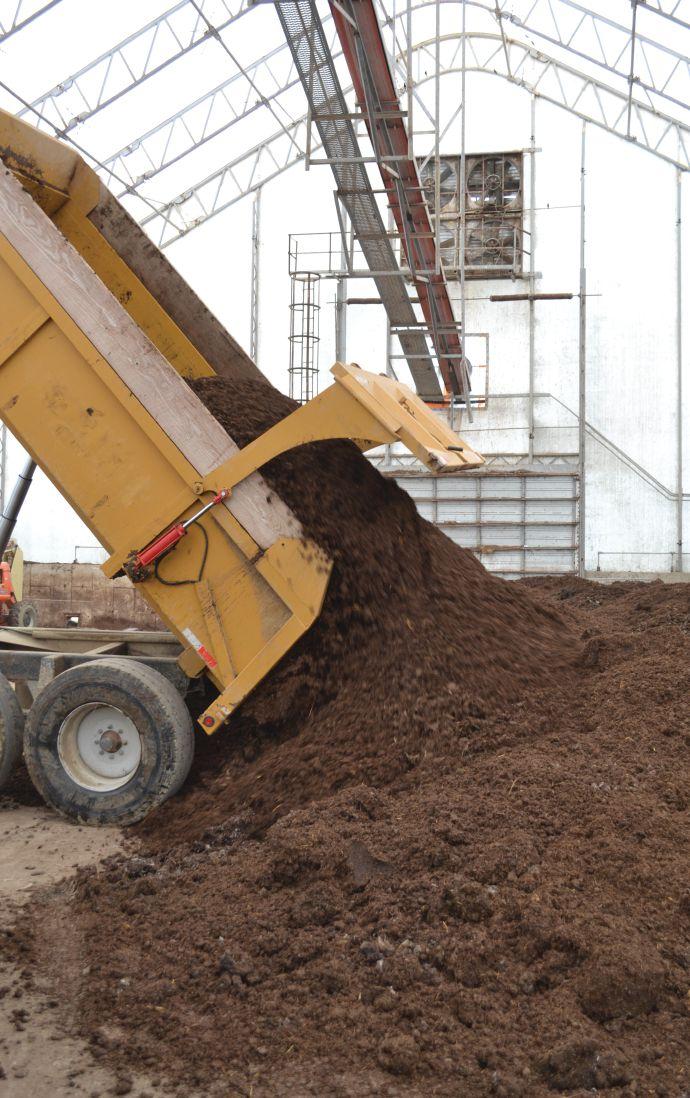
Poultry manure is largely handled as a solid, making it easier to effectively transport when needed.
PHOTO COURTESY OF ROBB MEINEN
same operations add additional animals or new livestock operations open up down the road, manureshed analysis can assist with the surplus nutrients in terms of balanced distribution.
“Someone’s nutrients are most likely going to have to move to lands that can act as a nutrient sink,” he explains. “There are countless scenarios here, but it means a change for someone in the neighbourhood can be expected. Manure redistribution to new lands is likely and chances are the manure nutrients can replace historic fertilizer nutrient application.”
Therefore, wise regional planning will encourage new swine operations to locate in manureshed sinks rather than in areas where there are already other hog farms that are fulfilling the immediate nutrient needs of the area. Additionally, he suggests that smart expansion can be an integrated approach that includes placement of feed mills in regions with crop farmers (manureshed sinks) and potential sites for livestock operations.
“It’s a big picture idea that could be supported by agencies and integrators, but I allow that it requires very strategic economic planning,” he says.
He explains that in areas where swine and poultry operations co-exist, there can be complications with how the nutrients are moved from source regions to sink regions. These are important considerations as the animal agriculture
industries expand. Do animal commodity associations and other regulatory bodies have the right to work with municipalities to help determine placement of new livestock operations? What could this type of smart growth look like?
“I don’t think it is possible to find a one-size-fits-all solution,” he says. “Expanding manuresheds might make sense, for example with the poultry broiler industry because it may make logistical sense to have animals close to the harvest plant and broker manure to distant lands where the nutrients are needed.
On the other hand, relocating animals to a nutrient sink area also relocates associated manure nutrients to that area where the N and P resources are needed.”
•
•
•
There are also animal health benefits to be had. With swine manure’s limited transportation efficiencies, hog farms can have greater isolation from one another as currently seen in parts of Pennsylvania.
“Such isolation limits risk of disease transfer, which in turn positively impacts animal welfare, farm efficiencies and profitability,” he says. “Another important consideration is whether the producer at the new contracted location has a need for the manure nutrients produced at the farm. Manure nutrients enhance profitability of the farm’s cropping operations by replacing costs of commercial fertilizer and positively influencing soil health.”
Meinen says the heart of the issue is water quality.
“All of the farm-by-farm work with nutrient management planning that we do across the nation does a good job of distributing nutrients properly on a local level, but we know that improvements can still be made,” he says. “Some local areas already have more manure nutrients than local cropland can assimilate in the long-term.”
Similar to how fossil fuel companies have started to take part in alternative energy options like Shell’s electric vehicle charging, he would like to see fertilizer companies take part in nutrient distribution solutions.
“It’s a complicated puzzle for sure,” he says. “Some areas will always be better suited for animal production and other areas better suited for crop production, especially with existing infrastructure. It is long understood that cycling manure nutrients back to cropping areas in lieu of introducing fertilizer nutrients into those areas is the ultimate solution to many of our water quality issues associated with agriculture.” •
•
•
•
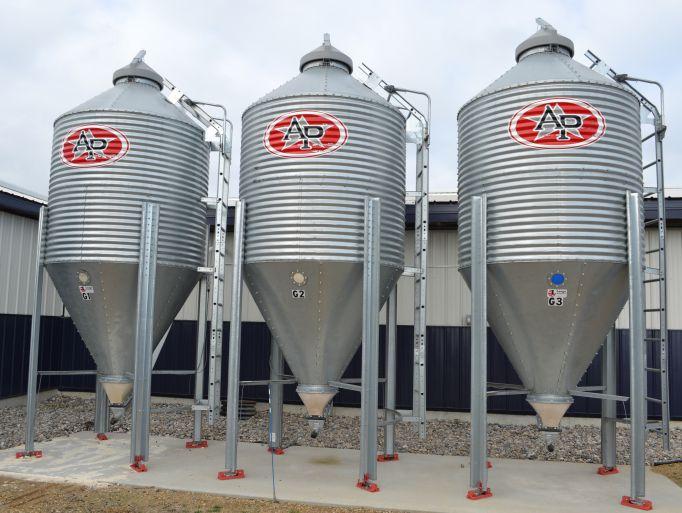
Feed bins at the South Dakota State University Swine Education and Research Facility store imported nutrients.
PHOTO COURTESY OF ROBB MEINEN
The incredible nominations we received for the second year of this program highlighted just how many influential women there are working within Canada’s agriculture industry.
To our Top 7 recipients, those who nominated an influential woman, those who offered support through social media or tuning into the podcast series on AgAnnex Talks, and to our generous sponsors:
CONGRATULATIONS
WOMEN IN CANADIAN AGRICULTURE WINNERS
Andrea McKenna
Crystal Mackay
Ellen Sparry
Leona Staples
Noura Ziadi
Simone Demers-Collins
Tina Widowski
POULTRY LITTER: How old is too old?
New research is characterizing litter microbiota to find out how it helps poultry resist common diseases.
When it comes to re-using poultry litter for successive flocks, how old is too old?
Research led by research microbiologist Adelumola Oladeinde, who works in the bacterial epidemiology and antimicrobial resistance research unit at the USDA’s National Poultry Research Centre, shows that contrary to established wisdom, using fresh litter for new poultry flocks can have a negative effect on the microbiota and chicken mortality.
But many questions remain as to management decisions, and these can only be answered with data.
Oladeinde says in Canada and Europe, it’s common practice to completely replace litter between flocks, but in the United States, litter is reused over multiple flocks, and sometimes for a period of several years, before being replaced.
In the U.S., during “downtimes” between flocks, used litter is typically decaked, tilled/ windrowed, or treated with acid-based amendments to reduce litter pH. It is also occasionally “topped up” with fresh pine shavings.
BY JULIENNE ISAACS
BELOW
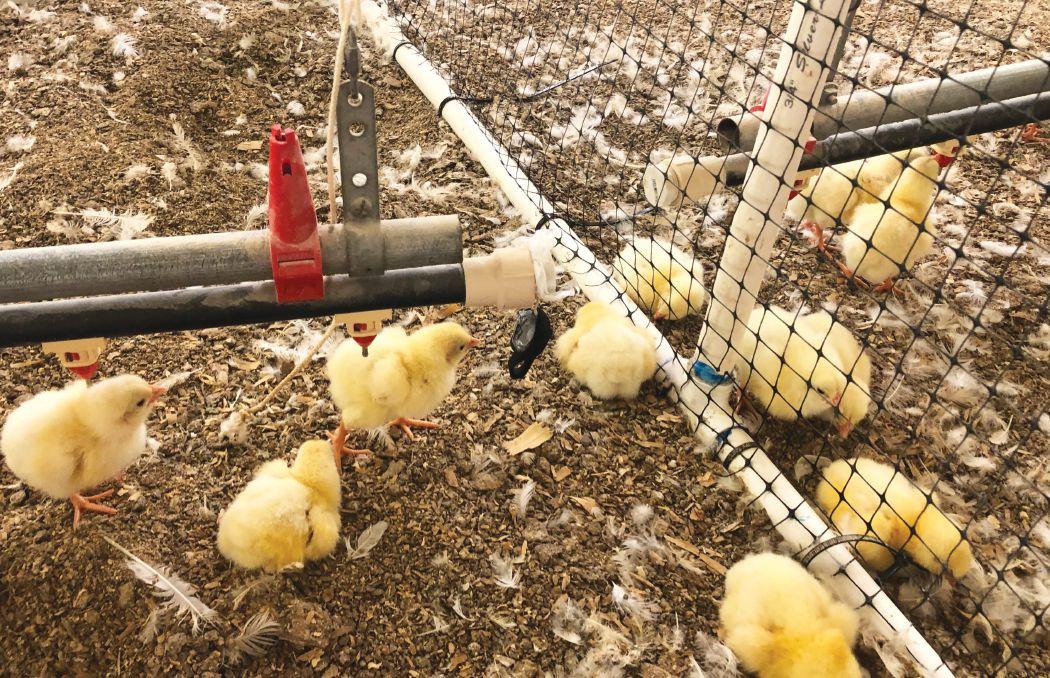
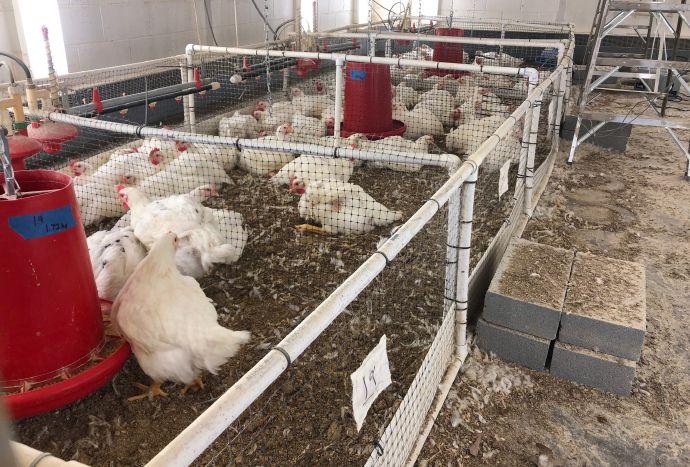
Day-old broiler chicks raised on reused litter.
The exact amount of time that litter is reused is left up to the producer, as is the length of the downtime before a new flock is introduced. The latter tends to reflect supply and demand more than poultry health, says Oladeinde, and isn’t standardized across the industry.
“If there’s a lot of demand for chickens, downtime is reduced. But what is needed is
a scientific basis for that decision. Currently, it’s random – so that’s one of the questions we’re trying to answer. What impact does that time have on the microbiome? Does it result in a decrease of pathogens or an increase?” he says.
In 2017, when the research began, Oladeinde set out to assess whether Salmonella can successfully colonize litter and compete with the beneficial bacteria already present. What he found was the opposite: reused litter tended to harbor a mix of microbes that naturally kept pathogens in check. The length of the downtime – and whether or not producers used pH amendments – had significant impacts on these levels.
In his latest research, Oladeinde attempted to characterize the litter microbiota to better understand how management choices impact populations of beneficial and harmful microbial communities, and answer the question of how the litter microbiota works to help poultry resist dangerous pathogens like Salmonella and pathogenic categories of E. coli.
“We need more data to convince the industry.”
HELPFUL AND HARMFUL POPULATIONS IN LITTER MICROBIOTA
In one study designed to document changes in the microbiota during downtime, Oladeinde used DNA sequencing to determine the makeup of the litter microbiota. He found the litter (after an 18 day downtime) was dominated by bacterial genera that are known to be beneficial, such as Faecalibacterium (Firmicutes), Lactobacillus (Firmicutes), and Bacillus (Firmicutes) and Nocardiopsis (Actinobacteria). However, when treated with acidifiers such as sodium bisulphate or sodium hydrogen sulphate (NaHSO4), “bad bugs” such as E. coli increased.
“In that study we saw a 90 percent decline in E. coli by leaving it for 18 days. At the same time, we see stability in [levels of] good bugs that are commonly used as direct-fed microbials when we Reused
A LONG WAY TOGETHER
WHEREVER YOU ARE, BKT IS WITH YOU
BKT provides you tires that are reliable and safe, sturdy and durable, capable of combining traction and reduced soil compaction, comfort and high performance.
BKT: always with you, to get the most out of your agricultural equipment.
reuse litter,” he says.
“What we observed is that when we put this acidifier on top of top dressed litter, the gain is reversed, and we see this bloom in E. coli populations that [had been] declining.”
Competition is a driver of resistance, says Oladeinde, and it’s likely that the more complex the environment, the more self-regulating it becomes.
In another study, he attempted to characterize a “healthy” gut microbiome – or a microbiome better able to resist pathogens such as Salmonella and E. coli – in broiler hens, by challenging broiler chicks raised on reused litter with Salmonella Heidelberg, a model pathogen.
“We show that chicks raised on reused litter carried lower abundance of
Salmonella and harbored a more uniform and diverse microbiome comprising of bacterial species that are known to provide colonization resistance towards Salmonella compared to chicks raised on fresh bedding composed of pine shavings,” writes Oladeinde and his co-authors in a publication based on his results.
Of particular interest, he adds, was the enrichment of antimicrobial pathways in reused litter, which indicates higher levels of competition between bacterial species as the litter was used by more flocks.
How, exactly, does it work? Oladeinde says the first thing broiler chickens do on entering a new environment –before eating or drinking – is to peck at the litter. “When we look at the genes that are in used litter, a lot of them are catabolic genes, able to break down a
TOP:
Broiler chickens raised on reused litter.
BOTTOM:
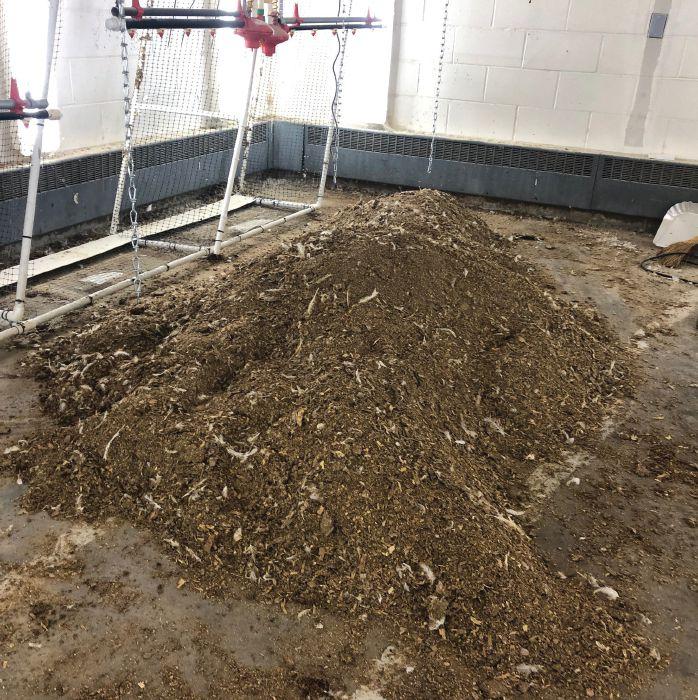
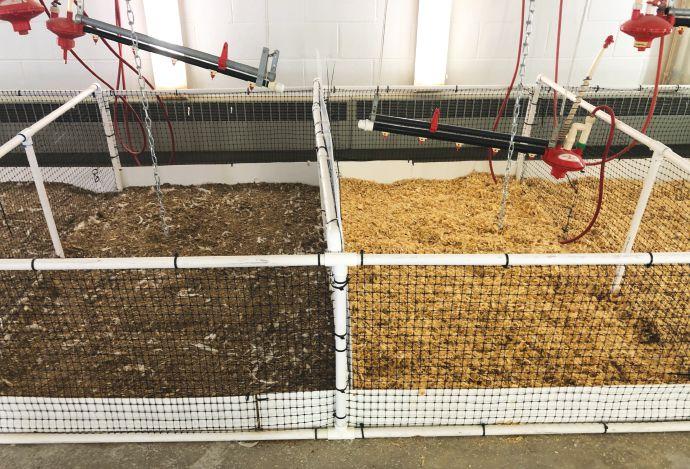
Experimental broiler chicken floor pens prepared with reused litter composed of pine shavings (left) and fresh pine shavings (right) as bedding material.
lot of nutrients, ions, metals easily. The feed we use always includes metals like zinc and copper,” he explains. “The litter already contains bacteria that can break these down. The chickens are enriching themselves with bacteria that [are] able to do the work.”
Streptomycin, an antibiotic derived from bacteria, is also abundant in reused litter, he adds. When chickens are challenged by Salmonella or E. coli, the streptomycin is able to knock off those pathogens before they cause problems.
But the length of time producers should keep a flock on reused litter before pathogens mount in numbers is still imperfectly understood. “It is possible that after several years or multiple flocks, some pathogens may become resistant to the competitive exclusion potential of reused litter, and that warrants further study,” says Oladeinde. Litter cannot be reused forever.
It’s also clear that balance is key: producers should avoid top dressing with fresh pine shavings, if they plan to acidify the litter in between flocks, which can have a negative impact on antibiotic resistance and can result in E. coli blooms. He adds that acidifying litter can have many benefits; it reduces litter ammonia and pH, which is particularly important to the health of the flock. In addition, they can help reduce litter moisture, which keeps litter dry and can lead to a reduction in pathogen numbers and better foot-pad scores, he says.
“Acidification just has to be done the right way, and we are in need of more focused research on this,” he says.
In a new project, Oladeinde intends to look at whether fresh litter can be inoculated with “good bugs” from reused litter. In another project conducted in collaboration with Agriculture and Agri-Food Canada researcher Moussa Diarra, Oladeinde will generate more data documenting Salmonella populations in fresh versus reused litter.
“We need more data to convince the industry,” he says. •
BY
Safety in motion
The fall harvest is an especially common time for collisions involving ag equipment. How can operators bake safety into the culture?
BY BREE RODY
It’s a relatively common experience most adults are familiar with – going to the washroom at a mall, department store or fast food place and noticing a chart on the wall. At short intervals – usually 30 to 60 minutes – someone has signed the chart to indicate that the washroom was cleaned.
Walter Grose says if the retail industry can embrace such regularity and discipline, those transporting manure have to as well.
“It’s all about due diligence,” says Grose. “Write everything down and record everything – you walk around the spreader, write it down. You check the oil, write it down.”
Grose serves as secretary for the Wellington Country Farm and Home Safety Association.
ABOVE
He also sits on the Workplace Safety Prevention Services advisory group – meaning Grose isn’t just passionate about farming, but also about safety. He helps landowners and residents in the area informed on everything from ATV smarts to in-depth farm safety. And as farmers get deep into their fall harvest, Grose says there’s no time like the present to not only refresh your knowledge of safety practices, but also work with your team on developing thorough protocols and better practices.
When working with manure, safety is already a concern for a multitude of reasons – asphyxiation remains the leading cause of death related to manure handling (and, research from Penn State
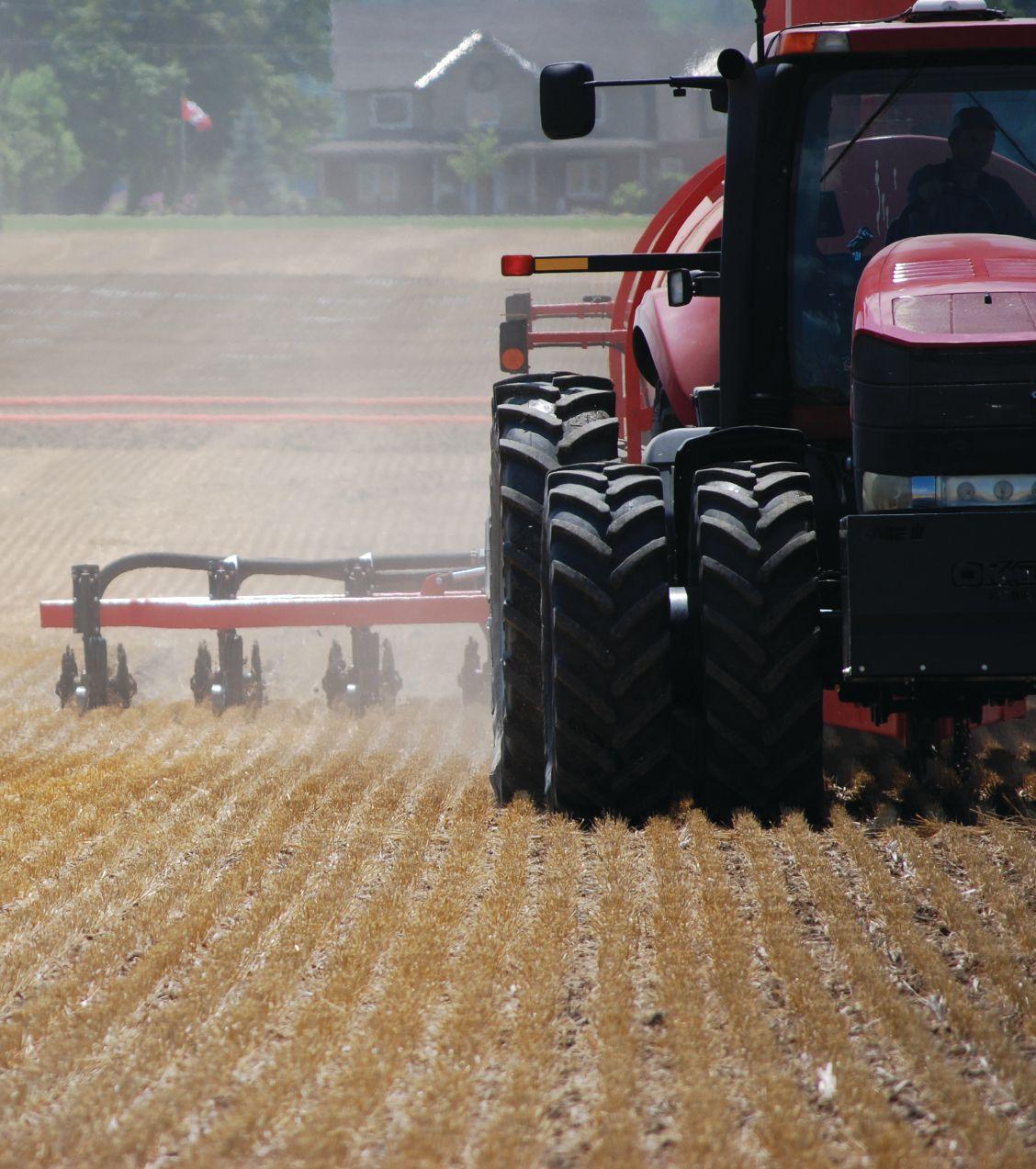
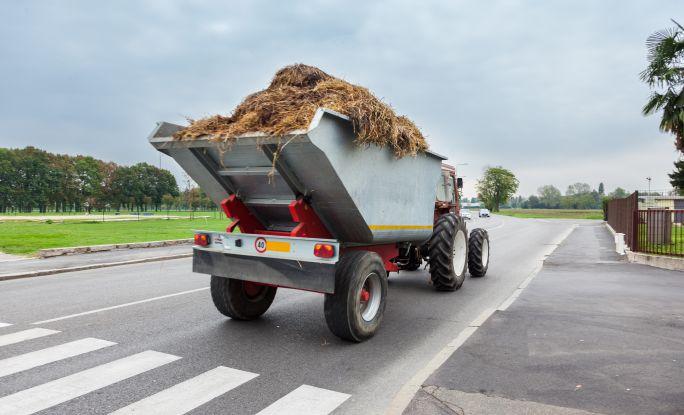
Manure application takes place just off a rural road in southern Ontario.
PHOTO
MANURE MANAGER
+
University suggests up to 25 percent of these deaths occur among young people), while pit deaths are also a concern. But Grose says an added layer of vigilance is required when one gets behind the wheel of a vehicle – whether it’s to spread manure in the fields or to transport materials down the highway.
According to a study by the Great Plains Center for Agricultural Health that looked at vehicles crashes in the Midwestern United States between 2005 and 2010, crashes occur most commonly
in the September-December harvest season, when a total of 3,006 crashes occurred across the nine states studied (Illinois, Iowa, Kansas, Minnesota, Missouri, Nebraska, North Dakota, South Dakota and Wisconsin) over five years.
In the year-round data, a total of 7,094 collisions involving 14,758 passengers were recorded, resulting in 161 deaths. Rear-end collisions were most common (22.6 percent of collisions), followed closely by same-direction side-swipes (17.8 percent).
THE ROADS HAVE CHANGED
In part, manure transportation is also risky because one has to contend with other people, many of whom do not understand the risks involved in farming. Even if they are perfect drivers themselves, haulers have to contend with drivers who are increasingly likely to be distracted or in a hurry.
Steve Freeman, a professor of agriculture and biosystems engineering with Iowa State University, says the fall can be an especially concerning season for road safety because of the harvest. “Combines, grain carts, large grain trucks, [vehicles] turning in and out of fields – and field intersections are not always well marked.”
Rural drivers sometimes get impatient, says Freeman, because they “don’t always understand what drivers are trying to do.”
While Freeman says the biggest hazard related to manure handling will always be confined spaces – because in those situations it is common to see “multiple fatalities at a time,” there needs to be more attention paid to risks on the road. “Tractors and slurry wagons, when they are moving on the roads going from farmstead to the fields… there are some very crucial concerns.”
“A lot of this equipment is too large to really get it off the site. So they’re going to be blocking traffic.”
In particular, he says, when slowmoving vehicle are used in manure operation, the manure mess can pose a hazard. “It’s not a very clean operation, so blinkers or slow-moving emblems can get covered with manure and they’re harder to see for traffic.”
The most common types of crashes Freeman encounters are those in which the farming equipment is struck from behind – which can be caused purely by drivers not perceiving speeds well enough. “If a car is moving at 60 miles an hour and the equipment is going 15, sometimes they don’t recognize that difference quickly enough to slow down.”
The second-most common crash, he says, is when vehicles attempt to pass a piece of farming equipment at the wrong time. If the equipment operator is about to turn left, says Freeman, “They [the equipment operator] will have to swerve to the right a little bit in order to make that turn. So even if they have their left
blinker on, as they start to move, drivers get impatient, they start to pass, and the piece of equipment turns because they have the right of way.”
It takes everyone to make roads safe, says Freeman. For ISU’s part, he says the school and extension do PSAs for rural drivers, but also work closely with farmers to do their own part.
“[If] they’re going to be blocking traffic, they need to move slower, they need to make sure that all their equipment is well-marked, and they need to communicate to rural drivers what they’re doing.”
Cheryl Skjolaas, agricultural safety and health specialist with the Center for Agricultural Safety and Health at UW Madison Extension says she sees similar issues in her state – year after year.
“It’s still the rear-end collisions and left-turn collisions,” she says. But she adds that traffic issues are worsening because the environment is changing. “We keep talking about the rural-urban interference. There’s not much of our area that is just rural anymore.” With more areas adjacent to farmland becoming recreational or tourism areas, she says, there’s more potential for more traffic and, thus, more problems.
Indeed, the GPCAH study found that about 70 percent of crashes involving farm equipment occur within rural zip codes, but 30 percent – not a small figure – occur in urban zip codes.
From the operators’ side, Skjolaas says there’s also a concern about causing spills on the road. Recent research on manure spills in Wisconsin from 2015 to 2019 by Reed Kostelny, Rachel Osterhaus and Kevin Erb found the top-three factors in manure spills (excluding dragline) were mechanical failure, operator error and manure spills on the road.
Being based in Ontario’s Wellington
County, Grose is not far from midsized cities such as Guelph, London and Waterloo, and is only a short drive from Toronto. He says city drivers aren’t used to the pace of those driving farm equipment. “They try to get around them as quickly as possible, because they can’t waste a minute of their life.”
At the same time, he says, increased volumes in traffic mean it’s harder for tractors and other equipment to get out onto the road – they have to “creep” out into traffic, which he says also poses a risk.
THE TIMES HAVE CHANGED TOO Lifestyle plays a bigger role than ever, says Grose – compounded by the economic need to do more jobs with less time and fewer resources. “We have less people that are working on the farm because we can’t get people – the factories are getting them, the internet is taking them. We don’t have people who are interested in driving a tractor and working on a farm.”
He says in an interest in simplifying jobs, farmers are taking one trip instead of two to transport equipment and material –which is creating larger hauls and thus larger potential problems.
“You have your drag hose, you have your pump, you have your pickup truck – you could end up 90 feet long,” he says. “Now imagine you have a small car trying to pass you.” He has also seen other drivers underestimating the length of the vehicle they’re passing. If they attempt a pass and another vehicle comes toward him, he says, “It’s almost impossible that a small car could get back in [to their proper lane] without having to crash into something.”
Skjolaas has also found in her discussions with custom applicators that operator fatigue is a large factor in many incidents. For example, she says, with
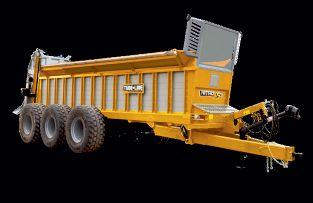
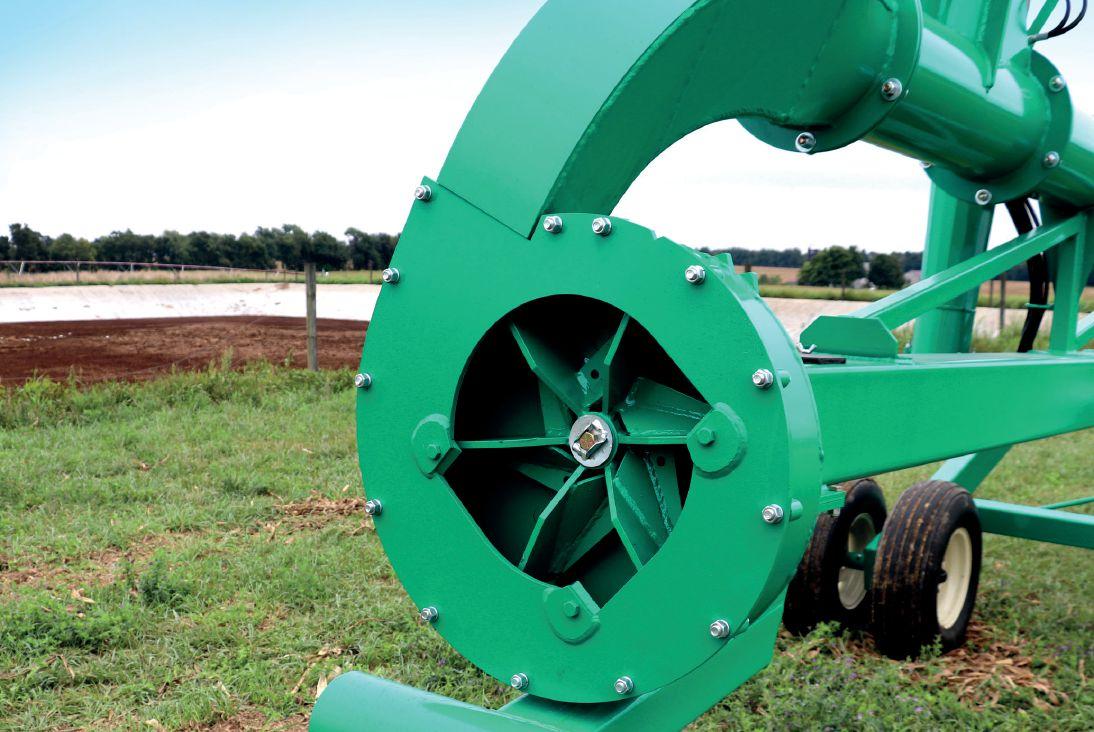
The strength and reliability of Nitro Spreaders set the standard for nutrient management.
The hydraulically driven variable speed apron chains feed fastmoving beaters that ‘bite’ the load and throw it into the field with remarkable consistency.
The addition of a variable rate control system, further reduces overhead, increases yields, and verifies field application rates.
When you’re ready to spread, we’re ready for duty.
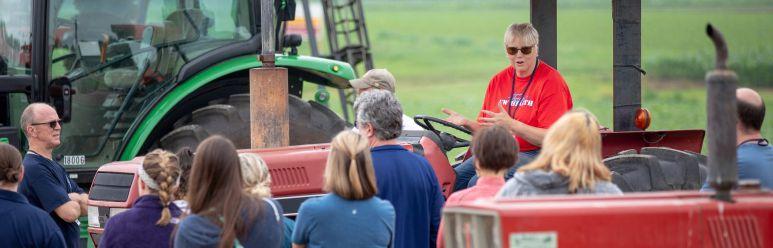
Extension educator Cheryl Skjolaas discusses vehicle safety with a group in Madison, Wisc.
trucks that move manure to frac tanks and dumpsters, the only three times the operators stop is to load, unload, or at a stop sign. “Out of habit, operators stopping at a stop sign reach over and absentmindedly flip the switch to open the valve.” Another observation, she says, is that the valve opening switch has been installed next to the jake brake switch, and when drivers approach a stop sign, they hit the wrong one. “Moving the switch, or putting a spring loaded cover on it, is being done to prevent this type of problem.”
Beyond operators who are inexperienced, overworked or tired, Skjolaas says they’re also increasingly distracted. “Distracted driving is a huge
problem out there. When you look at the size and scale of equipment you’re dealing with, you’ve got a lot that needs your full attention, on the road or in the field.”
And some basic spot checks might not be passed. According to the GPCAH study, only 29 percent of farm vehicles involved in collisions throughout the period of the study used seatbelts, versus 82 percent of other vehicle occupants. Two-thirds (66.8 percent) of farm vehicle occupants used no restraint or protection at all, versus 10.5 percent of other vehicle occupants.
Laws and punishment differ between jurisdictions – in Ontario, where Grose is based, the first strike is $615; subsequent
In a 2010 study, only 29 percent of passengers in farm vehicles involved in collisions used seatbelts, and some used no restraints at all.
strikes can eventually result in the impounding of the vehicle. In Wisconsin, where Skjolaas is based, fines are relatively lower compared to neighboring states, but a texting offense could land a driver a fine of anywhere from $20 to $400 with a possible four points added to the driver’s license; violating the state’s general distracted driving law results in a fine of $173 plus four points to their license.
CHECKS AND BALANCES
Skjolaas says whether someone is working with tractors, trucks or other equipment, all plans and procedures should be written. There should be highly visible safety checklists that are integrated into daily routines on the farm. “Make it part of your daily plans so that equipment gets checked, that you have a record of it. Vehicle inspections are so important to show that you are putting the safest vehicle possible out on the road.”
She says ultimately, everything starts with knowledge. “One key thing to look at is having your operators prepared, your crew trained and have a schedule you can stick to so that you can encourage a culture to take breaks when you’re feeling that fatigue and address some of the health issues.” •
PHOTO BY CRISTINA/ADOBE STOCK
CHRYSEIS MODDERMAN | University of Minnesota Extension and MELISSA WILSON | University of Minnesota extension specialist
Fall manure application tips
Fall manure applications are right around the corner (or, for some, are well underway), so here are some reminders on best practices to make accurate applications and avoid nutrient loss.
APPLICATION TIPS
• Sample your manure and get it tested. Manure is a variable product so knowing the actual nutrients (not “book values”) in the manure is important for accurate application.
• Soil sample. While we’re on the subject of nutrient analysis sampling, you will also need to have a recent analysis of your soil. The soil test tells you what nutrients are needed, while the manure test tells you how much of the nutrients you have. Both are an essential piece of the accurate application puzzle.
• Nitrogen calculations can be tricky. Not all of the total nitrogen in manure is plant-available in the first year. Manure provides two forms of nitrogen: the inorganic N (immediately plantavailable), and the organic N (not immediately plant-available). The organic fraction will need some time to break down (called mineralization) to become usable by the plant.
• Instead, if your soil test shows high P levels already, consider applying at a P-based rate. That means looking at how much P your plants will need, and applying at a rate that provides that amount of P. Of course, this will likely underapply N, so you will need to supplement with another N source.
• Wait for cool (<50ºF) soils to apply manure. When applying manure in the fall, you’ve got a long wait until spring for a crop to use those valuable nutrients; and you want those nutrients to stay put in the soil and wait patiently. Nitrogen has a knack for escaping into the environment, and nitrate is the most mobile form of nitrogen. Manure doesn’t contain significant amounts of nitrate, but the ammonium in manure (the plantavailable form) can convert to nitrate through a process called nitrification.
• Nitrate is easily lost through leaching and denitrification (lost as a gas), so we would like to keep manure nitrogen in the ammonium form, and not let it convert to nitrate. As long as the manure is incorporated into the soil, and not left on the surface, most of the ammonium will stay where you put it.
“Nitrogen has a knack for escaping into the environment.”
• When calculating a nitrogen-based application rate, use the total nitrogen multiplied by the availability factor. You can find the availability factor at your local extension manure application webpage.
• Don’t forget to credit all nitrogen sources. Was last year’s crop a legume? Was manure applied last year? Does your irrigation water contain nitrogen? Will you use a commercial starter fertilizer that contains N at planting? If you answered “yes” to any of those, subtract that N in your rate calculations for this year.
TIPS FOR AVOIDING NUTRIENT LOSS
• Avoid phosphorus buildup in your soils. Excess phosphorus in soil can lead to runoff and phosphorus pollution. To avoid P buildup, don’t blindly apply based on how much nitrogen you need. When applying at a N-based rate, most manure supplies too much P for the plant to use, causing it to build up in the soil over time.
• How do we avoid this dreaded nitrification process? Apply to cool soils. Nitrification happens rapidly at high temperatures, but slows with cooler temps. Therefore, we recommend waiting until soils are 50⁰F or cooler to apply manure. Note that nitrification is not halted at cool temperature, just slowed. Even around freezing, the process continues very slowly.
• Don’t apply when runoff is likely. It should be common sense to not apply manure right before a big rainstorm or onto frozen or snow-covered soil. Check the forecast and keep an eye on your soil saturation.
• Incorporate manure into the soil. When there is not a crop to take up nitrogen, incorporating manure into the soil immediately after application is important for avoiding nitrogen loss to the atmosphere as a gas through a process called volatilization. If manure is left on the surface, nearly all of the immediately-plantavailable nitrogen (ammonium) will be lost, though organic N will remain. •
HARDOX® - EXTENDED SERVICE LIFE
Harder. Better. Stronger.
Don’t let sand wear you down.
HARDOX® - LESS DOWNTIME
HARDOX® - COMPONENTS MANUFACTURED IN HOUSE
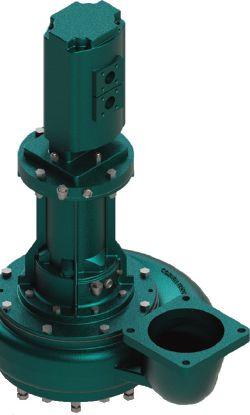
HARDOX® - NEW PUMP HOUSING DESIGN FOR EASIER SERVICE
I WANT A PUMP THAT CAN STAND UP TO MILLIONS OF GALLONS BEFORE REPAIR.
GEA now offers the impeller, housing and cover plate constructed with Hardox® for all PTO pumps with 8” and 10” discharge. By choosing GEA Hardox®, we provide you with extended life, reduced downtime, and increased affordability all while keeping manufacturing in house.
Requirements
•
•
• A strong drive to support your
Benefits
• Discount structures and terms on a readily available supply of parts and equipment.
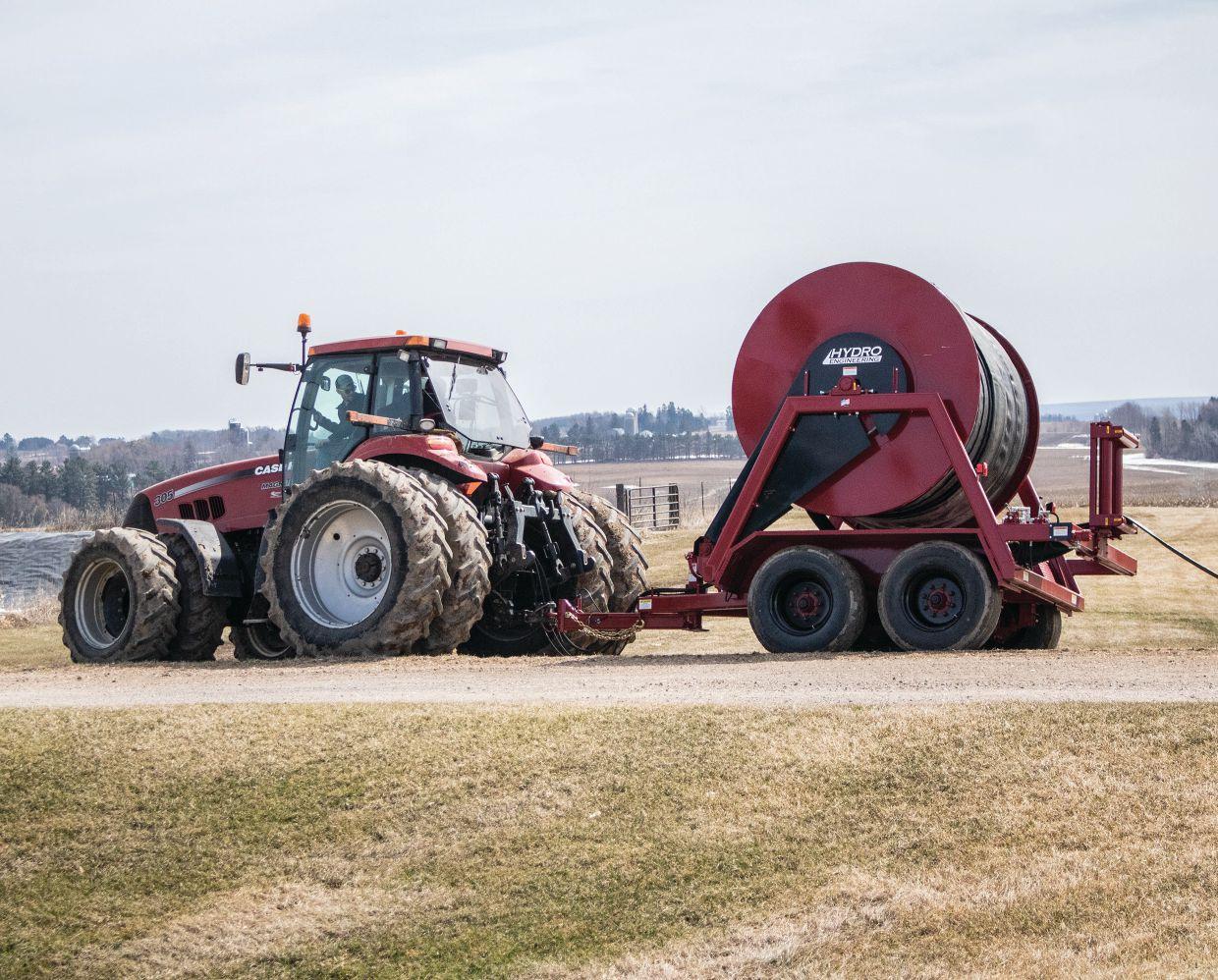
• Technical & customer support from Hydro Engineering utilizing decades of experience in the agricultural market.
• An opportunity to strengthen current customer relationships while building new ones.