MM - January - February 2020

Page 1


Back to basics

Making decisions for manure storage and application after a wet harvest | 14

Agritechnica highlights Scenes from Germany’s largest agriculture trade show | 18

Livestock Water Recycling A Q&A with the manure startup | 34

January/February 2020

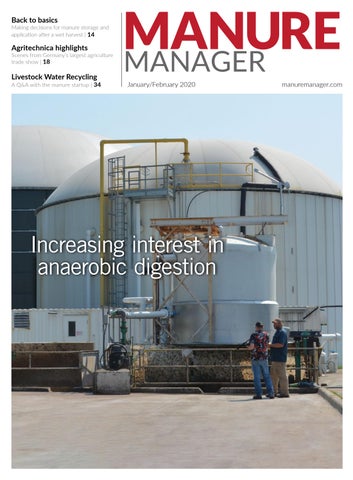
Increasing interest in anaerobic digestion

JANUARY/FEBRUARY 2020 Vol.18, Issue 1

Greener pastures?

Farmers in Michigan are showing increased interest in anaerobic digesters. 14 16 20

Back to basics Making decisions for manure management, storage and application after a wet harvest.

On the ground at Agritechnica

Scenes and highlights from Germany’s largest agriculture trade show.

Michigan State University’s South Campus anaerobic digester. See page 10. Photo courtesy of Michigan State University.

Q&A with Livestock Water Recyling Startup company looks to add manure to the circular economy. BY STEPHANIE GORDON

The power of people

Technology in agriculture has made countless advancements over the last few decades. These innovations can drive efficiency and process, but can anything truly replace a human?

I recently tuned in to The Calgary Eyeopener podcast, featuring highlights from the CBC Radio program in Calgary, AB, Canada, where host David Gray interviewed Will Evans, a farmer from Wales, U.K., and host of the Rock and Roll Farming podcast.

Evans, a multigenerational farmer, aims to share the human side of agriculture through his podcast. He visited Alberta in January, attending and speaking at the FarmTech conference, and is passionate about telling the story of agriculture through the people most involved in it.

Much like their North American counterparts, Evans says farmers in the U.K. are focused on soil health and regenerative agriculture. And, of course, technology is making all the difference. “We’re really on the cusp of a fourth agricultural revolution in terms of robotics and technology on farms and how it can drive us forward,” Evans said in his CBC interview.

efficiency and have incredibly high standards of animal welfare. It’s not as simple as ‘big farms are bad, small farms are good,’ but it certainly has changed a lot over the last generation.”

He’s not wrong. Advancements in technology and equipment have provided numerous benefits, including efficiency and precision. But to me, smart farming goes handin-hand with the shift in farm labor and dynamic. Yes, the benefits are proven – but that also means that the operator needs to be willing to adopt and understand the technology.

In addition, finding someone qualified to take over the farm has been a longstanding challenge for many farmers on both sides of the pond. Much like Evans has observed in the U.K., small farms with no one to succeed them often get purchased by a neighbor – in fact, the majority of respondents polled in our 2019 Succession Planning Survey revealed they have no succession plan in place (you can read more about that on www.familyfarmsuccession.ca).

The bottom line? Engaging the next generation is more important than ever. Acccording to the Food Sustainability Index, only one in

Smart farming goes hand-in-hand with the shift in farm labor.

But, he said, it seems as though the challenges are mirrored too.

“I think, speaking to Canadian farmers here over the last few days, [it’s] very similar [to] issues we’re having in the U.K. in terms of finding people to work on farms.

“It’s changed a lot certainly from my father’s generation, when there [were] a lot of small family farms around us. A lot of them are gone now. They’ve been swallowed up by the neighbours . . . a lot of the [larger farms] are really driving in

100 young people in the United States chooses to pursue a career in agriculture. And in the latest U.S. Census of Agriculture, the median age for farmers and ranchers in the United States is 59.4 years, and young producers – age 35 or younger – accounted for just nine percent of farmers.

It’s 2020. We know technology isn’t going anywhere. But if we want to keep up with smart farming, we need the right people to help.

(888) 599-2228 ext. 277 scroley@annexbusinessmedia.com

Associate Editor ALEX BARNARD (519) 429-3966 ext. 276 abarnard@annexbusinessmedia.com

Advertising Manager SHARON KAUK (519) 429-5189,

Designer CURTIS MARTIN

Circulation Manager SHAWN ARUL sarul@annexbusinessmedia.com

VP Production/Group Publisher DIANE KLEER dkleer@annexbusinessmedia.com COO SCOTT JAMIESON

#867172652RT0001

rthava@annexbusinessmedia.com Tel: (416) 442-5600 ext 3555 Fax: (416) 510-6875 (main) (416) 442-2191 Mail: 111 Gordon Baker Rd., Suite 400, Toronto, ON M2H 3R1

Occasionally, Manure Manager will mail information on behalf of industry-related groups whose products and services we believe may be of interest to you. If you prefer not to receive this information, please contact our circulation department in any of the four ways listed above. Annex Privacy Officer privacy@annexbusinessmedia.com Tel: 800-668-2374

No part of the editorial content of this publication may be reprinted without the publisher’s written permission. ©2019 Annex Publishing and Printing Inc. All rights reserved. Opinions expressed in this magazine are not necessarily those of the editor or the publisher. No liability is assumed for errors or omissions.

All advertising is subject to the publisher’s approval. Such approval does not imply any endorsement of the products or services advertisted. Publisher reserves the right to refuse advertising that does not meet the standards of the publication.

Tamara Carter Co-founder Carter Cattle Company Ltd. Lacadena, SK

Canadian Anaerobic Digestion Guideline now available

The Canadian Biogas Association (CBA) has developed a national Anaerobic Digestion (AD) Guideline document. The document aims to establish recommended planning, design and operational practices for AD facilities processing food and organic waste materials by clearly outlining the best practices for biogas projects.

In creating the AD Guideline, the CBA took input from government departments, industry

organizations, and members representing agriculture, municipal and private interests. Created by industry for industry, the AD Guideline offers technical guidance to support continued development of biogas projects in Canada with actionable information on the deployment of AD facilities.

If you are interested in obtaining a copy, please contact the Canadian Biogas Association at jgreen@canadianbiogasassociation.ca.

GEVO, U.S. DAIRIES PARTNER FOR PROJECT

Gevo Inc., a renewable chemicals and advanced biofuels company based in Colorado, recently entered into a contract with three dairies to convert the manure they provide into pipeline quality renewable natural gas (RNG).

The three dairies are expected to jointly generate approximately 350,000 million British Thermal Units (MMBTU) of biogas per year for sale to off-takers or use by the company’s

affiliate, Agri-Energy, LLC, at its biofuel production facility in Luverne, MN.

Gevo Inc. aims to reduce, and eventually eliminate, the fossil footprint created through the operation of the Luverne facility. These biogas contracts, in conjunction with wind power, should enable any biofuel produced at the Luverne facility to have a lower carbon intensity score, as well as an

increased value.

The company states it has a letter of commitment from a lender for $20 million to finance the RNG project at one of the three dairies, with a verbal commitment from the same lender to finance the projects at the other two dairies. The financing includes capital for the anaerobic digesters, the biogas collection and upgrading system and the utility interconnection system.

“These three dairy farms represent what I envisioned as phase one of the biogas cluster, consisting of eight to 10 total farms once the system is fully built out,” said Gevo Inc. CEO Patrick Gruber in a press release.

“We aim to change mindsets by demonstrating you can change waste from being a pollution problem to a renewable energy solution in the liquid fuels market.”

In the U.S., an estimated 9,000,000 dairy cows in 75,000 herds.

A 1,000-lb. cow produces an average of 82 lb. of manure per day

Based on the Pennsylvania State University digester, each cow produces a net daily biogas output of 40 cubic feet (1.2 m³).

University of Saskatchewan awarded nearly $7 million for livestock research

Twenty University of Saskatchewan projects have been awarded nearly $7 million through a joint federal-provincial government funding program through the Agriculture Development Fund to advance cattle, swine, and poultry research.

The funding program will help researchers improve health and safety for animals, reduce the environmental impact of livestock farming, and provide promising researchers of tomorrow with invaluable experience.

“This stellar livestock research helps increase agriculture value-added revenue, grow our agri-food exports, and address climate change, while training tomorrow’s skilled workers in this sector,” said Karen Chad, University of Saskatchewan vicepresident of research, in a press release.

Funding includes $3.2 million for

the management and operations of the University of Saskatchewan Livestock and Forage Centre of Excellence (LFCE). Seven of the 20 University of Saskatchewan research projects will be conducted all or in part at the LFCE, which has a mandate to improve the sustainability of the livestock and forage industries through research and education in five key areas: soil, forage and crop systems, cow management, feedlot operations, and alternative livestock including bison.

Projects announced Jan. 29 involving University of Saskatchewan animal health research include developing a universal vaccine for influenza A in swine, tracking antimicrobial resistant E. coli in chickens and testing for Salmonella dublin in dairy herds.

Livestock research projects with the potential to reduce environmental impact

NV Energy seeks biogas and biomass proposals in Nevada

Nevada-based NV Energy is requesting proposals for new renewable energy projects in all areas of renewables, including biomass and biogas, which are compliant with Nevada’s existing renewable energy standards.

The announcement follows the Public Utilities Commission of Nevada’s approval of 1,190 megawatts (MW) of new solar energy and 590 MW of battery storage to be built in Nevada, set to be operational by January 2024. NV Energy is also considering adding supplemental energy storage systems that are integrated with the proposed renewable energy resource and standalone energy storage systems.

Project proposals will be evaluated based on multiple factors, including best value to customers and the economic benefits for the state of Nevada. All proposed projects must be at least 20 MW in size, and proposals must include a completed Facilities Study or Large Generator Interconnection Agreement.

Proposals are due by 4 p.m. PDT on March 9. For more information, visit nvenergy.com.

include using pea starch for swine feed, hybrid fall rye as a new forage source for beef cattle, strategies to address mineral nutrition in the face of poor water quality and reducing greenhouse gas emissions from cattle feedlots.

The funding commitment also includes $375,000 to support 10 undergraduate summer research projects per year over five years. Co-ordinated by Dr. Elisabeth Snead with help from Saskatchewan Ministry of Agriculture scientists, the projects provide doctor of veterinary medicine students with exposure to both research and hands-on experience working with food animals and other animals important in agriculture. The goal is to make students more comfortable and confident dealing with these species during their professional careers after graduation.

CEF DELIVERS 143 MILLION GALLONS OF RNG IN 2019

Clean Energy Fuels (CEF) in 2019 delivered 143 million gallons of Redeem renewable natural gas (RNG), a carbonneutral transportation fuel, in 2019.

The environmental impact of replacing this volume of diesel fuel with RNG is equivalent to reducing more than 820,000 tons (745,000 tonnes) of greenhouse gas emissions, planting 12 million trees, removing 158,000 cars from the road, or reducing 260,000 tons of waste that would otherwise end up in landfills.

Redeem RNG is made by capturing methane produced by the decomposition of organic waste from dairies, landfills and wastewater treatment plants.

CEF is a California-based company with fuelling

stations across the contiguous U.S. In 2019, CEF stated their goal is to exclusively offer zero-carbon Redeem RNG at all of its fuelling stations in the U.S. by 2025.

Sales of the renewable fuel were strengthened by a seven-year contract with shipping company UPS for 170 million gallons to fuel its fleet of natural gas heavyduty trucks in the U.S., the largest purchase of RNG ever in the U.S.

Sales were also bolstered by the introduction in California of more ultra-low emissions trucks operating in the port of Los Angeles, as well as from wider adoption by municipalities including Santa Monica, Santa Clarita, Midway City, Redondo Beach, Sacramento, Ontario and San Jose.

Renewed tax credits to drive biogas industry boom

Tax credits that have been expired since Dec. 31, 2017 will be renewed in 2020. The American Biogas Council (ABC), a trade organization that represents the biogas industry in the U.S., believes these credits will drive industry growth and project development. The credits can be used for projects that will be developed this year or started operation during the last two years, when the renewable energy or alternative fuel credits were expired.

The tax extenders package signed into law on Dec. 20, 2019 includes provisions for the Section 45 Production Tax Credit for renewable electricity and the alternative fuel excise tax credit for biogas projects that provide vehicle fuel. With the passage of this legislation, biogas now has parity with several other renewable energy technologies, which had previously obtained longer term tax credits in 2015 and 2018 respectively.

“Our members will tell you it’s been a tough several years trying to finance many biogas projects while we compete with unfair advantages given to the fossil fuel industry, as well as our sister renewable industries,” said Patrick Serfass, executive director of the American Biogas Council (ABC), in a press release.

“For now, the biogas industry is on much more level footing. Our members are already developing the next biogas projects that will recycle organic material into renewable energy and soil products while creating new jobs and investment.”

The ABC believes the passage of this bill is an indication of Congress’ readiness to address remaining disparities in the tax code between fossil fuels – which have their tax credits permanently baked into the tax code –and renewable technologies and views this as a first step to more comprehensive renewable energy tax policy.

Digester upgrade powers up Prairies Edge

Prairies Edge Dairy Farms in Fair Oaks, IN, commissioned a new TwoStage Linear Vortex digester from DVO Inc., replacing the dairy’s CSTR/ complete-mix system and combining its biogas with that generated by the original DVO digester installed in 2008. The new digester is a significant improvement, adding 30 percent capacity to Amp Americas Renewable Dairy Fuels’ (RDF) original Fair Oaks compressed natural gas (CNG) installation. The original installation was already noted for achieving the lowest carbon-intensity score to date for an operating dairy biogas-to-CNG installation by the California Air Resources Board, according to DVO.

“Given the same inputs, our newest DVO digester produces more biogas than our old digester ever made on a good day, by at least 25 percent,” says Carl Ramsey, operations manager at Prairies Edge.

The Prairies Edge dairy-to-CNG operation is the second largest on-farm

CNG installation in North America. It has been online since 2011 and was the first dairy biogas-to-transportation fuel project in the country. The largest, RDF’s Jasper plant, is also located in Fair Oaks, and combines biogas from a number of adjacent dairy farms that utilize DVO digesters. The Jasper facility is 50 percent larger than Prairies Edge, and between the two installations, the manure from 38,000 milking cows is managed.

Amp Americas is a big proponent of DVO digesters. “DVO’s system digests all the waste from a dairy – nothing bypasses. The manure is thoroughly and efficiently processed, and the gas output is steady and predictable yearround,” says Grant Zimmerman, Amp Americas CEO. “Together this means significantly more biogas is produced ‘per cow’ than with other digester designs. These things are good for the environment and the local community – and tend to make our investors happy, too.”

Brightmark Energy collaborates on Florida biogas project

Brightmark Energy (BE), a San Francisco-based waste and energy development company, has partnered with four central Florida dairy farms to construct three anaerobic digesters, which BE will develop, own and operate. The four dairy farms, located in Okeechobee County, are owned by the Larson family – two by Larson Dairy Inc., and the other two by JM Larson Inc.

The project will convert 230,000 tons of dairy manure per year from 9,900 cows into renewable natural gas (RNG), reducing the net greenhouse gas emissions from processed dairy manure at a rate of 57,400 metric tons per year, the equivalent of planting 75,000 acres of forest each year.

“We’re proud to partner with the Larson family, who have a long history as dairy industry leaders in Florida,” BE CEO Bob Powell said. “Projects like these help to provide additional revenue streams for farmers, reduce local air and water impacts and enhance the sustainability efforts of farmers, so this project is a win for the farmers and the local community.”

BE has launched several biogas projects in the past two years, with active projects in Washington, Wisconsin and New York, and with intentions to develop similar biogas projects across the U.S. When the Larson project becomes operational at the end of 2021, BE’s biogas projects will generate enough RNG to drive a bus more than 16-million miles each year.

State officials are pleased with the collaboration, noting the benefits of innovation and the potential new revenue source for the local dairy community.

“Cows are the ultimate recyclers, creating wholesome milk from byproducts of the citrus, ethanol, brewing and textile industries,” participating farmer Woody Larson said. “This technology now also allows us to convert manure to energy and improve the environment.”

While the Larson family are the first partners on the project, BE is looking to collaborate with other Florida dairy farmers interested in biogas production. For more information on partnering with BE in Florida, contact Colin Kelly at colin. kelly@brightmarkenergy.com.

Bazooka Farmstar releases enhanced Titan Series Toolbar

Bazooka Farmstar has released an enhancement to their Titan Series Toolbar.

The Titan Series was the first front-folding manure injection toolbar upon its release in 2015.

Titan 2 improves upon several features of the original. The tower has been moved forward to more closely align with the tires, creating less resistance when turning in the ground at the end of a pass. The design of the toolbar body has been reinforced to withstand exceptionally rugged field conditions. The new design comes in lengths from 40 feet to 60 feet, increasing the number of Phantom Units that can be incorporated across the toolbar. It has been equipped with larger flotation tires to counteract the steel that has been incorporated into the new design.

Titan 2 includes two new standard features. The Flux Manifold is accompanied with a new lift assist for more convenient clean-out, and a block indicator light that allows operators to quickly detect an obstruction in the manifold. Three-inch bumblebee drop-tubes hold the hose routing, minimizing sagging that would otherwise cause sand build-up and hose clogging.

Manure Constituent Sensing now available with John Deere HarvestLab 3000

The John Deere HarvestLab 3000 with Manure Constituent Sensing analyzes liquid manure 4,000 times per second for nutrient constituents to help producers manage their total fertilizer program.

According to John Mishler, precision ag tactical marketing manager for John Deere, the HarvestLab 3000 infrared sensor used to evaluate nutrient characteristics of forage crops and feed can now be used to provide values for major constituents found in liquid manure used for fertilizer.

“The system provides accurate, real-time values for total nitrogen, ammonia nitrogen, potassium, phosphorous and dry matter content of the manure as it’s applied to the field,” Mishler says. “This enables the operator to manually or automatically adjust the volume based on the nutrient values to meet specific nutrient targets or goals for their fields, and possibly save on commercial fertilizers.”

HarvestLab 3000 can be used with a variety of tanker or dragline equipment to apply liquid swine, beef and dairy cattle manure.

GREENER pastures?

Michigan farmers showing increased interest in anaerobic digesters.

Michigan State University’s South Campus anaerobic digester.

Producers in Michigan are expressing increased interest in adding anaerobic digesters (AD) to their operations, driven by on-farm benefits, additional potential income sources, and a desire to make their operations more sustainable. When all the costs and benefits are laid out, it becomes clear that the choice to construct an AD in Michigan is not a simple one.

ANAEROBIC DIGESTION IN MICHIGAN

Interest in anaerobic digestion in Michigan is not new – a handful of systems were built in the early 1980s as a result of the energy crisis in the 1970s. Although one system operated for over 20 years near Sturgis, most of them only operated for a few years because of low energy prices, lack of environmental drivers and operating and maintenance issues.

“People weren’t trained on how to operate them and they weren’t designed to integrate nicely into the farm,” explains Dana Kirk, the manager of the Anaerobic Digestion Research and Education Center (ADREC) at Michigan State University. “Farms used sand bedding and there would be grit in manure, so the digester filled up with grit. There weren’t any provisions made to address how dairy operated.”

More recently, six systems were constructed on dairy farms in the late 2000s, five of which continue to operate. Michigan State University built plug flow and complete mix ADs in 2010 and 2012, respectively.

“This round is going much better,” Kirk says.

“Our farms are better engineered today, so process flows are easier and things work better. We also have technologies, like sand separation, to remove that on the front end and better tools to help us see what’s happening.”

LEFT

Compressors for DTE Biomass’s renewable natural gas production plant at Dairy Dreams LLC, a farm in Lincoln, WI. Photo courtesy of Mark Hill, DTE Biomass.

digesters and municipal digesters.”

Kirk adds that the low price paid for existing RNG projects and the fact that no new projects have been constructed in more than five years indicates that RNG is simply not prioritized in Michigan at this time. The energy potential of Michigan’s producer operations is considerable: Michigan dairy farms collectively care for an estimated 428,000 cows, and every 100 lactating cows generate 200 to 300 kilowatt hours of electricity per day, enough energy to power 15 houses per day.

“Renewable energy in Michigan tends to be produced from other sources, such as wind and biomass.”

Training has also helped. There are now operators who have gone through specific training to understand the mechanical parts of the digesters. Michigan State University ADREC is the in-state training option, offering a three-day AD operator training program that provides guidance to AD operators, enabling them to safely maximize biogas production and system life.

STATE POLICY AND SUPPORT

At this time, Michigan doesn’t provide support or incentives for adoption of ADs or biogas production. “Renewable energy in Michigan currently tends to be produced from other sources, such as wind and biomass,” Tess Van Gorder, associate policy and regulatory specialist in the Agricultural Ecology Department with the Michigan Farm Bureau, says. “But I do think conversations are starting to happen more frequently in regards to on-farm

Beyond Michigan’s borders, incentives for biogas and RNG are more readily available. Two main policies driving interest are the United States Environmental Protection Agency’s Renewable Fuel Standard (RFS) program and the California Low Carbon Fuel Standard (LCFS). The U.S. Congress created the RFS program to reduce greenhouse gas (GHG) emissions, expand the nation’s renewable fuels sector and reduce reliance on imported oil. Its goal is to ensure transportation fuels contain an increasing volume of renewable content. The LCFS is a fuel policy designed to encourage the use of lowcarbon fuels in California.

“Renewable natural gas produced from anaerobic digesters can be sold to California at a premium due the value the LCFS places on it,” Van Gorder explains.

Mark Hill, vice-president of Dairy RNG operations at DTE Biomass Energy, adds that dairy RNG is highly valuable in the LCFS program because of its ability to capture unregulated methane to generate project credits.

“California views methane emissions from dairy manure lagoons as a significant source of greenhouse gases, and as a result, dairy RNG from captured methane is considered to be a negative carbon intensity fuel,” Hill says. “Because value is based on the carbon intensity of the fuel, dairy RNG projects are seen as removing greenhouse gases and, therefore,

generate significant value.”

The recent renewal of tax provisions extending the Sect. 45 Production tax credit for renewable electricity and the alternative fuel excise tax credit for biogas projects that provide vehicle fuel creates additional benefits and motivation for the development of ADs, which will hopefully entice Michigan producers considering biogas production.

Should Michigan reconsider the value of RNG as a source of green energy and sustainable development, there are several states it could take as a model. “In North Carolina, energy production from swine waste is a part of the Renewable Energy and Energy Efficiency Portfolio Standard,” Van Gorder says. “Which has helped incentivize electric power production on farms, in part, from anaerobic digesters.”

COST AND ROI

Kirk says, for the current interest in biogas-to-RNG, producers are looking at a

$7 to $15 million investment for a 3,500cow dairy. While the investment is huge, the return on investment can be as low as two years, although he says it will more likely be three to five years.

Potential on-farm benefits include the production of renewable energy that can be used on-farm to offset energy costs, and the reduction of manure-based pathogens, odor and GHG emissions. The product of the anaerobic digestion process, the digestate, can also be used on-farm. Since nutrients from the manure remain in the digestate, it is often used as a fertilizer; if separated out, the solids can be re-used as bedding.

Hill says the financial decision to add an AD to a dairy farm is very complex and is driven by a number of aspects, including herd size and type, milk production per lactating cow, current manure handling practices, manure consistency, bedding type, financial stability of the dairy, access to a natural gas pipeline, ease of permitting digesters

LEFT

Gas separation membranes for DTE Biomass’s renewable natural gas production plant at Dairy Dreams. Photo courtesy of Mark Hill.

and RNG and utility access in the area.

“Farmers may need to obtain water or air permits, or make changes to existing National Pollutant Discharge Elimination System (NPDES) permits to add digesters to their operations,” Van Gorder says. “Additionally, some labor laws differ between farm and non-farm employees so farmers will need to be careful about classification of their workers.”

While there is interest in anaerobic digestion in Michigan, Kirk says there is a combination of factors that have Michigan producers being cautious when considering the investment. These include low commodity prices, lack of State drivers to generate renewable energy, confusion over Federal and other State policies and a history of AD-related challenges. Integration is also a challenge.

“Sand bedding is a big issue since it is commonly used on our dairies,” Kirk says. “Installing with a new operation is less expensive, assuming the dairy is located near a natural gas transmission line. Another potential barrier to systems is access to electricity. Gas upgrading and compression systems draw significant energy loads.”

Van Gorder adds cost and operations and maintenance to the list of challenges.

“Digesters are expensive and need to be monitored closely,” she says. “There are many parameters that need to be watched to ensure the digester is operating correctly, in addition to keeping up with maintenance and maintenance costs.”

Digesters are designed to take advantage of economies of scale inherent in large dairy and swine facilities, which puts them beyond the budget of mid-sized and small operations. However, that hasn’t dissuaded every smaller scale producer.

“The current markets are focused only on the largest farms, but it has been mostly medium-sized farms that have reached out to me for guidance and support,” says Kirk. “Factors that are attractive to those farms are of course new revenue lines, but also sustainability and the ability to demonstrate to their communities that they desire to be good environmental citizens.”

For more information visit the EPA AgSTAR website www.epa.gov/agstar. •

Getting back to basics

Making decisions for manure management, storage and application after a wet harvest.

During wet years, livestock manure application can be a challenging enterprise: depending on the rotation, there can be limited opportunities to apply during the growing season. If harvest is wet, many producers are forced to store manure for weeks or even months.

In some U.S. states winter application is outright banned, but the practice isn’t recommended anywhere in North America, says Chryseis Modderman, a manure nutrient management extension educator for the University of Minnesota. The risks of runoff and pollution are too high, and vast quantities of added nitrogen – up to half – could be lost.

In general, she adds, when a manure pit is at risk of overflow or breach, it’s better to landapply the manure than let it breach, as pollution from a large manure spill is typically greater than that from land application if the application site is well-chosen.

Harvests in 2018 and 2019 were challenging for much of Minnesota, she says, with near-

ABOVE

constant rain and land so wet that, even if producers managed to get the crop off, there was no way a heavy manure tanker could be driven into the field.

“I saw some folks making deep ruts in wet fields this fall in a desperate attempt to get manure spread. There are real soil health consequences to ‘mudding it in,’ like increased compaction,” Modderman says.

But a growing body of research shows risks of winter application, from nutrient loading in water bodies to pathogen and antimicrobial loss, according to a literature review authored by Steven Safferman, an associate professor at Michigan State University.

Christine Brown, field crop sustainability specialist for the Ontario Ministry of Agriculture, Food and Rural Affairs (OMAFRA), says that due to logistics, it used to be common for Ontario producers and commercial applicators to spread manure in the winter, but the practice is losing favor with growing awareness of eutrophication problems

Both 2018 and 2019 presented challenging conditions with extra moisture in many areas, causing delays to both harvest and manure application.

in Lake Erie. But even if the numbers are down, there are still too many producers winter-applying, she says.

With 2018 and 2019 weather and late harvest conditions in Ontario similar to those in Minnesota, early January saw many producers surface-applying manure; however, the second weekend of the month saw more than 2.5 inches (65 millimeters) of rain in 24 hours in some areas – breaking a record for precipitation set in the 1800s.

“There was an awful lot of surfaceapplied manure in the last few weeks, and needless to say those nutrients are no longer located where they were spread,” says Brown.

DECISION SUPPORT TOOLS

Brown says the most important approach to minimizing runoff issues is to plan well in advance, identifying application opportunities during the year and making them part of long-term planning – for example, by choosing crops that facilitate late-summer applications.

But the biggest factor, she says, is how much the manure is valued by users: if it’s valued, it’s more likely to be applied at the right time and in the right place. “There’s been more emphasis on the soil health aspects of manure, and that’s increased the value and [improved] how people treat manure,” she says.

Brown recommends producers get full manure analyses done so they understand the resource. OMAFRA has just released their AgriSuite Organic Amendment Tool, which lists available nutrients after application and places a dollar value on the manure. By spring the resource should also include a phosphorus risk assessment tool, she says.

In the U.S., the states of Wisconsin, Michigan, Minnesota and Ohio have partnered with several federal agencies and educational institutions to develop a suite of decision support tools for manure application, says Heather Johnson, a senior hydrologist for the Minnesota Department of Agriculture (MDA).

Minnesota’s Runoff Risk Advisory Forecast (RRAF) system was designed to help farmers and applicators determine the best times to apply manure, and has

LEFT

Winter application of manure can be a factor to nutrient runoff in water.

been in use since 2018.

“With the higher than normal precipitation around the state in 2019, most days the RRAF map was in alert status,” Johnson says.

In Canada, there are best practices for manure application in all seasons, but there are regulations, too. On farms that are regulated under the Nutrient Management Act, manure applications from December to the end of March are prohibited, unless they can be incorporated immediately or are applied to a living crop. Even farms that are not regulated can be fined if pollution events occur.

Brown says anyone handling manure should know which regulations apply on a farm or in a region, have contingency planning in place for storage and spills, and keep the Spills Action number at hand.

CONTINUED ON PAGE 23

On the ground at Agritechnica

Scenes and highlights from Germany’s largest agriculture trade show.

A number of new machines designed for working with manure were revealed at Agritechnica 2019, held Nov. 10-16 in Hanover, Germany. From slurry tankers to manure spreaders and more, the show left farmers pondering over the sheer size and technology involved in the new equipment.

With so many financial pressures on farmers these days, forking out bags of cash on new technology is an investment that needs serious scrutiny. However, with labour shortages across the sector becoming more common, the only solution to get the work done is via technology. That was one of the key messages that visitors took home with them when more than 450,000 farmers, contractors and machinery enthusiasts took in the many sights and sounds of the huge, week-long event.

Machinery manufacturers use the show to launch their latest innovations and technology that may or may not make it into full-scale commercial production someday. The world of agricultural

machinery is changing rapidly in terms of engines, design, size and, of course, price, and exhibitors at Agritechnica were keen to highlight their new releases.

Some of the key focuses at Agritechnica 2019 included producing engines fuelled by alternatives to diesel, developing smart technology that is affordable to smaller farmers and increasing the use of autonomous vehicles. While the machines come from a plethora of countries and are manufactured for a huge number of uses, the one sentiment that connects them all is that smart farming should provide for a better future.

In total, 2,819 exhibitors from 53 countries exhibited their wares, with a number of joint ventures between competing brands surprising some of those in attendance. The end goal of developing a machine that is efficient and saves costs remains the primary focus for manufacturers, even if the guaranteed future of that machine is a good few years down the line.

German company Annaburger introduced its new Tridem slurry spreader HTS 34.28 Profi tanker, designed for agricultural contractors and large farms. The fibreglass trailer has a low dead weight and therefore offers a very high filling volume of 1,006.5 cubic feet (28.5 cubic metres). The chassis, with 90,390-pound (41,000 kilogram) BPW axles, can be fitted with size 750/60 R30.5 tires. The electronic forced steering in the first and third axles makes the vehicle particularly soil-conserving when it travels on arable land or turf. On the road, the cylindrical shape of the tank and the four integrated baffle plates reduce unwanted surging of the liquid. A particular benefit of the new HTS 34.28 slurry spreader is the option for rear-mounting a four-point suspension for a linkage weighing up to 9,921 lb. (4,500 kg) – for example, a 118 foot (36 m) wide Vogelsang dribble bar. The high-performance Vogelsang rotary piston pump system, with a capacity of up to 2377.5 gallons (9,000 litres) per minute, guarantees short filling times and large application volumes.

When it comes to spreading manure in large quantities, the Austrian-built Brantner TR34090 Power Push model is the answer. With a gross weight of 74,957 lb. (34,000 kg) and a deadweight of 22,267 lb. (10,100 kg), a payload between 1518.5 and 1730.4 cubic feet (43 and 49 cubic metres) is possible. An extremely strong chassis frame made of double C press profiles gives extra stability in the field and on the road. Sitting at 36 ft. (11 m) long and 9.8 ft. (3 m) wide with huge tires, this

giant of a machine can shift manure in quantity. The distance between axles is 5.9 ft. (1.8 m) and the tire of choice is 560/60 R 22.5 Agri Radial Mitas 161 D.

Fliegl’s unique transport trailer caught the attention of visitors at the show with its tracked chassis. Not only does this trailer offer increased efficiency at harvest time, it also is less harmful to the ground with its new crawler technology. With 24 balancing rollers, a track width of 31.5 in. (800 mm) and a chassis height of 41 in. (1050 mm), the trailer protects the soil structure with increased traction. Within the Vario range there are six different models, from 706 to 1589 cubic foot (20 to 45 cubic metre) capacities with load discharges of around 22,000 lb. (10 tonnes) per minute. The Vario has width-adjustable side walls which can be reduced to 8.4 ft. (2.55 m) for road transport, extending to 9.8 ft. (3 m) for field work.

JCB added a new telescopic handler to its vast range at Agritechnica called the Loadall 532-60 AGRI. Key features on the new model include a joystick switchcontrolled four-speed powershift transmission, the JCB EcoMAX four-cylinder 4.4-litre 109 hp engine and a 7,055 lb. (3,200 kg) lift capacity maximum to 20.3 ft. (6.2 m) full height or 3,086 lb. (1,400 kg) at 11 ft. (3.34 m) forward reach. Exhaust gases are cleaned using selective catalytic reduction (SCR) and a diesel oxidation catalyst (DOC) to meet Euro Stage IV/US Tier 4 Final

emissions compliance. It can be specified on 20-inch tires to bring the machine’s height down to just 7.9 ft. (2.4 m), from 8.2 ft. (2.49 m) on 24-inch tires, together with a slight reduction in overall width. Top speed on the 380/75 R20 tires is 20.5 m.p.h. (33 km/h) and the 460/70 R24 tires increase this to 25 m.p.h. (40 km/h).

The only gold medal awarded at this year’s Agritechnica went to a joint effort by Joskin and John Deere for development in electric drives. The heavy weight manufacturers have introduced a system where two axles on a Tridem manure spreader are electrically driven by motors. The eAutoPower gearbox for the new 8R large tractors from John Deere represents the first electro-mechanical power split gearbox in agricultural technology. Two electric motors are used as a continuously variable actuator and are specified to not only supply the drive, but provide up to 100 kW of electric power for external consumption. On the tractor side, this electrical integration results in improved gearbox efficiencies and reduced maintenance costs. Used in combination with an axle drive on a manure spreader, this improves traction, reduces slip and improved track guidance on steep slopes.

With a 777 cubic foot (22 cubic metre) load, Rolland’s new Rollforce 7322 manure spreader is the largest in the company’s range. Its 5 ft. (1.55 m) high sides built from reinforced steel allow the spreader to be easily loaded. It runs on two axles that can either be fixed or steering. The length of 24 ft. (7.3 m)

CONTINUED ON PAGE 27

Q&A: Livestock Water Recycling on the future of manure

Adding manure to the circular economy.

Manure Manager recently interviewed Karen Schuett, co-founder and CEO of Livestock Water Recycling (LWR). The company focuses on livestock manure management and recently made headlines as the winner of the Nutrien-Radicle Challenge, an agricultural pitch competition held in Saskatoon, SK. In this interview, Schuett shares where the idea for LWR came from, how it can help the manure industry, and her own hopes for where the manure industry can go.

Tell me about yourself and your background in the industry.

My co-founder [Ross Thurston] and I have been working together in water treatment for 25 years.

I’m a biologist ecologist and he’s a chemist, and we started treating water in hydrocarbon contaminated groundwater. And through that industry, learned a lot about the treatment of contaminated water. About 10 years ago, we were asked to help some local farms

ABOVE

with some water treatment problems they were having with lagoon runoff. We got very engaged in that aspect of water treatment, and we were really inspired to bring what we had learned in other industries of water treatment into the agricultural industry. With that, looking at it with a fresh set of eyes from another industry, allowed us to tackle the manure problem with a different, fresh perspective.

How did the idea for Livestock Water Recycling’s system come about?

A local hog farm in Alberta had an excursion out of the lagoon, and we were working at that time doing some construction dewatering projects. It looked to us like another dewatering project. So, we thought we could bring some of the same tools that we were using when there is water coming off industrial sites and take that to manure sites. But manure definitely didn’t behave like that at all. We were treating silt and sediments and the manure is very different from

Livestock Water Recycling came to be during a lagoon dewatering project in Alberta, Canada. Manure Manager file photo.

that. But we just got hooked on the idea of it being a complicated problem that was something that we could create value from.

Can you explain the technology in layman’s terms?

It is a skid-mounted system that is installed on each farm. It is a series of processes that the liquid goes through to remove out particles as it goes. We start with removing the largest particles, and those are the organics nutrients: organic nitrogen and phosphorus. When we pull out those big bulk solids and we dry them, they can be used as a really good organic fertilizer.

Then we have another stage of the process that filters out the smaller micronutrients – those are really healthy for soil. Those inorganic nitrogen, potassium, calcium, magnesium, really good, healthy regenerative nutrients for soil. At the end of the fourth stage process, we have clean potable water. That water can be used for animal cooling, for flushing, cleaning and then of course for irrigation.

working with commercial clients, they taught us about actual manure nutrients themselves.

By separating out the solids and segregating out the phosphorus from that waste stream, or what was traditionally called a waste stream, they were able to reapply it back on their farm. A specific farm I can mention in Wisconsin, he was able to increase his seed crop growth by separating those fertilizers, and then precision applying them when he needed to, rather than just flushing manure when

the lagoon was full. We didn’t realize that he was going to have that much of an increase in seed crop growth. Naively we thought he was going to clean water and that would be very helpful and it was, but he taught us all about that application of nutrients and what can be done when they are separated out like that. He also has taught us a lot about what can be done on farm with his water to help his herd health. He’s really able to keep just the cleanest farms we’ve ever seen and flush with the clean water. His animal care and herd health has been outstanding.

If bigger nutrients are in solid form, are the smaller nutrients also in solid form?

The macronutrients are in a bulk solid form and the micronutrients are in a concentrated liquid. That liquid is free of solids, so it can be applied to the land through irrigation, because it won’t clog any nozzles with any large particles.

Do you have anything that explains the composition of the output?

Yes, we do have assessments. We take lab analytical of all of what we produce and depending on what’s going in, of course, is what comes out. But we concentrate a stream into, if we say it’s 100 percent, eight percent of it goes into that solid form, 17 to 20 percent of it goes into that liquid fertilizer and then the rest, 70 to 75 percent goes into clean water. That’s how it normally breaks down on a site. We see over 90 percent of the phosphorus gets pulled out as a solid. The nitrogen is split between a solid and liquid fertilizer, and then over 90 percent of the potassium, calcium, magnesium, goes into that liquid.

How has on-farm experience affected the system’s design?

Originally, we were thinking we were going to clean water and that fresh water would be really helpful for on-farm use. And that we would reduce the freshwater withdrawals that agriculture was in the news for using up. When we started

7,486 tons

Who are your main users?

Right now, we are working on hog and dairy and anaerobic digester locations, mainly large facilities and large farms. We see the best return on investment (ROI) is for a farm with more than 400 to 500 cows and about 3,000 to 4,000 pigs. I think the smallest one has over 700 cows. The largest is probably in the Middle East. They have our largest system that is over 2,000 cows but we’re also treating their processing water as well.

But, of course, it all depends on what your objectives are, what your goals are on your farm and what your costs are before you go in. So, on that larger farm, it’s more difficult for them to spread the full amount of their nutrients and find land for spreading what they have. What we’ve seen is that for farms that want to increase their herd size, they can do that on the same amount of land by adding our system. They can do that without adding a new lagoon, and instead, process everything through our system.

You are Canadian but there are no Canadian systems?

We did all our original research and development and pilot testing in Canada, but we’ve seen the biggest uptake from farms in the U.S. Right now, we’re seeing the hugest amount of pull market from the European Union.

What has been the biggest barrier you’ve seen that prevents customers from taking on the system?

Originally, it was getting the technology on the farm so people can see it running and see how it created value. Now that we’ve gotten past that hurdle, the biggest problem I think all farms are facing is the commodity market. The price of dairy is really impacting people. Our real vision here is to help diversify that economy by helping reduce the cost of their manure management and also give them the ability to create additional revenue sources through their manure by selling it into fertilizer market and selling into the renewable natural gas (RNG) markets. We’re hoping to create better profitability on the farm.

What’s the biggest challenge the manure industry is currently facing?

I think the public perception is the biggest issue. Part of our messaging is to say this is a way to take the manure and not treat it like this terrible waste product emitting greenhouse gases, but as the greatest fertilizer that’s regenerative and natural and helpful for our crops – if the value of it is unlocked from the lagoon treatment. We see massive reductions in greenhouse gas emissions through processing through our system and that can change the whole messaging around manure.

How do you hope to see the manure industry change?

What we’re trying to talk about is to go lagoon free on food production. To try and step away from that old model and move to a manure processing model, where

we immediately process and package the manure so that it has its fullest potential realized in all of those ways: fuel, food, fiber – increasing the value of the farm completely by moving it out of the lagoon. I just part of a panel on ag tech and the event centered around thousands of young people talking about environmentalism, innovation and the future of food. It was so exciting because they can really get behind this idea of unlocking value of traditional waste products through a reuse and recycle model. My messaging was that manure is one of those things that we can unlock the value of. So, for everyone in food production to get behind the messaging that ‘we’re going to realize this value, we’re going to do as much as possible with this manure, and then tell the story of how we are doing it.’ I always say that farms are the greatest environmentalists, they live on that land. [The farmers] love it, it’s their legacy and they do tons of regenerative things for it, we just need to spread that message.

Livestock Water Recycling recently won the Nutrien-Radicle Challenge (an agriculture business pitch competition). What are your plans for the future?

With our tech, it’s a small system that gets on the farm but the biggest part of development that we’re working on right now is just around a digital footprint of manure and digitizing how the manure looks on the farm. This is so farms will have that digital footprint of their macronutrient value, their micronutrient value, their volatile solids, and so on, and have a full footprint of what they have to offer the marketplace. But we’re just trying to get that digitized in a way that they can interact with people in [ag companies], with big RNG groups, with the energy market.

Do you have any hopes for the future of the manure industry as a whole?

None of us can really control commodity pricing, or control feed/crop pricing, but what we see is that lagoon-free world. Where we say, you know you no longer have to deal with manure in that oldfashioned way, and we can do this in a way that makes dairy and food production back on the top of everybody’s list as far as things that we have – the best of all of us – to feed the planet. We need to do more with less. And if anyone knows about how to do that, it’s our farms. •

Editor’s note: Parts of this interview were edited and condensed for clarity.

LWR does assessments where a lab analysis is taken of the system’s output. The above example is for hog manure.

TIMING MATTERS

As research builds on the risks of applying manure in the winter, education initiatives are picking up steam.

In Ontario, the Timing Matters initiative, a partnership between OMAFRA and industry organizations focused on promoting better application management planning, began as a pilot program in 2017.

Timing Matters’ Peer to Peer Response Team aims to raise awareness and educate farmers and applicators about the risks of late winter application, says Bruce Kelly, program manager for Farm and Food Care Ontario, which provided secretariat for the program.

Kelly says the project aims to spread the word about the risks of runoff in all seasons, but particularly in late winter, by which time ‘concrete frosts’ have developed.

“After we go through a few freezethaw-soak cycles, all of the air spaces in the soil get filled with water and freeze, and at that point our soils are essentially concrete – they’re impermeable,” Kelly says. “After we get rain events in February, our soils are no different than urban hardscapes.

“The practice of winter spreading comes under the microscope as a contributor to runoff,” he adds.

The Peer to Peer program conducted a survey two years running, asking farmers why they spread when they did. The December group responded that, due to wet conditions, they couldn’t spread in the fall and waited until favorable opportunities arose late in the year. Over the last two years, says Kelly, there have been seven- to 10-day windows in December that weren’t bad for application, but this isn’t a given.

In the core of winter, some farmers spread because they didn’t have enough storage, says Kelly, and some spread because they wished to avoid compounding compaction issues.

Kelly says his response to these farmers was to give them another ball to juggle: “If it were all about compaction, winter application would be reasonable, but in the spring, with rain events those nutrients are likely to run off,” he says. “You’ve lost the value of those nutrients and you may have contributed to eutrophication potential.”

Solutions to the problem include expanding storage capacity, says Kelly, roofing those storages, diversifying rotations to increase application opportunities in-season and looking into specialized manure equipment that allows application into living crops.

“We want farmers to appreciate and understand the value of manure for its nutrients,” he says. “Planning to apply manure at less risky times is a 12-month process: a combination of having enough storage and having the right equipment,

so you can take advantage of your manure and get the maximum economic value out of it.”

A positive development in Ontario has been increasing interest in manure brokerage, says Kelly. The most elegant solution to phosphorus (P) loading is to move excess phosphorus to locations that are P-deficient, or in other words from livestock operations to cropping operations.

Making manure agreements well in advance helps put “liquid gold” where –and when – it’s most needed. •

FAN SEPARATOR IS THE WORLD LEADER IN LIQUID SOLID SEPARATION

BENEFITS

▪ Dry Matter content up to 38% in solids when separating cattle slurry

▪ Economical production of high-quality bedding from the manure solids already on the farm. No need to buy additional bedding

▪ High dry matter content even at high throughput rates

▪ Low energy consumption

▪ Press screw and screen basket made of stainless steel

▪ Long life of the auger due to hard metal coating

▪ Including automatic weight control

▪ Including control panel

▪ New robust cage and XC wearing screen

▪ Housing made of cast iron

▪ Permanent cleaning of the screen by the auger

▪ Easy to maintain

▪ Gearbox with NEMA flange allows convenient and costeffective sourcing of US motors up to 15 HP

Life time of waste parts is depending on the consistency of the manure and the dry matter of the plug.

Separator GREEN BEDDINGTM 3.3-780 HD

Capacity up to 3 cubic yards of bedding material per hour

Dry matter content up to 38%

Input power max. 15 HP

Screen size 0.75 / 1.0 mm

pump gear

design

North America, Michigan City, Indiana 46360, PO Box 8943 +800 922-8375, sales@bauer-at.com, www.bauer-at.com/en

Turning hog waste into biomass

Using manure from finishing hog facilities in the U.S. Midwest to produce renewable natural gas.

Six years ago, Roeslein Alternative Energy (RAE) teamed up with Smithfield Foods, the world’s largest pork producer, on a bold venture to generate green, clean, renewable natural gas (RNG) from hog waste. The goal was to build a RNG facility capable of harvesting biogas from Smithfield’s hog finishing farms in northern Missouri through the use of advanced anaerobic digestion technology developed by RAE, the St. Louis, MO-based renewable energy company.

Named the Valley View Project, the $100-million biogas initiative is now one of the largest of its kind, utilizing manure from one of the biggest concentrations of finishing hog facilities in the United States to create hundreds of millions of cubic feet of RNG annually for regional distribution.

This past October, the American Biogas Council acknowledged the important contributions and leadership of RAE and Smithfield Farms in the biogas arena by honouring the Valley View venture with one of its 2019 Project of the Year awards.

“The award acknowledges the innovation of our virtual pipeline as a gas delivery solution. It also highlights the coming-together of a largescale livestock producer in Smithfield Foods and an energy production company in Roeslein to produce a renewable product from waste while delivering environmental, ecological and wildlife benefits,” says Chris Roach, president of RAE.

A project of this nature doesn’t come without challenge, and Roach says weather is at the top of the list. “Wind, rain, cold and snow all ABOVE Biogas facility at Valley View Farms.

EFFICIENT SOLIDS LIQUID SEPARATION

ORGANIC FEED SYSTEMS

BIOSELECT

+ Solid Liquid Separation

+ With Structure

+ Without Chemicals

POWERFEED

+ Feeding and Transfer of Organic Waste

+ Closed Loop System

+ Process Control

+ Energy Efficient

Protecting native prairie grasslands

Chris Roach, president of Roeslein Alternative Energy, says Valley View and the company’s other RNG-producing farms represent the first stage of a two-tiered biogas production strategy for Monarch Bio Energy, the joint venture formed between RAE and Smithfield Foods.

bring certain challenges. We lost a year of gas production on another farm due to a devastating tornado. We’ve worked through hog production issues due to viruses. Supply chain issues have been challenging. We’ve faced a lot of challenges, so this award is a real testament to the hard work and dedication of our team, and the vision and commitment of Rudi Roeslein and our partners at Smithfield,” Roach says.

“Rudi and his company have really been at the leading edge of not just applying anaerobic digestion to the hog farming industry, but doing so in a way that really provides economic and operational benefits to the farmers,” says Patrick Serfass, executive director of the American Biogas Council. “When we saw the Valley View project, it definitely showed us that they were taking their vision for better manure management for the hog industry to the next level. And we wanted to recognize that,” he says. “Our projects of the year are ones that we feel are not only exemplary projects in their own way, but they’re also ones that are worth replicating in other parts of the country. They set an example for others.”

Roach says a formal joint venture called Monarch Bio Energy was formed between RAE and Smithfield Foods in 2018. Operations, including gas collection and purification, take place on Smithfield’s farms, while RAE provides the technology to refine and transport the gas and also handles many business aspects of the partnership.

Roach describes RAE’s founder, Rudi Roeslein, as an entrepreneur and businessman who brought his extensive expertise in engineering and construction to the emerging RNG market.

“Rudi Roeslein learned a lot about anaerobic digestion through his travels in Europe, where this process has been used for years to produce energy. Smithfield had already demonstrated biogas could be captured and flared. Rudi had the vision for taking it a step further and creating renewable natural gas,” Roach says.

“In our operations, manure leaves swine barns and ends up in lagoons. A natural process of anaerobic digestion breaks the manure down, which historically would have emitted [the gas] into the atmosphere. We use thick, impermeable covers to capture the gas, then we draw it out from underneath the covers to an on-site gas purification skid. This process began at Valley View in 2014, which is now fully operational. We flare the undesirable gases, and what is left is pure renewable natural gas that we transport from Valley View to a natural gas grid injection point nearby using our innovative virtual pipeline.”

Roach adds RAE has plans to spread its anaerobic digestion technology. “All of our farms are going to be part of the bigger project,” he says. “Currently, in north Missouri, we have four fully operational farms producing gas, with two more under construction and three more to be completed by 2021.” •

“Horizon 1 is what is taking place today with the swine gas production. Horizon 2 consists of producing gas from the anaerobic digestion of native prairie plants,” he says.

According to Roach, an important objective of the Horizon 2 project is to help protect and expand native prairie grasslands in the Midwest.

“Prairie is one of the most decimated native habitats in our country. When you look at a row crop field today, you are most likely looking at a plowed-over prairie. The loss of this habitat has caused problems for wildlife, like the monarch butterfly and bobwhite quail, but it has also led to large increases of soil erosion and nutrient runoff, impacting water quality,” says Roach.

“Our vision is to recreate prairie on marginal or highly erodible agricultural lands, thus creating a sustainable crop to be harvested and turned into energy. We plan to put farmers and landowners into the energy business,” he adds.

“We are working now to restore enough acres to support the first Horizon 2 project. We’re not producing gas from biomass yet, but we are getting close,” Roach says. “Once we start, we plan to make a huge landscape impact. Our vision is to restore 30 million acres of native prairie over the next 30 years.”

A native prairie habitat
Chris Roach, president of Roeslein Alternative Energy.
Patrick Serfass, executive director of the American Biogas Council.

is optimal for large volume buckets, allowing for very fast loading. The braking system can be air, hydraulic or mixed and the drawbar can be adjustable or with springs. There are a number of optional extras that can be fitted to the Rollforce 7322, such as the DPAe electronic control unit, a proportional electronic feed rate that continuously adjusts the speed of the belt to the tractor speed to improve driver comfort and work precision, and also onboard weigh scales and a camera.

Samson launched its new TG slurry tanker range at Agritechnica, with capacities from 636 to 706.3 cubic feet (18 to 20 cubic metres) in the TG18 and TG20 models. The vacuum is only generated in the ejector pipe system and not in the entire slurry tanker, which helps to minimise the weight of the TG tankers. The ejector system can build a very high vacuum – under optimal conditions down to -0.9 bar – and has a filling capacity of up to 1585 gallons (6,000 litres) per minute. The Samson TG can have filling points via a hopper placed at the top of the tanker, via a hose with filling pump on the side of the tanker, via single- or double-articulated side arms, or via a front arm pump. Tankers can be equipped with a Samson hydraulic three-point hitch with a lifting capacity of 8,360 lb. (3.8 tonnes).

when spreading heavy loads of manure. The latest version has a driven midaxle and is powered by a Paccar 530 hp engine. The extending drive axles offer 135 hp when fully extended, which aids the machine when travelling over wet ground and helps increase stability when working on slopes. The extra power is provided hydraulically by a 46-gallon (175-litre) per minute pump, with axles pushed out when in the field giving a full width of 14.8 ft. (4.5 m). There’s also a new three-point suspension

system to replace the leaf spring, with repositioned shock absorbers at the front of the axle. An inclination sensor, which detects whether the machine is on a side-hill, allows the system to automatically lock the suspension on the “down” side. Fitted with huge 1000/55 tires on the front and rear, and 750/50 tires on the extendable mid-axles, soil compaction is greatly reduced. The trike can reach its top speed of 25 m.p.h. (40 km/h) with the engine running at just 1200 rpm rather than at 1400 rpm. •

MAKE YOUR DAIRY EXTRAORDINARY

FEATURES AND BENEFITS:

• Oil bath bearings - self cooled and lubricated, needs no water flush

• Disintegrator tool - for hoof blocks and other solids

• Heavy duty seal and bearing systemlonger life in severe service

• Ductile iron casing and bearing housingheavy castings for long life

• Heat treated cast steel wear parts - for longer life in abrasive grit service

• Most parts readily available from stock for expedited delivery

APPLICATIONS INCLUDE:

• Digester Feed

• Digester Mixing

• Small Pit Recirculation

• Tanker Loading

• Flush Water

• Feeding Heat Exchangers

• Manure Transfer

• Separator Feed

Dutch company Vervaet exhibited a five-wheel drive Hydro Trike at the show, which reduces soil compaction

Winter manure application: tips from the experts

Here we go again – another winter where manure application might be unavoidable. Here in Minnesota, winter application is not banned for all operations, and exceedingly wet falls have made it a necessary evil for some producers.

The problem is the struggle between minimizing runoff and logistics. If time runs out for fall applications, storage overflow can become a problem in the winter. Unfortunately, that manure has to go somewhere.

This was the focus of a discussion activity I had with a group of commercial manure haulers: what do you do when faced with dwindling storage space, but fields are too wet, frozen or snow-covered? The goal was for participants – and myself – to learn from each other, and to plumb the deep well of knowledge of applicators who have seen it all. Here is what they came up with:

TIPS FROM COMMERCIAL APPLICATORS

temporary stockpiles can be created to stall application. Make sure these temporary stockpiles are in compliance with local rules.

• Whether under wet or winter conditions, if storage is about to be tapped out, manure should be transferred to other storage facilities – if any have room available – or land-applied.

• In general, when conditions are dire, pollutant discharge risk is lower for land application than a storage breach when application sites are carefully chosen. With land applications, you must do all you reasonably can to avoid pollution from contaminated runoff.

• Choosing the right application site to minimize runoff is crucial. Choose the flattest, driest fields possible. Applying to select portions of fields may be the best option. Fields with more residue and furrows will hold manure better than bare fields.

• If possible, incorporate or inject the manure into the soil to lower runoff risk.

• Follow setback requirements. Under winter conditions, the required setback from most sensitive features in Minnesota is 300 feet. It is also best practice to adopt this setback in wet conditions.

In most places, storage overflow is considered a manure spill.

• In a wet fall or spring, saturated fields are a no-go, especially when using a large liquid tanker. Runoff risk is high, and future compaction issues make it unwise (not to mention the likelihood of getting stuck). When asked about applying in saturated soils, the top responses from applicators were “pray that it stops raining” and “wait it out.”

• What if you get pinched between a rock and a hard place and it just won’t stop raining, and ground-freeze or substantial snowfall has occurred? Then it is time to assess storage. Specifically, determine how much manure needs to be moved or applied to avoid storage overflows before spring applications can be made.

• First and foremost, if liquid storage is at risk of overflowing, contact your local environmental quality agency so they are aware and can help you come up with solutions.

• In most places, storage overflow is considered a manure spill, and the appropriate response must be made, including notifying the proper authority.

• Solid manure is relatively easier than liquid to manage in adverse conditions, because

• Make sure you are applying appropriate nutrient rates and following your local guidelines. If applying on top of snow or frozen soil, reduced application rates may be more appropriate.

• Do not apply when a large rain or snowmelt event is expected in the next 24 to 48 hours.

• Be aware of additional restrictions that may depend on your operation’s permit. For example, in Minnesota if you have a National Pollutant Discharge Elimination System (NPDES) or State Disposal System (SDS) permit, you may not be allowed to apply liquid manure after Nov. 30, unless your situation is deemed an emergency according to the conditions of the permit.

• As always, even in the hectic fall season, safety should not be neglected. Be mindful of dangerous gases, equipment hazards and fatigue to keep you, your loved ones and your operation safe and thriving. •

Widen Your Horizons

The road to more efficient manure transport is now wide open with the STR Series Manure Semi-Tanker from GEA.

GEA’s STR Series Manure Semi-Tanker streamlines manure transportation for faster, farther hauling. From farm to field, this first-class manure hauling system saves time, fuel and equipment wear and tear. The STR Series SemiTanker can also haul and apply slurry directly on hard soils after harvesting, giving you flexibility in hauling times.

The GEA STR Series Semi-Tank meets all traffic safety regulations for vehicle weight and width for increased safety for you and everyone on the roads.

Don’t let distance slow you down. Hit the road with GEA’s STR Series Manure Semi-Tanker.

Turn static files into dynamic content formats.

Create a flipbook
Issuu converts static files into: digital portfolios, online yearbooks, online catalogs, digital photo albums and more. Sign up and create your flipbook.