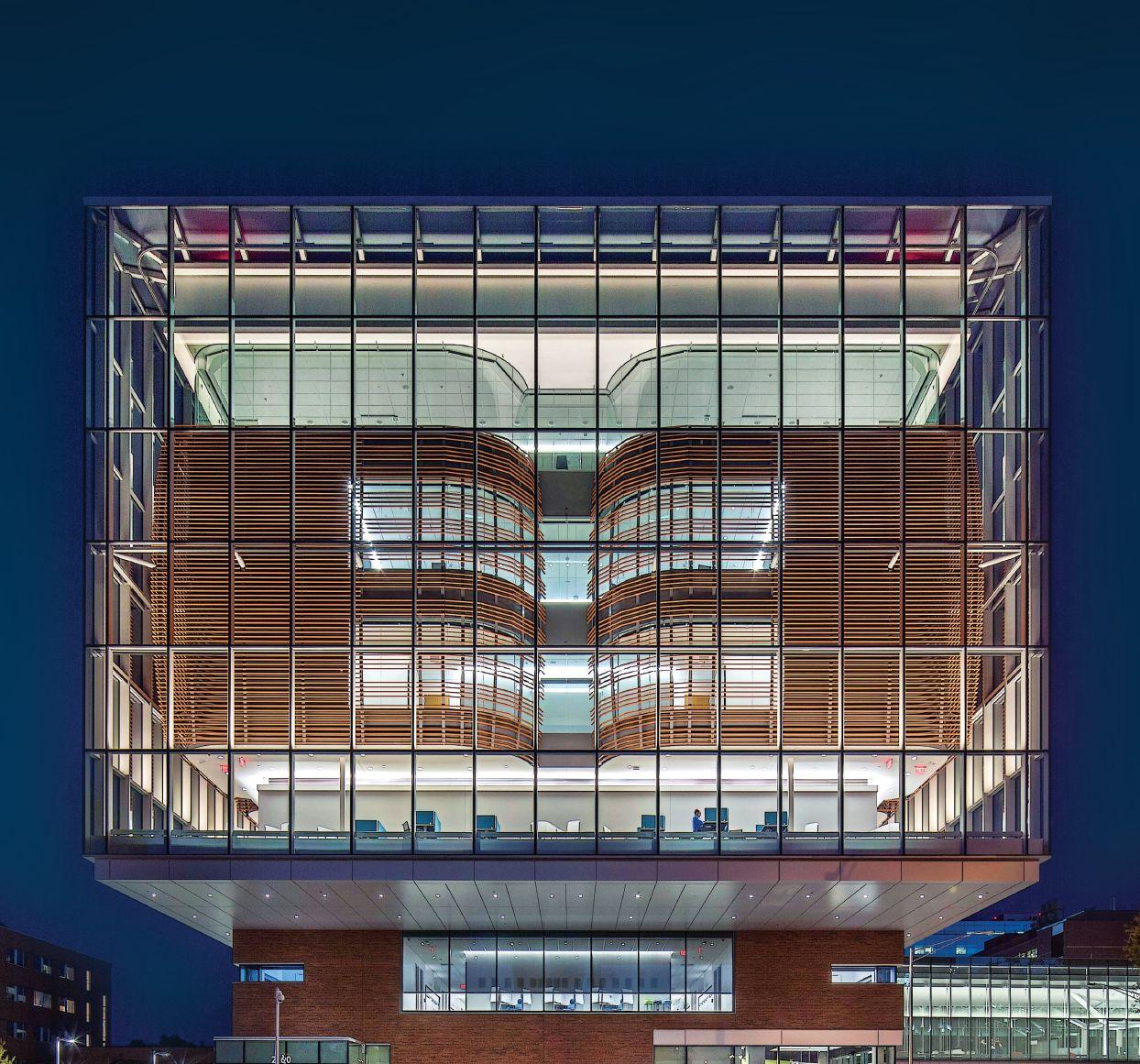
Six stunning projects that highlight Canada’s talented glaziers and glass fabricators.
The Other Pandemic
12
Art and glass unite
A stunning achievement at CIBC Square.
14 Old school/new school
Centennial College’s bright new campus.
16 Lighting up the library
Clearview Public Library lets in the sun.
18 Golden LRT
Glass-turned-art at Edmonton’s LRT.
20 The pumphouse
A new/old mixed-use in Winnipeg.
22 Setting a tone for the future
DEPARTMENTS
24 Under the Glass
Natasha Callender-Wilson talks big projects, being a leader and diversity in the industry.
COLUMNISTS
The Richardson Innovation Centre has its sights set forward. 11 The Engineer By David Heska
26 That’s Rich By Rich Poryako
Last year in Ontario, 30 percent of all the working people who died from opioid overdose worked in the construction industry. Jan Chappel, a senior occupational health and safety specialist with CCOHS, joined GlassTalk to give us some advice on what to look for in employee behaviour that might indicate a problem; how to address the issue; and where to find the resources both you and your employee might need.
Building for the future
EDITORIAL
A new word is defining our approach to environmentally conscious construction.
It’s funny how certain words float up to prominence in our discourse around an issue, linger for a while on the tips of everyone’s tongues, then fade away to be replaced by other words. “Pollution” is probably the first word I remember from the environmentally conscious green movement, back when concern for the environment was primarily attached to images of industrial waste pouring out of pipes into open ditches and the Detroit River on fire. “Acid rain” had it’s day, as did “smog” and later the “ozone layer.”
Then came the Big Kahuna – “global warming” – soon tweaked to “climate change.” With it, the terms for how companies should position themselves took on more esoteric and sophisticated meanings. “Recycling” was everything for a long time, until it started to become evident that we were never going to be able to reuse enough of what we consume to meet our climate objectives. That was broadened into a need to be “green” or “environmentally friendly,” taking in energy conservation as well as avoiding waste and not obtaining materials from non-green sources. At some point, the environmental movement realized that a complete cessation of making things was probably not in the cards, so a new word came along that incorporated some allowance for the need for industry to exist: “sustainability.” Go ahead and manufacture and consume and build if you must, but at least try to do it in a way that ensures you will be able to continue to do so tomorrow. And while you’re at it, don’t forget to include “embodied carbon” in your calculations.
At the recent Spring Training Camp conference hosted by Building Knowledge and McLeod Associates, I saw a new word poking its head up: “resilient.” The conference was a really excellent education in the most recent building science. There were some very knowledgeable and highly placed industry experts there, including contractors with long track records in sustainable building, engineers from Natural Resources Canada, energy advisors from the Canadian Association of Consulting Energy Advisors and Gord Cooke, Andy Oding and Tex McLeod themselves. All seemed quite interested in this “resilient” term and a couple of the presentations were built around it.
Resiliency obviously means building better: to a higher quality standard and for more longevity. That makes sense. There’s no better way to reduce the carbon impact of construction than to not have to renovate, repair or rebuild in the first place. But “resilient” is not exactly the same as “durable.” It also suggests the ability to roll with the punches; to adapt and be repaired or upgraded as time and changing conditions do their damage. The relevance of this today is obvious - it’s called climate change. We’re understanding that the conditions we build for today will not be the ones our buildings face tomorrow. That adds another level of complexity to the challenge. Finally, resiliency is also about resisting a higher level of punishment from the more frequent extreme weather we are already seeing. So the term carries with it the beginnings of a sad realization that some portion of the damage is already done and part of our jobs as builders will be to make structures capable of mitigating the permanent impact of climate change on our clients. •
GLASS CANADA
June 2022
Volume 34 • Number 3
Annex Business Media
P.O. Box 530, Simcoe, Ontario N3Y 4N5
READER SERVICE
Print and digital subscription inquiries or changes, please contact Shawn Arul, Audience Development Manager
Tel: 416.510.5181
Fax: 416.510.6875
Email: sarul@annexbusinessmedia.com
Mail: 111 Gordon Baker Rd., Suite 400, Toronto, ON M2H 3R1
EDITOR | Patrick FLANNERY pflannery@annexbusinessmedia.com 226.931.0545
ASSOCIATE EDITOR | Daniel REALE-CHIN dreale-chin@annexbusinessmedia.com 289.259.1408
COO | Scott JAMIESON sjamieson@annexbusinessmedia.com
SUBSCRIPTION RATES
Canada - 1 Year $37.00 (plus tax)
U.S.A. - 1 Year $85.00 (in CDN dollars)
Publication Mail Agreement #40065710 Printed in Canada ISSN 0843-7041
Occasionally, Glass Canada will mail information on behalf of industry-related groups whose products and services we believe may be of interest to you. If you prefer not to receive this information, please contact our circulation department in any of the four ways listed above.
Build your brand by instilling customer confidence. Grow your business by avoiding expensive callbacks. Enhance your value by increasing efficiency and quality.
Prove your window, door, frame, and glass products are a cut above with comprehensive quality control in manufacturing, components, and unit performance.
FGIA is the industry standard in fenestration and insulating glass. Learn more about product certification at FGIAonline.org/certification.
NEWS
High energy at 2022 BEC Conference
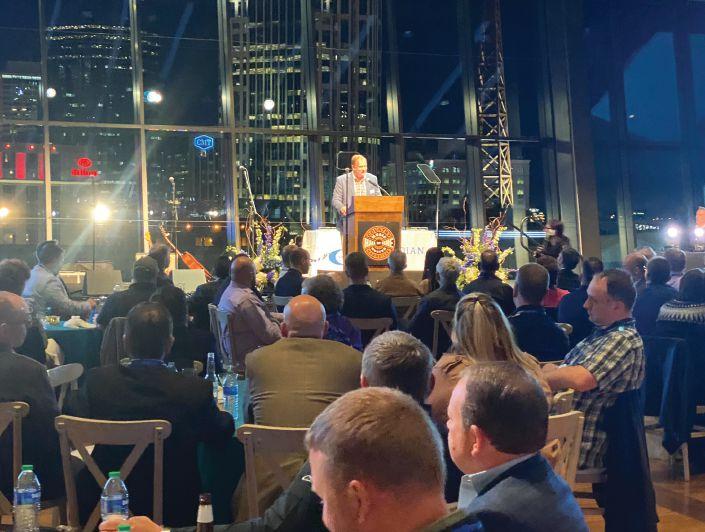
The National Glass Association’s Building Envelope Contractors conference returned to Nashville, Tenn., with a vengeance this past March, hosting a massive crowd of almost 650. Glass nerds from 40 states, four provinces and Europe gathered for two days of glazier-focused education during the return of BEC, which was cancelled last year due to the pandemic. NGA president Nicole Harris recognized Max Perilstein of Sole Source Consultants, who has been involved with the NGA for over a decade, as instrumental in building the BEC conference and presented Perilstein with a custom BEC MVP sports jersey, before addressing the supply constraints, supply shortages and skilledlabour shortages hurting the industry. In “Performance Criteria for Next-Generation Facade Technologies,” Brandon Andow, senior building analyst and associate principle for EYP, spoke about envelope systems and gave some great information about conflicting requirements, thermal-comfort and thermalload reductions and how to maintain privacy and design in envelope systems. Chris Wright, executive vice-president of operations support for Nabholz, was among the panelists who discussed hybrid workplaces and technology like Open Space, StructionSite and Holobuilder, that allow construction workers to collaborate over
multiple offices and sites. During “Manage Risks with Mock Ups,” self-declared Maple Leafs fan, Szymon Zienkiewicz, president of Larsen Zienkiewicz, shared strategies to avoid some of the many perils related to being a glazing sub-contractor; talked about the risks of delay and discussed the liabilities related to performance mock-ups. Michael Saroka, CEO of Goldray Glass, joined other panelists in discussing problems and solutions to common pain points like colour shift, heat soaking and sealant compatibility; and reminded audience members to get a sample of every material, since glass changes colour once you laminate it. Vitrum Glass Group’s chief of staff, Tara Brummet, taught audience members about heat-soaking, reminding the crowd that most heat-treated spontaneous breakage in glass is from a variety of reasons including surface or edge damage; deep scratches or gouges; severe weld splatter; missile or windborne debris impact; glassto-metal contact; wind or thermal loading; and inclusions. Urmilla Sowell, director of advocacy and technical services for the National Glass Association instilled pride in our community announcing the United Nations General Assembly declared 2022 as the International Year of Glass. Save the date for the BEC’s return to Las Vegas, March 5 through 7 in 2023. •
FGIA Annual Conference Amelia Island, Fla. fgiaonline.org
March 5 - 7
Building Envelope Conference
Las Vegas, Nev. glass.org
April 19
Top Glass Mississauga, Ont. topglasscanada.com
PHOTO: RICH PORAYKO
CANADA’S GLASS ASSOCIATIONS
AVFQ
The AVFQ takes the representation and defence of its members to heart. Under the theme “The future is now,” the AVFQ’s annual conference presented more than a dozen workshops and conferences on April 21 and 22 at the magnificent Chateau Frontenac in Quebec. A record number of attendees of 250 people this year! The Prix Lumieres Gala was back to reward the most beautiful projects in the industry. It was also the occasion to launch the AVFQ’s 60th anniversary celebrations.
On May 11, the AVFQ launched the revised version of the Curtain Wall Guide to its members but also to architects in Quebec. Three hundred people attended this event. Curtainwall is one of the most effective and popular facings for commercial buildings and residential towers. However, building design specialists have little involvement in the design, the manufacturing and installation of a curtainwall system. The AVFQ and the Quebec Building Envelope Council (CEBQ) have developed a practical and upto-date tool aimed at providing basic information to architects, engineers, technologists, manufacturers and installers of curtainwall about this construction system with remarkable properties. We have taken advantage of the image change to make several important changes to the guide.
We have removed the reference to the year of publication of the various standards and codes. The guide will always refer to the latest version of a standard or code.
In addition to esthetic and property changes, the AVFQ embarked on a vast project a few years ago, that of raising
the level of quality. The AVFQ and its members are concerned about the quality of work. To carry out this project, the idea came out to create technical bulletins. These bulletins will be useful both to the workers in the execution of their work, to the designers in the creation of their details and finally will also be useful to the site supervisors in their site visits. Two technical bulletins are now available on the website: “New Curtainwall Energy Efficiency Requirements” and “Principles of Curtainwall Assembly.”
Also remember that the AVFQ is organizing a one-week trade mission to Germany in French from July 9 to 17. During this trade mission, participants will visit plants in Germany and attend the world-leading trade show for doors and facades: Fensterbau Frontale.
AGMCA
Fromtime to time the AGMCA uses this space to highlight its volunteer directors or its member companies.
This month we salute Joe Buck, founder of Merit Glass.
Joe broke into our industry in 1967 with PPG Guelph (at that time known as CPI). He learned the basics of the glass business while working on the order desk. PPG decided Joe was a natural for sales, and enrolled him in their sales training course. In 1969, Joe was given his first sales territory in Vancouver, where he excelled. In 1974, Joe was transferred to PPG Kitchener.
The early ‘80s were a tough period in our industry, and PPG made the decision to start closing some of their regional centres. When they decided to close their Kitchener operation, Joe landed back where he started at PPG Guelph, where
he was contract manager.
A turning point for Joe came in 1983. When PPG announced they were closing their Guelph branch, Joe took a chance and bought the location. It was there, in a 3,000-squarefoot shop that Joe founded Merit Glass, with a staff of four people: one journeyman, one helper, one in the office and a glass cutter/warehouse person. Through hard work and determination in those early years, Joe quickly built a customer base that realized he was honest and reliable. Business was growing and Joe soon realized he would need more space. In 1985, he built a new 6,000-square-foot shop in Guelph, where they would stay until 2004, when Joe decided to branch out into pre-glazed curtainwall. When a 25,000-squarefoot facility became available at 61 Arrow Road in Guelph, Joe once again took a chance and purchased it.
Merit Glass became a member company of the AGMCA in 1992, and in 1995 Joe was elected to our board of directors, where he still volunteers his time to the betterment of the industry he loves. Joe provides invaluable input to all matters regarding apprenticeship and training, and still sits on the Ontario Glazier Apprentice Training Committee. He also sits on our Local Apprentice Committee that monitors the progress of the apprentices and ensures they complete their training.
In 2008, after 41 years in the glass business, Joe decided to retire. To this day, he still credits the training and experience gained with PPG as giving him a solid foundation and states that he owes everything to the dedication of his employees, and the loyalty of his customers. Joe can be reached at jbuck642@
gmail.com.
Finally, we’d like to point to some notable initatives that AGMCA members are involved with to promote and advance the glazier trade in Ontario. The YWCA Toronto partnered with the Finishing Trades Institute (FTI), the Ministry of Labour, Training and Skills Development and the International Union of Painters and Allied Trades to introduce a new training program for women and gender diverse people in trades and technology. The Architectural Glass and Metal Technician (glazier) Pre-Apprenticeship Training Program began on May 9 and will train future glaziers over the span of 15 weeks through a mix of online and in-person classes, projects and seminars. The program ends with a 12-week work placement that starts in August.
OGMA
Our deepest condolences to the Fulton family on the passing of their patriarch, Fredrick Joseph Fulton, who passed peacefully at home May 16 at the age of 89. Fred Sr. was a true gentleman and innovator in the glass and metal industry who founded Sealite Glass, Fulton Industries and was a major contributor to national quality standards (IGMAC) and industry organizations. Fred received the prestigious OGMA Lifetime Achievement Award in 2000. Fred Sr. was a man of many talents outside of work who enjoyed golf, playing the piano, singing, and who always enjoyed the company of his many friends. A true family man, Fred is survived by his wife Linda Taras-Fulton, his five sons Frank, Jim, Fred Jr., Bob, and John, and his only daughter, Cecilia. •
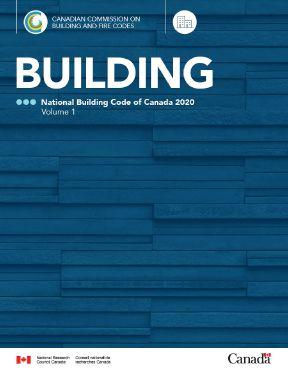
2020 NBC released at last
The new 2020 National Model Codes were released on Mar. 28. Under the new model codes, Canadian homes and buildings will require: strengthened protections for openable windows in residential occupancies to minimize the risk of falling; safety glazing in windows and doors for schools and similar buildings, to reduce the hazards of wired glass; adjustments to the minimum dimensions of building elements to accommodate people using a wider variety of mobility devices, and requirements for tactile signage and for more pedestrian entrances and floor levels to be accessible; a tiered energy performance compliance path which incrementally improves energy efficiency at each successive tier; the introduction of whole-building airtightness testing as an option for complying with air leakage requirements and the introduction of encapsulated mass
timber construction to allow for the construction of wood buildings up to 12-storeys tall. The 2020 codes include nearly 400 changes. Current provincial and territorial building, fire, plumbing
Guardian shutting down Russian glass operations
Guardian
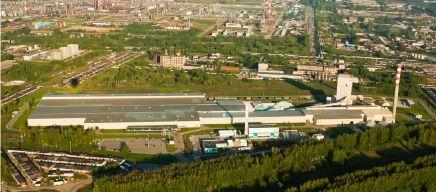
parent Koch Industries has announced it will shut down its two Russian glass plants. The move follows initial statements that the plants could not be shut down due to threats from Russian authorities to punish workers and management and concerns about the plants falling under the control of the Russian government. In a statement from Koch, COO Dave Robertson, says:
“Sanctions announced in early April, combined with the Russian government’s response and other actions, have made conditions untenable for Guardian to continue operations in Russia. As a result, Guardian asked its Russian employees to shut down the two glass plants. When made aware of this plan, Russian authorities repeated earlier warnings that local Guardian employees would violate Russian law and be prosecuted and imprisoned if they followed through with any shutdown activities, further reinforcing our concerns for employees’ safety. Therefore, Guardian is working with its local management team at Guardian Steklo (Russia) to find an exit strategy that maintains our commitment to employees’ safety and does not result in the Russian government taking over the plants and financially benefiting from them. All other Koch companies, none with operating assets in Russia, have ended or are ending business activities there.”
and energy regulations will remain in effect until the 2020 codes are adopted, with or without modifications, by the provincial or territorial authorities having jurisdiction. Discussions about the 2025 National Model Codes are already underway. The Canadian Commission on Building and Fire Codes (CCBFC) encourages the involvement of industry, general interest and regulatory experts in the process to make sure that the best available knowledge drives meaningful change. The 2020 codes are available through the National Research Council of Canada (NRC)’s publications archive in a free electronic format for download. To purchase the publications in print format, an order can be placed online through the NRC’s Virtual Store. The National Model Codes are developed by the CCBFC on a five-year cycle and are published by the NRC.
INT Machinery announces distribution agreement with Schirmer Machinen
INT Machinery announced an exclusive distribution agreement with Schirmer Machinen. Schirmer Machinen, based in Verl, Germany, is a premium manufacturer of aluminum profile cutting and processing centers. Schirmer’s profile clamping and guiding is done by servo-driven elements. This enables the machine to process profiles without clamping and guiding fixtures, for increased productivity. Also, the way the profile clamping is designed eliminates vibrations, allowing maximized milling speeds resulting in burr-free edges and higher output. The Schirmer modular system allows customization of the lines based on the customer’s production target, which allows a split of the milling process in different steps. INT Machinery will represent Schirmer in Canada and will provide local service support on their lines.
FGIA resumes in-person inspections
TheFenestration and Glazing Industry Alliance recently announced it will resume in-person inspections for certification program licensees. The timeline for this change is still being determined, but inspections will likely begin again in the latter half of 2022. The FGIA is also preparing to re-start in-person inspections for the air-waterstructural, thermal and profile certification programs in July. Traditionally, these inspections were unannounced. However, due to the long absence and to accommodate the safety requirements of companies, licensees will be given notice before their inspections. Details on this plan will follow in a formal announcement sent to licensees.
PHOTO: GUARDIAN INDUSTRIES
FGIA releases its U.S.-market study
The Fenestration and Glazing Industry Alliance has released FGIA 2021/2022 Study of the U.S. Market for Windows, Doors and Skylights. This bi-annual report delivers information on residential and non-residential market trends and product relationships for both residential and non-residential fenestration products. Forecasts are based on projections of construction activity as of April 2022. Contract awards reflect activity related to new construction and major additions to existing structures. Actual fenestration shipments for non-residential building activity typically lags contract awards by up to one year or more. This cycle can shorten or lengthen tremendously depending on the complexity or size of a building and when the specific building product is installed during the construction cycle. The 2021 contract award total saw a five-percent increase from 2020. The manufacturing and warehouse category increased by 38 percent in 2021, while contract awards in office, hotel and institutional category decreased by six percent and remained flat in the store and mercantile category. Contract awards are expected to increase by about eight percent in 2022, and to continue growing in 2023. Storefront windows represent the largest market segment by vision area with 27.1
percent of the overall nonresidential glazing in 2021, followed closely by site-fabricated windows representing 26.5 percent. The 2021 market for non-residential entry doors in the U.S. showed significant decline, with 2021 volume down 11 percent over 2020 and down 20 percent since 2019. The study estimates that the total U.S. market for commercial unit skylights in 2021 represents a one- percent increase from 2019. Unit sizes commonly average in the range of 22 to 25 square feet but can vary dramatically. Nearly all commercial unit skylights are aluminum framed, and most use some form of plastic glazing. Acrylic is most common. In 2021, new construction applications represented approximately 33 percent of the total, down from 35 percent in 2019 due to a lack of non-residential construction activity.
Big changes to wood construction Ontario glazing contractors and IUPAT
The2020 NBC has been updated to include encapsulated mass timber construction, enabling the construction of wood buildings up to 12 storeys. Mass timber elements are encapsulated in order to delay the involvement of mass timber elements in a fire. Compensatory measures are also implemented. A descriptive list of prescriptive exterior wall assemblies using wood products that are deemed to satisfy the fire protection requirements for exterior cladding/wall assemblies have been introduced into Appendix D of the NBC. These generic exterior wall assemblies may consist of wood studs, cross-laminated timber and/or fire retardant-treated plywood and can be used for any non-combustible, woodframed mid-rise or tall wood mass-timber building. Two new types of seismic force resisting systems with moderate- and limited-ductility cross-laminated timber shear walls (platformtype construction) have been introduced. Both systems are permitted to be used for 30-metre and 20-metre building heights, depending on the seismic-severity of the building location. Guidance from the structural commentaries on serviceability loading criteria is revised and moved into the NBC to ensure that appropriate load combinations are used for serviceability limit state design.
going to arbitration
Initial negotiations between the Architectural Glass and Metal Contractors Association (AGMCA) and the International Union of Painters and Allied Trades (IUPAT) stalled in Ontario at the end of April and the two sides went to arbitration.
From ACMCA executive director, Noel Marsella:
“After several meetings with the IUPAT we have not been able to reach a settlement. We are currently waiting for a conciliation officer to be appointed. If a settlement cannot be reached during the conciliation process, the officer will recommend a “ No Board.” Sixteen days following the date of the “ No Board,” the IUPAT may legally call a strike. It is not mandatory, and negotiations can continue if no settlement has been reached by that time.”
A bulletin on the IUPAT website reads:
“The Union is seeking a strike mandate for all members currently working under the Architectural Glass and Metal Contractors Technician Institutional Commercial and Industrial Agreement. All members are encouraged to participate in this very important process. While our negotiating teams continue to work hard and are hopeful that an agreement can be reached, reality indicates that job action may be required to secure an improved package. While there are trades that have ratified agreements, the construction industry continues to experience work disruptions. The IUPAT remains steadfast in its position that our members deserve their rightful and proper compensation, and a vote for a strike mandate is an important step in this process. All members are urged to participate. Please continue to monitor your e-mail accounts, checking our social media accounts or contact your local union representative for updates during this period. Thank you for your patience and understanding during this very contentious bargaining season.” •
PHOTO: NATURALLYWOOD.COM
PHOTO: ADOBE STOCK
by AMY ROBERTS
Glass that weathers the storm
Glazed areas must first meet three primary weather-related considerations to limit breakage, deformation, or damage from the elements: structural resistance to wind pressures; resistance, for skylights and sloped glazing, to snow loads; and water penetration from wind-driven rains. The principal performance and testing requirements for fenestration in large and commercial buildings are given in NBC part three, (Commercial) and in Subsection 5.9.2. Since 2010, the NBC has referenced AAMA/WDMA/CSA 101/I.S.2/A440, North American Fenestration Standard/Specification for Windows, Doors and Skylights, casually known as NAFS, and its Canadian supplement, CSA A440S1. To comply with NAFS in Canada, products must also be tested to the Canadian requirements in NAFS as well as to those in the Canadian Supplement. The structural performance is defined with respect to the minimum required performance grade and its required positive and negative design pressure.
Wind and snow load
NBC 2015 requires each individual glazing unit to meet the requirements for resistance to wind loads using either the Canadian standard CAN/CGSB-12.20, Structural Design of Glass for Buildings, or the American standard ASTM E1300, Standard Practice for Determining Load Resistance of Glass in Buildings. The NBC provides data on expected maximum wind speeds in various areas depending on recurrence interval. Once the appropriate peak expected wind velocity (V) for the locality is determined, the resulting wind pressure (qz) – the “design pressure”
Products tested to the U.S. requirements may still contain water trapped in the assembly, which would fail Canadian tests.
for the building – is derived by the basic equation: qz = Velocity Pressure (in N/m2) = 0.0613 V2 (in m/s). To specify glass of appropriate strength, which relates to glass thickness, ASTM E1300:2016, Standard Practice for Determining Load Resistance of Glass in Buildings, has been accepted in the NBC and is used by many Canadian engineers, architects and glass manufacturers. It describes procedures to determine the approximate maximum lateral deflection of the glass (i.e. its tendency to “bow” in or out) when subjected to the determined wind loads.
For testing the quality, durability and inert gas retention of insulating glass units, NBC 2015 recognizes the Canadian standard CAN/CGSB-12.8, Insulating Glass Units; or the American standard ASTM E2190, Insulating Glass Unit Performance and Evaluation.Snow load values are calculated as specified within the NBC.
Water Penetration
In practice, water penetration resistance capability of a fenestration product is linked to structural integrity through the design pressure. The water penetration resistance is defined by the NAFS, using the more stringent test pressure and water penetration failure criteria in the Canadian Supplement. In addition, Canada prohibits any entrapment of water within the fenestration assembly. Note that products tested to the U.S. requirements may still contain water trapped in the assembly, which would fail Canadian tests.
In Canada, water penetration resistance is specified separately from performance grade, and is reported in the secondary designator on product labels.
Design and specification professionals should be aware of the current requirements of local authorities having jurisdiction for the geographic areas in which they wish to do business.
They should also be aware that, in general, structural-air-water testing is more rigorous in Canada than it is in other countries. The maximum allowable air leakage rates are lower in Canada and the water penetration failure criteria in the Canadian Supplement to NAFS-11 are more stringent than in the US. •
Amy Roberts is FGIA director of Canadian and technical glass operations
FIGA
by DAVID HESKA
David Heska, P.Eng. is a director with WSP’s building sciences team in southwestern Ontario. david.heska@wsp.com.
The codes they are a-changin’
What an excellent time we had at Top Glass live and in person back in April. It was great to connect with so many of you and to meet a few new industry colleagues. In this column I’m going to recap my presentation on new and upcoming changes to building and energy codes in Canada.
To start, it’s important to remember why the federal government created the National Energy Code. Did you know that most buildings across Canada since 1920 have varied in energy use intensity between 200 and 300 kilowatt hours per square meter per year? Sadly 100 years of construction has demonstrated very little energy efficiency improvements. This data alone pushed the federal government to write the National Energy Code of Canada for Buildings (NECB). Codes Canada now publishes the National Building Code (NBC) and NECB approximately every five years. The 2020 version of the NECB is actually version five of this document. The first version was published in 1997 with subsequent updates in 2011, 2015 and 2017. The 2017 version was largely driven by the Pan Canadian Framework on Clean Growth and Climate Change when the government stated that it would “work with the provinces and territories to … develop a netzero energy ready model building code, with the goal that provinces and territories adopt it by 2030.” But, you might ask, why are we talking about a 2017 code in 2022? And didn’t the 2020 code just come out?
Yes, the 2020 codes did just come out but the national codes are just documents until they are enacted by the province. Alberta, Saskatchewan and Nova Scotia in 2019 and 2020 adopted
The 2020 version of the NEBC is actually version five of this document.
THE ENGINEER
the 2017 version of the National Energy Code but most provinces have not yet adopted it. New Brunswick, P.E.I and Newfoundland are looking to adopt the NECB 2017 shortly, whereas British Columbia has its own Step Code introduced in 2017.
Since other provinces and territories have not even implemented the 2017 version of the National Energy Code, where are we at on our path towards harmonization? In December 2021, provinces and territories were provided with advance copies of the latest code changes and on March 28, 2022, the new 2020 version of the National Building Code, Plumbing Code, Fire Code and Energy Code were published.
So, for the fenestration industry what’s new in NECB 2020? Table 3.2.2.3 is one place to look. The overall thermal transmittance for Zones 4 through 8 have changed. They used to be between 1.4 and 2.1 and are now between 1.44 and 1.90. NECB 2020 has also introduced an entirely new Chapter 10 on energy performance tiers in which your building can be zero to 24 percent, or 25 to 49 percent, or 50 to 59 percent, or more than 60 percent better than a reference building.
Closer to home for me, the upcoming 2022 Ontario Building Code changes are currently being discussed as the province moves to generally adopt the NBC 2020 and the NECB 2020. A modified version of NECB will replace Ontario’s Supplemental Bulletin 10 for non-Part 9 buildings and NBC Section 9.36 will replace SB-12 as the energy code for Part 9 buildings. The updated Ontario code release is planned for 2023 and will most likely come into effect in early 2024. Another change we will see in Ontario is harmonization with the climate zones shown in National Building Code. Ontario will move from two climate zones to five.
Finally, in the city of Toronto, version four of it’s Toronto Green Standard just came into force in May with maximum energy use intensities of 130 to 135 kWh per square meter per year for all multi-unit residential and commercial office buildings. Those are the mandatory values for Tier one. Tier two gets down to 100 and Tier three down to 75. Quite the improvement from our laissez-faire attitude from the past century when we hovered around 200 to 300. •
ART AND GLASS UNITE
by TREENA HEIN
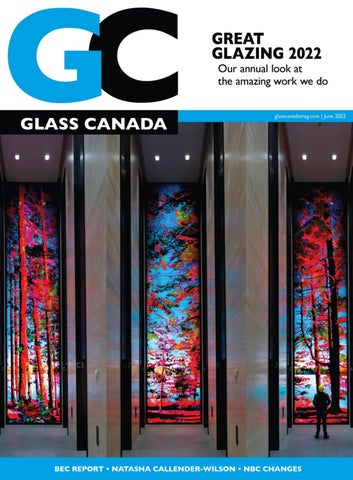
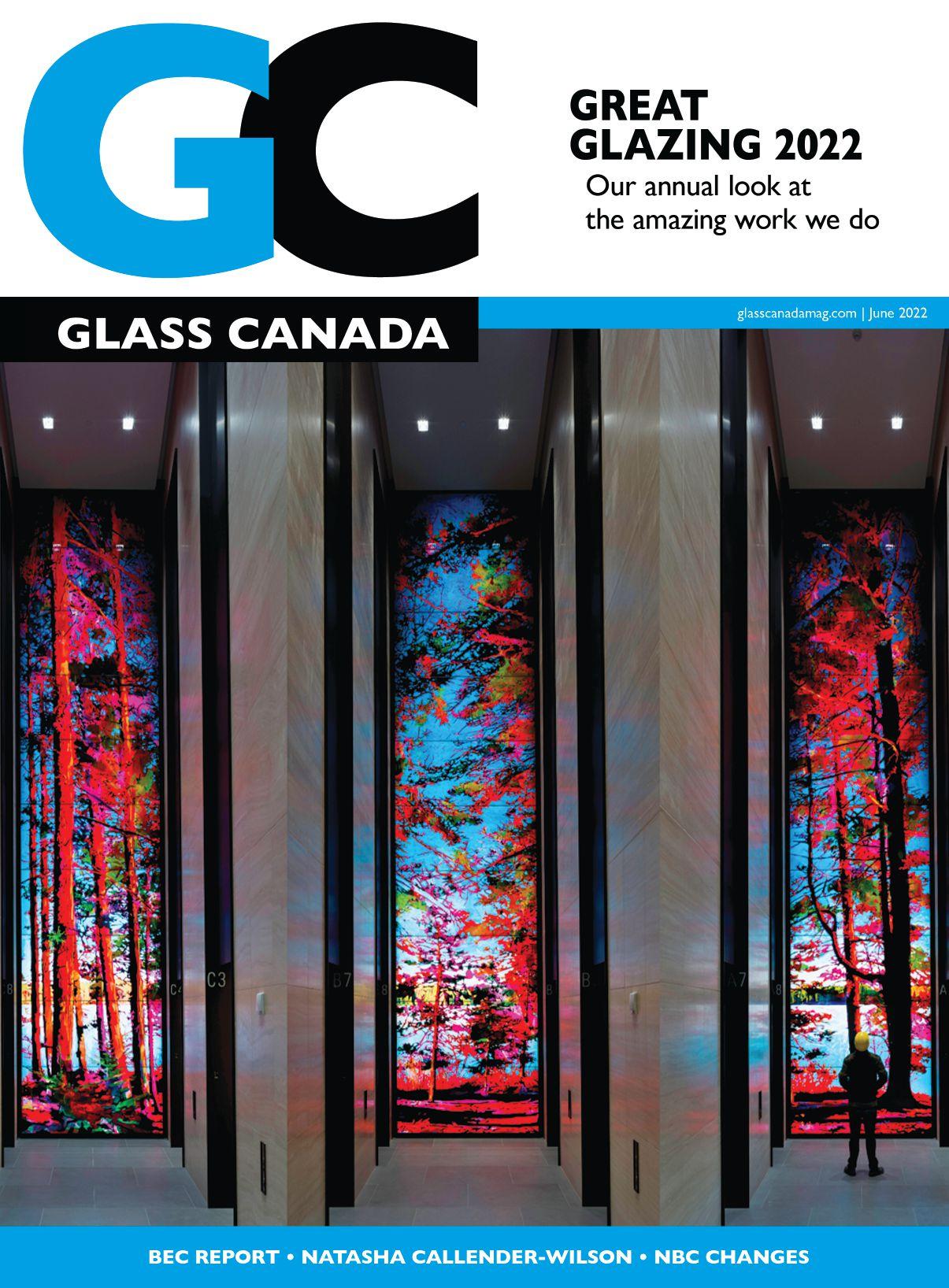
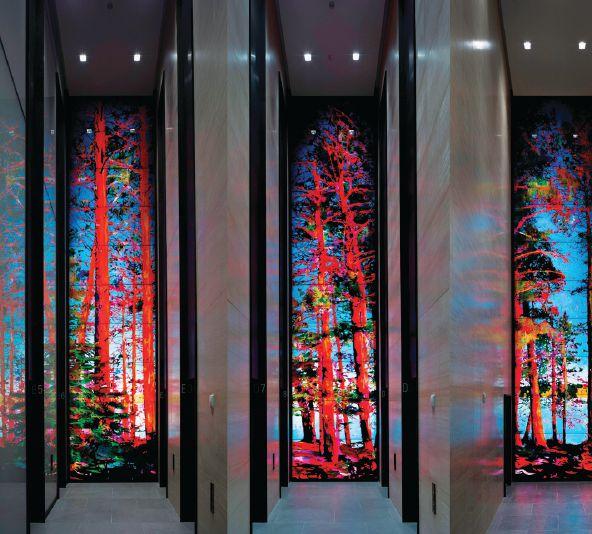
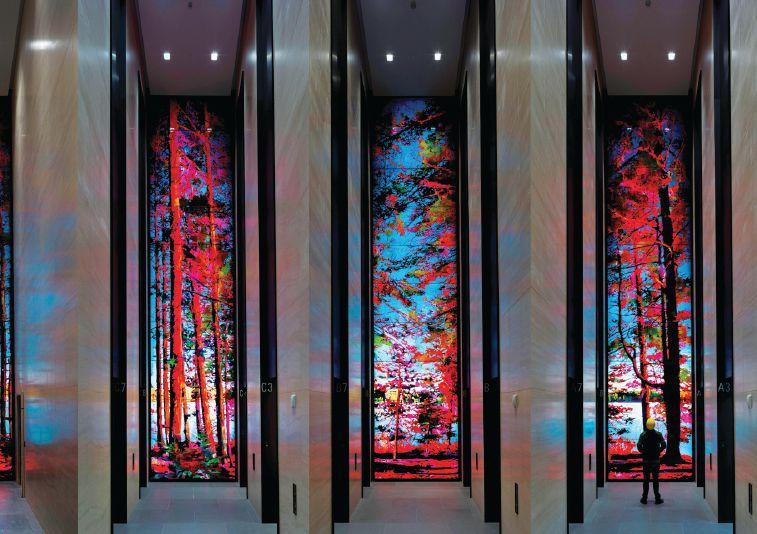
ALight Stolen From the Sun”...a fitting name for the stunning and unique public art installation at CIBC Square in Toronto. Through the cutting-edge technology of digital printing on glass, those entering the lobby are presented with six art walls, each around 40 feet tall, depicting the sun setting over water through a forest of cedar and red pine. From the fourth-floor canopy level, six other glass art walls give another stunning perspective of looking up through trees.
The building itself is also unique. It’s a complex comprised of two office towers totalling three million square feet. One tower –81 Bay Street at CIBC Square – is 49 storeys tall and home to the art installation. 141 Bay Street at CIBC Square is 50 storeys tall and is slated to open in 2024. The entire complex is described on its website as “an unparalleled experience,” and “a reflection of thoughtful dedication to the people of Toronto, health, wellness and smart technology.” It sets “a new standard for community – creating workspaces, places to socialize and celebrate culture and cuisine.”
Returning to the glass art walls, this was the first time Steve Driscoll of Steve Driscoll Studios had worked on backlit glass on such a large scale. “After a number of months of failed experiments with a hand-painting approach, I landed on some standout samples from Imagic Glass, a custom architectural glass fabricator based in Vaughan,” he explains. “Working through a number of iterations of printing density, saturation, file resolution and various defusers, we came up with samples that felt more like a painting than the prints they actually were.”
In order to achieve the resolution required, Driscoll worked with a photographer to capture over 100 stills of each of his 12 paintings, with the stills then stitched together digitally and edited. This process was done in tandem with experimentation with a team from GPI Design, an Ohio-based specialist backlighting firm. “In the end, the laminated tempered glass panels were
AT A GLANCE –CIBC Square at a glance
Architects: WilksonsonEyre and Adamson Associates
Contractor: EllisDon
Developer: Ivanhoe Cambridge and Hines
Glass artwork title: “A Light Stolen From the Sun”
Total number of backlit glass art walls: 12 (made up of 84 glass panels)
Locations: Six approximately 37-foot art walls in the main lobby; six approximately 18-foot art walls at the fourth floor canopy level
Glass assembly: 12 mm low-iron tempered printed and laminated glass with UV protective interlayer
Total diodes: About 500,000
Total glass weight: Over 30,000 pounds
printed on low-iron tempered sheets about four inches by nine inches and stacked vertically with a slim steel support at each seam,” says Driscoll, “resulting in only about 1/4-inch interruption of the image.”
The digital printing to glass of Driscoll’s paintings was the responsibility of Imagic Glass, which holds a methods and apparatus patent for its digital printing on glass and mirror. “We achieve vivid, precise colour reproduction across the entire spectrum, which is very important for public art projects,” explains Adam Shearer, president of Imagic Glass. “Our technology also allows us to control the opacity of the artwork, which is critical
ABOVE: When attempts to hand-paint the backlit glass failed, the designer turned to iMagic’s advanced digital printing technology and found a solution.
for backlighting. We collaborated extensively with Steve to successfully fabricate what he wished to achieve. Hundreds of man hours and dozens of custom samples were produced during the collaboration process.”
GPI custom-engineered the structural system to house the backlighting and the 84 different glass panels. However, installation was extremely tricky and plans had to be changed at the last minute in order to individually hoist and place each 250-pound panel securely onto the structure.
Tall and narrow bays meant a crane was out of the question, explains Tom Lawrence, founder and principal of GPI Design. “The plan was to use a ceilingmounted hoist above each bay with a vacuum glass lifter attached to lift each panel to the desired height before securing it into place. However, when we arrived on the site, we found that the ceiling was already finished. There were also a few bays with HVAC above the feature so even if the finish ceiling wasn’t there, we wouldn’t have had access to the deck above.”
Two rented scissor lifts side by side in each bay were modified to accept the glass panels in the front and lift each piece in tandem. It was the best way but came with challenges, including the need for extreme attention to detail. Mitch Polly of GPI Design was in charge of running the two lifts simultaneously while the team was split into two on either lift holding the glass simply with vacuum cups. After a few dry runs, they realized it was easier to have one person run both at the same time.
hindsight, we should have asked the rental company to reprogram them to behave exactly the same. The joysticks had slightly different dead zones and speed settings. It took some
major hand-eye coordination to run them up at the same rate. I would stare at the railings and make one catch up or slow down to keep them even.”
Joint treatment was also explored, including a variety of caulk colours, notes Lawrence. “With the inherently darker artwork of this project, the translucent caulk we typically use called attention to the joints instead of concealing them,” he says. “Black caulk made the artwork appear more seamless from panel to panel.”
The mockup at GPI proved essential in determining several key things, including the optimal glass “recipe “to compliment the artwork and the proper lighting colour temperature to accurately enhance – without shifting – the hue of the original works. With intense colour variations and amorphous forms spanning multiple stories, these art walls make for an intense experience in colour, light, and scale.
Colour temperature was heavily discussed in the mock up phase. Choosing the correct colour temperature to appropriately enhance the artwork without shifting the intended hues was key on this job. •
Saves Energy
Polly states, “In
PHOTO: STEVE DRISCOLL STUDIO
WHERE OLD SCHOOL MEETS NEW SCHOOL
by ANDREW SNOOK
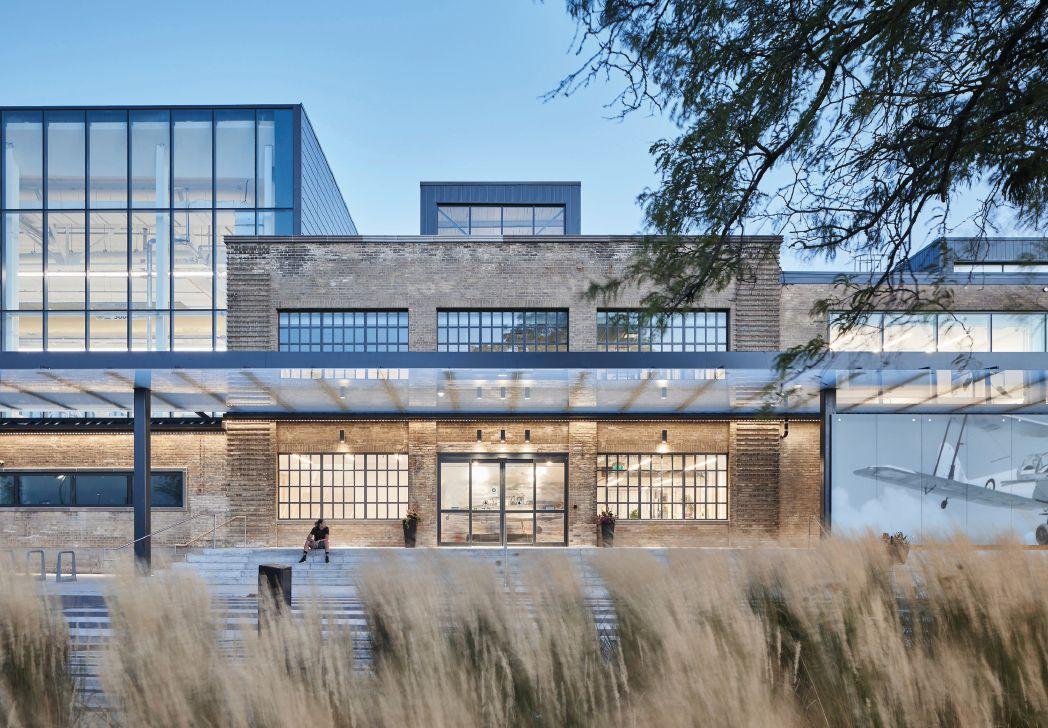
MJMA Architecture and Design was tasked with the challenging role of re-designing a near-centuryold facility to house the Aviation and Engineering Technology and Applied Science program for Centennial College’s Downsview Campus Centre in association with Stantec Architecture.
Chris Burbidge, principal for MJMA Architecture and Design, says working on a heritage building was extremely challenging. Construction on the original building took place between 1928
ABOVE: Updating a nearly 100-year-old building required careful engineering.
AT A GLANCE –Centennial College Downsview Campus
Architects: MJMA Architecture & Design
Glazing contractor: Noram
General contractor: Bondfield
Projection completion: April 2019
Glass specifications: Okalux light-diffusing glass with an interior capillary slab in the air space; GL4 laminated glass units with 6mm clear tempered glass with Solarban 60; 5 mm clear, tempered laminated tempered glass with frosting; spandrel 6 mm low iron tempered glass; typical 6 and 6 tempered and heat strengthened glass UV coated with Solarban on No. 2 and argon filled; Heritage replica windows manufactured by Bliss Nor-Am
PHOTO: SCOTT NORSWORTHY
to 1945, but the structure changed drastically over five eras when it expanded to produce components for the Second World War and later housed the aviation design and manufacturing sector and now the space functions as a post-secondary educational institute.
“This meant there was a huge amount of complexity in installing new glazing into an old masonry building. Components were failing and had to be reinforced. New rough openings had to be framed within this old facility. We had to cut into existing slabs to recess supporting channels for glazing partitions. We had to consider movement joints between the glass and large parts of the building, so they were very complex for movement. Then there’s thermal expansion and strength of glass in an industrial setting where you’ve got huge pieces of equipment, so we had to use a robust glass design,” says Burbidge.
Heritage windows were also part of the restoration and conservation portion of the project. A series of heritage windows were replaced with replica heritage windows that offered the same look of the old steel-framed industrial windows. The replica heritage windows were manufactured by Bliss Nor-Am.
“With those, we were able to do these old-styled heritage windows with a sealed unit to improve thermal performance in the building,” Burbidge says. “The difficult part was getting a new, modern-day thermal performance and to make it look like an old heritage window.”
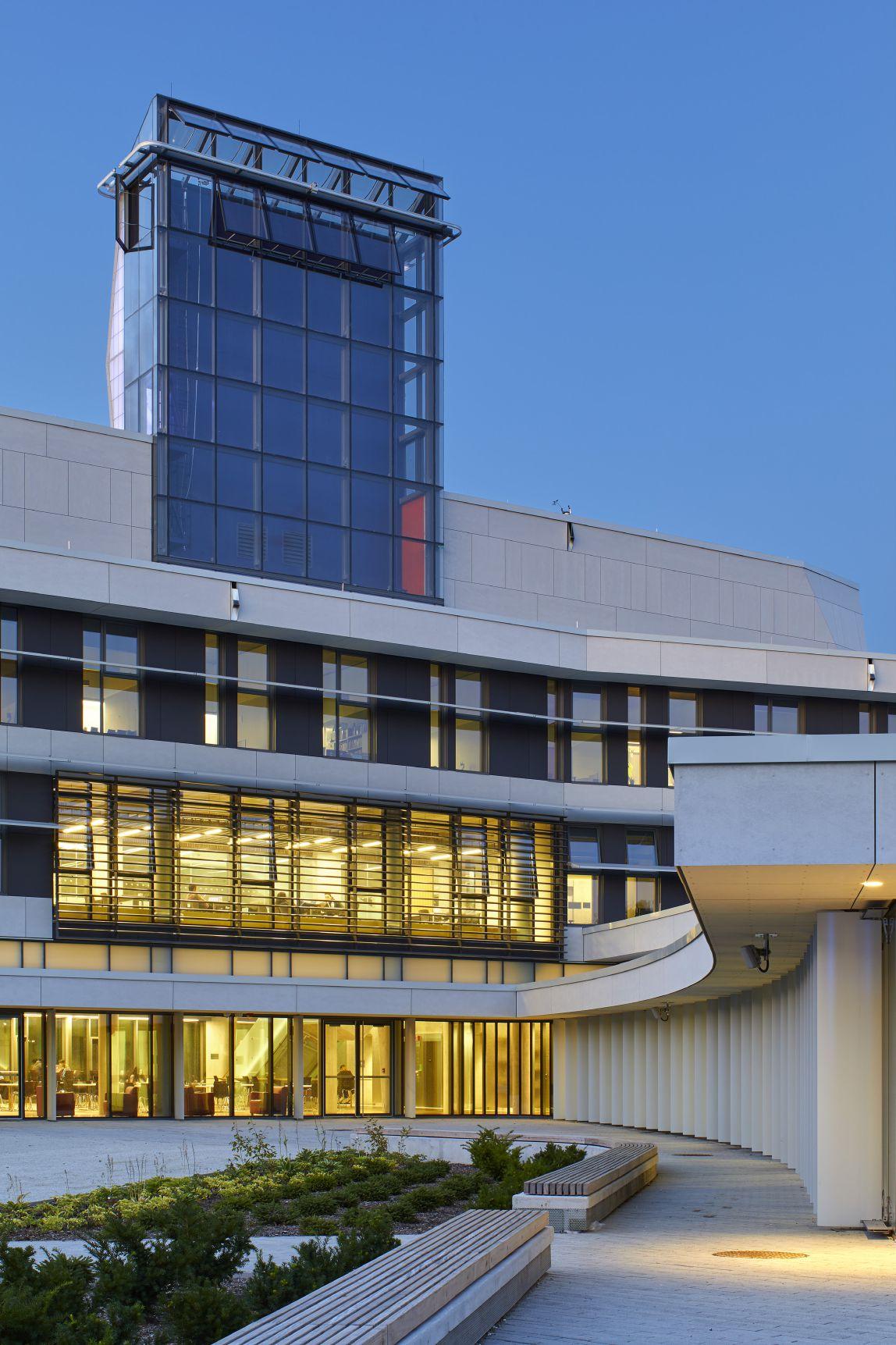
Centennial College’s programs are taught inside the heritage portion of the building as well as in new extensions. The former industrial complex features two hangars, classrooms, administration offices, a library and learning and fabrication spaces that include avionics, electronics, engines and composite labs and group study and collaborative zones. It also hosts a museum of artifacts with a collection drawn from the site and exhibits conveying the history of Canadian aviation, according to the project description offered by the Ontario Association of Architects. The association recently awarded the Centennial College Downsview Campus Centre project with a 2022 Design Excellence Award.
The hangar, which is largely curtainwall glazing (atypical for hangars) was designed as a foil to the heaviness of the traditional and historic brick buildings that form the heritage portion of the building, Burbidge says.
“We really wanted to set off that heavy masonry block building with a light, transparent glass building, and those two function as foils to each other,” he adds.
The design was also created to put the aviation school facility on display as a visual learning tool, showing off the activities and processes of teaching inside this building to the outer world, both through physical transparency to the exterior and within the interior.
“The building, being a public building, lets the public walk through it and see all the teaching labs on display through large amounts of safety glass fused from the corridors into those rooms,” Burbidge says. “The interior glazing doesn’t hide the industrial nature of the space. It really lets it show through. You can go into this building and see from one end into the other and you’re looking through new meeting rooms and board rooms. Even the tool lending spaces have been given a certain amount of glass in them so you can see the hustle and bustle of everyday school life unfolding.” •
DÜSSELDORF | GERMANY
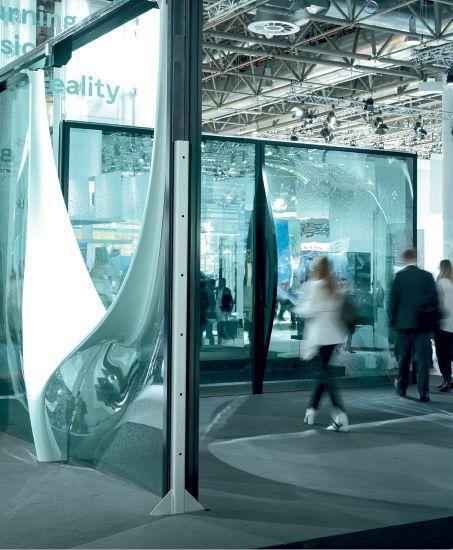
Finally, you can get back into the spirit of this special world-leading trade fair. Meet everyone in the world of glass face to face. Discuss the latest developments in high-tech material glass with the best in the industry. From energy generation, reducing CO2 , effective production and processing technologies to innovative glass products and applications. Make the most of the unique accompanying program with many highlights and talks by leading experts from around the globe. Look into the future of glass today with pioneering exhibits. glasstec – let’s go!
glasstec-online.com
LIGHTING UP THE LIBRARY
by ANDREW SNOOK
After a century of serving the public in Stayner, Ont., the Clearview Public Library needed a new home.
The 100-year-old library was moved to become part of a new community hub project that offers three municipal services in one spot: the Stayner Community Centre, the Memorial Arena and Community Hall and the Clearview Public Library.
“The hockey rink is the centre of town in a way, the whole city goes to the team’s games. It’s a big part of the community so it gets much more attention. It’s interesting to combine all these things at once. The library is something that’s going to get used more. During games, people go to the library between periods,” says Luc Bouliane, principal at Lebel and Bouliane, lead architectural firm for the project. “It’s a branch that does a ton, too – evening meeting rooms, an entrance atrium, Stayer Sports Hall of Fame, and artists hang art in the atrium space. It’s a well-used library.”
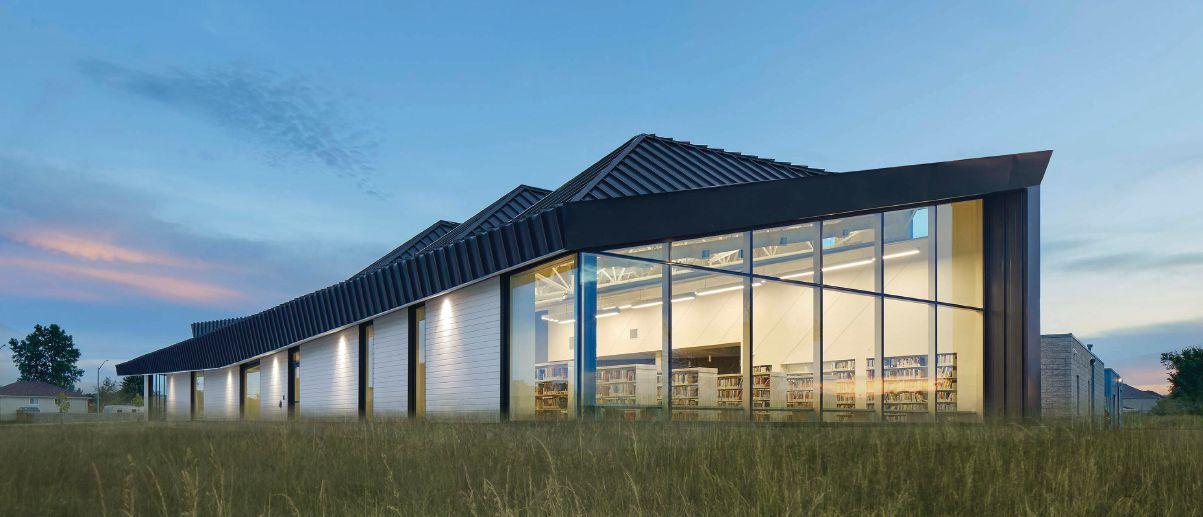
Overall, the project involved a 7,000-square-foot new build for the library and renovation to the community centre. The new library was designed alongside the arena with fields on both sides to ensure optimal natural lighting.
“We designed this branch mainly around solar orientation and what we wanted to do was take the best type of light from each time of day and put the kinds of programs in the library to
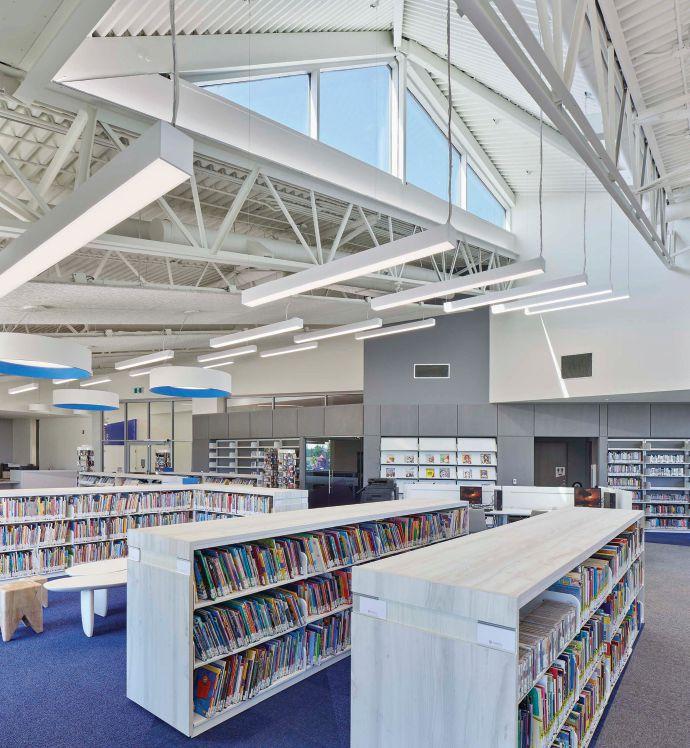
A combination of Sunguard SN 68 and SN 54 glass windows were installed throughout the building for this project, chosen for their UV values and clarity. On the north side of the building, where the books and reading area are located, large glass windows were installed to allow for lots of natural ambient light to work in. On the south side of the building is where first light takes place, so the entrance was designed to face south with a huge light scoop on the roof.
ABOVE: In a small town like Stayner, Ont., the library is more than just a place to read books – it’s a community hub and the design had to meet that role.
“There’s a lot of reflective direct light into the middle of the branch,” Bouliane says.
The east side of the branch houses a variety of programs including the children’s area and a place for seniors to sit and have coffee and sit by a fireplace. The placement of the glass allows for the morning light to flood into the sides of those areas. On the west side, where the teen area and community meeting rooms are housed, Bouliane says the glass was placed in a manner that allows this section of the library to receive an interesting band of light coming across.
Being attached to the local arena presented some challenges for the design and build of the new library, as well as the installation of the glass.
“Since it was attached to the hockey arena, it presented sort of a form challenge. How do you just connect something to the side of an arena? We took the typology of the barn shape and kind of twisted it and folded it in a bunch of ways which allowed for all these types of open-
ings and get in some light,” Bouliane says.
The biggest challenges related to the glazing were on the north wall, which required a lot of glazing and the roof skylights due to their geometry and shape.
“What’s interesting about the glass in this project is that it’s a project that’s designed around the sun. It’s not a glass box that wastes a ton of energy. Part of that is the kind of glass used but it is also the overall design, where the windows are oriented in the correct way, so you get the light without the loss of energy. That is more important than just the type and brand of glass and frames. Together with the design and orientation of all these locations, it just made for a very bright and open library but with a lot of solids, which is good for environmental reasons.”
Due to the library’s impressive design, the project was awarded a 2022 Design Excellence Award by the Ontario Association of Architects and was also the recipient of the 2022 Ontario Library Association Award. •
Keep the cold at bay –for a sustainable future
The Environmental Product Declarations (EPDs) help architects and planners to select the most sustainable products for their projects. This is the first step on our journey to carbon neutrality by 2050.
more at www.swisspacer.com
PHOTO: TOM ARBAN
Letting in sun without overheating the interior was the challenge. The designers met it with low-E glass and careful orientation of the fenestration.
EDMONTON’S GOLDEN LRT
by RICH PORAYKO
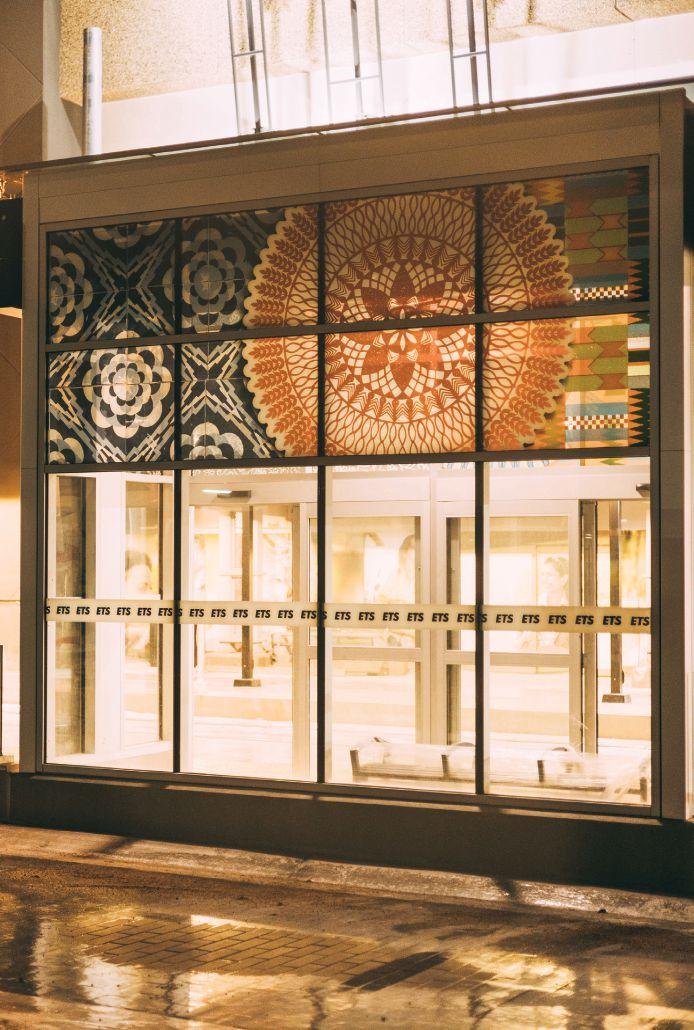
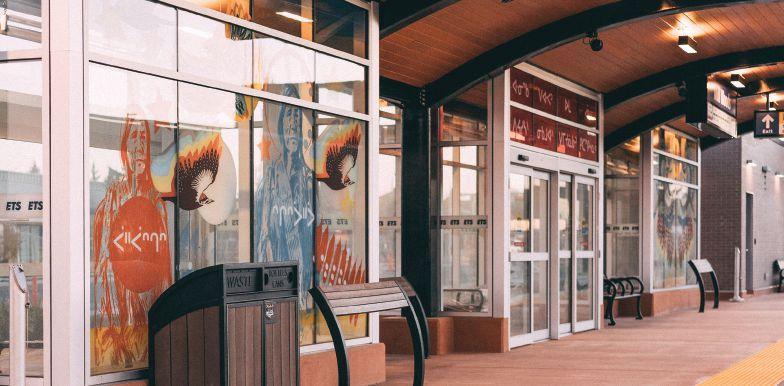
Goldray Glass has collaborated with artists to create public art projects for Edmonton LRT stations. Four Edmonton artists, three Albertan artists, two Indigenous artist teams and one international artist were chosen from 260 proposals to have their work displayed along Edmonton LRT’s Valley Line.
“We love public art. This project was very exciting to work on because they were taking a building material that was already going to be used in each of the structures – glass – and they used it as a medium for their public art projects as well,” said Laura Little, vice-president of sales and marketing for Goldray Glass.
“Edmonton Arts Council had a competition to choose which artists would be awarded and we got to be a part of the process,” explained Little, who connected with all the artists, painters, sculptors and photographers and trained them to create art on glass. “We talked about glass as a medium and we listened how the artists create art and then we collaborated on how this all translates into the glazing world. We discussed things like limitations of colour palettes, UV stability and printing capabilities.”
The artists had to make sure that their art was representative and connected to the community that was using the LRT station. “They put their artwork together and we created samples for each artist’s pitch to the Edmonton Arts Council,” said Little. “It started back in 2017 and we just finished it a few months ago. Working alongside these incredible artists, the Edmonton Art Council and the installers to deliver on such a vibrant and engaging
AT A GLANCE –Edmonton Valley Line LRT
Glazing Contractor: Capilano Glass
Glass Fabricator: Goldray Glass
Project owners: City of Edmonton
Edmonton Arts Council
Edmonton Transit Service
RIGHT: Glass supplier Goldray got to work with artists to explain glass as a medium for art.
PHOTOS: ELAYNE KUBAN
vision was an incredible experience for our team.”
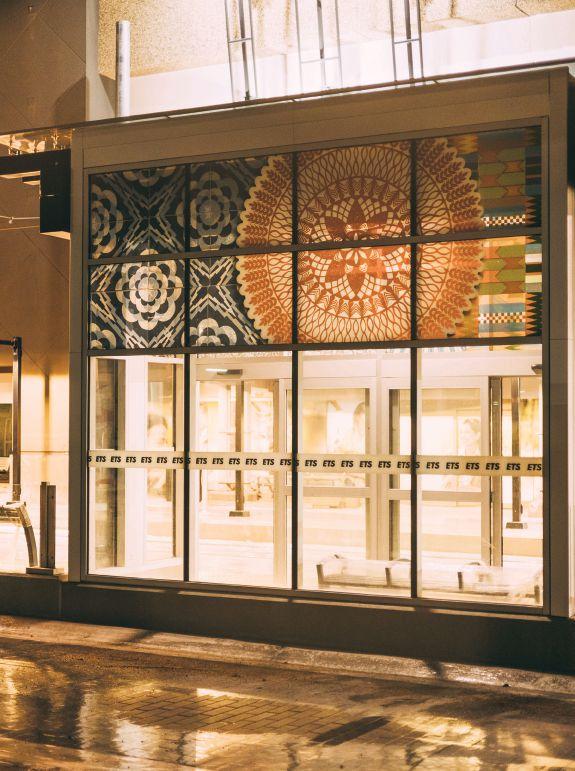
Each art installation uses a proprietary combination of products including digitally printed, low-iron, laminated glass. The Edmonton Transit Service (ETS) and their transit security section had requirements around where and where not artwork could be located and where they needed vision areas. “The ETS didn’t want to block any sightlines or create hidden areas out of view in case someone is in distress. Passengers must always be able to be seen,” said Little. “Being laminated, each panel also provides inherent safety and fallout protection.”
Glass is frequently used in public art. “It is easy to clean off graffiti and the colours remain vibrant even after years of being exposed to the elements,” said Little. “Replacing damaged panels is another reason digital printing was selected. Goldray will store the files so replacements are easy for us to produce.”
One of the artists on the project is Vancouver’s Adad Hannah who has produced community-engaged collaborative projects around the world. Adad’s artwork, Holyrood Lanterns, is a sequence of transit shelters with a series
of tessellated pentagons panels and patterns. The images in the mosaics were captured through a series of community workshops. Hannah’s intention was to transform the transit shelters into colourful and beautiful lanterns that reflect Hollyrood, a residential neighbourhood in the Bonnie Doon area of southeast Edmonton’s diverse makeup. “Not only are they functional shelters, but at night they light up like lanterns,” said Hannah.
Each shelter is different. “I held photography workshops with several school and community groups in the Holyrood neighbourhood,” explained Hannah. “In these workshops we discussed different modes of photography before heading out to capture images. Participants were free to photograph whatever caught their eye. We collected over 1,000 photos. Back at my studio, I selected images from this pool of photos and mapped them onto the five-sided tessellating shapes. Everyone that took part in the project has at least one photo included into the artwork. The community can see itself reflected in the project.”
“Goldray’s technical team is great,” said Hannah. “They provided me with technical support all along the way.”
“Glass is an ancient process and Goldray has combined art glass and high technology,” said Hannah. “The possibilities of what can be done with fullcolour printed frit allow me to take my photographic-based images and print it on glass.
You can print on all kinds of acrylic and plastics adhesives, but I don’t trust their longevity. Goldray’s process is as durable as stained glass. It’s not going to fade. It has all the things that public art clients want in terms of replaceability, durability and ease of cleaning. If a piece breaks, then it can be replaced by Goldray easily.”
“The beauty of digitally printing on glass is that it brings together beauty and functionality,” added Little. “The easy workflow to get designs onto the glass without compromising the vibrancy of colour for the artists, creating a connection with the community, as well as the ease of maintenance is a win for all involved. Public art projects are rewarding on so many levels including filling our hearts with pride at Goldray.” •
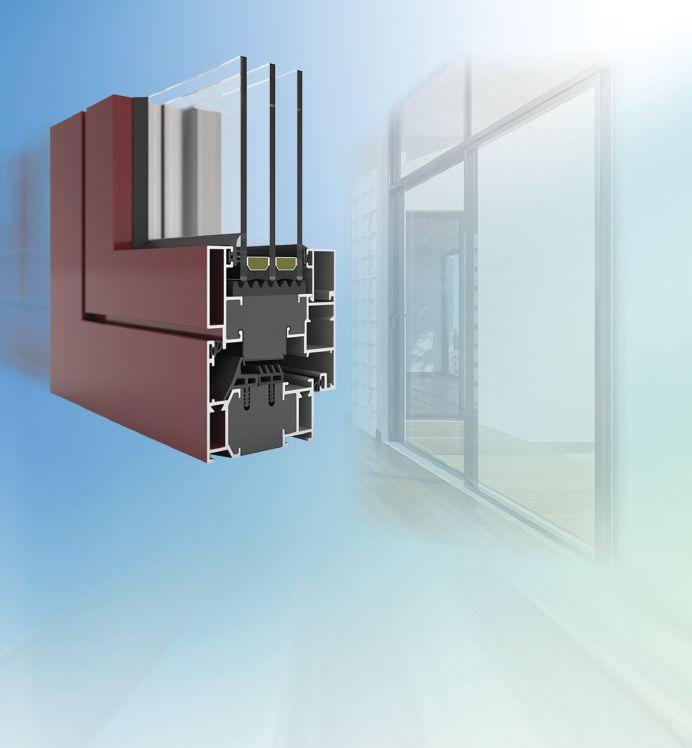
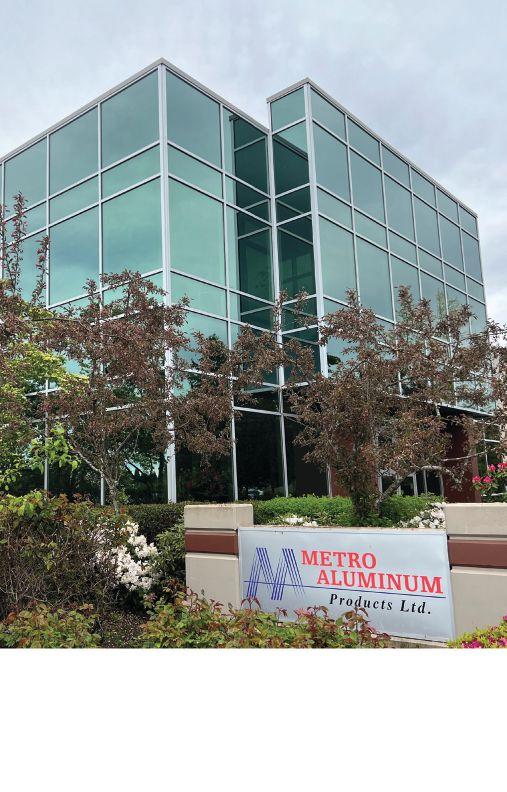
Metro Aluminum is an Architectural Curtainwall, Storefront, Window, and Door Manufacturer. Proudly serving Canadian Glazing Contractors, we offer wide varieties of Thermally Broken Double Glazed and Triple Glazed High Performance Energy Efficient Products to accommodate every budget and design. Metro Aluminum is an innovative and forward thinking Canadian Company, expanding our product lines to include Sunshades to work with our Curtainwall Systems.
TO
Each shelter is a unique work of art. Glass is an ideal medium due to its resistance to fading and ease of cleaning.
THE PUMP HOUSE
by RICH PORAYKO
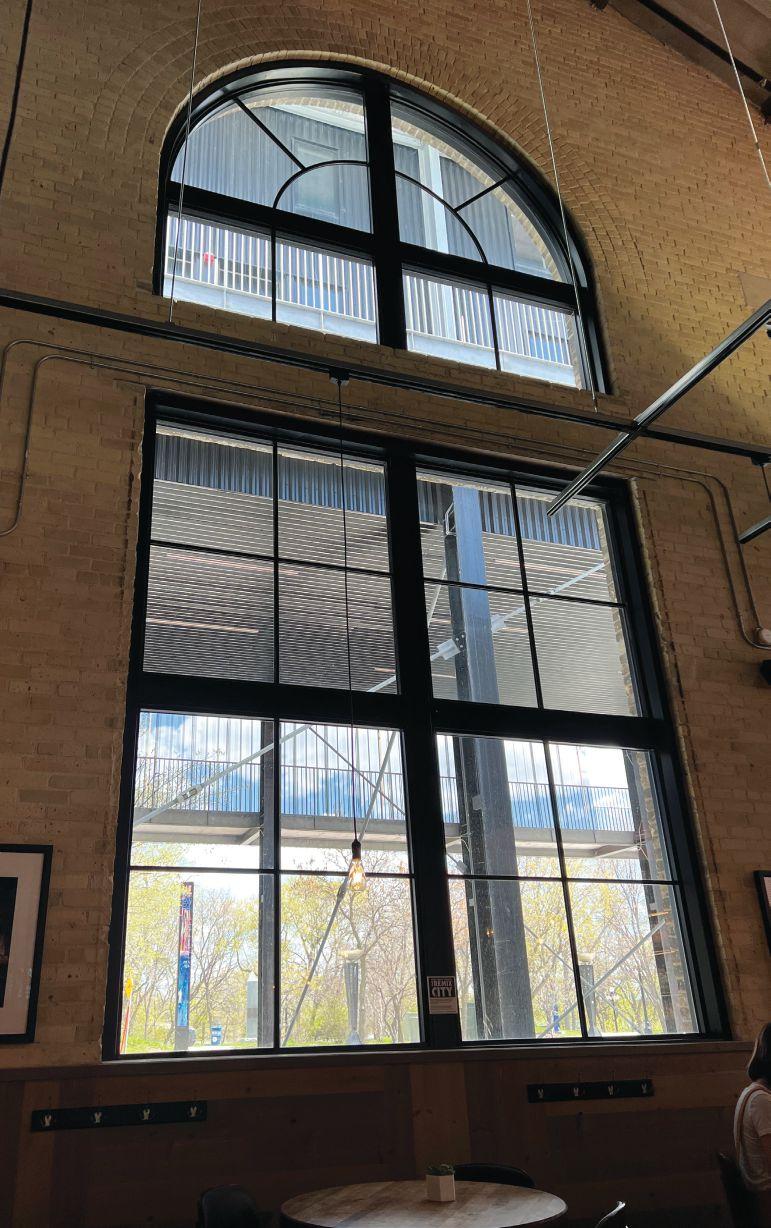
In 1904, downtown Winnipeg was threatened when a fire raged out of control. The domestic water supply, fed by wells, was inadequate. The fire was extinguished and in 1906, the James Avenue High Pressure Pumping Station was built to deliver 1,800 gallons of water a minute as high as 50 floors through an eight-mile network of high-pressure lines to more than seventy downtown Winnipeg hydrants. That historic building forms the heart of a new mixed-use development called, appropriately enough, the Pump House.
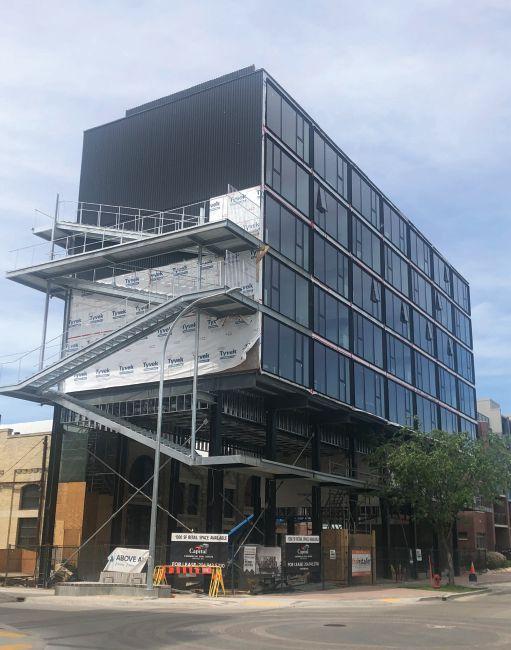
After several failed proposals, the corner of James Avenue and Waterfront Drive has recently been redeveloped with an emphasis on heritage and views. Part mixed-use, part museum, the three-phase development includes the existing heritage Pump House building which is now flanked on either side by two new buildings. “Pump House East was the second phase of the project and is 28 apartments over retail,” says Bryce Alston, director of Alston Properties. “The component that’s currently under construction is called Pump House West and it’s 65 units over retail.”
“We’ve got a really good working relationship with Duxton Windows,” says Alston. “They continually deliver a very high level of service for us and produce very good product. AI Ducek, owner and founder of Duxton Windows and Doors and his team are very adaptable. They work with the types of buildings that we do: intricate projects that demand more from suppliers. They are problem solvers. The Pump House development is exactly
the kind of project that is demanding in a sense in that you need to think outside the box and come up with creative solutions.”
“We’ve created specific products for applications at the Pump House that have
ABOVE: Window fabricator Duxton Windows and Doors had the necessary experience with heritage projects to execute modern designs in the old brick walls. AT A
a range of different capabilities, not just the classic dual and triple high-performance low-E,” says Ducek. “We can provide higher and lower shading co-efficients, so if you are facing east or west and are worried about heating and cooling loads, we can offer whatever combination makeup the modelling suggests is best. All manufactured in a state-of-the-art, world-class facility with a 20-year limited warranty.”
According to Alston, the site was tricky. “There was no staging area. Everything had to be just in time and that’s obviously more difficult these days. There’s been challenges associated with doing this project that aren’t common in all projects. It’s the nature of dealing with a heritage building and having a very high-profile site area developed in a downtown area with adjacency to other heritage buildings. It creates a number of challenges.”
“There are just more approval processes,” says Alston. “Duxton Windows is very used to dealing with the heritage department; what they’re looking for, what they want to see. They know how to navigate that process, which saves me a lot of time, effort and energy. That’s another big component of redeveloping these heritage buildings. Oftentimes dealing with the city and city processes becomes one of the biggest inhibitors for us.”
Views are also extremely important. “In the second phase of Pump House, there’s a full glass wall that overlooks Stephen Juba Park and the Red River,” says Alston. “It’s a massive attraction for tenants there. Our lease-up went extremely well. The building’s been full since we completed it over a year and a half ago. We never have a vacancy in that building because it’s such a unique
product and the views are so phenomenal.”
“We were looking for as much windows as we could because the views are spectacular,” says Ken Borton, of 5468796 Architecture. “And then the amount of light we always want is an important aspect. Even the small windows facing west away from the river are crucial when it comes to the ability to open those windows and have cross ventilation and then even actually a connection back to the heritage building.”
“Those small windows actually play a big part,” says Borton. “Obviously the key ones on the front were the most important part in terms of trying to get floor-to-ceiling glazing and do that in a way that was cost effective and repeatable.”
“We worked out ways to get prefab structures installed in large sections all at once,” says Borton. “These large window walls were essentially framed up almost like a component of the structure of the building then installed all in one piece. Preglazing was an important process that allowed for a quick and straightforward installation of these modules. Less trips up and down the building.”
Collaboration was a major factor says Ted Geddert of Holz Custom Prefab. “It brought our disciplines together,” says Geddert. “You have a progressive and trusting owner who is willing to take a calculated risk including going with a piece of property that others have failed to develop. And then to find an architect partner that makes the vision creating a beautiful building that interacts with the street and existing heritage site is remarkable.”
The Pumphouse project comprises a renovation of the original building with attached retail and residential units added.
SETTING A TONE FOR THE FUTURE GREATGLAZING
by TREENA HEIN
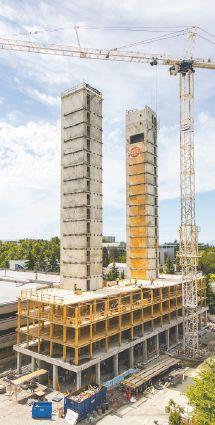
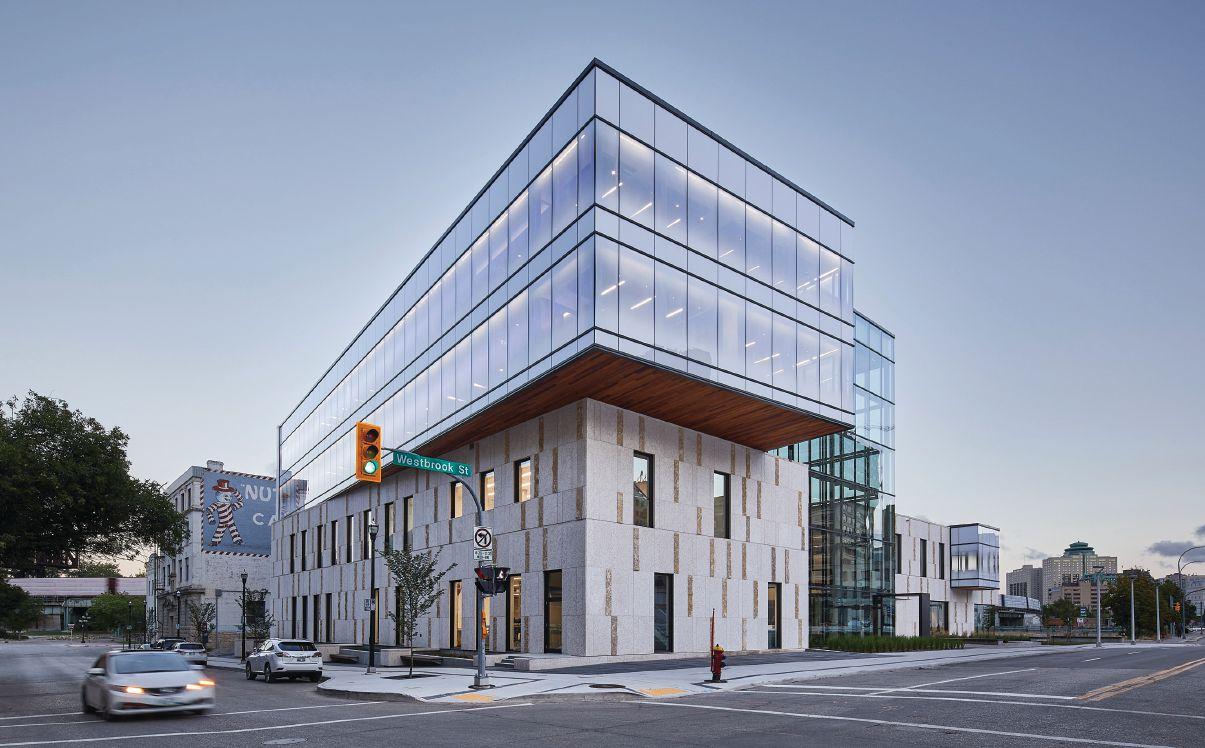
Setting the tone for future downtown development –that was one of the main design aims for the Richardson Innovation Centre in Winnipeg in terms of its overall look and its use of glass.
This exciting facility is located just south of the city’s historic Exchange District, which a century ago was the fast-beating heart of Winnipeg’s growing finance, manufacturing and transportation sectors.
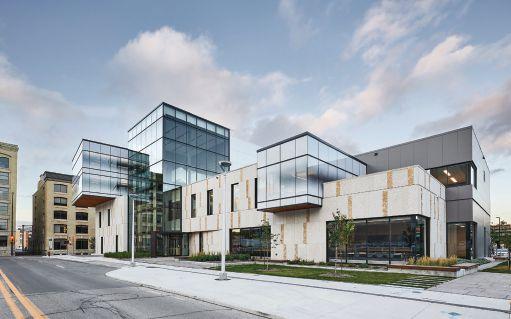
Design-builder Bockstael Construction notes that the building “has transformed the streetscape of what was once a surface parking lot, just a block away from Waterfront Drive. It is a welcome addition to the corner of Westbrook and Lombard and showcases remarkable architectural details at every angle that are highlighted
ABOVE: Designers were looking for a departure from the traditional look of a research building.
AT A GLANCE –Richardson Innovation Centre
Glazing contractor: Glass 8
Architectural firm: Number Ten Architectural Group
Design-Builder: Bockstael Construction
Total building footprint: 63,000 square feet
Completed: 2020
Fabricator: Garabaldi Glass, Burnaby, B.C.
Curtainwall: 6 mm Ultraclear with fadeout frit pattern in Hi-Opaci White frit (surface #2)/½-inch Black TGI – argon/6 mm SN68 Ultraclear (surface #3); 6 mm Ultraclear with flood frit in Hi-Opaci White (surface #2)
Interior lobby staircase: 10 Ultraclear with fadeout frit pattern in Hi-Opaci White (surface #2)/1.52 mm clear PVB/10 Ultraclear
both day and night. The key architectural features include varying limestone textures and glass curtainwall on the exterior, prominent structural overhangs and a centralized glass atrium with a feature staircase.”
Esthetics aside, the Richardson Innovation Centre is a state-of-the-art food product and quality testing facility, housing the food and ingredients division for Richardson International. This company is a leader in the global agricultural and food processing industry and employs 2,600 worldwide. Richardson International’s head office is a block away from the Innovation Centre.
Richardson International describes its Innovation Centre as “a hub of collaboration,” designed to “foster partnerships with the local food science and culinary community.” It houses product development suites, factory simulation areas and a demonstration kitchen where guests can sample new products. Analytical and microbiology labs provide space for food safety, quality assurance work and grain grading.
Brent Bellamy, creative director at Winnipeg-based Number Ten Architectural Group, notes that the building was designed to distinctly depart from the typical, historic (and generally not very attractive) design of R&D buildings. That is, unlike the other major research centre that’s so far been built downtown – the National Research Council of Canada lab constructed about three decades ago – the centre is designed through glass elements to connect activity inside the building with the street rather than keeping it closed off.
“One of our goals was to engage the building with the sidewalk,” he says. “We wanted to have internal building function expressed to the outside and connect the research going on inside with those
who are passing by and that meant having large windows on the ground floor right next to the street.”
Regarding the curtainwall, Glass 8 COO, Phil Gussakovsky, explains that while its installation was straightforward, the curtainwall “has attractive ceramic frit on the north side and we had to be very precise to follow the pattern.” Bellamy adds that “the frit helped us reduce glare, lower heat gain and resulted in less window covering requirements. It creates a diffused light and also balances the building in terms of its overall look. That is, the frit adds a modern lightness but the building still fits into the historic neighbourhood.”
In the entrance, Gussakovsky notes that the atrium is designed to look like a glass cube, open on three sides. Bellamy describes it as “a lantern” in the downtown when it glows at night. “We wanted the atrium glass to be as transparent as possible,” Bellamy says, “but also provide the required thermal performance. Garabaldi Glass was able to provide that.”
The building entrance also features a unique suspended four-story staircase with glass railings. “It was extremely challenging because of the very heavy pieces of glass required, 600 to 700 pounds
each,” Gussakovsky explains. “We had to have a 50-foot spider crane inside the building.” The centre was also a unique project for Glass 8 because there was not very much space around the building to work with. “We had to be openminded and find creative ways to get things done,” says Gussakovsky.
In addition to setting a design tone for Winnipeg’s downtown (and serving as a cutting-edge testing and R&D facility for Richardson International), the Innovation Centre is also serving to attract young, highly-skilled employees who favour a downtown vibe for both living and working. Bellamy has noted that if the Innovation Centre had been placed in an industrial park, it would not have been nearly as well-received as it is by this demographic.
“It’s adjacent to the famous intersection of Portage and Main and we hope the building will set a tone for what the future of the neighbourhood will look like,” says Bellamy, “so that it connects people the way the Exchange District did but also has that engaging modern look. The use of glass was a big part of that.” •
Your Solution to Custom Fabrication
MATERIALS
Galvanized/Mild Steel 26ga to 1/4”
Painted and Anodized Aluminum 0.032” to 1/4”
Pre-painted Steels
Stainless Steel/Brass/Copper/Zinc
SERVICES
Shearing/Punching/Notching/Routering/Bending
Stud & Spot Welding
Assembly/Prototypes
Backpan Fabrication
• Established in 1980
• COR Certified
• ISO 9001:2015 Certified
• CNC Press Brakes - 8’, 12’ & 14’
• CNC Router Table/Punch Center
• One piece to 10,000+ pieces
The one they look up to Bass Installation’s Natasha Callender-Wilson
The vice-president of Bass Installation sat down with Procore’s Sasha Reed to share her reflections on leadership in Canada’s glass industry.
Natasha Callender-Wilson is vice-president of Bass Installation, a glass installation company whose work can be seen in many Toronto projects including CIBC Square, TEC Bridge and the ShangriLa Hotel Toronto. Her father, Stephen Callender, founded and owns Bass and serves as president of the Afro Canadian Contractors Association (ACCA). Natasha joined Bass in 2005 and spearheaded the creation of its subsidiary, Bass Curtainwalls, in 2010. She spoke with Sasha Reed, director of industry advancement for Procore.org, about being a Black woman in construction, how she’s grown as a leader and how the industry can make room for a more diverse workforce - beyond gestures that simply check the diversity box.
Sasha Reed: What is it about construction that makes it your industry of choice?
Natasha: I’ve been around builders all my life, my dad’s an iron worker by trade. There’s some level of satisfaction in helping solve the challenges on a job site, whether you’re looking at drawings
or in the office doing payroll. Everybody has a role to play. We can say, “wow, we did that as a team, built something that’s going to be part of Toronto, or Ontario or Canada’s legacy.”
Sasha: You mentioned something there that I think is so interesting, which was reflected in an article that was written about you, the idea that your work is changing the skyline of Toronto. How much does that play into your desire to stay in this industry versus looking at other careers and opportunities?
Natasha: It’s not just the physical work of building skylines that is changing, but also the industry as a whole. There are women including women of colour entering construction. At Bass, we can play a part of opening those lines for people who just didn’t really have the opportunities like when I was coming up (being a woman and a minority). So, I think part of the reason I want to stay in the construction industry is because I have a voice and knowing where we came from and to see where we’re going. I want to be a part of that.
Sasha: First, as a woman in indus-
try, kudos to that. Talk to me about the transition that happens in your mind as a leader, where you go from being the underdog to a person in a position of authority who can inspire and give access to others.
Natasha: Recently, I had this moment when I realized, oh my gosh, I am the one that others may be looking up to now. When you’re starting out in the industry, you should ask questions even if you think they’re stupid, because you’re allowed when you’re young and naive and just coming up. I think the transition moment occurs when you realize that you are now the one answering the questions. I try to be honest and vulnerable with my colleagues who look up to me. It’s not always easy. There were days I locked myself in the bathroom and cried because I felt attacked. I’m happy to be someone who can share what I’ve learned and experienced with younger individuals and help them as they start their own journeys.
Sasha: On that point, do you see the culture that you’re building as a competitive advantage for your business?
Natasha: It is. I feel like we’ve been doing it all along. There are small things we can change that help open the industry to more people. I haven’t had a problem with terms like foreman or journeyman or anything like that, that’s the name of the role, I get it. But I’m always a little more receptive when someone mentions journeyperson versus a journeyman. We’re building a culture, and by building the culture, it’s spreading throughout the industry slowly. Sometimes you’ll also hear derogatory comments and it’s like, “but that’s just construction, that’s allowed.” We said, “No, no, it’s not acceptable, it’s not fine”. We’ve always been mindful about that. We train our supervisors and workers as they come to us to be mindful of things like that, not because it’s the new diversity and inclusion checkbox but because it’s who we are. We have many, many different cultures here, especially within our head office. To build that culture of good people, you need good thinkers, good ideas and different cultures coming together. Because at the core, we all want the same thing.
Sasha: How is construction changing in terms of communication methods?
Natasha: Having access to information – on the cloud – at our fingertips, across organizations, is really changing how we work as a company. I can mark up a drawing in Procore and say, “Joe did you get it?” And he’s all the way downtown, which is 45 kilometres from us. It’s brilliant that we’re able to connect and get things done more efficiently. With technology, there are opportunities for more people to participate and be productive.
Sasha: What is it that your company got right, in terms of being a participant in your success?
Natasha: What allowed me to pursue a career in this industry was being able to go to school and still pay my rent. That can be the difference for some people. So maybe you don’t work eight hours straight, you put in two hours now and make up the rest later. A flex system like that can help people achieve their goals. To support education, we offer tuition reimbursement. We’re always trying to encourage anyone who wants to learn. We want to make sure that people can grow within our organization.
Sasha: When it comes to employing and advancing women, what are some of those things that the industry can improve?
Natasha: There is that flexibility notion, and childcare plays a big part of it. One of the things the Ironworkers launched about four years ago was benefits for maternity leave. And they were one of the first unions to do that. There was such a disconnect with women in the trades, having to choose whether they’re going to work or choose to have children. It’s so hard to have to choose between the two, and it’s amazing to know that organizations like the Ironworkers union support us.
Further, maybe we need to focus on the culture of the organization by realigning the operations around how we want to do things and by investing in all our people. When you invest in good people, the return is far greater than expected. We can make the rules, so why are we trying to follow someone else’s rules? •
Jas Saraw is vice-president of Canada for Procore, a global provider of construction management software.
RESOURCEDIRECTORY
by RICH PORAYKO
Rich Porayko is a professional writer and founding partner of Construction Creative, a marketing and communications company. richp@ constructioncreativecom
Friends in high places
Blame it all on my roots, I showed up in boots. The 2022 Building Envelope Conference was an outstanding affair. I cannot say enough good things about it. But boy, was I rusty. Am I doing this right? Where am I supposed to go? What is “ArriveCan?” What’s the deal with COVID testing and the U.S.? How do I get home? Granted, this was late March so all travel restrictions were still in place but basic decisions like what time to set the alarm to make my flight to Bellingham, Wash., was more challenging than I recalled. Naturally, I overcompensated. Not only did I get there in time to cross the border and make my 07:50 flight, I easily had enough time to get gas, lounge around and still make the 06:30 flight. For around a half-hour, I was the only passenger in the entire BLI departure area. It was glorious. Aside from the fact that I was out of practice, the travel experience was mostly a piece of candy. After convincing myself that I had to be missing some crucial fine print from U.S. Customs and Border Protection, the sole border guard waved me through, I was the only person in security at the airport and no one anywhere ever asked me for any testing or to see my vax pass. I’d go so far as to even say that it was a smooth experience. Until I landed in Seattle. I’ve come to realize that although I love to travel, I hate to fly. Okay, not really. Flying is fine but I didn’t miss the whole parking, checking in, security, killing time, boarding, and stopovers part of travelling. I compare it to skiing or snowboarding, which I also love. Otherwise well-educated people suddenly lose their ability to perform the most basic organizational tasks.
The last time most conference attendees I spoke with were in NashVegas was for BEC in March 2020, at the beginning of the corona-nightmare when 25 people were killed during an
As soon as I walked into the lobby I could tell I was not in Coquitlam any more.
THAT’S RICH
EF3 tornado. It was traumatic and I know I wasn’t the only person who felt a huge sense of redemption and triumph returning to a packed conference of almost 650 friends and colleagues two crazy years later. As soon as I walked into the hotel lobby I could tell I wasn’t in Coquitlam anymore. Not one person was wearing a mask and people were staring at me. I ditched the mask and pretended like I owned the joint. It felt really good.
I caught up with the brilliant Stanley Yee for dinner and instantly remembered how much I missed face-to-face networking. Being dedicated workers, we shut it down early to be ready for an early Tennessee hot chicken brunch with Twitter’s #GlassGrillingGroup. Technically, I was “uninvited” and “crashed” the private breakfast, however I was with Stanley, so I was golden. Next thing you know, I’m having spicy hot chicken eggs benny with some of the biggest names in the industry watching NGA vice president Andrew Haring instantly regret sampling Party Fowl’s Poultrygeist hot sauce. Breakfast was worth the trip on its own. A quick visit to the Country Music Hall of Fame and lunch at Jason Aldean’s with my boy Earl Mercado and then it was go-time with wall-to-wall VIPs for the next 60 hours. Meetings, sessions, receptions, repeat. Nothing replaces facetime with customers like Binswanger Glass and suppliers like Guardian and Vitro. The networking at BEC, especially the opening welcome reception, is nothing short of world-class.
Bourbon, bourbon, bourbon. Although Goldray’s legendary Bourbon QuickFrost Challenge was informative, tasty, and refreshing, I was disappointed to learn that Canadian whiskey is not considered a true whiskey like Scotch, Bourbon, and Irish whiskey. What the hell? In fact, the professional taster compared Canadian whiskey to the CFL.
Sure, I made rookie mistakes forgetting my jerry cans, leaving my hat in security (which I got back four days later!), booking a middle seat, walking through an alarmed emergency exit, and screwing up my ArriveCan app, but the rest of the event was amazing. Not just the booze and the schmooze, it is the people, the products, and the projects. There is way, way more to glass than clear windows. It’s a lifestyle. If you are considering a career change, I highly recommend the glass life. •
On March 22nd, Annex Business Media’s Manufacturing Group teamed up to host ADVANCE: Women in Manufacturing, a one-day virtual summit that brought together industry experts and thought leaders to promote gender equity, diversity and inclusion in Canadian manufacturing. Visit womenincanadianmanufacturing.com to view on-demand content, including videos and podcasts.
THANK YOU TO OUR SPONSORS
GOLD SPONSORS
SILVER SPONSOR
BRONZE SPONSOR
Presented by
Less green. For less green.
Find affordable clarity in the Solarban® Acuity™ low-e glass series.
Introducing Acuity™ low-iron glass — which is 60 percent less green than ordinary clear glass . The new Solarban® Acuity™ series by Vitro Architectural Glass provides the truly clear look you want with the outstanding performance of the full range of Solarban® solar control low-e coatings.
Upgrading a low-e coated clear insulating glass unit to Solarban® Acuity™ glass will typically increase the total installed curtainwall cost by only $1–2 per square foot.
Give a little, get it all. Request your samples at vitroglazings.com/acuity