What mycoinsecticides are and how to use them effectively | 12
A natural end to pepper weevils
Could natural enemies of the pepper weevil be used in the greenhouse? | 40
Must-see at this year’s CGC
The 2018 programme revealed | 51
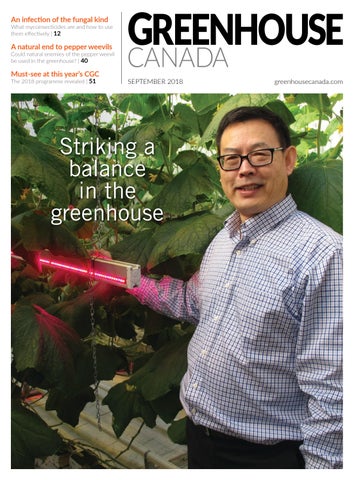
Striking a balance in the greenhouse
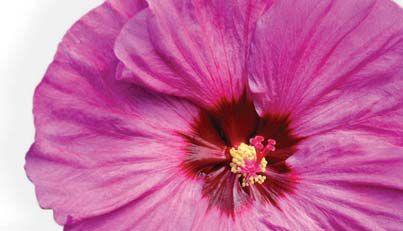
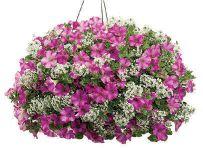
NEW Firehouse Verbena
Medium mounded for baskets and combos
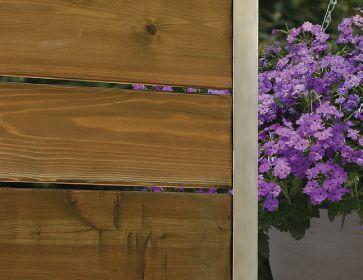
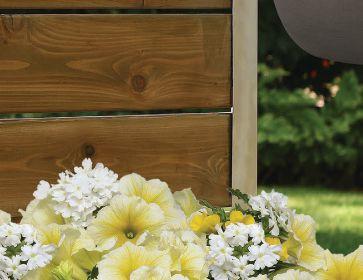
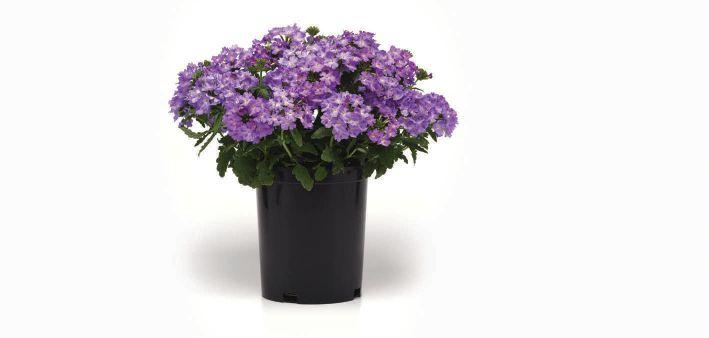
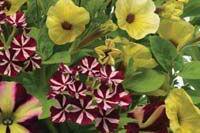
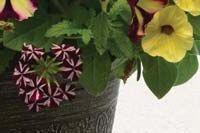
Ball FloraPlant® is reinventing the verbena class! NEW Firehouse medium-sized verbena series fires up baskets and mixed combos. With the same superior heat performance as our leading EnduraScape series, Firehouse keeps on blooming in containers all Summer long. Book yours now.
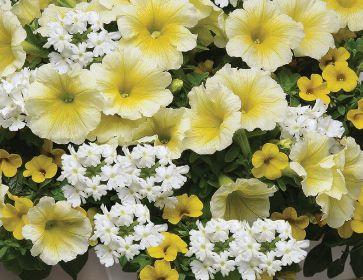
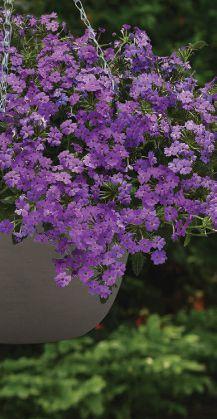
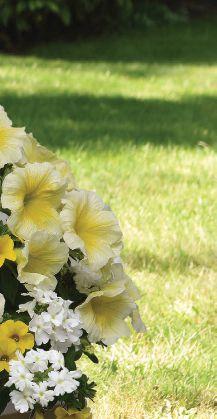
Top: NEW Firehouse White in MixMasters Sunnyside and NEW Firehouse Grape Bottom: NEW Firehouse Lavender
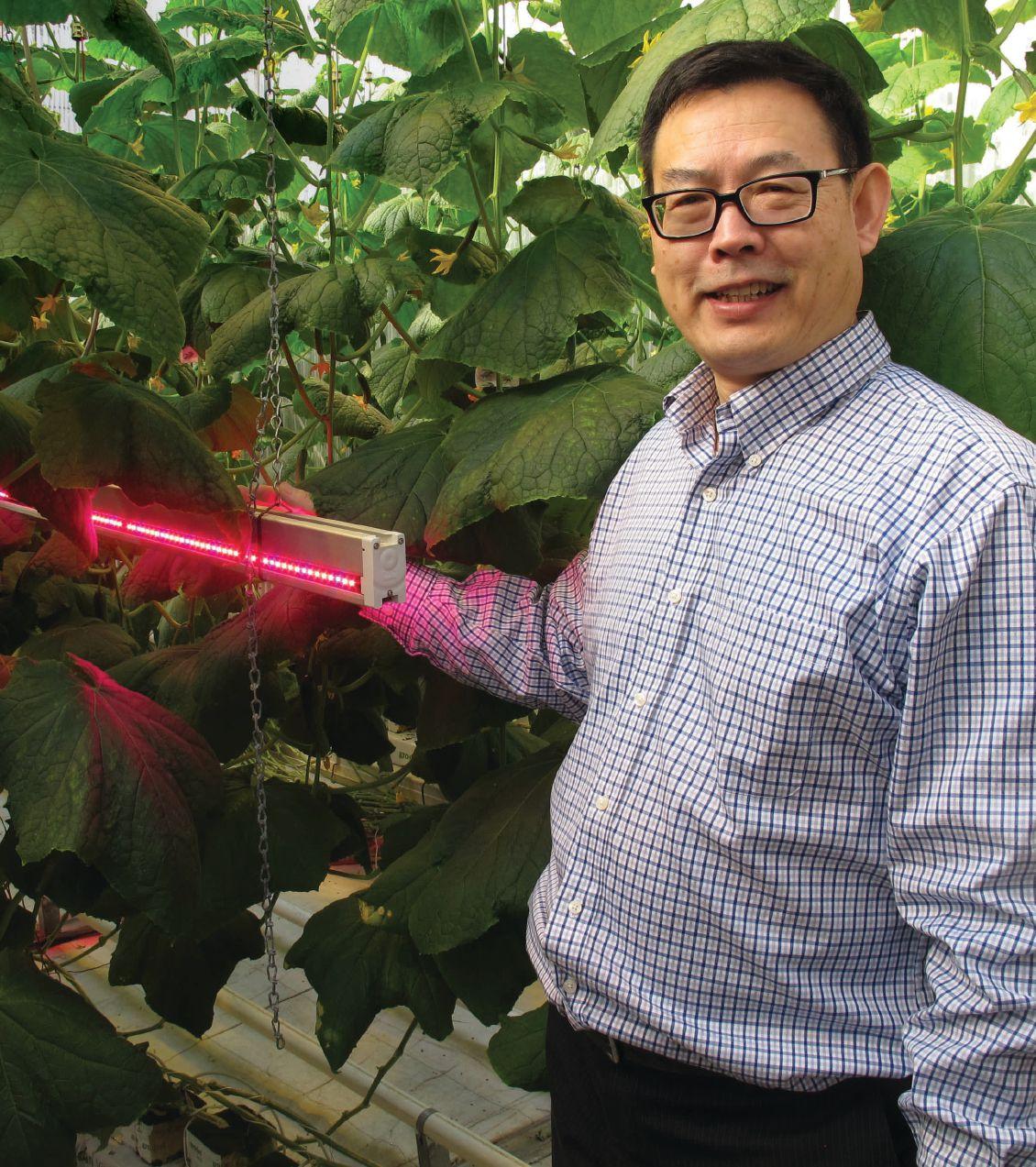
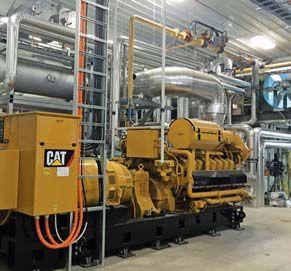
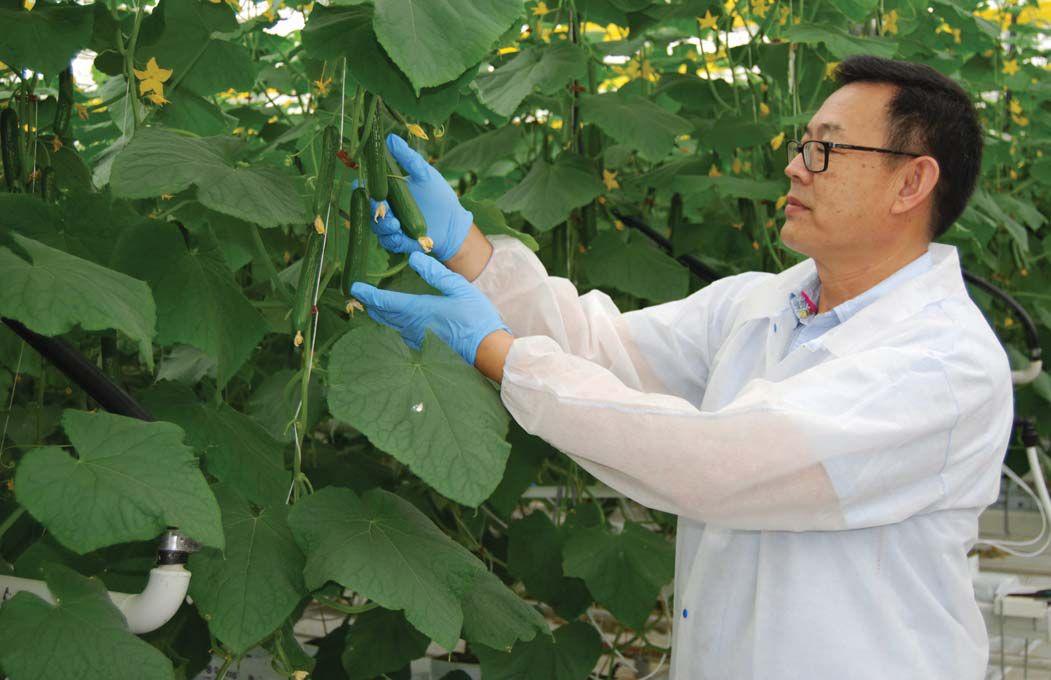
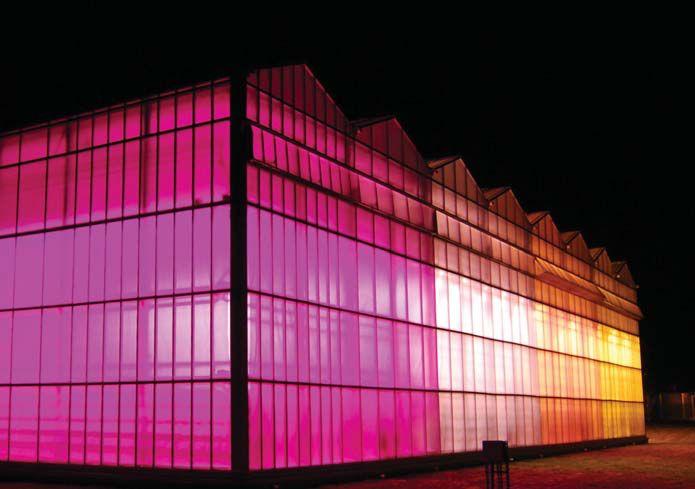
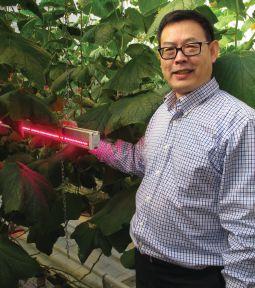
Dr. Xiuming Hao talks greenhouse energy balance at this year’s Canadian Greenhouse Conference. See pg. 56
BY DR. DANIEL PECK
BY PETER MITHAM
BY GRETA CHIU
FROM THE EDITOR
Success hangs in the balance
If there’s one key takeaway from this issue, it’s balance.
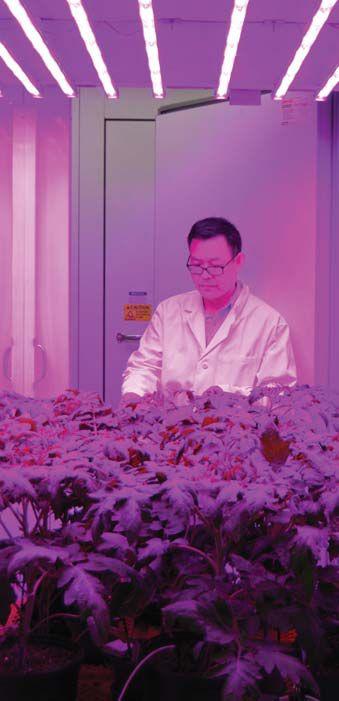
That point is driven home by our cover story this month (pg. 56), which features the research of Dr. Xiuming Hao from Agriculture and Agri-Food Canada. Based out of the Harrow research facility, his work on greenhouse energy and lighting shows what it means to achieve ‘balance’.
For instance, HPS lighting fixtures generate waste heat that leads to higher temperatures. The plants then transpire more, so they need more water and nutrients, and the greenhouse climate needs to be adjusted. A new balance must be found.
At Cultivate ’18, a conversation I had with Saul Cabrera of Greenspire Global stuck with me: crop protection is about balance too. What makes an integrated pest management strategy truly successful are the different practices involved, including scouting, adjusting greenhouse conditions, ensuring adequate nutrition and so forth. Applying a preventative fungicide is only one step, and that alone doesn’t necessarily lead to a
not bring them into the greenhouse? Without products on the current market that can target immature stages of the weevil, this research update is one to take note of.
Another class of natural-borne assassins is the fungal pathogen. These infectious microbes have been isolated by scientists to create mycoinsecticides. Flip to Dr. Dan Peck’s feature for more on what they are, why growers should consider using them and how to make the most of their application (pg. 12).
Key takeaway #2 in this issue is ‘know your greenhouse pests’. The feature on phloem feeders – aphids and mealybugs – is a prime example (pg. 20). The former responds well to systemic insecticides while the latter does not, underscoring the importance of scouting.
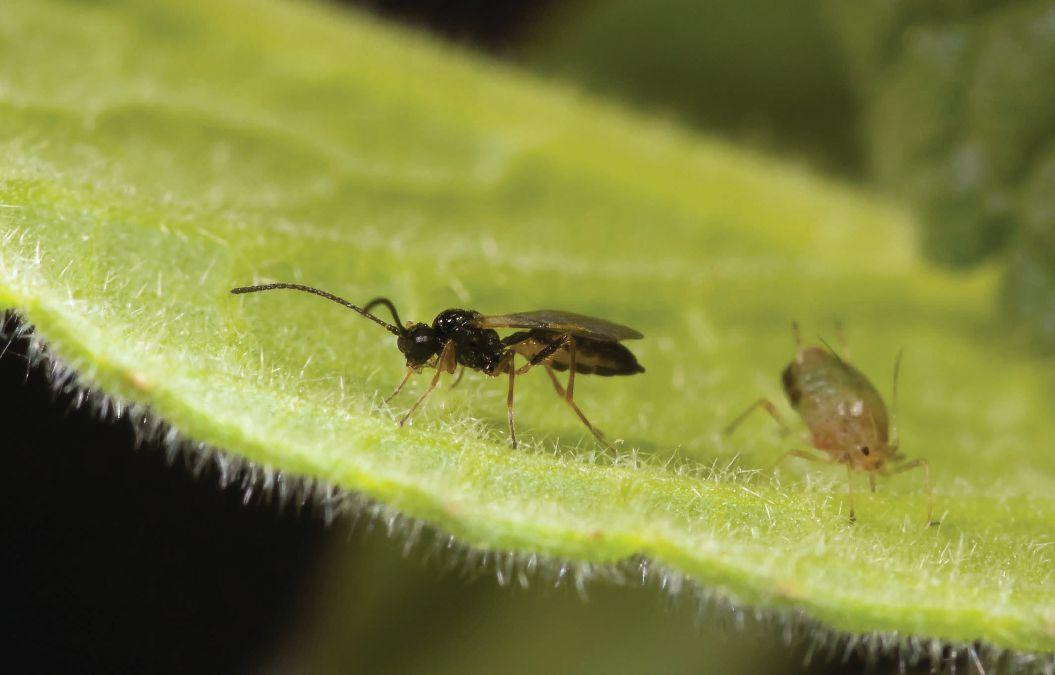
Then there’s Aphidius ervi, a parasitic wasp that some have given up on as ineffective against foxglove aphids. According to the study coming out of Vineland Research and Innovation Centre, one of the first steps to successfully using A. ervi is to release it as soon as you spot foxglove
healthy, well-balanced crop.
One of the keys to banker plant success? You guessed it – balance. Specifically the ratios of prey to beneficial predators at the beginning (pg. 34). Using non-crop plants to rear beneficial insects is an ingenious way to boost their population levels, ensuring they’re in full force by the time less-friendly bugs show up.
Another force that strives for balance in the world? Nature.
Turning to Dr. Roselyne Labbé’s feature (pg. 40), her team is working on identifying natural enemies of the dreaded pepper weevil. If Mother Nature has predators ready, then why
aphids (pg. 28). In other words, scout.
As Dr. Abida Nasreen points out, staff applying biocontrol strategies have to know how to use them. Are the biocontrols useful against the identified pests? Are the costs worth it? (Pg. 10)
And for something a little different, see our Q & A session with researchers Dr. Jaimin Patel and Leora Radetsky (pg. 46). They’re looking at the potential for visible and ultraviolet light in mitigating powdery and downy mildews – two common diseases in greenhouses. Who knows? There could be light levels on label one day for treatment against disease in the greenhouse.
Canadians travel back with trophies from Ohio
Annual awards were handed out at Cultivate ’18 in Columbus, Ohio earlier this year, and Canada did not disappoint.
Barbara Jeffery-Gibson of Jeffery’s Greenhouses in Ontario received one of six 2018 Horticultural Industries Leadership Awards (HILA). Sponsored by Syngenta and presented by Greenhouse Management and Nursery Management, recipients from both the greenhouse and nursery sectors were recognized for their contributions to the horticultural industry.
Amanda Bruce, general manager of Cedar Rim
Nursery in Langley, BC received the Young Retailer Award at the Unplugged event. Presented by Dümmen Orange and Green Profit, the annual award singles out one hard-working garden retailer under the age 35.
Also announced at Unplugged, Rajvir Prasher of DeVry Greenhouses in Chilliwack, BC was recognized as a finalist for the Dümmen Orange/Grower Talks Young Grower Award. He was just shy of the main prize, but his hard work and dedication were recognized on the podium.
Congratulations to everyone.
FIRST ‘NEW BLOOMS’ EVENT A SUCCESS
Attended by 96 growers, retailers and plant brokers from Western Canada, the first ‘New Blooms’ event was hosted by Deb’s Greenhouses near Morinville, AB.
“The event was a huge success I think because we have such a great group of growers here, the plants were grown nearby by Michiel at High Q Greenhouses and it was a true
BY THE NUMBERS
grower trial,” says Deb Foisey, owner of Deb’s Greenhouses. “There is a need for a plant show out west.”
In addition to plant trials grown by Alberta’s High Q Greenhouses, the two-part event featured presentations from breeding companies Elsner PAC, Florist Holland, PlantHaven International, Vegetalis and Westhoff, as well as unrooted cutting
producer, Vivero Internacional.
Foisey’s also looking forward to growing more patio vegetables from Vegetalis. “I did not realize I’m already growing some but I’m going to add a few more varieties to my program.”
Favourable reviews were garnered from the attending crowd as well.
“The 2018 New Blooms was an excellent grass roots event and
$ $ 16.7% 2 in 3 74% 55% of greenhouse
BILLION
provided a leg up to the many growers who attended,” says Geoff Wood from Ball Seed. “Growers got to actually see locally grown 2019 new variety samples as well as interact in person with the breeder product representatives. What could be more effective! This hopefully is just the start of an annual event based in Alberta supported by growers. Nicely done!”
8.7% of farms in Quebec are organic, the highest in the country. $
of Albertans buy organics weekly.
4.4%
Innovative that grow your business Pest Control Solutions
From fungicides to miticides to biological solutions, Bayer is dedicated to the research and development of the products that keep your crops and business blooming.
New for 2018: Specticle G and Luna Privilege Greenhouse Coming in 2019: Altus Insecticide - for greenhouse tomatoes, peppers, cucumbers, lettuce and ornamentals and in outdoor ornamentals
Bayer, the Bayer Cross, Kontos, Rhapsody, Forbid, Previcur, Luna Privilege Greenhouse, Scala, Specticle G , Compass 50WG, DeltaGard SC, Florel, Intercept, Ronstar and Altus are trademarks of Bayer.
Summer Crush hydrangeas from the Endless Summer series bring a profusion of rich raspberry red or neon purple blooms all summer long. Summer Crush has dark green glossy leaves, resists wilting in the summer heat, and fits smaller garden spaces or containers with its mature size. 45-91 cm tall and wide.
endlesssummerblooms.com
With tight internodes for more flowers and great garden performance, LIA is an early series with medium vigour - perfect for quarts and compact basket production. LIA will flower in a ten-hour
day. Flower size is noticeably different, up to 30% larger. LIA is available in six new colours including Bubblegum, Yellow, White, Blue, Melon and Raspberry. danzigeronline.com
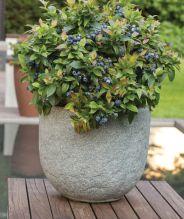
Jelly Bean from Bushel and Berry has large, flavourful blueberries mid-summer that taste
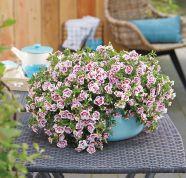
An early-to-finish, medium-compact calibrachoa, this new addition to the Uno series from Selecta One features heavily contrasted double flowers, uniform flower timing and a ball-shaped
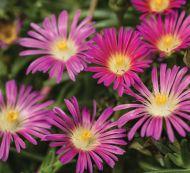
Delosperma Delmara
Huge, eye catching blooms show their colour intensity throughout the growing season. This delosperma from Green Fuse offers large flowers that cover the plants,
habit that is half trailing. It grows well in quart and gallon containers, but also thrives in hanging baskets as part of Trixi combos. 25-38 cm tall x 20-30 cm wide. selectanorthamerica.com
like sweet, homemade blueberry jelly. The foliage is unlike other blueberries and has unique, elongated green leaves with highlights of red in cooler climates. Suitable as a mini-hedge along a pathway, in the landscape or in decorative patio containers. USDA zones 4 to 8, full sun. 30-60 cm tall, mounded. bushelandberry.com
great for containers, baskets and mixes. This zone 4 perennial will bloom continuously without the need for vernalization or a set daylength. green-fuse.com Exceptionally large, showy blooms are the perfect inspiration for a warm welcome. This I’Conia Portofino Champagne hybrid begonia from Dümmen
Begonia, I’Conia Portofino Champagne
Orange is best for patio containers and hanging baskets. Part sun to full shade. 30-40 cm tall x 40-65 cm wide. dummenorange.com
Interspecific Geranium, Calliope
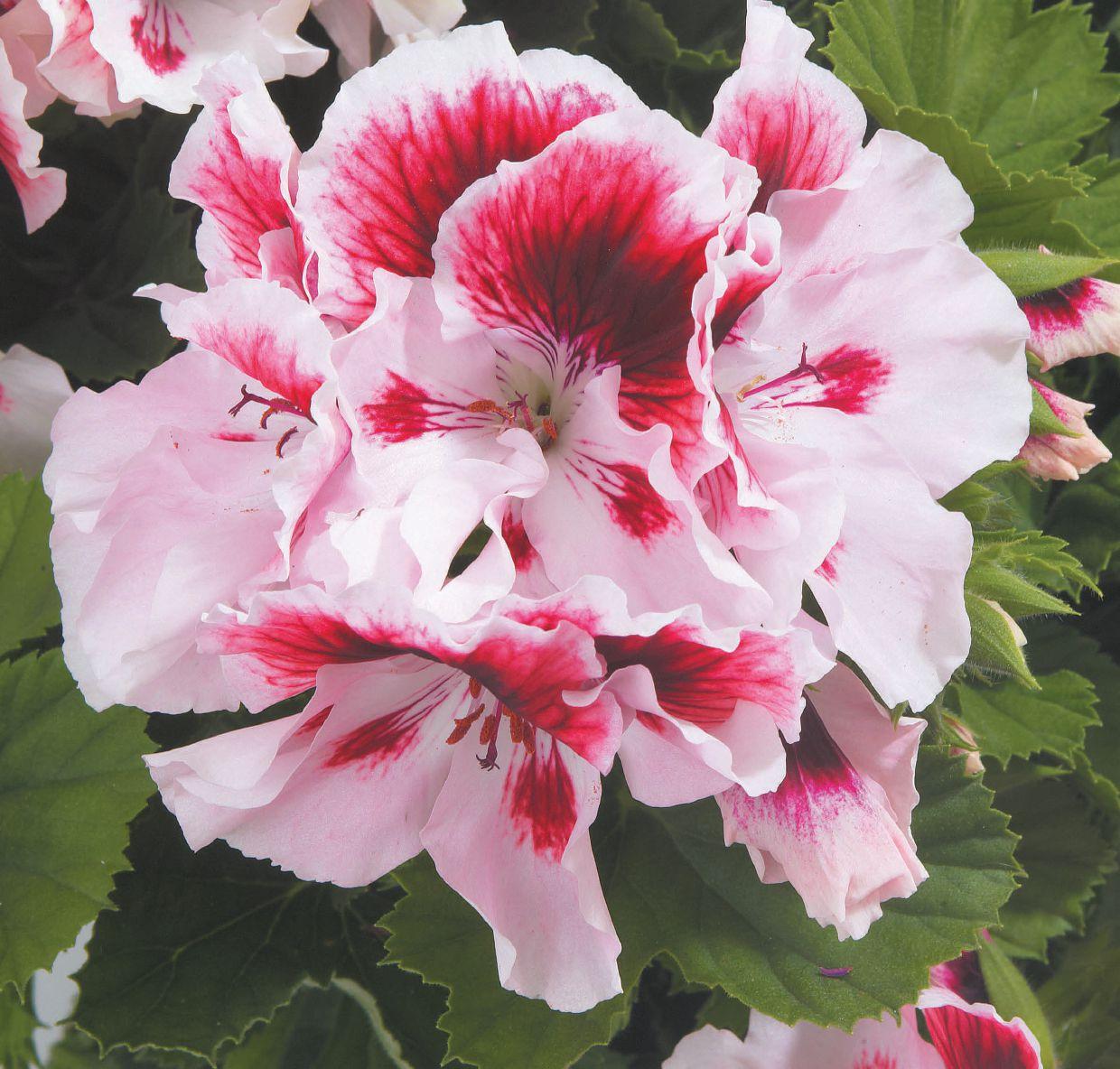
Medium Hot Rose
This new addition to the interspecific geranium Calliope series by Syngenta features vivid hot pink flowers with dark zoned foliage. It offers a controlled habit with superior performance over traditional zonal
geraniums. Large semi-double flowers with intense colour for retail and consumer appeal. Great landscape performance. Medium vigour with mounded habit. 40-50 cm tall x 35-40 cm wide. syngentaflowers-us.com
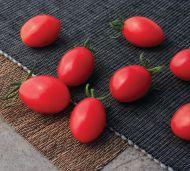
Rozestar indeterminate pink grape from Sakata Vegetables performs very well in high-tech and mid-tech production environments. It has a unique pink colour, with a smooth taste
that is well-balanced between acidity and brix. High yield potential, firm fruit and uniform shape and size. Plants are well balanced and vigorous. GSPP certified. sakatavegetables.com
Jelly Bean blueberry
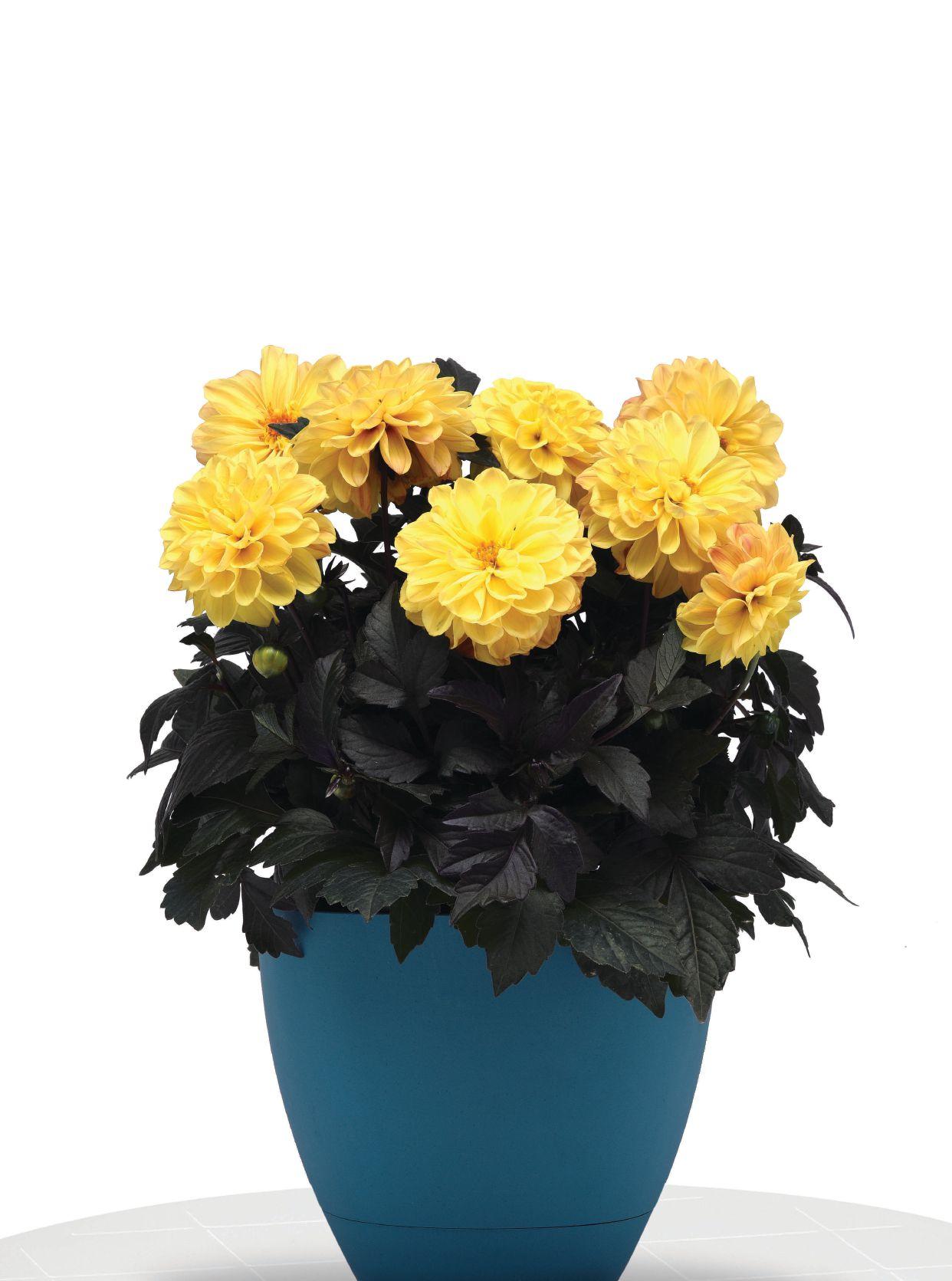
CITYLIGHTS beams colorfromdarkfoliage
Makes a dazzling accent that lasts all season.
The dark foliage of this garden dahlia amplifies bright, colorful blooms that attract butterflies and birds. From the Dalaya breeding program, City Lights has the same powerful garden performance. Featuring radiant color and good plant branching, City Lights is a stunning star in containers and gardens.
Visit selectanorthamerica.com to order City Lights Dahlias and to find best growing practices.
Economics of biocontrol
Biologically based pest management technologies are being widely accepted because of their potential to beneficially exploit pest systems with little to no probability of harmful effects on human health and the environment. Although biological control is among the fastest growing sectors of crop production, little focus has been placed on the economic assessment of this key ecosystem service. In order to understand the economics of biocontrol, we need to conduct a cost-benefit analysis. This will allow us to evaluate whether implementing biocontrol programs results in higher or lower profits when compared to traditional methods such as spraying insecticide. To conduct a cost-benefit analysis, we need to analyze the inputs required and the outputs received as a result of using beneficial insects or conventional chemical-based pest control. Inputs can be costs of labour, additional equipment needed and time required, while outputs can be effectiveness of pest control, quality and amount of yield produced.
There are risks involved in both biologicallybased and non-biologically-based methods. Using insecticides may lead to resistance over time, causing growers to use harsher chemicals and decreasing the overall value of their crops. This also increases exposure to growers, labourers and applicators. There might be restrictions being placed by the government to discourage excessive use of chemicals due to their potentially harmful effects on the environment and consumers.
pesticide-free and are willing to pay a little extra for it. Some branches of government are also encouraging the use of biocontrol agents due to their positive effects on the environment.
Setting biological control on a firm economic foundation would help to broaden its utility and adoption. By adopting a well-economised biological control programme, growers can not only grow good quality produce with minimal use of chemicals, but can save money and provide a healthy environment to workers. Such a system can be applied by critically-reviewed, preventative and curative measures, including steps such as:
1. Encouraging rhizosphere microbiome activity to strengthen the plants and ready them for a fight with pests and diseases.
2. Introduction of ground-inhabiting predators like Dalotia (formerly Atheta) coriaria as a slow release system and Hypoaspis miles as a key component against important soil residing / hibernating crop pests such as spider mites, fungus gnats, thrips, root aphids, etc.
3. Introduce generalist predatory mites (e.g. cucumeris, swirskii, californicus) and insects active on plant foliage by using the sachet system for predatory mites and the banker plant system to support Dicyphus, Orius and Aphidius. This will keep the population of different pests below economic thresholds.
Understanding the costs associated with biocontrol is valuable...
Similarly, biocontrol has its own risks. It requires knowledgeable staff who has the expertise of the biocontrol agents applied against pests, as well as knowledge of the compatibility of chemical use with biocontrol agents. If staff do not have this knowledge, using biocontrol products will be ineffective and expensive. Understanding the costs associated with biocontrol is valuable for the grower. Knowledge of different pests of different crops allows the grower to put into context where, when and why the biocontrol dollar should be spent, and where to focus on cost reduction.
Looking at the bigger picture, market trends are moving towards biocontrol use over insecticide use. This is because the public is becoming more health conscious. Some prefer produce that is
4. Use specialist predatory mite (persimilis) and insects (Encarsia, Eretmocerus, Aphidius) of specific pests, keeping in mind the predatorto-prey ratio. Release the biocontrol agent as soon as possible once the presence of the pest is marked by the scout. Enrich the hot spots with predators instead of a blanket application. The use of specialists is not suggested as a preventative measure, because specialists will not survive in the absence of its prey.
5. If a pest population flares up in spite of all the above said efforts, use a selective pesticide for quick suppression of the pest.
6. It is highly recommended that you consult your service provider for where, when and how much biological control agents should be applied to avoid over spending and to use natural enemies correctly.
Abida Nasreen, PhD, is director of research and development at GrowLiv Ltd.
Could adding soil probiotics be beneficial for business?
Exploring the science behind microbial fertilizers.
Soil probiotics and microbial fertilizers are not new. Known as ‘biofertilizers’, their history began with the launch of ‘Nitragin’ in 1895. This product contained nitrogen-fixing rhizobia originally isolated from the roots of legume crops, then cultivated for application. This beneficial microbe would form a ‘symbiotic relationship’ with the plant, increasing the number and size of root nitrogen-fixing nodules to increase nitrogen availability in the plant.
Because crops have different nutritional needs and relationships with different microbes, microbial fertilizer formulations have to be tailored towards different types of greenhouse crops. It’s not a new concept for many field crops, but adapting this technology for greenhouses helps balance many of the shortcomings of conventional chemicals, while continuing to improve soil fertility and productivity.
WHAT ARE SOIL PROBIOTICS?
If soil is like the stomach of a plant, then biofertilizers are “probiotics for the soil.” Nutrients can be hidden in plain view, unavailable to plants because they are locked up as insoluble minerals or in slow-to-decompose organic matter.
Scientists look for specific microbial strains
or concentrated, and must be applied with water. Powder-based biofertilizers are more versatile, because they can either be mixed with water and drenched around the root area, or mixed directly into the growing media. A soluble powder formulation can also offer better shelf stability and better ease of mixing with water, for application through an irrigation system or spraying equipment.
WHAT TO CONSIDER
“Many greenhouses grow in soilless media, which can be deficient in native biology,” explains Simon Neufeld, director of soil management at Earth Alive Clean Technologies.
For Benjamin Thauvette, owner of Les Serres Chlorophylle greenhouse in Quebec, he adds a powder-based microbial fertilizer to his hanging baskets. Flowers treated for Mother’s Day were on time, in full-bloom and showed outstanding colours, says Thauvette. “And vegetable plants fought off diseases and pests better than those that were not treated. So in the end, we had more plants for sale and less headache.”
Nutrients can be hidden in plain view, unavailable to plants...
in the soil that can enhance plant growth. When applied to soil, they can stimulate natural microbial communities, while also adding highly functional natural microbes that have been selected.
For best results apply early in the season, ideally at the time of planting, to give the microbes time to settle in, multiply and produce a range of enzymes and other compounds that help to break down organic matter, solubilize minerals and fertilizers, and conserve soil moisture.
The method of application depends on the concentration and form (liquid, granular or powder). Granular forms are generally applied dry, either alone or in combination with other amendments. Liquid products can come premixed
According to Neufeld, tomato and pepper greenhouse growers using microbial fertilizer saw taller vines, more fruit and higher yields. Roses and other greenhouse ornamentals have also responded well, with greener leaves, and more and longer flower stems.
“Growers should think about how their production methods support or inhibit biological activity in the root zone of their plants,” explains Neufeld. “Intensively managed growing systems have to improve not just the physical and chemical environments for the plants, but also the biological environment.” It’s important that plant roots are surrounded by beneficial microbial activity throughout the growing cycle, he adds, to ensure that plants have access to the resources they need to maintain growth.
For organic growers, OMRI-listed biofertilizers are approved for organic use, containing no genetically modified organisms or synthetic chemicals. They can also be used in conventional growing, allowing the grower to use less fertilizer.
Friendly but deadly: Getting to know your mycoinsecticides
The what, whys and hows of using fungal pathogens against insect pests.
BY Dr. DANIEL PECK
Insect pests don’t always die by flipping over with six legs in the air. In nature, the process is sometimes an inescapable decline due to an overwhelming infection, followed by loss of appetite, disinterest in reproduction, lethargy, and then death. Science has learned to isolate, select and mass-produce some of these infectious microbes. Among them are the entomopathogenic fungi, which are certain uncommon strains of fungi that can operate as insect parasites. These biocontrol organisms are in a class of pest management products called mycoinsecticides. This article will help you to understand them and help you to make the best use of them in your plant-protection toolbox.
WHAT’S A MYCOINSECTICIDE?
A mycoinsecticide is a microbial insecticide whose active ingredient is a living fungus that is pathogenic to insects or other arthropod pests. When the spores land on the insect’s
ABOVE
cuticle, they receive cues to germinate, then penetrate the host, overwhelm its defences and kill it. Some specific strains also release metabolites while inside the pest that may also injure or kill it. Both are pretty sophisticated, or at least complicated, approaches. As such, the development of resistance to the mycoinsecticidal modes of action are highly unlikely. Rotating or substituting conventional chemical insecticides with mycoinsecticides will therefore delay or prevent the development of insecticide resistance. Only specific rare fungal strains have been developed as commercial mycoinsecticides. In general, these strains have been selected from tens to thousands of others for, among other things, their virulence, speed of kill, and ability to be mass produced through largescale production processes. Five commercial products are currently available for greenhouse use in Canada (see Table, pg.18). These specific commercial strains represent the fungal species
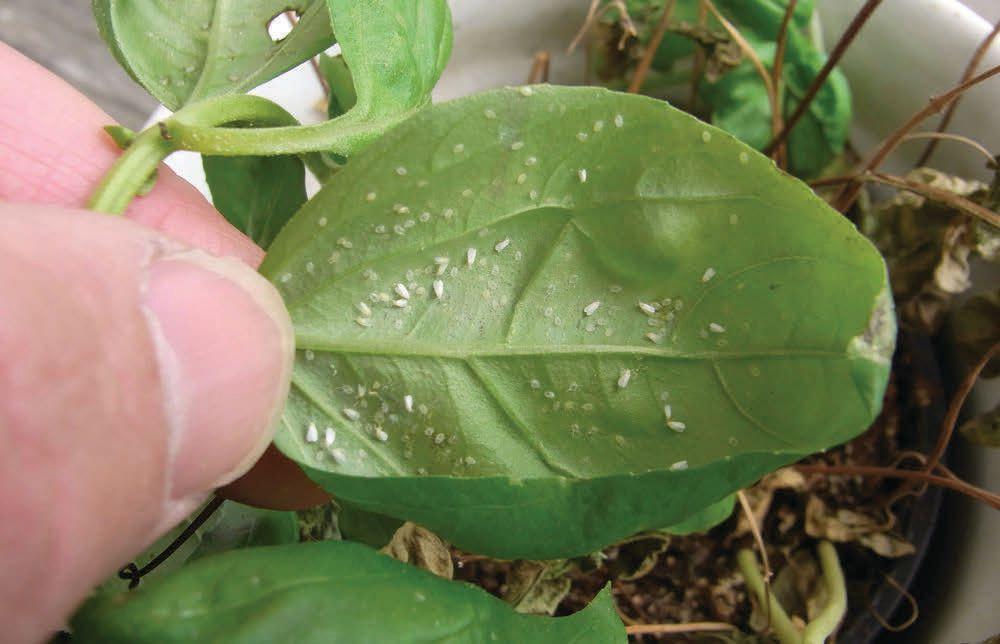
Whitefly pests of greenhouse crops are a susceptible target for mycoinsecticides.
LEFT
Laboratory colonies of Beauveria bassiana in Petri plate cultures.
Isaria fumosorosea
Paecilomyces fumosoroseus) Metarhizium brunneum (formerly M. ). Beyond species and strain, the end-use products can vary in a range of ways based on their formulations, shelf lives, spectrum of susceptible pest targets, labeled uses and recommended use patterns. Other considerations for choosing from among these products is their compatibility and interactions with other plant protection tools such as beneficial insects and mites (predators and parasitoids) and traditional chemical insecticides or adjuvants. Adequacy of access to technical support from the manufacturer/distributor should also be
WHY YOU MIGHT USE ONE
Consider these five reasons for why growers choose to use – and continue to e is increasing market demand by consumers and retailers for inputs that are more biologically-
Mycoinsecticides have far fewer safety concerns for workers, consumers and the environment because of their low toxicity. elatively brief Restricted-Entry Intervals (REI, 4-12-hour) and short Pre-Harvest Intervals (PHI, 0-day) are very favourable for production
Their complex modes of action on target pests will prevent or delay development of resistance to synthetic pesticides. Mycoinsecticides are generally more compatible with the use of beneficial insects and mites.
Take time to reflect on which of these features might influence your decision to
The basic mode of action for most mycoinsecticides consists of six general phases: attachment, germination, penetration, invasion, replication and host death. When the formulated product is diluted and applied following labelled instructions, spores can land on and attach to the target host’s cuticle.
Winmar RZ F1 (24-226)
• True winter type, long english fruits
• For traditional crops and high wire
• Powder mildew intermediate resistant
• Easily gives medium fruits in the difficult shortest day period
For Ontario: RZH Canada Ltd | (519) 324 0632
For Quebec: Seminova / Agrocentre Fertibec Inc. | (450) 454 5155
For BC/Alberta: Terralink Horticulture Inc. | (604) 864-9044
For USA: Rijk Zwaan USA Inc. | (832) 455 3000
Cervello RZ F1 (24-240)
• Early spring type, long english fruits
• For traditional crops and high wire
• Powdery Mildew intermediate resistant
• A good plant balance as winter transitions into longer spring days
Adhesion largely occurs by hydrophobic interactions between the cuticle and the spore. Efficacy depends on the number of spores that end up attached to the host’s body. In response to chemical cues on the cuticle, the spore will germinate and then develop an appressorium, which is the penetration structure. Through a combination of mechanical pressure and degradation from a mixture of enzymes, the fungus penetrates through the layers of the cuticle.
Certain strains of Beauveria have
Control diseases. Promote healthy root systems.
AT THE CANADIAN GREENHOUSE CONFERENCE!
For 25 years, our customers have trusted RootShield PLUS+ to control diseases and promote healthy root systems.
With RootShield PLUS+ you get control of Root Rot caused by Fusarium, Pythium, Phytophthora and Rhizoctonia.
Safer for plants, workers and the environment - RootShield PLUS+ is the right choice for IPM programs.
bioworksinc.com/gc (888) 270-0019
additional modes of action involving the release of one or more metabolites inside the pest. Once in the body cavity these specific strains will release metabolites such as beauvericin, which is a toxin that weakens the insect’s immune system. They can then release oosporein, which is an antibiotic that helps the fungus outcompete the insect’s gut bacteria. At this point the fungus will proliferate within the body cavity in the form of blastospores, which are the kind of spores that are formed in a liquid environment. Under special circumstances, such as higher humidity, there will be a seventh phase that entails outgrowth from the inside to the outside. This external sporulation produces conidia, which are spores formed in and spread through the air.
Because the conidia are available to infect another generation of insect hosts, this is how the fungus would complete its life cycle in the natural environment. Our experience with B. bassiana strain GHA, however, is that growers should not use external mycosis as a measure of success. In other words, growth on the outside is not a good measure of insect mortality. In most cases the fungus will not emerge from the body and produce a white cottony mass, yet it has still killed the insect. Sometimes the only sign of death by fungal infection is lack of movement and a discolouration of the body. In soil and foliar applications in the greenhouse, mycoinsecticides will not take off to reproduce and establish on their own. They will not disrupt soil microbial communities, persist in the environment, or lead to any substantial infection from one host to another. Therefore, to keep pest populations suppressed, mycoinsecticides should be reapplied every three to ten days.
Commercial mycoinsecticides vary in their spectrum of activity, meaning the range of target insects that are known to be susceptible to the particular strain. Activity against only a single pest species means that the strain may not be commercially viable given the small potential market. On the other hand, non-target activity against pollinators, predators and parasitoids is highly undesirable. Application practices, such as not spraying when beneficials are present or pollinators are foraging, can reduce those risks. And when you do spray, make sure you follow label guidelines for personal
VETOQUINOL GREENHOUSES
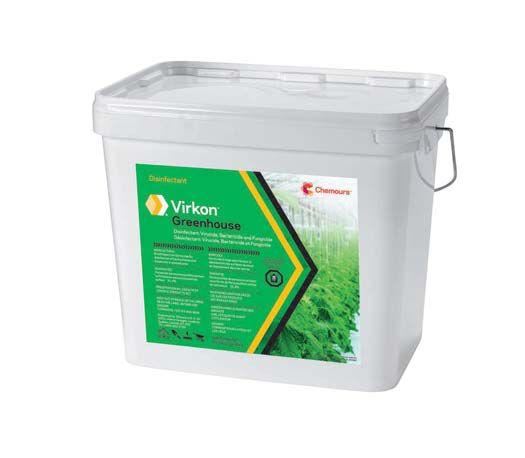
This is not a laundry room
A professional-grade greenhouse disinfectant with an excellent safety profile. Greenhouse
So why are you still using bleach? h?
Bleach is good to keep your t-shirts white. But you are a professional grower. Your business deserves a safe and efficient, professional-grade disinfectant. Virkon™ Greenhouse Optimize disinfection and keep bleach in the laundry room where it belongs.
Virkon™ Greenhouse is a broad-spectrum disinfectant for hard surfaces and equipment in greenhouses. a e de ach
vetoquinol.ca
biosecurite.vetoquinol.ca
BioCeres Anatis Bioprotection
BotaniGard BioWorksEC, WP Beauveria bassiana
Met52Novozymes
NoFly Futureco Bioscience
VeliferBASFOD
hizium brunneum
*EC = emulsifiable concentrate; G = granular; OD = oil dispersion; WP = wettable powder ** All products have a 0-day Pre-Harvest Interval (PHI)
Commercial mycoinsecticide products labeled for greenhouse use in Canada.
protective equipment (PPE) to keep yourself safe. Although biologically based and low in toxicity, mycoinsecticide applicators are still required to use long-sleeved shirts, long pants, eye goggles, shoes plus socks, waterproof gloves and NIOSH approved respirators/masks, the latter as a precaution against developing a rare sensitivity to the living active ingredient.
MAKING THE MOST OF YOUR APPLICATION
To get the most out of your mycoinsecticide application, keep in mind the following best-use practices.
Stay aware of the appropriate storage conditions and the shelf life expectations. As these are living organisms, storage conditions may be more particular and shelf life may be shorter.
Before tank-mixing with other products, ensure that they are compatible. A jar test can test for physical compatibility. But for biological compatibility, technical information from the manufacturer/distributor, or personal experience, is vital.
Do not look to external signs of mycosis as a measure of success, because insects may die long before that happens, or it may never happen. Instead, look for dead or discoloured pests, or the overall reduction in pests after two or three applications.
Think proactive or preventive: detect pests as soon as possible, intervene early in the pest cycle at low to medium pest pressure, and be prepared for subpar performance under high pest pressure or outbreaks. Do not expect quick knockdown. It may take three to seven days before the host stops feeding, laying eggs or dies, so mortality is not immediate.
Select the most appropriate application method and equipment to get complete coverage. As contact insecticides, complete coverage of all above-soil plant surfaces is critical for best control. While secondary contact by walking over the spores does lead to infections, primary contact through spores landing on the insect’s body is generally more efficacious. Apply early or late in the day as UV light will degrade spores.
Lastly, if trying out mycoinsecticides for the first time, consider conducting your own smaller-scale trial rather than changing over spray practices completely. Or, use them as substitutes for a chemical insecticide in your typical rotation. In other words, test on a small scale before going “all in.”
A final message of advice is to reach out to the manufacturer and/or distributor if you need help! As with other microbial and macrobial biocontrols, access to technical guidance will build your confidence to incorporate mycoinsecticides as part of a successful pest management program.
Daniel Peck, PhD, is an entomologist and biological program manager at BioWorks, Inc. He can be reached at dpeck@bioworksinc.com.
Fighting off the phloem feeders
Tight management pays off when keeping aphids and mealybugs in check.
BY PETER MITHAM
Greenhouse growers need to be rigorous managers if they want to stay ahead of aphids and mealybugs.
The two phloem-feeding pests are among the biggest challenges for growers, who face a dwindling number of pesticides for knocking down populations once they become established.
Both aphids and mealybugs have piercing, sucking mouthparts that feed on the vascular tissues of plants. The two often have a symbiotic relationship with ants, which love the honeydew the bugs excrete – so much so that ants will protect mealybugs from danger.
“Whenever you see ants on plants, you know that you have a phloem-feeding insect,”
says Raymond Cloyd, PhD, a professor in the department of entomology at Kansas State University and an extension specialist specializing in pest management and plant protection. “So if you’re going to do biological control of phloem-feeding insects, it’s imperative that you control the ants before you make any releases of any natural enemies.”
Keeping nitrogen applications in check is also a form of natural control. Aphids seek plants high in nitrogen, so less nitrogen means more pest control. Careful management of nitrogen will also lower input costs, ensuring the plant has just what it needs without the excess that attracts freeloaders, such as mealybugs, aphids
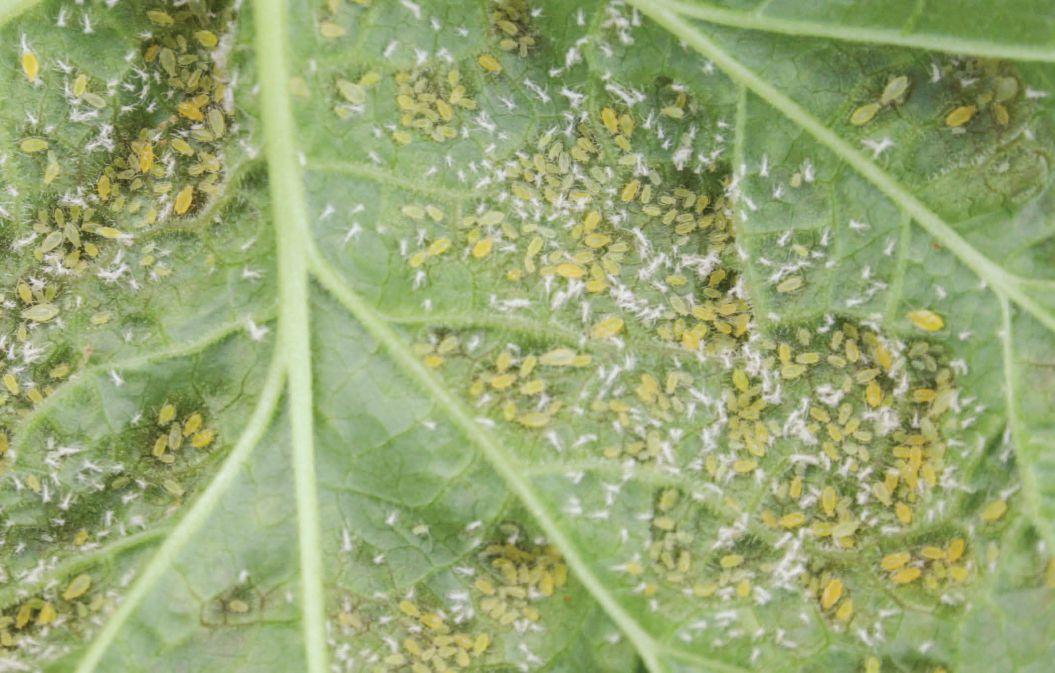
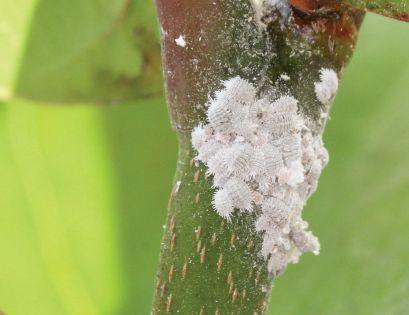
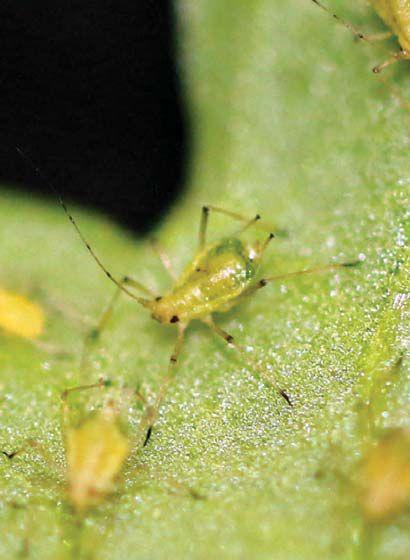
ABOVE Aphids (top) and mealybugs (right) are among the biggest challenges facing greenhouse growers. While aphids respond well to systemic insecticides, mealybugs do not.
and, in turn, ants.
However, it’s the management of spray regimes that are most important, both to ensure effective control of the pests as well as to avoid fostering resistance to pesticides in the bugs.
“When you’re dealing with mealybugs, it’s no different from thrips, spider mites and aphids. You have to rotate materials with different modes of action,” Cloyd says. “We have a lot of good materials, but [you need] proper application.”
MEALYBUGS: THE NEXT BIG PEST THREAT
Of all the phloem-feeders, Cloyd believes mealybugs pose the biggest risk to greenhouse growers.
“The next big pest of the 21st century are mealybugs,” he told growers attending the annual horticultural short course at the Pacific Agriculture Show in Abbotsford, British Columbia, earlier last year.
Cloyd discussed five key species growers should know about, including:
• Citrus mealybug, a key pest of flowers
and ornamental crops
• Longtail mealybug, an interiorscape pest
• Madeira mealybug, which infests marigolds and gerbera
• Pink hibiscus mealybug, a pest of tropical plants
• Miscanthus mealybug, which feeds on grasses
A number of characteristics make mealybugs hard to identify until it’s too late.
The bug shows an affinity for plants with a complex architecture, which allows them to hide until they’re impervious to insecticides. Their lifecycle is also among the longest of all greenhouse pests, running from 25 to 60 days at the very ambient temperature of approximately 24 degrees Celsius.
“How do I get rid of this critter once it’s established? Once you have it, there’s not very many options,” Cloyd says. “There are no silver bullets for mealybugs.”
MEALYBUG CONTROL
One of the biggest obstacles to controlling mealybugs is a lack of effective systemic insecticides, which the insects ingest when feeding on plant tissues.
“We can’t recommend systemics for mealybugs, or at least the ones we’re testing, because we’re not getting sufficient mortality – or mortality that you will accept,” Cloyd says. “With mealybugs you need to reach over 80 per cent mortality to break up the generations.”
What are effective, however, are contact insecticides, which work best on the first instar before the larvae begin feeding and acquire a waxy, impervious coating. Insect growth regulators are also effective by preventing the larvae from developing normally, leading to their death.
However, in both instances, several applications are necessary.
“There is no doubt repeat applications, multiple applications are mandatory, mainly because the eggs don’t hatch at one time and because you’re not going to get every mealybug on the plant,” he explains. “You’re not going to get instantaneous suppression, but it’s a gradual decline in the population of mealybugs in your greenhouse-grown horticultural crops.”
The bottom line, he says, is that you have to make more than one application for mealybugs. “One is not going to do it; it’s going to take multiple applications.” “Coverage of all plant parts – this is absolutely imperative for mealybugs. You
From seed to table, higher quality with better
A better-quality product for the consumer. An integrated, innovative greenhouse solution for you. That’s what Syngenta provides through quality genetics and new variety innovations. Your customers, and their dinner tables, deserve nothing less than the very best.
To learn more about varieties from Syngenta, contact Plant Products at 519-326-9037 or info@plantproducts.com
have to use high-volume applications. … Low volume applications will not get into the areas where mealybugs may be residing.”
The importance of using high doses at regular intervals also boosts the need to rotate through materials with different modes of action to prevent resistance. Some older chemistries are no longer effective because the bugs became resistant to them; an effective rotation hits the bugs at a different point each round, reducing the risk of resistance.
However, sometimes plants just must be ditched altogether: “Once the plant is heavily infested with mealybugs, just get rid of it. You’re not going to save it at all. You’re going to spend more money trying to preserve it.”
APHIDS: ‘EXTREMELY POLYPHAGOUS’
Aphids, unlike mealybugs, respond well to systemic insecticides. However, they’re a challenge because they enjoy a wide range of hosts.
The two key species facing greenhouse flower producers are Aphis persicae, or the green peach aphid, and Aphis gossypii, also called the melon or cotton aphid. However, potato aphid (Macrosiphum euphorbiae) infests greenhouse peppers.
“Aphids feed primarily on the terminal growth,” Cloyd notes. “Aphids select plants based on two aspects: host quality, which is associated for fertility, nitrogen content, and the other one is secondary chemicals [which protect plants from pests].”
Aphids detect plants that produce lower amounts of secondary chemicals, and those that are high in nitrogen, and move in.
“You really have to be on top of aphids because they reproduce so dramatically. Some people think they’re an example of spontaneous generation, and in some cases it looks like that,” Cloyd says.
Rather than mating to produce, females engage in parthenogenesis, in which its offspring are genetic clones of the parent.
“In greenhouse situations there are no males, they’re all females, and those females can produce 100 offspring in 30 days,” he said. “And within a period of time, they themselves – because there is no need for reproduction in a greenhouse – can produce their own offspring.”
Within five generations, Cloyd says, a single female can give rise to 13,552,028 aphids.
CALIBRACHOA BLOOMTASTIC ROSE QUARTZ
CONTROLLING DISEASE
Getting the leap on aphid populations is extremely important, Cloyd says, because they’re notorious vectors of plant viruses.
“They are the biggest virus vectors in the insect world,” he explains, noting that green peach aphids vector more than 300 viruses.
The good news is that, unlike mealybugs, aphids respond well to systemic insecticides as well as contact insecticides.
The bad news is that the environment has to be tightly managed and spray schedules rigorously adhered to in order to achieve effective population control. Cloyd recommends spraying every five to seven days, and spraying well to ensure adequate coverage.
Different species of aphids distribute themselves differently in different crops. Melon aphids like terminal growth, for example, while green peach aphids prefer the middle of the plant.
Similar to mealybugs, ants have to be controlled. Moreover, weeds need to be eliminated, because they not only serve as reservoirs for aphids and the species can take advantage of their presence, but lambsquarters, bittercress, chickweed and oxalis harbour viruses that aphids can spread to the main crop.
“You can use insecticides and biologicals, but if you’re not implementing sanitation strategies, they’re not going to work very well for you.”
Similar to mealybugs, Cloyd urges growers to take steps to prevent the bugs from becoming resistant to existing pesticide chemistries. With tighter controls on the materials available to growers, it pays to use the available tools wisely.
Thirty years ago, melon aphid was resistant to 30 insecticides and green peach aphid was resistant to 68; today, both are resistant to more than 100 insecticides each.
Cloyd suggests using compounds for two weeks at a time, rotating through four different compounds with different modes of action.
“Aphids are probably, next to thrips and spider mites, the biggest insect pest that can develop resistance to insecticides in a short period of time,” Cloyd says. “You have to rotate these insecticides with three different modes of action, or you’re going to get a population that is resistant to that mode of action.”
Understanding Ervi: Tips for successful foxglove aphid control
Contrary to some previous reports, this parasitoid is more effective than you might think.
BY ASHLEY
SUMMERFIELD, DR. MICHELANGELO LA SPINA, DR. SARAH
JANDRICIC AND DR. ROSE
BUITENHUIS
When we started our project to develop a more effective IPM strategy against foxglove aphids, one of the first questions we tried answering was “Why doesn’t Aphidius ervi provide good control?” Growers and IPM specialists have previously reported that this aphid parasitoid does not seem to be effective in controlling the relatively “new” aphid pest - foxglove aphid. However, experiment after experiment in our lab (and subsequent trials at Cornell University) demonstrated that not only did A. ervi control foxglove aphids, it actually out-performed other biocontrol agents tested.
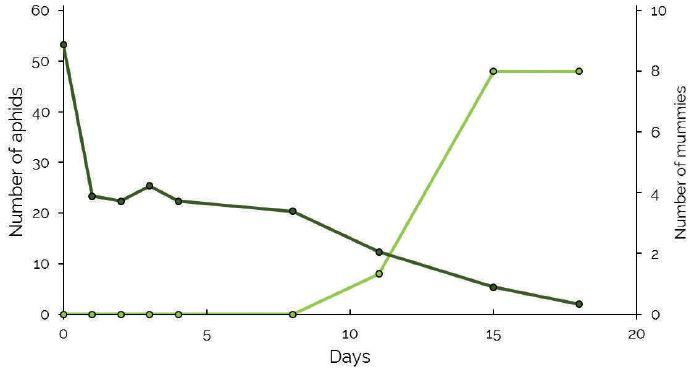
So if A. ervi is actually effective in controlling foxglove aphids, as demonstrated in our trials (see graph, pg. 30), how did it manage to get such a bad reputation? And why did so many growers stop relying on this parasitoid and switch to pesticides only to control this aphid pest?
Following an in-depth study of the
interaction between A. ervi and foxglove aphids, we realized that the measures of efficacy and release strategies being used weren’t a good fit for the parasitoid or pest.
GREAT EXPECTATIONS
How well a pest is being controlled is the ultimate measure of how effective a natural enemy is. However, “good control” depends on the perception of the grower. What one grower might perceive as “good control” might be different for another one, depending on their expectations.
One thing that can drive the perception of “good” or “bad” control is the speed at which it takes place. Unfortunately, the effect of parasitism is not immediate as seen with predators or sprays, which begin to take effect straight away. For most parasitoids, it will take at least a week to see the effect, sometimes two, depending on the temperature of the
greenhouse. In our greenhouse trials with A. ervi , true control (bringing aphid populations to nearly zero) wasn’t achieved until about the twoweek point. For growers who have been using sprays to control aphids, getting accustomed to this delay in effect requires patience.
Another common measure of efficacy when using parasitoids is the number of mummies found. This gives an indication of the parasitism (or attack) rate. Papery brown aphid mummies begin to appear a week or two after releasing parasitoids. The number of mummies is a good indicator of pest control for parasitoids like Aphidius colemani (the primary parasitic wasp for melon and green peach aphid). But this doesn’t appear to be true for A. ervi.
KNOW THY ENEMY
Not all aphids behave the same way in response to an attack. The arrival of a parasitoid can trigger two different responses in the aphid colony. Some species (like green peach aphid) stay in the same place and many mummies are found where a colony used to be. Other aphids (especially foxglove aphid) try to run away, or even drop off the plant when in danger. This means that you may not find mummies on the leaves where you expect them to be.
So, which situation is better? Obviously, seeing dozens of mummies is much more reassuring to the grower than only finding one, but BOTH scenarios can lead to good control.
In our trials, we observed that when an A. ervi lands on a leaf, it can clear away all foxglove aphids within a few minutes (whether it parasitizes them all or not) due to the “defensive
dropping” behaviour of this aphid species. Jumping ship (or leaf, in this case) might sound like a good defence strategy, but it comes with its own risks. If the foxglove aphid was first parasitized before it escaped, mummies can end up almost anywhere (on the bench, or on plants a few metres away). If they weren’t parasitized, they still might die from getting trapped in water, injured in the fall, or end up on the floor (not a great place for an aphid). To survive, the aphid will have to expend energy to find its way back onto the plant. The time the aphid spends trying to find its way back is time it’s not spending feeding and
reproducing. Scientists call these types of misadventures “non-consumptive effects”. Non-consumptive effects are known to also contribute to effective control (up to 50 per cent of biocontrol can be attributed to this). If the aphid does manage to get back to the crop, and parasitoids are still around, they will have an easier time parasitizing an aphid that is starved and weakened by its journey.
SET A. ERVI UP FOR SUCCESS
Ultimately, we know from our research (including on-farm trials in flower crops in Quebec) that under the right conditions A. ervi can do a great job maintaining foxglove populations at low levels. So what can growers do to make sure they succeed?
1. Release as soon as you find foxglove aphids. Our long-term greenhouse trials indicate that releasing A. ervi before the aphids arrive results in them giving up the search and leaving the greenhouse (or dying). (This is in contrast with strategies used for other aphid pests, e.g. A. colemani for green peach aphid control, where releasing the parasitoid preventatively seems to work better). On the other hand, if you wait too long to release them, the aphid population growth can exceed the parasitoids’ ability to
Foxglove aphid population dynamics with Aphidius ervi
control them.
2. Release A. ervi weekly until aphid populations start to decline, then reduce to every two weeks.
3. Use distribution boxes (available from most suppliers) when releasing. If you sprinkle the product, a lot of mummies can end up on the soil surface, bench, or floor, and can be ruined by conditions that are too wet.
4. After emergence, parasitoid wasps appreciate a source of sugar. They can feed on honeydew once they locate aphid colonies, but we can give them a head start by dabbing a droplet of honey on the side of the distribution box for them to feed on as soon as they emerge. This will ensure they have plenty of energy to search for aphids, and can prolong their activity in the greenhouse.
Now that you understand this parasitoid better, don’t you think it’s time you gave Aphidius ervi a second chance?
Ashley Summerfield is a research technician in biological control; Michelangelo La Spina, PhD, is a former research associate, and Rose Buitenhuis, PhD, is the research scientist of biological control at Vineland Research and Innovation Centre. Sarah Jandricic, PhD, is the greenhouse floriculture IPM specialist with the Ontario Ministry of Agriculture, Food and Rural Affairs.
Growing Cannabis sativa?
Instead of using bleach, disinfect with Virkon™ Greenhouse
A professional-grade greenhouse disinfectant with an excellent safety profile.
A growing plant requires care and attention, be it Cannabis sativa or any other culture. As a professional grower, your business deserves a safe, efficient, and high-performance disinfectant. Virkon™ Greenhouse Optimize disinfection and make sure your production keeps growing. Virkon™ Greenhouse is a broad-spectrum disinfectant for hard surfaces and equipment in greenhouses.
vetoquinol.ca biosecurite.vetoquinol.ca
Banking on bankers: Rearing the next generations of beneficials
Banker plants can boost a population of beneficial insects - but only when it’s done right.
BY GRETA CHIU
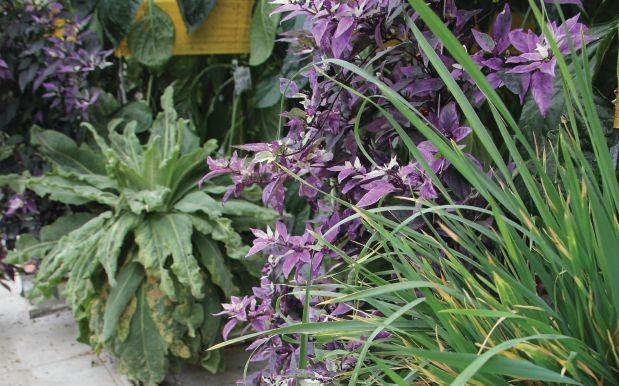
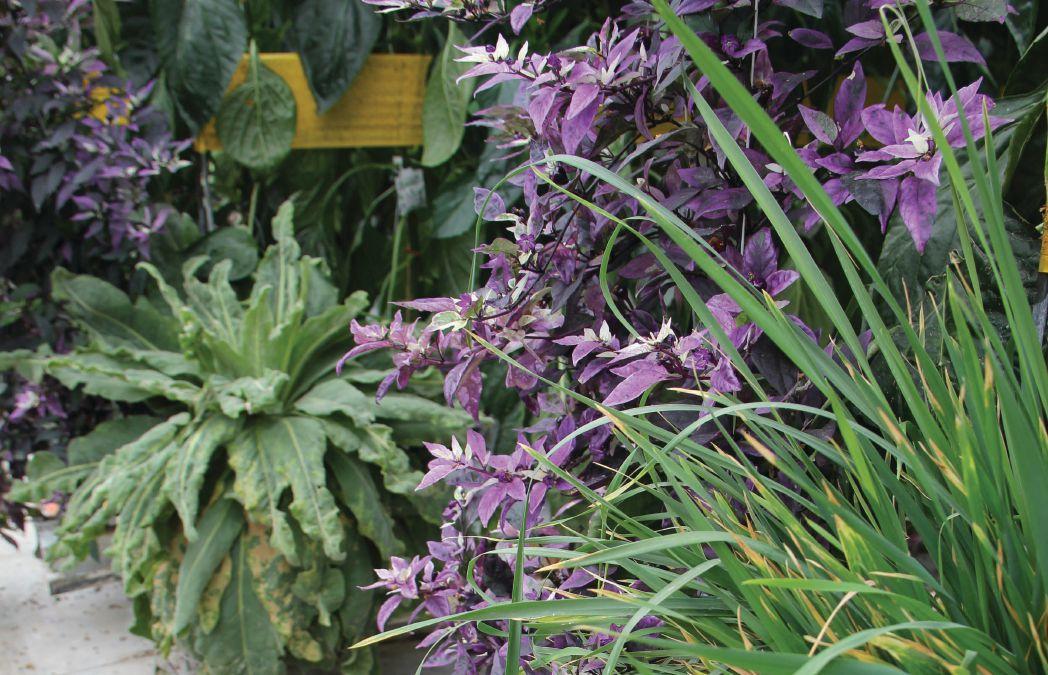
Walking into the Orangeline Farms greenhouse, you’ll notice a myriad of purple and green foliage at the ends of some rows. But they’re not any one of the 20 different bell pepper varieties that the greenhouse operation grows.
They’re banker plants, explains Saman Soltaninejad, grower at Orangeline Farms. Experienced with integrated pest management strategies, Soltaninejad has helped establish a system of non-crop plants to help boost the population of beneficial insects.
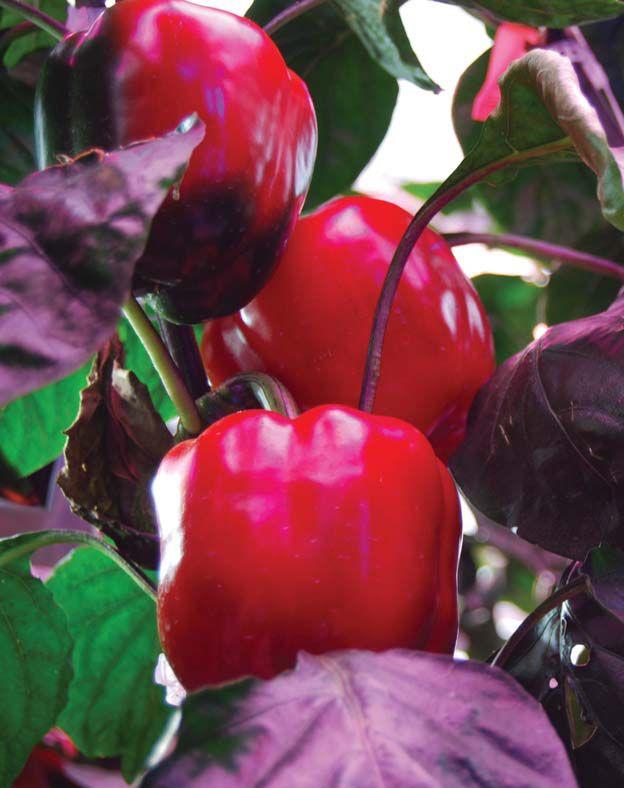
The purple plant is an ornamental pepper known as ‘Purple Flash’. The pollen provides food for Orius, explains Soltaninejad. The minute pirate bug is a beneficial insect that will consume all the mobile growth stages of thrips, as well as other soft-bodied insects like aphids.
“Thrips are one of the main issues in the area,” says Soltaninejad. But Orius also needs 12 to 13 hours of daylength to establish, he adds, so it only
ABOVE
works during certain times of the year, unless supplemental lighting is provided.
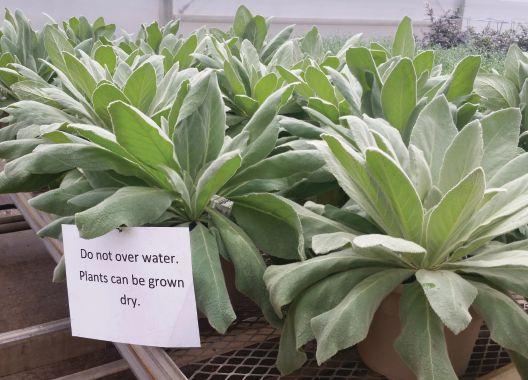
Also seen at the ends of some rows, Soltaninejad points out the mullein they use for rearing Dicyphus as a generalist against white flies, spidermites and broad mites. There’s also a combination of wheat, rye and barley plants for their aphid banker system.
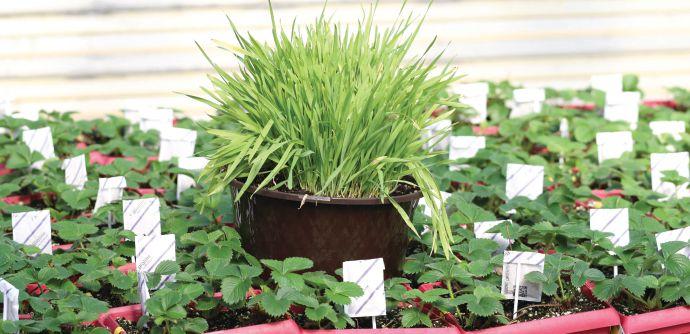
The cereal banker plants are designed based on non-harmful aphids to our pepper crop, he explains. In fact, they house cereal aphids, Rhopalosiphum padi used to help rear the beneficial parasitic wasp Aphidius colemani, which lays eggs inside these aphids. A. colemani would then move onto harmful species in the crop, such as the green-peach aphid.
FOR THE FIRST-TIMERS
“Most people start with the aphid banker plant program because you can buy this banker plant. The other banker system growers have to grow the plants themselves. You only need a couple of
Banker plant systems at the ends of some rows at Orangeline Farms. Pictured here (from left to right) are: mullein, ‘Purple flash’ ornamental pepper and the cereal banker plant system.
HUB International is a leading global insurance brokerage that provides risk management services and a broad array of property and casualty, life and health, voluntary benefits and personal lines insurance.
Since 1963 we have been providing high quality insurance protection to our clients from coast to coast.
Experienced, local service is available through our national network of offices.
For a quality product, local service and very competitive pricing give us a call today.
HUB International Ontario Limited
www.hubontario.com 800-463-4700
24 Seacliff Drive East. Unit 100 Leamington, ON N8HOC2 At your service across the United States and Canada.
plants depending on density and pest pressure, between two to four per acre,” says Suzanne Wainwright-Evans, owner of Buglady Consulting.
“It’s about building higher and healthier populations,” says Wainwright-Evans, “because any biocontrol agent coming out of the bottle can be stressed.” With aphid parasites, as soon as they emerge from their mummies, the adults really need to start feeding and they need to find places to lay their eggs very quickly. “If you’re in a bottle, that’s really hard to do.” If they are breeding in your greenhouse, they can get right to work and not have to wait to be released from a bottle. By the time commercially reared parasites reach the greenhouse, they’ve been bred in an insectary, placed into a bottle and transported overnight, often already emerging in the bottle. “It’s just better to build your own breeding population if you can.”
TIMING IS EVERYTHING
One of the key pitfalls Wainwright-Evans has seen this season is that growers sometimes forget that banker plants will not control all species in a particular order. For instance, A. colemani targets the peach and melon aphid, but not the potato or foxglove aphid.
Because banker plants aren’t part of the regular crop irrigation, most programs fail from the lack of banker-plant watering. They’re usually hanging on other poles and other places, and they don’t get watered, she says.
Timing is another key aspect. It’s great when growers do it right, says Wainwright-Evans, but if they miss their window to start their plants, then things go off track. “With certain programs you start the plants and you have them for months,” says Wainwright-Evans. “But when you look at an aphid banker program, you know you’ve got to constantly re-sow and restart those every few weeks.”
It’s also about anticipation. As Wainwright-Evans explains, the peppers should be blooming by the time Orius is released. “You typically want a month of reproduction of the Orius on the plants before you expect your thrips to show up,” says Wainwright-Evans. The idea is to have an unnaturally high level of beneficials right when the pests appear. After all, biocontrol is about prevention. “Once you have a massive pest problem, trying to clean up with biocontrol is very difficult and very expensive to do,” she adds.
Soltaninejad agrees. “The key factors to having a successful banker system are timing, balanced initial population of prey and predators/parasitoids and maintaining the system.”
COMMITMENT REQUIRED
You have to be into bugs to think this is cool, says WainwrightEvans. It’s an opportunity for growers to learn about the different life
Mullein banker plants. It’s often important to place signage on banker plants with directions for employees.
ABOVE
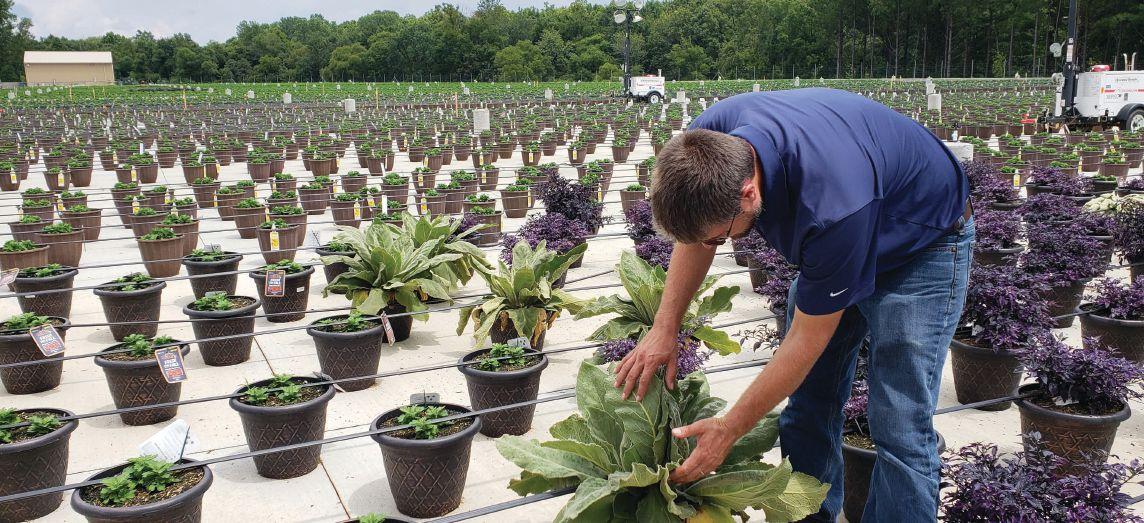
Metrolina grower scouts his banker plants, mulleins and peppers, in their fall mum crop. Banker plants can be used outdoors as well as indoors.
stages of beneficials and it helps with their scouting.
“Yes there will be some upfront costs,” she says. Banker plants will take up space and time – which means money needed to manage them. But looking at the overall costs through the year, there are savings to be had.
Some banker plants like the ornamental pepper are used in the spring and summer, then discarded. Others, like the aphid banker plants have to be replenished. “The aphids get eaten all off the plants because the parasites are so efficient,” Wainwright-Evans explains. “You have to keep reintroducing aphids out there, and the grasses don’t last long.” But with just a couple plants per acre, it’s more manageable, she adds.
“Barley seems to be a pretty good one, because you can rear a lot of aphids on it,” she says of the aphid banker plant. “But if it gets tall, it falls over, and then the aphids and the parasites can’t get to them.”
One thing Wainwright-Evans stresses is that banker plants are not for everyone. “You have to evaluate your growing system and see if they are right for you and what you’re doing,” she says.
HOW DO YOU CHOOSE?
There are some neat banker plant systems being developed in university trials, but what works in one area of the country may not work in another. Plus, they’re not all economically feasible for a commercial
growing operation.
“There’s lists of banker plant programs,” says Wainwright-Evans. “People talk about using oleander with oleander aphids, but where are you going to buy oleander aphids from?” Some systems are not readily available on the market.
With new information on banker plants every day, and practices that differ based on the growing region, things can get overwhelming. An experienced consultant or technical support representative from a biocontrol company can help outline the steps needed, including the density of plants, the date of planting, when and what biologicals to release, what supplements to use, and more.
“Pest complexes can be different for each growing facility, and so we’re tweaking and learning as we go on how to make these systems work better,” she says.
For Orangeline farms, Solaninejad says they’re adjusting their regiment based on the severity of pests. “We would probably try the same systems with a little bit of
adjustment in timing and substrate for our banker plants,” he says, “and since white fly is not a big issue in pepper production, we would not continue with [the] mullein system.”
WHAT’S NEXT?
Coming on the past couple of years, the mullein for Dicyphus is a bit of a new system, says Wainwright-Evans. But part of the problem is that it works too well. “That’s why you’ve seen the production of Dicyphus get passed around between the insectaries so much,” she says “because you can establish Dicyphus so well on the mulleins.”
Cannabis is a whole new ballgame. “We’re still trying to figure out all the complexes, all the different pests that are in cannabis, and even if banker plants will work in this system. In the US, some states prohibit the use of banker plants in cannabis,” Wainwright-Evans says. “Every week we’re finding a new pest in it, in indoor and outdoor production.”
RIGHT
Aphid banker plant being used with potted strawberries.
Can parasitic wasps effectively kill the pepper weevil?
A research update on the pest’s natural enemies.
BY DR. ROSELYNE LABBÉ
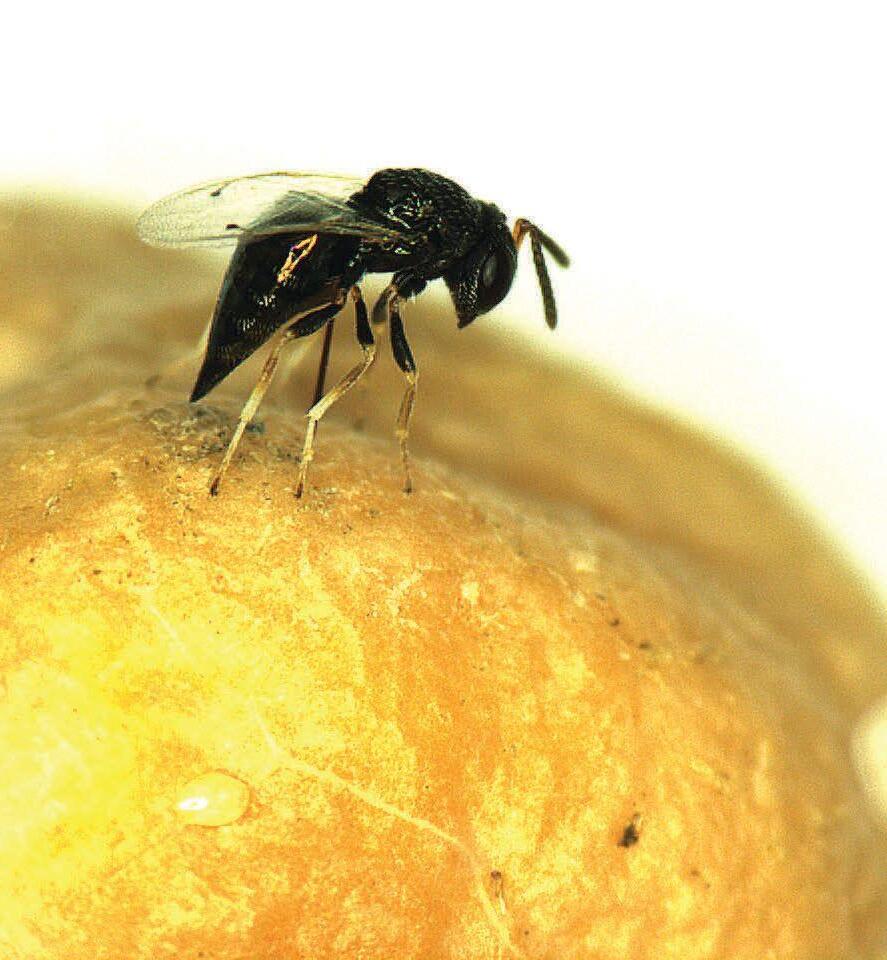
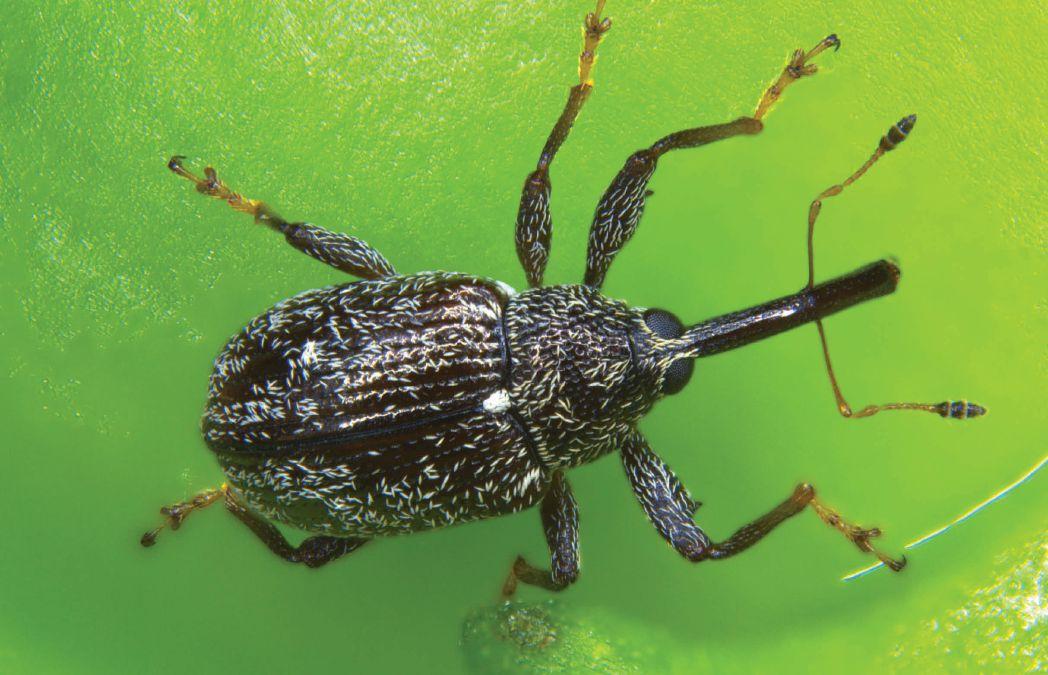
The pepper weevil, Anthonomus eugenii is one of the most important pests of pepper crops in North America. Currently, there are no commercial products that can target immature stages of pepper weevil, however strategies including biological control, may be useful in attacking these life stages and reducing population levels.
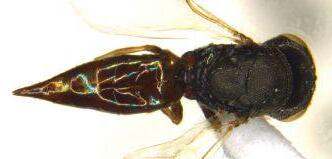
Of the parasitoid species previously identified from surveys in Mexico and Florida, three species of parasitoids, Triaspis eugenii, Urosigalphus sp., and Jaliscoa hunteri account for 96 per cent of all parasitoids that naturally attack the pepper weevil (Rodríguez-Leyva et al., 2007). Jaliscoa hunteri , attacks the third instar larvae, and the braconid Triaspis eugenii attacks the egg. These three species are therefore considered to be the most important in reducing
pepper weevil infestations.
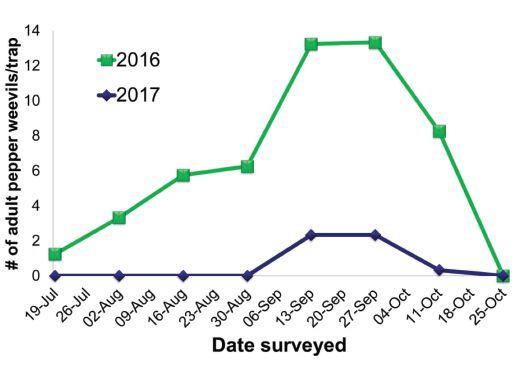
To investigate the potential for biological control of pepper weevils in at-risk areas including Canada, surveys of the pepper weevil and its natural enemies were conducted in southern Ontario following brief reported sightings in 2016 and 2017. From these surveys, significant differences were seen in Ontario’s weevil levels between 2016 and 2017 ( Figure 1 ) – the abundance of the weevil was dramatically lower in 2017. This change is thought to have been due to the application of multiple new management practices, such as stringent pepper waste disposal protocols and crop scouting, as well as tools such as screening, which could have minimized weevil presence.
In 2016, peppers infested with pepper weevil were collected from 10 field and
greenhouse sites in Ontario. These peppers were maintained in mesh bags in a controlled environment chamber at the Harrow Research and Development Centre (AAFC), and the emergence of weevils and parasitoids from these was monitored daily for up to six weeks. From these infested peppers, a total of 43 parasitoids emerged and were identified as parasitoids able to attack and kill the pepper weevil. In 2017, the near absence of the pepper weevil in field crops meant that naturally occurring parasitism of the pepper weevil was not observed in samples taken to the research station that year.
The parasitoids found to be associated with the pepper
LEFT
Figure 1. Weekly average number of pepper weevils per pheromone-baited trap in southwestern Ontario.
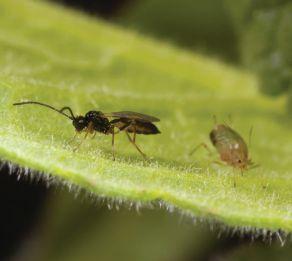
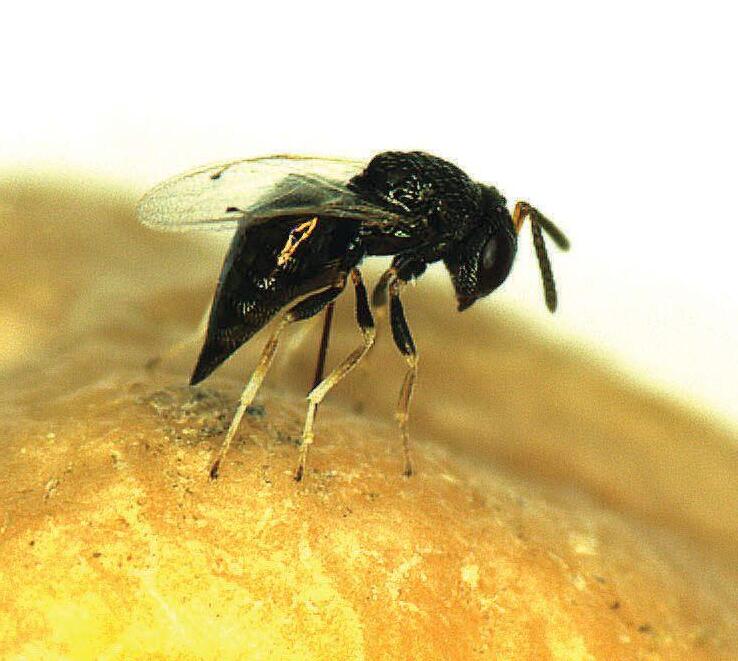
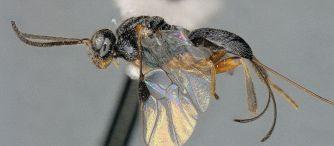
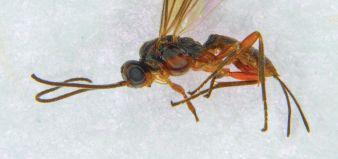
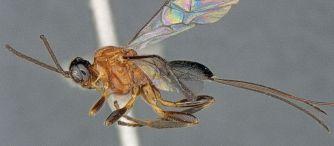
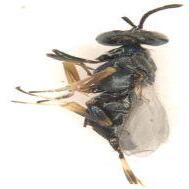
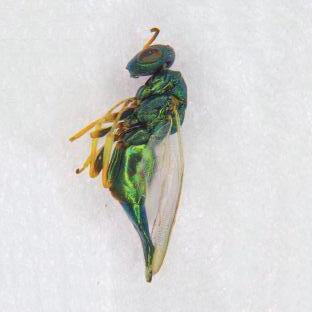
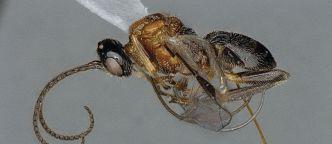
weevil in Canada in 2016 belong to different families of Hymenoptera, including the Jaliscoa (formerly Catolaccus ) hunteri , pteromalids ( Pteromalus anthonomi ), Eupelmidae ( Eupelmus pulchriceps ) and Braconidae ( Nealiolus spp., Bracon sp.) ( Figure 2 ).
• J. hunteri is a parasitoid previously associated with pepper weevil but is now identified for the first time in Canada.
• P. anthonomi is a generalist parasitoid known to be associated with several species of weevils, including Anthonomus signatus in Ontario (Yu 2017).
• A single parasitoid of E. pulchriceps Cameron (Hymenoptera: Eupelmidae), was identified in this study. It was previously known as a parasitoid of pepper weevil but may also attack another parasitoid P. anthonomi (Gibson 2013).
• Three species of Nealiolus were confirmed here according to the distinct morphological and molecular differences observed between the specimens.
• Based on the sequence data, the 16 Bracon specimens obtained in this study appear to belong to the same species. However, some morphological variation exists in these individuals, so further examination of additional specimens and a more detailed study of their biology may be needed to clarify the implications of this variation.
The e cke PoinseTT ia Manual
Who better to help you grow your poinsettia crops than the world’s leader?
The Paul Ecke Ranch, the world’s largest poinsettia breeder, shares its expertise on how to grow and market the number one Christmas flower.
This manual provides everything a grower needs to know about producing and selling this pervasive crop of red, pink, yellow, purple, speckled, and marbled flowers.
Using its vast experience, The Paul Ecke Ranch provides a great guide to selecting cultivars and growing high-quality crops. After giving a brief history of poinsettias and their place in the market, the authors provide detailed chapters about propagation, growing on, nutrition, pest and disease control, pot and cut flower culture, postharvest care, and marketing. Colour photos throughout.
Jaliscoa hunteri is considered one of the most important parasitoids of the pepper weevil that is now naturally well distributed throughout North America. Field trials in Florida have shown that J. hunteri can significantly reduce the number of weevil-infested peppers (Schuster 2012). Together, these new records of the pepper weevil’s natural enemies could facilitate the exploration and development of new agents for biological control. We are currently performing laboratory and greenhouse trials with J. hunteri to identify the factors that can improve its parasitism of the pepper weevil on commercial greenhouse pepper crops.
This research was funded through an AAFC project A-1526, Biological Control of Agricultural Pests, as well as a Collaborative Framework project through the Ontario Greenhouse Vegetable Growers 2117Management of the Pepper Weevil. Future trials evaluating the efficacy of parasitoids for suppression of the pepper weevil will be conducted through an Industry-led Research and Development project with the Canadian Horticultural Council (CHC) 2607- Pepper Weevil Integrated Management and with collaborator Koppert Canada.
More details are in the following paper: R.M. Labbé et al. (2018) Natural enemies of Anthonomus eugenii (Coleoptera: Curculionidae) in Canada. The Canadian Entomologist 150:03, 404-411.
Roselyne Labbé, PhD, is a research scientist in greenhouse entomology with Agriculture and Agri-Food Canada. She can be reached at roselyne.labbe@canada.ca.
Seeing disease in a new light
Researchers look to light as a possible tool against powdery and downy mildews.
BY GRETA CHIU
In a controlled environment, supplemental lights are often used to increase crop growth. But could they also be used for other purposes?
Research scientists Dr. Jaimin Patel and Leora Radetsky are exploring light as a way to mitigate disease. Working out of the Lighting Research Center (LRC) at the Rensselaer Polytechnic Institute, their research looks at using visible and ultraviolet (UV) light against powdery mildew and downy mildew – two of the most common diseases in the greenhouse.
With the rising demand for organic, locally grown produce and increasing attention on pesticides in consumer products, Patel and Radetsky’s findings could become a valuable tool in a grower’s toolbox.
We got in touch with Patel and Radetsky after their talk at Cultivate ’18 for a little Q&A.
Q: What prompted you to look into light as a possible tool against these mildews?
A: We started looking into using light to control powdery mildews based on our association with Dr. David Gadoury from Cornell University. David
ABOVE
is a plant pathologist with extensive expertise at using UV for mitigating powdery mildew in numerous food crops. We have had recent success working with researchers from Cornell, University of Florida and Norway in applying UV treatments at night to reduce powdery mildew in field-grown strawberries.
Dr. Jaimin Patel is a plant pathologist with expertise in downy mildew pathogens. He joined the LRC to investigate the efficacy of using light to reduce the disease severity for various food crops. Right now we are working on a spectral sensitivity function for basil downy mildew. Knowing how much light and which spectrum of light to use will allow cost-effective and disease-effective lighting solutions to be introduced.
Q: How does the technique work?
A: For basil downy mildew, these pathogens produce spores when it’s dark for an extended period of time, typically at night. If we give the right dose at night, we can supress spore production. Our research is investigating the most effective dose - how much, what spectrum, what
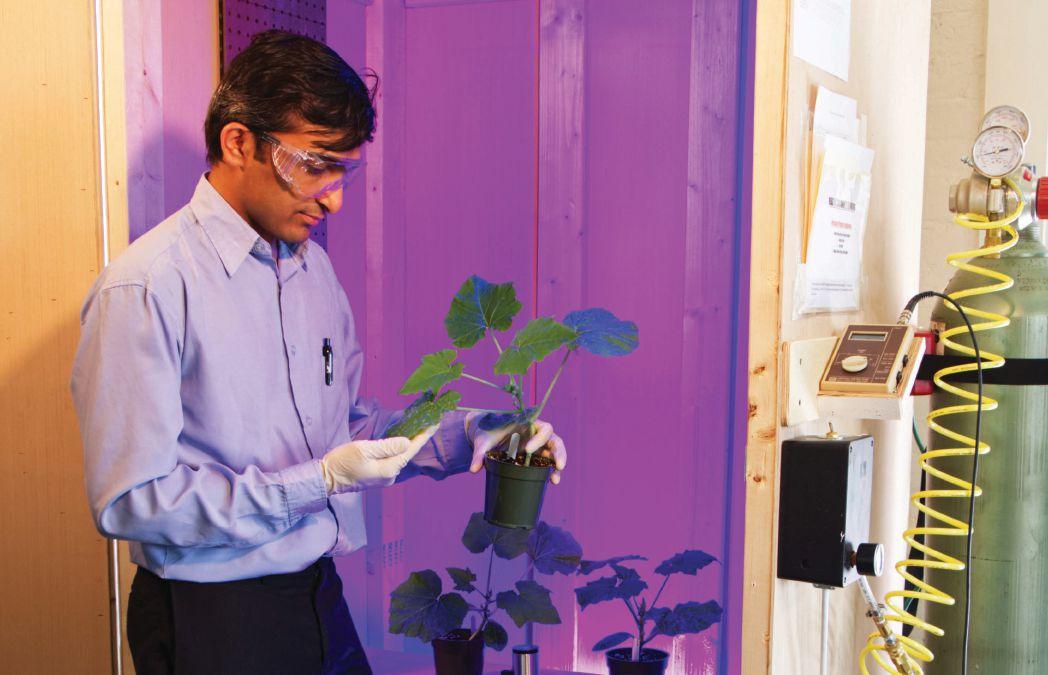
Patel examines powdery mildew on summer squash prior to dosing the plant in a UV-C chamber.
Energy/Shade & Blackout Curtains
We specialize in Energy, Blackout and Shade Curtains.
The benefit of Energy curtains has been widely accepted. It’s no longer why get Energy curtains, but when.
Call us and take advantage of our knowledge, competitive pricing, and unique products designed to reduce your maintenance costs, and start lowering your energy costs now!
We also offer Greenhouse parts Heaters NOW AVAILABLE Used Equipment Marketplace!
Over 40 available items of used greenhouse equipment. Buy or sell used equipment and supplies for your greenhouse.
Check it out at our website www.westlandgreenhousesupplies.com
SHADE STRUCTURES
Presentation of your products is important, helping you to increase sales. Our shade structures will help you present your products in a favorable way, and give your customers a comfortable environment at a low cost.
PRE-ORDER FOR SPRING AND GET 10% OFF!
WE MANUFACTURE OUR OWN HOOP HOUSES! Our structures have many competitive advantages: High straight sides Reduced wear on plastic Stronger Arches with oval tubing Less Expensive than competitors AND MUCH MORE... PRE-ORDER FOR SPRING AND GET 10% OFF!
time and for how long. We don’t know if light affects the host and/or the pathogen and if there is a circadian effect. We know that it does work and we are working to understand why.
For cucumber powdery mildew, we know that UV breaks down the pathogen’s DNA. It turns out that blue light repairs the DNA, which is why sunlight, which has both UV and blue spectral components, doesn’t prevent the pathogen from producing spores. We have found an effective solution by using UV at night without blue light.
We are interested in looking at other pathogens. Right now we are working on using light to control thrips with Dr. Margaret Skinner and Dr. Bruce Parker from the University of Vermont.
Q: Can it be made ‘broad spectrum’ to target more than one fungal disease?
A: The mechanisms within some pathogen groups may be the same, like pathogens that cause powdery mildews, but we don’t know if this is true for all pathogen groups. In practice, we have to make sure we give the right dose of light evenly over the entire crop. Time of application might also be important. Pathogens have evolved with plants to “see” light during the day. They may have their defenses down at night.
Q: What fungal stage(s) are most responsive to light? How much light do you need and for how long?
A: Practically speaking, we have to give the right dose at the right treatment interval. For powdery mildews, UV is effective at reducing the disease during most stages. Downy mildew sporulation is inhibited, to various extents, by light, depending on the dose. The germination stage, in some downy mildews, is also inhibited by light, but we don’t know if the response is the same for all downy mildew-causing pathogens. We have been focusing on supressing spores so the pathogen can’t reproduce.
Q: Could the light harm the crop, and conversely, could it help the crop grow better if disease wasn’t an issue?
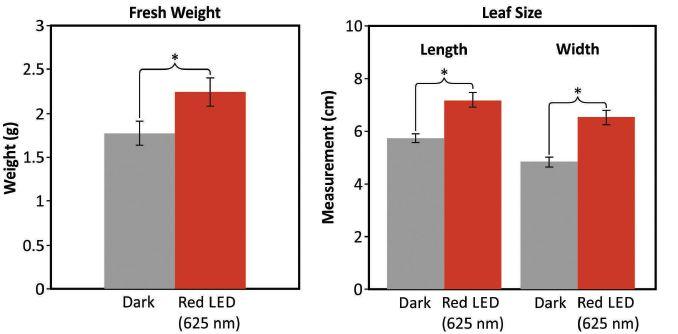
A: Of course – we don’t want to overdose or under dose the crop and pathogen. That’s why we talk about plant health - we also want to make sure that the lighting treatment doesn’t adversely affect the crop in any way, by making it look or taste bad for example. A recent paper of ours has been accepted for publication in the Canadian Journal of Plant Science. It shows that red light at
CA L L U S T O DAY ! 1 8 0 0 6 9 5 - 8 3 0 0 -Wi W th m or o e th h an 3 00 0 0 va a ri r et t ie s in m ul ti i pl e tr ay a s iz z es s , we e 'r r e un u iq ue ly l e qu u ip pe d to t a cc c om o mo m da a te t he n ee e ds s o f sm m al l l to t m idsi ze e o pe ra a ti on s. s I n fa ct c , no n o rd er i s to o o sm s al l wi th h o nl y a ha h lf bo b x m mi ni i mu u m! W e of fe r ta a g sa a le s to o m at t ch y ou r or o de e rs s , de li l ve ry op ti i on s fo f r re e mo te e l oc at a io o ns , co mb o id ea s, t ec h su pp or o t, cu c lt t ur e gu u id d e, p er e so o na n l, l a tt t en ti ve v s er e vi ce e a nd m or o e. e W e se ll di d re r ct c ly t o ou o r cu u st t om o er s, n ot o t hr h ou o gh t he b ro r ke r ne n tw w or k, k wh w ic c h af a fo f rd r s us t he e o pp p
A BEG G ONI NI ESM SM M É® É PEAACH H lyfarm er. com m sal sa l es@ jol jo lyffarm m er. er com om o | w ww. ww jol o
WINE &
night, which can be used to control basil downy mildew, can also increase yield in healthy basil plants.
Q: Could it help save time and labour for greenhouses or indoor farms?
A: That’s a critical requirement in our research. We have a vision of a 24-hour lighting scheme for controlled environments, where lighting, controls and sensors are implemented to diagnose and treat pathogens and pests. Notably, light can be given after infection has occurred, so prescriptive chemical treatments could be reduced.
Q: Is it expensive to set up?
A: We don’t manufacture or sell lighting so we can only estimate the costs. If the grower has a lighting and control system that can already provide the right spectrum, the incremental costs should be minimal. We hope that a newly-installed lighting system for a controlled environment is cost-effective from a life cycle cost perspective. We are working with Dr. Natalia Peres from the University of Florida and David Gadoury to reduce the cost of the first successful prototype we developed for field-grown strawberries.
Q: How does this fit into an effective IPM strategy?
A: Pathogens can cause catastrophic losses, and we believe that all controlled environments could have pathogen problems, sooner or later. We see light as an adjunct to chemical treatments.
Like fungicides, we see an eventual path towards a light dosing label. Light is especially exciting for organic production because light is “organic”.
Q: What’s next for your research?
A: Through our IPH (Illumination for Plant Health) industry alliance, we are working on effective LED solutions for pathogens attacking greenhouse crops. We are also working on a field solution for powdery mildew in summer squash through New York Farm Viability Institute (NYFVI). We are working on using artificial intelligence (AI) to phenotype powdery mildew with Dr. David Gadoury and Dr. Lance Cadle-Davidson at Cornell.
For more, visit http://www.lrc.rpi.edu/ programs/plants/plants_home.html and http://lightandplanthealth.org
NIAGARA FALLS OCT 3&4 2018
Join us for Canada’s foremost event for flower, vegetable and nursery growers. The Canadian Greenhouse Conference is the ultimate connection point for growers, suppliers and research partners.
Registration opens: 8:30 am Trade Show hours: 9 am – 4 pm
“Growing Prosperity”
Change creates opportunities to grow and thrive.
By Glenna Cairnie
Marketing and Events Coordinator, Canadian Greenhouse Conference
Never before have we seen such rapid advances in technology and societal changes that affect how work is done and businesses operate. Innovations in one sector are quickly adapted and adopted by another. Change is fast and furious – leaving some behind but creating incredible opportunities for those who recognize them. How can greenhouse operations, large and small, deal with today’s fast-paced business climate? While technology provides access to information 24-7, there is still value in personal interaction. Real conversations establishing real connections create opportunity for businesses to grow and thrive.
GROWING PROSPERITY
As Canada’s premier horticultural event, the Canadian Greenhouse Conference brings together growers, researchers and industry partners to teach, learn, and network. The comprehensive speakers program, designed to attract attendees from every level of operations, addresses issues growers face daily. 50+ speakers from Canada and around the world – including professional growers - share their experience and expertise gladly for the betterment of the grower community. Prosperity is the goal and the CGC mission is to support growers with education and access to new concepts and technologies. Take the time to come out from your offices and greenhouses to interact with colleagues and learn something new. You will return to work energized and motivated by what you have seen and heard.
The 2018 speaker program brings together an impressive list of speakers covering relevant issues pertinent to all crops grown under cover. The complete program with session summaries and speaker biographies is posted on our website.
FLOWER PRODUCTION
Sponsored by:
Greenhouse operations exist on schedules and technology is very helpful with keeping systems operating. Most challenging, however, can be the management of living, growing plants. CGC production sessions feature well-known speakers to help growers understand plant development and plan accordingly. Roberto Lopez, Michigan State University, instructs on the use of average
daily temperature (ADT) to schedule bedding plants and Syngenta’s Mark Smith, will review development and scheduling as it applies to garden mums. Mike Klopmeyer, of Darwin Perennials, will talk about marketing opportunities and growing perennials for three-season sales.
Can history help us prepare for the changes the greenhouse industry will face in our rapidly evolving world? Don’t miss P. Allan Hammer, of Dümmen Orange, as he looks to the past to prepare for the future.
Interest in exact phosphorus management is growing. There are many factors in determining the optimal rates. Josh B. Henry of North Carolina State University will share results from his experiments and discuss some of the ways that phosphorus fertility can be manipulated to regulate plant size, growth habit and even leaf colouration.
Gary Cortes has spent the last 15 years introducing greenhouse growers to LeanFlow techniques. Learn how they can be implemented in your business to improve efficiency.
Artificial intelligence is coming into the greenhouse as well. Saber Miresmailli of Ecoation will provide an overview of the need for detecting stress factors (moisture, pests) and how another set of “eyes” can deliver real-time reports to growers allowing for early detection of problems. Discover the capabilities of this technology and hear grower, Rodney Bierhuizen of Sunrise Greenhouses relate experiences in this session on Wednesday afternoon.
CANNABIS PRODUCTION
Sponsored by:
The most significant development in the Canadian greenhouse industry to date will be the legalization of recreational marijuana (cannabis) use on October 17th. This change has already altered the landscape of the greenhouse industry. The CGC will support cannabis growers with technical production information. Jon Page is internationally recognized for his work on cannabis biochemistry and genomics, and is the leading Canadian researcher working on the cannabis plant. Page will cover innovations in cannabis genetics. Factory or greenhouse? John Moeller of Broken Coast Cannabis and David Janik of Aphria will outline the benefits and drawbacks of each
type of growing facility. Many issues facing cannabis growers are not unique to the crop and information related to pest management, lighting, production innovations and HR can be found throughout the CGC program.
WORKSHOPS
Sponsored by:
CGC workshops offer practical, hands-on learning for everyone working in a greenhouse operation. They are an excellent way to provide continuing education for yourself and your staff.
Where is the industry currently in terms of thrips management and where should we be going to improve control and reduce the bottom line? OMAFRA Specialist, Sarah Jandricic, is joined by consultant, Graeme Murphy, and Rose Buitenhuis of Vineland Research & Innovation Centre to bring practical solutions for prevention and control in Wednesday’s Thrips Control Workshop.
Learn about the different methods used to determine substrate pH and electrical conductivity and how to read the reports generated in the Soil & Fertility Workshop led by Josh. B Henry of North Carolina State University.
BUSINESS, MARKETING & HR
Sponsored by:
Finding and retaining good employees is of utmost importance and one of the most challenging issues facing business owners. Staff turnover is time and money wasted. Why did that person who seemed so right for the job not work out? What can employers do to ensure a successful hire and build a productive growing team? “Committed employees perform better and stay longer. Commitment is built on relationships; relationships are built on communication,” says Richard Stup, of Cornell University. Stup will present strong, research-based approaches that greenhouse operators can use to build a clear and engaging work experience leading to higher employee commitment, performance and retention.
While remaining a sensitive topic, the mental wellbeing of your employees is an important consideration for all employers. Portia MacDonald-Dewhirst will review the issue and how best to foster a supportive workplace.
Changes prompted by Ontario Bill 148 are significant and ongoing; more regulations come into effect in 2019. Organizational specialists, Rod Barrass and Jenna Sweiss, outline those changes and offer suggestions on how to mitigate their effects on your business.
Shifts in demographics are opportunities to consider how the floriculture sector can better meet the needs of the emerging consumer base. Alexandra Grygorczyk, Vineland Research & Innovation Centre, shares the results of recent studies that will help the floral sector meet the needs of a new generation and set their customers up for success.
“We grow the wines you love.” The Grape Growers of Ontario (GGO) has found success in branding 100% grown in Ontario VQA wines domestically and internationally. What can the floriculture sector learn from this organization about branding, creating customer loyalty and promoting sales? GGO CEO Debbie Zimmerman shares her insights.
IPM & DISEASE MANAGEMENT
Sponsored by: Biostimulants & biopesticides are well-known terms and commonly used by growers, but understanding exactly what they are and how they work is key to their efficacy. Michael Brownbridge, Vineland Research & Innovation Centre will
provide examples of the benefits these materials can deliver and will unravel some of the mysteries surrounding their use.
Christian Nansen, of UC Davis, has found it surprising how frequently pesticide spray coverages are both low and inconsistent. Growers should be concerned as increased resistance to treatment can result. Nansen will discuss the issue of poor spray coverage and suggest solutions.
Thiel’s Greenhouses owner, Nadine Stielow’s passion for horticulture is evident in her thriving greenhouse operation, many awards, published articles and speaking engagements. Stielow is an advocate for biocontrol and will share her perspective on what works, what doesn’t, and the lessons learned since implementing a biocontrol system.
Don’t miss Colleen Warfield, from Ball Horticultural as she provides up-to-date information common issues affecting impatiens and calibrachoa.
VEGETABLE PRODUCTION & PEST MANAGEMENT
Sponsored by:
What’s new and what is in the future? Hear from Darryn Keiller, one of the industries foremost leaders as to the impact of automation and artificial intelligence in protected agriculture.
A greenhouse climate is a delicate balancing act. Heating, climate control and crop management need to be adjusted to optimize crop production under various lighting sources and placements. AAFC research scientist, Xiuming Hao shares his findings on the interaction of light sources with energy balance and plant micro-climates.
Due to CO2 fertilization, air quality will change throughout the season. Trace gases will influence crop quality and growth, but is it a negative? Jan-Kees Boerman, EMS NL, specializes in sensor technology and shares his expertise.
“It is always summer in the greenhouse” says OGVG Science Coordinator, Niki Bennett. A greenhouse provides a comfortable environment for many tropical pests looking to avoid the Great Canadian Winter. Bennett reports on the lessons learned from managing the unregulated pest, the pepper weevil.
Novel approaches to manage both pests and disease round out Wednesday’s program with presentations by Geneviève Marchand, AAFC and Marcel Schulte of Holland Gaas.
VERTICAL FARMING
Sponsored by:
Plant factories with artificial lighting (PFAL) may be the answer to providing more food with less space but the industry is still developing, and the issues are complex. Agriculture engineer, Murat Kacira, will speak about the challenges and opportunities for growing food indoors with artificial lighting, focusing on climate control and environmental uniformity. Gregg Curwin, founder of one of the largest vertical indoor farms in North America will share his experience on the state of food security and the need for tremendous growth in the vertical farming sector.
STRAWBERRY PRODUCTION
Sponsored by:
Indoor berry production continues to prosper as Canadian shoppers support locally grown produce. Hear from two Ontario growers, Dusty Zamecnik of EZ Grow Farms and Steve Stasko from Orangeline Farms who have developed successful greenhouse strawberry production facilities. Willem van Eldik, Delphy, will discuss maximizing berry yield, flavour and quality.
GARDEN
CENTRES
Retailers, this is your opportunity to learn from some of Canada’s best garden centre entrepreneurs. Christie Pollack, Marlene Mastronardi and John Vanderwees will share insight into the industry and how they are making sure their stores are relevant to today’s consumers. Discover what is happening in retail operations across Canada and the US and how you can implement changes in your store to increase sales. Don’t miss acclaimed speaker, Judy Sharpton, as she makes her first appearance at the CGC.
THERE’S MORE!
The Canadian Greenhouse Conference’s casual, friendly atmosphere will allow you to build a network of resources with internationally renowned speakers, researchers, retailers and allied trades but the CGC is about more than exhibits and programming – it is about PEOPLE! Where there are people there will be fun, and the CGC has the events you need to make your show experience enjoyable. The popular conference bus tour scheduled for the 2nd of October is a unique opportunity to tour some of the area’s premier vegetable and flower growing facilities. Don’t miss Happy Hour on Wednesday afternoon where food, drink and music create an ideal end to the first day of the conference. Enjoy dinner at The Gathering on Wednesday evening. It will be held in a new location this year – the Hard Rock Café in the heart of the Niagara Falls famous Clifton Hill district!
Register in advance to take advantage of discount pricing. Complete conference information is available at www. CanadianGreenhouseConference.com
2018 Canadian Greenhouse Conference: Your Canadian resource for the business of growing.
CONFERENCE BUS TOUR
TUESDAY OCTOBER 2ND
The annual CGC bus tour is a unique opportunity to tour Ontario’s premier vegetable and flower growing operations in the company of OMAFRA specialists, colleagues and CGC speakers. The full-day tour will visit operations in and around the Niagara area. The itinerary had not yet been finalized by press time, but visit the CGC website for complete details.
$150 – per person
Advance purchase only.
RESEARCH UPDATES
THURSDAY OCTOBER 4TH 9:30AM
Eight 10-minute presentations update growers with progress reports and outcomes of current research.
The varied topics will interest and inform while providing an excellent overview of what is happening in the industry.
Using Multispectral Image Analysis to Quantify Disease Resistance
Jessica Pinder, Vineland Research & Innovation Centre
Increasing Cannabinoids & Terpenes in Cannabis Through Horticulture Management
Deron Caplan, University of Guelph
Does “Blue” Light Invariably Cause Compact Plants?
Yun Kong, University of Guelph
Putting Together an IPM Package for Foxglove Aphid
Rose Buitenhuis, Vineland Research & Innovation Centre
Light as a Growth Regulator: Recipes for end-of-day lighting
Jasmine Mah, University of Guelph
Optimal Lighting Spectra for Producing High Quality Microgreens
Qinglu Ying, University of Guelph
What’s Bugging Growers?
Results of the 2018 biocontrol survey
Ashley Summerfield, Vineland Research & Innovation Centre
Optimal Light Intensities for Different Microgreen Productions
Chase Jones-Baumgardt, University of Guelph
THE GATHERING
WEDNESDAY, OCTOBER 3RD 6:30PM
Hard Rock Café
Great food — great company — great fun! Enjoy dinner with clients, friends and colleagues in the heart of Niagara Falls’ famous Clifton Hill district.
$80 – per person
Advance purchase only.
HAPPY HOUR
Wednesday at 4 pm on the trade show floor.
Relax and enjoy the renowned CGC Happy Hour. This popular event provides the ideal social atmosphere to meet old friends and make new industry connections. Fresh Ontario produce is featured in complimentary canapés. Wine, beer and nonalcoholic beverages available for purchase.
opens: 8:30 am
PRINCIPAL
Registration opens: 8:30 am
Trade Show hours: 9 am – 4 pm
Finding balance in the greenhouse
Canadian researcher and CGC speaker explores
interactions between lighting, microclimate and energy balance in the greenhouse environment.
By Greta Chiu
With dark, short days in winter months, growing in Canada isn’t easy – even in controlled environments like greenhouses. To keep providing markets with high-quality produce, supplemental lighting is top of mind for many greenhouse vegetable producers.
That’s why projects like Dr. Xiuming Hao’s are so important. Based out of Agriculture and Agri-Food Canada’s Harrow location, the researcher focuses on year-round vegetable production using supplemental lighting.
But it’s not as simple as hooking up lights in a greenhouse.
“Light is just one form of energy,” he says. “Once you put in light, the whole greenhouse’s energy balance is changed. The microclimate is changed.”
HPS lights generate so much heat that half of a greenhouse’s heating requirements can be met by the light fixture itself. This reduces input from the heating system, decreasing natural gas use. But that’s not necessarily a good thing. The lights run on electricity, and heating the greenhouse with electricity can get expensive, Hao says. Because the heat is in the form of long wavelength radiation (called ‘thermal radiation’), the crop canopy heats up substantially, which leads to higher transpiration. The result? More irrigation.
Hao examines mini cucumbers in the greenhouse.
In contrast, LEDs produce less thermal radiation and more heat though convection. Rather than sending direct waves of heat to the plant, they warm up the air around the light fixtures. This results in lower leaf temperature and comparatively lower transpiration.
“They are more efficient in electricity use,” Hao says of LEDs, “but because they produce less waste heat, you need to heat [the greenhouse] a little bit more compared to high pressure sodium.”
IT’S ABOUT BALANCE
“Energy lost from the greenhouse and energy going into the greenhouse is the same,” Hao says. “During the winter, we lose heat because the outside is cooler. So then we need to use the boiler to produce hot water to heat the greenhouse.”
There are other forms of energy as well, including light. Light fixtures like HPS also produce waste heat, affecting the rate of transpiration – a form of energy conversion.
“With water evaporation, it absorbs a lot of heat,” says Hao. The amount of heat needed to transform one gram of liquid water to water vapour is enough to cool one cubic metre of air by two degrees Celsius in the greenhouse. “So the plant is somehow the best air conditioner,” Hao says. “All the energy in the greenhouse,
including solar energy, half of it goes through the transpiration process.”
That’s great for sunny days in the summer, but when HPS fixtures increase transpiration, you could use some way to recover that heat for later use in the winter.
We could use a dehumidification system to recover and store the heat, all while reducing humidity and improving energy management, Hao explains. “The heat we store, we can use later when the light is off.”
IMPROVING THE MICROCLIMATE
There are two different types of microclimate in the greenhouse. The first is localized to the greenhouse environment itself, which includes indoor air temperature, humidity, light intensity, air movement and CO2 concentration. The second is known as the ‘plant microclimate’. That includes crop temperature, condensation on leaves, leaf surface humidity and so on. Neither stay consistent across the greenhouse or along the crop canopy.
“The microclimate is not uniform,” says Hao, “especially if you’re working with greenhouse fruit vegetables like tomato, cucumber and sweet pepper.” They are really tall crops, so temperature, humidity and lighting will differ along the height of the crop – at the head, in the middle and at the bottom.
During the day, the sun distributes the most light to the top of the canopy, raising the temperature. At night, the bottom of the canopy is warmer from the heating pipes.
This has profound implications for humidity in the plant’s microclimate. With the sun or HPS lighting at the top and heating pipes at the bottom, the middle of the canopy ends up with the lowest temperature and the highest humidity – which could lead to condensation and disease.
Because of the lower impact on leaf temperature, LEDs can be safely used for intracanopy lighting, placing them in the middle of the canopy to help even out temperature and humidity. HPS would be too hot.
If we can improve the microclimate and prevent condensation on the leaf’s surface, we can reduce disease, lower pesticide applications and improve quality, says Hao. Plus, the middle and bottom leaves will have access to more light, improving the photosynthetic capacity of the crop as a whole.
He’s also worked on something in the past called a ‘grow pipe’. “It’s just a small heating pipe. You put it inside the canopy,” he says, to warm it up and reduce humidity.
GROWING MORE FRUIT
It’s not just the middle of the canopy that’s affected. With HPS, a higher temperature at the head of the crop impacts plant development.
“Especially for cucumber, it’s really interesting how fast the plant development is affected by the head temperature, because that’s the area that produces new leaves and the cells divide into more cells,” Hao explains.
Peppers grown under supplemental lighting taste better, says the researcher.
The crop becomes tall, skinny and produces a lot of small leaves. They also become more generative, which is good for fruit production.
With LEDs, the growing point has a lower temperature, which causes the plant cells to divide more slowly. Because each cell has more time to grow, there are larger but fewer leaves on shorter plants. While this would be advantageous for growing leafy greens, it’s less ideal for fruit production.
Experimenting with beefsteak tomatoes, Hao’s found that some varieties are more suitable for HPS than LED, and vice versa.
For more vegetative cultivars with larger leaves, HPS reduces leaf size but leaves grow well, he says. “If you put LED, you have even more leaf growth, but the fruit don’t do that well.”
For more generative cultivars that readily produce fruit, HPS further reduces leaf size and speeds up senescence, wearing out the crop more quickly – not ideal for year-long production.
Hao is working with students at the University of Guelph on light recipes that could promote the export of photoassimilate – the sugars produced during photosynthesis – to the fruit. “You don’t want to keep them in the leaf, you want to send them to the fruit.”
GROWING BETTER FRUIT
Hao’s research has shown that direct lighting of the fruit using LED bars can help improve fruit quality and nutritional value.
Once tomatoes and cucumbers reach their full canopy, Hao starts to de-leaf and lower them, so the height of the fruit remains about the same and the LED bar’s positioning remains unchanged. For peppers though, the interlighting’s height is adjusted as the plant grows.
The plant needs to be at about one metre in height, so at least you have a half metre of canopy above the interlighting, Hao says. Prior to that, there’s no canopy above it and you would be wasting light, he chuckles. “But the top light you can start after planting.”
Hao’s also noticed that fruit grown under supplemental lighting leads to better quality.
“The wall of the pepper grown under supplemental lighting is much thicker and much crisper than the one without lighting,” he says. “You have more [of the] edible part.” The tomatoes taste better because of the higher sugar content from the light. For cucumbers, he says “the skin
colour is much darker, you have a higher chlorophyll content”, especially for those with direct interlighting. The cucumber fruit is firmer, tastes better and you have potentially longer shelf life, he adds.
INTEGRATION IS KEY
Hao has also found that plants grown under HPS tend to develop faster and senesce faster, so they need more calcium and nitrogen to maintain vigour throughout the year. With LEDs, the plants grow quite vigorously already, and don’t require the extra nitrogen supplement.
“We need to look at all the aspects,” Hao says. When growers add lighting or switch to a different kind of light, it affects the microclimate and crop growth, as well as requirements for heating, watering and nutrition.
There are also a lot of positives for the environment.
“Reducing the heating energy use, that means I reduce natural gas usage, that means less combustion, less emission of CO2 or other gases to the atmosphere,” Hao says. “For fertigation, I use water and nutrients more efficiently,” and less waste fertilizer goes to the environment.
The ultimate goal? To develop a thoroughly integrated system, that’s energy-efficient, cost-effective and environmentally-friendly, Hao says.
Acknowledgements: This research is supported by Ontario Greenhouse Vegetable Growers, the Agri-Innovation program of the Growing Forward 1 and Growing Forward 2 programs, and internal funding from the peer review program at Agriculture and Agri-Food Canada.
The newest greenhouse research facility at the Harrow Research and Development Centre.
Hao optimizing a light recipe for tomatoes.
Registration opens: 8:30 am Trade Show hours: 9 am – 4 pm OCT 3&4
Trade Show Open 9 am – 4 pm | Great food options available in the exhibit hall | Happy Hour 4 pm – 6 pm Titles and speakers subject to change. Visit www.CanadianGreenhouseConference.com for up to date information.
Registration
SCHEDULE | WEDNESDAY, OCT 3RD — AFTERNOON SESSIONS
WED.
2:00 PM TO 3:30 PM
Sponsored
Thrips Control: Past, present & future
Sarah Jandricic OMAFRA, Vineland
Moving Forward with Preventative Strategies
Rose Buitenhuis Vineland Research & Innovation Centre, ON
Thrips IPM in Action: What’s working and what’s not Graeme Murphy bioLogical Control Solutions, Welland, ON
Supplemental Photosynthetic Lighting for Northern Growers
Roberto Lopez Michigan State University
Lean Flow Shipping Dock Supermarket
Gary Cortes FlowVision, Delray Beach, FL
Grower Perspective: Efficiency in shipping & production
James Darrow
Jolly Farmer Products, Northampton, NB
Scheduling Perennials for Three Season Flowering
Mike Klopmeyer Darwin Perennials, Chicago, IL
Successful Greenhouse Operations in a Rapidly Changing World
P. Allen Hammer Dümmen Orange
The Challenge of the Everbearer: Results of today & tomorrow’s opportunities
C. Willem van Eldik Delphy, NL
Review of LED Production & Trials in Greenhouse
Strawberries
Steve Stasko Orangeline Farms Leamington, ON
Strawberry Plant Establishment for Greenhouse/High Tunnels in Substrate
Dusty Zamecnik EZ Grow Farms, Langton, ON
Titles and speakers subject to change. Visit www.CanadianGreenhouseConference.com for up to date information.
Managing Emerging Pest Threats: Lessons learned from pepper weevil
Niki Bennett
Ontario Greenhouse Vegetable Growers, Leamington, ON
Cara McCreary OMAFRA, Harrow
Insect Netting & Greenhouse Benefits
Marcel Schulte HollandGaas, NL
Innovative Approaches for Disease Management
Geneviève Marchand Agriculture & Agri-Food Canada, Harrow, ON
Registration opens: 8:30 am
Trade Show hours: 9 am – 4 pm
SCHEDULE | THURSDAY, OCT 4TH — MORNING SESSIONS
THURS.
Sponsored
In-House Nutritional Monitoring
Josh B. Henry North Carolina State University
Mental Health in the Workplace: Creating a supportive environment
Portia MacDonaldDewhirst Canadian Agricultural Human Resource Council, Ottawa, ON
Bill 148 – Steering Through Change
Jenna Sweiss & Roderick Barrass MNP LLP, Toronto, ON
Eight 10-minute presentations update growers with progress reports and outcomes of current research. The varied topics will interest and inform while providing an excellent overview of what is happening in the industry. Visit the CGC website for more details.
Collaborating for Success
Christie Pollack Christie's Gardens and Greenhouses, High Prairie, AB
The Top 5 Investments You Can Make in Your Store for 2019
Judy Sharpton Growing Places Marketing, Atlanta, GA
Environmental Uniformity & Climate Control in Plant Factories with Artificial LIghting
Murat Kacira University of Arizona
Grower
Experience: Vertical Farming
Gregg M. Curwin TruLeaf Smart Plant Systems, Bedford, NS
Grower
Experience: Opaskwayak
Smart Farm
Stephanie Cook & Joan Niquanicappo Opaskwayak Cree Nation, MB
Trade Show Open 9 am – 4 pm | Great food options available in the exhibit hall
Titles and speakers subject to change. Visit www.CanadianGreenhouseConference.com for up to date information.
SCHEDULE | THURSDAY, OCT 4TH — AFTERNOON SESSIONS
THURS.
2:00 PM TO 3:30 AM
Sponsored by:Sponsored by:Sponsored by:
The Latest on Impatiens Downy
Mildew Colleen Warfield Ball Horticultural Co.
Lessons Learned: Microbials for disease control in ornamentals
Sarah Jandricic OMAFRA, Vineland
Keeping Calibrachoa Diseases at Bay Colleen Warfield Ball Horticultural Co.
Use of Imaging Technologies to Detect and Diagnose Insect Stressors
Christian Nansen UC Davis, CA
Extending Growers’ Presence & Knowledge Through Artificial Intelligence & Robotics
Saber Miresmailli Ecoation, Vancouver, BC
Grower Experience: Computer Vision with iUNU Rodney Bierhuizen Sunrise Greenhouses, Vineland, ON
Short & Sweet: What headlines can tell you
Christie Pollack Christie's Gardens and Greenhouses, High Prairie, AB
3 Ways to Grow a Business: Creating a destination
Marlene Mastronardi Anna’s Flowers, Kingsville, ON
Changing with the Times
John Vanderwees Vanderwees Garden Gallery, Thunder Bay, ON
Titles and speakers subject to change. Visit www.CanadianGreenhouseConference.com for up to date information.
Reducing the Nuisance of Cannabis Odours
Vicki Hilborn OMAFRA, London
Innovation in Cannabis Genetics
Jon Page Anandia,Vancouver, BC
A Look at the Cost/Benefits of Growing Indoors
John Moeller Broken Coast Cannabis, Ladysmith, BC Greenhouse Cannabis Production: Benefits & Issues David Janik Aphria, Leamington, ON
FREE PARKING
COMPLIMENTS
CGC 2018 Exhibitors
2G Energy
360 Energy
AAB International
A & B Packing
Abell Pest Control
Acadian Plant Health
ACROBAT Projects
Ag Energy Co-operative Ltd.
AgroLux Lighting Inc.
Agrozone International Inc.
A&L Canada Labs
ALink Computer Solutions Inc.
A.M.A. Hydroponics
A.M.A. Plastics
Anderson Injectors
Aquatrols
Argus Control Systems Ltd.
Armtec
A-ROO Company
ASB Greenworld Ltd.
Atlantic Packing Products
Autogrow
Ball Horticultural Co.
Bamboo Supply Co.
Bayer Beaver PlasticS
BeekenKamp Plants BV
Beijing Sangreen
Bellpark Horticulture (Visser NA)
Bellwyck Packaging Solutions
Ben Berg Farm & Industrial Equip.
Beneficial Insectary
Berger
Berkens Greenhouse Mobility
Biobest Canada Ltd.
Bioline Agrosciences Inc.
BioSafe Systems
BioWorks Inc.
Bluelab
Bradford Greenhouses
Canadian HydroGardens Ltd.
CBA Canada
Cee Green
Cedar Island LED & Grow Systems
C. Frensch Ltd.
Chrysal
Colonial Florists Ltd.
Concentric (formerly Inocucor)
Concept Plastics
Crop Defenders Ltd.
Damatex Control Systems Inc.
De Cloet Greenhouse Mftg. Ltd
Deco Wraps
DeRuiter Seeds
DeVroomen Bulb Canada (formerly Vanhof & Blokker)
Dool International BV
Dramm Corporation
REGISTRATION PRE-REGISTER
ONLINE
by September 28th and SAVE time & money.
$80 – Wed. & Thurs. – Speaker program and trade show
$60 – Single Day (Wed. OR Thurs.) –Speaker program and trade show
$20 – Wed. OR Thurs. – Trade show ONLY
REGISTER AT THE DOOR*
$120 – Wed. & Thurs. – Speaker program and trade show
$90 – Single Day (Wed. OR Thurs.) – Speaker program and trade show
$30 – Single Day – Trade show ONLY
Dubois Agrinovation Inc.
Dümmen Orange
Durward Jones Barkwell & Co.
Dutch Lighting Innovations
Dutch Plantin Coir India Pvt
Earth Alive Clean Technologies
Eastern Caribbean Liaison Service
East Jordan Plastics Inc.
Ecocert
Ecostrat Inc.
Enbridge Gas Distribution
Enertec Engineering
Engage Agro Corp.
Environmental Monitoring Systems
Enza Zaden Canada Inc.
EPS AB Energy Canada Ltd.
ErfGoed
E T Grow
Express Seed Company
EZ Grow Farms
Fafard et Freres Ltd.
Farm Credit Canada
Flopak
Florist Holland B.V.
Flowers Canada Growers
Flowers Canada (Ontario)
Fluence Bioengineering
Foremostco Inc.
FormFlex Canada Inc.
Gabcor Inc.
George de Groot Laser Grading
Georgia-Pacific Corrugated
GGS Structures Inc.
Global Horticultural Inc.
GlocalFert
Grant Thornton LLP
Greenhouse Canada Magazine
Greenhouse Depot
Gro-Bark (Ontario) Ltd.
Grodan Inc.
Grow Zorb Technologies Inc.
Gryphon Automation
Hamill Agriculture Processing Sol’ns
Hampshire Paper
Harnois Greenhouses
Havecon North America Inc.
HerkuPlast Intl.
HG (Heartnut Grove Inc.)
*Pricing includes HST $
$30 – Students (with ID) – Speaker program and trade show
Hoogendoorn America Inc.
Hort Americas
Horta-Craft Limited
Hortidaily
Hort Protect Insurance
Hortus Supplies
Hub International Ontario Limited
Huplaso
Hydro One Networks Inc.
Hydrotek Hydroponics
Illumitex Inc.
Insta-Insulation
Intuitive Water Systems
Javo U.S.A. Inc.
Jelitto Perennial Seeds
Jiffy Products of America
Jolly Farmer Products Inc.
JV Energy Solutions Inc.
JVK
Kams Growers Supply Inc.
Keepsake Plants
KOAT BV
KoenPack Canada Inc.
Kooljet
Koppert Canada Ltd.
Lambert Peat Moss Inc.
Letsgrow.com
LI-COR Biosciences
Link Green
Lock Drives Inc.
Looije Agro Technics
Ludvig Svensson Inc.
LumiGrow
Mabre Canada
Machinerie S.B. Inc.
Mardenkro North America
Marsh Canada
Martin Energy Group Services LLC
Master Plant-Prod Inc. (MPPI)
Maximum H20
Maxstim Products Ltd.
Megaphoton Inc.
Messersmith Manufacturing Inc.
Meteor Horticultural Systems
Millenniumsoils Coir
M-J Tech
M. K. Rittenhouse
Modiform Motorleaf
MNP
Mycorrhizal Applications
Natural Insect Control
Nebula Controls
Niagara College - Ghs. Tech. Program
Niagrow Systems Inc.
N.M. Bartlett Inc. (Provide Agro)
Northern Docks
Nunhems Netherlands BV
Nurture Growth Bio Fertilizer Inc.
Ontario Federation of Agriculture
Ontario Flower Growers
Ont Min. of Ag, Food & Rural Affairs
Ont Soil Crop Improvement Assoc.
Oreon
Pacific Grading Services
Paridon Horticultural
Paul Boers Ltd. / Prins Greenhouses
Philips Lighting
Plantlogic LLC
Plantech Control Systems Inc.
Plant Products Inc.
P.L. Light Systems Can. Inc.
Pottery Extravaganza (Canada) Inc.
Premier Tech Horticulture
Priva North America
Prominent Fluid Controls Inc.
P.V.P. Industries
Quest Dehumidifiers
Quick Plug Canada
RBC
Realty Executives On The Bay Inc.
Riceland Foods Inc.
Ridder
Riello North America
Ryder Material Handling
R Z H Canada Ltd.
Saint-Gobain Cultilene
Sabic Functional Farms
San Eco Tec
SGS Agri-Food Laboratories
Sinclair Systems International
Sobkowich Greenhouses Ltd
Sodrox Chemicals Ltd.
Registration opens: 8:30 am
Trade Show hours: 9 am – 4 pm
Soliculture
South Essex Fabricating
Star.com
Stokes Seeds Ltd.
Sundara Energy
Sun Gro Horticulture
Sun Parlour Grower Supply
Sustane Natural Fertilizer
Sylar Technologies
Syngenta Flowers
Taks Handling Systems B.V.
TD Canada Trust
Temkin International Inc.
Teris
The Grower / OVFGA
The HC Canada Companies
Theriault & Hachey Peat Moss Ltd.
Thrive Agritech
T.O. Plastics
Triple Green Energy
University of Guelph Ag & Food Lab
Vanden Bussche Irrigation
Vineland Research Centre
VRE Systems
Wajax
Weishaupt Corporation
Wellmaster Carts
Westbrook Greenhouse Systems Ltd.
Westeel
Westland Ghs. Equip. / Supplies Inc.
Whittemore Co.
Willowbrook Nurseries
Workplace Safety & Prevention
WPS – We Prove Solutions
Yale Industrial Trucks
Yuksel Seeds
Zortech LED Canada
Zwart Systems
Sponsored by 1st draw Wednesday at 4:15pm 2nd draw Thursday at 3:45pm
*must
Registration opens: 8:30 am Trade Show hours: 9 am – 4 pm
At the podium
The
2018 speaker program brings
an impressive list of guest speakers, covering issues that apply to a wide range of crops under cover.
By Glenna Cairnie
Marketing and Events Coordinator, Canadian Greenhouse Conference
ROD BARRASS
MNP LLP, Toronto ON
Rod Barrass is a senior manager with MNP’s Toronto Advisory Services team, with over 15 years of experience as an organizational change management expert. He excels at technologydriven change and helping leaders drive adoption and achieve results, and has a collaborative, energetic approach to working with and influencing stakeholders.
NIKI BENNETT
Ontario Greenhouse Vegetable Growers, Leamington, ON
Niki Bennett is the science coordinator with the Ontario Greenhouse Vegetable Growers (OGVG). Niki has been with OGVG since 2014 and oversees research initiatives on behalf of over 200 membergreenhouses who grow cucumbers, peppers and tomatoes in Ontario. Niki is also active in seeking out crop protection solutions, advocating for increased research funding and involved in many provincial and national initiatives. The Ontario greenhouse vegetable sector represents approximately 3000 acres and an annual farm gate value of approximately $960 million.
RODNEY BIERHUIZEN
Sunrise Greenhouses, Vineland, ON Rodney Bierhuizen is general manager and owner of Sunrise Greenhouses. Additionally, he is a father, husband, head grower, maintenance man, salesman, HR manager, IT technician, engineer, electrician, breeder, product developer, designer, director, truck driver, purchaser…
JAN-KEES BOERMAN
Environmental Monitoring Systems (EMS), NL
Jan-Kees Boerman is founder and CEO of EMS. He works with various process technologies and sensor systems. He is proficient in developing gas measurements and gas-sensor solutions (owning several patents), project management and business development. He aspires to build innovative sensor systems and specializes particularly in the hard core of
sensor technology, physics, materials science and applications. These sensor applications are combined with knowledge of crops, storing fresh products and requirements of the practice applications. Key words for his personal ambitions besides technique: collaboration, team spirit, sustainability, leadership, inspire and motivate.
MICHAEL BROWNBRIDGE
Vineland Research and Innovation Centre, Vineland, ON Dr. Michael Brownbridge received his PhD from the University of Newcastle Upon Tyne in the U.K. and has worked in biological control for over 25 years. His work has taken him to positions in Israel, Kenya, the U.S. and New Zealand prior to joining the Vineland Research and Innovation Centre in Canada as research director in Horticultural Production Systems in July 2009. He leads a diverse research team and an industry-focused portfolio of projects on production, biological control and integrated crop management systems in greenhouse, field, nursery and landscape crops.
ROSE BUITENHUIS
Vineland Research & Innovation Centre, Vineland, ON Dr. Rose Buitenhuis is the research scientist in Biological Control at the Vineland Research and Innovation Centre since 2010. She is responsible for the development and implementation of biological control technologies for management of arthropod pests, supporting sustainable crop management practices for ornamental and production horticulture. Rose received her MSc in biology at the University of Leiden in the Netherlands in 1997, and her PhD in Entomology at Laval University, Québec in 2003. She worked as a post-doctoral fellow at Agriculture and Agri-Food Canada in Harrow (2004-2007) and at the University of Guelph (2007-2009) on biological and cultural control of western flower thrips in greenhouse flower crops. Current projects in greenhouse ornamentals and vegetables address the whole spectrum of IPM - from plant resistance, environmental factors and biological control strategies - and how to integrate pest management strategies in the production system.
DERON CAPLAN
University of Guelph
Deron Caplan is a PhD candidate working in Dr. Youbin Zheng’s lab at the University of Guelph. The goal of his research is to optimize horticultural methods for cannabis production, focusing on irrigation, growing substrates, fertilization, and propagation. He is passionate about bringing scientific thinking into the cannabis industry and has been focusing on cannabis production research in the past few years.
STEPHANIE COOK
Opaskwayak Cree Nation
Smart Farm, MB
Stephanie has been with Opaskwayak Cree Nation (OCN) Smart Farm from the beginning of its establishment in February of 2016. She started off as a grower and quickly worked her way up to lead vertical farming technician, then operations manager.
Prior to working with OCN Smart Farm she was employed with Scotiabank and OCNCFS (Child and Family Services), she is also an alumni of the government youth service program Katimavik. Having spent much of her time travelling and exploring the country from coast to coast she is proud of where she comes from and has always returned to her roots in Opaskwayak Cree Nation.
Over the past three years Stephanie has been working with the Smart Farm and has helped them grow over 75 different produce that range from a variety of lettuces, radishes, kale and even moving in to the production of fruits in the winter of 2018, ranging from strawberries, tomatoes and cucumbers to name a few.
Aside from the Smart Farm, Stephanie is a mother to a 4-year-old son, who means the world to her and is her drive to do better. She is also a university student working towards a bachelor’s in science in agriculture technology with a major in general agriculture.
Long-term goals are to make vertical farms a reality for communities in Northern Canada especially targeting communities which are fly-in or remote locations. As it is known, a clear majority of the First Nations population have limited access to fresh affordable produce and in turn, a lot of First Nations communities struggle with food insecurities. This is only one reason, for the work she does. The other is the health aspect, and that involves educating
students, elders, parents and children how to prepare and eat the produce grown in the Smart Farm. The community health study done by the Opaskwayak Health Authority in 2016 showed that 46 per cent of the population of OCN has or is suffering the effects of diabetes. She hopes to one day bring that number down to more then half of what the statistic have shown, and that fresh nutritious produce should be available to anyone at the same cost year-round.
GERSON “GARY” CORTES
FlowVision,
Delray Beach, FL
Gary has 30 years of Lean Flow Manufacturing experience. In 1998 Gary, with three partners founded FlowVision, LLC, - The Lean Business & Supply Chain Consulting Group. He has implemented in companies that produce as few as one product a day in the semiconductor capital equipment industry to as many as 20 billion coins a year at the US Mint. His experience ranges from high tech, high volume to machine intensive, low volume, make-toorder industries.
During the last 15 years, Gary has been instrumental in the introduction of Lean Flow techniques into the greenhouse industry, and has worked with over 150 growers in all aspects: tissue culture, annuals, perennials, shrubs, trees, cut flower, and tropical plants. He has also been instrumental in the development of a Rack Item Optimizer (RIO) software (Patent Pending) to help growers increase efficiency on the loading dock as well as increase payloads on trucks.
GREGG CURWIN
TruLeaf Sustainable Agriculture, Bedford, NS
Currently the founder, president and CEO of TruLeaf Sustainable Agriculture, Gregg is an entrepreneur with over 20 years of experience in health-care innovation industries, including medical devices, biologics, and health-related retail. He has consulted hospitals and governments in the broad area of health design, with a recent focus on the role of food production in disease prevention.
Gregg was recognized as a 2017 Manning Award finalist in Atlantic Canada. In 2016, Gregg received the Clean50 award by Delta Management Group. Gregg holds a bachelor of commerce from Saint Mary’s University in Halifax.
JAMES DARROW
Jolly Farmer Products, Northampton, NB
James is general manager of Jolly Farmer Products. He has overseen “Lean Flow” implementations within the company as well as helped other growers get started with these processes. Having been in the greenhouse industry for over 30 years, he understands the challenges that accompany live plant production including plugs, cuttings and finished production.
ALEXANDRA GRYGORCZYK
Vineland Research & Innovation Centre, Vineland, ON Dr. Alexandra Grygorczyk is a research scientist in Consumer Insights at Vineland Research and Innovation Centre. In this role, Dr. Grygorczyk is responsible for examining the factors that drive consumer preferences for fruits, vegetables and ornamental plants and how these factors influence purchase behaviour. Examples of her research in the ornamentals sector include understanding the potted plant needs of ethnic consumers and consumer preferences of landscape roses.
P. ALLEN HAMMER Dümmen Orange
Dr. Paul Allen Hammer, has worked in technical support for Dümmen Group since 2006. Prior to taking that position, he was Professor Emeritus of Floriculture, Department of Horticulture at Purdue University. He received his B.S. from North Carolina State University and M.S., PhD from Cornell University. He is a member of the American Society for Horticulture Science, International Society for Horticulture Science, and Society of American Florists. He has taught courses in Greenhouse Management, Plants for Interiors, Analysis of Horticultural Research, International Horticulture, and Florists’ Crop Production. He has a chapter in the textbook Introduction to Floriculture (second edition) Edited by Roy A. Larson and numerous extension and research articles on greenhouse production and management, computer applications, experimental design and analysis, height control, and root media, water, and plant tissue analysis. Hammer serves on several industry committees and boards and has received awards for
his work in the industry. He presently advises growers in North America on best growing practices for Dümmen products.
XIUMING HAO
Agriculture & Agri-Food Canada, Harrow, ON
Dr. Xiuming Hao is a senior research scientist with Agriculture and Agri-Food Canada (AAFC) at Harrow Research and Development Centre in Harrow, Ontario. He holds a PhD in plant physiology from University of Guelph and an MSc in computer control systems from Wayne State University. Dr. Hao has been involved in the greenhouse research at the research centre since 1995. The focus of his research program is on greenhouse environmental physiology and energy conservation. In the last 17 years, he has conducted numerous projects on greenhouse crop management, climate control, and energy conservation, including highwire cucumber production systems, new greenhouse insulation technology, heat placement in greenhouse vegetable production on raised-troughs, and dynamic temperature, CO2, humidity and fertigation control strategies, and new greenhouse cover materials. Dr. Hao has led the AAFC national research project on dynamic plant-based environment control to improve energy use efficiency in greenhouse vegetable production. He has conducted extensive research on year-round production systems with supplemental lighting and is leading the national AAFC lighting project on greenhouse vegetables to improve light and energy use efficiencies in year-round greenhouse vegetable production, with the use of high pressure sodium lamps, LEDs and other new light sources.
JOSH B. HENRY
North Carolina State University, Raleigh, NC
Josh Henry is a PhD student at North Carolina State University in the Department of Horticultural Science. His work has primarily focused on phosphorus fertility in floriculture species grown in peatbased substrates. Other areas of interest include plant nutrition, plant growth regulators, and remote sensing.
VICKI HILBORN
Ontario Ministry of Agriculture, Food & Rural Affairs, London, ON Vicki Hilborn is the civil systems engineer for the Ontario Ministry of Agriculture, Food and Rural Affairs. She works on increasing the safety and resiliency of farm buildings, while reducing their environmental impact. Projects have included reducing the risk of barn fires, updating the National Farm Building Code, reducing phosphorus emissions from greenhouses and a study on odour control equipment from cannabis operations. Previously, Vicki worked in the biogas sector assisting with the commissioning and operation of farm-based anaerobic digesters throughout North America.
SARAH JANDRICIC
Ontario Ministry of Agriculture, Food & Rural Affairs, Vineland, ON Dr. Sarah Jandricic started as the greenhouse floriculture IPM specialist for OMAFRA in 2015. Sarah has over 14 years’ experience in greenhouse integrated pest management, including extensive research experience in Canada, New York State and North Carolina, and 2 years at a greenhouse IPM consulting company. She has published numerous trade articles and run a variety of grower workshops relating to biological control of greenhouse pests. She is responsible for both IPM of insects and plant diseases.
CHASE
JONES-BAUMGARDT
University of Guelph, ON Chase Jones-Baumgardt is an MSc student working in Dr. Youbin Zheng’s lab at the University of Guelph. The goal of her research is to determine optimal light intensity using light emitting diodes as sole source or supplemental lighting in microgreen production in controlled environments. She takes pride in determining how to produce the highest quality microgreens, while also ensuring energy efficiency.
MURAT KACIRA
University of Arizona, Tucson, AZ
Dr. Murat Kacira is director of the Controlled Environment Agriculture Center and is a professor in the Biosystems Engineering Department at the University of
Arizona. He received his B.S. degree in agricultural engineering in Cukurova University in Turkey and M.Sc. and Ph.D. degrees from Food, Agricultural and Biological Engineering from Ohio State University, USA. His research involves greenhouse and plant energy balance studies, computer vision guided autonomous plant health and growth monitoring systems, modeling and simulation of aerodynamics in controlled environment agriculture systems, and photovoltaics-integrated greenhouse systems. Kacira has given lectures regularly at greenhouse crop production and engineering short courses and invited lectures both at the national and international scientific meetings and conferences. He teaches undergraduate and graduate level engineering courses at The University of Arizona. He is a member of American Society of Agricultural and Biological Engineers (ASABE) and International Society for Horticultural Science (ISHS). He serves as Chair of the Division Precision Horticulture Engineering under ISHS.
DARRYN KEILLER
Autogrow, Auckland, New Zealand
Darryn became involved with Autogrow in 2014, working with the founder’s sons to oversee the modernization of the company. In 2016, with the benefit of two years traversing the sector as a director, he developed a greater vision for Autogrow and with support from a new investor, joined the company as CEO. He has enjoyed leadership roles over 18 years with Compaq, HP, Polycom, Spark and LexisNexis. Building business relationships around the globe has been a constant feature of Darryn’s career and he has worked closely with many tech companies including IBM, Microsoft, VMWare, and Cisco. This has included consulting work for emerging technology companies in advanced materials, nano technology, drones and software. He has a personal passion for robotics and space exploration.
He has strong relationships with growers, industry partners, government representatives and innovators. Darryn’s passion for the industry is built on his drive for innovation and setting new standards of grower performance for indoor agriculture. He is driven to cross the boundaries for what’s possible, to meet the greatest challenges we face in food production – on Earth and beyond.
MIKE
KLOPMEYER
Ball FloraPlant, West Chicago, IL
Dr. Mike Klopmeyer joined Ball Horticultural Company as the corporate plant pathologist in February, 1989. He was involved in the development of the Ball Certified Plants laboratory and greenhouse program to support clean stock cutting production for Ball FloraPlant. In 1991 he assumed additional responsibility in the area of production planning and managing Ball FloraPlant’s production sites in Costa Rica, Mexico and Guatemala and served as production manager until 2005. From 2005 until 2008 he served as director of plant pathology for Ball Horticultural Co. providing plant pathology technical support and phytosanitary regulatory support to all areas of the company. From 2008-2018, he served as general manager of Darwin Perennials focusing on breeding, product development, supply, sales and marketing of vegetatively propagated perennials for the North American and EU markets. In August, 2018 he returned to Ball FloraPlant as president, a company focused on the development and sales of vegetatively propagated annuals into the North American and EU markets. He also serves on the Board of Directors for AmericanHort, the lead trade association for the North American horticultural industry.
Klopmeyer earned his PhD in plant pathology at the University of Illinois and holds a B.S and M.S in Botany from Eastern Illinois University.
YUN KONG
University of Guelph, ON
Dr. Yun Kong is a postdoctoral research associate working in Dr. Youbin Zheng’s lab at the University of Guelph. He has many years’ experience in horticulture, especially in greenhouse horticulture. His research interests include environmental physiology of greenhouse plants and greenhouse environment adjustment technology. In the past decade, he has focused his research on the interaction between light environment and horticultural plants.
ROBERTO LOPEZ
Michigan State University, East Lansing, MI
Dr. Roberto Lopez is an assistant professor and controlled environment/floriculture extension specialist with a 45 per cent
research, 30 per cent teaching, and 25 per cent extension appointment in the Department of Horticulture at Michigan State University. His research focuses on propagation and production of young and finish plants (floriculture, leafy green, and culinary herb crops) in greenhouses, growth rooms/containers, warehouse-based plant factories, and vertical farms. The primary objective of his research is to determine how light (quantity, quality, and duration), substrate and air temperature, and carbon dioxide in controlled-environment agriculture (CEA) production influences crop timing, rooting, yield, quality, flavour, nutrition, and subsequent performance.
PORTIA
MACDONALD-DEWHIRST
Canadian Agricultural Human Resource Council, Ottawa, ON
Portia MacDonald-Dewhirst is the executive director of the Canadian Agricultural Human Resource Council (CAHRC), Canada’s AgriWorkforce Centre of Excellence. Through collaboration, the Council researches emerging labour issues, modern job requirements, position vacancies and labour impacts to competitiveness. CAHRC also develops practical staff management tools and training programs to grow the AgriWorkforce and ensure it is skilled and resilient for future success. Portia holds a master’s degree in industrial and organizational psychology and has a wealth of experience in strategic human resource management. MacDonald-Dewhirst is an active contributor to many industry initiatives and is currently guiding the national Labour Task Force and the Agriculture & Agri-food Workforce Action Plan.
JASMINE MAH
University of Guelph, ON Jasmine Mah is a M.Sc. student under the supervision of Professor Youbin Zheng at the University of Guelph. Mah is researching the practical applications of novel lighting regimes in controlled environments, including greenhouse production.
GENEVIÈVE MARCHAND
Agriculture & Agri-Food Canada, Harrow, ON Following a B.Sc. in agronomy, specialized in plant science (2002), Dr. Geneviève Marchand obtained a PhD in plant
biology from Université Laval in 2008, working on the genetic control of the mode of action of biocontrol agent Pseudozyma flocculosa in the lab of Dr. Richard Bélanger. This microbial biocontrol agent targeted powdery mildew on greenhouse crops. During her post-doctoral fellowship at Health Canada in 2012-2013, Marchand contributed to the development of a microfluidic detection system for food-borne pathogens. She been with Agriculture and Agri-Food Canada on a permanent basis since 2014, and has previously worked at the Pest Management Centre and the Ottawa Research and Development Centre.
Since December 2016, Marchand has been leading a research program on the pathology of greenhouse vegetables and other horticultural crops at the Harrow Research and Development Centre in southwestern Ontario. The research program focuses on methods for detection and control of plant pathogens, with a focus on integrated pest management (IPM).
MARLENE MASTRONARDI
H&A Mastronardi Farms (DBA Anna’s Flowers), Kingsville, ON Marlene Mastronardi is the general manager of her familyowned garden centre, Anna’s Flowers, located in Kingsville, Ontario. In this role, Marlene leads a team that oversees all aspects of the business. They pride themselves as being home to an unbeatable selection of plants and flowers, gorgeous home and garden décor as well as freshly-picked, local produce, and natural food and wellness products.
Family is at the centre of their business, and they believe customers are an extension of their family. They strive to provide an experience like no other and to inspire their customers to live a beautiful and healthy life, both in and outside of their home.
What began as a small roadside stand selling only produce and hanging baskets 44 years ago, has now grown into a large greenhouse showroom filled with a large variety of home-grown plants and hand-selected products sourced with their customers in mind. Under Marlene’s leadership, Anna’s Flowers has grown from a seasonal spring garden centre to a year-round destination. At Anna’s Flowers, the goal is to deliver “Four Seasons of Home.” They strive to provide an experience
like no other and to provide trusted knowledge and advice when it comes to fulfilling any and all of their customers’ home and garden needs!
SABER MIRESMAILLI
Ecoation, Vancouver, BC
Dr. Saber Miresmailli, is an award-winning plant scientist and entrepreneur. He is the founder and CEO of Ecoation. Saber received the Young Scientist Award at ESA; IAFBC Award of Excellence in Innovation in Agriculture; NVCC Award of Innovation Excellence; First Prize in NVBC Competition; and BC Tech Summit AgTech Challenge Award. Saber is an advisor to the BC Minister of Agriculture, represents the province of British Columbia at the United Nations’ Climate Technology Center and Network. Saber was recently named top forty under 40 on the 2017 BIV list.
JOHN MOELLER
Broken Coast Cannabis, Ladysmith, BC
John Moeller is president and co-founder of Broken Coast Cannabis. Before entering the ACMPR he earned a BSc in computer science and worked in the computer industry before switching gears to manage a construction business. He has been managing Broken Coast since 2013. John has a strong interest in both business and the marijuana industry.
GRAEME MURPHY
bioLogical Control Solutions, Welland, ON
Graeme completed his undergraduate degree in biological sciences and his master’s in agricultural science in Melbourne, Australia and worked for eight years with the Victorian State Government in Australia, initially as an entomologist with the Department of Agriculture, and for two years as a research scientist with the Department of Natural Resources. In 1988, he moved to Canada and from then until the end of 2014, he worked as the Greenhouse Floriculture IPM Specialist with the Ontario Ministry of Agriculture and Food.
During that time, he worked closely with the industry on pest management issues generally, including new and invasive pests, registration of new pesticides, research into new control strategies and development of educational programs and publications for Ontario growers. He also worked
with individual growers in developing crop-specific IPM programs with an emphasis on biological control. He has written widely in grower trade publications in Canada and the USA and has been an invited speaker at many conferences and grower meetings both locally and internationally.
Since his retirement at the end of 2014, Graeme has been working as a consultant with greenhouse growers to help refine their pest management programs, focusing on in-house research projects, developing a better understanding of pest management economics and developing staff training sessions geared to the crops and pests of individual greenhouses.
CHRISTIAN NANSEN
University of CaliforniaDavis, CA
Dr. Christian Nansen, an assistant professor in the Department of Entomology and Nematology at UC Davis, specializes in applied insect ecology, IPM and remote sensing. Nansen completed his Ph.D. in zoology at the University of Copenhagen, Denmark, before joining the UC Davis faculty in 2014. He has also held faculty positions at Texas A&M, Texas Tech, and most recently at the University of Western Australia.
JOAN NIQUANICAPPO
Opaskwayak Cree Nation Smart Farm, MB Joan Niquanicappo, Opaskwayak Cree Nation (OCN) Smart Farm Manager is a member of the Opaskwayak Cree Nation situated across the Saskatchewan River from the town of The Pas, Manitoba. She and her husband Robbie reside on the OCN and have three sons and grandniece, Jennifer and 5 granddaughters and one grandson. Joan received her bachelor of business administration from the University of Regina in 1987 and has worked primarily in public administration for over 25 years beginning with the Whapmagoostui First Nation, Quebec, in 1988. She returned to her home community in 1995 working in administrative positions and is now the OCN Smart Farm General Manager. While working as the OCN General Manager, Joan saw the potential of vertical farming and together in December 2016 with colleagues from the OCN, pursued a LED Vertical Farm from KAST Engineering, a South Korean business with vast experience in vertical farming. The vertical farm was made possible through
contributions from the Opaskwayak Cree Nation and a Manitoba provincial agricultural program – The Northern Healthy Initiatives Program.
JONATHAN PAGE
Anadia, Vancouver, BC
Dr. Jonathan Page is the co-founder and CEO of Anandia, a leading cannabis testing and genetics company based in Vancouver, and an adjunct professor at UBC. He has spent his scientific career deciphering the genetic and biochemical secrets of medicinal plants, including the production of cannabinoids in cannabis. In 2010, Jonathan co-led the Canadian team that reported the first sequence of the cannabis genome. He lectures widely on cannabis science and actively contributes to policy discussions regarding cannabis legalization. Jonathan founded Anandia to build a strong scientific foundation for cannabis, and to create and commercialize the next generation of cannabis varieties.
JESSICA
PINDER
Vineland Research & Innovation Centre, Vineland, ON Pinder began working at Vineland Research and Innovation Centre after graduating from The University of Guelph. Before that, she had summer employment through the Ministry of Natural Resources and Forestry in fisheries and stewardship research. At Vineland, Pinder began working in the Pathology department, focusing on bioinoculant research. She then moved to the Applied Genomics department where her work focusses on pathogen resistant trait development.
CHRISTIE LYN POLLACK
Christie’s Gardens & Greenhouses, High Prairie, AB
Christie Pollack is a horticulturist, blogger, project lover, award winner (Top 10 Under 40 Greenhouse Canada (2016), AGGA Ornamental Grower of the Year (2016)), and dream chaser. She is a graduate of Marie Forleo’s B-School (business training for entrepreneurs), was chosen as 1 of 20 farmers under 40 in an intensive leadership training program facilitated by Alberta Canola Producers Commission in 2017 (Canola Leaders) and continues to advance her training in business programs online.
She spends her days running her
greenhouse, Christie’s Gardens and Greenhouses Ltd., growing plants, writing advice for gardeners on her blog at learnplantgrow.com, and studying business growth ideas. You can find her most days with dirt under her fingernails, typing away at her laptop in the greenhouse, or reading a business book.
MARCEL SCHULTE
Holland Gaas, NL
Marcel Schulte is the co-owner of Holland Gaas, an organization specializing in insect netting systems for the horticulture sector. Marcel studied International Management in The Hague and proceeded to work in horticulture. Passionate about netting solutions, Holland Gaas was born in 2005. Marcel has mastered the ins and outs of netting solutions and invented, together with his team, new netting systems for greenhouses that provide key benefits such as keeping insects outside (or inside), more light and more ventilation. The custom-sized netting systems are currently supplied and installed all over the world.
JUDY SHARPTON
Growing Places Marketing, Atlanta, GA
Judy Sharpton is the owner of Growing Places Marketing. Since 1994, Growing Places Marketing has provided store development services exclusively for independent garden centers and farm markets with a focus on physical development, category development and branding. Judy writes for a number of industry publications and offers program content to trade groups and individual vendors through Growing Places’ Store School®. Judy tends a personal retreat garden at the edge of 85 acres of salt marsh near Savannah, GA. She enjoys hiking, boating and birding with her husband Buddy and their dog Dylan.
MARK SMITH
Syngenta Flowers
After graduating from the University of Connecticut with a master’s degree in horticulture, Smith started working for Yoder Brothers as a researcher for cultural problems on the crops they grew. He has been directly involved with garden mums for the past 20 years. In 1997, Smith began to work in breeding, visiting growers throughout the early 2000’s. He is currently responsible for Syngenta’s
North American garden mum breeding program and provides technical support to growers in North America for garden and pot mums.
STEVE STASKO
Orangeline Farms, Leamington, ON Steve Stasko is a Grower at Orangeline Farms in Leamington, Ontario. A fourth-generation farmer, Stasko grew up on his family’s farm growing tomatoes and potatoes for processing, as well as other cash crops. Graduating with an honours bachelor’s degree in agriculture from the University of Guelph in 2011, Stasko knew he wanted to return to Leamington and take part in his family’s farm – though not on a full-time basis. After working as a quality assurance manager in a packing facility, he witnessed the importance of quality produce to the production chain, prompting his decision to go back to growing.
After starting work at Orangeline Farms Ltd. in 2012 as an assistant grower and now as grower, Stasko is in his fourth year of growing strawberries under LEDs and has recently applied this technology to greenhouse peppers. “One of the biggest components of my job that continues to motivate me is Orangeline’s mantra of being different from anyone else in the industry and a strong focus on research and development,” he says. He’s involved in an array of projects at Orangeline, including tests of 40 to 60 pre-commercial varieties for different seed companies each year. He and Orangeline have also worked with a local elementary school greenhouse, supplying them with plants and educating them on the greenhouse growing process. Stasko was also selected as one of Greenhouse Canada’s Top 10 Under 40 for 2018, recognizing the next crop of greenhouse industry leaders.
NADINE STIELOW
Thiel’s Greenhouses, Bruderheim, AB
With a life-long passion for horticulture and an entrepreneurial drive, Nadine purchased a greenhouse in 2010, embracing the challenge of a new career and business ownership. Located in east central Alberta, Thiel’s Greenhouses is a production, wholesale, and retail facility growing from propagation to finish in spring ornamentals. With two seasonal retail locations and several wholesale vendors, customers can source plants
knowing that Nadine is committed to using biocontrol and is on a constant quest to learn, teach, share and promote #growclean best practice methods.
In 2014 Nadine was awarded the AGGA Greenhouse Grower of the Year for her enterprising spirit and business growth. In 2016 she was honored with the Fort Saskatchewan International Women’s Day award for Business & Entrepreneurship. She has also contributed articles to various industry publications including Greenhouse Grower, Green Profit and the Alberta Greenhouse Grower newsletter.
Nadine’s business stories have been featured in the international publication Hortidaily and several other local media platforms. Current new venture: expanding the business to include fresh food production – to grow greens and herbs for the local food market – to provide a healthy option that is accessible to more northern consumers.
Nadine’s passion for all things green, healthy living, growing clean, educating others and community partnerships is forefront in both her business and her life. She is an advocate for biocontrol and often downright pushy with her opinion, not fully understanding why EVERYONE isn’t embracing the good bugs battle!
RICHARD STUP
Cornell University, Ithaca, NY
Dr. Richard Stup is the Agricultural Workforce Specialist with Cornell University’s College of Agriculture and Life Sciences. Richard’s role is to provide leadership for educational programs in human resource management and to conduct applied research that addresses challenges facing the agricultural industry. His focus is on enhancing employee engagement, regulatory compliance, and leadership development at the farm level.
Prior to joining Cornell, Richard founded Ag Workforce Development, a firm focused on improving individual and team performance through organization development and technology solutions. Before that he served agriculture with Farm Credit as a branch manager and member of the senior leadership team. During his Farm Credit career, Richard provided leadership to a diverse set of teams that included sales, credit, accounting and records, business consulting, risk management, and crop insurance. Earlier in his career, Richard was an Extension specialist with Penn State University, where he led the Dairy Alliance team and developed award-
winning programming in human resource management. He earned his doctorate from Penn State in the field of Workforce Education and Development, including innovative research into the effects of human resource management on employee organizational commitment.
Personally, Richard and his wife, Melissa, have three daughters, two in high school and one in middle school. He also enjoys hunting, hiking, history, singing, and playing his guitar.
ASHLEY SUMMERFIELD
Vineland Research & Innovation Centre, Vineland, ON
Ashley is a research technician in the biological control lab at Vineland Research & Innovation Centre. She has had the opportunity to work on a wide range of IPM projects in both floriculture and vegetable greenhouse crops and is particularly interested in ways to improve host plant resistance against pests. Her goal is to only pester growers to complete surveys every 4 years.
JENNA SWEISS
MNP LLP, Toronto, ON
Jenna is a consultant with MNP’s Consulting, Organization and People group in Toronto. Drawing on more than five years of consulting experience, Jenna helps clients create more cohesive teams, change organizational culture to better align with business direction (e.g. to promote greater customer focus, risk focus, etc.) design new organizational structures and governance models, and build and deliver strategies to manage major organizational changes. Jenna has extensive knowledge and experience in the areas of
JOHN VANDERWEES
Vanderwees Garden Gallery, Thunder Bay, ON John Vanderwees is owner and president of Vanderwees Garden Gallery, located in Thunder Bay, Ontario. A graduate of horticulture from Guelph University, John has been involved in the family business for over 48 years. Vanderwees Garden Gallery is a member of the Garden Gallery group of garden centres, with John heading up the committee responsible for purchasing in China for the group. Vanderwees is a year-round garden centre with something to offer its customers in every season. John has
been able to accomplish this through diversification, both in products and services offered. From a full Christmas program, to Tulips Café located within the garden centre, a large fashion boutique, and the new amusement park located on the garden centre grounds complete with 18 hole mini-golf course, Vanderwees is constantly striving to provide its customers with an exciting and memorable shopping experience. It is through this diversification that Vanderwees Garden Gallery has become a major Thunder Bay destination.
COLLEEN WARFIELD
Ball Horticultural Co., West Chicago, IL
Dr. Colleen Warfield oversees the Plant Pathology R&D laboratory at Ball Horticultural Company in West Chicago, Illinois which provides disease diagnostic services, applied pathology research, and breeding support for the corporation.
JEANINE WEST
Flowers Canada
Growers, ON Dr. Jeanine West is a consultant with nearly 20 years of experience in horticulture, holding a M.Sc. in limnology, and a PhD in plant physiology and phytopathology of cut flowers with the support of a Cecil Delworth Foundation grant. Jeanine continued her career in agriculture with Agriculture and Agri-Food Canada, then spent nearly 10 years as a successful senior manager at an ornamental nursery, preparing a nursery certification application and developing certification and best management protocols for boxwood blight. Currently the GCP Lead with Flowers Canada Growers Inc., Jeanine is involved in administering training for facilities exporting greenhouse-grown plants to the United States under the new Greenhouse-Grown Plant Certification Program.
RON WRAY
Fernlea Flowers, Delhi, ON
A graduate of the University of Guelph with a bachelor of science in agriculture, Ron Wray began his career with Fernlea Flowers as an assistant grower in June 1984, in the production department. After two years, he was promoted to Grower (plugs, cuttings and finished product), and in 2015 he became Fernlea Flowers’s head grower. He currently works with a team
of 12 members at the 34-acre Delhi greenhouse location. For most of the summer, Ron can be found in his backyard tending the giant pumpkins he grows for fall fair competitions.
QINGLU YING
University of Guelph, ON Qinglu Ying is a PhD student working in Dr. Youbin Zheng’s lab at the University of Guelph. She is focusing on optimizing light spectral combination for producing high quality and yield microgreens in indoor and greenhouse.
DUSTY ZAMECNIK
EZ Grow Farms, Langton, ON
Achieving your production goals begins with the correct plant. Dusty Zamecnik is an owner and production manager for EZ Grow Farms and recognized as one of Canada’s Outstanding Young Farmers. Recently, he expanded their international plant propagation business to begin offering quality strawberry plant material for the emerging greenhouse & season-extension production occurring in North America.
DEBBIE ZIMMERMAN
Grape Growers of Ontario, Vineland Station, ON Since 2003, Debbie has been the CEO of the Grape Growers of Ontario, the official organization that represents over 500 actively producing growers of 17,000 acres in the province’s three viticulture areas: Niagara Peninsula, Lake Erie North Shore and Prince Edward County. Embracing new technology and creating a focus on growing Ontario’s VQA wines is the culture embraced by the organization.
Debbie was actively involved in local politics for 36 years and continues to serve on provincial and municipal boards and committees. She has received many awards to recognize her leadership and service to the community and province.
DEHUMIDIFICATION may land funding for Ontario farmers
With the window for GCII applications closing, it may be time to consider dehumidification.
BY ROM MEIR
In late September, the AAC (Agricultural Adaptation Council) will be closing its application submissions for the “Greenhouse Competitiveness and Innovation Initiative” (GCII).
This is a $19 million fund, aimed towards Ontario greenhouse growers to increase competitiveness, through innovation and investment, to help invigorate Canada’s agriculture sector. The initiative aims to help greenhouses increase their efficiency, quality and output.
With dehumidification technologies on the rise, and with GCII submissions coming to a close, this is the time to get acquainted with the opportunities they may provide.
WHY DEHUMIDIFICATION
Plants are fussy creatures. Every grower knows this, and parameters such as temperature and light are commonly regulated to meet a plant’s needs. But crops have preferred levels of relative humidity as well. More importantly, pests, bacteria and fungi have their optimal humidity levels too.
We’ve mapped out the major reasons why dehumidification can be an asset to any operation:
ENERGY
Traditionally, humidity has been dealt with using ventilation. Though this may seem like an easy, inexpensive fix, it’s actually quite the opposite. Greenhouse air temperature is constantly being adjusted to meet the crops’ specific temperature levels, using a whole lot of energy to do so, especially in colder climates. When ventilating, this precious energy (and money) is literally being thrown out the window. With a dehumidification system in place, you could close everything up, conserve your heat and deal with humidity levels in-house. Dehumidifying correctly can save around 50 per cent on average, compared to the energy consumption of ventilated greenhouses.
CROP LOSS AND PESTICIDES
Chances are you’ve encountered one, if not all of these. These are all fungi that require high levels of relative humidity to become threats. In fact, by dehumidifying effectively, crop losses could be cut by as much as 25 per cent. Cutting crop loss is one side of this coin, the other being a reduction of pesticide and fungicide usage.
RESOURCE EFFICIENCY LEADS TO QUALITY AND QUANTITY
Closing up a greenhouse and throwing in a proper dehumidifier has some added benefits. The most obvious of these is water savings. Not all, but certain refrigerant-based dehumidifiers can remove 45 liters (12 gallons) of water an hour (at 18⁰oC, 80% RH). This distilled water, that would otherwise be wasted, can be saved and re-used by the grower for any purpose, within local regulations.
Optimal humidity for plants coupled with less than favourable conditions for diseases allows for denser crop placement. The outcome of which is a larger quantity of product in the same amount of space. Combine this with higher quality and faster growth and you have a serious argument for the introduction of a dehumidifier to your operation.
Introducing a new piece of equipment to the growing space is also a great opportunity to improve on additional factors which aren’t as apparent. But no technology is the same. When choosing between dehumidifying systems, look for one that creates air circulation to help maintain uniformity throughout the greenhouse. This helps in avoiding “pockets” of microclimates which are suboptimal to the plant.
NOW IS THE TIME
As we’re nearing the end of the GCII submission window, it’s time to start thinking about adopting dehumidification, a rising technology in the greenhouse sector and a very viable way to achieve all three of the fund’s goals.
Humidity-related diseases, such as gray mold, powdery mildew and downy mildew lead the way when it comes to crop loss.
Rom Meir is the content writer for DryGair, a company specializing in dehumidification technology for greenhouses.
Cannabis a major theme at horticultural meeting
The Canadian Society for Horticultural Science Annual Meeting is set for Oct 4 to 6 in Niagara Falls, ON.
The annual meeting is comprised of a series of symposia, each on a different topic including vegetables, post-harvest storage, processing and cannabis.
The cannabis symposium on October 5 will be chaired by Dr. Youbin Zheng of the University of Guelph and features talks by:
Dr. Ernest Small, research scientist with Agriculture and Agri-Food Canada and adjunct professor at Ryerson University. He selected the standard strain of medical marijuana that was officially used in Canada for 13 years and used to treat over 100,000 patients. His classification of cannabis on the basis of THC content has been adopted by numerous countries as the foundation of legislation governing hemp and marijuana cultivation.
Dr. Hemant Lata, senior research scientist from the National Center for Natural Products Research (NCNPR), School of Pharmacy at the University of Mississippi. Lata has worked on screening, conservation, micropropagation and multiplication of different varieties of Cannabis sativa. Lata’s research interests include – cell, tissue and organ culture of medicinally important plants; cryopreservation; alternative techniques for short and long term storage of plant germplasm and evaluation of micropropagated plants for secondary metabolites and genetic stability.
Dr. Jonathan Page, co-founder and CEO of Anandia, a cannabis testing and genetics company based in Vancouver, and an adjunct professor at UBC. He has worked on deciphering the genetics and biochemistry of medicinal plants, including the production of cannabinoids in cannabis. In 2010, Page coled the Canadian team that reported the first sequence of the cannabis genome.
In the vegetable symposium, keynote speaker Dr. Cynthia Scott-Dupree will present the latest research on insect pest management in vegetables using RNAi and sterile insect techniques.
Pre-conference tours will include trips to St. David’s Hydroponics Vegetable Greenhouses and the CannTrust Cannabis Greenhouse Operation.
Register by September 20 at agbio.usask.ca/cshs2018/index.php
CLASSIFIED RATES: Minimum order $75.00 or 84¢ per word, word ads must be
CLASSIFIED DISPLAYS: $72.00 per column inch, or $5.14 per agate line. GENERAL INFORMATION: Payment must accompany order. Copy required by the 1st of the month preceding publication. All advertising copy subject to the approval of the publisher. Send order and remittance to: Classified Dept., Greenhouse Canada, P.O. Box 530, 105 Donly Dr. S., Simcoe, ON N3Y 4N5
Tel: 416-442-5600 x3552 Fax: 416-510-6875 Mail: Greenhouse Canada c/o Annex Business Media 111 Gordon Baker Rd, Suite 400, Toronto, ON M2H 3R1 email: subscribe@greenhousecanada.com www.greenhousecanada.com
INSIDE VIEW
GARY JONES | Gary.Jones@kpu.ca
Dealing with pests? Sometimes less is more
So it’s finally happened. German drug and agrochemical company Bayer has bought US seed giant Monsanto in a deal worth around $66 billion US. No more Monsanto company name. Syngenta, Bayer/Monsanto, Dow-DuPont and BASF control about 75 per cent of world agrochemicals and about 50 per cent of the world seed market (Monsanto alone controlled 23 per cent). How we got to this point of vulnerability as a society is an interesting question, but one for another day perhaps.
Such a monumental shift in the landscape of suppliers to the food industry has caused some to question a number of potential ramifications, not least the possibility of unfair competition, development of a monopoly, the real concern of loss of genetic diversity, and some would fear a significant increase in genetic engineering.
Whatever the big question(s), simply from environmental and financial perspectives, it behooves farmers and growers to be efficient with the chemicals (and seeds) they use. At this year’s Lower Mainland Horticulture Improvement Association (LMHIA) Short Course, Saber Miresmailli of ‘Ecoation Innovative Solutions Inc’ (based in North Vancouver, BC) gave a presentation entitled ‘Pinpointing Crop Stress at the Earliest Stage’ . As per the program, the thrust of Saber’s talk was ‘using robots, artificial intelligence and
carries a series of sensors that detect the VOC’s. This information is then processed and passed to the second robot which is an automated treatment system. The system is designed to operate either outdoors or inside a greenhouse on the heating pipe-rail system, and night-time operation has also been developed. Not only can it detect insect or fungal pathogen issues, it can also identify poor crop work practices as evidenced by (for example) broken trusses on tomatoes, nutrient deficiencies and degrees of fruit ripeness (colour). Perhaps of even more significance, the detection system is capable of identifying plant virus issues. Whatever the information, all data can be logged into a database while building a map of all the locations of such plant stress, enabling growers to have early warning of possible problem areas next growing season.
But you, the grower, need to look after your own pocket book.
plant defensive signals for early stage detection of pests, disease and deficiencies in greenhouse crops.’
Saber contends that IPM requires early pest or disease detection before intervention, but he then asks “What is early?” Fair question. As he says, humans look for visible signs or symptoms. However, this can be ‘late’. Perhaps too late. Cameras can make somewhat earlier detections, but best of all are the plants themselves. When under stress (from pests, diseases or even physiological causes), plants are known to give off volatile organic compounds (VOC’s) well before we can visually see any symptoms. If we can detect these VOC’s, it may give us an extra few days in which to take action, so reducing pest build up and consequential crop losses.
To be able to do this, Saber has developed a pair of robots that work as a team. The first
Back to the beginning. The Big Four agrochemical companies (any agrochemical company in fact) love it when you buy more of their products. It’s only natural (or is it synthetic?) that a ‘for-profit’ company would do that. After all, that’s why they’re in business. But you the grower, need to look after your own pocket book. You don’t need anyone to tell you that, sorry. Innovative products like those being developed by Dr. Miresmailli and his team that help you reduce the amount of chemicals you use on your crops, or at least help make them more effective by being applied earlier, are therefore worthy of further consideration. Long term, maybe early enough detection of plant stress may make it possible to intervene completely without the use of pesticides at all if it enables better efficacy of biological control agents, cultural or physical interventions or other physiological treatments. Access to Monsanto’s 23 per cent global market share of seeds is ultimately perhaps the long-term prize that Bayer needs. Time will tell how this mega-company will pan out. But I’d keep an eye on the small innovative companies like that of Dr. Miresmailli and see the impact they can have.
Gary Jones is co-chair of Horticulture at Kwantlen Polytechnic University, Langley, BC. He sits on several industry committees and welcomes comments at Gary.Jones@kpu.ca.