Paul Grossinger pgrossinger@ annexbusinessmedia.com (416) 564-2513
PRESIDENT & CEO
Scott Jamieson sjamieson@ annexbusinessmedia.com
JP Giroux • jp.giroux@emccanada.org
VICE PRESIDENT AND GENERAL MANAGER
Amanda Doman • adoman@emccanada.org
VICE PRESIDENT, MANUFACTURING SECTOR PERFORMANCE
Scott McNeil-Smith • smcneilsmith@emccanada.org
MARKETING & COMMUNICATIONS MANAGER
Tiffany Robbins • trobbins@emccanada.org
MAINTENANCE WORKER
The latest industry outlook report from FCC.
Tackling impairment risks in the workplace. 10 Q&A WITH SORALINK’S YUN YAO
The CEO and co-founder talks AI, IoT and the future of predictive maintenance. 13 GEN AI IS TRANSFORMING THE WORKFORCE
How Gen AI is helping to streamline operations and empower frontline teams.
TURNING INSIGHTS INTO ACTION
Integrating OEE can transform data into actionable strategies for continuous improvement. Here’s how.
The human touch
Before I ever stepped into the world of publishing, I spent several years in the food and beverage industry. I started out washing dishes in my dad’s restaurant, then later worked as a server and bartender at local summer hot spot. While they weren’t in food and beverage manufacturing, those early jobs gave me a lasting appreciation for the people behind the scenes of F&B — the ones who keep things moving, whether in restaurant service, a production line, processing distribution, maintenance or quality control.
That human element is a thread running through this issue as labour, and the changing nature of it, comes up again and again in the news and conversation. In our feature on generative AI (page 13), we look at how Canadian food and beverage manufacturers are using new tools to support workers on the shop floor. From digitized SOPs to multilingual training content, Gen AI presents an opportunity to modernize the workplace and make it more accessible, especially for a younger generation of workers who expect digital tools to be part of the job.
But as Yun Yao, CEO and co-founder of Soralink, reminded me in our recent conversation, even the most advanced systems require people to main-
tain them. “The machines don’t repair themselves, unfortunately,” she said. “Even after you detect failures, you still need people on site to put oils, to remove the parts, to change parts.”
That’s where the real challenge lies. According to Food Processing Skills Canada, nearly a quarter of the workforce in this sector is between 55 and 64 years old. That’s a lot of institutional knowledge set to retire in the next decade. The question is, how do we pass it on and prepare the next generation to take it forward?
This issue explores that intersection between experience and innovation and I hope it sparks some reflection on how your role and industry is evolving. If so, let me know your thoughts at kbrown@annexbusinessmedia.com.
Until next time,
Kirstyn Brown kbrown@annexbusinessmedia.com
NEWS
OLYMEL TO BUILD $142M EXPANSION OF FOOD MFG. PLANT
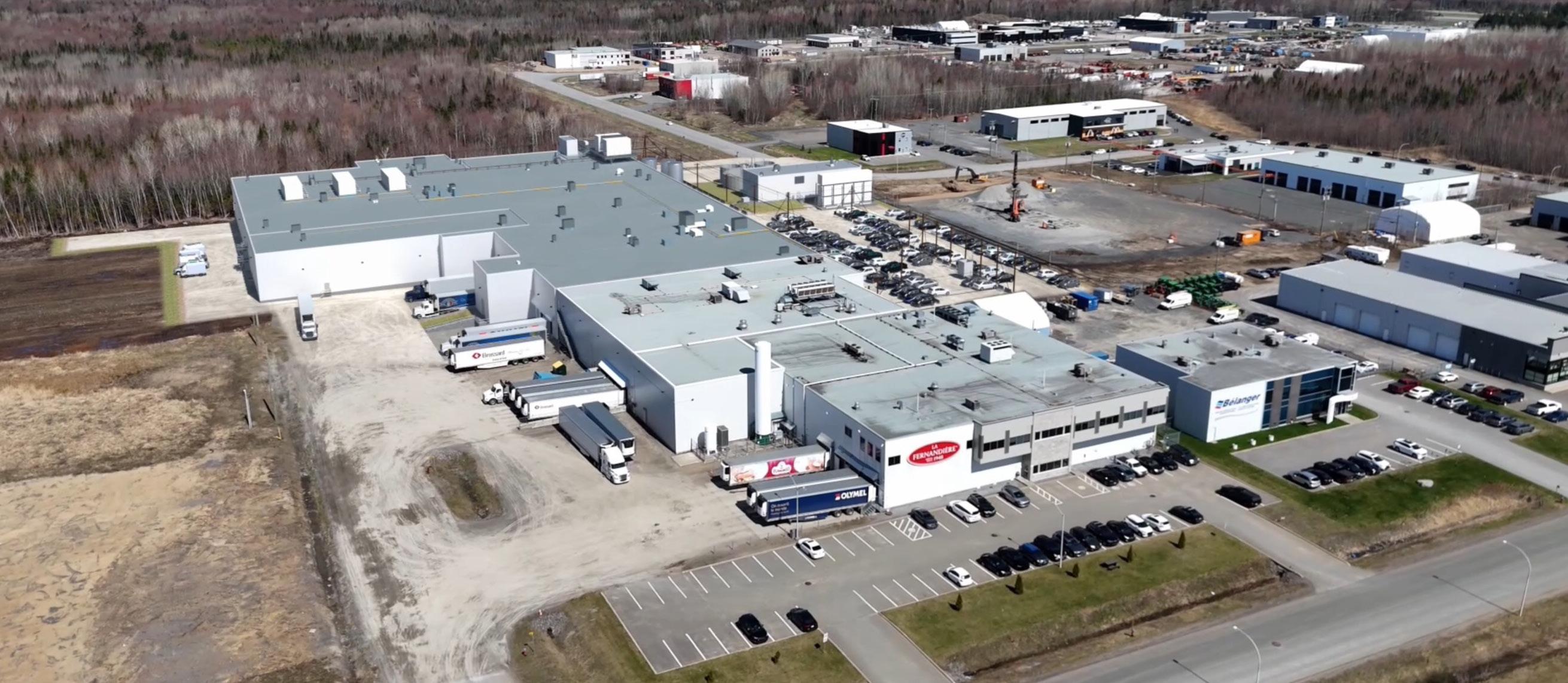
Canadian meat processor Olymel announced it is investing $142 million to expand its La Fernandière plant in Trois-Rivières, with construction starting soon and operations set for spring 2026.
The facility, currently focused on sausage production, will broaden its output to include pork and poultry products and become a fully integrated site for processing and packaging,
improving efficiency and reducing raw material transport.
In a press statement, the company said that the upgraded plant will feature AI-optimized systems, including autonomous slicing, packaging and palletizing, as well as industrial batteries, a continuous cooking line and autonomous vehicles.
Olymel said it aims to cut energy use through heat recovery, net-zero water-based cooking and wastewater heat exchangers. Closed-circuit water
systems will help to reduce water and energy consumption.
The project is expected to create about 50 direct jobs and use mostly Quebec-made materials, the company said. Construction Bertrand Dionne (Drummondville) and Premier Tech (Rivière-du-Loup) will handle key components.
To streamline operations, Olymel will close its Anjou and Cap-de-laMadeleine plants in spring 2026, offering affected employees roles at nearby facilities, including the new plant.
SCOTT TECHNOLOGY EXPANDS INTO CANADA
Scott Technology, a robotics and automation company, has secured NZ$27 million in new automation contracts across Europe and North America.
The company is partnering with Maple Lodge Farms for its first Canadian contract for the Automated Poultry Trusser solution. The multimillion-dollar contract includes the
design, build and installation of two 24-bird-per-minute trussing lines at Maple Lodge’s plant in Brampton.
“As one of Canada’s largest poultry processors, we see automation not just as an efficiency tool, but as a way to lead the industry in safety, quality, and innovation,” said Fred Marques, COO at Maple Lodge Farms. “Scott’s technology helps us deliver on that commitment every day, and it reflects the kind of forward-thinking investment that keeps Maple Lodge Farms a marketplace leader.”
“This agreement not only extends the reach of our poultry trusser technology, which is already delivering strong results in the U.S., but also supports Maple Lodge’s continued leadership in innovation, efficiency and workplace safety,” said Mike Christman, CEO of Scott Technology. We’re proud to contribute to their efforts in shaping the future of food production.”
HILTON FOODS INVESTS TO BUILD MFG. FACILITY IN BRANTFORD, ONT.
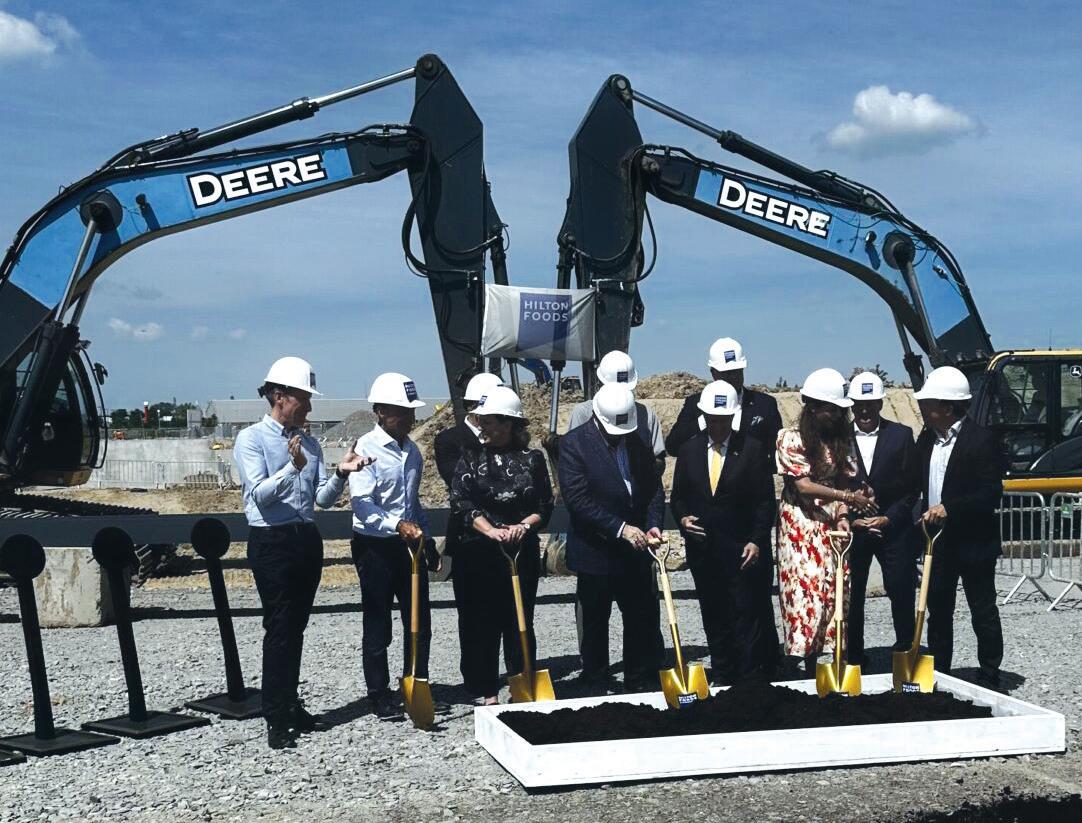
Hilton Foods Canada is investing $192 million to build its first North American food processing and distribution facility in Brantford, Ont., reportedly creating 150 new jobs. The Ontario government is supporting Hilton Foods’ expansion with a $1.5 million investment from the Southwestern Ontario Development Fund, helping to grow and diversify the province’s food manufacturing industry.
Hilton Foods Canada Inc. will build a new 230,000-square-foot food processing and warehouse distribution facility that will process protein products, including beef, pork, lamb and seafood, for distribution centres as far
as Mississauga, Ont., Cornwall, Ont., and Moncton, N.B. This investment is the company’s first food manufacturing operation in North America.
The Southwestern Ontario Development Fund is a stream of Ontario’s Regional Development Program (RDP), launched in 2019 to provide tailored financial assistance and advisory services to help businesses and municipalities invest in equipment, innovation, workforce development, and market expansion in eastern and southwestern Ontario.
CONGEBEC, BRADNER COLD STORAGE PARTNER TO EXPAND MULTI-TEMP STORAGE FACILITIES ACROSS CANADA
Congebec and Bradner Cold Storage are partnering to create a network of multi-temperature storage facilities across Canada. This strategic alliance reinforces Canada’s supply chain industry across six provinces: Quebec, Ontario, Manitoba, Saskatchewan, Alberta and British Columbia, bringing the
total network to 16 locations.
The merger combines Congebec‘s logistics resources with Bradner Cold Storage’s expertise and locations in British Columbia. It leverages Bradner’s expertise in frozen, fresh, and dry logistics while offering access to the Trans-Pacific trade routes through Vancouver.
Nicholas-P. Pedneault, CEO of
Congebec, stated, “This partnership marks a significant milestone in our journey to provide unparalleled cold storage solutions across Canada and internationally. By uniting our strengths, we are thrilled to deliver exceptional value and service to our customers who are embracing more than ever the demand for Canadian products.”
From recipe to recyclable
packaging.
Festo products and solutions are setting the stage for safe and reliable automated manufacturing processes of nearly everything we eat and drink. I festo.com/food
FOOD AND BEVERAGE INDUSTRY FACES
MIXED OUTLOOK IN 2025, FCC REPORT SAYS
BY FARM CREDIT CANADA
Canada’s food and beverage manufacturers face a year of uncertainty, with opportunities tempered by economic challenges, trade disruptions and shifting consumer habits, according to the latest Farm Credit Canada (FCC) Food and Beverage Report.
FCC Economics forecasted a modest 0.6 per cent increase in food and beverage sales to $168.8 billion in 2025, but a 1.5 per cent decline in sales volume, reflecting ongoing adjustments to beverage manufacturing. Profit margins are expected to improve slightly, though they will remain below pre-2019 levels, with variation across sub-sectors.
“The food and beverage industry faces ongoing pressures from economic challenges and trade disruptions,” said Amanda Norris, senior economist at FCC. “While sales growth is projected to increase slightly, manufacturers will need to carefully navigate rising costs and shifting consumer habits to maintain profitability.” For 2025, FCC Economics forecasted a further decline in beverage sales of -2.5 per cent and -2.6 per cent in volumes. The anticipated decline is driven by a continued shift away from alcoholic
beverages, particularly beer, and a slight slowdown in non-alcoholic beverage sales after four years of strong growth.
While inflation has eased and labour market pressures have relaxed, consumer spending remains uncertain. Per capita consumption of food and non-alcoholic beverages declined for the fourth consecutive year in 2024, down 1.0 per cent from 2023 and 8.0 per cent since 2021, as household budgets remained tight. However, food and non-alcoholic beverages showed signs of recovery near the end of 2024, while alcohol consumption continued to weaken.
“Consumer behavior is shifting, with a growing emphasis on value and products that align with individual preferences,” said Norris. “In this environment, manufacturers who adapt to changing trends and focus on meeting diverse consumer needs will be better positioned to build brand loyalty and strengthen sales.”
Another strong year for dairy product manufacturing sales is expected for 2025. FCC Economics forecasted
an 8.3 per cent increase in sales and a 6.0 per cent increase in volumes.
Gross margins in the sector are expected to improve in 2025, to the highest level over the past two years, with support from higher sales and declining raw material costs.
Strong price growth has driven double-digit sales increases in the sugar and confectionery sector since 2021, and 2025 is expected to bring another 10 per cent increase in sales, with volumes rising by 6.7 per cent. While higher revenues helped offset rising expenses in 2024, margins remain under pressure from high cocoa prices and potential trade disruptions. With over 90 per cent of confectionery sales tied to exports, particularly to the U.S., the sector faces risks from shifting trade policies, though steady growth in nonU.S. markets suggests diversification opportunities.
In addition, Canada’s aging labour pool will continue to
exert pressure on wages, this impact will be less pronounced than in previous years, with the decline in raw material costs helping to offset total expense.
“The food and beverage sector is at a crossroad, with both risks and opportunities ahead. Manufacturers must focus on innovation, strategic market diversification and cost
Clean quicker Save time
management to stay competitive,” Norris noted.
The annual FCC Food and Beverage Report features insights and analysis on grain and oilseed milling; dairy, meat, sugar and confectionery, bakery and tortilla products; seafood preparation; and fruit, vegetable and specialty foods, as well as soft drinks and alcoholic beverages.
SAFETY FIRST
Tackling impairment risks in the manufacturing workplace.
BROUGHT TO YOU BY EMC
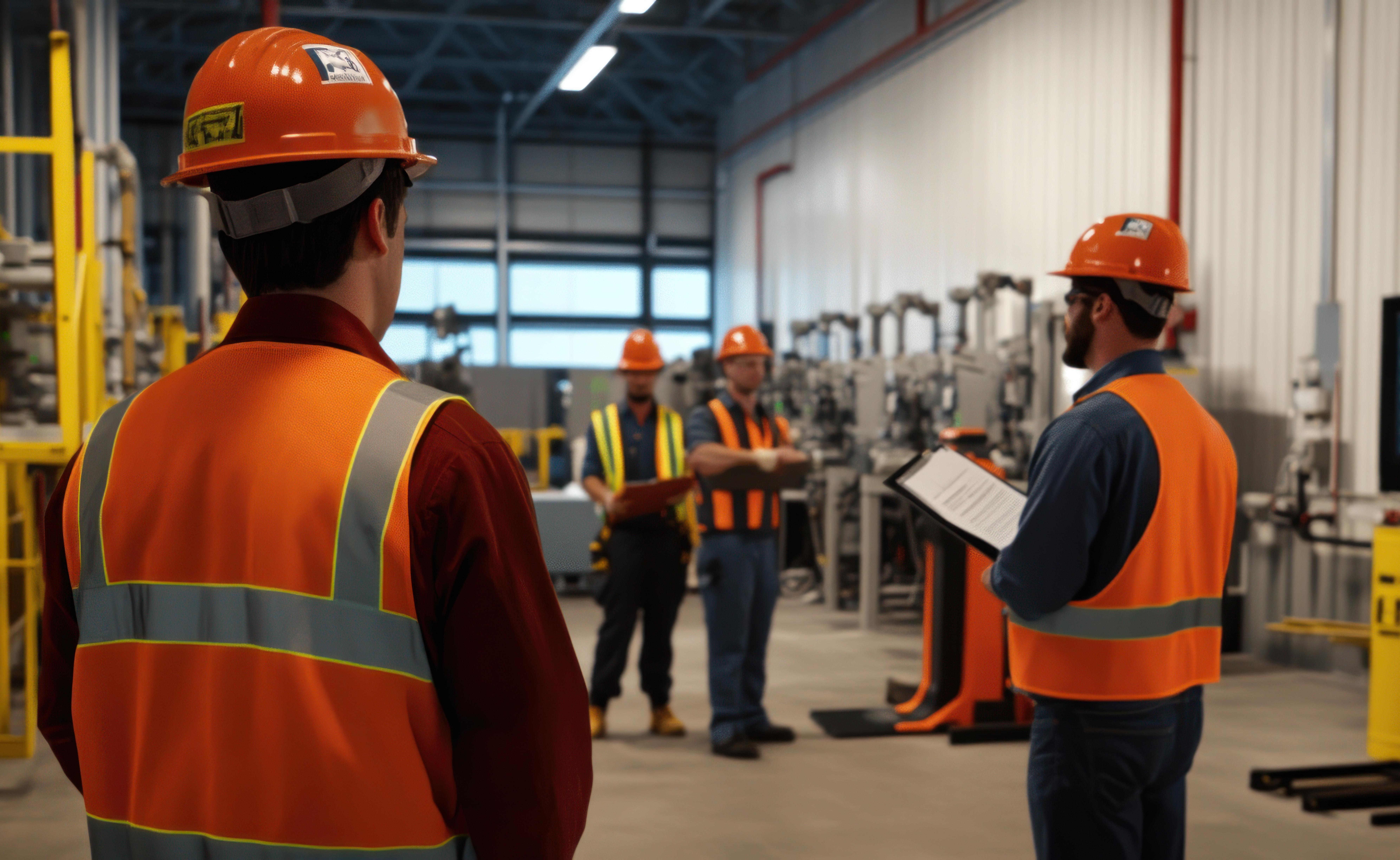
Daily operations in manufacturing workplaces require people to perform highly skilled tasks, such as operating heavy machinery and handling hazardous materials. To maintain workplace safety and operational efficiency, manufacturers must ensure that employees are fit for duty. This article explores the concepts of impairment and fitness for duty, their impact on workplace safety and strategies for developing effective policies to address these issues.
WHAT IS FIT FOR DUTY?
Fit for duty or fit for work means that an individual is able to do their tasks
safely and to an acceptable level for a time period such as a day or for the duration of a task.
Note that fit to work relates to medical fitness, usually after an illness or injury.
WHAT IS IMPAIRMENT?
Impairment means that physical or behavioral changes are affecting an individual’s ability to work safely, for example:
• Compromised judgement and decision-making. Extended breaks, arriving late and leaving early may arouse suspicion of impairment.
• Decreased motor coordination, reaction time and sensory perception. Falling, slowed reactions, and staggering are all actions that can be associated with impairment.
• Mood swings or personality changes. Nervousness and confusion are behaviours that could be attributed to impairment.
WHAT CAUSES IMPAIRMENT?
• Medical conditions such as seizures or unexplained unconsciousness.
• Prescription or non-prescription drugs including cold medication or pain relievers.
• Substances such as cannabis and alcohol.
• Fatigue, which can be mental and physical, and can be caused by shiftwork or seasonal time changes.
• Mental health, including depression and anxiety.
• Temporary, situational stressors such as grief or financial problems.
HOW CAN EMPLOYERS MINIMIZE IMPAIRMENT RISKS?
To provide a safe workplace and prevent impairment incidents, manufacturers should implement and apply comprehensive fit for duty/impairment policies that cover these elements:
Definitions. What does “Fit for duty” mean for your employees? What is acceptable behaviour and
Impairment isn’t limited to substance abuse. Fatigue and stress can also cause significant impairment. Causes of impairment include the following:
workers.
level of safety performance?
Reporting procedures. Establish protocols of what employees and supervisors should do if they recognize signs of impairment. Include steps for individuals to take if they are impaired.
Training programs.Ensure that supervisors and employees understand
your fit for duty and impairment policy and learn to recognize possible signs of impairment.
A fit for duty and impairment policy is essential to maintain workplace safety. Addressing fatigue and other factors that affect fitness for duty not only protects workers but also enhances overall operational efficiency.
Providing training programs to address impairment can help mitigate risks to
Q&A: SORALINK’S YUN YAO ON AI,
IoT AND THE FUTURE OF PREDICTIVE MAINTENANCE IN F&B MANUFACTURING
BY KIRSTYN BROWN
Most factory floors weren’t built with artificial intelligence in mind. Yet today, manufacturers are working to integrate advanced technologies like AI and IoT into systems that may be decades old. In the food and beverage sector—where downtime can mean both lost revenue and product waste—many companies are exploring predictive maintenance as a way to improve efficiency and reliability.
To understand how predictive maintenance is evolving in this environment, I spoke with Yun Yao, CEO and co-founder of Soralink, a
Canadian predictive maintenance solutions startup. In this Q&A, Yao explains why data quality matters more than ever, how manufacturers can start small and what it really takes to bring AI into legacy operations.
MRO: HOW WILL AI AND IOT SHAPE THE FUTURE OF PREDICTIVE MAINTENANCE, ESPECIALLY IN FOOD AND BEVERAGE MANUFACTURING?
Yun Yao: A way to reduce plant downtime is try to predict the conditions of the machine so that you can react on time. But you cannot predict anything just by the num-
ber of hours the machine runs.
So, the way we do it is using sensors. Sensors and this concept of predictive maintenance have been around also for a long time but what changed recently is that it has become very easy to use thanks to the latest technology in IoT: The sensor, cloud computing, embedded computing and the last missing piece is AI.
What’s special about food and beverage is that production varies depending on demand. An example is an ice cream factory: It doesn’t produce the same way in the winter as in the summer. This kind of variation is natural in the food and
beverage sector, and this means machines work in varying ways. So traditional threshold-based IoT simple predictive maintenance is not very useful. It doesn’t work very well in food and beverage production.
This is where AI comes in place: It’s capable of learning depending on what is being seen in the past such that it adapts to the new variation every time there is one. So, the AI part really makes this IoT-based predictive maintenance solution a lot more usable right out of the box.
MRO: WHAT CHALLENGES COME WITH AI PREDICTIVE MAINTENANCE, PARTICULARLY WITH OLDER EQUIPMENT?
YY: AI systems need good datasets — and that means having labeled data. You need to know what the machine looks like when it’s running normally and what it looks like when something’s wrong.
You can use simulations or refer to the manufacturer’s data sheet — for example, a machine is expected to operate within a certain vibration range, and anything outside that range is con-
sidered abnormal. But that doesn’t really work with older machines. Many of them are 20, 40, even 60 years old and over time they’ve been repaired with different parts and maintained in different ways. Because of that, it’s almost impossible to know what the “ideal” vibration level is for those machines. Each one has a unique history. Instead, we collect data and establish a baseline for that specific machine. From there, we can identify what’s normal and what’s not.
But even then, we still need labeled examples of when the machine was working properly. That’s why a period of data collection and observation is so important — it gives us the foundation to build an accurate model for detecting failures.
MRO: HOW CAN MANUFACTURERS ENSURE AI AND IOT SYSTEMS ARE SECURE AND COMPLIANT?
YY: When a new technology comes along, security usually isn’t the first priority. That’s what happened with IoT. In the beginning, to make sure everything worked smoothly, people left systems open because it was easier
that way.
But now we’re at a point where we need to close everything off, except for the specific doors we want open. And even those doors need to be properly locked, only allowing access to people with the right credentials.
So, how do you make sure IoT is secure? There are a lot of standards out there. You can learn them, you can learn what the best practices are. But the hardest part is actually implementing them. Someone can tell you, “Do this, this and this,” but if you don’t take it step by step, it won’t help.
Unfortunately, a lot of people still only take it seriously after something goes wrong. That’s often what it takes — a catastrophe. But it shouldn’t be that way.
MRO: WHAT ARE SOME COMMON MISCONCEPTIONS ABOUT AI AND PREDICTIVE MAINTENANCE?
YY: A common misconception is that it will just work like magic. That’s one, because nothing works like magic, especially not in industrial and the manufacturing sector. Things are designed to work in the same way, but often, it doesn’t work that way. It’s a very pow-
erful tool, for sure, but you need to be able to use it properly for it to create real value.
Another thing is people think, “Oh, I haven’t done these 10 steps before I can use new technology. I first need to do this and that.”
I think with today’s technology, a lot of it is more accessible than we thought. So having an IoT system for predictive maintenance, you can set it up pretty quickly without you having to do all the other nine things you thought you needed to do. Set it up, and the next day you see value.
MRO: WHAT KIND OF ROI CAN MANUFACTURERS EXPECT FROM AIDRIVEN PREDICTIVE MAINTENANCE?
YY: Traditional predictive maintenance already adds value by catching issues like oil shortages or maintenance errors.
And then adding AI to it is going to help you to deal with varying machines, things that are more difficult to deal with. And the difference is, before you could do nothing about it because it varied so much. How can you make sense of it? But now, with more pow-
erful AI that could work with data that is statistically difficult to deal with, they can do it. So, what used to not work now works in a more precise and accurate way.
MRO: HOW QUICKLY OR HOW MUCH TIME BEFORE MANUFACTURERS START TO SEE EFFICIENCY AND LESS DOWNTIME?
YY: You have to tune the system such that it fits your way of working in the factory. And every factory is different. They have different people; they have different skill sets. So that adaptation is important because it has to adapt to your team.
But I think in a well-managed place, with such a system, you can see results within three months easily.
MRO: WHAT’S THE MOST COMMON CONCERN YOU HEAR FROM MANUFACTURERS?
YY: Skepticism. People ask, “How do I know if my machine needs maintenance?”
The answer to that is: it depends on when you have done mainte-
Process improvement is improving quality while reducing operational costs.
Constant demand for consistency in product quality and taste makes Food & Beverage a demanding industry. With our comprehensive portfolio of instruments, industry expertise and accredited calibration services we ensure plant availability, resource conservation and repeatability in processing with traceable compliance.
nance. If you haven’t done it for a long time and we just put a sensor on, and we’re basing our baseline of the condition on it lacking maintenance, it’s not going to be very accurate. Because we are not basing it on good condition.
So the best way to solve this problem is to make sure your machine is working in a good condition. And then what you measure will be adequate according to what you need to know.
MRO: ANY FINAL ADVICE FOR MANUFACTURERS?
YY: Stay curious. Learning about the tools is going to help you, for sure. But you also need to be realistic about how quickly and how much time you need for it to bring value.
But always keep that antenna of curiosity out there, because there are so many new things coming up every day, and that may help you to solve your problem easily.
(The quotes in this article have been edited for length and clarity.)
HOW GEN AI IS TRANSFORMING
THE FOOD AND BEVERAGE WORKFORCE
As factories modernize, Gen AI is streamlining operations and empowering frontline teams across the food and beverage sector.
BY YANNICK HAECK
Generative Artificial Intelligence (Gen AI) is transforming how AI supports workers, both in consumer experiences and industrial environments. In manufacturing, Gen AI is increasingly seen as a powerful tool for enhancing workflow efficiency, especially on the factory floor, where it’s helping to foster a more engaging and productive work culture. A persistent challenge for food and beverage manufacturers has been attracting younger workers to shop floor roles, positions often perceived
as dull, dirty or dangerous. Fortunately, the rise of Gen AI, along with technologies like augmented and virtual reality, is revolutionizing these spaces.
Today’s factory floor is evolving into a more dynamic, tech-enabled environment that offers a rewarding employee experience and a more desirable place to work.
A GROWING INDUSTRY MEETS A NEW ERA OF WORK
Canada’s food and beverage manufacturing industry was made up
of nearly 15,000 establishments in 2024, contributing $35.2B in 2023 to Canada’s GDP and employing over 315,000 workers. Global AI in food and beverages market size being calculated at an all-time high of $21 billion in 2025 and growing exponentially over the next decade. That means training and reskilling frontline workers with different levels of knowledge, competence and language issues is vital while keeping
practices health and safety compliant for the new tech-enabled manufacturing era. Enter Gen AI and the new generation of connected worker platforms, where content creation and delivery are in their DNA.
Not only is Gen AI in food and beverage manufacturing a win for workers, but it is also a win for Consumer Packaged Goods (CPG) companies globally, where Gen AI use cases could increase the economic
impact of traditional AI by 15 to 40 per cent. In an article by McKinsey & Company, the consulting firm estimated that bridging that gap means unlocking an additional
$160 billion to $270 billion annually in profit, and part of this can be achieved through an enhanced workflow among increasingly connected workforces.
POWERING A MOTIVATED FRONTLINE
Bringing new technologies, such as connected worker platforms and Gen AI to the shop floor contributes to a more engaging, modern workplace. This transformation is especially important as manufacturers look to attract and retain younger workers.
Gen Z, in particular, is more familiar with AI tools thanks to their integration into education and everyday life. These workers are used to searching for answers online and expect digital access to information in the workplace. Making instructions and training materials available digitally is not just a convenience — it’s a necessity for retaining younger talent and empowering them to take ownership of their roles. This shift is especially relevant in the food and beverage processing industry, where the need for speed, accuracy and adaptability is high. Gen AI helps meet these demands by enabling faster onboarding, better knowledge transfer, and more personalized support.
EXPANDING CAPABILITIES AND RETAINING TALENT
One of the biggest challenges facing the food and beverage manufacturing industry is not just recruiting skilled frontline workers, but keeping them. Technology, particularly Gen AI, offers a powerful solution. Here’s how AI is helping manufacturers sustain and inspire their workforce:
1. Boosting efficiency through smarter content delivery
Frontline workers need clear, concise instructions that are easy to understand and quick to access. But creating and maintaining this content, especially across multiple formats and languages, can be time-consuming and expensive. Most CPG factories already have thousands of documents, including standard operating procedures (SOPs) and work instructions. Converting these into accessible digital formats is a major undertaking. According to a global Lenovo survey of 600 IT leaders, 79 per cent
believe AI will free employees to focus on more meaningful work — critical in an industry where deadlines are tight and products have a limited shelf life.
Gen AI can help by automating the conversion of existing documents into digital work instructions, reducing the time and cost involved while improving accessibility and usability.
2. Providing multi-format task guidance
AI-powered content transformation tools can streamline the creation of digital instructions in various formats — text, video, and images. This is especially valuable for younger workers, who prefer visual learning. In fact, a 2025 report found that 57 per cent of Gen Zers prefer to learn about new products through short-form videos.
Creating video-based instructions has traditionally been a challenge for factories with limited resources. But Gen AI changes the
game. It can extract relevant information from existing documents, sequence it into structured steps, and even generate visual guides. This not only improves engagement but also preserves institutional knowledge by capturing the expertise of senior operators.
Workers can access step-by-step visual guides for tasks, improving troubleshooting and reducing downtime. This approach also supports continuous learning and helps bridge the gap between experienced and new employees.
3. Breaking language barriers with AI transcription
In Canada, over 30 per cent of manufacturing workers are immigrants, many of whom speak a language other than English at home. Yet most global food and beverage manufacturers struggle to provide multilingual content.
AI-powered transcription and translation tools can break down these barriers by converting audio and video content into subtitles in
multiple languages, quickly and accurately. Unlike human translators, Gen AI tools can process recordings in minutes, making it easier to keep content up to date and accessible.
This improves comprehension, safety, and productivity on the shop floor, while also promoting inclusion and equity among a diverse workforce.
4. Enhancing communication with intelligent search
In fast-paced, noisy environments, clear communication is essential. Mistakes are inevitable, but Gen AI can help reduce them by enabling smarter, more intuitive search capabilities.
AI tools can interpret user input, even with typos or vague phrasing and deliver accurate, relevant answers. For example, if a worker needs to troubleshoot a jammed mixing machine, they can simply ask a question in natural language and receive step-by-step guidance.
Poka, a connected worker plat -
form, recently added embedded AI semantic functionality to improve its internal search engine. Its new “Ask a Question” feature allows users to bypass lengthy content libraries and get direct answers, referencing verified knowledge articles to ensure accuracy and avoid AI hallucinations.
THE FUTURE IS NOW
As the number of Canadian food and beverage manufacturers interested in buying into Gen AI tools to aid factory functions, we will see the rise of increasingly connected and engage workers on the shop floor. Gen AI continues to not only support but strengthen many practices within food and beverage manufacturing providing more efficient and rewarding work for manufacturers and workers alike, driving production efficiency and prompting an engaged and empowered workforce.
Yannick Haeck, VP Product, Poka
TURNING
INSIGHTS INTO ACTION
How integrating Overall Equipment Effectiveness (OEE) can transform real-time data into actionable strategies for continuous improvement.
BY ELI LATAK, MBB
Facing the relentless push for efficiency, manufacturing organizations are under growing pressure to optimize performance, reduce costs and deliver consistently high-quality products.
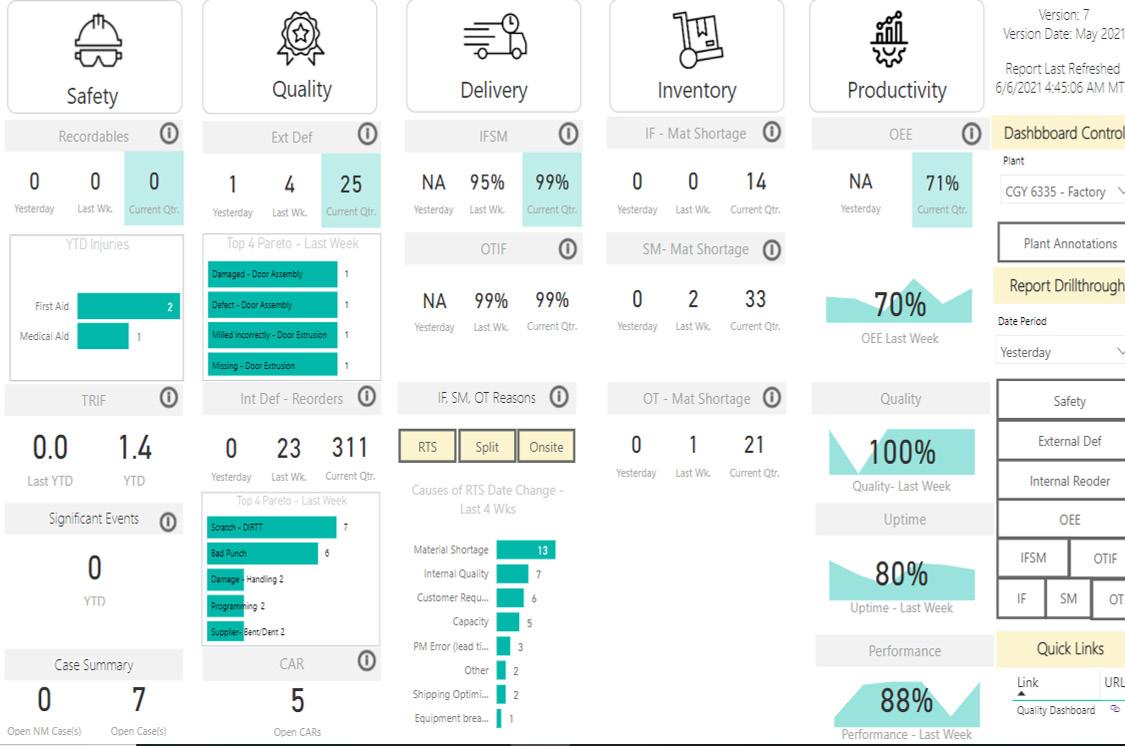
To meet these expectations, leading manufacturers are leveraging Overall Equipment Effectiveness (OEE) in conjunction with structured management tools like Safety, Quality, Delivery, Inventory and Productivity (SQDIP) boards. Together, these systems enable teams to monitor performance, drive continuous improvement and foster a
culture of accountability and transparency across all levels of the organization.
WHAT IS OEE?
OEE is a gold-standard metric used to assess how effectively a manufacturing operation is utilized. It is a composite metric made up of three key components:
• Availability – Measures downtime losses.
• Performance – Measures speed losses.
• Quality – Measures defect losses.
Example of a S.Q.D.I.P Managing Board
A perfect OEE score of 100 per cent indicates that a machine produces only good parts, as fast as possible, with no downtime. While this is rarely achievable, the goal of using OEE is not perfection but the identification and elimination of losses. Based on our extensive work with customers and their data, the reality is that most manufacturing organizations’ OEE scores are closer to 50 to 60 percent, depending on how long they have been tracking OEE.
So, while a world-class OEE score of 85 percent and above is extremely desirable, most manufacturers are unlikely to achieve such results. That’s why companies should not focus on striving for 85 percent as a minimum but rather set their sights on raising their OEE through specific improvements.
Now that you’ve started collecting OEE data, what are you doing with it?
How should it be managed? Our recommendation is to use daily huddles with SQDIP management boards.
WHAT IS SQDIP?
SQDIP stands for Safety, Quality, Delivery, Inventory and Productivity. It is a structured, visual management system that aligns daily activities with strategic goals. SQDIP boards are commonly used in tiered management meetings to monitor key metrics and encourage real-time decision-making. Each letter in SQDIP represents a core pillar of operational performance:
• Safety – Ensures a safe working environment and tracks incidents.
• Quality – Measures defects, rework, and process capability.
• Delivery – Tracks on-time delivery and schedule adherence.
• Inventory – Monitors raw material and finished goods levels.
• Productivity – Measures efficiency through KPIs like OEE.
By combining OEE with SQDIP boards,
companies can create a closed-loop system of performance monitoring and improvement.
BENEFITS OF INTEGRATING OEE WITH SQDIP BOARDS:
Real-time visibility of performance
One of the greatest strengths of using SQDIP boards in conjunction with OEE is real-time visibility. Teams can quickly identify underperform ing areas by visually displaying OEE metrics and performance indicators under the Productiv ity section.
With real-time data available during daily meetings, teams can:
• Identify trends or recurring is sues.
• Make immediate decisions and take corrective actions.
• Maintain alignment across shifts and departments.
Structured problem solving
SQDIP boards encourage root cause analysis and structured problem-solving. When an is
sue is identified—such as a dip in OEE due to machine downtime—it is logged on the board. Teams are then encouraged to use tools such as 5 Whys
Improved
communication and accountability
Daily tiered huddles centered around SQDIP boards create a culture of open
Driving
• Encourages team ownership of problems.
• Fosters collaboration across departments.
• Build a consistent feedback loop.
Managers can quickly understand what’s working and where support is needed.
Focus on leading indicators
While traditional KPIs often focus on lagging indicators (like monthly output), SQDIP and OEE emphasize leading indicators. These provide early warning signs of potential problems.
For example:
• A drop in performance (OEE) on a single line may predict late delivery (D in SQDIP).
• Increases in changeover time or minor stoppages can indicate future quality or availability issues.
By catching these signals early, teams can proactively prevent bigger issues downstream.
Drives daily continuous improvement (Kaizen)
One of Lean manufacturing’s core
tenets is Kaizen—continuous, incremental improvement. SQDIP boards support this philosophy by identifying improvement opportunities every day.
Examples include:
• Standardizing work to reduce performance losses.
• Implementing quick changeover techniques to boost availability.
• Using OEE loss trees to guide Kaizen events. By reviewing daily metrics and tracking actions on SQDIP boards, improvements become habitual rather than sporadic.
Alignment of people, processes and purpose
Visual boards provide a common language that aligns cross-functional teams. Whether you’re an operator, supervisor, or plant manager, SQDIP provides clarity on what matters.
Coupled with OEE data:
• Operators understand how their actions impact productivity.
• Maintenance teams prioritize based on high-impact issues.
• Leadership makes decisions
based on real performance data.
This alignment ensures that everyone is working toward the same goals and using the same data to get there.
Enhanced standardization and documentation.
Using OEE within a visual management system promotes consistency. Over time, best practices are documented and shared, creating a standardized approach to improvement.
These include:
• Documented standards for changeovers.
• Maintenance checklists to improve equipment availability.
• SOPs for addressing quality issues.
As standards evolve, the SQDIP board becomes a living document of the organization’s best practices. Motivation and team engagement.
Seeing performance metrics like OEE displayed on SQDIP boards provides immediate feedback. Teams know where they stand and what they need to improve.
When targets are met, it builds confidence. When they aren’t, it sparks
problem-solving.
This daily rhythm of review and action boosts morale, encourages team ownership, and embeds a culture of excellence.
OEE and SQDIP boards are more than just tools, they are cultural enablers. Together, they empower teams with real-time data, visual feedback and a structured problem-solving approach. This combination enhances communication, accountability and alignment, ultimately driving sustained improvements in productivity, quality and safety.
Organizations that integrate OEE within the SQDIP framework are better equipped to face the challenges of modern manufacturing. By focusing on what matters every day and acting on it, they build a resilient, high-performing operation ready to compete and thrive.
Eli Latak, MBB, is the founder of Smart Lean Manufacturing, a hands-on operational excellence implementation service.