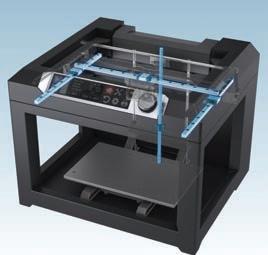
DfAM techniques leverage 3D printing’s advantages to optimizes part outcomes
MOTION CONTROL
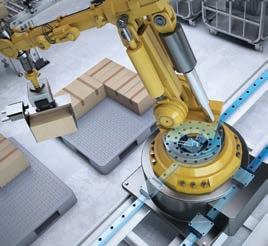
Smart conveyor system helps manufacturers overcome production challenges
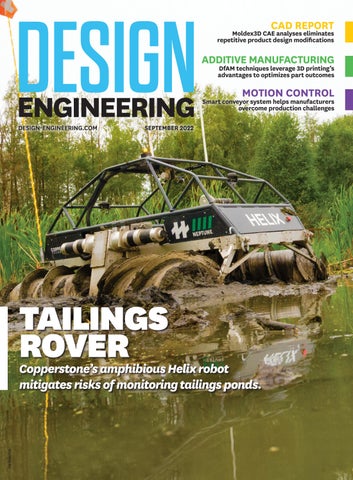
TAILINGS ROVER
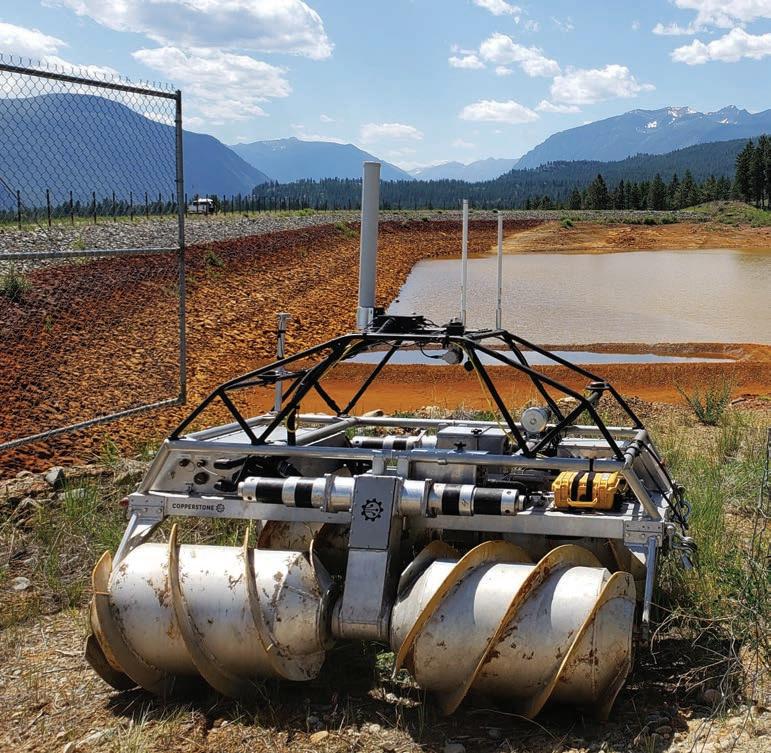
Copperstone’s amphibious Helix robot mitigates risks of monitoring tailings ponds.
Innovate today for a new tomorrow
Realize your vision with Festo‘s approach to smart automation for electronics manufacturing. Partner with Festo today.
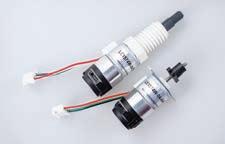
Unique system solutions for motor & drive technology.
The facts at a glance:
– Highly diverse motor range for virtually all drive applications:
– AC or DC motors
– Internal or external rotor
– Mechanical or electronic commutation
– EC motor with integrated or external operating electronics
– System solutions including transmission, brake and encoder
– Drive units capable of communication with bus interface
– Customized motor solutions, motor parts sets and drive assemblies
– Motors for automotive applications: Power steering drives, drives for clutch actuators and various pumps in the areas of transmission lubrication and exhaust aftertreatment and more
INSIDE
14 A New Design Approach
Design for additive manufacturing techniques leverage 3D printing’s advantages to optimizes part outcomes
How intelligent conveyor systems help manufacturers overcome production challenges
26 Laser Focus
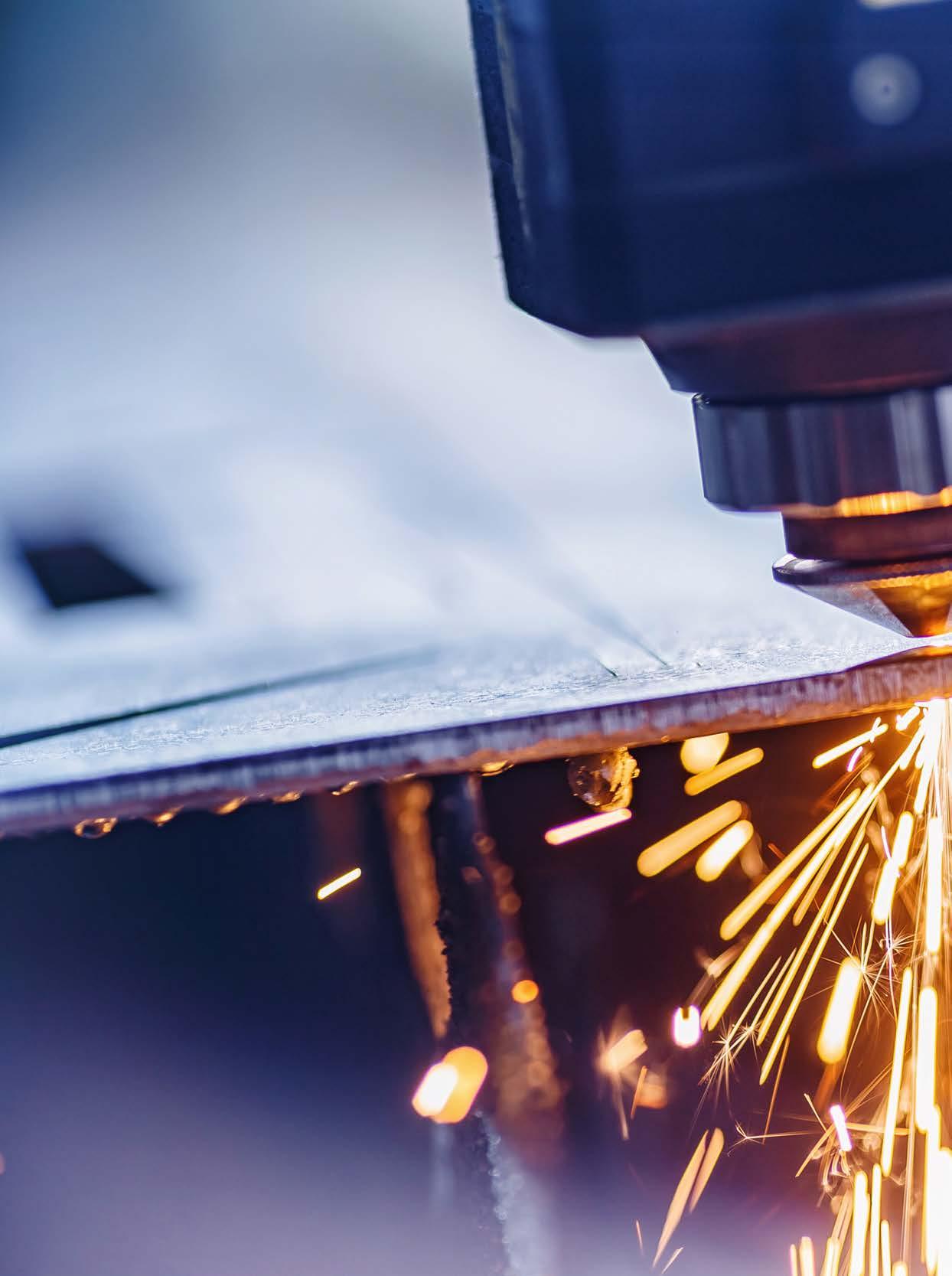
Efficient motion control boosts precision and performance of 5-axis fiber laser cutting system
Columns
8 Design News
Umicore to build EV battery materials plant near Kingston
12 CAD Report
Moldex3D automates multiple CAE analyses to eliminate repetitive design modifications.
29 Idea Generator
The latest industrial technology including automation, motion control, fluid power and sensor components
The Trouble with Tailings
As we approach the second quarter of the 21st century, most of the industrialized world is eagerly pursuing clean sources of energy to replace those that fueled the 20th. To capitalize on that transition, both the federal government and private enterprise are looking to market Canada as a “green” source of the raw material to produce these ecologically responsible technologies.
This stems from the fact that, unlike other manufacturing centers, provinces like Ontario and Quebec rely overwhelmingly on hydroelectric dams, rather than fossil fuels, to generate power. It follows then that mining, refining and manufacturing the material for these technologies should be located here. After all, what’s the benefit of an EV if producing the components that make it up generated as much pollution as its gas guzzling predecessor?
But, as this issue’s cover story on Copperstone Technologies’ Helix robots brings up, Canada has yet to fix a sticky and long-standing problem. Namely, what’s do be done about the often toxic waste these refining operations produce and the tailing ponds that contain it?
According to a 2021 report by the Alberta Energy Regulator (AER), the total area of Canadian oil sands tailings ponds alone covers approximately 1.36 billion cubic meters of fluids or 1.7 times the area of Vancouver. Factor in other mining facilities, plus the new cobalt, lithium and other materials the country hopes to mine to supply the EV battery trade, and the problem only promises to expand.
The crux of the issue is that tailings ponds aren’t going anywhere soon. Before they can be reclaimed, tailings have to fully dry out, but estimates put that de-watering time-frame at as much as 150 years, if left untreated. In that time, extraction operations can go bankrupt, be sold or abandoned such that remediation responsibility become difficult to establish. Ultimately, it may be provincial or federal coffers that settle the clean-up tab, an amount pegged at upwards of $130 billion.
For Canada to truly become a green mining and manufacturing leader, the public and private sectors will need to aggressively address the tailings pond problem, rather than let it languish further. Otherwise, the price of success for Canada in the near term could well be catastrophically expensive, financially and environmentally, down the road.
MIKE MCLEOD
Editor mmcleod@design-engineering.com
Editorial Board
DR. ALAIN AUBERTIN
President & CEO, Canada Consortium for Aerospace Research and Innovation in Canada (CARIC)
DR. MARY WELLS, P.ENG
Dean, Faculty of Engineering / Professor, Mechanical and Mechatronics Engineering; University of Waterloo
AJAY BAJAJ, P.ENG
President and CEO, Rotator Products Limited; Past President and Board Member, Power Transmission Distributors Association (PTDA)
DR. ISHWAR PURI, P.ENG
Vice President of Research; Engineering Professor, University of Southern California
SEPTEMBER 2022 Volume 68, No.4 design-engineering.com
READER SERVICE
Print and digital subsciption inquiries or changes, please contact Angelita Potal Tel: (416) 510-5113
Fax: (416) 510-6875
Email: apotal@annexbusinessmedia.com
Mail: 111 Gordon Baker Rd., Suite 400, Toronto ON M2H 3R1
SENIOR PUBLISHER Paul Burton (416) 510-6756 • pburton@annexbusinessmedia.com
EDITOR Michael McLeod (416) 442-5600 ext. 3231 mmcleod@design-engineering.com
NATIONAL ACCOUNT MANAGER Ilana Fawcett (416) 829-1221 • ifawcett@annexbusinessmedia.com
AUDIENCE DEVELOPMENT MANAGER Beata Olechnowicz (416) 510-5182 • bolechnowicz@annexbusinessmedia.com
COO Scott Jamieson sjamieson@annexbusinessmedia.com
Design Engineering, established in 1955, is published by Annex Business Media, 6 times per year except for occasional combined, expanded or premium issues, which count as two subscription issues.
Printed in Canada
Publications Mail Agreement #40065710 ISSN: 0011-9342 (Print), 1929-6452 (Online)
Subscriber Services: Canada: $57.50 for 1 year; $92.50 for 2 years; $10 for single copy.
Outside Canada: USA - $140.50; Overseas - $151.00; $10.00 for single copy.
All prices in CAD funds. Add applicable taxes to Canadian rates.
From time to time we make our subscription list available to select companies and organizations whose product or service may interest you. If you prefer not to receive this information, please contact our circulation department in any of the four ways listed above.
Annex Business Media Privacy Officer: privacy@annexbusinessmedia.com Tel: 800-668-2374
No part of the editorial content of this publication may be reprinted without the publisher’s written permission.
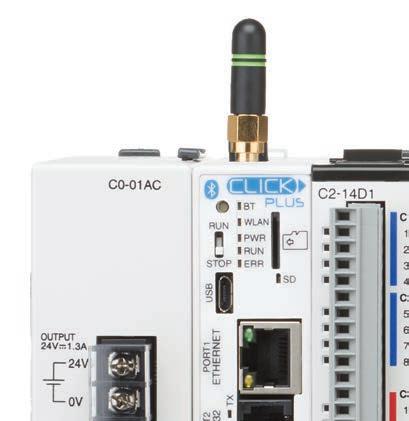
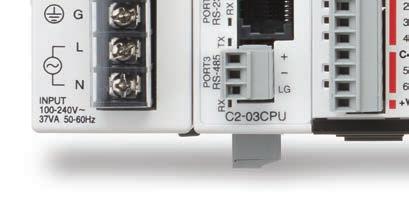
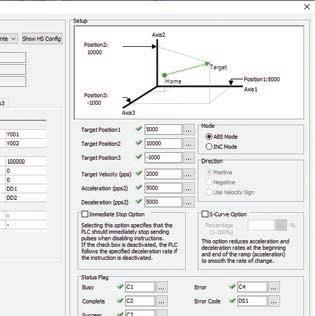
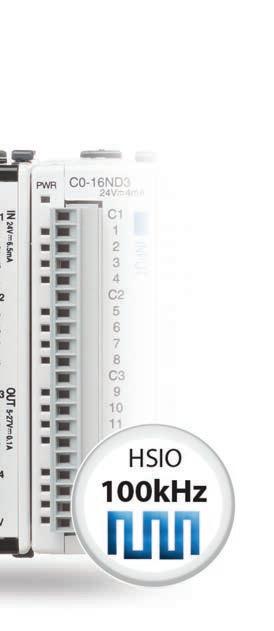
CLICK PLUS PLCs provide control simplicity combined with advanced capabilities including Wi-Fi communication, MQTT support, data logging, and now motion control. Any CLICK PLUS CPU can be con gured as a 3-axis PTO/PWM motion controller with 100kHz high-speed input and outputs (requires DC option slot I/O module placed in slot 0 of the CPU). With the easy-to-use con guration GUI built into the FREE software and the three new motion instructions (Velocity Move, Position Move and Home), CLICK PLUS makes it’s a cinch to control simple motion applications. FREE SOFTWARE with simple motion pro le setup and 3 new easy-to-use motion instructions:
AXIS PROFILES:
• Relative/absolute positioning
• Velocity mode
• Trapezoid
• S-Curve • Registration
Homing • Jogging • Linear mode
Orders over $49 get FAST FREE SHIPPING Our shipping policies make it easier than ever to order direct from the U.S.!
Fast free standard shipping* is available for most orders over $49 U.S., and that includes the brokerage fees (when using an AutomationDirect nominated broker). Using our choice of carrier, we can reach most Canadian destinations within 2 to 3 days.
*Free shipping does not apply to items requiring LTL transport, but those shipments can take advantage of our negotiated super-low at rates (based on weight) that include brokerage fees.
See Web site for details and restrictions at: www.automationdirect.com/canada
UMICORE TO BUILD EV BATTERY MATERIALS PLANT
NEAR KINGSTON,
ON
Belgium-based circular materials technology company, Umicore, announced it will construct an industrial-scale cathode active materials (CAM) and precur sor cathode active materials (pCAM) manufacturing plant near Kingston, Ontario.
Cathodes account for about 50 per cent of the value of an EV battery and contain key critical minerals such as nickel, cobalt, manganese and lithium. According to the company, it’s $1.5 billion investment in eastern Ontario will further connect Nor thern Ontario’s mineral sector to EV manufacturing in the south.
Planned for Loyalist Township, the $1.5 billion facility would be one of a kind in North America, the company says, in that it will be the first that combines production of precursor cathode active materials (pCAM) and cathode active materials at the same facility. Spanning about 350 acres, the plant is slated to begin construction in 2023 with operations planned for the end of 2025.
At full production, the plant will produce annual cathode material volumes sufficient to manufacture batteries for one million battery-electric vehicles – almost 20 per cent of all North American EV production at the end of the decade. Umicore says its plant will also leverage Ontario’s clean electricity system, that was more than 90 per cent emissions-free in 2021. Ontario is also developing a clean energy credit (CEC) registry that will enable companies like Umicore to voluntarily purchase CECs to demonstrate that all of their electricity has been sourced from non-emitting resources.
“Today is another perfect
A rendering of a single T centre qubit in a silicon lattice. The T centre’s constituents (two carbon atoms and a hydrogen atom) are shown as orange, and the opticallyaddressable electron spin is in shining pale blue.
example that our plan to rebuild Ontario’s auto industry is gaining speed and will deliver huge wins for communities,” said Premier Doug Ford. “Ontario has everything it needs, up and down our homegrown supply chain, to remain and strengthen its position as a North American auto manufacturing powerhouse. Umicore plans to bring this par t of the EV supply chain to Ontario which will continue to transform our auto sector and create good jobs.”
Despite its enormous potential to transform fields such as chemistr y, materials science, medicine and cybersecurity, quantum computing is currently restricted from scaling up to handling tough problems in those fields by a few fundamental challenges.
For one, the delicate quantum state within a cubit, the basic unit of a quantum computer, can too easily be disrupted, or suffer decoherence, due to interaction with its surround environment. A workable solution then requires that qubits remain coherent for as long as possible. Due to this fragility, qubits are inherently prone to error. To build a practical quantum computer therefore requires sophisticated error correction algorithms running on other qubits to double check the results of each working qubit.
A practical system would need to have thousands, if not 10s of thousands of qubits, some to do the processing work and the rest to make sure the computing cubits aren’t messing up. Of cour se, building a quantum computer with thousands of qubits would require a way for them to quickly communicate with each other over relatively long distances.
Researchers at Simon Fraser University’s Silicon Quantum Technology Lab say their work strongly points to a solution for these challenges. Their research focuses on building qubits from silicon. Not only does the common material produce some of the most stable and long-lived qubits currently available, the researchers say, but it already has an established manufacturing industry that’s had decades to maximize precision and cost efficiency.
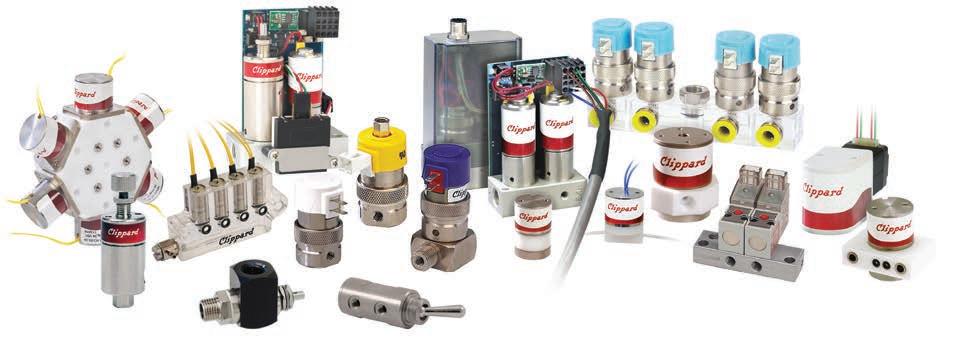
Designing efficient systems involves much more than simply understanding a few basic principles. There is a true art to balancing the specific requirements of an application in order to achieve the desired goals in the best possible way. Help us understand the unique needs of your application and together, we’ll develop something that surpasses what any of us could have done alone.
Contact your distributor to learn more, or clippard.com to request a free catalog and capabilities brochure.
More notably, the SFU lab – co-led by Stephanie Simmons, Canada Research Chair in Silicon Q uantum Technologies and SFU Professor Emeritus, Michael Thewalt – has discovered that a specific luminescent defect in silicon, or T center, can provide a photon-based interconnect between qubits.
What’s more, she says the photons emitted by silicon T centers are in a wavelength compatible with existing fiber optic networks.
“With T centers, you can build quantum processors that inherently communicate with other processors,” Simmons says. “When your silicon qubit can communicate by emitting photons in the same band used in data centers and fiber networks, you get these same benefits for connecting the millions of qubits needed for quantum computing.”
The SFU lab’s research, lead by Daniel Higginbottom, Alex Kurkjian, and co-author s, was recently published in Nature www.sfu.ca
“An emitter like the T center – that combines high-performance spin qubits and optical photon generation – is ideal to make scalable and distributed quantum computers, because they can handle the processing and the communications together, rather than needing to interface two different quantum technologies, one for processing and one for communications,” says Simmons.
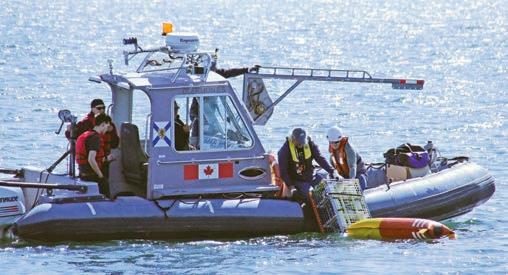
underwater acoustic technology tested as part of the Whalesafe Gear (Ropeless) Fishing Project off Newfoundland.
Atlantic Canada to harvest in a whale-safe manner while also enabling them as citizen scientists in the collection of acoustic data,” said JASCO engineering and business development manager, John Moloney. “It offers opportunities for the Atlantic Canadian industry to produce ropeless fishing systems and allows our team of partners to enable ropeless fishing internationally. The potential benefits are huge.”
Halifax-based JASCO Applied Sciences announced it has tested a ropeless fishing gear prototype off the coast of Newfoundland. Developed in partnership with U.S. non-profit Sea Mammal Education Learning Technology Society (SMELTS), the prototype is identical to a traditional lobster trap except for one important change. In place of ropes and surface buoys, that can entangle whales, the prototype employs inflatable liftbag technology tr iggered by a timer or an acoustic signal.
Department of Fisheries and Oceans Canada (DFO) has sponsored a portion of the collaboration through the Whalesafe Gear Adoption Fund. The goal is to require all non-tended, fixed-gear fisheries in Atlantic Canada and Quebec to use whalesafe gear by the beginning of the 2023 fishing seasons.
www.jasco.com
AUTONOMOUS ROBOT OFFERS DELIVERY SERVICE ON UWATERLOO CAMPUS
The test is the culmination of a partnership between JASCO, SMELTS and Netukulimk Fisheries Limited (NFL). To SMELTS ropeless trap technology, JASCO added its advanced underwater sound recording and analysis instruments. The goal is to demonstrate, train and enable indigenous fishers from Miawpukek First Nation (MFN) in whalesafe (ropeless) fishing and acoustic data collection.
“This collaboration will enable indigenous fishers in
University of Waterloo startup, LoopX, announced it will launch an autonomous delivery robot on the university campus. Called GoosEX, the company’s bright red electric delivery vehicle measures 1.2m by .8m by 1.2m and can
Jasco Applied Sciences’
Photo credit:
Jasco Applied Sciences
handle payloads up to 100kg. According to its developers, it can travel up to 40km on a single charge, at a maximum speed of 10km/h.
To reach its destination, the robot is equipped with various autonomous technologies, including LiDAR and longrange radar, as well as multiple cameras, ultrasonic sensors and a GNSS module to give the robot 360-degree awareness and centimeter-level positioning. For safety, the robot includes lights, bumpers, e-stops and an audio pedestrian alert function.
Capable of multiple deliveries at once, the robot contains six compartments, that can contain pizza, or groceries, pharmacy or other smaller items. When the robot arrives, customers are sent a code that unlocks their particular compartment.
Founded by UW mechatronics
engineering doctoral candidate, Chao Yu, the company recently won the top prize in the 5G Transportation Challenge. Sponsored by Rogers and Ontario Vehicle Innovation Network (OVIN), the contest challenged Ontario innovators to create an ultra-low latency application, using Rogers’ 5G networks, precision positioning tech and multi-access edge computing (MEC). The $30,000 pr ize, plus funding from the Engineer of the Future Fund
DOUBLE THE OPERATING LIFE.
DH/DS SERIES LINEAR GUIDES.
Maximize machine uptime with long-life Tough Steel technology.
NSK DH/DS series linear guides deliver outstanding positioning accuracy with greater capacity and operating life. Tough Steel material technology augments optimized ball circulation and rolling contact to deliver 26% higher dynamic load ratings, and double the fatigue life of our NH/NS series. Plus, the DH/DS series is dimensionally interchangeable with NH/NS, eliminating the need for redesign.
Enabling Automation in Motion & Control.
at Waterloo Engineering, have allowed LoopX to refine and demonstrate its 5G MEC-based hybrid driving system.
The company says it is fully insured to operate on private property. For its first test, it has permission to operate GoosEX on the UW campus, including the David Johnson Research + Technology Park. In the future, LoopX hopes to see its robot authorized for use on public roads and is cur rently being reviewed by Transport Canada.
In it’s Robot-as-a-Service business model, LoopX says it will partner with online delivery services and local restaurants and charge those partners delivery fee per service range. www.loopx.ai
Visit design-engineering.com for the latest new products, news and industry events.
Photo credit: University of Waterloo
Optimizing the Flow
Moldex3D’s design parameter study workflow automates multiple CAE analyses without repetitive product
BY WAYNE CHANG
To perform CAE analysis in the product design stage, a series of work items need to be conducted. First, the CAD engineer should create a geometric model in CAD software, and then output the geometric model file.
Next, the CAE engineer inputs the model file into the CAE software, and completes the settings such as boundary conditions, material selection, mesh generation and molding conditions, and then CAE analysis can be performed.
After CAE analysis, the engineer has to interpret the results. If the interpretation shows there are defects in the injection molding, it must go back to the CAD software to modify the product model, and then repeat all the same processes, until the model design is optimized for mass production. When a product design is changed, the whole workflow must be repeated.
The processes of file transfer and CAE calculation are also required, consuming a lot of time and effort. Also, such a workflow cannot be done by a CAD engineer alone. The reason is that CAD engineers have CAD editing capabilities, but lack experience with CAE analysis and optimization tools.
To solve this issue, CoreTech System’s Moldex3D software has added a new feature – Design Parameter Study (DPS) in Moldex3D SYNC – which enables automatic analysis and helps users quickly complete the entire CAE analysis process.
In the design parameter study (DPS) workflow, a set of reference groups is required for the optimization. After finding the results that need to be improved from the CAE analysis of the reference group, CAD engineers can use geometric
design modifications.
parameters, or new models directly, with their familiar CAD geometry editing tools to change geometric shapes and sizes that can affect the geometric parameters of the targeted result items.
Next, users can select the geometric features through the control factors in DPS and set the upper and lower limits and the variation amount for each feature.
Lastly, full factorial design (FFD) and the Taguchi method are provided for different combinations of design changes. Each combination contains different shape and size settings, and there can be dozens of combinations. DPS will automatically generate corresponding 3D geometries according to different size designs
After the geometries pass the inspection, the steps – including solid mesh generation, boundary condition, material and molding condition settings – will be automatically done. Then, it starts CAE analysis and performs parallel calculations on the design combination to reduce
the waiting time of CAE analysis. In this way, analysis can be automated, avoiding manual operations and the induced incorrect settings.
After analysis, DPS summarizes all design parameter combinations and analysis results on a graph. Product designers can view molding data for each design parameter combination to find the optimal one.
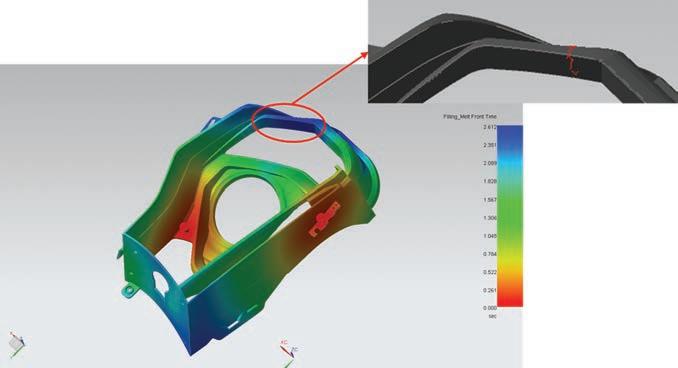
To illustrate how DPS works, consider the following case demonstration. In Fig. 1, a weld line appears at the weaker part of the product. However, by changing the product design, we can move the weld line’s position closer to a stronger structure.
First, we change the part thickness of specific areas of the CAD feature to change the weld line’s position. Use the DPS feature to optimize the change parameters of thickness. For the control factor, we would choose the characteristic of thickness changes; for the quality factor, choose backflow check. The definition of backflow check is the forward percentage of melt flow.
Fig. 1: A weld line at the weaker part of a model needs to be moved to a stronger part of the structure.
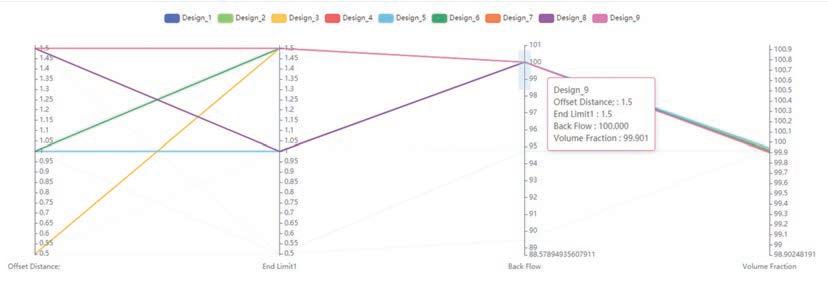
2: This parallel coordinates plot shows the relation between control and quality factors in all design combinations.
We can check if the weld lines will appear in the specific areas from this. In the end, the optimization analysis is carried out with the full f actorial design method.
Note that the so-called “Back Flow Check” means we have to specify a line segment; set its direction to record the melt front’s distribution on it and obtain
the degree of how the flow trend (direction) matches this direction (forward flow). The larger the value of the quality factor, the more consistent the direction of the melt flow direction in this area. That is, the weld line is further away or not appearing.
In the optimization analysis results, the relation
between the control factors and quality factors in all the combinations through the parallel coordinates plot.
In figure 2, there are several combinations with 100% backflow check results, so we can decide which one is the optimal combination through the quality response plot. From the quality response
plot, we can see that the higher level of the control factor is, the higher value of the backflow check will be. Thus, Design 9 is the optimal one (Fig. 2).
Besides DPS being embedded in Moldex3D SYNC, more integration with other optimization software is ongoing. With the algorithms of other optimization software and the CAE automation workflow of SYNC, users can find the optimal product design parameters.
In addition, Moldex3D SYNC is developing the gate position optimization feature, providing users with more optimization methods in the future. |DE www.moldex3d.com
Wayne Chang is an engineer in the R&D Division of CoreTech System.
Fig.
A NEW DESIGN APPROACH
Design for additive manufacturing techniques leverage 3D printing’s unique advantages to optimizes part outcomes.
BY NICK ALLEN
As design engineers and manufacturers assess the possibilities that exist for the use of industrial 3D printing to replace or, more likely, integrate with traditional manufacturing processes, there needs to be a quantum shift in the way they approach the entire design-to-manufacturing process.
Necessarily, this begins with re-evaluating product design. The subject of design for additive manufacturing (DfAM) has become a fer tile area for discussion and debate. Indeed, DfAM is a key factor that can drive the uptake of AM as a production technology insomuch as it can leverage the key advantages of 3D printing.
This issue centers around the fact that DfAM requires a very different approach compared with traditional design for manufacturing and assembly
(DfM&A). The latter focuses on designing products in such a way that manufacturing and assembly costs and difficulties are reduced. In contrast, DfAM aims to capitalize upon the unique capabilities of AM to design and optimize a product or component, thereby promoting innovation.
Key here is the utilization of the characteristics of AM to improve product functionality according to the capability of the AM process. This typically indicates that designers can tailor their designs to utilize the advantages of AM for complex geometries and light-weighting opportunities whilst taking the AM process limitations into consideration, to ensure the manufacturability of the product.
New flexibilities in design are a key benefit of 3D printing. However, it is not without its own restraints, which is why specific DfAM skills are essential to
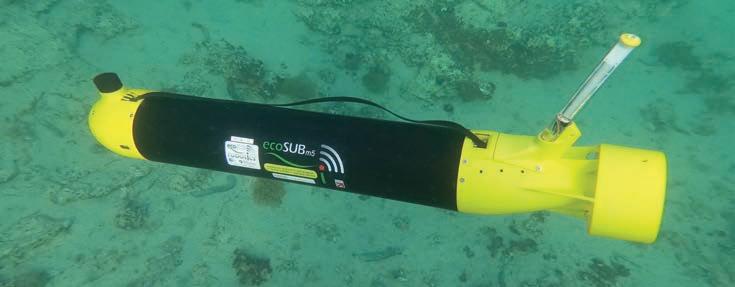
Autonomous underwater vehicle maker, ecoSUB Robotics, relies on AM to produce parts that operate in salt water and under extreme pressure while benefitted from the ability to customize designs.
successful adoption. As with any manufacturing process, there are good designs and there are bad designs, and understanding this is essential for successful outcomes. For many design engineers and manufacturers, however, this is a leap into the unknown, and it can be a barrier to adoption. But the rewards are there to be reaped.
Design Optimization
Whether for a new or a redesigned product or component, design optimization focuses on two key aspects. The first is topology optimization, which results in stronger and lighter parts. The second, part consolidation, reduces assemblies from multiple components to fewer or even a single part.
Both of these aspects are unique to AM, and cannot easily or cost-effectively be achieved with traditional manufacturing processes. Essentially, industrial 3D printing can produce components that are either impossible or too difficult/expensive to achieve using injection molding, such as components that are hollow in certain areas or products that require an internal lattice structure.
This is possible because 3D printing is an additive process, whereby material is added layer
Get Your PROTOTYPE
Off the Ground
SOONER
MISUMI components can cover up to 90% of your bill of materials with material certification available upon request.
Choose the material, surface treatment, dimensions and alterations of a component, and see instant pricing and lead time. Configured components have a unique globally-recognized part number, allowing easy re-ordering anywhere in the world.
Learn more about MISUMI’s offerings for Medical Industry.
Configurable Brackets
Linear Shafts & Bushings
Timing Pulleys & Belts
Linear Guides, Actuators & Lead Screws Couplers
by layer and material density can be altered in predetermined areas of the part. Thus, not only can some areas be hollow, but other critical areas can be reinforced. This means that 3D printing is a key facilitator when it comes to light-weighting with increased strength and functionality.
Topology optimization is a methodology that uses software tools to optimize material distribution within a design. It’s a powerful design technique that allows for the reduction of the weight of a product, by removing material where it is not required, while maintaining, sometimes even increasing the overall functional requirements of the part. This often results in complex geometries, something that only 3D printing as a manufacturing method can fulfill.
Part consolidation is another capability that the increased design freedom of 3D printing opens up. It enables the creation and production of complex internal geometries and complete complex products that incorporate the functionality of multiple components that cannot be made via conventional manufacturing technologies.
While 3D printing processes are relatively agnostic to increased part complexity, it is important for design engineers and manufacturers to understand the limitations and capabilities of the particular AM process chosen for production, the system-level design intent, and the implications in terms of inspection, validation and post-processing.
While it is generally accepted that part consolidation can improve structural performance when compared with conventional multi-piece assemblies, this may not always be the case. For example, 3D printed materials are directionally weakened, usually in the “build” direction, and this can compromise design intent and ultimate part functionality.
For manufacturers that are assessing the feasibility of the use of industrial 3D printing for manufacturing and production, there are various considerations that need to be addressed. Nobody is denying that it is a relatively steep learning curve when it comes to design and achieving optimal outcomes in respect of part functionality, cost savings, and time savings.
As a result, there are benefits for manufacturers in forming strategic partnerships with service providers, like 3DPRINTUK, that have the breadth and depth of knowledge of 3D printing that allow them to achieve project success.
Take autonomous underwater vehicle maker, ecoSUB Robotics, for example. The components the company has 3D pr inted have to operate in salt water, in very low temperatures and under extreme pressure some 2,500m below sea level, while at the same time remaining water-tight and intact.
By under standing DfAM, and the management of the 3D printing process to maximize efficiencies, the company has been able to reduce costs per part. In addition, the ecoSUB Robotics has benefited from the ability to customize designs for individual clients enabled by the innate capability of 3D printing as a direct manufacturing process.
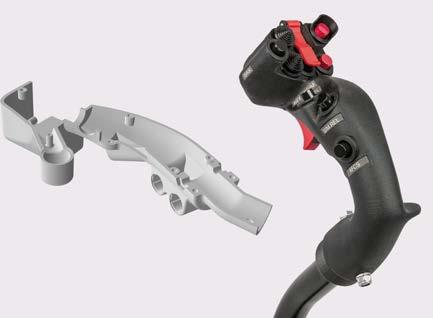
Similarly, Komodo Simulations have developed realistic helicopter control systems for home
Flight Sim Pilot and Professional Flight Simulators. These control systems are traditionally manufactured in many different parts. Leveraging AM’s capabilities, however, the controllers can be printed as a single part, which eliminates assembly and significantly reduces production costs.
Komodo Simulations leverages AM’s capabilities to 3D print its realistic helicopter control systems as a single part.
In addition, 3D printing allows for hollowed out internal parts and little to no limitation on the design of complex curved parts. The capability to produce high surface detail also means that textured grip surfaces can be included in the design.
For Brushtec, a designer and manufacturer of innovative brushwear, 3D printing has unlocked a new level of innovation and enabled the company to “design complex SLS parts and not be restricted by the limitation of standard machining.”
Specifically, the company says SLS produces precise and robust jigs and high quality machine parts for their brush production systems at a lower cost. “The cost of SLS printing is considerably cheaper then machining aluminum in-house when you factor in raw material purchase and delivery, machining center setup, machining center prog ramming, purchase of milling cutters, overheads and wages,” the company says.
For design engineers, the use of AM enables them to look past the constraints that exist around traditional DfM and DfA. In so doing, there is much greater freedom of design in terms of complexity. Parts can be produced using 3D printing that are more ergonomic and which incorporate multiple parts and features which would be impossible or prohibitively expensive to achieve via the fabrication of highly complex tooling required for injection molding. |DE www.3dprint-uk.co.uk
Nick Allen is the managing director of 3DPRINTUK.
TAILINGS ROVER
Copperstone Technologies’ amphibious Helix robot mitigates the risks of monitoring tailings ponds.
BY MIKE MCLEOD
For the oil sands and mineral extraction industries, tailings ponds are an environmental and regulatory nightmare. Often massive structures, they are designed to “temporarily” contain extraction by-products – often a mixture of water, sand and clay, as well as residual bitumen and other hazardous chemicals–until the solids in the
slurry settle out over time. While most of the clarified water at the top of the pond is re-used, what remains is a toxic sludge, called fine fluid tailings (FFT), that can take years to decades to dry out sufficiently for the pond to be reclaimed. During that “dewatering” process, environmental regulations require that tailings ponds and dams be regularly monitored.
For the Alberta oil sands, the burden is only growing. According to a 2021 report by the Alberta Energy Regulator (AER), tailings ponds currently contain 1.36 billion cubic meters of fluids that cover a surface 1.7 times the size of Vancouver. Taking regular depth readings, core samples and other measurements over that vast an area is a lengthy and difficult process.
To complicate matters, the terrain in a tailings pond can include radical extremes, from deep water to hard packed earth and dry sand to sticky mud. Sending field workers into this environment requires numerous safety and rescue measures.
“Imagine walking across a lake of peanut butter and the hazard becomes immediately obvious,” says Copperstone Technologies CEO, Craig Milne. “You can’t drive a truck or float a boat across that kind of material. And then, because these facilities can cover several square miles, you also get all sorts of debris and open pits of water in areas. It’s all of that terrain together that makes the environment hazardous and challenging.”
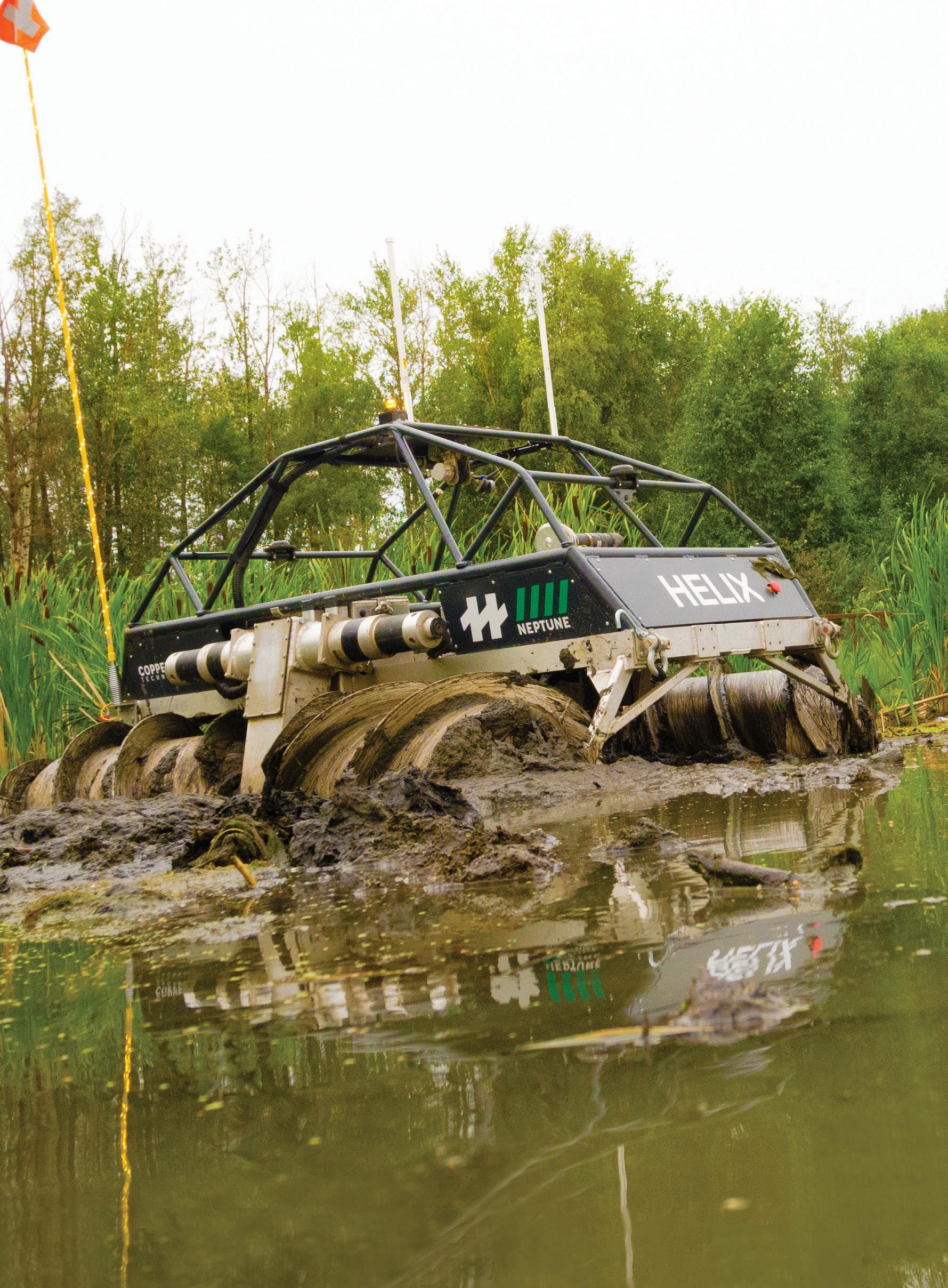
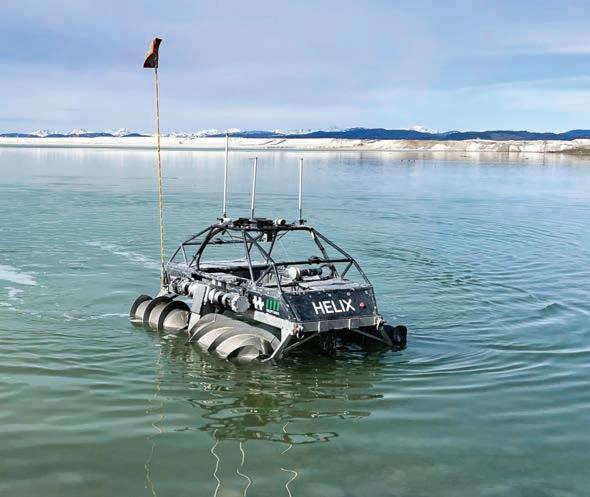
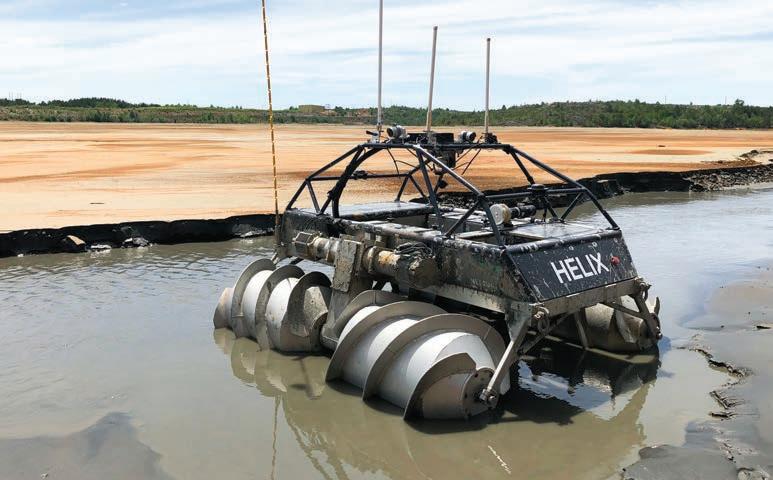
To mediate this sticky predicament, the Alberta-based robotics-as-a-service firm has engineered the HELIX all-terrain robot, a screw-driven amphibious robot that can autonomously navigate over nearly anything, its creators say.
Copper stone’s HELIX robots are distinctive for their “tires,” four hollow aluminum pontoons wrapped in helical projections that serve as both flotation and propulsion.
On snow, gravel and other hard surfaces, the robot moves similar to any wheeled vehicle – in the same direction as the rotation of the tires – while the opposing screw projections provide traction. As the terrain becomes more muddy and watery, however, the robot shifts 90 degrees to allow the screws to function as propellers.
“The design is actually a 100-year-old concept,” Milne explains. “One of the upgrades we’ve added to the traditional vehicles
Exceptional designs deserve superior components.
The developer of the original world-class linear motion systems, THK continues to redefine industry standards and to meet an ever-growing range of needs. From aerospace and machine tool to packaging and medical, THK products play a vital role in the advancement of technology and capability.
To learn more, call us at 1-800-763-5459 or visit www.thk.com.
is that we have two screws on each side that rotate in opposite directions. That’s critical in that it allows us to both steer better and also roll sideways, which is very efficient on hard ground. And then, once we hit soft material, we change 90 degrees and screw forwards so we can basically move axially through anything from snow, water or mud.”
The HELIX robot and its innovative propulsion is the brainchild of Copperstone’s co-founders, Nicolas Olmedo, Stephen Dwyer and Jamie Yuen. The three University of Alberta engineering school post-grads shared a f ascination for robotics and an advisor, mechanical engineering profession Dr. Mike Lipsett, who encouraged them to explore their entrepreneurial spirit.
Toward that end, the trio engaged with Mitacs, the Canadian not-for-profit that pairs private companies with research specialists at Canadian universities. Their first project involved designing a prototype tracking system for vehicles. Rather than accept a job to finish the project, they established Copperstone Technologies
to serve as an independent contractor.
After finishing that project, the team wanted to return to robotics. Based on conversations with an oil sands industry contact they met through Dr. Lipsett, the Copperstone founders began applying their own research on terramechanics, the study of the interaction of wheeled or tracked vehicles on soil, to the tailings pond monitor ing problem.
“At the time, I was reading a lot of books on military vehicles and space robotics, and in one of those books from the ’60s, I had seen a picture of the screwdriver vehicle,” Copperstone CTO, Nicolas Olmedo explains. “So when we were thinking seriously about how to make something move on tailings and we knew that tracks and wheels would get stuck, we thought, why don’t we try screw-drive propulsion.”
Apart from a Russian space race era text on designing a cosmonaut retrieval vehicle, however, the Copper stone Technologies team had little research to go on and had to learn the intricacies of screw-drive propulsion in the field.
“The most difficult thing was figuring out how much power we would need to rotate the scrolls in tailings because it will stick to them like very sticky yogurt or black honey,” Olmedo says. “At first, we thought to use bigger motors, but to carry the weight of bigger motors and bigger batteries, you need a bigger [robot]. And then with a bigger [robot], we probably need more power to rotate it. It became like a design cycle.”
Over the past eight years since the lessons learned from those early prototypes, Copperstone has developed its current line of HELIX robots, the AR2 and the Neptune. The heftier 800kg HELIX AR2 is capable of carrying 300 kg of gear and is typically used to carry out geotechnical surveys to test the bearing strength of the tailings pond.
The newer 400 kg HELIX Neptune is fully amphibious and has a 100 kg payload capacity. On hard land, the Neptune travels up to 15 kph, down to around 1 m/s (3.6 kph) as the terrain becomes muddier. On water, the Neptune cruises at 2-3 m/s (3-4 knots).
Both robots can last for several hours between charges, the company says, on its lithium polymer battery packs that can be swapped on site. Equipped with cameras and GPS tracking, the robots can be piloted in the field via a hand-held controller or programmed to autonomously navigate using waypoints without oversight. In addition to the HELIX robots themselves, Milne says the engineers at Copperstone have also perfected automating the test equipment the robots carry, thereby reducing the personnel needed on site to a minimum.
“The real vision in the future is actually to become much like the NASA control room,” Milne says. “Our operators could then monitor and maintain a number of different robots at a distance, but we’d also have somebody located onsite to make sure things are operating safely.”
While Milne can’t reveal particulars, he says their client list is a who’s who of the resource industr y, including work for Imperial Oil in Alberta and global mining company, Vale, to perform unmanned geotechnical investigations for its Brazilian operations
In addition to oil sands and mining, the company says its ultimate vision is to expand its services offworld.
“In a very low gravity environment, like asteroids, wheels and tracks don’t work,” Olmedo explains. “So the latest in space exploration technology is that screw drives are probably the best suited for super low or microgravity environments. We’re thinking seriously about that.” |DE copperstonetech.com
Photo credit: Copperstone Technologies
As the next level in CNC control, the TNC7 offers professional machinists completely new possibilities at every stage, from initial design to the finished workpiece. Graphical programming developed from scratch, individual customization of the user interface, perfect visualization of machined parts and the work envelope, and numerous smart functions all make your workday immensely easier.
The TNC7 assists you throughout the entire production process. It will advance your operations and add reliability to your processes. So take your manufacturing to a new level. It’s the future of machining.
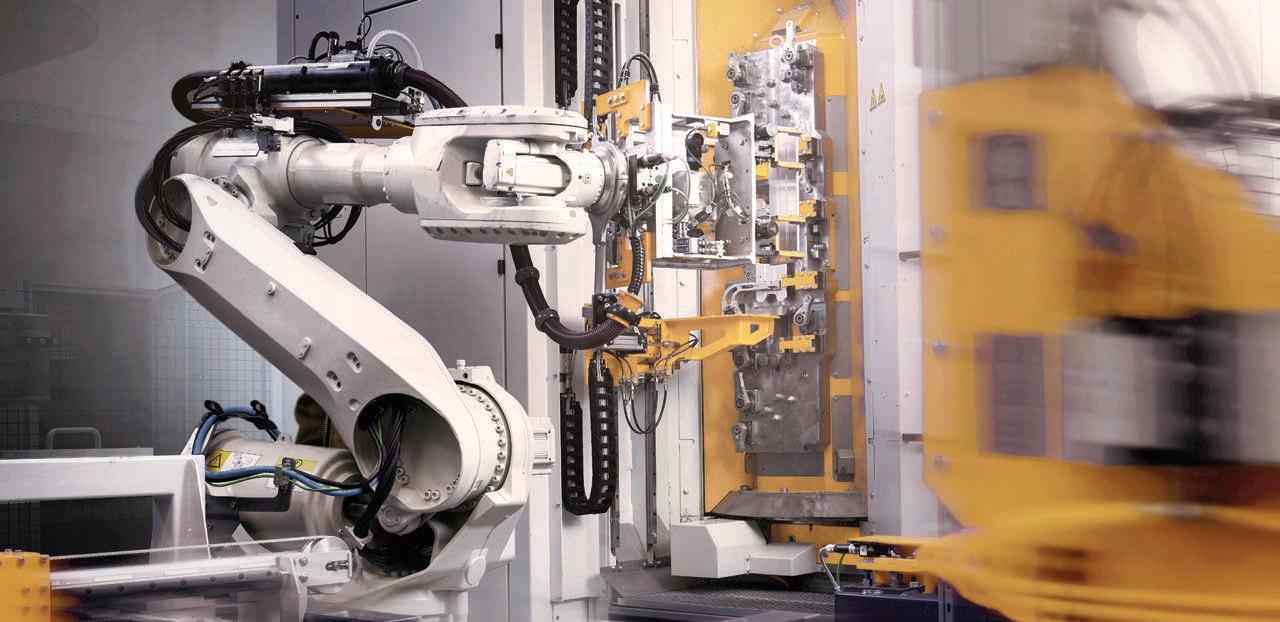
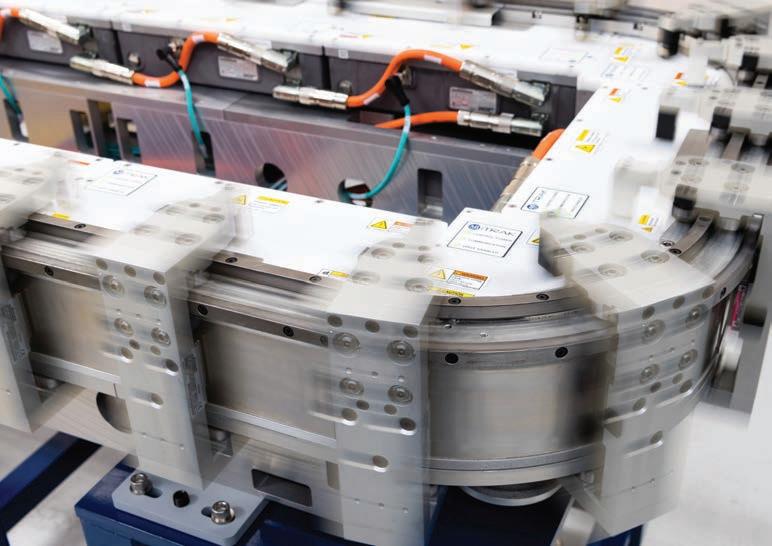
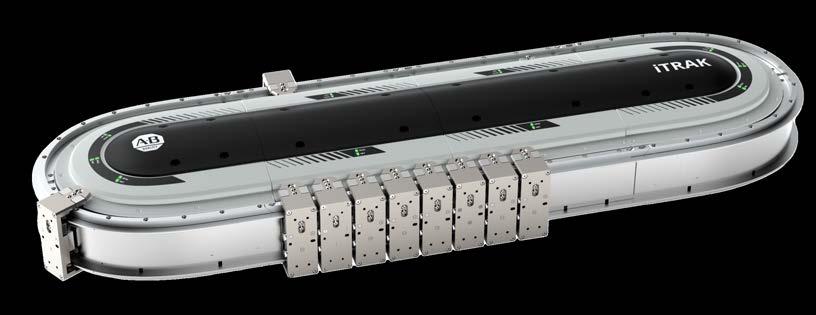
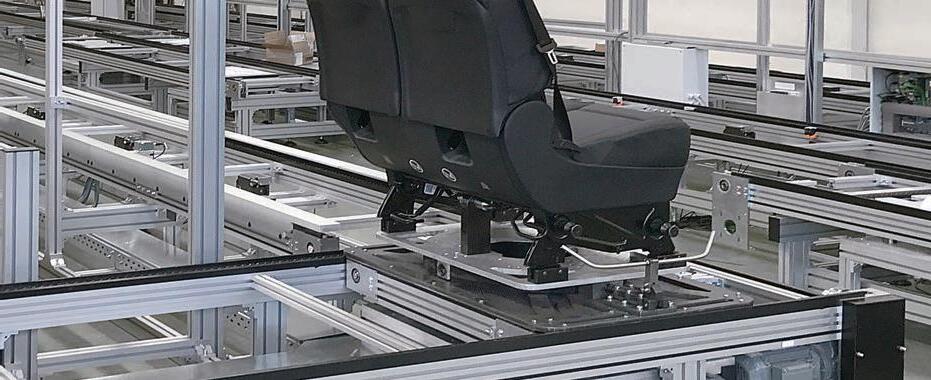
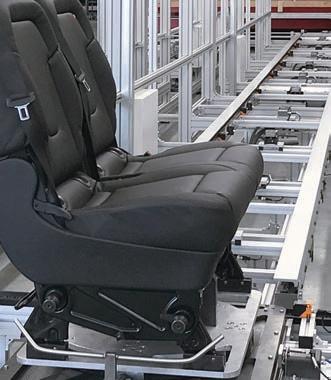
Rockwell Automation’s iTRAK smart conveyor systems help facilities increase production rates, reduce changeover time and shrink machine footprint.
SMART MOTION
How intelligent conveyor systems help manufacturers overcome production challenges.
BY MICHAELA KAUFMANN
The global pandemic created a myriad of challenges for the manuf acturing industry.
E-commerce traffic has skyrocketed since 2020, with US sales projected to cross $1 trillion in 2022—a threshold previously forecasted to be met in 2024.
This dramatic increase pressures manufacturers to produce at higher, more flexible and more rapid levels than ever before.
Increased consumer demands, paired with labor shortages, have left many production facilities scrambling to meet market needs. Fortunately, smart
motion solutions that simplify changeovers and offer advanced control of product transporting and positioning are helping manufacturers overcome these challenges with improved flexibility, faster c ycle times and increased throughput.
One type of smart motion solution that is proving to be successful is intelligent track or conveyor systems that use independent cart technology (ICT). These systems independently control multiple carts on straight or curvilinear paths — or tracks — giving better control and flexibility of a line. The systems are
the push of a button on a smart motion system with ICT, manufacturers can use software-configured profiles to perform toolless changeovers.
The system’s independent carts can also transport payloads of varying weights. And manufacturers can adjust and orient the system’s carts in a variety of ways to fit production needs. This allows the system to accommodate and efficiently produce a wide range of product types and sizes.
Smart motion systems with ICT can further boost uptime and productivity because they have fewer moving parts than conventional systems, creating fewer maintenance needs.
The systems also allow users to combine intermittent and continuous motion to help increase production rates. Full track and trace information from the system is also easily accessible to operator s. This can help prevent product losses and reduce troubleshooting time when maintenance is needed.
software configured, can intelligently and efficiently manage the flow of a wide range of products and have fewer moving parts than conventional conveyance systems.
This flexible motion solution can help production facilities increase production rates, reduce downtime for changeovers, shrink machine footprint and help improve workforce productivity.
Optimizing Productivity
Flexibility is at the core of smart motion—and that flexibility lends itself to increased productivity. With
Recovery time in the event of emergency shutdowns can also be greatly i mproved with smart motion systems. Exact cart position data allows users to restart the system immediately following a shutdown, unlike conventional mechanical systems that rely on motor s to return instruments to a home position.
Improving Operations
Food and beverage, consumer packaged goods, household and personal care, automotive and material handling operations all stand to benefit from smart motion systems. But
CoroDrill® DS20
What innovation looks like
After years of R&D and customer testing, we are convinced – CoroDrill® DS20 is truly the best indexable short hole drill on the market.
The concept consists of new designs for both drill body and inserts. It offers superior reliability and predictability with outstanding penetration rates for your 4–7×DC drilling operations. CoroDrill® DS20 is the first indexable drill to reach hole depths up to 7×DC – with no need for pilot drilling – reducing your cycle time and cost per hole.
We proudly welcome you to discover the new benchmark for indexable drilling –CoroDrill® DS20.
www.sandvik.coromant.com/corodrillds20
perhaps the most notable sector to gain from these systems is life sciences.
Facilities producing pandemic necessities like masks and vaccines have needed technology with fast cycle times, easy serialization and flexibility to output mater ials to meet never-before-seen demands.
One example is the implementation of a smart motion system at a system integrator site where they make custom solutions for medical device manufacturing. The system is designed to move lighter loads quickly and efficiently using tracks that fit together in a variety of layouts for
conveying, it would have taken about four weeks to connect and assemble all parts from a mechanical standpoint; however, because the system integrator simulated the system before installation, it took less than a week to start up and run without issue.
Outside of life sciences, other industries that have experienced high demand are also discovering how smart motion systems with ICT can help them keep pace with market needs.
Warehouse and logistics operations, for example, have needed to increase throughput to keep up with a boom in online sales.
Smart motion systems have
solutions allow for better production with higher throughput and flexibility that fit into existing layouts. For example, the solution can leverage ceiling space to address space restraints and maximize facility usage.
Other Benefits of Smart Motion
Smart motion systems are playing a critical role in helping manufacturers address their top needs.
But the systems also have many other distinguishing characteristics that not only set them apart from traditional conveyor technologies but also address top needs
f ast changeovers.
In conjunction with these capabilities, the system integrator was able to simulate the motion system before it was onsite using a library of catalogue object-oriented programming code with drag-and-drop capabilities.
This way, the programming was completed upfront, and the entire machine line was able to be simulated as a digital twin, validating the design before the first prototype of the machine was built.
This saved tremendous amounts of time and execution. With traditional
helped operators more efficiently manage these complex operations. In some cases, facilities have boosted throughput in their package sorting operations by more than 15 percent.
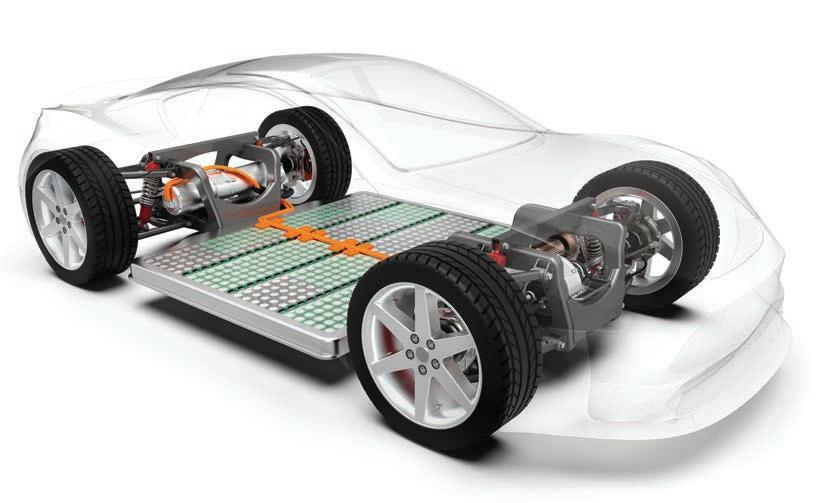
Similarly, electric vehicle battery cell production, particularly in Asian-Pacific markets, can require large amounts of manual labor. ICT enables automated production with flexibility to build different battery levels on different lines.
Semiconductor producers are also seeing increased demands and need ways to make the production process more efficient. ICT
also uses integrated safety rather than hardwired safety. This allows users to leverage functions like safe torque off with ease and confidence.
Given the above, these systems increase profitability. Shorter production r uns and decreased maintenance needs paired with lowered energy usage can help manufacturers improve productivity, efficiency and in turn profitability.
In addition, manufacturers are increasingly interested in motion control systems that are self-aware and able to analyze data and can help optimize their own performance. Smart motion control systems can now provide this capability.
The system can be provided as a collection of devices that are aware of the larger system and adjust to its own feedback. By being self-aware, the system can monitor its own health and help users make decisions about performance using clear design data. Engineers can look at this design data to improve performance quickly and effectively.
For example, improving the ease and efficiency of jobs is crucial today given the skilled worker shortage. With fewer moving parts, easy-to-use controls and toolless changeovers, smart motion systems reduce operational complexity and demands on workers.
In addition, smart motion systems reduce energy usage. Each motor module isolates energy consumption on the track to only the engaged piece, leaving the remaining elements stalled. Energy is not consumed until the mover magnet is activated.
Smart motion technology
The pandemic made it clear that manufacturers need greater flexibility, efficiency and ease-of-use than what can be provided by conventional conveyor and positioning systems. Smart motion technology is giving production facilities across sectors a more efficient, agile and intelligent approach to product flow to help them meet increased demands even with limited resources. |DE rockwellautomation.com
Michaela Kaufmann is the Global Business Manager of Independent Cart Technology at Rockwell Automation.
From sensor technology and data analytics to robotics and automation, you’ll see all of the latest innovations in fluid power, all in one place. Even better, you’ll have many opportunities for in-depth technical conversations with other engineers to spark new ideas, and you’ll be able to talk with suppliers about your specific challenges and the solutions they offer. Bring your question—and leave with smart new solutions to solve your most pressing technical problems.
LASER FOCUS
Efficient motion control boosts precision and performance of 5-axis fiber laser cutting system.
As both a machine builder OEM and system integrator, Dorchester, ONbased BOS Innovations Inc. combines its strength in delivering turnkey machines with the ability to develop solutions to retrofit and tie into existing factory lines.
“For 25 years, we have collaborated with major North Amer ican manufacturers to develop innovative, profit-driven solutions for automotive and other heavy industr ies,” says Ben Huigenbos, President of BOS. “We have developed core competencies in automated assembly, advanced robotics including welding, laser processing, coordinated motion technology, collaborative robots and quality inspection.”
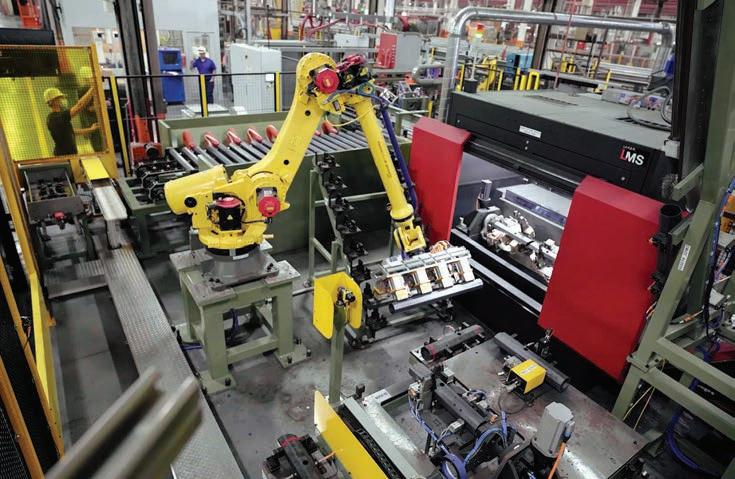
These capabilities were clear in an implementation of the Laser-Motion System (LMS) for a tier-1 automotive
manufacturer. The L-MS is an advanced fiberlaser cutting machine, equipped with a direct drive linear motion system for precision CNC processes. This high-performance machine produces complex parts with tight tolerances by leveraging up to five axes of coordinated motion.
“To make this L-MS a truly turnkey system, we needed to add a robot to loadand unload the parts and move them to stations for de-burring, vision inspection and marking,” says Steve Van Loon, Technology Manager – Laser and Motion Systems at BOS.
Flexible and modular controls
To make sure the L-MS could support a best-of-both-worlds approach for many customers, BOS made flexibility and modular ity top priorities in the initial design. In addition to a
Designed for a automotive manufacturer, the L-MS fiber laser cutting system, by Dorchester, ON-based BOS Innovations, integrates automated loading, inspection and de-burr technology.
standard 1 kW fiber laser, the cutting head can accommodate up to two 0.5-6 kW laser sources or even welding (also remote welding). The machine has options for fume extraction equipment, automated scrap conveying, automatic doors and safety scanners for operator or robotic loading.
For processing, the parts can sit on a flat bed or use a trunnion system with additional ser vo axes to rotate the workpiece 360 degrees. By adding s uch a turntable, the loading time can occur in parallel with the laser process. The flexibility even extends to footprint: The L-MS cell, a roughly 2-meter cube designed for 1,300-mmlong parts, can be expanded on all sides to accommodate workpieces of many sizes.
Providing this high degree of flexibility required robust yet, above all, adaptable controls and networking technologies that would allow the machine to integrate with other systems in the plant. Highly synchronized motor and drive technologies for the cutting axes were cr itical to ensure high part quality. Equally important was openness to enable real-time communication to the robot controller, de-burr components and vision system.
To address this, Van Loon worked with mechanical designers Riley Tomiuck and Scott McCall on the design. The team determined that the system required higher performance than a traditional fieldbus and hardware PLC could deliver, so they turned to solutions from Beckhoff.
Photo
“Anytime we face demanding servo applications, we work with Be ckhoff, so it just made sense for the L-MS,” Van Loon says.
BOS first implemented Beckhoff’s automation technologies a decade ago on a large cardboard converting system that had about 50 motion axes, and other projects followed.
Then, in 2018, the company used Beckhoff technology to build the first iteration of the L-MS, which was designed to cut SUV running boards, and became a standard offering in its portfolio.
For this project, the team worked closely with the local Beckhoff team, automation sales engineer, Dean Herron, and application engineer, Rui Zhang.
Making the cut
BOS implemented precision motion control on the L-MS, using a variety of rotary servomotor and direct drive solutions with EtherCAT communication. The machine processes octagonal steel tube parts of variable wall thicknesses, cuts a 21.5-degree angle on one end of each piece and handles two variants with either six or 12 holes while maintaining tight tolerances. The horizontal axes use Beckhoff AL2800 series linear motors, which deliver speeds up to 6 m/s and peak forces up to 4,500N.
“The X and Y axes have highly dynamic requirements in terms of acceleration, speed and accuracy, which called for linear motors,”Van Loon says.
The automotive
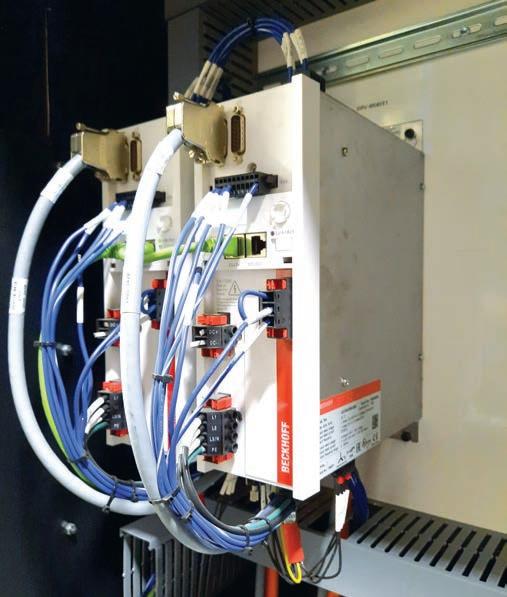
manufacturer’s machine featured a Z axis and a trunnion system, which both used AM8000 servomotors. With fast control technology, the AX5000 servo drives are ideal to support the
dynamic application, and they permitted easy integration of a smaller, third-party motor to control the theta axis on the cutting head. One Cable Technology (OCT) in the servomotors
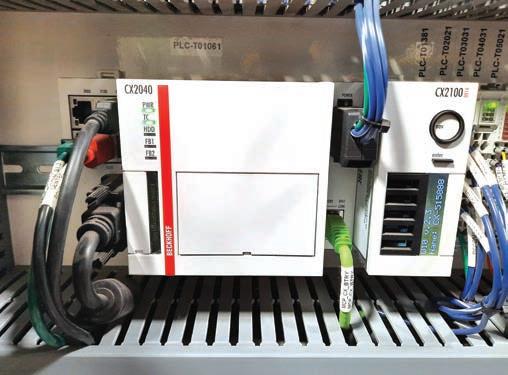
Beckhoff’s CX2040 embedded PC delivers the processing power to coordinate the five motion axes of the high-speed laser cutting machine.
Photo credit: BOS Innovations Inc.
and the servo drives reduces the cabling effort.
“Each device uses the EtherCAT function of distributed clocks to deliver exact synchronization and jitter of less than 1μs, which is optimal for coordinated motion systems like the L-MS,” Herron explains.
The broad EtherCAT I/O portfolio from Beckhoff is open to support communication to more than 30 protocols, and makes it easy to connect to other systems on the production line by adding an EtherNet/IP Bus Coupler, for example.
In addition to space-saving EtherCAT couplers and Beckhoff’s I/O terminals, BOS also implemented TwinSAFE terminals for
functional safety. This allows engineers to place safety technology directly within standard I/O segments, says Zhang.
“BOS used the EL6900 TwinSAFE Logic terminal as a safety PLC on this machine,” Zhang explains.
“This approach allowed them to cut down the time and complexity otherwise required for hardwiring safety switches. All I/Os stay on the same rack or mount onto the machine with IP67 EtherCAT Box modules. In addition, they could simply create safety logic in the standard TwinCAT engineering environment.”
TwinCAT allows engineers to select the programming languages they are most f amiliar with or that best suit the project. Here, they implemented TwinCAT PLC and CNC packages, and they appreciated the ability to use G-code, among other features.
“TwinCAT Motion Designer was also very helpful for sizing the AM8000 series servomotors,” Steve Van Loon adds.
The control platform relies on a single Beckhoff CX2040 Embedded PC that features a quad-core Intel Core i7 processor. A 15.6inch CP2916 control panel provides multi-touch operator interface and high-resolution display, which is ideal for viewing the results from the vision inspection process, among other things.
Best of both worlds
The complete L-MS system went live in the end user’s facility in late 2020. With fast controls and automated loading, the machine achieves a part-to-part cycle time of 40 seconds or less.
“The L-MS easily runs
at 2m/s with 1.25g acceleration, and it cuts holes with the highest precision that the customer says they have ever seen,” Van Loon sums up. “That’s due to the controller speed and the fine tuning we accomplished with TwinCAT Scope. Using the software oscilloscope, we could see all parameters on the screen and collect data from each axis, including following error, acceleration and deceleration, to optimize the system.”
“Coordinated motion requires a lot of data to be passed between the servo drives and motion planner. EtherCAT is really the only fieldbus capable of handling that,” Van Loon adds. The finished laser cutting machine met all requirements of the automotive manufacturer, and BOS is already building additional units for other customers. |DE bosinnovations.com beckhoff.com
This article was supplied by Beckhoff Automation.
Photo credit:
Beckhoff’s 2-channel AX5000 series servo drives support dynamic axis control and eased integration of a third-party motor to control the theta axis on the cutting head.
AUTOMATION
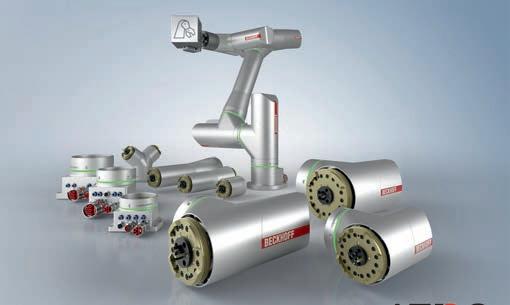
MODULAR INDUSTRIAL ROBOT
Beckhoff unveiled its Automation Technology for Robotics (ATRO), a modular robotic system with a reach of up to 1.3 meters that handles payloads up to 10kg. ATRO allows users to select the number of axes required and assemble the
robot or cobot needed. The motor modules are available in straight modules in I-shape or angled modules in L-shape, which are designed in five power sizes. Each motor module forms a complete drive system for one axis of the robot. The adapted structures are scanned by the control software, and the TwinCAT robotics functions automati-
cally create the corresponding control application. The robot’s internal media feeds for data, power and fluids are designed to support continuous rotation of all robot axes. Configurations with up to 16 robotic arms are possible. To teach the robot, users move the custom assembled robot arm into the desired positions and set them via a user interface.
www.beckhoff.com
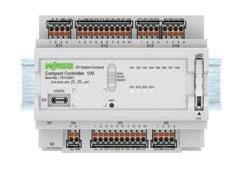
SMALL-SCALE PLC
WAGO unveiled its Compact Controller 100, a small-scale PLC with a wide variety of
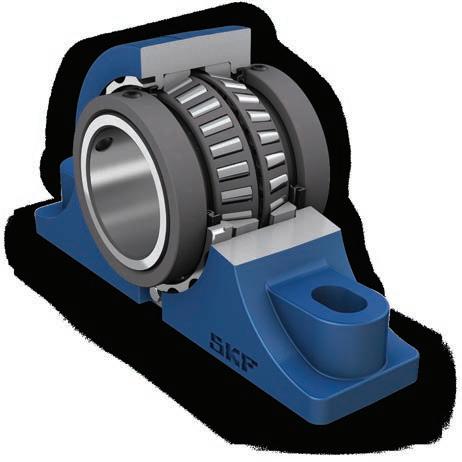
Introducing the SKF Mounted tapered roller bearing
remote I/O for use in smaller applications. The PLC can interface with industrial protocols including Modbus TCP/UDP, EtherNet/IP or EtherCAT via its two Ethernet ports. The Ethernet ports allows for use of a switch or two unique IP addresses. The CC100 uses Codesys 3.5, allowing users to program in one or more of the IEC 61131-3 compatible languages and utilize the controller’s built-in web server to develop HTML 5 visualizations. Along with its processor and microSD card slot, the CC100 includes a serial port and a variety of built-in digital and analog I/O, plus RTD inputs can be used with WAGO’s 750-362 MODBUS Coupler for I/O expansion in any application.
www.wago.com
An exponentially more reliable Type E bearing
This new line of mounted tapered roller bearings combines SKF’s world-class bearing expertise with proven CR Seals technology. The result is a wide range of robust, fully interchangeable bearings that cover fit, form and function.
IIOT GATEWAY
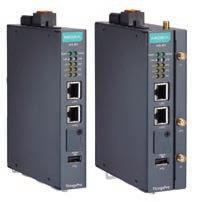
Moxa has launched its AIG-300 Series of IIoT gateways, optimized to integrate with Microsoft’s Azure IoT Edge computing platform. The gateways feature an Arm Cortex A7 dual-core 1 GHz processors and are pre-loaded with Azure IoT Edge and Moxa ThingsPro Edge software. They also feature I/O options for Ethernet, CAN, RS-232/422/485, USB and four digital (DI/DO) interfaces. For wireless communication, the AIG-300 comes with LTE cellular, GPS and Wi-Fi antenna connectors. Its DIN-rail
enclosure is made from SECC steel. The series meets Class I, Division 2 and ATEX hazardous location standards, the IP30 environment rating and IEC 600068-2 shock and vibration requirements. It also offers an operating temperature range of -40 to 70°C (-40 to 185°F).
www.moxa.com
POE INJECTOR
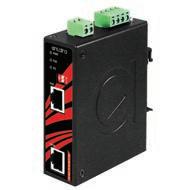
Antaira Technologies introduced its INJ-C201G-bt-10024-T, an industrial Gigabit enhanced PoE++ injector. A PoE injector functions as an intermediary to connect a non-PoE switch to PoE compliant devices. It does this by adding power to an Ethernet cable so that
any IEEE 802.3af, IEEE 802.3at, and IEEE 802.3bt PD connected can be powered. Antaira’s injector ensures full 90W PoE output, the company says. It supports an Enhanced PoE mode to supply up to 100W to the powered device, as well as a Power Booster for low voltage power inputs. Purpose engineered for industrial sites, the INJ-C201G-bt-100-24-T features a fan-less design, a temperature range of -40°C to 75°C, redundant 9 to 55VDC power inputs, and an IP30 rating.
www.antaira.com
MOTORS AND DRIVES
MICRO AC DRIVES
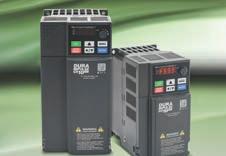
AutomationDirect announced it has added the DURApulse GS10
series of micro AC drives. The drives are available in a variety of voltage and horsepower ratings, including single-phase 120VAC models in sizes from 1/4 to 1 hp, single-phase 230VAC models from 1/4 to 3hp, three-phase 230VAC models from 1/4 to 7.5 hp, and 460VAC three-phase units from 1/2 to 10 hp. The GS10 features sensorless vector control, PID control and multiple motor support for induction motors, as well as the ability to control permanent magnet motors. Modbus RTU communication and built-in I/O, including analog, digital (with one 10kHz
pulse train input), and relay, are standard. NEMA 1 conduit boxes, DIN rail mounting kits and braking resistors are offered as optional accessories. www.automationdirect.com
LINEAR MOTORS
Siemens introduced its 1FN6 Linear Motors in three models that integrate with all Sinumerik or Simotion control systems using Sinamics drives. The 1FN3 Peak Load Motors offer short time, high acceleration/ deceleration and velocity rates comparable to S3 duty, the company says. Suited to horizontal or compensated vertical axes, they possesses a nominal force (Fn) of 8,100N; maximum force (Fmax) of 20,700N and maximum velocity 253 m/min with liquid cool- ing. The 1FN3 Continuous Load Motors offer long power-on duration for horizontal, inclined or compensated vertical axes. Comparable to S1 duty, they have an Fn of 10,375N, Fmax of 17,610N and max velocity of 129 m/min with liquid cooling. The 1FN6 Magnet Free Secondary are designed for long traverse lengths at high acceleration and velocity rates. Suited to horizontal, inclined or compensated vertical axes, it has a Fn of 2,110N, Fmax of 8,080N and a maximum velocity of 532 m/ min with air convection cooling. www.siemens.com
SERVO AND MOTION BUNDLES
Mitsubishi Electric Automation has introduced its Economy Solutions, packaged servo and motion bundles that allow for high precision motion control, the company says. Three different bundles are currently available: Compact motion, basic motion and pulse motion. Compact motion is available in up to 7.0 kWs, offers up to eight axes of synchronized motion per module and operates on the CC-Link IE Time-Sensitive Network (TSN). The Basic option uses the integrated networking of the iQ-F compact PLC to control servo amplifiers and motors. It operates over the CC-Link IE Field Basic network and allows the integration of other IE Field
Basic compatible devices. It is best suited for small systems and supports up to 16 stations. Pulse Motion operates over pulse train communication, which makes it able to communicate with almost any PLC. Also suited for smaller systems, it does not require a motion module.
https://us.mitsubishielectric.com
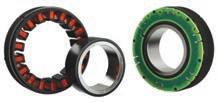
FRAMELESS SERVO MOTORS
Kollmorgen has introduced its TBM2G series of frameless servo motors that offer high-performance torque in a compact electromagnetics package. The company says the line eliminates the limitations of traditional frameless motors – low speeds and sizing issues – due to its advanced windings and
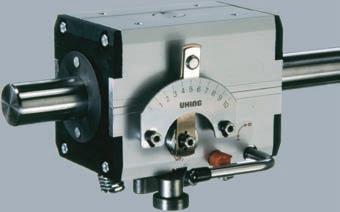
Rolling
Ring
Zero backlash. Jam-proof design.
• For applications in positioning & reciprocating motion
• Zero play –even during reversal
Uhing® Rolling Ring linear drives run on a smooth, threadless shaft that won't clog or jam. If the system is overloaded, the shaft simply slips instead of churning and grinding. The drive bearings are in constant contact with the shaft, even during reversal, thereby preventing backlash.
Example applications: metrology machines, material handling systems, spooling equipment, packaging & converting equipment. Many different sizes meet varying requirements for axial thrust & linear speed.
For more information call 1-800-252-2645
Email: amacoil@amacoil.com www.amacoil.com
Some models feature mechanical control over speed and travel direction. No programming or electronic controls are needed.
materials and the fact that they are sized to fit off-theshelf strain wave systems. The series is available in seven frame sizes with three stack lengths each—a total of 21 standard motors.
Typical applications are collaborative robots in the 3 to 15 kg range, powered at 48VDC and below. These motors are designed to perform at high speeds without exceeding the 80°C cobot limit.
They’re also available with thermal sensor options to meet the requirements of drives and control systems used in the cobot market. www.electromate.com
ACTUATORS
LINEAR ACTUATOR
AMETEK Haydon Kerk Pittman announced its 15000 Series stepper motor linear actuator. Known as the LC15/LE15, the actuator is available with an encoder option and in captive and linear versions, with a variety of resolutions ranging from 0.02mm to 0.10mm per step. The series can deliver force of up to 8 pounds (35N) without
resolution. The encoder option offers closed-loop control, an added benefit to the actuator’s small size.
www.haydonkerkpittman.com
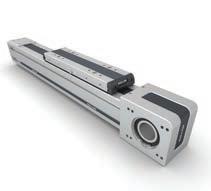
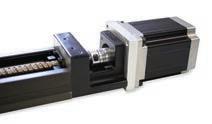
BELT-DRIVEN ACTUATORS
in gantry applications. The line exhibits repeatability accuracy of ±0.05mm with speeds up to 5 meters/ second and acceleration up to 50 meters/second2. It also features a reservoir to lubricate the ball raceway and a drive head that allows a gearbox assembly on either side of the unit. www.rollon.com
FLUID POWER
FLOW CONTROLLER
compromising longevity or cost. In addition, models can be micro-stepped for finer
Rollon has introduced its Plus System family of linear actuators that feature an anodized aluminum structure and steel reinforced driving belt. All series are available with stainless steel elements for applications in harsh environments. The line includes three actuator types: Plus System ELM, an enclosed belt drive linear actuator; Plus System ROBOT for multi-axis or SCARA robots as well as heavy load applications where high carriage pitch, yaw or roll moments are applied; and Plus System SC for vertical motion
21_0969_Design_Engineering_MAY_JUN_CN Mod: April 14, 2021 9:23 AM Print: 05/07/21 page 1 v2.5
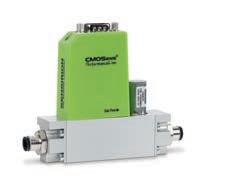
Sensirion has extended its SFC5500 mass flow controller series with four mass flow meters in ranges from 50sccm to 200slm. In addition, the company launched its SFM5500, a valveless sibling of
the SFC5500. These pressure-resistant mass flow meters are available in four flow ranges: 50sccm, 0.5slm, 2slm and 10slm. The sensor is based on the micro-thermal measurement principle and makes use of Sensirion’s CMOSens MEMS Technology. The series can cover several of the flow ranges of a traditional mass flow controller/meter in a single device. Coupled with multi-gas calibration and exchangeable fittings, the mass flow controllers/meters are available as off-the-shelf products suitable for applications in medical, analytical and industrial sectors.
www.sensirion.com
VACUUM AND PRE-VACUUM PUMP
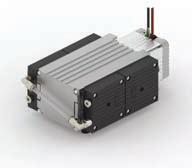
KNF unveiled its N 952 oil-free vacuum pump for use in analytical chemistry systems and as a pre-vacuum option for turbopumps. With an ultimate vacuum of up to 1.5 mbar (abs) and a free-flow of up to 36 l/min, the N 952 features four pump heads that can be connected in series or parallel as well as other combinations depending on process requirements. The pump is supported by a generation of in-house developed and produced brushless DC motors. Like all KNF BLDC motors of the digital customization series, the new generation can be digitally controlled or analog via PWM. The chemically resistant N 952 with brushless DC motor is available in both 24V or with an integrated AC/DC converter. www.knf.com
POWER TRANSMISSION
BEAM COUPLINGS
Ruland offers beam couplings for robotic applications. The couplings are offered in clamp and set screw styles with inch, metric and inch-to-metric bore combinations ranging from 3/32 inch (3mm) to 3/4 inch (20mm). They are available in 7075 aluminum for lightweight and low inertia or 303 stainless steel for higher torque and torsional stiffness. The company’s
four-beam style couplings (P- and MW-series) feature a compact design best suited to light-duty applications while its six-beam style coupling (F-series ) has increased torque capacity. Ruland’s multiple-beam couplings are designed to reduce vibration at speeds up to 6,000 rpm. Clamp-style F-series couplings feature the company’s Nypatch anti-vibration coating. www.ruland.com
LINEAR BEARING
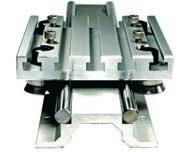
LM76 introduced its SPEED DEMON EL300, a linear rail/roller bearing wheel system that features travel lengths of 400mm to 3000mm and a 90mm base. Attached to the base are parallel 12mm h2 steel shafts hardened to RC62+2. The shafts are secured to the base every 100mm at a 45 degree angle. The carriage features four sealed, low friction, dual angular contact roller bearings. On one side of the carriage, the roller bearings have eccentric bushings
for adjusting preload. The maximum loads are: Vertical (down) –2800N static and 1400N dynamic, and Horizontal (side)- 2600N static / 1300N dynamic. The maximum moment loads are: Roll – 125N-m static and 62N-m dynamic, Pitch – 165N-m static / 80N-m dynamic, and Yaw – 82N-m static 40N-m dynamic. The height of the carriage and base assembly is 54mm, and both are clear anodized.
www.lm76.com
SENSORS
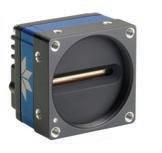
LINE SCAN CAMERAS
Teledyne DALSA announced the availability of its Linea Lite family of line scan cameras. Built for machine vision applications, the cameras present a 45% smaller footprint than the company’s original Linea camera line. Based on the company’s proprietary
CMOS image sensor design, the Linea Lite line also features Power over Ethernet and are supported by features like T2IR and the company’s SaperaLT control software. The line includes color and monochrome image sensors at both 2048 x 2 and 4096 x 2 resolutions, includes a GigE Vision interface and has maximum line rate ranging from 12.5 kHz to 50 kHz.
www.teledynedalsa.com
WIRELESS IIOT SENSOR
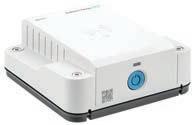
Endress+Hauser has developed the Micropilot FWR30, a wireless 80GHz IIoT sensor that combines measurement technology and digital services. The FWR30’s basic setup covers level measurement in plastic and open tanks. An optional process connection enables measurement of media in metal tanks. Besides level data, users also receive location tracking information for their storage tanks and containers. The sensor is plug-and-play and can be installed, without special tools, in less than three minutes, the company says. The unit has an integrated battery and its free space radar sensor covers measuring ranges up to 15 meters and temperatures between -20°C and 60°C. www.endress.com
POSITION SENSOR
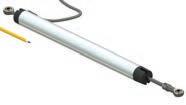
Harold G. Schaevitz Industries LLC (HGSI) has released its LPPS-36B linear potentiometer with rod ends. The position sensor is used to monitor and track the linear motion or position of a target from 350mm up to 700mm (14 to 28 inches). Designed for use in industrial and laboratory applications, the ruggedized sensors have a 36mm (1.4-inch) outer diameter housing and consist of a resistive potentiometric element made from conductive plastic. With swivel rod ends that allow for self-alignment and easy mounting, the swivel rod can be rotated up to 360 degrees. The series is resistant to dust, temperature, shock and vibration. www.hgsind.com
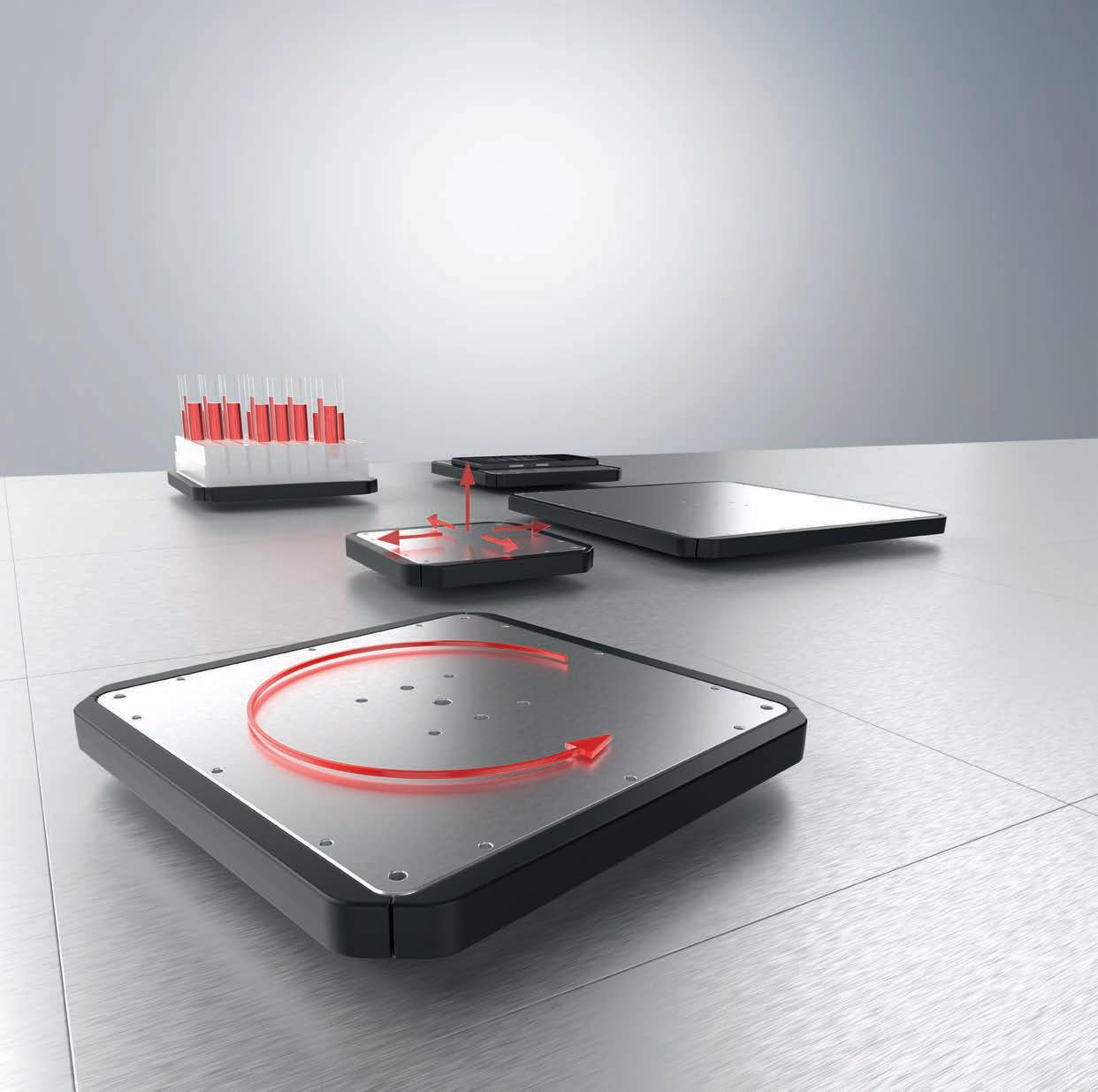
: Take flight with flying motion technology!
Flying 2D product transport with up to 6 degrees of freedom
XPlanar enables new dimensions of freedom in product and material handling: Levitating planar movers fly over flexibly arranged planar tiles accommodating nearly any track layout and path planning.
Individual 2D transport at up to 2 m/s
Processing with up to 6 degrees of freedom
Transport and processing in one system
Wear-free, hygienic and easy to clean
Free arrangement of planar tiles enabling totally customized machine and process layouts
Multi-mover control enables parallel and individual product handling
Fully integrated into the powerful and standardized PC-based Beckhoff control system