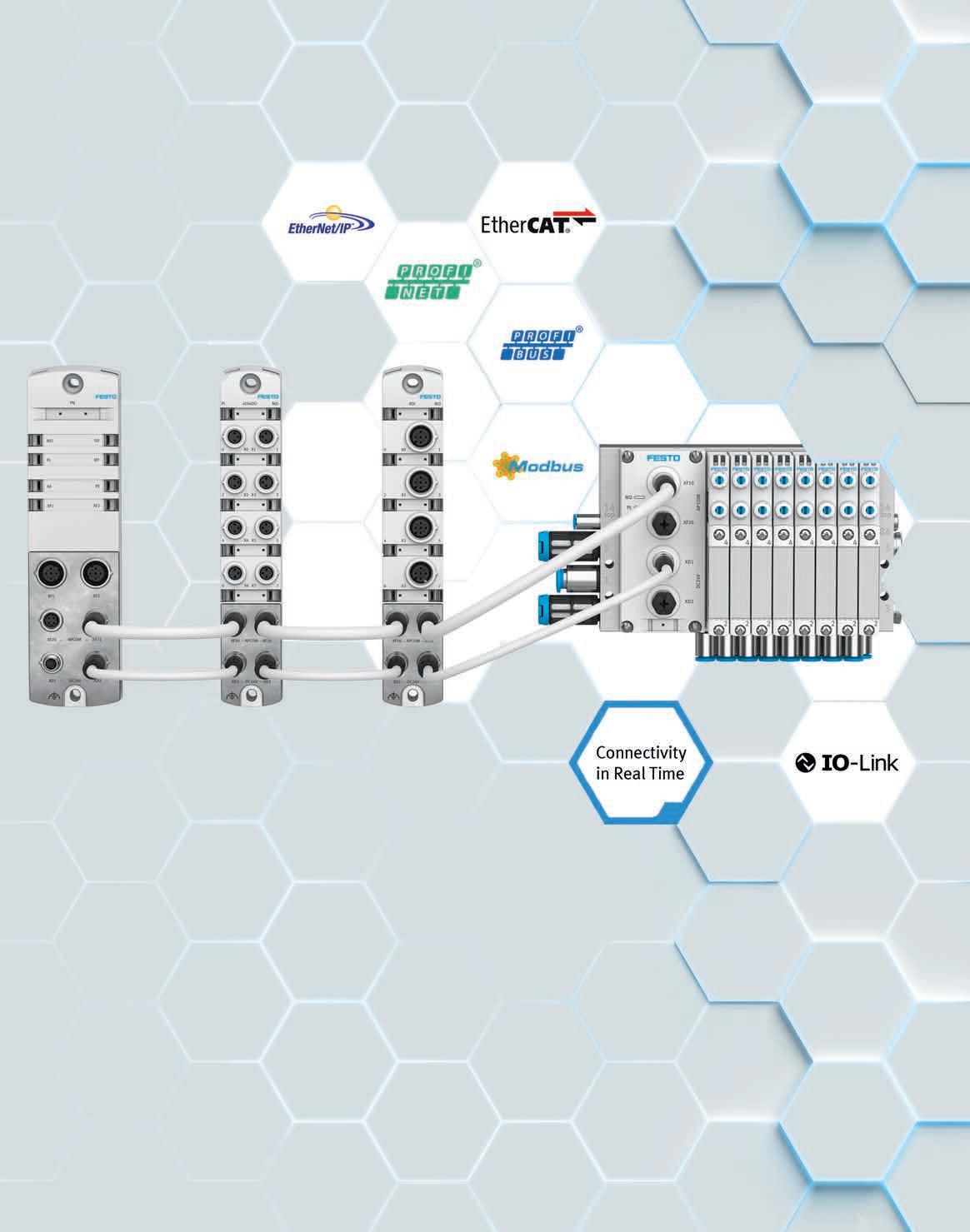
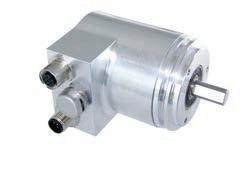
Need reliable and high speed I/O data over long distances?
Interconnectivity for pneumatics and electric automation
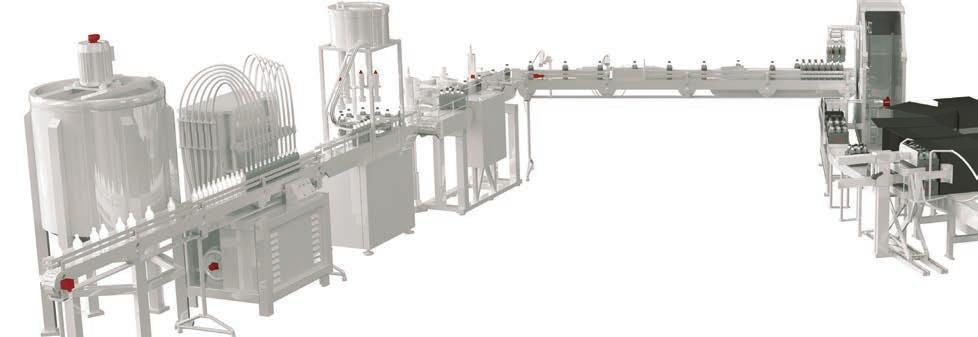
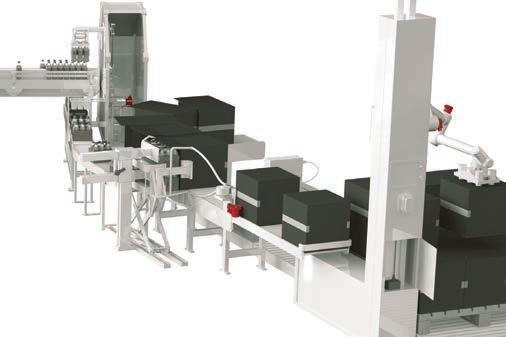
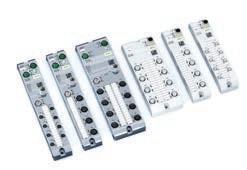
The new I/O system in IP65/IP67 enables powerful I/O modules and existing valve manifolds to be directly integrated to a fieldbus.
•Up to 500 I/O modules including IO-Link masters
•50 m cables between modules
• Simplified integration using L5X export/import on Rockwell systems
•Ability to create power zones
The importance of indoor air quality.
We are spending more time indoors, at home and at work. Unfortunately, our homes and offices trap harmful pollutants and allergens like CO2, tobacco smoke, pet dander, pollen, volatile organic compounds (VOCs,) dust, dust mites, mold spores, viruses, bacteria, and other harmful contaminants.
Siemens emphasizes flexibility in software implementation, procurement and functionality with launch of Solid Edge 2021
16 Changing the G ame
Mountain bike makers turn to engineered plastics to cut weight and resist corrosion
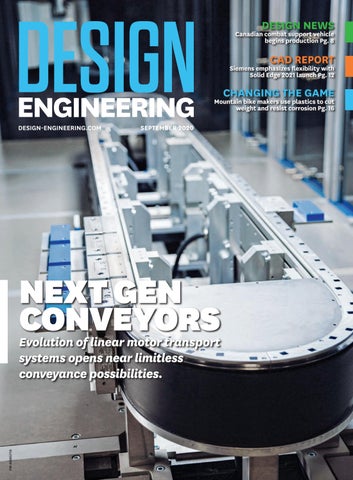
25 Next Gen Conveyors
Evolution of linear motor transport systems opens near limitless conveyance possibilities.
Columns
8 Design News
Canadian combat support vehicle begins production and other design news
19 Idea Generator
The latest in industrial products including fluid power and power transmission
23 Motion Control News
Robotics firm Solaris acquires Jetbrain and other motion control news
A New Look
The machine building industry has changed radically since Design Engineering magazine printed its first issue 1955. The technology has transformed from the purely mechanical to the mechatronic to the digital-mechanical systems the industry is on the threshold of.
Similarly, design tools used to mean a slide rule, a ruler and a mechanical pencil. Today, mechanical engineering has become as much about writing software code and napkin sketches have given way to sophisticated CAD and simulation applications, not to mention 3D printing and scanning technologies.
To stay current with these transformations, Design Engineering regularly overhauls its look to better reflect changes in the market. In this unprecedented year, which marks the magazine’s 65th anniversary, we’ve once again updated our brand, both online and in print.
As you’ll see in this issue, the magazine sports a new logo and layout, as well as a cleaner, more contemporary style with extra white space. The intent is to allow us to explore more creative, eye-catching layouts. Online, the new website design is less cluttered, exposes more of the content and implements some technical bells and whistles that we’ll build upon in the months ahead.
Beyond the aesthetics, the magazine’s content, in print and online, also continues to evolve. The magazine will still offer profiles and features about Canadian engineers and businesses with unique, disruptive and innovative applications. And we’ll keep the top notch editorial from contributors who specialize in the subjects engineers care about.
To that, we look to add deeper dives into the industrial trends and technologies entering the market and shaping the industry’s future. In addition, we hope to meld in a broader range of columnists to better reflect Canada’s shifting engineering landscape.
As the new editor, I enjoyed helping shape the new logo, layout and content as much 15 years ago as today. Then as now, print isn’t enough; readers demand more. And in the same way we ventured early into online content, social media and trade shows in the past, we also look forward to expanding into fresh editorial terrain in the future.
We hope you, our audience, like the new direction we’ve taken as we navigate the next evolutionary step in the magazine’s history. If you have any suggestions or requests for future topic coverage, please don’t hesitate to let us know.
MIKE MCLEOD Editor mmcleod@design-engineering.com
Editorial Board
DR. ALAIN AUBERTIN
Vice President, Business Development and International Affairs, Canada Consortium for Aerospace Research and Innovation in Canada (CARIC)
DR. MARY WELLS, P.ENG
Dean of the College of Engineering and Physical Sciences, University of Guelph; Chair of the Ontario Network for Women in Engineering
AJAY BAJAJ, P.ENG
President, Rotator Products Limited; Past President and Board Member, Power Transmission Distributors Association (PTDA)
JOHN LAMB
Regional Sales Manager, Wainbee Limited
DR. ISHWAR PURI, P.ENG
Dean of the Faculty of Engineering; Professor of Mechanical Engineering, McMaster University
SEPTEMBER 2020 Volume 65, No. 4 design-engineering.com
SENIOR PUBLISHER Paul Burton (416) 510-6756 • pburton@annexbusinessmedia.com
EDITOR Michael McLeod (416) 442-5600 ext. 3231 mmcleod@design-engineering.com
ACCOUNT MANAGER Ron Salmon (905) 713-4362 rsalmon@design-engineering.com
COO Scott Jamieson sjamieson@annexbusinessmedia.com
Design Engineering, established in 1955, is published by Annex Business Media, 6 times per year except for occasional combined, expanded or premium issues, which count as two subscription issues.
Printed in Canada
Publications Mail Agreement #40065710 ISSN: 0011-9342 (Print), 1929-6452 (Online)
Subscriber Services: Canada: $57.50 for 1 year; $92.50 for 2 years; $10 for single copy.
Outside Canada: USA - $140.50; Overseas - $151.00; $10.00 for single copy. Directory/buyer’s guide: Canada $28; Outside Canada $46. All prices in CAD funds. Add applicable taxes to Canadian rates.
Mail: 111 Gordon Baker Rd., Suite 400, Toronto ON M2H 3R1
From time to time we make our subscription list available to select companies and organizations whose product or service may interest you. If you prefer not to receive this information, please contact our circulation department in any of the four ways listed above.
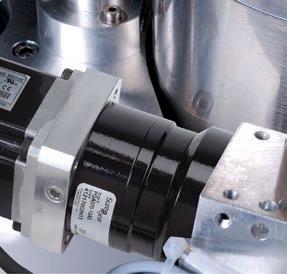
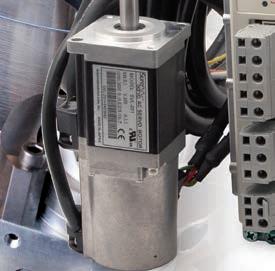
The fully digital SureServo family of brushless servo systems offers a rich set of features to cover a broad range of applications. Choose from eight standard permanent magnet servo motors that operate in combination with one of three standard servo drives.
• Precise control of position, velocity and/or torque
• Eight standard systems from 100W to 3kW
• Use with PLCs or any other host controller
• Drives feature on-board indexer and adaptive tuning modes
Add a precision planetary gearbox to increase available torque or for inertia balancing:
• Inline, right-angle, or hub style
• Best-in-class backlash
• Six gear ratios: 5:1, 10:1, 15:1, 25:1, 36:1, and 50:1
• All hardware included for mounting to SureServo motor
• Maintenance free with 5-year warranty Servo gearbox selector:www.go2adc.com/gearselect
Orders over $49 get FAST FREE SHIPPING
Our shipping policies make it easier than ever to order direct from the U.S.!
Fast free standard shipping* is available for most orders over $49 U.S., and that includes the brokerage fees (when using an AutomationDirect nominated broker). Using our choice of carrier, we can reach most Canadian destinations within 2 to 3 days.
*Free shipping does not apply to items requiring LTL transport, but those shipments can take advantage of our negotiated super-low at rates (based on weight) that include brokerage fees.
See Web site for details and restrictions at: www.automationdirect.com/canada
CANADIAN ARMOURED COMBAT SUPPORT VEHICLE BEGINS PRODUCTION
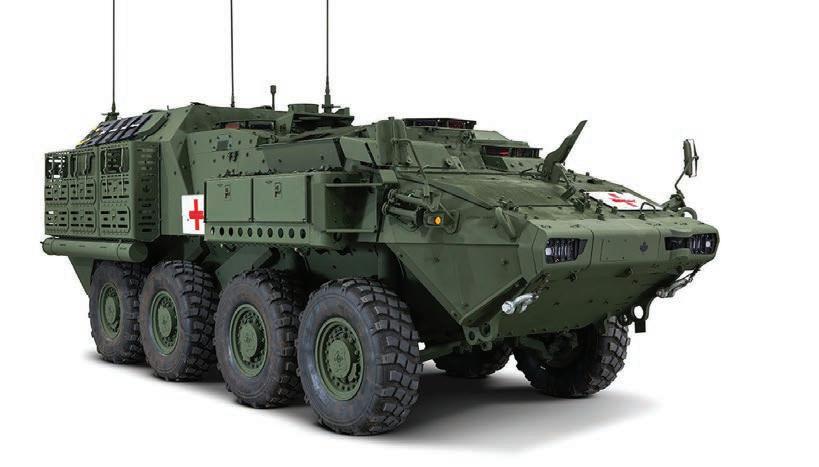
General Dynamics Land Systems-Canada announced it has begun producing the Armoured Combat Support Vehicle (ACSV) in its London, Ontario manufacturing facility.
The ACSV is destined to replace the current M113 Tracked Light Armoured Vehicle (TLAV) and the LAV II Bison and fulfill various combat support roles. The vehicle will be available in eight variants, performing various services, including ambulances, vehicle recovery, engineering, mobile repair, electronic warfare, troop carrying and command posts.
“These vehicles will form the backbone of the Army’s combat support fleet and be used on a wide range of operations including domestic disaster relief and inter national peace support missions,” said Minister of National Defence, Harjit S. Sajjan.
“Thanks to the flexibility found in our defence policy, Strong, Secure, Engaged, work on the vehicles has started years earlier than expected and ensures that we continue to support well-paying Canadian jobs and cr itical innovation in communities across the country.”
Awarded in September 2019, the project contract carries a value of approximately $2 billion for 360 ACSV, initial spare par ts, technical manuals and training. Subcontracts from General Dynamics to companies in seven provinces totaled more than $137 million.
The first ACSV is expected to roll off the production line this December, with deliveries occurring through February 2025. Testing, training and procurement of spare parts will be required before the initial vehicles are distributed to Canadian Ar med Forces bases in 2022. www.gdlscanada.com
PORSCHE 3D PRINTS PISTONS FOR FLAGSHIP 911 MODEL
Porsche announced it has begun 3D printing the pistons for the high-performance engine of its GT2 RS 911 model. According to the sports car maker, additive manufacturing produces pistons that are not only ten percent lighter than the forged pistons but also allows their structure to be optimized to handle the loads acting on them.
The pistons of the 911 GT2 RS were manufactured from highpurity metal powder using the laser metal fusion process.
“Thanks to the new, lighter pistons, we can increase the engine speed, lower the temperature load on the pistons a nd optimize combustion,” explains Frank Ickinger from the advance drive development department at Porsche. “This makes it possible to get up to 30 PS more power from the 700 PS biturbo engine, while at the same time improving efficiency.”
(PS, short for Pferdestrke, is a European power output rating roughly equivalent to bhp.)
The pistons of the 911 GT2 RS were manufactured from high-purity metal powder using the laser metal fusion process (LMF), in which a laser beam heats and melts the powder surface corresponding to the part contour. Porsche initiated the joint project together with partners Mahle and Trumpf; quality validation and component performance were tested using measurement technology from Zeiss.
Porsche already uses additive manufacturing processes in several areas including a 3D-printed bodyform full bucket seat, available since May in its 911 and 718 series. In these models, the seat cushion and backrest surfaces are partly produced by 3D printing. Porsche Classic
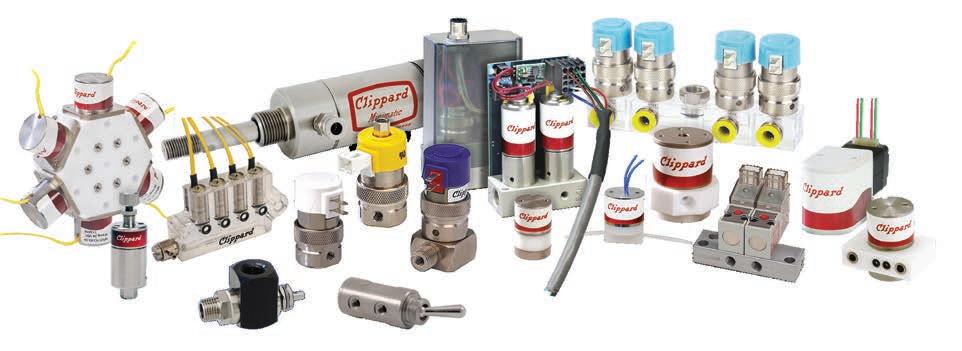
Precision Flow Control
Designing efficient systems involves much more than simply understanding a few basic principles. There is a true art to balancing the specific requirements of an application in order to achieve the desired goals in the best possible way. Help us understand the unique needs of your application and together, we’ll develop something that surpasses what any of us could have done alone.
Contact your distributor to learn more, or clippard.com to request a free catalog and capabilities brochure.
also uses additive processes to reproduce plastic, steel and alloy spare parts that were previously unavailable. www.porsche.com
CARBON ENGINEERING SELECTED AS “TECHNOLOGY PIONEER” BY THE WORLD ECONOMIC FORUM
Squamish, B.C.-based Carbon Engineering Ltd. has been selected, among hundreds of candidates, as one of The World Economic Forum’s “Technology Pioneers.”
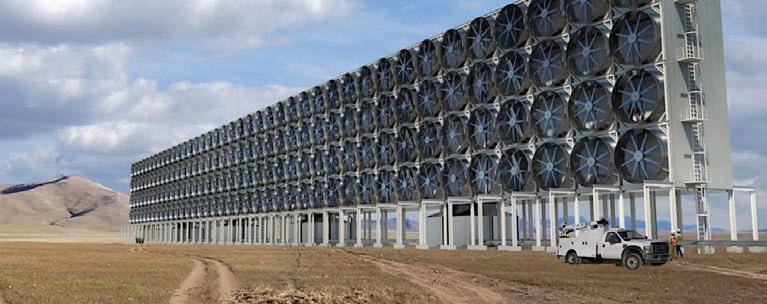
Founded by Harvard Professor, David Keith, in 2009, the Canadian clean energy company developed the CO2 Direct Air Capture (DAC) technology and is working to deploy industrial-scale facilities that will each capture one million tons of CO2 from the atmosphere a year.
The World Economic Forum’s Technology Pioneers are early to
A rendering of an industrial-scale implementation of Carbon Engineering’s Direct Air Capture technology, potentially capable of capturing one million tons of CO2 from the atmosphere each year.
growth-stage companies involved in the design, development and deployment of new technologies that are deemed to have a significant impact on business and society. Past recipients include Airbnb, Google, Kickstarter, Mozilla, Palantir Technologies, Spotify, TransferWise, Twitter and Wikimedia.
“Being selected to join the community of Technology Pioneers, alongside leading innovators and entrepreneurs, is an honour for CE,” said Carbon Engineering CEO, Steve Oldham. “We are delighted that Direct Air Capture
UNSTOPPABLE
technology is gaining global attention as a feasible, affordable and available climate change solution.”
As a Technology Pioneer, the company will participate at World Economic Forum activities, events and discussions, as well as contribute to Forum initiatives over the next two years to help define the global agenda on key issues.
MINI-FACTORY CRANKS OUT 50 FACEMASKS PER MINUTE WITHIN A SHIPPING CONTAINER
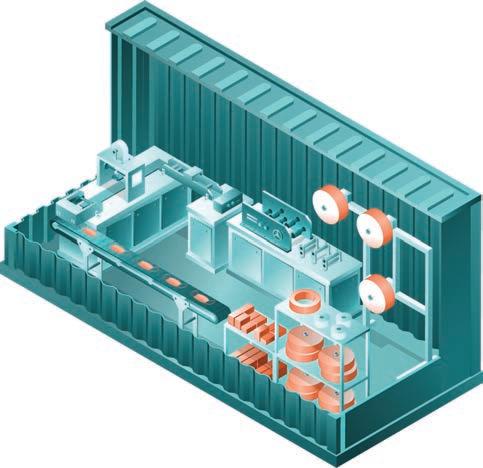
Swiss OEM, Mikron, announced the development of a mobile automated production line that can produce 50 facemasks per minute (roughly 2 million per month) but fits inside a standard 20ft. shipping container.
According to the company, 45 of its mini-factory containers would be capable of producing enough masks to supply the present needs of Italy.
Mikron’s automation system is the culmination of Project CAROLA, a non-profit initiative to address the global facemask shortage. Using the project’s open source design, engineers worldwide can construct as many of these containerized mask-making systems as needed and place them in remote areas or near locations with the highest demand.
The open source nature of the project also allows for the base system design to be adapted to suit specific installations or needs; any modifications can then be made available to other designers.
According to the project, the design is published under the CERN Open Hardware License 2.0, updated in March 2020 to broaden the legal framework to include
(Photo credit: Carbon Engineering)
application-specific integrated circuits (ASICs) and field-programmable gate arrays (FPGAs) as well as a wider range of open hardware applications.
For its Project CAROLA system, Mikron turned to project partner Festo for the development of the production line itself.The German automation company contributed engineering, as well as many of the electric and pneumatic components needed to clamp, unwind, shape and fold for the meltblown non-woven fabric the masks are made from.
The line also inserts the metal nose clip and attaches the ear loops. Controlled by a Beckhoff PLC, the system can operate autonomously for more than two hours, given adequate raw materials, the company says.
In addition to the production line inside, Mikron’s containerized system integrates air-conditioning with air purification filters to reduce the risk of viral contamination.
It can make individual masks or shrink-wrapped packs of ten thanks to an automated station developed by fellow Project CAROLA partner, pi4–robotics GmbH.
Project CAROLA partner organizations include CADUS e.V.; Open Source Ecology Ger many e.V. and r0g, the agency for open culture and critical transformation, as well as corporate supporters Mikron, Festo, pi4–robotics and Wikif actory. www.projectcarola.org
Using Project CAROLA’s open source design, engineers worldwide can construct these containerized mask-making systems to satisfy local PPE demand.
SOLUTIONS FOR MEDICAL
Compact, high-accuracy positioning through seamless mechatronic integration.
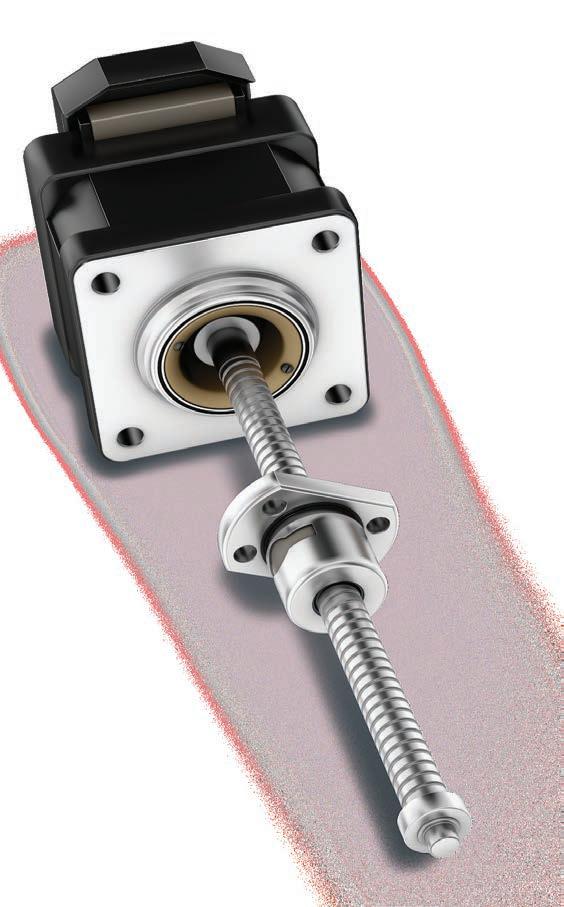
For life-critical medical, imaging and laboratory applications, NSK integrates a high-resolution motor with our precisionmachined ball screw to create the MBSA Motorized Ball Screw Actuator. The result: smooth, near-silent, extremely reliable and ultra-accurate motion, improving efficiency and throughput while lowering costs.
Stay in motion. Stay in control.
NSK MBSA Motorized Ball Screw Actuator for Compact, Precision Linear Motion
The Soft Option
Siemens emphasizes flexibility in software implementation, procurement and functionality with launch of Solid Edge 2021.
BY RALPH GRABOWSKI
Siemens holds a unique position among MCAD software firms: It’s the only one that also operates as a manufacturer. Other big MCAD vendors, like Autodesk and PTC, have presentation centers in which they demonstrate manufacturing on a tiny scale, but Siemens is a manufacturing behemoth that last year made CAD$115 billion – 20x more than its largest CAD software competitor, Dassault Systemes.
Siemens’ CAD division (now called Siemens Digital Industries Software) is also the largest CAD vendor to resist today’s notion that design software must run on the cloud, a position that is in direct contrast to competitors, who find customers still clinging to desktops irritating. For Siemens Digital Industries Software CEO Tony Hemmelgar n, design belongs on the desktop, end of story.
“We will never have to have that hard discussion with customers about them having to make a difficult transition of technologies [from desktop to cloud],” he said.
What does belong in the cloud is collaboration, he says, and so Siemens is working at making its popular Teamcenter collaborative software run on the cloud, under the name Teamcenter X. You can see how this makes sense: Engineers have powerful desktop systems running NX or Solid Edge, but collaborate with each other and fieldworkers through the cloud.
And even when it does come to the
Solid
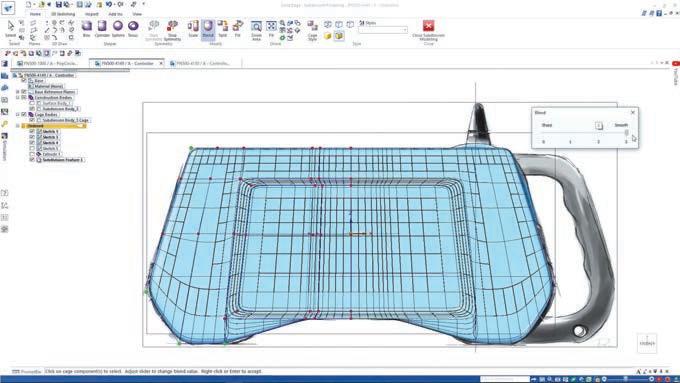
Edge 2021 now features subdivision modeling allowing users to model organic meshes and save them in the same file as parametric data.
cloud, Siemens offers unusual flexibility. You can choose to have the software hosted by Siemens (on Amazon), by pr ivate or local cloud providers, on premises, at the edge or hybrids thereof. No one else offers this.
You Pay Your Way
Siemens also insists that customers have a choice in how they pay for software, whether through permanent licenses or by subscription. Hemmelgarn says he is surprised by how many of his competitors have forced customers onto subscriptions.
Despite his declaration, the company is nevertheless pushing forward with software that can only be paid for by subscription. It turns out that CAD vendors who go to the cloud have no
Siemens Digital Industries Software is the largest CAD vendor to resist today’s notion that design software must run on the cloud, a position that is in direct contrast to competitors.
choice in the matter; software that runs non-stop on the cloud has to be paid for non-stop to cloud providers like Amazon, and so customers also have to pay non-stop.
If we understand nothing else about Siemens’ future, it’s that it will be based on Mendix. This platform with the odd name has an equally odd history: It began as a cloud-based visual prog ramming service for business applications, like human resources and scheduling. Two years ago, Siemens bought it for CAD$950 million and then applied it to CAD.
We can think of Mendix as a combination of Autodesk’s Forge API and PTC’s Onshape/Atlas platform. The no/low code app development platform has a three-fold role at Siemens: As a set of software for running businesses; an API for customers to customize; and as the underlaying technology that powers all cloudbased apps for Siemens.
“We are launching a lot of applications based on Mendix,” said senior VP of business strategy and marketing, Brenda Discher, formerly of Autodesk marketing.
What’s New in Solid Edge 2021
In July 2020, Siemens held a dedicated launch event for Solid Edge 2021, at which it emphasized the doit-all nature of its mid-range software. Presenter Dan Staples, VP of R&D, boasted that Solid Edge has “the best mechanical design in the marketplace.”
In addition to MCAD, the company also pushed that Solid Edge 2021 now encompasses a number of related design functions, including electrical design, simulation, data management and collaboration. In reality, the implementation of those functions in Solid Edge isn’t quite as complete as the marketing might suggest. While Siemens, as a whole, does possess a wide breadth of software offerings, Solid Edge 2021 depends on external applications to perform those functions
Electrical design in Solid Edge, for example, consists primarily of designing cabinets and auto-routing wire harnesses; it doesn’t actually do
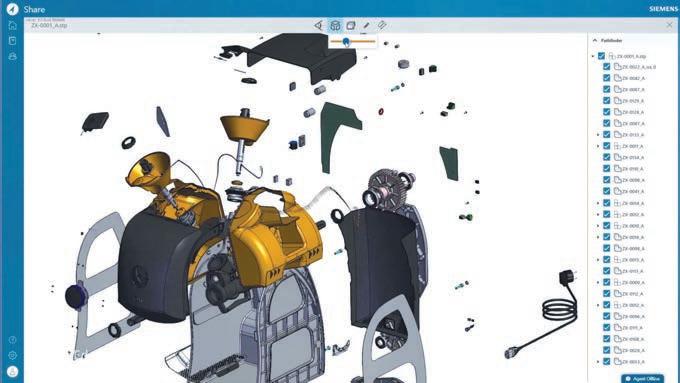
An exploded view of an assembly created in Solid Edge 2021 using QuadriSpace’s HTML 5-enabled Share3D for interactive documents.
electrical design but instead depends on importing electrical and PCB designs through TeamCenter.
Similarly, data management in Solid Edge requires parts of TeamCenter to control drawings and other files, while cloud-based collaboration depends
on the beta release of TeamCenter X. With it, users can share and view models on mobile devices and use AR (augmented reality) to place them within a physical environment.
In addition to TeamCenter’s functionality, Solid Edge 2021 enables
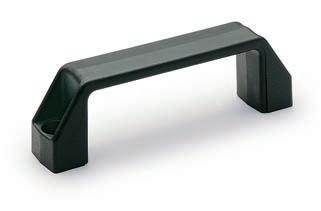
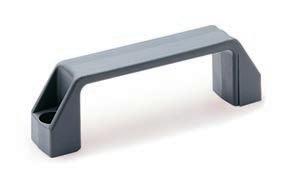
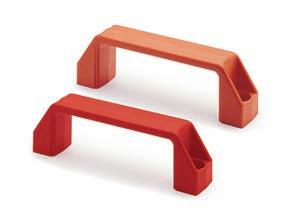
Ergonomic
high strength pull handles
Variety of handle styles and materials to suit any application
For opening/closing doors, panels and hatches
Ergonomic designs in standard colors.
Multiple materials
From many styles in glassreinforced polyamide engineering technopolymer to aluminum and stainless steel.
For tough applications
High strength, impact resistant, with documented test results.
elesa.com Toll-Free 800-374-7686
Request Catalog 080AM
simulation through a cut-down version of Siemens’s own Simcenter FloEFD while generating Technical Publications means output as PDF or through QuadriSpace’s HTML 5-enabled Share3D for interactive documents.
What’s New in Solid Edge 2021
Within stand-alone Solid Edge 2021, Siemens touted Subdivision modeling as the number-one feature. This modeling method is meant for industrial designers who make organic-looking things like the swoopy shell of a mouse or camera body. The emphasis in sub-D is looks not accuracy.
In this form of modeling, you begin with a primitive, like a box or sphere, and then interactively push and pull mesh areas to get closer and closer to the shape you want. When you need greater detail, you sub-divide sections of the mesh into denser, higher resolution areas. Sharp corners are added by manipulating edges. Solid Edge also includes a handy mirror function, so that anything you do on one half of a model is replicated in the other half to create a perfectly symmetrical result. Arriving at a curvy mouse or camera body is faster with sub-D modeling than with solid modeling, but eventually the mesh needs to work with solids. Here, Siemens offers Convergent Modeling, that is the ability to combine disparate geometr y data in a single model, including parametric and sub-D geometry as well as generative and reverse-engineered (3D
scans). Sub-D modeling is included with both the Classic and Premium versions of Solid Edge 2021, so you don’t pay extra for it.
Here’s a run down of other new features:
Modeling: To make large assemblies faster, all parts are kept in a single assembly file. Internal relationships (like constraints) are remembered when copying and pasting parts from one assembly to another. Frames can have gaps to allow for welds, and semi-automatically add inward or outward end-caps with optional offsets and chamfers. Nesting now optimizes part placement on unusual shapes.
Sheetmetal: Multiple edges receive flanges by selecting and pulling them, and partial flanges can be constructed. The decals command places images and logos, even across multiple faces.
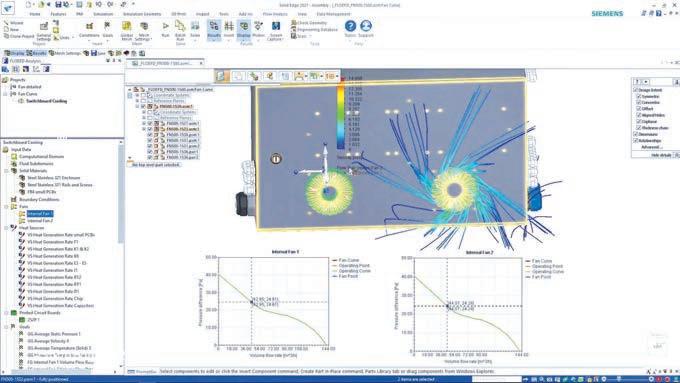
Simulation: The 2021 release adds electronics air cooling analysis from Simcenter’s FloEFD fluid simulation module. Package Creator defines the packaging and solder points of chips. Modern chips generate a lot of heat, so simulation in Solid Edge now handles the impact of air flow from cooling of fans, shown as temperature curves and iso-surfaces that represent air flow direction, velocity and temperature. Structural designs also can take temperature into account.
User Interface: The new Adaptive UI tracks commands you are working with, and then guesses at the next command you might need. CAD managers can take output from experienced
M.443
Solid Edge 2021 integrates with Simcenter’s FloEFD fluid simulation module for thermal analysis such as airflow from cooling fans.
Siemens also insists that customers have a choice in how they pay for software, whether through permanent licenses or by subscription.
users and give it to novice users as they learn to do specific tasks, with Solid Edge telling them the next command to employ.
Parts Catalog: Siemens licensed the Cadenas parts library to provide Solid Edge 2021 with 1,500 manufacturers’ catalogs. There is a visual search function that returns results sorted by percentage likelihood of matching your request.
This is an era where, it seems to me, some CAD vendors concentrate harder on collecting subscr iptions from customers than improving their software.
So it is good to see Siemens going all out by loading up this year’s release of Solid Edge with lots of new functions.
During the launch event, the host introduced Solid Edge 2021 by saying, “We bring the technologies of tomorrow to our customers today.” But some new features, like sub-D modeling and electrical design, were long needed to catch up with competitors AutoCAD and Solidworks, respectively. The improvements to fluid simulation were, I suspect, in reaction to Discovery Live
fluid simulation added by PTC to Creo last year. Other new features, like the “AI”-enabled interface, are trickle-downs from earlier releases of NX.
Nevermind. Siemens places the emphases in the right areas. Design belongs on the desktop; subscriptions ought to be optional; automatic upgrades pausable and collaboration should be hostable anywhere. These are policies that reassure customers that their future with Siemens is a stable one.
Solid Edge 2021 is expected to ship in August. It is free to students (including self-learners) and star tups (in business under three years, under $1 million in revenues). For everyone else, the 30-day free trial can be downloaded (after registration) from the Siemens PLM website. |DE https://solidedge.siemens. com
ibis Cycles,
Changing the Game
Mountain bike makers turn to engineered plastics to cut weight and resist corrosion.
BY THOMAS RENNER
There is a lot to explore in Canada and more and more people are discovering that the best way to see Canada’s splendid scenery is with mountain bikes. In total, there are 27,669 trails covering 27,145 miles in Canada, where industry statistics claim nearly 1.3 million people participate in the sport. A favorite among North American mountain biking cyclists, Whistler Mountain alone includes 70 bike trails covering 80 kilometers.
In the past decade, there has been a substantial shift in components used in mountain bikes. Many
mountain bike manufacturers are now turning to highly technical, cost-saving eng ineered plastic components that weigh less, resist contamination and stand up to the rigorous demands of mountain biking.
“We see the benefits of igus parts, especially since the bikes are put through some harsh conditions and contamination where metal parts break down faster and can cause failures, where plastics generally don’t,’’ said Megan Tompkins, the global marketing director at Crankbrothers, which has been using igus materials in its pedals since 2015. “I can see more and more manufacturers switching
two years also include igus bushings in the lower link. The bushings are in the bike’s clevis, a U-shaped connector fastened by a bolt or pin passing through the ends of the connector.
“We had always used sealed cartridge ball bearings in all of our pivots,’’ said Colin Hughes, lead engineer for ibis. “It was what the customer always wanted, but some of our highest load pivots moved less than 20 degrees. It did not seem to matter how high the quality of a ball bearing I specified. It would always start feeling notchy prematurely.”
Similarly, Crankbrothers manufactures a range of components for mountain bikes, including wheels, handlebars, pumps, pedals, and dropper posts, which allow riders to adjust the seat to adapt to variable terrain. Bushings from igus are included in several models of pedals, and they are also included in the company’s Highline dropper seat post.
to plastic components now that the industry is seeing the benefits.”
Where They are Found
Mountain bike manufacturers find similar advantages in igus products, but they are applied differently throughout the bike. For example, mountain bike manufacturer, ibis Cycles, uses igus bushing in its full suspension frames.
Founded in 1981, the company has been using igus components since 2013. Plastic bushings were first included in the Ripley, the company’s original model. Four new models of ibis mountain bikes introduced over the past
“All five Highline dropper seat posts (ranging from 80 to 170 millimeters) use igus bushings and keys,’’ Tompkins said. “Nearly all of Crankbrothers p edals use igus bearings. The clipless pedals use a custom sleeve bearing and the stamps use a custom double bushing-bearing system. All the igus parts Crankbrothers uses are for the specific design.”
Corrosion Resistant, Enhanced Durability
igus products are included in a wide range of industries: Robotics, cranes, m edical equipment, food processing, and material handling, to name a few. The advantages of igus materials also make them ideal (Photo
Mountain bike manufacturer,
uses engineered plastic bushings in the high load components of its original model, the Ripley, and four other models.
Credit: Lear Miller)
In the near future, nearly all mountain bikes are likely to
include some high-performance plastics.
for mountain bikes. The dry-running, lightweight and durability properties in engineered plastics make them suitable for almost any field.
“After the first year when the new frames that featured igus were on the market, I started receiving feedback from consumers who had taken their frames apart for maintenance,’’ Hughes said. “I got a few from the United Kingdom where the owners were shocked by how well they are holding up.”
Before switching, Crankbrothers had been using needle bearings or Delrin bushings (a thermoplastic designed to replace metal) and brass keys in its products. “We experienced some corrosion,’’ said Tompkins. “We were also trying to solve issues with durability and precision fits.”
The company completed ride testing and accelerated lab testing to see how the components would handle the demands on a mountain bike. “The igus components performed better than current polymer bearings, and there was no corrosion,’’ Tompkins said. “From our research, the results were what we had expected, but we were still quite pleased.”
Matt Floyd, igus’ West region sales manager, started introducing engineered plastics to mountain biking companies in 2012 and has seen significant growth.
“The contamination and wear with metal made it challenging for the mountain biking industry,’’ Floyd said. “It also created unnecessary weight and accelerated wear and friction. We were able to reduce costs without affecting performance and feel.”
Silencing Skeptics
Robin Wallner, who joined the ibis racing team in 2014, ranked 11th in the world in the Enduro World Series last year. In 2018, he had his best year, recording three Top 10 finishes in the Enduro World Series and at one point
rose to second in the world before a broken hand ended his season.
As a veteran rider, Wallner is
particularly attuned to his bike. When ibis said it was interested in using igus components, he was skeptical.
“I had some concerns that plastic wasn’t going to hold up against the forces that we put on our bikes,’’ Wallner said. “I wasn’t sure how it would withstand the abuse of dirt, water and other bike path debris.”
But since switching to the igus
We understand how you strive for constant product quality and optimized costs.
CONSISTENT
100%
traceability ensured with calibration services
You are poised to meet your safety and quality requirements while optimizing resources and securing process repeatability.
Improve your plant availability, and ensure quality with optimized calibration
• Traceable on-site and laboratory calibration of various parameters
• We are a leading manufacturer of process instrumentation – uniquely qualified to calibrate
• Our global, harmonized calibration standards provide consistent service quality
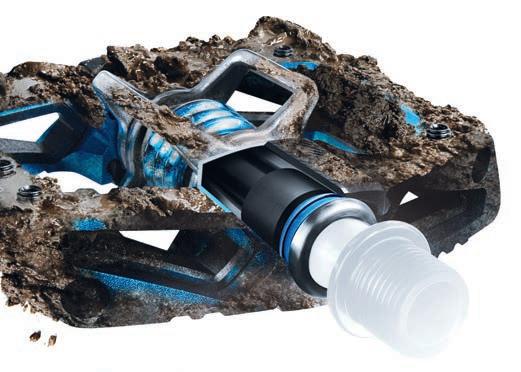
Crankbrothers includes igus components in its mallet E pedals, which eliminated corrosion in its polymer bearings.
bushings, his Ripmo V2 mountain bike has proved sturdy on the challenging mountain terrain.
“In over two years of riding, our Enduro Team hasn’t broken any bushings,’’ Wallner said. “It has definitely been holding together better than I originally thought. It’s also lighter and much easier to maintain than the bushings I previously used.”
Wallner said the engineered
The average weight of a mountain bike with metal parts. Using plastic components reduces weight and frame stress.
plastics have helped his bike become lighter, stiffer and more cost effective. While he is world-ranked, the same properties also appeal to the millions of recreational cyclists who also zip down rugged mountain terrain.
“All mountain biking technology is developed with racing, but the majority of the technology is used by recreation cyclists,’’ Floyd said. “Everything is developed with speed in mind.”
Challenging Terrain
Mountain bikers ride on terrain that includes roots, rocks, mud, grass, sticks, gullies and jumps. Bikes take a substantial pounding, and durability is put to the test every time down the mountain. A mechanical breakdown in any component could result in an injur ious spill. The average mountain bike speed on single track is approximately 10
miles per hour, but can reach speeds up to 55 MPH on downhill trails.
Rider s want their bikes to absorb the frequent bumpy paths without mechanical breakdowns, but they also demand comfor t, precise feel and light weight. Mountain bikes with metal components weigh an average of 30 pounds. Shaving weight with plastic components puts less stress on the frame and can make the bike easier to maneuver.
In the near future, nearly all mountain bikes are likely to include some high-performance plastics. Performance, durability, lightweight and less maintenance are features that resonate with every rider, whether they are competing against the globe’s best or cruising on a weekend trek. |DE www.igus.com
Thomas Renner is a freelance writer for publications in the U.S. and Canada.
(Photo
FLUID POWER
VALVE TERMINAL
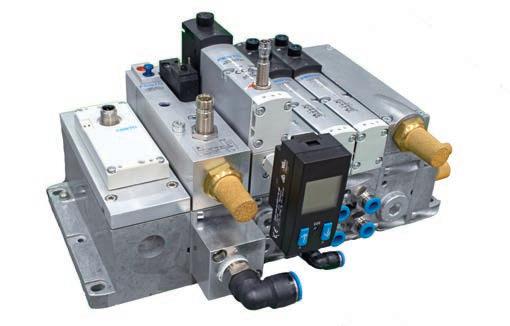
Festo has released its VTSA IO-Link valve terminal that includes an IO-Link connector. The terminal offers capacity up to 24 coils – 24 single or 12 double solenoids – in any combination of valve sizes (e.g. 18mm, 26mm, 42mm and 52mm). VTSA IO-Link also offers optional add-ons such as stackable regulators, an integrated vacuum generator, pilot air pressure control and monitoring, and a safety exhaust and soft stop valve. The terminal’s interface can also be used in combination with Festo’s CTEU network adapter to create a fieldbus network with protocols like EtherNet IP, PROFINET and EtherCAT. www.festo.com
VACUUM/ COMPRESSOR PUMPS
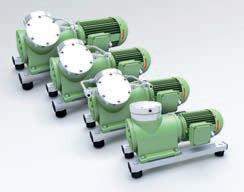
KNF’s launched its N 630 diaphragm vacuum/compressor pump series in four versions for use in industrial coolant systems, gas recycling, gas and emissions measurement/analysis and leak detection. The pump line can vacuum down to 0.74inHg (25mbar abs), positive pressure up to 174psig (12bar rel), and a flow rate up to 2.4CFM (68L/min). All models come with EPDM or PTFE-coated diaphragms and handles
ambient and media temperatures down to 41°F (5°C); head water cooling systems make them suitable for use at temperatures up to 140°F (60°C). All N 630 pumps are
equipped with IP55-rated motors designed to be operated via a variable frequency drive. The standard-model pumps are designed with a permanently attached base, combined with rubber-bonded metal shock absorbers. The series fulfills the criteria for machinery directive 2006/42/EC and therefore comes with the CE marking. www.knf.com
PNEUMATIC AIR PREPARATION
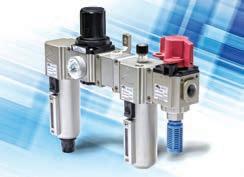
AutomationDirect announced that its NITRA line of pneumatic air filters, air regulators, air lubricators, air relief valves and combination air filters/
regulators are now available with larger gauges and a quarter-turn twist off feature. These air preparation units are available in a wide variety of port sizes to meet a broad range of pneumatic air supply filtration, air regulation and compressed air lubrication applications. The modular design allows for combining NITRA pneumatic filters, pneumatic regulators, air lubricators and air relief valves using modular assembly brackets (purchased separately). NITRA units filters lubricate and regulate pressure for an entire plant, at the machine, or component level to ensure consistent pressure for reliable pneumatic actuation.
www.automationdirect.com
LIQUID PUMPS
High Pressure Equipment
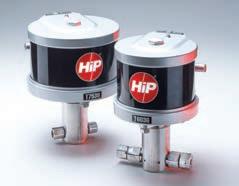
Company (HiP) introduced its T-Series pneumatically-operated liquid pumps, engineered to provide a hydraulic power source for applications up to 68,000psi (4,690bar). The T6000 series of pumps has a 6-inch air cylinder and a
maximum operating pressure of 58,000psi (4000bar), while T7500 series pumps have a 7.5-inch air cylinder and a maximum operating pressure of 68,000psi (4690bar). Both pump series are available in nine different pump ratios and four different plunger seal
materials, and have a 2.5-inch pump stroke with a maximum flow rate of 177 in3/min (2.9 lpm) at 80 CPM air drive pressure. This pump family incorporates quick access to plunger seals and the pump assembly uses a retaining ring that allows for 360° rotation for installation and service. www.highpressure.com
POWER TRANSMISSION
BALL SCREW
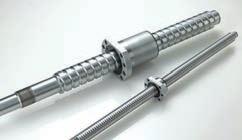
THK unveiled its Type SDA-V/ SDAN-V caged ball screw that picks up balls in the tangential direction, achieves rotational speeds up to 5,000 RPM (DN value of 160,000 max.) and has nut dimensions that conform to DIN standards (DIN69051-5).
The product line includes fifty-nine products with a combination of shaft diameters from ø12 to ø50 and leads from 4mm to 50mm. Clearance can be selected, including an axial clearance of zero or less. The ball screw is designed with higher axial rigidity than the Type SDA-V. Shaft diameters range from ø31 to ø50 and leads from 10mm to 20mm. A double nut is used to achieve axial clearance of 0 or less. Full-ball versions are available for both the Type SDA-V and the Type SDAN-V. The Type SDA-V/SDAN-V complies with JIS (Japanese Industrial Standards) as well as ISO and DIN standards. www.thk.com
SLIDE GUIDES
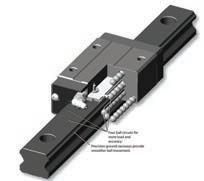
NB Corporation introduced its SGL slide guides that provide high-precision, rigidity and load capacity, the company says. The guide line ranges in length from 160mm to 3000mm. The company offers three accuracy grades and six types of blocks, depending on the mounting space and desired mounting method. The number of tracking grooves for ball elements or rows of rollers varies by type of glide and width ranges. Both retained and non-retained ball elements are available. www.nbcorporation.com
SLIT COUPLINGS
Ruland Manufacturing announced it now offers
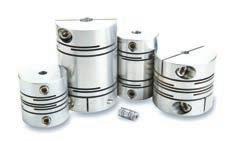
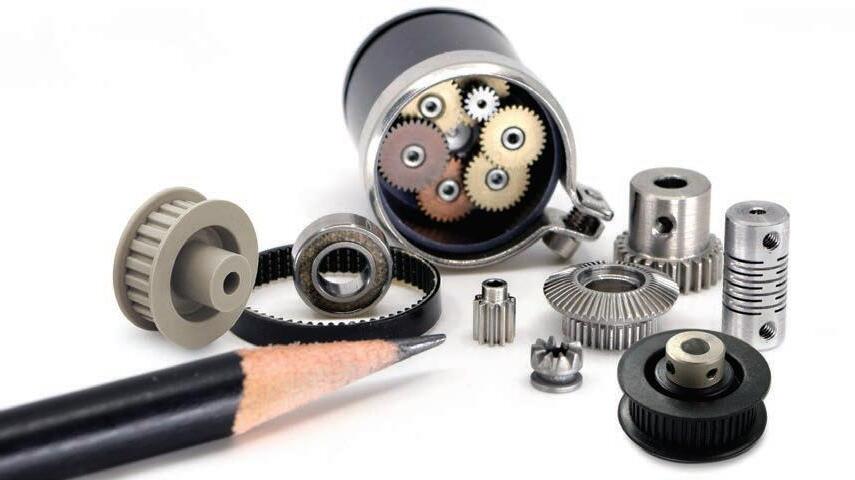
Reliance Precision’s RL- and RS-series slit couplings that feature a proprietary slit pattern that has radiused as opposed to squared edges, reducing stresses that build up during misalignment conditions and torque loads. RL-series couplings have longer lengths allowing for greater parallel misalignment and increased torsional stiffness. RS-series couplings are designed to fit in compact spaces and offer parallel misalignment capabilities. Both series have a zero-backlash balanced design allowing for speeds up to 70,000 rpm. The slit couplings are available in clamp screw and set screw
designs with inch, metric and inch to metric bore sizes ranging from 1/8 inch to 3/8 inch and 1.5mm to 12mm. The couplings are also RoHS3 and REACH compliant.
www.ruland.com
MOUNTED BEARINGS
KML Bearing USA introduced its Stand-Out Mounted Bearings, which incorporate a Poly-Guard IP69K Sealing System, offering protection against contamination. The bearing’s design eliminates edge seams and crevices at bearing mountings. The company’s IP69K sealing
system passed tests of 1500 PSI without ingress of water. The system also prevents the ingress of dust and bacteria, especially during high-velocity, high-temperature chemical washdowns, as mandated by the Food Safety Modernization Act (FSMA). Besides, the seal helps prevent corrosion of the critical bearing surfaces while reducing chemical damage and embrittlement to critical sealing surfaces, the company says.
www.kml-bearing.com
RIGHT ANGLE GEAR DRIVES
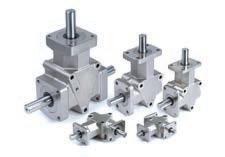
Zero-Max unveiled a line of IP65-rated right angle gear drives, featuring a nickel plated housing. Available in 1:1 and 2:1 ratios and 2-way, 3-way, and counter-rotating shaft configurations, the crown
gear drives also feature NBR covered shaft seals. Capable of speeds up to 2000 rpm, the gear drives feature heat treated AGMA Class 10 spiral bevel gears and are lubricated for life with H1-rated food grade grease. Additional features include a sealed and tamper proof design, precision hardened and ground ball bearings, and operating temperature ranges from -20°C to +100°C (-4°F to + 212°F). The drives are available with 1:1 and 2:1 ratios and shaft diameters of 3/8, 1/2, 5/8, 3/4 and 1-inch.
www.zero-max.com
ELECTRICAL POWER SUPPLY
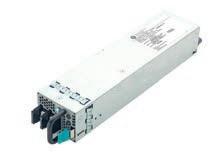
ABB has expanded its line of MPR power supplies. Both the AC-input and DC-input power supplies feature 9-by-2.15-by1.57-inch form factors. The products have power densities of 23W/inch3 and energy efficiencies up to 94 percent at 50 percent load (80 PLUS Platinum grade). The AC-input version features a front 90-to-264-volt AC input, rear +12-volt DC output and a 700W output power. The DC-input version allows for a front -44 to -72-volt DC input and a rear +12-volt DC output with a 700W output power. Both operate a tempera ture range of -5°C to 50°C.
https://global. abb
MOTION CONTROL NEWS
Solaris acquires Jetbrain to expand healthcare robotics offering and other motion control news p.23
NEXT GEN CONVEYORS
Evolution of linear motor transport systems opens near limitless conveyance possibilities p.25
MOTION CONTROL PRODUCTS
The latest in motion control technologies including actuators, motors, drives and sensors p.28
2020 MOTION CONTROL GUIDE
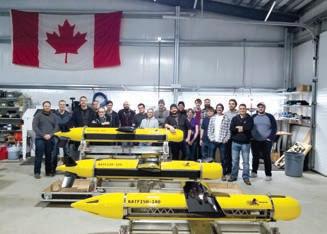
KRAKEN ROBOTICS SECURES DEAL WITH ROYAL DANISH NAVY
Kraken Robotics Inc. announced that its wholly owned subsidiary, Kraken Robotic Systems Inc. has secured a $40 million deal with the Royal Danish Navy, the largest deal in the company’s history. In doing so, the company beat out some of the defense industry’s heaviest hitters including Northrop Grumman International Trading Inc., Thales DMS France and Klein Marine Systems Inc.
Under the program, Kraken will deliver its KATFISH towed synthetic aperture sonar, Tentacle winch and Autonomous Launch and Recovery System (ALARS) as part of the Royal Danish Navy’s mine hunting upgrade program.
Kraken originally announced in October 2019 that it was chosen as
the successful bidder on a program for the acquisition of new sonar systems for an unnamed international navy. The delay since then was the result of the complaint process initiated by a losing bidder combined with a slowing of government activity during the COVID period in Europe. However, the Board of Complaints, which oversaw the complaint process, has ruled in f avor of the Royal Danish Navy’s position on all points. https://krakenrobotics.com
SOLARIS ACQUIRES JETBRAIN TO EXPAND HEALTHCARE ROBOTICS OFFERING
Mississauga-based Solaris Disinfection Inc., makers of the Lytbot automated disinfection system, has acquired India’s Jetbrain Robotics. Jetbrain products include delivery robots that feature a secure and traceable chain of custody
for medicines and blood products, as well as patient-experience robots and UV disinfection robots.
According to the company, the addition of Jetbrain’s team enhances Solaris’s expertise in healthcare robotics while extending its offering from whole room disinfection to automated delivery, logistics and ultimately patient exper ience.
“With its growing market position and extensive distribution network, Solaris is well-positioned to help us further develop and deploy our technologies while continuing to support our mission of improving healthcare using cutting edge AMR technologies across a broad spectrum of use cases,” said Ajay Vishnu, Founder & CEO of Jetbrain Robotics, who assumes the role of CTO in the merged entity.
Since 2017, Solaris has conducted research on the effectiveness of its pulsed UV technology against communicable human respiratory viruses like novel coronaviruses (COVID-19) with outcomes proving its ability to eradicate +99% of such pathogens in as little as 10 seconds.
www.solarislyt.com
https://jetbrain.ai/
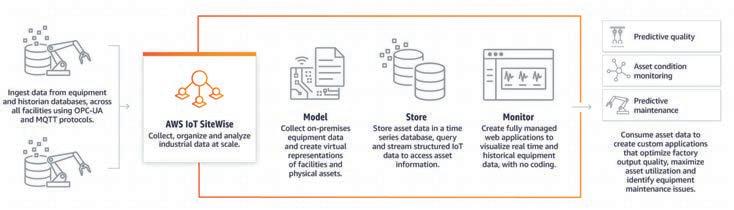
AWS MAKES IIOT SERVICE, SITEWISE, GENERALLY AVAILABLE
Amazon Web Services (AWS) announced the general availability of AWS IoT SiteWise, an IIoT service that collects data from the plant floor, structures and labels the data and generates real-time metrics.
Solaris Disinfection’s Lytbot automated disinfection system.
Initially announced at AWS re:Invent 2018, the service had since been piloted with select companies including Volkswagen, Bayer Crop Science and Pentair.
Now, AWS says any industrial customer – within select geographic regions – can use SiteWise to monitor facilities, compute performance metrics and create applications that
analyze industrial equipment data.
According to AWS, customers begin the setup process by modeling their
Rolling Ring
Zero backlash. Jam-proof design.
industrial equipment, processes and facilities in SiteWise and then define common industrial performance metrics. The service then computes and reports those metrics at a defined interval.
All uploaded data and computed metrics are sent to a fully managed time series database, which is designed to store and retrieve time-stamped data with low latency.
• For applications in positioning & reciprocating motion
• Zero play –even during reversal
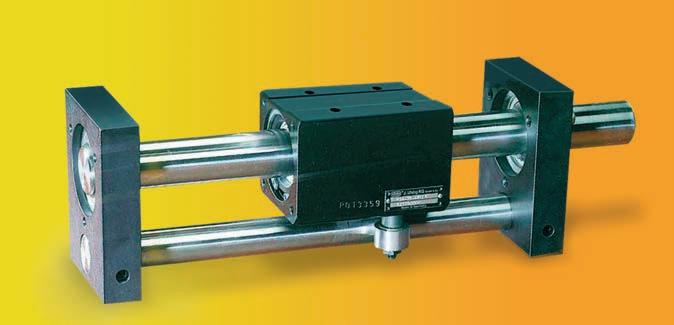
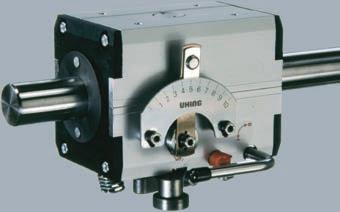
Uhing® Rolling Ring linear drives run on a smooth, threadless shaft that won't clog or jam. If the system is overloaded, the shaft simply slips instead of churning and grinding. The drive bearings are in constant contact with the shaft, even during reversal, thereby preventing backlash.
Example applications: metrology machines, material handling systems, spooling equipment, packaging & converting equipment.
Many different sizes meet varying requirements for axial thrust & linear speed.
For more information call 1-800-252-2645
Email: amacoil@amacoil.com www.amacoil.com
Some models feature mechanical control over speed and travel direction. No programming or electronic controls are needed.
From within the SiteWise console, customers can also create custom web applications (i.e. dashboards) to visualize metrics in near real-time on any web-enabled desktop, tablet or phone.
In addition to using software running on an edge device, the company says SiteWise provides interfaces for collecting data from modern industrial applications through MQTT messages or its APIs.
The service is currently available in certain regions: The US East (N. Virginia), US West (Oregon), Europe (Frankfurt), and Europe (Ireland).
aws.amazon.com
MOTION INDUSTRIES ACQUIRES TRC HYDRAULICS
In August, industrial component distributor, Motion Industries, announced the acquisition of New Brunswick-based hydraulics supplier, TRC Hydraulics. In business since 1986, TRC Hydraulics has served the Atlantic Canada region with sales and repair facilities.
In addition to distributing hydraulic product lines, the Canadian company manufactures and maintains hydraulic components and systems, as well as customized hydraulic and mechanical solutions.
With annual sales of $6.0 billion, Motion Industries has over 550 locations, including 15 distribution centers throughout North America and ser ves more than 200,000 customers from multiple industries. |DE MotionIndustries.com
NEXT GEN CONVEYORS
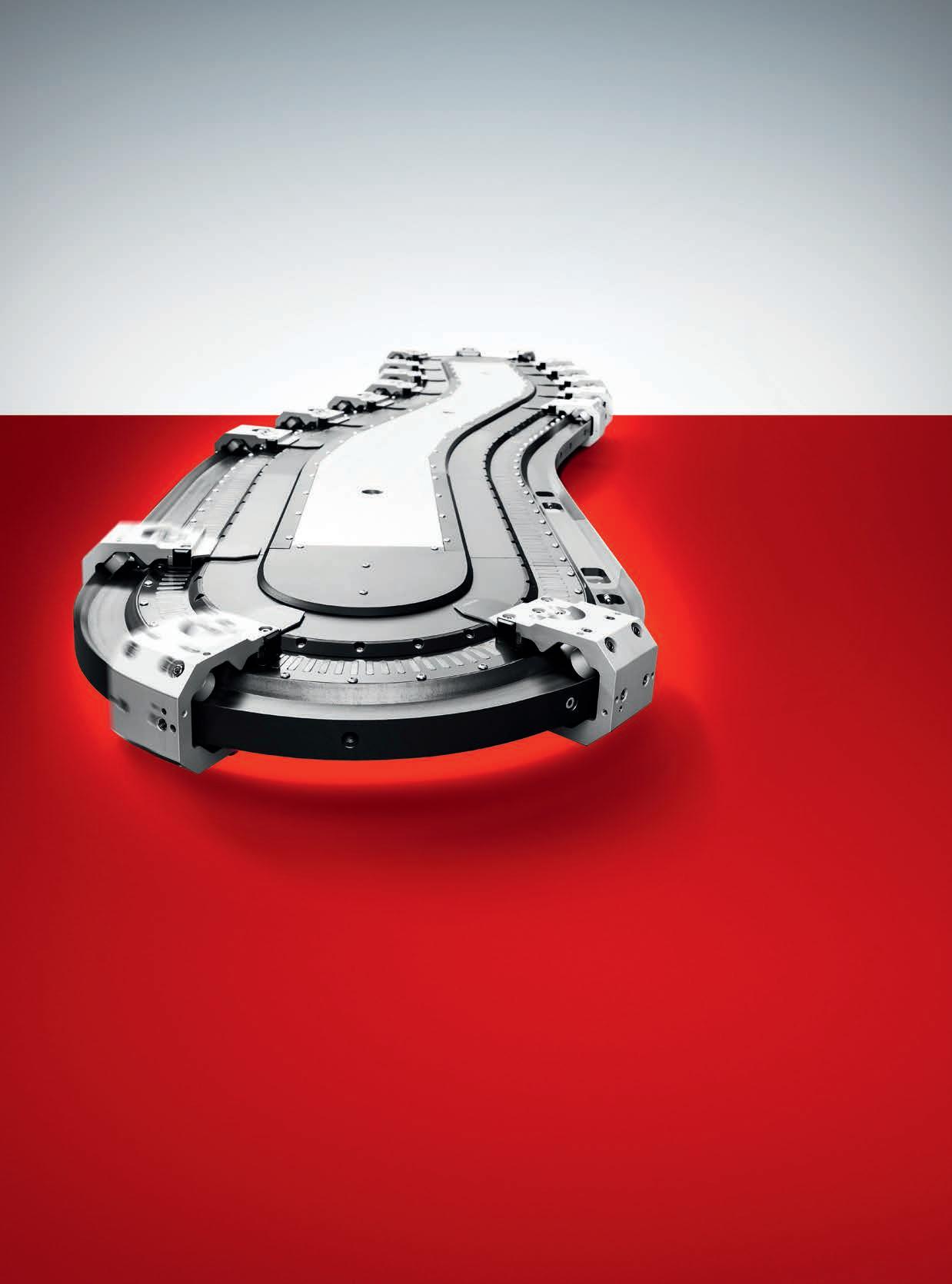
Evolution of linear motor transport systems opens near limitless conveyance possibilities.
Since ATS Automation released its first SuperTrak system in 2001, linear track conveyance systems (also known as smar t conveyors or linear motor transfer systems) have become an increasingly popular upgrade from conventional belt or chain driven conveyor systems.
In the early days, ATS and MagneMotion (now part of Rockwell Automation) where the only game in town but have been joined by Beckhoff, Festo and Bosch Rexroth, as well as a few smaller players. In addition, the product segment has continued to mature in that suppliers have differentiated their systems to stand out from the crowd.
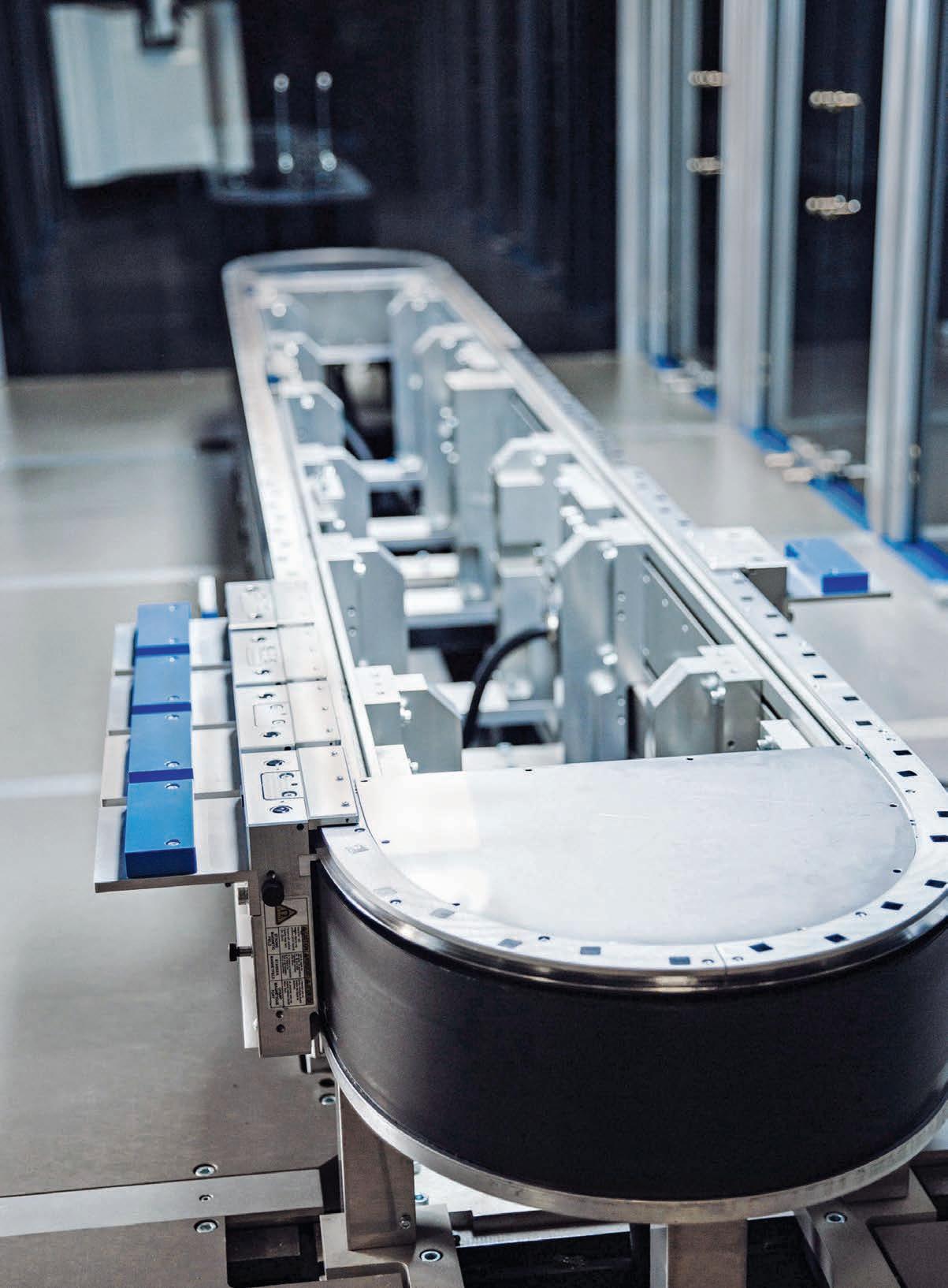
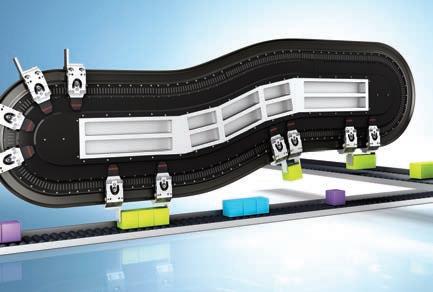
Whoever makes the system, they all operate based more or less on the same principle. At the core is a track composed of straight and/or curved linear motor segments. Joining them together allows for the conveyor’s path to be configured in various geometries to suit different applications. Unlike most traditional conveyors, smart track systems don’t need to be horizontal but can be oriented vertically or tipped on end.
Along the edge of the track run the shuttles (aka movers, pallets or carriers depending on manufacturer). These movers are affixed to the track primarily by wheels but aided by the attraction between the linear motors’ electromagnetic coils and permanent magnets in the shuttle. By manipulating the activation of the coils, each shuttle can be programmed to move around the track, individually or in groups, at different speeds, accelerations and/or directions, as needed.
In part, it’s that independent motion that makes linear motor transport systems a powerful solution. Asynchronous motion allows shortening cycle times since parts don’t all progress through the manufacturing process at the same set pace. Adding in the high speeds and acceleration/deceleration possible means par ts spend less time moving between work stations.
A related but less obvious strength of these systems is their micron level precision, enabled by a linear encoder scale on the track. Consequently, the conveyance system can participate in the manufacturing process itself. For example, the x-axis motion of the shuttle can be coordinated with motion at a process station to simplify tooling operations. These systems also possess built-in collision avoidance, auto-queuing and auto indexing capabilities.
Beyond speed and independent motion, linear motor conveyance systems are also highly
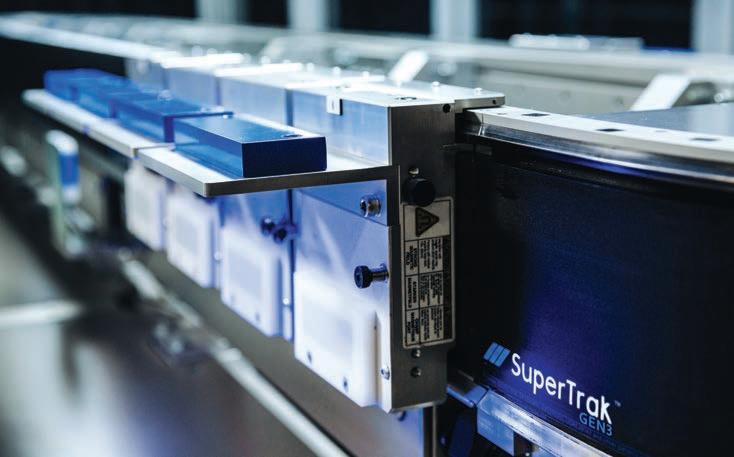
As the original “smart” conveyor, the ATS SuperTrak Gen3 has matured considerably since its introduction 20 years ago.
flexible; tracks can be scaled by adding or removing track and shuttles or reconfigured to new geometries. In addition, reprogramming happens quickly by swapping motion profiles in software, thereby enabling multiple product lines and shortened change over. These systems also consume less electricity and require less maintenance than conventional conveyors since the wheels are the only moving parts.
One of the often overlooked advantages linear motor transfer systems afford, says Ben Hope, product manager for SuperTrak CONVEYANCE at ATS Automation, is the ability to condense an operation’s footprint.
“Footprint size effects revenue per square foot, especially in areas where real estate is expensive,” he says. “Compared to transitional synchronous conveyance, independent asynchronous shuttle control provides the means to change shuttle pitch allowing the system to use only the space required.”
ATS SuperTrak
Now in its third generation, the performance of ATS’ SuperTrak has improved substantially since it’s first iteration. For example, shuttles on the current SuperTrak Gen3 can handle payloads up to 10kg (up from 1kg in the first generation) while the maximum speed each shuttle now reaches is 4m/s unloaded, (up from 1m/s).
Similarly, each shuttle’s maximum acceleration is now 39.2m/s2 (4g) with a 1-kilogram payload. With a 10kg load, acceleration tops out at 1g. In addition, the SuperTrak Gen3 features fully controllable corner segments, rather than the rotating drums on the company’s previous iterations.
F rom a control engineering perspective, each shuttle functions as a separate servo axis. To program them, ATS provides its TrakMaster software in which engineers can digitally model a track design and simulate the overall conveyance sequence by fine tuning shuttle motion, acceleration, stop locations and shuttle coordination. Once the bugs are worked out virtually, the motion profiles can be output to integrate with Ethernet/ IP, ProfiNet or other protocol-based systems.
Beyond improvements to SuperTrak, ATS released a related linear motor conveyor line last year, called SuperTrack Micro, that expands the concept to encompass sorting and diverting operations. By positioning two oval tracks in close proximity, the Micro’s “double-sided shuttles” can switch between tracks at full speed. This allows for one or more shuttles to be diverted for additional operations or part inspection, and then merged back onto the originating track, when and if needed.
For that added functionality, the trade-off is a reduction in per shuttle payload capacity (1.5kg for a 50mm-wide shuttle and 3kg for a 100mm shuttle).
Beckhoff’s eXtended Transport System (XTS) offers the widest range of track geometries, including straight, oval, circle, square, rectangular and S-shaped.
In addition, top speed is limited to 3m/s and acceleration is reduced to 1.5g with a 1.5kg payload (or 5g with a 0.25kg payload).
Beckhoff XTS
While the same in concept, Beckhoff Automation’s eXtended Transport System (XTS) differ s from other systems in terms of its mechanics and design flexibility. For example, the system’s six or 12 wheeled shuttles (or movers) are fully captive, “gripping” the horizontally oriented linear motor track like a C-clamp and the movers’ magnets engage the motor coil both above and below the track to balance the magnetic force.
Practically speaking, XTS track length tops out at 100M with approximately 200 movers, depending on computation limits. Unloaded, XTS movers can accelerate up to 100m/s 2 (10g) reaching a top speed of 4m/s. With its maximum ~8kg payload, standard mover acceleration drops to 2m/s2 (.2g).
Mover positioning accuracy is less than ±0.15mm at 1.5m/s with repeatability of less than ±.01mm. As with other linear motor systems, movers can also apply force between them to act as make-shift grippers. At standstill, XTS movers can apply up to 100N or a continuous force of 30N while in motion.
Beyond its specs, what makes the XTS stand out is that Beckhoff has fully explored the potential of the linear motor conveyance concept. Most notably, XTS allows for multiple track geometries. In addition
to straight 250mm segments and 180 degree corners, the company also offers 90 and inside/outside 22.5 degree turns. Combining them opens the possibility of not only straight and oval tracks, but also circle, square, rectangular, S-shaped tracks and any permutation thereof.
“From a mechanical standpoint, the compact size of our system is often key,” says Calvin Wallace, managing director, Beckhoff Canada. “It’s not only the small track, but also the simplicity of the control system; all that’s required is an IPC, TwinCAT automation software and EtherCAT.”
Like ATS’ SuperTrak Micro, Beckhoff has also expanded XTS into multiple track configurations by taking the concept into the third dimension; two or more tracks can be stacked on top of each other to enable sorting, diverting and merging shuttles but without taking up additional floor space. In effect, this is facilitated by “elevators,” specialized sections of straight track that can raise or lower shuttles from one track level to another.
XTS also comes in specialized versions. The XTS Black line, for example, offers motor modules that support integration of third-party track systems for higher-payload applications. The company’s XTS Hygienic line carries an IP 69K rating due to its stainless steel surfaces, with no hidden edges or undercuts, and sealed joints. Designed for the pharma and food industries, the line is suitable for applications that require high-pressure washdown.
Festo Multi-Carrier-System
More so than other smart conveyors, the Festo/Siemens Multi-Carrier-System (MCS) excels at integrating with an existing production line. While there is a self-contained track option, MCS is often
implemented only where asynchronous movement is needed.
As a result, MCS is one of the most customizable of linear motor systems. Since it can mesh with most traditional conveyors, Festo engineers transitions between MCS motor segments and belt, chain, etc dr iven conveyors. Carriers, as well, come in multiple sizes and types to suit the application and facilitate the hand-off between sections.
“Because we can customize these systems, there isn’t really a payload limit,” says David Dolezal, electric automation business development manager with Festo Canada. “We’ve designed MCS systems to handle everything from a few grams to 150kg because we can gang motor segments together in parallel to move a heavy load. We can build the system to whatever the application requires.”
For single-width motor implementations, in line with other systems, MCS payload tops out at 4kg. Unloaded, maximum carrier speed is 4m/s with a maximum acceleration 50m/s² (5g) and repetition accuracy of ±.05mm when in the direction of travel.
In its standard form, the MCS offers 102mm and 306mm sections of linear motor track for potentially unlimited track length. However, each track segment requires one or more motor cables connected to a Siemens controller, depending on application complexity, plus an encoder cable for closedloop implementations.
To design a Multi-Carrier-System, Siemens’ MCS Creator softw are enables graphical drag-and-drop layout and configuration of the motor segments . User can also create a bill of materials and select a suitable controller type. Detailed programming is performed with the RailControl software library in which carriers are treated as virtual axes
and motion functions, such as positioning, gear synchronization, curve synchronization or path interpolation, can be used.
Rockwell iTRAK
Finally, Rockwell Automation’s iTRAK system combines the strengths of other linear motor conveyors and sports impressive specs. Available in two variants, iTRAK motors come in straight and 90 degree segments, allowing for straight and racetrak ovals, as well as rectangular and square configurations. Furthermore, each segment contains a motor, drive and encoder.
The workhorse of the pair, the iTRAK Medium Frame, allows for tracks up to 100 meters long (256 sections) with up to 250 movers, each of which can handle payloads up to 40kg. Unloaded, mover top speed is 5m/s with accelerations greater than ~100m/s2 (10g).
Peak force attainable is contingent on motor coil and mover width, ranging from 88N for 50mm motor and mover width up to 793N when 150mm
Highly customizable, the Festo/ Siemens Multi-CarrierSystem is designed to integrate with nearly any traditional conveyor type.
motor segments are paired with 150mm-wide movers. In addition, mover repeatability hovers at ±0.03mm and minimum pitch ranges between 66 to 75mm.
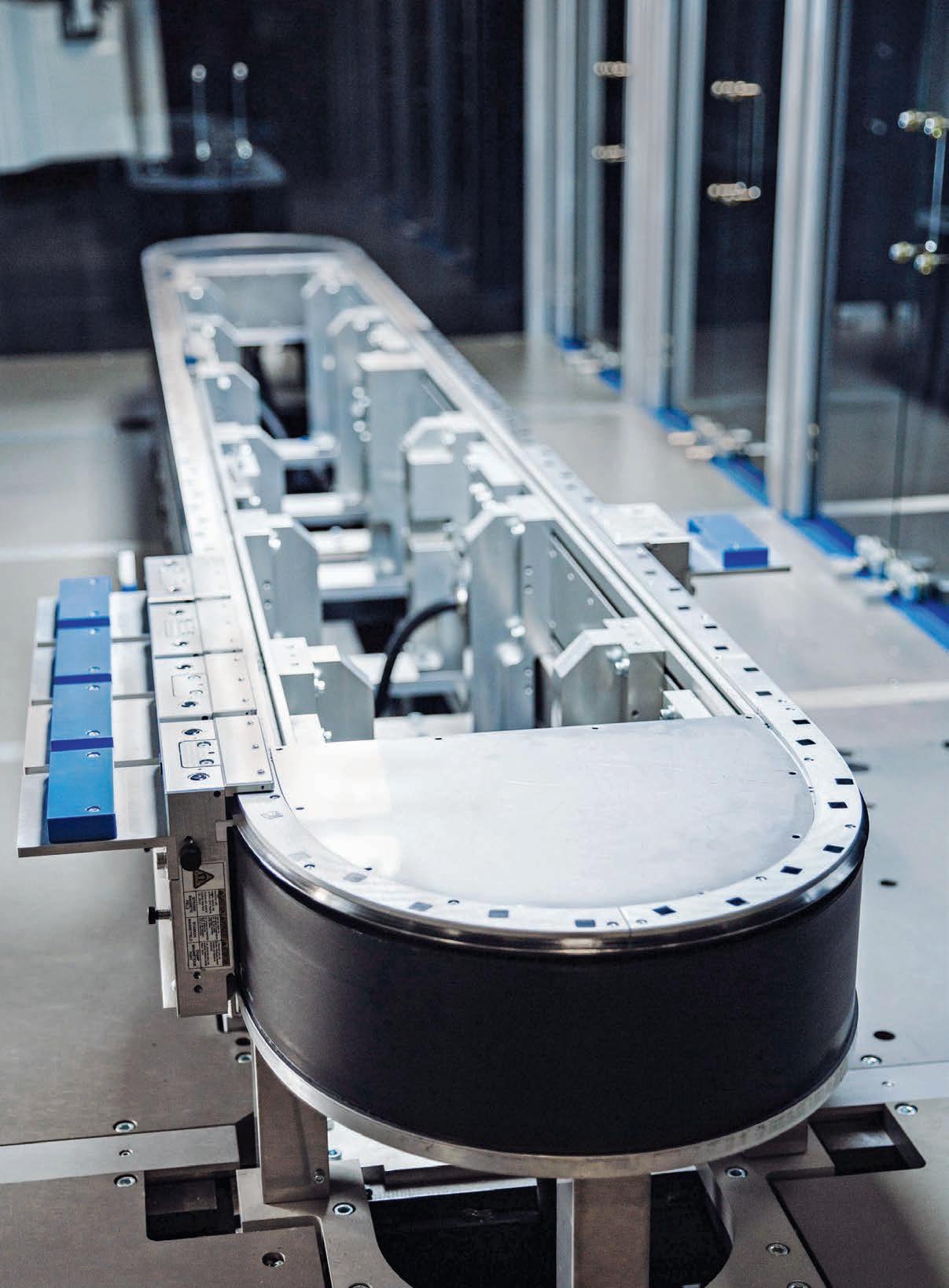
As of May 2020, Rockwell also offers the iTRAK Small Frame, designed for food and beverage and packaging applications, that shares its partner’s flexibility but not its brawn. While mover top speed is also 5m/s, payload per mover tops out at 4kg and peak force is 100N.
In addition, track size is limited to approximately 64 motor sections and 128 movers total. On the upside, the Small Frame features a stainless steel track and carries an IP66 rating. In addition, mover pitch is reduced to 50mm and repeatability is +/- 0.01 mm.
While the iTRAK is in line with other smart conveyors discussed here, the company offers the widest range of linear motor products in terms of application. The MagneMotion Lite, for example offers fast programmable motion and intr icate branching pathways for small payloads (2.5 kg per mover) while Rockwell’s QuickStick 100 and HT lines handle payloads as large as 100kg or into the thousands of kilograms, respectively.
This smart conveyor overview only scratches the surface of these systems’ potential and limitations. And while there are numerous advantages, it should be noted that they carry a higher initial price tag than traditional systems. However, proponents of the technology point out that since they are quicker to design and build, require less maintenance and power consumption a nd increased up-time, comparing total cost of ownership is a nuanced calculation. |DE https://atsautomation.com http://beckhoff.com festo.com rockwellautomation.com
Released in May 2020, the Rockwell iTRAK Small Frame provides tighter precision and mover pitch than the iTrak Medium Frame at the cost of payload capacity. (Photo
AUTOMATION
INDUSTRIAL VPN ROUTER
AutomationDirect released its StrideLinx VPN routers that provide an outgoing, secure connection from remote machines or systems to the StrideLinx platform. The routers have a built-in firewall and provide multiple router connection options including wired gigabit Ethernet and WiFi, as well as 4G cellular. The StrideLinx SE-SL3011-4GG router provides support for global 4G LTE frequencies and bands. The wired basic router (SE-SL3001) offers remote access option without data logging support. All routers in the StrideLinx line are UL/cUL and CE approved. www.automationdirect.com
I/O SYSTEM FIELD
WAGO introduced a IP67-rated I/O System Field offered with two types of housings: Cast zinc housings with encapsulated electronics and non-encapsulated plastic housings with low mass for mobile applications. In both modules types, current and voltage levels can be recorded and evaluated, and overload limits and alarms can be set for each channel. The zinc housing devices have input and output power ports for use with daisy chained modules. They are ProfiNet based, with support for
EtherNet/IP and EtherCat protocols planned. These modules are also designed for the time-sensitive networking (TSN) standard, support OPC UA and MQTT communications and can be configured via
Bluetooth. The non-encapsulated modules are IO-Link hubs and come in either 8 or 16 configurable DIO ports. Each channel is configurable for a 24VDC digital input or output rated at 2A per channel.
www.wago.com
FIELDBUS GATEWAY
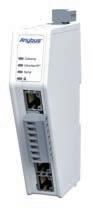
HMS Networks unveiled its second-generation Anybus Communicator, a line of gateways starting with the Anybus Communicator for EtherNet/IP followed by versions for Modbus TCP, PROFINET and PROFIBUS. All 2nd generation Communicators are powered by the Anybus NP40 industrial network processor used in all HMS’ embedded solutions. According to the company, data cycle times are up to 10 times faster than with
the first generation Communicators. The new line also allows for up to 1,448 bytes to be transferred between a PLC and the gateway. All products in the line are equipped with a security chip and secure boot to ensure the firmware has not been tampered with. The series carries CE- and UL-marking industrial certifications, and support a temperature range of -25 to +70°C.
www.anybus.com
ETHERNET SWITCH
Antaira Technologies introduced its LMP-0702G-SFP-V2 and LMX-0702G-SFP-V2 series of Ethernet switches. The V2 hardware allows for installation of a new operating system with features that bring these smaller switches up to the same feature set as the company’s larger port count Ethernet switches. Two of the key features are access control lists and multi-ring Ethernet Ring Protection Switching (ERPS), an open standard used for creating redundant link rings. Access control lists make sure data can get to where it needs to go but all other traffic is blocked. The LMX-0702GSFP-V2 Series features two fiber optic ports. The LMP0702G-SFP-V2 Series provides PoE ports (30W) for security applications, as well as fiber optic interfaces for long-range connectivity (1 meter to 100km).
www.antaira.com
ACTUATORS
LINEAR ACTUATORS
Thomson Industries launched
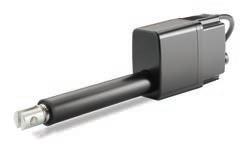
Electrak MD, an electromechanical actuator with up to two kilonewtons of force, onboard electronics and J1939 CAN bus support. The actuator also comes with onboard intelligence, which enhances the overall performance and eliminates space consumption by keeping any external equipment, like encoders and switches, within the actuator housing. As with its predecessor, the Electrak HD, this functionality provides a simpler method of control and communication. In addition, the Electrak MD also features feedback on position, low-current switching (PLC compatibility) and end-ofstroke indication output. www.thomsonlinear.com
ELECTRIC ACTUATOR
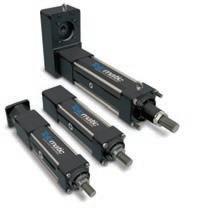
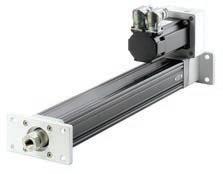
Tolomatic has expanded its extreme-force electric actuator family to include the RSX128 actuator, rated up to 50,000 pounds of force (222.4kN). Designed for replacing hydraulic cylinders and designed for 100 percent duty cycle, the RSX actuator features Tolomatic’s precision-ground planetary roller screws. Additional frame sizes include the RSX080 which provides 18,000 lbf/80kN and the RSX096P press-model which is optimized to provide extend force up to 40,000 lbf/178 kN. For all models, IP65 is standard and IP67 is optional. A modified food-grade version is also available as a custom
design with food-grade white epoxy coating and stainless-steel components. The entire RSX actuator family’s construction includes tie-rods and Type III hard-coat anodized aluminum housings. A standard internal anti-rotate feature prevents the rod from rotating without external guidance. www.electromate.com
ELECTRIC CYLINDER
Kollmorgen introduced its EC2, an electric cylinder for moderate thrust loads. The series is designed for industrial, scientific, and commercial applications requiring precise con
trol of linear thrust, speed and position and are available in ball or lead screw configurations with a selection of motorto-screw reduction types. Integrated motor options include the AKM family of brushless servo motors paired with AKD series servo drives or optional NEMA 17, 23, 34 hybrid stepper motor mounts. Features include a maximum stroke length to 750mm, custom lengths to 1000mm and ball or lead screw options with 4, 5 or 16mm leads. The series offer maximum thrust forces up to 3600N with optional protection to IP65. www.kollmorgen.com
YAW-PITCH STAGE
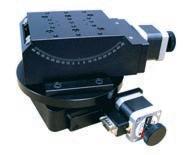
OES has introduced its YP100-45-01 (stepper motor driven, pictured) and YP100-45-02 (brushless servo motor driven) Dual-axis Yaw
and Pitch Stages that feature a yaw axis capable of rotation in either direction and an integrated pitch axis with a travel of +/- 45 degrees. The yaw axis has a maximum speed of 14 degrees per second with a stepper motor and 45 degrees
per second with a servo motor. It has a resolution of 0.001 degrees equal to 3.6 arc sec when the resolution of the micro-step is 10. The positional accuracy is 0.05 degrees, and repeatability is +/-0.01 degrees. The pitch stage has an 80mm x 80mm table with a precision pattern of threaded holes for mounting. www.oesincorp.com
MOTORS AND DRIVES
LARGE AC MOTORS
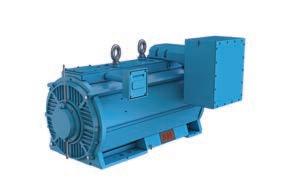
ABB unveiled its AXW 5000 and large AC 5800 motors, which deliver an average of 40 percent more power over conventional totally enclosed fan cooled (TEFC) motors, the company says. According to ABB, the motors include higher power densities, smaller footprint, noise reduction, constant cooling and heat reduc tion. For harsh, contaminate-filled environments, the AXW is designed for continuous operation, due to the consistent cooling of the water jacket surrounding
MOTION CONTROL NEW PRODUCTS
the motor. The main terminal box and auxiliary box can be mounted in several positions and the motor’s frame design increases stability to meet vibration limit specifications. AXW motors are available with up to an IP56 rating. www.abb.com
AC DRIVES
AutomationDirect introduced its DURApulse GS20 Series, a line of VFD drives that are IP66/NEMA 4X rated for operation in harsh environments. The drives feature dynamic braking, PID, removable keypad and RS-485 Modbus communication. In addition, the DURApulse family adds single-phase input capability, a built-in PLC and an optional EtherNet/IP and ModbusTCP communication card. An available GS2 mode duplicates exact parameter configuration of GS2 series mini AC drives. GS20 drives are available from 1/4 to 30 hp in single-phase 120VAC input, single-phase/ three-phase 230VAC input, and threephase 460VAC and 575VAC input. GS20X NEMA 4X drives are available up to 10hp. www.automationdirect.com
SENSORS
ABSOLUTE ENCODERS
POSITAL launched a line of diverse-redundant absolute encoders, based on non-certified standard components, to augment its range of certified SIL safety encoders. The devices are suitable – when combined with functional safety PLCs –for applications that conform to Performance Level/ PL d, Cat. 3 of ISO 13849. The encoders contain two independent sensor systems, one magnetic and one optical. If both measured values are the same, safe operation is assumed. If they deviate, the controlling PLC triggers an alarm. www.posital.com
A revolution in linear transport systems: XTS
The XTS advantage
circulatory movement flexible modular system individually movable movers
User benefits
reduced machine footprint software-based changeovers improved machine flexibility increased throughput shorter time to market
www.beckhoff.ca/xts
Manufacturers around the world need to offer increasingly customized products – with machines that deliver reduced footprint and improved productivity. Available now in the U.S., the eXtended Transport System (XTS) from Beckhoff answers these machine design challenges and more. In combination with PC- and EtherCAT-based control technology, the XTS features a high level of design freedom for machine builders to develop game-changing concepts for product transport, handling and assembly. A stainless steel hygienic XTS version is ideal for use in the pharmaceutical and food industries. Take your next step in machine design with XTS: total freedom of installation position compact design integrates directly into machinery freely selectable track geometries few mechanical parts and system components