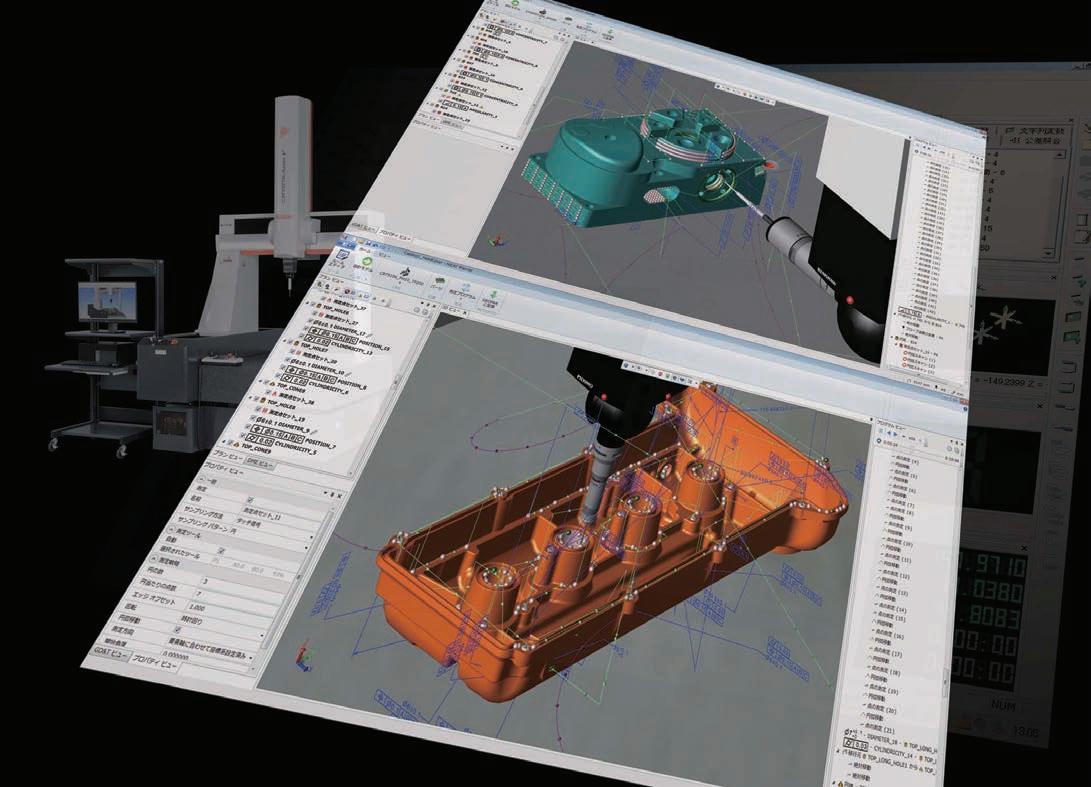
STEP format makes strides toward becoming the PDF of machining. pg 10
CANADIAN INNOVATOR
Raven.ai helps manufacturers sleuth out the root causes of lost OEE pg. 18
MOTION CONTROL
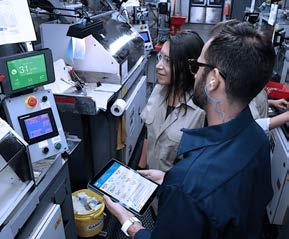
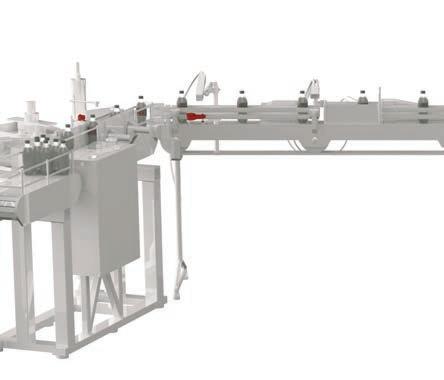
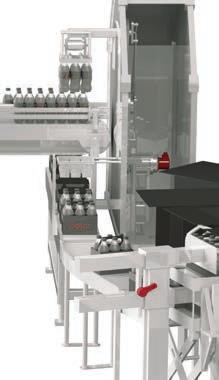
Packaging firm creates high production bottling lines in three months. pg. 22
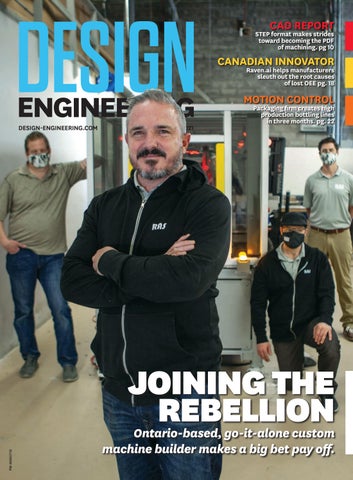
JOINING THE REBELLION
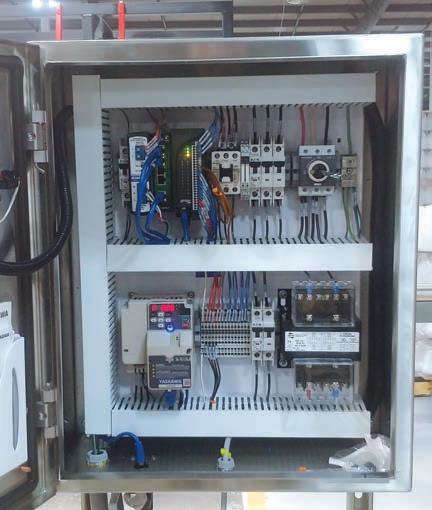
High-performance VFD w/ PLC in a super compact size
High-performance drive w/ PLC and sensorless vector technology up to 300 HP
Starting at $463.00 (GS4-21P0)
Starting at $121.00 (CFW100A01P6S220G2)
AC drives w/ sensorless vector technology, STO and built-in PLC; models available with NEMA 4X rated enclosure (GS20X)
Starting at $144.00 (GS21-20P2)
From the tiny WEG CFW100 to the highperformance GS4 VFD, AutomationDirect is your go-to source for affordable AC drives. Newest to our lineup are IronHorse NEMA 4X rated VFDs for washdown environments. With our low pricing and fast shipping, we can fit just about any budget and help any project finish on time.
Starting at $189.00 (ACNND-20P5)
Low-cost AC drive in a NEMA 4X rated enclosure with STO, sensorless vector control and a wide range of HP ratings.
• 230VAC: three-phase up to 20hp, single phase up to 10hp
• 460VAC: three-phase up to 30hp, single-phase up to 15hp
• Can be used with AC induction motors or permanent magnet AC motors (PMAC)
• Lockable, integrated disconnect or no-disconnect models
• STO - Safe Torque Off (SIL2)
• Built-in dynamic braking
• PID controller - including sleep and wake
• High speed communication interfaces with MODBUS RTU built-in, optional EtherNet/IP and ModbusTCP communication cards available
Orders over $49 get FAST FREE SHIPPING
Our shipping policies make it easier than ever to order direct from the U.S.!
Fast free standard shipping* is available for most orders over $49 U.S., and that includes the brokerage fees (when using an AutomationDirect nominated broker). Using our choice of carrier, we can reach most Canadian destinations within 2 to 3 days.
*Free shipping does not apply to items requiring LTL transport, but those shipments can take advantage of our negotiated super-low at rates (based on weight) that include brokerage fees.
See Web site for details and restrictions at: www.automationdirect.com/canada
All prices shown are U.S. Dollars
INSIDE
10 A STEP in the Right Direction
STEP file format makes strides toward becoming the PDF of machining and CAD data transfer
16 Joining the Rebellion
Ontario-based, go-it-alone custom machine builder makes a big bet pay off
18 Downtime Detective
Raven.ai’s industry 4.0 solution helps manufacturers sleuth out the root causes of lost productivity
MDA awarded JAXA contract and other engineering news
14 Metrology
3D scanners enable digital archiving and spot inspection
20 ADM 2021 Pre-Show Guide
5-in-1 advance manufacturing and engineering expo returns in-person to Toronto
26 Idea Generator
The latest industrial technologies including fluid power and motion control
Making the Grade
As the end of the year approaches and high school seniors contemplate their next steps, the inevitable question arises: Which university is the best for my field?
To help students answer that question, Maclean’s magazine annually publishes its influential “Canada’s Best Universities” ranking. Now in its seventh year, the magazine recently published its 2022 rankings, which grade Canadian universities on things like student satisfaction and reputation overall, but also drills down on the best programs for those looking to pursue a career in law, business, medicine and, of course, engineering.
To calculate this year’s lists, the publication surveyed 1,200 faculty and senior administrators across 80 universities, asking each to pick 10 university programs they felt provided the best education and conducted the best research in their discipline.
To anyone familiar with Canada’s engineering schools, the top institutions for 2022 shouldn’t come as a surprise. The universities of Toronto, Waterloo, McGill, British Columbia and Alberta took the top five spots in engineering. McMaster, Queen’s, University of Calgary, Laval and Western round out the top 10. As per usual, UofT and UWO battled for top spot. While they tied in terms of program reputation, UofT edged out its main competitor based on research reputation.
Of course, engineering isn’t a monolithic discipline and each university has it strengths. In March, London-based analytics firm, Quacquarelli Symonds (QS), also pegged UofT as the top all-around engineering university in Canada in its yearly ranking. However, it named McGill as the best mechanical engineering school in Canada and UBC tops in civil engineering.
Even so, for my money, the best program is the one most likely to lead to employment following graduation, which is the point of going in the first place. For that, it’s hard to beat the University of Waterloo. Since its inception, the institution has made a work co-op program a requirement of its engineering students to graduate. Now, nearly 65 years later, the program has grown to the largest of its kind in the world and boasts a 96% employment rate for co-op students within six months of graduation.
Granted, a degree from a highly regarded institution may raise eyebrows in Canada among relatives or at a cocktail party, but my bet is prior work experience trumps reputation during a job interview in any country.
MIKE MCLEOD
Editor mmcleod@design-engineering.com
Editorial Board
DR. ALAIN AUBERTIN
Vice President, Business Development and International Affairs, Canada Consortium for Aerospace Research and Innovation in Canada (CARIC)
DR. MARY WELLS, P.ENG
Dean of the College of Engineering and Physical Sciences, University of Guelph; Chair of the Ontario Network for Women in Engineering
AJAY BAJAJ, P.ENG
President, Rotator Products Limited; Past President and Board Member, Power Transmission Distributors Association (PTDA)
JOHN LAMB
Regional Sales Manager, Wainbee Limited
DR. ISHWAR PURI, P.ENG
Dean of the Faculty of Engineering; Professor of Mechanical Engineering, McMaster University
OCTOBER 2021 Volume 66, No.5 design-engineering.com
READER SERVICE
Print and digital subsciption inquiries or changes, please contact
Beata Olechnowicz, Audience Development Manager Tel: (416) 510-5182
Fax: 416-510-6875
Email: bolechnowicz@annexbusinessmedia.com
Mail: 111 Gordon Baker Rd., Suite 400, Toronto ON M2H 3R1
SENIOR PUBLISHER Paul Burton (416) 510-6756 • pburton@annexbusinessmedia.com
EDITOR Michael McLeod (416) 442-5600 ext. 3231 mmcleod@design-engineering.com
COO Scott Jamieson sjamieson@annexbusinessmedia.com
Design Engineering, established in 1955, is published by Annex Business Media, 6 times per year except for occasional combined, expanded or premium issues, which count as two subscription issues.
Printed in Canada
Publications Mail Agreement #40065710 ISSN: 0011-9342 (Print), 1929-6452 (Online)
Subscriber Services: Canada: $57.50 for 1 year; $92.50 for 2 years; $10 for single copy.
Outside Canada: USA - $140.50; Overseas - $151.00; $10.00 for single copy.
All prices in CAD funds. Add applicable taxes to Canadian rates.
From time to time we make our subscription list available to select companies and organizations whose product or service may interest you. If you prefer not to receive this information, please contact our circulation department in any of the four ways listed above.
Annex Business Media Privacy Officer: privacy@annexbusinessmedia.com Tel: 800-668-2374
No part of the editorial content of this publication may be reprinted without the publisher’s written permission.
MDA AWARDED CONTRACT FOR JAXA’S MARTIAN MOONS MISSION
Macdonald Dettwiler and Associates Ltd. (MDA) announced that it has been contracted by Mitsubishi Electric Corp to provide a laser rangefinder (LRF) altimeter for the Japan Aerospace Exploration Agency’s (JAXA) Martian Moons eXploration (MMX) mission.
Scheduled to launch in 2024, the MMX spacecraft will travel to Mars and explore the red planet’s two moons: Phobos and Deimos. The objective is to investigate the origin of the Martian moons and the evolution process of the Martian-sphere (Mars, Phobos, Deimos), among other mission objectives.
The company’s LRF will be used to provide range measurements to the planetary probe for its safe approach and landing on Phobos. As part of the contract, MDA will be providing t wo redundant flight units altimeters and one engineering development unit (EDU) LRF altimeter.
“MDA is a global leader in laser range finder and light detection and ranging (LiDAR) and we are very proud to be providing our advanced sensor technology to the MELCO team for JAXA’s Martian Moons Exploration Mission,” MDA CEO, Mike Greenley. “The Phobos landing will be a first for humankind, and the opportunity for MDA to be part of the milestone is an honour and reflection of the dedication and skill of our team.”
www.mda.space www.mmx.jaxa.jp/en
ATTABOTICS EXPANDS EXECUTIVE MANAGEMENT STAFF
Attabotics announced that it has hired former Wind
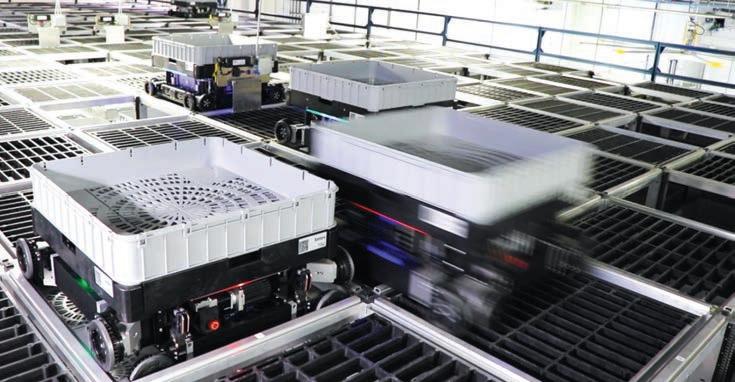
River, Microsoft and Amazon executive, Cyra Richardson, as CTO and chief product officer (CPO). Modeled on ants, the Calgary-based firm’s technology aims to replace traditional fulfillment center s with a storage structure and robotics shuttles that utilize both horizontal and vertical space in a “hive”-like pattern.
In her new role, Richardson will be responsible for leading Attabotics product commercialization, development and technical strategy. With nearly 30 years of experience, and more than twenty patents to her name, she most recently served as the VP and CPO for Wind River,
where she oversaw product and development teams.
Prior to that, she served as the GM of Artificial Intelligence and Robotics Incubation at Microsoft. During her two decades there, she incubated the company’s initial AI offerings, including Azure Cognitive Services and AzureBot Services. According to the company, Richardson also played a significant role in the development of Windows 3.0, Windows Embedded, Azure Intelligent System Service (Azure IoT) and Windows 10 IoT.
At Amazon, Richardson was a business and technical leader responsible for growing the Mobile Web business, new product
Currently scheduled to launch in the mid-2020s, JAXA’s MMX mission will collect surface material from Mar’s moon, Phobos, and return it to the Earth.
Calgary-based Attabotic’s technology aims to replace traditional fulfillment centers with a storage structure and robotics shuttles that utilize both horizontal and vertical space in a “hive”-like pattern.
implementation and modernization of the consumer shopping exper ience.
“The Attabotics team has quietly developed the most versatile storage technology on the market, and I could not be more excited to join at a time of immense opportunity and growth for the company,” Richardson said. “Clearly, they are on to something, and I look forward to accelerating their solutions to the next level.”
In addition to a new CTO, Attabotics also hired Julien Seret as Vice President of Network Supply Chain. Prior to Attabotics, Seret held worked at SoftBank Robotics, most recently serving as the VP of Global Product. While there, he led the design of new robots and played an instrumental role in the success of the Whiz and Pepper robots, the company says.
Over the past year, Attabotics says it has grown its staff by 50% to more than 300 employees and says it will continue to staff up to fuel the company’s growth. www.attabotics.com
OSPE LAUNCHES ENGINEERINGFOCUSED ONLINE CAREER PORTAL
The Ontario Society of Professional Engineers (OSPE) announced the launch of a virtual
The OSPE’s ENGpath portal provides engineers and engineering graduates with interactive programs to connect with employers in Canada
Optimize rotating equipment performance and reliability!
career por tal called ENGpath targeted at Ontario engineers. The portal provides engineers and engineering graduates with interactive programs to connect with employers in Canada.
In addition to a jobs board, where the engineering community can post openings and find positions, the ENGpath portal also features three virtual projects to help connect skilled engineers with employers.
ENGpath’s Virtual
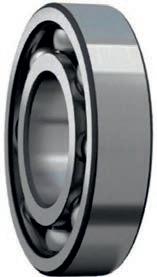
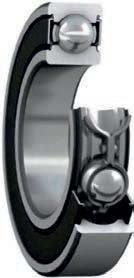
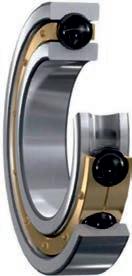
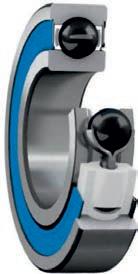
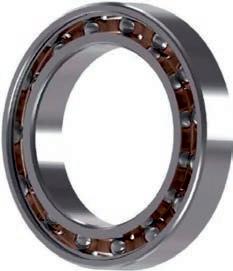
Count on SKF's unmatched range of high quality deep groove ball bearings for superior reliability, performance and service life for industrial, commercial and niche applications. Designed to run faster, cooler, smoother, quieter and longer, thanks to SKF world class manufacturing.
Contact your SKF representative or marketing@skf.ca
Employment Events (VE3s), for example, provide opportunities for engineering professionals to connect with the top employers, free of charge, in a virtual “job fair” environment.
In preparation for those events, the portal’s Virtual Interview Simulator (VIS) offers potential applicants interview training for video interviewing while a regular series of Virtual Job Search Workshops (VJSW) are designed to improve engineers job seeking skills such as resume writing, networking and accessing the hidden job market.
“Ontario’s engineers come in all genders and backgrounds, as well as from all regions of the province,” said OSPE President and Chair, Mark Frayne, P.Eng. “Yet the historical misperception is that engineers are all basically white males living in Toronto. Support for these programs will allow us to attract the best people based on merit and connect with qualified individuals from all target groups.”
https://ospe.on.ca
BALLARD, QUANTRON TO DEVELOP HYDROGEN FUEL CELL ELECTRIC TRUCKS
Ballard Power Systems announced that its heavy-duty fuel cell power modules have
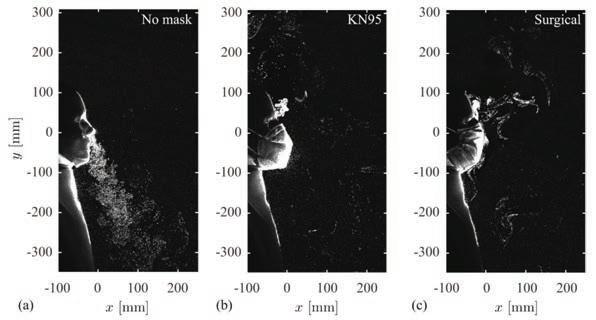
Test results of mask efficacy on absorbing aerosol droplets conducted by engineering researchers at the University of Waterloo.
been selected by Quantron AG to power an upcoming line of the German company’s zero-emission electric trucks.
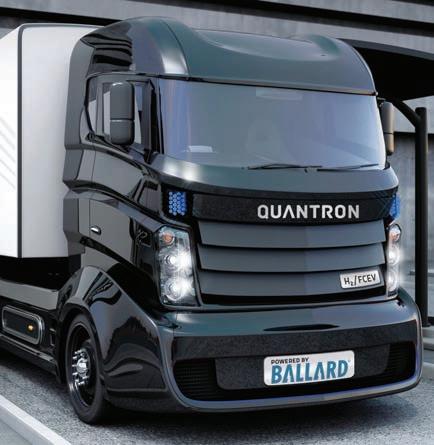
According to the companies, initial collaboration will focus on integrating Ballard’s FCmove family of fuel cell power modules with truck platforms currently in development by Quantron, including a 7.5-ton delivery truck, a 44-ton heavy duty truck and a municipal waste collection truck.
A line of Quantron AG vehicles, including this heavy duty truck model, will feature fuel cells developed by Ballard Power Systems.
According to Ballard, its fuel cells will provide longer range and fast refueling without diminishing the payload capacity of Quantron’s vehicles. Deployment of fuel cell electric trucks, Quantron says, is scheduled for the second half of 2022.
Established in 2019, Quantron is a spin-off from 139-yearold Ger man firm Haller GmbH & Co. KG which specializes in service, maintenance and repair of vans, trucks and buses. In addition to zero emission trucks, the company also recently announced its BEV Bus, a 12m low-floor bus will launch by the end of this year. www.quantron.net
ENGINEERING STUDY FINDS LOW QUALITY MASKS DO LITTLE TO STEM COVID INDOORS
A study by engineering researchers at the University of Waterloo found that common, poorly fitting face masks may do little to curb the spread of COVID-19 indoors. However, wide-spread
use of higher quality N95 and KN95 masks, plus good ventilation, could significantly reduce the spread of COVID-19 indoor s.
To test mask efficacy, the U of Waterloo researchers used a mannequin to simulate a seated person breathing in a large room. Testing with common cloth and blue surgical masks, the study discovered significant buildup of aerosol droplets over time. Those masks filtered approximately 10 per cent of exhaled aerosol droplets; the bulk of droplets are redirected out of the top of the mask due to poor fit. By contrast, N95 and KN95 masks filtered more than 50 per cent of the exhaled aerosols.
Serhiy Yarusevych, a professor of mechanical and mechatronics engineering and the leader of the study, said the much greater effectiveness of N95 and KN95 masks versus cloth and surgical masks makes a compelling case that they should be worn in indoor settings, such as schools and workplaces, as much as possible.
In addition, the study found that even modest ventilation rates were found to be as effective as the best masks in reducing the risk of transmission. Ideally, Yarusevych said, the evidence shows that high-quality masks and proper ventilation should be used in combination to mitigate the threat posed by indoor aerosol accumulation as much as possible.
https://uwaterloo.ca
Image credit: University of Waterloo
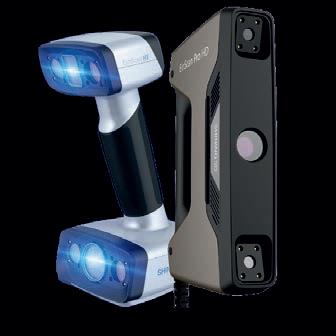
• White light and laser 3D scanners.
• Handheld and desktop mounted versions.
• Perfect for reverse engineering.
• Colour 3D scanning.
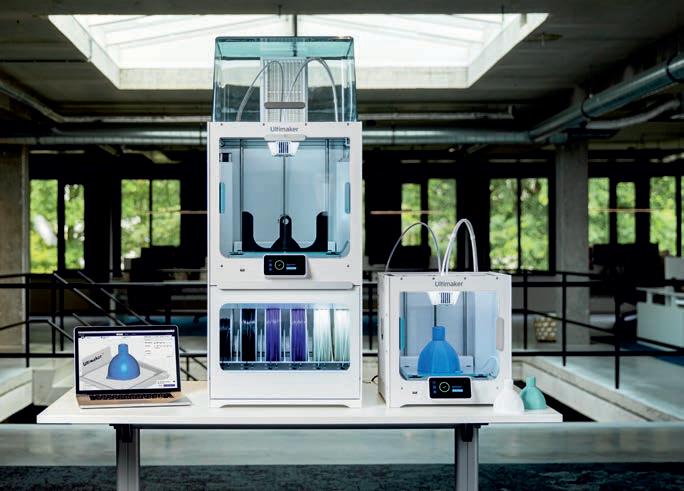
• World renowned FDM printers.
• Simple to use, turn key solution.
• Supported by the best software on the market.
• Great for educators and engineers.
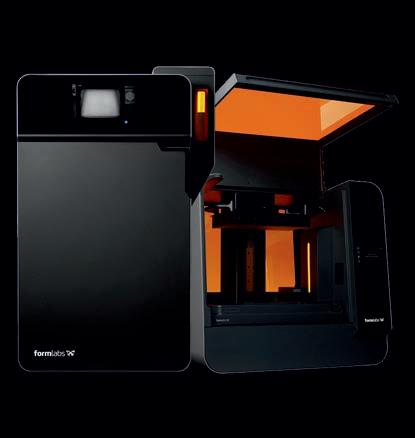
• Designed for small scale batch production.
• Resin that is
•
• SLS
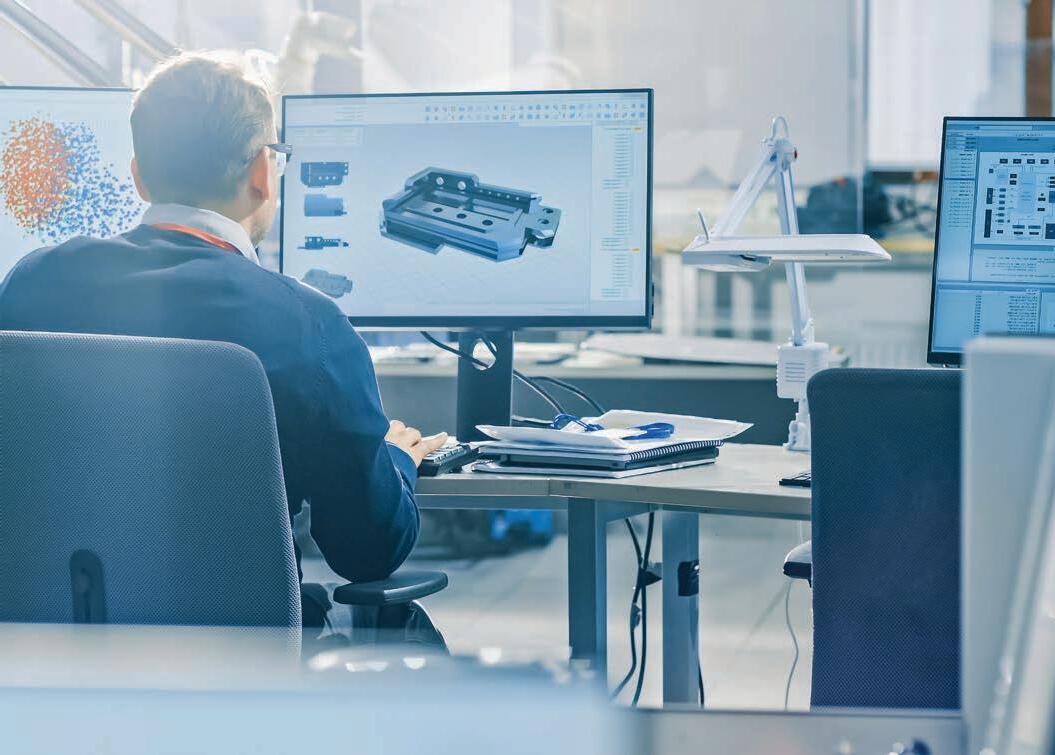
A STEP in the Right Direction
STEP file format makes strides toward becoming the PDF of machining and CAD data transfer.
BY RALPH GRABOWSKI
In the early days of mechanical CAD, there was no need to exchange model files. MCAD was rare enough that it didn’t matter that systems were incompatible. By 1976, however, MCAD had become common enough that the US Air Force demanded reduced costs in using files on the design floor from contractors. The solution was a common format, “initial graphics exchange specification” – IGES, for short.
As IGES adoption increased, though, it also became unwieldy as it adapted to support data from an increasing number of MCAD systems. In response, the IGES steering committee started a new file format, PDES. “PDES is envisioned to support all aspects of product descr iption, from initial conception through product design, manufacture, support, and disposal,” said the US Department of Commerce, describing what PLM sounds like today.
In 1985, the committee contributed PDES to an ISO initiative that had also initiated a universal file format designed to handle “anything from a microchip to a battleship.” This became known as the “STandard for the Exchange of Product model data” or STEP. In 1988, a group of aircraft manufacturers formed the PDES, inc consortium to oversee STEP’s development.
Defined by the EXPRESS data modeling language, STEP was designed to be extensible so that it could accommodate new technology. First released in 1995, STEP is sometimes referred to as “AP203” (level 2 application protocol).
Today, STEP consists of 800 standards, most of which compose a library of reusable definitions, but four are defined for end users. In addition to the original AP203 standard that defined solid models, AP214 added assembly data in 2003, AP242 added annotations in 2015 and AP242e2, released just last year, includes tolerances.
STEP for Machining
The original purpose of IGES was to make it easier for manufacturers like General Electric to deal with 3D models arriving from suppliers using incompatible MCAD file formats.
The process of machining a part from these files began with a CAD operator creating a drawing with no regard for the manufacturing process. A CAM operator would then design a manufacturing process and a CAM software post-processor generated the G-code to instruct the machine. A CNC operator then closely supervised the machining to make sure the initial parts were made correctly.
Since then, STEP has replaced IGES and has been extended into a machine tool control language, known as STEP-NC (numerical control).
In 2005, AP238 version 1 was added to the STEP standard to incorporate precision machining. Last year, AP238 version 2 was added for precision assembly.
What’s more, the addition of AP242e2 tolerances allowed STEP to be useful in automated manufacturing. When you know the tolerances
manufacturing needs to meet, you can machine parts to those tolerances. Before this, machines controls worked blindly, not knowing what was allowed. Year by year, STEP-NC is adding more to the process data needed to know how to mill, drill or lathe a part, how to lead in, the speed at which to run and so on. The key is to know which operations have to be done in which order with the minimum viable tool path. When the data is rich, intelligent software on the control can figure out the rest.
According to Dr. Martin Hardwick, President and CEO of STEP Tools inc., the desire today is to go direct from CAD to CNC. In this process, a CAD operator makes the 3D model suitable for manufacturing. A post-processor in CAD makes the STEP-NC file and a CNC machine uses STEP-NC for automated and optimized machining.
“Before, the operator figured it out; now, the software has to be rewritten to figure it out,” Hardwick says.
This change means a massive rewrite of CAM software, something not all firms can afford. Partly as a result of this industry change, many CAM firms
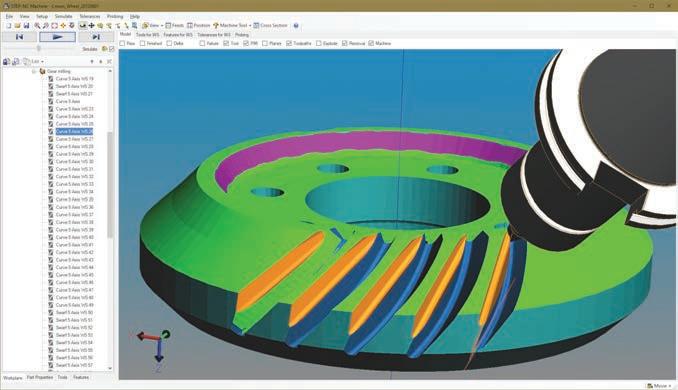
A STEP-NC file instructing the roughing, finishing, drilling and gear milling of a crown wheel with 105 operations and 925 tool paths
– like Cimitron, GibbsCAM, MasterCAM, SigmaNEST and Vericut – have in recent years sold themselves to larger companies, like Sandvik.
Since 2017, STEP-NC has been used to machine millions of 5-axis parts each year for commercial aircraft, such as the Boeing 787. Now STEP-NC is being prepared for direct-CADto-CNC 2.5-axis milling for features on airframes. As well, it is getting ready for 3D printing, leading Hardwick to call STEPNC “the PDF of machining.”
ODA Expands to STEP
Yet, for all its advancements, integrating the breadth of STEP’s capabilities is beyond the resources of many CAD software developers. That’s a situation the Open Design Alliance (ODA) looks to remedy. The non-profit technology consortium is known
for open software development kits (SDKs), such as for reading and writing DWG and PDF files. With these SDKs, members can create CAD software that is able to access and exchange engineering design data. By developing the code on their behalf, the ODA’s 1,200 members don’t need to develop it themselves.
Five years ago, the organization expanded beyond offering individual SDKs to also developing complete technology packages for CAD and BIM, (e.g. web collaboration, version control, visualization) on any platform, supported by a natively developed solid modeler and constraints engine.
Earlier this year, the ODA announced it’s also taking on STEP suppor t as a long-term organizational priority. According to ODA president, Neil Peterson, the move was driven by demand
2022
The year by the end of which the Open Design Alliance says it will develop a full set of STEP tools.
from its members, since currently available STEP libraries are expensive and royalty-based. While some STEP software libraries have been released to the public domain, they suffer from insufficient development. As a result, there is no high-quality STEP library on the market that’s affordable for small CAD software firms, Peterson says. Some ODA members just want access to STEP files. Others – who use the APIs ODA provides for the IFC architectural data model – want both: IFC for buildings and STEP for the machinery inside the buildings. According to the ODA, it will develop a full set of STEP tools by the end of 2022, including visualization, a free STEP viewer and web-based libraries.
Considering that STEP files, and the EXPRESS programming language, are hugely complex, I
wondered how the work could get done so fast. The PDES consortium, which maintains the STEP standard, had been working on the problem for nearly three decades.
“We gained expertise by developing IFC,” Peterson says. “Similar to IFC, STEP is defined using EXPRESS schema, and so we can reuse the automation framework we developed for IFC to quickly build a high-quality STEP solution.” As well, the ODA says it’s working with PDES, inc. just as it works with buildingSMART on IFCs.
Rolling Ring
Zero backlash. Jam-proof design.
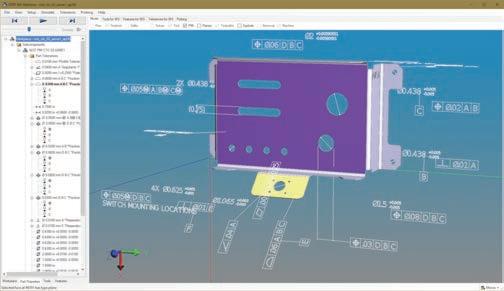
A NIST-created test file with AP242 presentation and semantic geometric tolerances.
• For applications in positioning & reciprocating motion
• Zero play –even during reversal
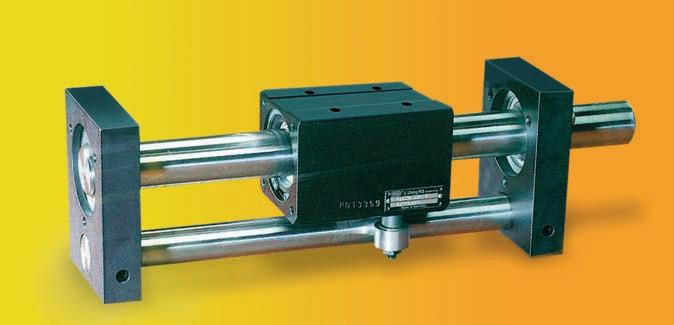
Uhing® Rolling Ring linear drives run on a smooth, threadless shaft that won't clog or jam. If the system is overloaded, the shaft simply slips instead of churning and grinding. The drive bearings are in constant contact with the shaft, even during reversal, thereby preventing backlash.
Example applications: metrology machines, material handling systems, spooling equipment, packaging & converting equipment.
Many different sizes meet varying requirements for axial thrust & linear speed.
For more information call 1-800-252-2645
Email: amacoil@amacoil.com www.amacoil.com
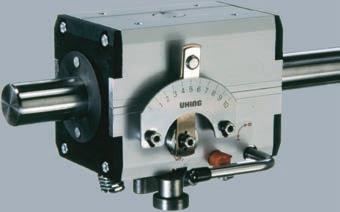
Some models feature mechanical control over speed and travel direction. No programming or electronic controls are needed.
In detail, ODA’s timeline calls for the release of an initial STEP SDK with read/write for AP203, AP214 and AP242 (all conformance classes) by the end of 2021. By the end of 2022, it intends to release full visualization support for the three APs on desktop, mobile and web, as well as a free STEP viewer and the ability to convert to 2D/3D PDF, Navisworks, and DWG. Longer term, ODA envisions adding support for AP238 STEP-NC and the ability to convert to IFC and Revit. “Priorities in these areas,” Peterson cautions,” will be based on requests from our members.”
The cost of getting the STEP APIs from the ODA will be “free” to the ODA members who pay the annual US$1,800 membership fee, but no royalty payments are involved.
The MCAD/CAM industry needs a universal file format to minimize the cost and inconvenience of translating data. Arriving at universality is, however, a terribly complex problem, as CAD vendors want to maintain advantages over competitors by sticking with unique file for mats. Lip service is given to data interoperability. Data flows easily into CAD systems, but emerges reluctantly.
The 2020s find the STEP standard expanding in two directions, towards greater complexity with STEP-NC, and towards lower cost with ODA STEP. The toolkits provided by the ODA, one can hope, ought to make implementing data exchange universality in mechanical easier. |DE https://pdesinc.org www.opendesign.com
Ralph Grabowski is a CAD industry writer.
HOW TO ENSURE TOOLS AND MOLDS BUILD
PERFECT PARTS
3D scanners enable reverse engineering, digital archiving and spot inspection of molds, tools and dies.
At the beginning of a manufacturing process, a mold, die or jig is engineered according to a theoretical CAD model. The aim of this tooling, made precisely from the nominal model, is to produce parts that correspond to the technical requirements.
It tur ns out, however, that there are often differences between the theoretical model and the reality. Different phenomena
interfere with the tooling, causing imperfections on the parts. Adjustments and iterations are required to ensure the tools and molds, even if they correspond exactly to their nominal models, produce good parts that meet quality controls and customer demands. These adjustments and iterations can be simplified and accelerated thanks to 3D scanning and 3D scanning inspections.
Non-predictable phenomena
The reality of an industrial environment differs from the theory illustrated in CAD models. During the manufacturing process, several phenomena that are difficult to predict can occur. Spring backs when stamping a die, shrinkage when building a mold made of composite material, or thermal forces when welding two elements together are all good examples of phenomena that impact tooling precision. Nevertheless, modeling the removal of a composite resin, the spring back of a die, the impact of a weld remains difficult, complex and expensive.
Initially, the tooling is built according to the theoretical model, which is developed to create manufactured parts that meet the production requirements. But, in the reality of the industr y, the aforementioned phenomena interfere with the molded or stamped parts. As a result, the parts do not meet the technical demands and must be adjusted, corrected and altered to pass the quality controls.
Starting with nominal models is, of course, a good first step, but let’s not forget that what manufacturers want is not so much a perfect tooling, but good parts that meet technical requirements and customer needs.
An iterative inspection process
The most commonly used method is to work on the part before adjusting the tooling. More precisely, this method involves producing a part, measuring it and analyzing deviations between the part and the CAD model. Hence, if we notice that there are some missing (or extra) millimeters in one place, we will go to the corresponding surface on the mold, die or jig to grind or add material. Thus, the iteration is performed on the
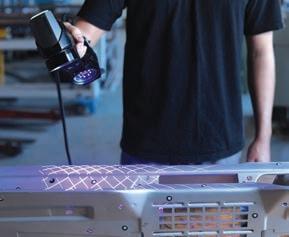
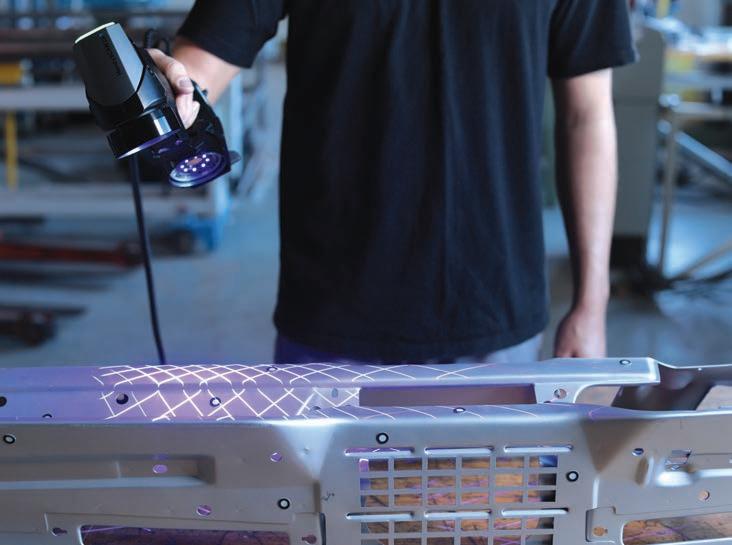
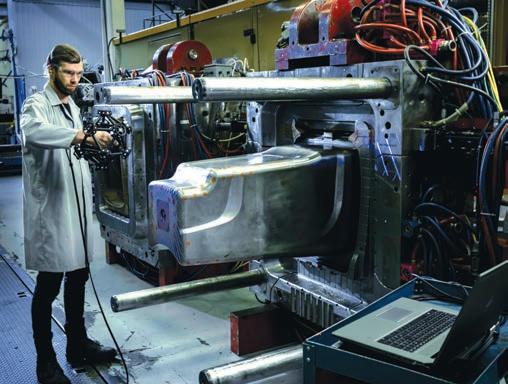
A handheld 3D laser scanner, such as this blue light HandySCAN 3D BLACK Series, enables high resolution accuracy for digital archiving of tooling, jigs and dies as well as reverse engineering of automotive parts.
tooling after measuring the manufactured part.
Once this operation is completed, we restart the manufacturing process in order to produce a new part that will be measured to verify if there are any remaining deviations. This iterative process will continue on a loop until we obtain the desired part (i.e., when the manufactured part corresponds to its CAD model).
This iterative process of quality control requires a fast measuring tool to produce the next part without delay. In addition, the measurement technology must have the capability to be used directly on the shop floor and the capacity to measure all types of sizes, surface finishes and geometries. 3D scanning technology, with its speed, portability and versatility, enables production teams to make the required corrections to the tooling quickly and effectively.
The customer who buys the manufactured parts may also require a CMM report from the tooling manufacturers. Thus, a second measurement tool that will reduce the CMM workflow is an important benefit for manufacturing companies. With a portable 3D scanner, they can measure the majority of the entities and multiply the intermediate inspections, preserving the CMM for the final inspection and report generation.
Digital Archiving
Once we have a tooling that produces a certified part, the mold, die or jig can be scanned as part of the reverse engineering process to create a 3D model. All initial iterations then can
Metrology tools, like this portable MetraSCAN 3D CMM, allows for periodic quality control checks since parts can be measured directly on the production floor.
be saved for future productions. This means that if the tooling wears out and a new one is required, we can work directly from the 3D model that is known to build good parts. All initial iteration time is saved for future productions.
A mold, die or jig can also be reverse engineered using a 3D scanner. Depending on the application and scanning environment, one type of 3D scanner may be preferred over another. For example, a portable 3D scanner may be used to acquire the 3D measurements of a mold r ight on the production floor.
Once the measurements are taken, a post-treatment process must be car ried out to finalize and prepare the 3D scan data to be used in CAD software. This post-treatment process, which involves segmentation, alignment and positioning the part in space, is normally done using specialized software. The result is a “clean” STL file. Once ready, the clean file can then be exported directly to CAD software, like SolidWorks, AutoCAD or Inventor, or into reverse
beneficial for the mold and tool industry because it increases inspection sampling and saves time by measuring parts directly on the floor of production without having to bring them to a CMM. Thus, periodic quality controls ensure that the production remains in control and delivers parts on time.
engineering software and then CAD software.
A reverse engineering expert or industrial designer will remodel the part either “as is,” meaning with potential imperfections, or based on the original design intent (parametric reverse engineering). Modifications can also be made to the 3D model, depending on the application or need.
Once the 3D model has been generated and improved upon, if required, many reverse engineering teams produce a prototype using additive manufacturing techniques. The watertight CAD file is sent to a 3D pr inter for the prototype to be made. Experts can then assess if the 3D model is accurate or if additional changes and prototypes are required. Once the final 3D model is approved, it is sent for official tooling.
Periodic quality control
Instead of measuring a part out of 50 or 100 with a CMM, 3D scanning technology enables the possibility of conducting periodic q uality controls. Indeed, a portable 3D scanner is
If the manufactured parts suddenly do not match the technical requirements, the manufacturing company will fall into an investigation mode, which will cause a lot of stress and uncertainty. With a portable 3D scanner, quality assurance will be able to intervene without further delays and find the root cause by acquiring a lot of data quickly and investigating directly on the shop floor.
Several phenomena specific to an industrial environment regularly occur on the production floor. They cause unexpected spring backs or shrinkage. Necessary adjustments are required to ensure that the tooling, even if it exactly matches its nominal model, produces good parts that meet quality controls and customer requirements.
These iterations are facilitated by 3D scanning, which, due to its speed, portability and versatility, is an effective alternative to a CMM that can remain free for final inspections. In addition, 3D scanning offers the possibility of reverse engineering the tooling that produces the good parts, performing periodic quality controls and quickly resolving unexpected issues that may occur at any time. |DE www.creaform3d.com
This article was provided by Creaform
JOINING THE REBELLION
Ontario-based, go-it-alone custom machine builder makes a big bet pay off.
Basketball star Fred VanVleet popularized the slogan “Bet on yourself” –that is, passing up a modest sure thing to risk an all-in pursuit of a far bigger prize, in his case, a huge contract.
Jeff Cybulski made a similar bet, opting to leave behind a life in management, reporting to higher ups with ultimate decision-making power, to become his own boss, for better or worse. Two years ago, he launched Rebel Automated Systems (RAS) in the back of a friend’s shop.
“I took the initiative to get it fired up when the industry was on a down trend,” says Cybulski. The name of the company, he adds, suited his mindset – to be an upstart in the marketplace. (It also happened to be the since-retired moniker of his wife’s former high school – Eastwood Collegiate in Kitchener).
For a time, Rebel was just Cybulski and his phone, drumming up orders, designing and building small systems. During the first COVID-19 wave in 2020, he had some operational help for a while from his brother, who was on temporary furlough from an auto-parts manufacturer during the initial pandemic slowdown.
Two years and two expansions later, Rebel now operates out of a 10,000-sq-ft space in Cambridge, ON, with just shy of 20 employees and worldwide strategic partnerships set in place. The company currently delivers custom automated solutions to customers not only in southern Ontario but worldwide.
Rebel’s latest creation, a robotic solder cell for Electrical Contacts Ltd of nearby Hanover, automates a step in the process of making contacts.
Electrical Contacts, which celebrated its 50th anniversary last year, has built a global customer base as a premier supplier of many styles of contacts, contact assemblies and tapes for electrical circuit protection and switching devices, like circuit breaker panels.
The solder cell doesn’t actually do any soldering, but rather sets up the contacts for the furnace. It’s typical of the custom machines needed to automate manual gaps in multi-stage manufacturing flows. Many of these gaps represent a function that’s supportive of or subordinate to a major process, and for which there is no off-the-shelf automation solution.
The sheer number of custom machines being built by OEMs in southern Ontario for local customers suggests there are many such oppor tunities out there. One of Cybulski’s final projects in his prior executive-for-somebody-else life was a cell automating PVC pipe-sawing – cutting long lengths into short ones – for bending into elbows and other shapes.
The solder cell performs two functions. First, the unfinished silver contacts are scanned and flawed ones ditched. Then, a trio of desktop-size robots load them into pockets on honeycomb-like boards that are prefilled with a small amount of solder. The pockets reflect the size and shape of the contact; some are square, some round, some oblong, etc. The board, once populated, is sent to a high temperature furnace where the solder fuses and smooths out the contact’s brazing surface.
The design Cybulski, project manager Ryan Baetz and their crew developed uses Festo electrical and pneumatic systems – electrical
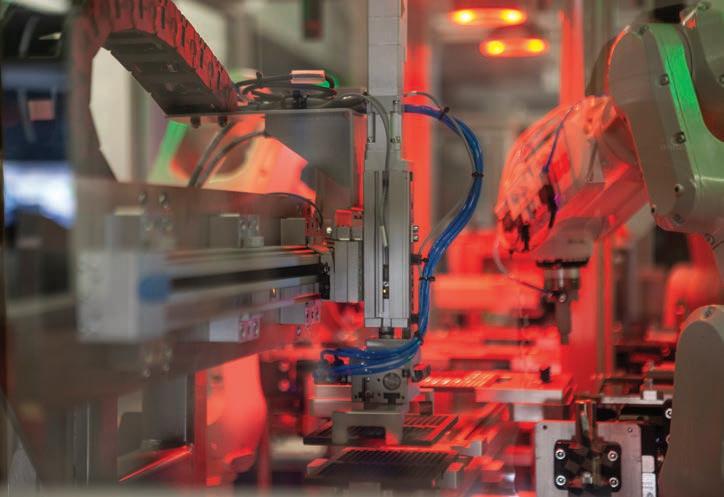
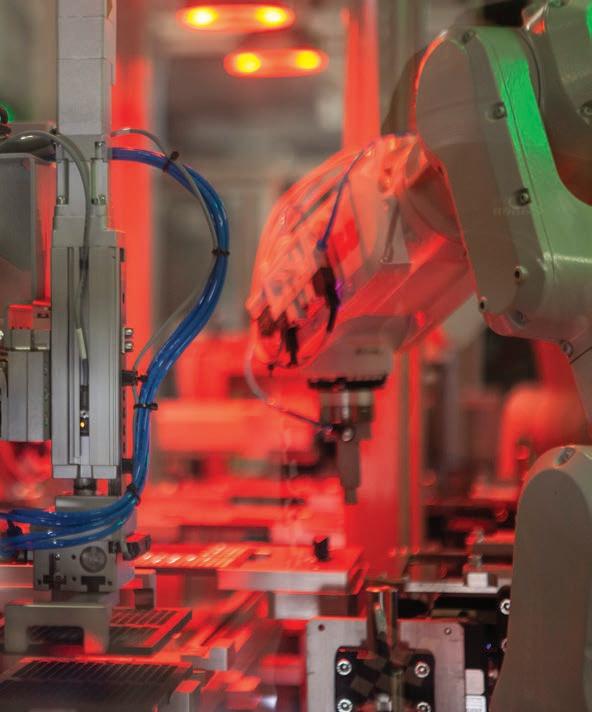
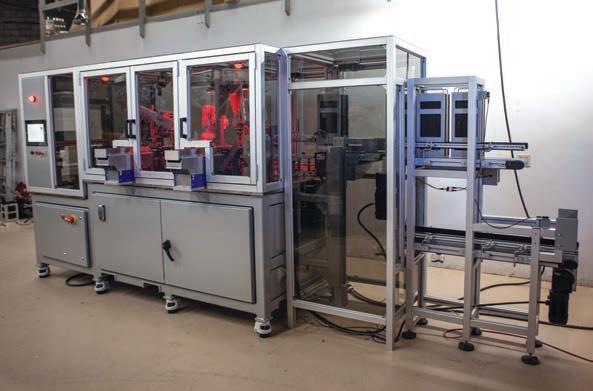
RAS’s machine employs Festo pneumatic actuators and grippers to de-stack and position the empty boards for insertion of contacts by three ABB robots, which then perform an optical inspection.
cylinders and minislide, toothed belt and spindle axes, servo drives and stepper motors, vacuum generators, pneumatic grippers, valve manifold, air preparation unit, position sensors, encoders and accessories – to perform all board-handling throughout.
The empty boards are lifted from a magazine and positioned for the robots. After the boards are fully populated with contacts, they are shifted to the outfeed, then loaded into another magazine for transport to the furnace area. The use of Festo’s CMMT-ST servo drives are particularly noteworthy; their small size and optimized design for low power (max 300W) positioning and motion tasks make them well suited to the stepper motors throughout RAS’ solder cell.
The contact pathway begins with a vibratory feeder that moves them into the scanner viewing area, ensuring each is in the right orientation. After one is picked, it’s passed over a three dimensional scanner. Flawed contacts are dropped by the robot into a reject bin. A complete cycle – inspection and
Ryan Baetz (left).
placement – takes three seconds. Employing three robots, the system is able to place a contact in a board every second. The only manual intervention is replenishing the supply of contacts and empty boards and transferring magazines of completed boards to the furnace area.
According to Cybulski, Festo’s versatility was particularly important under
Built by Rebel Automated Systems (RAS), this custom robotic solder cell machine automates a step in the process of making contacts for Hanover, ON-based Electrical Contacts, a supplier of contacts, contact assemblies and tapes for electrical circuit protection and switching devices.
it was here in three weeks, as promised. That and the engineering support we get from Ray [Reginato, Rebel’s Festo sales rep]. So, we’ll continue to use Festo as our standard … until I’m not here anymore.”
The solder cell has been programmed for 10 of Electrical Contacts’ largest-volume part types. The setup can be changed from one type to another in 15-20 minutes, with the only physical changeover being the g rippers; the rest self-aligns because it’s servo-driven.
The machine’s other notable strength is its ability to maintain continuous production. With three robots, even if there is a fault with one, the other two keep inspecting and loading, says Ryan Baetz – Project Manager. “It’s kind of a set-itand-forget-it machine; it’s designed to run with hardly any operator intervention.”
pandemic conditions, since late deliveries of parts have been a big issue for machine builders.
“We need parts when we need them,” he says. “If something is supposed to be delivered in three weeks and shows up in eight weeks, how can we deal with that when we’ve given the customer a delivery schedule? With Festo, we are getting stuff from Germany, and
One typical board size has 480 pockets, and another has 240, to accommodate larger contacts. Batch runs range from 10,000 to 50,000 contacts. The contacts are as small as 125 thou (1/8 inch) diameter. When filling pockets is done manually “the operator has to put these in, they can only go in one orientation, they can’t be facing upwards; they have to face downwards,” Cybulski says. “It’s cumbersome; it’s time-consuming.” Automation assures consistently high output and accurac y, and there are no manpower availability concerns.
The machine is in place at Electrical Contacts and has earned plaudits from the customer, says Cybulski. “They tell us it’s running great, and is really easy to operate and add more part types as intended.”
As for his assessment of the gamble he took starting Rebel Automated Systems, he’s philosophical.
“As I see it, every decision in life has its pluses and minuses, and starting Rebel has them both,” he says. “The hours I put in are double that of a regular job. However, the satisfaction of completing the unknown that we have signed up for is twice as rewarding.” |DE rebelautomatedsystems. ca
This story was provided by Festo Canada.
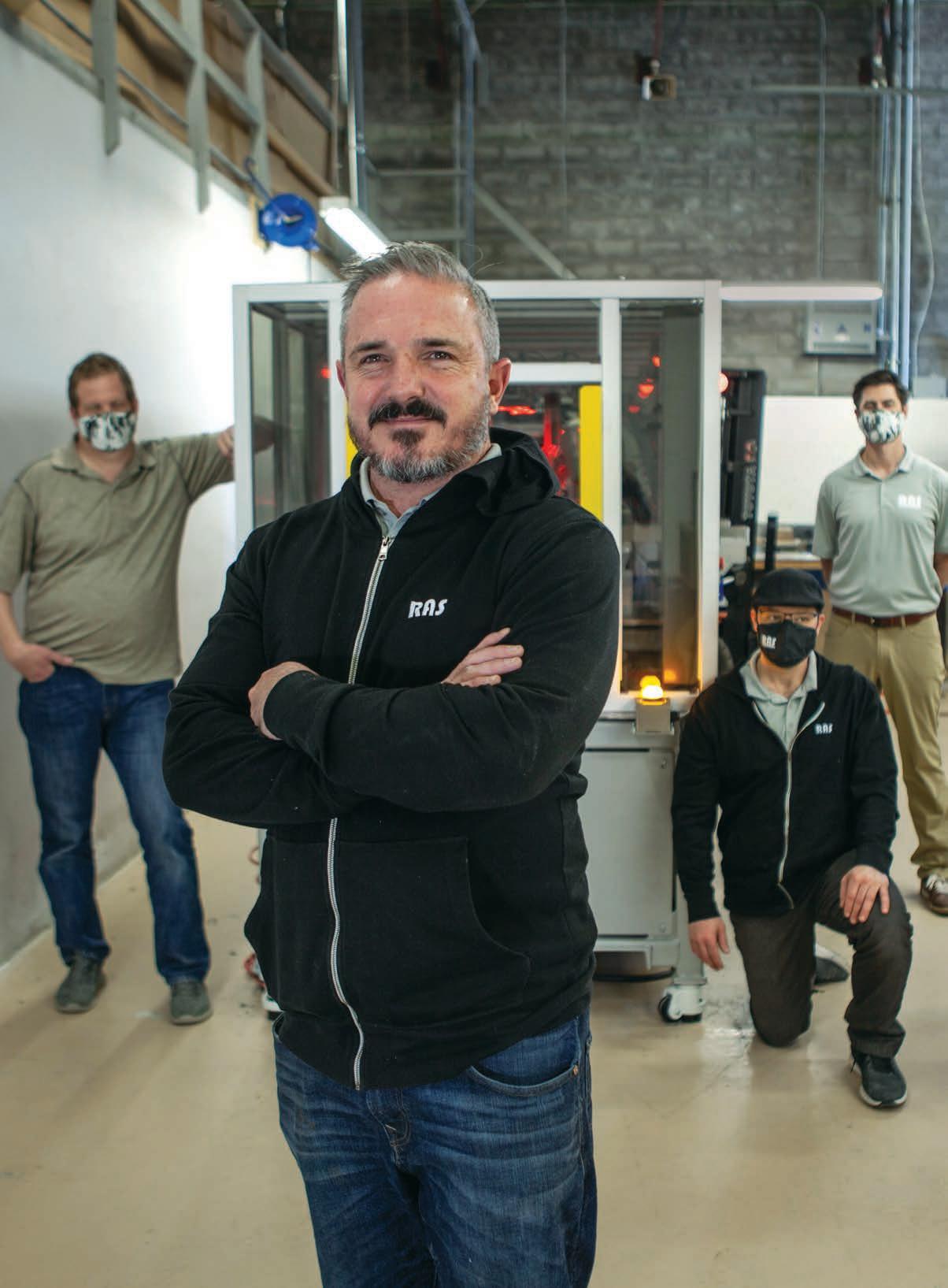
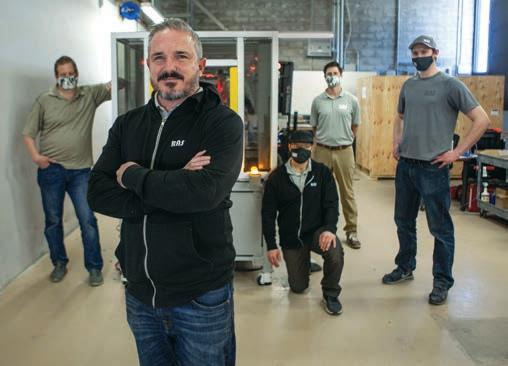
Jeff Cybulski, founder of Cambridge, ON-based Rebel Automated Systems (RAS) with his team including project manager,
DOWNTIME DETECTIVE
Raven.ai’s industry 4.0 solution helps manufacturers sleuth out the root causes of lost productivity.
BY MIKE MCLEOD
No matter how adeptly a manufacturing plant is run, they all experience some amount of unscheduled downtime. Inevitably, things happen that weren’t anticipated.
According to International Society of Automation estimates, nearly all manufacturing plants lose 5% of production due to downtime. For some, it can be as much 20%.
Even so, an 2017 ARC Advisory Group survey suggests those number s are most likely an underestimation since most plants don’t calculate the cost of unplanned downtime. For those that do, the survey found that manufacturers didn’t measure unplanned downtime consistently and rarely in terms of monetary
value. While every industry is impacted differently, the industry analysis firm pegs the global financial impact of downtime at one trillion dollars annually for process industries alone.
Unfortunately, one of the biggest barriers to preventing unplanned downtime is discovering why it happened in the first place. Often, the cause of an event – whether due to operator error, delayed maintenance, a slow change-over procedure or a combination of those – simply gets filed under the same generic “unplanned” label.
“When a process isn’t running, the biggest challenge is understanding why isn’t it running,” says Mar tin Cloake, founder and CEO of Ottawa-based Raven.ai. “If you only look at the machine
fault code, for example, it would say ‘code ABC’ for three hours, but that doesn’t tell you what happened.”
Breaking down those three hours into defined segments, he says, allows manufactures to begin asking the right questions. For example, how long did it take for someone to notice a machine might be broken? Once noticed, and maintenance is alerted, how much time was spent waiting for the MRO staff to fix it? Did maintenance have what they needed to fix it? Once fixed, was the process waiting for the operator to come back and run the machine again? Only by dissecting downtime can plant operators hone in on the right answers.
“What often happens with inaccurate data from the shop floor is that people over index on the technical side of things,” he explains. “They think it’s their machines that are broken all the time when the reality is, if what’s really causing all this down time is uncovered, often there’s a lot of things that can be done on the operational side of things.”
That’s where Raven.ai’s industry 4.0 solution comes in. The company’s hardware and software are designed to account for how manufacturing operations “spend every single second of the day,” Cloake says. To facilitate that, the company offers its Raven Sense tablet, an IOT/Edge device that automates the process of labeling downtime, by tapping into multiple sources starting with the operators.
With that data, the company’s artificial intelligence software can discover patterns that would otherwise be missed. Designed with operator s in mind, the device also provides real-time feedback on how production is performing relative to production targets.
As an example of what the system is capable of, Cloake points to an instillation of Raven’s technology at a Danaher plant
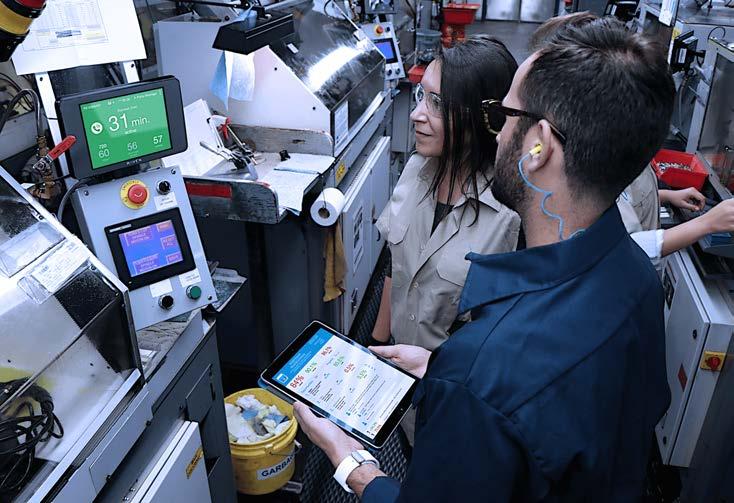
Raven.AI’s Raven Sense edge computing hardware and Raven Flight apps help manufacturers quickly narrow in on the root causes of unscheduled downtime.
that was losing 600 machine hours per month, it turned out, due to staff having to waiting for maintenance to arrive.
“Danaher is a fantastic company, so it’s not that they didn’t know how to schedule maintenance; they just didn’t know that was the critical issue that was stopping them from producing,” Cloake says. “So we help our clients identify what the most important cause of unwanted downtime is. We don’t solve the problem, people still solve that, but we help them make sure that they stand in front of the right problem, at the right time.”
But no matter how clever the technology, it’s worthless if it doesn’t gain engagement with operators on the plant floor, Cloake says – a lesson he learned early in his career. Shortly after graduating from McGill University with a mechanical engineering degree, his first manufacturing job was as a manufacturing engineer and production supervisor for a Montreal window blinds manufacturer.
It was his experience there that inspired Raven.ai, he says, and informed the how the company’s technology integrates into their clients’ manufacturing process. As a result, the Raven Sense tablet, he says, is a tool akin to a driver using GPS to navigate more efficiently.
“The GPS in your car is a perfect example of helping people perform and done in a way where it’s not about the report; it’s not about the graph,” Cloake says. “It’s about occasional high-value guidance to help people perform at higher levels.”
“For us, everything starts with the operator and a high degree of respect for the fact that they are producing the good that’s being delivered to the customer,” he adds. “So if operators are putting in effort to interact with a screen, it can’t exclusively be to feed a system full of data.They have to get something in return, which is to see people fix the problems they identify. Again, the way the continuous improvement game is played is by identifying and solving the right problems quickly.”
Ultimately, he says, companies often focus too much on the
technology during their digital transformation journey instead of the real goal which is helping people become more productive. In support, he points to a Deloitte study that found produc-
more efficient got lost. We suddenly thought that implementing technology was the goal,” he says.
“But that’s not the goal,” he adds. “The goal is to produce and con-
“We don’t solve the problem, people still solve that, but we help them make sure they stand in front of the right problem, at the right time.”
tivity has stagnated globally on average since 2010 despite rapid technological improvements like the smart phone.
“What happened is that we went from looking at historical data on reports once in awhile to being bombarded with real-time data all the time and the ultimate goal of making ourselves
tinuously improve. That’s good for consumers, good for profits and good for people on the shop floor because nobody wants to be running an inefficient process. So if it’s good for those three things, that’s really the potential of Industry 4.0.” |DE https://raven.ai
They’ve been running since March.
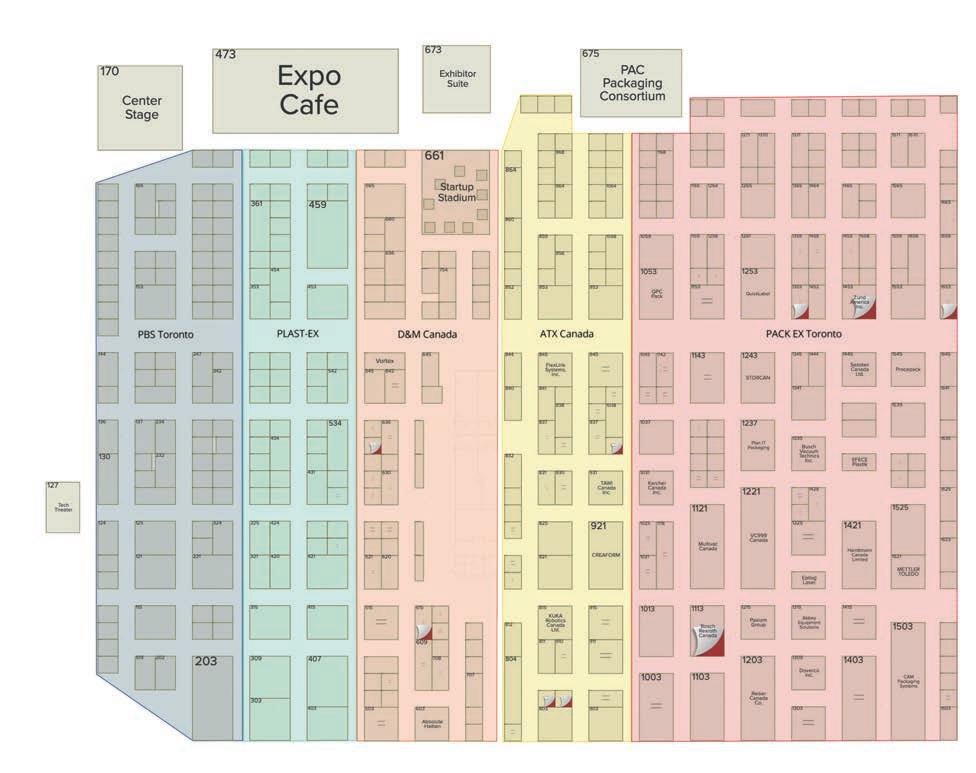
ADM 2021 PRE-SHOW GUIDE
D&M, PackEX, Plast-EX and ATX expos return to connect the advance manufacturing and design engineering community for in-person networking and deal-making.
The Advanced Design & Manufacturing (ADM) Toronto conference and exhibition will return in-person to Toronto this winter. Slated for November 9-11 at the Toronto Congress Centre, the 2021 edition of ADM comprises five event brands under one roof: PackEX, PLAST-EX, Automation Technology Expo (ATX), Powder & Bulk Solids, and Design & Manufacturing (D&M).
According to the tradeshow’s organizer, Informa Markets, ADM 2021 is designed to provide an allin-one experience and will provide attendees with the opportunity to explore the latest trends and technologies shaping the future of advanced design and manufacturing across automation, robotics, energy efficiency, packaging, plastics, processing, and more.
“The power of face-to-face connection plays an undeniable role in the industry’s advancement and has been sorely missed over the past eighteen months,” said Jenny McCall, Group Event
Director, ADM, Informa Markets. “We could not be more excited to reconnect the industry in-person this November in Canada’s epicenter of innovation and progress the manufacturing industry, a sector that accounts for 10% of the country’s GDP.”
McCall adds that the event is strategically held in Toronto, since it’s home to a selection of the world’s leading injection mold and toolmakers, additive manufacturing supplier s, and emerging R&D in machining technology. In total, the combined shows will host an estimated 130 exhibitors and attract 2,500+ attendees this year.
Industry-leading exhibitors will include Absolute Haitian, CAM Packaging Systems, Carlo Gavazzi Canada, Cog-Veyor Systems, Creafor m, Firing Industries, Flexlink Systems, IKO Thompson Bearing Canada, Jenike & Johanson, Kongskilde Industries, KUKA R obotics Canada, Multivac Canada, PlexPack Corporation, Proax Technologies, Reiser Canada, SMC Corp, and Vortex. |DE www.admtoronto.com
ADM 2021 KEYNOTES
Tues, Nov. 9 11–11:45 a.m. Fireside Chat – Solving Plastics Packaging Waste Challenges Jim Downham, President & CEO of PAC Global and George Roter, Managing Director of Canada Plastics Pact Wed, Nov. 10 11–11:45 a.m. Dennis Darby President & CEO, Canadian Manufacturers and Exporters (CME)
Thurs, Nov. 11 11–11:45 a.m. State of Advanced Manufacturing in Canada Jayson Myers, CEO of Next Generation Manufacturing Canada (NGen)
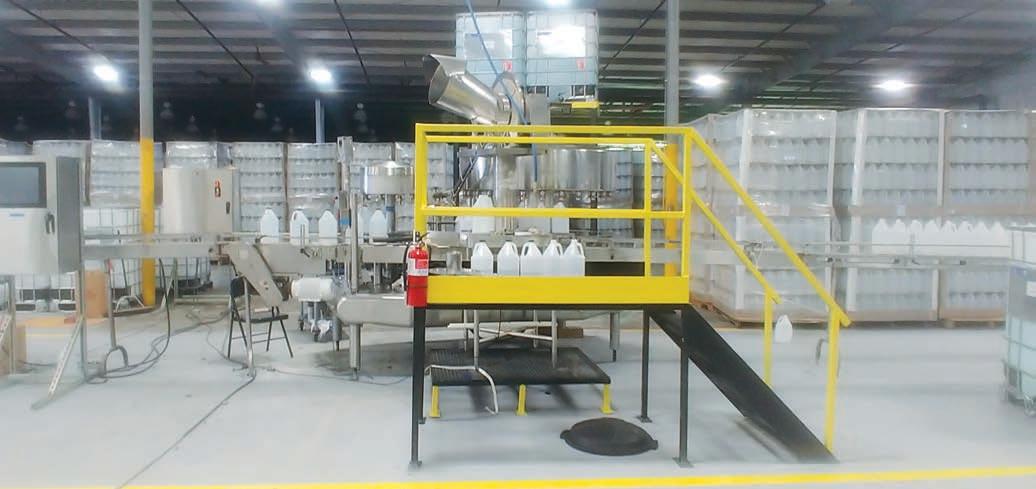
rotary filler/capper unit is only part of the equipment Emerald 66 and partner NACI designed and deployed in three months to produce hand-sanitizer in high volumes.
FROM WAREHOUSE TO ENTERPRISE
Packaging company transforms empty space into high production bottling facility in three months.
BY JOSH EASTBURN
With demand for hand sanitizer more than doubling across the US, and annual growth expected to exceed 20% in coming years, 2020 presented the cleaning industry with a big oppor tunity.
To meet this need, Emerald 66 Enterprises (E66), a co-packaging and distribution company based in Seminole, Oklahoma, mobilized its resources, setting up shop in an empty denim processing warehouse.
In only three months, the company had automated packaging lines producing up to one million bottles of
hand sanitizer a week in a cGMP-compliant facility, and they continue to expand their core process capabilities at a rapid clip.
“When we say we do stuff quick,” says E66 president, Robert Bodnar, “we’re talking days, not weeks or months.”
To help achieve that feat, E66 hired Northeast Automation Company (NACI) with the understanding that things needed to move fast. E66 was competing against low-paid, high-volume workforces operating manually. E66 believed technology would allow them to do more with a smaller,
better-paid workforce.
The quickest way to build a new packaging process was by acquiring a variety of equipment at auction, leaving NACI the task of integrating it all into a cohesive system.
Tom Coombs, principal engineer at NACI, decided to make Opto 22’s groov devices the focus of their strategy so they could use edge computing to build an information management system as they scaled up.
“Each piece of equipment needs to be intelligent,” Coombs explains. “We’re going to make every conveyor and every device smart.”
It’s a bold aspiration, for sure, but buying secondhand equipment meant that quality varied widely. NACI had to get creative to design a cohesive system at the speed Emerald 66 needed.
Layered distributed control
To address this circumstance, Coombs proposed a unique architecture that enabled separate control systems to function together while also laying the foundation for E66’s data acquisition goals.
At the top level, Coombs used a groov EPIC edge programmable industrial controller to supervise the process lines and connect disparate devices through REST APIs. The used equipment that arrived with defunct control systems was integrated into this network as remote I/O through SNAP-PAC-R1 controllers, which also provided specialty I/O options not yet available on EPIC.
NACI then used groov RIO edge I/O modules to
This
Photo
loosely integrate any functional control systems. As each new unit came online, NACI dropped in one of these PoE-powered modules and used its software-configurable channels to identify the signals the unit provided. NACI mirrored these I/O signals in parallel with the existing PLC I/O connections and integrated them into the groov EPIC network.
“The ease with which you can do this, you know, you’re talking about a half-hour of wiring,” Coombs notes. “Your biggest problem is finding the documentation from the original manufacturer.”
While these modules appear as remote I/O in the groov EPIC’s control strategy, Coombs also engineered an additional layer of control, independent of EPIC, by allowing each groov RIO to execute limited local control through Node-RED.
Living up to their ambition to “make every device smart,” NACI added motors, photo eyes, load cells and other instrumentation to many pieces of semi-automated and dumb equipment. It then sprinkled in a little logic to make them work together and report process data up to the coordinating level.
“The top-level process [in
Automation firm, NACI, manufactured several of these VFD control panels for local conveyor control using Opto22’s groov RIO edge I/O modules.
EPIC] is turning on two lines or three lines,” says E66’s Bodnar, who is a veteran engineer himself and was involved in much of this design. “If you have a line coming in and you have a line going out, they may not be running at the same speed…You’ve got all these different components running at different speeds, so it’s kinda neat to be able to say, ‘what if we use the groov RIOs to control just the lines and the belt and case packers and things like that?’ We’re doing just little simple stuff: Turning on and off motors to run a line and trying to match up how fast a filling machine is spinning. They’re kind of little islands of point automation.”
This loosely coupled, distributed architecture allowed NACI to assemble their production line without modifying any of the existing control systems that came as part of their purchased equipment. In three months, Coombs and his team had 15 pieces of equipment up and running, but this wouldn’t be their last challenge.
The Big Pivot
Emerald 66’s end-to-end process includes conveyance, filling, capping , printing, labeling, packing and palletizing operations. Because they had modeled their business around a single large purchaser, the process was designed to maximize throughput. But the situation changed significantly when that customer suffered a financial setback and had to close production.
As a result, E66’s whole business had to pivot. Suddenly, processing high volumes of one-gallon, single-formulation containers didn’t work. The automation had to grow to produce a variety of sanitizer chemistries in different batch sizes and packaging form factors: From small two-, four-, six- and eight-ounce containers, to hand pumps, spray bottles and large jugs.
Fortunately, NACI’s decision to use a loosely coupled
production line made it easy to modify individual segments without interrupting their data collection and process integration. In combination with on-site panel building and 3D printing capabilities, edge-oriented automation allowed them to retool very quickly. Emerald 66 was able to break even on their initial investment within six months.
“The groov RIO / PAC control / groov EPIC / business system stack, as you move up, lets you move things around and be pretty modular and respond to business,” Bodnar says. “There are a lot of good things that you can do in the industrial world that people might [comment on], but they usually don’t say that you’re nimble. But it is fun to be nimble, and on the industrial side, I think that’s one of the things [Opto 22] has really helped us with.”
“The fluidity and dynamics of modern manufacturing requires extremely fast response to changing market demands,” NACI’s Coombs adds. “With groov EPIC and groov RIO, Opto 22 puts dynamic manufacturing data at the edge of the production line and into enterprise systems simultaneously in real-time.”
As demand grows, Emerald 66 continues to diversify its business and expand its production capabilities. Recently, they spun up a technology division that uses groov devices to develop filling equipment for overseas export.
Their automation is also adapting to accommodate new functions like container molding, product blending and quality control procedures. As the process expands, so do E66’s ambitions for their data infrastructure and infor mation management systems. |DE emerald-66.com northeastautomationco.com www.opto22.com
Josh Eastburn is Opto 22’s director of technical marketing with more than a decade of experience as a systems integrator and automation engineer.
Today’s manufacturing companies face several pressing challenges that include maintaining or replacing aging equipment, minimizing unplanned downtime and overcoming the shortage of skilled workers.
Predictive maintenance holds the key to surmounting many of these obstacles. This strategy helps manufacturers monitor equipment remotely, cut maintenance costs and avoid the sorts of adverse events that lead to unplanned downtime.
Traditional preventive maintenance – as opposed to predictive maintenance – relies on experienced workers who regularly execute time-consuming manual tasks. Without inhouse employees who can do this, manufacturers drive up costs and complexity by using third-party service providers. As many maintenance workers near retirement, there’s a growing scarcity of senior-level per sonnel who can train new hires.
Fortunately, the latest predictive maintenance technologies are equipped with machine learning algorithms that store and
reproduce human expertise. Artificial intelligence (AI) controllers, for example, build a model of “normal” machine behavior and sound an alarm whenever they detect an anomaly.
Cutting costs
In the absence of a predictive maintenance strategy, companies must care for their equipment with regularly scheduled preventive maintenance. According to Plant Engineering, manufacturers spend an average of 19 hours per week maintaining their equipment. These effor ts can be very expensive and increasingly time-consuming, as equipment ages.
In addition, manufacturers relying on preventive maintenance f ace a dilemma when mapping out a plan for replacing equipment. Without a continuous monitoring system, the only way to avoid a catastrophic failure is to purchase new equipment before it’s truly necessary.
With predictive maintenance, manufacturers can rest assured that the system will indicate exactly when replacements are necessary. Continuous monitoring removes the costly demand to
hedge one’s bets and builds confidence in a fully functioning system.
On top of saving money, predictive maintenance frees up employees’ time for correcting critical production issues and realizing moder nization projects that will improve productivity and equipment performance (OEE) over the long ter m.
Prior to investing in a continuous monitoring solution, a company might be unable to invest in these projects due to lack of manpower. With a next-generation maintenance solution, it will also be less urgent for a company to look for new hires, and senior-level employees will have more time to coach the next generation.
Reducing downtime
Unplanned downtime is a serious issue that can cost millions of dollars in lost revenue, wasted products and production line standstills. Most manufacturing companies have had their production lines go down without warning at least once in the past few years.
Manufacturers who use a reactive approach to unscheduled downtime, rather than a proactive solution,
often don’t know when their equipment is due for repair or replacement.
While aging equipment is one of the main culprits, both legacy and new machines require regular maintenance to maximize their lifespan.To combat the high cost of preventive and reactive maintenance, many companies are now embracing predictive maintenance technolog ies that provide 24/7 condition monitoring to reveal any issues before an actual failure occurs.
In one example, a Canadian medical research f acility found that its air handling units (AHUs) were failing unexpectedly despite frequently scheduled maintenance. When the facility star ted using a motor monitoring device for predictive maintenance, these failures stopped occurring.
The round-the-clock monitoring system helped the facility ensure 100% up-time of a critical system and avoid the destruction of valuable biomedical research materials that would otherwise result from a lack of AHU functioning.
Enhancing safety
Traditional preventive maintenance can be costly,
Image credit: Omron Canada
IIoT-based predictive maintenance components allow power supply loads, motor condition and equipment thermal condition to be monitored in real time
but an additional concern is the dangerous nature of the regularly scheduled maintenance tasks that this approach often involves. These activities are typically hands-on, bringing workers close to the hazardous portions of equipment.
For example, workers who perform thermal inspections on energized electrical panels of 50 volts or greater may be exposed to arc flash risks and must wear protective equipment. Arc flashes can be thought of as an explosion of electricity that can be fatal for anyone nearby. When a company takes advantage of a 24/7 ther mal monitoring device, its
maintenance workers no longer need to expose themselves to this type of risk on a regular basis.
IIoT capabilities
Advances in sensors, analytics and communication technologies are making predictive maintenance increasingly practical and affordable for any manufacturing company. Turnkey solutions equipped with IIoT capabilities make it easy to garner real-time visibility of the health of equipment. This information can be further processed to help operators make informed decisions.
By monitoring power supply loads, motor condition and equipment thermal condition in real time, IIoT-based predictive maintenance solutions are ideal for a wide range of industries and applications.
To summarize, the benefits of traditional preventive maintenance only go so far. At some point, manufacturers are bound to start missing signs of equipment degradation or driving costs up by replacing perfectly functional equipment on a “just in case” basis.
A round-the-clock monitoring strategy is the only way to truly keep track of equipment and minimize downtime. Throughout the automotive, semiconductor, commodities and other manufacturing industries, predictive maintenance solutions can streamline maintenance work while also supporting production. |DE
www.omron.com
Omron automation application specialist, Mathieu Paré, is a certified professional engineer based in Omron’s Quebec office.
AUTOMATION
INDUSTRIAL PC
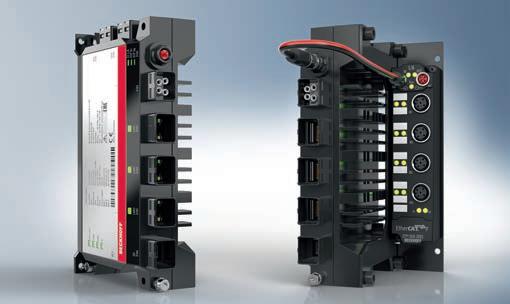
Beckhoff unveiled its C7015 Industrial PC that features IP65/67 protection. The Microsoft Azure Certified and AWS Qualified edge device is designed for decentralized installations. Measuring 85 x 167 x 43mm, the C7015 incorporates an Intel Atom multi-core processors with up to four cores. The IPC features an EtherCAT P connection which allows for sensor/ actuator connections via the IP67-protected EPP modules. A special mounting plate enables direct attachment of an EPP module to the C7015. If required, additional EPP modules can be flexibly connected via EtherCAT P to suit specific applications. www.beckhoff.com
HIGH-SPEED CAMERAS
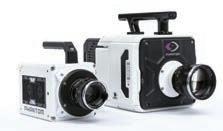
Vision Research unveiled two models in its ultra high-speed performance line of Phantom cameras. The compact Phantom T3610 achieves frame rates of 38,040fps at 1280 x 800 resolution and up to 875,000 fps at reduced resolution. The TMX 5010 has a 50,725 fps at its maximum
resolution of 1280 x 800. It also features RAM capacity up to 512GB, a partition offering of 511 segments, a 10Gb Ethernet RJ45 port, and the ability to upgrade to higher throughput models at a later date. Both models feature a 2x2 binned mode for higher vertical resolution at the camera’s top frame rates. Their BSI sensor technology also provides greater sensitivity and sustained throughput. Extreme Dynamic Range (EDR) is also included to capture detail in flashes and saturated highlights.
www.phantomhighspeed.com
MOTION CONTROL
MOTION CONTROLLER
AutomationDirect has added the PS-AMC to its catalog of motion controllers. The line is capable of up to 4 coordinated axes of motion per controller (PS-AMC4) with differential encoder feedback for each axis and a maximum switching frequency of 1MHz. Support for up to 24 general-purpose high-speed inputs and 12 outputs are also included.
Available in 1-, 2-, 3-, or 4-axes models, the AMC controllers are auto-discovered in the company’s Productivity Suite programming software, which has numerous built-in motion instructions allowing for easy configuration of standard motion profiles, including flying cut-offs and rotary tables. www.automationdirect.com
MOTION CONTROL SYSTEMS
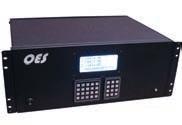
Optimal Engineering Systems’ (OES) has added the ADAGIO-X-STPR Series of motion control systems, designed to drive single and multi-axis stepper motor stages. Each 19-inch rack mounted controller includes a power supply, and motion controller
cards for 1 to 4 axes, and micro-stepper drivers for single and two-phase steppers requiring up to 7 amps per phase. The unit’s capabilities include set acceleration, set velocity, set position, absolute move, relative move, find home, zero position counter, go to position zero, stop all motors and limit switches. The controllers operate on an input power of 115 or 230 VAC, 50-60 Hz, have Auto Current Reduction and can be ordered Plug-and-Play. www.oesincorp.com
LINEAR STEPPER STAGES
H2W released its LSS-031-04011-MEA, a series of single-axis linear stepper stages that integrates a linear encoder into the single-axis linear stepper motor stage. The H2W linear stepper motor STS-1220-AP3 powers the stage and generates a force of 11.0 lbs [48.8N]
with a total stroke length of 31.0in [788mm]. Integrated air bearings maintain the required motor air gap. The customer must supply 60-80 PSI of filtered compressed air for proper operation of the stage. The integrated 1.0-micron resolution encoder works with the control package to operate the stepper motor as a two-phase brushless linear motor, which generates higher speeds and allows for precise positioning.
www.h2wtech.com
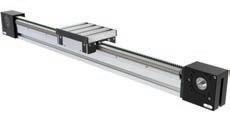
LINEAR MOTION UNIT
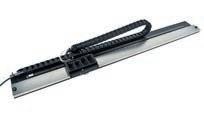
Robotunits introduced its Linear Motion System which includes 50mm aluminum extrusions and a common 14mm T-slot, to make it compatible with the company’s other systems such as conveyors, material handling components, safety fencing and machine frames. The unit is available with a single or double carriage. The system allows the energy chain to attach directly to the carriage without the need for additional components. For advanced applications, the Omega Linear Motion Unit can be used as an individual device or x-y-z gantry to move and position parts with precision. The system also
features an integrated belt return inside the extrusion and the use of single or double idlers, depending on the load. In addition, single and multiple guide rails are available.
www.robotunits.com
MOTORS AND DRIVES
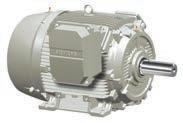
AC MOTORS
Siemens released its SIMOTICS
SD200, a low-voltage, severe-duty motor. The cast-iron NEMA motors offer 75-800 hp output and feature 444-5013 cast-iron frames for operation in 460V and 575V ranges. They also meet or exceed NEMA Premium MG1 Table 12-12 efficiencies. Options include IP56 ingress protection, encoders, brakes and blowers. On these motors, the frame, end-shields, fan guard and diagonally split, oversized terminal box are all cast-iron. It also comes
with zinc-plated hardware, epoxy paint and stainless-steel nameplates. Each die-cast aluminum rotor assembly is dynamically balanced and includes a C1045 carbon steel shaft. C5-grade steel laminations and copper magnet wire are standard. The insulation system – a Class-H non-hygroscopic system with NEMA Class B temperature rise –meets or exceeds NEMA MG1
2014 Part 31. http://usa.siemens.com
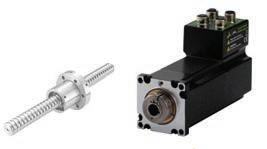
INTEGRATED SPINDLE DRIVE MOTOR
JVL A/S announced an addition of a directly mountable motor for driving spindles to its ServoStep line. The line
includes encoder, drive electronics, control electronics with ePLC and optional Ethernet or CAN bus integrated. It supports protocols including Profinet, EtherNet/ IP, EtherCAT, SERCOS, ModbusTCP/UDP and Powerlink. The line also features double ball bearings enabling up to 7100 N axial load, 409,600 step/rev resolution and speed-resolution down to ±0.01 RPM. The built-in ePLC features 8 DIO and 24V or 0-5V (12bit) analog input with advanced filtering. www.electromate.com
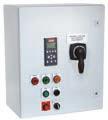
SOFT STARTER
Danfoss unveiled its MCD 600 Enclosed, a VLT soft starter that includes an enclosure. The enclosed model offers the features and functions as a standard MCD 600 Soft Starter in a NEMA12 or NEMA3R enclosure, with circuit breaker, keypad, and operators on the door. Other standard features include advanced start, stop and protection, a mains voltage range of 3 x 480 VAC and DC injection braking. The model also includes inbuilt impeller cleaning assistance, an auto start/stop clock and a 4-line graphical display. Standard and heavy duty models are available.
www.danfoss.com
21_1881_Design_Engineering-OCT_CN Mod: August 25, 2021 9:06 AM Print: 09/22/21 page 1 v2.5
FLUID POWER
LINEAR ACTUATOR
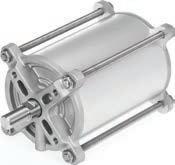
Festo released its DFPC double acting linear actuator, available in either standard, preconfigured versions or individually configurable versions. The latter can be ordered with different stroke lengths of the space bolts, piston rods of differing lengths, different thread types and diameters and can be adapted for ATEX II 2GD certification. DFPC has been specially designed for actuating process valves types such as gate, knife-gate and pinch valves, or valve bodies without housing. The piston rods, screws, nuts and tie rods are made of stainless steel, while the cylinder barrels and end caps are made of aluminum. There are interfaces for process valve to ISO 5210 and ISO 15552 with extended tie rods. Proximity switches, mountings for position sensing and Namur adapter plates are
available as accessories. The DFPC is available currently with strokes of up to 1600mm and in the sizes 80 to 200. www.festo.com
SPRAY NOZZLE
EXAIR released a 1/2 NPT siphon fed air spray nozzle that atomizes a variety of fluids in a round spray pattern where no liquid pressure is available and heavy application of liquid is needed. The corrosion resistant type 303SS nozzle draws liquid into the airstream and mixes it internally while providing up to 24 inches of suction height. The 1/2 NPT spray nozzle provides liquid flow up to 68 GPH in a 6 inch diameter round pattern. The atomizing nozzles are available with 1/8, 1/4 and 1/2 NPT connections and in a variety of spray patterns. All models are adjustable,
have an available mounting bracket and handle liquids with a viscosity of up to 300 centipoise. www.exair.com
PNEUMATIC CYLINDER
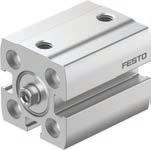
Festo released its ADN-S pneumatic cylinder adapted from its ISO standard ADN double-acting cylinder. Available with multiple mounting options, the compact cylinder is available with either fixed or no end-position cushioning and proximity sensor can be added. The piston rod is available with internal or external threading, in diameters 6 to 60mm and in standard strokes 5 to 50mm. For lithium-ion battery manufacturing, there is also a variant which contains only trace amounts of copper, zinc and nickel. www.festo.com
DYNAMIC VALVE
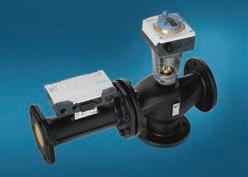
Siemens introduced its Intelligent Valve, a cloud connected, self-optimizing, dynamic valve that features automatic presetting, continuous optimization of the delta T limitation and system-generated reports. The valve’s built-in learning mechanism avoids maximum volumetric flow when it isn’t required. Thanks to automatic presetting, the system doesn’t need to have power and the installer does not have to adjust each valve multiple times. The Intelligent Valve’s self-adjustment feature helps continuously optimize the system and immediately detect faults and anomalies. The self-test report documents settings data. The valve’s RS458 interface connects it to Modbus RTU networks. www.siemens.com
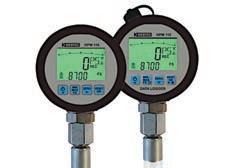
DIGITAL PRESSURE GAUGE
Webtec announced that its HPM110 digital pressure gauge is now available with a USB interface to facilitate data logging. This optional version, with real-time clock, records both current measured pressures, as well as the minimum and maximum values. Users can transfer the stored data to a PC or laptop in CSV file format, where they will see a time and date stamp against
recorded pressures. The HPM110 has a maximum system pressure of 600 bar (8700 psi) for fluids in the temperature range of -20 to 80°C, while accuracy is ±0.5% at full scale. Featuring a back-lit visual display, the battery-operated gauge features a zinc die casting with a protective TPE rubber cover. webtec.com
POWER TRANSMISSION
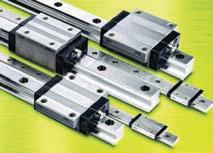
LINEAR BEARINGS AND RAILS
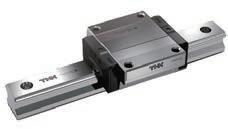
AutomationDirect has added the WON linear bearing and rails to its line of mechanical power transmission products. WON linear bearing blocks are available in various sizes to meet the needs of any specialized motion project. The H series offers four rows of continuously circulating ball bearings and comes in a flanged or rectangular form factor. The M and MB series offer two rows and come in either a rectangular or long rectangular form factor. Linear rail in lengths up to 1000mm matches the series of bearing blocks selected. All bearing/rail systems provide 4-direction equal load sharing in any direction for lower friction and smooth motion. www.automationdirect.com
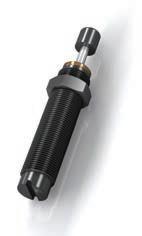
MINIATURE SHOCK ABSORBER
ACE Controls released its MC75 Family of miniature shock absorbers, designed to provide energy damping in tight installation spaces. The MC75 features an energy capacity of 75 inch-pounds per cycle and 250,000 inch-pounds per hour. Available in weight ranges from 0.5 to 2.5 pounds through 55 to 160 pounds, units have a length of 2.77 inches. They also feature a
0.40-inch stroke length and deliver low return forces, the company says. The miniature shock absorbers include a one-piece outer body filled with temperature-stable oil. They’re also able to react to changing energy conditions without adjustment. Additional features of the MC75 include a continuous outer body thread with lock nut and an integrated positive stop. www.acecontrols.com
SENSORS
ABSOLUTE ROTARY ENCODERS
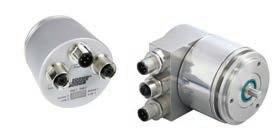
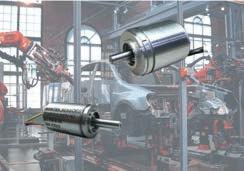
POSITAL announced it has upgraded the PROFINET communications interface of its IXARC series of absolute encoders. The speed of the interface has been increased, reducing cycle time by a factor of eight to 125μs. In addition, the company has added capabilities, including acceleration monitoring and over-temperature warnings. Output from the encoders can be scaled (amplified or reduced) to meet the requirement of the controller. The encoder interface also
supports MRP (Media Redundancy Protocol) and MRPD (Media Redundancy for Planned Duplication).
POSITAL’s IXARC magnetic encoders provide up to 0.005° resolution (16 bit) and accuracy of up to 0.02° (14 bit). Multi-turn models have a range of up to 65,536 revolutions. IXARC encoders are available with multiple options for housing size and materials, flange configuration, shaft type and diameter, connection/
wiring type and level of environmental protection. www.posital.com
MEMS CAPACITIVE ACCELEROMETERS
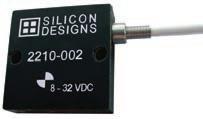
Silicon Designs, Inc. announced availability of stock quantities of its Model 2210 series of capacitive accelerometer modules. Offered in standard ranges from ±2g to ±400g, the series incorporates a MEMS capacitive accelerometer chip together with high-drive, low-impedance buffering. All Silicon Designs Model 2210 series modules generate two analog voltage
outputs which vary in response to applied acceleration. Users can employ either a single-ended or differential output, the latter of which doubles accelerometer sensitivity. Output scale factor is independent from the supply voltage of +8 to +32V. At zero acceleration, differential output voltage is nominally 0 VDC; at full scale, it is ±4 VDC. www.silicondesigns.com
ULTRASONIC SENSOR
Pepperl+Fuchs introduced the USi-safety ultrasonic sensor, designed for use in harsh environments and outdoor applications. With safety certification in accordance with EN ISO 13849 category 3 PL d, the USi-safety is a 2-channel ultrasonic sensor, featuring two transducers
connected to a control interface. On each of the two independent channels, objects can be detected via an elliptical sound beam within ranges of up to 2500mm. Two safe OSSD outputs are provided for signal output. Due to the special “wide and shallow” shape of the detection field, the system can be successfully used just above the floor or close to a wall. Due to the opening angle of ± 17°/± 5°, a particularly wide detection range is generated in one plane and a narrow detection range in the other plane.
www.pepperl-fuchs.com
ROTARY POSITION SENSORS
NewTek released its RV series of rotary position sensors designed to ensure the performance accuracy of industrial robotic systems. With a shaft that rotates 360° with no stops, the sensors measure shaft angle position over a nominal range of ±30°. The sensor features RVDT technology for non-contact measurement. The series
features an operating temperature range of -65°F to 221°F (-55 to 105°C). Units are available in both size 8 (0.75 inch) and size 11 (1.06 inches) diameter. As the AC-operated rotary position sensor requires external excitation, the NewTek NTC-6000 LVDT Signal Conditioner powers the sensor while converting its position output into 4-20mA, 0-5V, 0-10V or RS-485 format for robotic control systems. www.newteksensors.com
TEMPERATURE PROBE
The sensor connection division of Harold G. Schaevitz Industries LLC, has expanded its line of temperature sensors with the addition of the EGT-EP probe. The exhaust gas temperature probe is capable of temperatures up to 2,300°F (1,300°C) and will fit most internal combustion engine exhaust systems from approximately .750-inch to about 4 inch diameter. The EGT probe is 0.187-inch diameter (4.75mm) with a 90-degree bend to accommodate tight mounting locations. An adjustable (316 Stainless Steel) 1/8-inch NPT compression fitting adapter is included. The probe’s cable lead length is 6 feet (1.8 meters) or 12 feet (3.6 meters) and is over-braided in stainless steel for abrasion resistance.
www.hgsind.com
TYPE 3 LIGHT CURTAIN
Pilz released its PSENopt II line of type 3 safety light curtains, the first to gain approval from Underwriters Laboratories (UL). Suitable for Performance Level d (PL d) applications, the PSENopt II line provides finger, hand and body protection in accordance with EN/IEC 61496- 1/-2 “Safety of machinery – Electro-sensitive protective equipment.” They are also the only light curtains available with a shock resistance of 50 g. As such, the shock-resistant light curtains are designed for rugged industrial environments.
www.pilz.com
ManufacturingJobsite.ca is Canada’s premier online job portal for the growing manufacturing sector. A laser focus on the right people across the country’s largest manufacturing media audience means you get the right applicants the first time. No more massive piles of unqualified applicants, just professional employers reaching qualified professionals.
Powered by the top manufacturing media brands in Canada, the reach to over 500,000 industry professionals on ManufacturingJobsite.ca is amplified by:
Website advertising to 185,000 qualified monthly site visitors
A comprehensive and magnifying reach across multiple associated job boards
Email promotion and job alerts to 131,000 industry emails using Canada’s largest CASL-compliant direct access to manufacturing professionals
Social media promotion to all brand networks on Facebook, Instagram, Twitter and LinkedIn
CONFIGURABLE COMPONENTS MILLIONS
MISUMI is proud to offer an expansive catalog of parts for your applications. Including, automation, press die, plastic mold, electrical, and more!
Our configurability options allow you to adjust the material, length, diameter, shape, and more. Shop, configure, and download CAD files straight from our site.