14 Altair fatigue analysis software reveals areas of likely failure
17 A look inside BRP’s legacy of innovation and industrial design
23 Self-synchronizing actuators help work-platform builder maintain footing
90% faster gripper change
SHS Quick-change System
Up to 210 N gripping force
Electric EGP Gripper for small Components
Design and order in 15 minutes
SCHUNK Finger Designer
Everything for your Scara Robot
More than 600 components for handling and assembly.
Reduce cable related downtime by 75%
Defined bend radius. Built-in torsion stop. Split cavity for cable separation.
Decrease downtime and improve production with the triflex® R multi-axis robotic cable management system
Dr. Alain Aubertin Vice President, Business Development and International Affairs, Canada Consortium for Aerospace Research and Innovation in Canada (CARIC)
Ajay Bajaj, P.Eng President, Rotator Products Limited; Past President and Board Member, Power Transmission Distributors Association (PTDA)
John Lamb Regional Sales Manager, Wainbee Limited; Chairman, Canadian Fluid Power Association (CFPA)
Dr. Ishwar Puri, P.Eng Dean of the Faculty of Engineering; Professor of Mechanical Engineering, McMaster University
Dr. Mary Wells, P.Eng Dean of the College of Engineering and Physical Sciences, University of Guelph; Chair of the Ontario Network for Women in Engineering
8 Design News
Nanoracks, Maritime Launch partner to re-use rocket stages as space outposts and other design news
14 CAD Report
Random response fatigue analysis reveals areas of likely failure due to dynamic excitation
30
Idea Generator
The latest in industrial products including automation, motion control and sensors
Columns Features
17 Canadian Innovator
An inside look at Bombardier Recreational Product’s legacy of innovation and industry leading industrial design
Self-synchronizing actuators help work-platform builder maintain footing in demanding industrial markets
The Canadian Paradox Editorial Viewpoint
Fordecades, Canada has been critiqued for lagging behind peer nations in terms of innovation. Sources, like the Conference Board of Canada, have repeatedly pegged Canada as an under performer in terms of innovation output (e.g. number of patents and productivity), despite having many favorable inputs (e.g. first-rate research institutions, healthy VC activity, generous R&D tax credits and proximity to the U.S.). This paradox begs the question: What factors are hampering Canada from living up to its innovation potential?
According to a recent study (To Sell or Scale Up: Canada’s Patent Strategy in a Knowledge Economy) by the Institute for Research on Public Policy, the answer may have a lot to do with the realities of the patenting system in North America. First, the authors note, most Canadian inventors by-pass the Canadian patent system and instead file their IP claims directly with the US Patent and Trademark Office (USPTO).
The reason is that filing in Canada alone doesn’t protect that IP from being used in other countries while filing internationally can be a complex and expensive enterprise in itself. As result, twice as many patents that list at least one Canadian inventor are granted in U.S. – the country with the most financial potential – rather than in Canada. Once that IP has proven itself in the U.S. market, one could reason, then it’s worth filing for a patent in Canada and internationally.
The downside to this strategy, the report points out, is that the business of patent protection has changed considerably in the past 30 years. For one, creating ‘the next big thing’ has become increasingly high tech, dependent on a number of inter-related technologies. The smart phone, for example, is a sophisticated interconnected web of multiple hardware, software and communication-related components, each of which may have multiple claimants. The past few decades have also seen the rise of the patent troll, holding companies that do nothing but collect IP so as to club any enterprise that wanders into its IP territory.
As a consequence, the report argues that Canadian innovators are increasingly reluctant to wade into this morass of potential liability. Instead, they prefer selling off their IP in the early stages rather than develop it into a home-grown business. After sifting through the USPTO database for patents with at least one Canadian inventor listed, the study’s authors found that the number of those patents assigned to foreign firms on the date of issue has grown to 45 percent in recent years.That’s up from 18 percent, 20 years ago. What’s more, many of the Canadian inventor patents that remain are sold off in the first five years after being granted.
One of the sobering conclusions of the report is that early stage R&D funding, like SR&ED, has become somewhat like a bad crowd-funding campaign; tax dollars intended to support the development of Canadian IP – and subsequently scaled up into home-grown businesses – ends up benefiting a small group of inventors and the foreign entities that ultimately develop it into a profitable asset or business.
Until Canadian companies learn to navigate the tangled web of U.S. patent law and the incentives to innovate are modified to support the development of Canadian IP beyond the initial stages, the likelihood of seeing the next wave of big innovation-driven Canadian companies is increasingly low.
Mike McLeod
www.design-engineering.com
Publisher Alan Macpherson (416) 510-6756 amacpherson@design-engineering.com
Editor Michael McLeod (416) 442-5600 ext. 3231 mmcleod@design-engineering.com
Account Manager
Ron Salmon (416) (905) 713-4362 rsalmon@design-engineering.com
Vice President/Executive Publisher Tim Dimopoulos tdimopoulos@annexbusinessmedia.com
COO Scott Jamieson sjamieson@annexbusinessmedia.com
Design Engineering, established in 1955, is published by Annex Business Media, 6 times per year except for occasional combined, expanded or premium issues, which count as two subscription issues. Printed in Canada Publications Mail Agreement #40065710 ISSN: 0011-9342 (Print), 1929-6452 (Online)
Subscriber Services: Canada: $57.50 for 1 year; $92.50 for 2 years; $10 for single copy.
Outside Canada: USA - $108 USD; Overseas - $116 USD $22 for single copy. Directory/buyer’s guide: Canada $28; Outside Canada $46. Add applicable taxes to Canadian rates.
Mail: 111 Gordon Baker Rd., Suite 400, Toronto ON M2H 3R1 From time to time we make our subscription list available to select companies and organizations whose product or service may interest you. If you prefer not to receive this information, please contact our circulation department in any of the four ways listed above.
I enjoy hearing from you so please contact me at MMcLeod@design-engineering.com and your letter could be published in an upcoming issue.
Pneumatic Air Preparation Pneumatic Cylinders
All pneumatic motion requires clean and dry air with enough flow to provide the required pressure. The process of filtering, regulating and lubricating compressed air is known as air prep. The NITRA family of air preparation components include:
• Filters with 40 micron filter element (5 micron option) in sizes from 1/8” to 1” NPT port sizes
• Regulators with adjustment from 20-130 PSI and 4-57 PSI
• Combination filter/regulators available with same options in one unit
• Lubricators in 1/8” to 1” port sizes
• Total air prep units that combine all air preparation functions in one compact unit
Solenoid Valves
Solenoid valves are electrically controlled to direct air flow to sequence operations in pneumatic systems. Solenoid valves are used to control cylinders, rotary actuators, grippers and other pneumatic devices. Use a manifold to simplify plumbing for a bank of valves. Modular systems even allow networked control of valve group.
• Available as stand-alone units or as part of a compact modular valve system
• Stand-alone units can be used with optional manifolds to make system configuration simpler
• Available in 3-port/3-way, and 5-port/4-way styles
• 4-way valves come in 2-position or 3-position styles with center closed or center open
The most popular style of pneumatic actuator uses compressed air acting on a piston inside a cylinder to move a load along a linear path.
• Round body cylinders available in single-acting or double-acting styles, with up to an 18-inch stroke and 2-inch bore. Also available in stainless steel. Magnetic pistons are optional.
• NFPA tie rod air cylinders come in double-acting style, with up to a 24-inch stroke and 4-inch bore. All include a magnetic piston. Adjustable air cushions are an option.
• ISO 15552 air cylinders are double-acting cylinders with up to a 600mm stroke and 100mm bore. All include magnetic pistons and adjustable air cushions.
• Metric and Inch compact air cylinders as well as dual rod guided air cylinders also available.
Orders over $49 get FAST FREE SHIPPING
Our shipping policies make it easier than ever to order direct from the U.S.!
Fast free standard shipping* is available for most orders over $49 U.S., and that includes the brokerage fees (when using an AutomationDirect nominated broker). Using our choice of carrier, we can reach most Canadian destinations within 2 to 3 days. Order by 6pm ET and in-stock orders ship the same day!
*2-day free shipping does not apply to drop-ships, or orders requiring LTL transport, but those shipments can take advantage of our negotiated super-low at rates (based on weight) that include brokerage fees.
See Web site for details and restrictions at: www.automationdirect.com/canada
To
DesignNews
Nanoracks, Maritime Launch partner to re-use rocket stages as space outposts
Typically, when a multi-step rocket jettisons its upper stages, they become part of the 34,000 bits of space junk larger than 10cm currently in low earth orbit. Texas-based commercial space hardware and services company, Nanoracks, however, has a vision to salvage those spent stages and refurbishing them into orbiting commercial habitats or outposts.
While other attempts have been made to re-purpose upper stages in the past, namely the U.S.’s first space station Skylab, Nanoranks’ aim is to recycle them while in orbit.
As part of that plan, the company announced in November it would partner with Halifax’s Maritime Launch Services, Canada’s first commercial spaceport, located near Canso, Nova Scotia, that plans to schedule its first launches in 2021.
The partnership will see Nanoracks use the second stage of the Halifax company’s launch vehicle, the two-stage Cyclone-4M
rocket, designed by the Ukraine’s Yuzhnoye Design Office.
“We envision populating the solar system with cost-efficient platforms, that can serve as hotels, research parks, fuel depots, storage centers and more,” said Nanoracks CEO Jeffrey Manber. “We are proving time and time again that there are new ways to look at how we explore
deep space, and that we need to think creatively, but work cost-efficiently.
This agreement with Maritime Launch will provide us with the in-orbit test bench second stage articles to do exactly that, and to grow our space industry even further.”
www.nanoracks.com
www.maritimelaunch.com
UWaterloo researcher’s ‘artificial leaf’ turns carbon dioxide into fuel
An engineering researcher at the University of Waterloo announced the development of a process by which carbon dioxide and water can be converted to methanol and oxygen, using white light as the sole power source.
“We call it an artificial leaf because it mimics real leaves and the process of photosynthesis,” said research lead Yimin
Wu, who is a mechanical and mechatronics engineering professor at the University of Waterloo’s Institute for Nanotechnology. “A leaf produces glucose and oxygen. We produce methanol and oxygen.”
According to Wu’s study, the process depends on eightsided, or faceted, particles of cuprous oxide, a photocatalyst composed of glucose, copper acetate, sodium hydroxide and sodium dodecyl sulfate.
Mixed with water, this specific form of the photocatalyst produces methanol and oxygen when CO2 gas is dissolved in the water and white light is directed on the solution. The methanol can then be collected as it evaporates when the solution is heated.
According to the research team, including researchers at Argonne National Laboratory, California State University, Northridge, and the City University of Hong Kong, the next steps include commercializing the patented process and boosting the methanol yield.
https://uwaterloo.ca
Waterloo engineering professor Yimin Wu. (PHOTO CREDIT: BRIAN CALDWELL, UNIVERSITY OF WATERLOO)
• Resolution ≤5 mV
• Accuracy ±0.25% of full scale
• Real-time adjustable PID control
• Integrated 0 to 10 VDC, 4-20 mA signal, or 3.3 VDC serial communication
• 0 to 10 VDC feedback pressure monitor
• Virtually silent
• No integral bleed required
• Multiple pressure ranges from vacuum to 150 psig
• 2.7 to 65 l/min flow control
Take Control with Cordis
The future of proportional control has arrived— and it’s digital. The Clippard Cordis is a revolutionary microcontroller primed for escape velocity from a proportional control market that has grown stagnant.
With unparalleled performance and flexibility not possible with current analog proportional controllers, the Cordis makes everything from calibration, to sensor variety, to future development opportunities more accessible and less complicated.
Precise, Linear Digital Pressure Control
Contact wainbee.com today to learn more about how the Cordis can provide precise, real-time control for your application, or visit clippard.com to request more information.
Ideal for locking components quickly and safely
n Stable – the lever is controlled during clamping to prevent impact due to side thrust
n Secure – for applications with strong vibration stresses
n Heavy series – for applications requiring high clamping load capacity
n Durable – Long Life series tested to over one million cycles
n Functional – suitable for applications at high temperatures, on molds for plastic materials and in rotational molding
Request Catalog 077AM
elesa.com
Toll-Free 800-374-7686
Metal foam better than aluminum for aircraft wings, researchers say
According to research by a North Carolina State University team, a combination of steel composite metal foam (CMF) and epoxy resin has more desirable characteristics than industry standard aluminum as a leading-edge material of an airplane wing.
Called infused CMF, the foam material consists of hollow metal spheres embedded in a metallic matrix of steel, aluminum or metallic alloys. The composite is then vacuum infused with a hydrophobic resin such that approximately 90 percent of the empty space is filled.
“While infused CMF is about the same weight as aluminum, it is tougher and has other characteristics that make it more appealing from a flight performance, safety and fuel efficiency standpoint,” says Afsaneh Rabiei, a professor of mechanical and aerospace engineering at NC State and the corresponding author of a paper on the work.
In testing, the researchers found their infused CMF had a contact angle (i.e. how quickly water streams off) that was 130% higher than aluminum and it retained that advantage even after grit blasting. In addition, the foam was 60% better in regard to maximum insect residue build-up and 30% better in surface area covered. Overall, the researchers say infused CMF retained its properties even after erosion and wear, indicating that it would give leading-edge wing components a longer lifetime and reduce the costs associated with maintenance and replacement. www.ncsu.edu
Festo BionicOpter inducted into Guinness World Records
Inits 2020 addition, Guinness World Records has named Festo’s BionicOpter as the world’s largest flying robotic insect. Based on the dragonfly, the BionicOpter is one of the many robotic animals created by the German automation company’s Bionic Learning Network.
“It is fascinating what we can learn from nature,” says Karoline von Häfen, head of Corporate Bionic Projects.
With a wingspan of 63cm and a length of 44cm, the model dragonfly weighs just 175 grams. Its wings consist of a carbon-fibre frame and a thin foil covering. The wings are also individually controlable, allowing the robot to fly in all directions and turn abruptly.
Controllable via a smartphone app, the BionicOpter has on board flight systems that continuously record and evaluated data on the position and the twisting of the wings in real time to correct any vibrations and ensure flight stability. www.festo.com
(PHOTO CREDIT: AFSANEH RABIEI / NORTH CAROLINA STATE UNIVERSITY)
Researchers recharge EV battery in 10 minutes
Ateamof engineers at Penn State University say they’ve perfected a method by which electric vehicles could be charged in as little as 10 minutes. What’s more, the process doesn’t degrade the lifespan of the rechargeable battery or impact safety, the researchers say.
When charged at high speed and at ambient temperatures, lithium-ion batteries form deposits on the anode that reduce cell storage capacity and can cause an internal short or other unsafe battery conditions. Heating the battery first prevents dendrite formation but it also
One Integrated Platform for All of Your Automation Needs
One platform for electric automation means seamless connectivity. From electromechanical actuators when joined with servo motors and servo drives to complete positioning systems, motion control solutions as well as entire handling systems and decentralized control solutions - always with the right software and interface.
www.festo.ca/ea
degrades battery longevity through solid-electrolyte-interphase growth.
To overcome these problems, the research team heated their test battery to 60°C during the 10-minute charge cycle but then rapidly cooled it to ambient temperatures, preventing the formation of lithium deposits while also limiting damage caused by prolonged heat exposure.
The team’s study reports their “asymmetric temperature modulation” method allowed a commercially available, 209 Wh/ kg Li-ion cell to retain 91.7% of its capacity, even after 2,500 of the research team’s 10 -minute, extreme fast charging cycles. www.psu.edu
UWindsor leads satellite design contest
The fifth Canadian Satellite Design Challenge (CSDC) hit a major milestone in October as undergraduate and graduate student teams from Canada’s leading engineering universities met in Montreal to submit their designs for a small satellite for review.
For the current incarnation of the two-year-long contest, the teams are tasked with designing and constructing a 4kg, milk carton-sized cubesat that can take a snapshot of the Earth on a command transmitted by any ham radio operator. The aptly named “Selfie-Sat” will then transmit the photo to the operator along with their location.
Following the Critical Design Review portion of the challenge, the University of Windor team, WinSAT, took the lead, followed by University of British Columbia and a close grouping of the other competitors, including Simon Fraser, Queen’s, McGill, York, and the winner of the fourth CSDC, the University of Manitoba.
“Placing first in Canada for our CubeSat design is an incredible achievement for the University of Windsor,” said Cole Nadalin, VP and business lead of the University of Windsor Space and Aeronautics Team. “Having collected valuable information from the competition judges, the team now needs to fabricate and test a functioning satellite.”
www.winsat.ca
MARCH 10-14, 2020
LAS VEGAS, NV, USA
SHOW OWNERS: CO-LOCATED WITH: INTERNATIONAL FLUID POWER EXPO
CHRONIC FATIGUE
Random
response
fatigue
analysis reveals areas of likely failure due to dynamic excitation.
By David Aguilar
Ona recent trip to Toronto, I looked out the window at a construction crane and noticed persistent motion from wind induced pressure. The motion was oscillatory in nature, rotating the arm back and forth, for as long as the breeze was present.
Occasionally, the wind strengthened, and the arm rotated further before bouncing back into a neutral position. Day to day, this motion and corresponding stress will continue unrecorded and unnoticed, but a lifetime of this unknown dynamic excitation could cause a disaster if the crane is not correctly designed.
In numerous applications across a wide variety of industries, a system with unknown excitations is a common situation. It presents a significant challenge to engineers trying to meet increasingly
stringent design margins. When facing the possibility of dynamically induced fatigue failure, without a complete time history of excitations, what should an engineer do?
The sophistication of engineering analysis software has increased dramatically, and engineers have more tools in
Random response fatigue analysis is often used in the automotive industry to ensure that a vehicle chassis, like this one, will withstand hundreds of thousands of miles of operation.
their toolbox than ever before. One tool available in Altair OptiStruct calculates fatigue damage (OS-fatigue) for power spectral density (PSD) analysis. This is known as random response analysis and can be used for both parent materials and welds.
Random Response Fatigue Analysis
Random response fatigue analysis is the result of cascading analyses (modal, frequency response and random response) that yield a statistical likelihood of a component failing due to fatigue.
A common application of random response fatigue analysis is in the automotive industry. A vehicle chassis, for example, needs to be able to withstand hundreds of thousands of miles of operation.
During its lifetime, a vehicle will see a multitude of excitations. From potholes to steady state harmonic excitations, (simply driving over smooth highway),
every event induces a cycle of stresses. When these are added up over the lifetime of the system, they could cause fatigue failure. Many of these events are also dynamic, meaning that the cycle can occur at rates higher than 100 per second.
While some level of data collection is necessary, trying to develop an input excitation profile for a direct transient solution is impractical and unnecessary. A better approach is to collect data that will allow the characterization of the statistics in the dynamic duty cycle. This data can then be used to create an acceleration spectral density profile, or PSD input excitation profile.
Random response analysis requires all the same material properties needed to run a modal analysis. To calculate fatigue damage values, fatigue material properties need to be added to the material definition card (MAT1). This can easily be done even if all the fatigue properties are not known.
In Altair HyperMesh, the fatigue material properties can be estimated if the ultimate tensile strength, yield strength
and material type are known. While it is important to ensure accurate material properties before final validation, these estimations can give accurate insight on problem areas.
Understanding Results
A PSD analysis is the PSD input excitation profile. This is the statistical likelihood of accelerations that a system will experience throughout its duty cycle. The input to a PSD is random, so the results are random.
When drawing conclusions, there are several responses that are useful, including stress, strain and fatigue damage values, as well as dynamic response shapes and frequencies. Stresses and strains are typically shown as standard deviations of root mean squared (RMS) results. If a stress contour shows a one sigma RMS value, it means the system will have stresses at or below the contour values for 68% of the system’s duty cycle. When drawing conclusions from random response fatigue analysis, the most useful results are the damage values. This
is an indication of whether the system is susceptible to fatigue failure. These numbers are based on the fatigue curve of the material, the number of stress cycles seen by the material and the amplitude of the stress cycles.
In many fatigue analyses, counting the number of cycles is straightforward since the results are deterministic. Since random response is stochastic, a specialized method is required. There are several methods available within Altair OptiStruct, with the most popular being the Dirlik method. Once the amplitude and number of cycles is known, damage
induced on the material is determined by applying Miner’s Rule (See equation above).
CADReport
In this equation, nm is the number of cycles that occur at stress Sm while Nm is the number of cycles at Sm at which failure of the material will occur.
Miner’s rule simply creates a ratio of the summation of induced damage over damage required to achieve failure. Values below 1 represent a system that is not predicted to fail due to the input excitation. Values of 1 and above represent a system that is likely to see fatigue failure and require redesign.
Once it has been determined that an area is susceptible to fatigue failure,
Created by Altair OptiStruct, this graph shows the two frequencies contributing most to overall root mean square (RMS) stress.
reviewing the stress spectrum will indicate which dynamic motion and response frequency needs to be altered.
Dynamic Response Shapes and Frequencies
Random response analysis is a dynamic analysis which means that elastic mode shapes are excited. To change the design to correct unfavorable results, the frequencies and shapes that induce the results must be understood.
A good first step to obtain a clear picture of the response is to generate a spec-
MECHANICAL COMPONENT OPTIONS
tral plot of stresses at a high stress location. In the stress plot above, the highest stresses occur near a weld. Plotting peak stress on a frequency step basis will result in the spectral plot (left).
This graph shows that two frequencies contribute the most to the RMS stress. Reviewing frequency response displacements at the problem frequencies (determined from the stress spectrum) will give the user insight on the motion that is causing stress within the component.
When systems are subjected to a lifetime of dynamic excitation, fatigue failures are highly likely. Using the powerful fatigue analysis tools in Altair OptiStruct will generate valuable results and meaningful conclusions. These conclusions will prove as an intelligent guide on how to evolve to a robust design and reduce the likelihood of fatigue failure. DE www.altair.com
David Aguilar is a senior application engineer at Altair, who specializes in mode-based dynamic solutions and fatigue analysis within OptiStruct.
Design A LEGACY O A LEGACY OF
Since its inception more than 75 years ago, Bombardier Recreation Products (BRP) has maintained a reputation for its near constant innovation and design expertise. The Valcourt, Quebec-based company has been credited, over that history, with inventing the first recreational snowmobile (Ski-Doo) and the first jet ski (Sea-Doo), as well as introducing ground-breaking vehicles, like the three-wheeled Spyder.
In October, the company celebrated 50 years of having baked industrial design deep into its corporate DNA. To get a peek inside that design process and philosophy, Design Engineering chatted with BRP’s Senior VP of Design, Innovation and Creative Services, Denys Lapointe.
DE: BRP recently celebrated 50 years of innovative industrial design but how did it originally become a central tenet of the company’s culture?
Lapointe: The entire story started with my dad being the first designer hired by the company. He had a design consultancy in the 1960s and one of his clients happened to be a Bombardier Recreational Products. At some point, there was so much growth that Laurent Beaudoin asked him to join the company. He was hired in late 1968 but really started putting a team together in 1969, hence the 50 years of design. At the beginning, he was manager of design but then became director of design for Ski-Doo snowmobiles for quite some time.
I joined the company in 1985 as a junior industrial designer to work on a car project. That project fell through but there was an internal design competition for the 1988 re-launch of Sea-Doo watercraft and the theme I submitted was the one selected to bring to production. At that point, I only had three years in the company, but since the Sea-Doo had such great success from 1988 onwards, I was asked to take on more responsibilities and become chief designer for Sea-Doo and then eventually Ski-Doo as well.
In 1989, we developed our design philosophy which focuses on creating highly innovative products that provide a new experience for the consumer. As part of that philosophy, we focus on creating not only highly functional products that are well-designed from an ergonomics perspective but also contain a high dose of emotion so that people are seduced by the product.
DE: For BRP, does product design start with an aesthetic and ergonomic outer envelope into which the mechanicals are designed to fit or do you build the mechanical platform first which your team then wraps in an alluring shell?
An inside look at Bombardier Recreational Product’s rich history of innovation and industry leading industrial design.
Besides sharing a similar color, these historic Ski-Doo snowmobiles illustrate how BRP’s industrial design has evolved with its user base, from the simple utility of the 1967 Ski-Doo Super Olympique (top) to the streamlined aggressiveness of the company’s 2009 limited-run Ski-Doo 50 Edition.
Lapointe: For us, as a company that is really consumer-centric, it’s more the former scenario. People aren’t compressible or stretchable, so the key is to start with the end user – and the experience you want to create – and then design the elements around them. That’s where we’ve had so much success with many of our platforms, whether it be the creation and relaunch of the sit-down watercraft, our REV platform in the snowmobile industry or our three-wheeled Spyder and Ryker products.
In contrast, I remember in my early days designing the relaunch of the Sea-Doo, one of our competitors had designed their product so it fit better in its crate. They were more concerned about how many of their product they could ship than designing it right
CADInnovator
from an ergonomics perspective. We’ve always put the customer at the center of everything that we do. Today, our team is much larger and impressive than it was then, but it currently includes a doctor in bio-mechanics who makes sure we design to create the right experience for the consumer.
DE: What’s the process BRP goes through to ensure that right consumer experience?
Lapointe: It starts with preliminary ideations of various design concepts, including sketches that elaborate what would be the best ergonomic positions. Of course, you can design a lot of things on paper – and we are using augmented reality techniques to validate certain hypotheses – but nothing can replace sitting on something physical.
So, as soon as we can, we build what we call a “mule” prototype that encompasses the dynamic behavior and the ergonomics. When you combine those two with the sketches, then you can start imagining what the product could be like. From there, the sooner we can get to the road, land, water or whatever the product is designed to do, the better, because then we can validate our ergo hypotheses and assess if the rideability, and the way you interact with the machine, are going in right direction.
DE: When a company invents something category defining, like the snowmobile and the Sea-Doo, it’s all too common for it to rest on its laurels and allow competitors to overtake it.
How has BRP managed to keep innovating and avoid the complacency trap?
Lapointe: We’re fully aware of other companies where everything went well but then someone else introduced a new paradigm and changed the dynamics of the market. So, we’ve put in place governance, within our company, to make sure we dedicate money toward evolutive products and incremental improvements to existing products.
At the same time, we also know someone could invent a new paradigm, but the best defense against that is to create yourself. We’ve also identified that the best way to challenge the paradigm is to have a team that is dedicated to only doing that. So, for a percentage of my group, their sole role is to think and create experiences that are five to 10 years out.
When you want to re-invent a category or create a major disruption, you have to remove the invention from the critical path. So, our advanced concept process isn’t linked to a production date. Rather, it is tied to proving that the category could exist. This is the best way to remain innovative. Otherwise, like anything, nobody wants to introduce risk at the start of production.
Once we have the opportunity to validate a new product idea with consumers and they are eager for it, then we put the big machine behind it. That’s our method for making sure we are the ones creating the next paradigms rather than having someone else force us to follow their paradigm. DE www.brp.com
Atage 35 and delivering her first baby, Eva Apatsidou Maragkakis had much to look forward to. But after giving birth to her son, the Toronto woman felt tired and weak, with a pressure in her head she assumed was related to the delivery process.
The pain lingered for about two weeks after the delivery, and she encountered vision problems and confusion in her speech. As it turned out, her health concerns were unrelated to her pregnancy. She was suffering a stroke, which occurs in approximately 30 women out of every 100,000 pregnancies in Canada.
Eva’s story is part of a growing trend in Canada, where stroke is the third-leading cause of death. According to heartandstroke.ca, more than 400,000 residents of Canada are living with longterm disability from stroke, number expected to double in the next 20 years. About 60 percent of stroke patients are left with some disability, and more than 40 percent are left with moderate to severe disability.
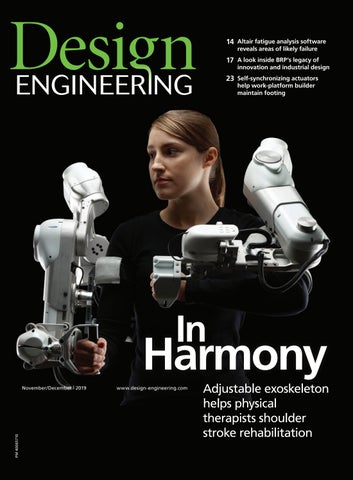
Stroke patients who require extensive therapy are getting an assist from technology. Harmonic Bionics has designed an exoskeleton that tracks the full range of arm movement in 3D. The device, called Harmony, maximizes the range of motion of the human shoulder and the shoulder girdle while ensuring safety with physical and programmed interlocks. It allows physical therapists to work with
stroke patients to improve the functionality and healing from neuromuscular damage. Actuator and controller technology allows the Harmony exoskeleton to customize gravity compensation, assistance and impedance as needed for the patient.
“Development of robust closed-loop torque-controlled actuators with high refresh rates was our biggest challenge,’’ said Rohit John Varghese, Harmonic’s Head of Product Development. “The design team built out all of the motor control and communication electronics in-house, and this has enabled the level
of performance that the therapist who we work with require.”
Innovative shoulder mechanism
Harmony’s critical piece is an innovative shoulder mechanism that powers coordinated motions of five joints in the shoulder complex, which is the key to shoulder rehabilitation according to Professor Ashish Deshpande, director of the ReNeu Robotics Lab where the project was conceived.
Ensuring alignment between the exoskeleton and the patient is critical to prevent stress on the patient’s joints and
The Harmony exoskeleton, created by Harmonic Bionics, assists stoke patients healing neuromuscular damage and improve upper body functionality.
PowerTransmission
protect them from injury. The project began in the ReNeu Robotics Lab at the University of Texas’ Cockrell School of Engineering in 2011 with funding from the National Science Foundation.
Each side of the robot seamlessly moves the subject’s arm and shoulder through a full natural range of motion and it can be adjusted for people of all shapes and sizes. Harmonic engineers used information from extensive databases to collect its anthropometric size data. Based on that data, Harmony has been designed to adjust its size to fit more than 95 percent of the American population.
To be effective in a clinical setting, it is important for the exoskeleton to quickly and smoothly change its physical dimensions to align with these different body sizes.
“Our target is to get stroke patients moving the hemiparetic arm more efficiently and fluidly which leads to improved function and outcomes,’’ said Bob Whitford, an Occupational Therapist at St. David’s Medical Center in Texas. “Increasing the functional range of movement in preparation for furthering and completion is always the goal with our neuro-injured clients.”
In addition, due to the challenging requirements of human robot interaction, the resizing mechanisms need to be highly compact to allow for room for the electronics and actuators. All linear bearing mechanisms need to be able to lock once in position to prevent unwanted changes in size. Oil-based lubrication for the linear bearings causes many issues, including the accumulation of dirt, which allows for bacteria to accumulate.
Lightweight and maintenance-free Harmony includes multiple bearings, liners and rail guides manufactured by igus, the Germany-based manufacturer of motion plastics. Besides being maintenance- and lubrication-free, the components are also extraordinarily light, an important criterion in an exoskeleton.
Each Harmony unit includes six iglide J bearings, an endurance bushing that exhibits low wear against different shaft materials and low coefficients of friction in dry operation. They are cost-effective bearings when low-pressure loads are
With a 5 degree-offreedom shoulder joint, Harmony incorporates igus’ iglide J bearings, drylin T-rail guides and drylin R liner to provide maintenance- and lubrication-free motion and reduce the rehabilitation robot’s weight.
needed and are frequently used in automation, printing, beverage technology and aerospace engineering.
The company’s drylin T-rail guide systems are manufactured to ensure high rigidity in the stand for the exoskeleton and are resistant to dirt and offer a low coefficient of friction and wear. They are also frequently used in machine building, machine tools, packaging and woodworking industries.
A custom bearing housing compresses on a drylin R liner, which reduced the size significantly compared to previous models of the exoskeleton. Compression
from the housing locks shafts, eliminating the need for an additional shaft collar. drylin R products are made with the iglide J materials, and are frequently used in packaging, 3D printing and laboratories. The shoulder mechanism also includes drylin R bearings, which operate dry and tolerate frequent cleanings.
The Harmony engineering team worked extensively with igus representative Charles McNeil to identify the parts that best solved the needs for Harmony.
“Having the devices in our hands made it a lot more intuitive to find many more uses for them in our design,’’ Varghese said.
Stroke of luck
Eva Maragkakis survived her stroke in large part due to her body awareness and quick-thinking. She works full-time and doctors closely monitor her blood pressure and other risk factors associated with stroke.
But Canada, and the world, is fighting a growing health concern. According to the World Health Organization, about 15 million people suffer strokes each year. Stroke rates climbed 11 percent in Canada between 2006-2015 for people between the ages 20-59. The increase is tied to more processed foods, stressful lives, sedentary lifestyles and higher rates of obesity and diabetes in young adults.
While the Harmony exoskeleton won’t prevent stroke, it will help patients who remain committed to the rehabilitation process to improve functionality and improve their quality of life.
“The biggest challenge with stroke survivors is the duration of time required to re-train the brain to a function level and the patience required by the survivor to persist in their own rehab journey,” Whitford said. “Many patients give up too soon or develop bad habits that will persist for the rest of their lives. Harmony helps make my job easier to handle the patient’s upper limb paralysis and gives immediate feedback.” DE http://harmonicbionics.com www.igus.ca
Matt Mowry is the DryLin Product Manager for igus North America.
RISE ON THE
Whenfinal assembly of larger-thanhuman-scale products requires a human touch, industrial equipment manufacturers deploy a variety of industrial work platform solutions to enable access to the appropriate task areas. Solutions range from small step stools to fully tooled robotic frameworks.
Holding a commanding position between those market extremes is Spika Design and Manufacturing, a Lewistown, Montana-based provider of commercial and custom industrial work platforms.
The company provides automotive, aerospace and military aviation manufacturers with reliable, ergonomic platforms to support a wide variety of assembly and maintenance operations.
Sustaining its place in the market, however, requires close attention to evolving customer needs.
“All of our customers need a work platform of some type, maybe to access sections of a heavy duty pickup truck or
Self-synchronizing actuators help work-platform builder maintain footing in demanding industrial markets.
the nozzle on a rocket motor,” said Spika Director of Business Development Jeff Ruffner. “Their safety folks want maximum assurance of compliance with OSHA requirements. Their technical teams want safety too, but they also want maximum height variability. Adding to the challenge is steady demand for customization, cost efficiency and faster delivery.”
Rising to the Occasion
A key to meeting its customers’ needs has been Spika’s selection of electromechanical linear actuators that automate the raising and lowering of platforms and the articulated stairs that enable access to them.
Most of the platforms Spika provides are 3-feet wide and 10 to 16 feet long. At this scale, keeping platforms level is important for safety as well as productivity. Prior to actuators, height variability for work platforms relied upon manual screw jacks. They would raise
one side at a time, cranking it up a few inches to the desired height and adjusting the other jack accordingly until the platform was level. Recognizing the obvious inefficiencies, Spika engineers tested alternative solutions.
“We tried motor- and manual chaindriven ball screws, but these were labor intensive,” said Tom Spika, the company’s CEO and founder. “We also looked at hydraulic systems, which have been popular for power elevation, but found significant limitations there as well.
Shortfalls included fluid leakage, settling over time and, most importantly, the inability to maintain elevational balance. Electromechanical actuators proved to be the most economical and effective solution.”
A typical electromechanical configuration might include four actuators acting for a single stage to achieve up to three feet of height variability, or two actuators on each corner to obtain up to
MotionControl
6.5 feet of height variability. Additional actuators are used to adjust variable pitch stairs to make it easier for workers to access the adjusted height. Height adjustment ranges of up to 6.5 feet can be controlled from push buttons located on the platform.
Although a significant improvement over trailer jacks, Spika engineers found this simple arrangement of actuators to be less than optimal. Variations in factors such as load distribution and floor consistency resulted in uneven platforms. An unbalanced load, for example, would cause one actuator to top out an inch or so before a lower one, making for a somewhat jerky ride while adding mechanical stress.
In Sync
To counter load and balance issues, Spika engineers installed electromechanical actuators to keep the platform balanced. Initially, they had deployed an early generation of self-synchronizing actuators. As customers increasingly demanded greater height variation on heavier loads,
however, the engineers sought a more robust solution.
“Where 23.5 inches of actuation may have been adequate in the past, today it is not uncommon to get requests for 6.5 feet or even more,” said Ruffner.
Meeting such demands required faster actuators with greater static load holding strength. After evaluating several options, the Spika team found that Thomson Electrak HD electromechanical linear actuators would be the best solution to provide the speed and strength needed to keep up with the changing and increasingly uneven load conditions they were encountering.
With speed capacity exceeding 1.5 inches per second and strokes up to 3 feet, Electrak HD actuators provide Spika with smooth synchronization in large and demanding applications. Their static strength of up to 18 kilonewtons is consistent across its entire product line.
“Having consistently high static strength for each actuator is important,” said Ruffner. “OSHA requires load testing of all platforms to a four times safety
factor. With Thomson’s consistent 18-kilonewton strength, we are confident that we have covered the testing range for any application we choose.”
A Smarter Solution
Thomson actuators achieve smooth synchronization by using an embedded microcontroller that allows for communication between each actuator on the common circuit. The actuators use only two wires to connect to a power supply and two to connect to other actuators in the system. Any actuator on the circuit can then be used to drive the system via three low-current wires connected to a simple switch or discrete I/O on a PLC.
In a typical configuration, Spika engineers designate an actuator as the master, providing the reference point against which all other actuators synchronize. All actuators are constantly driving to a set speed, regardless of load changes. When actuation starts from the same fully retracted position, the result is a smooth, synchronized movement that will handle uneven and even shifting loads.
“Especially in comparison to hydraulic systems, the Thomson synchronized actuators provide us an optimal solution for our applications,” said Spika. “With Thomson’s synchronized actuators, our platforms stay level regardless of the load distribution; something that hydraulics cannot do easily.”
Height variation on heavier loads requires faster actuators with greater static strength to keep the platform balanced, especially in changing and increasingly uneven load conditions.
Typically 3-feet wide and 10 to 16 feet long, work platforms by Spika support a variety of assembly and maintenance operations for automotive, aerospace and military aviation manufacturers.
“Synchronization is very valuable for heavily cantilevered and uneven loads like these,” said Ruffner. “In the past, it was not uncommon for companies to hang the weight off the back of the platform to counterbalance such cantilevered arrangements. Electronic synchronization, however, eliminates the need to add counterbalance weights for these types of loads because the synchronized actuators can sense speed changes and adjust independent actuators accordingly to improve system operation.
ical configurations involve 10 or 12 actuators, they envision a day when many more could be deployed, as the price points drop even further. Theoretically, the engineers say, there is no limit to the number of actuators that can be synchronized.
Responding to market challenges
Actuator synchronization has created innovative possibilities for Spika. For example, a tier-one aerospace manufacturer needed a platform that would fit around the nose of an aircraft, thereby requiring a cantilever to extend an additional 15 feet from the platform. Raising and lowering the extension from the base platform required five actuators. Although there were caster beams supporting the extension underneath, the extension load put additional stress on the actuators.
“Companies worry about the ergonomics for their workforce because those costs add up over time,” he continued. “One of our aerospace customers re-engineered their platforms and slides because personnel were incurring a high number of musculoskeletal injuries. By employing our platform, that can provide various access points safely, they can enhance the health and safety of their employees while saving on insurance costs.”
Spika engineers see actuators playing a continuing role in helping the team stay abreast of customer demand. Where typ-
“As actuator advances enable us to meet new efficiency challenges, we are getting more and more unique requests,” said Ruffner. “One aviation customer posed the challenge for sliders to extend simultaneously to follow the contour of the work object as the platform rose. And once it reached 50 percent of its height, they wanted the sliders to retract.”
“This is the kind of thing,” he adds, “ where we might draw on the additional intelligence and communications built into Electrak HD actuators to connect to a programmable logic controller, which could control interactions with servo motors and drives to enable more complex operations.” DE www.spikamfg.com www.thomsonlinear.com
This article was contributed by Thomson.
IdeaGenerator
Motion Control
Linear Motor Stages
Yaskawa America has introduced its Sigma Trac II series linear servo motor stages that combine a Yaskawa SGLF2 series linear motor with linear bearings, a high resolution absolute optical scale, cable management and optional bellows. Features include peak force output up to 540N, speeds up to 5 m/s and a 10 million double-stroke design life. In addition, the stages also include absolute encoder feedback with 9.765nm resolution, stroke lengths up to 1340mm and integrated cable management. Sigma Trac II stages are available in 3 coil sizes and 13 base lengths. www.yaskawa.com
Integrated Motor / Actuator
Curtiss-Wright’s Industrial Division released its Exlar GTX100, the second frame size in
the company’s integrated motor/actuator line. Featuring the company’s inverted roller screw technology, the line offers continuous force ratings up to 15,392N (3,460lbf), speeds up to 953mm/sec (37.5 in/sec), and standard stroke lengths from 150mm (5.9 inches) to 300mm (11.8 inches). Other GTX Series features include high capacity planetary roller screws; IP65 environmental protection; and a removable front seal bushing.
www.exlar.com
Angle Encoder
RSF Elektronik released its next generation kit angle encoder, available through HEIDENHAIN North America, in both absolute (MCR 15) and incremental (MSR 15) versions. Both models consist of an optical scanning unit and a separate full circle drum with the graduation on the outer diameter. The encoders are available in drum sizes from an inside diameter of 40mm up to 330mm and accuracies from 20 arc seconds up to 10 arc second, depending on diameter. Resolutions are also diameter-based and range from 22 to 25 bits for the absolute versions. The resolutions of the incremental versions start at 4,740 lines per 360 degrees up to 27,540 lines for the largest diameter.
www.heidenhain.us
Absolute Encoders
EPC announced that its Model A58HE and Model A58SE absolute encoders now offer
PROFINET communication protocol as well as EtherCAT. The Model A58HE is a 58mm encoder in a blind hollow bore construction, and the Model A58SE is a 58mm shaft encoder available with either a clamping flange or synchro flange, in both compact and heavy-duty configurations. Both models offer multi-turn resolution up to 43 bits, single turn resolution up to 16 bits, and continuous digital position monitoring. In addition, bores sizes are available up to 0.375 inch (15mm) and shaft diameters up to 0.375 inch (12mm). The encoders meet CE/EMC Standards for immunity and emissions, sealing rated to IP65 and retain absolute position after a power outage.
http://encoder.com
Overload Relays
AutomationDirect has added Eaton’s XT series of self-powered electronic overload relays that offer additional trip classes, universal connections to any contactor, and a wide amperage range. Accessory 24 to 120VAC remote reset modules provide remote overload reset capability. The series have a full-load-amperage (FLA) range from
0.33-175A, selectable trip classes (10A, 10, 20, 30), and can be separately mounted to NEMA, IEC and DP contactors. Motor protection includes thermal overload, phase loss, selectable on/off phase imbalance and on/off ground fault (on select models). www.automationdirect.com
Industrial 4G Router
Westermo launched its MRD-455-NA, a 4G router that features DIN-rail mounting, an isolated power supply, an operating voltage range from 10 to 60VDC and support for 3G and 4G LTE mobile standards. Its GPS antenna port allows for tracking remote assets by location. The unit has a built-in two port 10/100 Ethernet switch and RS-232 D-Sub. Device status changes can be received by SMS and email. The MRD-455-NA offers VPN functionality, an inspection firewall and dual SIM support, allowing the MRD-455-NA to automatically switch to the other SIM in case of a connectivity problem. www.westermo.com
Motor Soft Starters
Siemens Smart Infrastructure launched its Sirius 3RW50 and Sirius 3RW55 Failsafe, electrical motor soft starters, the latter of which is the first to feature the integrated Safe Torque Off (STO) function. The Sirius 3RW55 Failsafe soft starters are suited for starting and stopping operations of highpower motors with a rated output of 5.5 to 560kW at 400V. All switching operations can be controlled via its HMI. The Sirius 3RW50 covers a power range from 75 to 315kW at 400V and are designed for standard applications. They are also ATEX- and IECEx-certified and can also be used for applications in potentially explosive areas. All Sirius 3RW5 portfolio soft starters have functions for parameterization, current limitation with motor overload protection and pump start and stop. They are also compliant with IEC, UL and CSA standards. www.siemens.com
Power Transmission
Plastic-steel energy chain
igus has developed the YE.4, a hybrid plastic-steel energy chain for vertical guidance of cables and hoses. The system’s supporting chain links are made of steel, whereas the pin/bore connection, the outer links and the crossbars are made of a tribologically optimized high-performance plastic. The hybrid chain is 50 percent lighter than steel chains and compared to a traditional plastic chain,
Rolling Ring
Zero backlash. Jam-proof design.
• For applications in positioning & reciprocating motion
• Zero play –even during reversal
Uhing® Rolling Ring linear drives run on a smooth, threadless shaft that won't clog or jam. If the system is overloaded, the shaft simply slips instead of churning and grinding. The drive bearings are in constant contact with the shaft, even during reversal, thereby preventing backlash.
Example applications: metrology machines, material handling systems, spooling equipment, packaging & converting equipment. Many different sizes meet varying requirements for axial thrust & linear speed.
For more information call 1-800-252-2645
Email: amacoil@amacoil.com www.amacoil.com
Some models feature mechanical control over speed and travel direction. No programming or electronic controls are needed.
IdeaGenerator
allows for 50 percent more unsupported length. The chains’ modular design also don’t require screws or pins. Hybrid energy chains will be available with an inner height of 42mm and a width of 50 to 400mm with a bend radius of 100mm. Other sizes are available upon request. www.igus.com
Roller Guide
THK America introduced its Roller LM Guide Type HRX, which features a duplex face-to-face structure and a full roller design. The guide’s caged technology employs a synthetic resin cage with a patented curvature that cradles each roller and separates it from the next. The spaces between the rolling elements retain grease and act as a lubrication system. Additionally, four-way equal loading enables the Type HRX to be mounted in any orientation and to meet the requirements of a wide range of applications. The Type HRX is available in models with outer dimensions of 48mm to 100mm (H), 100mm to 126mm (W) and 123.2mm to 304.1mm (L). Basic load ratings range from 56 to 257kN. www.thk.com
Vibration Monitor
SKF unveiled its Enlight ProCollect, a portable vibration monitoring system that incorporates the company’s QuickCollect hand-held sensor and the SKF ProCol-
lect mobile app. Running on a standard iOS or Android device, ProCollect collects, interprets and communicates operational and machine condition data and links to the SKF Enlight Centre web-based monitoring platform. The system enables pre-programmed inspection routes that guide operators through data collection. It can also help operators diagnose and fix common problems on the shop floor. The visualization capabilities of the Enlight Centre platform, meanwhile, allow companies to generate dashboards that provide an overview of plant performance.
www.skf.com
I/O Systems
I/O Modules
Opto 22 has released three groov EPIC input/output modules for specialty and low-cost applications. The GRV-IDCSW-12 monitors the open/closed status of dry contact switches, and provides the necessary excitation voltage to power the circuit. It features discrete input, 12 channels and DC contact switch status. It can monitor distributed IT equipment, benchtop analyzers, motor run/stop relays, or any device that offers only a dry contact for status. The GRV-IVI-12
BRINGING YOUR MEDICAL DEVICES TO LIFE
How can Aerotech help?
• We make the difficult motion processes easy so you can manufacture unique devices that outperform the competition.
• Aerotech is a one-stop-shop that can support the simplest or most complex motion required by the current stage of your product lifecycle.
• We have the enabling technologies that make unique, high-value product designs possible, and that maximize manufacturing efficiency and throughput.
You will compete better in a valuebased world with Aerotech as your automation partner!
features 12 isolated channels, each configurable to one of eight ranges from ±1.25 to ±160V, and eliminates the need to segregate I/O signals over multiple modules. The module has 20-bit resolution and is accurate to 0.1% of the configured range. It includes options for scaling, filtering and averaging. The GRV-IRTD-8 provides 8 channels for 2- and 3-wire RTD inputs, with a maximum range of –200°C to 850°C. It can also be used for high-resolution resistance measurements, with accuracy ranging from 4.2 Ohms at the 8K Ohm input range to 0.058 Ohms at the 10 Ohm range for 3-wire RTDs. www.opto22.com
Remote I/O System
Festo announced the CPX-AP-I, an IP65/IP67-rated remote I/O system compatible with most communication protocols, including EtherNet/IP, PROFINET and Ether CAT. Directly mountable on machines, the CPX-AP-I allows valve terminals to be moved closer to pneumatic cylinders. It handles up to 80 I/O modules, in a mix of digital I/O, analog I/O, I/O-Link and valve terminals, at distances between modules up to 49 feet (15 meters). Process data in and out of each bus module is as much as two kilobytes. Scan cycles for a mix of both valve terminals and I/O are below one millisecond. Communication and voltage supply are via two separate connecting cables that are also galvanically isolated, eliminating the potential for stray currents. Two separate wires enable the creation of voltage zones that provide reliable control for a host of machine processes. www.festo.com
Ethernet I/O Module
CAS Dataloggers released its Novus DigiRail Connect, an intelligent, distributed I/O module that can be used to expand data logging and data acquisition systems. A built-in Ethernet port allows it to act as a Modbus TCP server to send data over the network. It features 2 isolated analog inputs/outputs, 4 digital inputs and 3 digital or 2 relay outputs, which accept a variety of standard sensor and signal types including thermocouples, RTDs, voltage and 0-20mA current. It also has an RS-485 serial interface that allows it to be used as a slave device in Modbus RTU networks or as a gateway between Modbus TCP and Modbus 485 networks. The DIN Rail mountable module accepts 10-36VDC power Input and an operating range of -20°C to 60°C. www.dataloggerinc.com
IdeaGenerator
Sensors
Laser Light Array
Balluff introduced its BLA0007 laser light array that can measure the size of up to six objects in its 16mm light field. Those measurements include object diameter and position; gap width and position; and edge position. The light array also offers modes such as counting and nominal/actual comparisons, which can be used simultaneously. If needed, it can be programmed to blank an area, so objects in that part of the array don’t trigger the sensor. Additionally, they can measure object height or gap dimensions, monitor hole placement or size, and detect the web edge of material like paper or cloth, including many transparent materials that are optically demanding. They can detect cable, wire or threads as small as 0.3mm. www.balluff.com
LVDT Signal Conditioner
Alliance Sensors Group introduced its SC-200 LVDT signal conditioner, that works with a range of LVDTs, RVDTs and inductive half-bridge sensors including 3-wire industrial LVRTs. The signal conditioning module also has cyber-security tamper prevention
and notification features. The SC-200 features push button calibration, 4 excitation frequencies, 8 analog DC outputs, 16 addresses for RS-485 communications, built-in null indication and advanced master/slave capability. Diagnostic capabilities include fault or failure detection and the unit can detect at least eleven fault conditions including shorted primary, disconnected or open primary/secondaries, shorted or grounded secondaries and common hook-up errors.
www.alliancesensors.com
Hydraulic/Pneumatic Position Sensors
Novotechnik U.S. released its TM1 Series of magnetostrictive linear hydraulic and pneumatic position sensors. The sensor features a magnetic ring-shaped marker that affixes to an application’s moving cylinder and moves up and down the TM1 rod without contact. The series’ stroke lengths are from 50 to 2,000mm in 25mm steps. Operating pressure is up to 5,076 psi (350 bar) with peaks to 6,526 psi (450 bar). Both plug-in and screw type flange models are available. Other key specifications include absolute linearity of ≤ 0.04% F.S. (min. 0.3mm) and repeatability of ≤ ±0.1mm. Output options include 4 to 20mA current as well as voltage output of 0.25 to 4.75V, 0.5 to 4.5V or 0.1 to 10V. Ingress protection is to IP 69K, shock and vibration 100g and 20g respectively. Operating temperature range is to -40 to +105°C.
www.novotechnik.com
Loop Detectors
CARLO GAVAZZI launched its LDD and LDP series of loop detectors for either single or dual loops, available in either plug-in or DIN rail mount housings. Used for traffic management, the LDD (DIN Rail) and LDP (Plug) series are equipped with automatic loop frequency tuning and sensitivity tuning. The component’s automatic sensitivity boost (ASB) ensures detection of high bed vehicles such as trucks or buses. Other features include 20µH to 1000µH loop input inductance; fail safe and fail secure functions; selectable output operation (pulse or presence); and automatic or manual loop frequency tuning. The detectors also integrate multicolor diagnostics LEDs and two SPDT relay outputs. www.GavazziOnline.com
BEGINS
Slash cabling costs with EtherCAT P
Ultra-fast communication and power on one cable
www.beckhoff.ca/EtherCAT-P-Box
EtherCAT P integrates EtherCAT communication with system and peripheral voltage supply in one 4-wire standard Ethernet cable. The I/O system for EtherCAT P with IP 67 protection takes full advantage of One Cable Automation: material and installation costs, as well as the required installation space in drag chains, cable trays and control cabinets are significantly reduced. The compact and robust I/O modules cover a wide signal range, from standard digital I/Os to complex analog signals and measurement technology. More than 100 additional EtherCAT P components are available. Find out more now!