PTC speaks openly about Onshape’s future at first ever user conference. pg.10
REVERSE ENGINEERING
Undaunted designer modifies racecars to help disabled drivers return to the track. pg.14
IN THE LOOP
Regina drilling rig beats historic blizzard with help from igus energy chain. pg. 24
INSIDE
14 Back in the Driver’s Seat
Undaunted designer modifies racecars to help disabled drivers return to the track
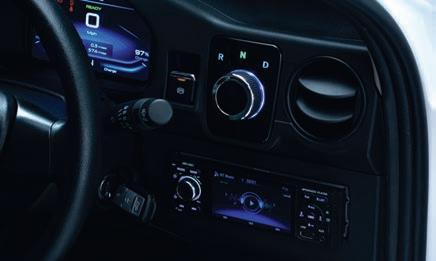
18 The Commuter EV
ElectraMeccanica’s entry-level, three-wheeled SOLO looks to ride wave of enthusiasm for zero emission vehicles
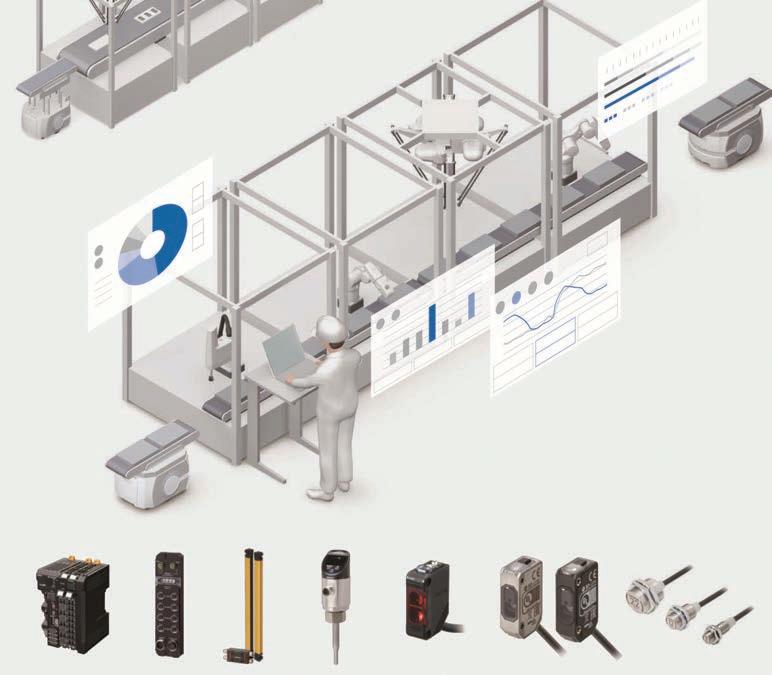
20 Understanding IO-Link
A guide to the capabilities of the IEC 61131-9-compliant IO-Link networking standard
24 In the Loop
Regina potash drilling rig beats historic blizzard with help from igus energy chain
Columns
6 Design News
Canadian laser system cools antimatter to absolute zero and other design news
10 CAD Report
PTC speaks openly about Onshape’s future during cloud-based CAD software’s first ever user conference
26 Idea Generator
The latest in industrial products including automation, motion control and sensors
Things that Anti-matter
Ever since Nobel prize winner Paul Dirac posited the existence of anti-particles in 1928, a hypothesis confirmed by Carl Anderson in 1932 with the discovery of the positron (anti-electron), physicists have been plagued by one question: Why does the universe exist?
In modern physics, each particle of matter has a twin with the same mass and spin (e.g. proton/anti-proton, electron/positron, etc.) but with an opposite charge. As such, these pairs annihilate (i.e. turn into pure energy) on contact. That’s great for the writers of Star Trek, but if there were equal amounts of both matter and anti-matter shortly after the big bang, then why didn’t the “stuff” within the very early universe just evaporate?
Seemingly, most of it did, which is still detected as the cosmic microwave background radiation. For the universe to exist then, every billion particles of anti-matter had to interact with a billion and one particles of matter, leaving just enough matter behind to for m stars, planets, etc. This suggests that matter and antimatter aren’t identical and the difference somehow gives regular matter a survival edge.
At the CERN Large Hadron Collider in Switzerland, scientists have been edging progressively closer to detecting this difference. In one experiment, ALPHA, scientists are creating anti-hydrogen (a positron and anti-proton) to see if gravity affects anti-matter and matter the same way or to the same extent. If not, it may explain why there’s so much of one but nearly none of the other.
Problem is, since anti-matter vanishes as soon as it touches anything, collecting enough of the stuff to measure and test is a bit challenging. Dan Brown novels to the contrary, CERN doesn’t have enough to blow up the Vatican. At best, they’ve been able to capture trace amounts for approximately 15 minutes.
And, to perform tests with the precision needed, the ALPHA team first has to reduce the anti-atom’s kinetic energy (i.e. temperature) and that’s where the Canadian-made laser system featured in this issue’s news section comes in. By repeatedly energizing the trapped anti-hydrogen with laser light photons, and letting the atoms decay to their original energy state, the ALPHA team succeeded in cooling them to a hair above absolute zero. In that state, the anti-hydrogen can then be tested to hopefully reveal the answer to this nearly 100-year-old mystery.
Despite modern physics’ ability to explain the nature of everything, it’s exciting to know that not only are there fundamental puzzles still left, but that we also have the tools, like the ALPHA program’s Canadian-built laser, to unlock them.
MIKE MCLEOD
Editor mmcleod@design-engineering.com
Editorial Board
DR. ALAIN AUBERTIN
Vice President, Business Development and International Affairs, Canada Consortium for Aerospace Research and Innovation in Canada (CARIC)
DR. MARY WELLS, P.ENG
Dean of the College of Engineering and Physical Sciences, University of Guelph; Chair of the Ontario Network for Women in Engineering
AJAY BAJAJ, P.ENG
President, Rotator Products Limited; Past President and Board Member, Power Transmission Distributors Association (PTDA)
JOHN LAMB
Regional Sales Manager, Wainbee Limited
DR. ISHWAR PURI, P.ENG
Dean of the Faculty of Engineering; Professor of Mechanical Engineering, McMaster University
COO Scott Jamieson sjamieson@annexbusinessmedia.com
Design Engineering, established in 1955, is published by Annex Business Media, 6 times per year except for occasional combined, expanded or premium issues, which count as two subscription issues.
Printed in Canada
Publications Mail Agreement #40065710 ISSN: 0011-9342 (Print), 1929-6452 (Online)
Subscriber Services: Canada: $57.50 for 1 year; $92.50 for 2 years; $10 for single copy.
Outside Canada: USA - $140.50; Overseas - $151.00; $10.00 for single copy.
All prices in CAD funds. Add applicable taxes to Canadian rates.
From time to time we make our subscription list available to select companies and organizations whose product or service may interest you. If you prefer not to receive this information, please contact our circulation department in any of the four ways listed above.
Annex Business Media Privacy Officer: privacy@annexbusinessmedia.com Tel: 800-668-2374
No part of the editorial content of this publication may be reprinted without the publisher’s written permission.
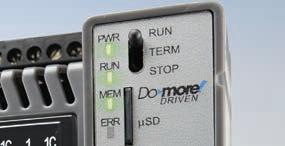
The BRX PLC has advanced features that allow it to easily take on the role of an edge device - gathering, refining and delivering control system data to upstream IT collection and BIG DATA analysis programs.
Embedded Web Server
Rest API
devicecatalog.azure.com
Must-have IIoT Protocols
With BRX’s embedded Web server, you can instantly access system status, diagnostic information, and monitor memory usage from any Internet-ready device.
The integrated Rest API and secure HTTPS protocol allow BRX to work with flow control tools like Node-RED® in order to supply high-level IT systems with the plant-floor data they need.
With the growing number of IIoT platforms and cloud computing services, BRX controllers utilize the industry-standard MQTT(S) and FTP protocols to seamlessly integrate with asset management/IIoT platforms including:
• Microsoft Azure®
• IBM Watson®
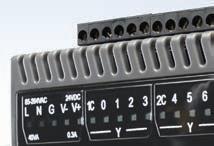
The NEW BRX HSIO4 module offers both TTL and differential high-speed I/O at up to 2MHz. Differential I/O can be used to prevent inaccuracies in high-speed signals caused by electrical interference from high-noise environments. www.BRXPLC.com
Orders over $49 get FAST FREE SHIPPING
Our shipping policies make it easier than ever to order direct from the U.S.!
Fast free standard shipping* is available for most orders over $49 U.S., and that includes the brokerage fees (when using an AutomationDirect nominated broker). Using our choice of carrier, we can reach most Canadian destinations within 2 to 3 days.
*Free shipping does not apply to items requiring LTL transport, but those shipments can take advantage of our negotiated super-low at rates (based on weight) that include brokerage fees.
See Web site for details and restrictions at: www.automationdirect.com/canada
ENGINEERING
CANADIAN LASER SYSTEM USED TO COOL ANTIMATTER TO ABSOLUTE ZERO
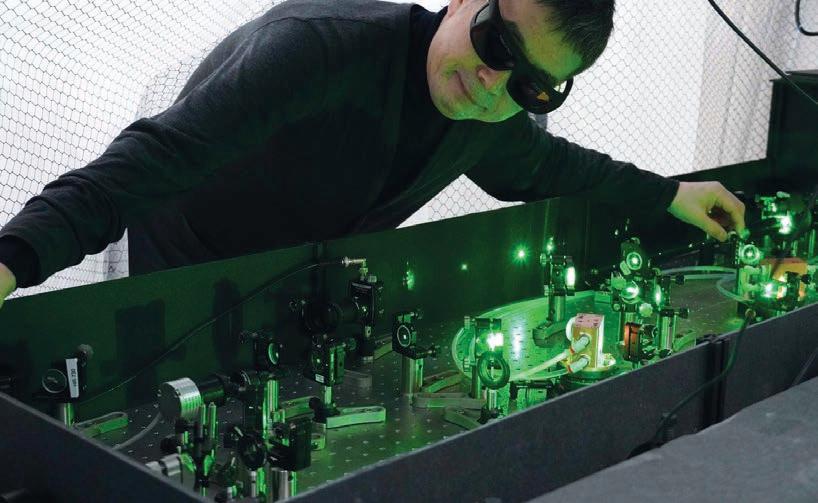
Researchers with the CERNbased ALPHA collaboration have announced the world’s first laser-based manipulation of antimatter. Using a made-in-Canada laser system, developed at the University of British Columbia, the CERN team was able to cool a sample of anti-matter down to near absolute zero. Detailed in the journal Nature, the achievement, physicists say, will open new doors of antimatter research.
“Today’s results are the culmination of a years-long program of research and engineering, conducted at UBC but supported by partners from across the country,” said Dr. Takamasa Momose, the UBC researcher with ALPHA’s Canadian team who led the development of the laser. “With this technique, we can address long-standing mysteries like: ‘How does antimatter respond to gravity? Can anti-matter help us understand symmetries in physics?’ These answers may fundamentally alter our understanding of our universe.”
Having the opposite charge of regular matter, anti-matter will annihilate on contact with matter, making it very di cult to create or experiment on. Laser manipulation and cooling of ordinary atoms has been in use for 40 years, but tests run with the ALPHA laser-based system marks the first time scientists have applied the technique to anti-matter.
“It was a bit of crazy dream to manipulate anti-matter with a laser,” said Dr. Makoto Fujiwara, ALPHA-Canada spokesperson, TRIUMF scientist, and the original proponent of the laser cooling idea. “I am thrilled that our dream has finally come true as a result of tremendous
teamwork of both Canadian and international scientists.”
HAICU
Following from the ALPHA program, HAICU is a new Canadian project to develop quantum techniques to hopefully manufacture antimatter molecules.
The Canadian e ort was led by researchers and students from ALPHA-Canada (TRIUMF, UBC, Simon Fraser University, the University of Calgary, and York University) and contributors the University of Victoria and BCIT.
Going forward, Dr. Fujiwara and Dr. Momose say they now lead a Canadian project, called HAICU, to develop new quantum techniques for anti-matter studies. “My next dream is to make a ‘fountain’ of anti-atoms by tossing the laser-cooled antimatter into free space,” said Dr. Fujiwara. “If realized, it would enable an entirely new class of quantum measurements that were previously unthinkable.”
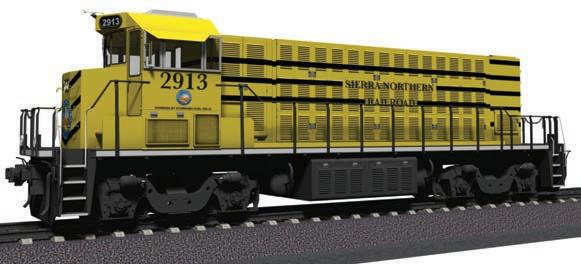
A Sierra Northern Railway switching locomotive, like the one pictured, will be converted from diesel to Ballard fuel cells as part of a California Energy Commission pilot program.
“Furthermore, we are one step closer to being able to manufacture the world’s first anti-matter molecules by joining anti-atoms together using our laser manipulation technology,” Dr. Momose added.
The ALPHA program’s antimatter research began in 2011 with the creation and trapping of anti-hydrogen for a world-record one thousand seconds. The collaboration also provided a first glimpse of the anti-hydrogen spectrum in 2012, set guardrails confining the e ect of gravity on anti-matter in 2013 and showcased an antimatter counterpart to a key spectroscopic phenomenon in 2020.
https://alpha.web.cern.ch
BALLARD FUEL CELLS TO POWER ZEROEMISSION LOCOMOTIVE
Vancouver-based Ballard Power Systems announced it expects to provide fuel cell modules to Sierra Northern Railway – the freight division of California-based Sierra Energy Corporation – to power a zero-emission switching locomotive.
According to the company, a purchase order for the fuel cell modules is expected to be issued
Dr. Takamasa Momose posing with the ALPHA-Canada laser system, the main components of which were designed and built by Momose and students in his UBC lab.
Photo credit: Takamasa Momose
Precision Control Solutions
Designing efficient systems involves much more than simply understanding a few basic principles. There is a true art to balancing the specific requirements of an application in order to achieve the desired goals in the best possible way. Help us understand the unique needs of your application and together, we’ll develop something that surpasses what any of us could have done alone.
Contact your distributor to learn more, or clippard.com to request a free catalog and capabilities brochure.
by Sierra by mid-year 2021. The pilot program will be partially funded by a $4-million award from the California Energy Commission.
According to Ballard, Sierra plans to retire a diesel locomotive and replace it with a zero-emission switching locomotive powered by a Ballard 200-kilowatt FCmove-HD fuel cell module. The conversion will also include the integration of hydrogen storage together with advanced battery and systems control technologies.
The pilot program is expected to establish a platform for widespread deployment in California, where more than 260 switching locomotives and up to 500 intrastate locomotives are currently in service. Ballard will participate in the program with a multi-company team and will provide applications engineering and field support throughout a 6-month demonstration period. The switching locomotive will be refueled at a new hydrogen station to be constructed by Royal Dutch Shell plc.
“We are pleased to partner with this great team to build and test this innovative zero-emission switching locomotive. We believe this project will help lead the switching locomotive industry to an emissions free pathway in all ports in the State of California”, said Kennan H. Beard III, President of Sierra Norther Railway.
Short-line and switching locomotives account for a significant share of the total locomotive energy use within the State of California. Most switching locomotives in California use an average of 50,000 gallons of diesel per year; converting them could potentially reduce diesel fuel usage by more than 12-million gallons annually –approximately equivalent to the fuel used by 20,000 light-duty vehicles, the company says. www.ballard.com www.sierranorthern.com
CarbonCure
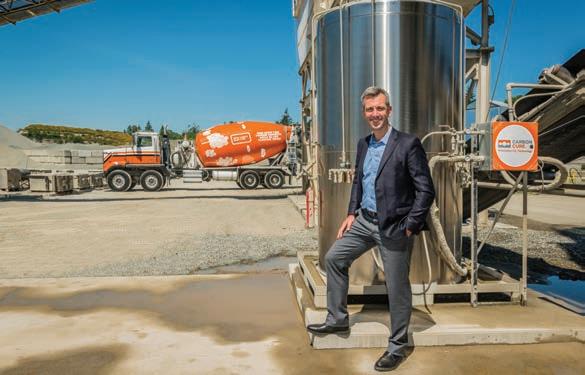
CEO Rob Niven with the company’s CO2 trapping concrete system.
CANADIAN FIRM NAMED CO-WINNER OF XPRIZE FOR TRAPPING CO2 IN CONCRETE
300
CarbonCure’s CO2 trapping process is currently used by 300 plants that have delivered 10M cubic yards of concrete, globally.
CarbonCure Technologies, a Canadian company that develops clean tech solutions for the concrete industry, has been named one of two winners in the US$20 million NRG COSIA Carbon XPRIZE. Each winner takes home a US$7.5 million grand prize.
The global competition took place in three rounds over 54 months. It challenged participants to develop technologies to convert carbon dioxide (CO2) emissions into usable products – with the goal of tackling climate change.
CarbonCure became one of 38 shortlisted contenders for the Carbon XPRIZE in 2015 and in 2020 completed its final technology demonstration in Alberta.
“Team CarbonCure and our fellow Carbon XPRIZE contenders have demonstrated that the challenge is surmountable and that we have the solutions available today to create meaningful change,” said Jennifer Wagner, CarbonCure President and leader of Team CarbonCure. “The prize money will be used to accelerate our path to our mission of reducing 500 million tonnes of carbon emissions annually by 2030.”
CarbonCure’s XPRIZE project aimed to decarbonize the carbon-intensive process of concrete production. The almost five-year competition showcased the portfolio of CarbonCure’s technologies,
in addition to completing the world’s first integrated CO2 capture project from cement kiln emissions with beneficial reuse in concrete production.
The final round introduced CarbonCure’s newest commercial technology focused on carbonating reclaimed water – the wastewater generated at concrete plants – to enable the production of concrete with a reduced water, cement, and carbon intensity.
“Buildings are the source of 40 percent of the world’s annual greenhouse gas emissions. The world’s building stock is expected to double by 2060 so it’s vital that solutions like CarbonCure’s scale quickly,” said Marcius Extavour Executive Director of the Carbon XPRIZE and VP of Climate and Energy for the XPRIZE Foundation.
The use of CO2 in concrete is expected to become a US$400 billion market opportunity so solutions like CarbonCure’s are both very timely to respond to climate targets and represent an attractive economic opportunity for heavy industry.
CarbonCure was established in Nova Scotia, in 2012 and its innovative concrete solution is now used in more than 300 concrete plants around the world.
To date, producers have supplied nearly 10 million cubic yards of CarbonCure concrete to a wide range of project types. The company says it is on a mission to reduce embodied carbon in the built environment by 500 million tonnes annually by 2030. www.carboncure.com
Photo credit: J.Yanyshyn/VisionsWest
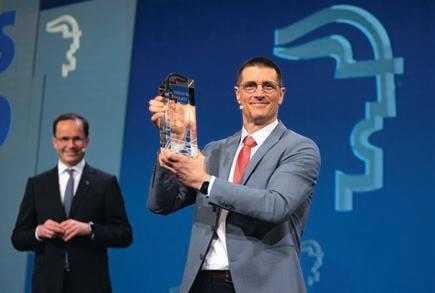
BOSCH REXROTH WINS 2021 HERMES AWARD
Bosch Rexroth has won the 2021 Hermes Award for the company’s SVA R2 Subsea Valve Actuator, the world’s first electrical actuator for controlling process valves under water.
Presented at Hannover Messe 2021, the Hermes Award is the international trade show’s annual technology prize, recognizing products and solutions that have a particularly high level of technological innovation.
The SVA R2 is designed as a drop-in replacement for conventional hydraulic cylinders commonly used in subsea process industries, such as oil and gas production. Within these o shore installations, hydraulic cylinders are typically used to open and close subsea valves, and require a central power unit with hydraulic lines several
kilometers long. While energy inefficient, hydraulic systems are currently the standard since they are compact and integrate field-tested safety systems.
In comparison, Bosch Rexroth’s all electric SVA R2 is also compact and satisfies Safety Integrity Level (SIL) 3 requirements but minimizing energy consumption and eliminates the possibility of hydraulic fluid leaks.
The new module comprises a pressure-compensated container that contains an electric drive, a motion control system and a safety device. As such, the unit also allows for precise motion control and only requires one cable for the power supply and communication down to a depth of 4,000 meters.
According to Bosch Rexroth, the SVA R2 is suitable for other applications both below and above water such as hydrogen
Bosch Rexroth Senior VP, Thomas Fechner, accepting the Hermes Award at Hannover Messe 2021. Visit design-engineering.com for the latest new products, news and industry events.
production, CO2 storage and general applications in the process industry. The company says it’s currently in the testing phase of full scale prototypes built in accordance with stringent international standards. The first pilot tests are to start in the third quarter of 2021.
www.boschrexroth.com
Photo credit: Hannover Messe
A Refreshing Change
PTC speaks openly about Onshape’s present and future during cloudbased CAD software’s first ever user conference. BY RALPH GRABOWSKI
In March 2021, for the first time in Onshape’s nineyear history, users of PTC’s browser-based CAD software were treated to a conference – online, ’natch. User events from some CAD vendors are little more than “Aren’t we the greatest!” cheer fests. In contrast, speakers from PTC’s CEO on down were surprisingly frank when speaking about Onshape: What still needs to be done, and even, in some cases, drawbacks to the software. Users had questions answered in chat-rooms during the one-day online event.
As Onshape is now owned by PTC, CEO James Heppelmann was first to speak. In his opinion, all CAD in the future will be on the cloud, which he calls “SaaS” (software as a service). Perhaps after seeing the decade-long failure of competitor Solidworks, as well as Inventor, to cross that Rubicon, he figured converting his company’s line of desktop software to run in the cloud could also take too long and cost too much.
During his presentation, he recounted the days when he watched with interest Onshape’s work at making cloud-based MCAD from scratch and asked his sta for progress reports. In 2019, they told Heppelmann they thought Onshape had succeeded. During that time, Onshape was looking for a buyer to pay o its $169-million debt to venture capitalists; PTC was really the only CAD vendor with the money and interest to buy it.
Bending Towards Atlas
After PTC acquired Onshape, it became a company-wide cloud
platform. Existing PTC cloudbased programs, such as Vuforia augmented-reality and Arena PLM, are already being ported over.
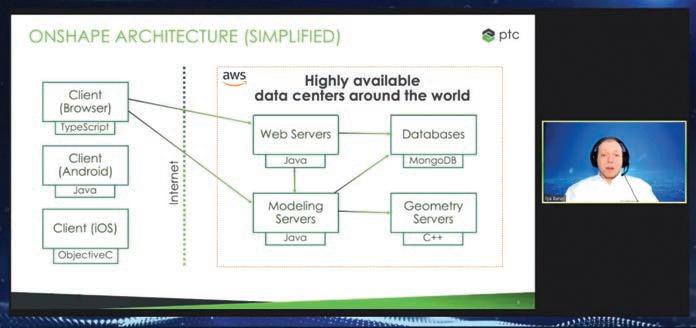
In this context, “porting” means changing the way the programs store data to match Onshape’s method. Onshape uses a MongoDB database to store 3D models as data only (no file format). The data is then encrypted and continuously backed-up on Amazon servers running separately from other servers handling geometry calculations and user interactions. More significantly, Onshape has also become the cloud
platform (code named “Atlas”) for PTC’s desktop software, such as Creo MCAD and Windchill PLM, albeit slowly. Heppelmann has acknowledged elsewhere that porting that software to the cloud could take five to ten years to complete, and end up costing customers twice as much in annual fees. He is, however, adamant that cloud-based Creo will have all of desktop Creo’s functions so that customers can use either.
Most surprising to me was the seeming non-role desktop analysis software will play in PTC’s new Atlas era. Last year, the company announced it had
PTC CEO James Heppelmann presenting at Onshape’s first user conference in March 2021.
The importance of indoor air quality.
We are spending more time indoors, at home and at work. Unfortunately, our homes and offices trap harmful pollutants and allergens like CO2, tobacco smoke, pet dander, pollen, volatile organic compounds (VOCs,) dust, dust mites, mold spores, viruses, bacteria, and other harmful contaminants.
adopted Discovery Live real-time FEA (finite element analysis) software from ANSYS. Yet, in a Q&A during the March conference, Onshape sta said they would not be using it: “No, not ANSYS Live. We have something that is very e cient and accurate and will scale well in the cloud.” So, not all desktop software will migrate to Onshape’s cloud.
Arch Nemesis Solidworks
When Onshape launched nine years ago, sta said they were targeting Solidworks users. This sort of makes sense, as Solidworks is the most popular midrange MCAD program out there and most of Onshape’s executives came from Solidworks. Beat Solidworks and you’ve won the market.
It didn’t happen. PTC states that most Onshape customers come from other CAD packages; the Onshape user base of late might be about 13,000 or higher – compared to 1.5 million commercial customers for Solidworks.
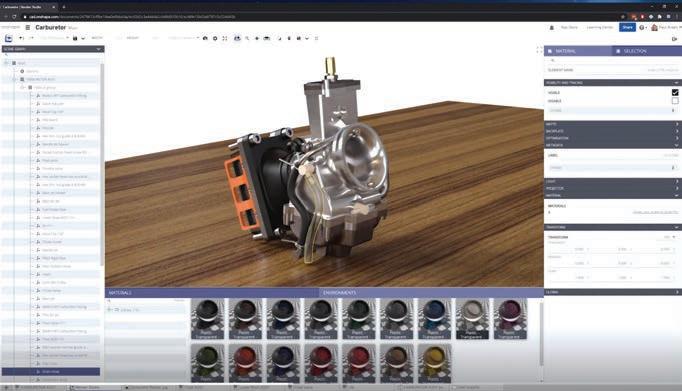
At its 2021 user conference, PTC announced and demonstrated a near realtime rendering module running inside Onshape.
Part of the reason behind that low number could be how tough it is to move a Solidworks assembly to Onshape. Components import as individual objects. In some cases, assemblies end up exploded and centered on the origin.
Onshape also won’t import configurations, drawings, feature lists, mates (constraints) or simulation data from Solidworks. Drawings have to be saved
as DWG files, then imported separately.
As a result, PTC recommends that users start new models in Onshape and then import parts from Solidworks only as needed. Or else, they advise, pay Cassini US$10,000 to bulk-migrate a thousand files at a time.
The disarray following a Solidworks import gives me two concerns. Perhaps PTC just hasn’t spent enough time solving these .sldasm conversion problems. Or more seriously, Onshape’s unique architecture makes it nearly incapable of reading complex models from competitors cleanly.
In the better news department, PTC says Onshape now has a million users in the (mostly) free education market, versus Solidworks’ five million. This is an easier market to capture, as these users tend to work with simple models made from scratch or provided in native format. Also, students’ livelihoods do not depend on interoperability.
What’s Next for Onshape
When Belmont Technologies (the original name for Onshape) began writing a next-gen MCAD program from scratch, they determined it had to run on the cloud, and so the priority was figuring out how to store, access, and share CAD data in real-time. “Let’s make sure we put in place the things no one has done before, and then we build out the CAD functionality,” explained Ilya Baran, Onshape VP of architecture.
Users, however, have the opposite priority: CAD functionality is primary; they don’t usually care how or where data is stored. Since CAD functions have taken a back seat during its development, Onshape software could be
considered less mature than competitors, even after nine years. Don’t get me wrong: Onshape arrived at a beautiful data solution that’s now mimicked in the engineering software industry.
That said, PTC did announce during the conference that Onshape will be gaining two musthaves in MCAD: electrical CAD design and near-realtime rendering. Both were acquired, and both still need to be integrated into Onshape. In addition, PTC is providing Onshape with its Frustum generative design and Arena PLM.
PTC apparently isn’t providing simulation to Onshape; sta showed us instead an early version of their own. We saw them placing loads on assemblies, and then running the simulation in a separate tab. When the results returned to the model, staff exploded the stress plot and drove the parts by displacement.
Among its new capabilities, Onshape’s Frame function will generate custom cut lists and allow them to be edited in drawings.
Rendering and simulation definitely benefit from as many CPU or GPU cores the cloud can provide.
PTC is cycling fast to get Onshape up to par with an updated release every three weeks. During the conference, PTC showed o lots of tweaks, such as editing cross-hatches in section views. Once computed properties are added to Feature Studio and to bills of materials, users will be able to calculate things like area, mass and even the shipping size.
In the future, the Onshape’s Frames function will allow for the use of custom profiles on any edge, and combine geometry with di erent profiles. Users will also be able to generate custom cut lists and allow them to be edited in drawings.
Some new functions will, however, be available only to holders of more expensive licenses, such as the computed properties and
a new Auditor function that checks whether change orders were implemented. This last technology came from PTC’s Windchill PLM software.
Onshape’s first user group conference proved to be a refreshing change. We got to hear about real-world problems and solutions. The conference showed us how far Onshape still needs to go to catch up with more mature MCAD programs, despite an update schedule that runs about 6x faster than its MCAD competitors. Nevertheless, Onshape remains the premier and only MCAD system that’s fully cloud-ified. |DE www.onshape.com
Ralph Grabowski writes on the business of CAD on his WorldCAD Access blog (www.worldcadaccess.com) and weekly upFront.eZine newsletter. He has authored numerous articles and books on CAD, Visio and other design software.
BACK IN THE DRIVER’S SEAT
Undaunted designer modifies racecars to help disabled drivers return to the track.
acceleration and brake foot pedals, while also allowing for quick shifting and use of the hand brake. And it had to be operated by one hand.
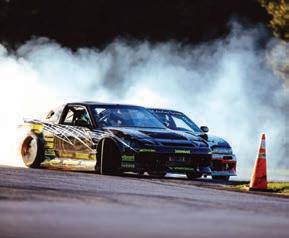
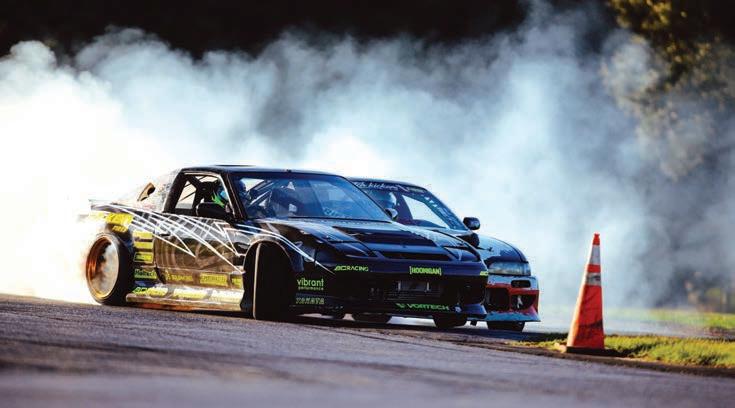
In the art of drifting – that is negotiating a race track turn while the car skids sideways – drivers are required to use the throttle, brakes, clutch, gears and steering in rapid succession to safely push the car to the limits of control. Added to that is the adrenaline rush of throwing a vehicle around a track with smoke billowing from the rear tires.
For Lethbridge, Albertanative, Rob Parsons, there’s a further technological challenge to this extreme motor sport. In 2011, the competitive auto and motocross racer was left paralyzed from the waist down following a life-changing motorbike accident.
During his recovery, Parsons set himself the task of designing a unique hand control system with which to operate the
clutch, brakes, gear shift and throttle of a racecar so that he, and others, could resume their passion for drift racing.
Building a Drift Car
Parsons’ journey started with a Nissan 180SX chassis to which he added custom structural reinforcements in key areas. By hacking the front and rear of the chassis to almost nothing, he made room for a 650-hp, 6.2-liter LS V8 from Speedmasters and a T56 Magnum six-speed manual transmission.
To this point, Parsons relied on professional advice from part manufacturers. The design of a novel hand-control system, however, wasn’t something that original part suppliers had worked on before; he’d have to engineer it himself. In short, he had to find a way to replicate all of the functionalities of the
Although the mechanics seem basic, Parsons says the real challenge was the control of the clutch and the gearbox. Indeed, operating these with precision and speed is critical to executing all of the drifting manoeuvres needed to compete at a professional level.
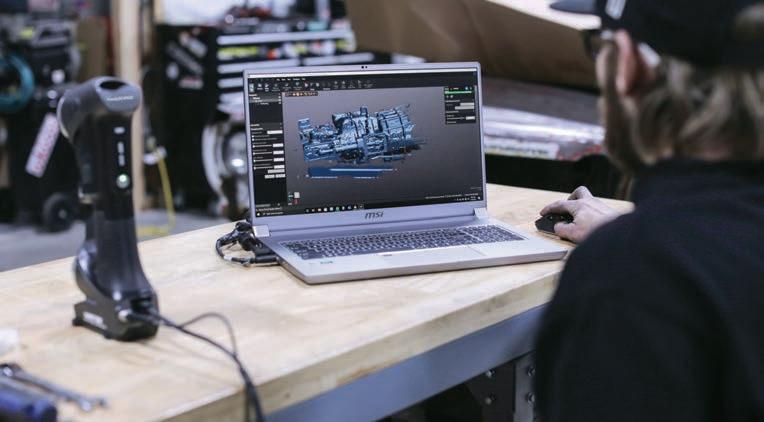
To design a solution, he relied on a few innovative technologies, including Creaform’s HandySCAN 3D Silver Series scanner. With it, he was able to extract the dimensional data from the race car’s T56 transmission to determine where a custom designed pneumatic shifter needed to be positioned.
Scanning the transmission also allowed Parsons to measure the position of each gear precisely after moving the shift rod from gear 1 to gear 6. Furthermore, the 3D scanner enabled him to measure the surrounding environment to make sure the movements derived from the new mechanism wouldn’t collide with any other components.
These positions would have been almost impossible to measure accurately by hand, Parsons says. However, the portable 3D scanner o ered the required level of detail to determine the positioning data on which the design of the mechanism was based.
“With a laser scanner, you expect to get really detailed scans,” Parsons says, “and the HandySCAN 3D Silver Series definitely produces that.” Having the mesh so finely detailed, in addition to being cleaned and aligned, is a huge benefit when trying to line up holes and accurately measure features and diameters that will need to be machined out. “You don’t need to take out a caliper to check everything up,” he adds.
A purely hand-controled Nissan 180SX drift racecar modified by Alberta’s Rob Parsons, founder of the Chairslayer Foundation.
Photo credit: Chairslayer
Hand Controls
With the transmission modifications in place, Parsons moved on to the righthand drive car’s unique hand controls. For most functions, the system relies on control arm mounted on the steering column, where the turn signal would be.
Reminiscent of motorcycle handle bar, the control arm incorporates a motorcycle clutch lever to engage the systems electronic clutch-by-wire system, while buttons near the thumb position control up and down shifting.
The control arm also takes the place of the brake and gas peddles; pulling the arm down accelerates while pushing it away engages the brakes. This configuration allows the driver to both brake and accelerate at the same time (pulling down while pushing the arm forward). In addition, a large vertical lever, near the steering column, engages the race car’s hand-brake. Taken together, the system enables the driver to initiate the lightning-quick clutch kicks, gear up- and down-shifts and the prolonged skidding maneuvers characteristic of
To help design his drift racecar’s hand control system, Parsons used a Creaform 3D scanner to create a CAD model of this T-56 manual transmission.
drift racing.
Instead of relying on expensive physical prototypes, Parsons says he was able to make changes to the hand controls directly in the CAD model before machining the parts. Using the scanner also meant a better design that became a perfectly fitting part the first time.
While Parsons’ unique hand control system enabled him to go back on the track and drift again, he didn’t stop after his first laps and adrenaline rushes.
Seeing how his story inspired others with disabilities, Parsons founded the Chairslayer Foundation. His non-profit organization helps get paraplegics behind the wheel of high-performance cars, like his hand-controlled drift car, slamming on the accelerator and having some extreme fun burning rubber. www.chairslayer.org www.creaform3d.com
This article was contributed by Creaform.
Your rotating equipment deserve the bearing standard of excellence!
SKF deep groove ball bearings are an engineering feat in bearing design, tribology, metallurgy, lubrication and manufacturing. The result is a standard of excellence in bearing performance and precision manufacturing – unmatched in the marketplace. Contact SKF today to help meet your requirements and goals! https://skf.li/v5qnzj
Keywords
ManufacturingJobsite.ca is Canada’s premier online job portal for the growing manufacturing sector. A laser focus on the right people across the country’s largest manufacturing media audience means you get the right applicants the first time. No more massive piles of unqualified applicants, just professional employers reaching qualified professionals.
Powered by the top manufacturing media brands in Canada, the reach to over 500,000 industry professionals on ManufacturingJobsite.ca is amplified by:
Website advertising to 185,000 qualified monthly site visitors
A comprehensive and magnifying reach across multiple associated job boards
Email promotion and job alerts to 131,000 industry emails using Canada’s largest CASL-compliant direct access to manufacturing professionals
Social media promotion to all brand networks on Facebook, Instagram, Twitter and LinkedIn
THE COMMUTER EV
ElectraMeccanica’s entry-level, threewheeled SOLO looks to ride wave of enthusiasm for zero emission vehicles.
BY MIKE MCLEOD
It wasn’t long ago that the mainstream auto industry treated the electric vehicle like fast food restaurants offered the veggie burger, a “healthy” alternative intended for that fraction of the market that wanted it. In the past year, however, car makers have decided that fringe menu item will become its main fare. Nearly all the major car makers have made bold proclamations to end, or severely curtail, the production and sale of internal combustion engine vehicles over the next 15 to 30 years.
In part, the industry didn’t embark on that transformative journey on its own. Between 2017 and 2019, nearly all industrialized nations, including the EU, China, Canada and many U.S. states, decreed, by one measure or another, that the standard ICE will have seen it’s day by 2050 if not sooner. Couple that with Tesla becoming world’s highest valued car company in 2020, and it’s clear there isn’t only investor enthusiasm for the EV, but market forces pushing toward that transition.
Amid this environment has emerged the SOLO, an entry-level electric vehicle designed and manufactured by Vancouver-based ElectraMeccanica. The distinctive 3-wheeled BEV had its official U.S. launch in late 2020, and, for now, the company says sales will focus on the western U.S. In place of traditional dealerships, the company has followed Tesla’s sales model, with 20 sales kiosks spread across five states including Arizona, Washington, Oregon, Colorado and throughout California.
To eventually supply those orders,
ElectraMeccanica broke ground in May 2021 on a 250,000-sq.-ft. manufacturing facility in Mesa, Arizona that the company says will produce 20,000 SOLOs per year. In the meantime, the company has contracted Chinese motorcycle manufacturer, Zongshen Industrial Group, to satisfy the pre-orders the company says it had received prior to launch.
While that might seem an odd choice, the SOLO is technically an enclosed motorcycle, although in most jurisdictions it can operated without a special license. It’s also includes safety features found in a conventional car, including a torque limiting traction control system, front and rear crumple zones, a rollover bar and reinforcement bars in the doors.
That said, the motorcycle classification does exempt the SOLO from meeting NHTSA crash standards, although ElectraMeccanica says the vehicle does meet all Federal Motor Vehicle Safety Standards (FMVSS) standards, as they pertain to motorcycles.
All in all, it would be easy to dismiss the SOLO, at first glance. Despite it’s modern features (e.g. backup camera, heated seats, keyless entry), the EV has room for only a driver and, relative to other EVs, it has a short 100 mile (160 km) in-city range. However, for ElectraMeccanica CEO, Paul Rivera, those stats encapsulate the whole point of the SOLO.
“For all the time that we spend in traffic going to and from work, people in North America commute 16 miles on average and we like to do it by ourselves,” says Rivera, who’s spent 20 years in the alternative fuels and
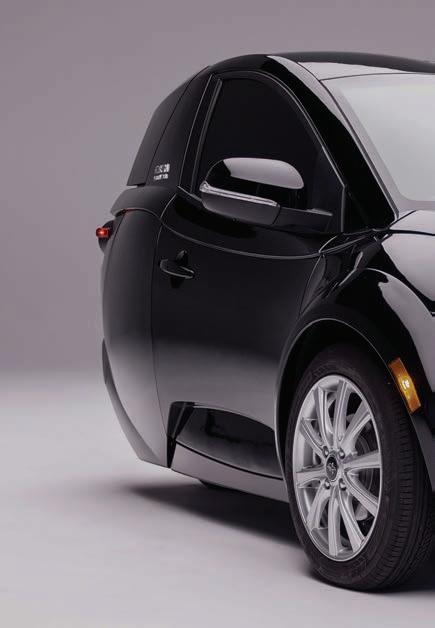
With a 100 mile (160km) range and US$18,500 sticker price, the SOLO is designed for urban commuters, as well as ride sharing services and fleet applications.
transportation industry before joining ElectraMeccanica in 2019. “So we are often using an over-utilized, over-powered powertrain.”
In place of that high hor sepower engine, the SOLO’s belt-driven rearwheel is powered a liquid cooled 53-hp synchronous AC motor that produces 94 ft-lbs. of torque, a top speed of 80 mph and a 10-second 0-60 mph.
However, focusing on the SOLO’s performance or unique appearance overlooks what makes it very different from most EVs. At a retail price of US$18,500, the SOLO costs approximately a third of the average EV (US$55,600), according to Kelly Blue Book publisher, Cox Automotive.
In fact, it’s low entry price may be its most attractive feature, considering demand for EVs has remained relatively
low. According to the 20,000 auto buyers worldwide who were polled by Ipsos in 2020 as part of its Global Mobility Navigator Syndicated Study, the high sticker pr ice of electr ic vehicles currently exceeds range anxiety and charging infrastructure as the dominant barrier to buying a BEV.
And looking at the field, even the cheapest brand-name EVs available in North America carry a comparatively hefty price tag. The four-seat 2021 Mini Electric, for example, is limited to roughly the same range as the SOLO (110 miles) but retails for US$11,400 more (US$29,900).
Other entry-level competitors include the second generation 2021 Nissan Leaf and 2022 Chevy Bolt. For around US$32,000, the stripped down version of 2021 Leaf has only a 150 mile range but offers fourseats/wheels, more amenities and is produced by an established brand. Similarly, GM anticipates its entry-level 2022 Chevy Bolt come in with the same price and amenities as the Leaf, but a range of 259 miles.
For the SOLO to stay in the running, maintaining it’s lower price point is paramount. That
fact also helps explain the reasoning behind many of the vehicle’s distinctive design choices. On one level, cutting out the passenger and back seats, plus a back wheel, reduces material and manufacturing costs but also helps reduce the SOLO’s curb weight to less than 1,800 pounds.
Added to weight reduction, having one less wheel reduces the vehicle’s rolling resistance, while the single seat allows for body styling that improves the vehicle’s overall drag coefficient and lowers center of gravity.
Taken together, these factors help the SOLO achieve its 100 miles range using a smaller, lighter and less costly 17.3-kWh lithium-ion battery pack. Although the average cost of an EV batter y has declined by 87% since 2010, according to BloombergNEF, it’s still an EV’s most costly component – approximately $156 per kilowatt hour on average.
“The SOLO’s battery is a bit unique because it’s 144 volts, or 72 volts in each door sill. For our needs, this particular cell configuration just worked out well for what we were trying to achieve,” Rivera says. “But over the next 24 to 36 months, as we evolved the vehicle for the global market,
that’ll bring changes that include a slightly longer wheelbase, probably front-wheel drive, additional safety features and a different battery pack and cell chemistry.”
In the meantime, Rivera says the North American consumer market represents only a part of the SOLO’s current market potential. In addition to commuters, he says the SOLO is well suited to ride sharing services and the fleet market. The SOLO can be configured with a 5-cubic-foot cargo box with up to a 60 lbs. payload.
“Every one of our vehicles has sophisticated telematics on it so we know location, state of charge, g-forces, acceleration, etc but with consideration of the privacy laws,” he says. “The fact that we have that capability is important for what we want to do on the fleet side.”
100
The SOLO’s 100-mile range is achieved using a smaller, lighter and less costly 17.3-kWh lithium-ion battery pack.
“Think about all the different applications that there are when you take off the hatchback and you add the cargo box...for pizza, fast food, grocery delivery, as well as security companies that patrol communities,” he continues, adding that the company has received 1,800 fleet leads since January 2021. “Our vehicle is perfect for that.”
Beyond it’s plans for the SOLO, Rivera says the company’s next major steps will include building on the recent launch of the eRoadster, an electrified version of Intermeccanica’s Porsche 356 replica. Ultimately, Rivera says the company will introduce its high-performance Tofino sports car, a modern take on the classic open-top coup.
“We have done a lot through nimbleness, remaining asset light, prudence and with very little capital to get to where are, where we’re able to put a vehicle on the road,” Rivera says. “And we’re just beginning. I’m really excited we’re headed from here.” |DE www.electrameccanica.com
For the full Paul Rivera interview, check out the Design Engineering podcast.
The single seat, three-wheeled SOLO electric vehicle by Vancouver-based ElectraMeccanica
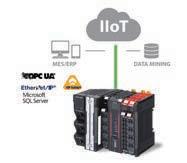
IO-Link provides an internationally accepted platform for sensors to report fault detection, condition monitoring and component identification.
UNDERSTANDING IO-LINK
A guide to the capabilities of the IEC 61131-9 compliant communications networking standard.
For manufacturers seeking guidance on implementing Industry 4.0 technologies, a common directive is to collect more data from the plant floor. Since data is the foundation for the factory of the future, it goes without saying that the first step towards a next-generation facility must involve capturing the types of information that can help optimize the production line. Barcode reading, RFID and
machine vision supply large amounts of data on work-inprogress whereabouts and quality status, but sensors are another information source that can – and should be – tapped.
Before the advent of IOLink, the only data that could be gleaned from sensors was a basic on/o status. IO-Link provides an internationally accepted platform for sensors to report fault detection, condition monitoring and component identification.
through the IO-Link Master via a fieldbus network into the host controller. This article will examine several questions manufacturers have when considering whether to use IO-Link for their applications.
What technologies are needed to use IO-Link?
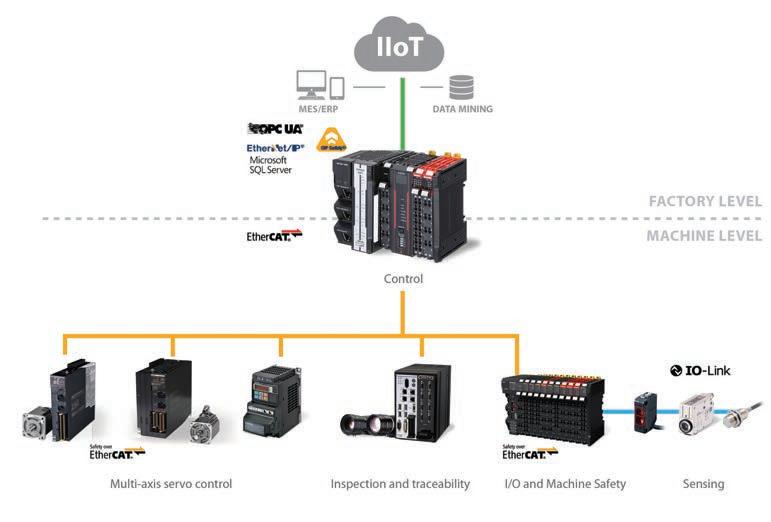
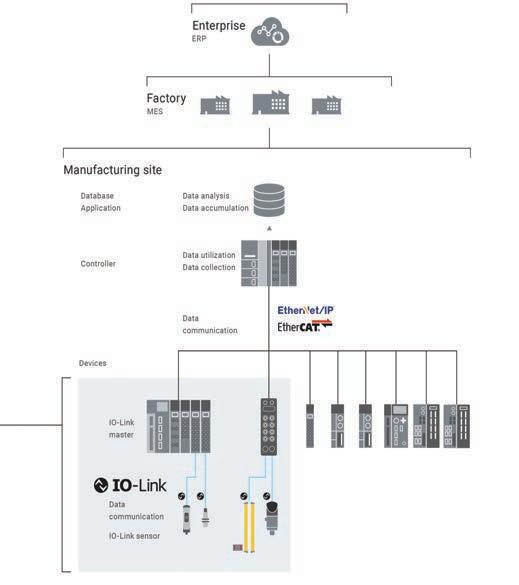
A basic IO-Link system consists of one or more sensors/actuators with IO-Link functionality and an IOLink master, which serves as the interface between the individual devices and the higher-level control system.
An IO Device Description (IODD) is also required, as this particular file contains data that identifies each IO-Link-enabled device and describes its parameters, process data, diagnosis data, communication properties and more. Standard communication cabling is used to connect the devices to the master.
What types of data can be collected
via IO-Link devices?
By communicating these details throughout the system, IO-Link helps shorten commissioning time while simplifying troubleshooting and reducing downtime occurrences to maximize production availability.
IO-Link meets the international standard IEC 61131-9 as an open information technology – or interface technology – between the sensor/actuator and the I/O terminal. It collects information from the sensor/actuator
Essentially, IO-Link allows users to gather output data and monitor it over time. This information can be useful for predicting how long sensors will last in a given environment and identify likely areas for process improvement. Additionally, users can use IO-Link to identify the vendor, product name and hardware revision in addition to collecting total runtime data and even temperature information. With the E2E NEXT DC 3-wire proximity sensors, users can know in real time –from a single location – the status of multiple sensors, in order to identify the location and cause of failures ahead of time.
Exceptional designs deserve superior components.
The developer of the original world-class linear motion systems, THK continues to redefine industry standards and to meet an ever-growing range of needs. From aerospace and machine tool to packaging and medical, THK products play a vital role in the advancement of technology and capability.
To learn more, call us at 1-800-763-5459 or visit www.thk.com.
What are some key strategies for using IO-Link?
The most impactful way to employ IO-Link technologies is to use their alarm and data collection capabilities. By setting certain thresholds – for example, if a target gets too close to a proximity sensor, or if a photoelectric receiver is only getting a certain percentage of the light it normally receives –the technology can alert the operator to potential issues before they become more serious. Collecting data from the sensor and logging it into a database application that provides further analysis allows users to better predict when problems might arise. In addition, logging the data over time can reveal trends in equipment maintenance requirements that can be used to move from simple preventive maintenance to more effective predictive maintenance.
IO-Link also provides a highly effective means of connecting sensors. For example, a single 8-port IOLink master block can have
IO-Link hubs attached to it, each of which can support up to 16 sensors. By doing this, a user can run up to 128 sensors from a single IO-Link master. By contrast, using EtherNet/IP distribution blocks, a distribution block would be required for every 16 sensors, and eight blocks would be needed to hook up 128 sensors. Distribution blocks are relatively expensive, and EtherNet/ IP distribution blocks have the added disadvantage of requiring each block to have a separate IP address, whereas only the IO-Link Master requires an IP address in an IO-Link system
What’s the potential impact of not using IO-Link?
Without using IO-Link, it would be more di cult to accurately predict when sensors might fail or cause other issues due to improper positioning. If these problems aren’t caught, the system might miss individual parts if sensing distances became too large, or the sensors could collide with sensing objects if the sensing distances were
mechanical damage.
In addition, manually collecting sensor runtime data would be a tedious, error prone, and time-intensive process, as operators would need to manually log all runtime data. In addition, there would be no way for photoelectric sensors to automatically indicate when their lenses became dirty enough to impact their detection capability.
too short. The latter issue is a major cause of equipment downtime, as collisions can easily damage the delicate sensor technology. IO-Link helps manufacturers ensure a consistent sensing distance throughout the production line in order to keep detection rates high and avoid
Instead, operators would see a flickering “false on” or “false o ” until the sensor finally locked on or o . A similar situation would be seen with proximity sensors as weld slag buildup starts to happen. IO-Link sensors can help manufacturers monitor sensor output in real time, rather than being notified only once the failed sensor condition occurs.
Yet another consequence of using devices that don’t incorporate IO-Link is a reduced ability to error-proof replacements for these
devices. IO-Link master ports can be configured to recognize a specific part number, so if that part number needs to be replaced, the system can identify any mismatches and send an error alert. Without IO-Link, an operator could accidentally install the wrong part without raising any immediate alarms. This could cause false triggers, missed parts, or even damaged parts.
Finally, IO-Link technology makes replacement devices much easier to configure. Without IO-Link, operators need to go through a complex process of reconfiguring a new sensor to replace an old one.This process is made much easier with IO-Link, since the configuration that was used with the previous sensor can be set up to be automatically pushed to the new sensor once it’s installed. This saves time and also reduces the likelihood of an error.
How can IO-Link help manufacturers embrace Industry 4.0?
Across industries, a willingness and ability to implement Industry 4.0 technologies is becoming a prerequisite for success in the manufacturing environment of the near future.
Next-generation factories are built upon a foundation of data that tracks the location and status of works-inprogress and monitors the functionality of equipment. Also known as the Industrial Internet of Things (IIoT), this assortment of technologies is being developed to serve the need for collecting and utilizing information from the plant floor to improve processes and facilitate predictive maintenance.
IO-Link fully supports movements toward plant
connectivity and IIoT by collecting machine and process data at the device level. As production lines trend simultaneously towards more flexibility and more automation, it becomes increasingly di cult for operators to comprehensively monitor machine function and predict when repairs will be needed. By collecting machine data at the device level and storing this data for future analysis, IO-Link technologies help manufacturers stay on top of important predictive maintenance needs.
IO-Link technologies provide an excellent way to collect the data necessary to provide a foundation for improving process flow and facilitating predictive maintenance as today’s manufacturing applications grow in complexity.
IO-Link-enabled sensors contain important machine-level information that compliments the data gleaned through traceability and vision inspections.Without IO-Link, sensors can only provide a simple on/o status reading.
In addition, IO-Link makes key components of any application much easier to set up and maintain. With an internationally accepted platform for sensors to report fault detection, condition monitoring and component identification, it shortens commissioning while reducing troubleshooting needs and downtime instances. Replacement devices are much easier to incorporate when IO-Link can automatically push the original settings to the new device from the IOLink master. |DE automation.omron.com This article was contributed by Omron.
Human-Collaborative Robots Powered by Wainbee Expertise
Flexible, Safe, Easy-to-Use
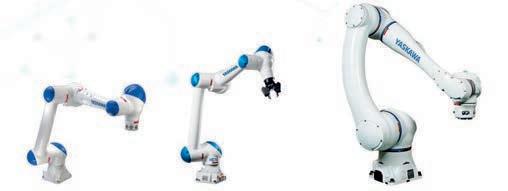
Highly versatile and portable, HC-series robots are ideal for a variety of tasks including machine tending, material handling, packaging and light assembly. Designed to work safely with, or in the same workspaces as humans, these six-axis human-collaborative robots meet established safety standards.
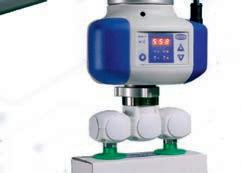
As part of Yaskawa Motoman’s Technology Partner Network, Schmalz offers several modular vacuum gripping options for Yaskawa’s HC10DT. Talk to a Wainbee Representative today on how our packaged systems help customers quickly meet their application requirements.
Enhanced Worker Safety. Optimized Production Rates. Fast System Integration.
.com
WAINBEE (924-6233)
IN THE LOOP
Regina potash drilling rig beats historic blizzard with help from igus energy chain.
BY SCOTT PARKER
The hurricane force blizzard that bore down on Regina in January 2021 wasn’t a garden variety Canadian snow storm. Winds reached 126 kilometer per hour, a record for that month. News organizations compared it to a 2007 blizzard that killed two people, shut down airports, brought motor vehicle tra c to a standstill and shut down public services.
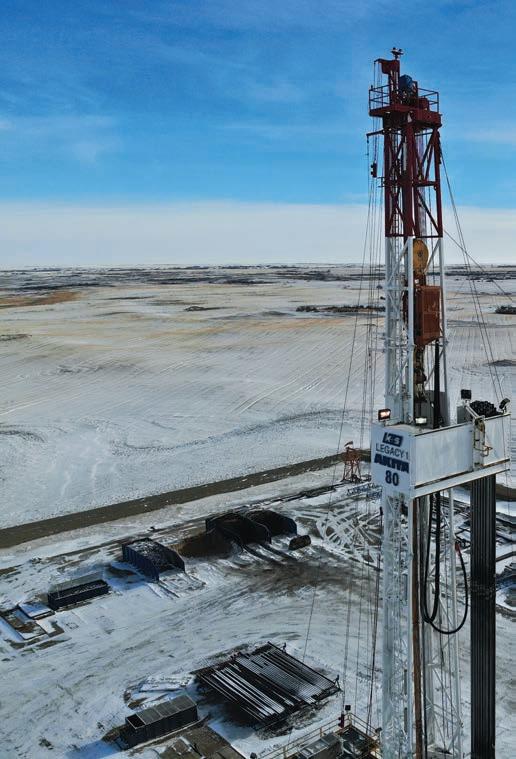
Workers at AKITA Drilling had seen this movie before, and the reviews weren’t good. Among its 20 Canadian rigs, the Calgary-based drilling company operates a 500,000-pound-capacity pad rig at K+S Potash Canada’s potash mine near Bethune, Saskatchewan, approximately an hour from Regina.
Just two months earlier, a major storm roared through the area which broke all-time November snow records in some areas of Saskatchewan with more than 47 centimeters in just 48 hours. Similar conditions, and even those less forceful, had forced AKITA to shut down its drilling
operations at the potash mine.
This time, however, a retrofit of its drilling rig just one day prior to the January blizzard proved to be a production savior. Workers encased the top drive service loop with an igus energy chain to protect the rig’s electric and hydraulic lines.
“Even in those extreme conditions, the loop functions very well,’’ said Darren Hrynkiw, a senior manager for K+S Potash Canada. “I am always pleased when an engineered solution can be found to eliminate a safety hazard as this is far more e ective than procedural safeguards. We expect little to no maintenance given its design and there are no productivity impacts with the installation of this protective system.”
Service Loops, Explained
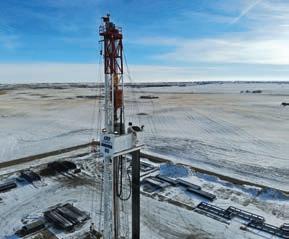
Located on the first greenfield potash in Saskatchewan in more than 40 years, AKITA’s rig in Bethune is composed of a onepiece 16-foot tall substructure with a 136-foot tall mast. At the heart of the system lies a
large electrical motor in the rig’s top drive, which travels up and down the mast as the rig drills. The top drive’s electric and hydraulic systems are supplied by a long dangling umbilical cord, or service loop. In addition to the main motor, electrical lines in the service loop also provide auxiliary power for lighting, lube oil heaters and cooling fans, as well as control, data and instrumentation functions.
To protect these critical components, many service loops are encased in steel jackets, which can be susceptible to corrosion. In fact, corrosion is one of the most significant problems for rig reliability, especially in drilling for oil and gas in environments located near or in waterways. As a consequence, steel service loops require continual maintenance. Repair work on service loops is also dangerous in oil and gas exploration. In a 1988 incident in the North Sea, near Scotland, 167 workers were killed at the Piper Alpha Oil platform.With all sorts of moving parts, and sometimes extracting flammable products,
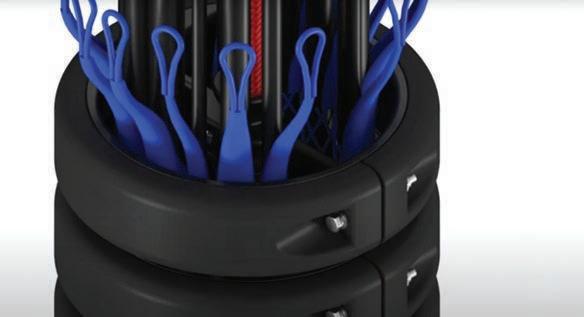
With a bend radius of 500 millimeters, igus’ polymer e-chain encases and protects the rig’s service loop while a high tensile Dyneema rope bears the weight of the loop’s electrical and hydraulic lines.
workers face a potentially deadly work environment. Similarly, there were safety concerns at the AKITA rig stemming from the cables on its service loop.
“There was more than one occasion where the service loop became snagged on the top drive, resulting in a dangerous overhead safety incident with high voltage cabling,’’ Hrynkiw said. “Multiple engineered safety solutions were explored, but in most cases the solution presented other maintenance or sometimes even new safety concerns.”
The bigger issue, however, was that the cables became snagged on the rig during operations in high winds. That caused rips and pulls on the cables, which are also costly to replace.
“Sometimes the wind gusts and grabs the service loop and sends it into mast beams,’’ said Justin Amyotte, a field superintendent with AKITA. “Hopefully, the driller sees it and stops and fixes the snag. If he does not see it, the cords get damaged. That results in even longer downtime.”
E-Loop Solution
AKITA Drilling sought a solution to eliminate downtime caused by high winds. “We tried multiple ways to combat the wind messing the service loop,’’ Amyotte said. “We even went as far to set up the rig in the direction of the predominant winds. We even stationed a worker on the floor watching the service loop at all times during high winds.”
After reviewing several solutions, AKITA turned to the igus e-loop energy chain to provide a protective cable guidance system that eliminates service loop cable snags and hang-ups. The modular design allows easy pre- and post-installation access, making it safer for repairs.
retrofit time and costs. Cables are free of strain, and the self-lubricating modular e-loop ensures a defined bend radius of the cables and withstands vibrations and shocks. The e-loop can be opened and closed for easy maintenance, and includes cable-friendly, two-chamber interior separation.
To reduce downtime due to the high winds, this AKITA Drilling pad rig, at K+S Potash Canada’s mine in Saskatchewan, was fitted with an igus e-chain to protect the system’s long service loop cabling.
The igus e-loop has a bend radius of 500 millimeters, and combines the advantages of a polymer energy chain with a Dyneema rope that possesses high tensile strength. The tensile forces are absorbed by the rope and passed through the mounting brackets into the support structure. The design relieves cables of any strain, and ensures a defined bend radius of the cables. The modular e-loop also withstands vibrations and shocks.
The e-loop is mounted in the middle of the mast, which is a load-bearing structure used to support and position the drill string. The e-loop traverses the 136-foot mast by going 70 feet up and 70 feet down from the center point.
“Less down time results in more productivity, and less damage to the rig saves money,’’ Amyotte said. “There is also an important safety component. There is 600VAC running through those power cords and up to 600 amps before the breaker trips.”
AKITA and igus completed the retrofit in eight hours. AKITA used the existing cables on the rig, and installed them into the igus e-loop. The option to use existing hose supports and mounting brackets reduced
“Sourcing igus was a bit of a challenge because they had never been used in Western Canada until now,’’ Hrynkiw said. “igus was very responsive in working with us to find a way to make a delivery happen for the first time to Western Canada. When the e-loop arrived, we found the install to be relatively quick and easy and the overall design is intrinsically safe and rated for overhead use.”
While the technology in this application was used for potash, Amyotte said any rig could use the technology. “A drilling rig is a drilling rig,’’ he said. “What it drills for doesn’t matter. It could be a huge benefit on any drilling rig.”
Saskatchewan is home to approximately 50 percent of the world’s known potash reserves, and it is critical to the Canadian economy. Exports of potash from Saskatchewan amounted to more than $5 billion in 2017, and generated payments of more than $308 million to the province’s economy in 2017-18.
As a critical component to the Canadian economy, and the world’s food supply, it is important that production stays on pace. The new e-loop will help support steady potash production, even in the most severe weather conditions.
“We worked out a great solution,’’ Amyotte said. “This has been a challenge for us for a while, so it’s nice to have something we can depend on.” |DE www.akita-drilling.com www.igus.ca
Scott Parker is the igus product manager for energy chain systems in Canada.
AUTOMATION
MANAGED SWITCH
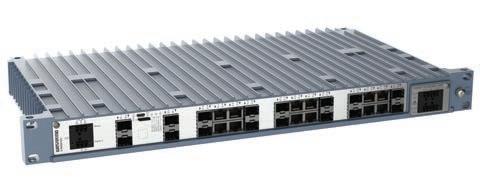
Westermo introduced its RedFox-5728, a managed industrial Ethernet switch designed for tough environments. The switch meets all test levels for Class 2 fulfillment, which do not allow the loss of a single transmission package, even during the highest EMI bursts. The switch has also attained KEMA type test gold certification, ensuring zero downtime, communication losses, delays or errors. The
RedFox-5728 has been designed to run efficiently from either one or two power inputs, with dual internal power supplies fully isolated from each other and all other interfaces. Suitable for 19-inch rack installations, the 28-port switch has all connectors located at the front with a range of port configurations, customizable with SFP transceivers. Available with both layer 2 and layer 3 functionality, the switch runs the WeOS operating system. www.westermo.com
MANAGED SWITCH
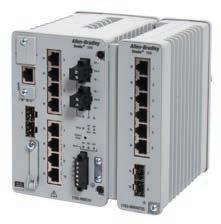
Rockwell released its Allen-Bradley Stratix 5800
managed industrial Ethernet switch that supports layer 2 access switching, layer 3 routing and ISA/IEC 62443-4-2 network security. Certification to ISA/IEC 62443-4-2 verifies that the switch meets the standard’s technical requirements to security level 2 for industrial automation and control systems. Available in fixed and modular designs, the
switch offers combinations of copper, fiber and Power over Ethernet (PoE) ports. The switch runs Cisco’s IOS-XE operating system and accepts Studio 5000 add-on profiles to enable integration into the Rockwell Automation Integrated Architecture. www.rockwellautomation. com
SMART GRID GATEWAYS
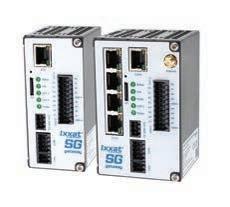
HMS Networks has expanded its Ixxat SG-gateway series to include two multi-IO versions that connect to energy systems using IEC 61850 and IEC 60870. In addition to existing support for EtherNet/IP, PROFINET, MQTT and 4G, the two SG-gateways feature Multi-IO and Wi-Fi capabilities (WLAN according to IEEE 802.11 a/b/g/n). Besides
RS232/485 and Ethernet, 8 digital inputs/outputs (24VDC) and 8 analog inputs (0-20mA or 0-10V) are available for direct sensor connection, all switchable via software. For direct use, data can be pre-processed using the integrated WEBPLC. Data security is implemented via a local firewall, access management and encrypted data transmission, using either openVPN or TLS 1.3.
www.ixxat.com
MOTION CONTROL POWER SUPPLY
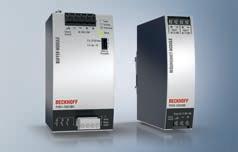
Beckhoff has expanded its universal 24/48VDC power supply series with the addition of its PS9xxx buffer and redundancy modules. The PS90xx buffer modules prevent disturbances caused by voltage dips and fluctuations by storing energy via maintenance-free electrolytic capacitors and releasing it as required. Requiring no control wiring, the buffer modules can be added in parallel to the load circuit at any point. The redundancy modules allow two or more power supply units, connected in parallel, to
be decoupled by one or more redundancy modules. The redundancy modules use MOSFET technology for decoupling, which reduces voltage drops and power
dissipation. Accordingly, the devices have lower power loss compared to conventional diode modules.
www.beckhoff.com
XY ALIGNMENT STAGES
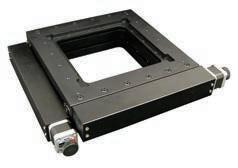
Optimal Engineering Systems, Inc. (OES) released its AU200-200x200-01 XY Alignment Stage. Supplied with a standard 4mm-per-turn ground lead screw, the stages feature 200mm (7.874 in.) of
travel in both the X and Y axes and have a 250mm x 250mm (9.842 in. x 9.842 in.) open aperture. The stepper motor-driven AU200200x200-01 features a resolution of 1 micron when using a 20 micro-steps-perstep micro-stepper motor driver and better than 2 micron repeatability. The knobs on the AU200-200x200-01 Stepper Motor series can be replaced with an optical encoder for position verification. For greater resolution, repeatability, positional accuracy, higher travel speeds and greater throughput, the AU200200x200-02 and AU200200x200-03 stages are supplied with three phase brushless servo motors and DC brush motors with quadrature encoders for closed loop servo operation.
www.oesincorp.com
DIGITAL OUTPUT MODULES
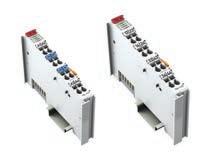
WAGO introduced two solid state MOSFET digital output modules that have the ability to switch 2 Amp resistive loads at a frequency up to 1 Hz. With this capability, it can switch
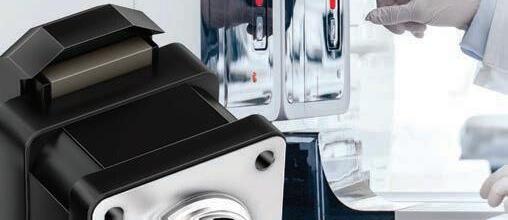
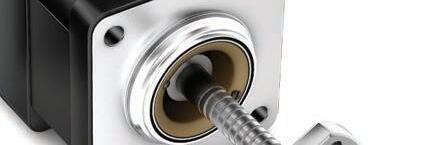
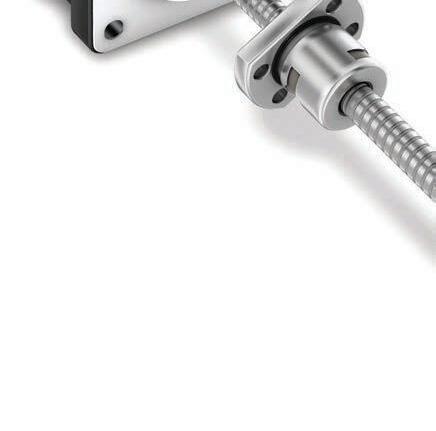
Compact. Silent. Precise. MBSA.
Motorized Ball Screw Actuator
positioning through seamless mechatronic integration.
near-silent, extremely reliable and ultra-accurate motion, improving efficiency and throughput while lowering costs.
Enabling Automation in Motion & Control.
NSK MBSA Motorized Ball Screw Actuator for Compact, Precision Linear Motion
high current outputs without wearing out mechanical relay contacts. The 750-527 and 750-528 are both 4-channel semiconductor I/O modules that switch both AC and DC voltages up to 30V and 2A. Field power for the 750-527 is supplied by the module’s power jumper contacts and can be cascaded to other modules. The 750-528 field power is supplied by an external source and each of the four outputs are isolated from each other. www.wago.com
ROTARY AXIS SYSTEM
ETEL introduced it DXRH
rotary axis system which incorporates a 360,000-line encoder and bearing technology from parent company HEIDENHAIN. The unit also features ETEL’s toothless (ironless), zero torque ripple direct drive technology for high speed stability. The DXRH was
designed for the semiconductor industry, and is especially suited for Wafer Process
Control applications such as overlay metrology, critical dimension and thin film metrology. The DXRH provides accuracy of ±3 arcsec without calibration, position stability of ± 2.5 marcsec, bidirectional repeatability of ± 0.25 arcsec, and a radial runout of ±1µm.
The module is also ISO class 1 clean room compatible. www.heidenhain.us
POWER TRANSMISSION
SERVO COUPLING
RINGFEDER released its GWE 5113 series of elastomer jaw servo-couplings, featuring a new hub design. This design eliminates radial loads and achieves uniform power transmission with an even
clamp force and symmetrical arrangement of clamp and screw positions, the company says. GWE 5113 couplings
transmit torques from 3 to 560Nm. The hub is slit partially through and located directly under the jaws to minimize pressure on the shaft. Units come with an elastomer spider with 98 Shore A hardness. They also come in seven sizes from 12 to 42, with diameters ranging from 4 to 56 millimeters. Units also comply with ATEX, providing maximum operational safety.
www.ringfeder.com
ROLLER GUIDE
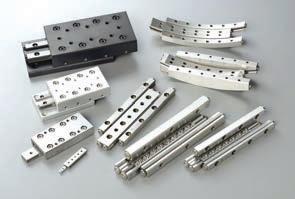
NB Slide Ways are non-recirculating linear motion bearings used primarily in optical and measurement equipment where high precision movement is required. The SV style consists of two roller cages with precision rollers in a cross arrangement and four rails with V-shaped raceways. The SVW has one rail with V-shaped
grooves on both sides and two SV rails. The NB GONIO WAY is a curved crossed roller slide way utilizing low friction, non-recirculating, precision crossed rollers. It is used when there is a need to change the gradient or obtain an accurate gradient angle without changing the center of rotation in high-precision optical and measurement equipment.
www.nbcorporation.com
FLUID POWER
FILTRATION UNITS
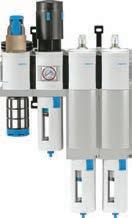
Festo introduced its MS series of filtration products that lower the risk of particle contamination when compressed air comes into direct contact with food or packaging in the food zone. The three models in the series – MS4, MS6 and MS9 – conform to FDA and US Food Safety Modernization Act guidelines as well as Safe Quality Food Institute Codes Edition 9 · 3-A standard 604-05 · British Compressed Air Society Guideline 102 · ISO2200:2005. MS series filtration systems are rated for air flow ranging from the MS4 at 360 l/min to MS9 at 7,800 l/min. Once the pressure point is set, a lockable filter regulator prevents tampering. Visual-cue red/green gauges indicate the unit has the correct/incorrect pressure range and whether filters require replacement. The MS series is compatible with a wide range of fittings from NPT 2 down to G 1/8.
www.festo.com
ROCKER VALVES
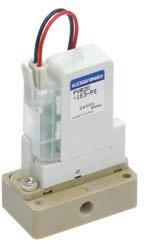
KOGANEI International America has expanded its line of media isolation valves with the PVR20 Series. The compact valves isolate aggressive gas and liquid media typically found in life science and medical analytics applications. Streamlined passages minimize internal volume
to less than 60 microliters by using rocker type design. The valves also feature metal-free wetted area for improved corrosion resistance and a power-saving circuit. With a service life up to 10 million cycles, the valves have a 2mm internal orifice and an operating pressure range from -11 psi to 43.5 psi.
SENSORS
MAGNETIC RING ENCODER
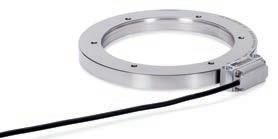
HEIDENHAIN introduced its ECM 2400, an absolute modular magnetic angle encoder designed for machine tool applications. The ECM 2400 is suitable for applications with high rotational speeds and works particularly well on B-axis lathes with motorized milling spindles, or on the A and C axes of
Rolling Ring
milling machines where a large hollow shaft encoder is necessary. The ECM 2400 encoders are available with EnDat 2.2 interface. In conjunction with a safe control, they can be used as single-encoder systems in applications with control category SIL 2 (as per EN 61508) and with Performance Level “d” (as per EN ISO 13849). Existing non-FS interfaces for ECM 2400 encoders includes Fanuc05 and Mit03-4. All of these encoders have an IP67 rating. www.heidenhain.us
MAGNETIC ENCODERS
• For applications in positioning & reciprocating motion
• Zero play –even during reversal
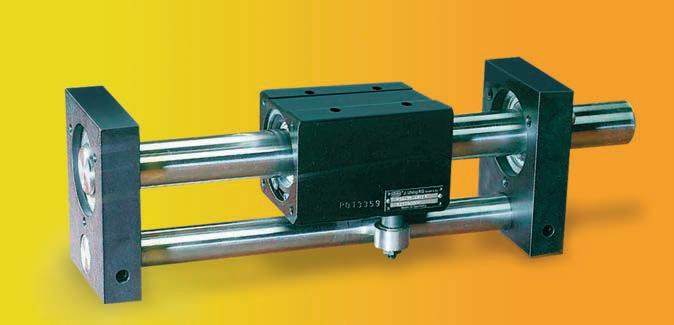
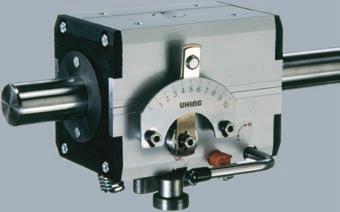
Uhing® Rolling Ring linear drives run on a smooth, threadless shaft that won't clog or jam. If the system is overloaded, the shaft simply slips instead of churning and grinding. The drive bearings are in constant contact with the shaft, even during reversal, thereby preventing backlash.
Example applications: metrology machines, material handling systems, spooling equipment, packaging & converting equipment.
Many different sizes meet varying requirements for axial thrust & linear speed.
For more information call 1-800-252-2645
Email: amacoil@amacoil.com www.amacoil.com
Some models feature mechanical control over speed and travel direction. No programming or electronic controls are needed.
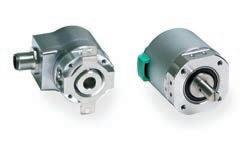
POSITAL announced its IXARC magnetic absolute rotary encoders will be available with a BiSS-C interface. This interface is designed for commutation and position feedback on BLDC servo motors. The encoders also feature 17-bit resolution and dynamic response up to 12,000 RPM. Multiturn variants feature a 32-bit rotation measurement range (over two billion revolutions). The rotation counter is self-powered, using Wiegand energyharvesting technology, eliminating the need for backup batteries or gear drive systems. The BiSS-C enabled products are available with a 36mm housing, enabling them to fit into the same mounting footprint as Size 15 resolvers.
www.posital.com
LINEAR POSITION SENSOR
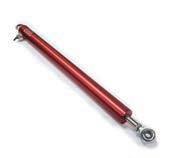
Harold G. Schaevitz Industries LLC (HGSI) has adding a line of ILPS-27 Series Inductive Linear Position Sensors using LVIT Technology. Available in 10 length ranges, from 2 to 18 inches (50 to 450mm), the sensors feature a 1.05 inch (27mm) diameter anodized aluminum housing sealed to IP-67. The line’s radial cable exit version comes with swivel rod eye ends, while the axial termination versions comes with either an M-12 connector or cable. Operating from a variety of DC voltages, the ILPS-27 series offer a choice of four analog outputs; all models include HGSI’s proprietary SenSet field recalibration feature. www.hgsind.com
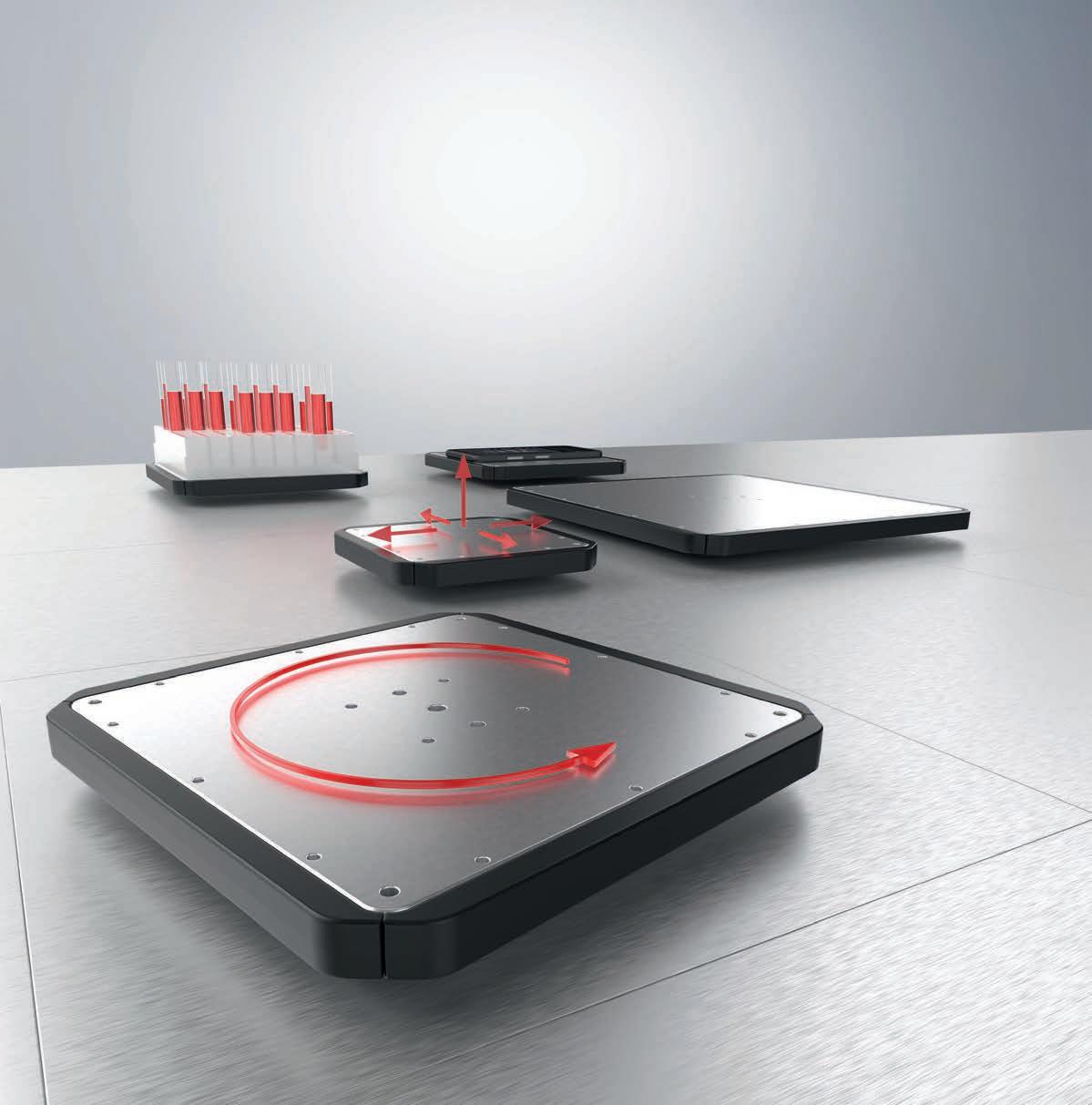
Individual 2D transport at up to 2 m/s
Processing with up to 6 degrees of freedom
Transport and processing in one system
Wear-free, hygienic and easy to clean
Free arrangement of planar tiles enabling totally customized machine and process layouts
Multi-mover control enables parallel and individual product handling
Fully integrated into the powerful and standardized PC-based Beckhoff control system (TwinCAT, PLC IEC 61131, Motion, Measurement, Machine Learning, Vision, Communication, HMI)
For use across all industries: assembly, packaging, food/bev, pharma, laboratory, entertainment, …