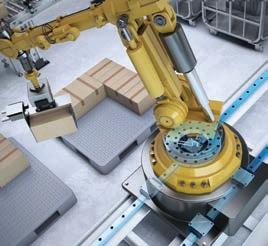
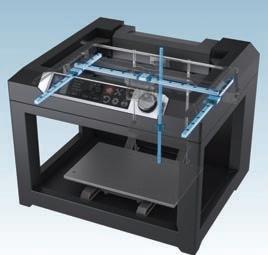
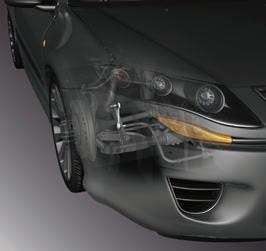
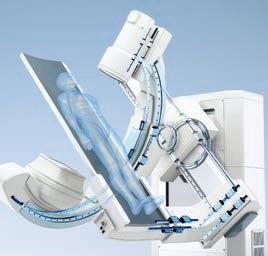
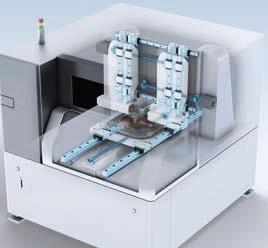
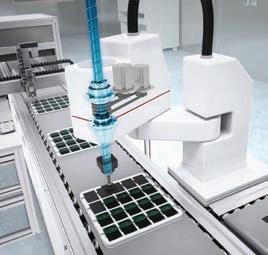
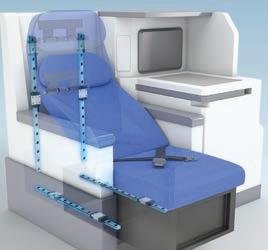
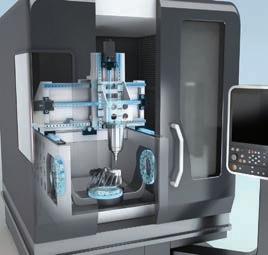
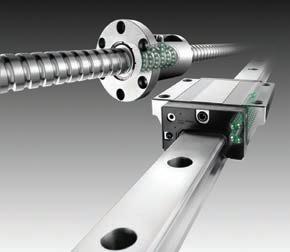
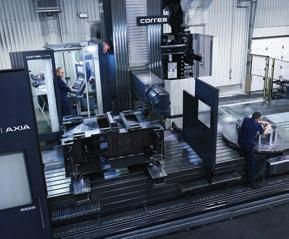
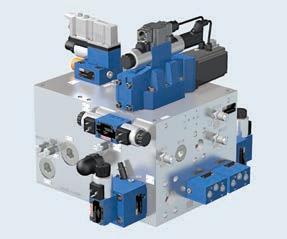
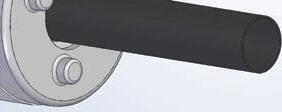
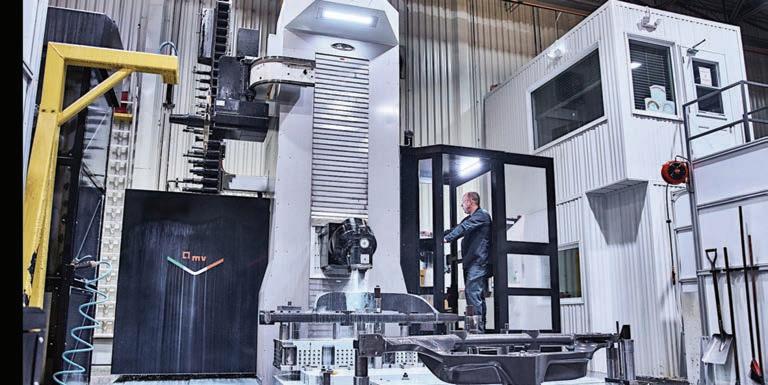
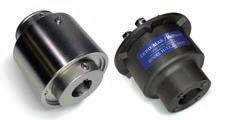
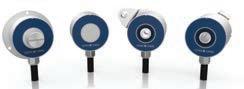
The developer of the original world-class linear motion systems, THK continues to redefine industry standards and to meet an ever-growing range of needs. From aerospace and machine tool to packaging and medical, THK products play a vital role in the advancement of technology and capability.
To learn more, call us at 1-800-763-5459 or visit www.thk.com.
14 The future of nuclear waste disposal
CNL seeks industry support to move Chalk River’s NSDF project forward
18 A Better Working Culture
How Industry 4.0 can improve manufacturers’ shop floor working culture and the bottom line 22 In Short Supply
Automated testing system from AFA ensures a reliable supply of hygienic gloves worldwide
How certified press modules increase operational safety, improve energy efficiency and reduce costs
Canadian ROV breaks RCMP record and other news
DS pushes digital twin tech at annual user conference
Idea Generator The latest in industrial products including fluid power, automation and sensors
Procurement Woes
Canada has a storied history of troubled military procurement projects, the most notorious of which being the effort to replace the Sikorsky CH-124 Sea King helicopter. Begun in 1983, the process took 32 years – due to political, budgetary and manufacturing difficulties – before the first CH-148 Cyclones saw active service, making the procurement one of the longest and costliest in history.
While not as drawn out, Canada’s decision to lease four “like-new” submarines from the UK in 1998, to shore up its 30-year-old submarine fleet, proved equally disastrous. Although initially heralded as the “cheap” option, the Victoria-class submarines turned out to be in such bad shape that it took more than a decade and roughly $2 billion to make them service worthy.
Now, Canada’s initiative to replace its aging fleet of the CF-18 fighter jets – another quagmire plagued by political controversy and mismanagement – may be nearing an end. In December, the eligible competitors for the contract were slimmed to two – Lockheed Martin’s F-35A and the Swedish Saab Gripen E – along with assurances that a decision between them, or further negotiations, was imminent. However, that was four months ago, and Procurement Canada representatives have been reluctant to give details other than to express optimism that a deal will be struck by the end of the year. If that transpires, Canada will begin taking delivery of the first of 88 total replacement fighter jets after 2025 with the last delivered by 2033, at a cost of approximately $19 billion.
That just leaves the question of which fighter jet will ultimately be selected. Divorced of any other consideration, Boeing’s Block III Super Hornet probably would have been the most prudent choice. Less expensive than the F-35, the fighter jet would have presented a relatively easy path since pilots and related personnel are already familiar with its progenitor. However, while it didn’t say so officially, Canada’s procurement decision makers clearly couldn’t stomach rewarding a company that went out of its way to single-handedly kneecap Bombardier’s CSeries program.
That leaves the F-35A as the odds-on favorite, given that Canada has already invested US$613 million in the program, over the past 25 years, as an industrial partner. It’s still not an easy choice though, considering the JSF’s ever-escalating price tag, controversial history and the fact that then PM candidate Trudeau pledged to overturn the original F-35 deal in 2015.Whatever the outcome, it needs to happen before the 2025 election. If not, this procurement process could unravel again and potentially challenge the Sea King replacement debacle for its throne.
MIKE MCLEOD Editor mmcleod@design-engineering.com
Editorial Board
DR. ALAIN AUBERTIN
President & CEO, Canada Consortium for Aerospace Research and Innovation in Canada (CARIC)
DR. MARY WELLS, P.ENG
Dean, Faculty of Engineering / Professor, Mechanical and Mechatronics Engineering; University of Waterloo
AJAY BAJAJ, P.ENG
President and CEO, Rotator Products Limited; Past President and Board Member, Power Transmission Distributors Association (PTDA)
DR. ISHWAR PURI, P.ENG
Vice President of Research; Engineering Professor, University of Southern California
MARCH/APRIL 2022
Volume 67, No.2 design-engineering.com
READER SERVICE
Print and digital subsciption inquiries or changes, please contact Beata Olechnowicz, Audience Development Manager
Tel: (416) 510-5182
Fax: 416-510-6875
Email: bolechnowicz@annexbusinessmedia.com
Mail: 111 Gordon Baker Rd., Suite 400, Toronto ON M2H 3R1
SENIOR PUBLISHER Paul Burton (416) 510-6756 • pburton@annexbusinessmedia.com
EDITOR Michael McLeod (416) 442-5600 ext. 3231 mmcleod@design-engineering.com
COO Scott Jamieson sjamieson@annexbusinessmedia.com
Design Engineering, established in 1955, is published by Annex Business Media, 6 times per year except for occasional combined, expanded or premium issues, which count as two subscription issues.
Printed in Canada
Publications Mail Agreement #40065710 ISSN: 0011-9342 (Print), 1929-6452 (Online)
Subscriber Services: Canada: $57.50 for 1 year; $92.50 for 2 years; $10 for single copy.
Outside Canada: USA - $140.50; Overseas - $151.00; $10.00 for single copy.
All prices in CAD funds. Add applicable taxes to Canadian rates.
From time to time we make our subscription list available to select companies and organizations whose product or service may interest you. If you prefer not to receive this information, please contact our circulation department in any of the four ways listed above.
Annex Business Media Privacy Officer: privacy@annexbusinessmedia.com Tel: 800-668-2374
No part of the editorial content of this publication may be reprinted without the publisher’s written permission.
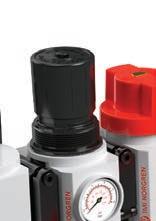
All pneumatic motion requires clean and dry air. The process of filtering, regulating and lubricating compressed air is known as air prep. The Norgren and NITRA family of air preparation components include:
• Particulate filters with 40 micron filter element (5 micron option), coalescing type and oil vapor removal in sizes from 1/8” to 1” NPT port sizes
• Regulators with adjustment from 4-58 PSI, 7-60 PSI, 7-130 PSI and 4-145 PSI
• Combination filter/regulators available with same options in one unit
• Lubricators in 1/8” to 1” port sizes
• Total air prep units that combine all air preparation functions in one compact unit
Solenoid Valves
Solenoid valves are electrically controlled to direct air flow to sequence operations in pneumatic systems. Solenoid valves are used to control cylinders, rotary actuators, grippers and other pneumatic devices. Use a manifold to simplify plumbing for a bank of valves. Modular systems even allow networked control of valve group.
• Available as stand-alone units or as part of a compact modular valve system
• Stand-alone units can be used with optional manifolds to make system configuration simpler
• Available in 3-port/3-way, and 5-port/4-way styles
• 4-way valves come in 2-position or 3-position styles with center closed or center open
Fast free standard shipping* is available for most orders over $49 U.S., and that includes the brokerage fees (when using an AutomationDirect nominated broker). Using our choice of carrier, we can reach most Canadian destinations within 2 to 3 days.
*Free shipping does not apply to items requiring LTL transport, but those shipments can take advantage of our negotiated super-low at rates (based on weight) that include brokerage fees.
See Web site for details and restrictions at: www.automationdirect.com/canada
Pneumatic Cylinders
The most popular style of pneumatic actuator uses compressed air acting on a piston inside a cylinder to move a load along a linear path.
• Round body cylinders available in singleacting or double-acting styles, with up to an 18-inch stroke and 2-inch bore. Also available in stainless steel. Magnetic pistons are optional.
• NFPA tie rod air cylinders come in doubleacting style, with up to a 32-inch stroke and 4-inch bore. All include a magnetic piston. Adjustable air cushions are an option.
• ISO 15552 air cylinders are double-acting cylinders with up to a 600mm stroke and 100mm bore. All include magnetic pistons and adjustable air cushions.
• Metric and Inch compact air cylinders as well as dual rod guided air cylinders also available.
ROBOTICS
CANADIAN ROV BREAKS RCMP RECORD FOR DEEPEST RECOVERY MISSION
SEAMOR Marine – a Nanaimo, BC-based maker of remotely operated vehicles (ROV) – announced that its Chinook underwater ROV has helped the RCMP’s diver team recover an accident victim north of the Arctic Circle. At a depth of 160m, the mission broke the RCMP’s record for the deepest recovery mission in its history.
In January, a Back River gold mining project worker died when his bulldozer fell through the ice while widening the 170km ice road connecting the project site with the Bathurst Inlet port facility. The bulldozer sank 160m under the ice, a depth inaccessible to RCMP’s dive team from the National Underwater Recovery Training Centre (NURTC), Canada’s Nanaimo-based elite police diver training headquarters.
After a different ROV retrieval attempt failed, the team employed their SEAMOR ROV. Custom built for NURTC, the Chinook ROV is a 6-thruster vehicle, capable of diving to 600m and flying with a tether as long as 2km. For this mission, the NURTC team also integrated the Alpha Arm, a third-party robotic arm designed for subsea ROV’s.
After clearing the underwater area and recovering the first ROV,
the team used the Chinook’s underwater GPS, multibeam sonar, HD video and two manipulator arms to find and open the door of the sunken bulldozer and retrieve the victim’s body. The NURTC team have nick-named their Chinook ROV ‘Fab’ after Fabrice Gevaudan, an RCMP diving colleague who died in the line of duty.
https://seamor.com
FLUID POWER
HYDRAULIC QUADCOPTER LOOKS TO EXCEED LIMITS OF UAVS
Flowcopter’s
In February, Edinburgh-based aerospace company, Flowcopter, announced its in the testing phase of a hydraulically powered quadcopter drone that could potentially fly for six hours and with a range up to 900km (560 miles). With a shorter flight time, the company says the drone has the potential to carry up to a 150kg payload.
That kind of performance has been well beyond traditional multi-copter drones, which rely on the lightweight, responsiveness and controllability of electric motor s to operate. To maintain controlled flight, a quadcopter has to be able to instantly and independently spin up or down its multiple propellers in concert, to counter-act gravity plus deal with shifting wind patterns.
Add in an rechargeable battery and the self-contained system is relatively compact and lightweight enough for a small flight application.
The trade-off is that electric motors aren’t particularly brawny or long-lasting when paired with the relatively low energy density of lithium ion batteries. Up-sizing the battery and motors to fly longer and/or carry a heavy load simply adds more weight to overcome. While hydraulics may seem like an odd alternative, Flowcopter says its higher power density allows its drone to exceed these limitations.
At its core, the prototype drone employs a flight certified Rotax 915 gas engine, which delivers 15 times the energy per kg than batteries. At 90 kg installed, it’s also lighter, the company says, than four electric motors (28kg each) with comparable output. The airplane engine, in turn, drives the drone’s other key component, digital displacement pump technology, developed in part by a team of the company’s founders and currently owned by Danfoss.
Replicating the responsiveness of electric motors, the radial piston pump can enable and disable its cylinders in real time, using high speed, computer controlled valves to provide flow to up to four independent hydraulic circuits. Those circuits feed four 5.5kg hydraulic
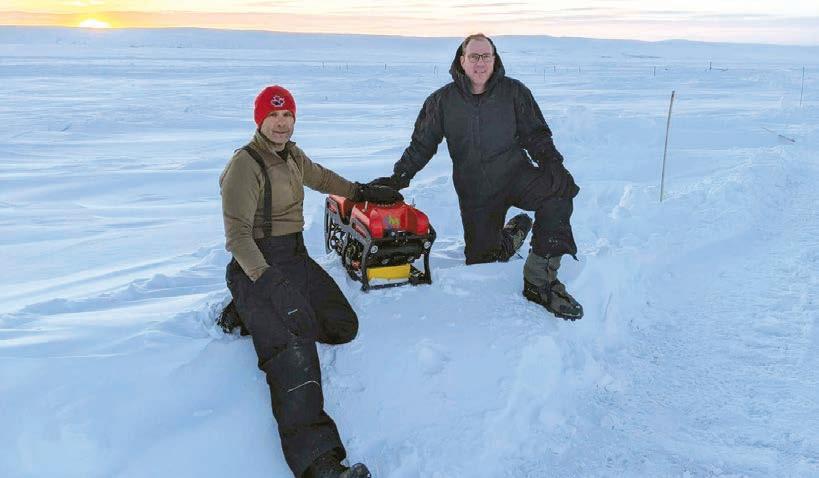
RCMP divers Corporal Steve Wells (left) and Corporal Todd Kaufmann with ‘Fab’, a Chinook ROV custom built by SEAMOR Marine for the National Underwater Recovery Training Centre.
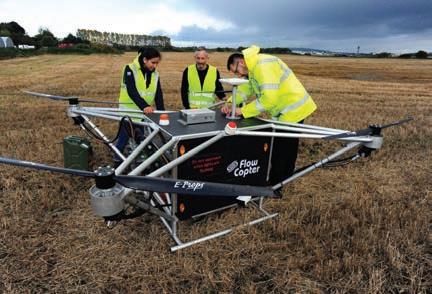
hydraulically powered quadcopter drone.
Photos: RCMP Corporals
Steve Wells and Todd Kaufmann, Flowcopter
motors, each of which provide 96kW shaft power to the drone’s carbon fiber propellers.
In testing, a single propeller has lifted 85kg on its own and the prototype has achieved prolonged tethered flight. When complete, however, the company ultimately sees its hydraulic drone finding use in applications previously unsuited to quadcopter drones include freight, longrange sur veying and search and rescue operations.
https://flowcopter.com
GM, POSCO TO BUILD EV BATTERY MATERIAL PLANT IN QUEBEC
GM and POSCO Chemical announced they are working with the governments of Canada and Quebec to build a facility in Bécancour, Quebec to produce cathode active material (CAM) for GM’s Ultium batteries. The
car maker says the batteries will power its electric vehicle lines including the Chevrolet Silverado EV, GMC HUMMER EV and Cadillac LYRIQ.
Estimated at US$400 million, the facility will be operated as a joint venture. When complete, the Quebec site will process CAM, a key battery material consisting of components like processed nickel, lithium and other materials representing
about 40% of the cost of a battery cell.
B y the end of 2025, GM says it plans to have capacity to build 1 million electric vehicles in North America. POSCO Chemical is an advanced materials company that produces Ni-r ich cathode materials and low-expansion anode materials for EV batteries.
www.gm.com www.poscochemical.com
(From left:) Members of the House of Commons: Fayçal El-Khoury, Patricia Lattanzio, and Jonatan Julien, and Quebec’s Minister of Energy and Natural Resources, François-Philippe, at the General Motors Co. and POSCO Chemical announcement to build a cathode active material processing facility in Bécancour, Quebec.
Photo: General Motors Co.
SNC-LAVALIN TO HELP DESIGN NUCLEAR RESEARCH FACILITY
SNC-Lavalin subsidiary Candu Energy Inc. announced it has contracted to provide engineering and design services to Eclipse Automation, in support of the development of Canadian Nuclear Laboratories’ (CNL) Advanced Nuclear Materials Research Centre (ANMRC).
Valued at CAD$13 million over the next two years, the contract calls for the design of the structures and foundations for 12 shielded hot cells at the Chalk River, Ontario research laboratory. Once complete, the hot cells will enable post-irradiation examination of small modular reactor (SMR) components and next-generation nuclear fuels. The engineering company says it will also design and develop an active liquid waste management system for the laboratory.
As one of the largest R&D facilities in Canada, the ANMRC is being positioned to make Canada a leader in nuclear science and technological innovation and support its net zero emissions goals www.snclavalin.com
CANADA BOLSTERS SEMICONDUCTOR AND PHOTONICS INDUSTRIES
Recognizing that disruptions in semiconductor supply can impact all sectors of the economy, the government of Canada
A rendering of the Canadian Nuclear Laboratories’ (CNL) Advanced Nuclear Materials Research Centre (ANMRC) currently in development.
announced the Semiconductor Challenge Callout, a fund of $150 million through the Strategic Innovation Fund to make targeted investments to build on Canada’s domestic semiconductor industry.
According to government officials, the challenge represents an initial commitment to invest in projects that reinforce and scale up the Canadian semiconductor ecosystem, with a priority placed on research, commercialization and expanding manufacturing capacity.
for the continued provision of air reconnaissance capability and associated support services by the Dutch Caribbean Coastguard. The contract covers PAL upg rading and operating two DHC-8 maritime patrol aircraft, including crew systems training and program support for 10 years with an option to extend.
Inside the National Research Council’s Canadian Photonics Fabrication Centre (CPFC).
In addition to the challenge, the federal government has also committed $90 million for the National Research Council’s Canadian Photonics Fabrication Centre (CPFC). The investment will fund equipment upgrades to improve the centre’s capacity and capability, the government said.
Currently, the CPFC is the only compound semiconductor foundry in North America that is publicly operated and open to all for use.The centre offers photonics device fabrication services to researchers and private industry, including telecommunications, environmental sensing, automotive, defense and aerospace. https://nrc.canada.ca
PAL CONTRACTED FOR DUTCH CARIBBEAN COASTGUARD PROGRAM
Canadian aerospace and defence company, PAL Aerospace, announced it has been contracted
The aircrafts’ tasks will include maritime surveillance, search and rescue and law enforcement. Upgrades to the craft include sensor systems to continue providing industry leading air reconnaissance capacity for the Dutch Caribbean Coastguard.
According to the company, the contract furthers PAL Aerospace’s relationship with consortium bidding partner JetSupport Amsterdam, an independent provider of aircraft maintenance and support based at Schiphol Airport in the Netherlands. www.palaerospace.com
A PAL Aerospace Dutch Caribbean Coastguard Dash 8 Maritime Patrol Aircraft
• Resolution ≤5 mV
• Accuracy ±0.25% of full scale
• Real-time adjustable PID control
• Integrated 0 to 10 VDC, 4-20 mA signal, or 3.3 VDC serial communication
• 0 to 10 VDC feedback pressure monitor
• Virtually silent
• No integral bleed required
• Multiple pressure ranges from vacuum to 150 psig
• 2.7 to 65 l/min flow control
Take Control with Cordis
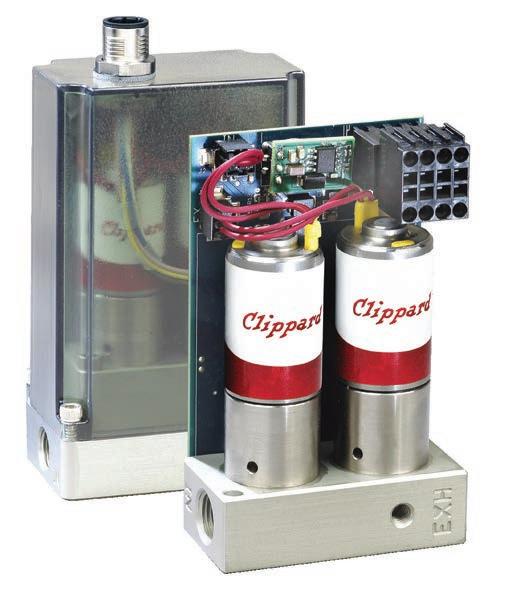
The future of proportional control has arrived— and it’s digital. The Clippard Cordis is a revolutionary microcontroller primed for escape velocity from a proportional control market that has grown stagnant.
With unparalleled performance and flexibility not possible with current analog proportional controllers, the Cordis makes everything from calibration, to sensor variety, to future development opportunities more accessible and less complicated.
Precise, Linear Digital Pressure Control
Contact wainbee.com today to learn more about how the Cordis can provide precise, real-time control for your application, or visit clippard.com to request more information.
Dassault’s Virtual Future
Solidworks parent company pushes digital twin technology at annual user conference.
BY RALPH GRABOWSKI
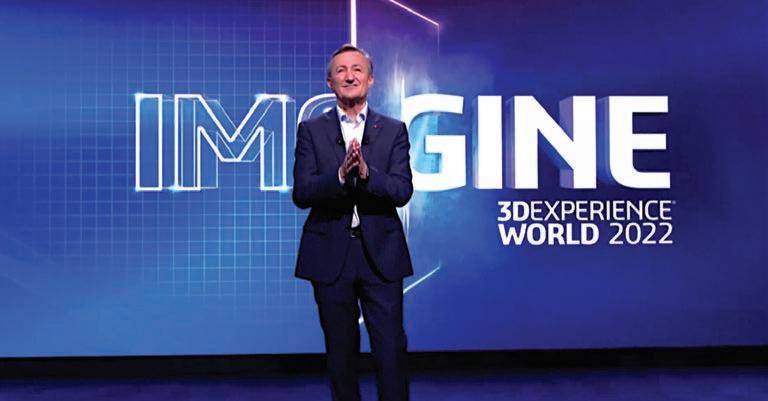
While the in-person 3DExperience World had to be switched to a livestream event at short notice this year due to Omnicron, the annual CAD software user conference still proceeded largely without a hitch. Apropos to the switch, CEO Bernard Charles encouraged those in virtual attendance to imagine a new meta-verse sounding future during his keynote.
“Imagine the future of the world economy; imagine factories that produce experiences; imagine yourself as an experience designer.” The examples he provided of that future, however, were as vaguely worded as “quality of life, and quality of services” and tropes as tired as “connecting with the right suppliers” and “reaching new markets.”
Virtual Twin
Digital twin is the hot new trend from CAD vendors, through which they hope to sell more product; it’s PLM (product lifecycle management) with a feedback loop. PLM is designed to handle all aspects of products: design, construction, operation, and discardation. Installing software that comprehensive, however, has proven
overwhelming for all but the largest firms.
Never mind; CAD vendors are now throwing IoT (Internet of things) into the mix to get data returned from the construction and operation phases. The data is used to fine-tune as-built drawings, monitor operations remotely, and in some cases analyze customer behavior in a Google-like fashion. The twin in the digital world is always being updated by its sibling in the real world, goes the thinking.
To differentiate themselves from the rest of the CAD market, Dassault can’t call its digital twins “digital twins,” so it calls their version “virtual
twins.” Which presents its own set of semantic problems. Perhaps Charles needed to reassure his shareholders over the company’s meaning for “virtual,” what with Facebook’s share price crashing 46% following the pivot to Meta. So, during the keynote, Charles hastened to clarify that Dassault’s virtual twin has nothing to do with virtual twins from Facebook’s Metaverse or nVidia’s Omniverse. It is the opposite; instead of escaping from the real world to a better meta world, Dassault wants its meta worlds to make the real world better.
Virtual worlds, he noted, have been our playground
If there was any question that Dassault disdains Solidworks, it was laid to rest during the keynote addresses by Dassault executives.
for forty years now. By this, I think he meant that CAD drawings are virtual versions of what we intend to build. Thirty years ago, Dassault developed the first full 3D digital twin with the design of the Boeing 777 aircraft, and more recently has gone biological: “We are the only ones making a virtual twin of the most complex system, the human body.”
Dassault’s goal is to make the virtual world available to everyone, such as through 3D on mobile devices. Although it sounded like “everyone” is all eight billion of us, I think he meant the subset who work with designs. For now, though, it is just for the few firms who convince Dassault they are worthy to be part of 3DExperience Labs, or else pay a month fee.
“This is the world we are building together,” he proclaimed. “From creation to repurposing... accessible to all, providing everyone on the
Dassault Systemes CEO Bernard Charles during the keynote at 3DExperience World 2022.
Photos: Dassault Systèmes
Tourists viewing a VR reproduction of the Lascaux cave system.
planet to re-use, produce” through virtual twins.The “together” theme proved to be a favorite throughout his talk.
In the meantime, VR (virtual reality) goggles and high-end computers are required to access this future. As an example, Dassault is sponsoring a VR version of the Lascaux caves. The real ones can no longer be visited by tourists due to mold covering the cave walls brought in by people. The ITC French Monuments Museum, across the Seine from the Eiffel Tower, has a room dedicated to visitors experiencing the caves by wearing VR goggles and computer backpacks.
Solidworks Wins
The shocker news released on the first day of 3DExperience World 2022 was that seven-year-long Solidworks CEO, Gian Paolo Bassi, was CEO no more. His replacement, Manish Kumar, has
been with Solidworks for 23 years, most recently as Vice President of R&D. It sounds like Kumar will hold down both jobs for now.
Bassi was promoted sideways to the newly-created position of Executive VP of 3DExperience Works and Customer Role Experience. “He is now in charge
of what is essentially a collection of addons of unknown popularity and unstated revenue,” summarized long-time CAD journalist Roopinder Tara.
If there was any question that Dassault disdains Solidworks, it was laid to rest during the keynote addresses by Dassault executives. It was 3DExperience
all the way, the cloud-based software from Dassault. The end-of-conference session, with its sneak peeks at what’s new in the next release of Solidworks, went missing this year. Under Kumar, I expect it will return next year.
The one time a Solidworks product was mentioned was
with an offering named Solidworks Cloud Offer. Bassi called it “the new generation of mobile CAD,” saying it is “the first in the industry.”The “mobile” claim comes from the software running in Web browsers, and it turns out that
Solidworks Cloud is mostly 3DExperience Works Cloud renamed. It offers the following cloud-based products: 3D Creator, 3D Sculptor, 3D Sheet Metal Creator, 3D Structure Creator, Manufacturing Definition Creator and 3D Renderer
Solidworks users are not fond of this set of programs, as it’s incompatible, has a different user interface and costs more.
Inventor and Solid Edge are as desktop-bound as ever. I suppose Dassault could put the hammer down and cancel Solidworks outright, but shareholders would be horrified, as the unit brings in over a billion dollars a year. What this means is that the one-man machine shop owner won out over a $5 billion/ year international corporation in preventing Dassault from por ting Solidworks users from desktop to cloud. Given how poorly 3DExperience Works seems to have done, I’m thinking Bassi is being ported over to give it some Solidworks oompf.
Dassault first tried to introduce a cloud-based runs-anywhere-on-anything Solidworks in 2010, and it’s not hard to understand why. At the time, CAD on the cloud was seen as the no-brainer future. If you can run a search engine on the cloud, then so should a CAD system.
Well, for one, search engines have as close to no interface as you can get. A small number of CAD vendors nevertheless worked mightily to overcome interactive UX and latency problems. On the other side, CAD users resisted mightily and not just Solidworks users.
And so here we are, 13 years, management shuffles and several rebranding exercises later, and desktop MCAD like Solidworks,
As for the virtual twin concept, it is the next level of abstraction from the cloud. The impetus for it mimics that of the cloud: it is also where the future lies, or so goes the thinking. The problem for Dassault is that VR, which itself is 30 years old, is proving to be about as popular as 3D TV. |DE www.3ds.com
Ralph Grabowski writes on the CAD industry on his WorldCAD Access blog (www.worldcadaccess.com) and weekly upFront.eZine newsletter. He has authored numerous articles and books on CAD, Visio and other design software applications.
Solidworks Cloud is a suite of mobile apps including 3D Creator, 3D Sculptor and 3D Renderer.
Canadian Nuclear Laboratories’ (CNL) Chalk River Laboratories campus.
The future of responsible nuclear waste disposal
CNL seeks industry support to move Chalk River’s NSDF project forward.
Plans have been laid for the construction of a highly engineered radioactive waste disposal facility in Chalk River, Ontario. The facility is being proposed as a per manent and modern technological solution to an environmental issue that goes back almost a century.
Today, Canadian Nuclear Laboratories (CNL) is seeking the support of the industry and its supply chain to move this project forward and advance the future of waste disposal in Canada.
Canada’s storied Chalk River Laboratories was established in 1944 on the Ottawa River, about 180km (114 miles) from the City of Ottawa. An adjacent community, the Town of Deep River, was developed to support the site and remains home to generations of employees. The site is located on the traditional and unceded territory of the Algonquin Nation.
For decades, Chalk River Laboratories has been the centre for Nobel Prize-winning physics research, engineering technology and
It’s not just the mandate that’s changing, though.The new site entrance building is a visitor’s first indication of the Canadian government’s CAD$1.2 billion investment to modernize the laboratories and revitalize the site.
Honoured by the Algonquins of Ontario with the name Minwamon, meaning “clear path,” it is one of three new buildings that use wood as the main structural material, reducing the carbon footprint of the campus.
The revitalization of the Chalk River campus is enabling Canada to continue its history of life-changing and forward-thinking science and technology. In the centre of the site is the new LEEDS-certified Harriet Brooks building, a world class material science laboratory named after the first Canadian female physicist, who is recognized for her important contributions to atomic physics.
CNL is the company overseeing this revitalization – CNL manages the laboratories at Chalk River, along with several other government-owned nuclear sites and facilities.
neutron science. Among its best-known legacies are the CANDU reactor and the development of medical isotopes that benefited millions of people around the world through cancer diagnosis and treatment.
Today’s Chalk River Laboratories provides essential support to Canada’s c arbon-reducing nuclear energy industry, contributes to new innovations in medical isotopes, and is a leader in the investigation and analysis of reactor components to ensure safety and compliance.
It’s not surprising that decades of innovative research and development has resulted in waste by-products, as well as the demolition of more than 100 aging structures – in the form of building debris and decommissioning material. While CNL has been storing the waste onsite using industry best practices, regulations in Canada are changing and this is not a permanent solution.
Waste management is a challenge facing the entire nuclear industry. CNL is once again using leading-edge technology to put
forward a long-term environmental solution. Taking guidance from domestic and international experience, CNL has proposed an engineered containment mound – the Near Surface Disposal Facility, or NSDF – as the solution for low-level radioactive waste at Chalk River Labs.
As a fundamental component in the revitalization of the Chalk River campus, the NSDF is critical to both the long-term protection of the environment and to the continued development of breakthroughs in nuclear science and technology.
“Chalk River Laboratories is undergoing a transformative change that will propel CNL into the forefront of nuclear research in Canada
and the world. The Near Surface Disposal Facility is key to this revitalization,” said Kristan Schruder, CNL Deputy Vice President of Environmental Remediation Management.
The proposed facility will include the construction
of a highly engineered containment mound, site infrastructure and waste water treatment facilities. The project is estimated to cost CAD$365 million. A skilled workforce of 225 to 300 people will be needed to build it from the ground
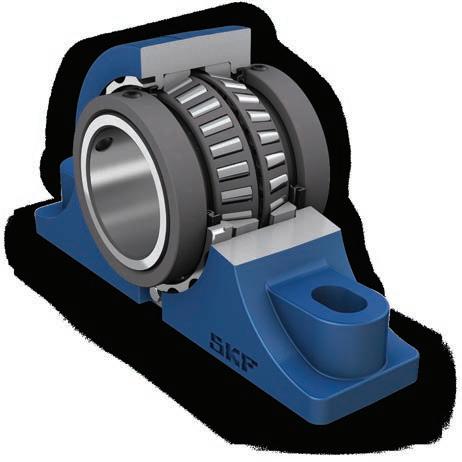
Introducing the SKF Mounted tapered roller bearing
up. If CNL’s proposal is approved by Canada’s nuclear regulator, the Canadian Nuclear Safety Commission, constr uction of the NSDF is anticipated to start in the fall of 2022.
CNL has successful experience with the engineered
An exponentially more reliable Type E bearing
This new line of mounted tapered roller bearings combines SKF’s world-class bearing expertise with proven CR Seals technology. The result is a wide range of robust, fully interchangeable bearings that cover fit, form and function. Find out more: skf.li/0bafhx
A rendering of the operations phase of Chalk River’s Near Surface Disposal Facility.
containment design through the construction and operation of waste management f acilities in the two Southern Ontario communities of Port Hope and Port Granby, located about 100km (60 miles) east of Toronto on Lake Ontario. In 2021, CNL completed the closure of the engineered aboveground mound in Port Granby, with 1.3 million tonnes (1.4 million tons) of contaminated soil and industr ial waste placed in the mound for safe, long-term storage.
The design technology specific to the NSDF has been tested extensively. The facility will use natural and synthetic barriers that work together to isolate the waste from the environment for generations. Testing on the synthetic geo-membrane
While CNL has been storing the waste onsite using industry best practices, regulations in Canada are changing...
done at Queen’s University concluded the membrane will stay intact for more than a thousand years – much longer than the time it will take for the radioactivity contained in the facility to decay to a safe level.
The mayor of Deep River, Sue D’Eon, is a strong suppor ter of the NSDF. She champions the proposal as protective of the environment and critical to industry and business development in the area.
“CNL is a collaborative neighbour and an excellent employer. We view the
proposal to build a facility for the safe disposal of low-level radioactive waste as a responsible action and a benefit to the entire community that demonstrates CNL’s careful stewardship of the environment,” said D’Eon.
The NSDF proposal is nearing the end of a five-year, federally regulated environmental assessment and the Canadian Nuclear Safety Commission has scheduled a public hearing starting in May of this year to consider CNL’s proposal. Anyone can participate in the hearing process by submitting a
written intervention or letter of support to the Commission by April 11.
“We are asking for the support of our partners in business and industry to help us demonstrate to Canada and the world that the nuclear industry and its supply chain is well prepared to advance from temporary waste storage to permanent disposal – both technically and in terms of our workforce,” said Schruder. |DE www.cnl.ca
This story was provided by Canadian Nuclear Laboratories
A BETTER WORKING CULTURE
How Industry 4.0 can improve manufacturers’ shop floor working culture, and the bottom line.
Big data and the Industrial Internet of Things (IIoT) grant employees easier, and more centralized, control and access to data. But do these technologies improve the working culture on the shop floor? That question was put to the test by OSI Precision when it installed software by Sandvik Coromant to help with its Industry 4.0 roll-out.
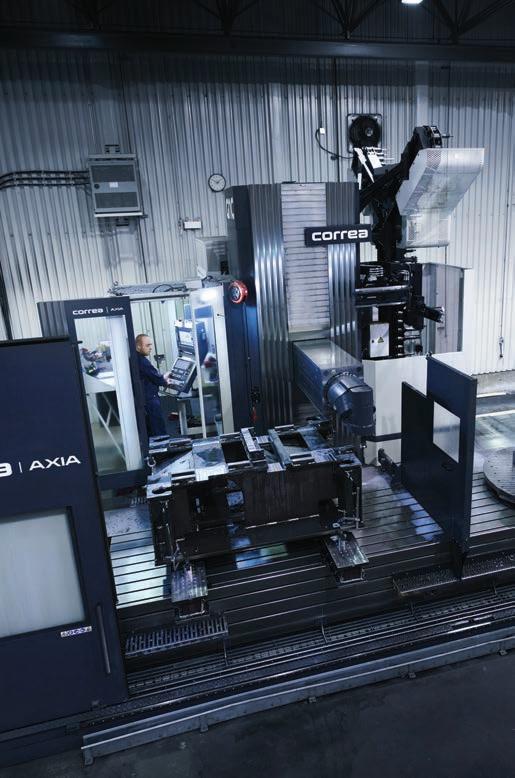
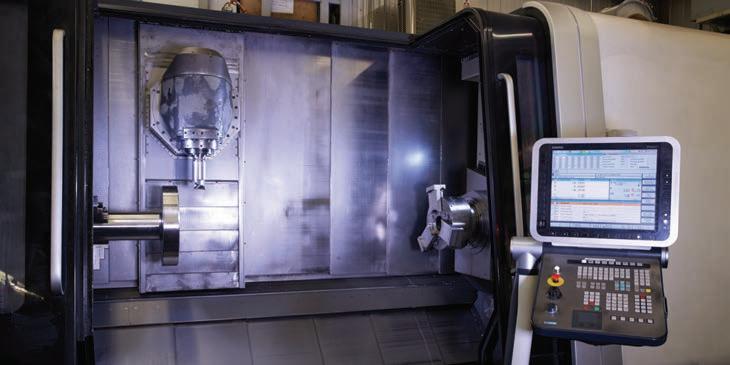
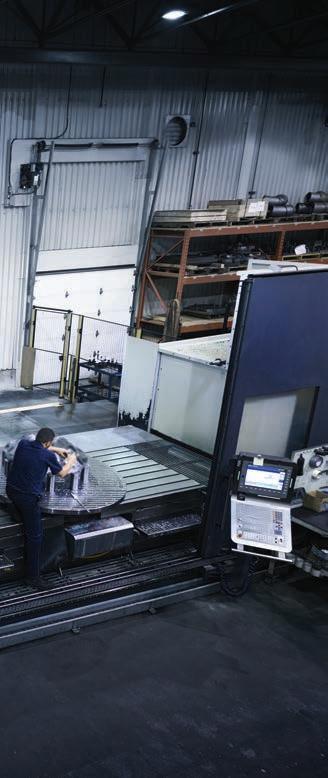
Based in Quebec, OSI Precision is a general engineering manufacturer of complex parts that uses several CNC machining lathes, and a milling machine, on its shop floor. However, the company wanted to better connect its nine CNC machines.
For assistance, OSI turned to Sandvik Coromant to help consolidate the control and performance
analysis for all the machines, quickly and securely, and in a way that would benefit the organization’s cultural shift towards Industry 4.0.
Adding to the challenge was the fact that the machines came from different manufacturers – DMG, Mazak, Correa and Parpas – and were both new and old. Furthermore, each machine was costly to run, so the control solution OSI decided on would need to have a real impact on financial gains.
“Before choosing Sandvik Coromant, we took a few months to properly research all the tools available, and to select the right partner for this project,” explained Hubert Breton, operational efficiency and digital technology manager at OSI Precision.
“In fact, we had up to 15 criteria,” he added. “They included
Quebec-based OSI Precision employed Sandvik Coromant’s IIoT software to connect, monitor and assess the performance of several CNC machines from different vendors.
that the control and monitoring system had to be versatile, configurable, and easily adapt to all our different types of machine. We also needed it to integrate with our other digital systems — databases and so on — and also required an easy-to-use interface for our operators.”
In the end, OSI opted for Sandvik Coromant’s CoroPlus Machining Insights platform, a modern cloud-based machine monitoring solution. The main reason was for its trusted partnership and support.
“Having data is really the first step in deriving the best performance and profitability from these machines, and to be able to measure this ourselves,” said Bijal Patel, a senior digital machining specialist at Sandvik Coromant. “That is where Sandvik Coromant comes in.”
Pilot project
OSI Precision was also won over by Sandvik Coromant’s plans to develop the CoroPlus MachiningInsights platform further into the future. Not only does the
Sandvik’s machine monitoring platform allows OSI to see not only the current state of machines, but also how they have performed since the day they were connected.
Photos: Sandvik Coromant
platform give manufacturers greater visibility of their CNC machine tools and machining processes, but it also provides the tools needed to analyze, identify and eliminate common sources of downtime and inefficiency.
“MachiningInsights automates the processes of data c ollection and analysis,” explained Patel. “The software’s end goal – to provide machine shops with complete transparency about how their machine tools are be utilized – seemed to perfectly suit OSI Precision’s Industry 4.0 digital shift, and to offer a solution that could be easily adopted by their workforce.”
helpful in drilling down to the causes of machine stoppages. Sandvik Coromant was also fully aware of the importance of a working culture within OSI Precision.
“I think it all boils down to how people treat one another,” Patel said, “and that includes through the use of data, data management and sharing and better reporting — and, therefore, better communication — within the plant.”
“The implementation was very important to ensure that everyone got on board and worked towards the same goal,” added Breton. “It was vital to involve people directly in the project, rather than develop it in a silo away from everyone.”
Highly customizable
The parameters and data managed by the operators relate to tool and part changes, breakages and machine f ailures. The data yielded by the machine monitoring solution can prove especially
OSI Precision first implemented CoroPlus MachiningInsights as a pilot project: Three machine operators ran the equipment following internal training, which Breton super vised internally. At the same time, he explained the pilot project.The second part of training was a lot more hands-on, covering how the system can be controlled from an iPad.
For the pilot project, OSI’s workers had to get accustomed to using all-new software. Fortunately, the CoroPlus MachiningInsights platform is easy to get up and running and to use, with a simple login and menu interface. The platform is also highly customizable, whether it is accessed from operator channels on iPads, or from dashboards.
22_0541_Design_Engineering_MAR_APR_CN Mod: March 18, 2022 10:07 AM Print: 03/18/22 page 1 v2.5
“In fact, OSI has customized dashboards with all the information that we thought was pertinent, as a modified
ORDER BY 6 PM FOR SAME DAY SHIPPING
version of the interface supplied by Sandvik Coromant,” says Hubert.
Patel adds: “Through remote iPad access, operators can not only see the current state of machines, but also how they have performed since the day they were connected. The operators can access empirical data about every part ever produced, every tool used, every shift they ever worked and even how operators impact operations.”
Nevertheless, there was some trepidation from OSI’s operators at the beginning of the project — not least because the data from CoroPlus MachiningInsights would measure performance and activities.
“It was really important that people realized that it is not a surveillance system,”
Breton said. “Instead, MachiningInsights fuels our continuous improvements, to be more competitive, so that everyone can be better at their job, and use data to drive those improvement efforts.
“We’re very careful in how we share our data internally, so everyone is on board with the fact that this is to fuel continuous improvement efforts,” he added.
“Customized reporting was crucial for this.”
With Sandvik Coromant’s support, the company was soon able to demonstrate the advantages of the digitalized approach in a way that made sense — specifically, being able to demonstrate the advantages of the system through data. Before long, OSI’s operators were fully onboard with the new project.
One challenge arose when OSI Precision had to work with vendors of different machines to install adaptors that would translate each machine’s data to make it compatible with the CoroPlus MachiningInsights platform. All signals and data from the machines are translated into one machine language, and then put together for analysis by OPS.
“For the first adaptors, Sandvik Coromant was present at the plant, which was very helpful for the hands-on installation by the machine manufacturers,” says Hubert. “There was also a compatibility issue with one of the adaptors, but Sandvik Coromant was able to quickly solve the problem online, by connecting us with the right people.”
In fact, 95% of Sandvik Coromant’s support for the project was offered remotely. OSI and Sandvik Coromant communicated regularly through Zoom
and TeamViewer meetings, and the installation and configuration of the machine monitoring solution was also remote. OSI Precision plans to use data from the pilot project for future improvements, and to roll the system out to the rest of its 15 to 20 operators.
“We have worked well together so far, and the system has been really easy to use,” Hubert said. “We have also been able to integrate this data with other software, using the Sandvik Coromant Application Programming Interface (API), with which we had excellent support from Germany.”
“The system has never broken down and nothing has ever been offline,” he added. “It has been super reliable so far and our operators have been using it 90% of the time, as expected.”
Going forward, OSI Precision predicts that the system will prove how competitive it can be and how fast the company delivers complex and bespoke machined components to customers.
“Moreo ver, the new technology has made OSI’s operators more efficient,” Hubert concluded. “We are on the right track to changing our working culture for the better.” |DE sandvik.coromant.com
This article was contributed by Sandvik Coromant.
The data yielded by CoroPlus Machining Insights platform helps operators at OSI Precision analyze, identify and eliminate common sources of downtime.
From sensor technology and data analytics to robotics and automation, you’ll see all of the latest innovations in fluid power, all in one place. Even better, you’ll have many opportunities for in-depth technical conversations with other engineers to spark new ideas, and you’ll be able to talk with suppliers about your specific challenges and the solutions they offer. Bring your question—and leave with smart new solutions to solve your most pressing technical problems.
IN SHORT SUPPLY
Automated testing system from AFA ensures a reliable supply of hygienic gloves worldwide.
When the COVID-19 pandemic broke out, protective equipment was in short supply. Nursing staff didn’t have enough face masks, protective goggles, full-body protective suits or hygienic disposable rubber gloves. To overcome the shortage of gloves at least, AFA Technologies offers packaging machines and automated systems for quality control.
Before the global COVID outbreak in spring 2020, the production of hygienic disposable gloves was limited to the traditional rubber-producing countries in Southeast Asia. The sudden increase in demand led many countries affected by the pandemic to set up their own glove production.
This presented an opportunity for AFA Technologies to export machinery and equipment to Europe and Nor th America as well. While Malaysia is still the leader in the world rubber glove market with a market share
of 65%, AFA’s automated testing system has ensured a reliable supply of hygienic gloves worldwide.
“We currently have a market share of 85% in packaging machines and test systems for disposable gloves,” explained AFA Technologies CEO, Chester Tan, and pointed out that the company has already sold more than 300 LTM leakage test machines. Tan attributes this success not only to the rapid increase in demand created by the pandemic, but also to AFA’s technological leadership.
The company has been developing leakage testing machines for protective
gloves since 2009. Previously, it was common practice to test the gloves manually. Now, only the mounting of the gloves on the test mandrels is done manually; the actual testing process is automated.
The testing system achieves an output of 4,800 to 5,200 pieces per hour with only three operators. The output speed and, most importantly, the consistency in quality control compared to three operators testing the gloves manually have been increased significantly.
The machines test the rubber and nitrile gloves by using air pressure to
Before COVID, the production of hygienic disposable gloves was limited to the traditional rubber-producing countries in Southeast Asia.
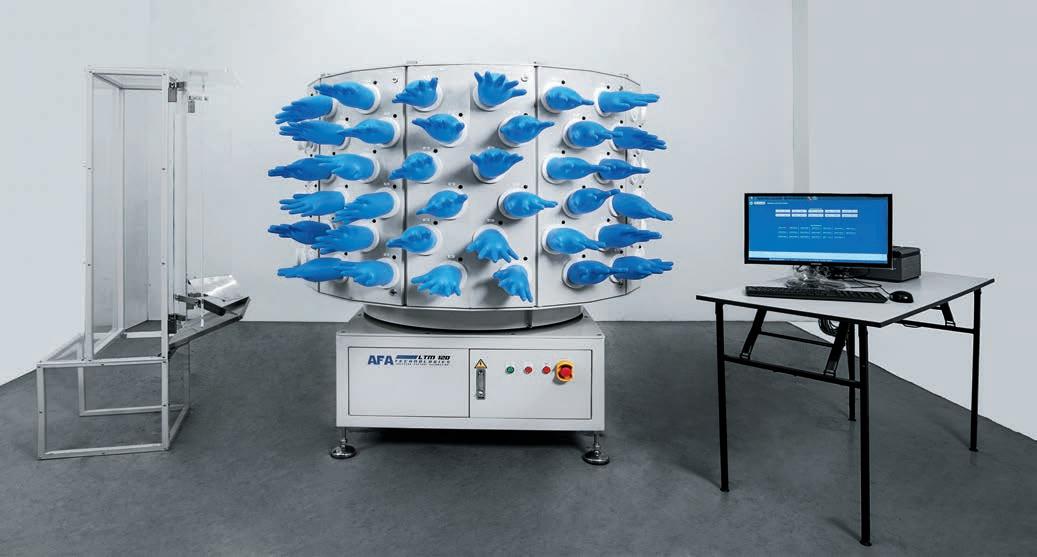
AFA Technologies’ LTM 120 machines have 120 test mandrels that automate the testing of rubber and nitrile gloves by using air pressure to detect holes.
Photos:
detect any holes but don’t destroy the gloves in the process. The LTM 120 machines have 120 test mandrels made of medical Teflon with built-in LED lighting.
The mandrel can be used for various standard glove sizes from XS to XL and from 5.5 to 9.0. The testing machine uses high-precision digital pressure sensors with a pressure accuracy of up to 0.001 psi.
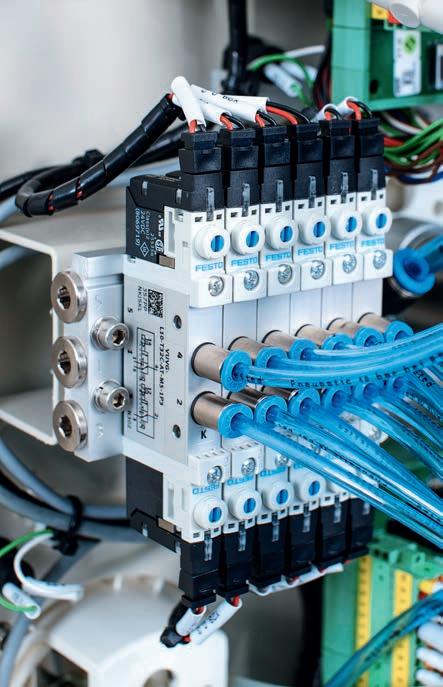
Each of the 120 test mandrels is controlled by a VUVG pneumatic valve from Festo. The valves from the Core Range are significantly smaller and more robust than comparable valves on the market.
“We are glad that the experts from Festo, especially Dhruv Subbiah, at that time country manager of Festo Malaysia, as well as sales engineer Aaron Ang, advised us on the right use of Festo valve technology,” adds Tan.
The support from Festo doesn’t stop at sales advice, but also includes extensive simulations and
calculations, as well as test products for proof of concept to determine which products might be suitable for the machines.
“What is also practical for us now that we are experiencing a flourishing export of our machines is that Festo is quickly available in over 180 countries worldwide,” says Tan.
“It has been a g reat pleasure to work with AFA because of their passion for technology, and their vision to expand their scope from the glove industry to end-to-end material handling and packaging solutions,” says Subbiah, who is now Festo’s Head of Industry Segment Management, Electronics and Light Assembly, Southeast Asia and Pacific.
“We have enjoyed the partnership as their solution provider for automation solutions and are looking forward to our future jour ney together.” |DE www.afa-tech.com www.festo.com
This story was provided by Festo
Festo’s VUVG pneumatic valves supply and control air delivered to the LTM 120’s mandrels so that the gloves aren’t damaged during testing.
GREATER VALUE AT ZERO RISK
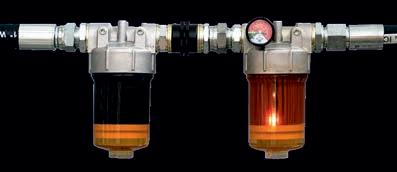
To reduce the problem of electrostatic charge in filters, MP Filtri has developed zerospark: a range of specialised products that solves the problem of electrostatic discharges inside hydraulic filters.
BENEFITS
elimination of triboelectric effect dissipation of accumulated charges improved performance over time increased safety resistance to cyclic flow weight and cost optimisation
Energy-optimized press modules allow hydraulic press manufacturers to meet safety requirements in a cost-effective manner while increasing energy efficiency.
PRESSING MATTER
How certified press modules increase operational safety, improve energy efficiency and reduce costs.
Companies that manufacture hydraulic presses or r ubber and plastics processing machines must ensure that these machines operate safely. The hydraulic systems must be designed to minimize the risk to the operator’s health and any residual risks from the start. Constructors therefore face a challenge –they must carefully define how the protective and command systems will interact with the hydraulic safety control system.
The best way to do this is to use a general safety control system in accordance with ISO16092-3 for hydraulic presses or EN289
for plastics and rubber machines. If these standards for all design variants are met, machine safety depends neither on the size of the press module nor the way in which the press works.
And if the same switching cycle can be used all the time, the effort required to produce the safety program is reduced significantly. This is particularly true if the requirements of the 2006/42/ EC directive (machinery) are already met. If the press modules are supplied as a ready-to-install system and can easily be connected to the electrical safety control, the commissioning outlay is also reduced. Detailed documentation at the end
constructors can move the downstroke tool into the pump’s power regulating system later on in the pressing process and thus reach the lower dead point more quickly.
If the drive concept can be changed, however, then there is no need to buy a completely new system straight away. Instead, it is worth finding the hydraulically relevant components and checking whether an energy-optimized press module would increase efficiency and whether downsizing is possible.
More power with lower costs
of the configuration process speeds up CE certification for the press or the machine.
Energy Efficiency
In addition to functional safety, operators are increasingly focusing on energy efficiency and an improved energy balance for the overall system. In the case of hydraulic presses, these are directly linked to the cycle times and the power requirement. As a result, there are two possible approaches when it comes to improving energy efficiency.
With a defined drive system, the priority is to use the installed dr ive power as effectively as possible. To shorten the cycle times,
Energy-optimized press modules use special switching conditions to fundamentally reduce the pressure losses between the pump and the actuator. A 40 percent reduction here means 40 percent more power for the net pressing force. Compared to conventional manifolds, the press modules in Bosch Rexroth’s IH04 range come close to achieving this figure.
If the hydraulic systems can be downsized as a result, this offers significant cost benefits. Further cost benefits can be achieved in the engineering because combining standard building blocks in a modular f ashion takes up much less time than developing and implementing individual hydraulic controls. Because the modular IH04 solution results in ready-to-install switching systems, which take into account functional safety, the engineering complexity is reduced all the more. The type-examination procedures for the downstroke and upstroke modules in Images: Bosch Rexroth
accordance with EN ISO 16092 and EN289:2009 have already been carried out or requested.
As a result, all safety requirements for operating modes – including individual stroke, automatic, set-up with two-hand operation in accordance with PL e or reduced closing speed below 10 mm/s in accordance with PL d – can be met with minimal outlay.
The same applies to muting with a light barrier integrated into the press. The modular system with a standardized safety concept is made up of basic modules, extension modules and directional valves.
Downsizing Potential
The possibility of downsizing with reduced costs is all the greater if the press modules are available in various finely graduated sizes. Constructors can choose between two types from Bosch Rexroth’s current IH04 range with a standardized safety concept.
Type C is available in five standard sizes (10, 16, 25, 32 and 35) and is aimed at applications with flows of up to 2,000 l/min and pressures of up to 350 bar. The IH04 Type D module in cast iron is available in two standard sizes (6 or 10) and is suitable for up to 80 l/min and up to 315 bar.
Both modular systems comprise at least one basic module, a directional valve to control the flow and function-dependent extension modules. The latter cater for all common hydraulic functions and also offer structural advantages such as lateral supply connections. This way, a range of pressure and position control functions in the open circuit, including safety functions, can
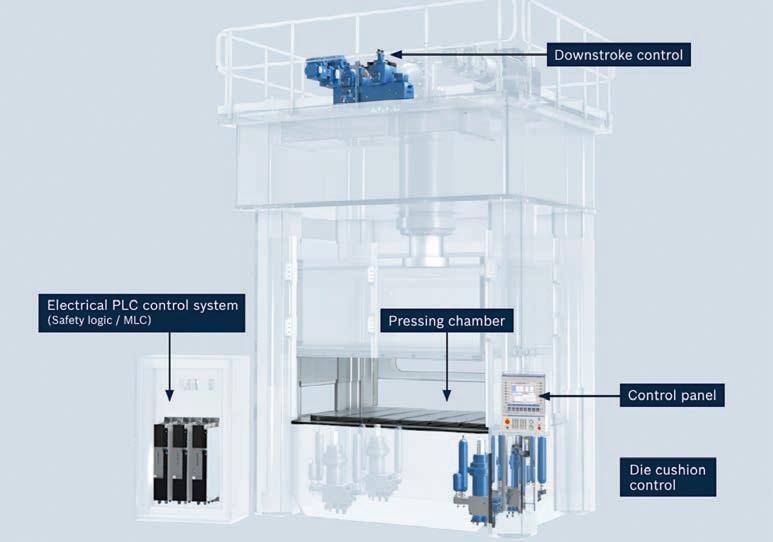
be achieved. On the software side, a comprehensive library of safety modules for the safety PLC in accordance with PLCopen is available. These include control systems for the upper piston, the hold-down device, the ejector and the press ram.
Matching upstroke
To increase energy efficiency, cost-effectiveness and hydraulic control options on the press beyond the upper piston, Bosch Rexroth has expanded the IH04 modular system to include suitable upstroke die cushion modules in accordance with DIN ISO 16092-3. The Type E modules, for volume flows of up to 2,000 l/min, have been optimized for efficiency and concept-tested and are available in the sizes 10, 16, 25 and 32.
With the IH04E modules, die cushion functions with active and passive pressure control can be achieved and optimized for efficiency and costs. The available extension functions include Load Sensing (LN), Differential Circuit (DN), High-Response Valve with Zero Overlap (RN) or a combination of Differential Circuit and Load Sensing (DL).
Functional safety
To ensure safe operation in accordance with EN ISO 16092-3, Bosch Rexroth supplies a certificate for the type-examination procedure for each Type C press module. Within the control system, performance level d is achieved in set-up mode and a Cat4 performance level e for hazards when opening and closing. This prevents accidental lowering owing to the unit’s own weight, an unintended start-up from the rest position or the dangerous closing movement being stopped.
The IH04 press module meets all safety requirements for operating modes including individual stroke, automatic, set-up with two-hand operation in accordance with PL e or reduced closing speed below 10 mm/s in accordance with PL d. During muting, a process-controlled light barrier system ensures that operating personnel can reach into the pressing chamber to put things in it or remove things without endangering themselves.
Compared to accumulator operation, the hardware and installation costs are lower if similar flows and pressure losses can be achieved with
a smaller press module from the point of view of the load spectrum. An expensive “size jump” can also be avoided. Together with the Bosch Rexroth’s Motion Control System MLC and the Safety Logic safety control system, users benefit from a ready-toinstall state-of- the-art system which minimizes internal process costs at the same time. Press modules that are optimized for efficiency and feature a standardized safety concept and test certification offer machine manufacturers the opportunity to gain a range of attractive competitive advantages. These range from safe operation with minimal residual risk and a better energy balance of the press to a lasting reduction in costs thanks to downsizing and considerable time savings for engineering, commissioning and assembly.
The positive effects on the manufacturing costs and time-to-market become even greater the more comprehensively the modular approach is used, for example for downstroke and die cushion functions. |DE www.boschrexroth.com
This article was contributed by Bosch Rexroth Canada.
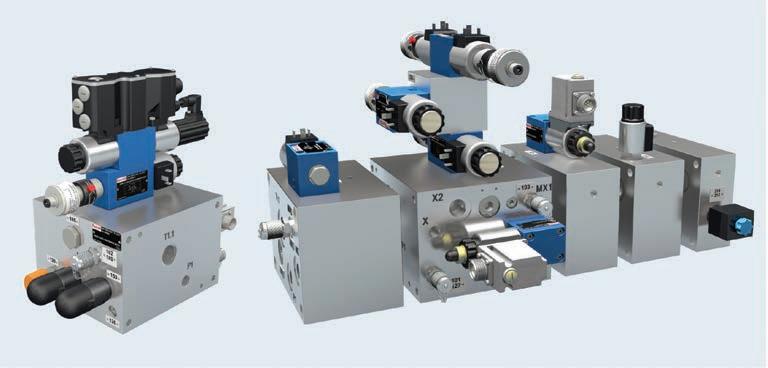
The IH04 Type D basic module (left), in combination with extension modules (right), includes safety functions and extension switching systems and provides flows of up to 80 l/min.
FLUID POWER
HOSE CLAMP
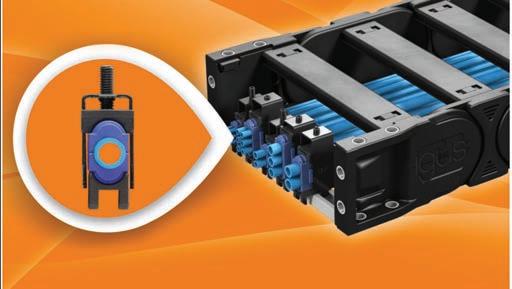
igus has introduced its CFX series clamp designed to provide strain relief for pneumatic hoses in e-chain cable carriers. The clamps feature pneumatic double tubs and blue inserts that enclose the hoses from top and bottom. When tightened, the jaws of the
clamp screw don’t press directly on the surface of the hose. The blue stacker saddles are available for cable diameters of 4, 6, 8, 10, and 12 millimeters. Additionally, it is possible to position two hoses next to each other in a stacker saddle for cables with diameters of 4 and 6 millimeters. Therefore, up to ten hoses can be accommodated in one clamp .www.igus.com
Don’t Compromise! Use MAIN!
FLOWMETERS
Endress+Hauser has released its Proline Prosonic Flow W 400 flowmeter, which can be used for volume measurement, totalizing, balancing, process monitoring, flowmeter verification and pipeline leak detection. Mounted directly onto a metal or plastic pipe, the clamp-on sensor can be applied to pipelines up to four meters in diameter. Made of stainless steel, the ultrasonic sensor is rated IP68 (Type 6P) and can be used at process temperatures between –40 and +130 °C in non-hazardous areas. Its transmitter includes a web server via which users can directly access diagnostic, configuration and device data. It also features the company’s Flow DC function which detects flow disturbances on the measurement signal so they can be compensated for by calculation.
www.ca.endress.com
DISPLACEMENT PUMP
Danfoss’ DDP096
Digital Displacement pump, winner of Agritechnica’s Systems & Components Trophy 2022, delivers hydraulic power with both high efficiency and controllability, the company says. The pump uses solenoid valves to control each cylinder on a shaft-turn-by-shaft-turn basis. The technology reduces energy losses by up to 90% compared with conventional pumps, the company says. Additionally, it is possible to bring groups of
cylinders out to the endplate for independent control, creating a multi-service pump. Additionally, users can have up to three separately controllable outputs from a single pump body. www.danfoss.com
HYDRAULIC POWER UNIT
HAWE has launched its INKA type line of intelligent compact power units. Equipped with an electronic communication box and real-time operating system, the unit enables the acquisition and storage of operating data, diagnostic options and a self-test for all measuring functions. Measured values of the integrated multi-sensor can be transmitted to a machine control system via an IO-Link interface. Alternatively, a version with three freely parameterizable switching outputs is also available. The unit can be equipped with a radial piston pump for pressures up to 700 bar or with a gear pump for pressures up to 200 bar. The maximum possible flow rate is 2.2 l/min. www.hawe.com
VALVE MANIFOLD
Antaira Technologies unveiled its AGS-7230-AC-T-US, an industrial dual-radio wireless router with a Modbus gateway which is designed for industrial and enterprise wireless access applications. The gateway features 802.11a/b/g/n/ac wifi with selectable 2.4 or 5Ghz frequencies. With MiMo technology, the wireless radio
supports high-speed data transmission of up to 867Mbps. The AGS-7230-AC-TUS is capable of MQTT and Modbus Gateway and permits Modbus RS485 networks to connect directly to the device, converting the signal from Modbus ASCII/RTU to Modbus TCP. According to the company, the units allow users to position the wireless antennas in a better signal-broadcasting location for improved wireless coverage and signal strength. www.antaira.com
AIR/VACUUM GENERATOR
Festo introduced its PGVA pressure/ vacuum generator for pressure over liquid pipetting that can transfer a range of liquid volumes in milliliter ranges and up with + 2% precision. In the PGVA unit, pressure and vacuum are generated by a 50 dB pump and stored internally in individual reservoirs. Air is filtered to -0.001µm purity and flow is servo controlled by a piezoelectric regulator. The unit can be controlled from any RS232, USB or Ethernet port. Open-source Python, C# and Java drivers are available on Github. The 24V system has a footprint of 8x3x8 inches. www.festo.com
AUTOMATION
GANTRY ROBOT
Festo’s debuted its Modular Gantry Robot platform for laboratory-based automated liquid handling systems. The customizable gantry features an open-source motion and fluidic application programming interface (API) with Python, Java, and .NET/C# drivers. The three-axis modular gantry robots are delivered as ready-to-assemble kits, including cabinet and all necessary supporting components, or as pre-assembled systems. The modular platform follows a Lego-like building block strategy of employing interoperable components that can be assembled with simple hand tools.
Other modules can include dispense head, pipettes, capper/decapper and bar code reader.
www.festo.com
NAT DEVICE
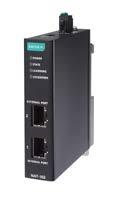
Moxa has introduced the NAT-102 Series of 2-port industrial-grade Network Address Translation (NAT) devices
engineered to simplify the IP configuration of machines in existing network infrastructures. System configuration, including firewall rules and certificates, can be copied from one NAT device to another. It also features port-based Auto
Rolling Ring
• For applications in positioning & reciprocating motion
• Zero play –even during reversal
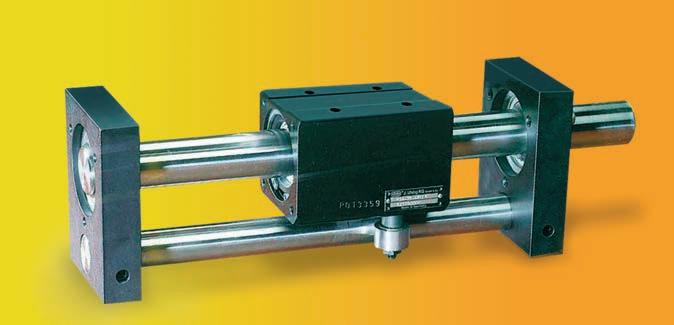
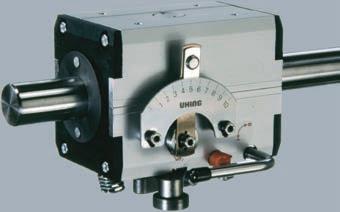
Uhing® Rolling Ring linear drives run on a smooth, threadless shaft that won't clog or jam. If the system is overloaded, the shaft simply slips instead of churning and grinding. The drive bearings are in constant contact with the shaft, even during reversal, thereby preventing backlash.
Example applications: metrology machines, material handling systems, spooling equipment, packaging & converting equipment. Many different sizes meet varying requirements for axial thrust & linear speed.
For more information call 1-800-252-2645
Email: amacoil@amacoil.com www.amacoil.com
Some models feature mechanical control over speed and travel direction. No programming or electronic controls are needed.
Learning Lock that automatically acquires the IP and MAC address of the locally connected devices and binds them to a whitelist. Operable in temperature ranges from -40 up to 75°C, the NAT-102 is rated for installation in ATEX and Class I, Division 2 locations, as well as EN 50121-4 for railway applications. It is also NEMA TS2 compliant. The NAT-102 features two RJ4510/100BaseT(X) Ethernet ports that can be set for port access, transmission speed, flow control and port type. www.moxa.com
EDGE COMPUTER
WAGO has introduced its 752-9800 Edge Computer, designed to run
applications operating in Docker containers. The edge device is also suited for Linux users who want an industrial grade computer running applications such as Node Red, Grafana, AI and digital twins. With a dual-core i7 Intel processor, 16GB RAM and 256GB flash, the IPC offers low latency control, a high level of determinism and simplified north/south connection with Cloud based services, the company says. www.wago.com
SERVER ENCLOSURE
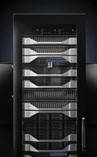
Rittal launched a size 53U version of its TS IT Pro server rack. The rack is designed to handle increasing density and load capacity requirements, the company
says. The modular 53U features easy-to-remove locking sidewalls, quick-release perforated doors and split rear doors. In addition, it also includes cable walls that provide tool-less cable mounting points and increased roof cable entry openings, with brush baffling. www.rittal.ca
POWER TRANSMISSION
GUIDE ROLLER
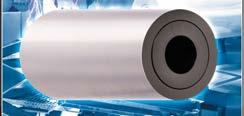
igus expanded its xiros guide roller line to include a dissipative variant made of stainless steel - a kind of rotating lightning conductor that ensures a controlled
electrostatic discharge. These rollers are available in stock sizes 608, 6000, and 6001 with a stainless steel tube length of 100 to 1,000 millimeters. The variant’s tube and rolling bearing balls are made of stainless steel. The inner and outer rings are made of the company’s antistatic high-performance plastic, xiros F180. Suitable in temperature ranges from -40°C and +80°C and for contact with food, the bearings don’t require lubricants that have an insulating effect.
www.igus.ca
TORQUE LIMITING COUPLERS
Zero-Max announced its Torq-Tender and H-TLC models, which operate as a coupling and an overload safety device, are available
with options to fit the level of protection needed. The standard Torq-Tender devices have machined steel bodies with standard black oxide exteriors. Enhancement options for washdown and corrosion protection include a nickel plated exterior with stainless steel hardware; stainless steel exterior and hardware; o-ring seals added to seal between the driver and driven halves; and food grade grease and/or dry lube lubrication. Standard H-TLC
Overload Safety Devices have a composite body with plated hardware. Enhancement options include stainless steel exterior and hardware; stainless steel springs; food grade grease.
www.zero-max.com
MOTION CONTROL
STAINLESS STEEL MOTORS
Baldor-Reliance announced that AEGIS Shaft
Grounding Rings have been made standard equipment on the company’s Food Safe line of motors to provide increased motor reliability and prevent early bearing failure from EDM. The motor line consists of 25 models with horsepower ratings from 1/2 HP up to 10 HP. The ring protect motors by channeling VFD-induced bearing current safely to ground. Continuous circumferential rows of conductive microfibers, embedded in the ring’s AEGIS FiberLock channel, surround the motor shaft and provide millions of discharge points. The microfibers are engineered for conductivity and flexibility to minimize wear and prevent breakage.
www.est-aegis.com
ELECTRIC ACTUATOR
Tolomatic introduced its RSH electric hygienic rod-style actuator designed for the food, beverage, medical, healthcare and pharmaceutical industries. The RSH is clean-in-place (CIP) compatible, features a front-face sealing O-ring, an all-316 stainless-steel exterior and is rated IP69K. The RSH is
designed for forces up to 7,943 lbf (35kN), speeds up to 20 in./sec (498mm/sec) and stroke lengths up to 48 in. (1,200mm). It is available in both ball screw and roller screw options. All Tolomatic actuators are designed with the company’s Endurance Technology, a design principle that incorporates features designed for maximum durability and extended service life, the company says. www.electromate.com
ROTARY ENCODERS
Leine Linde released its M500 line of rotary encoders, bearingless inductive encoders with extended life expectancy, the company
says. The M500 models utilize HEIDENHAIN’s inductive scanning technology that makes them resistant to contamination and electrical and magnetic fields. It also extends average encoder lifetimes, the company says, as well as reduces encoder size. The line supports a maximum rotational speed of 6000 rpm and features an operating temperature range from -20 to +100°C (dependent on version), ingress protection class IP67 (IP69 in the MZI 594 model) and axial shaft play ±3 mm (MZI 594). www.heidenhain.us
GIMBAL MOTORS
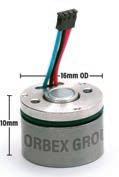
Orbex Group has introduced a line of compact
gimbal motors that feature a pancake-style form factor. The motors are wound to operate at low speeds typical for gimbals while exhibiting a high torque constant for fast response. The gimbal motors are engineered to minimize cogging torque, ensuring smooth rotation, the company says. The brushless motors are electronically commutated and are lightweight making them suited for drones, UAVs and other airborne craft that need to maximize flight time. Orbex gimbal motors are available in two sizes: 16mm (Outer dimension) by 10mm (height) and 26mm (OD) by 12mm (H).
www.orbexgroup.com
SENSORS
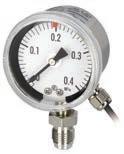
designed for ultra-high purity gas delivery systems. The Reed Switch capability actuates an internal switch that triggers an alarm or a process condition change. The gauge features stainless-steel construction and wetted components. It is helium leak tested to 1 x 10⁻⁸ scc/s, cleaned in class 10,000 cleanroom and packed in a Polyethylene-sealed bag after nitrogen gas flushing. www.ashcroft.com
LIGHT CURTAINS
DISTANCE SENSOR
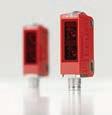
Leuze released its ODT 3C sensor, which can handle both measuring and switching tasks. The sensor transmits measurement values and diagnostic data via IO-Link, including temperature values, warnings and signal quality. It features black-and-white behavior (< ± 3 millimeter at 150mm). The operating range can be adjusted via the teach button, line or IO-Link. It also offers active ambient light suppression, which prevents faulty switching, even when exposed to direct light from LED hall lighting systems. Two independent switching outputs and sensor models with warning output or a small light spot (pinpoint) round of the sensor’s functions.
www.leuze.com
PRESSURE GAUGE
Ashcroft introduced its 50mm HPS high-purity pressure gauge with Reed Switch, which is ultrasonically cleaned and
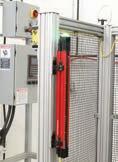
Rockford Systems introduced its Protector Series Light Curtains, which feature bi-color alignment indicators, simplified resolution settings, automatic diagnostics, remote fixed blanking, and can be interconnected in a cascading configuration. The series employs dual-scan technology that makes its photodiodes highly immune to EMI, RFI, ambient light, weld flash and strobe lights.
The product’s design recesses the unit’s windows 5mm into the housing to prevent direct contact with the sensors. Emitters and receivers are both contained inside of 3mm-thick industrial grade aluminum housings with durable metal end-caps. They are rated IP65/IP67 to protect against liquid ingress or immersion. Units come in three resolutions – 14mm (finger detection), 23mm (hand detection) and 40mm (body detection) – for each light curtain length. All three resolutions have a range of up to 12 meters (39 feet). www.rockfordsystems.com
APRIL 20, 2022
Victoria Inn Hotel and Convention Centre, WINNIPEG, MANITOBA
KEYNOTE PANEL DISCUSSION 9AM-10AM SHOW FLOOR OPEN 10AM-4PM
In this exclusive presentation, Kathleen will share insights on various topics including:
• Boeing’s 50-year history in Manitoba
• Technology advancements
• Addressing the age gap
• Maintaining top talent and managing a diverse workforce
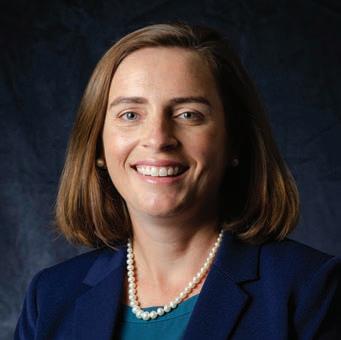
Attend the DEX and Metalworking & Manufacturing Expo in Winnipeg and hear Kathleen Garney, General Manager of Boeing Canada Winnipeg
Kathleen Garney is the general manager at Boeing Canada Winnipeg (BCW). Garney joined BCW in September 2020 as operations director and was named general manager in November 2021. She and her team are responsible for the safe production and assembly of complex composite components manufactured in Winnipeg for Boeing Commercial Airplanes.
Innovate today for a new tomorrow
Realize your vision with Festo‘s approach to smart automation. Partner with Festo today.