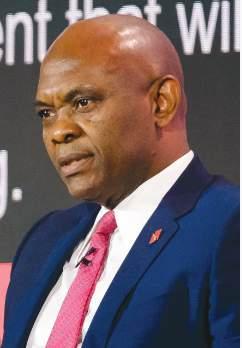
Oyedele: Employers, Individuals Must File Tax Returns by January 31, March 31,
Festus Akanbi
The
Chairman
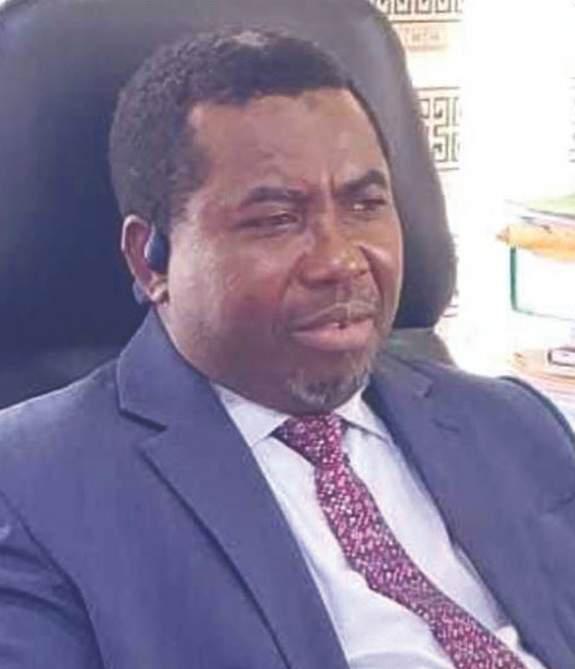
of the Presidential Committee on Fiscal Policy and Tax Reforms, Taiwo Oyedele, has stated that
the new tax laws require all employers of labour and individuals to
by January 31 and March 31, respectively, annually. This
he
the recently debated “power of substitution” in Nigeria’s tax laws was neither new nor unusual.
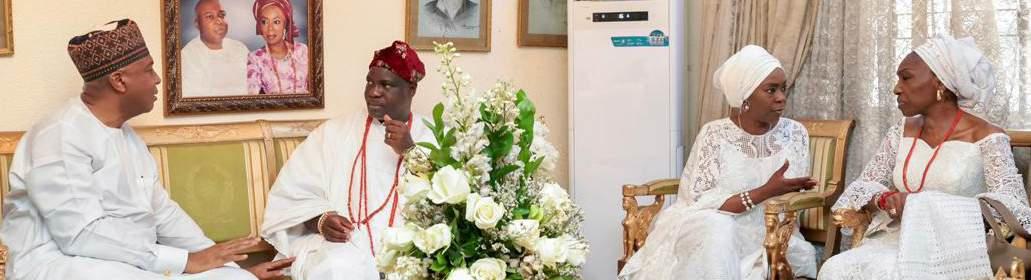
L-R: Former Senate President and son-in-law of the deceased, Dr. Abubakar Bukola Saraki; the Olugbon of Orile Igbon, Oba Olusola Alao; daughter of the deceased, Mrs. Toyin Ojora-Saraki; and Olori Olusola Adedoyin-Alao, during a condolence visit to the Ojora’s residence in Ikoyi, Lagos… yesterday
A new report from the
Tinubu Receives Taraba Gov, Kefas into APC, Says Govs are Party Leaders
Deji Elumoye in Abuja
President Bola Tinubu has declared that governors of the All Progressives Congress (APC) remain the party's leaders in their respective states.
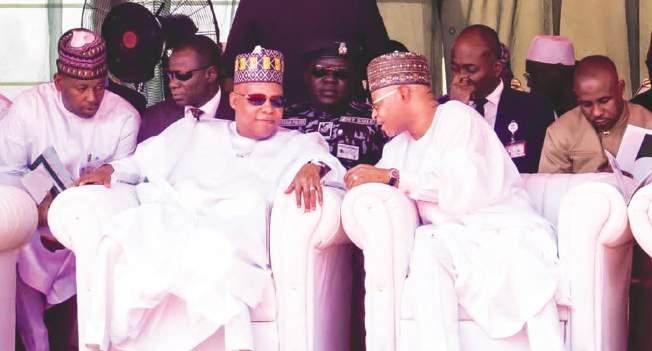
Tinubu made the declaration yesterday at the official reception of the Governor of Taraba State, Agbu Kefas, into the ruling party in Jalingo, the state capital.
Represented by Vice President Kashim Shettima, President Tinubu pledged a stronger development partnership between the federal government and the state following Kefas’ formal entry into the APC.
Speaking at a grand reception to formally receive Kefas, the
Ndubuisi Francis and James Emejo, in Abuja
Market Capitalisation Rises by N6.8tn in January as Stock Market Opens 2026 on Buoyant Note
Kayode Tokede
Nigeria’s equities market began 2026 on a buoyant note, with the Nigerian Exchange Limited (NGX) recording a N6.8 trillion rise in market capitalisation in January, driven by strong corporate earnings, sustained macroeconomic reforms, and renewed investor confidence.
Data from the NGX showed that total market capitalisation rose by N6.8 trillion, or 6.8 per cent, to N106.15 trillion as of
TINUBU
January 30, 2026, from N99.376 trillion at the close of trading on December 31, 2025.
The rally pushed the market past the historic N100 trillion marks early in the year, underscoring the resilience of the bourse amid lingering global and domestic uncertainties.
Market operators attributed the upbeat performance to strong earnings by listed companies and the cumulative impact of reforms undertaken
RECEIVES TARABA
Vice President described the state as being instrumental to Nigeria's food and energy security.
Shettima said President Tinubu had instructed him to assure the governor of his place not only in the party but also in the ongoing relationship, to prioritise the development of the state.
According to the vice president: “What makes us different from other political parties is that we believe that nations endure when they learn to recognise their quiet strengths. We believe Taraba is one such strength. It is a land that feeds, powers, and steadies the nation without demanding applause".
Conveying President Tinubu’s message, Shettima assured Kefas of his full place within the ruling party and a continued relationship focused on development.
“My dear brother, His Excellency, President Bola
International Monetary Fund (IMF) has listed 10 countries, including India and Nigeria, among the top contributors to global economic growth for 2026.
This is consistent with the world's richest man, Elon Musk, declaring yesterday that "the balance of power is changing."
While the IMF data placed Nigeria at number six with a projected 1.5 per cent real GDP growth, India was ranked ahead of the United States of America as number two, with 17 per cent growth.
According to the IMF data, Nigeria is projected to contribute 1.5 per cent to global real GDP growth in 2026, thus placing one of Africa’s leading economies
He stressed that both employers and individuals must comply with the law.
He made this known during a webinar organised for HR managers, payroll officers, Chief Finance Officers (CFOs), and tax managers in collaboration with the Joint Revenue Board (JRB).
In the webinar, which was posted on YouTube over the weekend, Oyedele said
in recent years by the Central Bank of Nigeria (CBN) and the NGX, which have strengthened market fundamentals and deepened investor participation.
The NGX All-Share Index (ASI) closed January 2026 at 165,370.40 basis points, representing a year-to-date (YtD) gain of 6.27 per cent, or 9,757.37 basis points, from its opening level of 155,613.03 basis points.
By contrast, the market’s performance in January 2025
was relatively modest, with the ASI closing at 104,496.12 basis points.
This represents a YtD increase of 1.53 per cent or 1,569.72 basis points from its 2024 closing level of 102,926.40 points.
Market capitalisation at that time had increased by N1.95 trillion, closing at N64.709 trillion, up from N62.763 trillion in December 2024, as earlier reported by THISDAY.
Despite cautious trading by
investors in January 2026, all major sectoral indices closed in positive territory, reflecting broad-based buying interest across the market.
The NGX Oil and Gas Index led the rally with a gain of 13.8 per cent to close at 3,038.79 basis points. It was followed by the NGX Insurance Index, which appreciated by 11.8 per cent to end the month at 1,329.16 basis points.
The NGX Banking Index advanced by 6.99 per cent to close at 1,621.77 basis points, while the NGX Industrial Goods Index gained 5.45 per cent to settle at 5,985.87 basis points. The NGX Consumer Goods Index also recorded a positive performance, rising by 3.2 per cent to close at 4,103.12 basis points on January 30, 2026. Market analysts noted that the strong January showing followed an impressive full-year performance in 2025, when the NGX ASI delivered an annual return of 51.2 per cent.
GOV, KEFAS INTO APC, SAYS GOVS ARE PARTY LEADERS
Ahmed Tinubu, has asked me to assure you of your place not only in the party, but in our continuing relationship to prioritise the development of our people. He has demonstrated that no region is expendable. No state is ornamental,” he said.
The Vice President said the event was not about discovering the state’s relevance, but acknowledging its longestablished role in national cohesion.
“Today, we are not discovering Taraba. We are just acknowledging what we have always known: its place at the centre of Nigeria’s political stability and future,” Shettima stated.
The vice president said the APC was conceived as a unifying platform designed to bring Nigeria’s diverse regions together around a shared national purpose.
“The All Progressives Congress was built as a meeting
ahead of several advanced and emerging economies, including Germany, Brazil, and Indonesia.
Nigeria's 1.5 per cent share exceeds most European nations combined.
China is expected to remain the largest contributor to global growth, accounting for 26.6 per cent, followed by India with 17.0 per cent.
The United States ranks third at 9.9 per cent.
Together, China and India are projected to account for 43.6 per cent of global economic growth in 2026.
Other countries in the top 10 include: Indonesia at 3.8 per cent, Türkiye at 2.2 per cent, Saudi Arabia at 1.7 per cent, Vietnam at 1.6 per cent, Brazil
many Nigerians remained non-compliant in filing selfassessment returns.
“In terms of filing returns, you need to file annual returns as employers for your employees. Many of you have likely already done that. If you haven’t, you have just a couple of days left to file those returns, including projections of how much you will pay your staff,” he said.
point. A place where regions converge. Where differences find direction. Where ambition is disciplined by purpose.”
According to him, Taraba’s entry into the ruling party strengthens that convergence at multiple levels, noting that “to have Taraba firmly within this fold is to strengthen that convergence – strategically, politically and economically. This is so because Taraba sits where food security meets energy security, where fertile land meets flowing water. Where mineral wealth meets industrial possibility."
Welcoming Governor Kefas into the party, Shettima said the decision reflected a clear understanding of governance as a partnership rather than isolation.
He said: “Leadership, at its core, is the courage to align destiny with reality. He understands that governance is not an act of isolation but
at 1.5 per cent, and Germany at 0.9 per cent.
The IMF data also highlighted the dominance of the Asia-Pacific region, which is expected to account for nearly 50 per cent of global economic growth, reflecting continued momentum across the region.
Reacting to the latest IMF data, Elon Musk wrote on his official account that "The balance of power is changing," and shared the IMF data placing India ahead of the United States in contributions to global economic growth for 2026. India accounts for 17 per cent of projected global expansion; China ranks higher at 26.6 per cent, meaning the two Asian economies now account for
He added that individual taxpayers must also file their self-assessment, noting that compliance in this area remains very low.
“This is one area where we have been non-compliant in Nigeria. In many states, more than 90 per cent, even the most sophisticated states, cannot boast of 5% filing returns,” Oyedele said.
The tax reforms, he
of partnership. That progress is faster when vision meets structure.”
The vice president said Governor Kefas’ decision to join the APC reinforces those principles and strengthens national cohesion.
“Today also showcases what the APC represents: That we are a party that grows by conviction, not compulsion. By inclusion, not exclusion. By performance, not noise,” Shettima further said.
Shettima commended Kefas for his understanding of Taraba’s ethnic and religious diversity and his efforts to promote unity in the state, urging residents to rally behind the governor to advance development.
“We are proud of Governor Agbu Kefas for his sense of inclusivity and his development drive. I urge the people of Taraba State to support him as he delivers on his mandate,” he said.
The News Agency of
43.6 per cent of global GDP growth between them.
According to analysts, Elon Musk's comment on the IMF data wasn't random.
He has been tracking India's trajectory closely - meeting Prime Minister Narendra Modi twice in recent months, scouting factory locations, and watching his Shanghai playbook potentially repeat in a market of 1.4 billion people.
They maintain that this goes beyond business calculus. Musk highlighted that India and China are emerging as drivers of global economic growth at a time when his companies are navigating slowing sales in traditional Western markets.
Tesla's China momentum
explained, clarified that employees could not assume that their obligations ended once employers deducted taxes from their salaries.
“Many people assume that if they are an employee and the employer has deducted pay, they don’t have to do anything. That is wrong. Both under the old and new tax laws, you must still file your returns.”
Oyedele assured Nigerians
Nigeria (NAN) reported that Shettima described the governor as the undisputed leader of the APC in the state.
Also speaking at the event, Senate President, Senator Godswill Akpabio, represented by the Deputy Senate President, Senator Jibrin Barau, said Kefas’ defection to the ruling party was a wise decision that would bring prosperity to the state, noting that the entire National Assembly is in support of the decision.
On his part, National Chairman of the APC, Prof. Nantawe Yilwatda, thanked Governor Kefas for saving the state from what he called "the sinking PDP."
He said moving from such a sick party is the best decision he has made, describing it as a move to accelerate progress, development, and prosperity in the state.
"The best thing is to align
has cooled. Europe's stuck in regulatory tangles. India's 6.3 per cent growth rate—revised upward by the IMF—offers an obvious target.
The broader pattern is stark. Germany contributes just 0.9 per cent to global growth in 2026.
The eurozone collectively adds 2 per cent, while advanced economies as a group are projected to expand 1.8 per cent, just as emerging markets are projected to grow 4.2 per cent.
That gap compounds year after year.
The Indian Times reported that manufacturing, not just population and infrastructure spending, jumped sharply in 2025.
Manufacturing output
that authorities were working to streamline filing.
“I’m sure the tax authorities, joint revenue boards, and various state internal revenue services are working on how to make this process simpler and easier. All of us must file our returns, including those earning low income. You must file returns by 31st March of the year in respect of the previous fiscal year.”
with the centre so that all the good things and policies happening at that level will come to Taraba State," he noted.
In his remarks, Governor Kefas commended the state's security operatives for ensuring citizens' safety, saying his defection to the APC was not about playing politics or dwelling on the past, but about living with purpose. The governor said Taraba State must move into the centre to benefit from the policies and the programs of the present government. Also speaking was Ekiti State Governor, Abiodun Oyebanji, who represented the Chairman of the Progressive Governors' Forum and Governor of Imo State, Hope Uzodinma, and said Governor Kefas made the best decision by joining the progressives to attract the dividends of democracy to the state.
accelerated even as global trade slowed. Consumer demand stayed resilient despite inflation hovering near the target.
The IMF specifically cited domestic strength rather than export dependency as the engine.
Musk's observation echoes what economists have quietly tracked for years: global growth is increasingly driven outside the West, even as Wall Street and Silicon Valley still set the technological pace. Whether that balance tips further depends on execution—India's ability to sustain reforms, manage fiscal pressures, and convert high growth rates into durable industrial capacity.
He added that businesses enjoying tax incentives were required to disclose them in their returns.
“Under the new tax law, if you operate a business as an enterprise and you enjoy certain incentives, you have the obligation to disclose those incentives. There’s a disclosure requirement for tax
Continued on page 10
STRENGTHENING RELIGIOUS HARMONY…
Gov Yusuf Debunks Alleged Plan to Dethrone Emir Sanusi, Says Defection Will Not
Ahmad Sorondinki in Kano
Kano State Governor, Abba Kabir Yusuf, has ruled out any plan to remove the 16th Emir of Kano, Muhammadu Sanusi II, insisting that his recent political alignment with the centre would not alter the status of the Kano Emirate or affect the monarch’s position on the throne.
The governor said he did not reach any agreement with the All Progressives Congress (APC) to dethrone Sanusi.
The governor, who spoke through his spokesperson, Sanusi Dawakin Bature, dispelled the rumour of the planned removal of the emir, explaining that there was no truth to the speculation.
“There is no plan to replace Emir Sanusi on the throne of Kano. The appointment of the emir was made after the emirate law was repealed,
and there is no intention at the executive level to amend it.
“Emir Sanusi has been duly appointed in accordance with the law, and the governor’s defection to the APC will not change the status quo. Emir Sanusi remains the Emir of Kano.
“The emirate issue is not a political decision. The personal interests of some individuals drive it,” he said.
On whether the government was engaging with the Emir Bayero camp or those opposed to Emir Sanusi’s reinstatement, Bature said no such outreach had begun.
“Not yet,” he said, adding that the government was appealing to Bayero and his supporters to prioritise peace.
“We want to appeal to him and his co-sponsors to please, in the interest of peace, stability, and economic prosperity of Kano State, distance themselves
from the ongoing claim of awaiting reinstatement.”
The governor’s assurance came amid renewed speculation that his new political realignment could lead to a reversal of Sanusi’s reinstatement.
Kano has been locked in an unprecedented royal deadlock, with two emirs laying claim to the same exalted stool.
Emir Muhammadu Sanusi II continues to operate from the historic Gidan Rumfa palace, while Emir Aminu Ado Bayero remains at the Nassarawa mini-palace, each backed by rival political interests.
Sanusi, who was deposed in March 2020 by then-Governor Abdullahi Umar Ganduje and replaced with Bayero, was reinstated in May 2024 by Governor Yusuf.
The reinstatement followed the passage of the Kano State Emirates Councils (Repeal) Law
Change Status quo
2024 by the state House of Assembly, which abolished the five emirates created under the 2019 law widely seen as instrumental to Sanusi’s initial removal.
By repealing that law, the Yusuf administration restored Kano to a single-emir structure, removing Bayero and the other first-class emirs appointed under the previous arrangement.
Despite this, Bayero continued to lay claim to the throne, reportedly enjoying security backing and tacit recognition from some federal authorities, further deepening the crisis.
Fresh speculations emerged earlier this week after Governor Yusuf defected to the APC, aligning with former governor Ganduje, a key supporter of Bayero.
The defection also marked a major rupture between
ADC: Delays in Passage of Electoral Bill 2025 Will Undermine Credibility of 2027 Elections
The African Democratic Congress (ADC) has accused the Senate, which is dominated by the All Progressives Congress (APC), of deliberately delaying the passage of the Electoral Bill 2025.
In a statement issued yesterday by ADC’s National Publicity Secretary, Mallam Bolaji Abdullah, the party insisted that any further delays pose a serious risk to the integrity of the 2027 general election and undermine the integrity of the entire electoral process well in advance.
It noted the various amendments to the Electoral Act 2022, which constitute serious eligibility and compliance risks
for political parties if not passed on time.
The party also noted that new provisions on mandatory electronic voter accreditation and the transmission of results were minimum requirements on which the credibility of the 2027 election would depend, and insisted that they must not be sabotaged by unnecessary filibustering.
The ADC said it was deeply concerned by the continued prevarications by the National Assembly over the 2025 Electoral Bill, saying failure to pass the bill for urgent presidential assent promptly raised suspicions that the APC-dominated legislature was deliberately applying delay tactics to frustrate key
amendments, especially those intended to make future elections more difficult to rig.
The ADC also noted that some of the proposed amendments introduced new compliance and eligibility requirements that political parties needed to understand and meet.
The ADC spokesman said: ''Failure to give sufficient time to understand the provisions of the new law, beyond what is publicly available as proposals, has serious consequences for both political parties and the INEC.
''Lack of clarity as to the electoral guidelines would not only serve as booby traps for opposition political parties, but also make it difficult for the
INEC to prepare sufficiently and set clear guidelines within the stipulated time,'' Abdullahi said.
He cited, ''the provision that requires INEC to publish election notices not later than 360 days before the general election remains extant. The implication of this is that even now, there is very little left for maneuver.''
The ADC therefore called on the National Assembly to promptly pass the bill, adding ''any further delays pose a serious risk to the integrity of the 2027 general election and undermine the integrity of the entire electoral process well in advance. Nigeria cannot afford the cost of another acrimonious or dubious election.''
Yusuf and his former political benefactor, Senator Rabiu Musa Kwankwaso, under whose influence Sanusi was believed to have secured his reinstatement.
This political realignment fuelled speculation that the emirate dispute could be revisited as part of broader reconciliation efforts within the APC.
The questions gained further traction on Thursday after the Commissioner for Information and Internal Affairs, Ibrahim Abdullahi Waiya, hinted that the prolonged crisis might be nearing resolution.
Speaking on a radio
programme in Kano, Waiya said the state government had implemented “concrete measures” to restore lasting peace and stability, adding that the “two emirs” stalemate was approaching its conclusion. Social media platforms were soon awash with speculation, with many framing the development as a possible “second removal” of Sanusi, allegedly linked to the growing rift between Governor Yusuf and Kwankwaso.
But responding to the speculation, the governor on Friday categorically ruled out any plan to alter Sanusi’s status as Emir of Kano.
Tinubu Returns to Abuja After State Visit to Turkiye
Deji Elumoye in Abuja
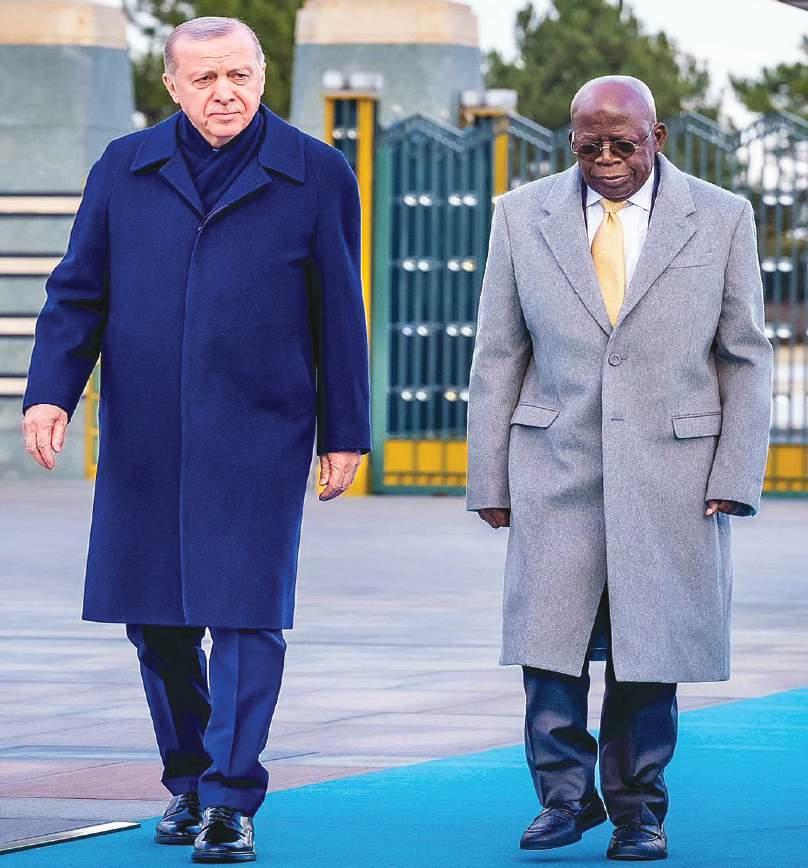
President Bola Ahmed Tinubu yesterday evening returned to the nation's capital, Abuja after a state visit to the Republic of Türkiye.
His official aircraft, Nigeria Air Force 1, touched down at the presidential wing of the Nnamdi Azikiwe International Airport at 8:55 p.m.
The president was received on arrival by the Ministers of the Federal Capital Territory, Nyesom Wike; Finance and Co-ordinating Minister of the Economy, Wale Edun; and State for Defence, Bello Matawalle.
Tinubu returned to the country after a series of high-level engagements in the capital of Turkiye, Ankara that underscored Nigeria’s renewed diplomatic push and strategic partnerships.
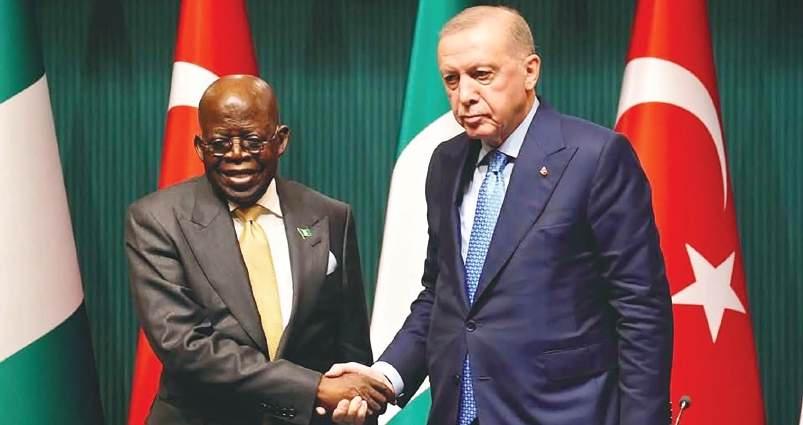
During the visit, the president held bilateral talks with Turkish President Recep
Tayyip Erdogan, alongside meetings with senior government officials and defence industry leaders. The state visit recorded significant outcomes, including Türkiye’s reaffirmed commitment to deepening cooperation with Nigeria in security, military training and intelligence sharing, as well as support for Nigeria’s ongoing fight against insurgency. Both countries also reiterated their resolve to achieve a $5billion trade volume target, indicating expansion of economic ties. Tinubu, in his engagements with President Erdogan expressed appreciation to the Turkish government for its openness to collaboration, noting that discussions centred on counter-terrorism, economic growth, and collective efforts to defeat agents of destabilisation threatening regional peace.
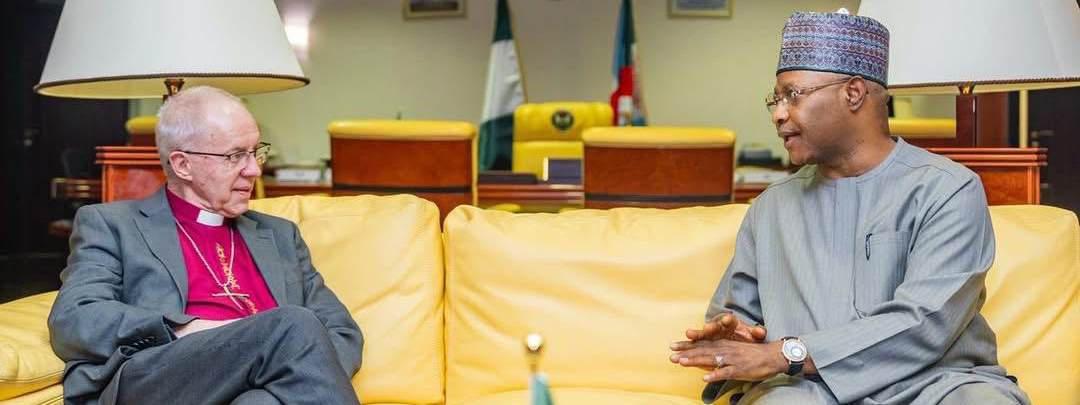
105th Archbishop of Canterbury, His Grace Justin Portal Welby (left), and Kaduna State Governor, Senator Uba Sani, during the cleric’s courtesy visit to governor after his engagement as Guest Speaker at the Ahmadu Bello University Convocation Lecture Zaria in Kaduna…yesterday
Chuks Okocha in Abuja
THIRTY-FIVE HEARTY CHEERS…
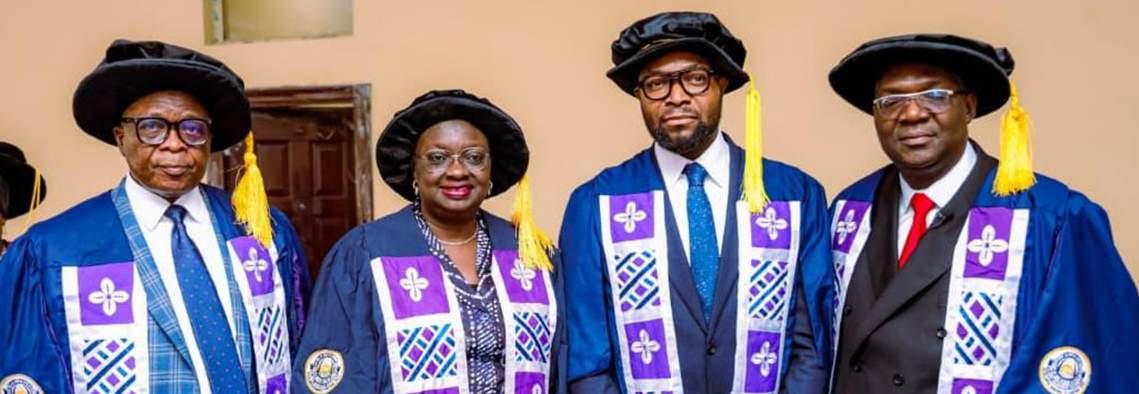
L-R: Commissioner for Education, Science and Technology, Prof. Abayomi
and Digital Economy,
Minister: Certificates Alone Cannot Help Nigeria Realise Dream of Economic Prosperity
James Sowole in Abeokuta
The Minister of Communication, Innovation, and Digital Economy, Dr. Bosun Tijani, said yesterday that certificates alone cannot achieve the nation’s dream of a prosperous economy as envisioned under President Bola Tinubu’s administration.
Tijani said Nigerian graduates must therefore prioritise applying the skills and knowledge they acquired in school to be problem solvers and contribute to the country’s economic growth and prosperity.
The minister made the call in his keynote address at the 35th convocation of Olabisi Onabanjo University, Ago
Iwoye, Ogun State.
Addressing the graduands, Tijani said, “While the certificates you’re taking home are important, it should not be the end of it all because as a nation, we do not just grow by certificates; we grow on applied knowledge and productive skills that come from relevant institutions such as Olabisi Onabanjo University, Ago Iwoye.”
The minister urged the graduates to consider their degrees from the university as tools to make an impact that would benefit and uplift humanity.
He explained, “What you are leaving with is an instrument; the instrument
Scheduled Visa Services Uninterrupted as US Mission Halts Updates Amid Funding Lapse
The United States Mission in Nigeria has announced the temporary suspension of regular updates on its official X account due to a lapse in government appropriations, while assuring that passport and visa services will continue as the situation permits.
The Mission announced this yesterday in a post on its verified X handle, @ USinNigeria.
According to the statement, the account will not be updated regularly until full operations resume, except for urgent safety and security information that may be necessary for the public.
“Due to the lapse in appropriations, this account will not be updated regularly until full operations resume, except for urgent safety and security information,” the post read.
Despite the funding challenges, the Mission clarified that scheduled passport and visa services in the United States and at US embassies and consulates overseas would continue, depending on how the situation unfolds.
“At this time, scheduled passport and visa services in the United States and at US Embassies and Consulates overseas will continue during the lapse in appropriations as the situation permits,” the Mission stated.
The US Mission also noted that further updates would only be provided once full operations resume, except in cases involving urgent safety or security matters.
It advised the public seeking information on services and operating status to visit the official U.S. travel website.
that must make you take impact as an assignment. You must not believe that, as you are graduating, you have arrived; you must rather see it as being deployed to make an impact in society.
“You should go out there, find a problem in your environment, and use the skills you have acquired to solve the problem that will benefit the world.
“Go and make an impact;
make the world a lot better with your educational training and skills received at the university”.
Tijani said Nigeria’s challenge was not ambition but productivity, adding that a prosperous economy is built when skills are applied with purpose.
He disclosed, “When farmers, teachers, engineers, and public servants all raise the standard of what they do,
the society gets better. Nigeria’s prosperity will not come alone from policies but from millions of Nigerians applying their skills with intent and purpose.
The minister charged the country's universities to continue providing high-quality education that addresses real societal challenges and supports the $ 1 trillion prosperous economic drive under President Tinubu.
Tijani said that no economy
in the world has grown faster than the relevance of its universities and the quality of their graduates.
“When a university aligns its learning and teaching with the real society’s needs, prosperity becomes an outcome, not just an aspiration,” he said. The minister announced a donation of a digital laboratory to the university to further strengthen excellence in tech education.
Insecurity: Again, Troops of Nigerian Army Neutralise over 150 Terrorists in Kwara Forests
Hammed
Troops of 22 Armoured Brigade of the Nigerian Army have reportedly neutralised about 150 terrorists that have been terrorising the people from different forests of Kwara State.
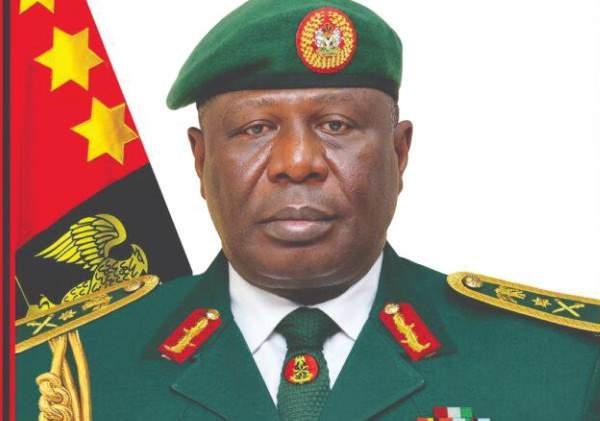
A statement issued yesterday in Ilorin by the Acting Deputy Director, 2 Division Army Public Relations, Nigerian Army/ Sector 3 Operations FANSAN YAMMA, Captain Maureen
Ogbuka stated that, "these operations were conducted under the leadership of Major General Chinedu Nnebife, the General Officer Commanding (GOC) 2 Division of the Nigerian Army and Commander, Sector 3, Operation FANSAN YAMMA (OPFY), alongside Brigadier General Nicholas Rume, the Commander 22 Brigade.
"Their efforts reflect high operational responsiveness and determination to
dismantle terrorist networks.
"In the engagements, troops, in collaboration with the Office of the National Security Adviser (ONSA), conducted fighting patrols in several bandits’ enclaves.
"They successfully neutralised terrorists, while others managed to escape into the forest with suspected gunshot wounds and their hideouts and camps were completely destroyed leaving the brigands dislodged".
The statement added,
"Similarly, troops cleared Garin Dandi, a known enclave of bandits in the Ifelodun Local Government Area of Kwara State leading to the decimation of the bandits' logistics bases and supply system.
"Troops also stormed remote camps hitherto inaccessible to security forces where several abandoned camps and logistics enablers were destroyed significantly degrading the terrorists' sustainment capability.
Archbishop of Canterbury Hails Kaduna’s Peace Progress During Visit to Governor Sani
John Shiklam in Kaduna
The Archbishop of Canterbury, His Grace Justin Portal Welby, has praised the Kaduna State Government for the progress it has recorded in peace, unity, and stability during a courtesy visit to Governor Uba Sani at the Sir Kashim Ibrahim House, Kaduna. In a statement shared on his Facebook page yesterday, Governor Sani said the visit by the 105th Archbishop of
Canterbury was undertaken on the margins of Welby’s engagement as Guest Speaker at the Ahmadu Bello University, Zaria Convocation Lecture.
He noted that the visit “carried a significance that transcended protocol” and reflected Kaduna State’s evolving narrative.
Sani noted that the archbishop reflected on his first visit to Kaduna in 2002, a period he described
as being marked by “deep ethno-religious tensions and recurrent crises.”
“Against that memory, he observed with notable clarity the progress the state has made, remarking on the relative peace, unity, and stability that now characterise our public life,” the governor stated.
He explained that
Archbishop Welby said this transformation informed his decision to visit the Sir
Kashim Ibrahim House, both to acknowledge the efforts of the present administration and to encourage the government to sustain its current path.
“He explained that this transformation informed his decision to visit the Sir Kashim Ibrahim House, both to acknowledge the efforts of our administration and to encourage us to sustain this path of reconciliation and cohesion,” the statement read.
Arigbabu; Ogun State Deputy Governor and Representative of the Governor, Noimot Salako-Oyedele; Minister for Communication
Dr. Bosun Tijani; and the Vice Chancellor of the Olabisi Onabanjo University, Prof Ayodeji Agboola, during the 35th Convocation ceremony of the university, at Ago Iwoye, Ogun State…yesterday
Shittu in Ilorin
PROMOTING EDUCATION…
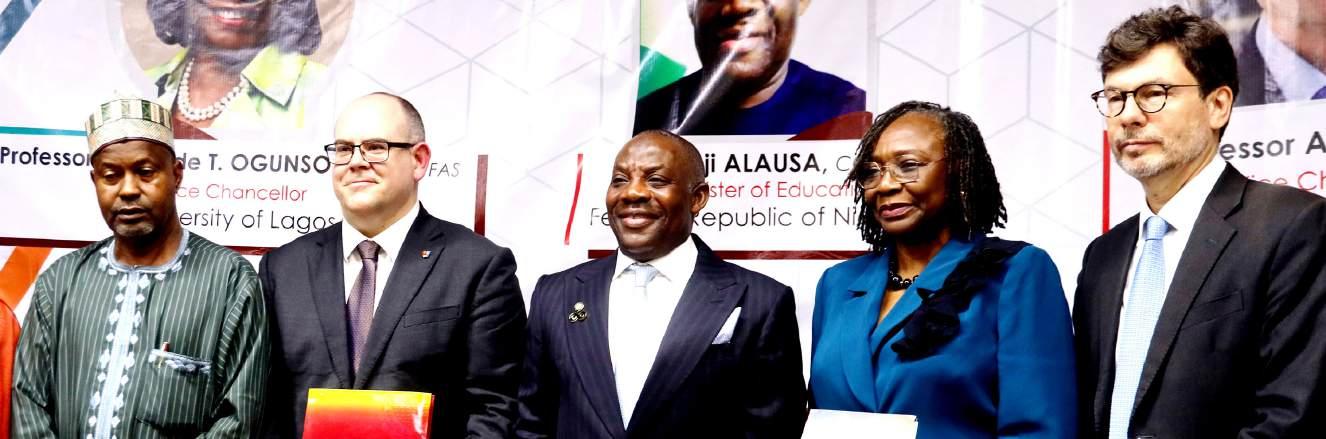
L-R: Executive Secretary, National Universities Commission, Prof. Abdullahi Ribadu; Provost, University of Birmingham, Prof. Nick Vaughan-Williams; Minister of Education, Dr. Olatunji Alausa; Vice- Chancellor, University of Lagos, Prof. Folashade Ogunsola; and British Deputy High Commissioner to Lagos, Jonny Baxter, during the signing of an agreement on the expansion of transnational
A former Minister of Petroleum Resources, Mrs. Diezani Alison-Madueke, has questioned the fairness of her ongoing corruption trial in the United Kingdom, alleging that the combined actions of the Nigerian and British governments had denied her access to crucial documents needed to defend herself.
At the proceedings before Southwark Crown Court in London during the week, Alison-Madueke, through her legal team, formally challenged the integrity of the process, saying that the evidence central
to her defence had been seized, filtered, or withheld, leaving her at a disadvantage.
Alison-Madueke’s position was relayed in a statement from her media aide, Bolouere Opukiri, which outlined the issues raised by her lawyers, Jonathan Laidlaw and Alistair Richardson.
The duo told the court that the trial should not continue if the defendant were being denied the materials and opportunity required for a fair hearing.
Alison-Madueke’s lawyers traced the origins of the case to July 2013, when investigations began, noting that she was first
arrested in London in October 2015 while undergoing cancer treatment and interviewed by the UK’s National Crime Agency shortly thereafter.
Despite this, formal charges were not filed until 2023, a delay the defence described as excessive and prejudicial.
Throughout this period, UK authorities, according to the former minister's lawyers, retained her passport, effectively preventing her from returning to Nigeria.
Laidlaw told the jury that this restriction had left AlisonMadueke unable to work and unable to travel home to gather documents and meet potential
witnesses, a situation the defence said had seriously impaired her ability to prepare her case.
For a trial concerning actions allegedly taken while she was a senior Nigerian official, her enforced absence from Nigeria, in the defence’s view, was a fundamental handicap.
“The core of her argument is that if she is being deprived of the materials and freedom necessary for a fair hearing, the case against her should be dismissed,” Alison-Madueke's defence counsel argued.
The prosecution alleged that Alison-Madueke received improper financial benefits, including accommodation
Insecurity: Southern Kaduna Clerics Seek Release of Abducted Worshippers, Protection of Worship Centres
John Shiklam in Kaduna
Christian leaders in Southern Kaduna have called on the state government, security agencies, and local communities to take urgent steps to protect worship centres and secure the release of abducted worshippers, warning that affected families were experiencing deepening trauma.
The call was made yesterday by the Chairman of Southern Kaduna Christian Leaders, Dr. Emmanuel Kure, during the 2026 Southern Kaduna Prayer Summit held at the Kafanchan New Township Stadium. The summit was themed: “Worship His Majesty.”
Kure said the gathering was not only a spiritual exercise but also an opportunity to appeal for swift government intervention, expressing concern over the lack of visible progress weeks after recent abductions.
“It has been almost two weeks, and nobody has been released. In other cases, early government intervention often
leads to the quick release of victims, but here, there has been no movement,” Kure said.
While thanking God that no deaths have been confirmed among the abducted worshippers, he highlighted the emotional and psychological trauma faced by families, noting that even journalists covering the incidents were moved to tears.
He added that young children in affected communities were particularly impacted.
Addressing ransom demands, Kure said rural communities and farmers lacked the capacity to meet the requested amounts.
“There is no farmer in Kaduna, Katsina, Zamfara, or Sokoto who can raise N50 million or N80 million in the present economic climate. These ransom demands are destroying our rural communities,” he said.
The cleric urged the Kaduna State Government to honour prior assurances of action,
warning that delays only worsen victims' suffering and erode public confidence in security institutions. He also called on communities to strengthen local protection for places of worship.
“Our holy places must remain sacred. Christians and Muslims alike must rise to ensure that our places of worship are protected.
“If government resources are stretched, communities must remain vigilant and coordinate with security agencies to prevent further attacks,” Kure said.
Speaking after the cleric’s address, a member of the House of Representatives for Jema’a/Sanga Federal Constituency, Dan Amos, urged Christians and religious leaders in Southern Kaduna to intensify prayers for Nigeria’s peace, stability, and development, especially as the country approaches another election cycle.
Amos, who spoke shortly after a special prayer
session held in their honour, commended the government's efforts to improve critical sectors, such as electricity supply, noting that stable power would enhance industrial growth and attract investors to Kaduna State and Southern Kaduna.
He emphasised that sustainable development requires patience, consistency, and divine guidance.
“Development is not today, tomorrow, or the next day. With commitment, consistency, and the guidance of God, we will surely get there,” he said.
The lawmaker urged bishops and Christian leaders to continue praying for Nigeria and its leaders, describing prayer as a vital tool for national transformation.
He also highlighted Nigeria’s vast human and natural resources, noting that the country has the potential to become one of the world’s leading nations if unity and effective leadership are sustained.
and luxury items, during her tenure in office.
But the defence countered that these expenses were either legitimate official costs later reimbursed through the Nigerian government’s channels or were paid from her personal funds in Nigeria.
They argued that documentary records in Abuja would demonstrate that she did not personally benefit from the arrangements in question.
Alison-Madueke maintained that the Nigerian authorities raided her homes and seized documents that could support this position.
According to her account, the records included evidence of reimbursements made in Nigeria, with third parties initially covering costs abroad.
She contended that these materials would show that she derived no unlawful personal gain.
The defence team emphasised that after multiple changes of government and more than eleven years, they were informed that many of these records “do not exist,” a claim they dispute.
Although the Nigerian authorities later sent boxes of documents to the UK, AlisonMadueke’s lawyers argued that the material provided was incomplete and omitted key categories of evidence.
More significantly, they alleged that UK investigators were aware of the arrival and contents of these boxes but did not inform the defence at the relevant time.
Labour Party Hails INEC as Commission Recognises Nenadi Usman’s Leadership after Court Order
Chuks Okocha in Abuja
The Senator Nenadi Usmanled Labour Party (LP) has expressed relief over the official recognition of its interim national leadership by the Independent National Electoral Commission (INEC).
INEC on Friday uploaded the particulars of Senators Usman and Darlington Nwokocha as chairman and national secretary of the party, respectively, on its official website.
Other members of the National Working Committee (NWC) are: Hamisu Santuraki (National Treasurer); Aisha Madije (National Financial Secretary), and Eric Ifere (National Legal Adviser.
On January 21, the Federal High Court, Abuja, recognised the Usman-led NWC of the Labour Party, sacking Julius Abure as the party’s national
chairman.
Justice Peter Lifu based his action on the verdict of the Supreme Court declaring Nenadi as the authentic leader of the Labour Party.
He asked INEC to recognise the Usman-led NWC as the party’s legally recognised authority until the conduct of the party’s next convention. According to Justice Lifu, the evidence before the court indicated that Abure’s tenure as Labour Party national chairman had ended.
While dismissing the matter as a non-justiciable internal party affair, he said the establishment of the Caretaker Committee was “a necessity” arising from the Supreme Court’s earlier ruling.
Following the ruling, the Abure-led group in the LP vowed to appeal the Federal High Court ruling.
University of
PHOTO: ETOP UKUTT
Emmanuel Addeh in Abuja
AWARD OF HONORARY DOCTORATE DEGREE...
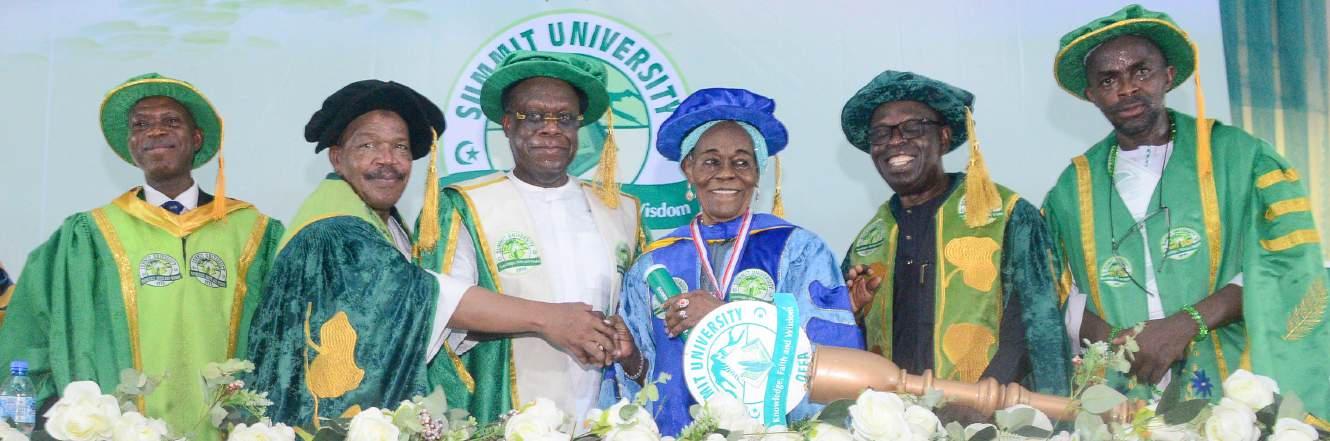
L–R: Acting Registrar, Summit University, Offa, Mr. Mustapha Abayomi Kadiri; Pro-Chancellor and Chairman, Governing Council of the university, Alhaji Rafiu Adisa Ebiti; President, Ansar-Ud-Deen Society of Nigeria, Prince Mosediq Adeniji Kazeem; Awardee of Honorary Doctorate in Business Administration /Mother of the Chief of Staff to the President, Alhaja Lateefat Olufunke Gbajabiamila; Chancellor, Summit University, Offa; Dr. Sulaiman Adebola Adegunwa, and Vice-Chancellor, Prof. Abiodun Musa Aibinu, during the formal robing ceremony of the awardee, Alhaja Gbajabiamila, organised by the management of the institution in Surulere, Lagos... yesterday
Tinubu Reaffirms Commitment to Stable Academic Calendar, Power Supply for Universities
Announces staff loan scheme for academic and non-academic workers in tertiary institutions
President Bola Tinubu has reaffirmed his administration’s commitment to ensuring a stable academic calendar, improved staff welfare and uninterrupted power supply across Nigerian universities, declaring that
education remains central to his Renewed Hope Agenda.
The president also announced the introduction of a Staff Loan Scheme for academic and nonacademic workers in tertiary institutions, aimed at reducing
financial pressure and boosting productivity.
Tinubu said that for the current year, a total of N40billion had been earmarked for the scheme, with individual loan amounts ranging from N1million to N10million.
The president made this known yesterday at the 45th convocation ceremony of Ahmadu Bello University, Zaria, Kaduna State, where he was represented by the Minister of State for Education, Prof. Suwaiba Said Ahmad.
Nigeria Firmly on Course to Build $1tn Economy by 2030, Says Presidency
Deji Elumoye
The Presidency has stated that Nigeria is on a “healing journey” and firmly on course to build a $1 trillion economy by 2030, as it intensifies efforts to deepen economic and financial inclusion and reposition the country as Africa’s leading hub for a borderless digital economy.
The Technical Adviser to the President on Economic and Financial Inclusion, Office of the Vice President, Dr. Nurudeen Zauro, stated this at the weekend in Abuja
during a media parley where organisers unveiled details of the 2026 RegTech Africa Conference and Expo.
Zauro said President Bola Tinubu set a clear economic target on his first day in office, anchored in reforms aimed at restoring confidence, expanding inclusion, and attracting investment.
“From day one, Mr. President set a target of deepening Nigeria’s economic and financial sector to achieve a $1 trillion economy by 2030. To get there, we must build trust, infrastructure,
and inclusion, supported by policies that promote partnership and collaboration. That is the essence of a borderless economy,” he said.
Nigeria is set to host the continental conference from May 20 to 22, 2026, under the patronage of the Office of the Vice President.
The event with the theme “Building trust, infrastructure, inclusion and policy for a borderless economy,” is being organised in partnership with the Presidential Committee on Economic and Financial Inclusion and in collaboration
with the Inter-Governmental Action Group Against Money Laundering in West Africa.
Zauro acknowledged that recent policy changes have been difficult for citizens but insisted they are necessary to restore long-term economic health.
“It takes a bold decision for a father who knows his child is sick to take him to the hospital, allow him to go through surgery, and come out hale and hearty. Nigeria has gone through painful reforms, but today we are on a healing journey,” he said.
Congratulating the university community, Tinubu described the convocation as “a testament to persistent commitment to rigorous academic pursuits” and commended ABU for sustaining excellence in teaching, research and community service.
He urged the institution to remain aligned with the Federal Government’s Federal Tertiary Institutions Governance and Transparency Programme, which he said was designed to promote accountability, transparency and data-driven governance in tertiary education.
“This programme is a significant step taken by the federal government to modernise higher education management and restore public trust, in line with the Renewed Hope Agenda,” the president stated, adding that ABU’s compliance had kept it among the country’s leading universities.
Tinubu stressed that the growth and development of academic institutions depended largely
on a stable academic calendar, assuring Nigerians that his administration was determined to avoid disruptions in the education sector.
“I reaffirm this administration’s commitment to keeping our educational institutions open in accordance with their approved academic calendars and to avoiding disruptions in the nation’s educational system,” he said. He disclosed that the federal government had adopted a unified negotiation framework through the Tertiary Institutions Expanded Negotiation Committee to enhance efficiency in engagements with university-based unions.
The president commended the committee, led by Alhaji Mahmud Yayale Ahmed, for facilitating the agreement reached with the Academic Staff Union of Universities (ASUU) and appealed to other unions to remain patient, assuring them that comprehensive agreements would be concluded in due course.
OYEDELE: EMPLOYERS, INDIVIDUALS MUST FILE TAX RETURNS BY JANUARY 31, MARCH 31, RESPECTIVELY
incentives that is not available to everybody as a general rule for taxpayers—to disclose them when filing their tax returns or shortly after.”
Meanwhile, Oyedele clarified that the recently debated “power of substitution” in Nigeria’s tax laws was neither new nor unusual. He explained that the power of substitution allowed tax authorities to act when taxpayers failed to file returns or when reported information was inconsistent with available intelligence, such as bank activity, property acquisitions, or overseas travel.
He said, “Some people thought it was problematic because they did not know
it was always there in the law. For them, it’s new. But the reality is that this is not even new at all. It’s been there since sliced bread before some of us were born. It’s also not new to Nigeria. It’s common across the world. Some countries call it the garnishment order; some call it third-party agents.”
Oyedele, who described how the process worked, said: “But what does it really mean? It means you’re expected to conduct self-assessments. You did not do it. The taxman writes to you: either you haven’t filed your returns, or we have intelligence about you. You just bought a new car, built a new house, or travelled abroad, but the money isn’t
showing on your tax return. Can you explain? You refuse to explain, or your explanation doesn’t make a lot of sense.
“They say, ‘Okay, based on what we have about you, we think you owe N5 million. You have 30 days to object.’ When you object, the tax man must look at your objection. He says, “Oh, ‘I will revise it, it is not N5 million, it’s N3 million.’
You are free to keep objecting until the tax man says, ‘I refuse to amend,” and sends you a notice of refusal to amend. At that point, it triggers an appeal. You have 30 days to appeal to the tax tribunal.
“You don’t like the outcome; you can appeal to the High Court. You don’t like that
outcome, you can go to the Court of Appeal, and in some cases, the Supreme Court, before they determine the amount of tax you are owing.
That’s why we call it final, conclusive, and payable. Even after the court has determined that you owe, let’s say N2.5 million, the tax man is required to tell you to pay within a specified period of time—10 days, 21 days, 30 days. When you fail to pay after that, the tax man has the power to ask anyone who has any money belonging to you—or that will belong to you—to pay the money to the government, including your bank.”
He dismissed claims that the tax authority could arbitrarily
debit citizens’ bank accounts.
He said, “It may not require your consent, but it requires your knowledge because they’ve been writing to you. There’s no way this will be done without your awareness.”
Oyedele noted that the power existed under prior tax laws and that the new tax legislation included stronger safeguards against abuse, including the ability to escalate disputes to tax tribunals.
On compliance, Oyedele said: “I’m sure the tax authorities, joint revenue boards, and various state internal revenue services are working on how to make this process simpler and easier. All
of us must file our returns, including those earning low income. You must file returns by 31st March of the year in respect of the previous fiscal year.”
Speaking on the broad benefits of the reforms, Oyedele explained: “If we make these work, we’ll have a country we can all be proud of. It’s a collective responsibility. These reforms would help small businesses, large businesses, multinationals, and foreign investors. Everybody benefits. Households will also benefit from lower income taxes, which will increase disposable income. This reform also removes VAT on basic consumption.”
THE ENEMY WITHIN
By Chief Femi
The enemy within smirks, mocks and laughs when our President slips and falls to the floor in far away Turkiya. Oblivious of the fact that a democratically-elected President, whether you like or support him or not, is the living manifestation of our nation and the essence and symbol of our national sovereignty and pride they pray for the worse and celebrate it in the inner recesses of their dark, sinister, twisted and malevolent minds.
They forget that when our President falls, it essentially means that our nation falls. They forget that a true patriot is meant to pray for, cheer on and encourage the leader of his country, whether or not he is in opposition, when he is fighting for the future of our people in a foreign land. They whisper to themselves in their closets and bedrooms that “finally, this is his end”.
With glee they say to themselves and to their grubby little minions that “at last we have him!”They assume the worse and they desire for the worse.
They forget that anyone can slip and fall at anytime and that the Holy Bible says “rejoice not over me, O my enemy; when I fall for I shall rise and when I sit in darkness, the LORD will be a light to me”- Micah 7:8.
They forget that it also says “for a righteous man may fall seven times and rise again but the wicked shall fall by calamity”- Proverbs 24:16.
It is to the glory of God and to the shame of our detractors and the enemy within that though our President slipped and fell in Turkey before the entire world, he rose again with strength and pride like the phoenix and he went on to negotiate and sign numerous bilateral agreements which will bring security, succour and prosperity to our nation with President Erdoğan of Turkiya.
That is the lot of a righteous man and a humble, forgiving and kindhearted leader and it signifies the fact that the Lord is with him and that the enemy within has failed once again.
Yet they never stop and neither will they ever do so because they are seized of a dark, depraved, diseased and sadistic mind that craves failure and chaos and longs for calamity, tragedy, sorrow, tears and malevolence.
The enemy within just loves it when terrible things happen. Like the accursed masochists that they are, that is their pleasure and delight.
They love to hear the cries of infants and babies and they delight in hearing the wailing of widows and the screaming of orphans. Consider their reaction to the sad and unfortunate events that took place in Kajuru, Kaduna State earlier this month.
I am as saddened and concerned as anyone else about the abductions of the worshippers that took place there and like everyone else I hope and pray for their rescue and safe return back home at the soonest. I am however constrained to make the following observations and I do so with pain and sorrow.
The reality is that the enemy within, namely a handful of political leaders in the opposition who seek to undermine and discredit our government and to destabilise our country and who are working in collaboration with foreign powers are part of those that are secretly encouraging and, I suspect, facilitating the abduction of Christians in Nigeria because they make political capital out of it.
They secretly crave it yet openly condemn it because it suits their purpose and it confirms the narrative that they want to establish.
For some it proves that Christians are being targetted in Nigeria and it plays into the Christian genocide and persecution narrative which the Americans have gladly cottoned on to and for others it feeds the erroneous suggestion that having a Christian candidate for the opposition or a Christian running mate for our President in 2027 are the answers to the problem and the only way of proving that Christians are safe and treated with humanity in our country.
Both views do not fully recognise the depth and complexity of the problem and can therefore be fairly described as simplistic, myopic and misplaced because the situation is much more complex than that.
Worse still the specious lies and dubious political motives that fuel this thinking are irresponsible and disingenuous.
You cannot play politics with peoples lives and liberty, take advantage of their misery and suffering and use them as pawns in a deadly game of political chess.
Worse still you cannot attempt to distort the narrative, misinform the world and perpetuate and peddle the nonsensical falsehood that only Christians are being abducted and killed by the terrorists in our country and that only Churches are being burnt down whilst Mosques are left standing. This is simply not true.
The reality is that Muslims are also being abducted in massive numbers and a more accurate and honest categerisation of the situation we are faced with would have been that both Christian and Muslim Nigerians are “not safe” in parts of Northern Nigeria because of mass abductions and not just
Even this categorisation may not be accurate and is possibly unfair because it negates the efforts and successes that the Nigerian military, the Minister of Defence, the Minister of State for Defence, the National Security Adviser and the Nigerian security forces and Intelligence agencies together with numerous notable Governors from the Northern states like the Governor of Kaduna, the Governor of Kwara, the Governor of Yobe, the Governor of Borno, the Governor of Sokoto and a number of other key Northern leaders such as Vice President Kashim Shettima, Senator Abdul Aziz Yari, Senator Aliyu Wamakko, Senator Shehu Umar Buba and a number of others have made in curbing this menace.
The truth is that for every person that has been abducted hundreds have been protected and delivered from attempts at abduction and virtually every single one of those that were actually abducted before Kajuru have been rescued and returned home safely.
That in itself is encouraging though it does not negate or underplay the problem we have and the challenge we collectively face.
It simply means that despite the problems and challenges and the politically-motivated expressions of angst and concern of the usual suspects at least some progress is being made.
It is deeply saddening and troubling that ANYONE is abducted or killed in the first place and this represents a failure in our efforts to achieve
100% security for Nigerians in the midst of what is essentially an open and horrendous guerrilla war where civilian populations are purposely targetted and a massive and unprecedented armed rebellion and relentless insurgency is in full play.
However we must acknowledge that our successes in this respect both in the prevention of even more killings and abductions and in terms of recovery and rescue of those taken is very good.
Sadly people tend to focus on the failures and remain silent in the face of the successes which is most unfair. What is even more unfair and extremely dangerous is to continuously frame the entire matter in religious terms.
I am amongst those that did so in the past but six years ago, after much research and extensive travelling all over the more distant parts of the core North for an investigation into the matter and an extensive 5 week tour my eyes opened and I came to appreciate the fact the Muslims were being targetted with equal ferocity and in equal measure.
This is a fact that the media and most Southern Nigerians, for reasons I cannot fathom or comprehend, appear to ignore and choose to play down and it begs the question whether Muslim lives are considered as being as sacred and precious as Christian ones in their eyes?
The criminals and terrorists that carry out these atrocities do not care whether it is Christians or Muslims that they terrorise, traumatise, kill or abduct. They only care that their victims are Nigerians.
Christians.
Turkish President Recep Erdoğan (left) and President Bola Tinubu
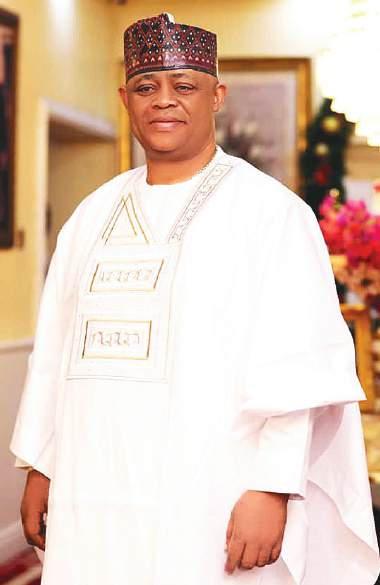
Fani-Kayode
THE ENEMY WITHIN
that you have no hope in hell of winning the presidential primaries.
Yet all that doublespeak, lack of consistency, opportunism and deceit pales into comparison when compared to what you did to your former presidential campaign manager. You repaid his good with evil by turning your back on him in his time of need and refused to stand by him and support him when he fell ill. For this alone God will never forgive you.
I will not go into what else you did to him because that is for another day but to say the least you were unfeeling, insensitive and callous towards this profoundly good man who many loved and held in high esteem.
The only mistake he made was that he associated himself with you and joined your bandwagon of misguided and irreverent Obidient cheerleaders. Thankfully towards the end he saw you for what you were, retraced his steps and returned back to us.
Surely you are not the stuff of which real leaders and Presidents are made. Your loyalty is to your vaulting ambition and to no-one and nothing else.
Your new friends in the ADC will attest to that at a later date after you break ranks with them. These are my words for you Peter. I sincerely hope that you will consider them.
Permit me to end this contribution with the following. If truth be told Obi sincerely believes that he has the right to the Presidency just as satan believed he had the right to Moses’body.
When the latter passed on and satan came for his corpse the Holy Bible tells us that Archangel Michael rose up, confronted him, resisted him and boldly pronounced “the Lord rebuke you satan” after which the devil fled. Today I say, “the Lord rebuke you Peter”and, like satan, you MUST flee.
TTheir war is not against Christians alone but against the Nigerian state and the Nigerian people, both Christian and Muslim. It is in this light that we must view this harrowing challenge and once we do so we will be in a better position to confront it, defeat the enemy, eliminate the threat and put both our local and foreign detractors to shame.
he enemy within smirks, mocks and laughs when our President slips and falls to the floor in far away Turkiya. Oblivious of the fact that a democratically-elected President, whether you like or support him or not, is the living manifestation of our nation and the essence and symbol of our national sovereignty and pride they pray for the worse and celebrate it in the inner recesses of their dark, sinister, twisted and malevolent minds.
Permit me to continue this contribution with a sincere and heartfelt word for Mr. Peter Obi, a notable member of the Nigerian opposition. I refer to your post on the terrible events that took place in Kajuru on Sunday, 18th January 2026.
They forget that when our President falls, it essentially means that our nation falls. They forget that a true patriot is meant to pray for, cheer on and encourage the leader of his country, whether or not he is in opposition, when he is fighting for the future of our people in a foreign land. They whisper to themselves in their closets and bedrooms that “finally, this is his end”.
I share your concerns for the safety of those abducted but unlike you mine are from the heart and I am not expressing those concerns for political gain. At a time like this we should be praying for the rescue of the worshippers and assisting and encouraging our Government to ensure their safe return.
With glee they say to themselves and to their grubby little minions that “at last we have him!”They assume the worse and they desire for the worse.
Instead of doing so you are sheepishly asking “what is happening in our country”as if you, your supporters and your insincere and divisive rhetoric are not part of the problem.
They forget that anyone can slip and fall at anytime and that the Holy Bible says “rejoice not over me, O my enemy; when I fall for I shall rise and when I sit in the LORD will be a light to me”- Micah 7:8.
You feign concern and focus on the negative never offering support or giving credit to whom it is due when things go well and are done properly. For example have you ever had the decency or presence of mind to commend the efforts of the gallant men of our Armed Forces and security agencies or acknowledged the number of people and lives they have successfully defended and saved?
They forget that it also says “for a righteous man may fall seven times and rise again but the wicked shall fall by calamity”- Proverbs 24:16.
It is to the glory of God and to the shame of our detractors and the enemy within that though our President slipped and fell in Turkey before the entire world, he rose again with strength and pride like the phoenix and he went on to negotiate and sign numerous bilateral agreements which will bring security, succour and prosperity to our nation with President Erdoğan of Turkiya.
Have you ever considered the fact that many of them are paying the supreme price every day on the frontlines in their attempt to protect and guard the realm and prevent the barbarians from climbing over our walls? Have you ever thanked them for this or publicly expressed solidarity with or support for them? I doubt it.
That is the lot of a righteous man and a humble, forgiving and kindhearted leader and it signifies the fact that the Lord is with him and that the enemy within has failed once again.
Our greatest problem are people like you that openly crave for and secretly celebrate chaos, lawlessness, division and carnage and that see the propagation and execution of such evil as a justification for your futile and pitiful attempt to discredit the government and gain sympathy and support for yourself.
Yet they never stop and neither will they ever do so because they are seized of a dark, depraved, diseased and sadistic mind that craves failure and chaos and longs for calamity, tragedy, sorrow, tears and malevolence.
The enemy within just loves it when terrible things happen. Like the accursed masochists that they are, that is their pleasure and delight.
Simply put you seek to harvest the misery of our people in the same way that some harvest human organs and you celebrate their pain, suffering and tears.
They love to hear the cries of infants and babies and they delight in hearing the wailing of widows and the screaming of orphans. Consider their reaction to the sad and unfortunate events that took place in Kajuru, Kaduna State earlier this month.
Relevant here are the words of Mr. Dennis Amachree, a former Assistant Director of the DSS, who said the following: “Most of these mass abductions are carried out to spite the government in power: there are fifth columnists and complicit actors within the system and by the time the government reacts the damage has already been done”.
I am as saddened and concerned as anyone else about the abductions of the worshippers that took place there and like everyone else I hope and pray for their rescue and safe return back home at the soonest. I am however constrained to make the following observations and I do so with pain and sorrow.
I am constrained to ask whether you are part of those that are actually behind these abductions and insurgency simply for political gain?
Let me be clear: this is a question and not an allegation but whatever the answer is (and I do not claim to know it) kindly save your crocodile tears and insincere concern for the welfare and safety of our people whether it be in Kaduna or elsewhere. We know you don’t mean it.
The reality is that the enemy within, namely a handful of political leaders in the opposition who seek to undermine and discredit our government and to destabilise our country and who are working in collaboration with foreign powers are part of those that are secretly encouraging and, I suspect, facilitating the abduction of Christians in Nigeria because they make political capital out of it.
The only thing that is important to you is that all our institutions fail and our nation is burnt to ashes in a religious and ethnic conflagration so that you and your cohorts can divide our country, break it into pieces and share what is left of it amongst yourselves. Be rest assured that that will NEVER happen and you will NEVER achieve your objectives.
They secretly crave it yet openly condemn it because it suits their purpose and it confirms the narrative that they want to establish.
Whatever our challenges may be as a nation and whatever obstacles may be placed in our path, I am persuaded that in peace, love, unity, mutual respect and faith we shall SURELY overcome.
For some it proves that Christians are being targetted in Nigeria and it plays into the Christian genocide and persecution narrative which the Americans have gladly cottoned on to and for others it feeds the erroneous suggestion that having a Christian candidate for the opposition or a Christian running mate for our President in 2027 are the answers to the problem and the only way of proving that Christians are safe and treated with humanity in our country.
Permit me to add the following. It has come to my attention that when ESN and IPOB terrorists murder Christians and Muslims in the South East you encourage it by saying nothing and endorse it with your resounding silence.
When Muslims are killed in the North, except on the odd occasion, you say nothing because you do not see them as human beings and you could not care less.
Both views do not fully recognise the depth and complexity of the problem and can therefore be fairly described as simplistic, myopic and misplaced because the situation is much more complex than that.
When Christians are killed in the North you feign outrage and you celebrate and magnify it, citing it as evidence of “Christian persecution” and “Christian genocide” and encouraging the right-wing lunatic fringe in American politics to latch on to it.
Worse still the specious lies and dubious political motives that fuel this thinking are irresponsible and disingenuous.
You cannot play politics with peoples lives and liberty, take advantage of their misery and suffering and use them as pawns in a deadly game of political chess.
When Christians are not killed in the North you pretend that they are, inflate numbers and fabricate it in an attempt to plant the seeds of religious division and provoke a sectarian war. What manner of man are you?
Worse still you cannot attempt to distort the narrative, misinform the world and perpetuate and peddle the nonsensical falsehood that only Christians are being abducted and killed by the terrorists in our country and that only Churches are being burnt down whilst Mosques are left standing. This is simply not true.
Why are you so hell bent on destroying our country and shattering the unity that we are trying to establish and preserve? Is it your desire to be President over a broken, bleeding and dying Nigeria and to preside over the corpse of a great nation like ours that you are evidently so desperate to murder?
The reality is that Muslims are also being abducted in massive numbers and a more accurate and honest categerisation of the situation we are faced with would have been that both Christian and Muslim Nigerians are “not safe” in parts of Northern Nigeria because of mass abductions and not just
doublespeak and grave antics and what has Nigeria done to you and yours that you so desperately seek her destruction and demise? We have seen this desperate thirst and quest for power before and we saw how many bodies littered the streets in an attempt to gain it.
consequences for those that were behind it and indeed for the entire nation. May we never see such again.
becoming President: God alone gives power to whom He pleases and when he deems it fit.
He deems it fit to give it to the South East it will certainly NOT be to you. I say this because there are men and women from your part of the country that are far better and far more deserving and qualified than you and that are neither divisive or obsessed with the division of our country.
Christians.
Unlike you such men and women proudly consider themselves as being Nigerians and not Biafrans and they do not make a distinction between Muslims and Christians.
They see all Nigerians, whether Christian or Muslim or whether Northerner or Southerner, as being one and the same and that is what we expect and deserve.
They appreciate the fact that the road to power in a democracy is one of peace, inclusiveness and understanding and not one of discord, strife, violence, lies, insults, disinformation, propaganda, division, historical revisionism, inordinate ambition, greed, entitlement and deceit.
Neither do they believe in the stereotyping or demonising of any of our great ethnic nationalities or religious faiths. These are the basic and fundamental prerequisites that are required for anyone to lead our great nation and in my humble opinion you do not have them and you are incapable of ever cultivating them. Yet it doesn’t stop there.
Even this categorisation may not be accurate and is possibly unfair because it negates the efforts and successes that the Nigerian military, the Minister of Defence, the Minister of State for Defence, the National Security Adviser and the Nigerian security forces and Intelligence agencies together with numerous notable Governors from the Northern states like the Governor of Kaduna, the Governor of Kwara, the Governor of Yobe, the Governor of Borno, the Governor of Sokoto and a number of other key Northern leaders such as Vice President Kashim Shettima, Senator Abdul Aziz Yari, Senator Aliyu Wamakko, Senator Shehu Umar Buba and a number of others have made in curbing this menace.
The truth is that for every person that has been abducted hundreds have been protected and delivered from attempts at abduction and virtually every single one of those that were actually abducted before Kajuru have been rescued and returned home safely.
You not only turned on your own Obidient supporters and called them “criminals”(an appellation I will not contest with you) after they complained about the fact that you joined the ADC, a political party that you had earlier described as a “structure of criminality” but you also disavowed and disowned them when they resorted to their usual infantile tantrums after it was brought to their attention that you were considering the possibility of being the running mate to the undisputed leader of that party given the fact
That in itself is encouraging though it does not negate or underplay the problem we have and the challenge we collectively face.
It simply means that despite the problems and challenges and the politically-motivated expressions of angst and concern of the usual suspects at least some progress is being made.
It is deeply saddening and troubling that ANYONE is abducted or killed in the first place and this represents a failure in our efforts to achieve
Whatever the case and whoever the enemy within choose to field in 2027 as their presidential candidate one thing remains clear: in a 36 state federation our ruling party the APC now controls all but 7 states and of the seven one is in alliance with us.
Given this it is clear that only God can stop President Bola Ahmed Tinubu from being re-elected in 2027.
100% security for Nigerians in the midst of what is essentially an open and horrendous guerrilla war where civilian populations are purposely targetted and a massive and unprecedented armed rebellion and relentless insurgency is in full play.
All the subversion, destabilisation, betrayal, hostility, lies, conspiracies and shenanigans that the enemy within, the opposition and their hordes of foreign friends, attack dogs and bellicose trolls have collectively contrived cannot stop or deter him.
However we must acknowledge that our successes in this respect both in the prevention of even more killings and abductions and in terms of recovery and rescue of those taken is very good.
I advise them to focus their presidential aspirations on 2031 and forget 2027 because until then there is no vacancy in Aso Rock. I also urge them to purge themselves of their divisive and subversive ways and their hate and contempt or, failing that, to leave our shores and embark on a journey of no return.
Sadly people tend to focus on the failures and remain silent in the face of the successes which is most unfair. What is even more unfair and extremely dangerous is to continuously frame the entire matter in religious terms.
May God bless and defend the Federal Republic of Nigeria.
I am amongst those that did so in the past but six years ago, after much research and extensive travelling all over the more distant parts of the core North for an investigation into the matter and an extensive 5 week tour my eyes opened and I came to appreciate the fact the Muslims were being targetted with equal ferocity and in equal measure.
This is a fact that the media and most Southern Nigerians, for reasons I cannot fathom or comprehend, appear to ignore and choose to play down and it begs the question whether Muslim lives are considered as being as sacred and precious as Christian ones in their eyes?
The criminals and terrorists that carry out these atrocities do not care whether it is Christians or Muslims that they terrorise, traumatise, kill or abduct. They only care that their victims are Nigerians.
Chief Femi Fani-Kayode is the Sadaukin Shinkafi, the Wakilin Doka Potiskum, the Otunba of Joga Orile, the Aare Ajagunla of Otun Ekiti, a former Minister of Culture and Tourism, a former Minister of Aviation, a former Senior Special Assistant to President Olusegun Obasanjo, a legal practitioner and an Ambassador-Designate of the Federal Republic of Nigeria
Chief Femi Fani-Kayode
Tinubu and Erdoğan
Turkish President Recep Erdoğan (left) and President Bola Tinubu
By Chief Femi Fani-Kayode
IMPACTFuL GOVErNANCE…
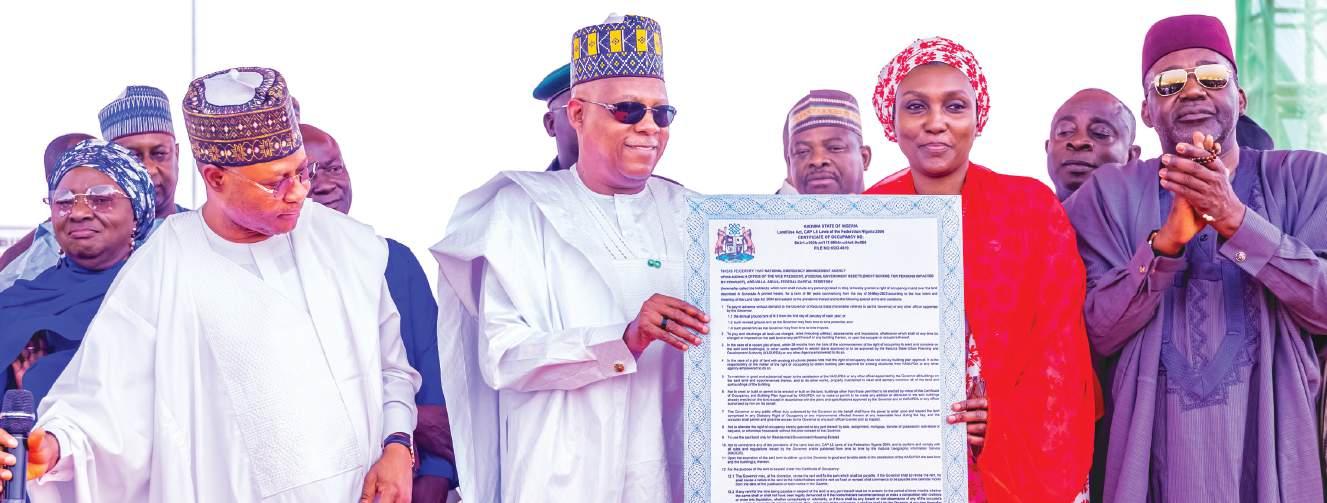
L-R: Governor of Kaduna State, Senator Uba Sani; Vice President, Senator Kashim Shettima; Director General, National Emergency Management Agency
to the President, Senator Ibrahim Hassan Hadejia,
Nigeria Calls for Reactivation of Regional Standby Force to Tackle Insecurity in West Africa
President Bola Tinubu has called for the reactivation of a regional standby force to strengthen collective security efforts in West Africa and the Sahel, urging countries in the region to leverage Nigeria’s National Counter Terrorism Centre in Abuja as an intelligence and operations hub.
Tinubu’s position was conveyed in Nigeria’s official statement delivered by the Minister of State for Foreign Affairs, Ambassador Bianca Odumegwu-Ojukwu, at the Conference on Security Situation, Operational Challenges and Future Risk Trajectories in West Africa and the Sahel, held in Accra, Ghana, from January 29 to 30, 2026.
According to a statement issued yesterday in Abuja by the Special Assistant on Communications and New Media to the minister, Magnus Eze, the president reaffirmed Nigeria’s unwavering commitment to safeguarding peace, security,
and stability in the region, stressing the need for stronger multilateral cooperation to address the worsening security situation in the Sahel.
“Nigeria is favourably disposed to more collaborative and multilateral approaches aimed at dealing with the security crisis in the Sahel,” Tinubu said.
He noted that Nigeria continues to monitor and disrupt terrorist activities through joint efforts with regional and continental institutions, including the Regional Intelligence Fusion Unit, the Liaison Fusion Unit, the Eastern African Fusion Unit, and the Committee of Intelligence and Security Services of Africa.
He recalled that in 2025, the NCTC signed a Memorandum of Understanding with the African Union to collaborate on counterterrorism and violent extremism across the continent.
“The centre is therefore well positioned to support regional
Falana: Lagos Demolitions Threat to Rule of Law
Human rights lawyer, Femi Falana, SAN, has argued that the rule of law is under threat in Nigeria, referencing the controversial Makoko and Oworonsoki demolitions, which triggered outrage and protests among residents in Lagos State.
He spoke in Abeokuta, Ogun State, on Saturday at the 2025 Annual General Conference of the Committee for the Defence of Human Rights (CDHR).
The conference, with the theme “Advancing and Defending the Rule of Law in Nigeria: Stakeholders’ Tragedy and Way Forward,” attracted civil society leaders and delegates from across the country.
In his remarks, Falana, represented by Malachy Ugwumadu, a legal practitioner, expressed concern over lack of freedom to protest, press freedom, and respect for court judgments.
He said, “The question is, do we have a full dose of the rule of law operational in our country? It’s a question. Can we boldly say that the rule of law operates in our country, even under civil dispensation, which they call democracy? Can we say so? If we can say so, for so many other countries, I’m sure what is happening in Oworonsoki in Lagos is a good example that the rule of law is not operational.
“Thousands of Nigerians are not just being displaced; their properties are razed down, even while many of them are in there with children, innocent children.
“The only offence is that they belong to the demographic of weak Nigerians, who are not as financially buoyant as those that live in Ikoyi and Ajah, as the case may be.”
mechanisms and serve as an intelligence coordinating hub in our unified counter-terrorism efforts,” the president added.
Tinubu also warned about the growing use of cyberspace by terrorist groups for misinformation and disinformation campaigns, which he said undermines security and stability in the region.
Following what he described
as “momentous gains” by Nigeria in cyber monitoring, surveillance, and intelligence gathering through the National Cyber Security Centre in Abuja, Tinubu urged other West African states to leverage Nigeria’s infrastructure to establish regional mechanisms to counter cyber-enabled threats.
“Security cooperation
remains central to Nigeria’s national interest and regional stability. Through joint initiatives, intelligence sharing and coordinated operations, Nigeria seeks to enhance our collective ability to combat terrorism, transnational organised crime and other forms of insecurity that undermine our individual and collective development,” he said.
The president said the security situation in large parts of West Africa remains volatile, with rising casualties of violence, including among women and children. He identified the absence of a single counterterrorism focal point and thinly spread defence formations as key factors creating power vacuums that militant groups have exploited.
Matawalle: Tinubu Set for Convincing Victory in 2027
The Minister of State for Defence, Alhaji Bello Matawalle, has expressed strong confidence that President Bola Tinubu will secure a convincing victory in the 2027 presidential election, urging Nigerians and political stakeholders to rally behind the president’s reform agenda.
Speaking at his residence in Abuja yesterday, Matawalle said President Tinubu’s leadership and policy direction have positioned the country on the path of economic stabilisation, institutional strengthening and
national cohesion.
The minister cautioned against what he described as premature political manoeuvres and power struggles targeted at undermining the current administration, warning that such actions are self-serving and detrimental to Nigeria’s democratic stability.
He said, “President Tinubu has taken bold steps to stabilise the economy and strengthen national institutions.
“Those plotting to unseat him are motivated by personal
interests rather than the public good. If allowed to complete his reform programme, I am confident the President will win convincingly in 2027.”
Matawalle noted that the impact of the President’s policies is already being felt across the country, particularly in the northern region, citing improvements in governance, security initiatives and institutional reforms.
He called on political actors to embrace constructive
engagement instead of divisive tactics, stressing that national interest should take precedence over personal ambition.
The minister also appealed to Nigerians to support government policies aimed at promoting sustainable economic growth, improving security and strengthening national unity.
“Rather than engaging in rancour and short-term political calculations, we should focus on solutions that deliver jobs, security and stronger institutions for Nigerians,” he said.
FG: Road Contractors Back to Site after Security-induced Slowdown in Niger
Emmanuel Addeh in Abuja
The federal government at the weekend said contractors handling major road projects in Niger State have returned to site after an initial slowdown caused by security challenges, assuring that work is now progressing steadily following improved safety conditions.
Federal Controller of Works, Aluko Eyitayo, disclosed this during an inspection tour of ongoing federal road projects across the state, stressing that insecurity had earlier forced contractors to suspend work for months on some critical corridors.
Eyitayo explained that the Tegina–Kontagora section of the Minna–Zungeru–Tejina–
Kontagora road, a key route linking the north-central and north-west zones, suffered major delays due to persistent security threats.
However, he clarified that efforts of the government and security operatives have restored confidence in the affected areas while government contractors have now moved back to their respective sites.
He explained that the Tegina–Kontagora section of the Minna–Zungeru–Tejina–Kontagora road, a key route linking the north-central and north-west zones, suffered major delays due to persistent security threats.
Eyitayo said: “The contractor is on site, but due to the high level of insecurity around
that area, that has really slowed down the progress of work. But through the concerted efforts of the government, the Executive Governor of Niger State and security agencies, the contractors have moved back to site, and the work is ongoing.”
He said the road, with a total length of about 95 kilometres, has recorded about 18 kilometers of asphalt laying since work resumed.
On the Bida–Zungeru–Wushishi Road, being handled by Gerawa Nigeria Limited, Eyitayo said about 16 kilometres of the 29.5-kilometre road has been asphalted, while work is ongoing with satisfactory quality.
Similarly, he said phase one of the Minna–Tegina road, being executed by Messrs HMF Nigeria Limited, has recorded about 38 kilometres of asphalt laying out of its 94-kilometre length.
Eyitayo also revealed that the Suleja–Minna Road project, earlier stalled due to poor performance by contractors, has been terminated and is being re-awarded, with construction expected to resume soon. Despite the challenges, the controller said contractors have generally performed satisfactorily, and expressed optimism that improved security and sustained government intervention would accelerate progress on the projects and restore vital transport links in the region.
(NEMA), Mrs. Zubaida Umar; and Deputy Chief of Staff
during the presentation of Certificate of Occupancy by the vice president to Director General NEMA for the land used for construction of houses under the Rehabilitation Scheme for Persons Impacted by Conflicts (RSPIC) by NEMA at Tudun Biri, in Kaduna State…Friday
PFN, Middle Belt Youths, Fault SCSN, Rejects Calls for Removal of INEC Chairman
The Pentecostal Fellowship of Nigeria (PFN) and the Middle Belt Youths Forum have rejected calls by the Supreme Council for Shari’ah in Nigeria (SCSN) to remove the Chairman of the Independent National Electoral Commission (INEC), Prof. Joash Amupitan.
President of the SCSN, Sheikh Bashir Umar, had at the Council’s 2026 Annual PreRamadan Lecture on Tuesday in Abuja, said Amupitan’s position on allegations of Christian genocide “amounted to divisive propaganda and raised serious doubts about his impartiality as the head of the electoral body,” and asked him to resign or be dismissed.
But in a swift response, the
Christian Association of Nigeria (CAN) in the 19 northern states and the Federal Capital Territory (FCT) rejected the calls by the SCSN, describing the demand as an attempt to politicise religion and undermine a key national institution.
In a statement issued by the Chairman of Northern CAN, Rev. Joseph Hayab, and its Secretary-General, Bishop Mohammed Naga, the Christian body had questioned the motive behind the demand, asking who was sponsoring the call and why such interests were being pursued under the platform of a religious organisation.
Similarly, PFN has condemned such calls, saying the INEC chairman has the right to express his personal views on issues of national concern.
Hoodlums Disrupt LP, ADC Event in Lagos
Unidentified hoodlums yesterday disrupted the Labour Party (LP) – African Democratic Congress (ADC) event in Alimosho Local Government Area of Lagos State.
The event was organised by the parties to formally mark the defection of LP members in Alimosho to the ADC.
The hoodlums, numbering over 100, stormed the first venue of the event at the LP office in Idumu and sent members, including officials, running for their lives.
The hoodlums, who were seen welding different kinds of weapons, including knives and canes, were beating anyone they caught while the mayhem lasted.
Some of the hoodlums were shouting that LP-ADC is not welcome in Lagos state.
Some party members sustained varying degrees of injuries.
Undeterred by the disrup-
tion, officials from both parties swiftly arranged an alternative venue at the Eco Centre Event in Egbeda.
Recounting the ordeal. The LP chairman in Alimosho, Mr Olaranwaju Olushola, popularly known as Heritage in Lagos, described the attack on his members as unwarranted.
He expressed concern that many Nigerians may not be free to express themselves in the lead-up to the 2027 general elections.
‘What is most painful is that most of my members sustained varying degrees of wounds. This is despite the hoodlums going into our party secretariat in Alimosho, destroying our furniture and flags.”
The party chairman, however, said that the members had already defected en masse, noting that today’s event was not an official defection but a ceremony to inform Nigerians of their move.
A statement signed by the National Secretary of the PFN, Bishop David Bakare, condemned in every ramification, suggestions for the removal of Amupitan.
“We strongly oppose such calls because Prof. Amupitan, as a Nigerian, has the right to make comments on what
he observes to be happening in the nation, regardless of his appointment or assignment.
“We condemn in every ramification the suggestion that he should be removed from office on this basis”.
“This matter has nothing to do with his assignment. It has nothing to do with elections
or any electoral activity for which he is appointed.
“He should not be punished for taking a position as a true Nigerian,” the statement said.
Bakare said Nigerians must resist the temptation to judge people based on their religious beliefs or positions.
On its part, the Middle Belt Youths Forum, in a statement from its leader, Comrade Meliga Godwin, issued a strong warning to SCSN over what it described as inflammatory statements that could undermine national unity and the credibility of the 2027 general elections.
Deny Bandits Safe Havens, Defence Minister Urges Nigerians
The Minister of Defence, General Christopher Musa (rtd), has called on Nigerians to deny bandits, kidnappers and terrorists any form of safe haven, stressing that public cooperation remains critical to ending insecurity in the country.
He warned that such groups thrive when communities provide them shelter, food or silence, either knowingly or unknowingly.
Speaking at the seventh Our Nigeria News Award
ceremony in Abuja on Saturday, Musa urged citizens to report suspicious activities promptly.
He said, “This is a modern kind of warfare. Asymmetric warfare is not easy; it is not like conventional warfare, where you are fighting another country. In asymmetric warfare, the enemy is within, and that is why it is the most dangerous.
“You cannot see it on a person’s face; it could be someone you think is your friend. You turn your back, and he shoots
you from behind. That is why it is important that people do not give criminals any safe haven. If you see anyone committing a crime —whether a bandit, kidnapper, terrorist or insurgent — please report it as quickly as possible, and action will be taken.”
The minister thanked Nigerians for their support and perseverance, appealing to them not to get tired or give up on the country.
He said the Federal Government, under President Bola
Tinubu, was doing everything possible to restore peace, including strengthening international partnerships.
Musa disclosed that Nigeria recently signed securityrelated agreements in Turkey aimed at improving peace and stability.
“We are getting there; it’s improving by the day. We all need to put our hands together to make sure it works. It is a whole-of-society approach to peace, and we are heading in the right direction.
Ebonyi Gov Sacks Commissioner, Traditional Rulers over Killings
benjamin Nworie in Abakaliki
The Ebonyi State Governor, Francis Nwifuru, has ordered the removal of traditional rulers in the Amasiri clan of Afikpo Local Government Area and directed the withdrawal of their staff of office.
He also sacked the Commissioner for Tertiary Education from the area, Prof. Amari
Omaka, and dissolved the entire political and traditional leadership structure of the community.
The actions followed a violent attack on Okporojo in Oso Edda community, Edda Local Government Area, during which four persons were allegedly beheaded, with their heads taken away by assailants from the Amasiri clan.
The governor gave the directives on Saturday during an on-the-spot assessment visit to Okporojo, where he addressed residents, community leaders, security agencies and government officials.
Nwifuru described the attack as “most unfortunate” and said such a barbaric act should never be tolerated in Ebonyi State.
He assured that the state
government would decisively deal with the perpetrators, stressing that the lives lost would not be in vain.
He urged residents to remain calm and embrace peace, warning that any form of retaliation would only worsen the situation. According to him, government actions would be firm but guided by the need to prevent further escalation of the crisis.
Lightbay Energy Resources, Neopower to Showcase Sustainable Power Solutions
Lightbay Energy Resources Limited will showcase its growing portfolio of sustainable and high-reliability power solutions in partnership with NeoPower, a global manufacturer of industrial voltage stabilisation systems in a Powerelec Nigeria 2026 exhibition.
During the exhibition, the company said it will engage policymakers, investors, utilities, and industrial stakeholders on
practical approaches to delivering clean, reliable, and affordable power across critical sectors of the economy as part of its contribution to Nigeria’s energy transition and the United Nations Sustainable Development Goals (SDGs).
Speaking ahead of the event, the Chief Executive Officer of Lightbay Energy Resources, Mr. Tega Erhiwha, reaffirmed the company’s commitment to
improving power quality, system efficiency, and infrastructure resilience in Nigeria.
“As Nigeria accelerates its energy transition, reliability must remain central to the conversation,” Erhiwha said. “Our participation at Powerelec Nigeria 2026 reflects Lightbay’s focus on solutions that protect critical assets, reduce downtime, and support sustainable industrial growth.”
A major highlight of Lightbay’s exhibition will be its strategic partnership with NeoPower. Under this partnership, Lightbay Energy Resources has been appointed NeoPower’s authorised partner in Nigeria, with responsibility for the marketing, distribution, installation, and after-sales support of NeoPower’s industrial voltage stabilisers ranging up to 3000kVA.
John Shiklam in Kaduna
L-R: Chief Executive Officer, UBA UK, Mr. Loknath Mishra; Managing Director/CEO, Unity Bank Plc, Mr. Ebenezer Kolawole; and Head, Trade Finance, UBA UK, Mr. Mark Ifashe, during a courtesy visit by the UBA UK delegation to Unity Bank Plc Headquarters in Lagos…recently
Editor: Festus Akanbi
08038588469 Email: festus.akanbi@thisdaylive.com
The Rise of POS Agents as Nigeria’s News Cash Banks
While regulators focus on building stronger, better-capitalised banks, millions of Nigerians are quietly grappling with a more basic problem: how to access their own cash. As ATMs run dry and POS kiosks fill the gap at a cost, a parallel cash economy is reshaping everyday banking in Nigeria, writes Festus Akanbi
Nigeria’s banking conversation is currently dominated by the Central Bank of Nigeria’s push for stronger, better-capitalised banks. The recapitalisation drive is framed as a foundation for stability and resilience, and as part of the ambition to build a $1 trillion economy. Yet, running parallel to this regulatory focus is a quieter but more intimate anxiety among bank customers: the growing difficulty of accessing their own cash through banks’ traditional channels, particularly automated teller machines, and the gradual outsourcing of this core banking function to point-of-sale operators.
This tension between balance sheet strength and service delivery has become increasingly visible in everyday life.
Social media critic, Mimj Yakigar, captured a widespread sentiment when she asked, “When exactly did POS replace ATMs in Nigeria? Nobody introduced it to us. It just happened.”
Her observation reflects not a sudden policy shift but a gradual consumer adaptation to repeated service failures. ATMs were designed to embody a simple promise of banking: your card, your money, instant access, with no intermediary. Over time, that promise weakened under the weight of persistent network errors, debits without cash, delayed reversals, and layered charges. As these frictions became routine rather than exceptional, an alternative channel filled the gap.
Point-of-sale terminals were originally introduced as payment tools to help merchants accept electronic payments. Their evolution into cash-dispensing points was not driven by formal design but by necessity.
As Yakigar noted, POS did not rise because it was inherently superior to ATMs but because “the system started failing, not once, not twice, but consistently.” In this sense, the growth of POS cash withdrawals is less a story of innovation than one of adaptation within a stressed system.
Shifting to POS
Ironically, the same banks that issue ATM cards are also at the centre of POS expansion, either directly or through fintech partnerships. This has created a peculiar outcome in which customers increasingly pay a premium to access funds already held within the formal banking system.
In markets and neighbourhood kiosks across the country, cash has itself become a commodity. A customer seeking N10,000 may be charged N 10,500 or more, depending on location, timing, and availability. What emerges is a parallel cash economy operating alongside regulated banking, where money is no longer withdrawn but effectively resold.
The CBN does not dispute the continuing importance of cash. Speaking at the 2026 Committee of Heads of Bank Operations conference in Lagos, Governor Olayemi Cardoso, represented by his adviser Fatai Karim, stated clearly that “cash remains king.” According to the CBN, ATMs and POS terminals together increased cash circulation by 4.6 per cent in 2025, underscoring their role in stabilising cash distribution. Cardoso emphasised that while electronic transactions have grown rapidly, they cannot fully replace cash, particularly in rural and informal settings. Electronic payment volumes rose by 276 percent over five years, with transaction values increasing by 581 percent, yet physical cash remains essential for inclusion. Industry leaders echo this dual reality. Pius
Olanrewaju, president of the Chartered Institute of Bankers of Nigeria, noted that although electronic transactions exceeded 60 billion in 2025, cash remains vital for low-value transactions in informal and rural areas.
Chairman of the Committee of Heads of Bank Operations, Abraham Aziegbe, noted that ATM withdrawals totalled N36.34 trillion in the first half of 2025, underscoring Nigerians’ continued reliance on cash even amid digital growth. These figures suggest that demand for cash has not disappeared; rather, access to it has shifted.
On the ground, that shift is unmistakable.
In markets like Mile 12 in Lagos, customers now instinctively ask for the nearest POS operator rather than an ATM. A 35-year-old lawyer, Zainab Okosun, described how she paid N2,400 in charges to withdraw N80,000 from a POS operator after struggling with ATM queues in the past. Her experience reflects a broader pattern: ATMs that are “temporarily unable to dispense cash,” machines disabled in the evenings or on weekends, and long queues that make POS withdrawals, even at a premium, the more predictable option.
The Pressure Banks cite several pressures behind this trend. According to POS aggregators like Tinuke Adebola, ATM operations have become increasingly expensive and stressful. Power supply, security, cash movement, foreign exchange constraints, inflation, and policy uncertainty all add to costs, while ATM usage does not always generate commensurate profit.
In a profit-driven system, banks have little incentive to expand or even maintain extensive ATM networks. POS operators, by contrast, operate flexible, decentralised models, sourcing cash locally and passing costs directly to customers.
Data from the Nigeria Inter-Bank Settlement System illustrates the scale of this transformation. As of August 2024, Nigeria had over 26.5 million registered PoS terminals, processing trillions of naira in transactions. Fintech firms such as Moniepoint, PalmPay, and OPay dominate this space. At the same time, the Association of Mobile Money and Bank Agents of Nigeria estimates that the sector has created over two million jobs. From a
financial inclusion perspective, this expansion fills real gaps, especially in over 300 local government areas without bank branches.
However, inclusion through intermediaries comes with trade-offs. Charges are unregulated and vary widely by location, from modest fees in densely populated areas to steep premiums in high-brow neighbourhoods or cash-scarce communities. As Yakigar observed, this normalises a system in which people pay for the privilege of accessing their own money. Over time, this risk reshapes economic expectations, particularly among young Nigerians who may come to see “selling money” as a standard form of entrepreneurship.
The recapitalisation debate intersects with this reality in important ways. As Alliance Law Firm has noted, increased bank recapitalisation strengthens balance sheets and regulatory resilience but does not automatically translate into better customer service, lower fees, or improved access. Larger, better-capitalised banks may even reduce competition, creating institutions that are stable yet distant from everyday consumer needs. In such a context, the outsourcing of cash access to PoS agents can be seen as a rational response by banks, but also as a signal of service lag rather than technological progress.
The CBN has acknowledged these complexities, indicating that it is reviewing policies such as the ratio of bank-issued cards to ATMs. Cardoso has stressed that cash availability depends not only on currency issuance but also on logistics, infrastructure, incentives, and coordination among institutions. His framing of the future of money as both physical and digital suggests recognition that balance, rather than replacement, is the goal. Ultimately, the rise of POS as the primary source of cash access in Nigeria does not mean ATMs have become obsolete. It reveals a system in which service delivery has struggled to keep pace with demand, and adaptation has filled the gaps.
As Yakigar concluded, “POS did not replace ATM; it exposed a system where money is sold, not served.” The challenge for regulators and banks alike is to ensure that strengthening the financial system’s foundations does not come at the expense of its most basic promise: reliable, affordable access to one’s own money.
A crowd of customers at bank ATM terminal
A POS platform
www.thisdaylive.com
FINISHING STRONG: BEHOLD THE HOUR COMETH…
Eseme Eyiboh says whether the Senate finishes strong will depend not on rhetoric, but on deeds
See Page 20
NIGERIA’S COUP PLOT CONTROVERSY
Felix Oladeji argues that the issue raises question of transparency, trust and balanced communication of national security affairs
See Page 20
opinion@thisdaylive.com
It is the refusal to treat security as a central economic variable rather than a parallel sectoral issue, argues K BOLANLE ATI-JOHN
NIGERIA’S ECONOMIC RECOVERY HAS A BLINDSPOT
Nigeria enters 2026 with something it has not enjoyed in a long time: a narrow but genuine margin for choice. After years of macroeconomic turbulence, the immediate threat of collapse has receded. Inflation, while still burdensome for households, has begun to ease. The exchange rate, once a symbol of disorder, has stabilised. External reserves have been rebuilt to levels not seen in years. Confidence, tentative and cautious, is returning to markets and boardrooms.
This moment has rightly been described by Nigeria’s leading policy and business voices as a transition from stabilisation to consolidation. Stabilisation is the phase in which a country stops the bleeding. Consolidation is the phase in which it decides whether recovery will endure or quietly unravel. History is unambiguous on this point. Many countries stabilise. Far fewer consolidate. And when consolidation fails, it is rarely because policymakers lack technical sophistication or economic insight. It fails because the underlying problem has been misdiagnosed.
Nigeria now risks such a misdiagnosis.
The current economic conversation, including the most influential assessments shaping government and business expectations, is broadly correct about the macroeconomic picture. But it remains incomplete in its understanding of what consolidation requires in a country like Nigeria. The missing link is not another fiscal adjustment or a marginal monetary recalibration. It is the persistent refusal to treat security as a central economic variable rather than a parallel sectoral issue.
Until this changes, Nigeria’s recovery will remain fragile improved on paper, but exposed in practice.
Macroeconomic stabilisation is a necessary achievement. It restores confidence, curbs panic, and creates room for policy. Nigeria’s recent reforms have done exactly that. But stabilisation is a pause, not a destination. It buys time.
It does not, by itself, create resilience. Consolidation is the far more demanding phase. It is the point at which gains become irreversible, expectations shift from fear to confidence, and institutions begin to matter more than personalities. It is also the phase at which reform efforts most often falter.
The early signs of this tension are already visible. Economic growth remains below the level required to absorb a rapidly expanding population. Food prices continue to dominate household distress despite a general disinflation trend.
Agriculture and manufacturing, the sectors that anchor broad based prosperity, remain constrained. Investment flows, though improved, are still skewed toward short term instruments rather than long term productive commitments. These outcomes are not anomalies. They are signals.
They are also security conditioned realities.
Nigeria’s economy does not operate in the
abstract space assumed by many economic models. It operates in contested territory physically, legally, and institutionally. Farmers do not decide whether to plant based solely on price signals or access to credit.
They decide based on whether they can reach their land safely and whether their harvest can get to market.
Transporters do not calculate margins in isolation; they factor in unsafe roads, unpredictable checkpoints, and the risk of loss. Manufacturers hedge not just against inflation and exchange rate volatility, but against power failures, logistics disruptions, and insecurity along supply chains. Investors do not price Nigeria solely on macro indicators; they discount physical exposure, legal uncertainty, and the enforceability of contracts. These are not secondary inconveniences. They are decisive economic variables.
Food inflation in Nigeria is not primarily a monetary phenomenon. It is a security phenomenon. It reflects disrupted production zones, unsafe transport corridors, and fragmented access to markets. Logistics costs are not merely a consequence of infrastructure deficits; they are shaped by insecurity, informal toll systems, and weak enforcement.
The subdued response of long term investment is not simply a function of interest rates; it is driven by uncertainty over whether assets can be protected, disputes resolved, and economic order maintained.
Yet economic policy continues to treat these realities as exogenous shocks unfortunate interruptions rather than structural constraints.
For decades, Nigeria has framed security
largely as a cost centre, an unavoidable expenditure to be funded alongside other priorities. This framing is analytically flawed and strategically costly. Security is not a drag on growth. It is a prerequisite for it. Every economy that has sustained growth has done so on the back of enforceable order: predictable rules, protected assets, safe movement, and credible authority. Where these conditions weaken, economic performance follows. Where they strengthen, productivity responds.
Nigeria’s challenge is not a shortage of economic ideas. It is the fragility of the space in which those ideas must operate.
A country cannot consolidate its currency while losing control of productive territory. It cannot sustain disinflation while food systems operate under persistent threat. It cannot deepen private investment while firms bear unpriced physical and legal risks.
And it cannot expect citizens to endure reform pain indefinitely when insecurity erodes daily life. Stabilisation creates time. Security determines whether that time is converted into lasting strength.
History offers a clear pattern. When consolidation fails, it is rarely because reform is abandoned outright. It fails because the social and economic environment in which reform must take root remains hostile. Inflation returns not because central banks lose discipline, but because supply chains fracture. Fiscal gains erode not because budgets loosen, but because leakage persists in ungoverned spaces. Investment stalls not because policy reverses, but because risk remains opaque and unmanageable. Public support fades not because citizens reject reform in principle, but because they experience sacrifice without protection.
Nigeria exhibits all these vulnerabilities. The danger is not dramatic collapse. It is gradual relapse: growth that never quite accelerates, inflation that never quite disappears, investment that never quite commits, and a public that grows quietly cynical. This is the most dangerous outcome of all, because it appears stable until it is not. If consolidation is to succeed, it must be redefined. It cannot be limited to policy continuity or macro discipline. It must encompass governance consolidation: the state’s ability to secure the economic space in which markets operate. This requires a shift in thinking as much as in policy.
Security must be embedded in macroeconomic analysis, not appended to it. Inflation, productivity, and growth projections that ignore insecurity are incomplete. Security is not an external shock; it is an internal driver. Productive and logistics corridors must be treated as macroeconomic assets.
Agricultural belts, transport routes, energy infrastructure, ports, and trade nodes are not merely sectoral concerns. Their security underpins price stability, export performance, and employment. Reform dividends must be visible in daily life.
Rear Admiral Ati-John (rtd) writes from Lagos
FINIShING STRONG: BEhOLd ThE hOUR COmETh…
Eseme Eyiboh says whether the Senate finishes strong will depend not on rhetoric, but on deeds
There are moments in a nation’s life when institutions are reminded—quietly but unmistakably—that time does not negotiate with comfort. Nigeria’s Senate, returning from the conviviality of Christmas recess and New Year reflection to the discipline of plenary, has arrived at such a moment. The period of acclimatization has passed. The era of testing intentions is over. What remains is a phase in which time asserts itself, when the calendar ceases to be a backdrop and becomes an active force in governance.
WhenthePresidentoftheSenate,Godswill
Obot Akpabio, rose to welcome colleagues back to the chamber in early 2026, he spoke with an ease that respected ceremony while remaining alert to consequence. The tone was cordial but unsentimental; reflective without wandering. Beneath the courtesy was a clear intimation that the Tenth Senate had crossed from the comfort of beginnings into the gravity of its defining phase.
He began where seriousness often takes root—not with policy, but with people. The recess, he reminded senators, was not an escape from accountability but an extension of it: time spent among constituents, reengaging voices that do not echo within the chamber, absorbing frustrations that do not arrive neatly packaged as memoranda, and reconnecting with the human weight behind legislative abstractions. In doing so, Akpabio quietly reaffirmed representation as a lived obligation rather than a procedural formality.
The Senate, however, resumed its work under the shadow of loss. The death of Senator Godiya Akwashiki during the recess lent the chamber a gravity that could not be ignored. Akpabio’s tribute was spare, almost austere, and for that reason it carried weight. He spoke of diligence, humility, and responsibility—not as ornament, but as the unobtrusive virtues that prevent institutions from emptying themselves of meaning. The moment of silence that followed served as a reminder that democracy rests not only on arithmetic and procedure, but on the moral character of those entrusted to serve.
The address then widened its lens to the nation beyond the chamber. Nigeria, Akpabio observed, did not pause while the Senate recessed. Economic pressures persisted. Security challenges endured. Social demands intensified. Yet threaded through this catalogue of strain was a firm insistence on resilience. Nigerians, he argued, have continued to endure and adapt, expressing themselves not only through protest or complaint, but through work, enterprise, and a stubborn conviction that tomorrow need not be a repetition of today. This framing mattered. It acknowledged hardship without normalizing it, and resilience without romanticizing suffering. More importantly, it returned responsibility to leadership. Public expectations, Akpabio cautioned, have not diminished with time; they have sharpened.
Security, inevitably, commanded attention. The Senate President welcomed ongoing military cooperation between Nigeria and the United States as part of a broader effort to confront terrorism and safeguard stability. Yet strategy did not eclipse humanity. His condolences to families bereaved by insecurity were measured but sincere, underscoring a truth often obscured by briefings and statistics: security is not an abstraction, but the difference between return and absence, between continuity and grief.
Equally sobering was the warning that as many as 35 million Nigerians may face hunger in the coming year. This was not treated as a distant projection to be acknowledged and deferred, but as an imperative demanding legislative urgency,
rigorous oversight, and collaboration. Food security, in this context, is not charity; it is statecraft.
As the political season approaches with its familiar excesses, Akpabio’s appeal for civility and restraint was timely. Democracy, he implied, is not weakened by competition but by recklessness; not threatened by ambition but by the abandonment of responsibility. National unity, he warned, must never become collateral damage in the contest for power.
The address also made deliberate space for Nigerians whose lives remain suspended in captivity within their own country. Akpabio urged continued remembrance and prayer, resisting the political impulse to move on too quickly. Progress that ignores unresolved pain, he suggested, is progress in name only.
Threaded through the address was an endorsement of the Renewed Hope Programme of the Tinubu administration— not as a panacea, but as a collective undertaking requiring patience, discipline, and cooperation. Hope, in this telling, is not sentiment; it is work.
Then came the central fact. With less than one year and five months remaining, the Tenth Senate has entered its final stretch. Akpabio stated this plainly, without theatrics. The final stretch, he argued, is where participation yields to performance— where urgency must be embraced without panic, reform pursued without recklessness, and productivity demanded without compromising standards.
What followed was a concise legislative philosophy. The months ahead must be reform-driven. Laws passed now must strengthen institutions, secure lives and property, unlock growth, and restore confidence in the Nigerian state. There was a pointed warning against legislative clutter and symbolic excess. History, Akpabio reminded his colleagues, is unimpressed by volume; it is persuaded by value.
He described the task ahead as institutional housekeeping: clearing bottlenecks, completing what was begun, and leaving behind laws that function rather than frustrate. The imagery was modest, but the implication was serious. Governance, at its best, is stewardship rather than spectacle. The vision outlined was ambitious yet restrained: a Nigeria more governable than it was met; more just than it was found; more hopeful than it was entrusted to this generation of lawmakers. Institutions stronger than individuals. Laws that serve rather than burden. It was nation-building language—and an invitation to judgment.
NIGERIA’S COUP PLOT CONTROVERSY
Felix Oladeji argues that the issue raises question of transparency, trust and balanced communication of national security affairs
Recent developments surrounding an alleged plot within the Nigerian military to overthrow President Bola Ahmed Tinubu have thrust questions of security, governance, transparency, and public trust back into the national spotlight. In a statement released on January 26, 2026, the Defence Headquarters (DHQ) confirmed that investigations into the conduct of 16 Nigerian Army officers uncovered actions inconsistent with military ethics and professional standards, including allegations of plotting to overthrow the government. The findings, the DHQ said, have been forwarded to appropriate authorities and may lead to disciplinary and judicial proceedings under established military regulations.
The confirmation marks a significant shift from official positions in late 2025, when the DHQ categorically dismissed reports linking cancelled national events including Nigeria’s 65th Independence Day parade to coup rumours, insisting that the investigations involving the officers were routine disciplinary matters and not related to any attempt to destabilise constitutional governance. This return to the public stage of a sensitive matter raises critical questions about the nature of civilmilitary relations, democratic accountability, and the communication of national security affairs in an era of heightened political scrutiny.
Nigeria’s history is no stranger to military interventions in politics. Though the nation has maintained civilian rule since 1999, episodes of rumour, fear, and speculation about coups often fuelled by opaque communication and muted official responses continue to test public confidence.
The handling of the latest episode illustrates a deeper challenge: the gap between official narrative management and the public’s need for credible, consistent information. When denials are followed by confirmations, citizens are left to wonder not only about the facts on the ground, but about the transparency and motives of those charged with defending constitutional order.
This controversy also underscores the importance of clear and timely communication from state institutions. In democratic societies, the management of national security information must be balanced carefully against public interest — protecting genuine operational confidentiality while avoiding the kind of speculation that erodes trust and fuels anxiety. The African Democratic Congress (ADC), for instance, has previously called on the government to clarify such reports transparently, emphasising that any
legitimate threat should be communicated in ways that preserve public confidence rather than deepen uncertainty.
Nigeria’s armed forces, for their part, have long asserted their loyalty to constitutional governance and civilian authority, reaffirming their commitment to national stability amid swirling rumours and misinformation. When former reports denied coup links, the DHQ repeatedly emphasised that the arrests and investigations were disciplinary and unrelated to any plot — framing the armed forces as an institution loyal to democracy and rule of law. Yet the subsequent revelation of confirmed allegations - however procedurally characterised; highlights the challenges inherent in managing sensitive information in fragile political contexts. The broader context within West Africa further complicates public perceptions. Recent attempted coups in neighbouring states, and Nigeria’s own role in regional security operations; such as troop deployments in response to instability in Benin Republic — remind citizens and policymakers alike that democratic resilience cannot be taken for granted in the region. These regional dynamics make transparent governance and disciplined institutional communication all the more necessary at home.
At its core, this episode is not only about the specifics of military discipline or internal investigations; it is about trust in democratic institutions. A thriving democracy depends on robust oversight, credible communication, and citizen confidence that state actors are accountable and that national security challenges are addressed within constitutional bounds.
As Nigeria navigates this moment, it should reaffirm its commitment not only to constitutional order but to transparent governance ensuring that allegations, investigations, and official responses strengthen rather than weaken the public’s faith in democratic norms. Delivering clarity without compromising legitimate security procedures is a delicate balance, but one that is essential for democratic consolidation in a nation still striving to align its governance practices with the expectations of its people and the demands of a rapidly changing geopolitical landscape.
Oladeji writes from Lagos
Hon Eyiboh is the Special Adviser on Media and Publicity to the President of the Senate
Editor, Editorial Page PETER ISHAKA
Email peter.ishaka@thisdaylive.com
ON THE ABORTED COUP ATTEMPT
Despite lapses, Nigeria is better off with democratic governance
After weeks of denial and stonewalling, the military high command has finally confirmed reports of a foiled attempt to topple the administration of President Bola Tinubu. In a statement released by the Director of Defence Information, Major-General Samaila Uba, findings of their investigation identified “a number of the officers with allegations of plotting to overthrow the government.” Although the management of information on this matter has been anything but salutary, our national history makes it imperative that we treat acts of mutiny, armed insurrection, revolt and coup attempts with all seriousness. In a democracy, there is no room for unconstitutional acquisitions of power or any conduct “inconsistent with the ethics, values and professional standards required of members of the Armed Forces of Nigeria.”
unrest and coups in some African countries enlarges the red flag in Nigeria even further. At about the time the ‘coup’ was first reported online last October, an elite unit of the Madagascar armed forces had just overthrown the government of President Andry Rajoelina, following weeks of civil protest. Before then, there had been military takeover of government in some countries within the subregion notably Niger, Burkina Faso, Chad, Mali, and Guinea. That was what heightened concerns when reports of a coup attempt in Nigeria first surfaced.
Beyond bringing the culprits to justice, the current administration must also refocus attention on the welfare of citizens. Even when military coups offer no solution to political problems, the ultimate lesson is for leaders to be more accountable to the people
As we stated when the news first broke, Nigeria has a long nasty memory of undemocratic rule which ought to make the word ‘coup’ singularly ugly in our political discourse. While reminding the public that in October 2025, Defence Headquarters had announced the arrest of 16 officers accused of indiscipline and violations of military codes, Defence authorities have promised that “those with cases to answer will be formally arraigned before appropriate military judicial panel to face trial in accordance with the Armed Forces Act and other applicable service regulations.”
Military personnel who deviate into dangerous acts bordering on treason must understand the full consequences and brace up for them. But we must caution that there be factual parameters in investigating and punishing offenders in the alleged coup attempt. The Tinubu administration must also avoid the temptation to politicise the issue. There is a dividing line between genuine and legitimate opposition to the incumbent administration’s policies and plain acts of professional misconduct among the rank and file of the armed services.
What is at stake most crucially is the plight and future of civil rule, especially in a continent where economic stagnation, jihadist insurgency, bad politics and disastrous governance have quickened the pressure towards military dictatorships. The wave of recent
SUNDAY NEWSPAPER
editor DAviDSoN iRiEkpEN
deputy editors FESTUS AkANBi, EJioFoR ALikE
Managing director ENioLA BELLo
deputy Managing director iSRAEL iwEgBU
chairMan editorial Board oLUSEgUN ADENiYi
editor nation s capital iYoBoSA UwUgiAREN the oMBudsMan kAYoDE koMoLAFE
group executive directors ENioLA BELLo, kAYoDE koMoLAFE iSRAEL iwEgBU
divisional directors SHAkA MoMoDU, pETER iwEgBU ANTHoNY ogEDENgBE
deputy divisional director oJogUN viCToR DANBoYi snr. associate director ERiC oJEH
associate director pATRiCk EiMiUHi
controllers ABiMBoLA TAiwo UCHENNA DiBiAgwU, NDUkA MoSERi director, printing production CHUkS oNwUDiNJo to send eMail: first name.surname@thisdaylive.com
As things stand in Nigeria today, a military intervention would not only undermine the gains of the past 26 years but could also jeopardise the country’s future as was witnessed in the past. It is therefore important to remind ambitious military officers that such adventure is an aberration, and that democracy has come to stay as a global form of governance. The military must not distract from its current focus which is to defeat the Boko Haram/ISWAP insurgencies and win the war against banditry, militancy and other criminalities that are confronting the nation today, and impeding our development. However, beyond bringing the culprits to justice, the current administration must also refocus attention on the welfare of citizens. Even when military coups offer no solution to political problems, the ultimate lesson is for leaders to be more accountable to the people. And for the military, information concerning the coup story must be carefully managed in a manner that does not encourage fear of insecurity or portray the state as unstable.
Finally, the military high command must impress its officers on the need to be wary of civilians and politicians who may come to induce or encourage them into any unconstitutional acts. Officers must be warned of the consequences of their actions and advised to place the country before any personal interest. We also call on the federal government to sustain the funding of the military to enhance its professionalism by the acquisition of modern platforms and equipment required for their operations and continuous training. This is to keep our military busy to discharge their constitutional roles.
Letters in response to specific publications in THiSDAY should be brief(150-200 words) and straight to the point. interested readers may send such letters along with their contact details to opinion@thisdaylive.com. we also welcome comments and opinions on topical local, national and international issues provided they are well-written and should also not be longer than (950- 1000 words). They should be sent to opinion@thisdaylive. com along with the email address and phone numbers of the writer
LETTERS
BETWEEN GOV ABBA KABIR YUSUF AND RABIU KWANKWASO
The fallout of the conflict echoes familiar patterns from Kwankwaso’s past, particularly his bitter split with Abdullahi Ganduje. Once again, a protégé has chosen a different path, leaving many wondering: is Abba Kabir Yusuf’s (AKY) move a calculated step towards independence or a strategic checkmate in a long political chess game?
In a subdued and emotional interview with BBC Hausa since AKY’s exit from the NNPP, Kwankwaso expressed deep hurt, describing the defection as an unimaginable act of betrayal. He insisted Kano remains NNPP territory and warned that Abba would face consequences, accusing him of “handing over Kano’s mandate to the Gandujiyya camp.”
Kwankwaso claimed the issues leading to the defection could have been resolved through dialogue and repeatedly questioned what went wrong and who was to blame. Yet his continued public lament only reinforces
a perception of desperation, as though he fears losing something more than political relevance.
While his emotional appeal may resonate with loyalists, Kwankwaso is hardly alone in having felt betrayed in Kano’s turbulent political history. Ironically, many accuse him of the very conduct he now condemns.
Kwankwaso’s political ascent in 1999 was aided by figures such as Abubakar Rimi, Hamisu Musa, and Musa Gwadabe. Once in power, he dismantled the structures that supported him, side-lining these benefactors and rendering them politically irrelevant. None truly recovered from that fallout.
History appears to be repeating itself. A leader who once thrived on alliances has repeatedly abandoned them after consolidating power. Ali Sani Madaki has openly accused Kwankwaso of hypocrisy, arguing that someone with such a record lacks
the moral authority to lecture others on loyalty or betrayal.
This pattern extended beyond Kano.In 2019, Kwankwaso was accused of distancing himself from Atiku Abubakar after securing his own political interests in the state—an act many viewed as a serious breach of trust.
Compounding this is Kwankwaso’s long history of party switching: from PDP to APC, back to PDP, and now NNPP. These moves, often driven by personal ambition, weaken his credibility when criticizing defections by others— especially when his political protégé followed him through many of those same transitions.
Yet history shows that loyalty to Kwankwaso rarely guarantees lasting trust. Many who once defended him eventually fell out after warning of his autocratic and self-centred leadership
style. Figures like Rabiu Suleiman Bichi and Professor Hafiz Abubakar—who even resigned as Deputy Governor to demonstrate loyalty raised these concerns long before they became widely acknowledged.
Kwankwaso would be wise to stop issuing coded messages that could provoke damaging disclosures. The stakes are high. Ultimately, the decline of Kwankwaso’s political dynasty is not the result of external opposition but internal decay.
A movement built on control rather than mutual respect cannot endure. The ladder that lifted him was kicked away not by enemies, but by the memories of those who felt used, discarded, and betrayed. What we are witnessing today may not be betrayal at all—but karma, long delayed, finally coming full circle.
Abba Dukawa, Abuja
Extraordinary Educational Legacy of the Fani-Kayode Family Pay, Peace and the Politics of Learning
emmanuel Owabor
There is no other family in the history of Africa in which there are five generations of graduates from Oxbridgelevel universities.
From 1893 when Rev. Emmanuel Adelabi Kayode (Chief Femi FaniKayode’s great grandfather) graduated with honors with a Master of Arts degree in theology from Durham University, to 1922 when Justice Victor Adedapo Kayode (Chief Femi FaniKayode’s grandfather) graduated from Cambridge University with a law degree, to 1943 when Chief Remi Fani-Kayode (Chief Femi Fani-Kayode’s father) graduated from Cambridge University with a law degree, to 1984 when Chief Femi Fani-Kayode himself graduated from Cambridge University with a law degree, no family in Nigeria or indeed Africa and few in the world
have had four generations of graduates from these elite institutions from such an early age.
The fifth generation of Oxbridge-level graduates was led by Chief Femi FaniKayode’s eldest daughter, Miss Folake Fani-Kayode, who graduated with a degree from Durham University in 2009 (like her great, great grandfather, Rev. Emmanuel Adelabi Kayode had done, 116 years earlier.
Since then numerous other children of Chief Femi Fani-Kayode have graduated from top British and western Universities. This represents an extraordinary legacy of first class education from the best Universities the world for five uninterrupted generations. No other Nigerian or African family has achieved this and very few even in the Western world.
Owabor, a Director of Content Service, is a public policy expert and a public affairs commentator
In Nigeria, the academic calendar has, for too long, behaved like a fragile truce rather than a dependable promise. Families plan for semesters the way coastal communities plan for storms: with caution, with backups, with a quiet readiness to start again after everything has been interrupted. Students have learned to measure time not by sessions completed but by months lost—months that do not return, months that cannot be refunded, months that leave behind a residue of frustration and diminished confidence. When a nation normalises the repeated suspension of learning, it is not merely universities that shut down; aspiration, productivity, and the social contract itself begin to fray.
That is the backdrop against which the newly renegotiated agreement between the Federal Government and the Academic Staff Union of Universities (ASUU) must be read—not as a routine labour settlement, but as a statement about whether Nigeria is finally ready to treat higher education as national infrastructure. According to multiple reports, the agreement delivers a 40% increase in academic staff remuneration, with effect from January 1, 2026, and is framed as the culmination of a renegotiation process tied to the long-contested 2009 FG–ASUU pact.
Understanding the importance requires remembering the costs. The dispute has outlasted administrations and strained public patience, shifting from committee rooms to living rooms, policy briefs to cancelled graduations, and dashed hopes for young people. Between 2017 and 2023, industrial actions caused a cumulative 21 months of strike—time lost from learning, research, and the momentum that develops talent. When education becomes episodic, the country pays twice: first, with lost time; then, with reduced capacity.
This agreement is viewed as a turning point because it addresses not only pay but also the costs of academic work. The revised structure, described by the Minister of Education, introduces payment via CONUASS (Consolidated University Academic Staff Salary) and a Consolidated Academic Tools Allowance (CATA)—acknowledging that scholarship requires resources. CATA supports journal publications, conferences, internet, society memberships, and research expenses. This isn’t minor. A lecturer without access to current research and networks teaches outdated knowledge. To enhance global competitiveness, Nigerian universities must deliberately and transparently fund academic productivity.
sustainability, especially concerning university autonomy and governance.
This is where the national conversation must mature. Strikes did not become frequent because lecturers enjoy conflict; they became frequent because trust failed. The 2009 agreement was overdue for revision, and the process dragged on through successive administrations’ renegotiation committees before the current committee, led by Yayale Ahmed (inaugurated in October 2024), reportedly reached the conclusion now being unveiled. When routine review becomes a decade-long struggle, both sides learn to bargain with threats. The tragedy is that students become bargaining chips. If President Bola Ahmed Tinubu’s administration is committed to its pledge to keep students in school, this agreement must become a rare model of consistent followthrough. The deal underscores dialogue, fiscal realism, and a choice to end disruption. But fiscal realism must not become evasion. The nation will watch the first months of implementation with the vigilance of those who have been disappointed many times. Payment schedules, circulars, disbursement, and compliance—these “small” details are where the state’s credibility will be rebuilt or broken again.
The agreement also creates a Professorial Cadre Allowance for senior academics. Fulltime professors reportedly get 1.7–1.8 million yearly (about 140,000 monthly); readers get 840,000 yearly (about 70,000 monthly). This recognises their heavy scholarly and leadership duties. In a country battling brain drain, this is more than an incentive—it helps restore dignity to a vital profession.
The restructuring of Earned Academic Allowances (EAA) is crucial, aiming for a clearer, duty-based system explicitly tied to postgraduate supervision, fieldwork, clinical duties, moderation, exams, and leadership. The goal extends beyond higher pay, seeking better governance by minimising ambiguities, reducing suspicion, and linking compensation to visible work. In a system where opacity leads to strikes, greater transparency promotes industrial peace.
But no serious reflection can stop at what is written. Nigeria has signed agreements before, and each time, urgency has faded into the graveyard of good intentions— policy documents that sound historic on day one but become disputed memories by day ninety. That is why the words “agreement implemented” must now demand unyielding attention and continuous pressure. Even ASUU’s leadership, while welcoming this breakthrough, has kept its guard up—highlighting unresolved structural issues and warning that only urgent, deeper reforms will ensure
There is also an urgent fairness question: universities are ecosystems. Academic staff welfare is central, but non-academic staff unions and the wider university community will immediately assess whether reforms feel equitable. Responses of other campus unions, already noted in coverage, show that stability requires urgent, simultaneous attention across the whole system. Peace in the university is rarely achieved by a single signature; it is maintained by urgently negotiated justice. Still, it is both necessary and urgent to acknowledge progress while refusing triumphalism. A 40% review, a tool-based allowance for academic productivity, a structured approach to earned allowances, and recognition for the professorial cadre can, if executed with urgency and faithfulness, reverse the degradation of university work. More importantly, it can urgently restore something Nigeria desperately needs: predictability. Predictability allows students to plan, families to budget, researchers to build continuity, and institutions to rebuild standards—actions that cannot be delayed.
The ASUU–Federal Government agreement should face one clear test: will it return time to students? Lost semesters are gone, but stability may regain time—a calendar that holds, graduations on schedule, uninterrupted research, lecturers who teach with confidence, and students who trust the system.
If implementation matches the ambition of the announcement, January 1, 2026, may be remembered as more than an effective date. It may be remembered as the day Nigeria began to treat its universities the way serious nations treat theirs: as factories of capability, guardians of standards, and the closest thing to a long-term national insurance policy. If implementation falters, it will be remembered as another eloquent moment that could not survive Nigeria’s oldest enemy—our habit of making commitments without building the systems to honour them.
Chief Victor Babaremilekun Adetokunbo FaniKayode
Chief David Oluwafemi Adewunmi Abdulateef FaniKayode.
Miss Oluwafolakemi Aisha Fani-Kayode
Rev. Emmanuel Adelabi Kayode Justice Victor Adedapo Kayode.
Jeff ukachukwu
Alausa
Israelo-South African Diplomatic Saga: Some Lessons for Nigeria’s Bleak Future
When the idea of globalization was first thrown open to the whole world, the objective was to link the world socio-economically, politico-culturally, and technologically-driven in such a way that free movement of people and goods, ideas, and resources could move more easily across international borders. Multilateralism was to be encouraged but not allowed to be to the detriment of nationalism. Put differently, globalization was meant to foster economic growth, opportunity, as well as promote trade, attract investment, and create job opportunities. Perhaps most interestingly, globalisation was not only meant to enable nation states to specialize in what they know and do best.
Today, globalization, which also involves the sharing of knowledge and technology, is no longer what it used to be. Its objective of interconnectedness of resources, opportunities, knowledge, etc. are no longer seriously shared. There is nothing like transfer of technology. What there is now is the promotion of bilateralism to the detriment of multilateralism. The more developed countries want to forcefully dominate and exploit the less developed countries. It is against this background that globalization is being replaced by the forceful imposition of a new American order, defined by the twin policies of ‘America First’ and ‘Make America Great Again,’ (MAGA). The twin policies are basically aimed at protecting U.S. national interests, but without any due regard to international law. It is also against this background that the Israelo-South African diplomatic saga can also be explained and understood.
Israel has frequently engaged in genocidal acts under the pretext of self-defence and the United States of President Donald Trump has not only been acquiescing to them, but has also always been sustaining and encouraging Israel to do so. Western allies often do condemn the acts but hardly do anything concrete to stop such Israeli irrationalities.
Israelo-South African Diplomatic Saga
Diplomatic ties between South Africa and Israel have always been fraught with misunderstandings for two main reasons: South African disagreement with how Israel mistreats Palestinians and Israel’s relationship with the Bantustans in South Africa in the post-apartheid era. Right from the time of considerations for the establishment of the State of Israel in 1947, South Africa is on record to have been a supporter of Israel. South Africa voted in favour of the UN partitioning of Palestine to enable the creation of Israel. Expectedly, Israel condemned apartheid South Africa in the 1950s and 1960s.
As from 1967, Israel changed its attitude and began to strengthen ties with the Bantustans to the extent of military alliance and nuclear weapons collaboration. As Wikipedia has it, ‘up to 1986, Israel also had a vibrant economic relationship but was forced to sanction South Africa in 1987 as a consequence of American pressure.’ And perhaps more of concern was the deterioration of the ties as from 1994 when apartheid was finally neutralized and Nelson Mandela not only visited Israel but was also opposed to Israel’s mistreatment of Palestinians. South Africa’s concerns about the mistreatment of Palestinians partly explains the downgrading of South Africa’s embassy to the level of just a liaison office in 2019 and to South Africa’s genocidal allegations against Israel in 2023 at the International Court of Justice (ICJ).
The most recent irritant in the bilateral relationship is the declaration of Israeli Chargé d’Affaires in South Africa, Ariel Seidman, persona non grata, and the reciprocal declaration of South Africa’s Ambassador to Palestine, Shaun Edward Byneveldt, also as persona non grata. South Africa’s allegations against Israel at the ICJ were and still are vehemently denied by Israel. Even though Israel has denied such genocidal accusations, the popular international view is that there had been several manifestations of killings of internationally-protected people and genocide by Israel. As the individual Israeli soldiers could not be arrested and prosecuted by the International Criminal Court, South Africa opted to refer the matter to the ICJ. It is only the International Criminal Court that has the legal mandate to prosecute individuals. The ICJ does not have such a mandate, but can give its opinion which can impact on the United Nations and its institutions. As Israel is not, stricto sensu, denying the possibility of genocide,
but capitalizing on the need for Israel’s legitimate self-defence, the South African allegations may therefore not be quickly thrown into the garbage of history. Put differently, the ICJ could quickly rule on the need to stop the hostilities but judgment on allegations of genocide may take a longer time.
As argued by the South African High Court lawyer, Tembeka Ngcukaitobi, at the ICJ, the manifestation of Israel’s genocidal intent had been shown ‘from the way in which this military attack is being conducted. The intent to destroy Gaza has been nurtured at the highest level of state.’ More important, Adila Hassim, another South African lawyer, also posited that ‘every day there is mounting, irreparable loss of life, property, dignity and humanity for the Palestinian people. Nothing will stop the suffering, except an order from the court.’ In essence, the submission of South Africa was that the conduct of the Israeli war in Gaza was ‘intended to bring about the destruction of a substantial part of the Palestinian national, racial and ethnical group. In other words, it is clearly genocidal.
The viewpoint of Israel cannot but be different. As quoted by the BBC, Prime Minister Benjamin Netanyahu said ‘the hypocrisy of South Africa screams to the heavens.’ The Israeli President, Isaac Herzog, added that South African allegations were ‘atrocious and preposterous. We will be in the ICJ and we will present proudly our case of using self-defence… under humanitarian law.’ More significantly, Netanyahu said ‘today we saw an upside-down world. Israel is accused of genocide while it is fighting against genocide… Israel is fighting murderous terrorists who carried out crimes against humanity.’ As expected, the United States lent its support to Netanyahu by declaring that the Israelis ‘are defending themselves against a still viable threat.’ As such, mutual
disregard for one another is already existential in the relationship.
In the current diplomatic saga, a statement issued by the South African Department of International Relations and Cooperation gave the rationale behind the declaration of Israel’s Chargé d’Affaires as persona non grata: it is a resultant from ‘a series of unacceptable violations of diplomatic norms and practices’ by Israel’s Seidman and the practices posed ‘a direct challenge to South Africa’s sovereignty. As noted by South Africa, the violations included ‘repeated use of official Israeli social media platforms to launch insulting attacks against President Cyril Ramaphosa and a deliberate failure to inform the Department of purported visits by senior Israeli officials.’
And true enough, there were the reports of the visit of an Israeli Foreign Ministry official, David Saranga, to several medical institutions and Walter Sisulu University in South Africa’s Eastern Cape Province without the normal prior notification and authorization. As Xinhua press has it, Saranga ‘met with around 50 local leaders to discuss cooperation in agriculture, health, and education.’
Without any jot of exaggeration, such visits to Africa without prior notification and permission of the South African government is truly ‘a gross abuse of diplomatic privilege and a fundamental breach of the Vienna convention,’ to borrow the words of the South African government. Israeli visits to South Africa without prior notification and express permission is incompatible with diplomatic tradition, and therefore reprehensible. In this regard, three issues of general interest are raised by the current diplomatic row between South Africa and Israel: They are the questions of legitimate self-defence, application of the principle of reciprocity, and the right of Israel to declare the South African ambassador persona non grata.
As regards the principle of self-defence, it is defined by many factors. First is the rule of innocence according to which the state claiming the right of self-defence must not be the initial aggressor. Second is the establishment of a reasonable belief that force is the only option left as a solution to a threat or actual attack. In this regard, there must really be an imminent threat. A danger must be impending and unavoidable. Third is the principle of proportionality, that is, the use of force must be commensurate with the level of threat. This principle is aimed at preventing excessive use of force. When these principles are reviewed against the background of Israel’s airstrikes in Gaza, it can be seen that the rule of proportionality has not been respected and that Israel can be rightly argued to be the initial aggressor as the October 7 Hamas saga was a reaction to the Israeli occupation and governance mistreatment. Besides, the extent to which Israel had complied with the obligations provided for under Article 51 of the UN Charter is, at best, arguable.
On reciprocity, psychologists see it as a golden rule according to which you treat others the same way you would like to be treated. It is about building loyalty in the business and marketing world. In international law and relations, it can be positive or negative. When it is positive, it often refers to economic benefits in terms of concessions, like cases of most-favoured nation clauses. When it is negative, it is about tit for tat. It is about reprisal requiring the use of force in reciprocating or about retorsion when force is not used. In this regard, to what extent is Nigeria prepared for the emerging America new order, and the threats of Israelo-South African diplomatic row?
Chicanery, Corruption, and Promiscuity
At a distance, the diplomatic row between South Africa and Israel does not look like a big deal. A deeper look suggests the contrary. First from the perspective of BRICS, South Africa is a member of the BRICS by accession and still considered as an originating full member. Nigeria is neither an original nor a member by accession, but by partnership, in other words, Nigeria’s membership falls under the category of BRICS+. In the eyes of the United States who sees the BRICS as a threat, as a rival to the Breton Woods institutions, all the BRICS Member States are also threats in the eyes of Donald Trump. In this regard, Israel is the other side of the Donald Trump destabilization coin in contemporary international politics. This means that Nigeria cannot but be in the strategic calculations of Israel and the United States.
At the level of the African Union (AU), can the AU speak with one voice in its foreign policy attitude towards Israel in this particular case of diplomatic row? As shown above, the origin of the row is traceable to the South African allegations of genocide against Israel at the ICJ. Many countries have actually joined South Africa in the matter. They are Algeria, Bangladesh and Belgium. This means that these countries can see some wisdom in the case brought forward to the ICJ by South Africa. Will Nigeria dissociate herself from the AU’s position in the event it adopts a position that conflicts with Nigeria’s national interest?
From the angle of South Africa-United States relations, the relationship has been particularly frosty, especially because of the South African-initiated ICJ case against Israel. For example, The US had declared South African ambassador to the United States, Ebrahim Rasool, persona non grata. Ambassador Rasool was reappointed South African ambassador to Washington in January 2025 because of his US experience. However, about two months thereafter, that is, mid-March 2025, he was declared unwanted and given 72 hours to leave the country purportedly for criticizing U.S. policy and claiming that the Trump administration was ‘mobilising a supremacism.’ In the eyes of the US Secretary of State, Marco Rubio, Ambassador Rasool is a ‘race-baiting politician who hates America.’
Ramaphosa
As the 68th Grammys take place tonight in Los Angeles, USA, Nigerians are once again rooting for their own — Burna Boy, Wizkid, Ayra Starr, Omah Lay and Davido — to return home with music’s most coveted trophy. Vanessa Obioha traces Nigeria’s long, winding journey to the world’s biggest music stage.
edited by:
Nigeria’s Eyes on the Grammys
Before the 2020s, when Afrobeats wasn’t yet a global force, the Grammy Awards felt like a distant dream for Nigerian musicians. Young or old, underground or famous, many aspired to add the golden gramophone to their trophy shelves.
Nominations were almost treated like a win in some cases.
For years, Femi Kuti appeared closest to breaking through the Grammys’ wall of fame, earning multiple nominations in the Best World Music category before it was later renamed Best Global Music Album. Still, while the British band Sade which has as lead singer, the Nigerian-born British artist Sade Adu — won Best New Artist in 1986 — and percussionist Sikiru Adepoju, who won in 2009 with the Global Drum Project, had tasted Grammy success, the moment felt removed from Nigeria’s contemporary music scene.
That perception shifted decisively in 2021.
Wizkid and Burna Boy finally brought home the Grammy glory that their generation longed for. Wizkid’s win came through his collaborative effort with American superstar Beyoncé on ‘Brown Skin Girl,’ while Burna Boy claimed Best Global Music Album for ‘Twice As Tall.’
Burna Boy’s victory, in particular, altered the landscape. The self-styled African Giant had done what many Nigerians thought was impossible: win a Grammy in a most competitive category for Africans. He broke the ‘Angelique Kidjo jinx.’ For him and his contemporaries, the win ignited a renewed sense of possibility. The competition intensified. Nigerian artists began submitting stronger, more deliberate bodies of work for Grammy consideration, year after year. It was only a matter of time before the Grammys began considering a dedicated category for emerging African sounds.
In 2023, the Recording Academy introduced Best African Music Performance, a category that was designed to recognise emerging sounds from the continent, including Afrobeats, Amapiano, highlife and other African genres. The category made its debut at the 2024 Grammy Awards. While debates continue over labels and definitions, the category marked a significant institutional acknowledgement of Africa’s growing influence on global music.
Tems emerged as the first Nigerian to win in that category last year for her song ‘Love Me Jeje.’ She also stands out as one of the few Nigerians with multiple Grammy wins, having earlier claimed Best Melodic Rap Performance in 2023 for her feature on Future’s ‘Wait for You.’
The Grammy Effect
For many artists, winning a Grammy represents the pinnacle of a lifelong dream. Since the first Grammy Awards were held in 1959, the ceremony has grown into a global reference point for excellence, recognition and validation in music. Originally conceived to reward technical and artistic merit, the Grammys initially focused on genres such as pop, jazz and classical music. Over time, the awards evolved. By its tenth year, the Grammys had become more than an industry gathering, embracing new sounds and surprising winners. The Beatles’ historic win for ‘Sgt. Pepper’s Lonely Hearts Club Band’ marked the first time a rock album claimed Album of the Year. The awards also honoured an eclectic mix of winners. From Republican Illinois senator Everett M. Dirksen, who won Spoken Word of the Year, to horror film legend Boris Karloff, who received Best Recording for Children. It was this expanding scope that prompted entertainer Andy Williams — later the host of the first live Grammy telecast — to famously describe the awards as “the Oscar, the Emmy, the Tony of the recording industry.”
In subsequent years, the Recording Academy added new categories to reflect shifting musical realities: reggae in 1985, rap in 1989, and Best World Music Album in 1992, which recognised music from outside the
Western mainstream. By 1997, Latin music had grown so significantly that it necessitated a separate platform, the Latin Grammy Awards for works recorded in Spanish or Portuguese from around the world.
In a similar spirit, Nigeria’s Minister of Art, Culture, Tourism and Creative Economy, Hannatu Musawa, floated the idea of hosting an African-centred Grammy-style award in Nigeria. The proposal, however, faced resistance from industry stakeholders who feared it might dilute existing African award platforms and undermine homegrown institutions.
While the Grammys are widely perceived as the highest international music honour, they have not been without controversy. Critics have long accused the awards of gender imbalance, racial exclusion and excessive commercialism. In 1991, the late Irish singer Sinéad O’Connor famously boycotted the ceremony, citing its extreme commercialism. Others have criticised the Grammys for conservatism and for failing to adequately reward innovation.
In response, the Recording Academy made a few changes by creating initiatives such as the Black Music Collective, dedicated to the inclusion, recognition and advancements of Black music and its creators and professionals within the Recording Academy and music industry at-large and Women in the Mix.
Despite these criticisms, the Grammys’ symbolic power remains undeniable, particularly in Nigeria, where international
validation still carries enormous weight. Thus, an artist’s greatness is often measured not only by creative output, but also by sold-out global tours and Grammy wins.
There are, of course, other respected international awards including the MOBO Awards, and the MTV Video Music Awards. Even in Nigeria, the Headies was once dubbed the Grammys of Nigeria. Meanwhile, the All Africa Music Awards continues to gain momentum as a continental platform for African music creatives.
Still, for many Nigerian artists, the Grammys represent the ultimate benchmark, a chance to join music’s most exclusive club.
Afrobeat’s Impact
Nigeria’s Grammy story is incomplete without Afrobeat, the revolutionary sound pioneered by the late music legend Fela Anikulapo-Kuti. Fierce, defiant and politically charged, Fela’s music was not just ingenious; it was confrontational, speaking truth to power while laying the sonic foundation for what would later evolve into modern Afrobeats. His influence travelled far beyond Nigeria’s borders, and even farther in death.
Last night in the United States, Fela became the first African to receive a Grammy Lifetime Achievement Award, with the Recording Academy recognising his enduring contribution to global music and his role in shaping the DNA of contemporary Nigerian sound.
Decades after his passing, his legacy remains a reference point for generations of artists who continue to draw inspiration from his work. From Wizkid, whose ‘Ojuelegba’ carries echoes of Afrobeat’s reflective storytelling, to the growing global imprint
of Burna Boy, Fela’s sonic fingerprints are unmistakable. Of course, artists like Innocent “2Baba” Idibia and D’banj also played key roles in popularising Afrobeats in its formative years. Yet, in today’s global conversation, Burna Boy has emerged as the genre’s most visible standardbearer.
Even with just one Grammy win, Burna Boy stands as the most Grammy-nominated Nigerian artist, with over 10 nominations since 2020. In 2024, he made history as the first Nigerian artist to perform on the Grammys’ main televised stage, delivering a medley that featured appearances from Brandy and 21 Savage.
Earlier, in 2021, he performed at the Grammy Premiere Ceremony following his ‘Twice As Tall’ win. Due to pandemic-era restrictions, the performance was staged from Lagos at the then National Arts Theatre. Burna Boy has since become the poster figure for Nigeria’s Grammy aspirations; proof that African artists can compete, and win, on music’s biggest stage without compromising their identity.
The 2026 Contenders
As the 68th Grammy Awards unfold tonight in Los Angeles, Nigerians are once again hopeful. Burna Boy enters the ceremony with two nominations: No Sign of Weakness for Best Global Music Album and ‘Love’ for Best African Music Performance.
Davido and Omah Lay are also nominated for Best African Music Performance with ‘With You,’ while Ayra Starr and Wizkid earn nods in the same category for their duet ‘Gimme Dat.’ Win or lose, the moment itself reflects how far Nigerian music has travelled from distant nominations to sustained global presence. What was once an elusive dream has become a recurring reality that is cementing Nigeria’s place in the Grammy Award
Fela performing on the stage
Brandy, Burna Boy and 21 Savage at 2024 Grammys
Tems receiving Grammy award
Hig H Life
Ajimobi, Adelabu, Zacch, Shittu, Teslim and the Question of Supremacy
The most important primary election in Oyo State politics may be the one inside the party’s own boardroom. As commentators are now making points about, the APC’s internal chess game is setting the stage for 2027.
The party has historically been defined by a dichotomy in Oyo. On one side is Bayo Adelabu, the current Minister of Power and a two-time gubernatorial contender—he has formally declared his 2027 ambition. On the other side is Teslim Folarin, the party’s 2023 flagbearer and a master of grassroots machinery.
One might assume that these two hold all the power, but no. The late Governor Abiola Ajimobi’s legacy actually serves as a unifying force, shepherded by his widow, Florence. She has emerged as a key matriarch, leading reconciliation tours to mend long-standing factional rifts.
Then, there is also federal influence to consider, for example, Zacch Adedeji, the FIRS Chairman, who wields immense power from Abuja but has ruled out a gubernatorial run. The national clout of Adedeji remains a resource for any aligned faction, not forgetting that former Minister Adebayo Shittu also remains in the mix.
The current rapprochement, spearheaded by Folarin’s “Renewed Hope” tours, makes it clear that any truce arrived at now can only be fragile. And even though the goal is to present a united front, the underlying contest for ultimate control simmers just beneath the surface.
Therefore, the fundamental question is whether party loyalty or federal backing will prove decisive. After all, while Adelabu represents a minister with Tinubu’s ear, Folarin embodies the local structure that turns out votes.
For now, the supremacy battle is on pause, not resolved. Both sides understand that in Oyo, the APC’s path to the government house requires first winning the war within its own ranks. The real election will be a test of whether their new unity is a strategy or just a temporary ceasefire.
with Kayode aLFRed 08116759807, E-mail: kayflex2@yahoo.com
...Amazing lifestyles of Nigeria’s rich and famous
Silently Waiting for Tinubu’s 2027 Nod for Lagos Politics
The most important conversation in Lagos politics is happening in complete silence. It’s the internal calculus of who President Bola Tinubu will choose as the party’s next governorship candidate in 2027.
As of early 2026, no official anointment has been made. The decision is widely understood to reside with the powerful, unelected Governance Advisory Council (GAC), whose deliberation will shape the race. Currently, Seyi Tinubu is the most intriguing variable. The President’s son has visible youth endorsements but no declared bid. He is a potential “wildcard,”though some strategists quietly float him as a 2031 option, needing more political seasoning.
Akinwunmi Ambode, former Lagos state governor, has re-emerged in political calculations ahead of the 2027 elections, as indications point to a possible return to frontline politics. Sources familiar with ongoing developments say renewed consultations and behind-the-scenes engagements have placed Ambode back in strategic discussions, with his name increasingly circulating within key political circles as permutations for 2027 gradually take shape. He remains polarising because he was denied a second term in 2019. Therefore, his candidacy tests whether past grievances can be set aside for a perceived“safe
are as reliable as August rain; everyone predicts it, but no one knows how hard it will fall. The 2026 governorship race is already defying easy prediction.
pair of hands.”
Chief of Staff Femi Gbajabiamila is another formidable contender. His deep federal network and closeness to the President are major assets. However, his current role is so critical in Abuja that a move to Lagos governance is not a guaranteed transition.
There is also Assembly Speaker Mudashiru Obasa, whose survival of the recent impeachment saga demonstrates his resilience and control over the legislative house, a key power base. His ambition, while largely unspoken, is only an open secret.
Other names like Deputy Governor Kadri Hamzat and Senator Tokunbo Abiru circulate, but they currently lack the decisive coalition of the frontrunners, according to street commentators. And though each carries political weight, the final calculus will balance loyalty, electability, and regional appeasement.
On the other side of the development is the President’s reticence, itself a strategy.A premature choice could fracture the party, so the GAC’s method is one of consensus, a slow alignment of various interests until a single name emerges with the least resistance.
The resulting outcome is a peculiar limbo, where ambitious politicians must project public confidence while privately manoeuvring, their fate hinging on a nod that may not come until the politically expedient
moment, turning the pre-campaign into a highstakes audition of patience and loyalty.
Osun 2026: Can Bola Oyebamiji Truly Unseat Ademola Adeleke?
Incumbent Governor Ademola Adeleke, now of the Accord Party, enjoys a powerful incumbency. He defeated a sitting governor in 2022, proving his formidable grassroots appeal and a strong personal coalition. His “Imole” movement retains deep emotional resonance.
Meanwhile, his challenger, Bola Oyebamiji of the APC, is a study in contrasting pedigrees. A former Finance Commissioner and ex-MD of NIWA, he is a technocrat backed by the formidable machinery of former Governor Gboyega Oyetola and, by extension, President Tinubu. He projects confidence in a landslide.
A third disruptor, Najeem Salaam of the ADC, makes this analysis for the Ogun gubernatorial all the more complex. A former Speaker and political ally of estranged former Governor Rauf Aregbesola, Salaam’s candidacy represents a factional war within the broader progressive family, a potential spoiler for the APC.
Adeleke’s defection to Accord was a strategic gambit to sidestep PDP internal crises. Per the arguments
A Colossus Takes His Bow: Adekunle Ojora Passes at 93
The quiet pulse of Nigeria’s corporate world slowed this week. Otunba Adekunle Ojora, a foundational figure in boardrooms, died at age 93.
He passed away on Tuesday, January 27, 2026, at his Ikoyi home in Lagos after a brief illness. A patriarch of the Ojora royal family, he was the Otunba of Lagos and the Lisa of Ile-Ife.
Otunba Ojora’s career was a masterclass in evolution. He began as a journalist at the BBC and Nigeria’s NBC in the 1950s. A move to the United Africa Company (UAC) in 1961 opened the door to business, where he became a titan.
He served as Chairman of AGIP Nigeria Limited for over three decades, from 1971 to 2002. His portfolio was vast, spanning oil and gas, shipping, publishing, insurance, and real estate. He was a principal architect of indigenous corporate investment.
In Niger Delta, the next great hope for Nigerian sports might not be on a pitch in Lagos. Rather, it’s taking shape in a quiet boardroom in Uyo.
Chiedu Ebie, the Chairman of the Niger Delta Development Commission (NDDC), is betting on it. He recently told stakeholders that the regional Niger Delta Games could become a conveyor belt for future Olympians. The second edition of the Games is scheduled for late February 2026.
For Ebie, a former Delta State Secretary to Government and oil sector lawyer, this is more than a sporting event. From his standpoint, this is a legacy project with an institutional goal, namely: to build a sustainable platform that identifies raw talent across the nine oil-producing states and funnels it to the national stage.
This vision requires meticulous scaffolding, which might be why he endorsed a recent planning retreat by
Despite his royal lineage and nearly becoming the Oba of Lagos in 2003, Ojora famously avoided partisan politics. He preferred the politics of the boardroom, focusing on corporate governance and nation-building through enterprise.
His life was also marked by profound personal resilience. He endured the tragic losses of his sons, Adegboyega in 2011 and Dapo in 2020. His legacy extends through his family, including his daughter, Toyin Saraki.
A recipient of the national honour Commander of the Order of the Niger (CON), Ojora’s influence was both commercial and cultural. He was a bridge between Nigeria’s colonial-era business landscape and its modern, indigenous corporate identity.
Otunba Ojora’s passing marks the closing of a chapter. He was not just a wealthy man; he was part of the architecture of Nigeria’s modern economy, a
Field of Dreams in Niger Delta
of critics, this move tests whether his personal brand is stronger than a traditional party logo, with his administration’s record on salaries and infrastructure forming his defence.
On the other hand, Oyebamiji’s challenge is to translate federal backing and party structure into a compelling local narrative. Critics whisper he is a placeholder for Oyetola, a perception he must overcome to inspire beyond the party faithful.
Where the calculus is intricate, much honour is due: Adeleke’s organic connection versus Oyebamiji’s institutional might, with Salaam waiting to siphon critical votes. The election may hinge on which camp better mobilises a disillusioned youth electorate. At least, that is the opinion of those with insider info.
For now, the race is a tense stalemate between a popular performer and a proficient planner. And because in Osun, voters have a history of emotional rebellion, 2026 may be less of a coronation and more of a highstakes audit of both affection and administration.
quiet force whose deals and directorships helped shape the commercial skyline we see today.
consultants Dunamis-Icon, emphasising the need for “structured evaluations” to correct flaws. The subtext is clear: after decades of false starts, the region is attempting to build something that lasts.
The ambition faces a familiar backdrop. Ebie’s own tenure at the NDDC began with a legal challenge over his appointment, though the courts dismissed the case. The commission itself has a long history of unmet promises. Turning a sports festival into a reliable talent pipeline would be a tangible departure from the past.
The forthcoming Games will be a quiet litmus test. Can a region better known for pipelines and protests build a new reputation on the running tracks and swimming pools of a week-long tournament?
For now, Chairman Ebie’s optimism is a policy statement. The real answer won’t come from a retreat, but from whether a teenager discovered in Yenagoa or Port Harcourt someday stands on an Olympic podium wearing green and white.
Political forecasts in Osun State
Oyebamiji
Tinubu
Ajimobi
Ojora
Ebie
Aisha Rimi: Where Authority Meets Change
In government agencies, especially in today’s Nigeria, authority has been redefined
Kano State’s most enduring political bond has suddenly snapped. And because things are only conclusive when they knock heads on authority’s desk, the fallout of this divorce is now being measured in the stack of resignation letters on the governor’s desk.
Governor Abba Yusuf, the political son of Senator Rabiu Kwankwaso, defected from the NNPP to the ruling APC in late January 2026, citing internal party crises and framing the move as being for Kano’s “broader interest.” Kwankwaso’s reaction makes this defection a study in political stagecraft.
The former governor called it a dream turned nightmare, a personal rupture made deeper by their family ties. And with reason, because hours before the defection, Kwankwaso’s son, Mustapha, resigned as a commissioner. Talk about schism in familial places.
Post defection, there was another episode of exoduses. Key commissioners loyal to Kwankwaso, including those for Internal Security and Special Duties, resigned. In other words, from this mass departure, it becomes obvious the movement’s deep personal loyalty to Kwankwaso over the sitting governor.
Yet, Yusuf’s move was not entirely isolated. The man reportedly secured the support of 25
to mean saying ‘no’ at very convenient times. But at the Nigerian Investment Promotion Commission (NIPC), Aisha Rimi has built a reputation for saying‘how.’
Appointed Executive Secretary in October 2023, Rimi rallied over three dedicated decades of legal expertise to the role. Which says a lot, considering that she is the co-founder of Africa Law Practice and a seasoned specialist in international commercial law.
Her tenure at NIPC has been defined by a clear pivot, especially with her transforming the agency from a traditional regulatory gatekeeper into a proactive investment facilitator. As experts have mentioned time and again, this shift is encapsulated in her focus on‘Investment Aftercare’, actively supporting existing investors.
And where before there was tradition and mediocrity, there is now a trend sponsored by digitisation. Rimi championed the move to online portals and real-time data, making the agency’s processes more transparent and less opaque. Because of this, the agency’s authority is almost completely modernised, making it predictable.
Substantively, she has also redirected the commission’s focus. Under her guidance, the NIPC now prioritises “New Economy” sectors like fintech, agritech, and renewable energy. This strategic reorientation attracted $10.23 billion in capital inflows in the first half of 2025 alone.
Her legal background provides a foundation of integrity. The good lady advocates for regulatory harmony, using her authority to create a stable, rules-based environment that investors trust.
Beyond policy, her compassion extends to social impact. She established a pro bono legal aid program for victims of domestic abuse through her law firm.
To be sure, Rimi’s leadership demonstrates that the most effective authority is not a barrier, but a bridge. Having successfully fused the weight of her office with a forward-thinking vision, she is proving that a regulatory body can be both a pillar of the state and an engine of modern progress.
Julius Rone: The Standard-Bearer of Nigeria’s Gas Revolution
A Political Marriage that Ended in Divorce in Kano
Kano State’s most enduring political bond has suddenly snapped. And because things are only conclusive when they knock heads on authority’s desk, the fallout of this divorce is now being measured in the stack of resignation letters on the governor’s desk.
Governor Abba Yusuf, the political son of Senator Rabiu Kwankwaso, defected from the NNPP to the ruling APC in late January 2026, citing internal party crises and framing the move as being for Kano’s “broader interest.” Kwankwaso’s reaction makes this defection a study in political stagecraft.
The former governor called it a dream turned nightmare, a personal rupture made deeper by their family ties. And with reason, because hours before the defection, Kwankwaso’s son, Mustapha, resigned as a commissioner. Talk about schism in familial places.
Post defection, there was another episode of exoduses. Key commissioners loyal to Kwankwaso, including those for Internal Security and Special
Duties, resigned. In other words, from this mass departure, it becomes obvious the movement’s deep personal loyalty to Kwankwaso over the sitting governor.
Yet, Yusuf’s move was not entirely isolated. The man reportedly secured the support of 25 of 27 NNPP state lawmakers to join him in the APC, a significant defection that suggests the power grab is more a calculated game than a solo flight.
Governor Yusuf appears to be attempting to escape the long shadow of his godfather so he can establish his own political identity, leveraging the resources of the ruling party at the centre. However, for Kwankwaso, the loss is both territorial and personal.
His Kwankwasiyya movement used to be dominant in Kano. Now, it faces a formidable challenger from within. He is reportedly exploring new opposition alliances for 2027.
This is a case of the teacher under dismissal by his star pupil. And since it proves that in Nigerian
The Family Ties That Still Bind Hannatu
Musawa
She named her daughter after his grandmother. In Nigerian high society, that detail speaks louder than any divorce decree ever could.
Hannatu Musawa, Nigeria’s Minister of Art and Culture, recently discussed her past marriage to industrialist Abdul Samad Rabiu. In a January 2026 podcast interview, her reflections were notably devoid of acrimony. Instead, she framed Rabiu as family, a protector, and her “greatest cheerleader.”
Their connection is inextricable, woven from over thirty years of shared history. Both hail from intertwined families in Kano.
This bedrock of mutual heritage has allowed their relationship to metamorphose gracefully beyond its original form.
She offered tangible proof of this continuity. Her daughter bears the name Khadija, honouring Rabiu’s grandmother, Hajiya Bua. Musawa still refers to Rabiu’s mother as her own. These are not casual nods to the past but active
Williams Leads Tetracore Energy into Ghana’s Virtual Gas Era
of 27 NNPP state lawmakers to join him in the APC, a significant defection that suggests the power grab is more a calculated game than a solo flight.
Governor Yusuf appears to be attempting to escape the long shadow of his godfather so he can establish his own political identity, leveraging the resources of the ruling party at the centre. However, for Kwankwaso, the loss is both territorial and personal.
His Kwankwasiyya movement used to be dominant in Kano. Now, it faces a formidable challenger from within. He is reportedly exploring new opposition alliances for 2027.
This is a case of the teacher under dismissal by his star pupil. And since it proves that in Nigerian politics, even the strongest mentorship cannot survive a godson’s ambition to become his own man, the realignment in Kano has turned a family affair into a factional war.
politics, even the strongest mentorship cannot survive a godson’s ambition to become his own man, the realignment in Kano has turned a family affair into a factional war.
testaments to a living bond.
Publicly, Rabiu is the formidable BUA Group chairman. Privately, Musawa painted a portrait of a “genuinely kind-hearted” supporter. She views their marriage not as a failure, but as a foundational juncture that shaped her path to public service.
In Nigeria’s elite circles, divorces usually arrive with silence, careful distance, or public hostility. What makes this case unusual is the absence of all three. The relationship did not retreat into formality; it remained visible, functional, and emotionally intelligible to those watching closely.
That continuity matters because Musawa’s public life now unfolds under national scrutiny. The Rabiu name still appears in her family choices, her language, and her sense of belonging.
But it is not nostalgia. What it is is evidence that some personal alliances survive change by reordering themselves, rather than disappearing.
The future of West African energy has arrived. And it has done so not by pipeline, but by pressurised truck, thanks to the news that the first Compressed Natural Gas (CNG) facility in Ghana is now operational.
The $15 million facility was commissioned in Tema in early 2026 by Ghanaian President John Mahama. However, it was built by Tetracore Gas Ghana, a subsidiary of the Nigerian-led Tetracore Energy Group, founded and run by Dr. Olakunle Williams.
The project really is a pivot towards advantage-delivering strategy, one that creates a “virtual pipeline,” using specialised trucks to deliver CNG to industries beyond physical pipeline networks. By offering a cleaner, scalable alternative to diesel, this methodology meaningfully bypasses massive infrastructure costs.
According to reports, the initial capacity is 5.1 million standard cubic feet per day. With plans to double it within nine months, the facility is projected to cut carbon emissions by approximately 1,347 metric tons daily.
Williams, a lawyer and project management professional, is expanding a Nigerian template. His group already operates significant CNG and gas distribution infrastructure in Edo and Ogun States, so this Ghana move marks a deliberate foray into regional energy integration.
The venture draws attention to a growing intra-African energy collaboration. Tetracore is a registered shipper on the West Africa Gas Pipeline, and the project involved a joint venture with Nigeria’s NNPC Gas Marketing Limited.
Financially, the model is a calculated bet on industrial demand, one that provides a reliable, cost-effective fuel for factories and logistics, positioning gas as a catalyst for regional industrial growth. Therefore, for Williams, the facility is more a proof of concept than more than infrastructure. What it demonstrates is that African companies can deploy sophisticated, cleaner energy solutions across borders, turning a regional gas network into a web of economic opportunity, one truckload at a time.
Olakunle
Williams
Rimi
Rone
Yusuf
Musawa
Akinwunmi Ambode: On the March Again?
You know how during the Ibrahim Babangida years, people would say that soldiers were willing to go to war blindly for him? That’s exactly how I feel about Akinwunmi Ambode. I am rabidly and passionately in love with this man. The reasons range from the personal to the macro.
Personally, this was the firstever sitting governor to call me. I remember that day very clearly. It was on a Sunday. I was driving when my phone rang. Irritatedly, I asked who the caller was.“Akinwunmi Ambode,” was what I heard.
I could only mutter‘wow’after I heard his name. He said he was calling to say he was a fan and enjoyed reading this column and would love to buy me a beer in Shomolu.
Since then, we have built a different kind of rapport that has seen me grow a very deep respect for the man. At the macro level, we all are living witnesses to the infrastructural revolution he fostered in Lagos. Thankfully, his successor continued.
DeDe MAbiAku: A DAniel hAs COMe tO JuDgeMent
I am sure you all were well aware of the firestorm debate between the legend Fela Kuti and the megastar Wizkid orchestrated by Fela’s son Seun Kuti. The country scatter as everyone took sides. The debate was fierce and almost got violent in some quarters. Fela was the biggest ever thing that Nigeria has ever produced and exported culturally, but Wizkid, in my estimation, has taken it very far from where Fela could have imagined.
Anyways, that was how Ruth Osime invited me, Dede Mabiaku and one boy that is the president of Wizkid fans club to her famous programme to discuss the matter.
Now Dede on his own is a mini legend, a Fela protégé who saw it all. He lived the life, witnessed it all and was there with him for over 30 years. In some quarters they have said that Dede was even more Fela than Fela. If you see his rendition of the Fela classic “Water No Get Enemy” you
carriageways, hospitals, theatres all over the place.
The man on the street cried when it happened but thankfully, it’s looking like Lagos would be given a second chance.
During the week, I received a poster with Oga on it, announcing something about himself in Lagos. I immediately grabbed it and shared it to all and reached out and said congratulations in advance. Ambode is my Sodom and Gomorrah experience. He is that one person that I will ask of God – if there was one person in APC, would you save it? I am sure that the answer will be very positive. Ambode is relatively young, passionate, a deep thinker and loves his people - the quintessential servant/leader. Kai, see as I dey hail the oga, but no blame me, he is the people’s choice. Eje ko wole. Thank you.
will see what I am saying. Dede was only able to mute me because I was firing from all cylinders in favour of Wizkid by going philosophical. I must give it to him, he was very brilliant in escalating the Fela mystique. He talked about the philosophy behind that mind, the push for black consciousness, his being compared to Mozart, and generally just better situated the Fela persona within the context of its immortality. It was a brilliant outing, and that for me, put paid to all the noise. As we stepped out of the studio, we continued the conversations and he spoke eloquently about his time with Fela which made me giddy with excitement. But there was a certain deep sadness in his eyes, like something he is afraid to talk about.
You know when you have gone through fire and are afraid to try it again. I mentioned it to him and he screamed, “Me? Itsekiri royal blood?
I no fear anything and anybody. I just dey fight for the body of music,” he
railed.
But the more he spoke, the more convinced I was of that place behind his fiery eyes that he would not want to go to again. I wonder what that is, no matter what it is, Dede remains an icon in his own right.
OMOyele sOWOre vs renO OMOkri: truth On triAl If Nigeria were a movie, it would win the Oscars back-to-back. So one man jumps up and shouts “Oh, he is a drug pusher. I have spent my money and time and have documents to show that he is a drug pusher,” his reward after recanting is an ambassadorial role. The other one also jumps up “Oh, he is a criminal,” and he is facing jail time, if he is not careful.
Since he had withdrawn his earlier statement, the first man argues that it cannot be used against him. Now the judge discounts that and admits the drug baron video as evidence. The defence lawyer now asks the people who took the - he
is a criminal – proponent to court, “why did you guys now clear the drug baron singer for an appointment even after that statement?”
The answer Nigerians got was “I don’t know.”
Then it gets worse, I don’t even know if the president is aware of the statement or even this trial. That is what in movies they call a wrap or in basketball a dunk. The man they have abused has not shown any sign that he is vexing. In fact, he has been reported to say that he ignores those things for his mental health. It is another person whose job is something else that takes it in his stride to pursue the case. This is what in Shomolu we used to call “afamaco,” doing what dey no send you. Anyway, the film never end. We are still watching.
Chris OkOtie: Where FOrth Art thOu?
Please don’t mind my biblical language. That is how Pastor Chris used to speak. The dashing and
Sowore
Omokri
Okotie
Ambode
Mabiaku
The man turned Lagos into a huge construction site, building
powerfully vocal man of God has really gone silent for some time now. You know I never thought of it until my brother and veteran journalist, Abiola Aloba, posted on his IG page the question – where is Chris Okotie?
Then it struck me daddy has not really been in the public view and a lot has not been heard from him. I don’t even know if his wonderful church where I used to be a member is still functioning. We miss his big English o, charismatic persona and most especially his Charis Award where he used to give special awards to deserving Nigerians.
Please anybody that knows how to contact him should please tell him that I am looking for him o, if for nothing else to come and speak big English in describing the current state of things in Nigeria. My Lord, please come out o Nigeria needs you now more than ever before. Thank you.
Isaac Fayose: Let’s Fear God
I could not sleep this night and decided to scroll through social media. Immediately, I stumbled on a post by social critic and my very good friend Isaac Fayose. He was reeling in sarcastic humour as he gleefully announced that the Ekiti State Governor, Biodun Oyebanji, had just approved the tidy sum of N76.6million as car and housing loan to 15,000 primary school teachers in the state. He didn’t stop at that but went ahead to ask his teeming followers to help him divide the sum so that he could decipher how much of the said sum would go to an individual teacher. He then offered the sum of N50,000 for the first to win.
I quickly joined the contest not because of the N50,000 but because the whole thing looked and sounded very ridiculous. I did the math’s and arrived at a little bit above N5,000. It was then I knew that oga had just misinformed his many followers. For how can a whole state governor give out N5,000 as housing loan. I think the last governor that did something so outrageous was a South-east governor who was said to have given out N500 to every nursing mother and he was booed for his efforts.
So, I did a quick check and found out that the actual sum was N590million and it was for 400 teachers which each teacher to get N1,475,000 which cannot buy the Mini Cooper I just bought but was still way off the N5,000 the baldheaded Isaac so gleefully reported. All I can now say at this juncture is – make we dey fear God. Thank you.
LaIde aGbooLa: a PurPLe MoMent Laide is worried. Laide is the extremely brilliant entrepreneur that delivered for Nigeria two iconic malls – the plush Purple Maryland and superlative Purple Lekki. Laide and his partner Obinna, another strategically brilliant investment banker, have together built Purple Group whose 2025 valuation stands at about N100 billion.
These days however, they have a huge
headache. Due to some extraneous macro-economic factors, they were not able to meet dollar denominated obligations to international counterparties on the Maryland Mall part of their business and as a result, a receiver manager was appointed. Since then, service at the Mall has gone dog-eared. Escalators not working, ACs parked up, all these leading to a slowdown of traffic, turning the Mall into a ‘one kain place’. The other day, a young writer lamented on a medium about the sad state of the mall which went viral. That publication made me reach out to Laide and Obinna to ask them what was going on and they assured
me that they were in talks with their obligors and are very sure that very soon things will be normalised. I pray that they succeed because businesses like theirs create jobs, opportunities and sustain hope. It is not easy running a business in Nigeria, the challenges are crazy but then again lion hearts like Laide and Obinna are what they are because of their dogged approach to things like this. Meanwhile, rush to Purple Lekki and see the magic ongoing. I really wish them well on this one.
Lere oLayInka:
deMocracy Made In ekItI
This Ekiti man is turning principles
tony eLuMeLu: WHen
styLe becoMes tHe Man
Oya, let me be effusive and write like a style writer. This bobo they call Tony Elumelu, I have been watching his style for a bit now. If you are an ardent follower of his IG page, you will understand what I am saying. He has evolved from the conservative suit wearing initial banker to a swashbuckling connoisseur of style. His pieces are always well put together, streamlined and coiffured to ease into a cascading tapestry of evolving engagements. Then he compliments this with the wellcurated adornments with the carriage of a well-trained horseman. His physique with the wide chest, flat tummy and strong bowlegs makes the pieces sit so
of democracy on its head o. The other day on TV, I watched him say that since Wike is controlling 27 members of Rivers State legislature and the only three that he is not controlling have stopped going to the House, that the sitting governor should be bowing to Wike.
This is democracy taught in his village and not the democracy we all know. What intrigues me about Nigerians is the way we boldly and confidently spew crap. If you watched Lere on that programme with the way he was postulating, you will be thinking he was a Harvardtrained political scientist. How you sit boldly on national TV and speak so confidently about a travesty will continue to amaze me, I swear.
Why would a sitting governor who is supposed to have been elected by the people who are the custodians of power now go and be bowing to an appointee simply because the appointee is controlling legislatures who were meant to have been elected by the people who they represent through undemocratic means?
This is real democracy Ekiti style and imported to Rivers. Mbok, Ekiti people come and carry your pikin o, kai.
toyIn AbrAhAm And Over SAbi
Her movie was the one of two that I watched this Christmas season, the other being Funke Akindele’s ‘Behind the Scenes’ – that one has crossed the N2billion mark.
Now Toyin’s own has just been announced to have crossed the N1 billion mark. This is very remarkable, especially if you remember that she was screaming the other day that cinemas were playing rough with her. Despite that glitch, she hit her strides, jumped into her knickers, put on her bra and hit the streets, marketing her movie and today it has paid off and she is now a billionaire movie maker. The movie itself was a joy to watch. It first started loud and noisy.
That Adeolu Adekola’s part was just crap. It almost made me stand up and leave the screening. It didn’t make sense but wise counsel made me stay to the end and I did not regret it.
The overzealous Christian sister played by Toyin herself, the Igbo Yoruba chief played by Mike Ezuruonye who was her husband, their love and the cacophony that was their household with the two daughters and the shy silent son who eventually killed his girlfriend.
evangelically on him that they preach to you.
The killer point is the swagger. He gives off the Denzel Washington walk so easily. Jumping off a helicopter and swishing through corridors or holding an umbrella on a rainy New York street, he cuts the picture of a Monaco billionaire on the prowl.
Whoever are his stylists needs a Nobel prize if there is anything like that. Then he further kills it with a stubble that now gives him a more cosmopolitan look, driving him very far from the Ekpoma Tony that first came to Lagos. This Tony is now a style icon that has won global admiration not only for his work as an entrepreneur but for his inimitable style. Well done bro.
The most touching part of the movie was when the police eventually came and the mother took the fall and said she was the one who killed the girl. Wow, the tears on screen and in the preview hall were crazy.
I wept like a child – this kind thing used to touch me, I swear. I cried oooo when I got to my car, my driver was just looking at this his crazy boss. Mike was certainly the star of the movie. His seamless switch between Igbo and Yoruba wisecracks, his portrayal of an Igbo chief who had been totally assimilated to the Yoruba culture but still stubbornly tied to his Igbo roots or should I say links as he doesn’t joke with his “town meeting” was perfect. He killed it for me and was certainly the pull.
Congrats my sister, well done. Your grit and push are a truly Nigerian story. Well done and God bless.
Is Interior Minister, Tunji-Ojo, Jostling for Aiyedatiwa’s Job?
To many, 2028 is still a long way to go. But for politicians whose only job is politicking, it looks a few months away. The earlier the planning, the better.
Although the next governorship election in Ondo State is still three years away, the game has started in earnest, with its usual scheming, horse-trading, and intrigues.
Barely a year in office, political rivals are already regrouping and plotting to stop Governor Lucky Aiyedatiwa from pursuing a second term.
Sources revealed to Society Watch that one of the names that has become a recurring decimal in the state’s political landscape is the current Minister of Interior, Hon. Olubunmi Tunji-Ojo.
The minister, who was a member of the House of Reresentatives, has been touted to succeed Aiyedatiwa.
Although the minister has not publicly declared his ambition or made it known to anyone, our source revealed that he has been the anointed candidate of the Presidency.
As gathered, his name has been on the lips of many in the state, a reference point and a
colossus in political discussions.
However, another source stated that the assumption that the Presidency has anointed anyone for the 2028 election is a ruse and an attempt to destabilise the hardworking governor who has spent barely one year in office.
Another source stated that Aiyedatiwa may not be able to contest for a second term based on the law signed by President Muhammadu Buhari in 2018.
The law states that if a person is sworn in as governor to complete the term of another elected governor, they can only be elected to that office for a single full four-year term afterwards.
This specific rule was introduced to prevent a scenario where a successor could potentially serve for more than the intended eight-year maximum (e.g., serving a significant remainder of a term plus two full elected terms, potentially adding up to 10+ years, as happened in some cases before the amendment).
That Governor Aiyedatiwa is a lucky man, just as his name is not in doubt. The man who was the deputy to the late Rotimi Akeredolu succeeded his boss in 2023 before finally winning an election in 2024.
Before Akeredolu’s death, a move to impeach him through the House of Assembly failed. Aiyedatiwa was almost like a pariah; many people didn’t want to touch him, even with a ten-foot pole. But immediately after the death of the former governor, Aiyedatiwa was sworn in, his enemies suddenly became his friends.
Auwalu Rano, widely recognised as AA Rano, entered the oil and gas sector in 1994, laying the groundwork for what would later become a significant business venture with formal incorporation in 2002.
Over the years, he has established himself as a prominent figure in the energy landscape of Nigeria, operating more than 200 retail outlets supported by an extensive fleet of over 600 trucks. The company, headquartered in Kano, has developed a comprehensive presence across the oil and gas value chain, encompassing distribution, marketing, logistics, and trading.
One of Rano’s notable recent investments includes a state-of-the-art 60-million-litre tank farm located in Lagos, alongside a substantial 20,000-metric-ton LPG facility that is supported by a newly acquired vessel.
These developments highlight his commitment to expanding his company’s infrastructure and enhancing its service capabilities.
In addition to his entrepreneurial pursuits, Rano is dedicated to social development initiatives. Through the A.A. Rano Foundation, he actively supports education, healthcare, and youth-focused programmes across Nigeria, demonstrating his commitment to giving back to the community.
In a bold step aimed at revolutionising the oil and gas retail sector, AA Rano has unveiled plans to launch Nigeria’s first fully automated, unmanned fuel stations. This initiative represents a significant shift in the downstream petroleum market, fundamentally transforming how motorists purchase fuel and how operators manage retail outlets.
The new automated stations will operate 24/7, offering self-service fueling supported by advanced Artificial Intelligence-driven digital controls and remote monitoring capabilities.
The implementation of this pioneering project is a result of a strategic partnership with Petrosoft Limited, a Nigerian technology firm renowned for developing innovative management systems tailored for the oil and gas industry. Under this agreement, Petrosoft will deploy its cutting-edge automated station technology across AA Rano’s retail network nationwide, with operations anticipated to commence in January 2026.
The forward-thinking technology allows customers to refuel, make contactless payments, and complete transactions without the need for attendants, thereby enhancing convenience for consumers.
Rano emphasises that this technological advancement is designed to minimise losses, bolster transparency, and provide reassurance to customers, ensuring they receive the exact volume of fuel they are paying for.
The SmartPump platform will seamlessly integrate retail automation, inventory tracking, and corporate fuel management systems, facilitating self-service refuelling, fleet vehicle identification, and real-time dispenser control.
The late former South African President Nelson Mandela once said, “Education is the most powerful weapon which you can use to change the world.” Adewale Tinubu, the
Group Chief Executive of Oando, has so much belief in the deathless quote.
The energy magnate is more keen on social interventions that leave a great impact on people. He has invested so much in Nigeria’s education sector. Through his Oando Foundation, an independent charity, he has supported the Nigerian Government in actualising its Universal Basic Education, UBE, programme.The Foundation has taken a multifaceted approach to education that delivers a superior learning environment for both pupils and teachers alike.
For his contribution, he was recently conferred with the honorary Doctorate Degree of Business (Honoris Causa) by
the University of Lagos (UNILAG). The conferment was done during the 56th Convocation Ceremonies of the university.
According to the letter sent to Tinubu, the conferment was based on his sterling contributions and the recognition of his exceptional leadership in the business, energy and education sectors.
Speaking on behalf of the honorary award recipients, Tinubu described the recognition as both an honour and a responsibility, noting that it reflected a broader obligation to society beyond personal accomplishment.“We receive it not merely as a celebration of personal achievement, but as a renewed call to service,”he said, adding that“knowledge and leadership only fulfil their purpose when they are placed in the service of the common good.”
his relationship with star actress Tonto Dikeh
public knowledge. Their wedding
particularly
media attention just as his claims of being the nephew of exPresident
However, many began to see him differently when Dikeh accused him of infidelity. The mother of one further gained the public’s empathy when she opened up on the alleged domestic violence she suffered at his hands. Their feud didn’t end there. The once envied couple became bitter enemies, calling each other unprintable names, not minding the implications of their fight on their son.
After their controversial breakup, they both moved on with their lives and even got romantically linked with other lovers. It was widely believed that their love story had ended, but that changed recently when Churchill and Dikeh grabbed headlines with their reconciliation. The actress credited God for restoring peace, respect, and understanding, describing the reconciliation as a work of divine intervention rather than human effort. She also expressed gratitude to Churchill for choosing peace and encouraged others going through similar situations not to lose hope.
Tunji-Ojo
Rano
Tonto and Churchil
Like a good Nollywood movie, the story of Churchill Olakunle and Tonto Dikeh is one made for the box office. It is a story of love and betrayal. Little was known about Churchill until
became
ceremony
gained
Olusegun Obasanjo went viral.
Tibunu
Chike Aniakor and the Quiet Force of Lines That Speak
In a recently-concluded solo exhibition, Chike Aniakor transforms line and colour into a restless intelligence, where tradition, identity, and memory collide with the precision of thought made visible.
Okechukwu Uwaezuoke writes
Before “A Lady Before a Mirror” (2010), an art cognoscente should pause in awe. The woman in this acrylic-on-canvas painting appears in profile, her body a deep, resonant red, worked through with rose-like whorls that seem to breathe rather than decorate. She leans toward a surface that might be a mirror, might be a window—certainly not a reflector of fixed meanings. What meets her gaze is ambiguity. Her hair, a spill of blues, greens, and chalked whites, billows like weather held briefly in check. It seeps into the surrounding space, undoing the neat separation between figure and ground. The effect is quietly destabilising. This is not a portrait in the conventional sense but a state of suspension.
Aniakor withholds revelation here with a kind of ethical patience. Identity is neither fixed nor displayed for inspection. It is felt instead as pressure, as rhythm—something worked out rather than declared. The painting’s stillness is busy, charged with inward motion. In that refusal to settle, in that carefully sustained uncertainty, lies the key to Aniakor’s wider artistic world, where looking is never passive and understanding is always earned, slowly, line by line.
It is from this intimate core of introspection that the solo exhibition Thoughts & Reflections: Chike Aniakor and the Long Intelligence of the Line unfolds with curatorial restraint and conceptual confidence. Shown at the Thought Pyramid Art Centre, Abuja, and curated by Obi Nwaegbe, the exhibition declines the usual retrospective sequence. Fifty-eight works spanning two decades are arranged less as a timeline than as an argument. Motifs resurface, ideas double back, questions persist. The effect is not spectacle but accumulation—a quiet insistence that lingers well beyond the gallery walls. The gallery itself proved an able accomplice to
the octogenarian artist’s thinking. Monumental canvases occupied the walls with the quiet, unarguable authority of elders who do not repeat themselves, while drawings and mixedmedia works on paper were positioned on central pillars and freestanding boards. The arrangement resisted passive viewing. It demanded proximity. Looking became an act of leaning in, of private negotiation rather than public consumption. Silence was not incidental here; it was structural. The exhibition trusted its audience to manage both space and restraint.
At its centre was Aniakor’s line—restless, rhythmic, and faintly unnerving in its intelligence. This was not line as embellishment or dutiful mark-making, but line as thought in motion. It curved like an argument revising itself, recoiled with second thoughts, thickened into dense thickets of meaning, then pared itself down to hesitation. His engagement with Uli was neither nostalgic nor decorative. It functioned as a living grammar, elastic enough to articulate contemporary anxieties around selfhood, power, gender, and moral obligation without lapsing into illustration.
That tension between assertion and doubt sharpened in “I Exist” (2002). A translucent blue figure—muscular, gender-ambiguous—
plants itself against a feverish red ground. A white outline holds the body in place, as if containment itself were an effort. Above, a swirling ocular form hovers, part witness, part accusation. Below, green-blue textures churn like memory refusing to settle. Existence here is not serenely proclaimed; it is asserted under pressure, articulated against resistance. Elsewhere, Aniakor widened the frame.
In “Communal Celebrations” (2018) and “Communal Rally—Renewing Tradition” (2019), blue-toned bodies surge and compress, animated by spiralling strokes and flashes of red and yellow. These scenes avoid the comfort of idealised unity. Energy is collective but volatile, edged with friction. Tradition is not embalmed; it is activated. What holds these figures together is not sameness but rhythm—a shared pulse rather than a shared outline.
The female form recurs insistently, never as ornament or muse, but as a charged vessel of memory and gravity. In other works, bodies fracture into symbols; symbols drift toward abstraction. Meaning loosens, then reconstitutes itself elsewhere. Across decades, motifs return, recalibrated rather than repeated. Change registers as evolution, not rupture—thought working on itself over time.
Perhaps the exhibition’s most eloquent gesture was its refusal to perform for the market. None of the works were for sale. In a culture alert to price before substance, this absence felt pointed. The removal of valuation recalibrated attention. The works were left to stand—or fall—on the strength of their ideas and their emotional pressure alone. Conversation shifted accordingly, away from worth and toward consequence.
Aniakor’s dual life as artist and academic was everywhere apparent. These works functioned as visual essays: dense, layered, resistant to closure. Making and thinking were not parallel activities but the same discipline pursued by different means. At this stage, Aniakor showed no interest in summing up. Legacy was treated not as a monument to be admired, but as a practice still in motion.
In its slow, accumulating force, Thoughts & Reflections made no attempt to announce Aniakor’s stature. Drawing emerged as philosophy made visible. Tradition breathed in every line. Reflection revealed itself as labour, not retreat. From the hush of a woman before an uncooperative mirror to the churning press of communal bodies, the exhibition moved with the patience—and the pressure—of a mind that has never stopped working. Witnessing this, US Ambassador Richard Mills, NCAC Director-General Obi Asika, US Deputy Head of Mission Keith Heffman, Brian Neubert, Head of Public Diplomacy (US), Sandra Alonge, Director of Programmes at GIZ, accompanied by her husband Bolaji, the Nigeria-American artist Marcia Kure, and former students such as Agwu Enekwachi all absorbed the intensity on display. Titles and hierarchies dissolved; presence was measured by engagement. Aniakor’s legacy, like his line, held firm through thought, rigour, and enduring conversation—visible, resilient, and profoundly alive.
Erstwhile Head of the American Mission in Nigeria, Ambassador Richard Mills, in a conversation with exhibition sponsor, Mr Ejike Ekwenibe
Arts & review/PotPurri
When Taste Stops and Judgment Begins: Learning to See Value in Art
Jess Castellote
When standing before Ben Enwonwu’s bronze sculpture “Africa Dances” at the Yemisi Shyllon Museum of Art (YSMA), on PanAtlantic University’s campus, a visitor might say, “I like this sculpture” or alternatively, “This is a really good sculpture.” These statements sound similar—both are positive—but I believe they make fundamentally different claims: one about the perceiving subject, the other about the perceived object. After years of working at the museum and watching people react to artworks like this, I have come to realize that that they are actually saying two quite different things. Understanding the distinction between a statement of taste (of personal preference) and a statement of value is crucial not only for art criticism and museum education but for how we navigate questions of aesthetic judgment, cultural value, and the very purpose of art institutions. A statement of TASTE—”I like this sculpture”—is a subjective declaration about the speaker’s preferences, feelings, or emotional response. It reports an internal, personal state: the sculpture pleases me, moves me, aligns with my sensibilities, or fits my mood or memories. That kind of statement is about the viewer, not really about the artwork itself. Importantly, there is no arguing with statements of taste or aesthetics preferences. They are largely immune to argument. If you don’t like it, you
DISCOURSE
just don’t. If someone says they dislike “Africa Dances,” we cannot reasonably contradict them about their own experience. Simply, they do not like the sculpture. Full stop. Their feelings are their feelings. We might ask why they feel that way or what aspects provoke their response, but we cannot tell them they are wrong to feel as they do. David Hume, in his work “Of the Standard of Taste,” back in the 18th century, already pointed out how much taste depends on things like culture, education, and personal experience—everyone’s going to feel differently, and that’s fine. But when someone says, “This is a good sculpture,” they are making a statement of VALUE, a much bolder move, a very different kind of claim. They are asserting something about the object itself by claiming the work has real merit, that it has qualities that stand on their own, whether any one happens to connect with it or not. Such statements of value, invite scrutiny, demand justification, and can be debated. They open the door to discussion. If someone claims Enwonwu’s sculpture is good, we can ask: Why is it good? What makes it so? Does it demonstrate technical mastery? Does it express something profound about movement, culture, or the African experience? Does it succeed in what it attempts to do? These are questions about the artwork’s objective qualities that can be intersubjectively recognized and discussed. In the case of “Africa Dances,” I could argue that the work possesses excellence, merit, and significance that exists independently of any single viewer’s
response. I would point to Enwonwu’s incredible ability to capture rhythm and motion in solid bronze, something that’s very hard to pull off. Or the way he blends European modernist techniques with the deep roots of Nigerian bronze-casting traditions (Ife, Benin, Igbo-Ukwu). There is also the historical weight: created around the time Nigeria was finding its voice post-independence, the piece radiates cultural confidence and vitality. These are not just my preferences; they are aspects others can see and study. They can be debated among informed viewers. Of course, people might push back. Someone could say the fusion feels forced, or that other artists captured African dance more powerfully. That kind of back-and-forth is exactly what value judgments invite—and why they matter. The debate is impossible with mere statements of taste.
Immanuel Kant, in his Critique of Judgment (1790) on aesthetics, argued that when we truly judge something beautiful, we are not just expressing private pleasure; we are claiming a kind of universal appeal, even if those standards of beauty are contested. It is not that everyone will automatically love it, but the qualities that make it excellent should be noticeable to anyone who looks carefully. Yet, I recognize that the relationship between subjectivity and objectivity in aesthetic judgment is more complex than a simple binary. Our subjective responses are not arbitrary; they are shaped by our cultural formation, education, experiences, and even our bodies. Someone raised with exposure to both African dance traditions and modernist sculpture will likely perceive dimensions of “Africa Dances” invisible to someone lacking
that background. The sculpture doesn’t change, but what is objectively present in it becomes accessible to different subjects differently. That is why this distinction between taste and value feels so important to me, especially in a place like the YSMA. A museum’s mission is not primarily to display what the curator personally likes—that would be a statement of taste writ large. Instead, museums make institutional claims about value: we are saying these works deserve attention because they carry real artistic, historical, and cultural weight. We make an argument that these works deserve recognition.
See concluded part on www. thisdaylive.com
Six Plays, One Statement, Women Lead the Duke of Shomolu Foundation’s 2026 Season
Yinka Olatunbosun
The Duke of Shomolu Foundation has announced its 2026 theatre season, “Powerfully Unapologetic,” a landmark cultural initiative comprising six major stage productions written and directed exclusively by women from Nigeria’s six geopolitical zones.
The season marks a historic turning point for the Foundation. Since its inception, the Duke of Shomolu Foundation has produced forty-one stage plays, none of which were written or directed by women. In 2026, that narrative changes decisively.
With more than 70 per cent female cast and crew, “Powerfully Unapologetic” is a deliberate move to celebrate female creative authority, leadership, and storytelling power within Nigerian theatre.
Speaking on the initiative, Mrs. Mofoluwake Edgar,
THEATRE
MD/CEO of the Duke of Shomolu Foundation, said: “This season is intentional. It is about visibility, voice, and validation. Nigerian women have always told powerful stories—this time, they are doing so unapologetically, from the centre of the stage.”
The six productions scheduled for 2026 are: Kokoro the Blind Minstrel, written and directed by Dr. Abiola Adumati (Easter); Dora, written and directed by Dr. Toyin Bifarin Ogundeji (Easter); Makamba, written and directed by Prof. Ifure Ufford-Azorbo (December); Hafsatu, written and directed by Prof. Rasheedat Liman (December); Dein of Agbor, written and directed by Prof. Juliana Okoh (December); and Princess Inikpi, written and directed by Dr. Tayo Joan Adenuga (December).
Each production reflects a distinct cultural, historical, and social narrative, collectively showcasing the depth and diversity of Nigerian women’s voices
Art Installation Sheds Light on Nigeria’s Rising Missing Persons Crisis
Visual artist Ashele Israel has created a striking social commentary on Nigeria’s growing missing persons crisis, confronting the public with both the scale of the problem and the widespread indifference toward it.
His one-day installation and performance, “24,000 and Counting,” took place on Friday, January 23, at the Ecobank Pan African Centre, Victoria Island, Lagos, and was presented by the Lagos Pop-Up Museum. The project was designed to reveal how people unconsciously pass by missing persons’ posters daily—particularly at bus stops and busy streets—without concern or empathy.
To immerse visitors in his vision, Israel recreated a typical Lagos bus stop within the exhibition space. The environment featured recorded voices of conductors
VISUAL
shouting destinations, announcements urging people to register their SIM cards and National Identification Numbers, and displays of everyday roadside items such as soft drinks, snacks, and second-hand clothes (known locally as okrika). The result was a vividly noisy, crowded atmosphere that mirrored the city’s daily rhythm.
“This installation mimics everyday life,” Israel explained. “People see these posters at bus stops all the time but rarely notice them. I wanted to create awareness, because most of these posters are pasted in public spaces like this.”
The project was informed by research Israel began in June last year in collaboration with the Nigerian Red Cross Society.
“My research shows that over 24,000 people have been reported missing in the last ten years according to Red Cross records alone. If we include unreported cases, the number could be close to 50,000,” he revealed. The installation, he said, is meant to awaken public consciousness to both the scale and urgency of the issue.
“Every day, missing persons’ posters are everywhere—in markets, on streets—but people avoid engagement. Even taking a photo or contacting a family is often seen as too much effort. Meanwhile, the numbers keep rising,” Israel added.
He urged Nigerians to take personal safety seriously: inform family members of their movements, share locations, and ensure visits to safe, trusted spaces. He also encouraged the public to photograph missing persons’ posters, which could be vital if the individuals are at risk of trafficking, kidnapping, or other dangers.
across regions and disciplines.
One of the season’s headline productions, Dora, tells the story of Professor Dora Nkem Akunyili—former Director-General of NAFDAC and former Minister of Information—tracing her educational journey, regulatory battles, and service to the nation during a critical period in Nigeria’s history.
As part of the season, the Foundation will also recognise selected female leaders, executives, and champions of women’s advancement as Special Honourees. Their names will be inscribed on a Roll of Honour displayed at all six productions, celebrating women who support and uplift other women across sectors.
The Duke of Shomolu Foundation is a leading Nigerian theatre and cultural institution dedicated to storytelling, heritage preservation, and national discourse through stage productions. The Foundation remains committed to excellence, education, and the development of creative talent.
Africa Dances by Ben Enwonwu
Edgar
Ashele
Endless Collapse of Nigeria’s National Grid IN THE ARENA
For the umpteenth time, Nigerians were plunged into darkness last Tuesday after the national electricity grid collapsed for the third time in one month, raising concerns over the failure of the federal government to resolve the challenges that made it impossible for Nigerians to enjoy adequate and stable electricity supply, Davidson Iriekpen writes
Nigerians were in the early hours of last Tuesday thrown into darkness once again following collapse of the national grid.
The system disturbance was the second time in less than five days and third time in less than one month that Nigeria’s national grid had suffered a disturbance resulting in a nationwide power outage.
The grid had previously collapsed on December 29, 2025, and on Friday, January 23, 2026, before the latest incident.
It would be recalled that the grid collapsed almost monthly in 2024, but the situation improved in 2025 when only two major collapses were recorded.
However, experiencing two incidents in four days—and three in less than a month—signals a worrying trend to stakeholders in the Nigerian electricity supply industry.
Persistent grid collapses and erratic power supply have continued to disrupt businesses and households across the country, forcing many Nigerians to rely on alternatives such as generators and solar power.
Power generation dropped to just 39 megawatts at 11.m. on Tuesday, down from 3,825 MW at 10a.m.
Generation peaked at 4,762 MW as of 6a.m. on that day. But during the collapse, load allocation to the DisCos was 0.00 MW, indicating that no company was supplying electricity at the time.
The Nigerian Independent System Operator (NISO) attributed the collapse to a voltage disturbance originating from the Gombe Transmission Substation.
Since the federal government-led All Progressives Congress (APC) came to power in 2015, the national grid has collapsed over 100 times despite the trillions of naira invested in the sector.
Power failures inflict high economic and social costs, with outages estimated to cost Nigeria around $1billion annually. Many industries that depend on a consistent electricity supply have been forced to shut down, while small businesses and manufacturers of heavy machinery bear the brunt of the power companies’ poor performance.
Citizens also suffer socially, psychologically, and physically. Overall, the chronic instability of the power sector has been a major factor in Nigeria’s economic stagnation.
Frequent collapse of the grid raises questions about the government’s ability to address this challenge. Although five power stations, Egbin,
Delta, Olorunsogo NIPP, Geregu NIPP and Omotosho NIPP, are meant to provide spinning reserves, none of them currently have actual reserves.
The national grid reportedly has a production capacity of 12,000MW, but the GenCos have only been able to produce between 4,000MW and 5,000MW, which is insufficient to cater for the country’s over 200 million population. Experts estimate that Nigeria needs a minimum of 30,000MW to achieve sufficient power supply.
In November 2013, the federal government privatised all power generation and 11 distribution companies, with the government retaining the ownership of the transmission company. This was to improve efficiency in the sector but it has yielded few results.
What is more confounding is that the power from all 23 generating companies is transmitted by one entity: the Transmission Company of Nigeria (TCN).
Nigeria is one of the most underpowered countries in the world, with actual consumption 80% below expectations based on current population and income levels.
This has led Nigerians to create a unique generator economy where countless diesel and petrol generators of varying capacities account for nearly 14GW of electricity used in the country. Compared to other African countries, South Africa, with a population of 59.39 million, generates
a staggering 58,095 MW, while Egypt, with a population of 109 million, produces over 59,000 MW. Nigeria’s power generation falls far short of its potential, hindering economic growth and development.
Since power affects every aspect of Nigerian life, from economic growth to the daily lives of citizens and business owners, the government’s commitment to addressing this issue is crucial, and it must be accompanied by concrete action and a sustained effort to bring stability to the national grid. Nigerians deserve a reliable and consistent power supply to unlock the nation’s full potential and improve the quality of life for all its citizens.
Experts have posited that to solve the power crisis in Nigeria, a holistic approach, which includes a significant investment in power generation, transmission, and distribution infrastructure, is required. The government must also prioritise the rehabilitation and expansion of the power grid to ensure it can meet the growing electricity demand.
They suggested that there must be transparency in the management of funds allocated to the power sector and the elimination of corruption at all levels to ensure that resources are used efficiently.
Experts also advocate for Nigeria to explore alternative energy sources, such as renewable energy, to reduce dependence on fossil fuels and
create a more sustainable energy mix.
The Siemens deal, a project that held promise for improving the country’s power infrastructure, which President Bola Tinubu and German Chancellor Olaf Scholz signed late last year in Dubai, United Arab Emirates, was aimed at expediting the implementation of the Presidential Power Initiative (PPI) to improve electricity supply in Nigeria. It was seen as a potential game-changer.
However, questions linger about the status and progress of this initiative. The country’s power challenges cannot be resolved by mere signing of MoUs without tangible investments. Shortly after assuming office, President Tinubu had told Nigerians not to reelect if does not provide steady electricity. Almost three years after, not only have the people not seen steady power supply, the situation seems to be getting worse.
In June 2023, the president assented to the electricity bill, which empowers states, companies and individuals to generate, transmit, and distribute electricity. One year later, the effect of the law has not been felt in the power sector.
In his New Year message to Nigerians recently, the Minister of Power, Adebayo Adelabu, assured the people that the federal government’s priority in 2026 was a reliable, accessible and sustainable electricity supply.
Adelabu said the path forward would be driven by continuity and renewed vigour, with efforts to enhance grid stability and expand transmission infrastructure.
However, no tangible improvement has been recorded and many Nigerians believe the minister is focused more on his 2027 governorship ambition in Oyo State than on the mandate given to him by President Tinubu in the power sector.
There must be a concerted political effort directed at solving Nigeria’s power problem. Smaller, localised grids dedicated to specific areas could provide a solution. If individual states cannot generate sufficient electricity, the country’s existing geopolitical zones could be used to create transmission grids tailored to each zone. This approach could reduce reliance on a central grid that frequently collapses and causes widespread energy distress.
For now, the government’s commitment to addressing this issue must be accompanied by concrete action and a sustained effort to bring stability to the national grid.
Nigerians deserve a reliable and consistent power supply to unlock the nation’s full potential and improve the quality of life for all its citizens.
When Akpabio Spoke Truth to Power POLITICAL NOTES
For the first time since he assumed office in 2023, President of the Senate, Senator Godswill Akpabio, identified with the plight of the common man and took governance seriously when he lamented the rising cost of food and the growing threat of hunger across the country.
The former Akwa Ibom State governor also called for urgent and coordinated national action to avert a worsening food crisis.
Akpabio made the call last Tuesday in his welcome address at the first sitting of the Senate as the Upper Chamber resumed plenary for 2026 after the Christmas and New Year recess,
He warned that rising food prices and hunger now pose a grave challenge to national stability and citizens’
wellbeing.
The Senate president, while citing a recent United Nations’ projection that up to 35 million Nigerians could face hunger this year, described the situation as a national emergency requiring immediate legislative, executive and societal response.
Akpabio said the worsening cost of food had placed unbearable pressure on households, particularly the most vulnerable, stressing that the Senate must act decisively to strengthen food security and protect citizens from the harsh effects of inflation.
The Senate president used the opportunity to extend condolences to families affected by insecurity across the country, stressing that security challenges were not abstract
statistics but real human tragedies involving lost lives, shattered homes and uncertain futures.
To many Nigerians, this is the first time Akpabio will identify with the plights of the masses since he assumed office.
While he may not have used the occasion to directly chastise the executive arm of government, he indirectly implied that they were not doing enough to tackle poverty, hunger and hardship.
That he spoke truth to power when some members of the executive and legislature were still in denial that prices of food have come down, was commendable. Nigerians need lawmakers that feel the pulse of the people, not those whose only achievement is to constantly profess “on your mandate we stand.”
Power plant
Akpabio
BRIEFINGNOTES
Will Kwankwaso Lose Grip on Kano Politics?
With the defection of Governor Abba Yusuf of Kano State from the New Nigeria People’s Party to the All Progressives Congress, potentially altering the state’s political equation, will the National Leader of the NNPP, Rabiu Musa Kwankwaso, lose his firm grip on the politics of the state? Ejiofor Alike asks
There is no doubt that the National Leader of the New Nigeria People’s Party (NNPP), Rabiu Musa Kwankwaso, is currently facing one of the greatest tests of his political career.
Since he regained control of the politics of Kano State in the 2023 general election, the former governor of the state has been losing his allies and loyalists to the defection tsunamis that swept through the opposition parties in the country.
Kwankwaso was so hit by the latest defection of his godson and Governor of Kano State, Abba Yusuf, that he confessed that the governor’s exit from the NNPP was as startling as it was difficult to explain.
After weeks of speculation and political horse-trading, Governor Yusuf, alongside nine federal lawmakers, and 31 members of the state House of Assembly, last Monday, officially joined the All Progressives Congress (APC) from the NNPP.
The governor and other defectors were received by prominent APC chieftains, including a former governor of the state and erstwhile National Chairman of the party, Dr. Abdullahi Ganduje; Deputy President of the Senate, Senator Barau Jibrin; Minister of Housing and Urban Development, Abdullahi Ata; and the state party chairman, Abdullahi Abbas.
Speaking shortly after flagging off the e-registration process, the governor said his decision to re-join APC was not motivated by personal ambition but “a deliberate step taken in the interest of unity, peace, stability, progress and sustainable development of Kano State.”
THISDAY had reported that Yusuf’s defection was being delayed due to his demand for an automatic ticket in the 2027 general election, which was being resisted by other APC leaders in the state, who were nursing governorship ambition.
But in his address, Ganduje announced that all contenders for the governorship under APC had relinquished their ambitions for Yusuf.
Similarly, Jibrin, hitherto identified as having a governorship ambition, also relinquished his governorship bid, saying, “When I say Abba Gida-Gida, you say 4+4.”
Although the deputy governor, Comrade Aminu Abdulsalam, and three commissioners, who were absent, have remained in the NNPP, the defection of the governor and others was seen as a great political blow to the National Leader of NNPP, Kwankwaso.
Kwankwaso, the leader of the Kwankwasiyya movement, a powerful political group, regained his political supremacy in the politics of the state in the 2023 general election.
However, with the defection of his political godson, Yusuf and his other key allies and foot soldiers, who were all members of the Kwankwasiyya movement, it is feared that Kwankwaso is gradually losing control of the politics of the state.
Kwankwaso had in May 2025 lost the Senator representing Kano South Senatorial District under the platform of the NNPP, Kawu Sumaila, to the APC.
In his letter of defection read at plenary by the President of the Senate, Senator Godswill Akpabio, he said his decision to leave the NNPP was anchored on compelling and undeniable developments within the party, which had rendered the party severely divided and dysfunctional.
NNPP had also lost many elected members of the House of Representatives in the state.
These defections will significantly alter Kano’s political equation and potentially weaken Kwankwaso’s control of the politics of the state ahead of the 2027 general election.
When it emerged that Yusuf would
defect to the ruling APC, Kwankwaso had described his planned defection to the APC as an act of betrayal.
“This is a lesson to all of us. We thought everyone had understood. We never expected betrayal.
“The most painful thing is that after everything we did to rescue Kano from Ganduje and the APC, you have now handed the governorship back to him free of charge,” Kwankwaso lamented.
However, many believe the former Kano State governor was paying for his sins against the Peoples Democratic Party (PDP).
Kwankwaso had defected from the PDP to the APC while serving as governor without vacating his office.
In their separate reactions to Yusuf’s resignation from the NNPP, shortly before he joined the APC, Kwankwaso and the National Working Committee (NWC) of the NNPP had described the governor’s resignation from the party as a cold betrayal of a sacred trust.
Addressing his loyalists at his Miller Road residence in Kano, Kwankwaso, declared January 23 as “World Betrayal Day”.
Kwankwaso said the idea of adopting the day as such was inspired by social media commentators who described the governor’s NNPP exit as an act of betrayal.
Similarly, the NNPP, in a statement signed by its National Publicity Secretary, Ladipo
NOTES FOR FILE
Johnson, noted that Yusuf’s resignation was not the first time such a betrayal occurred in the political history of Kano, adding that in the early 1980s, Alhaji Abubakar Rimi defected from the People’s Redemption Party (PRP) to the Nigerian People’s Party (NPP).
In his latest reaction to Yusuf’s defection, Kwankwaso had warned that the governor would regret his decision.
Kwankwaso stated this last Wednesday during an interview with the BBC Hausa Service, where he described Yusuf’s exit from the party as startling as it was difficult to explain.
The former Kano State governor noted that the manner in which the governor and his allies left the NNPP had raised widespread suspicion. He said, “Honestly, there are times I also struggle to understand how events unfolded in that manner.”
But in their reaction, former National Chairman of NNPP, Professor Rafai Alkali; former National Organising Secretary, Suliman Hunkuyi; and former National Legal Adviser, Professor Bem Angwe, declared that they had been vindicated by Yusuf’s defection to APC.
A statement jointly signed by Alkali, Angwe, and Hunkuyi, said, ‘’Today, the very party Abba Yusuf left is engulfed in open conflicts – courtroom litigations, factional declarations, and advertised confusion over par-ty legitimacy.
“This is not an external conspiracy; it is the natural consequence of unresolved contradictions, demanding serious attention, but ignored for too long.”
Responding to Kwankwaso’s statement that Governor Yusuf should relinquish his mandate before defecting to the APC, a former Kano State governor, Ibrahim Shekarau, insisted that Yusuf should not be accused of betrayal because Kwankwaso set the precedent.
“To me, Kwankwaso has either forgotten what happened in the past or he thought people have forgotten,” Shekarau said.
“When he was in PDP, he also left the governorship seat to APC. Why didn’t he drop it for PDP? The way he took PDP’s seat to APC is likely the same way Abba will take the NNPP seat to APC,” he added.
Today, Kwankwaso is caught between joining APC and queuing behind Yusuf as his leader or rebuilding what is left of the NNPP ahead of the 2027 elections.
But the question is: Can Kano NNPP, which has depleted in ranks, stand the APC, which parades formidable leaders such as Governor Yusuf, Ganduje, Jibrin and other political gladiators?
Who Smuggled Dakingari’s Name into List of Ambassador-designates?
When will the Presidency publicly sanction officials who have continued to bring embarrassments to it?
This is one question many are asking since it was discovered that the name of a former governor of Kebbi State, Usman Dakingari, appeared on the confirmed list of ambassador-designates.
Penultimate week, the presidency listed Dakingari as Nigeria’s Ambassador to Turkey despite the fact that his name was not among the nominees screened by the DSS and confirmed by the Senate.
On January 22, 2026, the presidency announced the posting of four ambassador-designates, amongst whom was Dakingari, saying the appointments were made “out of the 68 confirmed by the Senate last December”.
From the statement, former Director-General of
the DSS, Col. Kayode Are (rtd.), was appointed Nigeria’s ambassador-designate to the United States; former Director-General of the National Intelligence Agency (NIA), Ayodele Oke, was posted to France; former ambassador to South Korea, Amin Dalhatu was posted to the United Kingdom, while Dakingari was posted to Turkey.
However, barely 24 hours after the announcement, Dakingari’s posting was withdrawn, raising questions about what could have gone wrong.
It did take long for Nigerians to know that Dakingari’s name was not even originally on the list announced by the president and later sent to the Senate for confirmation. This raised questions about how a name that was not screened and confirmed by the Senate could be presented as one of those confirmed by the lawmakers.
The presidency’s statement suggested that Dakingari’s posting flowed from the Senate’s confirmation exercise.
The only confirmed career nominees from Kebbi State where Dakingari hails from were Abubakar Musa Musa and Mohammed Idris.
The question begging for answers is: At what stage was Dakingari’s name smuggled into the list?
The development has sparked concerns as many have also recalled the withdrawal of the names of dead persons nominated for appointment into offices; the withdrawal of the list of those granted presidential pardon or that of the gazetted tax laws that were allegedly different from the version passed by the National Assembly.
When will the presidency publicly sanction officials that have continued to bring these embarrassments?
Kwankwaso
Governor Yusuf
Dakingari
When Will FG Release Osun LG Funds?
Is the All Progressives Congress-led federal government withholding the Osun State local governments’ allocations to give the party an edge ahead of the August governorship election in the state? Davidson Iriekpen asks
Osun State Governor, Ademola Adeleke, has again decried the continued withholding of the state’s local governments’ allocations by the federal government, despite a Supreme Court’s directive to the contrary.
In a statewide broadcast last Monday, Adeleke, cried out over the continuous withholding of the over ₦130 billion in statutory allocations due to local governments in the state.
He warned that the withdrawal was severely impacting grassroots governance negatively and causing hardship for workers and residents.
Speaking on the illegal occupation of local government secretariats in the state, the governor stated that court-sacked All Progressives Congress (APC) chairmen and councillors have unlawfully held onto council offices for almost a year, despite Federal High Court judgments in November 2022 and subsequent affirmations by the Court of Appeal in February and June 2025 nullifying their elections.
“The court removed them, not my administration,” the governor said, stressing that fresh local government elections were conducted in compliance with subsisting court orders, leading to the swearing-in of duly elected chairmen and councillors on February 23, 2025.
Since the elections, however, he said the federal government has withheld funds due to them from the Federation Account following an appeal by the APC. This has exacerbated poverty in the state.
APC had, on its part, accused Governor Adeleke of violating his oath of office by conducting the polls and colluding with his party to disrupt peace by refusing to comply with the February 10, 2025, Court of Appeal ruling that ordered the reinstatement of the sacked elected local government officials.
The state government and the PDP, however, countered the APC’s argument, citing a case the APC lost at the same Federal High Court, the appeal which was dismissed by the Court of Appeal on January 13, 2025, for lack of
diligent prosecution. They added that the state Independent Electoral Commission conducted another election on February 21, 2025, where a new set of LG officials emerged.
Attempts by the state government to recover the seized funds through the Supreme Court have been rebuffed by the APC-led federal government. Though in a split decision of six justices to one, the apex court ruled that the state Attorney General and Commissioner for Justice lacked the legal right to institute the suit on behalf of the local governments, it, however, noted that the federal government was wrong in withholding the funds, which it said is a breach of the 1999 Constitution.
Justice Mohammed Baba-Idris, who delivered the lead majority judgment, urged the federal government to ensure that the funds are directly released to the local governments’ accounts.
“Refusal to release the funds is a clear misuse of power by the defendant, and it is a clear disobedience to the court’s order that funds should be paid only to a democratically elected government,” he declared.
The court dismissed the AGF’s contempt allegations against the state, adding that he was in more contempt than the state by not paying the funds as required by law.
In a minority judgment, Justice Emmanuel Agim disagreed with the six other justices, holding that the state Attorney General has the right to institute the case. He said that the action of the federal government in withholding the local governments’ funds was in bad taste because it was capable of crippling the activities of the councils.
Despite the directive of the Supreme Court, the APC-led federal government has failed to release the withheld funds, arguing that since the court struck out the case, the judgment was in its favour.
While the parties were caught in the exchange of words, many believe that the federal government’s decision contrasts sharply with its inaction in Edo State, where, despite the sack of democratically-elected local government executives by the APC-led state government, LG allocations continue to flow.
This has led to allegations of double standards against the APC-led federal government, which was also accused of bias, hypocrisy and inconsistency.
Recall that shortly after assuming office, Governor Monday Okpebholo, acting on the advice of the Edo State House of Assembly, suspended all 18 local government chairmen and their deputies for what was supposed to be two months over alleged insubordination. The suspension has remained indefinite.
Ironically, among the first to react was the Attorney General of the Federation and Minister of Justice, Mr. Lateef Fagbemi, who declared the action illegal and unconstitutional.
Speaking in Abuja on December 19, 2024, the AGF stated that the actions of the Edo State government violated the autonomy granted to LGAs by the Supreme Court’s landmark judgment of July 11, 2024.
“One thing that I know and can say without fear is that under the present dispensation, no governor has the right to remove any local government chairman. That much I know. If I did not know before, since July 11, 2024, I became aware that removal of any local government chairman or official would be the prerogative of that local government, through their legislative house,” the AGF stated.
However, the state government berated the AGF, saying that Governor Okpebholo and the state assembly had the power to remove local government officials from office.
The question agitating the minds of many Nigerians is: Why did the APC-led federal government seize the statutory allocations of Osun LGAs and allow those of Edo State, which are being run by non-democratically
elected officials?
The Osun situation is compounded by the governorship election due in the state in August 2026. Many believe the seizure of the funds was meant to cripple the state and unseat Governor Adeleke who recently defected from the PDP to the Accord Party and give undue advantage to the APC to take over the state.
Governor Adeleke had accused the former governor of the state and incumbent Minister of Marine and Blue Economy, Gboyega Oyetola, of undermining democracy and the rule of law. He added that the funds were critical for the payment of salaries of primary school teachers, nurses, health workers in 332 primary health care centres, council workers, traditional councils, and retirees.
According to him, the state government had to look for funds and make painful sacrifices to keep salaries paid for almost 12 months, a situation he described as unsustainable.
“Governance is about humanity, responsibility, and compassion, but this burden cannot continue indefinitely,” he said.
The governor described the current occupation of the local government secretariats by impostors acting without any lawful mandate as illegal.
He also alleged that local government workers trying to resume duty were harassed and intimidated by armed police officers and political thugs.
Adeleke appealed to President Bola Tinubu to ensure the release of the withheld funds and to protect democratic institutions. The governor who insisted that the president was not involved in the illegality, urged him to rescue Osun’s local governments from an unlawful siege. He appealed to Nigerians and pro-democracy advocates to demand an immediate end to the illegality.
What is happening to Osun State is a mockery of democracy, and should not be allowed to continue.
What is more worrisome is that it is happening under the watch of President Tinubu who as governor of Lagos State fought vigorously and vehemently when President Olusegun Obasanjo seized the state’s local government allocations illegally.
Tinubu
Oyetola
Adeleke
Fagbemi
PersPective
Cooperative Governance: How Uba Sani and Tinubu’s Administration Restored Tudun Biri
In December 2023, Tudun Biri, a quiet agrarian community in Igabi Local Government Area of Kaduna State, became the setting of one of the most painful chapters in Nigeria’s recent history. An accidental military drone strike cut short innocent lives, injured many, and left families and an entire community traumatised. The tragedy was sudden and devastating, but its emotional aftermath lingered far longer; marked by grief, uncertainty, and a haunting question that often follows national tragedies: would the state remember?
Nearly two years later, that question has been answered with uncommon clarity. Tudun Biri today is no longer defined solely by loss. It has been rebuilt as a living testament to what is possible when governance is driven by empathy, responsibility, and resolve. The restoration of the community stands as a powerful example of cooperative federalism in action, shaped by the compassionate leadership of President Bola Ahmed Tinubu and the determined, hands-on stewardship of Kaduna State Governor, Senator Uba Sani.
From the earliest hours after the incident, Governor Sani approached the crisis not as a political inconvenience, but as a moral obligation. Emergency medical care was mobilised for the injured, psychosocial support was extended to grieving families, and relief materials were coordinated in partnership with community leaders. Yet, even as these immediate steps were taken, the governor was clear-eyed about the scale of what lay ahead. Tudun Biri required far more than sympathy and temporary relief; it needed comprehensive rebuilding, economic restoration, and long-term reintegration.
Recognising that the task exceeded the financial and institutional capacity of a single state, Governor Sani took the matter directly to President Tinubu. What followed was a defining moment in the evolving response. The president listened, reflected, and acted decisively. At the federal level, the response matured from expressions of condolence into a structured, nationwide development intervention. Tudun Biri was adopted as the pilot community for the Resettlement Scheme for Persons Impacted by Conflicts (RSPIC), a framework designed to deliver durable recovery solutions to communities affected by conflict and humanitarian crises.
Vice President Kashim Shettima, who would later oversee the implementation of the scheme, described the philosophy behind it as one “anchored on a simple but powerful notion that governance must serve people, heal divisions, and strengthen the foundations of national stability.” Standing in Tudun Biri during the commissioning of the resettlement projects on Friday, January 30, 2026, the Vice President added that “fairness is the glue that holds a nation together, and compassion is not a weakness of the state, but its moral strength.”
Under RSPIC, the focus shifted decisively from short-term relief to long-term restoration. Modern residential homes were planned and constructed to replace those lost, accompanied by essential infrastructure designed to support safe, dignified, and sustainable living. According to the Director-General of the National Emergency Management Agency (NEMA), Mrs. Zubaida Umar, the original project design made provision for 143 housing units. However, she explained that “ten housing units were converted into a befitting school facility to meet the educational needs of the children within the settlement.” As a result, “the site now comprises 133 completed housing units, complemented by educational facilities that invest in the future of the community.”
But the Tudun Biri intervention was never conceived as a housing project alone. Federal planners deliberately integrated social amenities and livelihood-support systems into the resettlement design. Healthcare services, educational infrastructure, renewable energy solutions, livestock and agricultural support structures were incorporated to ensure that affected families were not merely relocated, but fully reintegrated into a functional economic and social ecosystem. As Vice President Shettima put it, “the Tudun Biri Resettlement Scheme is a vehicle for hope for families whose lives were disrupted,” and “a practical assurance that the Nigerian state does not abandon its citizens in times of adversity.”
While the federal government provided the framework and resources, the Kaduna State Government remained deeply embedded in every phase of recovery. From emergency response to long-term planning, Governor Uba Sani’s administration adopted a community-centred approach anchored on a clear policy principle: Kaduna State would not create internally displaced persons’ camps. Recovery would take place within communities, preserving social bonds and restoring economic life where it was disrupted.
One of the most impactful state-led interventions was in healthcare. A fully equipped 25-bed Primary Healthcare Centre was constructed in Tudun Biri by the Kaduna State Government, offering maternal care, minor surgical services, and ophthalmological treatment. For a community that previously depended on distant facilities, the centre has become both a lifeline and a symbol of renewed state presence.
Education was treated with similar urgency. A new primary school replaced facilities that had been lost or rendered inadequate, ensuring continuity of learning for children whose lives had already been deeply unsettled. Beyond formal education, the Kaduna State Government established a Skills Acquisition Centre in the community. The centre equips young people with vocational and entrepreneurial skills, reinforcing the belief that recovery must empower citizens to build sustainable livelihoods.
Infrastructure played a decisive role in reconnecting Tudun Biri to broader economic opportunities. The state government constructed a 5.5-kilometre asphalt road linking the community to the Kaduna International Airport corridor. This single intervention significantly improved mobility, facilitated trade, enhanced access to markets, and increased the community’s attractiveness to investors. It also symbolised a deliberate effort to integrate Tudun Biri into Kaduna
State’s wider development trajectory.
Agricultural recovery was another pillar of the intervention. Households received fertiliser, rice, and maize through state social programmes, while continuous support was coordinated by the Kaduna State Emergency Management Agency. These measures addressed immediate food security concerns while enabling households to resume productive activity.
Perhaps the most delicate challenge was the use of portions of farmland for housing and community infrastructure. Rather than impose decisions, the Kaduna State Government engaged in consultations with affected farmers. Governor Sani made it unequivocally clear that rebuilding would not come at the cost of livelihoods. Farmers whose lands were repurposed were allocated alternative and improved farmlands and supported with Certificates of Occupancy and Rights of Occupancy. These documents, handed over through the Vice President, allow beneficiaries to access credit and participate fully in modern agribusiness; an important step as Kaduna positions itself as a regional agricultural hub.
In his address at the commissioning ceremony, Governor Uba Sani reflected on the deeper meaning of the intervention. He recalled the tragedy with solemn restraint, noting that “the pain of that moment remains with us. It must continue to guide our actions, remind us of our duty, and compel us to ensure that sorrow is never followed by silence or neglect.” He praised President Tinubu’s leadership, stating that the President’s directive to rebuild Tudun Biri “reflected a clear belief that the dignity of citizens must remain central to governance.”
The governor also paid tribute to Vice President Shettima, whose oversight was critical to translating commitments into outcomes. He observed that the Vice President’s role exemplified “cooperative federalism at its best, with federal and state institutions working in harmony to serve citizens.” For Vice President Shettima, the Tudun Biri intervention was part of a broader national commitment. He reminded the audience that the scheme was not isolated, noting that similar recovery projects were underway in other states affected by conflict and displacement.
Mrs. Zubaida Umar emphasised the institutional discipline behind the project, describing it as “a significant milestone in the federal government’s commitment to restoring dignity, stability, and opportunity for communities affected by humanitarian crisis.” She underscored that the intervention was firmly rooted in President Tinubu’s Renewed Hope Agenda, which places people-centred recovery, national security, and inclusive development at the core of governance.
For the people of Tudun Biri, the impact is tangible and deeply personal. Speaking on behalf of beneficiaries, community representatives expressed gratitude for a process that restored not just homes, but confidence in the promise of citizenship. The rebuilt Central Mosque and Church now stand as enduring symbols of unity and resilience, reflecting a community determined to heal together rather than fragment along lines of grief.
The peaceful and dignified manner in which the community selected beneficiaries for the new homes offered a quiet but powerful counterpoint to the violence that once defined its story. As Governor Sani observed, Tudun Biri has emerged as “a symbol of resilience, cooperative governance, and renewed national solidarity.”
The restoration of Tudun Biri offers a compelling recovery model for Nigeria; one that balances accountability with compassion, and security with development. It demonstrates that while tragedy may strike without warning, recovery is a choice shaped by leadership. In the words of Vice President Shettima, the commissioning of the resettlement scheme was not merely about buildings, but about “our national commitment to responsibility, empathy, and the protection of human dignity.”
For Tudun Biri, that commitment has translated into restored lives, renewed livelihoods, and a future reclaimed from despair. In doing so, it has reaffirmed a vital truth: when empathy guides power and tenacity drives action, even the most desolate communities can rise again.
• Abdulaziz, a freelance journalist, resides in Mando, Kaduna State
Vice President Shettima (left) and Governor Uba
Tudun Biri Resettlement Scheme
Vice President Shettima (second left) and Governor Uba at the inauguration of the Tudun Biri Resettlement Scheme…recently
Liman Abdulaziz
after which Obasanjo went to Atiku’s residence to plead with him to save the day. Eventually, the governors who led the rebellion paid the price as the Economic and Financial Crimes Commission (EFCC) went after them.
The long and short of it was that Obasanjo grudgingly retained Atiku, but they immediately went to war after they were inaugurated for their second term. (That is the matter we have been trying to settle since). President Umaru Musa Yar’Adua did not live long enough to seek a second term, so we would never know if he would have retained Vice-President Goodluck Jonathan. On their part, Jonathan and Vice-President Namadi Sambo had a cordial relationship and there were no surprises that he retained Sambo in 2015, but they were defeated by President Muhammadu Buhari of the All Progressives Congress (APC) in our first and only presidential election to be lost by an incumbent.
Buhari also retained his vice-president, Prof Yemi Osinbajo, in 2019 despite speculation that he was going to drop him. The Buhari/Osinbajo case was very interesting and some bits are already out there, but the major charge on Osinbajo’s head was that he was too ambitious when he acted as president during Buhari’s prolonged medical leave in 2017 and carried on as if the president would never return to his seat. There were rumours Buhari had been poisoned, that some prayer warriors had been gathered to facilitate his transition “to eternal glory”, plus the usual diabolical stuff. Regardless, Buhari retained him and both of them went on to serve out their eight years together. It would seem retaining the vice-president is an unwritten code. That is why it will look odd if Shettima is dropped. Many have pointed to the fact that Tinubu had three different deputies when he was governor of Lagos state from
THIS IS AMERICA
America happened to Alex Pretti, a 37-yearold intensive care nurse, on January 24, 2026 when he was shot several times and killed by agents of the United States Customs and Border Protection (CBP) agents in Minneapolis, Minnesota. The official cover-up was astonishing, but for the bystanders who captured the atrocity on video. A few weeks earlier, America had also happened to Renée Good, who was shot and killed by the same CBP officials in a country once reputed for civil liberty and justice. What readily comes to mind is Childish Gambino’s song, ‘This is America’ — a powerful commentary on the systemic crisis rocking the country. May America never happen to us. Amen.
On January 20, 2026, when Governor Yusuf came to the Presidential Villa for a strategic meeting with President Tinubu, apart from addressing his defection concerns, one other issue that dominated discussions was his plea to the President to renew discussions and negotiations with Kwankwaso, persuade him to re-join APC and consider the possibility of working with him.
However, as correctly reported by a national newspaper over the weekend, Kwankwaso appears inflexible and unrealistic in his demands and conditions for enlisting in the governing party, allegedly seeking commitments for the 2031 presidential position – five years away!
Kwankwaso was thrown into shock and disbelief by Abba Gida-Gida’s defection. Still reeling from shock days after, he swore that Yusuf would regret his decision. His tough stance should be understandable. Governor Yusuf is his son-in-law, former Commissioner for Transport and one of his closest associates.
The battle line now seems clearly drawn between the godfather and the godson. Can Kwankwaso recover from the shock of what he called treachery by a man he helped into office as governor? Can the former minister regain his stranglehold on Kano politics and his awesome control of the levers of power in the state? What does Governor Yusuf’s defection portend for his re-election? I will attempt to answer these critical questions shortly.
1999 to 2007, meaning he has a history in that regard. But the circumstances are not alike. His first deputy, Mrs Kofoworola Bucknor-Akerele, was engaged in an open fight with him until she finally lost out in December 2002. It was evidently an incompatible marriage. Her successor, Mr Femi Pedro, fell out with Tinubu because of his 2007 governorship ambition, but he was deputy governor for over four years before defecting to the Labour Party.
From where I am sitting, I cannot see any rift between Tinubu and Shettima. He has been holding the fort for Tinubu whenever he is so delegated — and many say he has been discharging the task with intelligence, courage and wisdom. He has represented Nigeria creditably well at international events, including at the UNGA. There are no reports of secret meetings between him and politicians to undermine the president. I do not pretend to know what goes on in Aso Rock, but I do not get the impression that Shettima has fallen out of favour with the president. Sure, some people around Tinubu might be whispering nasty things to him about Shettima, but that is part of the power game.
I have stayed long enough in the media to know that when you start reading certain stories, there is an agenda. Suddenly, there is a campaign that Tinubu has to pick a northern Christian in 2027 in order to pacify US President Donald Trump over accusations of Christian genocide. Tinubu had picked Shettima, a fellow Muslim, as running mate in the last election and defeated Atiku, the homeboy in northern Nigeria. But it is now being proposed that he should pick a northern Christian to run with (likely against Atiku again) in 2027. Otherwise, it is projected, Trump would give Tinubu the Maduro treatment by kidnapping him and enforcing a regime change. To me, that is just
political tactic.
Just last week, someone “authoritatively” told me Shettima will be dropped because he is the founder of Boko Haram. “When he was governor of Borno state, he created Boko Haram to fight Jonathan,” she declared, with a swag. I had heard this before. A friend shared a similar post to me before the 2023 general election. I told him Boko Haram would kill Shettima instantly if they could lay their hands on him. I cited instances when they went after him, even as governor. My friend, whom I had known as far back as 1994, got angry. He accused me of supporting Tinubu and asked me to write this down: Tinubu will never be president of Nigeria in Jesus name! He stopped talking to me.
I get confused at times over this Boko Haram thing. So many people have been accused of being the founder, depending on the ongoing emotions and the agenda. Ahead of the 2011 elections, members of the PDP who had insisted that power must remain in the north and that Jonathan should not run for president were accused of being Boko Haram founders. It was said that they wanted to destabilise the country and stop Jonathan. After Jonathan got his party’s ticket, Buhari, his main opponent, was said to be the Boko Haram founder, so much so he was named as their negotiator in proposed talks with the government. He rejected the nomination, alleging mischief.
Things became even more bemusing ahead of the 2015 elections when Jonathan himself was accused of being the brain behind Boko Haram. Some of his accusers said he created the group to destroy the north, declare a state of emergency and suspend the elections in order to remain in power beyond 2015. Gen Azubuike Ihejirika,
And Four Other Things…
TURKEY TALE
On Tuesday, President Bola Tinubu stumbled as he walked alongside President Recep Erdogan during a welcome ceremony in Ankara, Turkey. It instantly made headlines in Nigeria, but Mrs Abike Dabiri-Erewa, chairman of the Nigerians in Diaspora Commission (NiDCOM), apparently thinks it should have been blacked out. She said Turkish officials were “shocked to learn that it was an issue in Nigerian media/ blogs… One of them described it as ‘silly and mischievous’, and reiterated how their country was excited about the incredible success of the visit”. Of course, it is not their president that fell. For the record, the fall was well reported by Turkish media. It was also on the BBC. Newsworthy.
One crucial point is the fact that Abba Gida-Gida defected from a position of strength. He crossed over to APC with a formidable arsenal: eight National Assembly members, 22 state assembly members and 44 local council chairmen. The APC has also given him an automatic ticket to contest for re-election in 2027. Leading APC gubernatorial aspirants in the state, notably Deputy Senate President Jibrin Barau, have already dropped their
BURKINA SUFFER
Are you following events in Burkina Faso?
The military junta, led by Captain Ibrahim Traore, has just dissolved all political parties and repealed the laws governing them, saying “the great and important decision is part of the re-founding of the state”. Anyone who is familiar with the history of military rule and democracy in Africa can easily decode what will happen next: Traore will someday announce a transition to civil rule, form new parties, drop his uniform, and contest to become a democratically elected president. He will win, sure. In the first phase, there will be a term limit. The constitution will thereafter be amended to make him life president of Burkina Faso. If you know, you know. Africa!
ambitions, opting to support the governor in 2027. This is a significant decision, particularly by Barau, who had been quite resolute in his preparation for the governorship race, and a demonstration of his humility and loyalty to party leadership.
Will Abba Gida-Gida suffer the same fate in next year’s election as late Abubakar Rimi in 1983? It is yet uncertain.
As indicated earlier, Governor Yusuf has strong supporters in his corner, and his administration is said to be truly pro-people in its governance programmes and infrastructure projects. In his home-base of Gwale Local Government and Kano Central Senatorial District, Abba Gida-Gida, a member of a royal family, is well-liked and has a strong following, even though Senator Rufai Hanga of NNPP, who represents the senatorial zone in the National Assembly, had refused to defect with him.
Senator Barau undoubtedly has a formidable presence in his Kano North, along with Hon. Abubakar Kabir Abubakar Bichi, Chairman of the House of Representatives Committee on Appropriations, who is from Hagagawa Village. Also for APC in this zone are former deputy governor in the state and former Minister of State for Housing, Abdullahi Gwarzo, and APC deputy govenorship candidate in the last election, Murtala Sule Garo. APC is strong enough there to secure Kano North for Abba Gida-Gida, while Senator Kawu Sumaila, who had earlier in April 2025 defected from NNPP to APC, may do a similar thing for
an officer and a gentleman who served as chief of army staff between 2010 and 2014, was also accused of being behind Boko Haram. He had to clear his name in court. Around the same time, Senator Modu Sheriff, former Borno governor of Borno state who had defected to the PDP, was accused of being the founder of the terrorist group. So puzzling!
Before the 2023 presidential election, accusing fingers started pointing at Shettima, who, as a matter of fact, was a manager at Zenith Bank Plc when the late Mohammed Yusuf founded Boko Haram in 2002 — a group of zealots who were critical of the political establishment. They morphed into a full-blown terrorist group following the military crackdown on them in July 2009. With 2027 polls now approaching, fingers are pointing at Shettima again. Indeed, if there was evidence that Shettima was the Boko Haram founder, my guess is that it would have been leaked to the media or officially made public by the Jonathan administration. That was some low-hanging fruit for Jonathan in 2015.
Having observed and reported political intrigues in Nigeria for decades, I would say there is nothing going on now that is unusual. We know all these things. Nevertheless, I will still be a bit surprised if Tinubu decides to drop Shettima on the account of these speculations and conjectures. It is quite remarkable that the APC has issued a strong denial of the rumour that Tinubu wants to drop him, but we all know that these things mean nothing in the game of politics. If Tinubu decides to drop him, however, I would simply advise the vice-president to walk up to the president and thank him wholeheartedly for the privilege to serve Nigeria. Nigerians can then find other topics to discuss.
NO COMMENT
Senator Adams Oshiomhole, the man formerly known as comrade, was on TV recently quoting unnamed Nigerians as complaining that food is becoming too cheap. “The truth is this, we promised radical reforms,” the former governor of Edo state, who was also at some point the national chairman of the ruling All Progressives Congress (APC), said. “There are Nigerians now who are saying food is becoming too cheap.” I am not doubting his source, just that I am yet to hear such a complaint from anybody. He added: “I even heard some opposition member saying the president is manipulating food prices to crash. So, they are angry that food prices are down.” Angry? Hahahaha.
the governor in Kano South, among other things.
A lot, however, will depend on how Governor Yusuf carries on from now till the election, in terms of his relationship with the Kano people and the seriousness of the leaders both in Kano and Abuja, who are with him, to deliver him. There is also the issue of who Kwankwaso’s NNPP will present to slug it out with Abba Gida-Gida, who is yet unknown. That choice too will be a key factor in the election.
Meanwhile, Kwankwaso has begun a recalibration of his fractured NNPP and the Kwankwasiyya Movement.
Fortunately for him, Yusuf’s deputy, Samaila Gwarzo, has refused to join the governor in the defection to the APC. However, his fate hangs in the balance as the governor and his associates mull his impeachment. The governor has an overwhelming majority in the House to carry this through.
Also, some commissioners and a few top functionaries have resigned from Abba Gida-Gida’s government to demonstrate their loyalty to Kwankwaso. This will give initial comfort and strength in his efforts to rebuild his broken political group.
In summary, though seemingly down now, Kwankwaso cannot be ruled out in Kano’s political equation. It will amount to political naivety to contemplate otherwise.
*Rahman is Senior Special Assistant to the President on Media and Special Duties.
Gov Yusuf
2027: An Election in Search of Candidates
The political army has gradually worked the nation into an election preparation frenzy. You can hear it, feel it and smell it in the very air we breathe. A banker friend jokingly told me the other day that some politically exposed customers are beginning to seek huge loans and offering “victory in view” in the 2027 elections as “collateral” for such humongous loans! For most sensible people, the question of the moment has become a big existential puzzle: Will there still be life after 2027?
The ruling APC and the incumbent political rabble are reinforcing their ranks to give Mr. Tinubu and most of their ruling ambassadors assurance that they will retain their positions, be re-elected or be reappointed. The beat needs to go one while the gravy train rolls on. Most of all, Mr. Dinuba’s re-election for a second term is the primary prize at stake. In a predictable groundswell, political office holders ranging from governors to assembly men and political foot soldiers have been trooping to the ruling APC in what can best be described as the greatest national political migration in our political history. It is a migration that defies the direction of political movements from bad parties to promising ones. Most ordinarily sensible Nigerians are trooping en masse into a party that has ruined the nation in the last 11 years.
In preparation for what promises to be a massive electoral haul in our national political history, the APC is fast transforming into a political war machine. So, at zonal, state, local government and ward structures are being put in place by the ruling party all over the country. No one can fault the structural foundations currently being put in place by the APC. A party that is used to political power grab needs to be prepared in structural terms. This is the most elementary requirement of a political party that is serious about retaining power. Politics is about people. People in Nigeria live in wards, local governments and they aggregate in states that define themselves in the recognized geopolitical zones of the country. In fairness, the APC is organising for the forthcoming elections in practical terms.
In a multi- party democracy, the credible alternative to a ruling party, good or bad, is a viable and credible opposition party or coalition of parties. By its nature, an opposition party or coalition platform cannot expect to unseat a ruling party if it is in any way less organized, less thorough and less hard working than the party it is out to defeat at the next election. But it must be noted that an opposition political party or platform cannot be reduced to a barrage of targeted insults directed at the incumbent government in the social media. It is not a series of sporadic and staccato statements condemning isolated policies and very every body movements of the agents of the incumbent government. A political opposition is also not a mere expression of intent to form an opposition party. In today’s Nigeria, no one is scared of such empty threats not backed by political sagacity or cash troves.
Nor does a credible and viable opposition party derive life and credibility from uncoordinated condemnations of current policies. It does not matter how loud the patrons of an intended opposition party shout from the roof top of their mansions lamenting current national affairs. On the contrary, an opposition party properly defined must offer the public and electorate a credible intelligent alternative to the current reality. It must present an intelligent alternative template for governance which the elite and general public can see and test as a tool of better governance.
Barely one year to the 2027 general elections, the only opposition to Tinubu’s APC hegemony remains a wild speculation, a viral rumour and a series of knee jerk movements. Yes, there have been conspiratorial caucuses and meetings. There have been names dropped of all manner of political gladiators who are all aspiring to snatch the keys of Aso Villa from Mr. Tinubu and his wife. A presumed opposition party- the African Democratic Congress (ADC)- has been floated and registered. Beyond
that acronym, little else is known yet. All manner of patrons are mushrooming all over the place as kingpins of the new opposition party. We do not yet know the party executives. We do not know the zonal, state, local government or ward leaders of the proposed party. All we hear are names of APC failed graduates, PDP rejects, APC refuseniks and Tinubu’s former allies who fell out of favour or could not find lucrative positions in the incumbent gravy train.
The so-called ADC is still a parade of names of political strange bedfellows, politicians who share only one attribute: they happen not to be Bola Ahmed Tinubu or his crawling disciples. The major names being trolled include Peter Obi, Atiku Abubakar, Rotimi Amaechi, Nasir El Rufai, Rabiu Kwankwaso, David Mark etc. These names are united by something else: each of them wants to be president because he thinks he is better than Bola Tinubu.
If there is a primary to select the presidential candidate, each of them will throw in his hat into the ring because they each know why the next person cannot carry the party flag. Everybody is better than everybody else. Nigeria is a bad place because none of the ADC potential presidents has been chaperoned into the Villa. Each of them sees himself as the best president Nigeria has never had. Worse still, each of the ADC front runners and would- be contestants is ready to dangle and brandish some advantageous ethnic, geopolitical, religious or other advantage which he wants to dazzle the public with. What we have in the offing is an “opposition party of many presidents” with none ready to step down for the others. A leader who cannot accept the leadership of others is a rebel in disguise, a trouble maker and habitual rabble rouser.
Buhari’s coalition that gave birth to
the APC worked because there was an ab initio understanding among all the coalition partners that Mr. Buhari and his political faction was the lead mascot. There was no opposition to Buhari in reality. When in Kenya a coalition of parties was put together to oust Arap Moi’s Kenya African Union, the leading parties had an understanding that the opposition would be led to power by Mwai Kibaki.
In the ADC on the other hand, none of the front runners is coming with a party platform of his own. There is no core organic party from which the ADC is emerging. Mr. Obi is more of a political nomad, coming with a notional followership of his Obidients and social media youth squad only, having recently quit his Labour Party, in itself wracked by legal and structural instability. Atiku is virtually a political destitute in terms of party heritage, having lost his foothold in a tattered PDP, courtesy of Tinubu’s wrecking ball emissary Nyesom Wike. Atiku cannot claim any registered party as his. And no party is ready to stake any ownership of Atiku and his political baggage. The man is now a roving political mascot and potential spoiler of good causes.
Ordinarily, an opposition party should embody an obvious alternative viewpoint that contrasts with or contradicts the core ideas on which the ruling party has either run or ruined the country. One has been listening to the noises coming from the major trumpeters of the ADC for anything that faintly suggests either an ideological divergence or an alternative viewpoint. There is not even a consistent argument or sensible standpoint. In respectable democracies, an opposition party should minimally canvass an alternative viewpoint on most policy issues. In the Second Republic, Chief Awolowo’s Unity Party of Nigeria articulated an alternative to the programmes of the ruling NPN. Shagari and the NPN posited qualitative education while the UPN advocated education for all, leading to the so-called Jakanda Schools that extended the benefits of education to as many children as possible.
Minimally, we expect the fledgling opposition to Tinubu’s draconian APC to have articulated by now an agenda that replaces today’s high
cost, high tax anti people reform with a more compassionate agenda that would offer relief to the masses of suffering Nigerians. In response to the flamboyant annual budgets of the Tinubu administration, Nigerians expect the ADC to have articulated its own alternative budgets (with figures) that would achieve a more frugal management of resources to deliver less waste and more benefits in education, poverty reduction and healthcare for the people. Instead, all we hear from leading opposition figures are the familiar abuses, destructive criticism and disruptive conduct and rhetoric.
The emerging opposition platform in today’s Nigeria has one major political asset in its armoury. The vast majority of Nigerians are disenchanted with Tinubu and the APC. The president has performed abysmally on all fronts. He lacks the personal electricity and charisma to carry the weight of this oversize office. Many also argue that he does not have the knowledge base, administrative sagacity and eloquence to attract and retain popular attention and followership. His pre-Aso Rock resume sounds like a phone book of infamy that have made him an object of dislike by the majority of Nigerians. Above all, he has unleashed on Nigerians an avalanche of anti people policies that have reduced most average Nigerians into walking corpses. Yet, Tinubu’s monolithic iron grip on the machinery of the APC should in this scenario confer a bullet proof advantage on Tinubu and the APC towards victory in 2027. I thought so until his current state visit to Turkey. Tinubu tripped and fell hopelessly down at the reception event in Turkey. Even after he was helped up, the president had to be propped up by his host and appeared rather unwieldy and visibly weak and unwell. Of course, Tinubu has a right to trip and fall and still rise. He even has a right to be ill like all humans. But to carry obvious infirmity into a hectic campaign season may devalue the strength of the APC’s prime ticket. Worse still, Donald Trump’s campaign against victimization of Christians in Nigeria may compel Tinubu to seek a Christian Vice President who may not have the political gravitas of a Shettima. In effect, the APC may have an incumbency advantage over the fledgling opposition but the strength of the Tinubu ticket may be eroded by his crippling infirmity, generally cranky health and his many sectarian and geo ethnic troubles. As a candidate for re-election, Tinubu is eminently unsuitable and unelectable for a second term both on grounds of his bad personal antecedents and his abysmal performance on the job.
But there remains a lingering very Nigerian fear surrounding Tinubu’s hold on presidential power. More than his prospective opponents or indeed any other political factions in the country, Tinubu has access to an abundance what every politics needs: MONEY.
On the other hand, the opposition leadership slate is riddled with conflicting ambitions, peer group rivalry and a vastly divided demographics. While most of the leading opposition figures may be able to slug it out in a fair contest, Mr. Atiku Abubakar has a disruptive presence. He has aged out of the pack. He evokes the sectarian and ethno-regional echoes of a receding past era. His statesmanship credentials would be best served if he steps back and plays guardian to the ADC leadership scramble. If he insists on running, he might end up diminishing the chances of the coalition and unconsciously serving the goals of Mr. Tinubu. Nigerians are hungry for a leadership that can free the nation from the vice grip of old politics and incompetent power grabbers and imperial overlords. But between the two camps, the public may search in vain for leadership material that transcends the trouble with Nigeria. The presidential contest in 2027 may in fact be altered by repositioning the contest as one between the opposition with its popular support versus what Tinubu and the APC have in abundance: a CASH armada.
In that case, the grand wager of the 2027 presidential contest would be: What wins between people’s power as popular consensus and the power of money as a factor in democratic enablement?
Amupitan
Edited by: Duro Ikhazuagbe Email:
SundaySPORTS Again, Ademola Lookman and Atalanta Back in the Transfer Trenches
Nigerian wants Fenerbahce, Atalanta prefers Atletico Madrid
Duro Ikhazuagbe
Nigerian international, Ademola Lookman and his Italian Serie A clubside, Atalanta, appear to have returned to now familiar transfer window drama!
After both player and club danced naked last summer, leading to the 2024 African Player of the Year going on Absence Without Leave (AWOL), the Bergamo-based club have once again ignited another fire with their ludicrous insistence on shipping their prized Nigerian star to Atletico Madrid instead of Fenerbahce.
According to Turkish Transfer Expert, Yagiz Sabuncuoglu, Atalanta have agreed to receive 35 million euros plus an additional five million in add-ons from Atletico Madrid, same as what Fenerbache have agreed to pay.
What however is the bone of contention now is Atalanta have not demanded a down payment or bank guarantees for this transfer fee from Atletico as they
have asked Fenerbache.
Both Atalanta and Atletico have done some transfer business recently, like the move of Giacomo Raspadori to Spain last summer.
Other independent sources in Turkey revealed that how much of the transfer fee of 35 million euros agreed by both Atalanta and Fenerbache for Lookman as well as how soon the other installmental payments will be made are what have held back a conclusion of the player’s switch to Turkey.
While Lookman has already agreed personal terms with Fenerbache to the tune of 9million Euros/ year for a four-year deal, what Atletico is offering the Nigerian is believed to be less than half of that amount.
Just like it happened last summer, Lookman was reported to have resorted to training alone again away from Atalanta’s first team.
Another Transfer Expert, Nicolo Schira, reported yesterday that Lookman who trained separate from the main squad will not be named on the matchday squad for Sunday’s Serie A game at Como. Last summer, he also
agreed personal terms with Inter Milan, but Atalanta were only open to selling him to a club outside Italy. It was this development that
Whoever wins today will create history*Rybakina wins firstGrand Slam
Whoever wins Sunday’s Australian Open men’s singles final between Novak Djokovic and Carlos Alcaraz will create history.
In the women’s singles yesterday, Elena Rybakina, inflicted further Grand Slam final heartbreak on world number one Aryna Sabalenka with a dramatic third-set fightback to win her first Australian Open title. Kazakh Rybakina flew to 6-4 4-6 6-4 victory to avenge her loss to two-time winner Sabalenka in the 2023 final.
Back to today’s men’s singles final, Djokovic, 38, has been
stuck on 24 Grand Slam titles since September 2023 - and one more success will take him clear of Margaret Court’s record of major singles titles.
One of the young guns stopping Djokovic has been 22-year-old Alcaraz.
The Spaniard has already lifted six major trophies - and victory in Melbourne would seal a maiden Australian Open title and make him the youngest man to have won all four Grand Slams.
Unlike Alcaraz, Djokovic does not have time on his side.
That is why this final feels so crucial for Djokovic - and that could provide the fuel to fire him to crowning glory.
The Chairman, Board of Trustees of the IBB International Golf and Country Club, Abuja, Justice Monica Dongban-Mensem, has urged the FCT Minister, Nyesom Wike, to expedite the renovation of IBB golf course for it to begin functioning.
She made the appeal in her address at the flag off ceremony of the rehabilitation and upgrade of the course by Julius Berger.
An internal conflicts that led to the shutting down of the 18-hole IBB course since April 26, 2025 has also provided a window for its rehabilitation by Wike, who ordered the clubhouse to be remodelled.
who won two Man-of-the-Match awards at the just concluded AFCON 2025 in Morocco.
Dongban-Mensem, who incidentally is the President of the Court of Appeal, said the golf course, established 35 years ago in the Maitama district as the pioneer green golf course in the entire West African sub-region had never undergone a total and holistic rehabilitation of the scale being carried out.
“The commitment of the Hon. Minister of FCT to ensuring the restoration of this national monument cannot be overemphasized. I therefore respectfully appeal to His Excellency to see to the successful completion of this laudable project, so that this treasured facility may be fully restored to its rightful place of pride and excellence,” Dongban-Mensem said.
Golf Club
According to her, for many years, the course, described as a gem was subjected to relentless use, with little respite.
She’s grateful to President Bola Tinubu for his timely intervention in acceding to the request of the FCT Minister to rescue and restore the golf facility.
“The golf course stands as a monumental pride of all Nigerians. For many years, it positioned Nigeria and indeed Africa as a preferred destination for golf tourism, attracting golfers from across the continent and beyond, while projecting the nation’s image of excellence, hospitality and global relevance,” she said.
Huge Turnout on Day 2 of Akwa Ibom Trials for Niger Delta Games
Athletes turned out in huge numbers on the second day of trials for Akwa Ibom state trials for selection of athletes for the second Niger Delta Games.
Droves of athletes, officials and spectators were spotted at the Nest of Champions and West Itam Sports Centre which played hosts to four sports.
At the Nest of Champions where boxing took place, fans were treated to some spectacle by the duo of Jedidiah Bassey and Princewill Itoro whose punching accuracy, footwork, agility and composure in the men’s 60-65 kg category caught the eye of a plethora of
onlookers which included the chairman of the state liaison committee for the games and commissioner for sports, Elder Paul Bassey.
Speaking on the sidelines of the exercise, Mr Bassey paid glowing tributes to the Niger Delta Development Commission - NDDC, sponsors of the games, and Dunamis-Icon Limited, organizers of the games, citing talent discovery as a key aspect of the ARISE agenda of the Governor of Akwa Ibom state, Pastor Umo Eno.
“The administration of Governor Umo Eno places a lot of premium on talent hunt and grassroots sports development.” Mr Bassey said.
“The ideals of this competition completely
align with the policy statement of His Excellency’s ARISE agenda.” This is why I’m very grateful to the NDDC and Dunamis-Icon for putting together this competition that is now of copious benefits to everyone,” the sports boss added. At West Itam Sports Centre where handball, volleyball and basketball took place, all registered athletes turned up and took part in the trials. Godswill Edet, a volleyball player and an SS2 student of West Itam secondary school, bared his mind on the trials.
“I am delighted to be part of these trials, and I look forward to making my parents and Akwa Ibom proud when the main games commence.”
Ademola Lookman...back in the trenches with Atalanta over transfer
led to the face off leading to the AWOL. The winter transfer window in Turkey will expire on February 6 with
Fenerbahce still hopeful of landing Lookman
Nigeria lost out in the semifinal to host Morocco and defeated Egypt in shootouts to win the third place bronze.
Novak Djokovic (left) and Carlos Alcaraz...chasing Gland Slam histories
One of the most amazing things about Nigerian politics is how a tiny rumour develops wings and flies around the ecosystem, nestling in the minds of the people and gaining significant media mileage in no time. President Bola Tinubu had hardly been inaugurated in 2023 when rumours started gushing out that he had become estranged with Vice-President Kashim Shettima and was not going to retain him in 2027. I mean, they had barely spent one hour in office and we were already discussing second term with a sense of urgency! I concede that we live and die for politics in Nigeria, but sometimes I think some politicians get too excited over these things and start showing their hands too early.
I don’t know if Tinubu will retain Shettima in 2027 — such information is above my paygrade. It is his choice. Although the president and the vice-president are jointly elected according to our laws, a presidential candidate retains the right to pick the running mate. No contest is
say goodbye to Shettima in 2027, that will be it. The VP cannot go and secure an injunction from any court of law to bar the president from dropping him as his running mate. It is that simple. I honestly do not understand this brouhaha.
The noise was so loud recently that the All Progressives Congress (APC) had to issue a statement to debunk the rumour. The party’s national publicity secretary, Mr Felix Morka, said media reports were “speculative, untrue and utterly baseless”. I was the least surprised by the speculations because that is the nature of power. Being a vice-president during a second term could be strategic: you’re maybe just a heartbeat away from becoming president. It is, thus, not strange for those who have their eyes on it to sow seeds of discord between the president and the VP, raise questions about his loyalty, or even accuse him of deploying diabolical powers to incapacitate the president. It is all in the game.
In our history, though, no president has ever dropped his VP while going for a second term. President Shehu Shagari retained Dr
Yusuf’s Defection, Kwankwaso and the 2027
Kano State, the bastion of progressive politics in Northern Nigeria, is going through a turbulent time. This turbulence has caused a tectonic shift in the state’s political map. Mallam Abba Kabir Yusuf, nicknamed Abba Gida-Gida by his numerous supporters, the only governor elected on the platform of the New Nigeria Peoples Party (NNPP) and a key lieutenant and protégé of Senator Rabiu Musa Kwankwaso – leader of both the party and the Kawankwasiyya Movement – quit the NNPP and the movement. His departure is a big blow to Kwankwaso and the Kwankwasiyya Movement. The seismic shift perhaps presents the biggest challenge to the godfather’s hegemony.
For Kwankwaso, former Minister of Defence in the President Obasanjo’s administration, the disappointment is difficult to mask. He has described Monday, January
26, 2026, the day Abba Gida-Gida formally enlisted in the governing All Progressives Congress, as one that should be marked in the world as a day of ‘betrayal’.
Cloak-and-dagger politics has never been the exception in Kano’s political culture. Over the years and across several republics, Kano has witnessed bitter disagreements among its political leaders that engendered acrimonious parting of ways. In the Second Republic, the late Abubakar Rimi’s disagreement with his mentor, Malam Aminu Kano, led to a rift that split down the line Aminu Kano’s People’s Redemption Party that brought him to power as governor in 1979.
Rimi eventually pitched his tent with the defunct Nigeria Peoples Party, founded by Dr Nnamdi Azikiwe, to seek re-election in 1983. Sabo BakinZuwo, propped by PRP to contest the Kano governorship election in 1983, would later defeat his opponent, Alhaji Aminu Wali of the National Party of Nigeria, in a closely contested election.
However, his tenure was short-lived. The military coup of December 31, 1983, removed him from office.
It has been no different in the Fourth Republic. Dr Umar Ganduje had a bittersweet relationship with his political friend and principal, Rabiu Kwankwaso, leading to the two parting ways. Such was their initial bond that, even after Ganduje served as Kwankwaso’s deputy during his first governorship term from 1999 to 2003, he tapped him again as deputy when he returned as governor for a second term in 2011, after the eight years of Alhaji Ibrahim Shekarau.
Defection is normal and part of Nigeria’s politics. The question arising from today’s wave of defections is whether the motive is ideological or for political survival and whether defection is motivated by conflicting political ideas, as was the case in the earlier period referenced, particularly in the case of Rimi and Aminu Kano.
Abba Gida-Gida says his decision to defect
Alex Ekwueme in 1983. They had an excellent working relationship and there was a strong theory that Shagari would support Ekwueme to be his successor. That was not to be as the military took over on the last day of 1983, so we would never know. President Olusegun Obasanjo, despite having a barely disguised conflict with Vice-President Atiku Abubakar, retained him in 2003. Obasanjo had declared his second term bid without naming his running mate and for months, the trending rumour was that he would replace Atiku with one of the northern governors. Atiku fought back on the eve of the convention of the Peoples Democratic Party (PDP) in Abuja by saying he had three options: (1) to contest for the party’s presidential ticket against Obasanjo (2) to support Ekwueme and become his running mate (3) to be Obasanjo’s running mate. He said he was yet to make up his mind. He left the convention ground before voting started. The PDP governors held Obasanjo to ransom and forced him to bring Atiku back to the table,
to the APC was not self-serving, but was made in the interest of the people of the state to align with the party at the centre and drive more development to Kano. “Our return to APC is anchored on the need to work closely with President Bola Tinubu to advance social welfare, infrastructure and inclusive economic development in Kano. This decision was not driven by personal ambition, but by stability, progress and well-being of Kano people,” he had said during his declaration.
Governor Yusuf seemed at pains to leave the NNPP and part ways with his political leader. It’s instructive that, despite the widespread talk of his defection, it took him quite a while and a few postponements before he eventually joined the APC and pitched his tent with the Ganduje political camp he defeated in the 2023 Kano governorship election.
Shettima
Continued on page 61
L-R: Father of the groom, High Chief Enahoro Eta; his wife, Stella; Groom, Ajiri Eta; Bride, Mamoke; Delta State Governor, Hon. Sheriff Oborevwori; his wife, Tobore; Mother of the bride, Deaconess Imoni Ezebo; Father of the bride, Mr. Mike Ezebo, during the wedding reception of Mamoke and Ajiri at the Kratos Ballroom in Effurun, Delta State…yesterday