2025 Licensing: NUPRC Restricts Bidders to 2 Oil Blocks,
Emmanuel Addeh in Abuja The Nigerian Upstream Petro-
Prioritises Technical, Financial Capacity
Says signature bonus of $3m to $7m must be paid within 60 days of offer leum
www.thisdaylive.com
Emmanuel Addeh in Abuja The Nigerian Upstream Petro-
Says signature bonus of $3m to $7m must be paid within 60 days of offer leum
www.thisdaylive.com
Sunday Aborisade in Abuja Senate may take a decisive step towards tightening
Insists new tax law not designed to heap burden on poor Nigerians Explains credit scheme discontinued to curb abuses, says not within NRS remit Says information a key challenge in tax implementation, assures transparency, rule of law are non-negotiable Declares deductions for cost of revenue collection no longer applicable, bank account balances not taxable
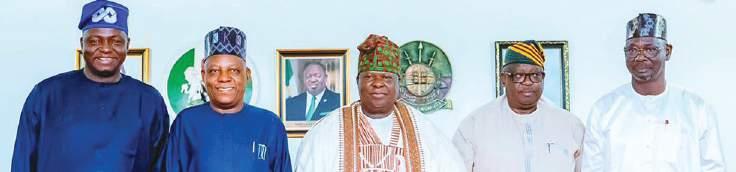
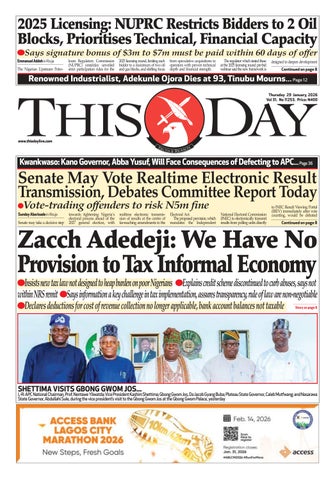
SHETTIMA VISITS GBONG GWOM JOS...
L-R: APC National Chairman, Prof. Nentawe Yilwatda; Vice President Kashim Shettima; Gbong Gwom Jos, Da Jacob Gyang Buba; Plateau State Governor, Caleb Mutfwang; and Nasarawa State Governor, Abdullahi Sule, during the vice president’s visit to the Gbong Gwom Jos at the Gbong Gwom Palace, yesterday





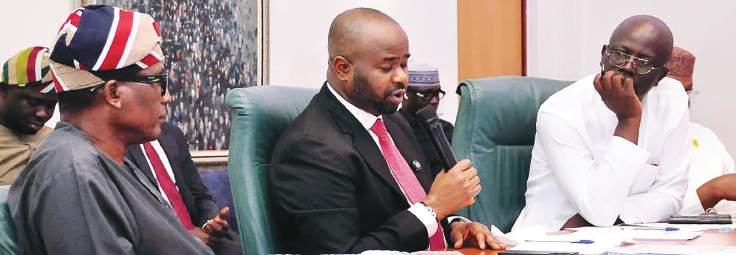
INTERACTIVE SESSION WITH THE EDITORIAL BOARDS OF THISDAY/ARISE TV ON IMPLEMENTATION OF NEW TAX LAWS... L-R: The Ombudsman, THISDAY/ARISE Television, Kayode Komolafe; Executive Chairman, Nigeria Revenue Service (NRS), Dr. Zacch Adedeji and Chairman, THISDAY Editorial Board, Segun Adeniyi during the interactive session with the Editorial board of THISDAY and ARISE TV on the implementation of the new Tax laws in Abuja…..yesterday
Nume Ekeghe
A consortium led by Stanbic IBTC Capital Limited, Stanbic IBTC Bank Limited, and Standard Bank of South Africa has reached financial close on a $250 million strategic financing facility for Aradel Energy Limited, marking a major boost to the indigenous energy company’s expansion plans.
In a statement, they noted that the funding package was designed to underpin Aradel Energy’s longterm growth strategy, including the acquisition of an additional 40 per cent equity stake in ND Western Limited from Petrolin Trading Limited.
Proceeds from the facility would also be used to refinance existing debt and support higher production levels across the company’s current asset portfolio.
Aradel Energy is a wholly owned subsidiary of Aradel Holdings Plc and the operator of the Ogbele and Omerelu onshore marginal fields, as well as OPL 227 in shallow water terrain.
Before the transaction, Aradel Energy held a 41.67per cent equity interest in ND Western. Following the completion of the acquisition,
its shareholding in ND Western has increased to 81.67per cent.
ND Western holds a 45 per cent participating interest in OML 34 and a 50per cent equity interest in Renaissance Africa Energy Company Limited (Renaissance). Renaissance is the operator of the Renaissance Joint Venture and a 30per cent owner of one of Nigeria’s largest and most strategic energy portfolios. As a result of the transaction, Aradel Energy’s indirect equity interest in Renaissance
has increased to 53.3 per cent, significantly strengthening the company’s upstream position and long-term value creation potential.
Standard Bank acted as Global Coordinator and Bookrunner, leading the structuring, execution, and funding of the facility.
The transaction affirms the Bank’s deep sectoral expertise and reinforces its position as a leading financier in Africa’s energy industry.
Executive Director, Corporate and Transaction Banking, Stanbic
IBTC Bank, Eric Fajemisin stated: “As Aradel Energy consolidates its position as one of Nigeria’s leading oil and gas companies, Stanbic IBTC Bank is proud to serve as a trusted long-term partner supporting the Company’s growth ambitions.”
The Regional Head, Energy & Infrastructure Finance, West Africa at Standard Bank, Cody Aduloju said: “The transaction illustrates Standard Bank’s ability to deliver large-scale, tailored funding solu- tions and further demonstrates
our support to the fast-growing indigenous companies of Nigeria’s oil and gas sector.”
Commenting on the transaction, Chief Executive Officer of Aradel Holdings Plc, Adegbite Falade stated: “The acquisition bolsters Aradel Energy’s competitive positioning across Nigeria’s oil and gas value chain and supports our commitment to strategic growth, asset optimisation, and enduring value creation.
“We are pleased to have partnered with Standard Bank,
who supported us and delivered a fully funded solution under very tightThetimelines.” statement noted that the transaction reinforced Standard Bank Group’s commitment to providing strategic capital to clients as they execute on their transformative growth objectives. By delivering tailored financing solutions that enable sustainable value creation, the Bank remains a trusted partner to leading corporates across Africa’s evolving energy landscape.
James Emejo in Abuja
Governor of Central Bank of Nigeria (CBN), Mr. Olayemi Cardoso, restated his commitment to deepen financial sector reforms and attract long-term investment, when he hosted a delegation from British International Investment (BII). The meeting in Abuja with the BII delegation, led by its Chair, Ms. Diana Layfield, alongside British High Commissioner to Nigeria, Mr. Richard Montgomery, was part of efforts to deepen reforms in Nigeria.
strengthening the resilience of the banking system and improving financial intermediation.
Cardoso reaffirmed CBN’s commitment to macroeconomic stability, credible monetary policy, and a transparent, data-driven regulatory framework aimed at
NCC: Despite Improvement in 5G Coverage, Divide Persists in Network Quality
Despite improvement in 5G coverage areas and quality of service from the third and fourth quarters of 2025, an industry performance report has revealed that divide persists in network quality between rural and urban connectivity, from the subscribers’ perspective.
According to the Q4 2025 Industry Performance Report, released yesterday by the Nigerian Communications Commission (NCC), in Lagos the 5G coverage gap in Q3 was 70.9 per cent, but the gap reduced to 55.4 per cent in Q4 2025, which was an improvement.
The report also explained that in Abuja, 5G coverage gap in Q3 2025 was 65.6 per cent, but it reduced to 47. 4 per cent in Q4 2025, which
was an improvement in the federal capital city.
Presenting the report during a webinar organised by the NCC, the Director, Technical Standards and Network Integrity at NCC, Edoyemi Ogoh, highlighted the disparity in network quality between rural and urban connectivity, in relation to download and upload speed. According to him, for urban areas, the median download speed in Q4 2025 was about 20.5mbps across all networks, but in rural areas, the median download speed was 11mbps.
He also highlighted the video quality gap between urban and rural areas, which dropped in Q4 2025, compared to what was obtained in Q3 2025.
According to the report, in Q3 2025, rural download speed was 12.7mbps but dropped to 8mbps in Q4 2025.
From the report, about 50 per cent of Nigerian subscribers with 5G devices do not have access to 5G services, because there are no 5G services in the areas they want to access, which indicates that there is still a gap in 5G coverage, despite the improvement in coverage areas.
From the operators’ perspective, in terms of latency, MTN, Airtel and Globacom are doing relatively well in connectivity performance in the urban areas, but Globacom and T2 are not doing relatively well in rural connectivity, which demands that both Globacom and T2 need to step up their networks in rural connectivity.
Discussions focused on developments in the financial services sector, BII’s investment outlook, and opportunities to deploy patient capital in support of banking sector stability, financial inclusion, and sustainable private-sector growth, according to a statement by the apex bank.
Cardoso further stated that Development Finance Institutions (DFIs) providing long-term capital and strong governance were key
partners in Nigeria’s reform agenda. Layfield reaffirmed BII’s continued interest in Nigeria’s financial services sector, emphasising the importance of regulatory clarity and sustained engagement to support investment and inclusive growth.
The meeting was attended by members of BII’s Board and Executive Management, including Mr. Leslie Maarsdorp, Chief Executive Officer; Mr. Andrew Alli, Non-Executive Director; Mr. Simon Rowlands, Non-Executive Director; Mr. Chris Chijiutomi,
Managing Director and Head of Africa; and Mr. Benson Adenuga, West Africa Regional Director and Head of the Nigeria Office, alongside senior officials of the British High Commission.
British International Investment is UK’s development finance institution, wholly owned by the UK government through the Foreign, Commonwealth and Development Office (FCDO), with total assets of £9.9 billion supporting over 1,600 businesses across emerging markets.
Kwara, Chinese Investors Partner on Business Investments Worth $35m
Hammed Shittu in Ilorin
Kwara State Government and Chinese investors are partnering on investments worth about $35 million for the industrialisation and economic growth of the state.
The partnership involves establishment of a lithium factory worth $20 million and setting up of a pharmaceutical company valued at more than $15 million in the state.
Speaking in Ilorin yesterday during a meeting with the state governor, Alhaji AbdulRahman AbdulRazaq, Team Lead of the
Chinese investor, ER- KANG Company Limited, Mr. Sun Qing Rong, said the firm had concluded and flagged off its $20 million lithium factory, aligning with government’s policy to grow value addition and local manufacturing capacity.
Rong said the firm had more than 300 employees, mostly Kwarans, adding that the plants process lithium into ready materials, instead of exporting them raw without any value addition.
He said the firm will also be partnering the state government on an industrial park.
Rong stated, “This is one of the
fruits of the meeting that we held with Your Excellency in Beijing about two years ago.
“Today, we have completed the lithium plant and it is up and running. And this year, we are starting the pharmaceutical company with the help of Your Excellency.”
He added, “The factory will include two phases of construction for large infusion and small volume injection workshops, which will make up for the shortage of such products in the Nigerian market.
“At present, the relevant preparatory work is basically completed.”
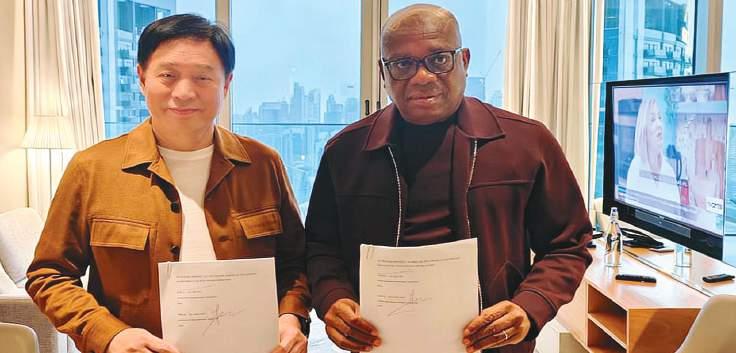
Senator Orji Uzor Kalu, Chairman of Swiber Africa (Nigeria) Group (right), and Zhu Gongshan, Chairman of GCL (China) Group, after signing a New Energy Industry Framework Cooperation Agreement in Dubai, United Arab Emirates… recently
Says CBN, Nigerian financial institutions constitute 75% of total AFC’s shareholding Hails robust assetquality track record, strong liquidity coverage, others Disbursed $18.5 billion across 36 African countries
James Emejo in Abuja
Standard & Poor’s (S&P) Global Ratings), yesterday declared that it assigned its ‘A’ long-term and ‘A-1’ short-term issuer credit ratings to Africa Finance Corporation (AFC) with a positive outlook.
The positive outlook reflects
expectation that AFC will execute its strategy by further diversifying its shareholder structure and expanding its capital base, while sustaining strong capital and liquidity levels.
S&P, however, stated that it could revise the outlook to stable if AFC failed to make meaningful progress in achieving a more diversified
shareholder structure.
In a statement, the ratings institution said a significant drop in capital or liquidity could also pressure “our assessment of AFC’s financial risk profile and lead to a negative rating action”.
On the other hand, it stated, “We could raise the ratings if
AFC meaningfully expands its sovereign shareholder base to the extent that investments represent more than token stakes, reducing the corporation’s concentrated shareholder nature.
“We could also consider a positive rating action if capitalisation levels strengthen materially, for example,
President of the Senate, Senator Godswill Akpabio, has raised the alarm over the circulation of fake and unauthorised versions of the recently passed Tax Reform Act, directing all senators to obtain only certified copies from the Office of the Clerk of the National Assembly.
Akpabio warned lawmakers to completely ignore any other versions in circulation, stressing that such documents do not reflect the exact provisions approved by both chambers of the National Assembly or assented to by the President.
He said the move was necessary to prevent misinformation, misinterpretation and possible abuse of the new tax law, especially at a time when public scrutiny of fiscal reforms remains high.
The Senate President assured senators that the certified copies issued by the Clerk are authentic, accurate and free from any form of alteration, noting that they represent the final and legally binding version of the legislation.
Following the directive, the Senate proceeded to adjourn plenary.
The controversy over the alleged doctoring of recently passed tax laws
has deepened, placing the Senate and the National Assembly under pressure to resolve discrepancies between versions approved by lawmakers and those gazetted by the executive, when legislative activities resume this week.
At the centre of the dispute are claims that key provisions of the tax legislation were altered after passage by both chambers of the federal parliament.
An ad hoc committee set up by the House of Representatives Minority Caucus to probe the allegations had affirmed that the claims raised by a lawmaker, Abdusamad Dasuki, were valid.
The seven-member fact-finding
committee, chaired by Hon. Afam Ogene, disclosed in a preliminary report that some sections of the Nigeria Tax Administration Act, 2025, were altered after being passed by the National Assembly.
According to the committee, its investigation uncovered the existence of three different versions of the Nigeria Tax Administration Act, 2025, currently in circulation.
It had stated that the contentious provisions showed clear discrepancies between the version passed by the legislature and the one published in the official gazette, a position it said was further supported by Certified True Copies issued by the House of
Representatives.
However, the House leadership has since rejected the interim report, describing the Minority Caucus committee as procedurally invalid.
In a statement by its spokesman, Akintunde Rotimi, the House had insisted that only the Speaker or the plenary has the constitutional authority to constitute committees, stressing that caucus-led inquiries are informal, non-binding and capable of misleading the public on sensitive legislative matters.
The leadership also noted that a duly constituted bipartisan ad hoc committee set up in December 2025 remains in place to investigate the matter.
through continued progress in raising equity.”
S&P further said the AFC ratings reflected its assessment of the corporation’s strong enterprise risk profile and strong financial riskTheprofile.statement said AFC had a mandate to address structural investment gaps across Africa, playing an important role in financing critical infrastructure and catalysing private sector lending.
It said the corporation’s ongoing capital increases reflected strong shareholder support, “but the corporation’s shareholder base remains concentrated, with the Central Bank of Nigeria and Nigerian financial institutions representing about 75 per cent of total shareholding”.
S&P, however, pointed out that despite modest capitalisation relative to peers, AFC maintained a “robust asset-quality track record and very strong liquidity coverage”.
Established by treaty in 2007, AFC has a mandate to address structural investment gaps and catalyse private-sector lending across Africa.
Structured as a public-private partnership (PPP), AFC plays a pivotal role in funding infrastructure, industrial development, and
natural resource projects across the continent.
In addition to providing financing, the corporation offers transaction advisory, deal structuring, project development, and principal investment services throughout the entire infrastructure project lifecycle. Since inception, it has disbursed a cumulative $18.5 billion across 36 African countries as of year-end 2025, underscoring its scale and strategic importance in advancing Africa’s development agenda. AFC’s investment pipeline is anchored by projects that close critical infrastructure gaps while supporting national development priorities. It specialises in sectors, such as power, transport and logistics, natural resources (including mining, oil, and gas), heavy industry, telecommunications, and technology.
Although the shareholder base remains diversified in terms of the number of entities, it remains concentrated, with CBN holding a dominant 39 per cent stake. This is one of the highest concentrations among rated MLIs.
In addition, Nigerian financial institutions account for an additional 40 per cent of total shareholding, elevating agency-risk considerations relative to similarly rated peers.
The Nigeria Police Force has strengthened its collaboration with the Federal Mortgage Bank of Nigeria (FMBN) in a renewed effort to deliver affordable and sustainable housing solutions for police personnel nationwide. This commitment was reiterated
during a courtesy visit by the Managing Director of FMBN, Mr. Shehu Usman Osidi, to the Force Headquarters in Abuja, where he was received by the Inspector-General of Police (IGP), Mr. Kayode Egbetokun. Speaking during the meeting, the IGP described institutional partnerships of this nature as critical to achieving the Force’s
welfare objectives, particularly in addressing the longstanding housing needs of officers and men.
He reaffirmed the welfare of personnel remains a central pillar of his leadership agenda.
According to the IGP, access to decent and affordable housing is essential to boosting morale and enhancing productivity, especially
for officers who continually risk their lives in the service of national security.
He stressed that improved living conditions would not only support operational efficiency but also reinforce professionalism within the Force.
In a statement, the Force Public Relations Officer, CSP Benjamin Hundeyin, said the visit was both
timely and strategic, noting that it marked a significant step towards deepening cooperation between the Nigeria Police Force and the FMBN. Earlier, Mr. Osidi expressed appreciation to the IGP for the warm reception, describing the Nigeria Police Force as one of the Federal Mortgage Bank’s most important institutional partners.
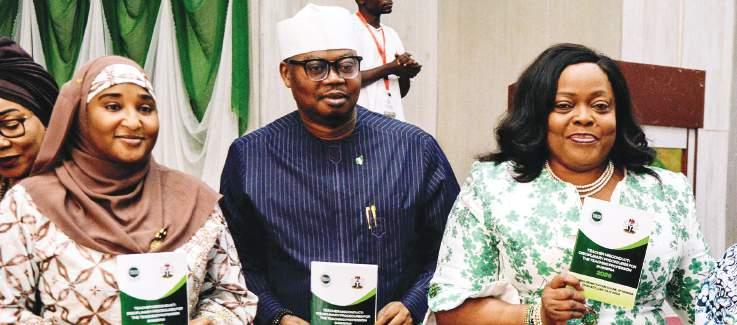
L-R: Minister of state for Education, Dr. Suwaiba Ahmad; Deputy Executive Secretary, UBEC, Olajuwon Rasaq Akinyemi; and Chief Executive Officer, Teachers Registration Council of Nigeria, Dr. Ronke Soyombo, during the 2026 National Teachers Summit in Abuja, yesterday
2,116 Retirees
Retiree’s monthly pension enhanced to N206,000 from about N18,000 Oloworaran: increment a testament to Tinubu’s disposition to boost welfare of all retirees
James Emejo in Abuja
Director General/Chief Executive, National Pension Commission (PenCom), Ms. Omolola Oloworaran, yesterday, said the commission had approved an upward review of pensions for 2,116 retirees under the Nigeria Social Insurance Trust Fund (NSITF).
The increment, which translated to an unprecedented 1,173 per cent enhancement, took the fund’s total monthly pension payments from N12.56 million to N159.95 million.
With the development, the affected NSITF retirees had received N8.70 billion in pension arrears, translating to an average of about N3 million arrears payment per retiree. This also marked the first pension increase for NSITF retirees in 21 years, addressing long-standing disparities and restoring the value of benefits in line with statutory provisions, and prevailing economic conditions.
In a statement, Oloworaran pointed out that the NSITF pension increment was yet another milestone in President Bola Tinubu’s policy drive to enhance the welfare of
retirees in the country.
The PenCom director-general has continued to champion landmark reforms that have transformed the Contributory Pension Scheme (CPS).
Essentially, an NSITF retiree’s monthly pension was enhanced from about N18,000 to a whopping N206,000. In addition, the retiree was paid over N8 million as pension arrears, the statement added.
PenCom said the enhancement was supported by the significant growth of the NSITF Fund, which grew from N54 billion at the point of transfer in 2005 to N195 billion as of December 2025.
The growth reflected prudent fund management under the strict supervision of PenCom, providing the financial headroom necessary to implement the long-overdue review while safeguarding the scheme’s sustainability.
NSITF was established in 1993 as the successor to the National Provident Fund (NPF), managing pension benefits for private sector employees prior to the introduction of the CPS under the Pension Reform Act (P RA) 2004.
Following the reform, pension assets under the defunct NSITF
Scheme were transferred to Trustfund Pensions Limited, which was mandated to manage the scheme’s assets and administer benefits to existing and deferred pensioners.
Section 39(3) of the PRA 2014, together with Section 173(3) of the Constitution of the Federal
Republic of Nigeria, mandates periodic pension reviews at least every five years or in line with Federal Civil Service salary reviews.
Furthermore, NSITF Benefits Payment Policy provides that the minimum retirement pension should not be less than 80 per
cent of the prevailing National Minimum Wage.
Despite these provisions, the last review of NSITF pensions occurred in 2005, the statement added.
In response to the prolonged non-compliance, PenCom invoked Section 53 of the PRA 2014, which
requires that benefits under the NSITF scheme be administered in accordance with the scheme’s governing terms.
PenCom consequently directed Trustfund Pensions Limited to submit a comprehensive proposal for pension enhancement.
Plan establishment of lithium smelting facility in Abia
Emmanuel Addeh and Sunday Aborisade in Abuja
Chairman of Swiber Africa (Nigeria) Group, Dr. Orji Uzor Kalu, and Zhu Gongshan, Chairman of GCL (China) Group, have officially signed a new energy industry framework cooperation agreement in Dubai, United Arab Emirates.
According to a statement from the firms, under the agreement, the two parties will engage in in-depth cooperation across areas, including energy system development, strategic
Bennett Oghifo
Wema Bank has introduced a voice-enabled banking feature on its digital platform, ALAT, following the release of an upgraded version of the application tagged “ALAT: The Evolution.”
The upgraded platform, launched on January 12, 2026, includes new functionalities designed to allow users to complete banking transactions through voice commands using an in-app virtual assistant known as “SAW.”
According to the bank, the feature enables end-to-end transaction processing without manual data entry.The virtual assistant offers gender-based customisation and incorporates voice recognition technology, which the bank says adapts to individual voice patterns. An additional passcode requirement is included as part of the verification process.
Speaking on the introduction of the voice banking feature, the Managing Director and Chief
Executive Officer of Wema Bank, Moruf Oseni, said the development was guided by the need to improve efficiency, reliability and convenience in digital banking. He stated that the feature was designed to support users in completing transactions quickly without disrupting their daily activities.
Oseni noted the upgraded ALAT platform integrates artificial intelligence with security features and is intended to optimise banking services for users within and outside Nigeria.
lithium resource development, and industrial chain collaboration.
This signing, the partners said, marks an important outcome of strengthened practical cooperation between China and Nigeria, and represents a key step in GCL’s active response to the Belt and Road Initiative and its broader internationalisation strategy.
“As one of Africa’s leading economies, Nigeria has long faced severe power shortages and a weak electricity grid, which have significantly constrained industrial development and improvements in living standards.
“Against the backdrop of the global energy transition and deepening China-Africa cooperation, GCL Group
is leveraging its more than 20 years of experience in integrated oil, gas, and green energy development in African countries such as Ethiopia and Djibouti.
“Targeting Nigeria’s pressing energy and resource challenges, GCL is focusing on the development of a new-generation power system and the lithium battery industry chain, while comprehensively expanding its strategic footprints along the belt and road corridors,” the statement explained.
In terms of power system construction, GCL said it will integrate internationally advanced high-efficiency clean power generation technologies with scenario-based system solutions. It stressed that a
key offering will be the full-scale virtual power plant system successfully deployed in the Suzhou Industrial Park jointly developed by China and Singapore—which can achieve a load regulation accuracy of up to 94 per cent.
“This system will provide Nigeria with intelligent energy management capabilities ranging from millisecondlevel rapid response to medium and long-term precise forecasting. The cooperation will be directly aligned with Nigeria’s Presidential Power Initiative (PPI), with plans to develop major projects including 3GW of gas-fired power plants, 4 GW of integrated wind and solar energy projects, as well as hydropower and coal-fired power stations.
The Nigeria Police Force, through the National Cybercrime Centre (NPF-NCCC), has dismantled a sophisticated cyber-enabled fraud syndicate responsible for the large-scale diversion of telecommunications airtime and data
resources, with estimated losses exceeding N7.7 billion.
In a statement, the Force Public Relations Officer, CSP Benjamin Hundeyin, said the operation followed a petition from a Nigerian telecommunications company that detected suspicious and unauthorised activities within its billing and payment systems. He explained that investigations revealed that login credentials belonging to internal staff had been compromised, allowing cybercriminals to gain unlawful access to the company’s core infrastructure and manipulate its systems for financial gain.
James Emejo in Abuja Minister of Budget and Economic Planning, Senator Abubakar Bagudu, yesterday, said ongoing economic reforms were progressing in the right direction, with an unusual outcome of strengthening political consensus in the country.
Bagudu spoke at a meeting with officials from the Agence Française de Développement (AFD) Microeconomic Risk Analysis Due Diligence Mission, led by its Country Director, Mr. Jacky Amprou.
He explained that the reforms had fostered unity of purpose between the executive and legislative branches, as well as among the three tiers of government.
Bagudu emphasised that under Tinubu’s leadership, the country’s federal system had been strengthened, with better coordination among the federating units through the effective management of National Economic Council (NEC), a body constitutionally responsible for
guiding the country’s economic growth.
The minister stated, “The reforms have improved cooperation between the executive and legislative branches of government. The National Assembly has been very supportive of the president’s bold economic initiatives.
“Of equal importance is the friendly relationship among the federal, state, and local governments.”
He said macroeconomic reforms implemented over the past two and a half years had begun to show tangible results, including improved macroeconomic stability, heightened investor confidence, and an unusual, yet, notable increase in political cohesion across the federation.
In a statement, Bagudu stressed that despite regional political instability and the challenging timing of reforms, Nigeria remained committed to implementing bold economic measures.
He observed that the increasing political consensus around the
reforms had helped stabilise the exchange rate, maintain investor confidence, and reduce the usual pre-election uncertainty often linked with emerging markets.
Reiterating the president’s economic vision, the minister stressed the country’s goal to develop a onetrillion-dollar economy within the next five years, driven by inclusive and decentralised growth.
At the heart of that vision, he said, was the Renewed Hope Ward Development Plan, a grassrootsdriven initiative designed to map Nigeria’s economic potential across its 8,809 wards, gather local-level priorities, and elevate them to the national stage, and promote a fairer distribution of growth and federal resources.
Bagudu explained that under the framework, each ward’s economic potential, including agriculture, skills, resources, and industry, were being mapped, emphasising that development planning will originate at the ward level, feed into state
development plans, and, ultimately, shape the national development plan.
He stated that agriculture, local production, and value chains would be prioritised to promote job creation, food security, and household income growth.
Bagudu reaffirmed the government’s strong commitment to private-sector-led growth, with reforms aimed at making Nigeria more attractive to both local and foreign investors, despite challenges related to revenue generation, high interest rates, and global economic pressures.
He acknowledged the short-term difficulties and pains of the reforms, but said they were necessary, critical, and irreversible for Nigeria’s longterm stability and sustainable growth.
Earlier, in his remarks, Amprou stated that AFD was not focused on a single project, but on a comprehensive review of Nigeria’s macroeconomic and structural reforms.
He added that the agency was updating its country risk and
economic assessment, a regulatory requirement that will guide future engagements and financing decisions.
Amprou acknowledged that significant reforms had been implemented since 2022, leading to notable changes in Nigeria’s economic landscape.
He said the mission aimed for a deeper understanding of the government’s plans for: consolidation of reforms, sustained economic growth, and acceleration of national development.
Permanent Secretary, Federal Ministry of Budget and Economic Planning, Dr. Deborah Odoh, welcomed the AFD delegation and other development partners, and emphasised the importance of strategic alignment with Nigeria’s 2026–2030 National Development Plan.
Odoh reiterated Nigeria’s stance as an attractive destination for economic growth. She expressed appreciation for ongoing international partnerships, while emphasising that the govern-
James Emejo in Abuja
Chairman, Nigeria Revenue Service (NRS), Dr. Zacch Adedeji, yesterday, declared that the country currently lacked a framework to tax operators in the informal sector of the economy.
Adedeji said existing tax provisions were designed for taxation of the formal economy.
The NRS chairman spoke to the Editorial Board of THISDAY in Abuja on the implementation of the new tax laws.
He said the only way to tax informal businesses was to continue to encourage them to formalise their operations.
Adedeji said, “On the informal sector, you cannot tax what is informal. That is why they are called informal. To tax them,
you must first formalise them. Encourage them to register and grow. Once they are formal, they fall into proper categories and can be taxed accordingly.
“Education and engagement will continue. We have departments for media, engagement, and stakeholder relations so that solutions can be tailored. Our goal is to help small businesses grow or, at the very least, sustain themselves.”
Adedeji further clarified that contrary to speculations, the Value Added Tax (VAT) was not imposed on poor Nigerians. Rather, it was a consumption tax with exemptions, he stated. He said the aim of the Nigeria Tax Administration Act (NTAA) 2025, was to remove the burden of tax on the poor, adding that the new tax regime
has ensured that only income or profits are subject to tax, not capital or investments.
He said while the new tax reforms had restored clarity, capacity, and accountability in tax administration, technology and process had also ensured that revenue collection was better tracked.
According to him, tax is paid by less than 10 per cent of the population everywhere in the world. He added, “VAT is not imposed on the poor.” He said under his administration, no businesses will be shut down for noncompliance.
Adedeji said, “If I want revenue to grow, I must help you grow. I am not here to suffocate businesses. I am not a policeman or someone chasing bandits. I am like a farmer who prunes a tree so
it can bear more fruit.
“That is why audits are now part of operations. Auditors work alongside tax officers. I have told them never to shut down a business, because sales lost today can never be recovered. If a business does not make profit, there is nothing to tax.
“That is why we now have tax service partners in every operation—to guide, explain, and assist businesses.”
He further clarified that his administration stopped the tax credit scheme due to the abuses it was subjected to, and “because it turned tax authorities into project supervisors, which we are not equipped to be”.
He said tax credit was not within NRS’ remit, adding that the service lacks the required competence to assess the projects.
SENATE MAY VOTE REALTIME ELECTRONIC RESULT TRANSMISSION, DEBATES COMMITTEE REPORT TODAY
clause by clause today when Senate considers the report of its Committee on Electoral Matters.
The report, scheduled for plenary consideration, was laid before senators yesterday following a motion by Senate Leader, Senator Opeyemi Bamidele (Ekiti Central), who urged his colleagues to study the document ahead of deliberations on what he described as a highly sensitive piece of legislation.
Bamidele, with the approval of President of the Senate, Senator Godswill Akpabio, disclosed that a brief closed-door session would precede the committee-of-thewhole consideration to allow senators to exchange views on the report before final debate.
A copy of the committee’s report obtained yesterday indicated that a new subsection (3) had been inserted into the Electoral Act (Amendment) Bill, 2025, specifically to curb manipulation of results and incidents of ballot box-snatching.
The new provision states unequivocally, “INEC shall electronically transmit election results from each polling unit to the IREV portal in real time and such transmission shall be done simultaneously with the physical collation of results.”
In another significant reform, the committee introduced a new subsection (2) to Section 77, making it a punishable offence for presiding officers to fail to sign and stamp ballot papers and the results they announced at polling units.
To align the law with current
electoral technology, Sections 47(2) and (3) were also amended by replacing references to the “smart card reader” with the “Bimodal Voter Accreditation System (BVAS),” formally recognising BVAS as the legally approved accreditation tool.
The report further amended Section 54(1) to address alleged abuses during voting by visually impaired and incapacitated persons.
Under the proposed changes, political party agents, candidates, or officials would be barred from accompanying such voters into
the voting cubicle, a move aimed at protecting the secrecy and integrity of their ballots.
In a bid to deter vote-trading and the illicit handling of voters’ cards, the committee recommended stiffer penalties for the buying and selling of Permanent Voter Cards (PVCs).
The amendment proposed an increase in the fine under Section 22 from N500,000 to N5 million for offenders.
Given the implications of the proposed amendments for Nigeria’s democracy, Akpabio appealed to senators to approach
the exercise with diligence and restraint.
He stated, “Distinguished colleagues, as suggested by the leader, please, let us study the report very well ahead of final consideration tomorrow, first at the closed-door session, and then at the committee of the whole.”
Today’s debate is expected to set the tone for what could become the most consequential overhaul of Nigeria’s electoral framework since the introduction of electronic accreditation and result viewing.
He also said tax reforms around VAT remained one of the most significant of the interventions, as the federal government had given more financial resources to states.
The NRS boss also explained that the federal government’s decision not to subject food and agricultural items to VAT was to keep food inflation under check, and make food cheaper.
Adedeji said information currently remained the biggest challenge in the implementation of tax reforms, adding that government will continue to listen and address emerging concerns.
He said, “Trust is critical. People must first believe that government is not trying to make life harder. That understanding is the foundation.
“We do not claim to be perfect. Information is the biggest challenge right now, especially in an environment like ours.
“We are listening. Where something is not working, we will adjust. That is why we are here.”
On tax accountability and compliance, the NRS boss said, “Tax compliance is the law. It is not optional. In other countries you mentioned, people pay as much as 40 per cent of their income in taxes. Benefits do not come before compliance.
“We must ask ourselves if we are ready for the Nigeria we talk about. In the last three years, we invested heavily in education and skills development so graduates can find jobs. Accountability is not optional.
“Government officials are accountable for how tax revenue is spent. People are now asking questions, and rightly so. The era of taking citizens for granted is over.”
Adedeji added, “Trust takes time everywhere, not just in Nigeria. That is
outcomes, accelerate production and align Nigeria’s upstream sector with global best practice.
Under the guidelines, the commission said priority would be given to bidders that can clearly demonstrate the technical competence to operate the assets and the financial capacity to fund exploration and development activities through to first oil or gas.
According to the NUPRC, the era of warehousing assets without clear work programmes or funding plans is over, noting that block allocation would no longer be driven solely by aggressive bidding but by the ability to deliver value to the industry and the economy.
Speaking at the virtual event, the Commission’s Chief Executive, Oritsemeyiwa Eyesan, maintained that only applicants with strong technical and financial credentials will proceed to the critical stage of the bidding process for the 50 blocks.
“The process follows five steps: registration and pre-qualification, data acquisition, technical bid submission, evaluation, and a commercial bid conference. Only candidates with strong technical and financial credentials, professionalism, and credible plans move forward. Winners are chosen through a transparent, merit-based procedure,” she reiterated.
The NUPRC chief executive noted that with the approval of President Bola Tinubu, signature bonuses for the 2025 licensing round are now set within a value range that reduces entry barriers and places greater weight on what truly matters: technical capability, credible work programmes, financial strength, and the ability to deliver production within the shortest possible time.
The commission also set firm financial conditions for successful bidders, directing that signature bonuses must be paid within 60
days of the issuance of the offer letter, failing which the award would lapse. It added that one-off payments for the blocks have been pegged between $3 million and $7 million, depending on asset classification, as part of efforts to balance investor entry costs with the need to secure serious commitments.
“This has been done to increase competitiveness and in response to capital mobility,” the NUPRC chief executive stated.
Eyesan described the licensing round as an open call for committed partners; those ready to invest capital, bring technical excellence, and accelerate Nigeria’s assets from license award to exploration, appraisal, and ultimately, full production.
She restated the commission’s commitment to a transparent licensing round, insisting that Nigeria is “ready to be the beautiful bride to capital and
ment expects all development support to align with national priorities. Both parties agreed that future AFD activities in Nigeria must strictly align with the government’s development priorities. Discussions also included preparation of a new AFD–Nigeria Country Partnership Agreement, as the current five-year framework concluded in 2025, ensuring coherence with Nigeria’s upcoming 2026–2030 National Development Plan.
why we focused on actual implementation rather than explanations. People are now seeing that what we promised is what is happening.
“We are open to feedback. This process will not be perfect, but we will keep adjusting. Transparency and rule of law are non-negotiable. I have told my staff: everything must be open.”
Adedeji also addressed issues on deduction and non-remittance of tax.
He disclosed that with the consolidated law, revenue agencies will no longer lay claims to costs of collection but rather cost of operation, stressing that government should be able to fund its agencies.
Among other things, he said individual bank account balances could not be taxed.
He said, “Let me explain why it is difficult to do that now. Salary is a deductible expense. The only way to prove that salary was paid is evidence of tax remittance. So the system is self-regulated.
“On the issue of cost of collection, one reason we consolidated the law was because agencies were collecting taxes independently. When we consolidated, those costs became costs of operation. It is the duty of government to fund its agencies.
“I don’t generate revenue; I only collect revenue. My job is to ensure businesses and individuals do well. When they do well, revenue comes automatically.
“Revenue grows not by harassment, but by creating a conducive environment. That is why our focus is economic prosperity.
“Your bank account is your asset. Nobody has the right to tax your bank balance. Money in your account does not automatically mean profit.”
playroom for advanced technological deployment for hydrocarbon recovery.”
She added: “In this licensing round, 50 oil and gas blocks across Nigeria are available, allowing investors to access the country’s key basins and create long-term value.”
Eyesan further assured the public that the bid process will comply with the Petroleum Industry Act (PIA), promote the use of digital tools for smooth data access and remain open to public and institutional scrutiny through the Nigeria Extractive Industries Transparency Initiative (NEITI) and other oversight agencies.
“Let me emphasise that the Nigeria 2025 licensing round is not merely a bidding exercise. It is a clear signal of a re-imagined upstream sector, anchored in the rule of law, driven by data, aligned with global investment realities, and focused on long-term value
creation,” the NUPRC boss said. During the webinar, subject matter experts from the NUPRC explained the guidelines, model contracts, bid parameters, and evaluation criteria in order to help investors navigate uncertainty and operate within a framework that is transparent, predictable, and deliberately designed to inspire confidence.
In his presentation, the Head of the Alternative Dispute Resolution Centre (ADRC) of the NUPRC, Mr. Augustine Okwah, stated that as part of the guidelines, any bidder who is given an offer must make payment within 60 days.
Besides, he explained that bidders will be restricted to only two oil and gas blocks, explaining that anything above that will not be considered by the commission.
“The offer letter will stipulate the conditions precedent the winning bidder needs to fulfil
Continued on page 35
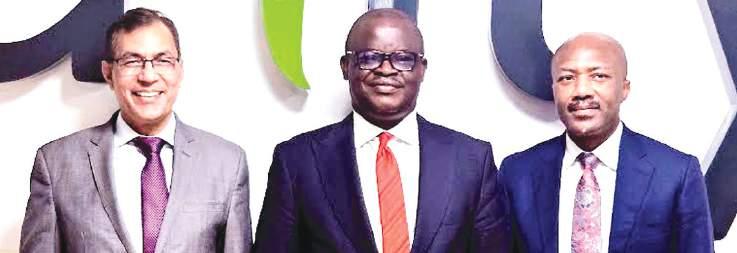
L-R: Chief Executive Officer, UBA UK, Mr. Loknath Mishra; Managing Director/CEO, Unity Bank Plc, Mr. Ebenezer Kolawole; and Head, Trade Finance, UBA UK, Mr. Mark Ifashe, during a courtesy visit by the UBA UK delegation to Unity Bank Plc headquarters in Lagos… recently
Vice President Kashim Shettima, has emphasised Nigeria’s commitment towards shaping Africa’s future through impact, inclusion, and investment.
And in achieving this, he said the nation is launching and strengthening initiatives such as the Business Coalition for Education and the Women and Youth Financial and Economic Inclusion Platform.
Speaking on Wednesday at the Africa Social Impact Summit HighLevel Policy Engagement, held at
the Banquet Hall of the State House, Abuja, the Vice President noted however that “government alone cannot solve Africa’s development challenges.”
Shettima, who was represented by his Technical Adviser on Women, Youth Engagement, and Impact, Hajiya Hauwa Liman, said, “Beyond Nigeria’s commitment to shaping Africa’s future through impact, inclusion, and investment, this convening of the Africa Social Impact Summit (ASIS) held in partnership with Sterling One Foundation and our local and global collaborators,
must be more than an exercise in social relations.
“It must serve as a platform where intent is converted into execution, where dialogue matures into decision, and where partnerships are forged with outcomes firmly in view.”
Shettima pointed out that Nigeria has never taken the potential of ASIS and its promise for granted, recalling that over the past four editions, the summit has evolved “into one of Africa’s most consequential platforms for development dialogue.
“We do not need a lecture on why this engagement matters. None of
us doubts its relevance, because all of us here share the same aspiration: to build platforms of execution strong enough to carry the immense potential of this continent into lived reality,” he added.
The Vice President observed that while development had been “framed primarily as expenditure,” in the past decades, government’s responsibility at the moment is to reframe it as investment in human capital, productive systems, climate resilience, digital infrastructure, and inclusive markets.
Shettima noted that Africa’s future
In a bid to support the implementation of governance reforms in the management of basic education and primary healthcare across the 36 states of the Federation and the Federal Capital Territory (FCT), the federal government has engaged the Nigeria Governors’ Forum (NGF) through the World Bank–supported Human Capital Opportunities for Prosperity and Equity Governance (HOPE-GOV) Programme.
The National Coordinator of the HOPE-GOV Programme, which is the brainchild of the Federal Ministry of Budget and Economic Planning, Dr. Assad Hassan, who led members of the National Programme Coordination Unit on an advocacy
visit to the NGF in Abuja, described the Forum as a critical platform for strengthening inter-governmental coordination to ensure the successful implementation of the programme.
“It’s in the recognition of the pivotal role that the Nigeria Governors’ Forum plays on fostering inter-governmental coordination and collaboration that we are here to brief the secretariat and also to socialise the HOPE Governance Programme to seek strategic support as well as guidance and also to explore avenues for collaboration towards ensuring effective and successful implementation of the Program not just in the 36 States of the Federation but also in the FCT,” he said.
He applauded the NGF for its leadership in championing strategic
interventions aimed at promoting governance, service delivery, and outcomes in the basic education and primary healthcare sectors in the country.
Hassan stated that the programme was designed to maximise the utilisation of federal and state funds at the facility level in the health and basic education sectors, while reinforcing transparency and monitoring of inter-governmental transfers and expenditure.
He stressed that the initiative would also enhance the execution of coordinated annual service delivery plans and improve accountability in health and basic education spending across all levels of government.
The HOPE-GOV Programme, he said, additionally aims to close
James Sowole in Abeokuta
A total of 141 out of 4,141 regular students that would be graduating at the 33rd Convocation of the Federal University of Agriculture, Abeokuta (FUNAAB), Ogun State, made First Class. The Vice Chancellor of the FUNAAB, Prof. Olusola Kehinde disclosed the figure about the performances of the students at a press conference on the 33rd Convocation Ceremony of the university, that will reach climax on Saturday, January,
2026. The news conference, which was held at the Senate Chamber of the institution, was attended by principal officers of the university and during which the vice chancellor revealed main achievements of the university established in January 1988.
Giving further breakdown of performances of students, the Vice Chancellor disclosed that 1,771 obtained Second Class (Upper Division), 1896 obtained Second Class Lower Division, 285 Third Class Division while two students made Pass Degree.
Apart from the regular First Degree graduands, Kehinde disclosed that 69 Part Timers would also graduate during the convocation that will also feature graduation of 49 Post Graduate Diploma students.
According to the Vice Chancellor, the institution, would also award 164 Masters Degree just as 89 would bag PhD.
Kehinde said sequel to the stable academic calendar, conducive learning environment and other incentives, FUNAAB is now a preferred university among others in the country.
staffing gaps in the education and health sectors by incentivising states to recruit, retain, and equitably deploy teachers and priority healthcare workers.
“We are also looking at improvement in human resources in the two sectors. We are talking about employment, retention and equitable posting of workers in the two sectors,” he stated.
According to Hassan, the $500 million Performance Incentive Programme was structured around three result areas.
will not be financed by aid alone but also by “patient capital, catalytic capital, blended finance, and private enterprise deployed at scale and guided by impact.”
In doing so, he said, “Nigeria is positioning itself accordingly. We are strengthening delivery systems across education, health, social protection, agriculture, climate action, digital public infrastructure, and financial inclusion.
“We are reforming institutions. We are aligning incentives. We are building national results architectures not to impress donors, but to serve citizens.”
The Vice President pointed out that while President Bola Tinubu “has without doubt begun the work of turning Nigeria’s fortunes around, “no government, however committed, can finance or execute this agenda alone.”
He explained that it is for this reason the nation considers ASIS as “a convening ground for co-investment, co-design, and co-delivery.”
Shettima described the summit as a “space where policymakers sit with CEOs, development partners, entrepreneurs, civil society leaders, and innovators to build solutions together.”
On empowering Nigerian youth, the Vice President said the Tinubu administration “has expanded op-
portunities for young people and women in keeping faith with its promise of an inclusive society.
“Our focus on strengthening human capital is unmistakable. But let me be candid. If we fail to stand together, we leave ourselves vulnerable to avoidable setbacks. This is a reminder to our development partners, to our social innovators, to civil society, and most importantly to the young people and women across Nigeria and across Africa. The stakes are too high for fragmentation. Progress demands coalition,” he further stated.
Earlier, Minister of Budget and Economic Planning, Atiku Bagudu, represented by Dr. Sampson Ebimaro, the ministry’s Director of the International Cooperation Department, said the objectives of ASIS resonate strongly with the Renewed Hope Agenda of President Tinubu, as the federal government continues to translate policy into implementation.
According to him, ASIS 2026 reinforces the need for strong collaboration among government and the private sector. The Minister assured development partners that the government will continue to accelerate the implementation of the Sustainable Development Goals (SDGs) and deepen collaboration for impact within Nigeria and across Africa.
The Minister of Communications, Innovation, and Digital Economy, Dr. Bosun Tijani, has stated that the success of Nigeria’s digital economy hinges on data integrity and trust among citizens.
Tijani spoke yesterday in Abuja at a press conference on Global Privacy Day 2026 and the 4th edition of the National Privacy Week, with the theme “Privacy in the Era of Emerging Technologies: Trust, Ethics and Innovation,” organised by the National Data Protection Commission (NDPC).
According to him, the success of
Nigeria’s digital economy clearly rests on trust and not only on infrastructure and talent.
“Let me say clearly, the success of Nigeria’s digital economy will rest not only on infrastructure and talents, but also on trust. And I want everyone to believe this. So NDPC, the work we do is not just something that is exciting.
“Our sector will not be successful, and when people talk about trust, don’t let it be a word that you think you
“Whenunderstand. we lose trust in this sector, people will be discouraged to actually rely on some of the tools that we hope can transform.
“If we can maintain trust, citizens
must trust that personal data in Nigeria is respected, protected, and used appropriately. NDPC is central to building that trust. I believe that together, we will build a digital Nigeria that is innovative, inclusive, and safe,” the minister said. On digital privacy, he said, “digital protection and privacy, I personally consider to be the foundation to trust safety and sustainability.”
The National Commissioner, NDPC, Dr. Vincent Olatunji said the commission generated over N7 billion in the last two years, adding that it would publish the list of educational institutions that failed to comply with the Act.
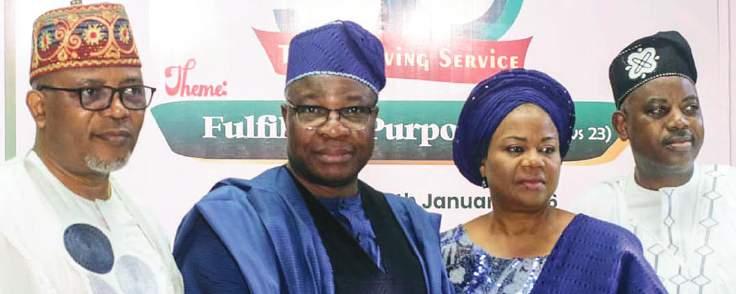
L-R: MD/CEO, Mutual Benefits Assurance Plc, Mr. Femi Asenuga; Chairman of the Board, Dr. Akin Ogunbiyi; his wife, Dotun; and Executive Director, Mr. Joseph Oladokun, during the Mutual Benefits 30th year Thanksgiving service/long service award in Lagos… recently
Michael Olugbode in Abuja
National Human Rights Commission (NHRC) has voiced serious concerns over recent forced evictions in Lagos State and the enforcement of sit-at-home directives in Anambra State, warning that both actions threaten citizens’ fundamental rights.
Executive Secretary of NHRC. Dr. Tony Ojukwu, expressed alarm over the ongoing demolition of waterfront and informal settlements in Makoko, Lagos, which had, reportedly, displaced thousands of residents.
Ojukwu said the demolitions were carried out without adequate notice, compensation, or resettlement plans, leaving many families homeless and livelihoods destroyed.
He said, “These actions contradict constitutional protections for dignity, housing, and family life, as well as international human rights standards to which Nigeria is committed.”
He stated that court rulings
prohibiting forced evictions were often ignored, undermining public trust in the rule of law.
NHRC called for an immediate halt to all demolitions, urging authorities to engage in meaningful dialogue with affected communities and ensure proper compensation and resettlement before proceeding with any development projects.
The commission also weighed in on the situation in Anambra State, where traders complied with the illegal sit-at-home directive, prompting the closure of Onitsha Main Market. While praising the government’s efforts to address the sit-at-home enforcement, Ojukwu cautioned against collective punishment of traders, which he said infringed on the rights to livelihood, freedom of movement, and due process.
He highlighted the economic effect of repeated sit-at-home days, with government estimates suggesting losses of up to N8 billion every Monday, and stressed the
need for measures that balanced security with protection of human rights.
Ojukwu reiterated that development, law enforcement, and
economic regulation must respect fundamental rights. He warned that ignoring these principles could deepen social vulnerabilities and erode trust in government.
He called for justice, fairness, and respect for citizens’ dignity to guide Nigeria’s growth and governance.
Director of Corporate Affairs
and External Linkages at NHRC, Fatimah Mohammed, confirmed that the commission would continue to monitor both situations closely and engage relevant authorities.
Linus Aleke in Abuja
The Defence Headquarters (DHQ) has restated its unwavering commitment to the welfare of wounded soldiers, dismissing social media claims alleging neglect, inadequate care and institutional indifference towards military personnel injured in the line of duty.
In a statement, the Director of Defence Information, Major General Samaila Uba, said while the Armed Forces of Nigeria (AFN) respect the right of citizens to express concerns,
The Nigerian Air Force (NAF) has launched an investigation into reports of alleged civilian casualties arising from an air interdiction operation conducted on Sunday, 25 January 2026, in Kurigi Village, Kontokoro District, Mariga Local Government Area of Niger State.
In a statement, the Director of Public Relations and Information of the NAF, Air Commodore Ehimen Ejodame, said a Civilian Harm Accident and Investigation (CHAI) team has been activated to carry out an immediate and comprehensive assessment of the incident.
Air Commodore Ejodame noted that the Air Force recognises the gravity of the reported loss of lives and injuries and expressed deep concern for all those affected.
He reaffirmed the protection of civilians and non-combatants
remains a core principle guiding NAF operations.
According to him, the NAF has, over the past year, consistently implemented its Civilian Harm Mitigation and Response Action Plan (CHMR-AP), integrating civilian protection considerations into every stage of operational planning and execution.
He added the initiative has been strengthened through enhanced training, refined procedures and additional safeguards aimed at minimising the risk of harm to innocent populations.
“In line with our commitment to accountability and transparency, the CHAI team will thoroughly examine the circumstances surrounding the operation,” the statement said. “Where lapses are identified, appropriate responsibility will be taken, corrective measures implemented and lessons applied to prevent a recurrence.”
The Air Force assured Nigerians of its determination to balance operational effectiveness with restraint and professionalism, while upholding the trust placed in it to safeguard lives as it continues to defend the nation.
Meanwhile, the Defence Headquarters (DHQ) reiterated that all military operations across the country are conducted with strict adherence to the rules of engagement, international humanitarian law and respect for human rights.
Speaking on recent security operations, the Director of Defence Media Operations, Major General Michael Onoja, said troops of the Armed Forces of Nigeria (AFN), working in close collaboration with other security agencies, remain focused on intelligence-driven and joint operations aimed at dismantling terrorist, insurgent, bandit and other criminal networks threatening national peace and security.
it is necessary to correct misleading narratives and place verifiable facts on record.
According to him, the welfare of Nigerian military personnel—particularly those wounded in action—remains a moral and institutional priority.
He explained that all personnel injured during combat or operations are entitled to comprehensive medical care under established Armed Forces medical policies.
“Depending on the nature and severity of injuries, treatment is provided both within Nigeria and abroad,” he said, adding that the AFN routinely facilitates advanced medical care for critically wounded personnel in reputable foreign medical facilities when required.
Within the country, Major General Uba noted that injured troops receive care across the Armed Forces’
network of military hospitals and medical centres, with referrals to specialised civilian hospitals where necessary, all at government expense.
He added that medical evacuation, surgery, rehabilitation, prosthetics and long-term care form integral components of the military’s healthcare framework.
He further explained that personnel whose injuries prevent further service are supported through favourable discharge and medical boarding processes, ensuring access to pensions, gratuities and other statutory entitlements in line with existing regulations.
Families of personnel killed in action, he said, are also supported through death benefits, insurance payouts, pensions, educational support for dependants and sustained engagement by military authorities.
Describing claims that “nobody
cares” for wounded or fallen soldiers as inaccurate and unfair, the Defence spokesman said injured personnel benefit from structured welfare support, including rehabilitation programmes, counselling services, family support mechanisms and continuous command oversight. He pointed out that the soldiers featured in a widely circulated video cited in the allegations are themselves evidence of the AFN’s rehabilitation efforts, describing them as living testimonies to the sacrifices made by personnel who continue to serve the nation despite injuries sustained in the course of duty. Major General Uba also highlighted Nigeria’s active participation in the Invictus Games, a global initiative dedicated to the recovery and rehabilitation of wounded, injured and sick servicemen and women through sports.
Alex Enumah in Abuja
A High Court of the Federal Capital Territory (FCT), on Tuesday ordered the remand of a national coordinator of the North East Development Commission (NEDC), Alhaji Danjuma Mohammed and his associate, Chibuike Echem, at the Suleja prison, Niger State, pending the commencement of their alleged fraud trial.
Justice Kezaiah Ogbonna, issued the remand order shortly after the arraignment of the defendants on a 55-count criminal charge bordering
on advance fee fraud, forgery, and award of fake contracts to the tune of over N2.2 billion. The prosecution, the Economic and Financial Crimes Commission (EFCC), in the charge marked: CR/708/25, alleged that Mohammed, Echem and another person, Aminu Alhaji said to be at large, defrauded one Kenneth Ejiofor Ifekudu, a whopping sum of N2.2 billion between May 2022 and February 2024, under the pretence of awarding him contract from the Northeast Development Commission. Ifekudu, said to be the Managing
Director of Diamond Leeds Ltd, was said to have been made to part with the said sums through a coordinated advance fee fraud. In another count, Mohammed, who is the National Coordinator, Multi-Sectoral Crisis Recovery Project (MCRP), and Echem were said to have between January and December 2023, obtained another sum of N649.5 million from their victim using the bank account of Echem under the claim that they have the capacity to award to his company contracts from the multi-sectoral crisis projects (MCRP), of the NEDC.

L-R: Education Officer, Ogun State, Alfred Oluwatobi Ajayi; Second Runner-up, David Solomonezemma; Deputy Director of Education, Ogun State, Olukolu Omolara Esther; Winner, Saint Riman; Executive Vice President, Group Marketing and Communications, Interswitch Group, Dr. Cherry Eromosele; and First Runner-up, David Okorie; during the grand finale of the 7th edition of the InterswitchSPAK National Science Competition held in Lagos recently.
Otunba Adekunle Ojora, one of Nigeria’s most influential postindependence business leaders and a prominent member of the Lagos royal aristocracy, yesterday died at the age of 93, marking the end of a long era in which he stood at the intersection of corporate leadership, public service and traditional authority.
Also, President Bola Tinubu has condoled with the government and people of Lagos State over the passing of the business tycoon, and community leader.
The President, in a statement issued by his Adviser on Information and Strategy, Bayo Onanuga, commiserated with the immediate family members, the Ojora and Adele royal families of Lagos, and business associates of the departed business titan.
Tinubu highlighted the late Ojora’s
life, marked by humility, perseverance, hard work, tenacity, and generosity, which greatly helped his career in the public and private sectors.
The President noted Ojora’s significant contributions to both the private and public sectors, particularly his role in advising governments—national and subnational—on best practices for safeguarding the future of institutions.
Tinubu said the passing of Otunba Ojora was a significant loss to the country, the private and public sectors,
and traditional institutions and prayed for the repose of his soul and comfort for his family.
Also yesterday, the Ojora family of Lagos announced the passing of its patriarch, the Otunba of Lagos and Lisa of Ife. In a press release Ojora returned to his creator early Tuesday morning, submitting to the will of Almighty Allah.
The statement, signed by Mrs. Toyin Ojora-Saraki on behalf of the family, described the late traditional
George Okoh in Makurdi
The Economic and Financial Crimes Commission, EFCC, on Wednesday arraigned the former Chairman, Benue State Independent Electoral Commission, BSEIC, Dr. Tersoo Joseph Loko and ten others; Kuleve Kelvin Terlumun, Serki Mtomga Manasseh, Ugbede Denen Ronald, Tatyough Thaddeus, Angwa Dominic Terhember, Uwua Benjamin Igbawua, Adese Asom, Orkuma Emmanuel Nyiusta, Owoicho Odeh and Mhir
Iyenge before Justice M.S Abubakar of the Federal High Court, Makurdi, for an alleged N1,100,000.00 (One Billion, One Hundred Million Naira) fraud.
They were arraigned on 30-count charge bordering on criminal misappropriation of public funds and money
laundering to the tune of N1.1bn. Dr. Josep Loko was arrested by the Makurdi Zonal Directorate of the EFCC upon receipt of petition against the defendants.
The complaint alleged the former chairman of BSEIC used the advantage of his office and misappropriate and divert funds meant for the conduct of the 2020 and 2022 local government election for which a total sum of N985,403,001.74 (Nine Hundred and Eighty-Five Million, Four Hundred and Three Thousand, One Naira and Seventy-Four Kobo) and N680,000.00 (Six Hundred and Eighty Million Naira) were released respectively.
The petitioner further alleged that the former BSIEC Chairman only utilized the sum of N565,039,506
(Five Hundred and Sixty- Five Million, Thirty-Nine Thousand, Five Hundred and Six Naira) for both the 2020 and 2022 elections out of N1, 665,403,100 ( One Billion, Six Hundred and Sixty-Five Million, Four Hundred and Three Thousand, One Hundred Naira).
That the sum of N1,100,363,594 was unaccounted for by Dr. Joseph Loko.
Count one of the charge reads that you Dr. Tersoo Joseph Loko (whilst in your capacity as Chairman of Benue State Independent Electoral Commission, BSEIC, “M” sometime in 2022 in Makurdi within the jurisdiction of this honourable court in abuse of your office, did directly received cash payment of the sum (N118,166,000.00, (One Hundred and Eighteen Million, One Hundred and Sixty Six Thousand)
Yinka Kolawole in Osogbo
The Campaign for Democracy (CD) has congratulated the Committee for the Defense of Human Rights (CDHR) on the successful conclusion of its National Convention and the re-election of Comrade Debo Adeniran as its National President. In a statement issued by the National Secretary of the Campaign for Democracy, Comrade Olufemi Lawson, the pro-democracy group
described the convention as a landmark event that reaffirmed the enduring relevance of CDHR in Nigeria’s democratic journey. According to the statement, CDHR occupies a historic and indelible position in the struggle against military dictatorship and the relentless fight for the enthronement and deepening of democratic governance in Nigeria.
The CD noted that over the decades, CDHR has remained consistent, principled, and coura-
geous in defending civil liberties, promoting human rights, and holding successive governments accountable to the people.
The Campaign for Democracy particularly commended the reelection of Comrade Debo Adeniran, describing it as a well-deserved vote of confidence in his visionary leadership, unwavering commitment, and lifelong dedication to the struggle for democracy, rule of law, and good governance in Nigeria.
from Benue State Independent Electoral Commission funds with BSEIC recorded as recipient/ payee which you diverted for your personal use when you knew as reasonably ought to have known that the said money represented the proceeds of your unlawful activity to wit: criminal misappropriation and abuse of public office and you thereby committed an offence contrary to Section 5(2) (b) of the Money Laundering ( Prohibition) Act, 2011 as amended in 2012 and Punishable under Section 15 (3) of the same Act.
leader as a man who lived a dignified life and served his community with honour. “He was 93 and will be buried in Lagos according to Islamic rites,” the family said.
Otunba Ojora is survived by his wife, Erelu Ojuolape Ojora, his children, grandchildren, and greatgrandchildren. The family urged members of the public to join them in prayers, asking Allah to grant the deceased mercy, reprieve in the grave, and a place in Aljannah Firdaus.
Born in 1932, into the Ojora and Adele royal families of Lagos, Ojora was from an early age groomed for leadership. His royal lineage conferred on him several traditional titles, reflecting his standing within the Yoruba traditional hierarchy and his role as a custodian of culture and heritage.
Ojora was educated in the United Kingdom, where he studied journalism at Regent Street Polytechnic in London. He began his professional career with the British Broadcasting Corporation (BBC) in the early 1950s, gaining experience in international broadcasting at a time when few Nigerians occupied such roles abroad.
On his return to Nigeria in the mid-1950s, he worked with the Nigerian Broadcasting Corporation (NBC) and later served in information and public communication roles in Ibadan, then the administrative capital of the Western Region.
His transition from media into
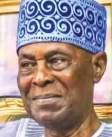
Late Adekunle Ojora
corporate life marked the beginning of a distinguished business career. Ojora joined the United Africa Company in the early 1960s, rising rapidly to become one of the earliest Nigerians to hold executive-level positions in a major multinational operating in the country.
He later held several public sector and quasi-public appointments, including roles in urban governance, real estate development and shipping, which broadened his influence in Nigeria’s economic management during the early post-independence years.
Ojora became most widely known for his long tenure as chairman of AGIP Nigeria Limited, a position he assumed in 1971. Under his leadership, the company became a major force in Nigeria’s downstream oil sector.
The Imo State Coordinator of Renewed Hope Ambassador (RHA), Rt. Hon. Goodluck Opiah, has clarified the organization remains a partner in progress and not an opposition within the All Progressives Congress (APC).
While addressing a press briefing in Owerri, the State Capital, Opiah cleared the doubt among many Renewed Hope organs, adding that all of them are working towards the achievement of the same goal as long as their motives are to geared towards advocacy of President Bola Tinubu’s legacies for the betterment of the country.
Inaugurating the 21 Local Government Areas Coordinators of RHA, Opiah, a former Minister of State for Education reaffirmed their total loyalty to President Bola Ahmed Tinubu, “whose courage and reformdriven leadership are repositioning Nigeria for long-term growth, and to Governor Hope Uzodimma, whose development-focused governance continues to transform Imo State.”
According to him, “we are partners in progress. We complement the party’s mobilisation efforts and work within the broader framework of party unity, discipline and loyalty to leadership.”
He urged the members to sustain the message of Renewed Hope, not just as a slogan, but as a practical
commitment to better living conditions, inclusive development and political stability for all the people. He said, “This is also not a platform for personal political ambition. It is a service platform. Those who have been appointed were selected based on their experience, commitment to party ideals and capacity to mobilise people at the grassroots.
“I want to use this opportunity to charge all the newly inaugurated coordinators to see this assignment as a call to service. You must be accessible to your people. You must listen to their concerns. You must engage respectfully, even with those who disagree with us politically. Democracy thrives on persuasion, not intimidation.

Acting Group Politics Editor DEJI ELUMOYE
Email: deji.elumoye@thisdaylive.com
08033025611 sms only
The controversy surrounding the four gazetted tax laws has continued to pitch the Minority caucus of the House of Representatives against the leadership of the Green Chamber. Adedayo Akinwale writes.

The relative peace enjoyed in the House of Representatives may soon give way if the issue of the altered gazetted tax laws that have continued to generate a lot of controversy is not well handled between some opposition lawmakers in the Green Chamber and the leadership of the House.
Recall that during a recent plenary, Hon. Abdulsamad Dasuki raised the alarm on the floor of the House that there were discrepancies between the tax laws recently passed and assented to by President Bola Tinubu and the gazetted version.
Following the outcry, the Speaker, Hon. Abbas Tajudeen ordered an internal verification and immediate public release of the Certified Acts to eliminate doubts, restore clarity, and protect the sanctity of the legislature.
The four Acts thus released included The Nigeria Tax Act, 2025; The Nigeria Tax Administration Act, 2025; The National Revenue Service ( Establishment) Act, 2025 and The Joint Revenue Board (Establishment) Act, 2025.
However, the Minority Caucus under the leadership of Hon. Kingsley Chinda, on January 2, 2026, set up a seven-man Fact-finding Committee to help the Caucus get to the roots of all the issues surrounding the scandal.
The committee, which was led by Hon. Afam Ogene also has Hon. Aliyu Garu, Hon. Stanley Adedeji, Hon. Ibe Osonwa, Hon. Marie Ebikake, Hon. Shehu Fagge and Hon. Gbefwi Jonathan as members.
The committee unconditionally vowed to protect the independence of the legislature and the democracy. It added that any attempt to foist fake laws on Nigerians was an attack on the independence and constitutional role of the National Assembly in safeguarding Nigeria’s democracy.
In its interim report released last Friday, the Minority Caucus of the House maintained that the Nigeria Tax Administration Act (NTAA) 2025, has a number of discrepancies from the version passed by the National Assembly and the version earlier published in the official gazette.
The committee explained that these discrepancies were obvious going by the released Certified True Copies (CTCs) by the House. The caucus pointed out that the alterations were a clear case of the Executive undermining legislative powers by illegally altering an already passed law to drag more taxpayers into the net.
Ogene noted that after comparing the Certified True Copies of the Acts released officially by the House of Representatives as directed by the Speaker, with the already
gazetted version already in circulation, the tax law was indeed altered.
He said: “That there were some alterations as alleged by Hon. Dasuki on the floor of the House of Representatives, especially in the Nigeria Tax Administration Act, 2025. There were three different versions of the documents in circulation, particularly the Nigeria Tax Administration Act, 2025.
“The order to the Clerk of the National Assembly, to take steps to “aligning the Acts - duly passed, assented to, and certified - with the federal government Printing Press to ensure accuracy, conformity, and uniformity,” is a clear indication that there were some procedural anomalies in the previously gazetted version that illegally encroached on the core mandate of the National Assembly, as the only organ of government constitutionally empowered to make laws for the good of the people, as prescribed.
This is a grave concern that would be deeply looked into.”
These discrepancies, Ogene noted, were obvious going by the released Certified True Copies (CTCs) by the House referenced earlier.
In addition, the minority caucus emphasised that it considered the alterations as an affront to the exclusive powers of the National Assembly to make laws.
For instance, the cause explained that under “Section 39(3): Currency of Tax Computation, the illegally altered gazetted Act mandated that tax computations for petroleum operations be made in US Dollars.
“But in the actual version passed
by the National Assembly, it prescribed tax calculations in the currency of the transaction,” Ogene said.
The caucus said given the anomalies, illegalities, and impunity observed, which clearly undermine the National Assembly’s constitutional powers and democracy, the Committee found the current evidence sufficient to warrant a deeper investigation.
Expectedly, the leadership of the House said that the ad-hoc committee on altered tax law constituted by the Minority Caucus of the House lacked institutional authority.
Spokesperson of the House, Hon. Akin Rotimi in a statement said while the House recognised the legitimate role of the minority caucus within parliamentary democracy and affirmed its right to express dissenting opinions, engage in policy advocacy, and raise public concerns, it was necessary to clearly distinguish between political activities and the formal parliamentary processes of the House.
Citing Standing Orders of the House of Representatives (Eleventh Edition), Rotimi stressed that the authority to constitute an ad hoc committee of the House rests solely with the House acting in plenary, or with the Speaker exercising powers conferred under the Standing Orders.
To this end, he said no political caucus, whether majority or minority, possesses the procedural authority to establish a committee that carries the status of a parliamentary body.
While political caucuses remain important platforms for consultation and coordination among members, the House however said they do not possess institutional and investigative authority, oversight jurisdiction, or the power to summon persons or demand official documents.
The House noted that any action taken by a caucus in this regard is therefore “nonbinding, informal, and without legal or
o bservers believe that while opposition lawmakers have the constitutional rights to protect nigerians from any form of executive rascality, the action of the House minority caucus to constitute a probe committee was, however, not in conformity with the rules of the Green Chamber.
institutional consequence.”
“Any committee constituted outside the processes prescribed by the Standing Orders lacks institutional recognition. Accordingly, any interim or final report emanating from such a caucus-led body cannot be laid before the House, cannot be received as a parliamentary document, and does not form part of the official legislative or oversight record of the National Assembly,” Rotimi further said.
The Green Chamber said it considered the action attributed to the minority caucus to be procedurally improper, inconsistent with parliamentary norms, liable to set an unwholesome precedent, and to create unnecessary public confusion, particularly since the matter had been addressed through established parliamentary mechanisms.
The House recalled that in December, 2025, it duly constituted a bipartisan ad hoc committee following the intervention of an opposition member who formally drew the attention of the House to the existence of multiple documents purporting to be official gazettes of the tax legislation.
The spokesperson noted that the mandate of that committee, which comprised members from both the ruling and opposition parties, is specifically to examine those allegations. He said upon the conclusion of its work, it would lay its report before the House in plenary.
Subsequently, the National Assembly, acting jointly through both Chambers, published the official Gazette of the National Assembly and issued Certified True Copies of the enacted tax laws. The legislative process has therefore been concluded and given full legal effect.
“In this context, the establishment of a parallel caucus-led committee and the circulation of purported interim findings serve only to compound public misunderstanding on an issue that has been institutionally resolved and overtaken by events,” Rotimi pointed out.
Observers believe that while opposition lawmakers have the constitutional rights to protect Nigerians from any form of executive rascality, the action of the House minority caucus to constitute a probe committee was, however, not in conformity with the rules of the Green Chamber.
They were also of the views that the caucus might be over-pushing its luck by setting up a parallel committee against the one set up by leadership of the House, warning that if it refuses to back down, it might lead to the suspension of the leaders of the minority caucus.
Be that as it may, the extent at which the leadership of the minority caucus would go to prove its point remains to be seen.
as the 2027 governorship poll in Ogun state draws near, a group, Ogun West Professionals, is ready to tackle the impediments of lack of cohesion and unity of purpose among major political players in the senatorial district. In this interview, Coordinator of Ogun West Professionals, ajiroba Oladapo Oke, speaks on the group’s core programmes and other topical issues. Folalumi Alaran brings excerpts.
What is your group all about?
Ogun West Professionals comprises professionals of Ogun West origin, both within Nigeria and in the Diaspora, who are committed to regional development and political equity. It is a coalition of accomplished individuals from diverse sectors committed to the advancement and development of Ogun west Senatorial District.
The group, which is newly created, is focusing on promoting the interests, development, and political representation of the Ogun West Senatorial District in Ogun State, Nigeria and to play a key role in mobilizing professionals and stakeholders from the region. Our main objective is to push for equity, especially in state leadership to correct historical marginalization of the region.
Are your members concerned about the levels of development in the Ogun West Senatorial District?
Our members are deeply concerned about the levels of development in the Ogun West Senatorial District. Our advocacy is, therefore, rooted in a shared frustration over what we perceive as decades of neglect and underdevelopment compared to other zones in Ogun State.
Members in our meetings frequently highlight the poor state of roads, inadequate healthcare facilities, and limited access to human capital development. Despite Ogun West hosting major industrial hubs like Agbara and Ota, members argued that the economic benefits are not equitably reinvested in the local communities.
We are deeply concerned about the lack of job opportunities and youth empowerment programs, which leads to migration of talent to other regions or abroad.
Members believe that government
institutions and services are disproportionately concentrated in other regions leaving Ogun West underserved.
Many of our members are professionals who grew up in Ogun West, some even retired from state public service and have seen first hand
the disparity in development. We believe that political marginalization has contributed to economic stagnation, and that producing a governor from Ogun West could help redirect attention and resources to the regions equitably.
What is your organisation’s agenda in Ogun?
Our goal is not just political power, but sustainable development and inclusive governance that benefits all parts of the state. Development is not just a side issue, it is central to our mission.
The agenda of the group is to present a common front before 2027. But the senatorial district is known for divisions. Do you think the professionals can break the jinx and unite the people?
In politics, certain things are normal, this includes multiple aspirations by interested contenders. This is because politics is a game of interest apart from being game of numbers, but all aspirants are not equally endowed hence, among many contestants, there will always be one among others who will clearly tower above the others as the best among equals. There will also be pretenders who are in the race for mere recognition and perhaps on the believe that they could be settled for other offices.
It is always the responsibility of the leaders to look at each contestants and bring out the best candidate who can win the election.
NOTE: Interested readers should continue in the online edition on www.thisdaylive.com
Tunde Akanni writes about the need for women to seek governorship seats in their states to give room for proportionate political representation in line with the Increased Women Seat Bill currently before the 10th National a ssembly.
The question is no longer whether Nigerian women are interested in power. The more honest question is whether Nigeria’s political architecture is genuinely prepared for women to exercise power without apology, patronage, or pity. The renewed campaign for increased women’s seats in the legislature has once again exposed the fault lines in our democratic imagination.
Obviously on account of its strong appeal, many citizens across gender divides freely support the idea. Some others, on the other hand, including some women, dismiss it as defeatist likening it to a charity-driven shortcut that undermines merit. Yet, beneath this argument lies a deeper fear: the discomfort with women not just participating in politics, but leading it.
Nigeria’s politics, noisy and competitive as it is, remains robustly masculine. From party structures to campaign financing, from godfatherism to violent primaries, politics is designed as a system that rewards brute endurance rather than broad-based inclusion. In such a terrain, women are routinely advised to “work harder,” “wait longer,” or “learn the ropes,” even when the ropes themselves are deliberately knotted against them. The agitation for reserved seats or affirmative quotas must therefore be understood not as a plea for pity, but as a strategic intervention in a structurally skewed system.
Critics of the campaign argue that conceding seats to women amounts to lowering the bar. They insist that politics should remain a free contest where only the strongest survive.
But this argument conveniently ignores the fact that the contest has never been free. It ignores the historical disadvantages women
face in access to funding, party tickets, political networks, and even physical safety. To demand “equal competition” in an unequal field is not principled neutrality. Rather, it presents moral indifference disguised as fairness. Globally, affirmative action has never been about replacing merit with mediocrity. Rather, it is about widening the gate so that merit, long suppressed by structural exclusion, can finally walk in. The Sustainable Development Goals (SDGs), which
Nigeria endorsed with fanfare, are anchored on a simple but powerful philosophy: leave no one behind. Political parties that mouth this slogan in development conferences but ignore it in their internal power-sharing arrangements are guilty of selective idealism. If parties are sincere about inclusive growth and governance, then propping up more women should not be an afterthought; it should be a core democratic obligation. Women, however, must also recognise that no liberation is handed down ready made. Beyond advocacy, there is a compelling need
for collectivisation. Nigerian women constitute a very significant percentage of the population, yet this numerical strength rarely translates into coordinated political muscle. Too often, women’s political engagement is fragmented by party loyalties, ethnic considerations, and elite patronage. The challenge before women is to build cross-party, cross-regional solidarities that can sway progressives and pragmatists alike—not with emotional appeals alone, but with disciplined organisation and ideological clarity.
The recent political journey of Senator Aisha “Binani” Dahiru in Adamawa State offers both inspiration and caution. Her near-emergence as Nigeria’s first elected female governor was a moment of collective pride for many women. Yet, the confusion, controversy, and ultimate frustration that followed her candidacy also exposed the perils of weak political anchorage. Critics argue that her alignment with powerful but controversial political figures, including Atiku Abubakar, burdened by the infallible stamp of corruption by his own former boss, President Olusegun Obasanjo, easily diminished her rating. Atiku is also notorious for frequent party switching, thus blurring her ideological compass and deepened uncertainty around her political project. Whether one agrees with these criticisms or not, the lesson is clear: women’s political advancement cannot rest solely on proximity to imagined male political titans whose interests may not align with long-term feminist or democratic goals.
-Prof Akanni writes from Lagos.
In a strategic push to strengthen industrialisation in Nigeria, particularly within the oil and gas sector, and to support the stability of the national economy, the Chief Executive of the Nigerian Midstream and Downstream Petroleum Regulatory Authority (NMDPRA), Mr. Saidu Mohammed, led his team on a three-day operational visit to refineries, gas processing plants, and petroleum bulk storage facilities in Rivers State, South-South Nigeria. Blessing Ibunge reports
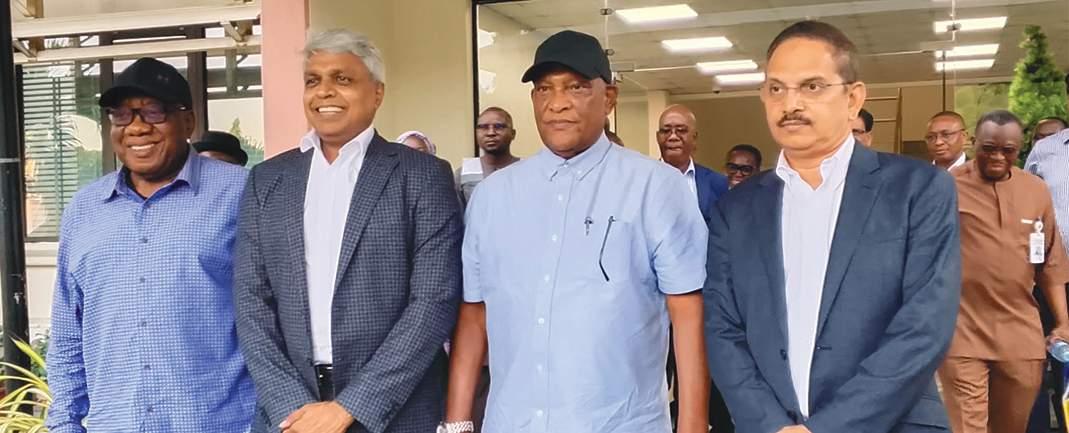
On December 19, 2025, following his nomination by President Bola Tinubu, the Senate confirmed Mr. Saidu Mohammed as the Chief Executive Officer of NMDPRA. He officially took over from former Authority head Farouk Ahmed on 23 December. Upon assuming office, Mohammed expressed a strong commitment to positively impact the energy sector in line with the President’s agenda of revitalising the industry.
Last week, Mohammed embarked on a tour of refineries, gas processing plants, and petroleum bulk storage facilities in the oil-rich South-South region. The visit aimed to obtain first-hand insights into the operational status and capacity of critical infrastructure in the midstream and downstream petroleum sectors.
The tour also sought to- Review and strengthen the strategic alignment between NMDPRA and its licensed operators; Engage key investors to ensure regulatory frameworks support business growth; Align government and public objectives with stakeholder operations; Improve operational excellence within the Authority; and Promote safety and personnel welfare in the midstream and downstream sector.
Facilities visited included Indorama, Aradel, Stockgap Fuels Limited, Matrix Petrochemical Limited, and Central Horizon Gas Company Limited.
The Federal Government has intensified focus on the energy sector in recent years, promoting stable operations by both local and international operators. While other sectors contribute to national development, energy remains central, given its high revenue generation.
Mohammed began the tour at Indorama Eleme Fertilizer and Chemical Limited in Rivers State. He described Nigeria’s midstream sector as “a tremendous segment that requires significant investment” and applauded Indorama for its consistent growth. He also highlighted the country’s imminent full-scale export of urea, thanks to increased fertilizer production.
“What we have seen in Indorama is a manifestation of what Nigeria needs to have. We need a lot of this in the midstream — fertilizer plants and any value addition on hydrocarbon resources are essential to propel the nation. These dreams existed before, but today, we have found the right partnership with the private sector…
“We need to earn 30 to 50 billion dollars a day if we must get Nigeria on the right footing as a hub not only for oil and gas, but for secondary products such as fertilizer and urea. With the expansion at Indorama and other companies including Dangote Fertilizer, I am confident that within 24 months, Nigeria will join the league of urea-eporting nations.”
Indorama CEO, Mr Munish Jindal, commended the visit, noting the company’s efforts in overcoming past regulatory challenges, adding that “The Authority has been engaging with the oil and gas sector for years. Initially, we faced challenges, but the new regulators have encouraged us, and we fully support their initiatives.”
Gas Distribution as a Catalyst for Industrialisation
At Stockgap Fuels Limited, Mohammed emphasised the critical role of gas distribution in supporting industrial growth. “Gas provides a cleaner and more efficient energy source that lowers production costs
and ultimately reduces consumer prices. We are committed to enforcing strict compliance while accelerating gas distribution to drive industrialisation nationwide. This tour aligns with the Federal Government’s Decade of Gas initiative, which seeks to maximise Nigeria’s vast gas resources.”
Mohammed reaffirmed the government’s goals to deploy activities across the oil and gas value chain, deepen domestic gas utilisation, and facilitate exports. He assured support for gas distributors and midstream operators to ensure orderly expansion under transparent technical and commercial frameworks.
“Inspecting these facilities underscores government’s resolve to reposition the gas sector as a catalyst for industrial growth and national prosperity. Transparency remains central under the Petroleum Industry Act. These operators may appear small, but they are vital to delivering gas across the country, particularly to industrial hubs.”
Stockgap Chairman, Dr Stanley Ohamarije, revealed the company plans to inject five million gas cylinders into the market over the next five years to support the government’s 10-million-cylinder target. He said the plant currently produces 2,500 cylinders per hour, a demonstration of commitment to increasing gas access and driving industrial growth.
Central Horizon Gas Company Managing Director, Mr Kahide Alabi, added that the company was expanding gas infrastructure nationwide to support industrialisation under the Decade of Gas initiative: “Natural gas remains a major driver of industrial growth globally. CHGC is establishing facilities across Nigeria
to support economic development.” Private Sector Investment Drives Growth
During the Aradel facility tour, Mohammed lauded Nigerian indigenous oil and gas firms for their investment strides. He stressed that the midstream sector requires $30–50 billion in private investment.
“As a regulator, we aim to create the right enablers for private investment. Facilities like Aradel demonstrate worldclass operations run by Nigerians — a model for others. Not only 11,000 barrels of oil per day, but 50,000, 100,000, as the case may be.”
Mohammed emphasised Nigeria’s potential to supply domestic and continental markets: “Dangote Refinery alone cannot satisfy the large Nigerian market.
We aim to go beyond Africa, exporting PMS, LPG, and gasoline to America and Europe. Aradel is an example of the facilities needed to develop the midstream sector, which drives overall economic growth.”
He also stressed that adequate supply and competition are key to lowering prices and enhancing economic efficiency: “The more supply we have, the lower the prices. Competition drives affordability. PMS prices have dropped from over 1,000 Naira to about 800 Naira, a clear example of how market dynamics work when there is no subsidy.”
Conclusion
Saidu Mohammed’s visits underscore NMDPRA’s commitment to industrialisation, private-sector investment, and economic recovery. By engaging stakeholders, promoting regulatory excellence, and supporting the gas and midstream oil sector, the Authority aims to position Nigeria as a hub for energy and downstream value-added products.
stories by Chiemelie ezeobi
The Nigerian Armed Forces Resettlement Centre (NAFRC), Oshodi, has inaugurated Course 1/2026 of the PreRetirement/Pre-Discharge Programme, with participants urged to embrace discipline, purposeful learning and adaptability as they prepare for life after active military service.
The Commandant of the Centre, Air Vice Marshal (AVM) Nnaemeka Ignatius Ilo, who spoke at the inauguration ceremony held on Wednesday, January 28, 2026, at the NAFRC Buhari Hall, described the Centre as a “citadel of courage and hope,” noting that its motto reflects the core values required for a successful transition from military to civil life.
AVM Ilo congratulated the participants on their nomination for what he described as a highly competitive and prestigious course designed to equip personnel with relevant skills for post-service survival and prosperity.
According to him, the Centre’s mandate remains the provision of quality training, research and development, as well as consultancy services aimed at adequately preparing retiring personnel to face the realities and challenges of civil society.
He explained that the six-month course features a blend of theoretical and practical training focused on entrepreneurship, self-reliance, job creation and sustainable living.
The Commandant disclosed that feedback from past participants showed that many graduates of the Centre had gone on to become successful entrepreneurs across diverse sectors of the economy, expressing confidence that the current participants would equally emerge competitive and productive in the open market.
He cautioned participants against underestimating the realities of civil life,
describing it as largely unstructured and fiercely competitive when compared to the regimented military environment.
Stressing the importance of emotional intelligence and self-control, AVM Ilo advised them to prepare mentally for differences in work culture, time management and interpersonal relations outside the Armed Forces.
He also emphasised the importance of family, urging participants to see the course as an investment not only in themselves but also in their families, who depend on their successful transition.
He underscored the need for dedication, diligence and effective time management, noting that optimal use of the training period would largely determine individual success.
On discipline, AVM Ilo reiterated that high standards of comportment and regimentation would be maintained throughout the course.
He further warned that the Defence Headquarters’ directive on the misuse of
social media remains fully applicable within the Centre, stressing that violations would attract severe sanctions, including dismissal from the course and further disciplinary action.
The Commandant expressed gratitude to the Chief of Defence Staff, the Service Chiefs, the Minister of Defence and the President, Commander-in-Chief of the Armed Forces, President Bola Ahmed Tinubu, for their support and commitment to the resettlement and welfare of retiring personnel.
In an interaction with journalists, AVM Ilo said the Centre is intensifying efforts to modernise its training approach through the gradual introduction of technology-driven modules, including Artificial Intelligence, as part of efforts to align NAFRC with international best practices.
Earlier, the Director of Training, Brigadier General Isang Akpaumontia, described the inauguration as the formal commencement of training activities for Course 1/2026.
He disclosed that a total of 823 participants were posted to the course, comprising 523 personnel from the Nigerian Army, 122 from the Nigerian Navy and 178 from the Nigerian Air Force.
Of this number, he said 718 participants had been received, documented, accommodated and medically screened, while 85 were declared medically unfit and returned to their units for further medical attention.
He added that arrangements had been made to complete documentation and biometric capture for the affected personnel ahead of graduation.
Brig. Gen. Akpaumontia reiterated that the Centre remains a world-class institution dedicated to entrepreneurship and management training, aimed at ensuring the seamless reintegration of personnel into civil society after decades of meritorious service.
He reminded participants that the course is fully residential and urged them to uphold discipline and conduct befitting their ranks.
The Nigerian Air Force (NAF) has reaffirmed its commitment to improving the healthcare, employment prospects and overall welfare of its veterans, describing their wellbeing as critical to sustaining national security and institutional strength.
The Chief of the Air Staff (CAS), Air Marshal Sunday Aneke, stated this during an interactive parley with Air Force veterans held last weekend at the Nigerian Air Force Officers’ Wives Association (NAFOWA) Hall, Ikeja, Lagos.
Air Marshal Aneke said the enhancement
of veterans’ healthcare services, economic reintegration, financial security and sustained engagement remains a top priority of his administration, noting that retired personnel constitute an invaluable reservoir of experience and institutional memory for the service.
Represented by the Director of Veteran Affairs, Headquarters Nigerian Air Force, Air Commodore Ademuyiwa Adedoyin, the CAS disclosed that the NAF is developing digital education and employment support programmes aimed at
easing veterans’ transition into civilian life.
He revealed that discussions are ongoing to produce a structured framework that would integrate NAF veterans into national labour and employment strategies, in collaboration with the Federal Ministry of Labour and Employment.
According to him, the Air Force is also planning to establish dedicated healthcare sections within its hospitals to provide specialised medical services for veterans, thereby improving access to quality care after retirement.
Air Marshal Aneke
further announced that the group life assurance policy payable to the families of deceased Air Force veterans has received Presidential approval. He added that the President has also approved the payment of all outstanding welfare arrears owed across the Nigerian Air Force.
In his remarks, the Air Officer Commanding Logistics Command, Air Vice Marshal Abubakar Suleh, described the veterans’ parley as an important platform for strengthening the values, traditions and professional standards upon which the Nigerian
Air Force has been built.
He said similar engagements held across various NAF units have contributed significantly to reinforcing the foundation of the service as a key pillar of Nigeria’s defence and national security architecture. One of the guest speakers, retired Air Vice-Marshal Nicholas Spiff, who delivered a presentation titled Life After Service, stressed the importance of preparing serving personnel for the realities of post-retirement life.
He urged veterans to approach the transition to civilian life with
optimism, planning and adaptability, noting that life after service requires a deliberate shift in mindset.
Also present at the event were over 400 veterans, who attended the interactive forum, which commenced in 2023 as an annual engagement. Since then, due to its growing relevance and impact, the initiative has since been upgraded to a biannual event, underscoring the Nigerian Air Force’s sustained commitment to the welfare and inclusion of its retired personnel, a tradition sustained by Air Marshal Aneke nationwide.
Edited by Oke Epia

Nigeria has articulated some of the most detailed climate and energy transition frameworks in Africa. The Energy Transition Plan (ETP) aligned with its Net-Zero by 2060 commitment and the updated Nationally Determined Contribution (NDC 3.0) are intended to map out how the country will reduce emissions and diversify its energy mix away from fossil fuels while achieving universal energy access. Yet a careful look at the policy landscape tends to suggest gaps and mismatches that need to be addressed.
The policy framework: clarity with caveats
Nigeria’s ETP explicitly defines sectoral decarbonization pathways for power, transport, industry, cooking, and oil and gas. Importantly, the plan recognizes gas as a transition fuel while ramping up renewables such as solar and hydropower. It commits to achieving net-zero emissions by 2060, and outlines job creation and poverty reduction as co-benefits of the energy transition. It also sets broad targets for renewable energy penetration and moves away from diesel generators that have dominated electricity supply.
However, the ETP remains largely model-driven rather than implementation-focused. Despite many ambitions, only a small fraction of the financing needed to achieve the transition has been secured to date, the plan itself notes the need for billions of dollars annually, far beyond current public or private commitments. The Energy Transition Office (ETO) is meant to coordinate execution. Similarly, while the ETP and NDC 3.0 provide a roadmap, they fall short of clear accountability and reporting mechanisms. This makes it difficult to assess whether short-term milestones (e.g., renewable share by 2030) are being met.
Solar leads but far below expectations
The most visible government-driven renewable energy progress has been in solar electrification and off-grid solutions. The Rural Electrification Agency (REA), through the Nigeria Electrification Programme (NEP), has reportedly deployed about 176 mini-grids and impacted about 7.8 million Nigerians with off-grid solar and standalone systems.
These distributed renewable projects are essential and represent a concrete implementation of policy. Their positive effects include reduced reliance on diesel generators in rural areas and increased energy access. But this is only the tip of the clean energy iceberg: solar projects remain small compared with Nigeria’s enormous energy access gap as an estimated 86 million Nigerians still lack reliable access to electricity. Large-scale solar and grid-connected renewable capacities remain limited and there is no clear data showing rapid deployment of utility-scale solar integrated with the national grid, and many planned projects have faced delays or financing challenges. The absence of a publicly accessible results framework makes it difficult to validate claims of achievement.
Nigeria’s Distributed Access through Renewable Energy Scale-up (DARES), a $750 million program funded by the World Bank, aims to expand decentralized renewable infrastructure to over 17.5 million Nigerians. This signifies a larger strategic push, but it is still in early stages and has not yet delivered widespread measurable outcomes across all target zones. Additionally, grid instability— long a hallmark of Nigeria’s power system - continues to hamper large-scale renewable integration because solar and wind require
robust grid management and storage capacity that are currently lacking. This infrastructural deficit limits how much utility-scale renewable energy can be absorbed and distributed without frequent outages.
Fragmented projects are part of the problems
The Nigeria National Petroleum Company Limited (NNPCL) formally recognizes renewable energy through its subsidiary, NNPC New Energy Limited, which is meant to drive renewable and low-carbon initiatives in line with Nigeria’s Energy Transition Plan. However, in practice, this renewable energy mandate remains largely dormant. There is no clear, publicly verifiable evidence of NNPC owning, operating,
or financing significant renewable energy projects such as large-scale solar or wind power. Instead, NNPC’s transition efforts are mostly concentrated on gas-based activities, including gas commercialization and flare reduction. While these actions may lower emissions compared to diesel or crude oil use, they do not amount to empirical renewable energy deployment and fall short of the deep decarbonization required for Nigeria’s net-zero 2060 goal. The absence of visible renewable investment from Nigeria’s most powerful energy institution creates a gap in the transition architecture, leaving agencies like the REA to drive renewables at the margins. Without clear targets, capital allocation, and transparent reporting on renewable projects,
NNPC’s renewable energy function risks remaining a symbolic structure rather than a driver of Nigeria’s clean energy transition.
Gas and CNG: Transition fuel or policy placeholders?
Natural gas holds a central, contested role in Nigeria’s energy narrative. The ETP explicitly positions gas as a transition fuel that can provide baseload power and improve energy reliability while solar and other renewables scale. Consumption of gas is anticipated to increase initially (about 25 percent above 2019 levels by 2030) before declining as the country approaches net-zero goals. Nigeria has reiterated commitments to end routine gas flaring by 2030 and to reduce methane emissions by 60 percent by 2031 - directly addressing one of the country’s most carbon and pollution-intensive practices. Notable interventions such as the Nigeria Gas Flare Commercialization Programme (NGFCP) and the Presidential Compressed Natural Gas (CNG) Initiative are not without their challenges. For instance, capturing flare gas and converting it into productive energy requires complex financing, engineering, and infrastructure construction. While gas is seen as a transition fuel, its role as a core energy source well into the 2030s may delay substantial decarbonization, unless paired with carbon capture or renewable replacement pathways. In any case, gas flaring has historically defied enforcement, with decades-old anti-flaring laws previously failing to get compliance, raising a critical question about regulatory capacity and political will. The rhetoric of flaring reduction must therefore be tested against sustained enforcement, not just announced targets. This distinction is often overlooked in official narratives.
The story continues online on www.thisdaylive.com
As Nigeria charts its path toward a sustainable and affordable energy future, the National Agency for Science and Engineering Infrastructure (NASENI) seems to have positioned itself at a critical intersection of innovation, climate action, and home-grown sustainability solutions. But are the agency’s optics being translated into real, tangible and sustained progress?
A project that captured national attention was the foundation laying of what was touted as West Africa’s first solar cell production factory in Gora, Nasarawa State in March 2023. The groundbreaking event was performed by then Vice President Yemi
Osinbajo. This ambitious initiative, designed to anchor local solar manufacturing and reduce the cost of solar energy, was celebrated as a potential game-changer in Nigeria’s energy sector and a major step toward reducing reliance on diesel generators and expanding renewable solutions. Yet, almost three years on, stakeholders and citizens alike are left with pressing questions: What progress has been made since 2023? Is the factory operational, under construction, or facing delays? What structures are in place to guarantee continuity beyond announcements? Has this factory moved beyond groundbreaking to actual production? What concrete milestones and timelines have been published? Clear,

regular reporting on progress, financing, and implementation mechanisms is necessary to confirm that this project isn’t stalled or forgotten but demonstrates seriousness about energy transition delivery.
Nevertheless, NASENI continues to invest in energy solutions. It is reportedly training personnel to install 100,000 solar home systems nationwide aiming to expand off-grid access and rural electrification. The agency’s solar portfolio has also reportedly grown, upgrading its capacity from 22 MW to 50 MW with plans to scale further, while also looking into solar irrigation technology to support sustainable agriculture.
From a governance perspective, NASENI’s activities are noteworthy. Its work demonstrates a willingness to innovate and align with Nigeria’s Energy Transition Plan, which aims for cleaner energy integration and universal access. However, it doesn’t end here, transparency and accountability must accompany ambition. Citizens need accessible and regular updates on flagship projects, budget allocations, operational challenges, and success metrics. How is progress measured? Are timelines and deliverables publicly posted? What safeguards ensure continuity beyond political cycles and leadership changes?
At SOStainability, we raise these posers not to question NASENI’s credibility but to promote strong governance, public trust, and collective progress. We look forward to NASENI doing even more, fulfilling its energy commitments. When innovation is paired with accountability, Nigeria’s energy transition becomes not just possible, but exemplary for Africa.
Edited by Oke Epia |
By Rep (Sir) Sam Onuigbo
Two things made Nigeria’s attendance at this year’s Abu Dhabi Sustainability Week Summit (ADSW 2026) very remarkable.
One, it showed how the sequence of actions by Nigeria’s leader, President Bola Ahmed Tinubu, undergirded his determination to pave a promising future for the country’s energy transition agenda.
Secondly, the fact of the President’s consistent attendance, which made it easy for him to attract the hosting of Investopia 2026 to Nigeria, and the unveiling of Nigeria’s Carbon Market Framework, combined to make the country the cynosure of all delegations at the seven-day event.
The Investopia, which is expected to be co-hosted by Nigeria and the United Arab Emirates, in Lagos in February this year, will showcase Nigeria as an investors’ haven, especially its pedigree as home to over 250 million persons and Africa’s most populous nation. Bouyed by its significant population of well-educated youths and easy access to ECOWAS and the rest of Africa, Nigeria indeed is the go-to place as far as access to market and networking is concerned.
Although it came at a great personal cost, I was happy I made it to the Abu Dhabi meet, where the International Renewable Energy Agency (IRENA) Assembly preceded the talks on the Sustainability Week. As I sat through the President’s address, I quickly recalled his 2025 observations. The President had declared at the ADSW2025: “The fight against Climate Change is not merely an environmental necessity, but a global economic opportunity to reshape the trajectory of our continent and the global energy landscape.” Further, he stressed that “to succeed, we must innovate, collaborate and decisively collaborate as a global community.”
I recalled also how in the course of his inaugural address at Eagle Square, Abuja, on May 29, 2023, the President had stated: “Our government shall also work with the National Assembly to fashion an omnibus jobs and prosperity bill. This bill will give our administration the policy space to embark on labour-intensive infrastructural improvements, encourage light industry, and provide improved social services for the poor, elderly, and vulnerable.”
At every turn in the activities of the ADSW 2026, it was evident that President Tinubu’s consistent push for environmental renewal undergirded his belief that energy transition was the key to future prosperity. That could explain why, during his 2024 Budget Speech in November 2023, he declared that “we have strategically made provisions to leverage private capital for big-ticket infrastructure projects in energy, transportation, and other sectors. “This marks a critical step towards diversifying our energy mix, enhancing efficiency and fostering the development of renewable energy sources…”
Of course, knowing that here was a President who signed into law the Electricity Bill barely eight days after taking office, made me recall the rigours the House of Representatives and I, under the efficient leadership of Speaker Femi Gbajabiamila, went through to deliver Nigeria’s signature law, the Climate Change Act 2021. So far, the Nigerian leader has continued to build on that foundation to catapult the country’s profile in the emerging global energy economy. And, all that showed during the ADSW 2026. By assenting to the Electricity Act of 2023, the President dismantled decades of suffocating centralised control over power and invited states and the private sector to finally build. It was the first tangible signal that this administration might approach its promises as a blueprint, not a bromide.
What is more, as Nigeria approached the COP28 climate summit, the directive to relevant agencies was sharp and singular: secure substantial international funding and
partnerships to bolster the national energy transition plan. The mandate was to move from advocacy on the global stage to securing concrete, actionable commitments.
At the Abu Dhabi Sustainability Week, therefore, the President reinforced my conviction that Nigeria’s prosperity depends on a fundamental shift to clean, reliable energy.
ADSW showed that indeed, the polished global conversation had finally moved from declarations to the gritty mechanics of delivery.
Verging on the core of this progressive conversation is the continuing search for how nations are building on their ambitious promises. Nigeria’s leader did not disappoint. President Tinubu was there live, not as a passive potentate, but as a leader actively involved and leading the charge, providing directions and proffering workable strategies.
The fact of his 2025 and 2026 consecutive physical presence did much to impact the atmosphere in a way no policy paper could. It signaled to every investor, diplomat, and executive present that Nigeria’s energy transition is not a side project managed by mid-level officials, but a top priority owned and driven from the very highest level of government.
“Nexus to Next: All Systems Go” was the theme of the ADSW 2026. To Nigeria, that phrase carried a particular, almost painful, weight. Our systems—the grid, the financial architecture, the regulatory environment, energy, human capital—have infamously not been “going” for a long time. Our message was
that we are finally, seriously, rewiring them, and we are using the global green transition as the master blueprint for this overhaul.
We came forward with proofs and specifics: That the 2023 Electricity Act is no longer just a landmark legislation. It is the thriving legal bedrock that allows a company to construct a solar mini-grid for a hospital in rural Abia, Nasarawa, Borno, etc., without pleading for federal permission. We are talking about a decisive shift from theoretical potentials to practical, on-the-ground projects.
In plain terms, it could be seen that Nigeria was particular about energy financing. Our pitch was built for the financial pragmatists in the room. We did not ask for aid or concessionary pity; we presented a business case, complete with the instruments we had already built and tested. A Sovereign Green Bond, oversubscribed by 82 per cent, was cited as proof that the market was listening.
A five-hundred-million-dollar Distributed Access through Renewable Energy Scale-up (DARES) was highlighted as capital that is well established, managed, and ready to deploy.
A seven-hundred-and-fifty-million-dollar programme with the World Bank, already in motion, aims to bring clean electricity access to over seventeen million Nigerians. The takeaway from ADSW 2026 for other countries is that Nigeria has progressed from making pledges to creating the financial machinery to fulfil them. The country has clearly set the structure for global connectivity and revenue inflow.
The gamechanger
It was a bang: The signing of the Nigeria-United Arab Emirates Comprehensive Economic Partnership Agreement (CEPA), came through as the game-changer. Here was a hard-negotiated and ratified trade deal. The UAE will eliminate tariffs on over seven thousand Nigerian products, and Nigeria will do the same for about six thousand UAE products. This agreement also signals the creation of qualitative jobs, particularly for Nigeria’s young population, in agriculture, real estate, digital banking, retail, and infrastructure financing. Can you beat that?
Consider what that means for a moment. To a furniture manufacturer in Lagos, a certified cocoa processor in Ondo, or an assembler of electronics in Nnewi, one of the most significant barriers to entering one of the world’s most affluent and connected markets has just been dismantled. This is the most decisive policy push for a post-oil, industrialised economy I have witnessed in a generation. It will masterfully transform Nigeria’s green transition from an internal development goal into a compelling global trade and investment opportunity. In the conference hall, you could almost see the recalibration happening in real-time behind the eyes of the assembled investors and partners. Yet, amidst this powerful forward thrust, the most intellectually resonant moment for me was one of direct and necessary challenge: President Tinubu turned to the custodians of global development finance, reminding them that their prevailing model has become fundamentally flawed. He argued persuasively that shackling developing nations with ever more sovereign debt to build the very solar grids, climate-resilient agriculture, and infrastructure the whole world needs is neither morally fair nor operationally sustainable. President Tinubu’s proposal for innovative blended finance was, in essence, a clarion call to rebalance the scales of risk. It framed the conversation not as a plea for concessionary terms, but as a strategic renegotiation of the partnership between global capital and emerging economies.
The audacity of this position carried significant weight precisely because of the groundwork he had just laid. For the preceding hour, his presentation had systematically dismantled the old narrative. He had not outlined a list of needs; he had catalogued a portfolio of ready opportunities, established governance frameworks, and concrete financial instruments. He had demonstrated that Nigeria arrived at the table not as a supplicant, but as a serious and credible counterparty, fundamentally changing the context of the tasks that followed.
Lessons brought forward Nigeria’s presence at the ADSW 2026 had rich lessons. First, credibility is a currency minted through consecutive, verifiable action. Nigeria’s voice carried an unfamiliar weight in those rooms because it was backed by a trail of veritable policies: The Climate Change Act, the Electricity Act, the oversubscribed green bonds, the National Climate Change Fund, our Pilot Electric Mobility Project, National Carbon Market Activation Policy, etcetera. The President’s personal stewardship on that global stage was the final, unmistakable stamp on that currency. Second, true progress lies in deliberate connection. We are finally, seriously attempting to systematically link power generation to job creation, our vast rare earth minerals to domestic manufacturing, and foreign investment to the development of local skills. This is the integrated, forward-thinking industrial strategy we disastrously failed to build during the oil boom. The green transition, ironically, is our nation’s second chance to get it right.



Celebrating Excellence at James Hope College, Lekki, Lagos
Subjects
Accounting
Religious Studies
Mathematics
Additional Mathematics
English Language
Chemistry
Biology
Geography
Literature in English
Design & Technology
Physics
Computer Science Economics
CELEBRATING OUR OUTSTANDING SCHOLARS OF 2025 (A* & A)

* Jim Ovia Foundation Scholarship Beneficiar y










SOLA
FREDRICK NWABUFO
reckons that the visit earns Nigeria dividends in trade, defence, and diplomacy
See page 21
APC welcomes Caleb Mutfwang in grand style, writes YAKUBU DATI
See page 21
EDITORIAL


argues why Nigeria must stop mistaking projections for outcomes, and start governing poverty as a system
Nigeria’s poverty debate has drifted into a dangerous simplification. A single figure appears, detached from its assumptions, repeated until it hardens into fact, and then deployed as proof of inevitability or failure. It is emotionally compelling. It is also analytically shallow.
When the media headlines projections made by consulting firms, such as the recent PwC publication Nigeria Economic Outlook 2026, which stated that 141 million Nigerians will be poor, the figure is often treated as a definitive account of lived reality rather than what it actually is: a projection based on assumptions about economic conditions, policy effectiveness, and exposure to shocks. That distinction matters, because projections are not measurements, and assumptions are only assumptions.
This piece is not an attempt to downplay poverty. It is an attempt to restore clarity to how poverty is understood, debated, and governed.
A poverty measurement is derived from household-level data collected at a specific point in time, using a defined methodology and threshold. It tells us what was observed.
A poverty projection, by contrast, extends past trends forward often in a straight line to estimate what might happen if key conditions remain unchanged. It assumes that household behaviour does not change, policy design and scale do not improve, efficiency of beneficiary targeting remains static, shocks recur with similar intensity, and social protection systems remain fragmented.
Straight-line projections are useful as warnings, but they are not neutral. They embed pessimism into forecasts and then present those assumptions as data-backed certainty. Allowing this instrumental use of poverty statistics to dominate public discourse particularly in a pre-election year undermines serious policy engagement.
Poverty is not a single condition. It is an aggregation of deprivations that interact over time. Two households can fall below the same poverty line for entirely different reasons and therefore require different policy responses. One may be temporarily poor due to food price shocks. Another may be structurally trapped by low education, poor health access, unsafe housing, and lack of productive assets.
other. Some households have income but lack essential services. Others lack income today but possess capabilities and assets that make their poverty transitory.
Evidence from countries such as the United States illustrates partial overlap, reinforcing the need for complementary measurement frameworks. In its latest report, the US Census Bureau cited 12.3% of Americans are income poor, 15% were MPI/MDI poor, while 8.3% are poor in both measures.
Complementing monetary measures, Nigeria’s sub-national Multidimensional Poverty Index (MPI) report (2022) provides the most updated and verifiable poverty numbers. It shows how people are poor, not just how many. It provides federal and state governments with insight into how to allocate resources by sector and geography based on actual deprivation patterns. Crucially, it enables coordination across ministries and sub-national governments by turning poverty into a shared, measurable outcome.
This is why serious governments use MPI not merely to report poverty, but to design policy, track progress, and hold institutions accountable. India, with a population of over 1.2 billion, has significantly used the MPI as a crucial tool to track and achieve substantial poverty reduction. The country nearly halved its MPI value, moving 415 million people out of multidimensional poverty in 15 years (2005/06-2019/21).
Nigeria’s poverty debate, however, often jumps prematurely to funding. Can we afford this? Where will the money come from? These are the wrong questions.
model trade-offs, run microsimulations, assess budget incidence, and prioritise interventions that reduce deprivation fastest and prevent relapse.
Effective social protection answers one central question: what happens to a household over time?
This is where Ultra-Poor Graduation approaches matter. There are some beneficiaries who remain in the Nigeria National Social Register since 2016- not improving in livelihoods, nor exiting to make room for others. Graduation approach is the answer. Originally developed by BRAC in Bangladesh, the Graduation approach is a holistic framework designed to transition the world’s most vulnerable populations into self-sufficiency. The programme provides a "big push" through six core components: the transfer of a productive asset (such as livestock), technical skills training, temporary consumption support, access to savings, health education, and intensive weekly coaching.
Rigorous evaluations by J-PAL affiliates across diverse contexts, including Ethiopia, Ghana, Honduras, India, Pakistan, and Peru, demonstrate the model's extraordinary efficacy: In Bangladesh, participants saw a 38% increase in earnings four years after the initial asset transfer. Long-term data shows these benefits persist even 11 years later, with significant gains in self-employment and consumption. In West Bengal, India, households experienced a five-fold increase in livestock revenue and a 30% rise in wages as women transitioned from casual farm labour to more stable non-farm occupations and small businesses.

Assuming equivalence based solely on headline figures results in imprecise beneficiary targeting, suboptimal allocation of resources, and weak poverty exit strategies. When policy is guided by a single metric, poverty is managed rather than reduced.
Given that monetary poverty and multidimensional poverty do not fully overlap, across countries, large groups of people are poor by one measure and not
When social protection spending: cash transfers, food interventions, school feeding, health subsidies, education support, livelihood programmes, humanitarian response, pensions, fuel mitigation measures, and shock-related relief, is aggregated across Ministries, Departments and Agencies, it already represents one of the largest functional expenditures in the national system. Fragmentation makes large spending appear small and serious effort appear ineffective. Integrated systems, by contrast, allow governments to pool resources,
Beyond financial metrics, research in Ghana found that integrating cognitive behavioural therapy (CBT) into the model significantly improved participants' mental health and socioemotional skills, while studies in India noted marked improvements in food security and physical health a decade after the program ended. The success of this evidencebased model has sparked massive global expansion. BRAC has reached over 2.3 million households in Bangladesh and more than one million across 14 other countries. Furthermore, the World Bank estimates that over 400 economic inclusion programs inspired by this approach have now reached approximately 70 million people worldwide.
Afolayan is a social protection and poverty governance specialist with over 25 years experience working on multidimensional poverty analysis, integrated safety nets, and graduation-based pathways out of poverty in Nigeria
FREDRICK NWABUFO reckons that the visit earns Nigeria dividends in trade, defence, and diplomacy

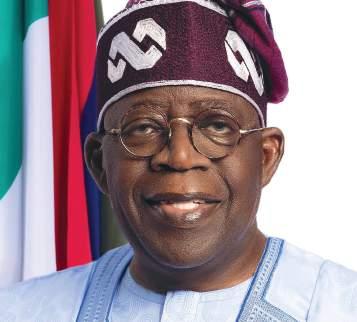
President Bola Tinubu on Monday arrived in Ankara, the state capital of Türkiye, to commence a historic state visit. On Tuesday, before a grand reception at the Presidential Palace, T.C. Cumhurbaşkanlığı Külliyesi, President Recep Tayyip Erdogan paid a visit to the President at his suite.
President Tinubu arrived at the Presidential Palace, where a resplendent ceremony was held to welcome him. After inspecting the guard of honour, the President and his host, President Erdogan, went into a private meeting for bilateral talks.
President Tinubu's visit holds immense significance, and happening at a time, the nation is gaining global attention for very good reasons. Nigeria has regained its natural place in the league of nations.
Nigeria is Türkiye's largest trading partner in sub-Saharan Africa, with over 50 Turkish companies operating in the country and with investments totalling over $400 million. Nigeria's exports to Türkiye were $504.67 million during 2024, according to the United Nations COMTRADE database on international trade.
The visit is not a jaunt or a leisure run, but a historically, economically, diplomatically, and security-wise consequential visit.
Some of the quick wins, viz-a-viz the memoranda of understanding, signed, include:
One, agreement on defence cooperation. Türkiye is a Middle-Eastern power with advanced defence capabilities and some success in combating terrorism. Nigeria, as a strategic partner, is strengthening its relations with
Türkiye in this regard.
Two, Joint declaration establishing the economy and trade joint committee.
Three, agreement in the field of Halal quality assurance.
Four, cooperation in the field of higher education.
Five, cooperation in the field of media and communication.
Six, cooperation in the field of diaspora policy.
Seven, cooperation in the field of education.
Eight, cooperation between the Republic of Türkiye, Ministry of Foreign Affairs, Diplomacy Academy, and the Federal Republic of Nigeria, Ministry of Foreign Affairs and Foreign Affairs Academy.
Nine, cooperation between the Republic of Türkiye, Ministry of Family and Social Services and Federal Republic of Nigeria, Ministry of Women Affairs.
Speaking after the signing ceremony, President Tinubu emphasised the urgency of collaboration among global partners in tackling today's existential problems for tomorrow's security, peace, and progress.
"How do we build an inclusive economy together? How do we reform and get vulnerable people involved in the economy? How do we ensure peace in the world?" Nigeria's President said.
"We discussed efforts against terrorism. We discussed how to defeat agents of destabilisation."
President Tinubu's state visit to Türkiye earns our nation another dividend in trade, defence, and diplomacy.
Nwabufo is Senior Special Assistant to the President on Public Engagement
APC
writes YAKUBU DATI

The historic reception held in honour of Gov Caleb Mutfwang of Plateau State by the All Progressives Congress (APC), to welcome him into the party on Tuesday marked a decisive moment in Plateau State’s political recalibration.
Attended by respected dignitaries that included Vice President Kashim Shettima who was there as the representative of President Bola Ahmed Tinubu and in his capacity as party leader; Senate President Godswill Akpabio; Speaker of the House of Representatives Rt. Hon. Tajudeen Abbas; principal officers of the National Assembly; APC governors; federal ministers; heads of parastatals and senior party officials; Jos, the capital of Plateau State experienced a seismic vibration not seen in recent times.
With an estimated population of 4.7 million people, the entire state stood still to witness the historic event and honour President Tinubu for his demonstrated love for the state.
The world witnessed how market women left their stalls, youths jubilating in their thousands, the elderly heading towards the particular direction as they sang and party faithful not willing to be outdone, swarmed the Polo field venue of the event as Plateau reflected a truly masses-oriented politics and the governor, a leader with a magnetic pull.
The reception has given political scientists an assignment to unravel how a leader could galvanize so much force and momentum that unifies millions of people within a short period of time .
Gov Mutfwang received his membership card of the the APC only on January 2, but going by the kind of dignitaries and number of people he was able to attract to Jos on Tuesday, he may well take his rightful place as the greatest unifying force the party and indeed Plateau has been waiting for.
The magnitude of his impact was felt thousands of miles away as millions were live streaming the event from across the globe while over three million people were gathered at the Polo field, Jos to witness the historic occasion.
That Mutfwang has redefined the concept of party politics and political realignment is not in doubt because in Nigerian politics, authority is reinforced not only at the polls but through strategic convergence.
The grand reception did not merely affirm political goodwill; it consolidated APC influence and strengthened President Tinubu's support base in a region with increasing strategic importance in national politics.
Chaired by Deputy Speaker of the House of Representatives in the 9th Assembly, Rt. Hon. Ahmed Idris as head of the Organising Committee, the event was deliberately structured to convey order, seriousness, and control.
Far from a routine political gathering,
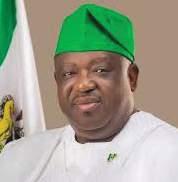
it underscored the APC’s institutional depth and Gov Mutfwang’s firm grip on the political process. The optics and execution reflected a maturing alliance anchored on stability and shared national priorities.
Plateau’s political landscape has historically been competitive, fluid, and ideologically diverse.
In such an environment, federal alignment carries significant weight. The physical presence of Vice President Shettima, sent an unambiguous signal: Plateau is firmly connected to the centre of power.
For President Tinubu, the gains were immediate and strategic. The reception reinforced his image as a bridge-builder and expanded APC’s footprint in NorthCentral Nigeria.
It demonstrated that the President’s support base continues to grow through engagement, dialogue, and coalitionbuilding rather than confrontation. For party loyalists, it was a clear statement of consolidation.
The APC also emerged strengthened within Plateau State. The reception elevated the party’s stature, countered lingering perceptions of marginal influence, and reasserted its relevance at both elite and grassroots levels.
With polling unit leaders, ward executives, and champions of local government structures in attendance, the message of unity and direction filtered rapidly through the party’s base.
Through the gathering, Gov Mutfwang’s political standing was equally reinforced. By hosting the APC and national leadership, he positioned himself as a pragmatic actor capable of harmonizing Plateau’s interests with federal priorities. This has enhanced his authority locally while placing him firmly within the national political mainstream. Ultimately, this reception was not only symbolic—it was strategic. It consolidated APC's dominance, strengthened President Tinubu’s support base in Plateau, and reaffirmed state–federal unity as the pathway to political stability and effective governance.
Yakubudati@gmail.com
Editor, Editorial Page PETER ISHAKA
Email peter.ishaka@thisdaylive.com
The authorities should do more to stem proliferation of arms
The warning by the National Centre for the Control of Small Arms and Light Weapons (NCCSALW) Director General, Johnson Kokumo, that weak armoury management within security institutions is fuelling the proliferation of small arms and light weapons across the country should be taken seriously. “Numerous military and police operations in the North-East, North-West, and Niger Delta have stretched our forces thin,” he said while noting how leakages from poorly managed official stockpiles were arming criminals and undermining national security. “Weak armoury management and corruption have enabled weapons to leak from state stockpiles into criminal circles. This undermines Nigeria’s constitutional monopoly over the legitimate use of force.”
To the extent that such internal compromise and sabotage make fighting insecurity difficult, we hope there will be a thorough investigation of this revelation. But more importantly, given the overwhelming level of insecurity in the country, efforts should be made to contain the proliferation of these dangerous weapons. Kokumo has located a major challenge in the fact that Nigeria still relies on the 1959 Firearms Act which is obsolete and incapable of addressing today’s realities. “Weapons move across our borders in exchange for drugs, contraband, or cattle,” he argued while stressing that arms proliferation is not merely a security challenge but also one of governance and development. “These flows link arms trafficking with terrorism, smuggling, and human trafficking. The weapons themselves enable violence, but the deeper challenge lies in the structural weaknesses that allow them to thrive.”


and property of citizens. Ordinarily, peace and order are only guaranteed because citizens surrender their right of self-defense to the overarching force of the state. Once this shield of collective sovereign protection and security begins to cave in, individual citizens resort to self-defense, hence the proliferation of illegal arms across the country.



The task of protecting the people remains that of the state. But it is a task that can only be performed in tandem with strengthening the security of citizens to make illegal possession of firearms unattractive
T H I S D AY
EDITOR SHAKA MOMODU
DEPUTY EDITOR WALE OLALEYE
MANAGING DIRECTOR ENIOLA BELLO
DEPUTY MANAGING DIRECTOR ISRAEL IWEGBU
CHAIRMAN EDITORIAL BOARD OLUSEGUN ADENIYI
EDITOR NATION’S CAPITAL IYOBOSA UWUGIAREN
THE OMBUDSMAN KAYODE KOMOLAFE

T H I S D AY N E W S
EDITOR-IN-CHIEF/CHAIRMAN NDUKA OBAIGBENA
GROUP EXECUTIVE DIRECTORS ENIOLA BELLO, KAYODE KOMOLAFE, ISRAEL IWEGBU
DIVISIONAL DIRECTORS SHAKA MOMODU, PETER IWEGBU, ANTHONY OGEDENGBE
DEPUTY DIVISIONAL DIRECTOR OJOGUN VICTOR DANBOYI
SNR. ASSOCIATE DIRECTOR ERIC OJEH
As we have stated repeatedly, the proliferation of arms in private civilian hands is perhaps the readiest sign that the Nigerian state has vastly receded in terms of inability to defend its territory as well as the lives
ASSOCIATE DIRECTOR PATRICK EIMIUHI
CONTROLLERS ABIMBOLA TAIWO, UCHENNA DIBIAGWU, NDUKA MOSERI
DIRECTOR, PRINTING PRODUCTION CHUKS ONWUDINJO
TO SEND EMAIL: first name.surname@thisdaylive.com
Nigeria, according to reports, accounts for at least 70 per cent of the illegal SALWs circulating within the West African sub-region most of them in the hands of sundry criminal cartels. It therefore stands to reason that with access to abundant illegal weapons the rogue elements in our midst have become more fortified and hence less amenable to entreaties to make peace. Meanwhile, it was such easy access to SALWs by some unscrupulous elements that resulted in total breakdown of law and order in some of the failed states in Africa of which Somalia is a prime example. With these illegal firearms, violent crime is no longer just social deviance but a thriving enterprise by many unscrupulous Nigerians with dire consequences for peace and national security. To counterbalance the threat to life and property by these armed criminals, some individual citizens have also resorted to the acquisition of arms for personal security and protection. In several communities around the country, the deployment of armed vigilantes and traditional hunters armed with modern weapons has become commonplace.
Since Nigeria has no constitutional provision on the right to bear arms, all such weapons in the hands of civilians remain illegal except by license for hunting and other sport. The state still officially remains the ultimate protector of the citizenry who is legally presumed unarmed. Therefore, the task of protecting the people remains that of the state. But it is a task that can only be performed in tandem with strengthening the security of citizens to make illegal possession of firearms unattractive. We can also not continue to rely on an obsolete law to deal with the menace.
Letters in response to specific publications in THISDAY should be brief (150-300 words) and straight to the point. Interested readers may send such letters along with their contact details to opinion@thisdaylive.com. We also welcome comments and opinions on topical local, national and international issues provided they are well-written and should also not be longer than (750- 1000 words). They should be sent to opinion@thisdaylive. com along with photograph, email address and phone numbers of the writer.
It is a blood-curdling aberration that in Nigerian mines where minerals should be mined and minded, blood often flows. More damning is the reality that a country rich beyond measure in minerals is reluctant to clean up its often bloody mines.
On January 22, 2026 gunmen attacked and killed about seven miners at a mining site in Kuru, Jos South Local Government Area of Plateau State. According to the reports, they arrived at the mine and started shooting indiscriminately, leading to the death of the miners. The youngest of the slain was just about 15 years old.
With Nigeria’s vast landscape awash in mineral resources, the government has in recent times talked up mining and the resultant mineral resources as a way to diversify its economy and reduce the emphasis on oil. As a result, the government has recently started seemingly paying more attention to Nigeria’s minerals sector and what happens in the mines.
For so long, as Nigeria paid disproportionate and
disastrous attention to oil as its chief source of revenue and major driver of its economy, other sectors of the Nigerian economy were largely neglected. These included the solid minerals sector, which has largely suffered neglect and exploitation.
In most countries of the world awash with mineral resources, conflict is never far away, with the race to exploit the mineral resources often resulting in violent instability and insecurity for the immediate communities. Unfortunately, Africa has been a blood-soaked experiment on how mineral resources can spin countries into an unending and bloody cycle of bone-chilling violence.
It Is no secret that the brutal civil wars fought in Liberia and neighboring Sierra Leone were inextricably linked to the mineral resources in those countries, specifically the huge diamond reserves in those countries. The atrocities committed in the Democratic Republic of Congo remain well-documented, with the country remaining a heartbreaking example of what happens
when the government fails to adequately regulate the mineral resources ecosystem within a country.
Similarly, the rush for Sudan’s gold has played a stirring role in the conflict that is reducing one of Africa’s most iconic countries to its knees, taking a particularly crushing toll on women and children.
It Is no coincidence that in Nigeria, the poorly regulated solid minerals sector has contributed to rising insecurity. Gold reserves in some states in the North have largely fueled insecurity in those areas, with foreigners, bandits, locals, and government officials all locked in the race to make the most profits.
For those who fuel Nigeria’s grave security crisis, it is no surprise that they find solid minerals an attractive proposition, as selling them on the black market would give them the financial resources they dearly need to keep their deadly activities going.
Ike Willie-Nwobu, Ikewilly9@gmail.com
Communication experts have stressed the need for organisations in Africa, Nigeria inclusive, to invest in Artificial Intelligence (AI) tools and to cultivate trust among communities, through transparent communication, in order to build strong brand visibility.
They were of the view that AI has become a transformative, necessitydriven force in global brand visibility, shifting from a marketing tool to a core
strategic component that defines how brands are discovered, perceived, and engaged with.
The experts stated this during a webinar organised by Newmark Group, a leading Pan-African Integrated Marketing Communications firm, which was moderated by Country Lead, Newmark Nigeria, Lovelyn Okafor.
As businesses begin operations in 2026 with new strategies as top priorities for business owners and managers, they said there is need for businesses to
effectively communicate in a transparent manner that will build trust in customers and communities, adding that the best way to achieve such influence is to invest in AI tools.
CEO, Newmark Group, Gilbert Manirakiza, said organisations must invest in AI tools because groundbreaking technology such as AI would require trust at a massive scale for it to be adopted responsibly, since communication itself would affect AI and vice-versa.
“So for me to be able to
accept the trade-off that a tool takes over what I’m known for, what I do for a living, is going to require a lot of trust, and a lot of trust building.
If the tech innovators that are developing AI systems do not build the trust needed across the world to have humanity to support AI adoption, in my view, AI will have a serious setback because humanity is going to turn against AI. We are already seeing countries regulating against AI in different ways.
So I believe that it’s in the interest of those big companies
that are building AI systems to actually work with the communications landscape and professionals to make AI understood, to make it part of the national, international discourse, to ensure that there is consensus about some of the things the world is concerned about. Communication is equipped to lead on this, and I believe it’s very important that communication experts are allowed to assist on this,” Manirakiza said.
Giving further details how AI itself will affect communications, Manirakiza
said: “A lot of communication experts are using AI in different ways to do what they do on a day-to-day basis. So I see a couple of positive and negative influences in the use of AI tools. On the negative influence, newer generations of communication professionals might actually find it hard to get junior roles because the research work, and data crowdsourcing that they were hitherto recruited to take up, will be done by basic AI systems.
Emma Okonji
Nigeria’s .ng domain name adoption recorded a significant growth in December 2025, with an increase in fresh registrations and renewals, according to the latest statistics released by the Nigeria Internet Registration Association, the body responsible for managing Nigeria’s country code Top Level Domain (ccTLD).
From the statistics, fresh .ng domain name registrations reached 10,047,
while renewals of existing .ng domain names reached 5,816 in the December 2025.
The ccTLD .ng domain name is Nigeria’s identity in cyberspace, which has the .ng at the suffix of every official email address that originates from Nigeria. In the United Kingdom, all official email addresses end with .co.uk.
In United States of America, they end with .com, while in South Africa, the official email addresses end with .co.za.
A breakdown of the statistics released by NiRA, showed that fresh registration
in the second level domain name category (.ng) reached 1,693, while fresh registration for the third level domain name category (com.ng, .org. ng) reached 8,354, totaling 10,047 new registrations. Also, fresh renewals in the second level domain name category reached 1,928, while fresh renewals for the third level domain name category reached 3,888, totaling 5,816 new renewals.
Commenting on the growth of .ng domain name adoption in Nigeria during his new year message, the President of
NiRA, Mr. Adesola Akinsanya, said the surge in domain name adoption in Nigeria to over 10,000 new registrations in a single month, was a testament to the growing confidence in Nigeria’s digital economy. According to him, as businesses move into the new year, the .ng domain remains more than just an address, as it is also a symbol of Nigerian pride and a gateway to the global marketplace.
“As we begin another year of digital transformation in Nigeria, the latest domain report for December 2025
highlights a significant trend: Nigerians and local businesses are increasingly securing their online identities with the .ng domain.
The December figures reflect a robust commitment to the local internet ecosystem, showing that even as 2026 begins to unfold, the momentum for digital presence remains strong.
“The data for December reveals a healthy balance between new entrants into the digital space and existing users maintaining their online presence. A total of 10,047
new domains were registered during the month, showcasing a strong “new year, new goals” mindset among entrepreneurs and organizations. A total of 5,816 domains were renewed, indicating that established brands continue to see the value and trust associated with the .ng extension. The report therefore highlights a clear preference in how different segments of the market choose to identify themselves online,” Akinsanya said.
In this interview, the spokesperson of Data Privacy Week 2026 and Chief Information Security Officer at TeKnowledge, Eric Schifflers, speaks on why Businesses should be paying attention to the rise of Post‑quantum Cryptography, data privacy, data handling, information security, cybersecurity, enterprise readiness. Excerpts
Why is Data Privacy Week still highly relevant in 2026, especially for businesses operating in emerging and complex digital markets like Africa?
Data Privacy Week remains highly relevant in 2026 because the volume, speed, and value of personal data have only increased—especially markets like Africa, where digital adoption is accelerating faster than regulatory and institutional maturity. The Data Privacy Week creates a shared focal point for raising awareness, reinforcing internal policies, and engaging customers, partners, and regulators on how data is collected, processed, and protected.
From your perspective as a global CISO, how has the conversation around data privacy evolved over the last few years from compliance to business resilience?
Up until a few years ago, data privacy was often treated as a legal or compliance function, focusing on policy documentation, simply satisfying requirements, and passing audits. Today, boards and executives around the world increasingly see data privacy as a strategic risk. Data breaches, regulatory fines, and reputational damage have made it clear that poor privacy practices can directly impact revenue, customer trust, and operational continuity. This evolution has led organizations to integrate privacy into incident response, third‑party risk management, and cyber‑resilience planning.
What are the most common mistakes organisations still make when it comes to handling customer and employee data?
One of the most common mistakes organisations make is treating data protection as a purely technical or process‑driven exercise, while underestimating the human element. They tend to invest heavily in encryption, access controls, and automated workflows, but fail to embed data privacy and security awareness into everyday behaviour across the workforce. Another frequent mistake is treating privacy as a one‑time activity or project rather than an ongoing discipline. Organizations conduct initial training, create policies, and run awareness campaigns, but then fail to reinforce those messages or adapt them to new threats, technologies, or business models. This leads to gaps in understanding, especially when new tools such as GenAI apps are introduced without clear privacy guidance.
How should businesses be thinking about data ownership and responsibility in an era of cloud computing, AI, and cross-border data flows?
In an era of cloud computing and AI, businesses must move away from thinking of data as a by‑product and instead treat it as a strategic asset with clearly defined ownership and responsibility. The key is to anchor this mindset in strong data governance, data classification and labelling, and explicit data‑ownership responsibilities.
Additionally, Data Classification and Labelling are essential to ensure that appropriate controls are applied as needed. Not all data is created equal, and some datasets are highly sensitive (such as PII, health, or financial information) while others are less critical. By classifying data at the source and applying clear labels, businesses can automate access controls, encryption, retention policies, and monitoring, especially when data moves across
borders or is used to train AI models.
What role does leadership play in embedding responsible data handling practices across an organization and not just within IT teams?
Leadership plays a decisive role in embedding responsible data handling practices across an organization because tone and behaviour at the top shape culture far more than any policy or tool. When executives lead by example by handling data with care, respecting privacy, and consistently following the same rules they expect from others, they send a powerful message that data responsibility is a business‑wide priority, not just an IT or compliance issue. Responsible data handling should be framed as an enabler, not a burden.
Leaders can do this by clearly linking data practices to customer trust, brand reputation, and business resilience. When employees see that protecting data directly supports the company’s ability to innovate, comply with regulations, and retain customers, they are more likely to view it as part of their everyday role rather than an extra hurdle.
Cyber threats are becoming more sophisticated. What are the biggest information security risks facing enterprises today?
One of the biggest information security risks organizations are facing are increasingly tied to where data is stored and processed, not just to perimeter defences. Cyber threats have become more sophisticated and automated, and AI has given attackers powerful capabilities to discover and exploit weaknesses in how data is handled across environments. Many organizations operate with fragmented
visibility across on‑premises systems, multiple cloud platforms, third‑party services, and collaboration tools. As a result, they may not know which systems contain customer PII, financial records, or intellectual property, or how that data moves between environments. In an AI‑driven threat landscape, attackers can quickly scan for misconfigurations, weak access controls, or unprotected data stores. If an organization cannot see where its data lives and how it is being processed, it cannot protect it effectively. That is why modern security programs must treat data‑location and data‑flow visibility as a core capability, not an afterthought.
What makes TeKnowledge’s approach to information security different from traditional managed services or advisory firms?
TeKnowledge provides expert technology services. partnering with enterprises, governments, and tech companies to help them on their journey to become AI first. We operate across four continents from 16 hubs, with over 4,000 experts delivering 24/7 operations to support our clients when they need us most. We are a global Microsoft partner, we deliver enterprise support worldwide, improve customer experience, while also empowering governments and financial institutions—from a leading national cyber agency in the Middle East to ministries and banks across LATAM and in Africa, we are partners to some of Nigeria’s leading financial institutions in skilling their digital workforce, increasing their tech talent pool and providing end to end support from strategy to deployment and ongoing optimisation in their AI first vision.
Unlike traditional managed services or advisory firms, our model integrates
deep engineering capability, global scalability, and trusted partnerships with a human centric approach that enables people within organisations to adopt a positive behavioural change towards data protection.
With regulations like NDPR, GDPR, and other global frameworks, how should organisations approach compliance without treating it as a box-ticking exercise?
Organisations should treat data‑protection regulations like NDPR and GDPR, not as isolated compliance tasks, but as a continuous risk‑management and business‑enablement journey. In our case, achieving ISO/IEC 27701 certification has been central to that approach: it provides a structured, auditable framework that aligns with GDPR and NDPR requirements while embedding privacy into our processes, not just our documentation. By adopting ISO 27701, we’ve turned compliance into an operational discipline. It forces us to map data flows, define lawful bases, implement privacy‑by‑design, and maintain robust records of processing activities—core requirements that regulators look for.
If there’s one mindset shift you would encourage organisations to adopt this Data Privacy Week, what would it be?
If there’s one mindset shift, I would encourage organizations to adopt it is this: “never settle”. Information security and data privacy are not static checkpoints; they are continuous disciplines that must evolve alongside the threat landscape and the regulatory environment. Organizations should move away from thinking in terms of “we are compliant” or “we passed the audit” and instead adopt a posture of constant improvement. New technologies, new attack techniques, and new regulations will keep emerging, and yesterday’s controls may not be sufficient tomorrow. This means regularly reassessing risks, updating policies, refreshing training, and testing incident‑response capabilities. By embracing a mindset of continuous adaptation, organizations position themselves not just to meet today’s requirements, but to anticipate tomorrow’s challenges.
Looking to the future, what emerging trends in cybersecurity and data protection should businesses be paying attention to now?
One of the most critical emerging trends businesses should be paying attention to is the rise of Post‑quantum cryptography (PQC). As quantum computing advances, traditional encryption algorithms that currently protect most of today’s data could eventually be broken, exposing sensitive information that is intercepted or stored today. Organizations need to start thinking about this now, even if large‑scale quantum attacks are not imminent.
The risk is not only future‑facing; data that is encrypted today using current standards may still be valuable years from now, and if it is harvested now, it could be decrypted later once quantum‑resistant algorithms are broken or quantum computers mature. In short, post‑quantum cryptography is no longer a theoretical concern; it is an emerging reality that organizations must factor into their long‑term security and data‑protection strategies. Starting the conversation and the planning now will help ensure that today’s encrypted data remains protected in a future quantum‑enabled world.
As the year 2026 unfolds with new strategies for business growth, Information and Communications Technology experts have predicted how the integration of Artificial Intelligence, network expansion, Fintech collaboration and growth of data centres, including stablecoins, will further boost productivity in 2026, writes Emma Okonji
From the first week in 2026, there have been several predictions about factors that will shape the ICT sector, but the most outstanding predictions were the ones backed by strong data analytics, such as AI integration, with emphasis on agentic and contextual AI, network expansion, Fintech collaboration, growth of data centres, growth of stablecoins and their impact in cross-border payment, including digital transformation growth and the Google search report that prioritised Nigerians’ search for self-improvement and entrepreneurial growth, among other predictions.
Network Expansion
Following last year’s 50 per cent hike in tariff that was approved for telecoms operators by the Nigerian Communications Commission (NCC), the operators have said such approval significantly improved revenue generation for the telecoms sector in 2025, and has metamorphosed into general network expansion that will impact service quality in 2026.
Chairman, Association of Licensed Telecoms Operators of Nigeria (ALTON), who doubles as the spokesperson for telecoms operators in Nigeria, Gbenga Adebayo, gave the assurance during a telephone interview with THISDAY Newspapers. Adebayo, who highlighted some factors that would shape the telecoms sector in 2026, insisted that telecoms subscribers would experience

improved service quality across all networks in 2026, based on the level of investments in network expansion, carried out by the telecoms operators.
“We are doing a lot of expansion this year to enhance service quality in the telecoms sector. Telecoms operators have invested in network optimization, network expansion, capacity upgrade, and all of that in order to improve on user experience this year, through improvements in quality of services, and improvements in customer
service. So we believe that this is a year that telecoms subscribers will actually get benefits for all of the challenges they experienced in the industry in the past year and the year before. So 2026 is a year of consolidation and a year of benefits for telecoms subscribers.
“It’s also a year where we are interested in exploring areas where we haven’t been commercially attractive, because of the ongoing network expansion. Again, there has been an improvement on
legislation, which has helped in addressing willful destruction of telecoms facilities in some parts of the country, as well as addressing the closure of telecoms sites by different government agencies. So access to certain areas that where hitherto restricted has improved upon, leading to easy access to those areas for maintenance work,” Adebayo said.
The story continues online on www.thisdaylive.com
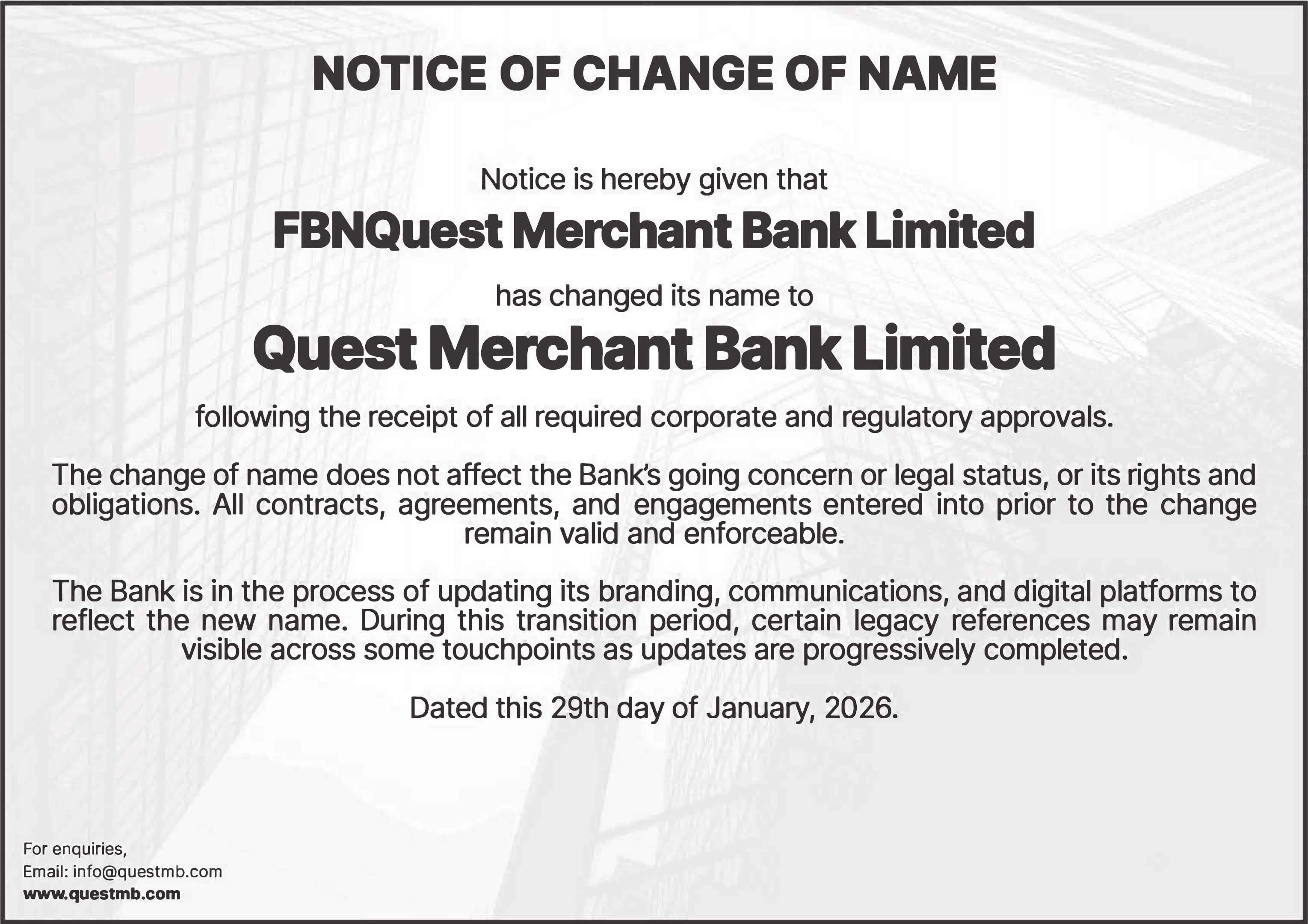
Oluchi Chibuzor
Chairperson of the Türkiye–Nigeria Business Council, Hon. Dele Kelvin Oye, will join other public- and private-sector stakeholders to promote investment opportunities in Nigeria at the Türkiye–Nigeria Business Meeting holding on the sidelines of President Bola Ahmed Tinubu’s state visit to the Republic of Türkiye.
The visit is aimed at strengthening the existing cordial relations between the two countries and exploring further areas of cooperation in security, education, social development, innovation, and aviation.
During President Tinubu’s visit, both countries will engage in strategic political and diplomatic discussions on shared values in finance, communication, trade and investment.
The forum is part of lined up events to gather
investors from both countries to explore areas of interest during the visit.
The meeting is being organised by the Foreign Economic Relations Board of Türkiye (DEİK) in collaboration with the Türkiye–Nigeria Business Council as part of efforts to deepen economic cooperation and expand bilateral trade and investment relations.
Oye, who will deliver opening remarks at the event alongside Mr. Osman Aksoy, DEİK Board Member and Chairperson of the DEİK/Türkiye–Nigeria Business Council, is expected to highlight Nigeria’s investment potential and the role of the private sector in strengthening economic ties between both countries.
The programme will feature a country presentation by the Chief Executive Officer of the Nigeria Investment
Promotion Commission (NIPC), Mrs. Aisha Rimi, who will outline Nigeria’s investment climate, ongoing economic reforms and priority sectors open to foreign investors.
Participating Turkish and Nigerian companies will also be introduced, with each firm making brief presentations on their business interests and areas for potential collaboration.
Official addresses are scheduled to be delivered by the Deputy Minister of Trade of the Republic of Türkiye, Mr. Mustafa Tuzcu, and Nigeria’s Minister of Industry, Trade and Investment, Senator John Owan Enoh.
The Türkiye–Nigeria Business Meeting is expected to complement President Tinubu’s state visit, which aims to strengthen bilateral relations and promote increased cooperation between Nigeria and Türkiye across key economic sectors.
The Private Infrastructure Development Group (PIDG), through its project development solution, InfraCo has exited its preference share investment in InfraCredit Nigeria for USD 26 million, achieving a strong return despite challenging macroeconomic conditions.
InfraCo continues to hold ordinary shares following InfraCredit Nigeria’s listing on the NASD OTC Securities Exchange in 2025. PIDG had partnered with the Nigeria Sovereign Investment Authority to establish InfraCredit in 2017 as the first local currency guarantee facility in the world targeting infrastructure in frontier markets.
Chief Executive Officer, PIDG, Philippe Valahu, said, “PIDG has demonstrated how to successfully use increasingly scarce capital to unlock domestic
institutional finance. InfraCredit’s strong performance serves as a template for how such entities can be built in the future. With this transaction, we can now redeploy our investment for further action on climate and sustainable development in low- and middle-income countries.”
PIDG will reinvest the $26 million earnings into additional inclusive and sustainable infrastructure projects.
InfraCredit is a specialised institution that provides Nairadenominated guarantees to enhance the credit quality of local currency debt instruments issued to finance infrastructure projects in Nigeria. Since its establishment, it has expanded its guarantee portfolio and enabled domestic investors to participate in infrastructure
finance, unlocking N327 billion (approximately $516 million equivalent, indexed at issuance) from more than 20 institutional investors in sectors including renewable energy, transport, logistics, and telecommunications.
Chinua Azubike, CEO of InfraCredit said, “The completion of PIDG’s preference share investment marks an important milestone in InfraCredit’s development. PIDG has been a foundational partner since inception, supporting InfraCredit through its early stages as we built the institutional strength and market credibility required to become a publicly listed company and operate at scale. As InfraCredit continues to evolve as a more established, marketanchored institution, we value the continuation of this relationship and the role it plays in advancing our long-term mandate.”
DataPro Limited, Nigeria’s leading Data Protection Compliance Organisation (DPCO), has commenced its 2026 Privacy Week with the release of Privacy Pulse, a comprehensive review of Nigeria’s data protection landscape and a forward-looking agenda for organisations operating under the Nigeria Data Protection Act (NDPA).
The week-long observance, themed, “Privacy in the Age of Emerging Technologies: Trust, Ethics, and Innovation,” according to its Head of Emerging Services, Ademikun Adeseyeju, is against the backdrop of a decisive transformation of Nigeria’s privacy ecosystem in 2025, from awareness-led compliance to a strict,
enforcement-driven regime.
According to the firm, 2025 marked the full transition from the Nigeria Data Protection Regulation (NDPR) to the statutory authority of the NDPA and the General Application and Implementation Directive (GAID) 2025. This shift, it said, fundamentally altered the compliance expectations for public and private institutions, introducing mandatory obligations backed by regulatory sanctions and judicial scrutiny. In its year-in-review assessment, DataPro noted that the Nigeria Data Protection Commission (NDPC) adopted a more assertive enforcement posture during the year, publicly naming noncompliant organisations,

L-R: Group CEO, Alert Group, Dr. Kazeem Olanrewaju and Lagos mainland LGA Chairman, Hon. Jubril Emilagba, at the commissioning of a borehole at Yaba Market in Lagos... recently
particularly within the financial services sector.
The move signalled a clear departure from advisory regulation to active oversight.
Looking ahead to 2026, DataPro projected a shift towards stronger board and executive ownership of privacy risks. The firm anticipates that data protection will become a standing governance issue, requiring regular reporting, dedicated budgets, and strategic oversight at the highest levels. It also warned of a likely rise in individual claims and constitutional privacy litigation, urging organisations to remain “litigation-ready” through robust record-keeping and strengthened compliance frameworks.
Kayode Tokede
The stock market section on the Nigerian Exchange Limited (NGX) was yestrday subdued, dropping by N351 billion on profittaking in MTN Nigeria Communications (MTNN) Plc and 37 others.
As the telecommunication stock price depreciated by 1.4
per cent, the NGX All Share Index ASI lost by 549.44 basis points or 0.33 per cent to close at 165,164.38 basis points with the Month-toDate and Year-to-Date returns settled at +6.1 per cent. On sectors, performance was broadly negative as the NGXX Insurance Index dropped by 1.3per cent, NGX Consumer Goods Index dropped by 0.5per cent,
and NGX Banking slumped by 0.4 per cent. The NGX Industrial Goods and Oil & Gas indices closed flat.
Reflecting the profit taking impact, market sentiment was negative, with 38 declining counters outweighing 32 advancing stocks. DEAP Capital Management & Trust recorded the highest price gain of 9.97 per cent to close at N9.49, per share.
Tantalizer followed with a gain of 9.92 per cent to close at N3.88, while Skyway Aviation Handling Company rose by 9.91 per cent to close at N128.60, per share.
Morison Industries appreciated by 9.90 per cent to close at N9.99, while Zichis Agro-Allied Industries up by 9.81 per cent to close at N3.47, per share.
On the other hand, R.T.
Briscoe (Nigeria) led the losers’ chart by 9.97 per cent to close at N6.50, per share. May & Baker Nigeria followed with a decline of 9.96 per cent to close at N35.25, while Ikeja Hotel declined by 9.92 per cent to close at N32.25, per share.
LivingTrust Mortgage Bank depreciated by 9.90 per cent to close at N4.64, while eTranzact International
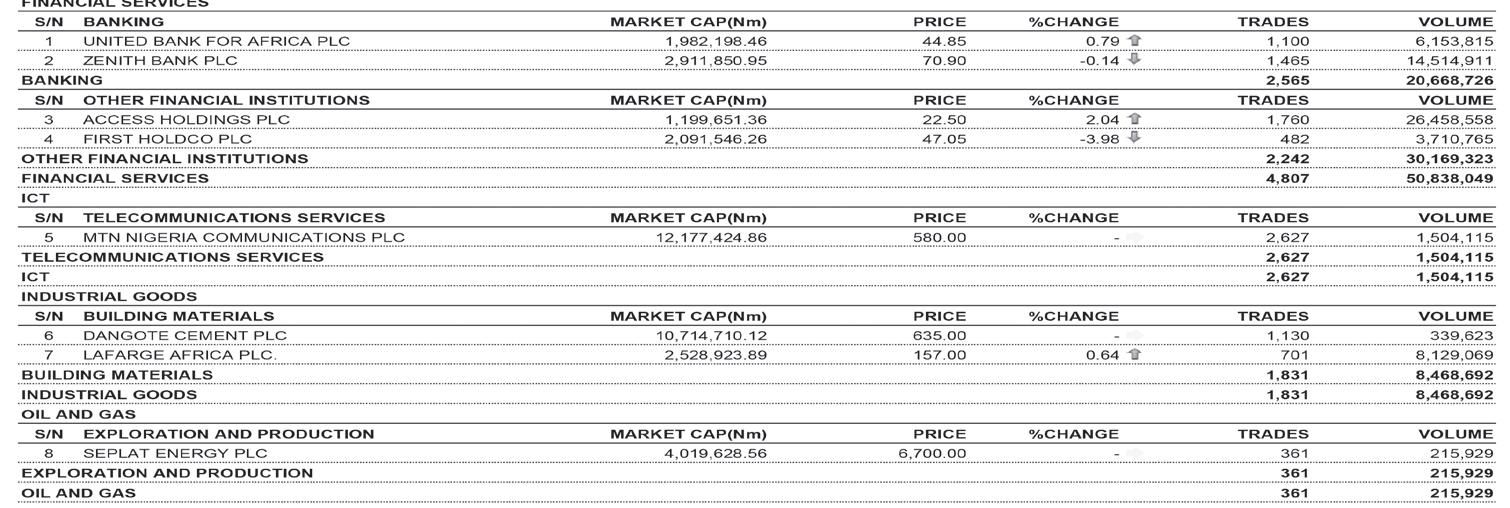
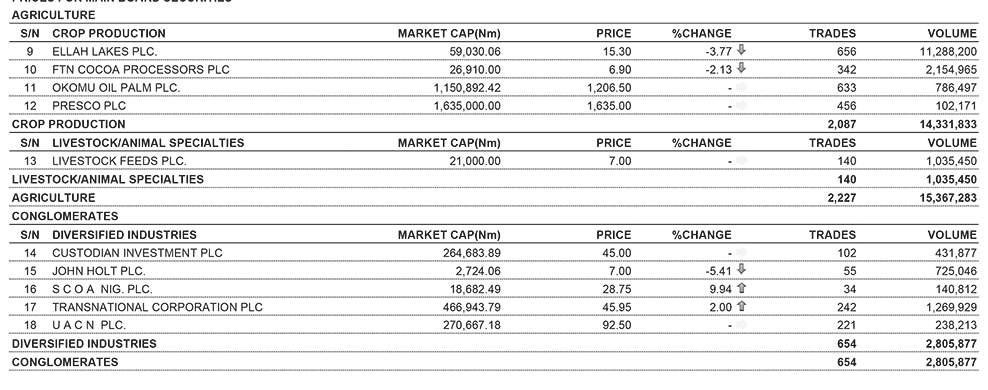
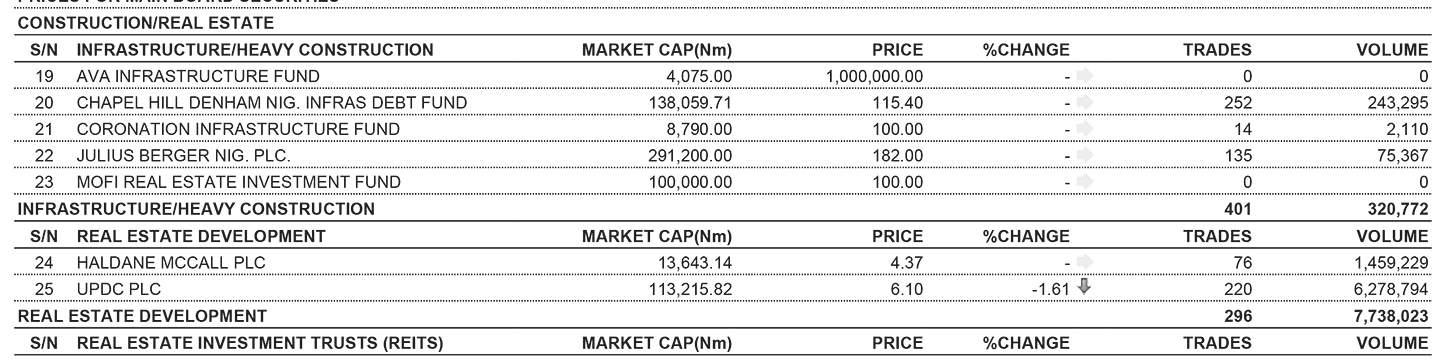
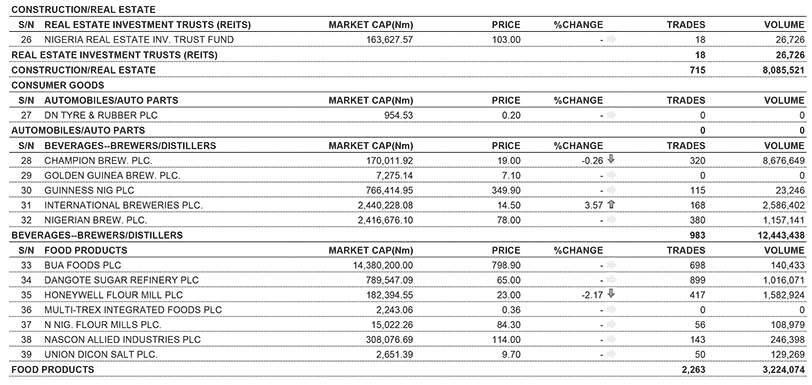
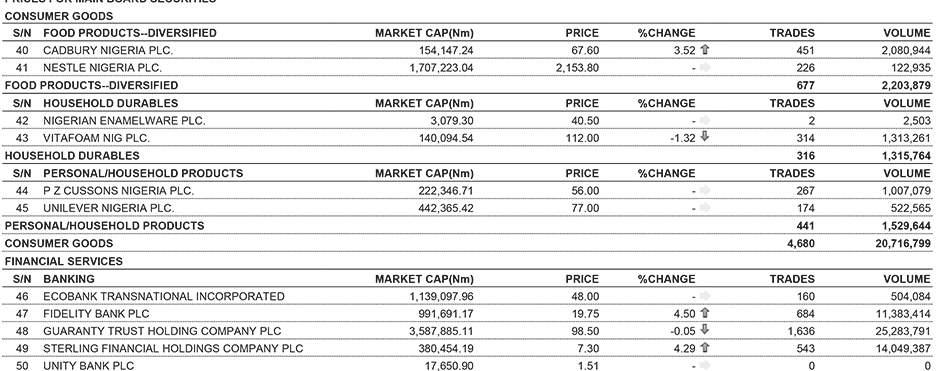
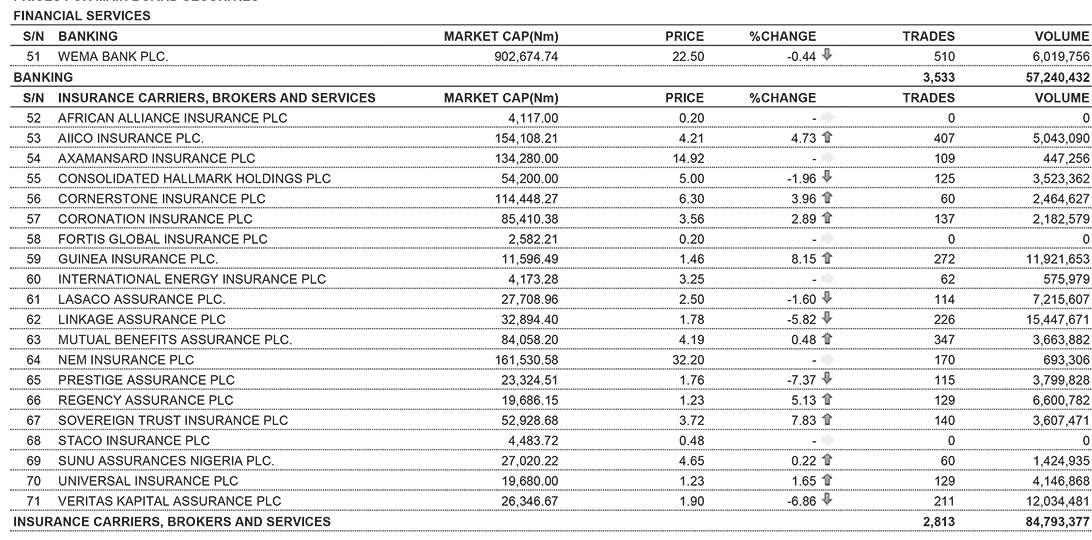
declined by 9.16 per cent to close at N17.35, per share. Meanwhile, the total volume traded rose by 29.00 per cent to 623.177 million units, valued at N16.540 billion, and exchanged in 42,172 deals. Transactions in the shares of Neimeth International Pharmaceuticals topped the activity chart with 58.126 million shares valued at N590.603 million.
AS OF JANUARY /28/26

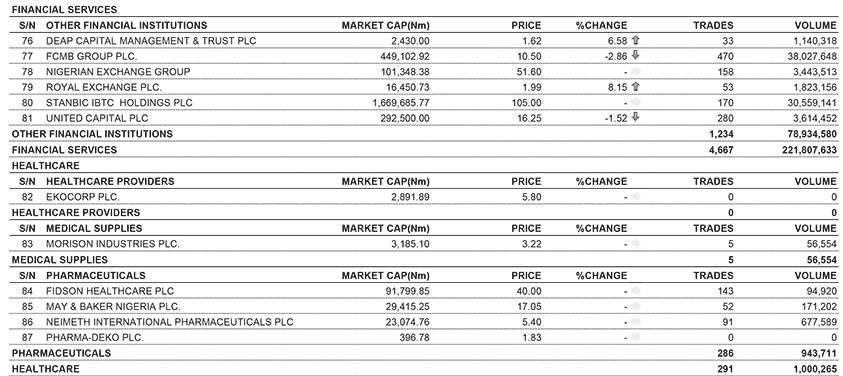
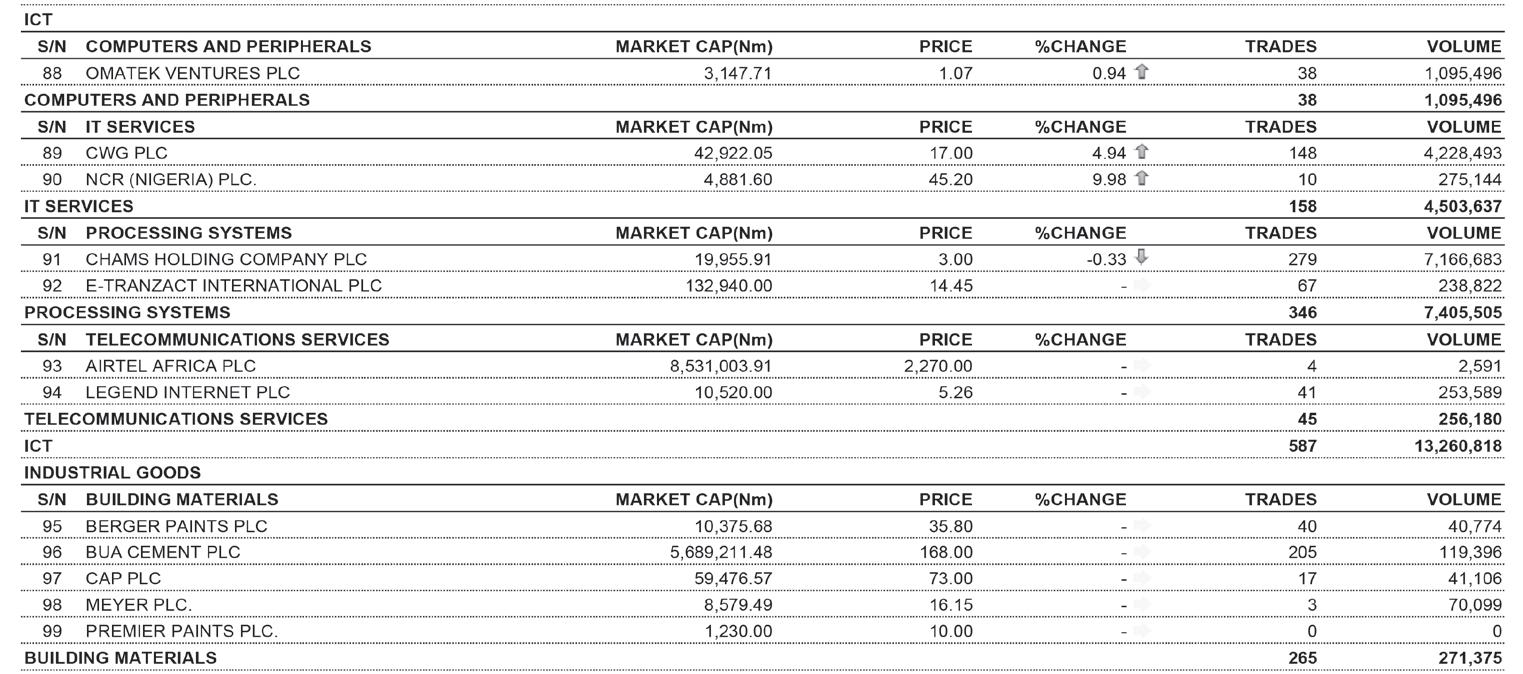
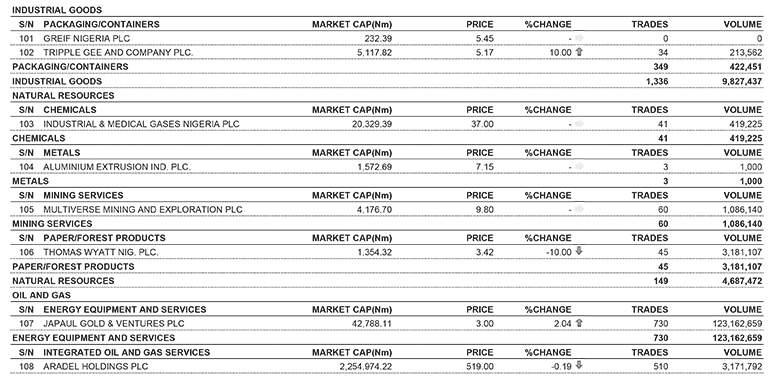
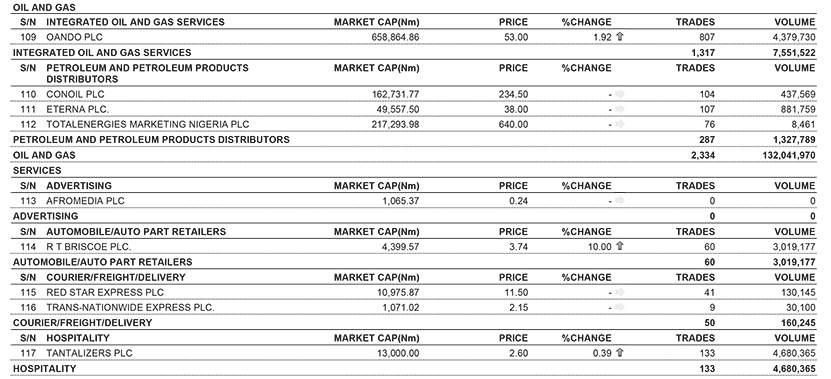
Opeyemi Bamidele
The life cycle of the 10th National Assembly is fast rolling by at an unimaginable speed. Out of the 48 months that the Constitution spells out for its existence, we are now left with 16. This indeed shows the speed of time is nothing, but the fluidity of life itself. Also, the exigency of speed attests to the indispensability of speedy, but well-thought-out responses to our nation’s toughest challenges at a critical time when the world waits for no nation and when nations themselves no longer wait for the world.
This is truly an era of defending the national interest first and foremost while working tenaciously for the peace and security of the world. At the National Assembly, we are conscious of this rapidly changing global environment and its implications for our domestic economy and politics. Amid these stark realities, we cannot afford to lag behind; neither can we slow down the pace of responding to the challenges that confront us today, pursuing diverse pro-people reforms that will make our fatherland a choice destination for much-needed foreign direct investments, whether now or in the future.
We are equally conscious of the vital interests of our nation and the mandate of our people. They are clear expressions of the burden that our constituents’ search for a cohesive nation; a vibrant economy; and a resilient republic places upon their representatives, indeed the National Assembly, regardless of the places we worship, the political parties that produce us and the constituencies we represent. They also place upon us the burden of trust that we struggle daily to defend and treasure never to breach.
History is, no doubt, our witness. The last 32 months have been devoted to farreaching reforms that cut across all the sectors of our economy. And the essence of the reforms is to recalibrate Nigeria from being an extraction-dependent state to an economically diversified state, now enabled for optimal productivity and repositioned for global competitiveness. This is the spirit with which we have been working since the advent of this Assembly, and we will continue in the same spirit as we resume plenary this week.
The next 16 months will be as challenging as the last 32 months. But we have resolved to consider and conclude legislative initiatives that directly touch our nation’s electoral regime and governance structure. We have, as well, resolved to consolidate and perfect diverse reforms this Assembly has initiated with a view to making public governance more efficient and people-centric than it has ever been in our history.
Now that we have resumed plenary, we will devote quality time to the scrutiny and passage of the 2026 Appropriation Bill valued at N58.47 trillion. In both chambers, our committees are already looking deeply into the estimates of revenues and expenditures that President Bola Ahmed Tinubu, GCFR laid before the joint session of the National Assembly on December 18, 2025. The proposal is crucial to the growth, prosperity and stability of our economy this year and even beyond given its emphasis on consolidating the gains of the previous years.
The budget, when it finally becomes effective, will further reinforce our collective resolve to guarantee our nation’s macroeconomic stability, deepen her global competitiveness and translate economic growth to decent jobs, rising incomes and a better quality of life across the federation. This will help us restore and maintain a budget cycle that annually starts from January and ends in December. Achieving these ends might be tough, perhaps unattainable given the bottlenecks we have experienced before now.
Unlike previous years, we have significantly reformed our fiscal space to reflect our socioeconomic realities. This process culminated
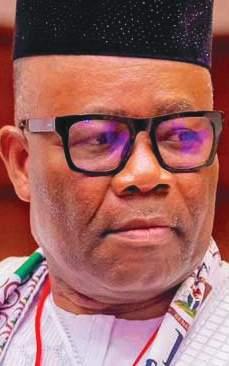
in the enactment of the 2025 Tax Reform Act. We now operate a progressively recalibrated fiscal regime that eases tax burden off the shoulders of low-income earners and places more responsibilities upon the high-income earners. From the reforms of our fiscal space, we believe funding our budget will no longer be a challenge, and our budget deficit will definitely begin to shrink year by year.
Apart from the 2025 Appropriation Bill, we are prioritising the delivery of an electoral governance framework that will guarantee a credible and transparent process in 2027 general elections. We have started the review of the Electoral Act, 2022 clause by clause to achieve this end. With the Electoral Bill, 2025, we have achieved quite a lot to improve how we manage our elections; enhance the credibility of the process and ensure the political parties are accountable. This vision is in line with the sustained public demands for an electoral system that will guarantee the security of votes.
The Electoral Bill, 2025 introduces no fewer than 20 defining highlights that will eventually differentiate it from the previous electoral regimes. First, under Section 12(1-2), the Bill recognises the voting rights of prisoners and the obligations of the Independent National Electoral Commission to register all eligible inmates in all correctional facilities nationwide. Also, under Section 3(3), the Bill mandates that funds for general elections must be released at least one year before the day of the elections. Obviously, this reduces uncertainty that often clogs the operation of the INEC and strengthens its independence.
Under Section 47(1a), the Bill introduces an electronically generated voter identification, including a downloadable voter card with a unique QR code while Section 60 (5)) mandates presiding officers to transmit polling unit results including the total number of accredited voters to the next level of collation. Unlike the 2022 Electoral Act, the Bill proposes the standardisation of
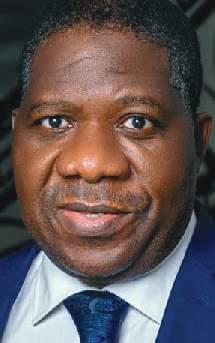
delegates for indirect primaries. In detail, it now recommends who qualifies as a delegate. The provision ends the practice in which the leadership of political parties determine the criteria for delegates.
Among others, the Bill introduces stricter identification for voter registration in Section 10(2), extended publication period for candidates’ details, early verification of party symbols and names in Section 42(3), enhanced regulations of party conventions in Section 82, determination of the exclusion of the candidates by the judiciary in Section 89(3), higher campaign spending and donation limits in Section 93, harsher penalties for electoral malpractices in Section 22 as well as tougher sanctions for electoral offences in Sections 62, 71(2) and 74(2).
The Bill introduces a system of consequence to our nation’s electoral regime. This suggests that any form of breach will not attract just sanctions. With respect to vote buying, the sanctions range from a fine of N5 million to a two-year imprisonment and 10-year ban from contesting elections. The Bill recommends mandatory jail terms and higher fines for such electoral offences as vote buying, result falsification and obstruction of election officials. This provision forecloses the possibility of impunity when electoral offences are established.
These proposals are quite far-reaching, clearly deterrent in nature. If the majority of my colleagues approve them, they will significantly improve the credibility of our electoral process starting from the 2027 general elections. We are conscious of the values the proposals will add to our electoral process. Now that we have resumed, the Committees on INEC in both chambers will submit their reports to the plenaries. After the submission, we will accordingly consider, debate and vote the Bill clause by clause before transmitting it to the President. The review of the 1999 Constitution is also at its peak. Its technical sessions have completed. The reports of public
hearings, too, have been turned in. We have concluded multi-tiered engagements with critical stakeholders. Before the first quarter elapses, the Deputy President of the Senate and Chairman, Senate Committee on the Review of the 1999 Constitution, Senator Barau I. Jibrin will lay the report of the exercise before the Senate. In the coming days, as well, we will consider, debate and vote on each of the proposals to complete the cycle.
The process of the review does not end with the National Assembly. Under Section 9 of the 1999 Constitution, the National Assembly is under obligation to transmit its report to the 36 State Houses of Assembly for consideration and voting. Specifically, Section 9(3) requires not-less-than two-thirds approval by all the State Houses of Assembly before the alteration of the1999 Constitution can be effected. Consequently, the role of the state legislatures is as significant as that of the federal legislature . As we round off the process, the onus now rests upon the state legislatures to consider the proposals on their merit and approve them accordingly. These are just brief highlights of what lies ahead of us in the coming weeks, even for the rest of this year. For us, it is not just about the burden of services we were elected to render to our constituents and our fatherland. It is also about the burden of trust that our constituents repose in us. At this highly critical time when what happens in other parts of the world now dictates the direction of our economy and polity, the onus rests much more upon us than any time in history to reinforce our constituents’ trust in their representatives, in the National Assembly and in their fatherland. At the end of it all, good governance, enhanced security and welfare of our constituents shall remain our cardinal objectives as well as the core of our legislative agenda.
•Senator Opeyemi Bamidele, CON, Leader of the 10th Senate, Federal Republic of Nigeria. 27th January 2026
Edited by nseobonG okon-ekonG
KC Gaming Networks Limited has set a bold tone for the year ahead as it convened its leadership in Lagos for a strategic retreat aimed at sharpening Bet9ja’s vision, strengthening execution, and reinforcing its commitment to lasting industry impact, writes Nseobong Okon-Ekong

KC Gaming Networks Limited, the parent company of Bet9ja— Nigeria’s leading gambling and gaming brand—has concluded its 2026 Strategy Planning Retreat, a four-day intensive leadership engagement designed to sharpen the company’s strategic direction and reinforce its commitment to long-term, sustainable impact. Held in Lagos, the retreat brought together members of the executive leadership team, senior managers, and selected contributors from across the organization for a series of high-level discussions, working sessions, and collaborative forums.
The retreat marked a deliberate pause from the fast-paced demands of daily operations, providing a structured environment for leaders to reflect on performance, challenge long-held assumptions, and define the strategic choices that will guide Bet9ja’s next phase of growth. More than a routine corporate gathering, the event was positioned as a leadership alignment forum—one focused on
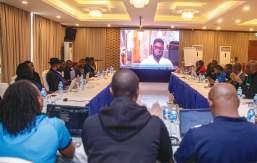
strengthening execution discipline, deepening organizational cohesion, and ensuring that strategy is not only articulated at the top but co-created across the business.
Opening the retreat, the Managing Director and Chief Executive Officer, Ayo Ojuroye, set the tone with a message
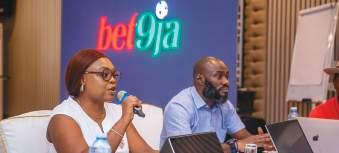
centered on belief, ownership, and disciplined execution as the foundations of sustained market leadership. In his keynote remarks, Ojuroye emphasized that Bet9ja’s ambition extends beyond competition to making a measurable and positive impact within the industry and the communities it serves.
“Great companies are built on unshaken belief and exceptional execution. Bet9ja is not here to compete; we are here to make impact,” he said.
Mr. Ojuroye also highlighted a significant evolution in how strategy is being developed within the organization, pointing to a more inclusive, bottom-up approach that draws insights from teams closest to the business. According to him, this shift is designed to ensure that strategic plans are grounded in operational realities and informed by the practical experiences of staff across departments.
“True ownership does not happen when strategy is handed down; it happens when it is built together,” he added, underscoring
the importance of collective responsibility in translating plans into results.
The Chairman of KC Gaming Networks Limited, Kunle Soname, OFR, also addressed participants, commending the leadership and wider workforce for the resilience and performance that have positioned the company for its next chapter.
The story continues online on www.thisdaylive.com

Photo


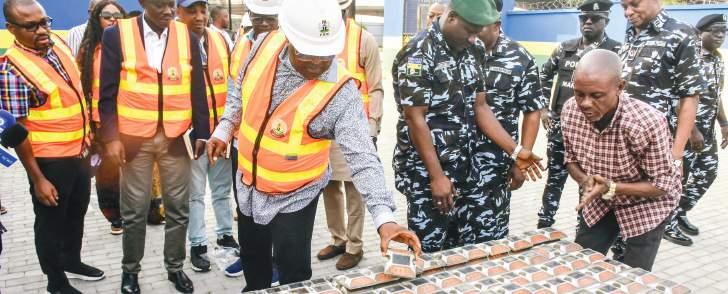
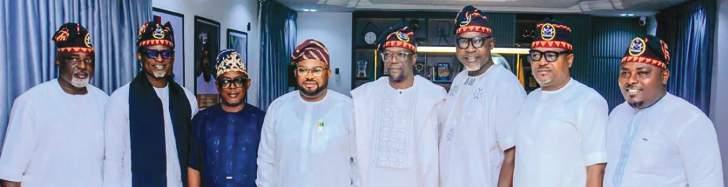
Bennett Oghifo
To ensure credible and efficient cost management in the execution of projects, the Nigerian Institute of Quantity
Surveyors (NIQS) has been advised to adopt data-driven decision-making and to avoid lying with or misrepresenting data.
Former Executive Secretary,
Nigeria Extractive Industries Transparency Initiative (NEITI), Mr. Waziri Adio gave this advice in his Keynote address at the Nigerian Institute of Quantity Surveyors’ (NIQS) 2026 National
L-R: NIQS past President, QS Murtala Aliyu, FNIQS; current Deputy President, QS Bamidele Mafimidiwo, FNIQS; past President, QS Joseph O. Ajanlekoko, FNIQS; current President, QS Dr. Aminu M. Bashir, FNIQS; past President, QS Agele Alufohai, FNIQS; current Vice President, QS Joseph Afe Otaru, FNIQS and past President, QS Dr. Mohammed Abba Tor, FNIQS, at NIQS 2026 National Executive Council and Chapter Chairmen Retreat in Abuja, recently
Executive Council and Chapter Chairmen Retreat in Abuja, recently.
The theme was, “From Intention to Structure, From Structure to Delivery.”
In his address titled, ‘Leadership and Relevance in the Data Age’, Adio, who also leads Agora Policy, a Think Tank on data, said, “In today’s world, we need compelling and credible data to make informed decisions and to lead effectively.
“It is therefore important to mainstream the use of evidence in every facet of the operations of NIQS, from setting your goals to measuring the impact of your activities, from attempting to understand the needs and expectations of your members and other critical stakeholders to setting agenda for government and the larger society.”
He advised NIQS to “consider adopting an approach called Data-Driven Decision-Making
(DDDM),” which, he said, was defined in a 2019 Harvard Business Review article as “the process of using data to inform your decision-making process and validate a course of action before committing to it.”
He said, “Instead of just relying on opinion, experience and tradition, or even impulse, consider making this question a constant refrain: what does the data tell us and what does that mean? Obsess with data not just because someone enjoins you to or because everyone else is doing it, but because data makes a world of difference.
“Mastering data imbues you with confidence and credibility and makes you more persuasive.”
Adio said, “On the whole, the data-driven decision-making approach assists in improving accuracy and reducing bias/subjectivity, optimising performance, improving efficiency, tracking
progress, ensuring proactive decision-making, and prompting necessary course correction. What is there not to like? “However, you need to be mindful of certain things as you actively embrace using and leveraging data in decision-making.
The first, which may sound contradictory, is that data is not everything. Decisions still have to be made by humans. And judgement calls still have to be made. As you invest in data generation, also invest in the capacity of the staff, management and leadership of NIQS to understand data, to be comfortable with data, and to make the right calls with data. Enhanced data literacy is important even for those that will not be directly involved with crunching the numbers. “Also be mindful of this: the fact that a decision is based on data does not mean it will always be the correct or the sensible decision.
Fadekemi Ajakaiye
The Omole Phase 1 Residents’ Association (OPRA) at the weekend formally unveiled a newly completed recreation park, marking a significant milestone in community development and publicprivate collaboration within Lagos metropolis.
The unveiling ceremony, which attracted representatives of the Lagos State Government, officials of the Lagos State Parks and Gardens Agency (LASPARK), executives of IHS Nigeria, estate sector chairmen, civil servants and residents, underscored the growing importance of green and recreational spaces in enhancing urban livability in the state.
Speaking at the event, the Chairperson of the Omole Phase 1 Residents’ Association,
Hon. Mrs. Abimbola Osikoya, described the occasion as a proud and defining moment for the estate. According to her, the recreation park goes beyond being a physical facility, representing what can be achieved when government, private sector partners and communities work together with a shared sense of responsibility.
“Today is a proud and significant day for Omole Phase 1. This occasion represents more than the unveiling of a residents’ park; it reflects the positive outcomes that emerge when government, private sector partners and communities work together with purpose,” she said.
Osikoya expressed deep appreciation to IHS Nigeria for donating and supporting the development of the park, noting that in a city as dynamic
and demanding as Lagos, access to safe and functional recreational spaces is no longer a luxury but a necessity. She explained that the park would serve as a hub for relaxation, family bonding, healthy living and social interaction among residents.
Quoting a popular maxim, she added: “The measure of a society is how it cares for its people, and IHS has clearly demonstrated this commitment through meaningful community investment.”
The OPRA chairperson also acknowledged the Lagos State Parks and Gardens Agency as a key partner and landlord, commending the agency for its consistent support and stewardship of public green spaces. She noted that LASPARK’s involvement reflects the Lagos State Government’s broader vision of sustainable
urban development that places people and the environment at its core.
She further assured stakeholders that the facility
would be protected, properly maintained and responsibly used for the benefit of all residents. “We assure our partners and the Lagos State
Government that this facility will be safeguarded and preserved to continue serving Omole Phase 1 for many years to come,” Osikoya stated.
Bennett Oghifo
The Nigerian real estate sector, which has, in the past few years, seen a massive influx of billions of Naira from Nigerians in the diaspora, is facing a fresh wave of scrutiny, following alleged breach of contract and project abandonment.
Some Nigerians in the Diaspora are distraught and deeply concerned that one of the real estate industry’s players RevolutionPlus Property, was yet to deliver their homes to them years after they completed payment for these homes.
RevolutionPlus did not deny this claim, telling THISAY they were hit by inflation, but had recovered and are set to deliver the homes to these investors.
Regardless, some investors who spoke with journalists said what was promised as a dream investment in a high-brow area of Lagos has turned into an
unending nightmare year after year.
Alex Adelesoye, a medical practitioner in the Middle East, expressed his frustration over the failure of RevolutionPlus to deliver his house to him many years after making payments for an apartment in Flourish Apartment and Terraces, located on Orchid Road, Lekki, near the Chevron area.
According to Dr. Adelesoye, he and several others were lured by advertisements from RevolutionPlus between 2020 and 2021. Enticed by the prospect of owning a home in one of Lagos’ fastest-growing corridors, the subscribers made substantial payments under a formal agreement that the project would be delivered within 12 months. However, years later, the promised delivery remains what victims describe as a “mirage”.
“The story changed imme-
diately after payments were made,” said Dr. Adelesoye.
“Instead of delivering a finished apartment, we were met with repeated requests for additional payments, which the subscribers meekly complied with in hopes of finally securing their investment.”
Thelma Egunjobi, a Nigerian living in Europe, said she invested over N40 million as far back 2020, and as of today, her three-bedroom terrace is yet to be delivered. Promises of delivery by the company have been unending.
“I paid for a 3-bedroom terrace. RevolutionPlus pleaded with me to add more money, and I had to change foreign currency to fund the purchase. As of today, I am frustrated that the delivery is a pipe dream. RevolutionPlus has thoroughly messed me up. We took the matter to the Lagos State Real Estate Regulatory Authority
and the Anti-Land Grabbing Commission, without any success. We later reported to EFCC, and we are yet to receive our properties, which is really a shame and a huge disincentive to investment in our country, as several investors have had their fingers burnt without any punitive or pragmatic intervention from the Government agencies regulating these developers,” she lamented.
Prince Yellowe, another subscriber, who lives in the United States, bemoaned government failure to hold RevolutionPlus accountable, saying: “I paid N65 million to RevolutionPlus as far back as 2022. Even at EFCC, I was made to pay additional money in May 2025, over N100 million was made available to Revolutioplus, with the promise that the house would be delivered in December 2025. Till now, nothing palpable has been invested of this fund on
the completion of the project.”
“Massive work is ongoing on the site,” according to RevolutionPlus.
When contacted, The Managing Director of RevolutionPlus Property, Bamidele Onalaja told THISDAY, “We are working. Work is going on. Inflation has met up with the project, but we are back to cycle now. We are working. Very soon, and when we are done, everybody will receive their allocation.”
When asked to give the investors a timeline for delivery of their homes, Onalaja said, “Maybe six months. This year. Six months, let’s say, like July? By God’s grace. Yes.”
Meanwhile, pictures of the site obtained as of Monday, January 12, 2026, showed otherwise. Reacting to Mr Onalaja’s comments, Dr. Adelesoye stressed that the real estate company has done
nothing significant since 2022. “The company didn’t do anything noticeable in the last three years. The agreement we have says the project will be delivered on or before December 2022. The massive work claimed to be going on was just a delivery of some trucks of sand when he was aware of EFCC’s planned visit to the site on Monday 12 January. We appreciate the value of what we have invested but sad to see how things have turned,” he added.
“We’re tired of delays”Investors
Another investor, Omayemi Edukugho, who resides in the United States also told journalists that his hope of owning a home in Nigeria has since been frustrated. “As a law abiding citizen, we have reported to EFCC. Potential buyers should also note that the buildings have been sold.”
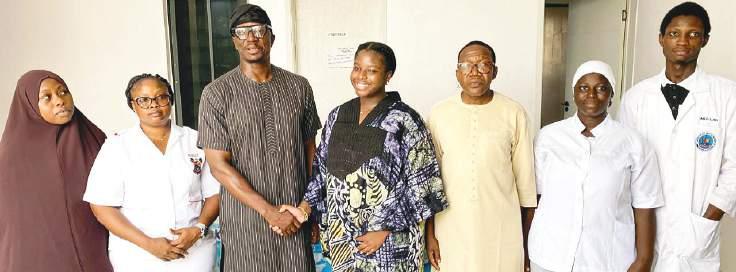
L-R: Assistant PR Account Executive, Glam Brand Agency, Miss Teniola Oyekan; Chief Executive Officer, Glam Brand Agency, Mrs. Bola Balogun; Lagos State Commissioner for Tourism, Arts and Culture, Mrs. Toke Benson-Awoyinka; Vice President, Growth and Partnerships, Rolling Stone Africa, Mrs. Itohan Barlow-Ndukuba; and PR Account Executive, Glam Brand Agency, Miss. Ochuko Akpofure, during a courtesy visit to the Commissioner’s office in Alausa Ikeja... recently
Deji Elumoye in Abuja and Yemi Kosoko in Jos
Vice President Kashim Shettima, yesterday, disclosed that Nigeria had the potential to be one of the greatest countries on earth if its citizens learned to tolerate and live in peace with one another.
According to Shettima, all Nigerians are one people tied to a common heritage, and what binds them together as a people supersedes whatever threatens to separate them.
Shettima stated spoke yesterday in Jos, the Plateau State capital, when he paid homage to the Gbong Gwom Jos and Chairman, Plateau State Council of Chiefs and Emirs, HRH Jacob Gyang Buba, at his palace.
He said, “We are all connected one way or the other. We must, therefore, continue to live together. What binds us together supersedes what separates us.”
The vice president, who was in the state for the grand reception of Plateau State Governor, Caleb Mutfwang, and other prominent politicians into All Progressives Congress (APC), stated that traditional rulers were a special
group of respected leaders because they upheld the society.
According to him, “They are not just the custodians of our cultural heritage. They help in upholding the society by preaching peace among their subjects.”
He lauded the cordial relationship existing between National Chairman of APC, Professor Nentawe Yilwatda, and Mutfwang, stating that the realignment is a good omen for Plateau State.
Shettima stated, “The APC national chairman, who is an indigene of the state, made a very generous statement at the reception venue by pledging his full support to the governor, and with their coming together, the state will enjoy more dividends of democracy. That is good for the people of the state.”
He expressed confidence in the political realignment, saying it would also boost the image of Plateau State as well as ensure the sustenance of peace and tranquillity across the state, and the entire country.
“The national chairman was the opponent of the governor at the last election but today they have agreed to work together.
There can be no development without peace. Therefore, with their coming together, the state will enjoy more peace,” the vice president stated. He thanked the government and people of the state for the show of hospitality to him and his entourage.
Earlier, Mutfwang commended the good working relationship
between President Bola Tinubu and Shettima, stating that it would continue to abound for the benefit of the entire country.
In his remarks, the Gbong Gwom Jos appealed for more efforts to ensure adequate security in order to address the challenges confronting the state and other parts of the country. He stated, “On behalf of
the traditional council here, I appreciate what our security agencies are doing to ensure we enjoy peace, but I want to appeal for more security and true reconciliation in all parts of the country.
“Nigerians must respect one another and live in peace. Islam and Christianity are not in support of acts of insurgency or
trouble making. We all believe in God Almighty who is the Supreme Being. Why should we foment trouble or kill one another?”
The royal father thanked the vice president, the national chairman of APC, and the governor for their realignment, saying it is a good development for both the state and the country.
Says court-sacked APC chairmen lack mandate to stay in office
Yinka Kolawole in Osogbo
Osun State Governor, Ademola
Adeleke, has told President Bola Tinubu to call Minister of Blue Economy, Gboyega Oyetola, to order, alleging that he is behind the crisis in the state’s local government system.
Adeleke reiterated that the self-awarded tenure of APC local government chairmen lapsed in 2025 and could not be elongated under the law and Supreme Court precedents.
Adeleke faulted the minister’s submission on the local government crisis, insisting that the former governor is the chief architect of the paralysis and the untold hardship being inflicted on Osun people.
Adeleke said a Federal High Court had sacked the APC chairmen in 2022 and the judgement was later validated by a Court of Appeal judgement, which also acknowledged that newly validly elected chairmen and councillors
from Peoples Democratic Party (PDP) were already sworn into office.
The governor reminded the minister that the APC chairmen were sacked by the court because their election was conducted under Oyetola in violation of the Electoral Act, which stipulated a year notice before conducting local elections.
He queried Oyetola’s motive for conducting local government election in violation of the law and soon after he lost his re-election bid
Sunday Aborisade in Abuja
The December 25, 2025 United States airstrikes on terrorist enclaves in Sokoto State, yesterday, sparked a fresh debate in Senate, with lawmakers resolving to hold an executive briefing amid concerns over Nigeria’s sovereignty and the alleged exclusion of the National Assembly from the decision-making process.
The controversy was triggered by Senator Abdul Ningi (PDP, Bauchi Central), who faulted the US-led military operation, and stated that it amounted to a violation of Nigeria’s territorial integrity as a sovereign nation.
Ningi anchored his objection on
claims that the National Assembly, constitutionally empowered to be involved in discussions leading to external military interventions, was not consulted before the strikes were carried out.
Raising the matter during plenary presided over by President of the Senate, Senator Godswill Akpabio, Ningi cautioned against a situation where the executive arm of government alone would be taking far-reaching security decisions involving foreign powers without legislative input.
He warned that allowing such a precedent to stand could open the door for other global powers to undertake military actions on
Nigerian soil without recourse to the legislature.
Ningi stated, “It is not right. The leadership of the National Assembly should take a briefing from the security agencies on what happened. This is a violation of our territorial integrity.”
He added that if unchecked, countries, such as Russia and others, could in future justify unilateral military operations in Nigeria, citing security cooperation with the executive.
However, Akpabio swiftly intervened to calm frayed nerves, explaining that the senate leadership had already scheduled a closed-door briefing for lawmakers on the matter.
He said the planned in-camera session was to hold on Tuesday, January 27, shortly after the senate reconvened from the Christmas and New Year recess. He said it was postponed due to the suspension of legislative activities in honour of the late Senator Godiya Akwashiki, who passed away on December 31, 2025.
Akpabio stressed that the issue was a sensitive national security matter that should not be debated openly on the floor of the senate.
“We really should not discuss it in the open. We wanted to do it behind closed doors yesterday, but because of Senator Akwashiki, we couldn’t,” he said.
He assured the senators that the leadership had taken note of Ningi’s concerns and a comprehensive briefing would take place today, January 29.
“So, your point of order is noted. We need to brief you behind closed doors,” Akpabio added.
The U.S. airstrikes, conducted on December 25, 2025, were reportedly carried out in coordination with Nigerian authorities and targeted camps linked to the Islamic State group operating in Nigeria’s North-west.
The United States Africa Command (AFRICOM) confirmed that the operation led to the killing of multiple ISIS fighters.
in 2022, insisting that the minister should bear full responsibility for the paralysis of the councils, which are well-known to the mass of Osun people.
While APC insisted on not quitting office, despite court rulings, and while the minister ensured the seizure of council allocations, the governor said he had ensured regular payment of salaries. He questioned why Oyetola preferred local workers to suffer even after blocking funding flow to the local government system.
The governor expressed shock at the minister’s denial of paralysis of local governments in Osun, calling it an insult to Osun traditional rulers whose salaries could not be paid; a denigration of local workers, who survived only through salaries minus the allowances; and gross contempt for local government workers, who were recently molested and harassed by APC thugs and tenure-less chairmen.
Adeleke said, “Under what authority is Mr Oyetola and his cronies in the guise of council chairmen disbursing funds meant for salaries of local government workers. “Under what authority is he deciding who gets paid or not? Why are they not paying salaries of local health workers, local teachers and local retirees?”
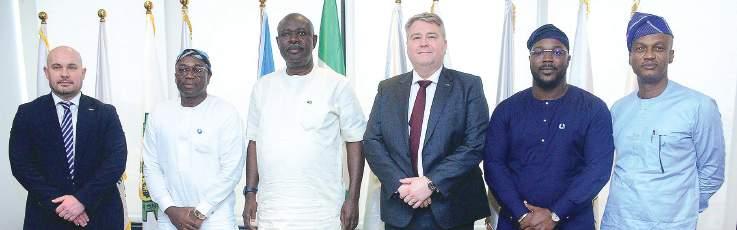
L-R: Chief Commercial Officer, NHV Group, Jamie John; Chief Executive Officer (CEO), Caverton Offshore Support Group (COSG), Mr. Olabode Makanjuola; Honourable Minister of state for Petroleum Resources (Oil), Senator Heineken Lokpobiri; CEO, NHV Group, Lars Hendrick; Chief Operating Officer, COSG, Rotimi Makanjuola; and Managing Director/Accountable Manager, Caverton Helicopters, Captain Ibrahim Bello, when Caverton management and NHV Group executives paid a courtesy visit to the minister to discuss strategies on the future of offshore helicopter services in Abuja… recently
Says sit-at-home deliberate sabotage caused by some politicians, vows to name them soon Warns he can revoke ownership of shops who fail to comply
David-Chyddy
Anambra State Governor, Professor Chukwuma Soludo, said there was no going back on the order to shut Main Market, Onitsha.
The decision had generated tension in the state since it was made on Monday following the traders’ observance of Monday’s sit-at-home order by Indigenous People of Biafra (IPOB).
Soludo, in a press briefing yesterday,
described the continual stay at home by traders in the market as economic sabotage and would not be allowed to continue.
He insisted that even if it meant revoking the ownership of shops of those who failed to comply or even taking total possession of the market and demolishing it, he would do it to ensure that things were gotten right.
Soludo stated, “I want to say that the Monday sit-at-home is deliberate economic sabotage and would not be
allowed to continue. Throughout the yuletide the market was open from Monday down to Saturday and in most cases opened on Sundays, too.
“For people who say the Monday decision is because of insecurity, why were there no incidences when traders opened all through the week? Now that normal businesses have commenced, they have started their Monday sabotage. If they go for meetings on Monday, go to stadium to exercise and they do not
fear insecurity.”
The governor also said, “Why is their target Nnewi and Onitsha? Majority of those doing it are not from Anambra. As I drove to Onitsha on Monday, all markets were open. In most cases there was street trading and it was even difficult for us to meander our way.
“Other markets were open and I drove through Ochanja, but the major target is Onitsha Main Market. When we got there, it was not open. We think
Chuks Okocha in Abuja
Peoples Democratic Party (PDP) Governors’ Forum slammed former Ekiti State governor, Ayodele Fayose, describing him as a liability to Nigeria. politics. This followed Fayose’s comments on a recent meeting between President Bola Tinubu, a member of All Progressives Congress (APC), and Oyo State Governor, Seyi Makinde, a PDP member.
The PDP governors also described Fayose as an attack dog of the presidency, who merely sought to be noticed by Tinubu.
Reacting to Fayose’s criticism of Makinde, Director-General of PDP Governors’ Forum, Dr. Emmanuel Agbo, said, ‘’Ordinarily, the forum, like any sensible and focused group in Nigeria, would not join issues with characters like Fayose and confer them the dignity they do not deserve.
‘’Nevertheless, even though
Governor Makinde has explained to Nigerians the subject of his parley with the president, it is exigent to respond to Fayose’s latest gaffe, in order to draw attention to his degenerative public demeanour and the demeaning impact that it is having on the image of Nigerian politics.
‘’For his attribution of partisan motives to Makinde’s meeting with the president, among other negative implications, portrays Tinubu as a desperate leader, whose sole objective for interacting with the governors of states in the country he presides upon is to consolidate his hold on power.”
The forum said, ‘’Fayose’s pathological tirade also suggests that the current leadership in Nigeria is only focused on political horsetrading and trade-offs, in exclusion of issues of governance and efforts towards addressing the nation’s development needs.
‘’The former Ekiti State governor
is, indeed, proving to be more a liability, than an asset to the country’s body politic.”
The PDP governor alleged, “After several failed attempts to sell his services to the presidency, Fayose has turned into a self-appointed attack dog of the Villa, desperate for retainership and seeking an upgrade from his status as the flunkey of Nyesom Wike, whose position as a Minister of the Federal Republic restrains him from condescending to Fayose’s low level, even as he has severally, too.
‘’As a former governor and one-time Chairman of PDPGF, the forum regrets the degeneration in his conduct in Nigeria’s political arena and wish to call on his loved ones to seek professional attention for Fayose, who is exhibiting symptoms of an abnormal condition. Nigerians would, indeed, be deeply gratified to be rid of the ridicule that elements like him are drawing to the nation’s political character.”
Agbo stated, ‘’Nigeria’s democracy can be harmed by elements like Fayose, who only find relevance in an atmosphere of partisan hate and crises. The PDPGF, therefore, calls on the presidency to dissociate itself from unsolicited hounds like him for the sake of sanity and in order to ensure decency in the nation’s politics.’’
2025
this is deliberate and it has to end.”
The governor traced the history of the sit-at-home order on Mondays to 2021 in protest against the arrest of Nnamdi Kanu, leader of IPOB, but said he visited Kanu in prison and he was unhappy with the decision and called for an end to the order.
Soludo disclosed, “I visited Kanu and he was unhappy about it. I confronted him with the question (sit-at-home order) and he told me it was wrong. We later met with the stakeholders, constituted the Justice Peace Committee, which was headed by Professor Chidi Odinkalu, and they have submitted their report and we have been implementing it.
“We also discovered that the people outside are the ones fuelling it and we have held town hall meetings to tell them they are killing the homeland. You cannot distort the growth of people and education, the same people you said you are fighting for.”
The governor added, “We announced amnesty programme and 15,400 youths came out and we have rehabilitated them. We are working to give young people a life and other people are there working to give them pain.
“The rest of the world cannot adjust to our own calendar, we cannot operate a four-day economy and hope to compete with people operating six days of the week. So we must stop. This is not because of fear of insecurity, because we have over 150 security personnel working in the main market only.”
Speaking on the what the government was losing in terms of revenue, Soludo said the cost was much, but it was not merely about government revenue, but about the economy of the poor people and the overall stability of the state.
He said, “The cost is much and not as a result of loss in taxes, because Onitsha generates pittance. I’m talking about the larger economy, which is more on the traders themselves.
“Monday is the most important day of the week and if we continue, our economy will continue to come down. We can’t train our children in a school system that runs four days a week.
“I’m concerned because you gave me the mandate to be your Chief Servant. If not, what do I lose? I can as well shut down and use my Mondays to sleep too.”
before the issuance of the license by the minister. The condition precedent will include payment of the signature bonus within 60 days from the issuance of the offer letter. It will include your work commitment guarantee.
the asset up to 60 per cent, which will be held by the NNPC on behalf of the government.
attracting foreign investment.
“The general license condition speaks to general times and conditions of the license that you are required to adhere to during the pendency of the license and of course the bid is for a maximum of two blocks. If you bid for any blocks exceeding these two blocks, those additional submissions will not be evaluated,” he explained.
“We have the Sokoto Basin, the Chad Basin, we have the Benue Trough, the Bida Basin, Anambra Basin, Benin Basin and of course the mature Niger Delta Basin. This Licensing Round will take place across five of the seven basins,’’ he stated.
The statement noted Fubara’s exemplary leadership qualities that have endeared him to the Rivers people as well as his tireless effort and commitment to the peace and greater good of the state.
“On behalf of the South-South
The South-south Governors’ Forum (SSGF), has extended hearty felicitations to their colleague in Rivers State, Siminalayi Fubara, on his 51st birthday. Chairman of the regional governors’ body and Governor of Bayelsa State, Senator Douye Diri, in a statement, yesterday, described Fubara as a humble servant of humanity and the people of Rivers State.
Governors Forum, I extend our warm birthday wishes to His Excellency, Governor Siminalayi Fubara, on his 51st birthday.
“The Forum celebrates the new year in your life and the new life in your years just as we wish you greater leadership successes in the years ahead,” he said.
“And then you are required to submit a performance bond that will guarantee that work obligation. And of course you are required equally to show evidence of payment of your rent from the first one year. If the winning bidder is unable to fulfil this condition precedent within these 90 days, upon the expiration of the 90 days, without recourse to the winning bidder, the commission will then invite the reserve bidder to fulfil these conditions and it means the offer made to the winning bidder lapses,” he stated.
Significantly, he explained that if a winning bidder operates on a concessional contract arrangement, it means the government has a right to barge into that asset at any time during the lifespan of
According to him, any winning bidder who fails to fulfil his obligations, will have their offers revoked as prescribed under the (PIA), and the cancelled participating interest will be distributed amongst the other non-defaulting members.
Besides, in his submission, the Deputy Director, Lease Administration, Exploration and Acreage Management, Dr Amba Ndoma-Egba, noted that some of the objectives of the bid round include: ensuring energy sufficiency, boosting gas utilisation, expanding opportunities and
He reiterated that the signature bonus will be around the range of $3 million and $7 million, emphasising that the commission has the prerogative to determine the percentage of the bond that will be given in respect of the work programme commitment.
“The CCE said in her speech, the signature bonus is within a range. We have a range which is between $3 million to $7 million and will be evaluated based on version 16 of the Petroleum Industry Act 2021. The Commission has the prerogative to determine the percentage of the bond that will be given in respect of the work programme commitment,” he stated.
L-R: Senators Ned Nwoko and Ipalibo Banigo; Senate Leader, Opeyemi Bamidele; Senator Aminu Tambuwal (one of the celebrants, exchanging banter) with the President of the Senate, Godswill Akpabio; Chairman, Senate Committee on Appropriations, Adeola Olamilekan (watches); Deputy Minority Leader, Olalere Oyewumi; and Chairman, Senate Committee on Sports, Abdul Ningi, during the celebration of senators born in the month of January after plenary, yesterday
Says his exit shocking, painful, difficult to comprehend Commissioner awaiting directive from leader
Chuks Okocha in Abuja and Laleye Dipo in Minna
Former presidential candidate of the New Nigeria Peoples Party (NNPP) and leader of the Kwankwasiyya Movement, Rabiu Musa Kwankwaso, has said the Kano State Governor, Abba Kabir Yusuf, would face the consequences of his defection to the ruling All Progressives Congress (APC).
Kwankwaso said this during an interview on BBC Hausa Service.
He said the governor’s exit from the party was shocking, painful, and difficult to comprehend, stressing that Yusuf and others who defected with him would, in time, come to regret their actions.
“What has happened is very disturbing. Leaving the party that worked tirelessly to build you and brought you to power is not something that can be easily explained,” Kwankwaso said.
He cautioned that political decisions carry lasting implications, warning pointedly that the full consequences of the defection were yet to unfold.
“They may think they have succeeded today, but time will reveal everything. Actions like this always have consequences,” he declared.
Kwankwaso noted that the manner of Yusuf’s departure had unsettled NNPP members and supporters across Kano State, describing the mood within the Kwankwasiyya political family as one of disbelief and betrayal.
According to him, several people had approached him since the defection, expressing doubts about how and why it happened, with some speculating that it might have been the outcome of a broader political arrangement.
“Many people have come to me saying they believe what happened was part of a deal — either between me and him, or between me and those around him. Even I, on many occasions, find it hard to believe that things unfolded the way they did,” he said.
He insisted, however, that no such agreement existed and maintained that time would ultimately expose the real motives and implications
behind the political move.
Meanwhile, the Commissioner for Diaspora Matters, Alhaji Danladi AbdulHamid, has said he would remain in the cabinet of Governor Yussuf until when directed to quit by Kwankawaso, leader of
the NNPP.
Danladi Abdulhamid, an indigine of Niger State, was introduced to Yusuf by Kwankawaso, leading to his appointment as Commissioner for Diaspora Matters.
“As for my portfolio as Com-
missioner for Diaspora, whether I am there or not I will continue to advise Abba because Kwankawaso introduced me to Abba unless and until Kwankawaso ask me to withdraw from Abbas cabinet I will remain
“I am really not happy about what happened. I still see it as a dream,” he said, adding that he had not been able to speak to the governor since his defection. “I have tried him three times, I will continue to try him.”
Onyebuchi Ezigbo
The Nigeria Labour Congress (NLC) and the Trade Union Congress (TUC) have asked staff of the Federal Capital Territory to continue with the industrial action despite the restraining order by the National Industrial Court.
A statement jointly signed by NLC’s acting General Secretary, Benson Upah and TUC Secretary General Dr. Nuhu Toro said the order of interlocutory injunction obtained by the Minister of the FCT, Nyesom Wike was against
Dangote Industries has appointed MTN Group’s Chief Executive Officer, Ralph Mupita, to the board of its fertiliser business as it prepares to expand and list the operation in the Nigerian Stock Exchange.
Dangote Fertiliser plans an initial public offering on the Stock Exchange this year, and Mupita’s experience includes spearheading the listing of MTN’s unit in Nigeria in 2019, Bloomberg reported yesterday.
Dangote Fertiliser produces about 3 million tons of granulated urea annually and plans to expand its complex in Lagos and build a facility in Ethiopia this year to become the largest maker globally by 2028.
Dangote Fertiliser Ltd. Managing Director Vishwajit Sinha confirmed
Mupita’s appointment in an email response to questions, the Bloomberg report added.
The high-profile hire to Aliko Dangote’s stable comes as Dangote Fertiliser plans an initial public offering on the Nigerian Stock Exchange this year. Mupita spearheaded the listing of MTN’s unit in the West African nation in 2019, a business whose revenue has more than quadrupled since.
With a market value of $8.6 billion, it’s the bourse’s biggest company after BUA Foods Ltd. Africa is home to the fastestgrowing population worldwide. Rising food demand, urbanisation and expanding regional trade could see agriculture grow to beyond $1 trillion by 2030, according to the African Development Bank (AfDB).
This creates a huge market for fertiliser firms on the continent, although the majority of farmers still struggle with limited access to finance, infrastructure and markets.
Dangote Fertiliser produces about 3 million tons of granulated urea annually and plans to be the largest maker globally by 2028, said Dangote previously. To do this, it needs to expand its $2.5 billion complex in Lagos, and will start building a facility in Ethiopia this year.Mupita has headed Africa’s largest wireless carrier for more than five years after joining the group in 2017 as chief financial officer. Before that, he held senior positions at South African financial services group Old Mutual Ltd. and initially trained as an engineer.
the two individual union leaders and not against the striking trade unions.
The two labour centres, while expressing solidarity with unions, urged the workers to continue to observe the strike and to be courageous “in the face of relentless threats”.
“We use this opportunity to give unsolicited advice to the judiciary. We commend the honest judges who have given their all in order to give hope to the weak and the poor, ensure law and order in our society as well as see to the protection of the rights of the citizenry,
“ We put on notice, cash and
carry judges who continue to constitute a smudge on the judiciary and whose conduct imperils our society, that they cannot be insulated from the consequences of the storms they create and they will be held accountable, if not by man, by God for the destruction of their society or for accelerating the unraveling of their society.
“Workers cannot be made slaves in their country. We stand for the rule of law and its observance to the hilt, no matter the status of the parties to this dispute. Accordingly, we not only support the workers in this action, we urge them to maintain high morale in the face of relentless threats.
“Finally, this strike continues until the Minister of FCT comes off his high horse and negotiates with the workers,” the labour organisations said. The two labour centres regretted that rather than utilise the window provided by the judicial intervention to reach out to organised labour for an amicable resolution of the issues, the FCT administration had resorted to threats against workers.
“The offences committed against the FCT workers are serious enough. To add intimidation, humiliation, insults and harassment to the menu is something we cannot watch from the sidelines,” they added.
Emmanuel Addeh in Abuja
The federal government has moved to fast-track major federal road and bridge projects in Niger State, as growing traffic pressure and structural concerns threaten key transport corridors linking northern and southern Nigeria. The Minister of Works, David Umahi, disclosed this in Abuja after a meeting with Niger State Governor, Mohammed Bago, where both leaders agreed to deepen collaboration to address worsening congestion, infrastructure decay and safety risks on federal roads in the state.
Umahi said the Bola Tinubu administration was determined to accelerate the delivery of ongoing projects, describing road infrastructure as a shared national responsibility rather than one limited by jurisdiction, a statement by the Director, Information and Public Relations, Mohammed Ahmed said yesterday.
He commended the Niger State Government for stepping in on several federal road corridors, noting that interventions in Minna, Bida and Suleja had improved mobility and stimulated economic activity.
A major focus of the talks was the 71-kilometre Minna–Suleja Road, a critical artery connecting the Federal Capital Territory (FCT) to the North Central region. Umahi disclosed that the project has received approval from the Bureau of Public Procurement (BPP) and is awaiting consideration by the Federal Executive Council (FEC). He added that Tinubu had directed that the project be prioritised, assuring that funds already deployed by the Niger State Government for emergency intervention would be refunded.
Delta State University(DELSU), Abraka, Mr. Charles Ajuyah, SAN; Governor Sheriff Oborevwori of Delta State; Members, Rt. Hon. Festus Ovie-Agas, and Rt. Hon. Frank Enekorogha, after the inauguration of the new DELSU Governing Council in Asaba…yesterday
adedayo
akinwaleinabuja
The House of Representatives has called President Bola Tinubu to, as a matter of urgency, direct the Chief of Defence Staff(CDS) to initiate a coordinated joint security operation and provide area surveillance and ground support to flush out the armed bandits and destroy their camps in Gombe State. The resolution of the House followed the adoption of a motion moved at the plenary one yesterday by the Chief Whip, Hon. Usman Kumo.
Galadima, Pindiga, Garin Jaji, and Laro and other communities in Akko Local Government Area of Gombe State resulted in the killing of six people, abduction of 20 persons currently being
Moving the motion, he recalled that recent attacks by armed bandits on Garin
Omon-Julius Onabuinasaba
Delta State Governor, Sheriff Oborevwori, has been commended for approving payment of three years’ outstanding counterpart fund to the Livelihood Improvement Family Enterprises for the Niger Delta (LIFE-ND) in the state.
The Delta State Coordinator, Livelihood Improvement Family Enterprises for Niger Delta (LIFE-ND), Mr Collins Ashoro, who gave the commendation last Tuesday in Asaba, noted that the LIFE-ND project is a tripartite programme of the Federal Government of Nigeria in collaboration with the International Fund for Agricultural Development
(IFAD) and the Niger Delta Development Commission (NDDC).
Ashoro, in his remarks during a LIFE-ND Media Roundtable in Asaba last Tuesday to review the activities of the first phase of the developmental programme from inception in 2019 to 2025 in the 10 selected local government areas of Delta, said that payment of counterpart fund remained critical to the level of success in the various projects of the intervention initiative.
The state project coordinator emphasized that participating state governments are required to pay a counterpart fund so as to attract needed funding for executing the projects and activities of LIFE-ND.
sylvesteridowuinWarri
A private security firm, Tantita Security Services Nigeria Limited (TSSNL), owned by Chief Government Ekpemupolo, yesterday deepens it’s collaboration with the Nigerian Army with the construction of 13 new offices and reconstruction of 22 offices at the 3 Battalion, Effurun in Uvwie Local Government Area of Delta State.
Inaugurating the new and remodelled offices and other facilities, the firm reaffirmed its commitment to the highest standards of accountability, collaboration, and service in support of the Nigerian Army and other security agencies.
The facilities were embedded
within Sector I facilities of Operation Delta Safe.
The Managing Director of Tantita Security Services Nigeria Limited, High Chief Kestin Pondi, said the project reflected the company’s belief that sustainable security is driven by strong partnerships between public and private institutions.
“All over the world, experience has shown that sustainable security cannot be delivered by one institution acting alone. It thrives where there is collaboration between public and private institutions,” Pondi said, noting that the principle formed the bedrock of Tantita’s engagement in protecting Nigeria’s critical energy infrastructure.
held hostage by the kidnappers, and destruction of property.
He added that the recent attacks have caused widespread fear and displacement of citizens from their homes, displacement
of citizens, loss of livelihoods, fear, and uncertainty within the communities Kumo expressed worry that these incidents are a stark reminder of the overwhelming
threat to national security, and a call to all security agencies to double their efforts in ensuring that they provide adequate protection to the citizens and their properties.
sunday Ehigiator
A succession dispute has erupted in Lagos over the Oloja of Lagos stool, as the Akinsanya Olojo-Kosoko Ruling House called on Governor Babajide Sanwo-Olu to intervene following what it described as an unlawful appointment.
In a petition, the ruling house
sunday Okobi
The Board of Directors of Origin Automobile Works (OAW) has successfully solidified the organisation’s impact and established key priorities for the future at its strategic retreat, held in Lagos recently.
The three-day session with the theme: ‘Building Institutional
rejected the announcement of Prince Babajide Kosoko of the Oteniya Ruling House as the new Oloja of Lagos.
The family claimed the move violates the Lagos State Obas and Chiefs Law and the 1983 registered declaration governing succession to the throne.
The petition, signed by the Head of the family,
Strength to Accelerate Growth,’ was focused on strengthening governance, among other positives for the future, providing an opportunity for board members to move beyond routine agendas, focusing deeply on long-term sustainability, risk management, and the enhancement of operational efficiencies.
Prince Surajudeen Abiodun Olojo-Kosoko, and General Secretary, Prince Theophilus Olojo-Kosoko, affirmed that Prince Abiola Olojo-Kosoko of the Akinsanya-Olojo ruling house remains the duly Oloja-elect.
According to the family, “Prince Abiola was elected by the kingmakers of the
The board, in collaboration with executive leadership, examined the achievements of the previous fiscal year in the context of the OAW five-year Strategic Plan (2020 –2025) and established the foundational goals for the future strategic plan to span between 2026 and 2030.
King Kosoko Royal Family on December 12, 2020, in a process fully compliant with tradition and law. “His selection was formally presented to the wider royal family on December 31, 2020, and forwarded to the Lagos State Government for ratification.”
Recognising the need for a dynamic approach to optimise and consolidate its contributions to the mechanisation development in agriculture and the food systems sector in Nigeria, as well as promoting sustainable development, the board engaged, considered, and discussed measures to refine the organisation’s mission and values.
The Enugu State Government has reaffirmed the strategic importance of town unions as critical partners in grassroots governance, describing them as indispensable structures for community administration, peace building, and sustainable local development.
Also, the government charged town union presidents-general across the state to maintain peace in their respective communities and resist any attempt to use their platforms for destabilisation.
The Enugu Commissioner for Chieftaincy Matters, Dr. Charles Egumgbe, gave
the charge while speaking during his maiden official meeting with town union presidents-general yesterday at the ministry.
Dr. Egumgbe explained that the core functions of the Ministry of Chieftaincy Matters, as approved by Governor Peter Mbah upon his inauguration as commissioner, include the development and implementation of policies on chieftaincy matters, issues relating to the creation of autonomous communities and village integration as well as the establishment and supervision of palace courts for dispute resolution.
segun awofadeji in Bauchi
The Bauchi State Government has pledged to settle the outstanding debts of late veteran journalist and retired civil servant, Mallam Dalhat Hamid Bello, and to fast-track the payment of his gratuity to support his family.
The commitment followed the late broadcaster’s touching testament, in which he urged his children to use his gratuity to offset his debts in the event of his death.
Moved by the gesture, the state Governor, Bala Mohammed, directed that the debts be paid directly by
the state, while his gratuity process is expedited.
This was disclosed by the state Commissioner for Humanitarian Affairs and Disaster Management, Hon. Hajara Yakubu Wanka, yesterday during a condolence visit to the family of the deceased in Bauchi.
Wanka described the late Dalhat as a dedicated public servant who served Bauchi State with distinction and contributed immensely to the growth of the broadcasting profession, having once served as the acting Managing Director of the Bauchi Radio Corporation (BRC).
Duro Ikhazuagbe
Both Victor Osimhen and Ademola Lookman fired blanks for their respective clubs in the final UEFA Champions League matches of the league phase last night.
While Osimhen was in action for all of 90 minutes for Galatasaray’s 2-0 defeat at Manchester City’s Etihad Stadium, Lookman and his Atalanta teammates were also beaten 1-0 at Royale Union SG’s Lotto Park in Anderlecht, Belgium.
Kamaldeen Sulemana came on for Lookman after 51minutes.
Osimhen had Galatasaray’s best chances but his flicked header and low drive were both kept out by Gianluigi Donnarumma.
In the game that had all the hypes of a true championship clash, Erling Haaland and Rayan Cherki scored in the first half to give Pep Guardiola’s side an advantage they never looked like ceding at the Etihad.
It was a welcome return to the
goals for Haaland, who had not scored from open play in eight games prior to last night’s victory.
Expectedly, the result was enough to help City clinch the last eighth spot of the direct qualification to the last 16 stage of the Champions League.
For Galatasaray whose fans disrupted the game with Kurdish protests, finishing 20th on the league phase table with 10 points from eight games means that they Istanbul giants will be involved in the home and away playoffs for all the 16 teams from 9th to 24th on the final standings.
Lookman’s Atalanta that also finished 15th with 13 points from same eight matches, will be involved in the playoffs as well.
Arsenal completed a flawless league phase campaign last night, making it eight wins out of eight in the Champions League
Ahmed Musa rolled back the years again as he was the match winner on Wednesday for struggling Kano Pillars to pip Katsina United 1-0 in a Northwest Derby.
The former Super Eagles captain, who also doubles as Pillars general manager, scored the only goal in the 72nd minute of this home game.
In Jos, Plateau United continued their impressive form courtesy of a 2-1 win over Rangers at the New Jos Stadium on Wednesday.
Gbenga Ogunbote’s side are now unbeaten in four league games.
Vincent Temitope gave Plateau United the lead in the 15th minute, while Chidiebere Nwobodo
equalised for the visitors two minutes before the half hour mark. Temitope netted the winning goal from the penalty spot five minutes before the break.
In Umuahia, Abia Warriors were held to a 1-1 draw by Wikki Tourists.
The hosts took the lead through Emeka Obioma in the 51st minute, while Taheer Abubakar levelled scores for Wikki Tourists five minutes later.
Former champions Enyimba held Nasarawa United to a 1-1 draw in Lafia.
JoFrank Istifanus gave Nasarawa United the lead in the 69th minute, while Kalu Nweke restored parity for Enyimba four minutes later.
President General of Ohanaeze Ndigbo, Senator John AzutaMbata, yesterday sent his condolences to Super Eagles Captain, Wilfred Onyinye Ndidi, who lost his father in a tragic motor accident on Tuesday.
Azuta-Mbata said: “The tragic passage of Chief Sunday Ndidi is painful especially coming after his son celebrated him at the last Africa Cup of Nations with a goal. I understand father and son were so close. We join the family in mourning a hero.”
The President General added that the nation will remember the senior Ndidi for mentoring his son to greatness and living to see his son rise to the position of national team captain.
“Chief Ndidi was there for
his son, from youth football at Ekosodin Stars to transfer to Europe from Nath Boys Academy. I am pretty sure he encouraged the footballer to go for further education at De Montfort University in 2019 even as a successful professional footballer.
“That’s a man who looked beyond the gains and glitter of soccer. I am sure Ndidi will continue to progress according to his father’s plan. He has shown maturity as Super Eagles captain and I know all of us missed him in the semifinals against Morocco.”
Ndidi’s international teammate, Stanley Nwabali, lost his parents during the Super Eagles campaign at the Cote d’Ivoire 2023 AFCON where the team won a silver medal after losing to the host country in the final.
with victory over Kairat Almaty. Kai Havertz scored on his first start for nearly a year as the Gunners defeated Almaty 3-2.
Viktor Gyokeres opened scores barely three minutes with Gabriel Martinelli adding the third .
The draw for the play-offs is on Friday with the draw for the last-16 taking place on February 27.
There will only be four possible opponents for City based on their finishing position. City know they will face either Real Madrid, Inter
16 Teams for the Playoffs
That
comes through the play-off ties involving those clubs in February.

Leading Nigeria’s hospitality industry power house, the Art Hotel Lagos, has renewed its commitment to the promotion of tourism and lifestyle with the sponsorship of a team in the ongoing 2026 Lagos International Polo Tournament.
Captain of the Art Hotel polo team that remains the team to beat in the Chapel Hill Denham Open Cup, Mohammed Sani, who disclosed this during a Team Presentation Ceremony and media briefing at Victoria Island, Lagos, described the relationship between Art Hotel and the Lagos Polo Club as a partnership where art, hospitality, and sport come together to create unforgettable experiences.
Art Hotel’s Chairman, Habib Oniru, pointed out that the sponsorship is driven by the desire to integrate the “art” of polo with the hotel’s vision of culture and lifestyle, promising continued support for the sport.
The team loaded with established Nigerian players like Mohammed Dangote, Folarin
Kuku, Ahmed Baba Dantata also have two Argentine professionals, Fernandez Segundo and Bautista Panelo. The team is set for polo battles against three arch rivals in the Open Cup face-off.
Dangote, who doubles as the Captain of Lagos Polo Club, said that the team’s chemistry, the well-worked-out game strategies, massive motivation, and their teeming supporters would be their biggest asset in the campaign
for the Chapel Hill Denham Cup victory this year.
“It’s not going to be an easy ride, but we are ready to go all the way to victory. We are lucky to have the mount and the players who have the required exposure and experience to clinch the Open Cup this year,” declared the polo patron, who won four major cups with his MSD Baby-bear team last year.
The hotel Chairman who expressed optimism that the team
is well motivated to surpass their successes in previous outings, added that Art Hotel – Lagos Polo Club partnership has been an added value to the promotion of the noble game and hospitality industry.
“It’s our privilege and honor to sponsor the Lagos Art Hotel polo team to one of the most prestigious and richest polo tournaments in Africa, and we look forward to a great competition,” he declared.

Vice Peresident Atiku Abubakar, Mr Peter Obi, Mr Rotimi Amaechi and others—the conversation centred around the place of gratitude to a political benefactor.
It was Amaechi who began the conversation by saying that after God, he owes whatever he may have achieved politically to former Rivers State Governor, Dr Peter Odili. Claiming to have been ‘pushed away’, Amaechi then added that he cannot be blamed for how this godfather-godson relationship eventually unravelled. And since he doesn’t want to offend, writing his memoir becomes difficult. On his part, former Ekiti State Governor, Dr Kayode Fayemi, who co-presented the book with his former Sokoto State colleague, Senator Aminu Tambuwal said such relationships need not be seen as that between master and servant because they could be mutually beneficial. But former Osun State Governor, Rauf Aregbesola, who had apparently been looking for such a platform, took a totally different slant. He said loyalty should not be to individuals but worthy causes while also throwing jabs at the current administration headed by a man who could be considered his own political godfather before they fell apart.
However, Bolaji’s thesis, to which I fully subscribe, is that gratitude to a benefactor is necessary while genuine political mentorship, including a godfathergodson relationship, could actually strengthen our democracy if properly channelled. “As we start out in our journeys, we all need someone to lean on, to hold our hands, to give us opportunities to show what we can do,” he stated in his message of appreciation at the end of the book presentation. “But ultimately, this relationship must be built on an ideal, a vision of society, a set of principles, something higher and bigger than the selfish interests
of the two parties.” That precisely is the central argument of his memoir to which I am privileged to have contributed the foreword. “It may sound ironic, but some relationships can only be saved through an amicable divorce,” Bolaji wrote in the last lines. “In such cases, we could at least hope that someday, if God wills, what was lost might be recovered.”
Meanwhile, Bolaji also raised some pertinent questions on Tuesday: “Why does it appear that every relationship between a godfather and the godson must end badly? Why do governors keep entrusting their succession to someone that they
trusted most only for the trustee to cut them lose or even drive them out of town soon after taking power?” He attempts an explanation. “We can give several examples of this. And where the relationship did not end in such calamity, it is most likely because one of the two parties has surrendered and agreed to holding the shorter end of the stick,” according to him. “To my mind, this is because the relationship had not been built on any other thing but self-interest. My conclusion is that there is nothing inherently wrong in a godfather relationship.”
While Bolaji is correct, our experience in the last
27 years should serve as a cautionary tale as we interrogate the power dynamics that drive this phenomenon. Yes, young politicians need experienced guides who can teach them the art of governance, help them navigate complex bureaucracies, and provide wisdom earned through years of service. But this cannot happen in an environment where mentorship is indistinguishable from ownership, and breaking free from a patron’s grip is considered the ultimate political sin. Respected retired bureaucrat, Dr Hakeem Baba-Ahmed, who reviewed Bolaji’s book on Tuesday reinforced this position. Whether we want to admit it or not, the variant of godfatherism common in Nigeria is one that restricts the emergence of credible candidates who can genuinely serve the public. It is therefore no surprise that we continue enthroning people who have no business in governance. To change the narrative, political parties have a role to play. Their leadership selection processes must be freer, fairer, and less transactional. Imposition of surrogates almost always ends in tears for the godfathers. Transparent party primaries are the only way to produce popular choices.
All factors considered, I subscribe to the notion that every young politician requires experienced shoulders to lean on. But we must redefine the rules of engagement. Until we can separate mentorship from mercantilism in Nigerian politics, we will continue to produce public officials who govern not for the people who elected them but for the godfathers who sponsored them. And when political relationships are defined by transactional obligations, we will also continue to have ‘Betrayal Days’, which are nothing but elaborate performances of victimhood by political patrons who mistake endorsement and support for ownership.
Alex Enumah in Abuja
Aide to former President Goodluck Jonathan and ambassador appointee, Bemigho Reno Omokri, has described President Bola Tinubu is a person of good character, high moral standing, who has never been a drugOmokrilord.made the assertion in his response to human rights activist, Omoyele Sowore statement to the extent that he (Omokri) had in the build up to the 2023 general elections
remarks based on wrong media publications Sought and received Tinubu’s forgiveness
labeled Tinubu a drug lord.
Recall that at his ongoing trial on alleged cyberstalking of President Tinubu, Sowore had on Tuesday, through his lawyer, Marshal Abubakar, tendered video evidence of Omokri calling the president a drug lord.
Sowore is arguing that if the Department of State Service (DSS) did not see anything wrong and arrested Omokri for the same uncomplimentary remarks against Tinubu, why should his own case
be different.
However, responding to Sowore, Omokri in a statement though not denying making the said uncomplimentary remarks stressed that he was misled by media publications into reaching such conclusion about the president.
“With regard to the claims made by Mr Omoyele Sowore and his counsel, Mr Abubakar Marshal, in court on Tuesday, January 27, 2026, I do freely admit that I did make uncomplimentary remarks about
the then Presidential candidate of the All Progressives Congress, while believing those comments to be true at the time I uttered them.
“Subsequent to making those statements, I discovered that they were not, in fact, true, and I publicly withdrew them in writing and on video at various times and through multiple platforms”, he said.
Speaking further, Omokri recalled that when Tinubu was sworn in as president on Monday, May 29, 2023, he had released a statement
there are discrepancies in new tax laws
The Senator representing Borno South Senatorial District at the National Assembly, Senator Ali Ndume has urged the President Bola Tinubu-led federal government to prioritise the budget of the country’s armed forces in order to tackle insecurity in Nigeria.
Ndume who gave the advice yesterday while speaking as a guest on Arise News Prime Time programme, also urged the government to capitalise on the collaboration with the United States, in wiping out or reducing activities of terrorism, banditry, kidnapping and other violent extremism in the country.
The senator who noted that Nigerian soldiers as well as other security agencies in the country are committed to the safety and security of the people and the territorial
integrity of Nigeria, lamented that the challenge remains adequate funding.
According to him, there is clear visibility now for the army to go into the three black spots in the North East and take on insurgents but, “they still need training, motivation and ammunition”.
Ndume therefore urged the government to stand up and be counted, especially since the declaration of a ‘State of Emergency’ on insecurity. “The president should walk the talk... the army is very committed but without morale boosters, ammunition it is difficult,” he said.
According to Ndume, some of the soldiers lost in the North-east were as a result of landmines and suicide bombers, when the heat was on insurgents, adding that these soldiers would have been alive if they had fighter jets to cover them
as they move in on insurgents.
While noting that the legislature has continued to approve funds for the military to tackle insecurity in the country, he disclosed that these funds hardly get to the people.
“Defence has the highest budget this year, where the problem is in the funding”, he said, just as he pointed out that funds released to the military don’t get to the concerned persons, as and when due.
To remedy the situation, Ndume stressed that Nigeria should emulate countries like America which has prioritised the budget of their armed forces, to ensure that monies voted are received as at when due.
On the issue of the new tax law, the Borno Senator, claimed he was “one of those that identified the differences” and called on the leadership to say there is a problem “because what we passed was not
what the president signed”.
While warning that the issue is not something that can be buried due to the controversies it has generated, he advised the leadership of the Senate to handle the issue more transparently.
Responding to questions on the 2027 general elections, Ndume noted that Tinubu could be re-elected if he gets insecurity and some other current challenges right.
“The President needs to make amends, once things are turned around....there is relative peace, people can freely move through Nigeria, they would have no reason to change the leadership”, he said.
The senator pointed out that some of the people around the president are his major problem f, adding that, “when he was governor of Lagos State he had good people around him, today most of the good people have been sidelined”.
affirming him as President of Nigeria and urging members of the public to put the past behind them and give him their full support.
He noted that he had repeated this stance and public call on October 26, 2023, when the Supreme Court of Nigeria ruled in favour of the President.
“In that judgment, the honourable court declared that there were no criminal charges or convictions against the President. It clarified what had happened in the past, which had been misrepresented by some media.
“On the same day the judgement was rendered, I accepted it, applauded it, and stated that, based on that verdict, my stance on the statements I had made against the President had changed: not only was it wrong, but I fully believed it was fallacious.
“When members of the Peoples Democratic Party continued to dwell on those unfounded allegations, I arranged to be interviewed on Newscentral Television on Thursday, March 27, 2025, where I said that the President had been “exonerated”, a word that I used intentionally, as I have a Master’s in Law from the United Kingdom, and understood and wanted to project and confirm to the Nigerian public that a constitutionally recognised official body had absolved the President of any wrongdoing, which is the legal meaning of that word”, he said.
Omokri added that he had on June 11, 2025, admitted to the Nigerian public and the world at large during a live broadcast that he was wrong about those statements he had made about the then candidate, and that he relied on false publications in the media in making them.
The ambassadorial appointee
explained that after he got accurate judicial pronouncements that exonerated the President and established beyond any reasonable doubt that the information “I had erroneously believed, chiefly from Mr Omoyele Sowore’s platform, Saharareporters, was false, I withdrew those statements and apologised for them”. He disclosed that before then he had sought a private audience with the President himself on October 1, 2024, “where I flew into Nigeria from my home in California, and apologised to him in person, prostrating flat on the ground, before stating that I was misled by publications in the media into making those statements, and that my actions were not malicious, but that I was then labouring under a mistaken belief that what I had read in the media was true, when in fact it was wrong.
“Finally, in law, it is ultra vires to use previous statements made at a time when it was believed to be true to establish the veracity of a claim you yourself caused to be published, or to justify yourself or offer a defence, when the maker of that statement has admitted that the statements were made in good faith, but subsequently found to be untrue, and then publicly withdrawn, with various attempts at restitution made by the author of those statements.
“President Bola Ahmed Tinubu is not, has never been, and will never be a drug lord. He is a person of good character, high moral standing, and a professed Muslim, with the largeness of heart to forgive his enemies and opponents when they realise the error of their ways, which is, amongst other reasons, why he is uniquely and particularly suited to lead a multiethnic, multicultural, multi-religious, and multiracial country like Nigeria.
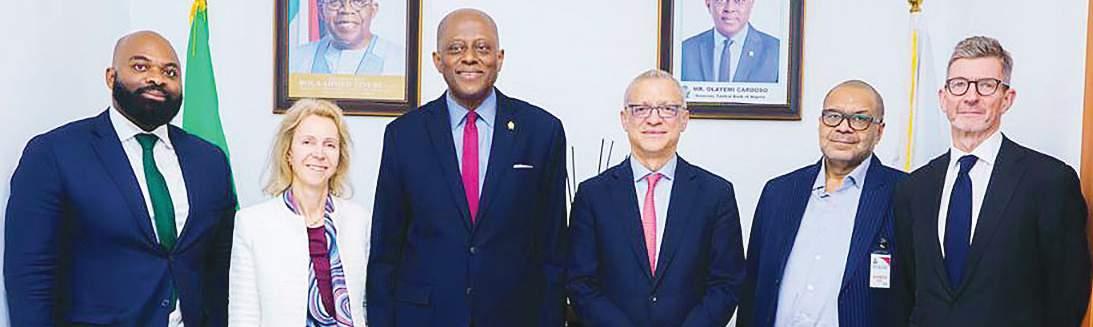
L-R: The Managing Director and Head of Africa at British International Investment (BII), Mr. Chris Chijiutomi; the BII Chair, Ms. Diana Layfield; the Governor of the Central Bank of Nigeria (CBN), Mr. Olayemi Cardoso; the Chief Executive Officer of BII, Mr. Leslie Maasdorp; Non-Executive Director, Mr. Andrew Alli; and Mr. Simon Rowlands, also a NonExecutive Director, when Mr. Cardoso hosted the BII Board at the CBN Head Office in Abuja on Wednesday, January 28, 2026.
olusegun.adeniyi@thisdaylive.com

Last Friday, Governor Abba Kabir Yusuf of Kano State resigned from the New Nigeria Peoples Party (NNPP) on which he came to power in 2023. His estranged political godfather, Senator Rabiu Musa Kwankwaso, took it personally, christening January 23 as a ‘Day of Betrayal’. Beyond the fact that such declaration is quintessentially Nigerian in its victim narrative, it also raises a fundamental question that speaks to the rot at the heart of Nigerian politics: betrayal of what, exactly?
Both Kwankwaso and Yusuf were founding members of the ruling All Progressives Congress (APC) to which the latter has now returned. But Yusuf has been a long-time follower of Kwankwaso whom he had served in various capacities since 1999. The relationship was so close that Kwankwaso gave Yusuf his daughter to marry, effectively making him a family member. So, it is understandable that he would feel let down that a son-in-law has elected to exit his (Kwankwaso’s) political orbit. But if an elected governor chooses to chart his own path rather than the dictates of a political benefactor, has he committed an act of treachery? The answer to this question reveals everything wrong with the godfather culture that has turned Nigerian democracy into a feudal marketplace.
I am aware that many Nigerians read their texts upside down, so it may be important to state this very quickly: I do not endorse the opportunism that makes every politician believe they must leave their party to join the APC whose broom seems big enough to wipe away every crime. Nor should elected officials in the ruling party be more obsessed with political ‘mergers and acquisitions’ than in making a difference in the lives of the people. Besides, not a few Nigerians would snigger at a governor leaving Kwankwaso to hide under the wings of Abdullahi Ganduje. These are issues for another day. My main concern today is how public officials who owe their political success to godfathers easily become entangled in having to choose between serving the public interest and appeasing their benefactors. This is at the root of the problem in many states where policy decisions, allocation of resources, and appointment of key officials must be dictated by the godfather or they can expect mayhem.
Before I come back to the specific charge of Kwankwaso, let me reiterate that godfatherism comes in different variants, as I stated in my ‘Platform Nigeria’ presentation in June 2024. And it is neither peculiar to Nigeria nor altogether bad. The Philippines has a history of political dynasties and godfathers where powerful families control local politics, perpetuating their influence across generations. Italian politics has also seen its fair
share of godfathers, particularly in regions such as Sicily where the influence of Mafia families in elections has been well-documented. The politics of Kenya is also replete with influential figures who shape electoral outcomes. These ‘kingpins’ control party nominations and funding.
The consequences in those jurisdictions, of course, include compromised governance and limited accountability. Unfortunately, that seems to be the model we have adopted in Nigeria. And this is precisely what makes the godfather phenomenon particularly pernicious: it transforms what should be mentorship into mercantilism, and political support into indentured servitude. It therefore goes without saying that most political godfathers do not invest in others because they believe in their vision or capacity for service. They invest expecting returns:
power to make appointments and award contracts, unhindered access to treasuries, unquestioned loyalty to their person, etc.
Consider, by contrast, how political mentorship works in functional democracies. When a young Barack Obama was a community organizer in Chicago, he was supported by established politicians. Men like Emil Jones Jr. helped him navigate the Illinois State Senate, and other influential figures in the Democratic machine who saw Obama’s potential also helped. These relationships mattered. They opened doors, provided counsel, and created opportunities. But at no point did these mentors claim ownership of Obama’s political future or demand tribute for their support. They understood that their role was to nurture talent, not to purchase loyalty.
The same pattern holds across Western democracies. Young politicians are mentored, supported, and guided by more experienced hands. But the relationship is predicated on mutual respect and shared ideals, not on a transactional calculus where the mentor expects to govern by remote control or insists that their mentee live perpetually under their shadow. More importantly, these relationships are transparent and accountable to the electorate. No one pretends that the elected official is anything other than the people’s representative.
In Nigeria, we have inverted this model entirely. Our godfathers are either business patrons who demand returns on investment or political buccaneers who seek to rule by sleight of hand. And when their carefully selected proxies dare to remember that they were elected by the people, not appointed by the godfather, we get ‘Betrayal Days’. Therefore, the question we should be asking is not whether Yusuf betrayed Kwankwaso, but whether the latter’s
expectations were ever legitimate in the first place. If we accept that a governor’s first duty is to his godfather rather than his constituents, have we not abandoned any pretense that what we practice is representative democracy?
On Monday, a former Special Adviser on Political Affairs to President Goodluck Jonathan (who also served as NNPP National Chairman until he resigned), Professor Rufai Alkali, released a joint statement with the party’s former National Organising Secretary, Senator Suleiman Hunkuyi and former National Legal Adviser, Professor Bem Angwe. “Not surprisingly, critics have framed the decision (of the governor) as betrayal. That is the lazy language of some selfish politicians,” wrote these former associates of Kwankwaso in a statement that endorsed the governor’s action. “In truth, what we are witnessing is something unique and rare: a politician refusing to be trapped by a collapsing internal disorder, simply to satisfy the romantic expectations of mentors and political merchants.”
Now to the pertinent question: If, as stated earlier, godfatherism is not unique to Nigeria and is not entirely a bad proposition, where lies the problem? Interestingly, this was the central theme at the public presentation of ‘The Loyalist’, a memoir by the National Publicity Secretary of the African Democratic Congress (ADC), Bolaji Abdullahi on Tuesday. In the book, Bolaji takes readers through his journey with the former Senate President, Dr Bukola Saraki, who headhunted him and nurtured his political career until they eventually parted ways. It is a delicate story well told. With the ceremony attended by many politicians, including ADC National Chairman, Dr David Mark and presidential hopefuls—former
Continued
By Amadu Sesay
Dear Segun, I could not stop reflecting on the important issues you so vividly discussed in your last column on the horrendous massacre of a family in Kano. If our security agencies were on top of their act, the young man would have long been removed from society for good. I have read a few media reports on some responses to the incident, including that of the governor who offered a hajj trip and a house to the bereaved man. A ‘go-fund-me’ drive is reported to have also raised N25 million for the man. As helpful as all these
are, I am not sure they are the priorities of the man presently. What the man needs most urgently, and above all else at the moment, are reliable and sustainable PTSD sessions to be paid for by the government of Kano State. I believe that everything else will have no meaning until he has been put through credible successful PTSD sessions to help him cope with his monumental loss. Finally, and as you rightly illustrated in your brilliant piece, the whole ugly story is a total indictment on our society. I also think that it represents, unfortunately, the level of our present socioeconomic development. In
advanced societies where psychiatric facilities exist and are accessible, the mal-normal dispositions/behaviours of the young man would have been detected at a much younger age. He would have been put on a treatment regime to address his monstrous tendencies, and promptly isolated from the rest of society if that failed. Once again, thanks for calling attention to such a horrendous tragic failure on the part of those who are supposed to protect us at different layers of society.
•Sesay, Emeritus Professor of International Relations who taught me at Ife in the eighties, now resides in Idanre, Ondo State