Lagos Revenue Service Activates Power of Substitution to Boost Tax Recovery
James Emejo in Abuja
Lagos State Internal Revenue Service (LIRS) said it had activated
the relevant tax authority to boost tax enforcement and recovery from defaulting taxpayers, going forward.
In a public notice, LIRS stated that NTAA 2025 empowered it to “direct any person holding money on behalf of, or owing money to, a
taxpayer who has failed to pay an established final tax liability when due, to remit such money to the service in settlement (or partial
settlement) of the outstanding tax”. That was as Chairman, National
New tax law permits authorities to collect money from third party who owe, hold funds for tax defaulters Puts obligation on banks and other financial institutions, employers, tenants, debtors, or customers of the taxpayer, agents, any person owing money to taxpayer, others NTPIC begins stakeholder engagements, meets Adedeji, others the provisions of Section 60 of the Nigeria Tax Administration Act, 2025 (NTAA 2025) relating to the Power of Substitution vested in
Continued on page 8
www.thisdaylive.com
Yusuf, 31 Lawmakers, 44 LG Chairs with Many Wearing Kwankwasiyya Caps Join APC...
19
APC to Musawa, Others: Avoid Stoking Needless Speculations, Focus on Your Duty
Says alleged possible replacement of Shet-tima as Tinubu’s running mate in 2027 speculative
All Progressives Congress (APC), yesterday, warned Minister of Culture, Tourism and Creative Economy, Hannatu Musawa, other senior government and party officials to stop fuelling needless speculations, but focus on their primary duty of diligent service to the government and the party.
APC also dismissed growing media reports about possible replacement of Vice President
Continued on page 8
Finally, Military Confirms Attempted Coup, Identifies 16 to Be Court-martialed
Says trial will ensure full accountability, adherence to principles of fairness, due process Declares actions aimed at maintaining military’s integrity, operational effectiveness
About three months after it denied reports of a failed coup, the Nigerian military, yesterday, confirmed that the findings of an investigation into the conduct of 16 detained officers had linked them to an attempted coup to overthrow the administration of President Bola Tinubu.
The announcement followed revelations that a number of officers were under scrutiny for indiscipline and breaches of service regulations.
In a statement, the military emphasised that the officers found to have substantial evidence against them would be formally arraigned before a military judicial panel, where they would face trial in accordance with the Armed Forces Act and other relevant
Continued on page 8
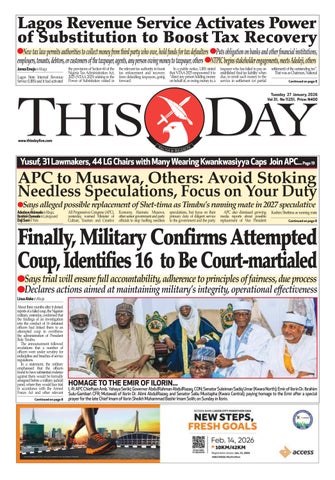
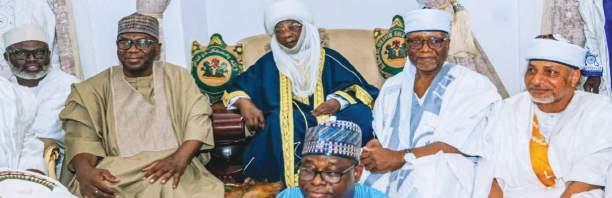
HOMAGE TO THE EMIR OF ILORIN...
L-R: APC Chieftain Amb. Yahaya Seriki; Governor AbdulRahman AbdulRazaq, CON; Senator Suleiman Sadiq Umar (Kwara North); Emir of Ilorin Dr. Ibrahim Sulu-Gambari CFR; Mutawali of Ilorin Dr. Alimi AbdulRazaq; and Senator Saliu Mustapha (Kwara Central); paying homage to the Emir after a special prayer for the late Chief Imam of Ilorin Sheikh Muhammad Bashir Imam Solih; on Sunday in Ilorin.
Linus Aleke in Abuja
Kashim Shettima as running mate
Adedayo Akinwale in Abuja, Ibrahim Oyewale in Lokoja and Daji Sani in Yola
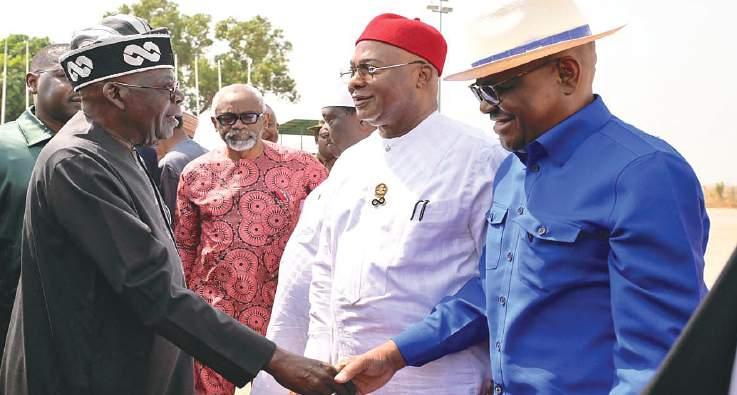
DEPARTS FOR ANKARA...
L-R: President Bola Ahmed Tinubu; Chief of Staff to the President, Femi Gbajabiamila; Secretary to the Government of the Federation, (SGF), Senator George Akume; Imo State Governor Hope Uzodimma, and FCT Minister, Nyesom Wike, during the President’s departure from Nnamdi Azikiwe International Airport Abuja for a state
Wale Adeniyi: Customs Generated
N7.28 Trillion Revenue in 2025
Says gains stemmed from improved compliance, better data use, digital tools, disciplined enforcement, not arbitrary actions Declares customs to institutionalise procedural reforms that reduce clearance times, increase transparency, eliminate avoidable bottlenecks Udoka-Anite hails achievements, vows increased support for innovation, transparency
James Emejo in Abuja
Comptroller General of Customs (CGC), Mr. Bashir Adeniyi, yesterday, disclosed that the service generated a total revenue amounting to N7.28 trillion in 2025.
The performance exceeded the N6.58 trillion target for the year, with a positive variance of N697 billion, representing a growth of over 10 per cent.
Adeniyi said the total revenue rose from N6.1 trillion, an increase of N1.18 trillion, or 19 per cent year-on-year, compared to 2024 collections.
He spoke at the 2026 International Customs Day, and the official launch of Nigeria Time Release Study (TRS) report, a milestone in building customs administration that concomitantly protects society and facilitates lawful trade.
The CGC said, “We present these figures not as self-congratulation, but as evidence that reform is yielding tangible outcomes. The gains came not from arbitrary enforcement or the burdening of legitimate traders, but from improved compliance, better data use, digital tools, and disciplined enforcement.
“More importantly, this performance was achieved while deepening collaboration with the private sector and upholding facilitation commitments.”
In her remarks, Minister of State for Finance, Dr. Doris Udoka-Anite, said the federal government remained committed to providing the necessary support for reforms and to strengthening institutional capacity for transparency and accountability in the service.
Udoka-Anite added that the federal
government will continue to play its role in financing and supporting the reforms as well as providing the tools and leadership required to sustain the progress recorded by customs under the current leadership of Adeniyi.
She said the insights generated from TRS will inform future policy actions in infrastructure, investment, and social development, guided by clear trends and policy objectives.
The minister said the government will continue to promote sustainable operations across government agencies, working closely with the private sector, development partners, and trade agencies.
She urged all stakeholders to adopt an inclusive approach and translate the findings into tangible improvements that would benefit the economy and the citizens.
Udoka-Anite said, “Our institutions must continue to build trust and strengthen cooperation across regions to support generational progress and national stability. The operational commitment of all partners will be essential in driving this transformation.
“I therefore, encourage all offices and leaders to take pride in their roles and to invest continuously in excellence.
“This service stands as a pillar of national security, learning, policy development, and global engagement. Every improved process and every faithfully delivered report strengthens investor confidence and moves us closer to preserving Nigeria’s economic potential.”
Adeniyi said the service will institutionalise procedural reforms that would reduce clearance times,
increase transparency, and eliminate avoidable bottlenecks.
He pointed out that the TRS report was a mirror that “shows us how others experience our system and challenges us to respond. We are committed to the implementation of its recommendations, including synchronized inspections, better gate coordination, and improved system interoperability”.
He also said NCS will strengthen partnerships, adding, “Customs cannot be everywhere, and it cannot do
everything. We will work more closely with other government agencies, the organised private sector, ports and maritime operators, financial institutions, and international bodies such as the WCO. Protection and facilitation are both shared responsibilities.”
Adeniyi stated, “As we look ahead, the question before us is simple: how do we sustain this dual mission-protecting society and enabling prosperity in an era of complex supply chains, technology-driven crime, and rising expectations from traders and
In 2026 Outlook,
government alike?
“Our answer is threefold: first, we will invest in intelligence-led, technology-driven enforcement. Illicit trade has become more sophisticated, and customs must be more sophisticated.
“Tools such as risk management, non-intrusive inspection, post-clearance audit, and data analytics will play an increasingly central role. The days when enforcement depended solely on physical presence are over; the future belongs to digital presence.”
He pointed out that this year’s World Customs Day, with the theme, “Customs Protecting Society Through Vigilance and Commitment,” emphasised that safety and prosperity were not mutually exclusive and that the “economy and security are not separate agendas, and that Customs stands at the nexus of both”. He said across customs commands, officers working with sister agencies disrupted multiple criminal supply chains before they ever reached our communities.
Ernst & Young Says CEOs Increasingly See AI as Productivity Enabler
Ernst & Young, a global professional services firm and one of the ‘Big Four’ has said that chief executives are increasingly regarding Artificial Intelligence (AI) as a dependable enabler of productivity, revenue growth, customer experience and efficiency for the year ahead.
According to the EY-Parthenon 2026 CEO Outlook report, sustained transformation will separate leaders from laggards in an uncertain global environment, as the need to adapt and continue transforming to help navigate a volatile and changing environment has become imperatively paramount.
Geopolitics and technology are reshaping the global economy and
business environment faster than ever, the report said, arguing that those who invest intentionally, rethink their operating models and use AI to accelerate change will create their own tailwinds and outpace competitors long before the environment stabilises.
With global inflation continuing to ease but remaining highly divergent, Ernst & Young stated that confidence remains resilient in two critical areas, namely talent and technology.
“CEOs continue to feel assured about attracting and retaining key capabilities, reflecting the maturing of hybrid work models, clearer employee value propositions and continued investment in skills. Equally, confidence in emerging technologies, including AI, automa-
tion and advanced analytics, remains strong, reflecting the transformative potential for productivity, customer experience, and long-term competitiveness.
“To navigate this uncertainty, CEOs should focus on three priorities: sharper cost discipline through productivity-driving investments such as AI; more precise pricing grounded in customer insight to protect margins; and a faster shift to skills-powered organizations, with teams equipped to scale new technologies and manage geopolitical and macro volatility,” the report said.
Some of the report findings revealed that CEOs who double down on people and technology while addressing cost and growth pressures head on will be best placed
to create their own momentum in a challenging year ahead. The survey report further highlighted that CEOs face continued geopolitical uncertainty and cost pressures but remain confident in driving growth through AI, talent and operational efficiency.
Global Vice Chair EY-Parthenon, Andrea Guerzoni, said: “2026 is not going to be a year of certainty, and CEOs know this. The winners will be those who actively rewire their capital allocation, navigate geopolitical complexity and focus on technology-led M&A to fashion flexible, resilient portfolios that are built not only to absorb further potential market shocks, but also to maximize opportunities presented by ongoing market volatility.”
Emmanuel Addeh in Abuja
TINUBU
visit to Republic of Turkiye... yesterday
PHOTO: GODWIN OMOIGUI
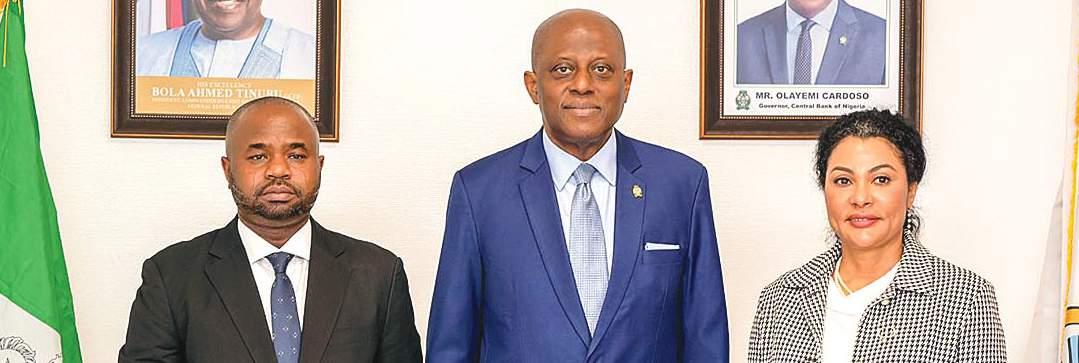
REINFORCING FISCAL AND MONETARY COLLABORATION...
L-R: Chairman, Nigerian Revenue Service, Dr. Zacch Adedeji; Governor of the Central Bank of Nigeria (CBN), Mr. Olayemi Cardoso, and Minister of State for Finance, Dr. Doris Uzoka- Anite, during a working visit by the Minister and Adedeji, reinforcing Fiscal and Monetary collaboration for national development, in Abuja…yesterday
Mrs Tinubu Donates Three Mobile Clinics to NYSC, Taraba Government
Says love on wheels project will boost healthcare delivery in rural, underserved communities Vows to do more for common people in coming years Taraba gov, NYSC DG hail First Lady’s non-partisan intervention as life-saving, far-reaching irrespective of political affiliation.
Deji Elumoye in Abuja
Wife of the president, Senator Oluremi Tinubu, on Monday donated three mobile clinic units to National Youth Service Corps (NYSC) and Taraba State Government, as part of efforts to strengthen healthcare delivery in underserved communities across the country.
The clinics, delivered under the
Renewed Hope Initiative’s (RHI) Love on Wheels project, were handed over at a ceremony in Abuja.
Two of the units were allocated to NYSC, while the third was donated to Taraba State Government.
The first lady, who is also National Chairman of RHI, described the initiative as a practical demonstration of “care in action”, aimed at taking healthcare beyond hospital walls,
improving access, shortening response times, and supporting flexible medical services, particularly in emergencies and hard-to-reach areas.
Mrs Tinubu explained that the two mobile clinics for NYSC were pledged on January 23, 2025, during the inauguration of Nigerian Digital Museum in Abuja, while the Taraba unit was promised during her official visit to the state on April 11, 2025,
at a programme for frontline health workers.
She said the delay in delivery was due to the clinics being built from scratch to meet certification standards.
Emphasising the non-partisan nature of the intervention, the first lady said the donation to Taraba State, then governed by Peoples Democratic Party (PDP), reflected RHI’s commitment to putting Nigerians first,
Shettima to Launch Fresh Women, Youth, Children Learning, Empowerment Fund Tomorrow
As Nigeria co-hosts Africa social impact summit, policy engagement in Abuja
Deji Elumoye in Abuja
Vice President Kashim Shettima is to launch a fresh learning fund and empowerment platform targeted at unlocking the potential of Nigerian children, women, and youth.
The event, according to a release issued on Monday by Media Assistant to the Vice President, Stanley Nkwocha, will hold on Wednesday, January 28, 2026, at the State House Conference Centre, Abuja.
This initiative, convened by the Office of the Vice President in collaboration with Sterling One Foundation, the United Nations System, and other ASIS partners, will form part of the outcomes of the Africa Social Impact Summit (ASIS)
2026 High-Level Policy Engagement. ASIS is a premier platform for accelerating progress on the Sustainable Development Goals (SDGs) through innovation, financing, and partnerships.
The high-level engagement with the theme, “Scaling Action – Driving Inclusive Growth through Policy and Innovation,” will bring together over 200 senior leaders from government, private enterprise, development institutions, civil society, and the diplomatic community.
Key highlights of the engagement include the launch of flagship, policy-backed initiatives, notably the Business Coalition for Education (BCE) and the Nigeria Foundational Learning Fund, designed to accelerate
foundational literacy and numeracy, while addressing the country’s outof-school children challenge.
Also to be launched on Wednesday is the Women and Youth Financial and Economic Inclusion (WYFEI) Nigeria, the country’s flagship platform for advancing women and youth economic empowerment through compact-based delivery, co-investment frameworks, and performance accountability.
This will make Nigeria the implementation platform of the African Union’s WYFEI programme which will also be launched in other countries after Nigeria.
Speaking ahead of the engagement, the Vice President noted that Nigeria is poised for a prosperity-filled future
Tinubu Arrives Ankara For Official Visit to Türkiye
Deji
Elumoye in Abuja
President Bola Tinubu yesterday night arrived in Ankara, the capital of Türkiye, for an official visit aimed at strengthening bilateral relations between Nigeria and the Eurasian nation.
The President’s official aircraft, Nigeria Air Force 1, touched down at the Ankara Esenboga Airport at 9:05 p.m. local time, marking the commencement of official engagements scheduled for the visit. He was received on arrival by
a Turkish government delegation led by the Minister of National Education, Yusuf Tekin, alongside other senior officials. Tinubu had earlier yesterday afternoon departed the nation’s capital, Abuja for the state visit to Türkiye.
The President’s official aircraft, took off from the Presidential Wing of the Nnamdi Azikiwe International Airport at 2:05pm, marking the commencement of a visit aimed at strengthening bilateral relations and expanding cooperation across
key sectors.
Top government officials who saw the President off at the airport included Governor of Imo State, Hope Uzodinma; Secretary to the Government of the Federation, Senator George Akume; Ministers of Budget and Economic Planning, Atiku Bagudu; Federal Capital Territory, Nyesom Wike; Chief of Staff to the President, Hon Femi Gbajabiamila; National Security Adviser, Mallam Nuhu Ribadu; and Special Adviser to the President on Media and Public Communication, Sunday Dare.
through the government’s sustained and effective mobilisation of funding, support, and expertise, both internationally and locally.
“Nigeria’s future prosperity depends on how effectively we mobilise the private sector, development partners, and public institutions around shared national priorities. This engagement marks a critical step toward delivery-driven partnerships that unlock the full potential of our women and youth, strengthen human capital, and accelerate inclusive growth,” he said.
“Party politics aside, we have to provide dividends of democracy to our people. It is people first before party,” she said. She added that the initiative was designed to reach every Nigerian in need.
Mrs Tinubu urged the beneficiaries to deploy the clinics responsibly to save lives and complement existing healthcare efforts, as she formally handed over two units to NYSC and one to Taraba State Government.
Taraba State Governor, Agbu Kefas, expressed gratitude to Mrs Tinubu, describing the donation as a life-saving intervention that transcends party lines.
According to him, the mobile clinic would significantly improve access to quality healthcare in rural and hard-to-reach communities across the state.
“This is not just a facility; it is hope on wheels and a life-saving intervention for communities that have waited long for quality healthcare,” Kefas said, pledging transparent and responsible deployment of the clinic in line with the vision of President Bola Tinubu.
Minister of State for Health and Social Welfare, Dr Iziaq Salako, commended the first lady’s initiative, describing her as a public health champion.
Salako pledged federal support to ensure effective utilisation of the clinics by NYSC and Taraba State. Director-General of NYSC, Brigadier-General Oluseye Nafiu, said the two mobile clinics would significantly expand the corps’ rural health outreach, enabling medical teams to reach tens of thousands more Nigerians.
Nafiu described the donation as a strategic boost that would deepen access to free and quality healthcare in remote communities nationwide.
Equally on Monday, Mrs Tinubu promised to do more for the masses in the years ahead.
Speaking in her office in Abuja while formally receiving notification of her conferment with “Person of the Year” award by Leadership Newspapers, the first lady thanked the media organisation for the recognition, which she said was a call for more work on her part. She said, “With this, I am fired up for the year. I am guided by the scripture, which says, I can do all things…
“There is still more for me to do… what I am doing for the common man. I like to work hard because my husband is a hard-working man.” She expressed delight that as a woman, her efforts were being recognised.
Oil Executive Decries Alleged Prejudicial Reportage of Case with
M.J. Numa & Partners LLP, lawyers to the Chief Executive Officer of Dateline Energy Services Limited (DESL) Mr. Wilson Opuwei, has decried recent alleged misleading and prejudicial publications concerning the businessman’s case with the Economic and Financial Crimes Commission (EFCC).
A statement signed by Michael Johnthan Numa (SAN) clarified that the High Court of Lagos State, in Suit No: LD/62455GCMW/2024 (Prince Donatus Okonkwo v.
Wilson Opuwei & Dateline Energy Services Limited), presided over by Justice L. A. Akapo prior to his elevation to the Court of Appeal, determined that the dispute was purely civil in nature.
“This matter has been judicially determined to be civil in character, not criminal in nature, and public discourse must reflect the clear ruling of the Court rather than speculative or sensational narratives,” said Numa.
The statement said that Opuwei who holds directorship positions across affiliated entities in Nigeria’s hydrocarbons and infrastructure
sectors, expressed concern over media coverage portraying the matter as involving fraud or criminal wrongdoing despite the court’s civil determination. According to the statement, such reports are materially inconsistent with the court’s ruling and contribute to the growing problem of trial by media. Reporting of this nature, especially during active judicial proceedings, he said, can erode the authority of the court, prejudice the parties’ right to fair adjudication, and create public narratives unanchored in judicial fact.
Emmanuel Addeh in Abuja
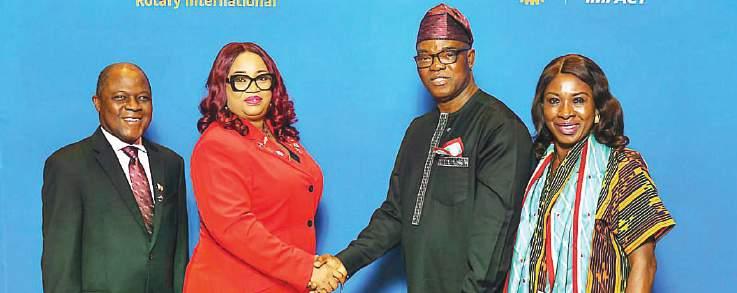
AT ROTARY INTERNATIONAL ASSEMBLY, ORLANDO FLORIDA, USA...
L-R: Ajirowa of Ijesa Land, Lateef Akande Bakare; and wife, District Governor-elect Rotary District 9111, Bukola Bakare; Rotary International President-elect, Yinka Babalola and wife, Precy Babalola, at Rotary International Assembly, Orlando Florida, USA... recently
Copyright Breach: Court Awards N210m Against Airtel for Unauthorised Use of ‘Nigeria Go Survive’ Track
Wale Igbintade
Justice Ibrahim Ahmad Kala of the Federal High Court, Lagos, yesterday awarded a total of N210 million in damages against Airtel Networks Limited for copyright infringement arising from the unauthorised use of a musical work titled “Nigeria Go Survive.”
The award comprises N200 million as general damages and N10 million as costs.
In addition to the monetary award, the court issued mandatory and perpetual injunctions restraining Airtel, its management, agents, servants, privies, successors-in-title and assigns from reproducing or further using the musical work, or any substantial part of it, for advertising, promotion, telemarketing, or other business purposes without the licence or authorisation of the copyright owner.
Justice Kala specifically ordered Airtel to remove “Nigeria Go Survive” from its list of songs used for advertising, business, telemarketing and promotional purposes across its network with
immediate effect.
The judge held that Airtel’s use of the song without licence or authorisation amounted to restricted acts under the Copyright Act and constituted an infringement of the plaintiff’s copyright.
The judgment was delivered in suit No: FHC/L/CS/1822/2022, filed by the producer of the song, Veno Marioghae Mbanefo.
In resolving the sole issue for determination, the court held that the plaintiff proved her case on the balance of probabilities.
Justice Kala noted that a perpetual injunction is granted after infringement has been established and is intended to protect the proprietary rights of the copyright owner and restrain continued infringement.
Accordingly, the court made the following orders: “That Airtel’s unauthorised use of “Nigeria Go Survive” for advertising, promotion and telemarketing amounts to copyright infringement.
“Mandatory injunction prohibiting Airtel from reproducing or using the musical work, or any
substantial part of it, for business and promotional purposes.
“Perpetual injunction restraining Airtel from any further unauthorised use of the work.
“General damages N200 million awarded to the plaintiff for losses suffered as a result of the infringement. And N10 million awarded in favour of the plaintiff, considering the duration of the case, legal
representation, expenses incurred, and the current value of the naira.
In the writ of summons filed by her legal team led by Clement Onwvenwunor, SAN, the plaintiff sought, among other reliefs, declarations that Airtel’s use of the song without attribution, licence or authorisation breached her statutory rights under Section 12 of the Copyright Act, Cap. C28, Laws of
the Federation of Nigeria, 2004.
She also claimed substantial damages for copyright infringement and, in the alternative, requested an order directing Airtel to render an account of profits allegedly made from the infringement under the supervision of the Nigerian Communications Commission (NCC).
Airtel Networks Limited, represented by counsel led by
Babatunde Amoo, urged the court to dismiss the suit. However, after reviewing the exhibits and submissions of counsel, Justice Kala resolved all issues in favour of the plaintiff. The court refused the plaintiff’s alternative prayer for an account of profits but granted all substantive reliefs relating to infringement, damages and injunctive orders.
Tuggar Holds Strategic Talks with Turkish Counterpart in Ankara
Michael Olugbode in Abuja
Ahead of President Bola Ahmed Tinubu’s State visit to Türkiye, the Minister of Foreign Affairs, Amb. Yusuf Maitama Tuggar, on Monday paid an official visit to Ankara where he held high-level talks with his Turkish counterpart, Hakan Fidan, aimed at deepening bilateral cooperation between the two countries.
Nigeria, Italy to Strengthen Bilateral Ties, Tackle Migration, Security Challenges
Michael
Nigeria and Italy have expressed their commitment to strengthening bilateral relations, with a focus on addressing irregular migration, insecurity, counter-terrorism, and expanding economic cooperation.
Minister of State for Foreign Affairs, Amb. Bianca OdumegwuOjukwu made this known in Abuja yesterday, during a courtesy visit by the Italian Ambassador to Nigeria, Mr. Roberto Mengoni.
Odumegwu-Ojukwu described Italy as one of Nigeria’s key strategic partners in Europe, noting that although diplomatic relations between both countries span more than six decades, there has yet to be a formal Nigeria-Italy Bi-National Commission, calling
for the establishment of such a framework to deepen structured engagement and cooperation.
According to the minister, sustained high-level diplomatic engagements between both countries have continued to highlight shared priorities in sustainable development, food security, climate action, and economic growth.
She said ongoing consultations between Nigeria and Italy also reflect a common commitment to addressing global and regional challenges, including climate change, irregular migration, and security threats. The minister urged continued collaboration of both countries in combating illegal migration, hu-
man trafficking, and transnational crimes, while calling for stronger Italian involvement in Nigeria’s ongoing economic reforms.
She identified renewable energy, agribusiness, and infrastructure development as critical sectors for enhanced cooperation.
Odumegwu-Ojukwu also sought Italy’s technical support for Nigeria’s industrialisation drive, stressing that improved mobility between both countries would stimulate trade, investment, education, and cultural exchange.
She emphasised the need to improve visa processing systems, noting that more efficient procedures would ease movement, reduce delays, and strengthen economic and diplomatic relations.
The meeting, Tuggar’s first official visit to Türkiye, focused on strengthening political, economic, security, and multilateral cooperation.
Minister Fidan commended Nigeria’s constructive role in promoting regional stability, peace, and prosperity in West Africa, noting Nigeria’s leadership within regional and continental frameworks.
Tuggar placed strong emphasis on
expanding bilateral trade and increasing mutual investment, particularly in sectors of interest to Turkish companies, including construction, manufacturing, energy, and infrastructure.
Both ministers acknowledged the steady growth in economic relations and underlined the need to unlock further potential through structured public–private engagement.
On security cooperation, the two
sides highlighted opportunities to deepen collaboration in military affairs and the defence industry. The visit reflects the growing strategic character of Nigeria–Türkiye relations, anchored in shared positions on sovereignty, institutional cooperation, and pragmatic partnership, with both sides expressing confidence in the prospects for deeper engagement in the period ahead.
Zulum Launches Rayyan Microfinance Bank to Boost Financial Inclusion in Borno
Michael Olugbode in Abuja
Borno State Governor, Prof. Babagana Zulum, has formally unveiled Rayyan Microfinance Bank, a non-interest financial institution headquartered in Maiduguri, as part of efforts to strengthen economic recovery and promote financial inclusion in the state.
The unveiling ceremony took place on Sunday at the Forshams Event Centre in Maiduguri, drawing stakeholders from the financial sector, academia, regulatory bodies, and religious institutions.
Rayyan Microfinance Bank operates as an ethical-compliant digital bank, offering non-interest financing alongside a variety of banking products tailored to individuals, cooperatives, and
small businesses. The institution is designed to serve people who are often excluded from conventional banking systems.
Speaking at the event, Zulum described the bank as a strategic platform for rebuilding livelihoods and encouraging self-reliance among communities affected by years of insurgency and economic disruption.
According to him, microfinance institutions play a vital role in poverty reduction and economic growth by providing access to essential financial services such as small loans, savings products, and insurance to low-income earners.
“Microfinance banks are key drivers of financial inclusion. They provide the support many citizens need to start businesses, grow
enterprises, and improve their standard of living,” Zulum said. The governor commended the leadership and vision of the bank’s board and management, assuring them of the state government’s readiness to collaborate in advancing non-interest banking as a viable alternative within Nigeria’s financial system. As a demonstration of confidence in the new institution, Zulum directed the Borno State Ministry of Finance to open an official account with Rayyan Microfinance Bank.
He also encouraged residents, business owners, and cooperative societies to take advantage of the bank’s services to expand their economic activities and contribute to Borno’s long-term recovery and development.
Olugbode in Abuja
NNPC, Chevron Find Fresh Oil, Gas in N’Delta in Boost for 1.8m Bpd Target
JV aims to raise crude output to 146,000bpd
Emmanuel Addeh in Abuja and Peter Uzoho in Lagos
The Nigerian National Petroleum Company Limited (NNPC Ltd) yesterday disclosed that Chevron Nigeria Limited (CNL), operator of the NNPC Ltd/CNL Joint Venture (JV), has found substantial presence of hydrocarbons across multiple reservoir zones in the Niger Delta.
In a statement in Abuja signed by its Chief Corporate Communications Officer, Andy Odey, the NNPC said the well is located in the shallow offshore area of the region, explaining that this was achieved after the completion of the Awodi-07 appraisal and exploration well.
The announcement marks an important moment for Nigeria’s oil industry which has in recent years struggled to meet its Organisation of Petroleum Exporting Countries (OPEC) production quota of 1.5 million barrels per day.
The presence of fresh hydro-
carbons in the area would boost additional production if developed efficiently and swiftly and could help narrow the output gap as well as improve Nigeria’s ability to meet its quota commitments.
Besides , it reflects the impact of recent reforms under the Petroleum Industry Act (PIA), which have been aimed at clarifying fiscal terms and encouraging investment. Chevron’s activity signals renewed international oil company confidence in Nigeria’s upstream sector.
In the same vein, higher production volumes will translate into increased export earnings, more government revenue from royalties and taxes, and improved foreign exchange inflows, especially in a country where oil still plays an outsized role in public finance.
“The Awodi-07 well was drilled as part of the Joint Venture’s ongoing efforts to further delineate and unlock hydrocarbon potential within its asset portfolio. Drilling operations com-
menced in late November 2025 and were concluded in mid-December 2025, with all activities executed safely, efficiently, and in strict compliance with approved operational and regulatory standards.
“Following the completion of comprehensive testing, logging, and data acquisition, the well was safely secured, bringing the programme to a successful close”, the company said in the statement.
NNPC noted that the results from the well were highly encouraging, confirming a substantial presence of hydrocarbons across multiple reservoir zones.
“This outcome represents a notable milestone for the NNPC Ltd/ CNL Joint Venture,on strengthening confidence in the underlying asset and reinforcing the prospectivity of the area,” the company said.
According to the national oil firm, the success of Awodi-07 underscores the effectiveness of disciplined exploration, sound
technical evaluation, and the strong operational collaboration between NNPC and JV partner.
“NNPC Limited and Chevron Nigeria Ltd work together under a joint venture agreement to operate several oil and gas fields in Nigeria’s Niger Delta. In this partnership, Chevron owns 40 per cent of the assets, while NNPC Limited holds the remaining share.
“The arrangement allows both companies to combine resources, expertise, and investment to develop Nigeria’s oil and gas resources more effectively”, NNPC stated.
According to the statement, through the collaboration, the partners aim to increase oil output to about 146,000 barrels per day (bpd), which would support government revenue, create jobs, and contribute to the country’s energy supply.
Commenting on the achievement, Group Chief Executive Officer (GCEO) of NNPC, Bayo Ojulari, commended Chevron Nigeria
Limited for its operational excellence, technical competence, and consistent delivery of value.
“The success of the Awodi-07 well further reinforces the strength of the NNPC Ltd/CNL Joint Venture and our shared commitment to responsibly growing Nigeria’s hydrocarbon reserves.
This achievement aligns squarely with our strategic priorities of increasing production, enhancing national energy security, and delivering sustainable value for the Nigerian people”, he said.
Last year, Ojulari stressed that the NNPC aimed to achieve 1.8 million barrels per day crude oil production this 2026, with a plan to raise output steadily to 2 million bpd by 2027, a target seen as largely conservative.
Also speaking on the milestone, Executive Vice President (Upstream), NNPC, Udy Ntia described the Awodi-07 results as a clear demonstration of the value of sustained
FINALLY, MILITARY CONFIRMS ATTEMPTED COUP, IDENTIFIES 16 TO BE COURT-MARTIALED service regulations.
Director of Defence Information, Major-General Samaila Uba, revealed the outcome of the investiga-tion panel in a statement, titled, “Update on Disciplinary Cases Involving Sixteen Officers Investigated For Indiscipline, Breach Of Service Regulations.”
Uba reminded the public that in October 2025, Defence Headquarters
had released a statement detailing the arrest of 16 officers accused of indiscipline and violations of military codes.
Uba said, in the statement yesterday, “The Armed Forces of Nigeria (AFN) wishes to inform the general public that investigations into the matter have now concluded, and the final report has been submitted to the appropriate superior authorities
for further action, as per established military regulations.”
He stated that the investigation was conducted meticulously, adhering to military’s rigorous procedures, adding that it thoroughly examined the actions of the officers involved and the circumstances surrounding the alleged coup attempt.
He explained that the findings revealed that several officers were
implicated in the plot to destabilise the government, an action clearly at odds with the values, ethics, and professional standards upheld by the AFN.
Uba stated, “Those found to be involved will be subjected to trial by a military panel in line with the Armed Forces Act and other relevant legal frameworks, ensuring full accountability and adherence
APC TO MUSAWA, OTHERS: AVOID STOKING NEEDLESS SPECULATIONS, FOCUS ON YOUR DUTY
to President Bola Tinubu ahead of the 2027 general election.
Musawa had warned that APC could drastically weaken its chances in the 2027 presidential election if it dropped Shettima or did not pick a northern Muslim to run with Tinubu in his re-election bid.
She gave the warning during a recent episode of Mic On Show with popular journalist, Seun Okinbaloye. Musawa’s comments came amid rising speculation that the ruling party might consider altering the Muslim-Muslim presidential ticket that powered APC to victory in the 2023 elections.
The minister cautioned that replacing Shettima or removing a northern Muslim from the ticket could pose serious political risks, particularly in the core northern states, where voting patterns were deeply influenced by regional and religious considerations.
“If there is no Hausa, Fulani or Kanuri Muslim on that ticket, it creates a hurdle. That is the reality of the way people think,” Musawa had said.
But National Publicity Secretary of APC, Felix Morka, in a statement yesterday, maintained that the stories were purely speculative, untrue, and utterly baseless.
Morka stated, “We call on our ministers, senior government and party officials to avoid, wittingly or unwittingly, stoking needless speculations, and to focus on their primary duty of diligent service to government and our party, and bolster the success and achievements of President Tinubu, our inimitable and visionary leader.”
The ruling party urged media organisations to refrain from lending their platforms to rumour-peddlers and mischievous “news sources” of questionable provenance whose only
intention was to promote discord and confusion in the polity.
The statement said, “Our attention has been drawn to the growing media frenzy about possible replacement of Vice President Kashim Shettima as the running mate to President Bola Tinubu under the platform of our great party ahead of the 2027 general election.
“While these stories have been mostly subtle, they recently assumed a new dimension when names of specific individuals were touted as possible replacements for Vice President Shettima.
“Our party states in categorical terms that the stories are purely speculative, untrue and utterly baseless.
“We urge media organisations to refrain from lending their platforms to rumour-peddlers and mischievous ‘news sources’ of questionable provenance whose only intention is to promote discord and confusion in the polity.”
Morka stressed that under the country’s laws and electoral regulations, the ban on political activities remained in force.
He stated, “At this time, our party remains focused on supporting President Tinubu and Vice President Shettima in delivering the administration’s Renewed Hope Agenda and entrenching its bold reforms that are now steadily transforming the economy, building prosperity, and uplifting the living conditions of our people.”
Ododo: Tinubu is Nigeria’s Boldest Reformer Kogi State Governor, Usman Ododo, lauded Tinubu, describing him as Nigeria’s boldest reformer. Ododo also declared that the
president’s courage and resultsdriven leadership had earned him the informed endorsement of Kogi youths ahead of 2027.
The governor gave the commendation while speaking to a large crowd at President Muhammadu Buhari Civic Centre, Lokoja, during a Kogi APC youth rally marking two years of his administration.
He said the gathering was both a celebration of youth-focused governance in Kogi State and a clear vote of confidence in Tinubu’s Renewed Hope Agenda.
He stated, “The youths of Kogi State have spoken with one loud, clear and courageous voice. Your endorsement of President Bola Ahmed Tinubu is not emotional;
it is informed. It is the decision of young people who can think, who can judge results, and who understand leadership.”
The governor described Tinubu as “the boldest president in the history of Nigeria”, stressing that while many leaders would have chosen political safety over national interest, Tinubu took tough decisions to prevent economic collapse.
The governor said, “Any politician thinking only of re-election would have played safe. But Jagaban faced the storm, took the heat and led from the front. Today, we are seeing the results of courage.
“The naira is stabilising, food prices are responding, the cost of living is dropping, and the
to the principles of fairness and due process.”
AFN further clarified that the disciplinary actions being taken were part of an ongoing process aimed at maintaining the integrity and operational effectiveness of the military.
The statement reaffirmed the commitment of the armed forces to uphold the highest standards of
standard of living is rising. This is not propaganda; this is about results.”
Ododo told the youths that no administration in Nigeria’s history had prioritised youth empowerment like Tinubu’s, citing expanded opportunities in agriculture, skills development, economic inclusion and youth participation in governance.
He also spoke on his personal relationship with the president, describing Tinubu as a father figure whose guidance and support have strengthened his resolve to serve Kogi State faithfully.
“I am lucky to be serving Kogi State at a time when Jagaban is
Continued on page 21
collaboration, technical rigour, and a stable, enabling operating environment.
“This discovery underscores the importance of disciplined exploration programmes, strong partnerships, and the positive impact of the reforms introduced under the Petroleum Industry Act,” Ntia said.
According to Ntia, the NNPC looks forward to working closely with CNL to advance the opportunity toward timely development and monetisation of the new field.
professionalism, loyalty, and respect for the nation’s constitutional order.
“In line with the AFN’s core principles, the measures currently in progress are designed to reinforce discipline and preserve the operational readiness of the force,” Uba said.
He said the military’s unwavering stance on maintaining constitutional authority underscored its continued dedication to safeguarding the country’s stability and ensuring that all personnel acted within the bounds of their duty and service regulations.
The military had earlier denied the alleged coup plot, arguing that those detained were merely undergoing investigation for indiscipline and breaches of service regulations.
Then Acting Director of Defence Information, Brigadier-General Tukur Gusau, explained that a duly constituted investigative panel was reviewing the conduct of the affected personnel, and its findings would be made public once the process was concluded.
“The ongoing investigation involving the sixteen officers is a routine internal process aimed at ensuring that discipline and professionalism are maintained within the ranks,” Gusau said.
LAGOS REVENUE SERVICE ACTIVATES POWER OF SUBSTITUTION TO BOOST TAX RECOVERY
Tax Policy Implementation Committee (NTPIC), Mr. Joseph Tegbe, said the body had commenced structured stakeholder engagements to ensure a humane, inclusive, and well-coordinated implementation of the new tax acts amid significant fiscal reforms.
Working closely with Nigeria Revenue Service (NRS) and Presidential Fiscal Policy Reform Committee (PFPRC), the committee aims to bridge the gap between policy intent and execution by promoting clarity, managing expectations, and ensuring that implementation reflects the realities of businesses, citizens, and all levels of government.
Also, Chairman, Presidential Fiscal Policy and Tax Reforms Committee, Mr. Taiwo Oyedele, said there had been feedback from workers who had received their salaries for January 2026, confirming a reduction in their Pay As You Earn (PAYE) tax, resulting in
higher take home pay under the new tax laws.
He added that to ensure that relevant individuals charged with the responsibility of implementing the changes for the benefit of employees in their organisations were well informed, the committee will host a session for key stakeholders in collaboration with the Joint Revenue Board (JRB) on Wednesday.
Power of Substitution is a legal collection tool that allows tax services to bypass a non-compliant taxpayer and collect outstanding taxes directly from anyone who holds money for them or owes them money as granted under relevant sections of the NTAA.
Lagos Revenue Service further stressed that the tool sought to ensure efficient recovery of unpaid taxes, including Personal Income Tax (PIT), Capital Gains Tax (CGT), Stamp Duties and Withholding Tax (WHT) administered by LIRS.
It stated, “Where a taxpayer fails, neglects or refuses to settle any established outstanding tax liability when due, LIRS may exercise its power under Section 60 to direct any of the following persons to pay the amount owed by the taxpayer - banks and other financial institutions, employers, tenants, debtors, or customers of the taxpayer; agents, business partners, and any person holding money on behalf of the taxpayer; any person owing money to the taxpayer, whether presently due or accruing.
“Once a substitution notice is issued, the person served is statutorily required to remit to LIRS the amount specified in the notice from funds belonging to, or payable to, the defaulting taxpayer.
“The tax liability is deemed paid to the extent of the remittance made pursuant to the substitution. Failure to comply with such a directive
constitutes an offence under the Act.”
On compliance requirements, and obligation of banks and financial institutions under the law, the notice clarified, “Upon receipt of a substitution notice, all banks and financial institutions are required to remit the stated amount to LIRS without delay, and provide confirmation of compliance to the service.”
Banks were also required to report the taxpayer’s available balances and any encumbrances as may be requested by LIRS. Meanwhile, as part of its initial consultations, the committee’s leadership team met with Presidential Fiscal Policy Reform Committee (FPRC), led by Mr. Taiwo Oyedele, to ensure alignment between reform objectives and practical implementation realities. Oyedele highlighted challenges
Continued on page 20
NNPC Boss, Bayo Ojulari
COURTESY VISIT TO EFCC BY MONIEPOINT...
L-R Managing Partner, Vantage Attorney LP, Abdulfatai Oyedele; Managing Director, Moniepoint Microfinance Bank, Babatunde Olofin; Co-founder and Chief Executive Officer, Moniepoint Inc, Tosin Eniolorunda; Executive Chairman, Economic and Financial Crimes Commission (EFCC), Ola Olukoyede; Chief of Staff to the EC, EFCC, Michael Nzekwe; Director of Investigations, EFCC, Abdulkarim Chukkol and Head, Media and Publicity, EFCC, Dele Oyewale during a courtesy visit by the Moniepoint Inc management team to the EFCC Headquarters in Abuja...recently
FG Ends Controversy on Nigeria’s Housing
Gap, Committee Pegs Deficit at 15m Units
Minister pitches opportunities in housing sector at Saudi forum
The National Housing Data Technical Committee set up by the Federal Ministry of Housing and Urban Development has released new data indicating that Nigeria’s housing deficit for 2025 stood at 14.925 million housing units, putting to rest the various controversies on the country’s actual housing gap.
The data was presented by the Chairman of the National Housing
Data Technical Committee and Director at Nigeria Mortgage Refinance Company (NMRC), Dr. Taofeek Olatinwo, during a technical session at the 14th National Council on Lands, Housing and Urban Development, which ended in Ilorin at the weekend.
According to the presentation, recent analyses conducted under the national housing data programme offered more scientific estimates compared to unverified figures touted over the last few years, a statement
by the Director of Press and Public Relations in the ministry, Badamasi Haiba, said yesterday.
The data, which focused on the number of persons per room as a standard for determining deficit, highlighted persistent supply gaps driven by rapid population growth, urbanisation pressures, limited access to long-term housing finance, land and title constraints, and inadequate housing supply across several regions. During the presentation, the
committee chairman, Olatinwo, explained that the deficit estimates were derived from multiple validated data sources, including national household surveys, population and housing census data, and housing adequacy indices developed under international best practice frameworks.
“Reliable housing data is fundamental to solving Nigeria’s housing problem. Accurate measurement of the housing deficit allows government, lenders, developers,
AGF Takes over, to Review ICPC’s
Alleged Fraud Charges against Ozekhome
The office of the Attorney-General of the Federation (AGF) and Minister of Justice, Prince Lateef Fagbemi, SAN, on Monday, took over the case brought against Professor Mike Ozekhome SAN, by the Independent Corrupt Practices and other related offences Commission (ICPC).
The AGF besides, got permission of Justice Peter Kekemeke, of the High Court of the Federal Capital Territory (FCT) to review the case file of the fraud allegation.
The court had slated January 26, for the arraignment of the senior lawyer.
However, when the matter was called although, ICPC’s lawyer,
Osuebeni Akpomesingha announced appearance for the prosecution, the Director, Public Prosecution of the Federation (DPPF), Mr. Rotimi Oyedepo, SAN, announced appearance on behalf of the AGF and disclosed the intention of the AGF’s office to take over prosecution of the case.
Oyedepo stated the decision was pursuant to Section 174 of the 1999 Constitution and to collaborate with the ICPC to ensure that the prosecution meets the highest standard of effectiveness, efficiency, diligence and compliance with due process of law.
The DPPF further told the court the decision was also guided by public interest and to instill confi-
dence, fairness and competence in the criminal justice system.
While assuring the right of the defendant will be protected and no party will be made to suffer any adverse exposure, the DPPF, stressed that inter-agency cooperation to fight corruption was also considered by the OAGF.
He therefore asked the court to take judicial notice of the take-over of the trial by the AGF Office.
Oyedepo in addition urged the court to grant the prosecution, a short adjournment to enable his office retrieve the case file from the ICPC to thoroughly review it and take the next line of action.
Responding, the prosecution did not object to the takeover but
Tax Laws: NGO Writes Tinubu, NASS, Demands Sanctions over Alterations
James
Sowole in Abeokuta
The Network for the Actualization of Social Growth and Viable Development (NEFGAD), a civic advocacy group in Nigeria has written to President Bola Ahmed Tinubu and the National Assembly, demanding an immediate and independent investigation into the confirmed unlawful alteration of Nigeria’s newly gazetted tax laws.
The demand of advocacy group, was contained in a letter signed
by the country’s acting head of office, Mr. Blessing Nnekwu Ojo, and sent to President Bola Tinubu and the leadership of the National Assembly.
The organisation expressed grave concern following the National Assembly’s confirmation that changes were made to the contents of tax laws after they had been duly passed and assented to by the president. NEFGAD described the development as a direct assault on constitutional order, legislative
integrity, and democratic governance.
The organisation therefore, called on Tinubu to immediately order an independent investigation to identify the point at which the integrity of the legislative process was compromised, establish the exact nature and scope of the alterations made to the gazetted tax laws and apply appropriate sanctions to all persons, offices, or agencies involved, in accordance with the Constitution and extant laws of the Federation.
promised to cooperate fully with the office of the AGF to ensure diligent prosecution.
Similarly, a former AGF and Minister of Justice, Chief Kanu Agabi, SAN, who led 15 other SANs alongside over 40 junior lawyers in the defence of Ozekhome did not object to the take over as well as review of the case file by the AGF’s office.
and investors to plan effectively, allocate resources properly, and design sustainable interventions that expand access to affordable housing,” he said.
The presentation formed part of the broader work of the National Housing Data Technical Committee, a multi-agency platform inaugurated by the Federal Ministry of Housing and Urban Development and coordinated by NMRC, in collaboration with National Bureau of Statistics (NBS), National Population Commission (NPC), Central Bank of Nigeria (CBN), Federal Mortgage Bank of Nigeria (FMBN ), Federal Housing Authority (FHA) and other key housing sector institutions.
Housing Minister, Ahmed Dangiwa, in his remarks, commended the committee for finally putting the issue of Nigeria’s housing data to rest. “One of the biggest gaps in our sector has been the absence of reliable, centralised, and actionable housing data. Without data, planning becomes guesswork; investment becomes speculative; and tracking progress becomes difficult,” he said.
Under the programme, the committee led efforts to establish
the National Housing Data Centre, a central platform designed to aggregate, standardise, and disseminate housing and mortgage market data to support policy formulation, housing delivery planning, and long-term housing finance development.
The new deficit figures reaffirmed the scale of Nigeria’s housing challenge and strengthened the case for coordinated reforms in land administration, housing supply, infrastructure development, and mortgage finance expansion.
The National Council on Lands, Housing and Urban Development serves as the highest intergovernmental policy forum on housing and urban development in Nigeria, bringing together federal and state governments to deliberate on sector priorities, reforms, and implementation strategies.
Meanwhile, Dangiwa, has called on global investors and real estate developers to partner with Nigeria in scaling housing delivery under the Renewed Hope Housing Programme, describing the country’s housing market as one of the largest, most immediate, and most bankable demand opportunities in Africa.
David-Chyddy Eleke in Awka Anambra State Governor, Prof. Chukwuma Soludo, has shut down Onitsha Main Market, reputed to be the largest market in West Africa; over failure of traders in the market to report from business yesterday, in observance of the already nullified Monday sit at home.
The governor announced the closure yesterday after inspecting the level of compliance to a recent memo directing abolition of Monday sit-at-home to markets, schools and other government offices, urging workers and traders to resume duties on Mondays.
The governor said: “Today, I
have ordered the shut-down of the Onitsha Main Market for one week due to the protracted economic sabotage cloaked as “Monday sit-at-home”. Going forward, this order would apply to any other market in Anambra that shuts down on Monday.
“This action is not taken lightly, as I am determined to protect the economic interests of our state and its people. No individual or group has the right to halt the lives and livelihood of the people.
“I urge all traders and market stakeholders to disregard this call to economic sabotage and resume business as usual. Let us work together to build a prosperous
Anambra.
“To those who continue to aid and abet this economic sabotage, I warn that we will not tolerate it any further. Our government will take all necessary measures to ensure the security and safety of lives and property in the state.
“I call on all residents of Anambra to go about their normal business activities without fear. We will continue to do everything possible to protect our economy and ensure that our state remains a hub for business and investment.
“Let us stand together against economic sabotage and build a brighter future for our state,” the governor said.
Alex Enumah in Abuja
Emmanuel Addeh in Abuja
NIGERIA ELECTRONIC FRAUD FORUM...
Hon. Bola Olumegbon-Lawal Special Adviser CBD at Central Business District Summit, Muson Centre Onikan... recently.
Stakeholders, Civil Society Groups Tackle NAFDAC over Ban of Sachet Drinks
Raheem Akingbolu
Stakeholders and coalition of civil societies protecting consumer rights have intensified protests against the decision of the National Agency for foods and Drug Administration and Control (NAFDAC), to enforce the ban on the production of alcohol in sachets and PET, describing it as a calculated plan to frustrate and cripple local manufacturers in the food and beverage sector.
THISDAY had over the weekend reported how members of the Food, Beverages and Tobacco Senior Staff Association and the National Union of Food, Beverages and Tobacco Employees staged a protest at the Lagos office of NADFAC, warning that it could displace no fewer than 5.5 million Nigerians from their jobs.
Meanwhile, the NAFDAC Director-General, Prof. Mojisola Adeyeye, at a meeting with the unions on Friday, affirmed that the reason behind the ban was to protect the children from the indiscriminate intake of alcohol.
Returning to the NAFDAC Lagos office yesterday, the aggrieved members vowed not to withdraw until their demands are met.
Declan Ihekaire, who represented the coalition of civil societies of
Nigeria protecting consumer rights, said the initiative was in solidarity with members of the distillers’ association, under the aegis of the Food, Beverages and Tobacco Senior Staff Association and the National Union of Food, Beverages and Tobacco Employees, who have been shut out of work following the regulatory action by NAFDAC.
He argued that the ban would worsen economic hardship, noting that millions of Nigerians are employed across the value chain of sachet alcohol production, distribution, and sales.
While accusing the government of using regulatory agencies to impose policies that affect lowincome earners, who are the consumers of the products, he noted that the ban could only be justified when there are serious health challenges.
He said: “Millions of Nigerians have decided to go on low-key by consuming those products because of the income level. It’s not everybody who is so rich as to afford Hennessy and other big drinks. So when you now say we shouldn’t take such a drink, it’s as good as saying don’t take sachet water but only take bottled water.”
He, however, insisted that regulation rather than banning
the products should have been adopted if there were issues the regulatory agency wanted to address.
In his remarks, the Branch Chairman of Food, Beverage and Tobacco Senior Staff Association (FOBTOB) in Lagos, Somefun Olamiye, accused the Director-General of NAFDAC of misrepresenting facts to justify the ban on sachet alcoholic drinks. He
stressed that the claim that sachet alcohol contains excessively high alcohol content was false.
Faulting the NAFDAC claim that the sachet alcohol contains up to 95 per cent alcohol, he said no sachet alcoholic drink exceeds 43 per cent alcohol content.
While appealing for the ban to be lifted, he noted that many low-income Nigerians, including widows and small-scale traders,
depend on the sale of sachet alcoholic drinks alongside other products to sustain their families and fund their children’s education.
“We want the Tinubu government to save our jobs. After this, we will be marching to the National Assembly to inform them of our grievances because this is not the renewed hope that President Bola Tinubu promised us,” he said.
Earlier, the Executive Secretary of FOBTOB, Solomon Adebosin, had stated that the regulatory agency misrepresented facts in most of its agreements against the drinks. He also noted that a distillery was not an informal or unregulated environment but a controlled manufacturing space where alcoholic beverages are blended, flavoured, standardised, and packaged.
Union Blocks Wike’s Convoy, Court Adjourns Ruling on Bid to Stop Strike
Olawale Ajimotokan in Abuja
Protesting members of the Joint Union Action Congress (JUAC) yesterday barricaded the secretariat of the Federal Capital Territory and prevented the movement of the convoy of the FCT Minister, Nyesom Wike, as the indefinite strike by the workers entered the sixth day.
The minister had to covertly exit the complex through the Ministry of Agriculture gate on his way to the International Airport to bid President Bola Tinubu farewell to Turkiye on an official engagement.
NJC Urged to Investigate, Sanction Judges
Allegedly Used by Politicians to Silence Opposition
The National Judicial Council (NJC) has been called on to investigate and subsequently sanction judges allegedly being used by politicians to target and silence opposition leaders in the country.
The call by the Centre for Reform and Public Advocacy, was predicated on the alleged “selective prosecution and intimidation of opposition politicians by the ruling party”, the All Progressives Congress (APC).
Speaking on Monday in Abuja, Head, Legal Unit of the Centre, Kalu Agu, alleged that democracy is under threat in Nigeria, and urgent
measures should be taking by all to remedy the situation.
“The selective application of justice in Nigeria is a cancer that threatens the very fabric of our democracy and eats away the foundations of our nationhood”, Kalu stated.
According to him, anti-corruption agencies in the country have refused to prosecute some former governors and ministers of the ruling party indicted for corruption, while those of the opposition are not spared.
“Why is the EFCC not going after the governors of APC extraction? The reason is simple; they are above the law?
The centre in accusing the
judiciary of also being a tool in the hands of politicians, lamented that contrary to the plea of the People’s Democratic Party (PDP) its cases are still being assigned to some judges at the Federal High Court, accused of doing the biddings of politicians.
“It is not in dispute that the Nigerian judiciary has a proud history of upholding justice and protecting the rights of citizens.
“However, the actions of a few judicial officers who have allowed themselves to be used to harass and intimidate opposition leaders are a stark reminder that our institutions are fragile and require constant vigilance.
Meanwhile the National Industrial Court (NICN), sitting in Abuja, has adjourned until today for ruling on a motion seeking to stop the FCTA workers from continuing their ongoing strike.
The court presided over by Justice Emmanuel Subilim approved the matter for ruling after hearing the arguments of both the counsel to the FCT minister and the workers, who stormed the court in large numbers.
Whereas Mr. James Onoja (SAN) announced his appearance for both the FCT minister and the FCTA, who were claimants in the matter, Mr. Maxwell Opara represented the defendants.
The President and Secretary of the Joint Union Action Congress (JUAC),
Rifkatu Iortyer and Abdullahi Saleh, were cited as defendants in the suit marked: NICN/ABJ/17/2026, wherein the FCTA, among other things, sought a pronouncement of the court, compelling the striking workers to return to their duty posts.
The workers had embarked on an industrial action over alleged grievances including, mass failure in a promotion examination, unpaid salaries, unremitted pension contributions, among other working conditions in the FCT.
At the resumed proceedings in the matter, counsel to the defendants, Opara, prayed the court to also join the Nigeria Labour Congress (NLC) and the Trade Union Congress (TUC) as defendants.
He argued that their inclusion would ensure that they would be bound by any order the court would make in the matter.
However, the claimant lawyer, Onoja opposed the application, insisting that the matter could be effectively decided without the NLC and the TUC. His ground for objection was that the suit was properly constituted, stressing that the two defendants on record were not registered under the Trade Union Act. He urged the court to accede to prayers in the suit by directing the striking workers to immediately resume their duties, lamenting that the ongoing industrial action had crippled essential services within the FCTA.
Troops Secure Adibawa Oil Well from Crude Oil Thieves, Plan 24-Hour Surveillance
The Joint Task Force, South South, Operation Delta Safe, has successfully reclaimed the Adibawa Oil Well from the grip of crude oil thieves, marking a significant victory in the ongoing battle against economic sabotage.
The military said this followed a series of aggressive maneuvers, further revealing it has now finalized arrangements with Reconizer Oil Company to establish a 24-hour surveillance post in the area to ensure that illegal bunkering
activities do not resurface.
Speaking during a media interaction with Defence Correspondents at the Adibawa wellhead, the Acting Garrison Commander of the 16 Brigade, Nigerian Army, Yenagoa, Major Hassan Mubarak Mohammed, explained the successful takeover flowed from constant patrols and sustained anti-oil bunkering operations.
He pointed out the remnants of an illegal refining camp near the wellhead, which criminals had previously used to tap crude oil
directly from the source.
Major Mohammed noted that while the terrain is notoriously difficult—characterized by swampy and waterlogged conditions—the resilience of the troops forced the criminals to abandon their operations and retreat deep into the forest.
The military’s new strategy shifts from temporary raids to a permanent, static deployment. Major Mohammed revealed that a field assessment was conducted last month to facilitate the construction of troop accommodations.
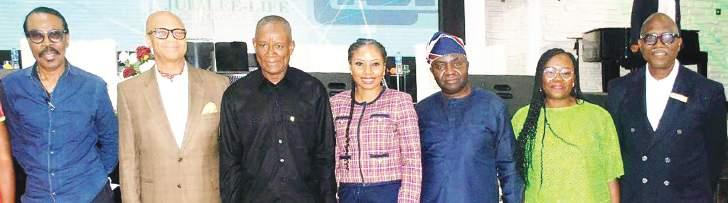
L-R- Mr Shuaheeb Olabode Agoro, Head of Service of Lagos State, ESV Bashir Oladunni MD/CEO WEMABOD, Dr. Kadiri Obafemi Hamzat, The Deputy Governor of Lagos State and
Linus Aleke in Abuja
Alex Enumah in Abuja
Kaduna Community Cries Out over Non-Release of 13 KidnapVictims after N40m Ransom Payment
John shiklam in Kaduna
Residents of Gidan Waya community in Lere Local Government Area of Kaduna State have expressed concern over the non-release of 13 people abducted by bandits despite paying N40 million ransom.
Addressing a press conference yesterday in Kaduna, Chairman of the Community’s Elders Forum, Mallam Rabo Sambo said residents were forced to sell over 3,000 bags of maize to raise the N40 million ransom demanded by the bandits.
Recounting the unfortunate incident, Sambo said the bandits invaded the community on the night of November 11,
2025, killing four residents abducting 13 others, comprising five men and eight women.
“We heard gunshots, and before we knew what was happening, the bandits had surrounded the community. They wore face masks during the operation.
“Our community is a closed settlement, so they easily ambushed us,” he said.
Sambo described the attack as the first of its kind in the community, noting that Gidan Waya had previously enjoyed peaceful coexistence.
“We have always lived in peace in our community. There has never been any crisis among us,” Sambo said.
He explained that the kidnappers contacted the
community in January 2026, demanding N40 million as ransom for the release of the victims.
He said raising the money was a painful process as the community had no alternative
but to sell its food reserves.
“To raise the ransom, we sold over 3,000 bags of maize. When the trailers came to load the maize, everyone in the community was crying.
“As soon as we got the
money, it was taken straight to the kidnappers,” he added. Sambo lamented that despite complying with the bandits’ demands, the abducted villagers were yet to be released.
He said the decision to address the press was informed by uncertainty over whether the Kaduna state government or the Lere Local Government authorities were fully aware of the community’s predicament.
Gani Adams Urges FG to Return Use of Mother Tongue in Schools
James sowole inabeokuta
The Convener of Oodua Progressive Union (OPU) Worldwide and Aare Onakakanfo of Yorubaland, Chief Gani Adams, has appealed to the Minister of Education, Dr. Tunji Alausa, to reverse the policy, which stopped the use of mother tongue as the language of instruction, in the Nigerian education curriculum.
Group Calls on Theodore Orji’s Political Family to Support Tinubu
A socio-political group, Real Mandate Initiative (RMI) has called on former Governor Theodore Ahamefule Orji, his son, Hon Chinedum Orji and members of Ochendo Political Family, not to see themselves as new entrants in the All Progressives Congress (APC).
The group in a statement, signed by its chairman, Chief Obasi Nnabuike, said they should not be satisfied with working at the background
for the re-election of President Bola Tinubu in 2027.
It called on the Ochendo political family to make the group’s efforts in Abia State known so that their vast grassroots political structure will key in to the realisation of Tinubu’s 2027 bid.
According to the group, “it has become necessary for political observers, followers and top stakeholders to fully appreciate the place
of Ochendo’s vast grassroots political structure in Abia State towards the realisation of Tinubu’s re-election in 2027.”
The group explained that even though Senator T A Orji and Chinedum, have been working tirelessly behind the scene for President Tinubu’s electoral victory in Abia State, they seem to think that it would not matter if they remain at the background.
Adams made the call while speaking at the 12th Oodua Progressive Union World Congress in Ijebu -Ode, Ogun State.
The congress, tagged ‘Empowering the Yoruba Homeland and Diaspora: Strategies for Growth and Development’, attracted dignitaries from within and outside Nigeria.
According to Adams, the OPU
is the foremost socio-cultural organisation with branches in 104 countries across the world.
The convener noted that there is no reat race in the world that neglects its language, saying that the essence of education is to learn more about people’s race and language.
He stressed that the educational, cultural, and social benefits of mother
tongue instruction in Nigeria are numerous, noting that removing mother tongue instruction risks impairing students’ understanding and academic performance, especially in early education.on Adams said: “Research consistently shows that children learn best in their mother tongue during the foundational years of education.
NYA Condemns Use-and-Dump Treatment of Youth after Electioneering
Sunday Ehigiator
The National Youth Alliance (NYA) has condemned the practice of Nigerian politicians mobilising young people during electioneering only to abandon them after securing victory, describing the trend as unacceptable and damaging to the country’s democratic growth.
The President of the NYA,
Aliyu Bin Abbas, made this declaration yesterday in Abuja while inaugurating the chairmen of the alliance across the 36 states and the Federal Capital Territory (FCT), as well as unveiling the organisation’s official website and digital portal at the NAF Conference Centre.
Abbas said many politicians had confused and misguided Nigerian youths by using them as tools during elections
and excluding them from governance thereafter.
“We must speak the truth: many of our politicians have confused and misguided the youths, using them during elections, ignoring them during governance, and abandoning them after victory. Women, despite their strength, resilience, and numbers, remain largely confined to the margins of power,” he said.
Acting Group Politics Editor DEJI ELUMOYE
Email: deji.elumoye@thisdaylive.com
08033025611 sms only
Electoral Law Faces Defining Test as N’Assembly Resumes Plenary Today
as the National assembly resumes plenary today, January 27, 2026, a dangerous clock is ticking at the Red Chamber. This is because despite passage by the House of Representatives, amendments to the Electoral act remain stalled at the Senate. With constitutional deadlines looming, delay now threatens to force Nigeria into the 2027 polls under a flawed legal framework. sunday Aborisade reports.
When the 10th Senate resumes plenary on Tuesday, January 27, 2026, the mood in the Red Chamber will be sombre but the stakes could hardly be higher. In line with parliamentary tradition, senators will first adjourn sitting in honour of the late Senator Godiya Akwashiki, who passed away after a prolonged illness in an Indian hospital, before reconvening the following day. Yet beyond the ceremonial pause lies a more consequential hiatus, which is one that has already begun to cast a long shadow over Nigeria’s democratic future.
More than any other legislative delay, the Senate’s failure so far to pass the Electoral Act (Amendment) Bill, 2025, despite its passage by the House of Representatives, has become the most troubling implication of the recess.
With the 2027 general elections less than 13 months away, the constitutional clock is ticking relentlessly. Under Nigeria’s electoral legal framework, no amendment to the Electoral Act can take effect unless it is passed and assented to at least 360 days before a general election.
That deadline effectively falls in February 2026. Should the Senate fail to conclude action on the bill within weeks, the proposed reforms, hailed as critical to restoring public confidence in elections, will automatically lapse.
In practical terms, that would mean Nigeria heading into another election cycle under the same 2022 Electoral Act whose gaps and ambiguities were laid bare during the 2023 polls.
The Electoral Act (Amendment) Bill, 2025 was passed at third reading by the House of Representatives in December 2025, after months of debate and stakeholders’ engagement.
The Senate, on its part, passed the bill at second reading but stepped it down for further consultations before recess, leaving its final consideration hanging in the balance.
This delay has fuelled anxiety among civil society groups, election observers and even lawmakers themselves. Deputy Speaker of the House and other ranking legislators have repeatedly emphasised the urgency of consolidating electoral reforms ahead of 2027, warning that legislative foot-dragging could undermine years of incremental progress in Nigeria’s electoral system.
Ironically, Senate leadership has publicly
expressed commitment to completing the process in good time. But commitment without speed, critics argue, may no longer be enough.
The pending amendments go far beyond cosmetic changes. At their core, they seek to fundamentally recalibrate how elections are conducted, disputed and concluded in Nigeria.
One of the most far-reaching proposals is election calendar reform. Under the draft amendment, presidential and governorship elections would be moved from the traditional February–March window to November 2026, roughly 185 days before the end of the current administration in May 2027.
The intention is clear: to ensure that all election petitions and appeals are concluded before inauguration day, eliminating the perennial contradiction of officeholders governing while their mandates are still being contested in court.
However, strong indications have emerged that the idea had been jettisoned since it was not contained in the version passed by the House of Representatives.
Another controversial proposal concerns the Permanent Voter Card (PVC).
Lawmakers are considering making the PVC optional, given that the Bimodal Voter Accreditation System (BVAS) does not actually read the PVC’s microchip.
Alternatives under consideration
include the use of National Identification Numbers (NIN), international passports, or downloadable and printable voter cards. While supporters argue this would expand access and reduce logistical bottlenecks, critics fear it could open new avenues for abuse if not carefully regulated.
Perhaps the most widely supported reform is the push for mandatory electronic transmission of results. The bill proposes that results be transmitted electronically from polling units alongside manual collation, backed by stiffer penalties for electoral officers who distribute unstamped or unsigned ballot papers and result sheets.
This is designed to address one of the biggest credibility gaps of past elections: the divergence between polling-unit results and figures declared at collation centres.
The amendments also introduce early voting, up to 14 days before election day, for security personnel, INEC officials, accredited observers, journalists and other election workers. If passed, this would mark a historic shift, recognising the realities of election-day deployment and reducing disenfranchisement among those tasked with safeguarding the process.
Other provisions seek to strengthen INEC’s oversight of party primaries, compel political parties to publish delegates’ lists, and mandate earlier submission of candidate lists, at least 210 days before election day.
There are also proposals to compress campaign durations to curb excessive spending and political tension, although details remain under negotiation.
Crucially, the bill aims to fast-track election litigation so that all disputes are resolved
The resumption of plenary by the 10th senate today offers a narrowing window to redeem legislative promises on electoral reform. Whether that opportunity is seized, or allowed to slip by, may well define not just the credibility of the next elections, but the legacy of the senate itself.
before May 29, 2027. This would require tighter tribunal and appellate timelines, an ambition that hinges as much on judicial capacity as on legislative drafting.
Beyond the Electoral Act itself, the National Assembly is also weighing constitutional amendments that would move election timelines out of the Constitution and into the Electoral Act.
Proponents argue this would provide greater flexibility for future reforms without the arduous process of constitutional alteration. Opponents counter that such a move could weaken constitutional safeguards around elections.
These proposals are embedded within the broader constitution review exercise, another major item awaiting Senate attention on resumption. Committees have already held public hearings, and reports are expected to return to plenary in 2026.
Any successful alteration will still require approval by at least two-thirds of state Houses of Assembly, adding another layer of complexity and time pressure.
While electoral reform dominates public concern, it is not the only pressing item on the Senate’s agenda. The 2026 Appropriation Bill, estimated at ₦58.47 trillion, has passed second reading and awaits detailed committee consideration and final passage.
As the fiscal year begins, lawmakers will also scrutinise the Medium-Term Expenditure Framework (MTEF) and Fiscal Strategy Paper for 2026–2028, documents that set the tone for government spending amid economic uncertainty.
Meanwhile, controversy over the alleged doctoring of recently passed tax laws has deepened, placing the Senate and the National Assembly under pressure to resolve discrepancies between versions approved by lawmakers and those gazetted by the executive, when legislative activities resume today.
At the centre of the dispute are claims that key provisions of the tax legislation were altered after passage by both chambers of the federal parliament.
Akpabio Abbas
Bamidele
LAWYER
Impeachment: Rivers of Crises
Speaker, Rivers State House of assembly, Rt. Hon. Martin amaewhule
Rivers State Governor , Siminalayi Fubara
Rivers State Chief Judge, Justice Simeon amadi
LAWYER
Impeachment: Rivers of Crises
‘The principle of a rotational Presidency between the North and the South, stands as one of the clearest expressions of principled compromise in the service of our national interest….If one massive party can be brought to its knees because of what people thought was unfair, I shudder to think what could happen to Nigeria, when people begin to think that things are unfair…..’ - Rt. Honourable Femi Gbajabiamila, CFR, Lawyer; Speaker, House of Representatives, 9th National Assembly; Chief of Staff to HE, President Bola Tinubu, GCFR
Speaker,RiversStateHouseofassembly,Rt.Hon. Martin amaewhule
Whether Court Order Staying Proceedings Pending Arbitration is Interlocutory or Final in Nature?
Facts
The Appellant and Respondent entered into a Master Services Agreement (“MSA”) and ancillary documentation, under which the Respondent allegedly provided expatriate manpower and technical services to the Appellant. Claiming that these services remained unpaid for, the Respondent commenced a debt recovery action under the Undefended List Procedure at the High Court of Rivers State (the “trial court”), seeking the sum of US$459,123.27 (Four hundred and fifty-nine thousand, one hundred and twenty-three United States Dollars and twenty-seven Cents), alongside post-judgement interest assessed at a rate of 10%. In response to the suit, the Appellant filed a notice of intention to defend and an application for stay of proceedings pending the conclusion of mediation or arbitration as stipulated in the dispute resolution clause of the MSA. The trial court found merit in the application and subsequently issued an order staying proceedings sine die. Dissatisfied with this ruling, the Respondent appealed to the Court of Appeal, eighty-six (86) days after the decision of the trial court.
The Appellant raised a preliminary objection to the competence of the appeal, arguing that because the ruling was interlocutory, the Respondent’s failure to seek and obtain leave of the court before filing the appeal, rendered same incompetent. The Court of Appeal dismissed this objection, holding that the ruling of the trial court relates to the issue of jurisdiction, thereby qualifying as an appeal as of right. The court then proceeded to determine the substantive appeal on its merits. Aggrieved by the decision of the Court of Appeal, the Appellant further appealed to the Supreme Court.
Issues for Determination
The following issues were submitted for determination of the court:
i. Whether the lower court was right when it held that the order of the trial High Court of 25th April, 2017 staying further proceedings in the suit and referring the parties to mediation or arbitration was a final order appealable as of right under Section 241(1) of the Constitution of the Federal Republic of Nigeria, 1999 (as amended)?
ii. Whether the lower court was right when it held that the filing of a notice of intention to defend by the Appellant amounted to taking a further step in the proceedings, and thereby constituted a waiver of the Appellant’s right to refer the dispute between the parties to mediation or arbitration?
iii. Whether the lower court was right when it held that only the Master Services Agreement (Exhibit 01) and the Purchase Order (Exhibit 02) regulated the contractual relationship of the parties, and that the General Purchase Conditions (Exhibit 03) did not form part of the documents to be considered in determining such contractual relationship?
Arguments
On issue one, the Appellant contended that the lower court erred by classifying the decision of the trial court on the application for stay of proceedings as a final judgement. The Appellant argued that the decision of the trial court did not determine the rights of the parties but merely suspended the proceedings pending the outcome of mediation or arbitration. In effect, the decision is interlocutory in nature and not final. They relied on the decision in IGUNBOR v AFOLABI (2001) 11 NWLR (PT. 723) 1483. The Appellant submitted that since the decision of the trial court is in the nature
Honourable tijjani abubakar, JSC
In the Supreme Court of Nigeria Holden at abuja On Friday, the 4th say of June, 2025
Before their lordships
John Inyang Okoro
Helen Moronkeji Ogunwumiju Tijjani abubakar
Haruna Simon Tsammani
Mohammed Baba Idris Justices, Supreme Court SC/CV/975/2020 Between
GeNeRaL eLeCTRIC INTeRNaTIONaL
OPeRaTIONS NIGeRIa LIMITed
Q OIL aNd GaS SeRVICeS LIMITed
aPPeLLaNT And
ReSPONdeNT (Lead Judgement delivered by Honourable Tijjani Abubakar, JSC)
of an interlocutory decision, the Respondent ought to have appealed against it within 14 (fourteen) days. Therefore, by filing its appeal eighty-six (86) days after the decision without seeking and obtaining the leave of court, the Respondent’s appeal is incurably incompetent.
In response to the arguments of the Appellant on the first issue, the Respondent argued that it is fundamentally flawed for the Appellant to contend that the decision of the trial court is interlocutory. It is the Respondent’s contention that the decision of the lower court, though arising from an interlocutory application, it is final in nature.
“Therefore, where the trial court retains jurisdiction to revisit the matter, or if the matter can be revived upon the occurrence of a future event, then the decision is interlocutory”
Court’s Judgement and Rationale
The gravamen of issue one before the Supreme Court was the was the characterisation of the trial court’s decision to stay proceedings sine die pending mediation or arbitration. Their Lordships strongly emphasised that, the importance of distinguishing between a final and an interlocutory decision lies in the fact that failure to obtain leave in an appeal against an interlocutory decision renders the appeal incompetent and liable to be struck out.
The Supreme Court reaffirmed the age-long test for determining finality of a decision, relying on its earlier decision in the case of OMONUWA v OSHODIN (1985) 2 SC 1. The Apex Court noted that a decision is final when it determines the rights of the parties in the manner before the court, leaving nothing else for the trial court to address or pronounce upon. Conversely, a decision is interlocutory if it does not finally determine the substantive rights of the parties, but rather preserves the subject matter of the suit, regulate proceedings, or addresses a procedural question pending the determination of the substantive claim, or put in another way, defer determination pending another event. The test is to examine the nature of the order made and whether the legal rights of the parties have been finally and conclusively determined by the order made. The crucial consideration in determining the character of a decision is not the form or label of the order, nor the function performed by the court, but rather whether the order finally resolves the substantive claim between parties. Thus, the determining factor is not whether the court has exhausted its jurisdiction or brought the proceedings to an end, but whether the order made has conclusively settled the legal rights in controversy between the contending parties – BACKBONE CONNECTIVITY NETWORK (NIG) LTD v BACKBONE TECH NETWORK INC & ORS. (2021) LPELR-56884(SC). Therefore, where the trial court retains jurisdiction to revisit the matter, or if the matter can be revived upon the occurrence of a future event, then the decision is interlocutory.
Applying the principles above, the Supreme Court held that the decision of the trial court did not determine the substantive rights of the parties. The court clarified that the use of the term “sine die” by the trial court does not connote finality; rather, “the suit remains on the docket of the trial court and may be revived upon the happening of a contingency, in this case, the conclusion or failure of arbitration.”
The crux of the Respondent’s argument is that the decision pertained to jurisdiction considering that the trial court refused jurisdiction to delve into the substance of the suit pending the outcome of mediation or arbitration. Stressing the argument further, the Respondent argued that the decision of the trial Court on a jurisdiction issue has the effect of determining the rights of the parties as nothing is left for the trial court to adjudicate on. Relying on Section 30 of the Court of Appeal Act, which defines judgement to include any decision or order of the court, and Section 318(1) of the 1999 Constitution (as amended), counsel argued for the Respondent that the ruling in question finally determined the rights of the parties in respect of the jurisdictional issue and left nothing more for the trial court to adjudicate on in the matter. Further relying on the decision in UGO v UGO (2017) ALL FWLR (PT. 902) 903
AT 919-920, the Respondent submitted that having held that it could not entertain the suit pending the outcome of mediation or arbiwwtration, the trial court became functus officio on the issue of jurisdiction, rendering the decision of the trial court final.
The Apex Court stressed further that an arbitration agreement does not oust the jurisdiction of the court, citing the decision in OBI OBEMBE v WEMABOD ESTATES LIMITED (1977) 5 SC (REPRINT) 70 AT 79-80. Consequently, the court found that the Court of Appeal erred in equating the trial court’s deference to arbitration with a full and final disposal of the action. The Supreme Court concluded that the trial court neither became functus officio by staying the proceedings, nor did it divest itself of all further authority in respect of the matter.
Finally, the Supreme Court resolved issue one in favour of the Appellant. Regarding the other issues, the court held that they had been rendered academic by virtue of its pronouncement on issue one.
Appeal Allowed.
Representation
R. Ebokpo with M. Aigbe for the Appellant. Mike A. Ozekhome, SAN; with him, Osilama Mike Ozekhome; Jamilat Kassim Ali (Miss); Yusuf Amuda-Kannike and Osikhuemhe Mike Ozekhome for the Respondent.
Reported by Optimum Publishers Limited, Publishers of the Nigerian Monthly Law Reports (NMLR)(An affiliate of Babalakin & Co.)
Right of Reply
Introduction
The death of Master Nkanu Adichie-Esege, is a tragedy that pierces the conscience of our nation. Yet, tragedy must not be compounded by inaccuracy. In her article published in Thisday Lawyer on Tuesday, 20th January, 2026, Onikepo Braithwaite suggested that determining if Nkanu died from a Propofol overdose, requires proof from an autopsy and without a postmortem examination, the cause of death cannot be proved. This rejoinder is written to correct those misstatements of law and medicine.
As will be clearly demonstrated, the law does not abandon truth because an autopsy or postmortem report is absent.
The Law Beyond the Body
The position of the law has always remained settled to the effect that, in the interpretation of statutes the entire provisions must be read holistically and not in isolated fragments. See the cases of Council of Legal Education v AMU (2025) LPELR-81723(CA), Onyejegbu & Anor v Ezeude & Ors (2022) LPELR-59150(CA) and Minister of Education & Ors v Mafara (2024) LPELR-62557(CA). If the provisions of the Coroners System Law of Lagos State, 2007 have been read as a whole, the submissions of Braithwaite would have been different. Why do we say so?
Whilst it is clearly evident as cited by Braithwaite that by the provisions of Section 48(1) of the Coroners Systems Law of Lagos State, 2007, requires the approval of a Coroner before chemical preservation of the body of a person who died in circumstances requiring an inquest can be undertaken, that provision neither suggests nor prescribes that an inquest cannot be undertaken where the body has been either or completely destroyed or cremated as in the instant case.
In fact, the Coroners Systems Law of Lagos State envisages this situation perfectly, as it is understood that there may be cases where the body will no longer be present as at the time of an inquest thus, it is provided in Section 21 of the law as follows;“Where a Coroner has reason to believe that a death has occurred within his District and in such circumstances that an inquest should be held, he may hold an inquest regarding the death if he considers it necessary, notwithstanding the:
(a) total destruction or partial destruction of the body by fire or any other cause, an inquest cannot be held except by virtue of the provisions of this Section;
(b) fact that the body is lying in a place from which it cannot be recovered.
Provided that the law relating to inquest shall apply with such modifications as may be necessary on or after a medical examination of the body found within the Coroner’s District”.
This provision anticipates precisely the situation at hand: where grief, cultural choice, or circumstance results in burial or cremation, the law still insists that inquiry can still proceed. To suggest otherwise and allege crime in the burial of the deceased child, is to mislead the public and weaponise grief against mourning parents.
At any rate, the Nigerian courts have consistently affirmed that cause of death can be established without autopsy. For example, in Ado v State (2019) LPELR50964(CA), it was held by the Appellate Court that:
“With regard to the submission that the lower Court could only have established the cause of death through the autopsy report of a medical doctor, it is now fully established that where there are other evidence upon which the cause of death can be inferred, it is not vital to resort to a medical report. A Court can in the absence of a medical report, properly infer the cause of death from the evidence and the circumstances of the case.” See similarly the decision of the Supreme Court in Muhammad v State (2017) LPELR-42098(SC), where it was observed that: “…where the cause of death is obvious, medical evidence ceases to be of any practical or legal necessity in homicide cases. Such a situation arises where death is instantaneous or nearly so”.
Those decisions were in fact, in cases of culpable homicide where proof beyond reasonable doubt is required, and not even in an inquisitorial proceeding or a matter relating to medical negligence which may or may lead to criminal proceedings but bolster a civil claim for damages.The jurisprudence is thus, clear: law does not insist on ritual where reason suffices.
Clinical Records as Evidence
What is more? Autopsy, though a valuable tool, is not the sole path to truth. In paediatric care, clinical protocols and contemporaneous records often provide more reliable evidence than postmortem tissue, depending on the particular case. In this case where a propofol
The column for Readers who feel strongly about issues expressed by the Advocate, and have a view point.
Justice Beyond the Body: Correcting Statements in Onikepo Braithwaite’s Article; 'Baby Nkanu: Negligence or Meningitis?'
This article by Thaddeus Idenyi is a Rejoinder to Onikepo Braithwaite’s article of 20/1/2026, “Baby Nkanu: Negligence or Meningitis?”. He accuses Onikepo Braithwaite’s article of being inaccurate, insisting that it is possible to determine the cause of Nkanu’s death with medical records and no autopsy. He also appears to conclude without adequate proof, and without input from euracare, that Baby Nkanu died from Propofol Infusion Syndrome, elaborately educating Readers on the effects of an overdose of Propofol
overdose is alleged to have accelerated death, there is available literature which clearly indicate that one of the adverse effects of use of propofol is Propofol-Infusion Syndrome (PRIS).
PRIS is characterised by myocardial failure, severe metabolic acidosis, bradyarrhythmias, rhabdomyolysis, acute renal failure, hypotension, dyslipidemias, and cardiac arrest and is associated with a mortality rate of more than 80% of deaths arising from propofol. Risk factors for PRIS were identified to include younger age, presence of airway infection, severe head trauma, high dose propofol infusion (> 5 mg/kg/hr) for > 48 hours.
In a clinical article titled Sudden Death Associated with Propofol Infusion Syndrome by Ng M.J, et al. published in the International Journal of Forensic Sciences 2024, (available online at https:// medwinpublisher.org/index.php/IJFSC/article/ download/1386/1237/3205) it was opined that; “The risk of developing PRIS increases, when the maximum permissible duration of propofol administration (48 hours), and its single dose of more than 4 mg/kg/hour are exceeded”.
An examination of the medical records, will most certainly reveal the dosage administered. If it exceeds 4mg, then the probable cause of death will be associated with the administered dosage.
It is material in this regard to note that, although Baby Nkanu was critically ill, he was brought into the health facility where he was last managed in a stable condition before certain procedures were performed. He was sedated, but he never regained full consciousness thereafter, and subsequently,
“….if a child, brought into a health facility in a stable condition, suddenly suffers respiratory collapse under sedation inconsistent with proper dosage and monitoring, the hospital must explain how this occurred absent negligence…. The law allows inquiry, even without a body. Clinical records can establish negligence, without autopsy”
suffered respiratory failure; a known symptom of PRIS. This sequence of events is crucial. If meningitis were the sole cause of death, why did collapse occur only after sedation? This is a crucial question, to which available medical records can provide an answer.
Furthermore, international best practice underscores this point. The South African Journal of Anaesthesia and Analgesia (2016), in its Guidelines for the safe use of procedural sedation and analgesia for diagnostic and therapeutic procedures in children, mandates that before sedation:
• A health evaluation, including a focused airway examination, must be performed by a trained sedation practitioner.
• Communication with the child is essential, and children unsuitable for sedation must be identified.
• Pre-sedation assessment should be recorded on a medical history questionnaire and sedation monitoring chart.
• Evaluation must include age (with caution for children under 5),weight, birth and neonatal history, prematurity, fasting status, and full medical history.
An examination of these records vis-à-vis the dosage administered becomes vital. It can provide strong circumstantial evidence, of what triggered respiratory failure.
Propofol is well-documented in medical literature as a sedative that, when overdosed, can cause respiratory depression and failure. This is why paediatric protocols insist on weight-based dosing and continuous monitoring. If dosage records reveal administration above safe thresholds, or if monitoring was inadequate, the inference of negligence becomes compelling.
It must also be reiterated that an inquest to the cause of death suspected to have been caused by medical negligence, is not necessarily to establish guilt or for criminal prosecution, but to unravel the truth regarding the medical care offered, and for preventive steps in the future. When properly viewed, the temptation to insist that an inquest must proceed on the basis of a postmortem for some proof beyond reasonable doubt, becomes less fanciful.
Res Ipsa Loquitur and Clinical Negligence
This leads us to the established doctrine of res ipsa loquitur “the thing speaks for itself”, which has long been applied in medical negligence cases. In Cassidy v Ministry of Health [1951] 2 KB 343, Denning LJ remarked: “I went into hospital to be cured of two stiff fingers. I have come out with four stiff fingers, and my hand is useless. That should not happen, if due care had been used. Explain it if you can.” Thus, the burden to prove absence of negligence shifted to the health care facility to explain.
In Thomas v Curley [2013] EWCA Civ 117, the Court of Appeal held that, injury caused in an area other than the operative site “called for an explanation as to how that might have occurred in the absence of negligence”. Applied here, if a child, brought into a health facility in a stable condition, suddenly suffers respiratory collapse under sedation inconsistent with proper dosage and monitoring, the hospital must explain how this occurred absent negligence. The records themselves demand accountability.
Meningitis and Accountability
The possibility of meningitis has been raised. Yet, the existence of an underlying condition, does not absolve medical professionals of responsibility. The child was stable before sedation, but never regained consciousness afterwards, and only then suffered respiratory collapse. This temporal link points to sedation management, not meningitis alone. If meningitis was indeed, present, a proper pre-sedation assessment should have flagged it as a risk factor. The failure to identify or act upon such a risk, compounds the negligence. Medicine does not operate in absolutes; neither does law. The task is not to choose between illness or negligence, but to examine how care was rendered within the context of illness.
Conclusion: Guidance and Equal Publication
This rejoinder is not an indictment. It is a call for accuracy. The law allows inquiry, even without a body. Clinical records can establish negligence, without autopsy. To insist otherwise, is to misinform the public and distort the legal state of affairs. We urge Onikepo Braithwaite, to give this rejoinder the same widespread publication as her original article. Justice demands no less.
Thaddeus Idenyi, Partner, Pinheiro LP
Chimamanda Ngozi Adichie
Right of Reply
Again, I express my condolences to Ms Chimamanda Adichie, Dr Esege and their family, on the sad death of their beloved son, Nkanu Nnamdi. My piece last week elicited an overwhelming response from the public, both here and abroad, and because it’s such an important matter, it is apposite for me to feature some of the comments below.
Baby Nkanu: Braithwaite’s Evidentiary Reasoning
This is a powerful, rigorous, and unsettling piece of legal journalism, and it deserves to be acknowledged as such.
What stands out first is discipline. The article refuses to be swept away by grief-driven certainty, or social-media outrage. It insists, almost stubbornly, on procedure, evidence, and law. In a moment where emotion is overwhelming and public sympathy is understandably aligned with bereaved parents, the author performs the most difficult civic task: separating compassion from conclusions. That alone requires courage.
Technically, the essay is exceptionally grounded. The legal architecture is precise and correct. The deployment of the Coroners’ System Law of Lagos State, especially Sections 14, 15, 26, 39, 41, 48, and 54, is not decorative. It is structural. The reader is walked, step by step, through what the law requires, not what sentiment demands. The discussion of autopsy jurisprudence, anchored in Abelegah v State, Okolie v State, Aderinkomi v State, and State v Chukwu, is textbook appellate reasoning applied to real life. The distinction between cases where postmortem evidence may be dispensed with and those where it is indispensable, is explained with clarity that even a non-Lawyer can follow, without diluting legal accuracy.
Medically, the piece shows restraint and seriousness. It does not pretend to practise medicine by proxy. Instead, it frames medicine through law: duty of care, standard of practice, causation, and proof. The discussion of meningitis is measured and responsible. It does not assert a diagnosis, but it asks the only questions that matter: Why was an LP requested? What was suspected? What were the results? The reminder that bacterial meningitis can kill within 24 hours is not sensationalism; it is clinical reality, and it fundamentally complicates any simplistic narrative of causation.
Emotionally, the writing is controlled, but not cold. The condolences are sincere and dignified. There is no attempt to diminish the parents’ grief or delegitimise their pain. At the same time, the article quietly but firmly reminds the reader that grief is not evidence, and anguish cannot substitute for forensic truth. That balance is rare, and it is ethical.
The most uncomfortable but necessary part of the article, is the discussion on cremation. It is handled without accusation, yet, it lands with devastating logical force. The question is not framed as a moral attack, but as a legal paradox: why destroy the only form of proof capable of confirming the allegation? This is not rhetoric; it is evidentiary reasoning. Any trained Lawyer reading this will immediately feel the unease, because the implications are unavoidable.
The treatment of medical negligence law, is equally sound. The citation of Ojo v Gharoro and Lord Denning’s formulation reinforces that negligence is judged by professional standards, not hindsight outrage. The escalation from professional discipline under the Code of Medical Ethics to potential criminal liability under the Criminal Law of Lagos State is carefully drawn, showing that accountability exists, but only through proof, not presumption.
Above all, the article performs a civic service. It defends the rule of law at a moment when mob justice, reputational destruction, and international embarrassment are being casually dispensed. It does not exonerate anyone. It does not convict anyone. It demands process. That is the highest form of legal integrity.
This is not a pro-hospital piece, or an anti-parent piece. It is a pro-truth piece. It insists that the dead child deserves more than narratives; he deserves answers. And answers, in law and medicine alike, come from evidence, not volume.
In a country where institutions are fragile and public trust is thin, this kind of writing is rare and necessary. It reminds us that justice, like medicine, must be practiced carefully, patiently, and without fear.
Dr Dorai, Lawyer, Singapore
Dear Dr Dorai,
Thank you for your excellent and thorough analysis of my piece. It is interesting that you say: “The question is not framed as a moral attack, but as a legal paradox: why destroy the only form of proof capable of confirming the allegation? This is not rhetoric; it is evidentiary reasoning”. A commentator also mentioned that Propofol metabolises/disappears from the body in a matter of minutes or a few hours, so it doesn’t matter if Nkanu’s remains were cremated. My response is that, the essence of an autopsy is to establish the cause of death, and even if Propofol disappears from the body instantly, if something else and not a Propofol overdose was responsible for Nkanu’s death, this would have been revealed by an autopsy. There are several sides involved in this incident; if an autopsy isn’t required by the side alleging a Propofol overdose
onikepo braithwaite
onikEpo BraiTHwaiTE
onikepo.braithwaite@thisdaylive. com onikepob@yahoo.com
'Baby Nkanu: Negligence or Meningitis?'..."This is a powerful, rigorous, and unsettling piece of legal journalism…. The article refuses to be swept away by grief-driven certainty, or social-media outrage. It insists, almost stubbornly, on procedure, evidence, and law…The reader is walked, step by step, through what the law requires, not what sentiment demands….The condolences are sincere and dignified. There is no attempt to diminish the parents’ grief, or delegitimise their pain….This is not a pro-hospital piece, or an anti-parent piece. It is a pro-truth piece”
to prove its case, it could be required by the others to prove theirs. Therefore, in the interest of justice, any cremation should have been carried out, only after the autopsy had been completed. This is standard procedure, in many countries.
Editor
…..The Frenzy Over a Single Story
I have just read your piece "Baby Nkanu: Negligence or Meningitis" and thought I should mention it straight away, that this is the most objective and balanced analysis of all the accounts I have read since the sad news broke.
Even in an adversarial system of justice we practice, the social media and public opinion can sometimes be cruel and the most virulent. We live in a world where judgement, and of guilt, can be summarily passed on you without hearing your own side of the story. This is why your piece is instructive for every voice that have been raised in judgement or condemnation of the hospital involved, without hearing its own side. I couldn’t but agree with you more. Our civilisation can do a lot better, than this human frenzy over a single story.
My heart goes out to our literary icon, over this irreplaceable loss that no parent can ever wish for!. Thank you for daring to be different!
Professor Bambo Adewopo, SAN …..No Winner in This Sad Situation
I read your article in ThisDay Lawyer on the unfortunate situation with Chimamanda Adichie’s
son. I want to thank you for a very objective analysis, and for amplifying a word of caution to not adjudicate in the court of public opinion. Regrettably, material evidence appears to no longer exist. There is no winner, in this sad situation.
Yele Aluko, Medical Doctor, USA
Reply to Page 4 Rejoinder
Dear Mr Idenyi,
Thank you, for your rejoinder.
While Section 21 of the Coroners’ System Law of Lagos State 2007 (CSL) which you refer to, does anticipate an autopsy without a corpse in certain circumstances, I disagree with you that these circumstances include a deceased being wilfully cremated, when such body qualifies as one that requires a Coroner’s Inquest. A community or holistic reading of Section 48(1) of the CSL which I cited last week and Section 21 which you cited, can only lead to the irresistible conclusion that Section 21 of the CSL only refers to circumstances in which a person who dies in violent circumstances such as a fire, resulting in the body being totally or partially destroyed, or circumstances such as a plane crashing into the ocean where the bodies cannot be recovered, and are therefore, unavoidably unavailable for autopsy. In the October 2005 Bellview Crash for example, the aircraft, at a high speed and vertical angle crashed, creating a 9m (30 ft) deep crater in the ground, and everyone on board was killed. The aircraft was completely destroyed, and not a single corpse could be recovered. I submit that, this is the type of situation that Section 21 of the CSL envisages, not voluntary cremation
before an autopsy. You mischievously cite only the part of Section 48(1) of the CSL that refers to chemical preservation, and conveniently do not mention dismemberment and disposal of remains which would obviously include voluntary cremation. What would be the need to criminalise using chemicals, the dismemberment or the total disposal (such as cremation) of the remains of a deceased who is qualified to be a Coroner’s case in Section 48, prescribing 15 years imprisonment upon conviction for same, if such acts are permitted in Section 21? That would be an absurdity. See Awolowo v Shagari (1979) LPELR-653(SC) per Andrew’s Otutu Obaseki, JSC where his Lordship held thus: “In my opinion, the rule has always been this, if the words of an Act admit of two interpretations, they are not clear; and if one interpretation leads to an absurdity and the other does not, the Court will conclude that the legislature did not intend to lead to an absurdity, and will adopt the other interpretation”.
I didn’t draft or enact Section 48(1) of the CSL; I simply referred to it. So, for you to state in your rejoinder that: “To suggest otherwise and allege crime in the burial of the deceased child, is to mislead the public and weaponise grief against mourning parents”, is rather uncharitable and unfair. I would never stoop so low as to mislead anyone, nor weaponise grief against anyone. It appears that in other countries, where the Coroner’s intervention is necessary, the process of postmortem is completed before cremation is authorised by the approving agency. In Italy, beyond an autopsy, samples may be taken from the deceased and stored for 10 years, in case of any future judicial proceedings. See the Cremation (England and Wales) Regulations 2008; the Italian Cremation Law No. 130 of 2001. While I do agree with you that medical records are of the utmost importance, and they should reveal the dosage of any medication that had been given to Nkanu, I am still unable to agree that an autopsy isn’t necessary to confirm the exact cause of his death, particularly as you admit that he was critically ill. This is what I maintained in my article - “And, to determine whether a Propofol overdose was indeed, the cause of Nkanu’s death, or what the cause of his death is, an Autopsy, that is, a postmortem examination upon his death would be required”. You however, appear to conclude in your rejoinder that the cause of Nkanu’s death is a Propofol overdose, predicated on assumptions and presumptions arising from the theory of medicine. This back and forth would have been unnecessary, had the cremation been delayed till after the autopsy; it would certainly have brought more clarity to the case. Ms Adichie mentioned in her statement, that Nkanu was taken to Euracare for some diagnostic tests in anticipation of his evacuation to Johns Hopkins Hospital, USA. This points to the fact that most of Nkanu’s medical records may be at Atlantis Hospital, which was his primary hospital, and not Euracare, where he was in transit. You even stated: “Thus, the burden to prove absence of negligence, shifted to the health care facility to explain”. How would they be expected to discharge this burden of proof? Using mostly information from other sources, when direct evidence could have been obtained from an autopsy? An autopsy would have made Euracare less dependent on a third party hospital, Atlantis, or even Nkanu’s normal paediatric clinic in USA (which appears to have been his place of residence), for complete medical records.
A person with the stature of Nkanu’s Mother, would have been able to secure a rush on her child’s autopsy, so that the cremation wouldn’t be unnecessarily delayed. You cited Ado v State (2019) LPELR-50964(CA), which you state is a case of culpable homicide, to support your position that a court can infer a cause of death from the evidence in the absence of a medical report. We are all aware that an inference is not always correct, as every type of inference, be it deductive, inductive or abductive, can fail for several reasons, including insufficient evidence. You also cite the case of Muhammad v State (2017) LPELR-42098(SC) stating again that it is a case of culpable homicide, also deciding that where the cause of death is obvious, medical evidence isn’t necessary. With respect, these cases are inapplicable; they are not on all fours with Nkanu’s. The cause of Nkanu’s death hasn’t been established; this means it isn’t obvious. It is still in the realm of allegation. See Okolie v State (2014) LPELR-23256(CA); Aderinkomi v State (2021) LPELR-56340(CA).
Finally, I restate the fact that I have only sought to examine the highlights of this unfortunate occurrence vis-à-vis the provisions of the law. I, in no way, attempt to apportion any blame, nor did I ever state that I know Nkanu’s cause of death. I simply asked pertinent questions. As Dr Dorai said, my article “…is not a pro-hospital piece, or an anti-parent piece. It is a pro-truth piece”. As a Parent myself, it is impossible not to feel the pain and grief of Ms Adichie and Dr Esege. I hope that the public, medical and legal practitioners, are able to garner some useful information from both our interventions. Let us await the outcome of the Coroner’s Inquest. My position is that, the court of public opinion and social media, are not equipped to decide this matter.
Editor
Ms chimamanda adichie
Impeachment: Rivers of Crises
In the past few weeks, Rivers State has been on the boil, consequent upon the concerted attempt by majority of its House of assembly members to impeach Governor Siminalayi Fubara and his deputy, Professor Ngozi Odu who only recently returned to office after a six-month hiatus, waiting out their suspension. The House of assembly members had transmitted a letter to the Rivers State Chief Judge, requesting that he constitute a Seven-Man Panel to investigate Governor Sim Fubara and his deputy, with a view to impeaching them. But, the Chief Judge of the State, Honourable Justice Simeon amadi refused to accede to their request, stating that his hands were “fettered”, due to several court orders. In this discourse, Dr Monday onyekachi Ubani, SAN; Sylvester Udemezue and Jide ojo dissect the issues in the unfolding drama in Rivers State, and their far reaching implications for the State and the larger Nigerian polity
Weaponisation of Impeachment in Rivers State: A Constitutional Aberration
Dr Monday Onyekachi Ubani, SAN
Introduction
Impeachment under the 1999 Constitution of Nigeria, is not a political bludgeon to be deployed at will. It is a grave constitutional mechanism, carefully designed to balance accountability with stability. What is currently unfolding in Rivers State, represents a troubling departure from this constitutional design.
Critical Issues
At the heart of the controversy are two critical issues: the refusal of the Chief Judge to constitute a seven-man investigative panel, and the propriety or otherwise of the lawmakers purporting to initiate the impeachment
“Since the order, whether rightly or wrongly given, has not been set aside by the same court or on appeal, it is to be obeyed by all authorities in the country, including the Chief Judge….The refusal of the Chief Judge to constitute a Panel in the face of an express court order, although an ex-parte order, is neither defiance nor abdication. It is judicial restraint”
process.
Section 188(5) of the Constitution provides that the Chief Judge shall constitute a sevenman panel upon receipt of a valid request from the Speaker of the House of Assembly. While the word “shall” suggests a mandatory obligation, constitutional interpretation has never been blind to context.
The Chief Judge’s role, though administrative, is not mechanical. He is not a conveyor belt, required to process a constitutionally tainted request. Where there are fundamental defects such as doubts about the legitimacy of the House, the status of the Speaker, quorum, or compliance with earlier stages of Section 188, the Chief Judge is constitutionally entitled to decline participation. To do otherwise, would amount to judicial endorsement of illegality.
In this particular case in Rivers, an order of court restrained the Chief Judge of the State from constituting the desired Panel. Since the order, whether rightly or wrongly given, has not been set aside by the same court or on appeal, it is to be obeyed by all authorities in the country, including the Chief Judge.
Nigerian courts have repeatedly affirmed that, impeachment proceedings must strictly comply with constitutional procedure. Any deviation, however minor, renders the process null and void. The order may have been
given, based on an affidavit that may have alluded to that deviation. However, the motion on notice will still be heard, and a decision will one way or the other, be reached.
Can the Lawmakers Even Initiate Impeachment?
This is the more fundamental question. Impeachment can only be initiated by a properly constituted House of Assembly. The Constitution is explicit: legislative action requires quorum, institutional cohesion, and procedural regularity. Political disagreement does not confer constitutional authority. Numbers, procedure, and legitimacy do.
The law is settled that you cannot place something on nothing and expect it to stand. An impeachment process founded on procedural illegitimacy, is stillborn.
Impeachment Isn’t Political Warfare Impeachment is a quasi-judicial process, not a tool of political vendetta. Its weaponisation in times of executive/legislative conflict, undermines democratic stability and invites judicial intervention. History shows that courts will not hesitate to strike down impeachments driven by political expediency rather than constitutional fidelity.
The refusal of the Chief Judge to constitute a Panel in the face of an express court order, although an ex-parte order, is neither defiance
Rivers State House of Assembly complex
Impeachment: rivers of crises
nor abdication. It is judicial restraint. Impeachment must remain what the Constitution intended it to be: a shield for accountability, not a sword for political combat and hostility. Enough said.
Dr Monday Onyekachi Ubani, SAN, former Chairman, NBA Section on Special Interest and Development Law (SPIDEL)
Rivers State Assembly and the Chief Judge’s Refusal to Constitute a Probe Panel
A Legal Appraisal of Governor Fubara’s Second Impeachment Crisis
Sylvester Udemezue
Background
The second impeachment crisis involving Governor Siminalayi Fubara of Rivers State and his Deputy, Professor Ngozi Odu, is one of the most intense constitutional and political confrontations in the State’s recent history. It unfolded amid a prolonged power struggle between the Executive and the Rivers State House of Assembly, raising fundamental questions about constitutional compliance, separation of powers, and the limits of judicial involvement in impeachment proceedings.
The crisis formally crystallised on 8 January, 2026, when the House of Assembly issued and purportedly served Notices of Allegations of Gross Misconduct on the Governor and his Deputy. The notices, signed by the Speaker, Hon. Martin Amaewhule, were supported by 26 members of the Assembly. Soon after, however, the process became mired in controversy over service and procedure. Reports indicated that several days after the resolution, the Governor had not been personally served with the notice, fuelling speculation about procedural defects, political manoeuvring, or a stalled process. There were also fears about whether the four Honourable members loyal to Governor Fubara were carried along, as required by the proviso to Section 188(2) of the Constitution.
On 16 January, 2026, 26 members of the House passed a Motion resolving to investigate the allegations and, directed the Speaker to request the Chief Judge of Rivers State to constitute a seven-man investigative panel, thereby escalating the crisis to a critical constitutional stage. However, a turning point occurred on 20 January, 2026, when the Chief Judge, Hon Justice Amadi, declined the Assembly’s request to constitute the panel. In a letter responding to the Speaker’s request under Section 188, the Chief Judge cited concerns relating to judicial independence and procedural propriety. This refusal introduced a novel constitutional dilemma: whether a Chief Judge has discretion to decline a request that appears constitutionally mandated, and the legal consequences of such refusal for an ongoing impeachment process. It is this tension between constitutional text, institutional roles, and political reality, that this article interrogates. By examining the impeachment proceedings against Governor Fubara and his Deputy (particularly the Chief Judge’s refusal to constitute a probe panel), the article assesses the legality, propriety, and constitutional implications of the actions of the key actors within Nigeria’s impeachment framework.
A Summary of the Impeachment Procedure Under Section 188 of the Constitution Impeachment proceedings against a Governor or Deputy Governor under Section 188 of the 1999 Constitution, are governed by a strictly sequenced and mandatory procedure, with which exact compliance is constitutionally required.
The process begins with a Notice of Allegation of Gross Misconduct, which must be in writing, contain detailed particulars, be signed by not less than one-third of the members of the House of Assembly, and be presented to the Speaker. Upon receipt, the Speaker must, within seven (7) days, serve the Notice on the Governor and circulate copies to all members of the House. At this stage, “gross misconduct” is defined by Section 188(11) as a grave violation or breach of the Constitution, or any misconduct which, in the opinion of the House, amounts to gross misconduct. The Governor is entitled to respond, and any reply must be circulated by the Speaker to all members before further steps are taken. Within fourteen (14) days of the presentation of the Notice (whether or not a reply is submitted), the House must decide by motion and without debate, whether to investigate the allegations. This motion must be supported by not less than a two-thirds majority of all members; failure to attain this majority automatically terminates the process. Where the motion succeeds, the Speaker must, within seven (7) days, request the Chief Judge to constitute a sevenmember investigative panel composed of persons of unquestionable integrity who are not members of the public service, the legislature, or any political party. The panel must conduct its inquiry in accordance with procedures prescribed by the House, afford the Governor the right to defend himself personally or through Counsel, and submit its report within three (3) months of appointment. Upon receipt of the report, the House proceeds to final consideration. If the panel exonerates the Governor, the Constitution bars any further proceedings. If the allegations are upheld, the House must, within fourteen (14) days, consider and, by a two-thirds majority resolution,
“Impeachment is therefore, justiciable to the limited extent of ensuring strict adherence to constitutional procedure. In this context, the Supreme Court interpreted the ouster clauses in Sections 143(10) and 188(10) as excluding judicial review only of the substantive resolutions or opinions of the House (such as whether conduct amounts to “gross misconduct”), but not of procedural compliance”
adopt the report, whereupon the Governor is removed from office with immediate effect. Throughout, strict compliance with Section 188 is mandatory. While courts will not examine the merits of the allegations, they retain jurisdiction to intervene for procedural non-compliance, as affirmed by the Supreme Court in Inakoju v Adeleke (2007) 4 NWLR (Pt. 1025) 423.
The Ouster Clause and Justiciability of Impeachment Proceedings in Nigeria
Questions on impeachment under the Nigerian Constitution often generate confusion, because two related but distinct issues are conflated: the constitutional power to impeach, and the constitutional procedure for impeachment. This distinction was authoritatively settled by the Supreme Court in Inakoju v Adeleke (Supra) (the Ladoja case), the leading authority on the justiciability of impeachment proceedings in Nigeria. In the case, which arose from the impeachment of Oyo State Governor, Rasheed Ladoja, the Supreme Court held that the purported impeachment was a nullity, due to flagrant non-compliance with Section 188 of the 1999 Constitution. The Court affirmed that although impeachment is a political process, it is constitutionally regulated, and any departure from the prescribed procedure renders the entire exercise void. The decision underscored the Judiciary’s role, in protecting constitutionalism and the rule of law. The Court drew a clear line, between power and procedure. On the one hand, it held that courts lack jurisdiction to question the substantive power of a House of Assembly to initiate and carry out impeachment, as that power is expressly vested in the Legislature by Sections 143 and 188 of the Constitution. The motives, wisdom, or political justification for impeachment, are matters exclusively within the legislative domain. On the other hand, the Court held that the Judiciary retains jurisdiction to inquire into allegations of non-compliance with the mandatory procedural steps in Sections 143 or 188(1)–(9). Impeachment is therefore, justiciable to the limited extent of ensuring strict adherence to constitutional procedure. In this context, the Supreme Court interpreted the ouster clauses in Sections 143(10) and 188(10) as excluding judicial review only of the substantive resolutions or opinions of the House (such as whether conduct amounts to “gross misconduct”), but not of procedural compliance. Where constitutional safeguards are breached, the courts are both competent and duty-bound to intervene. Accordingly, impeachment under the Nigerian Constitution is not a non-justiciable political question in
cases of procedural irregularity; the courts act as constitutional gatekeepers while refraining from adjudicating the political merits of the allegations. Thus, although legislative acts are generally non-justiciable, courts will assume jurisdiction where the Constitution prescribes a specific procedure and that procedure is breached, as the courts are guardians of the Constitution.
Competence of the High Court of Rivers State in Impeachment-Related Proceedings
The High Court of Rivers State is competent (it shares concurrent jurisdiction with the Federal High Court) to entertain matters arising from impeachment proceedings against the sitting Governor of the State, not to determine the merits of the allegations, but to adjudicate issues of constitutional compliance and legal rights. Under Section 272 of the Constitution of the Federal Republic of Nigeria, 1999, the State High Court has broad jurisdiction over civil proceedings involving the existence, extent, or enforcement of legal rights, powers, duties, or obligations, subject only to the exclusive jurisdiction of the Federal High Court under Section 251. Accordingly, where impeachment proceedings raise questions of compliance with the mandatory procedures in Section 188 of the Constitution, such disputes fall within the supervisory jurisdiction of the State High Court or the Federal High Court, which may enforce constitutional safeguards and the rule of law, without intruding into the political discretion of the House of Assembly.
Legal Propriety (or Otherwise) of the Rivers State Chief Judge’s Refusal to Constitute a Probe Panel
a) Is the Chief Judge Bound to Constitute a Panel: The duty of a State Chief Judge to constitute an investigative panel under Section 188(5) of the Constitution, is neither mechanical nor automatic. It is a constitutional duty, conditioned on prior strict compliance by the House of Assembly with the mandatory steps in section 188(1)-(4). Although the power to initiate impeachment and request a panel lies with the House, the Chief Judge’s role must be exercised in fidelity to the Constitution. As the Supreme Court held in Inakoju v Adeleke (2007) 4 NWLR (Pt. 1025) 423, impeachment is a constitutionally regulated process, and any step taken in breach of constitutional requirements is a nullity. The Chief Judge therefore, cannot be compelled to act on a constitutionally defective request, as the Constitution does
rivers State Governor, Siminalayi Fubara and President Bola Ahmed Tinubu, GcFr
Impeachment: rivers of crises
not mandate participation in an unlawful or incomplete impeachment process. The Chief Judge is entitled, indeed, constitutionally obliged, to decline a request where it is apparent that the House has failed to comply with fundamental procedural requirements under Section 188, even absent a court order. This duty flows from Section 1(1) and (2) of the Constitution, which proclaim constitutional supremacy and binds all authorities to its provisions. To constitute a panel in the face of clear breaches (such as improper service, failure to secure the required majority, or premature invocation of Section 188(5)) would amount to aiding a constitutional violation and undermining the rule of law. The proper course is to notify the Speaker of the defects, and insist on due process. As affirmed in Inakoju v Adeleke (Supra), procedural noncompliance vitiates impeachment ab initio. Where the Chief Judge declines on this basis, the House’s remedy lies in challenging that decision in court. In Abiodun v C.J. Kwara State (2007) LPELR-8308(CA), the Court of Appeal confirmed that courts may examine both compliance with the two-thirds requirement, and the Chief Judge’s exercise of discretion in empanelling a panel where challenged.
b) Duty to Decline Where a Subsisting Court Order Exists: One of the reasons offered by the CJ of Rivers State for declining to set up a panel, is that his office was in in receipt of two separate interim orders issued by the High Court on 16 January, 2026 in Suit No.: OYHC/6/CS/2026 (Ngozi Odu v Amaewhule & 32 Ors) and Suit No.: OYHC/7/CS/2026 (Siminalayi Fubara v Amaewhule & 32 Ors). In both suits, the Honourable Chief Judge of Rivers State is named as the 32nd Defendant/ Respondent, and the said interim orders were duly served on the CJ’s office on 16 January, 2026, the same date on which the orders were issued. It is respectfully submitted that, the Chief Judge is constitutionally bound to refuse to constitute a panel where a subsisting court order restrains further steps in the impeachment process. Obedience to court orders is a foundational element of the rule of law: all orders (whether regular, irregular, valid, or later found to be without jurisdiction) must be obeyed until set aside. This principle has been consistently affirmed by the Supreme Court, including in Rossek v A.C.B. Ltd. (1993) 8 NWLR (Pt. 312) 382; Oba Aladegbemi v Oba Fasanmade (1988) 3 NWLR (Pt. 81) 129; Adebayo v Johnson (1969) 1 All NLR 176; Komolafe v Omole (1993) 1 NWLR (Pt. 268) 213; and Oshiomhole v FGN(2004) LPELR-5188(CA), echoing Hadkinson v Hadkinson and Isaacs v Robertson. Acting in defiance of a subsisting order would amount to contempt of court, and a violation of constitutional supremacy under Section 1(2). This position finds practical precedent in Ondo State, where the Chief Judge, Honourable Justice Olusegun Odusola, on 06 October, 2023 declined to constitute a panel in obedience to a subsisting restraining order of the Federal High Court in FHC/ABJ/CS/1294/2023, thereby upholding judicial authority. The Rivers State Chief Judge in the present instance, relied on Dele Abiodun v Honourable Chief Judge of Kwara State (2007) 18 NWLR (Pt. 109) 169, where the Court of Appeal nullified an impeachment process because the Chief Judge had constituted a panel in defiance of a court order, sternly condemning such conduct and reaffirming the Chief Judge’s paramount duty to obey and uphold the law.
1) The Rivers House of Assembly and Quod Approbo Non Reprobo A critical feature of this matter is the Rivers State Chief Judge’s statement to the Speaker, that the House had lodged an appeal against the subsisting interim orders of the High Court, and that he had been served with the Notices of Appeal. He accordingly invoked the doctrine of lis pendens, noting that both parties and the court must await the outcome of the appeal. This is legally significant. Once a court order is made and remains subsisting,
it binds all affected persons and authorities until set aside by due process. No litigant may approbate and reprobate, in the same proceedings. Having itself appealed against the High Court’s order, the Rivers State House of Assembly cannot simultaneously proceed as if that order does not exist, by requesting the Chief Judge to constitute an investigative panel. Such conduct violates the equitable principle of quod approbo non reprobo, which forbids a party from accepting and rejecting the same legal position to suit its convenience. By filing an appeal, the House has acknowledged the existence, binding force, and operative effect of the order, and is therefore legally and constitutionally bound to await the outcome of its appeal. It cannot lawfully take steps that undermine, pre-empt, or render nugatory a subsisting judicial decision.
Possible Legal Flaws that Could Justify Judicial Intervention Judicial intervention is warranted where impeachment proceedings fail to comply with the mandatory procedural safeguards in Section 188 of the Constitution. Such defects go to the root of the process and render it incompetent. Illustrative instances include the following:
a) Failure by the Speaker to serve the Notice of Allegations on all members of the House, or to circulate the Governor’s reply (if any), as required by Section 188(2), is a fundamental breach, as it deprives legislators of the opportunity to consider the Governor’s defence before further steps are taken.
b) Where the motion to investigate is passed outside the mandatory fourteen (14) days from presentation of the Notice, or is not supported by a two-thirds majority of all members as required by Section 188(4), the impeachment automatically fails.
c) Non-compliance also arises where the Speaker’s request to the Chief Judge to constitute a seven-man panel is not made within seven (7) days of the resolution to investigate, contrary to Section 188(5).
Likewise, where a panel exonerates the Governor, but the House nevertheless proceeds to remove him, such action is a
“The Chief Judge therefore, cannot be compelled to act on a constitutionally defective request, as the Constitution does not mandate participation in an unlawful or incomplete impeachment process. The Chief Judge is entitled, indeed, constitutionally obliged, to decline a request where it is apparent that the House has failed to comply with fundamental procedural requirements under Section 188, even absent a court order”
nullity under Section 188(8). An illustration occurred in Ekiti State during the Fayose episode, where a Governor was removed despite a panel’s exoneration, an illegality that went unchallenged;
d) Even where a panel indicts the Governor, the process fails if the House does not, within fourteen (14) days, adopt the report by a two-thirds majority, as required by Section 188(9). This principle was applied in Plateau State, where the impeachment of Governor Joshua Dariye by only about 8 members (out of the 24-member House) was nullified and he was reinstated.
e) Impeachment proceedings conducted outside the chambers of the House of Assembly are unconstitutional. In Inakoju & Ors v Adeleke & Ors (Supra), the Supreme Court nullified Governor Ladoja’s impeachment because proceedings were held at D’Rovans Hotel, Ibadan. Similarly, in Balonwu & Ors v Obi & Anor (2007) LPELR-4255 (CA), Governor Peter Obi’s impeachment was set aside because, among other flaws, the proceedings occurred outside the Anambra State House of Assembly.
f) In Dapianlong & Ors v Dariye (SC 39/2007) [2007] NGSC 181, the Supreme Court held that Section 188(10) does not oust judicial jurisdiction where there is non-compliance with Section 188(1)–(9).
The impeachment of Governor Joshua Dariye was declared unconstitutional due to multiple fatal defects, including initiation and conduct by a minority of six to eight members in a twenty-four-member House; improper reliance on Section 102; an undated and improperly signed Notice not served on the Governor or circulated to members; absence of valid two-thirds resolutions to investigate or adopt any report; an invalid request to the Acting Chief Judge; an improperly constituted panel that acted in defiance of subsisting court orders, submitted an interim report, and denied the Governor fair hearing; and proceedings conducted under coercive circumstances. Taken cumulatively, these violations rendered the impeachment, the panel proceedings, the report, and the purported removal null and void, necessitating the Governor’s reinstatement with all attendant rights and privileges.
2) Propriety of the Appeal Filed by the House of Assembly
The propriety of the House of Assembly’s appeal is open to serious doubt, given the nature of the order appealed against and settled procedural practice. The order in question was an interim ex-parte order, which is inherently provisional and liable to be varied or set aside by the same court upon application. The more appropriate course would have been to apply promptly to the High Court to discharge or vary the order, while filing a counter-affidavit and written address in response to the pending
motion on notice. Immediate appeals against ex-parte orders are generally discouraged, as appellate courts emphasise that the court of first instance should first be given the opportunity to reconsider its interim ruling. Premature resort to appeal undermines judicial economy, and risks unnecessary delay. More significantly, by appealing rather than first seeking to set aside the order, the House acknowledged the subsistence and binding effect of the order, thereby triggering the doctrine of lis pendens and constraining itself from taking steps that could render the order nugatory. Accordingly, while the appeal may not be incompetent, it was procedurally ill-advised and counterproductive, in a sensitive constitutional process such as impeachment. A prompt application to set aside the ex-parte order, coupled with a robust response to the motion on notice, would have better preserved the House’s position, without attracting the constitutional and equitable consequences attendant upon appealing against a subsisting interim order.
3) A Word of Advice to the Warring Parties and the People of Rivers State
The protracted political crisis in Rivers State has reached a point of diminishing returns, where governance, public confidence, and institutional integrity are being sacrificed on the altar of political brinkmanship. As I advised in my earlier published write-up titled, “Enough of the Rivers State Crisis: Nigerians are Tired of the Drama - It’s Time to Govern, Not Grandstand”, the prevailing mood among Nigerians, is one of fatigue and frustration with endless power struggles that yield no tangible benefit to the people. Nigeria faces far graver national challenges (insecurity, economic hardship, unemployment, and failing social services) than to be continually consumed by one State’s political quarrels. The warring political actors must recognise that constitutional power is held in trust for the public good, not as a weapon for perpetual conflict. All sides (executive, legislature, and their supporters) are urged to de-escalate tensions, respect constitutional boundaries, obey court orders, and prioritise dialogue, compromise, and statesmanship over confrontation. Ultimately, the peace, development, and welfare of Rivers State must take precedence over factional victories, as history is kinder to leaders who chose peace and delivered good governance, than to those who merely grandstand loudly.
4) Conclusion
The impeachment crisis in Rivers State, starkly illustrates the dangers of politicising constitutionally regulated processes and disregarding the rule of law. While impeachment is a legitimate constitutional mechanism, it must be exercised strictly within the confines of the Constitution, with scrupulous adherence to due process, judicial authority, and institutional restraint. Any deviation (whether by the legislature, the executive, or
Deputy Governor of rivers State, Prof. Ngozi Nma odu
Impeachment: rivers of crises
ancillary actors) invites judicial intervention, and undermines democratic governance. The Constitution remains supreme, court orders remain binding, and no arm of government is above the law. It is only through fidelity to these foundational principles that constitutional democracy can be preserved, and public trust restored in Rivers State and Nigeria at large. Sylvester Udemezue (Udems), Legal Practitioner
The Stalled Impeachment Move on Governor Sim Fubara
Jide Ojo
Introduction
Governor Siminalaye Fubara of Rivers State has become a cat with nine lives, having survived two previous impeachment moves by the Rivers State House of Assembly. However, another plan is afoot to impeach the ‘gentle giant’ who rode to power on the back of his predecessor, former Governor Nyesom Wike. Will he and his deputy, Prof. Ngozi Odu, survive this third attempt?
The Rivers State House of Assembly first made to impeach Fubara in October 2023. In order to thwart that move, some arsonists set a section of the Assembly on fire on Sunday, October 29, 2023. The second attempt was in March 2025 few days before President Bola Tinubu declared State of Emergency in Rivers State, in which the suspension order affected the entire members of the Rivers State House of Assembly, the Governor and the Deputy Governor. The SoE lasted from March 18 – September 18, 2025.
The second impeachment notice was communicated via a letter which was dated Friday, March 14, 2025 but was made public on Monday, March 17, 2025. The letter addressed to the Speaker, Martin Amaewhule, titled; “Notice of Allegations of Gross Misconduct Brought Pursuant to Section 188 of the Constitution of The Federal Republic of Nigeria (as amended) 1999, was signed by 26 members of the House. The letter accused the Governor of gross misconduct in the performance of the functions of the office of the Governor. A separate letter was directed to the Deputy. The letter accused the Governor of spending public funds, contrary to Sections 120, 121 and 122 of the Constitution. A portion of the letter stated “that the Governor has shown that he is not prepared to govern Rivers State in line with the Constitution of the Federal Republic of Nigeria, 1999 (as amended) and his oath of office..”.
The third and the current impeachment move happened on Thursday, January 8, 2026. The impeachment process was initiated during plenary, presided over by Speaker Martins Amaewhule. The Majority Leader, Major Jack, read the notice of allegations against Governor Fubara, citing seven counts of gross misconduct. Allegations include the demolition of the Assembly complex, extra-budgetary expenditure, withholding of funds intended for the Assembly Service Commission, and alleged disobedience of a Supreme Court ruling on legislative financial autonomy. 26 lawmakers endorsed the notice.
Court Offered Temporary Relief to Fubara and Deputy Interestingly, the Chief Judge of Rivers State, Simeon Amadi has declined to constitute a seven-man investigative panel, citing legal encumbrances. The Chief Judge’s position was contained in a letter dated January 20, 2026, personally signed by him and addressed to the Speaker of the House, Martin Amaewhule. The CJ disclosed that his office received, on January 16, two separate interim injunctions issued by the Oyibo Division of the Rivers State High Court, sitting in Port Harcourt, restraining him from receiving, considering or acting on any impeachment-related request from the
Assembly. According to the Chief Judge, the interim orders were granted in two separate suits filed by the Governor and his deputy: Suit No. OYHC/7/CS/2026 filed by Governor Fubara and Suit No. OYHC/6/CS/2026 filed by Prof. Odu. In both suits, the Chief Judge is listed as the 32nd Defendant.
In the letter, Justice Amadi stated that the interim injunctions expressly barred him from acting on any communication from the lawmakers relating to the constitution of a probe panel for a period of seven days, pending further proceedings. Justice Amadi further noted that the Assembly had already appealed the interim orders at the Court of Appeal, Port Harcourt Division, and that he had been served with the notices of appeal on January 19 and 20. He explained that by the doctrine of lis pendens, all parties, including the court, were required to await the outcome of the appeal.
“Constitutionalism and the Rule of Law are the bedrock of democracy, and all persons and authorities are expected to obey subsisting orders of a court of competent jurisdiction, irrespective of perception of its regularity or otherwise”, the Chief Judge stated. He stressed that until the interim orders are set aside or the suits finally determined, he remains legally constrained from exercising his constitutional duty under Section 188(5) of the Constitution. “In view of the foregoing, my hand is fettered, as there are subsisting interim orders of injunction and appeal against the said orders. I am therefore, legally disabled at this point from exercising my duties under Section 188(5) of the Constitution in the instant”, Justice Amadi concluded.
Chronicle of Impeachment in Nigeria’s Fourth Republic
Impeachment is one of the legal provisions, meant to check the excesses of the executive arm of government. Specifically, Section 188 with 11 subsections, provide a comprehensive procedure for impeaching a Governor and/or his Deputy. In this Fourth Republic which started from May 29, 1999, there have been series of successful and attempted impeachment of Governors and Deputy Governors. Successful ones are: Ayo Fayose was impeached as the Governor of Ekiti State on 16 October, 2006 on alleged mismanagement of public funds and serial killings; Peter Obi was impeached as the
“It remains to be seen how the impeachment move will pan out, but, so far, Fubara seems to have a upper hand, given the obedience to court orders being observed by the Rivers State CJ”
Governor of Anambra State on 2 November, 2006 on alleged gross misconduct; Joshua Dariye, was impeached as the Governor of Plateau State on 13 November, 2006 on alleged siphoning of public funds and money laundering in London; Rashidi Ladoja, was impeached as the Governor of Oyo State on 12 January, 2006; Diepreye Alamieyeseigha was impeached as the Governor of Bayelsa State on 9 December, 2005 on alleged corruption which includes, theft of public funds, abuse of office, and money laundering; Murtala Nyako was impeached as the Governor of Adamawa State in July 2014 on alleged corruption which includes theft of public funds, abuse of office and money laundering.
According to The Nation newspaper of April 9, 2024, seventeen deputy Governors have so far been impeached. They are: Femi Pedro (Lagos); Iyiola Omisore (Osun); Kofoworola Bucknor-Akerele (Lagos); Chris Ekpenyong (Akwa Ibom); Abiodun Aluko (Ekiti); Biodun Olujinmi (Ekiti); Late Garba Gadi (Bauchi); Peremobowei Elebi (Bayelsa); and Sani Abubakar Danladi (Taraba). Others are: Jude Agbaso (Imo); Sunday Onyebuchi (Enugu); Ali Olanusi (Ondo); Eze Madumere (Imo); Simon Achuba (Kogi); Rauf Olaniyan (Oyo); Mahdi Aliyu Gusau (Zamfara) and Philip Shaibu (Edo).
Interestingly, most, if not all these impeachments have been invalidated by the courts, even though many of the victims were not able to go back to resume their offices due to effluxion of tenure expiration. The courts have serially nullified these impeachments, because due process was not followed by the initiators.
Interestingly, no President or Vice President have been successfully impeached, while some of the impeachment moves of State Governors were also unsuccessful. For instance, in September 2023, the Ondo State House of Assembly served the embattled Deputy Governor of the State, Lucky Aiyedatiwa an impeachment notice. It was the court and the Chief Judge of the State that saved him, when he refused to constitute the 7-man panel due to a court injunction that restrained him.
The Real Issue Behind the Plot to Remove Governor Fubara and His Deputy
Though the State House of Assembly as an independent arm of government has a right to impeach the Governor and/or his Deputy; however, the reasons they advanced for their action are ostensible. They needed to call a dog a bad name, in order to hang it. The real reason behind the impeachment move, was that Fubara has reportedly become a prodigal godson of Wike. He is deemed disloyal to his godfather, who bulldozed his way to make the former Accountant General of Rivers State the Governor in 2023. Fubara’s mortal sin is believed to be,
his purported attempt to hijack the political structure of his estranged godfather Wike. Governor Fubara has consistently denied this.
Recall that there was a serious attempt by Fubara to reconstitute the 23 Local Government Chairmen and Councillors of Rivers State with his own loyalists, after the end of tenure of the ones elected under Wike. This attempt was rebuffed by the RSHA. The Local Government election held in October 2024 was also nullified by the court, for allegedly failing the integrity and due process tests. It was only the one held under the sole administrator in August 2025 in which Wike’s loyalists in All Progressives Congress won 20 LGAs, and three others won under Peoples Democratic Party, that are in place now. So, Wike has now regained his political structure.
Godfather, Nyesom Wike has also openly alleged that Fubara sacked 10,000 of his supporters that he employed during his time in office, and that several of the projects he initiated have remained uncompleted by Fubara, his successor.
The plan of Wike in allegedly instigating the current impeachment move against his godson, is to do away with both the Governor and his Deputy, in order to pave way for his staunch loyalist, the Speaker of the RSHA to become acting Governor. It is important to know that, in most of the previous impeachments of the Governor, the Deputy Governor is usually left out and becomes the acting Governor. This was the case in Bayelsa, Oyo, Anambra, Adamawa and Plateau.
The other leg of the plot is to remove the Governor and Deputy Governor from office, so that they will not get to re-contest, let alone winning reelection in 2027. Wike has expressed the fear that he will be buried politically, if Fubara wins reelection. Despite the defection of the Governor and Deputy Governor from PDP to APC, Wike reportedly was unhappy that Fubara did not take him into confidence before his defection and was also boasting to be the 001 in APC, which makes him the leader of the party in Rivers State. Wike even had a public spat with the National Secretary of APC, Senator Ajibola Bashiru, when he affirmed that the Governor is the leader of APC in Rivers State.
Conclusion
It remains to be seen how the impeachment move will pan out, but, so far, Fubara seems to have a upper hand, given the obedience to court orders being observed by the Rivers State CJ. There are also several behind the scene moves, to resolve the issues politically and fashion out an out of court settlement. Most Ijaw people are also unhappy that their kinsman who happens to be the first Governor to come from the riverine area, is being coerced out of office. They are waiting in the wings, and hoping that their ‘son’ will survive this political onslaught.
Jide Ojo, Development Consultant, Author and Public Affairs Analyst
CJN Calls for Sweeping Judicial Reforms
Stories by Steve Aya
The Chief Justice of Nigeria (CJN), Hon. Justice Kudirat
M. O. Kekere-Ekun, GCON, has called for urgent and far-reaching reforms within Nigeria’s judicial system, stressing that transformation is necessary to strengthen public trust and institutional effectiveness.
Justice Kekere-Ekun made the call at the opening ceremony of the 2026 Strategic Retreat of the Committee of Chief Registrars of Nigeria, themed “Strengthening Court Administration, Financial Accountability and Staff Wellbeing for a More Effective Judiciary in Nigeria”. She described the retreat as a defining moment for the Judiciary.
According to the CJN, the gathering goes beyond
routine professional engagement, serving instead as a forum for honest selfassessment, open dialogue, and renewed commitment to the values that sustain a credible, independent, and efficient justice system. She noted that strengthening court administration is critical
to improving case management, streamlining judicial processes, and reducing delays that have continued to undermine confidence in the courts.
Efficient administration, she said, remains central to delivering timely justice.
The CJN also underscored the importance of financial
accountability, emphasising that transparency in the management of judicial resources is essential to good governance and institutional independence, particularly in an era of heightened public scrutiny. Equally highlighted was staff wellbeing, which the CJN described as
fundamental to judicial effectiveness. She stressed that a motivated and well-supported workforce is indispensable to upholding professionalism, impartiality, and high ethical standards across the courts.
She urged Chief Registrars and other
stakeholders, to use the retreat to develop practical strategies that will translate reform goals into measurable outcomes, expressing confidence that the deliberations would strengthen the Judiciary’s role as a pillar of democracy, justice, and the rule of law in Nigeria.
Nigerian Law School Extends Application Deadline
The Nigerian Law School has extended the deadline for the submission of application forms, for admission into the 2025/2026 academic session.
The Law School announced that the new deadline for the submission of applications is Friday, January 31, 2026. The
announcement was contained in a Notice, signed by the Secretary to the Council and Director of Administration.
According to the Notice, prospective Applicants who have already started the application process but are yet to complete it, are advised to forward their pending applications to the
EFCC Draws Line Between Fraud Probe and Property Dispute in Lagos Court
The Economic and Financial Crimes Commission (EFCC) has told a Lagos State High Court that it was never engaged to recover the N152 million paid for two luxury apartments at the centre of a high-profile property dispute in Victoria Island, firmly distancing itself from what it described as a civil transaction gone sour.
Testifying before Justice Akingbola George at the Tafawa Balewa Square division of the court, EFCC operative Emmanuel Adide said the Commission did not receive any formal request from NigerianAmerican Engineer, Anthony Ugbebor, to recover funds paid to Oak Homes Limited for the disputed flats. He stressed that the anti-graft agency “is not a debt recovery organisation”.
The testimony came in a suit instituted by property developer Olukayode Olusanya and his firm, Oak Homes Limited, against Ugbebor over alleged trespass on two second-floor apartments at No. 14A Musa Yar’Adua Street, Victoria Island. The case has drawn attention, for blurring the line between criminal complaints and
commercial disagreements.
Adide told the court that while the EFCC initially intervened following a petition alleging criminal breach of trust and obtaining money by false pretence, investigations later showed the matter to be civil in nature. As a result, the Commission disengaged from the dispute, and advised the parties accordingly.
He clarified that although discussions took place within the EFCC regarding a possible refund, there was no agreement or directive that the developer should sell the flats to facilitate repayment.
Compelling such a sale, Adide noted, would amount to an improper exercise of the Commission’s powers.
The EFCC witness also confirmed that Olusanya, Managing Director of Oak Homes Limited, was briefly detained when he first reported to the Commission in Abuja, but emphasised that the developer never denied receiving money from Ugbebor.
He added that the eventual refund was made after Olusanya had been granted bail,
not while he was in custody.
According to Adide, the developer paid back N102 million in three bank drafts submitted to the EFCC, although he could not recall the exact number of instalments involved. He further confirmed under cross-examination that there was no written instruction from Ugbebor asking the Commission to recover the funds on his behalf.
Earlier in the proceedings, Ugbebor had told the court that he paid N152 million— about 80% of the N190 million purchase price—for the flats, describing the funds as his “life savings” totalling $400,000. He alleged that Oak Homes later denied any record of the transaction, prompting him to petition the EFCC over suspected fraud.
With the EFCC now asserting that the dispute falls outside its criminal mandate, Justice George adjourned the case until March 23, 2026, for the adoption of final written addresses, setting the stage for the court to determine whether the conflict is one of trespass, contract, or credibility.
Office of the Secretary to the Council and Director of Administration, on or before the new deadline.
The Law School explained that the extension was granted, to ensure
the timely processing of applications and admissions for the forthcoming academic session.
However, the institution warned that applications submitted after January 31 will not be considered, stressing that no further extension will be granted, and urged candidates to take advantage of the extended deadline.
NBA Kicks Over Appointment of Ex-Convict as Branch Patron
The Nigerian Bar Association has called for the probe of its Garki Branch Abuja Chairman, over the appointment of an ex-convict as a Grand Patron.
In a statement signed by its President, Mazi Afam Osigwe, SAN, described the appointment of Mr Abdulrasheed Maina, who was convicted of looting over N2 billion in pension funds, as a patron of its Branchq, as unfortunate. Insisting that the appointment made a mockery of the legal profession and the fight against corruption, the NBA said it would commence disciplinary proceedings against its Garki Branch Chairman, Mr Bamidele Ojo.
Aside from demanding the immediate withdrawal of the appointment, the Association vowed to take firm and decisive institutional action against any conduct that undermines its integrity, accountability, and respect for the judicial process.
In the statement, NBA President said “The Nigerian Bar Association views with disdain the purported appointment of Abdulrasheed Maina, who was convicted for stealing over N2 billion in pension funds, as ‘Grand Patron of NBA Garki Branch’ by the Chairman of NBA Garki Branch, Anthony Bamidele Ojo.
“The purported appointment not only paints the legal profession and the NBA in a bad light, but also makes a mockery of
the Government’s fight against corruption, as well as the Association’s motto of promoting the rule of law.
“Equally reprehensible was the decision of the Chairman to make comments about Abdulrasheed Maina’s appeal, currently believed to be pending at the Supreme Court.
“While the NBA respects Mr Maina’s right to exhaust his right to appeal against the conviction, the Bar will NOT under any guise comment on such an appeal, or be seen to try to sway public opinion in his favour.
“These actions portray the Chairman of NBA Garki and, indeed, any person who endorsed his putrid actions, as condoning corrupt practices.
“The Bar fails in her duties to society and the cause of justice when it condones, encourages, and or fails to take definite actions to eliminate corruption and corrupt practices.
“The Association will not, under any guise, lend its platform, name, or institutional credibility to influence public opinion or judicial proceedings in respect of cases that are sub judice or take steps that may be perceived as laundering the image of any person convicted of criminal offences. Any attempt to do so, constitutes a grave violation of professional ethics and a direct affront to the rule of law.
“In view of the foregoing, the
Chairman of the NBA Garki Branch, Mr Bamidele Ojo, is hereby directed to immediately withdraw any purported appointment of Mr Abdulrasheed Maina as a Patron of the Branch, and to forthwith cease and desist from issuing statements, comments, or representations on behalf of, or in support of, Mr Maina or any other litigant in respect of cases pending in court.
“The NBA views this conduct ,as a serious breach of professional responsibility and institutional discipline.
“Accordingly, disciplinary proceedings will be commenced against the Chairman of the NBA Garki Branch, for actions inconsistent with the Constitution of the NBA, the Rules of Professional Conduct, and the core values of the legal profession.
“Integrity, accountability, respect for the judicial process, and the preservation of public confidence in the legal profession, are foundational values of the Nigerian Bar Association.
“Any conduct that undermines these principles, will attract firm and decisive institutional response.
“The NBA therefore, disclaims the purported appointment of Abdulrasheed Maina as ‘Grand Patron of NBA Garki Branch’ by the Chairman of the Branch, Anthony Bamidele Ojo. The NBA strongly condemns his actions, and reiterates that the Bar must use its power to stop corruption.”
Director General, Nigerian Law School, Olugbemisola Odusote
Former Chairman, Defunct Pension Reform Task Team (PRTT), Abdulrasheed Maina
Chief Justice of Nigeria, Hon. Justice Kudirat Kekere-Ekun, GCON
FCMB-TLG N20bn Private Debt Fund Series 2 Offer Opens for Investment
Kayode Tokede
FCMB Asset Management Limited (FCMBAM) has announced the opening of the FCMB-TLG Private Debt Fund Series 2 Offer of up to N20 billion for investment, following the receipt of all the necessary regulatory approvals.
The FCMB-TLG Private Debt Fund Series 2 represents a continuation of FCMBAM’s commitment to offering Qualified Institutional Investors (QIIs) and High Networth Individuals (HNIs) access to well structured and diversified private debt opportunities, building on the strong performance of the Fund’s Series 1.
The FCMB-TLG Private Debt Fund is Nigeria’s first Naira denominated Private Debt Fund, with programme size of N100 billion which was approved
by the Securities and Exchange Commission (SEC) in 2024. Series 1 of the Fund closed in 2024 with significant investor interest in a N10 billion Offer that was 4.3 per cent oversubscribed, as a total of N10.43 billion was raised from five (5) different investor categories, including top-rated Pension Fund Administrators (PFAs).
The Fund’s Series 1, it said, delivered positive real and competitive risk adjusted return on investment in 2025 and paid distribution to Unitholders in April and November 2025 despite prevailing macroeconomic headwinds; thus, reaffirming the relevance of private debt as a resilient income generating asset class that offers protection against inflation.
“FCMB Asset
Management Limited, as Fund Manager, worked with key stakeholders, including its Technical Partner, TLG Capital Investments Limited (TLG Capital), the Lead Issuing House, FCMB Capital Markets, joint Issuing Houses, Stanbic IBTC Capital and Coronation Merchant Bank, as well as other professional parties to design the Fund’s Series 2 which is targeted at QIIs and HNIs.
“Similar to Series 1, Series 2 will aim to invest in the debt component of the capital structure of mid-sized companies with commercially viable and impact-oriented activities in sectors of the Nigerian economy aligned with the United Nations (UN) Sustainable Development Goals (SDG) while providing investors with an opportunity to earn competitive risk-adjusted return on investment,” it said.
Rivers Born Tariboba Gets NACCIMA Trade Mission Committee Appointment
Oluchi
Chibuzor
In a significant boost to Nigeria’s trade and commerce landscape, the Nigerian Association of Chambers of Commerce, Industry, Mines and Agriculture (NACCIMA) has announced the appointment of Ms. Tariboba Memberr as Vice Chairman of its Trade Mission Committee. This strategic role underscores NACCIMA’s commitment to enhancing international trade relations and fostering economic growth amid evolving global markets.
Memberr, a seasoned leader in the travel and tourism sector, brings a wealth of experience to the position. As the current Chairperson of the Port Harcourt Chamber of Commerce, Industry, Mines and Agriculture (PHCCIMA) Intergovernmental
Relations Committee and the PHCCIMA Foreign Trade Missions Desk, she has been instrumental in bridging local businesses with international opportunities. Her dual roles at PHCCIMA have focused on strengthening intergovernmental partnerships and organizing trade missions that promote Nigerian exports and attract foreign investments.
A brief profile of Memberr reveals a dynamic career spanning over 28 years in the travel and tourism industry. She serves as the Managing Director and CEO of Now Travel and Tours Limited Nigeria, United Kingdom and UAE.
Memberr holds an MBA from the University of Port Harcourt, equipping her with advanced strategic management skills. She is a global executive leader and holds key positions in professional
bodies, including the Board of Trustees for the National Association of Nigerian Travel Agencies (NANTA) and Immediate Past President of SKAL International Port Harcourt – a prestigious network of travel and tourism professionals. Her affiliations extend to various chambers and associations, where she advocates for women in business and economic empowerment.
In her new role at NACCIMA, Memberr is expected to spearhead trade missions, exhibitions, and bilateral engagements to expand Nigeria’s business horizons. “This appointment is a testament to Ms. Memberr’s proven track record in fostering trade linkages,” said a NACCIMA spokesperson.
“Her expertise will be pivotal in navigating postpandemic recovery and leveraging opportunities in emerging markets like Asia, Europe and UAE.”
How Terra is Building Community beyond Market Share
For brands, building a sense of community and connection with consumers takes focused effort. It must be earned over time. Terra’s approach in 2025 reflects this understanding, as the brand moved beyond conventional marketing to building genuine connections with consumers. More than just competing for shelf space or market share, Terra has made a deliberate shift toward building a community rooted in shared experiences, joy, education, and everyday relevance.
Over the years, Terra’s consumer engagement has gone beyond traditional advertising. The brand
has focused on showing up where its consumers already are - online, in kitchens, in conversations about food, during moments of joy, and togetherness. One of the strongest expressions of this commitment was Terra’s partnership with Big Brother Naija (BBN). Rather than simply sponsoring the show, Terra leaned into moments that encouraged shared experiences such as mealtimes, game night, viewers engagement, and social media conversations that brought people together over food.
Another major pillar of Terra’s communitybuilding efforts has been the Unwrap Joy Squad
activities. Designed as a people-first initiative, the Unwrap Joy Squad brought Terra closer to consumers through on-ground activations, surprise moments, and genuine interactions.
According to Chief Marketing Officer at TGI Group, Probal Bhattacharya, “At Terra, we believe strong brands are built by creating value beyond the product. When you invest in people, culture, and shared experiences, you build trust and loyalty that no discount or promotion can buy. Our goal is to be present in meaningful moments, not just purchase moments.
OPEC DAILY BASKET PRICE As AT 24TH n OV e M be R , 2025
The price of OPEC basket of twelve crudes stood at $63.14 a barrel on Monday, according to OPEC Secretariat calculations.
The OPEC Reference Basket of
Crudes (ORB) is made up of the following: Saharan Blend (Algeria), Djeno (Congo), Zafiro (Equatorial Guinea), Rabi Light (Gabon), Iran Heavy (Islamic Republic of Iran), Basrah Medium (Iraq), Kuwait Export (Kuwait), Es Sider (Libya), Bonny Light (Nigeria), Arab Light (Saudi Arabia), Murban (UAE) and Merey (Venezuela).
2025FY: Chemical & Allied Products Declares 61% Growth in Profit
Kayode Tokede
Chemical and Allied Products Plc, yesterday announced its unaudited result and accounts for the full year ended December 31, 2025 with profit after tax of N6.12 billion, about 61 per
cent growth from N3.81 billion declared in 2024 unaudited result and accounts.
The Nigeria’s leading paints and coatings company in its result and accounts on the Nigerian Exchange Limited (NGX) revealed that its profit before tax stood at N9.13 billion
in 2025, representing an increase of 51per cent from N6.06 billion reported in 2024.
Revenue in the period under review was at N44.9 billion, up by 23 per cent from N36.36billion in 2024.
Commenting on the results, Managing Director, Chemical
and Allied Products, Bolarin Okunowo, in a statement stated,“We are pleased to announce our Q4 and FY 2025 performance. Revenue, operating profit, and profit before tax grew by 23per cent, 48per cent, and 51per cent respectively.
“These achievements
reflect the continued trust and commitment of our customers, trade partners, and employees.
“As we look ahead to 2026, we will build on this positive momentum by deepening our investments in our people, brands and operations, ensuring we
continue to meet and exceed the expectations of our customers and stakeholders.”
The company , however, closed 2025 with total assets of N24.7billion, representing 26 per cent growth when compared to N19.7billion declared in 2024.
BUSINESS WORLD
RATES AS AT J A nu AR y 26, 2026
Nigeria’s Gas Output Rises 8%, Climbs by 198bn Scf Amid Elevated Flaring
Stories by Emmanuel Addeh in Abuja
Numbers released by the Nigerian Upstream Petroleum Regulatory Commission (NUPRC) has revealed that Nigeria’s total gas production increased by nearly 8 per cent in 2025, a rise of roughly 198 billion Standard Cubic Feet (Scf), underscoring steady but measured growth in upstream gas supply.
A THISDAY comparison of the commission’s Gas Production Status Reports for 2024 and and 2025 showed that total gas production rose from 2.508 trillion standard cubic feet in 2024 to 2.706 trillion standard cubic feet
in 2025. Specifically, the difference of 197.7 billion scf represented a 7.9 per cent increase year on year. While the rise is material in absolute terms, the underlying data indicated that Nigeria’s gas sector is expanding at a moderate pace, with gains spread unevenly between associated and nonassociated gas streams and utilisation broadly keeping pace with supply.
In 2024, the data showed that associated gas production stood at 1.441 trillion scf, accounting for about 57.4 per cent of total gas output. Nonassociated gas contributed 1.068 trillion scf, or 42.6 per cent of production. By 2025,
associated gas rose marginally to 1.456 trillion scf, while nonassociated gas increased more strongly to 1.250 trillion scf.
This means associated gas production grew by 15.3 billion scf, a rise of just 1.1 per cent, whereas nonassociated gas expanded by 182.4 billion scf, representing a much stronger 17.1 per cent increase.
As a result, non-associated gas accounted for roughly 46.2 per cent of total gas production in 2025, up from 42.6 per cent the previous year, confirming a gradual structural shift towards gas fields not directly linked to crude oil output.
Besides, the data showed
that gas utilisation moved broadly in line with production, with total gas utilised increasing from 2.313 trillion scf in 2024 to 2.500 trillion scf in 2025. The increase of 186.9 billion scf represents an 8.1 per cent rise, slightly outpacing the growth in total production. In proportional terms, utilisation efficiency improved marginally.
In 2024, utilised gas represented about 92.2 per cent of total production. By 2025, this ratio edged up to 92.4 per cent, suggesting that additional volumes brought on stream were largely absorbed by domestic consumption, exports and
other uses rather than being lost to inefficiencies.
However, despite this improvement, gas flaring also increased in absolute terms, as total gas flared rose from 192.9 billion scf in 2024 to 204.0 billion scf in 2025, an increase of 11.1 billion scf or 5.8 per cent. But as a share of total production, flaring declined slightly from about 7.7 per cent to 7.5 per cent, indicating that flaring control improved marginally but did not decline in volume because overall production rose.
Furthermore, gas shrinkage remained negligible in both periods, falling from 2.464 billion scf in 2024 to 2.121
billion scf in 2025, a reduction of roughly 14 per cent. In actual terms, this reinforced the view that processing and transportation losses remain a very small fraction of Nigeria’s gas balance. Taken together, the figures painted a picture of steady rather than dramatic expansion. Nearly 90 per cent of the increase in total gas production between 2024 and 2025 came from non-associated gas, confirming that Nigeria’s incremental growth is being driven primarily by dedicated gas developments rather than oil-linked output.
NEITI, EFCC, ICPC Forge Alliance to Tackle Graft in Extractive Sector
The Nigeria Extractive Industries Transparency Initiative (NEITI) has reaffirmed its commitment to accountability in Nigeria’s oil, gas, and mining sectors by strengthening its partnership with the Economic and Financial Crimes Commission (EFCC) and the Independent Corrupt Practices and Other Related
Offences Commission (ICPC).
During separate visits to the headquarters of both agencies, NEITI’s Executive Secretary, Musa Adar, underscored the urgency of deepening collaboration to enforce transparency, remediate audit findings, and plug systemic revenue leakages in the extractive industries.
Adar emphasised that since assuming office, his priority has been to engage strategically with institutions whose statutory mandates align with NEITI’s mission. He described EFCC and ICPC as indispensable partners in ensuring that NEITI’s transparency disclosures translate into concrete
enforcement outcomes.
“This partnership is not just about disclosure. It is about accountability, corrective actions, and measurable impact. As Nigeria prepares for the 2026 EITI validation, our collective responsibility is to demonstrate that transparency leads to real change,” Adar stated.
The executive secretary highlighted that the forthcoming EITI validation will assess Nigeria’s implementation of the 2023 EITI Standard across three critical pillars: Transparency, stakeholder engagement as well as outcomes and impact.
NEITI formally sought the continued cooperation
of EFCC and ICPC under the existing Memorandum of Understanding (MoU), calling for stronger joint action through information sharing, technical collaboration, and coordinated follow-up on cases arising from NEITI’s audit reports.
L-R: Brand Manager, Leadway Group, Niyi Abiola, leading other Leadway volunteers, in partnership with Lagos Food Bank to support lactating mothers and children with nutritional supplements and education, through the Nutritious Meal Plan Intervention for Vulnerable Mothers and Children (NUMEPLAN) program at Lagos Food Bank Office, in Mangoro, Ikeja… recently
Weak Data, Poor Pay Stalling $500m
W’Bank-funded Metering Scheme
Poor remuneration for installers and lack of clean data of unmetered customers of Distribution Companies (Discos) is the main cause of the slow pace of deployment of the World Bank-funded smart electricity meters under
the Distribution Sector Recovery Programme (DISREP), THISDAY has learnt.
At the moment, only about 150,000 out of the initial 1 million meters received by the Discos for deployment to their unmetered customers have been successfully installed,
Sahara Foundation Unveils Recycling Hub
Sahara Group Foundation has inaugurated its 17th Go Recycling Hub in IbejuLekki, Lagos, reinforcing its commitment to sustainable waste management, environmental protection, and community empowerment across Nigeria.
The Go Recycling Initiative promotes a circular economy by diverting recyclable waste from landfills, improving resource recovery, and creating income opportunities for households through wasteto-wealth interventions.
Speaking at the unveling, Director, Sahara Group Foundation, Chidilim Menakaya, said the initiative reflects the Foundation’s focus on practical, people-centred solutions.
“The Sahara Go Recycling Hub in Ibeju-Lekki is more
than a recycling point; it is a platform for dignity, livelihoods, and environmental responsibility. By bringing structured recycling closer to communities, we are empowering residents to participate meaningfully in protecting their environment while creating economic value,” she stated.
Executive Chairman of Ibeju-Lekki Local Government, Abdullahi Sesan, emphasised the significance of the Sahara Go Recycling Hub to residents of Ibeju-Lekki, particularly given its strategic location within the community.
Chief Executive Officer of Ecobarter, Rita Idehai, said: “Our collaboration with Sahara Group Foundation in IbejuLekki highlights the power of partnerships in delivering scalable, community-focused recycling solutions.
leaving 850,000 still dumped at the stores of the 11 Discos.
Last week, the government received another batch of 500,000 meters from the DISREP implementing partner, Sanxing of China, bringing the total meters now available for
deployment to 1.5 million.
DISREP is a federal government initiative funded by the World Bank through a $500 million loan agreement, aimed at boosting the financial health and technical performance of the country’s electricity sector. Metering is
part of the programme and aimed at bridging the current 7 million meter deficit, ending estimated billing of consumers, and minimizing commercial losses.
In total, about 3.4 million smart meters are expected to be delivered through the DISREP scheme over a couple of years. The electricity metering challenge in Nigeria has defied all solutions put in place by successive governments, making it impossible for the sector to break even and attract new investors.
Sokoto-Badagry Highway: FG to Fix CCTV, Lighting for Safety of Road Users
Stories by Emmanuel Addeh in Abuja
The federal government has reaffirmed its commitment to delivering safe, durable, and economically transformative road infrastructure with the ongoing construction of the 1,068-kilometre Sokoto–Badagry highway. As part of measures to guarantee the safety of
road users and communities along its corridors, the project, the government said, incorporates modern infrastructure features, such as a Closed-Circuit Television (CCTV) surveillance system and street lighting, a statement by the Director, Press and Public Relations in Works Ministry, Mohammed Ahmed, stated. Providing a background
on the project, the Federal Controller of Works in Sokoto State, Kasimu Maigwandu, explained that the super highway originates from Illela in Sokoto State, at the Nigeria–Niger Republic border, traversing Kebbi State in the North-West Zone, Niger and Kwara States in the North-Central, and terminates at Badagry in Lagos State, South-West, Nigeria.
According to him, the project, which ranks among the most economically influential infrastructure investments in the country, aims at facilitating the efficient movement of people, goods, and services within Nigeria and across neighbouring countries such as Niger and the Benin Republic, while ensuring safer, faster, and joyful transportation.
Adelabu Meets ECN, Seeks Local Manufacture of Electricity Equipment
The Minister of Power, Adebayo Adelabu, has held a strategic meeting with the Electricity Commission of Nigeria (ECN) aimed at deepening collaboration among the different stakeholders in Nigeria’s power sector.
At the meeting which
which took place at the Ministry of Power in Abuja, Adelabu spoke on the need for synergy between the ministry, its relevant agencies and the ECN, a statement by his spokesman, Bolaji Tunji, said. He also highlighted key solutions that could strengthen Nigeria’s economy, including
reducing dependence on importation by encouraging local production of essential power sector equipment.
According to him, developing local capacity will not only create jobs but also improve sustainability, reduce costs, and enhance the long-term stability of the
nation’s power infrastructure. The engagement, according to the statement, marked another step toward building a more reliable and self-sufficient power sector for Nigeria with collaboration among the different stakeholders in the Nigerian Power Sector.
Peter Uzoho
Peter Uzoho
Non-oil Exports: Nigeria’s Fast Track to Growth, FX Stability
Nigeria’s non-oil export landscape is undergoing a structural transformation. Recent data from the Nigerian Export Promotion Council (NEPC) shows that non-oil exports crossed $4.5 billion in 2024, driven by solid performance in cocoa, sesame, urea, cashew, and manufactured products. In 2025, the country earned approximately $6.1billion, reflecting sustained momentum and a growing contribution of the non-oil sector to foreign exchange stability. But beyond the numbers, something more fundamental is happening: Nigerian businesses are becoming more innovative, competitive, outward-looking and more integrated into regional and global value chains. Growing accessibility of resources, as well as the accelerating implementation of the African Continental Free Trade Area (AfCFTA) are significantly amplifying this shift.
Next Frontier of Global Market
According to the World Bank, the continent’s population, median age, GDP and consumer spending as at 2024 are 1.5bn, 19 years, $3trillion and 70-80% of GDP respectively. As the second most populous continent in the world after Asia, these macroeconomic factors are a major driver of the economy. Within this macroeconomic environment, Nigeria has taken deliberate steps to position itself as a central player in intra-African trade. In 2025, the Federal Ministry of Industry, Trade and Investment recorded several milestones that directly strengthen export competitiveness:
• Ratification of the AfCFTA Protocol on Digital Trade
• Establishment of the AfCFTA Central Coordination Committee
• Gazetting of provisional tariff concessions
• Completion and publication of Nigeria’s first AfCFTA five-year implementation review In addition to these milestones, practical enablers are also emerging, supporting sector growth. The new export air-cargo corridor to East and Southern Africa has reduced logistics costs and improved delivery timelines. The ministry’s market-intelligence tool, covering opportunities in agroprocessing, cosmetics, and textiles across thirteen African markets, is providing exporters with datadriven insights rather than abstract speculations.These are not theoretical reforms. They are real levers that reduce friction and open doors.
Reshaping Nigeria’s Export Competitiveness
Artificial Intelligence is becoming a silent accelerator in the non-oil export ecosystem. Across the value chain, AI is enabling:
• Predictive quality control for agro-exports
• Market-intelligence analytics that identify demand patterns across African and global markets
• Smart logistics planning that reduces delays and post-harvest losses
• Digital identity and traceability systems that boost buyer confidence across local and export markets
• Automated documentation and compliance checks
Forward-thinking exporters,especially MSMEs, are already using AI-powered tools to improve product consistency, reduce rejection rates, and negotiate better pricing.For a country where quality-related rejections have historically undermined export earnings, the adoption of AI in trade will open up a vista of opportunities.
Exports as Job Engine
Non-oil exports go beyond driving FX growth; it also sits at the intersection of growth and employment, making it one of Nigeria’s most powerful levers for employment generation.
According to NEPC estimates, every $1 billion increase in non-oil exports can create between 40,000 and 70,000 direct and indirect jobs across farming, processing, logistics, packaging, haulage, and professional services. Sectors such as Cocoa processing,Cashew processing, Textiles and apparel, Leather and
footwear, Digital services exports have some of the highest job-creation multipliers in the economy, and as theAfCFTA lowers barriers and expands market access, these labourintensive sectors stand to absorb thousands of young Nigerians, a demographic dividend waiting to be unlocked.
Export Readiness as Real Competitive Edge
Nigeria’s export potential is vast, but potential alone does not translate into contracts. Exporting requires:
• Quality assurance
• Documentation
• Compliance
• Logistics
• Risk management
• Working capital
Many capable businesses have failed because these fundamentals were not established early enough.
Banks Must Enable Execution
At Sterling Bank, we understand that financing is only one part of the export equation. True support means providing capital and the capability to use that capital effectively. This thinking led to the creation of the Sterling Bank Non-Oil Export Academy, designed to
equip entrepreneurs with practical across Export readiness, Pricing strategy, Compliance, Documentation, and Logistics. Our partnership with the Enterprise Development Centre of Pan-Atlantic University ensures participants receive rigorous, market-relevant export training designed to translate learning into real economic activity, after which they receive structured certification upon completion. The Academy is further structured to build end-to-end export capability, strengthening product readiness, compliance, market access, financial management, and execution across non-oil value chains. We are also integrating AI-enabled tools into our advisory and capacity-building programmes to help exporters improve documentation accuracy, market research, and operational efficiency.
Looking Ahead
Non-oil exports are more than an economic diversification strategy. They represent a powerful commercial opportunity for Nigerian businesses and a pathway to large-scale job creation. With AfCFTA implementation deepening, AI-driven tools becoming more accessible, and more Nigerian firms embracing regional markets, the country is better positioned than ever to unlock the value of Africa’s 1.3-billion-person market. But strategy alone is not enough. Nigeria needs execution, and execution requires capability, collaboration, and consistency. The momentum is real. The opportunity is clear. Now is the time to deepen capacity and convert Nigeria’s export potential into measurable economic impact.
Author Bio
• Akporee Idenedo is the Divisional Head of Commercial Banking at Sterling Bank Limited. He leads strategic initiatives that empower Nigerian businesses and entrepreneurs in the Healthcare, Education, Agriculture, Renewable Energy, Transportation, Trade and Manufacturing sectors with a focus on trade finance, export development, and capacitybuilding programmes.
Akporee Idenedo
MOJEC GROUP BUSINESS STRATEGY RETREAT...
L–R: Chief Consultant , IntelYtics Limited, Oluwaseun Adesanya (GS) ; Chairman, MOJEC Group, Mrs. Mojisola Abdul ; Marketing Director, MOJEC Group, Mrs. Kikelomo Akinwale, and Chief Technology Officer, MOJEC Group, Mr. Jerry Ajeh, at the 2026 MOJEC Group Business Strategy Retreat in Lagos....weekend
Tinubu: Our Security Cooperation with US Strategic, Targets Counterterrorism
President Bola Tinubu has declared Nigeria’s security cooperation with the United States as strategic, focusing on counterterrorism and civilian protection while respecting the country’s sovereignty.
He was represented at the event by the Minister of Information and National Orientation, Mohammed Idris.
“Our security alliance with the United States is strategic, focused on protecting vulnerable communities, and operationally led by Nigerian troops,” he said.
He affirmed this yesterday at the 4th International Conference of the Centre for Islamic Civilisation and Interfaith Dialogue at Bayero University, Kano.
Speaking on the prevailing national challenges, the president also urged Nigerians to eschew narratives that portray the country as intolerant of religious freedom.
He said: “We must strengthen our resolve for a more united country. Recent attempts to misrepresent Nigeria as a nation that undermines religious freedom must be firmly resisted.
He urged Nigerians to uphold shared values and peaceful coexistence, describing unity as the foundation for lasting peace.
He asserted that national security is closely linked to unity and mutual respect among citizens.
“Our national security is tied to our unity, our togetherness, and our respect for religious diversity. We must forge a united front against
Nigeria Leads in Advanced Healthcare as First Female Robotic Surgery Performed in West Africa
Nigeria’s medical landscape got a major boost as The Prostate Clinic (TPC) in Lagos made history by successfully performing the country’s first robotic gynaecological surgery on a woman in West Africa.
The surgery was performed on a 30-year-old woman who had been experiencing severe pain and discomfort due to an ovarian tumour.
Speaking to journalists recently in Lagos, Prof. Kingsley Ekwueme, Consultant Robotic Surgeon and Medical Director of TPC, who led the team of experts in performing the surgery, noted, “Following our tradition of leading innovation in Nigeria and West Africa, we introduced the first surgical robot
in the sub-region last year.
“Today, we are proud to extend that innovation to women’s surgeries. This young woman has an ovarian tumour that has caused pain and disrupted her life. With robotic surgery, we removed two big tumours. She will go home today and return to work tomorrow.”
The procedure was carried out at no cost to the patient as part of TPC’s corporate social responsibility. Prof. Ekwueme explained the unquantified economic losses from prolonged illness far outweigh the cost of advanced surgical care.
“Within six hours, once vital signs are stable, the patient can eat and go home. Recovery is fast, blood loss is minimal, and vital functions are preserved”, he
said, describing the procedure as a game-changer for women suffering from gynaecological conditions such as fibroids, endometriosis, ovarian tumours, and selected ectopic pregnancies.
The surgery is a significant milestone for TPC, which has been at the forefront of innovation in Nigeria and West Africa. Prof.
Ekwueme disclosed that TPC has partnered the Imo State Government to establish a robotic surgery centre, which is expected to drive innovation, research, and curb medical tourism.
“This revolution has just started. With the right partnerships and vision, Nigeria can become a hub for advanced medical care, training, and research”, Prof. Ekwueme said.
“The government has a role
FG Partners Nigerian Higher Education Foundation to Boost Endowment Funding
Funmi Ogundare
The federal government yesterday partnered the Nigerian Higher Education Foundation (NHEF) to strengthen advancement offices in federal tertiary institutions as part of efforts to diversify university funding sources and improve the quality of education. Speaking at the launch of National University Advancement Programme (NUAP), in Lagos, the Minister of Education, Dr. Tunji
Alausa, explained the partnership is aimed at equipping federal and state universities with the capacity, expertise, and global best practices required to raise funds beyond government subventions.
He noted that public funding alone can no longer meet the growing needs of tertiary education.
According to him, the initiative focuses on building effective advancement offices within universities, enabling them to en-
gage alumni, attract philanthropic support, and sustainably manage endowment funds.
“As government funding for tertiary education continues to decline globally, universities must begin to explore additional ways of mobilising resources,” the minister said. “This programme is about guiding institutions on how to build capacity, develop technical expertise, and adopt global standards in fundraising and endowment management.”
to play. And when the work and the vision are there, I think that Nigerian citizens will be the better for it”, he added.
The partnership between TPC and Imo State Government is expected to bring numerous benefits to the state, including access to advanced medical care, training, and research opportunities.
The robotic surgery centre is already under construction, and Prof. Ekwueme expressed optimism that it will become a reality soon.
those who seek to divide us,” he said.
He reiterated the current administration’s commitment to protecting lives and property and confronting criminality across the country, noting his administration was working assiduously to protect life and property and to execute the fight against terror with all that is at its disposal.
The president urged Nigerians to embrace unity, religious tolerance, and peaceful coexistence as critical pillars for national security and development.
He noted that over 7,000 trained forest guards had been deployed nationwide to deny criminals access to forest corridors, adding that at the same time, efforts were ongoing to entrench community policing through state policing, in line with constitutional processes.
He commended the Centre for Islamic Civilisation and Interfaith Dialogue and the Sultan Bello Mosque, Kaduna, for sustaining dialogue that promotes peace and national cohesion.
“This conference continues to uphold the ideals of our nation’s peace and unity through dialogue.
I am honoured by this invitation,” he said.
He lauded the conference’s focus on the legacy of the late Sheikh Mahmud Abubakar Gummi as timely and instructive, noting that the renowned Islamic scholar played a significant role in promoting national unity during critical moments in Nigeria’s history.
“Sheikh Gummi understood the intersection of faith and politics and worked closely with authorities after independence and the civil war to promote oneness and peaceful coexistence,” Tinubu said. He described Sheikh Gummi as a distinguished scholar, reformer, and national figure whose influence extended beyond religious circles.
Tinubu said: “He was a teacher, a reformer, an advisor, and a prodigious writer. He mentored generations to believe in the indivisibility of Nigeria, in work and in worship.”
It would be recalled that following the declaration of a national security emergency in November 2025, President Tinubu said security operations had been expanded and reinforced in states affected by banditry and terrorism.
Alleged Osun Monarchs’ Rotation: State Assembly Denies Plotting Rotational Traditional Council Chairmanship
It has been alleged yesterday that Osun State House of Assembly Speaker, Rt. Hon. Adewale Olumide Egbedun, received letter to present to House Committee on Chieftaincy Matters to consider rotation of traditional monarchs’ chairmanship in Osun among four prominent monarchs.
But in swift reaction yesterday, the Osun State House of Assembly denied plotting rotational traditional council chairmanship among monarchs in the state.
Prominent monarchs mentioned are Ooni of Ile-Ife, Ataoja of Osogbo, Oluwo of lwo, Owa of Obokun of Ijesha Land and Òrangun of Ila.
It would be recalled the alleged plot was circulated on a pseudo-
Facebook page operating under the name “Ashiwaju Omo Yoruba,” in Osogbo yesterday.
The Facebook page read: “The strange things have been happening during Ademola Adeleke’s tenure.
It is unspeakable for Mr. Governor to emulate governor of Oyo State, Engr. Seyi Makinde who used politics to dabble in to the Chieftaincy in the state.
“I did not know the offense of Ooni of Ife to downgrade him to the base because every Yoruba knows that Ife is a cradle of Yoruba.
“Governor Ademola Adeleke and the Osun State Speaker, Honourable Adewale Egbedun know that power is ephemeral and this life itself is temporary.
“It has been cleared to me why Egbedun insulted the Alasi of Asi in Odo-Otin Local Government
Area of Osun State. Our leaders need to respect the traditional rulers to accolade them and value them.
“It was alleged that the news shocked Ooni when he received the news in his palace to rotate the chairmanship of the traditional rul- ers in the state. Ademola Adeleke is doing something that the Yoruba leaders will never forget him. The concerned Ife people have vehemently supported Ife kingdom that it is unfortunate to take a such “Ademolastep.Adeleke has caused the fight of the traditional rulers which he will continue to linger and the kings will have misunderstanding among them. We need to talk to Mr. Governor and Honourable Egbedun to rethink the rotation of the chairmanship of the kings.
Yinka Kolawole in Osogbo
Mary Nnah
Olawale Ajimotokan in Abuja
GRADUATE TRAINEES OF DANGOTE CEMENT...
L-R: Board member, Dangote Cement, Mr Ernest Ebi; Chairman of Dangote Cement, Mr. Emmanuel Ikazoboh; Managing Director and the Chief Executive Officer of Dangote Cement Plc, Mr. Arvind Pathak; and one of the exceptional Graduate trainees, Engr. Mary Nnana at the induction ceremony and Long Service Awards / Hall of Fame Employee Awards held in Lagos over the weekend
Deputy Governor absent, three commissioners resign We’ve been vindicated by his defection, declare former NNPP leaders Ardo: Governor made a mistake quitting
Chuks Okocha in Abuja and Ahmad Sorondinki in Kano
Kano State Governor, Abba Yusuf, alongside nine federal lawmakers, and 31 members of the House of Assembly, officially joined All Progressives Congress (APC) yesterday at a gathering attended by high-ranking party officials.
The event was witnessed by prominent APC chieftains, including a former governor and erstwhile National Chairman of the party, Abdullahi Ganduje; Deputy President of the Senate, Barau Jibrin; Minister of Housing and Urban Development, Abdullahi Ata; and the state party chairman, Abdullahi Abbas.
Yusuf’s e-registration as APC member took place at Government House, Kano, barely three days after he announced his resignation from New Nigeria Peoples Party (NNPP).
Although the deputy governor, Comrade Aminu Abdulsalam, and three commissioners were absent, Ganduje announced the endorsement of Yusuf as the sole governorship candidate of APC ahead of the 2027 general election.
Speaking shortly after flagging off the e-registration process, the
governor said his decision to re-join APC was not motivated by personal ambition.
He stated, “My decision to join the APC is not driven by personal interest or political ambition. It is a deliberate step taken in the interest of unity, peace, stability, progress and sustainable development of Kano State.
“On this day, Monday 26th, 2026, I Abba Kabir Yusuf, your governor, happily announce that I have joined the All Progressive Congress (APC).”
He explained that it was in the general interest of the state to bring more benefits to the people of Kano by joining the ruling party.
The governor equally announced that he had accepted the proposal to establish an independent Elders Council of Kano, solely for the progress and development of the state without any political inclination.
In his address, Ganduje announced that all contenders for the governorship under APC had relinquished their ambitions for Yusuf.
“I want to formally announce to you that all the contenders of the governorship candidacy in Kano have relinquished their ambitions
in support of your second term in office,” Ganduje told the governor. Ganduje also declared that the loyalty of the members of the party in the state would henceforth be with him as the leader of APC in Kano.
He said, “We in APC have a policy and by this policy all governors are the leaders of the party in their states just as the President Bola Ahmed Tinubu is the leader of the party in the country. You are now the leader of the APC in Kano and our loyalty is to you and we will support you.”
Jibrin, hitherto identified as having a governorship ambition, relinquished the bid, stating at the rally, “When I say Abba Gida-Gida, you say 4+4.”
Meanwhile, three commissioners tendered their resignation. They included Commissioner for Sports and Youth Hevelopment, Mustapha Kwankwaso, the son of Yusuf’s political godfather, Dr. Rabiu Kwankwaso; Commissioner for Internal Security, Air Vice Marshall Ibrahim Umar; and Commissioner for Special Duties, Nasiru Sule Garo. All insignia of NNPP had since been replaced with those of APC at Kano Government House.
But the red cap, the symbol of the Kwankwasiyya movement of Rabiu Kwankwaso, remained.
We’ve Been Vindicated By Ab-ba Yusuf’s Defection, Declare Former NNPPLeaders
Former National Chairman of NNPP, Professor Rafai Alkali; former National Organising Secretary, Suliman Hunkuyi; and former National Legal Adviser, Professor Bem Angwe, yesterday, declared that they had been vindicated by Yusuf’s defection to APC.
A statement jointly signed by Alkali, Angwe, and Hunkuyi, said, “We have learnt, loyalty is often praised, but foresight is rarely celebrated, until it is proven right.
“Governor Abba Kabir Yusuf’s decision to exit the NNPP and align with the APC has triggered predictable outrage, undiluted anger, and a crisis of denial among those who mistook noise for wisdom.
‘’Yet, stripped of all emotions and pretensions, the move was neither sudden nor surprising. It was not on-ly inevitable, but it was inevitably inevitable. As al-ways, in
All Set for Mutfwang’s Reception in APC
Yemi Kosoko in Jos
Central Planning Committee for the formal reception of Plateau State Governor, Caleb Manasseh Mutfwang, into All Progressives Congress (APC) announced that preparations had been concluded ahead of the ceremony today at Jos Polo Field.
Speaking at a press briefing yesterday at the Nigerian Union of Journalists (NUJ) Press Centre in Jos, the committee chairman, Hon. Ahmed Wase, said national attention had shifted to Plateau
State as political stakeholders awaited a “historic and symbolic realignment” in the state’s political landscape.
Mutfwang, who resigned from Peoples Democratic Party (PDP) on December 29, 2025, formally aligned with APC on January 2, 2026.
The move was interpreted by many political observers as a major shift capable of reshaping Plateau’s political direction.
Wase stated that the governor’s decision was welcomed by supporters across political divides.
He said it reflected a growing desire for unity, stability, and collaborative governance in the state.
According to him, the political transition is already creating an enabling environment for infrastructural development, economic growth, improved security, and increased social investment.
Wase described Mutfwang as a leader “widely acknowledged for his calm disposition, consultative style, and commitment to public good,” adding that his over two years in office have earned him
respect across party lines.
The reception committee chairman disclosed that Vice President Kashim Shettima was expected to lead top APC leaders to receive the governor formally.
Other dignitaries expected included APC National Chairman, Professor Nentawe Yilwatda; Senate President Godswill Akpabio; Speaker of the House of Representatives, Hon. Tajudeen Abbas; members of the National Working Committee (NWC), federal and state lawmakers, governors, and traditional rulers.
life, some decisions test character, others test courage, but Governor Kabir Yusuf’s move, tested both.
‘’For those of us who were privileged to have been witnesses to the long, uncertain and often chaotic sit-uations leading to the build-up to the 2023 elections, the implosion of the Kano faction of the NNPP was never a matter of if, but when.”
The statement added, “To all discerning minds and close watchers of the dynamics of politics, the warning signs were everywhere: a party built more on senti-ments than realities, on personalities rather than in-stitutions, and on personal loyalty instead of legiti-mate organisational discipline, will hardly escape from internal crisis and conflicts.
“Indeed, such fragile, artificial and ad hoc arrangements do not endure. Certainly, they do not last long; they expire and they explode – often with a big bang!”
They said Yusuf chose not to wait for the expiry date, because the expiry day was already very near.
The statement said, ‘’The unfolding crisis today is therefore, not just a fallout, it is a confirmation. Not surprisingly, critics have framed the decision as be-trayal. That is the lazy language of some selfish politi-cians.
“In truth, what we are witnessing is something unique and rare: a politician refusing to be trapped by a col-lapsing internal disorder, simply to satisfy the romantic expectations of mentors and political merchants.
“While others were busy managing and massaging egos and firefighting internal rebellions, the governor was reading the balance sheet of political reality. Un-fortunately, often times, reality is unforgiving.”
It said, ‘’Today, the very party Abba Yusuf left is en-gulfed in open conflicts – courtroom litigations, factional declarations, and advertised confusion over par-ty legitimacy.
“This is not an external conspiracy; it is the natural consequence
of unresolved contradictions, demanding serious attention, but were ignored for too long.
“The crisis did not begin with the governor’s exit. To the contrary, it was the political wind that blew open its pretentious cover.”
Ardo: Governor Made a Mistake Defecting
Former special adviser to President Olusegun Obasanjo, Dr. Umar Ardo, insisted that Yusuf made a mistake with his defection because Kano State and its politics had always been in the opposition. Ardo, who is also the convener of League of Northern Democrats, said, “The resignation of Governor Abba Yusuf of Kano State from the NNPP leading towards the 2027 general elections is a big mistake, if he even-tually joins the APC.
“The reason is simple - it will mean he does not understand the evolutionary history of Kano politics! If he had, he would have known that Kano politics has always essentially aligned with opposition politics, and never purposefully leaned toward the centre.
‘’The pattern of its politics since independence validates this assertion. In the Second Republic, while the North and the nation voted NPN, Kano still tilted towards the opposition and voted for the PRP.”
Ardo explained, ‘’Under the present dispensation as well in 1999, Kano rejected the perceived Conservative Party, the ANPP, and overwhelmingly voted the perceived liberal PDP.
‘’But when it turned out that PDP formed the national government as well, Kano promptly voted it out after only one term in 2003 and voted in the opposition party, the ANPP.”
He added, ‘’Then in 2015, along with other opposition parties, Kano joined the bandwagon and fused into the newly formed APC in opposition to the national government of the PDP.
MOBILISATION FOR 2027...
L-R: Abia State Director, City Boy Movement (CBM), Hon. Kelechi Onuzuruike; state Chairman, CBM, Mayor Lucky Igbokwe (Don Lulu); former Speaker, Abia State House of Assembly, Hon. Chinedum Enyinnaya Orji; and Director General, CBM, Hon. Francis Oluwatosin Shoga, during the appointment of Hon Orji as the patron of CBM, in Abia State …recently
Adeleke Demands Release of N130bn LG
Funds, Decries Illegal Siege on Secretariats
Alleges police receiving illegal orders from Oyetola
Yinka Kolawole in Osogbo
police support, an action he said undermined democracy and the rule of law.
In a state-wide broadcast, yesterday, on alleged illegal occupation of local government secretariats and defence of democratic order, Adeleke
Osun State Governor, Senator Ademola Adeleke, has demanded the immediate release of over N130 billion in statutory allocations allegedly withheld from the state’s local governments. Adeleke warned that refusal to release the funds was crippling grassroots governance and inflicting hardship on workers and residents.
said court-sacked All Progressives Congress (APC) chairmen and councillors had unlawfully occupied council offices across the state for nearly a year, despite judgements of the Federal High Court, Osogbo, in November 2022 and affirmations by the Court of Appeal in February and
June 2025 nullifying their elections.
“The court removed them, not my administration,” the governor said, stressing that fresh local government elections were conducted in compliance with subsisting court orders, leading to the swearing-in of duly elected chairmen and councillors on February 23, 2025. He described the current occupants of the secretariats as imposters acting without any lawful mandate.
Adeleke accused the former governor of Osun State, Gboyega Oyetola, of allegedly backing the continued occupation with
Ogoni Leaders Petition Tinubu, Accuse Wike of Undermining Peace Dialogue
Michael Olugbode in Abuja Leaders and people of Ogoniland have petitioned President Bola Tinubu over alleged attempts by Minister of the Federal Capital Territory (FCT), Nyesom Wike, to undermine the ongoing Federal Government–Ogoni dialogue aimed at resolving the decades-long Ogoni crisis.
The petition was submitted under the auspices of Conscience of Ogoni People (COOP), formerly known as Ken Saro-Wiwa Associates, a group of concerned Ogoni stakeholders advo-
cating peace, justice, and sustainable development in Ogoniland.
In a statement yesterday by COOP’s leader and spokesman, Chief Gani Topba, the group expressed strong support for the dialogue and peace process being facilitated by National Security Adviser (NSA), Mallam Nuhu Ribadu, describing it as the most credible effort so far to address the long-standing Ogoni question.
COOP alleged that Wike had been engaging in actions intended to frustrate the dialogue, tracing the dispute to unresolved issues from his
tenure as governor of Rivers State.
The group said the controversy was linked to a long-standing compensation dispute between the Ejama Ebubu community in Ogoni and Shell Petroleum Development Company of Nigeria Limited (SPDC) over environmental damage claims that were decided in favour of the community.
COOP stated that the Rivers State government became deeply involved in the matter during Wike’s administration, a development that had remained contentious and unresolved
LAGOS REVENUE SERVICE ACTIVATES POWER OF SUBSTITUTION TO BOOST TAX RECOVERY
arising from misinformation about certain provisions of the law, stating that some provisions have been misinterpreted in public discussions.
He added that targeted and accessible communication initiatives were being developed to address the gaps, with stakeholder feedback playing a key role in shaping the reform process.
Also, in a separate engagement with Executive Chairman of Nigeria Revenue Service (NRS), Dr. Zacch Adedeji, NTPIC focused on harmonising implementation priorities and strengthening institutional coordination. The committee outlined its ongoing activities and implementation roadmap.
On his part, Adedeji commended NTPIC’s proactive approach, describing the new tax laws as a significant development in Nigeria’s fiscal framework.
The NRS boss further stated that while new policies might take time to gain full public acceptance, a transparent, well-sequenced, and education-driven implementation process will gradually build confidence and trust.
The committee stressed that effective tax reform depended not only on legal and technical design but also on effective communication and stakeholder engagement.
Tegbe pointed out that structured stakeholder engagement and consistent communication
were central to the success of the reforms.
He assured that consultations will continue with National Economic Council, Nigeria Governors’ Forum, local government leaders, as well as traditional, religious, and community leaders.
He also stressed that the new tax Acts were designed to create a simpler, fairer, and more predictable tax system that fostered voluntary compliance, strengthened investor confidence, and supported sustainable economic growth.
The NTPIC team included Chairman of Stakeholders Engagement Subcommittee, Ismael Ahmed, and Chairman of Technical Subcommittee, Mr. Ajibola Olomola.
in public discourse.
COOP further alleged that during the recent visit of the NSA to Ogoniland, political associates of the FCT minister were instructed to boycott and undermine the engagement. The group claimed that efforts were deliberately made to sabotage the dialogue at the community level.
Raising security concerns, COOP alleged that armed youths recruited
from different parts of Rivers State were currently being mobilised and camped around the Rivers State House of Assembly quarters, allegedly, to destabilise the peace process.
The group also claimed that Wike was displeased with Rivers State Governor, Sir Siminalaiyi Fubara, for cooperating with the NSA to ensure the success of the Ogoni dialogue.
He further alleged that local government workers, who attempted to resume duty were harassed and intimidated by armed police officers and political thugs.
Adeleke disclosed that since February 2025, statutory allocations due to Osun local governments, now totalling about N130 billion, had not been released to the legal accounts of the councils. He said the funds were critical for the payment of salaries of primary school teachers, nurses, health workers in 332 primary health care centres, council workers, traditional councils, and retirees. According to him, the state government has had to look for funds and make painful sacrifices to pay salaries for almost 12 months, a situation he described as unsustainable.
“Governance is about humanity, responsibility, and compassion, but this burden cannot continue indefinitely,” he said.
Dangote Refinery Reaffirms Market Stability as PMS Price Increases to N839 per Litre
Sunday Ehigiator
Dangote Petroleum Refinery & Petrochemicals has reaffirmed its commitment to market stability and uninterrupted nationwide supply of Premium Motor Spirit (PMS) following a recent price adjustment that saw the retail price rise to N839 per litre at MRS outlets.
The refinery in a statement yesterday, explained that the price increase followed the conclusion of the festive period, during which it implemented a deliberate and temporary price support intervention to cushion Nigerians amid heightened household spending.
This marked the second consecutive festive season in which
the refinery absorbed significant costs in the national interest, after providing logistics support in 2024 and implementing a price reduction in 2025 to promote affordability and market calm.
According to the company, “despite the festive price reduction, many filling stations failed to reflect the adjusted prices at the pump, thereby preventing consumers from fully benefiting from the intervention.”
With the festive season over, the refinery said PMS prices were modestly realigned to sustainable levels to support long-term market stability and affordability.
“Under the current pricing structure, the PMS gantry price is N799 per litre, while MRS
retail outlets are selling at N839 per litre.”
Quoted in the statement, the Chief Executive Officer of Dangote Petroleum Refinery, David Bird, disclosed that “the facility continues to supply approximately 50 million litres of PMS daily to the domestic market,” noting that evacuation and nationwide distribution are operating smoothly. Bird further stated that “the refinery’s flexible design allows it to process a wide range of crude oil and intermediate feedstocks, ensuring uninterrupted PMS supply even during planned maintenance activities.” He said this capability guarantees stability in domestic fuel supply.
COURTESY VISIT AND PRESENTATION OF ACTIVITIES OF AREWA THINK TANK TO THE GOV SANI...
The National Assembly, yesterday, declared that it will not betray the trust of Nigerians as it enters the final 16 months of its constitutionally guaranteed term. It vowed to fast-track electoral reforms, pass a record N58.47 trillion 2026 budget, and conclude the long-running review of the 1999 Constitution.
Senate Leader, Senator Opeyemi Bamidele, disclosed these in a statement yesterday, ahead of today’s resumption of plenary.
Bamidele said the legislature was determined to consolidate far-reaching reforms already
initiated and deliver people-centred governance before the end of the assembly’s tenure.
He stated that with only 16 months left out of the 48 months allotted by the constitution, time was no longer a luxury the parliament could afford.
He said the fast-changing global environment and its impact on Nigeria’s economy and politics made it imperative for the National Assembly to respond with speed, clarity, and foresight.
According to him, the lawmakers remain guided by the overriding duty to defend the national interest while pursuing reforms capable of repositioning Nigeria as a competi-
tive and attractive destination for investment.
He stressed that beyond party affiliations, religious differences or constituency boundaries, members of the National Assembly were united by a shared mandate to build a cohesive nation, strengthen the economy and protect the republic.
“This mandate places on us a burden of trust that we struggle daily to defend and treasure never to breach,” he said, adding that history would ultimately judge the legislature by the quality and impact of its decisions.
Reviewing the performance of the assembly so far, the senate
Police Bust Kidnapping Gangs in Edo, Arrest 12
Felix Omoh-Asun in Benin
The Edo state police command yesterday said that its operatives in an intensive intelligence-driven operation arrested four suspected kidnappers in Ekpoma in Esan West Local Government Area of the state.
According to the state police spokesperson, Eno Ikoedem, the arrested suspects during the operation included: Mohammed Lawal, aged 62 years; Ashiru Ibrahim, aged 35 years; Abubakar Umoru, aged 30 years and Umoru Ali aged 35 years. She noted that other accomplices escaped into the forest with arms.
Ikoedem explained that the operation on Sunday, January 25, 2026, a coordinated drone-assisted bush-combing operation led by CSP Solomon Oseghale was carried out at the Era/Idoha forest axis in Ekpoma involving police tactical units, the drone department, Edo State Security Corps, hunters, and vigilante groups.
Items recovered from the suspects, she said, included two locally fabricated dane guns and four mobile phones. The suspects will be arraigned accordingly on the completion of investigations, the police added.
In other operations carried out over the weekend as part of efforts to suppress criminal activities
and strengthen public safety, the spokesperson said operatives of the command, led by CSP Sunday Ehimare, in collaboration with hunters and vigilante groups, conducted a bush-combing exercise along the Benin–Lagos Expressway near Ohosu.
She noted that this followed credible intelligence that suspected hoodlums had converged in the forest to carry out criminal activities. “Upon sighting the security operatives, the suspects opened fire on the team. The police operatives responded with superior firepower, which forced the hoodlums to flee into the bush.
“In the process, one of the fleeing suspects abandoned an AK-47 rifle loaded with 30 rounds of live ammunition, which was recovered by the operatives,” she noted. She disclosed that bush-combing operations in the axis are ongoing to track down the fleeing suspects and prevent any regrouping.
In another operation in Okpella, a 58-year-old farmer, Monday Adero, aged 58 years, of Iddo Quarters, who was kidnapped while on his way to his farm on January 22, 2026, the police said, was successfully rescued through a coordinated operation involving vigilantes and hunters working in collaboration with the police.
“During the rescue operation in the forest at the Uluoke axis, the kidnappers engaged the rescuing team in a gun duel. The superior response of the security operatives forced the suspects to flee, during which one of the kidnappers sustained a gunshot injury.
“ The victim was safely rescued and taken to a medical facility for treatment. Acting on intelligence and medical tracking, the injured suspect was subsequently traced, identified as Gehi Ibrahim, aged 24 years, and arrested. He is currently in custody and will be prosecuted accordingly.
“On the night of January 23, 2026, three persons were kidnapped from their residence at Dr. Akerenobo Quarters, Emaudo, Ekpoma. Upon receipt of the distress call, operatives of the Command mobilised in collaboration with the Nigerian Army, Edo State Security Corps, hunters, and other security partners led by the Area Commander Ekpoma, ACP Ibrahim Aliyu.
“The victims Odion Isideh, Mrs Isideh and Mercy Isideh were successfully rescued unhurt after intensive bush operations which led to the suspects taking to flight. Victims have been reunited with their families while efforts are in top gear to apprehend the fleeing suspects,” the police stressed.
leader said the past 32 months had been devoted to sweeping reforms across critical sectors of the economy.
He explained that the goal of the reforms was to recalibrate Nigeria from an extraction-dependent economy to a diversified, productivity-driven and globally competitive state.
He assured Nigerians that the same reformist spirit would guide legislative actions as plenary sessions resumed in earnest.
Top on the agenda of the National Assembly, according to Bamidele, was the scrutiny and passage of the 2026 Appropriation Bill estimated at N58.47 trillion.
He described the budget as crucial to economic growth, stability and prosperity, particularly in consolidating gains recorded in previous years and restoring a
January-to-December budget cycle.
He said the enactment of the 2025 Tax Reform Act had introduced a more progressive tax regime that reduced the burden on low-income earners while placing greater responsibility on high-income earners.
Bamidele added that the reforms were expected to shrink Nigeria’s budget deficit gradually and enhance macroeconomic stability.
Equally central to the legislature’s agenda was the delivery of a credible electoral framework ahead of the 2027 general election, he said.
Bamidele disclosed that lawmakers were reviewing the Electoral Act, 2022 clause by clause, building on the proposed Electoral Bill, 2025, which he said contained no fewer than 20 major innovations.
Among them were provisions granting voting rights to prisoners,
mandating the release of election funds to Independent National Electoral Commission (INEC) at least one year ahead of polls, and introducing electronically generated voter identification with QR codes.
On vote buying, Bamidele said the bill recommended fines of up to N5 million, jail terms, and a 10-year ban from contesting elections, signalling a clear end to impunity.
In addition, the senate leader confirmed that the review of the 1999 Constitution had reached an advanced stage, with technical sessions completed and reports of public hearings submitted.
He said Deputy President of the Senate, Senator Barau Jibrin, would soon lay the report before Senate, after which lawmakers would debate and vote on the proposals.
APC TO MUSAWA, OTHERS: AVOID STOKING NEEDLESS SPECULATIONS, FOCUS ON YOUR DUTY
serving Nigeria,” the governor said, adding that youths’ endorsement showed they are “the best demographic coalition in Nigeria,” capable of recognising good governance when they see it.
Abba Joins APC, Pledges Support for Tinubu
The son of former Vice President Atiku Abubakar, Abba, officially defected from Peoples Democratic Party (PDP) to APC.
The announcement was made at the APC secretariat in Adamawa State, where Abba expressed his commitment to supporting Tinubu’s re-election bid in 2027.
Abba stated that he started the process of joining APC from his ward, local government, and state executives, demonstrating his loyalty and commitment to the party’s rules and regulations.
He emphasised that he was now a member of APC and would work to support the party’s victory in northern Nigeria and beyond.
APC had welcomed Abba with open arms, with chieftains praising his maturity and decision.
Sunny Moniedafe, an APC
chieftain, described Abba as a mature man, who had made a wise decision, and expressed confidence that he would be a valuable asset to the party.
Jimelu Yusuf, another APC official, said the party had made a big gain with Abba’s defection, and expressed optimism that he will help the party win elections in the region.
Abba’s decision to join APC was seen as a boost for the party, especially in northern Nigeria. He had pledged to work diligently for the party’s victory in the region and beyond.
Northern Youth Leaders Endorse Tinubu, Contribute N200m for Presidential Forms
Northern Nigeria Youth Leaders Forum (NNYLF) endorsed Tinubu for a second term ahead in2027.
The resolution was announced at the end of a leadership and stakeholders’ engagement, with the theme, “Build the Youth, Build the Na-tion,” held yesterday in Abuja.
The stakeholders’ engagement brought together youth leaders,
professionals, grassroots mobilisers, and political stakeholders from across northern Nigeria.
The communique was jointly signed by NNYLF National Leader, Murtala Garba, and Director of Operations, Dr. Agbana John.
It stated, “The engagement was convened to review the direction of national development under the Renewed Hope Agenda, strengthen youth participation in governance, and formally endorse President Bola Ahmed Tinubu, for a second term in office, alongside the launch of the Renewed Hope Ambassadors initiative.”
The forum stressed that after extensive deliberations, it believed the Nigerian youth remained indispensable to national stability, democratic consolidation, and sustainable development.
It added that there was an increasing demand among youths for structured inclusion in governance, policy processes, and development implementation.
NNYLF stressed that youthled platforms provided critical channels for political education, grassroots mobilisation, peacebuilding, and national integration.
Sunday Aborisade in Abuja
L-R Hon Tijjani Hamisu, Alhaji Mukhtar Ramalan Yero,Governor Uba Sani, General Martin Luther Agwai and Muhammad Alhaji Yakubu Converner Arewa Think Tank during a Courtesy visit and Presentation of Activities of Arewa Think Tank to the Governor in Kaduna over the Weekend
TUESDAYSPORTS
Atalanta Lower Transfer Fee on Ademola Lookman
Duro Ikhazuagbe
Apparently not going to repeat their out-of-reach demand on their prized Nigerian forward, Italian Serie A club, Atalanta, have lowered the asking fee for Ademola Lookman in this January transfer window running to a close in matters of days.
Last summer, Atalanta slammed a bogus 55million transfer fee on the 2024 African Footballer of the Year who helped the Serie A side to become Europa League champions a year earlier.
With Lookman, 28, desperate to leave Bergamo for greener pastures, threw in a transfer request but the huge fee scared several interested clubs away. At a point, Lookman went on AWOL.
He however returned to Bergamo but was left in the cooler, not listed for first team actions. Lookman only regained his place in Atalanta’s starting XI close to leaving for the AFCON 2025 with Nigeria.
In Morocco, Lookman became a thorn in opposing defenders, tearing through them with ease and won the Player of the Match twice and got selected for team of the various stages of the AFCON tournament.
Nigeria finished the African football showpiece as the third placed bronze winner after losing the final ticket to hosts Morocco in the semifinal.
According to Turkish news-
paper Sabah, Atalanta are now willing to accept around €35 million as against between €45 and €50 million euros demanded earlier for the player.
The news publication further
reported that this should be good news for a team like Fenerbache, who are now desperate to sign several top stars like Ademola Lookman before the transfer window shuts down in a few
days.
Transfermarktvaluation of Ademola Lookman is €35 million and his contract at Atalanta will be up next year when he will be free to walk away a free agent.
Aduku Expresses Confidence as Falconets Prepare for Senegal Clash
Head Coach, Moses Aduku, has expressed satisfaction with the progress of the Nigeria U20 girls, Falconets, as the two-time FIFA World Cup silver-medallists continue preparations for the third-round FIFA U20 Women’s World Cup qualifying fixture against Senegal.
The past weeks spent in camp have been productive, with all invited players fully present and responding positively to training.
The technical crew has focused on tactical organization, team cohesion, and overall strategy, and the players have demonstrated commitment, discipline, and intensity throughout preparations.
Aduku emphasized that attention remains firmly on the upcoming qualifier, stressing the importance of securing a strong result in the first leg on home soil. Friendly matches have been vital in assessing and refining the team’s system of play, with focus on strengthening attacking play while maintaining defensive balance. He described performances so far as encouraging.
Nigeria will host the first leg of the fixture at the Lekan Salami Stadium, Ibadan, on Saturday,
U20 WOMEN’S WORLD CUP
7th February, with the return leg scheduled for Saturday, 14th February in Dakar, Senegal.
The Falconets, who also reached the semi finals of the FIFA World Cup in Japan 14 years ago, will travel to Ibadan today to continue their preparations ahead of the fixture.
While refraining from bold predictions, Coach Aduku expressed belief in the quality and mentality of the players, citing their competitive displays in recent friendly matches.
He concluded by re-affirming the team’s determination to make the nation proud and secure qualification.
The winner of the Nigeria/ Senegal fixture will go into the last round of the qualifying series, to confront the winner of the Guinea Bissau/Malawi fixture, for one of Africa’s four tickets at the final tournament.
The 12th edition of the FIFA U20 Women’s World Cup finals will be staged in Poland between September 5 and September 27, 2026.
Saleh, Tobin Win 2025 NLNG Golf Classic in Bonny Island
Olawale Ajimotokan in Abuja
Murtala Saleh and Lady Gladys Tobin, emerged the winners of the 2025 NLNG Golf Classic held at Bonny Island Golf Club, over the weekend.
Saleh clinched the Men’s Division 1 title after holding off Peter Igbi on countback (68), while Lady Tobin turned in 75 net for the Ladies Division 1 category title, beating last year’s winner Kafayat Bamimore, by one stroke.
Bonny Island Golf Club hosted about 100 golfers for the two-day invitational tournament.
Saleh described the NLNG trophy as a motivation to keep working on his game, adding his progress was largely due to constant practice, guidance and support from others.
“I have played football and tennis most of my life, and I only started golf less than three years ago.
“So, to win this early is a pleasant surprise, and I’m grateful. I have had good people around me, and I have just tried to stay consistent, listen, and keep
learning,” Saleh said.
The Captain Bonny Island Golf Club, Abubakar Hussaini, exhibited local knowledge of the course, shooting 80 for the best gross prize, while the immediate past Lady Captain, Nnena Ahube, won the ladies’ best gross prize.
Sonny Fombo carded 65 to emerge the overall best net winner in the men’s category, while Ewache Iyoko shot 68 for the guest men’s category, beating first runner-up Michael Jaja by six strokes.
Love Ndarake carded 72 net for a three-stroke edge over the immediate past President of the Ladies Golf Association of Nigeria (LGAN) Evelyn Oyome, to secure the ladies guest title.
The GM, External Relations and Sustainable Development, NLNG, Dr Sophia Horsfall, said the event brought together all industrial stakeholders and NLNG partners from all over the country.
She noted that golf aligns with NLNG’s values of teamwork, excellence, and national development.
Australian Open Alters Schedule over Extreme Heat
The Australian Open has altered its schedule for the second time in four days because of extreme heat, with temperatures expected to reach 42C in Melbourne today (Tuesday).
The start of the wheelchair events, featuring British defending champions, Alfie Hewett, Gordon Reid and Andy Lapthorne, have been postponed until Wednesday while play on the outside courts, where the junior matches are taking place, has been moved forward to 09:00 local time (22:00 GMT).
The four singles quarter-finals - which include world number ones Carlos Alcaraz and Aryna Sabalenka - and various doubles matches will take place on Rod Laver Arena and Margaret Court Arena, both of which have retract-
able roofs and air-conditioning systems which allow play to continue in cooler conditions.
Tournament organisers have not stated whether the roofs will be closed at the beginning of the day’s play.
The Australian Bureau of Meteorology has issued a severe heat warning across the state of Victoria.
Matches were suspended on Saturday as temperatures climbed towards 40C and the heat scale hit its maximum of five, with play halted on the outside courts for five hours and action on the show courts continuing indoors. The scale measures four factors - radiant heat (or the strength of the sun), air temperature in the shade, relative humidity, and wind speed.
Besiktas have paid £11.2m to Roma for Tammy Abraham - as the Turkish club prepare to sell him to Aston Villa. The striker had a medical on Saturday having travelled to the UK on Friday after Villa agreed an £18m deal with the Super Lig side.
Besiktas had an obligation to buy in the loan deal which took Abraham from Roma last summer and did not want to sell
him, but are reluctantly allowing Abraham to return to England. Abraham, who has 11 England caps, scored 12 goals in 24 games for Besiktas.
“The conditions in the transfer contract of Kevin Oghenetega Tamaraebi Bakumo-Abraham have been fulfilled and the provision for the permanent transfer of the
player has come into effect,” said Besiktas.
“In this context, a transfer fee of 13m euros will be paid to AS Roma.”
The 28-year-old joined Roma from Chelseafor £34m in 2021 and scored 39 goals in 120 games for the Serie A club, winning the Europa Conference League in 2022.
He also spent 2024-25 on loan at AC Milan, scoring 10 times in 44 appearances.
Ademola Lookman...Atalanta have reduced the transfer fee on him
Tammy Abraham...returning to England to join Aston Villa
BACK PAGE CONTINUATION
WHERE WAS AFRICA IN DAVOS?
Minister of Foreign Affairs, Ambassador Yusuf Tuggar. Vice President Shettima would later speak at a panel titled “When Food Becomes Security” where he made a case for climate-smart agriculture and modern farming, noting that “we have no business being poor”, given Nigeria’s vast arable land. Similarly, Minister of Finance Wale Edun speaking at a session titled “How can we better invest in people?” on Wednesday, 21 January, promoted Nigeria’s Reform Agenda: Nigeria’s emphasis on foreign investment to seek jobs, productivity and inclusive economic growth as the country moves from stabilization to consolidation.
He said Nigeria aims for less borrowing, and more investment to drive growth. But if the government chooses domestic borrowing, rather than foreign capital sources, would it not crowd out the private sector in the domestic capital markets, given the huge deficit of N23. 85 trillion in the 2026 Budget.? Other African countries like South Africa also had their sovereign pavilions in Davos, and there were other African leaders pushing the African narrative: Sierra Leone’s President Julius Maada Bio spoke about African prosperity, Rwanda and Liberia also attended. There was also much talk about African Continental Free Trade (AfCFTA). But whereas Africa’s presence was seen, the continent still remained at the margins selling potentials. The need to move the African narrative from the margins to the centre is the major challenge for African leaders participating at the Davos annual meeting. This would bring much higher value than the promise to hold the WEF Spring summit in South Africa in April 2027, after seven years. The last Africa meeting was held in Cape Town in September 2019.
The World Economic Forum is about power, the most powerful countries of the world and their leaders across disciplines naturally dominate the conversations and set the agenda for the Fourth Industrial Revolution, while the weaker countries of the world are expected to align or at best stand by as spectators. The inequity in geo-politics was most evident at this year’s WEF. The big men of the world came to discuss the urgent contemporary issues – technology, artificial intelligence, rare earth materials, climate change, and the other major issues that divide the world: trade tensions and tariffs, Greenland, conflicts and the realization that global rules have been ruptured, trust violated, and the world is becoming far more insular than it ever was. They went to Davos to have a dialogue as old allies grapple with the contradictions of their own making. The key statement in this direction was made by the Canadian Prime Minister Mark Carney who had most recently been in China on a state visit, and who obviously resents US President Donald Trump’s efforts to place “America First” in everything. Carney’s speech titled “Principled and Pragmatic: Canada’s Path” was a direct condemnation of America’s aggression against other states, and how Trump’s conduct has resulted in a “rupture in the rules-based international order.” Carney called on “middle powers” to come together in the face of economic coercion by “greater powers” which threatens the same institutions that middle powers rely upon including the World Trade Organisation (WTO) and the United Nations. Carmey was widely
NIGERIA: WHY TÜRKIYE?
A Partnership Already in Motion
The first Turkish Head of State to visit Nigeria was President Abdullah Gül in 2010. This milestone was followed by the official visits of President Recep Tayyip Erdogan to Nigeria in March 2016 and October 2021, reflecting Türkiye’s sustained diplomatic outreach and commitment to deepening bilateral relations with us.
These engagements were complemented by President Muhammadu Buhari’s official visit to Ankara on 19 October 2017, during the D-8 Summit. Together, these high-level exchanges set the tone for the strategic and forward-looking conversations taking place this weekend as President Tinubu visits.
So, the Nigeria–Türkiye relationship has already since, taken tangible shape—far beyond diplomatic pronouncements—across healthcare, education, manufacturing, agriculture, defence, and trade.
Trade at Scale- Bilateral trade now exceeds USD 1 billion annually, with historical peaks near USD 2.7 billion. Both governments have set a formal target to expand trade to USD 5 billion.
In 2024, alone, Turkish exports to Nigeria: ~$721 million, Nigerian exports to Türkiye: ~$505 million, Nigeria recorded a non-oil trade surplus of N6.1 trillion, signaling diversification aligned with Turkish industrial inputs.
According to IMF 2026 projections, Nigeria’s 4.4% growth rate compares favorably with: US (2.4%),
praised for his candour.
Carney did not mention Trump by name but everyone knew the target of his statements. Trump, ever ready to fight back, did not waste a moment. When it was his turn to speak the following day, he declared that “Canada lives because of the United States” and accused Carney of ingratitude, the man he calls Governor Carney, Canada being the 51st state of the United States in his own reckoning. Trump would subsequently disinvite Carney to the “Board of Peace”, which he had set up to oversee the US peace plan for Gaza rehabilitation. The fight with Carney did not end there. The previous week, PM Carney had visited China, and met President Xi Jinping on January 16. At their meeting, both leaders reached some agreements on trade tariffs: China will lower levies on Canadian Canola oil from 85% to 15% by March, Canada will tax Chinese EVS at the most favoured nation rate of 6.1% down from 100%. What has since followed is a threat from President Trump on Truth Social that “If Canada makes a deal with China, it will immediately be hit with a 100% tariff against all Canadian goods and products coming into the United States”
President Trump obviously does not like to be upstaged. Carney stealing the show in Davos was perhaps too much for him to bear. Trump had to be the most dominant world leader at the Forum. He was the star guest. Ahead of his visit, there had been protests in Davos and all over Europe
over the question of America’s planned acquisition of Greenland, the semi-autonomous region of Denmark, which Trump says is crucial for the strategic security of the United States, and which he threatened to acquire by military force if need be. Days earlier, Trump had threatened to impose tariffs on European allies including the United Kingdom, Norway, Sweden, Denmark, France, Germany, the Netherlands, and Finland if they continued to oppose his plan to annex Greenland. European leaders who he had dismissed as “weak” were also waiting for him. President Emmanuel Macron threatened that Europe would have no option but to invoke the anti-coercion instrument, “the Trade Bazooka,” which may harm transatlantic trade, but send a strong signal to Trump and the United States. Ahead of the WEF, eight European countries had sent troops to Greenland in a symbolic evocation of Article 5 of the NATO treaty. Trump was not just upending the global order; he was threatening the NATO alliance. He sent a text message to Norway’s Prime Minister, Jonas Stoere to show his annoyance over the refusal to give him the 2025 Nobel Peace Prize. He further threatened to impose 200% tariffs on French wines in a leaked private chat. Europe refused to be intimidated. The people torched American flags. About 300 persons took to the streets of Davos, chanting “Trump, not welcome.”
When he eventually spoke in Davos – a long speech, full of self-praise, that was more than
Germany (1.1%), UK (1.3%). Nigeria is now in the upper tier of emerging-market growth, achieved through structural correction—not commodity windfalls.
Strategic Turkish Presence in Nigeria is seen in various Turksih led investments within our homeland.
• Turkish Eye & Specialist Hospitals – expanding
one-hour long, Trump was far more conciliatory than expected. He backed down from his threat to use military force in Greenland referring to the framework of a future deal that had been discussed with NATO Chief Mark Rutte in Davos. He would rather build more military bases in Greenland and also build “a Golden Dome Defence System to protect the US from long-range missile strikes.” He abandoned talks of a trade war with Europe, and appeared more open to dialogue. He used the occasion to promote his vision of American exceptionalism and his personal achievements. “People are doing very well. They’re very happy with me… The USA is the economic engine on the planet. And when America booms, the entire world booms. It’s been the history.” Still in Davos, the other major development was the Board of Peace, set up by President Trump to implement his 20-point plan to end Israel’s war in Gaza, a three-tier governing structure with representatives from around the world. The White House had invited countries and figures around the world to sit on the board which would be chaired by Trump himself. The invitees came majorly from the US, Europe, Asia and the Middle East. Even the Pope was invited. From Africa, only Egypt and Morocco! In November 2025, the United Nations had backed the plan, granting it international legitimacy. But when the signing ceremony was held on the sidelines of the WEF in Davos, fewer than 20 countries signed up. Trump had been saying the Board could “replace the United Nations”. He would be Chairman of the Board indefinitely. Members will serve for three years after which they must pay one billion dollars for a permanent seat. The focus will no longer be the rebuilding of Gaza, but to tackle conflicts all over the world. Many countries declined: Britain (concerns about having to sit in the same room with Putin when peace is the subject), France and Norway (concerns about the UN), China (acknowledged the invitation but did not commit), Ukraine (said Russia is an enemy and Belarus is Russia’s friend). Italy. Ireland and others raised concerns about governance and transparency.
On the whole, there are key lessons to be learnt from the 56th edition of the WEF. The best way to check a bully is to stand up and resist the bully’s tactics. Canadian Prime Minister Mark Carney, France, and the United Kingdom resisted US President Trump by being clear and firm about where they stand in the order of things. Solidarity is also important. By bonding together, the European countries were able to show strength, not the weakness that Trump had associated with them. Dialogue is important in resolving tensions. When Europe spoke with one voice, Trump was compelled to listen. The world is for the powerful, not the weak. For Africa to get a front seat at the table, our leaders must learn to be more strategic. They must learn to make power moves, and pay less attention to the tourism value of international engagements and the estacodes that come with such outings. Having one strong ally is not enough. The landscape of global power politics is changing. Africa must cultivate new friends, to strengthen connections in an emerging new international order with a different set of rules.
• Nigeria–Türkiye Business Council – trade matchmaking and joint investment.
Atatürk’s Legacy, Tinubu’s Reform Path
Modern Türkiye was shaped by Mustafa Kemal Atatürk—a military strategist who rebuilt a nation through institutional discipline, industrial revival, and modernization.
Nigeria, under President Tinubu, is now pursuing a similar arc—reform before relief, structure before sentiment. Exchange-rate realism, fiscal discipline, security sector reform, and trade diversification are not temporary. They are foundational corrections. Türkiye understands this path because it has walked it.
The Bigger Picture
This visit is not about symbolism. It is about strategic alignment. Nigeria is positioning itself as a regional manufacturing and logistics hub, and Türkiye is one of the few partners capable of transferring technology, scaling infrastructure, and co-producing security solutions.
clinical partnership.
• Hayat Kimya – $200m hygiene manufacturing (Ogun State).
• Ülker – $50m food processing.
• Direkçi – $22m agro-livestock investments.
• ASELSAN – defence electronics office in Nigeria.
• Türkiye Exporters Assembly missions – 150+ bilateral business engagements.
If we are serious about becoming Africa’s gateway to global markets, then partnering with a nation that has spent centuries being the world’s gateway between continents is not coincidence—it is logic. By President Tinubu departing on this State Visit, the Nigerian leader is not just choosing a country to visit. Nigeria is choosing a corridor to traverse. And that corridor runs through Türkiye.
US President Donald Trump
President Tinubu
2026 ECONOMIC OUTLOOK IN LAGOS...
L-R: CEO, Financial Derivatives Company Limited. Mr. Bismarck Rewane; pastor in charge of the Redeemed Christian Church of God, Lagos Province 35 (RCCGLP 35), Dr Ben Akabueze; Hon. Minister of State for Industry, Federal Ministry of Industry,Trade, and Investment, Senator John Enoh; Tax Partner, KPMG West Africa, Ms. Elizabeth Olaghere; CEO, Centre for the Promo Mrs. Ini John-Mekwa; Chief Executive Officer, Centre for the Promotion of Private Enterprise, Dr. Muda Yusuf; Senior Business Correspondent, Channels Television, Mrs. Ini John-Mekwa; and Assistant Pastor in Charge, RCCG Lagos Province 35/Chairman, Empowerment Committee, Emeka Obiagwu at the 2026 Economic outlook: Navigating Tax Reforms and Investment opportunities organized by RCCG Lagos province 35 held in Lagos ..Friday
TUESDAY WITH REUBEN ABATI
abati1990@gmail.com
Where Was Africa In Davos?
To state the truth, Africa was significantly nowhere at the World Economic Forum which took place this January 19 - 23. You may say absent figuratively, sidelined more specifically, and that has been very much the pattern over the years. The World Economic Forum was established in 1971 by Professor Klaus Schwab to provide a forum for the global powers to come together to discuss global markets, create new models and discuss stakeholder capitalism – a tribute to multilateralism, an elite meeting point for political leaders, the private sector, captains of industry, civil society, celebrities and the youths of the world. It was not until 1992 that South African leaders F.W. de Klerk, and Nelson Mandela made a joint appearance at the Forum. Africa was later invited but we went there as a problem to be solved, a case for aid, a kind of beggars’ opera, not as a partner with a seat at the table and a voice. African leaders have been in attendance since
then, showing up, taking photographs, shaking hands, with the local African media exuding much
SUNDAY DARE
excitement about the scenery, the snow-capped Swiss Alps, and some of their leaders making statements on the margins but no one must be mistaken to think that Africa has any bargaining power. The pattern was the same this year, and even more so as Africa’s voice was muffled, low toned in the conversation. The theme for this year’s 56th World Economic Forum was “The Spirit of Dialogue” to address five key questions: co-operation in a more contested world, unlocking new sources of growth, investment in people, emerging technologies and how to build prosperity within planetary boundaries. The invitations showed an inclination to be inclusive, and in retrospect, global players this year, trooped to Davos as they have always done ritualistically, out of commitment to what has become an annual pilgrimage. It is a big opportunity for networking for governments and businesses, and a great business, and tourist season for the otherwise snowy, wintry, sleepy resort of Davos
in Switzerland. Africa showed up as it has always done since 1992, with delegations from across the continent. The Nigeria delegation was led by its Vice President, Senator Kashim Shettima, and there were Nigerian voices speaking about trade, and Nigeria as an investment destination. Nigeria even went a step further this year by having a House of its own at the Davos Boulevard where events were held to showcase the country. Vice President Shettima commissioned the Nigeria House where he affirmed Nigeria’s intention to engage with the global economy from the front row, ready to open up to the world, and tell Nigerian stories. It was a historic moment. Other speakers included the Minister for Industry, Trade and Industry, Mrs. Jumoke Oduwole, the Permanent Secretary in the Ministry of Solid Minerals Development, and the
Nigeria: Why Türkiye?
On Monday this week President Bola Ahmed Tinubu departed for a twoday official visit to the Republic of Türkiye. The stated agenda—military cooperation and trade partnership—is precise. But the subtext is broader: Nigeria is recalibrating its partnerships toward countries that combine strategic geography, industrial depth, security capability, and an instinct for pragmatic diplomacy.
Few nations fit that description as naturally as Türkiye, making this visit not just a sentimental jaunt but a strategic engagement, strengthening our official ties, since Turkey established diplomatic presence in Nigeria in 1962.
Türkiye: Where Civilizations Converge Long before modern states, the lands that form present-day Türkiye were the arteries of human civilization—bordering Mesopotamia, linking ancient empires, and serving as the world’s crossroads between Europe and Asia.
Today, Türkiye remains the only major power that physically straddles two continents, controlling maritime gateways that connect the Black Sea,
the Mediterranean, and the global trade lanes. Geography has always been destiny. For Africa—and for Nigeria in particular—Türkiye’s location is not symbolic; it is operational. It is a bridge to Europe, a corridor to the Middle East, and a springboard to Central and Far-East Asia.
So, Istanbul is not just a city; it is a gateway. For Nigerian exporters, investors, students, and logistics operators, Istanbul is increasingly the shortest route from Africa to global markets.
Why
Nigeria Is Turning to Türkiye
The President is visiting with the mindset that Nigeria’s reform trajectory—industrialization, security stabilization, trade diversification, and technology transfer—requires partners who do not merely sell products, but build systems. Türkiye brings four strategic advantages: a. Industrial Capability: From construction to defense manufacturing, textiles, energy
equipment, and rail systems, Türkiye is one of the most industrialized economies bridging emerging and developed markets.
b. Defense and Security Depth: Türkiye has become a global supplier of cost-effective, battle-tested military platforms—from drones and armored vehicles to surveillance systems. For Nigeria, confronting insurgency, banditry, and transnational crime, this partnership is about capacity, not dependency.
c. Trade Dynamism: Türkiye is among the world’s leading exporters to Africa. Its model emphasizes local production, infrastructure delivery, and joint ventures—the kind of growth Nigeria now prioritizes.
d. Geopolitical Balance: As a NATO member with strong relations across Asia, the Middle East, and Africa, Türkiye offers Nigeria strategic flexibility—not alignment by ideology, but cooperation by interest.