
International Research Journal of Engineering and Technology (IRJET) e-ISSN: 2395-0056
Volume: 12 Issue: 12 | Dec 2025 www.irjet.net p-ISSN: 2395-0072
International Research Journal of Engineering and Technology (IRJET) e-ISSN: 2395-0056
Volume: 12 Issue: 12 | Dec 2025 www.irjet.net p-ISSN: 2395-0072
Gayatri Joshi, Rahul Kabade, Johny Royte, Ramchandra Suresh Apte, Vikas Nandeshwar
1 Gayatri Joshi, Department of Electronics & Telecommunication Engineering, Vishwakarma Institute of Technology, Pune, Maharashtra, India
2 Rahul Kabade, Department of Electronics & Telecommunication Engineering, Vishwakarma Institute of Technology, Pune, Maharashtra, India
3 Johny Royte, Department of Electronics & Telecommunication Engineering, Vishwakarma Institute of Technology, Pune, Maharashtra, India
4,5, Department of Engineering, Science and Humanities (DESH) Vishwakarma Institute of Technology, Pune, Maharashtra, India ***
Abstract - The creation of a smart object tracking system that can deliver motion-based alerts and real-time location updates is presented in this paper. The system, which was created with an ESP32 microcontroller, a NEO-6M GPS module, and a Passive Infrared (PIR) motion sensor, provides an affordable and effective way to track personal property. With the option to integrate a mobile app via Wi-Fiforremote monitoring, it recognizes movement close to the object and sounds an alert via an LED or buzzer. Because of its execution, which prioritizes affordability, usability, and expandability, it can be used for smart home and personal security applications.
Key Words: Smart Object tracking, Motion detection, ESP32, IOT Security.
Intoday'stech-drivenworld,makingsurethatyourpersonal belongingsaresafeandsecureisabigworry.Itiscommon forpeopletoloseorhavetheirbags,electronics,orevencars stolen.However,mosttrackingsolutionsaretooexpensive, don'tworkwell,orcan'tbeusedwithothersmartsystems. Thispaperproposesthecreationofaneconomical,compact, and effective smart object tracking system that integrates real-timelocationtrackingwithmotiondetectiontotackle theseissues.
ThesystemthatwasaddedusesanESP32microcontroller,a NEO-6MGPSmodule,anda PassiveInfrared(PIR)motion sensor.Thesepartsworktogethertoletthesystemkeepan eye on where an object is and see if it moves without permission.Whenmotionisdetected,thedevicetriggersa buzzerorLEDforimmediatealert,andwithoptionalWi-Fi connectivity,itcansendreal-timelocationdataandalertsto a mobile application.
Thisprojectfocusesonbeingcheap,easytouse,andableto grow.Itnotonlyservesasapracticalsolutionforsecuring personal items but also offers potential integration into broader smart home environments, where intelligent
automation and real-time monitoring are becoming increasinglyessential.
1. Introduction
IoT-basedtrackingsystemshavebecomeacost-effective andpracticalanswertothegrowingdemandforimproved security and real-time tracking of personal belongings. To createintelligent,affordabletrackers,thesesystemsusually combinepartsliketheESP32microcontroller,NEO-6MGPS module,andmotionsensorslikePIR(PassiveInfrared).This review of the literature examines recent advancements in object tracking, including system architecture, sensor use, andreal-timemonitoringandalerting.
AnumberofresearchershavebeenworkingonIoT-powered trackingsolutionsforbothpersonalandvehicle-relateduses. Forexample,Rahmanetal.(2019)presentedaninexpensive GPS and GSM tracking device based on microcontrollers. They concentrated on energy efficiency and real-time tracking,whichisacrucialobjectivethatiscloselyrelatedto the Trak ify project. In a similar vein, Karthik and Jaya Prakash(2020)usedtheESP32tocreateaGPStrackerthat usesmotionsensingandcloudintegrationtosendoutalerts. Their design is fairly similar to what Trakify seeks to accomplish,andtheirfindingsvalidatedtheusefulnessofIoT trackersinaiding inthe recovery ofmisplacedor pilfered goods
3.
One important tool for spotting suspicious activity is motiondetection.PIRsensorsaredependableforidentifying humanmovement,accordingtoGuptaandTripathi's(2017) researchontheirpotentialapplicationsinsecurity.Theydid pointoutthattheplacementofthesensorshasasignificant impactonperformanceandhelpsavoidfalsealarms,which TrakifycantakeseriouslyforitsLEDandbuzzernotification system.
2025, IRJET | Impact Factor value: 8.315 | ISO 9001:2008 Certified Journal | Page25
International Research Journal of Engineering and Technology (IRJET) e-ISSN: 2395-0056
Volume: 12 Issue: 12 | Dec 2025 www.irjet.net p-ISSN: 2395-0072
ChenandWang(2021)expandedonthisbycontrastingPIR sensors with motion sensors based on ultrasonic and microwavetechnology.PIRsensorsweretheleastexpensive, butinordertominimizepointlessalerts,theyneededtobe properly calibrated. These lessons could help Trakify's motiondetectionsystembecomemorereliableandaccurate.
One of the main areas of focus has been GPS tracking precision.WhenSinghandKumar(2020)testedtheNEO-6M GPS module using an ESP32, they found that multipath error a phenomenon caused by reflections often interferes with GPS signals in urban areas. They recommended employing software-based filters to reduce signalnoise,whichcouldbeveryhelpfulforTrakifyinurban environments.
Martinez and Vilajosana (2019) suggested using smart sleep/wakecyclestoextendbatterylife.Thesecycleshelp saveenergybyturningonthetrackeronlywhennecessary. ForTrakify,thiscouldberevolutionary,particularlyifitis battery-powered.
ThechoiceofIoTplatformplaysabigroleinuserexperience. Pereira and Pinto (2021) evaluated Blynk and Firebase, finding Blynk more intuitive and better suited for mobile tracking makingitastrongcandidateforintegrationinto Trakify.
Whenitcomestoalerts,WangandZhang(2020)explored differentmethodsincludingbuzzers,appnotifications,and SMSalerts.Theyfoundthatcombiningmultiplealerttypes led to quickeruser response. This multi-channel approach could make Trakify’s alert system more effective with minimaleffort.
Any tracking system must prioritize security. The significance of encrypting location data to stop unwanted access was highlighted by Li and Yu (2022). Encryption wouldincreaseTrakify'ssecurityandfosteruserconfidence.
Rodriguez and Fernandez (2020) investigated anti-theft featuressuchastamperalertsthatareactivatedbyabrupt poweroutages.Byputtingsuchsafeguardsinplace,Trakify wouldbecomemorerobustandmoredifficulttodisablein theeventoftheft.
InordertoimplementtheTrakifysmartobject tracker, embeddedsoftwarelogicandhardwarecomponentsmustbe systematicallyintegrated.TheESP32microcontroller,NEO6MGPSmodule,PIRmotionsensor,andaudio-visualalert components (LED and buzzer) are all part of the system architecture.
• GPS Module (NEO-6M) is connected to the ESP32 using UART(TX->GPIO16,RX->GPIO17).
• PIRSensorisinterfacedviaadigitalI/Opin(e.g.,GPIO14).
• BuzzerandLEDareconnectedtoGPIO15toserveasalert indicators.
• Powered using USB or a portable battery pack, componentswereassembledonabreadboardinitiallyand latertransitionedtoasolderedPCBforreliability.
B. Software Development
• SoftwareiswritteninArduinoIDEusingTinyGPSPlusand HardwareSeriallibraries.
• The ESP32 reads GPS coordinates and monitors object displacement(geofencinglogic).
• PIR sensor detects unauthorized motion; alerts are activatedusingbuzzerandLED.
• OutputisshownontheSerialMonitor.Optionally,datais transmittedviaWi-Fitoamobileapporcloud.
C. Monitoring Enhancements
• BasicMode:UsesSerialMonitorforlivedebugging.
• AdvancedMode:UsesBlynkIoTplatformformobilealerts andlocationdisplay.
2. RESULTS
Inbothcontrolledandoutdoorsettings,theTrakifysystem wassuccessfullydevelopedandtested.Theoutcomeslisted belowwerenoted:
A. Execution
• Real-time tracking: stable coordinates allow for GPS lockinonetothreeminutes.
• Motion Detection: Within its range, the PIR sensor consistentlyidentifiedhumanmovement.
AlertSystem:Whenmotionwasdetected,theLEDandbuzzer reactedquickly Inbothcontrolledandoutdoorsettings,the Trakifysystemwassuccessfullydevelopedandtested.The outcomeslistedbelowwerenoted:
B. Execution
• Real-timetracking:stablecoordinatesallowforGPS lockinonetothreeminutes.
• MotionDetection:Withinitsrange,thePIRsensor consistentlyidentifiedhumanmovement.
Alert System: When motion was detected, the LED and buzzerreactedquickly
2.1 DISCUSSIONS
Trakifyprototypewasconstructedandtestedforitsmain functionalities: GPS tracking, motion detection, and alert creation.Thefollowingwerenotedwhentested:
Volume: 12 Issue: 12 | Dec 2025 www.irjet.net p-ISSN: 2395-0072
GPS Tracking
Inopenfields,theNEO-6MGPSchipprovidedreal-time positioningdatawithanaverageaccuracyof±3to5meters. Outside,theaveragetimetoacquireaGPSsignalwas15to30 seconds.Satellitesignalblockingsignificantlyreducedindoor performance.
2. Motion Detection
Withinarangeoffivetosevenmeters,thePIRsensorwas abletodetectmotion.AbuzzerandLEDwereusedtotrigger alertswhentheyweredetected.Temperaturevariationsor outsidemovementunrelatedtotheobjectoccasionallyledto thedetectionofspuriousalarms.
3. Alert Mechanism
WhentherewasmovementoraGPSboundaryviolation, thebuzzerandLEDreactedinmilliseconds.Theimproved versionallowedforremotemonitoringbysendingreal-time GPScoordinatesandalertstoamobileappviatheBlynkIoT platform.
4. System Integration
TheESP32boardprocesseddatafromthemotionsensors andGPSeffectively.Allthecomponentsfunctionedproperly onabreadboardwhiletesting,buttherewassomeinstability experiencedbecauseoflooseconnections.
Discussion
Trakify system proved consistent tracking and alert capabilityundernormalusescenarios:
GPS and PIR Synergy: By combining GPS and PIR motion sensing,locationtrackingandproximitydetectionweremade possible, providing an extra degree of security over commercialtrackingdevicesthatonlyuseBluetooth.
Environmental Impact: GPS functioned well outside but poorlyindoors,whichistobeexpected.AlthoughPIRsensors performed as anticipated, they needed to be adjusted to minimizefalsetriggers.
AlertEffectiveness:Forquickusernotification,promptaudiovisual alerts and mobile notifications worked well. The feasibility of low-cost real-time mobile tracking was demonstratedbyBlynkintegration
Hardware and Power Issues: The system consumed noticeable power, especially when Wi-Fi was turned on. Powerandstabilityproblemscouldberesolvedbyswitching frombreadboardstoPCBsandoptimizingsoftware(suchas sleep modes anddebouncelogic).
Cost-Effectiveness: By offering GPS, motion detection, and mobilenotifications,Trakify,whichcostsbetween₹1000and ₹1500, outperformed a number of expensive trackers in termsofperformance.
Theintelligentobjecttrackingsystemcreatedforthisproject has a great deal of potential for future enhancements and useful applications. Integrating the system with cloud platforms like Firebase to enable remote data storage, historicaltracking,andreal-timemonitoringwouldbeoneof themainimprovements.Itisalsopossibletocreateaspecific mobile application that offers an easy-to-use interface for managing device settings, viewing location, and getting motionalerts.
FurtherupgradesmayincludetheimplementationofSMS, email, or Telegram-based alert systems to notify users instantlyincaseofunauthorizedmovement.Powerefficiency canbeimprovedbyaddingbatterymonitoringandoptimizing forlow-powerconsumption,makingthedevicesuitablefor long-term, portable use. Lastly, the system can be miniaturizedandenclosedinawaterproofcasingtosupport outdoor usage and harsh environments, extending its applicabilitytopersonal,industrial,andsmarthomesecurity systems
TheimageshowstheprototypesetupconsistingofanESP32 microcontroller, a PIR motion sensor, and a NEO-6M GPS module mounted on a breadboard. The ESP32 is placed centrallyandhandlesallprocessing,whilethePIRsensoron the right detects movement. The GPS module on the left provides real-time location data. All components are connectedusingjumperwires,andanLEDindicatorisused toshowmotionalerts.
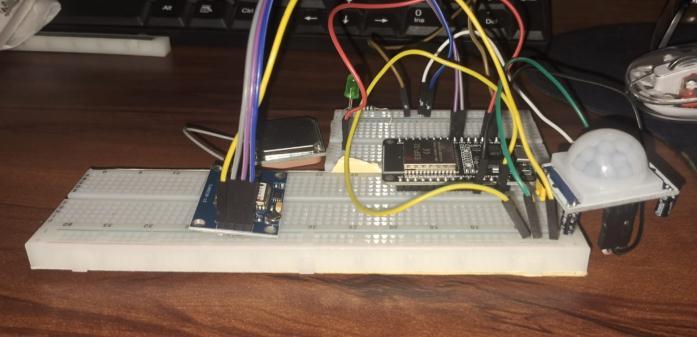
The experimental model consists of an ESP32 microcontrollerintegratedwithaPIRmotionsensorandan ultrasonic proximity sensor to implement the Trakify Proximity andMotionDetectionSystem.TheESP32serves asthecentralprocessingunit,receivingreal-timedatafrom bothsensorsandexecutingprogrammedresponses.
The PIR sensor,placedontherightsideofthebreadboard, detects human motion by sensing variations in infrared
International Research Journal of Engineering and Technology (IRJET) e-ISSN: 2395-0056
Volume: 12 Issue: 12 | Dec 2025 www.irjet.net p-ISSN: 2395-0072
radiation.AgreenLEDindicatorisconnectedtotheESP32to provide immediate visual feedback whenever motion or proximityisdetected.
Allcomponentsaremountedonasolderlessbreadboardand interconnectedusingjumperwiresforpower,ground,and signal connections. The ESP32 is powered via USB and processesincomingsensordatatotriggeroutputactionsor log events for further analysis. This setup effectively demonstratesalow-cost,real-timesensingplatformsuitable for security monitoring, automation, and smart tracking applications.
The Trakifysmart objecttrackingsystem'sdevelopment andtestingofferaworkable,affordable,andefficientwayto improve personal item security. The system effectively provides real-time alerts and positional updates through bothaudio-visualandmobileinterfacesbycombiningGPSbasedlocationtrackingwith motiondetectionusinga PIR sensor and ESP32 microcontroller. The integration of the Blynk IoT platform makes remote monitoring, adding significantusabilityinreal-worldapplications.
Sensor calibration, outdoor testing, and hardware stabilization through PCB integration helped to mitigate issues like GPS signal limitations indoors and false PIR triggers. The prototype's affordability, scalability, and dependability demonstrate its potential as a competitive substitute for more costly commercial tracking systems.
Allthingsconsidered,Trakifyprovidesascalablebasisfor upcoming improvements like cloud-based storage, specialized mobile apps, power optimization, and antitampermechanisms.Becauseofitsversatility,itcanbeused for both personal and more general purposes, such as trackingindustrialassetsandsmarthomes.
We’re truly thankful to the professors at Vishwakarma InstituteofTechnology,Pune,forwalkingusthroughevery step of this journey. Their genuine support and guidance havenotonlyhelpedusovercomechallengesbuthavealso inspiredustopushtheboundariesofourresearch.Wealso wanttogiveabigshout-outtotheauthorsofthereferenced studies;theirgroundbreakingworklaidthefoundationfor ourprojectandcontinuallymotivatesustoexplorefurther. Lastly,we’regratefultoourpeers,mentors,andinstitutions for their steady support and encouragement, which made thisadventureallthemoreenriching.
[1] M. Rahman, A. Hossain, and S. Ahmed, "Design and implementationofalow-costGPS-GSMbasedtracking system," *International Journal of Computer Applications*,vol.177,no.7,pp.15–19,Nov.2019.
[2] P.KarthikandD.JayaPrakash,"IoTbasedassettracking system using ESP32 and cloud integration," *International Research Journal of Engineering and Technology(IRJET)*,vol.7,no.9,pp.2543–2547,Sept. 2020.
[3] R.GuptaandS.Tripathi,"Humanmotiondetectionusing PIR sensor," *International Journal of Computer Applications*,vol.162,no.1,pp.20–23,Mar.2017.
[4] L. Chen and Y. Wang, "Comparative study of motion sensors for security applications," *Sensors and ActuatorsA:Physical*,vol.315,pp.112–120,Jan.2021.
[5] A.SinghandM.Kumar,"PerformanceanalysisofNEO6M GPS module with ESP32 under urban multipath effects," *International Journal of Electronics and CommunicationEngineering*,vol.12,no.3,pp.95–100, Mar.2020.
[6] B. Martinez and X. Vilajosana, "Low-power design strategies for GPS trackers in IoT applications," *IEEE SensorsJournal*,vol.19,no.17,pp.7342–7350,Sept. 2019.
[7] J. Pereira and R. Pinto, "Evaluating IoT platforms for mobile-based tracking applications," *International Journal of Emerging Technology and Advanced Engineering*,vol.11,no.2,pp.48–54,Feb.2021.
[8] T.WangandH.Zhang,"EfficientalertsystemsforIoTbased security devices," *Journal of Communications andNetworks*,vol.22,no.4,pp.302–308,Aug.2020.
[9] L. Li and X. Yu, "Privacy-preserving location data transmission in IoT-based tracking systems," *IEEE Access*,vol.10,pp.45219–45227,May2022.
[10]F.RodriguezandM.Fernandez,"Anti-theftmechanisms inIoTtrackingdevices:Asurveyandimplementation," *International Journal of Security and Networks*, vol. 15,no.1,pp.1–7,Jan.2020.