
International Research Journal of Engineering and Technology (IRJET) e-ISSN:2395-0056
Volume:12Issue:12| Dec2025 www.irjet.net p-ISSN:2395-0072
International Research Journal of Engineering and Technology (IRJET) e-ISSN:2395-0056
Volume:12Issue:12| Dec2025 www.irjet.net p-ISSN:2395-0072
Vikash Mallick1 , Tanmayi Jaiswal2 , Sujal Dhurve3, Arpita Bankar4 , Rakesh Moharle5 , Sushama Telrandhe6
1,2,3,4Dept of CSE, Gurunanak Institute of Engineering and Technology, Nagpur, Maharashtra, India
5Assistant Professor, Dept of CSE, Gurunanak Institute of Engineering and Technology, Nagpur, Maharashtra, India
6Associate Professor, Dept of CSE, Gurunanak Institue of Engineering and Technology, Nagpur, Maharashtra, India
Abstract - Manual preparation of crime records, First Information Reports (FIRs), and charge-sheets remains a significant bottleneck in policing due to human error, proceduraldelays, andinconsistencies in documentation. To address these limitations, this research introduces an AIdriven framework that automates FIR drafting, crime categorization, IPC-based charge-sheet preparation, and penaltyestimation.Thesystemintegratesmachinelearning, natural language processing, and legal-data analytics to classifyoffense types, map themto appropriate IPC sections, and generate structured legal documents. Logistic Regression combined with text-vectorization techniques enables reliable crime classification, while predictive analyticssupportssentencingestimationbasedonhistorical case data. The approach enhances operational efficiency, reduces manual dependency, and ensures uniformity and transparency in law-enforcement workflows. Future extensions may include block chain-based data security and real-timeintegrationwithnationalcrimedatabases.
Key Words: Automated Crime Reporting, FIR Generation, Charge-Sheet Automation, Crime Classification, Logistic Regression, Natural Language Processing, Indian Penal Code (IPC), Judicial Automation, Sentencing Prediction, Predictive Analytics, Machine Learning in Law Enforcement, Legal Document Processing, Crime Data Analysis, AIAssistedPolicing,DigitalForensicsIntegration.
Despite major digital governance initiatives, core components of India’s criminal justice system still rely heavilyonmanualworkflowssuchasFIRdrafting,chargesheet preparation, evidence logging, and IPC-based classification. Such manual dependency increases the likelihood of human error, procedural delays, and inconsistent interpretation of legal guidelines [4]. As police departments process thousands of incident reports daily, these inefficiencies contribute to overburdened courts,casebacklogs,anddelayedjusticedelivery.
AI-driven automation offers transformative potential to address these gaps. NLP methods provide accurate extraction of semantic information from textual
complaints, enabling automated processing of narrative descriptions [1], [12]. ML classification algorithms, especiallyLogistic Regression,NaïveBayes,andXG Boost, have been widely used to classify legal documents and crime types with high accuracy [2], [5]. Similarly, predictive systems have shown promising results in identifying crime trends, forecasting potential criminal behaviour,andestimatingjudicialoutcomes[9].
By integrating these capabilities, the proposed system enables automatic FIR drafting, offense categorization, IPC-mapping, and sentencing prediction. Such automation aligns with global trends where legal AI systems are increasingly used for document screening, case-law retrieval, fraud detection, and judicial decision support [12], [15]. The system thus enhances efficiency, transparency, and fairness within law-enforcement procedures.
AI and NLP have become integral tools in modern legal informaticsduetotheirabilitytointerpret,categorize,and analyse complex textual information. Several major research works highlight their application in criminal justice:
[1] NLPforLegalDocumentation
Studies such as Vattikuti (2024) demonstrate that transformer-basedmodelslikeBERTandGPTsignificantly improve clause extraction, anomaly detection, and document review accuracy in legal workflows [1]. Such systems reduce reliance on manual reading and improve consistency.
[2] AutomatedCrimeClassification
Ku & Leroy (2013) developed a decision-support system using NLP and Naïve Bayes classifiers to categorize crime reports. Their system achieved an accuracy of 94.82%, surpassing human analysts [2]. This demonstrates the reliabilityofMLinautomatedcrimecategorization.
[3] ChargePredictionandLegalReasoning
Yeetal.(2018)introducedatext-to-textmodelgenerating judicial reasoning (“court views”) from case descriptions.
International Research Journal of Engineering and Technology (IRJET) e-ISSN:2395-0056
Volume:12Issue:12| Dec2025 www.irjet.net p-ISSN:2395-0072
Their label-conditioned Seq2Seq architecture improved interpretabilityandshowedstrongapplicabilityforcharge prediction[3].
[4] Ethical&HumanRightsConcerns
Završnik (2020) emphasized that AI in criminal justice must consider fairness, transparency, and risk of bias to avoidreinforcingsystemicinequalities[4].Theseconcerns underline the importance of explainable and accountable AIsystems.
[5] NeuralNetworksforCrimeForecasting
Walczak (2021) and Shah et al. (2021) highlighted how neural networks and computer-vision-based systems can predict crime hotspots, detect anomalies, and classify incidentsusingmultimodaldatasources[10],[11].
[6] DeepLearningandCrimePrediction
Safety et al. (2021) used deep learning models to analyse large datasets from Chicago and Los Angeles, demonstrating strong performance in crime forecasting but also highlighting challenges such as dataset bias and dataimbalance[9].
Acrossliterature,itisevidentthatcombiningNLPandML with legal-domain knowledge can significantly enhance the automation of crime-reporting processes and judicial documentation.
3.SYSTEMARCHITECTURE
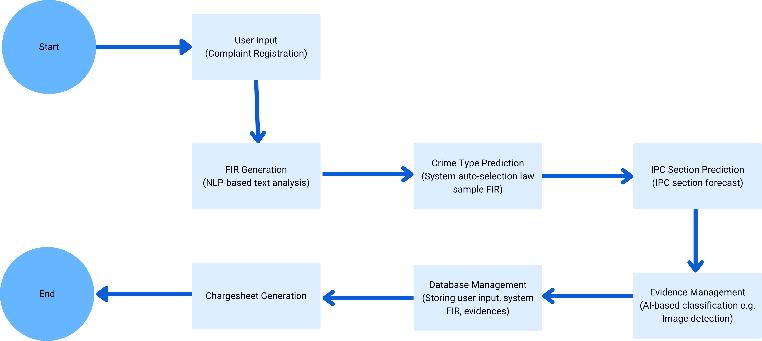
Thearchitecturefollowsamulti-moduledesignwhereeach subsystemcontributestoautomationanddecisionsupport.
1.ComplaintProcessingInterface
Users submit text-based descriptions of incidents. NLP techniques such as tokenization, NER, and dependency parsing help extract essential details. Similar approaches have been used for legal information retrieval and documentclassification.
2.NLP-BasedFIRGenerator
NLPmodelsstructurefree-textinputintoformalFIRfields (crime nature, incident timeline, location, involved persons). Prior research confirms the effectiveness of NLP in legal entity extraction and structured document generation.
3.CrimeClassificationModule
Count Vectorizer transforms text into numerical features, and Logistic Regression classifies the offense into cognizable or non-cognizable categories. Logistic models are commonly used for law-related text classification due totheirinterpretability.
4.EvidenceRepository
Digital evidence images, videos, documents isstoredin a centralized database. Such repositories support efficient
retrieval and cross-case referencing as suggested by forensic-AIresearch.
5.Charge-SheetGenerationEngine
Basedontheoffensetype,thesystemmapstheincidentto relevant IPC sections using pre-programmed legal rules andMLinferences.Similarhybridsystemscombiningrulebased and ML approaches have been proposed in legalanalyticsresearch.
6.SentencingPredictionModule
Using historical case records, the system predicts sentencing severity with ML models. Predictive systems have been used in various legal contexts, including ECHR judgment prediction, US Supreme Court predictions, and legal-judgmentmodelling.
4. FIR GENERATION
The FIR is generated automatically using a structured template.NLPfacilitatesextractionof:
Crimedescriptionandcontextualnarrative
Legalclassification(cognizable/non-cognizable)
Spatio-temporalattributes
Suspect/witnessidentification(NER)
Evidence summary extracted from uploaded documents
Officerassignmentandcasestatus
Thesystemoutputs:
Crimecategory(cognizableornon-cognizable)
StructuredFIRgeneratedthroughNLP
IPC-mappedcharges(forcognizableoffenses)
Recommended sentencing ranges based on ML predictions ML-based classification reliability is evaluated using accuracy,precision,recall,andF1-score,similartometrics usedincrime-forecastingstudies[9],[10]
International Research Journal of Engineering and Technology (IRJET) e-ISSN:2395-0056
Volume:12Issue:12| Dec2025 www.irjet.net p-ISSN:2395-0072
This research confirms that integrating NLP and ML can significantly automate essential components of criminaljustice workflows. FIR drafting, offense classification, IPC mapping, andsentencing prediction traditionally manual andtime-consumingtasks canbereliablyautomated.The proposed system draws on proven methodologies such as Logistic Regression, Seq2Seq reasoning, crime-prediction models, and forensic-AI frameworks [1]–[14], [16]. Future improvements include adoption of transformer-based models, block chain-backed audit trails, and real-time connectivity with national crime databases for end-to-end automation. These advancements mark a major step toward transparent, efficient, and technologically empoweredcriminal-justiceadministration.
[1] Vattikuti, Manoj Chowdary. “Natural Language Processing for Automated Legal Document Analysis and Contract Review.” International Journal of Sustainable DevelopmentinFieldofIT,vol.16,no.16, 2024.
[2] Ku, Chih-Hao, and Gondy Leroy. “Automated Crime Report Analysis and Classification for E-Government and Decision Support.” Proceedings of the 14th Annual InternationalConferenceonDigitalGovernmentResearch, 2013.
[3] Ye, Hai, et al. “Interpretable Charge Predictions for Criminal Cases: Learning to Generate Court Views from Fact Descriptions.” arXiv preprint arXiv:1802. 08504, 2018.
[4] Završnik, Ales. “Criminal Justice, Artificial Intelligence Systems, and Human Rights.” ERA Forum, vol. 20, no. 4, 2020.
[5] Jenga, Karabo, Cagatay Catal, and Gorkem Kar. “Machine Learning in Crime Prediction.” Journal of Ambient Intelligence and Humanized Computing, vol. 14, no.3,2023,pp.2887–2913.
[6] Jeong, Doowon. “Artificial Intelligence Security Threat, Crime, and Forensics: Taxonomy and Open Issues.” IEEE Access,vol.8,2020,pp.184560–184574.
[7]King,ThomasC.,etal.“ArtificialIntelligenceCrime:An Interdisciplinary Analysis of Foreseeable Threats and Solutions.” Science and Engineering Ethics, vol. 26, 2020, pp.89–120.
[8] Sushina, Tatyana, and Andrew Sobenin. “Artificial IntelligenceintheCriminalJusticeSystem:LeadingTrends and Possibilities.” 6th International Conference on Social, Economic, and Academic Leadership (ICSEAL-6-2019), AtlantisPress,2020.
[9]Safat,Wajiha,SohailAsghar,andSairaAndleebGillani. “Empirical Analysis for Crime Prediction and Forecasting Using Machine Learning and Deep Learning Techniques.” IEEEAccess,vol.9,2021,pp.70080–70094.
[10] Shah, Neil, Nandish Bhagat, and Manan Shah. “Crime Forecasting: A Machine Learning and Computer Vision Approach to Crime Prediction and Prevention.” Visual Computingfor Industry,Biomedicine,andArt,vol.4,no.1, 2021.
[11] Walczak, Steven. “Predicting Crime and Other Uses of Neural Networks in Police Decision Making.” Frontiers inPsychology,vol.12,2021,587943.
[12] Surden, Harry. “Artificial Intelligence and Law: An Overview.” Georgia State University Law Review, vol. 35, 2018,p.1305.
[13] Yang, Wenmian, Weijia Jia, Xiaojie Zhou, and Yutao Luo. “Legal Judgment Prediction via Multi-Perspective BiFeedback Network.” arXiv preprint arXiv:1905 .03969, 2019.
[14] Medvedeva, Masha, Michel Vols, and Martijn Wieling. “Using Machine Learning to Predict Decisions of the European Court of Human Rights.” Artificial Intelligence andLaw,vol.28,no.2,2020,pp.237–266.
[15] Ashley, Kevin D. Artificial Intelligence and Legal Analytics: New Tools for Law Practice in the Digital Age. Cambridge UniversityPress,2017.
[16] Zhong, Haoxi, Zhipeng Guo, Cunchao Tu, Chaojun Xiao, Zhiyuan Liu, and Maosong Sun. “Legal Judgment Prediction via Topological Learning.” Proceedings of the 2018 Conference on Empirical Methods in Natural LanguageProcessing,pp.3540–3549, 2018.