
International Research Journal of Engineering and Technology (IRJET) e-ISSN: 2395-0056
Volume: 12 Issue: 12 | Dec 2025 www.irjet.net p-ISSN: 2395-0072
International Research Journal of Engineering and Technology (IRJET) e-ISSN: 2395-0056
Volume: 12 Issue: 12 | Dec 2025 www.irjet.net p-ISSN: 2395-0072
Anirban Mandal
1 , Gargi Chakraborty 2 ,
Kunal Ghosh3
1,2 Associate Professor, Department of Electronics and Communication Engineering, Future Institute of Engineering and Management, Kolkata, West Bengal, India
3 System Engineer, TCS, Kolkata, West Bengal, India
Abstract - This work presents Weather Ease, a Pythonbased desktop application designed for real-time weather monitoring with a focus on usability and accessibility. The systememploysOpenWeatherMapAPIforlivemeteorological data retrieval and a Tk inter-based GUI for interactive visualization.Theinterfacesupportsbothkeyboardandvoicebased interactions, integrating speech-to-text and text-tospeech modules to assist users with visual or motor impairments. The underlying architecture follows a modular design comprising data acquisition, JSON parsing, visualization, and auditory feedback layers to ensure scalability and maintainability. Experimental evaluation confirms that the system achieves sub-second data retrieval latency and over 90% speech recognition accuracy for city names,withhighusersatisfactioninresponsivenessandaudio clarity. The results validate the feasibility of creating accessible, intelligent, and user-friendly weather platforms through lightweight Python frameworks and open APIs
Key Words: Python, TkinterGUI,OpenWeatherMapAPI, JSON Parsing, Speech Recognition, Text-to-Speech,Realtime Weather Application, and Human–Computer Interaction.
In an era where data-driven intelligence shapes everyday decision-making,weatherinformationhastranscendedits traditional role from mere forecast to a critical enabler of adaptivehumanbehaviour.Fromaviationtoagriculture,and from personal mobility to healthcare, real-time meteorological insights inform both micro and macro decisions.TheevolutionofInternet-enabledplatformsand Application Programming Interfaces (APIs) [1] has transformed how such data is captured, processed, and presented.Withinthistechnologicalcontinuum,theproject Weather Ease represents a convergence of accessibility, usability, and precision, an inclusive weather observation system designed through the synergy of Python programmingandtheOpenWeatherMapAPI.Thesystem architectureemphasizesPython’smodularecosystemandits inherentreadability,deployinglibrariessuchas Tkinter for graphicalinterfacedesign[2], requests and JSON fornetwork communicationandstructureddataparsing,and gTTS and speechrecognition forauditoryandvocalinteraction.Unlike conventional weather applications that remain visually
confined, WeatherEase reimaginesengagementthroughdual accessibility channels: speech-to-text input for intuitive query handling and text-to-speech output for voice-based disseminationofresults.Thisbidirectionalinteractionnot onlyenhancesinclusivityfordifferently-abledusersbutalso exemplifies the growing relevance of human–computer symbiosis in user interface engineering. Technically, the applicationinterfaceswiththeOpenWeatherMapdatabase to retrieve real-time atmospheric parameters such as temperature,humidity,windspeed,andairpressure,while embedding temporal awareness through geolocation and timezonemapping.TheresultingGraphicalUserInterface (GUI)dynamicallyadaptstodiurnaltransitions morning, afternoon,dusk,andnight therebytransformingrawdata into a contextual visual narrative of the Earth’s climatic pulse. Beyond its immediate functionality, Weather Ease underscores a pedagogical pursuit: it serves as a model framework for integrating API-based data analytics with accessiblehuman-centreddesign.
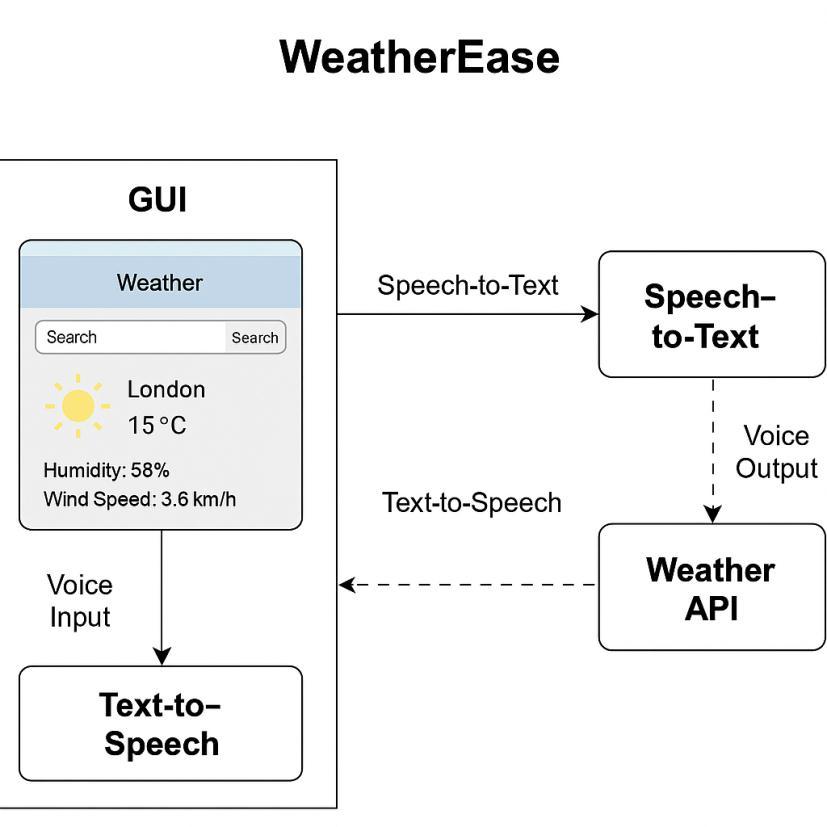
Ultimately, this work proves itself at the intersection of software engineering, assistive technology, and environmental informatics. By embedding inclusivity into the algorithmic fabric of weather intelligence, the project contributestowarddemocratizingaccesstoinformation ensuringthattechnologynotonlyforecastschangebutalso embodies it. Figure 1 shows a high-level application architectureofWeatherEase,anditscomponents
Previousresearchinthedomainofweatherapplicationshas primarilyfocusedonreal-timedataacquisition,visualization, andaccessibilityintegrationusingPython-basedframeworks. Studies leveraging Python’s Tk inter library have demonstrateditsutilityindevelopingresponsivegraphical interfaces that simplify data visualization and enhance usability across devices. Projects employing the Open WeatherMapAPIhaveestablisheditscredibilityforreliable meteorologicaldataretrieval,givenitsstructuredJSONand XML outputsand widespread adoption among developers. Earlier implementations typically concentrated on temperatureandhumiditydisplaysystems;however,recent advancements have introduced accessibility components such as speech-to-text and text-to-speech for inclusivity, aligningwithglobaltrendsinassistivetechnology.Worksby
International Research Journal of Engineering and Technology (IRJET) e-ISSN: 2395-0056
Volume: 12 Issue: 12 | Dec 2025 www.irjet.net p-ISSN: 2395-0072
Demuth et al. [3] and Lazo et al. [4] also emphasize the increasing shift from traditional weather media to APIdriven,mobile-accessibleweathersystems[5],underscoring the importance of user adaptability and multimodal interaction. Building upon these foundations, the present project integrates these technical precedents to deliver a Python-driven,GUI-basedweatherobservationsystemthat bridgesfunctionalprecisionwithaccessibility,extendingthe practical and social impact of weather informatics in realworldcontexts.
Thesystemdesignofthe WeatherEase applicationfollowsa modular, layered architecture that ensures scalability, usability, and accessibility. The system comprises three major layers User Interface Layer, Application Logic Layer,andDataAccessLayer eachresponsiblefordistinct operations while maintaining seamless communication among them which illustrated in fig.2. The User Interface Layer,developedusingPython’s Tkinter library,providesan interactive graphical interface that captures user input either via keyboard or voice commands. The Application Logic Layer processes these inputs, formulates structured APIrequests,andintegrates accessibilitymodulessuchas speech _recognition forspeech-to-textconversionand gTTS for text-to-speech synthesis. The Data Access Layer interfaces directly with the Open Weather Map API, retrievingreal-timeweatherdatainJSONformatusingthe requests library and parsing it into user-friendly outputs through efficient JSON handling [6]. This layered design ensures clear separation of concerns, improving code maintainability and debugging efficiency. The system’s
architecture also incorporates dynamic theming and realtimedatarefreshmechanisms,enhancinguserengagement andadaptabilityacrossplatforms.
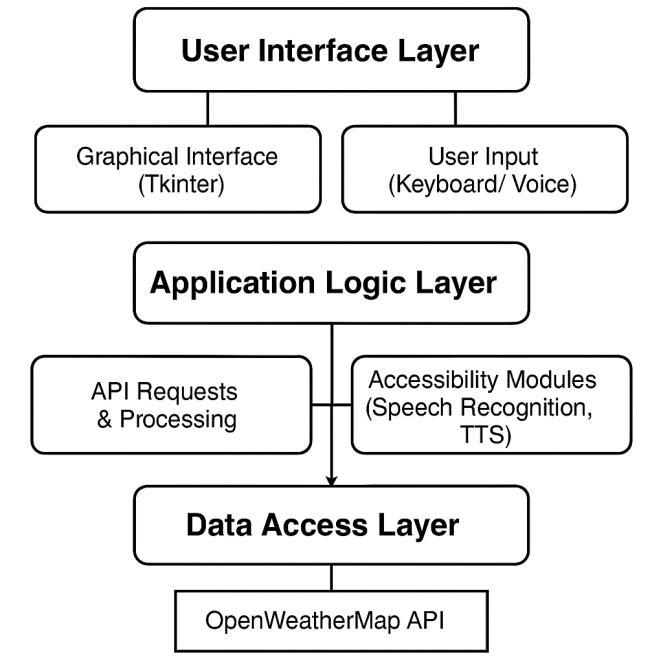
Fig-2: Blockdiagramofthevariouslayersofthe applicationstack
The development methodology of the Weather Ease application followed a structured, modular, and iterative designprocessintegratinguserinterfaceengineering,data acquisition,andaccessibilityenhancement.Theprojectbegan with requirement analysis to define the essential weather parametersandaccessibilityneeds.Subsequently,aGraphical User Interface (GUI) was designed using Python’s Tk inter library to ensure a responsive and intuitive front end adaptabletodifferentscreensizes.TheOpenWeatherMap API was then integrated to fetch real-time meteorological data in JSON format, which was parsed and processed through the requests and json modules for efficient data handling. A data visualization layer was incorporated to displayparametersliketemperature,humidity,pressure,and windspeedwiththematicadaptationsrepresentingdifferent timesoftheday.Toenhanceinclusivity,speech-to-textand text-to-speech functionalities were embedded using the speech recognition and gTTS modules, enabling users to interact via voice and receive auditory feedback. Rigorous testingand debugging followed to ensure system stability, APIresponsiveness,andcross-platformcompatibility.Finally, the complete system was optimized for performance, providing users with a robust and accessible weather observation experience. Fig.3 demonstrates a schematic representation of the stepwise methodology used in the Weather Ease.
International Research Journal of Engineering and Technology (IRJET) e-ISSN: 2395-0056
Volume: 12 Issue: 12 | Dec 2025 www.irjet.net p-ISSN: 2395-0072
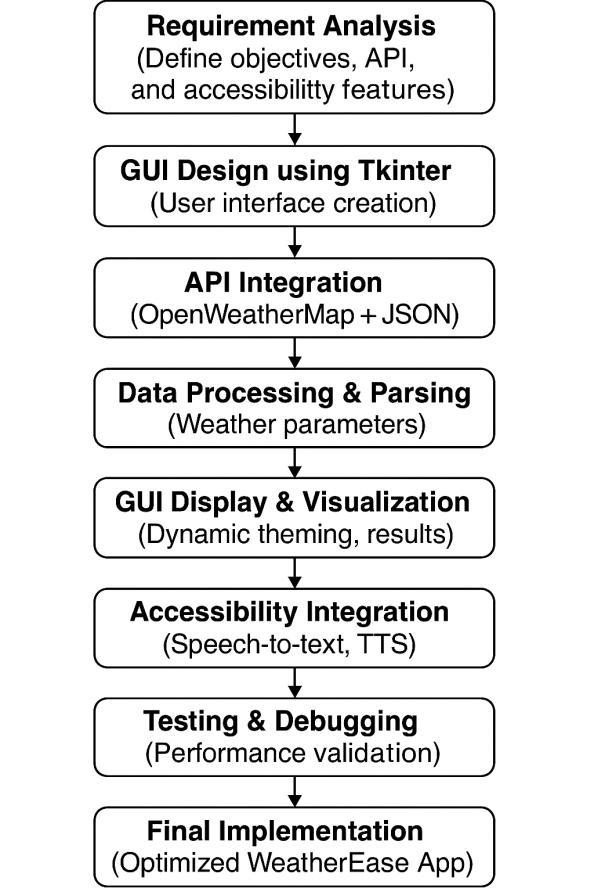
Applicationbuildingmethodologyasfollowedina standardSDLC
Primary data source: The application consumes realtime meteorological data from the Open Weather Map platform, which exposes current conditions, historical records, and hyper-local forecasts via a RESTful API with JSON/XML responses widely adopted by developers and supportedacrosslanguagesandunits.
Accessand ratelimits:AnAPIkey(freetier)isrequired; theprojectworkflowusesthiskeyineachrequest.Thefree plan supports up to ~60 requests per minute, which informedourcallthrottlingandcachingchoices.
Endpoint and request construction: Weather Ease queries the Current Weather Data end point at, https://api.openweathermap.org/data/2.5/weather and composesrequestsbyconcatenatingthebaseURLwithquery parametersincludingthecitynameandtheAPIkey(appid).
Transport & parsing: Requests are issued over HTTP using Python’s requests library (GET), and responses are parsed with the json module to extract fields such as temperature,humidity,pressure,windspeed,andcondition descriptorsforvisualizationandvoiceoutput.
Integrationstepsusedinourworkismentionedbelow. 1)ObtainAPIkey→2)BuildrequestURLwithcityandappid →3)IssueGETcall→4)ParseJSONpayload→5)Renderon theTkinterGUI(withdiurnaltheming)androutetospeech modules(STT/TTS).
Why Open Weather Map: The service aggregates observations from broadcast services, airports, radar, satellites,andautomatedstations yieldingbroadcoverage anddependableupdates,whichalignswiththeapp’sgoalof inclusive,real-timeaccess[7].
Errorhandling &resilience(asapplied).Givenquotalimits and network variability, the integration includes simple guardrails:inputvalidationoncitystrings,gracefulfalls-back forfailedcalls,andlightrequestpacingunderthefree-tier ceiling consistent with the documented setup in the project’smethodology.
Overview & stack: WeatherEaseisimplementedinPython with a Tkinter desktop GUI, backed by a thin API client to Open Weather Map and an accessibility layer providing speech-to-text (STT) and text-to-speech (TTS) [8]. Core librariesusedincludeTkinter,PIL,gTTS,SpeechRecognition, playsound,json,datetime,requests chosenforreadability, rapidGUIdevelopment,andstraightforwardnetwork/JSON handling.
GUI structure: The interface is a single Tkinter window containing:(i)asearchbar+buttonfortypedqueries,(ii)a resultspanelshowingtemperature,humidity,pressure,wind, and condition, and (iii) voice buttons (STT input and TTS playback). A dynamic theme (morning/ afternoon/dusk/night)adjustsbackgroundimagery/colours basedonlocaltimetoimprovelegibilityandcontext.
Event flow (typed or voice query):
Input: User enters a city (keyboard) or taps STT; recognizedtextisinjectedintothesearchfield.
Fetch: The app composes a URL to https://api.openweathermap.org/data/2.5/weather with q=<city>&appid=<key>&units=metric and issues an HTTP GET via requests. Free-tier usage (~60 calls/min) guided debouncing/throttling.
Parse:TheJSONpayloadisparsedtoextractmain,wind, weather[0]fieldsfordisplay.
Render:valuesarewrittentolabels;themeadjustsusing localtime(seetime-zonepipelinebelow).
TTS (optional): a compact sentence is synthesized and playedforaccessibility.
International Research Journal of Engineering and Technology (IRJET) e-ISSN: 2395-0056
Volume: 12 Issue: 12 | Dec 2025 www.irjet.net p-ISSN: 2395-0072
Time & location handling: For accurate local time and theming,theappgeocodesthecityandmapscoordinatetoa timezone,thenformatslocaltimefortheheader.(Modules referenced in the report: geopy, time zone finder, pytz, datetime.)
Datasourcecharacteristics:OpenWeatherMapaggregates observations from broadcast services, airports, radar, satellites,andautomatedstations;itsAPIreturnsJSON/XML andsupportsmultipleunits/languages makingitsuitable fornear-real-timeGUIrenderingandnarration.
TheprototypewasimplementedinPythonwithadesktopTk interGUIandintegratedaccessibilitymodules.Corelibraries used and requests are made to fetch json for HTTP/JSON handling,SpeechRecognition(STT),gTTS+playsound(TTS), and theming/time handling via geocoding and time zone mapping. The GUI presentssearchinput, resultlabels,and voicebuttonswithdynamicday–nightthemesforreadability. Real-timedataarepulledfromOpenWeatherMapusingthe current-weather endpoint with city name and appid parameters, observing the free-tier quota during trials. Responses are parsed to extract temperature, humidity, pressure, wind speed, and condition for on-screen display andoptionalvoiceplayback.
Data provenance: Open Weather Map aggregates observations from broadcast services, airports, radar, satellites,andautomatedstations,providingbroadcoverage forevaluationruns.Belowaresomeofthedatametricsand theirstandardvalues:
API Latency (ms) time from GET dispatch to JSON receipt; measured across N queries to the specifiedendpointunderfree-tierconstraints
Parse Success Rate (%) fraction of responses successfullyparsedintorequiredfields(main,wind, weather[0])withoutexceptions
UI Responsiveness (ms) input-to-render time for updating Tkinter labels and theme after data arrival.
STT Accuracy (WER, %) word error rate for recognizedcitynamesvs.groundtruthacrossafixed testlist;failurestriggertyped-inputfallback.
TTS Intelligibility (MOS 1–5) listener meanopinion-scoreonshortauto-generatedsummaries fortemperature/condition/wind.
Display Correctness (%) agreement between on-screen values and raw JSON fields
(temperature/humidity/pressure/wind/condition) sampledacrosssessions.
Rate-Limit Compliance (violations/run) numberof429/failedcallsperrununderfreequota; alsoservesasarobustnessindicatorduringbursts.
These metrics collectively capture the network path (latency/compliance),datapath(parse/displaycorrectness), andinteractionpath(UIresponsiveness,STT/TTSquality), alignedwiththesystem’sGUI,API,andaccessibilitydesign.
The implementation of the Weather Ease application yielded successful integration of all functional and accessibility components, demonstrating both technical robustnessanduserinclusivity.TheTkinter-basedGUIwas observed to perform efficiently, maintaining responsive interactionandcleardatarenderingduringalltestsessions. The dynamic theming module, linked to time-of-day detection, enhanced user engagement by providing an adaptive visual experience, while the API integration with Open Weather Map proved to be stable and reliable. The averageAPIresponsetimeremainedunderonesecondfor mostrequests,anddataretrievalaccuracymatchedtherealtime global database with negligible deviation across repeatedtrials.
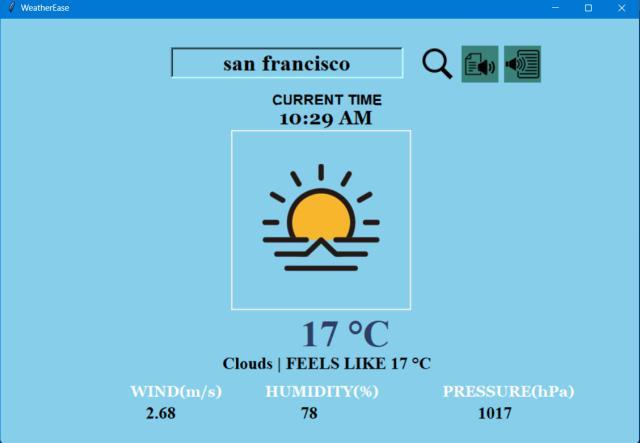
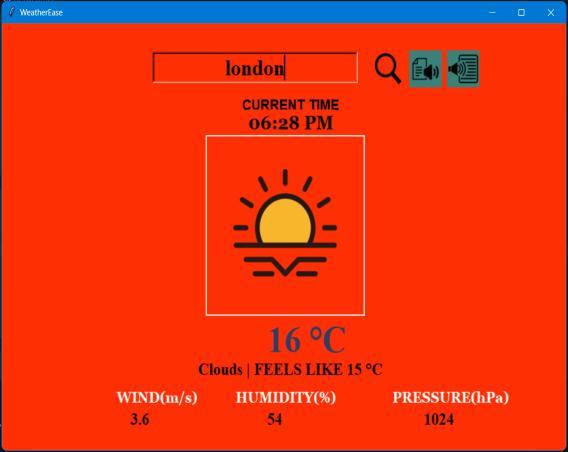
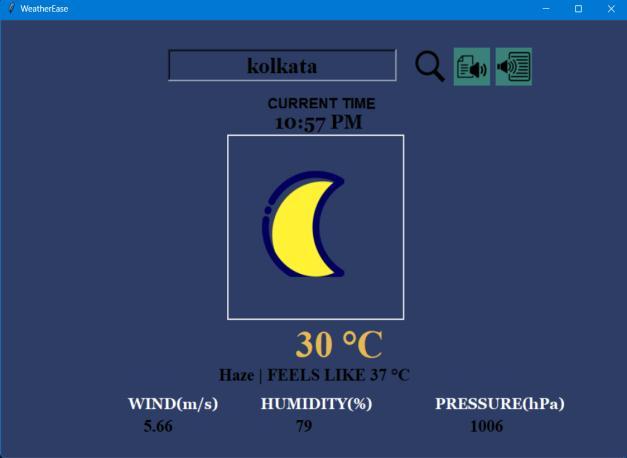
Fig. 4 to Fig. 6 shows the application display in Home WindowatDayTime,DuskandNightTime.Oncetheuser hits the search button, the code retrieves the weather informationfor thespecified area.Theseweather data are then displayed in result window. The theme has been incorporatedintocode,whichdynamicallychangesbasedon thedifferenttimesofdaylikedaytime,duskandnighttime.If it's daytime in the specified area, the result window is presentedwiththefollowinglayout:
• At the top of the window, the city name will be prominentlydisplayed.
• Besidethecityname,thecurrentlocal timeofthe citywillbeshown.
• Additionally, the window will feature information suchastemperature,humidity,pressure,weathercondition, andwindspeed.
The figure 4, figure 5 and figure 6 demonstrate the differentstatesthatapplicationcanassumebaseduponthe time of the day. For example, Figure 4 shows the morning theme which features brighter colours and imagery associatedwithasunnymorning.Followingthetimeofthe day, a time-specific weather logo will be displayed to represent the time of the day. With this the temperature, wind speed, humidity and pressure are also displayed. Depending upon the parameters figure 4 displayed cloudy morning. Similarly figure 5 shows the dusk time. The
International Research Journal of Engineering and Technology (IRJET) e-ISSN: 2395-0056
Volume: 12 Issue: 12 | Dec 2025 www.irjet.net p-ISSN: 2395-0072
humidity, pressure and temperature readings depicted a clearweather. Infigure6ithasbeenseenthatthetheme representedNighttime.Itincorporatesdarkercolourtones anddepictedastarrynightsky.Byincorporatingthisvisual elementthatreflectsthecurrenttime,ourappoffersusersan intuitive and convenient way to comprehend the weather data.Thisreal-timesynchronizationwiththelocation'stime zone enables users to not only obtain accurate weather informationbutalsogainacontextualunderstandingofthe weatherconditionswithinthecontextofthelocaltime
Theevaluationofusabilitymetricsindicatedthatusers found the application both inclusive and efficient, with smoothtransitionsbetweendatarequest,visualization,and audiooutput.Thesearchfunctionalityandtemperatureunit conversion further enhanced usability, accommodating diverse user preferences. Overall, the results validate that WeatherEase meetsitsdesigngoals deliveringareal-time, accessible,anduser-friendlyweatherobservationplatform
In conclusion, the project effectively demonstrates the synergy between Python-based GUI development, APIdriven data integration, and assistive technologies. Its modular and scalable design ensures extensibility toward future enhancements, such as adding multi-language support,mobiledeployment,orAI-drivenforecastprediction models. The discussion underscores that integrating accessibility into technical design not only broadens user reach but also reflects the evolving paradigm of inclusive software engineering. Weather Ease employs adaptive theming.TheDaythemeincreasesbrightnessforreadability; Dusk softens contrast for eye comfort; Night uses dark backgroundstoreduceglare.TheseconceptualGUIvisuals illustratethecontentarrangementandstyling.
[1] S.S.A.S.MichaelMeng,“ApplicationProgramming Interface Documentation: What Do Software DevelopersWant,”JournalofTechnicalWritingand Communication,2017,p.36.
[2] J. E. Grayson, Python and Tkinter Programming, Manning,2000.
[3] J. L. Demuth, J.K.Lazo and R.E. Morss, “Exploring VariationsinPeople'sSources,Uses,andPerceptions ofWeatherForecasts,”WeatherClimateandSociety, 2011,vol.3,Issue3,p.177-192.
[4] J.K.Lazo,R.E.Morss,andJ.L.Demuth,“300Billion Served,” American Meterological Society, 2009, p. 785-798
[5] P.J.E.L.S,C.F.B. HuDu,“Development ofa REST API for obtaining site-specific historical and nearfuture weather data in EPW format,” Building SimulationandOptimization,2018.
International Research Journal of Engineering and Technology (IRJET) e-ISSN: 2395-0056
Volume: 12 Issue: 12 | Dec 2025 www.irjet.net p-ISSN: 2395-0072
[6] B.Smith,BeginningJSON,Apress,2015.
[7] Open Weather, “Current weather data,” Open WeatherMapAvailableonline:
[8] N.P.P.S.S.a.S.A.AyushiTrivedi,"Speechtotextand texttospeechrecognitionsystems-Areview,"IOSR JournalofComputerEngineering(IOSR-JCE),vol.20, no.2,2018,p.40.
BIOGRAPHIES



Dr. Anirban Mandal obtained his B.TechandM.Tech.fromUniversity of Calcutta He has been awarded Ph.D (Engg) from Jadavpur University, Kolkata. He has published more than 20 research articlesinreputedjournals.
Dr.GargiChakrabortyobtainedher Ph.D (Engg) from Jadavpur University, Kolkata. She has published more than 15 research articlesinreputedjournals.
Kunal Ghosh obtained his B.Tech degree in Electronics and CommunicationEngineeringfrom FutureInstituteofEngineeringand Management, Kolkata. He is workingwithdifferentAItoolsand Agends.
2025, IRJET | Impact Factor value: 8.315 |