
Teaching with AI: Faculty Perspectives on Content Creation, Student Engagement and Writing Support
Goutam Mondal
Assistant Professor, Dept. of Education, Seth Anandram Jaipuria College, WB
Abstract - This study explores the perceptions and experiences of undergraduate college teachers in West Bengal regarding the use of Artificial Intelligence (AI) tools in higher education, with a specific focus on content creation, student engagement, and writing support within diverse classroom settings. The research employed a descriptive survey method, collecting data from 32 faculty members across multiple undergraduate colleges in the region through structured questionnaires. The findings indicate that a majority of teachers recognize the positive impact of AI tools in facilitating personalized learning, enhancing student participation, and improving academic writing. Many respondents highlighted how AI-assisted platforms enabled them to tailor content to individual learner needs, monitor student progress more effectively, and increase classroom efficiency. Teachers also observed improvedstudent motivation andinteractionwhenAI was integratedthoughtfullyintolessons.Despitethesebenefits, several challenges were identified. Concerns were raised aboutthelackoftechnicalknow-how,limitedinstitutional training, potential data privacy risks, and fears that overdependence on AI might diminish the human connection fundamental to effective teaching. The study concludes that while AI tools hold transformative potential in pedagogical practice, their successful integration demands adequate teacher training, institutional support, and clear ethical guidelines to ensure meaningful and responsible use in educational contexts.
Key words: Artificial Intelligence, Content creation, student engagement, writing support, personalized learning,student’sparticipation,ethicalguidelines.
1. INTRODUCTION
Artificial Intelligence (AI) is changing how teaching and learning happen in classrooms around the world. AIpowered tools such as ChatGPT, Grammarly, Google Gemini, and others are helping teachers create content, support student writing, and make learning more engaging (Zawacki-Richter et al., 2019). These tools can offer quick feedback, suggest improvements, and even adjust learning material to meet the needs of different students. As a result, many educators see AI as a useful waytoimprovethequality andefficiencyofteaching. In India, the use of AI in education is still growing,
especially in undergraduate colleges where classrooms areoftenlargeandstudentscomefromdiverselanguage and cultural backgrounds. In terms of West Bengal, college teachers are starting to use AI tools to better connect with students and improve teaching practices. Most studies focus on how students benefit from AI, but teachers' views are equally important because they are theoneswhodecidehowandwhentousetechnologyin the classroom (Luckin et al., 2016). In teaching and learning process, AI tools are now being used in three main areas: content creation, student engagement, and writing support. Content creation tools help teachers to design and to develop the lessons or contents more effectively and quickly Engagement tools make it easier to hold students’ attention and keep them involved during class. Writing support tools, like Grammarly and ChatGPT,assistbothteachersandstudentsinimproving grammar, correction, clarity and structure in writing (Holmes et al., 2022). These uses can be especially helpful in Indian classrooms, where English may not be the first language for many learners. But some teachers feel unsure about how these tools actually work and whether they can trust the results. Others worry about studentdataprivacyandfearthatrelyingtoomuchonAI may reduce real human interaction in the classroom (Williamson & Eynon, 2020). These concerns make it clearthatwhileAIoffersmanyadvantages,italsobrings new challenges that teachers must deal with. Given this background, the purpose of this study is to explore how undergraduate college teachers in West Bengal perceive and experience the use of AI tools in their teaching in threebasicareas:contentcreation,studentengagement, and writing support. To achieve this, the study answers thefollowingquestions:
1. What are undergraduate teachers’ perceptions ofusingAItoolsforcontentcreation?
2. How do teachers experience AI tools in supportingstudentengagementandwriting?
3. What challenges and concerns do teachers face whileusingAIintheirclassrooms?
2. LITERATURE REVIEWS
According to Zawacki-Richter et al. (2019), AI in education is mainly applied in four areas: intelligent
International Research Journal of Engineering and Technology (IRJET) e-ISSN:2395-0056
Volume: 12 Issue: 08 | Aug 2025 www.irjet.net p-ISSN:2395-0072
tutoring systems, automated assessment, learning analytics, and AI-assisted content creation. These tools help teachers save time, respond to students’ needs moreeffectively,andpersonalizeinstruction.
In many countries, especially in developed regions, AI tools are being used successfully to improve learning outcomes. For example, platforms like Grammarly assist students with grammar and style, while tools like ChatGPT can generate essay ideas, summaries, and even completeassignments(Holmesetal.,2022).
IntheIndiancontext,theNationalEducationPolicy2020 encourages the use of digital tools and AI to improve education quality and accessibility. However, the actual useofAIinIndianundergraduatecollegesisstilllimited and uneven. While some private institutions and urban colleges are experimenting with AI-based teaching aids, many government and rural colleges lack proper training, infrastructure, or awareness (Kumar & Babu, 2021).
Singh and Sharma (2022) found that students using AI writing tools performed better in academic tasks but often became overly dependent on the technology. On the other hand, limited attention has been given to how teachers view and use these tools. Yet, as Luckin et al. (2016) pointed out, the success of AI in education depends largely on how well teachers understand and implementitintheirclassrooms.
Some global studies have raised concerns about the ethicalandpedagogicalimplicationsofAI.Teachers may not fully understand how AI tools make decisions or provide feedback, leading to confusion or mistrust (Williamson & Eynon, 2020). Data privacy is another majorconcern,asmanyAItoolscollectuserinformation, which can be misused if proper safeguards are not in place.
InWestBengal,wherealargenumberofstudentscome from rural and semi-urban areas, teachers face the dual challenge of dealing with diverse learning needs and limitedresources.
MukherjeeandGhosh(2021)conductedasmallstudyon ICTadoptionamongteachersinSouthBengalandfound that while most teachers had a positive attitude toward technology, many lacked practical experience with AI tools.Theywerewillingto exploretoolslikeGrammarly or Google Docs’ smart suggestions, but expressed uncertaintyaboutmoreadvancedAIsystems.Thedigital divide between urban and semi-urban/rural colleges wasakeyconcern.
Chatterjee (2022) noted that while some undergraduate teachers in Kolkata colleges had begun experimenting
with ChatGPT for lesson summaries or student queries, others were hesitant due to lack of awareness or fear of being replaced by technology. The same study highlighted that many teachers wanted institutional support and guidelines to ensure responsible AI use especially when it comes to student data privacy and ethicalclassroompractices.
Another challenge in West Bengal is the multilingual natureofclassrooms.Manystudentsarefirst-generation learnersandmay not befluent in English.Insuchcases, AI-powered writing tools like Grammarly, QuillBot, or ChatGPT can support students by providing grammar correction, vocabulary suggestions, and writing structureguidance.
However, Sen (2023) pointed out that students often rely too heavily on these tools, bypassing the learning process, which puts pressure on teachers to maintain academicintegrity.
Moreover, some teachers fear that overuse of AI could reduce the human element in teaching a concern also shared by international researchers (Williamson & Eynon, 2020). In the culturally rich and socially diverse environment of West Bengal, teacher-student relationshipsoftenextendbeyondacademics.Theuseof AImust be balanced sothat technologysupports, rather than replaces, the teacher’s role in motivating and mentoringstudents.
However, most of the existing studies in India focus on urban, private institutions or student-centred perspectives. Little attention has been given to the grassroots-level experiences of teachers especially in states like West Bengal, where the higher education landscape includes a mix of government-aided, private, andruralcollegeswithvariedlevelsofdigitalreadiness.
To summarize, while AI tools offer promising solutions for enhancing content creation, improving student engagement, and supporting writing in undergraduate classrooms, their use in West Bengal is still in the early stages. Teachers are curious and willing, but they face barriers related to training, institutional support, and ethical clarity. This study contributes to the limited but growing body of research focused on how undergraduate college teachers in West Bengal are experiencingandrespondingtotheintroductionofAIin theirpedagogicalpractices.
3. CONCEPTUAL FRAMEWORK
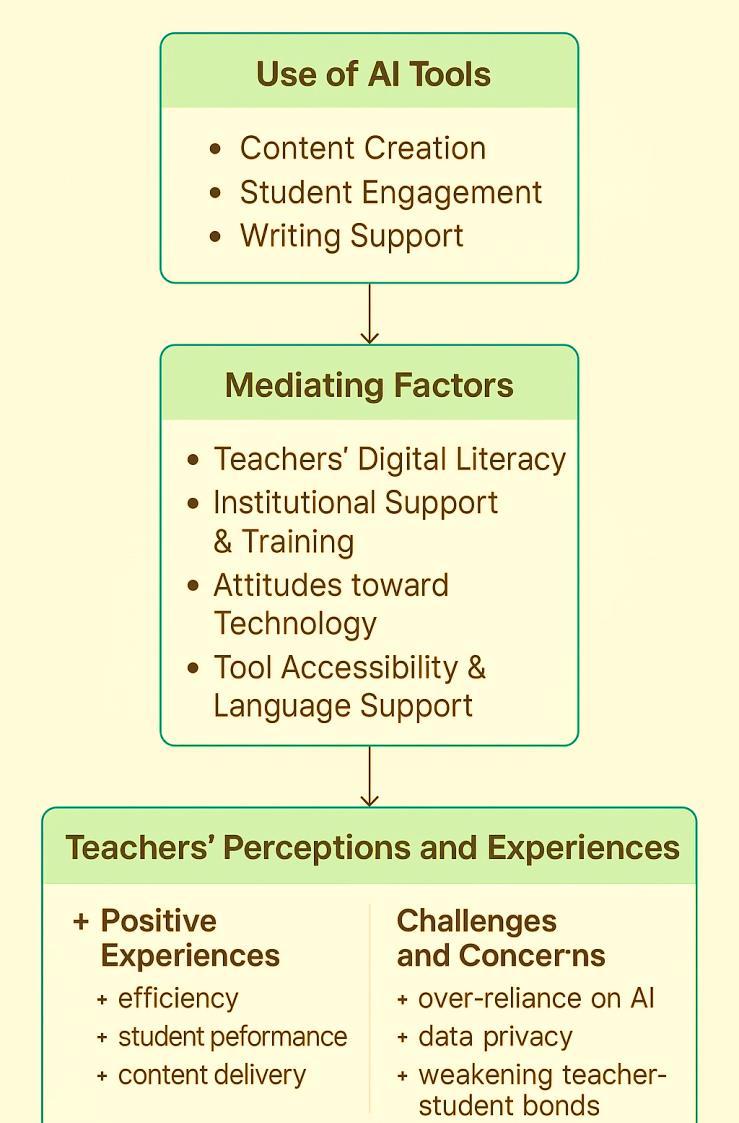
The integration of Artificial Intelligence (AI) tools in higher education is influenced by multiple factors that shape how educators perceive, adopt, and implement thesetechnologiesintheirteaching.Thisstudydrawson
International Research Journal of Engineering and Technology (IRJET) e-ISSN:2395-0056
Volume: 12 Issue: 08 | Aug 2025 www.irjet.net p-ISSN:2395-0072
a practical, teacher-cantered framework that highlights the relationship between the use of AI tools, the mediating conditions in the teaching environment, and theresultingperceptionsandexperiencesofteachers.
At the core of the framework is the use of AI tools, specificallyinthreedomains:
1. Content Creation – the use of AI to generate teaching materials, lesson plans, and subject explanations.
2. Student Engagement – the use of AI features to keep students involved, including LMS, digital technologies, chatbots, personalized learning activities,andfeedbacksystems
3. Writing Support – the use of grammar, writing enhancement, and paraphrasing tools to help studentsimproveacademicwritingskills.
Theirimpactisshapedbyseveralmediatingfactors:
a) Digital Literacy of Teachers – teachers’ comfort and skill level in using digital technologies and AItools.
b) Institutional Support and Infrastructure –availabilityoftrainingprograms,stableinternet, access to AI platforms, and administrative encouragement.
c) Teacher Attitudes and Beliefs – openness to innovation, perceived usefulness of AI, and concernsaboutethicsandclassroomdynamics.
d) Tool Accessibility and Language Support –whether tools are freely accessible, easy to use, andsupportregionallanguageslikeBengali.
These mediating conditions influence the outcomes, whichinthisstudyaredefinedas:
I. Positive Experiences – Perceived improvements in efficiency, student performance, content delivery,andclassroominteraction.
II. Challenges and Concerns – Issues such as overrelianceonAI,lackofcontrolortransparencyin AI outputs, data privacy concerns, and fear of weakeningteacher-studentbonds.
This framework enables a structured understanding of howteachersinWestBengalengagewithAItoolswithin theiruniqueinstitutionalandculturalcontexts.It guides both data collection and analysis by focusing on the interplay between AI tool usage, contextual factors, and teacherexperience.

4.
METHODOLOGY
Thisstudyemployedadescriptivesurveydesignusinga mixed-methods approach to explore the attitude, perceptions and experiences of undergraduate college teachers in West Bengal regarding the use of Artificial Intelligence (AI) tools in content creation, student engagement, and writing support. The combination of quantitative and qualitative data provided a more comprehensiveunderstandingoftheresearchproblem.
4.1 SAMPLING AND SAMPLING METHOD
Theparticipantsofthestudyincluded32undergraduate college teachers from various disciplines across 12 colleges in West Bengal, covering both urban, rural and semi-urban locations. The selection included teachers from government-aided colleges affiliated with state universities. Purposive sampling was used to ensure participants had some familiarity or experience with AI tools in their teaching practice. In addition to demographically, participants included both male and
Fig 1: A conceptual framework diagram
International Research Journal of Engineering and Technology (IRJET) e-ISSN:2395-0056
Volume: 12 Issue: 08 | Aug 2025 www.irjet.net p-ISSN:2395-0072
4.2 DATA COLLECTION TOOLS
Twoinstrumentswereusedfordatacollection:
Questionnaire: A structured questionnaire was developed to gather quantitative data. It consisted of 25 close-ended statements based on a 5-point Likert scale (Strongly Disagree to Strongly Agree), focusing on three main domains namely AI in content creation, AI in studentengagement,AIinwritingsupport
Semi-structured Interviews: To support and enrich the survey findings, in-depth interviews were conducted with32selectedteachers.Theinterviewsincludedopenended questions to explore teachers’ personal experiences, perceived benefits, and challenges associated with AI use in their teaching contexts. Interviews were conducted either face-to-face and via digitallyandrecordedwithconsent.
5. ANALYSIS & INTRPRETATION OF DATA
Quantitative data from the Likert-scale responses were analyzed using descriptive statistics such as mean, standard deviation, and percentage agreement. Qualitative data from interviews were analyzed thematically. Responses were transcribed, coded, and grouped into key themes related to benefits, challenges, ethicalconcerns,andprofessionalneeds.Toanalysisand interpret the quantitative data, the responses are aggregated across a sample of 32 teachers, with Mean (M) and Standard Deviation (SD) included, along with Interpretationbasedonthefollowingscale:
4.20–5.00=StronglyPositive
3.40–4.19=ModeratelyPositive
2.60–3.39=Neutral
1.80–2.59=ModeratelyNegative
1.00–1.79=StronglyNegative
Table -1: Statements with mean, SD alongwith interpretations
1 AItoolshelpme designlessonplans morequickly.
International Research Journal of Engineering and Technology (IRJET) e-ISSN:2395-0056
Volume: 12 Issue: 08 | Aug 2025 www.irjet.net p-ISSN:2395-0072
21 AIusehasimproved myteaching efficiency. 4.23
22 AItoolshelpmestay updatedwithnew content.
23 IadaptAI-generated materialtosuitmy context.
24 AIpromotescreativity inlessonplanning.
25 AIusemotivates studentstocomplete assignments.
26 IfeelAItoolsmay reducecritical thinkinginstudents.
Positive
Positive
27 AIhelpsin multilingualor regionallanguage support. 3.30 0.83 Neutral
28 Iamawareofethical issuessurroundingAI useineducation.
29 AItoolshelpreduce workloadforroutine tasks. 4.18
30 Iwouldrecommend AItoolstoother teachers.
Moderately Positive
On the other hand, qualitative data collected from 32 undergraduate teachers was analysed the method of “Thematic Coding” with the help of four key codes namely Efficient lesson planning, Personalization of content,AIasacreativepartner,Over-relianceconcerns. Intermsofcontentcreation,theresearcherobservedan emergent pattern among the teachers. Teachers reportedthatAItoolshelpedtogeneratelessonoutlines, quizzes, and topic summaries in very short time. Some viewed AI as a brainstorming tool. Though, a few teachers warned that AI-generated content may lack cultural or curricular alignment. In terms of student engagement, most teachers observed that students have a higher attention spans when AI-based tools like educational chatbots, visual aids were used. Some teachers reported that students were more willing to debate or critique AI responses. AI tools also gave introvert students a way. But some drawback was observed that a few students began depending too heavily on AI for answers. They stopped thinking critically. They just copy paste the resulted answer. AI also opened the pathway about writing support among
thestudents.Manyteachersobservedthatstudentshave fewergrammaticalerrorswhentheyusetheAItoolsfor writing. They also observed that students complete the contentwritingwithina fewhoursordays whereasthis writing supposed to be done in more than 10 days generally.
Table-2: Summary of Insights
Theme Positive Perceptions Key Concerns
Content Creation Savestime,boosts creativity, personalization
Student Engagement Increasesinterest, fostersinteraction
Lackoflocaland contextual relevance
Riskofpassive consumption
Writing Support Enhancesaccuracy, supportsweaker students Potentialoverrelianceand plagiarism
6. DISCUSSION
Thefindingsofthisstudyrevealacomplexyetoptimistic picture of how undergraduate college teachers in West Bengal are adopting AI tools in their classrooms. Teachers across the different institutions reported that AI has significantly improved their efficiency in content creation. Many teachers highlighted AI as a support system for both teaching and assessment, rather than a replacement of their pedagogical role. However, the analysis also revealed concerns about the ethical use of AI, data privacy, and the possible weakening of teacherstudentrelationships.
Interestingly, while a large number of teachers used AI tools like ChatGPT and Grammarly for generating materials or aiding students' writing skills, there remainedastrongdesiretomaintainhumantouchpoints in the learning process. This aligns with existing literaturewhichwarnsagainstover-automationandloss of pedagogical authenticity (Selwyn, 2019; Luckin et al., 2020). The teachers’ responses also highlight a digital divide not just in terms of infrastructure but in confidence and training. Educators who were more technologically literate demonstrated deeper engagement with AI features, while others remained hesitant.
The theme of student engagement brought out mixed feelings. On one hand, AI tools were said to enhance classroom participation, especially among introverted learners. On the other hand, there was a growing worry that students might become dependent on AI, undermining their critical thinking and creativity. These insights point to the need for pedagogically sound
International Research Journal of Engineering and Technology (IRJET) e-ISSN:2395-0056
Volume: 12 Issue: 08 | Aug 2025 www.irjet.net p-ISSN:2395-0072
integration of AI where it supports not substitutes the learningprocess.
7. IMPLICATIONS FOR PRACTICE
The study holds practical implications for institutions and policymakers in West Bengal and similar educational contexts. Firstly, AI should be integrated intoteachertrainingprograms notmerelyasatechnical tool but as a pedagogical ally. Teachers must be guided onethicaluse,contentlocalization,andhowtoensureAI is supporting deeper learning rather than rote dependence. Secondly, institutions need to invest in AI literacy notjustintermsof hardwareorsoftware butin cultivating a mind-set that values critical evaluation of AI-generated outputs. Teachers must be empowered to co-create with AI, rather than relying on it blindly. Finally, AI tools should be designed and selected with a local lens. Many teachers felt existing tools lacked contextual relevance. Local language integration and alignment with national curricula would help maximize thebenefitsofAIincontentdeliveryandassessment.
8. CONCLUSION
This study offers valuable insights into the perceptions and experiences of college teachers in West Bengal as they navigate the integration of AI tools in classroom teaching. While AI presents significant opportunities for enhancing content creation, student engagement, and academic support, its use must be balanced with pedagogicalintentionality.Thehumanaspectofteaching as empathy, adaptability, and interpersonal connection remains irreplaceable. With the right training, ethical safeguards,andlocalizedcontentsupport,AIcanbecome atransformativepartnerin21st-centuryeducation.
REFERENCES
[1] Akgun, O. E., Greenhow, C., Kennedy, K., & Rehn, N. (2022). Teachers' use of artificial intelligence in online education: A systematic review. Computers and Education: Artificial Intelligence, 3, 100063. https://doi.org/10.1016/j.caeai.2022.100063
[2] Chatterjee, R. (2022). Exploring AI integration in undergraduateclassrooms:A studyfromKolkata.JournalofEducationalTechnology inIndia,9(2),45–56.
[3] Crompton, H., & Burke, D. (2020). Artificial Intelligence in education: Emerging research and opportunities. IGI Global. https://doi.org/10.4018/978-1-7998-1400-9
[4] Holmes, W., Bialik, M., & Fadel, C. (2022). Artificial intelligence in education: Promises and implications for teaching and learning. Center for Curriculum Redesign.https://curriculumredesign.org
[5] Kumar, R., & Babu, K. R. (2021). Barriers to AI adoption in Indian higher education: A study of infrastructure and training gaps. Indian Journal of DigitalLearning,6(1),12–20.
[6] Luckin, R., Holmes, W., Griffiths, M., & Forcier, L. B. (2016).Intelligenceunleashed:AnargumentforAIin education. Pearson Education. https://www.pearson.com/content/dam/one-dotcom/one-dot-com/global/Files/aboutpearson/innovation/open-ideas/IntelligenceUnleashed-Publication.pdf
[7] Luckin, R., Holmes, W., & Griffiths, M. (2020). Revisiting Intelligence Unleashed: Five years of progress in AI and education. Open Ideas at Pearson. https://www.pearson.com
[8]Miao,F.,Holmes,W.,Huang,R.,&Zhang,H.(2021).AI and education: Guidance for policy-makers. UNESCO. https://unesdoc.unesco.org/ark:/48223/pf0000376 709
[9] Mukherjee, D., & Ghosh, S. (2021). ICT adoption among college teachers in South Bengal: Readiness for AI-based tools. Education and Society, 5(3), 88–96.
[10] National Education Policy. (2020). Ministry of HumanResourceDevelopment,GovernmentofIndia. https://www.education.gov.in/sites/upload_files/mh rd/files/NEP_Final_English_0.pdf
[11] Selwyn, N. (2019). Should robots replace teachers? AIandthefutureofeducation.PolityPress.
[12] Sen, R. (2023). AI writing tools and academic integrity: A study of undergraduate classrooms in Eastern India. Contemporary Education Review, 11(1),21–34.
[13] Singh, P., & Sharma, A. (2022). The effects of AIassisted writing on student performance: Opportunities and challenges. Journal of Educational TechnologyandResearch,8(4),101–117.
[14]Su,C.Y.,&Yang,L.(2023).IntegratingChatGPTinto highereducation:Acasestudyofteacherandstudent perceptions. Educational Technology Research and Development, 71, 245–267. https://doi.org/10.1007/s11423-023-10126-8
International Research Journal of Engineering and Technology (IRJET) e-ISSN:2395-0056
Volume: 12 Issue: 08 | Aug 2025 www.irjet.net p-ISSN:2395-0072
[15] Williamson, B., & Eynon, R. (2020). Historical threads,missinglinks,andfuturedirectionsinAIand education. Learning, Media and Technology, 45(3), 223–235. https://doi.org/10.1080/17439884.2020.1798995
[16] Zawacki-Richter, O., Marín, V. I., Bond, M., & Gouverneur,F.(2019).Systematicreviewofresearch on artificial intelligence applications in higher education – where are the educators? International Journal of Educational Technology in Higher Education, 16(1), 1–27. https://doi.org/10.1186/s41239-019-0171-0
© 2025, IRJET | Impact Factor value: 8.315 | ISO 9001:2008 Certified Journal | Page26