
International Research Journal of Engineering and Technology (IRJET) e-ISSN: 2395-0056
Volume: 12 Issue: 08 | Aug 2025 www.irjet.net p-ISSN: 2395-0072
International Research Journal of Engineering and Technology (IRJET) e-ISSN: 2395-0056
Volume: 12 Issue: 08 | Aug 2025 www.irjet.net p-ISSN: 2395-0072
Nikhil S Patil 1 , Shreyas S 2 , Kiran K N3
1 Nikhil S Patil, Student, Dept. of ECE, BNM Institute of Technology, Karnataka, India.
2 Shreyas S, Student, Dept. of ECE, BNM Institute of Technology, Karnataka, India.
3 Kiran K N, Assistant Professor, Dept. of ECE, BNM Institute of Technology, Karnataka, India.
Abstract - With the surge in global dependence on wireless communication systems including mobile telephony, Wi-Fi, Bluetooth, satellite internet, andtheInternetofThings(IoT) there has been public concerns regarding the health and environmentalimpacts ofconstantexposuretoradiofrequency (RF) electromagnetic radiation. Although RF radiation is classified as non-ionizingand oftenconsideredlow-risk, recent peer-reviewed studies suggest that chronic and close-range exposure to even low-intensity RF radiation can lead to cumulative thermal and non-thermal biological effects. These concerns have created a growing demand for accessible and user-friendly tools that enable individuals to monitor RF exposure in their immediatesurroundings. Thispaperpresents the design, fabrication, and empirical validationofacompact, battery-powered, and cost-effective RF radiation detection device and is tailored for public usage. Through both laboratory and real-world testing, the device demonstrated reliable detection of RF emissions from consumer-grade electronics such as mobile phones and wireless routers within a range of 10 to 25 cm, thus providing a practical solution for environments lacking advanced electromagnetic field (EMF) monitoring equipment
Key Words: RF Radiation, RF Emissions, Dual-Schottky diode rectifier, RF radiation detection device
The rapid usage of wireless communication-based technologies has changed modern life. In homes, offices, transitsystems,andpublicspaces,RF-emittingdevicessuch as smartphones, laptops, routers, and smart wearables functioncontinuously,creatingpersistentambientRFfields. Thesetechnologiesoperateacrossoverlappingspectra,often inthe300MHzto300GHzrange.Althoughnon-ionizingRF radiation does not possess the energy to ionize atoms or molecules,studieshaveindicatedthepossibilityof adverse healtheffectsduetoprolongedexposure.
Theseincludeincreasedtissueheating,oxidativestress,and otherphysiologicalresponses.OrganizationslikeWHOand IARCadvocateprecautionarymeasuresinmonitoringand limitingexposure,particularlyinhigh-densityorprolongedexposurescenarios.Despitetheserecommendations,access toaffordableandpracticalmonitoringtoolsremainslimited. ProfessionalRFmeasurementsystemsarecostlyandoften requirespecializedtraining,renderingtheminaccessiblefor
theaverageindividual.Thisproposedworkaddressesthis need by providing a low-cost, intuitive device capable of detectingandvisuallyindicatingthepresenceofambientRF radiation.ThesystemaimstodemocratizeRFmonitoring, enabling users from various backgrounds to better understandandmanagetheirexposure.
Overtheyears,therehas beenseveralsignificantstudieson theadverseimpactofRFradiationsonhumanlives.Astudy ofcognitiveperformance,sleepingproblemsinpeopleliving near telecommunication base stations has been discussed alsorelatedtotheimpactofpowerdensityonheadachesis humans.Thefindingshighlightsymptomclusterspotentially linked to RF proximity [1].Detailed investigations on the impactofcontinuousexposuretoextremelylow-frequency electromagnetic fields on the sleep quality, stress, depression,andanxietyisdone[2].
Global exposures to emergingwireless technologiesfrom applications such as mobile phones and wireless internet maypresentseriouspublichealthconsequences.Thepublic exposurestandardsare necessaryforchronicexposure to low-intensity exposures [3]. The foundational guidelines presented, provide the basis for threshold assumptions related RF exposure across health disciplines [4] The neurologicalrisksassociatedwithRFemissionshavebeen elaboratelydiscussed,underscoringtheimportanceofpublic awarenesstools forRFdetection[5].
Themobile phoneusageandtherelatedrisk forglioma is studied [6]. Studies related to exposure to mobile phone radiationpotentiallyleadingtodisturbanceinthemetabolic activityofthecerebellumhavebeendone[7].AnovelCMOS RF amplitude detector has been developed as a practical integratedtestdevice,thatdemonstratesforon-chiptesting.
A full wave rectification and generation of a DC voltage proportionalto RFsignalamplitudeisdonebythedetector [8].
RFpowermeasurementusingSchottkydiodesaredesigned, fabricated and studied using a commercial n-well CMOS foundry process [9]. The RF power detector using bipolar transistorsarestudiedandanovelembeddedRFICbased RFpowerdetectorfortestisproposed[10].Alow-costRF
International Research Journal of Engineering and Technology (IRJET) e-ISSN: 2395-0056
Volume: 12 Issue: 08 | Aug 2025 www.irjet.net p-ISSN: 2395-0072
powermeterformobilephonetestingatproductionandin assemblyphasetestingofGSMphonesisdeveloped.TheRF powermeteruseseitheranonboardlogarithmicamplifier typeRFdetectororanexternalSchottkydiodetypedetector locatedonseparatewiredboard[11].
AMobilePhoneSignalDetectorisdesignedanddeveloped whichcandetectsignalsfrommobilephones[12].Amobile phone detector is designed and developed to specifically detectandlocateacellphone’spresenceinaspecificarea. [13]. A RF power detector for detecting microwave applicationsoperatingat2.4GHzisdesignedanddeveloped [14].The fluctuations in RF exposure in real-world urban settingsisstudied.Thefindingsemphasizethesignificance unpredictabilityinexposurelevels.Thisdirectlyjustifiesthe necessityofportabledetectors,whichprovidereal-time,onperson measurements to account for the dynamic user behaviourandlocalizedsignalfluctuation.[15].
Thestudiesdonesofarcollectivelydemonstratetheneed forsystemscapableofcapturingreal-time,spatiallyaware, anduser-accessibleRFradiationdata.Oursystemresponds to this multidisciplinary need through a low-cost, robust analog circuit optimized for portability and public usage. Hence,thereisajustifiedneedforalow-cost,proactiveRF monitoringdevice.
The proposed flow chart for the RF radiation detection deviceisshowninFigure1.
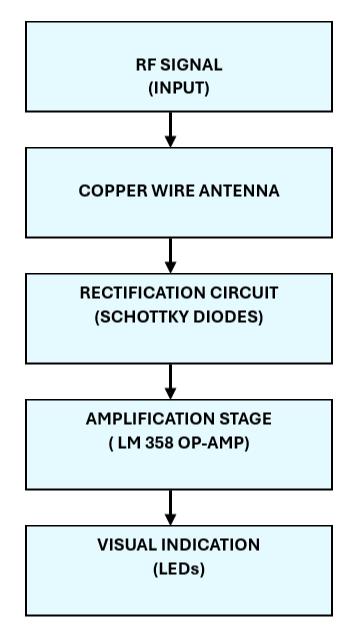
The system integrates a passive copper antenna to detect ambientRFsignals,adual-Schottkydioderectifierforsignal conversion, and an LM358 operational amplifier for highgainanalogamplification.AvisibleLEDindicatorprovides intuitive real-time feedback about the presence of RF radiation.Thesystemprioritizeslowcost,easeofuse,and minimal component dependency without compromising detectioneffectiveness.
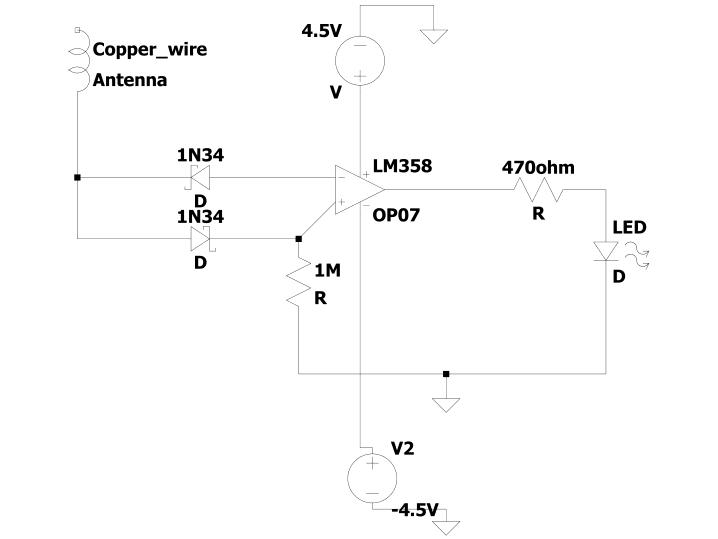
ThesystemArchitecturecomprisesoffourmajorfunctional modules viz. Antenna Subsystem, Rectifier Stage, AmplificationStage,andtheOutputInterface.TheAntenna Subsystemcomprisesofacopperwireloop,optimizedfor generalbroadbandreception,capturesambientRFsignals. Theloopgeometryfavorsreceptioninthe800MHzto2.5 GHz band. The rectifier stage consists of Two Schottky diodes (1N34) arranged in an anti-parallel configuration rectifyincomingRFsignalsintoaunipolarDCvoltage.
The amplification stage comprises of a LM358 op-amp configured in non-inverting mode amplifies the rectified signal.Thegainisdeterminedbya1MΩfeedbackresistor anda10kΩinputresistor,resultinginagainof101.Inthe OutputInterface,theamplifiedsignalpassesthrougha470Ω resistor to a red LED, which illuminates when the voltage exceedstheLED’sthreshold(~2V),indicatingthepresence ofRFradiation.
Additionally,sincetheLEDactivatesataround2V,andthe circuit'sgainisapproximately101,eveninputsignalsaslow as 20 mV from the rectifier stage can be amplified to the threshold level needed for illumination. This ensures that weakRFsignalsarereliablyconvertedintoavisualoutput, reinforcingthecircuit'spracticalsensitivity.Withand,the gainequals101.Thisensuresthatevensmallsignals(10–30 mV)areamplifiedtolevelsthatcanvisiblyactivatetheLED. The LM358 was selected for its dual-channel capability, single-supply operation, and low power consumption. Schottky diodes were chosen due to their low threshold voltage,whichenhancessensitivitytoweakRFsignals.
The initial prototype was developed on a breadboard for rapid testing. The final circuit was assembled on a singlelayer perf board for compactness and reliability. The antennawasconstructedbywindingenameledcopperwire intoa5cmdiameterloop,directlysolderedtotherectifier inputs. Signal amplification was achieved using an LM358 op-ampwithaprecisionresistornetwork.TheLEDoutput stage was protected using a 470 Ω resistor. Power was supplied by a 9V battery, selected for its availability and adequatevoltageheadroom.Acustom3D-printedenclosure housedthecircuit,ensuringdurabilityandeaseofhandling duringtests.
International Research Journal of Engineering and Technology (IRJET) e-ISSN: 2395-0056
Volume: 12 Issue: 08 | Aug 2025 www.irjet.net p-ISSN: 2395-0072
TestinginvolvedvariousconsumerelectronicsactingasRF sources, including smartphones, routers, and Bluetooth devices. Devices were operated in idle, active call, and streaming modes to simulate real-world usage. Multiple trialswereconductedtoconfirmrepeatabilityandreliability of the LED indication. Testing was conducted by placing activesmartphonesnearthedeviceduringcallsandWi-Fi activity. The following observations were made. The LED remained OFF when no RF source was nearby. The LED glowedbrightlywhenasmartphoneinitiatedacallnearby. LED brightness varied with distance, demonstrating detectionsensitivity.
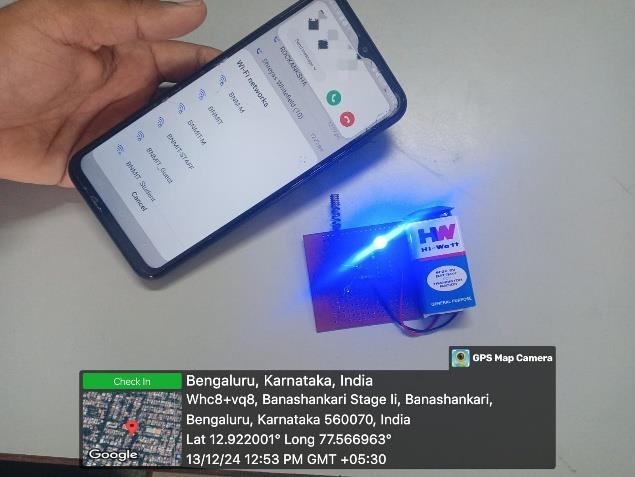
Thefollowingobservationsweremade.
Test
Smartphone (idle) 5cm
Background signal OFF
Smartphone (voicecall) 5cm Voice uplink/downlink ON
Smartphone (videostream) 10cm Wi-Fidownload ON
Wi-Firouter (idle) 20cm
Wi-Firouter (activeload) 15cm
Background beacon OFF
Continuous traffic ON
The LED responded reliably to RF signal strength and proximity. Signal detection occurred within milliseconds, ensuring prompt visual feedback. While lacking precise measurement capability, the detector proves effective for publicawareness,educationaluse,andpreliminaryexposure assessments.
The work demonstrates the working of a cost-effective, portableRFradiationdetectiondevicedesignedtoofferrealtime visual feedback for non-specialist users. Through a combinationofaccessiblecomponentsandanalogcircuitry, thesystemoffersareliable,intuitivesolutionformonitoring RF radiation. This work bridges critical gaps by offering a low-cost,battery-powered,andwhollyanalogRFdetection mechanism that delivers immediate visual indication without digital interfaces, contrasting sharply with IoTheavy designs while maintaining portability and affordability,makingitsuitableforeverydayindividualuse. The work also addresses environmental and health monitoring recommendations. This work highlights the feasibilityoftranslatingresearchinacademicstopractical public tools, by fostering technological accessibility and empoweringcommunitiestomakebetterinformeddecisions regarding environmental exposure by fostering greater awareness of RF exposure and contributing to environmentalhealthmonitoringefforts.
The future scope can extend to incorporation of future enhancements such as multi-color LEDs for indicating radiation intensity levels, Microcontroller integration for datalogging, Frequencyfilteringforselectivedetectionand bluetoothorWi-Ficonnectivityforapp-basedmonitoring.
International Research Journal of Engineering and Technology (IRJET) e-ISSN: 2395-0056
Volume: 12 Issue: 08 | Aug 2025 www.irjet.net p-ISSN: 2395-0072
[1] Hutter H, Moshammer H, Wallner P, et al, “Subjective symptoms, sleeping problems, and cognitive performanceinsubjectslivingnearmobilephonebase stations”, Occupational and Environmental Medicine 2006;63:307-313.
[2] Bagheri Hosseinabadi, Majid, Narges Khanjani, Mohammad Hossein Ebrahimi, Bahman Haji, and Mazaher Abdolahfard. 2018. “The Effect of Chronic ExposuretoExtremelyLow-FrequencyElectromagnetic FieldsonSleepQuality,Stress,Depression andAnxiety.” ElectromagneticBiologyandMedicine38(1):96–101. doi:10.1080/15368378.2018.1545665.
[3] Cindy Sage, David O. Carpenter, “Public health implicationsofwirelesstechnologies”,Pathophysiology, Volume16,Issues2–3,2009,Pages233-246,ISSN09284680, https://doi.org/10.1016/j.pathophys.2009.01.011.
[4] Guidelines for Limiting Exposure to Electromagnetic Fields(100kHzto 300GHz).HealthPhysics118(5):p 483-524, May 2020. | DOI: 10.1097/HP.0000000000001210
[5] Salford, L.G. et al., "Nerve Cell Damage in Mammalian BrainafterExposuretoMicrowavesfromGSMMobile Phones,"EnvironmentalHealthPerspectives,vol.111, no.7,2003.
[6] Hardell,L.andCarlberg,M.,"Mobilephoneandcordless phoneuseandtheriskforglioma–Analysisofpooled case-controlstudiesinSweden,1997–2003and2007–2009,"Pathophysiology,vol.22,2015.
[7] Elyasi,Hadis1;Ghanbari,Masoud2;Nadri,Farshad1,3. InvestigationoftheAdverseHealthEffectsofCellPhone RadiationandProposeSolutionstoMinimizeThem:A SystematicReview.IndianJournalofOccupationaland EnvironmentalMedicine28(1):p18-22,Jan–Mar2024.| DOI:10.4103/ijoem.ijoem_89_23
[8] A. Valdes-Garcia, R. Venkatasubramanian, J. SilvaMartinezandE.Sanchez-Sinencio,"ABroadbandCMOS AmplitudeDetectorforOn-ChipRFMeasurements,"in IEEE Transactions on Instrumentation and Measurement,vol.57,no.7,pp.1470-1477,July2008, doi:10.1109/TIM.2008.917196.
[9] V.Milanovic,M.Gaitan,J.C.MarshallandM.E.Zaghloul, "CMOSfoundryimplementationofSchottkydiodesfor RFdetection,"inIEEETransactionsonElectronDevices, vol. 43, no. 12, pp. 2210-2214, Dec. 1996, doi: 10.1109/16.544393.
[10] TaoZhang,W.R.EisenstadtandR.M.Fox,"Anovel5GHz RF power detector," 2004 IEEE International SymposiumonCircuitsandSystems(ISCAS),Vancouver, BC,2004,pp.I-897,doi:10.1109/ISCAS.2004.1328340.
[11] M. Maaspuro, A. Tuominen, K. Airikkala, J. Sippola, I. MonkareandL.Pykari,"AninexpensiveRFpowermeter forcellularphonetestinginproductionenvironment," 2008 50th International Symposium ELMAR, Borik Zadar,Croatia,2008,pp.199-202.
[12] Ajasa. A, Shoewu. O, Nwamina. P, 2014. Design anddevelopment of a mobile phone signal detector. Pacificjournalofscienceandtechnology,15(2)167-172.
[13] Jamila, T., Jude, U., & Farida, A. A. (2023). Design, construction and testing of cellphone detector. InternationalJournalofScienceforGlobalSustainability (IJSGS),9(4).https://doi.org/10.57233/ijsgs.v9i4.551
[14] MohamoudM.Ali,SitiZ.Ibrahim,I.Adam,andN.Khalid, “Design and development of RF power detector for microwave application.” Indonesian J. Electrical Eng. Comput.Sci.,Vol.13,pp.713-720,2019.
[15] Patrizia Frei, Evelyn Mohler, Georg Neubauer, Gaston Theis, Alfred Bürgi, Jürg Fröhlich, Charlotte BraunFahrländer, John Bolte, Matthias Egger, Martin Röösli, “Temporalandspatialvariabilityofpersonalexposure to radio frequency electromagnetic fields” Environmental Research, Volume 109, Issue 6,2009, Pages 779-785,ISSN 00139351,https://doi.org/10.1016/j.envres.2009.04.015.
© 2025, IRJET | Impact Factor value: 8.315 | ISO 9001:2008 Certified Journal | Page48