
International Research Journal of Engineering and Technology (IRJET) e-ISSN: 2395-0056
Volume: 12 Issue: 08 | Aug 2025 www.irjet.net p-ISSN: 2395-0072
International Research Journal of Engineering and Technology (IRJET) e-ISSN: 2395-0056
Volume: 12 Issue: 08 | Aug 2025 www.irjet.net p-ISSN: 2395-0072
Pathan Irshad Khan A Naseer Khan1 , Prof. S.S. Manal2
1M. Tech Student, Department of Civil Engineering, (CSMSS)Chh.Shahu College of Engineering Chh.Sambhajinagar, Maharashtra, India
2Professor, Department of Civil Engineering, (CSMSS)Chh.Shahu College of Engineering Chh.Sambhajinagar, Maharashtra, India ***
Abstract - In structural engineering, the pursuit of innovativesolutions that balance performance,efficiency,and sustainability continues to evolve. Within the context of highrise construction, hybrid structural systems have gained attention for their potential to combine the strengths of different materials. One promisingapproachistheintegration of steel beams with concrete columns, leveraging the advantages of both materials toforma unifiedandadaptable high-rise structure. This study investigates the seismic performance of a G+20 multistorey building using the Response Spectrum Method and Linear Time History Analysis based on the Bhuj earthquake. Four structural models were developed for comparison. Model 1 represents a conventional RCC frame, serving as a baseline. In Model 2, internal RC beams (between shear walls and columns) are replaced with steel beams. Model 3 involves the substitution of external RC beams (between peripheral columns) with steel beams. In Model 4, all RC beams throughout the structure are replaced with steel beams. Key parameters such as storey stiffness, storeydisplacement,storeydrift,storeyshear,andoverturning moment were evaluated across the models. The results indicate that substituting RC beams with steel significantly enhances structuralstiffness, leadingtonoticeablereductions in storey displacement, drift, base shear, and overturning moment. Additionally, the higher strength-to-weight ratio of steel contributes to a substantial decrease in the overall dead load of the structure.
Key Words: SeismicAnalysis,Steelbeam,concretecolumn, Response Spectrum Method, Multi-story Buildings, ComparativeAnalysis.
1.INTRODUCTION
The rise of urbanization has directed in an era where towering skyscrapers dominate city skylines, symbolizing humanprogressandachievement.High-risebuildingshave become representative of modern architectural prowess, reshaping urban landscapes and accommodating the growingglobalpopulation.However,theconstructionand engineering challenges associated with erecting these colossalstructuresareequallyformidable.Theveryessence ofahigh-risebuilding'sdesignrevolvesaroundoptimizing space,functionality,andefficiencywithinaconfinedvertical
footprint.Thetallerabuildingclimbs,themorepronounced thechallengesbecome,rangingfromwindandseismicforces to vertical transportation logistics and environmental considerations. Traditional construction materials and methods, while effective, often necessitate substantial resources and exhibit limitations in addressing these challenges.Itiswithinthecontextofthesechallengesthat innovativestructuralsolutionsemergeasessentialcatalysts forhigh-risebuildingevolution.Asbuildingsstrivetotouch theskywhileadheringtostringentsafety,sustainability,and economic requirements, the spotlight turns to new paradigms in structural engineering. In the realm of structural engineering, the quest for innovative solutions thatharmonizeperformance,efficiency,andsustainability remains an ongoing pursuit. As the demands placed upon our built environment become increasingly diverse and complex, traditional construction methods and materials often fall short in meeting the evolving needs of modern society. It is within this context that the concept of steelconcretehybridstructuresemergesasacompellingavenue for exploration and advancement. The inherent strengths and weaknesses of steel and concrete have long been acknowledgedintheconstructionindustry.Steelpossesses exceptionaltensilestrength,enablingittobearsignificant loadsacrossextendedspans.Conversely,concreteexcelsin compressive strength and durability, providing resilience against environmental and fire-related challenges. The convergence of these attributes opens up a world of possibilities for combining these materials in ways that transcend their individual limitations. 1 Standing at the intersection of tradition and innovation, the investigation intosteel-concretehybridstructuresexceedsthedomainof academicpursuit,evolvingintoapragmaticresponsetothe contemporary challenges of our time. The pursuit of this knowledge bears the potential to revolutionize the conceptualization, design, and construction of structures, driving humanity towards a future wherein the built environmentseamlesslyintegrateswiththenaturalworld, all the while catering to the demands of an adaptable and evolvingsociety.Throughthisreport,weaimtoshedlighton the principles, benefits, and challenges of steel-concrete hybrid structures, contributing to the collective pool of knowledge that drives the evolution of structural engineering. In the dynamic landscape of high-rise
International Research Journal of Engineering and Technology (IRJET) e-ISSN: 2395-0056
Volume: 12 Issue: 08 | Aug 2025 www.irjet.net p-ISSN: 2395-0072
construction, the pursuit of innovative solutions that combineefficiency,strength,andsustainabilityhasledtothe explorationofhybridstructuralsystems.Onesuchintriguing approach is the integration of steel beams and concrete columns,wheretheuniquepropertiesofeachmaterialare harnessed to create a cohesive and versatile high-rise structure.Thisfusionoffersthepotentialtooptimizeloadbearing capacities, enhance architectural freedom, and addressthechallengesinherenttotallbuildings.
Thespecificobjectivesoftheresearchare:
1.Tostudytheseismicbehaviourofmulti-storeyedbuilding with steel beam-concrete column HYBRID structure by ResponsespectrummethodandTimehistorymethod.
2.Tocomparestoreystiffness,storeydisplacement, storey drift,storeyshearandoverturningmomentofbothbuildings usingETABSsoftware.
S Morino (2014), studiedthesituationofhybridstructure development, design and construction in recent times and details of several selected hybrid structural systems are discussedlikesteelreinforcedconcretestructure,concrete filled tubular column system, reinforced concrete column, steelbeamstructuralsystemandhybridwallsystem.After thestudytheresearcherreachedtheconclusionthatconcrete filledtubularcolumn,reinforcedconcretecolumnandsteel beam element hybrid structure have attained a sufficient level of application in buildings. However, smooth stress transferisevenachallengingworkduetolackofknowledge inconnectionofelementinhybridstructure.[1]
Shahrooz et. al. (2014), provided a comprehensive exploration of design considerations pertaining to hybrid structures featuring reinforced concretecentral core walls combinedwithperimetersteelframes.Itdelvesintoarange of design possibilities, including the utilization of steel or steel-concrete composite coupling beams and their associated connections to core walls, as well as the connections between outrigger beams and core walls. The studyalsointroducespracticaldesignguidelines,whichare assessed based on prior experimental data from tests conductedbytheauthors.Byadheringtotherecommended design methodologies outlined in this paper, it becomes feasibletoachievedesirablecyclicbehaviorwithregardto bothstrengthandenergydissipationcharacteristicsinsuch hybridstructures.[2]
Qing-Sheng Yang et. al. (2015), representedtheinterfacial stressesofFRP-RChybridbeamsbyanalyticalmethods.An approximatemodelofthehybridbeamwasdevelopedanda closed-formsolutionforinterfacialshearstresswasderived out.Thenthefiniteelementcalculationswerecarriedoutfor
validation of the analytical solution. The 8 comparisons between present solution and other ones in existing literatures were also performed. It is shown that the analyticalsolutionfortheinterfacialshearstressisagreed well with the corresponding finite element result. He concludedthattheinterfacialstressesinFRP-RChybridbeam byanalyticalmethod.Thenumericalexamplesshowthatthe analyticalandnumericalresultshavegoodagreements.The comparisonsofpresentsolutionandothersarecarriedout. Presentsolutioncanbeusedtopredicttheinterfacialstress andfailureandtoconsidertheparametriceffectsoftheFRPRChybridbeams.[3]
Jiang Jun et al. (2015), presented the seismic design ofa superhigh-risehybridstructureonabackgroundofproject byusinglinearelasticanalysisandnonlinearelasto-plastic analysis. The hybrid structure consists of concrete shear walls, steel reinforced concrete (SRC) columns, concretefilledsquaresteeltubular(CFSST)columns,SRCbeamsand steel beams. Firstly, comparing steel structure and hybrid structureonseismicbehaviorandconstructioncost.Then, two structural design programs are utilized for elastic response spectrum analysis combined with elastic timehistoryanalysis,andtheresultsoftwoprogramsarequite close.Thirdly,staticnonlinearanalysis(pushoveranalysis) anddynamicnonlinearanalysis(elasto-plastictime-history analysis)areperformedtoevaluatetheseismicperformance ofthehybridstructure.Moreover,theimportantparts,such asstrengthenedpartatbottomandhotellobbyatmiddle,are analyzedcarefullytoensurethekeycolumnsareinelastic stateunderfortifiableearthquake.Conclusioncanbedrawn that the super high-rise hybrid structure achieves the earthquakeperformanceobjective,andtheseismicdesignof thebuildingcansatisfytheinspectionduetoout-of-codes.He introducedthedesignprocedureofasuperhigh-risehybrid structure. Elastic analysis including response spectrum methodandelastictime-historyanalysisincludingstaticand dynamic procedures are conducted. There are some conclusionshedrawnfromthestudy.Theresultsofelastic response spectra analyses calculated by two structural programsshowthecorrectnessofthecalculatingmodel.And theresultsofelastictime-historyarebasicallyidenticalwith that of response. Nonlinear elasto-plastic analyses under fortifiableandsevereearthquakeareperformedtoindicate thebehaviorofstructure.Theresultsshowthatthehybrid structure has well seismic performance and achieves the performanceobjective.[4]
Hajehpour et. al. (2021), studied the design of hybrid structure with cross laminated timber (CLT). Moderately ductilemomentresistingframesarecommonforlateralload resist,butbecomeuneconomicalforhighrisestructuredue tolargemembersectionstosatisfythedriftrequirement.In theresearch,3hybridbuildings8storey,12storeyand16 storey tall for seismicity of Vancouver, Canada and their performance was with benchmark steel moment frame buildings. Ductile connections were used to join the CLT
International Research Journal of Engineering and Technology (IRJET) e-ISSN: 2395-0056
Volume: 12 Issue: 08 | Aug 2025 www.irjet.net p-ISSN: 2395-0072
panel and steel frame. Non-linear static and time history analyseswerecarriedouttoevaluatethestructure’sseismic performance.Withthisstudytheresearcherconcludedthat the stiffness of hybrid structure was increased and modal periodofstructurewerereduced.Theuseofsteelinhybrid structure was also reduced as compared to steel moment frames.[5]
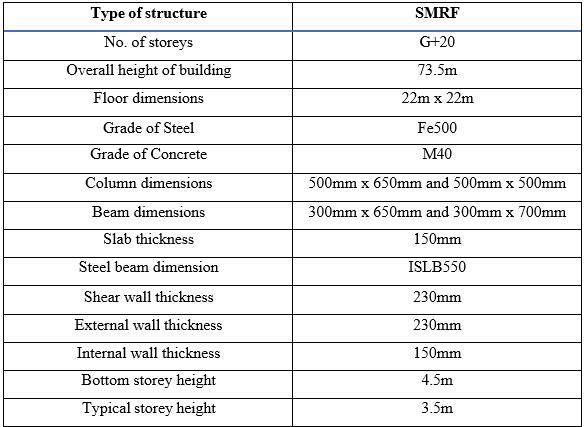
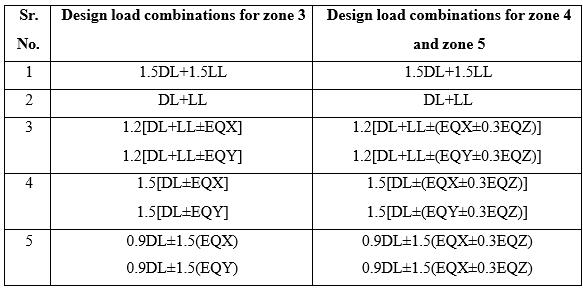
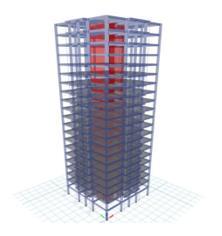
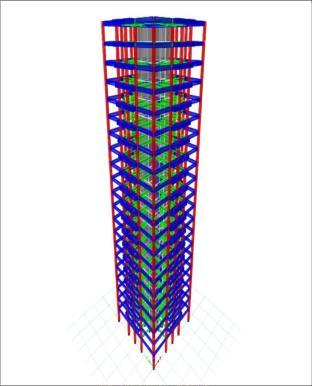
Thesystemdevelopmentphaseofthisdissertationproject encompassesthedesign,implementation,andevaluationofa computationalframeworkfortheseismicanalysisofaG+20 RCC framed structure and Steel Beam-Concrete Column Hybrid Frame Structure, with a particular focus on the replacementofRCCbeamswithsteelbeams.Thisphaseis critical inachieving theoverall researchobjectives, which aretoassesstheseismicperformance,structuralintegrity, andcomparativeadvantagesofthesetwostructuralsystems. Forseismicanalysisofhigh-risestructure,thetwomethods are used which are response spectrum method and time historymethodandwhicharelineardynamicmethods.In high-rise structures, time history analysis should be performedbecauseitgivesthemostaccurateresultsthan the response spectrum method. The data required for analysisofstructureandmodelsforthisstudyareexplained below.
International Research Journal of Engineering and Technology (IRJET) e-ISSN: 2395-0056
Volume: 12 Issue: 08 | Aug 2025 www.irjet.net p-ISSN: 2395-0072
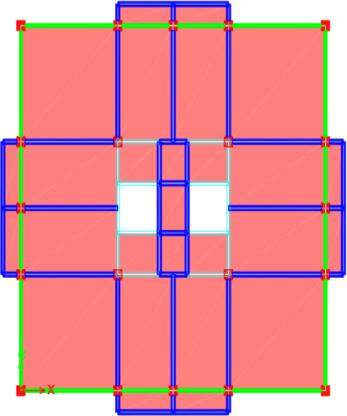
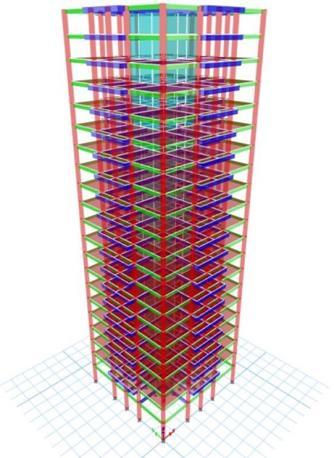
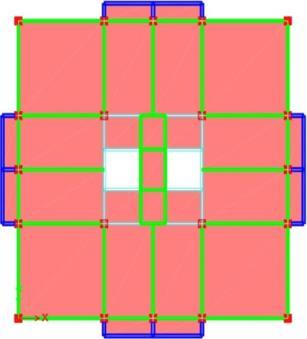
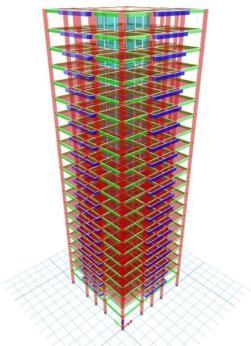
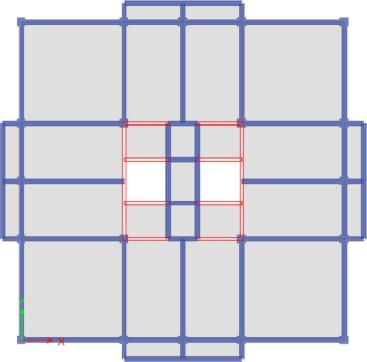
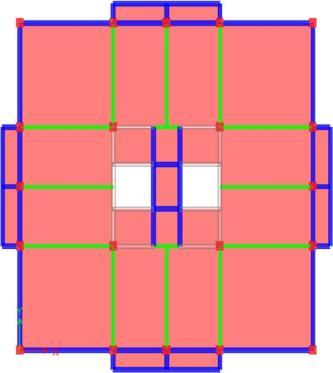
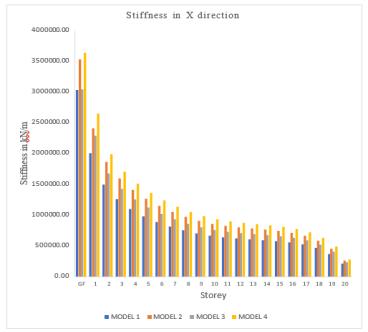
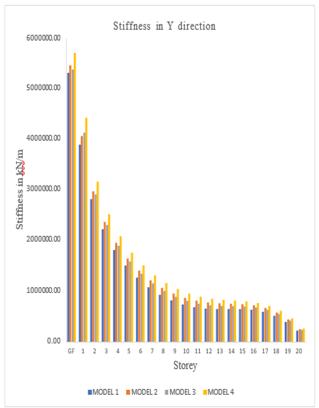
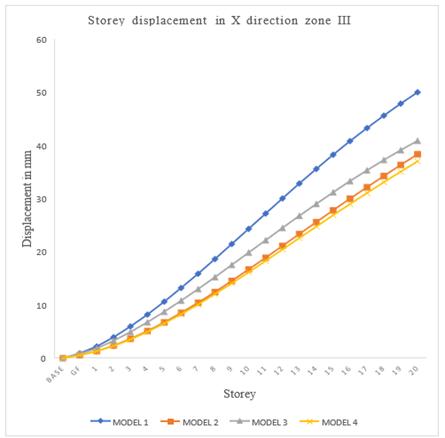
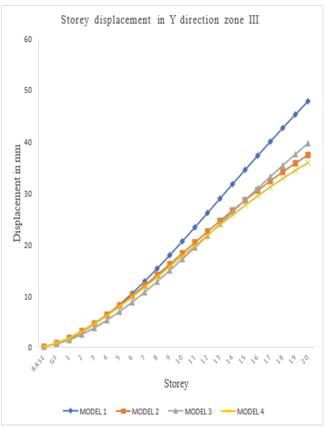
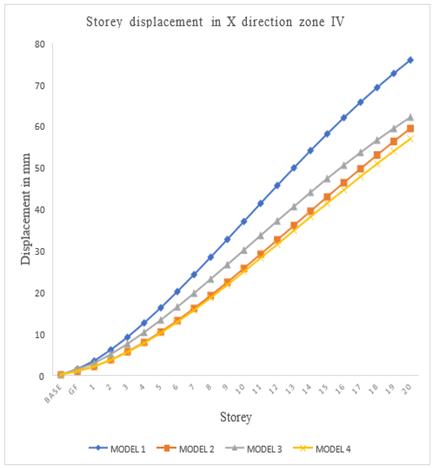
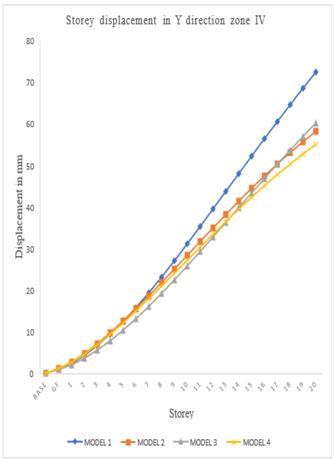
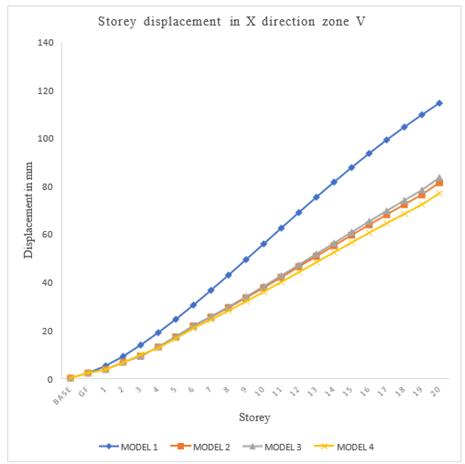
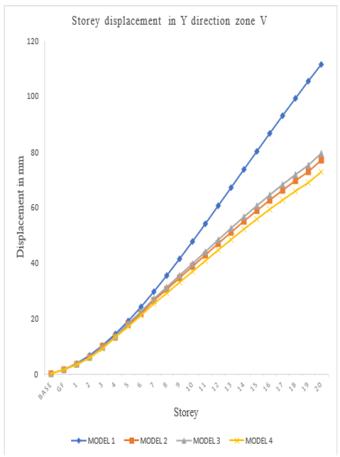
InthepresentworkG+20multistoreyRCCframedstructure ismodelledusingETABSsoftwareaccordingtoIS1893:2016 andIS16700:2017.Theelementsizesarechangedaccording tothedesignrequirements.Themodelisanalysedwithtwo differentframedsystemi.e.,oneisRCCframedstructureand inanothermodelRCbeamsarereplacedbysteelbeamsand keeping concrete column and shear wall same. For the presentanalysisresponsespectrumanalysisunderseismic zoneIII,IVandV,andtimehistoryanalysisbyconsidering Bhujearthquakedata.Theframedstructureconsideredfor theanalysisareRCCframedstructureandHYBRIDframed structure,inwhichallinternalbeamsconnectingshearwall andperipherycolumnsarereplacedbysteelbeamsinone model,allexternalbeamsconnectingperipherycolumnsare replaced with steel beams and all the beams are replaced withbeamsinmodel2,3and4respectively,andcolumns and shear walls are kept as same as RCC framed structure.The various seismic parameters like storey stiffness,storeydisplacement,storeydrift,storeyshearand overturning moment are compared for both type of structures, graphical comparison is carried out for each parameterasshownbelow.
International Research Journal of Engineering and Technology (IRJET) e-ISSN: 2395-0056
Volume: 12 Issue: 08 | Aug 2025 www.irjet.net p-ISSN: 2395-0072
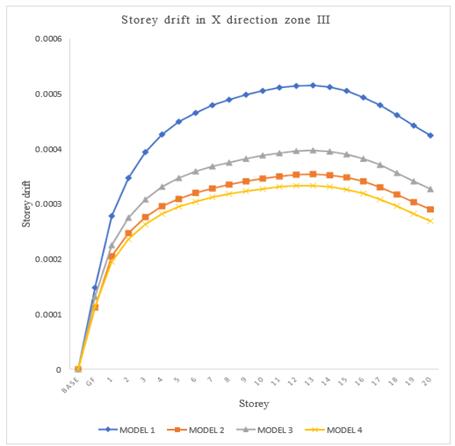
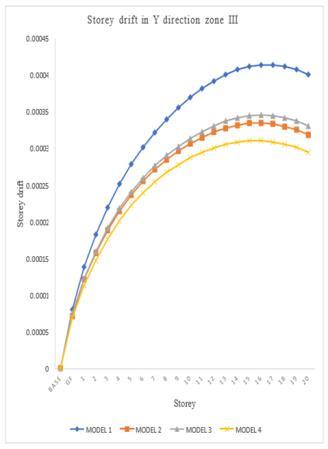
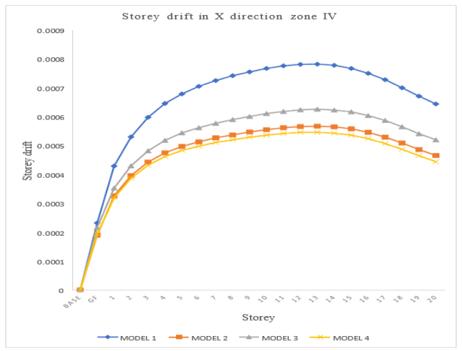
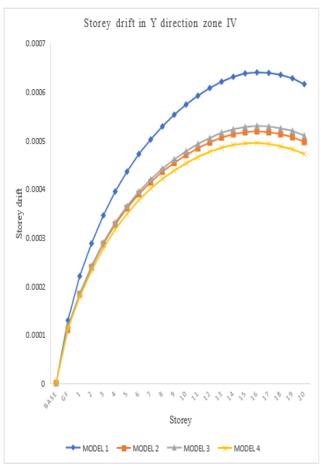
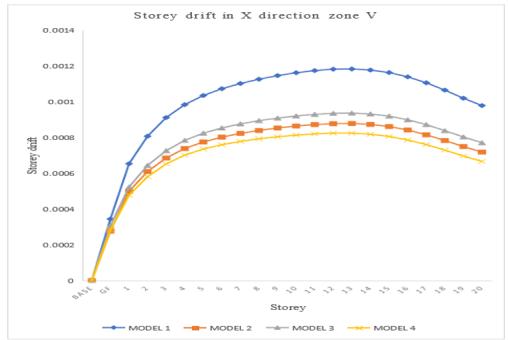
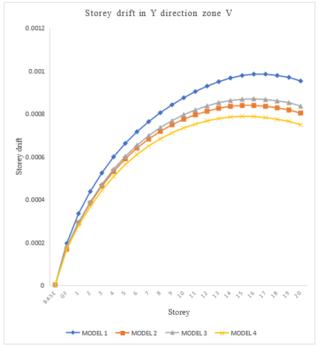
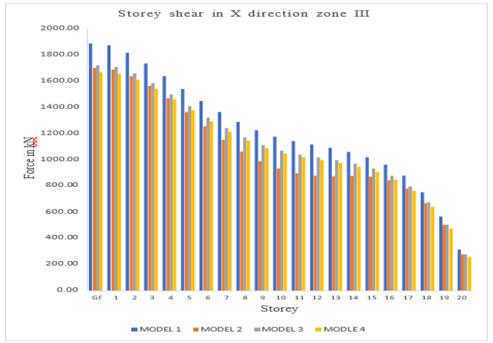
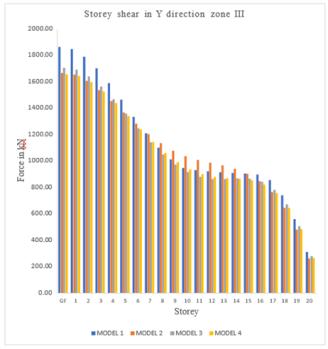
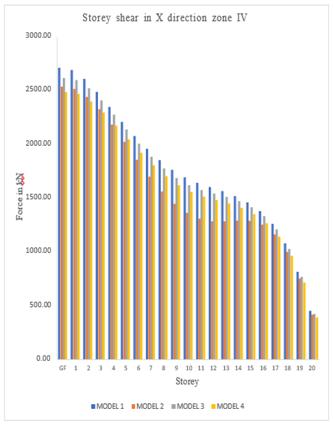
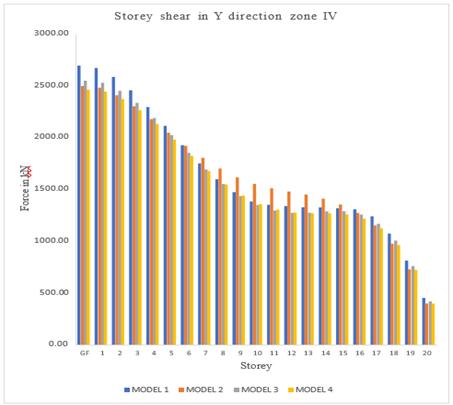
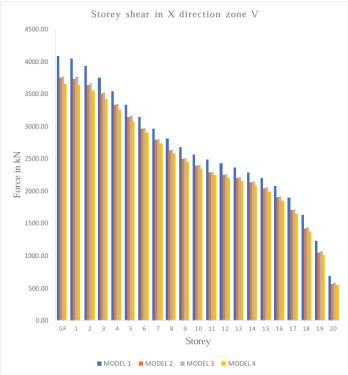
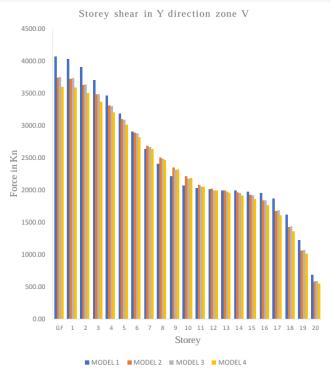
Inthepresentwork,G+20multistoreybuildingismodeled usingETABSsoftwareasperIS 1893-2016 and IS167002017.Fourmodelsareconsidered.Model1isordinarySMRF RCCframedstructureasbaselineforcomparison.Inmodel2 all internal beams connecting between shear wall and peripherycolumnsarereplacedbysteelbeams.Inmodel3 allexternalbeamsbetweenperipherycolumnsarereplaced bysteelbeamsandinmodel4alltheRCbeamsarereplaced bysteelbeams.Theresultofvariousparameterslikestorey stiffness,storeydisplacement,storeydrift,storeyshearand overturning moment are compared and following conclusionsaredrawn.
1)The stiffness of the structure increases in HYBRID structureascomparedtoRCCframedstructure.However, model4showsthemaximumincreaseinstiffness.
2)WhiletheHYBRIDstructurewithallsteelbeams(Model4) represents the maximum reduction in displacement, the differencebetweenmodel2andmodel4isverylessinall zonesandintimehistorymethodalso.
3)The storey drift in model 4 decreases drastically when comparedtomodel1.Whilethedifferenceinstoreydriftin model2andmodel4isminimalunderzoneIII,IVandV.
International Research Journal of Engineering and Technology (IRJET) e-ISSN: 2395-0056
Volume: 12 Issue: 08 | Aug 2025 www.irjet.net p-ISSN: 2395-0072
4)Models2,3,and4consistentlyexhibitlower baseshear values than Model 1, under zone III, IV and V and in time history method also, indicating comparatively reduced seismicforcesorlesserstructuralstressinthesemodels.
5)Model 4 consistently demonstrates notably lower overturningmomentsunderseismiczoneIII,IVandVand using time history method compared to Model 1. This indicates a considerable reduction in the potential for structural overturning or instability in Model 4 when comparedtoModel1.
6)The section sizes required will be less due to higher strengthtoweightratioofsteelultimatelyreducingthedead loadofthestructure.
1) S. Morino, “Recent developments in hybrid structures in Japan-research, design and construction”,EngineeringStructures,Volume 20,pp:336-346,Elsevier(Scopus)2014.
2) BahramMShahrooz,BingnianGong,Gokhan Tunc, Jeremy T Deason, “An overview of reinforced concrete core wall-steel frame hybrid structure”, Progress in Structural EngineeringandMaterials,Volume3,Issue2, pp:149-158,2014.
3) Qing-Sheng Yang, Yun Cui, Lian-Hua Ma, “Analytical and numerical investigation of interfacialstressinFRP-RChybridstructures”, Engineering, Science, Construction and Operations in Challenging, Earth and Space, pp:1-8,ASCE2015.
4) Jiang Jun, You Bing, Hu Ming, Hao Jiping Li Yangcheng, “Seismic design of a super highrisehybridstructure”,14thWorldConference onEarthquakeEngineering,2015.
5) Maria Antonietta Aiello, “Structural PerformancesofConcreteBeamswithHybrid „Fiber-Reinforced Polymer-Steel Reinforcements”, ASCE, Volume 10, pp 133140,2015.
6) Lei Pang, “Design Propositions for Hybrid FRP-SteelReinforcedConcreteBeams”,ASCE, Volume10,pp180-189,2015.
7) Ze-liang Yao, Fa-ning Dang, Guo-liang Bai, “Seismicresponseanalysisonasteel-concrete hybrid structure”, Tenth International Conference of Chinese Transportation Professionals,pp:3001-3007,ASCE2016.
8) M.A.Bezabeh,S.Tesfamariam,M.Popovski,K. Goda, S. F. Stiemer, “Seismic base shear modification factors for timber-steel hybrid structure:Collapseriskassessmentapproach”, JournalofStructuralEngineering,Volume143, Issue10,ASCE2017.
9) MohammadHamidElmy,“Staticandseismic behaviours of innovative hybrid steel reinforcedconcretebridge”,Elsevier(Scopus), Volume138,pp701-713,2017.
10)AndréPlumier,“AnAnalyticalDesignMethod for Steel-Concrete Hybrid Walls”, Elsevier (Scopus),Volume9,pp185-199,2017.
11)J.Ding,“Experimentalstudyofstructuralfire behaviour of steel beam to concrete filled tubular column assemblies with different typesofjoints”,Elsevier(Scopus),Volume29, Issue12,pp3485-3502,December2017.
12)Alessandro Zona, Luca Tassotti, Graziano Leoni Andrea Dallasta, “Nonlinear seismic response analysis of an innovative steel and concretehybridcoupledwallsystem”,Journal ofStructuralEngineering,Volume144,Issue 7,ASCE2018.
13)ChrisP.Pantelides,“StructuralPerformanceof Hybrid GFRP/Steel Concrete Sandwich Panels”,ASCE,Volume12,pp570-576,2018.
14)PiotrLacki, “Comparison of steel-concrete compositecolumnandsteelcolumn”,Volume 202,pp82-88,October2018.
15)Xiaoge Ren, Shungeng Gong, Yong Lu, “Performance evaluation of seismic strengthened irregular RC-steel hybrid frames”, Journal of Performance of Constructed Facilities, Volume 33, Issue 1, ASCE2019.

PathanIrshadKhanANaseerKhan
M.Tech Student Department Of CivilEngineering,At(CSMSS)Chh. Shahu College Of Engineering ChatraptiSambhajinagar431001.