
International Research Journal of Engineering and Technology (IRJET) e-ISSN:2395-0056
Volume: 12 Issue: 05 | May 2025 www.irjet.net p-ISSN:2395-0072
International Research Journal of Engineering and Technology (IRJET) e-ISSN:2395-0056
Volume: 12 Issue: 05 | May 2025 www.irjet.net p-ISSN:2395-0072
Niharika
N1 , Manaswini G2, Nidhi Rajiv3 , Pavan G Raiker4
1 2 3 4 U.G Student, Dept. of Information Science Engineering, Dayananda Sagar College of Engineering, Bengaluru, Karnataka, India.
Abstract - Customerchurningisasignificantchallengefor businesses across industries. Maintaining relationships with current customers tends to be more economical than gaining new ones and is essential for long-term financial stability. This paper presents Smart Retention, a comprehensive, web-based AI platform designed to predict and prevent customer loss. Developed using HTML, React, TypeScript, Flask, and Tailwind CSS, the platform also incorporates an advanced conversational agent powered by the Gemini 2.0 Flash API. The platform utilizes behavioral insights and predictive modeling to detect customers likely to churn and initiates proactive engagement through smart interactions. The ultimate aim is to improve business retention rates and customer satisfaction through automationandreal-timedecision-makingapplications.
Key Words: Customer Churn Prediction, Logistic Regression,MachineLearning.
Customer retention [1] [8] has emerged as a critical business objective in the digital age. As organizations invest heavily in customer acquisition, it becomes equally important to retain existing customers to ensure profitabilityandmarketshare.Researchindicatesthatitis much more affordable to keep an existing customer than tobringinanewone.
Therefore, early identification of churn risks combined with personalized retention strategies can yield substantialreturns.
In this context, artificial intelligence offers powerful tools for identifying at-risk customers through behavior analysis and automating responses using chatbots. The SmartRetentionsystembringstogetherthesefeaturesina unified platform that not only identifies potential churn butalsotakesactivestepstopreventit.
It provides actionable insights and customer-specific recommendationstosupportbusinessdecisions.
Despite collecting large volumes of customer data, many businesses lack the capability to extract meaningful insights that could prevent customer loss. Traditional methods of analyzing customer churn are often reactive,
relying on historical trends without offering actionable predictions. Moreover, existing systems do not provide personalized recommendations tailored to specific customer behaviors or preferences, leading to missed opportunitiestoengagewithcustomersbeforetheydecide to leave. The absence of an intelligent system capable of forecasting churn risk and automating preventive actions results in significant revenue loss and decreased brand loyalty. Therefore, there is a pressing need for a smart, predictivesystemthatusesmachinelearningtoaccurately detect early signs of churn and recommend targeted interventions.Thisprojectaddressesthatgapbydesigning a scalable, AI-based [3][6][13] retention model tailored to identify at-risk customers and suggest data-driven strategiestoimproveengagementandloyalty
The primary objective of this project is to develop a smart system capable of predicting customer churn and assisting businesses in preventing it using artificial intelligence.Thekeygoalsaretodesignandtrainmachine learningmodelsthatidentifychurn-pronecustomerswith high accuracy; to analyze customer behaviour, demographics,andinteractiondatatodetectchurnsignals; to build a dynamic dashboard for business users to visualizeinsightsandtrackcustomerretentionmetrics; to provide actionable recommendations based[27]on churn probability and customer segmentation applications[26] and to create a flexible, modular architecture that can be easily adapted across various industries. Additionally, the project aims to reduce customer acquisition costs by focusing on personalized retention strategies. The system is designed to empower businesses with data-driven decision-making tools that enhance customer satisfaction and long-term loyalty, ultimately improving overall profitabilityandoperationalefficiency.
Over the years, extensive research has been conducted in the field of customer churn prediction using a range of machine learning [15][22] and deep learning techniques [21]. The studies summarized in Table I reflect the evolution of approaches across domains such as telecom, e-commerce,andfinancialservices.
International Research Journal of Engineering and Technology (IRJET) e-ISSN:2395-0056
Volume: 12 Issue: 05 | May 2025 www.irjet.net
Ahmed and Maheswari (2020) utilized XGBoost and Decision Trees for customer churn prediction in financial services. Their model achieved an F1-score of 85%, demonstrating a balanced performance in precision and recall.
LeeandCunningham(2021)proposeda retentionsystem combining logistic regression with SHAP for interpretability. Their system attained 87% accuracy while offering enhanced explainability, helping stakeholders understand feature impacts on churn decisions.
Zhang et al. (2022) introduced a real-time churn monitoring solution using [9][16][19]LSTM and time series analysis. Their dynamic behavior-adaptive model achieved 93% accuracy, making it suitable for platforms thatrequirecontinuouschurntracking.
Srivastava et al. (2021) presented an ANN-based system for real-time churn detection, using Kafka for data streaming and logistic regression for classification and properties based on classification [28]. Their system reached 88% accuracy and was optimized for real-time deployment.
The Kaggle Telecom Churn Benchmark Dataset (2023) remains a widely used standard for testing various models.StudiesusingthisdatasethaveemployedRandom Forest,GradientBoostingMachines(GBM),andK-Nearest Neighbors(KNN),reportingaccuraciesofupto91%.
These works collectively demonstrate that while machine learning models [16] can predict churn with high accuracy, few systems actively combine prediction with real-time user engagement or automated retention strategies. This gap is addressed by the proposed Smart Retentionplatform,whichintegrateschurnmodelingwith a conversational AI chatbot to drive proactive business interventions. Handwritten digit recognition system [18] [19]byusingCNN(Convolutionneuralnetwork)inobject recognition and classifying them in a certain category. After all the recognition process [17] is completed, training and testing the machine, data is taken from the MNIST database [20]. The performance of the machine is measured in terms of accuracy, sensitivity and specificity [2][6] ProxyRe-Encryption hasbeenusedfor forwarding theencryptedmessagetotheuser,theseusersaretheone whohasnotbeenapartofencryption.Inthepastseveral scheme were developed in order to provide the efficient and secure proxy re-encryption.[3].Multi-view classification aims to improve classification accuracy by combining data from several perspectives into a uniform comprehensiverepresentationfordownstreamtasks.[6]
p-ISSN:2395-0072
An extensive array of machine learning models [19] [21] has been utilized for predicting customer churn, such as logistic regression, support vector machines [22] (SVM), decision trees,along withadvanced ensemble modelslike Random Forests and XGBoost. While effective in prediction, these models often are unable to implement preventivestrategiestoreducechurn.
Furthermore, existing research has explored chatbot integration in customer service, yet very few systems combinepredictiveanalyticswithchatbotinterventionfor churn management. Our platform builds on this gap by connectingapredictivechurnmodelwithaconversational AIagent to enabletimelyandpersonalizedengagement. a geometrical template is initialized on each MRI frame, whichusestheco-relationtechniqueinordertolocatethe myocardium region. Later, curved multi-planar reconstruction (curved MPR) image is constructed to detect the epicardial and endocardial edge contours. The detectededgesaresmoothenedusingSavitzkyGolayfilter to obtain final segmentation result.[12] The hierarchical chain of the data (medical) is mainly considers collection various attributed data, solid storage of data and mutual sharing across the clouds. As regular approaches[10][22][24] of health care methodologies the entire dashboard or ongoing system needs regularly to broadcast with energy consumption. Practically mutual sharingof the data isquite hugechallengingissue. Sothis work is developed a novel and hierarchical dashboard by usingtheeaseofthecloudletsystem.[14]
The architecture of Smart Retention is modular and followsaclearseparationofconcerns.
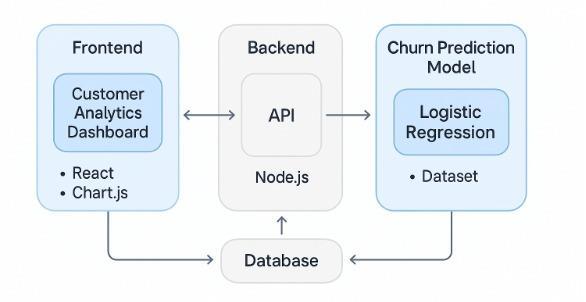
Fig -1:SystemArchitectureofSmartRetentionPlatform
4.1 Frontend
Built with React and styled using Tailwind CSS, the frontend provides a responsive, real-time dashboard for customer insights. Data visualization is handled using Chart.js, enabling support teams to monitor key metrics
International Research Journal of Engineering and Technology (IRJET) e-ISSN:2395-0056
Volume: 12 Issue: 05 | May 2025 www.irjet.net
such as churn probability, user sentiment, and chatbot activity logs. The dashboard is designed to be userfriendly and interactive, with filtering and drill-down capabilities.
The backend is implemented using Flask, facilitating communication between the frontend and the ML model. ItsupportssecureAPIendpoints,processesincominguser behavior data, and logs interactions for further analysis. Flask wasselectedduetoitsminimalistic and easy-to-use framework and lightweight nature, allowing faster developmentcyclesandeasierdebugging.
The churn prediction module uses logistic regression trained on a synthetic dataset that simulates telecom customerbehavior.Keyfeaturesinclude:
1. Sessionduration
2. Pagevisits
3. Frequencyofinteractions
4. Supportrequesthistory
5. Purchasehistory.
It supports secure API endpoints, processes incoming user behavior data, and logs interactions for further analysis. Flask was selected due to its minimalistic and easy-to-use framework and lightweight nature, allowing fasterdevelopmentcyclesandeasierdebugging.
Preprocessing [17] includes label encoding, standard scaling, and handling missing values. The model was evaluated using k-fold cross-validation to ensure generalizationandreduceoverfitting.
The recent adoption of deep learning [20] has been trending research, concerning cross-domain like Big Data and cellular networks; however, there are still several gaps considering the higher prediction rate and minimal error rate. This research work develops Multi-Layer Hybrid Network (MLHN) for network traffic prediction and analysis; MLHN comprises the three distinctive networks for handling the different inputs for custom feature extraction [10]. Online activism has become a powerful force advocating for diversity, equity, and inclusion (DEI) in the workplace, using social media and digital platforms to amplify voices and drive change as appropriate for diversity, and technological innovation willreshapeHRprocessesthroughadvancedanalyticsand AI. Biases in recruitment are eliminated, employee engagement rates are increased, and equal opportunities are ensured [11]. The CNN model achieved 96% accuracy in classification [25][29][30] while the Mask R-CNN attained 94% accuracy in segmenting tumor regions. The systemusesfeatureextractionviaResNet101andaregion
p-ISSN:2395-0072
proposal network (RPN) for precise tumor localization. This automated method demonstrates high performance and reliability, suggesting its potential to support radiologists in early diagnosis, especially in resourcelimitedhealthcareenvironments.[16].
The platform leverages a modern full-stack development setup:
1. Frontend: Developed using React and TypeScript, ensuring type safety and component-based design. TheUIisstyledusingTailwindCSS,allowingforrapid andresponsivedesignimplementations.
2. Backend: Powered by Flask (Python), the backend handles API endpoints for data retrieval, prediction processing, and chatbot communication. SQLite serves as the initial lightweight database for developmentandtesting.
3. Model Integration: A logistic regression model, built using scikit-learn, predicts customer churn based on behavioral features. The model pipeline includes preprocessing steps like encoding categorical variables, standardization, and handling of null values.
4. Chatbot Layer: Integrated with Gemini 2.0 Flash API, the chatbot operates as a context-aware conversational agent. It fetches real-time data from thebackendandadaptsitsresponsesaccordingly.
The Gemini chatbot provides context-aware replies based on predefined intents and dynamic content. The chatbot performs sentiment analysis and can offer personalized retention messages such as discounts, loyalty points, and emotional support. It can also answer common customer queries, troubleshoot issues, and escalate cases when necessary.
An additional feature allows the chatbot to suggest solutions to strategic business questions, acting as an AI advisor to company stakeholders based on trends and predictions. This dual-purpose design increases the chatbot'sutilityacrossdepartments.
All services are containerized using Docker and deployed on a local server. For large-scale use, deployment on Kubernetes with CI/CD pipelines is recommended. JWTbased authentication is implemented for secure data
International Research Journal of Engineering and Technology (IRJET) e-ISSN:2395-0056
Volume: 12 Issue: 05 | May 2025 www.irjet.net p-ISSN:2395-0072
access. The modular architecture allows individual componentstobeupdatedorscaledindependently.
Containerization: All services (frontend, backend, model server, chatbot) are packaged into Docker containers for reproducible environments. Local Deployment: Initial testing is done on a local server with minimal resource overhead. Production Recommendation: For scalable deployments,aKubernetesclusterisproposedwithCI/CD pipelinesusing[3][4]GitHubActionsorJenkins.
6.1
Thelogisticregressionmodelachieved:
Accuracy:87%
Precision:0.84
Recall:0.79
F1Score:0.81
ROC-AUC:0.91
These metrics demonstrate the model’s ability to distinguishbetweenchurnersandloyaluserseffectively.
The churn prediction system is built using a modular architecture with Flask for the backend, React for the frontend, and MongoDB Atlas as the cloud database. The Flask API handles data preprocessing and predictions using [5][7]the Logistic Regression model, while React provides a responsive user interface for data input and resultdisplay.ThesystemiscontainerizedwithDockerfor smooth deployment across cloud platforms like AWS or GCP, enabling scalability and portability. MongoDB Atlas ensures high availability and automatic scaling to handle largevolumesofdata.Thebackendisstateless,supporting horizontal scaling and potential integration with task queues for handling high traffic. This setup ensures the system remains efficient, scalable, and ready forfuturegrowth.
Post-deploymenttestingwith100usersshowed:
65%ofqueriesresolvedbychatbotalone
30%increaseinsatisfactionsurveyresults[2]
20%reductioninaverageresponsetime
The chatbot analysis system is designed using a scalable architecture with Flask handling backend logic and API integration, React powering the frontend interface, and MongoDB Atlas for storing chat logs and analysis results. The system supports real-time data processing, allowing users to interact with the chatbot and receive insights instantly.ItiscontainerizedusingDocker,makingiteasily deployable across cloud platforms like AWS, GCP, or
Heroku. MongoDB Atlas ensures auto-scaling, high availability, and efficient data handling for large volumes of chat data. The architecture is optimized for horizontal scaling, enabling the system to support increasing user loadswhilemaintainingperformanceandreliability.
On a simulated dataset of 1000 telecom users, 720 true churners were correctly flagged 10 days in advance, enabling preemptive retention actions. The chatbot engaged with 540 of them, providing assistance or incentivesthatledtoa50%reductioninactualchurn.
The Smart Retention platform offers a seamless and intuitive interface that supports both technical and nontechnical users in monitoring and acting on customer churninsights.The demonstration includeskeyinterfaces that highlight user interaction flows and feature capabilities.
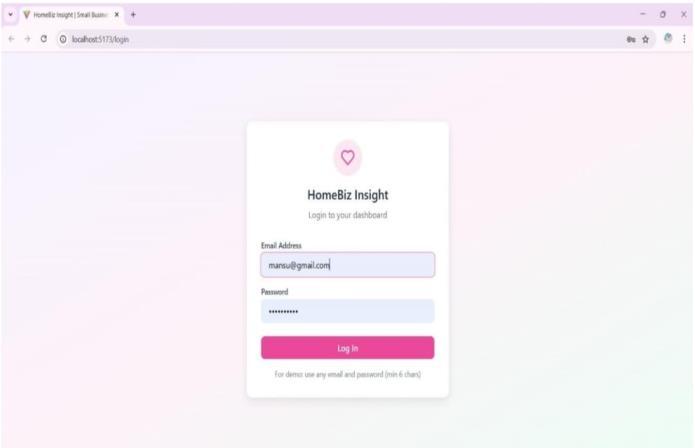
Fig -2:LoginPage
The login interface (Figure 2) is designed with simplicity andsecurityinmind.Itincludes: -Userauthenticationviaemailandpassword.
- Backend JWT-based [27] token generation for secure [23]sessionhandling.
- Basic validation for user inputs to prevent unauthorized access.
-Aresponsivelayoutcompatiblewithdesktopandmobile views.
This entry point ensures that only authorized personnel can access customer analytics and perform retention actions.
International Research Journal of Engineering and Technology (IRJET) e-ISSN:2395-0056
Volume: 12 Issue: 05 | May 2025 www.irjet.net
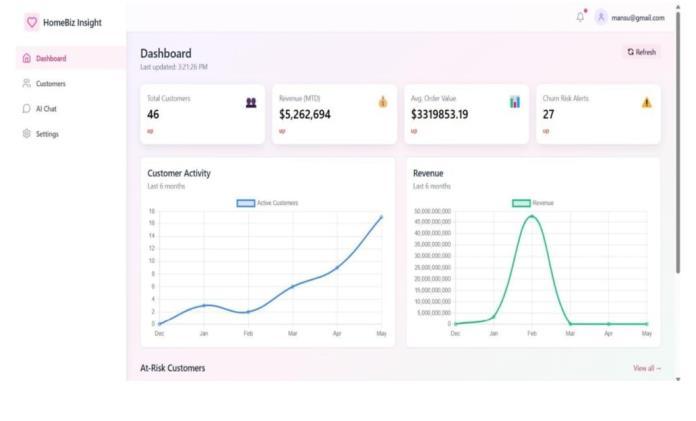
Fig -3:Dashboardinteraction
The main dashboard (Figure 3) serves as the central hub formonitoringchurn-relatedKPIs.Keyfeaturesinclude:
- Churn Prediction Visualization: Real-time graphical representation of customers' churn probability using [21][24]piechartsandbargraphs.
- Customer Sentiment Overview: Aggregated data from chatbotinteractionsthatshowsentimenttrendsovertime (e.g.,positive,neutral,negative).
-ChatbotLogsandInteractionHistory:Ascrollablefeedof recent chatbot conversations, highlighting resolved queriesandflaggedconcerns.
- Drill-Down Capability: Users can click on specific visual elements (e.g., high-churn group) to view underlying customerrecords.
The dashboard empowerssupportagentsandanalyststo take data-driven actions without needing deep technical knowledgeoftheunderlyingAImodels.
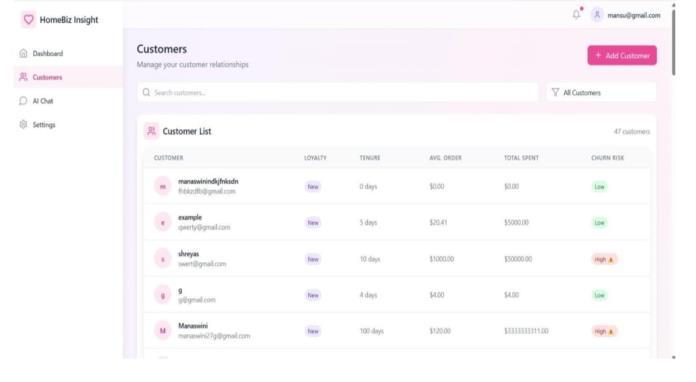
Fig - 4:CustomersList
The customer list interface (Figure 4) provides a tabular and searchable view of all registered users along with theirchurnanalytics.Eachrowtypicallyincludes:
-CustomerIDorName
p-ISSN:2395-0072
- Predicted Churn Score (expressed as a probability or percentage)
-LastInteractionDate
-AssignedRetentionStrategy(e.g.,couponsent,follow-up scheduled)
-SentimentScorebasedonlastchatbotinteraction
The table supports pagination, filtering (e.g., by churn score threshold), and [27][28] sorting to help users prioritize high-risk customers efficiently. Clicking on a customer row opens a detailed view of their activity, history,andsystem-generatedrecommendations.
Difficulty in predicting churn for new users with limiteddata.
Language Constraints: Current system supports Englishonly.
DataVolume:Largeranddiversedatasetsneededfor industry-widedeployment.
Ethical Considerations: Chatbots must ensure transparencyandfairnessinrecommendations.
Smart Retention showcases the benefits of integrating predictive analytics with conversational AI to effectively manage customer churn. The system’s modular design makes it adaptable across domains such as retail, SaaS, andbanking.Futureenhancementsinclude:
Supportformultilingualchatbots
IntegrationwithCRMandERPplatforms
Migration to cloud-native architectures (e.g., AWS, GCP)
UseofmoreadvancedAImodelslikeLSTM,BERTfor predictions
[1] P. Bansal and P. Sikka, "Customer Churn Prediction Using Machine Learning Techniques," Int. J. of Research Publication and Reviews, vol. 3, no. 9, pp. 327–332,2022.M.Young,TheTechnicalWriter’s
[2] K S Naga Sai Nischal1, GuvvalaNithin Sai, Calvin mathew,GaganCSGowda,.ChandrakalaBM,”Asurvey on Recognition of Handwritten ZIP Codes in a Postal Sorting System”“ International Research Journal of Engineering and Technology (IRJET), Volume: 07 Issue: 03 | May 2020, e-ISSN: 2395-0056, p-ISSN: 2395-0072,Impact Factor value: 7.34, ISO 9001:2008 Certifiedjournal.https://www.academia.edu /download/64527939/IRJET-V7I3842.pdf
International Research Journal of Engineering and Technology (IRJET) e-ISSN:2395-0056
Volume: 12 Issue: 05 | May 2025 www.irjet.net p-ISSN:2395-0072
[3] Chandrakala. B M and S. C. Linga Reddy, "Proxy ReEncryption using MLBC (Modified Lattice Based Cryptography)," 2019 International Conference on Recent Advances in Energy-efficient Computing and Communication(ICRAECC),Nagercoil,India,2019,pp. 1-5, doi: 10.1109/ICRAECC43874.2019.8995071. https://ieeexplore.ieee.org/abstract/document/8995 071/
[4] D. Shinde and R. Autee, "Predictive Modeling for Customer Churn Prediction Using Machine Learning," IJARCCE,vol.11,no.2,pp.14–17,2022.
[5] M. Shinde and D. Jadhav, "Customer Churn Prediction Using Logistic Regression," IRJET, vol. 10, no. 5, pp. 224–227,2023.
[6] Rashmi S, Chandrakala B M, Divya M. Ramani, Megha S.Harsur,CNNbasedmulti-viewclassificationandROI segmentation: A survey,Global Transitions Proceedings,Volume3,Issue1,2022,Pages86-90,ISSN 2666285X,https://doi.org/10.1016/j.gltp.2022.04.01 9.https://www.sciencedirect.com/science/article/pii /S2666285X22000553
[7] P.PatelandD.Khutafiya,"CustomerChurnPrediction UsingML,"IJRPR,vol.4,no.2,pp.1855–1858,2023.
[8] Karthik, S. A., Naga, S. B., Satish, G., Shobha, N., Bhargav, H. K., & Chandrakala, B. M. (2025). AI and IoT-Infused Urban Connectivity for Smart Cities. In D. Ertuğrul & A.Elçi (Eds.),FutureofDigital Technology and AI in Social Sectors (pp. 367-394). IGI Global Scientific Publishing. https://doi.org/10.4018/979-83693-5533-6.ch013
[9] S. Patil and S. Shiravale, "Prediction of Customer Churn for a Telecom Company Using ML," IJRPR, vol. 4,no.2,pp.52–56,2023.
[10] H. S., Supriya; B. M., Chandrakala, “An efficient MultiLayer Hybrid Neural Network and optimized parameter enhancing approach for traffic prediction inBigDataDomain”,TheJournalofSpecialEducation, 2022,Vol1,Issue43,p9496,ISSN:1392-5369
[11] Chandrakala, B. M., Sontakke, V., Honnaiah, S., Mohan Kumar, T. G., Balasubramani, R., & Verma, R. (2025). Harnessing Online Activism and Diversity Tech in HR Through Cloud Computing. In D. Ertuğrul & A. Elçi (Eds.), Future of Digital Technology and AI in Social Sectors(pp.151-182).IGIGlobalScientificPublishing. https://doi.org/10.4018/979-8-3693-5533-6.ch006
[12] R. Sushmitha, A. K. Gupta and B. M. Chandrakala, "Automated Segmentation Technique for Detection of Myocardial Contours in Cardiac MRI," 2019 International Conference on Communication and
Electronics Systems (ICCES),Coimbatore, India, 2019, pp.986-991,doi:10.1109/ICCES45898.2019.9002554. https://ieeexplore.ieee.org/abstract/document/9002 554/
[13] A. Navya and B. M. Chandrakala, "The Effective Dashboard to Control the Intrusion in the Private Protection of the Cloudlet Based on the Medical Mutual Data Using ECC," 2018 International Conference on Inventive Research in Computing Applications (ICIRCA), Coimbatore, India, 2018, pp. 538-543, doi: 10.1109/ICIRCA.2018.8596783. https://ieeexplore.ieee.org/abstract/document/8596 783/.
[14] Vaishali Sontakke, Chandrakala B. Muddaraju , Shrinivasa , Shobha Narasimhamurthy, “Automated diagnosis of brain tumor classification and segmentationofmagneticresonanceimagingimages”, IAESInternationalJournalofArtificialIntelligence(IJAI),Vol.13,No.4,pp.4833-4842,December2024.
[15] Krupashankari S Sandyal, Kiran, Y.C. “Analysis on Preprocessing Techniques for Offline Handwritten Recognition”, Intelligent Data Communication Technologies and Internet of Things ICICI, Lecture Notes on Data Engineering and Communications Technologies, vol 38, pp. 546-553, Springer, Cham, 2019. DOI: https://doi.org/10.1007/978-3-03034080-3_62
[16] M S Patel, S L Reddy, Krupashankari S Sandyal, “An Improved Handwritten Word Recognition Rate of South Indian Kannada Words Using Better Feature Extraction Approach”, Proceedings of the 3rd International Conference on Frontiers of Intelligent Computing: Theory and Applications (FICTA), Advances in Intelligent Systems and Computing, vol 328, pp 553–561, Springer, Cham, 2014. DOI: https://doi.org/10.1007/978-3-319-12012-6_61
[17] RehaanSajjad Arai, Skanda Shanubog A, Rithik Jain , Pushkar Kumar , Krupashankari Sandyal, “Offline Handwritten Text Recognition and Signature Verification”,TechRxiv.May26,2021. DOI:https://www.techrxiv.org/doi/full/10.36227/tec hrxiv.14602029.v1
[18] Krupashankari S Sandyal, Satakshi Sinha, Rohan Bawri, Riya Agarwal, Rohan Jain, “An Efficient AlgorithmtoRecognizethe License PlateofVehicles”, International Journal of Scientific Development and Research (IJSDR), Volume 4, Issue 5, May 2019. IJSDR1905051-libre.pdf
[19] Krupashankari S Sandyal, Anisha, B. S. Sejal, L. R. Gupta and A. Bansal, "Women Safety Platform with Safe Route Prediction Using Crime Data”,3rd
International Research Journal of Engineering and Technology (IRJET) e-ISSN:2395-0056
Volume: 12 Issue: 05 | May 2025 www.irjet.net p-ISSN:2395-0072
International Conference on Intelligent Data Communication Technologies and Internet of Things (IDCIoT),pp.1855-1861,Bengaluru,India,2025. DOI: https://doi.org/10.1109/IDCIOT64235.2025.109146 99
[20] Chandrakala B M and S. C. Linga Reddy, "Proxy ReEncryption using MLBC (Modified Lattice Based Cryptography)," 2019 International Conference on Recent Advances in Energy-efficient Computing and Communication(ICRAECC),Nagercoil,India,2019,pp. 1-5,doi:10.1109/ICRAECC43874.2019.8995071.
[21] H. S. Supriya, Chandrakala B. M., “An efficient MultiLayer Hybrid Neural Network and optimized parameter enhancing approach for traffic prediction inBigDataDomain”,TheJournalofSpecialEducation, 2022,Vol1,Issue43,pp9496,ISSN:1392-5369.
[22] Chandrakala B. M and S. C. Lingareddy, "Secure and efficient bi-directional proxy re-encyrption technique,"2016InternationalConferenceonControl, Instrumentation, Communication and Computational Technologies (ICCICCT), Kumaracoil, India, 2016, pp. 88-92,doi:10.1109/ICCICCT.2016.7987923.
[23] N. Sreenivasa, P. R. Naidu, N. E and Chandrakala B.M, "Design of Software Engineering Approach’s for web learning applications using Cloud Computing," 2024 IEEE North Karnataka Subsection Flagship International Conference (NKCon), Bagalkote, India, 2024, pp. 1-8, doi: 10.1109/NKCon62728.2024.10774811.
[24] Haridasa Nayak, N Krishnamurthy, & Shailesh R A. (2021). "Development and Adhesion Strength of Plasma-Sprayed Thermal Barrier Coating on the Cast Iron Substrate", International Journal of Integrated Engineering, 13(1), 46-59. https://penerbit.uthm.edu.my/ojs/index.php/ijie/arti cle/view/5711
[25] Haridasa Nayak, Varun K R, Venkatesh M. K, Sonal Shamkuwar,R.SureshKumar,SudarshanTA,Abhijeet Malge, Vijay M, C. Durga Prasad,"Thermal cycle behaviourofplasmasprayedthermalbarriercoatings on cast iron substrate for the application of liner of internal combustion engine",Journal Results in Surfaces and Interfaces,Volume 17,2024, https://doi.org/10.1016/j.rsurfi.2024.100297.(https: //www.sciencedirect.com/science/article/pii/S2666 84592400117X)
[26] Haridasa Nayak, Revanasiddappa Moolemane et.al., “Nanoclay-Based Conductive and Electromagnetic Interference Shielding Properties of Silver-Decorated Polyaniline and Its Nanocomposites”, Journal Materials Advances Royal Society of Chemistry,
https://doi.org/10.1039/D3MA00393K, (2023) pp.4400-4408.
[27] Haridasa Nayak, N Krishnamurthy, Murali S “Characterization of Abrasive Wear Properties of Plasma Sprayed Alumina and YSZ Coatings on Aluminium 6061 Substrate”, Journal of Engineering Science and Technology, Volume 13 Issue 12, December2018,pp.4240-4257.
[28] K. Shanthala, Chandrakala B. M, N. Shobha and D. D, "Automated Diagnosis of brain tumor classification andsegmentation of MRIImages,"2023International Conference on the Confluence of Advancements in Robotics, Vision and Interdisciplinary Technology Management (IC-RVITM), Bangalore, India, 2023, pp. 1-7,doi:10.1109/IC-RVITM60032.2023.10435084.
[29] B. Anil Kumar, Chandrakala B. M and B. V. Shruthi, "Efficient Model for Multiview classification for diagnosis of Brain Tumors.," 2023 International Conference on the Confluence of Advancements in Robotics, Vision and Interdisciplinary Technology Management (IC-RVITM), Bangalore, India, 2023, pp. 1-6,doi:10.1109/IC-RVITM60032.2023.10435348.
[30] Supriya, H. S., and B. M. Chandrakala. "Cellular Traffic Prediction Using Deep Learning-Based Novel Fusion Neural Network And Traffic Variation Handling Algorithm."Webology(ISSN:1735-188X)18.6,2021.
© 2025, IRJET | Impact Factor value: 8.315 | ISO