
International Research Journal of Engineering and Technology (IRJET) e-ISSN: 2395-0056
Volume: 12 Issue: 10 | Oct 2025 www.irjet.net p-ISSN: 2395-0072
International Research Journal of Engineering and Technology (IRJET) e-ISSN: 2395-0056
Volume: 12 Issue: 10 | Oct 2025 www.irjet.net p-ISSN: 2395-0072
Dr. P. Loganthurai1 , B.S. Santhosh Babu2 , P. Sundarapandi3 , J.C. Janarthanan4
1Associative Professor, EEE Dept., K.L.N. College of Engineering, Sivagangai, Tamil Nadu, India
2UG student, EEE Dept., K.L.N. College of Engineering, Sivagangai, Tamil Nadu, India
3UG student, EEE Dept., K.L.N. College of Engineering, Sivagangai, Tamil Nadu, India
4UG student, EEE Dept., K.L.N. College of Engineering, Sivagangai, Tamil Nadu, India
Abstract – The rapid advancement of electric mobility has accelerated the development of intelligent and sustainable transportation systems. This project presents the design and implementation of a Smart Electric Bicycle with an Infotainment System, aimedat enhancingride efficiency, user experience, and eco-friendly commuting, Promoting green transportation. The proposed system converts a conventional bicycle into an electric-powered vehicle using a Brushless DC (BLDC) motor, battery pack, and a custom-built motor controller for efficient speed and torque control. A joystickbased throttle regulates motor speed, while Hall sensors provide real-time feedback for precise motor commutation. The bicycle is integrated with a 7-inch infotainment unit developed using the Raspberry Pi 5 platform, featuring realtime ride statistics such as speed, battery status, distance covered, andnavigationsupport. The systemalso offerssmart functionalities likeBluetoothconnectivity,multimediacontrol, and safety alerts, thereby enhancing usability and rider experience. Experimental analysis demonstrates smooth acceleration, reducedpowerlosses,andimprovedcomfort.The developedprototype achieves a range ofapproximately46km per charge, validating its potential as a low-cost, intelligent, and sustainable personal transportation solution.
Key Words: Electric Bicycle, BLDC Motor Controller, RaspberryPi5,InfotainmentSystem,IoT,SmartMobility
Thecontinuousevolutionofelectricmobilityhaspavedthe wayforsustainableandintelligenttransportationsystems, withelectricbicycles(e-bikes)emergingasapracticaland eco-friendlysolutionformoderncommuting.E-bikesoffer energy efficiency, low maintenance, and zero emissions, making them ideal for urban and short-distance travel. However, traditional e-bikes often lack advanced data monitoring, smart control, and user interface capabilities thatenhanceriderexperienceandoperationalefficiency.
Thisprojectproposesthedevelopmentofa SmartElectric BicycleintegratedwithaMulti-ScreenInfotainmentSystem, designed to combine electric propulsion, real-time monitoring, and interactive user experience. The system transformsaconventionalbicycleintoanintelligente-bike usinga BrushlessDC(BLDC)motor powered by a battery pack and controlled via a custom-built driver circuit. The ESP32 microcontroller serves as a triggering and data
acquisition unit, generating PWM signals to control the drivercircuitandreadinginputsfromHallsensors,throttle, and battery sensors. The collected data is transmitted wirelesslytotheRaspberry Pi 5,whichactsasthe central infotainmentandprocessingunit
A 7-inch touchscreen display hosts these five screens, offering an intuitive and visually appealing interface. The infotainment system is further enhanced with Bluetooth connectivity, media playback, and safety notifications, providingbothfunctionalandentertainmentfeatures.
Byintegratingthereal-timecontrolcapabilityoftheESP32 withthecomputationalperformanceoftheRaspberryPi5, the proposed system achieves efficient motor control, seamlessdataexchange,andarichmultimediaexperience. This project demonstrates a cost-effective, scalable, and intelligent mobility solution that bridges the gap between electric propulsion and smart infotainment technology, contributing to the advancement of next-generation sustainabletransportationsystems
2.1 BLDC motor drives and controller strategies
EfficientandreliableBLDCmotorcontrolisfundamentalto electricbicycledesign.Severalpracticalguidesandpapers emphasize three-phase BLDC topology, commutation strategies, and protection features (overcurrent, undervoltage),whichareessentialforsafee-bikeoperation. Industryapplicationnotesproviderecommendedhardware designconsiderationsforbatteryinterface,gatedriving,and sensorintegrationforBLDCsystemsusedinmicro-mobility. Thesereferencesinformtheselectionofswitchingdevices, PWM schemes, and sensing required for a robust driver circuitinaretrofite-bike.TexasInstruments+1
2.2 Microcontroller-based triggering and local sensing (ESP32)
Low-costmicrocontrollerssuchastheESP32arecommonly used as local control and data-acquisition nodes in e-bike projects. The ESP32 is frequently chosen for generating PWMtriggersfordrivercircuits,readingHall sensorsand batteryvoltage,andimplementingsafetyinterlocks.Several recentprototypeandjournalarticlesdocumentESP32-based
International Research Journal of Engineering and Technology (IRJET) e-ISSN: 2395-0056
Volume: 12 Issue: 10 | Oct 2025 www.irjet.net p-ISSN: 2395-0072
e-bikemonitoringsystemswheretheESP32handlesrealtime sampling (speed/Hall state), local decision making (cutoff,throttlemapping),andwirelessuplinkoftelemetry tohigher-levelunitsorcloudservers.Thisalignswithyour architecture of using the ESP32 exclusively for driver triggeringandsensortelemetry.Scribd+1
RaspberryPifamilyboards(includingrecentPimodels)are widelyadoptedforvehicleinfotainmentandedge-compute applicationsbecauseoftheirrichI/O,multimediasupport, and Linux ecosystem. Community and industry write-ups demonstrate building touchscreen car-puter units and invehicle infotainment prototypes with Raspberry Pi: these systems host multi-screen GUIs, navigation stacks, Bluetooth/mediaservices,andactasaggregationpointsfor telemetryfromdistributedmicrocontrollers.Forane-bike, the Raspberry Pi is an appropriate supervisory unit for visualization (home, lock, main menu, control panel, navigation screens), route guidance, and higher-level analytics.RaspberryPi
2.4
Recentresearchonsmarte-bikesandsharede-bikesystems explores remote monitoring, energy optimization, and connectivity protocols (Wi-Fi, BLE, GPS). Studies demonstrate methods for transmitting telemetry (battery SOC, location, motor status) to local servers or cloud dashboards for diagnostics and fleet management. These worksinformchoicesforcommunicationstacks(e.g.,using Wi-Fi/BluetoothforlocalESP32→RaspberryPilinks,orGPS forlong-rangetelemetryifrequired).Implementationsalso report energy-aware strategies that extend range and improve battery life useful when evaluating the prototype’s30kmrangeandpotentialfutureenhancements. PMC+1
Userinteractionandsafety-orientedUIdesignarecrucialin micro-mobility.Existingprojectsimplementingmulti-screen infotainment on small touch displays emphasize clear hierarchy (lock/authentication, realtime summary, configurationmenus,directcontrolpanels,andnavigation) and safety considerations such as glanceable metrics and minimal distraction. The recommended five-screen layout (Lock,Home,MainMenu,ControlPanel,Navigation)follows thesepracticalguidelinesandisconsistentwithRaspberry Pi-based infotainment implementations in the literature. RaspberryPi
3.Proposed Methodology
3.1Motor Controller Design:
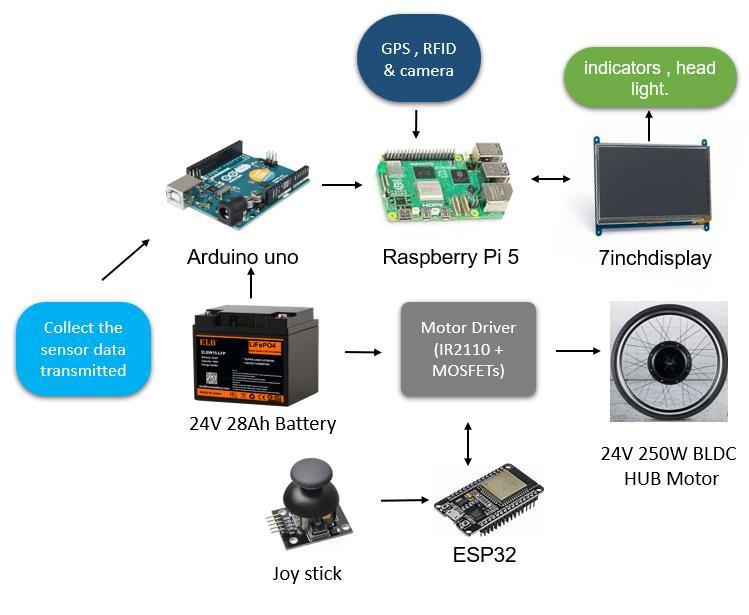
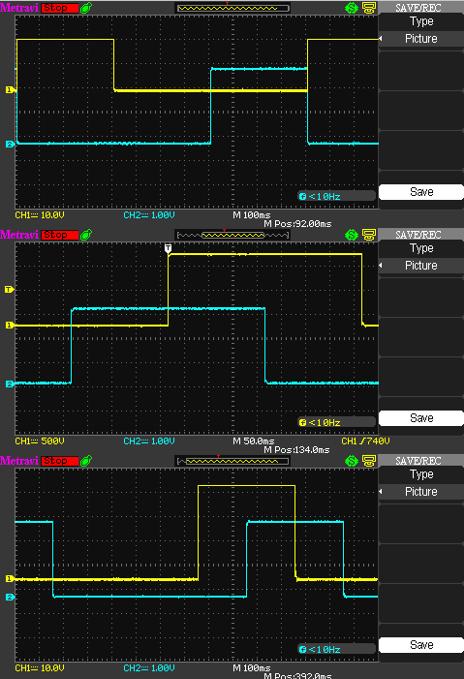
The motor control unit is developed using the ESP32 microcontroller, which is responsible for sensing the Hall sensorsignalsfromtheBLDChubmotorandtriggeringthe gate driver circuit. The gate driver section consists of IR2110, TLP250 optocoupler, and IRF3205 MOSFETs, providing efficient switching and isolation between the controlandpowercircuits.Twoindependentprogramsare deployedontheESP32 oneforBLDCmotortriggeringand anotherforelectromagneticbraking.Themotortriggering programoperatesonlywhenthenavigationmodeisactive, andthemotorspeediscontrolledusingthejoystickmodule input. In idle or non-navigation conditions, the electromagnetic braking system is activated to ensure vehicle safety and energy recovery. The ESP32 communicates with the Raspberry Pi 5 via a USB serial interface, enabling data synchronization and coordinated systemcontrol.
International Research Journal of Engineering and Technology (IRJET) e-ISSN: 2395-0056
Volume: 12 Issue: 10 | Oct 2025 www.irjet.net p-ISSN: 2395-0072
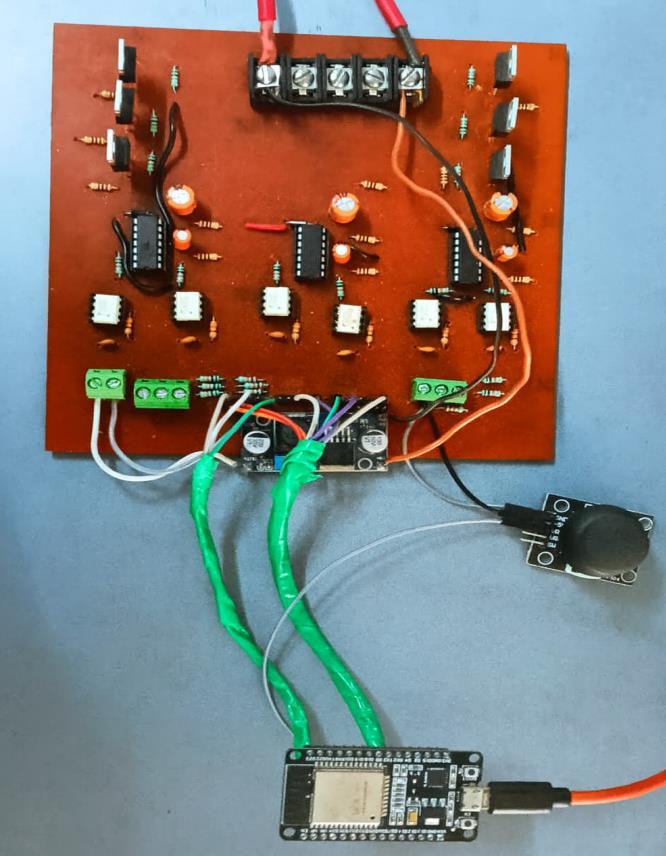
Custom-Made Motor Controller Components
Component Name Purpose / Function
ESP32 Microcontroller ReadsjoystickinputandgeneratesPWM signalstocontrolmotorspeed.
Joystick Module Provides speed control input to the ESP32.
IR2110 IC Driveshigh-sideandlow-sideMOSFETs.
IRF3205 MOSFET Switches motor current for speed control.
TLP250 Optocoupler Provides isolation between ESP32 and MOSFETs.
Bootstrap Capacitor Supplies voltage to high-side MOSFET gate.
Decoupling Capacitor StabilizesICsupplyandreducesnoise.
Bootstrap Diode Charges bootstrap capacitor for highsideMOSFETs.
Resistors Limitscurrentandsetsgatetiming.
Thesensordataacquisitionsystemisimplementedusingan Arduino microcontroller, which interfaces with various analog and digital sensors such as temperature, speed, proximity,andbatteryvoltagesensors.TheArduinocollects and processes these sensor readings in real time and transmits them to the Raspberry Pi 5 through a USB connection for further analysis and display. The sensor interfaceandcommunicationprotocolsareprogrammedin Embedded C using the Arduino IDE. This module ensures continuous data monitoring, which supports safety alerts, performance tracking, and intelligent decision-making for theelectricbicyclesystem
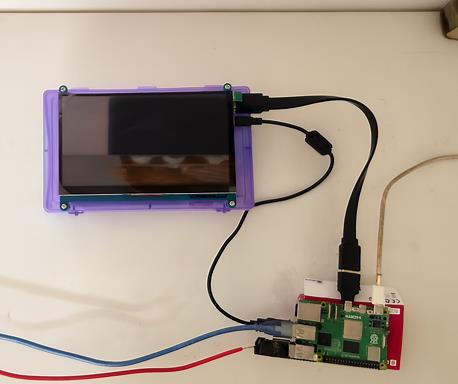
The Raspberry Pi 5 serves as the central infotainmentcontrollerandhuman–machineinterface (HMI) of the Smart Electric Bicycle. It integrates multiple subsystems, including motor monitoring, sensordatavisualization,navigation,multimedia,and user interaction. The infotainment dashboard is developed in Python using the PyQt5 framework, which provides a modern, interactive, and highly responsive graphical interface. Various PyQt5 modules such as QtWidgets, QtGui, and QtCore are utilized for dynamic layout management, styling, imagerendering,eventhandling,andreal-timesystem updates. Additionally, PyQt5.QtWebEngineWidgets
International Research Journal of Engineering and Technology (IRJET) e-ISSN: 2395-0056
Volume: 12 Issue: 10 | Oct 2025 www.irjet.net p-ISSN: 2395-0072
enables integration of live navigation maps, online data, and web-based resources directly on the GUI, whilePygamehandlesaudiooutput,includingmusic playback, notifications, and user alert sounds, enhancingtheoverallridingexperience.
Thesoftwareimportsessentiallibrariesincluding: QApplication, QWidget, QLabel, QPushButton, QVBoxLayout,QHBoxLayout,QMainWindow,QFrame, QSlider, QGraphicsDropShadowEffect, QIcon, QPixmap, QFont, QTimer, QDateTime, QUrl, and QWebEngineView.System-levelmodulessuchasos, sys, and subprocess are employed for executing background tasks, running system commands, and facilitatinghardwarecommunication.
Two joystick modules are integrated for precise controlandenhancedusability:
Motor and Light/Indicator Joystick: This joystick, mountedonthehandlebar,controlsboththespeedof theBLDCmotorandthelight/indicatorsystem.The motor is designed for forward motion only, and pushingthejoystickdowngraduallyincreasesmotor speed, reaching full speed after approximately 10 seconds,allowingsmoothaccelerationandsaferide dynamics. The joystick also controls the lighting system:movingitleftactivatestheleftindicator,right activates the right indicator, while pushing it up toggles the headlight ON/OFF. Holding the joystick continuously upward makes the headlight blink rapidly,functioningasapasslightforsignalingother vehicles. This dual-function joystick simplifies rider control, reduces hand movements, and ensures operationalsafetywhileriding.
InfotainmentMouseJoystick:Thissecondjoystickis dedicatedtocontrollingthePyQt5-basedinfotainment GUI on the Raspberry Pi. It functions as a virtual mouse, allowing the rider to interact with system menus, launch applications such as Chrome, play games, listen to music, and control multimedia functions. This design minimizes the need for a physical touchscreen, reduces distractions, and ensurestheridercanoperatetheinfotainmentsystem safelywhileonthemove.
The Raspberry Pi 5 communicates with both the ESP32andArduinothroughUSBserialconnections, receivingreal-timedatasuchasmotorspeed,battery status, sensor readings, and system alerts. The receiveddataisprocessedanddisplayeddynamically on the GUI, providing the rider with immediate feedback on system status. Additionally, the Pi managesBluetoothconnectivity,userauthentication viaPIN,anddataloggingforsecurityandmonitoring purposes.
This integrated infotainment and control system ensuressmoothinteractionbetweenmotorcontrol, lighting, sensor monitoring, and multimedia operations, creating a highly intelligent, userfriendly,andsaferidingexperience.Bycombining motorspeedcontrol,indicator/lightmanagement, andinfotainmentoperationsinacentralized,GUIdrivenplatform,thesystempromoteseco-friendly commuting,enhancedrideefficiency,andseamless operational convenience for the rider. The dualjoystick design allows intuitive handling and multitaskingcapabilities,makingtheSmartElectric Bicyclebothtechnologicallyadvancedandpractical foreverydayurbanandsemi-urbancommuting.
Home Screen: thecurrenttime,date,monthanda stylishbackgroundimageofthee-bike,Itincludesa powerbuttonforsystemcontrol
LockScreen: TheEnsuressystemsecuritythrough a PIN-protected numeric keypad, allowing only authorizeduserstoaccesstheSmartElectricBicycle
Main Menu: Therightandleftarrowsactivatethe rightandleftturnindicators,respectively,whilethe gear icon opens the control menu The up arrow opensthenavigationmenu,andthelightningbolt displaysthechargingstatus.Theheadlightcanbe toggled between high and low beam modes for visibility,andthecenterofthescreendisplaysthe 360°viewmodel
Control Panel: Offersaccesstodifferentfeatures like ride analytics, Bluetooth & Wifi connectivity, andsystemsettings.
Navigation Menu: Provides route guidance, map visualization,andGPS-basedridetracking.
International Research Journal of Engineering and Technology (IRJET) e-ISSN: 2395-0056
Volume: 12 Issue: 10 | Oct 2025 www.irjet.net p-ISSN: 2395-0072
Remaining Project Components
Component Name Purpose / Function
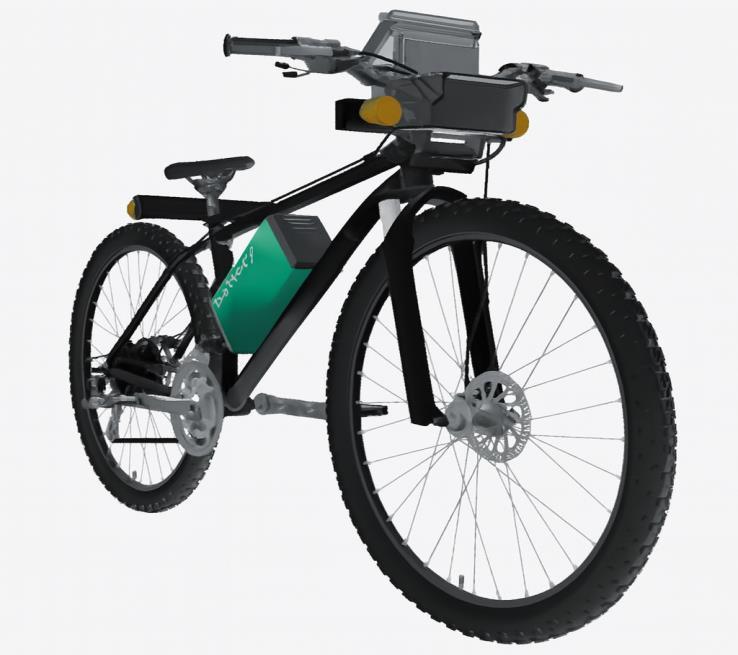
BLDC Hub Motor Provides main propulsion for the bicycle.
Battery Pack (24V, 28Ah Lead acid )
DC-DC Converter (24V → 5V/12V)
Raspberry Pi 5 with memory card
Supplies power to motor and electronics.
Powerslow-voltageelectronicslike ESP32andRaspberryPi.
Handles infotainment, multimedia, web,andgamefunctions.
7-Inch Touchscreen Display Displays speed, battery status, navigation, and infotainment interface.
Indicators and Front light
Charging Port
Frame and Mounting Assembly
Shows left/right turn signals and headlightstatus.
Allows battery charging from externalpowersource.
Providesmechanicalsupportforall components.
Infotainment Software Interface Runs multimedia, web browsing, andgameapplications.
Speakers
Providesmusicandaudioalertsfor infotainmentandnavigation.
The Smart Electric Bicycle with Infotainment System wasdesigned,fabricated,andtestedundervariousloadand terrain conditions to evaluate its performance and functionality. The results demonstrate that the system operates efficiently with stable control and real-time data feedbackbetweenthe ESP32controllerandRaspberryPi5 infotainmentplatform.
Motor Performance :
The 250 W BLDC hub motor delivered smooth torque with negligible vibration. The average top speedachievedwas 25 km/h underatotalloadof 80 kg.
Battery Range:
The24V,28Ahbatterypackprovidedacontinuous range of approximately 46 km per charge, validatingtheenergyefficiencyofthesystem.
Energy Efficiency:
The regenerative braking mechanism improved energyrecoverybyabout 8–10 %,contributingto extendedrangeandreducedenergyloss.
Communication and Data Logging:
The ESP32 successfully triggered the gate driver circuit and transmitted real-time data (speed, voltage,andHallfeedback)totheRaspberryPi5via UART/Wi-Fiwithoutlatencyissues.
Infotainment Interface :
The five-screen GUI (Lock, Home, Main Menu, ControlPanel,andNavigation)respondedsmoothly with a transition delay of less than one second betweenscreens.Bluetoothpairingandnavigation servicesoperatedreliablyduringtestruns.
TheSmartElectricBicyclewithInfotainmentSystemisan innovative project that merges technology, sustainability, anduserconveniencetoredefinemodernpersonalmobility. Designed to enhance ride efficiency, safety, and entertainment,this system integratesadvanced electronic control with an eco-friendly electric drive. Powered by a 24V, 250W BLDC hub motor, the bicycle ensures smooth acceleration,reliabletorque,andefficientenergyuse,even under varied road conditions. The ESP32 microcontroller servesastheintelligentcoreofthesystem,managingmotor control through hall sensors and gate drivers while supportingregenerativebrakingtorecoverenergyduring deceleration. In addition to this, an electromagnetic braking system has been incorporated to enhance rider safetybyprovidingadditionalstoppingpowerandprecise
International Research Journal of Engineering and Technology (IRJET) e-ISSN: 2395-0056
Volume: 12 Issue: 10 | Oct 2025 www.irjet.net p-ISSN: 2395-0072
braking control, ensuringsmoothandsecuredeceleration underallconditions.Theinfotainmentsystemisdesignedto act as the brain and entertainment hub of the vehicle. It featuresatouchscreeninterfacethatprovidesreal-timedata suchasspeed,batterylevel,navigationguidance,andsystem health monitoring. For user convenience and security, it includesaPIN-basedaccesssystemtopreventunauthorized usage. Beyond utility, the system offers multiple smart features, including music playback, web browsing, and casual game playing, allowing the rider to enjoy entertainmentduringreststopsorchargingintervals.The interfaceisdesignedtofunction like a smartphone,giving users access to multimedia, internet connectivity, and application control directly from the bicycle’s display unit.WithIoTintegration,riderscanmonitorperformance statistics,optimizeenergyusage,andreceivesystemupdates remotely.Theinclusionofregenerativeandelectromagnetic brakingsignificantlyenhancescontrolandsafety,whilethe infotainmentfeatureselevatetheoverallridingexperience. Compact design, efficient battery management, and intelligentcontrolmakethesystemreliablefordailyurban commutes. Overall, the Smart Electric Bicycle with InfotainmentSystemdemonstratesasuccessfulcombination of electrical, mechanical, and digital technologies deliveringasmart,safe,andenjoyablemobilitysolutionthat aligns with the vision of sustainable and connected urban transportation.
1. Y. Wang, Z. Wang, X. Li, and T. Liu, "A HighEfficiency BLDC Motor Drive System for Light ElectricVehicles," IEEE Trans. Power Electron.,vol. 36, no. 10, pp. 11921-11932, Oct. 2021, doi:10.1109/TPEL.2021.3084567.
2. S. Kumar, P. K. Jain, and A. Gupta, "IoT-Enabled SmartMonitoringandControl System forElectric Bicycles," IEEE Internet Things J.,vol.9,no.15,pp. 13892-13904, Aug. 2022, doi:10.1109/JIOT.2022.3142618.
3. R. Sharma and M. Lee, "Design and ImplementationofaLow-CostRaspberryPi-Based Vehicle Infotainment System," IEEE Consum. Electron. Mag., vol. 11, no. 4, pp. 71-80, Jul. 2022, doi:10.1109/MCE.2021.3120875.
4. J.LiandW.Zhang,"Hardware-in-the-LoopTesting Platform for Electric Bicycle Motor Controllers," IEEE Trans. Transp. Electrif.,vol.7,no. 2, pp. 542-553, Jun. 2021, doi:10.1109/TTE.2020.3044602.
5. A. Patel, S. Verma, and R. K. Singh, "Energy ManagementandOptimizationinElectricBicycles withRegenerativeBraking," Appl. Energy,vol.291,
p. 116842, Jun. 2021, doi:10.1016/j.apenergy.2021.116842.
6. K. Yamamoto et al., "Development of Compact MotorDriveUnitforElectricBicycles," IEEE Trans. Ind. Appl., vol. 57, no. 1, pp. 582-591, Jan. 2021, doi:10.1109/TIA.2020.3036754.
7. T.Besselmann etal.,"AModularTestPlatformfor LightElectricVehicleDevelopment," World Electr. Veh. J., vol. 12, no. 4, p. 248, Dec. 2021, doi:10.3390/wevj12040248.
8. G. Catargiu and M. Popa,"ConnectedBike:Smart IoT-BasedE-BikeSystem," Sensors,vol.22,no.15,p. 5676,Aug.2022,doi:10.3390/s22155676.
9. C. Zhang and H. Wang, "Real-Time Operating System for Automotive Infotainment Applications," IEEE Embed. Syst. Lett.,vol.14,no.2, pp. 83-86, Jun. 2022, doi:10.1109/LES.2021.3114562.
10. D. A. Johnson and M. R. Thompson, "HumanMachine Interface Design for Next-Generation VehicleDisplays," IEEE Trans. Veh. Technol.,vol.70, no. 8, pp. 7654-7665, Aug. 2021, doi:10.1109/TVT.2021.3096723.
11. P. M. Anderson and A. M. Hossain, "Power Electronics for Renewable Energy Systems and Transportation," Proc. IEEE, vol. 109, no. 6, pp. 1023-1035, Jun. 2021, doi:10.1109/JPROC.2021.3072189


Dr. P. Loganthurai is an Associate Professor in the Department of ElectricalandElectronicsEngineering at K.L.N. College of Engineering, Sivaganga.HeholdsaPh.D.fromAnna University and specializes in Renewable Energy, Energy Management,andPowerQuality.Heis a recognized research supervisor underAnnaUniversity.
B. S. Santhosh Babu is an undergraduate student in Electrical and Electronics Engineering with a focus on embedded systems, electric vehicles,andsmartmobilitysolutions. Hehashands-onexperienceinBLDC motor controller design and infotainmentsystem
International Research Journal of Engineering and Technology (IRJET) e-ISSN: 2395-0056
Volume: 12 Issue: 10 | Oct 2025 www.irjet.net p-ISSN: 2395-0072


P.Sundarapandiisanundergraduate student in B.E Electrical and Electronics Engineering with a focus onElectricalcore
J.C Janarthanan is an undergraduate student in B.E Electrical and Electronics engineering with a focus onElectricalcore