
International Research Journal of Engineering and Technology (IRJET) e-ISSN: 2395-0056
Volume: 12 Issue: 10 | Oct 2025 www.irjet.net p-ISSN: 2395-0072
International Research Journal of Engineering and Technology (IRJET) e-ISSN: 2395-0056
Volume: 12 Issue: 10 | Oct 2025 www.irjet.net p-ISSN: 2395-0072
Manjunatha K S 1 , Chetan Gonni S 2
1M. Tech Student, Department of Civil Engineering, Bapuji Institute of Engineering and Technology, Davanagere, Karnataka, India
2Assistant Professor, Department of Civil Engineering, Bapuji Institute of Engineering and Technology, Davanagere, Karnataka, India
Abstract - At present, India is the country with the largest population in the world It is increasingly becoming difficult to locate areas to live as there is congestion of space in big cities. This study investigates the G+12 storied structure resting on 10-degree sloped ground surface. Theanalysisisperformedfor seismic zone V as per Indian Standards codes by using Response Spectrum Method of Analysis. We have used steel bracings like X, K, V and diagonal for the study. The comparison is made between response parameters like Base Shear, Storey Displacement, Storey Drift and Storey Shear for sloped buildings to concludeabouttheconsideredstructuresin ETABS software through Response Spectrum Method of Analysis. This study helps to understand the performance and behavior of structures onslopedgroundusing differenttypesof bracings.
Key Words: RCC Structure, Bracing Systems, Response Spectrum Analysis, ETABS Software.
Earthquakesarehistoricallyandextensivelycauseddueto structuraldamageinseismicbehaviorofstructure.Bracing systemsareprovideessentialsupportinearthquake-prone areasandhelpingtomulti-storiedbuildingsremainstrong on both level and sloped ground. The various types of bracingssuchasX,K,V,Invertedchevronanddiagonal To enhancethedurabilityandstrengthofstructurewiththeir effectivenessdependsonplacementandarrangement.They aremostlyusedinbuildingstoimproveresistanceagainst horizontalloads.Inrecenttimes,fastgrowthinlargecities arecausedlackoflevelland.Duetothisitcreatesamajor challenge to engineers for construction of buildings on sloped ground surface. This shows the preparation of complexgeometricdesignandstructuralirregularities.
Structures are most widely adopted frame systems in modern construction. Allowed loads can be efficiently transferred to the foundation to ensure the safety and stability. Such structures are highly effective in resisting verticalloadslike,dead&liveloadsandlateralforcescauses by wind or earthquakes. The structures are built to using reinforced concrete and structural steel components for
usingbothcombinationsdependedontoresistloads.These systems are classified as rigid frames, braced frames or moment resisting frames. Today, framed structures are widelyprovisioninmulti-storeybuildings,industrialfacilities andbridges.
Bracingsystemarestructuralarrangementstoprovided inframedbuildingsareresistlateralloadsinducedbywind andearthquakes.Theyconsistofinclinedmembersplaced betweenaxialloadmemberandflexuremembertoforma triangulatedframework,whicheffectivelytransferslateral forces to the foundation. In high-rise buildings, bracing systemsareessentialforincreasingstructuralstiffnessand stability. They also help to reduce storey drift during earthquakes,toenhancingoverallsafety.
ASeismicresistantstructureiscreatedtoseismicforces byassuresafetyandstrength,forminimumdamageduringa seismic excitation. These structures are completely not in earthquake-proof,theyaredesignedtoabsorb&itdissipates seismicenergyeffectively.
A Response spectrum analysis the method useful for evaluate how the structures respond to earthquakes. To examine structural outcome. It assesses the buildings response to earthquakes and varying seismic intensities. Graphicalpresentationtoofbuildingstomaximumresponse and its occurrence helps to design and assessment. It is generally used for dynamic analysis technique in seismic engineeringtoassessthetremorresponseofbuildings.Each building responds specify to seismic activity based on its natural frequency, damping ratio and mode shapes, which shouldbeconsideredindesignandanalysis.
Theaimofthestudyistoinvestigatetheseismicbehaviorof multi-storiedRCbuildingonflatgroundandslopedgroundat aninclinationof10degrees,itsinteractivebehaviorswhen addedwithdifferenttypesofbracingsatdifferentlocations.
Volume:
TocreateandanalyzeaG+12RCbuildingrestingon flat and sloped ground using response spectrum methodofanalysis.
Insert X, K, V and diagonal bracings at different locationsofthebuilding.
Tocomparetheresultsw.r.tseismicbehaviori.e.,Base Shear,StoreyShear,StoreyDisplacementandStorey Drift of all the models using tabular columns and graphical figures and conclude with what type for bracing is suitable for a better, safer and economic section.
TocreateaG+12RCbuildingmodelinETABS.
To apply different types of loads (Dead load, Live Load and Earthquake Load) and different load combinationsasperIS1893:2016(Part-1).
To apply all the parameters of earthquake and performtheanalysisusingRSMofanalysis.
For the same models, insert the various types of bracings at different locations and perform the analysis.
To extract the analytical results, tabulate it and represent it in a graphical method for better comparisonbetweeneachmodels.
Tocomparethefinalresultsofseismicperformance by seismic parameters like Base Shear, Storey Displacement,StoreyDriftandStoreyShearforeach models
Table -3.1: ParametersconsideredforgenerationofRC buildings
Table -3.2: VariousmodelsareconsideredforRSA
Bracings
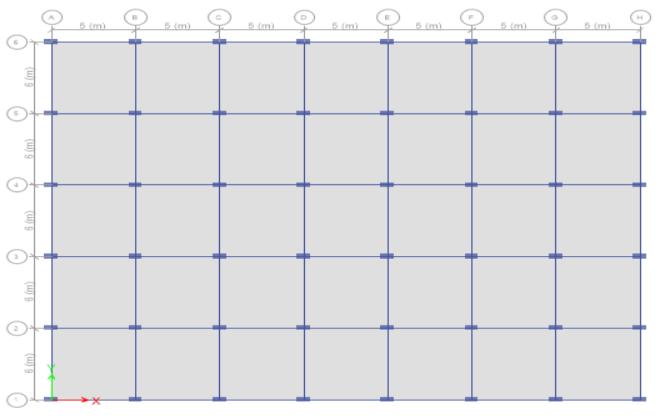
Fig-1: Planview
International Research Journal of Engineering and Technology (IRJET) e-ISSN: 2395-0056
Volume: 12 Issue: 10 | Oct 2025 www.irjet.net p-ISSN: 2395-0072
International Research Journal of Engineering and Technology (IRJET) e-ISSN: 2395-0056
Volume: 12 Issue: 10 | Oct 2025 www.irjet.net p-ISSN: 2395-0072
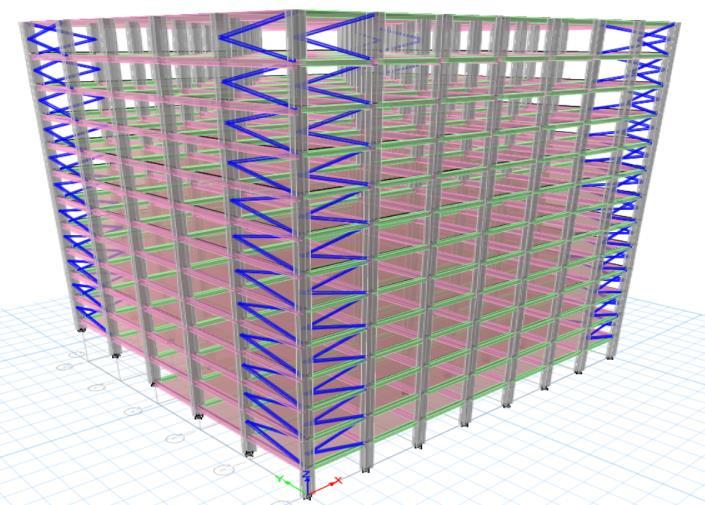
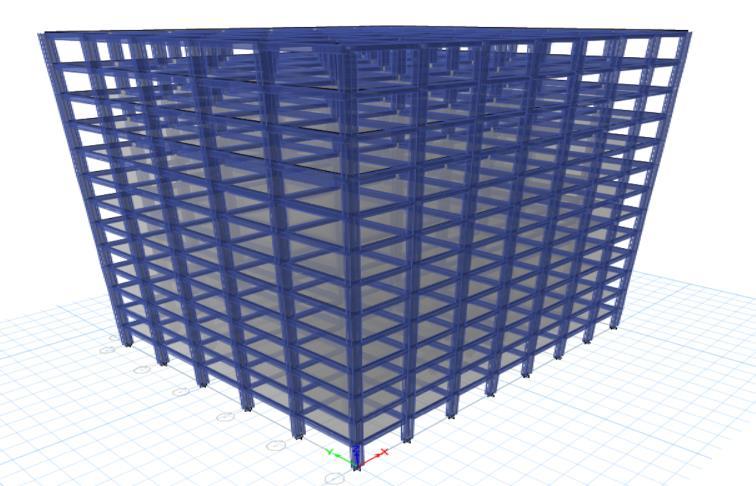
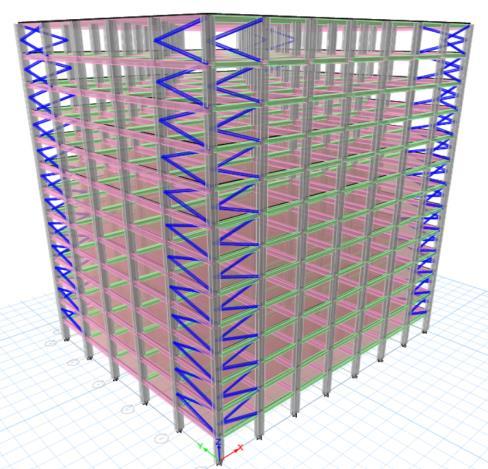
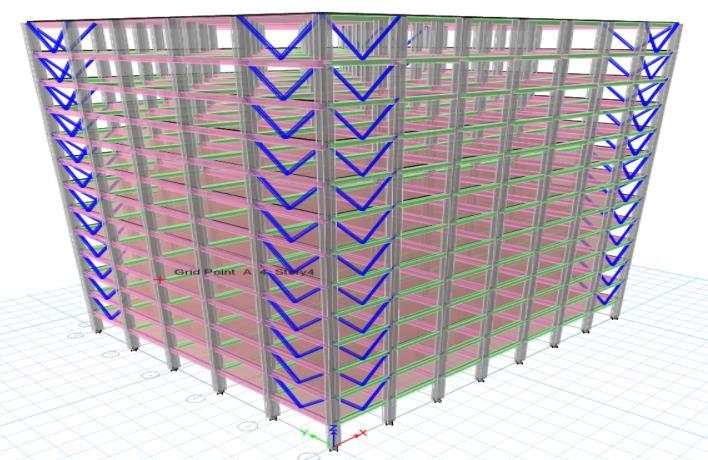
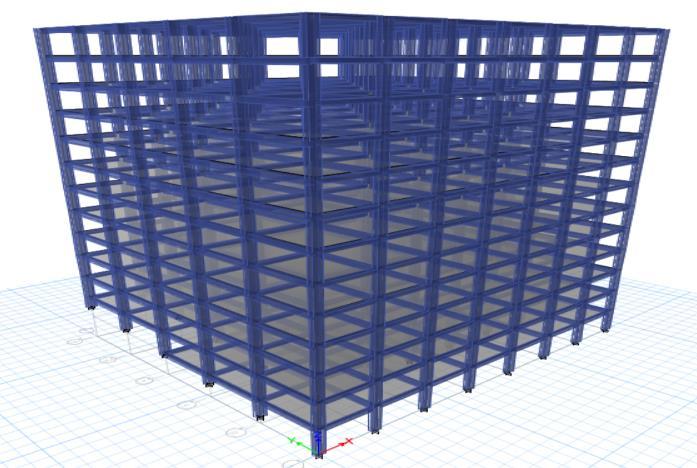
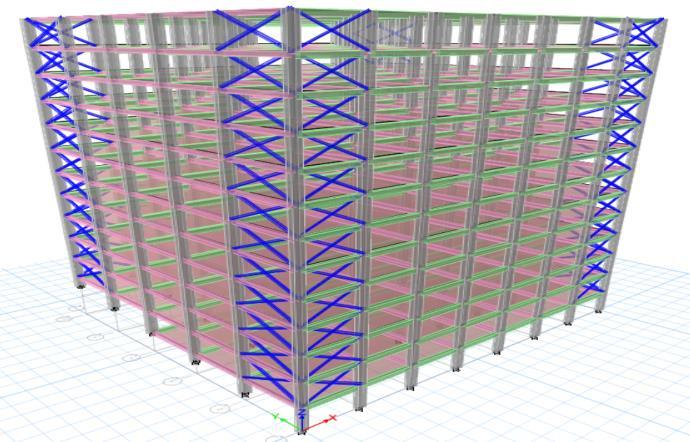
3DviewofRCframeM-3onSGS
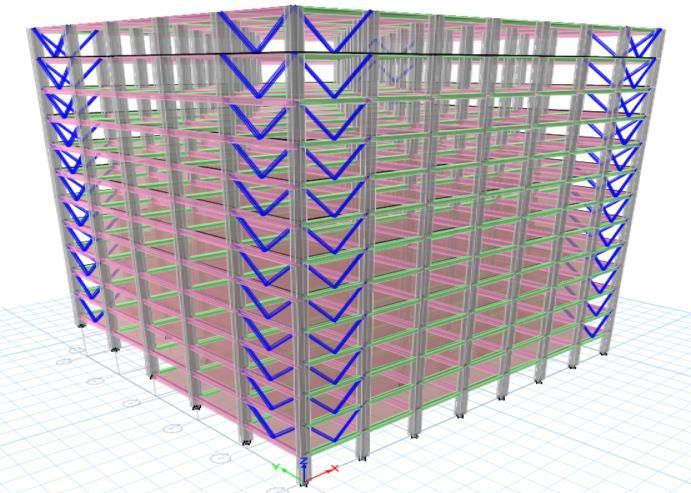
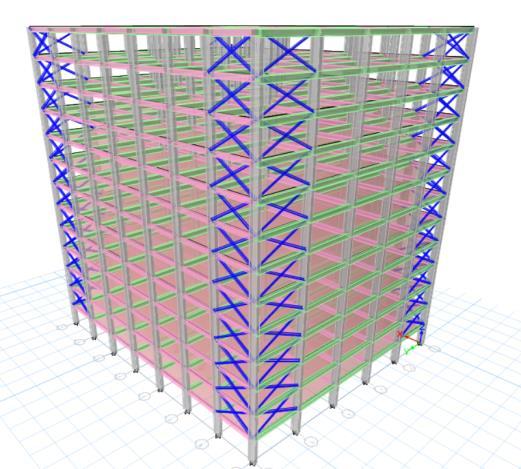
3DviewofRCframeM-4onSGS
4. RESULTS AND DISCUSSIONS
4.1 Base Shear
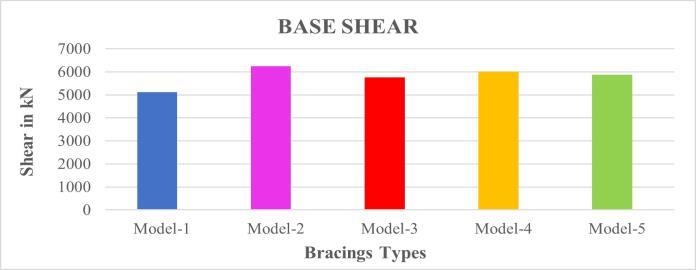
Chart -1:BaseShearvariationinX-dir.forvarioustypesof bracingsonFGS
Fromtheabovegraphandtables,itisclearlyobservedthat base shear on flat ground surface of Model-2 shows the maximum value is 6238.32 kN and Model-1 shows the minimumvalueis5116.03kNinX-direction.When(Model-2)
is compared with (Model-1), then value of base shear decreasedby18%.
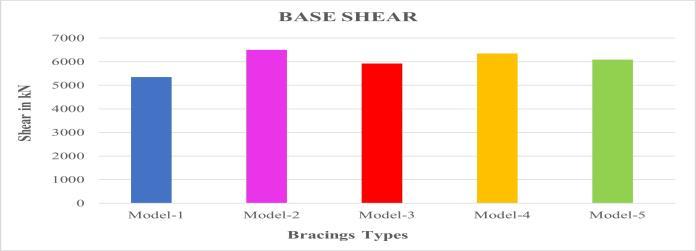
Chart -2:BaseShearvariationinY-dir.forvarioustypesof bracingsonFGS
Fromtheabovegraphandtables,itisclearlyobservedthat thebaseshearonflatgroundsurfaceofModel-2showsthe maximum value is 6505.1059 kN and Model-1 shows the minimum value is 5348.0516 kN in Y-direction. When (Model-2) is compared with (Model-1), then value of base sheardecreasedby18%.
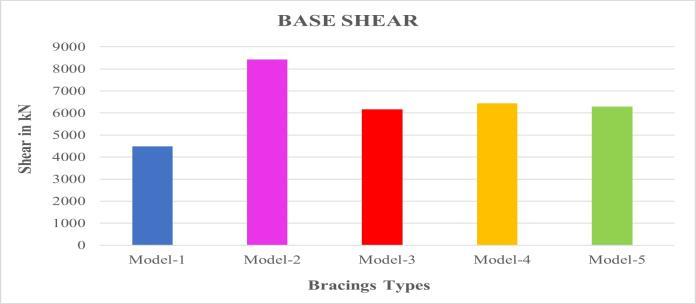
Chart -3:BaseShearvariationinX-dir.forvarioustypesof bracingsonSGS
Fromtheabovegraphandtables,itisclearlyobservedthat thebaseshearonslopedgroundsurfaceofModel-2shows themaximumvalueis8430.6835kNandModel-1showsthe minimum value is 4482.0827 kN in X-direction. When (Model-2) is compared with (Model-1), then value of base sheardecreasedby47%.
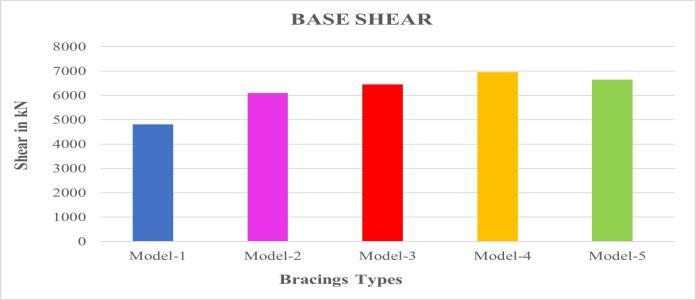
Chart -4:BaseShearvariationinY-dir.forvarioustypesof bracingsonSGS
International Research Journal of Engineering and Technology (IRJET) e-ISSN: 2395-0056
Volume: 12 Issue: 10 | Oct 2025 www.irjet.net
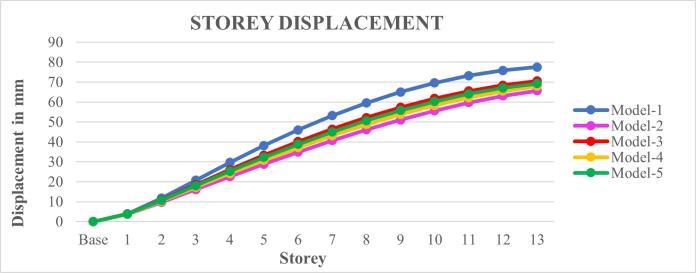
Chart -5:StoreydisplacementvariationinX-dir.for varioustypesofbracingsonFGS
Fromtheabovegraphandtables,itisclearlyobservedthat maximum storey displacement on flat ground surface of Model-1showsthemaximumvalueis77.486mmandModel2 shows the minimum value is 65.679 mm in X-direction. When(Model-1)iscomparedwith(Model-2),thenvalueof displacementdecreasedby16%.
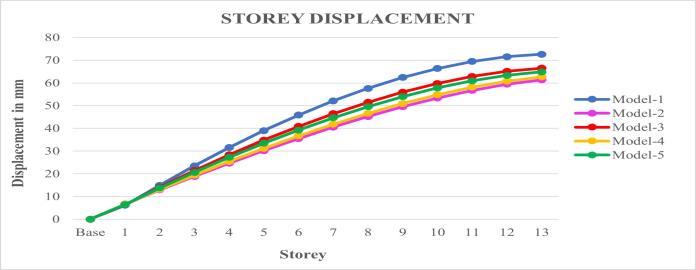
Chart -6:StoreydisplacementvariationinY-dir.for varioustypesofbracingsonFGS
Fromtheabovegraphandtables,itisclearlydeterminedthat maximum storey displacement on flat ground surface of Model-1showsthemaximumvalueis72.604mmandModel2 shows the minimum value is 61.374 mm in Y-direction, when(Model-1)iscomparedwith(Model-2),thenvalueof displacementdecreasedby16%.
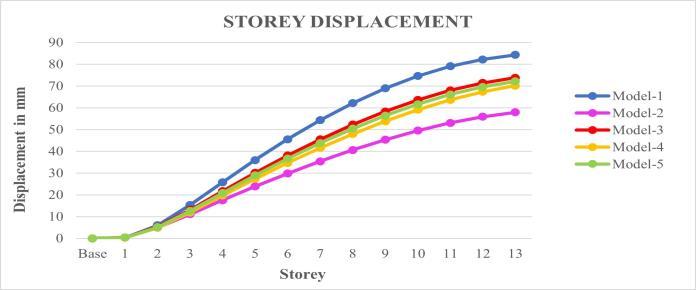
Chart -7:StoreydisplacementvariationinX-dir.for varioustypesofbracingsonSGS
Fromtheabovegraphandtables,itisclearlydeterminedthat maximumstoreydisplacementonslopedgroundsurfaceof Model-1showsthemaximumvalueis84.254mmandModel2 shows the minimum value is 57.923 mm in X-direction.
p-ISSN: 2395-0072
When(Model-1)iscomparedwith(Model-2),thenvalueof displacementdecreasedby32%.
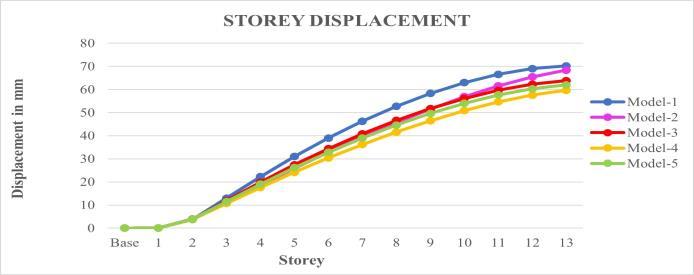
Chart -8:StoreydisplacementvariationinY-dir.for varioustypesofbracingsonSGS
4.3 Storey Drift
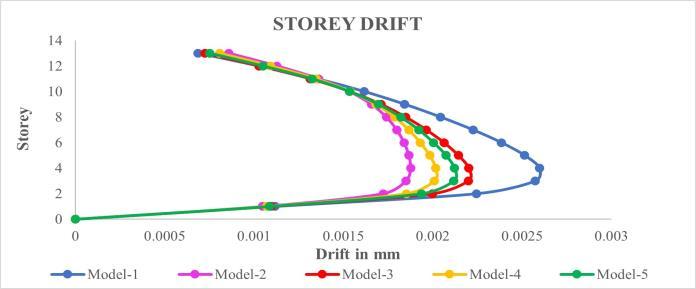
Chart -9:StoreydriftvariationinX-dir.forvarioustypes ofbracingsonFGS
Fromtheabovegraphandtables,itisclearlyobservedthat 12-storeystructureonflatgroundwithprecisematerialsand sectionproperties,storeydriftoftheseismicdataintheXdirectionofhighervaluefortheModel-1is0.002597.When compared with remaining Model values 2, 3, 4 and 5 are lesserrespectively.
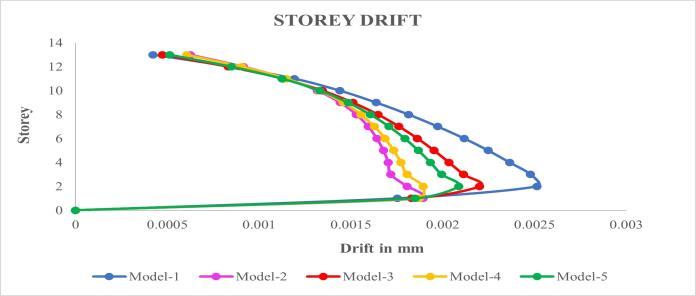
Chart -10:StoreydriftvariationinY-dir.forvarioustypes ofbracingsonFGS
Fromtheabovegraphandtables,itisclearlyobservedthat 12-storeystructureonflatgroundwithprecisematerialsand sectionproperties,storeydriftoftheseismicdataintheYdirectionofhighervaluefortheModel-1is0.002478.When compared with remaining Model values 2, 3, 4 and 5 are lesserrespectively.
International Research Journal of Engineering and Technology (IRJET) e-ISSN: 2395-0056
Volume: 12 Issue: 10 | Oct 2025 www.irjet.net p-ISSN: 2395-0072
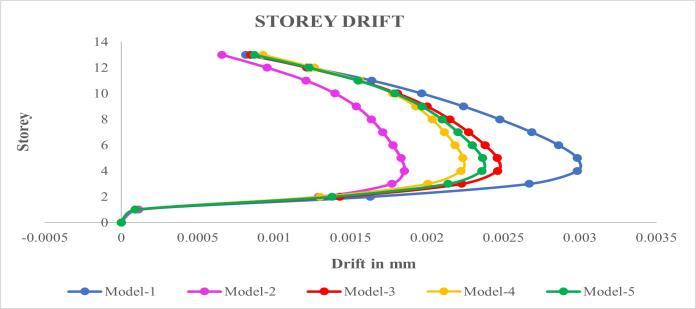
Chart -11:StoreydriftvariationinX-dir.forvarioustypes ofbracingsonSGS
Fromtheabovegraphandtables,itisclearlyobservedthat 12-storeystructureonslopedgroundwithprecisematerials andsectionproperties,storeydriftoftheseismicdatainthe X-directionofhighervaluefortheModel-1is0.002983.When compared with remaining Model values 2, 3, 4 and 5 are lesserrespectively.
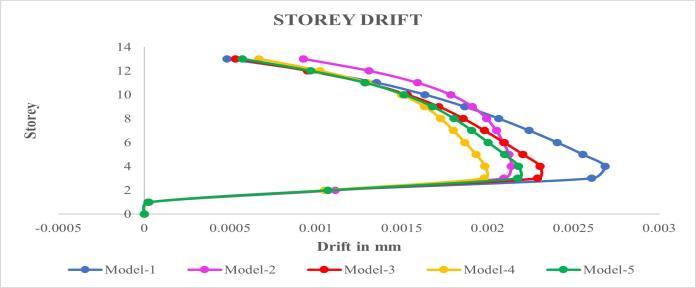
Chart -12:StoreydriftvariationinY-dir.forvarioustypes ofbracingsonSGS
Fromtheabovegraphandtables,itisclearlyobservedthat 12-storeystructureonslopedgroundwithprecisematerials andsectionproperties,storeydriftoftheseismicdatainthe Y-directionofhighervaluefortheModel-1is0.002684.When compared with remaining Model values 2, 3, 4 and 5 are lesserrespectively.
4.4 Storey Shear
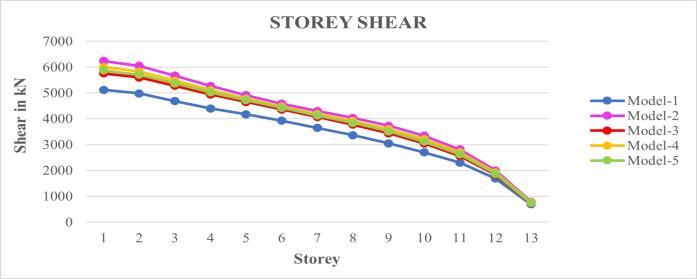
Chart -13:StoreyShearvariationinX-dir.forvarious typesofbracingsonFGS
Fromtheabovegraphandtables,itisclearlyobservedthat storey shear on flat ground surface of Model-2 shows the maximum value is 6238.32 kN and Model-1 shows the
minimumvalueis5116.03kNinX-direction.When(Model-2) is compared with (Model-1), then value of storey shear decreasedby18%.
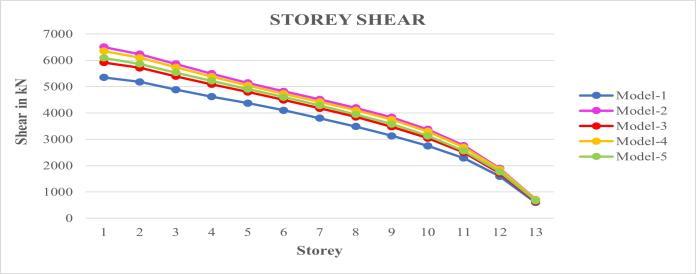
Chart -14:StoreyShearvariationinY-dir.forvarious typesofbracingsonFGS
Fromtheabovegraphandtables,itisclearlyobservedthat storey shear on flat ground surface of Model-2 shows the maximum value is 6505.1059 kN and Model-1 shows the minimum value is 5348.0516 kN in Y-direction. When (Model-2)iscomparedwith(Model-1),thenvalueofstorey sheardecreasedby18%.
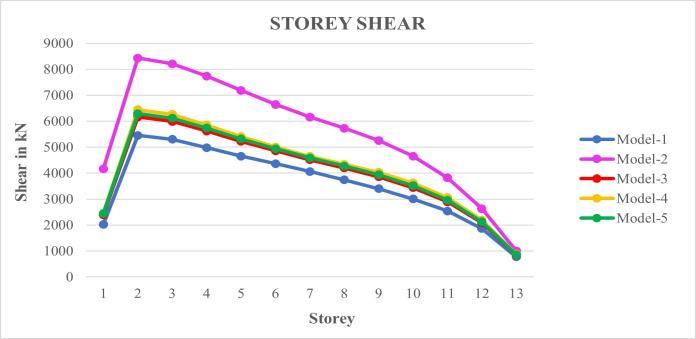
Chart -15:StoreyShearvariationinX-dir.forvarious typesofbracingsonSGS
Fromtheabovegraphandtables,itisclearlyobservedthat baseshearonslopedgroundsurfaceofModel-2showsthe maximum value is 4160.361 kN and Model-1 shows the minimum value is 2019.6807 kN in X-direction. When (Model-2)iscomparedwith(Model-1),thenvalueofstorey sheardecreasedby52%.
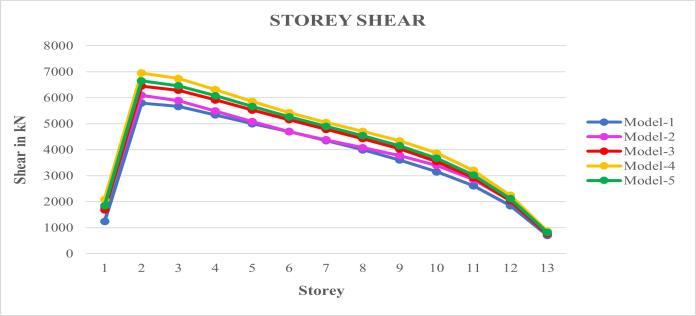
Chart -16:StoreyShearvariationinY-dir.forvarious typesofbracingsonSGS
International Research Journal of Engineering and Technology (IRJET) e-ISSN: 2395-0056
Volume: 12 Issue: 10 | Oct 2025 www.irjet.net p-ISSN: 2395-0072
Fromtheabovegraphandtables,itisclearlyobservedthat baseshearonslopedgroundsurfaceofModel-4showsthe maximum value is 2088.8935 kN and Model-1 shows the minimum value is 1242.1809 kN in Y-direction. When (Model-2)iscomparedwith(Model-1),thenvalueofstorey sheardecreasedby41%.
TheanalyticalresultsofbaseshearonFGSofModel-1 shows the maximum value is 6238.3205 kN and Model-2showstheminimumvaluesis5116.03kNin X-direction.Thebasesheardecreasedby18%,when (Model-1)iscomparedwith(Model-2)respectively.
TheanalyticalresultsofbaseshearonFGSofModel-1 shows the maximum value is 6505.1059 kN and Model-2showstheminimumvaluesis5348.0516kN in Y-direction. The base shear decreased by 18%, when (Model-1) is compared with (Model-2) respectively.
TheanalyticalresultsofbaseshearonSGSofModel-1 shows the maximum value is 8430.6835 kN and Model-2showstheminimumvaluesis4482.0827kN in X-direction. The base shear decreased by 47%, when (Model-1) is compared with (Model-2) respectively.
TheanalyticalresultsofbaseshearonSGSofModel-1 shows the maximum value is 6951.6643 kN and Model-2showstheminimumvaluesis4812.4329kN in Y-direction. The base shear decreased by 31%, when (Model-4) is compared with (Model-1) respectively.
TheanalyticalresultsofstoreydisplacementonFGSof Model-1showsthemaximumvalueof77.486mmand Model-2showstheminimumvaluesis65.679mmin X-direction. The displacement decreased by 16%, when (Model-1) is compared with (Model-2) respectively.
TheanalyticalresultsofstoreydisplacementonFGSof Model-1showsthemaximumvalueis72.604mmand Model-2showstheminimumvaluesis61.374mmin Y-direction. The displacement decreased by 16%, when (Model-1) is compared with (Model-2) respectively.
TheanalyticalresultsofstoreydisplacementonSGSof Model-1showsthemaximumvalueis84.254mmand Model-2showstheminimumvaluesis57.923mmin X-direction. The displacement decreased by 16%, when (Model-1) is compared with (Model-2) respectively.
TheanalyticalresultsofstoreydisplacementonSGSof Model-1showsthemaximumvalueis70.219mmand Model-4showstheminimumvaluesis59.677mmin Y-direction. The displacement decreased by 15%, when (Model-1) is compared with (Model-4) respectively.
The analytical results of storey drift on FGS in Xdirection of Model-1 shows the highest value is 0.002597 mm and Model 2, 3, 4 and 5 shows the lowestvaluesrespectively.
The analytical results of storey drift on FGS in Ydirection of Model-1 shows the highest value is 0.002478 mm and Model 2, 3, 4 and 5 shows the lowestvaluesrespectively.
The analytical results of storey drift on SGS in Xdirection of Model-1 shows the highest value is 0.002983 mm and Model 2, 3, 4 and 5 shows the lowestvaluesrespectively.
The analytical results of storey drift on SGS in Ydirection of Model-1 shows the highest value is 0.002684 mm and Model 2, 3, 4 and 5 shows the lowestvaluesrespectively.
TheanalyticalresultsofstoreyshearonFGSofModel2 shows the maximum value is 6505.1059 kN and Model-1showstheminimumvaluesis5116.03kNin X-direction.Thestoreysheardecreasedby18%,when (Model-2)iscomparedwith(Model-1)respectively.
TheanalyticalresultsofstoreyshearonFGSofModel2 shows the maximum value is 6238.3205 kN and Model-1showstheminimumvaluesis5348.0516kN in Y-direction. The storey shear decreased by 18%, when (Model-2) is compared with (Model-1) respectively.
TheanalyticalresultsofstoreyshearonSGSofModel2 shows the maximum value is 4160.361 kN and Model-1showstheminimumvaluesis2019.6807kN in X-direction. The storey shear decreased by 52%, when (Model-2) is compared with (Model-1) respectively.
TheanalyticalresultsofstoreyshearonSGSofModel4 shows the maximum value is 2088.8935 kN and Model-1showstheminimumvaluesis1242.1809kN in Y-direction. The storey shear decreased by 41%, when (Model-4) is compared with (Model-1) respectively.
International Research Journal of Engineering and Technology (IRJET) e-ISSN: 2395-0056
Volume: 12 Issue: 10 | Oct 2025 www.irjet.net p-ISSN: 2395-0072
[1] ChidanandBidanalamath,SabyathShetty,Shanmukha ShettyandThusharShetty(2019)“SeismicBehaviorof DifferentConfigurationofMulti-StoreyRCBuildingson SlopingGround:AReview”,InternalJournalofResearch inAdventTechnology,E-ISSN:2321-9637,Vol.03,pp. 1028-1032.
[2] D.J.MisalandM.ABagade(2016)“SeismicBehaviorof Multi-Storied RCMRF Buildings Resting on Sloping ground”. International Journal for Research in Engineering Science and Technology (IJRESTS), ISSN (Online):2395-6453,Vol.2,No.01,pp.104-114.
[3] Er.AditiH.DeshmukhMs.MonicaSandSuryawanshi (2022) “Effects of Sloping Ground on the Structural performance of R.C.C. Building Under Seismic loads”, International Journal of Interdisciplinary Innovative Research&Development(IJIIRD),ISSN:2456-236X,Vol. 7,Issue01,pp.41-50.
[4] LikhitharadhyaYR,PraveenJV,SanjithJandRanjithA (2016) “Seismic Analysis of Multi-Storied Building RestingonFlatGroundand SlopingGround”.Internal JournalofInnovativeResearchinScience,Engineering andTechnology,ISSN(Print):2347-6710,Vol.5,Issue6, pp.9786-9794.
[5] Rishi Mishra, Dr. Abhay Sharma and Dr. Vivek Garg (2014) “Analysis of RC Building Frames for Seismic Forces Using Different Types of Bracing Systems.” International Journal of Engineering Research & Technology(IJERT),ISSN:2278-0181,Vol.3,Issue07, pp.1135-1140.
[6] Sindhurashmi B.M. and Bhavani Shankar (2018) “SeismicResponseofRCFramedStructuresRestingon Sloping Terrain”. International Research Journal of Engineering and Technology (IRJET), E-ISSN: 23950056,Vol.05,Issue05,pp.1332-1342.
[7] IS456(2000),“PlainandReinforcedConcrete-Codeof Practice”,BureauofIndianStandards,NewDelhi,India.
[8] IS875-Part1(1987),“CodeofPracticeforDesignLoads (OtherthanEarthquake)forBuildingsandStructures. Part1DeadLoads–UnitWeightsofBuildingMaterials andStoredMaterials”,BureauofIndianStandards,New Delhi,India.
[9] IS875-Part2(1987),“CodeofPracticeforDesignLoads (OtherthanEarthquake)forBuildingsandStructures. Part 2 Imposed Loads”, Bureau of Indian Standards, NewDelhi,India.
[10] IS 1893-Part 1 (2016), “Criteria for Earthquake Resistant Design of Structures. Part 1- General
ProvisionsandBuildings”,BureauofIndianStandards, NewDelhi,India.
[11] IS800:(2007),“GeneralConstructioninSteel-Codeof Practice”,BureauofIndianStandards,NewDelhi,India.