
International Research Journal of Engineering and Technology (IRJET) e-ISSN: 2395-0056
Volume: 12 Issue: 10 | Oct 2025 www.irjet.net p-ISSN: 2395-0072
International Research Journal of Engineering and Technology (IRJET) e-ISSN: 2395-0056
Volume: 12 Issue: 10 | Oct 2025 www.irjet.net p-ISSN: 2395-0072
Madhusudan Bangalore Nagaraja1
1Technical Delivery Manager, Esystems-Inc & Dallas, TX, USA ***
Abstract - Effectivestakeholdermanagementiscriticalto project success, yet traditionalapproachesrely onperiodic assessmentsandsubjectiveevaluationsthatoftenmissearly warning signs of stakeholder disengagement. This paper presents a conceptual framework for sentiment-aware stakeholder management that integrates artificial intelligence-powered sentiment analysis with established stakeholdertheoryandproject managementpractices. The frameworkcombinesnaturallanguageprocessingtechniques withtraditionalprojectmetricstocreatepredictivemodelsfor threekeyoutcomes:RiskofScopeCreep(binaryclassification), Likelihood of Project Delay (probability estimation), and Stakeholder Satisfaction Score (regression analysis). By systematically analyzing communications from multiple channels emails, meeting transcripts, chat messages, and social media posts related to the project, the framework enables proactive stakeholder engagement through early detectionofsentiment-relatedrisks.Theproposedapproach transformsqualitativestakeholderfeedbackintoquantifiable metrics,providingprojectmanagerswithdata-driveninsights for intervention strategies. This conceptual framework contributestotheprojectmanagementliteraturebybridging sentiment analysis technology with stakeholder theory, offeringasystematicapproachtoenhanceprojectoutcomes throughimprovedstakeholderrelationships.
Key Words: Sentiment Analysis, Stakeholder Management, Project Management, Artificial Intelligence, Conceptual Framework, Natural Language Processing
1.1
Project management in the digital era faces unprecedentedchallengesinstakeholdercommunicationand engagement.TheProjectManagementInstitutereportsthat ineffective communicationcontributes to projectfailurein 33%ofcases,withorganizationsriskingsignificantvalue up to $75 million per $1 billion invested due to communication breakdowns[1]. As projects become increasingly complex and stakeholder ecosystems more diverse,traditionalapproachestostakeholdermanagement prove inadequate for capturing the nuanced dynamics of stakeholdersentimentandengagement
Currentstakeholdermanagementpracticessufferfrom several fundamental limitations. First, they are
predominantly reactive, identifying issues only after they have escalatedintosignificant problems. Second,they rely heavilyonsubjectiveassessmentsandperiodicsurveysthat maynotcapturereal-timesentimentfluctuations.Third,the volumeofdigitalcommunicationinmodernprojectscreates an information processing challenge that exceeds human analytical capabilities. Finally, existing approaches lack systematic integration between qualitative stakeholder feedbackandquantitativeprojectperformancemetrics.
This research aims to develop a comprehensive conceptual framework thataddressestheselimitationsby leveragingartificialintelligencetocreatesentiment-aware stakeholdermanagementcapabilities.Thespecificobjectives are:
1. Theoretical Integration: Establish a conceptual foundation that bridges stakeholder theory with sentimentanalysistechnology
2. Framework Development: Design a systematic approach for transforming stakeholder communicationsintoactionableinsights
3. Predictive Modeling:Definetargetvariablesand prediction models that link sentiment patterns to projectoutcomes
4. Validation Strategy: Propose methods for evaluating the framework's effectiveness and practicalutility
This work contributes to both theoretical and practical knowledge in several ways. Theoretically, it extends stakeholder theory by incorporating real-time sentiment dynamics and provides a sociotechnical perspective on stakeholder-project interactions. Methodologically, it introduces a novel integration of natural language processing with traditional project metrics for predictive modeling. Practically, it offers project managers a datadriven approach to stakeholder engagement that can improve project outcomes through proactive intervention strategies.
International Research Journal of Engineering and Technology (IRJET) e-ISSN: 2395-0056
Volume: 12 Issue: 10 | Oct 2025 www.irjet.net p-ISSN: 2395-0072
Freeman's stakeholder theory provides the foundational framework for understanding stakeholder relationships in projectcontexts[2].Thetheorypositsthatprojectsuccess depends not only on meeting technical specifications and budgetconstraintsbutalsoonsatisfyingthediverseneeds and expectations of all stakeholder groups. Modern extensions of stakeholder theory emphasize the dynamic nature of stakeholder relationships and the need for continuousmonitoringandadaptation[3].
Recentresearchinstakeholdermanagementhasidentified key challenges in contemporary project environments, includingstakeholdercomplexitywithconflictinginterests, communicationfragmentationacrossmultiplechannels,and cultural diversity in global projects[4]. These challenges underscoretheneedformoresophisticatedapproachesto stakeholdermonitoringandengagement.
Sentiment analysis, also known as opinion mining, has evolved from basic polarity detection to sophisticated emotion recognition and aspect-based analysis[5]. In organizationalcontexts,sentimentanalysisapplicationshave demonstratedvalueincustomerrelationshipmanagement, employee engagement monitoring, and brand reputation management[6].
Recent advances in transformer-based language models, particularly BERT and its variants, have significantly improved sentiment analysis accuracy across diverse domains[7]. Research demonstrates that AI-powered sentimentanalysisincorporatecommunicationcanimprove stakeholder engagement by enabling earlier detection of negativetrendsandreducingresponsetimes[8].
The integration of artificial intelligence in project management has gained significant momentum, with applications ranging from schedule optimization to risk assessment[9]. Traditional predictive models in project managementtypicallyrelyonquantitativemetricssuchas earned value management indicators and historical performancedata[10].
Recentstudieshaveexploredtheintegrationoftextualdata with traditional project metrics to improve prediction accuracy. Research shows that hybrid models combining quantitativeprojectindicatorswithqualitativestakeholder feedbackoutperformpurelyquantitativeapproachesinrisk prediction[11].
Thesociotechnicalsystemsperspectiveprovidesavaluable lens for understanding how information systems, communication technologies, and organizational routines shape both expressed sentiment and its effects on stakeholder commitment and satisfaction[12]. This perspective emphasizes the interaction between technical capabilitiesandsocialdynamicsinorganizationalcontexts.
3.1
The proposed framework is grounded in three theoretical perspectives:
1. Stakeholder Theory: Provides the foundation for understandingstakeholderrelationships,influence, and the importance of stakeholder satisfaction for projectsuccess.
2. SociotechnicalSystemsTheory:Offersinsightinto how technology-mediated communication affects stakeholder interactions and organizational outcomes.
3. Information Processing Theory: Explains how organizations can leverage data processing capabilities to enhance decision-making and performance
The conceptual framework consists of five interconnected layers:
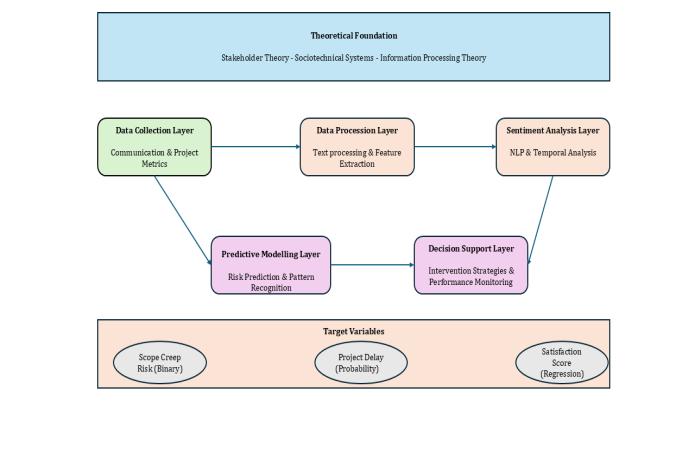
Fig -1:Sentiment-AwareStakeholderManagement: ConceptualFramework
3.2.1
Thislayerencompassesmultipledatasourcesthatcapture stakeholdercommunicationsandtraditionalprojectmetrics:
International Research Journal of Engineering and Technology (IRJET) e-ISSN: 2395-0056
Volume: 12 Issue: 10 | Oct 2025 www.irjet.net p-ISSN: 2395-0072
Communication Data Sources:
Emailsystemsandcorrespondence
Chatplatforms(Slack,MicrosoftTeams)
Meetingtranscriptsandrecordings
Socialmediamentionsanddiscussions
Surveyresponsesandfeedbackforms
Project Metrics Sources:
Scheduleperformanceindicators
Budgetutilizationreports
Qualitymetricsandissuetracking
Resourceallocationdata
Stakeholderengagementrecords
3.2.2
This layer transforms raw data into structured formats suitableforanalysis:
Text Preprocessing: Cleaning, tokenization, and normalization of communication data using establishedNLPtechniques.
FeatureExtraction:Generationofbothsentimentderivedfeaturesandtraditionalprojectmetricsfor predictivemodeling.
DataIntegration:Combiningtextualandnumerical dataintounifiedfeaturevectorsforanalysis.
Thislayerappliesnaturallanguageprocessingtechniquesto extractsentimentinformation:
Sentiment Classification: Determiningemotional tone(positive,negative,neutral)ofcommunications usingtransformer-basedmodels.
Temporal Analysis: Tracking sentiment trends overtimetoidentifypatternsandanomalies.
Stakeholder-Specific Analysis: Segmenting sentiment analysis by stakeholder groups, communicationchannels,andtopiccategories.
3.2.4
This layer generates predictions about project outcomes basedonsentimentandtraditionalmetrics:
Risk Prediction Models: Forecasting potential issues related to scope, schedule, and stakeholder satisfaction.
PatternRecognition:Identifyingrecurringpatterns thatprecedestakeholder-relatedproblems.
Early Warning Generation: Creatingalertswhen sentimentindicatorssuggestemergingrisks.
This layer translates analytical insights into actionable recommendations:
Risk Prioritization: Ranking stakeholder-related risksbasedonseverityandprobability.
Intervention Strategies: Recommending specific actionsbasedonsentimentpatternsandrisklevels.
Performance Monitoring: Tracking the effectiveness of interventions and adjusting strategiesaccordingly.
The framework focuses on three primary target variables thatcapturedifferentaspectsofstakeholder-relatedproject risks:
3.3.1 Risk of Scope Creep (Binary Classification)
Definition: Binary indicator of whether a project will experience significant scope changes (>15% increase in originally defined deliverables) within a specified time window.
Mathematical Formulation: Scope_Creep_Risk={1ifΔScope>0.15×Scope_baseline,0 otherwise}
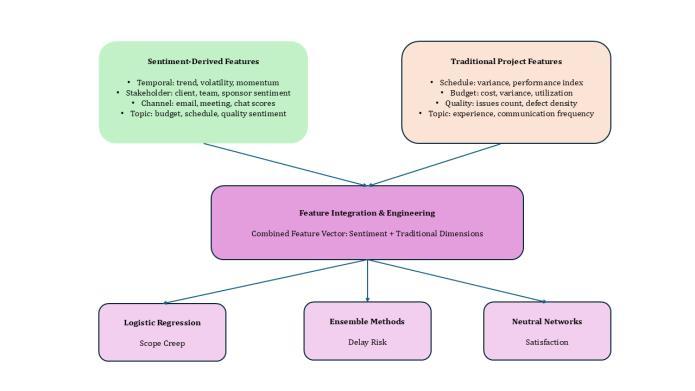
Predictive Approach: Logistic regression models incorporatingsentimenttrends,stakeholdercommunication patterns,andtraditionalscopemanagementindicators.
3.3.2 Likelihood of Project Delay (Probability Estimation)
Definition:Probabilitythatprojectcompletionwillexceed the baseline schedule by more than 10% of the original duration.
Mathematical Formulation: P(Delay)=P(Actual_Duration>1.1×Baseline_Duration)
International Research Journal of Engineering and Technology (IRJET) e-ISSN: 2395-0056
Volume: 12 Issue: 10 | Oct 2025 www.irjet.net p-ISSN: 2395-0072
Predictive Approach: Ensemble methods combining sentimentvolatility,communicationfrequency,andschedule performancemetricstogenerateprobabilityestimates.
3.3.3 Stakeholder Satisfaction Score (Regression Analysis)
Definition: Composite satisfaction score ranging from 0100,aggregatedacrossallstakeholdergroupsweightedby theirprojectinfluence.
Mathematical Formulation:
Satisfaction_Score=Σ(wi×Si)/Σ(wi) wherewi=influenceweightofstakeholdergroupi Si=satisfactionscoreforstakeholdergroupi
Predictive Approach: Neural network models incorporating multi-dimensional sentiment features, engagementmetrics,andstakeholdercharacteristics.
3.4 Feature Engineering Strategy
The framework employs a comprehensive feature engineering approach that combines sentiment-derived featureswithtraditionalprojectmetrics:
3.4.1 Sentiment-Derived Features
Temporal Features:
‘sentiment_trend_7d’: 7-day moving average of sentimentscores
‘sentiment_volatility’: Standard deviation of sentimentscoresover14-daywindow
‘sentiment_momentum’: Rate of change in sentimentscores
Stakeholder-Specific Features:
‘client_sentiment_avg’: Average sentiment from clientcommunications
‘team_sentiment_avg’: Average sentiment from internalteamcommunications
‘sponsor_sentiment_avg’: Average sentiment from projectsponsorcommunications
Communication Channel Features:
‘email_sentiment_score’:Weightedsentimentfrom emailcommunications
‘meeting_sentiment_score’: Sentiment extracted frommeetingtranscripts
‘chat_sentiment_score’: Real-time sentiment from chat platforms
Topic-Based Features:
‘budget_sentiment’: Sentiment related to budget discussions
‘schedule_sentiment’:Sentimentrelatedtotimeline discussions
‘quality_sentiment’:Sentimentrelatedtodeliverable quality
Schedule Performance Indicators:
Schedulevariance:(EV-PV)/PV
Scheduleperformanceindex:EV/PV
Criticalpathslacktime
Budget Performance Indicators:
Costvariance:(EV-AC)/AC
Costperformanceindex:EV/AC
Budgetutilizationrate
Quality and Issue Metrics:
Openissuescount
Defectdensity
Issueresolutiontime
Team and Communication Metrics:
Teamexperiencescore
Resourceutilizationrate
Communicationfrequency
Responsetimeaverages
4. Methodology and Validation Approach
4.1 Framework Validation Strategy
The validation of this conceptual framework requires a multi-faceted approach that combines quantitative model validationwithqualitativeassessment:
PredictivePerformanceTesting:Evaluationofsupervised modelsusingcross-validation,holdouttesting,andstandard performancemetrics(AUC,precision,recall,RMSE,R²).
Comparative Analysis: Benchmarking sentiment-aware modelsagainsttraditionalprojectmanagementapproaches todemonstrateincrementalvalue.
Statistical Significance Testing: Employing appropriate statisticalteststovalidatethesignificanceofimprovements inpredictionaccuracy.
ExpertReview:Validationofmodeloutputsagainstdomain expert assessments and stakeholder interviews to detect falsepositivesandcontext-specificissues.
International Research Journal of Engineering and Technology (IRJET) e-ISSN: 2395-0056
Volume: 12 Issue: 10 | Oct 2025 www.irjet.net p-ISSN: 2395-0072
Case Study Analysis:In-depthexaminationofframework application in diverse project contexts to assess practical utilityandidentifyimplementationchallenges.
StakeholderFeedback:Collectionoffeedbackfromproject managers and stakeholders regarding the usefulness and accuracyofframeworkoutputs.
4.2.1
Data Privacy Protection: Implementation of differential privacy techniques and data anonymization protocols to protectstakeholdercommunications.
Consent Management: Clear opt-in/opt-out mechanisms forstakeholdersregardingcommunicationmonitoring.
TransparencyRequirements:ExplainableAIfeaturesthat provide clear reasoning for predictions and recommendations.
4.2.2
ChangeManagement:Strategiesforintroducingsentimentaware approaches into existing project management practices.
Training Requirements:Developmentofcompetenciesin data interpretation and AI-assisted decision making for projectmanagers.
Technology Integration: Approaches for integrating the framework with existing project management tools and systems.
The framework's effectiveness will be assessed using multiplemetrics:
Technical Performance:
Modelaccuracyandreliabilitymetrics
Processingspeedandscalabilitymeasures
Systemavailabilityandrobustnessindicators
Business Impact:
Improvementinstakeholdersatisfactionscores
Reductioninprojectdelaysandcostoverruns
Enhancedearlywarningcapability
User Acceptance:
Projectmanageradoptionrates
Stakeholdercomfortwithmonitoringapproaches
Integrationsuccesswithexistingworkflows
ExtensionofStakeholderTheory:Theframeworkextends traditional stakeholder theory by incorporating real-time sentiment dynamics and providing a more nuanced understandingofstakeholder-projectrelationships.
SociotechnicalIntegration:TheworkdemonstrateshowAI technologies can be integrated with human judgment to enhanceorganizationaldecision-makingprocesses.
Predictive Project Management: The framework contributes to the emerging field of predictive project managementbyshowinghowtextualdatacancomplement traditionalprojectmetrics.
Proactive Risk Management: Early identification of stakeholder-relatedrisksenablespreventiveinterventions ratherthanreactiveproblem-solving.
Data-DrivenDecisionMaking:Objectivesentimentmetrics complementsubjectiveassessments,providingmorereliable basisforstakeholdermanagementdecisions.
ResourceOptimization:Automatedmonitoringreducesthe time and effort required for stakeholder relationship managementwhileimprovingeffectiveness.
Improved Project Outcomes: Enhanced stakeholder engagementleadsto better projectsuccess rates, reduced delays,andimprovedsatisfactionscores.
The framework is applicable across various project types andindustries:
Technology Projects: Software development, IT implementations,digitaltransformations
Infrastructure Projects:Construction,engineering,public works
Consulting Projects: Business transformation, change management,organizationaldevelopment
Research Projects: Academic research, R&D initiatives, innovationprojects
International Research Journal of Engineering and Technology (IRJET) e-ISSN: 2395-0056
Volume: 12 Issue: 10 | Oct 2025 www.irjet.net p-ISSN: 2395-0072
6.1 Current Limitations
Cultural Sensitivity: The framework may require adaptationforprojectsinvolvingdiverseculturalcontexts wheresentimentexpressionvariessignificantly.
Context Understanding: AI models may miss nuanced communication patterns that human observers would readilyidentify.
Data Quality Dependencies: Framework performance is highly dependent on the quality and completeness of communicationdata.
PrivacyConcerns:Implementationrequirescarefulbalance between monitoring capabilities and stakeholder privacy rights.
6.2.1 Technical Enhancements
Multi-Modal Analysis: Integration of audio and visual sentiment cues from video conferences and face-to-face meetings.
Cross-CulturalAdaptation:Developmentofculture-specific sentimentmodelsforglobalprojectenvironments.
Causal Inference: Implementation of causal inference methodstobetterunderstandmechanismslinkingsentiment toprojectoutcomes.
6.2.2
Longitudinal Studies: Long-term research to understand the evolution of stakeholder sentiment patterns across projectlifecycles.
ComparativeEffectiveness:Studiescomparingsentimentawareapproacheswithtraditionalstakeholdermanagement methodsacrossdifferentcontexts.
Intervention Optimization: Research into the most effective intervention strategies for different types of sentiment-relatedrisks.
Industry-Specific Adaptations: Customization of the frameworkforspecificindustrieswithuniquestakeholder dynamicsandcommunicationpatterns.
ToolIntegration:Developmentofpluginsandintegrations withpopularprojectmanagementsoftwareplatforms.
Training Programs: Creation of educational programs to help project managers effectively use sentiment-aware approaches.
Thispaperpresentsacomprehensiveconceptualframework for sentiment-aware stakeholder engagement in projects, addressing a critical gap in current project management practice. By integrating artificial intelligence-powered sentimentanalysiswithestablishedstakeholdertheoryand project management principles, the framework offers a systematic approach to transform qualitative stakeholder feedbackintoquantifiable,actionableinsights.
The framework's multi-layered architecture provides a structuredapproachtodatacollection,processing,analysis, prediction, and decision support. The focus on three key targetvariables scopecreeprisk,projectdelaylikelihood, and stakeholder satisfaction addresses fundamental projectmanagementchallengeswhilemaintainingpractical applicability.
Key contributions include the theoretical integration of sentiment analysis with stakeholder theory, the development of a systematic approach to stakeholder sentimentmonitoring,andtheproposalofpredictivemodels that combine textual and traditional project data. The framework addresses current limitations in stakeholder management by enabling proactive rather than reactive approachestostakeholderengagement.
The validation strategy acknowledges the need for both quantitativemodelvalidationandqualitativeassessmentto ensure practical utility. Implementation considerations, includingprivacyprotectionandorganizationalintegration, demonstrate awareness of real-world deployment challenges.
While the framework presents certain limitations, particularly regarding cultural sensitivity and context understanding, it establishes a foundation for future research and development in sentiment-aware project management.Theproposedfutureresearchdirectionsoffer pathwaysforaddressingcurrentlimitationsandexpanding theframework'scapabilities.
As projects continue to increase in complexity and stakeholderdiversity,theneedforsophisticatedstakeholder management approaches will only grow. This conceptual frameworkprovidesascientificallygroundedfoundationfor transformingstakeholdermanagementfromanintuitiveart into a more systematic, data-driven discipline while preservingtheessentialhumanelementsthatmakeprojects successful.
International Research Journal of Engineering and Technology (IRJET) e-ISSN: 2395-0056
Volume: 12 Issue: 10 | Oct 2025 www.irjet.net p-ISSN: 2395-0072
The framework represents a paradigm shift toward proactive stakeholder management, enabling project managers to build stronger relationships, prevent issues beforetheyescalate,andultimatelydelivermoresuccessful projects. As AI technologies continue to advance, the integrationofhumaninsightwithmachineintelligencewill becomeincreasinglycriticalforprojectsuccessinthedigital age.
[1]Project Management Institute. (2021). A Guide to the Project Management Body of Knowledge (PMBOK Guide) –SeventhEdition.PMIPublications.
[2]Freeman, R. E. (2010). Strategic Management: A StakeholderApproach.CambridgeUniversityPress.
[3]Bhattacharya, S., Bhatia, M. K., & Rajput, A. H. (2025). Leadership Strategies for Managing Project Stakeholders. Advances in Human Resources Management and Organizational Development Book Series.https://doi.org/10.4018/979-8-3693-3960-2.ch015
[4]Fore,S.,&Mugobo,V.V.(2024).StrategiesforEffectively ManagingStakeholdersin4IRInformationTechnology(IT) Projects. InternationalJournalofAppliedResearchinBusiness and Management https://doi.org/10.51137/wrp.ijarbm.2024.sfs a.45625
[5]Liu, B. (2020). Sentiment Analysis: Mining Opinions, Sentiments,andEmotions.CambridgeUniversityPress.
[6]Pang,B.,&Lee,L.(2008).Opinionminingandsentiment analysis. Foundations and Trends in Information Retrieval, 2(1-2),1-135.
[7]Devlin,J.,Chang,M.W.,Lee,K.,&Toutanova,K.(2019). BERT:Pre-trainingofDeepBidirectionalTransformersfor LanguageUnderstanding. ProceedingsofNAACL-HLT,41714186.
[8]Gabelaia,I.,&Smaidziunaite,M.(2025).TheEffectiveness of AI-Powered Sentiment Analysis in Corporate Communication in Improving Stakeholder Engagement. International Journal of Management, Knowledge and Learning, 14, 237248.https://doi.org/10.53615/2232-5697.14.237-248
[9]Raja, V. (2025). Artificial Intelligence and Machine LearninginProjectManagement:AConceptualFramework forFutureIntegration. JournalofBusinessandManagement Studies https://doi.org/10.32996/jbms.2025.7.5.4
[10]Kerzner, H. (2017). Project Management: A Systems ApproachtoPlanning,Scheduling,andControlling.JohnWiley &Sons.
[11]Bai, L., Kang, S., Zhang, K., et al. (2022). Modeling for external stakeholder risk assessment of project portfolios. Engineering, Construction and Architectural Management https://doi.org/10.1108/ecam-01-2022-0010
[12]deSilva,D.(2024).TransformingInfrastructureProject Management: Integrating Blockchain and Predictive Analytics for Enhanced Audit and Risk Management. International Journal of Business and Management Review https://doi.org/10.37745/ijbmr.2013/vol12n57179
[13]Mariani, C., Navrotska, Y., & Mancini, M. (2023). Unsupervised machine learning for project stakeholder classification: Benefits and limitations. Project Leadership and Society, 4, 100093.https://doi.org/10.1016/j.plas.2023.100093
[14]Brunet,M.,Baba,S.,&Drouin,N.(2025).Governance, SocialAcceptability,andOrganizationalLearninginPublic Infrastructure Projects. Project Management Journal https://doi.org/10.1177/87569728251341288
[15]Tanim,S.H.(2024).ExploringtheRoleofBigData in Enhancing Project Portfolio Management Strategies. InternationalJournalofScience,Engineeringand Management.https://doi.org/10.36647/ijsem/11.12.a002
[16]Nguyen, T. S., Mohamed, S., & Mostafa, S. (2024). Optimising project outcomes in complex environments: empirical insights on agile practices and stakeholder dynamics. Built Environment Project and Asset Management https://doi.org/10.1108/bepam-06-20230107
[17]Nworuh,G.E.,Ebiringa,O.T.,Asiegbu,B.C.,etal.(2025). AnAgileStakeholderInterfaceManagementFrameworkfor UniversityInfrastructureProjectsinNigeria. AfricanJournal of Management and Business Research.https://doi.org/10.62154/ajmbr.2025.020.01026
[18]Bakare,O.A.,Aziza,O.R.,Uzougbo,N.S.,etal.(2024).A governance and risk management framework for project management in the oil and gas industry. Open Access Research Journal of Science and Technology https://doi.org/10.53022/oarjst.2024.12.1.011 9

Madhusudan Bangalore Nagarajais a seasoned Project Management LeaderandAIStrategistwithover15 years of experience delivering complextechnologyinitiativesacross publicandprivatesectors.Heserves on the Advisory Committee for PMI Infinity, shaping the future of AI in
International Research Journal of Engineering and Technology (IRJET) e-ISSN: 2395-0056
Volume: 12 Issue: 10 | Oct 2025 www.irjet.net p-ISSN: 2395-0072
projectmanagement.AcertifiedPMP and CPMAI reviewer, he has judged global PMO awards and hackathons, and frequently contributes to IEEE and PMI publications. His current focus is on integrating agentic AI to enhance project delivery and operationalexcellence.