
International Research Journal of Engineering and Technology (IRJET) e-ISSN: 2395-0056
Volume: 12 Issue: 10 | Oct 2025 www.irjet.net p-ISSN: 2395-0072
International Research Journal of Engineering and Technology (IRJET) e-ISSN: 2395-0056
Volume: 12 Issue: 10 | Oct 2025 www.irjet.net p-ISSN: 2395-0072
Gorla Sai kumar1 and Dr. K. Ramu2
1 Master in Technology, Department of Civil Engineering, University College of Engineering(A), JNTUK, Kakinada, Andhra Pradesh, India
2 Professor, Department of Civil Engineering, University College of Engineering(A), JNTUK, Kakinada, Andhra Pradesh, India ***
Abstract - The present study focuses on the stabilization of Expansive Soil using lime and sisal fiber to improve its engineeringproperties andreduceitsswellingbehavior.Black cottonsoil, beinghighlyexpansive,posesseriouschallengesfor civil engineering structures due to its low strength and high plasticity. To overcome these limitations, the soil was stabilized by adding lime in varying proportions of 2%, 4%, 6%, and 8% by dry weight of soil. Based on laboratory investigations, the optimum lime content was found tobe 6%, which resulted in a significant improvement in strength and reduction in plasticity. Further, the soil with optimum lime content was reinforcedwithsisalfiberatdifferentpercentages of0.5%, 0.7%, 0.9%, and 1.1%, andthe optimumfiber content was determined as 0.9%. The results revealed that the combined addition of lime and sisal fiber substantially enhanced the load-bearing capacity and reduced plasticity, swelling, and shrinkage of the soil. The study concludes that stabilization using 6% lime and 0.9% sisal fiber provides the most effective improvement in the geotechnical performance of expansive soil, offering a sustainable and cost-efficient solution for subgrade and foundation applications.
Key Words: Expansive Soil (ES), Lime, Sisal Fiber, Soil Stabilization.
Black cotton soil is one of the most problematic expansive soils, known for its high shrink–swell characteristicsandlowbearingcapacity.Theseproperties makeitunsuitableforconstructionpurposeswithoutproper stabilization. To improve its engineering behavior, lime is commonlyusedasachemicalstabilizer,whichreactswith soilmineralsandreducesplasticity.However,lime-treated soil may still lack sufficient tensile strength. To overcome this,naturalfiberssuchassisalfiberareaddedtoimprove thesoil’sductilityandstrength Thecombinationoflimeand sisal fiberprovidesa sustainableand effectivemethodfor enhancingthestrengthandstabilityofblackcottonsoil.
Limeisoneofthemostwidelyusedmaterialsforsoil stabilizationingeotechnicalengineering.Itisacalcium-based binderthatreactschemicallywithclaymineralsinthesoil,
leadingtoimprovedstrengthandreducedplasticity.When limeisaddedtoexpansivesoilssuchasblackcottonsoil,it initiates reactions like cation exchange, flocculation, and pozzolanic activity. These reactions decrease the soil’s swelling potential and enhance its load-bearing capacity. Limetreatmentalsoimprovestheworkabilityanddurability of soil, making it suitable for use in road subgrades, foundations,andembankments.Duetoitsavailability,costeffectiveness,andlong-termperformance,limestabilization is considered an efficient and sustainable method for improvingweaksoils.
Sisalfiberisanatural,biodegradablefiberextractedfrom theleavesofthe Agave sisalana plant.Itisknownforitshigh tensilestrength,durability,andresistancetoenvironmental degradation. In soil stabilization, sisal fiber is used as a reinforcingmaterialtoimprovethestrength,ductility,and toughnessofweaksoils.Whenmixedwithsoil,thefibersact astension-resistingelementsthatcontrolcrackformation andenhanceload-bearingcapacity.Unlikesyntheticfibers, sisal is eco-friendly, cost-effective, and easily available in many regions. The inclusion of sisal fiber in lime-treated blackcottonsoilhelpstoimproveshearstrengthandreduce brittleness, providing a sustainable approach to soil reinforcement.
1.Jairajetal.(2019): Conductedanexperimental studyon the stabilization of black cotton soil using lime and sisal fiber.Limewasaddedindifferentproportions(1%,2%,3%, and4%),andsisalfiberwasmixedatvaryingpercentages (0.5%, 1%, 2%, and 3%). The results showed that the addition of 0.5% sisal fiber with optimum lime content improvedtheunconfinedcompressivestrength(UCS)and shear strength significantly. The study concluded that the combinationoflimeandsisalfiberprovidesbetterresults thanusinglimealone.
2.ManjunathK.R.etal.(2013):Studiedthebehaviorofblack cotton soil reinforced with sisal fiber and lime. Lime was addedin3%proportion,andsisalfiberwasvariedfrom0% to 1% by dry weight of soil. The study observed that the
International Research Journal of Engineering and Technology (IRJET) e-ISSN: 2395-0056
Volume: 12 Issue: 10 | Oct 2025 www.irjet.net p-ISSN: 2395-0072
mixturecontaining3%limeand0.75%sisalfiberachieved thehighestCaliforniaBearingRatio(CBR)andunconfined compressive strength values. The results indicated that fibers increase ductility and tensile resistance while lime reducesplasticityandswelling.
3.PatelandDesai(2017):Investigatedtheimprovementof expansivesoilusinglimeandnaturalfibers.Theresearchers found that the addition of 6% lime reduced the plasticity index and improved the load-bearing capacity. When 1% sisal fiber was incorporated, further enhancement in strengthandreductionincrackswereobserved.Thestudy emphasizedthatnaturalfiberscaneffectivelycomplement limestabilizationforsustainablesoilimprovement.
4.Chittaranjanetal.(2018):Examinedtheinfluenceoflime andcoirfiberonexpansivesoilandconcludedthatadding fibers with lime improves the soil’s toughness and tensile strength.Althoughthestudyusedcoirfiberinsteadofsisal, the results demonstrated the general advantage of fiber reinforcementinreducingbrittlenessoflime-treatedsoils.
5. Kharade et al. (2014): Conducted experiments on black cottonsoiltreatedwithdifferentpercentagesoflime(2%, 4%,6%,and8%)andfoundthattheoptimumlimecontent wasaround6%.Beyondthisvalue,furtherincreaseinlime content did not yield significant improvement in soil strength.Thestudysupportstheselectionof6%limeasan optimumstabilizerinexpansivesoils.
6. Ramesh et al. (2020): Studied the effect of lime and bamboo fiber on expansive soil as an alternative to sisal fiber. The research revealed that adding 6% lime and 1% fiber content resulted in maximum strength gain. This findingfurther supportsthatcombininglime with natural fiberscansignificantlyenhancetheengineeringbehaviorof blackcottonsoil.
3. METHODOLOGY
Theexperimentalprogramwasconductedinmultiple stagestostudytheimprovementofexpansivesoilusinglime and sisal fiber. The process involved collecting the soil sample,drying,andpreparingitfortesting.Limewasadded tothesoilindifferentproportionsof2%,4%,6%,and8%to findtheoptimumcontent,whichwasdeterminedas6%.The optimumlime-treatedsoilwasthenmixedwithsisalfiberin varyingpercentagesof0.5%,0.7%,0.9%,and1.1%.Various laboratorytestssuchasAtterberglimits,compaction,CBR, andUCSwereperformedtoassessthestrengthandstability ofthetreatedsoil.
Theexpansivesoilwasmixedwithlimeandsisalfiber in different proportions to study their combined effect on soil stabilization. Lime was added to the soil in varying percentagesof2%,4%,6%,and8%bydryweightofsoilto
determinetheoptimumcontent.Basedonthetestresults, 6% lime was found to be the optimum percentage for maximumstrengthimprovement.Theoptimumlime-treated soil was then reinforced with sisal fiber in different proportionsof0.5%,0.7%,0.9%,and1.1%bydryweight. Eachmixwaspreparedbythoroughlyblendingthematerials in dry condition, followed by the addition of water corresponding to the Optimum Moisture Content (OMC) obtained fromcompactionteststo ensureuniformmixing andconsistency.
Table -1: Mix Proportions for testing Soil
S.NO Stabilizing Agent % content 1 Lime
2 SisalFiber
Specific Gravity Test (IS: 2720 Part 3 – 1980)
Thistestdeterminesthespecificgravityofsoilsolids,which helpsinidentifyingthetypeandclassificationofsoil.Itisan essential property used in calculating various soil parameterssuchasvoidratio,degreeofsaturation,andunit weightrelationships
Differential Free Swell (DFS) Test (IS: 2720 Part 40 –1977) The DFS test determines the swell potential of expansivesoils.Itmeasuresthedifferenceinvolumechange whenthesoilisimmersedinwatercomparedtokerosene. LowerDFSvaluesafterstabilizationindicateareductionin swellingbehaviorduetolimeandfiberaddition.
Atterberg Limits Test (IS: 2720 Part 5 – 1985)
Theliquidlimit,plasticlimit,andplasticityindexofthesoil were determined to study its consistency and plastic behavior.Theseparametersindicatethesoil’sswellingand shrinkagepotential,whichareespeciallyimportantforblack cottonsoil.
Grain Size Analysis (IS: 2720 Part 4 – 1985)
Thistestidentifiesthedistributionofdifferentparticlesizes withinthesoilsample.Ithelpsinclassifyingthesoilasclay, silt,sand,orgravelandprovidesinformationongradation and texture, which influence compaction and strength characteristics.
Standard Proctor Compaction Test (IS: 2720 Part 7 –1980) ThistestdeterminestheOptimumMoistureContent (OMC) and Maximum Dry Density (MDD) of the soil. It is conductedtounderstandthecompactioncharacteristicsand to obtain the moisture content at which the soil achieves maximumdensity,ensuringbetterfieldperformance.
California Bearing Ratio (CBR) Test (IS: 2720 Part 16 –1987) TheCBRtestmeasurestheload-bearingcapacityof
International Research
Volume: 12 Issue: 10 | Oct 2025 www.irjet.net
soilandiscommonlyusedinthedesignofroadsubgrades and pavements. Higher CBR values indicate improved strength and stability of the treated soil compared to untreatedsoil
( IS: 2720 Part 11 – 1993)
Thetriaxialcompressiontestisconductedtodeterminethe shearstrengthparametersofsoil,namelycohesion(c)and angleofinternalfriction(ϕ),underdifferentdrainageand loadingconditions.Itprovidesarealisticsimulationoffield stress conditions by applying both confining and axial pressuresonthespecimen.Thetesthelpsinunderstanding the behavior of soil under controlled stress paths and is usefulforanalyzingthestabilityofslopes,foundations,and embankments.
Table -2: Properties of Expansive Soil
Table -3: OMC and MDD of Expansive soil with Various Percentage of Lime
S.NO
1
3 Modifiedcompactionresults
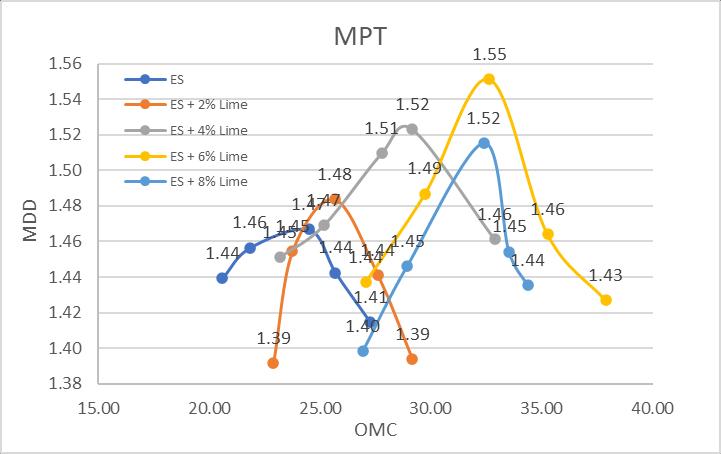
Graph -1: OMC & MDD Values of expansive Soil treated with Various percentage of Lime.
Table – 4 : CBR of Expansive soil with various percentage of Lime
Volume: 12 Issue: 10 | Oct 2025 www.irjet.net
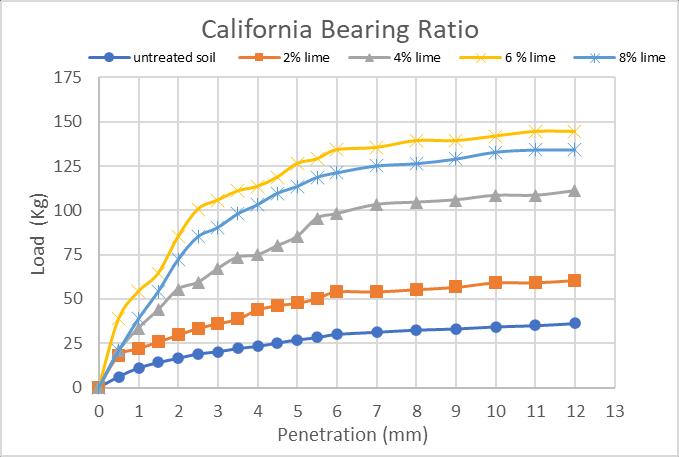
Graph – 2 : CBR of Expansive soil with various percentage of Lime
Table – 5:PropertiesofExpansiveSoiltreatedwithLime
S.No
4.2 Expansive soil treated with
Table -6: OMC and MDD ofExpansivesoil with optimum percentageoflimeandvariouspercentageofsisalfiber
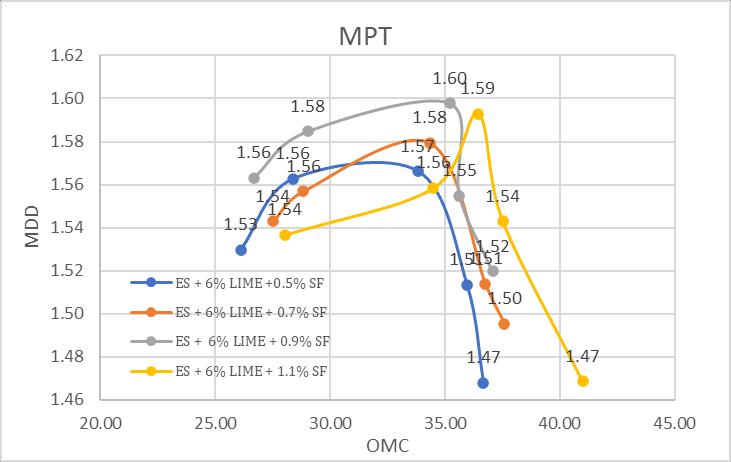
Graph -3: OMCandMDDofExpansivesoilwithoptimum percentageoflimeandvariouspercentageofsisalfiber
Table – 7: CBRofExpansivesoilwithoptimumpercentage oflimeandvariouspercentageofsisalfiber
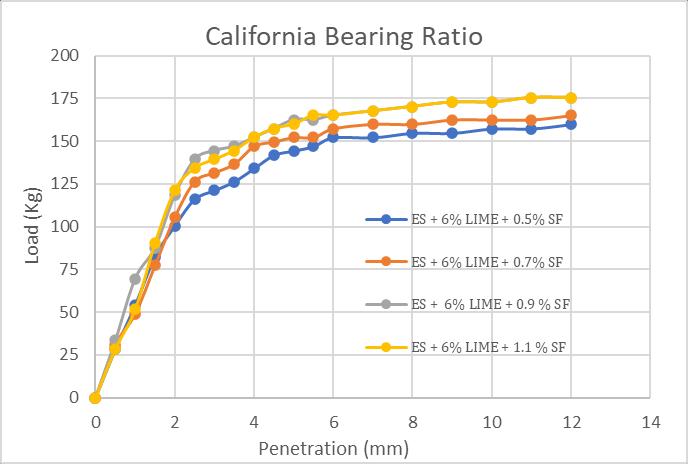
Graph -4: CBRofExpansivesoilwithoptimumpercentage oflimeandvariouspercentageofsisalfiber
Table-8: PropertiesofExpansiveSoiltreatedwithOptimum percentageoflimeandSisalFiber
Volume: 12 Issue: 10 | Oct 2025 www.irjet.net
3
4
5
7
5. CONCLUSIONS
1. The experimental studyshowed thatthe engineering propertiesofexpansivesoilcanbeeffectivelyimproved byusinglimeandsisalfibertogether.
2. Addinglimelowerstheplasticityandswellingbehavior of black cotton soil through chemical reactions like cationexchangeandpozzolanicactivity.Thisleadsto strongersoilaggregates.
3. Thebestlimecontentwas6%,wherethesoilshowed thegreatestimprovementinstrengthandthelowest plasticityindex.
4. Adding sisal fiber to the lime-treated soil further improved its performance. This made the soil more resistanttocrackingandshrinkageduringdrying,and itincreasedtensilestrengthandflexibility.
5. Amongthefibercontentstested(0.5%,0.7%,0.9%,and 1.1%),0.9%sisalfiberproducedthehighestvaluesfor CBRindicatingthebestpercentageforreinforcement.
6. Combining 6% lime with 0.9% sisal fiber resulted in higher dry density, better bearing capacity, and less swellingpotentialcomparedtountreatedsoil.
7. It is observed that the CBR of the Expansive Soil has beenincreasedfrom1.39%to7.34%ontheadditionof 6%Limeandithasbeenfurtherincreasedfrom7.34% to10.17%withadditionof0.9%SisalFiber.
8. The results confirm that natural fibers like sisal can effectivelyworkwithlimetocreateasustainableand cost-effectivemethodforstabilizingexpansivesoils.
[1] Jairaj,P.,Kumar,R.,&Singh,A.(2019). Stabilization of Black Cotton Soil Using Lime and Sisal Fiber. InternationalJournalofInnovativeResearchinScience, EngineeringandTechnology(IJIRSET),8(5),320–327.
[2] Manjunath,K.R.,&Shashikumar,N.(2013). Behavior of Black Cotton Soil Reinforced with Sisal Fiber and Lime. International Journal of Research in Engineering and Technology(IJRET),2(8),120–125.
[3] Patel, R., & Desai, J. (2017). Improvement of Expansive Soil Using Lime andNaturalFibers. InternationalJournal ofAdvancedEngineeringResearchandStudies(IJAERS), 6(2),45–49.
[4] Chittaranjan, M., Sahoo, S., & Patnaik, B. (2018). Influence of Lime and Coir Fiber on Expansive Soil Behavior. InternationalResearchJournalofEngineering andTechnology(IRJET),5(4),4108–4112.
[5] Ramesh,H.N.,&Prakash,K.B.(2020). EffectofLimeand Bamboo Fiber on the Strength of Expansive Soil. International Journal of Civil Engineering and Technology(IJCIET),11(5),90–97.
[6] Kharade,A.S.,Jadhav,P.A.,&Mali,S.S.(2014). Effect of Lime on the Engineering Properties of Black Cotton Soil. InternationalJournalofInnovativeResearchinScience, EngineeringandTechnology(IJIRSET),3(4),269–274.
[7] International Journal of Engineering Research and Technology(IJERT).(2013). StabilizationofBlackCotton Soil Using Lime and Sisal Fiber. IJERT,2(9),1–5.
[8] Rajasekar, R., Kannan, R., & Kumar, S. (2016). Improvement of Black Cotton Soil Using Lime and Jute Fiber. InternationalJournalofEngineeringScienceand Computing(IJESC),6(5),5173–5177
[9] BureauofIndianStandards(BIS).(1980–1993). IS:2720 Series – Methods of Test for Soils (Parts3,4,5,7,10,11, 16,and40).NewDelhi,India.