
International Research Journal of Engineering and Technology (IRJET) e-ISSN: 2395-0056
Volume: 12 Issue: 12 | Dec 2025 www.irjet.net p-ISSN: 2395-0072
International Research Journal of Engineering and Technology (IRJET) e-ISSN: 2395-0056
Volume: 12 Issue: 12 | Dec 2025 www.irjet.net p-ISSN: 2395-0072
Harsh Singh Bhatiya 1 , Mayur Pawar2 , Rohan Gaumgaonkar, Sharvan Dharme4 , Rakesh Moharle5 , Dr. Sushama Telrandhe6
1,2,3,4,U.G. Students, Department of Computer Science and Engineering, Gurunanak Institute of Engineering and Technology, Nagpur, Maharashtra, India
5 Assistant professor, Department of Computer Science and Engineering, Gurunanak Institute of Engineering and Technology, Nagpur, Maharashtra, India.
6 Associate professor, Department of Computer Science and Engineering, Gurunanak Institute of Engineering and Technology, Nagpur, Maharashtra, India.
ABSTRACT- The OCR Result Analysis System automates student data entry, result generation, and report management using Optical Character Recognition (OCR). Student detailssuchasRoll Number,Enrollment Number, CandidateName,andacademicrecordsareextractedfrom scannedimagesorenteredmanually,thenstoredsecurelyin astructureddatabase.Thesystemautomaticallygenerates Excelreports,includingdetailedsheets,summaryreports, andcategory-wiseanalyses.Ahistorymodulemaintainsall uploadsandgeneratedfilesforquickretrieval.Withsecure authenticationanderror-freeprocessing,thesystemreduces manual workload, improves accuracy, and provides a reliablesolutionforeducationalresultmanagement.
TheOCRResultAnalysisSystemisdesignedtoautomatethe management of student records and academic reports by utilizingOpticalCharacterRecognition(OCR)technology.It allowsuserstosecurelyloginandregisterbeforeaccessing features that let them manually input student details or uploadscannedmarksheetsforOCRprocessing.Thesystem then stores the extracted data in a structured database, enabling efficient and accurate result generation. Result sheetsareautomaticallycreatedinExcelformat,simplifying analysisandreportsharingforteachersandadministrators In addition to result generation, the system includes a HistoryModuletorecordactionssuchasOCRuploads,result sheetgeneration,andfiledownloads.Thismoduleensures transparencyandaccountabilitybyallowingeasyretrievalof previouslygeneratedfiles.Byautomatingmanualtasks,the systemsignificantlyreducesworkload,improvesoperational efficiency, and provides a reliable, secure solution for schools,colleges,anduniversitiestomanagestudentrecords andgenerateacademicreports.
ThestudybyMehdiRizvi,HasnainRaza,ShahabMaqsood, and Shan Afify (2019) presents an Optical Character Recognition(OCR)-basedintelligentdatabasemanagement system designed for examination process control. Their workappliescomputervisiontechniques,particularlyOCR and object recognition, to automate the processing of
handwrittenanddigitaltext.Byintegratingdeeplearning, thesystemrecognizesexam-relateddatasuchassignatures and written information, stores it efficiently, generates automatedgraphs,andreducesmanualeffortthroughoutthe exammanagementworkflow.
In another study, Eman Shaikh, Iman Mohiuddin, Ayesha Manzoor, Ghazanfar Latif, and Nazeer uddin Mohammad (2019) developed an automated grading system for handwritten answer sheets using convolutional neural networks(CNN).Trainedonadatasetof250answersheets, themodelachieved92%accuracyandsignificantlyreduced manualgradingtimebycomputingscoresautomatically.
The work of Aarav T. Shaji, Justin Thomas T., Emils Saj, VishnuprasadT.V.,DeepaJ.,andJibuMathew(2024)focuses on document digitalization using Optical Character Recognition for student evaluation sheets. Their system converts handwritten exam digits and information into digital CSV format using CNN, helping streamline data management and reduce manual labor in the evaluation process.
Finally, Shams A. Al-Qaisy, Amal Hasan Qanaa, Rougar Khorshid,MayarMohamad,SalimYahyaMassadKallul,and Ahmad Hussein Hassan (2025) emphasize enhancing securityanddatamanagementinhighereducationthrough theintegrationofCloudContentManagement(CCM).Their study highlights challenges such as declining student engagementandresourceaccessibility,proposingthatCCM solutionscanimprovecollaboration,datasharing,storage, andaccessibility,ultimatelysupportingbetterinstitutional operations.
3. METHODS AND MATERIALS
MATERIALS
Hardware:
Inteli3Processor
160GBHardDisk
8GBRAM
SVGAMonitor
International Research Journal of Engineering and Technology (IRJET) e-ISSN: 2395-0056
Volume: 12 Issue: 12 | Dec 2025 www.irjet.net p-ISSN: 2395-0072
StandardWindowsKeyboard
TwoorThreeButtonMouse
Software:
1OperatingSystem: Windows7/8/10
2 Server-sideScript:HTML,CSS,Bootstrap& JavaScript
3 ProgrammingLanguage:Python
4 Libraries/Framework:Django
5 IDE/Workbench:VSCode
6Technology:Python3.6+
Methods
Requirement Analysis:
Requirement Analysis is the foundational phase of any softwaredevelopmentproject.Itfocusesonunderstanding what the system should do and why it should do it. This phaseensuresthatstakeholders,developers,andusersshare acommonunderstanding.
System Design:
SystemdesignoutlinesthearchitecturalblueprintoftheOCR ResultAnalysisSystem.Thisphaseinvolvescreatingmodels anddiagramsthatrepresenthowthemodulesinteractwith eachother.Thesystemisdividedintomultiplelayers,such as input, preprocessing, OCR extraction, post-processing, database management, and dashboard visualization. Each layer works independently but communicates seamlessly withotherlayers,ensuringmodularityandmaintainability.
Development:
The application backend and frontend were coded using selectedprogramminglanguages.GIStoolswereintegrated to enable mapping functionalities. Security features includingrole-basedaccesscontrol,digitalsignatures,and encryptionwereimplemented.Blockchainintegrationwas optionallyincorporatedtorecordtransactionsimmutably.
Data Migration:
Existingpaperrecordsweredigitizedthroughscanningand OpticalCharacterRecognition(OCR).Legacydataunderwent validationandcleansingbeforeimportationintothesystem toensuredataintegrity.
Testing:
Testing evaluates the functionality, usability, and performanceoftheOCRResultAnalysisSystem.Thetesting process includes unit testing for individual components, integrationtestingforcombinedmodules,systemtestingfor the entire workflow, and performance testing to measure processingspeedandaccuracyunderload.Thisensuresthat thesystemperformsconsistentlyacrossdifferentdocuments and image qualities. Accuracy testing plays a vital role in OCR systems.EngineerscalculatemetricslikeWordError Rate (WER), Character Error Rate (CER), and overall
2025, IRJET | Impact Factor value: 8.315 |
accuracypercentagetomeasureOCRperformance.Usability testingensuresthedashboardisintuitiveforbothtechnical andnon-technicalusers.Finally,securitytestingverifiessafe filehandling,controlledaccess,andprotectionofsensitive data.
:
Testing evaluates the functionality, usability, and performanceoftheOCRResultAnalysisSystem.Thetesting process includes unit testing for individual components, integrationtestingforcombinedmodules,systemtestingfor the entire workflow, and performance testing to measure processingspeedandaccuracyunderload.Thisensuresthat thesystemperformsconsistentlyacrossdifferentdocuments and image qualities. Accuracy testing plays a vital role in OCR systems.EngineerscalculatemetricslikeWordError Rate (WER), Character Error Rate (CER), and overall accuracypercentagetomeasureOCRperformance.Usability testingensuresthedashboardisintuitiveforbothtechnical andnon-technicalusers.Finally,securitytestingverifiessafe filehandling,controlledaccess,andprotectionofsensitive data.
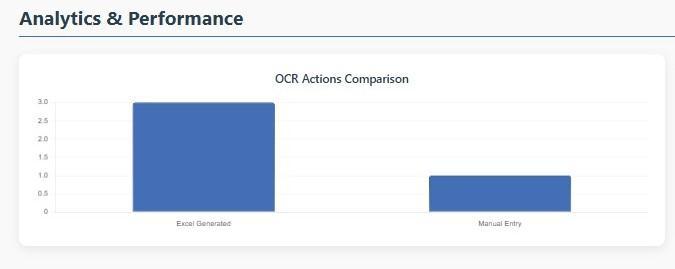
Duringthegrowthphase,accuracyincreasesrapidlydueto model improvements, additional datasets, and optimized preprocessing. Eventually, the system enters the maturity phase,whereaccuracystabilizes,andimprovementsbecome gradual. This indicates that the system has reached a performance saturation point. S-curve analysis helps researchersvisualizethesetrendsandunderstandsystem developmentpatterns.
Comparative Analysis of LRMS Implementation Impact
Comparative analysis evaluates how different OCR algorithms, models, or system enhancements affect performance. This involves comparing metrics such as
International Research Journal of Engineering and Technology (IRJET) e-ISSN: 2395-0056
Volume: 12 Issue: 12 | Dec 2025 www.irjet.net p-ISSN: 2395-0072
accuracy, speed, error rate, resource consumption, and languagesupport.Forexample,traditionalOCRmodelslike Tesseract provide acceptable accuracy for clean text but struggle with complex or noisy images. Meanwhile, deeplearning-basedmodelsachievesignificantlyhigheraccuracy atthecostofincreasedcomputationalpower.
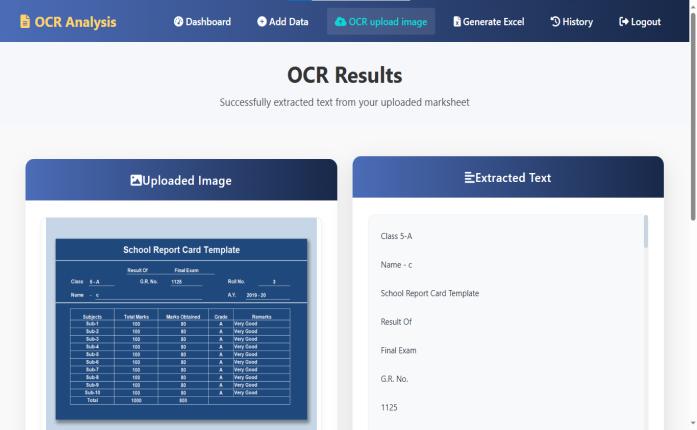
Dashboard Overview and Key Metrics:
Thedashboardinterfaceservesasthevisualcontrolcenter for users. It presents document upload options, extracted text,graphicalaccuracyreports,andperformancetrends.A well-designed dashboard provides users with an intuitive anduser-friendlyexperience.Visualelementslikebarcharts, S-curves, accuracy graphs, and tabular data presentation helpusersquicklyinterpretresults.
Thedashboardalsoincludesfeaturessuchasexportoptions, usersettings,searchfilters,andmulti-documentcomparison tools.Accessibilityelementslikeadjustablefontsize,highcontrastthemes,and keyboardnavigationsupportensure usability for a diverse audience. A streamlined dashboard improves overall efficiency and decision-making by presentingdatainanorganizedformat.
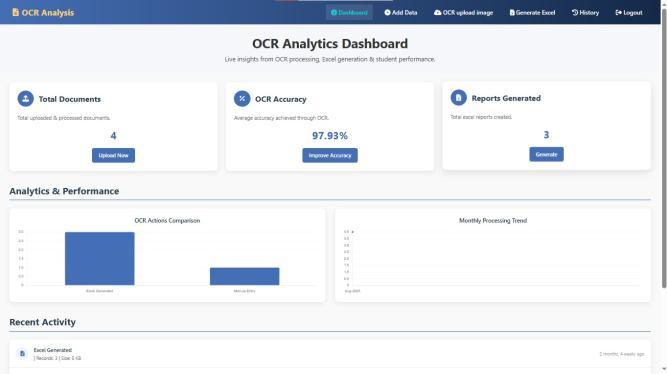
The OCR Result Analysis System offers multiple features, includingtextextraction,preprocessing,accuracyevaluation, anddashboardvisualization.Additionalfunctionalitiessuch as batch document processing, language selection, and downloadable output further enhance the system’s practicality.Multi-formatsupportensurescompatibilitywith awiderangeofdocumenttypes,fromPDFstohandwritten notes. User accessibility plays a critical role in system acceptance. Features like text-to-speech, screen reader compatibility, keyboard shortcuts, and visually accessible themes ensure inclusivity. The system follows key accessibility guidelines, such as WCAG, ensuring that differently-ableduserscanoperatethesystemcomfortably. Enhancedaccessibilityincreasesusabilityandbroadensthe system'suserbase.
Inconclusion,theOCRResultAnalysisSystemprovidesan efficient solution for automated text extraction and performanceevaluation.Throughitsmodulararchitecture, comprehensivedashboard,andanalyticalvisualizations,the systemsuccessfullyaddressesthechallengesassociatedwith manual text processing. The integration of preprocessing techniques,OCRmodels,andpost-processingfiltersensures accuracy and reliability. Looking toward the future, the system can be expanded using advanced deep-learning architectures, real-time mobile OCR, and cloud-based distributed processing. Integration of natural language processing features, such as summarization and entity recognition, will make the system more intelligent. Additionally,automatederrorcorrectionandself-learning capabilitiescanfurtherimproveaccuracyandreducehuman intervention.
1. MehdiRizvi,HasnainRaza,ShahabTahzeeb,ShanJaffry || Optical Character Recognition Based Intelligent DatabaseManagementSystemforExaminationProcess Control||2019.
2. Eman Shaikh, Iman Mohiuddin, Ayisha Manzoor, GhazanfarLatif,NazeeruddinMohammad||Automated Grading for Handwritten Answer Sheets using ConvolutionalNeuralNetworks||2019.
3. AjayTShaju,JustinThomasJo,EmilSaj Abraham,KG Vishnuprasad, V Deepa, Jabin Mathew || Document DigitizationUsingOpticalCharacterRecognition-ACase Study of Mark Entry Automation in Educational Institutions||2024.
4. Shams A. Al-Qaisy, Amal Hasan Jumaa, Rozhgar KhorsheedMahmud,SalimYahyaKasimKhalil,Ahmad HusseinHassan||EnhancingSecureDataManagement
International Research Journal of Engineering and Technology (IRJET) e-ISSN: 2395-0056
for Student Learning Analysis using Cloud Computing Management (CCM) in Higher Education || 2025.A secure land record management system using blockchain.(2023).IEEEXploreDigitalLibrary
5. Andriy Pukas, Andrii Simak, Andriy Yushko, Sergiy Nadvynychnyy, Serhii Shandruk, Oleh Vatslavskyi || Automated Reporting Module in the Academic Staff PerformanceAppraisalSystem||2024.UserSurveysand Impact Studies. (2024). Assessment of Digital Land RecordSystemsinIndianStates.VariousStateRevenue Departments.
6. Sonam Shivani Nair, Neeraj Anand Sharma || Implementation of an Automated Result Management SysteminaDevelopingCountry||2019.
7. Mahesh Jangid, Sumit Srivastava || A OCR Based Approach||2013.
8. Cristina Alonso-Fernández, José L. Jorro-Aragoneses, Carlos M. Alaíz, Pilar Rodríguez || Learning Analytics ToolstoAnalyzeProgressandResultsWithMoodleLMS Data||2024.
Volume: 12 Issue: 12 | Dec 2025 www.irjet.net p-ISSN: 2395-0072 © 2025, IRJET | Impact Factor value: 8.315 | ISO 9001:2008