
International Research Journal of Engineering and Technology (IRJET) e-ISSN: 2395-0056
Volume: 11 Issue: 12 | Dec 2024 www.irjet.net p-ISSN: 2395-0072

International Research Journal of Engineering and Technology (IRJET) e-ISSN: 2395-0056
Volume: 11 Issue: 12 | Dec 2024 www.irjet.net p-ISSN: 2395-0072
1,2Student, Dept. Artificial Intelligence & Machine Learning Engineering, PES’s Modern College of Engineering, Pune Maharashtra, India
3Assistant Professor, Dept. Artificial intelligence & Data Science Engineering, PES’s Modern College of Engineering Pune Maharashtra, India ***
Abstract - This paper presents the development ofareal-time 3D ball tracing system utilizing OpenCV for computer vision and Unity for 3D rendering. The system tracks the movement of a ball in real-time by processing video input through OpenCV, which identifies the ball's position using image processing techniques suchascolorsegmentationandcontour detection.[1] [2] The extracted data is then transferred to Unity, where it is used to render the ball's movement in a 3D virtual environment. This integration allows for accurate tracking and dynamic visualization, making the system ideal for applications in sports analysis, augmented reality, virtual reality and robotics.[4] The proposed approach demonstrates significant potential for real-time motion analysis and interactive visualization in various domains.
Key Words: OpenCV, Unity, 3D, Ball tracking, Real-time, Virtual environment, Dynamic visualization
Thisresearchfocusesonthedevelopmentofareal-time 3D object tracking system by integrating OpenCV for computervisionandUnityfor3Dvisualization.Thesystem processesvideoinputtotrackanobject,suchasaball,using techniqueslikecolorsegmentationandcontourdetection. ThetrackeddataistransmittedtoUnityusingUdpClient[5] , enablingdynamicvisualizationoftheobject'smovementina virtual 3D environment. This project has significant applications in sports analysis, robotics, and augmented reality,providingaseamlessconnectionbetweenphysical andvirtualspacesforenhancedinteractionandanalysis.[4]
Theimplementationutilizescomputervisiontechniques providedbyOpenCV,awidely-usedopen-sourcelibraryfor image and video processing. Python offers simplicity and extensive support for computing and it serves as a programming language. The project demonstrates the integrationofthesetoolstoachievereal-time3Dtracking, highlightingthepotentialforcreatingsophisticatedvirtual environments that interact seamlessly with real-world dynamics.[2]
This research contributes to the field by providing a framework for real-time object tracking in virtual spaces, pavingthewayforadvancementsinimmersivetechnologies and automated analysis systems. The methodologies and findingspresentedcanserveasafoundationforfurther
explorationintomorecomplexscenariosinvolvingmultiple objects,fastmotionsandintricateinteractionswithinvirtual environments.
The growing demand for interactive and immersive technologies has driven advancements in the fields of computer vision and 3D visualization. Real-time object trackingandvisualizationplayacriticalroleinapplications ranging from augmented reality and robotics to sports analyticsandgaming.Accuratelybridgingthephysicaland virtual worlds requires systems capable of detecting, tracking,andrepresentingobjectsinreal-timewithprecision andefficiency.[2][4,7]
OpenCV, a widely used open-source computer vision library,providesrobustalgorithmsforimageprocessingand objecttracking[1] Unity,aleadingreal-time3Ddevelopment platform,offerspowerfultoolsforrenderingandvisualizing virtual environments [6] The combination of these technologies enables the creation of systems that not only trackreal-worldobjectsbutalsoseamlesslyintegratetheir movementintovirtualenvironments.
Thisprojectaddressestheneedforsuchintegrationby utilizingOpenCVforreal-timeobjecttrackingandUnityfor dynamic 3D visualization. By combining these tools, the system provides an effective solution for applications that require accurate motion tracking and interactive visualization, contributing to the advancement of technologiesinvariousdomainssuchasaugmentedreality, robotics,andsportsperformanceanalysis.[7]
Real-timeobjecttrackingandvisualizationfacechallenges such as low accuracy, latency, and limited integration betweenphysicaltrackingandvirtualrepresentation.These issues impact applications in fields like sports analytics, robotics,andaugmentedreality,wherepreciseanddynamic interaction is essential. This project addresses these challenges by utilizing OpenCV for accurate tracking and Unityforseamless3Dvisualization,providingareliableand efficientsolutionforreal-timeobjecttrackinganditsvirtual representation.[3]
Research
Volume: 11 Issue: 12 | Dec 2024 www.irjet.net p-ISSN: 2395-0072
Develop a Real-Time Object Tracking System: Utilize OpenCV to accurately detect and track the position and movement of a 3D object, such as a ball,invideoinput.[2]
Integrate Data Transmission: Establish efficient communication between OpenCV and Unity using networking protocols like UDP/TCP for seamless datatransfer.[5]
Create a Dynamic 3D Visualization: UseUnityto renderthetrackedobject'smotioninavirtual3D environment, ensuring real-time synchronization withphysicalmovement.[6]
Enhance System Accuracy and Responsiveness: Minimizetrackingerrorsandlatencytoimprovethe reliabilityandreal-timeperformanceofthesystem.
Enable Practical Applications: Demonstrate the system's applicability in fields such as sports analytics, robotics, and augmented reality for enhancedinteractivityandanalysis.[7]
3DBallTrackinginVirtualEnvironmentprojectinvolvesa series of systematic steps to achieve real-time object trackingandrepresentation.Theprocessbeginswithvideo input acquisition, where frames are captured in real-time from a camera or video source. These frames are preprocessedbyapplyingnoisereductiontechniques,suchas Gaussian noise/blur, and converting the color space from BGR to HSV to enable efficient color-based detection. The nextstageinvolvescreatingamasktoisolatetheballbased on its unique color characteristics, followed by contour analysistoidentifyandlocalizetheballwithintheframe.To estimate the ball’s position in three-dimensional space, depth information is derived using stereo vision or depth sensors, enabling the computation of accurate 3D coordinates.[8]
Oncetheball’spositionisdetermined,motionanalysis techniques are used to predict its future trajectory. This predictivecapabilityenhancesthesystem'sresponsiveness andrealism,particularlyindynamicscenarios.Finally,the ball's tracked position and predicted trajectory are integrated into a virtual environment, ensuring that the simulation accurately reflects real-world dynamics. This methodologyemphasizesmodularityandprecision,making itadaptableforvariousapplications,includingvirtualreality, sportsanalytics,andinteractivegaming.[7]
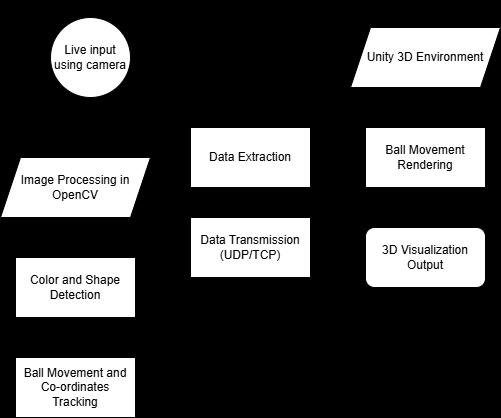
Diagram -1:Architecture
Input Acquisition:Thismodulecapturesreal-time video frames from a camera or video file. The frames serve as the primary data source for detectingandtrackingtheballwithinthescene.
Pre-processing:Inthisstage,theacquiredframes undergopre-processingtoenhancethequalityand suitabilityforanalysis.TechniquessuchasGaussian blur are applied to reduce noise, and color space conversion (e.g., BGR to HSV) is performed to facilitatecolor-basedobjectdetection.[3]
Ball Detection:Utilizingcolor-basedsegmentation, thesystemisolatestheballfromthebackground.By defining specific color ranges in the HSV color space, a mask is created to highlight the ball, allowingforitsidentificationwithintheframe.[3]
3D Position Estimation: To determine the ball's position in three-dimensional space, depth estimation techniques are employed. This may involve stereo vision setups or depth sensors to calculatethedistanceoftheballfromthecamera, enablingaccurate3Dlocalization.
Trajectory Prediction: Once the 3D position is established,thesystempredictstheball'strajectory usingmotionanalysis.Thispredictionisessential forapplicationsrequiringanticipationoftheball's movement, such as interactive gaming or simulations.[8]
Virtual Environment Integration: The final component involves mapping the predicted
International Research Journal of Engineering and Technology (IRJET) e-ISSN: 2395-0056
Volume: 11 Issue: 12 | Dec 2024 www.irjet.net p-ISSN: 2395-0072
trajectory and current position of the ball into a virtualenvironment.Thisintegrationensuresthat the virtual representation accurately reflects the real-world dynamics of the ball, providing an immersiveexperiencefortheuser.[6]
1. Environment Setup:
Installed Dependencies: Ensuring Python is installed,alongwithnecessarylibrariessuchas OpenCV,Socket.
ConfiguredHardware:Setupacameraorvideo inputdevicetocapturereal-timefootage.
Captured Video Frames: Utilized OpenCV to access the video stream and read frames sequentially [1]
2. Pre-processing:
Color Space Conversion: Converted frames fromBGRtoHSVcolorspacetofacilitatecolorbasedobjectdetection.
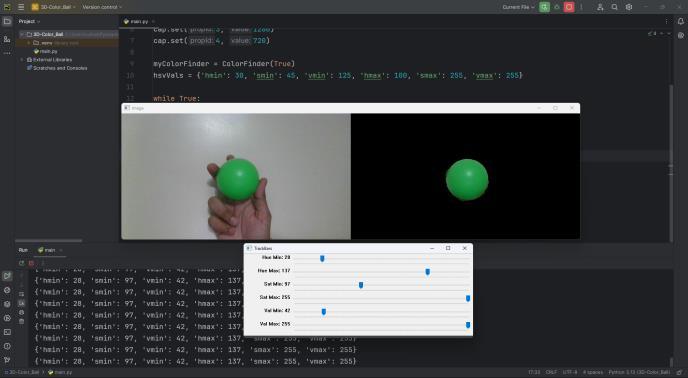
3. Ball Detection:
ColorThresholding:DefinedHSVcolorranges correspondingtotheball'scolorandcreatea masktoisolatetheball.
Contour Detection: Identified contours in the masked image to locate potential ball candidates.
Contour Filtering: Filtered contours based on sizeandshapetoaccuratelyidentifytheball.[3]
5. Trajectory Prediction:
MotionAnalysis:Analyzedtheball'smovement overtimetopredictitsfuturepositions.
ModelImplementation:Appliedmathematical functions, such as vectors, to enhance predictionaccuracy.
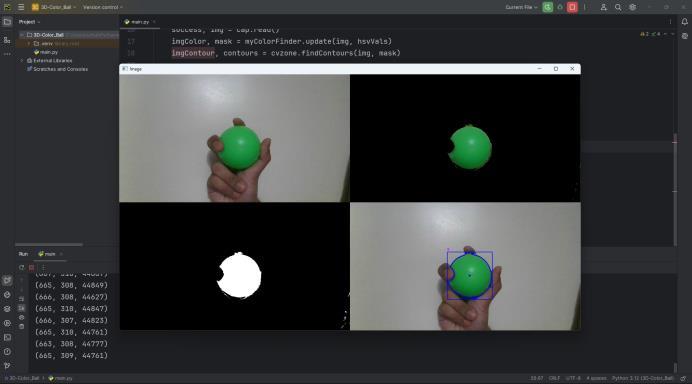
Fig -2:TrajectoryPrediction
6. Virtual Environment Integration:
Real-Time Rendering: Mapped the ball's 3D coordinates and predicted trajectory into the virtual environment to simulate its motion accurately.[6]
7. Testing and Validation:
System Calibration: Adjusted parameters to ensure the system accurately tracks and representstheball'smovement.
Performance Evaluation: Tested the system undervariousconditionstoassessrobustness andreliability.
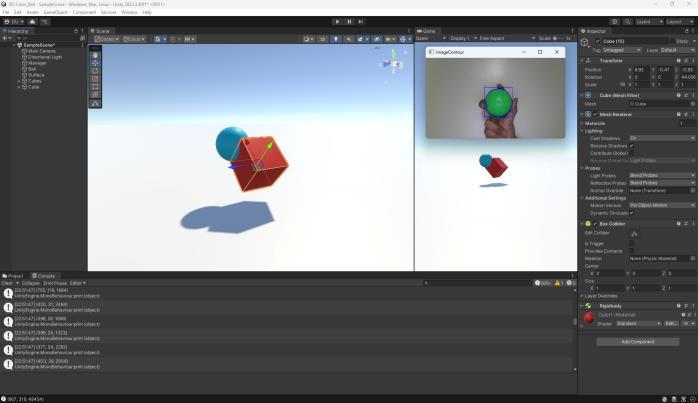
CoordinateMapping:Combined2Dpositional
-3:TestingandValidation
International Research Journal of Engineering and Technology (IRJET) e-ISSN: 2395-0056
Volume: 11 Issue: 12 | Dec 2024 www.irjet.net p-ISSN: 2395-0072
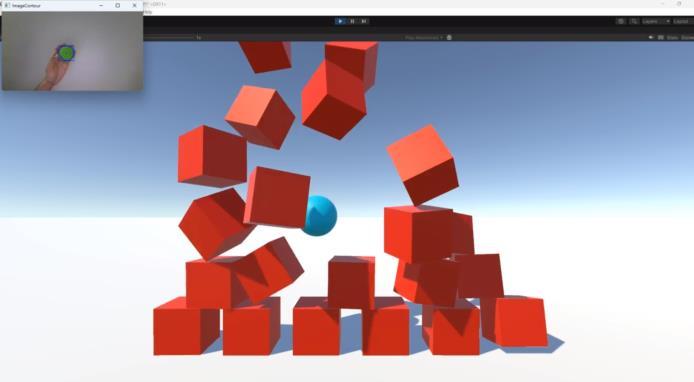
The 3D Ball Tracking in Virtual Environment project, implementedusingOpenCVandPython,achievedsignificant milestones in real-time object tracking and virtual simulation. The system effectively detected and tracked a colored ball in real-time, maintaining high accuracy even duringrapidmovements.
By employing depth estimation techniques, the project accurately calculated the ball's three-dimensional coordinates, enabling precise mapping within a virtual environment.Theintegrationofmotionanalysisalgorithms allowedforeffectivepredictionoftheball'sfuturepositions, enhancing the realism and interactivity of the virtual simulation.
These outcomes demonstrate the project's potential applications in areas such as virtual reality simulations, sportsanalytics,andinteractivegaming,wherereal-time3D objecttrackingisessential.[4][7]
Ensuring accurate object detection and motion trackingunderchanginglightingconditions.
Managing real-time data transmission with low latency.
Handling occlusion or obstruction of the tracked object.
Achieving seamless integration between OpenCV andUnity.
Addressing performance issues for large-scale or complex3Denvironments.
Making sure it is compatible across different hardwareandsoftwareplatforms
Balancing computational efficiency with tracking accuracy.
The future scope of the 3D object tracking and visualizationsystem presentsnumerous opportunities for further enhancement and application. One promising directionistheincorporationofadvancedobjectdetection algorithms, such as deep learning models, which could improveaccuracyandenablethesystemtotrackmore complex objects in diverse environments. Additionally, expanding the system to handle multiple objects tracking simultaneouslycouldunlocknewpossibilitiesinfieldslike sportsanalytics,robotics,andinteractivegaming.[4]
There is also potential for deeper integration with augmented reality (AR) technologies, allowing for more immersive,real-timeinteractiveexperiencesinapplications such as gaming, education, and training simulations. Furthermore, optimizing the system’s communication to reducelatencyandimproveprecisionwouldbecrucialfor high-speedtrackinginareaslikeroboticsorreal-timesports analysis.[7]
Thisprojectsuccessfullydemonstratestheintegrationof OpenCV and Unity for real-time 3D object tracking and visualization. By leveraging OpenCV’s computer vision capabilities and Unity’s 3D rendering power, the system accuratelytracksandvisualizesthemovementofobjectsin real time, bridging the gap between physical and virtual spaces.Theproposedsystemhasshownsignificantpotential inenhancingapplicationsinsportsanalytics,robotics,and augmented reality, offering valuable insights through dynamicandinteractivevisualizations.Despitechallengesin maintaining accuracy and minimizing latency, the project providesafoundationforfutureadvancementsinreal-time motiontrackingandvirtualrepresentation,contributingto thedevelopmentofmoreimmersiveandresponsivesystems invariousdomains.
[1] Bradski,G.(2000)."TheOpenCVLibrary."Dr.Dobb's JournalofSoftwareTools.Source:opencv.org
[2] Kari Pulli (NVIDIA), Anatoly Baksheev (NVIDIA), Kirill Kornyakov (NVIDIA), Victor Eruhimov (NVIDIA)."RealtimeComputerVisionwithOpenCV" inCommunicationsoftheACM.(June2012)
[3] https://pyimagesearch.com/2015/09/14/balltracking-with-opencv/
[4] https://towardsdatascience.com/ball-tracking-involleyball-with-opencv-and-tensorflow3d6e857bd2e7
International Research Journal of Engineering and Technology (IRJET) e-ISSN: 2395-0056
Volume: 11 Issue: 12 | Dec 2024 www.irjet.net p-ISSN: 2395-0072
[5] https://learn.microsoft.com/enus/dotnet/api/system.net.sockets.udpclient?view=n et-6.0
[6] https://docs.unity3d.com/Manual/UnityManual.htm l
[7] Lee, J., & Lee, K. (2018). "A Study of Augmented Reality Applications in Sports Training." InternationalJournalofSportsScience&Coaching, 13(5),777-784.DOI:10.1177/1747954118803269
[8] https://medium.com/@hrdeejay18/ball-trackingand-prediction-using-opencv-and-cvzone478b3557f413
2024, IRJET | Impact Factor value: 8.315 | ISO 9001:2008
| Page