
International Research Journal of Engineering and Technology (IRJET) e-ISSN:2395-0056
Volume: 12 Issue: 07 | Jul 2025 www.irjet.net p-ISSN:2395-0072
International Research Journal of Engineering and Technology (IRJET) e-ISSN:2395-0056
Volume: 12 Issue: 07 | Jul 2025 www.irjet.net p-ISSN:2395-0072
Dharmishtha R. Chaudhari1, Samkit Shah2, Deep Patel3
1Assistant Professor, Dept. Of Comp. Sci. & Engg., R. N. G. P. I. T., Bardoli, Surat, Gujarat, India
2R. N. G. P. I. T., Bardoli, Surat, Gujarat, India
3 R. N. G. P. I. T., Bardoli, Surat, Gujarat, India
Abstract - IoT based Real-time Number plate recognition for vehicle tracking and map generation is an important Technique, used in the Intelligent Transportation System. It is an important area of research because of its innumerable applications. Industries are adopting the fourth revolution. But our society is still not adapted to this revolution.so, we try to integrate the concept of industrial revolution into our traffic system and try to make it a smart intelligent system by adapting the concept of the Internet of Things, Computer Vision, Cloud Computing and Visualization. We are proposing a real-time application which will recognize the number plate to track the path of the vehicle. The intelligent system provides data of vehicle number with place and time which can be used in follow up, analysis and monitoring vehicle. It will represent the path of the vehicle on the map.
Key Words: Number plate recognition, character segmentation, character recognition, ALPR, Intelligent transport, IoT, vehicle tracking, map generation
1. Introduction
Vehicles are increasing enormously as they are necessary totravelfromoneplacetoanotherplaceinlittletime.We seethe numberofvehicles aroundus inourdailylifeand everyone needs it but with population increase, vehicles increased in large quantities. But it created disturbances tohumanlifesuchashugetraffic,largesound,crimecases such as stealing of vehicles, accidents, etc. and therefore managementofvehiclesisverynecessary.Asaresult,lots of improvements are being implemented in the current transportationsystem.
We are proposing a system which will maintain each and every log of a vehicle with time and place. It will use the Number plate as a unique entity to identify the vehicle details and use CCTV cameras to identify the location of thevehicle.ThiswillworkwithexistingCCTVcamerasand attached with our system named IoT based Read time Number plate recognition for vehicle tracking and map generation. We can implement this system to the various sectors of society like stolen vehicle tracking, Military camps, Government offices, Automatic Parking system, Check post, Automatic toll plaza, etc.We develop number plate detection, recognition, and character segmentation.
Number plate extraction is done using Sobel filter, morphological operations, and contour detection. We are using connected components and vertical projection analysis for Character segmentation. Segmented characters are recognized by the Support Vector Machine (SVM)[7][8]method.RecognizedtextisthenstoredinSQL ServerDatabase.WetookthesupportofHereMapAPIfor mapgenerationandrepresentation.
Automatic Number Plate Recognition System for Vehicle Identification Using Optical Character Recognition: Muhammad Tahir Qadri, Muhammad Asif. [1] described the method and system for Automatic number plate recognition (ANPR). The system first detects the vehicle andthencapturesthevehicleimage.Vehiclenumberplate region is extracted using the image segmentation in an image. Optical character recognition technique is used for character recognition. The resulting data is then used to compare withtherecordsona databaseso astocome up withthespecific informationlikethevehicleowner,place ofregistration,address,etc.
VehicleTrackingUsingNumberPlateRecognitionSystem: D. Madhu Babu, K.Manvitha, M.S.Narendra, A.Swathi, K.PraveenVarma[2]describedthemethodtoidentifythe lostvehicleandthevehicleswhichviolatetrafficrules.Itis notpossibletotrackthevehicle,bytheuserbecausethey may not be able to identify the number of the moving vehicle. Therefore, it is necessary to capture the number plateofthevehicleandusethiscapturednumbertotrack the path of the vehicle. To track the path, they extract the number from the captured image, using JAVA OCRlibraries. Number plate identification is helpful in finding stolenvehicles,identificationofthevehiclewhich violates trafficrules.
Automatic Number Plate Recognition and IoT Based Vehicle Tracking: Avadhut S Joshi, Digambar A Kulkarni [3] described the method and system for Automatic NumberPlateRecognitionandIoTBasedVehicleTracking. In this system, we recognize the vehicle number plate throughthecameras,CCTV’swhichwillbeconvertedfrom RGB image to Optical Character Recognition (OCR). This
International Research Journal of Engineering and Technology (IRJET) e-ISSN:2395-0056
Volume: 12 Issue: 07 | Jul 2025 www.irjet.net p-ISSN:2395-0072
system also provides the feature for tracking the vehicle using its GPS location easily. The location of the vehicle can be traced and updated every ten seconds to track the vehicle continuously using Map along with data storage. Here,everyvehicleneedstocarrytheGPS.
Performance Analysis of Vehicle Number Plate RecognitionSystemUsingTemplateMatchingTechniques: Gajendra Sharma. [5] Described the method of digital image processing techniques which is broadly used in vehicle transportation systems to identify the vehicle by their number plate. To identify vehicles by extracting the number plate and reading the plate to identify which unique identification code given to each vehicle. the performanceofthismethodbycomparingtheresultofthe accuracyofthesystemusingtemplatematchingalgorithm normalized cross correlation and phase correlation algorithm.
ThisFlowChartshowstheoverallflowofoursystem.Itis areal-timesystem,soitanalysesthelivestreamofavideo camera. It converts video to frame and then finds the optimalframe.
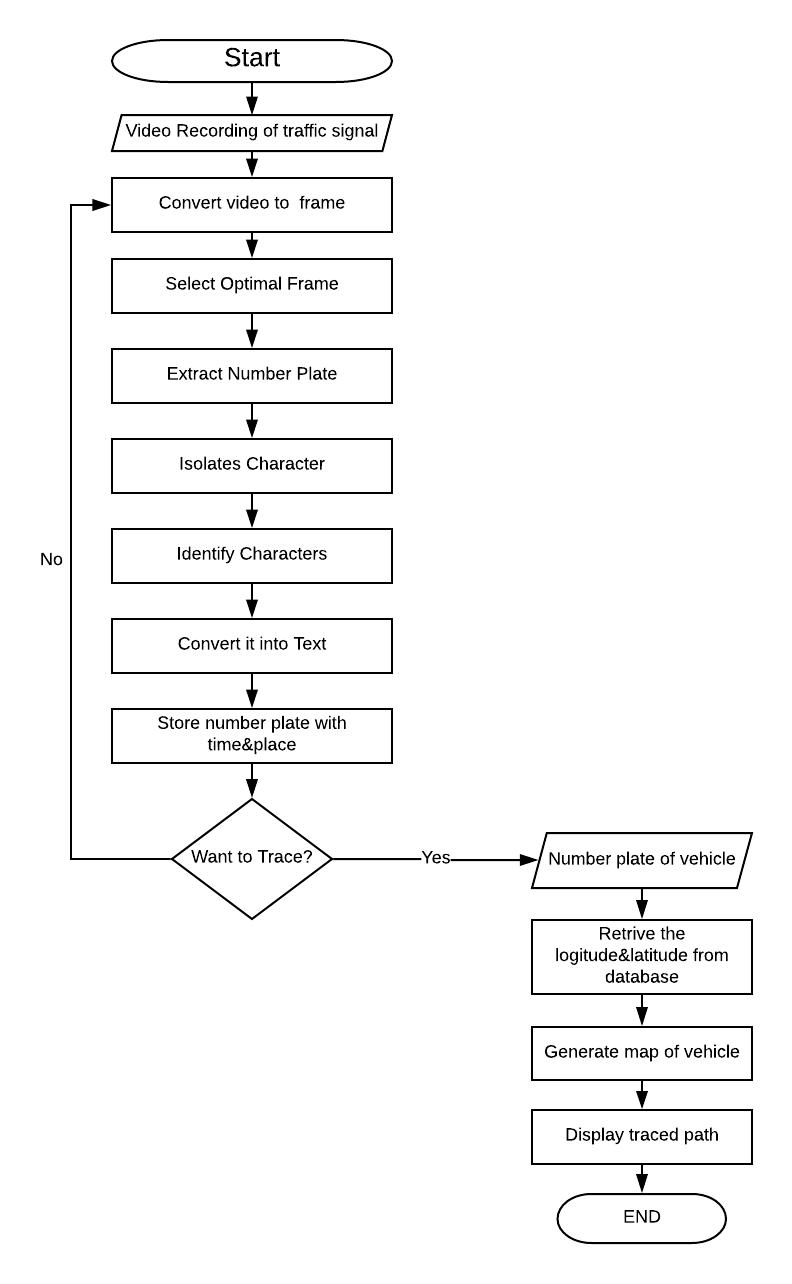
We process that frame as an image and extract a number plate from it. Then character segmentation and recognitionisdoneonthatextractedframe.Finally,weget the text of that vehicle number plate. We store that detail ofthevehiclewithdateandlocationinthedatabase.When ausersearchesforthevehicle then our system will generate a path and represent the traced path on the map [11] [12] [13].
4.1ImageAcquisitionandpre-processing
The high-resolution digital camera is used to acquire an image in this system. Images of the vehicle may be in different backgrounds, illumination conditions, and at various distances from. Images are resized to (1024 X 768).All theprocessingstepsare executedona grayscale image. The pre-processing is used to enhance the processing speed, improve the contrast of the image, and to reduce the noise in the image. It will remove the problem of low quality and low contrast in car images, images are enhanced by using histogram equalization on thegrayscaleimage.Thestepsarethefollowing:
1.LoadRGBimageandinitializevariables:Inthisstep,we read Red, green, and blue combined image as shown in figure
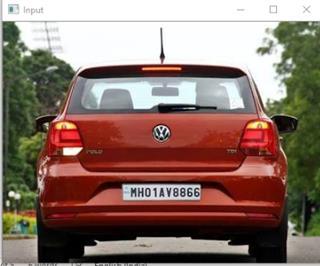
Fig -2 : LoadRGBimageandinitializevariables
2. Convert Color to Grayscale: In this step, we convert colorimagetograyscaleimageasshowninfigure3.
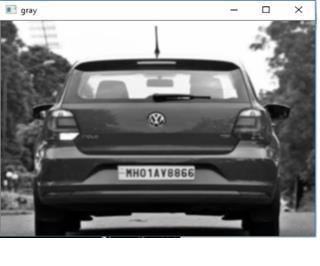
Fig -3 : ConvertColortoGrayscale
International Research Journal of Engineering and Technology (IRJET) e-ISSN:2395-0056
Volume: 12 Issue: 07 | Jul 2025 www.irjet.net p-ISSN:2395-0072
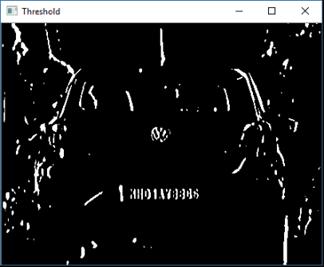
3. Thresholding of frame: The image will be converted to blackandwhiteimageinthisThresholdingprocess.Itwill reduce the number of a range of the color scale from (0255) to (0-1)[11][13]. Finally, the subtracted grayscale image is converted into a binary image. Firstly the global threshold level is calculated by using Otsu's method[6] and after this according to the calculated threshold value; the subtracted grayscale image is converted into a black andwhiteimage.Figure4showsabinarizedimage.
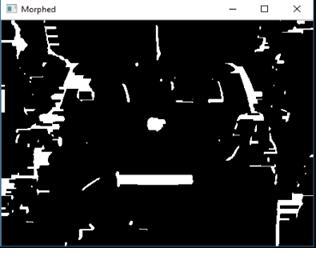
4. Morphed Frame: Dilation operation is applied on this image for detection of candidate plate area. After this the unwanted portion of image is removed by using opening operation and finally the candidate plate region is detected by using morphological erosion operation. Then morphological opening and morphological erode operations are used for detection of exact candidate plate area(NPD)anditsresultisshowninFigure5.
4.2NumberPlateareadetectionandExtraction:
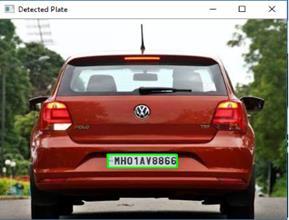
After the detection of the number plate area that area is extracted from the image. The efficiency of number plate extractiondependsonaccuratedetectionofnumberplate areaasshowninfigure6.
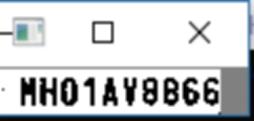
After the detection of candidate number plate area, Bounding Box analysis is used to extract plate area from the original image. From the Bounding Box analysis, respectiverowandcolumnindicesofplateareaarefound out. Once the indices of number plate are known, the number plate is extracted from the original grayscale image.
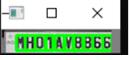
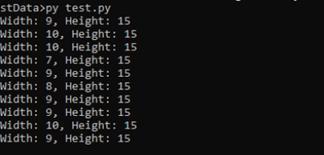
4.3.1 Character Segmentation (CS): This step acts as a bridgebetweenthenumberplateextractionandcharacter recognition phase. In this phase, the characters on the numberplatearea areseparatedorsegmented.Thereare manyfactorssuchasimagenoise,spacemark,plateframe, platerotation,andilluminationvarianceetc.thatmakethe charactersegmentationdifficult.Intheproposedapproach the character segmentation is done by Connected Component Analysis (CCA) and Boundary Box Analysis (BBA)[9]. Firstly labels are assigned to connected components and the labeled characters are extracted usingboundaryboxanalysisasshowninfigure8and9.
Volume: 12 Issue: 07 | Jul 2025 www.irjet.net p-ISSN:2395-0072
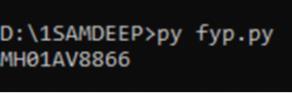
4.3.2Characterrecognition(CR):Itisthelastphaseofour system.Theinputstothisphasearesegmentedcharacters and output of this phase is license plate number. The character recognition is done by template matching (TM) using correlation. Correlation is the degree of similarity between the segmented characters and the template characters. In the character recognition step firstly make thetemplatebytaking42X24pixelAtoZalphabetand0 to9numberimages.Readallimageandstoretheminthe databaseandthisresultinto36charactertemplates.After the loading of templates, character normalization is done. In character normalization, all the segmented characters areresizedtotemplatesize42X24.
Sometimes the segmented characters do not have the samesizesothebetterwaytoovercomethisproblemisto resizethecharactersintoonesize(equaltotemplatesize) before actual recognition starts. In last the segmented characters are matched with template characters using correlation. The similarity between the template charactersandsegmentedcharactersismeasuredandthe templatethatismostsimilartothecharacterisrecognized as a target. The value of correlation is calculated by comparing the normalized segmented character image witheachtemplatecharacterimageandselectingthemost relevant image and writes that character as shown in figure10.
4.3.3MapGeneration
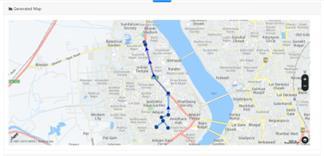
When the user searches for a vehicle in our system, we fetch data of the vehicle from the database and generate the traced path. The generated path will be displayed on theHereMapasshowninfigure11.Hereweuse MapAPI forIndianMapsupport.
The results of various operations like plate localization, characterseparationandcharacterrecognitionareshown with their success ratio in table 1 with 92%, 95.7 and 94.3%accuracyrespectively.
Table 1: Success ratio with various operations
This project has many possible future enhancements to makethecurrentintelligent trafficsystembetterinterms ofperformance,features,androbustness.Forinstance,we can use it for measuring traffic density at a particular junction and it’s also possible to classify vehicle types. In addition,thesystemcanbeabletorecognizenumberplate manipulationbetweentwojunctionsandalsodetectillegal numberplates.Furthermore,itcandetectthevalidityofa vehiclefrom government rc bookdata andif itisgoing to expirethennotifytheuseraboutitandifinthegiventime, the user does not take any action towards it then importantstepswouldbetakenbypolice.
In our present work, we have developed a complete system for recognizing the license number of a vehicle Theimageprocessingtechniquesuccessfullyidentifiesthe number plate of the vehicle for around 93% cases. The accuracy of the system is measured in terms of its constituent modules and is summarized in Table 1. Though the proposed system performs well in real life outdoorscenariosinIndia,stilltherearesomelimitations
International Research Journal of Engineering and Technology (IRJET) e-ISSN:2395-0056
Volume: 12 Issue: 07 | Jul 2025 www.irjet.net p-ISSN:2395-0072
ofthecurrentwork.Firstofall,wehavedesignedasystem to work for most vehicles in the city. The system may be developed for real-time tracking of high-speed vehicles. The system fails if the license plate is partially or totally occludedbyothers.
The system developed for stolen vehicles can easily be modified to apply it in other license plate recognition systems,likea recordingofvehicles‘entryintoll plaza,in car parking areas etc. Keeping the domain of operation and the outdoor run time environment in mind and considering the simplicity of the system compared to the complexity of the problem the overall performance of the systemmaybeconsideredtobesatisfactory.
1. Muhammad Tahir Qadri and Muhammad Asif, “Automatic Number Plate Recognition System for Vehicle Identification Using Optical Character Recognition”, in 2009 International Conference on Education Technology andComputer,Singapore.
2.D.MadhuBabu,K.Manvitha,M.S.Narendra,A.Swathiand K.Praveen Varma,"Vehicle Tracking Using Number Plate RecognitionSystem”,inInternationalJournalofComputer Science and Information Technologies (IJCSIT), Vol. 6 (2), 2015,1473-1476,Vizianagaram,India.
3. Avadhut S Joshi and Digambar A Kulkarni,"Automatic Number Plate Recognition and IoT Based Vehicle Tracking”, in International Research Journal of EngineeringandTechnology(IRJET),Volume:04Issue:07 |July-2017,Karnataka,India.
4. Divya gilly and Dr. Kumudha Raimond, “License Plate Recognition- A Template Matching Method”, International JournalofEngineeringResearchandApplications(IJERA), Vol.3,Issue.2,pp.1240-1245,2013.
5. Iroegbu Chibuisi and Okoronkwo Madubuezi C,"MATLAB Based Vehicle Number Plate Recognition”, in International Journal for Research in Applied Science & Engineering Technology (IJRASET), Volume 3 Issue IV, April 2015, Michael Okpara University of Agriculture, Umudike,AbiaState,Nigeria.
6. MuhammadTahir Qadri,Muhammad Asif .ISBN- 21551812 https://ieeexplore.ieee.org/document/5169511 IEEEon21July2009
7. D.Madhu Babu , K.Manvitha, M.S.Narendra , A.Swathi ,K.Praveen Varma on “Vehicle Tracking Using Number Plate Recognition System” ISSN-0975-9646 http://ijcsit.com/docs/Volume%206/vol6issue02/ijcsit2 0150602123.pdf.-July2015
8. Avadhut S Joshi, Digambar A Kulkarni on “Automatic Number Plate Recognition and IoT Based Vehicle Tracking” https://www.irjet.net/archives/V4/i7/IRJETV4I7319.pdf.OnJuly-2017
9.ShanDu,MahmoudIbrahim,MohamedShehataandWael Badawy, “Automatic License Plate Recognition (ALPR):A State-of-the-Art Review”, IEEE Transactions on Circuits & Systems for Video Technology, Vol. 23, Issue.2, pp.311325, 2013.J. Clerk Maxwell, A Treatise on Electricity and Magnetism, 3rd ed., vol. 2. Oxford: Clarendon, 1892, pp.68–73.
10. Christos-Nikolaos E. Anagnostopoulos, “License Plate Recognition: A Brief Tutorial”, Intelligent Transportation SystemsMagazine(IEEE),Vol.6,Issue.1,pp.59-67,2014K. Elissa,“Titleofpaperifknown,”unpublished.
11.C. Chunyu, W. Fucheng, C. Baozhi and Z. Chen,” Applicationofimageprocessingtothevehiclelicenseplate recognition,” International Conference on Computer ScienceandElectronicsEngineering,publishedbyAtlantis Press,pp2867-2869,2013Y.
12. Yorozu, M. Hirano, K. Oka, and Y. Tagawa, “Electron spectroscopy studies on magneto-optical media and plastic substrate interface,” IEEE Transl. J. Magn. Japan, vol.2,pp.740–741,August1987[Digests9thAnnualConf. MagneticsJapan,p.301,1982].
13. G. Naveen Balaji, V. Narayanan,V.S. Nivash “Low Power and High performance JK Flip – Flop using 45 nm Technology” International Journal of Engineering Research in Electronicsand Communication Engineering (IJERECE)Vol3,Issue10,October2016,pp:26-29
14.G.C.Lekhana and R.Srikantaswamy,” Real time license plate recognition system,” International Journal of Advanced Technology & Engineering Research, Vol-2, Issue-4, pp 5-9, July 2012.S Kranti and K Pranathi,” Automatic number plate recognition,” International Journal of Advancements in Technology,vol-2, no-3, pp408-423,July2011.