
International Research Journal of Engineering and Technology (IRJET) e-ISSN: 2395-0056
Volume:12Issue:08|Aug2025 wwwirjetnet

IoT-Based Biometric Door Locking System

p-ISSN:2395-0072
1Assistant Professor, Department of Electrical and Electronics Engineering, ATME College of Engineering, Mysuru, Karnataka, India-28
2Student, Department of Electrical and Electronics Engineering, ATME College of Engineering, Mysuru28
3Student, Department of Electrical and Electronics Engineering, ATME College of Engineering, Mysuru28
4Student, Department of Electrical and Electronics Engineering, ATME College of Engineering, Mysuru28
5Student, Department of Electrical and Electronics Engineering, ATME College of Engineering, Mysuru28
Abstract - Security concerns have always been a significant issue in everyday life. Traditional physical keys are prone to duplication and loss, leading to security vulnerabilities. To address this problem, a biometric security system using fingerprint recognition is implemented. The proposed system uses a fingerprint sensor to authenticate users and control door access. If the fingerprint matches stored records, thedoor lock is activated. Otherwise, accessis denied. The system integrates an Arduino microcontroller, HC-05 Bluetooth module, and relay module to ensure secure andefficient functioning. This approach enhances security by eliminating the risks associated with traditional keys.
Key Words: Arduino UNO, HC-05 Bluetooth Module, PowerRelay,BiometricSensor
1. INTRODUCTION
IoTcomprisesthingsthathaveuniqueidentitiesandare connectedtointernet.Bytheendofthe2024therewillbe morethan75billiondevices/thingsconnectedtointernet. IoT is not limited to just connecting things to the internet but also allow things to communicate and exchange data. The things in IoT refer to IoT devices that have unique identities and perform remote sensing, actuating, and monitoringcapabilities.IoTdevicescanexchangedatawith other connected device applications. It collects data from other devices and process data either locally or remotely. An IoT device may consist of several interfaces for communication to other devices both wired and wireless. Theseinclude
•I/Ointerfacesforsensors,
•Interfacesforinternetconnectivity
•Memoryandstorageinterfaces
•Audio/videointerfaces.
IoT-based biometric door locking system integrates biometric technology with Internet of Things (IoT), enhancing security and convenience in access control. “A biometricdoorlockingsystemisasecuritydevicethatuses unique physical or behavioral characteristics, to identify and unlock doors. Some examples of biometric characteristics include fingerprints, facial recognition, to unlock door”. Biometric door locks are more secure than

traditionallocks,asreplicatingorforgingbiometricdatais
muchmorechallenging thanstealing akey or guessinga password.
1.1 Need of Smart lock system
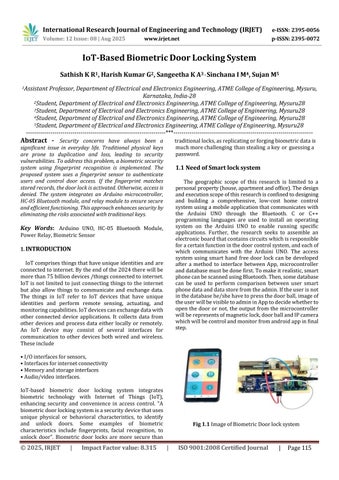
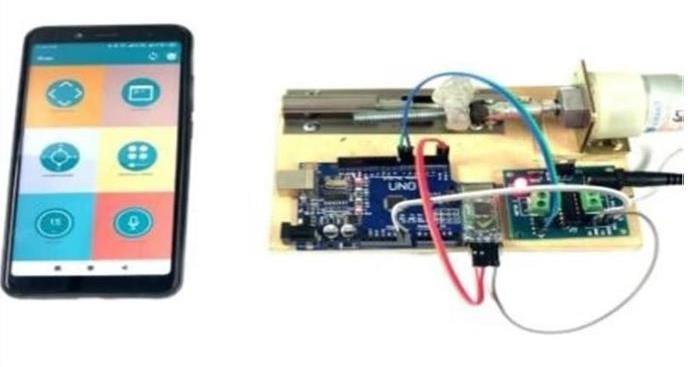
The geographic scope of this research is limited to a personalproperty(house,apartmentandoffice).Thedesign andexecutionscopeofthisresearchisconfinedtodesigning and building a comprehensive, low-cost home control systemusingamobileapplicationthatcommunicateswith the Arduini UNO through the Bluetooth. C or C++ programming languages are used to install an operating system on the Arduini UNO to enable running specific applications. Further, the research seeks to assemble an electronicboardthatcontainscircuitswhichisresponsible foracertainfunctioninthedoorcontrolsystem,andeachof which communicates with the Arduini UNO. The access system using smart hand free door lock can be developed after a method to interface between App, microcontroller anddatabasemustbedonefirst.Tomakeitrealistic,smart phonecanbescannedusingBluetooth.Then,somedatabase can be used to perform comparison between user smart phonedataanddatastorefromtheadmin.Iftheuserisnot inthedatabasehe/shehavetopressthedoorball,imageof theuserwillbevisibletoadmininApptodecidewhetherto openthedoorornot,theoutputfromthemicrocontroller willberepresentsofmagneticlock,doorballandIPcamera whichwillbecontrolandmonitorfromandroidappinfinal step.

1.2 Market Survey
1.4 Problem Definition
Theglobaldigitallocksystemmarketwasvaluedto7.6 billionUSDin2023andisestimatedtogrowataCAGRof over7.4%from2024–2032.Thedigitaldoorlocksystem industry is growing due to increased demand for smart home security solutions. Digital door locks, featuring biometricaccess,remotecontrol,andactivitymonitoring, offerbettersecuritythan traditionallock,makingthema popularchoice.LatinAmericaisexpectedtogrowfrom9% to11%bytheendof2032.Indiaisexpectedtowitnesshigh growthwithaCAGRof14.5%bytheendof2032.
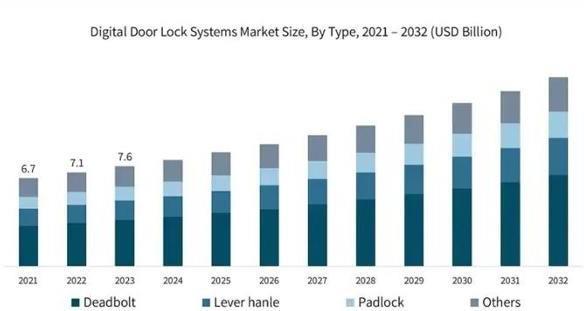
Chart-1:Smartdoorlocksystemmarketsize
1.3 Field Survey
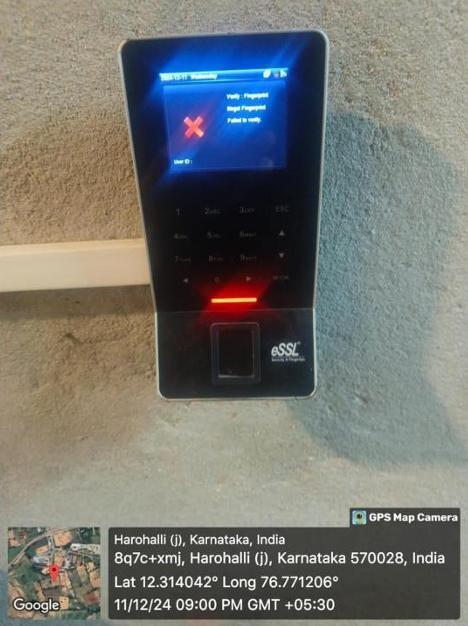
A survey conducted in hostel premises demonstrated the necessity of a secure and reliable locking system. The proposed biometric lock system eliminates concerns associated with misplaced keys and unauthorizedaccess.
ReliabilityofBiometricsensors
o False Positive: Incorrectly granting access due to matchingerrors.
o False Negative: Denying access even with valid biometricdata.
o Sensor Malfunctions: Potential issues with sensor degradationorfailureduetousage.
SecurityConcerns
Data branches: Risks of biometric data being interceptedifnotproperlysecured.
Spoofing and Unauthorized Access: System vulnerabilities to attacks like fake fingerprints or brute-forceattemptsonthenetwork.
SystemFailures
DowntimeRisks: Power failures and internet outages can disruptaccess.
BackupAuthentication:Needforbackupmethods,likePIN codes or manual keys, in case biometric authenticationfails.
CostandScalability
o Initial High Costs: costs associated with high-quality sensors,securestorage,andnetworkinfrastructure.
o Scalability: challenges in supporting multiple users and potentiallylinkingtoothersmarthomesystems.
1.5 Project Objective
Establish a reliable and tamper-resistant access control system using biometrics to improve securityand accessibility. Reduce Dependency on Physical Keys & Avoidtheriskoflostorstolenkeys.ImproveSecurity with Biometric Traits. Use features that are unique to each individual, making it harder for unauthorized access Limit Access to Authorized Users: Only pre-registered userscan unlockthedoor.
2. Literature Survey
[1] Sajal Aggrwal, Virendra Ranga “A Raspberry Pi 4 and Arduino-based Automated Intercom Door Lock System”, IEEE Xplore, Conference: 2024 IEEE 1st International Conference on Advanced Computing and Emerging Technologies (ACET), DOI: https://doi.org/10.1109/ACET61898.2024.10730356 , Published:2024.Inference:
• Arduino is better suited for controlling the hardware components.Ontheotherhand,theRaspberryPiisbetter suited for software applications that demand more processingpower.
[2] DhyanikPujara,RiyaGautam,DhavalShah“Integrative HomeAutomationSystem-AMultifacetedApproach”,2023 IEEEInternationalSymposiumonsmartElectronicsystem
International Research Journal of Engineering and Technology (IRJET) e-ISSN: 2395-0056 p-ISSN:2395-0072
Volume:12Issue:08|Aug2025 www.irjet.net
(iSES), DOI: https://doi.org/10.1109/iSES58672.2023.00101 , Published:2023.Inference:
• This paper presents an innovative and comprehensive approachtohomeautomation,designedtoenhancecontrol, security,andenergyefficiencyincontemporaryhouseholds.
3. Hardware and Software Description
The hardware introduction may touch upon the power source and management system for the IoT based Biometric System. This includes information about the Power relay, Arduino, Bluetooth. This introduction also may also discusses about power efficiency and energy conversiontoensureusageforIoTbasedBiometricSystem. Software enables advanced encryption and authentication methods which helps to protect against unauthorizedaccess.Withsoftware,userscancontroltheir smart locks remotely through a mobile app or web interface. This allows users to lock or unlock doors from anywhere, providing convenience and peace of mind. software plays crucial for enhancing the functionality, security, and convenience of smart lock systems, making them a valuable addition to modern home security solutions.
3.1 Hardware Components
3.1.1 ArduinoUNO
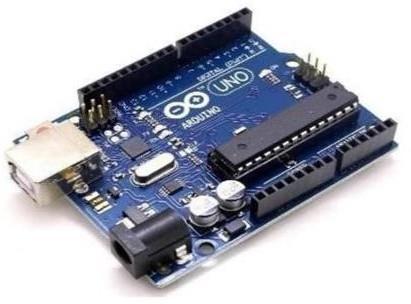
Arduino UNO is an open-source microcontroller board basedontheATmega328Pchip.Ithas14digitalI/Opins(6 ofwhich can be used asPWMoutputs), 6analoginputs, a USB port, and other components like a voltage regulator and oscillator. It is widely used to control and sense electronicdevices.
3.1.2 HC – 05BluetoothModule

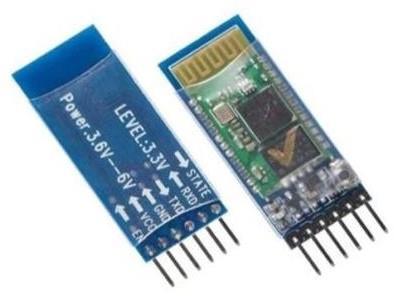
Fig3.2 HC–05BluetoothModule
The HC-05 is a popular Bluetooth serial communication module that enables seamless wireless data transmission between electronic devices. Based on the Bluetooth 2.0 standards,itutilizesthe2.4GHzISM(Industrial,Scientific, and Medical) band for operation. This module serves as a link between Bluetooth wireless communication and conventionalcablesserialconnection.Itmakesconnecting Bluetoothdeviceseasierforavarietyofapplications.
3.1.3 Relay
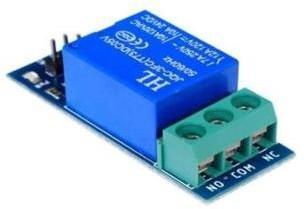
Fig3.3 RelayModule
A relay is an electrical switch that uses a small control signal to turn on/off a higher voltage/current device. It helpsisolatelow-voltagecontrolcircuitsfromhigh-voltage devices, commonly used to control AC appliances using microcontrollers.
3.1.4 SolenoidLock
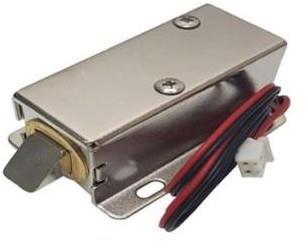
Fig3.4 SolenoidLock
SL0635S Solenoid lock isa compact lock used in cabinets, drawers,andlockers.Itcanbecontrolledelectronicallyand also supports manual release during power failure. It's suitableforaccesscontrolsystems.
International Research Journal of Engineering and Technology (IRJET) e-ISSN: 2395-0056 p-ISSN:2395-0072 Volume:12Issue:08|Aug2025 www.irjet.net
3.2SoftwareComponent
3.2.1 ArduinoIDE

Fig3.5 ArduinoIDE
TheArduinoIDEisfreesoftwareusedtowrite,compile, and upload code to Arduino boards. It's beginner-friendly andsupportsWindows,macOS,andLinux.
KeyFeatures:
Code Editor:Highlightssyntaxand formats code neatly.
Library Manager: Easily adds extra functions usingready-madelibraries.
Board Manager: Supports various Arduino and compatibleboards.
SerialMonitor:Communicateswiththeboardfor debugginganddatadisplay.
Examples&Tutorials:Built-insamplecodesfor quicklearning.
Sketches: Arduino programs are called sketches andsavedwith.inoextension.
4. CircuitDiagram&Methodology
4.1CircuitDiagram
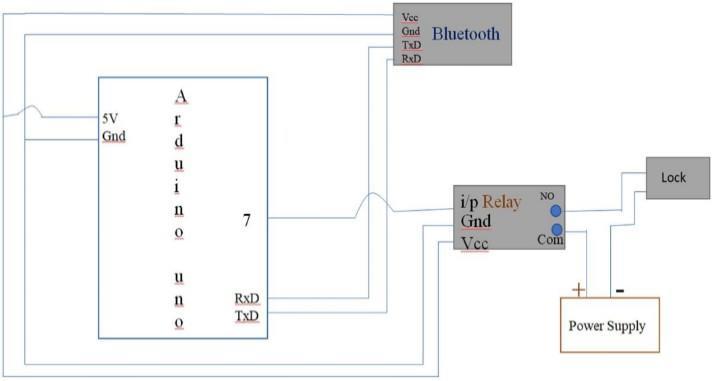
Fig4.1 CircuitDiagram
4.2Methodology
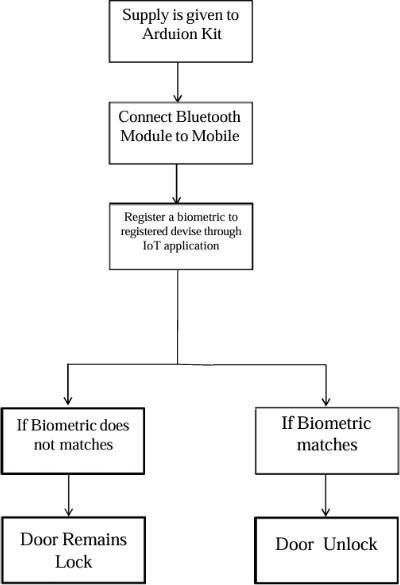
Chart-2:Methodology
TheFingerprintdoorlockusingArduino,weareshowing thecomponentsandconnectedthemtothepowersupply. Thissystemisbasedforimprovingthesecuritywhichwill registertheowner’sfingerprintintotheArduinousingthe fingerprintsensor,andthissystemwehavegiven5vpower supplytoArduinothroughthecodeuploadingwire.When youputyourthumbonfingerprintsensorafterregistering yourself the lock will be unlocked and you repeat this processagainthenthesolenoidlockwillbegotlocked.The processoflockingandunlockingrequireslessthan1second sothisiswhytheSolenoidlockisusedinsidethisproject.
4.2.1WorkingPrinciple
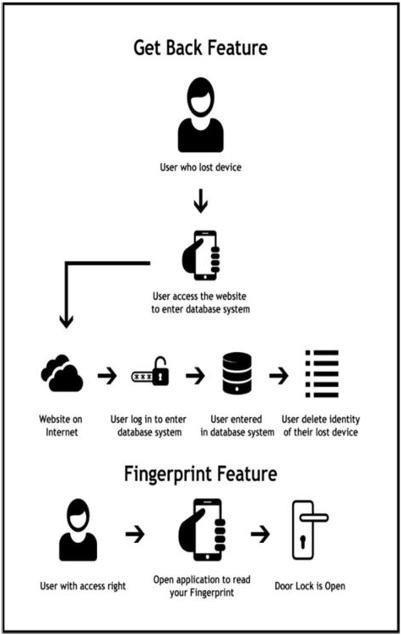
4.2 WorkingPrincipal
Volume:12Issue:08|Aug2025 www.irjet.net
International Research Journal of Engineering and Technology (IRJET) e-ISSN: 2395-0056 p-ISSN:2395-0072
Data Enrolment: User’s fingerprint or face is scannedandstored asa digitaltemplate.
Biometric Scan:Userscanstheirfingerprintorface to access the door.
Data Conversion: The scan is converted into a digital format.
Template Matching: The new scan is compared with stored data.
Authentication: If matched, access is granted; otherwise, denied.
Lock Control: If verified, the door unlocks. If not, it stays locked.
Logging: Entry/exit times are recorded for security tracking.
5. Result
TheArduino-basedfingerprintdoorlockenhancessecurity by registering the owner’s fingerprint using a fingerprint sensor.Thesystemispoweredbya5Vsupplythroughthe code uploading wire. Once registered, placing a thumb on the sensor unlocks the solenoid lock, and repeating the process locks it again. The locking and unlocking process takes less than a second, making the solenoid lock an efficientchoiceforthisproject.
5.1 General conditions on the lock system to get to know clearlyhowtheSmartLocksystemworks.
Condition1
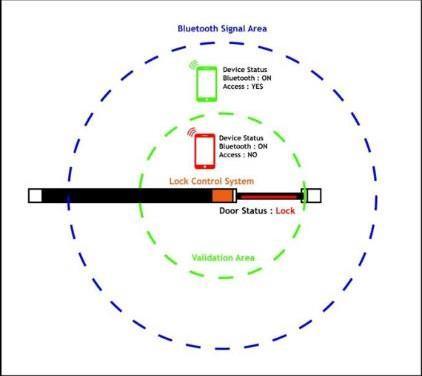
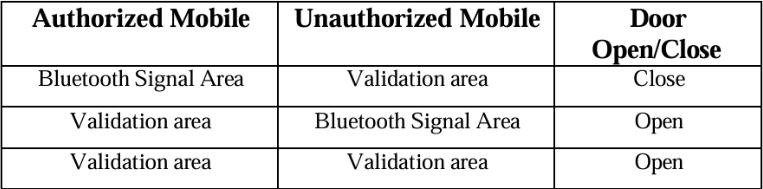
TheuserofaccessislocatedonBluetoothsignalarea andtheuserofnoaccessislocatedonthevalidation area.Theconditionidentifiesthattheuserofaccessis located on the Bluetooth signal area, yet the system hasnotgiventhecommandtoopenorlockthedoor. Theuserofnoaccessislocatedonthevalidationarea, yettheidentityoftheuserdetectedontheareadoes notmatchtheidentitysavedontheserver,sothedoor lockisstillonthelockedstatus.
Condition2
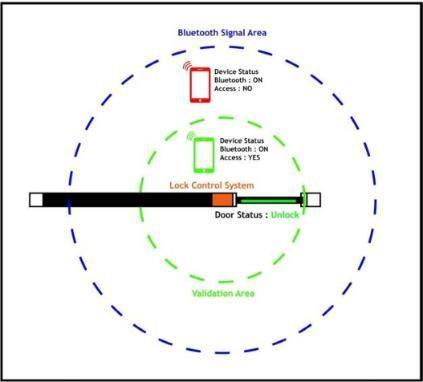
Theuserofaccessislocatedonthevalidationareaandthe user of no access is located on the Bluetooth signal area. Thereisnoactionfromthesystemiftheuserislocatedon the Bluetooth signal area, yet the system can detect an activeBluetoothsoftware,matchtheidentity,andconnect communicationfortheuserofaccess.Oncondition2figure, it is identified that the user of access is located on the validation area, so the system gives command to the door locktoopenautomatically.
Condition 3
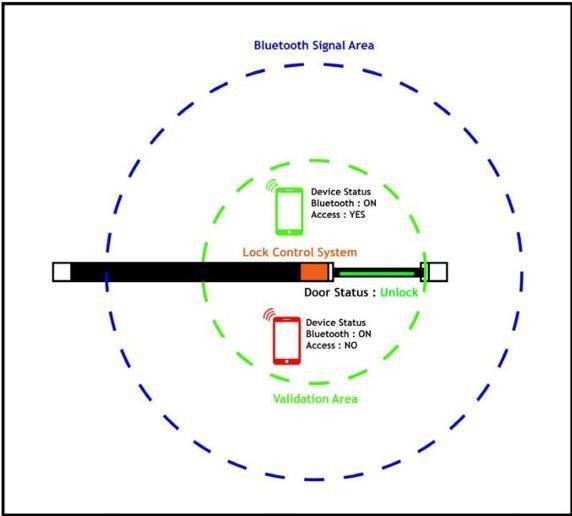
Fig5.1 WorkingofSmartlockSystem–Condition3
Theuserofaccessandtheuserofnoaccessarelocatedon the validation area. If the condition happens, the lock systemwillgivecommandtothedoorlocktoopenbecause the identity of the user is detected matched with the one saved in the server. It is designed purposively for the condition where the user of access might bring relatives withnoaccesstoentertheroom. Whentheuserofaccess is out of the validation area, then the lock control system gives command to the door lock to stay locked automatically.
Volume:12Issue:08|Aug2025 wwwirjetnet
5.2 Truth Table of the Project Output
6. Applications and Advantages
6.1Applications
Access control –Itismainlyusedincorporateoffices,data centers etc. To prevent from unauthorized entry and monitoraccesslocks.
Attendance systems –Itcanrecordstheentryandexittime oftheemployeesorstudents
Educational institutions –Itcansecureclassroom,labsand staff areas while ensuring only authorized students and facultyaccess.
Government facilities – Government offices handles the sensitive information, it requiring strict access control henceitprovidedbiometriclockingwhereitisessential.
Healthcare facilities – Ithelpsto protects patients records andmedicalreports.
7. CONCLUSIONS
International Research Journal of Engineering and Technology (IRJET) e-ISSN: 2395-0056 p-ISSN:2395-0072
The research and development of the Smart Door Lock system have successfully met the objectives of enabling secure access via Android applications and fingerprint authentication.Thesystemintegrates bothhardwareand
software components seamlessly, ensuring optimal performanceanduser-centricfunctionality.
KeyfeaturesoftheAndroidapplicationinclude:
Securedoorlock/unlockcontrol
Devicemanagement(Create,Read,Update,Delete)
Fingerprintenrollment.
Real-timeremotemonitoringandcontrolusingIoT
Integration with Firebase Realtime Database (RTDB) for efficient and responsive communication.
Thesystemunderwent20testiterations,achievinga100% success rate across various operating conditions, demonstratingitsreliabilityandstability.
Designed for both residential and commercial use, this smartlocksystemoffersenhancedsecurity,convenience, andeaseofaccess,makingitarobustsolutionformodern accesscontrolneeds.
8. Future Scope of Improvement
6.2 Advantages
Enhanced Security: The system provides a high
Cyber security – It ensures safety, privacy and integrity of thesystems. levelofsecuritythroughbiometricauthentication andapp-basedaccesscontrol,reducingtheriskof unauthorizedentry.
Convenience:Userscaneasilyunlockdoorsusing their fingerprint or smartphone, eliminating the needtocarryphysicalkeys
Audit Trails: The system maintains detailed logs of access events, allowing administrators to track who accessed the door and when, enhancing transparencyandcontrols
User Accountability: Since access is tied to individual biometric or user profiles, each user is accountable for their entry and exit, promoting responsibleusage.
Environmental Testing: Conduct extensive testingofthesystemundervariousenvironmental conditions (e.g., humidity, temperature, dust) to ensurereliabilityandrobustness.
Enhanced Security Features: Integrate additional authentication methods such as RFID and facial recognition to improve system flexibility,security,anduseraccessibility.
Smart Home Integration: Expand the system’s capabilitiesbyintegratingitintoabroader Smart Home ecosystem, enabling centralized control andmonitoring.
Power Backup Support: Ensure uninterrupted operation during power failures by incorporating a UPS (Uninterruptible Power Supply) or batterybackupsystem.
REFERENCES
1. Sajal Aggrwal, Virendra Ranga “A Raspberry Pi 4 and Arduino-based Automated Intercom Door Lock System” M. Young, The Technical Writer’s Handbook. Mill Valley, CA: University Science, 1989.
Volume:12Issue:08|Aug2025 wwwirjetnet
International Research Journal of Engineering and Technology (IRJET) e-ISSN: 2395-0056 p-ISSN:2395-0072
2. Summaiya Rajput, Noureen Talpur, Rozan Boudville,GhulamMustafaEAbro,BeenishTalpur; Faizan Zahid “Modernizing Home Protection: An IoT- Driven Approach with Smart Lock and Android Application” K. Elissa, “Title of paper if known,”unpublished.
3. Abdullahi Ahmed, Said Abdulkadir, Jama Mohamed, Suleiman Abdullahi Ali; Mowlid Abdi, SharmakeAliKahie“DesignandImplementationof anIoTbaseddoorlocksystem”.
4. Dhyanik Pujara, Riya Gautam, Dhaval Shah “Integrative Home Automation System - A MultifacetedApproach”.
5. Md. Khayrul Islam & Alimul Rajeen (2022)“FingerprintDoorLockUsingArduino”.