
International Research Journal of Engineering and Technology (IRJET) e-ISSN: 2395-0056
Volume: 12 Issue: 08 | Aug 2025 www.irjet.net p-ISSN: 2395-0072
International Research Journal of Engineering and Technology (IRJET) e-ISSN: 2395-0056
Volume: 12 Issue: 08 | Aug 2025 www.irjet.net p-ISSN: 2395-0072
Neman Sharif M.M1 , Dr. Inayathulla M2
1Research Scholar, DCE, University of Visvesvaraya College of Engineering, Bengaluru
2Professor, DCE, University of Visvesvaraya College of Engineering, Bengaluru, Karnataka, India
Abstract - Accurate flood inundation mapping is fundamental for effective flood risk management, urban planning, and emergency preparedness. While advances in hydrologic and hydraulic modeling have significantly improved the precision of these maps, the nuanced influence of hydraulic structures such as dams is often simplified or overlooked. This study presents a comprehensive approach to assess the impact of Krishna Raja Sagara (KRS) dam on flood inundation patterns. KRS dam is a type of Gravity dam constructed with stone masonry along with surki mortar having a length of 2621 m and has a maximum height of 44.66 m and the bottom width of the dam is 33.88 m covering a catchment area of 10961 km2. The Gross storage capacity of the dam is 1400 MCum. The design flood discharge is estimated to be 9911 cumecs. A total number of 152 gates have been installed to dispose off the surplus as well as water stored in the KRS dam which are situated at different levels of the dam having varying capacities. Utilizing integrated 1D/2D hydrodynamic modeling data, we simulate floodevents under diverse scenarios, comparing inundation extents and depths with and without detailed representation of structure. The methodology incorporates detailed structural geometry, operational rules, and their interaction with upstream and downstream flow dynamics. Preliminary findings demonstrate that hydraulic structures can significantly alter flood wave propagation, water surface elevations, and flow velocities, leading to considerable differences in predicted inundation areas and depths. The maximum inundation area observed in the maps generated was 288.407sq.km respectively in 2D modeling. The maximum water surface elevation observed is 755.139 (m)with overtoppingfailure with Dam breakscenario.
Key Words: Flood Inundation Mapping, hydrologic, hydraulic modelling, Dam breach analysis, HEC-RAS· HEC-HMS.
1.INTRODUCTION :
A flood is defined as the overflow of water onto land that is normally dry, typically caused by excessive rainfall leading to high flows in rivers, streams, or drainage channels, or by water ponding near the point of precipitation.Whenariver'scarryingcapacityisexceeded, the excess water spills over its banks, resulting in
inundation. The extent and severity of flood inundation are influenced by various factors, including terrain slope, elevation, rainfall intensity, drainage density, land use patterns,and soil characteristics
Dams are engineered hydraulic structures constructed across rivers to form reservoirs, serving a range of purposes including flood control, hydropower generation, irrigation, water supply for domestic and industrial use, andrecreationalactivities [1].However,damfailurespose significant risks to public safety and the environment. Historical disasters, such as the 1975 Banqiao and Shimantan Dam collapses in China (85,000 fatalities), the 2018PatelDamfailureinKenya(41deaths),andthe1994 Merriespruit tailings dam disaster in South Africa (17 fatalities), highlight the catastrophic consequences of dam breaches ( [2]; [3]; [4]). Other notable failures include the St. Francis Dam (1928), Buffalo Creek Dam (1972), and Teton Dam (1976), which caused extensive property damage and loss of life ( [5]; [6]). Globally, over 800,000 dams have been constructed [7], but their failure often due to overtopping (34% of cases), foundation defects, or extreme weather can lead to devastating downstream flooding [8]. The 1975BanqiaoDamdisaster,triggeredby extreme rainfall, resulted in widespread fatalities, displacement, and disease outbreaks [9]. Since the 1970s, dam safety concerns have grown, prompting studies on breach mechanisms, flood modeling, and risk mitigation [10] Traditional approaches relied on over engineered structures, but modern strategies emphasize flood forecasting, emergency action plans, and downstream evacuation [11]. Advanced modeling tools, such as HECRAS, HEC-HMS, and DAMBRK,simulatebreachscenarios, predict flood extents, and support emergency planning ( [12] [13]). Parametric and analytical models estimate breach dimensions and outflow hydrographs, while GISbasedtoolslike HEC-GeoRAS enhanceinundationmapping ([14];[15]).
Thepresentstudyondambreakanalysishelpsinmany waysandhasgotmuchsignificanceaslistedbelow:
Helps in assessing the potential extent of damage indownstreamareasofthedam.
International Research Journal of Engineering and Technology (IRJET) e-ISSN: 2395-0056
Volume: 12 Issue: 08 | Aug 2025 www.irjet.net p-ISSN: 2395-0072
Aids in identifying the population and infrastructureatriskfartherdownstream.
Enablesestimationofdambreakfloodhydrograph andexpectedinundationlevels.
Facilitates analysis of worst-case scenarios for effectivedisastermanagementplanning.
Flood mapping serves as a key input in the preparationofEmergencyActionPlans(EAPs)for safeandtimelyevacuation.
The Krishna Raja Sagara, also known as KRS Dam is located near Mysore Karnataka, India. KRS Dam standsas a marvel and a vital resource of water. KRS Dam was completed in 1932. The location of the KRS Dam is as showninFigureNo.1
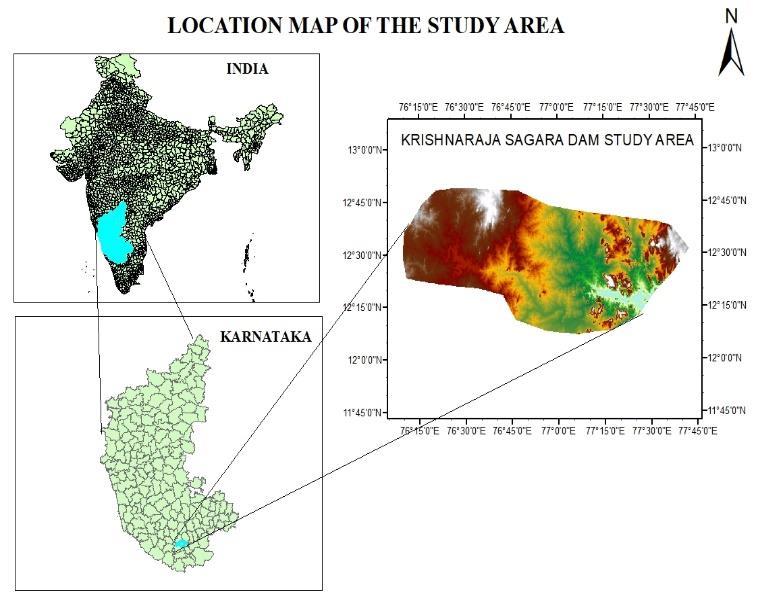
The Krishna Raja Sagara Dam's primary purpose is to store water from the Krishna River for irrigation and powergeneration.Thereservoiritholdsnotonlysupports agriculture but also supplies drinking water to regions thatareinandaround.Beyonditsutilitarianfunctions,the dam's elegant design and surrounding lush landscapes attract tourists. With a capacity to harness hydroelectric power and facilitate water management, the KRS Dam remains a crucial asset of the state for the sustainable development that plays a significant role in Karnataka's water, energy, and agricultural sector .The KRS Dam standsasatestamenttohumaningenuityandengineering prowess. The KRS Dam has transformed from the year it was built years ago has turned into a landscape and shapedthesocio-economicdevelopmentoftheregion.The Krishnarajasagara Dam is located near Kannambadi village, in Srirangapatna Taluk of Mandya district, Karnataka State with Lat 120 25’ 30” N and Long 760 34’ 30” E and with a catchment area of 10961 Sq.Km. The
gross capacity of reservoir is 1400 MCum. The salient features of Krishnarajasagara reservoir project is tabulatedinTableNo.1.
TableNo.1:SalientfeaturesofKRSReservoirProject
NameofDam Krishnarajasagara Dam
NameofRiverBasin Cauverybasin
Location 120 25’30”N,760 34’30”E
CatchmentArea 10961Sq.Km
Grossstoragecapacity 1400MCum
LiveStorage 1275.38MCum
Deadstorage 124.62MCum
LowestFoundationLevel 709.66m
LowestRiverBedLevel 714.45m
FullReservoirLevel 752.48m
TopoftheDam 754.32m
Totallengthofdam 2620m
Heightofthedam 44.66m
Topwidthofroadway 4.12m
Designedflooddischarge 9911cumecs
Figure no. 2 illustrates the elevation-storage relationship of the KRS reservoir, while Figure no. 3 depicts the Probable Maximum Flood (PMF) hydrograph generatedforthestudyarea.
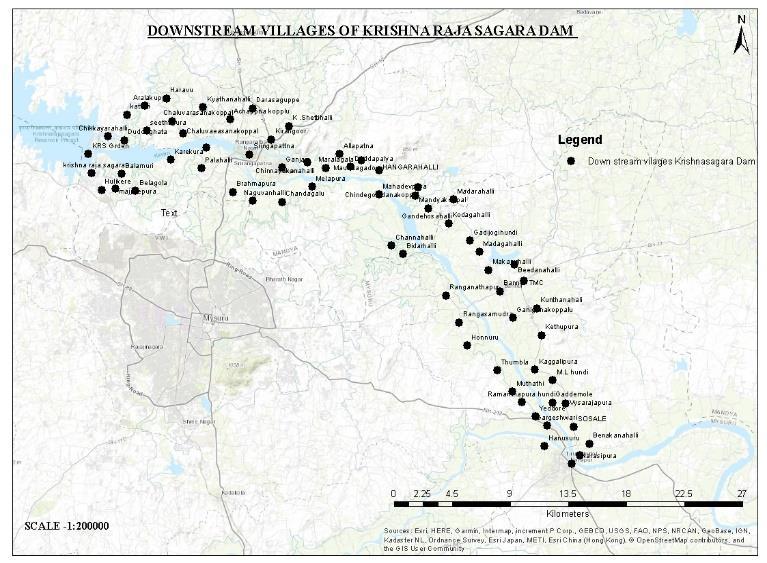
Further,there are many villagesalong the downstream side of the dam which will get affected due to the floods causedbythefailureofthedam representsinFigureno.4 and hence, the inundation mapping made in this work wouldbemoreapplicableandusefulinthiscontext.
Figure No.2: Elevation-Storage for the KRS Reservoir
International Research Journal of Engineering and Technology (IRJET) e-ISSN: 2395-0056
Volume: 12 Issue: 08 | Aug 2025 www.irjet.net p-ISSN: 2395-0072
3. Regression Equations
The following regression equations have been used for several dam safety studies found in the literature, are presentedingreaterdetailinthischapter:
Froehlich(1995a) Bave =0.1803Ko Vw0.32 hb0.19 ,
tf=0.00254Vw0.53 hb-0.90
Froehlich(2008) Bave =0.27Ko Vw0.32 hb0.04
tf =63.2√
MacDonald and LangridgeMonopolis1984
Von Thun and Gillette
Veroded=0.0261(Vout *hw)0.769
tf =0.0179(Veroded )0.364
Bave =2.5hw+Cb
Where
Bave =Averagebreachwidth(m)
Ko =Constant
(1.4,forovertoppingfailures,1.0forpiping)
Vw =Reservoirvolumeattimeoffailure(m3)
hb =Heightofthefinalbreach(m)
tf =Breachformationtime(hrs)
Bave =Averagebreachwidth(m)
Veroded =Volume of material eroded from the dam embankment(m3)
Vout =Volume of waterthat passesthroughthe breach (m3).
hw =Depth of water above the bottom of the breach (m).
To accurately estimate outflow hydrographs and downstream inundation during a dam breach, key parameters must be defined in HEC-RAS software. These include:
Breach location (centreline of the dam), based on damtype,failurehistory,andlikelyweakpoints.
Failure mode (overtopping or piping), which determineshowthebreachinitiatesanddevelops.
Critical breach development time, the duration from breach initiation to full formation, estimated externallyandenteredintoHEC-RAS.
Weir and piping flow coefficients, which influence peak outflow rates and must be user-defined based onanunderstandingofbreachmechanics.
Breach Parameter Estimates for Overtopping Failure is tabulated in Table no.2. And for piping failure breach parametersarepresentedinTableno.3.
Table no. 2: Breach Parameter Estimates for Overtopping Failure
International Research Journal of Engineering and Technology (IRJET)
Volume: 12 Issue: 08 | Aug 2025 www.irjet.net
Table no.3: Results of Breach Parameter Estimates for Piping Failure
Method
Froehlich (1995a)
and LangridgeMonopolis
Von Thun and Gillette
Xuand Zhang (2009)
The mapping of inundated area will be made using HECGeo-RAS, which is an ArcGIS based pre- and postprocessorforHEC-RAS(Figureno..5)
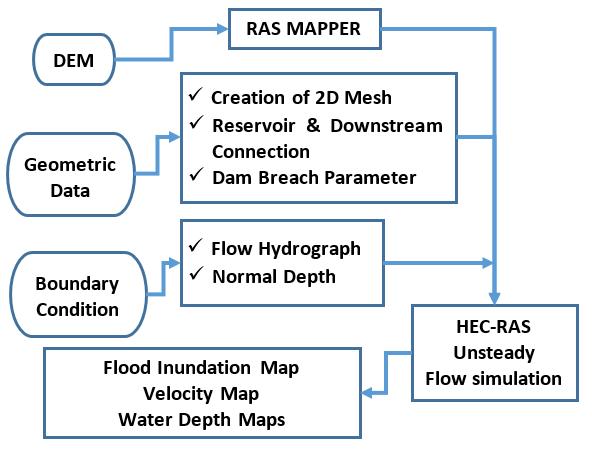
Figure No.5: Flow Chart for Methodology of 2-D Modeling using HEC-RAS
There are five main steps in creating a hydraulic model withHEC-RAS2Dmodeling:
1. Creationoraddingaterrain(Plateno..1&2)
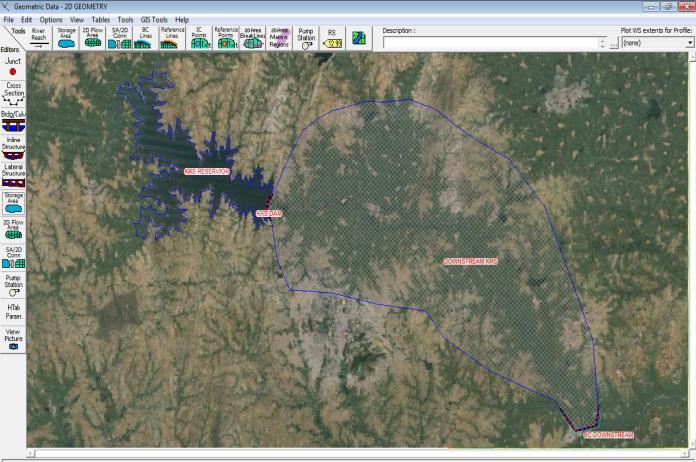
2. Addingthegeometrydatafortheterrain
3. HEC-RAS processing and Unsteady Flow data (Plateno.3)
4. Dam break scenario and the Entry of Breach prameters
5. Unsteadyflowanalysis(Plate.No.4).
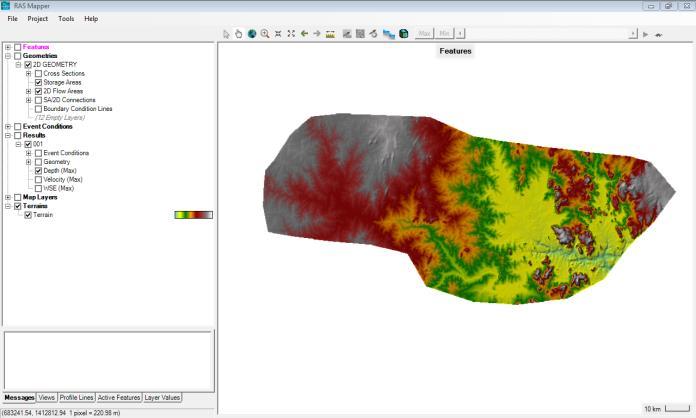
Creation of Terrain profile in HEC-RAS using RAS mapper
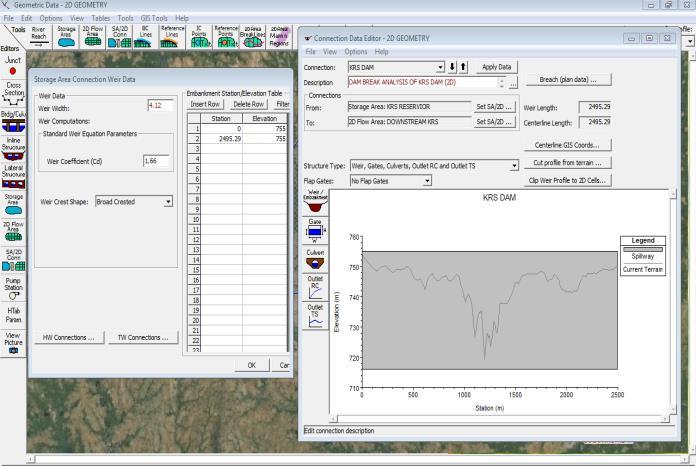
no. 3: HEC-RAS Connection Data Editor
International Research Journal of Engineering and Technology (IRJET) e-ISSN: 2395-0056
Volume: 12 Issue: 08 | Aug 2025 www.irjet.net p-ISSN: 2395-0072
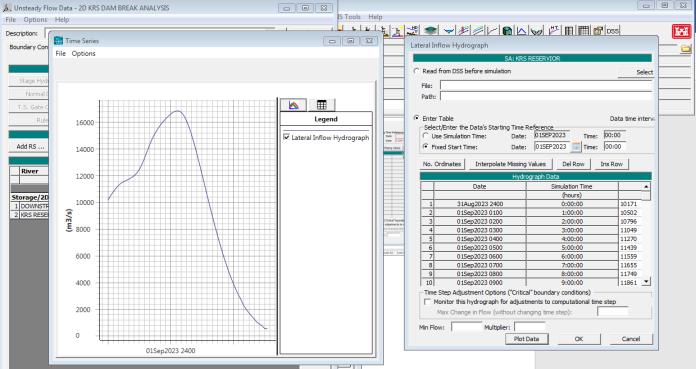
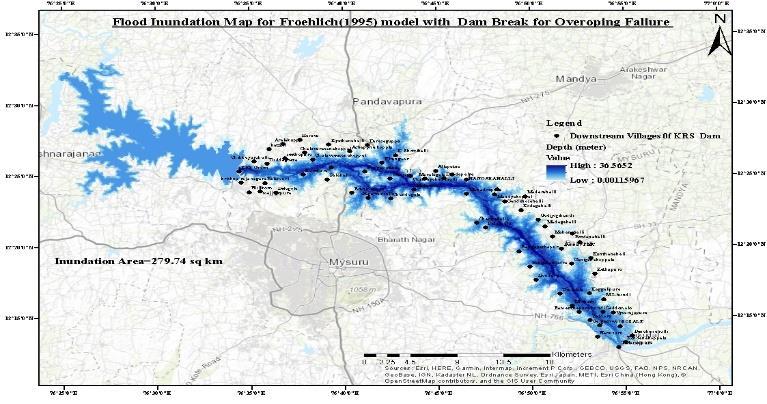
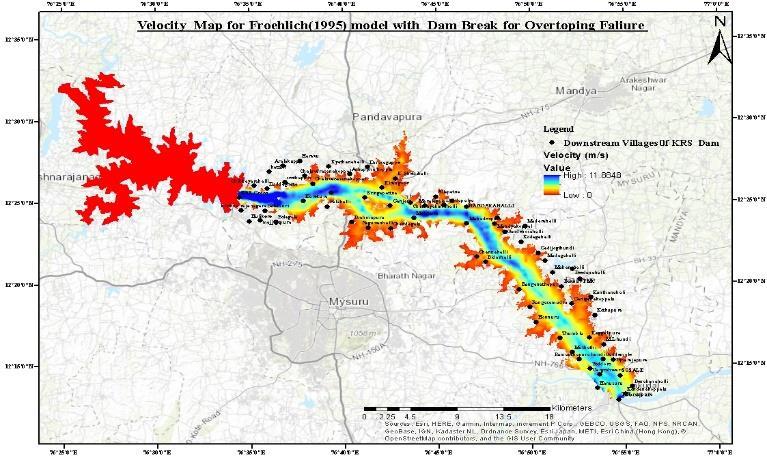
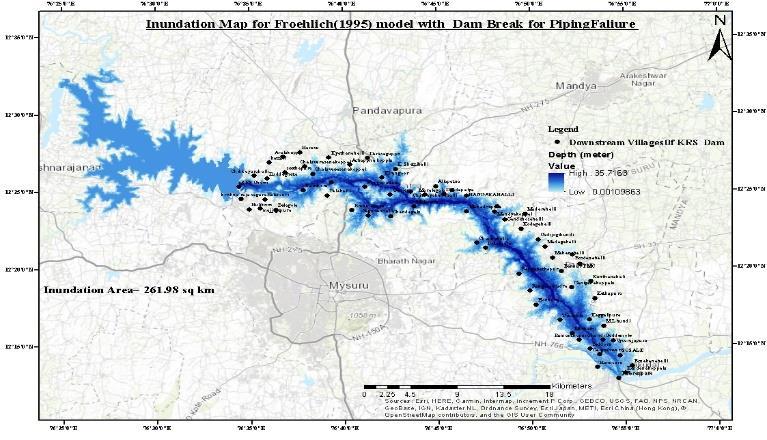
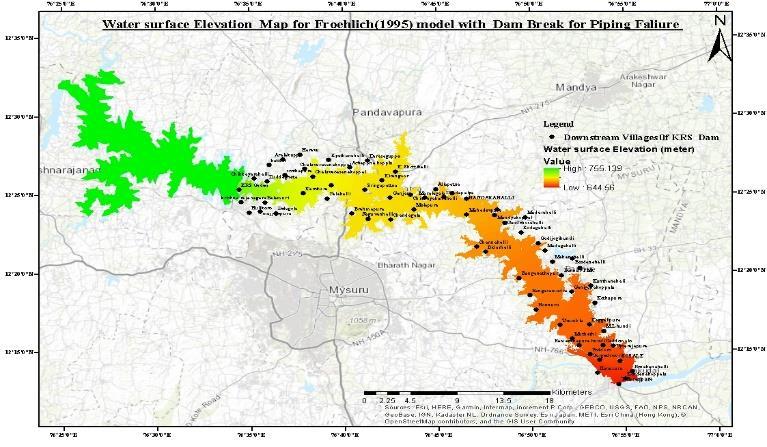
The breach parameters obtained by using different regressionequationsareusedintheHEC-RASfordifferent modes of failure like overtopping and piping failure 2D modeling and the maps have been generated and is given here.
Flood inundation maps with dam break scenario for alltheregressionequationswith
Overtoppingfailureby2Dmodeling.
Pipingfailureby2Dmodeling.
Floodinundationmapswithoutdambreakscenario From
Figure no. to Error! Reference source not found. there showsvariousvillageswhichareinundated.
International Research Journal of Engineering and Technology (IRJET) e-ISSN: 2395-0056
Volume: 12 Issue: 08 | Aug 2025 www.irjet.net p-ISSN: 2395-0072
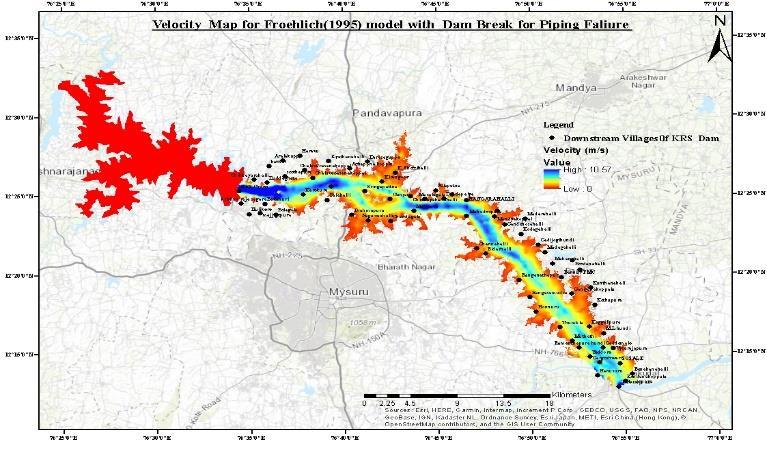
no.10: Velocity Map by with Piping Failure
From the Flood inundation map that are prepared for the KRSdamwithdambreakscenarioshowthat
Thevillageswhicharemajorlyaffectedbythemonthe right of the bank KRS garden, Naguvanhalli, Melepura, Chandagalu, Mahadevapura, Channahalli, Bidarhalli, Ranganathapur, Honnuru, Muthathi, Yeddore, Gargeshwar, T narasipura , Benakanahalli, Balamuri, Karekura,Brahmapura,Chandgala,Naguvalli
The villages Affected on the left bank are Chikkayarahalli, Duddaghata, Seethapura, Ganjam, Hangarahalli, Chaluvarasanakoppal, Sringapattna, Gadijogihundi, Ganiganakoppalu, Gaddemole, Vysarajapura, Sosale, Kunthanhalli, Bannur TMC, Gandehosalli,Kyathanahalli.
The villages which are not affected by the Flood are Katteri, Aralakuppe, Haravu, Achappana, Darasaguppe, Madarhalli, Bidarhalli, Makanahalli, Bannur rural, Kethupura,M.Lhundi,Palahalli,Belagola,Hanusuru.
The villages which are partially affected by the Flood are K. Sheetihalli, Allapatna, Doddapalya, Maragala, Maundagadore,Madagahalli,Gadijogihundi.
7. CONCLUSIONS
Dam failures pose significant socio-economic and environmental risks, necessitating robust risk management and emergency planning. This study assessed potential failure scenarios for the Krishnaraja Sagar(KRS)Dam under overtopping and piping conditio ns.
Keyfindingsinclude:
Maximum inundation area: 288.407 km²
Peak flood velocity: 11.281 m/s
Water surface elevation range: 614.166 m (min) to 755.139 m (max).
The spillway was found sufficient to handle PMF flows, making overtopping failure unlikely. However, piping failure generated higher peak discharges, increasing
downstream flood risks. The study highlighted potential impacts on agriculture, infrastructure, and local economies, reinforcing the need for preparedness measures
Land-use planning and emergency response strategies should incorporate dam break simulations.
Future models should integrate soil properties, vegetation, sediment transport, and highresolution topographic data for improved accuracy.
Enhanced risk assessment frameworks are needed to strengthen disaster mitigation and recoveryefforts.
This study underscores the critical role of predictive modeling in minimizing dam failure impacts and improvingcommunityresilience.
[1] USACE. (2016), HEC-RAS 5.0 Hydraulic Reference Manual,InUser’sManual,Version4.1,2016.
[2] Sachin, Dam Break analysis using Mike11 for lower Nagavali dam and Rukura dam, National Institute Of Technology,Rourkela-769008.,2014.
[3] Soy A, Kenya’s Patel dam bursts, sweeping away homes in Solai, BBC News. https:// www. bbc. com/ news/world-africa-44065340,2018.
[4] Tail Pro Consulting. , Merriespruit Tailings Dam Failure, Virginia,, South Africa. : Tailings. Info. https:// www. taili ngs. info/ cases tudies/ merri espruit.htm,2002.
[5] Graham WJ. , The Teton Dam Failure-, An Effective Warning and. ASDSO Annual Conference. Indian Wells,30.,2008.
[6] RogersJD.,Lessonslearned fromtheSt.francisDam failure.,Geo-Strata,14–17.,2006.
[7] ZagonjolliM, Dam breach modeling, risk assessment and uncertainty analysis for flood mitigation, Doctoral dissertation,, UNESCO-IHE, Institute for Water Education). https:// www. routl edge. com/ Dam- Break- Model ling- Risk Asses sment- andUncer tainty Analy sis- for- Flood/ Zagon jolli/p/ book/ 97804 15455 947. Accessed 10 June 2023 , 2007.
[8] Concha LP, Lall U, Hariri-Ardebli MA, "Needs for portfolioriskassessmentofagingdamsintheUnited States," J Water Resour Plann Manag , p. 149(3):04022083,2003.
International Research Journal of Engineering and Technology (IRJET) e-ISSN: 2395-0056
Volume: 12 Issue: 08 | Aug 2025 www.irjet.net p-ISSN: 2395-0072
[9] World Commission on Dams, "Dams and development: a new framework for decisionmaking:," the report of the world commission on dams.,Earthscan,2000.
[10] Ramola M, Nayak PC, Venkatesh B, Thomas T, "Dam break analysis using hec-ras and flood inundation modelling for Pulichinatala Dam in Andhra Pradesh, India.," Indian J Ecol , vol.48,no.2,p.:620–626,2021
[11] Winarta B, Juwono PT, Ali MI, Ramli NI , "Dam break studies using hydrologic and hydraulics model for Chereh Dam, Kuantan, Pahang, Malaysia.," IOP Conf Ser Earth Environ Sci, vol. 1, no. 2036. https:// doi. org/10.1088/1755-1315/366/1/012036,p.366, 2019.
[12] Amini A, Bahrami J, Miraki A , "Effects of dam break on downstream dam and lands using GIS and Hec Ras: a decision basis for the safe operation of two successive dams.," Int J River Basin Manag , vol. 20:, no.4,p.487–498,2022.
[13] Brunner G, "Using HEC-RAS for Dam Breach Studies," USACEHECTechnical,2014.
[14] Alsubeai A, Burckhard S, "Rainfall-runoff simulation andmodelling usingHEC-HMSand HEC-RASmodels: case study Tabuk, Saudi Arabia," Nat Resour , no. https:// doi. org/ 10. 4236/ nr. 2021. 12100 22, p. 12:321–338.,2021.
[15] RossiCLCU,MarquesMG,TeixeiraED,MeloJFD,Ferla R, Prá MD, "Dam-break analysis: proposal of a simplified approach.," RBRH. https:// doi. org/ 10. 1590/2318-0331.262120200066,2021.
BIOGRAPHIES


Neman Sharif M M ResearchScholar, Department of Civil Engineering, University of Visvesvaraya College of Engineering, BangaloreUniversity,Bengaluru nemansharifmm@gmail.com


Dr. Inayathulla M Professor, Department of Civil Engineering, University of Visvesvaraya College of Engineering, BangaloreUniversity,Bengaluru drinayath@gmail.com